
International Research Journal of Engineering and Technology (IRJET) e-ISSN: 2395-0056
Volume: 13 Issue: 06 | Jun 2026 www.irjet.net p-ISSN: 2395-0072

International Research Journal of Engineering and Technology (IRJET) e-ISSN: 2395-0056
Volume: 13 Issue: 06 | Jun 2026 www.irjet.net p-ISSN: 2395-0072
Fahad Saif Alharbi
College of Computing, Fahad Bin Sultan University, AIMD Lab, KSA, Tabuk
Abstract-Smart cities increasingly depend on interconnected digital technologies, including Internet of Things devices, smart sensors, surveillance systems, cloud computing platforms, artificial intelligence, deep learning, location-based services, and agent-based systems to enhance urban management and improve citizens’ quality of life. Although these technologies provide significant benefits in terms of efficiency, automation, and service optimization, they also introduce serious cybersecurity and privacy challenges due to the high level of connectivity among critical urban infrastructures. This paper discusses the major cybersecurity threats facing smart cities, including Advanced Persistent Threats, ransomware attacks, IoT botnets, AI-driven cyberattacks, and attacks targeting industrial control systems. It also highlights privacy risks associatedwith the collection,processing,and sharing of sensitive citizen data, particularly location information,movementpatterns,andservice-usagerecords. Furthermore, the paper emphasizes the importance of securing software agents, as these agents may operate autonomously, exchange information, access distributed resources, and support decision-making across different smart-city environments. Several protection mechanisms are considered, including authentication, access control, encryption, secure communication, network monitoring, data minimization, anonymization, obfuscation, incident response planning, and human supervision. The paper concludesthatthedevelopmentofsecureandreliablesmart cities requires an integrated security framework that combinescybersecurity,privacypreservation,secureagentbased computing, and responsible use of artificial intelligence and deep learning to ensure service continuity, citizensafety,andpublictrust.
Key Words: Privacy, Security, Smart Cities, Agents, Threats, Controls, Healthcare.
A smart city uses digital technologies such as sensors, connected cameras, smart traffic systems, online services, and smart energy networks to improve city life. These technologieshelpcitiesbecome faster,more efficient,and more organized [1]. However, once many systems are connected, they also become more vulnerable to cyberattacks. CISA (Cybersecurity and Infrastructure Security Agency) explains that smart cities face risk because they create larger and more interconnected attack surfaces,
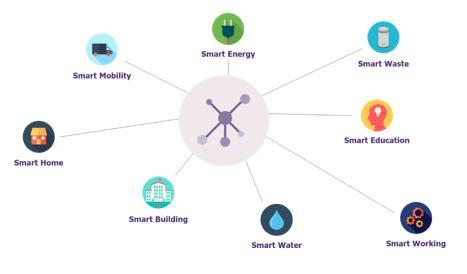
whileNIST(NationalInstituteofStandardsandTechnology) says cybersecurity must be built into smart-city planningfromthebeginning.Figure1showsthatcybersecurityinasmartcityisnotlimitedtoonesystemonly,butaffects multiple connected sectors including mobility, energy, water, buildings, homes, education, waste management,andworkingenvironments.
Systems, transport, emergency communication, or publicservices.Thismeansa cyber-problemina smartcityis notonlyacomputerissue;itcanbecomeapublicsafetyissue. NIST recommends a risk-managed approach so that citiescan identify threats earlyand applysuitable protections.
One major problem is the large number of connected devices. Smart cities depend on IoT devices, cloud systems,communication networks,andsoftware fromdifferentvendors.Ifonedeviceisweak,attackersmayuseitas an entry point. Another problem is poor coordination betweendepartmentsorsuppliers.CISAhighlightsthatconnectedcommunitiesneedstrongcyberpractices,andNIST stresses that cities should choose security processes that fittheirownenvironment.
Themostadvancedcyberthreatsinsmartcitiesinclude Advanced Persistent Threats [2], ransomware [3], IoT botnets [4], AI-powered cyberattacks [5], and attacks on
International Research Journal of Engineering and Technology (IRJET) e-ISSN: 2395-0056
Volume: 13 Issue: 06 | Jun 2026 www.irjet.net p-ISSN: 2395-0072
industrial control systems [6]. Advanced Persistent Threats are highly organized and long-term attacks in which hackers secretly enter smart-city networks to steal sensitive information or disrupt important services. Ransomware attacks are also very dangerous because they can lock critical systems such as hospitals, traffic lights, waternetworks,electricitygrids,andmunicipaldatabases untilapaymentisdemanded.AnotherseriousthreatisIoT botnets, where attackers hijack weakly protected smart devices such as cameras, sensors, meters, and traffic devices, then use them to spy, spread malware, or launch large-scale attacks. In addition, AI-powered cyberattacks are becoming more advanced because attackers can use artificialintelligencetocreaterealisticphishingmessages, discover system weaknesses, imitate normal user behavior,orproducedeepfakecontent.Finally,attacksonindustrial control systems are among the most critical threats because they can directly affect physical infrastructure such as transportation systems, smart grids, and water treatment plants, which may lead to service disruption, publicsafetyrisks,andlossoftrustinsmart-citytechnologies.
To improve cyber security, smart cities need strong passwords, regular updates, network monitoring, controlled access, and clear incident response plans. Staff training is also important because human mistakes often createsecuritygaps.Cybersecurityshouldnotbeaddedat theendofaproject.Itshouldbeincludedfromthedesign stage.
Protection against advanced cyber threats (mentioned above)insmartcitiesrequiresacombinationoftechnical, organizational, and monitoring-based methods [7, 8]. To protect against Advanced Persistent Threats, smart cities should use continuous network monitoring, threat intelligence, zero-trust security, multi-factor authentication, endpointdetectionandresponse,and regularsecurityauditstodetecthiddenattackersearly.Toreducetheimpact ofransomware,citiesshouldapplyfrequentdatabackups, disaster recovery plans, email filtering, employee awareness training, access control, patch management, and network segmentation so that malware cannot easily spread across critical systems. For IoT botnetsand device hijacking, protection methods include strong device authentication, changing default passwords, secure firmware updates, encryption, device inventory management, and isolatingIoTdevicesfromsensitivecitynetworks.AgainstAIpowered cyberattacks, smart cities should use AI-based threat detection, deepfake detection tools, secure identity verification, phishing detection systems, human review of sensitive decisions, and continuous training of employees and citizens. Finally, to protect industrial control systems and operational technology, cities should separate IT and OT networks, use firewalls and intrusion detection sys-
tems, apply strict access control, monitor unusual system behavior, update systems carefully, and prepare incident response plans to ensure that essential services such as electricity, water, transport, and emergency systems remainsafeandavailable.
Smart cities use cameras, sensors, mobile apps, smart transport, and online services to improve daily life. These systemsdependoncollectingandusingdata,whichmakes privacyprotectionveryimportant.Thesmart-citydatacan affectdifferentformsofprivacy.
Privacy protection matters because smart-city systems can collect information about where people go, how they travel,andhowtheyusepublicservices.Ifthisdataisnot handled carefully, it can reduce public trust and expose people to unnecessary monitoring. NIST’s smart-city guidebook recommends a risk-managed approach to privacyandcybersecurityfromthedesignstage.
Themainprivacyrisksincludeexcessivedatacollection, location tracking, public surveillance, data breaches, data sharing without clear consent, weak transparency, and profiling through linked datasets. European Commission highlighted privacy concerns in smart-city data use, and the explains that data-protection rules also apply to technologiessuchasvideosurveillanceandonlineidentifiers.
Smart cameras / CCTV: surveillance in public spaces.
Transport apps / smart ticketing: tracking location andmovement.
Public Wi-Fi and connected devices: identifying usersthroughdeviceornetworkdata.
City data platforms: data breaches or unauthorized access.
Sharedcitydatasets:profilingpeopleby combining informationfromdifferentsystems.
Privacyprotectionishighlightedwhendependingonlocationbasedservicestoenddailyactivitiesinsmartcities by users [9]. All examples mentioned above can be under threat of attacking privacy when integrated with location basedservices.
Smart cities can protect privacy by collecting only necessary data, limiting access, being transparent about data
International Research Journal of Engineering and Technology (IRJET) e-ISSN: 2395-0056
Volume: 13 Issue: 06 | Jun 2026 www.irjet.net p-ISSN: 2395-0072
use, and applying clear governance rules. OECD points to measures such as ethics oversight, opt-out procedures, andstrongerdata-managementpractices,whileNISTsupports privacy-aware risk management as part of smartcityplanning.
When it comes to talking about privacy protection in smart cities, taking into account integration with location based services, there are many protection controls that can be explored through [10, 11, 12, 13]. The most common ways are dummies, encryption, transformation of locationinformation,obfuscation,andclockingregions.It is worth mentioning that all of these ways intersect with a common concept, which isachieving k-anonymity level. It isworthmentioningthatwhenlocationbasedservicesuse webapplications,anotherwaysofprotectionarerequired aswellasdataminingtechniquestodealwithbigdata[14, 15].
Agent-based systems are systems made of autonomous software agents thatcan observe, decide, and act on their own.Inmanycases,theseagentsworktogetherasamultiagentsystemtosolvecomplexproblems.Suchsystemsare useful because they are flexible, distributed, and able to reactquickly[16].However,becauseagentscanmakedecisions and communicate with each other, security becomesa veryimportantconcern. Awell-knownsurvey on multi-agent security identifies access control and trust as keyissues,whileNIST’snewAIAgentStandardsInitiative highlightstheneedforsecureandinteroperableagentsystems.
Security is important in agent-based systems because agents may exchange data, access tools, or perform tasks without constant human control. If one agent is compromised, it may spread false information, misuse permissions, or affect the decisions of other agents. NIST notes that AI agents must function securely on behalf of users, especiallyastheybecomemorecapableandautonomous.
The security of software agents is very important in smartcitiesbecausetheseagentsmayactautomaticallyon behalfofusers,systems,orcityauthorities.Insmartcities, software agents can collect data, make decisions, communicate with other systems, manage services, and supportapplicationssuchastrafficcontrol,healthcare,energy management,transportation,emergencyresponse,andlocation-based services. If these agents are not secure, attackers may manipulate them, steal the data they carry, changetheirdecisions,orusethemasagatewaytoattack smart-city infrastructure. This can lead to privacy viola-
tions, service disruption, wrong decisions, financial loss, andevenriskstopublicsafety.
Moreover, software agents often move between different platforms or interact with many distributed devices, sensors, servers, and cloud systems. This makes them exposed to threats such as identity spoofing, unauthorized access, malicious code injection, data tampering, and communicationinterception.Therefore,securingsoftware agents helps ensure authentication, confidentiality, integrity, trust, and reliable decision-making. In smart cities, wheredigitalsystemsaredirectlyconnectedtoreal-world services, protecting software agents is essential for maintaining citizen privacy, service continuity, and confidence insmart-citytechnologies.
The main security challenges include weak authentication, poor permission control,unsafecommunication, and lackoftrustbetweenagents.OWASPalsowarnsthatagenticapplications face new risksandneed practical security controls during design and deployment [17]. This means developers must think about threats early, not only after thesystemisbuilt.Inaddition,therearea widespectrum of attacks that can be applied to agents-based systems [18]. Many protection controls are developed in [19, 20], wheredummiesisconsideredasoneofthemosteffective controls. It is worth mentioning that power consumption is an important issue linked with agents, where it is addressedinsomeworkssuchas[21].
Agent-based systemscan be protected through identity verification, access control, secure communication, monitoring,logging,andhuman oversightfor sensitiveactions. OWASP recommends treating outside data as untrusted and using validation and clear boundaries before agents act on that data. These controls reduce the chance of manipulationorunauthorizedactions.
Artificial intelligence and deep learning are becoming veryimportantinhealthcare.Theyareusedtosupportdiagnosis, medical imaging, patient monitoring, drug development, and health-system management. WHO (world health organisation) explains that AI can help countries build more people-centered, equitable, and sustainable healthsystems[22].ThisshowsthatAIisnolongerjusta futureidea; it isalready partof modernhealthcare development.
International Research Journal of Engineering and Technology (IRJET) e-ISSN: 2395-0056
Volume: 13 Issue: 06 | Jun 2026 www.irjet.net p-ISSN: 2395-0072
Deep learning is a part of AI that learns patterns from large and complex datasets. A Nature Medicine guide describes deep learning in healthcare across computer vision,natural languageprocessing,reinforcementlearning, and other general methods. This is why deep learning is especially useful for reading medical images, processing clinicalrecords,andfindinghiddenpatternsinhealthdata.
AI and deep learning can help doctors work faster and supportbetterdecisions.FDA(FoodandDrugAdministration) notes that AI-enabled medical devices are already authorized for marketing in the United States, which shows that AI is already being used in real healthcare products. These tools can improve efficiency, assist diagnosis, and support patient care when they are properly testedandregulated.
There are many researchers conducted in healthcare sector that provide advanced diagnosing systems to predict diseases for the sake of protecting health of people, suchas[23,24,25].
Despite these benefits, AI in healthcare also creates challenges. WHO warns that ethics, governance, and humanrightsmustremaincentralintheuseofAIforhealth. FDA also emphasizes safety, effectiveness, and life-cycle management for AI-enabled medical devices. This means AI systems must be monitored carefully because healthcaredecisionsdirectlyaffecthumanlives.
Smart cities depend heavily on connected technologies, IoT devices, cloud platforms, artificial intelligence, deep learning,location-basedservices,andagent-basedsystems to improve the quality of life and efficiency of public services. However, this high level of connectivity also increases cybersecurity, privacy, and system-security risks. Advancedcyberthreatssuchasransomware, IoT botnets, AI-powered attacks, Advanced Persistent Threats, and attacksonindustrialcontrolsystemscanaffectnotonlydigital systems but also real-world services such as transportation,healthcare,energy,water,andemergencyresponse. Therefore,cybersecurity mustbeconsideredfrom thedesign stage through strong authentication, access control, monitoring,encryption,regularupdates,networksegmentation, and incident response planning. In addition, privacy protection is essential because smart-city applications maycollectsensitiveinformationaboutcitizens’locations, movements,activities,andserviceusage.Techniquessuch asdataminimization,anonymization,obfuscation,encryption, and clear governance policiescan help reduce priva-
cy risks. Furthermore, securing software agents is important because agents may act autonomously, exchange data, and make decisions across different smart-city systems. Overall, building a safe and trusted smart city requiresanintegratedapproachthatcombinescybersecurity,privacyprotection,secureagent-basedsystems,andresponsible use of AI and deep learning to ensure service continuity,citizensafety,andpublictrust.
The author takes help of ChatGPT to present illustrative figures as well as for proof reading. However, the basic scientificcontentispresentedbytheauthor.
1) Rehan, Hassan. "Internet of Things (IoT) in smart cities: Enhancing urban living through technology."Journal of engineering and technology5.1 (2023):1-16.
2) Hummelholm, Aarne. "Cyber threat analysis in SmartCityenvironments."EuropeanConferenceon Cyber Warfareand Security. AcademicConferences InternationalLimited,2018.
3) Farid, Farnaz. "A threat analysis framework for cyberattacks in smart cities: Ransomware in focus."AdvancesintheInternetofThings.CRCPress, 2026.101-124.
4) Kim, Donghyun, et al. "Design the IoT Botnet Defense Process for Cybersecurity in Smart City."IntelligentAutomation&SoftComputing37.3 (2023).
5) Khan, Irfan, and Asif Ali. "Cybersecurity Challenges in AI-Powered Smart Cities: A Risk Assessment Framework."(2024).
6) Drias,Zakarya,AhmedSerhrouchni,andOlivierVogel."Analysisofcybersecurityforindustrialcontrol systems."2015 international conference on cyber security of smart cities, industrial control system andcommunications(ssic).IEEE,2015.
7) Shawl, Rashed Qayoom, Manmeet Singh, and Malik Mubasher Hassan. "Leveraging Cyber-Physical SecuritySolutionsBlendedWithMachineLearningfor Advanced IoT Botnet Detection."IEEE CommunicationsStandardsMagazine(2025).
8) Demertzi,Vasiliki,StavrosDemertzis,andKonstantinos Demertzis. "An overview of cyber threats, attacks and countermeasures on the primary do-
International Research Journal of Engineering and Technology (IRJET) e-ISSN: 2395-0056
Volume: 13 Issue: 06 | Jun 2026 www.irjet.net p-ISSN: 2395-0072
mains of smart cities."Applied Sciences13.2 (2023):790.
9) Mohamad Shady Alrahhal, Maher Khemakhem and Kamal Jambi, "A Survey on Privacy of LocationBased Services: Classification, Inference Attacks, andChallenges,"JournalofTheoreticalandApplied InformationTechnology,vol.95,no.24,2017.
10) Mohamad Shady Alrahhal, Maher Khemakhem and Kamal Jambi, "Agent-Based System for Efficient kNNQueryProcessingwithComprehensivePrivacy Protection," International Journal of Advanced Computer Science and Applications, vol. 9, no. 1, 2018.
11) MohamadShady Alrahhal,MuhammadUsman Ashraf,AdnanAbesenandSabahArif,"AES-RouteServer Model for Location Based Services in Road Networks,"InternationalJournalofAdvancedComputerScienceandApplications,vol.8,no.8,2017.
12) Hosam Alrahhal et al., "A symbiotic relationship based leader approach for privacy protection in location based services," ISPRS International Journal ofGeo-Information,vol.9,no.6,p.408,2020.
13) Abdullah S. Alyousef, Karthik Srinivasan, Mohamad ShadyAlrahhal,MajdahAlshammariandMousa AlAkhras, "Preserving Location Privacy in the IoT againstAdvancedAttacksusingDeepLearning,"International Journal of Advanced Computer Science andApplications,vol.13,no.1,2022.
14) Majed Abdullah Albarrk and Mohamad Shady Alrahhal, "Web Applications Security: More Collaboration,"2020.
15) MohamadShadyAlrahhalandAdnanAbiSen,"Data mining,bigdata,andartificialintelligence:Anoverview,challenges,andresearchquestions,"2018.
16) Cardoso, Rafael C., and Angelo Ferrando. "A review of agent-based programming for multi-agent systems."Computers10.2(2021):16.
17) Sinan, Maysa.Support Security Control ManagementandImplementationinDevSecOps.Diss.RMIT University,2025.
18) Bandar Alluhaybi, Mohamad Shady Alrahhal, Ahmed Alzhrani and Vijey Thayananthan, "A Survey: Agent-based Software Technology Under the Eyes of Cyber Security, Security Controls, Attacks and Challenges," International Journal of Advanced Computer Science and Applications, vol. 10, no. 8, 2019.
19) Bandar Alluhaybi, Mohamad Shady Alrahhal, Ahmed Alzhrani and Vijey Thayananthan, "Dummybased approach for protecting mobile agents against malicious destination machines," IEEE Access,vol.8,pp.129320-129337,2020.
20) Bandar Alluhaybi, Mohamad Shady Alrahhal, Ahmed Alzhrani and Vijey Thayananthan, "Achieving self-protectionandself-communicationfeaturesfor securityofagent-basedsystems,"2020.
21) Mohamad Shady Alrahhal, Maher Khemekhem and Kamal Jambi, "Achieving load balancing between privacyprotectionlevel and powerconsumptionin location based services," International Research JournalofEngineeringandTechnology,vol.5,no.3, pp.619-625,2018.
22) WorldHealthOrganization.WHOglobalstrategyon people-centred and integrated health services: interim report. No. WHO/HIS/SDS/2015.6. World HealthOrganization,2015.
23) Mona Alfifi, Mohamad Shady Alrahhal, Samir Bataineh and Mohammad Mezher, "Enhanced ArtificialIntelligenceSystemforDiagnosingandPredicting Breast Cancer using Deep Learning," International Journal of Advanced Computer Science and Applications,vol.11,no.7,2020.
24) Mohamad Shady Alrahhal and Eftkhar Alqhtani, "Deep learning-based system for detection of lung cancerusingfusionoffeatures,"InternationalJournalofComputerScienceandMobileComputing,vol. 10,no.2,pp.57-67,2021.
25) Mohamad Shady Alrahhal and Majed Abdullah Albarrk, "A Survey of the COVID-19 Epidemic ThroughtheEyesofArtificialIntelligenceandDeep Learning: Challenges and Research Questions," 2020.