
International Research Journal of Engineering and Technology (IRJET) e-ISSN: 2395-0056
Volume: 13 Issue:06| Jun 2026 www.irjet.net p-ISSN:2395-0072
International Research Journal of Engineering and Technology (IRJET) e-ISSN: 2395-0056
Volume: 13 Issue:06| Jun 2026 www.irjet.net p-ISSN:2395-0072
Anubhav Patil1, Prof. Sunny Nahar2
1Master of Computer Applications, Vivekanand Education Society's Institute of Technology, Mumbai, India 2Assistant Professor, Vivekanand Education Society's Institute of Technology, Mumbai, India
Abstract - To immerse the player fully in interactive digital environments, much more is required than realistic graphics. Music and sound are also important and building believable sound environments is critically dependent on a proper simulation of sound propagation and interaction in complex virtual environments. This paper compares and contrasts all of the spatial audio technologies that are employed in existing modern game engines, with the origins of the basic research in room acoustics and spatial audio since the early 1960s. This work is a systematic survey and conceptual taxonomy, and did not include any original empirical experiments.
Key Words: Spatial Audio, Game Development, Adaptive Rectangular Decomposition, Beam Tracing, Ray Tracing, HRTF Personalization, SAMOSA, Presence, Head-Related Transfer Function, Sound Propagation, Wave-Based Acoustics, Binaural Rendering, Perceptual Evaluation, Deep Learning Audio.
Musicandsoundaremorethanjustaprettyfacetoadorn a game; they're a part of the total experience and the experience of a player who plays in a virtual world. In many contexts, information is conveyed prior to visual information. Someone walking down a narrow stone passage can hear approaching footsteps well before they see the person coming, and an open courtyard will immediately give the sense of scale when a player walks into a large cathedral with reverberation and echo. In the absence of these auditory signals, when exaggerated or impossibletoperform,thesenseofpresenceisdiminished and gives the player the realization that they are interacting with a virtual reality, and not a believable world[1,2].
While the computer graphics have made a remarkable developmentinthelastfewdecades,thespatialaudiohas not progressed in the same pace. Today's game engines can produce highly detailed environments via real-time rasterization and even path-traced lighting that can rival
photos on consumer hardware. Many commercial games, however, still employ much the same kind of simplified models and approximations that were developed decades ago. This mismatch has been described by several researchers as an "immersion gap", where the degree of realisminthevisualdomainhasgrownconsiderablywhile theauditorydomainhasbeencomparativelylittle[4,5].In recent surveys, similar assessments of spatial audio features in virtual environments have been investigated. More specifically, Melchior et al. [3] assessed the spatial audio formats and the possibility of spatial reproduction onimmersiveplatforms.Althoughtheirattentionismostly on documenting the existing production workflow and consumer delivery capabilities of standard virtual reality systems, this paper extends their analysis by compiling and formalizing the prior work to develop a formal comparative taxonomy of the underlying physical propagation mechanisms (geometric, wave-based, and hybrid), and proposes a conceptual implementation of a real-time semantic-acoustic pipeline (SAMOSA+ARD), that would enable the use of dynamic scene geometry, as well asaproposedstructuredevaluationprotocol.
The challenge isn't a lack of understanding of acoustic principals. The location and characteristics of sounds are determined by human beings with a combination of perceptual cues such as Interaural Time Difference (ITD), InterauralLevelDifference(ILD),andthespectralfiltering effectsdue to the head and torsoand outer ears. All these effects are summarized in the HRTF (Head-Related Transfer Function). Accurately reproducing these cues in real-time becomes increasingly difficult as the sound sources, listeners and environments are constantly changing. Consequently, spatial audio has typically been a by-product of computational efficiency and perceptual realism,andnotakeydesigngoal[6,7].
But this is beginning to change, with a number of technological trends bringing a resurgence of interest in spatialaudioresearch.TheswiftadvancementofExtended Reality (XR) technologies such as Virtual Reality (VR) and Augmented Reality (AR) are significant factors. Visually, the amount of information available to the user is limited, whichmakessoundamorecriticalformofinformationfor
International Research Journal of Engineering and Technology (IRJET) e-ISSN: 2395-0056
Volume: 13 Issue:06| Jun 2026 www.irjet.net p-ISSN:2395-0072
navigation, awareness and environmental perception in IHMDs.Consequently,spatialaudiohasbecomeakeypart of the overall user experience, and not just an add-on [3, 8]. The other is the ongoing development of GPU computing.Moderngraphicshardwareispowerfulenough to run acoustic simulations that would have been impractical and too wasteful to do real-time, previously. Until now, techniques based on wave-based methodology were only used in offline study settings, but are now becoming feasible for interactive systems and game engines [9, 10]. The third big development is the appearanceofmachinelearningmethodsforspatialsound processing. In recent years, there have been significant advances in creating personalized Head-Related Transfer Functions (HRTFs) from geometric information of listeners' anatomical structures. The last few years has seengreatprogressinthefieldofpersonalizationofHeadRelated Transfer Functions (HRTFs) using geometric measurements of a listener's anatomy. They represent a convenient alternative to the conventional HRTF acquisition techniques, which involve expensive anechoic chamberrecordingsandspecific equipment.Inthispaper, these developments are synthesized by means of a structured comparison of the current state of the art in spatial audio technology. The most important acoustic modelling techniques, namely geometric, wave-based and hybrid techniques will be discussed and compared in terms of performance, based on quantitative results reported in the literature. The existing commercial HRTF personalization solutions and game-engine integrations are also discussed, as are existing concepts for HRTF personalization and the demographic coverage of the available HRTF databases. Moreover, we introduce a perceptual evaluation scheme based on proven psychoacoustic principles and highlight some of the research challenges that need to be pursued in the quest fornextgenerationimmersiveaudiosystems.
This paper synthesizes prior work and proposes four conceptualcontributions:
(1) Systematic Comparative Taxonomy: A structured classification of Geometric, Wave-based, and Hybrid acoustic models with quantitative performance benchmarks derived from a systematic survey of more than50primarysources,identifyingtheimmersiongapin nativeenginearchitectures[4,13].
(2) Multimodal Simulation Framework: A proposed conceptual pipeline (SAMOSA+ARD) for fusing real-time on-device RGB-D sensor data with GPU-accelerated wave
equation solvers for physically-plausible XR rendering, extending the on-device sensing framework of Xu et al. [12].
(3) Auditory Equity Analysis: A structured critique of the demographic bias in existing HRTF corpora, with recommendations for inclusive dataset construction [14, 15].
(4) Proposed Perceptual Evaluation Protocol: A proposed dual-method assessment framework for future empirical validation, integrating expert Likert-scale rating with inferential statistical verification, calibrated for spatial audioqualitymeasurement[16,17].
The research on computational room acoustics has its origins in the concepts used in geometric optics, treating sound in a similar way to light. In this method, sound is propagated as rays which are emitted from a source, reflected from surfaces, and lose energy as they travel through space. One of the earliest and more influential worksin thisarea wasby Schroeder and Atal (1963) who createda systematiccomputational schemeforsimulating room impulse responses. They were the precursors to muchoftheacousticmodellingwhichfollowedforthenext fewdecades[18].
The game industry, however, took much easier paths to audio simulation in the late 1980s and early 90s. Most of the games used simple distance-attenuation models in which the volume of sound reduces as the distance between the sound source and the listener increases and which also sometimes involved simplified ray-casting checks to see if an object was blocking the sound path. Thesemethodswerealsorelativelysimpletocalculateand were appropriate for the hardware that was available at thetime.Buttheyfailedtomakeanyattempttorepresent important acoustic features like reflections, diffraction, reverberation, and frequency-dependent absorption. Consequently, the inside of homes was frequently the same.Eventhoughthedifferenceinthephysicalmaterials betweenalargestonedungeon,aconcretewarehouse,and a carpeted office is clear, each can yield almost the same acousticresponses.
Inthelate1990s,therewasamoresignificantrelationship between the worlds of acoustics and interactive graphics. One of the pioneering contributions was SIGGRAPH 1998 virtualenvironmentinteractivebeam-tracingsystem(IBS) byFunkhouseretal.Theyfoundthatbeamtracingwasone
International Research Journal of Engineering and Technology (IRJET) e-ISSN: 2395-0056
Volume: 13 Issue:06| Jun 2026 www.irjet.net p-ISSN:2395-0072
of the most promising methods to obtain interactive acousticsimulationofcomplexscenesatthe timebecause it was efficient for simulating high order specular reflections and yet still had a reasonable computational cost. To build on this momentum, Tsingos et al. [19] proposed precomputed reverberation methods that decoupled costly computation of the geometry from the real-time rendering of the audio. This innovation enabled location-dependent reverberation effects for interactive applications, and was a significant advance towards more realisticvirtualacoustics[19].
Meanwhile, commercial audio middleware had started to come into the game development marketplace. In 1998 Creative Labs enhanced its own application programming interface for environmental reverberation by launching Environmental Audio Extensions (EAX), which made the process of adding the effect to audio possible by utilizing pre-defined acoustic presets. EAX did not model the acoustics from real geometry, but instead used manually set parameters; even so, it set the precedent that games should have some sort of environmental modelling of audio,iftheimplementationwasrelativelysimple[20].
This phase of the game sound evolution took place from 2005 to 2015.This is another major era in game audio technology development, so the 2005-2015 time frame is the period of evolution. This decade saw the arrival of a number of important middleware platforms, such as Audiokinetic'sWwise,Valve'sSteamAudio(with research from Intel's RealSense projects) and Firelight Technologies' FMOD. These systems slowly evolved the development possibilities, enabling the creation of more sophisticated applications to simulate propagation, environmentandspatialaudiorendering.Astimewenton, they were expanded to include elements like real-time acoustics from ray-tracing, dynamic occlusion modelling, and HRTF-based binaural rendering, which has brought game sounds closer to physically-informed acoustics than everbefore[21].
One of the most prominent and early developed methods forsimulatingsoundreflectionsinenclosedenvironments is the Image Source Method (ISM). The method was first introduced by AllenandBerkley(1979)and subsequently expanded to three dimensional spaces by Borish (1984), and models reflections using virtual copies of the sound source. The virtual, or "image," sources are created when theoriginalsourceisreflectedonreflectivesurfacesinthe environment.Theresultantroomimpulseresponseisthen computed as the sum of the contributions to the sound
from the real source and all of the valid image sources throughaspecifiedreflectionorder[22,23].
The major benefit of ISM is the geometric accuracy. The methodyieldsveryaccurateresultsforthereflectionpaths that it correctly models and accurately represents the physical behaviour of specular sound reflections. The accuracy is, however, costly because of the amount of computation required. The larger a scene's surface count, the more image sources a scene can have. The approximationofthenumberofimagesourcesthatwillbe generated at reflection order r for an environment containing N_w planar reflective surfaces is O(N_w^r) = N_w \sum_{i=1}^{r} (N_w - 1)^{i-1}. This formulation assumes that walls are flat and perfectly reflecting, and that there are no occlusions, wall boundaries, and wave diffraction. This results in that many computed image sources are not physically blocked or invalid, and have to bepruned,whichisveryexpensive.Thisformulamaythen be considered an approximation of the number of possibilities of specular reflection path and may be useful only in the real time environment with low reflection ordersingeometricallysimpleenvironments.
Due to this constraint, most practical applications only considerthreeorfourordersofreflections.Thisisenough to recreate the early reflections which are important to spatial perception and source localization. But higher order reflections, which play an important role in late reverberationandtheoverallacousticqualityofthespace, areoftenignored. Thisconstraint isespeciallychallenging for large scale or geometrically complex virtual environments, such as a dense urban environment with thousandsofbuildingfacadesoranaturalcaveswithnonuniformstructuresandnon-uniformsurfaces[13,24].
However, the scalability issues do not deter ISM from being important in current acoustic simulation systems. It isparticularlyusefulforreproducingearlyreflectionpaths accurately, which is crucial for producing the direct path and near-direct path acoustic cues that are the most perceptually important for listeners. Many current hybrid pipelines use ISM for modelling low-order reflections, but useothermethodsforthelate-reverberationportionofthe sound field such as stochastic ray-tracing or statistical reverberation models to approximate the later componentsinthesereflections[25].
TheRayTracingMethod(RTM)isatechniqueadaptingthe principles of ray tracing in optics, for the simulation of propagation of sound in an environment. RTM does not
International Research Journal of Engineering and Technology (IRJET) e-ISSN: 2395-0056
Volume: 13 Issue:06| Jun 2026 www.irjet.net
explicitly calculate each and every reflection path, but rather it shoots a massive amount of “rays” of sound particles from the point of origin and traces their interactionwithnearbysurfaces.Evacuatedraystransport an amount of acoustic energy which decreases with their travel throughdistanceattenuationandenergylossesdue to surface absorption. If a ray arrives at the listener, or crosses a user-defined detection volume surrounding the listener,thenitisaddedtotheresultantimpulseresponse [26,27].
RTM is much more applicable to environments with complex or irregular geometry as compared to the Image Source Method. Its computational cost is essentially not influenced by the number of possible combinations of reflectionoftherays,butisonlyinfluencedbythenumber of rays being traced. This results in performance that scales more predictably and thus allows the technique to be used in large virtual scenes like urban environments, industrial installations or large natural landscapes, where image-sourcemethodsaretoocomputationallyexpensive.
Nevertheless, there are some drawbacks to the method. SinceRTMisaMonteCarlosimulation,theaccuracyofthe simulation will depend greatly on the number of rays generated.Ifthenumberofsamplesisnotadequate, there willbestatisticalnoiseintheimpulseresponse,especially in the late reverberation region where there are many reflections from the same source but each reflects a small amountof energy.Togeta smoothandreliable resultone mayneedtotraceaverylargenumberofrays,thusadding tothecomputationalcost.
Another drawback is the fact that some reflection paths can be overlooked. RTM only propagates a subset of all possible propagation paths, so some acoustically significantspecularreflectionsmightnotbetraced.Thisis known as the "missing-path" problem, and can result in noticeable differences in the sound field audible to listeners, particularly in settings where the reflections are loudanddistinct.Inthesesituationslistenersmayhearan echoorlackofconsistencyinwhattheyhear,butmaynot completely suspect the method is not working efficiently [28].
Despite these challenges, ray tracing remains one of the most widely used approaches for real-time acoustic simulation. Its ability to handle large and geometrically complex environments has made it a key component of moderngameenginesandspatialaudiomiddleware.Many contemporary systems further improve its performance and accuracy by combining ray tracing with complementary techniques, creating hybrid acoustic
p-ISSN:2395-0072
models that balance computational efficiency with perceptualrealism.
Usingdeterministic pyramidalbeamsinsteadofstochastic rays, Beam Tracing, formalized by Funkhouser et al. (1998), is an improvement over RTM. The energy in each beamisinacoherentcone.Thebeamtracingmethodisan efficient method that reduces the amount of computation required compared to exhaustive ray casting by taking advantageofthespatial coherenceofneighbouringbeams that share the processing surfaces. A technique such as Binary Space Partitioning (BSP) trees or other spatial acceleration structures enable identification of surfaces intersected by each beam in a short amount of time [13, 29].
Themainbenefitofbeamtracingisthatitcanproducethe second, third and higher order specular reflections at interactive rate for moderate scene complexity. The original implementation by Funkhouser was successful in the auralization of architectural scenes having several hundred polygons. There have been more recent implementations that extend this to tens of thousands of polygons,basedonhierarchicalvisibilitypruningandGPU parallelization[30,31].
Geometrical acoustics is based on the assumption that sound travels as rays; this is a valid assumption when the wavelengthsofthesoundaresmallcomparedtothesizeof thegeometryaround which soundtravelsandanyobjects init.Inthiscase,soundreflectionscanberepresentedbya similar model to light rays, which allows for geometric modellingtobeusedefficientlytoagoodapproximationin alargenumberofapplications.
This assumption is not as true at lower frequencies, though. Typical indoor environments usually have frequencies below a certain threshold (physically defined astheSchroedercrossoverfrequencyfs=2000 sqrt(RT60 /V)wherethereverberationtime,RT60,isinsecondsand the room volume, V, is in cubic metres), where wavelengths are comparable or greater than many architectural features. This formula is valid for a statistically uniform sound field, where the sound is spread out. With this assumption, the transition between low frequency discrete wave modes and high frequency overlappingspecularreflectionsistakentobeatf=fs.The crossover frequency for normal domestic rooms or in small studios ranges from 300 to 500 Hz. In these spaces
International Research Journal of Engineering and Technology (IRJET) e-ISSN: 2395-0056
Volume: 13 Issue:06| Jun 2026 www.irjet.net p-ISSN:2395-0072
with very strong definition (coupled volumes, long corridorsetc.)thistransitionisgradual,andtheformulais only approximate. At frequencies lower than this, sound does not appear to be made up of independent rays. Rather, it has been found to demonstrate complex wave phenomena like diffusion, interference and modal resonances[24,28,32].
Becausetheseeffectsarisefromthewavenatureofsound, they cannot be accurately represented using purely geometricapproaches.Consequently,geometrical acoustic models often struggle to reproduce low-frequency behaviour,leadingtoinaccuraciesinthesimulationofbass response, room resonances, and sound propagation around obstacles. Addressing these limitations requires the use of wave-based simulation techniques that directly model the underlying physics of sound propagation, particularly in environments where low-frequency accuracyisimportant.
A wave-based approach to the acoustic simulation that is widely studied is the Finite-Difference Time-Domain (FDTD) method. In particular, FDTD is based on the 3D acoustic wave equation: \partial^2 p / \partial t^2 - c^2 \nabla^2 p = 0, with the acoustic pressure p(x, t) measured in Pascals, the speed of sound in metres per second, and t being time. The 3D Laplacian operator is \nabla^2 = \partial^2/\partial x^2 + \partial^2/\partial y^2+\partial^2/\partial z^2.Thisequationis basedona linearpropagationofsoundinahomogeneousandlossless air medium. It is very useful for modelling low-frequency wave phenomena (diffraction and interference), but has a number of limitations: it doesn't take account of the viscosityoftheair,heatlossesandpropagationeffectsthat are not linear at high sound pressure levels. In contrast, instead of assuming that sound is propagated as rays, FDTD numerically solves this wave equation, by dividing the space around the ear into a regular lattice and calculating the time evolution of sound pressure at every lattice point. Each time the simulation is stepped forward, the pressure values are calculated following finitedifference equations which represent physical behaviour ofsoundwaves.
FDTD has several main benefits over other geometric methods in that it is able to accurately capture wave phenomena that are not captured by geometric methods. Asitisbasedonthedirectmodellingofsoundpropagation fromthewaveequation,itisnaturalthatitisabletomodel diffraction around obstacles, constructive and destructive interference,scatteringandroomresonances.Themethod
is also very flexible and allows for complex boundary conditions as well as a multitude of geometries of the environmentthatcanbehandled[32,33].
Even though very accurate, FDTD is a very costly computational method. The resolution of the spatial grid used should be fine enough compared to the shortest wavelength simulated to ensure numerical stability and accurate simulation. This is normally done by specifying a gridsize,(space)Δx≈1/10λ(orΔx≥10cells/λ),whereλ is the smallest wavelength of interest, following the standard FDTD stability rules. But other low dispersion FDs are able to be used closer, closer to 6-8 cells/wavelength value. Hence, even a small-scale simulation,withfrequenciesupto1kHz,couldentailtens of millions of grid cells, where each cell would have to be updatedpersimulationtimestep[32,33,34].
Numerical dispersion is a difficulty that occurs in the process of discretization and is caused by the grid. Where the speed of different frequency components of the pulse is slightly different, depending on their frequency, as they would be in a real physical environment, numerical dispersion will cause distortions which will become more pronounced with increasing frequency. These errors can be generally reduced by using a smaller spatial grid to increase the number of calculations needed or by using a higher-order finite difference scheme with an increase in thecomplexityofimplementation[33].
Duetotheserestrictions,full-spectrumFDTDsimulationof large-scaleindoorsituationsisstilltimeconsuming.While the practicality of wave-based acoustic simulation has advanced greatly with today's GPUs, most current hardware is unable to accommodate real-time FDTD modelling of room-scale spaces over the entire audible range. For this reason, FDTD is most often applied in research applications, in offline acoustic analysis or in hybrid simulation approaches in place of real-time simulation[33,35].
Traditional wave-based methods are often complex and time consuming due to their computational requirements, so Raghuvanshi et al. [9] proposed the Adaptive Rectangular Decomposition (ARD) approach to overcome these difficulties and retain the physical accuracy of the wave simulation results, but with reduced computational cost [9]. ARD was conceived as an efficient tool for simulation of low-frequency acoustic propagation in architectural settings, which is hardly feasible for FiniteDifferenceTime-Domain(FDTD)methods.
International Research Journal of Engineering and Technology (IRJET) e-ISSN: 2395-0056
Volume: 13 Issue:06| Jun 2026 www.irjet.net p-ISSN:2395-0072
ThefundamentalideaonwhichARDisbasedisthesimple observation that in many of the indoor spaces there are few ornoobstaclesthatblock thepathoftheairandso it can be modeled as rectangular areas. Unlike FDTD, ARD divides the space into a set of ‘sub-domains’ that are rectangular and are connected together. Thepressurep is expandedinthesub-domains[36]x[36]x[36]as:p(x,y,z, t)=\sum_{l,m,n}q_{l,m,n}(t)\cos(l\pix/L_x)\cos(m\pi y/L_y)\cos(n\piz/L_z),wherethemodalindicesl,m,n, and the time varying modal amplitudes q_{l, m, n}(t) are defined.Theexpansionisintheassumptionthattheinner boundaries of each rectangular box are rigid (reflecting). Then pressure and velocity continuity boundary conditions are applied to the common boundaries of the adjacentsub-domains:p_i=p_jand\partialp_i/\partialn =\partialp_j/\partialnwithnormalnpointingoutofthe interface.Themajordrawbackisthatthismethodcanonly beappliedtorectangularsub-domains;curvedorirregular boundaries have to be subdivided in steps or staircases that can cause errors. This makes the problem of solving this propagation in a domain one of computing Discrete CosineTransforms(DCTs),ataskthatiswelloptimizedin modernGPUs.
Such an approach is extremely cost-effective in terms of computation time while maintaining the ability to model key wave phenomena like diffraction, interference and room resonances. ARD takes advantage of the mathematical structure of rectangular spaces and the efficient implementations of DCT on GPUs to achieve performancelevels,whichwouldbehardtocome bywith conventionalwave-equationsolvers.
One possible source of error is at the interfaces between the neighboring rectangular domains. In practical architectural spaces, which generally are not rectangles, the transmission of sound through shared boundaries can only be approximated and not exactly represented. As a result, there will be some error in transferring acoustic energy between neighbouring sub-domains. But experiments done by Raghuvanshi and his co-workers demonstrated that most of the errors were small and are perceptually insignificant for most of the architectural environmentsfacedinpractice[9].
The performance gain from ARD is very scene dependent and architecture dependent for GPUs. In the particular experimental situations presented by the original authors on 2009-era hardware (NVIDIA GeForce 8800 GTX), ARD showed a factor of ~200 times faster than equivalent FDTD simulations. This was a significant improvement in computational efficiency for the simple rectangular domain of moderate size (about 100-fold less) allowing
low-frequencyroomimpulseresponsestobegeneratedin near real-time. Many subsequent studies and optimizations for the GPU have boosted the efficiency, making ARD one of the most convenient wave-based methodsforinteractivesimulation[9,37].
Hence,ARDisseenasavitallinkbetweenthehighlevelof accuracy of the wave solvers, but also as one of the necessarycriteriaforreal-timeapplications.Itshowsthat, by using the principles of intelligent domain decomposition and using numerical techniques that are accelerated by hardware, physically based acoustic simulation can be made much more useful and more viable, and much more useful for more advanced spatial audio systems in games, virtual reality, and architectural acoustics.
The more accurate wave-based acoustic simulation methods are only applicable if most of the computation is performed at a precomputation stage, outside the run time. On the basis of the previous work of Adaptive RectangularDecomposition(ARD),Raghuvanshietal.[37] proposedamethodallowingfortheacousticrenderingofa dynamic listener and/or sound source position with high realismbyemployingprecomputedacousticdata[37].
Themaininnovationinthismethodisthepreparationofa seven dimensional (7D) acoustic transfer function. The transfer function is the propagation of sound in an environment as a function of three coordinates of the source position, three coordinates of the listener position and one frequency dimension. That is, it stores the acoustical connection between any source and listener position in a certain scene, over a frequency range. This information is calculated beforehand, so during the actual runningofthesystem,thesystemdoesn'tneedtosolvethe complexwaveequations.
The7Dacousticfieldiscreatedandsavedasacompressed datastructure.Therequiredacousticresponsecanthenbe computed during run time, through a query of this database, and by performing some interpolation between cachedprecomputedresponses.Theseoperationsarealso easily performed in the computer, so that very little processing overhead is required to achieve wave-accurate spatial audio. This allows for a high degree of acoustic realism to be achieved that would not be possible with interactive applications with only real-time wave simulation.
International Research Journal of Engineering and Technology (IRJET) e-ISSN: 2395-0056
Volume: 13 Issue:06| Jun 2026 www.irjet.net p-ISSN:2395-0072
The chief drawback of this is that it requires a certain amount of constancy in the environment. The acoustic transfer function is precomputed for a given scene geometry and will not reflect changes in the geometry, if thathappens,thestoreddatawillnotbevalid.Thismeans thatthewholeacousticfieldneedstoberecalculatedinthe field every time the walls, obstacles or significant environmental elements change. This requirement limits the use of this technique to static environments or scenes wheretheacousticboundariesdonotchangeveryoften.
Under this constraint, precomputed wave simulation is one of the best solutions to provide physically plausible spatial audio in an interactive system. It takes the approach of sacrificing storage space and offline computation in exchange for being efficient in real-time, and ends up achieving a compromise between acoustic realism and performance that is hard to replicate with purely real-time wave-based approaches. Precomputed acoustic fields are therefore becoming a part of the very sophisticated virtual reality, architectural acoustics or interactive simulation systems in which the geometry of theenvironmentvariesonlytoasmalldegree.
Manyresearchershavecometotheconsensusthatneither geometric nor wave-based modelling approaches for acoustics can be used separately to meet all the needs of real-time spatial modelling. While each one has some major strengths, none of them has any major weakness thatwouldpreventitsusealone.
Geometric methods (e.g. Image Source Method, Ray Tracing) are very useful for the modelling of propagation of sound over long distances and for capturing highfrequency phenomena like specular reflections. They are alsoveryefficienttocomputeandcanbeusedinrealtime and virtual environments with complex needs. These techniques, however, are unable to accurately represent important low frequency phenomena like diffraction, resonanceandinterferenceintheroomduetothefactthat theyweregroundedonraysandnotwaves.
Wave-based methods tackle just these issues. They can directly solve the acoustic wave equation, thus faithfully representingthewidevarietyofacousticphenomena,such asrepresentingthebehaviouroflow-frequencysoundand complexacousticinteractions.Unfortunately, thisphysical accuracy is very expensive to compute and would be impractical in most interactive applications and in large
environmentsinrealtime,whereafull-spectrumwavecan becalculated[28].
The limitations of these approaches have stimulated the growinginterestinresearchonhybridsystems,combining thebestofbothworldsinspatialaudio.Atypicalapproach istopartitiontheacousticspectrumtodifferentfrequency bands,andusedifferentsimulationmethodsforeachband. Wave-based methods are employed to the low-frequency componentswheretheeffectsofwavesareprominent,and the high-frequency components are simulated by the geometric approach, which can effectively simulate the reflection and propagation behaviour. The crossover frequency between these two regions is usually set at the Schroeder frequency fs, which is a function of the room volume and reverberation time and typically falls in the range300-500Hzintypicalrooms,butvariesaccordingto theroomvolumeandreverberationtime[24,28,38].
Thisisafrequencydomainpartitioningthatoffersanideal balance between the physical realism and computational efficiency. Hybrid systems can be used to model a wider variety of phenomena than either of the two methods could, when applied individually. This has led to the developmentofoneofthemostpromisingapproaches for nextgenerationspatialaudio,geometric-waveframeworks thatarehybrid,meaningthattheycombinebothgeometric and wave front methods.This has paved the way for the developmentofoneofthemostpromisingframeworksfor the next generation of spatial audio, hybrid geometricwave frameworks, which merge both geometric and wave front approaches in a scalable way toward more realistic and immersive sound simulation for games, virtual reality andotherinteractivecontexts.
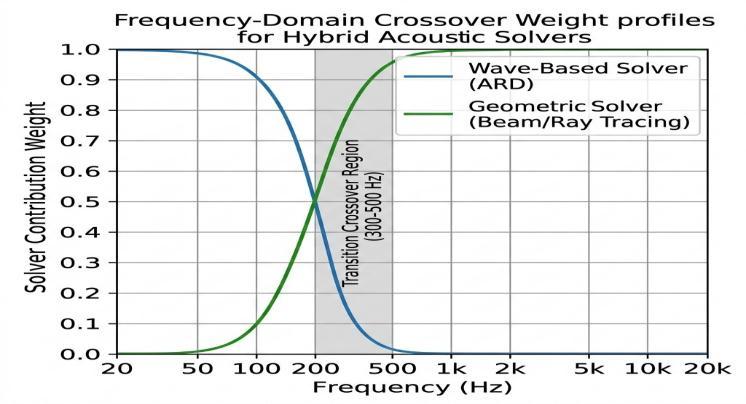
Fig-2: Crossoverweightprofilesforhybridroom-acoustic solvers,demonstratingthetransitionregion(300–500Hz) wherewave-basedmethods(ARD)andgeometricmethods (Beam/RayTracing)areblended.
International Research Journal of Engineering and Technology (IRJET) e-ISSN: 2395-0056
Volume: 13 Issue:06| Jun 2026 www.irjet.net p-ISSN:2395-0072
Since the acoustic phenomena differ with respect to the requirements of the algorithms used for simulation, a few workshaveinvestigatedhybridimplementationsinwhich multiplemodellingmethodsareusedinthesamepipeline. AparticularlyinterestingoneisthatproposedbySikoraet al. (2018), which combines beam tracing for early reflections and ray tracing for late reverberations, and utilizes the best attributes of both while avoiding their shortcomings[25].
The goal of this division is to draw inspiration from the differingperceptualrolesofearlyandlateacousticenergy. The first reflections (lasting less than 100 milliseconds after the direct sound) are important for spatial perception. They are crucial for directing listeners' attentiontothesound'sorigin,formakinglistenersaware of the spatial context of the sound, and for giving the listener a sense of externalization of the sound source. These reflections are extremely sensitive to propagation paths,andbeamtracingcanhelpdeterminethepathsand provide a geometrically precise representation of the paths that are important for these reflections, thus enablingthesereflectionstobereplicated.
Bycontrast,latereverberationistheresultofanenormous amount of higher order reflections that have bounced manytimesoffthewalls.Atthispoint,listenerstendtobe less attentive to the precise direction in which each reflection is travelling and more sensitive to how the energy fades and spreads out as a whole in the environment. Stochastic ray tracing is thus a good alternative for statistical approximation of the perceptual properties of late reverberation with much lower computationcostthandeterministicapproaches.
Basedontheseconcepts,Tsingos[39]suggestedamethod which still further decreases the need for real-time computation by adding precomputation [39]. In this schema,theinformationofearlyechoes/latereverberation is pre-calculated offline and stored in small databases. Early reflections are modeled by precomputed imagesource gradients and late reverberation is modeled by directional diffuse-energy decay profiles corresponding to differentlistenerlocationsintheenvironment.
Atruntime,thesystemjustusesthemostsuitableacoustic data, depending on the location of the listener, and appropriately mixes the corresponding reflection and reverberation profiles. The method can produce realistic location-dependent acoustical effects without accessing the scene geometry directly, as the high expense of
performing the geometrical calculations has already been done in pre-processing. This greatly saves the computing timefromreachinghighlevelsofperceptualrealism.
In summary, the hybrid and precomputed methods provide a glimpse into the larger theme of spatial audio research, which is the use of multiple simulation techniquestoachievea compromise betweenthephysical realism of the sound and the perceptual quality of the output,andalsotoaccommodatecomputationalefficiency. In interactive applications, realistic acoustics is especially important and must be delivered under tight real-time performance constraints, and such strategies have proven tobeveryuseful.
With the development of more advanced spatial audio technologies, several commercial and open source middlewares have sprung up to enable state-of-the-art acoustic simulation to be used by game developers. The platformscomewithpre-madefunctionsforspatialisation, propagation and modelling of the acoustics of the environment, so the development team can add realistic sound behaviour without designing a complex acoustic solver from scratch. Of the available solutions, four platforms have seen the use of particularly widely spread throughoutthegamingandimmersive-mediaindustry.
Steam Audio is a hybrid system, created by Valve Corporation and first released in 2016, based on Ambisonics, ray-traced sound propagation and HRTFbased binaural rendering. As an open source solution, the middleware can be directly integrated with the major game engines, including Unity and Unreal Engine. Steam Audio features several of the most important acoustic effects, such as sound occlusion, sound transmission through portals between connected spaces, indirect reflections and diffuse reverberation. Its propagation model, however, is mostly based on geometric acoustics and does not have the native wave-based simulation required to faithfully simulate some low frequency phenomena(diffractionandroomresonances)[21].
Google introduced Resonance Audio in 2018, which is mainly used for virtual reality and augmented reality. It uses a hybrid Ambisonic rendering pipeline and HRTFbased spatialization and near-field correction techniques to enhance the realism of the nearby sound sources. The acoustic propagation system is based on the principles of geometry and acoustics, including support for the directionalsoundsourceandthefrequencydependenceof the surface absorption. Resonance Audio stopped
International Research Journal of Engineering and Technology (IRJET) e-ISSN: 2395-0056
Volume: 13 Issue:06| Jun 2026 www.irjet.net
developingitin2019,butthesoftwaredevelopmentkitis still freely available and is employed in mobile VR and XR development projects because of its lightness and ease of integration[3].
Audiokinetic's Wwise is the leading audio middleware for AAAgamedevelopment.Inadditiontothehugenumberof audio authoring and runtime features, Wwise features a dedicated module for Spatial Audio, added in version 2019.1 [40]. The module uses Geometric Sound Propagation (GSP) and Portal-based Room Modelling (PRM) to model the propagation of sound in a room by simulatingtheconnectionsbetweentherooms.TheHRTFbasedtechniquesareusedforspatialrendering,commonly done via a third party plug-in. Wwise does not include acoustic simulation based on waves, but offers the flexibility to add external wave-based propagation solvers and further, specialized spatial-audio technologies when needed. This flexibility has played a major role in the widespread use of this technology in large scale commercialproductions[21].
FMOD Studio, created by Firelight Technologies, has features like Wwise, but with a focus on a streamlined workflow and intuitive content authoring environment. FMOD's Geometry API allows the developer to create acoustic geometry that can be passed to the FMOD Runtime library for real-time occlusion, obstruction and reflection calculations. FMOD does not include any engine for wave-based propagation but can be integrated with third party spatial-audio solutions like Steam Audio or other HRTF-based wave propagation rendering plug in solutions.Theextensibilityletsdevelopersaddtothecore functionality of the platform while keeping to the
p-ISSN:2395-0072
simplicity and flexibility that game developers have found tobesowellsuitedtoFMOD.
To compare them quantitatively with empirical data from vendor documentation and academic tests with particular configurations:WwiseandFMODallowlotsofvoicestobe active,upto64or128channelswithcurrentconsoles,and arebasedonsimplerocclusionfilters.InthecaseofWwise Spatial Audio, for instance, under a representative setup, applying portal approximations [40] gives a reflection processing time between 0.2 and 0.5ms per active source. The propagation calculations of Steam Audio using CPU/GPUraytracingrequire1.5-3.0msofCPUframetime (on a representative mid-range quad-core desktop CPU), which means that propagation calculations have a higher computational overhead, and that up to 32 active propagation sources can be simulated, with reflection and diffraction.ThepropagationofResonanceAudioislimited to simple boxes, and the first-order Ambisonics spatialisation engine takes less than 0.1ms per source on the desk, making it highly optimized. The values can vary widelybasedonthespecific hardware,SDKversion,scene polygoncountandrealvoiceload.
The sum total of these middleware platforms is what is currently done in game-audio production. Although they vary in architecture, user target and implementation details,theyallhavethesamefocusonefficientgeometricacoustic simulation and advanced spatialisation techniques. Remarkably, no one of the vast number of systemsusedtodayhasabuilt-incomprehensivereal-time wave-based propagation as standard, so the current problem is to achieve the acoustic realism and computational efficiency necessary for interactive applications.
Table -1: Comparativesummaryofacousticmodellingmethodsforreal-timegameaudio,indicatingfrequencycoverage, computationalcomplexity,diffractionsupport,latencycharacteristics,andprimaryapplicationcontext.
Image Source Method(ISM)
Ray Tracing (RTM)
O(N_w^r) (exponential, where N_w is room boundaries and r is reflection order)
O(N_rays) (linear perray)
per step (where M is total
International Research Journal of Engineering and Technology (IRJET) e-ISSN: 2395-0056
Volume: 13 Issue:06| Jun 2026 www.irjet.net p-ISSN:2395-0072
ARD(GPU) Low-to-mid frequency (< 1000 Hz)
Precomputed Wave(7D)
Low-to-mid band (hybridhigh-freq)
HybridBeam+Ray Fullband
grid cells) and O(M*T)overall
O(K * M log M) (where K is subdomains, M is modes per domain)
Fast spatial interpolation (scales with active sourcecount)
Moderate
The Head-Related Transfer Function (HRTF) refers to the transformation of an incoming sound wave caused by the physicalstructureofalistener'sbodythathappensbefore they get to the eardrums. When sound travels around the head,somefrequenciesareamplifiedandsomearemuted, due to the interaction between the sound and the outer ears (pinnae) and the torso. These changes form unique spectrographic signatures which the human auditory systemisabletointerprettolocateasoundsourceandits direction.
Every person has an individual HRTF, as the shape of the head, ear and torso are different for each person. These differences in anatomy are especially critical in determining the pitch of a sound, and whether it is heard infrontoforbehindthelistener.Thespectralcuesusedto thesedimensionsareverypersonalandthereforestrongly influenced by the anatomy of the listener to which the appliedHRTFiscompared[6,7].
Spatial sound is usually created by convolving an audio signal with two HRTFs for the left and right ears in a binaural audio system. That is, the signals x_L(t) and x_R(t) received at the listener's left and right ears are formed by convolving the source signal s(t) with the left and right Head-Related Impulse Response (HRIRs) at sourcedirection(\theta,\phi)anddistance,d:x_L(t)=s(t) * h_L(\theta, \phi, d, t) = \int_0^{\infty} s(t - \tau)
h_L(\theta, \phi, d, \tau) d\tau and x_R(t) = s(t) * h_R(\theta, \phi, d, t) = \int_0^{\infty} s(t - \tau) h_R(\theta, \phi, d, \tau) d\tau. This is set up for the monophonic (mixed) source signal s(t), HRIRs h_{L,R} for theleftand rightspeakers, andthe integration delay \tau. This model assumes that the acoustic links between the
Yes
Yes
Supported only if hybridized with a wave or diffraction solver(e.g.,UTD)
Nearreal-time Low-freq diffraction in games
Real-time (staticscenes) XR environments with fixed geometry
Real-time AAA game environments
sound source and the eardrums are linear, time-invariant (LTI)foreachofthebriefanalysisframes.Itisveryuseful for spatialized sound reproduction in headphones. The primary drawback of this method is the need to continuously interpolate between successive impulse responses (due to head rotation or source movement) which can result in processing delays or audible "clicks" whentheinterpolationsarenotsufficientlysmoothed,and its computational complexity is linear with the number of sound sources being activated. If the HRTF/HRIR pair is similartothatofthelistener,theresultingsound fieldcan be extremely realistic, allowing for accurate localization andahighdegreeofperceivedsenseofsoundpresence,as opposedtobeingproducedbyheadphones.Thistechnique is generally considered the most perceptually accurate of allthetechniquesusedforbinauralrecordingpresentlyin use.
While it is challenging to acquire individual HRTFs, there aremanycommercialsystemsthatuseHRTFdatasetsthat are generic. Generalized profiles can be used to create a convincing spatial effect, but may cause a decrease in the localization accuracy. Some listeners might find it hard to determinehowhighorlowasoundis;maymixupsounds from front and back; may hear sounds as if they were coming from inside their head and not in the outside world. This effect is called in-head localization, and is one of the most prevalent shortcomings of non-personalised binaural audio systems, and is a key driving force for furtherresearchontechniquesforpersonalisingtheHRTF [6,7].
This has led to accurate HRTF modelling being a focus of research in the fields of spatial audio, virtual reality and immersive media. Personalization of HRTFs has been perceived as an essential step towards more natural, realisticanduniversal3Daudioexperiences.
International Research Journal of Engineering and Technology (IRJET) e-ISSN: 2395-0056
Volume: 13 Issue:06| Jun 2026 www.irjet.net p-ISSN:2395-0072
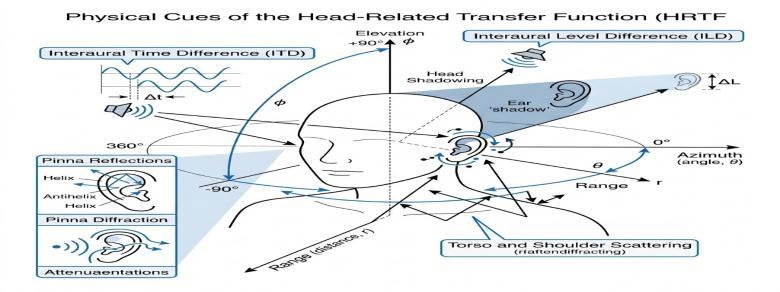
Fig -3: Coordinates(azimuth,elevation,range)and physicalacousticcues(ITD,ILD,pinnascattering,head shadowing,torsodiffraction)thatconstitutetheHeadRelatedTransferFunction(HRTF).
Traditionally, measuring an individual's Head-Related Transfer Function (HRTF) is a very controlled and resource intensive measurement procedure. The measurements are usually made in an anechoic chamber whichisdesignedtoreducereflectionsandexternalnoise. Theparticipantisenvelopedbyapreciselydesignedsetof loudspeakers that are located at hundreds of different azimuth and elevation angles during the procedure. Disks of tiny microphones are positioned at or close to the ear canalentrancestocapturetheeffectofthelistener'shead, torso and outer ears on sound coming in from different directions. The resulting measurements are a dense set of directional impulse responses that are then later interpolated to approximate different locations of the soundsources[36].
Inthepast,therehavebeenseveralpublicHRTFdatabases available to assist research and commercial spatial-audio applications.ThemostpopulararetheCIPICdatabase(45 subjects), the LISTEN database (51 subjects), the HUTUBS database(96subjects),andthenewerSONICOMdatabase, whichwasparticularlydesignedtoincreasethebreadthof measurements and to have more subjects representative ofthepopulation[15,36].
These databases have been vital for the advancement of spatial-audio research, but they also show an important limitationwhichhasbeengainingmoreandmoreinterest in recent years. Most of the subjects of many popular HRTFsareyoung,male,andwesternEuropean.Therefore, the measurements available do not represent all the variationinanatomythroughouttheglobalpopulation.
Thisdearthofdiversityisnotjustanumericalissue,buta perceptual one as well. There are differences in the anatomical characteristics that affect HRTFs that exist
between individuals and between demographic groups, such as head width, ear shape, torso size and even hair type. These differences change the listeners' perception and use of spectral cues, such as estimating elevation and discriminatingbetweenfrontandbacksoundsources.This makes listeners with physical characteristics significantly different from what has been measured in the databases moresusceptibletolocalizationerrorswhenusinggeneric HRTFs[14,15].
An increased frequency of front-back confusion, that is, when listeners hear a sound coming from behind their head as if it were coming from the front or vice versa, is one common effect. In the broader context, the discrepancy in the HRTF chosen by the listener and their ownanatomycanleadtoinaccuraciesinlocalization,aloss ofthesenseofanexternalsourceofsoundandadecrease in realism for spatial audio experiences. The problem has been termed a "demographic bias" problem in the field of HRTF research, and it is being addressed by the need for more representative data sets and better personalization techniques.
Therefore,theaimofincreasingthedemographiccoverage has gained significance in modern research on spatialaudio. New datasets and machine-learning-based personalization methods seek to eliminate the limitations of the current state of immersive audio technologies by providing users with a certain level of spatial perception acrossawiderangeofages,sex,ethnicitiesandanatomical variations, instead of optimizing it for only a small population.
Traditionally, HRTF measurements are expensive and time-consuming, and require special facilities, calibrated equipment and extensive data collection procedures. Researchers have been motivated to develop computational approaches that can estimate someone's HRTF from readily available physical data, such as measurements of their body. The aim is to enable personalized spatial sound without anechoic chamber recordings.
First approaches to HRTF personalization were mostly statistical-based. One of the most frequently adopted methods was to employ Principal Component Analysis (PCA) to find correlations between the HRTF characteristics and anthropometric parameters such as head width, ear size, and torso shape. These relationships were modelled, allowing researchers to estimate individual HRTFs with a reasonable accuracy without the complexityofdirectmeasurement.Thesetechniqueswere
International Research Journal of Engineering and Technology (IRJET) e-ISSN: 2395-0056
Volume: 13 Issue:06| Jun 2026 www.irjet.net p-ISSN:2395-0072
a significant improvement but lacked adequate prediction accuracy in fine spectral details which are particularly importantforaccurateelevationestimationandfront-back discrimination[6].
The development of machine learning techniques, especially deep learning, has greatly enhanced the prediction accuracy of HRTFs in recent years. In contrast, modern modelsareabletolearnthecomplexrelationship betweenanatomyandacousticresponse,allowinga much more accurate personalisation than traditional statistical methods.
A distinguished one is GraphNF-SCA (Graph Neural Field with Spatial-Correlation Augmentation) presented by Hu et al. [11]. This framework consists of a representation of the outer ear geometry as a graph with a neural field that predictstheentireHRTF.Thesystemexplicitlymodelsthe spatial relationships in the pinna geometry, and provides state-of-the-art localization performance and directional accuracy with only non-invasive anatomical measurements[11].
Inasimilarmanner,Huetal.[12]proposedatransformerbased architecture, HRTFformer, which was specifically designed for the reconstruction and personalization of HRTFs. HRTFformer can reconstruct high-resolution directional HRTFs based on a small number of acoustic measurements. It is a spatially-aware attention based model, which has been shown to achieve reconstruction errors below 2 dB within mid frequency range (1–8 kHz), whichismuchmoresuccessfulthanpreviousinterpolators [12].
Oneofthegreatbenefitsofthesenewmethodsisthatthey arealldependentoninformationthatcanbegatheredwith consumer equipment that is readily available. The ear photos, smartphone pictures or low-cost 3D scans are sufficient to describe the anatomy for the prediction process. This drastically decreases the barriers of conventionalHRTFmethodsacquisitionandallowsforthe provisionofpersonalizedspatial soundtoa wide rangeof userswithoutspecialequipment.
In addition, efforts have been made to decrease the computationalcomplexityofusingpersonalizedHRTFsfor real-time rendering. One such is MoD-ART (Modular Directional Auralization in Real-Time) by Scerbo et al. (2025). MoD-ART breaks up the HRTF into a series of modular directionally oriented components that are modifiable and processable separately. This design allows efficient multichannel binaural rendering with significantly decreased computational burden in the case
of dynamic environment with continuously varying sound sourcesandlistenerpositions[41].
In total, these developments clearly indicate a shift in HRTFresearch.Thereisashiftfromexpensivelaboratorybased measures to scalable data-driven personalization measures. These techniques provide a realistic approach to creating personalized spatial audio systems that could be applied in consumer games, virtual reality, augmented reality, and other spatial applications, leveraging the advancements in computer vision, machine learning, and efficientaudiorendering.
Although individual HRTFs can be successfully measured, the data obtained can still be prone to error. One of the difficulties is that the HRTF can be very sensitive to the position of the listener's head when recording it. Many of the spectral cues that aid in sound localization rely on subtleinteractionsbetweensoundwavesandthecomplex geometryoftheouterear,soeventhesmallestinvoluntary movements can make an appreciable difference in the recordedresponse.
It is demonstrated that small head movements during a measurement session can cause typical variations of 3–5 dB (up to 6 dB in extreme cases) in the magnitude of the recorded HRTF. These differences are more extreme at frequencies above 8 kHz, when the localization cues provided by the pinna are most important. At these frequencies, a small head movement can change the path that incoming sound waves follow through the ear sufficiently to result in a measurable change in the resulting HRTF, such as the case of a page 235 in [7] and [14].
Theuncertaintyinmeasurementdoesnotjustapplytothe recording session. If a wrong HRTF is inserted into a database, then each subsequent binaural rendering which uses that data will inherit that error. Therefore, the performanceofthelocalizationsystemcouldbepooreven if a seemingly individualized HRTF is being employed. These inaccuracies may be nested in the recorded measurementsandmaybehardtodetectandevenharder tocorrectoncethedatahasbeengathered.
There are some measures that have been proposed to mitigate this. A method is to reduce the amount of body motion when taking measurements with physical headstabilization systems. The other uses motion tracking to capture head position during the measurement and then uses a technique of retrospective compensation to correct for any measured head motion. The third approach is to
International Research Journal of Engineering and Technology (IRJET) e-ISSN: 2395-0056
Volume: 13 Issue:06| Jun 2026 www.irjet.net p-ISSN:2395-0072
apply repeated measurements and ensemble-averaging techniques to minimize the effect of random positional variations in the measurements, by averaging across multiple recordings to generate a representative HRTF [15,36].
Therefore, this type of measurement variation is another significant inconsistency that is present in the available data sets and poses a major challenge in both HRTF measurementandpersonalizationstudies.Thiswillhinder the reliability, repeatability and comparability across
datasets for spatial-audio research until better standards andmeasurementmethodsaredeveloped.
In broader terms, this issue is a reminder that HRTF personalization is not just a matter of having elaborate prediction models and large datasets, but also of having high-quality and consistent measurements that form the basis of the HRTF personalization systems. Therefore, reliable measurement is still a pivotal step towards next generation binaural audio technologies tailored to the individual.
Table -2: ComparisonofmajorpubliclyavailableHRTFdatabases,indicatingsubjectcount,angularmeasurementresolution, demographiccoverage,anddataaccesspolicy.
directions (25 azimuths x 50 elevations)
demographic scope Public (free researchonlylicense)
3D3A Lab (Princeton) [Choueiri,2021]
II[Armstronget al.,2018]
Inordertorelatethetheoreticalconsiderationscoveredin the preceding sections to their real-world use, the operation of a modern spatial audio system will be explored in a realistic game setting. Imagine that a player character is exploring a virtual Gothic cathedral, an approximatescaleof35m×15m×26m,inthegame.This isanextremelychallenging acousticalspacebecauseofits large size, reflective stone walls and intricate architecture ofthebuilding.
These kinds of scenes are excellent stress-test for spatial audiotechnologyastheyencompassa numberof acoustic phenomena that many advanced rendering systems are supposedtobeabletorender.Thelargeenclosedareahas long reverberation times which help to create a sense of scale and atmosphere. Multiple high order reflections are createdbyparallelstonewallsandvaultedsurfaces,giving a form to the reverberant sound field. The sound waves bend around the various pieces of architecture and massive pillars, causing diffraction effects, especially at
low frequencies. Concurrently, localization is crucial, as players need to be able to pinpoint the location of sounds spread across the environment by identifying direction anddistance.
On an engineering side of things, this is a tightly coupled scenario, involving the use of almost all elements of a modern spatial audio pipeline. The sources of the sounds have to be determined and all their direct propagation pathscomputedwithrespecttothelistener.Reflectionand reverberation systems are then used to define how the acoustic energy interacts with the geometry of the cathedral, creating early reflection and the late diffusion that is the characteristic of its acoustics. In addition to geometric methods, low-frequency propagation models can also include diffraction and room-resonance effects, which are not captured by geometric methods. Lastly, the finalized sound field needs to be rendered in a spatial manner using binaural rendering techniques, typically basedonHead-RelatedTransferFunctions(HRTFs),which help to render a sound field as if it were coming from a particularlocationinsidethevirtualenvironment.
International Research Journal of Engineering and Technology (IRJET) e-ISSN: 2395-0056
Volume: 13 Issue:06| Jun 2026 www.irjet.net p-ISSN:2395-0072
This allows to witness how the different modelling methods introduced in this paper can be applied in a comprehensive system in the context of the cathedral scenario. The example not only demonstrates the advantagesofexistingspatialsoundtechnologies,butalso the compromises that will need to be made between physicalaccuracy,computationalefficiencyandperceptual realismincreatinganinteractiveexperience.
When the player enters the nave, the acoustic rendering system starts by analysing the geometry of the environmentinordertounderstandhowsoundisgoingto travel inthespace.Thecathedral isa spacethatprimarily consistsoflarge,smoothandregularlystructuredsurfaces – a flat stone floor, walls made of ashlar masonry and a vaultedceilingsupportedbytherepetitionofribs –which makes it an ideal space for the application of geometricacoustic techniques like the Image Source Method and beamtracing.
Beamtracingisimplementedbythepropagationengineto determinethefirstfewimportantreflectionpathsbetween the active sources and listener. These can be ambient musicplayedfromthealtar,soundsfromtheenvironment in the building, and the sound of the player's footsteps. When building such beam trees up to the fifth reflection order, the system is capable of determining the dominant early reflections that are most beneficial to spatial perceptionwithoutlosingcomputationalefficiency.
These reflections make themselves heard nearly instantly acoustically. The first received sound is the direct sound andshortlyafter,aseriesofdistinctivereflectionsfromthe surrounding stone surfaces. Reflections from the floor, ceiling and architectural details add extra layers of acoustic complexity, the characteristic flutter echoes, which rapidly repeat reflections bouncing back and forth acrossthenave,beingproducedbytheparallelsidewalls. These reflections get added together and slowly coalesce intoathickfieldofreverberation,fillingtheinsidespace.
In combination these early reflections create the sound signature of the cathedral. Their time, direction and intensity give listeners much of the information about the size, shape and material texture of the environment. The direct sound, the reflections, and the reverberation without any visual input give the impression of a large stonestructureandalargeenclosedvolume.
These cues, when correctly reproduced, play a very important role in the perception of presence. Listeners who have heard the acoustics of actual churches or
cathedrals know the nature of this echo quite well – the echoes are strong, the decay time long, the reverberation massive, giving immediate auditory recognition of large, reverberant, Gothic interiors. In this manner, the earlyreflection system does not only simulate sound propagation, but also conveys the architectural identity and scale of the environment, thereby immersing the player before he or she is able to perceive the visual informationofthesceneconsciously.
One of the important limitations of purely geometric acoustic models is apparent as the player passes behind oneofthecathedral'slargeload-bearingstonepillars.The vertical column from the perspective of a geometric propagation system completely obstructs the propagation line between the sound source on the altar and the listener. This implies that the model should predict an acoustic shadow region in which the sound from the altar shouldbegreatlyreducedorevenbeinaudible.
Actually, sound does not act as a bundle of rays. In the lower frequencies, where the wavelength is equal to or greater than the size of the obstacle, sound waves diffract around the obstacle. In the case of a stone pillar with radius a = 0.75 m (diameter 1.5 m), the significant wave bending(diffraction)isobservedforthewavenumberk= 2 pi f/c,whenitislessthan2 pi,thatis,atfrequencies less than about 450 Hz. At higher frequencies, sound goes into a "geometric shadow zone", causing a lot of attenuation. This means that a listener behind the pillar would still be able to hear the low frequencies of the cathedral organ (under 450 Hz), although the higher frequencies would be somewhat masked. This mixture of preserved bass energy and decreased amount of high frequency content is a well-known feature of the real worldacousticshadowing.
The behaviour is replicated by adding a low-frequency wave-based simulation to the geometric propagation model with Adaptive Rectangular Decomposition (ARD). TheARDsolverdoesnotmodelraysbutrathermodelsthe propagation of sound waves directly in the architectural space.Theinterior ofthecathedral isbrokeninto a series of connected rectangular spaces, including the main nave, the side aisles divided by series of pillars and the raised triforium spaces above the arcade. For each region, the propagation of sound is calculated with efficient Discrete Cosine Transform (DCT)-based solutions of the acoustic waveequation.
These individual domains then connect acoustically via openings and shared boundaries to travel naturally
International Research Journal of Engineering and Technology (IRJET) e-ISSN: 2395-0056
Volume: 13 Issue:06| Jun 2026 www.irjet.net p-ISSN:2395-0072
throughout the structure at low frequencies. This allows the diffraction effects, standing waves and other wave properties to be simulated that would not be possible purelygeometrically.
Atthetimeofsimulation,theoutputsofbothmethodsare merged together during the run-time. The ARD solver gives the low-frequency transfer function that is representativeofthediffractionaroundthepillar,whereas the geometric solver gives the high-frequency transfer function that represents direct sound, reflections and detailed spatial cues. These responses are mixed at a crossoverfrequencywhichischosenbasedonthephysical dimensions of the obstacle and the frequency range at whichwaveeffectsaremeaningful.
Theoutcomeisamorerealisticsoundeffect.Theplayeris not hearing an artificially deadened stretch behind the pillar, but rather the sound character changes gradually: Lowfrequenciesremainandcarrytheweightoftheorgan while the higher frequencies are gradually lower. The behaviour is close to the actual acoustic perception and explains the reason why hybrid geometric-wave systems arefrequentlyregardedasthemostpromisingsolution to physical plausible spatial audio rendering in complex architecturalspaces.
After the complete Spatial Impulse Response (SIR) has been generated, it merges the influence of multiple stages of the acoustic modelling: the early reflections (geometric); the late reverberation (statistical); the lowfrequency diffraction (wave). The binaural signals to be presented to the left and right ear are then created by convolving this unified impulse response with the listener's listening room Head-Related Transfer Function (HRTF)foreachindividualsoundsource.
This process needs to be continuous in virtual reality applications as the user rotates and moves its head. The rendering system updates the HRTF for every frame generatedbyheadtracking (usually90framespersecond for the modern VR platforms). For every update, the system calculates the direction of each sound source relative to the listener and interpolates between the closest measured and/or calculated HRTF directions. This way,thelistener'sorientationhasaspatialcuetogoalong withit.
Imagine a player whose voice is coming from inside the cathedral, as an organist plays an organ piece from the altar. If the player is looking to a right side aisle, then the position of the organ in the auditory scene should be perceived towards the left side aisle. Moving away from
the altar will, on the other hand, move the sound source forward. These changes are because the physical source doesn'tmoveinthevirtualenvironment,justthelistener.
Oneofthemostcrucialthingsforconvincingspatialaudio is this seamless interlinkage between head motion and hearing. When humans move through an environment, theytendtoexpectthevisual andauditoryinformation to stayinsyncwiththemastheygo.Aslongastheeyesshow the direction and ears show the direction, there is no problem with that. Any noticeable mismatch between the directionindicatedbytheeyesandthedirectionindicated by the ears can cause immersion to suffer and make the experience less realistic. Therefore, the correct headtracked binaural rendering is of a crucial importance for preserving the spatial coherence in virtual environments [1,8].
Correct binaural rendering isn't enough to create a strong sense of presence, but it serves as a starting point for adding other elements of the sense of presence. HRTFbased rendering can also be used in conjunction with a realistic propagation model, environmental acoustics and responsive head tracking, which will help to ensure that virtual sound sources are stable in the scene and that the listenerfeelslocatedinacoherentandphysicallyplausible acousticspace.
For all geometry-dependent acoustic simulation techniques, whether using geometric acoustics or wavebased modelling, a fundamental challenge is the need for an accurate representation of the surrounding environment. This need has been met in traditional game development with manually written acoustic meshes: low polygonmodelswithsimplifiedgeometry,designedbythe level designer for the purpose of sound propagation calculations. These meshes are basically used to approximate the virtual environment and the basis for acousticsimulation,whicharecomputationalefficient.
InExtendedReality(XR)applicationsaimedataugmenting or interacting with the real world, the situation is much more complicated. In these cases, there is no existing acousticmeshnetwork astheenvironmentis not planned for in advance. Rather, the system has to constantly sense and model the physical environment with the onboard sensors. Thus, the acoustic simulation process is now tied tothereal-timeunderstandingoftheenvironmentandthe understandingofthescene.
International Research Journal of Engineering and Technology (IRJET) e-ISSN: 2395-0056
Volume: 13 Issue:06| Jun 2026 www.irjet.net
To overcome this difficulty, Xu et al. [17] proposed SAMOSA (Scene-Aware Multimodal Acoustic Rendering), which supports real-time environmental sensing and leverages the parallel processing power of GPUs to simulate audio properties.To cope with this challenge, Xu et al. have presented SAMOSA (Scene-Aware Multimodal Acoustic Rendering), a framework that fuses real-time environmental sensing with GPU-accelerated acoustic simulation [17]. In this paper we suggest a conceptual integration containing an Adaptive Rectangular Decomposition(ARD)wavesolverstagethatcomplements the SAMOSA pipeline. Please note that this integrated SAMOSA+ARDapproachisnotyetin real implementation, butisproposedasanarchitecture.
There are three key phases of the framework. The first stageisthesensingphase,whichtransformsdataofdepth and colour images into a three dimensional point cloud of the environment around the object. This data is then fed into a CNN producing dense voxel representation of the scene. The network also does semantic classification besides the geometric reconstruction of the environment: It assigns to different areas of the environment material labels such as concrete, wood, fabric, glass and metal. These labels are then used to look up the acoustic properties, such as the absorption coefficients as a function of frequency, from a look-up table that contains acousticalpropertiesforvariousmaterials.
Thesecondstepistheacousticpropagationmodelling.The reconstructed geometry with the environment annotated is suggested to be then passed on to an appropriate simulation engine. The system can use an Adaptive Rectangular Decomposition (ARD) solver when sufficient computational power is available and the environment is nottoolarge,toprovideanaccuratecalculationofthelowfrequency wave, and can use a hybrid beam-tracing and ray-tracing framework when the frequency is not low, to provide an accurate calculation of the propagation of the high-frequency geometry. This adaptive selection aims to achieve a compromise between physical accuracy and computingresources,ensuringinteractiveperformance.
The last step is the audio rendering. Combined with the listener's personal Head-Related Transfer Function (HRTF), the propagation engine-generated directional impulse responses are used to create binaural audio signals that accurately represent acoustical properties of
p-ISSN:2395-0072
the environment and listeners' spatial perception. This gives rise to a dynamically updated sound field which adapts to modifications of user location and environment setup.
The most noteworthy contribution of SAMOSA is acoustic adaptability as a result of the change in the physical environment. The acoustic model can be changed over time during the use of the space, like when a door is opened or closed, when furniture is moved, when objects are placed on reflective surfaces or when the room is moved from one to another, etc. This capability is a key towards truly adaptive acoustic XR systems where the virtual soundscape would adapt to the changing state of thephysicalworld.
While significant progress has been made, there are still keytechnologicalissuestobeaddressed.Thisfullsensingsimulation-rendering process adds latency since data about the environment has to be collected, processed, simulatedandthenrendered.Thisend-to-endlatencywas evaluated on standalone XR hardware (in this case an Oculus Quest 2 equivalent device) by Xu et al. (2025) and wasfoundtobe~70-90ms,withdepthsensingtaking~33 ms, CNN material classification taking ~15-30 ms, voxelization taking ~10 ms, ARD wave propagation step taking ~8-15 ms, and binaural convolution taking ~1 ms. The timings are hardware dependent and would be differentonotherdevices,orbythelevel ofgranularity of the scenes. The sensing and voxelization processes are proposedtobeexecutedasynchronouslywithakeyframe rate of 2-5 Hz (the geometry of the room is changing slowly) at the same time as the audio spatialization and head-tracked rendering are synchronously executed at a high frequency frame loop at 90 Hz (the geometry of the room is not changing fast). This optimization can be done with room propagation parameter optimization that is dynamically updated, to maintain high interactive performance[17,42].
Ingeneral,SAMOSAdemonstratesthegrowingintegration ofcomputervision,machinelearning,real-timesimulation and spatial rendering of audio. It allows to generate the acoustic model directly from the sensed environment, rather than be manually written in geometry, and opens thedoortonewfutureaudiosystemsthatcandynamically adapttotherealworld.
International Research Journal of Engineering and Technology (IRJET) e-ISSN: 2395-0056
Volume: 13 Issue:06| Jun 2026 www.irjet.net p-ISSN:2395-0072
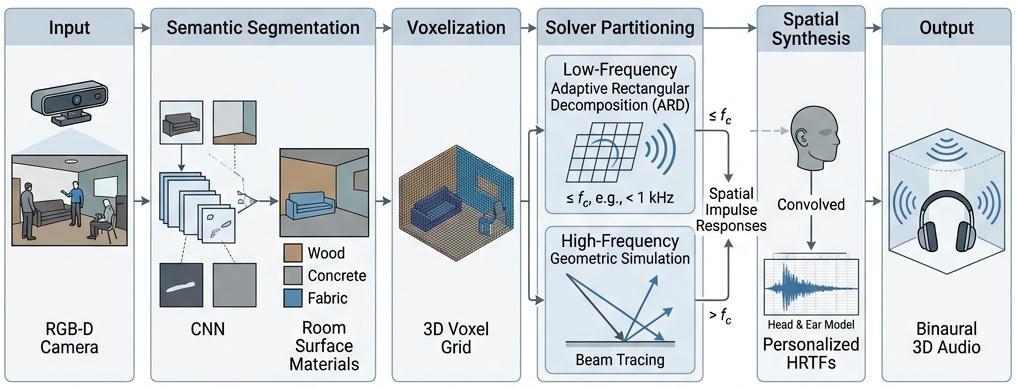
Fig -1: ConceptualarchitectureoftheSAMOSA+ARDpipeline,integratingreal-timeenvironmentalsensing,CNN-based semanticlabeling,voxelization,andfrequency-partitionedsolverswithpersonalizedHRTFrendering.
8.
TheSci-Phi model,developedbyJiangetal.(2026),isone example of a spatial audio large language model that is capable of describing entire spatial scenes of an acoustic environment. Instead of being a parameter generator, SciPhi is an audio analysis tool that receives First Order Ambisonics (FOA) spatial recordings and estimates the acoustic parameters and generates natural language descriptions of the scene, such as source directions, distance,loudnessandroomcharacteristics[43].
This work was inspired by a practical problem for sound designers and acoustic engineers. Physically based audio systems can create very realistic acoustic behaviour, but can be very time consuming and complex to set-up manually. Meaningful results require designers to first assignmaterialpropertiesinthedesign,tosetupacoustic boundaries, to estimate absorption and scattering properties, and to set up a lot of simulation parameters. This can be a technically challenging and time consuming processinalargeorcomplexenvironment.
With Sci-Phi, acoustic analysis is made easier with automated transcription of spatial characteristics. For example, if an audio scene is captured by a system, but parameters are not measured or tuned manually, the system could use Sci-Phi to identify the audio scene as a medium sized stone room with moderate reverberation. Themodelthendecodesthespeechandhelpsdetermineif the parameters are representative of the designer's intended speech or not, thus closing the qualitative/quantitativegapbetweenuserdescriptionand acousticmodeling.
This analysis may have a number of potential benefits. It canbeusedforautomaticroomcharacterization,speedup theverificationofsoundpropagationmodelsandincrease the accessibility of the use of sophisticated audio analysis tools to developers who may not have an available specialist hardware for acoustic measurements. Systems like Sci-Phi could help designers be sure that their virtual spaces comply with desired acoustics, while also relieving them of some of the time-consuming aspects of scene auditing.
But the potential application of language models in this scenario also poses significant challenges. Ultimately, the acoustic simulation will be determined by physical laws, whilethelanguagemodelswillproduceoutputsaccording to the patterns learned from data. Therefore, it is not guaranteedthattheacousticphenomenaexpressedbythe concepts in an LLM are exactly the same as their acoustic behaviourinreality.Althoughthedescriptionmakessense inthemindoftheprogrammer,itcouldleadtoparameter values that do not make physical sense for a specific environmentorarenotoptimuminthatenvironment.Itis, therefore, a current research area to keep the parameters generatedinaphysicallyplausiblerange.
While these are these worries, initial assessments of SciPhi are promising. Preliminary results indicate that the textual descriptions produced by the model are able to correctly classify the virtual room types and the sound sources in a wide range of different scenes, and that they arehighlysimilartohumandescriptions[43].
Overall, as this is a broader trend, there is an increasing overlap between systems in the field of artificial intelligence and sound systems. In addition to simulation
International Research Journal of Engineering and Technology (IRJET) e-ISSN: 2395-0056
Volume: 13 Issue:06| Jun 2026 www.irjet.net p-ISSN:2395-0072
techniques, language models are being integrated into the systems for analyzing and indexing spatial audio outputs, andforvalidatingtheoutputs.Theyhavebeensuccessfully integrated into existing game engines and soundmiddleware, and their vision is that future workflows will be possible, where the complicated acoustic environment canbeautomaticallyauditedanddescribed.
As one of the typical challenges in spatial audio research, there is lacking an accepted and standardised evaluation framework. While many studies have documented an increase in localization accuracy, immersion, realism, and/or overall sound quality, it can be challenging to compare the results of various studies. Numerous experimental approaches, including different listening environments, HRTF configurations, acoustic scenes, renderingtechniquesandpopulationsofparticipants.That is, if two studies give similar findings, it is not possible to determine whether these findings represent a real improvement or not, and whether the findings are really equivalent[16,44].
This is not methodological consistency, which is a big probleminscienceprogressanddeployment.Ifthereisno common basis for the evaluation then researchers can't easily conclude whether the improvements are due to better acoustic modelling, better test conditions, different groups of participants or different experimental designs. This makes the field prone to scattergun reaction and makes it difficult to reproduce and prove without outside help.
The solution to this problem is proposed that a dual approach evaluation protocol is followed in which a combination of qualitative expert evaluation and quantitative statistical evaluation is practiced. The aim is to provide a balanced perspective that can span the subjective aspect of audibility and the objective aspect of output performance of spatial audio systems. The combined effect of these complementary viewpoints should lead to perceptually meaningful but scientifically sound results. It is presented here as an outline protocol forfuturestudiesandasareferenceforthisprotocol,asit hasnotbeenusedinanempiricalstudyyet.
This qualitative part involves listening evaluations conducted by experts with experience in audio engineering, acoustics, psychoacoustics and/or critical listening. The focus of these evaluations is realism, space, externalization, environment and overall immersion. An expert listener is very valuable for picking up on subtle
artefacts and perceptual inconsistencies that may not be apparentfromobjectivemeasurements.
Objective performance indicators are included in the quantitative portion of the assessment. They may be the localization accuracy, front-back confusion rate, the error that is made in estimating the elevation of the source, consistency of responses among listeners, computational efficiency, response latency, and some other measure of theperformanceofthesystem,dependingontheresearch purpose. Comparisons made by statistical analysis enable scientists to determine whether the differences they are seeing are not random, but are likely due to some other factororinfluence.
Methodological independence is one of the key design features of the proposed design. The protocol can be applied to any kind of spatial audio system based on any type of simulation method. All these methods (geometric, wave, hybrid, propagation, or HRTF personalization, or newapproachesbasedonmachinelearning)canbetested alike. This way, the comparison of the implementation details is avoided and the comparison is limited to perceptualandperformanceaspects.
This would improve the ability of other groups to reproduce experiments, and afford a useful comparison between various technologies. More important, it would giveabenchmarktoevaluatetheprogressofspatialaudio in the future. Over the years, the field has developed, including the ability to simulate sounds acoustically, the adoption of XR technologies, and the ability to produce sound that is more realistic to the individual. This will necessitate standard practices to evaluate the developmentsanddeterminethebestdirectionsforfuture research.
This evaluation framework will be evaluated qualitatively by a panel of experts (N = 12) 6 of which are experts in Acoustic Engineering and 6 are interactive Media/domain experts for games. This equitable mix will help bring balancetofutureevaluationsbothonthetechnical side of how accurately the acoustic simulation was accomplished and on its practical use for immersion. All individuals would assess the different systems being tested on a 5 point Likert Scale: (5 = excellent, 1 = poor) [1, 16, 17]. As there were no human subjects involved in this study, IRB/Ethics Committee approval was not required. In subsequent trials, informed consent and approval will be obtainedpriortoconductinglisteningtests. Basedonthenumberofexpertlisteners(N=12),wedraw on known recommendations for subjective audio
International Research Journal of Engineering and Technology (IRJET) e-ISSN: 2395-0056
Volume: 13 Issue:06| Jun 2026 www.irjet.net p-ISSN:2395-0072
measurement. For advanced audio systems, the ITU-R BS.1116-3 standard suggests using 10-15 experienced listeners,sincetheirsensorysensitivityisatahigherlevel and they do not cause any cognitive fatigue that could otherwise result from a larger, untrained population of listeners. A priori power analysis suggests that for a repeated-measuresdesign(within-subjects)involvingfour systems across four perceptual dimensions, a sample of N =12expertlistenerswouldhaveapower>0.80todetecta large effect size (Cohen's f ≈ 0.40 or a rank-biserial r ≈ 0.50)atthealpha=0.05levelofsignificance.
Theperceptiontakesplaceonfourperceptualdimensions, which in total encapsulate the quality of the spatial audio experience.
Thedegreetowhichtheacousticenvironment(AE)thatis renderedisinaccordancewiththelistener'sperceptionof how the space represented (SP) should sound is the measure of naturalness. The evaluators should decide if the acoustic response is realistic and if there are artefacts created by the simulation method which are perceptible. The higher the rating the more the acoustics overall feel like the perceived environment, and the lower the rating, the more there are acoustics artefacts like appear unnatural reflections, acoustics that seem to come from the wrong place or from nowhere, or other acoustics artefacts that make the acoustics not seem like the perceivedenvironment.
Externalizationisa wayof measuringwhetherthesounds are heard as part of the environment or not. The goal of successful binaural rendering is to give the impression of the sounds being located in stable positions in 3-D space. Systemsshowingin-headlocalizationareratedthelowest inthiscategory[6,7]sincethisisoneofthemostcommon characteristics of a mismatch between the HRTF and the systemorlackofspatialrendering.
Also known as the acoustic clarity measure C50, Spatial Clarity is a measure of the balance between early reflections and late reverberation. A good acoustic design should maintain the source intelligibility and localization cues while providing the reverberant qualities of the surrounding area. Too much reverberation will smudge thesenseofspacewhiletoolittlereverberationwillleadto anunnatural feelingofspace.Systemswithbetterbalance between competing factors and are able to accurately perceivethesourcepositionwithinthereverberantsound fieldaregivenhigherratings[4].
Presence is the degree of perceived “realness” of the auditory world, that is, the feeling of being physically presentinthevirtual space.Thisdimension wasbased on
existing presence research, such as the Igroup Presence Questionnaire (IPQ) and other metrics of the immersive experience [45]. The evaluators are interested in how the audio contributes to their sense of 'situatedness' and how it may evoke a sense of acoustic 'coherence' and 'belieavability'.
All evaluations are carried out in standardized listening conditions, to make it consistent across participants and experimental sessions. Binaural presentation is via a pair of circumaural open-backed headphones with frequencyresponseequalizationtoreducecolourationresultingfrom the headphones. Different stimuli from various systems are presented in a random order, which minimizes order effectsandevaluator'sbias.Eachparticipantgoesthrough a familiarization session before formal assessment starts andthissessionfamiliarizestheparticipantwiththerating criteria and the 5-point scale is calibrated. This training process can enhance interrater reliability and consistency and help eliminate rater interpretation differences in the scoresoftheevaluationcriteria,sothatthescorescapture perceptual differences rather than simply individual differencesinraterinterpretation.
This qualitative evaluation framework is designed to be more structured and reproducible, and leverages expert judgment, controlled listening conditions and perceptual dimensions that are clearly defined in order to assess perceptualperformanceofspatialaudiosystemsinalarge varietyofsimulationapproachesandapplicationdomains.
Objective acoustic measurements would be added to the subjective assessments given by expert listeners to complement the subjective measures. Perceptual evaluations describe the perception of the spatial audio system;objectivemeasureswouldofferquantitativeproof of the acoustic accuracy of a spatial audio system and allowittobecomparedina repeatablewayacrossspatial audio system implementations. These two points of view are meant to be combined to help guarantee that the performance gain that is measured is the one that is perceptuallyvaluable.
The two main objective measures are reverberation time (RT60) and the clarity index (C50), which are typically used in architecture acoustics and room-acoustic analysis. The following parameters are directly measured from the rendered impulse responses, according to the following standardisedproceduresasspecifiedinISO3382.RT60 is thebestmeasureofthereverberantnatureofaspaceand is the time it takes for the sound energy to drop by 60 dB inthespace.C50istheratiobetweenenergyreaching the
International Research Journal of Engineering and Technology (IRJET) e-ISSN: 2395-0056
Volume: 13 Issue:06| Jun 2026 www.irjet.net
listener first and that reaching the listener later in the room, and is widely used as an indicator of the intelligibilityandclarityofspeech.
The measured RT60 values would be compared with the RT60valueofareferencesimulationorreferenceacoustic model for consistencyinacousticaccuracy.Itissuggested thatthetargeterrorvalueforthissystemislessthan0.18 seconds mean absolute error (MAE). For the sake of making this threshold "real" we will use the JustNoticeableDifference(JND)forreverberationtime.JNDfor RT60 is defined as 5% of the nominal value as per ISO 3382-1. This JND is roughly 0.05 - 0.15 seconds when the decay times are 1.0 to 3.0 seconds as is common in room acoustics. Therefore a reasonable, perceptually valid criterion, close to the human detection threshold [46, 47] isaMAEof0.18seconds.
Thestatisticalanalysiswouldthenservetodecidewhether any observed differences are statistically significant (making them more than just random fluctuation) or not. As Likert scale data is ordinal, and thus do not meet the normality assumptions of parametric statistics, nonparametricstatisticswouldbeusedinstead.Iftherewasa repeatedmeasuresdesignwithtwosystems,theWilcoxon signed-ranked test would be used for each perceptual dimension to compare the two systems. As multiple comparisons are done simultaneously, BenjaminiHochbergFalseDiscoveryRate(FDR)correctionwouldbe used instead of the highly conservative Bonferroni correction to control the overall Type I error rate, and statisticalsignificanceevaluatedatanalphalevelof0.05.
p-ISSN:2395-0072
If three or more systems were involved in an experiment using a repeated measures design, a Friedman test (nonparametric version of one-way repeated measures ANOVA) would be used to determine if there are significant differences among the group medians. If Friedmantestshowsthatthereisastatisticallysignificant effect, then post hoc pairwise comparisons would be conductedamongthespecificsystemsbyWilcoxonsignedranktestwithBenjamini-HochbergFDRcorrectionsothat thefamily-wiseerrorratesarecontrolled.
Significance testing, as well as effect sizes (using the matched pairs rank biserial correlation r) would be reported for all pairwise comparisons. While p values tell us whether there is a statistically significant difference betweentheobservedvalues,effectsizestellusthesizeof thedifferencebetweenobservedvaluesanditwillprovide us with a measure of practical importance scaled independentlyof sample size.Reportingof both statistical significance and non-parametric effect sizes provides a more comprehensive analysis of experimental results and ensures that differences that are only detected, but not perceptually meaningful, are not interpreted as statisticallysignificant[16].
These objective measures and statistical analysis will give a sound quantitative basis to the suggested evaluation system. The methodology uses standardized acoustic metrics, controlled statistical testing, and reporting of effect size to allow for transparent reproducible comparisonsbetweenspatialaudiosystemsandtoensure that a complementary perceptual–physical approach is usedtoassessperceptualandphysicalperformance.
Table -3: Proposedperceptualevaluationmetricsforspatialaudiosystems,indicatingmeasurementprocedure,target acceptancethreshold,andsourcereference.
RT60MAE ISO 3382-1
C50Clarity Early-to-lateenergyratio >0dB(forintelligibility) ISO3382-1
HRTFSpectralError Log-spectraldistance(LSD) <4.5dB Huetal.(2025a)
LocalisationMAE(azimuth) Pointertask,anechoic <8° Blauert(1997)
LocalisationMAE(elevation) Pointertask,anechoic <12° Xie(2013)
Presence (Igroup Presence Questionnaire) Self-reportquestionnaire Score>4.0/7.0 Schubertetal.(2001)
Naturalness(Likert) Expertpanel(N=12) Median>3.5/5.0 Proposed(thispaper)
Externalisation(Likert) Expertpanel(N=12) Median>3.5/5.0 Proposed(thispaper)
International Research Journal of Engineering and Technology (IRJET) e-ISSN: 2395-0056
Volume: 13 Issue:06| Jun 2026 www.irjet.net p-ISSN:2395-0072
The immersion gap between visual and audio realism of modern games is not just a subjective matter, it can be measured quantitatively. Although there have been significant strides in graphics technology in recent years thathaveallowedreal-time renderingsystemsto produce stunningvisualquality,thequalityofspatialaudioinmany commerciallyavailablegameengineshasnotkeptpace.In interactiveexperiences,theauditoryaspectisoftennotas accurate or perceptually realistic as the visual aspect, resulting in a delay between the visual and auditory information.
Fıratetal.(2022)testedthevirtualacousticsperformance of Unreal Engine 4 and Wwise with the commercial geometricalacousticssoftwareOdeonandfoundthatthere was a difference. The study compared the physical acoustics parameters in different virtual environments against the physical standard, and found that the native game engine spatialization tools produced large differencesinboththelowfrequencyrange(63to125Hz) and the high frequency range (8 kHz). These differences were minimized by integrating a dedicated audio middleware,showingthatnativeengineconfigurationsare not enough to achieve physically accurate room acoustic simulation of audio. Spatial audio engines and personal HRTFs tend to give better localization, but often native implementations have large localization errors because theysimplifythepropagationmodel.
These results indicate a significant achievement deficit. In particular, deviations in the room acoustic parameters (such as EarlyDecay Time (EDT) and Reverberation Time (RT30) differences) in the low frequencies, directly affecting the localization cues and the spatial ambiguity, were found to be more than 2.0 s for native engine configurations without propagation middleware. A player'sskilltoaccuratelylocalizethesoundsourcecanbe significantly impaired by these physical parameter deviations, and can increase the player's confusion betweenthefrontandback,anddecreasetheirimmersion inthevirtualenvironment.
The same trend is observed in analyzing reverberation accuracy. There are many commercial game engines that use a pre-programmed convolution reverb or an algorithmic reverb system set up by the sound designer. These methods are computationally simple and relatively straightforwardtowrite,butarenotabletomimicthetrue acoustics of complex environments. There are considerable deviations from the room-acoustic
parameters of native engines when compared to the physically simulated acoustic references as mentioned in thecomparisonofvirtualenginesandmiddlewarebyFırat etal.(2022).
The geometry-based propagation systems are much more effective. These methods involve a significant improvementinacousticaccuracybyderivingtheacoustic behaviourdirectlyfromthe structureandmaterialsofthe environment. In comparison, physically-informed propagation models are more effective at reproducing the reverberant nature of real spaces, which gives a better approximation to the desired acoustic situation and increases the accuracy of the virtual acoustics to real measureddata.
Overall, this study offers compelling empirical evidence thatthesoundqualitythatmanycommercialgameengines currentlydeliverisstillfarfromwhatcanbeaccomplished with current state-of-the-art spatial audio technologies. Whereasmodernengineshavecomealongway,achieving amazing realism in appearance, there has been much less work done in terms of realism when it comes to sound. The resulting difference would further confirm the presence of an immersion difference and the continued need for further research on more advanced propagation models,customizedHRTFrendering,andphysicallybased acoustic simulation. If there is a gap between the two, it will be crucial in developing virtual environments where both the auditory and visual realism can coexist at an equalpace.
Theperceptualadvantagesofenhancedspatialaudiohave been proven to be true, but the practical advantages are slight:computationalcost.Nomatterhowgoodanacoustic simulationcanbe,ithastomeettheverydemandingrealtimeinteractiveapplicationperformancerequirements.
Mostgamesnowadaysworkwithaframerateof60frames or more, which means that the calculations for rendering, physics, AI, network communications, and audio are supposedtobedoneinabout16.7millisecondsperframe. In applications of virtual reality, there are even tighter constraints, with the typical requirement of 90 Hz, which cuts the frame time down to around 11.1 milliseconds. Audio processing is typically performed at a separate update rate (approx. 5-10 milliseconds), and therefore onlyasmallportionoftheavailableprocessingpowercan beusedforacousticsimulation.Inpractice,thismeansthat there are about 1-3 msec available (on a shared CPU thread!) or 5-8 msec available (on a dedicated thread for
International Research Journal of Engineering and Technology (IRJET) e-ISSN: 2395-0056
Volume: 13 Issue:06| Jun 2026 www.irjet.net
audio processing!) for real-time spatial-audio computations.
In this range of constraints, the different spatial-audio techniques have very distinct computational properties. Wave technologies are still the most costly ones. For a moderately complex room, a full scene Adaptive RectangularDecomposition(ARD)simulationtakes8to15 milliseconds using modern GPU hardware (e.g. mid-range NVIDIA RTX 3080/4070 desktop GPUs) [9]. This is a high cost per frame but is feasible to do asynchronously (in parallel) in the background and update at a lower rate (e.g.,10-30Hz).Thoseupdateratesaretypicallyadequate forthelowfrequencyacousticbehaviorsincethisbehavior changes relatively slowly and does not strain the system resourcestomaintainperceptualrealism.
The geometric-acoustic techniques are much milder. The typical processing time for beam tracing to compute early reflections is about 0.5 – 2 milliseconds for a moderate complexity scene (e.g., 10,000 polygons, 5th-order reflections) on a single CPU thread [30]. For the few sounds that are acoustically significant, like dialogue, the significantsounds(suchastheenvironment)orthemajor sounds(suchasmusic),thisoverheadisnotoutofreachof currenttechnology.
The added computational cost of binaural rendering via HRTF convolution is a predictable additional cost. The required computation time for the HRTF processing mostly lies between 0.3 and 0.8 milliseconds per ear channel per source for typical 128-tap or 256-tap FIR filtersonmodernCPUs[7]dependingonthecomplexityof the filters and their implementation details. All these active sources have to be treated separately, so the cost increases approximately in proportion to the number of sound sources that are audible simultaneously. For large and acoustically dense scenes, efficient source management is therefore an important factor to take into account.
These techniques can be used together in a well-designed hybrid pipeline and fit the performance constraints of today's games. Beam tracing can be used for early reflections, statistical reverberation for the late reverberant field, and HRTF convolution for binaural rendering can be computed within the standard 60 Hz game loop, and ARD simulation can be updated asynchronously.Theevidencecurrentlyavailableindicates thatasimilarpipelineforanenvironmentwitharound10–20 concurrent audible sources is possible with the use of suitablelevel-of-detailtechniques[21,30].
p-ISSN:2395-0072
Theseoptimizationsgenerallyincludeloweringthefidelity of the simulated sound for sources that are far away, are very attenuated, or are not much of an acoustical interest to the player, but keeping the quality of the simulated sound at a higher level for sounds that are acoustically very interesting to the player. This dynamic resource allocation approach allows developers to strike a realistic balancebetweenrealismandreal-timeperformance.
Thus, the main hurdle when implementing the use of sophisticated spatial sounds is no longer the sheer computational impracticality. Rather, it is a matter of effectively utilizing the resources available and making intelligent choices of the matching simulation techniques. Hybrid pipelines, which incorporate geometric, statistical and wave-based techniques, are increasingly proving that physicallyinformedspatialaudiocanbeintegratedtorealtime applications, without the performance burden of currentgamingandXRplatforms.
The demographic restrictions on current HRTF databases raise more than just technical issues, and they are fundamental questions of accessibility, inclusiveness, and fairness in spatial-audio technology. The participants in most commonly-used HRTF databases are typically small in number and skewed towards young adult males in Western European countries. Therefore, the anatomical features included in these databases are not representativeofthepopulationacrosstheworld.
This imbalance directly affects user experience. Listeners can have poor spatial-audio performance if they do not share the physical characteristics of the majority of the population that is represented in an HRTF set, including head size, ear shape, torso size and other physical attributes.Thisinvolvesnumerouswomen,children,older people and people from minority ethnic backgrounds. With the best available binaural rendering systems, these users can experience reduced localization accuracy, greater front-back confusion, less convincing sound externalization and a less convincing spatial experience [14,15].
Fromthisperspective,it'snotjustaboutwhichmetricsare being captured, but about ensuring access to the best immersive technologies for everyone. Spatial-audio technologies, if they systematically deliver better experiences for certain groups of people than for others, have an unequal benefit. With the growing significance of spatial audio in the gaming, virtual reality and augmented reality worlds, education and communication, the
International Research Journal of Engineering and Technology (IRJET) e-ISSN: 2395-0056
Volume: 13 Issue:06| Jun 2026 www.irjet.net
importance of solving these differences is both technical andinclusive.
In theory, the answer is simple, develop larger, more representativeHRTFdatabases,includingparticipantsofa wide age range and sex, ethnic group and anatomical variation.ThesewouldofferaricherbasisfordirectHRTF selection and the future development of personalization systems. But it's not an easy solution to implement. Historically, HRTFs have been acquired in specialized laboratories, with specialized equipment, and during a lengthy measurement session, which makes large-scale measurementtimeconsumingandexpensive.Thebuilding of a demographically balanced database with hundreds of participants from various population groups, with long planning and huge resources from worldwide research institutionswouldbeverycostly[15].
This challenge has started to be tackled by efforts like SONICOM, which have worked on increasing the demographic coverage of publicly available data. While thesearegreatstridestowardsminimizingbiasinspatialaudiotechnologies,therearestillmanyeffortstogobefore atrulyworldwidecoveragecanbeaccomplished.
Machine-learning-based personalization is a complementary approach that has the potential to be effective. Deep-learning systems measure each person indirectlyinsteadofdirectly,usingasetofeasilyobtained inputs, like photographs, images from smart phones or three-dimensional scans, to estimate the HRTFs of the individual. Several approaches have shown that a realistic prediction of the HRTF might be possible without the costly anechoic-chamber measurements, thus cutting by severalordersthecostofpersonalization[11,12]asinthe approacheshereof.
These approaches do not, however, remove the use of representativedatasets.Deep-learningmodelsarelikeany data-driven system: They learn from examples they've been trained with. When the training data is small and narrow,themodelsgeneratedmaynotaccuratelyapplyto people with anatomy that is not well represented in the data. That is, even with state-of-the-art machine-learning models, measurement bias can result in biased prediction models.
Therefore, expanding databases and using machinelearningfor personalization shouldn'tbeseenasmutually exclusivesolutions,butratheraspartofalargerapproach. The large and varied HRTF databases are essential not onlyto enhancedirectHRTFselectionbutalsotoincrease trainingdataforreliablepersonalizationalgorithms.These efforts can all contribute to a more accurate and immersive spatial-audio experience across a broad
p-ISSN:2395-0072
spectrum of users, instead of limiting the experience to a few.
There is still much work to be done to achieve truly inclusivespatial audio,and thiswill requirethecontinued efforts of many groups, including acousticians, audio engineers, machine-learning researchers, hardware manufacturers, and funding bodies. These synchronous works are needed to achieve a technically advanced spatial-audio system that is widely representative of humanlisteners'diversity.
Even withall theadvancementsinspatial audio,there are still a number of key issues that have not been addressed andarestillontheresearchagendaforspatialaudio.
Firstly, the issue is how to integrate real-time wave based acoustic simulation into a dynamic environment. The first oneisaboutreal-timewave-basedacousticsimulationina dynamic environment. Today's games and XR experiences are growing in complexity by incorporating a constantly evolving world that responds to a player's presence and actions,from doorsopening andclosing,themovement of furniture, the addition or removal of objects, to the destruction or creation of environments. Ideally, the acoustic response of the environment should change instantly to these changes. But it is hard for this level of responsiveness to be realized. Pre-computed acoustic methodsrelyona goodknowledgeofthegeometryofthe scene and its variation to a smaller degree, while fully dynamic wave based methods like FDTD and ARD require much more computational power and frequently claim a lot of GPU memory when the graphics are rendered. This means that it is currently impractical to have real-time updates at such a rate for today's games. Another potentially fruitful area of future work is incremental update algorithms that take advantage of the locality of environmentalchangesinmanycases.Thesewouldadjust onlythepartsoftheacousticfieldthataremodified,rather than re-computing the entire acoustic field, and could increase the efficiency of computation to a reasonable level.
Language model-based acoustic design tools are another region that needs to be studied further, which involves validation. Sci-Phi shows that the use of large language models for analysing spatial audio recordings and producing text descriptions and sometimes perceptually convincing results can be achieved. But the correlation between these parameters and the true acoustical response of the system is not fully understood. Prior evaluations have been subjective, rather than physical.
International Research Journal of Engineering and Technology (IRJET) e-ISSN: 2395-0056
Volume: 13 Issue:06| Jun 2026 www.irjet.net p-ISSN:2395-0072
Systematic comparisons against measured acoustic environments and physically validated simulations would beneededtoensuretheconfidenceintheuseofsuchtools in professional audio productions or any other perceptually sensitive application. A key open research question is whether or not a language-generated parameter set always represents a realistic acoustic scenario[43].
Another one of the challenges is comprehending the interaction between spatial audio and other sensory modalities that allow to create a sense of presence. Immersive experiences are multimodal not only are they using sound, they are using pictures, perceiving depth, using motion and more and more the haptics. While most researchers consider audio as an important factor of immersion, the influence of specific acoustic cues is still not well understood. For instance, it remains to be determined whether the difference in presence can be attributedtothemodellingofthediffractionortothehigh level of personalization of the HRTFs, or whether the difference in perceptual benefit can be attributed to the presenceortothehighleveloflocalizationaccuracyunder certain circumstances. These questions are especially crucial when developers have to allocate computational power to various resources and run the computation on a limitedsetofresources.
To tackle such considerations, there needs to be a better understanding of human perception. In addition to the improvementsoftheacousticsimulationalgorithms,more close cooperation is needed between the acoustic engineers, psychoacousticians, cognitive scientists and XR researcherstomakefutureprogress.Knowingwhichparts ofspatialaudioarethemostimportantforimmersionwill help the researchers create systems that capture perceptually relevant properties, while reducing or eliminating those elements that have the least impact on the user's experience, but are more computationally intensive.
All of these issues point to a greater fact, that the remaining issues in spatial audio are no longer just those of simulation precision. They are often increasingly complex, requiring balancing of physical realism, computational efficiency, perceptual effectiveness and accessibility. This will take the collaboration of interdisciplinary research that leverages advances in acoustics,artificialintelligence,graphicshardware,human perception,andinteractivemediadesign.Theanswersthat will be created in these areas will be at the heart of the creation of the next generation of immersive digital environments.
This paper has reviewed the evolution of spatial audio technologiesfromthegeometricacousticsapproachtothe current wave-based, hybrid and machine-learning approaches and included a comprehensive taxonomy. We have systematically compared propagation solvers, HRTF database biases and middleware solutions, and identified the important physical and perceptual properties that determine the acoustic realism in interactive game environments.
The key issues in the future for the next generation of spatial audio are not so much finding specific solvers, but integrating systems and making them accessible to the workflow. For real time dynamic environments, mixed pipelines are needed that can execute wave accurate low frequency simulations asynchronously with the low latencyhighfrequencygeometricsolver.Atthesametime, moving away from demographically limited HRTF databasestorepresentative,world-widediversecorporais becoming increasingly important, and is being driven by lowcostmachine-learningpersonalizationmodelsinorder toachieveauditoryequity.
Finally,spatialaudioshouldnotbeviewedasa mereaddon to immersive computing but as an integral part of the experience. Digital environments are becoming more prevalent in healthcare, collaborative work and remote education, and the fidelity of what is being heard is becoming as important as what is being seen. It is hoped that standardisation of evaluation protocols, including the non-parametric statistical framework presented in this work, will be important in facilitating the creation of reproducible benchmarks and in the systematic progress achievedindustry-wide.
The conceptual framework proposed in this paper does not have a public software release. The datasets referenced in this study are publicly available at their respective repositories: the CIPIC HRTF database (https://www.cipic.ucdavis.edu), the SONICOM HRTF dataset (https://www.sonicom.eu), the LISTEN HRTF database (https://www.ircam.fr), and the HUTUBS HRTF dataset(https://depositonce.tu-berlin.de).
Anubhav A. Patil and Prof. Sunny Nahar are the sole authors of this manuscript, responsible for the conceptualization, literature review, taxonomy
International Research Journal of Engineering and Technology (IRJET) e-ISSN: 2395-0056
Volume: 13 Issue:06| Jun 2026 www.irjet.net p-ISSN:2395-0072
development, proposed SAMOSA+ARD integration, evaluationprotocoldesign,andwritingofthepaper.
The authors would like to express their sincere gratitude to the editorial board and the anonymous reviewers for their valuable comments, insightful suggestions, and constructive feedback throughout the review process. Their observations helped improve both the clarity and qualityofthiswork.
We also acknowledge the broader spatial audio research communityforitscontinuedcontributionstothefield.The availability of open-access datasets, publicly released source code, benchmark frameworks, and research tools has played a crucial role in advancing spatial audio research and made this comparative study possible. The collaborative efforts of researchers, developers, and institutions worldwide continue to accelerate innovation in acoustic simulation, binaural rendering, and immersive audiotechnologies.Finally,werecognizethecontributions ofthemanyresearcherswhosefoundationalworkoverthe past several decades has established the theoretical and practical foundations upon which contemporary spatial audio systems are built. Their efforts have enabled the development of increasingly realistic and accessible immersive audio experiences across gaming, virtual reality, augmented reality, and other interactive applications.
[1] Hong, J.Y., He, J., Lam, B., Gupta, R., Gan, W.-S.: "Spatial Audio for Soundscape Design: Recording and Reproduction";AppliedSciences,7(6),627(2017).
[2] Witmer, B.G., Singer, M.J.: "Measuring presence in virtual environments: A presence questionnaire"; Presence: Teleoperators and Virtual Environments, 7, 3 (1998),225–240.
[3] Melchior, F., et al.: "Spatial Audio in Immersive Environments: From VR Production to Consumer Delivery"; Journal of the Audio Engineering Society, 67, 9 (2019),669–685.
[4] Fırat, H.B., Maffei, L., Masullo, M.: "3D sound spatialization with game engines: the virtual acoustics performance of a game engine and a middleware for interactive audio design"; Virtual Reality, 26, 4 (2022), 1481–1499.
[5]Kleiner,M.,Dalenback,B.,Svensson,P.:"Auralization An Overview"; Journal of the Audio Engineering Society, 41,11(1993),861–875.
[6] Blauert, J.: Spatial Hearing: The Psychophysics of Human Sound Localization (Revised Edition); MIT Press, Cambridge,MA(1997).
[7] Xie, B.-S.: Head-Related Transfer Function and Virtual Auditory Display (2nd ed.); J. Ross Publishing, Fort Lauderdale,FL(2013).
[8] Noisternig, M., et al.: "A 3D Ambisonic Based Binaural SoundReproductionSystem";Proc.AES24thInternational Conference,Banff,Canada(2003).
[9] Raghuvanshi, N., Snyder, J., Mehra, R., Lin, M., Govindaraju,N.:"EfficientandAccurateSoundPropagation Using Adaptive Rectangular Decomposition"; IEEE Transactions on Visualization and Computer Graphics, 15, 5(2009),789–801.
[10]Southern,A.,Murphy,D.,Savioja,L.:"SpatialEncoding of Finite Difference Time Domain Acoustic Models for Auralization"; IEEE Transactions on Audio, Speech, and LanguageProcessing,20,9(2013).
[11] Hu, D., et al.: "Graph Neural Field with SpatialCorrelation Augmentation for HRTF Personalization"; arXiv preprint arXiv:2511.10697 (2025), to be published in Proc. AAAI Conference on Artificial Intelligence (AAAI 2026).
[12] Hu, X., Li, J., Zhang, S., Goetz, S., Hogg, A.O.T.: "HRTFformer: A Spatially-Aware Transformer for Personalized HRTF Upsampling in Immersive Audio Rendering";arXivpreprintarXiv:2510.01891(2025).
[13]Funkhouser,T.,Carlbom,I.,Elko,G.,Pingali,G.,Sondhi, M., West, J.: "A Beam Tracing Approach to Acoustic ModelingforInteractiveVirtualEnvironments";Proc.ACM SIGGRAPH1998,ACM,NewYork(1998),21–32.
[14]Bruschi,V.,etal.:"AReviewonHead-RelatedTransfer Function Generation for Spatial Audio"; Applied Sciences, 14(23),11242(2024).
[15] Thiemann, J., et al.: "The SONICOM HRTF dataset: Methodology, validation, and practical applications"; Journal of the Audio Engineering Society, 70, 4 (2022), 256–268.
[16] Bech, S., Zacharov, N.: Perceptual Audio Evaluation: Theory, Method and Application; John Wiley & Sons, Chichester(2006).
International Research Journal of Engineering and Technology (IRJET) e-ISSN: 2395-0056
Volume: 13 Issue:06| Jun 2026 www.irjet.net p-ISSN:2395-0072
[17] Xu, T., et al.: "Enhancing XR Auditory Realism via Multimodal Scene-Aware Acoustic Rendering (SAMOSA)"; Proc. ACM Symposium on User Interface Software and Technology(UIST'25)(2025).
[18] Schroeder, M.R., Atal, B.S.: "Computer simulation of sound transmission in rooms"; Proc. IEEE International ConventionRecord,7(1963),150–155.
[19] Tsingos, N., Funkhouser, T., Ngan, A., Carlbom, I.: "Modeling acoustics in virtual environments using the uniformtheoryofdiffraction";Proc.ACMSIGGRAPH2001, ACM,NewYork(2001).
[20] Creative Labs: "Environmental Audio Extensions (EAX) Software Development Kit, Version 1.0"; Creative TechnologyLtd.(1998).
[21] Han, Y., et al.: "Perspectives of Sound Designers on Real-Time Sound Propagation in Games"; Proc. IEEE ConferenceonGames(CoG2025)(2025).
[22]Allen,J.B.,Berkley,D.A.:"Imagemethodforefficiently simulatingsmall-roomacoustics";JournaloftheAcoustical SocietyofAmerica,65,4(1979),943–950.
[23] Borish, J.: "Extension of the image model to arbitrary polyhedra"; Journal of the Acoustical Society of America, 75,6(1984),1827–1836.
[24] Kuttruff, H.: Room Acoustics (4th ed.); Spon Press, London(2000).
[25] Sikora, M., et al.: "Hybrid Beam and Ray Tracing Simulation Method for Architectural Acoustics"; Proc. Euronoise2018,Crete,Greece(2018).
[26] Kulowski, A.: "Algorithmic representation of the ray tracing technique"; Applied Acoustics, 18, 6 (1984), 449–469.
[27] Krokstad, A., Strom, S., Sorsdal, S.: "Calculating the acoustical room response by the use of a ray tracing technique"; Journal of Sound and Vibration, 8, 1 (1968), 118–125.
[28] Savioja, L., Svensson, U.P.: "Overview of geometrical room acoustic modeling techniques"; Journal of the AcousticalSocietyofAmerica,138,2(2015),708–730.
[29]Laine,S.,etal.:"Accelerated3Dsoundpropagation in a virtual environment using a hierarchy of portals"; Proc. IEEE Symposium on Interactive 3D Graphics and Games (2009).
[30] Chandak, A., et al.: "AD-Frustum: Adaptive Frustum Tracing for Bidirectional Sound Propagation"; IEEE Transactions on Visualization and Computer Graphics, 14, 6(2008),1475–1482.
[31] Taylor, M., et al.: "Guided Multiview Ray Tracing for FastAuralization";IEEETransactionsonVisualizationand ComputerGraphics,15,1(2009),114–124.
[32] Botteldooren, D.: "Numerical simulation of the effect of obstacles on sound propagation"; Journal of the AcousticalSocietyofAmerica,95,6(1994),3497–3500.
[33] Kowalczyk, K., Van Walstijn, M.: "Room acoustics simulation using 3-D compact explicit FDTD schemes"; IEEE Transactions on Audio, Speech, and Language Processing,19,1(2011),34–46.
[34] Bilbao, S.: Numerical Sound Synthesis: Finite Difference Schemes and Simulation in Musical Acoustics; JohnWiley&Sons,Chichester,UK(2009).
[35] Hamilton, B., Webb, C.J.: "Room acoustics modelling using GPU-accelerated finite difference and finite volume methods on a face-centred cubic grid"; Proc. Digital Audio Effects(DAFx-13),Maynooth,Ireland(2013).
[36]Algazi,V.R.,Duda,R.O.,Thompson,D.M.,Avendano,C.: "The CIPIC HRTF Database"; Proc. IEEE Workshop on Applications of Signal Processing to Audio and Acoustics (2001),99–102.
[37] Raghuvanshi, N., Snyder, J., Mehra, R., Lin, M., Govindaraju, N.: "Precomputed Wave Simulation for RealTime Sound Propagation of Dynamic Sources in Complex Scenes"; ACM Transactions on Graphics, 29, 4 (2010), Article68.
[38] Mehra, R., et al.: "Wave-based sound propagation in largeopenscenesusinganequivalentsourceformulation"; ACMTransactionsonGraphics,33,2(2014),Article19.
[39] Tsingos, N.: "Pre-computing geometry-based reverberation effects for games"; Proc. AES 35th InternationalConference,London(2009).
[40]Audiokinetic:"WwiseSpatialAudioIntegrationGuide, Version2019.1";AudiokineticInc.(2019).
[41] Scerbo, M., et al.: "Efficient Multichannel Auralization BasedonMoD-ART";IEEE Transactions on Audio, Speech, andLanguageProcessing(2025).
[42] Zang, Y., Kong, J.: "GSound-SIR: A Decoupled RayTracing Toolkit for Spatial Impulse Response Research";
International Research Journal of Engineering and Technology (IRJET) e-ISSN: 2395-0056
Volume: 13 Issue:06| Jun 2026 www.irjet.net p-ISSN:2395-0072
Proc. IEEE International Conference on Acoustics, Speech andSignalProcessing(ICASSP2025).
[43] Jiang, X., et al.: "Sci-Phi: A Large Language Model Spatial Audio Descriptor"; IEEE Open Journal of Signal Processing(2026).
[44] Sakamoto, S., et al.: "Computational simulation of sound field in a room using the finite-difference timedomain method"; Journal of Environmental Engineering, 10,2(2015).
[45] Schubert, T., Friedmann, F., Regenbrecht, H.: "The experience of presence: Factor analytic insights"; Presence: Teleoperators and Virtual Environments, 10, 3 (2001),266–281.
[46]ISO3382-1:Acoustics Measurementofroomacoustic parametersPart1:Performancespaces(2009).
[47] Martellotta, F.: "Just noticeable differences of spatial room acoustic parameters in a small theater"; Journal of theAcousticalSocietyofAmerica,128,2(2010),654–663.
[48]Funkhouser,T.,Jot,J.-M.,Tsingos,N.:"SoundsGoodto Me!ComputationalSoundforGraphics,VirtualReality,and Interactive Systems"; SIGGRAPH 1998 Course Notes (1998).
[49] Thiemann, J., et al.: "The SONICOM HRTF Dataset: An Open Database for Research on Personalized Binaural Audio"; Frontiers in Signal Processing, 2 (2022), Article 894567.
[50] Vorlander, M.: Auralization: Fundamentals of Acoustics, Modelling, Simulation, Algorithms and Acoustic VirtualReality(2nded.);Springer,Berlin(2020).
[51] Choueiri, E.Y.: "The 3D3A HRTF Database"; Princeton University3D3ALabReport(2021).
[52] Armstrong, M., et al.: "SADIE II: A Database of HeadRelated Transfer Functions and Associated 3D Models"; Proc. Audio Engineering Society Conference on Spatial Audio(2018).
[53]Siltanen,S.,Lokki,T.,Savioja,L.:"Aboundaryelement method for room acoustics using image sources"; Journal oftheAcoustical Societyof America,126,4(2009),1828–1840.
[54] Rindel, J.H.: "The use of computer modeling in room acoustics";Proc.MISA2000,1–17(2000).
[55] Xiang, L., Schissler, C.: "Real-time sound propagation with GPU-accelerated wave-based solvers"; Proc. IEEE (2014).
2026, IRJET | Impact Factor value: 8.315 |