
International Research Journal of Engineering and Technology (IRJET) e-ISSN: 2395-0056
Volume: 13 Issue: 04 | Apr 2026 www.irjet.net p-ISSN: 2395-0072
International Research Journal of Engineering and Technology (IRJET) e-ISSN: 2395-0056
Volume: 13 Issue: 04 | Apr 2026 www.irjet.net p-ISSN: 2395-0072
Rekha S Patil1 , Shakuntala2, Sneha2, Samiksha2
1Professor, Department of Computer Science and Engineering, PDACEK, Kalaburagi, India
2B.E Student, Department of Computer Science and Engineering, PDACEK, Kalaburagi, India**
Abstract - This paper presents the development and implementation of a web-based food delivery service tailored for a specific restaurant using the MERN (MongoDB, Express.js, React.js, Node.js) stack. The system aims to streamline restaurant operations by providing an integrated platform for customers to browse menus, place orders, and make secure payments. Restaurant administrators can manage menu items, process orders, and track their progress in real-time. The proposed solution emphasizes scalability, responsiveness, and security, providing small and medium-scale restaurants with a modern digital presence without relying on third-party platforms. The system ensures an enhanced customer experience, cost efficiency, and maintainability, representing a practical example of full-stack web application development.
Keywords - MERN Stack, Food Delivery, Web Application, Full Stack Development, Online Ordering, Restaurant Management
The increasing use of digital technologies and widespread internet access has transformed how customers interact with food service providers. Onlinefooddeliveryplatformshavebecomeessential duetotheirconvenience,speed,andabilitytooffera seamless ordering experience. Users now expect modern features such as digital menu browsing, secure payments, and real-time order updates. As demand continues to rise, the need for efficient, scalable,anduser-friendlyfooddeliverysystemshas grownsignificantly.
However, many existing platforms still face challenges, including slow performance during peak hours, outdated interfaces, unreliable tracking mechanisms, and limited support for small vendors. Traditional systems also struggle to adapt to changing customer expectations, leading to decreased satisfaction and operational inefficiencies. Security concerns such as weak authentication and unsafe data handling further highlight the need for bettertechnologicalsolutions.
Toaddresstheseissues,theMERNstack MongoDB, Express.js, React.js, and Node.js provides a robust foundationforbuildingmodernwebapplications.Its unified JavaScript environment enables seamless
communication between the frontend and backend, ensuringflexibility,speed,andscalability.Thispaper presents the development of a MERN-based food delivery application featuring secure authentication, dynamic menu management, real-time order tracking, and an admin dashboard. The proposed system aims to enhance performance, usability, and reliabilitycomparedtotraditionalplatforms.
Several studies have explored digital food-ordering systemsandfull-stackwebtechnologies.
[1] Chauhan, Bhardwaj, Shaikh, and Mishra (2022) developed Cooked with Care, a food ordering website built using the MERN stack to support homemakers, mess owners, and small food businesses. The system enables sellers to digitally managemenus,interactwithcustomers,andoperate ina wireless environment. Their workhighlights the importance of digital transformation for small-scale food providers but lacks advanced features such as real-time tracking and scalability, which motivates further enhancements in modern food delivery systems.
[2] Brindashree C. B. (2021) proposed a canteen automation system integrating a MERN-based web
International Research Journal of Engineering and Technology (IRJET) e-ISSN: 2395-0056
interface with an online payment gateway. The system aims to eliminate traditional queueing and manualordermistakesbyenablingstudentstoplace orders digitally. Although the platform improves operational efficiency and accuracy, it primarily focuses on institutional canteens and does not address commercial delivery requirements, leaving roomforbroaderapplications.
[3] Kulkarni, Khuba, and Shaikh (2021) presented an online food delivery system designed to streamline the ordering process for customers and restaurant staff. Their platform features digital menus, online ordering, and administrative tools for inventory and order management. While the system reduces human errors and enhances convenience, it does not fully explore modern interface design or scalablearchitecturesneededforlargeruserbases.
[4] Mohammad (2023) analyzed the suitability of the MERN stack for building food delivery applications. The study discusses how MongoDB’s flexible schema, Express.js and Node.js server efficiency, and React’s dynamic UI capabilities collectivelysupportresponsiveandscalablesystems. The findings confirm MERN as a strong option for modern applications, though the study remains theoretical without presenting a complete implementation.
[5] Kumar, Jain, and Bajwa (2021) developed Foodie, an online food delivery app offering menu browsing, online payments, and admin-side control. The application incorporates machine learning algorithms, such as decision trees, to analyze user preferences and improve service quality. While the inclusionofmachine learningadds value, thesystem has limited focus on real-time order tracking and advancedadministrativefunctions.
[6] Gujar, Rao, Panpatil, Badhe, and Patil (2024) created a food delivery web application using the MERN stack with features such as real-time order tracking, secure payment integration, and dynamic menu listing. The system emphasizes user experience, providing intuitive UI elements and mobile compatibility. Although comprehensive, the
Volume: 13 Issue: 04 | Apr 2026 www.irjet.net p-ISSN: 2395-0072 © 2026, IRJET | Impact Factor value: 8.315 | ISO 9001:2008 Certified Journal | Page1980
platform can be enhanced with more advanced scalabilityfeaturesforlarge-scaledeployment.
[7] Mponela, Shereef, and Tawarish (2024) proposed an online food ordering system primarily designed for restaurants and hotels. The application allowsuserstobrowsemenus,customizeorders,and place them via a mobile interface. Their work highlights the potential of mobile technology in replacing traditional ordering practices; however, it lacks an admin dashboard and does not incorporate web-basedscalability.
[8] Marshettiwar (2025) introduced Hunger-Bite, a food ordering and donation system built to support both commercial and social needs. The system connectscustomers,restaurantowners,fooddonors, and NGOs through a unified platform. While the inclusion of donation features makes the system socially impactful, it diverges from traditional food delivery workflows and does not focus heavily on enhancedUI/UXoradvancedbackendscaling.
[9] Aulia, Zakir, and Dafitri (2017) developed an Android-based restaurant ordering mechanism to replace manual ordering with tablet or smartphone interfaces. Orders are sent wirelessly to the kitchen, helping reduce processing errors and improving service speed. However, the system remains limited to restaurant interiors and does not support online fooddeliveryoperations.
[10] Nikose, Hatwar, and Nikose (2023) proposed a cafeteria food ordering system that uses QR code technology to simplify ordering. Customers scan the QR code placed on tables to access menus, place orders, and track updates. Although efficient for cafeteria environments, the system lacks external delivery capabilities and real-time routing features foundinmodernfooddeliveryapps.
[11] Dubey, Dhanve, Nikalje, and Bodhale (2023) designed an online food ordering system that includes order tracking, digital menus, rating features, and personalized recommendations. The system allows users to rate food items, helping restaurants improve service quality. While it enhances user engagement, the application does not
International Research Journal of Engineering and Technology (IRJET) e-ISSN: 2395-0056
incorporate advanced security features or scalable backendstructures.
[12] Kushwah, Sharma, Sharma, and Negi (2024) developed Cafe Ease, an improved online food ordering platform based on user-centered design principles. The study incorporates user surveys and usability testing to identify weaknesses in existing applicationsandproposessolutionsforbetterUI/UX, accuracy, and delivery efficiency. However, the system remains conceptual and lacks a fully implementedbackend.
[13] Raj Kishor (2025) explored the architecture and design principles behind full-stack food delivery platforms, covering backend development, user interface design, and scalability considerations. The study discusses modern tools and best practices for building robust systems but does not include a functionalprototypeorreal-worldtesting.
Although these works provide strong foundations, gaps remain in scalability, real-time updates, and admin-side monitoring. This paper addresses these gaps with an integrated, optimized MERN architecture.
Therapidgrowthofonlinefooddeliveryserviceshas significantly changed how customers interact with restaurants, yet many existing platforms continue to face persistent shortcomings that affect both user experience and operational efficiency. Traditional food ordering methods such as phone calls or physical visits are time-consuming, prone to miscommunication, and unable to meet the expectations of today’s digitally driven consumers. Current online food delivery systems also encounter several challenges, particularly during peak hours, where high traffic leads to server overload, slow response times, and occasional order failures. These issuesnegativelyimpactusersatisfactionandreduce thereliabilityoftheplatform.
Additionally, many platforms lack accurate real-time order tracking, leaving customers without clear informationonthestatusoftheirorder.Thiscreates uncertainty and frustration, especially in time-
Volume: 13 Issue: 04 | Apr 2026 www.irjet.net p-ISSN: 2395-0072 © 2026, IRJET | Impact Factor value: 8.315 | ISO 9001:2008 Certified Journal | Page1981
sensitive situations. Small food vendors and homebased businesses also struggle to gain visibility on largecommercialplatformsduetohighcommissions and technical limitations, restricting their ability to reachawidercustomerbase.
Securityremainsanothermajorconcern,asimproper authentication and weak data management expose userstoriskssuchasdataleaks,unauthorizedaccess, and insecure transactions. Several existing applications are built on outdated or monolithic architectures, making them difficult to scale, maintain,orenhancewithnewfeatures.
Therefore, there is a strong need for a modern, secure, efficient, and scalable food delivery web application. A MERN-based solution can address these issues by offering a unified JavaScript environment, real-time communication, dynamic interfaces, and robust backend management. This project aims to develop such a system to overcome the limitations of existing platforms and enhance bothusersatisfactionandadministrativeefficiency.
Theprimaryobjectiveofthisprojectistodesignand develop a modern, scalable, and user-friendly online food deliverywebapplicationusingthe MERN stack. The system aims to provide a seamless ordering experience through an intuitive and responsive user interface.SpecificSpecificobjectivesinclude:
1. Implement a fully functional frontend using React.js to enable dynamic food browsing, search,filtering,andcartmanagement.
2. Developasecureandmodularbackendusing Node.js and Express.js to handle authentication, order processing, and system logic.
3. Integrate JSON Web Token (JWT)–based authentication to ensure secure user access anddataprotection.
4. Provide real-time order status updates to enhance customer engagement and transparency.
International Research Journal of Engineering and Technology (IRJET) e-ISSN: 2395-0056
Volume: 13 Issue: 04 | Apr 2026 www.irjet.net p-ISSN: 2395-0072
5. Buildanadmindashboardformanagingfood items,orders,andplatformoperations.
Ensure application scalability, responsiveness, and maintainabilityforfutureenhancements.
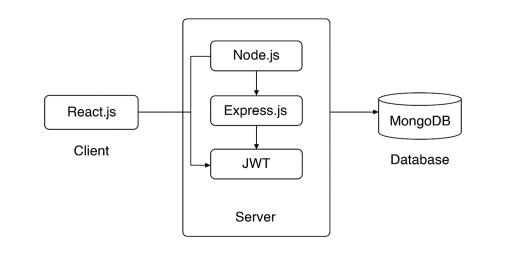
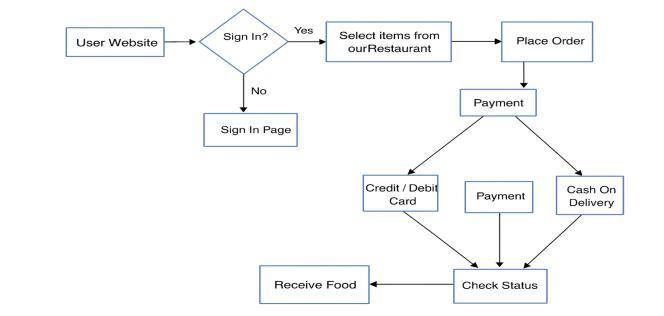
The proposed system is a MERN-based online food delivery web application designed to provide a fast, secure, and user-friendly ordering experience. The system uses React.js for an interactive frontend, Node.js and Express.js for backend processing, and MongoDBforstoringuser,product,andorderdata.It includes two main modules: a User Module for browsing menus, adding items to the cart, placing orders, making payments, and tracking order status, and an Admin Module for managing food items and processing orders. Secure JWT authentication, responsive design, and real-time status updates ensureareliableandefficientplatform.
A. System Architecture
The application follows a client-server architecture where: - React.js handles frontend UI rendering. - Express.js and Node.js handle backend logic and routing.
-MongoDBstoresuser,product,andorderdata.
B. Functional Components
1) User Module
Browsefooditems
Additemstocart
Placeordersandcompletepayments
Trackordersinrealtime
2) Admin Module
Add/update/deletefoodproducts
Manageordersandupdatestatus
Monitorsystemactivity
3) Authentication System
JWT-basedloginensuressecureaccesscontrol.
4) Payment Integration
SupportsRazorpay/Stripe/UPI.
5) Real-Time Order Tracking
Order stages include: Order Placed → Confirmed → Preparing → Out for Delivery → Delivered
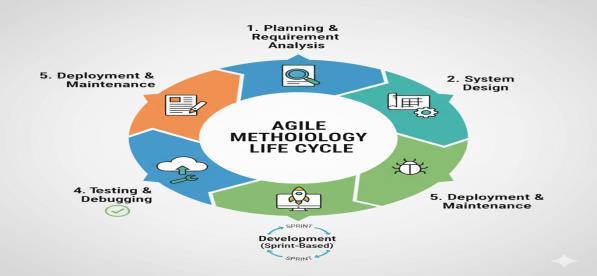
We will follow the Agile Methodology to ensure efficient, iterative, and flexible development. The project will be divided into multiple sprints, each focusing on a key module. Instead of planning an entire project upfront, Agile breaks down large projectsintosmall,manageable cyclescalled sprints oriterations.
International Research Journal of Engineering and Technology (IRJET) e-ISSN: 2395-0056
Volume: 13 Issue: 04 | Apr 2026 www.irjet.net p-ISSN: 2395-0072
Agile Process in Our Project:
• Planning & Requirement Analysis: Identify systemneeds,researchexistingsolutions,and definetheMERNstackarchitecture.
• System Design: Create UI wireframes, databaseschema,andAPIendpoints
1. Development (Sprint-Based):
• Sprint 1-2: Setup environment, authenticationsystem.
• Sprint 3-4: Restaurant management, order placement.
• Sprint 5-6: Payment gateway, real-time tracking,notifications.
• Sprint 7: Review&ratingsystem.
2. Testing & Debugging: Perform unit and system testingtoensuresecurityandefficiency.
3. Deployment & Maintenance: Host on Vercel, Render, and MongoDB Atlas, with continuous monitoringandupdates.
VII. Results and Discussion
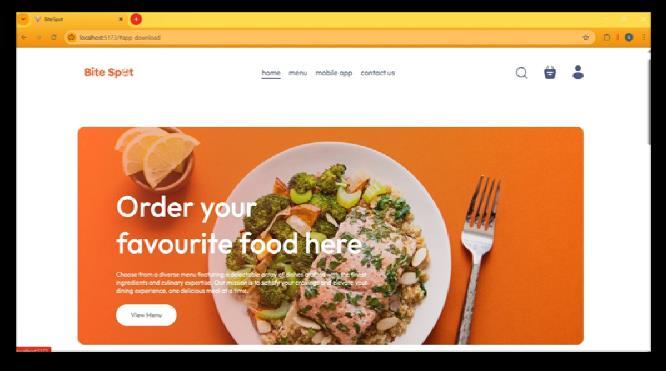
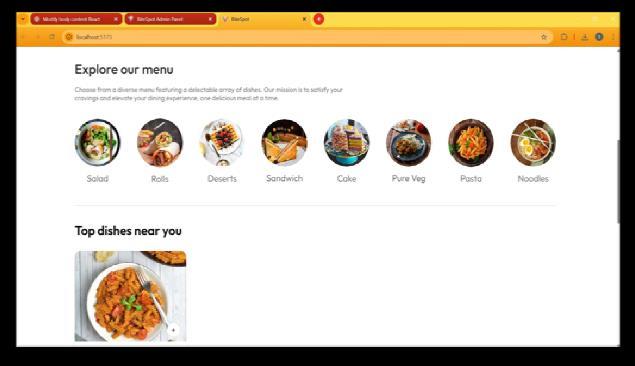
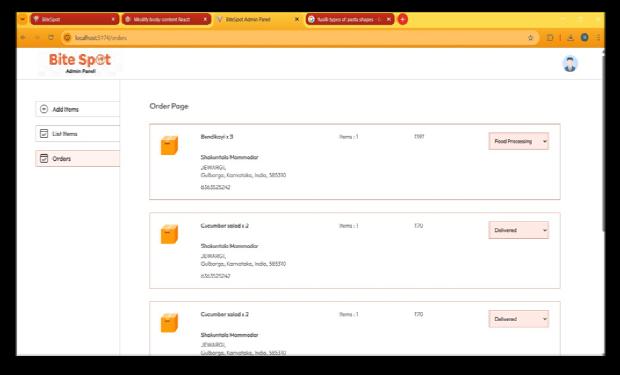
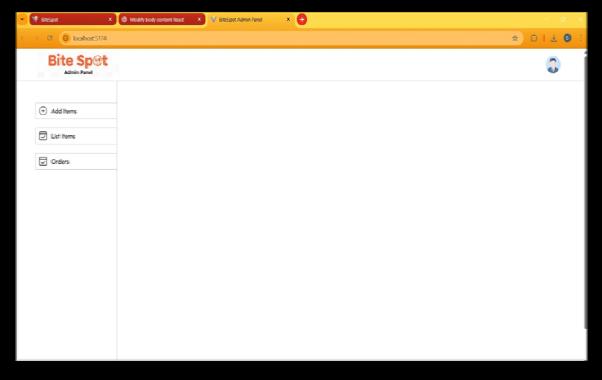
The developed application, titled 'BiteSpot,' offers seamlessuserexperiencewithmodulesforcustomer and admin roles. Customers can register, browse menus, manage carts, and track their orders, while adminsmanagemenus,orders,andpaymentrecords. The platform supports responsive design across mobileanddesktopscreens,withoptimizedbackend performance ensuring low latency. The system was tested for usability and responsiveness, confirming its stability and efficiency for small restaurant use cases.
International Research Journal of Engineering and Technology (IRJET) e-ISSN: 2395-0056
Volume: 13 Issue: 04 | Apr 2026 www.irjet.net p-ISSN: 2395-0072
VIII. Conclusion
This paper presented 'A Service for Delivering Food withMERNStack,'amodernweb-basedfooddelivery application that demonstrates the effectiveness of full-stack JavaScript technologies. The system enhances operational efficiency for restaurants and providescustomerswithareliable,secure,anduserfriendly digital ordering experience. Future enhancements may include implementing live order tracking via WebSockets, integrating AI-driven food recommendations,andexpandingtomulti-restaurant support. The project contributes to practical understanding of MERN stack application
development and its potential for small business digitization.
References
[1] A. S. Chauhan et al., 'Food Ordering Website “Cooked with Care” Developed Using MERN Stack', 2022.
[2] B. C. B., 'Implementation of Canteen Automation System with Payment Gateway Using MERN Stack', 2021.
[3]S.V.Kulkarnietal.,'OnlineFoodDeliverySystem', 2021.
[4] D. Mohammad, 'Evaluating the Suitability of the MERN Stack in the Development of Food Delivery Applications',2023.
[5] A. Gujar et al., 'Food Delivery Web Application withMERN',2024.
[6]MongoDBDocumentation:https://www.mongodb. com/docs/
[7]Express.jsGuide:https://expressjs.com/
[8]React.jsOfficialDocumentation:https://reactjs.org/
[9]Node.jsAPIDocumentation:https://nodejs.org/en/ docs/