International Research Journal of Engineering and Technology (IRJET)
e-ISSN: 2395-0056
Volume: 13 Issue: 06 | Jun 2026
p-ISSN: 2395-0072
www.irjet.net
A Review on Performance Assessment of Distributed Tuned Mass Dampers for Wind Response Control of Tall Buildings Using CFD and Structural Dynamic Analysis Mitesh R. Sakpal1, P. J. Salunke2 1PG Student, Dept of civil engineering, Mahatma Gandhi Mission’s College of Engineering and Technology(MGMCET),
Kamothe, Navi Mumbai, Maharashtra, India
2Professor, Dept of civil engineering, Mahatma Gandhi Mission’s College of Engineering and Technology(MGMCET),
Kamothe, Navi Mumbai, Maharashtra, India ----------------------------------------------------------------------***-----------------------------------------------------------------------I.INTRODUCTION Abstract-The increasing construction of tall and slender buildings has intensified the challenges associated with wind-induced vibrations. Excessive lateral displacements and accelerations generated by aerodynamic forces can adversely affect occupant comfort, structural serviceability, and long-term performance. Conventional wind-resistant design methods primarily rely on codal provisions and wind tunnel experiments; however, recent advances in Computational Fluid Dynamics (CFD) have enabled detailed simulation of atmospheric boundary layer flow and aerodynamic loading on buildings. Simultaneously, vibration control devices such as Tuned Mass Dampers (TMDs) have become widely adopted for mitigating dynamic responses. Although single TMD systems are effective near the fundamental frequency, their efficiency decreases when higher vibration modes significantly contribute to structural behavior. To overcome these limitations, Distributed Tuned Mass Dampers (d-TMDs) have been proposed, where multiple dampers are strategically distributed along the building height and tuned to different modal frequencies. This review presents a comprehensive assessment of previous studies related to CFD-based wind load prediction, wind-induced response of tall buildings, multiple and distributed tuned mass dampers, and coupled aerodynamicstructural analyses. The findings indicate that d-TMD systems provide superior vibration mitigation and robustness compared to conventional TMD configurations. Furthermore, integrating CFD-derived wind loads with structural dynamic analysis offers a realistic framework for evaluating vibration control performance. The review also identifies major research gaps and future opportunities for enhancing wind response mitigation strategies in tall buildings.
Rapid urbanization and the growing demand for high-rise infrastructure have resulted in the construction of increasingly tall and slender buildings. While advancements in construction materials and structural systems have enabled greater heights, they have also increased susceptibility to dynamic environmental loads, particularly wind. Unlike gravity loads, wind loads are highly variable and can induce significant lateral displacements, accelerations, and torsional responses. For modern tall buildings, serviceability criteria often govern design rather than strength requirements. Excessive building accelerations may cause occupant discomfort even when structural safety remains unaffected. Consequently, understanding wind–structure interaction and developing efficient vibration control systems have become essential aspects of structural engineering.
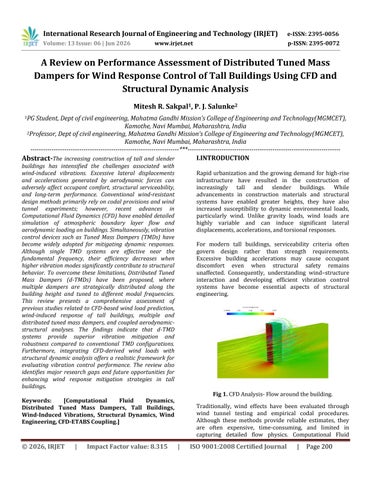
Fig 1. CFD Analysis- Flow around the building.
Keywords: [Computational Fluid Dynamics, Distributed Tuned Mass Dampers, Tall Buildings, Wind-Induced Vibrations, Structural Dynamics, Wind Engineering, CFD-ETABS Coupling.]
© 2026, IRJET
|
Impact Factor value: 8.315
Traditionally, wind effects have been evaluated through wind tunnel testing and empirical codal procedures. Although these methods provide reliable estimates, they are often expensive, time-consuming, and limited in capturing detailed flow physics. Computational Fluid
|
ISO 9001:2008 Certified Journal
|
Page 200