
International Research Journal of Engineering and Technology (IRJET) e-ISSN: 2395-0056
Volume: 13 Issue: 03 | Mar 2026 www.irjet.net p-ISSN: 2395-0072
International Research Journal of Engineering and Technology (IRJET) e-ISSN: 2395-0056
Volume: 13 Issue: 03 | Mar 2026 www.irjet.net p-ISSN: 2395-0072
Pradeep Kumar Chaurasiya1 , Mr. Ushendra Kumar2
1Master of Technology, Civil Engineering, Lucknow Institute of Technology, Lucknow, India
2Head of Department, Department of Civil Engineering, Lucknow Institute of Technology, Lucknow, India
Abstract -The surface characteristics of high-speed bituminous wearing courses play a decisive role in ensuring traffic safety, particularly under wet operating conditions. Among these characteristics, macro-texture significantly governs water drainage capability and tire–pavement interaction, thereby influencing skid resistance performance over time. However, progressive surface wear, aggregate polishing, binder aging, and environmental exposure contribute to macro-texture evolution and consequent degradationofskidresistance.Thisreviewsynthesizesexisting scientific literature on the mechanisms governing macrotexture development, measurement methodologies, and the temporal deterioration of frictional properties in high-speed asphaltpavements.Emphasisisplacedoncommonlyadopted textureparameterssuchasMeanProfileDepth(MPD),friction indicators obtained from British Pendulum Tester and continuousfrictionmeasuringequipment,andtheirreported correlations. The review critically evaluates empirical, mechanistic,anddata-drivenmodelsproposedforpredicting skid resistance degradation. Variability in findings due to traffic intensity, aggregate mineralogy, climatic conditions, and measurement techniques is examined to identify inconsistencies and knowledge gaps. Furthermore, advancements in non-contact laser profiling and high-speed friction measurement technologies are discussed. The study highlightstheneedforstandardizedevaluationprotocolsand integratedmulti-scaletextureanalysisframeworkstoenhance predictive reliability and pavement safety management strategies.
Key Words: Macro-texture evolution; Skid resistance degradation; High-speed bituminous wearing courses; Pavement surface friction; Mean Profile Depth (MPD); Texture–friction correlation.
1.1.1 Importance of Macro-Texture and Skid Resistance in High-Speed Road Safety
Surface friction characteristics of bituminous wearing coursesarefundamentaltohighwaysafety,particularlyon high-speed corridors where braking demand and hydroplaningriskaresignificantlyamplified.Macro-texture,
definedassurfaceirregularitieswithwavelengthstypically between 0.5 mm and 50 mm, plays a critical role in facilitatingwaterdrainagefromthetire–pavementinterface. Adequatemacro-texturereducesthethicknessofthewater filmduring rainfall events,thereby improving tirecontact andminimizinglossoffriction(PIARC,2012).Inhigh-speed traffic conditions, insufficient macro-texture has been directly associated with increased wet-weather accident rates due to compromised skid resistance (Flintsch et al., 2003). Consequently, maintaining texture depth within functional thresholds is essential for ensuring pavement serviceabilityandroadusersafety.
Stopping distance is strongly governed by the available frictionforceatthetire–roadinterface.Atelevatedspeeds, frictiondemandincreasesnonlinearly,andthepresenceof waterfurtherreduceseffectivecontactarea.Macro-texture enhances hysteresis friction and promotes rapid water evacuation, thereby sustaining friction coefficients under dynamic loading (Persson, 2001). Empirical studies demonstrate that reductions in surface texture depth correlate with extended braking distances, particularly above 80 km/h, where hydrodynamic effects become dominant(Halletal.,2009).Thus,theevolutionofmacrotexture over pavement life has direct implications for vehiculardecelerationperformanceandaccidentprevention.
1.2.1
Pavementsurfacetextureistypicallyclassifiedintomicrotexture and macro-texture based on wavelength and amplitudecharacteristics.Micro-texturereferstofine-scale asperitiesofaggregateparticles(wavelength<0.5mm)and primarilygovernsadhesion-relatedfrictionatlowspeeds.In contrast, macro-texture is associated with aggregate arrangement and mixture design features that influence water drainage and hysteresis effects at higher speeds (Moore,1975).Whilemicro-textureishighlydependenton aggregate mineralogy and polishing resistance, macrotextureismoreinfluencedbygradation,airvoidstructure, and compaction quality (Kane et al., 2013). Both scales
International Research Journal of Engineering and Technology (IRJET) e-ISSN: 2395-0056
Volume: 13 Issue: 03 | Mar 2026 www.irjet.net p-ISSN: 2395-0072
interactsynergisticallytodetermineoverallskidresistance performance.
Skid resistance is quantified using various standardized indicators that capture frictional performance under controlledconditions.TheBritishPendulumNumber(BPN) providesaportableassessmentofsurfacefriction,primarily reflectingmicro-texturalcharacteristics(ASTME303,2020).
ContinuousFrictionMeasuringEquipment(CFME),suchas SCRIMandLocked-WheelTesters,evaluatesfrictionunder dynamic conditions representative of traffic speeds (Wambold et al., 1995). Texture-related parameters, includingMeanProfileDepth(MPD)obtainedthroughlaser profilometry, are widely adopted to characterize macrotexture quantitatively (ISO 13473-1, 2019). Correlative relationships between MPD and friction coefficients have beenextensivelyinvestigated,althoughvariabilitypersists duetooperationalandenvironmentalfactors.
Technological progress in non-contact laser profilometry and high-speed friction testing has significantly improved measurement precision and spatial coverage. Threedimensional texture scanning enables multi-scale surface characterization beyond traditional sand patch methods (Kogbara et al., 2016). In parallel, data-driven modelling approaches and mechanistic–empirical frameworks are increasingly employed to predict friction deterioration trends under traffic loading and climatic exposure. These developments necessitate a systematic review to evaluate methodologicalrobustness,identifyconvergenceinfindings, andhighlightareasrequiringfurtherrefinement.
Thisreviewaimstocriticallysynthesizeexistingliterature ontheevolutionofmacro-textureanditsinfluenceonskid resistance degradation in high-speed bituminous wearing courses.Specifically,itexamines:(i)mechanismsgoverning texturealterationundertrafficandenvironmentalactions; (ii) measurement techniques and texture–friction correlations; (iii) degradation modelling approaches; and (iv)technologicaladvancementsinmonitoringsystems.The scope is confined to peer-reviewed studies focusing on asphalt-based wearing surfaces subjected to high-speed traffic conditions. Experimental results are discussed comparatively rather than presented as original research findings.Throughstructuredanalysis,thereviewseeksto identify knowledge gaps and propose directions for improvedpredictiveandmaintenanceframeworks.
2.1.1
Asystematicandstructuredliteraturesearchwasconducted toensurecomprehensivecoverageofscholarlycontributions related to macro-texture evolution and skid resistance degradation in high-speed bituminous wearing courses. Major bibliographic databases including Web of Science, Scopus, and Google Scholar were selected due to their extensiveindexingofpeer-reviewedjournalsinpavement engineering and transportation infrastructure. These platforms are widely recognized for their reliability in systematicreviewsandbibliometricanalyses(Mongeonand Paul-Hus, 2016). The selection of multiple databases minimized publication bias and enhanced retrieval of interdisciplinary studies encompassing materials science, highway engineering, and surface characterization technologies.
2.1.2
–2025)
Thereviewconsideredpublicationsfrom1990to2025 to capture the evolution of pavement texture research over approximatelythreedecades.Theearly1990smarkedthe increasing adoption of mechanistic friction analysis and improvedtexturemeasurementtechniques,whilethepost2000periodreflectsadvancementsinlaserprofilometryand high-speed friction testing technologies. Including recent literatureensuresincorporationofdevelopmentsindigital surface characterization and predictive modelling approaches. Temporal coverage across this span enables assessmentoflong-termresearchtrendsandmethodological shiftsinpavementsurfaceevaluation(Tranfield,Denyerand Smart,2003).
2.2
2.2.1
Thereviewprimarilyincludedpeer-reviewedSCI-indexed journalarticlestoensuremethodologicalrigorandacademic reliability.Keyjournalsinpavementengineering,materials science, and transportation safety were prioritized. Additionally, relevant international standards (e.g., ASTM, ISO)andselectedhigh-impactconferenceproceedingswere includedwheretheycontributedfoundationalknowledgeon measurementtechniquesorstandardizedprocedures.Nonpeer-reviewed reports, unpublished theses, and opinionbased articles were excluded to maintain scientific credibilityandconsistencyinevidencesynthesis.
2.2.2
Structured keyword combinations were employed using Boolean operators to refine search results. Primary keywords included: “macro-texture evolution,” “skid
International Research Journal of Engineering and Technology (IRJET) e-ISSN: 2395-0056
Volume: 13 Issue: 03 | Mar 2026 www.irjet.net p-ISSN: 2395-0072
resistance degradation,” “bituminous wearing course,” “MeanProfileDepth(MPD),”“pavementfriction,”and“highspeedasphaltsurface.”Thesewerecombinedusinglogical connectorssuchasAND/ORtoimproveretrievalspecificity. Thedevelopmentofkeywordclustersfollowedestablished systematic review protocols to enhance transparency and reproducibility(KitchenhamandCharters,2007).Synonyms andrelatedtechnicaltermswereincorporatedtoaccountfor terminologicalvariationacrossregionsanddisciplines.
2.2.3 Language and Quality
OnlyarticlespublishedinEnglishwereconsideredtoensure consistencyininterpretationandanalysis.Qualityfiltering involved screening for journal impact, citation frequency, and methodological clarity. Studies lacking clear experimental procedures, measurement descriptions, or statisticalvalidationwereexcluded.Duplicaterecordsacross databases were removed during the screening stage. Abstractandfull-textreviewswereconductedsequentially to confirm thematic relevance to macro-texture and skid resistancerelationships.
3.1 Pavement Surface Texture
3.1.1 Classification: Micro, Macro and Mega Texture
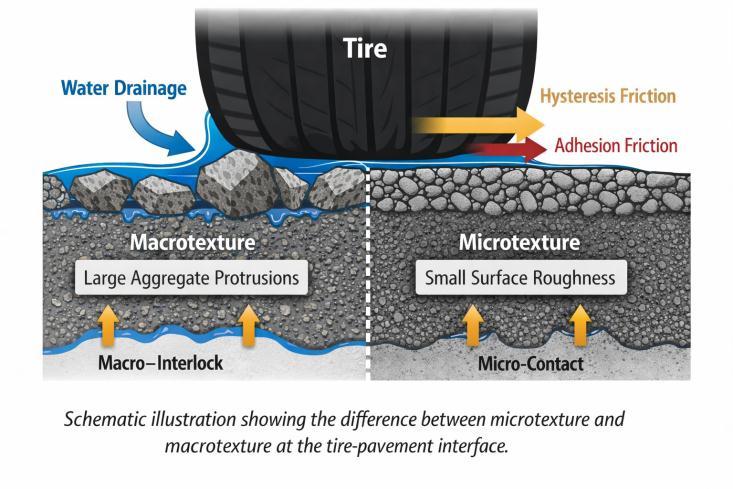
Pavementsurfacetextureisamulti-scalecharacteristicthat significantly influences tire–pavement interaction and hydraulic behaviour. It is commonly classified into microtexture, macro-texture, and mega-texture based on wavelength ranges. Micro-texture (wavelength < 0.5 mm) correspondstothefineasperitiesofaggregateparticlesand primarilygovernsadhesion-relatedfrictionatlowspeeds. Macro-texture (0.5 mm–50 mm) arises from aggregate arrangementandmixturestructure,controllinghysteresis frictionandwaterdrainagecapacity.Mega-texture(50mm–500 mm) relates to surface irregularities associated with constructionpracticesorsurfacedistress,influencingride qualityanddynamicloading(PIARC,2012).Thishierarchical classification enables functional interpretation of texture effects across varying traffic speeds and environmental conditions.
The interaction between these texture scales is not independent; rather, they operate synergistically. While micro-texturecontributestodirectrubberadhesion,macrotexturefacilitatesrapidwaterescapeandenhancescontact underwetconditions.Mega-texture,althoughlessdirectly linkedtofrictiongeneration,mayaffectvehiclestabilityat very high speeds due to induced vibrations (Hall et al., 2009).
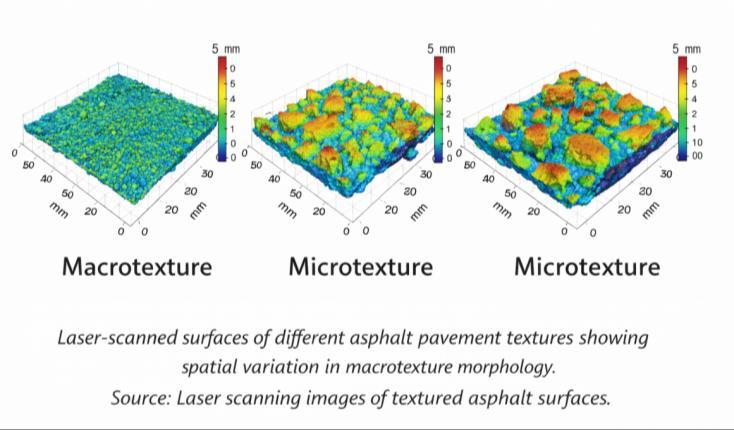
Texturecharacterizationisperformedusingbothvolumetric and profile-based measurement techniques. Traditional volumetricapproachessuchasthesandpatchtestprovide Mean Texture Depth (MTD), expressed in millimetres. Modern laser-based profilometers measure Mean Profile Depth (MPD), a standardized macro-texture indicator derived from longitudinal surface profiles (ISO 13473-1, 2019).Three-dimensionalscanningsystemsfurtherenable arealtextureparameters,offeringenhancedresolutionand repeatabilitycomparedto manual methods.Measurement scaleselectiondependsonfunctionalrequirements;macrotexture parametersare particularlycritical forhigh-speed pavementsduetotheirinfluenceondrainageefficiencyand hydrodynamicpressuredistribution.
3.2.1
Skidresistancereferstotheabilityofapavementsurfaceto developsufficientfrictionalforcetoresistslidingofvehicle tiresunderbrakingorcorneringmanoeuvres.Itisadynamic propertyinfluencedbysurfacetexture,tirecharacteristics, speed, temperature, and moisture conditions. From a tribological perspective, pavement friction consists of adhesion and hysteresis components, with their relative contributionsvaryingaccordingtosurfaceroughnessscale and operational speed (Persson, 2001). At higher speeds, hysteresisfrictionassociatedwithmacro-texturebecomes increasinglydominantduetodeformationofthetiretread oversurfaceasperities.
Skidresistanceisthereforenotastaticmaterialpropertybut a system-level response governed by tire–pavement–environment interaction. Its degradation over time is typicallyassociatedwithaggregatepolishing,binderwear, andtraffic-inducedsurfacesmoothing.
3.2.2
International Research Journal of Engineering and Technology (IRJET) e-ISSN: 2395-0056
Volume: 13 Issue: 03 | Mar 2026 www.irjet.net p-ISSN: 2395-0072
Variousstandardizeddevicesareemployedtoquantifyskid resistance under controlled conditions. The British PendulumTester(BPT)measuresfrictionatlowspeedsand provides the British Pendulum Number (BPN), primarily reflectingmicro-texturalproperties(ASTME303,2020).For network-levelassessmentatoperationalspeeds,Sidewayforce Coefficient Routine Investigation Machine (SCRIM) evaluates friction under continuous motion, offering representative field performance data (Wambold et al., 1995).TheLocked-WheelSkidTestersimulatesemergency brakingconditionsbymeasuringfrictionataspecifiedslip ratio,widelyusedinhighwayperformancemonitoring.The Dynamic Friction Tester (DFT) measures friction across variable rotational speeds, allowing characterization of speed-dependentfrictioncurves.
Each method captures distinct aspects of the friction mechanism, and discrepancies between results may arise duetodifferencesintestspeed,slipconditions,andwater application rates. Consequently, harmonization of friction indicators remains a continuing challenge in pavement performanceevaluation.
3.3.1
High-speed bituminous wearing courses are engineered asphaltmixturesdesignedtowithstandheavytrafficloading whilemaintainingadequatesurfacefrictionanddurability. Typicalcompositionsincludedense-gradedasphaltconcrete (AC),stonemasticasphalt(SMA),andopen-gradedfriction courses (OGFC). These mixtures consist of mineral aggregates, bituminous binders(oftenpolymer-modified), mineral fillers, and air void structures optimized for structuralandfunctionalperformance(Robertsetal.,1996). Aggregatemineralogyandgradationsignificantlyinfluence bothmacro-textureformationandresistancetopolishing.
Polymer-modified binders enhance rutting resistance and durability, whereas gap-graded mixtures such as SMA promotestone-on-stonecontact,contributingtoimproved macro-texture retention. Open-graded surfaces facilitate superior drainage but may exhibit different long-term textureevolutionpatterns.
3.3.2 Characteristics
Thefunctionalperformanceofhigh-speedwearingcourses depends on structural integrity, aggregate interlock, and resistancetosurfacewear.Macro-textureisstronglyaffected byaggregatesizedistribution,compactionlevel,andbinder content. Over time, traffic loading may cause aggregate embedmentorpolishing,leadingtoreducedtexturedepth andfrictionalperformance.Environmentalfactorssuchas
temperature fluctuations and oxidation further influence binderstiffnessandaggregateexposure(Kaneetal.,2013).
For high-speed highways, optimal balance between durability and surface roughness is critical. Excessively smoothsurfacesincreasehydroplaningrisk,whereasoverly rough surfaces may generate noise and vibration issues. Therefore,mixturedesignandmaintenancestrategiesmust consider long-term macro-texture stability to sustain skid resistancethroughoutthepavementservicelife.
4. MACRO-TEXTURE EVOLUTION OF BITUMINOUS SURFACES
Macro-textureevolutioninbituminous wearingcourses is governed by mechanical, material, and environmental processesactingsimultaneouslyoverthepavementservice life. These mechanisms alter aggregate exposure, surface morphology, and void structure, ultimately affecting hydraulicconductivityandfrictionalresponse.
Traffic loading is the primary driver of macro-texture modification. Repeated wheel passes induce abrasion, aggregate rearrangement, and localized compaction, particularly in high-volume corridors. Under heavy axle loads, aggregate particles may undergo micro-fracture or embedment into the binder matrix, reducing effective surfaceprotrusionandtexturedepth.Shearstressesatthe tire–pavement interface also promote surface smoothing over time (Flintsch et al., 2003). The rate of texture reductionisstronglycorrelatedwithcumulativeEquivalent Single Axle Loads (ESALs), with accelerated degradation observedinslowlanesandbrakingzones.
4.1.2
Aggregate polishing is a progressive reduction in surface roughnesscausedbymechanicalabrasionfromtirecontact.
International Research Journal of Engineering and Technology (IRJET) e-ISSN: 2395-0056
Volume: 13 Issue: 03 | Mar 2026 www.irjet.net p-ISSN: 2395-0072
Thepolishingresistanceofaggregatesdependsonmineral hardness, angularity, and petrographic composition. Siliceous aggregates typically exhibit better long-term resistance compared to softer calcareous materials. As polishing progresses, micro-texture diminishes first, followed by gradual macro-texture alteration due to smoothingofexposedaggregatesurfaces(Kaneetal.,2013). Thisphenomenonsignificantlyreducesfrictionunderwet conditions,whereadhesioncomponentsbecomelimited.
Bituminousbindersundergooxidativeagingduetoexposure to oxygen, ultraviolet radiation, and thermal cycles. Oxidativehardeningincreasesbinderstiffness,potentially leadingtomicro-crackingandravelingatthesurface.Over time, binder film thinning and aggregate debonding may occur, modifying surface morphology and contributing to texturevariability(Petersen,2009).Whilebinderagingcan initiallyincreaseaggregateexposureduetostiffening,longtermdeteriorationoftenresultsinmateriallossandsurface irregularitiesthataltermacro-texturecharacteristics.
4.1.4
Environmental conditions significantly influence macrotexturestability.Temperaturefluctuationsinducethermal stressesandexpansion–contractioncycles,affectingbinder–aggregateadhesion.Incolderclimates,freeze–thawcycles promotesurfacescalingandmicro-cracking,whereashightemperature regions may experience accelerated binder softening and rutting. Moisture infiltration further exacerbatesstrippingandsurfacewear.Climaticexposure, combinedwithtrafficaction,createsregion-specificpatterns oftextureevolution(Al-Qadietal.,2008).Therefore,macrotexture degradation cannot be fully understood without consideringenvironmentalcontext.
Quantitative evaluation of macro-texturerequires reliable surfacecharacterizationparametersthatreflectfunctional performance.
4.2.1
MeanProfileDepth(MPD)isoneofthemostwidelyadopted macro-textureindicatorsderivedfromlongitudinalsurface profiles. It is calculated from high-resolution laser measurements over standardized sampling lengths and expressed in millimetres. MPD provides improved repeatabilitycomparedtovolumetricsandpatchmethods andisstandardizedunderISO13473-1(2019).Numerous studieshavedemonstratedsignificantcorrelationbetween MPDandwetfrictionperformanceathighspeeds,makingit acriticalparameterinpavementmanagementsystems.
BeyondMPD,additionalstatisticalparameterssuchasRoot Mean Square(RMS) height, texture roughnessindex(RT), andskewnessdescriptorsareusedtocharacterizesurface morphology.RMSvaluesrepresentthestandarddeviationof surface elevation data and provide information about amplitude variability. These metrics enable multidimensionalinterpretationoftexturestructure,particularly whenusingthree-dimensionalsurfacemappingtechniques (Kogbaraetal.,2016).AlthoughMPDremainsdominantfor network-levelevaluation,advancedmetricsfacilitatedeeper understanding of texture distribution and degradation patterns.
Modern texture assessment relies heavily on non-contact laserprofilometerscapableofhigh-speeddataacquisition. These systems generate continuous surface profiles and allow computation of standardized parameters under operationaltrafficspeeds.Three-dimensionallaserscanners furtherenablearealtextureanalysis,overcominglimitations of traditional line-based measurements. Compared to manual sand patch testing, laser methods provide higher spatial resolution, improved safety, and better reproducibility(PIARC,2012).However,datainterpretation requires careful filtering and calibration to ensure consistencyacrossequipmenttypes.
Macro-texture is not static but evolves dynamically under cumulativemechanicalandenvironmentalinfluences.
Longitudinalfieldinvestigationsrevealthatmacro-texture typicallyexperiencesaninitialstabilizationphasefollowing construction,followedbygradualdeclineduetopolishing andwear.Insomecases,early-lifedensificationmayslightly reduce texture depth before equilibrium is reached. Subsequent degradation often follows nonlinear trends, influenced by traffic growth and mixture characteristics (Halletal.,2009).Certainopen-gradedsurfacesdemonstrate relatively stable macro-texture retention compared to dense-gradedmixtures,thoughtheymaybesusceptibleto cloggingeffectsovertime.
Pavementageand trafficintensityarestronglyassociated withmacro-texturereductionrates.Highertrafficvolumes accelerate aggregate polishing and structural rearrangement, leading to measurable decreases in MPD values within the first few service years. Conversely, lowvolume roads often retain texture characteristics for extended periods. Empirical analyses indicate that degradation curves are influenced by cumulative load
International Research Journal of Engineering and Technology (IRJET) e-ISSN: 2395-0056
Volume: 13 Issue: 03 | Mar 2026 www.irjet.net p-ISSN: 2395-0072
repetitionsratherthanchronologicalagealone(Flintschet al.,2003).Therefore,predictivemodelsmustintegratetraffic loading parameters alongside environmental variables to accuratelyestimatelong-termmacro-textureperformance.
5.1 Relationship Between Macro-Texture and Skid Resistance
Theinteractionbetweenpavementsurfacetextureandtire rubber governs the frictional performance of bituminous wearingcourses.Whilemicro-texturecontrolsadhesionat lowspeeds,macro-texturebecomesincreasinglysignificant underhigh-speedandwetconditions.
5.1.1 Theoretical Foundations
Fromatribologicalperspective,pavementfrictioncomprises adhesionandhysteresiscomponents.Adhesionarisesfrom molecular bonding between tire rubber and aggregate asperities,whereashysteresisfrictionisgeneratedthrough viscoelasticdeformationofrubberoversurfaceirregularities (Persson, 2001). At higher speeds, the presence of water reduces adhesive contact, and macro-texture facilitates drainage, limiting hydrodynamic lift and maintaining effectivecontactarea.Theoreticalmodelsoftire–pavement interactionindicatethatinsufficientmacro-textureincreases waterfilmthickness,therebyreducingavailablefrictionand elevating hydroplaning risk (PIARC, 2012). Consequently, macro-textureisfunctionallylinkedtofrictionsustainability underdynamicloading.
5.1.2
Numerousfieldinvestigationshavequantifiedcorrelations between macro-texture indicators, such as Mean Profile Depth (MPD), and measured friction coefficients. Studies reportpositiverelationshipsbetweenMPDandhigh-speed friction values, particularly under wet testing conditions (Flintschetal.,2003).However,thestrengthofcorrelation variesdependingontrafficspeed,testingdevice,andsurface condition.Someresearchersobservenonlinearbehaviour, where friction improvement plateaus beyond a threshold texture depth (Hall et al., 2009). These empirical findings highlight that macro-texture is a necessary but not independentlysufficientpredictorofskidresistance.
Accurateevaluationofskidresistancerequiresstandardized measurement systems capable of simulating real traffic conditions.
5.2.1
Portabledevices,suchastheBritishPendulumTester(BPT), provide rapid point-based assessment of surface friction. The British Pendulum Number (BPN) reflects low-speed
frictioncharacteristicsandisparticularlysensitivetomicrotexture properties (ASTM E303, 2020). Although widely usedforspotevaluationsandlaboratoryspecimens,portable devices may not fully represent friction performance at highwayspeeds.Theiradvantagesincludesimplicity,costeffectiveness,andminimaloperationalrequirements.
ContinuousFrictionMeasuringEquipment(CFME),including SCRIM and locked-wheel testers, evaluates friction under operational speeds and controlled slip conditions. These systems provide network-level data and enable spatial variabilityanalysisalonghighwaysections(Wamboldetal., 1995).Comparedtoportabledevices,CFMEbettercaptures macro-texture effects under wet conditions. However, differences in slip ratio, tire type, and water application protocols can produce variability between measurement systems, necessitating calibration and harmonization procedures.
Skid resistance degradation is influenced by material characteristics, environmental exposure, and mechanical distressmechanisms.
Aggregate mineralogy plays a critical role in long-term friction retention. Hard, angular aggregates with high polishing resistance maintain surface roughness over extendedtrafficexposure,whereassofteraggregatestendto smooth rapidly. Polishing reduces micro-texture first, followedbygradualreductioninmacro-texturecontribution tofriction(Kaneetal.,2013).Laboratorypolishingtestsand petrographicanalysisareoftenusedtoevaluateaggregate suitabilityforhigh-speedpavements.
Moisture and temperature significantly affect frictional behaviour.Underwetconditions,wateractsasalubricant, reducingadhesionandamplifyingtheimportanceofmacrotexture. Elevated temperatures may soften the binder, potentially leading to aggregate embedment and surface smoothing. Conversely, freeze–thaw cycles can induce micro-cracking and surface scaling, altering texture morphology(Al-Qadietal.,2008).Environmentalexposure thusacceleratesdegradationprocessesandmodifiesfriction performanceseasonally.
Mechanical wear mechanisms such as abrasion, cracking, and raveling directly alter surface morphology. Abrasion caused by tire contact progressively smooths aggregate surfaces.Crackingandravelingmayinitiallyincreasesurface
International Research Journal of Engineering and Technology (IRJET) e-ISSN: 2395-0056
Volume: 13 Issue: 03 | Mar 2026 www.irjet.net p-ISSN: 2395-0072
roughnessbuteventuallyleadtomateriallossandstructural deterioration. These distress modes interact with traffic intensity and mixture design, influencing the rate and patternofskidresistancedecline(Robertsetal.,1996).
Skidresistanceevolvesoverthepavementlifecycleandis typically characterized by an initial period of adjustment followedbygradualdecline.
5.4.1
Long-term monitoring programs indicate that skid resistanceoftendecreasesrapidlyduringtheearlyservice period due to aggregate polishing, then stabilizes before declining again as structural wear progresses (Hall et al., 2009).High-trafficsectionsexhibitfasterdegradationrates compared to low-volume roads. Seasonal fluctuations are also reported, with lower friction observed during wet or high-temperatureperiods.
5.4.2
Variousstatisticalandempiricalmodelshavebeenproposed to predict friction decline over time. Regression-based modelsfrequentlyrelatefrictioncoefficientstocumulative traffic loading, age, and environmental variables. Mechanistic–empirical approaches incorporate texture evolution parameters to enhance predictive capability (Flintschetal.,2003).Althoughthesemodelsdemonstrate reasonableaccuracywithinspecificdatasets,generalization across regions remains challenging due to variability in materialsandclimate.
5.5.1 Similarities and Discrepancies in Reported Degradation Rates
Comparativeanalysisofpublishedstudiesrevealsconsistent agreementthattrafficloadingandaggregatepolishingare primary drivers of friction decline. However, reported degradation rates vary substantially. Some investigations indicaterapidearly-lifefrictionloss,whereasothersobserve moregradualtrends.Differencesintestingmethodologies, climatic exposure, mixture types, and traffic compositions contributetothesediscrepancies(PIARC,2012).
5.5.2 Possible Reasons for Variation
Variabilityinfindingscanbeattributedtoinconsistenciesin measurementequipmentcalibration,slipratios,andwater application rates. Regional differences in aggregate mineralogy and maintenance practices further influence outcomes.Additionally,theabsenceofstandardizedmacrotexture thresholds across jurisdictions complicates crossstudycomparisons.Thesevariationshighlightthenecessity
for harmonized testing frameworks and multi-parameter analysistoimprovepredictivereliability.
Predictive modeling of macro-texture evolution and skid resistance degradation is essential for pavement management systems and safety-based maintenance planning.Overthepastdecades,approacheshaveevolved fromsimpleempiricalregressionstomechanistic–empirical frameworks and, more recently, data-driven analytical techniques.
6.1.1
Empirical models represent the earliest and most widely adoptedmethodsforpredictingskidresistancedegradation Thesemodelstypicallyemployregressionanalysistorelate friction indicators (e.g., friction number or sideway-force coefficient)toexplanatoryvariablessuchaspavementage, cumulativetrafficloading,andinitialtexturedepth.Linear, exponential,andlogarithmicdecayfunctionsarecommonly used to describe friction reduction trends (Flintsch et al., 2003).
Curve-fittingapproachesareparticularlyusefulfornetworklevel performance forecasting, where large datasets are available from routine monitoring. However, empirical models are inherently site-specific and rely heavily on calibration datasets. Their predictive accuracy diminishes when extrapolated beyond the original environmental or material conditions. Despite these limitations, empirical formulations remain practical tools in pavement management systems due to their simplicity and ease of implementation.
6.2.1
Mechanistic–empirical (M–E) models integrate physical principles governing tire–pavement interaction with statistically calibrated parameters. These approaches consider tribological mechanisms such as adhesion and hysteresisfriction,viscoelasticdeformationofrubber,and hydrodynamic pressure effects under wet conditions (Persson,2001).Byincorporatingmacro-textureparameters suchasMeanProfileDepth(MPD)intotheoreticalfriction formulations,M–Emodelsaimtoprovidemoregeneralized predictivecapability.
Such models often include traffic-induced polishing rates, aggregatemineralhardness,andenvironmentalexposureas mechanistic inputs. Compared to purely empirical regressions, mechanistic–empirical approaches offer improvedinterpretabilityandtransferability.Nevertheless, accuratecalibrationrequirescomprehensivefielddata,and
International Research Journal of Engineering and Technology (IRJET) e-ISSN: 2395-0056
Volume: 13 Issue: 03 | Mar 2026 www.irjet.net p-ISSN: 2395-0072
the complexity of tire–pavement interactions introduces uncertaintiesinparameterestimation(Halletal.,2009).
6.3.1
With the expansion of high-resolution surface monitoring and continuous friction measurement systems, large datasets have become available for advanced analytical modeling.Machine-learningalgorithms includingArtificial Neural Networks (ANN), Support Vector Machines (SVM), and Random Forest models have been explored for predictingskidresistancebasedonmulti-parameterinputs such as texture metrics, traffic intensity, and climatic variables(Kogbaraetal.,2016).
Data-drivenmodelscancapturenonlinearrelationshipsthat traditionalregressionmethodsmayfailtoidentify.Theyare particularlyadvantageouswhenhandlinghigh-dimensional datasetsderivedfromlaserscanningtechnologies.However, their effectiveness depends strongly on dataset quality, featureselection,andmodeltrainingprotocols.
Theprimaryadvantageofmachine-learningapproacheslies in their ability to improve predictive accuracy through adaptive learning. They can integrate multi-scale texture descriptors and real-time monitoring data for proactive pavement maintenancestrategies.However,thesemodels often function as “black boxes,” limiting physical interpretability. Additionally, overfitting risks and lack of standardized validation frameworks remain critical challenges.Broaderadoptionrequirestransparentreporting of model architecture, validation procedures, and crossregionaltesting.
6.4.1
Model performance is typically evaluated using statistical indicators such as coefficient of determination (R²), root meansquareerror(RMSE),andmeanabsolutepercentage error (MAPE). Empirical models generally provide acceptable short-term predictions within calibrated conditions, whereas mechanistic–empirical models demonstrate improved conceptual robustness. Machinelearning models frequently achieve higher predictive accuracy but require extensive datasets for stable generalization(PIARC,2012).
Comparative studies suggest that no single modeling approachisuniversallysuperior;effectivenessdependson dataavailability,requiredpredictionhorizon,andpractical implementationconstraints.
Despite considerable progress, several gaps remain in predictive modeling of macro-texture and skid resistance degradation. First, integration of multi-scale texture parameters into unified modeling frameworks is limited. Second,long-termdatasetscapturingcombinedtrafficand environmentaleffectsareinsufficientinmanyregions.Third, harmonizationoffrictionmeasurementstandardsisneeded toimprovemodeltransferabilityacrossjurisdictions.Future researchshouldemphasizehybridmodelingapproachesthat combine mechanistic understanding with data-driven adaptabilitytoenhancepredictivereliabilityandoperational applicability.
This review critically synthesizes existing literature on macro-textureevolutionandskidresistancedegradationin high-speedbituminouswearingcourses,highlightingtheir interdependentrolesinpavementsafetyperformance.The findings confirm that macro-texture is a decisive factor in maintaining adequate friction under high-speed and wet conditions,primarilythroughenhancedwaterdrainageand hysteresis-based friction mechanisms. Traffic loading, aggregate polishing, binder aging, and environmental exposurecollectivelygoverntexturemodificationoverthe pavement life cycle. While empirical studies consistently demonstratea positivecorrelationbetweentexturedepth indicators suchasMeanProfileDepth(MPD) andhighspeed friction performance, variability persists due to differencesinmaterials,climate,andtestingmethodologies.
Advancementsinlaser-basedprofilometryandcontinuous frictionmeasuringsystemshaveimprovedtheaccuracyand spatial coverage of surface characterization. Moreover, predictive modeling approaches have evolved from regression-based empirical formulations to mechanistic–empirical and data-driven frameworks. However, inconsistenciesinmeasurementprotocolsandlimitedlongtermdatasetsconstrainmodelgeneralizationacrossregions. The review underscores the need for standardized evaluation procedures, integration of multi-scale texture descriptors, and hybrid predictive models that combine physical understanding with advanced analytics. A comprehensive and harmonized approach to texture and friction monitoring is essential to enhance safety managementstrategiesforhigh-speedasphaltpavements.
ThisreviewislimitedtoEnglish-languagepublicationsand primarily focuses on peer-reviewed journal articles, potentiallyexcludingrelevantregionalstudiesortechnical reports.Variabilityinfrictionmeasurementequipmentand reporting formats across jurisdictions restricts direct quantitativecomparisonofdegradationrates.Additionally, the synthesis relies on published datasets without
International Research Journal of Engineering and Technology (IRJET) e-ISSN: 2395-0056
Volume: 13 Issue: 03 | Mar 2026 www.irjet.net p-ISSN: 2395-0072
independent validation, and differences in climatic and material conditions may influence generalizability of conclusions.Emergingmachine-learningapplicationswere discussed conceptually due to limited long-term field validation studies. Future reviews incorporating metaanalytical techniques and broader multilingual databases couldprovidemorecomprehensiveglobalinsights.
1. Al-Qadi, I.L., Ozer, H., Wang, H. and Leng, Z. (2008) ‘Impact of climatic conditions on flexible pavement performance’, Journal of the Association of Asphalt PavingTechnologists,77,pp.1–34.
2. ASTM E303 (2020) Standard Test Method for Measuring Surface Frictional Properties Using the British Pendulum Tester. West Conshohocken, PA: ASTMInternational.
3. Flintsch,G.W.,deLeón,E.,McGhee,K.K.andAl-Qadi,I.L. (2003)‘Pavementsurfacemacrotexturemeasurement and application’, Transportation Research Record: JournaloftheTransportationResearchBoard,1860(1), pp.168–177.
4. Hall, J.W., Smith, K.L., Titus-Glover, L., Wambold, J.C., Yager, T.J. and Rado, Z. (2009) Guide for Pavement Friction.NCHRPWeb-OnlyDocument108.Washington, DC:TransportationResearchBoard.
5. ISO 13473-1 (2019) Characterization of Pavement Texture by Use of Surface Profiles – Part 1: Determination of Mean Profile Depth. Geneva: InternationalOrganizationforStandardization.
6. Kane, M., Artamendi, I. and Scarpas, A. (2013) ‘Longterm skid resistance of asphalt surfacings: A review’, ConstructionandBuildingMaterials,48,pp.84–91.
7. Kitchenham,B.andCharters,S.(2007)Guidelinesfor PerformingSystematicLiteratureReviewsinSoftware Engineering.EBSETechnicalReport.KeeleUniversity andDurhamUniversity.
8. Kogbara,R.B.,Masad,E.A.,Kassem,E.,Scarpas,A.and Anupam, K. (2016) ‘A state-of-the-art review of advancesinasphaltmixture modelling’,Construction andBuildingMaterials,124,pp.1085–1104.
9. Mongeon, P. and Paul-Hus, A. (2016) ‘The journal coverageofWebofScienceandScopus:acomparative analysis’,Scientometrics,106(1),pp.213–228.
10. Persson, B.N.J. (2001) ‘Theory of rubber friction and contact mechanics’, The Journal of Chemical Physics, 115(8),pp.3840–3861.
11. PIARC(2012)RoadSurface CharacteristicsandRoad Safety.TechnicalCommitteeReport.Paris:WorldRoad Association.
12. Petersen,J.C.(2009)‘Areviewofthefundamentalsof asphaltoxidation:Chemical,physicochemical,physical property,anddurabilityrelationships’,Transportation Research Circular, E-C140, Transportation Research Board.
13. Roberts, F.L., Kandhal, P.S., Brown, E.R., Lee, D.Y. and Kennedy, T.W. (1996) Hot Mix Asphalt Materials, Mixture Design and Construction. 2nd edn. Lanham, MD:NAPAResearchandEducationFoundation.
14. Tranfield,D.,Denyer,D.andSmart,P.(2003)‘Towards a methodology for developing evidence-informed management knowledge by means of systematic review’,BritishJournalofManagement,14(3),pp.207–222.
15. Wambold,J.C.,Antle,C.E.,Henry,J.J.andRado,Z.(1995) International PIARC Experiment to Compare and HarmonizeTextureandSkidResistanceMeasurements. Paris:WorldRoadAssociation(PIARC).
16. Chen,W.,Zhang,Z.,Wei,J.,Zhang,X.,Wu,W.,Sun,Y.and Wang, G. (2025) ‘Study on skid resistance of asphalt pavementsundermacroscopicandmicroscopictexture features: A review of the state of the art’, Applied Sciences,15(12),p.6819.
17. Xie,T.,Yang,E.,Chen,Q.,Rao,J.,Zhang,H.andQiu,Y. (2024) ‘Separation of macro- and micro-texture to characterize skid resistance of asphalt pavement’, Materials(Basel),17(20),p.4961.
18. Zou, Y., Chen, G., Yang, G. and Chen, X. (2025) ‘Understanding pavement texture evolution and its impactonskid resistancethrough machinelearning’, Infrastructures,10(11),p.283.
19. Yang,G.,Chen,K.-T.,Wang,K.,Li,J.andZou,Y.(2024) ‘Field study of asphalt pavement texture and skid resistance under traffic polishing using 0.01 mm 3D images’,Lubricants,12(7),p.256.
20. ‘Measurement and modeling of skid resistance of asphaltpavement:Areview’(2020)Constructionand BuildingMaterials,260,p.119878.
21. A review of non-contact approach for pavement skid resistance evaluation based on texture (2024) TribologyInternational,196,p.109737.
22. Guo, F., Zhang, J., Pei, J., He, H., Yao, T. and Wang, D. (2025) ‘Impact of macrotexture and microtexture on skid resistance of asphalt pavement using three-
International Research Journal of Engineering and Technology (IRJET) e-ISSN: 2395-0056
dimensional reconstruction andprinting technology’, Materials(Basel),18(11),p.2597.
23. AkmalIdurus,I.,Safuan,M.A.F.,Jamaluddin,M.F.S.and Bujang, H. (2025) ‘The effect of aggregate micro and macrotexture on pavement skid resistance in UTHM CampusPagoh’,MultidisciplinaryAppliedResearchand Innovation,6(4),pp.9–15.
24. Qian,G.,Wang,Z.,Yu,H.,Shi,C.,Zhang,C.,Ge,J.andDai, W. (2024) ‘Research on surface texture and skid resistance of asphalt pavement considering abrasion effect’, Case Studies in Construction Materials, 20, e02949.
25. Mohammad, D.J. and Ismael, M.Q. (2021) ‘Evaluating the friction characteristics of pavement surface for majorarterialroad’,CivilEngineeringJournal,7(12).
26. Pu,Z.,Wang,S.,Liu,C.,Cui,Z.andWang,Y.(2019)‘Road surface friction prediction using long short-term memory neural network based on historical data’, arXiv.
27. Gao, L., Din, Z., Kim, K. and Senouci, A. (2025) ‘Time series transformer-based modeling of pavement skid andtexturedeterioration’,arXiv.
28. Chen, Z., Zeng, L., Wang, H. and Qu, X. (2024) ‘The impact of coarse aggregate mineral compositions on skid resistance performance of asphalt pavement: A comprehensivestudy’,PLoSOne,19(12),e0308721.
29. Study on the skid resistance decay of submerged asphaltpavementsbasedontextureparameters(2024) MaterialsandStructures.
30. Miao, Y., Wu, J., Hou, Y., Wang, L. and Yu, W. (2019) ‘Study on asphalt pavement surface texture degradationusing3-Dimageprocessingtechniquesand entropytheory’,Entropy,21(2),p.208.
31. Study of the surface texture evolution and friction degradationinasphaltpavementsduringwearprocess (2024)Wear.
32. Evaluation of pavement skid resistance using high speedtexturemeasurement(2015)JournalofTraffic andTransportationEngineering,X.
33. Field investigation of skid resistance degradation of asphalt pavement during early service (2016) International Journal of Pavement Research and Technology,9(4),pp.313–320.
34. 2D-waveletbasedmicroandmacrotextureanalysisfor asphaltpavementundersnoworicecondition(2021) JournalofInfrastructurePreservationandResilience,2.
35. Asphaltpavementssurfacetextureandskidresistance –Exploringthereality(2012)CanadianJournalofCivil Engineering,39(1),pp.1–9.
36. Ahammed,M.A.andTighe,S.(2012)Asphaltpavements surface texture and skid resistance – Exploring the reality,CanadianJournalofCivilEngineering.
37. International Friction Index and pavement performance studies – Various authors (IFI model developments) as summarized in skid resistance literature.
38. ‘Measurement and modeling of skid resistance of asphalt pavement: A review’ (2016) – TRID review summarizingharmonizationoftexturemethods.
39. Impact of coarse aggregate mineral compositions on skidresistanceperformance(2024)–PLoSOnestudy linkingmineralogyandfriction.
Volume: 13 Issue: 03 | Mar 2026 www.irjet.net p-ISSN: 2395-0072 © 2026, IRJET | Impact Factor value: 8.315 | ISO 9001:2008