
International Research Journal of Engineering and Technology (IRJET) e-ISSN: 2395-0056
Volume: 13 Issue: 03 | Mar 2026 www.irjet.net p-ISSN: 2395-0072
International Research Journal of Engineering and Technology (IRJET) e-ISSN: 2395-0056
Volume: 13 Issue: 03 | Mar 2026 www.irjet.net p-ISSN: 2395-0072
Parul Srivastava1, Dr. Imran Khan2
1Master of Technology, Electrical Engineering (Power System), Azad Institute of Engineering and Technology, Lucknow, India
2Professor, Department Electrical Engineering (Power System), Azad Institute of Engineering and Technology, Lucknow, India ***
Abstract - Stateestimationplaysafundamentalroleinthe monitoring, control, and secure operation of modern power systems. With the evolution of smart grids and the increasing penetration of distributed energy resources, traditional distribution networks are transforming into active distribution networks characterized by bidirectional power flows, dynamic operating conditions, and increased system complexity. Conventional state estimation techniques primarily rely on Supervisory Control and Data Acquisition (SCADA) measurements, which typically have low sampling rates and limited measurement coverage. These limitations often lead to insufficient system observability and reduced estimation accuracy, particularly in distribution networks withsparsemeasurementinfrastructure.Thedevelopment of synchrophasortechnologythroughPhasorMeasurementUnits (PMUs) has introduced high-resolution, time-synchronized measurements that provide precise voltage and current phasor information. However, the high installation and communication costs of PMUs restrict their widespread deploymentacrosstheentirenetwork.Asaresult,hybridstate estimation techniques that integrate SCADA and synchrophasordatahaveemergedasapromisingsolutionfor enhancing system observability and improving estimation performance. This review paper presents a comprehensive analysis of hybrid state estimation approaches used in active distribution networks. The study examines the fundamental conceptsofstateestimation,thecharacteristicsofSCADAand synchrophasormeasurementsystems,andthemethodological frameworks developed to combine these heterogeneous data sources. Furthermore, existing research contributions are systematicallyreviewedandcategorizedbasedonestimation models,dataintegrationstrategies,andapplicationscenarios. The paper also highlights key challenges, including measurement synchronization, multi-rate data processing, and cybersecurity concerns. Finally, potential research directions are discussed to support the development of more accurate, scalable, and resilient hybrid state estimation techniques for future smart grid applications.
Key Words: Hybrid State Estimation; SCADA; Synchrophasor;PhasorMeasurement Unit(PMU);Active Distribution Networks; Power System Observability; Smart Grid.
1.1.1
Modern power systems are undergoing a significant transformation from conventional centralized generation structures to highly dynamic and decentralized networks. Thistransitionislargelydrivenbytherapiddevelopmentof smart grid technologies, which integrate advanced communicationsystems,intelligentmonitoringdevices,and automated control mechanisms into the electrical infrastructure. Traditional power systems were designed primarily for unidirectional power flow from large centralized generation units to consumers. However, the increasing deployment of advanced digital technologies, automation, and distributed control systems has enabled utilitiestomonitorandmanagethegridmoreefficientlyand reliably. As a result, the concept of Active Distribution Networks(ADNs)hasemerged,wheredistributionsystems are no longer passive but actively participate in power managementandsystemoptimization(Farhangi,2010).
Another important driver of modern power system evolution is the growing penetration of renewable energy resources and distributed generation (DG). Technologies suchassolarphotovoltaicsystems,windturbines,andsmallscaleenergystoragesystemsareincreasinglyconnectedto distributionnetworks.Thesedistributedenergyresources introducevariabilityanduncertaintyintothegridbecause their generation depends on environmental conditions. Furthermore, the integration of DG units enables bidirectional power flows, where electricity can flow not onlyfromthegridtoconsumers butalsofromconsumers backtothegrid.Whilethisimprovesenergysustainability and system flexibility, it also increases the complexity of monitoringandoperatingthepowersystem,requiringmore advancedanalyticalandestimationtools(Lopesetal.,2007).
International Research Journal of Engineering and Technology (IRJET) e-ISSN: 2395-0056
Volume: 13 Issue: 03 | Mar 2026 www.irjet.net p-ISSN: 2395-0072
1.2.1
Stateestimationisafundamentalanalyticalfunctionwithin the Energy Management System (EMS) used by power system operators. It processes various measurement data collectedfromfielddevicesandestimatesthemostprobable operating state of the power system. The state variables generallyincludethevoltagemagnitudesandphaseanglesat differentbusesinthenetwork.Sincedirectmeasurementof allstatevariablesisnotfeasible,stateestimationalgorithms utilize redundant measurements to determine the system state while minimizing measurement errors. This process enables operators to obtain an accurate and consistent snapshot of the system’s operating condition, which is essentialforreal-timemonitoringandoperationaldecisionmaking(AburandExposito,2004).
Accurate state estimation is crucial for maintaining the reliability, stability, and security of power systems. By providingareliableestimateofsystemconditions,operators can detect abnormal operating states, identify potential faults, and take preventive actions before disturbances propagate through the network. State estimation also supportsseveraladvancedapplicationssuchascontingency analysis, optimal power flow, and load forecasting. In modern active distribution networks, where system conditionschangerapidlyduetorenewablegenerationand fluctuating loads, precise state estimation becomes even morecriticaltoensureefficientsystemcontrolandsecure gridoperation(Monticelli,1999).
1.3 Limitations of ConventionalSCADA-BasedState Estimation
1.3.1
Conventional stateestimationinpowersystemsprimarily relies on measurements collected through Supervisory Control and Data Acquisition (SCADA) systems. Although SCADAsystemshavebeenwidelyusedforseveraldecades, they typically provide measurements at relatively low sampling rates, usually ranging from 2 to 6 seconds. Such slowdataacquisitionlimitstheabilityofthecontrolcenter tocapturefastsystemdynamicsandtransientdisturbances. Consequently, the estimation results may not accurately reflect the real-time operating condition of the power system,particularlyduringrapidlychangingevents(Phadke andThorp,2008).
1.3.2
AnothermajorlimitationofSCADA-basedstateestimationis the limited observability of power networks. In many
distribution systems, measurement devices are sparsely installedduetoeconomicandinfrastructuralconstraints.As aresult,theavailablemeasurementsmaynotbesufficientto fully observe the system state, leading to estimation uncertainties. Inadequate observ ability becomes particularly problematic in modern distribution networks withnumerous distributed energyresourcesandcomplex powerflowpatterns(BaranandKelley,1994).
1.3.3 Measurement Inaccuraciesand DataQualityIssues
SCADA measurements are also subject to various data qualityissues,includingmeasurementnoise,communication delays,andequipmentcalibrationerrors.Theseinaccuracies can degrade the performance of conventional state estimation algorithms and lead to incorrect system state predictions. Additionally, the absence of synchronized measurement timestamps makes it difficult to accurately correlatemeasurementscollectedfromdifferentpartsofthe network,furtherreducingestimationreliability.
1.4.1 Phasor Measurement Units and Wide Area Monitoring Systems
Thelimitationsofconventionalmeasurementsystemshave ledtothedevelopmentofsynchrophasortechnology,which relies on Phasor Measurement Units (PMUs). PMUs are advanced measurement devices capable of providing synchronized voltage and current phasor measurements using precise time signals obtained from the Global Positioning System (GPS). These devices are typically integrated into Wide Area Monitoring Systems (WAMS), which enable real-time monitoring of power system dynamicsacrosslargegeographicregions.Theavailabilityof synchronizedphasormeasurementssignificantlyenhances the accuracy and speed of power system monitoring and analysis(PhadkeandThorp,2008).
1.4.2 Advantages of High-Speed and Time-Synchronized Measurements
OneofthemajoradvantagesofPMUtechnologyisitsability to provide measurements at very high sampling rates, typically 30–60samplesper second, which issignificantly fasterthanconventionalSCADAsystems.Inaddition,PMUs measurevoltageandcurrentphasorsdirectlyandprovide accuratephaseangleinformationsynchronizedacrossthe entire grid. This synchronized measurement capability allowssystemoperatorstoobservesystemdynamicsmore preciselyanddetectdisturbancesalmostinstantaneously.In fact,PMUmeasurementscanbenearly100timesfasterthan traditional SCADA measurements, making them highly suitableforreal-timemonitoringandadvancedgridcontrol applications(PhadkeandThorp,2008).
International Research Journal of Engineering and Technology (IRJET) e-ISSN: 2395-0056
Volume: 13 Issue: 03 | Mar 2026 www.irjet.net p-ISSN: 2395-0072
2.1.1
Powersystemstateestimationisacomputationaltechnique usedtodeterminethemostprobableoperatingconditionof an electrical power network based on available measurementdata.Inpracticalpowersystemoperation,itis notfeasibletodirectlymeasureallvariablesthat describe thesystemstateduetoeconomicandtechnicallimitations. Therefore,stateestimationalgorithmsutilizeredundantand partially available measurements collected from field devices to infer the unknown system variables. The estimated values represent the best approximation of the real-timeoperatingconditionofthepowergridandprovide operatorswithaconsistentandreliablesystemsnapshotfor monitoringanddecision-making(AburandGómez-Expósito, 2004).
In power system analysis, the state variables are typically definedasthevoltagemagnitudesandvoltagephaseangles at each bus of the network. These variables completely describetheelectricalconditionofthesystemandenablethe calculation of other important parameters such as line powerflows,powerinjections,andsystemlosses.Sincemost measurementsobtainedfromthefield suchaspowerflows and injections are nonlinear functions of voltage magnitude and phase angle, state estimation becomes an essentialtoolfordeterminingthesefundamentalvariables indirectly(Monticelli,1999).
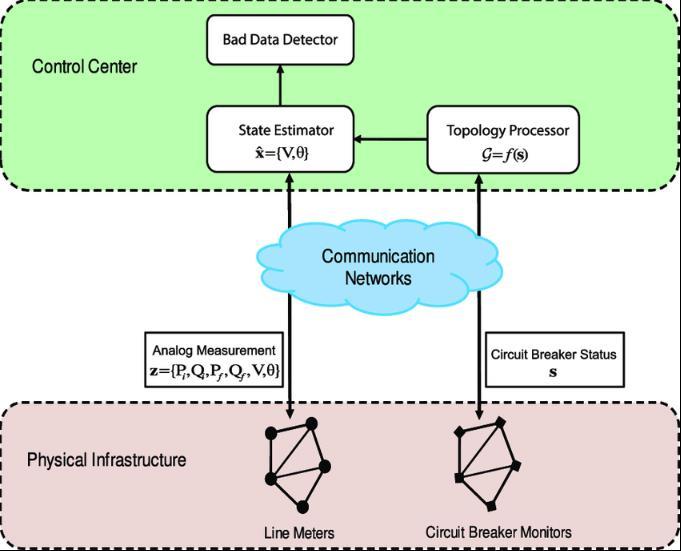
The mathematical formulation of power system state estimation is generally expressed through a set of measurementequationsthatrelatethemeasuredquantities to the system state variables. In this formulation, the measurement vector consists of data obtained from monitoring devices such as power flows, bus voltages, current magnitudes, and power injections. These measurements are related to the unknown state vector throughnonlinearfunctionsthatrepresentthephysicallaws governingpowersystemoperation,suchasOhm’slawand Kirchhoff’slaws.
Becausetherelationshipbetweenmeasurementsandsystem states is nonlinear, power system state estimation is inherentlyanonlinearoptimizationproblem.Theestimation algorithmmustiterativelyupdatethestatevariablesuntil thedifferencebetweenthemeasuredvaluesandcalculated values is minimized. This iterative process requires linearization of the nonlinear equations around an initial operatingpointandrepeatedupdatesuntilconvergenceis achieved.TechniquessuchastheNewton–Raphsonmethod arecommonlyusedforthispurpose.Accuratemodelingof measurementerrorsandsystemparametersisessentialto ensure reliable estimation results and fast algorithm convergence(Conejo,CarrionandMorales,2010).
2.3.1
The Weighted Least Squares (WLS) method is the most widely used technique for state estimation in traditional powersystemcontrolcenters.Inthismethod,theobjective is to minimize the weighted sum of squared differences betweenthemeasuredvaluesandthevaluescalculatedfrom theestimatedstatevariables.Eachmeasurementisassigned aweightbasedonitsaccuracy,meaningthatmeasurements with higher reliability have greater influence on the final estimationresults.
2.4.1
Observability is a critical concept in power system state estimationthatreferstothe abilitytouniquelydetermine the system state variables using the available set of measurements.Apowersystemisconsideredobservableif thecollectedmeasurementdataaresufficienttoestimateall state variables within the network. If the system lacks adequate measurements, some state variables cannot be
International Research Journal of Engineering and Technology (IRJET) e-ISSN: 2395-0056
Volume: 13 Issue: 03 | Mar 2026 www.irjet.net p-ISSN: 2395-0072
determined,leadingtoinaccurateorincompleteestimation results.Observabilityanalysisisthereforeperformedprior to the state estimation process to ensure that the measurementconfigurationisadequateforreliablesystem monitoring(Kundur,1994).
Maintainingnetworkobservabilityisparticularlyimportant in large-scale power systems and modern distribution networks where measurement devices may be sparsely installed. Insufficient observability can lead to inaccurate operational decisions, which may compromise system stabilityandreliability.
Observabilityinpowersystemscanbeanalyzedusingtwo primary approaches: topological observability and numerical observability.Topological observability focuses ontheconnectivitystructureofthenetworkandexamines whether the measurement placement allows the system statestobedeterminedbasedonnetworktopologyalone. Thisapproachisgenerallycomputationallyefficientand is oftenusedforplanningmeasurementplacement.
3.1
(SCADA)
3.1.1
SupervisoryControlandDataAcquisition(SCADA)systems formthebackboneofmonitoringandcontroloperationsin traditionalpowersystems.ASCADAsystemisdesignedto collectreal-timedatafromvariousfielddevices,transmitthe datatoacentralizedcontrolcenter,andallowoperatorsto supervise and control system operations remotely. The architectureofSCADAtypicallyconsistsofRemoteTerminal Units (RTUs), communication networks, data acquisition servers,andcontrolcenterapplications.
SCADA systems collect several types of electrical measurementsthatareusedforsystemmonitoringandstate estimation. These measurements provide indirect informationabouttheelectricalstateofthenetworkandare typically obtained through analog sensors installed at substations.
Power injection measurements represent the active and reactive power entering or leaving a bus in the power network.Thesevaluesarecalculatedbasedoncurrentand voltage measurements obtained at substations and are essentialforanalyzingthepowerbalanceateachnodeofthe system.Injectionmeasurementshelpoperatorsunderstand
how much power is being generated, consumed, or transferredwithindifferentpartsofthenetwork.
Lineflowmeasurementsindicatetheamountofactiveand reactivepowerflowingthroughtransmissionordistribution lines. These measurements are crucial for monitoring networkloadingconditionsandensuringthattransmission lines operate within their thermal and stability limits. Accuratelineflowmeasurementsassistsystemoperatorsin identifyingcongestionconditionsandpreventingpotential overloadsinthenetwork.
VoltagemagnitudemeasurementsrepresenttheRMSvalue of voltage at a particular bus or substation. Maintaining appropriate voltage levels is essential for system stability and power quality. SCADA systems continuously monitor voltage magnitudes to ensure that they remain within acceptableoperatinglimitsandtosupportvoltageregulation strategies in power system operation (Gómez-Expósito, ConejoandCañizares,2009).
3.2.1 Working Principle
PhasorMeasurementUnits(PMUs)areadvancedmonitoring devicesdesignedtomeasureelectricalquantitiesinapower systemwithhighprecisionandsynchronizedtiming.Unlike conventional measurement devices, PMUs utilize Global Positioning System (GPS) signals to synchronize measurementstakenatgeographicallydispersedlocations. This time synchronization enables PMUs to provide measurementsthatarereferencedtoacommontimeframe acrosstheentirepowersystem.
PMUs provide a category of measurements known as synchrophasors, which represent synchronized phasor quantities measured across the network. These measurementsofferdetailedinformationabouttheelectrical stateofthesystemandsignificantlyimprovetheaccuracyof monitoringandstateestimation.
Voltage Magnitude
PMUsdirectlymeasurethemagnitudeofbusvoltageswith high precision and at high sampling rates. Unlike SCADA measurements,whichareupdatedeveryfewseconds,PMU voltagemeasurementsarereportedmanytimespersecond. This allows operators to observe rapid changes in system conditionsanddetectdisturbancesinnearrealtime.
International Research
Volume: 13 Issue: 03 | Mar 2026 www.irjet.net p-ISSN: 2395-0072
OneofthemostimportantfeaturesofPMUtechnologyisthe ability to measure voltage phase angles accurately and synchronously across different locations in the network. Phase angle measurements provide valuable information about power transfer patterns and system stability. Differences in voltage phase angles between buses are directlyrelatedtopowerflowinthenetwork,makingthese measurements highly useful for advanced monitoring and controlapplications.
Inadditiontovoltagephasors,PMUsalsomeasurecurrent phasorsflowingthroughtransmissionlinesortransformers. These measurements provide both magnitude and phase angle information for current signals, enabling accurate calculation of power flows and network conditions. The availabilityofsynchronizedcurrentmeasurementsfurther enhancessystemvisibilityandsupportsapplicationssuchas faultdetectionanddynamicstabilitymonitoring(Terzijaet al.,2011).
Comparison Between SCADA and PMU Measurements
SCADA and PMU systems differ significantly in terms of measurement characteristics, data acquisition speed, and accuracy. SCADA systems provide measurements such as power flows, injections, and voltage magnitudes with relatively slow update rates. In contrast, PMUs provide synchronized phasor measurements with high sampling rates and precise timing information. These differences make PMUs highly suitable for real-time monitoring of powersystemdynamics.
Table-1: Comparison Between SCADA and PMU Measurements
Sampling
4.1.1 Integration of SCADA and Synchrophasor Measurements
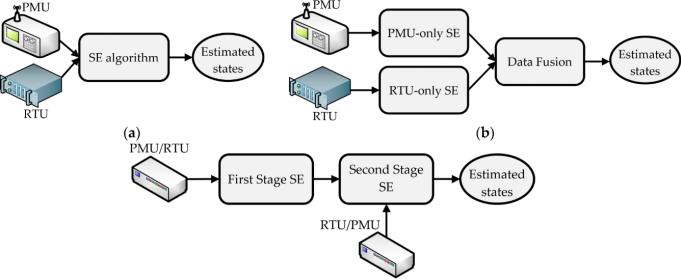
Hybrid State Estimation (HSE) is an advanced estimation framework developed to enhance the accuracy and reliability of power system monitoring by integrating measurementdatafrommultiplesources.Traditionalstate estimationmethodsrelyprimarilyonSCADAmeasurements, which include power injections, line flows, and voltage magnitudes collected at relatively slow sampling rates. However, the introduction of Phasor Measurement Units (PMUs)hasenabledtheacquisitionofhighlyaccurateand time-synchronized measurements of voltage and current phasors. Hybrid state estimation combines these two complementary measurement systems to exploit their respectiveadvantages.WhileSCADAprovideswidecoverage of the network, PMUs offer high temporal resolution and precise phase angle information. By integrating these heterogeneous data sources into a unified estimation framework,hybridstateestimationsignificantlyimproves theoverallqualityofsystemstateestimation(Zhang,Bose andTomsovic,2010).
4.2.1 Steady-State Based Estimation Framework
StaticHybridStateEstimation(SHSE)referstoestimation approaches that assume the power system is operating understeady-stateconditionsduringtheestimationprocess. In this framework, the system variables are assumed to remain constant within the time interval in which measurements are collected. As a result, SHSE treats the estimationproblemasastaticoptimizationtaskinwhichthe state variables are determined based on a snapshot of measurement data obtained from both SCADA and PMU devices.
4.2.2 Weighted Least Squares Based Hybrid Estimation
MoststatichybridestimationmethodsemploytheWeighted Least Squares (WLS) technique as the underlying
International Research Journal of Engineering and Technology (IRJET) e-ISSN: 2395-0056
Volume: 13 Issue: 03 | Mar 2026 www.irjet.net p-ISSN: 2395-0072
optimization algorithm. In this approach, the objective function minimizes the weighted difference between measured and estimated values while accounting for measurement accuracy. PMU measurements generally receive higher weights due to their superior precision compared with conventional SCADA measurements. The inclusionofsynchrophasordatawithintheWLSframework significantly improves the numerical conditioning of the estimation problem and enhances convergence characteristics. Consequently, SHSE methods have been widely adopted as an extension of conventional SCADAbased state estimation systems in modern power system controlcenters.
4.3.1
DynamicHybridStateEstimation(DHSE)extendsthestatic estimation framework by considering the time-varying behaviorofpowersystems.Inreal-worldoperation,power system states change continuously due to fluctuations in load demand, renewable generation, and network disturbances.Staticestimationmethodscannotfullycapture thesedynamicvariationsbecausetheytreateachestimation cycleindependently.Dynamichybridestimationaddresses this limitation by incorporating temporal relationships betweenconsecutivesystemstates.
4.3.2
Dynamic hybrid estimation commonly relies on Kalman filtering techniques, which are recursive algorithms designedforestimatingthestateofdynamicsystemsinthe presenceofmeasurementnoise.TheKalmanfilterpredicts thesystemstatebasedona mathematicalmodelandthen updatestheestimateusingincomingmeasurements.
4.4.1
One of the most significant advantages of hybrid state estimationistheimprovementinsystemobservability.The inclusionofPMUmeasurementsprovidesdirectinformation about voltage phasors, which reduces the dependence on indirect measurements such as power flows. Even with limited PMU deployment, the additional information obtainedfromsynchrophasordevicescangreatlyenhance the ability of the estimator to determine the system state accurately.
Hybrid state estimation improves the overall accuracy of estimatedstatevariablesbecausePMUmeasurementshave higher precision and are synchronized in time. The integrationofthesemeasurementsreducesuncertainty in
the estimation process and minimizes the impact of measurement noise. As a result, hybrid estimators can producemorereliableestimatesofvoltagemagnitudesand phase angles compared with conventional SCADA-based methods.
Thepresenceofdirectphasormeasurementsalsoimproves thenumericalpropertiesoftheestimationproblem.Because PMUs provide voltage angle measurements directly, the estimator requires fewer iterations to converge to the optimal solution. This faster convergence enhances computationalefficiencyandallowsstateestimationtobe performed more frequently, supporting near real-time monitoringofpowersystemconditions.
Anotherimportantadvantageofhybridstateestimationis itsimprovedcapabilityforbaddatadetection.Measurement errors, sensor malfunctions, or communication faults can introduce incorrect data into the estimation process. The redundancy created by combining SCADA and PMU measurements allows the estimator to identify inconsistencies more effectively and isolate erroneous measurements. This improves the reliability of the estimation results and helps maintain the security and stability of the power system (Abur and Gómez-Expósito, 2004).
5.1 Early Research on Hybrid SCADA–PMU State Estimation
5.1.1 Integration of PMU Data into Classical State Estimation Frameworks
Theearlieststudiesonhybridstateestimationfocused on incorporating Phasor Measurement Unit (PMU) data into conventional SCADA-based state estimation frameworks. Traditionally,powersystemstateestimationreliedonthe WeightedLeastSquares(WLS)methodusingmeasurements suchaspowerflowsandvoltagemagnitudesobtainedfrom SCADA systems. However, the introduction of PMU technology enabled direct measurement of voltage and current phasors with precise time synchronization. Early research explored methods for integrating these synchrophasor measurements into the existing WLS framework to enhance estimation accuracy and observability.
International Research Journal of Engineering and Technology (IRJET) e-ISSN: 2395-0056
Volume: 13 Issue: 03 | Mar 2026 www.irjet.net p-ISSN: 2395-0072
5.2.1 Sequential Integration of PMU and SCADA
Two-stage hybrid estimation methods were developed to address the challenges associated with combining measurements that have different sampling rates and accuracylevels.Intheseapproaches,theestimationprocess isperformedintwosequentialstages.Thefirststageutilizes high-precisionPMUmeasurementstoestimateasubsetof systemstates,typicallyfocusingonbuseswherePMUsare installed. Since PMU measurements provide direct phasor information,thisstageproducesaccurateestimatesforthose partsofthenetworkwithPMUcoverage.
5.3.1 Simultaneous Processing of SCADA and PMU Data
Unified hybrid state estimation models represent a more integrated approach in which SCADA and PMU measurementsareprocessedsimultaneouslywithinasingle estimation framework. Instead of treating the two measurement sources separately, unified models incorporate all measurements into a single mathematical formulation. This approach enables the estimator to fully exploit the complementary characteristics of both measurementsystems.
5.4.1 Extended Kalman Filter Based Estimation
Dynamic hybrid state estimation methods extend the traditional estimation framework by considering the temporalevolutionofsystemstates.Oneofthemostwidely used approaches for dynamic estimation is the Extended KalmanFilter(EKF),whichisdesignedtoestimatethestate ofnonlineardynamicsystems.
5.4.2 Unscented Kalman Filter Based Estimation
Anotheradvancedapproachfordynamichybridestimation istheUnscentedKalmanFilter(UKF),whichaddressessome ofthelimitationsassociatedwiththeEKF.UnliketheEKF, theUKFdoesnotrequireexplicitlinearizationofnonlinear functions.Instead,itusesadeterministicsamplingtechnique knownastheunscentedtransformationtopropagatestate uncertaintiesthroughnonlinearsystemmodels.
5.5.1 Neural
Withtheincreasingavailabilityoflargevolumesofpower system data, data-driven approaches have emerged as promisingalternativestotraditionalmodel-basedestimation
methods.Neuralnetworkshavebeenwidelyinvestigatedfor stateestimationapplicationsbecauseoftheirabilitytolearn complex nonlinear relationships between measurements and system states. In these methods, neural networks are trainedusinghistoricalmeasurementdatatoapproximate the mapping between input measurements and correspondingsystemstates.
5.5.2
Recent advancements in deep learning have further expandedthepossibilitiesfordata-drivenstateestimation. Deepneuralnetworks,convolutionalneuralnetworks,and recurrent neural networks have been applied to power system monitoring tasks due to their ability to extract complex patterns from large datasets. In hybrid state estimationframeworks,deeplearningmodelscanintegrate data from SCADA systems, PMUs, and advanced metering infrastructure (AMI) to estimate system states with high accuracy.
5.6.1
Theincreasingpenetration ofdistributedgeneration(DG) and renewable energy resources has introduced new challengesforpowersystemstateestimation,particularlyin distribution networks. Unlike traditional transmission systems, distribution networks often have limited measurement infrastructure and exhibit complex operational characteristics such as unbalanced loads and bidirectionalpowerflows.Thesefactorsmakeaccuratestate estimationmoredifficult.
Renewable energy sources such as solar and wind generation introduce significant variability into power systemoperation.Rapid fluctuationsingeneration output can cause frequent changes in system states, making it challengingfortraditionalestimationmethodstomaintain accurate monitoring. Hybrid estimation approaches that incorporatehigh-frequencyPMUmeasurementsarebetter suited to capture these dynamic variations and support reliableoperationofactivedistributionnetworks.
6.1 Characteristics of ActiveDistributionNetworks
6.1.1
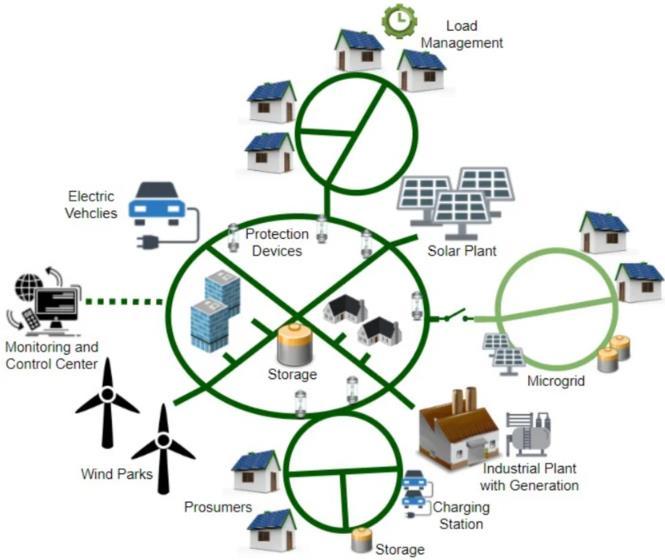
ActiveDistributionNetworks(ADNs)representanadvanced form of conventional distribution systems in which distributed energy resources (DERs), renewable energy generation, and intelligent control technologies are
International Research Journal of Engineering and Technology (IRJET) e-ISSN: 2395-0056
Volume: 13 Issue: 03 | Mar 2026 www.irjet.net p-ISSN: 2395-0072
integratedintothenetwork.Intraditionalpowersystems, electricityflowsfromcentralizedgenerationunitsthrough transmissionnetworkstopassivedistributionsystems.
6.1.2 Bidirectional Power Flows
Another important characteristic of active distribution networks is the presence of bidirectional power flows. In conventionalradialdistributionsystems,electricitytypically flowsinasingledirectionfromthesubstationtoendusers. However, the integration of distributed generation allows consumerstoalsoactasenergyproducers,oftenreferredto as prosumers. When local generation exceeds local consumption, excess power can be injected back into the grid,causingreversepowerflows.
6.2.1 Limited Measurement Infrastructure
One of the major challenges in implementing effective DistributionSystemStateEstimation(DSSE)isthelimited availability of measurement devices in distribution networks. Unlike transmission systems, where extensive monitoringinfrastructureistypicallyinstalled,distribution systems often have sparse measurement coverage due to economic constraints and the large number of network nodes.Manydistributionfeedersrelyprimarily onlimited SCADA measurements at substations, while intermediate nodesmaynothavedirectmonitoringdevices.
6.3.1
Hybridstateestimationplaysacriticalroleinenhancingthe observabilityandmonitoringcapabilityofactivedistribution networks by integrating data from multiple measurement technologies. In addition to traditional SCADA measurements and high-speed PMU data, modern distributionsystemsalsoutilizeinformationfromAdvanced Metering Infrastructure (AMI), smart meters, and other intelligent sensors. Each of these measurement sources provides different types of information about system operation.Forexample,SCADAsystemsprovidesupervisory measurementsatsubstations,PMUsdeliverhigh-resolution synchronizedphasordata,whileAMIandsmartmetersoffer detailedconsumptioninformationatthecustomerlevel.
Theimprovedobservabilityprovidedbyhybridestimation techniquessupportsawiderangeofoperationalapplications in active distribution networks. Accurate state estimation enables system operators to detect voltage violations, monitor line loading conditions, and identify potential network disturbances in real time. Furthermore, hybrid estimation provides valuable input for advanced applications such as voltage control, demand response management,anddistributedenergyresourcecoordination. Asdistributionnetworkscontinuetoevolvetowardhighly decentralizedandrenewable-basedenergysystems,hybrid stateestimationwillremainanessentialtoolformaintaining systemreliabilityandoperationalefficiency.
Hybrid state estimation integrates heterogeneous measurement sources such as SCADA systems, PMUs, and smartmeterstoenhancemonitoringandobserv ability in modernpowersystems.Whilethisintegrationsignificantly improves estimation accuracy, it also introduces several technical challenges related to data synchronization, communicationinfrastructure,computationalrequirements, anddatareliability.Addressingthesechallengesisessential for ensuring the successful implementation of hybrid estimationframeworksinreal-worldpowernetworks.
7.1.1
One of the primary challenges in hybrid state estimation arisesfrommeasurementsynchronizationissuesbetween different monitoring systems. SCADA measurements are typically collected at relatively slow intervals, often every few seconds, whereas PMUs provide high-speed synchronizedmeasurementsatratesof30–60samplesper second. Although PMU measurements are precisely
International Research Journal of Engineering and Technology (IRJET) e-ISSN: 2395-0056
Volume: 13 Issue: 03 | Mar 2026 www.irjet.net p-ISSN: 2395-0072
synchronizedusingGlobalPositioningSystem(GPS)signals, SCADAmeasurementsaregenerallynottime-stampedwith thesamelevelofprecision.Asaresult,integratingthesetwo types of data into a single estimation framework requires carefultimealignmentanddataprocessingtechniques.
7.2.1 Integration of Measurements with Different Sampling Rates
Anotherimportantchallengeinhybridstateestimationisthe fusionofdataobtainedatdifferentsamplingrates.SCADA systemstypicallyupdatemeasurementsevery2–6seconds, whereasPMUdevicesprovidemeasurementsatmuchhigher frequencies.Thislargedifferenceinsamplingratescreates difficultiesinintegratingthetwodatasetswithinaunified estimationframework.
7.3.1 Reliability and Security of
Hybrid state estimation relies heavily on communication networks for transmitting measurement data from geographicallydistributeddevicestocontrolcenters.Asthe numberofmonitoringdevicesincreases,thecommunication infrastructure becomes more complex and susceptible to failuresordelays.Communicationlatency,packetloss,and networkcongestioncandegradethequalityofmeasurement data and affect the performance of state estimation algorithms.
7.4.1 Handling MeasurementErrorsand DataAnomalies
Measurement data used in state estimation may contain errors,noise,orabnormalvalues,commonlyreferredtoas baddata.Theseerrorscanariseduetosensormalfunctions, communication failures, calibration errors, or external disturbances. If bad data are not properly detected and removed,theycansignificantlydistorttheestimationresults andleadtoincorrectsystemmonitoringdecisions.
7.5.1 Scalability of Hybrid Estimation Algorithms
Aspowersystemscontinuetoexpandandincorporatelarge numbers of measurement devices, the computational complexityofhybridstateestimationalgorithmsbecomesa significantconcern.Theintegrationofhigh-frequencyPMU measurementswithconventionalSCADAdataincreasesthe volume of data that must be processed in real time. This largedatavolumecanimposeheavycomputationalburdens onestimationalgorithms,particularlyinlarge-scalepower networks.
The rapid evolution of smart grid technologies and the increasingcomplexityofpowersystemshavecreatednew opportunities for improving hybrid state estimation techniques. Recent research has focused on integrating advanced computational methods, intelligent algorithms, anddistributedmonitoringsystemstoenhancetheaccuracy and efficiency of state estimation in modern power networks.
8.1.1
Artificial intelligence (AI) and machine learning (ML) techniquesareincreasinglybeingexploredforpowersystem monitoring and state estimation applications. These approaches use historical measurement data to learn complex relationships between system variables and measurement signals without relying solely on detailed physical models of the network. Machine learning models suchasartificialneuralnetworks,supportvectormachines, anddeeplearningarchitecturescanprocesslargevolumesof measurementdataandextracthiddenpatternsthatmaynot becapturedbytraditionalestimationmethods.
8.2.1
Another emerging trend in hybrid state estimation is the development of distributed and decentralized estimation techniques.Inlarge-scalepowersystems,centralizedstate estimation may become computationally inefficient and vulnerable to communication failures. Distributed estimation methods address this issue by dividing the network into multiple regions and performing estimation locallywithineachregion.
8.3.1 Utilization of Advanced Monitoring Infrastructure
The advancement of smart grid technologies has significantly expanded the range of measurement devices availableforpowersystemmonitoring.Moderndistribution networks increasingly incorporate technologies such as AdvancedMeteringInfrastructure(AMI),smartsensors,and Internet of Things (IoT) devices. These technologies generatelargevolumesofreal-timedatathatcanbeutilized toimprovestateestimationaccuracy.
International Research Journal of Engineering and Technology (IRJET) e-ISSN: 2395-0056
Volume: 13 Issue: 03 | Mar 2026 www.irjet.net p-ISSN: 2395-0072
8.4.1 Improving Observability with Limited Resources
Because PMUs are relatively expensive devices, it is often impracticaltoinstallthemateverybusinapowernetwork. Therefore,determiningtheoptimalplacementofPMUsisan important research problem aimed at maximizing system observability while minimizing installation costs. Various optimizationtechniqueshavebeenproposedtoidentifythe mosteffectivelocationsforPMUdeployment.
8.5.1 Protection Against Cyber Attacks
Aspowersystemsbecomemoreinterconnectedandreliant on digital communication technologies, ensuring the cybersecurity of state estimation systems has become a critical research priority. Hybrid state estimation frameworks must be capable of detecting and mitigating cyber attacks that target measurement data or communicationnetworks.Oneparticularlydangeroustype of attack is the false data injection attack, in which an attacker manipulates measurement data to mislead the estimationprocess.
Hybridstateestimationhasemergedasacrucialapproach forimprovingthemonitoringandoperationalawarenessof modern power systems, particularly in the context of evolvingsmartgridinfrastructuresandactivedistribution networks.Traditionalstateestimationmethodsbasedsolely on SCADA measurements often suffer from limited observabilityandrelativelyslowdataacquisitionrates.The integration of Phasor Measurement Units (PMUs) with conventional measurement systems has significantly enhancedtheaccuracy,reliability,andreal-timecapabilityof state estimation processes. By combining synchronized phasor measurements with conventional data sources, hybridestimationtechniquesprovideamorecomprehensive representation of system states, including voltage magnitudesandphaseanglesacrossthenetwork.
This review has examined the fundamental concepts of powersystemstateestimation,includingthemathematical formulation of estimation problems and conventional Weighted Least Squares (WLS) approaches. It has also discussedthegrowingimportanceofhybridstateestimation in addressing the challenges associated with active distributionnetworkscharacterizedbydistributedenergy resources, bidirectional power flows, and increasingly complex network structures. Furthermore, key challenges such as measurement synchronization, multi-rate data fusion,communicationreliability,cybersecuritythreats,bad data detection, and computational complexity have been criticallyanalyzed.
In addition, emerging research trends including artificial intelligence-based estimation methods, distributed and decentralized estimation frameworks, smart grid integration,optimalPMUplacementstrategies,andcyberresilient estimation techniques have been highlighted as promisingdirectionsforfuturework.Overall,hybridstate estimationrepresentsasignificantadvancementinpower system monitoring, offering improved accuracy and situationalawarenessnecessaryforreliablegridoperation. Continuedresearchandtechnologicaldevelopmentinthis area will play a vital role in supporting the efficient management and stability of future intelligent power systems.
Despiteprovidingacomprehensiveoverviewofhybridstate estimation techniques and their applications in modern powersystems,thisreviewhascertainlimitations.Thestudy primarily focuses on conceptual frameworks, methodological approaches, and selected research contributionsreportedintheexistingliterature.Duetothe broad scope of the topic, it was not possible to include all recently proposed algorithms and experimental implementations related to hybrid state estimation. In addition, the review mainly discusses theoretical and simulation-based studies, while large-scale real-world deployment experiences remain relatively limited. Variations in network configurations, measurement infrastructures,anddataavailabilityacrossdifferentpower systemsmayalsoinfluencethepracticalapplicabilityofthe reviewed techniques. Future reviews could incorporate more empirical studies and comparative experimental evaluations.
1. Abur,A.andGómez-Expósito,A.,2004.PowerSystem State Estimation: Theory and Implementation. Boca Raton:CRCPress.
2. Baran,M.E.andKelley,A.W.,1994.Stateestimationfor real-time monitoring of distribution systems. IEEE TransactionsonPowerSystems,9(3),pp.1601–1609.
3. Donnot,B.,Guyon,I.andSchoenauer,M.,2018.Machine learning for power system operation. arXiv preprint arXiv:1812.05640.
4. Gómez-Expósito,A.,Conejo,A.J.andCañizares,C.,2009. ElectricEnergySystems:AnalysisandOperation.Boca Raton:CRCPress.
5. Gungor,V.C.,Sahin,D.,Kocak,T.,Ergut,S.,Buccella,C., Cecati, C. and Hancke, G.P., 2013. Smart grid technologies: Communication technologies and standards.IEEETransactionsonIndustrialInformatics, 7(4),pp.529–539.
International Research Journal of Engineering and Technology (IRJET) e-ISSN: 2395-0056
Volume: 13 Issue: 03 | Mar 2026 www.irjet.net p-ISSN: 2395-0072
6. Kersting,W.H.,2001.Radial distributiontest feeders. IEEE Transactions on Power Systems, 6(3), pp.975–985.
7. Korres, G.N., 2011. A distributed multiarea state estimation. IEEE Transactions on Power Systems, 26(1),pp.73–84.
8. Lopes,J.A.P.,Hatziargyriou,N.,Mutale,J.,Djapic,P.and Jenkins, N., 2007. Integrating distributed generation intoelectricpowersystems.ProceedingsoftheIEEE, 95(5),pp.1185–1203.
9. Mo, Y., Kim, T.H., Brancik, K., Dickinson, D., Lee, H., Perrig, A. and Sinopoli, B., 2012. Cyber–physical securityofasmartgridinfrastructure.Proceedingsof theIEEE,100(1),pp.195–209.
10. Monticelli,A.,1999.StateEstimationinElectricPower Systems:AGeneralizedApproach.Boston:Springer.
11. Nuqui, R.F. and Phadke, A.G., 2005. Phasor measurementunitplacementtechniquesforcomplete and incomplete observability. IEEE Transactions on PowerDelivery,20(4),pp.2381–2388.
12. Phadke,A.G.andThorp,J.S.,2008.SynchronizedPhasor Measurements and Their Applications. New York: Springer.
13. Primadianto, A. and Lu, C., 2017. A review of distributionsystemstateestimation.IEEETransactions onPowerSystems,32(5),pp.3875–3883.
14. Valverde, G. and Terzija, V., 2011. Unscented Kalman filterforpowersystemdynamicstateestimation.IET Generation,Transmission&Distribution,5(1),pp.29–37.
15. Cataliotti,A.,Cosentino,V.,DiCara,D.,Tinè,G.,Guaiana, S.andCroce,L.,2014.Compensationofnonlinearityin voltage and current transformer measurements for PMU-based applications. IEEE Transactions on Instrumentation and Measurement, 63(5), pp.1324–1332.
16. Chen,Y.,Zhang,J.,Wang,Z.andWang,Y.,2016.Robust power system state estimation with PMU measurements.IEEETransactionsonPowerSystems, 31(5),pp.3676–3685.
17. de Melo, V.H.P., Monteiro, A.L., Ascari, L.B., Lourenço, F.M.,Costa,A.S.andLondonJr.,J.B.A.,2024.Reviewof power system state estimation and maturity level of marketsolutions.Journal of Control,Automation and ElectricalSystems,35,pp.702–719.
18. Dubey,A.,Chakrabarti,S.andTerzija,V.,2019.SCADA and PMU measurement based methods for robust
hybrid state estimation. Electric Power Components andSystems,47(9–10),pp.849–860.
19. Jabr,R.A.,2006.Powersystemstateestimationusingan iteratively reweighted least squares method. International Journal of Electrical Power & Energy Systems,28(4),pp.288–294.
20. Jin,T.andShen,X.,2018.AmixedWLSpowersystem stateestimationmethodintegratingWAMSandSCADA measurements.Energies,11(2),p.408.
21. Li,X.,Scaglione,A.andChang,T.H.,2013.Aframework for phasor measurement placement in hybrid state estimation via Gauss–Newton method. IEEE TransactionsonPowerSystems,28(4),pp.3246–3256.
22. Madtharad,C.,Premrudeepreechacharn,S.andWatson, N.R., 2003. Power system state estimation using singularvaluedecomposition.ElectricPowerSystems Research,67(2),pp.99–107.
23. Moshtagh, S. and Rahmani, M., 2021. Robust hybrid state estimation for power systems utilizing phasor measurementunits.ElectricPowerSystemsResearch, 196,p.107195.
24. Netto,M.,Zhao,J.andMili,L.,2021.Arobustextended Kalman filter for power system dynamic state estimation using PMU measurements. IEEE TransactionsonPowerSystems,36(2),pp.1048–1058.
25. Qi, J., Sun, K. and Kang, W., 2015. Optimal PMU placementforpowersystemdynamicstateestimation using empirical observability gramian. IEEE TransactionsonPowerSystems,30(4),pp.2041–2054.
26. Shanmugapriya,S.,Pallav,P.,Patel, M.and Mulgir,V., 2024. State estimation of power system using PMU devices.EAIEndorsedTransactionsonEnergyWeb.
27. Singh, R., Pal, B.C. and Jabr, R.A., 2009. Choice of estimatorfordistributionsystemstateestimation.IET Generation,Transmission&Distribution,3(7),pp.666–678.
28. Sun,H.,Nikovski,D.,Guo,Q.,Pan,Z.andZhang,J.,2015. A hybrid state estimation method for power systems integrating PMU and SCADA measurements. IEEE TransactionsonSmartGrid,6(2),pp.936–946.
29. Taha, A.F. and Gatsis, N., 2016. Data-driven power systemstateestimation.IEEETransactionsonPower Systems,31(3),pp.2368–2377.
30. Valverde, G., Terzija, V. and Vanfretti, L., 2014. Unscented Kalman filter for power system dynamic state estimation with PMU measurements. IEEE TransactionsonPowerSystems,29(2),pp.629–636.
International Research Journal of Engineering and Technology (IRJET) e-ISSN: 2395-0056
Volume: 13 Issue: 03 | Mar 2026 www.irjet.net p-ISSN: 2395-0072
31. Wang,S.,Gao,W.,Meliopoulos,A.P.S.andSun,Y.,2017. Power system dynamic state estimation using synchrophasor measurements. IEEE Transactions on PowerSystems,32(3),pp.1951–1960.
32. Zhang, J., Chen, Y. and Wang, Z., 2016. Robust state estimationmethodforpowersystemsconsideringbad data.ElectricPowerSystemsResearch,141,pp.12–20.
33. Zhu, J., Gao, W., Li, Y., Guo, X., Zhang, G. and Sun, W., 2024.Powersystemstateestimationbasedonfusionof PMUandSCADAdata.Energies,17(11),p.2609.
34. Das,K.,Hazra,J.,Seetharam,D.P.,Reddi,R.K.andSinha, A.K., 2012. Real-time hybrid state estimation incorporating SCADA and PMU measurements. IEEE PES Innovative Smart Grid Technologies Europe Conference.
35. Kekatos,V.,Zhang,G.andGiannakis,G.B.,2013.Power systemstateestimationusingsemidefiniterelaxation. IEEETransactionsonPowerSystems,28(2),pp.1143–1152.
36. Zhang, X., Li, F. and Bhatt, N., 2010. Next-generation monitoring,analysis,andcontrolforthefuturesmart grid. IEEE Transactions on Smart Grid, 1(2), pp.186–192.
37. Korres, G.N. and Manousakis, N.M., 2012. State estimation and bad data processing for systems includingPMUmeasurements.ElectricPowerSystems Research,81(7),pp.1514–1524.
38. Wollenberg, B.F., Wood, A.J. and Sheblé, G.B., 2013. Power Generation, Operation, and Control. 3rd ed. Hoboken:Wiley.