
International Research Journal of Engineering and Technology (IRJET) e-ISSN: 2395-0056
Volume: 13 Issue: 03 | Mar 2026 www.irjet.net p-ISSN: 2395-0072
International Research Journal of Engineering and Technology (IRJET) e-ISSN: 2395-0056
Volume: 13 Issue: 03 | Mar 2026 www.irjet.net p-ISSN: 2395-0072
Shailesh Kumar1, Dr. Imran Khan2
1Master of Technology, Electrical Engineering, Azad Institute of Engineering and Technology, Lucknow, India
2Professor, Department Electrical Engineering , Azad Institute of Engineering and Technology, Lucknow, India
Abstract -The increasing integration of renewable energy resources in microgrid systems has created significant challenges in maintaining power stability, reliability, and efficient energy management due to the intermittent and unpredictablenatureofrenewablegeneration.Energystorage systems play a critical role in mitigating these issues by balancing supply and demand and improving the dynamic performance of microgrids. Among various storage technologies, hybrid energy storage systems (HESS) that combine batteries and ultracapacitors have gained considerable attention because of their complementary characteristics.Batteriesprovidehighenergydensitysuitable for long-duration energy support, whereas ultracapacitors offer high power density and rapid charge–discharge capability, making them effective for handling short-term power fluctuations. In autonomous microgrid environments, coordinated energy dispatch strategies are essential to optimallyallocatepowerbetweenthesestoragecomponents, enhance system efficiency, reduce battery stress, and extend theoperationallifetimeofstoragedevices.Thisreviewpaper presents a comprehensive overview of coordinated energy dispatchstrategiesforhybridbattery–ultracapacitorstorage modules in autonomous microgrids. Various energy managementapproaches,includingrule-basedcontrol,filterbasedpowerallocation,optimization-baseddispatchmethods, andemergingdata-driventechniques,arecriticallyanalyzed and compared. Furthermore, the paper discusses the architectural configurations of hybrid storage systems, their operational roles in microgrid stability, and the major technicalchallengesassociatedwiththeirdeployment.Finally, key research gaps and potential future directions are identifiedtosupportthedevelopmentofmoreintelligentand efficient coordinated dispatch strategies for next-generation autonomous microgrid systems.
Key Words: Autonomous Microgrid; Hybrid Energy Storage System; Battery–Ultracapacitor; Energy Dispatch Strategy; Energy Management System; Renewable Energy Integration; Power System Stability.
1.1 Background
The rapid growth of renewable energy technologies has significantly transformed modern power systems. Distributed renewable energy sources such as solar
photovoltaic (PV) and wind power are increasingly integrated into microgrid infrastructures to reduce greenhouse gas emissions, improve energy efficiency, and support sustainable electricity generation. Autonomous microgrids, particularly those operating in islanded or remoteenvironments,relyheavilyonrenewableresources to supply electricity to local loads. However, the inherent intermittency and variability of renewable energy generationcreateseveraloperationalchallenges,including power imbalance, voltage fluctuations, and frequency instability.Theseissuesbecomemorecriticalinautonomous microgrids where the absence of a main grid limits the ability to absorb fluctuations in generation or demand (Lasseter,2002;Hatziargyriouetal.,2007).
Energystoragesystems(ESS)haveemergedasaneffective solutiontoaddressthesechallengesbyprovidingflexibility in energy management. By storing excess energy during periods of high generation and supplying power during deficits,ESSenablesstableoperationofmicrogridswithhigh renewable penetration. Furthermore, energy storage technologiescontributetopowerqualityimprovement,peak loadshaving,andfrequencyregulationwithinautonomous microgridenvironments(Divyaand Østergaard,2009).As renewablepenetrationcontinuestoincrease,theneedfor advanced energy storage integration and management strategieshasbecomeakeyresearchfocusinmodernpower systemengineering.
Energystoragesystemsplayafundamentalroleinensuring reliable and efficient microgrid operation. In renewablebased microgrids, generation patterns often do not align withloaddemandduetovariationsinweatherconditions anddailyconsumptioncycles.Energystoragesystemsactas buffers that absorb surplus energy and release it when generationisinsufficient,therebymaintainingthebalance between supply and demand. In addition to energy balancing,ESStechnologiesprovideancillaryservicessuch asvoltagesupport,frequencyregulation,andmitigationof transientdisturbances(Akhiletal.,2013).
Another important function of energy storage systems is improvingsystemresilience.Duringsuddendisturbancesor load changes, storage devices can rapidly respond to stabilize the system and prevent power outages. In autonomousmicrogrids,wheregridsupportisunavailable,
International Research Journal of Engineering and Technology (IRJET) e-ISSN: 2395-0056
Volume: 13 Issue: 03 | Mar 2026 www.irjet.net p-ISSN: 2395-0072
thepresenceofreliablestorageinfrastructurebecomeseven morecriticalformaintainingcontinuouselectricitysupply andoperationalstability.
Hybridenergystoragesystemscombinetwoormoreenergy storage technologies to exploit their complementary characteristics and overcome the limitations of individual storagedevices.Amongthevarioushybridconfigurations, the combination of batteries and ultracapacitors has attracted significant attention in microgrid applications. Batteries,suchaslithium-ionorlead-acidtypes,offerhigh energydensityandarecapableofstoringlargeamountsof electrical energy over extended durations. However, they typically suffer from limited power density and reduced lifetime when subjected to frequent high-power cycling (Chenetal.,2009).
Ultracapacitors, also known as supercapacitors, possess extremelyhighpowerdensityandcanchargeordischarge rapidly with minimal degradation. These characteristics make them suitable for handling short-term power fluctuations and transient load variations. By integrating batteriesandultracapacitorsintoaunifiedhybridstorage system,itbecomespossibletoallocatelong-durationenergy supplytothebatterywhileassigningrapidpowervariations to the ultracapacitor. This coordinated operation significantly improves system efficiency, reduces battery stress,andenhancesoverallmicrogridreliability(Zhanget al.,2018).
Theeffectivenessofhybridbattery–ultracapacitorsystemsis primarily derived from the complementary operational characteristicsofthetwotechnologies.Batteriesaremore suitable for low-frequency and long-duration energy demands, whereas ultracapacitors respond effectively to high-frequency power variations. When renewable generation fluctuates rapidly due to environmental conditions, ultracapacitors can absorb or supply power almostinstantaneously,therebypreventingexcessivecycling ofthebattery.
Thiscomplementarybehaviorenableshybridenergystorage systems to significantly extend battery lifespan while maintaining high power quality in microgrid operations. Additionally, hybrid systems improve overall energy efficiency and reduce operational costs associated with batteryreplacementandmaintenance.Consequently,hybrid battery–ultracapacitorenergystoragesystemshavebecome apromisingsolutionformanagingdynamicpowerflowsin renewable-dominatedmicrogrids.
In autonomous microgrids, coordinated energy dispatch strategies play a crucial role in managing the interaction betweendistributedgenerationsources,loads,andhybrid energystoragesystems.Coordinateddispatchreferstothe systematicallocationofpoweramongdifferentcomponents of the microgrid to achieve optimal performance under varyingoperatingconditions.Withoutpropercoordination, energystoragedevicesmayoperateinefficiently,leadingto unnecessaryenergylosses,acceleratedbatterydegradation, andunstablesystemperformance.
Effective energy dispatch strategies ensure that power is distributed appropriately among renewable generators, storage devices, and loads. For example, during sudden increasesinloaddemandorrapiddecreasesinrenewable generation,ultracapacitorscanimmediatelyprovidehighpowersupportwhilebatteriessupplysustainedenergyover longer durations. By controlling the power flow between thesestoragecomponents,coordinateddispatchstrategies maintain power balance and prevent system instability (Guerreroetal.,2011).
Furthermore,advancedenergymanagementalgorithmscan optimizeoperationalcostsbyreducingrelianceonexpensive backup generators and minimizing energy losses. Coordinated dispatch also enhances system reliability by enablingreal-timecontrolofdistributedenergyresources andensuringcontinuouspowersupplyinisolatedmicrogrid environments.
The rapid advancement of hybrid energy storage technologiesandcoordinatedenergymanagementstrategies hasgeneratedasubstantialbodyofresearchinrecentyears. However, existing studies are often fragmented across differentcontrolapproaches,optimizationtechniques,and applicationscenarios.Acomprehensivesynthesisofthese research efforts is necessary to provide a clear understandingofthecurrentstateoftheartandtoidentify potentialresearchopportunitiesinthefield.
Thisreviewpaperaimstopresentasystematicandcritical surveyofcoordinatedenergydispatchstrategiesforhybrid battery–ultracapacitor energy storage systems in autonomousmicrogridenvironments.Thestudyprovidesa detailed classification of existing energy management approaches, including rule-based methods, filter-based power allocation strategies, optimization-based dispatch algorithms, and emerging data-driven techniques. In addition, a comparative analysis of these methods is presented to highlight their advantages, limitations, and practicalapplicabilityinmicrogridsystems.
International Research Journal of Engineering and Technology (IRJET) e-ISSN: 2395-0056
Volume: 13 Issue: 03 | Mar 2026 www.irjet.net p-ISSN: 2395-0072
Autonomous microgrids are localized power systems capable of operating independently from the main utility grid while supplying electricity to nearby loads. These systems typically integrate multiple distributed energy resourcessuchasrenewablegenerationunits,distributed generators,energystoragesystems,andcontrollableloads. Renewableenergysources, particularlysolarphotovoltaic (PV)panelsandwindturbines,formtheprimarygeneration units in many modern microgrids because of their environmentalbenefitsanddecreasinginstallationcosts.In additionto renewablesources,backupgeneratorssuchas diesel generators or microturbines are often included to ensure power supply during periods of insufficient renewablegeneration(Lasseter,2002).
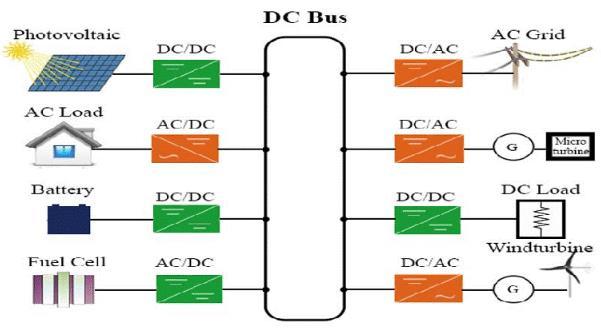
Distributedenergyresources(DERs)areessentialelements inautonomousmicrogridarchitecturebecausetheyprovide localized electricity generation and enhance system flexibility. Renewable DERs such as PV arrays and wind turbinessupplycleanenergybutareinherentlyintermittent duetoenvironmentalvariability.Toaddressthislimitation, microgrids incorporate energy storage systems and controllablegeneratorsthatbalancethedifferencebetween energysupplyandloaddemand.
Powerelectronicconvertersplayacriticalroleininterfacing DERs with the microgrid network by regulating voltage, frequency, and power flow. Advanced control strategies allowthesecomponentstooperateinacoordinatedmanner to maintain system stability under varying operating conditions. The integration of DERs, storage systems, and intelligentcontrollerscreatesaflexibleenergyinfrastructure capableofsupportingreliableelectricitysupplyinremoteor islandedregions.
Hybrid battery–ultracapacitor energy storage systems combine the advantages of two complementary storage technologiestoenhancemicrogridperformance.Batteries providehighenergydensityandaresuitableforsupplying sustained power over longer periods. In contrast, ultracapacitors possess very high power density and can respondrapidlytosuddenpowerchanges.Integratingthese devicesintoahybridsystemenablesefficientmanagement of both long-term energy demands and short-term power fluctuations. To achieve effective coordination between these components, several hybrid storage configurations have been developed based on the arrangement of power convertersandelectricalconnections(Chenetal.,2009).
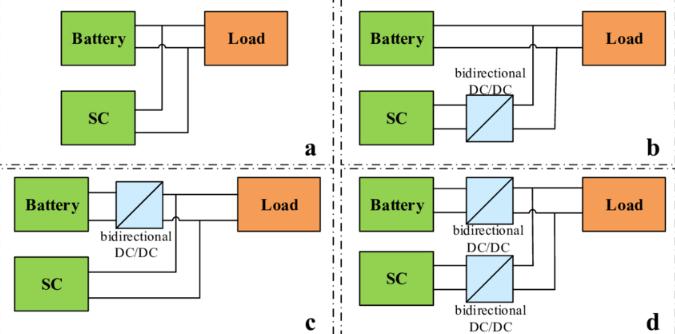
Inpassivehybridenergystoragetopology,thebatteryand ultracapacitor are directly connected in parallel without dedicated power converters for each storage component. Thecurrentdistributionbetweenthetwodevicesdepends primarily on their internal impedance characteristics. Becauseultracapacitorshavelowerinternalresistance,they naturallyrespondtorapidpowervariations,whilebatteries provideslowerenergysupport.
Thepassiveconfigurationoffersadvantagessuchassimple structure, low cost, and minimal control complexity. However, this topology lacks precise control over power sharing between storage devices. As a result, system efficiency may decrease and battery stress may increase undercertainoperating conditions. Consequently,passive hybridstorageisgenerallyusedinapplicationswherecost and simplicity are prioritized over performance optimization.
Semi-active hybrid storage topology introduces a power electronic converter for either the battery or the ultracapacitor,allowingpartialcontroloverpowerflow.In many implementations, the ultracapacitor is connected
International Research Journal of Engineering and Technology (IRJET) e-ISSN: 2395-0056
Volume: 13 Issue: 03 | Mar 2026 www.irjet.net p-ISSN: 2395-0072
through a bidirectional DC–DC converter, enabling it to regulaterapidpowerfluctuationswhilethebatteryremains directlyconnectedtotheDCbus.
Thisconfigurationprovidesimprovedflexibilitycomparedto passive topology because the converter can regulate the ultracapacitor’schargeanddischargebehavior.Asaresult, thebatteryisprotectedfromhigh-frequencypowercycling, whichhelpsextenditsoperationallifetime.However,semiactivetopologystillofferslimitedcontrolcomparedtofully activesystems,sinceonlyonestoragecomponentisactively regulated(Zhangetal.,2018).
Fully active hybrid storage topology employs separate bidirectional converters for both the battery and the ultracapacitor. This configuration allows independent control of each storage device and enables precise power allocation according to system requirements. Through coordinated control algorithms, high-frequency power componentscanbeassignedtotheultracapacitorwhilelowfrequencyenergydemandsarehandledbythebattery.
Althoughfullyactivetopologyprovidesthehighestlevelof flexibility and operational efficiency, it also introduces higher system complexity, increased cost, and additional control requirements. Nevertheless, this configuration is widelyadopted in advanced microgrid systems because it enables optimal energy management and enhances the reliabilityofhybridstorageintegration.
The power flow characteristics of hybrid battery–ultracapacitor energy storage systems are primarily determinedbythecomplementarydynamicpropertiesofthe two storage technologies. Batteries are designed to store largeamountsofenergyandthereforerespondeffectivelyto low-frequency power variations associated with gradual changesinloaddemandorrenewablegeneration.However, frequent rapid charging and discharging cycles can accelerate battery degradation and reduce its operational lifetime.
Ultracapacitors,ontheotherhand,arecapableofdelivering highpoweralmostinstantaneouslyduetotheirelectrostatic energy storage mechanism. This feature makes them particularly suitable for handling high-frequency power fluctuations, transient disturbances, and sudden load changes within microgrids. By distributing power components according to their frequency characteristics, hybrid energy storage systems ensure efficient energy utilizationwhileminimizingstressonbatteryunits(Divya andØstergaard,2009).
Despite their advantages, autonomous microgrids face several operational challenges that complicate system planning,control,andenergymanagement.Thesechallenges arise primarily from the stochastic nature of renewable generation,uncertaintiesinloaddemand,andthetechnical limitationsofenergystoragetechnologies.Addressingthese issuesrequiresadvancedcontrolstrategiesandintelligent energymanagementframeworks.
One of the major challenges is renewable energy intermittency. Solar and wind power outputs vary continuously due to weather conditions, leading to unpredictable fluctuations in power generation. These variations can cause voltage deviations, frequency instability,andpowerimbalancewithinmicrogrids.Another challenge is load uncertainty, where electricity demand changesdynamicallydependingonconsumerbehaviorand environmental conditions. Such variations increase the difficultyofmaintainingreal-timeenergybalance(Guerrero etal.,2011).
The increasing adoption of hybrid battery–ultracapacitor energystoragesystems(HESS)inautonomousmicrogrids hasledtoextensiveresearchoncoordinatedenergydispatch strategies. These strategies aim to optimally distribute poweramongstoragecomponentsanddistributedenergy resources to ensure system stability, efficient energy utilization,andextendedbatterylifespan.Becausebatteries andultracapacitorsexhibitdifferentdynamiccharacteristics, coordinated dispatch methods are essential to determine howpowershouldbesharedbetweenthemduringvarious operating conditions. Over the past decade, several approaches have been proposed in the literature, ranging from simple rule-based control methods to advanced optimization and artificial intelligence-based algorithms. These approaches differ in complexity, computational requirements, and effectiveness in handling uncertainties associated with renewable generation and load demand (Guerreroetal.,2011).
Energy Management Systems (EMS) play a central role in controlling hybrid energy storage systems within autonomous microgrids. An EMS is responsible for monitoring system conditions, forecasting generation and loaddemand,andcoordinatingtheoperationofdistributed energy resources and storage devices. In hybrid battery–ultracapacitorsystems,theEMSdetermineshowpoweris allocatedbetweenthebatteryandultracapacitorbasedon systemrequirements,devicecharacteristics,andoperational
International Research Journal of Engineering and Technology (IRJET) e-ISSN: 2395-0056
Volume: 13 Issue: 03 | Mar 2026 www.irjet.net p-ISSN: 2395-0072
constraints.Properenergymanagementensuresthathighfrequencypowerfluctuationsarehandledbyultracapacitors whilebatteriessupplylong-durationenergysupport.
EffectiveEMSdesignalsoconsidersfactorssuchasstate-ofcharge (SOC), system efficiency, battery degradation, and operationalcosts.AdvancedEMSframeworksintegraterealtime monitoring and predictive control techniques to improve dispatch accuracy and system reliability. By optimizingtheinteractionbetweenstoragecomponentsand renewablegenerationunits,EMS-baseddispatchstrategies significantly enhance the operational performance of microgridswithhybridenergystorage(Akhiletal.,2013).
Theprimaryobjectiveofcoordinatedenergydispatchisto ensure optimal power sharing among different energy storage components while maintaining stable microgrid operation. In hybrid storage systems, dispatch strategies must balance multiple objectives, including minimizing energylosses,reducingbatterydegradation,andimproving systemreliability.Coordinateddispatchalgorithmstypically analyze load demand, renewable generation output, and storage device conditions to determine the appropriate powerallocationinrealtime.
Anotherimportantgoalistoenhancethelifetimeofbattery systems by preventing excessive current peaks and deep discharge cycles. By assigning short-duration power fluctuations to ultracapacitors and maintaining moderate operating conditions for batteries, coordinated dispatch strategies can significantly improve the durability and economicviabilityofhybridenergystoragesystems.
Rule-basedandheuristicdispatchstrategiesareamongthe earliest approaches used for managing hybrid energy storage systems in microgrids. These methods rely on predefined control rules or decision logic that determine how power is distributed between batteries and ultracapacitors.Onecommontechniqueisthreshold-based control,wheresystemparameterssuchaspowerdemandor storagecapacityarecomparedwithpredefinedthresholdsto trigger specific control actions. When the load demand exceeds a certain threshold, ultracapacitors may provide immediatepowersupport,whilebatterieshandlesustained energydelivery.
Anotherwidelyusedmethodisstate-of-charge(SOC)based control. In this approach, dispatch decisions are made accordingtotheSOClevelsofthebatteryandultracapacitor. Forinstance,whenthebatterySOCishigh,itmaysupplya greatershareoftheloaddemand,whereastheultracapacitor handles transient fluctuations when its charge level is sufficient.Fuzzylogic-basedcontrolhasalsobeenappliedto hybrid storage systems, where expert knowledge and linguisticrulesareusedtomanagepowerdistributionunder
uncertainconditions.Fuzzycontrollerscanhandlenonlinear systembehavioreffectively andprovidesmoothercontrol responsescomparedwithconventionalrule-basedmethods (Lietal.,2015).
Filter-based power splitting methods are widely used for coordinated energy management in hybrid battery–ultracapacitor systems due to their simplicity and effectiveness. These methods rely on signal processing techniques to separate the total power demand into lowfrequency and high-frequency components. The lowfrequencycomponent,whichrepresentsgradualchangesin powerdemand,istypicallyassignedtothebatterybecause ofitshighenergycapacity.Incontrast,thehigh-frequency componentrepresentingrapidfluctuationsishandledbythe ultracapacitor due to its high power density and fast responsecapability.
High-pass and low-pass filters are commonly used to implement this power separation mechanism. A low-pass filterextractstheslow-changingpowercomponentthatis deliveredbythebattery,whiletheremaininghigh-frequency componentisdirectedtotheultracapacitor.Thisapproach effectively reduces battery stress by preventing it from responding to rapid power fluctuations. Filter-based dispatchmethodsarecomputationallyefficientandcanbe easilyimplementedinreal-timecontrolsystems(Zhanget al.,2018).
Optimization-based dispatch strategies have been extensivelystudiedtoovercomethelimitationsofheuristic andfilter-basedapproaches.Thesemethodsformulatethe energydispatchproblemasanoptimizationtaskinwhichan objective function such as minimizing operational cost, reducing energy losses, or extending battery life is optimized subject to system constraints. Linear programming and nonlinear programming techniques are often used to determine optimal power allocation among storagedevicesanddistributedgenerators.
Metaheuristic algorithms such as particle swarm optimization (PSO) and genetic algorithms (GA) have also been applied to energy management problems in hybrid storagesystems.Thesealgorithmsarecapableofexploring largesearchspacesandidentifyingnear-optimalsolutions forcomplexnonlinearsystems.Anotheradvancedmethodis model predictive control (MPC), which uses predictive models and real-time system data to optimize dispatch decisions over a future prediction horizon. MPC-based approaches are particularly effective in microgrid applicationsbecausetheycanhandlesystemconstraintsand adapt to changing operating conditions (Camacho and Bordons,2013).
International Research Journal of Engineering and Technology (IRJET) e-ISSN: 2395-0056
Volume: 13 Issue: 03 | Mar 2026 www.irjet.net p-ISSN: 2395-0072
Although optimization-based methods provide superior performance and flexibility, they often require significant computational resources and accurate system models. Implementing these algorithms in real-time microgrid controlsystemsmaythereforerequireadvancedhardware andefficientcomputationalframeworks.
Recent advancements in artificial intelligence and data analytics have led to the development of data-driven dispatchstrategiesforhybridenergystoragesystems.These approaches leverage historical data, machine learning models,andadaptivecontrolalgorithmstoimproveenergy managementinmicrogrids.Unliketraditionalmodel-based methods,data-drivenapproachescanlearnsystembehavior directly from operational data, making them suitable for complex and nonlinear systems where accurate mathematical models are difficult to obtain (Zhao et al., 2020).
Machinelearningtechniques suchasneuralnetworksand support vector machines have been applied to forecast renewable generation and load demand, enabling more accurate dispatch decisions. Reinforcement learning algorithms have also gained attention for their ability to learnoptimalcontrolpoliciesthroughinteractionwiththe system environment. By continuously updating control strategiesbasedonsystemfeedback,reinforcementlearning methodscanimprovedispatchperformanceovertime.
Inautonomousmicrogrids,coordinatedenergydispatchis typically implemented across multiple time horizons to effectivelymanagegenerationvariabilityandloaddemand. Multi-timescale dispatch frameworks divide the energy management process into different operational layers, includingday-ahead,hour-ahead,andreal-timescheduling. Each timescale addresses different operational objectives andlevelsofuncertaintywithinthemicrogridsystem.Dayahead dispatch focuses on planning the operation of distributedgenerationunitsandenergystorageresources based on forecasted renewable generation and predicted load demand. This stage helps determine the expected power contribution from batteries, ultracapacitors, and backupgeneratorswhileminimizingoperationalcostsand ensuringadequateenergyreserves(Moraisetal.,2010).
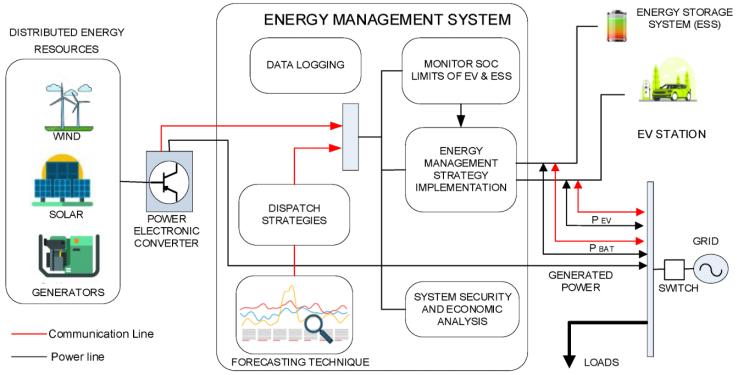
Hour-ahead dispatch refines the day-ahead schedule by incorporating updated forecasts of renewable generation andloaddemand.Sincerenewableresourcessuchassolar andwindarehighlyvariable,hour-aheadoptimizationhelps reduceforecasterrorsandimprovessystemreliability.Realtime dispatch, on the other hand, addresses immediate fluctuations and disturbances within the microgrid. This stage involves rapid adjustments in power allocation between storage components and generation units to maintainvoltagestability,frequencyregulation,andpower balance. Multi-timescale dispatch frameworks therefore enablemicrogridstooperateefficientlybycombininglongtermplanningwithreal-timeadaptivecontrolstrategies.
Hierarchical control structures are commonly used to implementmulti-timescaleenergydispatchinmicrogrids.In this framework, higher control layers handle long-term planning and economic optimization, while lower control layersmanagereal-timesystemdynamics.Thehierarchical approach improves operational flexibility and enables coordinatedcontrolofdistributedenergyresources,storage devices,andloads.
At the upper level, the energy management system determines optimal schedules for storage devices and distributedgeneratorsbasedonforecastdata.Atthelower level, fast control loops regulate voltage, frequency, and powerflowinrealtime.Thislayeredarchitectureenhances systemstabilityandallowsmicrogridstorespondquicklyto disturbances or sudden changes in renewable generation output(Olivaresetal.,2014).
Powerallocationbetweenbatteryandultracapacitorunitsis a critical component of coordinated energy dispatch in hybrid energy storage systems. Because batteries are designedforhighenergystoragecapacitybutlimitedhighpowercyclingcapability,excessiverapidcharge–discharge cyclescanacceleratebatterydegradationandreducesystem
International Research Journal of Engineering and Technology (IRJET) e-ISSN: 2395-0056
Volume: 13 Issue: 03 | Mar 2026 www.irjet.net p-ISSN: 2395-0072
reliability. Ultracapacitors, in contrast, are capable of deliveringhighpowerquicklyandcanwithstandfrequent cyclingwithoutsignificantdegradation.
Tomaximizesystemefficiencyandprolongbatterylifetime, coordinated dispatch strategies allocate low-frequency energy variations to batteries and assign high-frequency powerfluctuationstoultracapacitors.Thisapproachensures that the battery operates within moderate current ranges whileultracapacitorshandlesuddenpowerspikescausedby renewable intermittency or rapid load changes. Such coordinated power allocation reduces thermal stress on batteriesandimprovestheoveralldurabilityofthehybrid energystoragesystem(Zhangetal.,2018).
Lifecycleoptimizationisakeyobjectiveindesigningpower allocation strategies for hybrid storage systems. Since battery replacement represents a significant portion of microgridoperatingcosts,reducingbatterydegradationis essential for improving economic performance. Advanced dispatch algorithms monitor parameters such as battery state-of-charge,state-of-health,andcharge–dischargerates to determine appropriate power sharing between storage components.
By continuously adjusting the power contribution of ultracapacitors during transient conditions, coordinated dispatch frameworks reduce the depth of discharge and cyclingfrequencyexperiencedbybatteries.Thisapproach significantly extends battery lifespan while maintaining stablepowerdeliveryinthemicrogrid.Asaresult,hybrid battery–ultracapacitorsystemscanprovidereliableenergy support while minimizing long-term maintenance and replacementcosts.
The integration of renewable energy sources such as photovoltaic (PV) systems and wind turbines introduces additional complexity into microgrid energy management duetothestochasticnatureoftheseresources.Solarpower outputvarieswithsolarirradianceandweatherconditions, whilewindgenerationdependsonwindspeedfluctuations. These variations can lead to sudden power imbalances within the microgrid, making coordinated dispatch strategiesessentialformaintainingstableoperation.
Hybridbattery–ultracapacitorstoragesystemsplayacrucial role in mitigating renewable energy fluctuations. During periods of excess renewable generation, the battery can store surplus energy for later use, while ultracapacitors absorb rapid transient variations. Conversely, when renewablegenerationdecreasesorloaddemandincreases suddenly,thehybridstoragesystemcansupplytherequired power to maintain system stability. Coordinated dispatch frameworksthereforeensurethatrenewableenergysources
are utilized efficiently while maintaining reliable power supplytomicrogridloads(Lundetal.,2015).
Accurateforecastingofrenewablegenerationisessentialfor effectiveenergydispatchinmicrogrids.Forecastingmodels usemeteorologicaldataandhistoricalgenerationpatternsto predict future solar and wind power output. These predictionsenabletheenergymanagementsystemtoplan energy storage utilization and adjust dispatch schedules accordingly.
By combining forecasting techniques with coordinated dispatch algorithms, microgrids can minimize energy curtailment, reduce reliance on backup generators, and improve renewable energy utilization. The integration of forecastingwithhybridstoragecontrolenhancestheoverall efficiency and sustainability of autonomous microgrid systems.
Real-timeenergymanagementisessentialformaintaining stableoperationinislandedmicrogridswhereexternalgrid support is unavailable. Real-time control systems continuously monitor system parameters such as voltage, frequency,powerflow,andstoragestate-of-charge.Basedon thesemeasurements,controlalgorithmsdynamicallyadjust theoperationofdistributed energy resourcesandstorage devicestomaintainpowerbalanceandsystemstability.
Advancedreal-timeschedulingalgorithmsaredesignedto respondrapidlytodisturbancesandsuddenloadchanges. These algorithms determine optimal power allocation amongbatteries,ultracapacitors,andgenerationunitswhile consideringoperationalconstraintssuchasstoragecapacity limitsandconverterratings.Real-timecontrolalsoensures effectivecoordinationbetweendifferentcomponentsofthe microgrid,allowingthesystemtomaintainstableoperation even under highly dynamic conditions (Guerrero et al., 2013).
Various control algorithms have been developed for realtime energy management in islanded microgrids. These include droop control, predictive control strategies, and adaptivecontrolmethods.Droopcontrolallowsdistributed generators and storage devices to share load changes proportionally without requiring centralized communication. Predictive control algorithms use system modelstoanticipatefuturedisturbancesandadjustcontrol actionsaccordingly.
Adaptive control techniques further enhance microgrid performancebyadjustingsystemparametersinresponseto changingoperatingconditions.Whencombinedwithhybrid
International Research Journal of Engineering and Technology (IRJET) e-ISSN: 2395-0056
Volume: 13 Issue: 03 | Mar 2026 www.irjet.net p-ISSN: 2395-0072
energystoragesystems,thesecontrolstrategiesenablerapid responsetorenewablefluctuationsandloadvariations.Asa result,coordinatedreal-timeenergymanagementensures reliable and efficientoperationofautonomous microgrids withhighrenewableenergypenetration.
Hybrid energy storage systems (HESS), particularly those combining batteries and ultracapacitors, have become an important component in modern autonomous microgrids. Thesesystemsenhanceoperationalstability,improvepower quality,andensurereliableenergysupplybyaddressingthe limitations of renewable energy sources. Due to their complementarycharacteristics,hybridstoragesystemsare capableofhandlingbothlong-durationenergydemandsand short-term power fluctuations. As renewable penetration increases in microgrids, the role of HESS becomes increasingly significant in maintaining efficient and stable systemoperation(Luoetal.,2015).
One of the primary applications of hybrid energy storage systems in autonomous microgrids is smoothing power fluctuations caused by intermittent renewable energy sources. Renewable generation technologies such as solar photovoltaicandwindturbinesproducevariableoutputdue to changing environmental conditions, including solar irradiance variations and wind speed fluctuations. These variationscanleadtorapidchangesinpoweroutput,which maycauseinstabilityinmicrogridoperationifnotproperly managed.
Hybrid battery–ultracapacitor storage systems effectively mitigatethesefluctuationsbydistributingpowervariations accordingtothedynamiccapabilitiesofeachstoragedevice. Ultracapacitorsrespondquicklytosuddenchangesinpower output, absorbing or supplying high-frequency power components, while batteries manage slower variations in energy demand over longer durations. This coordinated operationensuressmootherpoweroutputfromrenewable energy systems and reduces stress on other microgrid components(Zhaoetal.,2015).
The effectiveness of hybrid energy storage in fluctuation smoothingislargelyattributedtoitsrapiddynamicresponse capability.Ultracapacitorscanchargeanddischargewithin milliseconds, allowing them to compensate for sudden variations in renewable generation or load demand. Batteries, although slower in response compared to ultracapacitors, provide sustained energy support when longer-durationpowerdeficitsoccur.
By combining these technologies within a coordinated dispatch framework, hybrid storage systems maintain a stable power profile within the microgrid. This dynamic response capability is particularly valuable in microgrids with high renewable penetration, where rapid power fluctuationsoccurfrequently.
Maintainingstablefrequencyandvoltagelevelsisessential forreliableoperationofautonomousmicrogrids.Inislanded operation, microgrids cannot rely on the main grid for frequency and voltage support, making internal control mechanisms critical for system stability. Hybrid energy storage systems contribute significantly to frequency and voltage regulation by rapidly adjusting power output in responsetosystemdisturbances.
Whenasuddenimbalanceoccursbetweengenerationand loaddemand,ultracapacitorscanprovideimmediatepower supporttostabilizesystemfrequency.Meanwhile,batteries supplysustainedenergytomaintainthebalanceoverlonger time periods. Coordinated dispatch strategies ensure that these storage components operate together to maintain stable voltage and frequency profiles throughout the microgrid(Guerreroetal.,2013).
Inadditiontoprimaryfrequencyregulation,hybridenergy storage systems can provide various ancillary services withinmicrogrids.Theseservicesincludevoltagesupport, spinningreserve,andload-followingcapabilities.Byrapidly adjusting their power output, storage devices help compensate for generation or load disturbances and maintainstableoperatingconditions.
The ability of HESS to deliver these ancillary services improves the resilience and operational flexibility of microgrids. As a result, hybrid storage systems are increasingly integrated into advanced microgrid control frameworks designed to enhance system stability and reliability.
Power quality is a critical concern in microgrid systems, particularlythosewithahighproportionofpowerelectronic converters and distributed renewable resources. Disturbancessuchasvoltagesags,harmonicdistortion,and transientpowerfluctuationscannegativelyimpactsensitive electrical equipment and reduce overall system performance. Hybrid energy storage systems play an important role in mitigating these issues by stabilizing voltagelevelsandcompensatingfortransientdisturbances.
Ultracapacitors are especially effective in responding to short-durationdisturbancesduetotheirhighpowerdensity and rapid response time. When sudden voltage drops or
International Research Journal of Engineering and Technology (IRJET) e-ISSN: 2395-0056
Volume: 13 Issue: 03 | Mar 2026 www.irjet.net p-ISSN: 2395-0072
spikes occur, ultracapacitors can quickly inject or absorb power to maintain stable voltage levels. Batteries complementthisfunctionbyprovidinglonger-termenergy support when sustained disturbances occur (Divya and Østergaard,2009).
Hybridenergystoragesystemsalsocontributetoharmonic mitigation and transient compensation within microgrids. Power electronic converters associated with renewable energysourcescanintroduceharmonicdistortionintothe electrical network. By integrating advanced control algorithms with hybrid storage systems, it is possible to regulatepowerflowandreduceharmoniceffects.
Furthermore,transientdisturbancescausedbysuddenload switchingorfaultscanbeeffectivelycompensatedusingthe fastresponsecapabilityofultracapacitors.Thiscoordinated response enhances power quality and protects sensitive electricalequipmentconnectedtothemicrogrid.
Reliability is a major concern for autonomous microgrids, especially in remote or isolated regions where grid connectivity is unavailable. In such environments, uninterrupted power supply is essential for supporting residential, commercial, and critical infrastructure loads. Hybrid energy storage systems significantly enhance microgrid reliability by ensuring continuous power availabilityduringperiodsofrenewableenergyshortageor unexpectedsystemdisturbances.
Whenrenewablegenerationdecreasesduetounfavorable environmental conditions, the battery component of the hybridstoragesystemcanprovidesustainedenergysupport tomaintainloadsupply.Atthesametime,ultracapacitors handle rapid load variations and transient disturbances, ensuringstableoperationduringdynamicconditions.This coordinatedoperationreducestheriskofpoweroutagesand improvestheoverallreliabilityofmicrogridsystems(Lund etal.,2015).
Hybrid energy storage systems also contribute to energy securityinremotemicrogrids byreducingdependenceon fossil fuel-based backup generators. In isolated regions wherefueltransportationmaybeexpensiveorunreliable, hybridstoragesystemsenablegreaterutilizationoflocally availablerenewableresources.Bystoringexcessrenewable energyandsupplyingitwhenneeded,thesesystemsensure astableandsustainableenergysupply.
Despite the significant progress in hybrid battery–ultracapacitorenergystoragetechnologiesandcoordinated
energy dispatch strategies, several technical challenges remainunresolvedinautonomousmicrogridenvironments. The integration of renewable energy sources, advanced control algorithms, and distributed storage systems introduces complex operational dynamics that require efficient and intelligent energy management frameworks. While many dispatch strategies have demonstrated promising results in simulations and small-scale implementations, their practical deployment often faces limitations related to battery degradation, system design optimization,computationalrequirements,andintegration with modern smart grid infrastructures. Identifying these challengesandresearchgapsisessentialforguidingfuture research toward the development of more reliable and scalablemicrogridenergymanagementsystems(Olivareset al.,2014).
One of the most critical challenges associated with hybrid energy storage systems is battery degradation caused by repeatedcharge–dischargecycles.Inmicrogridapplications, batteries frequently experience variable operating conditions due to renewable energy fluctuations and dynamic load demands. Excessive cycling, high current peaks,anddeepdischargeeventsacceleratebatteryaging, leading to capacity loss and reduced operational lifetime. Sincebatteryreplacementrepresentsasignificantportionof microgridmaintenancecosts,effectivelifecyclemanagement strategiesareessentialforimprovingtheeconomicviability ofhybridenergystoragesystems.
Modern coordinated dispatch strategies increasingly incorporatebatteryhealthindicatorssuchasstate-of-health (SOH),depthofdischarge,andtemperaturevariationsinto the decision-making process. By monitoring these parameters,energymanagementsystemscanlimitharmful operatingconditionsanddistributepowermoreefficiently betweenbatteriesandultracapacitors.However,accurately predicting battery degradation under varying operating conditions remains a complex research challenge that requires improved modeling techniques and real-time monitoringsolutions(Berecibaretal.,2016).
Aging-aware energy dispatch strategies represent an emerging research direction aimed at reducing battery degradation in hybrid storage systems. These approaches incorporate battery aging models into optimization algorithms to determine dispatch decisions that minimize long-term degradation effects. For instance, energy management systems may limit rapid charging cycles or adjustpowerallocationtoultracapacitorsduringtransient events.
Although aging-aware dispatch strategies have shown promising results in simulation studies, practical
International Research Journal of Engineering and Technology (IRJET) e-ISSN: 2395-0056
Volume: 13 Issue: 03 | Mar 2026 www.irjet.net p-ISSN: 2395-0072
implementationremainschallengingduetothecomplexity ofbatterydegradationmechanisms.Accurateagingmodels requiredetailedknowledgeofelectrochemicalprocessesand environmentalconditions,whicharedifficulttocapturein real-timecontrolsystems.Consequently,furtherresearchis required to develop robust and computationally efficient aging-awarecontrolframeworks.
Determining the optimal size and configuration of hybrid battery–ultracapacitor energy storage systems is another significantchallengeinautonomousmicrogriddesign.The capacityratiobetweenbatteriesandultracapacitorsdirectly influences system performance, cost efficiency, and operational reliability. If the battery capacity is oversized, system costs increase unnecessarily, whereas insufficient batterycapacitymayleadtofrequentdeepdischargecycles and accelerated degradation. Similarly, an inadequate ultracapacitor capacity may reduce the system’s ability to handlehigh-frequencypowerfluctuations.
Optimalsizinginvolvesanalyzingseveralfactors,including renewable generation variability, load demand patterns, storage device characteristics, and economic constraints. Researchers have proposed various analytical and optimization methods to determine appropriate capacity ratios for hybrid storage systems. However, the highly dynamicnatureofmicrogridenvironmentsmakesitdifficult toestablishuniversallyapplicabledesignguidelines(Luoet al.,2015).
Recent research efforts have focused on multi-objective optimization techniques to determine the optimal configuration of hybrid energy storage systems. These methods simultaneously consider multiple design criteria such as system reliability, lifecycle cost, energy efficiency, and storage device lifespan. Optimization algorithms evaluatedifferentcombinationsofbatteryandultracapacitor capacities to identify the configuration that best satisfies systemrequirements.
Although multi-objective optimization provides valuable insights into system design, its effectiveness depends on accurate modeling of microgrid dynamics and renewable energy variability. Furthermore, real-world microgrid environments often experience unpredictable changes in load demand and environmental conditions, making it difficulttodetermineoptimalconfigurationsbasedsolelyon theoreticalmodels.
Thedevelopment ofadvancedenergydispatchalgorithms has significantly improved the efficiency of hybrid energy
storage management in microgrids. However, many optimization-basedandartificialintelligence-baseddispatch strategiesinvolvecomplex mathematical modelsandhigh computationalrequirements.Thesealgorithmsoftenrequire solving large-scale optimization problems or training machinelearningmodelsusingextensivedatasets.
Inreal-timemicrogridoperation,computationalefficiency becomesacriticalfactorbecausedispatchdecisionsmustbe made rapidly to respond to system disturbances. High computational complexity may delay control actions and reduce system responsiveness, potentially affecting microgrid stability. Implementing advanced dispatch algorithms therefore requires efficient computational platformsandsimplifiedmodelscapableofdeliveringfast andreliablesolutions(CamachoandBordons,2013).
Real-timeimplementationofcomplexdispatchalgorithms presentsseveralpracticalchallenges.Microgridcontrollers mustprocesslargevolumes ofoperational data,including measurements from distributed sensors, renewable generation forecasts, and storage system parameters. Ensuring timely processing of this information requires high-performance computing resources and robust communicationinfrastructure.
Additionally,microgridcontrolsystemsmustremainreliable even under communication delays or data uncertainties. Simplifiedcontrolstrategiesandhybridcontrolframeworks that combine heuristic and optimization-based methods havebeenproposedtoaddressthesechallenges.However, further research is necessary to develop scalable and computationally efficient dispatch algorithms suitable for practicalmicrogriddeployment.
TherapiddevelopmentofsmartgridandInternetofThings (IoT)technologiesoffersnewopportunitiesforimproving energymanagementinautonomousmicrogrids.Smartgrid infrastructure enables advanced communication, monitoring, and control capabilities that facilitate coordinatedoperationofdistributedenergyresourcesand storagesystems.IoT-enabledsensorscancollectreal-time data on system parameters such as power flow, voltage levels, and storage device conditions, providing valuable informationforintelligentdispatchdecisions.
By integrating IoT-based monitoring systems with hybrid energy storage management frameworks, microgrids can achieve higher levels of automation and operational efficiency. Data collected from distributed sensors can be analyzed using advanced analytics and machine learning techniquestopredictsystembehaviorandoptimizeenergy dispatchstrategies.Thisintegrationenablesmoreaccurate
International Research Journal of Engineering and Technology (IRJET) e-ISSN: 2395-0056
Volume: 13 Issue: 03 | Mar 2026 www.irjet.net p-ISSN: 2395-0072
forecasting,improvedfaultdetection,andadaptivecontrolof microgridcomponents(Gungoretal.,2013).
Intelligentenergymanagementsystemsrepresentthenext generationofmicrogridcontrolarchitectures.Thesesystems combinesmartgridtechnologies,artificialintelligence,and hybrid energy storage to create self-adaptive energy networks capable of responding dynamically to changing operatingconditions.IntelligentEMSplatformscananalyze real-time system data, predict future energy demand, and automaticallyadjustdispatchstrategiestomaintainoptimal performance.
Thegrowingintegrationofrenewableenergyresourcesin modernpowersystemshasacceleratedthedevelopmentof autonomous microgrids as a reliable and sustainable solutionfordecentralizedelectricitygeneration.However, the intermittent nature of renewable energy sources introducessignificantchallengesrelatedtopowerstability, voltageregulation,andenergymanagement.Hybridenergy storage systems (HESS), particularly those combining batteriesandultracapacitors,haveemergedasaneffective solution to address these challenges due to their complementarycharacteristicsofhighenergydensityand highpowerdensity.
This review has presented a comprehensive analysis of coordinatedenergydispatchstrategiesforhybridbattery–ultracapacitor storage modules in autonomous microgrid environments. The study examined the architectural framework of microgrids integrated with hybrid energy storageanddiscussedtheoperationalprinciplesofdifferent storage configurations. A detailed literature review highlighted various energy management approaches, includingrule-basedstrategies,filter-basedpowerallocation methods, optimization-based dispatch algorithms, and emerging artificial intelligence-driven techniques. Each approach was analyzed in terms of operational efficiency, computationalrequirements,andpracticalapplicabilityin microgridsystems.
Furthermore,thereviewexploredthemajorapplicationsof hybridenergystoragesystems,includingpowerfluctuation smoothing,frequencyandvoltageregulation,powerquality improvement, and reliability enhancement in islanded microgrids.Despitesignificantprogressinthisfield,several challenges remain, such as battery degradation, optimal system sizing, computational complexity of advanced algorithms, and integration with smart grid technologies. Future research should focus on developing intelligent, scalable,andcost-effectiveenergymanagementframeworks thatintegrateadvancedoptimizationtechniques,machine learningalgorithms,andreal-timemonitoringtechnologies. Suchadvancementswillenablemoreefficientutilizationof
hybridenergystoragesystemsandcontributetothereliable operationofnext-generationautonomousmicrogrids.
Althoughthisreviewprovidesacomprehensiveoverviewof coordinatedenergydispatchstrategiesforhybridbattery–ultracapacitorstoragesystemsinautonomousmicrogrids, several limitations should be acknowledged. First, the reviewprimarilyfocusesonconceptualframeworks,control strategies,andsystemarchitecturesreportedintheexisting literature,whiledetailedexperimentalvalidationsandlargescalereal-worldimplementationsarelimited.Second,dueto therapiddevelopmentofenergymanagementtechnologies, someemergingapproachessuchasadvanceddeeplearningbasedcontrolorblockchain-basedenergymanagementmay not be fully represented. Additionally, the review emphasizes electrical and operational aspects of hybrid storage systems but provides limited discussion on economicanalysis,lifecycleassessment,andenvironmental impacts. Finally, variations in microgrid configurations, renewable energy penetration levels, and geographical conditionsmayinfluencetheapplicabilityofthediscussed dispatchstrategies.Therefore,furtherstudiesincorporating practical case studies, techno-economic evaluations, and real-timeimplementationanalysesarerequiredtoprovidea more comprehensive understanding of hybrid energy storagemanagementinautonomousmicrogridsystems.
1. Akhil, A.A., Huff, G., Currier, A.B., Kaun, B.C., Rastler, D.M., Chen, S.B., Cotter, A.L., Bradshaw, D.T. and Gauntlett, W.D., 2013. DOE/EPRI electricity storage handbookincollaborationwithNRECA.Albuquerque, NM:SandiaNationalLaboratories.
2. Berecibar,M.,Gandiaga,I.,Villarreal,I.,Omar,N.,Van Mierlo,J.andVandenBossche,P.,2016.Criticalreview of state-of-health estimation methods of Li-ion batteries for real applications. Renewable and SustainableEnergyReviews,56,pp.572–587.
3. Camacho,E.F.andBordons,C.,2013.ModelPredictive Control.2nded.London:Springer.
4. Chen,H.,Cong,T.N.,Yang,W.,Tan,C.,Li,Y.andDing,Y., 2009.Progressinelectrical energystoragesystem:A critical review. Progress in Natural Science, 19(3), pp.291–312.
5. Divya, K.C. and Østergaard, J., 2009. Battery energy storagetechnologyforpowersystems Anoverview. ElectricPowerSystemsResearch,79(4),pp.511–520.
6. Guerrero, J.M., Vasquez, J.C., Matas, J., De Vicuña, L.G. and Castilla, M., 2011. Hierarchical control of droopcontrolledACandDCmicrogrids Ageneralapproach
International Research Journal of Engineering and Technology (IRJET) e-ISSN: 2395-0056
Volume: 13 Issue: 03 | Mar 2026 www.irjet.net p-ISSN: 2395-0072
7. Guerrero,J.M.,Loh,P.C.,Lee,T.L.andChandorkar,M., 2013. Advanced control architectures for intelligent microgrids. IEEE Transactions on Industrial Electronics,60(4),pp.1254–1262.
8. Gungor,V.C.,Sahin,D.,Kocak,T.,Ergut,S.,Buccella,C., Cecati, C. and Hancke, G.P., 2013. Smart grid technologies: Communication technologies and standards.IEEETransactionsonIndustrialInformatics, 7(4),pp.529–539.
9. Hatziargyriou,N.,Asano,H.,Iravani,R.andMarnay,C., 2007. Microgrids. IEEE Power and Energy Magazine, 5(4),pp.78–94.
10. Lasseter,R.H.,2002.Microgrids.In:Proceedingsofthe IEEEPowerEngineeringSocietyWinterMeeting.New York:IEEE,pp.305–308.
11. Li,X.,Hui,D.andLai,X.,2015.Batteryenergystorage stationbasedsmoothingcontrolofphotovoltaicpower generation fluctuations. IEEE Transactions on SustainableEnergy,4(2),pp.464–473.
12. Lund, H., Andersen, A.N., Østergaard, P.A., Mathiesen, B.V.andConnolly,D.,2015.Fromelectricitysmartgrids tosmartenergysystems.Energy,42(1),pp.96–102.
13. Luo, X., Wang, J., Dooner, M. and Clarke, J., 2015. Overviewofcurrentdevelopmentinelectricalenergy storage technologies and the application potential in powersystemoperation.AppliedEnergy,137,pp.511–536.
14. Morais, H., Kádár, P., Faria, P., Vale, Z. and Khodr, H., 2010.Optimalschedulingofarenewablemicrogridin an isolated load area using mixed-integer linear programming.RenewableEnergy,35(1),pp.151–156.
15. Olivares,D.E.,Mehrizi-Sani,A.,Etemadi,A.H.,Canizares, C.A.,Iravani,R.,Kazerani,M.,Hajimiragha,A.H.,GomisBellmunt, O., Saeedifard, M., Palma-Behnke, R. and Jiménez-Estévez, G.A., 2014. Trends in microgrid control. IEEE Transactions on Smart Grid, 5(4), pp.1905–1919.
16. Zhang,Q.,Li,C.,Wang,Y.andWang,J.,2018.Ahybrid energy storage system for microgrids: Modeling, controlandapplications.Energies,11(9),p.2343.
17. Zhao, H., Wu, Q., Hu, S., Xu, H. and Rasmussen, C.N., 2015.Reviewofenergystoragesystemforwindpower integrationsupport.AppliedEnergy,137,pp.545–553.
19. Burke,A.,2000.Ultracapacitors:why,how,andwhere is the technology. Journal of Power Sources, 91(1), pp.37–50.
20. Cao, J. and Emadi, A., 2012. A new battery/ultracapacitor hybrid energy storage system forelectric,hybrid,andplug-inhybridelectricvehicles. IEEE Transactions on Power Electronics, 27(1), pp.122–132.
21. Dougal,R.A.,Liu,S.and White,R.E., 2002. Powerand lifeextensionofbattery–ultracapacitorhybrids.IEEE Transactions on Components and Packaging Technologies,25(1),pp.120–131.
22. Gao, L., Dougal, R.A. and Liu, S., 2005. Active power sharing in hybrid battery/ultracapacitor power sources. IEEE Transactions on Power Electronics, 20(3),pp.543–550.
23. Ferreira,H.L.,Garde,R.,Fulli,G.,Kling,W.andLopes, J.P.,2013.Characterisationofelectricalenergystorage technologies.Energy,53,pp.288–298.
24. Kim,Y.,Koh,J.,Xie,Q.,Wang,Y.,Chang,N.andPedram, M.,2014.Ascalableandflexiblehybridenergystorage systemdesignandimplementation.Journal of Power Sources,255,pp.410–422.
25. Sun,C., Yue,Y., Choi,S.S.andJiang,Z.,2015. Capacity optimization of hybrid energy storage systems in microgridusingneuralnetworks.AppliedEnergy,137, pp.548–556.
26. Zhou, H., Bhattacharya, T., Tran, D., Siew, T. and Khambadkone, A., 2011. Composite energy storage system involving battery and ultracapacitor with dynamicenergymanagementinmicrogridapplications. IEEE Transactions on Power Electronics, 26(3), pp.923–930.
27. Arrigoni, S., Tarsitano, D. and Cheli, F., 2016. Comparison between different energy management algorithms for hybrid energy storage systems. InternationalJournalofHeavyVehicleSystems,23(2), pp.171–189.
28. Khalid,M.,2019.Areviewontheselectedapplications of battery-supercapacitor hybrid energy storage systemsformicrogrids.Energies,12(23),p.4559.
29. Zhang, W., Zhang, W. and Wang, Z., 2022. Strategy of lithium-ion battery–supercapacitor hybrid energy storagetosuppresspowerfluctuationofDCmicrogrid. InternationalJournalofLow-CarbonTechnologies,17, pp.1012–1017.
2026, IRJET | Impact Factor value: 8.315 | ISO 9001:2008
| Page1602 toward standardization. IEEE Transactions on IndustrialElectronics,58(1),pp.158–172.
18. Zhao, H., Wu, Q., Hu, S., Xu, H. and Rasmussen, C.N., 2020.Reviewofenergystoragesystemforrenewable energyintegrationandpowersystemstability.Applied Energy,137,pp.545–553.
International Research Journal of Engineering and Technology (IRJET) e-ISSN: 2395-0056
Volume: 13 Issue: 03 | Mar 2026 www.irjet.net p-ISSN: 2395-0072
30. Chen, H., 2022. Lithium-ion battery-supercapacitor energy managementforDC microgrids.International Journal of Low-Carbon Technologies, 17, pp.1452–1458.
31. Hu, Q., Xie, S. and Zhang, J., 2024. Data-based power managementcontrolforbattery–supercapacitorhybrid energystorageinsolarDCmicrogrid.ScientificReports, 14,p.26164.
32. Kamagaté, Y. and Shah, H.A., 2024. Hybrid energy storage system for dynamic power management in grid-connected microgrid. International Journal of PowerElectronicsandDriveSystems,16(1),pp.485–496.
33. Yang, X., Li, H., Jiang, Z., Wang, H. and Yin, Z., 2013. Reviewonapplicationofhybridenergystoragebased on ultracapacitor. Applied Mechanics and Materials, 341–342,pp.1299–1302.
34. Hamza,A.,Javid,M.A.,Hayyat,S.andAbduallah,M.N.A., 2025.Energymanagementinlithium-ionbatteryand supercapacitor hybrid systems: Techniques and approaches. European Journal of Sustainable ManufacturingandTechnology,1(1),pp.1–15.
35. Morstyn, T., Hredzak, B., Aguilera, R.P. and Agelidis, V.G., 2017. Model predictive control for distributed microgrid battery energy storage systems. IEEE TransactionsonSmartGrid,9(2),pp.1091–1101.
36. Zhou, Y., Wang, C. and Chen, Z., 2024. Optimizationbasedpowermanagementforbattery/supercapacitor hybrid energy storage system in DC microgrid. International Journal of Electrical Power & Energy Systems,155,p.109665.
37. Liu, S., Dougal, R.A. and White, R.E., 2002. Power enhancement of an actively controlled batteryultracapacitor hybrid. IEEE Transactions on Power Electronics,20(1),pp.236–243.
38. Burke,A.andMiller,M.,2010.Thepowercapabilityof ultracapacitors and lithium batteries for electric and hybridvehicleapplications.JournalofPowerSources, 195(16),pp.5147–5155.
39. Li,Q.,Chen,W.,Liu,Y.andLiu,J.,2018.Hybridenergy storage system for microgrid applications: A review. Renewable and Sustainable Energy Reviews, 81, pp.260–270.
40. Fathabadi, H., 2016. Novel hybrid battery/supercapacitor energy storage system for microgrid applications. Energy Conversion and Management,124,pp.124–132.
41. Zhang, C., Wei, Y., Cao, P. and Lin, M., 2018. Energy storage system design for microgrid using hybrid battery–supercapacitor. IEEE Transactions on SustainableEnergy,9(2),pp.957–964.
42. He,H.,Xiong,R.andFan,J.,2012.Evaluationoflithiumionbatteryequivalentcircuitmodelsforstateofcharge estimation.AppliedEnergy,88(11),pp.4138–4147.
43. Zakeri,B.and Syri,S.,2015.Electricalenergystorage systems: A comparative life cycle cost analysis. Renewable and Sustainable Energy Reviews, 42, pp.569–596.