
International Research Journal of Engineering and Technology (IRJET) e-ISSN: 2395-0056
Volume: 13 Issue: 04 | Apr 2026 www.irjet.net p-ISSN: 2395-0072
International Research Journal of Engineering and Technology (IRJET) e-ISSN: 2395-0056
Volume: 13 Issue: 04 | Apr 2026 www.irjet.net p-ISSN: 2395-0072
Gaurav Gupta1 , Bhoj Ram Sahu2
1Mtech Scholar, Department of Civil Engineering, Bharti Vishwavidyalaya Durg CG
2Assistant Professor, Department of Civil Engineering, Bharti Vishwavidyalaya Durg CG
Abstract - The characteristics and uses of bacterial concrete are thoroughly examined in this essay, with an emphasis on the material's capacity for self-healing. It starts by treating the microcracks that are naturally present in concrete, which cause toxic elements to seep in and cause structural damage. Concrete regeneration is essential, and bio-mineralization methods hold promise for closing these microcracks through continuous hydration processes. Microbiologically inducedcalcite precipitation(MICP),which is well-known for its ability to reinforce concrete integrity, is the most used technique for this. The study emphasizes how encapsulationtechniques are preferable to directapplication for better concrete restoration results. It highlights the function of urease-producing bacteria,suchBacillusPasteurii and Bacillus Subtilis, which, when paired with a calcium supply, promote calciteprecipitation(CaCO3).Byencouraging a strong pore structure, this response aids in the efficient sealing of concrete fractures. The study highlights that the flexibility of bacterial concentrations is crucial for improving concrete's durability and that including such bacteria enhances the material's overall strength and toughness in additionto helpingit self-heal. Finally,itexaminesthevarious uses of bacterial agents inconcrete healingandthevariations in performance based on the application technique thereby outliningthe benefits of incorporating bacterial technologies in concrete engineering.
Key Words: Bacterial Concrete, Self-healing Concrete, Bacteria, Self-healing, Micro-cracks, CaCO3 precipitation,
1.1 Concrete: Concreteisaprevalentconstructionmaterial, knownforitsstrengthincompressionbutweaknessin tension,leadingtoinevitablecrackingthatdiminishes structural lifespan. Traditional repair methods are costly and labor intensive. An innovative solution involvesself-healingconcretethatincorporatesbacteria nourishingoncalcium.Thesebacteriapromotecalcium carbonate precipitation to effectively seal cracks, enhancing both strength and durability. Specifically, cracks larger than 0.8mm pose repair challenges, yet bacterial reinforcement shows promise. Lightweight aggregatescansubstitutefineaggregate,boostbacterial mortarstrengthwhilefacilitatebetterhealingefficiency. The application of Rice husk ash and fly ash with bacteria further improves mechanical properties and reduces porosity, with strength gains up to 24% and 22%, respectively. Recent self-healing techniques, includinghydrogelencapsulationandvascularsystems,
demonstratesignificantpotentialforearly-stagecrack remediation.Thisstudyaimstoreviewtheinfluenceof bacteria on concrete properties and the various bacterial types utilized for calcium carbonate precipitation.
1.2 Self-healing approach and ways ofapplyingbacteria in concrete
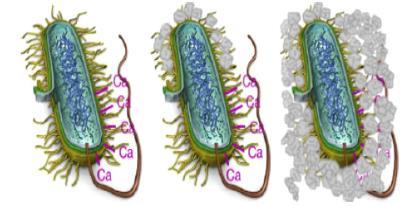
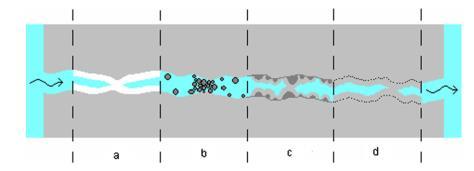
a. Self-healing approach: Whendamageisdetected, ahealingagentisreleasedbyanidealself-healing concrete system. Microorganisms that precipitate calcium carbonate are used in self-healing treatments, including autogenous healing, to successfullymendmicrocracks.Intheveryalkaline conditions of concrete, bacteria like Bacillus Sphaericus flourish. They convert urea into ammoniumandcarbonate,whichgeneratesCaCO3, whichfillsfracturesandbindsconcreteingredients like sand and gravel. Larger fissures require bacterial activation from hibernation in order to healovertime,butcrackslessthan0.2mmcanbe fixed by the concrete itself. This process, called Microbiologically Induced Calcium Carbonate Precipitation(MICP),usesbacteriaasapersistent remedy. various metabolic routes are used by various microorganisms to create calcium carbonate; heterotrophic methods produce more precipitate than autotrophic ones. In essence, the breakdownofureabybacterialureasecatalyzesthe conversion required for the creation of calcium carbonate,improvingpHandcarbonatelevelsinthe surrounding environment and eventually promotingconcrete'sabilitytohealitself. Thenegativechargeofthebacterialcellwallmakes iteasierforcations,suchasCa2+,tobeabsorbed. Thiscausescalciumcarbonatetoprecipitateatthe cell surface, which serves as a nucleation site. Throughurealysis,avarietyofmicroorganismsmay precipitate calcium carbonate, improving the qualitiesofconcrete.Bacillus aerius enhancesthe endurance of rice husk ash concrete, whereas Bacillus subtilis boosts concrete strength using lightweight particles and graphite nanoplatelets. Bacillus sphaericus increases the durability of concrete, whereas Bacillus megaterium increases compressive strength by 24%. Through bacterial carbonate precipitation, Sporosarcina pasteurii addstosurfacetreatmentchoicesandexhibitsselfhealing properties in fly ash and silica fume concretes.
International Research Journal of Engineering and Technology (IRJET) e-ISSN: 2395-0056
Volume: 13 Issue: 04 | Apr 2026 www.irjet.net p-ISSN: 2395-0072
2. Potential cementitious material self-healing processes
Pui Yan Wong et al. (2024) studied the healing mechanism of bacterial concrete using MicrobialInduced Calcium Carbonate Precipitation. They foundthathealingdependsonpH(9–11),moisture, andoxygen, andidentifiednutrientdepletionasa limitation. They suggested using bacteria + fungi systems.
Nirakar Pradhan et al. (2024) focused on durability. Their results showed a reduction in water permeability (up to 60%), less chloride penetration, and better long-term performance. However, they noted a lack of real-world (field) studies.
Ajitanshu Vedrtnam et al. (2025) studiedcarbon capture in bio-concrete. They found that some bacteria can absorb CO₂ during calcite formation, making concrete more eco-friendly They introducedtheideaofcarbon-negativeconcrete
Abeer M. Eisa et al. (2025) developedrubberized bacterial concrete using recycled rubber and Bacillus subtilis They found better crack healing, but a slight decrease in strength. This supports wastematerialuseinconstruction.
P. Ingle, M. Shrestha, R. Potdar (2017) thispaper has presented the bio concrete with and without risk husk and also permeability compressive strength tests they are did by introducing of B. pasteurii. They use 2%, 4% and 6% rise husk replacing cement and used several bacterial solutions like 103, 105 and 107cells/ml I productionofconcrete.Finally,theyconcludedthat compressive strength rise, permeability and porosity of rice husk concrete is decrease by the
introduction of B. pasteurii and also enhances durability.
S. Sanjay, S. Neha, and R. Jasvir (2016), This paperwaspresentedtheexperimentalinvestigation onbacterialconcretetoincreasethestrengthofbio concreteandtoinformtheprocessinvolvedinthe bacterial concrete to know the calcite crystals formed in bacterial concrete analysis of microstructurehasbeendonethatisusedforthe potential to recovery the cracks in bacterial concreteandalsotoinformthebiologicalreaction in concrete. As a result, has been got because of goodadaptabilityofnutrientbrothmediumofbio concreteat28daysattainedbetterstrengthwhen comparetoconventionalconcrete.
Kunal R. Patil, B. Waghere, B. K. Ahire, et al (2016), This research has been informed that an experimentonbioconcretewiththeseveraltypeof bacteria B. pasteurii and bacillus sharicus to enhancingdurabilityandstrengthofconcretewith the mechanism of MICP at age of 7,28 days. They foundthatwhenbacteriaareaddedtotheconcrete its gives less compressive strength than nutrient broth solution by bacillus sphaericus and B. pasteurii.
Prof. M. Manjunath, A. A. Kalaje, Santosh A. Kadapure, (2014), Thispaperwaspresentedthe observationtheyaredidthetestsonthemechanical properties of concrete, chloride permeability and waterabsorptionandalsoflyashreplacingcement by 10% and 20% with bacterial solutions of 103,105,107usingB.Sphaericusatageof28days. Generally, they concluded that mechanical propertiesareimprovedbythepresenceofbacteria and decrease water absorption and permeability. The better results gain at bacterial solution of 105cells/ml.
N. Chahal and R. Siddique (2008) thisstudyhas been presented that with use of Sporosarcina pasteurii which would make it, self-healing. They observed that newly formed cracks healed by the presenceofbacteria.Intheconcretemix10%,20% and 30% and also 5% and 10% dosage of fly ash andsilicafumerespectivelyreplacingcementinthe bacterial solution of 103, 105 and 107 cells/ml. They did tests on the water absorption and porosity, chloride permeability and compressive strengthbyusinguptoage91days.Theyconcluded that by the presence of S. pasteurii increase compressivestrength,cutdownsthepermeability andporosityofsilicafumeandflyashconcrete.
N. Ganesh and Dr. S. Siddiraju, thispaperhasbeen informed using calcium lactate and bacteria to repairthecrackspercentagesof bacteria selected forthestudyare3.5%and5%withmassofcement. Thecementreplacingwith10%and5%ofcalcium lactatewasusedinconcreteinthisexperimentB. pasteurii bacterial species is used with different
International Research Journal of Engineering and Technology (IRJET) e-ISSN: 2395-0056
Volume: 13 Issue: 04 | Apr 2026 www.irjet.net p-ISSN: 2395-0072
concentrations of bacterial for an M40 concrete grade. Several tests are done in this investigation such as elastic modulus, flexural strength, and compressive strength the cubes of dimensions of 10x10x10 cm were used for the compressive strengthtestitwasfoundthat40.53MPaand19.8 MPafor28and7daysbyusingcalciumlactatefor normal concrete of compressive strength tests respectivelyandfromthistheyobservedreducing ofcompressivestrengthduetocalciumlactateand also10%isoptimumdosageofcalciumlactateby theintroducingofbacteriainconcretetheyfound enhancing of the properties of concrete and of concretewhichisbetterthanconventionalconcrete. Finally, they concluded that effective self-healing agentproducedbyusing5%ofbacteriaand3.5%of calciumlactate.
Chintalapudi kartik et all: Carried the work on bacterialconcrete,theadditionofureaseproducing bacteria along with calcium source results in calcium precipitation in concrete. Experiments showedthatthecellconcentrationof106cells/ml ofwaterinthecementpasteandmortarspecimens has higher compressive strength gain was up to 39.80%,33.07%and50%,28.20%respectively.
G. Mohit and P. Krishna Chaitanya, thispaperhas presented that, experimental investigation on bacterialconcretebyB.pasteuriibacterialspecies and also compare the results with the normal concretewithinthiscementisreplacingby30%of GGBSandflyashinM25concretegrade.Different testshavebeenconductedinthisinvestigationtests like X-Ray diffraction test, compressive strength, flexuralstrength,slumpflowtestandsplittensile strengthforseveralsampleof40ml,50ml,and60ml bacterial concentrations for each sample the compressive strength improved by 30% in bio concreteandbacterialconcretewithflyashby15% andGGBSby20%.Itwasfoundthatbioconcreteof 40mland50mlbacterialsolutionisattainsextreme flexuralstrengthandsplittensilestrengthbutit’s not true for 60ml bacterial solution after 14 days when they did flexural tensile strength also, the optimum dosage of bacterial solution used in concrete is 50ml l it’s the point of maximum improvementofmechanicalpropertiesofbacterial concrete. Generally, more CaCO3 is produce in concrete because of bacteria species which has enhancingdurabilityofstructureduetoreducingof voidsby10%.
3.1 Aim & Objectives:
Tostudythebehaviorofbacteria-basedself-healing concrete using the concept of Microbial-Induced CalciumCarbonatePrecipitation.
Compare the effect of bacterial species such as Bacillus subtilis, Bacillus sphaericus, and Sporosarcina pasteurii on: Compressive strength durabilityandcrack-healingefficiency
Tostudytheinfluenceofdifferentparameterssuch as: Bacterial concentration Nutrient content (e.g., calcium lactate) Environmental conditions (pH, moisture,oxygen)
To study the use of waste materials (such as rice husk, rubber, fly ash, and GGBS) in bacterial concreteforsustainableconstruction.
4.1 Working of Bio concrete as a repair material: Self-healing concrete is a biologically engineered material designed to repair cracks in concrete structures.Itincorporatesspecificbacterialspecies, such as bacillus, along with calcium lactate and nutrientslikenitrogenandphosphorus.Theseselfhealingagentsremainviablewithintheconcretefor up to 200 years. When water and nutrients penetrate the porous surface of the concrete, the bacterialsporesgerminate.Thebacteriathenfeed on calcium lactate, leading to the consumption of oxygen and the conversion of soluble calcium lactateintoanimpenetrablecalcareouscompound. This process results in granite-like solidification overthecracks.Furthermore,theconsumptionof oxygenmitigatescorrosionoftheembeddedsteel reinforcement,enhancingthestructuralintegrityof the concrete. The reaction between CO2 and calciumhydroxideintheconcretematrixproduces calciumcarbonate,contributingtotheself-healing propertiesofthematerial.Water(H2O)andcalcium carbonate(CaCO3)aretheproductsofthereaction between CO2 and calcium hydroxide (Ca(OH)2). BecauseCa(OH)2issoluble,itcanseepintocracks when water enters. By breaking down calcium nutrients, bacteria in concrete promote a selfhealing mechanism that improves fracture rehabilitation. For example, calcium carbonate, carbon dioxide, and water are produced when calcium acetate reacts with oxygen. This demonstrateshowautogenoushealingmechanisms aidintheclosingoffracturesinconcretebuildings andhowmicrobial activity directlycontributes to thecreationofcalciumcarbonate.
4.2 Self-healing measurement methods: This document discusses various techniques for determiningthewidthofsealedcracksinconcrete, predominantly utilizing image surveillance and microscopy. Key technologies include optical imaging,high-pixelcameraphotography,andX-ray computed tomography, revealing average crack dimensionsof60µmwithpolymerfillingreaching
International Research Journal of Engineering and Technology (IRJET) e-ISSN: 2395-0056
Volume: 13 Issue: 04 | Apr 2026 www.irjet.net p-ISSN: 2395-0072
upto138µm.Auxiliarycementingmaterialshave been shown to effectively plug cracks of 200 µm width, while encapsulating microorganisms in concrete can heal wider cracks up to 970 µm, representing a highly effective approach. The combinationofchemicalsandmicroorganismshas demonstrated efficacy, extending the self-healing capability to cracks up to 0.22 m wide. The literature indicates that many researchers focus primarily on large-scale mechanical properties to evaluateself-healingeffectiveness,withadditional assessments of macrostructures highlighting improved results. However, some studies have shownlessaccuracyincrackanalysiswhenutilizing only microscopy. While microstructure tests are also performed along with durability tests, the reliabilityofself-healingbasedsolelyondurability metrics has been questioned as less effective. Certain researchers have conducted nano-scale effectivenesstests,butevidencesuggeststhatselfcuring, macro-mechanical, micro-structure, and nano-structure tests have not been measured in parallel. Future research is urged to adopt a systematic method for evaluating self-healing efficacyinconcrete.
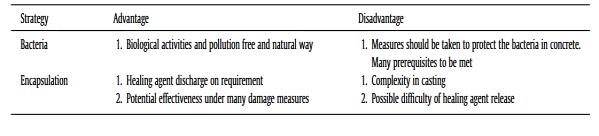
4.3 Mechanism of applying the healing agents in concrete: According to research, there are two primary ways to apply healing chemicals to concrete:encapsulationanddirectapplication.The best bacterial concentration was determined by direct application entails adding bacteria to lightweight aggregates and employing graphite nanoplates as carriers. To improve self-healing, encapsulation entails covering aggregates with a polymerafterimpregnating themwitha bacterial solution.Thistechniquehasbetterhealingquality, allowing for a wider spectrum of cracks and a quicker response to cracking. Bacterial spores encapsulatedinhydrogel havealsodemonstrated enhancedhealingefficacy.After28days,thedirect application of Shewanella bacteria increased the cementmortar'scompressivestrengthby25%.By improvingthedispersionanddefenseofbacteriain alkaline settings, these techniques increase the effectivenessofself-healing.
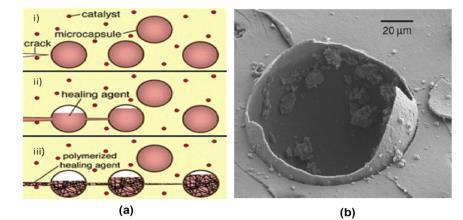
(i)Formationofcracksinmatrix;(ii)process ofreleasinghealingagent;(iii)processofcrack healingand (b) ESEM image displaying a ruptured microcapsule.
Table-1 Self-healing Technique
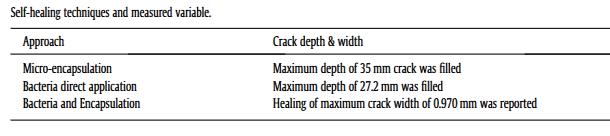
Table-2 Summarized Contrast Between Specific Techniques.
4.4 Effect of bacteria on properties of concrete
a. Hydration kinetics: Depending on the type of calcium source utilized, adding bacteria spore powder to concrete can either speed up or slow down its setting time. While calcium format and calciumnitratespeedupthesettingtime,calcium lactatetendstoslowitdown.
b. Compressive strength:Thestrengthofstructural concrete has been enhanced through a biotechnological method involving calcite precipitation. Microbial cells, particularly Bacillus megaterium, thrive in permeable cement mortar, adapting to the high pH during curing, leading to calcite precipitation on the cells and within the mortar matrix. This results in lower porosity and permeability. Higher grade concrete (50 MPa) shows a 24% increase in compressive strength whenbacteriaareintroduced,comparedtolower grades.Replacing10%ofcementwithflyashand includingSparciouspasteuriibacteriacanenhance compressive strength by 20%. Other studies indicate that different fly ash concentrations improve mortar strength by 19%, 14%, and 10% with bacterial presence. Additionally, the use of nanomaterials like GNP for bacterial distribution further increases compressive strength through microbialcalciumcarbonateprecipitation.Overall, the concrete's compressive strength can significantlyimproveduetothedepositionofCaCO3 fromthebacterialactivity.
International Research Journal of Engineering and Technology (IRJET) e-ISSN: 2395-0056
Volume: 13 Issue: 04 | Apr 2026 www.irjet.net p-ISSN: 2395-0072
Table-3 Different types of bacteria and their performance.
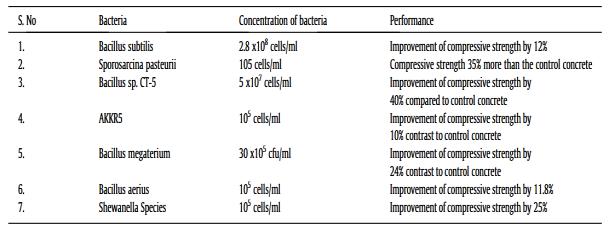
c. Water permeability: The durability of concrete under pressure gradients is fundamentally influencedbyitspermeability,whichislinkedtothe characteristics of its pore network, including porosity, tortuosity, specific surface area, size distribution,connectivity,andmicrocracks.These features are affected by the water/cement (w/c) ratio,particlesizedistribution,ageofthematerials, andtheingressofaggressivesubstances.Research indicatesthatthedepositionofcalciumcarbonate (CaCO3)canreduceboththewaterabsorptionand permeabilityofconcrete.Forinstance,studiesshow thattheintroductionofthebacteriaS.Pasteuriiinto flyashconcretesignificantlyreducesporosityand permeability, with a fourfold decrease in water absorption observed at a concentration of 10^5 cells/ml.Similarly,concretespecimensmixedwith BacillusMegateriumdemonstratedoverthreetimes less water absorption than controls due to microbial calcite deposition. The use of Bacillus Aeriusfurtherenhancesdurabilitybyfillingpores withcalcite,therebyreducingwaterabsorptionand porosity. At 28 days of curing, control specimens exhibitedhightomoderatepermeability,whereas AAKR5 bacterial concrete showed a significant reductioninpermeabilityduetocalciumcarbonate filling pores. Additionally, microbial precipitation hasbeenshowntoimprovethequalityofrecycled aggregates,therebyreducingtheirwaterabsorption aswell.
d. Chloride ion permeability: Corrosion of reinforcing steel caused by chloride ingress is a significant environmental threat to concrete structures.Thepermeabilityofconcretetochloride ions is influenced by its internal pore structure, which is affected by factors such as mix design, curing methods, hydration levels, the use of supplementary cementitious materials, and construction practices. The Rapid chloride permeability test measures the electrical current passing through concrete samples to assess their chloride permeability. Incorporating bacteria in
concrete can enhance resistance to chloride permeation;studiesshowthatconcretecontaining bacteria had an average reduction of 11.7% in chloride permeability compared to standard concrete. Specifically, Sparcious Pasteurii and Bacillus Subtilis effectively reduce chloride penetration and enhance sulfate exposure resistance. The inclusion of Bacillus Aerius also decreasedtotalchargepassedthroughbothcontrol and RHA concrete specimens, with reductions of 55.8%, 49.9%, and 48.4% compared to conventional concrete at 7, 28, and 56 days, respectively. Moreover, Sparcious Pasteurii at an optimalconcentrationof105cells/mlin10%silica fumeconcretedemonstratedasignificantreduction in rapid chloride penetration (380 coulombs). It wasnotedthatflyashconcretewithSporoscarcina pasteurii at the same bacterial concentration achieved maximum chloride ion reduction; however, concrete with 30% fly ash yielded only 762 coulombs of penetration, indicating its effectiveness. Thus, the service life of concrete structures, particularly those subject to de-icing saltsormarineenvironments,islargelydependent ontheirabilitytoresistchlorideionpenetration.
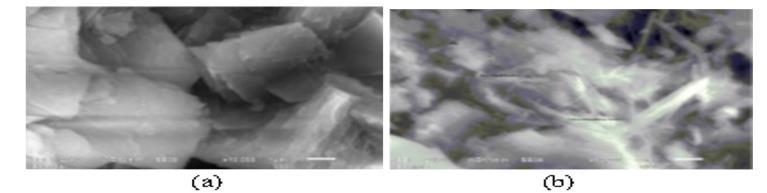
e. Microstructure: Calciteprecipitationinmortarand concretewascharacterizedthroughSEManalysis, revealingrod-shapedbacteriaassociatedwiththe calcitecrystals.Thisdepositionenhancesconcrete impermeability by acting as a barrier against harmful substances. The introduction of Bacillus Megateriumbacteriaataconcentrationof30-105 cfu/ml resulted in a maximum calcium weight increase of 38.76% compared to other bacterial proportions and control samples. SEM, EDS, and XRD analyses confirmed the presence of calcite, primarily as calcium carbonate, thus improving concrete microstructure and durability. The SEM images demonstrated that bacterial concrete contained embedded calcite crystals, effectively filling voids and enhancing the strength of RHA concrete through calcium carbonate deposition. Microstructural resultsindicatedthat thecalcium carbonate filled cracks, leading to reduced water absorption,chloridepermeability,andacidingress, asevidencedbyincreasedultrasonicpulsevelocity signaltransmissionrates.
International Research Journal of Engineering and Technology (IRJET) e-ISSN: 2395-0056
Volume: 13 Issue: 04 | Apr 2026 www.irjet.net p-ISSN: 2395-0072
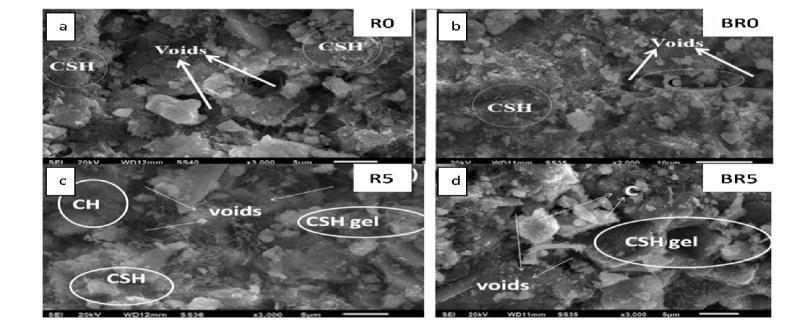
Fig. 5. SEM images of (a)Normalconcrete(R0) (b)Bacterialconcrete(BR0)(c)5%ofRHA Concrete(R5)(d)Bacterialconcretewith5%RHA (BR5).
5.1 The following conclusions can be drawn:
i. The study focuses on how urease-producing bacteria, such Bacillus subtilis and Bacillus pasteuri,mayrepairconcretefractures.
ii. Itexaminesseveralbacteriathatcanbeusedin thisway.
iii. The results of the study show that these bacteria have a beneficial effect on the compressivestrengthofconcreteandPortland cementmortar.
iv. Theuseofbacteriadecreasesthepermeability ofchlorideionsandwaterpenetration.
v. The study promotes the use of "microbial concrete" as an economical and eco-friendly substitute for conventional concrete sealants, increasing the longevity of construction materials.
vi. The research focuses on the application of urease-producingbacteria,specificallyBacillus subtilis and Bacillus Pasteurii, for concrete crackhealing.
vii. Various bacteria types were investigated for their effectiveness in repairing cracks in concrete.
viii. Thestudyfoundthatthecompressivestrength of concrete is positively influenced by the presenceofbacteria.
ix. Bacteria contribute to reducing water penetration and chloride ion permeability in concrete.
x. Thefindingssuggestthat"microbialconcrete" can serve as a cost-effective and environmentally friendly alternative to traditionalconcrete,enhancingthedurabilityof buildingmaterials.
xi. ItconcludesthatBacillusPasteuriiandBacillus subtilis are the most effective bacteria for healingconcretecracks.
Bacterialconcreteoffersapromisingself-healing solution,butfaceschallengesbeforelarge-scale use.
The absence of standardized methods for evaluating self-healing efficiency limits comparabilityacrossstudies.
Mostresearchoccursinlabs,lackingassessments of long-term performance in real-world conditions, such as bacterial viability and nutrientdepletion.
Scalabilityremainsaconcernduetoinsufficient dataonlarge-scalestructuraltestingandhealing kineticsmodeling.
Economic viability is questionable due to the costs of bacterial culture, encapsulation, and nutrientsupply.
Environmentalimpacts,specificallyammonium productionfromureolyticbacteria,couldaffect reinforcementdurability.
Future research should focus on improving bacterial encapsulation and using innovative materials,suchasnanomaterialsandhydrogels, for enhanced bacterial survivability and sporereleasecontrol.
Investigatingnovelmicrobialstrainswithbetter metabolicactivityandenvironmentalresilience couldboostefficiency.
Analysis of the bonding between cementitious matrix and microbially precipitated calcium carbonate is crucial for load transfer behavior understanding.
The impact of cyclic loading on MICP-healed concreteneedsexploration.
Comprehensive assessments of life-cycle costs and sustainability are necessary to verify the long-term feasibility of bacterial concrete in structuralapplications.
[1] Concrete Technology: Theory and Practice by M. L Gambhir.
[2] ConcreteTechnology:byS.S.Bhavikatti.
[3] E.Mostavi,S.Asadi,M.M.Hassan,M.Alansari,Evaluation of self-healing mechanisms in concrete with doublewalledsodiumsilicatemicrocapsules,J.Mater.Civ.Eng. 27(12)(2015)4015035.
[4] W.Khaliq,M.B.Ehsan,Crackhealinginconcreteusing variousbioinfluencedself-healingtechniques,Constr. Build.Mater.102(2016)349–357.
[5] M.Luo,C.Qian,Influencesofbacteria-basedself-healing agentsoncementitiousmaterialshydrationkineticsand compressivestrength,Constr.Build.Mater.121(2016) 659–663.
International Research Journal of Engineering and Technology (IRJET) e-ISSN: 2395-0056
Volume: 13 Issue: 04 | Apr 2026 www.irjet.net p-ISSN: 2395-0072
[6] M. Luo, C.X. Qian, R.Y. Li, Factors affecting crack repairing capacity of bacteria-based self-healing concrete,Constr.Build.Mater.87(2015)1–7.
[7] C.C.Hung,Y.F.Su,Medium-termself-healingevaluation of engineered cementitious composites with varying amounts of fly ash and exposure durations, Constr. Build.Mater.118(2016)194–203.
[8] E. Tziviloglou, V. Wiktor, H.M. Jonkers, E. Schlangen, Bacteria-basedself-healingconcretetoincreaseliquid tightness of cracks, Constr. Build. Mater. 122 (2016) 118–125.
[9] W.DeMuynck,D.Debrouwer,N.DeBelie,W.Verstraete, Bacterial carbonate precipitation improves the durabilityofcementitiousmaterials,Cem.ConcrRes.38 (2008)1005–1014.
[10]R.Siddique,K.Singh,M.Kunal,V.CorinaldesiSingh,A. Rajor, Properties of bacterial rice husk ash concrete, Constr.Build.Mater.121(2016)112-119.
[11]R. Andalib, M.Z. Abd Majid, Hussin, Optimum concentrationofBacillusmegateriumforstrengthening structural concrete, Constr. Build. Mater. 118 (2016) 180–193.
[12]J.Wang,J.Dewanckele,V.Cnudde,S.VanVlierberghe,W. Verstraete, N. De Belie, X-ray computed tomography proofof bacterial-basedself-healingin concrete,Cem. Concr.Compos.53(2014)289–304.
[13]J.Y.Wang,D.Snoeck,S.VanVlierberghe,W.Verstraete, N. De Belie, Application of hydrogel encapsulated carbonate precipitating bacteria for approaching a realisticself-healinginconcrete,Constr.Build.Mater.68 (2014)110–119.
[14]N.Chahal,R.Siddique,A.Rajor,Influenceofbacteriaon thecompressivestrength,waterabsorptionandrapid chloridepermeabilityofflyashconcrete,Constr.Build. Mater.28(2012)351-356.
[15]N.Chahal,R.Siddique,A.Rajor,Influenceofbacteriaon thecompressivestrength,waterabsorptionandrapid chloride permeability of concrete incorporating silica fume,Constr.Build.Mater.37(1)(2012)645–651.
[16]W. De Muynck, K. Cox, N. De Belie, W. Verstraete, Bacterial carbonate precipitation as an alternative surfacetreatmentforconcrete,Constr.Build.Mater.22 (5)(2008)875–885.
[17]R. Siddique, V. Nanda, Kunal, Influence of bacteria on compressive strength and permeation properties of concretemadewithcementbaghousefilterdust,Constr. Build.Mater.106(2016)461–469.
[18]Q. Tri, N. Maes, G. De Schutter, D. Jacques, G. Ye, Determination of water permeability of cementitious materials using a controlled constant flow method, Constr.Build.Mater.47(2013)1488-1496.
[19]K. Van Tittelboom, N. De Belie, W. De Muynck, W. Verstraete,Useofbacteriatorepaircracksinconcrete, Cem.Concr.Res.40(1)(2010)157–166.
[20]N. Kaur, M.S. Reddy, A. Mukherjee, Improvement in strength properties of ash bricks by bacterial calcite, Ecol.Eng.39(2012)31–35.
[21]R. Siddique, N. Kaur, Effect of ureolytic bacteria on concreteproperties,Constr.Build.Mater.25(10)(2011) 3791–3801.
[22]J.Wang,K.VanTittelboom,N.DeBelie,W. Verstraete, Useofsilicagelorpolyurethane immobilizedbacteria for self-healing concrete, Constr. Build. Mater. 26 (1) (2012)532–540.
[23]F. Bravo, D. Silva, N. Boon, W. Verstraete, N. De Belie, Screening of bacteria and concrete compatible protectionmaterials,vol.88,2015,pp.196–203.
[24]J. Qiu, D. Qin, S. Tng, E. Yang, Surface treatment of recycled concrete aggregates through microbial carbonateprecipitation,Constr.Build.Mater.57(2014) 144–150.
[25]M.Luo,C.X.Qian, Performanceof Two Bacteria-Based AdditivesUsedforSelf-HealingConcrete,pp.1–6.
[26]V. Achal, X. Pan, N. Özyurt, Improved strength and durability of fly ash- amended concrete by microbial calciteprecipitation,Ecol.Eng.37(4)(2011)554–559.
[27]N.Zakarietal.,Testsandmethodsofevaluatingtheselfhealing efficiency of concrete: a review, Constr. Build. Mater.112(2016)1123–1132.
[28]F. Nosouhian, D. Mostofinejad, H. Hasheminejad, Concrete durability improvement in a sulfate environmentusingbacteria,28(1)(2016)1–12.
[29]R.Pei,J.Liu,S.Wang,M.Yang,Useofbacterialcellwalls to improve the mechanical performance of concrete, Cem.Concr.Compos.39(2013)122–130.
[30]Y.Zhang,H.X.Guo,X.H.Cheng,C.À.Caco,C.À.Ca,Roleof calciumsourcesinthestrengthand microstructureof microbialmortar,Constr.Build.Mater.77(2015)160–167.
[31]G.Souradeep,H.W.Kua,EncapsulationTechnologyand TechniquesinSelf-HealingConcrete,no.2007,2007,pp. 1–15.
[32]V.Wiktor,H.M.Jonkers,Quantificationofcrack-healing in novel bacteria-based self-healing concrete, Cem. Concr.Compos.33(7)(2011)763–770.
[33]H.K. Kim, S.J. Park, J.I. Han, H.K. Lee, Microbially mediated calcium carbonate precipitation on normal and lightweight concrete, Constr. Build. Mater. 38 (2013)1073–1082.
[34]A.M.Grabiec,J.Klama,D.Zawal,D.Krupa,Modification of recycled concrete aggregate by calcium carbonate bio-deposition,Constr.Build.Mater.34(2012)145–150.
[35]H.M. Jonkers, A. Thijssen, G. Muyzer, O. Copuroglu, E. Schlangen,Applicationofbacteriaasself-healingagent forthedevelopmentofsustainableconcrete,36(2010) 230–235.
[36]N.DeBelie,Applicationofbacteriainconcrete:acritical review,pp.56–61,2016.
[37]V.Achal,A.Mukherjee,M.S.Reddy,MicrobialConcrete: WaytoEnhancetheDurabilityofBuildingStructures,23 (2011)730–734.
[38]M.S. Reddy, Lactose mother liquor as an alternative nutrient source for microbial concrete production by Sporosarcinapasteurii,2009,pp.433–438.