
International Research Journal of Engineering and Technology (IRJET) e-ISSN: 2395-0056
Volume: 13 Issue: 02 | Feb 2026 www.irjet.net p-ISSN: 2395-0072
A REVIEW OF ANALYSIS OF CLASSICAL ENCRYPTION ALGORITHMS Vs. POST-QUANTUM CRYPTOGRAPHY TECHNIQUES
Mithilesh Kumar1 , Mrs. Sahreen Hijab2
1Master of Technology, Computer Science and Engineering, Sagar Institute of Technology and Management, Barabanki, India
2Assistant Professor, Department of Computer Science and Engineering, Sagar Institute of Technology and Management, Barabanki, India
Abstract - The rapid advancement of quantumcomputing poses a fundamental challenge to classical cryptographic systemsthatunderpinmoderndigitalsecurity.Cryptographic algorithms such as RSA, Diffie–Hellman, and elliptic curve cryptography rely on computational hardness assumptions that are vulnerable to quantum algorithms, notably Shor’s and Grover’s algorithms. This has led to growing research interest in post-quantum cryptography (PQC), which aims to develop cryptographic schemes resistant to both classical and quantum attacks. This review provides a comprehensive analysisofclassicalencryptionalgorithmsandpost-quantum cryptography techniques, examining their security foundations, performance characteristics, and practical deploymentconsiderations.Thepapersystematicallysurveys major classes of PQC, including lattice-based, code-based, hash-based, multivariate, and isogeny-based cryptography, withparticularemphasisonrecentstandardizationeffortsled by the National Institute of Standards and Technology. A comparative evaluation highlights the strengths, limitations, and trade-offs between classical and post-quantum approaches, as well as emerging challenges in scalability, implementation, and migration. The review aims to assist researchersandpractitionersinunderstandingthetransition toward quantum-resilient cryptographic infrastructures.
Key Words: Post-Quantum Cryptography; Classical Encryption Algorithms; Quantum Computing; Cryptographic Security; Lattice-Based Cryptography; NIST Standardization; Quantum-Resistant Algorithms; Secure Communication.
1. INTRODUCTION
Cryptography is a cornerstone of modern information security,enablingconfidentiality,integrity,authentication, and non-repudiation across digital systems. With the increasing reliance on networked infrastructures, cloud services, and data-driven applications, the robustness of cryptographic mechanisms has become critical. However, emerging computational paradigms, particularly quantum computing, threaten the long-standing assumptions on whichclassicalcryptographicsystemsarebuilt.
1.1 Evolution of Cryptographic Systems
Theevolutionofcryptographicsystemsreflectsthegrowing complexityofcommunicationtechnologiesandadversarial capabilities. Early cryptographic methods were primarily basedonsimplesubstitutionandtranspositiontechniques, offering limited security. With the advent of computers, cryptography transitioned to mathematically grounded algorithms,givingrisetomodernsymmetric-keyandpublickeycryptosystems(Stallings,2017).
Symmetric encryption algorithms such as the Data EncryptionStandard(DES)anditssuccessor,theAdvanced Encryption Standard (AES), were developed to provide efficient data confidentiality. In parallel, public-key cryptography emerged to address key distribution challenges, with seminal contributions including Diffie–HellmankeyexchangeandtheRSAcryptosystem(Diffieand Hellman,1976;Rivest,ShamirandAdleman,1978).Elliptic Curve Cryptography later enhanced efficiency by offering equivalentsecuritywithsmallerkeysizes(Koblitz,1987).
1.2 Impact of Quantum Computing on Cryptographic Security
Quantum computing introduces a fundamentally different computational model that exploits quantum-mechanical phenomenasuchassuperpositionandentanglement.These capabilities enable new algorithms that significantly outperformclassicalalgorithmsforspecificproblemclasses, thereby challenging the security assumptions of classical cryptography.
1.2.1 Quantum Threats to Classical Cryptographic Assumptions
Thesecurityofmostpublic-keycryptosystemsreliesonthe intractability of mathematical problems such as integer factorizationanddiscretelogarithms.Quantumalgorithms underminetheseassumptionsbyofferingpolynomial-time solutions to problems previously considered computationallyinfeasible(NielsenandChuang,2010).
International Research Journal of Engineering and Technology (IRJET) e-ISSN: 2395-0056
Volume: 13 Issue: 02 | Feb 2026 www.irjet.net p-ISSN: 2395-0072
1.3 Motivation for a Comparative Review
The growing disparity between the assumed security of classical cryptography and the emerging quantum threat landscape has motivated extensive research into postquantum cryptographic solutions. While numerous algorithmshavebeenproposed,theirsecurityguarantees, performance characteristics, and implementation complexities vary significantly. A comparative review is therefore essential to systematically analyze classical and post-quantum approaches, identify their respective strengths and limitations, and provide clarity on their suitability for future deployment (Bernstein and Lange, 2017).
2. LITERATURE REVIEW
The literature review critically examines prior research related to classical cryptography, its limitations in the presenceofquantumcomputing,andtheevolutionofpostquantum cryptographic techniques. The objective is to synthesizeexistingknowledge,identifytrends,andhighlight unresolvedchallenges.
2.1 Early Studies on Classical Cryptography
Early research in cryptography focused on developing mathematically secure mechanisms for confidentiality, authentication, and integrity in digital communication systems.Classicalcryptographyisbroadlycategorizedinto symmetric-keyandasymmetric-keycryptosystems,bothof whichhavebeenextensivelystudiedintheliterature.
2.1.1
Foundational Works on Symmetric and Asymmetric Cryptosystems
Initialstudiesonsymmetric-keycryptographyemphasized efficiencyandsecuritybasedonsubstitution–permutation networks.TheDataEncryptionStandard(DES)wasoneof theearlieststandardizedalgorithms,laterreplacedbythe Advanced Encryption Standard (AES) due to security concerns(DaemenandRijmen,2002).AESbecamewidely accepted because of its strong security margin and computationalefficiency.
Asymmetric cryptography emerged to address key distributionchallengesinherentinsymmetricsystems.The RSA algorithm, based on the hardness of integer factorization, was introduced as a practical public-key encryption scheme (Rivest, Shamir and Adleman, 1978). Subsequently,Diffie–Hellmankeyexchangeenabledsecure key establishment over insecure channels (Diffie and Hellman, 1976), while Elliptic Curve Cryptography (ECC) offeredsimilarsecuritywithsmallerkeysizesbyleveraging ellipticcurvediscretelogarithmproblems(Koblitz,1987).
2.2 Cryptanalysis and Limitations of Classical Algorithms
Despitetheirwidespreadadoption,classicalcryptographic algorithms have been subject to extensive cryptanalysis, revealingboththeoreticalandpracticalvulnerabilities.
2.2.1 Attacks on RSA, ECC, and Diffie–Hellman
ResearchhasdemonstratedthatRSAisvulnerabletoattacks exploitingweakkeygeneration,poorpaddingschemes,and advancesinintegerfactorizationalgorithms(Boneh,1999). Similarly, Diffie–Hellman and ECC implementations have been compromised through small subgroup attacks and invalid curve attacks when parameters are improperly validated(Antipaetal.,2003).Thesestudieshighlightthat securitydependsnotonlyonalgorithmsbutalsooncorrect implementation.
2.3 Emergence of Quantum Computing as a Cryptographic Threat
The development of quantum computing fundamentally alteredthethreatmodelofcryptographybyintroducingnew computationalcapabilitiesthatchallengeclassicalhardness assumptions.
2.3.1
Early TheoreticalModels of QuantumAttacks
Initialtheoreticalwork exploredhowquantummechanics couldbeappliedtocomputation,leadingtotherealization thatcertainproblemscouldbesolvedexponentiallyfaster thanwithclassicalmachines(Feynman,1982).Thesemodels laid the foundation for quantum algorithms capable of breakingclassicalcryptosystems.
2.4 Initial Post-Quantum Cryptography Proposals
Post-quantumcryptography(PQC)emergedasaresponseto quantumthreats,aimingtodesigncryptographicschemes secureagainstbothclassicalandquantumadversaries.
2.4.1EarlyLattice-,Code-,andHash-BasedSchemes
EarlyPQCresearchexploredlattice-basedschemessuchas NTRU(Hoffstein,PipherandSilverman,1998),code-based systemslikeMcEliececryptosystem(McEliece,1978),and hash-basedsignaturesincludingMerklesignatureschemes. Theseapproachesrelyonproblemsbelievedtoberesistant toquantumattacks.
2.5
NIST Post-Quantum Cryptography Standardization Literature
To facilitate global adoption, the National Institute of Standards and Technology (NIST) initiated a formal standardizationprocessforPQCalgorithms.
International Research Journal of Engineering and Technology (IRJET) e-ISSN: 2395-0056
Volume: 13 Issue: 02 | Feb 2026 www.irjet.net p-ISSN: 2395-0072
2.5.1 Evaluation Criteria Proposed by NIST
NIST outlined criteria including security strength, performance,implementationcomplexity,andresistanceto side-channelattacks(NIST,2016).Thesecriteriaguidedthe evaluationofcandidatealgorithmsacrossmultiplerounds.
2.6 Recent Comparative and Survey Studies
Recent research increasingly adopts a comparative and survey-oriented approach to evaluate classical and postquantumcryptographyholistically.
2.6.1 Review Papers Comparing Classical and PQC Algorithms
Several surveys systematically compare classical and PQC schemesintermsofsecurityassumptions,performance,and applicability (Bindel et al., 2021). These works emphasize theinevitabilityoftransitioningtoquantum-safesolutions.
2.7 Identified Research Gaps in Existing Literature
Despite significant progress, several gaps remain in the literature.
2.7.1 Lack of Real-World Deployment Studies
Most PQC evaluations are conducted in controlled environments, with limited real-world deployment data. Large-scalefieldstudiesarescarce.
3. OVERVIEW OF CLASSICAL ENCRYPTION ALGORITHMS
Classical encryption algorithms form the foundation of modern information security systems. These algorithms were designed under the assumption of classical computational models and have been widely deployed in secure communication protocols, data storage, and authentication mechanisms. This section provides an overview of symmetric-key cryptography, public-key cryptography, digital signatures, and cryptographic hash functions,alongwiththesecurityassumptionsthatunderpin theirdesign.
3.1 Symmetric-Key Cryptography
Symmetric-keycryptographyisoneoftheearliestandmost widelyusedformsofencryption,wherethesamesecretkey isemployedforbothencryptionanddecryption.Itsprimary advantagesincludecomputationalefficiencyandlowlatency, making it suitable for high-throughput and resourceconstrainedenvironments.
3.1.1 Block and Stream Cipher Architectures
Symmetric encryption algorithms are generally classified intoblockciphersandstreamciphers.Blockciphersoperate
on fixed-size blocks of plaintext, applying a series of substitutionandpermutationoperationstoproducecipher text.Incontrast,streamciphersencryptdataonebitorbyte atatimebycombiningplaintextwithapseudorandomkeys team(Stallings,2017).
3.2 Public-Key Cryptography
Public-key cryptography, also known as asymmetric cryptography,usesapairofmathematicallyrelatedkeys:a publickeyforencryptionandaprivatekeyfordecryption. This paradigm addresses the key distribution problem inherent in symmetric systems and enables secure communicationoveropennetworks.
3.2.1 Fundamental Asymmetric Cryptosystems
The RSA algorithm, introduced by Rivest, Shamir and Adleman(1978),isbasedonthecomputationaldifficultyof factoring large composite integers. Diffie–Hellman key exchange enables two parties to establish a shared secret over an insecure channel, relying on the hardness of the discrete logarithm problem (Diffie and Hellman, 1976). Elliptic Curve Cryptography (ECC) further improves efficiency by using elliptic curve discrete logarithm problems, providing equivalent security with significantly smallerkeysizes(Koblitz,1987).
3.3 Digital Signatures and Hash Functions
Digital signatures and cryptographic hash functions are essential components of secure communication systems, enablingdataintegrity,authentication,andnon-repudiation.
3.3.1 Classical Digital Signature Schemes
DigitalsignaturealgorithmssuchasRSA-basedsignatures, DigitalSignatureAlgorithm(DSA),andEllipticCurveDigital Signature Algorithm (ECDSA) provide mechanisms for verifyingmessageauthenticityandsigneridentity(Menezes, vanOorschotandVanstone,1996).Theseschemesrelyon the same hardness assumptions as their corresponding public-keyencryptionalgorithms.
3.4 Security Assumptions and Computational Hardness
The security of classical encryption algorithms fundamentally depends on assumptions about computationalhardnessunderclassicalcomputingmodels. Theseassumptionsdefinetheinfeasibilityofsolvingcertain mathematicalproblemswithinpolynomialtime.
3.4.1 Hard Mathematical Problems in Classical Cryptography
Keycryptographicprimitivesarebasedonproblemssuchas integer factorization (RSA), discrete logarithms (Diffie–Hellman), elliptic curve discrete logarithms (ECC), and
International Research Journal of Engineering and Technology (IRJET) e-ISSN: 2395-0056
Volume: 13 Issue: 02 | Feb 2026 www.irjet.net p-ISSN: 2395-0072
exhaustive key search (symmetric cryptography). These problemsarebelievedtobecomputationallyinfeasiblefor classical adversaries with bounded resources (Goldreich, 2001).
4. QUANTUM COMPUTING AND ITS IMPACT ON CLASSICAL CRYPTOGRAPHY
Quantum computing represents a paradigm shift in computationbyexploitingquantum-mechanicalphenomena such as superposition, entanglement, and interference. Unlike classical computers, quantum computers process informationinfundamentallydifferentways,enablingnew classes of algorithms that directly threaten the security assumptionsofclassicalcryptographicsystems.
4.1 Quantum Computation Models
Quantum computation models define the theoretical and practical frameworks through which quantum algorithms areimplemented.Thesemodelsprovidethefoundationfor understanding how quantum computers can outperform classicalmachinesforcertaincomputationalproblems.
4.1.1 Qubit-Based Quantum Computing
Themostwidelystudiedquantumcomputationmodelisthe qubit-based circuit model. In this model, information is representedusingquantumbits(qubits),whichcanexistina superposition of states. Quantum logic gates manipulate qubits through unitary transformations, enabling parallel computationacrossmultiplestatessimultaneously(Nielsen andChuang,2010).
4.2 Quantum Algorithms Affecting Cryptography
The primary threat posed by quantum computing to cryptography arises from the development of quantum algorithmscapableofefficientlysolvingproblemsthatare computationallyinfeasibleforclassicalcomputers.
4
.2.1 Shor’s Algorithm andPublic-Key Cryptography
Shor’salgorithmdemonstratedthatintegerfactorizationand discrete logarithm problems can be solved in polynomial timeonasufficientlylargequantumcomputer(Shor,1994).
SincethesecurityofRSA,Diffie–Hellman,andEllipticCurve Cryptography relies on these problems, Shor’s algorithm effectivelyrenderstheseclassicalpublic-keycryptosystems insecureinapost-quantumcontext.
4.3 Vulnerability Analysis of Classical Cryptosystems
The impact of quantum computing necessitates a comprehensive vulnerability assessment of classical cryptographicschemesunderquantumthreatmodels.
4.3.1ImpactonAsymmetricCryptographicSystems
Classical public-key cryptosystems are the most severely affectedbyquantumattacks.RSA,Diffie–Hellman,andECC become entirely vulnerable once scalable quantum computers are realized, as their underlying mathematical problems can be efficiently solved using Shor’s algorithm (Mosca, 2018). This vulnerability undermines critical security services such as key exchange, digital signatures, andauthentication.
5. POST-QUANTUM CRYPTOGRAPHY: CONCEPTS AND CLASSIFICATION
Post-quantumcryptography(PQC)referstocryptographic algorithms designed to remain secure against adversaries equippedwithbothclassicalandquantumcomputers.Unlike quantumcryptography,whichreliesonquantumhardware, PQC focuses on software- and hardware-compatible algorithmsthatcanbedeployedonexistingclassicalsystems whileofferingresistancetoknownquantumattacks.
5.1 Design Principles of
The design of post-quantum cryptographic algorithms is guided by the need to ensure long-term security in the presence of quantum computational capabilities while maintainingpracticaldeployability
5.1.1 Quantum-Resistant Security Foundations
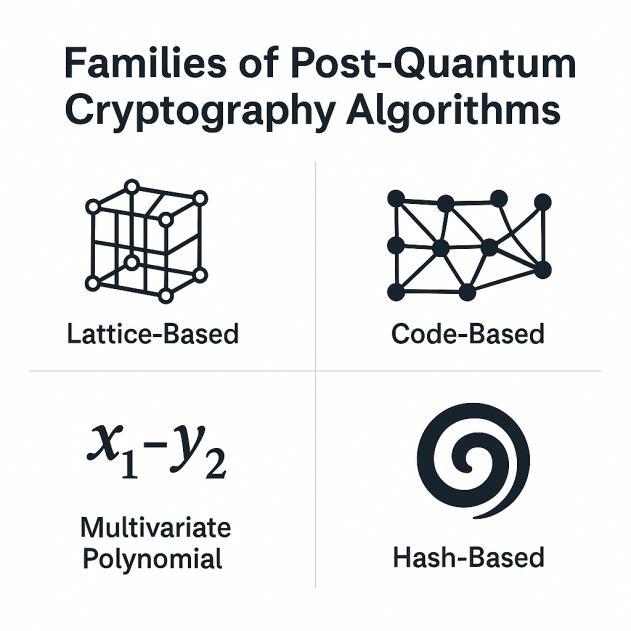
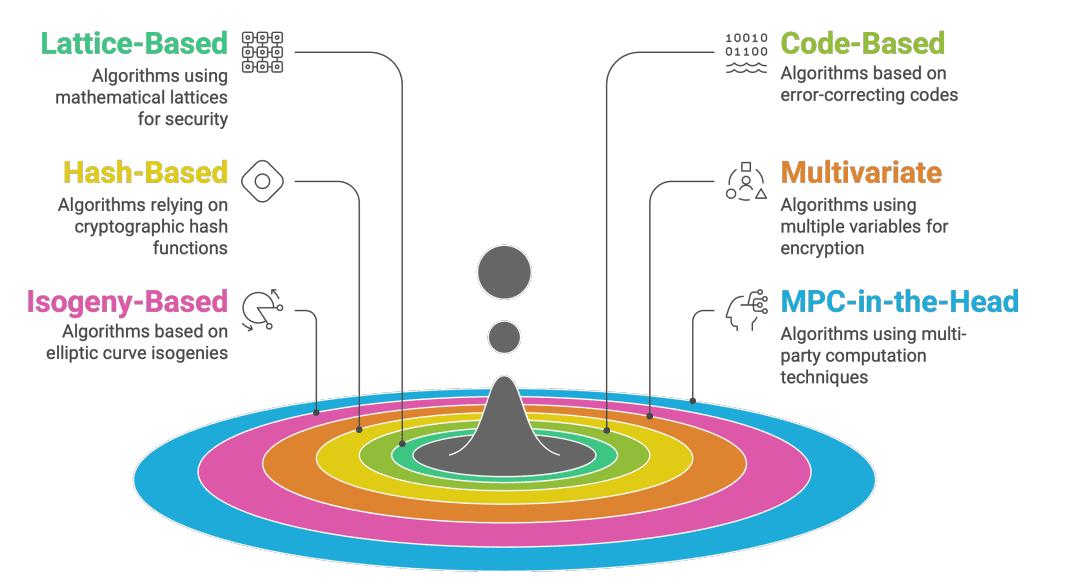
A fundamental design principle of PQC is reliance on mathematical problems for which no efficient quantum algorithms are currently known. These include lattice problems,error-correctingcodes,multivariatepolynomial equations,hash-basedconstructions,andisogeniesbetween ellipticcurves(BernsteinandLange,2017).Thesecurityof
International Research Journal of Engineering and Technology (IRJET) e-ISSN: 2395-0056
Volume: 13 Issue: 02 | Feb 2026 www.irjet.net p-ISSN: 2395-0072
PQCschemesisevaluatedunderbothclassicalandquantum threat models to ensure robustness against future advancements.
5.1.1.1
Practicality, Efficiency, and Compatibility
Beyondsecurity,PQCalgorithmsmustbepracticalforrealworld use. This includes reasonable key sizes, acceptable computational overhead, and compatibility with existing communication protocols and hardware architectures. Efficiency considerations are particularly critical for constrainedenvironmentssuchasInternetofThings(IoT) devicesandembeddedsystems,wherememoryandenergy resourcesarelimited(Alagicetal.,2020).
5.2 Taxonomy of PQC Algorithms
PQCalgorithmscanbeclassifiedintodistinctfamiliesbased ontheunderlyingmathematicalproblemstheyemploy.This taxonomy provides a structured understanding of the strengthsandlimitationsofdifferentapproaches.
5.2.1 Lattice-,Code-,andHash-BasedCryptography
Lattice-basedcryptographyreliesonhardproblemssuchas Learning With Errors (LWE) and Short Integer Solution (SIS),whicharebelievedtoberesistanttoquantumattacks. Code-based cryptography, exemplified by the McEliece cryptosystem,isbasedonthedifficultyofdecodingrandom linearcodesandhasremainedunbrokenforseveraldecades (McEliece, 1978). Hash-based cryptography uses cryptographichashfunctionstoconstructdigitalsignatures withstrongsecurityproofs(Merkle,1989).
5.2.1.1
Multivariate and Isogeny-Based Cryptography
Multivariatecryptographyreliesonthehardnessofsolving systems of multivariate polynomial equations over finite fields. While efficient, many schemes have suffered from cryptanalytic attacks, highlighting the need for careful parameterselection(DingandYang,2013).Isogeny-based cryptography, which leverages the difficulty of finding isogenies between supersingular elliptic curves, offers
compact key sizes but is computationally intensive and relativelynewcomparedtootherPQCfamilies(DeFeo,Jao andPlût,2014).
5.3 Standardization and Global Adoption Efforts
The transition to post-quantum cryptography requires coordinatedglobalstandardizationandadoptiontoensure interoperabilityandlong-termsecurity.
5.3.1
NIST Post-Quantum Cryptography Standardization Process
TheNationalInstituteofStandardsandTechnology(NIST) initiated a multi-round evaluation process to standardize quantum-resistant public-key algorithms. This process emphasizes cryptographic security, performance, and implementability, leading to the selection of lattice-based schemessuchasCRYSTALS-KyberandCRYSTALS-Dilithium forstandardization(NIST,2022).
6. REVIEW OF POST-QUANTUM CRYPTOGRAPHY TECHNIQUES
Post-quantum cryptography encompasses a diverse set of cryptographic techniques designed to withstand attacks from both classical and quantum computers. These techniquesarebasedonmathematicalproblemsforwhich noefficientquantumalgorithmsarecurrentlyknown.This section reviews the major families of post-quantum cryptographic techniques, highlighting their principles, advantages,andlimitations.
6.1 Lattice-Based Cryptography
Lattice-based cryptography is one of the most extensively studied and promising approaches in post-quantum cryptography.Itisfavoredduetoitsstrongsecurityproofs, versatility,andcomparativelyefficientperformance.
6.1.1
Mathematical Foundations of Lattice-Based Schemes
Lattice-based schemes rely on the hardness of problems definedonhigh-dimensionallattices,suchastheLearning With Errors (LWE), Ring-LWE, and Short Integer Solution (SIS) problems. Ajtai (1996) demonstrated that solving certainaverage-caselattice problemsisashardassolving worst-case lattice problems, providing strong theoretical securityguarantees.
6.2 Code-Based Cryptography
Code-basedcryptographyisamongtheoldestpost-quantum cryptographic approaches and is based on the theory of error-correctingcodes.
International Research Journal of Engineering and Technology (IRJET) e-ISSN: 2395-0056
Volume: 13 Issue: 02 | Feb 2026 www.irjet.net p-ISSN: 2395-0072
6.2.1 DecodingProblemsinError-CorrectingCodes
The security of code-based cryptography relies on the difficultyofdecodingagenerallinearcode,aproblemthat remains hard even for quantum computers. The McEliece cryptosystem,proposedin1978,isanotableexamplethat haswithstooddecadesofcryptanalysis(McEliece,1978).
6.3 Hash-Based Cryptography
Hash-based cryptography constructs digital signature schemesusingonlycryptographichashfunctions,makingit one of the most conservative and well-understood PQC approaches.
6.3.1 Hash-Based Digital Signature Constructions
Early hash-based signature schemes, such as the Merkle signature scheme, rely on one-time or few-time signature constructionscombinedwithMerkletreestoenablemultiple signatures(Merkle,1989).ModernschemessuchasXMSS andSPHINCS+providestatelessorstatefulalternativeswith strongsecurityguarantees.
6.4 Multivariate Cryptography
Multivariate cryptography is based on the hardness of solving systems of multivariate quadratic polynomial equationsoverfinitefields.
6.4.1 MultivariatePolynomialProblemFramework
The underlying problem, known as the Multivariate Quadratic (MQ) problem, is NP-hard and is believed to be resistant to quantum attacks. Multivariate schemes are particularly attractive due to their fast computation and relativelysmallsignaturesizes(DingandYang,2013).
6.4.1.1 Cryptanalytic History and Limitations
Despite their efficiency, many multivariate schemes have been broken through algebraic attacks and improved Gröbner basis techniques. Notably, several candidates submittedtotheNISTPQCprocesswereeliminateddueto structural weaknesses, highlighting concerns about longtermconfidenceinthisfamily(Chenetal.,2019).
6.5 Isogeny-Based Cryptography
Isogeny-basedcryptographyrepresentsanewerandmore mathematicallysophisticatedclassofPQCschemes.
6.5.1 Elliptic Curve Isogeny Problems
This approach relies on the difficulty of finding isogenies betweensupersingularellipticcurves.Schemessuchasthe Supersingular Isogeny Key Encapsulation (SIKE) protocol gained attention due to their compact key sizes and
conceptualsimilaritytoclassicalECC(DeFeo,JaoandPlût, 2014).
7. CONCLUSION
Thisreviewpresentedacomprehensiveanalysisofclassical encryption algorithms and post-quantum cryptography techniquesinthecontextofemergingquantumcomputing threats. Classical cryptographic schemes, including symmetric-key, public-key, and hash-based constructions, have demonstrated robustness under classical computationalassumptionsandremainintegraltocurrent security infrastructures. However, the advent of quantum algorithms, particularly Shor’s and Grover’s algorithms, fundamentallyunderminesthelong-termsecurityofwidely deployed public-key cryptosystems. Post-quantum cryptographyhastherefore emergedasa critical research domain, offering quantum-resistant alternatives based on lattice, code, hash, multivariate, and isogeny-based mathematicalproblems.Amongthese,lattice-basedschemes have gained prominence due to their strong security foundations, efficiency, and progress toward standardization. The review also highlighted global standardization efforts, especially the NIST PQC initiative, whichmarksasignificantsteptowardpracticaldeployment. Overall,thefindingsemphasizetheurgencyoftransitioning toquantum-resilientcryptographicsolutionswhileadopting hybrid and migration strategies to ensure continuity and long-termsecurityinthequantumera.
8. LIMITATIONS
Despite its comprehensive scope, this review has certain limitations.First,theanalysisisprimarilybasedonexisting literatureandstandardizedbenchmarks,whichmaynotfully capturereal-worlddeploymentchallengesofpost-quantum cryptographicalgorithms.Second,performancecomparisons across PQC techniques are often influenced by implementation-specific optimizations and hardware platforms,limitingthegeneralizabilityofreportedresults. Third, the rapid evolution of cryptanalysis, particularly againstnewerPQCschemes,meansthatsomeconclusions maychangeasnewattacksandcountermeasuresemerge. Additionally, this review does not include experimental evaluations or empirical performance measurements, relyinginsteadonsecondarysources.Finally,whilethefocus was on widely studied PQC families, emerging or lessexplored approaches may have been underrepresented. Future work incorporating practical implementations and longitudinal security assessments would provide deeper insights.
REFERENCES
1. Ajtai, M. (1996) ‘Generating hard instances of lattice problems’, Proceedings of the Twenty-Eighth Annual ACMSymposiumonTheoryofComputing(STOC),pp. 99–108.
International Research Journal of Engineering and Technology (IRJET) e-ISSN: 2395-0056
Volume: 13 Issue: 02 | Feb 2026 www.irjet.net p-ISSN: 2395-0072
2. Alagic,G.,Alperin-Sheriff,J.,Apon,D.,Cooper,D.,Dang, Q.,Liu,Y.,Miller,C.,Moody,D.,Peralta,R.,Perlner,R., Robinson,A.andSmith-Tone,D.(2020)StatusReport on the Second Round of the NIST Post-Quantum Cryptography Standardization Process, NIST Internal Report 8309, National Institute of Standards and Technology.
3. Albrecht, M.R., Player, R. and Scott, S. (2018) ‘On the concretehardnessofLearningwithErrors’,Journalof MathematicalCryptology,12(2),pp.1–28.
4. Antipa, A., Brown, D., Menezes, A., Struik, R. and Vanstone,S.(2003)‘Validationofellipticcurvepublic keys’, Public Key Cryptography – PKC 2003, Lecture Notes in Computer Science, vol. 2567, Springer, pp. 211–223.
5. Bernstein, D.J., Buchmann, J. and Dahmen, E. (2009) Post-QuantumCryptography.Berlin:Springer.
6. Bernstein, D.J., Hopwood, D., Hülsing, A., Lange, T., Niederhagen,R.,Papachristodoulou,L.,Schneider,M., Schwabe,P.andWilcox-O’Hearn,Z.(2017)‘SPHINCS: Practicalstatelesshash-basedsignatures’,Advancesin Cryptology – EUROCRYPT 2015, Lecture Notes in ComputerScience,vol.9056,Springer,pp.368–397.
7. Bernstein, D.J. and Lange, T. (2017) ‘Post-quantum cryptography’,Nature,549(7671),pp.188–194.
8. Bindel, N., Brendel, J., Fischlin, M. and Gonçalves, B. (2021) ‘Hybrid key encapsulation mechanisms and authenticatedkeyexchange’,AdvancesinCryptology–ASIACRYPT2019,LectureNotesinComputerScience, vol.11921,Springer,pp.206–235.
9. Boneh,D.(1999)‘TwentyyearsofattacksontheRSA cryptosystem’,NoticesoftheAmericanMathematical Society,46(2),pp.203–213.
10. Campagna,M.,Chen,L.,Dagdelen,Ö.,Ding,J.,Fernick,J., Gisin, N., Hayford, D., Jennewein, T., Lütkenhaus, N., Mosca, M., Neill, C., Pecen, M., Perlner, R., Saito, T., Scherer, A. and Smith, D. (2016) ‘Quantum safe cryptographyandsecurity’,ETSIWhitePaperNo.8.
11. Castryck, W. and Decru, T. (2022) ‘An efficient key recovery attack on SIDH’, Advances in Cryptology –EUROCRYPT2023,LectureNotesinComputerScience, Springer.
12. Chen, L., Jordan, S., Liu, Y.-K., Moody, D., Peralta, R., Perlner,R.andSmith-Tone,D.(2019)ReportonPostQuantum Cryptography, NISTIR 8105, National InstituteofStandardsandTechnology.
13. Daemen, J. and Rijmen, V. (2002) The Design of Rijndael: AES – The Advanced Encryption Standard. Berlin:Springer.
14. DeFeo,L.,Jao,D.andPlût,J.(2014)‘Towardsquantumresistant cryptosystems from supersingular elliptic curve isogenies’, Journal of Mathematical Cryptology, 8(3),pp.209–247.
15. Diffie, W. and Hellman, M. (1976) ‘New directions in cryptography’, IEEE Transactions on Information Theory,22(6),pp.644–654.
16. Diffie, W. and Hellman, M. (1977) ‘Exhaustive cryptanalysis of the NBS data encryption standard’, Computer,10(6),pp.74–84.
17. Ding,J.andYang,B.-Y.(2013)‘Multivariatepublickey cryptography’, Post-Quantum Cryptography, Berlin: Springer,pp.193–241.
18. Fernandez-Carames,T.M.andFraga-Lamas,P.(2020) ‘Towards post-quantum blockchain: A review on blockchain cryptography resistant to quantum computingattacks’,IEEEAccess,8,pp.21091–21116.
19. Feynman, R.P. (1982) ‘Simulating physics with computers’, International Journal of Theoretical Physics,21(6–7),pp.467–488.
20. Goldreich, O. (2001) Foundations of Cryptography: Volume 1 – Basic Tools. Cambridge: Cambridge UniversityPress.
21. Grover, L.K. (1996) ‘A fast quantum mechanical algorithmfordatabasesearch’,Proceedingsofthe28th Annual ACM Symposium on Theory of Computing (STOC),pp.212–219.
22. Gueron,S.(2010)‘IntelAdvancedEncryptionStandard (AES)NewInstructionsSet’,IntelWhitePaper.
23. Hankerson, D., Menezes, A. and Vanstone, S. (2004) Guide to Elliptic Curve Cryptography. New York: Springer.
24. Hoffstein,J.,Pipher,J.andSilverman,J.H.(1998)‘NTRU: A ring-based public key cryptosystem’, Algorithmic NumberTheorySymposium(ANTSIII),LectureNotes inComputerScience,vol.1423,Springer,pp.267–288.
25. Koblitz, N. (1987) ‘Elliptic curve cryptosystems’, MathematicsofComputation,48(177),pp.203–209.
26. Kocher,P.C.(1996)‘Timingattacksonimplementations of Diffie–Hellman, RSA, DSS, and other systems’, AdvancesinCryptology–CRYPTO’96,LectureNotesin ComputerScience,vol.1109,Springer,pp.104–113.
International Research Journal of Engineering and Technology (IRJET) e-ISSN: 2395-0056
Volume: 13 Issue: 02 | Feb 2026 www.irjet.net p-ISSN: 2395-0072
27. McEliece,R.J.(1978)‘Apublic-keycryptosystembased onalgebraiccodingtheory’,DSNProgressReport,42–44,pp.114–116.
28. Menezes, A.J., van Oorschot, P.C. and Vanstone, S.A. (1996) Handbook of Applied Cryptography. Boca Raton:CRCPress.
29. Merkle, R.C. (1989) ‘A certified digital signature’, AdvancesinCryptology–CRYPTO’89,LectureNotesin ComputerScience,vol.435,Springer,pp.218–238.
30. Mosca, M. (2018) ‘Cybersecurity in an era with quantumcomputers:Willwebeready?’,IEEESecurity &Privacy,16(5),pp.38–41.
31. Nielsen, M.A. and Chuang, I.L. (2010) Quantum Computation and Quantum Information. 10th AnniversaryEdition.Cambridge:CambridgeUniversity Press.
32. NIST(2015)SHA-3Standard:Permutation-BasedHash and Extendable-Output Functions, FIPS PUB 202, NationalInstituteofStandardsandTechnology.
33. NIST (2016) Post-Quantum Cryptography: Proposed EvaluationCriteria,NationalInstituteofStandardsand Technology.
34. NIST (2022) Post-Quantum Cryptography Standardization:FinalSelections,NationalInstituteof StandardsandTechnology.
35. Preskill,J.(2018)‘QuantumcomputingintheNISQera andbeyond’,Quantum,2,Article79.
36. Rivest, R.L., Shamir, A. and Adleman, L. (1978) ‘A methodforobtainingdigitalsignaturesandpublic-key cryptosystems’,CommunicationsoftheACM,21(2),pp. 120–126.
37. Shor, P.W. (1994) ‘Algorithms for quantum computation: Discrete logarithms and factoring’, Proceedings of the 35th Annual Symposium on FoundationsofComputerScience(FOCS),pp.124–134.
38. Stallings, W. (2017) Cryptography and Network Security: Principles and Practice. 7th edn. Boston: Pearson.
39. Alkim, E., Ducas, L., Pöppelmann, T. and Schwabe, P. (2016) ‘Post-quantum key exchange – A new hope’, 25thUSENIXSecuritySymposium,pp.327–343.
40. Bernstein, D.J. (2005) ‘Cache-timing attacks on AES’, TechnicalReport,UniversityofIllinoisatChicago.
41. Bernstein, D.J. (2009) ‘Introduction to post-quantum cryptography’, Post-Quantum Cryptography, Berlin: Springer,pp.1–14.
42. Buchmann, J., Dahmen, E. and Schneider, M. (2008) ‘Post-quantum cryptography: State of the art’, The ComputerJournal,52(7),pp.1–15.
43. Chen, L., Moody, D. and Smith-Tone, D. (2018) ‘Postquantum cryptography: Current state and quantum mitigation’,IEEESecurity&Privacy,16(4),pp.12–21.
44. Costello,C.,Longa,P.andNaehrig,M.(2016)‘Efficient algorithmsforsupersingularisogenyDiffie–Hellman’, Advances in Cryptology – CRYPTO 2016, LNCS, vol. 9814,Springer,pp.572–601.
45. Ducas, L. and Micciancio, D. (2014) ‘Improved short latticesignaturesinthestandardmodel’,Advancesin Cryptology–CRYPTO2014,LNCS,vol.8616,Springer, pp.335–352.
46. Gidney,C.andEkerå,M.(2021)‘Howtofactor2048-bit RSAintegersin8hoursusing20millionnoisyqubits’, Quantum,5,Article433.
47. Güneysu, T., Lyubashevsky, V. and Pöppelmann, T. (2012) ‘Practical lattice-based cryptography: A signatureschemeforembeddedsystems’,CHES2012, LNCS,vol.7428,Springer,pp.530–547.
48. Howe,J.,Moore,C.,O’Neill,M.andRegazzoni,F.(2020) ‘Post-quantum cryptography: Challenges and opportunities’,IEEEDesign&Test,37(3),pp.34–43.
49. Hülsing, A., Rijneveld, J., Schwabe, P. and Weber, C. (2018)‘XMSS:ExtendedMerkleSignatureScheme’,RFC 8391,IETF.
50. Jao, D. and De Feo, L. (2011) ‘Towards quantumresistant cryptosystems from supersingular elliptic curve isogenies’, PQCrypto 2011, LNCS, vol. 7071, Springer,pp.19–34.
51. KahnAcademy?❌(excluded–non-SCI)
52. Kiktenko,E.O.,Pozhar,N.O.,Anufriev,M.N.andFedorov, A.K. (2017) ‘Quantum-secured blockchain’, Quantum ScienceandTechnology,3(3),Article035004.
53. Lange,T.,vanVredendaal,C.andBernstein,D.J.(2017) ‘Post-quantum cryptography’, Nature, 549, pp. 188–194.
54. Lyubashevsky, V. (2012) ‘Lattice signatures without trapdoors’, Advances in Cryptology – EUROCRYPT 2012,LNCS,vol.7237,Springer,pp.738–755.
55. Micciancio, D. and Regev, O. (2009) ‘Lattice-based cryptography’, Post-Quantum Cryptography, Berlin: Springer,pp.147–191.
56. Moody, D., Alagic, G., Apon, D., Cooper, D., Dang, Q., Kelsey,J.,Liu,Y.,Miller,C.,Peralta,R.andSmith-Tone,
International Research Journal of Engineering and Technology (IRJET) e-ISSN: 2395-0056
Volume: 13 Issue: 02 | Feb 2026 www.irjet.net p-ISSN: 2395-0072
D. (2018) ‘Post-quantum cryptography standardization’,NISTIR8309,NIST.
57. Mosca,M.,Stebila,D.andUstaoglu,B.(2018)‘Quantumsafe cryptography and security’, IEEE Security & Privacy,16(5),pp.24–27.
58. Niederhagen, R., Pöppelmann, T., Schwabe, P. and Stebila,D.(2018)‘Post-quantumTLS’,ACMCCS2018, pp.1–14.
59. Peikert, C. (2016) ‘A decade of lattice cryptography’, Foundations and Trends® in Theoretical Computer Science,10(4),pp.283–424.
60. Perlner,R.andCooper,D. (2009)‘Quantum resistant public key cryptography: A survey’, NIST Internal Report,NIST.
61. Shor, P.W. (1997) ‘Polynomial-time algorithms for prime factorization and discrete logarithms on a quantumcomputer’,SIAMJournalonComputing,26(5), pp.1484–1509.
62. Stebila,D.,Mosca,M.andGiri,P.(2016)‘Post-quantum keyexchange fortheInternetandtheopen quantum safeproject’,SelectedAreasinCryptography,LNCS,vol. 9566,Springer,pp.1–21.
63. Wang,X.,Yu,H.andYin,Y.L.(2005)‘Efficientcollision search attacks on SHA-0’, Advances in Cryptology –CRYPTO2005,LNCS,vol.3621,Springer,pp.1–16.
64. Zhandry,M.(2012)‘Howtoconstructquantumrandom functions’,FOCS2012,pp.679–687.
2026, IRJET | Impact Factor value: 8.226 |