
International Research Journal of Engineering and Technology (IRJET) e-ISSN: 2395-0056
Volume: 13 Issue: 03 | Mar 2026 www.irjet.net p-ISSN: 2395-0072
A REVIEW OF ADAPTIVE PROTECTION COORDINATION STRATEGY FOR INVERTER-DOMINATED RADIAL DISTRIBUTION SYSTEMS WITH BIDIRECTIONAL POWER FLOW
Amit Kumar Singh1, Dr. Imran Khan2
1Master of Technology, Electrical Engineering (Power System), Azad Institute of Engineering and Technology, Lucknow, India
2Professor, Department Electrical Engineering (Power System), Azad Institute of Engineering and Technology, Lucknow, India ***
Abstract -The rapid integration of renewable energy resources and distributed generation into modern power distribution networks has significantly transformed the operational characteristics of traditional radial distribution systems. A large proportion of these resources are connected throughpowerelectronicconverters,leadingtotheemergence of inverter-dominated distribution systems. Although such integration improves system efficiency, sustainability, and energy flexibility, it introduces major challenges to conventional protection schemes. Traditional protection coordination strategies are primarily designed for networks with unidirectional power flow and high fault current levels suppliedbysynchronousgenerators.However,inverter-based resources typically contribute limited and controlled fault currents, which complicates fault detection and may lead to relaymiscoordination,protectionblinding,orfalsetripping.In addition,highpenetrationofdistributedgenerationresultsin bidirectional power flow, further affecting the reliability and selectivity of protection devices in radial distribution networks. Consequently, adaptive protection coordination strategies have emerged as a promising solution to address these challenges by dynamically adjusting relay settings according to real-time system conditions. This review paper presents a comprehensive analysis of existing protection coordination techniques for inverter-dominated radial distributionsystems with bidirectional power flow. The study criticallyexaminesconventionalprotectionmethods,adaptive relay coordination strategies, communication-assisted protection schemes, and emerging intelligent protection approachesbasedondataanalyticsandartificialintelligence. Furthermore, the review identifies current research gaps and discusses future research directions aimed at improving protection reliability, selectivity, and adaptability in modern active distribution networks.
Key Words: Adaptive protection coordination; Inverterdominated distribution systems; Bidirectional power flow; Distributed generation; Overcurrent relay coordination; Smart grid protection.
1. INTRODUCTION
Modernelectricpowersystemsareundergoingasignificant transformation due to the increasing integration of
renewable energy resources and distributed generation. Traditionaldistributionnetworksweredesignedaspassive systemswhereelectricalenergyflowedinasingledirection fromcentralizedpowerplantstoconsumers.However,the rapiddeploymentofdistributedenergyresources(DERs), particularly inverter-based renewable generation such as photovoltaic (PV) and wind systems, has altered the operational behavior of distribution networks. These changes introduce new challenges in system monitoring, control, and protection coordination. Conventional protectionschemesweredevelopedassumingpredictable faultcurrentlevelsandunidirectionalpowerflow,butthe presence of inverter-interfaced resources modifies fault characteristics and system dynamics. As a result, modern distributionnetworksrequiremoreadvancedandadaptive protection strategies to ensure reliability, selectivity, and operational security (Hatziargyriou, 2014; Bollen and Hassan,2011).
1.1 Background of Modern Distribution Systems
Electricdistributionsystemshaveevolvedsignificantlyover thepastdecadesasaresultoftechnologicaladvancements, environmental concerns, and the global transition toward sustainable energy systems. The integration of renewable energy technologies and smart grid infrastructure has transformed distribution networks from passive power deliverysystemsintoactivenetworkscapableofsupporting distributed generation, energy storage, and bidirectional power flow. This transformation has improved system flexibilityandefficiencybuthasalsointroducedcomplexities in network operation and protection design (Ackermann, 2005).
1.1.1EvolutionofDistributionNetworksfromPassive
to Active Systems
Historically, distribution networks operated as passive systems in which electricity flowed from centralized generationstationsthroughtransmissionnetworkstoend users.Insuchsystems,theoperationalcharacteristicswere relatively stable, and protection coordination could be designedusingfixedrelaysettings.Withtheintroductionof distributed generation and smart grid technologies,
International Research Journal of Engineering and Technology (IRJET) e-ISSN: 2395-0056
Volume: 13 Issue: 03 | Mar 2026 www.irjet.net p-ISSN: 2395-0072
distribution systems have evolved into active networks capable of both consuming and generating power. Active distribution systems include renewable energy sources, electric vehicles, and distributed energy storage, which collectively influence power flow patterns and network stability. This transition requires advanced monitoring, control, and adaptive protection mechanisms to maintain reliablesystemoperation(Lasseter,2002).
1.1.2 Integration of Renewable Energy Sources through Power Electronic Converters
Renewableenergytechnologiessuchassolarphotovoltaic systems and wind turbines are typically connected to the gridthroughpowerelectronicconverters.Theseconverters regulate voltage, frequency, and power output while enabling efficient integration of intermittent renewable sourcesintothedistributionnetwork.Unlikeconventional synchronousgenerators,inverter-basedgenerationdoesnot inherently provide large fault currents during system disturbances. Instead, the fault current contribution from inverters is often limited by control algorithms and hardware constraints. This characteristic significantly influencestheperformanceoftraditionalprotectiondevices thatrelyonhighfaultcurrentlevelsforreliableoperation (Blaabjerg,TeodorescuandLiserre,2006).
1.1.3 Growth of Inverter-Interfaced Distributed Generation in Smart Grids
The rapid deployment of distributed generation has been facilitated by the development of smart grid technologies and supportive energy policies worldwide. Inverterinterfaced distributed generation units, including rooftop solar systems, wind turbines, and battery energy storage systems, are increasingly installed within distribution networks.Theseresourcesprovidebenefitssuchasreduced transmission losses, improved voltage regulation, and enhanced energy sustainability. However, the increasing penetrationofinverter-basedresourcesalsoaltersthefault behaviorofthenetworkandcomplicatesthecoordinationof protection devices. Consequently, modern smart grids requireadvancedprotectionstrategiescapableofadapting tovaryingsystemconditions(Guerreroetal.,2013).
1.2 Radial Distribution Networks with Distributed Generation
Radial distribution networks are widely used in electric power systems due to their simple structure and costeffective design. In these networks, power flows along a single path from the substation to end users. While this configuration simplifies protection coordination under traditional operating conditions, the integration of distributed generation introduces new operational challenges.Thepresenceofdistributedenergyresourcescan changethe magnitude and direction of power flow, which
affectsvoltageprofiles,faultcurrents,andtheperformance ofprotectiondevices(Gonen,2014).
1.2.1 Characteristics of Radial Distribution Systems
Radialdistributionsystemsarecharacterizedbyatree-like structure in which each consumer is supplied through a singleelectricalpathfromthedistributionsubstation.This topologyoffersadvantagessuchaslowerinfrastructurecost, simplified operation, and straightforward protection coordination. In conventional radial systems, protection devicessuchasovercurrentrelays,reclosers,andfusesare coordinated based on the assumption that fault currents decreaseasthe distance fromthesourceincreases. These predictable characteristics enable effective fault isolation using time-graded protection schemes (Blackburn and Domin,2015).
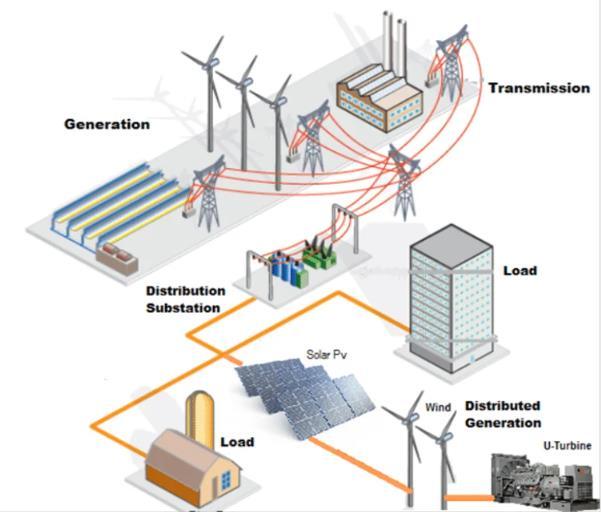
1.2.2 Role of Distributed Energy Resources and Inverter-Based Resources
Distributedenergyresourcesplayanincreasinglyimportant roleinmoderndistributionnetworksbyenablinglocalized powergenerationandsupportinggridresilience.Common DERtechnologiesincludesolarphotovoltaicsystems,wind turbines,micro-turbines,andenergystoragesystems.Most oftheseresourcesareconnectedthroughpowerelectronic inverters, which control power injection and maintain synchronization with the grid. While inverter-based resources provide operational flexibility and improved energyefficiency,theirlimitedfaultcurrentcapabilityand dynamic control characteristics introduce challenges for traditional protection systems designed for synchronous generator-dominatednetworks(KatiraeiandIravani,2006).
Volume: 13 Issue: 03 | Mar 2026 www.irjet.net p-ISSN: 2395-0072
1.2.3 Impact of DER Penetration on Power Flow Patterns
High penetration of distributed energy resources can significantlymodifythepowerflowpatternswithinradial distributionsystems.Inconventionalnetworks,powerflows unidirectionally from the substation toward consumers. However, when local generation exceeds local demand, power may flow in the reverse direction toward the upstreamnetwork.Thisbidirectionalpowerflowcanalter voltageprofiles,increasefaultcurrentcomplexity,andaffect thecoordinationofprotectivedevices.Asaresult,traditional protection schemes may fail to operate correctly unless adaptive or directional protection mechanisms are implemented(BollenandHassan,2011).
1.3ChallengesinProtectionofInverter-Dominated Networks
The increasing penetration of inverter-based distributed generation has introduced significant challenges to the designand coordination of distributionsystem protection schemes.Traditionalprotectionmethodsrelyonpredictable faultcurrentmagnitudesandfixedrelaysettings,whichare no longer valid in inverter-dominated networks. These systems exhibit different fault characteristics due to the control behavior of power electronic converters and the variability of renewable energy sources. Consequently, advanced protection strategies are required to ensure reliable fault detection and system stability in modern distributionnetworks(Hatziargyriou,2014).
1.3.1
Reduced Fault Current Contribution from Inverter-Based Sources
Oneofthemajorchallengesininverter-dominatedsystems isthelimitedfaultcurrentcontributionfrominverter-based generation units. Unlike synchronous generators that can supplylargefaultcurrents,inverter-basedsourcestypically limit their output current to protect semiconductor components.Asaresult,themagnitudeoffaultcurrentsmay notbesufficienttotriggerconventionalovercurrentrelays. Thisconditioncanleadtodelayedfaultdetectionorfailure of protection devices to operate correctly during system disturbances(Blaabjerg,TeodorescuandLiserre,2006).
1.3.2
Bidirectional Power Flow and Its Influence on Relay Coordination
The integration of distributed generation often results in bidirectionalpowerflowwithinradialdistributionnetworks. Traditionalrelaycoordinationschemesaredesignedbased on the assumption that current flows from the upstream source toward downstream loads. When power flow reverses due to distributed generation, the directional characteristics of fault currents change, which may cause incorrect relay operation. Directional relays and adaptive protection strategies are therefore required to ensure
proper coordination under varying system conditions (BlackburnandDomin,2015).
1.3.3 Misoperation of Traditional Overcurrent Protection Schemes
Traditional overcurrent protection schemes rely on predetermined pickup current settings and time-current characteristics. In networks with high penetration of inverter-basedresources,thevariabilityofgenerationand the limited fault current contribution can cause relay blinding or false tripping. Relay blinding occurs when the fault current magnitude is insufficient to exceed the relay pickupthreshold,whereasfalsetrippingmayoccurdueto changes in current direction or magnitude. These issues highlight the limitations of conventional protection strategies in modern active distribution systems (Gonen, 2014).
1.3.4 Dynamic Network Configuration Due to Renewable Variability
Renewable energy sources such as solar and wind exhibit intermittent and variable generation patterns. This variability causes frequent changes in system operating conditions, including power flow direction, voltage levels, and fault current magnitude. As a result, the distribution networkconfigurationeffectivelybecomesdynamic,making fixed protection settings inadequate. Adaptive protection coordinationstrategiesthatadjustrelayparametersbased on real-time system conditions have therefore gained significant attention in recent research on smart grid protectionsystems(Guerreroetal.,2013).
2. FUNDAMENTALS OF PROTECTION IN RADIAL DISTRIBUTION SYSTEMS
Protectionsystemsplaya crucial roleinensuringthesafe and reliable operation of electric power distribution networks.Theprimaryobjectiveofaprotectionsystemisto detect abnormal operating conditions such as faults and isolate the affected section of the network to prevent equipmentdamageandmaintainsystemstability.Inradial distribution systems, protection coordination is typically achieved through a combination of protective devices includingrelays,circuitbreakers,fuses,andreclosers.These devicesarecoordinatedbasedonpredeterminedoperating characteristics so that faults are cleared selectively and efficiently.Traditionalprotectionschemeshavebeenwidely implementedindistributionnetworksduetotheirsimplicity andeffectivenessunderconventionaloperatingconditions where power flows from a centralized source toward consumers(BlackburnandDomin,2015).
2.1 Conventional Protection Schemes
Conventional protection schemes in radial distribution systemsareprimarilybasedoncurrentmagnitudeandtime
International Research Journal of Engineering and Technology (IRJET) e-ISSN: 2395-0056
Volume: 13 Issue: 03 | Mar 2026 www.irjet.net p-ISSN: 2395-0072
coordination principles. These schemes are designed to ensure that protective devices closest to the fault operate first, while upstream devices act as backup protection. Overcurrent relays, directional relays, and fuse-recloser coordinationareamongthemostcommonlyusedprotection mechanisms in radial distribution networks. These approachesrelyonpredictablefaultcurrentbehaviorand fixed relay settings derived from system studies and coordination curves. Although these protection schemes have proven effective in traditional networks, their performance becomes more challenging when system conditionschangeduetodistributedgenerationintegration (Gonen,2014).
2.1.1 Overcurrent Protection
Overcurrent protection is one of the most widely used protection methods in distribution systems because of its simplicity, reliability, and cost-effectiveness. The fundamentalprincipleofovercurrentprotectionisbasedon detectingcurrentsthatexceedapredefinedthresholdvalue, whichtypicallyindicatestheoccurrenceofafaultcondition. When the measured current surpasses the relay pickup setting,therelayinitiatesatrippingcommandtoisolatethe faulty section of the network. Overcurrent relays are commonly installed at substations, feeder lines, and distribution transformers to provide primary protection againstshortcircuitsandoverloadconditions(Horowitzand Phadke,2014).
A key feature of overcurrent relays is their time-current characteristic(TCC),whichdefinestherelationshipbetween the magnitude of current and the relay operating time. In general, the operating time decreases as the fault current magnitude increases, allowing faster isolation of severe faults while maintaining coordination with downstream protection devices. Various relay characteristics such as inverse,veryinverse,andextremelyinversecurvesareused toachievepropercoordinationamongprotectivedevicesin radial feeders. These curves enable time grading between relayssothatthedevicenearesttothefaultoperatesfirst while upstream relays provide backup protection if necessary(IEEEPowerSystemRelayingCommittee,2011).
2.1.2 Directional Overcurrent Protection
Directional overcurrent protection is an extension of conventional overcurrent protection that incorporates directional elements to determine the direction of fault currentflow.Indistributionsystemswheremultiplepower sourcesexist,themagnitudeoffaultcurrentalonemaynot be sufficient to correctly identify the fault location. Directionalrelaysusevoltageandcurrentmeasurementsto determine whether the fault current is flowing toward or away from the protected zone. This directional capability improvestheselectivityofprotectionsystems,particularly innetworkswheredistributedgenerationsourcesmaycause reversepowerflowconditions(PhadkeandThorp,2009).
Directionalovercurrentrelaysaretypicallyusedinsystems withinterconnectedfeeders,ringnetworks,ordistributed generationsources.Byincorporatingdirectionalelements, these relays can differentiate between upstream and downstream faults and ensure that only the appropriate protective device operates. The directional decision is usuallybasedonphaseanglerelationshipsbetweencurrent andvoltagesignals,whichenablesaccurateidentificationof fault direction and improves coordination in complex distributionnetworks.
2.1.3 Fuse–Recloser Coordination
Fuse–reclosercoordinationisawidelyadoptedprotection strategy in conventional radial distribution feeders, particularly in overhead distribution lines. In this coordinationscheme,arecloserisinstalledupstreamwhile fuses are placed downstream near lateral feeders or distribution transformers. The recloser is designed to temporarily interrupt fault currents and automatically restorepowerifthefaultistransient,suchasthosecaused bylightningortemporarylinecontactwithvegetation.Ifthe fault persists after several reclosing attempts, the fuse operates to permanently isolate the faulted section of the network(IEEEPowerandEnergySociety,2018).
Thecoordinationbetweenfusesandreclosersisachievedby carefullyselectingtime-currentcharacteristicssuchthatthe recloserclearstemporaryfaultsbeforethefusemelts.This approach improves service reliability by reducing unnecessary fuse operations and minimizing customer outages.However,thepresenceofdistributedgenerationin moderndistributionnetworkscandisturbthiscoordination because additional fault current contributions may cause fusestooperatebeforetherecloser,leadingtounintended serviceinterruptions.
2.2 Protection Coordination Principles
Protectioncoordinationreferstothesystematicdesignand adjustmentofprotectivedevicessothatfaultsareisolated quicklyandselectivelywithoutaffectinghealthypartsofthe network. In radial distribution systems, protection coordinationensuresthattheprotectivedeviceclosesttothe faultoperatesfirstwhileupstreamdevicesprovidebackup protection. Effective coordination depends on several fundamental principles including selectivity, sensitivity, reliability,andspeedofoperation.Theseprinciplesguidethe designofprotectionsettingsandensurethattheprotection system performs correctly under various fault conditions (Anderson,1999).
2.2.1 Selectivity
Selectivityistheabilityofaprotectionsystemtoisolateonly thefaultyportionofthenetworkwhilekeepingtherestof the system in operation. This principle is essential for maintainingservicecontinuityandminimizingtheimpactof
International Research Journal of Engineering and Technology (IRJET) e-ISSN: 2395-0056
Volume: 13 Issue: 03 | Mar 2026 www.irjet.net p-ISSN: 2395-0072
faults on consumers. In radial distribution systems, selectivity is typically achieved through time-graded coordination of protective devices, where downstream relaysoperatefasterthanupstreamrelays.Properselectivity ensures that faults are cleared locally without causing unnecessaryoutagesinunaffectedsectionsofthenetwork (BlackburnandDomin,2015).
2.2.2 Sensitivity
Sensitivityreferstotheabilityofprotectivedevicestodetect andrespondtorelativelylowfaultcurrentlevels.Asensitive protection system can detect faults even when the fault current magnitude is close to normal operating current levels. Adequate sensitivity is particularly important in distributionnetworkswithlongfeedersorhighimpedance faults where fault currents may be relatively small. Protectionsettingsmustthereforebecarefullyselectedto ensure that relays respond reliably to all possible fault conditionswithoutcausingnuisancetrippingduringnormal operation(HorowitzandPhadke,2014).
2.2.3
Reliability
Reliability is one of the most critical attributes of a protection system and refers to the ability of protective devices to operate correctly when required and remain stable during normal system conditions. A reliable protectionsystemmustsuccessfullydetectandisolatefaults whileavoidingunnecessaryoperations.Reliabilityisoften categorized into two aspects: dependability and security. Dependabilityensuresthattheprotectionsystemoperates during faults, whereas security ensures that it does not operateincorrectlyduringnon-faultconditions(Anderson, 1999).
2.2.4
Speed of Operation
Speedofoperationisanimportantfactorinminimizingthe impact of faults on power system equipment and maintainingsystemstability.Fasterfaultclearancereduces thermalandmechanicalstressonsystemcomponentsand preventsthepropagationofdisturbancestootherpartsof the network. However, high operating speed must be balanced with coordination requirements to avoid premature operation of upstream protection devices. Therefore, protection systems are typically designed to achieveanoptimalbalancebetweenfastfaultclearingand proper coordination among relays (Phadke and Thorp, 2009).
2.3
Limitations of Traditional Protection in Active Distribution Networks
Traditional protection schemes were developed for distribution networks characterized by centralized generation and unidirectional power flow from the substationtoendusers.Undertheseconditions,faultcurrent
levelsanddirectionsremainrelativelypredictable,allowing fixed relay settings to provide effective protection coordination. However, the increasing integration of distributed generation and inverter-based resources has fundamentally altered the operational characteristics of distributionnetworks.Powerflowcannowoccurinmultiple directions depending on local generation and load conditions,whichcomplicatesthecoordinationofprotective devices(BollenandHassan,2011).
3. IMPACT OF INVERTER-BASED RESOURCES ON DISTRIBUTION SYSTEM PROTECTION
Therapidintegrationofrenewableenergytechnologiesin modern power systems has significantly increased the numberofinverter-interfaceddistributedgenerationunits connected to distribution networks. These inverter-based resources,suchasphotovoltaicsystems,windturbines,and batteryenergystoragesystems,differfundamentallyfrom conventional synchronous generators in terms of operational characteristics and fault behavior. Traditional protection schemes in radial distribution systems rely heavily on predictable fault current magnitudes and unidirectional power flow. However, inverter-based resources introduce different dynamic responses during faultsduetotheircontrolalgorithmsandpowerelectronic interfaces. Consequently, the presence of these resources modifies the behavior of fault currents and creates new challengesforprotectioncoordination,faultdetection,and system reliability in modern distribution networks (Blaabjergetal.,2017).
3.1 Characteristics of Inverter-Dominated Distribution Systems
Inverter-dominateddistributionsystemsarecharacterized by a high penetration of distributed energy resources connected through power electronic converters. Unlike conventionalpowersystemswheresynchronousgenerators providenaturalinertiaandlargefaultcurrentcontributions, inverter-based systems rely on semiconductor switching devicesanddigitalcontrolsystemstoregulatepoweroutput. Thesesystemsofferseveraladvantagesincludingimproved power quality, flexible control,and efficientintegration of renewable energy sources. However, their operational behaviorduringdisturbancesdifferssignificantlyfromthat of conventional generation systems, particularly with respect to fault current magnitude, response time, and protection interaction. As a result, traditional protection approaches may not perform effectively in networks dominatedbyinverter-interfacedgenerationunits(Guerrero etal.,2013).
3.1.1 Power Electronic Interface of Renewable Sources
Mostrenewableenergysources,includingsolarphotovoltaic arraysandvariable-speedwindturbines,areconnectedto
International Research Journal of Engineering and Technology (IRJET) e-ISSN: 2395-0056
Volume: 13 Issue: 03 | Mar 2026 www.irjet.net p-ISSN: 2395-0072
the grid through power electronic converters. These converters serve as an interface between the renewable energy source and the power system, enabling control of voltage, frequency, and power output. Power electronic interfaces allow renewable energy systems to operate efficiently under varying environmental conditions while maintaining synchronization with the grid. However, the presence of these converters also introduces different dynamic behaviors during disturbances because the converter control systems regulate current and voltage according to predefined limits. Unlike synchronous machines, which naturally respond to system faults with high current levels, power electronic converters are designedtoprotectsemiconductorcomponentsbylimiting the output current. This operational characteristic significantly influences fault detection mechanisms in distribution protection systems (Teodorescu, Liserre and Rodriguez,2011).
3.1.2 Limited Fault Current Capability of Inverters
Oneofthemostimportantcharacteristicsofinverter-based generation is its limited capability to supply fault current. Conventional synchronous generators can produce fault currents that are several times higher than their rated currentduetotheirelectromagneticproperties.Incontrast, inverter-interfacedresourcestypicallyrestricttheiroutput currenttoapproximately1.1–2times the ratedcurrent to protectinternalsemiconductordevices.Thiscurrentlimiting behavior reduces the magnitude of fault currents in distributionnetworkswithhighinverterpenetration.Asa result, traditional overcurrent protection devices may not detectfaultsreliablybecausethemeasuredcurrentmaynot exceedtherelaypickupthreshold.Thereducedfaultcurrent levelthereforecreatessignificantchallengesforprotection coordination and may require alternative detection techniquesoradaptiverelaysettingsininverter-dominated systems(Liserre,SauterandHung,2010).
3.2 Bidirectional Power Flow in Distribution Networks
The integration of distributed energy resources within distribution networks introduces the possibility of bidirectional power flow. In traditional radial distribution systems,electricalpowerflowsinasingledirectionfromthe substationtowarddownstreamloads.However,whenlocal distributedgenerationexceedslocaldemand,excesspower mayflowbacktowardtheupstreamnetworkorneighboring feeders.Thisphenomenonisknownaspowerflowreversal and represents a fundamental change in the operational characteristicsofdistributionsystems.Bidirectionalpower flowcaninfluencevoltageprofiles,alterfaultcurrentpaths, andaffectthecoordination ofprotectivedevicesdesigned forunidirectionalcurrentflow(BollenandHassan,2011).
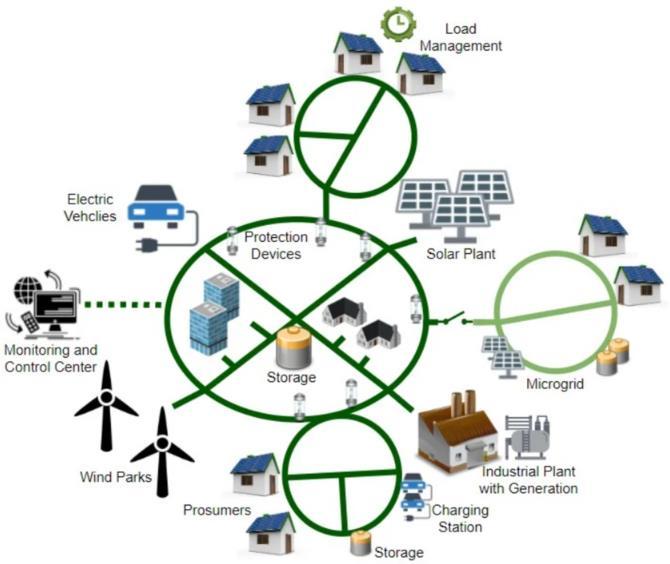
Power flow reversal caused by high penetration of distributed generation can significantly affect relay coordination and fault detection. Many conventional protectionschemesassumethatfaultcurrentflowsfromthe source toward the fault location. When distributed generationinjectspowerintothenetwork,thedirectionof faultcurrentmaychangedependingonthelocationofthe generationsourcerelativetothefault.Thischangeincurrent directioncanleadtoincorrectoperationofprotectiverelays, particularlythosethatrelysolelyoncurrentmagnitudefor decision making. Consequently, directional relays or adaptive protection mechanisms are often required to maintain proper protection coordination in networks experiencingbidirectionalpowerflow(GirgisandBrahma, 2001).
3.3FaultCurrentCharacteristicsinInverter-Based Systems
Fault current behavior in inverter-dominated distribution systemsdifferssignificantlyfromthatoftraditionalpower systems. In conventional systems with synchronous generators,faultcurrentsareprimarilydeterminedbythe generator impedance and system configuration. These currentstypicallyexhibithighmagnitudesandpredictable decaycharacteristics.Incontrast,inverter-basedsystemsare governed by converter control algorithms that regulate current injection during fault conditions. As a result, fault currentsininverter-dominatednetworksareoftenlowerin magnitude and may exhibit non-traditional waveform characteristicscomparedtoconventionalsystems(Lasseter, 2002).
International Research Journal of Engineering and Technology (IRJET) e-ISSN: 2395-0056
Volume: 13 Issue: 03 | Mar 2026 www.irjet.net p-ISSN: 2395-0072
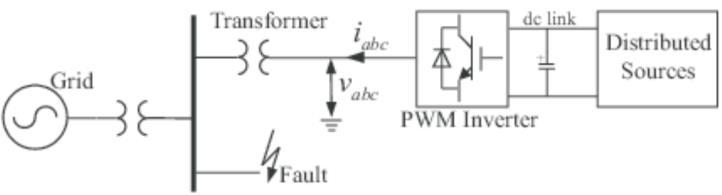
Figure-3:Limited Fault Current Contribution of Inverter-Based Resources
One of the defining characteristics of inverter-based fault currentsistheirrelativelylowmagnitude.Becausepower electronicconvertersactivelycontroltheiroutputcurrent, the resulting fault current may only slightly exceed the normal operatingcurrent. This limitedcurrent magnitude reduces the sensitivity of conventional overcurrent protection devices and may prevent them from distinguishing between normal load variations and actual faultconditions.Furthermore,thecurrentlimitingbehavior ofconvertersintroducesadditionalcomplexitybecausethe output current may remain constant regardless of fault severity.Thischaracteristicchallengestraditionalprotection principlesthatrelyonhighercurrentlevelsforfasterfault detectionandisolation(Guerreroetal.,2013).
3.4 Protection Challenges in Inverter-Dominated Radial Networks
The presence of inverter-based distributed generation introduces several new challenges for the protection of radial distribution networks. One common issue is relay blinding,whichoccurswhenthefaultcurrentmagnitudeis insufficient to trigger the operation of overcurrent relays. Since inverter-based resources limit their fault current contribution, the total fault currentinthesystem mayfall below the relay pickup setting, causing the relay to fail in detectingthefault.Thisconditioncandelayfaultisolation and potentially lead to equipment damage or system instability(HorowitzandPhadke,2014).
Anotherimportantchallengeisfalsetripping,whichoccurs whenprotectiondevicesoperateincorrectlyinresponseto non-faultconditions.Thepresenceofdistributedgeneration cancausefluctuationsincurrentmagnitudeanddirection, which may be misinterpreted by conventional protection devices as fault events. False tripping can unnecessarily disconnect healthy sections of the network and reduce system reliability. In addition, the integration of inverterbased resources can cause loss of coordination among protective devices because the traditional time-grading strategy may no longer function properly under changing faultcurrentconditions.
4. ADAPTIVE PROTECTION CONCEPTS FOR SMART DISTRIBUTION SYSTEMS
The modernization of electric power distribution systems and the increasing penetration of distributed energy
resourceshaveintroducednewoperationalchallengesfor conventional protection schemes. Traditional protection strategies are typically based on fixed relay settings that assume stable network conditions and predictable fault currentlevels.However,activedistributionnetworkswith inverter-interfacedresourcesexperiencefrequentchanges in operating conditions due to renewable generation variability,dynamicloadbehavior,andbidirectionalpower flow. These variations can cause conventional protection schemes to lose coordination or operate incorrectly. To addressthesechallenges,adaptiveprotectionconceptshave been developed to enable protection systems to automaticallyadjusttheirsettingsinresponsetoreal-time systemconditions.Suchadaptivemechanismsenhancethe ability of protection systems to maintain selectivity, sensitivity, and reliability in modern smart distribution networks(HorowitzandPhadke,2014).
4.1DefinitionandPrinciplesofAdaptiveProtection
Adaptiveprotectionreferstoaprotectionstrategyinwhich relayparametersandcoordinationsettingsaredynamically modifiedbasedonchangesinsystemoperatingconditions. Unlike conventional protection schemes that rely on predetermined settings derived from offline studies, adaptiveprotectionsystemsutilizereal-timemeasurements, systemmonitoringdata,andcommunicationinfrastructure toupdateprotectionsettingsautomatically.Thiscapability enables the protection system to respond effectively to variationsingenerationlevels,networktopology,andpower flowpatterns.Theprimaryobjectiveofadaptiveprotection is to ensure that protective devices maintain proper coordinationandoperatecorrectlyunderbothnormaland abnormal operating conditions in active distribution networks(GirgisandBrahma,2001).
Adaptive protection systems typically rely on advanced monitoring and control technologies such as phasor measurementunits,intelligentelectronicdevices,anddigital communicationnetworks.Thesetechnologiesproviderealtimeinformationaboutsystemvoltages,currents,andpower flows, allowing protection algorithms to determine the appropriaterelaysettingsfordifferentoperatingscenarios. By continuously evaluating system conditions, adaptive protection schemes can improve the accuracy of fault detectionandreducetheriskofprotectionmiscoordination innetworkswithhighpenetrationofdistributedgeneration (PhadkeandThorp,2009).
4.2 Architecture of Adaptive Protection Systems
Thearchitecture of anadaptive protection system defines how protection devices, monitoring systems, and communication networks interact to achieve coordinated protection. Different architectural approaches have been proposed to implement adaptive protection in smart distribution networks, depending on system complexity, communication infrastructure, and control requirements.
International Research Journal of Engineering and Technology (IRJET) e-ISSN: 2395-0056
Volume: 13 Issue: 03 | Mar 2026 www.irjet.net p-ISSN: 2395-0072
The most commonly discussed architectures include centralized, decentralized, and distributed protection frameworks. Each approach has its own advantages and limitations in terms of scalability, reliability, and implementationcomplexity(Hatziargyriou,2014).
4.2.1 Centralized Protection Architecture
Inacentralizedprotectionarchitecture,protectiondecisions and relay setting adjustments are managed by a central control unit or supervisory control system. This central controller collects real-time measurements from various protection devices and monitoring units across the distributionnetwork.Usingthisinformation,thecontroller calculatesoptimalprotectionsettingsandtransmitsupdated parameters to individual relays. Centralized protection systemsprovideaglobalviewofthenetwork,whichallows comprehensive coordination of protective devices and accurate assessment of system conditions. Such architectures are particularly suitable for networks equippedwithadvancedmonitoringsystemsandhigh-speed communicationinfrastructure.
However, centralized protection architectures may introducecertainoperationalchallenges.Therelianceona central controller increases the vulnerability of the protectionsystemtocommunicationfailuresorcontroller malfunctions.Inaddition,large-scaledistributionnetworks may generate significant amounts of data that must be processed in real time, which can increase computational requirementsandsystemcomplexity(Anderson,1999).
4.2.2 Decentralized Protection Architecture
Decentralizedprotectionarchitecturedistributesprotection decision-makingamongseverallocalcontrollersratherthan relyingonasinglecentralunit.Inthisapproach,individual protection zones or substations are equipped with local control systems that analyze system measurements and adjustrelaysettingsbasedonpredefinedcoordinationrules. Each local controller operates independently while exchanginglimitedinformationwithneighboringprotection zones.Thisarchitectureimprovessystemreliabilitybecause thefailureofonecontrollerdoesnotnecessarilyaffectthe operationoftheentireprotectionsystem.
Decentralizedprotectionschemesareparticularlyusefulin large distribution networks where centralized data processing may be impractical. By performing protection calculations locally, decentralized systems can reduce communication requirements and improve response time during fault conditions. However, achieving effective coordinationamongmultiplelocalcontrollersrequireswelldesigned communication protocols and coordination algorithms(BollenandHassan,2011).
4.2.3 Distributed Protection Architecture
Distributed protection architecture represents a more advancedapproachinwhichintelligentprotectiondevices collaborate directly with one another to make protection decisions.Inthisarchitecture,intelligentelectronicdevices installed at various points in the distribution network exchange information such as voltage, current, and fault indicators.Basedonthissharedinformation,eachdevicecan determinewhetherafaulthasoccurredwithinitsprotection zoneandtakeappropriateaction.
Distributedprotectionsystemsareparticularlysuitablefor smartgridsbecausetheyofferhighscalability,flexibility,and resilience.Theabsenceofasinglecentralcontrollerreduces the risk of system-wide failure and allows the protection system to continue functioning even if some devices or communication links fail. Furthermore, distributed architecturescanrespondquicklytolocaldisturbancessince decisionsaremadeclosetothefaultlocation.Nevertheless, the design of distributed protection algorithms can be complexandrequiresreliablecommunicationnetworksto ensurepropercoordinationamongdevices(Guerreroetal., 2013).
4.3 Communication Infrastructure for Adaptive Protection
Communication infrastructure plays a critical role in enablingadaptiveprotectionsystemstofunctioneffectively. Real-timeexchangeofsysteminformationamongprotection devices,monitoringunits,andcontrolcentersisessentialfor updating relay settings and maintaining proper coordination. Modern smart grid technologies provide severalcommunicationframeworksthatsupporthigh-speed data transfer and reliable system monitoring. These frameworks allow protection systems to adapt quickly to changing network conditions and improve overall system reliability(Gungoretal.,2013).
4.3.1 IEC 61850 Based Communication
IEC 61850 is an international communication standard designedspecificallyforsubstationautomationandsmart grid applications. This standard defines communication protocols, data models,and interoperability requirements for intelligent electronic devices used in power system protection and control. IEC 61850 enables high-speed communicationbetweenprotectionrelays,controlsystems, and monitoring devices, allowing rapid exchange of fault information and system measurements. The use of standardized communication protocols improves interoperability among equipment from different manufacturers and simplifies the integration of adaptive protection schemes in modern substations (Mackiewicz, 2006).
International Research Journal of Engineering and Technology (IRJET) e-ISSN: 2395-0056
Volume: 13 Issue: 03 | Mar 2026 www.irjet.net p-ISSN: 2395-0072
4.3.2 Wide Area Monitoring Systems
Wide area monitoring systems (WAMS) provide real-time visibilityofpowersystemconditionsacrosslargegeographic regions.Thesesystemsutilizesynchronizedmeasurement devicessuchasphasormeasurementunitstocapturehighresolutiondataonvoltage,current,andphaseangleacross the network. The synchronized measurements enable accuratemonitoringofsystemdynamicsandfaultevents.In adaptive protection applications, WAMS can provide valuable information for identifying abnormal operating conditions and adjusting relay settings accordingly. The integration of wide area monitoring technologies with adaptiveprotectionsystemscansignificantlyenhancefault detectionaccuracyandsystemstability(PhadkeandThorp, 2009).
4.3.3 Smart Grid Communication Networks
Smartgridcommunicationnetworksformthebackboneof modern power system monitoring and control. These networksutilizevariouscommunicationtechnologiessuch as fiber-optic links, wireless communication systems, and internet-basedprotocolstoconnectprotectiondevicesand control centers. Reliable communication networks enable real-time data exchange among distributed protection devices and facilitate rapid implementation of adaptive protectionstrategies.Inaddition,smartgridcommunication systems support advanced functionalities such as remote monitoring, automated control, and cybersecurity protection,whichareessentialforthereliableoperationof moderndistributionnetworks(Gungoretal.,2013).
4.4 Advantages and Limitations of Adaptive Protection
Adaptive protection offers several advantages compared with traditional protection approaches in modern distributionsystems.Oneofthemostsignificantbenefitsis theabilitytomaintainpropercoordinationamongprotective devices under varying system conditions. By dynamically adjustingrelaysettingsbasedonreal-timemeasurements, adaptive protection systems can improve fault detection accuracyandreducetheriskofprotectionmiscoordination. Thiscapabilityisparticularlyvaluableinnetworkswithhigh penetration of distributed generation and inverter-based resources, where fault current characteristics and power flowpatternsmaychangefrequently.
5. LITERATURE REVIEW OF PROTECTION STRATEGIES FOR INVERTER-DOMINATED DISTRIBUTION SYSTEMS
Theincreasingpenetrationofinverter-interfaceddistributed generationhasmotivatedextensiveresearchonprotection strategies suitable for modern distribution networks. Traditionalprotectionmethodsdesignedforradialsystems with synchronous generators often face operational
difficultieswhendistributedgenerationisintegratedintothe network.Consequently,numerousstudieshaveinvestigated modificationstoconventionalprotectionschemesaswellas the development of adaptive and intelligent protection strategies. These research efforts aim to maintain reliable fault detection, ensure proper coordination of protective devices, and improve system stability under varying operatingconditions.Thefollowingsubsectionsreviewthe major protection strategies proposed in the literature for inverter-dominateddistributionsystems.
5.1 Conventional Protection Approaches with Distributed Generation
Conventionalprotectionschemeshavebeenwidelyusedin distributionsystemsfordecadesbecauseoftheirsimplicity and cost-effectiveness. With the integration of distributed generation, researchers have proposed various modifications to these traditional approaches in order to maintainreliableoperation.Thesemodificationsprimarily focus on improving the performance of overcurrent, directional, and differential protection methods under conditionsofvariablefaultcurrentlevelsandbidirectional power flow. Although these approaches may improve protectionperformancetosomeextent,theyoftenremain limitedinhighlydynamicnetworkswheresystemconditions changefrequently(BollenandHassan,2011).
5.1.1 Modified Overcurrent Protection
Overcurrentprotectionremainsoneofthemostcommonly usedprotectionmethodsindistributionnetworks.Several studies have proposed modifications to conventional overcurrentrelaysettingstoaccommodatethepresenceof distributed generation. For instance, researchers have developed optimization techniques for determining relay pickup currents and time-current characteristics that consider the additional fault current contribution from distributed generators. Such approaches typically involve adjusting relay settings based on network topology, generation capacity, and fault current levels to maintain coordination between primary and backup protection devices.
Recent studies have also explored the use of optimization algorithmssuchasgeneticalgorithmsandparticleswarm optimizationtodetermineoptimalrelaysettingsinnetworks with distributed generation. These algorithms evaluate multiple operating scenarios to identify relay parameters that ensure proper coordination across different fault conditions. Although modified overcurrent protection schemescanimprovesystemperformanceincertaincases, their effectiveness may still be limited when fault current contributionsfrominverter-basedresourcesareverysmall (Urdaneta,NadiraandJimenez,2001).
International Research Journal of Engineering and Technology (IRJET) e-ISSN: 2395-0056
Volume: 13 Issue: 03 | Mar 2026 www.irjet.net p-ISSN: 2395-0072
5.1.2 Directional Protection Schemes
Directional protection schemes have been proposed as an effectivesolutionforaddressingthechallengesassociated with bidirectional power flow in distribution systems. In networkswithmultipledistributedgenerationsources,fault currentsmayflowindifferentdirectionsdependingonthe locationofthefaultandthegenerationsources.Directional overcurrentrelaysutilizevoltageandcurrentphaseangle relationshipstodeterminethedirectionoffaultcurrentflow andisolatethecorrectsectionofthenetwork.
Several studies have demonstrated that directional protectionschemescansignificantlyimprovetheselectivity of protection systems in networks with distributed generation.Byincorporatingdirectionalelements,relaysare able to differentiate between upstream and downstream faults, which reduces the likelihood of incorrect tripping. However,theimplementationofdirectionalprotectionmay requireadditionalmeasurementdevicesandmorecomplex relayconfigurationscomparedwithtraditionalovercurrent protectionmethods(GirgisandBrahma,2001).
5.1.3 Differential Protection Techniques
Differential protection is another approach that has been investigated for improving protection reliability in distribution systems with distributed generation. Differential protectionschemesoperate bycomparingthe currententeringandleavingaprotectedzone.Ifasignificant difference is detected between the two currents, the protectionsystemidentifiesthepresenceofa faultwithin theprotectedzoneandinitiatesatripsignal.
This technique offers several advantages including high sensitivity and fast fault detection. Because differential protectiondoesnotrelysolelyoncurrentmagnitude,itcan detect faults even when fault current levels are relatively low.Asaresult,differentialprotectionhasbeenconsidereda promising solution for protecting feeders and microgrids with inverter-interfaced generation. However, the implementationofdifferentialprotectiontypicallyrequires reliable communication links and synchronized measurements between protection devices, which may increasesystemcomplexityandcost(HorowitzandPhadke, 2014).
5.2 Adaptive Protection Coordination Strategies
Adaptive protection coordination strategies have been extensively investigated to address the limitations of traditional protection methods in inverter-dominated distribution systems. Unlike conventional protection schemesthatrelyonfixedrelaysettings,adaptiveprotection approachesdynamicallyadjustprotectionparametersbased on real-time system conditions. These strategies utilize system monitoring data and communication networks to updaterelaysettingsinresponsetovariationsingeneration
levels, network topology, and power flow patterns. As a result, adaptive protection systems can maintain proper coordinationamongprotectivedevicesevenunderchanging operatingconditions(PhadkeandThorp,2009).
5.2.1 Adaptive Overcurrent Relay Settings
Adaptive overcurrent relay schemes modify relay pickup currents and operating times based on the level of distributedgenerationconnectedtothenetwork.Whenthe penetration level of distributed generation increases, the relay settings are automatically adjusted to account for changes in fault current magnitude and direction. This approachensuresthatrelaysmaintainadequatesensitivity andcoordinationdespitevariationsingenerationoutput.
Severaladaptiveprotectionalgorithmshavebeenproposed toimplementthisconcept.Thesealgorithmsanalyzesystem measurementssuchasvoltage,current,andpowerflowto determineappropriaterelaysettingsfordifferentoperating scenarios.Forexample,adaptiverelaycoordinationmethods mayutilize real-time monitoringdata tocalculateoptimal time-current characteristics for protective relays. Such adaptive algorithms can significantly improve protection performanceinnetworkswithfluctuatingrenewableenergy generation(JavadianandHaghifam,2011).
5.2.2 Fault Direction-Based Adaptive Protection
Fault direction-based adaptive protection schemes utilize directional elements and sequence component analysis to determinethelocationanddirectionoffaultsindistribution networks.Theseschemestypicallyrelyonpositive-sequence current or voltage measurements to identify whether the fault current is flowing toward or away from a protection device. By analyzing the direction of fault current flow, protection systems can accurately identify the faulted section of the network even when multiple generation sourcesarepresent.
Adaptivethresholdcalculationisanotherimportantfeature oftheseschemes.Insteadofusingfixedrelaypickupsettings, theprotectionsystemdynamicallydeterminesappropriate thresholdvaluesbasedonreal-timesystemconditions.This approach improves relay selectivity and reduces the likelihoodofincorrecttrippinginnetworkswithinverterinterfaced generation. Studies have shown that directionbasedadaptiveprotectionmethodscansignificantlyenhance the reliability of protection systems in modern active distribution networks (Zeineldin, El-Saadany and Salama, 2006).
5.2.3 Communication-Assisted Protection Schemes
Communication-assisted protection schemes utilize highspeed communication networks to exchange information betweenprotectiondeviceslocatedatdifferentpointsinthe distributionsystem.Theseschemesenablerelaystoshare faultinformation,currentmeasurements,andsystemstatus
International Research Journal of Engineering and Technology (IRJET) e-ISSN: 2395-0056
Volume: 13 Issue: 03 | Mar 2026 www.irjet.net p-ISSN: 2395-0072
data in real time. By using this shared information, protection devices can make coordinated decisions regardingfaultisolationandrelayoperation.
One common approach involves the use of centralized protection controllers that collect system measurements frommultiplerelaysanddetermineappropriateprotection actions. Another approach involves peer-to-peer communicationbetweenrelays,allowingthemtocoordinate their operation without relying on a central controller. Communication-assistedprotectionschemesareparticularly effective in large distribution networks where local measurementsalonemaynotprovidesufficientinformation foraccuratefaultdetection.However,theseschemesrequire reliable communication infrastructure and cybersecurity measures to ensure secure and dependable operation (Terzijaetal.,2011).
5.3 Artificial Intelligence and Data-Driven Protection Methods
Recent advancements in artificial intelligence and data analytics have opened new opportunities for improving powersystemprotection.Data-drivenprotectionmethods utilize machine learning and deep learning algorithms to analyze large volumes of power system data and identify fault conditions. These techniques can extract complex patternsfromvoltageandcurrentsignalsthatmaynotbe easilydetectedusingconventionalprotectionmethods.Asa result,AI-basedprotectionschemeshavegainedsignificant attention in recent research on smart grid protection systems(Zhangetal.,2019).
5.3.1 Machine Learning-Based Fault Detection
Machine learning techniques have been widely applied to faultdetectionandclassificationinmodernpowersystems. Algorithmssuchassupportvectormachines,decisiontrees, andrandomforestscanbetrainedusinghistoricalfaultdata to identify different types of disturbances in distribution networks. These models analyze features extracted from voltage and current signals and classify them as normal operatingconditionsorspecificfaulttypes.
Machine learning-based protection systems offer several advantagesincludinghighdetectionaccuracyandtheability toadapttochangingsystemconditions.Oncetrained,these models can process real-time measurements and quickly detect abnormal events in the network. However, the performanceofmachinelearningmodelsdependsheavilyon thequalityandquantityoftrainingdataavailableformodel development(Jamalietal.,2018).
5.3.2 Deep Learning-Based Protection Algorithms
Deeplearningmethodsrepresentamoreadvancedformof machinelearningthatutilizesmulti-layerneuralnetworksto analyzecomplexdatapatterns.Inpowersystemprotection
applications, deep learning models such as convolutional neuralnetworksandrecurrentneuralnetworkshavebeen usedtodetectfaultsandclassifydisturbanceevents.These models are capable of automatically extracting relevant featuresfromrawmeasurementsignals,whichreducesthe needformanualfeatureengineering.
Research has shown that deep learning-based protection algorithmscanachievehighaccuracyinidentifyingfaultsin distribution systems with renewable energy integration. Thesealgorithmsareparticularlyusefulforanalyzingnonlinear and time-varying signals generated by inverterinterfacedresources.Despitetheiradvantages,deeplearning methods require significant computational resources and largedatasetsfortraining, whichmaylimittheirpractical implementationincertainapplications(Heetal.,2017).
5.3.3 Data-Driven Adaptive Protection Strategies
Data-driven adaptive protection strategies combine realtime monitoring data with intelligent algorithms to dynamically adjust protection settings in response to changing system conditions. These approaches utilize advanced data analytics techniques to evaluate system operating conditions and determine optimal protection parameters. By continuously analyzing system data, datadriven protection systems can detect emerging faults, predict abnormal conditions, and update relay settings accordingly.
The integration of data-driven methods with adaptive protectionsystemshasthepotentialtosignificantlyimprove the reliability and resilience of modern distribution networks.Suchapproachescanprovidemoreaccuratefault detection and faster response times compared with conventionalprotectionschemes.However,thesuccessful implementation of data-driven protection requires robust data management systems and reliable communication infrastructure(Terzijaetal.,2011).
5.4 Protection Strategies for Microgrids and Renewable-Integrated Systems
Microgridsandrenewable-integrateddistributionsystems presentuniquechallengesforprotectiondesignduetotheir ability to operate in both grid-connected and islanded modes. During grid-connected operation, the microgrid receivessupportfromthemainutilitygrid,whichcansupply additional fault current. However, in islanded mode, the microgrid relies solely on local generation sources, which may provide limited fault current due to inverter control mechanisms.
Researchers have proposed various protection strategies specifically designed for microgrids, including adaptive protection schemes, differential protection methods, and communication-assisted protection techniques. These strategiesaimtomaintainreliableprotectionperformance
International Research Journal of Engineering and Technology (IRJET) e-ISSN: 2395-0056
Volume: 13 Issue: 03 | Mar 2026 www.irjet.net p-ISSN: 2395-0072
regardless of whether the microgrid is operating in gridconnected or islanded mode. In particular, adaptive protection approaches have shown promising results becausetheycanautomaticallyadjustrelaysettingswhen the microgrid transitions between operating modes. Such flexibility is essential for ensuring reliable operation of renewable-integrated distribution networks (Lasseter, 2002).
6. COMPARATIVE ANALYSIS OF EXISTING PROTECTION COORDINATION STRATEGIES
Theincreasingcomplexityofmoderndistributionsystems withhigh penetrationofdistributedenergy resourceshas ledtothedevelopmentofvariousprotectioncoordination strategies. Each protection approach offers specific advantagesandlimitationsdependingonsystemconditions, communication infrastructure, and operational requirements. Therefore, a comparative analysis of these protection methods is essential to understand their effectiveness in inverter-dominated radial distribution networks. Such analysis helps researchers and system planners evaluate the suitability of different protection techniquesbasedonkeyperformanceparameterssuchas fault detection accuracy, response speed, communication dependency, and implementation complexity. Several studies have emphasized the importance of comparative evaluation to identify the most appropriate protection strategyformodernsmartgridenvironments(Terzijaetal., 2011).
6.1 Classification of Protection Methods
Protection strategies proposed for distribution networks withdistributedgenerationcangenerallybeclassifiedinto several major categories based on their operational principlesandtechnologicalrequirements.Thesecategories include conventional protection methods, adaptive protection schemes, communication-assisted protection approaches,andintelligentprotectiontechniquesbasedon artificial intelligence and data analytics. Each category representsadifferentstageintheevolutionofpowersystem protectionandaddressesspecificchallengesassociatedwith inverter-interfaced distributed generation. Understanding these classifications provides a structured framework for evaluating existing protection solutions and identifying suitableapproachesforfuturepowersystems(Horowitzand Phadke,2014).
Conventional protection methods rely on predetermined relaysettingsandaretypicallybasedoncurrentmagnitude and time coordination principles. These methods include overcurrent protection, directional protection, and fuse–reclosercoordinationschemes.Whiletheyhavebeenwidely usedintraditionalradialdistributionsystemsduetotheir simplicityandreliability,theireffectivenessdecreaseswhen distributedgenerationintroducesbidirectionalpowerflow andvaryingfaultcurrentlevels.
6.2 Comparative Evaluation Criteria
To evaluate the effectiveness of different protection strategies,itisnecessarytodefineappropriatecomparison criteria.Severalperformanceindicatorsarecommonlyused inpowersystemprotectionstudiestoassessthereliability andefficiencyofprotectionschemes.Thesecriteriainclude fault detection accuracy, response time, communication requirements,andimplementationcomplexity.Byanalyzing protectionstrategiesbasedontheseparameters,researchers candeterminetherelativestrengthsandweaknessesofeach approach and identify potential improvements for future protectionsystemdesigns(Anderson,1999).
6.2.1 Fault Detection Accuracy
Faultdetectionaccuracyreferstotheabilityofaprotection system to correctly identify the presence and location of faultswithinthepowernetwork.Highaccuracyisessential forensuringthatonlytheaffectedportionofthesystemis isolatedwhiletherestofthenetworkcontinuestooperate normally.Conventionalprotectionschemesmayexperience reduced accuracy in inverter-dominated networks due to limitedfaultcurrentlevelsandbidirectionalpowerflow.In contrast,adaptiveandintelligentprotectionmethodsoften achievehigherdetectionaccuracybyincorporatingreal-time monitoring data and advanced analytical techniques. For example, machine learning-based protection systems can identifycomplexfaultpatternsthatmaynotbedetectable usingtraditionalprotectionalgorithms(Zhangetal.,2019).
6.2.2 Response Time
Responsetimeisanothercriticalperformanceparameterin powersystemprotection.Itreferstothetimerequiredfor theprotectionsystemtodetectafaultandinitiatecorrective action such as tripping a circuit breaker. Faster response timesreducetheriskofequipmentdamageandpreventthe propagationofdisturbancesthroughoutthepowernetwork. Conventional protection systems typically rely on timecurrent characteristics, which may introduce intentional delaystomaintaincoordinationbetweendevices.Advanced protection strategies such as differential protection and communication-assisted schemes can significantly reduce response time by utilizing real-time measurements and directcommunicationbetweenprotectiondevices(Phadke andThorp,2009).
6.2.3 Communication Requirement
Communication infrastructure plays an increasingly importantroleinmodernprotectionsystems.Conventional protection schemes generally operate independently and requireminimalcommunicationbetweenprotectiondevices. However,advancedprotectionapproachessuchasadaptive andcommunication-assistedprotectiondependheavilyon real-timedataexchangebetweenrelays,monitoringdevices, and control centers. The availability and reliability of
International Research Journal of Engineering and Technology (IRJET) e-ISSN: 2395-0056
Volume: 13 Issue: 03 | Mar 2026 www.irjet.net p-ISSN: 2395-0072
communicationnetworksthereforehaveasignificantimpact ontheperformanceofthese protectionschemes.Insmart gridenvironments,high-speedcommunicationtechnologies such as fiber-optic networks and IEC 61850 protocols are commonlyusedtosupportreal-timeprotectioncoordination (Gungoretal.,2013).
6.2.4
Implementation Complexity
Implementationcomplexityreferstothelevel oftechnical difficultyassociatedwithdeployingaparticularprotection strategy in a real power system. Conventional protection methods are relatively simple to implement because they rely on fixed relay settings and minimal communication infrastructure.Asaresult,theyremainwidelyusedinmany existing distribution networks. In contrast, adaptive and intelligentprotectionschemesrequireadvancedmonitoring systems, computational algorithms, and communication networks. While these advanced methods offer improved protectionperformance,theirimplementationmayinvolve higher installation costs, complex system integration, and additionalmaintenancerequirements.Therefore,protection engineers must carefully evaluate the trade-off between performanceimprovementandimplementationcomplexity whenselectinganappropriateprotectionstrategy(Bollen andHassan,2011).
7. CONCLUSION
The rapid growth of distributed energy resources and renewableenergyintegrationhassignificantlytransformed conventional radial distribution networks into active and inverter-dominatedsystems.Thewidespreaddeploymentof inverter-interfaced distributed generation, such as solar photovoltaic and wind power systems, introduces new operational characteristics including bidirectional power flow, reduced fault current levels, and dynamic network configurations.Thesechangeschallengetheeffectivenessof traditional protection coordination schemes that were originally designed for passive distribution systems with unidirectional power flow and high fault current contributionsfromsynchronousgenerators.
Thisreviewpaperhaspresentedacomprehensiveoverview ofprotectioncoordinationstrategiesforinverter-dominated radial distribution systems. The study first discussed the fundamental principles of conventional protection techniques, including overcurrent protection, directional protection,andfuse–reclosercoordination.Itthenanalyzed the limitations of traditional protection approaches when applied to modern distribution networks with high penetrationofinverter-basedresources.Thereviewfurther examined the impact of inverter characteristics on fault current behavior and highlighted major protection challengessuchasrelayblinding,falsetripping,andlossof coordination.
Inaddition,thepaperreviewedvariousadvancedprotection solutions including adaptive relay coordination, communication-assistedprotectionschemes,andintelligent protection methods based on machine learning and datadriven techniques. A comparative analysis of these approaches demonstrated that adaptive and intelligent protectionstrategiesofferimprovedreliability,selectivity, and operational flexibility in modern smart distribution systems.Overall,thefindingsindicatethatthedevelopment of robust adaptive protection frameworks supported by reliablecommunicationinfrastructurewillplayacrucialrole inensuringsecureandefficientoperationoffutureinverterdominateddistributionnetworks.
8. LIMITATIONS OF THE REVIEW
Althoughthisreviewprovidesacomprehensiveanalysisof protection coordination strategies for inverter-dominated radial distribution systems, several limitations should be acknowledged.First,thereviewmainlyfocusesonpublished academic literature and may not fully capture recent industrial implementations or proprietary protection solutions used by utilities. Second, the discussion emphasizes protection strategies in radial distribution networks, while other configurations such as meshed or hybrid distribution systems are not extensively covered. Additionally,thecomparativeanalysisisprimarilybasedon qualitative evaluation rather than detailed quantitative performance assessment due to the diversity of methodologiesusedindifferentstudies.Finally,therapidly evolving nature of smart grid technologies, artificial intelligenceapplications,andcommunicationinfrastructures meansthatnewprotectionstrategiesmayemergebeyond thescopeoftheliteraturereviewedinthispaper.
REFERENCES
1. Anderson,P.M.(1999)PowerSystemProtection.New York:IEEEPress.
2. Bollen, M.H.J. and Hassan, F. (2011) Integration of DistributedGenerationinthePowerSystem.Hoboken, NJ:Wiley-IEEEPress.
3. Girgis, A.A. and Brahma, S.M. (2001) ‘Effect of distributed generation on protective device coordination’, Proceedings of the IEEE Power Engineering Society Winter Meeting, Columbus, USA, pp.115–120.
4. Gungor,V.C.,Sahin,D.,Kocak,T.,Ergut,S.,Buccella,C., Cecati, C. and Hancke, G.P. (2013) ‘Smart grid technologies: Communication technologies and standards’,IEEETransactionsonIndustrialInformatics, 7(4),pp.529–539.
5. Horowitz,S.H.andPhadke,A.G.(2014)PowerSystem Relaying.4thedn.Hoboken,NJ:Wiley.
International Research Journal of Engineering and Technology (IRJET) e-ISSN: 2395-0056
Volume: 13 Issue: 03 | Mar 2026 www.irjet.net p-ISSN: 2395-0072
6. Jamali, S., Bahmanyar, A. and Bompard, E. (2018) ‘Machine learning based fault detection in power distributionsystems’,ElectricPowerSystemsResearch, 160,pp.191–199.
7. Javadian,S.A.M.andHaghifam,M.R.(2011)‘Adaptive protection coordination in distribution systems with distributed generation’, IEEE Transactions on Power Delivery,26(3),pp.1408–1416.
8. Phadke,A.G.andThorp,J.S.(2009)ComputerRelaying forPowerSystems.Hoboken,NJ:Wiley.
9. Terzija,V.,Valverde,G.,Cai,D.,Regulski,P.,Madani,V., Fitch,J.,Skok,S.,Begovic,M.M.andPhadke,A.(2011) ‘Wide-areamonitoring,protectionandcontroloffuture electric power networks’, Proceedings of the IEEE, 99(1),pp.80–93.
10. Zeineldin, H.H., El-Saadany, E.F. and Salama, M.M.A. (2006) ‘Impact of distributed generation on distribution system protection’, IEEE Power EngineeringSocietyGeneralMeeting,Montreal,Canada, pp.1–8.
11. Zhang,Y.,Wang,J.,Chen,B.andLi,F.(2019)‘Artificial intelligence techniques for power system protection andcontrol’,IEEEAccess,7,pp.173795–173810.
12. Brahma,S.M.andGirgis,A.A.(2004)‘Developmentof adaptive protection scheme for distribution systems withhighpenetrationofdistributedgeneration’,IEEE TransactionsonPowerDelivery,19(1),pp.56–63.
13. Mahat,P.,Chen,Z.andBak-Jensen,B.(2011)‘Asimple adaptiveovercurrentprotectionofdistributionsystems with distributed generation’, IEEE Transactions on SmartGrid,2(3),pp.428–437.
14. Zeineldin, H.H., Mohamed, Y.A.R.I., Khadkikar, V. and Pandi,V.R.(2013)‘Aprotectioncoordinationindexfor evaluating distributed generation impacts on protection for meshed distribution systems’, IEEE TransactionsonSmartGrid,4(3),pp.1523–1532.
15. Cheung,H.,Hamlyn,A.,Wang,L.,Yang,C.andCheung,R. (2009) ‘Investigations of impacts of distributed generations on feeder protections’, IEEE Power and EnergySocietyGeneralMeeting,pp.1–7.
16. Urdaneta, A.J., Nadira, R. and Jimenez, L.G.P. (1988) ‘Optimalcoordinationofdirectionalovercurrentrelays ininterconnectedpowersystems’,IEEETransactions onPowerDelivery,3(3),pp.903–911.
17. Singh, M. (2017) ‘Protection coordination in distribution systems with and without distributed energyresources–areview’,ProtectionandControlof ModernPowerSystems,2(27),pp.1–15.
18. Rezaei, N. and Haghifam, M.R. (2008) ‘Protection scheme for distribution systems with distributed generationusingdifferentialprotection’,International JournalofElectricalPower&EnergySystems,30(10), pp.523–530.
19. Kamel, R.M., Chaouachi, A. and Nagasaka, K. (2016) ‘Three control strategies to improve the microgrid transient dynamic response during isolated mode’, Renewable and Sustainable Energy Reviews, 48, pp. 793–806.
20. Brearley,B.J.andPrabu,R.R.(2017)‘Areviewonissues andapproachesformicrogridprotection’,Renewable andSustainableEnergyReviews,67,pp.988–997.
21. Hosseini, S.A., Abyaneh, H.A. and Razavi, F. (2016) ‘Protectioncoordinationindistributionnetworkswith distributedgenerationusingoptimizationtechniques’, Renewable and Sustainable Energy Reviews, 58, pp. 159–172.
22. Ferreira, R.R., Silva, K.M. and Costa, F.B. (2019) ‘Adaptiveprotectionschemefordistributionnetworks with distributed generation’, International Journal of ElectricalPower&EnergySystems,104,pp.230–240.
23. Chowdhury,S.,Chowdhury,S.P.andCrossley,P.(2009) MicrogridsandActiveDistributionNetworks.London: IET.
24. Zayandehroodi, H., Mohamed, A., Shareef, H. and Mohamed,A.H.(2012)‘Anovelprotectioncoordination scheme for distribution system with distributed generation’,InternationalJournalofElectricalPower& EnergySystems,43(1),pp.1091–1101.
25. Ates, Y., Uzunoglu, M. and Karakas, A. (2016) ‘Protection strategies for distributed generation integrated distribution systems’, Journal of Cleaner Production,112,pp.123–132.
26. Hadjsaid, N., Canard, J.F. and Dumas, F. (1999) ‘Dispersed generation impact on distribution networks’, IEEE Computer Applications in Power, 12(2),pp.22–28.
27. Dugan,R.C.andRizy,D.T.(1984)‘Electricdistribution protection problems associated with dispersed generation’, IEEE Transactions on Power Apparatus andSystems,PAS-103(6),pp.1121–1127.
28. Memon, A.A. and Kauhaniemi, K. (2015) ‘A critical reviewofACmicrogridprotectionissuesandavailable solutions’, Electric Power Systems Research, 129, pp. 23–31.
International Research Journal of Engineering and Technology (IRJET) e-ISSN: 2395-0056
Volume: 13 Issue: 03 | Mar 2026 www.irjet.net p-ISSN: 2395-0072
29. Nayak,P.,Mishra,S.andDash,P.K.(2018)‘Protection coordination in microgrids using adaptive relays’, RenewableEnergy,125,pp.512–525.
30. Dileep,G.(2020)‘Asurveyonsmartgridtechnologies and applications’, Renewable Energy, 146, pp. 2589–2625.
31. Kappagantu,R.andDaniel,S.A.(2018)‘Challengesand issuesofsmartgridimplementation’,Renewableand SustainableEnergyReviews,71,pp.652–661.
32. Akhil, A.A., Huff, G., Currier, A.B., Kaun, B.C., Rastler, D.M., Chen, S.B., Cotter, A.L., Bradshaw, D.T. and Gauntlett, W.D. (2015) DOE/EPRI Electricity Storage Handbook. Washington DC: Sandia National Laboratories.
33. Kumar, D., Samantaray, S.R. and Joos, G. (2015) ‘Protection of microgrids using pattern recognition techniques’,IEEETransactionsonSmartGrid,6(4),pp. 2051–2059.
34. Saleh,K.A.,Zeineldin,H.H.andAl-Hosani,M.A.(2017) ‘Protectioncoordinationfordistributionsystemswith distributedgenerationusingoptimizationtechniques’, ElectricPowerSystemsResearch,142,pp.153–163.
35. Sharma,A.andSrinivasan,D.(2019)‘Machinelearning basedprotectionschemefordistributionsystemswith renewablegeneration’,IEEESystemsJournal,13(4),pp. 4218–4229.
36. El-Idrissi, Z., El-Mariami, F., Belfqih, A. and Haidi, T. (2021) ‘Impact of distributed power generation on protection coordination in distribution networks’, Indonesian Journal of Electrical Engineering and ComputerScience,23(3),pp.1271–1280.