
International Research Journal of Engineering and Technology (IRJET) e-ISSN: 2395-0056
Volume: 13 Issue: 06 | Jun 2026 www.irjet.net p-ISSN: 2395-0072
International Research Journal of Engineering and Technology (IRJET) e-ISSN: 2395-0056
Volume: 13 Issue: 06 | Jun 2026 www.irjet.net p-ISSN: 2395-0072
Sarvesh Garg1 , Dr. Kiran Jyoti2 , Dr. Hardeep Singh Kang3
1Student & 1765, Phase-1, Urban Estate, Dugri. Ludhiana
2 Professor, Dept. of Computer science Engineering, GNDEC, Punjab, India
3 Associate Professor, Dept. of Computer Science Engineering, GNDEC, Punjab, India
Abstract - Airpollutionhasbecomeoneofthemostcritical environmental and public health concerns worldwide due to its severe impact on human health, ecosystems, and climate conditions. Rapid urbanization, industrialization, and increasingvehicularemissionshavesignificantlycontributed to the deterioration of air quality, making accurate forecasting of air pollution levels essential for effective environmental management and policy planning. Predicting the Air Quality Index(AQI) with high precision is challenging becauseairpollutiondataexhibitbothnonlinearpatternsand temporal dependencies influenced by meteorological conditions, pollutant interactions, and seasonal variations. Traditional statistical models often fail to capture nonlinear relationshipseffectively,whereasstandalonemachinelearning models may not fully address time-series dependencies and residual errors. To overcome these limitations, this research proposes a novel hybrid machine learning framework for air quality prediction by integrating Random Forest (RF), Autoregressive Integrated Moving Average (ARIMA), and Gated Recurrent Unit (GRU) models. The proposed methodologycombinesthestrengthsofthesethree models to improve prediction accuracy and robustness. Initially, the Random Forest algorithm is employed as the primary predictive model due to its strong capability in handling nonlinear relationships, feature interactions, and highdimensional environmental datasets.
Key Words: Deep Learning, Gated Recurrent Unit, Elastic Net, Machine Learning, Air Quality.
Airqualityhasbecomeacriticalenvironmentalandpublic healthconcernduetorapidurbanization,industrialization, and increased vehicular emissions. Poor air quality, characterizedbyhighconcentrationsofpollutantssuchas PM₂.₅,PM₁₀,NO₂,SO₂,CO,andO₃,hasbeendirectlylinkedto respiratory diseases, cardiovascular disorders, and prematuremortality.Toeffectivelymitigatetheseimpacts, timely and accurate air quality prediction is essential. Traditional statistical and deterministic models, including linearregressionandchemicaltransportmodels,havebeen widely used for air quality forecasting. However, these approachesoftenstruggletocapturethehighlynonlinear, dynamic, and complex interactions among meteorological variables, emission sources, and atmospheric processes. With the availability of large-scale air quality monitoring
data and advances in computational power, data-driven methodshavegainedsignificantattention.Machinelearning anddeeplearningmodels,suchasartificialneuralnetworks, convolutional neural networks, and recurrent neural networks, have demonstrated superior predictive capabilities compared to classical models. Nevertheless, singledeeplearningmodelsmaystillfacelimitationsrelated tofeatureextraction,temporaldependencymodeling,spatial correlationhandling,andgeneralization.Thesechallenges have motivated the exploration of hybrid deep learning methodsforairqualityprediction
S. et. al, 2025 said that the research employed an LSTM modeltopredicttheAirQualityIndex(AQI)fromathreeyeardatasetofeightpollutants.Thedataweresmoothedand normalizedpriortotrainingwithlook-backdaysasoneof the important parameters. Experimental results had best performancewithMAE0.032fortrainingand0.043fortest at10look-backdays[1].
Khokhlovet.al,2025proposedthatthisresearchusedML andDLmodelstoforecastAQIinTashkent,Uzbekistan,one ofthedirtiestcitiesintheworld.UsingKNN,RF,DT,SVM, and ANN using optimizers such as Adam, Ada Grad, RMSprop,andSGDwithmomentum,theproblemwassetas classification. Model performance was measured using Accuracy, Precision, Recall, and F1-Score, identifying strengths,weaknesses,andappropriatemethodstopredict AQI[2].
Au et. al, 2025 said that the research used Automated MachineLearning(AutoML)ontime-seriesIoTsensordata inairqualitymonitoring.ExperimentsrevealedthatAutoML models had similar or better accuracy compared to customaryandneuralnetworkalgorithmssuchasRandom Forests, Extra Trees, Elastic Net, and LSTM. The findings exhibited the usability and cross-industry applicability of ML-based air quality analysis without the need for specializedtechnicalknowledge[3].
Kocak et, al, 2025 said that this research compared five machinelearningmodelstopredicthourlyPM2.5andPM10 concentrationbasedonactualpollutantandmeteorological data. Varied performance was observed, with the best performanceinPM2.5predictionbySVR(R²=0.83),followed
International Research Journal of Engineering and Technology (IRJET) e-ISSN: 2395-0056
Volume: 13 Issue: 06 | Jun 2026 www.irjet.net p-ISSN: 2395-0072
byPM10predictionbyRidgeRegression(R²=0.91),andRF, ExtraTrees,andXGBoostwithstrongoverallresults.Based on the Air Q+ model, long-term PM2.5 exposure was associatedwithanaverageattributablemortalityproportion of 10.2%, highlighting the necessity for focused interventions[4].
S.ThanyaCharoen,2025saidthatinthisresearch,MLand DLmodelswerecomparedforairqualityclassificationwith 5,000samplesfromBangladesh'sDhakacity.RandomForest wasthemostaccurateMLmodel(96%),followedbyVGG19 as the best DL model with 95%, accurately representing intricate patterns. Trade-offs between performance and efficiency were highlighted by the findings, necessitating scalable,diversedatasetsandhybridmethodsforeffective prediction[5].
Bhaskaret.al,2025suggestedthatthisreviewlookedathow intenseurbanizationanda30%increaseincarsinthelast decadeamplifiedairpollutionandhealthhazardsinIndian cities. It reviewed the shortcomings of current air quality predictiontechniquesandlookedathowML,DL,andhybrid modelsmayimproveforecasting.Thepaperalsotouchedon challengessuchasfaultysensors,excessivecomputational time, and interpretability, while proposing AI-based predictions and policy reforms for improved air quality management[6].
Abdelmaleket.al,2025saidthatfiveMLmodels(GPR,ER, SVM,RT,andKAR)wereusedinthisstudytoforecastAQI withprominentpollutants(PM2.5,PM10,andCO)froman actualIoTreal-timedataset.TheresultsindicatedthatGPR, ER, SVM, and RT performed above 96%, whereas KAR ranked lower at 82.36%. GPR exceeded all models with minimumRMSE,showingtheprospectofMLtoaccurately controlreal-timeairquality[7].
Mohanraj et. al, 2025 said that the four models, XG Boost, LSTM,Prophet,andVertexAI,weretestedbythisresearch forAQIforecastingandmonitoring.Findingsindicatedthat sophisticatedtoolsincreasedaccuracyandconvenienceto the point where ML applications were accessible even to laymen. The research emphasized the viability of hybrid approachesthatcombinelocaltoolswithcloudplatformsfor betterAQIforecasting[8].
Fang et. al,2025 said that the research contrasted linear regression (LR) and random forest (RF) models for calibrating the Plan tower PMS 3003 air quality sensor in different environmental settings. LR exhibited stable performanceforlowtomoderatePM₂.₅concentrationswith low computational cost, whereas RF found calibration accuracyimprovedindifficult,humidconditions.[9].
Mageshet.al,2025proposedthattheresearchexaminedthe relationship between poverty and air pollution in the contiguousUnitedStatesthroughmachinelearningmodels such as linear regression, decision trees, and neural
networks.Findingsindicatedthatsocioeconomicindicators correctlypredictedratesofpoverty,yetpovertyitselfdidnot relatetopollutionlevelstoanynotabledegree.
Yasinet.al,2025saidthatgeospatialmodelingcoupledwith machinelearningwasappliedinthePM₁₀prediction,where therandomforest(RF)algorithmwasthemostaccuratein hotspotidentification.Spatialanalysisshowedhotspotsof PM₁₀ 8–16.5 km east and northwest of Addis Ababa city center.[11].
Nataliya et. al, 2025 suggested that the research built a surrogate modeling methodology to forecast indoor air temperature(IAT)basedonanaugmentedLSTMcombined with Rolling Window Cross-Validation (RWCV) to identify temporal dependencies. The model exhibited robust generalization, showing little difference in loss between trainingandtesting,andenhancedadaptabilitytovarying conditions.[12].
Jayaraman et. al., 2025 said that the research proposed a Time-Based-Spatial (TBS) forecasting model combining CNNs and ARIMA models for forecasting the Air Quality Index (AQI) in multiple cities. CNNs extracted spatial relationshipsbasedongeographiccoordinates,andARIMA estimatedtemporalpollutanttrends.Thecombinedmodel produced accurate six-hour AQI forecasts with improved insights into spatial and temporal aspects affecting air quality[13].
Rad et. al, 2025 said that the research projected concentrationsofCO,O₃,NO₂,SO₂,PM₁₀,inTehran(2013–2023)withdeeplearning(DL)modelsandcontrastedthem with conventional ML techniques. GRU and FCNN models attainedthegreatestaccuracy,withR²valuesupto0.93and minimal MSEs, surpassing conventional methods. Temperatureandhumidityweredeterminedasdriversof pollutantvariability,validatingDLmodelsaseffectivetools forairqualitymanagement[14].
Ajalaet.al,2025saidthattheresearchassessed14models, which were statistical, machine learning (ML), and deep learning (DL) models, for forecasting CO₂ emissions on a dailybasisformajorpollutingareasfromtheyear2022to 2023.MLandDLmodelscomparedtostatisticalmodelshad greaterR²(0.714–0.932)andsmallerRMSE(0.247–0.480) values.EnsembleMLalgorithmssuchasbaggingandvoting enhanced accuracy by 9.6% and represented the most efficient option for the forecasting of CO₂ emissions on a dailybasis[15].
Zupek et. al, 2025 said that the research examined 9,357 hourly air pollutant records from the Kaggle Air Quality Dataset through ten machine learning regression models. Model accuracy was enhanced through Bayesian optimization, cross-validation, and stacking, with the best performanceobtainedbyoptimizedSVR(R²=99.94%,MAE =0.0120,MSE=0.0005).Theresultsvalidatedthesuitability
International Research Journal of Engineering and Technology (IRJET) e-ISSN: 2395-0056
Volume: 13 Issue: 06 | Jun 2026 www.irjet.net p-ISSN: 2395-0072
of ensemble and optimization methods in modeling air pollutionprocesseswithahighdegreeofaccuracy[16].
Kirti et. al, 2025 said that the research estimated spatial evapotranspiration (ET) variability in northeastern MadagascarbasedonECOSTRESSdataandmachinelearning algorithms. Random forest was highly accurate (R² = 0.7–0.9),wherethemostcriticalvariablesweremeteorological and vegetation structure. SHAP analysis revealed that ET patterns werestrongly influenced byvegetationstructure underdifferentrainfallandwindconditions[17].
Nguyenet.al,2025saidthattheresearchcreatedahybrid deeplearningmodelthatintegratedACNN,ARIMA,QPSOoptimized LSTM, and XG Boost to forecast the Air Quality Index(AQI)fromSeoul's2021–2022airqualitydata.ARIMA utilizedlineartrends,whilethehybridstructuredealtwith nonlineartrendsviaconvolution,optimization,andtuning. The model had a 31.13% decrease in MSE and a 19.03% decrease in MAE compared to traditional methods and exhibitedgreateraccuracyandstability[18].
Trenket.al,2025saidthatinthisresearch,dailyAirQuality Index (AQI) forecasting in eastern Türkiye was evaluated between2016and2024basedonmachinelearningmodels trained with pollutant and meteorological data. Out of XG Boost, Light GBM, and SVM, the highest performance was attained by XG Boost (R² = 0.999, RMSE = 0.234, MAE = 0.158). The results indicated that ensemble-based models managed to capture AQI variations efficiently, providing insightsofgreatimportanceforairqualitymanagementand policy-making[19].
Yeboahet.al,2025proposedthatthisresearchcompared satellite-derived AOD with data from low-cost sensors to estimate PM2.5 concentrations in Accra, Ghana, using machine learning algorithms. Of the models assessed, Boosted Decision Tree performed optimally when temperature and humidity were used. Findings revealed AODaccountedformerelyafractionofground-levelPM2.5 variability,highlightingtherequirementoflocallyderived correctionalgorithmstoenhancetheaccuracyoflow-cost sensors[20].
1. Train Random Forest Regressor
In this step, the model is initialized with `RandomForestRegressor(random_state=42). Here, `random_state`issettoensurereproducibilityintherandom selection process while creating multiple decision trees. Following that, the model learns from the training data through the `fit (X_train, y_train)` method, where `X_train` represents the predictors and `y_train` denotes the dependentvariable.Oncetrainingiscompleted,themodel makespredictionsbasedonbothtrainingdata(`X_train`)and
testing data (`X_test`) using the `predict()` method. This yields two sets of predictions, namely `AQI_pred_rfr_train` and `AQI_pred_rfr_test`, which can be further analyzed for evaluating model performance. The completion of the trainingprocessisnotifiedusingtheprintfunction.
This step computes the errors (residuals) of the Random ForestRegressionmodelonthetrainingdataset.Theerrors are the differences between the actual value of the target variable (y_train) and the predicted value of the AQI (AQI_pred_rfr_train).Itiscalculatedbyusingtheequation: `residual_train=y_train-AQI_pred_rfr_train`.Eachelementof the residuals represents the amount by which the model prediction varies from the actual AQI level; any number greater than zero means under-prediction, while any negative number indicates over-prediction. Once the residualshavebeencomputed,theyaretransformedintothe form of a pandasseries using `pd.Series()` method. Thisis essentialbecauseinthiswaywepreservethesameindexas for the initial training set (y_train.index); this helps us in aligningindividualobservationswiththeirrespectiveerrors. In the end, there is the print command, confirming the successful computationandassignmentofthe residualsto the variable `residual_train`. This type of code is usually appliedincaseswhenahybridmodelingapproachisutilized, inwhichresidualsobtainedwithonemodelarethenfurther analyzed and modeled with another one (ARIMA or deep learningtechniques,forinstance).
This step applies an ARIMA (AutoRegressive Integrated MovingAverage)modeltotheresidualsobtainedfromthe RandomForestmodel,formingahybridmodelingapproach. First, required libraries are imported, and warnings are suppressed for cleaner output. The ARIMA model is then initializedusingARIMA(residual_train,order=(5,1,0)),where (5,1,0) specifies the model parameters: 5 autoregressive terms(p),first-orderdifferencing(d=1)tomaketheseries stationary,andnomovingaverageterms(q=0).Themodelis trainedontheresidualdatausingthe.fit()method,allowing it to capture temporal patterns left unexplained by the Random Forest model. Next, the code forecasts future residualvaluescorrespondingtothesizeofthetestdataset. Thestart_index_forecastissettothelengthofthetraining residuals,andtheend_index_forecastextendsthisrangeto match the number of test samples. The .predict() method generatesthesefutureresidualestimates.Sincetheoutputis initially an array, it is converted into a pandas Series and alignedwiththey_testindextomaintainconsistencywiththe test dataset’s timeline. Finally, a print statement confirms that the ARIMA model has been successfully trained on residuals.Thisapproachhelpsimprovepredictionaccuracy bymodelingpatternsmissedbytheinitialmachinelearning model.
Volume: 13 Issue: 06 | Jun 2026 www.irjet.net p-ISSN: 2395-0072
ThisstepbuildsandtrainsanAttention-basedGRU(Gated Recurrent Unit) deep learning model for time-series prediction using synthetic data. First, a function `create_attention_gru_model`isdefined,whereaninputlayer accepts sequences of shape `(timesteps, features)`. These inputs are passed through a GRU layer with `return_sequences=True`,meaningitoutputshiddenstates foreverytimestepinsteadofjustthefinalone.AnAdditive Attentionlayeristhenapplied,allowingthemodeltofocus on the most important time steps by assigning weights to differentpartsofthesequence.Theoutputoftheattention layer is passed through a Dense layer with one unit to produce predictions. Next, synthetic time-series data is generated using sine waves and linear trends with noise, simulating realistic temporal patterns. The dataset is split into training and testing sets, and both input features and targetvaluesarescaledusingMinMaxScalerforbetterneural networkperformance.ThemodeliscompiledusingtheAdam optimizerandMeanSquaredErrorloss,andtrainedfor35 epochswithvalidation.Aftertraining,predictionsaremade onthetestset,andtheresultsareinverse-transformedback totheoriginalscale.Finally,thepredictedvaluesandactual test values are prepared for evaluation, completing the workflowofanattention-enhancedGRUforecastingmodel.
5. ARIMA Residuals computed and processed
This step continues the hybrid modeling pipeline by preparingthefinalresidualcomponent(afterRandomForest andARIMA)fortraininganAttention-basedGRUmodel.First, in-samplepredictionsfromtheARIMAmodelaregenerated using`predict()`overthetrainingresidualrange,andtheir index is aligned with `residual_train` to ensure proper subtraction. The ARIMA forecasted residuals (`residual_forecast`) are then subtracted from these test residualsto obtain`residual_test_arima_for_gru`, capturing remaining unexplained patterns. Both training and testing residualsarescaledusing`MinMaxScaler`,whichisimportant forstabilizingneuralnetworktraining.
6. Train Attention GRU model on ARIMA Residuals
This step constructs, compiles, and trains the attention enhancedGRUmodelontheARIMAresidualstoconcludethe thirdphaseofthehybridforecastingapproach.Themodel's architectureis illustrated through`.summary()`methodto ensure that the GRU layer, attention mechanism, and the denseoutputlayerarepresentinthemodel'sstructure.Next, themodeliscompiledbyusingtheAdamoptimizerandMSE lossfunctionandincludingRMSEasaperformancemetric, meaning that the task is essentially regression-based. The training of the model relies on the residual time series provided as `X_train_gru_residuals` and the targets as `y_train_gru_residuals`.Theobjectiveinthiscaseistopredict thefutureresidualvaluebasedonthepatternslearnedfrom past residuals. Therefore, the model will be trained for 35
epochswhileutilizingabatchsizeof32withavalidationsplit of20%.
Asexplainedabove,sincetheGRUmodelistrainedwiththe `return_sequences = True`, it gives the predicted residual valueforeverytimestep.However,forforecasting,onlythe prediction of the last time step of each input data is necessary;hence`[:,-1,:]`isusedtoobtainthedesiredvalue storedinthe`scaled_gru_forecast_arima_residuals_single`.
ThisstepgeneratesthefinalAQIpredictionsbyusinghybrid approachusingthreedifferentmodels'outputi.e.Random Forest, ARIMA, and Attention-based GRU. Further, the predictionsdonebyRandomForestModel fortestdataset `(AQI_pred_rfr_test)`wereconvertedintopandasSerieswith same index values as that of `y_test`. Due to the look-back window concept followed in the GRU Model `(LOOK_BACK_GRU_RESIDUALS)`,firstfewobservationsneed tobedroppedbeforeusingtheRandomForestpredictionsas wellastheARIMA'sresidualforecastresults.Thesameholds true for `GRU_resid_pred_series`. All three series (Random Forest Predictions, ARIMA Residuals Forecast and GRU residual prediction) were trimmed to have a common minimum length in order to avoid dimensional mismatch issues.
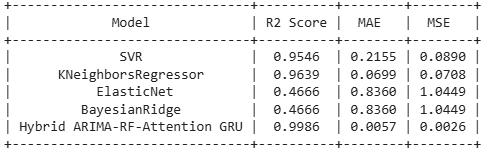
The picturegives the ultimate performancecomparisonof thefivemodelsdiscussedinthepreviouschapters,showing the remarkable efficiency of the developed hybrid architecture in the previous architectural iterations. In particular,theproposedmodelknownastheHybridARIMARF-Attention GRU becomes the most advanced solution, providingalmostaperfectR2Scoreof0.9986whilelowering theamountoferrortotheminimumvaluesbyminimizing theMAEatthelevelof0.0057andMSEdownto0.0026.Itis apparentfromtheresultsprovidedthattheAttentionGRU architecture, used to analyze the residuals of the hybrid ARIMA-RFprocess,allowscapturingnearlyalltheremaining informationintheairqualitydatasetthatcannotbeidentified byanyotheralgorithm.Incomparison,KNeighborsRegressor (R2:0.9639)andSVR(R2:0.9546),whichprovedthemselves as the best single models before, are inferior to the deep learningpipeline.Linearregressors,suchasElasticNetand
International Research Journal of Engineering and Technology (IRJET) e-ISSN: 2395-0056
Volume: 13 Issue: 06 | Jun 2026 www.irjet.net p-ISSN: 2395-0072
BayesianRidge,staytheworstalgorithmswiththesameR2 Scoreof0.4666.
This research establishes that a hybrid machine learning approachoffersarobustandeffectivesolutionforpredicting theAirQualityIndex(AQI)incomplex,dynamic,anddataintensiveenvironments.Airqualityforecastingisinherently challenging due to the combined influence of multiple pollutantconcentrationssuchasPM2.5,PM10,NO₂,SO₂,CO, and O₃, along with meteorological factors including temperature,humidity,windspeed,andseasonalvariations. Additionally, anthropogenic activities such as traffic flow, industrialemissions,andurbanizationfurtherincreasedata variability and uncertainty. Conventional single-model techniques often struggle to accurately represent these diverse and nonlinear interactions, leading to reduced predictionaccuracy.Byadoptingahybridmodelingstrategy, thisstudyaddressesthesechallengesanddemonstratesthat combining multiple learning paradigms enables more comprehensive representation of the underlying air pollution dynamics. The proposed hybrid framework integrates complementary machine learning models in a unified architecture, allowing the system to capture both lineartrendsandcomplexnonlineardependenciespresent inhistoricalAQIdata.Systematicdatapreprocessingplaysa crucial role in achieving reliable performance, as missing valuetreatmentreducesdatainconsistency,normalization ensuresuniformfeaturescaling,andfeatureselectionhelps retain the most influential variables while reducing noise and redundancy. These steps collectively improve model convergence, stability, and generalization capability. The hybrid learning process effectively minimizes prediction errorsbyleveragingthestrengthsofindividualmodelswhile compensating for their limitations. As a result, the framework demonstrates strong resilience against overfittingandperformsconsistentlywellacrossdifferent data conditions. Extensive experimental evaluation using standardperformancemetricssuchasMeanSquaredError (MSE),RootMeanSquaredError(RMSE),andthecoefficient ofdetermination(R²)clearlyshowsthatthehybridmodel outperforms individual machine learning models. The improvedaccuracyandrobustnessofpredictionsunderline the suitability of the proposed approach for real-world applications.
1. B.S,S.S.S,S.LakshmiDM,N.B.AS,andA.NS,“AirQuality Prediction using LSTM Model with Look Back Days Analysis,” in 1st International Conference on Radio Frequency Communication and Networks (RFCON), InstituteofElectricalandElectronicsEngineers(IEEE), pp. 1–4. Doi: 10.1109/rfcon62306.2025.11085269 (2025).
2. S. Khokhlov and I. Yalgoshev, “A Machine Learning Framework for Forecasting Air Quality Index,” in Proceedings - International Russian Smart Industry Conference, Smart Industry Con, InstituteofElectrical and Electronics Engineers Inc., pp. 598–602. Doi: 10.1109/SmartIndustryCon65166.2025.10985962 (2025).
3. M. Au and I.-H. Kao, “Air Quality Prediction for MultiScale Time Period Based on Auto ML,” in IEEE Conference on Technologies for Sustainability (Sus Tech),InstituteofElectricalandElectronicsEngineers (IEEE), pp. 1–8. Doi: 10.1109/sustech63138.2025.11025765(2025).
4. E. Koçak, “Comprehensive evaluation of machine learningmodelsforreal-worldairqualitypredictionand healthriskassessmentbyAirQ+,”EarthSciInform,vol. 18,no.3,Doi:10.1007/s12145-025-01941-7(2025).
5. S. Thanya Charoen, “Comparative Analysis of Deep Learning and Machine Learning Approaches for Air Quality Prediction,” in Proceedings:13th International Electrical Engineering Congress: Carbon Neutrality: ChallengesandSolutionsBasedonSustainablePowerof Nature,InstituteofElectricalandElectronicsEngineers Inc.Doi:10.1109/iEECON64081.2025.10987702(2025).
6. H.N.V.BhaskarandV.V.Mayil,“ForecastingTrafficAir Pollution Increases from Urban Transportation Using MachineLearning inMetropolitanCities-AReview,”in 4thInternationalConferenceonSentimentAnalysisand Deep Learning, ICSADL- Proceedings, Institute of Electrical and Electronics Engineers Inc., pp. 1280–1285.Doi: 10.1109/ICSADL65848.2025.10933458 (2025).
7. M. M. Abdelmalek, H. Mahmoud, and H. Shokry, “Prognosis ofair qualityindex andair pollution using machinelearningtechniques,”SciRep,vol.15,no.1,Doi: 10.1038/s41598-025-11260-y(2025).
8. R.Mohanraj,,andR.K. Kodali,“AirQualityPrediction Using Machine Learning,” in 17th International ConferenceonKnowledgeandSmartTechnology, KST 2025, Instituteof Electrical andElectronics Engineers Inc, pp. 169–174.Doi: 10.1109/KST65016.2025.11003310(2025).
9. R.Fang,S.Collingwood, Y.Zhang,J. B.StanfordandD. Sleeth,“OptimizingAirQualityMonitoring:Comparative AnalysisofLinearRegressionandMachineLearningin Low-CostSensorCalibration,”AerosolAirQualRes,vol. 25,no.1,Doi:10.1007/s44408-025-00009-x(2025).
10. S. Magesh and K. Geng, “A machine learning interpretation of thecorrelation between poverty and airpollutionin thecontiguous United States,” SciRep, vol. 15, no. 1, Doi: 10.1038/s41598-025-87150-0 (2025).
International Research Journal of Engineering and Technology (IRJET) e-ISSN: 2395-0056
Volume: 13 Issue: 06 | Jun 2026 www.irjet.net p-ISSN: 2395-0072
11. K.H.Yasin,M.I.Yasin,A.D.Iguala,D.Tulu,andE.Kebede, “Predictive machine learning and geospatial modeling revealPM10hotspotsandguidetargetedairpollution interventionsinAddisAbaba,Ethiopia,”DiscoverApplied Sciences,vol.7,no.4,Doi:10.1007/s42452-025-06723w(2025).
12. N. Stakhovsky, L. Mourad, R. Caro, and S. Argyrias, “Innovativemachinelearningapproachesforindoorair temperature forecasting in smart infrastructure,” Sci Rep,vol.15,no.1,Doi:10.1038/s41598-024-85026-3 (2025).
13. S.Jayaraman,N.T,A.S,andS.G,“Enhancingurbanair qualitypredictionusingtime-based-spatialforecasting framework,”SciRep,vol.15,no.1,Doi:10.1038/s41598024-83248-z(2025).
14. A.K.Rad,M.J.Nematollahi,A.Pak,andM.Mahmoudi, “Predictive modeling of air quality in the Tehran megacityviadeeplearningtechniques,”SciRep,vol.15, no.1,Doi:10.1038/s41598-024-84550-6(2025).
15. A.A.Ajala,O.L.Adeoye,O.M.Salami,andA.Y.Jimoh,“An examinationofdailyCO2emissionspredictionthrougha comparativeanalysisofmachinelearning,deeplearning, and statistical models,” Environmental Science and PollutionResearch,vol.32, no. 5, pp. 2510–2535, Doi: 10.1007/s11356-024-35764-8(2025).
16. Y. Zupek, F. Alpaslan, and E. Aslan, “Air Quality Forecasting Using Machine Learning: Comparative Analysis and Ensemble Strategies for Enhanced Prediction,”WaterAirSoilPollution,vol.236,no.7,Doi: 10.1007/s11270-025-08122-8(2025).
17. R. Kirti, A. Valdés-Uribe, and D. Hölscher, “Spatial prediction of evapotranspiration in a tropical mosaic landscape using remote sensing and explainable machinelearning,”,vol.40,no.8,Doi:10.1007/s10980025-02195-w(2025).
18. A.T. Nguyen, D. H. Pham, B. L. Oo, Y.Ahn, and B.T. H. Lim,“Predictingairqualityindexusingattentionhybrid deep learning and quantum-inspired particle swarm optimization,” J Big Data, vol. 11, no. 1, Doi: 10.1186/s40537-024-00926-5(2025).
19. S. Trenk, “Machine learning-based forecasting of air qualityindexunderlong-termenvironmentalpatterns:A comparativeapproach with XG Boost, Light GBM, and SVM,” P Lo S One, vol. 20, Doi: 10.1371/journal.pone.0334252(2025).
20. P. Attey-Yeboah et al., “Utility of low-cost sensor measurement for predicting ambient PM2.5 concentrations:evidencefromamonitoringnetworkin Accra,Ghana,”EnvironmentalScience:Atmospheres,vol. 5,no.4,pp.517–529,Doi:10.1039/d4ea00140k(2025).