
International Research Journal of Engineering and Technology (IRJET) e-ISSN: 2395-0056
Volume: 13 Issue: 01 | Jan 2026 www.irjet.net p-ISSN: 2395-0072
International Research Journal of Engineering and Technology (IRJET) e-ISSN: 2395-0056
Volume: 13 Issue: 01 | Jan 2026 www.irjet.net p-ISSN: 2395-0072
Emmanuel.A1 , RanjithKumar.S2 , Dharshini.D3
1 Research Scholar, Department of Biomedical Engineering, Anna University, Chennai, Tamil Nadu, India
2Research Scholar, Department of Advanced Sports Technology, Tamil Nadu Physical Education and Sports University, Chennai, Tamil Nadu, India
3Research Scholar, Department of Biomedical Engineering, GKM College of Engineering and Technology, Chennai,
Abstract in the evolving landscape of digital education, per- signalized and adaptive learning systems have become crucial for enhancing student engagement and comprehension. This research presents a Retrieval-Augmented Generation (RAG)-based AI tutor that enables students to upload educational materials, interact through dynamic conversations, and receive simplified explanations tailored to their understanding. The system supports customizable assessments, adaptive grading, and personalized study plans, ensuring continuous learning progress tracking. By integrating advanced retrieval and generative AI techniques, this application fosters a highly interactive and efficient self-learning environment, bridging the gap between traditional and AI-driven education methodologies.
Index Terms Retrieval-Augmented Generation, AI tutor, adaptive learning, personalized assessment, educational AI, self- learning system
In recent years, advancements in artificial intelligence (AI) have revolutionized education by enabling personalized learning experiences. Traditional learning methods often struggle to cater to individual student needs, resulting in varying levels of comprehensionandengagement.TheriseofRetrieval-AugmentedGeneration(RAG)modelshasintroducedanewparadigm, combininginformationretrievalwithgenerativeAItodeliverhighlyinteractiveandadaptivelearningenviron-mends.
This research presents an AI-powered educational assistant designed to facilitate concept understanding through interactstivedialogue.ThesystemallowsstudentstouploadeducationalmaterialsinPDFformat,whicharethenprocessedtoprovide simplified explanations, answer queries, and generate tailored assessments. By leveraging AI-driven retrieval and reasoning, the platform adapts to each student’s proficiency, providing structured feedback and personalized study plans to enhance learningoutcomes.
Beyond conventional question-answering systems, the pro- posed model offers customizable testing features, enabling students to set parameters such as test difficulty, marking schemes, and the number of assessments. Grading mechanisms provide insights into learning progress, while improvementTrackingandstudyplanrecommendationsfurtheroptimizethe learningjourney.WithAI-drivenpersonalization,thisapproachaimstobridgegapsinstudentcomprehension,fosteringamore efficientandengagingself-learningexperience.Theintegrationofretrieval-augmentedgenerationensuresthattheresponses remaincon-textuallyrelevant;makingthissystemastepforwardinAI-assistededucation.
Theemergenceof ArtificialIntelligenceintheeducationalspheremarksacrucialturningpointinteachingandlearning.AI’s
capacitytoanalyzelargeamountsofdata,detectpatterns,andmakereal-timeinformeddecisionshasopenedupexcitingnew opportunities in education. With digital devices and internet access becoming more widespread, students now have unprecedented access to information. The challenge lies in effectively leveraging this digital environment to enhance the overalllearningexperience
International Research Journal of Engineering and Technology (IRJET) e-ISSN: 2395-0056
Volume: 13 Issue: 01 | Jan 2026 www.irjet.net p-ISSN: 2395-0072
The shift from traditional classroom setups to remote, virtual, and blended learning environments is becoming a standard practice. Numerous studies are exploring how Technology-Enhanced Learning (TEL) can boost both efficiencyand engagement in education. Xie et al. (2019) provided an overview of how various technologies are integrated into learning ecosystems [1]. In addition, there are specialized reviews that focus on individual subjects, such as flipping mathematics [2] andchemistry[3],illustratingtheadvantagesofincorporatingtechnologyintothesefields.
Asmoreinstructional coursestransitiononline,managingthe resultingdata hasbecomeincreasinglycomplex. Theadoption of big data mining and artificial intelligence has gained traction in analyzing information technology within educational settings.YousufandWahid(2021)discussedvariousareasandapplicationswhereAIcanoffervaluableinsightsandpavethe wayforfutureresearch[4].
Integrating AI into tutoring systems can pose significant challenges, particularly when it comes to personalization in the learningprocess[?],[?]orinterventions[?].Thistypeofintegrationrequirescarefulconsiderationofsystemarchitectureand adaptability, as the AI algorithms are deeply embedded within the system, resembling adaptive learning approaches [?]. Intelligent TutoringSystems (ITSs)thatincorporateAI are better equipped to adjusttostudents’immediatelearningneeds, whichgreatlyenhancestheirpotentialtoprovidetimelysupportandintervention.
AIplays a keyroleinimprovingpersonalizedcontentdelivery.Byanalyzingvariousstudentdata,suchasquiz performance, time spent on assignments, and specific interests, AI algorithms can recommend targeted learning materials, modify task difficulty,andsuggestadditionalresourcesthatalignwiththelearner’scurrentknowledgeandgoals.Anotableexampleofthis is Khan Academy, which offers personalized learning paths for math students. Its AI systems continuously monitor each student’sprogressandadjustthedifficultyofexercisestoensureanoptimalchallengelevel.
Researchhassignificantlyfocusedonenhancingstudentengagement andpreventingdropoutrates.Forinstance,Leonyetal. (2013) utilized facial expression analysis through cam- eras, employing machine image recognition to gauge students’ emotionalstates[?].Similarly,Pereiraetal.(2019)harnessedhistoricalsystemlogdatatotrainamachinelearningmodelthat predictsstudentdropoutsinonlinecourses,effectivelyaidingteachersinboostingengagement[?].
ThefullpotentialofAIineducationislikelystillunfolding. WhileExplainable AI(XAI) gainstractionin computerscience,its application in education remains in early stages. For instance, Afzaal et al. (2021) implemented a counterfactual method to help instructors understand how AI provides pre- dictions, enabling them to offer targeted assistance to students [?]. In anotherstudy,Pereiraetal.(2021)appliedarecentXAIframework,SHAP,toelucidatetheresultsofAIpredictions[?].
Learning analytics involves gathering and examining the data produced by students as they interact with educational platforms.AIsystemsmonitorvariousmetricsincluding quizscores,the durationspenton tasks,andhow engagedstudents arewithcoursematerials.Thisinformationisthentransformed into actionable insights, allowing instructors to pinpoint students’strengthsandweaknessesandoffertimelysupport.Forexample,ifastudentrepeatedlystrugglesinaspecificarea, the AI system can suggest targeted practice exercises or ad- additional resources, illustrating an effective proactive approach to personalizedlearning.
Adaptive testing leverages algorithms to continually assess a student’s knowledge and skills. As students move through the assessment, the system modifies the questions based on their performance. This approach improves the accuracy of the assessment, ensuring that each question provides meaningful insightsintothestudent’sunderstanding.Aprimeexampleis theGraduateRecordExaminations(GRE)adaptivetest,whichvariesquestiondifficultyaccordingtothetest-taker’sprevious responses,enablingamorepreciseevaluationoftheirabilities.AI platforms adapt instruction accordingly. For instance,ifa learner is struggling with a particular language concept, the system might revise the content, adjust the complexity level, or change the learning mode to visual, auditory or kinesthetic depending on the learners’ preference. In addition, AI platforms providereal-timefeedback,identifyingareasofstrength andimprovement[?],[?].This instantaneous feed- back mechanism enableslearnerstoimprovetheirlanguageskillsmorequicklyandefficientlythanthroughtraditionalfeedbackmethods.The
International Research Journal of Engineering and Technology (IRJET) e-ISSN: 2395-0056
Volume: 13 Issue: 01 | Jan 2026 www.irjet.net p-ISSN: 2395-0072
use of AI, therefore, provides a highly targeted, responsive, and effective approach to personalized learning, revolutionizing thewaywevieweducationandinstruction.
Implementing AI in E-Learning platforms for analyzing students Data is very common, it can be used to retrieve insights on students learning type, their method of grasping information or their category, churn predictions to sell a course, study materials, boot camps etc., for segmentation of the students data into categories a unsupervised learning algorithms are used, they can be light weighted algorithms like gaussian mixture models [GMM], K-Means Clustering, K Nearestneighbors etc.,neuralnetworkalgorithmsandTransferlearninghasbecomemuchpopularwiththeadvantagesofhandlinghugeamount oftrainingdataandhighercompetencyandrobustperformancetorealworldproblems.
Tutoringinvolvesteachingwithsimplerandunderstandablemethods andanalyzingwhetherthestudenthaslearntwhatthe things that are being taught, this is done with tests, assignments and project work. this can track a student’s performance, adaptation, learning ability on a regular basis. this can be manual and not a personalized solution when it comes to the students. they strive to understand based on their own preferred source of education like live experiments, video lectures, readingbooks,solvingproblemsetc.,
For tutoring systems the research exists for so many years with designing smart tutoring systems with Mamdani Fuzzy inference systems and LLM based approach on designing tutors,quantitativecognitivediagnosissystems.thiscanbecome a hectic and expensive as the usage becomes higher and higher. for this usage of monolith system architecture does not considered as a best option, microservices receives a greater appreciation to run the entire application as separate small servicesontheirowncontributingtoachieveasinglesolution
For the development of the system, the research starts with analyzingEdu Techplatformsthatarebeingusedbymillionsof students for personalized learning, another field is the CRMs i.e., customer relationship management systems where these types of software’s analyses every movement, usage, likings and disliking, behavior with the product and they propose analyticsonwhichproducttoselltobesoldtowhichuser. thetutoringsystemwithapersonalizedplancanbederivedfrom the daily involvement of the user with the software, so our LLMs create a personalized learning dashboard within a certain shortamountoftime.
ThedatabaseisdesignedwithMariaDBcollectionsmadewithappwrite,theuserauthenticationismanagedbysessionbased authentication,whichimplementstheArgon2hashingalgorithm,authenticationoftheusergeneratesauniqueidentifierkey which can be used in creating and manipulating data in the database with respect to the user. the collections defined in the databaseare
Adaptivelearnerdesignisbuiltonthefoundationofcon-tenuousassessmentandprogressivecontentdelivery,ensuringthat each student receives a personalized learning experience. The system constantly evaluates a learner’s knowledge level by analyzing test results, quiz attempts, and interaction pattern switch is continuously updated based on the student’s test performance.Ifastudent’sproficiencyscoreinasubjectdropsduetorepeatedincorrectanswers,thesystemidentifiesrelated prerequisite topics that might be causing the difficulty and recommends a revision path to strengthen foundational knowedge.Inaddition,theadaptivesystemincorporatesspacedrepetitiontechniques,ensuringthatstudentsrevisitweakertopics atoptimalintervalstoreinforcetheirunderstanding The assessment engine dynamically adjusts the weightageofdifferent topics,prioritizingthosewhereimprovementisneededwhilemaintainingabalancewithnewlyintroducedsubjects.
International Research Journal of Engineering and Technology (IRJET) e-ISSN: 2395-0056
Volume: 13 Issue: 01 | Jan 2026 www.irjet.net p-ISSN: 2395-0072
Beyondassessment-basedadaptation,thesystemalsocons-siderslearningpatternsandbehavioralinsightstorefinecontent recommendations. If a student consistently struggles with specific question types, such as problem-solving or conceptual reasoning, the AI adjusts the teaching method accordingly switching between visual, textual, or interactive explanations to find the most effective approach for that individual. Over time, the system constructs a personalized study trajectory, gradually shaping the learning experience to maximize retention, engagement, and conceptual mastery. By dynamically modifying test structures, adapting content complexity, and reinforcing weak areas, adaptive learner de- sign ensures that students’progressattheirownpacewhilemaintainingsteadyacademicgrowth.
With study materials. Every test score is recorded and categorized based on topic difficulty, question complexity, and accuracyrate,allowingthesystemtodeterminealearner’sstrengthsandweaknesses.Ifastudentperformsexceptionallywell in a particular area, the system gradually increases the complexity of future assessments, introducing more challenging concepts to stimulate deeper learning. Conversely, if test results indicate difficulty in understanding a topic, the system simplifies subsequent content, providing additional explanations, alternative problem-solving approaches, and supplementtraylearningresourcessuchasvideosorinteractiveexercises.
Require: Studentproficiencylevel,pastperformance
Ensure: Personalizedlearningpath
Step1-Initialize studentProfile
Step2-Retrievepast performanceData
Step3-Identify weakAreas based on performanceData
Step4 - if weakAreas =Empty then
Step5-Recommendtopics from weakAreas
Step6 - else
Step7-Advancetothe nextmodule
Step8 - end if
Step9-Generateadaptiveassessment=0
The core mechanism of adaptive learning lies in real- time progress tracking and intelligent content adaptation. The system assigns a learning proficiency score to each topic,
Algorithm 2 Retrieval-AugmentedGeneration(RAG)Work-flow Require: Queryfromstudent,knowledgedatabase
Ensure: AI-generatedresponsewithrelevantcontext
Step1-Retrieve query Embedding
Step2-Search knowledge basefor relevant Documents
Step3-Select top k most similar documents
Step4-Combine query with retrieved Documents
Step5-Generate response using LLM
Step6-Returngenerated response =0
Progress tracking in adaptive learning monitors test scores, topic engagement, and learning patterns to provide real-time insights into student performance. If a learner struggles with a concept, the system recommends revisions and additional exercises, while strong performance leads to more advanced challenges. By continuously analyzing learning trajectories, the systemensurespersonalizedgrowth,targetedimprove-mends,andoptimizedstudyplansforeachstudent.
International Research Journal of Engineering and Technology (IRJET) e-ISSN: 2395-0056
Volume: 13 Issue: 01 | Jan 2026 www.irjet.net p-ISSN: 2395-0072
An event-driven architecture using Apache Kafka enhances the efficiency of an AI-powered tutor service by enabling realtimedataprocessingandasynchronouscommunicationbetween system components. When a student completes a
Require: StudentID,performancehistory
Ensure: Continuouslearninginsights
Step1-Initialize progressData
Step2-Retrievelatest testScores and completedModules
Step3-Compute averagePerformance
Step4 - if averagePerformance ¡Threshold then
Step5-Identify weak areas
Step6-Recommendadditionalresources
Step7 - else
Step8-Proceedto nextlearning phase
Step9 - end if
Step10-Generate progress report =0
test, asks a question, or uploads study material, these actions generate events that Kafka captures and processes. The Kafka Producerpublishestheseevents tospecifictopicslike”student- events”, while multiple Kafka Consumers listen for relevant updates.Forinstance,whena”TestCompleted”eventisreceived,thesystemupdatesprogresstracking,analyzesthestudent’s performance,and adjustsfuturelessonrecommendations.Similarly,aneventlike”Material Uploaded” trig- gets a document processingpipeline,ensuringnewlyaddedresourcesareindexedandmadesearchableforretrieval- augmentedlearning.By decouplingservicesandallowingreal- timestreaming, Kafka ensuresthatthetutor systemremainsscalable,responsive,and optimizedfordynamiceducationalinteractions.
Algorithm 4 EventProcessingwithApacheKafka Require: EventstreamfromAItutorsystem Ensure: Real-time processingandupdates
Step1-Initialize Kafka Producer
Step2-Publish eventto student-events topic
Step3-Initialize Kafka Consumer
Step4 - while Neweventreceived do
Step5-Processeventdata
Step6 - if Eventtype==”TestCompleted” then
Step7-Updateprogress trackingsystem
Step8 - else if Event type==”Material Uploaded” then
Step9-Triggerdocumentprocessingpipeline
Step10 - end if
Step11 - end while=0
EnsuringrobustdataprivacyintheAItutorservice,alluserinformationissecurelystoredonApp write,whichprovidesendto-endencryptionandaccesscontrol.Ar-gon2hashing,anaward-winningencryptionalgorithmfrom2021,isusedtoprotect usercredentials,makingunauthorizedaccessnearlyimpossible.ThesystemutilizesMariaDB,areliableandsecuredatabase, to store structured learning data while maintaining high availability. To enhance security further, reverse proxy servers manage
International Research Journal of Engineering and Technology (IRJET) e-ISSN: 2395-0056
Volume: 13 Issue: 01 | Jan 2026 www.irjet.net p-ISSN: 2395-0072
AIAPIrequests,preventingdirectexposureofbackendservices.GoogleGeminipowersAI-drivenresponses,en-suringhighly accurate and context-aware outputs while maintaining compliance with data protection regulations. This combination of securestorage,advancedhashing,andcontrolledAPIaccessguaranteestheprivacy,integrity,andconfidentialityofstudentand tutordata.

a) The scheduling interface enables users to create, track, and manage personalized study plans. It provides an overview of completed, due, and abandoned tasks, ensuring structured learning for optimized exam preparation:
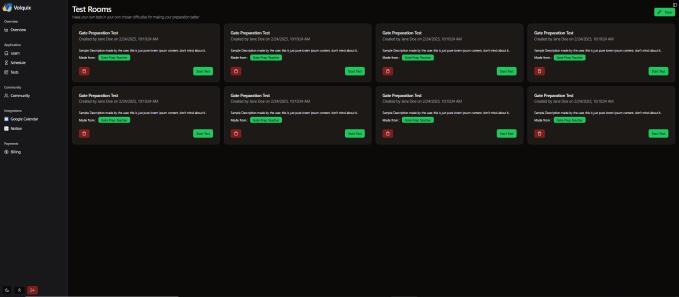
b) The test room interface allows users to create, man- age, and take customized tests for structured learning. Each test entry includes metadata such as creation date, test source, and description, ensuring an organized approach to exam preparation.:

International Research Journal of Engineering and Technology (IRJET) e-ISSN: 2395-0056
Volume: 13 Issue: 01 | Jan 2026 www.irjet.net p-ISSN: 2395-0072
c) The billing dashboard provides users with an overview of their current subscription plan, payment history, and upgrade options. It ensures transparency in financial transactions by displaying past payments, next billing dates, and available features.
Low-level design(LLD)isa crucial phasein the softwaredevelopment lifecycle that focusesonthe internal architectureand componentsofanapplication.Inbuildinganapplication,theLLDphasebreaksdownthehigh-levelfeaturesandrequirements into specific, manageable modules and classes. It defines the structure, methods, data flow, and interactions between individualcomponentswithinthesystem.Thisincludesdetailedspecificationsfordatabases,algorithms,datastructures,and userinterfaceelements.
Forexample,inawebapplication,theLLDwilloutlinehow individual components like APIs, controllers, views,andmodels interact.Itwillspecifyhow dataishandledthroughdifferentlayers,fromthefrontendtothebackend,andhowthedatabase schema is structured for efficient querying and storage. Furthermore, LLD ensures that all edge cases are addressed and that error handling, logging, and security mechanisms (e.g., authentication and authorization) are well- implemented. By providingclearguidancefordevelopers,low-leveldesignservesasablueprintforcodingandtestingandhelpsmitigaterisks suchasperformancebottlenecks,datainconsistency,andsecurityvulnerabilities.
In essence, low-level design forms the technical foundation upon which an application is developed, ensuring that it is both scalableandmaintainablewhilealsomeetingfunctionalandnon-functionalrequirements.
Django, Flask, and FastAPI applications due to its high-speed data retrieval and support for multiple data structures such as strings,lists,hashes,andsets.Inasystemhandlingteacherservices,testingmodules,andstudyplangeneration,cachingplays avitalroleinreducingdatabaseload,minimizingAPIlatency,andenhancingtheoveralluserexperience.Byutilizingkey-value storage,Redisensuresthatfrequentlyaccesseddata,suchasstudymaterials,quizresults,andstudentprogressreports,canbe retrievedinstantaneouslywithoutrepeatedlyqueryingthebackenddatabase.
In a Django-based teacher service, caching helps store preprocessed lecture materials, AI-generated explanations, and frequently accessed course content. When a student requests a study topic, instead of querying the Post greSQL or MongoDBdatabase,Redisservesthedatadirectlyfrommemory,cuttingdownonresponsetime.Djangoprovidesbuilt-incaching mechanisms through Django Cache Framework, al- lowing seamless integration with Redis. For dynamic content, template fragmentcachingstoresportionsofHTMLtemplates,ensuringthatelementssuchasnavigationbars,recentactivityfeeds,and frequentlyusedqueriesloadinstantly.
In the Flask-based testing service, caching improves performance by storing quiz structures, previous test attempts, and frequentlyusedquestionbanks.Redisenablessession-basedcachingwhereuserauthenticationtokensandexamprogressare temporarily stored, reducing the need for repeated authentication checks. Flask’s Flask-Caching extension integrates with Redis to implement function-level caching, ensuring that expensive computations, such as AI-powered test evaluations and scoring mechanisms, do not overload the server. Addition- ally, Redis supports publish-subscribe (Pub/Sub) mechanisms, enablingreal-timenotificationsabouttestcompletion,gradeupdates,orupcomingassessments.
For the FastAPI-driven study plan generator, caching optimizes the retrieval of personalized learning paths and rec-
Algorithm
Require: APIrequesttype
Ensure: Correctserviceinstantiation
Step1 - function SERVICEFACTORY(requestType)
Step2 - if requestType==”User” then
Step3-Return UserService
Step4 - else if requestType ==”Auth” then
International Research Journal of Engineering and Technology (IRJET) e-ISSN: 2395-0056
Volume: 13 Issue: 01 | Jan 2026 www.irjet.net p-ISSN: 2395-0072
Step5-Return AuthService
Step6 - else
Step7-Return”Invalidrequest”
Step8 - end if
Step9 - end function
Step10-service = ServiceFactory(”User”)
Step11-service.processRequest()=0
Cachingisacriticaloptimizationtechniqueinwebap-plications,significantlyimprovingresponsetimesbystoringfrequently accessed data in memory. Redis (Remote Dictionary Server), an in-memory data store, is widely used for caching inommendation models. Since Fast API excels in asynchronous processing, Redis is used for storing precomputed AI model outputs, allowing study plans to be generated faster. Utilizing TTL (Time-To-Live) caching, Fast API ensures that temporary recommendations are refreshed periodically, preventing out- dated study plans. Redis also serves as a distributed cache, allowingmultipleinstancesofthestudyplangeneratortoaccesssharedcachedata,ensuringconsistencyacrossusersessions.
ArobustcachingstrategywithRedisinvolvesimplementingwrite-throughcachingforfrequentlyupdateddata,wherechanges arewrittenbothtothecacheandthedatabasesimultaneously. Incontrast,lazycaching(cache-aside)fetchesdataonlywhen necessary, reducing unnecessary cache storage. Additionally, Redis supports eviction policies, such as Least Recently Used (LRU)orLeastFrequentlyUsed(LFU),en-suringthatmemoryisefficientlymanagedwithoutexcessivecachebuildup.
BeyondAPI-levelcaching,RedisalsoenhancessearchfunctionalitywithintheAItutoringsystem.Storingpre-indexed search results in Redis drastically reduces lookup
Require: Requestdata,cachestore(Redis)
Ensure: FasterAPIresponses
Step1 - function
Step2 - if request in CACHE
Step3- then Return
Step4 - else
Step5-response=QueryDatabase
Step6-Returnresponse
Step7 - end if
Step8 - end function
Step9-FetchData(”Get UserProfile”) =0
Times,allowingstudentstoretrieverelevantcontentinstantly.Furthermore,sessioncachinginRediseliminatestheneedfor repeatedauthentication,maintainingpersistentusersessionsacrossDjango,Flask,andFastAPIservices.
ByintegratingRediscachingintotheteacher,testing,andstudyplangeneratorservices,thesystemachievesfasterresponse times,reducedserverload,andimprovedscalability.
Stances ForDjango’steacherservice,multipleGunicornwork- ers are deployed to manage concurrent requests, with Nginx distributingtheloadamongthem.Flask’stesterservice,beinglightweight,isdeployedusinguWSGIorGunicorn,whereNginx ensuresaneventrafficflow.FastAPI,knownforitsasynchronouscapabilities,runsmultipleUvicornworkers,al-lowinghighspeedrequesthandling.WhenastudentaccessestheAItutor,Nginxdirectstherequesttothecorrespondingservicebasedon predefined routing rules. If a teacher-related request is detected, it is routed to Django; if it pertains to a test or quiz, Flask handlesit;andifitinvolvesstudyplangeneration,FastAPIprocessestherequest.
International Research Journal of Engineering and Technology (IRJET) e-ISSN: 2395-0056
Volume: 13 Issue: 01 | Jan 2026 www.irjet.net p-ISSN: 2395-0072
To implement load balancing, Nginx upstream configu- rations define backend servers running these services. The roundrobinmethodensuresthatrequestsaredistributedse- quentially,whereastheleastconnectionsmethoddirectstraffictothe least burdened server. If one instance becomes un- responsive, Nginx automatically reroutes traffic to a healthy instance, ensuringfaulttolerance.Additionally,ratelimitingandcachingmechanismswithinNginxreducelatency,improv-ingresponse times for frequently accessed data such as quiz results, study plans, and educational resources.Caching ensures that AIpowered tutoring remains efficient,seamless, and responsive, ultimately enhancing the studentlearningexperiencewhile optimizingbackendperformance.
Load balancing is an essential mechanism in distributed applications to ensure high availability, scalability, and optimal resourceutilization.Inasystemhandlingmultiplemicroservices, such as a teacher service, tester service, and studyplan generator, load balancing efficiently distributes incoming requests among multiple application instances. Nginx, a highperformancereverseproxyandloadbalancer,playsacriticalroleinhandlingtheseAPIservicesbyevenlydistributingtraffic, preventingserveroverload,andenhancingfaulttolerance.Byleveraginground-robin,leastconnections,orIPhashalgorithms, Nginxensuresthateachrequestisroutedtotheappropriatebackendservice,optimizingresponsetimesandserverhealth.
In a typical micro service-oriented architecture, where Django powers the teacher service, Flask manages the tester service, and FastAPI runs the study plan generator, Nginx is configured to balance the traffic between multiple instances of each service.Theteacherservice,builtwithDjango,handlesfunctionalitiessuchasretrievingstudymaterials,assistinginlectures, andgeneratingAI-poweredexplanations.Thetesterservice,developedusingFlask,isresponsibleforcreating,managing,and grading assessments. Meanwhile, the study plan generator, powered by FastAPI, dynamically designs personalized learning schedules based on student progress. Since these services cater to different workloads and user requests, an efficient load balancingstrategypreventsperfor-mancebottlenecks.
Nginxoperatesasareverseproxy,receivingclientrequestsand forwarding them to the appropriate backend server in-
Require: Incoming APIRequests
Ensure: Efficientrequestdistribution
Step1-Initialize ServerList withactiveservers
Step2 - function DISTRIBUTEREQUEST(request)
Step3-selectedServer= RoundRobin(ServerList)
Step4-ForwardrequesttoselectedServer
Step5-Returnresponse
Step6 - end function
Step7-DistributeRequest(”UserLogin”)=0
ByintegratingSSLtermination,Nginxsecurescommunicationbetweenclientsandthebackendservices,encryptingsensitive student and teacher data. It also compresses API responses, reducing bandwidth usageandenhancing efficiency. Moreover, with WebSocket support, real-time updates on test results and study plan modifications can be efficiently managed. The implementation of auto-scaling policies allows dynamic provisioning of additional backend instances during peak usage, ensuringseamlessoperationevenduringhigh-trafficperiodssuchasexamseasons.
The combination of Nginx load balancing, Django, Flask, and FastAPI ensures that the AI tutoring system remains scalable, reliable,andoptimized.Byeffectivelydistributingtraffic,handlingfailuresgracefully,andimprovingrequestefficiency,Nginx playsacrucialroleinenhancingtheteacher,tester,andstudyplangeneratorservices,therebycreatingarobustandefficient AI-powerededucationalecosystem.
International Research Journal of Engineering and Technology (IRJET) e-ISSN: 2395-0056
Volume: 13 Issue: 01 | Jan 2026 www.irjet.net p-ISSN: 2395-0072
Thehigh-leveldesignoftheapplicationinvolvesthreecoreservices,eachdedicatedtospecificfunctionalities,alongwiththe managementofauthenticationanddatastorage.Thearchitectureincorporatesmultipletechnologiesandframeworksto ensureascalable,maintainable,andefficientsystem.
The function as a service was built using Python and lever- aged Gemini, an AI model, to provide advanced functionalities withinthesystem.Thisserviceisresponsibleforexecutingkeyapplicationfunctionssuchasprocessinguserinputs,triggering events, andmanagingtask executions. Flasks offerlightweight and flexible handling of requests, ensuring that the service is fastandresponsive.
• Timeline Generator Service:BuiltusingFlask,thisservicegeneratespersonalizedtimelinesforusersbasedontheir input. It uses Gemini to generate intelligent predictions and dynamic content. The service employs a highly efficient backendtoprocessdata,therebyensuringthatusersreceiveaccurateandtimelyinformation.
• Teacher Service: This service, built with Django and powered by Langchain, Chroma DB (a vector database), and Gemini, is responsible for handling teacher-related operations. Using the Retrieval-Augmented Generation (RAG) approach, the service leverages the power of Chroma DB for storing and retrieving embeddings and Langchain for managing workflows. Gemini is used for generating responses based on the retrieved information, enhancing the service’sperformancebyofferingcontext-awareandrelevantcontenttoteachers.
• Tester Service:BuiltusingFastAPI,CassandraDB,Langchain, and Gemini, the tester service is focusedontesting and validating various components of the application. Cassandra DB offers high scalability and availability, makingit suitableforhandlinglargeamounts of data generated during testing. Lang chain orchestrates the logic of the testing workflows,whereasGeminipro-videsintelligentcapabilitiestoanalyzeandgeneratetestresultsinrealtime.
Authentication is managed by App write, a Backend-as-a- Service (BaaS) solution. App write handles user authentication, cloudstorage,and SQLdatabasesforstructured data management.Additionally,App write functionsareused toexecute the server-sidelogic.ThesystemalsoincorporatesGzipcompressiontoensureefficientfilestorageandfastertransmissions.
The entire application was containerized using Docker to ensurescalabilityand ease ofdeployment.Eachofthe services (function and timeline generator, teacher, and tester services) runs in isolated Docker containers, providing portability and consistencyacrossdifferentenvironments.Docker’slightweight nature allows us to quickly spin up or scaledownservices based on demand, ensuring that we can handle varying workloadsefficiently.Containerizationalsosupportsamicro service architecture,whereeachserviceisindependentlydeployableandupgradable.Thismodularapproachallowseasyscalingand rapiditerationofspecificcomponentswithout affecting the entire system. This architecture provides a com- prehensive and modular approach, allowing each service to be independently scalable, while ensuring seamless integration across applications.Eachcomponentisdesignedtohandlespecifictaskswithminimaloverhead,ensuringasmoothandresponsive userexperience.
Toenhancetheuserexperienceandensurethatstudentsaremotivated,engaged,andproductive,ourapplicationleveragesa variety of advanced UI/UX design principles. These include micro-interactions, progress charts, an awards-based learning system, and a gamified experience, all of which work in tandem to create an engaging, intuitive, and effective learning environment.
1) Micro-Interactions: Micro-interactionsplayacrucialroleinimprovingtheoveralluserexperiencebyprovidingsub-tle yet impactful feedback for user actions. In our application, micro-interactions are used throughout the interface to guide
International Research Journal of Engineering and Technology (IRJET) e-ISSN: 2395-0056
Volume: 13 Issue: 01 | Jan 2026 www.irjet.net p-ISSN: 2395-0072
students in their learning journey. For example, when a student completes a task or quiz, a smooth animation and a brief confirmation message appear, confirming their achievement. These micro-interactions help to keep users informed and engagedwithoutoverwhelmingthem,providingasenseofprogressionandaccomplishment.
2) Progress Charts: Progress tracking is an essential fea- ture for motivating students and keeping them on track with theirlearninggoals.Ourapplicationintegratesvisuallyappeal-ingprogresschartsthatdisplaykeymetricssuchascompleted lessons,quizscores,andoverallcourseperformance.Thesechartsareinteractiveandprovidestudentswithreal-timeinsights intotheirprogress.Byofferingaclearvisualization oftheirachievements,studentsareencouragedtocontinuetheirefforts, improving their engagementandproductivity.Additionally,theprogresschartsare customizable,allowingstudents to focus ontheareas wheretheyneedimprovement.
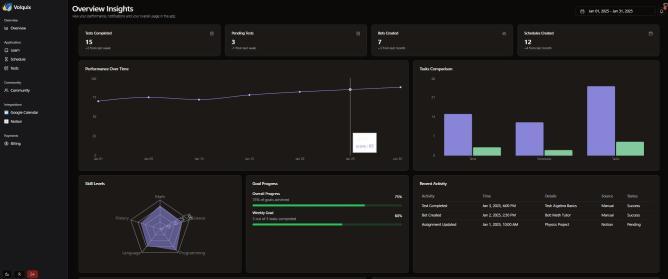
Fig.4. OverviewDashboardofAI-AssistedTutoringSystem:Thedashboard providesinsightsintouserperformance,test completion,andscheduling activities.Itvisualizesperformancetrends,skilllevels,taskcomparisons,and goalprogress, enablingdata-driventutoringenhancements.
3) Awards-Based Learning System: To further drive mo- tivation and engagement, the application incorporates an awardsbasedlearningsystem.Asstudentscompletevariousmilestones,suchasfinishinglessons,completingassignments,orscoring highon quizzes,they earn badges,certificates,or other formsofrecognition. These awardsnotonly providestudentswith a sense of achievement but also create an environment where learning is rewarded. The awards-based system encourages studentstomaintainconsistenteffort,promotingcontinuouslearningandimprovement.
4) Gamified Experience: Ourapplicationintegratesgamificationtechniquestocreatean interactiveandenjoyablelearning experience. Students can unlock achievements, progress through levels, and compete in challenges that align with their learning goals. The gamified experience includes ele- ments such as leaderboards, time-based challenges, and re- ward systems that make the learning process both fun and productive. By transforming the learning environment into a gamelike experience, students are more likely to stay engaged, motivated, and driven to complete their learning tasks. This gamificationapproachfostersasenseoffriendlycompetitionandachievement,turninglearningintoanexcitingandrewarding adventure.
5) Conclusion: By incorporating micro-interactions, progress charts, an awards-based learning system, and a gamified experience,ourapplicationaimstocreateamoreengagingandrewardingeducationalenvironment.Thesedesignfeaturesnot only enhance the overall UI/UX but also contribute to boosting student productivity, motivation, and long-term engagement withthelearningcontent.
Wewouldliketoextendoursincerethankstoalltheindi-vidualsandorganizationswhohavesupportedthedevelopmentof ourapplication.Thesuccessfulcompletionofthisprojectwouldnothavebeenpossiblewithoutthecollaborativeeffortsofour talentedteamandtheinvaluablecontributionsofourstakeholders.
Special thanks to the research community for their con- tinued advancements in AI, machine learning, and education technology, which served as the foundation for many ofthefeaturesinourapp.Wealsoappreciatetheextensiveresources provided by Appwrite, LangChain, and other third- party services that enabled us to implement powerful backend functionalities,suchasauthentication,datastorage,andinte-grationwithAImodels.
International Research Journal of Engineering and Technology (IRJET) e-ISSN: 2395-0056
Volume: 13 Issue: 01 | Jan 2026 www.irjet.net p-ISSN: 2395-0072
Additionally, we acknowledge the support of our aca- demic advisors and mentors, whose guidance has been crucial throughout the development process. Their insights into ed- ucational methodologies and user-centered design principles were instrumental in shaping the app’s features, such as the personalized learning experience and real-time feedback system.
Lastly,wethankourusersfortheirfeedback,whichhasdriventhecontinuousimprovementoftheapp.Theirinput has been invaluable in refining the user interface, enhancingthe gamification aspects, and optimizing the overall userexperience.
VIII. CONCLUSION
TheintegrationofRetrieval-AugmentedGeneration(RAG)intoeducational AI systemsmarksa significantadvancementin personalized learning. This research introduces an AI-powered tutor that enables students to interact with educational content dynamically, offering simplified explanations, intelligent question answering, and adaptive assessments. By leveraging AI-driven retrieval and generative techniques, thesystempersonalizeslearningexperiences,tracksprogress,and provides data-driven study plans to optimize student outcomes. Beyond traditional learning methods, this approach fosters self-paced education, ensuring that learners receive tailored guidance based on their individual needs. The ability to generate customized tests with adjustable difficulty levels and grading mechanisms enhances engagement and knowledge retention. As AI-driven education continues to evolve, the proposed system sets a foundation for more adaptive, interactive, and intelligent learning platforms, bridging gaps incomprehensionandmakingqualityeducationmoreaccessible.
[1]Agarwal,S.,Laradji,I.H.,Charlin,L.,& Pal,C.(2024).LitLLM:AToolkitforScientific LiteratureReview.arXivpreprint arXiv:2402.01788.https://arxiv.org/abs/2402.01788
[2] Alshammari, S., Basalelah, L., Rukbah, W. A., Alsuhibani, A., & Wijesinghe, D. S.(2023). KNIMEZoBot: Enhancing Literature Review with Zotero and KNIME OpenAIIntegration using Retrieval-Augmented Generation. arXiv preprint arXiv:2311.04310.https://arxiv.org/abs/2311.04310
[3]Arora,D.,Kini,A.,Chowdhury,S.R.,Natarajan,N.,Sinha,G.,&Sharma,A.(2023).Gar-meets-ragparadigmforzero-shot informationretrieval.arXivpreprintarXiv:2310.20158.https://arxiv.org/abs/2310.20158
[4]Boyd,J.(2015).Automaticmetadataextraction-Thehighenergyphysicsusecase(Master’sthesis,EcolePolytechnique, Lausanne).Retrievedfromhttps://cds.cern.ch/record/2039361.Presented04Sep2015.
[5]S. Ranjithkumar, G. Nallavan, and S. Sugumar, "Implementation of an Intelligent Real-Time Squat Detection and PerformanceEvaluationSystemUsingComputerVisionandPoseEstimationTechniques,"IconicRes.Eng.J.,vol.9,no. 6,2025 https://doi.org/10.64388/IREV9I6-1712786
[6]Duˇsek, R., Galias, C., Wojciechowska, L., & Wawer, A. (2023, September). Improving domain-specific retrieval by NLI fine-tuning. In 2023 18th Conference on Computer Science and Intelligence Systems (Fed CSIS) (pp. 949-953). IEEE. https://doi.org/10.15439/2023F7569
[7]Es, S., James, J., Espinosa-Anke, L., & Schockaert, S. (2023). Ragas: Automatedevaluation of retrieval augmented generation.arXivpreprintarXiv:2309.15217.https://arxiv.org/abs/2309.15217
[8]Gao,T.,Yen,H.,Yu, J.,&Chen,D.(2023).Enablinglarge languagemodelstogeneratetextwithcitations.arXiv preprint arXiv:2305.14627.https://arxiv.org/abs/2305.14627
[9]Gunasekar,S.,Zhang,Y.,Aneja,J.,Mendes,C.C.T.,Del Giorno,A.,Gopi,S.,...&Li,Y.(2023).Textbooksareall youneed. arXivpreprintarXiv:2306.11644.https://arxiv.org/abs/2306.11644
[10] Han, W., Shen, J., Liu, Y., Shi, Z., Xu, J., Hu, F., ... & Ge, M. (2024). LegalAsst: Human-centered and AI-empowered machine to enhance court productivity and legal as-sistance. Information Sciences,679, 121052. https://doi.org/10.1016/j.ins.2024.121052
International Research Journal of Engineering and Technology (IRJET) e-ISSN: 2395-0056
Volume: 13 Issue: 01 | Jan 2026 www.irjet.net p-ISSN: 2395-0072
[11] Sentence Transformers. (2021). all-mpnet-base-v2 [Pre-trained model]. Hug-ging Face. Retrieved from https://huggingface.co/sentence-transformers/all-mpnet-base-v229
[12] Izacard, G., & Grave, E. (2020). Leveraging passage retrieval with generative modelsfor open domain question answering.arXivpreprintarXiv:2007.01282.https://arxiv.org/abs/2007.01282
[13] Kaesberg,L.B.,Ruas,T.,Wahle,J.P.,&Gipp,B.(2024).CiteAssist:AsystemforautomatedpreprintcitationandBibTeX generation. arXiv preprint arXiv:2407.03192.https://arxiv.org/abs/2407.03192[14] Kamradt, G. (2024). Semantic chunking.FullStackRetrievalTutor
2026, IRJET | Impact Factor value: 8.315 | ISO 9001:2008