International Research Journal of Engineering and Technology (IRJET) e-ISSN: 2395-0056
Volume: 13 Issue: 03 | Mar 2026 www.irjet.net p-ISSN: 2395-0072
International Research Journal of Engineering and Technology (IRJET) e-ISSN: 2395-0056
Volume: 13 Issue: 03 | Mar 2026 www.irjet.net p-ISSN: 2395-0072
Mr. R.K. Shewale
1 , Yamini Ahire2, Yamini
Bagul3, Roshani Padvi4
, Bhumika Ahire5
1 Lecturer, Department of Civil Engineering, MET-BKC Institute of Technology (P), Nashik, M.H., India
2345 Diploma Student, Department of Civil Engineering, MET-BKC Institute of Technology (P), Nashik, M.H., India
ABSTRACT - Concrete is widely used in construction, but cement productioncauses significantenvironmentalpollution and carbon emissions. Silica fume, an industrial by-product rich in silica, is used as a partial replacement (5–15%) of cement. It reacts with concrete to form additional C-S-H gel, which enhances the strength, durability, and overall performance of concrete while reducing its permeability. The use ofsilica fume also improves resistance to chemicalattacks such as sulphates andchlorides, therebyincreasingtheservice life of structures. Furthermore, it enhances the bond between cement paste and aggregates, leading to better mechanical properties. This material also helps in producing highperformance and eco-friendly concrete by reducing cement consumption and utilizing industrial waste effectively, contributing to sustainable construction practices.
Silicafumeisanextremelyfinepowdermaterialobtainedas a by-product during the manufacture of silicon metal or ferrosilicon alloys in electric arc furnaces. It is mainly composed of very fine particles of silicon dioxide (SiO₂). Because of its very small particle size, it is widely used in cementconcreteasapartialreplacementforcement.
1.2. OBJECTIVE OF STUDY
[1] Improvedurability
[2] Reducepermeability(waterentry)
[3] Improvebondingbetweenmaterials
[4] Useindustrialwasteeffectively
[5] Reducecementuse(economical)
[6] Increasestrength(compressive&tensile)
[1] Tostudythepropertiesofsilicafume.
[2] Toevaluateitssuitabilityasapartialreplacementfor cement.
[3] Toanalyzetheeffectonworkabilityofconcrete.
[4] To determine compressive strength with different percentagesofsilicafume.
1.4. Methodology
[5] Collectmaterialslikecement,aggregates,water,and silicafume.
[6] Replaceasmallpercentageofcementwithsilicafume.
[7] Prepareandmixtheconcreteproperly.
[8] Casttheconcreteinmolds.
[9] Curethespecimensforrequireddays.
2.1 Introduction
Previous studies indicate that the use of silica fume as a partial replacement for cement significantly improves the strengthanddurabilityofconcrete.Itenhancescompressive, tensile, and flexural strength due to its high pozzolanic activityandfineparticlesize.However,anincreaseinsilica fumecontentmayreducetheworkabilityofconcrete.Most researchsuggeststhattheoptimumreplacementlevellies between8%and12%,whichprovidesthebestperformance. Additionally, silica fume reduces permeability, increases resistance to chemical attack, and contributes to the developmentofhigh-performanceandsustainableconcrete.
2.2. Review and studies of various Authors
2.2.1. Study by Sudhansu Tak et al. (2023)
SudhansuTakandco-authorsinvestigatedtheeffectofsilica fume as a partial replacement of cement in concrete with replacement levels of 0%, 5%, 8%, 11%, and 15%. Their resultsshowedthatcompressivestrengthincreasedwiththe additionofsilicafumeupto11%replacement,afterwhich the strength started decreasing. They also observed improvement in split tensile and flexural strength, while workabilitydecreasedwithhighersilicafumecontent.
2.2.2. Study by Md. Rejoan Chowdhury (2025)
Chowdhury studied silica fume in recycled aggregate concrete(RAC)withreplacementlevelsof0%,4%,8%,12%, and16%.Theresearchconcludedthatsilicafumeimproved bothearlyandlateragemechanicalpropertiesofconcrete. The optimum replacement level was found to be around
International Research Journal of Engineering and Technology (IRJET) e-ISSN: 2395-0056
Volume: 13 Issue: 03 | Mar 2026 www.irjet.net p-ISSN: 2395-0072
12%, which gave the highest compressive and tensile strength.
2.2.3. Study by B. Pranav Naik et al.
PranavNaikandco-researchersstudiedM25gradeconcrete withsilicafumereplacementlevelsbetween8%and12%. Their findings indicated that silica fume improves compressive strength and flexural strength due to its pozzolanicreactionandabilitytorefineporesinconcrete. The best performance was observed at about 10% silica fumereplacement.
2.2.4. Study by Herliati Rahman and Puput Dwi Rahayu
RahmanandRahayuinvestigatedtheuseofsilica fume in self-compactingconcrete(SCC)withreplacementlevelsof 0%, 5%, 10%, and 15%. Their research found that silica fume improved compressive strength and enhanced the compactness of concrete due to the finer particles filling voidsinthemix.
2.2.5. Review by Abhinav Shyam et al. (2017)
Abhinav Shyam and co-authors conducted a literature reviewonsilicafumeinconcreteandconcludedthatsilica fume significantly improves strength, durability, and resistancetoaggressiveenvironments.Theyalsohighlighted its role in producing high-performance concrete and reducingindustrialwastedisposalproblems.
2.2.6. Kumar & Dhaka (2016)
writeaReviewpaperonpartialreplacementofcementwith silicafumeanditseffectsonconcreteproperties.Themain parameterinvestigatedinthisstudyM-35concretemixwith partial replacement bysilica fume with varying0,5,9, 12 and15%byweightofcementThepaperpresentsadetailed experimental study on compressive strength, flexural strength and split tensile strength for 7 days and 28 days respectively. The results of experimental investigation indicatethattheuseofsilicafumeinconcretehasincreased thestrengthanddurability
3. DETAIL OF WORKING AND PROCESSES
Inthisproject,silicafumewasusedasapartialreplacement ofcementtostudyitseffectonthestrengthofconcrete
3.1. Selection and Collection of Materials
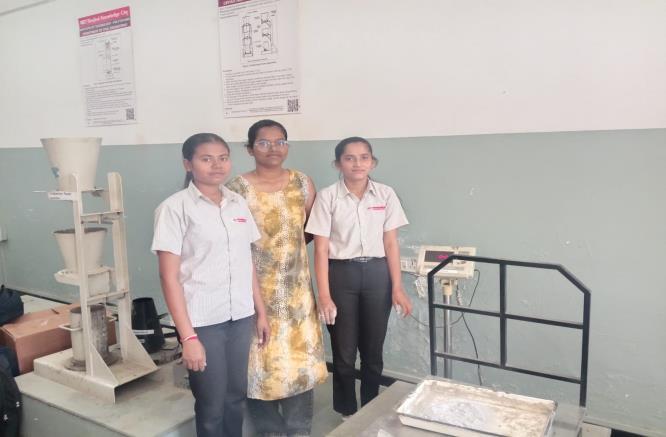
The first step is to collect the required materials such as cement,fineaggregate(sand),coarseaggregate,water,and silica fume. The materials should be clean and free from impurities.
3.2. Mix Proportion and Replacement
Asuitableconcretemixdesignispreparedaccordingtothe required grade of concrete. In this process, a small percentage of cement is replaced by silica fume. The replacementusuallydoneindifferentpercentagessuchas 8%,12%,and16%ofthetotalweightofcement.Thishelps in studying the effect of silica fume on the strength and durabilityofconcrete.WetakenthemixproportionasM20 gradewhoseratiois(1:1.5:3).
3.3. Mix Proportion: M20concretewithratio1:1.5:3is used; cement is partially replaced with silica fume at 8%, 12%,and16%.
3.4. Water–Cement Ratio: Awater–cementratioofabout 0.5wasusedtoobtainproperworkabilityofconcrete.
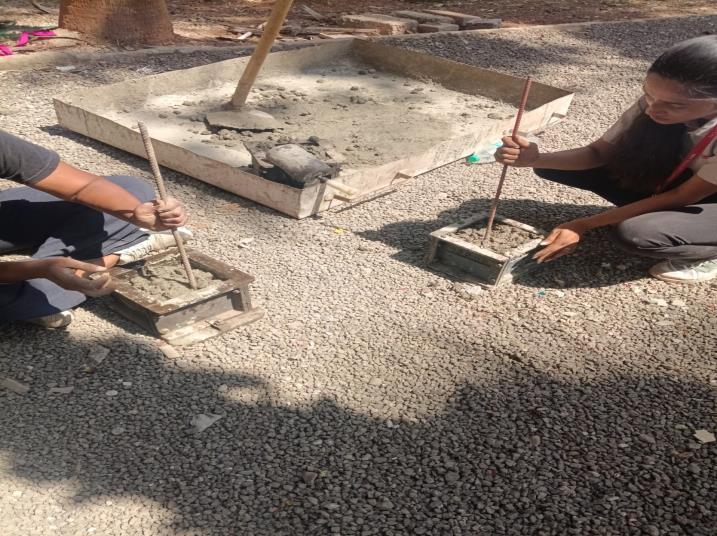
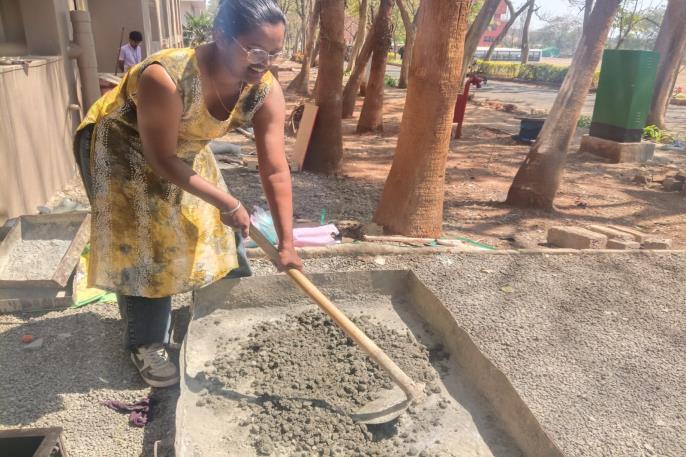
After batching, all materials are mixed to get a uniform concrete.First,drymaterials(cement,silicafume,fineand coarseaggregates)aremixedproperly.Thenwaterisadded gradually and mixed until a homogeneous and workable concreteisobtained.

FIG.No. 3.5.MIXINGOFCONCRETE
International Research Journal of Engineering and Technology (IRJET) e-ISSN: 2395-0056
Volume: 13 Issue: 03 | Mar 2026 www.irjet.net p-ISSN: 2395-0072
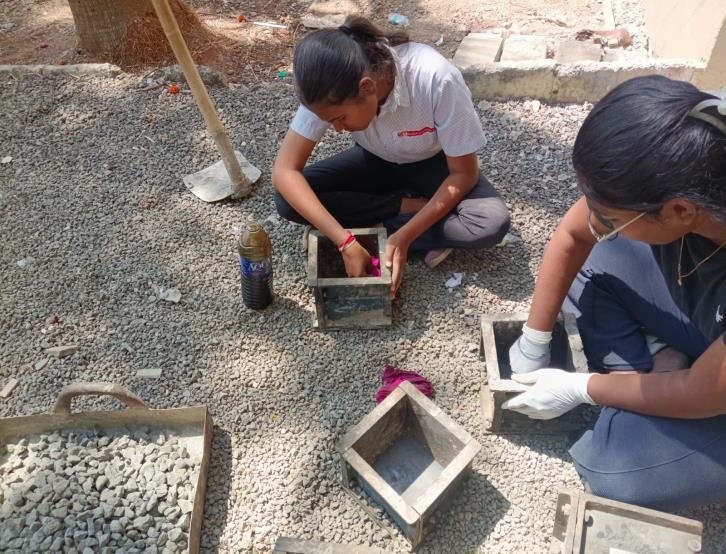
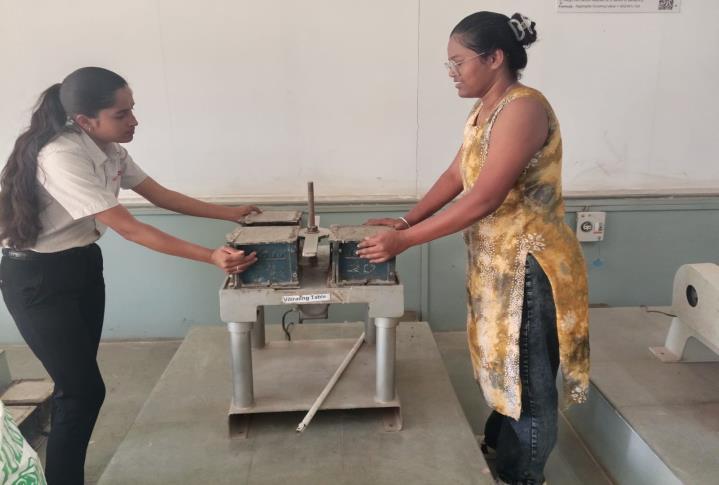
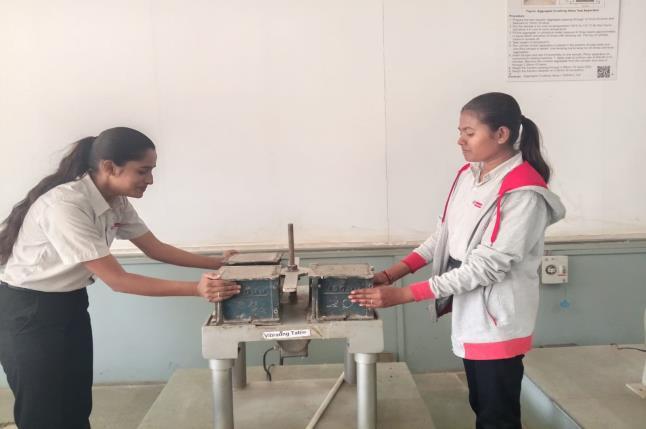
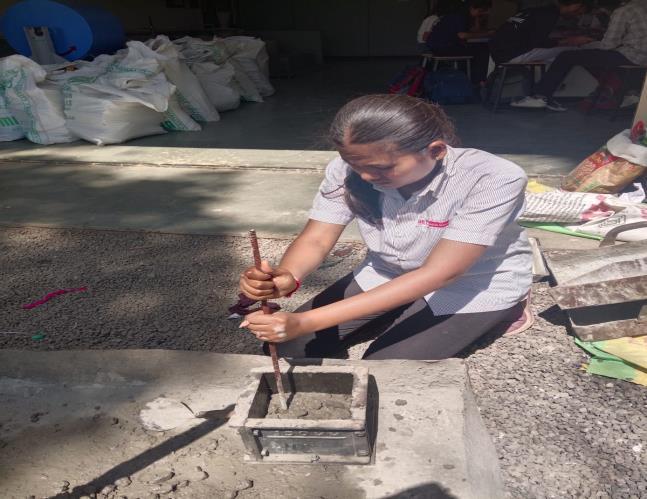
After proper mixing, the concrete is poured into standard cubemoldsofsize150mm×150mm×150mm.Themolds are filled in layers and each layer is compacted using a tamping rod or vibration to remove air voids. The top surfaceisleveledandfinishedsmoothly.
3.7.
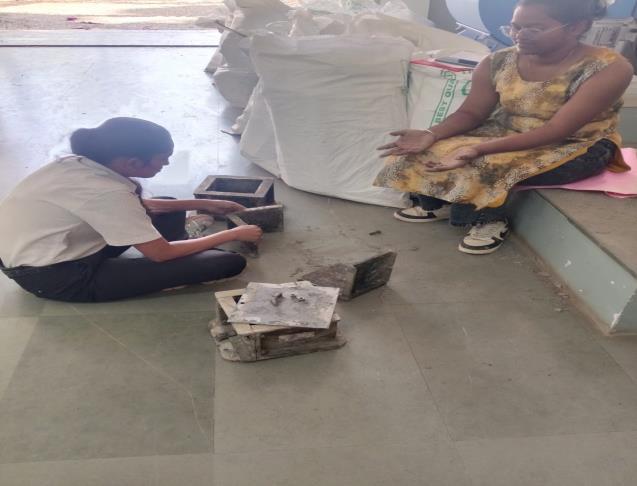
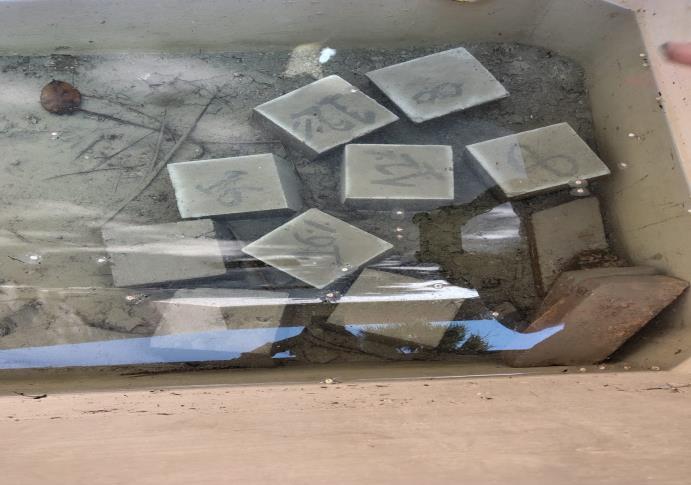
Aftercasting,themoldsarekeptundisturbedforabout24 hours at room temperature. After that, the specimens are removed from the molds and placed in clean water for curing.Curingisusuallydonefor7daysand28daystoallow properhydrationandstrengthdevelopment.
3.8.
Aftercuring,theconcretecubesaretestedforcompressive strengthusingaCompressionTestingMachine(CTM).Load isappliedgraduallyuntilthecubefails.Themaximumload carried by the specimen is recorded and the compressive strengthiscalculated.
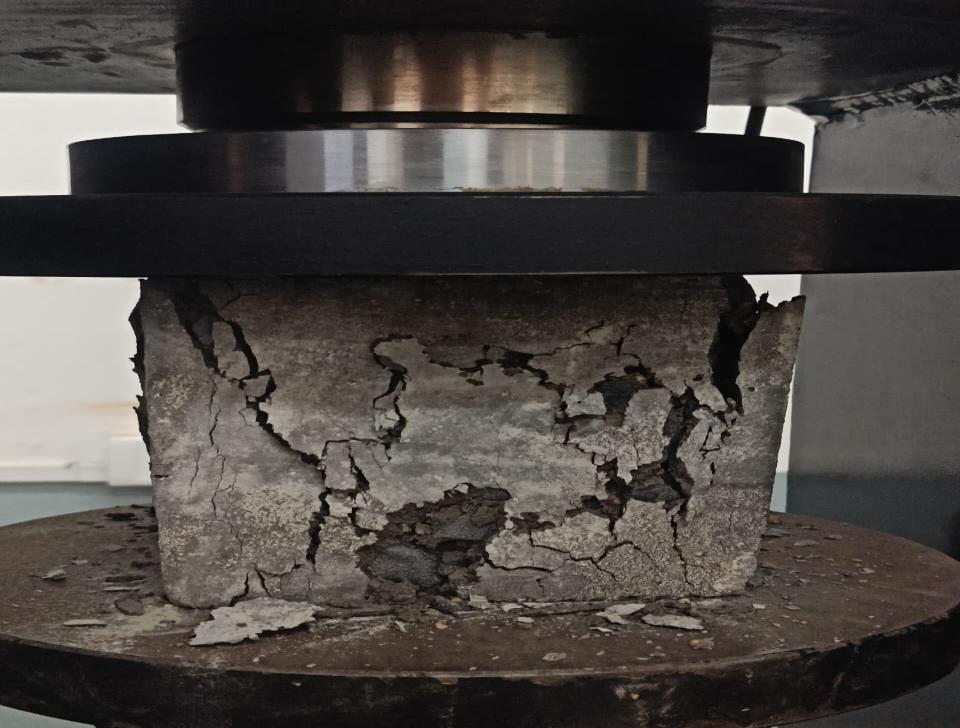
3.8. TESTINGOFCONCRETE
3.9.
Aftercuringtheconcretecubesfor7daysand28days, the compressive strength test was conducted using a CompressionTestingMachine(CTM).Theresultsobtained for different percentages of silica fume replacement are summarizedbelow.
Volume: 13 Issue: 03 | Mar 2026 www.irjet.net
3.9.1. Compressive Strength Test Results
3.9.2. Result
From the experiment, it is concluded that partial replacement of cement with silica fume improves the strengthanddurabilityofconcrete,and12%replacement givestheoptimumresult.
4. RESULT AND APPLICATION
4.1. Result
Thecompressivestrengthtestresultsshowthataddingsilica fume as a partial replacement of cement increases the strength of concrete compared to normal concrete. The maximum strength is obtained at about 10–12% replacement, after which it slightly decreases but still remains higher than conventional concrete. Silica fume improves the density of concrete by filling pores and enhancingthebondbetweencementpasteandaggregates
4.2. Application
[1] Usedinhigh-strengthconcretestructures
[2] Usedinbridges,dams,andmarinestructures
[3] Used in high-rise buildings Used in industrial floors andpavements
[4] Used in water-retaining structures (reduces permeability)
[5] Usedinrepairandrehabilitationworks
5. CONCLUSION AND FUTURE SCOPE
5.1. CONCLUSION:
Silicafumeimprovesthestrengthanddurabilityofconcrete. Maximumcompressivestrengthisachievedatabout12% replacement. It fills voids and enhances bonding, making concretedenserandstronger.Hence,itisaneffectivepartial replacementforcementandreducescementusage.
5.2. Future Scope
Silicafumecanbewidelyusedforhigh-strengthanddurable concrete.Furtherstudiescanexploredifferentpercentages andcombinationswithmaterialslikeflyashorslag,along withlong-termdurabilityandenvironmentalbenefits.
6. REFERENCES
6.1. Books & Codes
1) PropertiesofConcrete–A.M.Neville(Longman).
2) Concrete Technology – M. S. Shetty (S. Chand Publishing).
3) Advanced Concrete Technology – Zongjin Li (Elsevier).
4) ASTMC1240–StandardSpecificationforSilicaFume UsedinCementitiousMixtures–ASTMInternational.
5) EN 13263-1 Silica Fume for Concrete – European Standard.
6.2. Research Journals & Papers
1. “EffectofSilica Fumeonthe DurabilityPropertiesof Concrete” – International Journal of Civil and StructuralEngineering.
2. “UseofSilicaFumeinConcrete:AReview”–Journalof MaterialsinCivilEngineering.
3. “Compressive Strength and Microstructure of Silica FumeConcrete”–ConstructionandBuildingMaterials Journal.
4. “Influence of Silica Fume on High-Performance Concrete”–AsianJournalofCivilEngineering.
5. “SustainabilityofConcretewithSilicaFume”–Journal ofCleanerProduction.
6.3. Websites & Technical Reports
i. TheConcreteSociety(UK)–TechnicalReportonUse ofSilicaFumeinConcrete.
ii. PortlandCementAssociation(PCA)–GuidetoUsing SilicaFumeinConcrete.
iii. ACI (American Concrete Institute) Documents –Report234RonSilicaFumeUse.
International Research Journal of Engineering and Technology (IRJET) e-ISSN: 2395-0056
Volume: 13 Issue: 03 | Mar 2026 www.irjet.net p-ISSN: 2395-0072