
International Research Journal of Engineering and Technology (IRJET) e-ISSN: 2395-0056
Volume: 13 Issue: 05 | May 2026 www.irjet.net p-ISSN: 2395-0072
International Research Journal of Engineering and Technology (IRJET) e-ISSN: 2395-0056
Volume: 13 Issue: 05 | May 2026 www.irjet.net p-ISSN: 2395-0072
Aniket Tanaji Pawar, Sujit Vijay Zambare, Prathmesh Sanjay Patil, Vasim Jahangir Tamboli
¹²³Department of Electronics and Computer Science Engineering
Padmabhooshan Vasantraodada Patil Institute of Technology, Maharashtra, India
Abstract-The Internet of Things (IoT) has transformed traditional household systems into smart and intelligent environments. Kitchen safety is one of the major concerns in homes due to gas leakage, fire hazards, and manual monitoring problems. The proposed IoT-Based Smart Kitchen System provides an automated solution for gas leakage detection, safety monitoring, and remote alert generation. The system uses NodeMCU ESP8266, MQ-2 gas sensor,GSMmodule,relaymodule,exhaustfan,loadcell,and buzzer for real-time monitoring and control. The MQ-2 sensor continuously detects harmful gases such as LPG and methane. When the gas level exceeds the predefined threshold, thesystemactivatesabuzzeralarm,turnsON the exhaust fan automatically, and sends emergency notifications through GSM and IoT platforms. The proposed system improves kitchen safety, reduces accidents, and minimizes manual monitoring. It is cost-effective, energy efficient, and suitable for domestic as well as commercial kitchens.
Keywords: IoT, Smart Kitchen, Gas Leakage Detection, NodeMCU, MQ-2 Sensor, GSM Module.
1. Introduction:
IoT technology has introduced automation and smart monitoring into modern homes. Smart kitchens are becoming an important part of smart home systems because they improve safety, efficiency, and convenience. In traditional kitchens, gas leakage accidents may cause firehazards,explosions,andhealthproblems.Therefore,a reliablemonitoringandalertsystemisrequired.
The IoT-Based Smart Kitchen System continuously monitors kitchen conditions using sensors and internet connectivity.ThesystemdetectsgasleakageusingtheMQ2 gas sensor and automatically performs safety actions such as activating the exhaust fan, turning ON the buzzer, andsendingemergencynotifications.
The project also uses a load cell sensor to monitor gas cylinder weight and notify users when the gas level becomes low. The NodeMCU ESP8266 controller enables wireless communication and remote monitoring through mobileapplications.
The proposed system provides an efficient, low-cost, and user-friendly solution for kitchen automation and safety
management.
2. Problem Statement:
LPG gas is widely used in homes, hotels, and restaurants forcookingpurposes.Gasleakageaccidentsareincreasing due to improper monitoring and delayed detection. Existingsystemsmainlydependonmanualmonitoringand donotprovidereal-timealertsorautomaticsafetyactions.
Therefore, there is a need for an IoT-based smart kitchen systemthatcanautomaticallydetect gasleakage,generate emergency alerts, and improve kitchen safety using automationtechnology.
3. Objectives:
The main objective of the proposed IoT-Based Smart Kitchen System is to improve kitchen safety and automation using IoT technology. The system is designed to continuously monitor kitchen conditions, detect gas leakage, and provide immediate safety responses. It also aimstoreducemanualmonitoringandminimizetheriskof accidentsthroughreal-timealertgenerationandautomatic controlmechanisms.
1. TodetectgasleakageusingMQ-2gassensor.
2. Toprovidereal-timekitchenmonitoring.
3. To send emergency alerts using GSM and IoT platforms.
4. To automatically activate the exhaust fan during leakage.
5. Tomonitorgascylinderweightusingaloadcell.
6. Toreduceaccidentsandimprovekitchensafety.
4. Literature Review:
Several researchershave developedsmartkitchenand gas leakagedetectionsystemsusingIoTtechnology.
J. Tsado et al. proposed a GSM-based gas leakage alert system for emergency notification through mobile communication. The system improved kitchen safety by generatingalertsduringgasleakageconditions.
M.Eisenhaueretal.discussedambientintelligencesystems
International Research Journal of Engineering and Technology (IRJET) e-ISSN: 2395-0056
Volume: 13 Issue: 05 | May 2026 www.irjet.net p-ISSN: 2395-0072
using wireless sensors and IoT devices for smart home automation. Their work explained the importance of sensornetworksandremotemonitoringsystems.Research by the European Union on IoT discussed applications of IoTinsmarthomes,healthcare,andautomationsystems.
Existingsystemsmainlyfocusongasleakagedetectionbut lackautomaticventilationandremotemonitoringfeatures. The proposed system overcomes these limitations by integrating IoT monitoring, GSM alerts, automatic exhaust control,andgaslevelmonitoring.
5. Proposed System
TheproposedIoT-BasedSmartKitchenSystemisdesigned to improve kitchen safety using IoT and automation technologies. The system continuously monitors the kitchen environment using sensors and automatically respondsduringemergencyconditions.
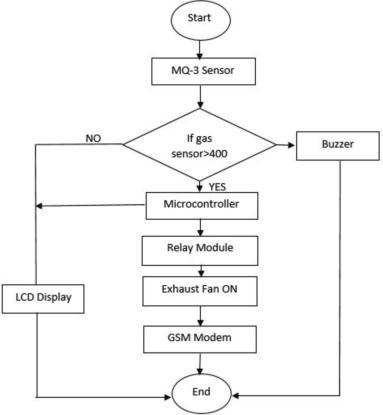
The MQ-2 gas sensor detects harmful gases such as LPG andmethane.Thesensoroutputiscontinuouslymonitored by the NodeMCU ESP8266 controller. When gas concentration exceeds the threshold value, the controller activatesthebuzzeralarmandrelaymodule.
The relay module automatically switches ON the exhaust fantoremoveleakedgasfromthekitchen.Simultaneously, theGSMmodulesendsemergencySMSalertstoregistered users, while the IoT platform provides real-time notificationsthroughmobileapplications.
A load cell sensor is also integrated into the system to monitorgascylinderweightandnotifyuserswhenthegas levelbecomeslow.
Theproposedsystemprovides:
Real-timemonitoring
Automaticemergencyresponse
Remotenotificationsystem
Gascylindermonitoring
Improvedkitchensafety
6. Methodology:
The proposed system uses sensors, controllers, and communication modules to improve kitchen safety and automationThe MQ-2 gas sensor continuously monitors LPG and harmful gases in the environment. The sensor sends data to the NodeMCU controller. When the gas concentration exceeds the threshold value, the controller activates the buzzer and relay module.The relay module automatically switches ON the exhaust fan to remove leaked gas from the kitchen. Simultaneously, the GSM module sends emergency SMS alerts to the user. The IoT platform provides real-time monitoring using mobile applications
The load cell sensor measures gas cylinder weight and
informsuserswhenthegaslevelbecomeslow.
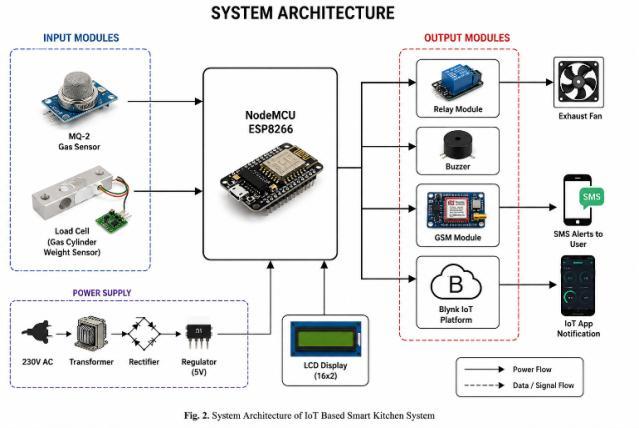
The system architecture consists of sensing, processing, communication,andsafetycontrolunits.
The MQ-2 gas sensor and load cell act as input sensing devices. These sensors are connected to the NodeMCU ESP8266 controller, which processes sensor data and controlsoutputdevices.
Thecontrollercommunicateswith:
Relaymodule
Exhaustfan
GSMmodule
Buzzer
IoTcloudplatform
The relay module controls the exhaust fan automatically during gas leakage conditions. The GSM module and IoT platformprovideremotealertsandnotifications.
This architecture ensures smooth communication, realtimemonitoring,andefficientemergencyresponse.
International Research Journal of Engineering and Technology (IRJET) e-ISSN: 2395-0056
Volume: 13 Issue: 05 | May 2026 www.irjet.net p-ISSN: 2395-0072
The proposed IoT-Based Smart Kitchen System is implemented using both hardware and software modules toachievereal-timegasleakagedetection,monitoring,and automatic safety control. The implementation process includes sensor integration, controller programming, communication setup, and testing of emergency response mechanisms.
The hardware section of the system consists of the followingcomponents:
NodeMCUESP8266
MQ-2GasSensor
RelayModule
GSMModule
ExhaustFan
Buzzer
LoadCell
LCDDisplay
Transformer
ConnectingWiresandPowerSupply
The MQ-2 gas sensor is placed near the gas stove or LPG cylinder to continuously monitor harmful gases such as LPG and methane. The sensor output is connected to the NodeMCUESP8266controller,whichprocessesthesensor datainrealtime.
The relay moduleisconnected to the exhaustfan andacts asanautomaticswitchingdevice.Whenevergasleakageis detected, the NodeMCU activates the relay module, which automatically turns ON the exhaust fan to remove leaked gasfromthekitchenenvironment.
A buzzer is used to provide an immediate audio alert during leakage conditions. The GSM module is integrated to send SMS alerts to registered users for emergency notification. The load cell is connected to monitor the weightofthegascylinderandidentifylowgasconditions.
TheLCDdisplayshowssystemstatusmessagessuchasgas level condition, leakage alerts, and fan status. A transformer and regulated power supply are used to providestablevoltagetoallhardwarecomponents.
Thesoftwareimplementationiscarriedoutusing:
ArduinoIDE
EmbeddedCProgramming
BlynkIoTPlatform
The program is developed using Embedded C in Arduino IDEanduploadedtotheNodeMCUcontroller.Thesoftware continuouslyreadssensorvaluesandcomparesthemwith predefinedthresholdlevels.
TheBlynkIoTplatformisusedforremotemonitoringand notification services. It allows users to monitor kitchen conditions through smartphones or web applications in realtime.
Thesoftwareperformsthefollowingoperations:
ReadingMQ-2sensorvalues
Detectinggasleakageconditions
Activatingbuzzeralarms
Controllingrelaymoduleandexhaustfan
SendingGSMalerts
UpdatingIoTdashboardnotifications
Monitoringgascylinderweight System Testing
The implemented system was tested under different gas leakage conditions to evaluate performance, response time, and reliability. LPG gas was carefully released near theMQ-2sensortoverifyleakagedetectioncapability.
Experimentaltestingconfirmedthat:
Thesensoraccuratelydetectedgasleakage
Thebuzzeralarmactivatedimmediately
Theexhaustfanoperatedautomatically
GSMalertsweresentsuccessfully
IoTnotificationswerereceivedinrealtime
The load cell monitored gas cylinder level accurately
The developed system demonstrated stable performance with low power consumption and fast emergency response, making it suitable for practical smart kitchen applications.
The developed smart kitchen system was tested under different conditions. The MQ-2 sensor successfully detected LPG gas leakage and generated alerts immediately.
Thebuzzeralarmandexhaustfanrespondedautomatically during gas leakage conditions. GSM alerts and IoT notificationsweresuccessfullysenttotheuser.
International Research Journal of Engineering and Technology (IRJET)
Volume: 13 Issue: 05 | May 2026 www.irjet.net
Theloadcell accuratelymeasuredgascylinder weight and indicated low gas conditions. The system demonstrated stable performance with low power consumption and fast responsetime.
The results show that the proposed system is reliable, efficient, and suitable for real-world kitchen safety applications.
1) J. Tsado, O. Imoru, S.O. Olayemi, “Design and Construction of a GSM Based Gas Leak Alert System”,IEEETransactions,2014.
2) M. Eisenhauer, P. Rosengren, P. Antolin, “A Development Platform for Integrating Wireless Devices and Sensors into Ambient Intelligence Systems”.
3) VisionandChallengesforRealizingtheInternetof Things,EuropeanUnion,2010.
220
10 Conclusion:
The IoT-Based Smart Kitchen System is an effective solutionforimprovingkitchensafetyandautomation.The system continuously monitors gas leakage using the MQ-2 sensor and provides immediate alerts through GSM and IoTtechnologies.
Automaticsafetyactionssuchasactivatingtheexhaustfan andbuzzerhelppreventaccidentsandimproveusersafety. Additional features such as gas level monitoring and remote notifications increase system efficiency and convenience.
The project is low-cost, user-friendly, and suitable for modern smart homes. Thus, the proposed system represents an important step toward safe and intelligent kitchenenvironments.
4) Dohr et al., “The Internet of Things for Ambient AssistedLiving”,ITNGConference,2010.
5) Apeh S.T., Erameh K.B., Iruansi U., “Design and Development of Kitchen Gas Leakage Detection andAutomaticGasShutOffSystem”,2014.
6) Sahu K., Mazumdar MSG., “Digitally Greenhouse Monitoring and Controlling System Based on EmbeddedSystem”,2012.
7) T.H Mujawar et al., “Development of Wireless Sensor Network System for LPG Gas Leakage DetectionSystem”,2015.