
International Research Journal of Engineering and Technology (IRJET) e-ISSN: 2395-0056
Volume: 13 Issue: 02 | Feb 2026 www.irjet.net p-ISSN: 2395-0072
International Research Journal of Engineering and Technology (IRJET) e-ISSN: 2395-0056
Volume: 13 Issue: 02 | Feb 2026 www.irjet.net p-ISSN: 2395-0072
Samir Vasantrao Nimbhore
Assistant Professor, Department of Electronic Science Shri Chhatrapati Shivaji Mahavidyalaya, Shrigonda, Ahilyanagar, Maharashtra
Abstract - The number of cars on the road is rising as a result of the world's population growth and the congested cities. One of the main challenges in cities is parking management. Research on the design of parking systems has been conducted in the past. On the other hand, smart parking systems continue to be in demand and are grabbing the attention of researchers as a possible improvement to satisfy contemporary demands. To enhance the global security system, it is essential to keep an eye on and control vehicle access in parking lots owned by the public and private sectors. Therefore, the purpose of this research is to design and builda smart parking system using Arduino and sensor technology.
The developed system may prevent illegal cars from entering parking lots while controlling the entry of permitted vehicles. At the moment, smart parking or parking guidance systems only convey the information to drivers after receiving it from deployed sensor networks about available parking spots. IR sensors, an LCD display, a servo motor, and an Arduino UNO will all be used. When a car enters or exits a parking lot, infrared sensors send a signal to an Arduino, which displays the number of available parking spots on an LCD. With such a system, we can determine whether parking spaces are available even before we approach the parking lot, and we may utilize this strategy to save time, gasoline, and pollution.
Keywords: Arduino, IRSensor, Servo Motor, Smart Parking.
In order to address many of the issues that are readily apparent and to reduce urban congestion, smart cities requiremoreinnovativeandefficienttechnologies.Oneof themostannoyingproblemsfordriversisfindingaparking space.Especiallyinpublicspaceslikeshoppingcenters,fivestar hotels, and movie theaters. Drivers waste time and gasolinelookingforaplacetoparktheirautomobiles,even insidethepark.Whilelookingforaparkingspace,thiswill harmthedriver'sfeelingsandpollutetheenvironment.We developandconstructasmartparkingsysteminthisstudy thatsuccessfullytacklestheseproblems.
AsmartparkingsystemismadewithanArduinoUno.Ina newcity,thegadgethelpsthemotoristfindparkingbyusing infraredsensorsinstalledintheparkingspacestoidentify unoccupiedspaces.Neitherapaymentsystemnoraparking space-findingguidingtechnologyareincludedinthesystem. The smart vehicle parking program aims to simplify and streamline parking. This initiative gives drivers accurate
informationonparkingspot availability,allowingthem to parktheircarswiththeleastamountoflosttime.
Inthepast,themajorityoflocationsaroundournationused manualortraditionalautomobileparkingsystems.However, asseveralstudieshaveshown,thismethodisriddledwith issues.Listedbelowareafewofthem:
1)Weseeatrafficbottleneckinfrontofthehospital,wherea parking area is designated for the hospital but adjacent utilities'carsareparkedthereaswell.Trafficdelaysarealso caused by the parking guard stopping every car and collectingpayments.
2)Findingtherightparkingspaceischallengingandtimeconsuming,whichwastestimeandgasoline.Additionally, 3)Theotherissuewithmanualparkingishumansecurity; anybodymayaccessthespaceandthereisariskof snatching,robbery,orgrabbing.
4)Aadditionalguardisneededforthefulloperationofa manualparkingsystem,whichraisesthecost.Mubashirin, M.,&Mahmud,S.(2017).
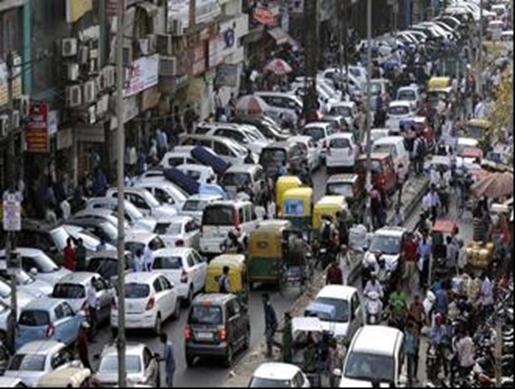
Figure 1: Heavyurbantrafficcongestioncausedby unorganizedroadsideparkingandhighvehicledensityin ametropolitanarea.
The primary goal of research on smart parking systems, especiallythoseutilizingArduinotechnology,istosolvethe increasingproblemsrelatedtourbanparking.Byminimizing fueluse,optimizingresourceallocation,andofferingusers
International Research Journal of Engineering and Technology (IRJET) e-ISSN: 2395-0056
Volume: 13 Issue: 02 | Feb 2026 www.irjet.net p-ISSN: 2395-0072
convenientparkingoptions,thesesystemshopetosupport thegrowthofsmartcities.
In2013,YanfengGengandChristosG.Cassandraspresented theideaofreservationsandoptimalresourceallocationin smartparkingsystems.Theirgoalwastocreateandputinto place a system that minimizes parking issues in cities by allocating resources and reservations as efficiently as possible.Theyhopedtoaidinthecreationofsmartcitiesby doingthis.Thesignificanceofeffectiveparkingmanagement using cutting-edge technologies was highlighted in this paper.
A. K. Hilal (2014) shed light on how intelligent parking managementsystemsarereallyputintopractice.Thegoal wastoshowhowthesetechnologiesmaybeusedpractically in an educational setting, proving their efficacy in actual situations. The study highlighted how smart parking solutions might affect day-to-day operations, especially at educationalinstitutions.
3. Motivation and Goals:
1)Minimizetrafficjamsbroughtonbyanunorganized parkingsystem.
2)Makethemostoftheparkingspotsavailable.
3)Toconservegasolineandcutdownondamagingcarbon emissions.
4)Improvecarsafetyandcarowners'safety.
5)Time-saving.
Manybenefitswillundoubtedlyresultfromresolvingthis issueorsimplymakinganefforttolessenit,suchas reducingdrivers'stressandirritation,savingtimeand fuel,andloweringgasemissions,whichwilllessenthe negativeimpactsofpollutionlevels.Thecurrentfigures makeitclearthatasignificantamountofgasolineisspent whenlookingforaparkingplace.
5. Working of System:
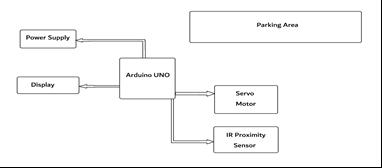
An automated, cost-effective, and efficient method of managing parking in the current era is provided by the Arduino-based smart parking system. The system incorporatesa16x2LCDmoduleforreal-timestatusdisplay, aservomotormechanismforautomatedgatecontrol,and infrared (IR) sensors for vehicle detection. In order to
govern vehicle entrance and slot occupancy, the Arduino microcontrollerservesasthecentralprocessingunit.Itdoes this by continually monitoring sensor inputs and carrying outpreprogrammedcontrollogic.
TheIRsensorrecognizesthepresenceofacarapproaching theparkingentryandsendsasignaltothemicrocontroller. After confirming slot availability, the system turns on the servo motor to either permit or prohibit admission. Individualslotsensorssimultaneouslytrackthenumberof occupiedslotsanddynamicallyupdatethenumberofvacant slots. The LCD display provides real-time information to users,therebyreducingconfusionandunnecessaryvehicle movementwithintheparkingarea.
Thesuggestedsolutiongreatlyreducestheneedforhuman interactionbyautomatingslotmonitoring,gateoperation, andvehicleidentification.Additionally,itcutsdownonthe amount of time spent looking for parking spots, which lowers vehicle emissions and fuel usage. As a result, the system helps to improve urban mobility and traffic flow, whichmakesitaworkableandscalableoptionforsmartcity infrastructure.
6. Result:
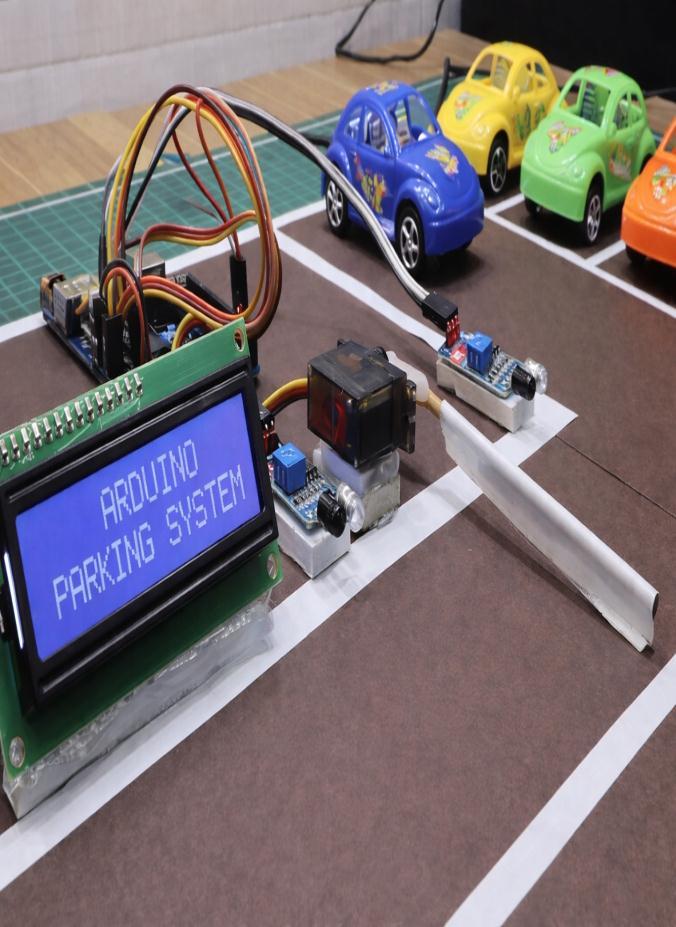
Thesmartparkingtechnologymakesparkingadministration easierbyefficientlydetectingandmanagingparkingspots. Duringreal-worldtesting,thesystemconsistentlyidentifies thepresenceofcarsatentryandexitpointsusinginfrared (IR) sensors. It also controls the entrance and exit gates, allowingordenyingvehicleaccessbasedonparkingspace availability.
International Research Journal of Engineering and Technology (IRJET) e-ISSN: 2395-0056
Volume: 13 Issue: 02 | Feb 2026 www.irjet.net p-ISSN: 2395-0072
By continuously updating an LCD display, the system providescustomerswithreal-timeinformationonparking space availability. When a car arrives, the system instantaneously modifies to reflect the drop-in available slots; when a car leaves, it reflects the increase in availability.
Thesystemcanoptionallysaveimportantdataina databaseforlaterreviewandanalysis.Auserinterface, suchawebplatformormobileapp,mayletusersmake bookings,checkparkingavailability,andgetalerts. Allthingsconsidered,thesystemgreatlyimprovesthe effectivenessofparkingoperations,cutsdownonsearch times,anduseslessfuel,givingusersabetterparking experience.
There are several useful uses for the Arduino-based smartparkingsystemwithinfraredsensors:
1. Urban Parking Management: Thismethodisuseful for controlling parking in congested cities, making it simplerfordriverstolocateopenspacesfast.
2. Commercial Establishments: Toimprovecustomer satisfaction and lessen parking-related stress, this systemcanbeusedinshoppingmalls,multiplexmovie theatres,andmajorcommercialcentres.
3. Public Venues: This technology may be used to effectivelymanageparkingformajoreventsatstadiums, conferencecentres,othereventvenues.
4. Smart Cities: Ascitiesadoptsmarttechnology,smart parking systems are essential for cutting down on pollution,trafficjams,andlosttimelookingforaplace topark.
5. Private Parking Facilities:Privateparkingfacilities, suchascompanyparkinglotsorresidentialcomplexes, can adopt this system to optimize their parking resources.
6. Environmental Impact:Byreducingthetimespent searchingforparkingspots,thissystemindirectly contributes to lowering fuel consumption and reducingairpollution.
7. Data Analytics:Theloggeddatacanbeanalysedto understand parking patterns and optimize the allocationofparkingspaces.
8. User-Friendly Interfaces:Integratingmobileapps orwebplatformsallowsuserstointeractwiththe system, check parking availability, make reservations,andreceivereal-timenotifications. Overall,thesmartparkingsystemhasbroadapplicationsin improvingparkingmanagement,enhancinguserexperience, andcontributingtomoresustainableurbanenvironments.
In conclusion, the smart parking system employing ArduinotechnologyandInfrared(IR)sensorsrepresentsa significant advancement in parking management. This innovativesystemeffectivelydetectsandmanagesparking slots,ultimatelyimprovingtheoverallparkingexperience.
Thesystem'sabilitytodetectvehiclesatentryandexit points, control gates, and provide real-time parking slot availability updates via an LCD display streamlines the processoffindingparkingspaces.Thisnotonlysavestimefor driversbutalsoreducesfuelconsumptionandenvironmental impact.
Additionally,theoptionaldataloggingfeatureprovides valuableinsightsintoparkingpatternsandusage,whichcan informfutureparkinginfrastructureimprovements.
Withpracticalapplicationsinurbanparkingmanagement, commercialcentres,publicvenues,smartcities,andprivate parking facilities, this system addresses the challenges of parkingincrowdedenvironments.
Moreover,theintegrationofuser-friendlyinterfaces,such asmobileappsandwebplatforms,enhancesuserinteraction and convenience. Users can effortlessly check parking availability, make reservations, and receive timely notifications.
In summary, the smart parking system offers a comprehensivesolutiontothepersistentparkingissuesfaced in modern urban settings. Its efficiency, environmental benefits, and user-centric features make it a promising technologyforimprovingthequalityoflifeinurbanareas.
ThesmartparkingsystemusingArduinoandIRsensors offersapromisingplatformforfurtherdevelopmentand expansion.Itsfuturescopeincludes:
1. Scalability: The system can be easily scaled up to accommodate larger parking facilities, making it suitable for urban areas and megacities with growingparkingneeds.
2. IntegrationwithIoT:Futureiterationscanintegrate with the Internet of Things (IoT) for enhanced connectivity, allowing users to check parking availabilityremotelyandreceivereal-timeupdates viamobileappsorwebplatforms.
3. Predictive Analytics: By leveraging historical parkingdata,thesystemcanpredictpeakparking hours, enabling better resource allocation and improvedtrafficmanagement.
4. Payment Solutions: The integration of cashless paymentoptionsanddigitalwalletscansimplifythe payment process, making it more convenient for users.
International Research Journal of Engineering and Technology (IRJET) e-ISSN: 2395-0056
Volume: 13 Issue: 02 | Feb 2026 www.irjet.net p-ISSN: 2395-0072
5. Environmental Monitoring: The system can incorporateenvironmentalsensorstomeasureair quality,temperature,andotherfactors,contributing tosmartcityinitiatives.
6. Reservation Systems: Advanced reservation systems can be implemented, allowing users to bookparkingslotsinadvance,ensuringavailability duringpeakhours.
7. Security Enhancements: The system can be augmentedwithadvancedsecurityfeatures,suchas licenseplaterecognitionandsurveillancecameras, toenhancesafety.
8. Data-DrivenDecisionMaking:Datacollectedbythe systemcanbeusedfordata-drivendecision-making incityplanningandinfrastructuredevelopment.
9. MobileAppIntegration:Developdedicatedmobile apps that provide users with a seamless parking experience,includingnavigationtoavailableslots andreal-timeinformation.
10. Global Adoption: The system's adaptable design makes it suitable for global adoption, benefiting citiesworldwidebyreducingtrafficcongestionand pollution.
Asurbanizationcontinues,thedemandforefficientparking solutions will grow. The smart parking system has significantpotentialforfurtherinnovationandwidespread implementation,contributingtomoresustainableanduserfriendlyurbanenvironments.
1. Geng, Y., & Cassandras, C. G. (2013). A new smart parking system based on optimal resource allocationandreservations. IEEETransactionson Intelligent Transportation Systems, 14(3), 1129–1139 https://doi.org/10.1109/TITS.2013.2252421
2. Lokhande,S.,Morade,S.,&Joshi,M.(2016).Smart carparking system using FPGAande-application. InternationalResearchJournalofEngineeringand Technology(IRJET),3(1).
3. Hilal, A. K. (2014). Intelligent car parking management system at Massey University, Palmerston North, New Zealand (Unpublished projectreport).MasseyUniversity.
4. Agarwal, P., Sharma, S., Gupta, L., & Manideep, B. (2017). Smart electronic garbage management systembasedonIoT. InternationalJournalofSoft ComputingandEngineering(IJSCE),7(1),93–96.
5. Ali,Z.H.,Ali,H.A.,&Badawy,M.M.(2015).Internet ofThings(IoT):Definitions,challengesandrecent research directions. International Journal of ComputerApplications,128(1),37–47.
6. Chowdary,U.V.,Rohith,K.,Sandeep,P.,&Ramu,M. (2015).HomeautomationsystemusingIRsensors.
International Journal of Electrical and Electronic Engineering(IJEEE),4(6),11–16.
7. Deekshitha, D., Disha, D., Malavika, & Soumya. (2017).TrafficmonitoringsystemusingIRsensors. International Journal of Advance Research, Ideas andInnovationsinTechnology,3(3),1045–1057.
8. Mubashirin, M., & Mahmud, S. (2017). Automated carparkingsystem(Bachelor’sthesis).Department of Electrical and Electronic Engineering, BRAC University,Dhaka,Bangladesh.