
International Research Journal of Engineering and Technology (IRJET) e-ISSN: 2395-0056
Volume: 13 Issue: 01 | Jan 2026 www.irjet.net p-ISSN: 2395-0072
International Research Journal of Engineering and Technology (IRJET) e-ISSN: 2395-0056
Volume: 13 Issue: 01 | Jan 2026 www.irjet.net p-ISSN: 2395-0072
Manjunath N K1 , Vanaja Kumari R2 , Dr. N Jayaramappa3
1Research Scholar, Dept. of Civil Engineering, UVCE, Bengaluru
2Student of Master in Technology, Department of Civil Engineering, Major: Prestressed concrete, University of Visveswaraya college of Engineering, Bangalore, Karnataka, India,
3Professor, Dept. of Civil Engineering, UVCE, Bangalore, Karnataka, India, ***
Abstract - The concept of layered concrete members has gained attention as an efficient approach for enhancing structural performance while making effectiveuseofdifferent concrete grades. This study focuses on the flexural behaviour of a 2-layered reinforced concrete beam, where two concrete layers with varying strength properties arecombinedwithina single beam section. The objective of the study is to evaluate the structural response of the 2-layered beam under bending and to validate its performance using numerical analysis. Experimental investigations were carried out on simply supported beam specimens subjected to monotonic loading. Key performance parameters such as load–deflection behaviour, first crack load, yield load, ultimate load, and failure mode were recorded and analysed. To support the experimental findings, a finite element model of the 2-layered beam was developed using Abaqus, incorporating realistic material models, proper layer interaction, and boundary conditions. The numerical results showed good agreement with experimental observations, with deviations within an acceptable range. The results demonstrate that the 2-layered beam exhibits improved flexural performance, enhanced stiffness, and a more uniform stress distribution compared to conventional beams. The validated numerical model confirms the effectiveness of layered concrete systems and highlights their potential application in structural engineering practice.
Keywords- 2-Layered Beam, Layered Concrete, Flexural Behaviour, Finite Element Analysis, Abaqus, Load–Deflection Response, Reinforced Concrete Beam
Reinforcedconcretebeamsareoneofthemostcommonly used structural elements in buildings and infrastructure. Traditionally,thesebeamsarecastusinga singlegrade of concretethroughoutthecross-section.However,inflexural members,thestressdistributionisnotuniform,withhigher compressivestressesoccurringatthetopregionandtensile stresses dominating the bottom region. This non-uniform stress demand has led to the development of layered concrete beams, where different concrete grades are strategicallyplacedtoimprovestructuralperformanceand materialefficiency.
A 2-layered beam is formed by combining two different concretelayerswithinasinglebeamsection,typicallywitha higherstrengthconcreteplacedinthecompressionzoneand a relatively lower or conventional concrete in the tension zone. This configuration aims to enhance load-carrying capacity, stiffness, and crack resistance while reducing material cost. The layered approach also promotes sustainableconstructionbyenablingtheeffectiveutilization of high-strength concrete only where it is structurally required.
Severalexperimentalandnumericalstudieshavereported that layered concrete beams exhibit improved flexural behaviourcomparedtoconventionalhomogeneousbeams. Parameterssuchasfirstcrackload,ultimateload,deflection characteristics,andfailuremodearesignificantlyinfluenced bythearrangementandpropertiesoftheconcretelayers. However,accuratepredictionofthebehaviourof2-layered beamsrequiresreliablenumericalmodelsthatcancapture materialnonlinearity,cracking,andinterlayerinteraction. Withtheadvancementoffiniteelementsoftware,numerical toolssuchasAbaqushavebecomeeffectiveforsimulating thenonlinearbehaviourofreinforcedconcretestructures. Byincorporatingappropriatematerialmodelsandboundary conditions, finite element analysis can closely replicate experimentalresponsesandreducetheneedforextensive physical testing. Validation of numerical models against experimental results is therefore essential to ensure their accuracyandapplicability.
In this study, the flexural performance of a 2-layered reinforced concrete beam is investigated through experimental testing and validated using finite element analysis. The study focuses on load–deflection behaviour, cracking characteristics, stress distribution, and failure patterns. The outcomes of this research aim to provide a clearer understanding of the structural efficiency of 2layeredbeamsandtosupporttheirpracticalapplicationin modernstructuralengineering.
International Research Journal of Engineering and Technology (IRJET) e-ISSN: 2395-0056
Volume: 13 Issue: 01 | Jan 2026 www.irjet.net p-ISSN: 2395-0072
[1] Desai and Krishnan developed a well-defined stress–strainrelationshipforconcrete,whichhasbeenextensively used in the nonlinear analysis of reinforced concrete members. Their model provides a realistic analytical descriptionofconcretebehaviourundercompressiveloading byaccountingforthenonlinearincreaseinstresswithstrain up to peak strength, followed by a gradual softening response. This stress–strain relationship has been widely incorporated into numerical and finite element models to simulate the flexural behaviour of concrete beams with greater accuracy. The study emphasized that linear elastic assumptions are insufficient to represent actual concrete behaviour, especially near ultimate load conditions. By highlighting the role of material nonlinearity, the authors demonstrated that accurate prediction of load–deflection response,crackingbehaviour,andfailuremodesofreinforced concrete beams strongly depends on the proper representation of concrete constitutive behaviour. Their work continues to serve as a fundamental reference for analytical and numerical studies involving reinforced and layeredconcretebeamsystems.
[2] Hognestad et al. carried out detailed experimental investigations on the flexural behaviour of reinforced concretebeamstounderstandstressdistributionacrossthe beamdepthunderincreasingload.Theirstudyrevealedthat concreteindifferentregionsofthebeamsectionissubjected to varying stress and strain demands during loading. The compression zone was found to play a dominant role in governingtheultimateload-carryingcapacityofthebeam, whilethetensionzoneprimarilyinfluencedcrackinitiation and crack propagation. The authors also observed that cracking occurs well before ultimate failure, leading to redistributionofstresseswithinthesection.Thesefindings clearlydemonstratedthatauniformconcretegradeacross theentiredepthmaynotbethemostefficientuseofmaterial. This fundamental understanding provided the theoretical basis for the concept of layered concrete beams, in which concretewithdifferentstrengthandstiffnesspropertiescan be strategically placed in regions according to structural demand,therebyimprovingoverallflexuralperformanceand materialefficiency.
[3] Barros and Figueiras carried out detailed numerical investigationsonreinforcedconcretebeamsandvalidated their finite element models using corresponding experimental results. Their study demonstrated that numericalmodelsincorporatinglayeredmaterialproperties were able to represent the actual behaviour of reinforced concrete beams more realistically than homogeneous concrete models. In particular, the layered modelling approachcapturedstiffnessdegradationaftercrackingand thenonlinearpost-crackingresponsewithgreateraccuracy. Theauthorsobservedimprovedpredictionofload–deflection behaviour, crack development, and stress redistribution
whendifferentmaterialpropertieswereassignedacrossthe beamdepth.Thesefindingsclearlyhighlighttheeffectiveness of layered material modelling in simulating the flexural behaviour of reinforced concrete beams and support its applicationinanalysingconventionallayeredconcretebeam systems
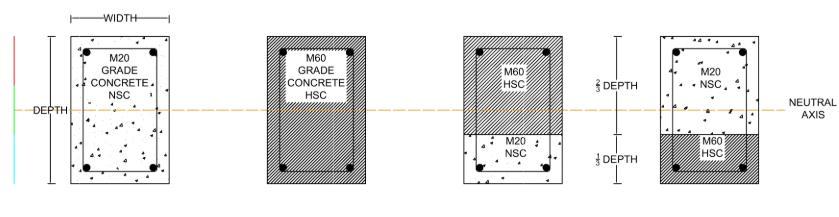
Inthepresentstudy,finiteelementmodellingiscarriedout using ABAQUS to simulate the flexural behaviour of conventionallayeredconcretebeams.Thenumericalmodelis developedtocloselyreplicatetheexperimentalconfiguration in terms of geometry, material properties, boundary conditions,andloadingarrangement.Thebeamismodelled asalayeredsectioninwhichdifferentconcretegradesare assigned to individual layers along the depth, allowing realisticrepresentationofmaterialvariation.
Concrete behaviour is defined using nonlinear material models to capture cracking in tension and crushing in compression.TheConcreteDamagePlasticity(CDP)modelis adopted to represent the inelastic behaviour of concrete, includingstiffnessdegradationanddamageevolutionunder increasingload.Reinforcementismodelledasanembedded regionwithintheconcrete,assumingperfectbondbetween steel and concrete. All material parameters used in the numerical model are selected based on experimental data andstandardcodeprovisions.
Boundary conditions and loading are applied to simulate simply supported conditions with monotonic loading. The analysisisperformedunderdisplacement-controlledloading to obtain stable convergence and accurate load–deflection response. The numerical results obtained from ABAQUS, including load–deflection curves, stress distribution, and crackingpatterns,arecomparedwithexperimentalresultsto validate the modelling approach. This Abaqus-based numerical framework provides a reliable tool for understanding the structural behaviour of conventional layeredconcretebeams.
International Research Journal of Engineering and Technology (IRJET) e-ISSN: 2395-0056
Volume: 13 Issue: 01 | Jan 2026 www.irjet.net p-ISSN: 2395-0072
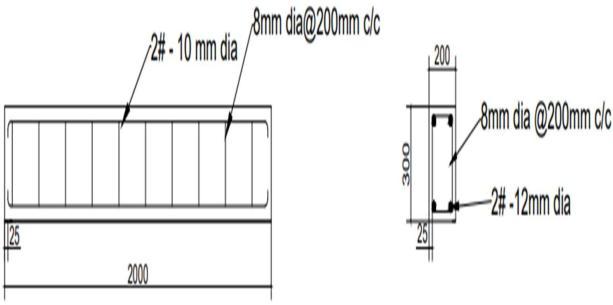
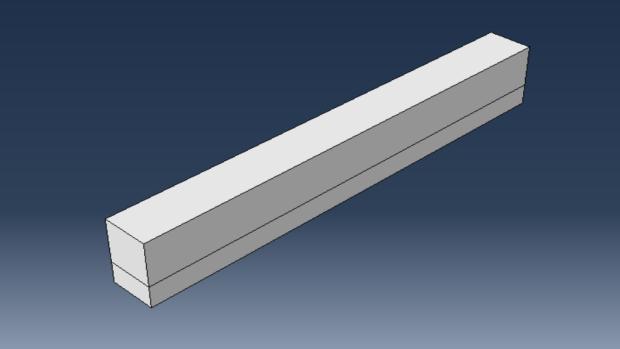
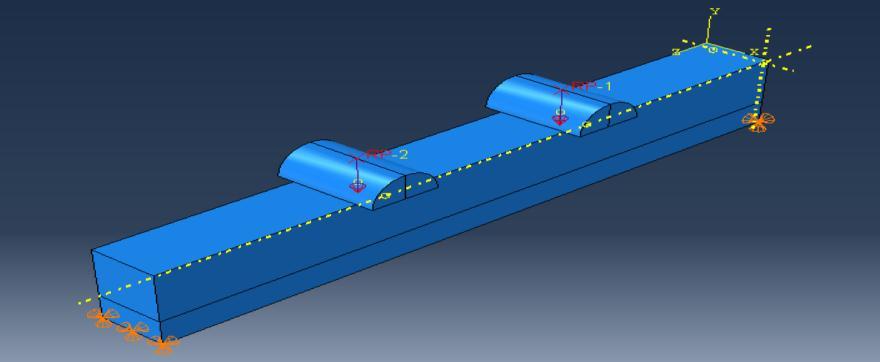
The geometry of the beam was modelled to match the experimentalspecimendimensions.Thebeamcross-section wasdividedintotwodistinctconcretelayersrepresenting the 2-layered configuration. Each layer was assigned its respectivethicknessandmaterialproperties.Reinforcement bars were modelled separately and positioned accurately withinthebeamaccordingtotheexperimentaldetailing.A perfectbondbetweenconcreteandsteelreinforcementwas assumedinthemodel.stackedalongtheheight(depth)ofthe beam.
ConcretewasmodelledusingtheConcreteDamage Plasticity(CDP)modelavailableinAbaqus,whichissuitable for representing nonlinear behaviour, cracking in tension, and crushing in compression. Material properties such as elasticmodulus,Poisson’sratio,andcompressivestrength, tensile strength, and damage parameters were defined separatelyforeachconcretelayer.Steelreinforcementwas modelled as an elastic–plastic material with isotropic hardeningbasedonstandardstress–strainrelationships.
Modulusof elasticitysteel 2.1x10⁵N/mm2
Atieconstraintwasusedbetweenthetwoconcretelayersto ensureproperloadtransferandcompositeaction,assuming perfect interlayer bonding. The interaction between reinforcement and concrete was defined using embedded region constraints, which allowed the reinforcement to followthedeformationofthesurroundingconcretewithout relativeslip
The beam wasmodelled as simply supported,consistent with the experimental setup. One end of the beam was restrainedagainstverticalandlongitudinaldisplacements, whiletheotherendwasallowedlongitudinalmovementto avoidaxialrestraint.Monotonicloadwasappliedintheform ofdisplacement-controlledloadingattheloadingpointsto capturethecompleteload–deflectionresponseuptofailure.
International Research Journal of Engineering and Technology (IRJET) e-ISSN: 2395-0056
Volume: 13 Issue: 01 | Jan 2026 www.irjet.net p-ISSN: 2395-0072
3.5
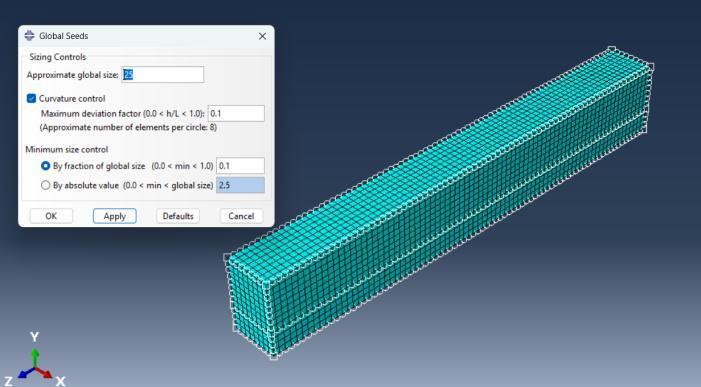
A structured meshing approach was adopted for the concrete beam using three-dimensional solid elements. A finer mesh was provided in regions of high stress concentration,particularlyneartheloadingpointsandmidspan. Reinforcement bars were discretized using appropriatetrussorbeam elements.Meshsensitivitywas checkedtoensureaccuracywithoutexcessivecomputational cost.
TheFEMresultswereevaluatedintermsofload–deflection
behaviour,stressdistribution,crackinitiation,anddamage patterns. The numerical results were compared with experimental data to assess the accuracy of the model. A close agreement was observed between FEM and experimentalresponses,withvariationswithinacceptable limits, confirming the reliability of the developed finite element model for analysing 2-layered conventional concretebeams
4.
This section presents and discusses the experimental and finiteelementanalysisresultsofthe2-layeredconventional reinforcedconcretebeamsubjectedtoflexuralloading.The
behaviour of the beam is evaluated in terms of load–deflection response, cracking characteristics, stress distribution, and failure mode. The numerical results obtained from Abaqus are compared with experimental observationstovalidatetheaccuracyofthefiniteelement model.
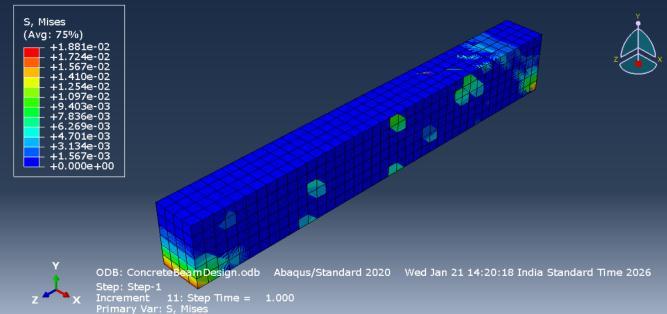
ThestressdistributionobtainedfromFEManalysisindicates a more uniform stress transfer across the depth of the 2layered beam. Higher compressive stresses were concentratedinthetopconcretelayer,whiletensilestresses werepredominantlyresistedbyreinforcementinthebottom region. This confirms the efficient utilization of different concretelayersbasedonstressdemand.
The transition of stresses across the interface of the two concrete layers was smooth, indicating proper composite action and effective load transfer. No significant stress discontinuitywasobservedatthelayerinterface.
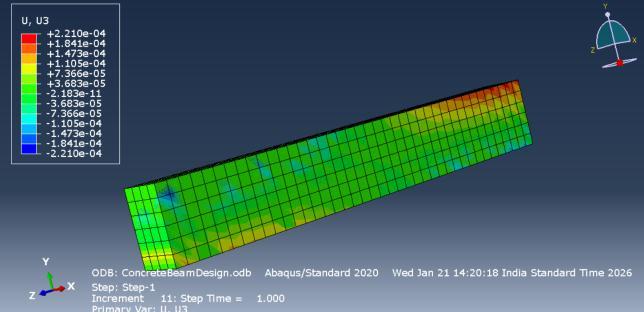
4.2 Displacement
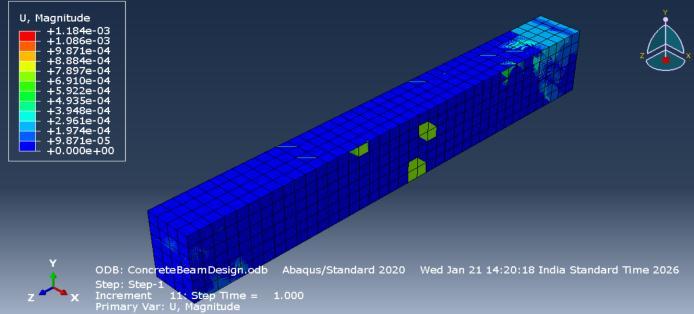
Thedisplacementbehaviourofthe2-layeredconventional reinforced concrete beam was evaluated using mid-span deflection obtained from both experimental testing and finiteelementanalysis.Displacementisakeyparameterfor assessing serviceability performance and stiffness characteristicsofflexuralmembers.
International Research Journal of Engineering and Technology (IRJET) e-ISSN: 2395-0056
Volume: 13 Issue: 01 | Jan 2026 www.irjet.net p-ISSN: 2395-0072
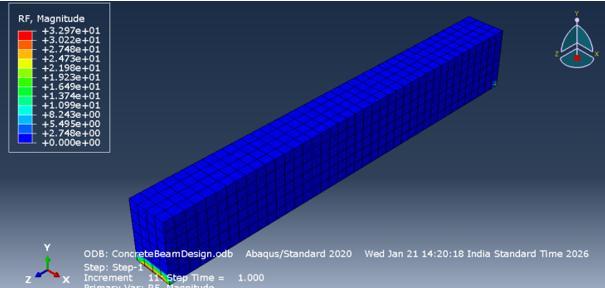
4.3 Reaction Force
Thereactionforcebehaviourofthe2-layeredconventional concretebeamshowedalinearincreasewithappliedload duringtheinitialelasticstage.Nearlyequalreactionforces wereobservedatbothsupportsduetosymmetricloading and simply supported conditions. After crack initiation, slightnonlinearityoccurredbecauseofstiffnessdegradation in the tension zone. FEM results from Abaqus closely matchedtheexperimentalreactionforceswithonlyminor variations.Atultimateload,stablereactionforcesconfirmed effectiveloadtransferandductilebehaviourofthebeam.
1. The 2-layered beam exhibited improved flexural performancecomparedtoconventionalsingle-layer beams,demonstratingbetterutilizationofconcrete basedonstressdemand.
2. The load–deflection behaviour showed an initial linear response followed by nonlinear behaviour aftercrackinitiation,indicatingductileperformance underflexuralloading.
3. Thepresenceofahigher-strengthconcretelayerin the compression zone enhanced stiffness and reducedmid-spandisplacement,particularlyinthe pre-yieldstage.
4. First crack load and ultimate load obtained from finite element analysis closely matched the
experimental results, with variations within acceptablelimits.
5. Stress distribution obtained from FEM analysis confirmedeffectivecompositeactionbetweenthe two concrete layers, with smooth stress transfer acrosstheinterface.
6. Crackingpatternsand failuremodespredicted by theFEMmodelwereconsistentwithexperimental observations,showingpredominantflexuralfailure.
7. ThevalidatedFEMmodelusingAbaqusprovedto be reliable for predicting displacement, stress response, and damage behaviour of 2-layered conventionalconcretebeams.
[1]BIS,PlainandReinforcedConcrete–CodeofPractice,IS 456:2000, Bureau of Indian Standards, New Delhi, India, 2000.
[2] BIS, Concrete Mix Proportioning – Guidelines, IS 10262:2019,BureauofIndianStandards,NewDelhi,India, 2019.
[3] ACI Committee 318, Building Code Requirements for Structural Concrete, American Concrete Institute, FarmingtonHills,MI,USA,2019.
[4]J.LeeandG.L.Fenves,“Plastic-damagemodelforcyclic loadingofconcretestructures,”J.Eng.Mech.,vol.124,no.8, pp.892–900,Aug.1998,doi:10.1061/(ASCE)0733-9399.
[5]J.A.O.BarrosandJ.A.Figueiras,“Flexuralbehaviourof layeredreinforcedconcretebeams,”J.Struct.Eng.,vol.125, no.7,pp.701–710,July1999.
[6] M. Y. H. Bangash, Concrete and Concrete Structures: NumericalModelingandApplications.London,U.K.:Elsevier, 1989.
[7] Dassault Systèmes Simulia Corp., ABAQUS/Standard User’sManual,Providence,RI,USA,2021.
[8] S. Selvaraj and B. Ramesh, “Finite element analysis of reinforced concrete beams using Abaqus,” Int. J. Eng. Res. Technol.,vol.6,no.5,pp.245–250,May2017.
[9]R.KumarandG.A.Rao,“Experimentalinvestigationon flexuralbehaviouroflayeredconcretebeams,”Int.J.Civ.Eng. Technol.,vol.9,no.4,pp.123–131,Apr.2018.
[10]fib,ModelCodeforConcreteStructures2010.Lausanne, Switzerland:FédérationInternationaleduBéton,2010.