
International Research Journal of Engineering and Technology (IRJET) e-ISSN: 2395-0056
Volume: 13 Issue: 05 | May 2026 www.irjet.net p-ISSN: 2395-0072

International Research Journal of Engineering and Technology (IRJET) e-ISSN: 2395-0056
Volume: 13 Issue: 05 | May 2026 www.irjet.net p-ISSN: 2395-0072
Mr. Amit R. Arbal1 , Ms. Shruti D. Dhokare2 , Mr. Shivraj K.Bangar 3 , Prof. Nilesh N. Shewale4
123Student, Saghavi college of Engineering, Nashik 4Assistant Professor, Dept. Civil Engineering, Saghavi college of Engineering, Nashik, Maharashtra, India.
Abstract - Concrete is widely used in construction because of its high compressive strength, but its low tensile capacity leads to cracking problems that affect durability and performance. To overcome this limitation, hybrid fiber reinforcement using glass fiber (GF) and polypropylene fiber (PP) is adopted. This study investigates the performance of M30gradeconcretewithhybridfibersindifferentproportions (0%, 0.5%, 0.75%, and 1%). The mix design is carried out as per IS 10262:2019. Experimental tests such as slump test, compressive strength test, and split tensile strength test are conducted. The results show that the addition of hybrid fibers improves strength and crack resistance of concrete. The optimum fiber content is found between 0.5% and 0.75%, beyond which workability decreases and strength gain reduces.
Key Words: Hybrid fiber concrete, Glass fiber, Polypropylene fiber, Compressive strength,Splittensile strength, Workability, M30 concrete
1. INTRODUCTION
Concreteisthemostcommonlyusedconstructionmaterial due to its high compressive strength. However, it has low tensile strength and is prone to cracking. These cracks reducedurabilityandstructuralperformance. To overcome this problem, fibers are added to concrete. FiberReinforcedConcrete(FRC)improves:
Crackresistance
Tensilestrength
Durability
Hybridfiberconcreteusestwotypesoffibers:
GlassFiber→improvesstrength
PolypropyleneFiber→controlscracks In this study, hybrid fiber reinforced M30 concrete is preparedusing 70% glass fiber and 30% polypropylene fiber anditsperformanceisevaluated.
2. LITERATURE REVIEW
Variousresearchershavereportedthattheadditionoffibers improvesthetensileandflexuralstrengthofconcrete.Glass fibersmainlyenhancestrength,whilepolypropylenefibers are effective in controlling micro-cracks. Hybrid fiber systemsshowbetterperformanceduetocombinedactionof differentfibers.
Researchersalsofound:
Optimumfibercontentexists(generally0.5%–1%)
Excessfiberreducesworkability
Strength does not increase continuously with fiber addition
3. SCOPE OF WORK
Themainobjectivesofthisstudyare:
TodesignM30concretemixusingIS10262:2019
Tostudyeffectofhybridfiberson:
i.Workability
ii.Compressivestrength
iii.Splittensilestrength
Todetermineoptimumfibercontent
Tocompareresultswithconventionalconcrete
4. EXPERIMENTAL INVESTIGATION
4.1 Materials Used
Cement:OPC
FineAggregate:ZoneIIsand
CoarseAggregate:20mm
Water:Potablewater
Fibers:
GlassFiber(70%)
PolypropyleneFiber(30%)
Ordinary Portland Cement (OPC) was used as the binding material for M30 grade concrete, having standard consistency, specific gravity of about 3.15, and suitable strengthcharacteristics.Fineaggregateconsistedoflocally available sand conforming to Zone II with specific gravity around2.65,whichhelpsinachievinggoodworkabilityand proper grading. Coarse aggregate of angular shape with maximumsize20mmandspecific gravityabout2.74was used to provide strength and stability to the mix. Clean potable water was used for mixing and curing, ensuring properhydrationofcement.Hybridfibersconsistingof70% glassfiberand30%polypropylenefiberwereincorporated; glass fibers possess high tensile strength and modulus of elasticity, improving strength and stiffness, while polypropylene fibers have low density and good chemical resistance,helpingincontrollingmicro-cracksandreducing shrinkage.
Themixdesignwascarriedoutusingawater-cementratio of0.45,watercontentof190L/m³,andcementcontentof 422 kg/m³ as per IS 10262:2019, ensuring required workability (75–100 mm slump) and strength characteristics.
International Research Journal of Engineering and Technology (IRJET) e-ISSN:
Volume: 13 Issue: 05 | May 2026 www.irjet.net p-ISSN: 2395-0072
4.2.1 Mix Proportions
Mixratio= 1: 1.61: 2.72
Table-1 MixProportion(0%Fiber):
Table-2 MixProportions(0.5%Fiber):
Table-5 Slumptestresults
Table-3 MixProportions(0.75%Fiber):
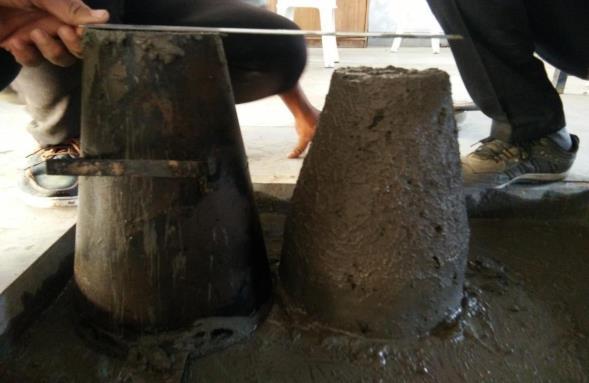
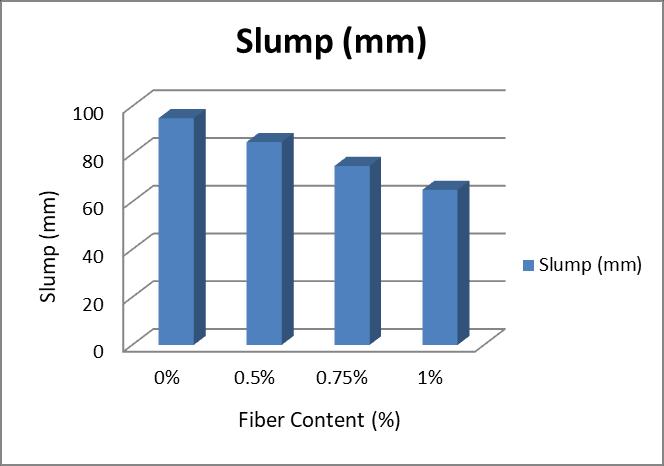
Table-4 MixProportions(1%Fiber):
4.3 Test results:
4.3.1 Slump Test Results:
The slump test is used to measure the workability and consistency of fresh concrete. It indicates how easily the concrete can be mixed, placed, and compacted. This test helps in understanding the effect of fiber addition on the flowcharacteristicsofthemix.
4.3.2 Compressive Test Results:
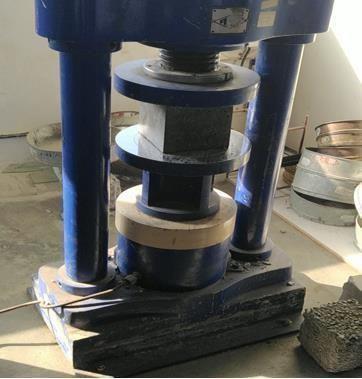
Thecompressivestrengthtestisconductedtodeterminethe load-carryingcapacityofhardenedconcrete.Itisthemost important property used in structural design. This test evaluatesthestrengthdevelopmentofconcreteatdifferent curingperiods.
International Research Journal of Engineering and Technology (IRJET) e-ISSN: 2395-0056
Volume: 13 Issue: 05 | May 2026 www.irjet.net p-ISSN: 2395-0072
Table-6 Compressivetestresults
Mix 3 Days (MPa) 14 Days (MPa) 28
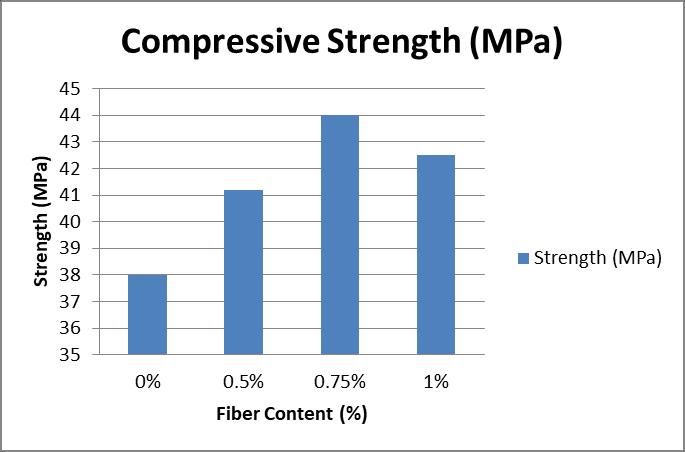
Chart -2:CompressiveStrengthat28daysMPa
4.3.3 Split Tensile Test Results:
The split tensile strength test is used to assess the tensile behaviorofconcrete,whichisotherwiseweakintension.It helps in understanding the crack resistance and bonding performance of the material. This test is important to evaluatetheeffectivenessoffiberreinforcementinimproving tensileproperties.
Table-7 splittensiletestresults Mix 3 Days (MPa) 14
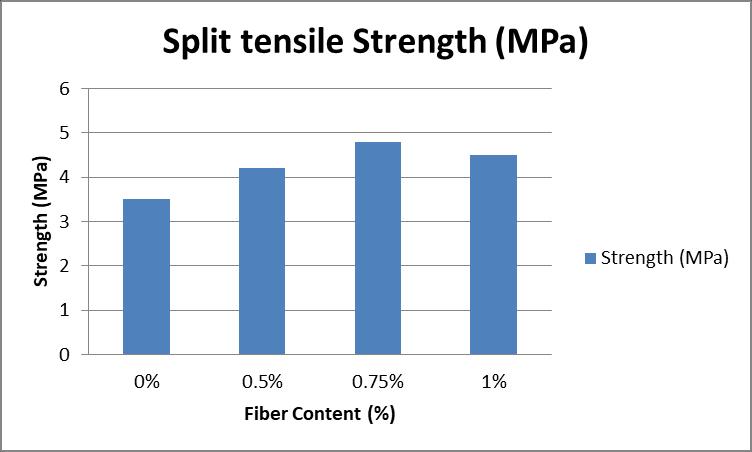
Thetestresultsshowthataddinghybridfibersimprovesthe performanceofM30concrete.Theslumpvaluedecreasesas fiber content increases, which means workability reduces slightly. The compressive strength increases up to 0.75% fiber content and then decreases slightly at 1%. The split tensile strength also increases significantly due to better crackresistance.Thebestresultswereobtainedat0.5%to 0.75% fiber content. This is because glass fiber improves strengthandpolypropylenefiberhelpsincontrollingcracks.
From this study, it can be concluded that hybrid fiber reinforcedconcreteperformsbetterthannormalconcrete. The use of glass fiber and polypropylene fiber together improvesstrengthandreducescracking.Theoptimumfiber contentisfoundtobebetween0.5%and0.75%.Hybridfiber concrete can be used in practical construction where improveddurabilityandcrackresistancearerequired.Thus, hybrid fiber reinforcement is an effective method for improvingtheperformanceofconventionalconcrete.
1) Lei, B., Li, W., Liu, H., Tang, Z., & Tam, V. W. Y., “Synergistic Effects of Polypropylene and Glass Fiber on Mechanical Properties and Durability of RecycledAggregateConcrete,”InternationalJournal ofConcreteStructuresandMaterials,Vol.14,2020.
2) Ahmed, A. A. M., & Jia, Y., “Effect of Using Hybrid Polypropylene and Glass Fibre on the Mechanical PropertiesandPermeabilityofConcrete,”Materials, Vol.12,2019.
3) Blazy, J., & Blazy, R., “Polypropylene Fiber ReinforcedConcreteandItsApplicationinCreating ArchitecturalFormsofPublicSpaces,”CaseStudies inConstructionMaterials,Vol.14,2021.
4) Abu-Elgasim,E.,Hassan,O.,Awad,A.,Abdullah,A.,& Mahmoud, M., “The Effect of Glass and Polypropylene Fibers on the Properties of Concrete,” International Research Journal of EngineeringandTechnology(IRJET),Vol.12,Issue 07,2025.
5) Nair,M.J.,&Varghese,R.,“InfluenceofGlassFiber and Polypropylene Fiber on M30 Grade Concrete and its Durability Study,” International Journal of Innovative Research in Science, Engineering and Technology,Vol.6,Issue5,2017.
6) IS 10262:2019, “Concrete Mix Proportioning –Guidelines,”BureauofIndianStandards,NewDelhi.