
International Research Journal of Engineering and Technology (IRJET) e-ISSN: 2395-0056
Volume: 13 Issue: 05 | May 2026 www.irjet.net p-ISSN: 2395-0072
International Research Journal of Engineering and Technology (IRJET) e-ISSN: 2395-0056
Volume: 13 Issue: 05 | May 2026 www.irjet.net p-ISSN: 2395-0072
Rohit Singh1 , Sudarshan Kandpal2
1M.tech Scholer B.N. COLLEGE OF ENGINEERING & TECHNOLOGY LUCKNOW
2Assistant Professor B.N. COLLEGE OF ENGINEERING & TECHNOLOGY LUCKNOW ***
Abstract - The demand of aerospace industries has stimulatedresearchfocusedonimprovingtheproperties of aluminium alloys through innovative processing methods. FrictionStir Processing (FSP) is an advanced solid-statemethodforthefabricationandimprovement of the surface and bulk characteristics of Metal Matrix Composites(MMCs).FrictionStirProcessingisutilizedto manufacture and analyze 6061-T6. This research examines the microstructural development andmechanical improvement of Al6061-T6 aluminum alloy augmented with SiC nanoparticles through a FrictionStirProcessing(FSP)method.OMdemonstrated thattheadditionofSiCnanoparticlesinducedanotable Zener pinning effect, hindering grain boundary migration during dynamic recrystallization
Thefabricationofmetalmatrixcomposites(MMC)has garnered significant attention owing to their unique mechanical characteristics, including lightweight, exceptional wear resistance, and elevated elastic modulus. FSP is an innovative method for the treatmentofsolid-statemetals.FSPisatechniquefor generating surface composites and altering microstructuralcharacteristics.FSPachieveslocalized andsignificantgrainrefinementandmicrostructural modification, resulting in enhanced mechanical properties of the treated area [1].. fabricated via the liquid metallurgical method, exceeded those of pure AA6061. Inadequate waste management adversely affects human health. Besides its visual deficiencies, waste exacerbates climate change by contaminating the atmosphere, damaging aquatic ecosystems upon disposal, and depleting the ozone layer during incineration.Thisresearchaimstodevelopafunctional compositematerialwithenhancedpropertiesutilizing SiC.SiliconCarbide(SiC)asanagentofreinforcement inAluminumMetalMatrixComposites(AMMCs)isone of the most effective materials engineering advancements,bridgingmetals'ductilityandceramics' strength. Al6061 and other 6XXX series aluminum
alloysarepopularfortheirlowdensityandcorrosion resistance,buttheylackhardnessandwearresistance forheavy-dutyindustrialapplications
1.2Categorization of composite materials:
Composites are classified as fibers, whiskers, and particulates based on the reinforcement phases utilized.. In certain studies, Intermetallic-Matrix Composites(IMCs)areclassifiedseparatelyfromMetal MatrixComposites(MMCs).
1.3 Fabrication techniques for metal matrix composites:
It can be fabricated using stir casting, powder metallurgy,orvariouschemicalandthermalmethods. However, in these procedures, composite creation occurs throughout the entirety of the volume. The frictionstirprocessandlasercladdingtechniquescan be employed to produce surface metal matrix compositesofrestrictedthickness.
1.4Principle of FSP
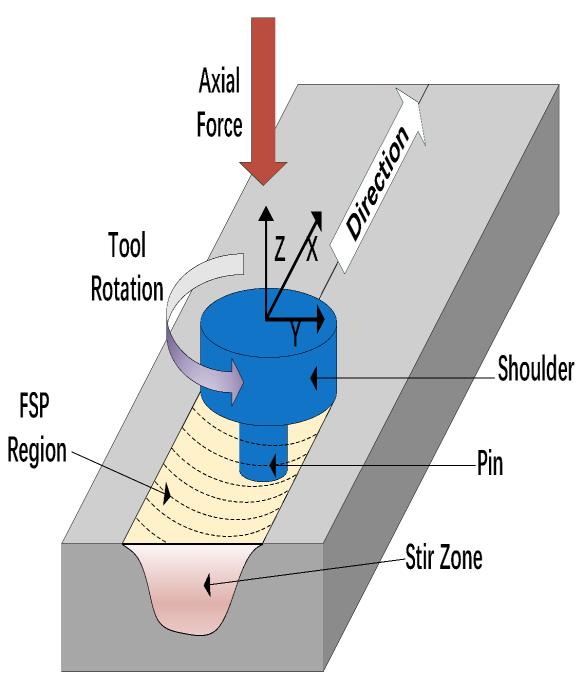
ThecoreprincipleofFSPreliesonplasticdeformation at elevated temperatures. The rotating shoulder producesthemajorityofheatfromfrictionalcontact withthesurface,whereasthepinfacilitatesthestirring andmixingofthesoftenedmaterialbelowthesurface.
As the tool traverses forward:
The material in front of the tool undergoes plasticdeformationandisconveyedaroundthe rotatingpin.
Thepliable substance experiences significant sheardeformation.
International Research Journal of Engineering and Technology (IRJET) e-ISSN: 2395-0056
Volume: 13 Issue: 05 | May 2026 www.irjet.net p-ISSN: 2395-0072
Metal matrix composites are good for surfaceinteractingcomponents.Frictionstirprocedure isapotentialmethodformakingsurfacemetal matriccomposites.Someautomotive,aerospace, naval, and other industries use surface metal matrix composites. Surface composites are employedinvariousfieldsbecauseoftheirwear resistance, hardness, corrosion resistance, strength,andductility.Frictionstirprocedureis superior for making surface composites with MMCtohideconstituentproperties[12].
Accordingtomultipleresearchers, FSPhasthe potential to enhance mechanical and metallurgical properties through plastic deformation, grain refinement, dynamic recrystallization, and tool rotation. Tool rotationalspeed,traversalspeed,andtiltangle arethemainprocessparametersofFSP.Plunge depth, pin diameter, pin length, shoulder diameter, and other similar parameters have littlebearing.Byoptimizingthecombinationof FSP parameters, homogeneous microstructure was achieved in processed magnesium AZ31B alloy,andthiswasafterinvestigatingtheimpact ofcriticalprocessfactorsontheforming-limits, microstructure, and texture of the alloy. A significantmaterialprocessingtechnology,FSP has a homogenous small microstructure and a strongbasaltexture[14].
Basedontheabovediscussionandliteraturereview, the Al-6061-T6 alloy has been chosen as the basis matrixmetalforthecurrentstudy.Table4.1displays the chemical composition of the alloy and table 4.2 show mechanical properties. This is a hot-rolled, artificially aged, and solution-hardened aluminum alloy. This alloy has silicon and magnesium as the principal alloying elements in aluminum. The characteristicsoftheAl-6061-T6alloyareenumerated asfollows:
(a)Moderatestrengthaccompaniedbyductility.
b)Exceptionalresistancetocorrosion.
c)Excellentformabilityintheplasticstate.
d)Excellentmachinability.
e)Moderatefatigueresistance.
f)Excellentwettabilitywithceramicmaterials

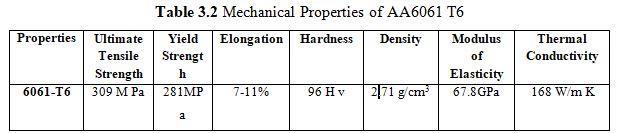
Table3.1Chemicalcompositionofbasematerials .
Theultimatestressamaterialcanendureinatensile test prior to plastic deformation is referred to as its tensile strength. Tensile testing entails exerting a consistent strain on both ends of the specimen.This inquiryusedaUniaxialTensileTest(UTM)conducted by Tinus Olsen H50KS. The processed material was utilized to fabricate testspecimens standardized per ASTME8requirementsfortensiletesting(Figure3.5). This apparatus can measure elongation percentage, yieldtensilestrength,andultimatetensilestrength.
International Research Journal of Engineering and Technology (IRJET) e-ISSN: 2395-0056
Volume: 13 Issue: 05 | May 2026 www.irjet.net p-ISSN: 2395-0072
Figure 4.1 (a and b) illustrates the morphologies surfaceoftheAA6061T6AlalloyFSPedSamplewith andWithoutSiCnanoparticles. Thisisacomprehensive study of the microstructural results for Friction Stir Processed (FSP) Al 6061-T6 and Al 6061-T6 + SiCnanocompositesamples based on optical micrographs.Figure4.1(a)showsthebasealloyafter frictionstirprocessingwithoutreinforcements.Long, "pancake-shaped"grainsareseeninthemicrograph. Thisindicatesamaterialthathasundergonesignificant plastic deformation but may retain some directional alignmentfromrollingortheFSPtoolroute.
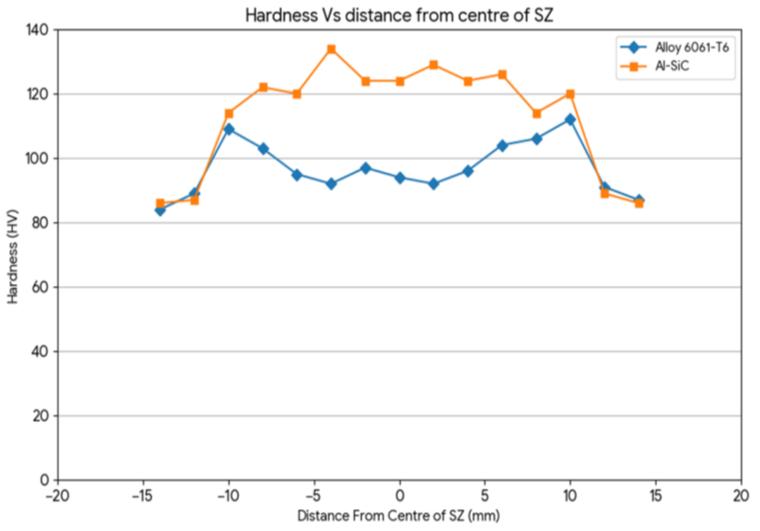
To assess hardness, the Vickers micro-indentation machine was employed to create indentations inthe transversedirectionoftheweld,maintaininga1mm interval between each subsequent indentation. Each sample, encased in a phenolic resin mold, was individuallysecuredinthevice.Theindentationload was sustained at 500 kg-f with a dwell period of 10 secondseachindentation.
Frictionstirprocessingwassuccessfullyusedtocreate a SiC-reinforced Al-6061-based surface composite. Severaltests,suchasmicro-hardness,tensile,optical microscopy, and SEM, were carried out on manufactured samples in compliance with the recommended procedures. The study's main conclusionsareasfollows.
1. Frictionstirprocessingcanbeemployedas aninnovativemethodforgrainrefinement, resulting in enhanced mechanical, and metallurgicalproperties.
2. TheincorporationofSiCnanoparticlesled toasignificantenhancementinmechanical performance. The Ultimate Tensile Strength (UTS) augmented by roughly 31%,escalatingfrom351MPainthebase alloy to 460 MPa in the processed nanocomposite.
3. Theintegrationofceramicreinforcements resulted in a significant enhancement in Vickershardness,risingfrom89HVto132 HV. The 48% increase is ascribed to the presence of hard SiC particles and the consequentgrainrefinement.
6.1
1. Yu, X. X., & Lee, W. B. (2000). The design and fabrication of an alumina reinforced aluminumcompositematerial.Composites Part A: Applied Science and Manufacturing,31(3),245-258.
2. Abushanab, W., Moustafa, E., Goda, E., Ghandourah, E., Taha, M., &Mosleh, A. (2023). Influence of Vanadium and Niobium Carbide Particles on the Mechanical,Microstructural,andPhysical Properties of AA6061 Aluminum-Based Mono- and Hybrid Composite Using FSP. Coatings,13(1),142.https://doi.org/10.339 0/coatings13010142
3. Carpio, M. J., Sánchez-Martín, M. J., Rodríguez-Cruz,M.S.,&Marín-Benito,J.M. (2021). Effect of Organic Residues on Pesticide Behavior in Soils: A Review of LaboratoryResearch.Environments,8(4), 32.https://doi.org/10.3390/environments 8040032.
4. Sathiyaraj,S.,Venkatesan,S.,Kumaran,P., &SelvaBabu, B. (2025). Optimization of Wear Behaviour of Al6061 Metal Matrix Composites Using Taguchi Approach. Turkish Journal of Engineering, 9(1), 56–63.https://doi.org/10.31127/tuje.1502413