International Research Journal of Engineering and Technology (IRJET)
e-ISSN: 2395-0056
Volume: 13 Issue: 05 | May 2026
p-ISSN: 2395-0072
www.irjet.net
“Blockchain based Electronic Voting System” Mrs.Vinayashree B S, Darshan K A, Adithya V,Sandesh G A,Harish Gowda M R 1Assistant Professor,Department of ECE.PES College of Engineering Mandya,Karnataka,India 2Students of ECE, PES College of Engineering Mandya,Karnataka,India
---------------------------------------------------------------------***---------------------------------------------------------------------
Abstract -This project presents a secure and user-friendly e-
unauthorized access. Another major issue across these systems is the lack of strong authentication methods, which can lead to problems like voter impersonation, duplicate voting, and even automated bot attacks. Additionally, many of these systems do not provide real-time transparency, which can result in delays, confusion, and disputes over election results. As a result, existing voting methods often struggle to ensure complete security, reliability, and trust throughout the entire election process.
voting system that uses blockchain technology and fingerprint authentication to ensure safe and reliable voting. Built with the Python Flask framework, it focuses on transparency and protecting votes from tampering. The system includes modules for election authorities, voters, and candidates. Authorities manage registrations, approve candidates, and track results. Voters register using Aadhaar, Voter ID, and OTP, along with fingerprint verification. During voting, multiple checks ensure security. Each voter can vote only once, and every vote is stored on the blockchain, ensuring a fair, accurate, and trustworthy election process.
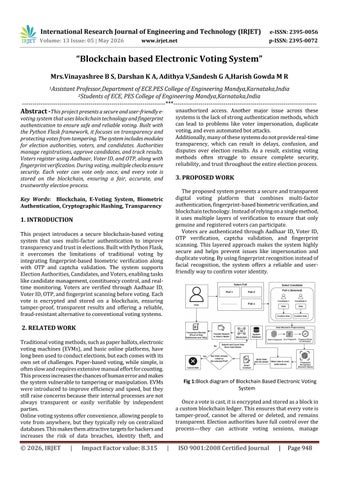
3. PROPOSED WORK The proposed system presents a secure and transparent digital voting platform that combines multi-factor authentication, fingerprint-based biometric verification, and blockchain technology. Instead of relying on a single method, it uses multiple layers of verification to ensure that only genuine and registered voters can participate. Voters are authenticated through Aadhaar ID, Voter ID, OTP verification, captcha validation, and fingerprint scanning. This layered approach makes the system highly secure and helps prevent issues like impersonation and duplicate voting. By using fingerprint recognition instead of facial recognition, the system offers a reliable and userfriendly way to confirm voter identity.
Key Words: Blockchain, E-Voting System, Biometric Authentication, Cryptographic Hashing, Transparency
1. INTRODUCTION This project introduces a secure blockchain-based voting system that uses multi-factor authentication to improve transparency and trust in elections. Built with Python Flask, it overcomes the limitations of traditional voting by integrating fingerprint-based biometric verification along with OTP and captcha validation. The system supports Election Authorities, Candidates, and Voters, enabling tasks like candidate management, constituency control, and realtime monitoring. Voters are verified through Aadhaar ID, Voter ID, OTP, and fingerprint scanning before voting. Each vote is encrypted and stored on a blockchain, ensuring tamper-proof, transparent results and offering a reliable, fraud-resistant alternative to conventional voting systems.
2. RELATED WORK Traditional voting methods, such as paper ballots, electronic voting machines (EVMs), and basic online platforms, have long been used to conduct elections, but each comes with its own set of challenges. Paper-based voting, while simple, is often slow and requires extensive manual effort for counting. This process increases the chances of human error and makes the system vulnerable to tampering or manipulation. EVMs were introduced to improve efficiency and speed, but they still raise concerns because their internal processes are not always transparent or easily verifiable by independent parties. Online voting systems offer convenience, allowing people to vote from anywhere, but they typically rely on centralized databases. This makes them attractive targets for hackers and increases the risk of data breaches, identity theft, and
© 2026, IRJET
|
Impact Factor value: 8.315
Fig 1:Block diagram of Blockchain Based Electronic Voting System Once a vote is cast, it is encrypted and stored as a block in a custom blockchain ledger. This ensures that every vote is tamper-proof, cannot be altered or deleted, and remains transparent. Election authorities have full control over the process—they can activate voting sessions, manage
|
ISO 9001:2008 Certified Journal
|
Page 948