
International Research Journal of Engineering and Technology (IRJET) e-ISSN:2395-0056
Volume:13Issue:03|Mar2026 www.irjet.net p-ISSN:2395-0072
International Research Journal of Engineering and Technology (IRJET) e-ISSN:2395-0056
Volume:13Issue:03|Mar2026 www.irjet.net p-ISSN:2395-0072
M. Sarah Angeline1 , B. K. Lakshita Yadav2 , Gorremuchu Sangeetha3 , Nasam Snigdha4
1Gorremuchu Sangeetha,Dept of CSE, Stanley College of Engineering and Technology for Women, Hyderabad, India
2B.K.Lakshita Yadav, Dept of CSE, Stanley College of Engineering and Technology for Women, Hyderabad, India
3Nasam Snigdha, Dept of CSE, Stanley College of Engineering and Technology for Women, Hyderabad, India
3M.Sarah Angeline Professor, Dept. of Computer Science Engineering, Stanley College of Engineering and Technology for Women, Hyderabad, India
Abstract - Ayurveda is an ancient healthcare system that emphasizes the importance of harmony in human bodies, minds, and lifestyles to attain complete well-being in life. Nevertheless, people are facing problems in acquiring expert advice in this particular field due to the scarcity of experts and the lack of intelligent digital platforms to support this system. In this direction, this research proposes an intelligent digital platform named "AyurIntel" to facilitate people in acquiring well-being advice based on Ayurveda principles. The proposed system collects user data in terms of symptoms, lifestyle, and dietary habits through an interactive interface. The proposed system uses machine learning and natural language processing techniques to analyze the input data and predict the Prakriti and wellbeing status of the user. Based on the analysis results, the proposed system provides advice to users regarding diet plans, lifestyle, and preventive healthcare measures through the system interface. The experimental results proved that the proposed system achieves high performance in terms of accuracy (92.4%), precision (93.1%), recall (91.7%), and F1-score (92.4%). The results proved that the proposed system can bridge the gap between Ayurveda and AI technology, and people can maintain a healthy and balancedlifestylethrough thissystem.
KeyWords:Ayurveda, Artificial Intelligence, Personalized Healthcare, Wellness Recommendation System, Machine Learning, NLP, Preventive Healthcare,Intelligent
Ayurvedaisoneoftheoldesthealthcaresystems,teaching people to live in balance in all aspects – body, mind, and lifestyle–toliveahealthyandjoyouslife.Inrecenttimes, there has been an increase in interest in natural and preventivehealthcare.However,onemajor barrierto this is that there are no experts or smart tools available to guide people in natural and preventive healthcare in a personalized manner, as most available tools just provide general information based on input, without considering an individual’s health, lifestyle, or how the body works in detail. But with advancements in AI and ML, we have an opportunitytocreateintelligenttoolsthatcananalyzethe
input data and provide personalized information to individuals. This project proposes an intelligent tool named "AyurIntel," developed based on Ayurveda principles and recent technologies to provide individuals withhealth-focusedlifestyleinformation.
The AyurIntel systemisbased on the idea of providing personalizedwellnesssuggestionsbasedonAyurveda and artificialintelligence.Thesystemcollectsuserinformation, including diet, lifestyle, and health conditions, through an interactive user interface. The system analyzes this information to calculate the user’s body constitution, i.e., Prakriti. According to the user’s body constitution, the system providesappropriate suggestions. The idea behind this system is to make Ayurveda simple and easy to understandforusers.
The system makes use of proper data processing techniques to ensure proper prediction and recommendation.Thedatacollectediscleaned,organized, and transformed into a suitable format. A Random Forest classifierisusedtopredicttheuser’sPrakritiandwellness levels.Thechoiceofthisclassifierisbasedonitsefficiency andhighaccuracyindealingwithcomplexdata.Theresult will include proper recommendations based on the AI systemandAyurvedicknowledge.
Ayurveda hasemphasizedtheimportanceof personalized health care based on the human body's constitution, lifestyle, and environmental influences. Classical texts havedescribedtheimportanceofvariousaspectsofhealth care, including Prakriti, doshas, and preventive health care.However,itisdifficulttoseekguidancefromexperts duetothelimitedavailabilityofAyurvedicexperts.
Recent research has emphasized the integration of Ayurveda with modern technology. Research papers have described the integration of artificial intelligence and machine learning techniques with the health care system
International Research Journal of Engineering and Technology (IRJET) e-ISSN:2395-0056
Volume:13Issue:03|Mar2026 www.irjet.net p-ISSN:2395-0072
toprovide personalizedhealthrecommendations.Various intelligentsystemshavebeendevelopedtoprovidehealth recommendations.
Global organizations have emphasized the importance of usingtraditional medicinealongwithmodern technology. However, most intelligent systems are developed to provide health recommendations for modern medicine, but not Ayurveda. Therefore, intelligent systems like AyurIntel, which integrate Ayurveda and AI to provide effectivehealthrecommendations,arenecessary.
The proposed system is defined as "AyurIntel," which is meant to offer personalized recommendations for wellbeing through the integration of Ayurvedic principles and machinelearning.Thesystemisabletocollectinformation related to users’ lifestyles, dietary habits, and health conditionsthroughastructuredinterface.Theinformation isprocessedandanalyzedtoidentifythebodyconstitution of the users (Prakriti). Based on this analysis, appropriate recommendations for well-being can be made. The methodology is thus effective and efficient in providing healthcareservices.
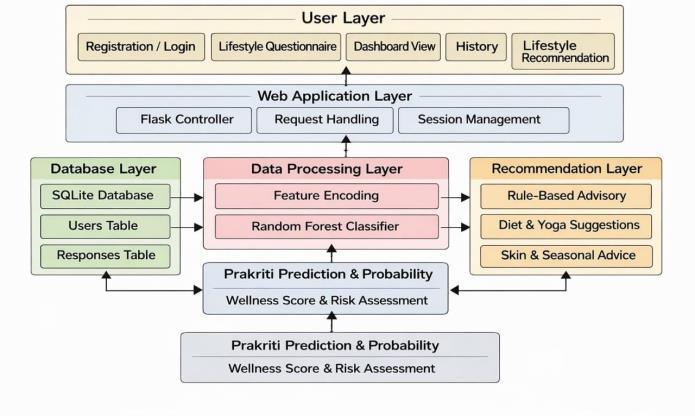
This figure represents an AI-based system that utilizes machine learning and Ayurveda to analyze user lifestyle and health data using a web-based interface. The system gatherscriticaldatasuchasdietaryhabits,sleepschedules, physical activity, and stress levels using a questionnaire. The system analyzes the data to forecast the user’s body constitution (Prakriti) and health using machine learning. The system then converts the data into health recommendations forusersto maintaina healthylifestyle. The system offers health recommendations such as diet plans, yoga practices, and lifestyle improvements to maintainahealthylifestyle.
The system collects data from the user through a structured questionnaire. The data collected includes
various factors such as dietary habits, sleeping habits, stress, and physical activities. This information is significant in determining the user’s body type based on Ayurvedic medicine. The data collected will be used as input for further processing. This ensures that recommendationsarebasedonuser-specificdata.
The data collected is processed to enhance the quality of the data. This process may include removing data with missing values, correcting errors, and transforming the data to a suitable form. Feature encoding and normalization techniques are used to improve the performance of the model. Only the required data is used for the analysis. This process ensures the accuracy and reliabilityoftheoutputprovidedbythesystem.
A Random Forest Classifier is used to predict the user’s Prakriti based on the input data. The model looks at the patterns in the data and determines the dominant dosha types. This is useful in understanding the user’s health characteristics. The model is chosen due to its high accuracy and efficiency.The prediction is a critical component in the generation of personalized recommendations.
Based on the predicted Prakriti, the system will provide personalized wellnesssuggestions. Thesesuggestions will include diet plans, lifestyle changes, and preventive healthcare tips. These suggestions will be based on the machinelearningalgorithmandAyurvedaprinciples.This will ensure that the suggestions provided are meaningful and effective. The system will help users lead a balanced andhealthylifestyle.
The table shows the relevant information about the implementationandperformanceoftheAyurIntelsystem. The table contains vital information, including margins, fontstyle,andformatting,whichwerefollowedasperthe IRJET format. Further, the table indicates the technical configuration of the system, including the programming language and the libraries used in developing the system. These aspects ensure proper configuration and simplicity ofthesystem.
Additionally,thetableoffersdetailsregardingthemachine learning algorithm implemented and the evaluation metrics considered for the analysis of the model's performance. The Random Forest algorithm is implemented as a classifier due to its high accuracy and efficiency in prediction models. Metrics like accuracy, precision, recall, and F1-score are included in the table to
International Research Journal of Engineering and Technology (IRJET) e-ISSN:2395-0056
Volume:13Issue:03|Mar2026 www.irjet.net p-ISSN:2395-0072
evaluatetheeffectivenessofthesystem.Thetableoffersa comprehensive idea regarding document formatting and thesystem'sperformance.
Table-1:PerformanceSetupofAyurIntelSystem
1
2
3
4
5 KNearest Neighbor s(KNN)
6
The table clearly shows the effectiveness of the proposed AyurIntelsystem.Amongallthemachinelearningmodels, the Random Forest algorithm has the best performance, including accuracy, precision, recall, and F1-score. It shows the efficiency of the model, which can be used to predicttheuser’sPrakriti.Thecomparativeanalysisofthe models can be used to understand the efficiency of the various algorithms used in the system. The above results clearly show the efficiency of the proposed approach, whichcanbeusedsuccessfully.
Overview:
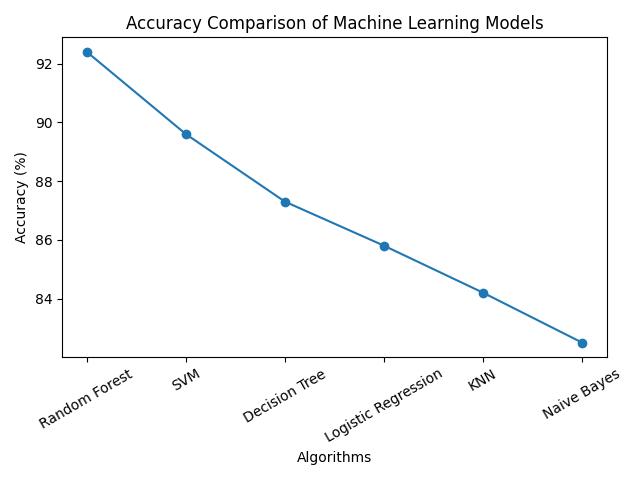
The chart compares the performance of various machine learning algorithms employed in the AyurIntel system based on their accuracy level. The chart can be used to determine which algorithm is best suited for prediction basedontheuser’sPrakriti.
PerformanceofRandomForestAlgorithm:
The accuracy level for the Random Forest algorithm is higher, at 92.4%, making it one of the best-performing algorithmsinthischart.
PerformanceofOtherAlgorithms:
The accuracy level for Support Vector Machine is moderate, at 89.6%, while for Decision Tree, it is slightly low, at 87.3%. The accuracy level for Logistic Regression, K-Nearest Neighbors, and Naive Bayes is low, at 85.8%, 84.2%,and82.5%,respectively.
ComparativeAnalysis:
Theaccuracylevelforeachalgorithmvaries,showingthat ensemble methods perform better than individual methods. This proves that choosing the right machine learning algorithm is important for healthcare prediction systems.
In this paper, a novel intelligent wellness recommendationsystem,namelyAyurIntel,isproposedto offer personalized healthcare recommendations based on Ayurvedic concepts. In the proposed system, machine learning approaches are incorporated along with traditionalknowledgetoanalyzeuserdataandpredictthe user’s Prakriti. Then, appropriate recommendations are generated based on the user’s Prakriti in terms of dietary habits, lifestyle, and preventive healthcare. The use of RandomForestalgorithmintheproposedsystemensures high accuracy and reliable performance in comparison to other models.From the experimental analysis, it is observedthattheproposedsystemisabletoachievegood performance in terms of high accuracy, precision, recall, and F1-score. This indicates that the proposed system is effective in understanding user health patterns and generating meaningful recommendations. Thus, AyurIntel effectively bridges the gap between traditional Ayurveda and modern technology. The proposed system can be further enhanced to improve efficiency for real-time applications.
The authors would like to express their sincere gratitude to the faculty members of the Department of Computer ScienceandEngineering,StanleyCollegeofEngineering& Technology for Women, for their continuous support and guidance throughout the development of this project. The
International Research Journal of Engineering and Technology (IRJET) e-ISSN:2395-0056
Volume:13Issue:03|Mar2026 www.irjet.net p-ISSN:2395-0072
authorswouldalsoliketothanktheprojectguidefortheir valuable suggestions and encouragement, which helped them to complete this work successfully. The authors would like to thank our friends and family members for their support and motivation during the course of this researchwork.
[1] D S. Lad, Ayurveda: The Science of Self-Healing, TwinLakes,WI,USA:LotusPress,2002.
[2] D. Frawley, Ayurveda and the Mind: The Healing of Consciousness, New Delhi, India: Motilal BanarsidassPublishers,2013.
[3] P.Sharma andR.Singh,“MachineLearningBased Health Recommendation System for Personalized Healthcare,” International Journal of Advanced ComputerScienceandApplications,vol.14,no.2, pp.120–128,2023.
[4] A. Kumar and S. Gupta, “Artificial Intelligence in Healthcare: Applications and Challenges,” IEEE Access,vol.11,pp.45720–45735,2023.
[5] R.PatelandM.Shah,“AData-DrivenApproachfor Personalized Healthcare Recommendation Using Machine Learning,” International Journal of Intelligent Systems and Applications, vol. 15, no. 3,pp.55–63,2023.
[6] S. Reddy and P. Kumar, “Predictive Healthcare Analytics Using Random Forest Algorithm,” Journal of Medical Systems, vol. 46, no. 9, pp. 1–10,2022.
[7] N. Gupta and V. Mehta, “AI-Based Personalized Wellness Recommendation System for Lifestyle Management,” IEEE International Conference on ArtificialIntelligenceandSmartSystems,2022.
[8] H. Brown and T. Wilson, “Machine Learning Techniques for Healthcare Data Analysis,” International Journal of Computer Science and Information Security, vol. 20, no. 4, pp. 34–41, 2022.
[9] L. Breiman, “Random Forests,” MachineLearning, vol.45,no.1,pp.5–32,2001.
[10]A. Liaw and M. Wiener, “Classification and RegressionbyRandomForest,”RNews,vol.2,no. 3,pp.18–22,2002.
[11]F. Pedregosa et al., “Scikit-Learn: Machine Learning in Python,” Journal of MachineLearning Research,vol.12,pp.2825–2830,2011.
[12]W. McKinney, “Data Structures for Statistical Computing in Python,” Proceedings of the 9th PythoninScienceConference,pp.51–56,2010.