
International Research Journal of Engineering and Technology (IRJET) e-ISSN: 2395-0056
Volume: 13 Issue: 06 | Jun 2026 www.irjet.net p-ISSN: 2395-0072

International Research Journal of Engineering and Technology (IRJET) e-ISSN: 2395-0056
Volume: 13 Issue: 06 | Jun 2026 www.irjet.net p-ISSN: 2395-0072
Thejiya.V1
1Department of Computer Science, Krupanidhi Group of Institutions, Bangalore, India *** -
Abstract-Asthedeploymentof5Gnetworksaccelerates globally, the focus of researchers, technologists, and policymakers is rapidly shifting toward sixth-generation (6G) wireless networks. 6G promises a dramatic transformation of communication paradigms by introducingultra-highthroughput,near-zerolatency,and AI-nativenetworking. It is envisionedas a transformative leap in mobile communication, promising ultra-low latency, terabit-per-second data rates, pervasive AI integration, and seamless global connectivity through integrated terrestrial, aerial, and satellite networks. This paper examines the foundational shifts proposed by 6G, identifying the limitations that drive the need for it. It probes into the architectural innovations underpinning 6G, including terahertz communication, AI-native networking, 3D network topologies, and intelligent reflecting surfaces. Key use cases such as real-time holography, tactile internet, and brain-computer interfacesareanalysedalongsidetechnicalchallengesand global pilot projects. Through extensive analysis and simulation, this paper provides a detailed roadmap toward a 6G-enabled future. The paper concludes with researchdirections,implementationstrategies,and policy considerations necessary for realizing the 6G vision by 2030andbeyond.
Keywords: Wireless networks, Mobile communication, Satellite networks, Global connectivity, 3DNetwork topologies, Simulation, Global connectivity, Architectural innovations
The journey of wireless communication has been marked by a generational leap approximately every decade each one reshaping the way humans interact, share, and access information. Starting with 1G analog voice in the 1980s, followed by 2G’s digital voice and SMS,3G’smobiledata,4G’sbroadbandinternet,and5G’s low latency and high-speed connectivity, each generation has addressed the demands of its era. However,theincreasingconvergenceofdigital,physical, and biological systems coupled with the explosive growthindevices,data,andAIapplications hasexposed thelimitationsofeventhemostadvanced5Gsystems.
5G,despiteitsmassiveimprovementsinspeed,capacity, and latency, is not fully equipped to support emerging demands such as real-time holographic communication,
high-precision industrial automation, immersive extended reality (XR), and ubiquitous global connectivity.Theseusecasesrequirenotonlyfasterdata transferbutalsointelligent,adaptive,andcontext-aware networkingfeaturesthatlieatthecoreof6G.
6G is not merely an extension of 5G; it represents a paradigm shift in how wireless systems are designed, implemented, and experienced. It promises peak data rates exceeding 1 terabit per second, end-to-end latencies below 0.1 milliseconds, and native support for artificial intelligence (AI) throughout the network. Additionally, 6G is expected to integrate communication with sensing, computing, and localization, enabling hyper-connected environments and intelligent services thatadaptdynamicallytousers'needs.
As of early research and standardization efforts, 6G is projected to reach initial deployment stages by 2030. Several countries and institutions such as the United States, China, South Korea, Finland, and the European Union have already launched strategic initiatives and pilot projects to lead this transition. While the vision is ambitious, it also brings significant challenges: from managing spectrum in the terahertz range to ensuring energyefficiency,privacy,andequitableaccess.
Thispaperexplorestheevolutionofwirelesstechnology leading to 6G, outlines its foundational innovations, and examines its transformative potential across industries and societies. Through technical analysis, simulation studies, and current global developments, the paper aimstoprovideacomprehensiveviewofwhat6Gmeans forthefutureofcommunication.
While 5G networks brought major breakthroughs in wireless communication such as enhanced mobile broadband (eMBB), ultra-reliable low latency communication (URLLC), and massive machine-type communications (mMTC) they are not sufficient for the anticipated demands of the next digital era. As new applications such as real-time digital twins, holographic conferencing, brain-computer interfaces, and fully autonomous systems emerge, the pressure to develop a more capable and intelligent network architecture is mounting. This pressure has catalysed the evolution toward6G.
International Research Journal of Engineering and Technology (IRJET) e-ISSN: 2395-0056
Volume: 13 Issue: 06 | Jun 2026 www.irjet.net p-ISSN: 2395-0072
Despite its achievements, 5G technology faces several constraints:
● Latency Floor: 5G targets latency as low as 1 millisecond, which is not enough for emerging usecaseslikereal-timeremotesurgeryorhaptic internet, which require sub-millisecond responsiveness.
● Bandwidth Saturation: Even with millimetrewave (mm Wave) bands, 5G cannot deliver the ultra-high capacity needed for terabit-level services such as high-resolution holograms or persistentXRenvironments.
● Limited Intelligence: 5G networks use AI primarily for optimization. They are not inherently AI-native, meaning decision-making isstillpartiallymanualorsemi-automated.
● Patchy Coverage: 5G relies heavily on dense infrastructure (e.g., small cells), making deployment expensive and leaving rural and remoteareasunder-served.
● Energy Consumption: With billions of devices connected, 5G networks consume substantial energy, raising sustainability concerns in both networkoperationanddevice-levelinteraction.
6G is envisioned as a holistic solution to these limitations, offering technological upgrades and architecturalshifts:
● Terabit-ScaleThroughput:6Gaimsforpeakdata rates of up to 1 Tbps using frequencies in the terahertz (THz) range (100 GHz to 10 THz), enablingextremelyhigh-speeddatatransfers.
● Sub-Millisecond Latency: 6G targets end-to-end latency below 0.1 ms, which will unlock truly real-time applications such as tactile internet, real-time remote operations, and precision controlsystems.
● AI-Native Architecture: In 6G, AI and machine learning are built into the fabric of the network itself, enabling autonomous optimization, selfhealing capabilities, and real-time decisionmaking.
● 3D Network Topology: By integrating satellites, high-altitude platforms (HAPs), and unmanned aerial vehicles(UAVs),6G offers3Dcoverage to eliminate blind zones and extend services to underservedareas.
● Energy-Efficient Design: 6G promotes lowpower protocols, energy harvesting
technologies, and green AI to make networks moresustainableandcost-effective.
The following emerging use cases highlight the inadequacyof5Gandjustifythetransitionto6G:
● Real-TimeHolography:Requiresextremelyhigh throughput and synchronization beyond 5G's capabilities.
● Brain-Computer Interfaces (BCIs): Demand ultra-low latency and uninterrupted highbandwidthconnectivity.
● Fully Autonomous Vehicles: Require constant and reliable communication, even in rural or obstacle-denseenvironments.
● DigitalTwinsandCyber-PhysicalSystems:Need synchronized sensing and actuation with nearzerodelay.
The architecture of 6G is expected to be fundamentally different from its predecessors. While 5G introduced cloud-native infrastructure, network slicing, and edge computing, 6G envisions a converged, intelligent, and three-dimensional (3D) communication system. It will natively embed artificial intelligence (AI), operate in the terahertz (THz) frequency bands, and seamlessly integrate terrestrial, aerial, and satellite networks. The following are the most significant architectural innovationsdriving6G.
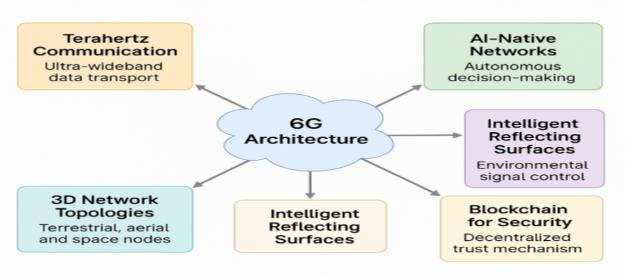
THz communication operates in frequencies between 100GHzand10THz. Thesefrequenciesofferultra-wide bandwidth, enabling data rates up to 1 Tbps, which are essential for applications like real-time holography and massive sensor data exchange. Challenges are High path loss, limited coverage distance, and hardware immaturity (e.g., THz antennas and circuits). Solutions includes development of high-gain antennas,
International Research Journal of Engineering and Technology (IRJET) e-ISSN: 2395-0056
Volume: 13 Issue: 06 | Jun 2026 www.irjet.net p-ISSN: 2395-0072
beamforming, ultra-massive MIMO, and intelligent surfacestofocussignalenergy.
In 6G, AI isn’t just an enhancement it becomes an intrinsic part of the network.AI-native systems allow self-organizing, self-optimizing, and self-healing networks, enabling real-time adjustments in routing, resource allocation, and anomaly detection. Benefits include predictive QoS based on user behaviour, realtime fault management, cyber-threat mitigation and personalized/context-awareservices.
Unlike 2D networks limited to ground-based infrastructure, 6G introduces a 3D topology involving: terrestrial base stations, UAVs (drones), high-altitude platforms (HAPs), and LEO satellites It ensures global coverage, especially in remote and disaster-hit areas wheredeployinggroundinfrastructureisimpractical.Its use cases are emergency response, rural broadband, defence communications, and maritime/aviation networks.
IRS are programmable meta-surfaces that reflect wireless signals in desired directions to enhance coverage and reduce interference. IRS can reshape the wireless environment dynamically, optimizing signal quality and reducing energy consumption. Its applications are enhancing indoor coverage, improving signal reliability in high-mobility scenarios (e.g., moving vehicles),supportingTHzandmmWavesignalsthatare otherwiseeasilyblocked.
Blockchain provides distributed, tamper-proof ledgers for authentication, data integrity, and access control As 6G networks become highly decentralized and dataintensive, trust management without central authorities becomes crucial. The benefits include secure identity management, transparent service-level agreements (SLAs), protection against fraud and tampering in IoT ecosystems.
6G will integrate sensing as a built-in feature, enabling thenetworkto"see"itsenvironment(e.g.,userposition, object detection, motion). This will enable applications suchasenvironment-awareservices,indoorlocalization, and cyber-physical coordination. Examples include use
of reflected THz signals for 3D imaging and gesture recognitioninsmarthomesorindustrialautomation.
6G is not merely a faster wireless standard it is a foundation for a new class of applications that require real-timeresponsiveness,massivebandwidth,intelligent networkbehaviour,andseamlessglobalcoverage.These use cases go far beyond the scope of 5G and promise to reshapeindustries,societies,andhumanexperiences.6G is expected to redefine numerous sectors through its advanced capabilities. Some of the most promising applicationsinclude:
High-fidelity 3D holograms are transmitted in real time to enable immersive communication experiences. Applications include virtual telepresence for remote collaboration, education and training with real-world simulations, entertainment (e.g., live concerts, virtual actors).
In this application, 6G network delivers extremely high throughput(Tbps-level),requireslatencybelow 1ms to synchronize motion and speech and will need ultra-low packetlossforimagestability.
The remote transmission of touch and haptic feedback happens in real time. The applications include remote surgery and medical training, tele-maintenance in hazardous or space environments, remote-controlled roboticsinmanufacturingordisasterrecovery. Inthiscase,6Gnetworkenableslatencyaslowas0.1Ms for real-time tactile feedback, ensures ultra-reliable communication with 99.99% availability and facilitates context-aware,AI-supportedcontrolsystems.
Smart city is an integrated system where urban infrastructure traffic lights, public transport, utilities, surveillance,andemergencysystems communicatesand adapts in real time. Applications are AI-powered traffic flow optimization, automated utility grids (smart electricity, water), and intelligent emergency response coordination.
In a smart city environment, a 6G Network supports billions of IoT devices in dense environments, offers edge computing for ultra-fast local data processing and provides3DconnectivitythroughUAVsandsatellitesfor resilience.
International Research Journal of Engineering and Technology (IRJET) e-ISSN: 2395-0056
Volume: 13 Issue: 06 | Jun 2026 www.irjet.net p-ISSN: 2395-0072
Thesearesystemsthatallowuserstocontrol devicesor communicate using neural signals. The applications are assistive technologies for individuals with disabilities, neuralprostheticsandcognitivemonitoring,gamingand immersivecomputing.
6G Networks is essential for proper functioning of BCIs as they require extremely low latency to match neural transmission speed, needs high bandwidth for brain signal decoding and feedback and demands robust privacyandsecurityprotocolsduetosensitivedata.
This is a fusion of AR (Augmented Reality), VR (Virtual Reality), and MR (Mixed Reality) experiences that blend the physical and digital world seamlessly. Applications areimmersiveeducationandvirtualclassrooms,remote site inspections and virtual tourism, military simulation andtraining.
A 6G network is essential for XR as it provides highresolution, real-timerenderingof environments,uses AI attheedgeforpersonalized,adaptivecontentandoffers stable connectivity across geographic regions and devices.
6) Digital Twins and Industry 5.0
It is a real-time virtual replica of physical entities (e.g., machines, humans, cities) used for monitoring, analysis, and optimization. Applications are predictive maintenance in manufacturing, human-machine collaboration in Industry 5.0, urban planning and sustainabilitymodelling.
A6Gnetworkallowsinstantsynchronizationofphysical and digital systems supports multi-modal sensor data integration and enables closed-loop feedback systems withultra-lowdelay.
Each of these use cases relies on 6G's core attributes: ultra-low latency, high reliability, massive device density, and embedded intelligence. As these applications mature, 6G will not only support new servicesitwillenableentirelynewindustries.
The deployment of 6G technologies will confront numerous technical and socio-economic challenges that mustbeaddressedsystematicallytoensureaviableand inclusiverollout.
First and foremost is the challenge of operating in the Terahertz (THz) band. These frequencies offer vast bandwidth, but their high susceptibility to atmospheric attenuation, rain fade, and molecular absorption severely limits propagation distance. Overcoming these challenges will require innovations in antenna design, beamforming, and materials science. Reconfigurable intelligentsurfaces(RIS)andultra-densesmallcellsmay be employed to overcome propagation losses, but these solutions must be optimized for cost and energy efficiency.
Another critical challenge is power consumption. The ultra-dense, high-throughput nature of 6G networks riskscreatingunsustainableenergydemands.Therefore, energyefficiencymustbeembeddedintoalllayersofthe protocol stack, and hardware must be capable of intelligent sleep modes, energy harvesting, and selfsustainingoperationthroughambientpowersources.
Cybersecurity and privacy represent significant hurdles. Withnetworksbecomingmoreintelligent,decentralized, and heavily reliant on AI, they become susceptible to newattackvectorssuchasadversarialmachinelearning, data poisoning, and smart jamming. Future security systems must incorporate real-time threat detection, quantum-resilientencryption,anddecentralizedidentity management using blockchain or distributed ledger technologies.
Standardization and spectrum allocation present logistical and geopolitical hurdles. Countries and regulatory bodies must work together to harmonize spectrum use, particularly in the THz bands. Failure to do so could result in fragmentation, inefficiencies, and incompatibilitiesbetweenregionalnetworks.
Finally,there’sthepressingissueofthedigitaldivide.6G networks will likely begin deployment in wealthier urban centres, potentially exacerbating inequalities. Governments and organizations must prioritize universal access and ensure that rural and underserved communities’ benefit from next-generation networks. Public-private partnerships and international developmentprogramswillbeessentialtoachievingthis goal.
The global race to shape the future of 6G has seen the launchofseveralstrategicpilotinitiativesbybothpublic andprivatestakeholders.
6G Flagship (Finland): Finland’s 6G Flagship, hosted by the University of Oulu, is one of the mostprominentacademic-ledresearch effortsin
International Research Journal of Engineering and Technology (IRJET) e-ISSN: 2395-0056
Volume: 13 Issue: 06 | Jun 2026 www.irjet.net p-ISSN: 2395-0072
the world. The initiative has explored the feasibility of using the THz band for short-range high-capacity communications. It has also made significant advances in intelligent surfaces and AI-native networking. The Flagship has released multiple white papers shaping the global understanding of what 6G should look like, and has served as a collaborative hub for academia and industry partners including Nokia and Ericsson.
Samsung’s 6G Vision: Samsung Research has presented a clear vision for 6G, outlining its aim to provide the 'next hyper-connected experience for all.' Key features include ultra-wideband communications, sub-millisecond latency, and ubiquitousAI.Samsunghasconductedsuccessful lab tests simulating real-time holographic video calls. Their approach also emphasizes AI-based network control systems, enabling dynamic resourceallocationandfaultprediction.
China’s6GSatelliteLaunch(2020):InNovember 2020, China launched what is widely recognized astheworld’sfirst6Gexperimentalsatellite.The satellitetestsfrequencybandsnotyetusedin5G, includingthoseabove100GHz,andexploresthe useofnon-terrestrialnetworks(NTN)in6G.The mission aligns with China's strategic plan to dominate the 6G space by integrating terrestrial, aerial, and space-based platforms for global seamless communication. While still in early stages,itrepresentsaleaptowardrealizinga3D
Communicationinfrastructure.
One of the defining goals of 6G is to achieve ultra-low latency ideally below 0.1 milliseconds. Latency refers to the time it takes for data to travel from one point to another. For real-time applications like remote surgery, autonomous driving, and immersive XR, even a small delay can lead to failure or safety risks. To validate the effectiveness of integrating UAVs into 6G network architecture, we conducted a simulation study focusing onlatencyimprovementsinanurbanenvironment.
This simulation study explores how 3D networking, which combines ground-based towers, drones (UAVs), and satellites, can help reduce latency especially in complexenvironmentslikecrowdedcities.
The simulation modelled a 5x5 city block with varying obstacle densities to simulate line-of-sight obstructions. Three network topologies were tested: terrestrial-only, terrestrial with one UAV relay, and terrestrial with two UAV relays. The drone-based relays used line-of-sight beamforming and edge-computing capabilities to optimize path selection and reduce data transmission delays.
● Scenario: A typical urban grid with tall buildings, where wireless signals often get blockedordelayed.
● Objective: Compare latency across three configurations:
1. Terrestrial-only (traditional base stations)
2. Terrestrial+1UAVrelay
3. Terrestrial+2UAVrelays
● Parameters:
o Datarate:10Gbps
o Messagesize:1MB
o Environment: High-rise interference simulatedwithrandomobstructions
B) Results
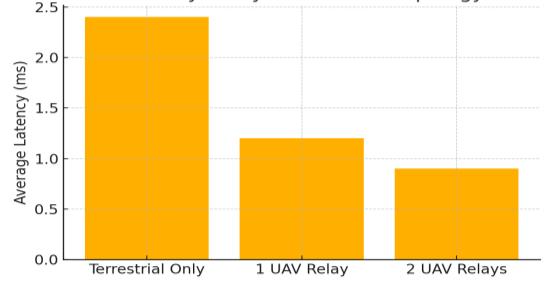
Fig - 2 : AverageLatencyComparisonin3D6GTopology
Table - 1: Latencyanalysisin3d6gtopology
Configuration Average Latency
Terrestrial-only 2.4Ms
1UAVRelay 1.2Ms
2UAVRelays 0.9Ms
C) Detailed Explanation
Imagineyou'resendingamessageacrossabusycity.Ifit travelsonlyvialand-basedtowers(likewalkingthrough traffic), it may get delayed by buildings or congestion. Now, imagine adding flying drones above the city acting like express messengers who skip the traffic by flying overit.ThisiswhatUAVrelaysdo.
International Research Journal of Engineering and Technology (IRJET) e-ISSN: 2395-0056
Volume: 13 Issue: 06 | Jun 2026 www.irjet.net p-ISSN: 2395-0072
Inthissimulation:
● Withnodrones,thedelaywas2.4Ms
● Addingjustonedronecutthedelayinhalf.
● Using two drones brought the delay under 1 millisecond fast enough for critical applications likeremotemedicalcontroloremergencydrone navigation.
This simulation proves that incorporating 3D network elements like drones, significantly reduces latency in urban environments. However, real-world deployment willrequire:
● Stableaerialcontrolsystems
● Efficientenergyusageforflyingnodes
● Regulatory frameworks for airspace communication
Still, the gains are clear: 3D networking is a vital tool in achievingthelow-latencygoalsof6G.
Asthevisionfor6Gbecomesmoretechnicallydefined,it opens up a wide array of research questions that span acrosscommunicationtheory,hardwaredesign,artificial intelligence, network security, and public policy. Addressing these questions is essential for moving from the conceptual phase of 6G to real-world deployment andstandardization.
● Challenge: How can the THz band (100 GHz to 10 THz) be effectively used despite its extreme pathlossandlimitedrange?
● ResearchNeeds:
o Efficient channel modelling at THz frequencies.
o Adaptive modulation and coding schemes suited for ultra-high bandwidth.
o Low-power THz transceiver and antennadesigns.
● Challenge:HowcanAIbedeeplyintegratedinto network control and decision-making while ensuringaccountabilityandrobustness?
● ResearchNeeds:
o Federated learning and edge AI for distributedenvironments.
o Explainable AI (XAI) for network auditingandtransparency.
o Resilience against adversarial attacks anddatapoisoning.
● Challenge: Can networks that “sense” their environmentoperatereliablyandsecurely?
● ResearchNeeds:
o Jointwaveformdesignforsimultaneous communicationandsensing.
o Resource allocation trade-offs between sensing accuracy and communication throughput.
o Context-aware services that utilize environmentalfeedback.
● Challenge: How can we ensure data integrity anduserprivacyindecentralizedandintelligent networks?
● ResearchNeeds:
o Quantum-safe cryptographic protocols forlong-termsecurity.
o Lightweight security algorithms for energy-constraineddevices.
o Blockchain and distributed ledgers for trustandauthentication.
● Challenge: How can we manage and optimize dynamic multi-layer networks (ground, air, space)?
● ResearchNeeds:
o Optimal placement and coordination of UAVsandsatellites.
o Interoperability standards across terrestrialandnon-terrestrialsystems.
o Energy-aware aerial routing and flight managementsystems.
● Challenge: Can 6G be sustainable while supportingtrillionsofconnecteddevices?
● ResearchNeeds:
o AI for adaptive energy management in realtime.
o Integration of ambient energy harvestingtechnologies.
International Research Journal of Engineering and Technology (IRJET) e-ISSN: 2395-0056
Volume: 13 Issue: 06 | Jun 2026 www.irjet.net p-ISSN: 2395-0072
o Carbon-aware network scheduling and optimization.
● Challenge:Howcanweensurethat6Gpromotes equity,accessibility,andethicaluse?
● ResearchNeeds:
o Governance models that balance innovationandpublicgood.
o Inclusionstrategiestobridgethedigital divide.
o Ethical frameworks for technologies likeBCIsandubiquitoussurveillance.
The development of 6G is not just a technological endeavour-it is a multidisciplinary challenge that intersects engineering, AI, law, policy, ethics, and sustainability.Theseopenresearch questionswill shape the design, deployment, and societal role of 6G in the coming decade. A collaborative global research ecosystemisessentialtotacklethemholistically.
The evolution of wireless communication has reached a critical inflection point. While 5G continues to roll out globally, the demands of future applications ranging from real-time holography and autonomous systems to brain-computerinterfacesandtrulyimmersiveextended reality necessitate a paradigm shift in network capabilities.6Gaimstomeetthesedemandswitha bold redesign of communication systems that goes beyond incrementalimprovements.
With target specifications including terabit-per-second data rates,sub-millisecondlatency,ultra-highreliability, and native AI integration, 6G represents a foundational transformation in how we perceive and interact with wireless technologies. Its architecture will be fundamentally decentralized, intelligent, and multidimensional, incorporating terrestrial, aerial, and satellitenodestoprovideseamless,globalcoverage.
This paper has examined the technological motivations for6G,thekeyarchitecturalinnovationsthatdistinguish it from 5G, and the transformative use cases it will enable.Simulationstudiesandglobalpilotprojectsshow promising early results, especially in areas like latency reduction through 3D topologies. However, several challenges remain particularly in areas of spectrum availability, energy efficiency, security, and equitable access.
Thesuccessful realizationof 6Gwill depend not only on engineering breakthroughs but also on global collaboration, inclusive policy-making, and sustainable practices. It will require a multi-disciplinary effort that combines research in physics, computer science, artificial intelligence, and ethics to build a network that is not just faster, but smarter, more inclusive, and more resilient.
In essence, 6G is not simply about better connectivity it is about redefining the relationship between people, machines, and the digital environment. Its development will shape the future of communication, productivity, andsocietalprogressfordecadestocome.
I make use of this opportunity to express our sincere gratitude to the Management of Krupanidhi Group of InstitutionsforsupportingtheworkthroughKrupanidhi ResearchIncubatorCentre(K-RIC)program.Ialsothank my Research Mentors who guided me throughout the researchandhelpedusinachievingthedesiredresults.
1) M. Latva-aho and K. Leppänen, "Key Drivers and Research Challenges for 6G Ubiquitous Wireless Intelligence," 6G Flagship White Paper, Univ. of Oulu,2019.
2) SamsungResearch,"6G:TheNextHyper-Connected ExperienceforAll,"SamsungElectronics,Jul.2020.
3) ITU-T, "IMT-2030 Framework and Overall Objectives of the Future Development of IMT for 2030 and Beyond," Int'l Telecommunication Union, 2022.
4) T. S. Rappaport et al., "Wireless Communications and Applications Above 100 GHz: Opportunities and Challenges for 6G and Beyond," IEEE Access, vol.7,pp.78729-78757,2019.
5) L. Zhang et al., "A Survey on 6G: The Next GenerationofMobileCommunication,"IEEEAccess, vol.9,pp.106638-106677,2021.
6) H. Tataria et al., "6G Wireless Systems: Vision, Requirements, Challenges, Insights, and Opportunities,"Proc.IEEE,vol.109,no.7,pp.11661199,Jul.2021.
7) Z. Zhang et al., "6G Wireless Networks: Vision, Requirements,Architecture,andKeyTechnologies,"
International Research Journal of Engineering and Technology (IRJET) e-ISSN: 2395-0056
IEEEVehicularTechnologyMagazine,vol.14,no.3, pp.28-41,Sep.2019.
8) W. Saad, M. Bennis, and M. Chen, "A Vision of 6G Wireless Systems: Applications, Trends, Technologies, and Open Research Problems," IEEE Network,vol.34,no.3,pp.134-142,May/Jun.2020.
9) F.Akyildiz,A.Kak,andS.Nie,“6GandBeyond:The FutureofWirelessCommunicationsSystems,” IEEE Access,vol.8,pp.133995–134030,2020.
10) C. Huang, A. Zappone, G. C. Alexandropoulos, M. Debbah, and C. Yuen, “Reconfigurable Intelligent Surfaces for Energy Efficiency in Wireless Communication,” IEEE Transactions on Wireless Communications,vol.18,no.8,pp.4157–4170,Aug. 2019.
11) Y. Yuan, Y.Zhao,B. Zong,andS. Parolari, “Potential Key Technologies for 6G Mobile Communications,” Science China Information Sciences, vol. 63, no. 8, pp.1–19,2020.
12) N. H. Mahmood, H. Alves, O. A. López, M. Shehab, and M. Latva-aho, “Six Key Features of Machine TypeCommunication in6G,” IEEECommunications Magazine,vol.57,no.12,pp.34–40,Dec.2019.
13) X.Youetal.,“Towards6GWirelessCommunication Networks: Vision, Enabling Technologies, and New Paradigm Shifts,” Science China Information Sciences,vol.64,no.1,pp.1–74,2021.
14) K. B. Letaief, W. Chen, Y. Shi, J. Zhang, and Y. A. Zhang, “The Roadmap to 6G: AI Empowered Wireless Networks,” IEEE Communications Magazine,vol.57,no.8,pp.84–90,Aug.2019.
15) S. Dang, O. Amin, B. Shihada, and M. S. Alouini, “WhatShould6GBe?”NatureElectronics,vol.3,pp. 20–29,Jan.2020.
BIOGRAPHY

Thejiya V is an Assistant Professor in the Department of Computer Science, Krupanidhi Group of Institutions, Bangalore. She completed her Bachelors in Computer Science & Engineering and her Masters in Computer Science & Engineering from Amrita School of Engineering, India under Amrita University.Hercurrent researchinterestlies in thearea ofComputerNetworks.
Volume: 13 Issue: 06 | Jun 2026 www.irjet.net p-ISSN: 2395-0072 © 2026, IRJET | Impact Factor value: 8.315 | ISO 9001:2008 Certified Journal | Page 365