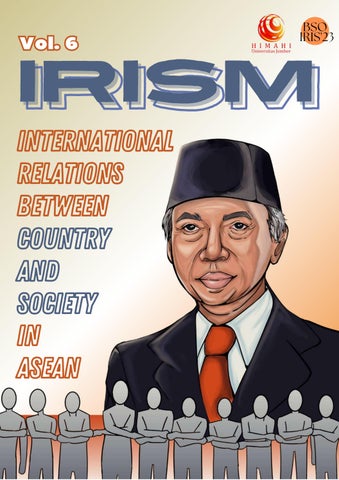
IRISM IRISM Vol. 6
International RelationS Between Country and Society In ASEAN
Preword BSO IRIS 2023's Chief
I would like to express my thanks for the support of those who helped prepare this HIMAHI magazine. It't work well without the support of external parties like the volunteers who have submitted the writing. This magazine serves as an information medium to channel knowledege related to major international relations and also as entertainment for you. 3 2 ’ IR R ifq i P u Besides, the publication of this tra K u r nia H a q magazine is also a form of Himahi's existence at Jember University in order to spread knowldege. I hope through the publication of this magazine can open up your insight into International Relations major in general and HIMAHI at Jember University in spesific.
01
BSO IRIS
2023 CONtent CON
writer
Diana Laili Nur Faiqoh IR’22 (chief) Oktaviani Rosmala IR’23 Adinda Riski Oktasari IR’22 Nadiyah Asyifa Putri IR’21
02 01
Chi Chief
Rifqi Putra K. H. IR’23
Filter ter Ega Ayu Agustin IR’21 Alga Pamungkas IR’21
MEMBERS
Editor Tor
Mia Eunice F. S. IR’23 (chief) Rahma Nur IR’23 Kalita Meviana P. IR’22 Aurel Amadea P. S. IR’23
Documentation tation Wali Anshori IR’22 Sardo Hasiholan Pardede IR’21
03
Table of Contents Cover Preword BSO IRIS Members Table of Contents Music Recommendation History of ASEAN Gastro Diplomacy in ASEAN Movie Recommendation Biography of ASEAN Public Figure Political Economic Dynamic in ASEAN ASEAN Cultural Society in ASEAN Environmental in ASEAN ASEAN Event ASEAN Matters Work Program Poem Mini Comic Bibliography
04
01 02 04 05 06 08 10 11 12 14 16 18 20 22 24 26 28
Music Recomendation
05
HISTORY OF ASEAN The Association of Southeast Asian Nations (ASEAN) was established on August 8, 1967. ASEAN was founded by five member countries: Indonesia, Malaysia, Philippines, Singapore, and Thailand. At that time, representatives of these five member countries officially signed the ASEAN Declaration, also known as the Bangkok Declaration. Some of the State/Government Representatives who signed the Bangkok Declaration included Adam Malik as the Minister of Foreign Affairs of Indonesia, Tun Abdul Razak as the Deputy Prime Minister, Minister of Defense and Minister of National Development of Malaysia, Narciso Ramos as the Minister of Foreign Affairs of the Philippines, S. Rajaratnam as the Minister of Foreign Affairs of Singapore, and Thanat Khoman as the Minister of Foreign Affairs of Thailand.
credit: s3.amazonaws.com
06
The Bangkok Declaration marks the official establishment of ASEAN and outlines the initial goals of its formation. The contents of the Bangkok Declaration are as follows : 1. To accelerate the economic growth, social progress and cultural development in the Southeast Asian region 2. To promote regional peace and stability 3. To promote active collaboration and mutual assistance on matters of common interest in the economic, social, cultural, technical, scientific and administrative fields 4. To provide assistance to each other in the form of training and research facilities in the educational, professional, technical and administrative spheres. 5. To collaborate more effectively for the greater utilization. 6. To promote South-East Asian studies 7. To maintain close and beneficial cooperation with existing international and regional organizations.
Adam Malik
e
n es
ia
Th
Mi
n ist
er of
F oreig n A ff airs
d fo In
o
After its official establishment in 1967, ASEAN continued to experience significant growth. ASEAN has achieved various agreements in both political and economic realms. In the political realm, ASEAN agreed to the Zone of Peace, Freedom, and Neutrality Declaration (ZOPFAN) in 1971. Furthermore, ASEAN also established the Treaty of Amity and Cooperation in Southeast Asia (TAC) as a foundation for ASEAN countries to coexist peacefully. In the realm of economics, ASEAN established the Agreement on ASEAN Preferential Trading Arrangements (PTA) in 1977. PTA served as the basis for adopting various instruments to facilitate trade liberalization on a preferential basis. Additionally, ASEAN successfully agreed on the Common Effective Preferential Tariff (CEPT) Scheme for the ASEAN Free Trade Area in 1992.
The development of ASEAN has led countries outside the founding members to express their desire to join the association. Brunei Darussalam officially became the 6th member of ASEAN on January 7, 1984, during a Special Meeting of ASEAN Foreign Ministers in Jakarta, Indonesia. Vietnam became the 7th member of ASEAN at the 28th ASEAN Foreign Ministers Meeting in Bandar Seri Begawan, Brunei Darussalam, on July 2930, 1995. Laos and Myanmar became the 8th and 9th members of ASEAN at the 30th ASEAN Foreign Ministers Meeting in Subang Jaya, Malaysia, on July 23-28, 1997. Cambodia officially became the 10th member of ASEAN in a Special Admission Ceremony on April 30, 1999, in Hanoi, Vietnam. Meanwhile, Timor Leste, which is also part of Southeast Asia, applied for ASEAN membership in 2011. At the ASEAN Summit in Phnom Penh, November 2022, Timor-Leste was approved in principle to become the 11th member of ASEAN. Meanwhile, discussions to formally achieve full membership for Timor-Leste are ongoing within the ASEAN Coordinating Council Working Group on Timor-Leste (ACC-WGTL). ASEAN continues to evolve in line with the aspirations of its founding members. ASEAN remains committed to accelerate economic growth while promote peace and regional stability. Based on these developments, ASEAN is continually expanding its influence and presence on the global stage.
by: Adinda Riski Oktasari (IR’22) ilustration: Mia Eunice F. S. (IR’23)
07
Gastro diplomacy in ASEAN Exploring the Culinary Bonds of Southeast Asia
Gastrodiplomacy is a strategy that uses the power of food as the main instrument in conducting diplomacy. It is a means of intercultural communication that can help achieve a country's national interests in the global realm. Gastro diplomacy involves promoting a country's authentic cuisine to other countries, which can advance the country's economy. The term "gastro diplomacy" was first used in an article about Thailand's public diplomacy campaign to promote its food and culinary arts to the world. Since then, the popularity of gastro diplomacy has spread rapidly. As we know, gastro diplomacy is a diplomatic strategy that involves using food as a means. In Southeast Asia, food has several vital roles in gastro diplomacy : 1. Food is a lubricant in conversation, provides happiness, and facilitates serious conversations, even in state diplomacy. 2. Food can help increase self-control, being a tool to relieve tension or prejudice. This “food can help increase self-control", which relates to the role of food as a lubricant in conversation. 3. Food can improve diplomatic relations through the gastronomic essence of diplomacy, where food can strengthen relations when heads of state gather in bilateral or multilateral forums, with food being an essential part of diplomatic events. 4. A country can use food to improve its image or branding of a country. For example, Indonesia used its culinary specialities, such as Rawon, as a diplomatic tool at the 2023 ASEAN Summit, which helped improve the country's image. 5. Food can encourage internationalization, although it is not the only factor. But with the support of hard work, food can be a catalyst for strengthening international relations. 6. Food can also contribute to economic growth and a nation's historical development. For example, culinary products can promote a country's economic growth in a way that reflects its distinctive culture. This does not only apply to Indonesia but also many other countries. 7. Food can also be used as a tool in economic diplomacy.
08
In gastro diplomacy, there is a new trend that is developing. For example, the latest trend in gastro diplomacy is cross-border culinary collaboration. This could mean collaboration between restaurant chefs in exchange programs or organizing regional food festivals like the ASEAN Food Festival. The ASEAN Food Festival is an example of celebrating the ASEAN region's rich culinary heritage and unique traditions. The ASEAN Food Festival 2023 will be a significant future event featuring various delicious dishes from various ASEAN regions. This festival is also a form of celebration of the cultural heritage and traditions of the ASEAN region. It is an excellent opportunity for people to experience the culinary and cultural diversity of the ASEAN region. It must be clarified that the ASEAN Festival differs from the Asian Food Fest, which involves the entire Asian continent and takes place in Los Angeles. The ASEAN Festival involves only ASEAN member countries and is an attraction for food lovers and culture lovers, especially culture in the ASEAN region.
Although gastro diplomacy has many benefits, some challenges must be faced, including differences in sanitation and food safety policies in each country, which can hinder food trade. Each ASEAN member country has its own sanitation and food safety regulations. So, an ASEAN member country wants to host a diplomatic forum and use gastro diplomacy as a diplomatic instrument. In that case, they must research to ensure their gastro diplomacy can run smoothly without hampering food trade. In addition, it is essential to remember that food used in diplomacy must represent cultural diversity and not cause conflict, considering the cultural diversity of ASEAN member countries.
by: Diana Laili Nur Faiqoh (IR’22)
Another example of a joint food for peace program is an initiative combining food and diplomacy elements to advance peace in the ASEAN region. The program involves the exchange of chefs from member countries who work together to create dishes that reflect the region's cultural diversity. The event also includes a diplomatic dialogue, allowing countries to discuss regional issues, find solutions, and strengthen ties. Thus, diplomacy through food (gastro diplomacy) is a solid tool to strengthen relations between countries in ASEAN. As a universal language, food allows people across the region to better understand each other through shared experiences at the dinner table. To support more robust integration in ASEAN, it is essential to continue developing programs that promote regional culinary and cross-border culinary cooperation. Thus, food will continue to be a vital bridge in diplomacy in ASEAN.
09
MOVIE Recomendation Bad Genius (2017)
credit: themoviedb.org
Country of Origin: Thailand Genre: Crime, School, Comedy, Thriller Duration: 2h 10m Synopsis: Tells about a group of students, namely, Lynn, a student who is good at school but comes from a poor family and has difficulty socializing, Grace, Lynn's best friend; Pat, Grace's boyfriend. Together they ran an illegal exam jockey business without the school knowing. Until in the end, the business developed into a crazy mission to crack the international exam (STIC) to enter universities in the United States. Apparently, Bank, Pat's school friend, knew about this crazy plan. The Bank wants to report the plan to the school and police. However, it turned out that Pat had already thwarted Bank's plan and succeeded in persuading Bank to take part in the crazy mission to break into the STIC international exam monitoring system. This film is very exciting to watch. The audience is brought into suspense by by every scene. Through this film, we can also be more open to the culture of cheating and the portrayal I of the education system in developing countries, especially ASEAN countries, in a clearer, dramatized way.
The Scent of Green Papaya (1993)
credit: themoviedb.org
Country of Origin: Vietnam Genre: Drama, Romantic Duration: 1h 44m Synopsis: Tells the story of a 10 year old girl named Mui who works as a servant in a family. He was very loved by the hostess (mother of the family). Mui worked there for 10 years, then he was told to move by the hostess because things were starting to become unstable and he was going bankrupt. The hostess wants Mui to get a more decent job. Mui ends up working at the house of Khuyen, a young master who is a friend of the first child of her former employer's family someone she had a crush on as a child. The storyline is described quite slowly, but that doesn't make this film boring. But it is very interesting because the cinematography is winning and beautiful. This film is too beautiful and poetic to be a film.
Diamond Island (2016) Country of Origin: Kamboja Genre: Drama Duration: 1h 41m Synopsis: An 18-year-old boy who went to the city to work on a construction site called Diamond Island a project for rich people that also became a symbol of Cambodia's future. The man's name is Bora. Until finally, he was reunitedwith his older brother, Solei, who had disappeared 5 years ago, who introduced him to a new world he had never encountered before. Depiction. of urban life in Cambodia, through the life of Bora. A country boy who left his village life and worked in the city. The plot is quite easy with depictions of Bora's daily life with his fellow workers, falling in love with women in the city and much more.
credit: themoviedb.org
10
BIOGRAPHY
DR. KAO KIM HOURN
credit: asean.org
Dr. Kao Kim Hourn is the15th Secretary-General of ASEAN. Dr. Kao Kim Hourn has primarily concentrated his professional journey on enhancing Cambodia's global connections, especially in ASEAN. His career revolves around driving policy advocacy and advancing the fields of research, education, and development. Over the period of 2013 to 2022, Dr. Kao held the position of Minister Delegate associated with the Prime Minister of Cambodia for two consecutive terms. Additionally, he has authored numerous publications on Cambodia and ASEAN. Dr. Kao Kim Hourn moved to United States when he was 15 years old. In United States, he earned a Bachelor's degree from Baylor University, two Master's degrees from Ohio University, and Doctorate in Political Science from the University of Hawaii at Manoa. In January 1993, Dr. Kao Kim Hourn returned to Cambodia. He returned to run an ASEAN and international affairs think tank, and later joined the Royal Government of Cambodia, where he has served in a variety of positions for over 25 years, strengthening Cambodia's foreign policy and ASEAN integration. In recognition of his contributions to Cambodia, Dr. Kao Kim Hourn received numerous honors. Those honors are the Royal Order of Cambodia, the Royal Order of Sowathara, and The Grand Order of National Merit, Furthermore, in 2007, he was honored with an Honorary Doctorate of Public Service from Ohio University, and in 2014, he was granted an Honorary Doctorate in Literature from the Kalinga Institute of Industrial Technology in India. Dr. Kao Kim Hourn is the founder of The University of Cambodia. His primary goal of establishing this university is to provide the youth in Cambodia with a better education. Furthermore, he played a key role in founding two additional think tanks and played a supporting role in the establishment of Southeast Asia Television and Radio.
11
Political Economic Dynamic in ASEAN
credit: eastasiaforum.org ASEAN (Association of Southeast Asian Nations) was formed because its five founding countries had several similarities, one of which was their close geographical location. They also have similar backgrounds and the same vision, namely increasing regional resilience through broader political, security, economic and sociocultural cooperation, as stated in the ASEAN charter. The formation of ASEAN aims to provide sustainable benefits for all generations, as well as increase welfare and prosperity. In realizing this goal, the supporting factors involve economic and political aspects. In line with its ideals, ASEAN seeks to create a stable, prosperous and highly competitive single market and production base, which is economically integrated using adequate facilities for trade and investment. Of course, this requires specific policies, such as trade liberalization, for example, through AFTA (ASEAN Free Trade Agreement) with a tariff reduction mechanism to minimize trade barriers.
12
Apart from economic aspects, ASEAN also focuses on politics because politics and economics are interrelated. To achieve economic stability, ASEAN member countries must cooperate politically and internationally with neighboring countries and fellow ASEAN members. This AEC underlines that efforts to increase economic stability cannot only be focused on economic aspects alone but also require political aspects such as cooperation and agreements with other countries. ASEAN finally created a community called AEC (ASEAN Economic Community) from several of these goals. AEC is an economic entity consisting of countries in the Southeast Asia region to integrate the economy. The countries that are members of this community implement a system known as a single market system, which means they open up opportunities to trade goods, services, investment, capital and labor.
The implementation of this system is closely related to the goals promoted by ASEAN Vision 2020. One of the main goals is to create a stable, prosperous and competitive ASEAN region. This aligns with efforts to reduce poverty and economic disparities among ASEAN countries. The ASEAN Economic community was established to encourage equitable and sustainable economic growth in all ASEAN members. Apart from that, this community also aims to overcome the problem of poverty and achieve a higher level of development. This community is evidence of close cooperation between ASEAN member countries. It aims to facilitate labor exchange, with the hope of improving economic conditions in the Southeast Asian region and enabling them to compete globally. The ASEAN Economic Community faces various challenges and opportunities. The main challenges include economic inequality between ASEAN member countries, which leads to significant inequality in the level of economic development between them. Some ASEAN member countries are more economically advanced than others, and this inequality could hinder deeper economic integration. In addition, protectionism issues, such as tariffs and trade barriers, can become a barrier to regional trade in several ASEAN member countries. Global challenges such as trade wars, military conflicts, and pandemics such as COVID-19 also provide significant uncertainty and have a major impact on the ASEAN region, primarily due to its dependence on international trade. Although unpredictable, climate change is also a severe threat and requires concerted efforts to address its economic and environmental impacts. Climate change is primarily related to the impacts of climate change, such as storms, drought and weather changes, which can disrupt economic sectors and international trade.
The ASEAN Economic Community can strengthen economic integration by creating a single market and production, which allows a more accessible flow of goods, services and capital in the ASEAN region. Investment promotion by ASEAN member countries can increase cooperation in foreign investment and create a conducive environment for investment. Infrastructure development is also an essential opportunity because not all ASEAN member countries have adequate infrastructure, which is needed to distribute goods, services and capital. Cooperation in innovation and technology can help ASEAN member countries increase global competitiveness through joint technology research and development. Finally, managing risks and emergencies, such as natural disasters, climate change and health crises, is a form of cooperation needed to strengthen ASEAN's economic resilience. This involves mitigating and resolving problems that could affect regional economic stability. The conclusion from the explanation above is that the formation of the ASEAN Economic Community will face various challenges and issues that ASEAN members must face. Apart from creating a better environment for the prosperity of its members, the ASEAN Economic Community also needs to work together in anticipating negative impacts and challenges that may arise in the future, such as climate change, social welfare, economic inequality, economic influence from other countries, and economic digitalization.
by : Diana Laili Nur Faiqoh (IR’22) 13
ASEAN CULTURAL credit: wallpapercave.com
The Association of Southeast Asian Nations (ASEAN) is a region known for its cultural diversity. The various forms of traditions, customs, and habits of the ten member countries of Brunei, Philippines, Indonesia, Cambodia, Laos, Malaysia, Myanmar, Singapore, Thailand, and Vietnam are brought together by ASEAN. From the organization of vibrant festivals and culinary delights to the exhibition of traditional arts and some ancient traditions. Not only that, the cultural heritage of the various ASEAN countries is diverse and has its own charm. To celebrate the unity in diversity, ASEAN shows the beauty of how cultures within the regional community can coexist harmoniously.
14
One example of ASEAN's cultural diversity can be found in the form of Thailand's most iconic festival, the Songkran Water Festival. This tradition is a traditional Thai New Year celebration known as the water festival. Songkran in Thai itself means "to move" or "to change places" which refers to the shifting of the constellations or zodiac as the sun begins to move into Aries.
The main focus of this celebration is how one can move forward in life. Even the word Songkran itself in Sanskrit means "passage of the sun". Symbols of hospitality, love, family relationships and society as a whole are depicted through this Songkran festival. Water is believed by the Thai people to be something that can cleanse one from bad things and any misfortune.
On the other hand, an important part of Songkran is how people honor family traditions and religious practices but do not forget the essence of having fun. Songkran is usually celebrated outdoors with street parties while blasting loud music amidst massive water fights.
Songkran is the most popular festival in Thailand. This festival is usually held on April 13-15 every year. Thai people use this moment to gather with their families, even people who work in the city and come from the countryside will return to their villages to meet their families to celebrate Songkran. In order to celebrate Songkran, many activities are carried out by the community. For example, performing Merit or prayer rituals in the morning followed by serving food to the monks and freeing birds from their cages. Furthermore, water that has been given a typical Thai Nam Op Thai fragrance is used to bathe the Buddha statue in the afternoon. After that, people will spray or splash water on each other regardless of age in a joyful manner. Some of the temple visitors on Songkran will bring sand to replenish the sand that has been carried away by shoes throughout the year. They will leave the sand in stupas or mounds on the ground and then decorate with flowers and colorful flags.
Songkran celebration has a sacred meaning and value in which this celebration aims to build relationships between humans, nature, and also the Almighty purely. Although it is a festival of fun, Songkran is considered sacred because it is considered part of a religious ritual. However, these purposes have adapted with the times to become more constructive and can be adapted to various human needs based on certain interests.
by: Nadiyah Asyifa Putri (IR’23) illustration: Mia Eunice F. S. (IR’23)
15
SOCIETY IN ASEAN Communities in the Southeast Asian region (ASEAN) have unique characteristics and illustrate the diversity of their respective cultures, languages and religions. This unity in diversity characterizes ASEAN communities that can coexist in harmony among various cultures, such as Javanese, Filipino, Thai, and Vietnamese cultures. The values of tolerance and harmony in ASEAN communities tend to be upheld despite the differences in religions practiced, namely Buddhism, Hinduism, Islam, and Christianity. In maintaining stability and peace, it is necessary to cooperate between member countries. The initial establishment of ASEAN was intended to encourage cooperation among countries in the Southeast Asian region in accelerating economic growth, maintaining regional stability and peace among members, and in various other fields. ASEAN was initiated by 5 Southeast Asian countries, namely the Philippines, Indonesia, Malaysia, Singapore and Thailand. Later, as ASEAN cooperation expanded, 5 new members joined, bringing ASEAN to a total of 10 members, namely Brunei Darussalam, Laos, Cambodia, Myanmar, and Vietnam. The cooperation between ASEAN member countries has produced results that benefit various parties. This is because the Southeast Asian region itself has a strategic geographical location.
16
Credit: Asia Society
Nadiyah Asyifa Putri
(IR’21) With the highly varied and complex conditions of the ASEAN community, ranging from cultural, linguistic, historical, social, and economic diversity, making this region has unique characteristics that describe the characteristics of the ASEAN community. For example, Indonesia, which is the largest country in ASEAN, has a very diverse society in terms of religion, ethnicity, language, and traditions. Brunei and Singapore are more homogenous in terms of religion and ethnicity. On the other hand, there are various languages spoken by countries in the Southeast Asian region. Examples are Indonesian, Filipino, Malay, Thai, and many more. However, English remains the most commonly used language and is used as a second language to communicate between ethnic and cultural groups. This phenomenon illustrates how cross-cultural communication in a region with linguistic and cultural diversity is important.
Credit: Asean.org
In addition, the different religions of the majority of the population in ASEAN also play an important role in maintaining mutual tolerance. Indonesia and Malaysia are predominantly Muslim, while the majority of Thailand and Cambodia are Buddhist. However, there are minority communities who follow other religions such as Christianity, Hinduism and traditional religions. Therefore, the principles of interfaith tolerance must be applied to maintain harmony and peace in the Southeast Asian region. Various other social challenges such as human rights issues, environmental issues, and social inequality are also faced by the ASEAN Community. Efforts to achieve stability, peace and prosperity can be based on regional cooperation formed in the ASEAN Community.
Thus the establishment of the ASEAN Community in 2015, there are three important pillars that are interrelated and complementary, one of which is the ASEAN Social-Cultural Community (ASCC). The ASEAN Social-Cultural Community is a form of joint efforts of ASEAN member countries in strengthening the social, cultural and educational dimensions in the Southeast Asian region. The ASEAN Social-Cultural Community itself is open and dynamic, focusing on the community. The scope of cooperation is also broad and multi-sectoral. All forms of challenges in the fields of poverty, employment, population, and community welfare can be overcome together by the ASEAN community as a socio-cultural community.
17
ENVIRONMENTAL IN ASEAN Oktaviana Rosmala (IR'23) All ASEAN member countries have abundant natural resources. Uniquely, each country has a diversity of natural resources and different commodities that become the advantage of each country, both biological and non-biological. ASEAN is also home to some of the world's most famous species, with at least 20 percent of these species found in ASEAN However, this wealth of natural resources raises major environmental problems and challenges. Urbanization, population increase, economic and industrial advancement have led to increased consumption of water, energy and food. Asean also faces air pollution such as smoke, increasing average and normal temperature, increasing rain intensity, indiscriminate waste disposal, and natural phenomena such as drought, forest or land fires, and floods. These issues can increase population health risks caused by air pollution, and potentially climate change. Environmental and natural resource management is a key element in regional environmental cooperation. Since 1977, Asean has endeavored to strengthen regional environmental cooperation policy coordination with member and partner countries to meet these challenges. Funded by the United Nations Office of Environment and Climate Change (UNEP ROAP) account and implemented by the United Nations Environment Program Asia and Pacific (UNEP ROAP), Asean is developing a project on Strengthening ASEAN Member States' Policies with Environmental Health Data 2021-2023. The project aims to develop national capacities and facilitate South-South cooperation to assess data on the beneficial or detrimental use of tools in environmental action with an emphasis on air pollution. The project is expected to restore a positive role in health risk prevention measures against air pollution, climate change, environmental health, and improved development after the COVID-19 pandemic.
Credit: Impakter
18
At the regional level, Asean focuses on developing knowledge products and outreach on improving environmental health data and tools to increase public awareness in environmental health data and tools policy and decision-making. Asean also provides precise and practical steps in using data tools to assess the co-benefits and costs of taking no action to reduce air pollution. It can also be used to maximize energy, minimize trade-offs, and find the right steps to address the challenges of the current situation. The project also organized an outreach event as a venue for discussion and knowledge exchange at the asean level to foster regional cooperation and commitment to science-informed, multi-sectoral policy practices to address environmental issues. the event could also be used to support the Asia-Pacific Regional Forum on Health and the Environment. Association of Southeast Asian Nations) in the field of the environment are crucial in addressing pressing environmental challenges in the region. Some relevant hopes include: 1. Strong Regional Cooperation: The hope is that ASEAN will continue to strengthen regional cooperation in addressing environmental issues, including climate change, air and water pollution, and biodiversity protection. 2. Adoption of Green Technology: It is hoped that ASEAN member states will invest more in green and sustainable technologies, such as renewable energy and energy efficiency, to reduce environmental impacts. 3. Environmental Awareness: The hope is that ASEAN will promote environmental awareness among its citizens, including education on the importance of preserving nature and minimizing waste. 4. Improved Waste Management: It is hoped that ASEAN countries will develop more efficient waste management strategies, including reducing plastic waste, better recycling, and reducing food waste. 5. Compliance with Climate Agreements: The hope is that all ASEAN member countries will remain committed to international climate change agreements, such as the Paris Agreement, and take concrete steps to reduce carbon emissions. 6. Response to Natural Disasters: It is hoped that ASEAN will enhance its capacity to respond to natural disasters such as floods and earthquakes, which can have a significant impact on the environment and communities in the region. 7. Sustainable Development: The hope is that economic development in ASEAN will continue to follow the principles of sustainable development, taking into account environmental impacts as well as social and economic well-being. 8. Empowerment of Local Communities: It is hoped that local communities will be empowered to play a role in environmental conservation and in decision-making that affects their environment. These hopes reflect the importance of maintaining a balance between sustainable economic development and environmental protection in the diverse ASEAN region. To achieve these goals, strong collaboration among member countries and a commitment to addressing environmental issues collectively are essential.
19
ASEAN EVENT
Oktaviani Rosmala (IR'23)
ASEAN YOUTH SUMMIT 2023
The ASEAN Summit is an annual meeting that is attended by every member of the Association of Southeast Asian Nations (ASEAN), namely Indonesia, Vietnam, Malaysia, Thailand, Brunei Darussalam, Cambodia, Laos, Myanmar, the Philippines, Singapore, and Timor Leste. At this meeting, state officials discuss the issues of each country both externally and internally, security, regional cooperation, and the economy of ASEAN member countries. The implementation of this meeting is carried out in a country in turn to be the host. In 2023, Indonesia officially hosted the ASEAN Summit which was held on 5-7 September in Jakarta. Not only Asean members, this meeting also invited nine other partner countries, such as the Republic of Korea, India, Japan, the People's Republic of China, New Zealand, Canada, Australia, Russia, and the United States (US) This opportunity is certainly an important momentum for Indonesia in showing the influence of Indonesia's leadership in international relations. This momentum is also expected to be a bridge to resolve the Myamnar conflict and the problem of disputes in the South China Sea in China. At this year's meeting, Indonesia brought the theme ASEAN Matters: Epicenter of Growth which means that Indonesia wants to make ASEAN a priority and appropriate for the ASEAN community and the world. The theme is relevant to Indonesia's principle that wants ASEAN to become a region that has an important role in regional and world countries. Both in the control of peace and prosperity of the region. Indonesia also wants ASEAN to be the center of economic growth in the region and the world. The theme will also lead to other discussions that are more specific and detailed.
20
The meeting was also enlivened by several regional performances. There were songs such as kaka play wrong, cikini ke gondangdia, and many more. State officials also compactly wore typical Indonesian clothing, namely batik. President Joko Widodo (Jokowi) also invited state officials to have dinner together, entitled Nusantara The Forest. They ate their meals accompanied by the traditional "sasando" music from the island of Rote, East Nusa Tenggara. President Joko Widodo officially closed the ASEAN Summit on September 7 at the Jakarta Convention Center (JCC). This inauguration also marked that Indonesia's chairmanship of ASEAN had ended and was handed over to Laos. The success of this event made the guests feel satisfied and happy. They praised Indonesia for its success in chairing the 2023 ASEAN Summit. Indonesia's success as chair is not only in the process of the event, but also in the series of substance. This can be seen from the success in ASEAN-CEPA cooperation with Japan, China, South Korea, and other countries, and also successfully signed the ASEAN-Australia-New Zealand Free Trade Area (AANZFTA). This meeting also succeeded in formulating several collaborations in the fields of security, peace, digitalization, food, trade, connectivity, and also the region which is expected to improve these fields.
The Asean youth summit is a series of high-level conferences in the Asean youth agenda 2023, involving Asean youth to work together and take action to make Asean more advanced and prosperous. Asean youth summit is an official youth forum or organization in Indonesia's chairmanship of 2023. Not only does it play an active role in Indonesia's chairmanship of ASEAN, this forum also plays a role in negotiation and cooperation in policy with ASEAN leaders. The opening of the ASEAN+Youth Summit was held on September 7-8, 2023 at the Jakarta Concert Hall, Central Jakarta which was officially opened by the Minister of Youth and Sports of the Republic of Indonesia (Menpora RI), Dito Ariotedjo who represented President Joko Widodo (Jokowi). In his remarks, Minister Dito explained several important points that became the main pioneers of the Indonesian government in creating a quality young generation to face global challenges. Minister Dito also emphasized that the nation must prepare youth who are broadminded and confident. According to him, creating a qualified and broad-minded young generation needs competent preparation in order to compete in the global world. The event was attended by more than 1500 general public as well as 80 delegates from various partner countries. A number of politicians, such as Sandiaga Uno, Dante Saksono, Bima Arya, as well as Cinta Laura and Raline Shah as Panelists, also attended the opening process of the Asean Youth Summit 2023. The event was officially opened with a symbolic torch burning and a modern dance performance. The forum discussed several important topics that were also discussed at the 43rd Summit, such as green economy, empowerment, digital literacy, and employment. The forum also discussed 5 major points in Asean, namely digital literacy, health, food, education, and green economy spread over 10 panels. The various global challenges experienced today led Rorian Pratyaksa, Chair of the Asean Youth Agenda 2023, to pressure the youth to collaborate and carry out the role of youth in realizing world peace and prosperity. Rorian hopes that this forum can be an initial momentum in strengthening the foundation of youth in creating a prosperous Asean and shaping a more advanced Asean future.Menpora Dito also hopes that this forum can be an opportunity for youth to expand relationships and strengthen the bonds of brotherhood between other Asean countries. "This momentum is an important forum for Indonesian youth and ASEAN youth to unite, and play a role in shaping a sustainable future for the ASEAN region. I invite all youth to take the initiative and contribute in overcoming global challenges in various fields," he said.
21
ASEAN Matters Epicentrum of Growth
The ASEAN Summit in Indonesia, themed "ASEAN Matters: Epicentrum of Growth," underscores the main role of the Association of Southeast Asian Nations (ASEAN) in fostering regional development and cooperation. The phrase "ASEAN Matters: Epicentrum of Growth" contains deep meaning related to the role and importance of ASEAN in regional growth and development. This summit serves as a platform for member states to address shared challenges, strengthen economic ties, and promote collective prosperity (Intan, 2023). The summit explores avenues to bridge development gaps among member states, ensuring that the benefits of growth are distributed equitably. Social and cultural exchanges complement economic discussions, fostering a sense of community and understanding among the people of ASEAN. The epicenter of growth extends beyond tangible economic indicators; it encompasses environmental sustainability and technological advancement (CNBC, 2023). The summit deliberates on strategies for green growth, acknowledging the importance of environmental stewardship in the pursuit of long-term prosperity. Additionally, discussions on technology and innovation highlight ASEAN's commitment to staying at the forefront of the Fourth Industrial Revolution.
22
In its implementation, the ASEAN Summit in Indonesia was held on 5-7 September 2023 in Jakarta. The feast of the heads of state was performed magnificently. The location of the Jakarta Convention Center (JCC) was chosen as the venue for the meeting of ASEAN heads of state. Indonesia as the chairman of the ASEAN Summit 2023 and organized the theme “ASEAN Matters: Epicentrum of Growth.” President Joko Widodo revealed the meaning of the theme in detail as follows.
Rifqi Putra K. H. (IR'23) 1. ASEAN Matters: This phrase emphasizes that ASEAN has significant relevance and importance. It highlights that whatever happens in ASEAN will have a significant impact, whether economically, politically, socially, or culturally. 2. Epicentrum of Growth: "Epicentrum" refers to the centre or core of an event or phenomenon. In this context, the "Epicenter of Growth" describes ASEAN as the centre of economic growth, innovation, and development in the region. It refers the central role of ASEAN in promoting economic growth and development among member countries (Intan, 2023). 3. Economic growth: This phrase emphasizes that economic growth is one of the main focuses Through close economic cooperation, ASEAN countries strive to create an environment in which economic growth can be accelerated, creating opportunities for investment, trade, and infrastructure development.
4. Unity and Collaboration: The term "Epicentrum of Growth" also refers to unity and collaboration between ASEAN countries. It reflects the importance of working together to overcome shared challenges. 5. The importance of ASEAN in a Global Context: This phrase affirms that ASEAN is not only a regional entity; it also has a global impact. As an "epicenter", ASEAN has become a focus of attention and influence within the framework of international relations (PMK, 2023). In conclusion, the ASEAN Summit in Indonesia, under the theme "ASEAN Matters: Epicenter of Growth," epitomizes the collective strength and potential of Southeast Asian nations. By addressing economic, diplomatic, and social dimensions, the summit underscores the holistic nature of ASEAN's role in shaping the region's future (Arbar, 2023). As the epicenter of growth, ASEAN stands as a beacon of collaboration, resilience, and shared aspirations. Afterwards, a number of the programmes that followed the ASEAN Summit in Indonesia were the creation of an ecosystem of electric vehicles in ASEAN, the Digital Economy Framework Agreement (DEFA), energy resilience, implementation of Chiang Mai initiatives and local currency transactions (LCT), food security, ASEAN Outlook on IndoPacific, and related investments in the Asean Indo–Pacific Forum. (Kemenkeu, 2023).
23
WORK PROGRAM
HIMAHI 2023
IR CBL IR LE
MUN SCHOOL
OCR IR League
24
SR
iR-VE
Social night
HI-CUP
rakorwil
25
10 10 Christmases Christmases
Poem Poem
by byPradnya PradnyaParamitha Paramitha(IR’22) (IR’22) I woke up to the taylor swift song that was still echoing The tangled threads that fill this room are so suffocating because there are feelings that are not channeled It seems, this full moon must be missed again No, this is not our time The night holds me so tight, even though many questions are passing by Today, have I remembered? Remembering yourself who is still busy with your world People say, I am just a helpless human being Although many say too, my soul is as strong as steel I still miss the loud thump in my chest that races with my footsteps I also miss the blush that I kept a few years ago. This year, we still don't meet We are still on different axes We turn our faces away from each other But it's me who hopes the most, that the meeting is real And in the end, I returned to my promise To see you after 10 Christmases have passed To celebrate your birthday before the sparkling Christmas For 10 more times The countdown has rung back a few years My wish is still the same, like Taylor Swift in her enchantment Please dont be in love with someone else After 10 Christmases have passed We will meet
26
The Virtuoso
by M. Ayesha B. (IR’23) I cannot be good, I must be perfection Through my work, you shall transcend My talent justifies all actions I am a slave to this passion And now, the curtain rises Our performance begins The stage is set My audience awaits I bring them smile I bring them scream Because my art bloom Like a flower, in a dawn
Crescent Moon
by Yedzya M. A. (IR’23) It starts to fall off There goes another They’ve tried So does the night above
Sunny Side Up
by Yedzya M. A. (IR’23) from oneself find it in another to thyself becomes anew as it is through winter until summer stays sky sky blue
A Garden Beneath Eden A Garden Beneath Eden
by by Yedzya Yedzya M. M. A. A. (IR’23) (IR’23)
O, people of their mothers Sons of Eirene With heart of conquest The above foreseen The all loving is asleep Beware of He’s sharp teeth For Him living in paradise For us loaded with despise O, thee whom its preying upon Life and death, both the look of frown The song of distress can’t be helped Eyes opened, one could care less A garden beneath eden Heaven at the gates of hell The knights riding it’s carousell Let it be done
Lament of silence
by Ach. Fitra Mubarok (IR’23)
illustration: Mia Eunice F. S. (IR’23)
27
A scrawny shadow lost on one own loneliness Engulfed with the cold flame of melancholy sweetest blaze Clinging to a past, which hold his entire world by a single Knot His eyes wander in the midst of roaring darkness Whilst his mouth whispering a faint echo A ballad of words, spoken by the heart So beautiful as if time itself pauses to be the audience for his piece But amongst his crude form of word An echo of uncertainty, a bespoken hopelessness Conjured in a form of a sounds A sounds no eyes can witness, and no ear can enjoy A sound of silence Silence filled with nothing but sorrow For there was cheer in that silence But now its nothing but a memento for the departed heart
MINI COMIC MINI COMIC
as an introduction to the ASEAN function
by: Mia Eunice F. S. (IR'23) Rifqi Putra K. H (IR'23)
28
blibliography blibliography Aisyah, N. (2023, September 7). Gastrodiplomasi dalam KTT ASEAN 2023: Jalin Diplomasi Melalui Rawon dkk. Detik.com. https://www.detik.com/edu/detikpedia/d-6918125/gastrodiplomasi-dalam-ktt-asean-2023jalin-diplomasi-melalui-rawon-dkk Anwar, I. C., & Idhom, A. M. (2021, December 31). Kondisi Penduduk negara ASEAN: Thailand, Kamboja, Laos, Filipina. tirto.id. https://tirto.id/kondisi-penduduk-negara-asean-thailand-kamboja-laos-filipinagiuj Arbar, T. F. (2023, September 4). Menkominfo Blak-blakan soal KTT ASEAN: RI Bisa Buat Sejarah. Retrieved from CNBC Indonesia: https://www.cnbcindonesia.com/news/20230904173530-4-469056/menkominfoblak-blakan-soal-ktt-asean-ri-bisa-buat-sejarah ASEAN. (1967). The ASEAN Declaration (Bangkok Declaration). https://asean.org/wpcontent/uploads/2022/02/0719.pdf CNBC. (2023, September 6). Pengembangan Green Infrastructure Lewat Kerja Sama KTT ASEAN. Retrieved from CNBC Indonesia: https://www.cnbcindonesia.com/news/20230906205853-8-470090/pengembangangreen-infrastructure-lewat-kerja-sama-ktt-asean Davidson, (2022April13).Songkran.Celebrations.https://kids.nationalgeographic.com/celebrations/article/songkran Firdaus, M. I., Marseto, & Sishadiyati. (2021). ANALISIS DAMPAK INTEGRASI EKONOMI TERHADAP FOREIGN DIRECT INVESTMENT DI ASEAN. Jurnal Indonesia Sosial Sains, 2(9), 1497-1510. http://jiss.publikasiindonesia.id/ Intan, G. (2023, September 2). Jokowi Ungkap Indonesia akan Fokus Angkat Isu Ekonomi di KTT ASEAN. Retrieved from VOA Indonesia: https://www.voaindonesia.com/a/jokowi-ungkap-indonesia-akan-fokus-angkatisu-ekonomi-di-ktt- asean/7251697.html Kemenkeu. (2023, September 18). Sukses Raih Mufakat, Ini Poin Penting Hasil KTT ASEAN Keketuaan Indonesia 2023. Retrieved from Kemenku.go.id: https://www.kemenkeu.go.id/informasi-publik/publikasi/beritautama/Poin-Penting- Hasil-KTT-ASEAN-2023 Masyarakat Sosial Budaya ASEAN: Portal Kementerian Luar negeri Republik Indonesia. Masyarakat Sosial Budaya Asean | Portal Kementerian Luar Negeri Republik Indonesia. (n.d.). https://kemlu.go.id/portal/id/read/115/halaman_list_lainnya/masyarakat-sosial-budaya-asean Nath, R. (n.d.). Songkran Festival - Thailand’s New Year Water Festival. Holidify. https://www.holidify.com/pages/songkran-festival-869.html Pamungkas, G. H. (2022, July 19). ASEAN: Pengertian, Negara Anggota, Sejarah dan Tujuan. CNBC Indonesia. Retrieved October 18, 2023, from https://www.cnbcindonesia.com/news/20220719171803-4 356822/aseanpengertian-negara-anggota-sejarah-dan-tujuan Parasecoli, F. (2022, August 20). How Countries Use Food to Win Friends and Influence People. Foreign Policy. https://foreignpolicy.com/2022/08/20/food-diplomacy-countries-identity-culture-marketinggastrodiplomacy-gastronativism/ PMK, K. (2023). President Jokowi Explains the Meaning of "ASEAN Matters: Epicentrum of Growth" and Support from All ASEAN Heads of State. Labuan Bajo: Kemenko PMK. Sejarah dan latar pembentukan ASEAN | Portal Kementerian Luar Negeri Republik Indonesia. (n.d.). https://kemlu.go.id/portal/id/read/980/halaman_list_lainnya/sejarah-dan-latar-pembentukan-asean Symons, A. (n.d.). Thai New Year returns this month with water fights and parties. euronews. https://www.euronews.com/travel/2023/04/14/what-is-songkran-everything-you-need-to-know-about thailands-wet-and-wild-new-year-celebra WHAT IS GASTRODIPLOMACY. Gastrodiplomacy. Retrieved October 15, 2023, from https://www.gastrodiplomacy.net/#home