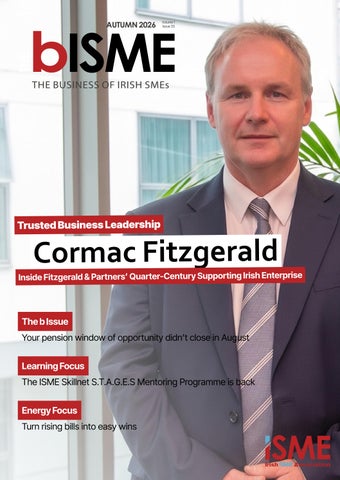
bISME Volume 1 Issue 33
THE
AUTUMN 2026
THE BUSINESS OF IRISH SMEs
Trusted Business Leadership
Cormac Fitzgerald
Inside Fitzgerald & Partners’ Quarter-Century Supporting Irish Enterprise
The b Issue Your pension window of opportunity didn’t close in August
Learning Focus The ISME Skillnet S.T.A.G.E.S Mentoring Programme is back Energy Focus Turn rising bills into easy wins
Business support made simple VISIT NEH.GOV.IE
Finding the right government support for your business has never been easier. The National Enterprise Hub is the single source of information on over 250 government supports. Whether you’re looking for grants, training or advice, you’ll find it all in one place. Support starts here An initiative of the Government of Ireland
bISME
THE
Contents
8.
16.
CONTENTS
Volume 1 Issue 33 AUTUMN 2026
17 Kildare Street, Dublin 2, Ireland. Phone : (01) 662 2755 E-mail: info@isme.ie
4. A Message from the Chief Executive: High Costs, Rising Insolvencies: ISME’s Pre-Budget Call to Action, an update from Neil McDonnell, ISME CEO 6. The b News: News and updates for business
Web: isme.ie
Published by iSME Editorial: gopika@isme.ie Design: whooleyciara@gmail.com Advertising: marketing@isme.ie
The bISME is the official publication of ISME. Individual views expressed in the magazine do not necessarily constitute ISME policy. Although every precaution has been taken in the preparation of this publication, the publishers assume no responsibility for errors or omissions. Copyright The bISME 2019. No part of this publication may be reproduced in any material form without the express written permission of ISME.
8. The b Interview: A sit down with Cormac Fitzgerald, ISME National Council Member and Principal of Fitzgerald & Partners Chartered Accountants 12. b Issue: Your pension window of opportunity didn’t close in August 14. b Focus: Your U.S. Market Entry plan 16. Energy Focus: Turn rising bills into easy wins SEAI supports are giving SMEs a competitive edge
18. Finance Focus: New Credit Review Service puts fairness at the heart of SME lending
30. Workplace Focus: Practical Support for Disability-Inclusive Employment
19. Finance Focus: Discover How Much Your Business Could Save on Foreign Currency Payments
34. Limerick Event Recap: Take a look back at the
20. Sustainability Focus: Helping SMEs Embed Sustainability with Confidence 22. HR Focus: Managing Workplace Investigations and Disciplinary Processes in line with the WRC Code of Practice 24. HR Focus: Why Effective Probation Management Starts on Day One 26. Business Focus: Five things to keep in mind before selling your business 28. Tech Focus: How AI Is Breaking the Bottleneck for Irish SMEs
ISME Leadership & Networking Forum.
34. Health & Safety Focus:
The Role and Importance of Consultation and Safety Representatives for Small Business and SMEs 36. b Insight
The key to SME success in the AI era 38. Learning Focus ISME Skillnet S.T.A.G.E.S Mentoring Programme 39. Another Side of... The bISME talks to ISME Staff Member, Daragh Fitzgerald about his interests and hobbies
A Message from the Chief Executive
High Costs, Rising Insolvencies: ISME’s PreBudget Call to Action Colleagues, We are now in the one-week run-up to Budget 2027. There is much kite-flying about a package for PAYE workers, who got no benefit in Budget 2026. However, for us, we want to see a package that encourages SMEs to scale, and we set this out clearly in our PreBudget Submission. We ask all business owners, whether ISME members or not, to reach out to local politicians ahead of the budget. Our key messages are: 1.
THE BUSINESS OF IRISH SMEs
Business costs are already too high, don’t increase any of them. 2. We need a pro-business tax system that encourages scale-up. 3. Businesses need ready and affordable access to capital. 4. Workers and employers need training- that’s what the National Training Fund was set up for.
You will find the contact details for your local TD HERE. We ask you to get involved with your local TDs, ministers and senators, ahead of final budget negotiations. The conflict in the Gulf shows signs of escalating, not abating. If this continues, we can expect significant increases in the prices of diesel, kerosene, natural gas and electricity this winter. This would put very great pressure on the government at a time when opposition parties, regrettably, are still calling for an expansionary budget.
4
Neil McDonnell, Chief Executive, ISME
Even without the impact of war, electricity prices are set to rise because of increased network charges. This is an issue we will track- Eirgrid returned a massive dividend to government this year, and our expectation is that increased costs can be absorbed. The Low Pay Commission issued its annual report to Minister Peter Burke in the third week of July. As a member of the Commission, I cannot comment on it, other than to say that the leaked report of a recommended €0.79 increase was very regrettable and does not reflect fully on the final report. Our Chair Finbarr Filan will take the lead for ISME on formal commentary on the national minimum wage. Despite suggestions to the contrary from some quarters that things are going great for Irish SMEs, Deloitte issued their insolvency statistics for the first half of the year. The key findings are: • • • • •
Court liquidations are up 69% Hospitality sector insolvencies are down- but the VAT drop is unlikely to help them, as labour and energy costs are the more significant burden. Voluntary and court liquidations combined are at their highest level since before the pandemic. There was a 4% increase in SCARP applications, but their overall numbers continue to be low. 80% of insolvencies are now liquidations, compared to 75% a year ago. This means that fewer of them are fit for restructure.
We expect tougher trading conditions for Irish SMEs ahead. It is really important that Budget 2027 doesn’t make them any worse! Neil McDonnell ISME CEO
web60 By SmartHost
Get your
60
Website in 60 seconds.
Seconds
YourBu
siness cap
s lo
Welco
For €60 a year. FREE.IE DOMAIN
.ie
Your B Trusted
GET IN
FREE SSL
.ie domain included
SSL
from day one
tro
TOUCH
60
ISO 27001 ISO
con
by locals.
always Quality
Fully compliant
ss
rvice.
Secure by default,
Service
GDPR COMPLIANT
me to
usine
Local se
Reliable
Support
SECONDS Local
Experts
TO A LIVE WEBSITE
Certified by INAB
out of the box
www.web60.ie No developers. No technical skills.
No waiting weeks for a website.
Try it free today
smarthost
SmartHost will beat the price of any other Irish hosting company Call us on 01 901 9700 or send us your current hosting quote to hello@smarthost.ie
Irish-based support
Free no hassle migration
LAUNCH IT. HOST IT. GROW IT.
01 901 9700
ck
shift
Up to 10x Faster hosting
smarthost.ie | hello@smarthost.ie
l
The b News SURVEYS TO COMPLETE & SHARE TO INFORM OUR LOBBYING Bank Watch Survey 2026 Please take our Bank Watch Survey for Q2 2026 based on your experiences of accessing finance and engaging with lenders here. The Bank Watch Survey provides us with the latest up to date information on SME’s access to finance. The findings of these surveys will be circulated to media and will feed into relevant groups and committees ISME sit on. Please share this survey with your network. Reports will also be uploaded to the ISME website, view previous reports here.
6
Reporting Insurance Fraud: What Businesses Need to Know For many business owners or managers, few experiences are more frustrating than dealing with an insurance claim where the circumstances give rise to a genuine concern that it may be fraudulent or exaggerated. Such claims can involve financial exposure, significant management time and considerable disruption to the business. ISME members have access, through ISME’s membership of the Alliance for Insurance Reform, to a structured process for reporting suspected insurance fraud to the Garda Insurance Fraud Coordination Office, or IFCO, within the Garda National Economic Crime Bureau. This means a properly supported concern can be considered directly by officers who specialise in insurance fraud. This is not a substitute for engaging fully with your insurer, nor does suspicion alone establish fraud. However, where there are reasonable grounds and supporting evidence, the protocol provides a designated route, standard forms and guidance for presenting the matter consistently. Where a business is concerned that a claim may be fraudulent or exaggerated, the most useful action often begins at the time of the incident: Preserve original evidence. Save CCTV or dashcam footage promptly, keep the original unchanged and make a separate working copy. Do not rely on recording a CCTV screen with a phone. Record what happened. Make dated, contemporaneous notes, take photographs and identify independent witnesses. Ask employees to prepare separate accounts in their own words, without leading questions. Act quickly. Check whether neighbouring premises or third parties may have relevant footage and ask that it be retained before routine deletion. Business owners also need insurers to play their part. Settling a suspect claim simply because it is quicker or cheaper in the short term is short-sighted and risks encouraging further claims. Insurers should invest sufficient resources in probing and investigating credible concerns, and report appropriate cases, so that enforcement can provide a meaningful deterrent. ISME members can access the relevant reporting materials through the ISME Members Area, with further background available from the Alliance’s public overview of reporting insurance fraud and the Garda National Economic Crime Bureau website.
The b News
ISME urges Government to make Budget 2027 a turning point for indigenous enterprise ISME is calling on Government to make Budget 2027 a clear turning point for indigenous businesses, with a focus on helping Irish SMEs scale, invest, train and compete. ISME says Budget 2027 should prioritise practical measures including improved access to finance, stronger investment in skills and training, support for lifelong learning and vocational education, and a tax system that encourages businesses to grow. The organisation is also warning that Ireland’s reliance on a highly concentrated corporation tax base leaves the public finances and wider domestic economy exposed. ISME says strengthening Ireland’s indigenous enterprise sector is essential to building a more resilient and balanced economy. Read more here
A valuable support for your employees
ISME welcomes fuel excise deferral but warns of November cost burden for SMEs ISME has welcomed the deferral of planned motor fuel excise increases but warned that the revised schedule could place additional pressure on SME cashflow in the final quarter of 2026. Fuel excise rates will be restored in four stages from 1 November 2026 to February 2027, while the reduced NORA levy will end on 31 October and the enhanced Diesel Rebate Scheme will expire at the end of December. ISME says the timing of these measures risks creating a compounding cost burden for transport-dependent and energy-intensive businesses, including retailers, childcare providers, nursing homes, bakeries and service businesses. The organisation is calling for the cost base of indigenous SMEs to be given greater consideration as the Government finalises the restoration pathway. Read more here
ISME partners with Laya healthcare and their health & wellbeing provider, SpectrumLife to provide 24/7 Mental Wellbeing Support Programme (EAP) for ISME Members. We offer unlimited access for your employees and their families to a 365 freephone EAP service, accessible via website, app, or live chat. The cost for up to 30 employees is €950 + VAT and each subsequent employee €8 per employee. Find out more here.
ISME HR HUB: Your HR Support To support Members to deal with the everchanging world of HR and employment law, we have created a portal to give you access to guides, templates, contracts, policies and more to support you in managing HR in your business. We have curated the information based on the HR Life Cycle: Attraction, Recruitment, Onboarding, Policies & Training, Performance Management and Exit. To find out how it works and looks, click on the video about the portal here. To use the ISME HR Hub log into the Members Area, click on the top left button.
7
The b Interview
“Keep Turning Up”....Trust, Tribe and Building SMEs That Last A sit down with Cormac Fitzgerald, ISME National Council Member and Principal of Fitzgerald & Partners Chartered Accountants You established Fitzgerald & Partners more than 26 years ago with a vision of supporting Irish SMEs. What inspired you to start the business, and what did you hope to build when you first started? When I established Fitzgerald & Partners more than 26 years ago, my ambition was never simply to build an accountancy practice. My vision was to create a trusted advisory firm at the heart of the business community, dedicated to helping Irish SMEs succeed, grow and build lasting businesses. Throughout my career, I have specialised in advising SMEs, entrepreneurs, family businesses and ownermanaged companies. I have shared in their successes and supported them through economic downturns, Brexit, COVID-19 and today’s rapidly changing business landscape.
THE BUSINESS OF IRISH SMEs
Those experiences have reinforced my belief that SMEs deserve advisers who understand not only the numbers, but also the realities of running a business. Our philosophy has always been simple: Trusted Business Leadership. As Chartered Accountants, we do far more than prepare financial statements. At our best, we provide insight, commercial judgement and confidence when business owners are making some of the most important decisions of their lives. We are trusted advisers who help businesses navigate uncertainty, seize opportunities and plan, and we do so with emotional intelligence. Looking ahead, what would you like to see for Fitzgerald & Partners in the coming years, and how do you see the firm continuing to support its clients as the business environment changes? Looking ahead, I would like Fitzgerald & Partners to continue strengthening its role as a trusted adviser to Irish SMEs, building on the philosophy of Trusted Business Leadership that has guided the firm since its foundation. 8
As the business environment becomes more complex and fast-moving, our focus will remain on helping clients navigate change with confidence, whether that relates to economic uncertainty, regulatory demands, or the opportunities and challenges created by new technologies such as AI and automation. We will continue to evolve our services so that we are not only responding to clients’ needs but anticipating them. That means investing in our people, embracing digital tools that improve efficiency and insight, and ensuring we have the skills and capability to deliver high-quality, forward-looking advice. At the same time, the core of what we do will not change. Strong relationships, trust, and a deep understanding of each client’s business will always remain central. Technology will enhance our work, but it will never replace the judgement, experience and personal support that SMEs rely on from their advisers. Ultimately, our goal is to continue helping business owners make better decisions, build more resilient businesses, and create sustainable growth in an environment that is constantly evolving. You are a member of ISME’s Board and National Council. What has your experience with ISME been like, and why do you think the work ISME does is so important for Irish SMEs? Joining the Board and National Council of ISME has been another proud milestone for me. I have learned a great deal from my fellow Board and Council members, who all bring valuable skills and experience and share a passion for strengthening the SME sector. Having worked alongside SMEs for more than 26 years, I see first-hand both their resilience and the challenges they face every day. Rising employment costs, increasing compliance obligations, higher insurance premiums, escalating energy costs and the continuing cost-of-living crisis mean many business owners are working harder than ever simply to stand still.
That is why ISME’s Think Small First philosophy resonates so strongly with me. SMEs account for almost 99% of all businesses in Ireland and employ most people working in the private sector. Indigenous SMEs create employment in every town and village, nurture future talent, support local communities, drive innovation and generate economic activity that benefits every corner of the country.
The b Interview
They are not simply part of our economy, they are its foundation. Many SMEs today are not asking for special treatment. They are simply asking for the opportunity to compete, invest and grow. They need a simpler, more competitive tax system, reduced administrative burdens and practical Government supports that encourage investment, innovation and sustainable growth. ISME gives a strong voice to more than 10,500 members across Ireland, and I am very pleased to play a part in that. If we truly embrace a Think Small First approach, we can strengthen not only our businesses, but also our communities and our national economy. As AI, automation and digital technology continue to reshape the accounting and advisory profession, what changes do you expect to see, and how can Irish SMEs best prepare for them?
Used responsibly, AI has enormous potential to improve efficiency, enhance client service and free up more time for high-value advisory work. It is another useful tool to add to our suite. However, technology will never replace trust. It cannot replace professional judgement, ethical leadership, experience or the trusted relationships that sit at the heart of every successful advisory relationship. As Chartered Accountants, our greatest value has never been simply processing information. It has been helping clients make informed decisions with confidence, integrity and clarity. For SMEs, embracing innovation is no longer optional. The businesses that continue learning, invest in their people, strengthen governance, embrace new technologies and remain agile will be best positioned to succeed in an increasingly competitive world. Continuous improvement and lifelong learning have never been more important. Upskilling and CPD are essential to staying up to date.
Community involvement has been an important part of your career, from your work with Kinsale & District Lions Club to your involvement with the CUH Charity. Why has giving back remained important to you alongside running a busy practice? I have always believed that business success means little unless we also contribute to the communities in which we live and work. Serving as President of Kinsale & District Lions Club reminded me that leadership is equally about community. Working alongside dedicated volunteers who quietly give their time to improve the lives of others has been both humbling and inspiring. Community involvement has reinforced my belief in paying it forward. One of the greatest privileges of my career has been learning from others, and I hope to continue mentoring, encouraging and supporting the next generation of SMEs and entrepreneurs, Chartered Accountants and business leaders. I have been fortunate throughout my career to receive encouragement, friendship, advice and support from family, friends, colleagues, clients, mentors and business contacts. I think it is important to recognise that support and, where possible, pass it on to others.
9
THE BUSINESS OF IRISH SMEs
The accountancy profession is entering one of the most exciting periods in its history. Artificial Intelligence, automation and digital technology are transforming professional services.
The b Interview Outside work, what do you enjoy doing in your spare time, and how do you like to switch off from the demands of running a business? Outside work, I enjoy walking and swimming. I also listen to Jim Power’s The Other Hand podcast to keep up to date on economics. Most importantly, I enjoy spending time with my family. My children, Sarah and Cillian, remain my greatest inspiration and my North Star. They remind me every day why building strong businesses and strong communities truly matters. You’ve spoken about the importance of “finding your tribe” in business and in life. Who have been the people or communities that have had the biggest influence on your journey, and why? If there is one lesson I have learned during all these years of advising Irish SMEs, it is this: find your tribe. I have been fortunate to find mine within four remarkable communities: my family and close friends, the accountancy profession, Kinsale & District Lions Club and, more recently, ISME. Each has shaped me in different ways, but together they have reinforced one enduring belief that has guided both my business and my life: leadership is about serving others. Surround yourself with people who share your values, challenge your thinking, support you through difficult times and celebrate your successes. Success in business is rarely achieved alone. It is built on trust, integrity and relationships that stand the test of time. Choose your advisers, mentors, business partners and friends carefully. They will shape not only your business, but also your reputation. Most people in business are honest, hardworking individuals who genuinely want to do the right thing. Unfortunately, a small minority do not. The trick is to recognise the difference early. Reputation is one of the greatest assets any entrepreneur or professional will ever possess. It takes years to build but only moments to lose.
10
Independent Economist Jim Power, Jack Chambers TD and Cormac Fitzgerald FCPA FCA, Managing Director of Fitzgerald & Partners Chartered Accountants
If you could leave one piece of advice with someone starting or growing an SME today, what would it be? Keep turning up. Business is rarely a straight line. There will be setbacks, uncertainty and moments when you question yourself. Resilience is not about never facing challenges, it is about learning, adapting and continuing to move forward. Keep innovating. Keep learning. Believe in yourself. Surround yourself with good people. Seek trusted mentors and advisers. Invest in your people. Embrace change, remain curious and never stop adapting. What continues to inspire me above all else, looking back on my career, is the resilience, determination and optimism of Irish entrepreneurs and SMEs across every sector. Time and again, I have seen business owners overcome adversity, reinvent their businesses and emerge stronger. Success is never achieved alone, it is built through trusted relationships, shared values and people who believe in you, especially during life’s more challenging moments. Lead with integrity. Keep innovating. And whatever challenges come your way — keep turning up.
Save with ISME ISME Members can access up to 50% discount on a selection of products & services with the ISME ADVANTAGE Affinity programme
Save now on
www.isme.ie/advantage
b Issue
Your pension window of opportunity didn’t close in August My Future Fund has put pensions on the agenda in every Irish SME. Richard Kelly, COO of Zen Pensions, on why the months ahead are the right time to review your long-term strategy – for your team, and for yourself. Ireland’s first auto-enrolment opt-out window closed at the end of August, and it has prompted a wave of questions from business owners. My Future Fund has been a genuinely positive development with hundreds of thousands of employees now saving who previously were not. But for many SMEs it has also raised a more fundamental question – is the State scheme the right long-term home for our people’s retirement savings, and for our own?
THE BUSINESS OF IRISH SMEs
Exemption is not tied to the window One point is widely misunderstood, and it is that employees are not locked in until the next optout window opens. Where an employee begins contributing to a qualifying pension scheme or Personal Retirement Savings Account (PRSA) through payroll, that employment becomes exempt from My Future Fund, and that can happen at any time. You do not have to wait for a designated opt-out period. For an employer weighing up a workplace pension, the timetable is yours, not the State’s. To exempt an employment from My Future Fund, contributions must meet the minimum standards, so the contribution design needs to be right from the outset, and you also need to check your employees’ contractual terms. The tax case for owners and directors For owners and directors, the tax case is compelling and frequently overlooked. Personal contributions attract relief at your marginal rate, within the agerelated limits and the €115,000 earnings cap. More significantly, an employer contribution to a PRSA is generally deductible against corporation tax, is not a benefit-in-kind for the individual and does not use up your personal age-related limits. Since January 2025, employer PRSA contributions are relievable up to 100% of salary. For a director who has spent years reinvesting every euro back into the business, that is often the most efficient use of retained profit available, and it is a relief the State scheme does not replicate.
12
Richard Kelly, COO of Zen Pensions,
Simple to set up – for you and your team Setting this up need not be a project. A Zen Pensions PRSA is opened in-app and employees onboard in minutes, contributions run through payroll, and members get 24/7 visibility of their retirement account. They can start, pause or top up, make AVCs, and take the pension with them when they move on. There are no employer setup or ongoing fees. For employees, charges are refreshingly simple - a single transparent fee between 0.7% and 0.9% of assets depending on fund size, with no hidden policy or contribution charges. A benefit your team can actually see That in-app visibility matters more than it first sounds. In a tight labour market, a pension your team can see and understand becomes a benefit they value rather than a line on a payslip they ignore. Engagement is the difference between a pension that quietly accrues and one that people talk about over lunch. Employees who can watch their fund grow, adjust their own contributions and understand what their employer is putting in tend to stay longer and worry less. Financial stress is one of the more corrosive, and least visible, drags on productivity in a small business.
“Pensions used to be the benefit nobody could see. When it lives on your team’s phone, it becomes something they actually value.” The first opt-out window has closed, but the strategic question is still very much open, and nothing about the timing forces your hand. For most SMEs, this is the moment to look at pension provision properly and not as a compliance exercise to be filed away, but as a decision about how you reward and retain the people you depend on, and how you fund your own retirement while you are at it. The Zen Pension is Ireland’s first fully digital PRSA. Zen Pensions is regulated by the Central Bank of Ireland, and its PRSA product is approved by the Pensions Authority. To arrange a walkthrough for your business, visit www.zenpensions.com. This article is provided for information only and does not constitute financial, tax or investment advice. The value of pension investments may fall as well as rise.
Credit where it’s due. Having difficulty getting a new business loan or restructuring your existing debt with your bank? Established by the Minister for Finance, Credit Review is here to help.
THE BUSINESS OF IRISH SMEs
Talk to the credit experts today on 0818 211 789 or visit creditreview.ie
13
b Focus
Researching & Planning Your U.S. Market Entry Liz Maguire, Littus For many Irish and U.K. businesses, entering the U.S. market can represent an exciting opportunity for growth. However, expanding into a new market requires more than identifying an opportunity and deciding where to set up. Differences in regulations, customer expectations, operating costs, workforce availability and business culture can all influence whether an expansion succeeds. The U.S. is also not one single market. What works in one state, region or city may not work elsewhere. Taking the time to understand the market, build the right relationships and develop a considered plan can help businesses make better decisions and avoid costly mistakes. Before beginning, leadership should ask three questions: 1. WHAT DO WE AS A TEAM NEED TO KNOW? Internationalisation is a team sport. As a business expands internationally, it will rely on its domestic team to support new opportunities abroad. Nominate someone, or a core group of individuals, to help manage the transition. This team should consider regulations, market trends, customer expectations and cultural differences that could create opportunities or challenges in the new market.
3. WHO CAN INTRODUCE US? Business runs on relationships, and international growth is no different. Look at your existing network for trusted introductions, while remaining open to new conversations. A single introduction can lead to an unexpected opportunity or connect you with someone who has already navigated the challenges you are about to face. From there, focus on three things: your research, your network and your plan. RESEARCH: START SMALL The U.S. is not one market; it is more like fifty. Customer expectations, industries, operating costs, workforce availability and business opportunities can differ significantly from state to state. As a team, identify the regions, states or cities that make the most sense for your business. The right location may not always be the most obvious one, and it will not necessarily be a major city. Consider factors such as your target customers, existing or potential clients, industry clusters, workforce availability, operating costs and connectivity. Direct flights, proximity to clients and access to relevant business networks can also influence where you choose to establish a presence. Start small, research deliberately and allow the evidence to shape your next step.
2. WHO DO WE NEED TO KNOW? Identify the organisations, advisers and business connections both at home and in the new market that can help you make informed decisions. Having trusted, on-the-ground connections can help businesses navigate unfamiliar processes and avoid potentially expensive mistakes. This could include advisers with expertise in company formation, taxation, intellectual property, immigration, insurance or recruitment.
14
NETWORK: FIND THE RIGHT PEOPLE When entering a new market, you will not know everyone you need to know, and that is OK. Regional organisations such as Economic Development Organisations (EDOs) can provide valuable insight into local industries, workforce, incentives and the wider business environment. Connecting with these organisations can help businesses determine whether a particular region is genuinely the right fit.
b Focus It is also worth speaking to businesses that have already made the journey. Peer companies can offer practical insights into establishing and growing a business in the U.S. that may not appear in a market report. PLAN: GIVE YOURSELF TIME One of the biggest advantages a business can give itself is time. Use the coming quarters to learn about the market before committing significant resources. Industry events and trade shows can provide valuable insight into competitors, customers and potential partners, while also helping businesses begin building relationships. Events such as the annual SelectUSA Investment Summit in Washington, D.C., bring together international companies, investors, Economic Development Organisations and government representatives from across the U.S. Internationalisation does not always have to be reactive. It can be proactive. The more you understand before entering a new market, the better positioned you will be to make decisions that support sustainable growth.
SUPPORTING BUSINESSES ENTERING THE U.S. MARKET For businesses considering their next steps in the U.S., having access to practical, on-the-ground experience can make the process easier to navigate. Littus, formed in 2018, is a soft-landing consultancy with a presence in the U.S. and Ireland that supports Irish and U.K. SMEs exploring entry into the U.S. market. Littus has built a network of trusted U.S.-based service providers and works with Economic Development Organisations across states. If entering the U.S. market is on your business’s horizon, visit www.littus.us or contact Liz Maguire at Liz@littus. usor Paul Maguire at Pmaguire@littus.us to arrange a conversation.
THE 26/27 NEW ACADEMIC YEAR IS NOW OPEN! THE BUSINESS OF IRISH SMEs
Your future awaits - explore your options today! Find out more:
15
THE
bISME
Energy Focus
Turn rising bills into easy wins SEAI supports are giving SMEs a competitive edge Between rising costs, day-to-day business operations and keeping customers happy, most business owners are focused on keeping multiple plates spinning. The Sustainable Energy Authority of Ireland (SEAI) recognises the diverse Irish SME sector is experiencing multiple pressures to stay competitive and so offers a suite of energy supports to meet a variety of business needs.
“An energy audit means businesses can bring in an energy expert to take a look at where energy is being used and where savings could be made quite quickly. Even something basic like whether the business is on a competitive electricity rate. And we pay the energy expert directly for the audit, so for the business this step really is a win-win” says Fergus. Businesses can then take the upgrades recommended in their energy audit one step at a time, choosing upgrades that suit their budget, building type and day-to-day operations instead of feeling pressure to do everything overnight.
Fergus Sharkey, Head of SEAI Business Supports.
“We want to show SMEs what’s available to them from free training and energy audits to rapid approval grants - that can help them start making changes, and saving costs, straight away. The interest and uptake in our business supports is huge and growing. We provided grant support of over €80 million to over 7,000 businesses in the last two years alone”
THE BUSINESS OF IRISH SMEs
Fergus Sharkey, Head of SEAI Business Supports. Showing SMEs how to start with zero-cost actions Saving energy doesn’t have to involve a huge budget or a complete business overhaul. “An easy win is simply to start your journey,” says Fergus. A good first step is either engaging with SEAI’s free training in energy management or applying for a – for most businesses – free SME energy audit voucher.
16
J ohn Ryan, Pembroke Kilkenny Getting an energy audit first is how John Ryan, of Pembroke Kilkenny, a 4-star boutique hotel, started their energy-efficiency journey. Then, with the support of SEAI, the hotel underwent a series of energy upgrade works, phased across six years, resulting in annual cost savings of €36,090 and 107 tCO₂eq. While some businesses might eventually move towards bigger upgrades, like Pembroke Kilkenny, many savings can start much sooner than expected. Fergus points to practical improvements like smarter building controls and solar PV as investments that can begin paying off almost immediately. “As soon as they’re installed and turned on, they’re saving you money and making an impact on your energy costs.”
Energy Focus
Lisa Preston, Environmental Health and Safety Specialist II, MSA Safety
Like MSA Safety, in Galway, who - after commissioning an energy audit for their site - found insufficient ceiling insulation was causing their high heating and cooling costs and uncomfortable work environment. They installed ceiling insulation, with grant support from the SEAI Business Energy Upgrade Scheme and then, a monitoring system which measures their electricity, gas, and water, saving them €24,000 in annual energy costs and about 14 tCO₂eq. Abcon Industrial Products are another business who made savings with just two energy upgrade measures.
Based in Cavan, the manufacturing company installed solar PV with an SEAI Non-Domestic Microgen Scheme (NDMG) grant, and replaced their leaky roof, through SEAI’s Business Energy Upgrades Scheme (BEUS). The new roofing system improves insulation and so reduces heat loss, while the solar PV installation now offsets a significant portion of their daily electricity demand, saving them €66,500 off their energy bills every year, as well as 110 tCO₂eq. SEAI energy-supports help streamline business operations For busy SMEs, it is vital to stop money disappearing out the door every month: “There was a time when investing in sustainable practices and technologies was primarily driven by enhancing your business’s reputation or just trying to do the right thing for the planet. Now, it’s become a strategic imperative. You can’t run a business if you are exposed to volatile energy costs” Find out more about SEAI’s range of rapid approval business grants and supports, visit seai.ie/easywins or search “SEAI Easy Wins”.
The pension that’s genuinely a benefit. Built for businesses like yours. THE BUSINESS OF IRISH SMEs
Say hello to a new era of pensions and goodbye to paper forms, long delays and complex fees. Give your team the pension they deserve - full tax relief, contribution flexibility and control, at no extra cost to the business.
To arrange a call visit zenpensions.com/isme
or email us at sales@zenpensions.com Warning: The value of your investment may go down as well as up. This product may be affected by changes in currency exchange rates. Warning: If you invest in this product, you will not have access to your money until age 60, or from age 50 if retiring from employment. Warning: If you invest in this product, you may lose some or all the money you invested. The income you receive from this investment may go down as well as up. Zen Pensions Limited, trading as Zen Pensions, is regulated by the Central Bank of Ireland. Zen Pensions Limited is registered in Ireland, number 666222.
17
Finance Focus
New Credit Review Service puts fairness at the heart of SME lending Comments by Catherine Collins, CEO, Credit Review Service
There is good news for small businesses and farm enterprises across Ireland: the Credit Review Service is now on a firm statutory footing (following the signing into law of the Credit Review Service Act 2026), giving viable borrowers a clear, independent route to challenge bank credit decisions when they feel they have been turned down unfairly. The Service is here to help SMEs, sole traders and farmers who have had a credit application refused, reduced or withdrawn by a participating bank. If a business has a viable proposition, but the bank says no, the Credit Review Service can take an impartial look at the decision and make a recommendation. “This is about making sure good and viable businesses get a fair hearing,” said Catherine Collins, CEO of the Credit Review Service. “Access to credit can be the difference between standing still and taking the next step — buying equipment, hiring staff, improving cashflow or investing in growth. Our role is to bring clarity, independence and practical expertise to that process.” The new statutory body builds on the work of the Credit Review Office, which has supported Irish SMEs and farm businesses since 2010. Over that time, Credit Review has received 1,468 formal applications and helped secure more than €86 million in additional credit for businesses and farms. Almost 80% of appeals deemed viable and supported by Credit Review have been offered a loan or credit solution by their bank. The Service can currently review new applications for credit of up to €3 million. It can also look at situations where existing facilities are reduced or withdrawn, or where loan terms are considered unfairly onerous or have been changed unreasonably. “Sometimes the answer is not simply yes or no,” Collins said. “A business may need a different debt product, or to provide better documentation so the bank can better understand the risk of making the loan. Maybe the borrower needs a revised repayment schedule. We aim to help both sides (bank and borrower) understand what is possible and, where appropriate, identify a credit solution that works for both parties”
18
The move also reflects a changing lending landscape with the legislation giving the Minister for Finance the ability to extend its scope to regulated non-bank lenders in the future. For borrowers, the message is practical and reassuring: if a bank has turned down, reduced or withdrawn credit, and the business believes the decision deserves a second look, there is a dedicated, independent process available. “We know that applying for finance can be stressful, especially for smaller businesses and family farms,” Collins added. “Our job is to make the review process as accessible and constructive as possible. Even where credit cannot be recommended immediately, we can often point to the steps that would make a future application stronger.” The Credit Review Service is more than just an appeals mechanism. It also reports on lending trends, engaging with banks and business bodies, and sharing insights from real credit cases. That means better explanations for declined applications, better preparation by borrowers, and better conversations between lenders and businesses. “The best outcome is not only a successful appeal,” Collins said. “It is a lending system where SMEs and farmers understand what banks need, banks communicate decisions clearly, and viable businesses have every reasonable opportunity to access finance.” For Ireland’s small business community, that could make a real difference. From a shop managing seasonal cashflow, or a growing enterprise looking to expand, access to credit matters. NEXT STEPS If you’re having difficulty accessing business credit, contact Credit Review. You can visit creditreview.ie or call the helpline on 0818 211789
Finance Focus
Fexco’s FX Savings Calculator -
Discover How Much Your Business Could Save on Foreign Currency Payments The latest ISME member survey released in early 2026 reveals overwhelmingly dominating concerns facing Irish Small and Medium Enterprises with business and labour costs topping the list. With business costs continuing to rise, keeping more of your revenue within the business matters. For firms paying suppliers abroad, receiving overseas income or trading regularly in currencies such as sterling and US dollars, foreign exchange is one area worth checking. Irish SMEs operate in an increasingly international marketplace, buying, selling and sourcing products and services from overseas. For many businesses, that means paying overseas suppliers in commonly traded currencies such as US dollars, sterling, but also in a growing range of emerging market (exotic) currencies. ISME’s own research highlights the extent to which SMEs rely on international trade and imports. Every foreign currency payment carries a cost, and the exchange rate you receive can have a meaningful impact on your bottom line. For many Irish SMEs, paying overseas suppliers is part of the everyday cost of doing business. You make the payment, accept the exchange rate available to you and move on. But small differences in the cost of each payment can add up over the course of a year. With business costs continuing to rise, keeping more of your revenue within the company matters. For firms paying suppliers abroad, receiving overseas income or trading regularly in currencies such as sterling and US dollars, foreign exchange is one area worth checking. The question is simple: how much could your business save? See what the numbers could mean for your business with Fexco’s FX savings calculator The FX Savings Calculator from our payments partner Fexco, gives ISME members a quick way to estimate their potential annual savings on foreign currency payments.
Enter a few details about your payments and the calculator will show you what those costs could look like over a year. That figure could help you see whether your current approach to foreign currency payments is costing more than necessary. A reduction in FX costs could mean: •
Lower costs when paying overseas suppliers
•
More money retained within your business
•
Greater certainty around payment costs
•
Less impact on your margins
•
More cash available for day-to-day business needs
The saving on one payment may seem modest. When you make regular international payments throughout the year, the difference can become much more meaningful. Find out what your business could save Take a few seconds to put your own figures into the calculator. You may find that the potential saving is larger than expected. Calculate your potential annual FX savings and see what the difference could mean for your business. SCAN THE QR CODE TO
CALCULATE YOUR FX SAVINGS
If the result shows there is money to be saved, you can then decide whether it is worth looking more closely at how your business manages foreign currency payments. For further information on savings and streamlined FX payments you can avail of as an ISMEmember, get in touch with your dedicated ISME member Account Manager, John Barry jobarry@fexco.com or call 066 9799041. Alternatively visit the dedicated Fexco International Payments ISME Member page
19
Sustainability Focus
Helping SMEs Embed Sustainability with Confidence For SMEs, sustainability is no longer a nice-to-have. Growing expectations from customers, larger corporate clients, employees, investors and regulators mean businesses are increasingly being asked to prove, not just promise, their commitment to responsible business practices. At the same time, scrutiny of environmental and social claims is increasing, with stakeholders becoming more alert to the risks of greenwashing and looking for credible evidence of progress. Many SMEs are already taking meaningful action, from reducing emissions and supporting biodiversity to creating more inclusive workplaces and strengthening community impact. However, to win new business, retain key customers and stand out in competitive supply chains, organisations need a trusted way to demonstrate their commitment that is authentic, independently verified and widely recognised.
policies, processes and performance. The three-year certification cycle ensures that improvements are sustained and continuously built upon—supporting long-term business success.
For over 15 years, Business Working Responsibly Mark has been Ireland’s leading standard for Economic, Environmental, Social and Governance (EESG) performance. Administered by Business in the Community Ireland (BITCI) and independently certified by the National Standards Authority of Ireland (NSAI), the Mark enables organisations to move beyond compliance and demonstrate credible leadership in sustainable business practice.
THE BUSINESS OF IRISH SMEs
The Mark provides a practical, structured framework to embed sustainability into core business strategy. It ensures sustainability is no longer treated as a standalone initiative, but threaded into leadership decision-making, risk management, and day-to-day operations. Already many BITCI members, spanning multiple sectors, are certified with the Business Working Responsibly Mark. Now in response to a growing demand for sustainable supply chains, it is open to SMEs to benefit from. Funding options are available from Enterprise Ireland to support SMEs to acquire the Mark. The Process Unlike other sustainability certifications, Mark certification is a guided audit process. All companies begin with an in-depth gap analysis against the Mark Standard with a BITCI in-house team of specialist advisers. From this analysis, gaps will be identified along with a detailed and bespoke action plan for each company. When ready, organisations can then go for a third-party certification audit with the NSAI. This involves an evidence-based assessment of 20
The Benefits For companies navigating growth, regulation, and increasing stakeholder expectations, the Business Working Responsibly Mark offers: •
A trusted framework to embed ESG without overwhelming resources.
•
A clear action plan to integrate sustainability into business strategy.
•
A way to differentiate in the marketplace.
•
A tool to strengthen governance and manage risk.
•
A pathway to unlock new business opportunities.
•
A foundation for long-term, sustainable growth.
“Organisations are increasingly expected to demonstrate not only strong governance and environmental practices, but also meaningful social impact. Achieving a recognised EESG accreditation such as ‘The Mark’ has helped Cornmarket clearly evidence our commitment in these areas, providing assurance to clients and stakeholders while strengthening our position in competitive tender submissions.” Ivan Ahearne, Managing Director, Cornmarket Group Financial Services “The Business Working Responsibly Mark is a tremendous achievement for everyone at Instantor. It recognises the progress we have made in EESG and our determination to continue raising standards across our operations. It is an important endorsement of our values, our people and our long-term commitment to responsible and sustainable business within our sector.” Alan Hogan, Managing Director – Plumbing, Heating & Kitchen Division at Sanbra Group It enables organisations to move beyond good intentions and one-off interventions and deliver meaningful, measurable impact. Take the next step— start your journey towards the Business Working Responsibly Mark here.
Are you concerned about possible breaches of
company law by companies, company directors, or other parties? 11
20
CO
MP
11
||
||
LA
| 3
IN
|0
||
|
T
An bhfuil imní ort faoi sháruithe féideartha ar dhlí na
gcuideachtaí ag cuideachtaí, ag stiúrthóirí cuideachta, nó ag páirtithe eile?
CEA Údarás um Fhorfheidhmiú Corparáideach
Corporate Enforcement Authority
Visit cea.gov.ie for our
complaints form
in
bISME
THE
HR Focus
Managing Workplace Investigations and Disciplinary Processes in line with the WRC Code of Practice Managing workplace investigations and disciplinary procedures effectively is a critical responsibility for employers in Ireland. A fair and transparent process not only protects employees’ rights but also reduces the risk of costly claims before the Workplace Relations Commission (WRC). The WRC Code of Practice on Grievance and Disciplinary Procedures (S.I. No. 146/2000) sets out the principles of fair procedures that employers should follow when addressing allegations of misconduct or poor performance. The first stage in any disciplinary matter is determining whether an investigation is required. An investigation is a fact-finding exercise designed to establish what happened before any decision is made regarding disciplinary action. It is essential that the investigator remains impartial and has had no prior involvement in the matter where possible. Employees should be informed of the allegations against them, the purpose of the investigation, and their right to respond to the issues raised.
THE BUSINESS OF IRISH SMEs
Throughout the investigation, confidentiality should be maintained to protect all parties involved. Witnesses should be interviewed separately, relevant documents reviewed, and detailed records kept. The investigator should avoid reaching conclusions prematurely and instead compile a report that objectively summarises the evidence gathered. It is important to remember that an investigation is not a disciplinary hearing, and no findings of guilt should be made unless this forms part of the investigator’s remit and is clearly communicated in advance. If the investigation concludes that there is a case to answer, the employer may proceed to a formal disciplinary hearing. The employee should receive written notification outlining the allegations, copies of the evidence to be relied upon, and reasonable notice of the hearing. In accordance with the WRC Code, employees should also be informed of their right to be accompanied by a work colleague or trade union representative where appropriate. The disciplinary hearing should be conducted by a senior employee who has not carried out the investigation wherever practicable. 22
This separation of roles demonstrates procedural fairness and reduces the risk of bias. During the hearing, the employee must be given a full opportunity to present their version of events, challenge the evidence, and raise any mitigating circumstances. Following the hearing, the employer should consider all of the evidence before reaching a decision. Any disciplinary sanction imposed should be proportionate to the seriousness of the misconduct and consistent with previous cases where similar circumstances existed. Many organisations adopt a system of progressive disciplinary action, beginning with an informal discussion or verbal warning, followed by written warnings and, where appropriate, dismissal for serious or repeated misconduct. Gross misconduct may justify summary dismissal, but only after a fair investigation and disciplinary process has been completed.
A key principle of the WRC Code is the employee’s right of appeal. Any disciplinary outcome should be confirmed in writing, clearly outlining the reasons for the decision and the timeframe for lodging an appeal. Wherever possible, the appeal should be heard by someone who was not involved in the original decision. An effective appeal process provides an important safeguard against procedural errors and reinforces the fairness of the overall process. Good record-keeping is equally important. Employers should retain investigation notes, witness statements, correspondence, meeting records, and outcome letters in accordance with data protection requirements. These records may prove invaluable if the matter subsequently comes before the WRC or the Labour Court.
Ultimately, employers who follow the principles of natural justice, procedural fairness, and the WRC Code of Practice are better placed to manage workplace issues effectively while maintaining employee trust. A well-managed investigation and disciplinary process not only minimises legal risk but also promotes consistency, accountability, and fairness across the organisation. Investing time in following the correct procedures is essential for achieving balanced outcomes that withstand external scrutiny. Training your team on how to manage performance and organisational challenges in line with the code is critical to the success of any business.
This Autumn, ISME Skillnet are hosting our HR Bite Sized 10 Session Training Programme focused on the Employee Lifecycle facilitated by Tracy O’Brien of The People Password. The Programme will train your managers on how to effectively manage probationary periods, performance issues, absenteeism along with other core leadership competencies. Full details of the programme can be found here or by emailing skillnet@ isme.ie. Our ISME HR Hub has a step by step guide to managing these processes in your business along with our checklists and template invitations and letters for each stage of the process. As an ISME member, you can access our HR Hub here. Not an ISME member? Details on signing up to ISME membership can be found here.
Now Open to SMEs
Make Sustainability a Business Advantage The Business Working Responsibly Mark gives SMEs a practical, independently certified framework to embed sustainability and demonstrate credible progress. Build trust with customers and clients
Strengthen governance and manage risk
Stand out in tenders and supply chains
Create a clear plan for long-term growth
Funding options are available from Enterprise Ireland.
Start Your Journey
Scan the QR Code to learn more about the Business Working Responsibly Mark
HR Focus
Why Effective Probation Management Starts on Day One MSS The HR People A probationary period should provide a structured framework for assessing performance, conduct, capability and overall suitability for a position. In practice, probation is not always actively managed. An employee may commence work with a six-month probationary period specified in their contract, but receive limited structured feedback until the probation end date approaches. This is something we encounter regularly in our work with employers. There may have been concerns for some time and several informal conversations may have taken place, but there is often little documentation or evidence that the employee was clearly informed of the seriousness of those concerns. A structured approach provides greater clarity for everyone involved. Expectations should be established at the beginning of employment and supported by regular reviews. These reviews allow managers to assess progress, identify concerns and determine whether additional support or improvement is required. They also mean that decisions at the end of probation are based on an established process rather than a lastminute assessment. Early intervention matters Performance concerns during probation should be addressed when they become apparent. Managers are sometimes reluctant to raise concerns with a new employee too quickly. There can be a reasonable expectation that an individual needs time to settle into a role, understand the business and become familiar with its systems and ways of working. There is, however, a difference between allowing someone reasonable time to settle in and allowing a known performance issue to continue without being addressed. Early feedback gives the employee an opportunity to understand the required standard and make the necessary improvements. It also allows the employer to distinguish between normal settling-in difficulties and more fundamental concerns about capability or suitability. Where improvement is required, the expected standard should be clearly communicated and an appropriate 24
timeframe agreed. Significant discussions should also be documented. This does not require excessive paperwork. A proportionate written record of the concerns discussed, expectations set and support provided will often be sufficient and can become important if a decision regarding continued employment is subsequently required. Understanding the reason for dismissal Where termination is being considered, the underlying reason needs to be clearly identified. A general conclusion that an employee has “not passed probation” does not necessarily explain the basis for the decision. Concerns may relate to performance, conduct, attendance, capability or overall suitability, and employers should be clear about which factors are relevant. This is also the point at which we often encourage employers to look beyond the probation clause itself. Although length of service may affect access to certain statutory claims, probationary status does not remove other employment protections. Issues involving discrimination, pregnancy and family-related rights, protected disclosures or the exercise of statutory employment rights can require particular consideration irrespective of service. The contractual position should also be reviewed, including provisions relating to probation, notice and termination. Process still matters One misconception we continue to encounter is that an employee can simply be dismissed without consideration of process because they remain within probation. The position is more nuanced. The appropriate process will depend on the circumstances, including the reason for the proposed dismissal, the employee’s contract and applicable workplace procedures. A distinction may also need to be made between concerns about general suitability or
HR Focus
Where misconduct is alleged, procedural considerations become particularly important. Employers should ensure that concerns are properly examined and that the appropriate process is followed before conclusions are reached. This is an area where taking advice before acting can make a significant difference. It is generally much easier to determine the appropriate approach before a dismissal has taken place than to address procedural difficulties afterwards. Keep an eye on the calendar Not every probation difficulty arises from a complex employee relations issue. Sometimes the problem is considerably more straightforward: the probation end date has simply been overlooked. In a busy SME, this is easily done. Operational priorities take precedence and suddenly a six-month probation review is only days away or has already passed. Probation dates should therefore be actively monitored, with reviews scheduled sufficiently in advance to allow a considered decision to be made. Where an extension is contemplated, the employment contract and relevant legal requirements should first be considered. An extension should also have a defined purpose. The employee should understand why additional time is required, what will be assessed during that period and when a further decision will be made. An extension should not simply become a mechanism for postponing a difficult decision. When termination becomes necessary There will inevitably be occasions when, despite feedback and support, it becomes clear that the employment relationship is unlikely to succeed. Where termination is the outcome, preparation is important. Before communicating a final decision, the employer should review the contractual position, the reasons for termination, the history of the probation period and any relevant records or correspondence. Consideration
should also be given to whether the circumstances require a particular procedural approach. The termination itself should be handled clearly and professionally. Applicable requirements regarding notice, final salary, accrued annual leave and other outstanding entitlements should be addressed, with the outcome confirmed appropriately in writing. It is also worth remembering that the way an employee leaves an organisation matters. A probationary dismissal may be a business decision, but it is a significant event for the individual concerned. Clarity, professionalism and respect should remain central to the process. Good probation is ultimately good management In our experience at MSS, many probation issues are not really about probation at all. They are about management. They are about setting expectations, providing feedback, addressing difficult issues early and being prepared to have conversations that may feel uncomfortable. For SMEs, the answer is not to introduce layers of unnecessary bureaucracy. A probation process should be practical and proportionate to the organisation. What matters is that it is actively managed. When expectations are clear from the outset, reviews take place as planned and concerns are addressed promptly, managers are in a much stronger position to make a fair and informed assessment of whether an employee is right for the role. Probation should provide a meaningful opportunity for a new employee to succeed. Equally, where the appointment is not working, it should enable the employer to recognise this and take appropriate action at an early stage. The most effective probationary dismissal process, therefore, begins long before any decision to dismiss is made. For training or support on probation periods, contact MSS The HR People at info@mssthehrpeople.ie or call +353 (0)1 887 0690. 25
THE BUSINESS OF IRISH SMEs
performance and allegations of misconduct.
Business Focus
5 things to keep in mind before selling your business For many business owners, selling is the most significant financial event of their lives. Yet it’s also one of the most commonly underprepared for. Whether you’ve received an approach from a potential buyer or you’re beginning to think about an exit on your own terms, the decisions you make in the months before a sale can have a profound impact on the outcome, both commercially and personally. Here are the key things every business owner should consider before going to market: 1. Know why you’re selling and what you actually want This sounds obvious, but it’s where most business owners start in the wrong place. Before thinking about price or buyers, get clear on your own motivation. Are you ready to walk away entirely, or do you want to stay involved? Is now the right time, or would twelve to eighteen months of further preparation give you a better outcome? The answer to this question shapes everything - which buyers to approach, how to structure a deal, and what a good outcome looks like. A process built around the wrong objective causes unnecessary stress and, too often, the wrong result.
THE BUSINESS OF IRISH SMEs
2. Aligned shareholders before you start In businesses with multiple shareholders or partners, unresolved tensions have a way of surfacing at the worst possible moment. Mid-transaction, when emotions are high and stakes are significant, is not the time to discover that the shareholders don’t agree on price, structure, or what happens next. Taking steps to align shareholders before kicking off a transaction is a key step and often takes time. If you rush it and paper over the cracks, they will come back to haunt you later in the process. 3. Take simple steps to maximise the value of your business Most business owners have a sense of what they think their business is worth. That figure is often based on instinct rather than evidence. Before going to market, it’s worth understanding how a buyer will value the business and what factors will push that valuation up or down.
26
Common value drivers include consistent recurring revenue, strong margins, a capable management team, and a diversified client base. Common detractors include key person dependency, client concentration, and inconsistent financial performance. Many of these issues can be addressed before a sale. A fresh perspective on the business will often identify straightforward improvements that can meaningfully increase the value achievable in a transaction. 4. Build a business that doesn’t depend on you This is the single most important step a business owner can take before selling and the one most often left too late. Buyers pay for businesses, not for people. If the business runs through you, a buyer will either discount their offer to reflect that risk or walk away entirely. Practically, this means building a leadership team that can operate independently, documenting key processes, and beginning to step back from day-to-day decisions before a sale process starts. Not only does this make the business more attractive to a buyer it also makes the transition far smoother after a deal closes. 5. Address risk before a buyer finds it Due diligence is where deals can fall over if not prepared for appropriately. Revenue concentration, overreliance on a key individual, compliance gaps, or contractual issues can all slow a process down or kill it entirely. The time to find and fix these issues is before you go to market, not when a buyer’s lawyers are asking questions. Reviewing the business from a buyer’s perspective is a valuable exercise most business owners skip.
About Camigo Consulting Camigo Consulting is a boutique M&A and growth advisory firm based in Blackrock, Dublin. We work with owner-managed businesses across Ireland and the UK, helping them to prepare for, and execute, successful transactions. Whether you are considering a sale, thinking about acquisition, or simply want to understand your options, we would be happy to have a conversation. Get in touch at ken@camigoconsulting.ie
SME
Irish SME Association
ISME Wellness Programme Partnering with Laya healthcare and their health and wellbeing provider, Spectrum.Life
Offering ISME Members a 24/7 Employee Assistance Programme, with unlimited access for members, their
employees & families to: 24/7 EAP service accessible via website, app, or live chat
Up to 6 sessions of face-to-face counselling Video/telephone counselling Support across finance, legal, mediation, parenting coaching, life coaching & more Special Member Rate:
€950 + VAT (fixed cost per year) for up to 30 employees. Each subsequent employee €8 + VAT per employee per year
Learn more here:
isme.ie/isme-wellness-programme Laya
healthcare proudly part of AIG
Spectrum Health
Tech Focus
Getting Online Faster: How AI Is Breaking the Bottleneck for Irish SMEs For many Irish SMEs, getting a proper website online has always sounded simple enough in theory. In reality, it can quickly become one of those jobs that sits on the list for weeks, then months, while everyone is busy running the actual business. A business owner may start with good intentions: choose a platform, pick a design, write the content, find images, sort out hosting, connect a domain, add an SSL certificate and make sure the site is secure. Then come the questions about updates, backups, software maintenance and what happens if something breaks. None of these tasks is impossible on its own. The problem is that there are so many moving parts. For a small business already dealing with customers, staff, cash flow and the daily surprises that come with running a company, a website can easily turn from a priority into a bottleneck. This is where artificial intelligence is starting to make a real difference. Instead of asking business owners to begin with a blank screen or scroll through hundreds of generic templates, AI-driven website platforms can now guide them through a much simpler process. By answering a short series of questions about what the business does, who it serves and what makes it different, a tailored website structure can be created in minutes. AI can help suggest the right pages, organise the navigation and place calls to action where visitors are most likely to need them. It can also help with the first draft of the wording, from service descriptions to key messages. That does not mean the content is finished or perfect, but it gives the business owner something to work with. Starting with a solid draft is far easier than staring at an empty page, wondering how to describe your own business without sounding like everyone else. The improvement is not only on the visible side of the website. Traditionally, getting online could involve separate suppliers for the domain, DNS, hosting, security certificates and backups. Modern AI-integrated platforms are increasingly bringing these technical pieces together in one managed environment. For the business owner, that means less time trying to 28
understand server settings and more time focusing on the business itself. Of course, speed should not come at the expense of good practice. Irish SMEs still need to think about where their data is stored, how their website is secured and whether their setup supports GDPR and European data protection requirements. They should also consider long-term control. Can the website be edited, expanded or moved as the business grows? That question matters. This is why open platforms remain important. Web60, an Irish website platform, combines AI-assisted website generation with Irish WordPress hosting, SSL and automated backups. Because the websites are built on WordPress, businesses get the benefit of speed at the beginning without being locked into a closed system later. They retain full WordPress access and can continue to edit, improve and grow the website over time. At €60 per year, Web60 is designed to remove much of the early friction that stops small businesses from getting online in the first place. AI will not replace the skill needed for complex digital projects, and nor should it. But for Irish SMEs that have delayed launching or modernising their website because of time, cost or technical confusion, it offers a practical first step. Getting online no longer has to feel like a major project before the project even begins. With the right tools, it can become what it should always have been: a useful, manageable asset for the business from day one. Find out more: web60.ie Contact: hello@web60.ie
29
Workplace Focus
The WIDE Framework: Practical Support for Disability-Inclusive Employment Many employers recognise the value of building a diverse and inclusive workforce, but knowing where to start can be challenging. This is particularly true for small and medium-sized enterprises (SMEs). The Widening Inclusion of Disability in Employment (WIDE) Framework platform, developed by AHEAD and Employers for Change with support from the Department of Social Protection, was developed to provide practical, evidence-based support to help employers hire, retain and promote disabled talent and create more inclusive workplaces. The WIDE Framework platform was developed over a two-year period and guided by a 21-member National Advisory Group comprising representatives from Disabled Persons Organisations (DPOs), nongovernmental organisations (NGOs), business representative groups, trade unions, HR networks and government agencies. The WIDE team also commissioned an in-depth literature review by esteemed researcher Dr Joanne Banks and undertook an extensive consultation and co-design process with employers, disabled people and disability organisations across Ireland. The result is a framework that combines international best practice with real-world employer experience. At the heart of the platform is the WIDE Framework Tool, which contains 53 actions with guidance notes across six domains of disability-inclusive employment including: • • • • • •
Domain 1 Policy and Strategy Domain 2 Environment Domain 3 Training and Development Domain 4 Recruitment and Selection Domain 5 Workplace Supports Domain 6 Performance and Progression
The WIDE Framework tool is freely available to all businesses globally and is particularly useful for SME’s who can view the guidance without the need to create a login. The platform also includes a growing Resource Library with more than 110 resources, an Island of Ireland Supplier Directory, information on legislation and funding supports specific to the Republic of Ireland. Medium – large organisations may wish to create an organisational profile and login to utilise the WIDE 30
Review tool, enabling a full organisational review of practices, and identification of areas for improvement. You can watch/listen to our short video introduction to the WIDE Framework to find out more. What makes WIDE particularly valuable for SMEs? It provides practical guidance when employers need it most. Rather than having to search for information or develop policies from scratch, organisations can access clear, actionable advice for specific situations they encounter throughout the employment lifecycle. Example 1 – You want to attract a more diverse range of applicants but are unsure whether their recruitment practices are unintentionally creating barriers – you recognise you are receiving very few applicants who are disclosing a disability at the application on onboarding stage. Under Domain 4 Recruitment and Selection, you can find detailed guidance organised into these three areas of effort: 4.1 Application and advertisement 4.2 Recruitment and selection process 4.3 Onboarding and Induction
HR Focus Each Area of Effort is further organised into actions. In this example, you would find the support you need under Area of Effort 4.1 These simple adjustments can help organisations reach a wider talent pool and encourage more disabled candidates to apply.
WIDE offers practical guidance on creating inclusive interview processes, including communicating interview formats in advance, discussing accommodation requirements, ensuring accessibility, and using structured assessment methods to support fair decision-making. You would find this information within Area of Effort 4.2 The WIDE Framework offers a practical roadmap to inclusive employment. Inclusion is everyone’s business and, by taking structured and manageable steps, organisations can transform their workplaces with confidence, improve their culture and workplace practices, and create environments where everyone can thrive. So, whether you’re after some just in time guidance on a specific topic or a comprehensive approach to governance of disability inclusion, WIDE has you covered. Visit the WIDE Framework Platform.
Example 2 – You may find yourself preparing to interview a candidate who has disclosed a disability and wonder how best to support them.
• Tank comes fully assembled • “Plug and Play” • Tank comes with Bye Law 30 kit • Pump • Drip tray • Supplied ready to be commissioned • No external parts required
Fittings Specifications Infill: 1/2 inch float valve Outlet: 1 inch brass connection Over flow Bye Law 30 3/4 inch 8 inch Lid for easy access Drain: 1/2 inch
Website: www.sturdyproducts.com Email: Sales@sturdyproducts.com 31 Phone: 045-865044
THE BUSINESS OF IRISH SMEs
Sturdy Home Boost Ready-to-Go Solutions
Limerick Event
Strong Turnout for ISME’s Leadership & Networking Forum in Limerick Business leaders and founders from across a wide range of sectors gathered at the Clayton Hotel Limerick on Wednesday, 23 September, for the ISME Leadership & Networking Forum, in partnership with Jobs.ie. The packed room reflected the appetite among SMEs for practical insights, shared learning and opportunities to connect. The speaker line-up included ISME CEO Neil McDonnell; Economist, Podcaster and Blogger, Jim Power; Christopher Paye, Country Director at Jobs. ie; Adam Weatherley, L&D manager at ISME Skillnet; Sinead Farrell, ISME HR advisor; and Luke Fagan, SME Business Decarbonisation Supports Executive at SEAI. Sessions covered recruitment and retention, HR, upskilling opportunities, management development and sustainability, offering valuable perspectives on the challenges facing Irish businesses. Christopher Paye highlighted the importance of transparency in attracting talent, including clearly communicating salaries and benefits. Sinead Farrell explored the need for a carefully reviewed AI policy, highlighting the risks associated with entering sensitive employee information into AI chatbots as well as the recent developments on Pay Transparency and Absence management. Jim Power discussed the economic and business case for developing a QQI system for SME owner-managers, while Luke Fagan outlined SEAI supports, including the Support Scheme for Renewable Heat. Hosted by ISME’s James Mailley, the morning also featured Pitch My Business, sponsored by Zen Pensions and led by Killian Dineen of Zen Pensions. Attendees introduced their businesses to the room, sparking conversations that continued over coffee. ISME thanks all speakers, attendees and our sponsors Jobs.ie and Zen Pensions for supporting a successful morning of learning and networking.
32
Missed the event? Catch up and explore the resources below: •
Download the presentation deck.
•
Watch SEAI’s Support Scheme for Renewable Heat video.
•
Read Jim Power’s report, The Economic & Business Case for Developing a QQI System for OwnerManagers of Irish SME Companies.
•
Browse the event photographs.
Attended the event? We would love to hear your feedback. Please complete our 60-second survey to help shape future ISME events.
THE BUSINESS OF IRISH SMEs
Limerick Event
33
Health & Safety Focus
The Role and Importance of Consultation and Safety Representatives for Small Business and SMEs Effective consultation and active Safety Representatives help small businesses and SMEs identify risks early, improve workplace safety, and build a stronger safety culture through worker involvement. •
•
Consultation means sharing information with employees, listening to their views, and taking their feedback into account before making health and safety decisions. Representation means a Safety Representative speaks on behalf of employees to raise health and safety concerns with the employer and management.
THE BUSINESS OF IRISH SMEs
Employers are legally required to consult employees on workplace safety, health, and welfare (Section 26 of the 2005 Act). Employees can elect a Safety Representative to represent them. If a Safety Committee exists in the workplace, it can facilitate this process. On construction sites where more than 20 persons are employed at any one time, the Project Supervisor for the Construction Stage (PSCS) must facilitate the appointment of a Safety Representative and ensure that Safety Representatives receive training. Employees involved in the safety consultation arrangements (for example, Safety Committee members or Safety Representatives) are entitled to time off for training, without loss of earnings, so that they can acquire the knowledge to discharge their functions. Not all companies will have a Safety Committee or a Safety Representative(s). However, employers still need to establish mechanisms for consulting with workers on safety matters. What is a Safety Committee A Safety Committee is a group within an organization that is tasked with promoting, maintaining, and improving workplace health and safety. Overall, the Safety Committee collaborates to identify, assess, and address workplace health and safety concerns. Typically, the Safety Committee involves representatives from both management and employees. What is a Safety Representative A Safety Representative is an employee selected by their fellow employees, whose role is to make 34
Dr Joan Cahill (Health and Safety Authority)
representations on their behalf to management on all health and safety issues. The Safety Representative provides a direct link between the employer and employees on issues that may be identified through workplace inspections or through communication with their fellow workers. While they do not have legal duties for enforcing safety or conducting risk assessments (that remains the employer’s responsibility), Safety Representatives act as a key link between workers and management. Safety Representatives Training In small businesses and SMEs, where resources may be limited, trained Safety Representatives can play a vital role in helping employers create safer, healthier, and more productive workplaces. The goal of Safety Representative training is to equip Safety Representatives with the knowledge, skills, and confidence they need to effectively represent employees on health and safety matters and contribute to a safer workplace. The level of training should match the complexity of the workplace hazards and the representative’s duties. Training should be provided over a minimum of three days. New guidance related to the training of Safety Representatives has been launched by the HSA. For more information, please see here Safety Representatives Resource Book (eBook) The Health and Safety Authority (HSA) have just launched the fourth edition of the Safety Representative Resource Book, replacing the previous edition. There are two versions of the Safety Representatives Resource Book (Edition 4). • eBook (new interactive format) • Print version The eBook version has built-in navigation tools, while the print PDF is intentionally static. For more information, please see here. Further Information & Resources • Safety Representatives Information Sheet available here. • A Short Course for Safety Representatives available here.
THE BUSINESS OF IRISH SMEs
News
35
b Insight
Leaders of Integrity: the key to SME success in the AI era Earlier this year, a Trinity College Dublin and Microsoft study revealed that Ireland is one of the world’s leading economies when it comes to AI adoption, with 92 per cent of organisations using or planning to use the technology, but SMEs are lagging behind. Businesses embracing AI are also reporting productivity gains of up to 40 per cent. Working closely with SME business owners across Ireland, I regularly hear the same questions about how AI can streamline processes. They are practical questions, and they need to be asked. However, I believe questions that relate to how AI can impact company values, culture and its people may prove even more important. In an SME there is nowhere for a leader’s integrity to hide. Unlike larger organisations, everyone interacts with their leader, perhaps every day. Whilst this is of course a risk, it is also a great opportunity, because the same closeness that exposes an inconsistent leader allows a trusted one to move a business quickly in a positive direction. That is why integrity becomes a competitive advantage. For SMEs, where trust is often the greatest asset the business has, integrity is essential - it is what decides whether change provoked by AI adoption is met with cooperation or with a quiet resistance.
THE BUSINESS OF IRISH SMEs
This conversation also comes at a time when Ireland already has a leadership challenge. The 2022 LIFT Leadership Index found that when Irish people were asked what qualities our leaders most needed to develop, honesty and integrity ranked comfortably at the top. Gallup’s latest workplace report paints a similar picture, finding that only 9 per cent of employees in Ireland are engaged at work, compared with a global average of 20 per cent. I don’t believe those two statistics are unrelated. Employees are more likely to embrace change when they trust the people leading it. That investment in people is becoming just as important as investment in technology. At the Timoney Leadership Institute, one of our strategy professors, Chris Bingham, often makes an important distinction: leadership development is not simply about learning what to do; it is about becoming a better leader yourself, and helping others around you do the same.” In addition to integrity, the ability to make good decisions is another essential leadership quality - but this is arguably more difficult than ever. The rapid acceleration of the pace of change that the AI revolution has brought 36
Ronan O’Farrell, CEO of the Timoney Leadership Institute about, combined with the already frantic nature of running an SME, has brought about a temptation to make decisions faster than ever. Here is precisely when prudence matters most. Prudence is not hesitation or indecision. It is the discipline of pausing, stepping back, gathering perspective and making a well-informed judgement before acting. The “charioteer of the virtues”! This pause is where better decisions happen, and it doesn’t have to be a very elaborate pause - it could be some thoughtful conversations with colleagues or a day away learning with peers. It may reveal that a business model needs to evolve or that the team needs training before new technology is introduced. Irish SMEs have always had advantages larger organisations envy - close customer relationships, agile decision-making and strong personal cultures. Each of them rests on trust in the person at the top. The businesses that thrive in the AI era will be led by people who protect that trust, using technology to strengthen it rather than spend it. About Ronan O’Farrell Ronan O’Farrell is one of the founding partners of the Timoney Leadership Institute and its first CEO. A graduate of International Commerce from UCD, he joined Diageo as a Strategic Analyst for Baileys Irish Cream in 1995 and became an International Brand Manager before leaving to work as the first Managing Director of Lismullin Institute. Along with other business leaders, he co-founded the Timoney Leadership Institute to support leaders across the island of Ireland.. Ronan is also a board member of Rosemont School for secondary school girls in Stepaside, Dublin. About Timoney Leadership Institute Timoney Leadership Institute is a not-for-profit institute whose purpose is to help senior leaders across the island of Ireland and the UK build better organisations and, through them, a better society. Founded in 2012, Timoney is one of only 15 associate schools worldwide of IESE Business School, and its programmes are taught by international faculty from IESE, Harvard and other leading business schools. For more information, visit timoneyleadership.ie.
News
S.T.A.G.E.S MENTORING PROGRAMME
What's the next stage for your business? SURVIVE THRIVE ACCELERATE GROW
12 HOURS I FULLY FUNDED I ONE-TO-ONE MENTORING Tailored support to help your business address real-world challenges, strengthen strategy and move confidently towards its next stage.
EXPORT SCALE
12 hours of mentoring engagements Matched with an accredited expert Available to eligible Irish SMEs Programme runs until the end of 2026
Questions? stages@isme.ie
THE BUSINESS OF IRISH SMEs
Ready to take your business to the next stage?
LEARN MORE
37
Learning Focus
ISME Skillnet S.T.A.G.E.S Mentoring Programme The ISME Skillnet S.T.A.G.E.S Mentoring Programme emerged as a definitive success story in 2025, providing crucial strategic coaching to help small and medium enterprises (SMEs) overcome scaling bottlenecks and accelerate their technological innovation. By pairing ambitious small business owners with seasoned and certified industry practitioners, the initiative successfully helped local firms implement advanced technologies, diversify into international markets, and boost overall economic resilience. The 2025 programme was 100% funded by Skillnet Ireland under the initiative of Pathways to Innovate and was a welcome addition to the ISME Skillnet’s other funding schemes. Off the back of last year’s success, ISME Skillnet will be launching the 2026 STAGES programme to focus on same themes:
Survive, Thrive Accelerate, Grow Export , Scale The Core Challenge:
THE BUSINESS OF IRISH SMEs
Small companies face immense hurdles when trying to transition from regional operations to international scaling. Some of the key obstacles addressed during the 2025 cycle included: •
Digital transformation lags due to limited technical expertise.
•
Market concentration risks that left small firms vulnerable to local economic shocks.
•
Management gaps in handling complex human resources and financial forecasting.
How the Programme Works: The S.T.A.G.E.S initiative delivers highly targeted, fully funded support through structured interactions. •
Business Needs Analysis: Every participant undergoes an initial operational assessment.
•
Bespoke Matching: Owners are paired with a certified coach holding specific domain expertise in tech, finance, or operations. 38
•
1-to-1 Advisory: Mentors offer external, objective insights to refine corporate structure and business models.
Quantifiable Impacts Achieved: The 2025 programme delivered clear, operational milestones for participating small businesses: Tech Adoption: Over 80% of participants successfully integrated new software or automated processes into their daily workflows. Export Expansion: Small firms utilise strategic planning to build entry roadmaps into broader European and global markets. Management Quality: Business owners reported vastly improved capabilities in forecasting budgets and managing team resources. The Human Element: Beyond numbers, the programme systematically reduced the “founder isolation” commonly experienced by small business managers. Giving leadership teams access to trusted, experienced confidants provided the operational confidence needed to take calculated risks and execute large-sc ale innovation. We are now taking expressions of interest for the 2026 launch at the end of August. We will be looking to engage 30 companies in Q3 and Q4 and provide 12 hours of mentoring with a suitable business expert. If you wish to embark on your innovation journey, please complete the below business questionnaire. Due to limited numbers, we will be using a first in / first served approach. Business Questionnaire for Mentoring Email stages@isme.ie for more information.
Another side of....
A series that highlights the lives and interests of ISME members and staff. In this edition, The bISME talks to ISME Staff Member, Daragh Fitzgerald about his interests and hobbies.
What interests/hobbies do you have outside of work? My main passion outside of work is rugby. I’ve been playing for years, and I love being part of a supportive club and the sense of community that comes with it. I also have a strong creative side. I enjoy theatre and performing, playing guitar and, of course, my guilty pleasure – karaoke. If you hear someone singing My Way by Frank Sinatra, there’s a fairly good chance it’s me! Why do these hobbies interest you? Rugby is incredibly cathartic, and the camaraderie you get from playing a team sport is hard to match. Individuals can have great moments, but ultimately it’s about working together, encouraging each other and playing your part in something bigger. Performing gives me a different kind of adrenaline rush. I particularly love theatre because you get the opportunity to step outside yourself, become a completely different character and hopefully have an impact on an audience. Do you have an interesting story about your hobby? I’ve been lucky enough to compete in international rugby tournaments. One of the highlights was in 2025, when our team won the Union Cup and were crowned European champions in Oslo, Norway. More recently, I travelled to London with my club and had the opportunity to play at The Stoop, home of Harlequins. Walking out onto the pitch at a Premiership rugby stadium was a brilliant experience and definitely one I’ll remember. Are there any hobbies or challenges you would like to try? I’d love to try beach volleyball – although preferably somewhere with slightly better weather than Ireland! I also used to do a bit of surfing and have always loved being by the coast, so that’s something I’d like to get back into. There’s something about being out on the water that completely takes you away from everything else.
Talk to us about the work you do at ISME. As Sales Executive at ISME, I promote the services we provide and, most importantly, show businesses the value of becoming an ISME member. I’m naturally a people person, so one of my favourite parts of the job is speaking to new people, learning about their businesses and understanding how we can support them. I get to speak with business owners and key decision-makers across a huge variety of industries, and you can learn an incredible amount just by listening to their experiences. How important is it to have an interest outside work, and how can it benefit your work? I subscribe to the “work hard, play hard” mindset. What you do outside work builds character, and having personal goals gives you something different to challenge yourself with. There are actually a lot of similarities with sales. Building relationships, overcoming challenges, learning from setbacks and constantly improving are all important. Whether it’s rugby, performing or your career, you’re always honing your skills. Pursuing passions outside work ultimately makes you a more rounded person, and I think that positively feeds into your professional life. Is this balance important for individuals and employers in creating a successful business? Absolutely. Everyone needs the opportunity to switch off, even if it’s only for a couple of hours doing something they genuinely enjoy. It gives your mind an opportunity to rest, reset and refocus. Some people find that through meditation; personally, I think a good hobby can have much the same effect. People at the top of their industries still make time to look after their minds and bodies outside work. Ultimately, having a life outside your job doesn’t take away from your professional ambitions – it can give you the energy, perspective and motivation to achieve them.
THE
bISME
THE BUSINESS OF IRISH SMEs