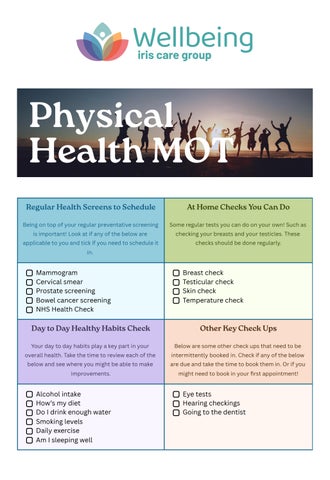

Physical HealthMOT

RegularHealthScreenstoSchedule
Being on top of your regular preventative screening is important! Look at if any of the below are applicable to you and tick if you need to schedule it in
Mammogram
Cervical smear
Prostate screening
Bowel cancer screening
NHS Health Check
DaytoDayHealthyHabitsCheck
Your day to day habits play a key part in your overall health Take the time to review each of the below and see where you might be able to make improvements
Alcohol intake
How’s my diet
Do I drink enough water
Smoking levels
Daily exercise
Am I sleeping well
AtHomeChecksYouCanDo
Some regular tests you can do on your own! Such as checking your breasts and your testicles. These checks should be done regularly
Breast check
Testicular check
Skin check
Temperature check
OtherKeyCheckUps
Below are some other check ups that need to be intermittently booked in Check if any of the below are due and take the time to book them in Or if you might need to book in your first appointment!
Eye tests
Hearing checkings
Going to the dentist
RegularHealthScreenstoSchedule
Mammograms
A mammogram uses an xray to check your breasts for small abnormalities that you can’t feel If you’re registered with a GP as a female the NHS will invite you for a breast screening every three years from the age of 50 to 71. You can still have a screening over the age of 71 if you want to every three years, just reach out to your GP
If you’re trans or non-binary you may still be invited if you’re registered as a female with your GP. For more information here’s the NHS website. If you’re registered as male but breast screening still applies to you reach out to your GP!
It’s a preventative measure and worth staying on top of your appointments!
CervicalSmears
Cervical screening tests the health of the cervix with the aim of early identification and prevention of cervical cancer This is oered to all people with a cervix between the ages of 25 and 64 You should automatically receive a letter inviting you, if you haven’t and think you need one then get in touch with your GP.
This test will take a sample of cells from your cervix to check of certain types of a virus which cause cervical cancer, as well as for any abnormal cells. Further details can be found here.
ProstateScreening
If you’re over 50 and have a prostate, talking to your GP about your prostate health is advisable They will be able to talk to you about any risk factors and be able to assess if any screening is necessary
Your GP will also let you know what signs and symptoms to look out for if there’s anything that means to get checked again Having this conversation with your GP is taking a pro-active approach to your health
BowelCancerScreening
Currently bowel cancer screening checks are available to everyone between 60 and 74 in England and 51 to 74 in Wales This is being expanded to 50 onwards gradually in England For this check you’ll be send an at home kit to collect a small poo sample and send it to a lab This will automatically be sent to you if you’re registered with a GP.
If one of these pops up in your post, don’t be shy and check your poo Early detection means at least 9 out of 10 people will survive bowel cancer
NHSHealthChecks
Annual health checks are oered to people 40 years and older It’s an appointment with your GP that will usually take between 20 and 30 minutes It could also be with a nurse or healthcare assistant
During this appointment they will talk to you about your overall health, measure your blood pressure, do a chloesterol test, talk about your heart health and measure your waist More details can be found here
AtHomeChecksYouCanDo
CheckingYourBreasts
Checking your breasts regularly at dierent times throughout the month means you’ll get an understanding of what is normal for you This makes it more likely that you’ll detect any changes early
Doing a quick but regular check in the shower is one way to squeeze it into your day See here for how to do a self breast examination Here’s a guide for how to check your breasts
HowToCheckYourSkin
It’s recommended to do a skin check once a month This is head-to-toe, in all the nooks and crannies This sheet walks you through how to check and also recording what you see It’s important to record what you find so you know when something changes You could also take a photo of any spot or mole you’re unsure about to keep a record of what it looks like.
You can do these checks at home in front of a mirror Doing it before or after a shower is a good time to fit it in
TakingaLookAtYourTestes
Movember have a video guide for how to check your testicles. Like breast and skin exams it’s key to know what’s normal to give you a better indication on if anything abnormal crops up
Having your GP do a check at a regular check up is also advisable. Early intervention for testicular health is key so it’s important to be regularly checking yourself over! Incorporate it when you have a shower every couple of weeks and make it a habit
TemperatureChecking
Knowing your baseline temperature can help you work out if you’re unwell. While not necessarily something to check regularly, it’s worth getting to know what is normal for you so that you can be more aware if anything becomes abnormal
You can get an electronic thermometer or ones that go under your arm at any pharmacy. Keep a record of the results It’s normal for your temprature to fluctuate across the month if you have periods, with temperatures rising during ovulation A normal temperature is around 37 degrees celsius
DaytoDayHealthyHabitsCheck
AlcoholIntake
Alcohol use at harmful levels can have a drastic impact on your life Assessing your alcohol consumption and knowing if you need to cut down can be really key Drinkaware’s self assessment is a good place to start in reviewing your alcohol intake. While the NHS oers tips for cutting down on alcohol. It’s recommended to not drink over 14 units of alcohol across the week Here’s a guide for how you can calculate units of alcohol
How’sMyDiet
The Eatwell guide gives an idea of how to eat a balanced daily diet. Are you getting 5 portions of fruit and veg a day? Or eating a balanced amount of healthy wholegrains and starchy carbohydrates? This could be a good time to take a look at your staple recipes and see if you can switch out an ingredient to make it healthier
DrinkingEnoughWater
It’s important to drink 6-8 glasses of water a day. This includes tea and coees as well as other sugar-free drinks. Trying to drink plenty of water is key to keeping our bodies going Count how many you drink a day, could you add any more to hit this target? Try setting a small goal of drinking an extra glass a day
SmokingLevels
Smoking can have significant health impacts but can be extremely challenging to stop Take a check of how many cigarettes you’re smoking a day or if you’re vaping, how frequently, and see if you’re able to make some changes The Quit Tracker: Stop Smoking app helps boost motivation during your quitting journey by showing how much money you’ve saved and progress while oering rewards.
DailyExercise
Staying active has numerous benefits both physically and mentally It’s important to find a form of exercise that you enjoy, if so you’re more likely to then stick with it. Not everyone is the same, some people may love the gym, some running, some taking a stroll a few times a week. It’s recommended to do 150 minutes of moderate activity spread out over the week Tally up how much you’re currently doing and see if you need to try to introduce more and how you might do so
SleepingWell
Having a good night sleep is important for our overall wellness Both mentally and physically Sleeping helps the body heal and makes you feel recharged and ready for the day It’s recommended that adults get between 7 and 9 uninterrupted hours of sleep per night Little things like trying to reduce screen time before bed, having a set bed time and wake up time can also be helpful to have a sleep routine. The NHS oers tips for how to fall asleep faster and sleep better A good night sleep can have great benefits for your mental wellbeing too
OtherKeyCheckUps
EyeTests
Keeping up with your regular eye tests is important On top of correcting your vision they can reveal if there are any underlying problems It’s recommended to usually do an eye test every two years Check if you are due your test and try to book it in. Iris Care Group will reimburse up to £39 for an eye test. Talk to your manager or HR for a form Specsavers is a common place to get your eyes tests, but some pharmacies and large supermarkets will oer it as well!
HearingChecks
Specsavers also oers free hearing tests. Hearing tests need to be redone every 18 months to two years. They provide you with a comprehensive hearing assessment No matter how old you are if you notice a change in your hearing it’s worth going and having a check Is it time for you to redo your hearing test? Or if you’ve noticed a change and been putting o booking in for a test, take some time out and book yourself in.
GoingToTheDentist
The dentist often gets put o Usually it’s recommended to attend the dentist every 6 months Your dentist can advise you on if you need to attend more or less frequently The dentist will help keep your mouth healthy and leaving dental problems untreated can lead to diculties in the future. Here’s how to register with a NHS dentist Put some time aside to take look at local dentists in your area and reach out for an appointment