4
P R OV I N C E TO W N A R T S 2 0 24
P R OV I N C E TO W N A R T S.O R G
5
6
P R OV I N C E TO W N A R T S 2 0 24
P R OV I N C E TO W N A R T S.O R G
7
8
P R OV I N C E TO W N A R T S 2 0 24
P R OV I N C E TO W N A R T S.O R G
9
10
P R OV I N C E TO W N A R T S 2 0 24
P R OV I N C E TO W N A R T S.O R G
11
12
P R OV I N C E TO W N A R T S 2 0 24
P R OV I N C E TO W N A R T S.O R G
13
Irene Lipton
untitled, 2014 oil on canvas 36 x 36 inches irenelipton.com
Albert Merola Gallery 508-247-7654 albertmerolagallery.com 14
P R OV I N C E TO W N A R T S 2 0 24
P R OV I N C E TO W N A R T S.O R G
15
16
P R OV I N C E TO W N A R T S 2 0 24
P R OV I N C E TO W N A R T S.O R G
17
18
P R OV I N C E TO W N A R T S 2 0 24
P R OV I N C E TO W N A R T S.O R G
19
20
P R OV I N C E TO W N A R T S 2 0 24
P R OV I N C E TO W N A R T S.O R G
21
22
P R OV I N C E TO W N A R T S 2 0 24
photo by nancy pearson
Dear Readers, Our cover feature for this issue is one that we’ve hoped to bring to fruition for several years. In the seventies and eighties, photographer Nan Goldin, who has longstanding ties to Provincetown, was one of the only artists putting images of the LGBTQ+ community in the public eye. As the AIDS crisis devastated the community throughout the eighties and well into the nineties, her unforgettable images of men and women—many of them, close friends—dying of the disease put faces to an epidemic that was largely ignored, with deadly consequences, by the mainstream media and the US government. Her work is the subject of a retrospective touring throughout Europe and the UK through 2026—Goldin’s first solo exhibition as a filmmaker. Her magnum opus, The Ballad of Sexual Dependency, an ever-expanding and changing slideshow that she began creating nearly fifty years ago, is one of six pieces in this highly unique retrospective, which is overviewed on pp. 38–45. Poet and memoirist Nick Flynn, who has written for and been featured in the magazine many times, wrote our cover story on Nan. Over the history of the arts colony, Provincetown has been the workplace of dozens of notable filmmakers and photographers; we’ve included work by eleven of them in a special section of this issue. As always, we’ve sought to cover a wide range of artists and work that represents diverse perspectives and voices: this year, the revival of the historic Forum series (a full schedule of events is on p. 61); the legacy of gallerist Berta Walker, who celebrates the 35th year of operating her gallery in Provincetown in 2024; and new leadership at the nonprofit arts organization Twenty Summers are among our feature articles. The exhibitions, recently published or forthcoming books, films, and plays of more than two dozen artists and writers are covered, as well. This issue also includes a second excerpt from a forthcoming memoir by artist Christina Schlesinger. Guest Poetry Editor Didi Jackson selected work from a wide range of poets for this year’s poetry section. Later this year, we plan to launch a “long short fiction” contest and begin publishing the winners in each year’s issue. We are very excited to share the news that this fall, Provincetown Arts Press will reprint David Dunlap’s Building Provincetown in full color, and in hardcover for the first time since its original publication by the town of Provincetown in 2015 (the hardcover run will be limited; copies can be reserved at provincetownarts.org/bookstore). All of our publications, including Provincetown Arts, are only possible with the support of you, our readers, and many generous donors, who are listed on p. 26. Please consider contributing toward the reprint of Building Provincetown through our Publisher’s Circle campaign to help us keep it available and affordable for all. This issue of Provincetown Arts is dedicated to the late photographer Renate Ponsold Motherwell (1935–2023), wife of painter Robert Motherwell and longtime friend to Provincetown Arts founder and publisher Christopher Busa, whose generous bequest to the press is helping us envision a new future for the organization. Our Board of Directors, to whom we are endlessly grateful, recently welcomed a new member, Shawn Brooks, after literary agent Laura Gross transitioned last summer from Board service to an advisory role for the organization. If you are interested in joining our Board of Directors or Advisory Board, please email info@provincetownarts.org. Finally, our annual publishing party will be held on July 12 from 5 to 7 p.m. at the Provincetown Art Association and Museum (460 Commercial Street, Provincetown). Please join us if you’re able. We look forward to seeing you there. With best wishes,
Elizabeth Winston editor
P OV R OV EO TO PR I NI N CC ET WW NN AA RR TT S S.O .O RR GG 2323
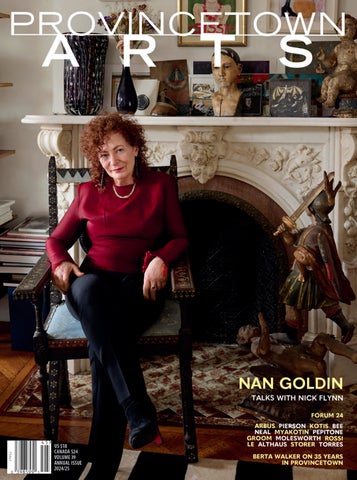
TABLE OF CONTENTS ON THE COVER photo of Nan Goldin at home by Jason Schmidt LETTER FROM THE EDITOR __________________________________ 23 BUZZ___________________________________________________________ 27 COVER FEATURE: NAN GOLDIN Between Friends: Nick Flynn Talks with Nan Goldin___________________________ 30 All the Beauty and the Bloodshed______________________________________32 No Words: This Will Not End Well: The Work of Nan Goldin, ____________________ 38 An International Retrospective
PHOTOGRAPHY Portfolio__________________________________________________________ 46 Amy Arbus, Jack Pierson, Mischa Richter, Lyle Ashton Harris, Marian Roth, Jane Paradise, Kahn & Selesnick, Paula Horn Kotis, Vincent Guadazno Ron Amato: Artists of Provincetown_______________________________________55 Artificial Intelligence and the Future of Photographic Art__________________56 Francis Olschafskie
FORUM 24 Forum 24: __________________________________________________________ 58 On the 75th Anniversary of Forum 49, the Series Is Revived for a Different Century Then, Now, and into the Future: Remembering Forum 49 at PAAM_____________ 59 Rob Phelps Forum 49: Relating All the Arts___________________________________________ 60 Jennifer Liese
ARTISTS Storms, Lighthouses, and Pinup Girls: Susan Bee in Provincetown________________ 62 Antonia Pocock Exhilarating Connections: Berta Walker Talks About Her Years in the Art World______ 67 Sue Harrison Christina Schlesinger: The Dorothy Paintings_________________________________ 72 Humility and Hope: In the Studio with Vicky Tomayko__________________________ 73 Antonia DaSilva Barbara E. Cohen: Abstraction Colored by Memory____________________________ 77 Susan Rand Brown Rosalind Pace: Poiesis, Five Decades of Collage________________________________ 80 Elizabeth Winston, Kathy Shorr, Marcia Simon Happily Ever After: Ever and Ever: Richard Neal’s Fall Show at PAAM______________ 84 André Van Der Wende Act of Faith: The Paintings of Abraham Storer_________________________________ 88 Megan Hinton Carmen Cicero: Drawings and Watercolors, Tales of Intrigue and Humor_____________ 91 A forthcoming Book edited by David Ebony The Indefatigable Artistry of Richard Pepitone____________________________ 92 Bill Evaul Esther Pressoir: A Modern Woman’s Painter_________________________________ 96 By Suzanne M. Scanlan, Reviewed by Taylor M. Polites
2024/2025
A publication of Provincetown Arts Press, Inc., a nonprofit press for artists and writers this issue is dedicated to
RENATE PONSOLD MOTHERWELL
Showman with a Paintbrush: The Life and Art of Arthur V. Diehl_________________ 99 Julia Salinger’s Memory Garden________________________________________ 100 André Van Der Wende Shrouded Rainbow: _________________________________________________ 103 The Transformation of the Natural and Civic Environment, a Project by Jay Critchley Twenty Summers, Eleven Seasons (and Counting): _______________________ 104 Bill Reihl Takes the Helm at the Hawthorne Barn’s Resident Arts Organization
WRITERS How to Live: A Memoir-in-Essays________________________________________106 By Kelle Groom, a Conversation with Jennifer Jean Open Questions: ___________________________________________________ 108 Curator Helen Molesworth Talks About Art, Influence, Discourse, and Her New Book: A Conversation with Moyra Davey and Jason Simon Meeting Georgia ____________________________________________________ 111 An Excerpt from a Memoir-in-Progress by Christina Schlesinger Chef Rossi on Her New Memoir: The Punk-Rock Queen of the Jews______________ 114 An Interview with John Braden Blackouts__________________________________________________________ 116 By Justin Torres, Reviewed by Cheri Johnson Michael Cunningham’s Day: __________________________________________ 117 The Provincetown Author Talks About His Most Recent Novel New & Selected Poems_______________________________________________ 119 By Keith Althaus, Reviewed by Elizabeth Bradfield 36 Ways of Writing a Vietnamese Poem ________________________________ 120 Author Nam Le and Lindsay Garbutt on Language as an Ecology of Violence and Corruption, the Pain of Being a Writer, and the Value of Uncertainty
STAFF EDITOR-IN-CHIEF/ Elizabeth Winston EXECUTIVE DIRECTOR CREATIVE DIRECTOR Irene Lipton MARKETING DIRECTOR Ingrid Aue SENIOR EDITOR Robert Phelps SENIOR POETRY EDITOR Major Jackson PRODUCTION EDITOR Rebecca Perlmutter ADVERTISING SALES Heather Bruce BOARD OF DIRECTORS E. J. Kahn III, President Christina Schlesinger, Vice President Laurie Fitzpatrick, Treasurer Richard Schneider, Jr., Secretary Shawn Brooks John DaSilva Margaret Murphy Mark Protosevich Sam Tager Livia Tenzer BOARD OF ADVISORS Mary Abell Mark Adams Richard Baker Elizabeth Bradfield Bill Evaul Melenie Freedom Flynn Susan Harrison Howard Karren Anne-Marie Levine Jennifer Liese Gail Mazur Joanne McFarland Susan Mitchell Debbie Nadolney Mira Schor Phillip H. Willkie FOUNDER Christopher Busa PROVINCETOWN ARTS EMERITUS Raymond Elman, co-founder Jennifer Liese Margaret Carroll-Bergman Susanna Ralli
• •
Annika Rose________________________________________________________ 122 By Cheri Johnson, Reviewed by Elizabeth Winston
FILM From Russia, with Love: A Conversation__________________________________ 123 With Jay Critchley and Igor Myakotin
ARCHITECTURE The Art of Creating Houses: Polhemus Savery DaSilva________________________ 127 By John R. DaSilva, Reviewed by John Wreidt Building Provincetown Again: a Fourth Printing____________________________ 131
PERFORMING ARTS Musical Nostalgia: When Provincetown Had a Symphony_______________________ 132 By Max Keller
POETRY A Selection by Didi Jackson______________________________________________135
MEMORIALS Nora Speyer, Sharon Niesp, Paul Tasha, Louise Elisabeth Glück___________________ 148
Published annually in midsummer since 1985, Provincetown Arts focuses broadly on artists, performers, and writers who inhabit or visit the tip of Cape Cod, and seeks to stimulate creative activity and enhance public awareness of the cultural life of the nation’s oldest continuous artists colony. Drawing upon a century-long tradition rich in art, theater, and writing, Provincetown Arts publishes essays, fiction, interviews, journals, performance pieces, poetry, profiles, reporting, reviews, and visual features, with a view toward demonstrating that a community of artists, functioning outside the urban centers, is a utopian dream with an ongoing vitality. ©2024 by Provincetown Arts, Inc. All rights reserved. Reproduction in whole or in part expressly forbidden without permission from the publisher. Most of Provincetown Arts is freelance-written. Queries and proposals for articles may be submitted to editor@ provincetownarts.org. Our writers’ guidelines are available online at provincetownarts.org. The best guide for content and length is a study of past issues. Member: Council of Literary Magazines and Presses Address all correspondence to: Provincetown Arts Press PO Box 1677, Provincetown, MA 02657 Telephone: (508) 217-6878 info@provincetownarts.org provincetownarts.org Subscriptions, the full catalogue of back issues, and other press publications are available at provincetownarts.org/ bookstore. Media kits for advertisers are available online. Provincetown Arts is indexed in the Humanities International Complete. PRINTED IN USA ISSN: 1053-5012 Printed by Puritan Press Inc., Hollis, NH
The Provincetown Arts Press staff and board offer heartfelt thanks to all who contributed to our work in the past year. Our supporters (July 2023–May 2024) include the following: ANGELS $50,000 OR MORE Renate Ponsold Motherwell PATRONS $10,000–$49,000 Mass Cultural Council Alix Ritchie and Marty Davis Lesley G. Silvester Family Foundation BENEFACTORS $5,000–$9,999 McManus Foundation SPONSORS $1,000–$4,999 Cape Associates, Inc., Custom Builders, Matthew H. Cole, President & CEO John and Sharon DaSilva Richard Epstein Laura Gross Gregory Lombardi, Gregory Lombardi Design Lesley Silvester and E. J. (Terry) Kahn III Edward Moore and Shawn Brooks Jeannie Motherwell and James Banks Lise Motherwell and Robert S. Steinberg Margaret Murphy Peter Petas Mark Protosevich and Robena Malicoat William Rawn and John Douhan III Seamen’s Bank Long Point Charitable Foundation, Lori Meads, President & CEO Rob Silverstein Livia Tenzer SUPPORTERS $500–$999 Laurie Fitzpatrick Sarah Lutz Jamie and Stephania McClennen Denise Pappas Maxine Schaffer FRIENDS $250–$499 Bobby Alter and Lisa DeLima Emily Bingham Susan Rand Brown David Chambers Carmen Cicero and Mary Abell Lars Etzkorn and Gregory Hoss Jerome Greene Bob Griffin Michael E. and Brenda Jones Brian Koll and David Altarac J. Michael Lennon and Donna Pedro Lennon Sky Power Richard Schneider Diana Silvester & Barry Bluestone Samuel Tager
26
P R OV I N C E T O W N A R T S 2 0 2 3
DONORS
$10–$249
Meryl Allison Susan Bandes, in memory of April Kingsley Margaret and Richard Bartek Patty Hopkins Barnes Christine and John Beach Susan Bee Ken Boyar Eugene Bryant Liz Carney Lynn Cetrulo David Chambers Kay Knight Clarke Bruce Danzer and Tom Huth Carol DeBoer-Langworthy Tony Doniger and Liza Lunt Heather Draz Thomas Ferguson Cynthia Frawley David M. Gagne and Carl G. Sessa Frank X. Gaspar Susan M. Glatki David Grayson Robert Griffin Curtis Hartman Carol Hofmann Robert Henry Patty Hopkins Barnes William Newell Jones Jack Houton and Ellen Kanter Lynne Kortenhaus Alison Hyder Howard Karren Myrna Kettler Richard and Barbara Kiusalas, West Barnstable Tables Hon. Maria Lopez Russell Lopez Sally Lutz Danielle Mailer and Peter McEachern
Genevieve Martin Terrence Meck David Moore John L. Moore West Magus Debbie Nadolney Roy Nicholson and Helen Harrison Stacey Parks Jane Paradise Sharon Polli Anna Poor and Francis Olschafskie Sky Power Kate Prendergast Marla Rice Georgene Riedl Steven E. Roderick Julia Salinger Christina Schlesinger Heidi Jon Schmidt Mira Schor Mitchell Seligman Andrew Sherman Scott Shields and Jim Woods Jack Simpson Nancy and Doug Smith Rev. Dr. Richard W. and Virginia Smith Joyce and William Tager Eileen Tavolacci Lenore Tenenblatt Jason Tenzer Lyle Timpson Stephanie Vevers Berta Walker Tamsin and Christopher Wallace Jane Barrell Yadav The Whitten Family, in honor of April Kingsley
Contributions to Provincetown Arts Press, a 501(c)(3) nonprofit, support the annual publication and distribution of Provincetown Arts magazine and books by and about artists and writers connected to Provincetown. Our work would not be possible without the generous support of the individual donors and funders listed here, and our readers around the world.
Multimedia artist Jay Critchley’s Provincetown Community Compact has been awarded a two-year $49,999 grant from the National Park Service to document LGBTQ history within the Provincetown Historic District, part of its annual grants program to recognize historically underrepresented communities. The proposed project will increase the amount of LGBTQ history currently included in the National Register Jay Critchley photo by igor myakotin of Historic Places by amending the existing historic district, documenting queer history from the early twentieth century through 1996, including the contributions of marginalized people such as women and transgender, nonbinary, and gender-variant people, as well as the “extraordinary significance” of the AIDS pandemic in Provincetown. A team of scholars and volunteer advisers will engage with the community to conduct project research. “The Compact sees this award as a milestone for the community, making visible this significant aspect of our collective memory through the built environment,” says Critchley, who serves as the Compact’s director. “It reflects our mission of nurturing community through the integration of culture, the economy, and the environment. We have a singular American story to tell.” . . . Cascadia Field Guide: Art, Ecology, Poetry, an anthology created and curated by poet and Truro resident Elizabeth Bradfield, CMarie Fuhrman, and Derek Sheffield, was the winner of the 2024 Pacific Northwest Book Award and a finalist for the Banff Mountain Film and Book Festival. The volume “brings together art, poetry, and stories holding scientific, sensory, and cultural knowledge to celebrate and illuminate Cascadia, the diverse ecoregion stretching from Alaska’s Prince William Sound down to Northern California and from the Pacific Coast east to the Continental Divide. Organized into thirteen sections corresponding with ecological communities, the book includes work by dozens of artists and poets with strong ties to the region, including Garrett Hongo, Lois Red Elk, Denise Levertov, and many more. . . . Poet and artist JoAnne McFarland’s new collection, American Graphic, was recently awarded the Green Linden Press’s Wishing Jewel Prize for Poetic Innovation, and will be published in December 2024. Describes the press (greenlindenpress.com), “With candor and insight, American Graphic confronts personal and cultural pasts. Juxtaposing historical documents— recipes from the first cookbook published by a Black woman in the States, reward posters for people JoAnne McFarland
fleeing enslavement—with intimate moments from the present, the book’s magic is to bend time so we see that the past’s rivers flow through us into the future.” A multidisciplinary artist, writer, and curator, McFarland is the artistic director of Artpoetica Project Space in Gowanus, Brooklyn. Her previous collections include A Domestic Lookbook and Pullman (Grid Books); Identifying the Body and the digital album Tracks of My Tears (Word Works); and Acid Rain (Willow Books). . . . Crown & Anchor owners Jonathan Hawkins and Paolo Martini served as honorary chairs of the Arts Foundation of Cape Cod’s annual Arts Gala on June 6. Hawkins first connected with the AFCC in 2020 to Amy Tuttle, Paolo Martini, Jonathan Hawkins, and Julie Wake, 2024 find a way to support Outer Cape artists who lost employment due to the COVID crisis, which led to the creation of the Provincetown Performing Arts Fund. The fund distributed nearly $75,000 in emergency assistance for out-of-work artists during the pandemic. The couple’s approach to the work was used as a guide in the redesign of the AFCC’s Creative Exchange in 2022, which provides development support to artists and arts professionals to help them achieve financial sustainability. . . . Producer, director, and playwright Eric Rosen Eric Rosen is now serving as the artistic director of the Cape Cod Center for the Arts in Dennis (artscapecod.org). Rosen is co-founder and former director of Chicago’s About Face Theater, a nationally recognized and community-focused LGBTQ arts organization. As an artist, Rosen has developed projects for PBS and directed regionally, including the much-lauded Arena Stage (Washington, DC) production of Paula Vogel’s Indecent in 2019, for which he received Theatre Washington’s Helen Hayes Award for Best Director. The organization’s historic theater, the Cape Playhouse (capeplayhouse.com), was founded in 1927 and is located on a twenty-two-acre campus that is also home to the Cape Cod Museum of Art (ccmoa.org). . . . The foundation named for Abstract Expressionist painter Jon Schueler announced its republication of his memoir The Sound of Sleat in August 2023. First published in 1999 by Picador, the book is a personal record of Schueler’s development as an artist. With his wife, Magda Salvesen (president of the Jon Schueler Foundation), the artist spent time on the Cape over numerous summers, as well as considerable time in Scotland, which he writes about extensively in the book (excerpted in the 1999 issue of Provincetown Arts). . . . The East End’s historic White Horse Inn closed its doors this winter after nearly six decades. P R OV I N C E TO W N A R T S.O R G
the arts foundation of cape cod
BUZZ BUZZ BUZZ BUZZ BUZZ BUZZ
27
BUZZ BUZZ BUZZ BUZZ BUZZ BUZZ BUZZ The inn opened in 1963 and remained a family business until the end, run by Frank Schaeffer and Mary Martin Schaeffer. Artist Jackson Lambert (1919–2011), who lived at the inn for a time, assisted Frank with the construction of its apartments, Mary says. A large art collection, including many pieces by Lambert, adorned the White Horse’s walls. The Bakker Gallery (bakkerproject.com) will hold an exhibition of White Horse Inn paintings by Lambert in July. . . . . . . Wellfleet artist Robert Henry (featured in the 2022 issue of Provincetown Arts) has a new book forthcoming in 2024: For Artists and Art Lovers: A Handbook. The publication draws on Henry’s seven decades of artistic practice, and will be available on Amazon. The handbook is intended to provide understanding and inspiration to artists and provide art lovers with insights. A renowned artist and educator and a former student of Hans Hoffman, Henry’s accolades include Lifetime Achievement Awards from the Provincetown Art Association and Museum and the Cape Cod Foundation for the Arts.
Jayne Anne Phillips
Brandon Som
photo by elena seibert
FORMER FAWC FELLOWS JAYNE ANNE PHILLIPS AND BRANDON SOM AWARDED 2024 PULITZER PRIZES FICTION WRITER Jayne Anne Phillips, a Writing Fellow at the Fine Arts Work Center (FAWC) from 1979–’80, was awarded a Pulitzer Prize in Fiction in May 2024 for Night Watch (Knopf), a postCivil-War-era novel set in West Virginia’s Trans-Allegheny Lunatic Asylum. A second former FAWC Writing Fellow, Brandon Som (2011–’12), was awarded a 2024 Pulitzer as well, in the poetry category, for his collection Tripas: Poems (Georgia Review Books), which explores the writer’s Mexican-Chinese heritage. “Som brings a consciousness of ‘tenor & rasp’ to poems informed by family gossip and social history, one’s place of origin and one’s place of immigrant footing, and the textures of Chinese and Spanish,” writes the poet Rick Barot. “Saturated with exuberant language and story, the poems in Tripas have the amplitude of archives and the intimacy of songs.” A native of Phoenix, Som published two collections of poems prior to Tripas, which was also a finalist for the National Book Award; a chapbook, Babel’s Moon (2011); and The Tribute Horse (Nightboat Books, 2014), which won the Kate Tufts Discovery Award in 2015. A West Virginia native, Phillips is founder of Rutgers University’s Master of Fine Arts in Creative Writing Program, which she currently directs. She is the author of six previous novels including Lark and Termite (Knopf, 2009), which was nominated for the National Book Award, as well as a collection of stories. Her essays and short fiction have been widely published and anthologized. Writer Alice Randall, author of Black Bottom Saints, calls Night Watch a “profound meditation on identity, empathy, sanity, daughter-love, nature, and the Civil War.” 28
P R OV I N C E TO W N A R T S 2 0 24
Creepy, crawly Un Chien Andalou courtesy of kino video
FORUM 24 SLICES THE BIG SCREEN ANDRÉ BAZIN, editor and co-founder of the influential film magazine Cahiers du Cinéma, was a passionate proponent of realism in the moving image: he believed that the medium became art in the way it faithfully conveyed the real world. Indeed, the photographic nature of movies makes them reflexively realistic—that was their appeal to audiences. Bazin felt that any artifice or aesthetic form in film should serve the reality depicted, not cloud it. This was the dominant aesthetic in film in 1949, when Forum 49 unfolded, a summer-long art symposium in Provincetown that has been revived this year as Forum 24. Surrealism, a modernist movement which came to the fore after World War I in Paris, eschewed such fidelity to the “real” world. It demanded instead that art seek a more subversive and (counterintuitively) truthful reality, one that incorporated dream logic and imagery and the subconscious. From the outset, “surrealist film” is thus a concept with a built-in internal struggle. Which makes it perfect for the contemporary Forum 24 and questioning the focus and relevance of art in Provincetown today. That’s the raison d’être for the Surrealist film shorts screenings of Forum 24. In curating these events, I settled on two programs: “Beginnings,” at the Provincetown Art Association and Museum on Wednesday, July 17 at 6 p.m., and “Beyond,” also at PAAM, on Wednesday, Aug. 21 at 6 p.m. The films in “Beginnings” are Luis Buñuel and Salvador Dalí’s Un Chien Andalou (An Andalusian Dog, 1929) and Maya Deren and Alexander Hammid’s Meshes of the Afternoon (1943)—they would have been ideal touchstones at Forum 49. The second pair of shorts—which leap “Beyond”—are Alain Resnais’s Le Chant du Styrène (The Song of Styrene, 1958) and Matthew Barney’s Cremaster 3: The Order (2002). They take Surrealism into new realms of avant-garde imagery. Both programs are anti-narrative and agitprop—provoking the audience into reaction. Buñuel and Dalí wanted to shock and awe the bourgeoisie, from slicing an eye open to dragging priests tied by rope to grand pianos. Deren and Hammid, determined to forge a path for filmmakers that was independent of Hollywood, take a couple (played by themselves) into a woman’s dreams. The violence in both films is the catalyst for breaking with the past. The films in “Beyond” arrived after the world wars were over and the arts had won their freedom from fascism. In response to global industrialization and alienation, Resnais creates a satirical ballet of plastic. Barney explores a personal-aesthetic sexuality as well as gender. They are touchstones for the artists of today, when reality is as surreal and absurd and threatening as ever. — Howard Karren
BUZZ BUZZ BUZZ BUZZ BUZZ BUZZ BUZZ Arts Organizations, Festivals, and Residency Programs PROVINCETOWN The Commons provincetowncommons.org; 46 Bradford Street Collaborative work space for artists and small businesses; offers affordable coworking, studio, and exhibition spaces, and hosts public art shows and events. Fine Arts Work Center fawc.org; 24 Pearl Street Seven-month visual arts and creative writing residencies, public events, the Summer Workshop program, and the 24PearlStreet online writing program. Helltown Players helltownplayers.org A nonprofit collaborative of nine local playwrights with the mission of producing original work by Cape Cod dramatists around Provincetown. Mary Heaton Vorse House and Provincetown Arts Society saintjosephsartsfoundation.org/provincetown-arts-society; 466 Commercial Street Exhibitions of art by Provincetown artists, short-term residencies, live performances, film screenings, and more. Peregrine Theatre Ensemble Peregrinetheatre.com Visit website for 2024’s 10th-anniversary season. Provincetown Art Association and Museum paam.org; 460 Commercial Street Exhibitions, visual arts workshops, and lectures. Provincetown Community Compact thecompact.org Dune shack residencies, artist and project grants, the annual Swim for Life (September 7, 2024), and the Prayer Ribbons living archive. Provincetown Dramatic Arts ptowndramaticarts.org Produces the Women’s International Theater Festival, the Eugene O’Neill Festival of New Works, and other dramatic productions around Provincetown. Provincetown Film Society provincetownfilm.org Produces the annual three-day Provincetown International Film Festival in mid-June, year-round film programming at Waters Edge Cinema (237 Commercial Street), and the Gabrielle A. Hanna Provincetown Film Institute. Provincetown Public Art Foundation provincetownpublicart.org Dedicated to telling the story of Provincetown’s past, present, and future with commissioned public art projects. Provincetown Tennessee Williams Theater Festival twptown.org The nineteenth annual festival, “Memory Plays,” runs September 26–29.
Provincetown Theater provincetowntheater.org; 238 Bradford Street Year-round performing arts programming, including staged readings by emerging writers, a summer mainstage season, and a playwright residency. Twenty Summers 20summers.org Artist and writer residencies and public events at the historic Hawthorne barn, 29 Miller Hill Road (open to the public during events) and at The Annex, 494 Commercial St.
TRURO Payomet Center for the Arts payomet.org; Highlands Center at Cape Cod National Seashore, 29 Old Dewline Road Live music, comedy, and summer Children’s Circus Camp. 2024 concerts include Judy Collins, Roseanne Cash, and Tom Rush. Truro Center for the Arts at Castle Hill castlehill.org; 10 Meetinghouse Road Visual arts workshops, exhibitions, public events, and the 17th annual International Encaustic Conference. Truro Playwright Collective truroplaywrightcollective.org Monthly readings from October through April of new plays by local playwrights at the Truro Public Library.
WELLFLEET Harbor Stage Company harborstage.org; 15 Kendrick Avenue 2024 productions include My Dinner With Andre (July 11–Aug. 3), and Westminster (Aug. 8–Sept. 1). Wellfleet Harbor Actors Theater what.org; 2357 Route 6 Full production season, special events, and a year-round screen broadcast of the Metropolitan Opera.
UPPER CAPE Cape Cod Museum of Art ccmoa.org; 60 Hope Lane, Dennis Exhibitions, music, films, visual arts classes, and other events. Cape Playhouse capeplayhouse.com; 820 Main Street, Route 6A, Dennis Annual mainstage productions and children’s programming. Cape Rep Theatre caperep.org; 3299 Route 6A, Brewster Annual mainstage season from May through December, outdoor theater featuring summer children’s shows, and youth and adult dramatic arts classes.
P R OV I N C E TO W N A R T S.O R G
29
FEATURE
AMONG FRIENDS NICK FLYNN TALKS WITH NAN GOLDIN 2024. I VISIT NAN GOLDIN IN HER BROOKLYN APARTMENT. It’s the top floor of a stand-alone building that might have once been called a mansion. Now it’s a little worn, but still imposing. On the walls are mostly photographs, several from Peter Hujar, one of David Wojnarowicz, who was a friend. Nan tells me she thinks Hujar is the greatest portrait photographer (and photographer of animals) of the twentieth century. Which says a lot, coming from Nan. Nan is in the kitchen, feeding her cats, Echo and Psyche. I find a painting in the living room that I hadn’t fully taken in before— Nan had asked if I’d seen it the last time we spoke, and I hadn’t. There are many things to take in in this apartment—a bell jar in the fireplace filled with empty pill bottles (to signify how many people were dying each day, in 2019, from opioid overdoses), a bulletin board of upcoming projects, a taxidermied coyote. Nan comes in from the kitchen, tells me the story of the painting: It’s a self-portrait with my mouth sewn shut. I made it the first year I got sober—there was a blizzard around Christmas, they called it a bomb cyclone, and I was stuck in my house for days. I didn’t talk to a single person, over Christmas and New Year’s, for days. . . . I remember that storm, I tell her. The self-portrait looks like it’s painted with blood. It reminds me of a self-portrait by Wojnarowicz, a photograph I’ve returned to many times since I first saw it. In it, Wojnarowicz had stitched his lips shut with thick black thread to embody the way artists were being silenced during the AIDS epidemic of the eighties— photography as performance art/political statement. It’s powerful, I tell Nan. It’s likely I first encountered Wojnarowicz at the Artists Space
(left) Nan Goldin, Self Portrait (above) Pins made by Goldin from Polaroids 30
P R OV I N C E TO W N A R T S 2 0 24
show Witnesses: Against Our Vanishing that was organized by Nan in the late eighties. It was a controversial show, with politicians weighing in (Helms, Dannemeyer), attempting to censor it by pressuring the NEA to cut funding (the NEA caved and cut the funding). I took a road trip to New York just to see it, a pilgrimage. The Wojnarowicz photographs Nan included in the show were of his closest person, Peter Hujar, after his death. If you’ve seen the film All the Beauty and the Bloodshed, the documentary by Laura Poitras, then you know that Nan’s activism has always been running alongside her art-making. That film was nominated for an Academy Award in 2023, after winning dozens of other international awards. Nan went to the ceremony in a gown by Elena Dawson. But it was at the Witnesses show that I understood (for the first time) that Nan’s photographs were also political, in their portrayals of transgression, that her photographs were in conversation with the political realities of her time. She photographed those who had not been offered visibility by the dominant culture—queens and drug-users, lesbians and queers—as an homage to their strength and beauty. We wander around her apartment. There are many books, thousands of books. Nan leads me to some of her drawings and paintings, some made when she was using, and some after she got sober. Can you tell which is which? she asks me. To me it’s obvious. The drawings she made when using are chaotic, nightmarish—full of snakes, nooses, violence. In one, a woman is being pulled by the hair by a naked man. These ones are not sober, I say. I like them, but they are not sober. There’s also an oil painting of a naked woman laying alone in the woods. The trees look like something Munch would paint. Yet it is peaceful, introspective. This one, I say, is sober. The last time I was in this apartment we watched the Visconti film Bellissima. Nan was to present the film in Bologna in a few weeks, at a festival, in front of six thousand people. She was to make some comments before the screening, and she was nervous. She wondered if we could watch it together, and then I could give her my take. In the film, Anna Magnani plays a mother trying to get her daughter a role in a film. It came out in 1951. I love this postwar, neorealism period of Italian film. I took some notes. At the end I said it seemed the film was, on one level, about how art can create a false desire, how it can distract people from what is actually keeping them oppressed. Nan agreed, but for her talk she took a more personal take, and talked about Anna Magnani as a woman, as a force of nature. Which is also a good way to describe Nan.
1976. LIKE ANY GOOD QUEER, WHEN ON BREAK FROM the Museum School, Nan lived in Provincetown. She moved there with her best friend David Armstrong, and their friend Bruce Balboni. That summer they did a lot of drinking, a lot of drugs. John Waters was filming there, Cookie Mueller was performing. Nan ended up working at the Pied Piper, living as part of the lesbian community, and of all the women she ran with, one became an obsession, a muse. Chrissy. They were briefly lovers, but even after they broke up, Nan would photograph her, often with her new lovers. This was the continuation of her lifelong project—photographing her tribe. She liked Provincetown so much she went back the next summer. But in Provincetown she was also broke, so when she wasn’t working at the Pied, she’d wander up and down Commercial Street with a button machine, offering to make a button (for a few dollars) from a Polaroid she’d take, right there on the spot. It was the kind of button with an image or a slogan on it that you’d pin to your jacket. The last time I was in her apartment, she showed me the buttons. I couldn’t believe she still had them, after a life of wandering and mayhem. They feel like holy relics, brought forth from another time, when Nan’s life could have gone off in a million other directions. Those summers in Provincetown, Nan didn’t have access to a darkroom. So she shot slides, with the idea that they could at some point be made into prints. But she had to show her work when she returned to school in the fall. As Nan tells it: A friend suggested I do a slideshow, and that’s how it started. 2024. NAN’S STUDIO IN DUMBO IS MOSTLY SLIDES. Hundreds of thousands of slides. This is how she describes it to me. She and her assistants spend most of their time searching through these slides, to create the art form she has become most known for—the slideshow. She refers to these slideshows as films, which is the art form she most respects. Film is making its way, more and more, into each of her recent exhibitions. When I ask to see her studio, she tells me there is not much to see. Boxes and boxes of slides. It reminds me of Beckett’s play Krapp’s Last Tape, where the lead character (Krapp) makes a recording every year on his birthday, recounting the highs and lows, the successes and failures, of the previous year. There is something Beckett-like in imagining Nan going through her slides, creating new versions of her life as each year passes. I also love that the slideshows/films are ever-changing, that they are not static. I mention this to her, that it seems the slideshow is a more ephemeral form than a print. That one is an object you frame and hang on a wall, or that you find in a book, and the other is light, projected onto a screen, and it vanishes before your eyes, it turns into something else. In this it is, perhaps, closer to memory than a still photograph, in that you only get to hold onto it for a few moments before it slides back into the depths. Nan responded: That may be true for the viewer, but not for me. The slides don’t feel ephemeral, not when you have a room full of one hundred thousand of them. Some have suggested that Nan’s slideshows are related to American culture of the fifties, that there is something homemade about the form, which is true. It requires a store-bought machine, the slides fit onto a carousel, there is that distinctive sound when one slide slips into another. But Nan has bent the
(top to bottom) Gilles and Gotcho Embracing, Provincetown, 1992; Roommate with Teacup, Boston, 1973; Sharon on My Bed, New York City, 1985 P R OV I N C E TO W N A R T S.O R G
31
ALL THE BEAUTY AND THE BLOODSHED THE 2022 DOCUMENTARY FILM All the Beauty and the Bloodshed, which was produced, coedited, and directed by Laura Poitras in collaboration with Nan Goldin, chronicles the photographer’s life, from childhood through her early years as an artist and her advocacy work during the AIDS crisis and, later, against the Sackler family for their role in the opioid epidemic. The film premiered on September 3, 2022, at the seventy-ninth Venice International Film Festival, where it was awarded the Golden Lion award, and was later nominated for Best Documentary Feature at the ninety-fifth Academy Awards. Goldin founded the advocacy group P.A.I.N. (Prescription Addiction Intervention Now) in 2017 after struggling with addiction to OxyContin and a near-fatal overdose of fentanyl. The group was started with the intention of holding museums and other arts institutions accountable for collaboration with the Sackler family, who have provided significant financial support to the arts, because of their role developing and suppressing the well-documented dangers of OxyContin through their company, Purdue Pharma. Dozens of protests and advocacy actions in the US, London and Paris that were planned and coordinated by P.A.I.N. ultimately resulted in all the targeted museums severing all ties with the Sackler family and taking down their name from their walls. Purdue Pharma filed for bankruptcy in 2021. PAIN continues to advocate for Harm Reduction and combat the stigma of drug addiction. All the Beauty and the Bloodshed is structured in seven “chapters,” each of which begins with a photographic sequence or archival footage of a period of Goldin’s life, and then transitions to footage of P.A.I.N. meetings, protests, and interviews
form to become something else entirely, a DIY mentality that has opened up new realms of possibility. These slideshows were first presented (once she left the Museum School and made her way to NYC) in bars and clubs. Mostly to her friends, who were also in the slide shows. This was a way for her friends to give input on how they were being shown, which is still very important to Nan, and separates her (at least in my mind) from any critique of exploitation. At first the soundtrack was whatever the DJ was playing at the time. Then her soundtracks became segments of songs from Brecht to Giorno to Eartha Kitt. Now she works with composers to score each piece. To see these early incarnations is inspiring, especially for any young artist. To see how necessity can open one to as-yet unimagined possibilities. As well as to the importance of who you surround yourself with, which, in the end, is maybe the main thing. The people in the slideshows are part of Nan’s life—they are not subjects for her art. 2018. I GO TO THE TRIBECA FILM FESTIVAL WITH NAN, to a screening of Madeline Sackler’s documentary film It’s a Hard Truth Ain’t It. The film depicts inmates at the Pendleton Correctional Facility in Indiana. Madeline Sackler is one of those Sacklers, the architects (by their own admission) of the opioid epidemic. Over one million deaths can be directly attributed to overdoses 32
P R OV I N C E TO W N A R T S 2 0 24
with members of the group. Sequences of Goldin’s photographs are from her slideshows Memory Lost and The Ballad of Sexual Dependency, which she has continued to expand, edit, and develop over the course of decades as the primary format for exhibiting her work. Footage of P.A.I.N. demonstrations include its first protest—at the Metropolitan Museum of Art’s Temple of Dendur in 2018—and subsequent protests at the Louvre, the Guggenheim, and other arts institutions around the world. Goldin serves as primary narrator of the film, in voiceovers, photographic sequences as well as protest footage. For two years prior to the making of the documentary, Goldin and two fellow activists filmed P.A.I.N. meetings and demonstrations with the intent of making a film about their work to publicize the fight against Purdue Pharma and the Sacklers. The movie was released in theaters in the US by Neon in 2022 and acquired by HBO Documentary Films for television and streaming, and has been nominated for and won dozens of international awards and accolades. Through Goldin’s singularly powerful portraits of friends, lovers, family members, and others in the largely marginalized communities of which she has been a member over the course of her life, and the often-chilling footage and testimony of P.A.I.N.’s activities and members, All the Beauty and the Bloodshed creates a powerful and disturbing sense of injustice, in many of its forms. Yet like the body of artistic work that serves as its foundation, it is also, on a deeply profound level, about the kind of devotion—to friends, to lovers, to speaking truth to power in an effort to effect change—that radiates its own, devastating form of beauty, and so often comes at great personal cost. — e.e.w.
in the United States since 1999. One can assume the money for It’s a Hard Truth Ain’t It came from the selling of opioids. I sit next to Nan. This is one of the first times I will hang out with Nan, though our paths have been crossing for decades. Others in our group are scattered throughout the theater, maybe ten of us in all. We come with our pockets full of empty prescription pill bottles, which we plan to toss onto the stage during the questionand-answer period, chanting Perdue lies, People die. Perdue is the company that produces OxyContin. Perdue is owned by the Sacklers, who pushed Oxy as the world’s first nonaddictive heroin—a thing everyone (including the Sacklers) knows does not exist. In the film, nearly every inmate’s story goes something like this: I got hooked on opioids, then I did this terrible thing. Sackler ends the film with a prisoner coming to the realization that you have to pay for the things you do in this life. The cynicism of this film is hard to measure, as the Sacklers have skated over any real consequence of their profiteering for decades. Sackler’s security team had spotted Nan the moment we walked in—Nan is one of the most recognizable artists in the country, having spent decades photographing herself and her circle of friends. And for the past two years she has been a thorn in the Sacklers’ side, staging actions at the Metropolitan Museum of Art and the Guggenheim, museums that have her work in their collections, as
NAN GOLDIN
well as wings with the Sackler name on them. Throughout the film she’d been murmuring to me that we were being closely watched. Madeline Sacker returned for the Q&A, but the families of the prisoners were also there, and images of the prisoners themselves were being beamed onto the screen. In the end we decided not to disrupt the screening of It’s a Hard Truth Ain’t It out of respect for the families and the prisoners. As we stood up to leave, the security guys surrounded us, to prevent us from tossing our prescription drug bottles onto the stage. But the film went nowhere, for it has become increasingly difficult, thanks in no small part to Nan, for any Sackler to hide. 2024. BY HER OWN ACCOUNT, UP UNTIL SEVEN YEARS ago, Nan had spent close to a decade locked in her apartments in Paris and Berlin, not going out—just using, mostly opiates. She took photographs of her walls, of cemeteries, but most of all she drew and painted. She’d become hooked on OxyContin, after it was prescribed for a wrist injury. That ended with a stay in rehab (not her first). In early recovery, she read a piece by Patrick Radden Keefe on the Sacklers. Nan says: My first year and a half or two years sober were almost as hard as my last years using. I was so shy again, and I’d done drugs to get over that shyness. I drew a lot in those years, but I can’t draw anymore. I haven’t tried in a few years, but I tried a lot when I first got sober. There’s something about drawing and painting . . . there’s a part of your brain that you access, that I can’t access sober . . . a complete lack of superego. I understood that. I told her how I took a lot of photographs when I was using, that I even had a darkroom set up in my loft in the Boston’s Combat Zone. I’d get high and spend hours in that darkroom—developing film, making prints. I could stay in that darkness for days and then come out with these images. It was magical. Then I quit and I couldn’t do it anymore. It made no sense. Taking pictures? Nan asks. None of it, I say. You get sober and you can’t dance, Nan says. I got sober and I had no idea who I was, she says, none. I couldn’t speak. That has changed. She began taking photographs of the sky when she got sober. Then, in 2018, she gathered some friends around her, formed the group P.A.I.N. (Prescription Addiction Intervention Now), which would go on to get the Sackler name taken off the walls of the Met, the Guggenheim, the Louvre, the Tate. And earlier this year, the group brought a civil case to hold the Sacklers financially liable all the way to the Supreme Court. All the Beauty and the Bloodshed documents these years. Two years into recovery, Nan presented new work at her thengallery, Marian Goodman (she has since moved to Gagosian). The centerpiece was a film/slideshow/installation called Memory Lost, which chronicled the recent years of her addiction. In Memory Lost, a series of disembodied voices float over scenes of transcendence and pain—as Nan puts it, the party was over, the pleasures of drug use had crossed the line into the despair of addiction. Nan describes it as her most important work since her first show, The Ballad of Sexual Dependency, the ever-evolving slideshow which began in the late seventies. (top to bottom) David with Irises, Provincetown, 1976; Cookie and Sharon Dancing in the Back Room, Provincetown, 1976; Cookie with Max at My Birthday Party, Provincetown, 1976 P R OV I N C E TO W N A R T S.O R G
33
Here’s Gabor Maté, who’s worked with drug-users for his entire life, in an essay he wrote describing his experience of seeing Memory Lost: This film is more than a lament for what is lost; it is also a spiritual quest for what can never be lost. Maté goes on: “I am not in pain,” a voice in the film attests, “I’m just trying not to feel anything.” He is, as many people do, deluding himself. Trying not to feel anything is but an anguished attempt not to experience the pain at the core of all addictions. Hence my mantra: “Ask first not why the addiction, but why the pain.” I found this insight of Maté’s especially relevant when trying to understand any drug-user, including Nan, including myself. 1986. I’D MOVED TO BOSTON THREE YEARS EARLIER, and the Institute of Contemporary Art (ICA) became my mecca. I remember seeing George Kuchar’s Weather Diaries there—as I remember it, Kuchar would lock himself in a hotel room each year (in Nebraska?) and film the Weather Channel talking about the incoming tornadoes. Occasionally he’d pull aside the curtains and film the rain in the parking lot. I remember walking through a turnstile Chris Burden had installed—each person that passed through the turnstile put some infinitesimal amount of pressure on the walls of the museum (think slow-moving tire jack). If some number of people (one million?) passed through, the idea was that the turnstile would knock the building down (to my twentysix-year-old self this was very exciting). And I remember Nan Goldin’s first slideshow, The Ballad of Sexual Dependency. The early images were of her time in Cambridge and Provincetown—her friends, lovers, drag bars, drag queens—the later images of her landing in New York. A bar called Tin Pan Alley, with garish red walls. Her glamorously ruined apartment on the Bowery. Some of the faces I recognized from the streets of Provincetown. In one photograph, a self-portrait (Nan and Brian in Bed, New York City, 1983), Nan is on her side, her head on a pillow, looking at her lover (Brian) as he smokes, shirtless, on the edge of the bed. His face, like hers, is lit by a sulfur-yellow light. The look on her face is troubled, at least this is how I would describe it. He does not look at her. I don’t know how she created this photograph. As I understand it, her self-portraits were created in two ways—one was using a cable-release. You set up a camera, run a cable from it to a button you hold in your hand, and press it at the decisive moment, though Nan has said she believes more in the indecisive moment. That it is more about chance than a conscious decision. Living in the moment as you are creating it. The other way she created her self-portraits was to pass her camera to a friend and have them click the shutter. Either way, the photograph was both hers and a collaboration with everyone inside it. A couple years after Nan and Brian in Bed, New York City, 1983, Nan would take a series of photographs of herself with two black eyes, having been nearly blinded by her Brian. These images of her face, post-domestic abuse, have become iconic, and have created an opening for others to talk about abuse. Her work has always been about lifting stigma, about giving other people a chance to tell their stories. Sitting on that bench in the ICA, I don’t know if I sensed that suicide was part of Nan’s photos. I didn’t know then that her sister Barbara had killed herself at eighteen, when Nan was just eleven. I didn’t know that Nan had left home at fourteen and 34
P R OV I N C E TO W N A R T S 2 0 24
began taking photographs of her friends, her roommates, her lovers. Nan has said that her sister’s death was the formative event in her life, that this is why she became an artist, but I didn’t know that then. I’d dropped out of college three years earlier, after my mother had killed herself, and I was living in an abandoned strip joint in the Combat Zone. I was working with the homeless, and my roommate had just tested positive for HIV. Sitting there, it felt like I’d entered a parallel universe, that I knew these people, or could. I think this is the reaction many people have when they encounter Nan’s work, a sense of coming home. After her sister died, Nan has said that she “became obsessed with never losing the memory of anyone again.” I don’t know if everyone senses that this is the shadow behind every photo. I doubt I could have articulated it then, but I saw something in her work that moved me deeply. 2022. I AM IN PARIS TO READ A POEM I’D WRITTEN FOR A friend’s wedding. Mike Quinn and Lea Richard-Nagle were getting married. Nan was to officiate. Nan and I sat next to each other the night before at the dinner. The title of my poem was “Epithalamion,” and she asked what epithalamion meant. I told her it was a wedding poem, that originally they were written to let the bride know what to expect on her wedding night. Nan was concerned she’d fuck up pronouncing it, so we practiced it a few times. For one of the biggest artists of the past fifty years, she was charmingly nervous about how the following day would go. I told her I’d be standing right beside her. I first met Mike Quinn around ten years ago. He was a little lost, but then, so was I. He’d just quit his job at a law firm, and had signed on to be on a reality TV show (Mike is movie-star handsome), but it didn’t go well. The show was a Survivor knockoff—beautiful people thrown together in an isolated paradise with limited resources. In the years since, he’s found a way to be a lawyer that didn’t eat away at his soul, and that was to represent artists. Mostly it was contract work, making sure the gallery gave the artist the right cut. His apartment became cluttered with artwork, because that was how he usually got paid. But then he began working with Nan, mostly around P.A.I.N. It gave him direction, purpose; it showed he had a hidden superpower. He’d end up filing a brief before the Supreme Court and working on the bankruptcy case for three-and-a-half years pro bono, while the Sackler lawyers made millions. As Nan remembers the moment she was to officiate: What happened at the wedding was incredible, my voice was trembling so hard someone gasped, they thought I was going to knock down the podium—then you put your hand on my back, and I found my voice. I’d just read the poem. I was standing beside her. Mike and Lea were standing in front of us. I knew Nan had it in her to get through this (she has gotten through so much, with such grace and dignity). I placed my hand on her back. After our days at the wedding in Paris, back in Brooklyn, Nan and I began making plans, which often ended up with us going to see films. A restored Tod Browning film (The Unknown) at MoMA. Aki Kaurismäki’s Fallen Leaves. Celina Song’s Past Lives. The following New Year’s we spent together. And the New Year’s after that. 2024. THE DIFFICULTY WITH WRITING ABOUT NAN IS that she’s already chronicled her life so completely, through the photographs she has been taking, almost obsessively, since she
NAN GOLDIN
Nan and Brian in Bed, New York CIty, 1983
left home at fourteen (she no longer photographs obsessively, but she still works obsessively, going through her archive of sound and images). The work she does on her slideshows, the endless revisions, it makes me think of Whitman, how he spent his life revising Leaves of Grass, over and over again. The photographs, the interviews she has given, the catalogue essays, all have been part of creating, as she calls it, the myth of Nan Goldin. She is very aware that there is the Nan in the photographs, in the interviews, and the Nan sitting beside me. As she puts it: There is a Nan Goldin in the world and a Nan in my house. . . . I don’t have much relationship to Nan Goldin, I’m not trying to keep that myth alive, but I use whatever myth there is if it can have an effect, if it has any influence at all . . . there is no Nan Goldin in this house. . . . This is true of each of us, perhaps—we all create the story of our lives, we all want to have some control over that story. Whitman had his words, Nan has her slideshows. 2024. MONDAY. I’M WAITING FOR NAN TO TEXT BACK. I’d texted that I was home in Brooklyn for a few nights. She texted that tomorrow she was free after six. Now it’s tomorrow. She will first need to spend a couple hours in her Dumbo studio, she needs to get some work done. There’s the opening in September in New York at Gagosian, her new gallery. There’s the retrospective (This Will Not End Well) moving to Germany in November—it opened in 2022 in Sweden, and then moved to Amsterdam. There’s the nine-volume boxed set of her work coming out next year, each with an essay written by a writer who has been moved by her work, including: Darryl Pinckney. Lucy Sante. Marvin Heiferman. Sarah Schulman. Gabor Maté. Caitlin Kiernan.
Nan asks if there’s a meeting we can go to—meetings are one of the things we do. I go online, find one in Park Slope at 6:30. Is that the meeting I didn’t like? she asks. I’m unsure, I tell her. She then proposes going to a film, La Chimera or Femme, both playing at IFC. I say, Sure, let’s do a film. Then she texts that maybe we should go back to the meeting idea, that I could come over first for dinner, then we could go to a later meeting. I find a meeting at the same place, Park Slope at 8:30. Then she lets me know she is tired, so I say I’ll just come over. I take my wife’s Vespa, thinking it will be quicker to ride with Nan on the back to the meeting, if we go. Her place is about fifteen minutes from my place. When we make a plan, a meeting is often the first thing proposed, because it’s important for each of us not to slip back into that other life. I have other friendships like this, based on meetings. But with Nan it’s different—often we end up just watching a movie, or eating dinner, which is also fine, because we end up saying whatever we might have said in the meeting anyway—what we are struggling with or grateful for, which is a big part of what a meeting is. When I come inside, careful not to let the cats out, she asks if I know how to cook chicken. The chicken is for the cats, Echo (boy) and Psyche (girl)—kittens just six months ago, the last time I visited her apartment. Yes, I tell her, I know how to cook chicken. I tell her to preheat the oven to 375 degrees, to get out a cookie sheet and some tin foil. While I work on the chicken, she takes some salmon and broccoli from the fridge, divides it up onto two plates, puts one in the microwave. After she takes the first plate out, the microwave seems to die, we press all the buttons, but it isn’t responding. I offer to eat mine cold, but Nan insists I get the warm plate. P R OV I N C E TO W N A R T S.O R G
35
We eat in her living room, on facing couches. We talk about acupuncture. Did you ever go to Fu Zhang? I ask. He was in Chinatown, you would lie on a table in a row of tables, someone on either side of you, full of needles. Everyone I knew used to go to him in the nineties, but then I saw that there were many Fu Zhangs. One building had a Fu Zhang on every floor. She has been seeing someone named Anton Lee for the past ten years. He’s a genius, she says, one of New York’s treasures. A high-end martial artist, a stick fighter, he works out of a fifth-floor walk-up. He’s kept me alive, she says, all these years. He does body work on you that could never be called massage. It’s time to go to the meeting if we’re going. As she gets ready, I look around her place. That taxidermied coyote, caught midhowl. Then she has her coat on, but I can see she is still tired. I will definitely not put her on the back of a scooter—we will take an Uber. As we are almost out the door, she hesitates. I’m fine with not going to the meeting, I say, we can stay in, watch a movie. Whatever you need, I say. She’s relieved. She proposes we watch the film made of my book (Another Bullshit Night in Suck City), which she hasn’t seen. But we end up talking more, and not watching the movie, until it is time for me to go. 2023. SHARON NIESP IS DYING. A FRIEND HAS OFFERED her an apartment in New York to use for hospice. Nan checks in on her every day. When she dies, Nan helps to organize a memorial at the Church of the Holy Apostles in Manhattan. The church is packed, and there is, of course, a slideshow. Sharon with Cookie [Mueller]. Sharon with Nan. Sharon in a car driving through the streets of New York. Nan read a eulogy, John Waters read a eulogy. Everyone laughs. I knew Sharon from Provincetown. She worked ice cream at Spiritus. I rowed her out to my boat one afternoon, and she didn’t leave for three days. It’s nice out here, she said. Peaceful. I’d bring her food when I’d row back out. I’m good here, she’d say. At some point she had to go back to shore for her shift at Spiritus. NAN SAYS SHE NO LONGER TAKES PHOTOGRAPHS OF people. She once believed that taking a photograph was a way to hold onto someone—that I would never lose them, that I could keep them alive. But then she learned that wasn’t true. Lately she has been visiting pet cemeteries. It can cost twelve thousand dollars to bury a cat, she tells me, if you want their grave to be maintained in perpetuity. What interests me most, she says, is there’s about nine hundred people buried in that cemetery, alongside their pets. Besides, I like animals more than anyone I know. Nan laughs at herself—I’ve become the cliché of the woman in the attic with two cats she talks about continuously, she says. The Sackler case is behind her—she won that one. These days she’s thinking about what’s happening in Gaza, the ethnic cleansing. When people come up now and thank her for her activism, she feels like she has done nothing. What have I done, she asks, when there’s a genocide playing out on our phones? I’m living and breathing it, she says. She goes on: There is nothing antisemitic about being anti-Zionist (Nan is Jewish). It’s like saying you’re anti-American if you oppose the government. I was born soon after the McCarthy era, my father was in government, and he was terrified. I’ve known what it was like since I was a kid. I’ve always refused to be silent, I marched 36
P R OV I N C E TO W N A R T S 2 0 24
around the White House as a kid for civil rights, protested the Vietnam War in Boston as a teenager, did what I could to dispel the stigma of AIDS as I watched my friends die due to lack of medical intervention—I was always an activist. I found a voice through my activism; I learned to speak through screaming. Now, for the first time in my life, I’m held back from what I want to do to challenge [what’s happening in Gaza]. Artists are getting blacklisted for speaking out . . . I feel I’m hurting my legacy by not speaking out more, hurting my moral compass . . . it’s there, but I’m not following it. . . . I need to be on the right side of history. Two years ago, on New Year’s Eve, Nan came to our place in upstate New York, with her friend Thora Siemsen. We have our dog with us, a five-pound Chihuahua-Shih Tzu mix (I call it a shitwawa) that our daughter named Oreo. Nan is fascinated with Oreo, who is a nasty little thing, biting everyone’s ankles. At some point she begins to photograph Oreo, and takes one of Maeve holding Oreo in her arms. A year or so later she is at our apartment, she sees the photograph on the wall. That’s a beautiful photograph, she says. You took it, I say. I did? she laughs. It looks like a Madonna and child, she says. NICK FLYNN is the author of thirteen books, including Low (Graywolf, 2023) and Some Ether (Graywolf, 2000), winner of the PEN/Joyce Osterweil Award for Poetry. His bestselling memoir Another Bullshit Night in Suck City (W. W. Norton, 2004) was made into a film starring Robert DeNiro (Focus Features, 2012), and has been translated into fifteen languages. He has been a cover feature for Provincetown Arts, and contributes regularly to the magazine. (above) Maeve and Oreo, 2022; (opposite page, clockwise from top left) Bruce on top of French Chris, 1979; David by the Pool at the Back Room, Provincetown, YEAR; Max, Muffy, and Peter at Sharon’s Birthday Party, Provincetown, 1976; Cookie with Max in the Hammock, Provincetown, 1977; Chrissy on the stairs, Chrissy and Linny on beach, Herring Cove
NAN GOLDIN
P R OV I N C E TO W N A R T S.O R G
37
NO WORDS
This Will Not End Well: The Work of Nan Goldin AN INTERNATIONAL RETROSPECTIVE THE FIRST TIME I EVER HEARD about Nan Goldin’s work was in 1993. I was nineteen, in my second year of college. She came to campus to do a slideshow, and a friend of mine who was a photography student told me I should go to see it. The college’s art department had reserved a largish auditorium for the presentation, and most of the seats were empty. I don’t know what I expected, but the photographs Goldin showed in her slideshow that day impressed me as deeply as any art I had ever experienced. There was no music; instead, Goldin talked: about the pictures, the people in them, where she had taken them, how her photography practice had started, and how it evolved over the years. She talked bluntly, with no embellishment, no more explanation than was necessary, in a voice that sounded, to me, heavy with the weight of struggle, or sorrow, or both. My younger sister, my only sibling, was seventeen and battling a lifelong illness; she was nearing the end of her life, and would die a year later. Then, and especially in retrospect, it was a filter through which I heard and saw everything. I don’t recall Goldin talking that day about her own sister, Barbara, who died when she was eleven, but perhaps it was the exploration of grief so prevalent in much of her work that spoke to me with so much resonance. When she first started showing slides of her work in the seventies and eighties—mostly in bars—Goldin projected them onto screens or walls, with music playing in the background. The slideshow was a narrative of sorts, an accumulation of images, at times disjointed, that, slide by slide, told a story. Over years, then decades, Goldin’s slideshow—called, always, The Ballad of Sexual Dependency—changed and expanded many times, but remained the vehicle for her work. Eventually, it was shown in galleries, in lecture halls, in museums, in addition to bars and clubs. It was captured, in various forms, in books. Its subject matter was endlessly vast: birth, death, sex, addiction, treatment, gender, sexuality, joy, despair. It told the stories of the bar scenes and gay communities of the eighties, the lives of sex workers and the world of drag queens, of the AIDS epidemic: stories that had, and needed, no words. People—the characters in Goldin’s narrative—came into the spotlight created by her lens and played out their roles. Some had cameo appearances; others remained over months, or years, and disappeared again from view: sometimes in death, at other times, without explanation. Often the artist herself appeared—alongside these people, or alone. Remarkably, she invited us into her most vulnerable moments, at her most exposed, and so earned our trust. Of the dozen-plus slideshows and films that Goldin has produced as a photographer-filmmaker over the course of her career, six are part of the retrospective of her work currently touring across Europe, This Will Not End Well, which is the artist’s first solo exhibition as a filmmaker. Organized
38
P R OV OVIIN NC CEETO T OW WN NAARRTTSS 220024 24
by Stockholm’s Moderna Museet, where the show opened in late October 2022, it moved to the Stedelijk Museum in Amsterdam in October 2023 and was on display through late January. It will then be on exhibit in Berlin at the Neue Nationalgalerie from November 23, 2024, through March 9, 2025; at the Pirelli HangarBicocca in Milan from October 10, 2025, through February 15, 2026; and at the Réunion des Musées Nationaux, Grand Palais, in Paris from April 11 to September 20, 2026. An installation at Factory International in Manchester, England, was recently announced, as well. It is probably fair to say that Goldin’s retrospective is among the most unique and creative art exhibits ever put together for a major museum show. Working with Goldin, architect Hala Wardé designed six unique buildings for the exhibit, in each of which one of Goldin’s slideshows or films plays, along with a soundtrack. Wardé’s structures were created in response to the art housed in each; together, they form a “village” of slideshows, Goldin says, that allow the visitor to wander freely in and among them to experience the art. The longest of the slideshows exhibited in the retrospective is the most recent iteration of The Ballad of Sexual Dependency, which includes more than seven hundred slides of photographs captured in Provincetown, Boston, Manhattan, London, and Berlin from the 1970s through 2022. Nearly forty-two minutes long, it is dedicated to those lost to the AIDS crisis, and is edited into themed chapters—relationships, prostitution, children, gender identity, and other subjects central to Goldin’s work. The excellent exhibition catalogue produced for the retrospective and edited by Moderna Museet Chief Curator Fredrik Liew features film reel–style reproductions of selections of the images from This Will Not End Well, displayed on black backgrounds. Published by Steidl Verlag, the 216-page, full-color hardcover catalogue also includes twenty essays— many of which were recently commissioned by Goldin— by writers including Gabor Maté, Sarah Schulman, and several close friends of Goldin’s who appear frequently in her work, including Cookie Mueller and David Wojnarowicz, as well as an interview by Andrea Lissoni. A nine-volume boxed set of Goldin’s slideshows and films is also being published by Steidl in conjunction with the retrospective. Eight of the volumes present the full content of the six slideshows exhibited in This Will Not End Well, laid out as in film strips, as well as lyrics from accompanying music; the ninth volume contains texts by thirty writers contextualizing Goldin’s work in essays and poems. In the following pages, a selection of images from each of the six slideshows in This Will Not End Well and Wardé’s architectural renderings are accompanied by short descriptions of each. —e.e.w.
(top to bottom) Installation view of the slideshow, Sisters, Saints, and Sibyls; Installation drawings for Moderna Museet, Stockholm: (left) exhibition floor plan with six structures; (right and bottom) Axonometric projection of exhibition architecture courtesy of hala wardé architecture all images in this section are courtesy of nan goldin. the images on pp. 40–45 are courtesy nan goldin and are sourced from the exhibition catalogue for this will not end well (steidl verlag, 2023)
PPRROV OVIIN NC CEETTO OW WN NA AR RT SS.O .O R G
39
The Ballad of Sexual Dependency
1981–2022, slideshow: 41m 52s (Goldin’s first slideshow and magnum opus)
40
P R OV OVIIN NC CEETO T OW WN NAARRTTSS 220024 24
The Other Side
1992–2021, slideshow: 16m 44s (photographs of drag queens)
PPRROV OVIIN NC CEETTO OW WN NA AR RT SS.O .O R G
41
Sisters, Saints, and Sibyls
2004–’22, three-channel video: 35m 17s (a film about Goldin’s sister, Barbara)
42
P R OV OVIIN NC CEETO T OW WN NAARRTTSS 220024 24
Sirens
2019–’20, single-channel video: 16m 1s, (a film about drug use)
PPRROV OVIIN NC CEETTO OW WN NA AR RT SS.O .O R G
43
Memory Lost
2019–’21, digital slideshow (photographs about the experience of withdrawal)
44
P R OV OVIIN NC CEETO T OW WN NAARRTTSS 220024 24
Fire Leap
2010–’22, digital slideshow: 14m 53 (photographs of children)
PPRROV OVIIN NC CEETTO OW WN NA AR RT SS.O .O R G
45
PHOTOGRAPHY
AMY ARBUS
“In November I began photographing at the Joyce Theater in New York City. Every three weeks there was a new company from a different part of the world. There were three of us at each ‘photo call’ or dress rehearsal for the press. Our favorite topic of conversation was how amazing and complicated the choreography was, but how frustrating it was that the dancers were hardly lit. Once I got home to find that I hadn’t gotten anything even remotely usable. I dread learning new cameras, but I had no choice. I bought two mirrorless cameras with ‘faster’ lenses (F2.8) so I could capture the action even in the darkest of dances. Sankai Juku from Japan was poetic and lyrical, graphic and emotionally intense. Their dance style, called Butoh, is performed in white body make-up. Their dances address taboo issues in modern dance like mental illness, disease, and death. Sankofa Danzafro is from Colombia, but their dance referenced the mass abductions in the African diaspora. Some of the dancers were bound to show imprisonment, pregnant to show miraculous births, while others had their faces painted to show rebellion. These images were violent, yet strikingly beautiful.” (top to bottom) Sankai Juku, 2023 Sankofa Danzafro, 2024 Sankofa Danzafro, 2024 ©amy arbus courtesy of the artist and the schoolhouse gallery
46
P R OV OVIIN NC CEETO T OW WN NAARRTTSS 220024 24
JACK PIERSON
Photographer and artist Jack Pierson (a cover feature for the 2019 issue of Provincetown Arts) is known for his photographs, collages, word sculptures, installations, drawings, and artists books. Part of a group of photographers known as the Boston School—David Armstrong, Philip-Lorca diCorcia, cover feature Nan Goldin, Mark Morrisroe, and twins Doug and Mike Starn, among others—Pierson’s work was included in the 2004 Whitney Biennial. “Billy has been the Eastern seaboard’s cultural flashpoint for over two decades,” Pierson says of artist Billy Hough, who performs his long-running Scream Along with Billy with Susan Goldberg weekly at the Grotta Bar in Provincetown (featured in the 2021 issue of Provincetown Arts). “Every desperado superstar of his magnitude deserves a mugshot. As far as I know he didn’t have one, so I made this photo of him during a session for Garage Dogs.”
BILLY 2020 pigment print 30 x 40 inches courtesy of lisson gallery
PPRROV OVIIN NC CEETTO OW WN NA AR RT SS.O .O R G
47
MISCHA RICHTER
Born in Windsor, England, editorial photographer Mischa Richter spent most of his childhood in Provincetown. Published in magazines such as Esquire, Vogue, the New York Times Magazine, Wallpaper, and Vibe, his work is part of the permanent collections at the National Portrait Gallery in London and the Provincetown Art Association and Museum. His first book, Saudade—published by Land’s End Press, a nonprofit he founded and directs—is a series of photographs taken in Provincetown, accompanied by a poem written by Nick Flynn.
48
P R OV OVIIN NC CEETO T OW WN NAARRTTSS 220024 24
LOST POLE 2015 C-print 32 x 40 inches ©mischa richter
courtesy of the artist and albert merola gallery
LYLE ASHTON HARRIS
“There’s a repeated image in the Shadow Works project of my adolescent friend Gasper, a classmate in high school that I had a crush on. In registering our shared experience at that particular moment in our lives, a time of my budding sexuality, the photo of him in a casual pose that I staged in my bedroom implicitly discloses different registers of intimacy. For me it also represents my emergence as a nascent queer artist with certain ways of looking, of framing desire: What is it about that mise-en-scène, with Gasper smoking a Newport cigarette, exercise weights at his feet, wearing Calvin Klein briefs? Ultimately, it’s less about the subject pictured; rather, my return to that image in Shadow Works mnemonically serves to evoke the social construction of youth and beauty, which carries so much symbolic weight in popular culture.” From a conversation among Lyle Ashton Harris, Lauren Haynes, and Caitlin Julia Rubin that is included in Lyle Ashton Harris: Our first and last love (Gregory R. Miller & Co., in collaboration with the Queens Museum and the Rose Art Museum).
MIGRATION TIMES 2020 unique assemblage (Ghanaian cloth, two dye sublimation prints) 621/2 x 751/2 inches courtesy of the artist and salon 94
PPRROV OVIIN NC CEETTO OW WN NA AR RT SS.O .O R G
49
MARIAN ROTH
“Late in the 1990s I bought an old Dodge Caravan from artists Irene Lipton and Phil Smith that I turned into a mobile camera obscura. I rode around until I found a spot that called to me. In total darkness I unrolled a piece of color print paper and exposed it by pulling away a piece of tape that was covering a hole I drilled in the side of the van. I held my breath and waited until it seemed enough time had passed for whatever wanted to come to show itself.”
THE MYSTERY c. 2000 RA4 color negative pinhole van camera 30 x 40 inches courtesy of the artist
50
P R OV OVIIN NC CEETO T OW WN NAARRTTSS 220024 24
JANE PARADISE
“This photo from March 2024 is from the series My Husband Has Alzheimer’s. This series became more focused during the pandemic when I started posting daily on Instagram with a photo from our daily walk and snippets of conversation we have. It is a way to focus my lens on the personal experience and my way of navigating these changes and being with him at the same time. It is also a way of sharing the journey with the wider world.”
FRANK, AFTER CHOCOLATE March 2024
PPRROV OVIIN NC CEETTO OW WN NA AR RT SS.O .O R G
51
KAHN & SELESNICK
“So it was the Truppe Fledermaus trudged out into the marshes at Fort Hill, their carts stuffed with masks, the very face of that ever-present companion, death, hanging against the damp velvets of the miniature theater in the chill March air. Naturally the wagon became mired in the muds as the tide moved in, unexpected and ill-timed. Then: the fog. Under this shroud we were rendered sufficiently invisible that we dared to give a performance to a passing marsh bird, but I have no memory now of what this might have been. . . .” (From collaborative artist team Nicholas Kahn and Richard Selesnick’s 2012 photographic fable, Truppe Fledermaus) 52
P R OV OVIIN NC CEETO T OW WN NAARRTTSS 220024 24
ABANDONED CARTS 2013 archival pigment print ed. 10 three sizes courtesy of the artist and the schoolhouse gallery
PAULA HORN KOTIS
Paula Kotis grew up in New York City, graduating from Hunter College in 1943. Magazine assignments brought her to post-war Europe and Israel in 1948–’49, where Kotis documented the dramatic changes taking place in both regions. Her acclaimed photos from the period include images documenting the journey of Jewish Holocaust survivors from displaced persons camps near Famagusta, Cyprus, to the port of Haifa, in northern Israel. In the 1950s, she collaborated on projects with the novelist James Baldwin and the poet Frank O’Hara, and photographed jazz greats including Sarah Vaughan and Charlie Parker. Her work has appeared in Vogue, Mademoiselle, Ebony, Arts, Evergreen Review, and U.S. Camera.
JAMES BALDWIN 1950s archival pigment print, 10 x 10 inches courtesy of the estate of paula horn kotis and the schoolhouse gallery
PPRROV OVIIN NC CEETTO OW WN NA AR RT SS.O .O R G
53
VINCENT GUADAZNO
On February 10, 1998, Provincetown’s historic Whaler’s Wharf burned to the ground in a five-alarm fire fought by firefighters from as far away as Plymouth. Editorial photographer Vincent Guadazno shot the scene for the Cape Cod Times. “Vince was usually the first photojournalist on scene for breaking news in Provincetown,” fellow photographer Steve Heaslip wrote of Guadazno, a former jeweler who captured tens of thousands of images of Provincetown happenings for the Provincetown Advocate, Banner, Provincetown Magazine, and other publications as well as the Times over the course of his decades-long career: “No matter what the news situation, from tall ships to stranded marine mammals, Pilgrim kids to lighting of the lobster traps, Vince was there. Everyone knows him; it is his town, so it is best to follow in his wake, making photographs.” 54
P R OV OVIIN NC CEETO T OW WN NAARRTTSS 220024 24
WHALER’S WHARF February 10, 1998 digital images ©vincent guadazno
Ron Amato’s ARTISTS OF PROVINCETOWN RELEASED IN APRIL 2024, PHOTOGRAPHER Ron Amato’s monograph Artists of Provincetown includes eighty-four full-color portraits of some of Provincetown’s most recognizable artists and writers. The book, which was eight years in the making, was produced in collaboration with the Provincetown Art Association and Museum, where an accompanying exhibition, Ron Amato: Artists of Provincetown, is on view from June 28 through August 18, 2024. With an introduction by Michael Cunningham, the book follows in the footsteps of photographers Norma Holt, whose portraits of many of the same subjects were included in her book On Equal Ground: Photographs from an Artist’s Community at the Tip of Cape Cod, and Arnold Newman, who created portraits of prominent artists during time spent in Provincetown in the fifties. Artists featured in Amato’s new book include Lea DeLaria, Peter Hutchinson, John Waters, Pat de Groot, Ilona Royce-Smithkin, Robert Henry, Cunningham, and dozens of others. Amato, who is a professor of photography and related media at Fashion Institute of Technology in New York, has spent summers in Provincetown for more than twenty-four years. He made the decision to document the Provincetown arts community with portraits in 2015 with dual motivations, he says: “One was because I thought that somebody needed to do it. My second motivation was because I wanted to know these people, get a sense of the scope and the depth of the artist community there.”
Whaler’s Wharf February 10, 1998 digital images © vincent guadazno
(clockwise from top left) Robert Henry on the cover of Artists of Provincetown, Ilona Royce Smithkin, John Waters, Pat de Groot ©ron amato, courtesy of ron amato
PPRROV OVIIN NC CEETTO OW WN NA AR RT SS.O .O R G
55
ARTIFICIAL INTELLIGENCE AND THE FUTURE OF PHOTOGRAPHIC ART BY FRANCIS OLSCHAFSKIE
The following is excerpted from an artist’s statement by Olschafskie on his current body of work.
(left to right) from the AI Generated Portrait Series, 2023, digital photographs, 12 x 12 inches: Man with Birds; On Sofa with Roses; With Fan courtesy of the artist and the schoolhouse gallery
MY URBAN WORK IS ABOUT CAPTURING PLACE, TIME, and light—in front of me, through me, and behind me. It is about making “pictures of pictures.” This is remarkably similar to what AI image-generating does as well: it makes pictures of pictures. To create AI images there are a number of tools available to photographers. Some are public, some are private, and some are individual. These are referred to as knowledge bases. A user can enter text with attributes to generate pictures. The text is referred to as prompts. Accessing different knowledge bases produces different results, often in style and form. I had been working with AI tools in generative content matter before working with image-creation tools, so I had a good understanding of how the process worked. When I started using prompts to create images, it became very clear to me that the knowledge bases, or data sets, lacked a great deal of information—a limitation that led to a significant lack of fidelity in the images built. I felt that this particular aspect of the image generation tools gives ammunition to the fearmongering and cultural backlash that predict AI will lead to the end of photography as we know it. This particular battle cry sounds extremely similar to other moments in the history of photography in which the processes lacked the ability to create accuracy; then, as now, people referred to the phenomenon of “faulty images” as “hallucination.” If we want to use the term “hallucination,” there are multiple ways to look at it; in fact, instead of looking at AI generation as a problem to solve, it can be seen as a unique moment. AI “hallucinations” produced by generative AI have the potential to increase the creativity and originality of AI-generated content. By pressing AI models to generate content that is transited 56
P R OV I N C E TO W N A R T S 2 0 24
based on existing data, hallucinations can result in the creation of unexpected and marvelous outputs. The goal of most artists is to generate glorious, aesthetic content—not to validate, but to assert the artist’s truth. This is a dilemma that has always been a part of photography and is only now seeping into the discussion of the content-shifting generated by this new tool. In fact, when referring to AI, it’s worth considering where the term “hallucination” originated. In this context, it appears to me to be a fabrication promoted by the technology community to fashion and induce a false construct of sophistication into the deficiency of the process. The introduction of the AI photographic tool is radically different from anything seen previously in the creation of art. Developing the relationship between any tool and the artist is part of the artistic process, as is determining how much use of the tool is related or necessary to the creation of an art piece. The invention of the camera changed the concept of how art is made. Using the tools of photography may seem effortless at times, but in the end, it is actually extremely sophisticated. The use of AI has brought back all of the earlier philosophic questions that arose in the earliest days of photography. It is an exhilarating moment, because the nature of the process can be thought of as a hallmark. The first reactions to the use of AI imaging have had the same characteristics as those to the introduction of each major advance in the photographic medium. Historically, the first projected images themselves must have had a hallucinatory effect on the viewer, presented, as they were, upside down on a wall. The viewer’s mind would have experienced and come to terms with this hallucination.
Women in Red at MIT (from the Urban Series), 2023, digital photograph, 24 x 36 Inches courtesy of the artist and the schoolhouse gallery
There are multiple moments like this within the evolution of photography. THE BIRTH OF PHOTOGRAPHY: PLATE METHODS AND NEGATIVETO-POSITIVE PROCESSES The oldest surviving camera photograph, View from the Window at Le Gras, by Joseph Nicéphore Niépce, was traditionally thought to be the result of an exposure of more than eight hours, but now it is believed to be many days. If this picture is not a hallucination, I don’t know what is. Daguerre’s Boulevard du Temple is a daguerreotype often referred to as “black boot man,” and the first photograph of a human. It is a busy street view, but because the exposure extended for several minutes, the moving traffic left no trace. Only the man in the bottom left, apparently having his boots polished, stood still long enough to be captured. This, when developed, must have been a mind-bending experience. Henry Fox Talbot’s early experiments in a negative-to-positive system required camera exposures of an hour or more. Paper coated with silver iodide was exposed in the camera and developed into a translucent “negative” image. Unlike a daguerreotype, the talbotype negative could be used to make numerous positive prints by contact printing. This was an enormous and mind-blowing innovation. Tintypes were coated with a dark lacquer, and the portraits were made with the use of a neck brace to hold the subjects
still—this “corrective” measure reflected limitations of the technology at the time. The length of exposure can be thought of as a lack of “data,” or ability of the process to create a full rendering of the subject, which resulted in an image that lacked naturalism. ANALOG TO DIGITAL PROCESSES The charge-coupled device (CCD) was invented in 1969 at Bell Labs as a memory device, not necessarily an imaging device. In 1973, Fairchild Semiconductor released the first image-capturing CCD chip. Work done with the use of the chip as early as 1980, long before Photoshop, worked hard to mask the limitations of the process by enhancing the images through a “paint system” that allowed the images to have a pictorial effect. This is a perfect example of how artists worked around limitations or lack of data to transform their work into an aesthetic. Subsequently, the pixel became a superstar of design culture, and image-capturing technology developed rapidly. There are inherent limitations of AI technology. AI systems do not have the ability to think or form beliefs; the human touch remains irreplaceable, as I suspect it always will. AI cannot make connectivity the way humans can. Going outside of the box and delving into an individual’s connectivity is a uniquely human ability that I suppose may never be available to a machine. “Artificial Intelligence hallucination”
should instead be referred to as “confab ulation” (some already refer to it this way)— fabricated data attempting to be authentic. “The moment” has the aesthetic capacity to curate the data set and use what it lacks (a failure of connectivity and complete data) to create something unique, bewildering, and beautiful. There is a degree of chance involved, but that is not a Duchampian approach—it is a very photographic experience, as many photographers use the practice of not looking through the viewfinder, and just pointing the lens at a subject. The knowledge base used to generate my own series of AI portraits often transmutes the substance of gender, beauty, and identity, shifting and elevating the portraits into a world of wonder. These portraits are about capturing a moment in time. AI generates different options all the time. The same process is very likely to produce a different output tomorrow than it would today. FRANCIS W. OLSCHAFSKIE has been a practicing artist for over twenty-five years. He has exhibited widely, including at the Walker Art Center in Minneapolis; the Museum of Modern Art, Paris; the Isentan Museum, Tokyo; the Greek Ministry of Culture, Athens; the Tisch School at New York University, New York City; the Robert Hull Fleming Museum in Vermont; and the Photographic Resource Center in Cambridge, Massachusetts. He is represented in New York City by Alan Klotz Gallery and in Provincetown by the Schoolhouse Gallery. P R OV I N C E TO W N A R T S.O R G
57
FORUM 24
On the 75th Anniversary of Forum 49, the Series Is Revived for a Different Century SEVENTY-FIVE YEARS AGO, PROVINCETOWN’S legendary Forum 49 series launched with a panel discussion, titled “What is an Artist?” Led by George Biddle, Hans Hofmann, Adolph Gottlieb, and Serge Chermayeff, the panel was intended, in part, to validate the Modernist movement in art, especially abstract painting. Salons put together as part of Forum 49 were organized by painters; Weldon Kees catalyzed the effort in July and August of 1949, holding the series of ten weekly Forum panels at his Gallery 200, a former Ford garage at 200 Commercial Street. During one, in the company of fellow artists including Arshile Gorky, Jackson Pollock, Mark Rothko, Robert Rauschenberg, Willem de Kooning, Helen Frankenthaler, Robert Motherwell, Larry Rivers, and Franz Kline, Adolf Gottlieb declared, “artists must take the risk of creating work that will not be recognized as art.” Over the intervening years, the Forum has been revived several times, including in 1999. This summer—the seventy-fifth anniversary of Forum 49—the Provincetown Art Gallery Association is sponsoring “Remembering Forum 49: The SeventyFifth Anniversary,” a summer-long series of public events. Co-chaired by Cid Bolduc and Grace Hopkins, the revived series aims “to honor the original Forum and illuminate the connections between modern art and the cultural changes and artistic changes that still resonate in the world today.” Forum 24 officially launched in April with the opening of Remembering Forum 49: Works from the PAAM Collection at the Provincetown Art Association and Museum (see opposite page). Curated by Hopkins, the exhibit included works from PAAM’s permanent collection by artists who were featured during Forum 49, including Adolph Gottlieb, Alexander Calder, and Morris Davidson, among many others working in Provincetown that year. A second exhibit, The Legacy of Forum 49: A Members’ Juried Exhibition, opened May 10 at the Pilgrim Monument and Provincetown Museum and will run through November 2. Curated by Hopkins and Bolduc, the PMPM show includes work “inspired by, informed by, or otherwise engaged with the figures, work, and values of Forum 49.” History perhaps tends toward remembering the visual arts-related aspects of Forum 49, but the series in fact encompassed a broad discourse among architects, psychoanalysts, musicians, poets, writers, critics, and photographers on the
subject of Modernism in general. World War II had recently ended, and the world was entering a new era: politically, socially, culturally. In her PhD dissertation on Forum 49 (excerpted on the following pages), Jennifer Liese writes, “With the whole country’s citizenry reeling in the wake of World War II and shoring up against the first loomings of the Cold War, the mid-century artist was urged to fix a position of patriotism that unequivocally, if subtly, advocated for democratic ideals. Could splatters, drips, and hieroglyphs be symbols of freedom?” An apt question; Liese goes on to divulge that rumors of communist activity plagued Forum 49. In the spirit of the original, Forum 24 events span a wide range of subjects, from architecture to Surrealist film, theater, poetry, and environmentalism. Two of the scheduled panels are designed to continue the dialogue begun during the original Forum, using the same titles from the 1949 series: “What Is an Artist?,” on July 31 at PAAM, moderated by Schoolhouse Gallery Director Mike Carroll; and the final event of the series, “Everyone’s Forum,” on October 25 at Provincetown Town Hall, moderated by Ryan Landry (see full schedule, p. 61, or visit the Forum 24 page at provincetownartgalleryassociation.org). Liese quotes Robert Motherwell, speaking at Forum 49, deploring the “unbearable” conditions in which artists in America were living in 1949, and then points out that, “Today [in 1999] artists here (and everywhere) face some similar challenges—poverty, a hostile or indifferent public, and some new ones—funding cuts, commercialization. The founders of Forum 49 addressed these conditions not by bemoaning them, but by banding together to enact a generative expression of what mattered most.” In 2024, artists are still facing those challenges, perhaps to a still greater extreme; the world is not recovering from a world war but from a global pandemic, and facing an environmental crisis rather than a looming cold war. Forum 49 participants sought to defend Modernism and artistic freedom, and deconstruct a traditional definition of art. Artists in the mid-twentieth century had to take the risk of making art that might not be seen as art, Gottlieb said. Can Forum 24 articulate and grapple with the risks artists must face today? — e.e.w.
(opposite page) installation shots of Remembering Forum 49: Works from the PAAM Collection photos by james zimmerman (following two pages) Weldon Kees addressing the Forum 49 audience, 1949, silver gelatin print, 7 x 9 inches gift of david murphy all images are courtesy of the provincetown art association and museum
58
P R OV I N C E T O W N A R T S 2 0 2 4
ARTISTS
THEN, NOW, AND INTO THE FUTURE Remembering Forum 49 at PAAM
STEPPING INTO THE PROVINCETOWN Art Association and Museum’s Hawthorne Gallery to see the exhibition Remembering Forum 49: Works from the PAAM Collection feels almost like traveling back in time. “I’ve heard that from several visitors,” says Grace Hopkins, curator of the show, which ran from April 19 to June 2. The show is comprised of over thirty works by more than two dozen artists who participated in Forum 49, the summer-long symposia on art and culture held in town that year. “You get the feeling that the people who were in the room then are in the room now,” Hopkins says. The “people” Hopkins refers to included major pioneers of Abstract Expressionism and other renowned artists, including Robert Motherwell, Mark Rothko, Alexander Calder, Franz Kline, John Grillo, Karl Knaths, and Hans Hoffmann, as well as many more who lived and worked in Provincetown at that time—artists including Blanche Lazell, Leo Manso, Lillian Orlowsky, Jack Tworkov, and Sol Wilson. The “room” Hopkins is talking about,
however, was not the Hawthorne Gallery at PAAM but a “tiny space at 200 Commercial Street” where all of Forum 49’s art was shown, Hopkins says. That space may have been tiny, but the art shown during the Forum series there was of no small significance; in 1949, Abstract Expressionism was on the cusp of mainstream acceptance, and many of the artists represented there would become icons of the movement. Moreover, Forum 49 gallery-goers saw the first show in New England devoted entirely to abstract art. Hopkins began putting together Remembering Forum 49 with a list of artists from that period whose work was part of a PAAM exhibition held in 1999 to celebrate Forum 49’s fiftieth anniversary. “There wasn’t an actual ’49 show [to source work from],” she says. “But in 1949, they probably had a kickoff show and then more exhibitions in the gallery all summer.” So Hopkins asked to see every work PAAM had in the collection that was made in 1949. Among the treasures she found were photos from the period as well as images of exhibitions and
artists at work, which she included in the show, in some cases pairing a photograph of the artist with the artist’s work. 2024 marks the seventy-fifth anniversary of Forum 49. With artist Cid Bolduc, Hopkins co-chaired the creation of Forum 24, a series of events that echoes the original and will run throughout the summer and early fall. She says her personal mission for both Remembering Forum 49 and for this summer’s events is to celebrate the artistic spirit of the whole town—then, now, and into the future. “In ’49, how they decided to do this was similar to the way we’re going about doing it. We wanted to showcase all the different arts organizations so that people can see the brain power of the people that are here and all the fascinating work they’re doing. That’s what I think is really interesting about Provincetown,” Hopkins says. “We live in the middle of nowhere, basically, but there’s a reason why people come here. It’s not just that it’s pretty. It’s that too, but it’s also the amazing knowledge and worth of the people who live here.” — Rob Phelps
P R OV I N C E T O W N A R T S .O R G
59
FORUM 49
RELATING ALL THE ARTS BY JENNIFER LIESE
The following is excerpted from a Masters Thesis by former Provincetown Arts editor Jennifer Liese that was printed in the 1999 issue of the magazine, the year of Forum 99, which Liese curated as an accompaniment to her thesis. THE GROUNDS WERE PARCHED DURING PROVINCETOWN’S
summer of ’49—the Advocate reported, “This summer severe drought has burned up lawns and gardens and lowered the normal levels of all of Provincetown’s ponds”—yet appetites for the arts were whet as Weldon Kees, Fritz Bultman, and Cecil Hemley initiated Forum 49, a series of ten weekly symposia on topics ranging from the definition of an artist to the depravity of Soviet policy to French avant-garde film. The exchanges took place in Gallery 200 (at 200 Commercial Street, corner of Carver), a former Ford garage whitewashed and decked out with pews purchased for nine dollars apiece from the Central Methodist Church. Audiences, surrounded by the first New England exhibition entirely devoted to abstraction, saw paintings by about fifty artists, many future icons of the percolating Abstract Expressionism movement—Robert Motherwell, Mark Rothko, Richard Pousette-Dart, Peter Busa, Adolph Gottlieb, and Hans Hofmann among them. Jackson Pollock’s Number 17A, illustrated in a summer Life magazine spread that famously asked, “Is He the Greatest Living American Painter?” was here, too. With the merits of abstract painting still much in dispute, viewers of the new art were predictably opinionated. Accompanying Pollock’s work was a ballot box into which visitors stuffed votes in response to Life’s query. The outcome? After one week: 503 nos to 39 yeses. On the inaugural evening, July 3, painters Hofmann, Gottlieb, and George Biddle, along with architect Serge Chermayeff, posited divergent conjectures in response to the question, “What is an artist?” Artists are like everyone else, Biddle, the conservative voice in the group, declared—“intelligent or bohemian, republican or communist.” Chermayeff argued for good craftsmanship while Gottlieb and Hofmann made pleas for originality. It is fitting that on this eve of Independence Day, heated follow-up discussion concerned the American artist’s relation to the nation’s public and to the world at large. With the whole country’s citizenry reeling in the wake of World War II and shoring up against the first loomings of the Cold War, the mid-century artist was urged to fix a position of patriotism that unequivocally, if subtly, advocated for democratic ideals. Could splatters, drips, and hieroglyphs be symbols of freedom? The first symposium attracted a capacity crowd of 200, each paying 60 cents a ticket, while an estimated 500 were turned away. Held every Thursday thereafter, the subsequent nine evenings proved as popular. Their extraordinary range provides a sketch 60
P R OV I N C E T O W N A R T S 2 0 2 4
of many of the major cultural and political preoccupations of mid-century [partial list]: • “The Dream World of the Soviet Bureaucracy” (Dwight Macdonald, editor of Politics magazine, “on a new theory exposing the lies of the Russian dictatorship.”) • “American Jazz Music: The 1920s” (Kees played records by Jelly Roll Morton, Bessie Smith, Louis Armstrong, Kid Ory, and others . . . ) • “An Evening of Films” (Joseph Cornell’s collection of little-seen films and the first screening of Helen Levitt and Janice Loeb’s raw footage for In the Street.) • “James Joyce & T. S. Eliot” (Recordings of each reading from their own work, with commentary by Joyce scholar Nathan Halper and poet, critic, and novelist Howard Nemerov.) • “French Art vs. US Art” (Artists Motherwell and Karl Knaths and several critics including Stuart Preston of the New York Times held forth; Gottlieb moderated.) • “Directions in 20th-Century Architecture” • “Finding Yourself through Psychoanalysis” (A round-table discussion between five psychoanalysts, most summering on the Lower Cape.) • “Everybody’s Forum” (“End-of-season retrospect”—thirteen speakers on various subjects; conversation eventually revolved around granting or denying freedom to Communists in the United States.) By uniting art with broader culture, Forum 49 risked, and found, a good amount of controversy. In a period of intense aesthetic, personal, and political conflict, the artists themselves struggled with the proceedings. . . . Audiences, too, were fraught. Before Macdonald’s address, Kees wrote to him, “We have run into a certain amount of hysteria of a sort we hadn’t counted on. Somebody got a look at our program, saw the word ‘soviet’ in the title of your talk, and the next thing we knew the rumor was all over town that ‘the Commies have taken over the building at 200 Commercial.’” FORUM 49 RECEIVED ENTHUSIASTIC ATTENTION NOT ONLY from the local press, which covered every event, but from the New York Times and the Christian Science Monitor. Greenberg offered a hearty plug limited only by requisite geocentrism, calling the Forum “the most exciting thing in art ever to be run outside New York
ARTISTS
in the summer—or in the winter, too.” Yet today, Forum 49 is largely neglected in art historical writings. It preceded, by just a few months, the founding in December of the Club, the Eighth Street meeting place attended by many of the same artists, “wintering” in New York City. While the Club is consistently championed as the nest where the fledgling Abstract Expressionists stretched their wings, Forum 49 is at best portrayed as a stray twig. What brief references one does find describe a grassroots endeavor—quaint but by no means serious or formative. . . . . . . . COULD ANY ART COMMUNITY generate a Forum 49 today? In 1949, the avant-garde art world was made up of a few hundred artists sharing many common concerns. Today, hundreds of thousands of artists work in dozens of styles based in as many theories. The “art world” more resembles many satellites circling and spinning off from the massive, yet unraveling, historical core of Modernism. In other words, it may be impossible to even begin a dialogue that “relates all the arts” and culture in any comprehensive way. But in Provincetown, we do have other, intriguing possibilities. Theorists speak of a “globalized” art world in describing the current situation, wherein a stable of international art stars floats from one biennial in Sydney to another in Brazil to yet another in Johannesburg. “Site-specific” art proliferates, but site-specific artists seem a dying breed. What we have in Provincetown may be termed a “localized” art world—a community of deeply rooted artists and writers committed to, and nourished by, place. Today I sat on a bench in front of Town Hall and listened to a friend, a painter and musician, perform with his friend, a musician and fisherman, while a glassy-eyed man in a glittery disco shirt and straw hat danced around them.
This is one of our many unique realities, a relating of the arts of which we can speak with knowledge and truth. And in an increasingly homogenized art world, to speak of this reality may be a most radical act. In Provincetown we are both blessed and cursed by marginality. The upside: out of the spotlight, there is room to experiment, to take risks, even to fail, which is not always a bad thing. The downside: out of the spotlight, it’s tough to see and to be seen. On this, the art colony’s one hundredth anniversary, we face a collective existential question: Do we want to see ourselves? When asked why there was no encore to Forum 49, Jeanne Bultman says the intention was never really to sustain the effort; rather, that summer, “the time was right, and it all just stuck.” The time was right because artists faced a crisis. Motherwell, in his statement at the Forum called “French Art vs. US Art Today,” put it straight: “The conditions under which an artist exists in America are nearly unbearable.” Today artists here (and everywhere) face some similar challenges—poverty, a hostile or indifferent public, and some new ones—funding cuts, commercialization. The founders of Forum 49 addressed these conditions not by bemoaning them, but by banding together to enact a generative expression of what mattered most. One clue invites speculation that Forum 49 was meant to be more than a one-time affair. At upper right, the Forum 49 letterhead reads just “FORUM” and beneath that, “Provincetown, Massachusetts.” The typesetting allows just enough space for Kees, in each of his correspondences, to have crayoned in “49.” Fifty years later, it seems time to fill in that blank again.
FORUM 24 SCHEDULE OF EVENTS
JENNIFER LIESE directs the Center for Arts & Language at Rhode Island School of Design, and is a former editor of Provincetown Arts.
Forum 24 is co-chaired by Cid Bolduc and Grace Hopkins. For more information, visit www.provincetownartgalleryassociation.org/forum-24.
Remembering Forum 49, closing June 2 and curated by Grace Hopkins at the Provincetown Art Association and Museum (PAAM). Revisiting Directions in 20th-Century Architecture, an afternoon tour of modern houses and a panel discussion led by Peter McMahon, June 9. Arts and Endangered Nature, a panel discussion led by Zyg Plater, at the Center for Coastal Studies, June 18. Provincetown Community Compact Celebrates Its Stories, hosted by Gail Strickland at the Provincetown Theater, June 23. Surrealist Film Shorts: Beginnings, a screening and discussion of Luis Buñuel’s Un Chien Andalou and Meshes of the Afternoon by Maya Deren and Alexander Hammid, with Howard Karren at PAAM, July 17. (see p. 28) What Is an Artist?, a panel discussion with Mike Carroll at PAAM, July 31. A Part of the Noise, by Carl Kline: a staged reading directed by Lynda Sturner and hosted by the Provincetown Theater, August 11. Surrealist Film Shorts: Beyond, a screening and discussion of short Surrealist films with Howard Karren at PAAM, August 21. The Lost Edge of Bohemia, a reading and panel moderated by Kathe Izzo at Gifford House, August 24. Lee and Tennessee, a live performance illuminating the movement toward abstract collage-making, starring Laura Shabott as Lee Krasner and directed by David Kaplan at the Fine Arts Work Center (FAWC), September 14. Everyone’s Forum, a panel discussion led by Ryan Landry at Provincetown Town Hall, October 25.
P R OV I N C E T O W N A R T S .O R G
61
ARTISTS Storms, Lighthouses, and Pinup Girls SUSAN BEE IN PROVINCETOWN BY ANTONIA POCOCK
(above) Eye of the Storm, 2007, oil on linen, 48 x 51 inches 62
P R OV I N C E TO W N A R T S 2 0 24
A SURVEY OF OVER FOUR DECADES OF WORK BY Susan Bee at the Provincetown Art Association and Museum (PAAM; August 23–November 17, 2024, with an artist talk scheduled for September 12) is titled after the artist’s enigmatic painting Eye of the Storm (2007). Echoes of Edvard Munch (one of Bee’s favorite painters) resound in this composition of churning, concentric brushstrokes delineating a storm at sea. In a visual pun, Bee depicts the center of the cyclone as a literal disembodied eye. Its spiral-filled iris recalls the haunting opening title sequence of Alfred Hitchcock’s Vertigo, a film about appearances that deceive. In the eerily calm, red-tinged waters of the hurricane’s core, a female figure floats idly in a sailboat. Viewers may wonder: is the “eye” of the storm all-seeing, or is it limited by its singular, cyclopean perspective? Works throughout the show—which date from 1981 to 2023—further meditate on the possibilities and limits of vision by juxtaposing seemingly incongruent images from art history, film, popular culture, and the artist’s personal history. The motifs in Eye of the Storm—floating eye, solitary figure, water, sailboat—reappear in multiple paintings on view. Curator Johanna Drucker writes in the catalogue accompanying the exhibition that Bee is a “metaphoric painter” whose work abounds in symbols and allusions. The marine imagery alludes partly to Provincetown, where Bee has spent many summers since childhood. Her parents, the artists Miriam
and Sigmund Laufer, were drawn to the Cape Cod fishing port not only for its natural beauty and magnificent light, but also for its bohemian creative community. Following in their footsteps, Bee and her husband, poet and literary critic Charles Bernstein, went on to bring their own children, artists Emma Bee Bernstein and Felix Bernstein, to the historic art colony annually. I first became acquainted with Bee’s work through my close friendship with Emma, which blossomed during our studies of art and art history at the University of Chicago from 2003 to 2007. When Bee first arrived in Provincetown at age six in 1958, it was a summer home to a group of New York artists, including Lester Johnson, Allan Kaprow, Red Grooms, and Bee’s friend Mimi Gross, who embraced figurative painting and performance at a time when abstract painting dominated the nation’s art capital. (Provincetown had also nurtured the Abstract Expressionists in the forties when they were misunderstood by the public.) By the seventies, filmmaker John Waters, actress-writer Cookie Mueller, photographer Nan Goldin (a touchstone for Emma’s work in photography), and other self-identified misfit artists banded together in Provincetown. Beyond providing respite from the hustle of New York City, Provincetown also empowered artists to freely cultivate experimental, outsider sensibilities that challenged art world norms in the city. Bee’s work, rooted in feminist art and theory, has consistently put pressure on the dictates of the male-dominated art scene in New York. The earliest painting in the exhibition is To the Lighthouse I (1981), which Drucker identifies as a turning point in Bee’s artistic trajectory. The lighthouse is also a recurring image in her oeuvre, as well as a symbol of Provincetown, whose historic lighthouses are a prominent sight along its shores. Prior to this vibrant, Matissean seascape, Bee’s art was largely photo-based and abstract. As a master’s degree student in art and art history at Hunter College from 1975 to 1977, she created photograms and wrote a thesis on the medium’s originators, László Moholy-Nagy and Man Ray. Produced by placing objects directly on photo paper, photograms are simultaneously representational, since they have literal referents, and abstract, since those referents are often ambiguous. Teeming with seemingly primordial forms, Bee’s photograms anticipate her mature paintings that are jam-packed with incidents and intermix figuration and abstraction. At Hunter, Bee also worked on large abstract stain paintings and minimal geometric compositions, and was encouraged by her professors, including Robert Morris, to continue in the vein of Minimalism—still a dominant strand of artistic practice in seventies New York. Blatantly rejecting that advice, Bee embraced the sensuous joy of bright-hued paint and overt figurative imagery in works like To the Lighthouse I—which could not be further from the austere, nonobjective forms of Minimal art.
(clockwise from lower right): Charles, Felix, and Emma Bernstein with Bee, Province town, MA, 2008
To the Lighthouse I, 1981, oil on linen, 50 x 40 inches
To the Lighthouse I calls to mind Virginia Woolf’s novel of nearly the same name, in which a promised trip to a lighthouse loosely structures a concatenation of internal monologues. With little objective reality in which to ground themselves, readers must piece together the novel’s events from the fragmentary and sometimes conflicting viewpoints of its protagonists. Bee employs collage elements in later works, such as The Flood (1983–2006), toward a similar effect: her juxtaposition of various visual styles conjures a world refracted through multiple modes of vision. To the Lighthouse I does not incorporate collage, but is a pastiche of Fauvism, which shattered Renaissance-era linear perspective into colorful flat shapes and staccato brushstrokes that evoke subjective sensations. For Woolf and Bee, the lighthouse, which guides ships at sea, might represent the pursuit of enlightenment along manifold, individual routes of perception. Woolf’s To the Lighthouse examines the nature of artistic perception through the character of Lily Briscoe, a painter who doubts the significance of her work in the face of a male character’s assertion that “women can’t paint.” Briscoe justifies her painting by reminding herself, “But this is what I see; this is what I see,” a mantra that establishes the goal of art as the rendering of subjective impressions—which is also how Woolf’s friend, art critic Roger Fry, defended modern, abstract painting. Briscoe’s partial descriptions of the painting she completes over the course of the novel hint at subject matter while also foregrounding formal relationships, mirroring Woolf’s own experimentation with narrative and abstraction. Bee’s To the Lighthouse I similarly combines recognizable imagery with passages that break down into mesmerizing abstract patterns—a duality that persists in later paintings included in the PAAM show. Amidst the literary and artistic references, there is also a personal resonance in To the Lighthouse I. Painted a year after the sudden death of Bee’s mother, its central motif returns in Go Forth (2011), a memorial painting for her daughter, Emma, who died at the age P R OV I N C E TO W N A R T S.O R G
63
Stormy Weather, 1990, oil and collage on linen, 18 x 24 inches
Marsden Hartley Meets Wonder Woman, 1983, oil on linen, 30 x 20 inches collection of jon friedman and joanne barkan
Portrait of the Artist as a Young Pig, 1983, oil on linen, 50 x 60 inches 64
P R OV I N C E TO W N A R T S 2 0 24
of twenty-three in Venice, Italy, in 2008. Bee’s lighthouses, then, might also symbolize safe passage to the afterlife. Like Woolf and her character Lily Briscoe, Bee also addresses the concept of perception through a feminist lens. In particular, she frequently parodies the male gaze as it appears in both fine art and popular culture. For example, Marsden Hartley Meets Wonder Woman (1983) stages a confrontation of the early American Modernist painter and the comic book character within an allover abstract composition of swirling lines. Hartley’s presence is another oblique reference to Provincetown, where Hartley spent the summer of 1916 with fellow artist Charles Demuth, and which he portrayed in various degrees of abstraction. In Bee’s painting, Hartley furrows his brow and recoils as Wonder Woman descends in front of him. As one of the first female superheroes, Wonder Woman, according to her creator William Moulton Marston, represented a new feminine archetype that was strong and powerful while also challenging the aggression of male superheroes. Marston’s interest in erotic pinup art (which Bee appropriates in later paintings) informed Wonder Woman’s blatant sexuality. As a backdrop to this meeting of male and female, avant-garde and kitsch, the tangled, looped forms call to mind Abstract Expressionism, often associated with hypermasculinity. Despite her diminutive stature, Wonder Woman, rendered in eye-catching red in the foreground of Bee’s painting, seems to assert herself over both the male artist and the gestural abstraction that she leaves behind. Yet she is also partly a product of the (heterosexual) male gaze. The eighties saw the rise of NeoExpressionist painting—which notoriously excluded women artists—alongside the Pictures Generation, which included Cindy Sherman and Sherrie Levine, whose work dissected gender stereotypes in the mass media. Though NeoExpressionism and the Pictures Generation are often pitted against one another, Bee’s work from the eighties, such as Marsden Hartley Meets Wonder Woman and Portrait of the Artist as a Young Pig (1983), combine Expressionistic painterly passages with quotations from pop culture.
ARTISTS
This marriage of opposites encapsulates key issues in art of the eighties: the commercialization of self-expression, the seductive yet manipulative power of mass media imagery, and the possibility of visual pleasure within the imperative of critique. Portrait of the Artist as a Young Pig is a humorous allegory of painting updated for women artists in the eighties. It features the cartoon character Petunia Pig holding a paintbrush while perched on the knee of a giant, Fauve-like female nude. Petunia scowls at her implied creation, who placidly returns her gaze. Is the pig artist frustrated with her attempt at a self-portrait, which, rather than mirroring her cartoonish appearance, takes on the guise of a Modernist odalisque? The act of painting a self-portrait as a female artist, the work suggests, entails excavating one’s image from within layers of representations of women in art and media. The experience of becoming a mother in 1985 inflected Bee’s work in the late eighties and nineties. Swan Song (1989), Monster Mitt (1990), Spider’s Web (1990), and Stormy Weather (1990) incorporate decals of Raggedy Ann, fanciful animals, and toadstools that evoke storybook illustrations as well as vintage paper dolls, bits of lace, and plastic flowers. In an essay titled “Breaking Ground” published in the November 1992 issue of M/E/A/N/I/N/G, a contemporary art journal which Bee cofounded in 1986 with artist and critic Mira Schor (whom she met in Provincetown), she addresses the common belief that being a serious artist and a mother is incompatible, or at least extremely difficult:
Swan Song, 1989, oil and mixed media on linen, 16 x 20 inches
Perhaps instead of being the handicap that it is thought to be, childbearing and rearing ought to be viewed as a source of renewable energy and inspiration. A way to open up new ideas and viewpoints that you hadn’t encountered before. Certainly I’ve found in my work that a reacquaintance with the imagery of childhood—nursery rhymes, fairy tales, comics, pop culture—through my daughter has infiltrated my paintings. Images created for children became yet another stream of artistic representation for Bee to mine for inspiration and imagery. Stormy Weather, with its turbulent waters, girl, and boat, prefigures Eye of the Storm. The girl in this earlier work is a kitschy decal with wide-eyes and a floppy bonnet, who stares across an abstract sea of short, thick brushstrokes toward a Victorian-style illustration of a ship in the distance. Like the jazz standard of the same name, the painting conveys a sentiment of longing. Alongside the “energy and inspiration” afforded by motherhood, Stormy Weather hints at the weariness it also entails. In the late nineties and early aughts, Bee’s collage repertoire became dominated by forties-era illustrations of pinups and femme fatales from pulp book covers and film noir movie posters, although plastic flowers and cutesy children’s images appear alongside this more adult subject matter in Love is a Gentle Whip (1999), and her signature disembodied eyes and sailboats can be found in Miss Dynamite (2001). In this and the related painting, Beware the Lady (1999), the cutouts are scattered across a strict yet colorful Modernist grid. The effect is an informal taxonomy of female stereotypes: blonde bombshell, gun-wielding vixen, damsel in distress, bathing beauty, etc. Within the grid, other painterly marks appear, including Jackson Pollock-type drips. Art critic John Yau, whose essay on this body of work, “Beware the Lady: New Paintings and Works on Paper by Susan Bee,” is reprinted in the PAAM exhibition catalogue, points out that Bee’s parody of Pollock’s poured paint in Love is a Gentle Whip resembles the flowing red blood she added to a nearby cutout of a fallen female figure. This echo of paint and blood, he argues, reminds us that the mass media “theatricalizes all of our experience.” Pollock’s work, which was contemporaneous with this strand of
Beware the Lady, 1999, oil and collage on linen, 50 x 40 inches
Love is a Gentle Whip, 1999, oil and collage on linen, 36 x 48 inches P R OV I N C E TO W N A R T S.O R G
65
kitsch imagery and positioned as its antithesis, is more theatrical than its initial champions admitted. Bee thus finds common ground between the feminine, kitsch and masculine, avant-garde polarities of forties visual culture, and revels in the artifice and allure of both. Bee’s quotations from visual culture ceased to take the form of collage by the end of the aughts. Instead, she turned to painting what art critic Raphael Rubinstein, in his essay “Capitals of Pain and Love: Susan Bee’s Recent Work,” also reprinted in the PAAM catalogue, aptly calls “cover versions” of her sources. Wanderer in a Sea of Fog (2008), for example, is based on the titular Caspar David Friedrich painting but swaps the male rückenfigur (“figure from the back”) with a female one. Though Bee copies Friedrich’s composition, she does not mimic his style, instead translating the image into her own visual language of bold lines, bright colors, and simplified, rounded forms. Given Bee’s German-Jewish heritage, paying homage to a painter who has been understood (albeit mistakenly) as the pinnacle of German nationalism is provocative. Even so, Friedrich’s dual focus of the act of looking and the sublime in nature, which creates an ever-present tension in his work between the framing of a picture and that which is ungraspable, resonates with Bee’s own preoccupation with vision (the eye motif and various gazes represented through a plethora of visual styles) and pictures within pictures. Bee further foregrounds framing devices in her “covers” of film stills. Pickpocket (2013) reimagines a shot from Robert Bresson’s black-and-white 1959 film of the main character in a prison cell during a visit from the woman he realizes he loves. In Bee’s version, the prison bars are rendered as one of her vibrant, abstract grids, punctuated by Pollockesque drips. Rather than enclosing collage cutouts, here the grid becomes an impenetrable boundary between a couple. Framing, in this painting, is an artistic (and cinematic) activity as well as a metaphor for social isolation. Reaching further back into art history, Bee’s most recent work draws from medieval illuminated manuscripts and fourteenth-century tapestries. Her affinity for this material is no surprise given her penchant for Maximalism and horror vacui. Days of Awe (2023) depicts a town bursting with sharp-clawed, tongue-brandishing demons. Villagers flee toward the margins while angels look down from above. The cartoonish cuteness of the monsters, rendered in
Wanderer in a Sea of Fog, 2008, oil on linen, 18 x 14 inches collection of susan straub 66
P R OV I N C E TO W N A R T S 2 0 24
Pickpocket, 2013, oil on canvas, 20 x 24 inches
friendly shades of purple, orange, and blue, prompts the viewer to wonder whether they should empathize with the angels or demons. Rejecting the stark morality of Christian images—even replacing the crosses with flowers—Bee instead ramps up their pathos and humor. Just as Bee’s individual paintings spark surprising connections and contradictions within their panoply of references, considering her forty-year body of work as a whole reveals additional layers of meaning behind each recurring motif. From its storms and lighthouses to its femme fatales and demons, Bee’s cosmos enraptures with its earthly delights while also grounding them in the vast history of visual culture. ANTONIA POCOCK is an independent scholar and educator based in Brooklyn, NY. Her writing has appeared in Texte Zur Kunst, Art in America, and exhibition catalogues including Bettina (New York: Aperture, 2022), Peggy Guggenheim: The Last Dogaressa (Venice: Peggy Guggenheim Collection, 2020), and Hairy Who? 1966–1969 (Art Institute of Chicago, 2018).
Days of Awe, 2023, oil on linen, 30 x 40 inches
ARTISTS
EXHILARATING CONNECTIONS Berta Walker Talks About Her Years in the Art World BY SUE HARRISON
BERTA WALKER IS A LOT LIKE PROVINCETOWN: intriguing, fascinating, and always evolving. Talking to her, one senses art history seen firsthand. In the current year of her life, she celebrates thirty-five years of owning and operating the Berta Walker Gallery at 208 Bradford St. in Provincetown, and eighty years of spending time at the Cape’s tip. Over its many years, the Walker Gallery has handled some of the biggest names and some of the most colorful characters in Provincetown’s art circles. Currently it represents fifty artists working in a myriad of styles—abstract, expressionist, figurative, outsider, and folk. It is a rich combination of Provincetown art, from early work by Hans Hofmann, Oliver Chaffee, Agnes Weinrich, Blanche Lazzell, Marsden Hartley, Charles W. Hawthorne, Karl Knaths, and Peter Hunt through current work by Donald Beal, Bert Yarborough, Joe Diggs, Deb Mell, Laura Shabott, Michael
Carroll, Sky Power, Grace Hopkins, and Danielle Mailer. Also included are the rich offerings of Nancy Whorf, Varujan Boghosian, Elspeth Halvorsen, Erna Partoll, Selina Trieff, Robert Henry, Paul Resika, Brenda Horowitz, and others. Walker oversees this exhilarating combination of art like an orchestra conductor bringing in just the right number of horns to balance the strings. She says that when the show is right, “the conversation begins. I can hear and feel the conversations amongst the various works of art which continue throughout the show and on our walls at home.” Talking with her about her life is heady stuff. Stories filled with big-name artists, gallerists, fishermen, builders, and emerging talents mix with off-the-cuff anecdotes that make one’s eyes go wide. Walker has seen much in her years of shepherding art into and through the world. It’s been a bit madcap, with tons of hard
(above) David Hilliard, Berta, Insisting on a Smile, 2022, diptych, color photograph archival pigment print mounted on aluminum, 24 x 41 inches collection of the provincetown art association and museum, a gift from alix ritchie and marty davis, courtesy of the artist and the schoolhouse gallery P R OV I N C E TO W N A R T S.O R G
67
Walker, 1970, assistant administrator, Whitney Museum of American Art
Walker in 1983 at Graham Modern, paintings by Sy Fogel
work and more than a little joy. Every day, she says, she learns something new about art. WALKER’S FAMILY HAS a deep connection to the arts. Her grandfather, Thomas Barlow (T. B.) Walker of California and Minnesota, developed a love of art that led him to create a great collection—one that he formally established as the Walker Art Galleries in Minneapolis in 1927. Later, with the support of the Federal Art Project of the Works Progress Administration, the galleries became the Walker Art Center, which opened to the public in 1940. Her father, Hudson D. Walker, went to Harvard to study art history, opened a gallery in Boston for a few years, and met Ione Gaul, a burgeoning artist and dance student, whose brother James Harvey Gaul was a roommate of Hudson’s at Harvard. They married and moved to Forest Hills, New York, where they raised their three girls—Berta, her twin Louise, and Harriet, known as “Hatty”—and opened an art gallery on Fifty-Seventh Street, which ran from 1936 to 1940. Ione’s mother Harriet Avery (Lester) Gaul published a novel titled Five Nights at the Five Pines, set on the Outer Cape. Since women were not then regarded as highly as male authors, she used the pen name Avery Gaul. Ione’s father, Harvey Gaul, was a renowned musician, composer and church organist who traveled extensively, making recordings of traditional music that ranged
from African American spirituals to folk music from Russia and Czechia. The Gauls came from Pittsburgh and were the first of Walker’s family to arrive in Provincetown in 1915, becoming friends with Mary Heaton Vorse, Harry Kemp, and members of the Provincetown Players. Walker says her grandfather was even a co-founder of the Beachcombers club. Like many New Yorkers, Walker’s parents summered on the Cape, first bringing daughter Berta when she was two. Hudson and Ione, immediately active in the Provincetown art community, became part of the core group that formed the Fine Arts Work Center in 1968. Considering her family’s connection to the arts, it’s no surprise that her first summer jobs were babysitting for Mark Rothko’s daughter and then for Robert Motherwell’s children. As a teenager she managed Ed Weiner’s modern jewelry store. Because of her background, Walker naturally gravitated toward art, taking classes in high school. In Provincetown she studied with Peter Frank and Seong Moy. “I remember standing at my easel thinking, what in the world am I doing here?” she says. “I am in this town filled with talent. What do I think I’m doing? So I stopped that. I was not an artist.” Shifting gears, she went to the University of Colorado at Boulder for a couple of years before deciding she needed to attend business school if she wanted a real job. “I looked in the Boston
(left to right) Walker on the Michael Ann, 1969; the Walker sisters in the dunes, c. 1956; Peter Hunt’s mother and Hudson Walker, 1950; Ione Walker playing backgammon 68
P R OV I N C E TO W N A R T S 2 0 24
ARTISTS
(top row, left to right) Paul Resika and Varujan Boghosian with Walker at their opening, 1997; Walker with Peter Hutchinson, 1993; Walker with Sal Del Deo; (middle row, left to right) notes about the Jefferson Airplane benefit in 1968; Nancy Whorf and Walker; Walker with Charles Schwartz and Merce Cunningham at the Whitney Museum in 1971; (bottom row, left to right) Ride The Winds playbill; Walker with Charles Mingus, Charles Schwartz, Jimmy Guiffre, and an opera singer at the Whitney Museum in 1970
yellow pages and found the Burdett College of Business,” she says, and after training there she headed to California. On the flight out, a passenger told her she should visit San Francisco’s North Beach. She did, thinking it was just that—a beach. Instead she discovered it was more like a beatnik SoHo. She loved it, got a job in advertising, and stayed for two years. “I started as a second-string secretary and ended up as a buyer,” she says. “In those days it was wild. Buyers were constantly being entertained by the media, so that we’d buy spots on their stations.” Despite the fun, she decided to come back East, where she realized what she really wanted to do was work in a museum. She was fortunate to land a job at the Whitney Museum of American Art in 1968. “I learned a lot,” she says of her tenure at the Whitney. “I was in the prime period of pop, conceptual, installation, and performance art in New York.” Starting as assistant to the administrator, Walker expanded that role to add a new youth focus, as she noticed the museum rarely had children or young people attending. Walker put the word out that she wanted to do something for families and met a young producer named Bill Tchakirides. Together they offered a new children’s opera based on
Lewis Carroll’s The Hunting of the Snark. It got rave reviews, which led Walker to create more productions in different areas. “I didn’t know a lot about producing. That’s the bottom line about what I often do: I dive in,” she says. “One learns if you say ‘yes,’ you get to live and learn.” Saying “yes” could very well be her mantra in life. She often jumps in, figuring out how to do something while doing it. For the Whitney, Walker took on concert management, event publicity, and mixed-media events. She got Jefferson Airplane to perform at a Friends of the Whitney fundraiser, presented Philip Glass in his first solo concert, and added performance art with Marjorie Strider, Larry Rivers, and John Perreault to the mix of programs. When Andy Warhol had a show at the Whitney, Walker turned two of his vinyl-backed Cow posters into a floor-length skirt, which she wore to his opening. He signed both sides of the skirt that night, writing “To Berta Walker, Andy Warhol” on the front. While presenting at night, she could be found on the Whitney roof during the day, growing tomatoes. After the Whitney, Walker and Tchakirides formed a nonprofit theater guide company and even produced an off-Broadway musical, Ride the Winds, at the Bijou Theater in 1974. Their office was in the prop room of the New
Theatre on Fifty-Fourth Street, where Walker befriended the theater’s manager, Robyn Watson. Watson would later move to Provincetown and become director of PAAM. By now, Walker had also taken on publicity and managing events for FAWC. At about the same time, the center was looking for a director. She suggested Tchakirides. He was hired, and together they launched a series of New York fundraising events for FAWC. In 1977 a big Cezanne show was coming to MoMA, and it seemed a perfect opportunity. In usual Walker style, she said at the time, “I’m going to see if I can get us a special viewing and create a fundraiser.” She did. That led to her creating annual events in SoHo lofts chaired by people like Robert Motherwell, Agnes de Mille, Myron Stout, and Stanley Kunitz. Walker had served as a trustee at FAWC for several years, and when her father, who headed the board, became ill and died, she took over as chair. That’s when she instituted the annual FAWC auction. She laughs, saying she hates auctions and feels the proliferation of them in town is largely her fault. She believes they are harmful to the careers of artists and undermine contemporary art. During this time Marisa del Re invited Walker to hold a fundraiser in her gallery. P R OV I N C E TO W N A R T S.O R G
69
(top row, left to right) Selina Trieff and David Mayo at the gallery; Walker and Steve Clover at a FAWC auction; Walker as chair of the FAWC board with Bill Tchakirides, director; (bottom row, left to right) Walker receiving an award, along with Grace Glueck and Paula Cooper in 1989 for “Leadership in Support of Women in the Arts”; Twins Berta and Louise at the Berta Walker Gallery 10th anniversary, “Hats On”
Viewing the space, Walker told her it was too small to accommodate a bar, a coatroom, the artwork, and one hundred guests. She told her she’d love to hold an event with her when she got a big enough space. Four months later del Re called to say she had found it. She had moved downstairs in the Fuller Building, well known for its art galleries, and wanted to open with a major sculpture and drawing show. She also wanted to make the opening a fundraiser for FAWC, complete with a catalogue describing the center’s nine-month residency program. Walker helped her edit the catalog and install the show. After the show was hung, del Re insisted Walker become her gallery director. That was Walker’s introduction to running a gallery. After that first show, Walker was asked to create a show from the gallery’s collection. Walker says that was a first for her. “I hung a great [Jean] Dubuffet with a huge Robert Motherwell on the center wall. I remember Grace Glueck of the New York Times came in, got really excited, and loved the concept. No one had seen that kind of juxtaposition in those days.” That, says Walker, gave her the confidence to complete the exhibition, her first ever. She adds, “Since I didn’t know anything, I just did what seemed aesthetically right. That’s how I started.” While director there, she was able to show some of the FAWC Fellows, such as Paul Bowen and Jim Peters, as part of her support for emerging artists. She remained for three years, beginning in 1981, before the next fork in the road appeared. In 1984, Robert Graham of the Graham Gallery, the oldest in New York, reached out to her. Graham wanted to create a second gallery to feature modern artwork and asked 70
P R OV I N C E TO W N A R T S 2 0 24
Walker to lead the process. “I said yes,” she says. “I got the second floor of their building and started Graham Modern at 1014 Madison Avenue, with its iconic Calder-designed sidewalk.” That’s when she met Paul Resika, who had been showing at Graham for years. Walker set about to determine what Graham Modern would be, who would be shown, and why. She says galleries were very invested in showing the European figurative expressionists, and she thought, “We have all these great American artists doing this work in New York, many with ties to Provincetown. We should show them.” Selina Trieff and Carmen Cicero brought slides in for consideration. For nine months while renovating Graham Modern and figuring out how to make the gallery exciting, she kept returning to the Trieff slides. “I kept looking at these odd slides, thinking, ‘I am so intrigued by her,’” Walker says. “Then I finally got to her studio. Honestly, it’s her work that taught me how art opens you. I would see people walk into the gallery, take a look, maybe make contact with the eyes [in the paintings], turn on the ball of their feet and skedaddle. I saw people break into tears over the work and people run because they couldn’t handle the emotional connection her paintings evoked.” She notes that in Trieff’s work the subjects are often looking directly at the viewer, which is different and somewhat confrontational. That confrontation, that urging of the viewer to connect, can evoke strong feelings. “That’s what art does,” she says. “It can touch you in a deep, often unfamiliar way. Artists who have the courage to dive deep and bring their connection to spirit into their art can move viewers in ways nothing
else can. I learned that from Selina Trieff’s art.” Walker showed Trieff at Graham Modern as well as Robert Henry, Carmen Cicero, Nancy Fried, and Paul Resika. All later joined her Provincetown gallery. DURING HER NEW YORK years, Walker continued to spend time in Provincetown, remaining active with FAWC. As the eighties jolted toward a close, she was beginning to feel a need to take a break from New York. In 1989 she left Graham and took over as acting FAWC director for a year. During that time, she was approached by Sonny Bayer and Sam Hardison, who owned a gallery at 212 Commercial Street. Sadly, Hardison, a great friend of hers, had AIDS. In those days there wasn’t much to be done for him. She recalls, “Sonny came into the center one day and said, ‘We have to let the gallery go. You have to take it over.’ I said, ‘What? I’m not running a gallery in Provincetown.’ I didn’t think I knew enough about town.” But she went, looked at the gallery, and once again, said yes. She ran it for two years in that location, beginning, in 1990, with Province town-New York artists she’d worked with and continuing with others she’d come to know in town, including Nancy Whorf and Martha Malicoat Dunigan. During her second year she planned a large exhibit for Nancy Whorf. But right before Whorf’s opening, a hurricane rolled in and took out the power, turning the town dark. As with most hurricanes, the day after was sunny and bright. “It was disappointing for her to have this show and not be able to have it be seen, so I took the show outside,” Walker says. One of the paintings sold directly from the sidewalk.
ARTISTS
Walker says over the years she and Whorf were great collaborators. “Whorf and I actually launched each other,” she says. “I found out I could run a reputable gallery in Provincetown, and Nancy learned she was a talented artist in her own right, not the artist-daughter of an artist [John Whorf]. Whorf sold fantastically, helping to keep the gallery afloat, and she grew and expanded with every newly found, confident palette knife stroke.” However, the rent for the gallery was high, and Walker soon realized she could buy a building and pay less for a mortgage. She moved to 208 Bradford Street. That has remained the flagship location. She had been showing John Dimestico, Peter Hutchinson, Susan Baker, Ray Nolin, Steph Gorkii, Dianne Vetromile, Lee Musselman, and Richard Pepitone early on. Within five years Brenda Horowitz, James Lechay, and Salvatore Del Deo joined the gallery. Other artists came on board from the Long Point Gallery when it closed. John Kearney’s chrome sculpture could be seen outside the gallery. Penelope Jencks’ larger-thanlife nudes stood tall inside. Walker describes her gallery as “presenting the history of American art as seen through the eyes of the Provincetown art colony.” Gallery-goers see the connection in Hans Hofmann being exhibited with Bert Yarborough, Deb Mell paintings juxtaposed Paul Resika, Budd Hopkins and Elspeth Halvorsen in conversation with Blanche Lazzell and Agnes Weinrich. “There is so much exciting art here, I twice opened a second gallery,” she says. The first, Walker’s Wonders, ran for five years, starting in 2000, and focused on artist-made furniture and crafts with an added performance element. A FAWC artist created an installation of twigs filling the space and growing out onto the roof, and other installation art included Jay Critchley’s Condom Nation, featuring condoms on nearly everything in the gallery. In 2015 she opened Berta Walker Gallery Wellfleet, which ran for five years. Some shows over the years have been long-planned; others were more spontaneous. Talking to Norman Mailer one day on the beach, she discovered he had done a series of drawings inspired by writing about Picasso. “I ended up giving him a show and meeting his family, doing a Mailer-generations-in-the-arts show,” she says. “Now, I represent his daughter Danielle.” Thinking of the nearly fifty artists she currently represents, she says she’s grateful that though some artists have moved on to other galleries, many are still affiliated thirty-five years later. Working with each of them has been a rich and rewarding association. Having the gallery gave her the opportunity to
support not only mature artists but those in the early stages of their careers while they found the direction they were meant to take. She believes deeply in the power of art and sees her own role as supporting artists while they hone their vision and bring their work to the public. Walker often speaks of energy and spirit and how the act of creation makes those elements visible, or at least accessible. That concept goes deep into who she is. “Usually on the first show for an artist, I feel like I’m standing naked on their behalf,” she says. “I am as vulnerable, in a way, as they are. They are coming out of their private world into the public eye. I feel it.” She continues, “I am my artists. I am them. The art I work with is what makes me whole. I don’t know how to word that. I’m so lucky I’ve had all this extraordinary art around me. It’s always different, a different thing can come off a painting I have looked at for twenty years. That’s the magic of the creative arts.” Walker would like to give credit for some of her success to being a recovering alcoholic. She got sober in 1976. “If not for the miracle of sobriety, I certainly wouldn’t have the joy and enhanced spiritual life of these last thirty-five years running a gallery in Provincetown,” she says. She feels fortunate to have what she has now. She was blessed to be in New York when it was undergoing an artistic shift. “I’m just lucky to be part of the tide, coming and going,” she says. How long will she keep doing it? It’s harder and harder to run a gallery, Berta Walker says. “I can’t stand up very well. I say I have a Calder body. It moves in its own way. I can still talk and think and laugh.” It’s also difficult, she says, due to the high cost of living, to find help. But again, she’s been lucky. Grace Hopkins is currently on board as her gallery director, and Laura Shabott gives additional support. Can she keep saying yes? “If I can pull it off from this comfy chair,” she says, “I’m in.” SUE HARRISON writes fiction, memoir, and nonfiction and is a photographer. She is currently editing a second novel. Her travel essays about parts of Florida more reminiscent of the past can be found on her website, myoldflorida.com. For over a decade she was the arts and entertainment editor and a prize-winning writer for the Provincetown Banner, a weekly newspaper in Massachusetts. In her spare time, she cuts gemstones and makes rustic jewelry, leather goods, and wood carvings.
P R OV I N C E TO W N A R T S.O R G
71
Christina Schlesinger The Dorothy Paintings
A
rtist Christina Schlesinger’s series of Wizard of Oz-inspired paintings will be on exhibit starting in July in a show at the Cultural Center of Cape Cod (307 Old Main St., South Yarmouth; cultural-center.org), The Dorothy Paintings. Inspired by a discarded Wizard of Oz coloring book that Schlesinger came across in her perennial search for discarded materials to use in—or as inspiration for—her work, the mural-size Dorothy paintings are oil, acrylic, and collage on canvas. Pieces of the artist’s clothing and found fragments of fabric are frequently incorporated, either as Dorothy’s clothing or as a structural element. “I love finding free things and then doing something with them, patching them up, painting them, making them cool and new again,” says Schlesinger, who divides her time between New York City and East Hampton, and has summered in Wellfleet since she was a child. “I am drawn to things that are thrown away, children’s coloring books or postcards from yard sales or the dump.” After graduating from Radcliffe College in 1968, Schlesinger studied at the California Institute of the Arts’ Feminist Art Program. In 1977, she co-founded the Social and Public Art Resource Center (SPARC), in Venice, California, with Judy Baca, an organization devoted to public community art. In the late eighties, she studied in Hangzhou, China, at the Zhejiang Academy of Fine Arts, later earning an MFA at Rutgers University’s Mason Gross School of the Arts. She has showed her paintings, drawings, and encaustic work widely, and her public murals can be found around the country. Drawn from the classic children’s book by L. Frank Baum, Schlesinger’s Dorothy and her trusty canine companion, Toto, are rendered in a soft palette of baby blues and pinks, light yellows, and greens in the series. “I like images that remind me of childhood,” she says. “The images are not necessarily of my childhood but the idea of childhood, of truly innocent play, of a kind of rapturous fun. So I like images of children, and the images that resonate for me are pictures from books I find from the forties, fifties, and sixties because I suppose they must remind me of pictures I saw when I was young. [Schlesinger was born in 1946]. I also like images which represent a state of mind or a place where I would want to be.”
Topsy-Turvy, 2001, oil and mixed media on canvas, 40 x 54 inches
Howdy, 2001, oil and mixed media on canvas, 40 x 54 inches 72
P R OV I N C E TO W N A R T S 2 0 24
ARTISTS
Humility and Hope IN THE STUDIO WITH VICKY TOMAYKO BY ANTONIA DASILVA
A VISIT TO ANOTHER ARTIST’S STUDIO IS A GIFT—THE privilege of a couple of hours inside that artist’s brain. There is a vibrating excitement and a certain thrill in seeing all the things that one never gets to see in a gallery: the works in progress, the discards, the experiments; the mess of process, the splatters of paint on the floor; the trinkets on a windowsill. Stepping into Vicky Tomayko’s Truro studio fills me with just this kind of excitement. A monoprint in progress lays on her etching press, ready for another layer. Panels ready for painting lean against the press legs. On a nearby table lay unfinished prints and scraps of used and unused stencils, a part of her printing process. I recognize a carved woodblock amongst the papers. Another table hosts small cardboard sculptures made for a workshop Tomayko taught at Outer Cape Health Services last fall. These colorful constructions sit on top of a pile of silkscreen prints she has just started. There are two small paintings in progress leaning against an easel. Tubes of ink and paint, brushes, brayers, assorted tools, an accordion book following the adventures of a honey bear, a cardboard dog on the windowsill—there are so many bits and pieces that make up this special world. Etching ink is rolled out on a glass palette, ready for printing. Tomayko is about to apply ink to a stencil and work on the print that is lying on the press. She rolls a translucent chartreuse color thinly onto the cut paper and carefully places it onto the print. The blankets go down, and the print is rolled through. No matter how many times you do it, there is a magic that happens when paper and ink are put through the intense pressure of a printing press. There is also a sense of expectation when the print is pulled up and you see what happened under all that pressure. The yellow green has blended into the ultramarine blue already on the paper and created a chartreuse glow. Tomayko runs a couple more stencils through the press. “Oh, now this is getting more fun,” she says. I look at the image. Already there are scatters of light blue, pink, and yellow, a silkscreened black-and-white electrical plug, a dog’s face, and some thinly lined letters, all floating in an abstract blue world. I know this print will go through the press many more times before Tomayko deems it complete. There’s a tension between freedom and control in this piece, and in much of Tomayko’s work. Printmaking, by nature, is an extremely process-oriented medium. In school, one learns to register colors precisely, clean plate edges, wipe plates perfectly. The image is decided ahead of time, then traced, transferred, and printed over and over to create an edition of identical images. Tomayko’s prints, however, are monotypes—one-of-a-kind prints that will never be replicated, and they have a sense of freedom that is unlike their editioned cousins. I watch as she continues to print stencils. Color transfers from the print to the newsprint she uses to protect the felt blankets on
Tomayko in her studio photos by antonia dasilva
the press and then back again to the print, landing in a different, and random, spot. This doesn’t bother her. In fact, she is after this kind of random addition to the image. “If I ever do have an idea ahead of time,” she says, “I can never make that thing. It never happens. . . . It always feels boring or forced by the time it’s actually made, so I prefer not to do that.” Instead, the images develop through the process of making. Tomayko puts down her stencils, and we walk over to some prints hanging on the wall. “That one’s not done yet,” she says, nodding toward the print in front of me, a vertical piece with red, white, and blue fish, a frog, snails, and assorted plant material wandering through an orange-tinted, confetti-patterned world. “I need to mess it up,” she continues. “It’s too orderly.” Already, there are many layers to the print: stamps, stencils, silkscreen, and pochoir—a hand-stenciling technique that can be used to P R OV I N C E TO W N A R T S.O R G
73
Detroit I Love You, 2014, lithographic monoprint, 11 x 15 inches
Rebirth of a City, 2014, lithographic monoprint, 19 x 25 1/4 inches
add three-dimensionality and subtle shifts in color to flat, press-printed stencils. “One thing I’ve been trying to do lately,” Tomayko says, “is to make prints or paintings where you can’t tell whether it’s earth, sky, or sea, or a combination of all those things. . . . And everything seems okay, even though it’s weird.” Indeed, there is a sense of peace amid the scattered bits and pieces of this strange environment. Everything seems to be able to coexist. I have the feeling that I wouldn’t mind staying in this world for a while. We move to looking at a framed piece on the floor titled Detroit, I Love You (2014). Carts of all sorts are scattered throughout a patterned red, purple, and green land74
P R OV I N C E TO W N A R T S 2 0 24
scape. Tomayko explains that the patterns came from the insides of security envelopes. During the summers in college, she worked for the postal service in Detroit. Returning to the city after time away, she found the landscape quite changed. “I took a trip back to Detroit, and the landscape was vastly different because in places the buildings were gone. Neighborhoods were being turned back into farmland or starting to be rebuilt. There were tractors and things in the city. . . . I wanted to make something about that experience, but I also wanted to connect it to the post office, because that’s how I saw these neighborhoods in the first place.” A whole series of patterned and cartfilled prints developed out of this experi-
ence. For Tomayko, these pieces may be a direct reference to her time in Detroit, but looking at the images, one can’t help but think of a landing on some foreign planet. Another piece from the same time, Rebirth of a City (2014), has a rainbow moon in the sky, and what could be an asteroid floating above a topsy-turvy ground filled with smoking carts, chimneys, and a rainbow tree. Despite a title that attempts to ground the work here on planet Earth, this piece in particular gives me the sense that I am somewhere else. Nothing in the world Tomayko has created seems exactly as it does here on Earth. More recent prints of Tomayko’s don’t utilize envelope patterns, but pattern in general is still a frequent motif. On a different wall hangs a print with a repeating pattern. Tomayko has done many of these images. This one is dominated by a pink, green, and yellow palette, and the pattern boasts animal faces, abstract shapes, a wheel, and what appear to be a bowl and two spoons. “I like making patterns that repeat,” she says. “I’m always curious if I make something, what it’s going to look like if I repeat it a bunch of times.” These pieces are almost, but not quite, wallpaper. (Although, as part of the recent renovation at the Work Center, Tomayko did in fact turn one of her patterns into wallpaper for a restroom.) But they are clearly done by hand, with slight variations and imperfections that interrupt their repetitive imagery. Sometimes, as in Water Uncorrupted—a linocut pattern featuring sea life—the subject matter and the narrative is clear. Other times, however, as in the piece hanging on the wall in her studio, my eyes and mind wander through the repeating imagery, and I come up with more questions than answers. Is the rabbit going to have soup for lunch? Does it need a scarf? Maybe this print is about winter? Maybe those aren’t even spoons. I am left wondering. I look around again, and my eyes land on a large print with scattered logs, flowers, and other plant material. A caterpillar floats near the center next to a bright red and blue sun. Or perhaps it’s a flower. The print is already titled—Summer Morning—but this is another piece that Tomayko says she needs to “mess up a bit.” I know this feeling. It’s easy with printmaking to become engrossed in the process and potential precision of the medium—to become too controlling and lose the spontaneity. Despite its unfinished state, I am drawn in. I point to a log—a recurring piece of imagery in Tomayko’s work—in the bottom left-hand corner. In between the thick black outlines, the wood of the log is rainbow-hued, similar to iridescent oil trails left on pavement. Tomayko,
ARTISTS
Water Uncorrupted, 2018, linocut, 25 x 20 inches
who frequently walks in the woods near her home, tells me there is a place where the decaying wood of downed trees has an unusual coloring. She said she brought a piece back home once, but the color didn’t look the same after sitting in her studio. Something about the environment in that particular area of forest created the coloring on the log’s interior wood. Images from nature appear frequently in Tomayko’s work—the bending, gnarly branches of winter trees in Truro, local critters, flowers, cacti, and plants, both real and imagined. “I’m an animist,” Tomayko states. “I think of animals as having just as much of a soul as we do.” Certainly, the ones in her prints do, I think, as I look around at the blue snails, the rainbow caterpillar, the frog gazing at me intensely from his printed perch. There are other things, too, that keep cropping up again and again in Tomayko’s prints: hearts, eyeballs (sometimes attached to a creature, sometimes not), polka dots, carts, chairs. The list goes on. “I’ll see something that just won’t get out of my head, like that caterpillar,” she says,
nodding to one of the prints on the wall, “and it just keeps appearing.” Recurring imagery is something the process of printmaking allows for, and Tomayko takes advantage of that. In addition to saving and reusing her cut stencils, Tomayko also saves the leftover material from finished pieces to be reused. “Lately,” she says, “I’ve been thinking about those bits of trash you see all along the beach. There’s an incredible amount of it.” Indeed, many of the stencil pieces and cutoffs I see lying around her studio are remarkably similar in shape to these ubiquitous, stray bits of trash. This recycling of material creates many visual connections throughout her work. Tomayko’s imagery is pulled from everywhere: living life and observing it, taking in experiences and observations, filtering them through her brain and latching onto the ones that stick. “Everything that’s out there”—Tomayko gestures to the world outside the studio—“gets in there,” she says, pointing to her head. “And then it comes out again. I don’t know how else to explain it. The landscape, the critters, the people, everything.” P R OV I N C E TO W N A R T S.O R G
75
This is what all artists do. They put the world into the filter of their mind and let pieces of it come out again through their chosen medium. Tomayko, however, stated it so simply that it took me by surprise; so often the explanation of artistic process gets dressed up with complicated language and explanations. I look next at one of the paintings in progress that’s sitting on Tomayko’s easel, an elephant in an orange world. In the last couple of years, Tomayko has been creating more paintings, prompted by teaching painting at Cape Cod Community College. “I can’t teach this if I don’t practice it,” she says. “I’ll just be making things up that I don’t know anything about.” This, she states, is one of the great advantages to teaching, something Tomayko has been doing in many capacities for years. “It forces me to explore different things,” she says. Often, when she does demos for classes, she tries something she wouldn’t do on her own, and sometimes that leads to inspiration. The elephant painting reminds me of another painted piece from 2021 titled Preparation. A white rabbit stands in a clearing surrounded by trees, giant flowers, a large cactus. The rabbit holds an armload of sticks and wears a bright red scarf while looking off into the distance, inquisitive, or
Summer, 2021, monoprint with silkscreen and pochoir, 30 x 44 inches
perhaps concerned. With both Preparation and the unfinished painting in Tomayko’s studio, I feel a sense of peace. I don’t know what the rabbit is preparing for or what is happening with the elephant, but something about the joy in the colors and the brushstrokes tells me they are both going to be just fine. Before I leave, I scan the big table in the center of her studio once more. My eyes land on a stuffed donkey and a small Risograph accordion book that depicts a similar creature. A Risograph is a duplicating print-
ing process somewhere between a copy machine and a silkscreen press. The recent acquisition of a “Riso” machine at the Work Center has led Tomayko to experiment with the medium. “Donkeys keep showing up,” she says as we look at the pile of prints waiting to be turned into little books. “They’re symbols of peace and humility, so they need to keep appearing.” I agree; the world needs much more of both. Luckily for us, Tomayko’s work offers a healthy dose. Never pretentious or aggressive, her images create stories about our world. They make us notice unusual details of life on planet Earth that we may not otherwise consider. They make us ask questions, and they bring us a sense of joy and freedom with their bright hues and scattered imagery. Somehow, amid all the complexity, they also offer us a sense of peace—showing how seemingly disparate things can coexist in unexpected ways. ANTONIA DASILVA is an artist, writer, and teacher. She lives and works year-round in Truro, MA.
Preparation, 2021, acrylic gouache on panel, 16 x 12 inches 76
P R OV I N C E TO W N A R T S 2 0 24
ARTISTS
BARBARA E. COHEN Abstraction Colored by Memory BY SUSAN RAND BROWN
Barbara E. Cohen photo by valerie isaacs
“A LOT OF PEOPLE CAN’T STAND ABSTRACT WORK,” Barbara E. Cohen says, with a belly laugh that fills her Hensche Lane studio as she gestures to bright, brushy paintings lining the compact space. Cohen is a dedicated abstract painter as well as a fluent narrator of her history, which stretches back more decades than she cares to reveal. When prompted, she admits to artistic work spanning half a century. She has had Provincetown studios of various sizes for over twenty years. “When I was at art school in Boston, Henry Schwartz would put down a canvas and put turpentine all over it. Then he would put oils all over it, take a rag, and sort of swab it down. And that’s how forms came about,” Cohen says of the influential teacher who pulled her aside at the School of the Museum of Fine Arts, now under the umbrella of Tufts University. The story continues. “He said to me, do you want to be a good landscape painter and make a lot of money, or do you want to be an excellent abstract painter and not know where the money’s going to come from?” Somewhat like the voyager in Robert Frost’s iconic poem, Cohen took the road less traveled, and learned to paint abstractly, starting with the circle and the square associated with the mathematical “golden mean.” These basic geometric forms also link Cohen to her girlhood in Lancaster, Pennsylvania,
where her grandfather and father sold dry goods to Amish and Mennonite farmers. Their warehouse, Cohen recalls, was lined with boxes from floor to ceiling. For Cohen, these early experiences remain a resource to be mined in unexpected ways, germinating ideas rich with potential to be realized in photography, sculpture, collage, and painting. Even a visit to a local market can take off in often surprising directions. Cohen’s Farm Stand series began during the height of the COVID pandemic, when New York City was shrouded in isolation and fear. At the time she was recovering from a knee-replacement operation, so walking outside was doubly precarious. But there she was, shopping at dusk for fresh fruits and vegetables at her local Fairway Market. “I found these little recycled brown bags and then just started to draw vegetables on these bags, stapling them together,” she says. The expressive gestures conjured memories of rows of vegetables populating the Amish farm stands of her Lancaster youth. Before long, like Jack’s beanstalk, Cohen’s carrots and beets had morphed into about twenty-five painterly, 55-by-55-inch fruit and vegetable portraits, painted on Fabriano archival paper. Still abstract in form, their scarlets, lime greens, and orangey pinks shimmer in fluorescent gouache. With gouache, she is able to P R OV I N C E TO W N A R T S.O R G
77
(above) Two paintings in the forthcoming book, In Dog Time
“paint with the kind of fury I like,” Cohen says of working with this looser, more fluid medium resembling opaque watercolor while listening to the brisk rhythms of jazz. The Farm Stand series was shown at the Commons, a Provincetown gallery and coworking space. In 2017, she exhibited paintings of a worn-out, rust-colored shoe belonging to visual artist Mary DeAngelis. Cohen used her Polaroid camera to photograph the classic ballerina-style shoe. She then manipulated the 2-by-3-inch image, creating an original oil painting, which she then enlarged. Its final iteration was a series of five-foot paintings in gouache that dominated the AMP Gallery, a Provincetown mecca under gallerist Debbie Nadolney that was dedicated to supporting artists working in many mediums, including spoken word, until its closure in 2022. “The Shoe contained my feelings and emotions about the Holocaust and the shoes left behind,” Cohen says. “Also, Trump had recently been elected, and I needed to hold on to the comfort of something solid that had been cherished and protected.” The Shoe was followed by Life Jackets, where patches of fluorescent orangey pinks and ruby reds allude to hapless swimmers in treacherous seas. There is also Cohen’s 78
P R OV I N C E TO W N A R T S 2 0 24
(above) Provincetown Cemeteries and Phone on the Wind, both from Our Provincetown: Intimate Portraits
NYC Dumpsters series, inspired by the oversize, colorful trash containers found on the streets of Manhattan. DayGlo reds, blues, and yellows swirl within rectangular shapes, beguiling surfaces that both conceal and reveal Cohen’s empathy for those displaced by urban demolition and reconstruction. The Displacement series, showing shacks and small dwellings lined up in rows, each with a square, white tin roof—the geometric forms that scaffold Cohen’s artwork—was the artist’s response to the refugee crisis in Europe and elsewhere. Travel, in particular to Greece, where she is now a four-time resident artist, also extends the range of Cohen’s artwork. In June 2024, she began the Cycladic Arts Residency on Paros Island. Begonia blossoms are visible from her courtyard-facing window. She swims and spends mornings sketching the fishing boats lining the docks, whose shapes and bright colors are reminiscent of a Provincetown that captivated generations of painters beginning with Charles W. Hawthorne. In 2022, she spent seven weeks on Skopelos Island, hosted by the Skopelos Foundation for the Arts, and between 2011 and 2013, she attended two Emily Harvey Foundation residencies in Venice. Cohen is widely known for the books— carefully sequenced, painted Polaroids with
and without text—that she has published since 1989. Our Provincetown: Intimate Portraits (Provincetown Arts Press, 2021) evokes this artist’s love of place and community. “If you have been to Provincetown you will recognize its wonders. If you don’t know the magic of this place, this book will probably inspire you to come,” writes Wellfleet-based artist Robert Henry. A few favorites from Our Provincetown include Provincetown Cemeteries, an aerial view of distant stones rendered in greens, oranges, and blues, and a close-up of the stones memorializing Pat and Nanno de Groot, with text by artist Polly Burnell; Seashore Point, evoked by two empty chairs, one rendered in lemon yellow, the other in tan and peach, with text by sculptor Pasquale Natale; and Phone on the Wind, with a description by Dawn Walsh of the Provincetown community that rallied to assist her in creating a simulated wooden phone booth outside the Commons (since removed). Passersby were invited to step inside, and, using a rotary phone, leave a message for departed loved ones. Walsh went on to found the Lily House, described online as a “community home for dying and living,” where Cohen often sits by the bedside of hospice residents, reading poems by Provincetown’s Mary Oliver.
ARTISTS
Nothing is Perfect IV, 2024, gouache on archival Fabriano paper, 54 1/2 x 53 inches
In New York Love Affair (Fields Publishing, 2010), Cohen combines major Manhattan landmarks, such as Central Park, with images of small shops and eateries—their facades festooned with flowers—that no longer exist. Here too, Cohen marks and memorializes the passage of time, her painted Polaroids capturing movement and light that evokes a nineteenth-century Impressionist work. Through a series of photo-collaged painted Polaroid images, Dog in the Dunes (Andrews McMeel Publishing, 1998) speaks to the simplicity of the refuge known as the Backshore. Gabe, Cohen’s black lab, is sporting a red collar. No longer a frisky pup, his wobbly legs linger on the porch of the rustic Margo Gelb shack, likely constructed of salvaged wood by Provincetown painter Gelb (Cohen stayed there for a week). A watchful Gabe pauses on the grass overlooking rolling dunes and the ocean beyond. On the final page, created after Gabe died, Cohen’s beloved companion hovers over the wooden structure, free to roam the skies. Cohen is working on a new book, In Dog Time, dedicated to Yofi, a ten-pound, mixedbreed rescue and her most recent canine companion. Yofi makes an appearance in almost every image, cavorting with others of his species, mini, maxi, spotted, striped, and plain, in visits to Provincetown landmarks, where they pose tourist-like for photos. There are dogs on a whale watch, dogs
waiting for food scraps outside Angel Foods, and Yofi hidden among blossoms in Stormy Mayo’s Bradford Street dahlia garden. Cohen achieves the “group photo” effect by embedding canines into scenic backdrops, photographed separately. The result is cinematic, humorous, heartwarming—an endearing portrait of Provincetown, nationally lauded as a dog-friendly community. Equally expressive using abstract and figurative imagery, today Cohen is able to choose how and where to show her work. As a colorist, this multimedia artist offers an optimistic palette even when the subtext, ranging from global dislocation to the inevitable passage of time, could dictate otherwise. Most of all, linking Cohen’s many travels and expressed through different mediums, is her sense of place and community—a deeply felt rootedness. Cohen’s latest series of paintings, Not Perfect, will be on exhibit at Farm Projects in Wellfleet during September 2024. SUSAN RAND BROWN has regarded Province town as her heart’s home since the early sixties, when her family settled into the East End’s gallery district. An annual contributor to Provincetown Arts for almost two decades, she also writes for Art New England and the Provincetown Independent. Currently she is a docent at the Wadsworth Atheneum Museum of Art, editing a museum publication and giving tours to adults and school groups. P R OV I N C E TO W N A R T S.O R G
79
ROSALIND PACE Poiesis, Five Decades of Collage
ROSALIND PACE IS BETTER KNOWN FOR HER POETRY and as a teacher of creative writing than as a visual artist, but two exhibitions in Provincetown in spring 2024 have hopefully changed that. Rosalind Pace: Poiesis, Five Decades of Collage at the Provincetown Art Association and Museum (PAAM), curated by Grace Hopkins, opened on May 3, 2024, and is on display through late June. Simultaneously, a show of her work was on exhibit at the Berta Walker Gallery, where Pace’s work is represented. The former director of the storied Long Point Gallery and a longtime teacher of both writing and visual art at Truro Center for the Arts at Castle Hill, PAAM, and elsewhere, Pace’s own visual work includes collage and large-scale sequential paintings, both of which were included in the PAAM exhibit, notable for their “luminous palettes” and created using a variety of papers—silk-screened, hand-painted, monoprinted, hand-inked, rice, handmade—as well as cut-up pieces of acrylic on canvas. The PAAM show included nearly forty works, ranging from small pieces on an intimate scale to wall-size sequential paintings based on her collage. Pace’s own creative practice as a recognized poet and visual artist spans decades. She also has a longstanding reputation as a teacher, friend, and fellow artist who encourages and nurtures creativity in others. “A few years ago I was swimming with Rosalind off Fisher Beach and was telling her that I didn’t know how to write, other than poetry,” Chris Sekaer recalls. “Her reply was, ‘Well, you know, Chris, the word ‘essay’ means to try.’ I bought a yellow pad and started writing.” A fellow student in Pace’s memoir course once made a list of “gems” uttered by Pace during class, Sekaer recalls: “What was the lifeline that kept you going?”; “Ride the horse of your intuition rather than the horse of your intention;” “What you don’t remember can open the door to what you do remember”; “Ask yourself, ‘What lens am I looking at this through?’”; “The simple declarative sentence is not just to say something simple, but can pack a wallop about something huge, for example, ‘Jesus wept.’” For seven years, Mary Ellen Abell co-directed the Long Point Gallery with Pace. When Abell retired after additional years as director, “Tony Vevers (president of Long Point for many years) and I persuaded Rosalind that she was the ideal person to take the
Pace in the “Small Museum” of Long Point Gallery, c. late 1980s 80
P R OV I N C E TO W N A R T S 2 0 24
Pace in her studio photo by martin desht
helm,” Abell says. “Rosalind brought a new spirit to the gallery when she became director since she was both a poet and a visual artist. On the occasion of the 1991 publication party for Province town Arts that featured Long Point on the cover, Rosalind spoke directly into the camera lens of the videographer: ‘When any of the artists come in, the whole gallery lights up with their presence. It is a wonderful, first-rate group of people, and I feel enormously privileged to know them.’” When, after many years operating as one of the best, and best-known, galleries in Provincetown’s history, the Long Point members decided it was finally time to close its doors, Pace arranged for the bulk of the gallery’s archives to go to the Archives of American Art, even finding a home for the Long Point signs in the collection of the Town of Provincetown, Abell recalls. Collaborative member ventures such as posters, framed Long Point originals, and the gallery’s print portfolio were donated to PAAM. At the final members’ meeting in August 1988, the articles of dissolution for Long Point, Inc. were signed at Pace’s home in Truro. For some years after meeting her in 1984, photographer Martin Desht was unaware that Pace and Marcia Simon had been teaching
Last meeting of Long Point Gallery at Pace’s home in Truro, August 6, 1998: (front row, left to right) Carmen Cicero, Edward Giobbi, Rosalind Pace, Sideo Fromboluti; (back row, left to right) Mary Ellen Abell, Dimitri Hadzi, Gilbert Franklin, Budd Hopkins, Tony Vevers, Michael Mazur, Nora Speyer, Varujan Boghosian, and Paul Bowen (missing Paul Resika and Renate Ponsold) photo by james zimmerman
ARTISTS
a course in bookmaking at Castle Hill; with Susan Heumiller and Desht, Pace co-edited his book Photosonata, which explores American urban post-industrialism at the end of the twentieth century. “Many artists, if they’re lucky, owe a great debt to a great teacher,” Desht says. “For me, Rosalind was one.” Another member of Pace’s memoir group, Jerry Thompson, was inspired to write a memoir about his youth “in a voice I didn’t know I still had alive within me.” Later, Thompson and his brother-in-law, Dave Connor, built Pace’s house, adjacent to “a tiny building, where she had lived for many years, painting, writing, reading, and celebrating. How did she manage to fit her huge creative spirit into that small structure? That’s Rosalind.” As they nailed the final shingles into place, Pace asked them to leave “a message of any kind” underneath them; Thompson wrote a poem and tucked it into the roof. Pace emphasizes that as both an artist and a poet, she never starts with an idea, says Kathy Jackson, a former student in Pace and Simon’s bookmaking course at Castle Hill. “While alert to its dangers, even artists and poets are sometimes pursued, trapped, or even slain by an idea. For an antidote to these dangers, and to realize a vital way of moving into and within the making of things—whatever the practice—one has only to be in Rosalind and Marcia’s bookmaking class,” Jackson writes. “It is an expedition into territory where visual and verbal language coexist, and where the most important part of the story is the language of making.” Born in Minneapolis, Pace spent her early childhood in Washington, DC during WWII. She studied American literature at Brown University as an undergraduate, and later earned an MA from University of Michigan. She taught English in Afghanistan for two years, then had a long career as a resident writer and teacher in poet-inthe-schools programs. In 1973, she visited Truro to study Abstract Expressionist technique and collage at Castle Hill with Budd Hopkins—her only formal training as an artist. Returning each subsequent summer, Pace began showing her work, then teaching collage and image-making, “developing her aesthetic signature: solid color, free painterly areas, cut and torn edges, calligraphic elements, spaces that open into other spaces, a play of rectangles,” Berta Walker says. “Colors tell stories, and that’s what Pace does with color—she makes it sing and speak.” — e.e.w.
(top to bottom) Dear John—Purple, Blue, Orange, 1978, collage with silk-screen papers, hand-painted papers, and calligraphy, 8 x 23 inches; Small Collage with Reds and Blues, 1987, silk-screen papers and hand-painted papers, 61/2 x 111/2 inches; Small Collage with Blue, Green, and White Diagonal, 1987, silkscreen papers, hand-painted, and hand-printed papers, 61/2 x 121/2 inches; Dream Pages with Orange, Greens, Purple, Pink, 1970s, collage with silk-screen papers and hand painted papers, 11 x 23 inches all photos by james zimmerman, courtesy of the provincetown art assocociation and museum P R OV I N C E TO W N A R T S.O R G
81
Y
ears ago I ran into Rosalind Pace in a shop, and I mentioned that I was interested in exploring poetry with her again after some years, but I didn’t want the pressure and inherent criticism of looking at our own work. I just wanted to read poems—poems we liked, poems we didn’t understand, whatever. She seemed enthusiastic, exclaiming, “That’s a GREAT idea!” And thus, Rosalind Pace—enthusiast of not only poetry, but, I came to realize, of life itself—opened her house, knowledge, and enthusiasm to me and a small group of others. We had differing tastes and passions, but equally strong interest in what could be learned from poetry. With its open white rafters, green enameled wood stove, and shelves holding volumes of poetry nearly everywhere—below the long window sills, next to the desk, behind the couch, beside the dining table, next to the stereo, on the floor—Rosalind’s house seems like a little poetry sanctuary, albeit a cheerful, chatty one. We’re still at it, whether it’s looking at the latest translation of The Odyssey or the first book by a Ukrainian poet now in exile. She says, roughly quoting Emily Dickinson, “If I feel as if the top of my head were taken off, I know that’s poetry.” She says that when a poem lands, “it gives you gooseflesh,” pushing up her sleeve as if to show off the prickling on her arm just thinking about it. Since COVID, I’ve gotten to know Rosalind’s own exquisite
82
P R OV I N C E TO W N A R T S 2 0 24
poetry. Her long, graceful lines are sometimes firm, other times questioning, as she explores the things that matter most to her—from her experience as an early Peace Corps worker in Afghanistan, to her ancestors’ likely status as slaveholders in seventeenth-century Jamestown, to wrestling with her current obsession: time. At the same time, she continues to champion newer writers like trans poet Chase Berggrun, whose first book, R E D, got a starred review in Publishers Weekly describing it as “a striking debut.” Berggrun wrote her first poem as a middle-school student at the Cape Cod Lighthouse Charter School when Rosalind was writer-in-residence there. “I wrote a stream-of-consciousness poem, fifty pages long,” Berggrun remembers. “I was so excited about it.” The school nurse was not so excited, finding Berggrun at the copier with scores of pages full of curse words, among other language, and Berggrun landed in the principal’s office. A few days later, Rosalind handed Berggrun a stack of paper. “It was a poem of mine she’d had photocopied and bound. She made me feel I’d made something that mattered. That’s the moment—I was fourteen years old, I didn’t know anything about myself or the world, but I knew I loved poems and wanted to make them part of my life.” A life in poetry. A life that matters. That, in a nutshell, is what Rosalind Pace is all about. — Kathy Shorr
ARTISTS
T
he blue papers move across, over, and through the white format. They curve like waves, wave upon wave; blues light, dark; purple with whitecaps ripping them, shimmering. White paper with ink-black messages we can almost read but never can. Black rectangular shapes stand guard, but a pale purple rectangle floats to the surface, almost pressing through the glass. A blood-red rectangle stands behind the blues but presses forward, breaking through the clean bottom format, reminding us of danger—inescapable danger. This collage has hung above my living room couch for half a century, delighting me even as it warns me that nothing ever stands still. — Marcia Simon
(facing page) Installation views of Rosalind Pace: Poiesis, Five Decades of Collage at PAAM; (top to bottom) Black & White Triptych, 1993, collage with black pastel paper and handprinted, hand-inked papers, 83/4 x 18 inches; Text #1, Text #2, Text #3, Text # 4, 1991, collage of hand-painted and handprinted papers, 6 x 4 inches each; Small Collage with Gray, Tan, Sand, Pink, 1993, hand-painted, hand-printed papers, and sandpaper, 51/2 x 51/2 inches all photos by james zimmerman, courtesy of the provincetown art association and museum
MARCIA SIMON is the co-creator of Image Making, which she and Rosalind Pace taught at Truro Center for the Arts at Castle Hill and PAAM for almost forty years. She lives in West Nyack, NY and Truro.
KATHY SHORR has spent most of her adult life on Outer Cape Cod. Her poetry and other writing has appeared in numerous print and online publications.
P R OV I N C E TO W N A R T S.O R G
83
HAPPILY EVER AFTER Ever and Ever: Richard Neal’s Fall Show at PAAM BY ANDRÉ VAN DER WENDE
IN PROMOTING HIS UPCOMING SHOW AT THE Provincetown Art Association and Museum, painter Richard Neal quoted Aldous Huxley: “Facts do not cease to exist just because they are ignored.” The maxim neatly sums up Neal’s inner drive to explore the nature of fact and the narrative of truth. It also speaks to Neal’s keen awareness of the current political environment of shapeshifting and fact-bending as volatile grist for his creative mill. “I think artists are the only ones who should be allowed to lie, while making their art. I do not want a plumber, a doctor, or a politician to tell me lies. But artists create fictions in order to tell a bigger truth,” Neal says. It’s what he does. Speaking in a slow, chewy cadence, sixty-nine-year-old Neal is a gentle giant of a person, a Washington, DC native with a calm, even disposition that belies the often raw and visceral political confrontation that drives a lot of his work. Not that he’s histrionic about it. Far from it. The sociopolitical agenda of the work never overshadows his ability to make arresting art. “To me it’s about American history, and how we get along and don’t get along. It’s been something that I think about a lot, the politics of America. You’ve got to jump in—if you’re interested— somewhere and make some work about it and see what happens. You can’t predict everything.” Neal arrived on the Cape some forty-two years ago and has been working out of the 1854 schoolhouse building in Barnstable Village for the last fifteen, creating large mixed-media paintings that take advantage of the studio’s tall ceiling and a bank of matching, north-facing windows that catch a glimpse of Cape Cod Bay. Ever and Ever, Neal’s fall show at PAAM (September 13 through November 10), presents some of the fruits from his ongoing tenure there—the large fire paintings, the house paintings, and the inventive portraits that incorporate everything from piano parts to Barbie dolls and old books. Curated by David Wright, director of the Wellfleet Historical Society and Museum (who first showed Neal’s work back in the early eighties), it provides a spacious glimpse of his masterful fusion of paint and found materials. Neal’s as much a builder as he is a painter—literally. With years in the trade, he still puts in time doing set design and construction for Cotuit Center for the Arts. But building is as integral to his art as painting is. It’s where it begins, as a backbone, often overlaying his paintings with a ground of found objects including clothing—particularly old blue jeans—books, and Perspex cutouts. It’s a foil on which to apply paint, giving his work dimensionality and heft, both literally and metaphorically. Physical presence is key to Neal’s art. There’s an often matterof-fact presentation to his work in terms of content and materials—both vast and wide—that he repurposes and repositions personally and politically within the arc of history, tackling issues of censorship, slavery, climate change, conspiracy, and political 84
P R OV I N C E TO W N A R T S 2 0 24
Sacrifice, 2021, oil on canvas over panel, 44 x 48 inches
fascism. What can be a delicate dance, politically speaking, Neal never force-feeds, giving the viewer a satisfying aesthetic excursion that allows you to draw your own conclusions. It also doesn’t hurt that he knows how to make compelling work that pulls you in with its startling physicality, rugged beauty, and strong backstory. An often dense, sometimes gritty patina is never gratuitous or decorative, but integral to a sense of sculptural density. His work is sometimes challenging, not always pretty, which is, of course, what gives it strength. That doesn’t mean it’s not attractive—particularly the fire paintings like Sacrifice (2021), which tap into that primal urge to step toward the heat as much as step back. For all the tactile forwardness of the work for which he’s known, some of Neal’s recent forays using digital printing yield different results. “I’ve dealt with this idea of photographic imagery over time, and I’m always curious about how it works,” he says. “But I do like messing with an image sometimes on the computer.” Tempest (2024) is such an example, fusing technology by digitally printing an image on canvas fixed to panels that he then paints over in his own hand. It’s a tall, sail-like apparition with a printed floor of industrial pipes and ductwork, out of which there’s an ascending, or bridge-like form, with a yellow line winding its way toward the top. In this piece, with its uncharacteristically exacting, sharp, straight lines and tangle of curves, Neal fully exploits his interest in photography.
ARTISTS
Ceremony, 2022, oil on clothing on canvas, 96 x 108 inches
“This was storm damage with the telephone poles coming down, and I put it on its side, so now it’s a kind of ladder that goes up high,” he explains, adding that the image at the bottom came from a job he was working on. “It was a ceiling, so ceiling tiles; you’re looking at all the plumbing. I inverted that so it’s upside down.” Thematically, it speaks to Neal’s constant upending of perspective, often a moment of altered spaces and environment that create a new angle, a new view. “I really didn’t know how it was going to come out,” he says. “I just want to mess around with these things and see what happens.” That messing around is what drives him and led him to the fire paintings. Neal had made a small house-frame sculpture of simple pine that he placed up in a tree and tipped at an angle amongst the branches
before a storm blew it out and the woods reclaimed it. Eventually it made its way to a fire pit, where pictures were taken, creating the spark that led to the series. “I got started on those fire paintings from those images of the burn. And then they just became their own thing. I was like, ‘Oh my God! What are these?’ These are like houses; they’re reminding me of things from my youth, seeing civil rights protests and people burning churches.” In Sacrifice (2021), the ribs of a house are engulfed in flames, a total apocalypse with all that sense of danger, fear, flight, and, curiously enough, enthrallment. There is also a little bit of cinematic theatricality to them that reveals their debt to photography. Then there’s Ceremony (2022), a large fire painting that Neal calls an “outlier,” flipping the scenario by making a sunset painting,
where the color pulls you in more than out. “I started realizing how the same colors can exist in this beautiful sky when the sun is setting. The colors are just fascinating, we look at them, people will stare at it for long periods looking at the color, and yet they’re so close to the colors that are existing in a huge fire, which also mesmerizes us. We look at a bonfire on the beach; you can stare at that for a long time.” It’s like the first television. In Ceremony, Neal explains he wanted to make a painting “where the fire and the sky, or the clouds and the sky, are confused a little bit. What exactly am I looking at? Should I be framing this or should I run?” That ambiguity—beauty laced with threat— occurs throughout his work. Here the textural oomph comes from the multiple pairs of jeans embedded under the P R OV I N C E TO W N A R T S.O R G
85
layers of paint. “Blue jeans are everywhere. I mean they’re ubiquitous,” he explains. “They’re something everybody uses. They’re also clothing that’s part of our bodies almost, like a stand-in of the figure sometimes.” The whole piece is covered with them. “The first thing you see is light, and that fire, and that sky. It’s only later [we see that], ‘Oh, it’s made out of jeans.’” This moment of understanding adds to the content of the work. First, Neal explored the textural context of the lines created by the jeans. Then they became part of the sky, an organic swirl, adding movement and voluminous presence to the clouds. “I like the ridges, I like the buttons, the textures,” he says. It’s about building—literally, metaphorically. Architecture, dwelling, is often at the forefront of these works. The house; the odd, distorted cage forms suggesting habitat, shelter, dwelling, immersed in fields of blue skies humming to infinity. In that sense, the process itself is content. “It’s amazing how stuff comes up out of the process. It’s that making of things, that developing an idea. I’m always interested in construction stuff, building things, and the way the straight edge plays against the organic,” he says. Neal’s portraits offer some of the more overt examples of work that is as much about building as it is about painting. They showcase Neal at his most left-field inventive. Barbie at Fifty (2009), a portrait of the pop-culture icon made up entirely of painted Barbie dolls, is at once perverse and laugh-out-loud funny. Prodigy (2011) is a washed-out image of a wane young child—pasty, sickly, covered in a swarm of small piano parts, like a malignant form of Hellraiser. It’s cropped tight, the head taking up the whole frame, giving off an unnerving twitch that pokes you in a disturbing way, that makes you want to stare as much as look away. “My stuff does have a lot of density to it.,” he says. “I kind of go back and forth with [the rough and the smooth].” It’s all part of that inner dialogue where Neal actively questions his use of tactile materials. “I’ve gone through periods thinking that my use of materials is almost a cop-out, a crutch or something. “I do feel the need to rein it back, get something flat, see what it’s like to do a wash, do a watercolor, something very smooth, and easy, and flat. And it’s very liberating to just be able to make imagery that way. So I go back. I do that a lot.” Neal’s draw to the smooth, easy, and flat may also be satisfied by his interest in photographs. “They’re mysterious that way, because they can create the illusion of depth, but yet they’re totally flat. At the center of it all lies photography, sometimes explicitly, sometimes in unison with painting, often as source material,” he 86
P R OV I N C E TO W N A R T S 2 0 24
ARTISTS
says. “It really messes with space. So I am trying to find ways of working with that photographic sort of imagery. Maybe it’s a failure, maybe it’s too fraught with troubles to deal with, but I like to get in that space.” Whatever that space is, Neal’s embrace of photography, oblique or direct, is intrinsic to his work as a whole: “how things are imprinted on our brain, images like the Challenger blowing up, the towers falling, those iconic sort of images,” he explains. “If you have an image like that, how far can you pull it apart to the point where you don’t recognize it—and then do you want to get it back to where you sort of recognize it again?” That flux—where you’re not sure if it’s coming together or pulling apart—is where Neal likes to play. Magic, explosions, constellations, micro/macro, grainy photographic proof—at its heart lies evidence for what constitutes reality, and the unreliability of the photographic record ingrained in the collective unconscious. “I’m pretty interested in how that imagery plays into our daily life and how we see it as art,” Neal says. It’s not so much about the consumption of images as it is “how our eyes and the mind interpret what we see.” Visual understanding. “That’s fascinating to me. How images are created by your mind, and as an artist you have a chance to [play with] those shapes and colors, and certain relationships. That plays with your perception. I’ve always been interested in that.” Neal remains insatiably curious. “Do you stay in the mystery?” he asks. “As you live long enough, your wealth of experience eventually develops to a point where you are able to put images out that are solid,” he says. “This is a perfect example of what we do. We try something, we make a mess, we get it all over us and it’s awful, and we do it again because we know somewhere there’s some meaning to what we’re doing.” ANDRÉ VAN DER WENDE is a writer, painter, and yoga instructor who lives in Brewster. A native New Zealander, his work can be seen at the Schoolhouse Gallery in Provincetown. He has written extensively for Provincetown Arts and numerous other publications. For more information, visit andrevanderwende.com.
(left, top to bottom) Barbie at Fifty, 2009, Barbie dolls and enamel on wood, 50 x 43 inches; Prodigy, 2011, oil, enamel, and piano parts on panel, 40 x 32 inches (opposite page) Tempest, 2024, oil and print on thread and canvas over panel, 116 x 48 inches P R OV I N C E TO W N A R T S.O R G
87
ACT OF FAITH The Paintings of Abraham Storer BY MEGAN HINTON
WHEN LOOKING AT ABRAHAM STORER’S PAINTINGS, I ponder the innate necessity of a landscape painter: a desire to depict the picturesque, its sublime and pastoral. Envision the painter standing on site in awe and wonder, so profound. Painting is the likely response, to capture such fleeting beauty. Storer’s Wellfleet paintings display utilitarian structures: a car, a beach sticker shack, or a parking-lot bathroom that meet, on the picture plane, empty sea, a clump of pitch pines, or a curvy road, contoured in beach rose. Our sandy shores hold a century-plus legacy of landscape painting en plein air. Storer maintains a unique, fresh view that is of this moment, and the opposite of pastiche. It is as if the artist is finding landscape painting for the first time in an act of faith. Landscape painting holds a weighty lineage. From a Western perspective, it goes way back to antiquity where Greeks and Romans created wall paintings of land- and garden-scapes. The genre eventually was championed by the Dutch in the sixteenth century as a subject no longer depicting backdrops for religious scenes, ever-present in Italian Renaissance painting. There was a rising middle class in Holland that sought nonsecular art to decorate the home—a market demographic artists and collectors still thrive on today. Eventually the genre encapsulated painterly movements like Romanticism, Impressionism, Color Field, and Neo-Expressionism. Storer’s work falls in with notable contemporary landscape painters like Lois Dodd, Peter Doig, and Maureen Gallace—painters who design space within an economy of shape and line, within considered color, whether soft or neon, intentionally mixed yet spare in variations. Storer paints activated yet calm color schemes. He is involved in the alchemy of painting, yet he understands the chemistry
Broken Body (Hand and Knee), oil and spray paint on canvas, 12 x 16 inches 88
P R OV I N C E TO W N A R T S 2 0 24
Abraham Storer photo by agata storer
of mixing his pigments. Drawn to the early twentieth-century Provincetown painter Edwin Dickinson, who apparently walked for miles on the backshore and loved the winter season here, Storer paints in the magic and wonder of it all en plein air. I imagine Dickinson, like Storer, finessed his canvases back in the studio after painting on a blustery site. If Storer’s work is picturesque, meaning visually attractive, it defies quaint. The idea of the sublime landscape points to natural forces: weather, darkness, stillness, elements more powerful than and sometimes threatening to our existence. Storer reorders the sublime by calming it down into a suspended spiritual glow. Pastoral also resonates in his pictures. The term conjures images of sheep grazing on the land, perhaps in an idealized version of country life. Storer riffs on the pastoral, particularly in his home-based paintings drawn from Wellfleet, or from long sojourns in his wife Agata’s native Poland and time spent in Israel, to expand landscape painting into a global rather than regional documentation. Before committing to work and life as an artist living on Outer Cape Cod, Storer traveled to Israel on a Fulbright Fellowship to investigate a series of his most conceptual and political body of landscape work, titled Against the Day. The paintings combine realistic landscape views with flat abstractions in the foreground. With this pictorial device, he puts forth ideas of figuration and masking, simultaneously presenting the seen and unseen. Storer
ARTISTS
Shorn Tree, 2020, oil on canvas, 24 x 26 inches
is fascinated with the term “contre-jour” (roughly, “against the day” in French), is a painterly device in which a subject is backlit. It is also used in photography. This technique hides detail and generates strong contrasts and silhouettes to emphasize line and shape. The light source then becomes a bright spot or glare behind the subject. Imagine the classic Cape Cod School of Art “mudhead,” where a figure on a beach sits in front of the sun so the face washes away in a muddy, painterly abstraction. Storer takes this concept further and interrupts “the day”
Pink Buoy, 2023, oil on canvas, 22 x 22 inches
(the landscape depicted behind the subject in the foreground) by using oil and spray paint in Broken Body (Hand and Knee). Peachy orbs float side by side to cut into the landscape’s negative space. They function as template-like body parts that partially reveal and conceal the site behind: salmon buildings, brown sand, and soft blue sky. Storer finds a way to block our viewpoint yet let the gaze through. He draws us in bodily, as if our own appendages have made prints on the eggshaped orbs, then been cut out before the shapes were applied, with tape visible at their edges, onto the painting. Curiously, a leggy bouquet of washed-out white carnation blooms has been placed—in a blue pitcher so flat it borders on the abstract—as if outside the landscape painting (an edge and a strip of wall line the bottom of the composition, giving the impression that Storer’s painting is of a painting already hanging on a wall, with the vase of flowers sitting in front of it). These layers are an activation of the scene, he says, as one in which “I could not fully convey the essence of the landscape with its religious and historical significance in a straightforward landscape painting. I complicated and partially obliterated the representational image to create something that felt more fitting for the place. So many perceive Jerusalem through imaginative, symbolic, and ideological lenses. I was hoping to capture some of that complexity in these obstructed paintings.”
Paintings from Poland, a pandemic body of work, was made by Storer far away from the views of Dickson’s backshore. Yet they still hold the idea of landscape as refuge, a quiet place that Storer says “reminds me of the ocean and its flatness and a place that changed dramatically with every season.” Such shifting became metaphors for “instability, pain, and growth.” In Shorn Tree (2020), a vertical trunk swoops down the center, top to bottom, bordering and somewhat blocking the view of the field behind it. Limbs are cut, yet the tree still reaches for the sky. The dark brown trunk, glistening with open cuts, beckons us to observe growth and contemplate the pain and instability that permeates our vulnerable globe. “I landed on landscape painting because growing up on the Cape, the experience of the landscape was so powerful and nurturing,” Storer says. “The landscape was a place where I learned about beauty, sensed God, and processed personal turmoil. Painting the landscape allows me to integrate spiritual and personal experiences into my art practice in a way that feels honest and intuitive.” During his second year of graduate school at Boston University, Storer worked on conceptual pieces with overt narratives, but they started to feel distant, as he was looking for a subject that felt authentic and grounding. He eventually found the diminutive of landscape painting, the small gesture and the power that it holds. Little easel paintings can carry a power-packed field of vision when the painter’s formal prowess aligns. When thinking of landscape painting, Storer mentions Edward Hopper’s portrayal of light on Cape Cod that “communicates the emotion of the soul. He’s not virtuosic or technically dazzling, but gets to the bottom of one’s emotional state.” ABRAHAM STORER grew up in Wellfleet and was first introduced to painting at Nauset High School by artist and educator Amy Kandall. In 2005 he had his first show at painter Paul Suggs’s The Works Gallery in Wellfleet, where he showed work depicting his fisherman father, Toby Storer. Toby left New Jersey for Wellfleet in the seventies to escape his middle-class life and live on his grandfather’s property, where he had summered in his youth. The Storers’ land is chock-a-block with resplendent fishing and aquaculture equipment. Decaying boats and tools cast out around the yard, perhaps no longer in use, evidence a history of work. Toby’s old boat, the Alison Marie, ringing of past times on the water, is now grounded at the foot of their lane—a monumental welcome to the family’s place, and a reminder of the importance of the labor P R OV I N C E TO W N A R T S.O R G
89
and industry so crucial to a town’s culture. Such things are reframed in Storer’s paintings. The boatyard chaos and discards are painted in an orderly, arresting manner. The pictures are self-contained, compartmentalized by the canvas edge to delineate a moment, a grasp for order. Pink Buoy (2023) is formatted symmetrically square to shore up the desire for structure. A deep, stained, vertically diagonal form off the top left guides the gaze down to the right, and then off a cadmium yellow rope that centralizes the buoy’s gravity. The sublime light of Cape Cod lures us from the buoy’s surface while an encroaching shadow juts off a rudder shape into the foreground: a compelling suggestion of what exists beyond the picture plane. A large blue form, flat yet curved, in the middle ground centers us behind the buoy’s drop. Here is a place to rest and reflect before the eye is led into the artist’s free- Cracked Mirror, 2021, oil on canvas, 35.4 x 27.5 inches associative, nervous mark-making in the background. A broken green chair, blue with his art in this series of paintings about plastic bucket, and orange line function to the fall, and then the rebuilding, of Eden. funnel not just material, but the viewer’s eye The paintings create fresh, alluring looks, out the back right of the canvas’s surface. and ask the question, why do we hold such These painted yard remnants suggest Stor- aversion to disorder and decay? Painting here er is dealing with the divine in a collective functions to show the fallen and decrepit as chaos. Typical of his work, we see forms beautiful, picturesque. An interior-exterior view Wellfleet’s Ocean and objects set up to create multiple picture planes. He rarely offers a straight view of View Drive experiments with multiple placethe landscape; something typically stands ments. Cracked Mirror presents a shoreline in front of, between, away from, and even public bathroom sink so specific in sensory association, musty, industrial, airy, a place behind us. Storer’s boatyard and dwellings are lo- we want to get in and out of quickly to return cated on the bay side of Wellfleet on Eden to our serenity by the sea. We stand before Lane. The artist speaks of the metaphor here, the sink in front of a broken mirror typical of the debris and things left to rot in the of these seasonal rundown facilities. The woods like the biblical story of the fall of artist places us in an unappealing interior Eden. If the Garden of Eden suggests per- space that’s a necessary, brief stop on the fect communion with God, Abraham’s own way to the place where we want to be, on Eden has been disrupted—like a transgression the beach road heading to the shore. Storer that needs resurrection by means of painting. again orders this composition up—sink and He reflects, saying, “I have memories of this mirror are in exact middle placement. The property where I grew up as green and sunny gray tones of the cinderblock walls and faucet and very idyllic. They’re very early memories frame the mirror, where the reflected view of though, and likely influenced by some pho- beach grass, rosa rugosa, and ochre sand are tographs, so I don’t fully trust their accuracy. accentuated. The color hues are nuanced Nonetheless, in my imagination, this was a into the neutral field of gray that frames the sort of Eden, like the name of the road. After reflection. The late editor of Provincetown Arts, I left, the property functioned more as an Christopher Busa, described gray in painting industrial space, as it was the base for my fa- as a “vampire color, a ghost color that takes ther’s shellfishing business. Now there’s a lot on the hue of adjacent tints.” Whether or not of old boats here and rusted trucks. There’s a Storer is aware of the color effect, the juxtacertain beauty still here, but also something position of gray space is a framing device that that feels incongruous with my memory. By accentuates the colored landscape to which painting this place—and gardening, living we want to return. The crack in the mirror here, and reestablishing a connection to this reiterates this newfound negative space, and land—I’m striving for a sort of restoration speaks again to the themes we see in the Poof beauty and order.” His faith coincides land paintings: static and fluid, beauty in a 90
P R OV I N C E TO W N A R T S 2 0 24
transitory state, or, as the artist says, “the cracks of our shifting experience.” Storer’s wife, the artist photographer Agata Storer, documented the same boatyard in a majestically uncanny show of her pictures at Farm Projects in 2023. Agata placed their daughter Malina in the industrial scene, looking straight on at the viewers in a way that made the viewer question whether the yard was a playground or a booby trap for the young and innocent. Abe and Agata share home and children, but also share artistic subjects, light, point of view, and a certain amount of vision. Their surroundings inspire work that defines them as a formative artist duo on Outer Cape Cod. They create in tandem as painter and photographer, but also bring up contrasting ideas about painting versus photography. Agata’s photos show the suspended time of our existence in a particular environment. They leave us breathless, somewhere between an inhale and an exhale, while Abe transports us into an emotional gesture of something otherworldly that only paint can portray. Storer is also apt at writing about art. He has written countless poignant articles about artists’ work for the Provincetown Independent as well as for this publication. Early in his studies, he was an English major, and thought to pursue writing as a way to flush out the depth of meaning found in literature. Yet art’s often indirect meaning also conjures metaphor, and here Storer finds an opportunity to construct language out of something visual, which he describes as “an experience to write out of.” Through writing he can meet other artists, who he relates to and cares about, and with whom he shares the idea that “we as artists can take care of each other.” His humble and kind nature transforms the competitive edge among artists that can run rampant in the art world. In August 2024, Storer will have a solo show of his paintings in Wellfleet’s generative contemporary gallery space, Farm Projects. Susie Nielsen, the gallery’s director, says, “Abe’s artwork has a thoughtfulness and profound resonance. There’s a quality to his work that suggests that something significant has occurred within the scene yet remains just beyond the viewer’s perception. It’s as though each painting holds a memory of an event or experience that lingers within its layers, inviting viewers to contemplate the unseen narratives hidden within.” MEGAN HINTON is a visual artist and educator who lives in Truro.
ARTISTS
Carmen Cicero Drawings and Watercolors, Tales of Intrigue and Humor By David Ebony Abbeville Press, 2024 (forthcoming in late fall) Edited by art critic David Ebony, this is the first book devoted to the enigmatic and thought-provoking drawings and watercolors of Carmen Cicero, one of the first members of the American avant-garde to return to figuration in the sixties and seventies in a style that came to be known as Figurative Expressionism. Born in 1926, Cicero’s works of the fifties—collected by the Museum of Modern Art, the Guggenheim, the Whitney, and other major museums—combined the gestures of Abstract Expressionism with the complex emergent forms of Surrealist automatism. In the sixties, Cicero’s art evolved into a “magical realist” style depicting mysterious scenes with themes of unfulfilled desire, jealousy, despair, and isolation—as well as a generous dose of humor. Born in Newark, New Jersey, in 1926, Cicero studied painting with Hans Hoffman and Robert Motherwell at Hunter College, and later moved to Truro, Massachusetts, showing his work at the legendary Long Point Gallery in Provincetown throughout the seventies and eighties. In 2012, Cicero—now ninety-eight—was awarded the Provincetown Art Association and Museum’s Lifetime Achievement Award. Throughout his decades-long career, drawing and watercolor have remained central to Cicero’s practice. Abbeville Press’s forthcoming, oversize volume presents a broad selection of drawings and watercolors from every stage of Cicero’s career, and many of which are reproduced at actual size. An essay by Ebony brings out the humor, pathos, and consummate skill of Cicero’s art. — e.e.w.
P R OV I N C E TO W N A R T S.O R G
91
The Indefatigable Artistry of
RICHARD PEPITONE BY BILL EVAUL
A SMALL CARD POSTED ON THE BULLETIN BOARD AT the Fine Arts Work Center caught my eye. It read, “Sculptor seeks studio assistant—$5.00 per hour.” This was the early seventies, mind you, and a good carpenter was only getting $3.50 per hour. My Fellowship stipend was good, but not quite enough to make ends meet, so I called the number and soon found myself working for the sculptor Richard Pepitone. This was the beginning of a nearly fifty-year friendship. Although my studio work with him was brief, we remained friends and colleagues, continuing to encourage and support each other right until the end. At that time, Richard was making casts of live models in plaster, making molds from the plaster negatives and then casting figures and fragments of figures in polyester resin. This was a laborious process, and he handled every step with meticulous craftsmanship and artistic vision. Clearly, I was working with a fiercely determined artist in full command of his vision. But where did he come from? And how did he get here? These are questions Richard eventually answered in his memoir, Gone for the Day, but that wouldn’t be published until 2015. It’s a must-read, since it reveals some of the vulcanizing forces at work on him, forces that shaped the man and the artist. He did share many stories with me, including how he cut school and wandered through the Metropolitan Museum of Art and other museums. He probably benefited more from that experience than anything his school provided. Of course, experience is one thing, but it takes innate skills to make good use of the experience. Imagine a six-year-old child
Richard Pepitone with sculpture: Flight, 1968, direct plaster, 14 x 48 x 3 inches photo by lynda bartlett
who memorizes all the subway and bus routes while traveling around the city with his parents, then strikes out on his own at the first chance. Add curiosity, an appreciation of environment, and the determination to learn more, and you begin to get an idea of who Richard was. His parents were basic, salt-of-the-earth, good-hearted people— Italian immigrants who landed in the middle of America’s Great Depression. Overwhelmed with mere survival, they were, like many families of the Depression, forced to take advantage of a social services program to place their first three children in temporary care until they could afford to have them returned. The program didn’t take children under five years of age, so Richard, being the youngest, stayed home. With both parents working or striving to find work, he was left alone a lot. There his wanderlust was ignited, and his curiosity and independence took over. Kindergarten was the high point of Richard’s formal education. He loved everything about school, from the scale of the little furniture to the snacks, afternoon naps on blankets on the floor, and, most especially, arts-and-crafts time. He took to that instantly and excelled. His teachers doted on him; they set him up with his own little workstation, and introduced him to painting and crafting. For the first time in his life, he received praise and encouragement. One of his earliest projects was a little house, complete with furniture, wallpaper, and all the details and objects he could think up. Unfortunately, Richard didn’t receive the same encouragement at home. When he set up his own workstation in a corner of their kitchen, his parents were perplexed. Why do you want Six Figures (complete Negative Dimensional series), 1968, plaster, fiberglass, Formica, and wood to do that and make a mess? Why don’t you go photo by john clem clarke 92
P R OV I N C E TO W N A R T S 2 0 24
ARTISTS
Reclining Nude, 1972, clear polyester resin, 12 x 12 x 38 inches collection of donald and andrea kline, photo by lady kech
outside and play? So, taking the hint, he did. When he moved on to elementary school, he got lots of discipline and recrimination from the teachers, but no encouragement in arts and crafts. Plus, being short for his age and having both a lisp and a slight hearing disability, he was ripe for bullying. That was the beginning of his habitual truancy, his roaming all over the city, and his indulgence in petty theft to finance his excursions, all of which led to chronic incarcerations in juvenile and even mental health institutions. You might wonder what this has to do with Richard Pepitone, the artist. While he never had any formal art schooling, he nonetheless learned art history and studio techniques in his own, self-designed, lifelong curriculum. During his time roaming the city, he devoted himself to looking and learning. His appreciation and keen observation of the natural world (Fort Greene Park, Jones Beach, and Coney Island), the animal world (Prospect Park Zoo), the humanistic world (street life, bars, diners, carnivals), and the aesthetic world (the Brooklyn Museum, the Metropolitan Museum of Art, and all the vaudeville and cinema theaters) became his classrooms. As he matured out of his
traumatic childhood, his love of art and making art propelled him forward. This laid the groundwork for his chosen lifelong career as an artist. If you want a master class in making the most out of nothing, of indefatigable will to survive and succeed, read Gone for the Day, and you will begin to understand. Around 1954, Richard set up a painting studio in Greenwich Village. Shortly after that, he sought out his first apprenticeship. A friend recommended him to the sculptor, Alfred Van Loen, also in the Village. Van Loen produced work in terra cotta, and carved slate and limestone. Richard endeared himself to the master as a diligent worker and student and, in 1959, it was Alfred Van Loen who referred him to L’Accademia di Belle Arti di Firenze in Florence, Italy. From there, at the behest of a mutual friend, he made his way to Paris to meet the great Alberto Giacometti. I believe this experience solidified his devotion to sculpture. He returned to New York in the early sixties and set to work in plaster and terra-cotta. Richard’s first exhibitions were presented in Reese Palley’s Objects d’Art Galleries in San Francisco in 1968 and in SoHo in 1969. It was around this time that he met his wife,
Cut Away Image, 1970, red tinted clear polyester resin, 6 x 8 x 24 inches collection of ciro and patty cozzi, photo by ken kay
Wild Things, 1997, raku ceramic, white crackle glaze, 1/4 x 13 x 14 inches
Variation on a Theme #2, 1980, bronze, 1/2 x 12 x 38 inches collection of ron hazel and northern arizona university museum
Inside Out: Concave/Convex, 1986, bronze, 1/4 x 14 x 22 inches collection of steven and judith van dyke bare, louise walker davy, kevin mclaughlin
Des Somnambules, 1992, oil on wood, 10 x 12 inches collection of michelle e. pepitone P R OV I N C E TO W N A R T S.O R G
93
Body Fragment, 1996, raku ceramic, 1/4 x 16 x 28 inches collection of napi and helen van dereck
Homage to the Fishermen, 1998, wood, three-strand line with found object steel base, 72, 76, and 80 inches high collection of berta walker
Man and Woman, 1990, bronze, 84 and 78 inches high collection of lise motherwell and r. s. steinberg 94
P R OV I N C E TO W N A R T S 2 0 24
Kay Goodall, and together they moved to Provincetown in 1969. Once on the Cape, he became absorbed in the arts community and responded with great productivity and a creative streak that continued until his very last breath. Richard’s first body of work in Provincetown was what he called his Negative Dimensional Form series. From plaster casts that he made from live models, he made rubber molds and cast them in polyester resin. The resin was water-clear and could be tinted with color. It was a laborious process and the sanding and polishing was tedious and time-consuming, but the result was beautiful. He distinguished himself among the artists and collectors of Cape Cod and had his first show here in 1972 at the Wellfleet Art Gallery. However, the resin dust was toxic and particularly noxious for an artist with asthma, so he ceased work with this medium, and in 1975, with his wife Kay and their daughter Michelle, he moved to the San Francisco Bay Area. It was there that he studied bronze-casting and foundry techniques and embarked on a new phase of creative work. He returned to Provincetown that summer and split his time between the two coasts until 1988, when he settled in Provincetown again, year-round. For artists who rely on their own artistic production for survival, sculpture presents numerous challenges. Galleries have limited storage space, and collectors usually have less floor space than wall space. So Richard became inventive. He adapted. He was good at that. He would find a medium
or technique and set about his own course of discovery: find a mentor and apprentice himself, or find a particular class taught by a working artist and sign up for it. He tapped into his graphic sensibilities and started producing monoprints. For imagery, he expanded his repertoire of themes and continued to weave them together. A horseman in a monoprint would turn up in a ceramic plate, or again in a collage or cutout of bronze or steel. Richard never abandoned the first successes he had with the resin sculptures. Using the same original mother molds, he would create new molds for casting fragments of figures—now in bronze or by pressing soft slabs of clay into the molds—and produce a series of wall pieces and sculptures. He also expanded his experimentation with other media. Printmaking became a staple for him, and he began drawing with graphite and inks a lot more. The Fine Arts Work Center, where he had a long relationship, had just established a well-equipped printmaking workshop, and Richard aligned himself with Michael Mazur, the Boston master printmaker who was leading workshops there. From that point onward, Pepitone was constantly making prints along with his sculptural work. With a nod to environmentalism, he embarked on a series of sculptures and assemblages using trash, such as empty plastic milk jugs or plastic cutlery. He also collected objects such as machine parts, and when he found some old, deteriorated oars on the beach, he set them against the wall and then—as he said—they spoke
ARTISTS
and found objects. He produced a sigto him. First the wooden oars were nificant body of ceramic artwork and carved, cut, and embellished with rope dove headlong into works on paper, and constructed bases. As he contemmonotypes, collage, and relief and plated their shapes, abstract figures stencil printing. As Provincetown artist and images emerged, akin to Native and longtime friend Salvatore Del Deo American iconography, shields and toobserved, he was “rather unique in the tems. Responding to the difficulty of art world. Pepitone was an artist to the finding old, weathered oars, he would very end of his fingers, to his heart. He cast them in bronze and create groupdidn’t have to study or anything. . . . ings, with a dialogue among them. His He had it already.” highly praised Homage to the Fishermen Richard’s creativity extended to evnow stands in the park at the foot of ery part of his life. Despite all the obMacMillan Wharf in Provincetown, a stacles thrown at him through life, he project spearheaded by Berta Walker. maintained a healthy personal outlook, At the same time, he returned to which extended to his person and his ceramics with a passion. Helping esdress. He was always sporting some tablish a Raku kiln and working at new flashy shirt or something like that, the Truro Center for the Arts at Casand there was one particular shirt he tle Hill, he produced an impressive wore that inspired me to make his porbody of work, some utilitarian but trait. It took us several years to finally mostly sculptural, using the images sit down and make that painting, and and language he had established in William Evaul, Mr. Pepitone, 1996, oil on canvas, 29 3/4 x now it is in the collection of the Cape drawings and prints. The nineties and 23 1/2 inches gift of michelle e. pepitone, cape cod museum of art permanent collection Cod Museum of Art. His creativity with early aughts was a particularly producfood and his passion to share it with tive period for Richard. He worked on multiple fronts and one project informed studio space, forcing him to move home friends were other facets of his art. As he another. Ceramic bowls would be decorat- and studio all too often. But if he suffered excelled in his artwork, he also did so with ed with figures from monoprints from depression because of these challeng- his friends. He would often make a date to and appear again in bronze. es, he never showed it. He stared it down, visit a friend, arrive with bags full of a fully Always on the lookout persevered, and never lost his love of life. prepped dinner, and cook it up right in their for something new, Pepi- Pepitone poured all of this resilience into home. His homemade bread was legendary. Richard was known to be a firecracker tone sought out a glass making art. He rejoiced in discovery and artisan to learn slumping experimentation. He would attack each new sometimes—a real hot pepper. Pepitone! and fusing glass in a kiln medium or method with the seriousness and Sometimes his temper would bubble over, in addition to stained- focus of a laboratory scientist, noting what but he was never mean-spirited. I remember, glass assembly tech- worked and what didn’t, and always glean- late in his life, he came to me and said, “I’m going around apologizing to my friends if niques. This began yet ing the best results. His fascination for art and for the making I ever treated them badly. How did I act another series of work, often referencing his of art never waned. He excelled in whatever with you when you worked for me?” I told long-standing motifs but he tried, or maybe he somehow knew what him he was great! I never felt attacked or also developing new design to try to excel in. He worked with plaster, offended—ever—and it was true. I had seen polyester resin, bronze, glass, steel, wood, it occasionally with others, but in fairness, it styles of expression. was usually a justified reaction to some ofThe struggles and trifense. But he was aware of his own nature, als of his childhood were really valued his friendships, and probably past, but Richard was GONE FOR THE DAY gave away as much art as he sold. plagued with multiple reA Childhood Memoir I think his daughter Michelle’s comment curring health issues, any sums it up well: “I have never met anyone one of which might have who loved life as much as my father. He taken down a person. He lived life on his own terms, and he did this also struggled with the up until his very last breath. He was honest, eternal Provincetown sometimes brutally honest, but this lent him problem of housing and an authenticity rarely seen in today’s self-curated culture, and I think this is what made him so captivating and loved.”
Wounded Warrior, 1996, steel (machine & hand forged), 1 inch full round twisted steel welded to found wheels, 84 inches high collection of michelle e. pepitone
By
Richard Pepitone i
BILL EVAUL is a painter-printmaker who has been working in Provincetown since 1970, when he first arrived as a Fellow at the Fine Arts Work Center. He attended Syracuse University School of Art and holds a BFA from Pratt Institute, with graduate seminars at the Whitney Museum of American Art. He is currently at work on a book about the history of the white-line woodblock print. P R OV I N C E TO W N A R T S.O R G
95
ESTHER PRESSOIR A Modern Woman’s Painter BY SUZANNE M. SCANLAN Lund Humphries, 2024 A BOOK REVIEW BY TAYLOR M. POLITES
IN THIS VIVIDLY WRITTEN MONOGRAPH ACCESSIBLE to the general reader, Suzanne M. Scanlan reconstitutes the life and work of a largely forgotten American woman artist of the twentieth century, offering a tantalizingly detailed view into her development as well as the shadowed corners of female and queer experience in the first half of the twentieth century. This book, we are told, is only an introduction, the first look into the voluminous time capsule of Pressoir’s artistic and personal life, pieced together from journals, letters, interviews, and archival records, as well as numerous paintings, prints, and drawings. We see Pressoir’s evolution from precocious child to experimenting student and ultimately to artistic maturity, confident in her hand and eye. Through Scanlan’s analysis, we also see the important influence of (or resistance to) her teachers like Charles W. Hawthorne, her absorption and practice of technique from canonic masters like van Gogh, and the impact on her tone and line from the German Expressionists. We are happily treated to a significant amount of artwork, reprinted in full color, throughout the heavily illustrated book. Pressoir’s work is predominantly figurative, still lifes and portraits, but female nudes, both of herself and other women, defined her focus as an artist and recommend her significance today. We are seeing, too, only an initial interpretation of that body of work, which was expansive, encompassing drawing and printmaking, works in oil and watercolor, as well as ceramics and jewelry. Pressoir died in 1986, leaving a studio packed with artwork and the accumulated scraps that document a life. Scanlan has spent significant time and resources bringing these disparate pieces together to conjure an understanding of Pressoir not exclusively as an artist in her studio, but as a personality in a broadly examined context. In her 1971 paradigm-shifting essay “Why Have There Been No Great Women Artists?,” Linda Nochlin examines the social and institutional barriers historically imposed on women, preventing them from even testing their interest or developing their skills in art except in the most domesticated way. While much discourse in the nineteenth and into the twentieth centuries supported a mythologized ideal of artistic genius—inborn and ineffable, and ultimately male, white, and Western—Nochlin posited a view taken from early childhood education that examined the influences of environment—influences that in real terms defined the boundaries of what a child might later achieve. 96
P R OV I N C E TO W N A R T S 2 0 24
Cover image: Self Portrait (smoking), c. 1935, oil on canvas, 28 x 22 inches
These critical elements of support and direction can seem invisible, yet they can lead young people into preferences and growth that later seem inspired. Think of the musical family from which Mozart sprang or Frank Lloyd Wright’s intensely focused mother, determined to make her child a genius architect. As Nochlin notes, those impediments to women’s entry into artistic work only increased later in life, when male-dominated institutions erected a multiplicity of barriers to women’s participation in an art economy. The emphasis on gender here is central to understanding Pressoir as an artist and to the world Scanlan maps in her analysis. The barriers were certainly real and impacted Pressoir’s career, but Scanlan’s work also shows how those critical foundations to later success—parental influence, educational access, recognition, and financial support—were becoming more available to women as Pressoir came of age as an artist, and how a female child who demonstrated an interest in art, in this particular place and in this particular time, found the resources and personal drive to build a lifelong and successful career as a recognized and original art maker in spite of those obstacles. Pressoir’s family was not artistic but working class. Soon after her birth in 1902, they moved to the factory town of Woonsocket, Rhode Island, where her father worked as an overseer in a woolen mill. Pressoir herself worked in the mill at times during her childhood to earn extra money. Her family must have been an encouraging influence, helping her to attend art classes for children that were offered at the Rhode Island School of Design (RISD) in nearby Providence. She entered RISD at the age of seventeen, after completing ninth grade. She lived in Providence for four years, graduating in 1923 with a degree in freehand drawing and printing. RISD was a except where noted, images are courtesy of risd museum, rhode island school of design
ARTISTS
Ye Flapper, 1923, pen and colored ink on paper, 6.5 x 5 inches collection of the author, photo by sal mancini
Artist and Model, c. 1930, lithograph, 11.25 x 8.5 inches Through Andorra, c. 1928, linocut, 16.3 x 11.5 inches
groundbreaking institution for its time and place as well, formed in 1877 by an initial donation from a group of wealthy women connected to Providence’s industrial class. It was coed from its opening and offered a practical education in design as well as fine art for men and women, a crucial resource in Pressoir’s progression toward a career in art. By the mid-twenties, we see Pressoir at the Art Students League of New York in an educational environment that was unequivocally dominated by male teachers, but increasingly connected to a student body and social fabric woven by women. Scanlan refers to Pressoir as an “avowed feminist” in these years, although we do not see her engaging in political activity. Rather, Pressoir appears to have been a feminist in action—asserting herself in spaces and activities that cut a wider path for women through a world dominated by men. Scanlan highlights the importance of these female connections. Pressoir was presented a scholarship at the Art Students League from the hand of Louise Waterman Wise, an artist and wife of a prominent and progressive New York rabbi. Their friendship, and Wise’s patronage, would become an important part of Pressoir’s future. Women gallerists, critics, patrons, and friends created a crucial network that afforded Pressoir access to gallery shows, critical financial support, and community—both in classes in New York and Provincetown as well as in her extraordinary travels through Europe. Pressoir emerged from this introduction as a remarkable personality, an individual with the strength and determination to create a path in art for herself, most spectacularly demonstrated in her twelvethousand-mile bicycle journey across Europe
in the summer and fall of 1927. On a dare, and clearly driven by her own ambition, Pressoir created a grand tour experience on a very limited budget that would have a defining impact on her future work. Scanlan was able to reconstruct this trip in part through the detailed journal that Pressoir kept. The daring and determination of this venture—alongside women companions and connecting with female friends at various stops along the way—makes for eye-opening reading, with Pressoir’s pluck and humor guiding her across France to Andorra, then to Italy, Switzerland, Austria, and ultimately Munich, where she studied for six weeks at a Kunstgewerbeschule, absorbing technique, discipline, and the Expressionist sensibility that would define her future style.
Sally, c. 1928–’34, linocut, 13.5 x 11.4 inches
In Scanlan’s narrative, we witness the evolution of Pressoir’s personality alongside her style. A critic explained her paintings, exhibited in 1934, thus: “Completely governed by the artist’s personality, they stand out in melancholic starkness made even more so by the lavish use of dark and heavy pigment.” Her letters and journal reveal her moods and sense of humor, as do the spot illustrations she contributed to the New Yorker for much of her career. A physical denotation of character is represented by the cigarette Pressoir had always at hand. Rare is the image of Pressoir without one. She was a lifelong smoker, and Scanlan explores the significance of this in contemporary advertising. The active, modern woman smoked. A self-portrait from
Florita (Girl from Harlem), c. 1930, watercolor, 20.75 x 12.75 inches P R OV I N C E TO W N A R T S.O R G
97
Self-portrait, bathing, c. 1935, oil on canvas, 32 x 24 inches private collection photo by sal mancini
1935 shows Pressoir seated, arms wrapped around her knees, the ubiquitous cigarette between her fingers, and one foot revealed and sporting a detailed shoe. “And that single shoe!” Scanlan enthuses. “Black, laced-up, outsized and sexy, the shoe is aligned with the smoldering cigarette. Pressoir would return to both motifs again and again in her work as icons of feminist chic and cheek.” Another significant part of that personality is presented and interpreted through
98
P R OV I N C E TO W N A R T S 2 0 24
Pressoir’s constant fascination with female bodies, those of her models as well as her own, particularly nudes. The “male gaze” has been examined as both a defining and toxic trope in our culture, and it is a perspective that still dominates many of the ways we understand beauty and the female image. The “male gaze” is one of desire and idealization, the depiction of the female nude as sexualized, perfected, and available. Pressoir’s nudes are certainly sexualized, and Scanlan speculates that this feeling in the work may also indicate physical intimacy, a “female gaze” to be examined and understood as a counternarrative to women’s bodies in art. Pressoir’s nudes and her nude self-portraits are often done with candor. Scanlan writes, “Here, Pressoir challenges traditional representations of the female nude that kept women suspended in a state of perpetual youth. She embraces a wholly nonidealized version of ‘what it is to be a woman.’ Bodies age. Gravity takes a toll. With a stroke of Pressoir’s brush, lithesome Venus has been transformed into a weary New Yorker in need of a revivifying soak.” Scanlan points out again the many paths to explore through Pressoir’s gaze on the female body. Equally fascinating are Pressoir’s works
focused on an African American woman often referred to as Florita. She appears after Pressoir’s European travels and up to the mid-thirties. She is depicted in drawings, prints and watercolors, and in states of dress and undress, even in the same tub in which Pressoir depicted herself. “By placing Florita in the same space, preparing to surrender to the sensual pleasures of a bath, Pressoir is one step from showing them in the tub together,” Scanlan writes. Here we are delving into these shadowy spaces that are harder to access and properly interpret. Scanlan acknowledges this difficulty: “What matters is that they speak to a bond that was, at the time, all but unspeakable outside the home. They present us with a pair of unequivocally modern women, who had the courage to imagine a life outside the parameters imposed by society. The pictures bind Esther and Florita in space and in time, leaving us with a legacy and lineage that otherwise could have been forgotten.” Again, the door is left open for future examinations as the depths of Pressoir’s archive are plumbed and more discoveries are made. In the final analysis, a reader may wonder about Pressoir’s “greatness” as an artist. Scanlan certainly argues for her significance both in terms of style and, especially, in artistic voice. Contemporary critics praised her work. Robert Ulrich Godsoe is quoted in the mid-thirties saying that Pressoir “is the strongest woman painter I know. She is considered one of the foremost younger artists.” At this time, her work was exhibited across the country, collected in numerous major museums, and shown alongside contemporaries like Milton Avery, Mark Rothko, and Yasuo Kuniyoshi. Linda Nochlin challenged the received idea that genius was spontaneous, divorced somehow from environment, but she also noted, “Disadvantage may indeed be an excuse; it is not, however, an intellectual position.” What makes an artist worthy of remembrance? For Pressoir, Scanlan has made a significant effort to place her back in the conversation. As our culture evolves and expands, this contribution makes the life and work of Esther Pressoir accessible to researchers, students, and the curious. Scanlan concludes, “Ultimately, Esther belongs in the constellation of modern artists who made their mark, in her case by indelibly shifting our understanding of the ways women can—and must—be seen.” We look forward to more insights and artwork from Pressoir’s rich archive and Scanlan’s sure-footed scholarship. TAYLOR M. POLITES is a Rhode Island-based writer, researcher, and educator.
ARTISTS
SHOWMAN WITH A PAINTBRUSH The Life and Art of Arthur V. Diehl THE CAPE COD MUSEUM OF ART MAY 16–JULY 23, 2024
BORN IN LONDON, IMPRESSIONIST PAINTER ARTHUR Vidal Diehl (1870–1929) spent most of his career living in Provincetown, where he was a significant figure in the town’s art scene in the 1920s, painting scenes of the fishing industry, boats at sea, and wharves, and starting in the summer of 1919, selling them at The Studio, his business at 362 Commercial Street. He was called “amazing and rather magnificent” by fellow artist Ross Moffett’s book Art in Narrow Streets (1964). An exhibition at the Cape Cod Museum of Art in Dennis curated by his artist granddaughter, Eugenia Diehl Pell, is on display through July 23, 2024. Diehl’s ability to capture light, shadow, and atmosphere in his subjects is notable; he was also known as a “speed painter extraordinaire.” Working quickly, he would give public demonstrations of his ability to paint finished landscapes in fifteen minutes while entertaining the onlookers with his cheerful conversation and humor. Tourists loved to watch him paint, and they loved to buy artwork from him to take home as a souvenir. Painting was his livelihood as well as his passion. The exhibition features his
Wharf, Provincetown, date unknown, oil on board, 20 x 35 inches private collection
Diehl demonstrating his skills at the Forbes and Wallace Department Store in Springfield, Massachusetts family photo collection
masterful, atmospheric, and historically accurate paintings, which capture the importance of Provincetown as a major fishing port and art colony during Diehl’s lifetime. It includes paintings from Provincetown, Chatham, New York City, Boston, and locations in Europe; some paintings, including one that was left on the easel of The Studio, have not been seen since 1929. One of seven children born to Louis Vidal Diehl, a professional violinist, and concert pianist and author Alice Mangold Diehl, Arthur spent his childhood in a home filled with music; it was here that he learned to play the piano, a practice that he continued for the rest of his life. He showed artistic interest and talent from a young age; at twelve, Arthur was sketching and memorizing scenes that he painted. Alice devoted herself to fostering her son’s natural artistic inclination, arranging for him to study with Leonidas Clint Miles, a well-known painter and professor in London; at the Heatherley School of Fine Arts; and, later, in the studio of Philip H. Calderon in St. John’s Wood. In 1885, Arthur was sent to Milan to live with a family and attend the studio of artist Luigi Steffani (1827–1898), where he lived for two years and traveled widely in Italy, Morocco, France, Holland, and Switzerland. At age twenty-three, Arthur sailed to America, landing in New York during the deep economic depression of 1893. Unable to sell his paintings and having exhausted his resources, he accepted a job with a dealer selling reproductions of European paintings. Later, he set up his first studio in 1904 in a piano store in Englewood, New Jersey, where he was able to paint subjects of his own choosing and with his own signature. In 1909, he rented studio space in Asbury Park, and in 1913 Diehl opened a summer studio in Provincetown, where he enthralled tourists with demonstrations of his facile painting style in his small but open and hospitable studio. In 1921, Fox Movietone News produced a short film of him at work in Provincetown, where he continued to work until his death in 1929. Eugenia Diehl Pell has studied her grandfather’s life and art for forty years. Her new biography, Arthur V. Diehl, was released to coincide with the Museum’s exhibition.
City Scape, Venice, 1927, oil on board, 18 x 30 inches private collection P R OV I N C E TO W N A R T S.O R G
99
I Put a Spell on You, 2023, mixed media, 9 x 14 feet
JULIA SALINGER’S MEMORY GARDEN BY ANDRÉ VAN DER WENDE
WELLFLEET CONSTITUTES JULIA SALINGER’S WORLD, but she is in no way bound by it. It’s where she shows her art, at Susie Nielsen’s Farm Projects space, and where she lives and works—on a sprawling property, with a barn and gardens, that’s bucolic despite its close proximity to the mid-Cape Highway. The sign out front reads “Mermaids Grange,” and underneath, “Art, life, love.” It’s where the magic happens. For years I would drive by Salinger’s sign and think it read, “Mermaids Garage,” which wouldn’t be completely off the mark, given the way she tinkers away on a painting, a poem, or a winter stew as layered as her art. For her it’s a base that provides reparations for the soul, a creative space in which to land, build worlds, and seek balance within a fraught one. When we meet in Salinger’s studio, concentrated within two packed f loors of her barn, the weather is barren and gray, winter mere days away, her vegetable and flower gardens spent and resting. “It’s your nest,” she says, as we step in. Her work is essentially everywhere, large paintings spanning the walls and on tables, layers deep, as she prepares for The Insistence of Memory, her spring 2024 exhibition at Provincetown Art Association and Museum. The show was curated by Nielsen, who also designed the accompanying book project, Mermaids Grange: A Curious Visual Adventure on the Scenic Route. The book, Salinger explains, is a way to condense and expand upon her world even further to include writing, poetry, and short stories, all folded around images. Think of it as The Portable Julia Salinger, an overview of an expansive world that includes a steady stream of drawings, prints, words, video, sculptural objects, and large paintings that make you step up and take notice. It’s a world packed as tight as it is unfolding, raw, frenetic and urgent, a barometer of the self in shadowy times, laced with the self-effacing humor of a true original. 100
P R OV I N C E TO W N A R T S 2 0 24
SALINGER MOVED TO Wellfleet twenty years ago, purchasing what was to become Mermaids Grange five years later. “I have been coming to Wellfleet since I was tiny,” she says, a frequent visitor from New York City on family vacations before she fully traded in a city life for a small-town one. These days, the “rigmarole” of a career long behind her, Salinger finds value and satisfaction in the creative doing, the making. “That really means a lot to me,” she says. In which case, she’s right where she’s meant to be. Raised in NYC, Salinger was a fledgling art historian who mentored under Irving Sandler. She studied at Columbia University, earned a master’s in art history, and pursued a curatorial track, attending a program at Washington, DC’s Hirshhorn Museum. She also worked at the Cooper Hewitt, the Neuberger, and the Whitney museums before taking a seventeen-year-long detour into the music industry, managing performers like Laurie Anderson, Diana Krall, and Bobby McFerrin. I’d like to think that experience contributes to the musicality of her work—that sing-song rhythm rooted in her love for jazz. That and the rhythm of the city, perhaps. In many ways, the urban world never left her, but as far as Well fleet goes, it’s like she’s always been here, another color in a colorful place. Comfortable in her skin at sixty-five years, Salinger has settled into an enclave and life firmly committed to creativity, nature, and the interconnectedness of it all. “Intertwined,” as Nielsen calls it. It’s Salinger’s candid cross-pollination, where disciplines freely commingle, that gives the work its spark and crackle, derived from a creative life fully alive in a cosmology entirely her own. That immersive approach indicates a commitment to creativity inseparable from a life-at-large, where banal or mundane has no place at her table. Color comes in all forms, and she liberally applies it to all corners of her world. Part of her approach to her work—and life—comes from her upbringing. She credits her mother for her own “love of words,
ARTISTS
Scenic Route, a book by Julia Salinger
art and music;” her father for teaching her “how to break all the rules and enjoy it along the way.” “I grew up in New York in the sixties and seventies,” Salinger explains, under a liberal milieu that encouraged a credo of the individual spirit. That’s hard to pull off without being self-conscious, but she’s the real deal, a creative polymath with a need to connect and communicate her most authentic self within the American dystopia. There’s hardly a veil there: so entwined is her art to her daily life that the boundaries between them have been blurred for years. In New York, she would frequent the thrift stores on the Lower East Side, where
the buildings were burnt out but the clothes were a dollar. “It was fun, it was dress-up and theater,” she explains, revealing her long-standing penchant for clothing as costume, and as a way to inhabit another persona, another world. “For me, dressing up and doing all that costume stuff, it’s just another form of expression.” Her father, a doctor, encouraged a natural curiosity. “I was very good at science as a kid, and I loved, loved, loved looking into his microscope. It was about this seeing this
Ready, Set, Go, 2023, ink, gouache, and pen on paper, 44 x 47 inches
little world that could be like this,” she says, enthusiastically throwing her arms wide. “I think a lot of the intense detail of my work comes from that, and actually making little worlds in just this little piece,” she says, pointing to a busy corner of a large painting. “Every little piece could be viewed as a whole other world. And I just really love that.” She still has the microscope. In a sense, Salinger’s work is about the digging, recovery, and reclamation of memory. “There’s a lot of that, I feel, in my work; the process of discovering. It’s not like everything’s laid out. At first I’m starting here,” she explains, indicating a lower corner of a large painting hanging in her studio, “and then the story goes to here, and then to here,” her hand zigzagging across the surface. “Something else informs something else and then, oh, there’s a figure there! It’s sort of like the story just keeps going.” It’s about seeing the past as it pertains to the present: “things you know,” she says. “Your life. “I’ve always wanted to be an archeologist. There’s a lot of that, I feel, in my work— the process of discovering.” As a child, one of her neighbors was Junius Bird, the famed curator at the Museum of Natural History for decades. She would visit his home, filled with “the bones and the exotic textiles,” and be taken on private tours through the museum. “I really believe now that made a huge impact on me, when I think about it. Just all of the little things, the power they had, and the spiritual juju, this assortment of just stuff, and it all kind of related in some P R OV I N C E TO W N A R T S.O R G
101
For Nabokov & the Butterflies at Large, 2021–’23, ink, acrylic marker, gouache, printer ink, crayon, and watercolor crayons, 9 x 6 feet
way,” she recalls, indicating that it’s the “stuff”—the fodder of life—and the process of trying to find those relationships, that carries her work. The last seven years has seen a creative renaissance in her life, with Salinger fully embracing theater, performing in local productions, and writing and staging her first play, Fatty Pastrami, which centers around her fraught relationship with her father. “It was very much a rebirth,” she says of the process of creating it. “It was an incredible experience. It opened my eyes to so many things,” she says. “A catharsis.” There’s always been an air of theatricality in her art. “I would say I’m a storyteller in my visual work. Sometimes I see my paintings— my large works—as visual poems. My poems are very visual, so I definitely see the relationship”—a process she calls “an unraveling.” What is most compelling in the PAAM show are the large works like For Nabokov & the Butterflies at Large (2021). At nine-feet wide, it’s the kind of piece Nielsen refers to as “one long poem, or song lyric,” again touching upon not only Salinger’s asides in writing, but the power of language—as it’s written, spoken, played, or sung—and the implication that the sum of her work can be thought of as an ongoing conversation that exists both in and out of time. Here the language resides in the pages of text and images pasted between short, tight bursts of line—pressed, inscribed, or drawn in black—forming a kind of wiry staccato that implies form and unites its expanse. Threaded in between, there are corridors of red and pink, a flash of yellow to add warmth. At that scale the engagement is physical, as you step in to scan and read the pages, only to step back and take in 102
P R OV I N C E TO W N A R T S 2 0 24
the whole. Given a space that’s comfortably accommodating, it’s a joy to experience. “Why do we choose to retain certain moments and filter the rest, while other lost fragments emerge years later?” Salinger asks in the press release for the exhibition. It reveals a creative drive toward the reconciliation of memory and time, gathering the fragments as a way to make sense of the nonsense, the parts into a whole. It’s that excavating of the past as a way to make sense of the present that Salinger counsels through the insistency of line; a strong measure of emotional resonance, an organic thread that dances in awe as much as convulses in dismay. That freewheeling line-work is a defining feature of Salinger’s work, marching across every surface to create a visual braid of memory and moments. “They just tell a story in many different ways, and each line resonates with me in a different emotional volume. You can carry a lot in a mark,” she says, citing her preference for van Gogh’s drawings over his paintings, and referencing local stalwart Bob Henry and his vibrant and lucid drawings. In works like Ready, Set, Go (2023), it’s all about the line, its pulse, its “aliveness.” That insistence—her use of lines at times teetering toward collapse—sets up a thrum of visual chatter in the work that’s full of unbridled release, and unapologetic joy. That energy is most pronounced in the large work, where there’s an unquestionable sound vibration: lines casting long writhing arcs, or binding into tight coils that buzz and quiver. Here’s where it all comes together—the performance, the words, the lines nestled around blocks of piquant color, punctuations of text, or a collage of images. One could call the works diaristic, oversize place-keepers for past events, immersed in
a river of thoughts, ideas, and notations, and announced with declarative urgency. Line may animate the work, but color is far from superfluous. It has its own voice, most noticeably when she deploys her “war palette” of blood red and grimy black. Other times, color stands alone—warm sweeps of dirty yellow, mottled pink and green—or deeply embedded within a twisted nest of lines, helping support the emotional tone of the works. Salinger works quickly, which is evident in the rough-hewn approach to capturing those lightning-in-a-jar moments, weaving a tapestry of firsttakes into a cohesive whole. There’s an element of performance, not just in her life, but in the physicality of her art, the various surfaces covered with blocks and scrubs of color; the collecting, cutting and pasting, and action of her line that invites you to engage and participate. That sense of “whatever’s within reach” permeates the work, like scrapbooking on a grand scale with a composition of castoffs— reams of paper, old linens, magazines and books, sea shells—anything with an embedded history ready to be woven into a new chapter. The small sculptural objects she creates are her most overtly archeological: found objects consecrated as relics; small, hermetic talismans. They feel a little creepy, a little dangerous and magical, their energy bound and concentrated, the opposite of her large, expansive paintings. Transformation is at the heart of it all. Salinger’s art is in some ways analogous to her love of cooking, both similar processes: the creative transfiguration of materials, be they food, or found objects and paint. I suggest it’s all a form of alchemy, and she readily agrees. “I feel like I have all the materials at hand, and whatever strikes me at a particular moment, I’m making it. In a day I could be doing a drawing, write a poem.” That crossover occurs throughout her art. “When I have had a good day in the studio, I get so, so excited about cooking,” she says. “It’s another form of expression. My garden, that’s basically an installation.” Just like a kitchen, when she’s in the studio, raw materials offer a potpourri of possibility. “It’s everything,” she says of her palette of supplies. “It’s gouache, it’s ink, it’s watercolor, crayons, it’s marker, it’s acrylic, it’s mixed with acrylic medium, oil.” If it can add color to a surface, or make a mark, it’s fair game in Salinger’s work—but central to it all is drawing. “I very rarely use brushes. I use sticks,” she says, explaining how she makes her line.
ARTISTS
Standing in the upper level of her barn, she unfurls a large painting with a flourish. “This is very archeological, this is like my scroll. This is like if you went into a cave and you found something,” she says. What that something could be she won’t know until she begins, but the act of digging is both process and content. Paintings are everywhere in Salinger’s studio, piled on top of each other or tacked loose under the eaves of the upper floor, spilling onto each other. “I like things a little bit industrial,” she gestures. “I feel like the pieces should just be hung raw.” Here, in their natural environment, they merge and reemerge, moving away from the walls, caught by a little shadow and air behind them. Salinger works on rough fragments of calico, old sheets, grommeted canvas, her mother’s tablecloth—free-floating and irregular vessels rife with history and the beauty of irregularity and distress. They’re the outcasts, the orphans. Some of the red and black war paintings are taking up space in her mind, preventing a sense of peace. “I’ve been thinking a lot about war lately,” she explains—Israel and Palestine, Ukraine and Russia—that weight creating a mix of anger, frustration, and sorrow. These works are direct, pared down, a visual exclamation of anguished dismay. She points to a particularly volatile work. “This was a lot of fury. A lot of anger. It just came out. The bigger picture for me is, ‘how can people treat people like this?’ I feel like there’s so little humanity left in the world.” They’re wounded and raw, yet despite their anguish, they never feel defeated; a flag among the ruins, raising consciousness on the inhumanity and inequities of war. In the midst of chaos and political unease, Salinger remains attached to discovery and a world worth celebrating. She points to The Imaginary Excavation, a large painting pinned alongside a long low wall of her barn. “I pretend to be an imaginary archeologist, and I find these things, and I make a whole legend about it. I love making up these stories. It’s basically creating a world.” Salinger’s exhibition The Insistence of Memory is on display at the Provincetown Art Association and Museum through July 7, 2024. ANDRÉ VAN DER WENDE is a writer, painter, and yoga instructor who lives in Brewster. A native New Zealander, his work can be seen through the Schoolhouse Gallery in Provincetown. He has written extensively for Provincetown Arts and numerous other publications. For more information, visit andrevanderwende.com.
SHROUDED RAINBOW
The Transformation of the Natural and Civic Environment A PROJECT BY JAY CRITCHLEY
A planetary dream deferred. Herring Cove Beach in Cape Cod National Seashore was dramatically transformed by four nor’easter storms in the winter of 2018. Although not unprecedented, the break in the narrow sand spit created an enormous breach that threatens the protected salt marsh behind it. Exposed after the barrier dune was washed away were three pilings that formed the base of a measured nautical mile target. A 1950s breach prompted a muscular human intervention, reminiscent of our belief that we could control and master the unrelenting power of the ocean—and now, climate change, ocean warming, and sea-level rise. A minor breach in the 1980s was repaired naturally by sand buildup. Shrouded Rainbow: The Transformation of the Natural and Civic Environment is a metaphor for the erosion of civic discourse that is undermining our ability to respond effectively to the planetary crisis we face. with thanks to david dunlap (building provincetown.com) and bill burke at the cape cod national seashore for historic images and map
JAY CRITCHLEY is a Provincetown artist who works across sculpture, film, installation, corporations, text, architecture, and performance. His work takes a deep dive into cultural, political, and environmental issues in a playful and singular way. He is the founder and director of the Provincetown Community Compact, sponsor of the annual Swim for Life benefit. P R OV I N C E TO W N A R T S.O R G
103
TWENTY SUMMERS, ELEVEN SEASONS (AND COUNTING) Bill Reihl Takes the Helm at the Hawthorne Barn’s Resident Arts Organization
Ruth Ozeki on stage at the Hawthorne Barn photo by alice gong
TWENTY SUMMERS—the Provincetown arts organization that offers residencies for selected visiting artists and public programming at the historic Hawthorne Barn—celebrated its tenth anniversary in 2023. Now, entering its eleventh season, the nonprofit has welcomed a new director, Bill Reihl, and is bringing in a new group of residents for 2024. Founded in 2012 by Joshua Prager, Julia Glass, and Ricky Opaterny, the organization launched its annual programming two years later, after acquiring a lease for use of the newly renovated barn on Miller Hill Road that was built in 1907 by Charles Hawthorne and has a storied history in the arts. Reihl, who has a background in marketing and advertising, 104
P R OV I N C E TO W N A R T S 2 0 24
joined the organization in late 2023. With Program Director Alice Gong, Staff Producer Cecilia Parker, and the board and advisory committee, Reihl has planned a slate of nearly forty public events in 2024, including artist talks, lectures, concerts, workshops, and more. Recently, the organization—which also offers online programming and recordings of its events—announced that it is creating a “Twenty Summers Annex” in the back gallery space at 494 Commercial Street, the historic schoolhouse that once housed the Schoolhouse Center for the Arts and is now home to the Schoolhouse Gallery and public broadcasting community radio station
ARTISTS
Bill Reihl photo by cecilia parker
Alice Gong and Cecilia Parker photo by joe navas
WOMR. “The Barn will always remain our spiritual home,” Reihl says. “The new space isn’t a replacement for it but an additional space for events and overflow, and a space we can activate for the other ten months of the year [programming is offered seasonally at the Hawthorne Barn]. We want it to be true to the Twenty Summers mission”—to foster public engagement with art and artists and honor the legacy of art in Provincetown. After a grassroots start and organic growth over the course of its first decade, Twenty Summers has made huge strides expanding and diversifying its programming in the past five years. “We don’t want growth just for growth’s sake,” Reihl says of the organization’s vision for continued expansion of its work. “How do we get bigger while staying small? We want to maintain the intimate experience we offer for our audiences. The barn is a beautiful, magical place,” but it only holds about sixty people, limiting the scope of the organization’s public offerings. The new group of Twenty Summers
residents includes photographers Quil Lemons, Matika Wilbur, and Michael Joseph; filmmaker Martine Syms; a dance troupe, Synchronous; and male soprano JU-EH, who will offer a series of artist talks on voice. Joseph, a New York–based street photographer whose project Wild West of the East is set in Provincetown, will give an artist talk and presentation on it and another long-term project about a subculture of American youth, Lost and Found, that was recently published as a book. In addition to single-day events at the barn, the organization will offer a threeday symposium of events in collaboration
photo by joe navas
with the biannual publication Atmos, and a painting workshop series in collaboration with the Provincetown Art Association and Museum. — e.e.w. For a full list of Twenty Summer events, tickets, and information on the organization and its current and past residents, visit twentysummers.org.
Michael Joseph, Alister and Sherie, New Orleans, LA, 2016 P R OV I N C E TO W N A R T S.O R G
105
WRITERS
How to Live A Memoir-in-Essays by Kelle Groom Tupelo Press, 2023
A Conversation with Jennifer Jean
decision to write “a book with a wild and eccentric plan,” which asks the Renaissance question [about] how to live. I was interested in how to live in a practical sense, especially in terms of home as well as in how to live a creative life, and how to survive the undercurrents of despair that surfaced. For me the title reverberates with multiple meanings and is always a question that I need to keep asking. J J: The book hooked me, reeled me! Lots of steps forward and back as you move us along the four years covered. The series of essays act as poems often do, utilizing lyricism and repetition—the title sprinkled throughout—while still showcasing an intense, linear growth of your soul. Your first memoir, I Wore the Ocean in the Shape of a Girl (Simon & Schuster, 2011), was written in a more continuous, conventional memoir format. Why use essays for this second memoir? Does this format change or illuminate your story in a way that’s important to you? KG: I’m so glad the book drew you in! In writing prose, in a chapter or an essay, I need to stay in the world of a poem. I mean the size of that world. I have to be able to hold it. If the piece is longer, I create sections. The prose needs to exist moment to moment, to be alive—very like a poem. But I need that intensity in prose as well. I did try to write the book as memoir rather than essays, adding connective tissue. However, in this book, it felt wrong, especially with this title. As if this were instructional, as if I knew where I was going and was simply retelling a story for the reader. Instead, the motion in the book is always questioning, trying to see and discover. I wanted to bring the reader into that search with me, discovering together. I couldn’t make it neat and tidy as if everything had been settled. The question is ongoing. With the essays, the book has individual, self-contained worlds—each in a new location—with enough white space in between to breathe before traveling to the next place. J J: Every essay was incredibly detailed! Your thoughts, the light in each room, the temperatures and climates, often what you wore. How do you remember details from so long ago? Or do you heavily journal? And were these written after each circumstance occurred? If the latter case, how did you make all these essays cohere into a single unit?
The following is excerpted from an interview with author Kelle Groom by Jennifer Jean. Jennifer Jean: Once, when we met at a dinner party in Provincetown, you told me How to Live was the title of your next book. I remember thinking that it sounded like a question the book would either continually ask or continually answer. I found the book does both! Though it does the latter at a slant. Does the title indicate either question or answer to you—or something else? Kelle Groom: How to Live was inspired by Michel de Montaigne, sixteenth-century pioneer of the essay, and his 106
P R OV I N C E TO W N A R T S 2 0 24
KG: I did keep daily journals for the entire four years I was traveling. Journals were really helpful in writing I Wore the Ocean in the Shape of a Girl as well. I kept daily journals from my late teens into late twenties. I love having access to those specific details, voices, light. But I’m also really interested in what gets remembered—even if not written down. Those moments that just stay with you. For the essays to cohere, a friend suggested that I might organize it by place/homes. Generally, the essays move in chronological order through the four years of my traveling, and the titles are all the names of places. But there is a good bit of stepping back in time, and in one case, going forward. J J: Your sentences are brief and your diction is fragmented. This creates a sharp tension and more than just a strong voice—the appearance of your own language. I noticed this especially when you talked about Maaya and the limits of communication in your powerful essay “Second Language.” Was this language structure intentional? Is it a carryover from your work as a poet? KG: I want the voice on the page to be as close as possible.
When I was writing I Wore the Ocean, a friend suggested I try to overhear myself. It was a fascinating process, and I still use it. I try to overhear myself, writing it down and then asking, “Is it true?” With all the meanings of true. And then I try again, leaning closer in to hear myself, asking again. There are so many layers of protection overlaying the past, and it is exciting to try to hear beyond them. J J: You write about grief, sobriety, home, motherhood, vulnerability, confronting fears and loneliness, the stress of moving and poverty. As well, much of the book is about the writing life—what do you hope writers learn from the book? And what can nonwriter readers learn from your writing life? KG: At one point, I emailed draft chapters of I Wore the Ocean to a friend as I wrote them. She said they made her ask herself what she was doing with her own life. It’s as if they shook her awake. She meant that the life in the chapters made her want to live more fully. The first time I remember feeling that way I was twenty-one years old and discovered Jayne Anne Phillips’ story collection Black Tickets. It wasn’t just the stunning beauty of the book, what it meant to me as a writer. It made me feel I’d only been half-seeing the world, half-living. I’m so grateful for anyone reading my book. How to Live asks what is meaningful to you, and how do you make space for that in your life. How do I avoid being subsumed into a passive existence? How do I balance the need for survival and the need for creativity? I feel writing takes everything. And then it takes more. But, as I say in the book, I live in a body, I have to take care of it. The learning is ongoing. I think the most important thing for me is to keep asking the question. A poet I’ve never met wrote me a note: Don’t lose your fire. Continuing to ask how to live reminds me I have a fire to keep. J J: Grief is the axis of this book. You mourn and remember your Nana, your uncle Dean, and your son, Tommy, in several essays. I remember some of their stories from your first memoir. But I don’t remember any mentioning of your uncle Jeffrey’s death as a child—or how it informed your response to Tommy’s death. Can you speak to that a bit? KG: Jeffrey was Nana’s late-in-life baby. Her other three children, including my mother, were teenagers when he was born. When he died in a toboggan accident in South Yarmouth, Massachusetts, Jeffrey was seven years old, and I was three. He was my uncle, and I never thought of him as a child. Not as an adult of course, but something else— another category. So much older, someone I looked up to, adored. I was the first grandchild, and Jeffrey the youngest child, so we
often played together. My brother was two when Jeffrey died, and neither of us went to the funeral. It was just Jeffrey there, and then the absence of him. The finality of it, the extreme and crushing grief. One bad decision taking him from us forever. We were living in South Weymouth when he died. But when I later learned that Nana had been out on her porch night after night, screaming, I knew what she’d meant when she’d said that her life had been tragic. She was so full of light, of joy, of endless happiness on my part, I’d been surprised. Jeffrey’s death was an unbearable loss that had to be borne. When my son, Tommy, died, I recognized I shared this with Nana. But that she was always such a shining, loving presence in my life showed me that even with the grief she carried, she could find a beautiful way to live. J J: You dedicated the book to artist and friend Larry Collins, and he makes an appearance in several essays. In “Wilderness,” a meditation on suicide, he says, “Tell them you are a friend of mine.” Later he says, “Van Gogh could paint rain.” You also talk about artists Mary Hackett and Hans Hofmann. How do you see your relationship to visual arts and artists affecting your writing and your writing life? KG: From the beginning, I’ve always written poems inspired by the work of artists. I want to try to understand their process, and the worlds they create. There is often someone talking in my poems, but I also like the idea of the poems themselves being in conversation with other writers and artists. I like that as a writer, I am on a continuum, and that through writing, I can be in conversation with any artist or writer throughout time. I’ve written poems inspired and influenced by Guillermo Kuitca, Kiki Smith, Joan Miró, Caravaggio, Modigliani, de Chirico, Brâncuși, Louise Nevelson, Alice Neel; photographs of critic Lorna Sage, the oldest map of the world, spirit writing, an Algonquin coat, Lili Jacob Meier’s book of photographs: The Auschwitz Album, and Roman Vishniac’s photographs in A Vanished World, among others. The covers of all four of my poetry collections are by artists I admire, three of whom I met in residencies. In I Wore the Ocean in the Shape of Girl, a statue of Guanyin in the Museum of Fine Arts, Boston is very important; in How to Live, along with Larry Collins’ paintings, the photographs by Enrique Metinides exhibited at SFMOMA and Moyra Davey’s film Les Goddesses are important. As a writer (poetry or prose), I’m interested in staying in a moment, looking around, and so visual arts are threaded through my work. I met Larry Collins my first fall-winter in Provincetown. My friends Beth and Kiki had given me their apartment, previously Hans
photo by marion ettlinger
Hofmann’s painting studio, until mid-January. It was a kind of residency. My time was my own. I had almost no money or food, but the Methodist Church provided a community lunch every day to those in need. I learned no one has to starve in Provincetown. When I could accept the uncertainty of my life, and just live in the day, it was remarkable. KELLE GROOM is the author of How to Live: A Memoir-in-Essays (Tupelo Press, October 2023); I Wore the Ocean in the Shape of a Girl (Simon & Schuster, 2011), a B&N Discover Great New Writers selection and New York Times Book Review Editor’s Choice; and four poetry collections, most recently Spill (Anhinga Press, 2017). JENNIFER JEAN’s poetry collections include VOZ (winner of the New England Poetry Club’s Jean Pedrick Chapbook Prize), Object Lesson (Lily Poetry Review, 2021), and The Fool (Big Table, 2013). Her teaching resource book is Object Lesson: A Guide to Writing Poetry (Lily Poetry Review, 2021). Jennifer curates and hosts the Wilder Words reading series and is the senior program manager of 24PearlStreet, the Fine Arts Work Center’s online writing program. For more info, visit jenniferjeanwriter.com.
P R OV I N C E TO W N A R T S.O R G
107
Open Questions Curator Helen Molesworth Talks About Art, Influence, Discourse, and Her New Book with Moyra Davey and Jason Simon
HELEN MOLESWORTH IS A WRITER, PODCASTER, AND curator based in Los Angeles and Provincetown. In 2023, Phaidon published Open Questions: Thirty Years of Writing About Art, an anthology of her essays. She has served as the curator of contemporary art at the Harvard Art Museums and the Baltimore Museum of Art, and chief curator at the Wexner Center for the Arts, the Institute of Contemporary Art Boston, and the Museum of Contemporary Art, Los Angeles. Her independently organized shows have originated at the Underground Museum, David Zwirner Gallery, Jack Shainman Gallery, and the International Center of Photography. Molesworth’s exhibitions have guided our way of looking at art for decades, and while she continues to curate at museum scale—even more impressively since her widely reported exit from regular museum jobs—in recent years her podcasts generously invite us to ride shotgun, with conversations that propel us through her influences of artists and thinkers, a posse in dialogue. Now Helen has given us Open Questions, a book spanning thirty years of her writings on art, with new introductions and afterwords punctuating the original texts. Moyra Davey and I have known Helen since 1987, and to witness this dear friend’s cascading triumphs merits the shorthand “awesome.” We sat down to talk with her about her new ventures via Zoom this spring. — Jason Simon
work. We had all left the East in some sort of state of heartbreak wanting clean slates in the West, found them and each other, and then went back East. Later we ended up, at different times, in Columbus, Ohio, too, and now, more decades later, we’ve landed in Provincetown. HM: My very first trip to Provincetown was to see the two of
you. Later, Susan Dackerman brought me out here early in our courtship. She said, “If you move to Boston, we could have this.” As a native New Yorker, I was bound to hate Boston, but not Provincetown! That was how she sealed the deal and got me to leave my job at the Wexner Center in Columbus, Ohio. JS: I wanted to connect these travels to your just-completed book
tour because I feel like one of the things that your book, Open Questions—which covers a span of thirty years, and all our travels— tells us is just how incredibly lucky we were; we just couldn’t have had more fortunate opportunities, ones that aren’t so available
Moyra Davey: I guess we could start by saying how the three of us have known each other for a really long time. Helen Molesworth: I know. It’s funny. Did you guys think it
would turn out this way? Jason Simon: Hell, no. HM: Me, neither. MD: It’s worth just taking a minute to review because we met in 1986 at UCSD, where we all ended up all sharing an apartment in downtown San Diego. JS: Yeah, around the corner from the legendary lesbian disco the
Flame, in a former steakhouse that still had its beautiful fifties neon sign. And of course you, Helen, were the bouncer and door person, as an undergrad! HM: It was only because it was San Diego and I was from New
York City, so I imagined I seemed tough. JS: Then we all ended up moving back to New York for school and 108
P R OV I N C E TO W N A R T S 2 0 24
Helen Molesworth photo by brigette lacombe
WRITERS
MD: You have [Dada pioneer Mar-
cel] Duchamp behind you, he is there from the start, and you return to him multiple times in the essays. But you’re not flogging a theme. Each time he comes up, it’s with a new sense of purpose and discovery—he feels organic to your process as an art historian and a writer. HM: When I was assembling
the book with my editor, Donna Wingate, I was overwhelmed by the fact that I’ve had four ideas, and two of them come from Duchamp—namely the concern with the problems of work and taste. I often feel like I’m out there tilling the same soil.
now, and I wanted to ask if that had been expressed to you in the reception of the book or by your audiences on the tour. HM: Yes, I think I’ve been really fortunate. I
think the book shows the difference between my early writing, which is academic—meaning that I take a set of ideas, or a work of art, and run it through the mill of art history, in an attempt to challenge certain art historical narratives—and that gave way, over time, to a voice that was less academic and more associated with the Museum [of Contemporary Art (MOCA), Los Angeles, where Molesworth served as chief curator from 2014 to 2018]. More recently, the writing has become belletrist, meaning it’s more essayistic and personal. Our generation was lucky because we were rooted in a specific intellectual history. We were taught by people who had studied with people from the Frankfurt school. We were informed by a rigorous version of psychoanalysis, and a French theoretical apparatus, that let us look critically at power. I’m not sure if people are taught this intellectual history today. I think the other shift the book registers is the move from the analogue to the digital world. If the Internet destroyed privacy, it stands to reason that it also destroyed public discourse. On the book tour, I was often introduced as a “public intellectual,” which really surprised me. Ultimately I think what that meant was that I’m trying to speak in public about ideas at an elevated level. And that too is the tail end of the thing that shaped the three of us. When I speak publicly, I have a lot of intellectual history underneath me supporting what I say.
collected essays. Rich wrote a preface in which she makes a claim for not rewriting old work, arguing instead that the essays exist as a diaristic history of ideas. The other person I looked to was Kobena Mercer, an art historian at Yale. In the late eighties Mercer wrote a very critical piece on Robert Mapplethorpe’s Black Book, critiquing it for its fetishism of Black men. A few years later he wrote another essay where he took some of that criticism back, because he said his first essay didn’t acknowledge his own libidinal interest. That blew my mind: firstly, it meant you could be wrong; second, it meant you could develop your ideas in public. That gave me a sense of freedom, both in my own writing, and in assembling the essays. MD: You start giving yourself permission
MD: You do it with a light touch.
to ask questions and to make it about the process, to have a method that makes the struggle visible.
HM: I am a Duchampian. More
HM: My friend, the painter Alexis Rockman,
than any other artist, his project cracked the whole thing open for me. The readymade makes it clear that context is everything [“readymade” refers to ordinary manufactured objects that Duchamp selected and modified as an antidote to what he called “retinal art”]. MD: Helen, who were your actual teachers at UCSD? HM: Funny to recall now: Sally Stein’s His-
tory of Photography—with you as the TA, Moyra; Manny Farber’s History of Film that Jason TA’d, which I didn’t enroll in, but I went to every class. Steve Fagin taught that graduate seminar on the Collins and Milazzo documents. I took a class on the Italian Renaissance. I did really poorly in that class because I wanted to talk about the sexuality of the Madonna. John Welchman was around, showing work by Mike Kelly and Paul McCarthy from LA. I remember visitors such as Svetlana Alpers, Yvonne Rainer, Martha Rosler. Jason, you brought Gregg Bordowitz and Mark Dion to town. There was a sense that the world was big and people were doing stuff, and that those people moved around. That was all new for me. JS: Enjoying these memories feels like tak-
ing such a license, but Open Questions invites it—it has this combination of being both an edited collection of critical essays and an autobiography. Was there a model for that structure, where the collected author is adding new introductions and afterwords for each text? HM: The book was my editor Donna Win-
gate’s idea. When I asked how I could make it new, she referred me to Adrianne Rich’s
and I both love basketball and we’ve talked for years about sports and art. Artists and athletes share something really powerful: they both practice, meaning they develop skills to be deployed in a chance field. Basically, you run up and down the court every day, which is brutally boring, but you do that so you can improvise. That’s what you’re doing when you’re learning how to draw or paint. You’re learning skills so you can be open to chance. Similarly, it was important to me to be a very good art historian, so that I could treat all of that knowledge lightly, so I could riff. JS: You’re a doctor, but you’ve also wit-
nessed the return of the essay form as a sort of conceptual genre, for both artists and writers. HM: That too feels lucky. When we were at
UCSD, Jean-Pierre Gorin was there, and his trilogy (Poto and Cabengo, Routine Pleasures, and My Crasy Life) of essayistic documentaries—I hate this word—is a masterpiece. Those three films are brilliant. Maybe that’s the tail end of a thing, too. . . . JS: And when he taught the essay as a for-
mal topic, it was through [sixteenth-century French author and philosopher Michel de] Montaigne. HM: I read Montaigne for the first time as
part of the process of putting the book together. It connected to one of the oddest things, to me, about the book tour: this trope of the critic on stage giving her opinions. Sometimes I felt like the public was just steps away from asking me my position on mainland China—in other words, a question that I have no right answering, so the role P R OV I N C E TO W N A R T S.O R G
109
of the “public intellectual,” or the essayist on stage, is also absurd. JS: This sounds like an opportunity to swing
it around to your podcasts. Having your voice in our heads does make it feel like yet another practice that you are exceptionally good at. And the podcasts have had their own arc, from working with the audio archives at the Getty Center, to the true-crime project around the artist Ana Mendieta, to, now, the podcast series through [the David Zwirner Gallery] that really does feel like you’re a public intellectual fulfilling her role. HM: I am working hard to be good at it.
There are basically two kinds of podcasts: true crime and people talking to each other. Alas, I think in the latter category there are only a handful of really good ones, mostly because people don’t come prepared, they treat it like lunch with a friend. For instance, the Zwirner podcasts are edited by me and my producer as if they were a text for a magazine. So instead of letting something run for a really baggy fifty-five minutes, we cut it down to a tight twenty-nine and leave the listener with an appetite. MD: I’ve been loving your podcasts. One of
your guests, Claire Messud, alluded, in a very lighthearted way, to writers being magpies.
Starting off the day by casting around for little bits to grab and steal. In another podcast Ira Sachs talks openly about borrowing from Godard to make his film Passages. They make it sound like it’s part of the writer and the artist’s toolkit. We all do it, but many of us are more secretive and probably feel guilty about it. What’s your relationship to this casual borrowing/thievery? HM: My feelings here are very generation-
al. I’m a Gen-X kid: malls were for stealing, shoplifting was a rite of passage, and private property creates crime. Then there’s my class chippage, so intellectual stealing never seemed criminal per se. I also studied with Rosalind Krauss, who very famously refused the idea of the copyright. The journal she founded, October, did not ask permission to reproduce works of art. And the artist Ashley Bickerton (RIP) told me that the best artists were the ones you could steal from without anyone knowing it. All this—plus Rauschenberg’s use of images and the newspaper in a way that said “this stuff belongs to everybody”—informed my ideas about borrowing/appropriation. MD: That’s where other people might start
to feel more guilty, around the anxiety of influence.
HM: When I see my ideas in the world with-
out them being attributed to me, I sort of feel like a badass. Maybe I’m being too cavalier? Obviously, there is the history of white people stealing Black cultural production. But then again, I came up during the invention of hip-hop, which is the most citational music we’ve ever had—the entire logic of the sample is about borrowing/appropriating/ lifting. I guess I’m trying to figure out where my cavalierness bumps into the privilege of my whiteness. MD: A mutual friend of ours, Mark Dion,
and I both love getting assignments. How much of your practice stems from invitations and how much is self-generated? Do you ever dream of a blank slate, no demands, where you’d be free to choose or have something choose you? HM: Yeah! So much of my work has been
done on assignment, and I too love an assignment. I have something I want to write that has no demands. It’s that classic blank slate, but, if I’m honest, thinking about it is pretty scary. MD: I’m not gonna ask you what it is. . . HM: I’m not even sure I know what it is, I
just know the title: The Shell Collector’s Wife. MD: It’s beautiful!
MOYRA DAVEY works across genres of photography, film/video, and writing. She is the author of Index Cards (2020), co-author of Davey-Hujar: The Shabbiness of Beauty (2021), and editor of Mother Reader: Essential Writings on Motherhood (2001). Her 2022 film, Horse Opera, premiered at MoMA, New York, and went on to show in film festivals, including TIFF and the Berlinale. Davey’s work is held in major public collections, including the Guggenheim in New York, the Reina Sofìa in Madrid, and the Tate Modern in London. JASON SIMON is professor emeritus at the City University of New York, College of Staten Island, and received his MFA from the University of California San Diego. His work has been the subject of solo exhibitions at Callicoon Fine Arts, American Fine Arts, and Pat Hearn galleries; Sismografo, Porto, and Artexte, Montreal; and in group exhibitions at the Whitney Museum, MoMA, the Hammer Museum, the New Museum, Mumok, the Pompidou Center, and the Kitchen. His films and videos are distributed by the Video Data Bank and Icarus Films. Simon co-organized the One Minute Film Festival for ten years beginning in 2003, subsequently hosted by Mass MoCA and the Plains Museum, and was a founding member of the cooperatively run Orchard Gallery. He established the Art & Tech Filmmaking Residency at the Wexner Center for the Arts. 110
P R OV I N C E TO W N A R T S 2 0 24
WRITERS
Meeting Georgia By Christina Schlesinger The following excerpt is from a memoir-in-progress by artist Christina Schlesinger. The events described occur in May 1974 in Santa Fe and Abiquiú, New Mexico. In 1971 Schlesinger fled west to Venice Beach, California to come into her own as an artist and to come out as a lesbian. By 1974 she was painting murals with gangs in East LA, and had co-founded the Citywide Mural Program with fellow artist Judy Baca. Gaylen Vaughn, who accompanied Schlesinger to New Mexico, was also an artist. The trip was meant as something of a lark—but as it turned out . . .
image tk
On May 21, we went out to Abiquiú to meet Georgia O’Keeffe—and we did. IN LATE MAY 1974 GAYLEN AND I DECIDED TO VISIT MY brother Andy in Santa Fe, New Mexico, setting off with no particular plans. Andy found us rooms at Bishop’s Lodge, now a very fancy, but then a modest place. The day after our arrival was Gaylen’s birthday. I asked her what she wanted for her birthday, and she said, “to meet Georgia O’Keeffe.” Andy happened to have a New Yorker with an article on O’Keeffe which described her place in Abiquiú. From the Bishop’s Lodge’s extravagantly gorgeous garden, we gathered purple irises, light and dark purple lilacs, and a yellow hanging flower into a fetching bouquet. With the article as our guide, we set out north on 84 through Espanola towards Abiquiú. The farther from Santa Fe we drove, the more the land rushed and swept, uncluttered, to the horizon, vast like the ocean. There were so many colors—pink, purple, green, dark red, red, white—and it was peaceful, and quiet. Abiquiú was all pink-orange adobe, the air so clean, the big trees and the green leaves flashing white/yellow in the wind and sun. It was silent and full of sound. There was a bar and a grocery store. We stopped at the bar to ask directions to O’Keeffe’s house, and the barman told us right off where she lived. We drove past an adobe church, up a steep paved road, the only paved one, along a wall which surrounded her garden and house. A couple of kids were playing on the wall. We followed along the wall to a driveway; on one side of the driveway was a gate and on the other an open vista with a magnificent view. Two blue chow dogs met us, barking, their long hair sticking out, with their funny mug-faces. A Beware of Dog sign hung outside the gate. We knocked at the gate and waited. A severe, dark-haired woman, late forties or fifties, appeared. We handed her the flowers to give to Ms. O’Keeffe, asking her to tell Ms. O’Keeffe they were from two Los Angeles artists who admired her. She disappeared with the flowers into a shaded house on the right, one of two buildings visible from the gate. From our vantage point, I peeked in and saw an old table covered with stones behind a wooden door. Since the woman had not returned, Gaylen and I started walking back to the car. Then we thought that was ridiculous! We had to try to see her! So we turned around and walked back to the gate and hung there like the kids we had seen playing on the wall. After more time had passed, the dogs started barking and the woman came back out. “Ms. O’Keeffe said thank you for the flowers, she thought they were ‘beautiful,’” she told us. “Could we
Maria Chabot, Georgia O’Keeffe, On the Roof, Ghost Ranch House, 1944, gelatin silver print maria chabot archive, georgia o’keeffe museum gift of maria chabot, ©georgia o’keeffe museum
see her for a few minutes?” we asked. She disappeared, returned shortly after, and very sternly said, “Yes, later this afternoon, for a few minutes.” We replied, “Of course, only for a few minutes. Four o’clock?” “No, five.” We had hours to kill. It was only 1 p.m. Perusing the New Yorker article, we decided to go to the Ghost Ranch where O’Keeffe had another house and studio. The landscape we drove through was full of majestic forms, crazy, wild spun shapes, red earth, white earth, purple and green grasses, all mixing into a soft gray blur under a solid blue sky. The Ghost Ranch sat off alone in a desert valley encircled with utterly paintable blue mountains and pink hills. The ranch sat low, more part of the desert, more exposed than the Abiquiú house. Skulls hung on the back porch of her studio, and rocks lay neatly arranged on wooden tables in the courtyard with weeds and wild brush growing up between the tables. We poked into a shed and found a kiln and on a shelf several lovely belly-shaped pots bathed in a blue-gray light. Gaylen took a twisted branch from in front of the “rattlesnake fence” surrounding the property, and it seemed she was plucking a living thing. Driving back, we stopped at a roadside café where we had New Mexico–style flat green chile enchiladas. Back in Abiquiú we glanced into the post office and spotted an FBI poster for Donald DeFreeze, the kidnapper of Patty Hearst, the heiress who had briefly become a part of the terrorist organization the Symbionese Liberation Army and who had caught our young feminist imaginations, and large pictures of Johnson, JFK, and Nixon. We went to the church and sat on a long wooden bench, collecting P R OV I N C E TO W N A R T S.O R G
111
Unknown photographer, Georgia O’Keeffe, 1940–’60, Gelatin silver print, 813/16 x 73/16 inches courtesy of the georgia o’keeffe museum, museum purchase
our thoughts. It was time. We walked down the road to the driveway and the house, noticing animal bones, bits of Indian pottery, extraordinary stones. First it was quiet; nobody around, then the dogs started barking. Gaylen glimpsed the stern lady for an instant at one door, then more dogs barking, then a different f igure appeared. This person seemed smaller at first, because we were expecting the tall, stern woman, but as she came closer, we realized it was O’Keeffe. When she got up to the fence, we could see she was taller than we thought, taller than I anyway. She began right away talking to us. We stood on either side of the fence. She looked right at us, with eyes that were full of understanding. She said, “What are you doing here? Have you just come to see my face?” And we said or I said, “Yes.” I told her I was a painter. She said, “Do you paint what other people tell you or do you paint what you want?” I said, “I paint what I want.” 112
P R OV I N C E TO W N A R T S 2 0 24
She said, “Do you have any pictures with you?” And I said, “No.” She said, “Good.” Then I started telling her about what I did, painting murals with street kids in LA, and she was really interested. She kept saying, “But do they paint pictures, but do they paint pictures.” And I said, “Yes.” She wanted to know exactly where—on the houses, on the streets, and I told her where. Then I said how I didn’t like the city too much and she said, “Well at least you are painting up the town.” She was pretty funny. You could tell it in her eyes. They looked anticipatory, like she was about to do something, like laugh, or else they were very direct, when she was telling us something which she wanted us to hear. She did that when she was telling us about the Ghost Ranch. She invited us to camp there and stay for two or three days. She told us that the things that affect you are the stuff that you do, like our going camping in the place she felt was the most
beautiful in the area, and it was important to experience it. When she spoke, we just had to listen. She was professional about our being artists. She tried to pinpoint Gaylen about her sculptures. After Gaylen said she did mainly heads, she asked her, “Do you do portraits? Can you do a likeness?” Since Gaylen said she worked in clay as well as stone, Georgia began a discussion about the clay in the area. O’Keeffe had started working in clay due to her dimming eyesight. Georgia explained she had tried working with the local clay but found it wasn’t any good because it had too much sand in it. Her hair was gray and white and pulled back off her head in a soft ponytail. She wore a gray-and-white Marimekko smock and had a black cane with a round black knob. Her hands were pretty big, strong and knobby. Her nose was the best, very strong, majestic, as were her commanding eyes. She asked how old we were, and I said twenty-seven and she said I didn’t look it, and Gaylen said it was her birthday. That’s when she told us to go to the Ghost Ranch and camp out. She was concerned about our sleeping arrangements. She told us to spend a couple of days there and come back through to see her again, “but not on Friday!” A gong rang which at first she ignored, but when it rang a second time, she said she’d better go in or else “she’d miss her dinner.” We didn’t tell Georgia that we had already been to the Ghost Ranch, and we didn’t go there that night either. We had a small party planned for Gaylen that evening, so we drove back to Santa Fe, putting off our camping at the Ghost Ranch to the next day. Nobody believed that we had met her, that she had come out and talked with us and had invited us to camp at the Ghost Ranch. That just didn’t happen. O’Keeffe was notoriously private and difficult to visit. People made appointments months in advance if they got to see her at all. The next morning we drove back out to the Ghost Ranch in its gorgeous small valley which also felt a bit desolate. We couldn’t find a suitable place to camp near the ranch. Then we located the perfect spot: a picturesque, small adobe, with a beehive-shaped adobe oven out front, perched on a hillock not too far from the ranch. We decided we would camp there. During the day we stayed near the Ghost Ranch making drawings of the rocks and twisted branches. Close to evening we went up to our campsite, pulled out our provisions, set up our sleeping bags, and made a fire in the adobe oven. After we ate and got ready for bed, we noticed the fire was getting hotter. We tried to put it out, but it suddenly jumped into flames.
WRITERS
Newspaper clipping of Schlesinger with young people working on the mural project
Schlesinger around the time of this story
Then we discovered that the oven was not real! It was plaster, wood, chicken wire, and paper. It was a prop. We ran to the adobe house and banged open the door. It wasn’t real either. It was a prop too. It was only a front. There was nothing inside. We were camping at an abandoned movie set. Westerns had been filmed in that valley; this was what remained! The fire was blazing; the sturdy two-by-fours dug deep into the ground, the paper, the plaster, the whole thing was on fire! We threw everything on it that we had—orange juice, milk, water.
Gaylen, a veteran of Malibu fires, began digging a ditch around the blaze with her hands. We didn’t have a shovel. I jumped in the car and started driving, looking for any other ranches in the area. We were terrified we were going to burn down Georgia’s favorite valley. I saw a ranch building and drove there. No one was around but I found on an outside wall a small red fire extinguisher which I grabbed and drove helter-skelter back to Gaylen. We emptied the fire extinguisher onto the blaze, which temporarily quieted it. Gaylen, who at some point in the evening had taken quaaludes, was teetering and finally collapsed into sleep. I couldn’t sleep. I was too worried about the fire, which was not completely out. I stayed up all night watching, waiting, squashing the flames that continued to dart out. By morning the fire was totally out. We were wiped out. We bundled everything back into the car and drove almost reluctantly back to Abiquiú, back up the steep driveway to Georgia’s house, and knocked again at the gate. This time a young man came out—his name was Juan Hamilton, we learned later. He said, “Oh, you must be the two lively young artists from LA Georgia told me about,” and he asked us about our camping at the Ghost Ranch. We did not tell him that we had almost set the valley on fire. I can’t remember what we told him, but I do remember feeling relieved that Georgia was napping. We had a bag of California dates we had picked up at Hadley’s date farm on our drive out from LA and offered them as thanks. He seemed pleased to take them. We wished him well and drove back to Santa Fe. What stayed with me most from the encounter, apart from the tranquility and beauty of Georgia’s places, her steeliness and forthrightness, and the drama of almost burning down her beloved valley, was a simple question, and what it opened up for me. Part of this has to do with how I misremembered her question. She asked me, “Do you paint what other people tell you or do you paint what you want?” But I heard something different, or it stayed in my memory as a different question: “Who do you paint for?” I had never thought about that before; I just painted. Answering that question made me think about who I did paint for, and why. I realized I painted only for myself. In this “dream” memory, I hesitate before answering. When I respond, “for myself,” O’Keeffe gives me a nod of approval. I had passed the test. CHRISTINA SCHLESINGER is an artist who lives and works in New York City; East Hampton, New York; and Wellfleet, Massachusetts. P R OV I N C E TO W N A R T S.O R G
113
Chef Rossi on Her New Memoir
The Punk-Rock Queen of the Jews An Interview with John Braden
CELEBRATED CHEF ROSSI HAS PUBLISHED HER SECOND book: The Punk-Rock Queen of the Jews. A lofty title that no one who knows her would deny is fitting. Her first memoir, The Raging Skillet, included stories that she had recorded on Provincetown’s well-loved community radio station. As the station’s operations manager, I came to know Rossi and her family from these hysterical stories about her wacky family and childhood. The Punk-Rock Queen of the Jews picks up on a time in Rossi’s late teens when her conservative parents dropped her off with Chasidic Jews in Crown Heights, Brooklyn, out of fear for her future. While a frightening prospect to the young, rebellious teenager, Rossi manages to write about her sometimes-harrowing experience with humor and affection. John Braden: Rossi, what were some of the things that you were
doing as a teenager that led up to your parent’s decision to drive you to Crown Heights and leave you in the care of the Chasidic community? Rossi: I had been a straight A student until high school. My
mother was happy about it of course, but I was miserable. I felt submerged. I felt powerless. I felt like I wasn’t living my own life. All I wanted to do was daydream about living a different life, a life where girls could do everything boys could do. I didn’t want to be a nice Jewish girl. I wanted to be a rock star! In high school, I discovered theater. Lordy, was that an eye-opener. I went from my parents’ 1940’s Orthodox Jewish values to 1970’s “free to be you and me.” Suddenly everything was okay. It was okay to be bisexual or to be gay or to be a punk or to be a man who dressed like a woman. I made my first gay friends. I found the perfect music for my rebellion. It was punk rock. The Sex Pistols, The Ramones, The Runaways. Yeah, baby! I gave up doodling cartoons of dogs in my notebook and started to paint portraits of Jim Morrison and Tom Petty! Then, one night when I was bar hopping, I had my first gay experience, a long sexy kiss with a woman who looked like a punk rock Audrey Hepburn! Wowza. I would never be the same. I had graduated from the eighth grade a quiet, shy girl who hid in the corner. I entered high school looking like the love child of Janis Joplin and Joan Jett. It wasn’t like I’d crawled out of my cocoon. More like I exploded out of it. My parents were horrified. They tried to contain me. They tried to squash me back into the tight little mold of what they thought Jewish girls should be. The fights in our house were so loud, the whole town knew about them. Ultimately, I ran away from home. When the police busted a rather loud party I threw in the motel room where I was living, they called my parents. My folks decided to ship me off to the Chasids. My mother had read about a Chasidic rabbi who specialized in turning around 114
P R OV I N C E TO W N A R T S 2 0 24
wayward Jewish kids. Looking back, I think my folks were beginning to suspect I wasn’t exactly heterosexual and were trying to pray the gay out of me. Side note: Didn’t work! JB: How did you manage to survive your two years in Crown
Heights? R: I guess I kicked into survival mode and stayed that way for two
years. I must have been terrified most of the time. I always tasted metal in my mouth. Now I recognize that as the flavor of fear. My parents had neglected to notice that Crown Heights, Brooklyn, in 1981 was one of the most dangerous neighborhoods in New York. The street gangs and criminals were certainly scary, but I had as much to fear from the Chasids themselves. More, as it turned out. I was angry at my parents. Angry at my situation. I let my rage fuel me forward. That rage was more energizing than gasoline. Rage is useful when one is trying to survive. But it really makes a mess of your stomach. I still have acid reflux from Crown Heights. The only thing that kept me sane was painting. Thank God for art. JB: You’re also a painter. How did your art sustain you?
WRITERS
you still consider yourself a practicing Jew? R: When I first left Crown Heights, I deeply
Rossi photo by quyn duong
R: I painted more passionately in those years
than ever before. I would spend days on end in my studio slashing away at my canvases with acrylic paint. I painted wildly. I painted furiously. I painted powerful, muscular women. Sometimes they could fly. Haven’t you always wished you could fly? Sometimes they danced. Sometimes they danced with each other. My roommate said they were self-portraits. What?! Self-portraits?! If that was true, it was more the me I dreamed of being—powerful, invincible. But I don’t think they were self-portraits as much as a prayer. Please, please, send me my own Wonder Woman. I needed a savior. I didn’t have one, so I painted one. Interestingly, in 2020 when COVID shut down my catering business in New York, and all the bars and restaurants shut down, and everything felt lonely, scary, bleak, and quiet, I started to paint again. It had been a long hiatus. Between the fear and the solitude of COVID, I felt like I was right back in Crown Heights. Four decades later, I was back in my teenage years. The paintings I did during those dark days of COVID were eerily similar to my Crown Heights work, only I’m a better painter now. Many more years of practice, I suppose. I mostly painted a lone woman walking around the city as if she were the last person on Earth. That’s how I often felt during the spring of 2020. That’s also how I felt many a night in Crown Heights. I remember looking out my window in Crown Heights, late at night, too scared to go out because of late night muggers and nasty feral dogs that came out and tore through the garbage bags. I smoked cigarettes and blew smoke rings out my window into the night and painted my super women and dreamed. One day, one day I would live in mystical, magical Manhattan. I’ve been living in Manhattan for forty years now. Dreams do come true. JB: I have friends who call themselves “re-
formed Catholics” as a result of their horrible experiences with the Catholic Church. Do
resented Judaism. But my Jewish soul felt too precious, too deep, to ignore. The problem was, I was far too much of a feminist, and I’d met far too many supposedly religious hypocrites to be Jewish the way my parents wanted me to be. I didn’t want to go to a shul (synagogue) that only allowed men at the bema! Why couldn’t women be rabbis?! It wasn’t until a friend took me to services at Congregation Beit Simchat Torah, the world’s largest gay synagogue, led by a passionate female rabbi, that I knew I’d found home. Now, I love being Jewish. Rather, I love being my kinda Jewish. My kinda Jewish believes that love is love and that women are every bit as powerful and deserving as men. My kinda Jewish believes that a good person who eats bacon is better than a bad person who keeps kosher. JB: The community that you found there
was wildly divergent, not at all what I expected. Can you talk about some of the people you met there who left an indelible impression? R: I met a whole roster of wackadoodles
in Crown Heights. At first, I felt alone and invisible, surrounded by what felt like a sea of men in black coats, but then I started to find other renegades. Well, they found me. I suppose the pink streaks in my hair made me stand out. I loved the local characters, like the Chasid with the long beard that nearly touched his ankles who raced around on roller skates before the start of Shabbat. There were also unforgettable characters like the pot-smoking old rabbis. I still laugh about giving them corn chips on their way to their bong. Who knew Chasids could be stoners?! I met young men who were living double lives among the Chasids. They could not come out to their families for fear of being ostracized and shunned, so they would go into the city and live their other life, their true life, away from the prying eyes of their religious community. What a sad way to live. A trio of fun-loving gal friends became my salvation. I don’t know where they are today, but I hope my book will reach them. I know somehow it will. Anya, Lifsa, and Fagee, three women who made me feel loved when I needed it most. I don’t even know their last names. JB: How did your experiences affect your
decision to become a chef? R: No one who ate my bizarre survival-mode
concoctions back then, like Hebrew National hotdogs and spaghetti with canned peas, would think that I’d become a chef. But I managed to create feasts out of nothing.
I had a budget of one or two dollars but fed all my starving-artist friends. I had ten bucks to my name, but seeing them all seated around my table, happy and laughing and devouring my food, made me feel like a millionaire. That feeling never left me. The lesson is simple. It’s my mantra to this day: Food is love. I actually end my show on WOMR by saying “Food is love, and so are you.” No wonder I became a caterer. JB: What drew this New York City punk rock-
er to the sandy beaches of Provincetown? R: Provincetown is my favorite place in the
world. I’ve been around—Italy, Amsterdam, London, Paris, Israel, Mexico, pretty much all over America—but nothing feels like Provincetown. It has been my great love since I first came here in 1990. Some folks think I love it so much because of how gay-friendly Provincetown is. Yes, that is great. But that’s not the biggest draw for me. I love this town most off-season when the parties and the tourists go away. I love staring for hours at the old, haunted fishing boats docked at MacMillan Pier. I rented a tiny apartment in town for eight years. It was the smallest place I ever lived in. Could not have been more than 200 square feet. But it had a breathtaking view of the bay. I loved sitting on the deck and painting the old boats. I saw them as survivors. I saw them as ghosts, both of which were things I could relate to. I love the rich artistic history of Province town, the writers, the painters. I can stand where Tennessee Williams stood. I used to walk past Norman Mailer on Commercial Street. I’d see him all the time. He almost always looked grumpy. I got to hang out many times with Selina Trieff. What an adorable funny woman she was, and what a brilliant artist. I feel blessed to have gotten to spend time with her. I am as inspired by these brilliant creatives as I am by the glorious nature of this strip of land, this Shangri-La. Every creative bone in my body feels like it’s on fire the moment I see the sand clustering along Route 6 and know that Provincetown is just around the bend. I close my eyes (when I’m not driving, of course) and say silently to myself, “I’m home. I’m home. I’m home.” JOHN BRADEN has served as the executive director at Provincetown’s WOMR-FM since 2012. He began his journey with the station in April 1991 when he moved to Provincetown and became a volunteer DJ. In the following years, John served on several committees and as the station’s building and equipment maintenance manager. In 2002 he was elected to the station’s board of directors, and in 2004 was hired as the station’s operations manager and started working with chef Rossi. P R OV I N C E TO W N A R T S.O R G
115
Blackouts By Justin Torres Macmillan, 2023 WINNER OF THE 2023 NATIONAL BOOK AWARD
A BOOK REVIEW BY CHERI JOHNSON “WHAT ARE YOU DOING HERE?” JUAN asks the unnamed narrator of Justin Torres’ novel Blackouts. The two men knew each other briefly in the past, when they were confined in the same institution. Now, a decade later, the elderly Juan is dying, and the twenty-sevenyear-old narrator, whom Juan addresses only with affectionate pet names like “nene,” has guessed correctly where he might find Juan, and has shown up at his door unannounced. Juan’s question is not interrogative or hostile. It’s not cranky but gentle and inquisitive, and he doesn’t ask it until about a third of the way into the book, when the two men have already spent hundreds of hours together in Juan’s room in the Palace, a dilapidated rooming house in a quiet desert town. During the day, Juan sleeps in the intense dusty heat of the shuttered room while the narrator “strut[s] about the room naked down to [his] white cotton underwear,” hoping “to give Juan a thrill,” though Juan hardly seems to notice. When the sun is out, he wakes only to be helped in and out of the bathroom and to eat soup straight from the can. At night, Juan lies awake. It’s in the dark that the two men “write” the complex, poetic, and lushly layered part of Torres’ story. As Juan asks for accounts of the narrator’s life and shares pieces of his own, he also passes on knowledge—everything from the meaning of the phrase “on the lam,” to Oscar Wilde quips, to critical analysis that unravels the metaphors of historical photographs and children’s books—and invites the narrator to see both of their lives as part of the fabric of queer history. Entertainment and a guide to effective storytelling are also on the agenda; Juan often directs the narrator on questions of form and style. “Oh, good. A bit of action at last,” he says when the narrator mentions once getting mugged after leaving a club in Chelsea. Integral to the story of Blackouts is another text: the research study Sex Variants is a real book that was published in 1941. The two volumes of the study are in Juan’s room at the Palace. The narrator discovers that on each page, much of the text has been blacked out. Readers of Blackouts see several of these blacked-out pages not only through the narrator’s descriptions, but with their own eyes; 116
P R OV I N C E TO W N A R T S 2 0 24
the pages are printed in Torres’ book, interspersed throughout the narrative. It’s impossible to see those blackouts and not think of censorship, and yet a closer look reveals something more interesting and subversive. Many of the blackouts seem to censor the very idea of censorship, as in the reconfiguration of a page that highlights a liberating message and lets the name of a subject from the study ring out from this hidden history like a bell: “José has felt/ José’s desires/ alienate José/ José will emancipate himself.” These volumes are tied to a request Juan makes of the narrator. When the narrator arrives at the Palace and sees Juan’s dire physical condition, he promises to stay and nurse him until the end. Juan accepts his help. He also bequeaths the room to him and asks him to continue work on a project after he’s gone: recovering the story of a woman named Jan Gay. Jan Gay is the chosen name of the real-life twentieth-century journalist who interviewed the dozens of queer people whose meticulously documented stories and experiences appear in Sex Variants. Queer herself, Gay hoped to publish the book as a frank and normalized account of this cross section of American life. However, she was unable to find a publisher until she teamed up with medical professionals, who lent both their credentials and their prejudices to the project. In the end, homosexuality was presented in the book largely as a disease, and Gay’s part in the study—even though the conception was hers and she did nearly all the work—was presented as largely secretarial. The narrator accepts Juan’s request. At night in the Palace, Juan tells the narrator what he knows of Gay’s history, which is woven into his own and also into the lives
of more famous historical figures. Adding to the sense that Torres’ book is not quite fiction are the printed images—such as a photograph of the dancer Franziska Boas and a note scribbled by Andy Warhol—that appear throughout it and help to tell both Juan’s and the narrator’s stories. Blackouts as an object, consequently, has a warm, immersive, comforting feel, like a blanket, or like the softly lined world of another text highlighted in the novel: a 1965 children’s picture book by Zhenya Gay called Who’s Afraid? That same kind of warmth, and the feeling that we’re suspended in a safe and peaceful place or moment, also infuses the central relationship of Torres’ beautiful, engrossing book. With Juan’s death quickly approaching, this feeling of safety is likely temporary, and certainly it’s not indestructible—but for now, it’s Juan’s and the narrator’s, and so it’s ours, too. When Juan asks the narrator why he’s come to the Palace and what he’s doing there, the question is left hanging. It ends the chapter in which it appears. I’m not sure either character ever answers it, at least not directly, or they answer it indirectly in a hundred different ways. We might know why the narrator has been wandering: he’s out of money, he’s burned some bridges. But why wander here? Why Juan? In the end, it doesn’t matter. In the same instant that Juan offers the narrator a purpose, a reason—which happens immediately after the two men behold one another for the first time in ten years, in the first paragraph of the book—the narrator seizes his opportunity and shoulders his responsibilities. He listens attentively to the things Juan tells him and endeavors to keep his friend alive as long, and as fully, as he can. His expressions of joy in the moments he feels he’s succeeded are infused with a searing sweetness that stayed with me long after the book was over. I shared in the narrator’s delight when Juan makes the rare request, after asking the narrator to tell the story of one of his romantic relationships, “And niño? . . . Try to turn me on.” To which the narrator replies, “I thought you’d never ask.” CHERI JOHNSON is the author of the novel Annika Rose, which won Red Hen Press’s 2021 Women’s Prose Prize. Her novel The Girl in Duluth, which she published under the name Sigrid Brown, won a 2023 Midwest Book Award. She’s won awards and fellowships from the McKnight Foundation, Yaddo, and the Fine Arts Work Center in Provincetown. She lives in Minneapolis, where she is a manuscript editor at the Loft Literary Center. Writer JUSTIN TORRES teaches frequently in the Summer Workshop Program at Provincetown’s Fine Arts Work Center.
WRITERS
Michael Cunningham’s Day The Provincetown Author Talks About His Most Recent Novel
Michael Cunningham photo by richard phibbs
IT’S BEEN AWHILE SINCE WRITER Michael Cunningham lived in Provincetown, but the town will forever claim him as its own. In 1980, Cunningham came for a FAWC Fellowship; later, he became an East End resident. Like Norman Mailer, or Tennessee Williams, or Mary Oliver, Cunningham long ago joined the ranks of artists who made their way here as adults and stayed—for a time, at least. In 2002, Cunningham published Land’s End: A Walk in Provincetown (Crown), a sort of love story to his adopted home. He had long established himself, by then, as a writer of beautiful and deeply descriptive prose driven by a gift for observation, but the book was the first in which he turned his writerly focus on Provincetown as a setting. Since the publication of his first novel, Golden States (Crown, 1984), the now New York-based Cunningham has written seven others, including his most recent, Day (Random House, November 2023). He has also written a collection of short stories, A Wild Swan and Other Tales (Farrar, Straus and Giroux, 2015); two screenplays; and a number of adaptations, including several of his own books, including A Home at the End of the World (Farrar, Straus and Giroux, 1990) and the Pulitzer Prize-winning The Hours (Farrar, Straus and Giroux, 1998), the work for which he is best known.
In person, Michael Cunningham is gracious, attentive, humble, charming, and funny. At a Provincetown Arts event in New York in the spring of 2023, I asked him what it was like to sit in the audience and watch The Hours as an opera (after adapting it for the screen, Cunningham adapted it for the stage in 2022). “Well, it’s funny,” he said, bending his head forward a bit, as he tends to do; Cunningham is very tall. “When I was writing The Hours there was a line I didn’t think was quite right, but I figured I could revise it later. But I never got around to it,” he said, and started to laugh. “So I was sitting there watching the opera, and I heard the line sung, and thought, “Well, I guess it’s too late to revise that.” Day is “a pandemic novel that never says ‘pandemic,’” as Caleb Crain put it in the title of his New York Times review. It follows the story of a family living in Brooklyn: Dan and Isabel; Isabel’s brother Robbie (who lives in the attic); and their children, Nathan (ten) and Violet (five), from the spring of 2019 through the spring of 2021. The marriage that pins them together is already beginning to fray; in ways that will resonate with any reader who went through the COVID crisis in a relationship, the pandemic slowly begins to put the screws to Dan and Isabel’s commitment. In the strange light of its aftermath, they struggle to come to terms with the fallout. Though he didn’t set out to write a novel about the pandemic, Cunningham says, it felt unavoidable in ways: “Like writing about Japan in 1945 without mentioning the atomic bomb. I couldn’t not write a novel set in my time and place. I didn’t want to write about the pandemic. I had to write about the pandemic because it was, in a way, my time and place.” In the Los Angeles Times review of the book, Cunningham is called “one of love’s greatest witnesses”; the Washington Post called Day “a reminder that Michael Cunningham is the most elegant writer in America.” The novel, with its tangled web of extramarital besottedness (both Isabel and Dan utterly adore Robbie; think Clarissa’s devotion to Richard in the contemporary storyline of The Hours, or Jonathan’s love for Bobby in A Home at the End of the World), is familiar territory for Cunningham, who paints its
scenes with his familiar, highly visual and metaphor-rich prose. The owl, small, about the size of a gardening glove, seems at first to be looking at Isabel but, after Isabel has adjusted herself to its gaze, is clearly looking only in Isabel’s vicinity, staring not only at her but at the room in which she stands—at the bedside table with its unlit lamp and its copy of last month’s Atlantic; at the wall behind the table with its framed photograph of the kids, a professional black and white in which they are disquietingly innocent, docile-looking versions of themselves. Cunningham’s approach to writing a novel set during the COVID crisis that wasn’t overtly about the pandemic itself was largely about expanding the book’s time frame: “I focused on a single day but spread it over three years,” he says. The year before the pandemic, the year at the height of the pandemic, and the year. . . Well, I wouldn’t say after the pandemic, exactly, the pandemic still isn’t over. But we live, for the most part, as we always have. At least we’re no longer worried about whether we sprayed enough disinfectant onto that apple from the supermarket.” — e.e.w. P R OV I N C E TO W N A R T S.O R G
117
118
P R OV I N C E TO W N A R T S 2 0 24
WRITERS
Keith Althaus courtesy of the author
New & Selected Poems by Keith Althaus Grid Books, 2024 A BOOK REVIEW BY ELIZABETH BRADFIELD IN 1969, WHILE WORKING on a pig farm in Dover, Pennsylvania, poet Keith Althaus saw a four-by-five-inch ad in the New York Times: Fine Arts Work Center in Provincetown A Program for Advanced Work in Painting • Writing • Sculpture Visiting Staff: Alan Dugan, Stanley Kunitz, Robert Lowell, Norman Mailer, Robert Motherwell, Jack Tworkov
Reader, he applied, thus becoming one in the first cohort of FAWC Writing Fellows alongside Louise Glück, Roger Skillings, Peter Frawley, John Bart Gerald, Bill Gilson, and Margaret Murray. The now-splendid compound on Pearl Street at that time was still a lumberyard, and the writers lived in various lodgings around town. It was shambly, new, and life-changing. Now, fifty-five years later, Keith and his wife, the artist Susan Baker, are fixtures of North Truro, where the “Susan Baker Memorial Museum” fronts Route 6A. I often see Keith walking his dog around “the loop,” a circle of roads crossing Route 6. We’ll wave as we pass, stop and chat if we have time. Keith often has thoughts about sports, football in particular, in which I have no interest, but there is something supremely wonderful about having a fellow poetneighbor whose work you love and whose presence anchors a sense of home. New & Selected Poems gathers work from Althaus’s previous books: Rival Heavens, Ladder
of Hours (Ausable Press, 2005), and Cold Storage (Off the Grid Books, 2016). When I sat down to talk with Keith among Susan’s sculptural, humorous paintings, and boxes of T-shirts and onesies for their son Ellery’s Bagel Hound shop (did I mention Keith’s dogs are always beagles?), I was, as always, struck by Keith’s deep knowledge of poetry, which he holds lightly and with dry humor. Keith held up a poem he’d framed to hang in the Bagel Hound, “The Bagel,” by David Ignatow, a playful, ridiculous poem about chasing after a rolling stray. We chatted about Keith’s idea for an anthology titled My Old Chestnuts that would hold only his favorite poems. “He’s pretty good, I like him,” Keith said of William Butler Yeats as we discussed his poem “The Valley of the Black Pig.” I can’t remember how Yeats came up, but when I go back and read the poem, I hear echoes of Keith’s own work in the lines. Not Yeats’s formality or rhyme scheme, but the emotional tenor: philosophical, gentle, inquisitive. Keith has laid out his writing notebook and a blue three-ring binder of newer poems slid into plastic sleeves in preparation for our meeting. “I did write something today, what did I write?” he muses. His notebook is a letter-sized, hardcover black sketchbook. “You want something . . . not a Moleskine, too upscale. An art notebook with no lines. You write the stuff in it, then you write the revisions in it.” In the front of the notebook is a list of titles for poems he’d like to write and images he’d like to use, and he has jotted “L.L.” by many entries, a reminder to write a poem that will end in this “last line.” We chat a bit about writing, revising, and I ask what became of the book I remember from one of our loop chats that he was working on while I was writing Toward Antarctica. A book about the Ephrata Cloister in Lancaster County, Pennsylvania, a religious group like the Amish and Mennonites but established a bit earlier, in 1732. I ask Keith why this work isn’t in the new book, and he says that since it’s one long poem, he couldn’t really excerpt it. “If it’s long enough, there’s nothing you can’t put in,” he says, amused by the thought of all
the disparate, incongruous poem-fellows that emerge in a book-length work. One thing that strikes me in reading New & Selected Poems, and also Keith’s two earlier, handmade chapbooks from the eighties, Lost at Home and Night Sky, is how little his style has changed. “I’ve cooled on ‘style,’” Keith says, “It ages, it gets old fast. I like plain and simple, but there’s nowhere to hide. It’s not easy.” Direct in approach, comprised of short, organic lines of simple diction, nothing highfalutin, his poems are like Shaker furniture: stripped down, unassuming, and precisely crafted. The poems ask you to quiet yourself, to consider the lyrical power of our daily experiences and how a sense of fate and mortality are a constant presence in our lives. Take, for example “Forms,” in the “New” section of his book, shared here in its entirety: Forms He says he works in forms too. By which he means those heavy boards, thick sheets of plywood they set up exactly in the ground and then pour concrete into. You’ve seen them in place waiting, or bundled up on trucks ready to go. “It’s not the same” I don’t say, not sure if it is or isn’t. Neither of us travels light. He has scars and places that will always ache. I have tics, recurrent thoughts I can’t escape, they find me, almost free at midnight, the armor put away, but then. . . . So I say yes, we both work in forms. There’s so much in this poem to admire, from the deep question of what form—either for a concrete worker or a poet—offers, as well as how work impacts us. Repeated labor of the body and the mind both carry their burdens. The poem is limpidly clear, humble (“not sure if it is or isn’t.”), and generous, which is characteristic of so much of Keith’s work. “You don’t want to think too much about what you’re doing,” says Keith. It would be like overworking dough—rather than delicious, springy bread with perfectly erratic air pockets, you get a lump. And that’s not a poem. ELIZABETH BRADFIELD (she/her) is a poet-naturalist living in Truro, MA. Her seven books include Interpretive Work (Arktoi Books, 2008), which won the Audre Lorde Prize in Lesbian Poetry, Toward Antarctica (Red Hen Press, 2019), and Cascadia Field Guide: Art, Ecology, Poetry, winner of a 2024 Pacific Northwest Book Award. Editor-in-chief of Broadsided, Liz teaches at Brandeis University and works as a naturalist. P R OV I N C E TO W N A R T S.O R G
119
36 Ways of Writing a Vietnamese Poem by Nam Le Knopf, 2023
Nam Le and Lindsay Garbutt on Language as an Ecology of Violence and Corruption, the Pain of Being a Writer, and the Value of Uncertainty Former Fine Arts Work Center Writing Fellow Nam Le spent the winter of 2006–’07 in Provincetown writing his short story collection The Boat, which was published by Knopf in 2008 and won more than a dozen major awards, including the Anisfield-Wolf Book Award and the Dylan Thomas Prize. In 2024, he published 36 Ways of Writing a Vietnamese Poem, which he discussed with Poetry’s Senior Editor Lindsay Garbutt on the magazine’s podcast (March 21, 2023, episode; produced by Rachel James). The following is excerpted and condensed from their conversation with permission. Listen to the complete episode or read the full transcript at poetrymagazine.org/podcast. Lindsay Garbutt: We had the honor of publishing an excerpt
from this book-length series in the March issue of Poetry. Each section has a different voice or point of view or tone. Can you tell me a little bit about what this series is like? Nam Le: I would describe it as a long poem that consists of thir-
ty-seven other poems, each of which is complete and has its own unity, but each of which speaks to and subverts the forms, I guess, of all of the other poems in the series. Rather than a fixed delineation of “Here are some ways of writing a Vietnamese poem,” which, of course, would import all of the different tonalities you might imagine—some satiric, some earnest, and everything in between; some personal, some political; with all of the different formal possibilities and conventions associated with diasporic literature and poetry—I wanted it to be a process. I wanted to preserve my ambiguities through verse. So I guess this is my attempt at a deeper and, in some senses, more constellatory way of doing that. Because in these poems there’s never a foothold, never a point of fixity. Everything changes, depending on where you’re standing, and where you’re looking, and how you’re looking, and where what you’re looking at is coming from. In a way, it’s kind of an ars poetica. It’s a sense of, “Here are all of the ways in which I constantly fail to come to any sort of resolution or peace with how to do this thing.” LG: Maybe now is a good time to hear you read from the first
poem in the series that we published in the magazine. NL:
[11. VIOLENCE: ANGLO-LINGUISTIC] Appetitive, omnivorous, expansionary. Atonal, with smashed-together consonants, It wants it all. Empire and industry. Science, technology, narratology. Transaction. One language to rule them all. Billions strong. 120
P R OV I N C E TO W N A R T S 2 0 24
Nam Le courtesy of the author
The standard. The first and first second. Mitotic, mitogenic, mitochondrial. Ceaselessly Dividing, changing, charging. It incorporates all, exiles all. We become internal Émigrés. Exophones. Our tongue blood-glutted [poem continues . . .] LG: I love this as an entry point into this series. This section, and
perhaps the poem as a whole, is about Western colonial violence and English linguistic violence specifically, and that incorporates many things. . . . Could you tell me more about that? How does English exile us? NL: Sometimes when I think of what a language is, it’s . . . an
ecology of violence and corruption. That’s primarily what it is. But we don’t think about it. Take English—which is the language that rules them all, in a sense, the language in and to which so many other languages have become subjugated—we know and use so little of its development, its etiologies, its etymologies. What we think we have of it is just a skimming of the surface. In that way the language in itself is both welcoming and exilic. You know, I’ve never felt unwelcomed in the English language— which is not to say that I’ve not felt unwelcomed in the places it’s spoken, or the manners in which it’s been used. But there’s a sense of constant exiling that happens in and through the language as well. We see it on a trite level from generation to generation, just from evolving usages. But we also lose most of our language, and all of the experience and knowledge it encodes, through our own decaying bodies. Through our lifetimes. In some ways, we’re always on the outside of language, or about to be—constantly exiled from a real apprehension. And that’s part of the pain of being a writer: you’re grabbing onto something which is always slipping away.
WRITERS
English with its mind of closed grids Demands Answers—data, declension, denomination. But Vietnamese answers: “I am all these things. Or any. I am openness, manyness at once, entelechy. Your grammar is violence. Your way is narrow Exaction. The Way that lets itself be said to be the Way Is not the Way. Nothing (I say) (ha ha!) is more important Than freedom.” LG: I love the end of the poem too, where you have Vietnamese
literally speaking back . . . and I’m curious how you got to that ending? Did you always think of Vietnamese as being about freedom? NL: That final quote is from Hồ Chí Minh, and it was the political
slogan of the Viet Cong. You know, “Nothing is more important than independence and freedom.” And, of course, that comes with such loadedness to me as a diasporic Vietnamese refugee, my parents having fought in the war against the Viet Cong. And so that freedom, which is referenced at the end of that poem, contains within it all of the contradictions and variations of all of the nonfreedoms which ensued upon the Viet Cong taking power in ’75. My dad was put in a labor camp for three years—not exactly an exemplification of the freedom which was being fought for. But then there are deeper and different lenses through which to view this and of course that war, the American war, was part of a larger geopolitical ideology, and par t of an American imperialist excursionism, part of a larger Cold War context, which was in turn part of like a larger set of colonial circumstances. So what does freedom actually mean in that, in those contexts? I don’t have an answer. But I do think that the notion of “freedom” being such a pure and high-ringing word, crowding out all of the sort of darker harmonics beneath that chime . . . we need to open up that spectrum. We need to sound out all those strands of what freedom actually means, how it’s been used, how it’s been weaponized, whether or not it can be something that’s enjoyed individually and communally. That’s what that poem is trying to do. It’s saying, “Hey, come with me here. Yeah, there’s a different way of doing things than English,” but then, hopefully, it undermines and subverts that too, and makes the reader think, “Hang on, are we imposing an easy judgment on top of something which we should not be allowed to reliably judge at all?” LG: Let’s hear another poem.
NL:
“[13. EASTERN-EPISTEMOLOGICAL].” (nine white masters sitting in a tree) So I’m reading Heaney on Yeats on “entire sincerity”—sincerity in life correlating to quality in poetry—thinking how this couldn’t have been unshadowed by what his father had written him re Blake’s poetry—“revolting and desiring”—being his whole true self, how this then shadowed what I’d been reading in Hass on Oppen on Zukofsky about sincerity being the first question of poetry, shading even into truth, how this even worked, if truth obtained in verb or noun, image or action, all this, of course, after Pound, after Fenollosa saying that nature hosted no true nouns, wherein he, Pound, composed an ideogram tree, sang sunrise through its higher branches and through its shade lanced sunlight down to just the spot where word’s made perfect, and the word’s—the word is, that is—the word is “sincerity.” LG: This whole series is obviously indebted, if that’s the right
word, to so many poets. . . . Who do you think of as being most influential to the series? NL: It’s a really loaded investigation for me. The subtitle, “nine
white masters sitting in a tree” gives one very sort of savagely satirical slant to the question of influence, and especially Western canonical influence, and how heavily conditioned by the biases of history these are. So, of course: they’re all white, they’re all men, and they’re all coming from a very particular narrow strain of poetics. Especially in relation to, I guess, the point at the start of the twentieth century, with the “Eiffel Tower” circle in Paris, where these white dudes were getting together and saying, “Hey, you know, there’s really good stuff out East, let’s translate it, and let’s sort of like formulate a different vision, a different politics out of this,” most of whom didn’t speak any of the “Eastern” languages. And when they were translating, they were translating from mistranslations or mistransliterations, and completely getting really basic things wrong about the linguistic structures and bodies of literature from which they were working. But at the same time, it was incredibly germinative. It was exciting. And the stuff that was happening through Imagism— through Modernism, let’s say—and then through its offshoots into Objectivism, various other isms, really did sort of move the Western practice and broaden the Western practice in, to me, incredibly beautiful and interesting, galvanic ways. And so, this poem to me is about owning that influence. But I think it’s also saying that—how do I say this?—that misprision, mistranslation, misunderstanding can also be incredibly germinative. It can create new directions and understandings. Especially that if you go off the given, which I do, that it’s all imperfect anyway, it’s all an approximation, you can never get there, it’s all futile, we’re all just sort of trying, trying, trying. THE POETRY MAGAZINE PODCAST takes listeners on an audio journey into and beyond the pages of Poetry. Hear poets share the surprises, confusions, and desires that keep them writing at poetryfoundation.org/podcasts. P R OV I N C E TO W N A R T S.O R G
121
Annika Rose by Cheri Johnson Red Hen Press, May 2024 FORMER Fine Arts Work Center Fellow Cheri Johnson’s second novel, Annika Rose (her first, The Girl in Duluth, was published under the name Sigrid Brown, and won a 2023 Midwest Book Award), blends two genres not frequently paired together—horror and literary fiction. The title character, a young-for-her-age seventeen-year-old girl, lives with her father in a trailer on their Midwest farm. Annika’s mother is dead; she spends a good deal of her time roaming the nearby woods. When a young couple, Wes and Tina, move into a more-or-less abandoned house down the road with the other members of Wes’s band in tow, Annika’s life suddenly gets much more interesting, not to mention confusing, and frequently frightening.
Immediately enthralled with the beautiful and more worldly Tina, Annika soon finds herself in a strange and unfamiliar competition with her father for attention from Tina, who has more pressing problems. In an early scene, Annika and Tina find a barrel holding the attic door shut, as if to keep someone inside; a slept-in bed and a broken window are all they find behind the door. Soon, however, strange noises in the house at night scare Tina—alone while her husband and his friends are out playing music until all hours—into going up the road to seek help from Annika and her father. The plot thickens with the entrance onto the scene of the school principal and an itinerant woman who lives in the woods, and an unexpected pregnancy and an accidental shooting—among other, stranger goings-on—move the book (winner of Red Hen Press’s 2022 Women’s Prose Prize) toward an unsettling conclusion. With prose in turns humorous and poetic, Johnson deftly employs a limited third-person narrator that allows enough distance from the still-adolescent Annika and the rest of the book’s band of misfits to keep the complex plot moving forward while still allowing access to Annika’s shifting perceptions and sharp observations: . . . another figure, tall and gangly, emerged from the southern ditch. So her father had come home. Annika couldn’t say how much time had passed since she’d left the trailer in the late morning to escape the quiet. She was struck by the way her father looked. Like a crane picking through the bog, its skinny head up in the air. Occasionally she saw him from such a distance, but never with someone beside her, watching him too. A tremor ran through her. She felt giddy, though cold, even in the sun. Her father had driven to Badger early in the morning. Usually, they went everywhere together. He’d asked her to come today, but she hadn’t wanted to, she couldn’t have said why. Johnson, a native of northern Minnesota, paints the landscape and culture of the novel’s setting with as much care as Annika’s character; both play into the book’s dual themes of suspense and coming-of-age. This north-central section of Minnesota, a few miles south of Canadian waters, had been leveled by glaciers ages ago. Where they were sitting used to be the northern edge of the inhabited world. The glaciers had melted into a lake, hence all the pebbles.
122
P R OV I N C E TO W N A R T S 2 0 24
Annika Rose photo by eric struve
With the pretty rocks she might have dug up this afternoon, Annika could have finished the butter press she was making for the Lake of the Woods County Fair. The artful little press, made of carved maple and a handle of stones, she felt would stand a decent chance at winning a ribbon worth two, two-fifty, or four dollars. A recipient of fellowships from Yaddo and the McKnight Foundation as well as FAWC, Johnson has published a chapbook of poems and two series of nonfiction books for young audiences, in addition to her two novels. The Knight Foundation supported a literary performance project, Crocus Hill: A Ghost Story, on which she collaborated with composer Julie Johnson, filmmaker D. J. Mendel, and new-music ensemble Zeitgeist. The inspiration for Annika Rose, she says, was Ira Levin’s Rosemary’s Baby (which also includes the discovery of a room blocked shut by a heavy object from which someone seems to have escaped), as well as Henry James’s The Turn of the Screw. “The thing that scared me the most about [Rosemary’s Baby] was the idea that an ambitious husband could betray his wife in such a horrific way and lie so easily about it. A few years later, all these fears got packed into the first draft of Annika Rose, which I wrote in 2009 in North Carolina,” Johnson says. “I was interested in retelling the relationship story in the woods of northern Minnesota, where I grew up, and figuring out what the concepts of the devil and evil mean to me. I was drawn to both the clarity and master plotting of Rosemary’s Baby and the atmospheric quality of The Turn of the Screw, its troubling psychology, its rich language and thematic depth.” —e.e.w.
JAY CRITCHLEY and IGOR MYAKOTIN
FILM
From Russia, with Love A Conversation
IGOR MYAKOTIN WAS BORN AND RAISED IN MAGADAN, a coastal city of 136,000 in easternmost Russia, at the end of the road of the landmass, the former Soviet Union. Near the Sea of Okhotsk, 6,256.69 miles from Boston. He now lives by the sea at the tip of Cape Cod, the last resort, in our quaint but fashionable fishing village. He makes movies, documentaries. Recognizing the cultural crossroads that is Province town, he landed a film job with the Oscar-nominated director David France (How to Survive a Plague), and then an opportunity as coproducer of another awardwinning documentary, Welcome to Chechnya. Myakotin is the producer of the remarkable documentary Queendom, which has received worldwide acclaim and numerous film festival awards. This documentary follows Gena—who surprisingly also happens to be from Magadan—a nonbinary performance artist and activist, struggling with their family and the violent Russian police before dramatically escaping to Paris. Provincetown still promises to be a locale where grains of sand, particles of hope, and a quirky configuration of land and sea creates waves heard round the world. Myakotin and I have become friends, exploring the Cape landscape and all things outdoors and outsider. I sat down with him between his travels to Copenhagen and Paris.
Myakotin at the screening of Queendom in the Hague, Netherlands, 2024 photo by lisa laguzinskaya
IGOR MYAKOTIN: I was fifteen, and I had a host family in Aurora, Colorado, which is a suburb of Denver. And I went there in early August, and I’d never been to the US before—you’re very impressed by everything, and especially by something you haven’t seen before, or you’ve seen only in movies. So it was really fascinating to interact with the culture and the people, and it wasn’t easy; at first, I really wanted to get out of there. I was really homesick, but after a month I decided to stay.
Bernadette Peters, and I started listening to all the songs, and I discovered this whole world of Broadway musicals. [Musicals are] something I really loved; it was very appealing to me, and fun, entertaining, smart, like Into the Woods, all those fairy tales, but totally turned upside down. I came back to Russia, and I think something changed in me. I was still interested in theater and acting, but I also knew that I didn’t want to stay in Russia. And then, when I went back, it was also very shocking to me. I was as shocked by Russia as I was shocked by America. Because I also saw it from a different perspective. And it was just a mess. Especially in my hometown. There’s obviously a certain beauty in it. But I also suddenly looked at it through a different lens.
JC: What were the things that you remember or the things that were important for you?
JC: So you went back to Russia, and you finished school, and then you went to Bulgaria for [more] school?
IM: I remember that they had theater classes, and I always wanted to take those. We didn’t have theater classes. And I remember they had photography classes. We didn’t have that as well, so I took a photography class. I took drawing. And then I totally fell in love with musicals. They showed us this Broadway recorded version of one. The witch was
IM: Yes, for four years, and every summer, I would come to the US to work. My first summer was in Seaside Heights, New Jersey, by Toms River. And then my second summer was in Maryland in Ocean City, also a summer resort. My third summer was in Minneapolis, Minnesota. And my fourth summer was in Provincetown.
JAY CRITCHLEY: When was your first visit to the United States?
P R OV I N C E TO W N A R T S.O R G
123
my American student visa. That was September 1, 2015. That was the last time I was in Russia. JC: Did you know that would be your last time? IM: No. But even then, even in 2015, even though I was in Moscow, in the center for a week, it felt different. It felt a bit like the people were suspicious of the police. [They were] checking people’s IDs out in public, so it felt eerie to be there. Gena Marvin and Myakotin at the New York premiere of Queendom at NewFest, 2023 photo by yifu chien @yifuography
JC: It took you all those years to get it right! IM: Yeah, it took me four years to get it right. JC: When did you first hear of Provincetown? IM: I was going to come to P’town because some of my friends were coming here as well. We were all going to come; that was the plan. And then I just had to go to Minnesota because of a different job that was very appealing to me. I just decided to go and follow that, and I had a beautiful summer in Minnesota. But then I was also calling my friends in P’town, and they were telling me what it’s like. JC: And what were your friends saying about it? IM: That it’s nothing like they’ve ever seen before. And it’s really fun. It’s very queer. It’s just a very magical place. And they’re making good money. JC: When did you discover that you were gay? IM: Well, that’s been—I think, forever. But the realization that you can be gay, that it was okay? It came in my second year in college. Before that, it was, I think, denial on some deep internal level. Subconsciously. JC: So while you were in Bulgaria? IM: My first year, I think. It was a slow process. Then in my second year, I met my best friend, Thomas. And he told me what it’s like to be gay, and I thought, I gotta do it. It wasn’t totally safe to be gay in Bulgaria, and it’s still not totally safe. But we were on this campus, which was like an enclave, this island in the middle of a smaller town 124
P R OV I N C E TO W N A R T S 2 0 24
called Blagoevgrad, and there was just this bubble of American-looking life, American University in Bulgaria. My friend asked me if I want to participate in this short documentary. I said yes. And then I thought, well, if I said yes, now I have to go and tell people I’m gay. People that are close to me, before they watch the film. So I scheduled meetings with a few of my friends, and I said, Well, I have to tell you something. It was an interesting process. [In 2013,] they adopted this anti-gay law in Russia, and our friend wanted to make this film about us coming out in response to that . . . and we were met with a lot of acceptance. But also some violence. There was a club of students advocating for gender equality on campus. The university didn’t have this before 2013. I graduated university, and I came to Provincetown for the first time in 2015. And I was never as out as I was here. JC: What was your first impression when you arrived here? IM: It just felt very beautiful—like the air was full, the light was heavy in a good way. I worked at the bike shop. I’m just fascinated by the town and the history and how open people are here. It was just a beautiful summer. I fell in love with the town, and I fell in love with a person, and it was a beautiful moment that never happened to me with such intensity. I think when this happens, when you experience strong emotions in a new place that [evokes] strong emotions in you, like a nuclear mix, that gets stuck in your memory, and then you have this real fascination with this place. That’s what made me keep coming back here. I went to Moscow for a week to apply for
JC: So, you came back here. IM: I went to New York to the New School, studying for a graduate certificate in documentary film, making a short documentary there. JC: Your studies evolved out of that interest in theater? IM: Yes, interest in theater and film, but also in photography. I think that was my first love, photography. My dad had this old Soviet film camera, fully analogue, metal, by this company Zenit. And so I used that a few times, but it was a bit complicated. Then he bought me this tiny digital camera. It was the first digital camera that anyone [I knew] ever had. I had a lot of fun with that. And then my parents got me a better camera that I took to the States. When I was in Bulgaria for college, I was still interested in photography, but I took filmmaking classes. I just thought it was more fun when the image is moving, and I made a short film about my dad’s camera. He’s an engineer, but he wanted to be a cinematographer. JC: How would you define, economically, your upbringing? IM: I don’t know if I felt like I had everything, but I was born in 1992. Parents who had children born in the nineties in Russia struggled a lot because of the lack of resources. The whole union was collapsing. The currency was devalued. There were really big lines. No produce. No nothing. So it was very difficult to bring a kid up during that time. But when I was growing up, I didn’t feel like I was missing anything. It felt like they made everything possible. JC: What about the other families? IM: Both of my parents worked, my peers’ parents too. Some were a bit better off, some a bit less, but we never really talked about that. [It was] that kind of town where no one really dreams. There’s beauty in that, I think, too—the smallness and the groundedness,
FILM
IM: During the [Provincetown International Film Festival], I knew David France was in town with his new film. He sounded interesting, the new film sounded interesting, and I wanted to see it. But I was working, and I didn’t have the opportunity. [Then] I saw he was walking down the street, and I thought, this is great. It’s my time to shine. I just went up to him, and I introduced myself, and I said, “Hey, I’m gay. I’m from Russia. I’m working on something. Can you look at it? Can you help me out?” And he said, of course. That was in June. By August, I went to New York by his invitation because there was an opening at his company as a Сергей Ковалев, Mask of Sorrow, a monument dedicated studio manager. . . . David was to the victims of the Soviet gulags in the 1930s. Sitting on top working on Welcome to Chechnya, of the hill, it overlooks Magadan and the “road of bones.” Its which I thought was a perfect fit ominous presence has been a grim reminder of the horrors of the past. photo by sergey kovalev in terms of the fact that I’m from Russia and I can speak Russian. Also, my knowledge of Russia and how they right? But I think you don’t really dream. operate helped us build those security proJC: No one ever dreams. Now that’s a pow- tocols early on in the film. erful statement. JC: And you ended up being a coproducer? IM: Yeah. I mean, I can elaborate on that. I can say that the conditions are just so harsh IM: A coproducer, yes. that it really feels like you’re on an island JC: The film, by the way, is haunting and and this is all there is. dramatic and brutal. JC: Do you think that was unique to Magadan? Do you think that was true in the rest of the country? IM: It’s hard to tell. I think given how isolated the place is, it does make you feel like you’re not even in Russia; you’re just somewhere else. [And yet,] it’s a very special feeling to be so isolated. I think P’town feels like that, especially in the winter, which I like. People that don’t understand the year-round nature of the town keep saying, “What do you do in the winter? Oh, you gotta get away.” No, no. . . . You have time [in the offseason]. JC: You got involved pretty quickly and recently in some high-end films. How did that happen? IM: I think I was in the right place at the right time, and I just showed up. I had this professor in college who said, “You got to do at least one thing if you can, you can always do more, but at least show up. Just you being there is already important.” JC: Where were you showing up? You mean being in Provincetown or being open?
by HBO. To have your film acquired by something like HBO brought a lot of gravitas, especially in Russia, where people know HBO as Game of Thrones. There, people are big fans of that show. We were nominated for an Emmy. We won a Peabody Award. We won a BAFTA Television Award—that’s in the UK—and I think twenty-plus more awards all over the world. We were shortlisted for an Oscar for Best Documentary and Best Visual Effects—the only documentary that was ever shortlisted for visual effects. The reason was, we replaced the faces of all the people fleeing Chechnya who are still in danger, even if they get to a safe place in Europe. . . . Chechnyans can, through their families, track them down and bring them back or murder them. So they’re all in danger; we had to replace about twenty faces. JC: At the time, this film was considered really experimental. IM: It was groundbreaking because we didn’t have the budget. This technology was possible back then but wasn’t available to a lot of people. It cost a lot of money. We found this person, Ryan Laney, who was just this genius who created the language, who wrote the code, and through machine learning, he made it possible.
IM: It is brutal. And this is what the reality is like for gay and queer people. We premiered at Sundance. I never thought about even going there—not just showing your film there but just going there. I never thought it was possible; it was always a dream. It’s like the Cannes Film Festival, or Berlin, or Venice. I think what was interesting in that film, one of the activists said if we don’t stop it, what’s happening, the persecution of queer people in Chechnya, it will spread across the country, and it will be everywhere, not just here. And it actually happened. Five years later, we’re at this point where his prediction was right, unfortunately. It felt important to work on something that could possibly affect people. In my country, in my home country. JC: And the film was shown in Chechnya and in Russia? IM: It’s still available there and on BBC News Russian and on YouTube for free. So anyone in Russia and the countries around it can watch it. JC: And it toured. IM: Yes, to film festivals, and it was acquired P R OV I N C E TO W N A R T S.O R G
125
This new film [I’ve been working on], Queendom, it also just landed in my hands. The story is incredible. And it’s set in my hometown, in Magadan, Russia. It couldn’t get more personal, and it doesn’t usually get personal for producers.
as a lead producer. I learned a lot from Alice Henty in particular, working on Welcome to Chechnya, by just showing up and observing. She taught me a lot about making films and producing films. I wouldn’t have attended the New School without her support.
JC: And so here you are, from Magadan, this little town out in the middle of nowhere, in a bubble, and lo and behold, there’s this incredible performance artist, Gena, who is also from Magadan. What kind of magic is that? The stars were aligning, obviously.
JC: Where do you see your things going now? Are you continuing to produce? I mean, you have other aspirations, I think.
IM: A lot of things aligned. All those elements. Yeah. It was very serendipitous and fateful. But you just got to be open to that, right? I would never dream about working on a film like that. I would never imagine it was possible. Just like I never imagined that it was possible to walk the streets of New York, growing up in Magadan. It was just in the movies, somewhere so far away. And then when it actually happens, you’ve got to stay grounded and still be open to new possibilities. JC: So tell me about Gena, the performance artist and queer activist from your hometown. She’s stunning! IM: That was probably the only place where someone like her could be born as an artist, because of what she had to experience growing up in a place like that. There was still a lot of bullying, and she was really free from a very early age, in her self-expression. Of course people didn’t like that. But she channeled that anger and that pain through art. She was experimenting with makeup. She would lock herself in the bathroom and just experiment with the makeup and then wash it off so people wouldn’t see it. I think at some point she decided that she didn’t care anymore about those people. JC: For those who haven’t seen the film, she creates these macabre, fascinating costumes, playful yet haunting. To me, the most fascinating—I mean, the whole thing was fascinating—but her relationship with her family, I thought, was so intense and so touching. They tried so much to change her in a loving way; sometimes they were angry, of course, but it was about love. IM: A hundred percent. [We] won a jury award in Copenhagen, CPH Docs. This was our international premiere. It has played at more than forty festivals at this point, won audience awards at Camden Film Festival, Zurich Film Festival, in Milan. It had a great run, really fun. It had a theatrical release in the UK in December and will be released in the US in June 2024. This is the first project that I worked on 126
P R OV I N C E TO W N A R T S 2 0 24
IM: Yes, I’ve finished a first draft of a script that I’m very excited about that is set in Provincetown and it’s semi-autobiographical, but what I really want to do is to act.
Provincetown. . . . [But] in Provincetown, you dream about how you’re going to be able to stay here. In Magadan, you dream about escaping things. JC: Yes. So, what’s in store for your next movie? What’s cooking? You said you have a script. You’re living in Provincetown. IM: For now, yes. As long as the housing allows. JC: Traveling?
JC: So Gena basically escaped Russia? Would you use the word “escaped?”
IM: And traveling as long as there’s some screenings of Queendom because we’re in our second year now, so that’s kind of winding down.
IM: She’s, yes, she’s an asylum seeker in France.
JC: And so you’re working on the script and other projects?
JC: And she made it to Paris?
IM: And working on four short films. All in various stages of production, which I’m also excited about.
IM: She’s an artist in exile, like a lot of us are. We wouldn’t be able to make this film if we didn’t get out. Agnia, the director, and Gena, they both got out after Russia invaded Ukraine. So, it was important. JC: In Queendom, there are some incredible shots of Gena out on the street with the police and the demonstrators, and it’s quite dramatic. One thing you told me was that the cinematographers were on roller skates. IM: That was a particular scene with Gena protesting Russia’s invasion of Ukraine. And it was just a few days after the invasion, she was walking almost naked, just panties on with a barbed wire wrapped around her body in the freezing cold in Russia. We knew that there’s a very high chance that she’s going to be arrested. So we were sort of prepared for that. . . . We knew that the footage was also very precious. If there’s an arrest, we didn’t want the footage to be confiscated. So the cinematographer was on the roller skates. When Gena got arrested and then Agnia was also trying to get arrested as well with her—Agnia wanted to stay with her—we knew that the footage had to escape, so as soon as the arrest happened, the cinematographer just ran away. JC: On roller skates. IM: On roller skates. And saved the footage. JC: And you know, you talked about the psyche of the people you grew up with in your town, and I have to say that the footage of the landscape really reflects the melancholy at that place, if that’s even a word to use. IM: Yeah. I think the ocean brings that and how isolated it is. It reminded me of
JC: Producing? IM: Producing. But sometimes I just wish that I could just sit down and paint and write, looking for quiet moments in the day and really treasuring them too. JC: But that will come this year at some point, right? When the film winds down. IM: Yeah, yeah. I’m going with the flow in a way. JC: Well, you just got back from Europe. I mean, you’ve been to dozens of countries. IM: First time in Europe in eight years. Incredible. JC: Well, we’re very excited that you’re living in Provincetown and you’re bringing your talent and your energy and your perspective on the world. Thank you for joining us in our bubble. IM: I love this bubble. It’s a very welcoming bubble. It’s a very safe bubble. But yes, Magadan also seemed, at that time, the best place on Earth. And that’s when you expand your horizon and you see how other people live, [you understand] that people really shouldn’t be living like that. I mean, there are problems everywhere. There’s beauty everywhere too. JAY CRITCHLEY is a Provincetown artist who works across sculpture, film, installation, corporations, text, architecture, and performance that take a deep dive into cultural, political, and environmental issues in a playful and singular way. He is the founder and director of the Provincetown Community Compact that sponsors the annual Swim for Life benefit.
POLHEMUS SAVERY DASILVA By John R. DaSilva • Foreword and principal photography by Brian Vanden Brink Introduction by Victor Deupi • Images Publishing, 2023
A BOOK REVIEW BY JOHN WRIEDT
FOR AN ARCHITECT WORKING WITHIN A CONSTRICTED AESTHETIC, ONE OF the most difficult feats is to maintain inspiration over time so that the act of creation remains stimulating and vital. Many architects respond to this dilemma by changing their approaches, often in dramatic fashion. For example, if we consider the work of Le Corbusier—arguably the most important Modernist architect of the twentieth century, and the person who codified the rules that we associate with the Modern movement—we can see a decisive break from those tenets in the 1930s, when he began to shift from the abstract style of his Purist era. Around this time, Le Corbusier’s work began to move toward an aesthetic that incorporated aspects of the vernacular buildings associated with the ancient cultures of the Mediterranean basin. By contrast, the design approaches of some architects remain remarkably consistent over their careers, evolving slowly, and never undergoing a significant transformation from the basis on which they began. The architecture of Polhemus Savery DaSilva (PSD) falls into the second category. As John DaSilva states in the essay that opens the volume, he believes in “an incrementally inventive approach that keeps architectural design within conventions.” Founded in 1996, PSD has used a process of “integrated architecture and construction”—otherwise known as design-build—to create an impressive body of work devoted to single-family houses in a traditional style, mainly on Cape Cod, Nantucket, and Martha’s Vineyard. These projects have been overviewed in multiple volumes, the recently published The Art of Creating Houses being the third. PSD’s architects are John DaSilva and Sharon DaSilva, with John taking the lead on the majority of the firm’s projects. All of the twenty-seven projects discussed in their new volume incorporate shingles as a siding material in some fashion. Although perhaps not every house could be strictly labeled as shingle style, the term is used frequently in the book, and that historical regional style is certainly the inspiration for the majority of the projects featured in it. Shingle style is often described as a vernacular style, but while it does have vernacular influences, it is very much a creation of professional architects. During the 1840s, as Vincent Scully described in his book The Shingle Style (1955), the pattern books of Andrew Jackson Downing— which merged the romanticism of the English Gothic revival with American construction techniques based on wood—became the dominant influence on domestic architecture. Jackson’s books had a more profound influence through builders than it did through architects. Beginning in the 1870s, however, architects began to reassert their
ARCHITECTURE
The Art of Creating Houses
P R OV I N C E TO W N A R T S.O R G
127
Pleasant Heights: (left) flames, treetops, and ocean are a magical combination; (right) a big porch for a big view all photos of psd’s architecture are courtesy of brian vanden brink
power. Perhaps the most important was Henry Hobson Richardson, who—influenced by the British architect Richard Norman Shaw—translated the Queen Anne style to the American domestic landscape. In the 1870s and 1880s, architects like McKim, Mead & White; Potter and Robertson; and Peabody and Stearns, along with Richardson, continued to develop the shingle style by introducing elements from Colonial buildings, such as the use of shingles, double-hung windows pressed close to the exterior, and a certain freedom in massing. The great innovations of the shingle style were an open spatial quality of the living spaces and continuous shingle sheathing, which provided continuity to highly articulated exteriors. These houses also used many indoor/outdoor spaces, such as porches, to create intimate connections with their settings. These characteristics of the style allowed a picturesque massing that enabled a dialogue with the often spectacular coastal settings. The best examples of the shingle style were mostly built in the northeastern United States and largely in New England; thus, the style came to be considered a regional one, with the actual pedigreed history often forgotten by its popular proponents. Over time, this style became assimilated by builders. As a result, shingle style houses became simpler and more modest in size, especially as income taxes reduced wealth inequality. The houses designed by PSD share many of the characteristics of the shingle style houses of the nineteenth-century golden age. For example, some of the houses designed by the DaSilvas are direct in their references, as with Brace Rock and Arrowhead Point, which adapt the wide, all-encompassing gable of McKim, Mead & White’s Low House. Other houses make use of the more conceptual features of shingle style houses. One wonderful thing about the shingle style is that it allows a great deal of plasticity. The house called Windswept is a wonderful example, with its curved and billowing walls and its wavelike roofs. Houses like Pleasant Heights and Meadowcrest demonstrate the ability of
shingle style houses to use indoor/outdoor spaces to integrate themselves in the landscape. In the influential essay “Towards a Critical Regionalism”— published in 1983, during the same period that John and Sharon DaSilva received their architectural educations—Kenneth Frampton outlined a series of strategies to revitalize architecture. Frampton’s text expresses a dissatisfaction with the contemporary relevance of the forms of orthodox Modernism. Frampton’s purpose was to revitalize Modernism through a close analysis of the special characteristics of the place where a building was constructed, including climate and readily available materials, proposing a “place-conscious poetic.” His critique can also be seen as a veiled critique of the Postmodern movement that was prominent at the time, which often applied a superficial historical veneer to a building’s shell, but still utilized the constructional means promoted by the Modern movement. Frampton’s approach provides a useful framework for analyzing the architecture of PSD. His dual dissatisfaction with both orthodox Modernism and the superficial forms of Postmodernism seems to have been shared by the principal designers at the firm. If Frampton’s intention was that architects would take the tectonics of Modernism and employ them using a critical lens provided by the region where the project was to be built, the DaSilvas use a process that was in some ways an inversion of that process. They use the tectonics of a traditional regional style and employ them through a critical lens that is indebted, for the most part, to the theoretical underpinnings (rather than the typical aesthetics) of Postmodernism. One of the principal intellectual foundations of the Postmodern movement was the text published by Robert Venturi in 1966 called Complexity and Contradiction in Architecture. Under the influence of literary critics such as T. S. Eliot, Cleanth Brooks, and William Empson, Venturi argued for a richness of meaning based on ambiguity and tension. Both John and Sharon worked for Venturi and his partner, Denise Scott Brown. Although Venturi designed
(left to right) Brace Rock: entry porch as spider’s web; Arrowhead Point: inspired by a specific shingle style house, McKim, Mead & White’s Low House; William G. Low House, Bristol County, Rhode Island historic american buildings survey, photo by cervin robinson 128
P R OV I N C E TO W N A R T S 2 0 24
ARCHITECTURE
several houses as he established his practice—including one based on McKim, Mead & White’s Low House—he increasingly turned to larger-scale buildings as the firm grew. Two exceptions were the paired Trubek and Wislocki houses on Nantucket (1971–’72) designed by Venturi and Scott Brown. Both the Trubek and Wislocki homes are fairly simple in massing. Although at first glance there might seem to be nothing about them that excites interest, on closer inspection, they exhibit a careful manipulation of the building envelope through the distribution of openings and overhangs that could only have been envisioned by an architect. Careful study is amply rewarded. Although these houses are modest in size compared to almost every project produced by PSD, here is truly the kernel of the approach taken by the DaSilvas in their designs. Both houses include a pathway that enables the incorporation of contemporary architectural theory into structures that also refer to traditional regional styles. By following this approach, the houses produced by PSD are both contemporary and yet at ease in their contexts. Examples of houses that seem ill-at-ease in their contexts can be found in Vincent Scully’s book The Shingle Style Today, or The Historian’s Revenge (1974), which shows many then-contemporary Modernist examples that seem like they could have been dropped onto their sites from helicopters.
intended for a female audience. From this huge range of sources, he created Ulysses, which tells the story of a common man, very much of his time, who is still an analog for Odysseus. From reading the essay that begins The Art of Creating Houses, “Lessons from Houses of the Past” (written by John DaSilva), it is clear that John is an assiduous and perceptive reader of buildings from all historic periods, sensitive both to their details and the way they cohere into wholes. John DaSilva’s analysis in the opening essay falls into four categories: “scale versus size,” “relating to history,” “indoor/outdoor connections,” and “semi-open but defined spaces.” These categories harken back to some of the most important features of the original shingle style, even if their applicability is more general. He has an especially good understanding of the syntax of the elements that make up a building, as emphasized by his close analyses of many buildings; his discussion of Frank Furness’s Kempton House is especially compelling. He ends this critique with the following statement: “This house is at the edge between order and chaos (often considered the most interesting place to be creatively),” a description that could equally apply to many of the houses built by PSD. But none of these influences and abilities would mean anything if the DaSilvas were unable to translate them into buildings that are practical for the needs of PSD’s clients and yet reward careful
GREAT AUTHORS ARE often great readers. James Joyce, for example, read everything from ancient Greek classics to popular novels
(clockwise from top left) North-by-Northeast: the living space adopts the historic shingle style’s synthesis of rustic and refined; Playful details like newel post tops that cradle eggs within gambrel roofs evoke smiles; Sandy Bluff: the banisters take inspiration from the Pilgrim Monument, which took inspiration from the Torre del Mangia in Siena; flattened and abstracted classicism makes the house part formal and part casual; interior windows connect and enliven spaces; Kempton House: facade photo by james l. dillon co. P R OV I N C E TO W N A R T S.O R G
129
their carefully choreographed spatial flow between the living spaces, provide a meaningful precedent. Although the nineteenth-century examples relegated the kitchens to subsidiary spaces occupied by servants, in contemporary houses, the kitchen is now perhaps the most important living space. Placing this space in the connected spatial flow of the living spaces shows the flexibility of the model. This synergy between the past and the present demonstrates the value of a clear understanding of history. The size and weight of DaSilva’s book—it weighs in at over seven-and-a-half pounds—is justified in part by the extremely high-quality reproductions of the excellent color photographs, which provide the reader with a sense of actually being in the houses. These images also allow one to see the high quality of the construction overseen by Aaron Polhemus. Although many of the forms are traditional, they are often achieved using advanced technology such as CNC (computer numerical control), where digitally controlled machine tools are used to repeatedly cut out intricate shapes for use in millwork. For example, in the past, the elaborate posts that support the handrail of the stair in the house called Sandy Bluff (which emulate the Pilgrim Monument in Provincetown) would have been created by a skilled craftsperson. While carpenters with these skills still exist, the cost of having them fabricate so many posts would be prohibitive. Yet, using CNC, this type of elaborate detail characteristic of nineteenth-century shingle style houses can be revived. While some of the projects shown in the volume are additions, and some houses are modest in (clockwise from top left) Saint Peter’s Cottage: complex space achieved with simple materials (gypsum wallboard, painted wood); the main stair is reminiscent of imaginary spaces in size, it is clear that the budgets here have all been Piranesi engravings; tugboat, sea creature, or ocean wave: it’s for you to decide. more than ample. If PSD has worked on any houses all photos of psd’s architecture are courtesy of brian vanden brink with more modest budgets, those projects are not shown here. Most of the nineteenth-century shingle style houses architectural scrutiny. At the best moments in the projects, these were built for wealthy clients who could afford to have vacation desires and intentions create a synergy. Many of the projects, such houses near the coast. One reason that the shingle style fell out as North-by-Northeast and Sandy Bluff, utilize classical orders but of favor is that the number of clients who could afford to build transform them into more abstract and playful entities. In Saint them decreased. Only in recent times has this desire to build large Peter’s Cottage, Gothic elements are integrated. As DaSilva writes houses near the shore been revived. Projects that are constrained in his essay, discussing the art of referencing the historical past by their budgets often require creative solutions that inspire arin architecture, “This approach allows for projecting individual chitects. It would have been informative to see more projects of character while at the same time participating in the collective that sort in this volume—if they exist—to gain a greater sense of continuum of architectural history. It is a way to create a home PSD’s range and abilities. that is unique enough to feel special, but not so unique as to feel Despite these caveats, the number and quality of the projects alienating.” Within the realm of the shingle style house designed illustrated in The Art of Creating Houses demonstrate both the apby PSD, this approach can be thought of as akin to the idea of plication of genuine talent and a remarkable degree of dedication. theme and variations in music, where a simple theme is transThese houses have, without a doubt, made a significant contribuformed in numerous iterations by the composer in ways that are tion to the regional architectural culture. One wonders, however, if only limited by creativity and imagination. an architecture “inspired by New England’s coastal vernacular”—as The use of history in Postmodernism also had a strong influVictor Deupi characterizes Polhemus Savery DaSilva’s work in the ence on the spatial aspects of architecture. There was a return introduction—is sustainable as a model for the future in a world to the idea of the room as a clearly defined entity, a reaction to that has changed significantly since the time when the historical the open spatial strategies of Modernism. For example, Michael styles were developed. Let us hope so. Graves made extensive use of the characteristics of massive masonry construction in his work, which enclosed clearly defined spaces JOHN WRIEDT is an architect, writer, and editor who lives in Princeton, by necessity. In the case of Graves, these thick walls were built NJ. His design work for John Carl Warnecke, DEGW, Michael Graves with drywall and studs, leaving large, inaccessible voids within the Architect, and other firms includes buildings in North America, Europe, walls. Graves also emphasized axial relationships. By contrast, the Africa, and Asia. He is the editor of Architecture from the Outside In: plans of PSD utilize thinner walls, resulting in more openness and Selected Essays by Robert Gutman and Notes from the Underdog: freedom in relationships. While this spatial freedom might seem at Agriculture for Subsistence in Porto. first to be a modern overlay imposed on the traditional forms of these houses, the original shingle style houses of the 1880s, with 130
P R OV I N C E TO W N A R T S 2 0 24
Building Provincetown AGAIN: a fourth printing (with a limited hardcover edition) DAVID DUNLAP, author of the iconic Building Provincetown, is currently consolidating all three Building Provincetown websites into a master compendium called Provincetown Encyclopedia (ptownencyclopedia.com). Organized alphabetically by street or geographic feature—as Building Provincetown was—it aims to chronicle more than four thousand buildings and significant structures in town, dozens and dozens of homes and stores that no longer exist, and many hundreds of vessels, past and present. The Encyclopedia’s articles on Prescott Townsend’s “Gangway” compound and the nearby Moors (below) offer a taste of how comprehensive the Encylopedia can be. Actuarial tables suggest that he will live until 2038, Dunlap says (he is 72), so he hopes the project may actually be completed sometime before then. First published by the Town of Provincetown in 2015 and again in 2016, and reprinted in full color in 2021 by Provincetown Arts, Building Provincetown will be printed for a fourth time in fall 2024 by Provincetown Arts, with a limited hardcover run.
Preorder to reserve a copy at provincetownarts.org/bookstore.
The Moors, in a postcard by Bill Bard Associates. [Collection of Salvador R. Vasques III / Pilgrim Monument and Provincetown Museum] “The Moors is one of those vanished Provincetown institutions—like Piggy’s and Cookie’s—that is missed even by those who never set foot in the place. It was joyfully vibrant and more than a bit raffish. It drew gourmands and guzzlers, townies and tourists, performers and patrons. It had a strong Portuguese-American accent and visible bonds to the sea. It was a mandatory detour on the way home from New Beach of a summer’s late afternoon, long before Tea Dance at the Boatslip. It was familial and multigenerational. It opened just as the Depression was ending, and lasted until the twenty-first century, after surviving a fire in 1956 that might have closed another business that wasn’t so beloved by the community.” The above captions and descriptions are excerpted from the articles on Dunlap’s website ptownencyclopedia.com, for 5 Bradford Street Extension (the Moors) and 1 Bradford Street Extension (the Gangway).
The Gangway, 1966, published in Inside Provincetown magazine. [Pilgrim Monument and Provincetown Museum Collection, Provincetown History Preservation Project, page 5321] “Some places at the Cape tip seem too fantastic even for Provincetown. Prescott Townsend’s compound behind the Moors was just such a place. Townsend (1894–1973) was part Boston Brahmin, part Bohemian, and wholly homosexual—long before American society countenanced visibly gay identities. He welcomed to his imaginative but tatterdemalion compound in the far West End whomever the tides washed ashore. Because twenty-year-old John Waters was among the waifs who briefly found shelter there, and because Waters famously described conditions in the Townsend “tree fort” as “like living with a lunatic Swiss Family Robinson,” the Gangway and its creator will probably inhabit Province town’s popular imagination for a long time.”
PPRROV OVIIN NC CEETTO OW WN NA AR RT SS.O .O R G
131
PERFORMING ARTS 132
P R OV I N C E TO W N A R T S 2 0 24
Musical Nostalgia When Provincetown Had a Symphony BY MAX KELLER
AT THE FIRST CONCERT OF THE PROVINCETOWN Symphony Orchestra on Sunday, August 14, 1955, at 8:30 p.m., tickets cost just one dollar, or two dollars if you wanted a reserved seat. As the tuning of instruments wafted through Town Hall’s auditorium, audiences trickled in like the tide. Conducted by the charismatic Joseph Hawthorne, the symphony played an ambitious program: Rossini’s L’Italiana in Algeri, a concerto grosso by Handel, Mozart’s Symphony No. 34 in C Major, Wagner’s Siegfried Idyll, Benjamin Britten’s Soirées musicales, and the premiere of James Cohn’s Music for Strings. The concert, wrote Alix Williamson for the Advocate, was organized “in a record one month’s time and rehearsed in a scant ten hours.” It included players from the Cape Cod Melody Tent, Contemporary Woodwind Quartet, and Gilbert & Sullivan Players in Falmouth. “Rightfully, the Provincetown Symphony Orchestra is not a symphony orchestra at all,” wrote Williamson. “Numbering but twenty-eight players for the initial concert, it should properly be Chaim Gross designed the Provincetown Symphony’s logo referred to as a chamber orchestra. photo courtesy provincetown history project “But,” she continued, “it was prime evidence of Mr. Hawthorne’s wisdom to withhold this somewhat forbidding designation.” Indeed, nothing could limit Hawthorne in the fourteen years—from 1955 to 1969—that he was at the symphony’s helm. During that time, they gave between one and three concerts each summer. That’s not counting the 11 a.m. “children’s concerts,” which were “actually a dress rehearsal that served to delight and encourage a new generation of music lovers,” said Hawthorne’s daughter, Nancy Dickinson, in a 2020 Provincetown Independent interview. A teenager at the time, Dickinson recalled Hawthorne hiring “young New York City musicians, giving them a chance for a several days’ gig in Provincetown” over the following years. A 1956 issue of the Advocate lists musicians hailing from “the Boston Symphony, St. Louis Symphony, Cleveland Symphony, Minneapolis Symphony, and the Symphony of the Air.” It later included players from the Cincinnati Symphony Orchestra, Louisville Orchestra, Little Orchestra Society, and New York Philharmonic. From the very beginning, Hawthorne mixed traditional and modern programming. That last Cohn piece on the 1955 program, for example, was “intended perhaps as a special gesture to Provincetown’s votaries of the abstract,” wrote Williamson. Hawthorne knew very well Provincetown’s “votaries of the abstract,” and the nonabstract, as the son of painters Charles Webster Hawthorne, founder of the Cape School of Art, and Marion Campbell Hawthorne. Joseph must have felt the pressure of that lineage, being portrayed in the Advocate as Provincetown’s native son, somehow “predestined to create.” According to a 1961 article, Joseph’s father purportedly said, “Two artists in the family are enough,” and handed the boy a violin. But, in reality, Charles himself was an amateur cellist, taking lessons with Leo Tushnett, of whom he painted a portrait. “Music was one of his great loves,” wrote Joseph in his introduction to his father’s Hawthorne on Painting. “This can be seen from the number of parallels he draws from music in his criticism. In New York, he was a great concertgoer, and, as far back as I can remember, there was chamber music in the house.” Joseph—or Jo, as his friends called him, “never with an ‘e,’ please”—grew up spending summers on Miller Hill Road. His early teachers included “a fellow named Foster” of Wellfleet, who was a former member of the Boston Symphony Orchestra, as well as violinist Melzar Chaffee.
Hawthorne conducting an unidentified orchestra photo courtesy worthpoint
Hawthorne went on to study at Princeton, then with Nadia Boulanger at the Conservatoire Américain in Fontainebleau, and finally at Juilliard, eventually trading his violin for a viola. In addition to Provincetown, he was conductor of orchestras in Dallas, Chattanooga, Toledo, and Duluth, where he was known for whipping players into shape. Nathaniel Kenney, reporting for National Geographic in 1962, described hearing “strains of a Mozart symphony coming from the white-frame, green-spired town hall. . . . The musicians were playing uncommonly well,” he wrote. “I slipped inside through an open side door. This was the Provincetown Symphony, composed of musicians who play in the best-known orchestras of the East in winter months. The conductor spotted me. ‘No rehearsal kibitzers,’ he said firmly. ‘Buy a ticket for tonight’s concert.’” It’s a funny snapshot, but Hawthorne, in fact, welcomed “kibitzers.” One afternoon rehearsal, advertised in the Advocate, was “open to artists and photographers to work while the orchestra and conductor are in full action.” An Arthur Cohen painting, now belonging to Michal Barnes, shows Hawthorne conducting beside a harpsichord. Indeed, Hawthorne seems to have purposefully fostered collaboration between painters and musicians. Chaim Gross designed the Provincetown Symphony’s logo, which shows a myth ical bird holding a flute. (Chaim’s daugh- ter, Mimi, listed as an “usherette” for the 1958 season, recalled that Hawthorne and her father were friends.) SINCE FIRST WRITING about the Provincetown Symphony for the Provincetown
(left to right) Leon Temerson, Joseph Hawthorne, and Leonard Bernstein rehearsing in New York City photo courtesy caro hawthorne
Independent in 2020, I’ve been able to piece together their fourteen years of programming. I’ve done this by looking at clippings from the Advocate and Cape Cod Standard-Times, as well as Provincetown Art Association catalogues and Provincetown Playhouse programs. (You can access a full spreadsheet at tinyurl.com/589m44wd.) In my research, I’ve found all sorts of gems— such as an ad for a “Special Symphony Dinner” at the Flagship—and had my share of adventures. At the New York Public Library for the Performing Arts, they pulled out a very full file for the “Providence Orchestra,” then, realizing their mistake, handed me a different file containing only two tiny scraps of paper. (Luckily, these scraps ended up being surprisingly useful.) The Provincetown Symphony seldom repeated a piece (the only repeats being Britten’s Soirées musicales, Wagner’s Siegfried Idyll, and Handel’s Water Music). On July 23, 1960, the symphony mounted a staged version of Stravinsky’s L’Histoire du Soldat, an ambitious undertaking. Hawthorne made use of the Cape’s local talent, too—one such talent being composer Arthur Berger, who lived part-time in Wellfleet and then in Truro. A concert on July 28, 1957, included Berger’s Three Pieces for String Orchestra alongside Schubert’s Overture in the Italian Style, Bach’s “Sinfonia” from Cantata No. 42, Mozart’s Concerto for Violin in G major, Haydn’s Symphony in D minor, Delius’s Summer Night on the River, and Martinu’s “Little Suite” from Comedy on the Bridge. “So much for tradition,” wrote Clift Bradt in an Advocate review. “In an audience such as Provincetown may be depended on to produce, there were ears for other things.”
He compared Berger’s work, quite aptly, to “new wine in old bottles,” continuing, “What Mr. Berger actually does here is step out of the compound of orthodoxy for a stroll in the fresh air, taking the audience with him.” On the opposite end of the spectrum, Hawthorne presented a Baroque program on August 23, 1964, featuring Elloyd Hanson and Joel Newman, former owners of the Provincetown Bookshop, on recorders. The concert included one of Bach’s G minor Brandenburg, as well works by Boccherini, Telemann, and Vivaldi, among others. (Keep in mind that this was relatively soon after Vivaldi’s rediscovery, firmly during the early music revival of the 1960s.) The symphony put on at least two concerts with legendary Wellfleet cellist Bernard Greenhouse: the first, on August 26, 1956, playing Saint-Saëns’s cello concerto in A minor; the second, on August 11, 1967, playing a Boccerini cello concerto, probably the B-flat major. The flutist Philip Dunigan remembered fondly playing with the great Greenhouse. (I had the honor of interviewing Dunigan for the Independent back in 2022, when he was in his late eighties and living in North Carolina. One of the Provincetown Symphony’s last surviving members, he passed away in 2023.) In the 1960s Dunigan was living on the Cape, having married into the Malicoat family. “Jo Hawthorne was a wonderful musician but not a gifted conductor,” said Dunigan. “You see, there are conductors, and there are instrumentalists. We had great respect for him and would do everything we could to help him out. Even so, he got better results than a lot of people who looked really good waving a wand. He knew an awful P R OV I N C E TO W N A R T S.O R G
133
Hawthorne, along with a fan note: “Has charming wife and children.” In his own letters, Hawthorne expressed his admiration of Bernstein’s televised “young people’s concerts,” seeming to model his own “children’s concerts” after them. In a column for the Advocate, children’s book author and illustrator Inez Hogan wrote that, in one concert, Hawthorne introduced the woodwind A painting by Arthur Cohen of a symphony rehearsal family as “all brothers, photo courtesy michal barnes some big, some small, lot and was really ace at programming.” with high voices and low voices.” Not all of Hawthore’s programming “Why does he wave his arms?” one child was equally admired. One Advocate article is reported to have asked. “Does the music described Iain Hamilton’s Arias for Orches- come out of his fingers?” tra—part of an August 11, 1967 concert—as It’s hard to say whether Hawthorne’s de“alien sounds.” But a July 28, 1967 per- cision to program Bernstein and Copland formance of Mozart’s overture from the (and in other concerts, Barber and Britten) Abduction from the Seraglio, Chopin’s Piano had anything to do with their homosexualiConcerto No. 2 in F minor, Saint-Saëns’s Sym- ty. Did he think audiences in Provincetown phony No. 2 in A minor, and Hans Werner might especially connect to these works? Henze’s Three Dithyrambs was reported to Nadine Hubbs writes, in The Queer Compohave had “five curtain calls.” The high point sition of America’s Sound, of a mid-century of Hawthorne’s programming, however, coding of tonality as effeminate or gay, and might have been on July 25, 1959, when the atonality as virile or straight. Whether or not symphony performed Leonard Bernstein’s there is truth to this, what’s notable is that Serenade, alongside Aaron Copland’s Quiet Hawthorne programmed all kinds of conCity, Rossini’s overture to Il Signor Bruschino, temporary works, tonal and atonal. And he Mozart’s Symphony No. 29 in A major, and Sir presented these beside rediscovered classics. Hamilton Harty’s John Field Suite. The best record we have of the symphoA black-and-white photograph shows a ny’s playing is a sole, undated recording, New York City rehearsal for this concert. The now out-of-print, which I got my hands violin soloist Leon Temerson is on the left, on through Will Walker of Provincetown. with Hawthorne carefully observing in the (You can hear the digitized vinyl at tinyurl. middle, as Bernstein, eyes closed, polo shirt a com/589m44wd.) The first movement of bit sweaty, effortlessly conducts one-handed. Haydn’s “The Philosopher” symphony has “Perhaps I should be polite and offer to let a dignified tempo with sensitive dynamics, you conduct your own piece,” wrote Haw- though the third and fourth movements get thorne in a letter to Bernstein, “but, frankly, a bit bogged down. The performance of Vithe piece has such charm, wit, and other fine valdi’s D major concerto, though far from qualities that I’d rather conduct it myself, if historically informed, does include a harpsiyou don’t mind!” In this letter, Hawthorne chord. And despite the scratchy recording, invited Bernstein to the Cape, though we you can hear violinist Gerald Tarack’s crystaldon’t know if Bernstein took him up on it. clear resonance. The only mark against it “I don’t enclose reviews of the Serenade are some intonation problems in the murky concert because no one knowledgeable cello section. Geminiani’s Concerto Grosso was available as critic in July,” Hawthorne in E minor is an unusual choice. At times wrote in a letter following the concert. “I’ll heavy-handed in the fugal second movement, look them up if you’d like, but they’re fairly the third leans into interesting harmonies, stupid, and not bad enough to be funny.” with birdlike trills in the fourth. Any imperHawthorne, like Bernstein, had star power. fections aside, the recording demonstrates “At five feet, nine inches tall and weighing world-class playing. Dickinson remembered 150 pounds,” wrote one Advocate article, her father recording some of the Provincequite unnecessarily, “Jo Hawthorne is a town Symphony’s other performances with good-looking man and in fine health.” An a newfangled microphone, though this apanonymous scrapbook from the Province- pears to be the only recording that survives. town History Project contains clippings of The symphony was always a fly-by-night 134
P R OV I N C E TO W N A R T S 2 0 24
venture. “During summers, Jo hand-copied, that is, with a broad-nibbed fountain pen, the scores for the musicians,” Dickinson said, “as buying or even renting them was expensive.” According to Hawthorne’s other daughter, Caro, who was a child at the time, as the Town Hall venue became less viable, they played chamber music at the Provincetown Art Association. “As the audience was dwindling, several artists, friends of my father—Varujan Boghosian, for one—went door to door selling tickets in person to help keep the symphony going,” she said in a 2020 interview. “But it seemed that fewer and fewer people were interested in classical concerts.” A letter asking Abstract Expressionist Hans Hoffman for a donation includes 1965 financial records. They were barely breaking even. Yet at the same time that the symphony was struggling monetarily, it was thriving artistically. Dunigan said that, for the last couple seasons, there was a regular schedule, with many more concerts. Indeed, programs list a “Provincetown Music Festival,” with performances by the “Gallery Players,” from 1967 and onward. In the Provincetown Symphony’s last season, Hawthorne accomplished one of his dreams. “A shell on the dunes, someday—it isn’t impossible,” said Hawthorne in a 1956 interview for the Advocate. “Another Tanglewood here on Cape Cod; the sweep of dune and sea for a background.” According to Caro, Hawthorne helped with the acoustical design of the Province Lands Amphitheater in the National Seashore. They put on at least two concerts there, on July 25 and August 1, 1969. Following in his father’s footsteps, Hawthorne had tried to make Provincetown a music haven. But ultimately, he failed. Why? One reason could be that the symphony was too dependent on Hawthorne’s leadership. He had made himself irreplaceable. While Provincetown is America’s oldest continuous art colony, its musical history is much more episodic. There hasn’t been something quite like the Provincetown Symphony since. But where Hawthorne’s legacy really lies is in his programming, from which we can glean that if Provincetown were to have a sound, it would be full of opposites and contradictions: mixing old and new, tonal and atonal, experimental and traditional, abstract and figurative, gay and straight, hyperlocal and newly washed ashore. MAX KELLER writes about classical music and queerness. Their work has appeared in the Nation, Out, Out Traveler, the Provincetown Independent, Early Music America, Parterre Box, and the blog Poison Put to Sound. Currently Brooklyn-based, Keller is pursuing a PhD in musicology at the CUNY Graduate Center.
PERFORMING ARTS
POETRY GUEST POETRY EDITOR
DIDI JACKSON
ALMOST TEN YEARS AGO, MY HUSBAND AND I PURCHASED A SIGNED lithograph by Robert Motherwell from the Albert Merola Gallery. It rests on our mantel in our home in Nashville after sitting on a similar mantel in Burlington, Vermont. This painting was part of a series in which Motherwell was in conversation with Federico García Lorca’s elegies about the Spanish Civil War. We have given this piece of art the most prominent position in our home. Knowing Motherwell’s deep connection to Provincetown reminds us of our own memories there. I spent many birthday weekends in April toasting with a white Cosmo at Victor’s. Now, a piece of Provincetown is with me year-round. The same is true with the poems I read in each issue of Provincetown Arts magazine. Their images echo well into the months beyond summer. I find myself returning to them over and over again. So, I was honored to be asked to be a guest editor for this issue. The poems I have curated for this section vary in theme, place, and perspective. However, I feel as if they all touch upon some profound level of anxiety we are all living with. Whether they describe a drive through a dangerous fire, worry about a dog’s happiness, or the frustration with the ridiculous demands of modern life, each offers us a glimpse into the speaker’s unease. Bianca Stone, in “The Circuitous Path Elegy for the Turkey Vulture Killed by Car While Eating Carrion,” wants to “live in the dead zone” between peaks of mountains after bearing witness to a vulture’s inexplicable death. And in “No Flowers but Inside,” Vievee Francis bucks up and bends to find the flowers within. Philosopher and theologian Paul Tillich wrote, “Courage is the readiness to take upon oneself negatives, anticipated by fear, for the sake of a fuller positivity.” And that anxiety is the “existential awareness of nonbeing.” The speakers in these poems tackle that fear and provide their readers with the apparatus to live courageously under the conditions and demands of the modern world. Always, in the middle of beauty and chaos, love and heartbreak, courage and fear, we find poetry.
PPRROV OVI N C E T TO OWNARTS S.O .O R G
135
Rick Hilles BOGLIASCO The real feeling I have, beyond gratitude, that lasts
And because I’m nothing if not my mother’s son
Longer the more I see this emerald coast in daylight
I think of how much she’d love this coast
Or at night—Brancusi moon, first stars, a cooling breeze—
And her one painting I know of that survives—
Is how guilty I feel that I’m the one who gets to see
Its lean box open in the basement—of a white
It and not my mother, now mostly living in her chair,
Hokusai wave breaking on dark rocks by a sea.
Which makes me rub my eyes as I watch the sunset.
Just thinking of it, I start to feel another breeze
Rowan Ricardo Phillips EXIT MUSIC
SONG
I leaned a little harder on the accelerator
This river
Willing it just a little faster just a little
Just barely a river
Further along on the crumbling highway
How from its clear bubble-wrap-like bottom
As the smell of melting rubber and cracked
Small stones small
Asphalt sat on my chest sharp and firm
Enough for a child to ferry
While I looked out the rearview window back
From one side to the other
At the encroaching flames that stretched
By hand eddy the roiling breaks
As far as I could see orange and yellow
Of the cold boiling surface
And yellow-orange and red it was so close
Like rhinocerotic godheads
I didn’t know where I was going or what
Face down in the wet
To do the front windshield now a still-life
Short-shadowed in the biding time of the drink
Of blue and white sky disintegrating lividly at the sides
Until reconciled into a single unified sound
Like a film burning on the reel and screen
That gauges all the acreage
Working its way to a certain kind of brightness
To the far margin of meaning
Not intended for our eyes the light that once
But does not say it this way
We see it we recognize how beautiful it is
Being only the sound of a river
And that it was always there behind the scenes
And barely a river at that
A kind of knowledge that fades uniquely And folds back into the sulk of broken things 136
P R OV I N C E TO T OW WN NA AR RTTSS 220024 24
POETRY
SEX AFTER FIFTY Across my skin, giving me gooseflesh, the ease
(For S—on her 50th birthday, inspired by a friend
Of it conjures the heart of her painting: a red sunset
who received a book called SEX AFTER FIFTY
Where already parts of paint flake off; now see
on his 50th, which, when opened, revealed that
How in this painting, likely to be my mother’s last,
all its pages were blank.)
That the sunset itself has become so bright It’s burning through the canvas, singeing the air. Once I saw midnight in my mother’s lovely hair And copper highlights bright as a custodian’s keys To rooms that opened for her in another life I don’t have access to, so I stand out in the sun And hope this sudden illumination of her will last At least long enough for me to begin to see
It’s a lot better than you might think especially if the mere thought of it makes you a little queasy. For one thing, our looks are just starting to get interesting, and everything else that’s starting to sag, wilt—whatever— was never really what it was all about in the first place. And while it might
Past the rooms of darkness to those holding mercy
be nice to dream that we will just
For my mother and myself, the fresh air here
lean into the perfect splendor of sensations
Helps me imagine a place more luminous and vast
in total darkness, most times it will be
Whose shutters, even in trompe l’oeil, open with ease
better to leave a light on and reflect
So I can imagine her taking in these turquoise sapphires
on how much more comfortable
From the seat she’s confined to now in her sunset life.
we are in our own skin. Let alone somebody else’s. So, while we’re still
And don’t we want our mothers to know a good life And its mercies? And mine is happiest by the sea Where all the shattered light of the relentless sun Spellbinds her, the whole turquoise surface sapphires Her silver-white hair—so alive now in the breeze— How I pray a moment as good as this might be her last. And even if her last painting crumbles into the sea, I am her son, and so I carry her and her image in me Like keys that find new uses wherever I go.
holding the universe in place on its axis, the two of us pinned to each other and our shadows, holding even the outmoded notions that could use a little more entertaining these days —like the Music of the Spheres— which will sing its immortal shape into us a little more each time we come to know love in rapturous sex after fifty!
P R OV I N C E TO W N A R T S.O R G
137
Dante Micheaux VIRTUOUS CITIZENS
BEAUTIFUL WORLD WARS
To stand in things that have been
He sweats lies and gall in the garden,
decided falters, if the character
as he speaks. The parched photographs
of the decider is questionable. of a proud boy’s grandfather turn A certain catechism teaches us
to dust in an attic.
that chastity is virtuous, that temperance, too, is virtuous, charity and diligence virtuous, patience, kindness, humility—all virtuous— and yet the agrarians’ lust for cotton, their gluttony in the midst of brown flesh, their greedy ships,
Between tongue and speech is downfall —shut-in cremains rattle urns, the scattered, by field or sea, seep into the water supply—millions of combatants, not counting civilians or the enemy and its civilians.
the sloth laze of soft hands, their whip’s wrath, their envy of empire
Irradiated dead flash like afterimages
and pride in manifesting their destiny
each time he opens his eyes.
would surely have disenfranchised
His little hands itch for conflict
them, according to your dissent,
but he is outnumbered.
“for want of capacity or moral fitness.” The historical record teaches us that the founding fathers did not exercise their rights, drafted solely for their benefit, “in a virtuous manner.” If you are searching for a precedent, stand in that.
138
P R OV I N C E TO W N A R T S 2 0 24
POETRY
Chen Chen THE LATEST CONVERSATION ABOUT OUR DOG IS NEARLY IDENTICAL TO THE FIRST
REAL LIFE
Do you think maybe he’s dying?
They were all of them walking the dog.
No, why?
The maybe dozen of them. The small dog. I could barely handle it, watching from across the street
He seems to be in a weird mood. He’s always like that. He’s our dog. Do you think he’s having a good life? Yes. Do you think we’re giving him a good life? Yes. But do you think it’s the best life he could have? Probably.
in a car I was not driving it wasn’t even moving so don’t worry about me. Only one of them was holding the leash, but all of them were walking the dog. All of them & the dog, really alive, truly walking. It was the only beautiful thing I’d everly seen, how to explain? Everyone who wasn’t holding the leash was walking close by & with their full attention on the dog who was small, so small it would’ve been easy to lose focus but not one of them did, I mean, I could see their hearts, anyone could’ve, their hearts had achieved such a clarity, even those whose hearts were clearly broken, even those
You would be happy, if you were him? If I were him, I would be ecstatic. He doesn’t seem ecstatic. He doesn’t know how good he has it. What kind of dog would I be?
who were sipping a beverage while heartbroken, even the mullet-having boy in the mustard-stained T-shirt, even he who was obviously heartbroken while mullet-having & sipping a beverage, even he possessed the wherewithal to be with the dog who was small or the smallness in dog configuration, it’s hard to say, but it’s easy to say that they were all, all, without holding the leash,
I think if you were a dog, you’d be the kind who knows about death, who worries about money, who thinks about dying
so real very livingly walking the dog—just as much, maybe even more than the one who was holding it.
every other moment, who thinks about these thoughts & why
But I don’t want to explain.
a creature would have them, all while
I want only to remember.
chewing on a pig’s ear or digging up
Can you help me with that?
the couch for the nine thousandth time. I think we’d both be that kind of dog.
PPRROV OVI N C E T TO OWNARTS S.O .O R G
139
Bianca Stone THE CIRCUITOUS PATH ELEGY FOR THE TURKEY VULTURE KILLED BY CAR WHILE EATING CARRION If you want to know anything you have to bear
how, he said, we live merely
the dying of things
a circuitous path toward inertia
you have to drive an indifferent vehicle
on a road distinctly repeating itself
with your difference locked inside it
on all sides the almost vertical green slopes
towards a reading in Salem, Massachusetts
of bowed ferns in an ephemeral green fleeting waterfall
for $100 and dinner
falling towards me
where once women were burned and hung
hiding the ground thick with sunk fronds
by paranoid and bleak people in weathered wooden houses
and tiny curled rinds of insects, the layers of what
now I go to burn.
was once the incessant clinging and letting go of leaves.
My daughter makes two bottle caps wander her lap
And at one hairpin turn, through the high hills,
in the back seat she names them then
I felt happy, moving with my child towards a room of willing people
we both sing the song I’ve incessantly played all September: piano with a woman’s dusky voice in regret and love, measuring complexes, moving me as I know it always will to know no music can ever be possessed forever but for now held in agreement it takes over my whole body like the silhouette of a hand lifted out of a glove box on a clean counter, fit upon me a song of recurring self-destruction which is also its own kind of familiar pleasure irony’s good sorrow legend moving fast on the road winding through the mountains of Vermont through a dead zone I always imagine living in in a hidden hut between peaks the cars moving together as if towards the same goal Freud’s death instinct probably thinking of the way he said what the living desire most of all is the old state of things, an unfathomable source the enormous stony oneiric thoughtless form we first held— 140
P R OV I N C E TO W N A R T S 2 0 24
and the afterwards inexplicable scene of a guest room in someone’s else’s home I knew nothing of. But at the big turn where the signal drops there’s two turkey vultures in the middle of the road pulling at the meat of some run-down animal. I remember something like the original angels had six wings—two wings to cover their feet two to their faces and two for flight itself carrying, no doubt, important messages for God in strange performances of blindness and paraplegia since it was known too their wings were riddled with open eyes and I remember how little I carried messages for myself for so long, and was instead the emissary of someone else’s disappointing yet vain life and put mine deep down in the brown grass. How I pretended to know the notes on the clarinet in school band and let random sound drown in the huge screeching saxophone section beside me closing my eyes, hoping to be overlooked by the conductor,
POETRY
with white hair who went pink in rage
like moonlight, and like matter, never really stopping,
at the overall unruliness of our Pomp and Circumstance opening
returning again and again in every possible guise,
and how I’d stay like that: eyes closed, pretending
however long it takes—
to be swept up in the notes until I really was, and sucking the reed in my mouth until it became the same exact fever as my mouth.
and what are messages sent from someone historically silent, and thunderous of mind and paradoxically crying out—what could it really be in the message, but more silence? Like writing a poem while the lips
The gaze of the vulture is a downward gaze.
do not move
It rises like the earth itself: slow and heavy and dark.
and the brow is stitched into a strange letter
The corpse of a fox assimilating within it, its back to me.
—what could it be the angels carry on swift wings
I think if I had seen its face
to some addressee, but
I would have seen fire there,
more silence—not God’s, but your own
and I would have had to stand it.
silence, the word taken back.
The wing bones hunched upward like someone trenchcoated upon whom a heavy rain is suddenly falling. The deep brown of its feathered form
THE AFFLUENCE OF BEING
intensified by sluggish urgency, moving so slow to rise right, while its mate went left—and it seemed
A hot gold wreath spins at the center.
a heavily pregnant woman was getting off the floor
Pure silver beads hang from the nose.
after kneeling down to pick up a child’s toy—
Fine-tooled leather flies apart and together when walking.
so slow that it does not get out of the way in time
Minute loops of brass, linked chainmail gowns
and the car in front of me hits it
draped on, hide nothing. Yellowing ivory toothed piano keys
and it reels sideways
around a wet, velvet tongue. Fire drop breasts.
and falls to the ground, its wings still trembling.
Lapis lazuli sentience. Pigment at the tips. Glass fountain frontal lobe, sculpture of skin.
What is this word I can’t bear to hear? Faust asked.
Lavish broach on purple mink genitals.
To go down was to go up.
Sand at the corners, dissolving into full mirrors
Love and intellect punctured him.
with the sharp wet dawn. The patina, the verdigris,
Death came for him.
the sweet tarnishes. The mortal bone China clavicle. Pilled silk eye bone. The hallowed hand-hewn beam
What does it do to know something and not know it? Born universally with the same drive, even smiling, for universally the humiliation of it runs through you
of the cock. The thistledown, milk and lilac, cherry or amethyst, its veins of coal, diamond, water and butter and wine. P R OV I N C E TO W N A R T S.O R G
141
Kimiko Hahn FIVE GOLDEN SHOVELS [Sweeping the] after Bashö
sound of my mother’s name). The ground gave way to sand. I figured, he’s going to take the boat out. He’s mending the sail after the day the storm tattered the coast. I was first to see the tear. I wanted to use his
My chore was sweeping
needle. Then dis-robe.
the fifty-two steps up the hill where our house and moss garden lived by forgetting
[the flow from] iii. after Jôha
the rest of the world. The maple leaves and heaps of snow
Every day I think of dying coral, the
slicked the handrail. I agree with the
plastics and warm waters flow
opinionated angling broom.
in currents from hurricanes and glaciers. The
[The sea darkens and] i. after Bashö
trash resembles a flower-scattering when seen from space. The ocean, a pond. The dammed are damned.
We can step outdoors now that the quarantine dies down. Still, the sea of unvaccinated darkens
[The sound of] after Richard Wright
the atmosphere, the forecast, and quotidian streets. I want my granddaughter on the
When asked, he recalls the
swings and her playmates’ voices
tone or pitch of a sound
to tear out of
as much or more as the thing—of
the masked hours—like the ducks
roiling waves or thunder
in Esòpus Creek, not so faintly
rumble as wide
ruffling Bashö’s white.
in peal than appeal, as the wet or the taste of plain
[hat on the ground ] after Bashö
sleet and wind over head. I try to recall which I recall first—is it
Only for the day’s sun, this hat, floppy especially over brow and on my back neck. Cotton. Mauve (the
142
P R OV I N C E TO T OW WN NA AR RTTSS 220024 24
ozone, as the storm rolls?
POETRY
Matthew Dickman MY UMBRELLA 1. a chump in a field
3. my youngest wakes up
Some things I’ve found in fields like that tail from a lodgepole
I think it’s no accident that it’s raining and I feel the way I do.
chipmunk or the alien feathers of the barred owl, the ancient Pepsi bottle beneath the sequoia are things someone
I think the warbling I hear is from his room and not the elm outside.
might keep on their desk or mantel like trophies from a saga
I think the knuckles in a fist look like apricot pits and that is why
only they are a part of.
the family in that play are baked into a pie. There is a bird in my brain,
But to find a single shoe, a strappy heel in the rain after prom season,
a pileated woodpecker and he is so beautiful.
to stand there and imagine the bare foot open like a dictionary,
In one story everyone is woken up early and dragged to the well, asked
that is something you should never keep. That is too unmarked
to answer for something they had no part in. And when they couldn’t answer they were torn asunder.
too unanswered, covered as it is by ladybugs, and the wind saying if found please return to.
This morning I was shocked to find out that I have done this all before, my clothes in a pile on the floor, caked in mud.
2. underneath the flower pot Does anyone leave their keys there anymore? I mean after what happened in Idaho what happened in Oregon what happened in New York what happened in Illinois what happened what happened what happened. I have a little daydream that we are all flowerpots
4. let’s go walking together “Here we walk the borders of our youth and gather like insects to firelight” writes Michael Ondaatje one morning when he couldn’t sleep. I fist read him by the light of a cigarette, waiting for the class on Horror Films of the 1970’s,
with big flowerpot eyes and inside it’s all soil and roots and well water.
wearing a baseball cap that no longer exists.
I kept a key in the backyard near the pear tree beneath the can
and show you the cherry trees and if we are lucky, which we are,
full of cigarette butts because who would look there? At night my sons would
a great wind will come and the blossoms will turn to snow.
throw the pears hard against the fence like sons.
Hello. The rain is passing by like a family on a flight to somewhere else.
In the morning they would sleep-in like daughters who, in the fable, had never once been taken out to the tool shed.
I would like to see you all today in person and take a walk
Let’s all stand in my yard and wave. I’ll make us coffee. I have sugar. I have cream!
PPRROV OVI N C E T TO OWNARTS S.O .O R G
143
Matthew Olzmann TO ACCESS OUR WEBSITE, PLEASE PROVE YOU’RE NOT A ROBOT Look at the following pictures.
of your city. Move toward that. Do your best
Now identify the photos of a mountain.
to pull yourself from the rubble. Do this
Good job. You did it. Unfortunately,
every day. Claw your way to the surface.
this is no longer enough to prove anything.
Prove you’re not a robot. May the dirt
These days, to demonstrate you are human,
cling to your hair. May your knuckles be raw.
you must not only identify the mountain, you must also feel insignificant when compared to the mountain. This means you must go to the mountain.
MONSTERS, FLEEING THE REPUBLIC
This means must stand in its shadow.
144
You must realize that to be human means
After the hairy one with the wolf-sour breath.
you are small and inconsequential
After the one with vipers seething like hair.
compared to the magnitude of the mountain.
After the girl, over the eaves, aloft on the broom.
You must fall to your knees and call out
Subsequent to the history teacher, the librarian,
to the God that may or may not exist
the lizard boy who lived in the cave.
inside the mountain. You must do this
In the full light of the full moon.
if you want to access our website, and
In the half-light of the empirical dawn.
if the God in the mountain does not respond,
Under the tarp on the back of the flatbed truck.
don’t worry. The mountain will respond
Tucked in the belly of the boat bobbing on the waves.
by burying you under a rockslide.
After the one with polished fangs. After the one stitched
Let it bury you. Being a sentient, alert
from dead bodies and car batteries.
individual will sometimes feel like an avalanche
After the cyclops and the bigfoot and the mathematician
of bad credit, missed appointments,
and the journalist all saying, We barely
pain killers, arguments with you father,
made it out alive. After the demons and the demonized
your doctor wanting to talk about your lab results,
had all departed, what did we have left?
a roof that leaks, the straitjacket of sleeplessness.
Who, now, could we press beneath stones,
Being buried like this is part of the deal.
or ignite at the stake? In the town square
Climb out of it. You must remember
there was only us—our faces still
sunlight, somewhere, in the valley above.
contorted with anger, trying suddenly,
Remember days when you felt alive
to uncontort, to remember a previous shape,
among crowds and markets and corridors
to look again like the people we thought we were.
P R OV I N C E TO W N A R T S 2 0 24
POETRY WRITERS
Vievee Francis NO FLOWERS BUT INSIDE but, there is that estate where the winds demand a puritan’s stance to any change, What, what, what—is how that song chimed in wilderness. — Sherwin Bitsui But I hear where
any anguish. Always: buck up and bend Always — doesn’t matter — I refused
where the sky after lightning spreads outward from the center during the storms I remember:
and the belt like a blackened copperhead found its way
flat sky, flat land panhandle and getting a handle on daughters, and a good hand on the chicken that thought
into my skin then below where I found the wild geraniums within.
its circling meant escape
TO THE ONES THAT ABANDONED ME Oh motherfuckers…
missiles. What good did a soul do me?
I’m sitting in this hard chair listening to Ornette
It drew the weak to my side: The tentative.
as my wet soul leaves my body. Floats up
Lovers of convenience. Users. Of what?
dripping and wrung. Then it shakes like a
Sheep in sheep’s clothing.
bear coming out of a dream
The ones who go far
of a salmon-filled river and she the only
but never far enough.
predator for miles. Brown and ferocious even
Not the shift but the paradigm,
in rapture. But back to my body, now soulless on
same o’ same o’. . .
this chair, a shell, but still rattling with loathing.
My soul hovers accused but—
I swatted my soul. Said, “What the fuck,” Said,
I long for it back. Its stink
“Why did you take what you took, all
of real. Its collard-smeared teeth.
the insults and lies, the neglect, the neglect.”
Its soundless smack. Its backwoods sex.
My soul couldn’t answer, understand? It
. . . Like I said, I find myself listening to Ornette
just looked at me, its hair still misted by the sea
blow the fuck out of the reeds and
or piss, an afro of great measure,
maybe, one day, I’ll let my soul back in
and I saw myself reflected in its eyes. Saw
the way I imagine a return of you who left,
what I had become—furious gourd,
ready to give in to this old-time religion
a watermelon ready to split, and spit
on the record player, to me in my solitude.
my seeds everywhere like small black
PPRROV OVI N C E T TO OWNARTS S.O .O R G
145
Jessica Jacobs “And Abraham said to his servant… ‘Put your hand, pray, under my thigh that I might make you swear by the Lord.’” —Genesis 24:2
SATURDAY SERVICES AT THE PROVINCETOWN SHORE Just off the parking lot, the lesbians come prepared. Our section a series of small encampments fortified with tents, coolers, canvas chairs, and the occasional baby under a popup sunshade. A sunscreen-slathered dealer shuffles cards onto a folding table.
to him, he chose it as the object on which his servant swore. For these moments they share, no matter what Leviticus says, pursing tight its prurient verses, these men, too, are taking a kind of oath: Our bodies are all we entail. —from unalone, with permission from Four Way Books, 2024
But down a long mechitza of pebbled sand: the masters of minimalism—men, with little more than flip-flops and hand towels. Oceanfront anthropologist, trespasser between tribes, I jog past, note how the sculpted vees of their backs arrow to an outcropping of asses polished as tumbled stones. At the shoreline, a man flips into a handstand, penis flapping like a windsock in low breeze—inverted Michelangelo—until his scan for admirers unkilters him into the surf. A seagull skims out, wings slow-clapping the water. Behind me, the land of women gripping beer koozies, fanning themselves with hands of Texas Hold’Em. I’ll return, I’m required—all my stuff is still there. And yes, men can make a bit much of their manhood: family jewels, third leg, second brain. But the trappings of comfort can obscure unadorned need. And, for just this barefoot mile, I let myself envy their economy, the premium they place on desire. Two by two, men enter the dunes. Because anyone taking an oath, said Rashi, must hold in their hand a sacred object, and because circumcision was Abraham’s first commandment and came to him through suffering and was beloved
146
P R OV I N C E TO T OW WN NA AR RTTSS 220024 24
HOLDING PRAYER In a bowl of mountains, a lake whose face doubled the blue day, as did my joined hands: fingers, a ridge loop; palms, a basin. I washed heat from my cheeks with palmfuls of sky. How long had I gone without the touch of another? My face in the bowl of my hands. Every made bowl a continuation of two hands held out in offering or asking. The seasoned bowls of our bodies, vessels for the alchemy of time. And this bowl, this one I’m giving to you—what do you carry? A stand-in for my hands, cast in clay, for all you have that needs holding.
POETRY
DIDI JACKSON is the author of the poetry collections My Infinity (Red Hen Press, 2024) and Moon Jar (Red Hen Press, 2020). Her poems have appeared in American Poetry Review, Bomb, the New Yorker, and Oxford American, among other journals and magazines. She has had poems selected for The Best American Poetry, Academy of American Poets’ Poem-a-Day, and The Slow Down with Tracy K. Smith. She is the recipient of the Robert H. Winner Memorial Award from the Poetry Society of America. She is a Dean’s Faculty Fellow at Vanderbilt University in Nashville, Tennessee, where she teaches creative writing. • ROWAN RICARDO PHILLIPS is the author, most recently, of the poetry collection Silver (Macmillan Publishers, 2024). A recipient of the Fulbright and Whiting Writing awards and the Amy Lowell Poetry Traveling Scholarship, RICK HILLES is the author of the poetry collections Brother Salvage (University of Pittsburgh Press, 2006), A Map of the Lost World (University of Pittsburgh Press, 2012), and, most recently, My Roberto Clemente (C&R Press, 2021). He is an associate professor of English at Vanderbilt University. DANTE MICHEAUX is the author of Circus (Indolent Books, 2018), which won the Four Quartets Prize from the Poetry Society of America and the T. S. Eliot Foundation, and Amorous Shepherd (Sheep Meadow Press, 2010). He is a Fellow and Director of Programs at the Cave Canem Foundation. His libretto for Rolf Hind’s opera Sky in a Small Cage will premiere at the 2024 Copenhagen Opera Festival. CHEN CHEN is the author of two books of poetry, Your Emergency Contact Has Experienced an Emergency (BOA Editions Ltd., 2022) and When I Grow Up I Want to Be a List of Further Possibilities (BOA Editions Ltd., 2017). He teaches for the low-residency MFA programs at New England College, Stonecoast, and Antioch. BIANCA STONE is the author of the poetry collections What Is Otherwise Infinite (Tin House Books, 2022), which won the 2023 Vermont Book Award in Poetry; The Möbius Strip Club of Grief (Tin House Books, 2018); and Someone Else’s Wedding Vows (Octopus Books and Tin House Books, 2014), and collaborated with Anne Carson on the illuminated version of Antigonick (New Directions, 2012). She teaches poetry at the nonprofit Ruth Stone House, where she is editor-at-large for ITERANT magazine.
MATTHEW DICKMAN is the author of Husbandry (W. W. Norton & Co., 2022), Wonderland (W. W. Norton & Co., 2020), Mayakovsky’s Revolver (W. W. Norton & Co., 2014), and All-American Poem (Copper Canyon Press, 2008), winner of the APR/ Honickman First Book Prize. His other honors include a Guggenheim Fellowship and the Sarton Award for Poetry from the American Academy of Arts and Sciences. He lives in Portland, Oregon. KIMIKO HAHN’s ten collections include the forthcoming The Ghost Forest: New and Selected Poems (W. W. Norton, 2014). Reflecting her interest in Japanese poetics, her essay on the zuihitsu was published in the American Poetry Review. Hahn is the 2023 recipient of the Ruth Lilly Prize for Lifetime Achievement from the Poetry Foundation. She teaches in the MFA Program at Queens College, City University of New York. JESSICA JACOBS is the author of unalone, poems in conversation with the Book of Genesis (Four Way Books, March 2024); Take Me with You, Wherever You’re Going (Four Way Books, 2019); Pelvis with Distance (White Pine Press, 2015), a biography-in-poems of Georgia O’Keeffe; and coauthor of Write It! 100 Poetry Prompts to Inspire (Spruce Books/Penguin Random House). She is the founder and executive director of Yetzirah: A Hearth for Jewish Poetry. Texas-born VIEVEE FRANCIS is the author of four books of poetry: Blue-Tail Fly (Wayne State University Press, 2006), Horse in the Dark (Northwest University Press, 2012), Forest Primeval (Northwestern University Press, 2015: winner of the Hurston/Wright Legacy Award, and the 2017 Kingsley and Kate Tufts Award), and The Shared World (Northwestern University Press, 2023). Her memoir, UGLY, is forthcoming, as is her fifth collection, Cleaning the Houses of the Dead. She has received honors including the 2021 Aiken Taylor Award for Modern American Poetry. She teaches poetry-writing and poetics as a Professor of English and Creative Writing at Dartmouth College in New Hampshire. MATTHEW OLZMANN is the author of Constellation Route (Alice James Books, 2022)., as well as two previous collections of poetry: Mezzanines (Alice James Books, 2019), and Contradictions in the Design (Alice James Books, 2016). A recipient of fellowships from Kundiman, MacDowell, and the National Endowment for the Arts, he is an assistant professor at Dartmouth College and teaches in the MFA Program at Warren Wilson College.
PPRROV OVI N C E T TO OWNARTS S.O .O R G
147
MEMORIALS 148
P R OV I N C E TO W N A R T S 2 0 24
NORA SPEYER (1922–2024) NORA SPEYER WAS A FOUNDER OF LONG Point Gallery in Provincetown and founder of the Landmark Gallery in New York City. She and her husband, the painter Sideo Fromboluti (1920–2014), summered and painted in Well fleet for over thirty-five years beginning in 1967. Nora passed at the age of 101 in Washington, DC on March 20, 2024. Nora was a gloriously free, creative woman— fun, outspoken, with a hearty laugh and a contagious joie de vivre. She remained true to her creative instincts and applied them to navigate her way through life’s vicissitudes in predominantly good spirits. Nora liked people and was genuinely interested in them: always inquiring Speyer in 1990 photo by joel meyerowitz how one was and asking questions. Her sound judgment was very helpful during the period that I served as director of Long Point Gallery in the late eighties and early nineties. Nora and Sideo were among a small group of members who were consulted when any tricky gallery-related situation arose during the winter months when the gallery was closed. I grew to deeply respect their aesthetics, ethical humanism, and humor. Nora was a devout practitioner of Iyengar yoga throughout the year, and in the summer she would regularly swim in Higgins Pond, which abutted their Wellfleet home (Sideo called her his “dolphin”). As a consequence, Nora was in wonderful physical shape and was able to display well-toned legs in skirts fashioned above the knee in her seventies, eighties, and nineties. She always wore singular, well-crafted, very feminine clothing with sexy shoes, sometimes with thin straps (reminiscent of the 1920s) and, of course, lots of distinctive jewelry and bold lipstick. Nora loved her dogs. I remember Monet, a miniature collie, and later the poodle Garbo, who were her steady companions. Nora was born in Pittsburgh, Pennsylvania, into a prominent Jewish family with five children (she was a fraternal twin). Nora’s father was a businessman who managed to survive the 1929 crash. The Speyers lived in a Victorian house with three uniformed servants, a chauffeur, and a tennis court next to their home. They wintered in Palm Beach and were well traveled. They were connected with other wealthy Pittsburgh families who often vacationed in similar places. They were friends of Edgar Kaufmann, the owner of the innovative house Fallingwater, designed by Frank Lloyd Wright. Through the Kaufmanns, Nora met renowned people such as Albert Einstein, Frida Kahlo, and Frank Lloyd Wright, and had amusing stories to relate of these encounters. She once told Carmen Cicero, a fellow member of the Long Point Gallery, that her family were nudists for a period, as were other friends (nudity was also popular on the Lower Cape during the forties among artists and members of the intelligentsia, who particularly enjoyed congregating on secluded beaches with their families). She recalled visiting the Kaufmanns one summer when Frank Lloyd Wright arrived while they were all relaxing in the nude. Dinnertime came and they were treated to the sight of Wright walking naked into the room. He did not know that it was their custom to dress for dinner and he beat a hasty retreat, to return later properly turned out. Nora remembered Kaufmann sitting at the head of the table dressed in his lederhosen. According to her daughter Iona, Nora’s father, Alexander, was a strict, “old fashioned patriarch,” and Nora “was willful” and “knew her own mind.” She attended Tyler School of Art in Philadelphia, where she met handsome twenty-year-old Sideo Fromboluti, a fellow art student, who came from a poor immigrant Italian family living in Hershey, Pennsylvania. She was eighteen at the time. In his memoirs, Sideo recalled that he met Nora on the occasion of preparations for the “Dante’s Inferno Artist’s Ball,” hosted and performed by the art department. He said he initially did not like her at all, as she was different from the shy, quiet girls he had grown up with.
“When she threw her head back, huge pale blue eyes stared into mine with an assurance I’d never met before,” he said. She told him: “You don’t need any memories and all that sentimental slush you’re so fond of. From now on you are mine.” Nora performed in the second act of the play, and Sideo recalled that the president of the College was seated in the front row. He remembered that Nora represented Venus in the performance and sang in a “terrible whisky-like croaking voice. The crowd went nuts. They banged, screamed, whistled, and whooped. The girl with the painted smock and the piled-up hair with the Victorian look was, except for a G-string around her thighs, stark naked. . . . This was 1941. Long before the free love movement. This was a time of one-piece bathing suits with skirts attached and when spicy detectives were the hottest literature you could find to read.” In his memoir, Sideo has a chapter titled “The Rebel,” which consists of his memories of the young art student who would later become his wife: At school, Nora had set herself up to become a painter with all of the rebellious energy found in a bohemian who retaliated against anything that was proper or conventional. It was no small matter to her. The intensity was prodigious. The very mention of certain words such as Victorian, Reynolds, or Romney would send her into an endless rage. She had no room for discussion of it. She’d roll her head and spit out fire. Also Nora was thrilled to be in a serious art school with fine teachers and was delighted by everything different. Along with her hatred of those arrogant Victorian husbands and sweet mousey housewives she expounded her rights as a woman to a state of boredom. She was of a solid piece, passionate at wanting to be an artist and clear in the mind at how she wanted to live. She swung her brush with a fervor, with total abandonment and the paint smock she wore was the filthiest one in school. Her paintings were wild, they were fresh, most expressive and most unpopular. Her ranting was too extreme for the students who strove for order and skills. She did not walk the white line and many called her a kook. I felt differently. I saw her for what she was and truly admired this deep and rare quality that separated the kooks from the mouses. I also enjoyed and admired her other excesses. The dresses with the low V-neck. The ton of jewelry which sometimes made her look in spite of her Venus figure like a child playing at being grown-up. And Nora drank too
Speyer at work
much and did not control her irritating tantrums. But she was what she was and I am who I am and slowly we both fell madly in love with each other.” Nora’s family did not approve of her new boyfriend and pulled her out of Tyler before her senior year, enrolling her in Carnegie Tech. In the following year, Nora rebelled against the wishes of her mother and father and left home, following Sideo to Junction City, Kansas, where he was stationed after being drafted by the Army during WWII. The two were married in 1944. They moved to New York City in 1948 at Nora’s insistence and became a part of the cooperative art gallery scene in the East Village, which was more open to new ideas than mainstream galleries, and accepted women as members. Sideo made a living as an illustrator with Nora as his agent. The family began to summer in Woodstock, New York, where Nora devoted herself to landscape painting. She eventually restored her relationship with her parents. After her father passed
Speyer and Fromboluti, c. 1942
in 1960, Nora received an inheritance that permitted them to live full time as painters. They shared studios throughout their lives, painting nine to five, five days a week. In 1966, Nora and Sideo spent the summer in Martha’s Vineyard, and the following year built a summer home with a studio in Wellfleet (both designed by the architect Charlie Zehnder) because Nora wanted to join friends and be a part of the artist community on Cape Cod. Iona recalled that her mother was fearful that she would not be considered a serious artist because she was a mother, and commented, “But she was a fantastic mother.” Nora is survived by her children, the artist Iona Fromboluti of Brooklyn, New York, and architect Chris Fromboluti of Washington, DC; grandchildren Sara Fromboluti of Kauai, Hawaii, and Matthew Fromboluti of Philadelphia; and two great-grandchildren. Nora’s works are included in twenty-two museum collections including the Museum of Modern Art, the National Gallery of Art in Washington, DC, the Pennsylvania Museum of Art in Philadelphia, and the Carnegie Museum of Art in Pittsburgh. She was included in the 1954 show New Talent Exhibition, Six Artists at the Museum of Modern Art. Nora was in numerous exhibitions with solo shows at Tanager, Stable, and Poindexter galleries, and the Dorothea Speyer Gallery in Paris, among others. She is currently represented by Denise Bibro Fine Arts in New York. The Provincetown Art Association and Museum hosted a 2015 exhibition, which I curated, titled Nora Speyer and Sideo Fromboluti: A Shared Life in Art, 1975–2008. In his catalog essay, the art historian Donald Kuspit wrote of the interconnectedness of art and love in the art of both Nora and Sideo: “Living together and married for many years, their closeness of nature reflects their closeness to each other. Their intimacy with nature bespeaks their intimacy with each other. Their lasting love of nature is informed by their enduring love for each other.” Nora’s figure paintings are Expressionistic and boldly sensual with strong emotional overtones, emphasized by a lush palette and dynamic impastoed brushwork. She also made black-and-white Expressionist drawings with collage elements. Nora’s figurative explorations delved into personal themes relating to sex and death. Nora also loved to paint flowers from nature in Wellfleet. Sideo had a resplendent garden with lilies and hydrangeas of all sorts. Nora nurtured a patio garden with potted flowers located outside of but visible from their living room. Nora enjoyed working both in the studio and outdoors, favoring flowers that she painted with a rich, sensual exuberance. In the catalogue essay for PAAM, Donald Kuspit wrote, P R OV I N C E TO W N A R T S.O R G
149
“Speyer is completely absorbed—ecstatically taken—with the flowers. No phallic trees for her; she is all woman, luxuriating in her femininity, surrounded by an abundance of fiery flowers. . . . Speyer’s art is split between the positive and the negative, the conscious and the unconscious—the beautiful sunny flowers she sees with the loving eyes of consciousness and the haunted woman threatened by ugly feelings she sees with the uncanny eyes of her unconscious. . . . Speyer is as conscious of herself as she is of nature. Indeed, she seems
more interested in—intrigued by—her own nature than she is in external nature, however much she delights in it.” Carmen Cicero said, “I had a great affection for Nora with her unique, low voice and personal sense of humor. It took a while to know her, but it was very easy to like her. Nora was a very talented artist with a distinctive individual style.” From a personal point of view as a woman, I loved being around Nora—she was always so completely herself and enjoyed being so, which was very
freeing and refreshing for those in her company. And when Sideo came on the scene, there were sure to be stories to respond to and later relate. One of the most remarkable things about Nora and Sideo is that these two handsome, talented people from very different cultural backgrounds, met, fell in love, and shared a deep and abiding passion for art and one another that lasted for an entire lifetime. — Mary Ellen Abell
SHARON NIESP 1943–2023 Born in 1943 in Buffalo, New York, Sharon Niesp was an actress known for her roles in John Waters films including Desperate Living (1977), Pecker (1998), and Polyester (1981). She spent much of her adult life in Provincetown, and appears in many photographs by Nan Goldin, often with her longtime partner, Cookie Mueller. The following is a eulogy given by Waters at her memorial service. SHE WAS LATE for her own mother’s funeral—I’m surprised her ashes made it here today on time! Sharon Niesp. Mr. Sharon, as we called her. But not trans, not nonbinary— don’t even dare say the “L” word, much less “gay.” Nope. She was just a man not trapped in her own, completely original, beautiful self. She could always delight me with her romantic obsessions. Hiding in a bush on Commercial Street to “accidentally” jump out and “run into” a girl she had a crush on as the crush walked by. Her magnificent love for Cookie Mueller, the only straight woman I ever knew who had a girlfriend for decades—Sharon. When Cookie later married a man—and a nice one, at that—I still said “Who?” every time Sharon mentioned his name just to show my support for the love between Cookie and Sharon. A contradiction? You bet. Sharon turned Catholic on her deathbed! Just like Tennessee Williams. She had wanted nuns to come visit, but you can’t find a nun in New York City these days. All I could think of was Sharon playing a nun in Polyester—snatching an unwed mother from her home and locking her in the trunk of the convent car to take her to an unwed mothers’ home, where she would force her to go on a hayride to “naturally” miscarry her child. But a priest did come—not once but twice—and perform last rites, or Extreme Unction, as I bet Sharon would rather call it. If there is an afterlife, God will have to think up a whole new place for Sharon to go. Maybe Limbo, since the Church canceled that possibility, and all the unbaptized babies moved out. Finally, she’d have room for the 150
P R OV I N C E TO W N A R T S 2 0 24
photo by nan goldin
hundreds of men’s coats she owned, never wore, but refused to throw out. God knows Sharon could be a scammer. A friend said she even told “practice lies” just to stay in shape. Many of you have heard her answering machine message; “Hello. . . I’m dying, leave a message, but I’ll never hear it,” basically she’d wail. But that wasn’t for her friends—that was for nosy welfare workers or landlords who might be snooping around. She probably still has several GoFundMe pages going, even though she’s dead! But we all loved her. And she loved back. Her daughter! How thrilled and excited she was to be accepted by her new family. Her loyal and supportive longtime friends, like Nora and Alice and Nan Goldin, who were there for her always in time of need. And especially Helen Marden, whose extreme generosity made Sharon’s last five years a thousand times better. It was like she won Queen for a Day! Thank you, Helen and Brice. That was way beyond what I call a “friendship payment.” And Max. I know Sharon was definitely a nontraditional father figure, but she loved you a lot—even in crazily not wanting you to know how sick she was,
because she knew you’d be upset. Max, you turned out great if you ask me, and Cookie and Sharon would both be so proud. Sharon wasn’t lazy. She worked her ass off in Sascha’s Baltimore restaurant, spent years slinging pizza dough for hours every day at Spiritus in Provincetown, a job she liked but was actually more suited to a college-age athlete than a granny-age beatnik. Once, Pat Moran tried to give Sharon the job of SAG stand-in for Melanie Griffith for Cecil B. Demented, because you worked every day, made union money, and all you had to do was stand still while the camera people focused on you for the upcoming shot. When the producer heard the plan, he went crazy! Movie star Melanie Griffith arrives on set and the first person she sees is Sharon as her double?! Are you crazy?!! So much for Sharon’s stand-in career. Her most famous line remains from Desperate Living: “Men are gender rejects. All that gristle they got hanging between their legs was God’s first mistake, and us women been paying for it ever since.” Ah, we had dialogue then. Once Sharon told me all she wanted to be in life was an African American woman who sat on a porch chair in the South and sang spirituals! She was no hipster Rachel Dolezal—she was just a white woman who wanted to be Aaron Neville. And boy could she sing! Clara Ward for the gay, white hipster crowd at every AIDS funeral I went to for a while, and yes, she was spiritual! Sharon was also funny, talented, beautifully handsome, and a character out of a bohemian storybook. All our lives have been enriched by knowing Sharon Niesp. She was a true friend who was always first to lend an emotional sympathetic ear when you had tragedy in your own life. She was a good person. I hope she’s doing the dirty boogie with Cookie somewhere up above right as I speak these words. Goodbye, Sharon. You were the coolest.
MEMORIALS
PAUL TASHA 1953–2024 WHEN THE COVID vaccines finally became available here, I found myself in line outside the clinic with Paul Tasha, recently recovered from serious illness, defiant and cheerful, joking with family and friends, trim and ready. Undiminished. Back in the nineties, when I was new enough to Provincetown to have some humility about its mysteries and the history that was still being written, I was invited to walk up Howland Street and see the shell of a house, a passion project of Paul’s. The house was still not a house but a sculpture of driftwood, reclaimed window frames, and carefully selected boulders, with a grand staircase rising into the open air. Paul didn’t know me, so I was privileged (as few were) to be welcomed into what seemed to be a colony of dreamers and a collection of family stories. It’s clear now that the character of Provincetown had grown out of such dreams of independence.
painting by mark adams
There was nothing quixotic about Paul. He built that unlikely house, while fishing, diving for lobsters, and maintaining the property his parents made—called Tasha Hill for as long as anyone seems to remember—deftly steering close to the rules and expectations of the conventional. My luck also got me introduced to Paul’s mother, Sunny, progenitor of the family ethos. I knew nothing of her when she opened her kitchen door and stirred me a dark cup of instant coffee. She read me the words on the kitchen blackboard, the rules that are still faintly visible decades later. In a town that churned on a sea of
gossip and complicated families, she stood for a militant discretion that the family lived by. When I drove Sunny through town in my jeep, she waved to passersby but wouldn’t stop to chat. “They always wanted Harry Kemp photo by mischa richter in the church, even wanted his ashes,” she said of Provincetown’s legendary resident poet of the dunes, once her closest friend. “He would have hated that.” Paul would always stop to chat. I’m not the only one who paused in the grocery aisle to hear his clear analysis, the logic of a scientist with frontier convictions. Paul was a homegrown naturalist, ready to point out the follies of the National Seashore (my employer at the time) and all the other rule-makers—and the fishermen themselves. “What’s the big deal about artists?” he said once, referring to the special considerations art juries gave to dune shack visitors (due to Sunny’s relationship with Kemp, the tiny, oneroom shack he lived in was left in their care). “We aren’t artists,” he said, indicating his family and neighbors with a sweep of an arm. Unless you count this way of life as an art in itself. The family workshop was built by his father and shared over time with Paul and his brother Carl. He took special pride in their metalwork and sculpture, Carl’s prized belt buckles and Paul’s cast-metal bulls and goddesses. The family is full of working artists covering a range from tattoos to architecture, from fabric to cuisine. Paul’s agelessness and appeal were astonishing. He could come off the boat and appear in a fashion shoot. You might know him as the bareback equestrian leading a second horse across the East End flats at a full gallop. This wasn’t a show or a film shoot. The horses and other animals on the Hill were family, and the rides were partly because the horses loved to run. I sense Paul would hate eulogies. Others have better chronicled the history of the families that kept Provincetown a working town, a place people actually live, rather than a drop-in condo culture where the locals are a bit of scenery. I remember Paul because he can’t be replaced. But I hope that his memory will remind us that Provincetown must remain a real place, and not a product. — Mark Adams
HIS DYING HORSE [THE CONVERSION OF PAUL] she lies on the ground & the leaves & the sun & the terrible night & the lead in his hand & he lies on his back & he looks in her eye & the sun & the leaves & she turns to his voice & she turns to the sea & he wrestles her up & his hand on her head & her eye still inside & he walks her the dawn & he whispers her name & he whispers the sun & he whispers come on & his hand on her mane & she stands in the bones & beyond it the leaves & the sky very blue & he walks her along & & the salt & the sea & not time & not this & he whispers her back & she whispers him forth — Nick Flynn P R OV I N C E TO W N A R T S.O R G
151
Louise Glück in Provincetown during her time as a Writing Fellow at the Fine Arts Work Center, 1969 courtesy of the fine arts work center archives
LOUISE ELISABETH GLÜCK 1943–2023 FORMER US POET LAUREATE Louise Glück—poet, essayist, winner of the 2020 Nobel Prize in Literature, the Pulitzer Prize, the National Book Award, and countless other accolades—left us in 2023, at age eighty. A member of the inaugural group of Writing Fellows at the Fine Arts Work Center in 1969–’70 (FAWC’s first two classes of Fellows only included visual artists), Glück spent that October through the following May in Provincetown along with a group of other emerging artists and writers that included fiction writer Roger Skillings and writer Keith Althaus, both of whom remained on the Outer Cape to live and write on a permanent basis. For a number of years after their Fellowships, Glück and Althaus maintained a correspondence in letters. “When I got the 152
P R OV I N C E TO W N A R T S 2 0 24
news that Louise had died, I got out her letters to me from fifty years ago, and when I finished reading them I actually felt good in an odd way, because she was funny, she was concerned, empathetic,” Althaus wrote in a recent email, noting that, like others, Glück struggled with writer’s block during her time as a Fellow. “I know that time [in Provincetown] was hard for her, especially the not writing, but that time, youth, is hard on everyone, we were all unhappy. And not writing is terrible till you solve it, if you do, and she did.” Author of more than a dozen volumes of poetry as well as chapbooks, essay collections, and a short novel, Marigold and Rose: A Fiction (Farrar, Straus and Giroux, 2022), Glück’s poetry was widely described as dealing predominately with trauma—failed relationships, death, loss. But her intense lyricism and employment of metaphor and simile as book-length devices to approach these themes—the spring emergence and
growth of a garden whose plants converse with God in The Wild Iris (Ecco Press, 1992; winner of the Pulitzer Prize), the alternating of poems about a contemporary deteriorating relationship with others about Ulysses and Penelope’s trials in Meadowlands (Ecco, 1997)—transcend subject matter. Nature and desire are common themes, but Glück’s body of work resists simple classification; in spite of her style and imagery, she can’t be called a nature poet or a feminist poet, or even a confessional one (her poetic voice frequently employs the first person), though the latter has been a subject of critical debate, and she is sometimes referred to as an autobiographical writer. Fellow writers, academics, and critics alike discuss Glück’s work as sharp, insightful, “severely lyrical,” dark in tone; on presentation of the Nobel Prize outside her Cambridge home during the COVID crisis, the Swedish Academy described it as poetry whose “austere beauty makes individual existence universal.” In an obituary in the Guardian, Michael Carlson described it thus: “Glück’s own poetry began very much in the confessional style of John Berryman, Robert Lowell, and Sylvia Plath, and could echo their depression, but she could also create a poetic landscape that made her work seem almost visionary.” Glück herself cited influences including T. S. Eliot, Emily Dickinson, and Stanley Kunitz, along with the psychotherapy that helped her overcome anorexia as a teenager and honed her gift for insight into others as well as herself, she said. Glück studied at both Sarah Lawrence College and Columbia University but never graduated with a degree; later, she taught at Yale as the Frederick Iseman Professor in the Practice of Poetry, as well as at Stanford University, Goddard College, and elsewhere. Interviewing her for the Paris Review in 2021, Henri Cole asked, “Do you prefer to write from your dreams and unconscious, as you do in ‘Song,’ or to make things up? How do you choose?” “It’s not choose,” Louise Glück responded. “Something presents itself and you have an instinct for what you can use, the way a bird building a nest knows, Oh, I need a little piece of red ribbon there, and then goes out searching for red ribbon, or the bird might not know that but see the red ribbon and think, Hmm, that has my name on it. You use what you come across, and you come across your dreams with regularity. I don’t sit at my desk and think, Now I will use something from my recent dream. It’s more like I wake up with a line and I write it down and I look at it, and it’s mysterious because the dream is mysterious—I don’t know what it means. Then I invent a context for it. Or I fail.” —e.e.w.