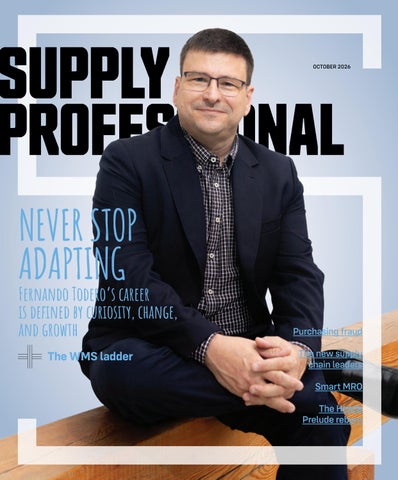
OCTOBER 2026
NEVER STOP ADAPTING
Fernando Todero’s career is defined by curiosity, change, and growth The WMS ladder
Purchasing fraud The new supply chain leaders Smart MRO The Honda Prelude reborn
SP Oct 26.indd 1
2026-09-28 3:26 PM
Beyond racking. Beyond limits. Transform your warehouse with one integrated partner Your warehouse is more than just storage. It’s a complex operation that demands smarter
Ready to future-proof
solutions. That’s why Konstant goes beyond racking to deliver seamless integration across
your operation?
racking, automation and material handling. Powered by our family of companies—and backed
Talk to our team today.
by Raymond and Toyota — we optimize every inch of your facility for efficiency and growth.
konstant.com | 1-866-202-0064
131174_Konstant_Supply-Professional_Print_ad_2025_FA.indd 1 SP Oct 26.indd 2
Complete Storage System Solutions
2025-03-20 12:12 AM 2026-09-28 3:26 PM
VOL.68 No.5 OCTOBER 2026 SUPPLYPRO.CA COVERING CANADA’S SUPPLY CHAIN
@SupplyProMag facebook.com/supplyprofessional linkedin.com/company/supplyprofessional
COVER: JOHN PACKMAN PHOTOGRAPHY
10
16
20
8
FEATURES 8 THE WMS LADDER Changing the approach to warehouse management systems. 10 BUILDING SYSTEMS, BUILDING PEOPLE Fernando Todero on creating resilient supply chains and developing leaders. 13 EASY TARGETS Tips for dealing with old fashioned supply chain fraud.
ALSO INSIDE 16 THE TALENT YOU NEED IS ALREADY HERE Developing people may be the key to building a future-ready supply chain workforce.
4 UP FRONT
18 FORECASTING THROUGH UNCERTAINTY Tips to plan for volatility without chasing forecast perfection.
7 INDUSTRY NEWS
5B USINESS FRONT 6 IN THE FIELD
30 THE LAW
20 SUPPLY CHAIN TALENT How to hire for the unexpected. 22 KNOW WHAT YOU’RE BUYING Why context matters as much as cost.
23
Fleet Management SUPPLYPRO.CA 3
0 12:12 AM SP Oct 26.indd 3
2026-09-28 3:26 PM
UP FRONT
A RESILIENT NETWORK The turmoil we’ve seen on the global stage has been unnerving. Yet, it’s led to something significant and unexpected in Canadian supply chain. As a result, we’ve seen a wave of investment in infrastructure projects across the country. This is good news. Canada is, among other roles we play, a trading country. Yet we’ve experienced significant capacity issues in recent years— vessel size limits, declining global connectivity, routing to US hubs. Supply chain infrastructure investments are long overdue. It’s exactly this moment in history that makes such infrastructure improvements so important. It’s not just about moving more cargo or people; it’s also about bolstering the country’s resilience. That resilience is more important than ever. Climate-related disruption, geopolitical turbulence, and trade friction with our largest trading partner, among other challenges, highlight the need for a strong, connected supply chain network. Ports provide a good example, as they’re at the nexus of Canada’s internal supply systems and dealings with international trade. They offer more capacity for imports and exports but can also mean there are more options available when things go sideways. There seems to be recognition of this. The Port of Vancouver Gateway Strategy, for example, launched last July, looks to double non-US exports by 2035. It involves work at the Roberts Bank Terminal 2, rail infrastructure optimization and expansion, environmental protections and more. The Port of Churchill in Manitoba is also seeing an expansion from a multi-billion-dollar upgrade supported by the Arctic Gateway Group to a much larger long-term vision backed by the Manitoba government. There are, of course, many other such projects in the works. There’s the International Cargo Hub at the Edmonton International Airport, projects at the Ports of Halifax and Montreal, as well as massive infrastructure upgrades at Toronto’s Pearson International Airport—all worthwhile and overdue. The same justification applies to each of these projects. Whether rail, airports, highways, or logistics hubs, they’re all part of the same connected supply chain ecosystem. As an overarching national project, there’s never been a more pressing time to focus on infrastructure. The risks on the national and global stages all loom as semi-permanent challenges for supply chain leaders. It also seems as if the resources are available. The federal government has established the Canada Strong Fund and the Trade Infrastructure Strategy, with a $6-billion commitment to link internal assets with global markets. It’s not simply a capacity issue. Strong infrastructure defends against supply chain risk. Rather than a collection of individual infrastructure projects, these upgrades are nodes of an interconnected supply chain. It’s especially exciting to see such projects in the works now. It’s a unique opportunity, and one that we shouldn’t waste.
EDITOR MICHAEL POWER 416-441-2085 x7 michael@supplypro.ca PUBLISHER FARIA AHMED 416-441-2085 x 5 faria@supplypro.ca DESIGN Art Direction ROY GAIOT Design Consultation BLVD AGENCY
iQ BUSINESS MEDIA INC. Vice President STEVE WILSON 416-441-2085 x3 swilson@iqbusinessmedia.com President & Executive Publisher ALEX PAPANOU
PUBLICATION MAIL AGREEMENT NO. 43096012 ISSN 1497-1569 (print); 1929-6479 (digital) CIRCULATION Mail: 126 Old Sheppard Ave, Toronto ON M2J 3L9 SUBSCRIPTION RATES Published six times per year Canada: 1 Year $ 99.95 CDN Outside Canada: 1 Year $ 172.95 USD Single price per copy $18.00 CDN Opinions expressed in this magazine are not necessarily those of the editor or the publisher. No liability is assumed for errors or omissions. All advertising is subject to the publisher’s approval. Such approval does not imply any endorsement of the products or services advertised. Publisher reserves the right to refuse advertising that does not meet the standards of the publication. No part of the editorial content of this publication may be reprinted without the publisher’s written permission. © 2021 iQ Business Media Inc. All rights reserved. Printed in Canada. Supply Professional is the Official Magazine for NISCL
MICHAEL POWER, Editor 4 OCTOBER 2026
SP Oct 26.indd 4
SUPPLY PROFESSIONAL
2026-09-28 3:26 PM
BUSINESS FRONT—BY MICHAEL HLINKA
THE STICKING POINT THE CANADA-US TRADE STANDOFF MAY COME DOWN TO ONE ISSUE In a column that I submitted last March, I predicted that there would be an uneasy negotiated settlement between the United States and Iran, and that oil would remain expensive, ranging between $80 to $90. And I’ve been largely correct, which proves that a broken clock gets the time right twice a day and even a blind squirrel occasionally finds a nut. I am submitting this column in early September, discussing where US and Canadian trade talks stand, predicting what the foreseeable future holds, and offering a possible solution to a problem that seems increasingly intractable. On September 8, retaliatory Canadian tariffs went into effect. They cover $28 billion worth of imports, ranging from primary products such as aluminum and steel to dairy products and hundreds of manufactured goods. In response, Trump announced a total block of imports on some motorcycles, dairy products, and alcohol. This might not even go through. Or he might announce even more draconian measures. These are not easy negotiations. THE ROOT OF THE PROBLEM I believe that the problem starts with the particular character of Donald Trump. He has a huge ego and more than most politicians, openly personalizes disputes. Trump believes that neither Justin Trudeau nor Mark Carney provide him with the respect that he deserves. It didn’t help when Ontario Premier Doug Ford said in an interview, “I have a lot of real estate on my ass, so he (Trump) has a lot of room to kiss my ass.”
Statements like these make it particularly difficult to get deals done. Then there’s the matter of Canadian support—or more properly lack of it—with respect to America’s military operation against Iran’s nuclear facilities. In late February, we articulated our official position: “The Islamic Republic of Iran is the principal source of instability and terror throughout the Middle East, has one of the world’s worst human rightsrecords, and must never be allowed to obtain or develop nuclear weapons.” While these words must have been pleasing to the US administration, it’s not like we joined the struggle. By the way, I agree with the Canadian position, but it impacts how Trump feels about us. Yet for all of this, it doesn’t explain why there isn’t a deal. Last November, I predicted that a comprehensive trade deal was going to be struck between Canada and the US before summer was out. Which goes to prove that the broken clock generally gets the time wrong and that blind squirrels more often than not go hungry. My logic went like this: Trump wanted to score a big win going into the November midterm elections. Had something been worked out in July or August, there would have been enough time to see lower prices on a range of goods which would translate into positive inflation numbers. Well, it’s September. And the reason why we haven’t seen a deal, and what seems to be the key sticking point, is Canada’s refusal to back down on one key American demand: a common tariff policy against the rest of the world.
Essentially, the US would like to transition from a more-or-less free trade area with Canada and Mexico to a customs union. By definition, this structure requires members to have the identical trade policies with non-members. Canada is digging in its heels because of the argument that in agreeing to this, we would be sacrificing our sovereignty. GAMING THE TALKS The Liberal government’s strategy is classical game theory; it is engaging in tit-for-tat retaliation. You’ve imposed tariffs on us, and we’ll reciprocate. To be fair to the current government, I suspect that were the Conservatives or NDP in power with majorities, both would be following a similar path. The problem with this approach, however, is that it tends to be harmful to both parties. Canadian exports to the US are down and what we import is more expensive. It’s a lose-lose. Here’s how I wish this dispute were handled. This matter should be put to a plebiscite, letting the Canadian people decide directly. The proposition would be simple: would you like to be part of a customs union with the US? There would be educational campaigns that would present the pros and cons of this arrangement. The voting public would understand the implications. And were this plebiscite to occur (trust me, it won’t), I know how I’d vote. I would jump at the chance to be part of a customs union with the biggest and most dynamic economy in the world. SP
Toronto-based Michael Hlinka is a tenured professor at George Brown College. His website is www. michaelhlinka.com
“Essentially, the US would like to transition from a moreor-less free trade area with Canada and Mexico to a customs union.”
SUPPLYPRO.CA 5
SP Oct 26.indd 5
2026-09-28 3:26 PM
IN THE FIELD—BY SIMON BROWN
THE IRREPLACEABLE SKILL FORGET AI, YOU NEED TO NEGOTIATE Artificial intelligence can forecast demand, optimize routes, write supplier emails, and summarize contracts. It can analyze spend patterns in seconds and surface risks you might have missed. But there is something it can’t do and won’t be able to do for a long time: sit across from another human being and negotiate. AI can support supply chain work, but it cannot replace the conversations that hold supply chains together. And those conversations are becoming increasingly difficult. In 2026, negotiation is the most important skill in supply chain not because technology has advanced, but because the human landscape has become more complex, more political, and more constrained. In procurement, logistics, operations, or supplier management, your ability to negotiate is no longer a soft skill. It’s the structural skill that determines whether your technical expertise delivers results. THE MOMENT WE’RE IN Supply chains are under pressure from every direction. Supplier consolidation means fewer choices. Inflation and cost volatility make every conversation about price more sensitive. ESG requirements add complexity. Risk concentration means the stakes of every agreement are higher. Political instability is reshaping global trade rules and tariffs, and today’s fundamental assumptions may not hold tomorrow. AI can help you analyze these pressures. But it cannot navigate them. When a supplier is struggling, when a stakeholder is misaligned, when a partner is hiding jeopardy, when someone is frustrated, afraid, or protecting their turf, that is not a data problem. It’s a negotiation problem. 6 OCTOBER 2026
SP Oct 26.indd 6
Most supply professionals have never been formally trained to solve it. MOST NEGOTIATION IS IMPROVISED The uncomfortable truth is, most supply chain professionals negotiate by instinct. They “wing it” because they’ve always done so. They assume that being reasonable, professional, and prepared is going to be sufficient. But instinct collapses under pressure. Personality does not help when the other side is under internal constraints. Experience does not help when the situation is new, political, or ambiguous. Habits don’t help when the stakes are high. This is where the “new take” comes in the idea at the heart of my book: If technical skill is the engine, negotiation is the transmission. Without a transmission, the vehicle loses not just power, but the ability to adjust. An engine connected to the axle can move forward, but it can’t respond to the shifting terrain. You can have the best analytics, the best forecasting, the best contracts, and the best supplier scorecards. But when something changes out of your control, those capabilities alone can’t help you adjust. Without negotiation, the engine has power but no flexibility. Negotiation turns capability into effective movement. A PRACTICAL, REPEATABLE MODEL In my book, I outline the Negotiation Profile Index (NPI) and Negotiation Value Index (NVI), which form the SNAP model—a structured way to determine strategic posture. The NPI asks four questions: Is there enough of what we need?
an we obtain it from more than C one person? If we get it somewhere else, is that hard or easy? What happens if it goes wrong? The NVI forces us to ask: What is the strategic significance? How much value does this negotiation create? What emotional value is tied to the topic? What financial commitment and opportunity cost are involved? Supply professionals don’t need the full model to benefit from it. Even referencing these questions before a negotiation improves clarity and reduces wasted effort. We must then map the other side of the table and consider several elements I term strategic empathy: Alignment: how aligned are we with the other party, and what level of opportunity do we represent moving forward? Importance: how important is the topic to them, their organization, or their broader community? Constraints: what pressures shape their position, beyond what they say? Finally, what levers in my persuasion toolkit are relevant to this negotiation? I use a framework adapted from research and tested by experience: CNRJ TSWA. This model is simple enough to use daily but strong enough to support highstakes conversations. It helps you to prepare deliberately, not reactively. And it is something AI cannot do for you. Review this list before conversations with suppliers, stakeholders, or partners: What do I need? Define the minimum acceptable outcome. What does the other side likely need? List their constraints, pressures, and risks.
Simon Brown is a supply chain transformation leader and business architect. His book, The Supply Chain Negotiator, is available at https:// www.amazon.com/ author/simonrjbrown.
“AI can support you. Negotiation will define you.”
here is the jeopardy? What W happens if we don’t reach an agreement? What value can I trade? List everything you can offer that isn’t price: flexibility; timing; information; risksharing; relationship capital; operational support. W hat’s my walkaway point? Define the line that protects your organization. AI will reshape supply chains,
automate tasks, accelerate analysis, and reduce administrative burden. It will not replace the conversations that determine cost, risk, resilience, and relationships. The professionals who negotiate deliberately will be the ones creating value. They will protect their organizations from jeopardy, build partnerships, and turn technical capability into outcomes. The time to build the skill is now. SP SUPPLY PROFESSIONAL
2026-09-28 3:26 PM
INDUSTRY NEWS
Date set for MODEX 2028
Procurement pressure rises: report
The MODEX 2028 materials management conference will be held April 3-5 at Atlanta’s Georgia World Congress Center. MODEX will bring together the industry’s leading solution providers to demonstrate their equipment, technology, systems, and services for manufacturing, supply chain, and transportation operations. Over 1,100 exhibitors will showcase their solutions on the MODEX show floor, which will total 630,000sq-ft of manufacturing and supply chain solutions. MODEX exhibits will represent all segments of material handling, transportation, and supply chain solutions, from traditional, manual equipment to computerized, automated systems. MODEX 2028 exhibits will fill all three halls of the Georgia World Congress Center.
Euna Solutions’ 2026 State of Public Procurement report finds government procurement teams are under growing cost, compliance, and capacity pressures. At the same time, many still rely on manual systems. Based on a survey of 100 North American procurement professionals, 74 per cent of respondents cited rising goods and service costs as a top external challenge, while 46 per cent still primarily use spreadsheets, email, or paper. Streamlining and automating processes remained the top priority, selected by 50 per cent of respondents, followed by cost reduction at 40 per cent. Supplier management also remains reactive: 59 per cent either do not formally assess suppliers or review them only when problems arise. Interest in AI is growing, but readiness lags, with 41 per cent of respondents reporting a lack of confidence in responsible adoption.
Questar expands Canadian network Mauser Packaging Solutions-owned Questar has launched Questar Canada, combining its US and Canadian distribution operations under one North American organization. Effective September 1, Canadian businesses ICS Jos. Le Bel and ICS Great Western joined Questar’s US operations. The expanded network includes seven major Canadian distribution hubs, offering increased inventory, faster delivery, and localized support. Questar Canada will provide industrial packaging, UN-certified containers, drums, pails, corrugated boxes, absorbents, spill-containment products, and other specialty solutions. The company says the unified operation will streamline logistics, improve product availability, and reduce supply chain risk while maintaining existing customer support.
Supply chains struggle to scale AI A new JBF Consulting survey finds many supply chain organizations are pursuing AI without the strategy and measurement needed to generate measurable results. Among over 2,000 senior supply chain, logistics, and technology leaders surveyed last July, 78 per cent said their organizations lack a formal AI plan. Meanwhile, 85 per cent select opportunities without consistent evaluation criteria. Only 11 per cent establish criteria before
launching an initiative, while three per cent assess results against the original business case. Forty per cent remain in prototype or pilot stages, compared with 23 per cent operating AI in the business. Only 16 per cent report ongoing funding for implementation and expansion. Data and technical architecture were the top areas where respondents wanted outside support, followed by implementation planning and outcome measurement.
Report sees headway in plastic waste reduction The Alliance to End Plastic Waste’s 2025 Progress Report highlights its first year implementing Strategy 2030, including progress on waste reduction, recycling systems and investment. In 2025, the Alliance says it saw a reduction of 138,162 tonnes of unmanaged plastic waste and valorised 165,317 tonnes, bringing cumulative totals to 378,147 and 418,529 tonnes, respectively. Its initiatives have also catalysed $641 million in third-party and impact-investor funding since 2019. The organization is shifting toward larger country and thematic programs, with active country programs in Brazil, Saudi Arabia,
India, Indonesia, and South Africa. In Indonesia, it committed up to $40 million to scale integrated waste-management approaches. Its flexibles program is also
developing recycling solutions in Europe and North America, while new investment initiatives aim to accelerate plastic-circularity technologies. SUPPLYPRO.CA 7
SP Oct 26.indd 7
2026-09-28 3:30 PM
BY MICHELLE JONES
STOP CLIMBING THE WMS LADDER BUILDING A SCALABLE FOUNDATION IN YOUR WAREHOUSE Today’s warehouse leaders face an all-too-familiar frustration. An operator scales its business, adds facilities, or enters a new market, and quickly discovers that its warehouse management system was not built to grow with it. The result is a disruptive, expensive reimplementation cycle that strains IT teams and forces employees to relearn systems from the ground up. For many organizations, this is not an isolated event but a recurring feature of doing business in a sector where technology decisions compound over time. The root cause is not a lack of technology options. It is a fundamental misunderstanding of how warehouse technology should scale, and that misunderstanding is costing companies more than they realize. THE LADDER MINDSET AND WHY IT FAILS For decades, the prevailing model in warehouse technology has been built around maturity levels, what practitioners commonly describe as a ladder. Operators at smaller scale start with a basic platform, 8 OCTOBER 2026
SP Oct 26.indd 8
and as the business grows, conventional wisdom says they must upgrade to a more sophisticated solution. The logic seems intuitive, but it has a significant structural flaw: it treats the underlying technology platform as a temporary solution rather than a permanent foundation. This ladder model drives the cycle of costly reimplementation. When a company outgrows its system, it does not simply add capability. It replaces the existing platform entirely, along with adding new training requirements, new integrations, and new project risk. Major enterprise WMS vendors have reinforced this
dynamic by offering tiered product lines, lighter versions of their software for smaller facilities, and more robust versions for complex operations. In practice, these lighter versions are often the same software with features removed. When operators need those capabilities, they discover they are not upgrading within a platform; instead, they are switching platforms entirely. THE HIDDEN COST OF PATCHWORK ARCHITECTURE The ladder approach creates a second problem that is less visible but equally damaging: fragmented
operational intelligence. As organizations expand across multiple facilities, they often accumulate different WMS platforms through acquisitions, regional deployments, or phased implementations. While each system may perform well locally, they rarely measure or report operational KPIs the same way. Definitions for metrics, such as productivity, utilization, order cycle time, or dock performance, often differ between systems, making execution-level reporting inconsistent and preventing true apples-to-apples comparisons across sites. Leadership is left consolidating spreadsheets, reconciling conflicting data, and making strategic decisions without a unified view of network performance. The result is reduced visibility, slower decision-making, and missed opportunities to optimize operations across the enterprise. CONFIGURATION OVER CUSTOMIZATION A growing number of operations leaders today are rethinking the ladder model in favor of what might be described as a dial approach. Rather than selecting a platform appropriate to a current scale and replacing it when that scale changes, the dial model treats the WMS as a permanent architectural foundation. Capability is not added by switching platforms. It is activated within the same platform as operational needs evolve. The critical distinction is between customization and configuration. Traditional WMS implementations often involve custom code changes to accommodate unique processes. The problem with custom code is that it diverges from the base system. Every software release becomes a risk, as custom code may conflict with platform updates, and the cost of maintaining that code escalates over time. Configuration-based systems address this by allowing operators to adjust system behaviour through structured logic rules and decision tables rather than code changes. If a warehouse does not use replenishment to a pick face because it operates as a full-pallet environment, that functionality is simply not configured. It remains available if operaSUPPLY PROFESSIONAL
2026-09-28 3:26 PM
tions change but creates no technical debt in the meantime. When a software update is released, there is no custom code to reconcile. Implementation timelines shorten. Upgrades become routine. When an operation evolves, the same platform accommodates the change through configuration rather than replacement. EASY MULTI-SITE CONSISTENCY One of the clearest applications of the dial model is the use of configuration templates across a network of facilities with varying complexity. Rather than deploying unique configurations at each site from scratch, operators can define templates that reflect the operational profile of a given facility type and apply those templates as they expand. A basic fulfillment warehouse gets a template appropriate to its needs. A highly automated distribution centre gets a different one. Both run on the same platform.
“The critical distinction is between customization and configuration.” Training is consistent across the network because the underlying system is the same. Integration work done once applies everywhere. And when a facility grows from a simpler operational model to a more complex one, the system grows with it by activating additional capabilities rather than triggering a replacement project. WHAT TECHNOLOGY LEADERS SHOULD ASK For leaders evaluating their current WMS architecture or preparing for a new selection, the most productive questions are not about features. Feature parity among major WMS vendors is relatively high, however, the more consequential questions are now architectural.
Does the platform require code changes to accommodate process customization, or can adaptation be achieved through configuration? Will a future upgrade disrupt those configurations? Can the same platform serve a 250,000-square-foot, labour-only facility and a millionsquare-foot, fully automated distribution centre without switching products? And is the vendor roadmap designed to make customers outgrow the current offering, as tiered product lines often are, or to evolve continuously alongside them? The answers reveal whether an organization is buying a ladder or a dial. In an environment where operational agility is a competitive requirement and reimplementation costs compound over time, that distinction matters more than any individual feature comparison. The frustration that warehouse leaders feel with technology implementations begins with how the industry has framed maturity.
Michelle Jones is the director of presales and solutions Consulting at Logistics Reply (www. logistics-reply.com).
Moving from a ladder model to a dial model does not just reduce costs. It changes what an organization can do operationally, and how quickly it can respond when the business demands something new. SP
26_011565_Supply_Professional_OCT_CN Mod: August 25, 2026 4:19 PM Print: 09/17/26 page 1 v2.5
π SHIPPING SUPPLY SPECIALISTS
KEEP YOUR BUSINESS ROLLING CONVEYORS, BOXES AND MORE
ORDER BY 6 PM FOR SAME DAY SHIPPING
COMPLETE CATALOG
1-800-295-5510
uline.ca SUPPLYPRO.CA 9
SP Oct 26.indd 9
2026-09-28 3:26 PM
BUILD BEYOND YOURSELF
FERNANDO TODERO ON PROBLEM SOLVING, IMPROVING SYSTEMS, AND DEVELOPING PEOPLE Fernando Todero once made himself redundant. While working at General Electric as a “fasttrack buyer,” the company tasked Todero with speeding up a procurement process that, at the time, could see service technicians waiting weeks for components. In doing so, he streamlined the internal process, convinced a Chicago-based supplier to stock the most frequently needed parts, arranged a five-times-a-day collection agreement with a courier, and integrated the company’s systems with that of the supplier. The results? A service request made at 3am could generate a tracking number by 7am the same morning. Critical components could then be delivered to the customer within hours. The process worked so well that Todero’s position was no longer necessary. “I pretty much made myself obsolete in this whole process, and I eliminated my own position,” he says. It’s a unique way to measure career success: rather than working to be irreplaceable, Todero focuses on solving problems so well that his role is no longer needed. For Todero, however, it wasn’t a one-off accomplishment. It’s an example of a profes10 OCTOBER 2026
SP Oct 26.indd 10
sional philosophy that has defined his career: search for ways to make a system function better, then improve it until that system can function without relying on you. The process also didn’t lead to unemployment. Todero—now director of procurement operations for North America at Veolia—is proud of his ability to do so. He has relished the opportunity to eliminate his own role—not just once, but whenever possible. AN INTERCONNECTED WORLD That philosophy, however, wasn’t something Todero set out to develop. He began his career in a way that he describes as “almost organically,” with an internship when he was 18 years old at an automotive company called GKN Automotive, in his hometown of Porto Alegre in Brazil. His role at the company was in the department responsible for machine planning for the future. Lead time for that equipment was usually two to three years. When his manager joined the production planning department, he offered Todero a full-time position there.
In that role, Todero had to figure out how suppliers functioned and work with them to understand the market. He became fascinated with what suppliers did and how interconnected everything was. “When we were planning for components and materials, I ended up realizing that I enjoyed talking to suppliers more than I enjoyed demand planning itself,” he says. That fascination has been a hallmark of Todero’s career since his early days. Like many in the field, Todero didn’t grow up yearning to become a procurement professional. Yet his early opportunities helped him understand how big the world was. Everyday products require a chain of events and several organizations working together in order to get those products on shelves. In that early position, for example, Todero recalls trying to get a rubber component from a supplier. The supplier faced challenges in the supply of latex he was using. Forests from which they were getting the latex were experiencing fires, making the supply more difficult to obtain. To the young Todero, realizing how linked supply chains were, and how a single problem could affect other processes up the chain, helped to spark a fascination with interconnected systems. With that curiosity awakened, Todero moved into a Brazil-based role as buyer planner analyst at ABB, a Swiss company. After three years there, he landed an export senior analyst position at Dell, before ultimately becoming a global category manager with the organization. When he was first hired there, his responsibility was to help find export opportunities beyond the South American market. While the role wasn’t really procurement related, he was able to implement some procurement processes he had developed in previous roles. What Todero and his team ended up developing was the South African market. While Europe is geographically closer, Todero convin ced the company’s leadership in Texas to shift South Africa’s support to Brazil. That left him responsible for enabling an operation in which Brazil supplied every laptop and desktop the company sold in South Africa. That was the arrangement for Dell’s computers in the African country for little under a year. From there, Todero returned to his procurement roots in 2006 when he accepted a global category manager position at Dell. But when the company decided to move its operations in Porto Alegre to São Paulo 1,000 kilometres away, Todoro was required to move there as well. That left him at a crossroads. If he had to relocate for professional reasons, why not try somewhere completely new? SUPPLY PROFESSIONAL
2026-09-28 3:34 PM
JOHN PACKMAN PHOTOGRAPHY
BY MICHAEL POWER
JOHN PACKMAN PHOTOGRAPHY
DUE NORTH While still living in Brazil, Todero and his girlfriend (now wife) decided to apply for permanent residency in Canada. After about two years, both of them were accepted, and they decided to relocate north. The couple landed first in Montreal. While they arrived without jobs, Todero’s girlfriend secured a buying position within a week. After several months of searching, Todero eventually found a position as well. Another turning point came when Todero landed an interview for a position in Ontario at General Electric, a company in which he had long been interested. When he was offered a job as a buyer at the company in 2013, he decided to accept it. “It was a way for me to restart in Canada and get used to the Canadian market and pretty much build my reputation here,” he says. The opportunity allowed him to improve processes as a “fast-track buyer,” integrate with a Chicago supplier, and ultimately make himself redundant. And although he eliminated his own position in the process, he also revealed something unexpected about supply chain and procurement: success isn’t necessarily reflected in how indispensable you become. It can also be measured by whether problems are solved without you because the systems you’ve established are so effective. And the process of eliminating his own position actually became a good career move, as it also led to his first management role. Shortly after, he became a sourcing manager at GE, a position he held for just over three years. He has now been with the company for 14 years, although it has been sold and rebranded a few times. It was first sold to Suez – Water Technologies & Solutions, then to Veolia Water Technologies. He held several positions at all of them and is now director of procurement operations for North America at Veolia. STRATEGIC SHIFT His director-level position focuses more on strategy, efficiency, and resource development than his previous roles, Todero says. He now spends much of his time on developing people, with succession planning and business continuity becoming a more prominent focus for him. Finding efficiencies is also a major part of his role. Director-level work also means less time spent talking to suppliers—one of Todero’s favourite aspects of his earlier roles.
SUPPLYPRO.CA 11
SP Oct 26.indd 11
2026-09-28 3:26 PM
“The best supply chain professionals are the ones Yet people management remains one of the most satisfying aspects of his current role. that will be able to adapt Todero had several mentors that helped him early in his career, and he now tries to pass and to think ahead of the along his own knowledge whenever he can. “Most of the one-on-ones that I do have with time when decisions are my team members, we plan for half an hour,” he says. “They usually don’t run less than an being made.” hour because we go from one topic to another, and then eventually it just turns into some very interesting conversations that we go through.” Along with a sense of curiosity, Todero tries to impart to his team members the mindset that eliminating one’s own position can bring unexpected benefits. “That’s something not typical, but in my case, it works, and I feel proud,” he says. “And I encourage everyone in my organization now to think about ways to eliminate their own position, because I’m going to grab that person by the hand, and I have a ton of opportunities to grow that individual.” The importance of people management became apparent when the leader of a procurement team left the company. Several other members of the five-person team left shortly after that. At the time, Todero was a member of an internal team known as the “Margin Guardians.” That team was responsible for working to control budget versus material acquisition. Todero was pulled from that assignment and tasked with leading the team of category managers. In that role, Todero had to find new team members, hire them, redo the existing policies and procedures, re-establish connections with stakeholders, and look for financial benefits during the reboot—all within less than a year. “During that one year that I performed that position,” Todero says, “I flipped the situation from losing $5 million the year before to saving $14 million, at the same time that I had four new resources.” COVID-19’S LASTING EFFECTS Each era is unique, and supply chain professionals now face challenges unique to the state of today’s world. Supply chain is different from what it was 20 or 25 years ago, Todero says. The COVID-19 pandemic changed the outlook of supply chain’s future, Todero notes. Until recently, the view of supply chains has revolved around consolidation—organizations looked to give volume to one supplier and worked to get the best deal possible from that supplier. Efficiency drove economies of scale. That paradigm shifted post-pandemic. COVID-19 threw supply chains into a container availability crisis. When that crisis waned, the 12 OCTOBER 2026
SP Oct 26.indd 12
world was hit with hyperinflation and suppliers began charging more in order to honour volumes. After hyperinflation eased, a new major challenge came in the form of geopolitical conflicts, such as those in Ukraine and the Middle East. Going forward, supply chain leaders must focus on minimizing risk, Todero says. Saving five cents today isn’t a great strategy if disruption costs a dollar in the future. “The world is more connected and we’re more dependent on each other,” Todero says. “Unfortunately, not everyone is speaking the same language today, which is going to be leading to more and more of those disruptions. We shouldn’t think of that as an exception anymore. The best supply chain professionals are the ones that will be able to adapt and to think ahead of the time when decisions are being made.” Having a diversified supplier base—both in terms of supplier numbers and geography— can help to ease those risks. As well, dealing with disruptions and delays early beats a waitand-see approach. “Don’t wait until the last minute,” Todero says. “Don’t wait until 100 per cent of your monthly demand is in a ship that got stuck in the Suez Canal because the boat got stuck sideways.” LIVE ALL SEASONS FULLY Such seismic changes are enough to confound any supply chain leader. To ensure you’re ready to navigate this new world, Todero counsels that every cycle of a career should be experienced in its entirety before moving on. Many young professionals want to keep growing their knowledge and abilities. That’s admirable, Todero says. But there are insights and knowledge in supply chain and procurement that come only with time. “You can learn how to create a PO in 10 minutes, but that doesn’t make you a good buyer,” he says. Rather, a good buyer has the experience to know what to do the first time a truck breaks down, when a winter storm shutters operations, or when customs workers go on strike, and everything gets held up.
For many aspects of the profession, it’s impossible to expedite that learning curve. Yet eventually, every supply chain leader goes through several such situations. And those experiences form them into experienced professionals. It’s important to become confident and competent at each level you hit. “I have some younger people that I’m coaching, and my advice to them is: Everyone’s professional life is going to be made of multiple cycles,” Todero says. “If everything goes well, each cycle is going to be better than the cycle before. But don’t try to rush through those cycles, because they’re important, and the better base you have, the easier it’s going to be once you climb the ladder. So, give it time.” An equally important skill is recognizing when a cycle is ending, he adds. That realization helps move you towards the next challenge. At that point, try to prioritize a different challenge, something that makes you uncomfortable again. That’s the best way to grow as a supply chain leader. AGILITY IS KING Our changing world may have shifted what it means to be a competent supply chain professional. Until now, an expert in a single field who had decades of experience in one industry was a valuable asset. Today, people are more valuable if they’re capable of a bit of everything. These days, people may be required to do multiple things throughout the day. Or perhaps they must complete one or two important tasks. That kind of professional agility is especially important for today’s dynamic organizations, Todero says. It’s the kind of breadth that he’s tried to build in his own career. “That would be my final thought, that I’m very happy with what I’ve done,” he says. “My ambition is to start helping to develop people and start helping to develop organizations with a more agile supply chain, less risk-managed organizations and supply chain models.” For Todero, the lessons of a long supply chain career come back to adaptability—build systems that work without you, develop people who can carry them forward, and keep seeking out the next challenge. In a world where disruption is increasingly the norm, he believes the strongest supply chain leaders will be those who can anticipate risk, embrace change, and use their experience to improve their decision making. For Todero, that process means not only building more agile supply chains, but helping the people working around him become agile leaders themselves. SP SUPPLY PROFESSIONAL
2026-09-28 3:26 PM
BY GERALD FORD
“Most purchasing fraud pipe. Three suppliers bid—two were isn’t sophisticated. identical and the third was low by 32 cents. The low bid had a faulty It exploits ordinary gaps— calculator. They had clearly compared pricing beforehand, but provweak controls, rushed ing it was another matter. Another time, suppliers met processes and too much at a golf course and agreed on a rotation. We only found out because authority concentrated a bidder who was supposed to win did not and came to the buyer with in one person.” the whole plan. These schemes run for years, and a whistleblower exposes them far more often than a tender review. The Competition Bureau estimates collusion affects 30 per cent of public procurement. Watch for quotes that move together, a bidder pool that never changes, a list you narrowed yourself, and a low bid followed by generous change orders.
THE FRAUD YOU MEET PURCHASING SCHEMES IN CANADA It might seem the only fraud you see is cyber related. But the old ways still exist, and you might not notice them. Last year was the worst on record for fraud, and only five to 10 per cent is ever reported. Supply chain is an easy target. It deals with more departments than anyone and rarely has the time to close gaps, especially ones they don’t know exist. Purchasing fraud is patient. It waits for a control nobody put in place. Almost every case I have seen comes down to one thing: people. Below are seven schemes, all of which have a common weakness. 1. THE COMPETITION DECIDED IN ADVANCE The first time I saw this form of fraud was in a bid for concrete
2. THE EXPERT WHO WINS THE BID AND NEVER SHOWS UP Specify that you must review and approve replacement resources. The company won on the skills and experience of named individuals. If those people never do the work, you are overpaying or you awarded to the wrong bidder. Some call what they do good business practice. You should call it not getting what you paid for. The same applies when a company wins and subcontracts the whole scope, like a contractor with no asbestos staff who hires another firm at a markup. Put a clause in your award document. Where a replacement is accepted at a lower level, the rate drops by the difference between the supplier’s quoted price and the lower rates. 3. THE FRAUD THAT STARTS AFTER THE AWARD Forensic audits do find contractors who overbilled by inflating change orders. In one case the firm quoted a large fee for subcontracted work, and the buyer was later quoted far less by the subcontractor directly. The bid was competitive, and the process was clean. The fraud lived entirely in what came afterward.
4. ONE PERSON WITH TOO MUCH AUTHORITY The requisitioner needs work done. They send the request, and the supplier named in the requisition is new, and the amount sits inside their own authority. The work is delivered, and they authorize payment. Except the company never existed, or a relative owned it. This is the failure on every fraud checklist ever written. Requisitioner, receiver and approver were the same authority. 5. PURCHASE ORDERS THAT ARRIVE AFTER THE INVOICE Accounts payable is often measured on prompt payment. That’s often an open door to fraud. The requisition never comes first. Somebody orders, the purchase order is raised afterward to fit an invoice already in the queue, or not raised at all. Nobody set out to commit fraud. They were clearing a backlog. You will see this when dealing with small things like office supplies. The three-way match fails when the purchase order is written to fit the invoice. Score accounts payable on days to pay and nothing else, and you have told everyone which number matters. 6. THE VENDOR WHO IS THREE VENDORS You disqualify a company, and it changes its name and bids again with different officers and sometimes a new email address. What they often forget to change is their telephone number—especially their cell number—and the street address.
Gerald Ford is Chief Visionary Officer at QCsolver: purchasing services.
7. YOUR OWN SUPPLIERS, DEFRAUDED IN YOUR NAME Dozens of heavy-duty trucking supply businesses were defrauded by callers phoning in orders for tires, oil, and trailer parts with credit card details. They gave a different ship to address. The transactions showed as approved and pending, the businesses shipped by courier, and the payments then failed—no hacking, no malware. Freight released on an authorization that never existed. Many of these examples are front-end problems. Several of these frauds started before a real purchase order existed. Most organizations still handle these challenges with a spreadsheet, Outlook, shared drive and maybe somebody’s memory. A supplier qualification or vendor management system helps reduce risk. A well-maintained registry qualifies a supplier once, to a standard, against verifiable information like HST number, insurance certificates and workplace safety certificates of clearance which need to stay current and are hard to fake. The person who wants the purchase is not the one who declares the supplier fit. What I’ve outlined doesn’t fix everything, but it does help. SP SUPPLYPRO.CA 13
SP Oct 26.indd 13
2026-09-28 3:26 PM
PDF/X-1a:2001
from
WEAK HOURS
SP Oct 26.indd 14 131062576_DragonFly_OPEN_SupplyProfessionals_DPS_Ad.indd
|
2026-09-23
|
13:00
|
PAGE 1
W
2026-09-28 3:26 PM
to
WEEKEND HOURS Think there’s no such thing as weekend delivery? It might be time for a change. Welcome to last-mile delivery for today’s ecomm.
Ready for a change? Connect with us at dragonflyinternational.com
Delivery done differently SP Oct 26.indd 15
2026-09-28 3:26 PM
BY AL-AZHAR KHALFAN, PRESIDENT & CEO, NATIONAL INSTITUTE OF SUPPLY CHAIN LEADERS (NISCL)
THE CAPABILITY IMPERATIVE
PREPARING CANADA’S SUPPLY CHAIN LEADERS FOR WHAT’S NEXT When you ask supply chain and procurement leaders across Canada what is holding their function back, “talent shortage” is often the answer. So, organizations recruit harder, compete for the same people, and wait for the market to produce candidates with the right experience. But what if we are diagnosing the problem incorrectly? CANADA MAY HAVE A SUPPLY CHAIN SKILLS SHORTAGE RATHER THAN A TALENT SHORTAGE The distinction matters because the solutions are fundamentally different. As the exclusive Canadian strategic partner of the Chartered Institute of Procurement & Supply (CIPS), NISCL has a close view of how the profession is evolving. The CIPS Procurement & Supply Salary Guide 2026, which surveyed 224 Canadian professionals as part of a global sample of more than 7,100, paints a more nuanced picture of the Canadian market. Canadian professionals are less likely to move than their peers in any other region, while 49 per cent 16 OCTOBER 2026
SP Oct 26.indd 16
of Canadian employers report difficulty finding talent, compared with 57 per cent globally. More revealing is what employers struggle with once they find people: 64 per cent cite organizational fit as a challenge, while 59 per cent point to a lack of technical skills or evidence of formal procurement training. The message is clear: the issue is not simply finding people. It is finding people with the capabilities the modern function now demands. WE’VE CHANGED THE JOB FASTER THAN SKILLS HAVE DEVELOPED Supply chain and procurement were once largely defined by functional expertise: sourcing, purchasing, planning, inventory, logistics, and supplier management. Those fundamentals still matter. But the mandate has expanded dramatically. Today’s professionals are expected to be data analysts, risk assessors, scenario planners, compliance experts, process engineers and cross-functional collabora-
tors—often several of these in the same week. They are expected to navigate tariff volatility, geopolitical disruption, regulatory complexity, and supplier risk, while increasingly using AI and analytics to make better decisions. The expectations placed on the profession are rising quickly. The capabilities required to meet
“Capability building is business infrastructure.” those expectations are not being built at the same pace. That gap is becoming a business issue. Waiting for the market to produce fully formed candidates with every capability on an increasingly demanding job description is neither scalable nor strategic. Organizations need to become better at developing the capabilities they need in the people they already have.
THE SKILLS GAP MAY NOT BE WHAT WE THINK IT IS There is another dimension that deserves attention: leaders and practitioners do not always see the capability gap in the same way. In a recent NISCL webinar with CIPS on building high-performing teams attended by close to 300 supply chain and procurement professionals, live polling revealed a striking difference between practitioner and senior-leader perspectives. When practitioners were asked which capability gap concerned them most over the next three years, AI and data literacy ranked first at 38 per cent, followed by critical thinking at 34 per cent and leadership capacity at 23 per cent. Supplier relationships and negotiation ranked last, at five per cent. The senior leaders on the panel saw the challenge differently. Their discussion repeatedly returned to capabilities that become more important as technology absorbs transactional work: leading critical projects, navigating difficult conversations, influencing across functions, making decisions amid ambiguity, establishing priorities, and building relationships that create value. That distinction is telling. Practitioners are understandably focused on the skills they need to keep pace with changing technology. Leaders are looking at the capabilities required to move the organization forward. Both perspectives are valid. And together, they point to a broader conclusion: the future-ready supply chain professional needs both functional and leadership capability. The audience’s responses reinforced this tension. While AI and data literacy ranked as the greatest personal capability gap, when asked what leaders should focus on in 2027, AI literacy finished last at 11 per cent, behind change management at 38 per cent, critical thinking at 30 per cent and leadership at 21 per cent. The implication for organizations is important: technology may change the work, but leadership determines whether the organization can capitalize on that change. SUPPLY PROFESSIONAL
2026-09-28 3:26 PM
WHEN “TOO MANY PRIORITIES” IS REALLY A CAPABILITY PROBLEM Our webinar polling also highlighted another familiar challenge. Fortyeight percent of respondents cited too many competing priorities as a major barrier to their teams performing at their full potential, compared with just 11 per cent who identified skills shortages as an obstacle. At first glance, these may seem like separate issues. They are not always so. When teams struggle with unclear ownership, slow decision-making or cross-functional communication, the underlying problem may be capability rather than process. Prioritization is a judgment skill. Alignment is a communication skill. Influencing requires leadership. Knowing what not to do requires organizational perspective and the confidence to make trade-offs. When nobody has been developed to make those decisions, everything becomes a priority. That is not necessarily a capacity problem. It is often a capability problem.
“The expectations placed on the profession are rising quickly. The capabilities required to meet those expectations are not being built at the same pace.” At NISCL, we believe building a high-performing supply chain function requires both functional excellence and leadership excellence. That means developing capabilities in areas such as analytics, AI, procurement, planning and risk, while equally strengthening strategic and critical thinking, communication, influence, change leadership, and decision-making.
It also means developing people earlier. Bring emerging leaders into strategic conversations before they feel completely ready. Give them ownership of meaningful projects. Let them experience disruption rather than simply observe how their leaders respond to it. As one of our webinar panellists put it, you develop leaders by preparing them to lead when you are absent, not when you are present. That is the difference between training people for the job they have today and building the capability the organization will need tomorrow. THE CHOICE IS IN FRONT OF US There has never been a more consequential time for supply chain and procurement. Whether it’s because of tariffs, geopolitical disruption, supplier concentration, AI, cybersecurity, regulatory complexity, or cost pressure—the function is no longer
operating behind the scenes. It is increasingly at the centre of enterprise decision-making. That visibility is an opportunity, but it also raises the standard. The question is no longer whether supply chain and procurement have a seat at the table. It is whether we have developed the capability to make the most of that seat. Organizations can continue competing for people who already possess every skill on an increasingly demanding job description. Or they can build those capabilities themselves. The organizations that choose the latter will not simply have better-trained supply chain teams. They will have a strategic advantage. Because the future of supply chain will not be determined by who can find the most talent. It will be determined by who can build the most capability. SP
CAPABILITY BUILDING IS BUSINESS INFRASTRUCTURE This is where organizations need to rethink professional development. If we expect supply chain professionals to lead transformation, navigate disruption, leverage AI, influence the business and make increasingly strategic decisions, then developing those capabilities cannot remain an employee side project. It needs to become part of the operating strategy. The data suggest there is considerable room to improve. Only 55 per cent of Canadian employers surveyed by CIPS provide support for study or career development. Yet 76 per cent of Canadian respondents believe procurement and supply chain qualifications will become more valued over the next decade. That is a meaningful disconnect. We are raising the expectations of the profession while underinvesting in the capabilities required to meet them. SUPPLYPRO.CA 17
SP Oct 26.indd 17
2026-09-28 3:26 PM
BY JOHN MCCLYMONT
be reasonably sure what demand looks like six months out. What if you only had to commit to three? Work with your suppliers on staged commitments, volume ranges, late confirmation of final quantities, supplier-held inventory, or a qualified secondary source. Every week you take out of your cash commitment is one less week you need to forecast accurately.
FORECASTING UNDER UNCERTAINTY
SEVEN THINGS THAT BEAT A BETTER MODEL Everyone I talk to is saying the same thing right now. Forecasting has gotten harder. They’re right. But the reason most people give is wrong, and a wrong diagnosis sends you spending money in the wrong places. WHAT ACTUALLY CHANGED Demand forecast error blew up in 2020, then settled back close to where it always was. APQC puts median monthly accuracy at 85 per cent across more than 1,000 organizations, and Gartner’s cross-industry medians have held roughly flat. Nothing systemic broke on the demand side. People are still buying things. What didn’t recover, though, is everything downstream of demand—lead times, landed cost, duty exposure, freight routing, currency. The GEP Global Supply Chain Volatility Index hit its highest reading since October 2022 this past 18 OCTOBER 2026
SP Oct 26.indd 18
April. In February, 72 per cent of senior trade professionals named US tariff volatility their most impactful regulatory change, up from 41 per cent a year earlier. Your planning system is no longer being asked “how many units will customers buy?” It’s being asked “when can we get it, from whom, at what landed cost, and how much do we commit before all of that moves again?” Most companies use one number to answer both. WHY A “BETTER MODEL” DOESN’T FIX IT Safety stock math assumes variance around a stable mean. It’s built for noise you can measure out of history, not for a lead time that doubles overnight or a duty rate that shows up with two weeks’ notice. Businesses also change their behaviour before a disruption actually lands. Expected tariff, pre-buy, demand spike, full warehouse,
purchasing slowdown—these behaviours all do one thing. They change the demand pattern. Your models read that pattern as growth then collapse. With short datasets, it gets pulled straight into your next buy, even though customer demand barely moved. AI won’t fix it either. Buy it for throughput, not foresight, because a regime change by definition isn’t in the training data. So, the question isn’t “how do we forecast better?” It’s “how do we make being wrong less expensive?” Here’s what you can do to make planning ‘easier,’ sorted by effort (lowest to highest). Start here. These four make your life easier. S horten the commitment horizon Probably the highest-value change on the list, and it has nothing to do with a better forecast. Commit to six months of inventory today and you need to
G ive every assumption an owner Most planning pain isn’t model quality. It’s four departments walking into a room with their own assumptions and defending them every cycle. S&OP should maintain inputs, not negotiate a number. Put one name against each of these. They own it: •B ase demand: demand planning • Promotions: merchandising • Retail pricing: commercial •L ead time and supplier capacity: procurement • F X and cash constraints: finance • Tariff interpretation: trade and compliance • I nventory targets and service policy: supply chain This simple list removes tons of work. M anage by exception Your scarce resource isn’t forecast accuracy. It’s planner attention. Most companies allocate it by volume, which is exactly backwards. A steady, high-volume item doesn’t need a human. It needs a rule and a trigger. Sort by these two questions instead. How predictable is it? What does it cost you to be wrong? • Predictable, low impact: automate it. Set the policy, set a reorder point, don’t look at it again •P redictable, high impact: automate it, but review exceptions monthly •U npredictable, low impact: min-max. Stop forecasting it •U npredictable, high impact: this is where your planners live—all of them. SUPPLY PROFESSIONAL
2026-09-28 3:36 PM
That last box is usually five per cent to 10 per cent of active items and most of the risk. Then set an exception threshold and hold to it. If a planner is still opening 400 items a month, you haven’t segmented anything. C ut the tail Every SKU is another forecast, another MOQ, another inventory position and another chance to be wrong. The only structural fix on this list, and the slowest. The resistance is political, not technical, and the payoff is permanent. Fewer things to forecast, better supplier leverage. It compounds. Fair warning, from experience, this always takes longer than it should. WORTH THE EFFORT THEY COST The first four give you something you can work with today. These next three pay out when they’re finished, not when they’re started. Separate the forecast from the buying decision Forecast demand first. Apply buying policy second. Someone forecasts 10,000 units. Then the business adds safety stock, rounds up to the MOQ, pads for a late supplier, and adds more because someone is nervous about tariffs. Five people each added a little protection, and nobody knows how the number got there. Keep the two split. It costs nothing, and it makes errors easy to trace. You’ll know whether you missed demand or just bought with too much fluff.
“The goal was never to predict an unpredicable world. It’s to build S ales aren’t demand A product that sold 60 units because only 60 units were on the a business that’s cheap shelf may not have a demand for 60. Your history can understate it. to be wrong in.” The point isn’t predicting the disruption. It’s to not spend three weeks deciding what to do after it shows up.
It runs the other way too: The pre-buy, the promotion, the onetime institutional order. Demand that was never really there. Either way, your model is learning something that didn’t happen, or likely won’t repeat. Fix it where it costs you. Track stockouts and tag known pre-buys and promotions on the items carrying your margin. Your top 100 SKUs is an afternoon of work.
MEASURE TWO THINGS It’s not a new scorecard, it’s two numbers. Persistent bias. Nobody has ever been pulled into a meeting to explain inventory that they didn’t need to buy. Stockouts get noticed. Overbuying gets absorbed. So, the padding only goes one way and
compounds quietly until someone runs an aging report. If your forecast leans the same direction in more than 60 per cent of months, you aren’t measuring demand. You’re measuring how afraid your team is of being short. Decision latency. You don’t control when the tariff lands or the lead time doubles. You control how long it takes you to act. Days from trigger detected to action executed. If nobody can put a number on that today, that’s your answer, and it’s why tip six exists. PICK THREE Only the first four actually reduce your workload. The rest buy you cheaper mistakes in exchange for more work up front.
John McClymont is principal–supply chain and operations transformation at Operational Innovations.
Any organization that tries to adopt all seven in 90 days will do all seven badly. So, pick three. Review them in a quarter. The goal was never to predict an unpredictable world. It’s to build a business that’s cheap to be wrong in. SP
Give every scenario a trigger You don’t need 15 versions of the future sitting in a deck. Two to four situations, each one gets a quantified threshold, a named owner, and a pre-agreed action. Much easier to agree on now than the day before: If effective category duty crosses 20 per cent or USD/CAD crosses 1.42, shift 30 per cent of volume to the secondary supplier and take a 4.5 per cent price increase. SUPPLYPRO.CA 19
SP Oct 26.indd 19
2026-09-28 3:26 PM
BY FRIDDY HOEGENER
HIRING FOR THE NEW SUPPLY CHAIN
Friddy Hoegener is the co-founder and head of recruiting at SCOPE Recruiting.
FINDING TALENT TO NAVIGATE DISRUPTION, AI, AND TRADE REALITIES Supply chain has always demanded a wide range of skills. But the combination of pressures hitting companies now—trade disruptions, reshoring initiatives, and rapid AI integration—has raised the bar. According to research from Alcott Global, 70 per cent of supply chain executives identify geopolitics, trade policies, and customs regulations as their primary concerns. Meanwhile, 65 per cent say finding candidates with the right skills is their biggest recruiting challenge. Those two problems reinforce each other. When the operating environment shifts, skill requirements shift with it, and hiring criteria that haven’t been updated often produce candidates who are well-suited for conditions that no longer exist. Canadian manufacturers face different pressures than even a few years ago. US tariffs have forced companies to reassess supplier relationships and sourcing strategies. Reshoring is gaining traction, which means rebuilding operational capabilities that may have been offshored for a decade or more. AI tools are being adopted across procurement, planning, and logistics at a pace most organizations weren’t prepared for.
The result is a talent market where candidates who performed well in stable environments may not be the right fit for what’s coming. Companies need people who can operate under uncertainty, adapt to shifting constraints, and think across functions. The hiring criteria most companies are using haven’t caught up. SKILLS THAT MATTER NOW Fluency with data and AI tools: This isn’t about hiring data scientists. It’s about candidates who can work with planning platforms, interpret outputs from AI-assisted tools, and understand where automation supports a decision versus where it needs human judgment. Technical literacy at this level is increasingly a baseline for mid- to senior-level roles, and it shows up in how candidates describe their day-to-day work. End-to-end operational understanding: Alcott Global’s research found that 96 per cent of supply chain executives ranked understanding of end-to-end supply chain operations as the most sought-after capability. That reflects something practitioners already know: specialists who can only see their lane become a liability when conditions require cross-functional coordination.
Candidates who have worked across procurement, planning, logistics, or operations, even if they’ve specialized since, tend to make better decisions because they understand the downstream effects of what they’re doing. Resilience under disruption: Candidates who stand out amid volatility are those who have operated in it. That’s harder to assess than a certification or a software proficiency, but it shows up in how people talk about their experience. Look for people who can give you an example of navigating something that broke: a supplier that failed, a demand forecast that was wrong, a sourcing strategy rebuilt under pressure. Experience with disruption is a differentiator that doesn’t show up in most job descriptions. Cross-functional communication: The ability to align procurement with finance, coordinate planning with commercial, or push back on operations when the numbers don’t support a decision is required in most senior roles. It’s also a skill that gets underweighted in initial candidate screens. Tolerance for ambiguity: Tariff changes and demand swings don’t resolve on a predictable timeline. Candidates who need full information
20 OCTOBER 2026
SP Oct 26.indd 20
2026-09-28 3:37 PM
“Candidates who have operated through disruption are increasingly more RESUME EVALUATION Resumes reveal the pattern of someone’s career valuable than those who have more than any credential. Here’s what to look for: E vidence of operating through disruption. only managed stable Language like “redesigned supplier base,” “rebuilt during transition,” or “led response to” environments.” before they act tend to create bottlenecks in situations where speed matters. Find people who can move with incomplete information, make a defensible call, and adjust as things develop.
is worth probing in an interview. It suggests the candidate was involved in solving a problem, not just maintaining a stable process. Cross-functional exposure. Has the candidate led initiatives that required alignment across departments? Scope of responsibility matters more than title at the mid and senior levels. Progression in complexity. Consistent growth in the scope of roles, including lateral moves that brought broader accountability, is a stronger signal than tenure alone. S pecific AI and data tools. Named platforms and methodologies suggest hands-on experience. Generic phrases like “data-driven” or “analytical mindset” tell you little.
Certifications are worth noting, particularly for earlier-career candidates where they signal baseline knowledge. At the senior level, experience carries more weight than credentials. EVALUATING SKILLS IN AN INTERVIEW Generic competency questions produce rehearsed answers. Situational questions that require specific examples are harder to pre-
pare for and more likely to show what’s there. Questions worth including: “Describe a time a supplier relationship or sourcing strategy collapsed quickly. What did you do and what was the outcome?” “Walk me through a specific example of how you’ve used data or AI tools to support a decision in the last year.” “Describe a situation where you made a significant call without full information. How did you approach it?” “Tell me about a time you had to influence a decision in another function. What did it take?” Strong candidates give you concrete details, including what went wrong and how they adjusted. Vague answers often mean the experience isn’t there, or the candidate is describing what they observed rather than what they did. The interview is where you assess how someone thinks. A candidate who walks you through their reasoning under pressure is more valuable than one who recites the right frameworks.
ATTRACTING TALENT Most hiring processes are built around active candidates. The problem is, the strongest supply chain professionals are rarely looking. Widening the pool to include passive candidates requires a different approach. It means direct outreach, referral networks, and being visible in the right communities before a role opens. Companies that only recruit reactively tend to compete for the same smaller pool of active candidates. Once you’ve got someone’s attention, the role must hold up. Be specific: Vague job requirements attract a wide field and create screening problems downstream. Be clear about the skills, experience, and functional background the role requires. If you need someone who has managed a cross-border supplier base or led a planning systems implementation, say that. Specificity filters in the right candidates and filters out the ones who will waste time. Write for outcomes: Most job descriptions read like a tasks list. Include what the person will be expected to deliver in the first six to 12 months, what problems they’ll be solving, and what the role can grow into. A description built around outcomes signals that the company has thought seriously about the hire. Get compensation right: Salary ranges that don’t reflect the market don’t attract the level of candidate the role description is calling for. That misalignment surfaces late in the process and costs time on both sides. Do the market research before posting. Treat candidates like professionals: Respond promptly. Give clear timelines and stick to them. Provide feedback when you say you will. Don’t ghost candidates after interviews. Strong candidates talk to each other. A slow, disorganized, or disrespectful process gets around, and narrows your pool the next time you’re hiring. Getting the hire right: The supply chain environment isn’t getting simpler. Trade pressures, AI adoption, and shifting operational demands raises the bar for a strong hire. Companies that update their evaluation criteria, widen their candidate pool, and run a process that reflects well on their organization tend to find better people, faster. Those that don’t are competing for a smaller pool and paying for it in time-to-fill and quality of hire. Experienced recruiters will tell you that the search frequently goes sideways when the criteria aren’t right before it starts. SP SUPPLYPRO.CA 21
SP Oct 26.indd 21
2026-09-28 3:26 PM
BY OTHON BARDELA
“Procurement teams “You should have known this should not operate in carafe was for the CEO’s office, so it needed to be a CEO-grade silos, viewed as gatekeepcarafe!” the angry assistant replied. This anecdote illustrates how ers or order-takers. critical it is for procurement teams to understand not just the demand Instead, they must and budget, but the purpose behind the goods and services they source. be valued as strategic Consider another comic—or perhaps, tragic—anecdote from partners driving corpoa colleague in the oil & gas sector. He received an urgent call from rate success.”
SOURCING WITH PURPOSE BEYOND THE PURCHASE REQUISITION In the early days of my procurement career, I joined a training session led by a seasoned supply chain professional. He shared the story of his first purchase as a buyer: A thermos carafe requested by the CEO’s executive assistant. He spent a lot of energy on the task, quoting several suppliers, negotiating hard for the lowest price, before ordering the piece. He was proud of his achievement, having secured a 60 percent saving over the budgeted price. The next day, he got a call from the CEO’s assistant. Instead of praise for the savings, the assistant complained it wasn’t what was asked for. The carafe was made of white plastic and looked cheap. “I ordered what was described on the material requisition: one one-litre thermos carafe,” he said. 22 OCTOBER 2026
SP Oct 26.indd 22
operations. A valve had jammed and needed immediate replacement. My colleague asked for technical specifications. “I don’t care what valve type or pressure class, I just need a valve!” the man shouted, peppering his response with NSFW words. If you have ever purchased valves for industrial projects, you know there are hundreds of thousands of unique configurations, each with different action types, construction materials, sizes, and pressure classes. Blindly buying a valve means virtually zero chance of getting it right. That is before even considering the devastating impact on revenue if that valve is critical to the operation. THE RIPPLE EFFECT While those examples had limited external impact, the following one disrupted the lives of thousands. In 2018, a fast-food chain decided to change its logistics service provider. The incumbent distributed food to 870 restaurants in the UK and Ireland out of six warehouses. The new provider offered a “cost-efficient” model, promising to run the entire operation from a single, strategically located warehouse. The chain decided to swap operators. However, on the first day of the new operation, three traffic accidents around the new warehouse blocked access—in and out—for nearly a day. This triggered a ripple effect; trucks couldn’t leave the facility, nor could they receive fresh chicken from their 500 partner farmers. The result was the temporary closure of over 600 res
taurants due to ingredient shortages, and the spoilage of several truckloads of fresh chicken that ultimate ly became food waste. This event is now a well-known case study in logistics, highlighting the lack of contingency planning during the outsourcing process. From a procurement perspective, this raises questions. Even without the full details of the tendering process, we must ask: Was the proposed new model reviewed technically and thoroughly, including a proper risk management assessment? What triggered the replacement of the original provider? Was the handover and onboarding process properly vetted? Hindsight is always 20/20, but it’s useful to reflect on what could have been done differently to avoid such a disaster. AVOID THE SCHEDULE TRAP The first takeaway is the danger of the schedule trap—rushing procurement decisions without sufficient data to meet a deadline. As a friend once told me, it is a classic “garbage in, garbage out” scenario. If the purchase requisition lacks vital information, including clear bid evaluation criteria, there is a risk that the sourced goods will fail to meet hidden requirements. In the carafe example, you can see this. Consider the hidden costs of returning or scrapping incorrect goods, coupled with the production downtime spent waiting for the right materials. This leads to secondary impacts, like missed cost-saving opportuni-
Othon Bardela is lead procurement officer at Lycopodium.
ties due to weakened negotiation leverage. Potential solutions include investing in stronger ERP integration—leveraging systems like SAP or Oracle to their full potential—and establishing material management governance to mitigate the risks of acting on missing or outdated data. Equally important is the need to strengthen stakeholder collaboration. Procurement teams should not operate in silos, viewed as gatekeepers or order-takers. Instead, they must be valued as strategic partners driving corporate success. Unclear specifications lead to unwanted outcomes, generating internal dissatisfaction and frustrating suppliers who must burn extra hours adapting to shifting demands. To prevent this, procurement must be involved in the early stages of design, planning, and capital projects. By deploying cross-functional sourcing teams, organizations can leverage vendor databases and procurement policy expertise to improve the accuracy of their strategic plans and budgets. SP SUPPLY PROFESSIONAL
2026-09-28 3:26 PM
Fleet Management
26
28
26
Vans get interesting New models, electric power, and a familiar name returns.
28
The Prelude’s reboot We test drive the sixth-generation Honda Prelude.
Fleet Management is a special section of Supply Professional magazine. It is an important resource for Canadian supply professionals who recommend, select and manage fleet vendors and service providers.
EDITORIAL INQUIRIES: Michael Power, 416-441-2085 x110, michael@supplypro.ca
ADVERTISING INQUIRIES: Faria Ahmed 416-441-2085 x5 faria@supplypro.ca
FLEET MANAGEMENT SUPPLYPRO.CA 23
SP Oct 26.indd 23
2026-09-28 3:26 PM
SP Oct 26.indd 24
2026-09-28 3:26 PM
SP Oct 26.indd 25
2026-09-28 3:26 PM
Fleet Management By Howard J Elmer
Ram ProMaster EV
Vans are back Commercial vans aren’t boring anymore You’d think that as an automotive segment, commercial vans would be boring. Not so. While you weren’t looking, mid-size vans vanished. Now they are back. Well, one is, the Ram is bringing the ProMaster City back for 2027. Electric offerings were popular, until recently when some vanished, like the BrightDrop from GM. Other companies, like Kia, have jumped in with a mid-size electric van. To say the market is confused is an understatement. So, let’s have a look at the old faithfuls and what’s new with commercial vans.
Ram ProMaster
ProMaster has over a decade of service in the Canadian market. This year it is concentrating on electronic convenience and safety features. Called Active Driving Assist, it combines lane centering assistance with adaptive cruise control. It’s meant to provide a hands-on-wheel and eyes-on-road automated driving 26 OCTOBER 2026
SP Oct 26.indd 26
experience. Specs are up slightly for 2027 with 4,750lbs max payload; 6,910lbs max towing capacity; 524cu-ft max cargo space and a dynamic roof load of 330lbs. The veteran 3.6L Pentastar V-6 engine is paired with a TorqueFlite nine-speed automatic transmission. This combination produces 276hp and 250lbs-ft of torque. All models feature a front-wheel-drive system.
2.
Ram ProMaster EV
The EV model builds off the standard ProMaster and offers 268hp and 302ft-lbs of torque in 3500 step van with super-high roof configuration, with a 110kWh battery pack. This is good for 289km of range. Three ProMaster EV model configurations are available—two new cargo versions join the existing step van model. It’s available in three trim classes that provide pre-packaged content, along with several freestanding options. Choose from Tradesman, SLT, or SLT+.
Mercedes Sprinter
Ram ProMaster City
The recently reintroduced 2027 ProMaster City, will have a turbocharged 1.6L inline-four engine with 166hp and 221lbs-ft of torque mated to an eight-speed automatic transmission. It offers 167cu-ft of cargo capacity with a 110-inch load floor, 2,000lbs payload, and towing capacity (when properly equipped) of 2,000lbs. ProMaster City has a standard passenger-side sliding door, while at the rear, options are available for 180-degree rear swing doors or optional rear liftgate.
Boost twin-turbo V6 with 300hp and 400ft-lbs of torque. Both engines are mated to a 10-speed automatic transmission and offer standard rear-wheel drive or optional all-wheel drive. Bodies come in two lengths while chassis cab and cutaway have three lengths. This allows for a maximum payload of 5,103lbs, maximum towing of 6,900lbs, and max cargo volume (behind the seats) of between 246.7cu-ft and 487.3cu-ft. According to Ford, the Transit is available in 37 configurations.
Ford Transit
Ford E-Transit
New electronics at Ford include embedded 5G modem and standard push-button start. Also, delivery assist (which auto-locks doors and turns on hazards when parked) improves delivery workflow. The Transit is available in two engine configurations: a 3.5L, V6 naturally aspirated engine with 275hp and 260ft-lbs of torque, or a 3.5L Eco-
Going into its fourth/fifth year of production, E-Transit remains static with the same dimensions as gas Transit. Power comes from an 89-kWh lithium-ion battery and provides a driving range of 256km on a full charge. E-Transit offers the optional Pro Power Onboard2, which provides up to 2.4 kilowatts of power for power needs on the job site. FM/SP SUPPLY PROFESSIONAL
2026-09-28 3:41 PM
Kia PV5
Chevrolet Express
Chevrolet Express and GMC Savana
The General Motors pair of Chevrolet Express/GMC Savana continue in 2027 unchanged. Offered as a traditional commercial van with a single roof height, in either 2500 or 3500, and in either cargo or passenger configuration. They come with the choice of a 4.3L V6 engine (276hp and 298ft-lbs of torque) or a 6.6L V8 engine (with 401hp and 464ft-lbs of torque). Both are paired to an eight-speed automatic transmission. Cargo van models have a payload capacity of between 3,280lbs (2500) to 4,280lbs (3500). Available safety features include rear camera, rear park assist, forward collision alert, side blind spot alert, lane departure warning and tire pressure monitoring.
Chrysler and Mercedes-Benz were operating together. When the companies split, the Sprinter reverted to a Mercedes-Benz. It comes in two roof heights (standard and high), three lengths, and four series (2500, 3500, 3500XD, and 4500). It’s available with two versions of a 2.0L diesel engine: standard- and high-output. The standard version offers 168hp and 295ft-lbs of torque, while the high output version offers 208hp and 332ft-lbs of torque. Both are mated to a ninespeed automatic transmission. An AWD model is also available. Maximum capacities for the cargo Sprinter are payload (6,812lbs), cargo volume (532.6cu-ft), towing (7,500lbs), cargo floor length (189in), cargo floor width (70in), and interior standing height (79in).
Mercedes Sprinter
Mercedes eSprinter
Sprinter is celebrating 30 years in Canada in 2026. It was initially branded as a Dodge Sprinter when
An electric eSprinter is also available and uses a permanent magnet synchronous motor with an output
of 295ft-lbs of torque. The battery is a lithium-iron-phosphate and has a capacity of 113kWh or 81kWh. The range is approximately 328km with the smaller battery or 478km with the larger option.
Kia PV5
In 2027, Kia is wading into the Canadian van market with the PV5 Cargo. The company says its van is built to power modern logistics, growing businesses, and servicedriven entrepreneurs. In addition to the long-range battery, which delivers an electric range of up to 386km and supports an estimated 30-minute fast charge, the PV5 features a NACS charge port, giving you access to thousands of additional fast charging stations across Canada. A driver- centric cabin features a seven-in digital cluster and 12.8in infotainment display while it has 177cu-ft of cargo space available. FM/SP
To say the market is confused is an understatement.
FLEET MANAGEMENT SUPPLYPRO.CA 27
SP Oct 26.indd 27
2026-09-28 3:39 PM
Fleet Management By Mario Cywinski
The Honda Prelude reborn Honda’s hybrid icon returns Now in its sixth generation, the Prelude brings back memories for many. It launched its first generation in Canada in 1978, with progressive updates, until the fifth-generation model was discontinued in 2001. The vehicle had a cult following, was known for cutting-edge technology, and came into its own in the 1990s. If you have ever driven or sat in a newer-model Honda Civic, the Prelude’s interior will look familiar. The Prelude is what you get when you take the Civic and turn it into a 2+2 hatchback. The result is a vehicle that is not as practical, but fun to drive. While it wears the Prelude name and Civic underpinnings, I got some Honda S2000 vibes while driving it. 28 OCTOBER 2026
SP Oct 26.indd 28
The Prelude is more geared towards the Mazda MX5, Subaru BRZ, Toyota GR86 segment— a small, fun-to-drive vehicle with enough power but won’t win any horsepower records. If that is what you are looking for, the Honda Civic Type R is more your cup of tea. The biggest difference between the Prelude and most competitors is that it features a frontwheel drive layout, while others are mainly rear-wheel drive vehicles.
Driving experience
The Prelude comes equipped with an Atkinson inline-four-cylinder 2.0L engine outputting 141hp and 134lbs-ft. This is mated to a two-motor hybridelectric system that offers 181hp.
Combined, the system has 200hp and 232lbs-ft of torque. A 40L fuel tank is standard, and fuel economy on the Prelude is 5.0/5.7/5.4L/100km (city/highway/combined). Great numbers for a sporty-themed vehicle. Interestingly, the Prelude is not equipped with a conventional transmission (traditional or CVT). Rather than use a torque converter and multiple gear ratios, or mechanical pulleys and drive belt, Honda explains the process like this: “drive force from the traction motor is sent to the wheels directly through a fixed ratio, while engine power is blended through a lock-up clutch.” It’s a smooth drive, so most drivers won’t be able to notice any difference between driving it and
driving a vehicle that has a more traditional transmission. Honda has debuted its S+ Shift drive mode on the Prelude. It “simulates a performance transmission experience to deliver the ultimate electrified Honda driving experience with a responsive and engaging shifting simulation,” says Honda. It feels like you’re driving a vehicle with a performance transmission when there isn’t one. It manages engine RPM, simulates gearshift responses, offers downshift blips, rev matching, gear holding and other technology. Unlike many vehicles, which offer multiple trims, packages, and options, the Prelude is available in one trim. It’s available not only FM/SP SUPPLY PROFESSIONAL
2026-09-28 3:26 PM
1. The Prelude comes with a 10.2in digital instrument cluster paired to a nine-inch Google-based touchscreen, offers wireless Apple CarPlay and Android Auto compatibility, and features Wi-Fi Hotspot capability. 2. The Prelude features an Atkinson inline-four-cylinder 2.0L engine outputting 141hp and 134lbs-ft, mated to a two-motor hybrid-electric system that offers 181hp.
The Prelude is what you get when you take the Civic and turn it into a 2+2 hatchback. The result is a vehicle that is not as practical, but fun to drive.
1.
2. in black, but also red and white. That one trim means everything is standard, no optional features. That includes leather-trimmed front sport seats, 19in alloy wheels with 235/40R19 AS tires, Brembo fourpiston aluminum front calipers, dualaxis strut front suspension, adaptive dampers, four driving modes, sport pedals, and 2+2 Seating with a 60/40 split fold-down rear seat.
Technology and safety
The Prelude includes a 10.2in digital instrument cluster paired to a nineinch Google-based touchscreen, offers wireless Apple CarPlay and Android Auto compatibility, features Wi-Fi Hotspot capability, has a wireless phone charger, and puts
it together with an eight-speaker Bose sound system with subwoofer. Honda Sensing suite offers a series of safety and driver-assistive technologies to help the driver stay safe. Standard safety features include forward collision warning; lane departure warning; collision mitigation braking system; road departure mitigation system; lane keeping assist system; adaptive cruise control; traffic jam assist; traffic sign recognition system; blind-spot information system; rear cross traffic monitor; low-speed braking control; and front- and rear-parking sensors. This is in addition to the driver and passenger front, knee, and side airbags; rear side airbags; side curtain
airbags; post-collision braking system; brake assist; and rearview camera.
CACOTY award finalist
In its first year, the Prelude was named a finalist for the North American Car of the Year award for 2026. This follows it’s stablemate’s win for the NACOTY win in 2025. For those that are in the market for a sporty vehicle, the Prelude harks back to the company’s hot hatch days to bring back an iconic name. As its ethos has always been on the leading edge of technology, it continues that by offering a hybrid system for the first time, and what Honda calls an e-CVT that uses a transmission that is not a transmission to control shifts. FM/SP
As Tested Price (incl. freight and PDI): $49,990 Engine: 2.0L four-cylinder Atkinson-cycle engine Hybrid: Two motor / AC Synchronous Permanent-Magnet Electric Motor Power: 141hp and 134lb-ft of torque (engine)/181hp and 232 lbs-ft of torque (electric motors)/200hp (combined) Transmission: e-CVT Fuel Economy (L/100km): 5.0 / 5.7 / 5.4L/100km (city/ hwy/combined)
FLEET MANAGEMENT SUPPLYPRO.CA 29
SP Oct 26.indd 29
2026-09-28 3:26 PM
THE LAW—BY PAUL EMANUELLI
PREMIER MEETING COSTS BIDDER COURT UPHOLDS BIDDER’S DISQUALIFICATION OVER RFP In its August 2026 decision in Land Design Inc. v. Ontario Infrastructure, the Ontario Divisional Court upheld a public agency’s decision to disqualify a bidder after that bidder met with Ontario Premier Doug Ford during a bidding process for the redevelopment of Ontario Place. By way of background, the bidder, Land Design Inc., was previously selected to provide a threedimensional model for the project and was a prospective bidder for the subsequent Request for Proposals (RFP) for the construction phase of the project. After the RFP was released, one of the bidder’s employees met Ontario Premier Doug Ford at an unrelated event and informed the Premier of the three-dimensional Ontario Place model. The Premier expressed interest in the design. The bidder’s employee followed up with the Premier’s staff to arrange a meeting at the bidder’s office that was attended by the Premier and the Minister of Tourism. Infrastructure Ontario subsequently disqualified the bidder for breaching the RFP’s no-lobbying rules that prohibited lobbying aimed at influencing the outcome of a bidding process. The bidder requested a reconsideration of the disqualification decision, but Infrastructure Ontario upheld its initial decision in a subsequent reconsideration process. The bidder brought a judicial review application to the Ontario Divisional Court seeking to strike down the disqualification. But the court dismissed the application after concluding that the disqualification was reasonable. 30 OCTOBER 2026
In its legal analysis the court noted that government procurement decisions remain subject to judicial review where they involve a significant public interest. While the court was careful to note that the size and cost of a public procurement project will not always be determining factors, the high-profile nature of the Ontario Place project, and that the case involved “issues related to the integrity of the process” where the grounds for disqualification turned on “the involvement of senior members of the Executive, including the Premier and a Minister of the Crown” provided the basis for judicially reviewing the disqualification since it had a “serious public dimension.” However, in reviewing the decision, the court ultimately concluded that the disqualification was reasonable and should not be struck down. As the court explained, allowing the Premier and Minister to visit its offices during the bidding process was a “direct violation” of the RFP’s no-lobbying rules that “would reasonably be viewed by other respondents as an unfair advantage for LANDinc in the RFP Process.” The court rejected the bidder’s argument that the visit was a reasonable consequence of LANDinc’s “incumbency” as the party that had previously provided the three-dimensional project model. Rather, the court found that this was “an additional advantage obtained by LANDinc by leveraging its incumbency to contact and meet with senior political actors.” As the court noted, the meeting went beyond a “chance encounter” and was “a planned, organized
visit by the Premier and the Minister to review work done by LANDinc under a prior contract, with private discussions involving the Premier, the Minister, and senior LANDinc personnel.” The court determined that Infrastructure Ontario acted reasonably in disqualifying the bidder after the bidder failed “to identify the problematic nature of a visit from the Premier and a Minister to LANDinc in the midst of the RFP Process” and that “other respondents could reasonably conclude that LANDinc leveraged its position as an incumbent contractor to gain an advantage over other respondents by meeting with the Premier and the Minister.” While the court acknowledged that the “appearance of advantage an incumbent contractor may enjoy is unavoidable and inherent in a project in which contracts are let on a staged basis”, it found that “exacerbating this apparent advantage, as was done here, justifies the firm response of disqualification.” Citing prior case law, the court concluded that “the integrity of the procurement process requires enforcing prohibitions against contact with elected officials during an active RFP process.” As this case illustrates, elected officials do not have the authority to change tendering rules after a bidding process is initiated. Even where they agree to meet with bidders during a bid competition, this doesn’t give those bidders legal immunity from a disqualification for breaching no-lobbying rules. In summary, bidders who are competing for high-profile public procurement contracts should avoid
Paul Emanuelli is the general counsel of The Procurement Office and can be reached at paul.emanuelli@ procurementoffice. com.
“The court found that meeting with the Premier and a Minister during the RFP process created an additional advantage that could reasonably be viewed by other respondents as unfair.”
contacting senior elected officials or other government officials who could influence bid award decisions. Those bidders would be wise to abide by the strict “single-point-ofcontract” protocols that are a standard part of a public tendering process and avoid any conduct that could constitute a breach of the no-lobbying rules. SP SUPPLY PROFESSIONAL
130921 G SP Oct 26.indd 30
2026-09-28 3:26 PM
YOUR STRATEGIC AUTOMATION PARTNER Discover the next step in your automation journey Automation that’s rooted in strategy—the right technology at the right time for the right application—boosts team productivity, engagement and satisfaction. And that’s good for business. No matter what stage you’re in, GNJ Automation brings years of intralogistics expertise to help evolve your systems and empower your people.
READY TO AUTOMATE, INTEGRATE AND INSPIRE? Connect with a member of our team and let’s start the conversation.
gnjautomation.com | 1.800.668.5586
Bastian Solutions, a Toyota Advanced Logistics company, is the official distributor of AutoStore for GNJ Automation. ©2023 GNJ Automation
130921 GNJ Automation Print Ad v4.indd 1
2023-10-11 4:21 PM
SP Oct 26.indd 31
2026-09-28 3:26 PM
UNLOCK HIDDEN BUSINESS VALUE WITH THE POWER OF INTRALOGISTICS Successful intralogistics is all about building smart and staying agile throughout every stage of facilities management. With our engagement model that helps you ideate, activate and adapt innovative solutions, combined with the power of our family of companies, we can help you optimize your facilities for whatever tomorrow brings. Tackle the challenges of today and make the most of the opportunities of tomorrow.
ACTIVATE
IDEATE
ADAPT
ONE TRUSTED PARTNER THREE STAGES OF OPTIMIZATION ENDLESS OPERATIONAL ADVANTAGE
johnstonequipment.com | 1.800.668.5586
©2025 Johnston Equipment
131175_JE_Print Ad_9x10.875_Supply Professional_2025_FA.indd 1 SP Oct 26.indd 32
2025-03-19 10:25 PM 2026-09-28 3:26 PM