BUILT FOR RESILIENCE
Inside Andarz Roya’s approach to modern supply chain leadership
Circular manufacturing

The Subaru Outback A new trade era MODEX 2026 highlights Mentorship in supply chain



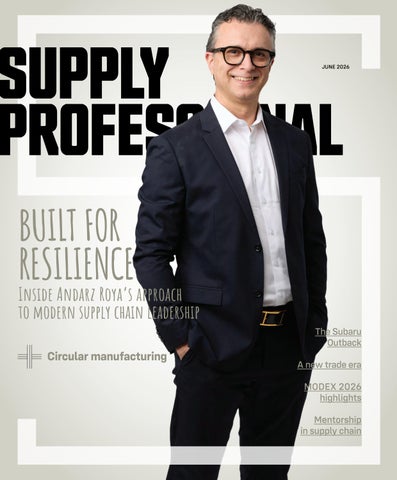
Inside Andarz Roya’s approach to modern supply chain leadership
Circular manufacturing
The Subaru Outback A new trade era MODEX 2026 highlights Mentorship in supply chain
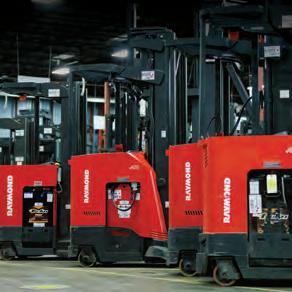
Successful intralogistics is all about building smart and staying agile throughout every stage of facilities management. With our engagement model that helps you ideate, activate and adapt innovative solutions, combined with the power of our family of companies, we can help you optimize your facilities for whatever tomorrow brings. Tackle the challenges of today and make the most of the opportunities of tomorrow.
ONE TRUSTED PARTNER THREE STAGES OF OPTIMIZATION ENDLESS OPERATIONAL ADVANTAGE



Many long-term procurement professionals remember the days when the field involved filling out POs and searching for the lowest cost. Purchasing had a back-office reputation and—the perception was—littleto-no visibility outside its own sphere of influence.
Those days are gone, and there’s no going back.
Procurement is now a major supply chain function affecting the entire business, end to end. Supply shocks and global trade crises have pushed the profession into the spotlight multiple times over the past few years.
Today, it’s about managing strategic risk, ensuring continuity, and nurturing long-term supplier relationships, among other critical functions.
Procurement can be proud to sit at the juncture of so many major strategic functions. Yet there’s a way the field continues to mature, and it’s the scale and consequence of what it does.
Threats arising from geopolitical instability, cyberthreats, digital transformation, trade volatility and tariffs, and other factors seem to gain velocity almost daily. Yet while disruptive, they have helped to elevate procurement’s visibility and scope of responsibility.
Trade and globalization have always been risky. Yet the rules-based order has helped to blunt those risks for decades. Elements of that order are under strain, making procurement’s job more difficult and complex.
The conflict in the Middle East is, for example, reshaping economic expectations in ways we’ll deal with for years.
The COVID-19 pandemic forced a re-evaluation of the just-in-time inventory framework that procurement and supply chain leaders still grapple with.
Cyberattacks make all this more unpredictable. Attackers can inject malicious code into trusted software updates, for example, infecting downstream users. Or they can exploit weak security in a supplier’s network to enter larger target networks.
All this means that the decisions procurement organizations make about suppliers, inventory, and regional sourcing have broader consequences for not only companies but Canada overall.
How and where organizations source helps to determine whether we rely on vulnerable global routes or move more towards self-sufficiency.
Relying on a single source can create risks. We’re seeing a move towards near-shoring, friend-shoring, and domestic manufacturing. The federal government is moving towards sourcing across regions and countries. That includes deepening trade ties with the EU and Southeast Asian nations.
This diversification moves us away from over-reliance on the US and China. It’s not a total decoupling from the US—that’s impossible. It does mean broadening our trade. Think of it as an insurance policy against over-reliance on too few suppliers.
Procurement is now a front-line function, and this diversification is both a defensive safety net and a source of long-term resilience and competitive advantage. The pandemic, tariffs, conflict in the Strait of Hormuz—these highlight the importance of supplier relationships, continuity planning, and a total cost approach.
Over time, and through multiple crises, procurement has grown more strategic. It now sits closer to the centre of decision making than ever.
We would all do well to remember that.

EDITOR
MICHAEL POWER 416-441-2085 x7 michael@supplypro.ca
P UBLISHER
FARIA AHMED 416-441-2085 x 5 faria@supplypro.ca
DE SIGN
Art Direction R OY GAIOT Design Consultation BLVD AGENCY
iQ BUSINESS MEDIA INC.
Vice President STEVE WILSON 416-441-2085 x3 swilson@iqbusinessmedia.com
President & Executive Publisher ALEX PAPANOU
PUBLICATION MAIL AGREEMENT NO. 43096012 ISSN 1497-1569 (print); 1929-6479 (digital)
CIRCULATION Mail: 126 Old Sheppard Ave, Toronto ON M2J 3L9
SUBSCRIPTION RATES
Published six times per year
Canada: 1 Year $ 99.95 CDN
Outside Canada: 1 Year $ 172.95 USD Single price per copy $18.00 CDN
Opinions expressed in this magazine are not necessarily those of the editor or the publisher. No liability is assumed for errors or omissions. All advertising is subject to the publisher’s approval. Such approval does not imply any endorsement of the products or services advertised.
Publisher reserves the right to refuse advertising that does not meet the standards of the publication.
No part of the editorial content of this publication may be reprinted without the publisher’s written permission. © 2021 iQ Business Media Inc. All rights reserved. Printed in Canada.
Supply Professional is the Official Magazine for NISCL

When I started this column, I went on YouTube and searched for “how many jobs will AI replace?” What popped up was “by 2030,” which is less than four years from now. I clicked on it and several videos popped up. But the one that got my attention was a 40-minute video by a podcaster that I have a great deal of respect for, Tom Bilyeu. I don’t know his backstory, but I suspect that he was very successful in business and had the means to pivot his career and embrace new media.
I digress. Bilyeu cites a 2023 Price Waterhouse Cooper study that found that 40 per cent of all jobs in the US could already be completed by artificial intelligence. He cites some legal positions, accountants, and project managers. More generally, jobs that are predictable and repetitive will be the first to go. But to be fair to Bilyeu, he wasn’t all gloom and doom. That’s in spite of the fact that the title of the video is “AI Will Erase 300 Million Jobs by 2030.”
Let me tell you why I am not worried by AI. I looked at a graph of Canada’s unemployment rate since 2000. When the economy was redhot from 2007 to 2009, the unemployment rate dipped below six percent. But then, from 2010 to 2016, it never fell below seven per cent. Then it dipped to about 5.5 per cent. Bottom line: over the past 25 years, the rate (with the exception of COVID-19) bounced between five and eight per cent, and now it’s 6.7 per cent. The story is similar in the US. At 4.3 per
cent, it’s well below the average we’ve seen over the past 35 years.
I want to provide a very specific example of how AI has the ability to make all our lives better. To do so, I must relate a disturbing anecdote. It was 8pm on a mild winter evening and I was preparing to take our dog out for a walk before settling into his kennel for a good night’s rest. It’s a nice neighbourhood. Just as I was about to leave, my wife and I heard a man yelling loudly, threatening a woman with violence. We could not see the woman and I asked my wife to call the police immediately.
I got on the phone. I told the male operator what I had heard and saw. He asked me if I witnessed an assault. I truthfully told him that I had not, nor had I seen the woman. Perhaps she didn’t even exist, I posited. But the man seemed mentally unbalanced, and he should be taken off the streets. The operator told me that I had called the wrong number and he flat-out refused to send anyone. He told me to call another number, said good-bye, and hung up.
Was this because he was singularly insensitive and uncaring? Or does it reveal a larger problem and that is a shortage of police officers? The latest number I could find was that in May 2023 there were 71,472 officers across Canada and that worked out to 178 officers per 100,000 population, the lowest ratio since 1970. Currently, there are just more than 300,000 full-time truck drivers. It will not be long before they are replaced by driverless vehicles. If even one-quarter were suitable
and willing to serve and protect, think how much safer our streets would be after the police forces were doubled.
EMBRACING THE TRANSITION
I suspect that there could be two different objections (for the lack of a better word) to the hypothetical in the previous paragraph. One would be, “what about the other 225,000 truck drivers? What are they going to do?” The second objection would be, “sounds like a great idea, but how are we going to pay for it? The federal government is running a deficit this year of $65 billion. Ontario’s deficit, for example, is projected to come in at around $14 billion.”
I’ll take each of these objections in turn. I don’t know what the other 225,000 truck drivers will do. But if you’ve ever needed work done on your home, you know that there is a shortage in the skilled trades. Maybe some time in the future there will be robot plumbers and robot electricians, but this isn’t happening any time soon. And if AI is as productivity enhancing as I think it will be, we will be enjoying something we haven’t seen in a long time, and that’s real economic growth.
Was I being intentionally provocative in the title of this column? Of course. But I honestly believe that AI will make our lives better and rather than fear it, we should embrace it. SP

“AI will make our lives better and rather than fear it, we should embrace it.”
If you ask supply chain leaders what they look for in early-career hires, you might expect to hear about technical skills, ERP experience, analytics capability, or certifications.
Those things matter, but they’re not what separates good from great early-career professionals.
After years of hiring in a fastpaced manufacturing environment, I’ve learned something that may surprise students and hiring managers alike: my best early career hires didn’t look exceptional on paper. They showed up exceptionally in real life.
Some studies suggest it can take dozens of applications just to secure one interview and 50 or more applications before receiving an offer. That’s not a reflection of ability. It’s a reflection of the volume and competition involved.
In a competitive market, resumes often share similar qualifications like comparable degrees, overlapping coursework, and exposure to the same tools. Formatting and keyword optimization may help a document pass through screening systems, but they are rarely what truly differentiates a candidate. What stands out is connection, the quality of interactions, the strength of relationships, and reputation.
What differentiates you is connection. It’s the conversation you had at an event. The follow-up email. The impression you left in a group project. The way you show up when no one is formally evaluating you. Networking isn’t about collecting contacts; it’s about building credibility.
One of the biggest myths students believe is that there’s a “correct” supply chain background. Trust me, there isn’t.
Supply chain is about titles. It’s built on behaviours under pressure.
During an interview for an entry-level buyer role, a candidate with restaurant experience reframed their serving job, describing a manufacturing buyer as “a server for production.” It’s a different menu with higher stakes.
As a server, they are balancing multiple tables, competing demands, and shifting priorities. A buyer balances multiple suppliers, part numbers, and expediting requests. In both cases, everyone believes their request is urgent. The skill isn’t doing everything at once, it’s sequencing effectively.
A server anticipates problems before the complaint comes. A strong supply chain professional anticipates disruptions before they halt production.
It doesn’t matter whether your experience comes from retail, warehousing, call centres, athletics, or volunteering. These roles are training grounds for prioritization, communication, resilience, and service.
Early in a career, I’m hiring you for how you think, how you respond, and how you show up, not what you already know.
Another factor that predicts early career success is called the “10 Things That Require Zero Talent.” This list isn’t original to me, you can find versions of it all over the internet, but I’ve kept it on my whiteboard for most of my career. It’s there as a reminder that
no matter how senior I become I am never above the basics:
Being on time
Work ethic
Effort
Body language
Energy
Attitude
Passion
Being coachable
Doing extra
Being prepared
None of these requires talent or credentials. These factors compound over time. In supply chain, where pressure is constant and collaboration is essential, these behaviours are often the difference between being competent and being trusted.
COACHABILITY: THE CAREER ACCELERATOR
If I had to choose one of the 10, it would be coachability.
Coachability is not passive agreement or blind acceptance. It is the willingness to improve even when feedback feels uncomfortable.
Early career professionals will receive feedback they don’t agree with. You need to remember that someone has that perception and there is a reason for it. You may not agree with the evaluation, but the perception is real.
The most powerful response is not defensiveness, it’s curiosity. Next time try, “Thank you for the feedback. Can you help me understand where I can improve?” Your response signals maturity, builds trust, and accelerates development.
THE LONG GAME
Supply chain is relationship-driven. Early-career professionals

“One of the biggest myths students believe is that there’s a ‘correct’ supply chain background. Trust me, there isn’t.”
often focus on resume optimization. But long-term careers are built on reputation.
What impression do you leave in meetings? Do people describe you as reliable? Do you show up prepared? Alternatively, are you reactive or defensive? Do you arrive late? Think about the impression you are leaving on others.
When I hire early career professionals, I’m not looking for polish. I’m looking for trajectory.
In supply chain, creativity matters. Problems are rarely solved by process alone. They require curiosity, critical thinking, and the confidence to suggest a better way.
You don’t have to be senior to deliver value. You must be engaged, able to think, and willing to contribute. In this profession, growth isn’t reserved for those with the longest tenure—it’s earned by those who work to improve, adapt, and step forward. SP
Canada Post is transforming to restore and renew postal service, and that work is now underway, the Crown Corporation said.
Canada Post said it is taking action to meet the evolving needs of Canadians in a financially sustainable way.
Following initial meetings with its bargaining agents, Canada Post will start preliminary work on two initiatives: converting the remaining addresses that receive door-to-door delivery to community mailboxes and modernizing its retail network.
Canada Post’s transformation will strengthen the postal service, allow it to partner better with businesses, enable national commerce, and help it meet its dual mandate of delivering for all Canadians without being a recurring burden on taxpayers.
The Port of Montréal is breaking ground on the Contrecœur Container Terminal Project.
Announced last September, the project will expand the port’s capacity by roughly 60 per cent. The expansion will add a modern, high-efficiency container terminal with integrated rail, road, and marine infrastructure. It will enable more goods to move reliably through the St. Lawrence gateway, said the Canadian government.
Expanding capacity at the Port of Montréal ensures the port will meet increased demand, seize future growth opportunities, and maintain the efficient movement of goods for Canadian businesses and consumers, the government said.
The project will support 4,000 jobs a year during construction and thousands more once operational.
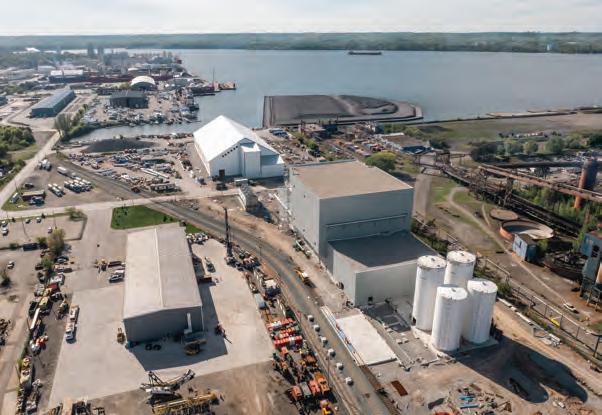
Sucro Can Canada and HOPA Ports marked the official opening of Sucro Can’s new sugar refinery, located at Pier 15 in the Port of Hamilton.
Construction of the new refinery began in April 2024 and was completed in April 2026. The $135-million facility was designed and built to become Canada’s largest sugar refinery over time, with planned refining capacity of up to a million metric tonnes annually.
Located at the centre of Canada’s food manufacturing sector, the refinery sits within a day’s drive of 142 million consumers and provides direct access to marine,
rail, and highway transportation.
This strategic location allows Sucro Can to receive raw sugar by vessel and distribute refined products to food manufacturers across Ontario, Quebec, and the US Midwest.
The refinery will gradually increase volumes, receiving up to 10 vessels in 2026, increasing to roughly 14 vessels in 2027, with continued expansion.
The facility currently employs about 65 skilled workers, with employment expected to grow as additional processing systems come online. Operations include the production of dry and liquid refined sugar, packaged in industrial formats.
Americold Realty Trust, Inc. and EQT have formed a new joint venture with EQT’s Active Core Infrastructure fund focused on the ownership, operation, and potential development of cold storage warehouse facilities in North America.
Through the agreement, Americold will contribute 12 cold storage facilities to the joint venture with an aggregate value of over $1.3 billion at inception.
The facilities are located across the US and comprise a total of roughly 124 million cubic feet of temperature-controlled capacity, with over 400,000 combined pallet positions.
Digital maturity across manufacturing has accelerated, propelled by an increase in predictive maintenance adoption, according to survey findings released by Fluke Corporation.
Rising investment in generative AI and industrial AI underscores this transition, the report said, as organizations move beyond pilot programs toward production-scale impact.
The findings show that within a year, reactive maintenance remained flat at 36 per cent. Proactive maintenance fell from 55 per cent to 45 per cent while predictive maintenance adoption doubled from nine to 18 per cent, signalling a shift from traditional preventive models to data-driven execution.
Nearly eight in 10 organizations now allocate 16-to-30 per cent of their maintenance budgets to new technologies, with investment moving away from exploratory AI toward cybersecurity, data management, generative AI, and industrial AI.
Respondents show that expectations around Industry 5.0 are resetting. The share expecting completion within six months fell from 33 per cent to 22 percent, while 40 per cent now anticipate a one- to fouryear timeline.
EQT will acquire a 70 per cent interest in the joint venture, and Americold will retain a 30 per cent equity interest and serve as day-to-day manager of the platform to ensure continuity of
service and Americold’s proven operational excellence for customers.
Americold expects to receive approximately $1.1 billion in net cash from the transaction.

BY VIDHU MONGA

I have been in distribution long enough to remember when a “system recommendation” meant someone ran a pivot table overnight and emailed the Excel workbook the next morning.
Today, tools make labour allocation decisions, predict trailer arrival times, flag pick path inefficiencies, and optimize put away logic in real time. Most of it works. But what worries me isn’t the technology.
It’s the novice supply chain professional who doesn’t know what to do when it’s wrong.
We talk about AI adoption, digital transformation, and building the supply chain workforce of the future. What we don’t discuss nearly enough is the responsibility of experienced leaders to mentor those learning the industry.
Mentorship is more than a program you sign up for. It’s about seasoned leaders looking beyond numbers to focus on improving the function.
The human touch matters. With technology evolving rapidly, experienced experts can guide the novice, helping to avoid costly mistakes.
That mentorship helps not only navigate on-the-job technology. It also imparts the kind of knowl-
edge that comes from experience, not algorithms.
Here is a common scenario: an AI-powered labour management tool flags an understaffed shift for an incoming high-volume wave. The system generates a recommendation to pull associates from the returns area to cover picking.
On paper, this is a logical proposal. But a seasoned DC manager knows that stripping returns processing during peak creates a backlog that you are chasing for the next 72 hours. The downstream customer service impact rarely shows up in the same dashboard that made the original recommendation.
A junior operations manager looking at that recommendation has no
reason to question it. But a mentor who has lived through that scenario can turn it into a valuable 15-minute conversation—not by overriding the tool, but by asking “what does this decision cost us tomorrow? What is the system not measuring?”
That kind of contextual thinking comes only from experience. It’s what we owe the next generation.
This dynamic also plays out in outbound transportation. AI route optimization tools are impressive, but they don’t know that a particular carrier’s weekend performance drops significantly in winter, or that a specific lane has a pattern of exceptions that never gets coded properly into the system.
That knowledge lives in people. If we do not pass it on, it disappears when those people leave.
In DCs across North America, AI is no longer an abstract, futuristic concept. This new world can create hidden decision risk for operators new to the environment.
Take autonomous mobile robots, now common in many fulfilment operations. They learn floor traffic patterns and re-route in real time to reduce congestion. A new operations supervisor watching throughput numbers climb can easily assume the system has it covered. What they may not see is that the robot routing logic was trained on a layout that has since changed, or that a particular zone is being systematically deprioritized in ways that will surface as a service miss three days from now. A mentor who understands both the capability and the limits of that tech-
nology can teach a junior leader to read the floor, not just the dashboard. The same risk shows up with AI-powered labour management systems, which forecast inbound volume and recommend staffing levels before trailers even dock. These tools are genuinely useful. But they optimize for the variables they can measure. A novice who treats every staffing recommendation as gospel will eventually get caught flat-footed when a late-night volume spike hits a team that the model did not account for, because the pattern was seasonal, and the training data was thin. This is the environment a new distribution professional enters on their first day. The tools are sophisticated, the pace is fast and the a ssumption—sometimes unfair— is that they’ll figure it out on their own.
Much of what made a strong distribution leader 10 years ago still makes t hat strong leader today.
It’s the ability to walk a floor and read what’s happening versus what the system says is happening. It’s the instinct to know when your team is burning out before it shows up in productivity metrics. It’s managing a difficult carrier conversation where the data doesn’t tell the whole story. AI hasn’t replaced that. Rather, it has raised the floor. The basics are more automated, which means the value is concentrated increasingly in judgment, relationships, a nd asking better questions of the tools you’re using.
When I think about what mentorship looks like right now, I think it is three things:
Fostering curiosity in young professionals about how a tool arrives at its recommendation, not just what the recommendation is;
Putting them in rooms and conversations where the complexity is real, not simulated; and Being honest with them about the times we—more experienced pro-
26_003882_Supply_Professional_JUN_CN
fessionals—got it wrong because that is where real learning lives.
IT’S
I didn’t get to where I am by reading about supply chain. Rather, people trusted me with real problems before I was fully ready. Those people then stayed close enough to help me work through those problems.
Who is doing that for people coming up behind me? For many organizations, the answer is: not enough people.
We are busy. The pressure to deliver is real and mentorship is an investment where the return doesn’t show up on this quarter’s scorecard. But that is exactly why it needs intention. It does not happen by accident.
W hatever your corner of supply chain looks like, think about one person on your team who is capable of more than they are currently being stretched toward. What would it look like to bring them into your next hard decision? Not to observe but
to participate, hear your reasoning in real time, and to push back on it.
Supply chain is at an inflection point. Technology is moving so fast that even experienced practitioners must keep learning.
But that’s a reason to double down on mentorship. The organizations that come out ahead won’t be the ones with the best algorithms. They’ll be the ones with people who understand their operations deeply enough to know what to do when the algorithm gets it wrong.
That depth does not come from software implementation. It comes from years of experience, passed from one generation of professionals to the next.
We veterans are the ones who have those years. Time to use them. SP

BY MICHAEL POWER
The culmination of Andarz Roya’s 25-plus years in supply chain came during a vacation in Paris—after a last-minute decision to attend a pivotal event.
For Andarz, now the vice-president of supply chain at Ontario Power Generation (OPG), the highlight came when he and his team landed Canada’s first enriched uranium fuel contract for small modular reactor.
The work included everything from shaping the early strategy through to completion. It was a huge step in getting the fuel supply needed for the G7’s first small modular reactor project.
While the stakes for the project were high, the timing was perfect. The announcement about the project was at the World Nuclear Exhibition in Paris in 2023, and Andarz and his family happened to be in the city on vacation.
“That morning I thought, ‘I can’t miss this,’” he says. “So, I jumped on the train and went, because my mind was still on the team and the work.”
Once at the event, Andarz connected with attendees at the exhibition’s Canadian pavilion, where the project attracted strong global interest. The team’s hard work left a positive impression on those following the project.
“The announcement was truly unforgettable,” Andarz says.
Supply chain professionals may nod silently about the pressure and risk that can accompany such complex, large-scope projects. And now, resilience is more important than ever. While global supply chains have always been volatile, 20 or 30 years ago they were simpler, more regional, and had fewer choke points.
That world is gone.
Rather than an intermittent hassle, uncertainty is a permanent feature in today’s supply chains. Pandemics, tariffs, and supply shocks
practically guarantee volatility. The question is, can organizations adapt to this uncertainty and make it part of how they operate? And if so, how do they get there?
It’s an environment in which Roya has thrived during his career. The thread throughout his professional life has been building organizations, teams, and systems that can endure volatility.
In fact, cracking the code on complex problems to establish resiliency was part of what drew him to the field.
“There’s always something going wrong in the supply chain world,” he says. “It’s a global supply chain, so you need to anticipate to the best of your ability. But in the meantime, you need to build resilience into your systems, people, process, and technology.”
That kind of thinking is essential at OPG, where the supply chain is anything but simple. The organization generates electricity across Ontario. Over 90 per cent of its nuclear and hydroelectric procurements are from Canadian suppliers, and it relies on products and services from roughly 1,200 companies from across the province.
In this environment, resiliency is non-negotiable. Learning to handle that complexity can be a decades-long journey, and Roya’s career is no exception.
Along with a Bachelor of Science in industrial engineering, he holds an Executive MBA from Western University’s Ivey Business School, which he received in 2015.
Roya didn’t stop there. He honed his skills further through the APICS CSCP credential and has also completed other leadership programs.
This kind of training, Roya notes, keeps his approach up to date. “My goal has always been to learn and execute from the learning,” he says.
His approach has been strategic: a formal academic education grounded in business, operations, and supply chain disciplines, paired with realworld application that involved learning by doing.
That training has proved useful. From the beginning, Roya’s interest in supply chain management sprung from a drive to solve complex challenges, build and lead high-performing teams, and deliver results.
Early in his career, In his drive to pursue those goals, Roya was drawn to the automotive industry’s challenging dynamics. It was the field’s high stakes and multiple variables that fascinated him. Observing the Toyota Production System, quality management standards, and organizational culture motivated him to pursue simplicity within complex supply chains.
With that education in industrial engineering and a background in manufacturing, Roya often found himself exposed to processes. Those processes can be complicated.
“That made me fascinated by supply chain, which hits multiple functions of a business simultaneously,” he says. “That’s why I’ve been in the business since then, and I’ve been enjoying it.”
Fascination with complexity has driven him to seek simplicity. As part of that search, Roya and a colleague once developed an industry-level quality management system. The system was simplified for small manufacturers, yet comprehensive enough for larger entities and use as far away as Iran.
The system included processes for new product development, along with mass production. It integrated checks and balances to ensure quality.
It’s not the only system Roya has designed. An interest in leading transformative initiatives pushed him to develop a procurement management system and control tower. He developed the system while working at Schneider Electric and was the first of its kind for the company.
Roya named the product Suivi (French for “monitoring” or “tracking”) to reflect its core purpose of monitoring and empowering operational excellence. Suivi helped simplify tough tasks, earning greater adoption than the ERP system they had implemented the year before.
Suivi worked so well that the team improved its on-time delivery rate to 96 per cent from the mid-60s while reducing working capacity by half.
Soon after, Roya’s team received Schneider’s global trophy for outstanding achievement.
After more than two decades in the field, Roya landed on his current role as VP of supply chain for OPG in 2021. With uncertainty a permanent fixture, organizations need long-term vision, and Roya’s current role focuses on modernization. Operating practices, systems, people, processes, and technology must all be made ready for what the future brings.
“We are growing, and we need to make sure that we have all the right tools, and people have the right skills and are empowered to deliver for the world that we’re envisioning in the future,” he says.
For supply chain, that modernization must include understanding internal interdependencies, how things operate today, and how they must operate tomorrow.
Since many of his activities focus on planning, Roya’s job isn’t a typical role targeting day-to-day issues. Rather, it’s about designing a long-term plan, deciding how to execute and manage that plan, and what coordination looks like across organizational departments. That translates into meetings, brainstorming, strategy, decision making and planning across departments.

The routine is a departure from Roya’s previous supply chain roles. Especially in procurement, there’s a cadence of activities throughout one’s career.
For Roya, that rhythm has changed.
“You plan for the week, you plan for the month, and you execute to that,” he says. “It’s not consistent, day-to-day activity, at least not in my current role at this stage.”
Roya’s 25 years of experience is suited to such long-term planning. And the work he’s doing now will leave a long-lasting legacy.
“We’re extremely focused on ensuring that what we deliver as a team is going to be best-inclass, with lasting impact, and will benefit the organization and Ontario. “I have always been fascinated by doing something that can make
an impact on the community that lasts a long time. This is one of those things.”
Supply chain leaders must develop what it takes to plan for the long term. Today’s supply chain challenges, Roya says, are defined by persistent volatility, geopolitical tension, climate driven disruptions, talent shortages, and the accelerating pace of technology and AI
Roya offers an acronym to capture the environment—BANI—which stands for Brittle, Anxious, Non-linear, and Incomprehensible. In a BANI world, even with abundant information, outcomes remain unpredictable and often chaotic, demanding resilience rather than agility alone.
The mistake is treating these conditions as temporary anomalies when they are in fact structural and will remain for the foreseeable future.
“Supply chain leaders must shift from reactive firefighting to deliberate capability building and elevate resilience into a leadership discipline, not an operational afterthought,” he said.
To deal with this, Roya sees four fundamental shifts that supply chains must implement.
The first is designing supply chains to include shock absorption. Many industries have made themselves exceptionally lean and efficient, yet they’re also the ones most impacted when there’s a supply shock.
Next, acknowledge inefficiency as insurance. Redundancy in critical suppliers, regionalization or localization, and intentional buffers are not failures of optimization—they are resilience.
“We don’t do diversification for the sake of it,” he said. “We need to be targeted on the areas that failure is absolutely unacceptable.”
Another move is to invest in scenario modelling, risk-based planning, and to use AI strategically. Move away from expecting a single outcome and instead prepare for a range of potential possibilities.
Focus planning on flexibility and quick adaptation, rather than getting predictions just right. AI is useful here, as it can spot patterns, test assumptions, and flag merging risks.
Strengthen supplier relationships, not just contracts. In volatile environments, transactional models break down. Resilient supply chains run on trust, transparency, and collaboration, especially with strategic suppliers where substitution is difficult.
Finally, build multidisciplinary teams empowered by AI, Roya says. Resilience depends on integrating operational expertise and data analytics with an understanding of human behaviour under pressure. Talent resilience is as critical as network or supplier resilience.
“Organizations that win will be those that
“Organizations that win will be those that treat uncertainty as a design parameter, not an inconvenience. That’s how we need to look at the state of the world.”
treat uncertainty as a design parameter, not an inconvenience,” he said. “That’s how we need to look at the current state of the world and how practitioners need to deal with those challenges.”
Roya is applying the same long view to his career. At this stage, he’s looking to broaden his contribution to the field and create lasting impact. He plans to tailor any future education to helping him develop talent at OPG.
“We have a unique opportunity to build a culture rooted in possibility, one that embraces transformation and turns it into measurable impact for the people and communities that we serve,” he says. “Bringing together my experience in change leadership and global operation gives me the chance to contribute in a way that benefits not only the organization, but also our community, Ontario, and Canada.”
On the personal front, Roya is looking to strike a balance between work and family time. He enjoys travel, especially when it involves exploring food and culture. This exploration keeps him “grounded, curious, and connected,” he says.
Closer to home, Roya’s curiosity extends to classic vehicles—a passion rooted in childhood. He especially enjoys riding his 1978 Suzuki GS1000 through the Ontario countryside, and in the summer months he and his wife enjoy taking a vintage Jaguar out for a drive.
With volatility a permanent fixture, supply chain leaders need tools to help them thrive in this new and often intimidating environment.
Roya has some advice for those in the field. Among those tips is to keep curiosity paramount on your professional journey.
“Supply chain is one of the few fields that touches every part of a business,” he says. “And the best practitioners are those who want to understand how things really work.”
As well, there are three professional muscles to develop early, he advises.
The first is the importance of systems thinking and seeing beyond your own function.
Don’t just focus on supply chain—seek to understand how the business runs and how the enterprise works as a system.
The second involves communication. Translating complexity into clarity is a superpower for today’s supply chain practitioners. “We deal with a huge number of complex matters on a dayto-day basis, and we need to be able to communicate them, translate them into business language, and to convey that complexity to the right leadership in the business to get support,” he says.
Third, develop resilience. Uncertainty is a part of the job, and you must be built for resilience, whether it involves the supply chain, how it’s designed, or the people who support the business.
Finally, treat your career as a craft. The field is evolving quickly and those who learn continuously will shape the profession’s future.
Yet the most transferable leadership skill that Roya has developed didn’t come from systems or strategy, rather from working internationally with people across cultures, including those in Iran, China, France, the US, or Canada.
“When you lead with genuine human regard, with respect, earnestness, and care, people understand it instinctively and respond with trust,” he says. “Culture shapes how we work, but humanity is what makes leadership work everywhere. The language changes, the signal does not.”
Roya considers it a privilege to have worked with different cultures and in various places. As he has looked at the differences among them, he’s also noticed what they have in common.
“What I see fascinates me,” he says. “Regardless of where you go, that’s the signal you get across the world. That’s the main driver for me, not just systems.”
The changes supply chains have undergone in recent years are now permanent. Geopolitical upheaval, pandemics, or geographic choke points can surface at any time. Volatility has become an operating feature—not an anomaly—of those supply chains.
Roya’s career highlights a consistent formula: build resilience into systems, develop multidisciplinary teams, and promote cultural awareness.
But beyond strategy and structure, his experience underscores something else: it’s humanity that makes leadership work, no matter where you are. It’s an observation worth remembering in a world of constant disruption. SP
In Canadian public sector procurement, understanding competitive bid laws is essential for ensuring fair, transparent, and effective practices. This article reviews the core concepts of Canadian competitive bidding practices and explores how they intersect. Readers will gain insights into navigating the complexities of public sector procurement while meeting contractual commitments.
Competitive bidding documents form the basis for subsequent contracts for goods and services. When a public entity issues a competitive tender, the process falls under Canadian competitive bid laws. Other legal considerations can include trade agreements; legisla-
tion, regulations, and bylaws; along with organizational policies and procedures.
All bid responses must be assessed to ensure they meet the mandatory criteria required to form a Contract A. It is best to keep these mandatories to a minimum. Evaluators should be able to determine whether a submission meets the mandatory criteria. If it does not, the bid is non-compliant and cannot be considered further.
The next step in the evaluation process is for evaluators to identify a preferred proponent, leading to the Contract B phase. The preferred proponent will have provided information related to the performance requirements to be met once the contract is executed. Contract A and Contract B are based on the Ron Engineering case from 1981. The Supreme Court of Canada has since made many rulings affecting public sector bidding practices.
A common evaluation error occurs when evaluators adjust scoring based on information outside the original RFX criteria. Evaluators might see that additional information or options could be beneficial after the fact. However, evaluations can only be based on what proponents were asked to address. Otherwise, this could be deemed a breach of the bidding process.
Most small or medium businesses (SMEs) have less experience with Canadian competitive bidding laws. They are more familiar with basic contract law used for buying and selling goods and services in retail and commercial sectors. SMEs can run competitive bids but should understand their legal obligations. Competitive bidding practices apply to both public and private sector organizations.
Procurement professionals provide valuable advice on the type of competitive bidding process to consider before going to market. Understanding market conditions, and whether an RFP or RFQ is best suited to generate competitive tension, influences ensuing contracts.
“Evaluations can only be based on what proponents were asked to respond to — otherwise, the bidding process itself may be at risk.”
Trade agreements can be international, interprovincial, regional, or Canada-wide. Private sector organizations participate in the public tendering opportunities afforded under trade agreements. It’s in an SME’s best interests to be familiar with these agreements and their rules of conduct.
Each trade agreement has specific spending thresholds the public sector must observe. If a tender reaches a threshold, legal obligations are triggered. These can include advertising requirements, evaluation processes with weightings and scoring criteria, and debriefings at the conclusion. Each trade agreement also has its own exemptions, exceptions, and exclusions.
The importance of careful preparation and planning for tenders cannot be overstated. Contractual agreements arising from tenders can be challenged by unsuccessful bidders. Issuing an RFX with insufficient or misleading information can cause problems for all parties. Hiring competent procurement expertise may seem costly, but it often costs less than going to court.
Contract law imposes a duty of good faith on contracting parties. This requires parties to act honestly, reasonably, and in a manner that upholds an agreement’s intent. A duty of good faith is implicit in all stages of the bidding process, from fair treatment of participants to post-contractual performance. A negotiated RFP (NRFP) does not waive the duty of good faith owed to participants. An NRFP may sidestep the Contract A and Contract B

paradigm but still demands fairness throughout the process.
Well-drafted contracts are essential for minimizing disputes and ensuring value for money. Canadian contract law emphasizes clearly defining the rights, obligations, and expectations of all parties.
This includes the scope of work, deliverables, timelines, payment terms, intellectual property rights, and other relevant conditions. Contracts should address potential risks and contingencies, such as financial capacity, work safety, quality compliance, confidentiality, and dispute resolution mechanisms. By creating clear and comprehensive contracts, organizations can reduce misunderstandings and legal disputes following an award.
Complementing the contract can be the use of service level agreements. Both parties draft SLAs for mutual benefit. With multi-year contracts, SLAs can be amended to leverage efficiencies gained during the agreement and contribute to greater value.
Understanding competitive bidding laws, procurement best practices, contract law, and trade agreements is imperative for anyone in public sector procurement. Procurement professionals are responsible for guiding teams through tendering and contracting processes. By honouring the duty of good faith and drafting clear, comprehensive contracts, organizations can advance mutually beneficial relationships with suppliers and stakeholders. SP
BY MATT WELLER
In the February 2024 issue of Supply Professional Magazine, I made a bold statement: “We will return (more-or-less) to the pre-Second World War era where countries will survive or fail based on their own natural and internal resources, their abilities to process those resources, and their ability to produce the goods they need to maintain their living standards. In Canada, we have outsourced (or retired) most of our processing capability and knowledge. Now, the long-term survival of our nation’s independence falls on a rapid reacquisition and scaling of these capabilities.”
When I said this, it was inconceivable to many that our trade relationship with the United States could ever falter to the extent that it has today.
Well, here we are.
The US created, financed, and secured the globalized trade system as a means to rebuild a war-torn Western Europe post-Second World War. It was never intended then, or now, to be permanent, and for decades the US has been moving away from it with accelerating urgency as it can no longer sustain it financially or militarily.
The net result is rapidly shifting trade regimes, trade wars, actual “hot” wars, and regional breakups and realignments. OPEC is breaking up, and
post-Second World War institutions such as NATO and the UN (to name just two) now face questionable futures as multi-country alignment deteriorates into what Mark Carney has called “the end of the rules-based order.”
For supply chains this translates to supply disruptions, input cost volatility, demand instability, and regulatory misalignment among nations. But it does not mean that our trade relationship with the US is over. The reality is trade between our two countries will persist, but it will be based on strategic alignments and not convenience. What are these strategic alignments? Security, and building a North American production and defence system that can function “closed loop” from the rest of the world. The reason for this is simple. Globalized trade discourages armed conflict. If your survival depends on goods or resources that your enemy possesses, and they are willing to trade with you, you are far less likely to attack them as doing so will hurt your own ability to thrive. When globalized trade goes away, all bets are off for sustained peace. The shifts we are seeing are real-
ly about building a security and defence perimeter around North America because unlike anywhere else in the world, it has all the resources needed (in abundance) to maintain a high standard of living, even in a “closed loop” system. In a far more volatile future, others can and will come to take those resources, by force if necessary. This is why (for example) Canada’s current government has shifted from 10 years of de-industrialization and demilitarization to a sudden 180-degree shift toward rebuilding our military, which necessarily requires reindustrializing the country.
I can only speculate that beneath many conflicting headlines, the current US trade situation is really about coercion to force Canada (and other nations) to end their own deindustrializations, wake up from the slumber of trade convenience, and seize its own resources and in-country capability and sovereignty. Has it been painful? Absolutely, for Canada and the US alike. And arguably, the current US administration’s approach has made it harder than necessary. But it may also have worked to stop us all from sleepwalking off a cliff. At the end of the day, the US’s own domestic security needs a Canada that is sovereign, and inde-
pendently capable and aligned to respond to long-term global threats. Trade between our nations will necessarily continue even if it is strategically different.
For individual manufacturers, building supply chains based on trade convenience and lowest input cost, which was the standard for decades, is now a recipe for total failure. It is this shortterm strategy that decimated our industrial capacity from what it was in the first place. The antidote is to build resilient, connected, and strategic supply chains that are based on value creation, not cost cutting. Chasing input costs will never bring as much benefit as process refinement and effective processes that increase value for the customer, because input costs will always be unstable (the new normal) but process is entirely within any company’s control to manage. Short-game band aids vs long-game competitive advantage.
Building resilient supply chains requires viewing your supply chain as a strategic element of your corporate objective, applying a system thinking approach (to understand your specific external—and internal supply chain risks), and following a systematic process to implement it. I follow a simple process, although the details are complex. 1) Map, 2) identify (every possible risk at each node of your supply chain), 3) qualify (determine the likeliness of each risk, and the financial impact on your firm if a risk should happen), 4) prioritize with a risk register as a gover-
“The time for warnings has passed and we now find ourselves swimming in open waters.”
nance tool to monitor emergent risks, and de-list risks that cease to be relevant. In all of it, maintaining (or leveraging) the capacity to produce value to the customer is the priority, not cost cutting.
It’s important to remember that a resilient supply chain is not one that never encounters a crisis, but one that can flex, pivot, and return to normal faster than the competition, when a crisis happens. In a supply crisis, availability beats cost every time.
It’s also necessary to build connected, visible ecosystems at the individual firm level. Despite being diminished from previous levels, Canada still possesses incredible and diverse manufacturing capabilities, nationally. We need to be able to map our process capabilities and make them visible and easily searchable regardless of whether they are a remote shop with five employees, or 5,000 employees in an industrial hub, and accessible regardless of website status, SEO rankings or AI filters. I’m involved in a project with EMC Canada to build this right now.
According to Statistics Canada, in 2025 $362 billion in goods were imported from the US, which is actually down 2.9 per cent from

2024. Purely from a technical perspective, much of this could be produced here in theory. But what specifically and how much? We won’t know until we can map our internal capabilities to see the gaps – and subsequent opportunities to build. There are tons of opportunities hidden by a lack of visibility. But the clock is ticking. The time for warnings has passed and we now find ourselves swimming in open waters. We have everything we need within Canada to transform our country into one of the most prosperous and secure countries in the world, but it depends on individual SME manufacturers to shift supply chain strategy, and act to create the critical mass. Though it will be a monumental challenge, the alternative seems far more daunting. SP
BY BRAD FORESTER
Industry experience suggests roughly eight out of 10 supply chain technology implementations are underestimated in cost and effort. Procurement professionals, of all people, should recognize this dynamic.
Most supply chain technology investments don’t fail at go-live. They fail months earlier, in a planning meeting where a vendor hands over a 14-week implementation timeline, and nobody pushes back on the assumptions underlying it. By the time the project is six months in with no end in sight, the damage to supplier relationships, operational continuity, and the original business case is done.
This is not an edge case. According to Gartner’s Logistics Functional Transformation Survey, 76 per cent of supply chain technology transformations fail to hit their critical success metrics. Even implementations broadly deemed “successful” still lose approximately 20 per cent of their projected value post-launch. Despite these persistent failure rates, 80 per cent of supply chain organizations have attempted four or more technology transformations in under five years, chasing ROI that keeps slipping just out of reach.
For an upper mid-market organization with $200–300 million in freight spend, a botched TMS or supply chain platform implementation typically amounts to a multi-mil-
lion-dollar mistake in hard remediation costs alone—not counting lost procurement leverage, degraded supplier performance visibility, delayed ROI, or the organizational credibility cost of a failed transformation. For large Canadian and global enterprises, that scales into the tens of millions.
What keeps going wrong?
Increasingly, supply chain and procurement leaders recognize that these failures don’t originate during implementation. They are rooted much earlier—in how the business case is structured, how requirements are defined, and in how vendor selection is governed before a single contract is signed.
The same four failure patterns appear again and again across supply chain and procurement technology deployments. They are preventable, but only if you look for them before the project starts.
The most common cause of a troubled implementation isn’t a bad vendor; it’s a misaligned one. Procurement teams and supply chain leaders
walked into a demo, saw a polished feature set, and signed a contract for capabilities their organization will rarely use and complexity they never fully planned for. Recent industry survey data makes the scale of this concern clear: 27.9 per cent of supply chain technology leaders cite fear of overpaying for rarely used capabilities, while 26.5 per cent flag underestimating integration complexity as a primary risk. These are the downstream consequences of a vendor selection process that prioritized feature breadth over supply chain fit. When the technology meets the day-to-day supply chain reality, the gap between what was promised and what can be delivered becomes the main issue.
Vendors are incentivized to win contracts, creating a natural bias toward optimistic timelines and simplified scoping assumptions. The result is an illusion: a project scoped at 14 weeks that is a 14-month undertaking, presented with confidence during the RFP process and accepted without sufficient scrutiny at contract award.
This failure is compounded by a chronic lack of business case rigor. The industry research found that only 13.1 per cent of supply chain technology business cases are built using rigorous methodology. The rest are back-of-envelope calculations dressed up in slide decks that collapse during implementation.
Even when technology is the right fit and the plan is reasonably constructed, projects stall in the design phase because supply chain and procurement teams cannot effectively translate their organization’s sourcing, logistics, and supplier management requirements into vendor-ready specifications. The vendor doesn’t understand the nuances of the supply chain it’s being asked to serve. The procurement team can’t articulate those nuances in terms the vendor’s implementation team can act on.
Recent survey data¹ reinforces how widespread this disconnect is. Only 8.2 per cent of organizations report delivering training tailored to specific supply chain workflows and professional roles, while over 40 per cent say their systems were designed with rolebased intent but delivered in a generic way. This gap between intended design and practical usability reflects breakdowns in how requirements are communicated and translated across functional boundaries.
The result is what practitioners describe as a cycle of repeated requirement rework: the same needs are revisited without resolution, stretching timelines to multiples of their original estimate while time and budget are consumed with little measurable progress.
One client recently described it this way: “The TMS is live. Carriers are integrated, lanes are configured, the data is flowing. But our procurement team doesn’t know how to pull the reports they need to manage supplier performance, and our logistics planners are running exceptions
manually because nobody trained them on the exception management module.” The system was installed. The supply chain operation was never ready to run on it.
A typical TMS or supply chain platform deployment touches procurement, supplier management, logistics operations, warehouse management, transportation, customer service, and IT, while coordinating the software vendor, third-party development shops, ERP and EDI integration middleware, and multiple carrier and supplier environments. Without an orchestrator holding all these parties to a shared objective, the project fractures along functional lines.
Survey data highlights how often this orchestration layer is missing or ineffective. Only 10 per cent of organizations report having a single lead with authority driving the implemen-
“The structural decisions that caused them were made months earlier, during planning, design, and the framing of the business case.”
tation, while nearly 49 per cent say leadership was assigned but authority was fragmented across departments. Another 25 per cent relied on vendors or systems integrators as de facto project leads—a dynamic that produces implementations optimized for the vendor’s delivery model, not the organization’s supply chain needs. In other words, projects operate without an empowered central orchestrator.
This is the orchestration gap, and it’s the most structurally misunderstood failure component in supply chain technology delivery. Every participant—the software vendor, IT team, logistics group, procurement function, and finance stakeholders— optimizes for their own workstream without a shared view of what the supply chain transformation is trying to achieve. Cost savings get traded away for speed. Integration and automation targets get descoped to make a go-live date. Promised procurement efficiency gains and freight savings evaporate one compromise at a time.
These four failure patterns share a common thread: they are all front-loaded problems that surface in the back half of the project. The structural decisions that caused them were made months earlier, during planning, design, and the framing of the business case.

Organizations that avoid these pitfalls invest upstream by building business cases with financial rigor— grounded in freight data, supplier complexity, and total cost of ownership—before selecting technology. It means pressure-testing vendor timelines against the complexity of the supply chain. It means establishing a pre-implementation readiness phase, aligning vendors, IT, procurement, and logistics leadership to shared program objectives before a contract is signed or an integration is scoped. It also means recognizing that systems integration and organizational integration are not the same thing. Getting the software installed is the floor, not the ceiling. The organizations that realize sustained ROI are the ones that fully operationalize the system, ensuring procurement managers, logistics planners, and supplier relations teams know how to use it, that SOPs, sourcing KPIs, and freight performance metrics are built around it, and that knowledge transfer at go-live is treated as a supply chain deliverable. The potential for a multi-million-dollar supply chain technology mistake is often made before anyone realizes it’s happening—in a vendor presentation, a procurement committee meeting, or a business case that lacks scrutiny. While this isn’t inevitable, closing the gap requires investment in the planning, sourcing governance, and readiness infrastructure that most supply chain technology implementations skip. SP
BY JACOB STOLLER
When blue boxes first began to show up in offices in the 1980s, the ongoing joke was that people should fill them up “to show that we believe in recycling.”
Those bins are certainly filling up. The concept that began as an experiment in Kitchener, Ontario has grown to a multi-billion-dollar global industry. In 2024 alone, Canada recovered 3.2 million metric tons of paper—a stack 66,000 kilometres high.
Recycled paper requires 30 per cent fewer resources to produce than virgin paper and saves 19 trees per metric tonne. The presence of blue bins in the home and the office has arguably done more than any other initiative to raise public awareness about preserving our planet.
However, as the joke implies, those savings are less than one-third of what you’d get from not using that paper in the first place. And that doesn’t include toner and other printing costs.
Similarly, the circular manufacturing metaphor helps keep the environment top of mind, but it can also take attention from the more urgent problem of reducing the consumption of resources.This myopia harms not only the environment, but the bottom line. Especially when involving a product like steel which
is not only costly but involves mining and processing that are taxing on the environment.
“Let’s say a metal shop sells its scrap for 10 cents a pound,” says Bruce Taylor, CEO of Elmira, Ontario-based Enviro-Stewards. “So, somebody gets excited that this generated $24,000. But what they don’t realize is that they had to buy that material at 50 cents a pound (i.e., $120,000), so generating that scrap cost them $96,000. This means there’s a significant loss there both to the environment and the bottom line—one that could help justify better nesting patterns when the parts are cut out.”
Recycling grabs people’s attention because it’s visible – you actually see the materials getting carted away on a truck. Government programs also tend to emphasize recycling because it’s a tangible process that’s easy to regulate. Needless waste, on the other hand, is much more subtle, and identifying it requires intimate knowledge of how processes work. It is also the key to making sustainability initiatives pay for themselves.
Taylor, whose clients range from local craft breweries to global giants such as Unilever,
advises companies to minimize waste as much as possible before designing recycling and reuse programs. In other words, shrink the circle before you close it.
“People are trying to find a good use for the material they just wasted,” says Taylor. “But they’re not asking, ‘why did we waste this in the first place?’ And so, what we advocate is first, minimize the loss, and then, find the highest value endpoint for that material.”
For example, Toronto-based High Park Brewery bought their bottles in cardboard boxes and had a time-consuming process in place for breaking down the boxes for recycling. The real question, Taylor notes, is why that cardboard was needed in the first place.
After exploring the options, the company started buying the bottles in bulk instead of in cardboard boxes, at a better price. For storage, they bought reusable plastic cases similar to milk crates. The cases with the brewery name were also used to deliver beer to customers, who often returned the cases to be refilled, causing sales to increase.
Another Enviro-Stewards client, a major coffee roaster, was looking for better ways to dispose of its wasted coffee packaging material. The material contains a combination of foil and plastic, making it difficult to recycle.
“The first step was to get coffee into that packaging material and sell it,” says Taylor. As it turned out, the packaging machinery was leaving 50 feet of the material behind when each roll switched out. “So, they brought in the manufacturer and retooled the machines.”
Overall, the company was able to reduce its solid waste by 90 per cent from a variety of actions, including selling the burlap sacks and the chaff from processing the coffee beans to farmers.
Reducing waste is a central tenet of lean manufacturing, and is a frequent focus of Larry Cote, president of Ontario-based consultancy Lean Advisors. The big idea here is that sustainability comes automatically when processes become simpler and more efficient.
Cote cites the three ‘Rs of sustainability: Reduce, Reuse, and Recycle. “You have to do all three,” he says, “but when you reduce first, that reduces the reuse and recycling you have to do.”
Decision makers, Cote explains, often plan elaborate recycling initiatives without even considering the ‘reduce’ option. For example, a manufacturer was all set to build a facility for recovering high-value materials from its waste stream. Cote convinced them to do a business case first.
“Waste is very expensive to handle,” says Cote. “You have to sort it, move it around, and store it before you even begin to process it. But
if you do things right and reduce the waste in the first place, you actually destroy the business case for building a facility for recovering the materials.”
A critical aspect of waste that is often not accounted for, Taylor explains, is the cost of the processing up to the point where the unfinished product leaves the production stream. For example, if a food processing plant spills a product in the canning process, it’s not just losing the raw materials, but all the labour, energy, and machine time that converted those raw materials into that product.
“A factory has done everything to get the right things in the right order with the right recipe to create a thing of value,” says Taylor. “So, the further you get down the line, the more critical it is to maximize all that benefit as much as you can.”
“People are trying to find a good use for the material they just wasted. But they’re not asking, ‘why did we waste this in the first place?’”
Looking at waste as not just materials but all the resources that go into creating a product reveals a much larger number—a figure, Cote says, can top 70 per cent of deployed resources.
Cote sees waste as a symptom of larger operational problems that could have large unseen
costs. For example, if a cutting process is producing a lot of scrap metal because it is poorly designed, it’s likely that the company is incurring hidden costs due to defects, re-work, or inefficient use of machinery.
“Scrap is really a symptom of quality issues that a company is having,” says Cote, “and often they’re not focused on solving those.”
While the blue box was an important step towards sustainability, it solves only part of the problem. Preventing waste from occurring in manufacturing processes is often far more impactful than recycling, and simultaneously protects the environment and improves the bottom line. Environmental sustainability, when done right, is a sustainable business practice. SP
BY MICHAEL POWER

Once treated mainly as cost centres, supply chains are increasingly becoming control centres for navigating volatility.
At the MODEX 2026 show in Atlanta in April, speakers repeatedly described a world in which tariffs, geopolitical shocks, shifting consumer behaviours, and other factors are forcing companies to focus on agility. The show—held every other year in Atlanta—highlights supply chains from every angle, featuring over 1,000 exhibits, 200 educational sessions, and four keynotes. The show combines hands-on product and technology demonstrations, education, and face-to-face connections.
When it comes to managing that volatility technology can help, whether it’s artificial intelligence, robotics, analytics, or others. But organizations that thrive in this new world are those that learn to use that technology strategically.
The Home Depot’s CFO Richard McPhail went so far as to describe supply chain as a “strategic weapon” and the company’s “lynchpin” during his keynote, which highlighted lessons learned from the supply chain front line.
In fact, supply chain has supported the company’s transformation in recent decades. About 20 years ago, the company shipped most of its product from vendors to stores—an inefficient process. The Home Depot has since rolled out dozens of rapid deployment centres. In the last five to seven years, it has built out huge distribution centres.
A series of pilot projects helped the company realize that delivery was its most important differentiating capability. “We knew that to win in the future, we had to tackle not just a product model but a service model,” McPhail said.
The company’s reinvention led to several key lessons for what makes supply chains great, including knowing who your customer is, what you’re selling, and what the customer experience looks like.
From the COVID-19 pandemic and the company’s rapid growth at that time, McPhail’s team learned how critical it was to re-engineer certain flows after a spike and then retreat in demand. “Make sure that when you build in platforms, you build in flexibility,” he said.
That idea has been tested as customer demands have evolved. A two-day delivery time—considered the gold standard a decade ago—is now too long for today’s impatient clientele. “Supply chain is never going to remain static,” McPhail said. “You’ve always got to be thinking about, what’s the next leg of improvement.”
Technology has played a pivotal role in the company’s shift. Robotics has allowed the company to cut manual effort and repetition while boosting safety. Automation allows The Home Depot to use vertical space more efficiently, with vertical picking a trend that McPhail calls “the wave of the future.”
Meanwhile, AI will eventually power much of their operations. “If you’re in the business of driving products around to customers then you have got to have AI assisted delivery routing,” he said.
In today’s high-velocity supply chains, the real risk isn’t the wrong automation—it’s doing nothing at all. But it’s important to look at the problem first, not just new technology.
That was the message from Crystal Parrott, president of global robotics, automation, and plant floor technology at UPS, during an education session on automation economics.
Once you’ve decided what the business problem is you’re trying to solve, you can then think about if and how technology can help. “You don’t automate to automate, you automate to have more business value,” she said.
Defining business needs and objectives first can help clarify what the solution is for organizations in the market for technology, said fellow speaker Francesco Pensato, vice-president of NūMove Robotique & Vision. “If you don’t have a good base understanding of, ‘what are the objectives?’ and ‘what are the needs?’, it could go off on a tangent,” he said.
That understanding has to be ramped up fast, said Colman Roche, VP of sales, new business, at Swisslog Americas. Business moves fast these days, so understanding what technology brings to a company, and what its capabilities are, is more important than ever.
Think of technology as an investment and an asset, said Roche. Trying to get the most from that asset can either be a challenge or a business enhancement. “It’s like a continuous improvement process on steroids,” he said.
That hyper-fast rate of change can leave organizations anxious about the risks of obsolescence. Many see technology as new and complex. Yet robotics is actually quite robust, having been used in the automotive and manufacturing spaces for decades, said Pensato.
While the implementation process can be worrisome, many solutions are modular and easily upgradable without having to upgrade entire robots.
To avoid obsolescence, always consider the next step or two in your technology journey,
“Supply chain is never going to remain static. You’ve always got to be thinking about, what’s the next leg of improvement.”
said Parrott. Building a roadmap while working with technology partners to ensure that technology is serving your goals helps organizations plan ahead. “You’ve got to be planning five years out,” Parrott said.
This push towards technology as a strategic tool against disruption was evident not only in keynotes and education sessions but across the exhibition floor, where multiple vendors emphasized autonomous mobility, flexibility, and inventory accuracy.
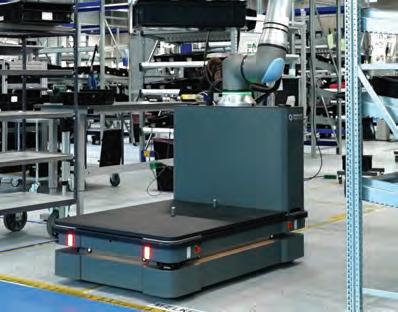
Teradyne Robotics, for example, showcased the MC600 (above image), a new mobile cobot. The MC600 is engineered to handle heavier items, capable of a maximum payload capacity of 600 kg (1322 lbs).
The MC600 automates complex workflows by excelling at diverse and demanding industrial applications. It tackles tasks such as palletizing, intricate box handling, and dedicated machine tending in a single, mobile unit.
The enhanced reach provided by the UR20 arm enables the MC600 to manage operations in areas previously inaccessible to smaller cobots.
Quicktron Robotics showcased its latest tote and pallet automation systems, showing how its unified robotics solutions and software can enable high-density, flexible, scalable automation across order fulfillment and material handling scenarios.
QuickBin Ultra is a high-density vertical tote storage and fulfillment solution. For pallet automation, QuickCube is a new compact solution featuring ultra-thin, four-way C150 shuttles to increase storage density by 50 per cent and reduce operation and maintenance costs.
The product delivers piece picking capacity of 40-to-45 bins an hour. It is capable of up to 3 m/s linear speed. The system delivers high-density, multi-depth storage, while maintaining tote-to-person workflows.
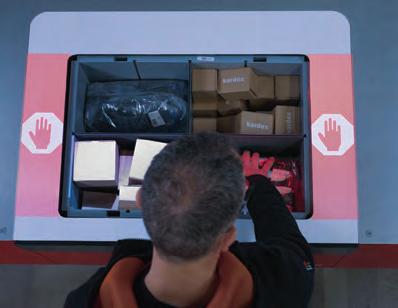
Intralogistics specialist Kardex launched its PortScale solution (above image). Designed to measure weight changes during picking and putaway processes, the new high-precision PortScale integrates with AutoStore, as well as Kardex’s Intuitive Picking Assistant (IPA), to improve inventory accuracy, instantly detect picking errors, and accelerate warehouse workflows.
PortScale is part of the Kardex AutoStore SmartWorkStation, an integrated workstation concept. It uses multiple weight sensors to capture and process weight data in real time, providing exact weight, count, and even location information to the warehouse management system (WMS).
As MODEX 2026 made clear, supply chains have become strategic assets that help organizations respond to and deal with disruption. Whether it’s AI, robotics, or automation, organizations are investing in these new technologies to build the resilience needed for whatever comes next. SP
BY GERALD FORD
The typical tasks that drain hours in government procurement may sound familiar: first drafts, summaries, policy reviews, and other work can eat up staff time quickly. Artificial intelligence can help—if you use it properly.
The AI landscape in the Canadian public sector is still taking shape. You might say it’s still the wild west. A recent snapshot shows that roughly 45 per cent of public sector organizations have not yet formalized their approach. Another 33 per cent are piloting or experimenting, while 22 per cent have moved into full implementation.
That spread tells you something useful: most of the sector is still in its early days, which means there is time to get this right rather than just fast. Everyone knows AI will impact many jobs. Technological change worries people. But you can stay ahead of this by focusing on two things: knowing how to ask the right question and knowing what the result should look like.
Behind the adoption numbers, Canadian public sector organizations face recognizable pressures: data quality and governance gaps, transparency and reporting requirements, capacity constraints tied to workforce reductions, fragmented/ absent unified oversight rules, and ESG and legislative obligations.
These are not just IT problems. They are operational and policy challenges that AI can help address, when the tools fit the workflow.
The tools most used or under evaluation are Microsoft Copilot, Perplexity, ChatGPT, and Claude, including its Cowork and Code variants. Each has a different profile, and choosing one depends on the work, the environment, and the organization’s infrastructure.
I started with Perplexity, mostly because I picked up a free yearly subscription. I had dabbled with ChatGPT but could not quite see what the fuss was about. Perplexity changed that. The first few months, I had it write a 23-page business case for a consulting service and created a visual for a LinkedIn post. I also used it to categorize supplier information from several Excel files and compiled compliance summaries for Ontario Bill 40 and Bill S-211.
None of those results happened because I needed technical skill. Rather, I learned quickly that AI works best when you treat it as you would treat a new hire who is smart, fast, and willing, but who still needs direction. The more specific you are, the better the output.
The best place to begin with AI is not a grand strategy. It is a nuisance where the work is repetitive, document-heavy, or hard to staff consistently. In public purchasing, that often means reports, policy reviews, RFP first drafts, vendor question summaries, legislation summaries, and contract file organization. None of that disappears with AI, but a lot of it can move faster. The question is not “How do we use AI?” It is “Where are we losing hours?” Once you identify that, you have your starting point.
“The question to ask is not ‘How do we use AI?’ It is ‘Where are we losing hours every week?’”
Prompting is just giving complete instructions. A weak prompt asks for “a report on AI.” A strong one asks for a briefing note, written in plain language, explaining low-risk uses of AI in procurement, finance, and public works, with practical examples and cautions.
Include four things in all your prompts: who the audience is, what the output should look like, what sector or jurisdiction you are in, and constraints like length, tone, or privacy sensitivity. Once you build that habit, results improve quickly. The AI is not guessing what you want. You have told it.
An AI program does not need a large budget or lengthy strategy document. It needs one department, one workflow, and one measurable goal. Pilots let you learn in a controlled way. Staff can see what helps, what needs adjustment, and where the technology creates confusion or risk. Once you have results you can trust, you decide whether to scale.
The choice between Claude and Copilot is less about which is better overall and more about which fits the task. Claude handles deep document analysis, complex report generation, and coding work better than Copilot. Copilot wins on ecosystem integration, familiar interface, and quick in-app assistance for staff already living in Microsoft 365.
For most Canadian public sector agencies, the practical answer of which to choose is to use both.
AI can draft, organize, summarize, and accelerate work, but it still needs human oversight. In local government, that matters even

more. Errors can affect public trust, legal compliance, service delivery, and taxpayer dollars.
Every AI workflow needs a review step. Staff should verify facts, check dates, confirm references, and ensure the final document reflects local policy and requirements. AI can produce the first version, but the municipality must own the final answer.
Canadian public sector agencies face retirements, hiring challenges, skills gaps, and increasing complexity. AI is one practical response to that pressure, but it is not a substitute for experienced people. When repetitive work is reduced, staff can spend more time on supplier relationships, policy analysis, stakeholder engagement, and service improvement. In smaller municipalities, AI can be a force multiplier helping staff prepare better drafts, organize information faster, and approach complex tasks from a stronger starting point.
The path ahead is straightforward. Start with a problem. Define the output. Use clear prompts. Test on a pilot basis. Keep a human reviewer in the loop. Expand only where the results are useful and reliable. Be careful about security, data storage, and confidentiality.
It is not about replacing people with technology. It about removing low-value effort, improving consistency, and giving skilled staff more time for the work that matters. SP



Kia Corporation’s all-electric PV5 has been named the ‘2026 International Van of the Year’ (IVOTY), marking a first for both the brand and a Korean manufacturer.
The award was presented last November at the IVOTY Award Gala during SOLUTRANS 2025 in Lyon, France, following a unanimous
decision by 26 commercial vehicle journalists from around the world. Established in 1992, IVOTY is recognized as the most authoritative global award in the light commercial vehicle (LCV) sector. Winners are selected by assessing how each model contributes to improving real-world productivity and advancing the LCV segment.
Toronto Hydro is conducting a pilot program designed to give local EV charging providers direct access to 480volt power.
Most direct current (DC) fast chargers operate at 480 volts, while utility-owned transformers, including Toronto Hydro’s, typically output 600 volts. This can mean customers must buy stepdown transformers. This pilot program can help to eliminate this step.
Up to 10 local projects will be able to use 1.5 MVA, 480volt transformers, giving EV charging providers access to the voltage most fast chargers are designed to use straight from the distribution grid, clearing a hurdle to faster deployment of public charging.
Delivering 480 volts helps lower project costs, speed up construction and energization, reduce space requirements, and match equipment design.
Under this pilot program, customers will be responsible for the costs associated with the 480volt transformer while Toronto Hydro will retain ownership and be responsible for ongoing maintenance. Performance, compatibility and system impacts will be closely monitored to generate realworld insights, helping to guide future standards and service offerings.
The pilot will run until the end of 2027 and, pending results, Toronto Hydro may transition it to a full-service offering. Visit torontohydro.com/ fastchargingpilot to learn more.
Generative AI has surged to nearuniversal adoption for fleet management for back-office applications, yet foundational data problems prevent the industry from realizing deeper operational returns.
That’s according to the results of the latest Fleet Advantage ‘Use of AI in Fleets’ survey. The 2026 AI survey provides a direct year-overyear comparison to last year’s 2025 edition, documenting both progress and blind spots.
Criteria include technological innovation, operational efficiency, safety, and environmental performance.
The Kia PV5 emerged ahead of six other contenders. It’s also Asia’s first electric van and the first Korean model to win, making Kia the second Asian brand to achieve this distinction in the competition’s 34-year history.
Overall, 87.1 per cent of respondents this year report using GenAI large language models (LLM) for back-office tasks, driver feedback, and accessing and extracting insights from internal fleet documentation such as maintenance manuals, SOPs, and compliance guides.
This category did not appear in the 2025 survey, making its dominance one of the most significant single-year shifts in the study. Predictive analytics (38.7 per cent) and machine learning (35.5 per cent) trail by a wide margin.
Geotab is integrating Polestar vehicles into its OEM telematics network, giving commercial fleet operators access to Polestar data within MyGeotab, with no aftermarket hardware installation required.
The integration is available globally across North America, Europe, and Asia Pacific, supporting all Polestar models.
Developed in collaboration with Geotab, among other telematics service providers, Polestar Fleet Telematics integrates directly into MyGeotab. The Geotab integration enables fleet managers to manage Polestar vehicles alongside other makes and models on one platform without fitting additional devices.
Through Polestar Fleet Telematics, fleet operators gain access to a dataset covering EV battery and charging status, location, tyre information, vehicle security, maintenance alerts, and climate data, flowing from Polestar’s connected vehicle architecture into MyGeotab.
The data enables fleet managers to move from reactive to proactive operations—scheduling maintenance before failures occur, optimising charge planning across depots, and maintaining duty-of-care oversight across the entire fleet.
Cost reduction, operational stability, and smarter, data-driven decisions are among the priorities of fleet managers across North America, according to Element Fleet Management’s recently released 2026 Market Pulse Report.
This marks a shift from recent years. Since 2022, organizations have moved
from reactive crisis management to disciplined, cost-focused optimization. Now in its fifth year, the report captures insights from organizations across the US, Canada, and Mexico, showing how leaders are optimizing fleet and mobility operations while balancing immediate pressures with long-term transformation.
Descartes Systems Group has acquired Idelic, a provider of AI-powered driver safety and performance management solutions.
Idelic’s safety intelligence platform unifies safety management activities like training, monitoring, reporting, and coaching into one solution. With an AI analytics workflow designed to impact driver behaviour, fleets can identify and reduce driving risk by leveraging
the platform’s dataset of more than 40 billion miles of telemetry and over 400,000 accident records.
The company collects data through a connected network of over 80 telematics, risk management, and regulatory system integrations. The AI capabilities are built on machine learning applied to predictive accident models across over 150 fleets. “Productivity and safety are equally critical for fleet
According to the report, 78 per cent of respondents prioritize cost savings, making it the top focus for 2026. As well, 54 per cent report moderate-to-significant impact from tariffs and economic factors. Meanwhile, 50 per cent expect to maintain fleet size, signaling a stability-first approach.
operators,” said James Wee, General Manager of Fleet Management at Descartes. “This acquisition adds critical data to our Global Logistics Network (GLN) and enhances Descartes’ final-mile footprint by adding highly advanced fleet safety capabilities and deep domain expertise.”
Descartes acquired Idelic for upfront consideration of approximately US$28 million.

NAFA Fleet Management Association’s (NAFA) wrapped up its 2026 Institute & Expo (I&E) in Cleveland, Ohio, bringing together more than 2,200 fleet professionals. This year’s event marked the largest attendance in nearly a decade and featured a sold-out Expo Hall with 250 exhibitors.
Toyota’s Kevin Curran provided the Industry Update, sharing insights on the future of fleet operations, innovations shaping the industry and the importance of strong relationships. NAFA also honoured nearly 30 fleet professionals from across government and corporate fleets and industry suppliers who earned their Certified Automotive Fleet Manager (CAFM) designation.
The OEM Panel Discussion featured speakers from GM Fleet, Stellantis, Ford Pro and Nissan. The panelists
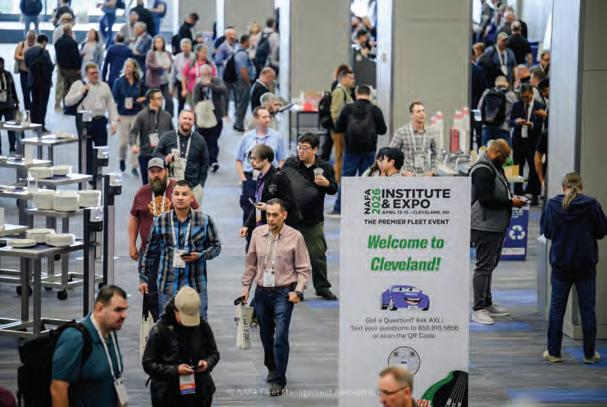
shared valuable insights on their fleet strategies for 2026, including electrification and AI technologies.
More than 60 educational events were held during I&E 2026. The sessions addressed emerging
technologies, sustainability, safety, legislative advocacy, operations management, and more.
The 2027 I&E will take place in Pittsburgh, PA, April 5-7, 2027.
The federal government has announced $10.6 million for 14 EV charging infrastructure projects across Canada. Karim Bardeesy, Parliamentary Secretary to Minister of Industry, Melanie Joly, made the announcement at the EV & Charging Expo in Toronto in April. These projects will install more than 1,600 chargers across Canada.
As well, Plug’n Drive will continue to offer a cross-country EV test drive tour with an additional $1.1 million in funding from Natural Resources Canada. The tour, which will focus on small- and medium-sized communities, will provide the chance to learn about how an EV can fit into lifestyles, compare multiple EV models in one place, ask questions and learn from EV experts.
Drivers want to be able to choose EVs without worrying about range, Bardeesy said during at the expo. “We know that the technology here is improving so much, and it’s all part of one message: that Canadians can charge with growing confidence,” he said.
By Michael Power
Electric vehicles and charging have come a long way. Vehicle range has improved, while charger scarcity recedes in the rear-view mirror. Yet as better technology emerges, a new set of challenges looms on the road ahead—and it has more to do with people and processes than technology.
That theme emerged across several sessions and panel discussion at the EV & Charging Expo in Toronto last April. The challenges that organizations face when adopting EVs now often focus on driver reticence, internal advocacy, and what processes and infrastructure are in place.
The two-day event brings together business and government leaders, fleet operators, municipalities, and logistics professionals to explore the evolving EV landscape.
A few years ago, hesitating before taking the EV plunge made more sense. Vehicles had shorter range, a higher price tag, and limited applications.
That’s no longer true.
Speaking during a panel on federal fleet electrification, Environment and Climate Change Canada’s national program manager Yves Arsenault noted how much cost and capability have improved.
As recently as 2022, pick-up trucks had a range of roughly 375 kilometres—a distance that could drop by almost half when towing. Today, some models exceed 790 kilometres and cost thousands less than earlier versions. “We’ve seen the curve of the range go up dramatically and the price go down, almost as dramatically,” Arsenault said. “That’s really helped with the acceptance of these vehicles.”
In other words, what spooked drivers and their organizations regarding EVs a few years ago is often no longer justified.
Yet despite range and performance improvements, there are still barriers to more widespread adoption. Those barriers—suggested several speakers—were due to people
more than technology. “They don’t want it because they don’t want it,” said Arsenault, summarizing one persistent reason why some drivers resist the EV switch.
Resistance to EVs can arise from preconceived notions of the technology, rather than first-hand experience. Engagement, communication, and advocacy can help build acceptance.
Yves Madore, lead advisor for the land fleet – Treasury Board of Canada Secretariat, encouraged a mindset shift to help win over managers and drivers. Rather than focusing on specific cases where greening is difficult, identify where it makes sense. “Let’s think about where you can green,” he said.
The right tools and policy procedures make this easier.
As organizations are pushing the boundaries of where EVs fit into fleet operations, long-held assumptions about the vehicles continue to topple.
A three-year pilot project by the RCMP deployed six EVs—including models from Tesla and Ford—as
pursuit vehicles. While the pilot was predicted to be a challenging use case, the data showed otherwise.
According to panelist Thierry Spiess, deputy director – Natural Resources Canada, 68 per cent of trips used less than 10 per cent of the battery, while only seven per cent of trips used 80 per cent. Range and charging were fine for most of the vehicles’ operations.
“There are some challenges on charging, but really, we’d almost call it a low-hanging fruit,” Spiess said. Just as notable was a cultural shift among drivers. Once shunned, the EVs became a desirable addition to the fleet.
“They’re fighting over who gets to drive the cool Mach-E,” Spiess said.
Examples like this highlight a broader point: EV resistance often springs from assumptions rather than real-world experience.
As the technology advances and EV use cases expand, the approach to fleet electrification is also changing.
In another session, Chad Saliba, director of EV engagement and operations at Element Fleet Management, laid out how his organization helps clients transition towards EV adoption.
Five years ago, fleets would purchase the most affordable EVs they could and put them in the motor pool, hoping that drivers would simply choose them. Element Fleet Management has largely replaced that process.
Now, the company works to support drivers—through user participation, advocacy, education, and charging access—before moving to select and scale vehicles.
Building out a broader policy is much easier once people’s apprehensions about the transition are calmed. Advocacy is more organic if those policies are informed by user participation and feedback.
“There’s nothing more valuable than somebody inside the fleet that says, ‘you know what? I’ve been driving an EV for a couple of years. I actually like it. It’s not what I expected it to be,’” Saliba told the audience.
Internal champions, in other words, are more likely to step forward if concerns are addressed first.
Although people and processes have become central in fleet greening, infrastructure challenges remain.
During a panel on shared charging depots, speakers highlighted the challenges of not only deploying EVs, but also ensuring there’s adequate charging available to keep them running. This depends not only on equipment, but grid connectivity.
Clément Sabourin, director, sustainability & special project –Nationex, described how his company purchased dozens of EVs a few years ago yet had no chargers at its depot. Even after getting the equipment, connecting them to the grid proved a lengthy process. “You can be ready but sometimes it takes nine months, 10 months, to be connected,” he said.
There’s nothing more valuable than somebody inside the fleet that says, ‘you know what? I’ve been driving an EV for a couple of years. I actually like it.

Companies using independent operators have similar charging challenges. Frederic Bel, director of decarbonization programs, Intelcom | Dragonfly, noted that those drivers may hesitate to be the first to adopt electric vehicles. Change management becomes essential in such instances.
“They don’t want to be the ones to make the first move,” Bel said.
“They want to wait and to see if someone is doing it.”
One fix, the panel concluded, is to share infrastructure and part-
nership models. For example, Martin Archambault, business development, fleet electrification, Hydro-Québec, noted companies that visit each other’s locations are able to share charging infrastructure. “Is there any way I can rearrange my billing so I owe you $20,000 for the delivery but you owe me $2,000 for the charging so I will only pay you $18,000?” he asked.
As several of the speakers at this year’s EV & Charging Expo noted,
technology is less of a barrier to adoption than ever. Yet more often, getting people and systems aligned with electrification goals is what holds organizations back.
Internal advocacy, addressing reluctance, and putting drivers’ needs first can help streamline electrification.
While having the proper equipment and infrastructure is paramount, success increasingly involves first tending to the human and process aspects.. FM/S
By Mario Cywinski

In 1995, Subaru debuted one of its most recognizable vehicles, the Outback. Built on the company’s outdoor themed reputation, it’s marketed as a go-anywhere vehicle.
The first generation brought capability, practicality, car-like driving, and a versatile vehicle— what would become known as a crossover. It has gone through many changes. The latest generation coincides with the Outback’s 30th anniversary in Canada.
The all-new Outback leans even more into its reputation with more features, increased functionality, and a more rugged vehicle.
Subaru has redesigned the Outback’s exterior, making the front fascia more rugged (or as Subaru puts it “greater thickness and width”) than the outgoing model,
along with a new grille. Another change is the arrangement of the headlights, which are now vertically positioned. The side profile still positions the Outback as a wagon; yet it does have more of an SUV look. The rear is all-new, with a taillight and combination lap design.
An assortment of colours and 18” or 19” wheels are now available.
The Outback has a more luxurious feel inside, with different trim levels offering different interior looks. The base Touring trim offers all-weather soft-touch material and more black accents in the cabin. The Limited XT move up to black leather, and more chrome accents. The Premier XT offers black or brown Nappa leather.
The move away from physical buttons by the automotive industry
frustrates many. To its credit, Subaru has reworked the HVAC layout to include buttons for all functions, with knobs added for temperature setting. The area also adds a type-A and type-C USB outlet, a 10w wireless charger.
Subaru vehicles are reliable, fun to drive, capable, and safe. However, one aspect that needed updating was the infotainment systems, which were slightly dated. That’s improved. The new system uses five design concepts: simple, clear, personal, seamless, and modern.
The system consists of a 12.3inch digital cluster that is fully customizable. Five screen layouts are available, a classic layout mode (with gauges), map mode (centred around the navigation), projection mode (which allows for using a map
from Android Auto or Apple CarPlay), EyeSight mode, or calm mode (which minimalizes the information displayed).
The centre stack in a 12.1” touchscreen that offers a new widgets screen, which can display navigation, radio/media, and phone information concisely. The side of the screen has a menu bar allowing for one-touch access to the navigation screen, music screen, phone screen, setting, and profile. Other screens available are apps, calm, warning, and camera.
Two engines are available on the Outback. The 2.4 litre, four-cylinder turbocharged Boxer engine outputting 260 horsepower and 277 pounds/feet of torque is avail-
1. The system now consists of a 12.3-inch digital cluster that is fully customizable, with five screen layouts available.
2. The 2.5L four-cylinder naturally aspirated Boxer engine with 180hp and 178lbs-ft of torque is available on the base Touring trim.

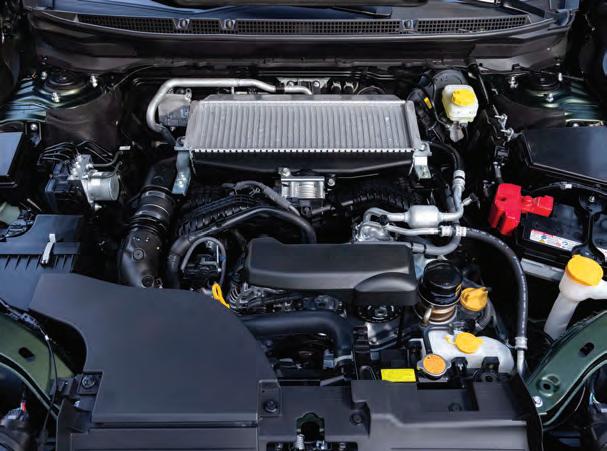
able on Limited XT, Wilderness, and Premier XT trims. The 2.5L four-cylinder naturally aspirated Boxer engine with 180hp and 178lbs-ft of torque is available on the base Touring trim. Both engines are mated to a CVT transmission.
Subaru’s off-road system X-MODE has been improved and now turns on or off with a switch on the steering wheel. The All-Wheel Drive system, which is what Subaru has built its name on, is one of the best AWD systems on the road. It offers faster centre differential lockup and incorporates steering angle data. While taking things offroad, you need a lot of ground clearance, and the Outback offers a standard 220 millimetres.
Subaru has refined the Active Torque Split AWD system, which
now reduces the need for corrective steering, helping to keep the vehicle stable during different scenarios where there is lateral slipping. Aerodynamics have been improved with a new front and rear air outlet, redesigned rear spoiler, and aerodynamic underfloor parts.
The EyeSight system has been a mainstay safety suite for years. It uses cameras instead of radars as its primary source of driving information. The new Outback offers Eyesight X, which includes handsfree assist, ore-curve speed control, active lane change assist, automatic resume assist, and emergency stop assist with safe lane selection. It is the next level in autonomous (hands-free) driving, now changing lanes and more on its own (available on Premier XT models).
Outback still has the regular suite of EyeSight features, now offering front pre-collision braking, front and side alert assist, and acceleration override assist, and many parts of the system have been improved. Outside of the Eyesight system, Subaru added digital Multiview monitor and emergency stop assist to the safety features.
An OEM specific app is available to help drivers keep an eye on their vehicles, as well as providing information and features. MySubaru on the Outback provides: remote services (lock/uplock, start, locate), maintenance and health information, SOS emergency assistance and automatic collision notification, roadside assistance, concierge services, and stolen vehicle recovery. It is available for
The all-new Outback leans even more into its reputation with more features, increased functionality, and a more rugged vehicle.
a three-year free period. Part of the package is MySubaru Navigator, a cloud-based navigation system available for one year free. FM/SP
Price): Touring - $40,895 / Limited XT - $48,195 / Wilderness$49,195 / Premier XT - $51,195 Engine: 2.5L four-cylinder naturally aspirated Boxer engine / 2.4L four-cylinder turbocharged Boxer engine
Power: 180hp and 178 lb/ft of torque / 260hp and 277 lb/ft of torque
Transmission:CVT
Rated Fuel: 2.5L – 9.3/7.5 L/100km (city/hwy) / 2.4L –11/8.3 L/100km / 2.4L Wilderness – 11.3/8.8 L/100km
While federal procurement controversies have dominated the news in recent years, a deeper review of recent Canadian case studies from across Canada reveals how chronic systemic failures are not limited to federal government procurement. Unfortunately, these failures have manifested themselves within provincial governments, provincial agencies, and broader public sector institutions from coast to coast across Canada.
Turning first to Atlantic Canada, the Auditor General of Newfoundland and Labrador recently raised concerns about a “deferred maintenance” scheme at Memorial University, finding that there was no coherent long-term plan in place to finance and manage outstanding buildings repairs. Another Newfoundland provincial audit raised “serious concerns” over the improper sole-sourcing of nursing contracts and the related costs of those uncompleted awards.
Meanwhile, the Supreme Court of Prince Edward Island recently dealt with the allegations of a losing bidder who claimed that the provincial cabinet improperly interfered with contract award decisions under the guise of providing “policy direction.” While the claim was ultimately dismissed, the case revealed a lack of clarity in the procurement oversight practices of the provincial cabinet.
Turning next to New Brunswick, the provincial auditor found that public housing units are sitting empty for months while waiting lists grow due to chronically delayed repairs. Further, a trade dispute panel recently accepted a protest over
allegations of systemic local preferences in New Brunswick’s provincial construction management practices.
Further, in Nova Scotia, the provincial auditor recently determined that the government’s “right of first refusal” process for the construction of long-term care facilities gave current contractors preferential treatment with no evidence that this scheme resulted in cost savings to the taxpayer.
Meanwhile in Quebec, the Gallant Commission is conducting a public inquiry into a failed major technology procurement that featured a $500 million cost overrun. Also in Quebec, a recent internal provincial audit found that a flawed tendering process led to cost overruns in the hundreds of millions of dollars in a health sector digitization project.
Turning to Ontario, the provincial government recently expanded its protectionist practices through the new Buy Ontario Act, 2025 that risks grinding public procurement into gridlock as public institutions across the province scramble to comply with a series of complicated new preferential procurement policies. At the same time, a recent provincial auditor’s report found that over the last three years the government wrote off $1.4 billion worth of expired PPE since Ontario hospitals would rather pay suppliers for the delivery of new products than rely on the provincial government to coordinate on-time delivery of free products from its fragmented and expiring stockpiles.
Meanwhile on the Ontario municipal front, a Toronto auditor’s report found that external consul-
tants were quick to approve change orders for delays in sewer system repairs, but slow to document why those delay claims were approved in the first place and why late performance penalties were not enforced.
Moving westward, a recent Manitoba provincial audit found frontier-style procurement at multiple municipalities, with one local government buying three untendered fire trucks, while the head of council at another municipality repeatedly circumvented the procurement rules. The auditor concluded that the Manitoba government had inadequate controls over municipal spending.
Turning next to Saskatchewan, a recent provincial audit found weak oversight in major provincial technology projects. In fact, in 20 reviewed projects, the auditor found that eight were over budget and 12 were delayed, including one project that was $130 million over budget and two and a half years behind schedule.
Moving westward to Alberta, a recent provincial auditor’s report found that the Minister of Health exercised improper influence over a multi-billion-dollar health sector procurement and compromised the independence of the government’s “arms-length” health agency. Further, an independent investigation ordered by the Alberta government concluded that two former employees of that same provincial health agency were involved in “obvious” conflicts when they acted for suppliers in major contracts with that agency.
Finally, the British Columbia Supreme Court recently dealt with an injunction application brought by an incumbent air ambulance service

Paul Emanuelli is the general counsel of The Procurement Office and can be reached at paul.emanuelli@ procurementoffice. com.
“As these recent case studies illustrate, public institutions from coast to coast across Canada continue to struggle in following proper procurement practices.”
provider after the province’s health authority failed to remove a conflicted evaluator from an RFP process. While the injunction was denied, the conflict tainted the contract award and forced the agency to conduct a re-evaluation with a new group of evaluators under the supervision of an independent third party.
As these recent case studies illustrate, public institutions from coast to coast across Canada continue to struggle in following proper procurement practices. They ne ed to refocus their priorities on the fundamentals of good governance if they hope to avoid being the next procurement case study. SP
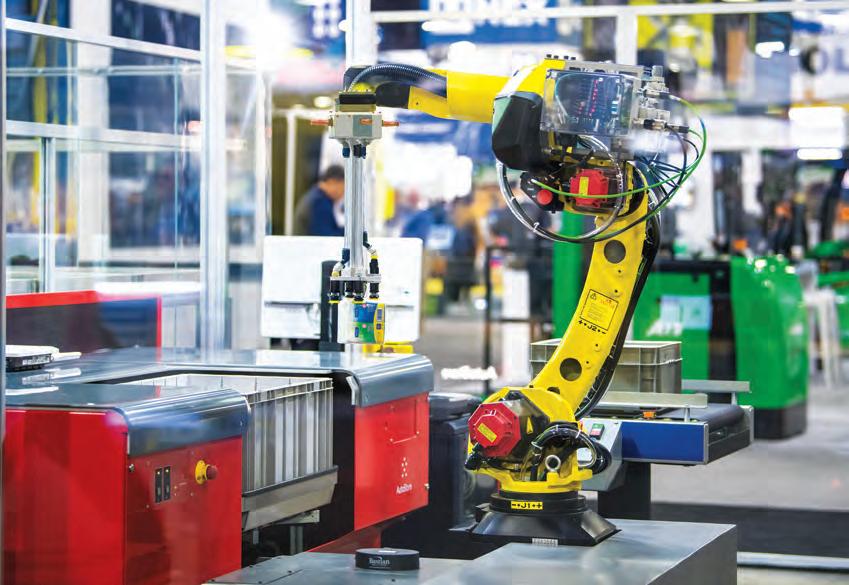
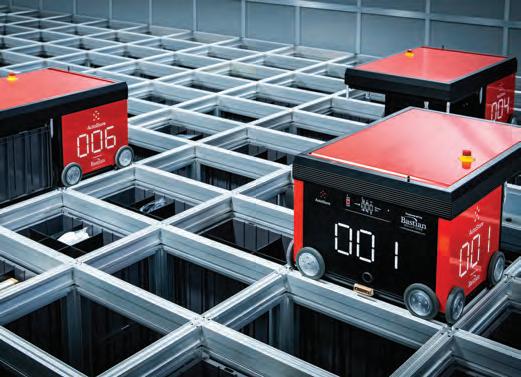
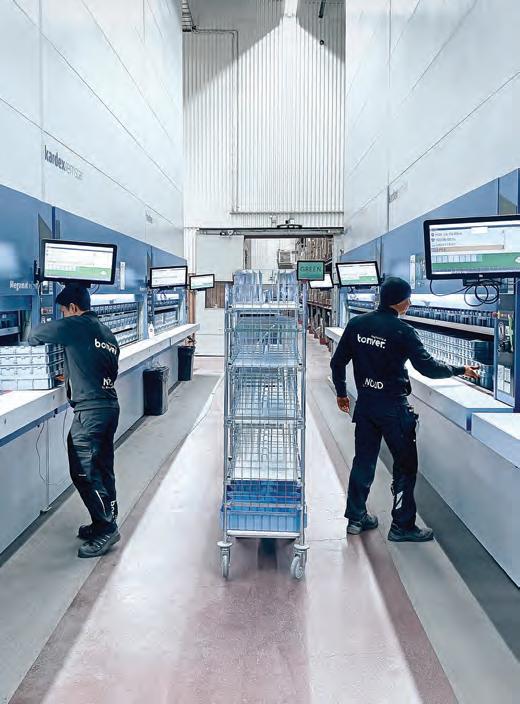
Discover the next step in your automation journey
Automation that’s rooted in strategy—the right technology at the right time for the right application—boosts team productivity, engagement and satisfaction. And that’s good for business. No matter what stage you’re in, GNJ Automation brings years of intralogistics expertise to help evolve your systems and empower your people.
READY TO AUTOMATE, INTEGRATE AND INSPIRE?
Connect with a member of our team and let’s start the conversation.

When you’re planning your next fleet cycle, long-term value matters as much as the upfront cost.
Subaru vehicles are known for strong resale value and long‑term durability, helping lower your total cost of ownership over time.
With Symmetrical Full‑Time All‑Wheel Drive and advanced safety technologies standard across the lineup, you’re investing in vehicles built to perform and hold their value.

The numbers don’t lie when long-term value is measurable. (strong resale value) + (long-term durability) (srv) +