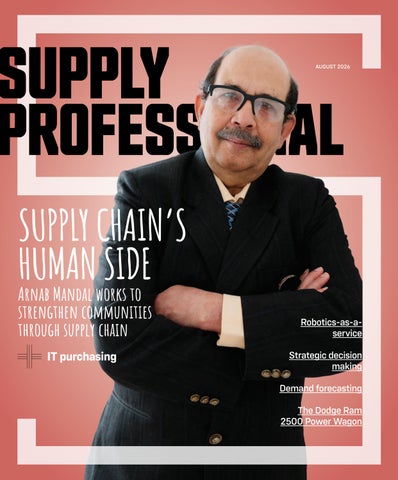
AUGUST 2026
SUPPLY CHAIN’S HUMAN SIDE Arnab Mandal works to strengthen communities through supply chain IT purchasing
Robotics-as-aservice Strategic decision making Demand forecasting The Dodge Ram 2500 Power Wagon
A bigger smile for your last mile With the largest electric delivery capacity in the country, we help you meet your ESG targets and customer expectations. If your carrier can’t do that, it isn’t built for today’s e-comm. Ready for a change? Connect with us at dragonflyinternational.com
Delivery done differently
VOL.68 No.4 AUGUST 2026 SUPPLYPRO.CA COVERING CANADA’S SUPPLY CHAIN
@SupplyProMag facebook.com/supplyprofessional linkedin.com/company/supplyprofessional
10
14
16
SHAWN MORETON PHOTOGRAPHY
8
FEATURES 8 BUYER BEWARE Build versus buy in IT purchasing. 10 SUPPLY CHAIN AS SERVICE A global career connects logistics to community needs. 13 STRATEGIC DECISION MAKING Supply chain leadership in times of disruption. 14 ROBOTICS AS A SERVICE Mapping the evolution of RaaS.
ALSO INSIDE 16 THE COST OF LATE DECISIONS Early supply chain input can reduce risk, cut costs, and improve product design outcomes. 18 PREDICTING CARGO FLOW Shipping players can sharpen demand forecasting to navigate volatility and plan capacity.
4 UP FRONT 5B USINESS FRONT 6 IN THE FIELD 7 INDUSTRY NEWS 30 THE LAW
20 RIGHT-WEIGHTED PACKAGING Companies are cutting waste and shipping costs with smarter package sizing strategies.
21
Fleet Management SUPPLYPRO.CA 3
UP FRONT
PRODUCTIVITY AND THE SUPPLY CHAIN We’ve heard it in the media. We’ve heard it from economists. The Bank of Canada has said it, and so have business leaders and politicians. Canada has a productivity problem. And it’s been one of the dominant economic stories in this country for the last two years. We lag our peers in this area. The OECD’s 2025 Economic Survey of Canada notes that our labour productivity trails peer countries. Also last year, the Bank of Canada said our labour productivity growth averaged about one per cent between 2000 and 2019, down from three per cent in the 1960s and 70s. All of those who have discussed the issue have offered solutions: increase capital investment, foster competition, or accelerate technology adoption. We hear about policy changes the federal government can adopt, strategies from SMEs, or whether AI and automation can help. All of the above are valid suggestions. Increasing productivity is a multi-pronged, multi-year task. Supply chain and procurement have a role to play. Factory floors, procurement organizations, warehouses, and every other supply chain node can help to boost productivity—one decision at a time. But first, let’s dispel a myth. It’s easy to think that workers must simply work harder. Or, that other countries beat us in productivity due to longer work hours. Rather, we must look to systems, and how they function, to find productivity boosts. Accurate forecasting and production planning, for example, make sure resources are available when needed. This can reduce idle time and unnecessary inventory, while preventing hasty changes. Streamlined processes keep materials and information flowing. Automating repetitive, manual tasks speeds up processes, reduces errors, and allows employees to focus more time on higher-value work. These examples don’t show teams working harder or longer hours. Rather, they illustrate how a system with fewer obstacles creates more value. They showthat supply chain improvements can boost productivity. They also illustrate how bottlenecks in the supply chain cause lower productivity. Poor demand forecasts, material delays, a lack of supplier visibility—these are less talked-about but still perceptible drags on productivity. They can also add up to potentially productive hours that simply disappear. Of course, I have to mention technology as a productivity booster. AI and its related technologies can indeed raise productivity and help to streamline processes and systems. But here’s something I’ve heard from numerous industry experts over the last few years: don’t chase technology for its own sake. AI alone won’t fix bad inventory data. Digitized procurement won’t mend poor supplier relations. Think of technology as a tool, rather than an end unto itself. To sum up, we shouldn’t look exclusively to government policy, technology, or employee effort for productivity fixes. While some of these can help, productivity improves through increased collaboration and better systems across Canada’s supply chains and operations.
EDITOR MICHAEL POWER 416-441-2085 x7 michael@supplypro.ca PUBLISHER FARIA AHMED 416-441-2085 x 5 faria@supplypro.ca DESIGN Art Direction ROY GAIOT Design Consultation BLVD AGENCY
iQ BUSINESS MEDIA INC. Vice President STEVE WILSON 416-441-2085 x3 swilson@iqbusinessmedia.com President & Executive Publisher ALEX PAPANOU
PUBLICATION MAIL AGREEMENT NO. 43096012 ISSN 1497-1569 (print); 1929-6479 (digital) CIRCULATION Mail: 126 Old Sheppard Ave, Toronto ON M2J 3L9 SUBSCRIPTION RATES Published six times per year Canada: 1 Year $ 99.95 CDN Outside Canada: 1 Year $ 172.95 USD Single price per copy $18.00 CDN Opinions expressed in this magazine are not necessarily those of the editor or the publisher. No liability is assumed for errors or omissions. All advertising is subject to the publisher’s approval. Such approval does not imply any endorsement of the products or services advertised. Publisher reserves the right to refuse advertising that does not meet the standards of the publication. No part of the editorial content of this publication may be reprinted without the publisher’s written permission. © 2021 iQ Business Media Inc. All rights reserved. Printed in Canada. Supply Professional is the Official Magazine for NISCL
MICHAEL POWER, Editor 4 AUGUST 2026
SUPPLY PROFESSIONAL
BUSINESS FRONT—BY MICHAEL HLINKA
THE ECONOMICS OF “MAYBE” RESISTING EASY ANSWERS IN ECONOMICS AND GEOPOLITICS My 10-year-old son loves American-style football. There was— I think it was on Netflix—a series that documented the career of retired quarterback Tom Brady. In one of the episodes, he recounts a parable that I had never heard before: Long ago, there was a Chinese farmer whose horse ran away. That evening, his neighbours came around to commiserate. They said, “We are sorry to hear your horse bolted. This is most unfortunate.” The farmer said, “Maybe.” The next day the horse came back bringing seven wild horses with it. That evening everybody came back and said, ‘Oh, isn’t that lucky. What a great turn of events.” The farmer again said, “Maybe.” The following day his son tried to break one of the horses. While riding it, he was thrown and broke his leg. The neighbours then said, “That’s too bad.” The farmer responded, “Maybe.” The next day the conscription officers came to conscript people into the army, and they rejected his son because he had a broken leg. Again, all the neighbours came around and said, “Isn’t that great!” Again, he said, “Maybe.” I copied the following paragraph, word for word, that gets to the heart of what this parable is about: “The whole process of nature is an integrated process of immense complexity, and it’s really impossible to tell whether anything that happens is good or bad. That’s because you never know what will be the consequence of the misfortune. Or, you never know what will be the consequences of good fortune.”
THE POWER OF PRESSURE Several days ago (in late June), Iran and the US signed a memorandum of understanding. For now, there is a fragile peace in the Middle East. Most observers believe that what brought the US to accept this deal was the immense pressure put on the global economy when the Strait of Hormuz was shut down. Donald Trump’s hand was forced, and he agreed to a deal that is generally understood to be more favourable to Iran. That may or may not be the case. But most people, I included, focus on the fact that the shooting has stopped and this is a good thing. “Maybe.” This column is dedicated to economic matters and this will be my focus. The big question, it seems to me, is what the global reaction will be, assuming that the peace holds. About three years ago, in this very magazine, I wrote a column speculating about when the rest of the world would find an alternative to the US dollar as the world’s reserve currency. I read that the use of the yuan (China’s currency) has soared since the outbreak of hostilities. And I’m not sure that we’ll ever go back to the status quo antebellum. Rather, it seems more likely—given the anger that many nations feel towards the US and Trump administration—that more global business will be settled in currencies other than the USD. And this is generally understood as a bad thing. “Maybe.” The closing of the Strait has to be a wake-up call to nations like India and China that currently rely on Middle Eastern oil. What could
be closed in March of 2026 could be closed again. Energy self-sufficiency will be understood as a necessity. American public policy analyst Jeffrey Sachs speculates that this will hasten these growing economies to embrace alternate sources of energy, nuclear in particular. And this should lower the global temperature, meaning conflicts of this sort will be less likely, which must be understood as a good thing. “Maybe.” Every military analyst will tell you that there are two factors that historically have driven the ability to project power: Population and wealth. Since the end of the Second World War, the US emerged as the world’s pre-eminent power. However, this war has demonstrated that drone technology is a great leveller. An aircraft carrier can cost $13 billion. Military drones might cost a few thousand dollars each and enough of them render an aircraft carrier vulnerable. And this levelling could make conflict more likely, and this must be understood as a bad thing. “Maybe.” WILL HISTORY REPEAT? Time to wrap this up. Yes, the shooting has stopped for now, but we can’t be sure that the history won’t repeat itself. The First World War ended with an uncomfortable armistice, but without a definitive resolution. Then, 20 years later, there was a longer and far bloodier Second World War. The fact that the US dollar became the world’s reserve currency led the US to profligate spending and dangerous levels of debt. If the
Toronto-based Michael Hlinka is a tenured professor at George Brown College. His website is www. michaelhlinka.com
“The first consequence of a geopolitical shock is usually obvious. The second and third consequences are the ones that reshape the global economy.”
world suddenly abandons fossil fuels, this will not be great for Canada. And perhaps the fact that war can be waged more cheaply will make armed conflict less rather than more likely because every nation will have the ability to cripple its enemies. “Maybe.” SP SUPPLYPRO.CA 5
IN THE FIELD—BY MAHMUD KHAMIS
THE NEW SUPPLY CHAIN REALITY NINE MONTHS OF CHANGE REVEAL A NEW PLAYBOOK FOR SUPPLY CHAIN LEADERS In late 2023, we began to see early signals of a shift many supply chain leaders sensed but could not yet define. At that point, those signals were simply observations that served as markers of a North American supply chain entering a period of structural change that would challenge longheld assumptions about labour, production, and resilience. Now, over the past nine months, the pattern has become unmistakable as the changes run deeper than we first imagined. A REGION IN TRANSITION For decades, North American supply chains rested on a familiar foundation: stable labour markets, predictable demand cycles, and a globalized production model optimized for cost. As demographics shifted, geopolitical tensions rose, and technology accelerated, that foundation began to move. One of the earliest signs was the widening gap between the US and Canadian labour markets. The US remained resilient, even overheated at times, while Canada cooled sharply. Youth unemployment rose, hiring slowed, and investment patterns shifted southward. This is now forcing Canada into recession. This divergence is not a temporary imbalance, as we have seen in the past. Rather, it’s a definite structural realignment, one that will shape where capital flows, where production anchors, supply chain flows, and how competitive each region will become. MANUFACTURING’S RECALIBRATION The pause in major EV investments, including Honda’s $15-bil6 AUGUST 2026
lion Ontario complex, was not an isolated headline. It reflected a broader recalibration across the continent. This involved the normalization of EV demand, while hybrid strategies gained momentum. Capital is becoming more selective and cost discipline is returning to the centre. Yet North American manufacturing is not retreating. It is rebalancing toward optionality, flexibility, and risk-weighted decision making as Canada seeks to align itself with Europe and Asia. The writing is on the wall: Our old trading partner America no longer appears to be all that interested in the partnership. Throughout the past nine months, procurement teams have found themselves front and centre in the battle. They’re the ones that feel macro change first. When inflation wavered, suppliers reacted. When freight costs shifted, budgets absorbed the shock. When geopolitical tensions rose, risk models strained. When AI matured, expectations for speed and insight accelerated. Procurement has now become an earlywarning system and increasingly, a strategic nerve centre. THE AI ACCELERATION In 2019, intelligent automation held promise. Today, that promise is operational reality. AI now underpins areas like predictive sourcing, automated supplier engagement, real-time cost visibility, scenario-based risk modelling, and faster, more confident decision making. Procurement teams need to understand that AI has not replaced procurement. Instead, AI has aug-
mented the function. It has also raised expectations for the function’s strategic contribution. Mid 2026 marks a turning point. Three truths define the current landscape: Volatility is structural, not cyclical, and the disruptions of the past five years were not anomalies. Rather, they were previews. Procurement has become a macro-strategic function, and we must all rise to the new role. Boards now ask procurement strategic questions about risk exposure, how fast a company can pivot, or what options exist. Optionality is the new competitive advantage, and procurement is front and centre. Organizations that thrive will be those with multiple paths forward— in sourcing, production, technology, and talent. Based on the signals tracked across nine months of analysis, five structural pillars will define the next phase of North America’s supply chain evolution. Regional rebalancing: Production will continue shifting toward North America but selectively, strategically, and with hybrid models that blend global and regional strengths. AI-enabled decision ecosystems: AI will become the operating system of procurement, enabling faster, more confident choices across complex networks. Workforce transformation: Skills such as cultural intelligence, critical thinking, and adaptability will become essential differentiators as organizations navigate demographic and technological change. Scenario-driven resilience: Organizations will design supply
Mahmud Khamis, EMBA, SCMP, is a supply chain professional in Mississauga.
“Volatility is structural, not cyclical. The disruptions of the past five years were not anomalies. They were previews.”
chains around multiple futures, not a single forecast. Optionality will replace optimization as the dominant philosophy. Integrated learning cultures: Just as multicultural societies thrive through openness and adaptation, organizations will succeed by integrating diverse perspectives, technologies, and operating models into a cohesive learning system. ROADMAP FOR THE NEXT DECADE The last nine months have not been a crisis. They have been a reset and a reanchoring of North America’s supply chain reality. We are not returning to the old normal. We are building a new one. The leaders who embrace this moment, who combine data with judgment, technology with humanity, and resilience with imagination, will shape the next generation of supply chain excellence. SP SUPPLY PROFESSIONAL
INDUSTRY NEWS
Canadian organizations unprepared for AI
Safety stockpiling hits three-year high
C-suite leaders across Canada warn that governance, oversight, and workforce readiness are struggling to keep pace with AI adoption, creating a widening ‘control gap.’ Findings from two IBM Institute for Business Value (IBV) global studies—one surveying 2,000 CEOs and the other 2,000 C-suite technology leaders—reveal a growing disconnect between the ambition to scale AI and the organizational and governance foundations to support it. While 90 per cent of Canadian CEOs who responded say they are embedding AI across multiple workflows and 80 per cent believe they are deploying AI at the pace needed to achieve business objectives, only 43 per cent of AI initiatives have delivered their expected ROI over the past two years. At the same time, 68 per cent say they are accountable for AI systems they do not fully control, while nearly 73 per cent report that AI adoption is outpacing their IT governance capabilities. In fact, 50 per cent of Canadian CIOs and CTOs cite security and compliance concerns as primary barriers to scaling AI.
The GEP Global Supply Chain Volatility Index signaled continued pressure on global supply chains as manufacturers increased purchases and built safety stocks to protect against rising inflation. Reports of safety stockpiling rose to their highest level since January 2023, as companies bulk ordered goods and raw materials ahead of expected price increases and potential supply disruption. This pushed global demand for inputs to its strongest since March 2022. Shortages also worsened, reaching their highest level in three-and-ahalf years. Combined with elevated transportation costs, the data show that supply chain pressures are no longer limited to shipping and energy markets.
UPS invests in crossdock facilities UPS has invested $48 million in 27 temperature-controlled freight cross-dock facilities worldwide, including one in Toronto. Designed for speed and short-term storage between air and ground transport, the facilities maintain strict temperature requirements throughout the transfer process. All facilities comply with IATA CEIV Pharma certification, an industry-recognized standard. Operating as an integrated network, they eliminate handoffs between providers, reducing risk and improving shipment visibility and control. A control tower gives real-time monitoring, identifies potential disruptions, and enables intervention to help protect high-value, temperature-sensitive therapies.
“Swarm” thinking helps human-robot collaboration: research What’s the most effective way for robots and humans to collaborate? Research published in Transportation Science, a journal of INFORMS, suggests that warehouse workers often achieve higher productivity when they switch among multiple autonomous mobile robots rather than working with one robot. The findings challenge the assump tion that fixed human-robot pairings are the most efficient approach. Instead, researchers found that a flexible “swarm” policy—workers collaborating with different robots—
often outperforms one-to-one assignment strategies. As robots become faster and more plentiful, the advantages of the swarm approach grow even stronger. Using analytical modelling and simulation, the research team evaluated more than 12,000 warehouse scenarios. The swarm policy generally delivered higher order throughput than the system-directed approach. Performance gains increased as the ratio of robots to workers grew and robots gained speed advantages over human pickers.
Risk management systems not predicting supply chain disruptions A recent report finds that 75 per cent of procurement organizations are not implementing advanced risk programs, mostly due to gaps in data and analytics. The report, released by ProcureAbility along with The Hackett Group, shows how traditional third-party risk performance management (TPRM) is breaking down due to supplier complexity, cost concerns, and regulatory scrutiny. The report draws insights from the 2026 Procurement Agenda and Key
DHL Group appoints Joe Joseph CFO DHL Group has appointed Joe Joseph as Chief Financial Officer (CFO), effective June 1, 2027. He will succeed Melanie Kreis, who will hand over responsibilities for the finance function next year. Joe Joseph now serves as CFO of DHL Express. The Australian native has been with DHL Express for over 28 years and has held numerous finance leadership roles throughout his career, including for the Middle East, Asia, and Europe, before assuming his current position in 2014. He has a strong and recognized track record in the finance function of DHL Express.
Issues Study and the 2024 Risk Study. According to the report, 62 per cent say that a mature supply risk management approach is only partially deployed due to limited development of practices, processes, or systems. As well, 13 per cent report there’s no formal approach to supply risk management. Although 90 per cent of these organizations are monitoring supplier risks, only seven per cent of them are modelling future disruption scenarios. SUPPLYPRO.CA 7
BY KAREN BETANCOURT
HIDDEN RED FLAGS IN IT PURCHASES
FOUR WARNING SIGNS THAT A SOFTWARE PURCHASE MAY BE HEADED OFF TRACK The eternal IT question is “build versus buy.” It sounds easy, like moving to a new city and having to choose between renting or buying. Such choices seem to come with pluses and minuses on both sides. Building your own backend software or new integration layer means you’ll have in-house expertise and troubleshooting capability, with lots of headcount added to the build and maintenance IT teams. You’ll own your own fate, but at a cost. Buying means, you’ll sacrifice customization but get underway faster and with a lower ongoing carry cost (supposedly). You’ll be able to switch to new technology faster, and without the onerous work of bringing on new workers with highly specialized skills. So, you’ve made the choice and decided to go with “buy.” Now you’re faced with the reality. There are few things more terrifying than the dread of shepherding a project successfully through bidding, evaluation, and finance approval only to be anxious that you don’t know what “on-track” means. 8 AUGUST 2026
Spoiler alert, almost no one will admit it, but on nearly every largescale project, every leader, at least once, realizes that they don’t know if things are on-track. Project managers can produce lovely Gantt charts, and reports from Agile teams can show milestones, but the answer to whether a project will
finish on-time and in full capability can remain unclear. TEN YEARS AND NINE ZEROS I once joined a company midway through an enterprise-level core infrastructure project, where timelines were years behind, and additional expenses ran into the hun-
dreds of millions. The result took 10 years and nine zeros to solve, with an intensive customer care group operating for seven months to wrap it up and move on. Your projects are unlikely to replicate that series of unfortunate events. But the costs to operations, corporate image, and financial results are real. In that case, as in many others, red flags of concern were overlooked or underestimated. Smaller IT projects may only have one or two of the following such red flags, but large projects invariably have all the below. Beware plug and play advertisement—There is nothing more appealing to a budget-strapped IT manager or operations leader than the idea that their problem will be fixed simply by adding some software. Phrases such as “fully compatible”, “immediate use”, “savings starting on day one,” are music to their ears. I have never found those statements to be true in any corporate setting. Invariably, as you ask questions, you’ll hear things like a project “needs six weeks of setup before the beta test begins,” or “we have a 10-month rollout plan for deployment to all sites.” Safe and prudent deployment is critical. However, if something is truly plug and play, more than two weeks between deployments is either signaling it’s not, and you have large onboarding costs hitting another department, or someone within your company is using terminology to get a project approved while knowing full well there are other expenses coming. Network security and data policy are absent—Critically important groups, and typically the bane of any new buy decision, these folks are responsible for ensuring corporate reputations are kept pristine and laws are followed. They typically are also not included in early architecting or installation discussions as they are the number-one identifier of the plug-and-play red flag. The easiest way to get the whole project underway—completed on-time and on-budget—is to include the friction points from the get-go. It’s a huge red flag if you’re at the contract signing and no one SUPPLY PROFESSIONAL
has talked to information security (InfoSec). Insist that they are involved and sign off on any project before you approve it. Procurement and finance are only involved at the end—In a world focused on ever greater productivity and efficiency, it’s unrealistic for everyone to be involved from the ideation stage. That’s particularly true when they’re in corporate support functions. However, no IT project, regardless of size, should only come to the monthly procurement and finance meeting when it is ready to be signed. Oftentimes, rushed projects where red flags are overlooked have high sensitivity. It’s when it involves the purchase of some new tech to solve a burning need, and senior leadership is probably antsy for that risk to go away. High pressure from senior leadership invariably causes short-cuts to be made to move fast. Don’t let anyone skip critical deepdive sessions just to move faster or
“The goal posts of ‘are we on track?’ are best identified through the above four. Projects without transparency are the first to go off-course.” accept that you’re inviting the risk into the company yourself. The vendor sales team is ubiquitous. We’ve all seen the following: the sales people are masters of anticipation and explanation, and nary a tech person from the software provider has been seen. If no one from the technical end of the application provider has shown up, it may be a sign that it’s a minor purchase. If so, scrap this list, the risk of a red flag being catastrophic is minimal.
But, if this involves key systems, is customer-facing, or involves a system your company has been using for decades, and no one from the vendor tech team has been involved? That’s an instant red flag. Service providers who are committed to earning and keeping your business always ensure they know where the pain points lie. There is no sales team on Earth that is wellversed enough in every single line of code to be able to anticipate every pain point. Their troubleshooters, experienced deployment engineers, and onboarding support are critical components to verify that the purchase will go as planned. BUYER BEWARE As with all things, it’s easy to identify red flags once they’ve smacked you in the face, but the goal posts of “are we on track?” are best identified through the above four. Don’t let folks sell you new KPIs to monitor, lines of code written or not, or
Karen Betancourt is co-founder of Colocourt Solutions, a Supply Chain operations consulting company based in California.
some other metric that you’ve never cared about before as an indicator of project health. As always, the adage of “buyer beware” relies on simple, verifiable discussion and the knowledge that projects without transparency are the first to go off-course. SP
26_008011_Supply_Professional_AUG_CN Mod: June 25, 2026 5:33 PM Print: 07/16/26 page 1 v2.5
π SHIPPING SUPPLY SPECIALISTS
BEST QUALITY AND SELECTION IN NORTH AMERICA
ORDER BY 6 PM FOR SAME DAY SHIPPING
1-800-295-5510
uline.ca
SUPPLYPRO.CA 9
BY MICHAEL POWER
ARNAB MANDAL CHAMPIONS SUPPLY CHAIN AS A FORCE FOR PUBLIC SERVICE AND COMMUNITY WELLBEING Arnab Mandal’s career has propelled him through an unusual and compelling evolution. The journey has taken him from managing the movement of raw materials in the steel industry in India—his home country—to ensuring the flow of healthcare supplies and products across Canada’s arctic in Nunavut. Yet what distinguishes Mandal is not the breadth of his travels. Rather, he views supply chain as a vehicle for public service and community building. He has come to see the field not just as a business function, but as service. It can strengthen communities, support vulnerable populations, and build local capacity. Mandal has served in the private and public sectors in industries ranging from iron and steel, mining, manufacturing, electronics, power generation, and most recently healthcare. The geographic journey, including India, Canada’s arctic, and southern Ontario, helped Mandal develop a philosophy around what he calls the “human side” of the profession—serving not just systems but the people those systems affect. For Mandal, now the director of supply chain management in the Department of Health 10 AUGUST 2026
for the Government of Nunavut, that journey began in the late 1980s. He had just earned a master’s degree in applied geology from the Indian Institute of Technology, in the city of Kharagpur, in West Bengal. His first glimpse at supply chain came after graduation, with a position as a management trainee at the Durgapur Steel Plant. The plant is a major steel enterprise with over 30,000 employees operating under the Steel Authority of India Ltd. Mandal’s first position was junior manager in the department of raw materials services. In that role, he coordinated quality assurance and collaborated with mines to distribute bulk volumes of raw materials like iron ore, coal, limestone, dolomite, and manganese ore. Mandal rose at the organization, first to manager and later to senior manager. The company entrusted him with annual procurement planning and budgeting, which amounted to the equivalent of C$45 million. He was responsible for stock management and accounting, expediting, and following up with transporters and vendors to ensure the timely movement of roughly four million tons of materials each
A NEW BEGINNING That seminar sparked Mandal’s decision to move to Canada, where he first settled in Toronto with his family in 2003. But that era was not an easy time for a newcomer with a young family, Mandal says. Wars in Afghanistan and Iraq were ongoing, there was the SARS epidemic and a mild recession. Yet Mandal was determined. He enrolled in the global logistics and supply chain management postgraduate diploma program at Toronto’s Seneca College. He also earned a business process integration certification from SAP Canada. His efforts paid off. Mandal landed a position in Toronto as purchasing agent with Nienkamper Inc., a furniture manufacturer. Yet, as he settled into his role, Mandal faced a new challenge. A recession hit the US, which gradually pushed the US and Canadian dollars towards parity. “The low market demand had resulted in a substantial reduction in our sales and placed increased pressure on purchasing to reduce materials costs,” Mandal says. With urgency mounting, Mandal led a team in exploring overseas sourcing options. They turned to China as a less expensive alternative for some of the components. “Quality was a concern initially,” Mandal says. Yet close coordination and collaboration meant components were brought to the company’s high standards. The team optimized costs between export logistics and the demands of just-in-time (JIT) delivery. Gradually, profits started creeping up. Shortly after, Mandal received a job offer that let him further develop his skills. In 2007, he started as a buyer at Til-Tek Antenna Inc. in Kemptville, Ontario. The small-scale, hightech antenna manufacturer operated under Kavveri Telecom, based in Bengaluru, India. SUPPLY PROFESSIONAL
SHAWN MORETON PHOTOGRAPHY
FINDING PURPOSE NORTH OF 60
year. He also worked to reconcile missing shipments with vendors and transports, as well as help the purchasing division when necessary. “These job rotations and enrichment opportunities not only deepened my interest in supply chain management but also gave me a broader understanding of the materials management function,” says Mandal. To enhance his skills, he pursued a graduate diploma in materials management (GDMM) from the Indian Institute of Materials Management in Mumbai, and a postgraduate diploma in materials management from Annamalai University in the southern province of Tamil Nadu. As Mandal’s experience and knowledge grew, so did his aspirations. He saw a newspaper advertisement for a free seminar hosted by a Canadian immigration agency. The seminar touted Canada as a “land of opportunity.”
SHAWN MORETON PHOTOGRAPHY
Mandal collaborated closely with both engineers in the quality control department and the new PCB manufacturer. Several prototypes were tested, and the new PCBs were approved to use in the company’s antennas. “This experience taught me a priceless truth: first shaping a new mental model is at the core of any successful change process,” Mandal says.
That company also had major customers in the US. Mandal was tasked with a 20 per cent reduction in the cost of the bill of materials—no easy task, as component quality is paramount for high-tech electronic equipment. Simply enforcing MRP (material requirements planning) and implementing VMI (vendor managed inventory) was not enough, Mandal says. Previous attempts to import components from China and India were unsuccessful. With the US and Canadian dollars almost at par, Mandal searched for a cost-effective source in the larger US market for printed
circuit boards. It’s one of the most expensive components in antennas, and the search for an affordable option took diligence. Mandal found an Illinois-based manufacturer to supply PCBs at 40 per cent less cost than the company’s Canadian supplier. Yet the switch met resistance from some quarters. The situation provided him with another opportunity to hone his stakeholder management skills. “I realized that winning this battle meant more than just cost savings,” Mandal says. “As the buyer, I needed to transform the mindsets of the stakeholders.”
FINDING PURPOSE NORTH OF 60 Despite his success at the company, Mandal’s tenure there lasted only a year. In 2008, he received a job offer from the Government of Nunavut in Iqaluit. Mandal moved to Nunavut with his family in 2008, which would become their home for the next 18 years. Mandal could not have predicted how much the experience would shape him. He and his family watched the northern lights during the dark winter months, saw polar bears and caribou, took photos with icebergs, and watched igloo-building competitions. Mandal’s wife also formerly worked for the Government of Nunavut, and his daughter grew up there and is now a practicing physician in Nunavut. “We fell in love with the rich Inuit culture, the stark beauty of the treeless tundra, and, above all, the genuine warmth of the local community who welcomed us to their land,” he says. Since he began his supply chain career, Mandal has been eager to contribute to public service. His position as purchasing officer with the department of community and government services for the government of Nunavut gave him that opportunity. Mandal was responsible for organizing the procurement of goods and services worth up to $5 million annually. He also maintained open, fair, and transparent practices in accordance with the Financial Administration Manual (FAM) guidelines. He considers himself fortunate to find the time for continuous education. For example, he has earned the Supply Chain Management Professional (SCMP) designation from Supply Chain Canada (formerly PMAC). While working with the government there, he also realized that the basic stipulations of public procurement are largely consistent around the world. For example, the purchasing practices in the Steel Authority of India Ltd were guided by directives from the Central Vigilance Commission, which closely resemble Canadian procurement laws—particularly those shaped by the Ron Engineering case.
SUPPLYPRO.CA 11
“Giving back is not an obligation, it is a privilege, STEPPING INTO LEADERSHIP By 2009, Mandal had moved to the department a responsibility, and the of health as a contract manager in the corporate services division. The goal was to promote, legacy we leave behind.” protect, and enhance the health and wellbeing
of those living in the territory through efficient and transparent contracting practices. He was an advisor to the senior management team, providing expertise in procurement, contracting, and financial matters. He also tackled strategic and policy challenges related to financial, legal, and political risks tied to service delivery. Another of Mandal’s responsibilities was consulting with directors and program managers, offering strategic leadership to the contract team by overseeing over 400 service contracts with a value of more than $70 million annually. He oversaw 100 contribution agreements and grants worth roughly $15 million a year. Mandal strove to uphold compliance with government legislation, including the Financial Administration Act. During his time with the corporate services division, Mandal completed an MBA through Royal Roads University in British Columbia and earned the Certified Management Consultant (CMC) designation from CMC-Canada. In the past, Mandal has stepped into the role of acting director of finance. He specialized in finance while doing his MBA which, combined with hands-on experience, provided the skills needed to navigate the complexities of financial operations, controls, and budgeting. Mandal worked as the director of finance for a full year, overseeing the financial cycle. During that time, he led a 10-member finance team responsible for budgeting. That included creating a three-year business plan and main estimates totalling $400 million annually. “This experience was both demanding and rewarding, deepening my appreciation for the critical role that sound financial leadership plays in public service,” Mandal says. While working in the territorial government, Mandal’s vision of supply chain as serving people—what he calls its “human side”— took shape. He came to realize that beneath the policies, cost benefits, and delivery metrics, supply chain can directly serve communities. Mandal saw he could do that through organizing contribution agreements and grants. Each year, the territorial and federal governments entrusted $15 to $20 million to fund community-based health and social wellness programs—initiatives aimed at suicide prevention, substance abuse recovery, mental health support, tuberculosis control, prenatal nutrition, and other areas. The funds are distributed to municipalities, non-profits, and other organi12 AUGUST 2026
zations through conditional contribution agreements or grants based on proposals for social wellness programs. “Knowing that these resources reach those who needed support the most brought me immense satisfaction,” Mandal says. “I took pride in assisting program managers and recipients in developing and complying with the formalities of the contribution agreements, while also educating them on fulfilling their obligations in accordance with government policy. I considered this aspect of my work as not just a business transaction, but a form of humanitarian service.” KEEPING THE LIGHTS ON IN THE NORTH After 10 years at the territory’s Department of Health, Mandal took a position in Baker Lake, Nunavut as the manager of supply chain at Qulliq Energy Corporation (QEC), Nunavut’s sole electric utility. Nunavut’s geographical and supply chain challenges are unique. Its 25 communities are spread across three time zones. There are limited options for transporting and distributing supplies and support services to remote community power plants, which are scattered over two million square kilometres of rugged Arctic tundra. Many communities have sea access for only three months a year. Beyond that narrow window, they rely on a handful of airlines to move critical materials. “In this field of work, procurement becomes more than just purchasing—it becomes strategic survival, ensuring that remote power plants remain operational, and that communities stay warm, lit, and connected through the harshest conditions on earth,” Mandal says. Mandal led a seven-member team of purchasing officers and contract administrators who supported procure-to-pay functions. They delivered sustainable and affordable energy through procurement, including of construction, real property leases, insurance coverage, and more. Mandal crafted policies that set standards and expectations across the procurement division. Like elsewhere, COVID-19 disrupted supply chain operations in Nunavut. The office of the auditor general also highlighted the need to strengthen the supply chain and distribution of medical supplies to the 25 remote community health centres across the territory to help prevent disruptions during future pandemics. These were among the challenges Mandal faced
as he stepped into his next role in Cambridge Bay as the territorial director of supply chain management with the department of health, a position he has held since 2023. Mandal now leads a team of 16, including purchasing officers, warehouse assistants, shippers and receivers, and regional managers. He manages the procurement of medical supplies and equipment valued at $10 million annually, while also overseeing the management of inventory. Above all, Mandal ensures the distribution of these supplies to community health centres. ROOTED IN GRATITUDE Many people nearing the end of their professional journeys reflect on what their work has contributed to their community. For Mandal, Nunavut brought clarity and purpose. He realized his career could transcend personal achievement to serve the community that had given him and his family so much. Part of that has involved supporting Nunavut’s socio-economic growth. Article 24 of the Nunavut Land Claims Agreement (NLCA) recommends preferential treatment to Nunavut and Inuit businesses to foster local development through the Nunavummi Nangminiqaqtunik Ikajuuti (NNI) policy. It’s a policy that Mandal has championed. Similarly, Article 23 of the NLCA prioritizes hiring Inuit candidates. Mandal has also advocated on behalf of land claim beneficiaries. “When direct hires were not possible, I preferred mentoring and developing local talent rather than recruiting from the south,” he says. “This approach not only honoured the spirit of the agreement but also built long-term capacity within the territory as an investment in Nunavut’s future.” Mandal has worked on the territory’s suicide prevention goals. He has volunteered with the Nunavut Kamatsiaqtut Help Line to provide telephone counselling. He served on their board of governance from 2012 to 2018. He served on several boards, including the National Board of the Supply Chain Management Association (2013-2016), the Northern Territory Board, SCMA (2012-2018), and the Alberta Board of Certified Management Consultants Canada. Mandal’s supply chain journey has taken him across the globe, from the tropics to the arctic. The path has been full of twists and turns, moments of self-discovery, and surprises. “Yet, I believe true professional fulfillment comes not only from personal achievement but from lifting up the communities and networks that shape us,” he says. “Giving back is not an obligation, it is a privilege, a responsibility, and the legacy we leave behind.” SP SUPPLY PROFESSIONAL
BY LISA FENTON
NO MORE “RIGHT ANSWERS” DECIDING UNDER UNCERTAINTY Today, leadership is about choosing the best decision, often without certainty. The traditional case study problem solving format is not wrong. It is simply no longer sufficient. When supply chains were linear, suppliers were interchangeable. Risks were local and manageable, and the traditional case study problem-solving framework helped us find the right answer. Today, making decisions amid uncertainty requires more than better problem solving. It demands an integration of data, systems thinking, scenario planning, and stakeholder alignment into a single executive capability. Contingency planning was effective while working through issue identification, root cause analysis, alternatives and options, recommendations, implementation, monitoring and control. We must now focus on emotional, behavioural, and cultural factors while also constructing the right problem. The case study format still excels in some areas. Yet it doesn’t address
cross-enterprise trade-offs, ambiguity, or long-term strategic consequences. To strengthen our strategic decision-making capabilities, we’ll explore how to develop skills in data analysis, scenario planning, stakeholder management and systems management. These skills must evolve to a single capability stack by developing an executive thinking framework. Together, these capabilities shift leaders from reactive execution to anticipatory, enterprise-level decision making. This journey feels uncomfortable because it is less about learning new tools and more about rewiring how we think. The work happens internally as leaders learn to tolerate ambiguity, resist premature certainty, and make decisions before clarity emerges. This is the shift from problem solver to strategic integrator. Those who excel can hold complexity, translate meaning, and make decisions when the answer isn’t obvious. For examples of companies illustrating these patterns, look to Toyota, Amazon, and Proctor & Gamble for key takeaways. Toyota doesn’t optimize parts; it optimizes the system over time, with people aligned to it. Amazon doesn’t predict the future; it builds systems that perform across multiple futures. Proctor & Gamble shows that complex systems only work when stakeholders think together. Across these examples, one pattern stands out: data reveals what’s happening, systems thinking explains why, scenario planning explores what could happen next, and stakeholder management turns insight into action. Each organization excels not because it mastered a single tool, but because it embedded one executive capability into how decisions are made. At the executive level, decision quality depends less on finding the right answer and more on orchestrating judgement under uncertainty. This loop integrates four critical capabilities into a single way of operating. The Executive Thinking Framework — D.S.S.S. Loop reframes
decision-making as a disciplined flow rather than a checklist. It begins with data, grounding decisions in clarity before interpretation by establishing what is objectively happening, which signals matter, where performance is deviating, and what information is missing or unreliable, producing a simplified truth statement anchored in drivers, not dashboards. It then moves to systems, shifting from symptoms to structure by examining the end-to-end processes, bottlenecks, feedback loops, and incentives that generate outcomes. This results in a cause-and-structure map that explains performance without defaulting to human error. The framework advances to scenarios, where leaders move from explanation to anticipation by identifying a small set of plausible futures—base, downside, upside, and disruption—focusing not on prediction but on preparedness and the decisions each scenario would trigger. Finally, stakeholders turn insight into action by clarifying decision ownership, impacts, resistance, and beliefs, culminating in a mobilization plan stating the recommendation, trade-offs, alignment strategy by stakeholder group, and key risks with mitigations. Executive discipline: Speak in outcomes, not functions. Build alignment before asking for approval. This framework evolves across your career levels. What changes is the scope, depth, and thinking type. Manager level: At the manager level decision making is grounded in execution. Data is mostly descriptive, explaining what happened rather than why. Systems are understood within functional silos, and thinking rarely extends beyond immediate process boundaries. Scenario use is reactive, focused on operational adjustments rather than strategic alternatives. Stakeholder engagement is largely about coordination and escalation. The limit is scope, thinking is functional, not end-to-end.
Lisa Fenton, NISCLCSCL/CSCMP/MCIPS, is global supply chain & inventory manager, Custom Plastics International Ltd.
Director level: At the director level, the focus shifts from execution to design. Data becomes diagnostic, connecting the signals across functions. Systems thinking expands to end-to-end value chains, where performance is shaped by interdependencies rather than isolated processes. Scenario planning begins to influence strategic trade offs, not just operational response. Stakeholder management becomes more intentional, requiring alignment across competing priorities. The limitation is integration; systems are understood but not always unified at the enterprise level. Executive level: At the executive level, the question changes from how we execute to how we ensure the system performs across any future. Data is used as decision intelligence, not reporting. Systems thinking becomes enterprise-wide design, shaping how the organization behaves under different conditions. Scenario planning is embedded into strategy, not treated as a separate exercise. Stakeholder management becomes narrative leadership, shaping belief, not just agreement. This shift is from managing parts of the system to shaping outcomes across the system. Your capability to understand complex systems, anticipate outcomes, and align people to better decisions is what separates managers who execute, from directors who design systems, from executives who shape outcomes. SP SUPPLYPRO.CA 13
BY JACOB STOLLER
THE EVOLUTION OF RAAS
ROBOTICS-AS-A-SERVICE AND DERISKING AUTOMATION DEPLOYMENTS One of the most consequential aspects of cloud computing is that it enables third parties to deploy and manage technology remotely on behalf of customers. The result is a business model known as XaaS (everything-as-a-service) by which companies can rent assets—software, servers, desktops, security infrastructure— on a subscription basis. XaaS is growing at 15-to-20 per cent a year and some analysts expect it to reach $40 trillion by 2032. The wide proliferation of easy-todeploy collaborative robots (cobots) has created opportunities to extend XaaS to robotics, and robotics-as-a-service (RaaS) became a common buzzword in the mid-teens. In 2015, two entrepreneurs, Matthew Bush and Rob Goldiez, founded Hirebotics, a company offering robots for rent to take on routine tasks such as repetitive welding. In the ensuing decade, the common definition of RaaS has broadened, and Hirebotics has moved along with that trend. “RaaS has evolved quite a bit compared to what it was when we started in 2015,” says Bush, 14 AUGUST 2026
the company’s CEO. “At the time, we were full turnkey integration. We designed it, we deployed it, we maintained the cells, and we were on the hook for it 24/7 because they were our systems.” “But if you look at RaaS today, it’s evolved to being more of a financing model with some service built in. I don’t really know of anybody who is doing what we had originally started doing 11 years ago around total custom integration.” A key challenge is that the operation of an automated device is often influenced or disrupted by other elements in the physical environment. This makes it very difficult to ensure uninterrupted operation remotely. “The RaaS model makes sense on the surface, but if you dig a little deeper, that model can only work if you have somebody onsite that can maintain uptime at a very high level,” says Kevin March, regional sales manager–Canada at Teradyne Robotics, parent company of Universal Robots and Mobile Industrial Robots. “Our systems are just a component inside a much larger system or ecosystem. So, for us to give you guaranteed uptime on
your system is very challenging, because it could be something unrelated to our robots.” A service interruption could, for example, result from a wi-fi connection failure. “We can control what the robot does, but not the components around it,” says March. All this could be covered by service level agreements (SLAs) in theory, but accounting for all the possibilities could be a momentous task, particularly if the robot is mobile. “If I’ve got a robot running through a facility or through an environment and something small gets in my way, it would be fair for the customer to expect that the robot would be able to navigate around that—if it couldn’t, that would be an equipment failure,” says Ryan Gariepy, VP of robotics at Rockwell Automation and board chair of the Canadian Robotics Council. “But if the entire path is blocked, then it’s on the customer. So, the challenge is, how do you even draw those lines in an SLA?” AN EVOLVING BUSINESS MODEL The most prevalent form of RaaS today is not based on the subscription model, but on a combination of service support and flexible financing to help purchasers work within their budgets. For example, a buyer could get around capex budget restrictions by leasing the equipment for a given period and then buying out the lease once the buyout price drops below a given threshold. Vendors also are giving customers the opportunity to test a solution before committing. “One thing that’s getting really common, particularly in the welding space, is a loaner period, where a customer gets to run a solution on-site, train a couple of people, and see if this is something they could deploy long term,” says March. Rapid advances in technology are also helping vendors reduce the risks of bad deployments, and the industry has gotten much better at delivering productized solutions that produce predictable results. “The product as a solution is really the better avenue for most customers,” says Bush. “So, we’ve really settled into a core niche by which we provide out-of-the-box solutions for specific applications.” Routine welding and palletizing are areas that lend themselves well to this approach. Determining the viability of a solution, however, involves much more than assigning a person’s job description to a robot. Decision-makers have to understand their processes intimately before they can automate them, and often, there are barriers that must be overcome first. “We discuss with potential customers their upstream processes to ensure that the proposed automation is going to work,” says Bush, “and SUPPLY PROFESSIONAL
we sometimes have to tell the customer that their process is not a good fit for automation. If they’re loosely saw-cutting parts and want to weld those with a robot, it just doesn’t work. So, we’ll tell our customers to update their upstream processes first, and then we can talk about a robot.” Managers often have a rough idea of what people do on the shop floor but lack sufficient knowledge to break the work down in order to determine what a robot would be expected to do. “People need to look at robots not as something that replaces a worker or does a job, but something that does specific tasks,” says Gariepy. “So, you have to know what tasks are involved and which of these can be automated and which can’t or shouldn’t.” Gariepy recommends that companies that don’t have in-house expertise work with a systems integrator who understands both the technology and the work environment in which it might be deployed. It’s also critical to maintain a problem-solving mindset when considering the technology. “I think the biggest challenge for most people is coming up with a scope based on a definition of a problem they’re trying to solve,” says March. “Often people have a science project mindset—they get excited by the technology
when they see it at a trade show but have pretty vague ideas of how they’re going to get an ROI from deploying it.” CLEAR OPPORTUNITIES IN CANADA There are, however, many clear opportunities for robotic automation, particularly in Canada which has been slower than most developed countries to adopt it. “If you look at the horizontal movement of a product through a typical warehouse,” says March, “there are still a lot of different forklifts and tuggers and different material handling devices that are all manually operated. These are good places to look for automation that will help a company gain an advantage and create a positive ROI.” The manual option is likely to be targeted more aggressively as more companies recognize the structural nature of Canada’s labour shortage. “This was never a ‘kids don’t want to work’ problem,” says Bush. “The industry has spent 25 years trying to solve it by pushing trade school enrollment, and it still isn’t enough; there just aren’t enough people to fill these jobs. So, this isn’t about replacing the labour we have. It’s about replacing labour we no longer have and won’t be getting back.” SP
“RaaS has evolved quite a bit. Today, it’s evolved to being more of a financing model with some service built in.”
SUPPLYPRO.CA 15
BY FERNANDO WALTER TODERO
PUTTING PROCUREMENT AT THE START
EARLY INPUT REDUCES COST, RISK, AND MISSED OPPORTUNITIES In the modern corporate landscape, companies operate under rigid, siloed definitions of responsibility. Finance handles capital, HR manages personnel, and engineering drives innovation. Information typically travels in a linear “upstreamto-downstream” flow, where departments complete their tasks in isolation before handing off the project to the next team. This model, while organized, carries a hidden cost. As a project flows downstream, the flexibility to make meaningful changes diminishes. By the time a concept reaches the final implementation stage, the cost and schedule impact of altering even a minor detail can be prohibitive. For too many large organizations, this is the status quo. Procurement, unfortunately, is often relegated to the tail end of this process. The cycle typically begins with sales challenging R&D to bring a new concept to market. Designers and engineers innovate, define specifications (again, in isolation), and finalize decisions. 16 AUGUST 2026
Only once the product is “set in stone” is it transferred to procurement for execution. This late-stage involvement inevitably creates organizational burdens that haunt the product lifecycle. Are the supply chains reliable? Does the specification create a risky singlesource dependency? Are there ethical or sustainability red flags? By the time these questions are raised, marketing brochures are often already printed, and sales teams are taking orders. Consequently, these risks are met with a “make-it-happen” mandate. Or they’re met with the dangerous promise to “address concerns later”—a commitment that, in practice, is rarely fulfilled. A COMPETITOR LANDS LOWER COSTS Consider, for example, a common scenario in high-volume manufacturing. A company spends months engineering a product to specific dimensions, only to find that a competitor
has achieved significantly lower costs for a nearly identical product. Upon investigation, the difference isn’t superior engineering, but supply chain agility. The competitor utilized a standard, readily available component that was discounted due to excess inventory, for example. On the other hand, the first company was locked into a custom specification that cost more to manufacture. When procurement is engaged too late, they are merely executors of someone else’s decisions, unable to leverage the market insights that could have saved the project millions. REVERSE ENGINEERING FOR SAVINGS One day, when I was working for a large computer manufacturer, I was asked to provide my inputs on why one of our competitor’s laptops was much cheaper than ours. We reverse engineered their product, looked for the components’ models and brands. The major difference we found was on the display (the LCD panel). While ours was a 14.1 inch, theirs was a 13.8 inch (but both compete in the same 14-inch market). We called the display manufacturer to ask if such a small difference in size would lead to that significant cost difference. That’s when we learned that the manufacturer had a huge order of 13.8inch displays cancelled. So, they offered the product to the market at a massive discount which was promptly acquired by our competitor. The story got worse when we learned that the same display was offered to our company in the first place, but departments upstream from procurement weren’t ready to embrace a change driven by our supplier. So that offer was ignored. The result of this story: our competitor’s MSRP was lower, and they sold more— at a higher margin—than we did. Similarly, we often see engineers defaulting to specifications based on past “tried-and-true” projects, ignoring the fact that current market conditions or new project environments no longer require those specific parameters. Without procurement’s input early in the design phase—asking, for instance, about supplier process tolerances rather than imposing arbitrary requirements— SUPPLY PROFESSIONAL
“Procurement should not be the final stamp of approval on a plan that is already too expensive to change. It should be the first collaborative partner in designing a product that is not just innovative, but viable.” companies miss the opportunity to integrate supplier expertise. Suppliers are often eager to collaborate on design efficiency to reduce their own risks. By ignoring this potential, organizations leave value on the table. TAPPING OUTSIDE EXPERTISE My challenge to leadership is simple: involve your procurement teams during the conceptual phase, not the execution phase. In a hyper-competitive global market, attempting to reinvent the wheel for every component is a strategic
error. The knowledge required to optimize cost, quality, and risk already exists within your supply chain. The companies that thrive are those that learn to synthesize that external expertise early. Even the most innovative product contains a significant percentage of standard components. By treating these components as strategic leverage rather than afterthoughts, you free your internal teams to focus on your true differentiators. Procurement should not be the final stamp of approval on a plan that is already too expen-
Fernando Walter Todero is a procurement executive at a Fortune Global 500 leader in environmental services.
sive to change. It should be the first collaborative partner in designing a product that is not just innovative, but viable. Stop treating your supply chain as a vendor list and start treating it as your extended R&D team. After all, the best time to fix a problem is before you’ve committed to the design that created it. SP
SUPPLYPRO.CA 17
BY CHRISTIAN SIVIÈRE
Christian Sivière is president at Solimpex.
FORECASTING THE UNPREDICTABLE DATA, ALLIANCES AND ANALYTICS ARE RESHAPING DEMAND FORECASTING FOR OCEAN SHIPPING Demand forecasting for ocean container lines is probably a bit easier than for other modes of transportation. They work together in alliances, sharing vessels and resources via vessel sharing agreements and slot charters, therefore limiting exposure to market swings, to a certain extent. For example, CMA-CGM, Hapag-Lloyd, MSC, and OOCL work together on services between the port of Montreal and Europe. Between Asia and Vancouver/Prince Rupert, there are two vessel sharing agreements in place: the Ocean Alliance, which includes CMA-CGM, Cosco, OOCL and Evergreen, and The Alliance, comprising Hapag-Lloyd, Hyundai Merchant Marine, Ocean Network Express and Yang Ming. In addition, Maersk and Hapag-Lloyd manage their worldwide fleet together under a joint company called the Gemini Cooperation. Ocean carriers enjoy this unique situation, which, for other modes, would likely be considered anticompetitive or abusive. Whether they are working independently, like Zim Containerline, who are not currently part of any alliance, or work jointly with other shipping lines, as most of them do, how do ocean carriers deal with the current market 18 AUGUST 2026
volatility created by geopolitical tensions, tariffs, ‘’trade wars,’’ and shifting trade patterns? How to plan vessel and capacity deployment in economic uncertainty? They need to use a blend of forecasting approaches. START WITH DATA Getting and analyzing good market intelligence at the macroeconomic level is the first step. Reliable data on international trade statistics, imports, exports, trends, and forecasts are available from various sources and freely accessible, like the United Nations (the Comtrade database), from the Word Trade Organization (the WTO Data Portal and the Global Trade Outlook Report), the World Bank (the World Integrated Trade Solution database) or the Organisation for Economic Co-operating and Development (research on measuring international trade). Financial services companies, Universities and numerous private companies and sources also publish relevant trade facts, figures, analysis, and indexes. A well-known one is the Purchasing Managers Index (PMI), a leading economic indicator built from monthly surveys of supply chain
executives. It looks at business conditions using concrete metrics like new orders, production, employment, supplier deliveries, and inventories. It is published by the Institute for Supply Management (ISM) for US activities and by S&P Global for international markets. As such, S&P Global publish a monthly PMI for Canada. It is a great tool for ocean carriers to measure demand and future prospects in any given market. Analyzing the evolution of the GDP of countries and regions of interest is another good method. Between all these organizations and sources, overall trends as well as country-specific information are readily available. Zooming into Canada, we have an invaluable source of information at our disposal from Statistics Canada, which publishes monthly statistics on Canada’s international trade, broken down into imports, exports, origin and destination countries, as well as commodities (H.S. codes). Statistics Canada also maintains an international trade interactive dashboard, available anytime and updated monthly. Global Affairs Canada (GAC), Export Development Canada (EDC) and the Business Development Bank of Canada (BDC) regularly publish insights on Canada’s
international trade as well. The information published by GAC is particularly interesting as they are the ones negotiating Canada’s Free Trade Agreements with other countries. One of the most recent ones is the Trans-Pacific Partnership linking us to 11 other Pacific countries. Like the CETA with the 27 member countries of the European Union, the TPP is an underutilized FTA. A new one coming on stream this year with Indonesia and current negotiations with the ASEAN group of countries (many of whom are already part of the TPP) indicate that trade volumes between Canada and Asia will increase. This ties in well with the Canadian Government’s objective of doubling our non-US exports over the next 10 years, which should substantially increase trade between Canada and the rest of the world, outside of the US. Whether this will happen more with Africa, Asia, Europe, Latin America, or the Middle East (or all these regions) is hard to tell at this point, but no doubt ocean carriers and ports are considering this in their planning.
“The combination of human know-how, reliable data, and advanced analytics or AI will help ocean carriers build more resilient maritime supply chains.” cargo will be moving across specific trade lanes, in order to optimize fleet deployment, vessel schedules and equipment requirements. Technology helps with this: aggregating trade data, tracking vessels, and creating complex computer models designed for this purpose, falling today under the broad term ‘’artificial intelligence.”
MULTI-PRONGED APPROACH Ideally, the combination of human know-how, reliable data, and advanced analytics or AI will help ocean carriers reduce costs, increase revenues, provide reliable services, and build more resilient maritime supply chains. And in times of crisis or uncertainty, ocean carriers can still use their traditional methods of adjusting services based on demand like slow-steaming, blank sailings and similar, in order to stabilize freight rates when the market is down. Or they will order new and bigger ships in good times. Ports, on the other hand, will look at the same data for their medium- to long-term strategic planning, and will work closely with ocean carriers, adjusting their short-term, operational plans based on shipping lines’ requirements and announcements of changes in services, new routes, and so on. SP
UTILIZING HISTORY Another tool or process available to ocean carriers is to use their own historical demand data. Looking at past statistics on their volume highs and lows, with the peak season building up in preparation for the holiday retail feast, while the low season occurs after this year-end rush, with a short inventory-building spike ahead of the Lunar New Year (also referred to as the Chinese New Year) and calmer waters during the Lunar New Year. These historical models enable the creation of baseline management tools, assuming that past shipping patterns will repeat themselves in the future. Which they generally do, with two exceptions: weather disruptions, which are mostly unpredictable, and tariffs. US tariffs are a new factor to consider, as they come and go, often on short notice, and greatly influence shipping patterns: if there is enough time to ship goods before a new tariff comes into effect, that can create an artificial, sudden spike in volume. Whereas, if there is not enough time, companies may hold back orders, in the hope that the tariffs will be cancelled, invalidated, or negotiated down by the countries involved. Sometimes, companies ship their products anyway, but look for bonded storage close to the final market, in order to hold the product awaiting clarification, lowering or cancellation of the said tariff. It is interesting for the logistics world, as this creates additional demand for bonded warehouses. Getting all this data together is relatively easy but often, the challenge is how to analyse and process it, in order to make the right decisions: how to anticipate cargo volumes and how much SUPPLYPRO.CA 19
BY RACHEL KAGAN
RIGHT-SIZED PACKAGING DESIGNING PAPER PACKAGING FOR TODAY’S SUPPLY CHAINS Every product that moves through a supply chain depends on packaging. Packaging plays an important role in protecting products, enabling safe handling and transportation, and communicating important and sometimes legally required information to consumers. While the function of packaging remains important, modern supply chains are different than they were decades ago. E-commerce has changed the way people shop and consumers expect convenience and fast delivery. Businesses are under pressure to improve efficiency, manage costs, and meet sustainability objectives, all while governments introduce new packaging and recycling requirements. As supply chains evolve, so does the role of packaging. Decisions about the size, weight and design of a package influence every stage 20 AUGUST 2026
“A package designed around the product of the supply chain, from transportation and warehouse operations can reduce empty space to product protection and customer experience. and improve how For the Canadian paper packaging industry, responding to these products are stacked, changes means continually optimizing packaging to balance prodstored, and uct protection, supply chain performance, and environmental transported.” considerations. This reflects the industry’s long-standing circular approach— from responsibly sourced fibre, to prioritizing the use of recycled content, to designing recyclable packaging, and recovering used paper fibres to manufacture new paper packaging—environmental sustainability is integrated throughout the paper packaging value chain. This article explores how designing packaging that uses the appropriate amount of material for a particular application helps the paper packaging industry protect products, improve supply chain efficiency, reduce unnecessary waste, and support the circular use of paper fibre. Whether it’s called right-sizing, right-weighting, fit-for-purpose, or packaging optimization, the terminology may vary, but the objective is the same: to design paper packaging that uses the appropriate amount of material based on the product, the customer’s requirements, and the supply chain it moves through. For example, a package that is too large may use more material than necessary, increase shipping costs, reduce pallet and trailer efficiency, and require additional protective filler. While a package that is too light may not adequately protect the product, leading to damage, returns, and unnecessary waste. SEEKING BALANCE So how is that balance achieved? It begins by understanding the product, the customer’s requirements, and the supply chain. Packaging designers evaluate the conditions the package will encounter
throughout its journey. They consider questions such as: “What is the product? Where is it going? How will it be transported? How will it be stored? Will it be exposed to humidity or refrigerated conditions? How high will it be stacked? How many times will it be handled before it reaches the customer?” The answers help to inform dimensions, the paperboard or containerboard used, the need for internal supports, and how efficiently it can be palletized, stored, and transported. A package travelling a short distance under controlled conditions may require a different solution than one moving through multiple distribution centres or shipping internationally. Achieving the right balance is a collaborative process, with packaging suppliers working closely with customers to understand their products, performance requirements, and supply chains before recommending the most appropriate packaging solution. These decisions are based on engineering, testing, and proven experience. The objective is to design packaging that performs throughout the supply chain while using no more material than necessary and prioritizing the use of recycled content. While there has long been a misconception that recycled board does not deliver the same performance as virgin fibre, that perception has been changing as end users have become more informed and seen that recycled board continues to demonstrate that it can meet performance requirements.
Rachel Kagan is executive director of the Paper and Paperboard Packaging Environmental Council.
A package designed around the product can reduce empty space and improve how products are stacked, stored, and transported. Better use of pallet and trailer space can improve transportation efficiency, reducing costs and carbon emissions. It also helps products arrive safely and in good condition, improving the customer experience while reducing the costs and waste associated with poorly optimized packaging. For the Canadian paper packaging industry, these outcomes are part of a broader circular system. Paper packaging is made from renewable fibre, prioritizes the use of recycled content, is designed to be recyclable, and is recovered through residential and commercial recycling programs so that those valuable fibres can be reused. AN ONGOING EVOLUTION As supply chains continue to evolve, so will packaging. The paper packaging industry will continue to optimize packaging to meet changing customer needs while supporting sustainable supply chains. Right-sizing isn’t just about making boxes smaller. It’s about designing paper packaging that uses the appropriate amount of material to protect products, improve supply chain performance, and reduce unnecessary waste. SP SUPPLY PROFESSIONAL
Fleet Management
24
26
22
Fleet News
Industry updates shaping fleet management.
28
24
Old trucks can cost more than repairs Aging equipment is affecting safety, insurance costs, and risk management.
Fleet Management is a special section of Supply Professional magazine. It is an important resource for Canadian supply professionals who recommend, select and manage fleet vendors and service providers.
26
IIHS expands its safety mission The organization launches commercial vehicle assessments.
EDITORIAL INQUIRIES: Michael Power, 416-441-2085 x110, michael@supplypro.ca
28
The off-road specialist The gas-powered Ram 2500 Power Wagon offers trail prowess and a premium cabin.
ADVERTISING INQUIRIES: Faria Ahmed 416-441-2085 x5 faria@supplypro.ca
FLEET MANAGEMENT SUPPLYPRO.CA 21
Fleet Management FLEET NEWS
Used vehicle prices stabilize The used vehicle market is facing increasing pressure. The June CARFAX Canada Used Vehicle Market Insights Report reveals that while prices remain elevated compared to pre-pandemic levels, they have mostly plateaued this year, dropping significantly from 2025. In April, 30.9 per cent of used vehicles listed for sale had reported damage, with an average listing price $7,464 lower than undamaged vehicles. This spread reflects the variability in how damage impacts value, influenced by damage severity and vehicle type. The figures in this report are based on broad market estimates. Used vehicle inventory is climbing fast, but not enough to outstrip levels seen last year. Supply remains con-
strained due to reduced new vehicle production earlier in the decade and the effect of lower leasing. Used and new sales are off to a slow start, with demand constrained by macroeconomic conditions and affordability pressures. Overall volumes remain below year-ago levels. The EV market continues to show volatility, but consumer interest is building. Amongst Canadians planning to purchase a used vehicle in the next 12 months, 22 per cent are considering a battery electric vehicle (BEV). This demand is being driven by expanding infrastructure and higher gas prices. But supply remains tight, with BEVs representing just four per cent of used listings and inventory heavily skewed towards higher-priced models.
Smart automotive manufacturing enters new phase Automakers and suppliers are shifting into harder-to-automate areas, including electronics assembly, validation, production coordination and logistics. As well, AI and ML are improving predictive maintenance, inspection accuracy, and system performance. The white paper highlights key adoption drivers, including more complex production environments, ongoing warranty pressures, rising costs, and increasing global competition.
Geotab takes on 300 interns in 2026 Geotab has welcomed 300 interns so far this year across its 2026 program cohorts. The company has placed over 1,000 interns in the past five years. Across North America, recent graduates are facing higher unemployment rates, nearly 43 per cent of new graduates are now underemployed, the highest rate since the pandemic. “AI is certainly reshaping the entry-level job market by automating some tasks, and the market to gain first work experience is difficult,” said Neil Cawse, founder and CEO of Geotab. “We are committed to our campus hiring. You simply cannot build a company for the long term without investing in the next 22 AUGUST AUGUST2026 2020
HTEC opens commercial heavy-duty hydrogen station HTEC has opened a 700-bar commercial heavy-duty clean hydrogen refuelling station, located on Tsawwassen First Nation (TFN) industrial lands at the Chevron Commercial Cardlock in Tsawwassen, B.C. The station will enable an initial deployment of 12 Class 7 and 8 fuel cell electric trucks funded through the B.C. Hydrogen Truck Pilot Project and the B.C. Hydrogen Ports Project. The 700 bar capability means that fuel cell trucks can carry more fuel, travel further, and operate more efficiently, making them viable for
real-world freight applications. Operating in drayage and regional freight routes, these vehicles will help integrate hydrogen into day-today fleet operations while reinforcing the continued build-out of HTEC’s Metro Vancouver Hydrogen Transportation Hub, the company said. Bringing together production, distribution and end use, the hub includes HTEC’s 1.8-tonne-per-day clean hydrogen production facility in Burnaby, a light-duty hydrogen refueling network, and now commercial heavy-duty refuelling capability in Tsawwassen.
generation of talent and the human judgment, curiosity, and fresh insight that they bring.” Geotab’s 2026 intern cohort has hired across all departments within the company, including data and engineering, and business support operations. Interns are introduced to GIA, Geotab’s internal AI assistant, used by all company employees, ensuring they develop practical AI fluency as a core professional skill. Roughly 20 per cent of intern positions have been hired into permanent roles in past years. Geotab’s 2026 internship cohorts are active across North American offices, with applications for future terms opening later this year.
IMAGE: HTEC
The automotive industry is entering a new phase of AI adoption, with manufacturers no longer asking whether to invest in smart manufacturing, but how quickly and where to apply it. That’s according to a white paper released by Rockwell Automation, Inc. and the Center for Automotive Research (CAR). The report looks at how AI, machine learning (ML), and automation are reshaping manufacturing across the automotive, tire, and battery industries.
FM/SP SUPPLY SUPPLYPROFESSIONAL PROFESSIONAL
2104_SUB
The numbers don’t lie when you add up TCO and uptime.
(r) +
(st)
Fleet performance isn’t just about purchase price: it’s about keeping your vehicles on the road. Subaru’s proven reliability, standard Symmetrical Full‑Time All‑Wheel Drive, and advanced safety technologies help support driver confidence and minimize unexpected downtime. When your fleet stays operational, productivity stays high and your total cost of ownership stays in check.
IMAGE: HTEC
(reliability) + (safety technologies)
Let’s talk reliability ︴ subarufleet.ca
2104_SUBARU_FLEET_SUPPLY_PROFESSIONAL_EN.indd 2
2026-04-22 16:19
Fleet Management By Wesley Hall
The fleet safety blind spot Aging trucks are raising risks For most organizations with transportation fleets, the age of their truck equipment is a known risk, an open item on the balance sheet. But new data reveal a more troubling gap: executives are watching their safety performance erode in real time, while tracking the wrong metrics to stop it. A 2026 Transportation Industry Benchmark Survey, compiled from responses that span across US organizations with heavy-duty truck fleets, shows that 58.62 per cent of organizations are operating Class-8 trucks model year 2019 or older. Nearly 41 per cent of those fleets have between one and 25 aging units running in their network, while 31 per cent are managing 26 to 50 older trucks daily. Although the benchmark data reflects responses from US fleet operators, the asset-age, safety, and insurance challenges it highlights are increasingly familiar to fleet managers across North America. That is not a small problem buried at the edge of the organization’s operations. For many companies, pre-2020 equipment is built into the core of daily operations, dispatched every morning, accumulating miles, and adding incremental risk with each passing quarter. When those same executives were asked whether aging equipment had impacted their fleet’s safety performance, 75 per cent said yes—41 per cent said it had slightly impacted safety, 34 per 24 AUGUST 2026
cent said moderately, and 10 per cent said significantly. Only onequarter of respondents reported no impact at all. Read that again: three out of four leaders have already seen safety performance degrade from older equipment. The problem is not theoretical. It is happening in active transportation fleets today.
A dangerous blind spot
Here is where the data turns genuinely alarming. When asked which key performance indicators they track most closely, executives ranked fuel economy (79 per cent) and maintenance cost per mile (72 per cent) as their top two metrics. These are reasonable, important numbers to manage. But scroll down the list of KPIs and you’ll find the safety score is nearly invisible: only 3.45 per cent of organizations formally track it. The implication is hard to overstate. Most organizations have acknowledged that older trucks are degrading their safety outcomes, yet fewer than one-in-28 are measuring safety performance as a tracked business metric. Fuel economy and maintenance costs are being managed with precision while safety drifts, unmeasured, in the background. This is not a failure of intent. Organizational leaders clearly understand that safety matters. The gap is structural: the financial and operational KPIs dominating
2.
fleet dashboards are not connecting to the safety outcomes those organizations are experiencing on the road. Every roadside inspection, every violation, and every reportable crash contributes to a fleet’s safety profile. Across North America, regulators, customers, and insurers increasingly rely on carrier safety records, compliance histories, and vehicle inspection data to assess operational risk. Older equipment tends to generate more vehicle maintenance violations: brake defects, lighting failures, and tire issues. Each one increases scrutiny from enforcement agencies, contributes to a weaker safety record, and can ultimately affect insurance costs and customer confidence. The commercial trucking insurance market remains under pressure on both sides of the border. Insurers are increasingly scrutinizing safety records, telematics data, maintenance practices, and compliance histories before issuing or renewing coverage. Fleets with deteriorating safety performance often face higher premiums, more restrictive underwriting requirements, or reduced access to coverage options altogether. For an organization running a large percentage of pre-2020 trucks, this is not an abstract future risk. It is a present-day cost being absorbed, often without a clear line of sight connecting aging equipment to the insurance line item on the P&L.
The AEB gap is closing the window
The regulatory landscape is about to make this gap significantly more expensive to ignore. In the United States, all new Class 7 and Class 8 trucks will be required to include Automatic Emergency Braking (AEB) systems beginning with the 2027 model year. While Canada has not adopted an identical requirement, the North American truck market is moving in the same direction, with manufacturers increasingly making advanced driver-assistance technologies standard equipment across new platforms. Critically, there is no retrofit requirement for older trucks already in service. This may sound like relief, but it is actually a liability accelerant. As newer trucks enter fleets equipped with AEB and other advanced safety systems, organizations continuing to operate older equipment will increasingly be running units that lack the safety architecture becoming standard across the industry. In litigation, that delta matters. Plaintiffs’ attorneys and insurers alike are paying closer attention to the availability of modern safety technologies and whether organizations took reasonable steps to reduce risk. As AEB becomes a baseline feature on new heavy-duty trucks, the argument that an organization knowingly continued operating older equipment without equivaFM/SP SUPPLY PROFESSIONAL
2019 2020 2021 2022
Wesley Hall, CTP, is the senior director of asset performance and off lease at Fleet Advantage.
Three out of four leaders have already seen safety performance degrade from older equipment.
2023 2024 2025 2026 2027 lent protection becomes increasingly difficult to defend.
The operationsfinance divide
The survey data surfaces one more insight worth close attention. When asked about strategic priorities for the next several years, 38 per cent of transportation fleet executives said increasing organizational capability to scale more efficiently was a top goal. Yet only 10 per cent identified improving cross-departmental alignment as a priority. That asymmetry is significant. The safety-to-finance connection,
the chain of causality that runs from equipment age to safety performance to insurance premiums to total cost of ownership, requires COOs and CFOs to work from the same data. When safety is managed operationally but not financially tracked, the cost of poor safety performance accumulates invisibly until it surfaces as an unexpected insurance renewal, a regulatory intervention, or worse, a catastrophic incident. Organizations that want to scale fleet capability cannot do that while carrying structural blind spots in their safety data. The two priorities are not in tension; they are the same problem.
Closing the gap before it closes you
The data are clear. Older equipment is degrading safety performance. Safety performance is not being formally measured. Insurance markets are tightening. And in the United States, a regulatory standard is arriving in 2027 that will redefine the baseline for what a safe, modern truck looks like. Executives do not lack urgency; they lack visibility. The first step is straightforward: add safety score as a tracked KPI alongside fuel economy and maintenance cost per mile. Until organizations with transporta-
tion fleets include this data in the same dashboard, the connection between aging assets and safety outcomes will remain a known risk that nobody is formally managing. Organizations that quantify the safety cost of older equipment, and connect it to insurance costs, carrier safety ratings, and lifecycle planning, will be best positioned to navigate what may be one of the most consequential periods of regulatory and financial pressure the private fleet industry has faced in a decade. FM/SP
FLEET MANAGEMENT SUPPLYPRO.CA 25
Fleet Management By Stephanie Wallcraft
1.
A new fleet safety standard
IIHS expands independent safety assessments to commercial vehicles This might be the most important fleet safety news to land in years. After decades of assessing safety in passenger cars, SUVs, and light-duty pick-up trucks, the Insurance Institute for Highway Safety (IIHS) is expanding aspects of its testing to commercial vehicles. Since it was established in 1959, the IIHS has been one of the top authorities for passenger vehicle safety. To this day, its crash testing and technology evaluations—as well as the resulting Top Safety Pick and Top Safety Pick+ awards—are a gold standard respected by consumers and coveted by automakers. Now, the Institute is bringing its depth of expertise to Class 4 to 6 trucks, cargo vans, and Class 3 (heavy-duty) pick-up trucks for the first time. This matters for commercial fleet operators, but it also matters for everyone else on the road. In the United States, 16 per cent of roadway fatalities involve medium- and 26 AUGUST 2026
heavy-duty trucks and light vans, according to IIHS data. Transport Canada’s most recent data from 2023 shows that Canada’s figure is even higher at 19 per cent.
Filling a critical safety gap
David Kidd, vice-president of vehicle research for the IIHS and lead for the commercial vehicles program, says this initiative is part of a broader plan to reduce fatalities on North American roads. “We have a new strategic plan that started in 2025 where we want to reduce fatal crashes by 30 per cent by the year 2030 as a stepping stone toward Vision Zero,” Kidd told Supply Professional in an exclusive interview. “There is not good independent information about the safety of [commercial] vehicles or guidance that fleets, automakers, or others can use to make safer choices about what vehicles they choose to do business in. We decided to take our knowl-
edge of how to evaluate passenger vehicles, and our experience in how to provide consumers with information, and adapt it to commercial vehicles.” The new IIHS assessments will focus on three key areas to start: Occupant protection. Researchers will look for key features that protect the driver in a collision such as driver seatbelts with standard pretensioners and load limiters, standard driver front and side airbags, and effective and persistent driver seatbelt reminder systems. Crash avoidance technologies. Features that protect people outside a commercial vehicle will be assessed, such as automatic emergency braking for other vehicles and pedestrians—children and adults during the day and at night— as well as headlight performance for sufficient illumination downfield and for glare.
river visibility. This testing D will look at line of sight for drivers of commercial vehicles from the cab. It does not include systems that can fail or be ignored such as cameras and sensors. The results for each vehicle will be represented in a visibility map. While these features are a given in most passenger vehicles today, Kidd says commercial vehicles have not been held to the same standard. “There’s plenty of evidence showing that these types of basic features have a safety benefit, and they’re not always available in commercial vehicles, especially as they get larger,” Kidd said.
Why fleets should pay attention
These new safety assessments could have significant implications for fleet operators. Selecting commercial vehicles with better FM/SP SUPPLY PROFESSIONAL
There is no good IIHS safety ratings could reduce independent a fleet’s rate of collisions and therefore lower liability for the information about operator. It could also mean lower the safety of insurance rates if the operator can demonstrate that IIHS safety commercial vehidata is influencing vehicle purchase choices. cles. We decided However, one hallmark of the IIHS’s passenger vehicle safety test- to adapt our ing is not yet being applied to commercial vehicles. As of now, there’s passenger vehicle no plan to integrate crash testing expertise to cominto these assessments. The institute plans to extrapolate from its mercial vehicles. knowledge gained over decades
“Back in 2017, only one trailer manufacturer received our ToughGuard award,” Kidd explained. “Now, pretty much every trailer manufacturer has a trailer that receives that award, and 99 per cent of new dry van trailers have a ToughGuard-rated rear underride guard.”
A phased rollout
The first round of data from the new commercial vehicle testing program, which assesses driver protection systems for cargo vans and
heavy-duty pick-up trucks, is available now. A full rollout of the safety assessments outlined here is expected by 2028. “Our hope,” Kidd said, “is that [the IIHS] can be seen as a trusted independent source of vehicle ratings as well as evidence-based insights that can help companies and other people who are purchasing commercial vehicles make safer choices that hopefully reduce crashes, injuries, and insurance losses.” FM/SP
of crashing passenger vehicles when applying it to commercial trucks and vans. “Frankly, I’m pretty sure our crash machine can’t test a tractor trailer,” Kidd said. “It’s not to say that we will never crash test these vehicles or do something else like sled testing, where you’re able to put a seat onto a platform and see how a dummy interacts with that seat and the restraint system in a simulated crash. There are other approaches to it, but we’re starting at a very accessible level, making sure that OEMs are doing the basics well and that fleets are looking out for these stepping stones for safe vehicles and safe operation.” Until this program launched, the most the IIHS had waded into commercial vehicles was its ToughGuard award. This recognizes truck trailers with strong rear underride guards that don’t allow passenger vehicle incursions under the trailer in a collision. (Interestingly, Kidd noted that Canada’s stricter rear underride guard standards provided a model for the ToughGuard award and still exceed what’s required under US regulations.) As part of the IIHS’s expansion of its commercial vehicle assessments, this award will soon also recognize trailers with strong side underride guards. Kidd says the ToughGuard award has produced demonstrable results.
FLEET MANAGEMENT SUPPLYPRO.CA 27
Fleet Management By Emily Atkins
Built for trails The 2025/26 Dodge Ram 2500 Power Wagon The 2025/26 Dodge Ram 2500 Power Wagon is an off-road capable, gas-powered heavy-duty pickup that’s great at off-roading, but lacks the grunt and towing power of its diesel relations. For a fleet that needs off-road capability with the durability and size of an HD truck, this Ram might be for you, but you’ll be in the minority. Manufacturer Stellantis confirms that sales of the gas-powered heavy-duty Rams are the minority. “More than 70 per cent of Ram Heavy Duty customers opt for the diesel, and for 2025 we built on that demand and long-lasting durability with an improved Cummins engine coupled with a new eight-speed transmission,” said Tim Kuniskis, 28 AUGUST 2026
head of American brands, North America marketing and retail strategy, Stellantis North America. The test truck we drove was labeled as a 2025/2026 because a hailstorm at the plant in Mexico where they are built delayed delivery of the 2026 models. The 2026 carries over unchanged from the 2025 model which we drove. The tester truck was equipped with the Power Wagon level 2 equipment group, adding $11,195, to the $89,795 MSRP. It also had towing options, the off-road group, extra safety equipment and the “Customer preferred 2UP” package. In total, including destination, the tester unit netted out at $116,655. The more powerful diesel adds a $12,995 pre-
mium to the price tag, but it’s not available in the Power Wagon trim. The gas engine is a 6.4L V8 HEMI HD paired with an eight– speed automatic transmission. It produces 405 horsepower and 429lbs-ft of torque. This combination delivers a surprisingly comfortable and quiet highway ride for an HD truck. However, during the week of driving, doing a few errands and cruising around, it turned in an eye-watering fuel economy score of 18.2 litres per 100 kilometres. It was painful to fill its 121-litre tank at current gas prices.
Towing and off-road capability
That said, the truck towed a loaded trailer weighing close to 10,000lbs as
though it wasn’t there. The suspension barely dropped as the trailer was hooked up. But, given that its towing capacity is 17,700lbs, we weren’t asking a lot. The truck was equipped with electronic towing systems that include cameras, reverse assist and tire-pressure sensors made the towing experience feel safe and easy. With the off-road package, the truck came raised, with articulated front suspension and a disconnecting front stabilizer bar and all-terrain tires. Although we didn’t need them for our drive, it’s also equipped with front and rear locking differentials, and a winch. All this made the 2500 something of an off-road star, powering through incredibly muddy, icy, and FM/SP SUPPLY PROFESSIONAL
1. A 14.4-inch central touchscreen anchors the Ram 2500 Power Wagon’s dashboard, paired with a 12-inch driver display and passenger screen for added functionality and entertainment. 2. Spacious rear seating in the Power Wagon folds flat to expand cargo space, offering comfort for passengers and up to 1,719 litres of storage behind the front row.
It powered through incredibly muddy, icy, and snowy slippery conditions and scaling rocks as though they were mere bumps in the road.
1.
2. snowy slippery conditions and scaling rocks as though they were mere bumps in the road. It traversed rough, potholed roads and through deep snowy ruts like a goat. Traction was excellent and the ride was always comfortable. As a heavy-duty truck, the Power Wagon is already big, and with the lift it is a truly imposing vehicle. Its blacked-out grille, hood vents and Power Wagon badging give it a rugged and no-nonsense demeanor. Although white is the basic colour for a work truck, the black accents and decals leave no doubt that this is a high trim level. Getting into the lifted Power Wagon was a workout, and the rock rail was narrow, so having the grab
handles inside the door frames was essential. Getting out is another matter, requiring a brave jump, slither, or reverse tiptoe on the rail.
Luxurious interior
Once you’re in, the Power Wagon is a luxurious vehicle. Leather seating surfaces, subtle stitching, and accent materials—all in dark colours—continue the rugged theme. Seating is incredibly comfortable, with an automatic driver’s seat and steering wheel heat. The rear seats are spacious enough for full-size passengers with accommodating doors for easy access. The rear seats also flip out of the way, and with the folddown flat floor there is 1,719 litres of space behind the front row.
Storage in the centre console can be customized with a sliding tray that shifts on preset detents to allow use of the cup holders or stowage for tall bottles or bags. Cupholders and big door pockets meet rear passengers’ stowage needs. The Power Wagon has a 14.4inch touchscreen centre display, coupled with a 12-inch driver display, and a 10.25-inch screen in the dash for passenger entertainment. The latter is faced with privacy glass, so the driver cannot even tell it’s turned on. From there the passenger has access to some controls and can also stream video. Systems include Ram’s Uconnect navigation as well as wireless Android Auto and Apple CarPlay
that can connect more than one phone at once. Numberous USB ports and electrical outlets back up dual wireless chargers. FM/SP
As tested (2025/26 Dodge Ram 2500 Power Wagon) Price (incl. freight and PDI): $116,655 Engine: 6.4L V8 HEMI HD Power: 405 horsepower / 429lbs-ft of torque Transmission: 6-speed automatic Rated Fuel Economy (L/100km): Not Rated Observed Combined Fuel Economy (L/100km): 18.2L/100km FLEET MANAGEMENT SUPPLYPRO.CA 29
THE LAW—BY PAUL EMANUELLI
BEYOND CONTRACT A “NON-BINDING” RFPS REMAIN SUBJECT TO FAIRNESS DUTIES As this article explains, while “non-binding” RFPs that operate outside of the Contact A tendering rules may not be subject to lost profit claims under common law remedies, those negotiated RFPs remain subject to fairness duties in public sector procurement. The recent Ontario Court of Appeal decision in Canada Forgings Inc. v. Atomic Energy of Canada (Limited) dealt with a case that was a Contract A-based lost profit claim by a losing bidder that was dismissed by a trial court primarily due to the expiry of a limitation period where the trial court also ruled that Contract A was not created in that tendering process and therefore fairness duties did not apply in the context of seeking a lost profit remedy. However, this is not the same as saying that no fairness duties apply to public institutions based on administrative law rules. CONTRACT A VERSUS ADMINISTRATIVE LAW While employing a “non-binding” RFP process may remove the lost profit remedy that would otherwise be available to losing bidders in court-based bid protests, a “non-binding” negotiated RFP structure does not preclude the specific application of trade treaty duties that apply to public institutions or the general administrative law duties and remedies that also apply to public institutions in their procurement processes. Simply stated, while public institutions can “contract out of” Contract A rules and related lost profit claims, they cannot “contract out” of the trade treaty and administrative law duties through the inclusion of terms and 30 AUGUST 2026
conditions in their solicitation documents. In fact, federal institutions remain subject to lost profit claims based on statutory remedies under the trade treaties, and like public institutions at all levels of government, remain subject to other procedural remedies under trade treaty enforcement mechanisms and courtbased administrative law judicial review applications. Existing case law clearly recognizes that fairness duties apply to a public procurement process under administrative law even in a “non-binding” tendering process that operates outside of the common law “Contract A” rules. This is evidenced by a decades-deep body of case law at the federal level developed by the Canadian International Trade Tribunal, which enforces trade treaty rules based on statutory remedies and administrative law principles, rather than under Contract A common law rules. Further, as noted above, in addition to any specific trade treaty enforcement mechanisms, public institutions at all levels of government remain subject to court-based judicial review challenges based on administrative law fairness duties. THE COURTS WEIGH IN For example, in its January 2019 decision in Murray Purcha & Son Ltd. v. Barriere (District), the British Columbia Court of Appeal ruled that a municipality’s “non-binding” RFP process did not create a Contract A contractual duty of fairness that would give rise to a commercial lost profit remedy claim by a proponent. However, the Court of Appeal also ruled that even if no Contract A was created to give rise
to a lost profit claim, government procurement decisions remain subject to judicial review under administrative law, where fairness duties are applied by the courts irrespective of whether a tendering process creates Contract A. Similarly, in its April 2015 decision in Rapiscan Systems Inc. v. Canada (Attorney General), the Canadian Federal Court of Appeal upheld a February 2014 Federal Court of Canada trial decision that struck down a contract award by the Canadian Air Transport Security Authority (CATSA) after finding that CATSA relied on hidden criteria to reject the complainant and award to the incumbent supplier. The RFP process was conducted without creating Contract A and was therefore not subject to a lost profit claim. However, the trial court granted the complainant’s judicial review application and voided the contract award due to the hidden technical standards relied on by CATSA when it rejected the complainant’s bid and awarded to the incumbent. JUDICIAL REVIEW TAKES CENTRE STAGE In more recent years the Canadian courts have started playing a more interventionist role in judicially reviewing the procurement decisions made by public bodies. The courts have the power to grant judicial review remedies to losing bidders in a public sector tendering process, including the power to order a re-evaluation, to void a contract award decision or to order that a contract be awarded to a successful complainant. In fact, in courtbased challenges, judicial review is
Paul Emanuelli is the general counsel of The Procurement Office and can be reached at paul.emanuelli@ procurementoffice. com.
“While public institutions can ‘contract out of’ Contract A rules and related lost profit claims, they cannot ‘contract out’ of the trade treaty and administrative law duties.”
now superseding the more traditional enforcement mechanisms that have historically been based on the commercial law principles of Contract A that focused on lost profit remedies as the main court-based check-and-balance in the government procurement system. As public institutions expand their use of negotiated RFPs, they should continue following fair process standards to better ensure the defensibility of their contract award procedures. SP SUPPLY PROFESSIONAL
130921 G
YOUR STRATEGIC AUTOMATION PARTNER Discover the next step in your automation journey Automation that’s rooted in strategy—the right technology at the right time for the right application—boosts team productivity, engagement and satisfaction. And that’s good for business. No matter what stage you’re in, GNJ Automation brings years of intralogistics expertise to help evolve your systems and empower your people.
READY TO AUTOMATE, INTEGRATE AND INSPIRE? Connect with a member of our team and let’s start the conversation.
gnjautomation.com | 1.800.668.5586
Bastian Solutions, a Toyota Advanced Logistics company, is the official distributor of AutoStore for GNJ Automation. ©2023 GNJ Automation
130921 GNJ Automation Print Ad v4.indd 1
2023-10-11 4:21 PM
UNLOCK HIDDEN BUSINESS VALUE WITH THE POWER OF INTRALOGISTICS Successful intralogistics is all about building smart and staying agile throughout every stage of facilities management. With our engagement model that helps you ideate, activate and adapt innovative solutions, combined with the power of our family of companies, we can help you optimize your facilities for whatever tomorrow brings. Tackle the challenges of today and make the most of the opportunities of tomorrow.
ACTIVATE
IDEATE
ADAPT
ONE TRUSTED PARTNER THREE STAGES OF OPTIMIZATION ENDLESS OPERATIONAL ADVANTAGE
johnstonequipment.com | 1.800.668.5586
©2025 Johnston Equipment
131175_JE_Print Ad_9x10.875_Supply Professional_2025_FA.indd 1
2025-03-19 10:25 PM