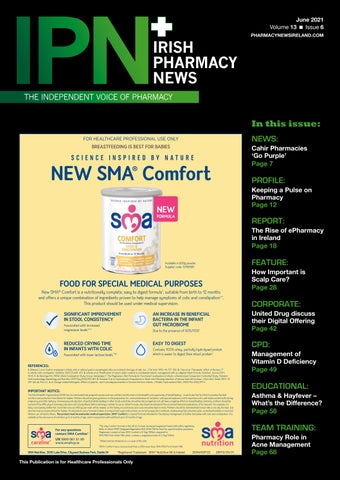
June 2021 Volume 13 Issue 6 PHARMACYNEWSIRELAND.COM
THE INDEPENDENT VOICE OF PHARMACY
In this issue: NEWS:
FOR HEALTHCARE PROFESSIONAL USE ONLY
BREASTFEEDING IS BEST FOR BABIES
Cahir Pharmacies ‘Go Purple’ Page 7
SCIENCE INSPIRED BY NATURE
NEW SMA® Comfort
PROFILE: Keeping a Pulse on Pharmacy Page 12
NEW
FORMULA
REPORT: The Rise of ePharmacy in Ireland Page 18
FEATURE:
Available in 800g powder Supplier code: 12458581
FOOD FOR SPECIAL MEDICAL PURPOSES
New SMA® Comfort is a nutritionally complete, easy to digest formula1, suitable from birth to 12 months and offers a unique combination of ingredients proven to help manage symptoms of colic and constipation1-7. This product should be used under medical supervision.
SIGNIFICANT IMPROVEMENT IN STOOL CONSISTENCY Associated with increased magnesium levels*2-4
EASY TO DIGEST Contains 100% whey, partially hydrolysed protein which is easier to digest than intact protein1
Associated with lower lactose levels
**5†
REFERENCES:
1. Billeaud C et al. Gastric emptying in infants with or without gastro-oesophageal reflux according to the type of milk. Eur J Clin Nutr 1990; 44: 577–583. 2. Chao et al. Therapeutic effect of Novalac-IT in infants with constipation. Nutrition 2007;23:469–473. 3. Infante et al. Modification of stool’s water content in constipated infants: management with an adapted infant formula. Nutrition Journal 2011; 10:55-8. 4. Benninga MA; MENA Infant Constipation Study Group, Vandenplas Y. The Magnesium-Rich Formula for Functional Constipation in Infants: a Randomized Comparator-Controlled Study. Pediatric Gastroenterology Hepatology and Nutrition 2019 May;22(3):270-281. 5. Kanabar D et al. Improvement of symptoms in infant colic following reduction of lactose load with lactase. J Hum Nutr Dietet 2001; 14: 359-363. 6. Moro G, et al. Dosage-related bifidogenic effects of galacto- and fructooligosaccharides in formula-fed term infants. J Pediatr Gastroenterol Nutr. 2002 Mar;34(3):291-5.
IMPORTANT NOTICE:
The World Health Organisation (WHO) has recommended that pregnant women and new mothers be informed on the benefits and superiority of breastfeeding – in particular the fact that it provides the best nutrition and protection from illness for babies. Mothers should be given guidance on the preparation for, and maintenance of, lactation, with special emphasis on the importance of a well-balanced diet both during pregnancy and after delivery. Unnecessary introduction of partial bottle-feeding or other foods and drinks should be discouraged since it will have a negative effect on breastfeeding. Similarly, mothers should be warned of the difficulty of reversing a decision not to breastfeed. Before advising a mother to use an infant formula, she should be advised of the social and financial implications of her decision: for example, if a baby is exclusively bottle-fed, more than one can (400 g) per week will be needed, so the family circumstances and costs should be kept in mind. Mothers should be reminded that breast milk is not only the best, but also the most economical food for babies. If a decision to use a formula is taken, it is important to give instructions on correct preparation methods, emphasising that unboiled water, unsterilised bottles or incorrect dilution can all lead to illness. This product must be used under medical supervision. SMA® Comfort is a special formula intended for the dietary management of bottle-fed babies with colic and constipation. It is suitable as the sole source of nutrition up to 6 months of age, and in conjunction with solid food up to 12 months of age.
For any questions contact SMA Careline®
UK 0800 081 81 80 www.smahcp.ie
Where lactose intolerance is a cause of the colic
**
SMA Comfort has a lactose level that is 35% lower than SMA PRO First Infant Milk
SMA Nutrition, 3030 Lake Drive, Citywest Business Park, Dublin 24
®Registered Trademark SMA® Nutrition UK & Ireland
This Publication is for Healthcare Professionals Only
DENWHSP122
CPD: Management of Vitamin D Deficiency Page 49
EDUCATIONAL: Asthma & Hayfever – What’s the Difference? Page 58
TEAM TRAINING:
* The only Comfort formula in the UK & I to have increased magnesium levels (still within regulatory limits of infant FSMP Delegated Regulation (EU) 2016/128 for food for special medical purposes). Magnesium content of new SMA Comfort is 8.1mg/100ml compared to SMA PRO First Infant Milk which contains a magnesium level of 5.7mg/100ml
†
CORPORATE: United Drug discuss their Digital Offering Page 42
AN INCREASE IN BENEFICIAL BACTERIA IN THE INFANT GUT MICROBIOME Due to the presence of GOS/FOS6
REDUCED CRYING TIME IN INFANTS WITH COLIC
How Important is Scalp Care? Page 28
ZRI913/05/21
Pharmacy Role in Acne Management Page 68
5
Contents
Foreword
Page 6: Blood Pressure Pilot rolled-out through pharmacy
As Irish Pharmacy News was going to press, The Irish Pharmaceutical Healthcare Association (IPHA), urged the Government to support global collaborative efforts to step up responsible Covid-19 vaccine dose-sharing and maximise production without compromising quality or safety.
Page 8: McKesson Ireland announce recognition awards Page 11: Pharmacy steps up to end period poverty Page 12: Analysis of Key Trends in the Pharmacy sector
11
Page 14: Inish Pharmacy celebrating a decade in business
14
Page 32: Support shown for frontline healthcare professionals Page 40: Darkness into Light for Daly’s Pharmacy PUBLISHER: IPN Communications Ireland Ltd. Clifton House, Fitzwilliam Street Lower, Dublin 2 00353 (01) 6690562
24
EDITOR Kelly Jo Eastwood: 00353 (87)737 6308 kelly-jo@ipn.ie
DESIGN DIRECTOR Ian Stoddart Design PHARMACYNEWSIRELAND.COM @Irish_PharmNews
As one community pharmacist says, “Covid has shown why e-health is so important. One of the key requirements for any proper e-prescribing infrastructure is an individual health identifier for a patient. Work on that started many years ago. By now, 2021, it was supposed to be fully rolled out, according to an implementation plan. It hasn’t been and it’s still the equivalent of the third secret of Fatima.” Turn to page 18 for the full article.
ADVERTISING EXECUTIVE Amy Evans: amy@ipn.ie
CONTRIBUTORS Niamh Cahill Ana Romero Theresa Lowry Lehnen Bernie Carter Dr Eamon Laird Ruth Morrow Rebecca Conway Dr Sarah Brewer Professor Moira O’Brien
In other news, on page 8 we detail how Ireland’s latest pharmacy offering – Chemist Warehouse – is planning to open a further store in Dublin. It is also believed a third store is on the way. The Chemist Warehouse brand was founded in Australia where it is the largest Pharmacy retail group. Their stores account for just under 10% of the physical pharmacies in Australia, but there sales equate to almost half the total pharmacy sales. Our report for this issue looks at ePrescribing and ePharmacy within Ireland, which has for some time been in the dark ages within this field. Niamh Cahill looks closer at the lack of progress and asks, ‘Now that Covid-19 has starkly illustrated the importance of efficient e-health systems, could this be about to change? Or will the pandemic set back plans even further?’
MANAGING DIRECTOR Natalie Maginnis n-maginnis@btconnect.com
CONTINUED PROFESSIONAL LEAD Sibongile Swan Mude swan@ipn.ie
The originator biopharmaceutical industry has brought forward Covid-19 vaccine breakthroughs in record time. By the end of this year, analysts are predicting 11 billion Covid-19 vaccine doses will have been produced – enough doses to vaccinate the world’s adult population. We will have more on this in the next issue. One of our leading news stories this month shows that the number of people who intend to get vaccinated for Covid-19, or who have already received a vaccine for the disease, has risen to 85%, according to the results of the latest tracker survey by Ipsos MRBI for IPHA.
Page 16: Boots Ireland expands their digital offering Page 24: Impact of Hayfever shown in new research
IPHA, in partnership with EFPIA, the industry’s European representative body, and other organisations said vaccines-makers, governments and non-governmental organisations must work together to ensure that Covid-19 vaccine doses equitably reach all priority populations globally.
32 Irish Pharmacy IRISH News is PHARMACY circulated to all NEWS independent, multiple Pharmacists and academics in Ireland. All rights reserved by Irish Pharmacy News. All material published in Irish Pharmacy News is copyright and no part of this magazine may be reproduced, stored in a retrieval system or transmitted in any form without written permission. IPN Communications Ltd. has taken every care in compiling the magazine to ensure that it is correct at the time of going to press, however the publishers assume no responsibility for any effects from omissions or errors.
We take a closer look at recent evidence from the Oireachtas Committee that Vitamin D deficiency is prevalent across the population in Ireland and the report which recommends that public health measures are established to address that deficiency. On page 46-47 you can read more about the recommendations, and industry opinion on the topic. We also have a plethora of clinically-authored features on current therapeutic areas including melanoma, scalp care and diabetes. I hope you enjoy the issue.
Regulars FEATURE: SCALP CARE
P28
FEATURE: SKIN CANCER
P33
CPD: VITAMIN D
P49
TEAM TRAINING: ACNE
P66
BUSINESS CPD:
P70
IrishPharmacyNews
PHARMACYNEWSIRELAND.COM
6
News
Pharmacy Pilots Blood Pressure Checks
Elections to PSI
Croí Third Age Mayo is partnering with 10 local pharmacies as part of a blood pressure measurement pilot programme. This initiative will see free blood pressure checks offered throughout the week to people over 55 years of age who have not had their blood pressure checked in the past year.
The Pharmaceutical Society of Ireland (PSI) Returning Officer Niall Byrne has declared the following five pharmacists as elected for appointment to the PSI Council:
Tom Treacy, Treacys Pharmacy
Members of the public found to have high blood pressure will be offered advice and information, as well as the opportunity to take part in a free blood pressure management programme, delivered by the Croí multidisciplinary health team. The pharmacies participating in the pilot programme are Molloy’s Pharmacy in Ballina, Crossmolina, Ballaghaderreen and Achill, Treacy’s Pharmacy in Castlebar, Westport and Ballinrobe, and O’Donnell’s Pharmacy and McVann’s Pharmacy in Westport.
People over 55 years of age interested in a free blood pressure check can simply contact one of the participating pharmacies to book an appointment, which are subject to availability. In other news, hypertension affects in excess of 50% of people over 50 years of age in Ireland. Lifestyle change is a critical element in blood pressure control and hypertension control is only effective when the individual understands their condition and are empowered to take action.
New research completed by NUI Galway, Croí – the West of Ireland Cardiac and Stroke Foundation, and the National Institute for Prevention and Cardiovascular Health, has explored the impact of a structured hypertension educational intervention programme on patient knowledge, lifestyle behaviours and blood pressure control. The study, published in the international medical journal SN Comprehensive Clinical Medicine, found a significant improvement in hypertension knowledge and awareness and a measurable increase in blood pressure control. First author of the paper Dr Haroon Zafar, Programme Lead for the Masters in Interventional Cardiovascular Medicine at NUI Galway, and Science Foundation Ireland and Irish Research Council funded Principal Investigator, said, “Providing a tailored educational intervention programme can have a positive impact on hypertension control, knowledge and self-care management within community-based settings. With upward trends for hypertension and cardiovascular disease across Ireland, the need for a new model to effectively treat and control hypertension among the Irish community becomes indispensable.” Over 100 participants from disadvantaged/underserved communities in County Mayo participated in the study.
From Baldoyle to Bulgaria Teva Pharmaceuticals has confirmed plans to close its Sudocrem production plant in Dublin with the loss of more than 100 jobs. The company told staff at the facility in Baldoyle of its plan. Sudocrem has been produced in Baldoyle since the 1940s. Production is to move to Bulgaria, with the Dublin factory expected to begin winding down operations in the third quarter of next year.
“We know that this news is disappointing for many, but we'll do everything we can to support all our affected employees throughout this process,” the company said.
The move is scheduled to be completed by January of 2023.
The company added that it will continue to have a strong presence in Ireland through its respiratory manufacturing plant in Waterford as well as commercial activities.
“Yesterday we met with employees at our Baldoyle plant to inform them of the proposed closure of the site, as part of a wider programme to optimise our global manufacturing network,” Teva said in a statement.
It added that it remains "committed to the Irish market". Sudocrem, which has been a household staple in Ireland for 90 years, is now available in more than 40 countries. An estimated 34.5 million pots are sold each year.
PHARMACYNEWSIRELAND.COM
Sudocrem was developed in 1931 by Dublin-based pharmacist Thomas Smith. It was originally called "Smith's Cream", later "Soothing Cream". The name changed to Sudocrem in 1950 due to the Dublin accent pronunciation of soothing cream. During the 1960s, samples of Sudocrem that were given to new mothers in Ireland increased the popularity of the product and the brand was gradually introduced to the UK in the 1970s. Its makers claim it to be the leading nappy rash cream in both Ireland and the United Kingdom.
• Rory O’Donnell • Sean Reilly • John Given • Katherine Morrow • Marie Louisa Power The Returning Officer shall give notice in writing to the Minister for Health of those pharmacists that have been selected. The Minister is responsible for approving all appointments to the PSI Council. You can view the election results in full, including details of the number of ballot papers issued (total electorate), the total valid poll, and the votes and transfers at each count by visiting the PSI website at www.thepsi.ie In accordance with the PSI (Council) Rules 2008 and 2015, the list of persons to be included in a panel for the filling of certain vacancies that may arise on Council is as follows, in decreasing order of the total number of votes cast for each candidate: • Avril Ryan • Thomas Michael Doody • Emma Early • Hazel Slevin • Dervla Kelly The counting of votes in the 2021 election of pharmacists for appointment to the PSI Council took place on Friday, 23 April 2021 at Office of the Dublin County Returning Officer, Unit 17 Tolka Valley Business Park, Ballyboggan Road, Dublin 11. The candidates are as follows: · Thomas Michael Doody (9661) · Emma Early (9623) · John Given (5868) · Dervla Kelly (9423) · Katherine Morrow (8399) · Rory O’Donnell (5334) · Marie Louisa Power (9409) · Sean Reilly (5410) · Avril Ryan (9240) · Hazel Slevin (9041) · Robert Anthony Wood (9564)
News Medicine Shortages The Health Products Regulatory Authority has been notified of a shortage of the following products: • Azacitidine Mylan 25mg/ ml Powder for Suspension for Injection – EU/1/20/1426/001 • Azarga 10mg/ml + 5mg/ ml Eye Drop Suspension – EU/1/08/482/001
7
Pharmacy Goes Purple Community pharmacies across the Cahir area are participating in the Go Purple Initiative to support and offer advice to victims of Domestic Violence. Pictured are - Back: Garda Jenny Gough and Sgt Ray Moloney, Front: Inspector Mark Allen, David Lennane, Zest Pharmacy, Dermot O’Brien, O’Brien’s Pharmacy, Seamus Kennedy Friary Street Pharmacy and CS Derek Smart
• Canesten HC 1% w/w & 1% w/w Cream – PA1040/040/002 • Caverject 10mcg Powder and Solvent for Solution for Injection – PA0822/115/002 • Clexane 40,000IU/0.4ml Solution for Injection in Prefilled Syringe – PA0540/097/005 • Cyklokapron 500mg Tablet – PA2010/055/001 • Diclac 50mg Gastro-resistant Tablet – PA0711/009/008 • Lercanidipine Clonmel 10mg Film Coated Tablet – PA0126/187/001 • Lercanidipine Clonmel 20mg Film Coated Tablet – PA0126/187/002 • Parlodel 2.5mg Tablet – PA2010/042/001 • Primovist 0.25mmol/ml Solution for Injection in Prefilled Syringe – PA1410/021/001 • Rifinah 300mg/150mg Tablet – PA0540/068/002 The following shortages have been resolved and supply has resumed to the Irish market: • Anastrozole Teva 1mg Film Coated Tablet – PA0749/028/001 • Champix 0.5mg Tablet – EU/1/06/360/001 • Flutiform 50mcg/5mcg per metered dose Pressurised Inhalation Suspension – PA1688/013/001 • Lignospan Special 20mg/12.5mg 2.2ml Solution for Injection – PA0196/013/001 • Lignospan Special 20mg/12.5mg 1.8ml Solution for Injection – PA0196/013/002 • Losartan 50mg Film Coated Tablet – PA0749/090/003 • Scandonest 3% w/v Solution for Injection – PA0196/015/001 • Tracrium 10mg/ml Solution for Injection or Infusion (250mg/2ml vial only) – PA1691/029/002 • Xylonor 150mg/g + 1.5mg/g Oromucosal Spray – PA0196/014/001 • Xylonor 50mg/g + 1.5mg/g Gingival Gel – PA0196/014/002
Just last month, Cahir Garda Station welcomed Breda Bell and Mary Barry from Cuan Saor and Seamus Scott from Men’s Aid Ireland for the launch of the “Go Purple” initiative across the Cahir District. They were accompanied by Dermot O’Brien, O’Briens Pharmacy, David Lennane, Zest Pharmacy and Seamus Kennedy from Friary Street Pharmacy. Each pharmacy was presented with a purple candle, kindly donated by Murphy Candles to display in the pharmacy their willingness to come to the assistance of those who need it.
The aim of this initiative is to allow victims of domestic violence to indicate to a member of staff in a pharmacy that they wish to access support and advice in relation to domestic violence. People can ask a pharmacy staff member for “Purple Clothes Dye” to speak to someone in confidence in those pharmacies. In turn, they will be offered advice from Cuan Saor
and in more serious situations, An Garda Síochána can also be contacted to offer advice in relation to Court Orders or indeed, in urgent circumstances to assist in bringing that person to safety. Cuan Saor is based in Clonmel and the group runs a free and confidential service for women and children experiencing domestic violence.
Public Appetite for Vaccine Rises to 85% The number of people who intend to get vaccinated for Covid-19, or who have already received a vaccine for the disease, has risen to 85%, according to the results of the latest tracker survey by Ipsos MRBI for the Irish Pharmaceutical Healthcare Association (IPHA) which represents the international researchbased biopharmaceutical industry. The results show that 73% of people will take a ovid-19 vaccine. But when combined with the vaccinated cohort, or 12% of the sample*, that number rises to 85% - 10 points higher than the percentage of people who said in January that they would take a COVID-19 vaccine. Between January and April, the number of people who said they either won’t get vaccinated for COVID-19 or were unsure about taking a vaccine has declined. In January, 7% said they would refuse a Covid-19 vaccine and 18% were unsure. This month, 6% say they will refuse a Covid-19 vaccine and 10% are unsure. Intention to take a COVID-19 vaccine is higher among older age groups and some in these groups have already been vaccinated. While just 6% of people overall
say they will not take a COVID-19 vaccine, it is highest among 25 to 34-year-olds, at 10%. While 10% say they are unsure about taking a Covid-19 vaccine, in the 18 to 24-year-old cohort it is 21%. Bernard Mallee, Director of Communications and Advocacy at IPHA, said, “There is no room for complacency though. We must keep facts to the forefront and trust the science. We are sharing on our social channels the benefits of immunisation through facts-based messaging and personal everyday stories told through film. As we start European Immunisation Week, communication and engagement are important in building confidence. “Vaccines are rigorously tested in clinical trials and closely monitored in the community by independent regulatory agencies. Vaccines
offer protection against infection which, allied with responsible behaviours, have an impact on the transmission of the virus. As more of us get vaccinated, we can expect to see greater protection in the community. While all that is happening, we should keep following public health advice. “Our industry, working with so many others, is bringing forward safe and effective COVID-19 vaccines in record time. Companies are working hard to surge COVID-19 vaccines production to meet global demand. Because of viral mutations, modified vaccines are in development. Much of our progress has been enabled by global collaboration and by science. Safety and effectiveness are our watchwords. Eventually, we will beat the pandemic, knowing there are better days to come.”
PHARMACYNEWSIRELAND.COM
8
News
Chemist Warehouse Eyes New Openings Chemist Warehouse, the Australian-founded pharmacy group, is getting ready to open their second store. Chemist Warehouse Blanchardstown pharmacy team members Kirsty Keogh, Kirk Richards, Ally Sharp and Michael Cesco very strong online business on TMall Global. Chemist Warehouse launched their first Irish store in Blanchardstown, in late October 2020. Despite opening and trading through lockdown, this new entrant to market has received a warm welcome from the public, a spokesperson told Irish Pharmacy News. Chemist Warehouse is the newest Pharmacy group to launch in Ireland.
equate to almost half the total pharmacy sales.
The brand was founded in Australia where it is the largest Pharmacy retail group.
The international expansion commenced in New Zealand in 2017 where the group now has over 20 stores.
Their stores account for just under 10% of the physical pharmacies in Australia, but their sales
They also commenced opening physical stores in China in 2019 where they already had a
“Their footfall continues to grow each day and the feedback from customers has been overwhelmingly positive. We have no doubt that with the easing of restrictions, this already popular new entrant to the market will see increased success,” they added. Whilst the expansion plans have been delayed by the lockdown
impacts on construction, the team are very excited to be opening another store soon. The new store will be located on Henry Street in the city centre in what was previously the Hickey’s Fabric store building. It is anticipated that the second store for the group will be open by the end of June. There is also rumoured to be a third store in the Dublin area in the coming months. The team at Chemist Warehouse are dedicated to providing affordable health and beauty products to the Irish public along with a high level of service. Having already employed 30 staff in their first store, the expansion is set to see increased employment opportunities. It is understood recruitment is currently underway. If you are interested in applying please email irelandHO@ chemistwarehouse.com
Pharmacy rates in the Top 10 for Reputation Boots Ireland has rated within the Top 10 of the most reputable organisations in Ireland with an Excellent Reputation Pulse score of 83.1 The pharmacy group came 5th overall whilst community pharmacies were revealed to be the second sector leading the response to Covid-19, behind healthcare professionals. This saw pharmacy rise from third place in April 2020. A Boots Ireland spokesperson said, “We are incredibly proud to be recognised as the most reputable pharmacy and retailer in Ireland for the second year running according to the 2021 Ireland RepTrak® study. The products and services we offer have also been rated the most reputable in the country. At Boots Ireland, our amazing Team Members are dedicated to offering the very best in customer and patient care and we couldn’t be prouder!” The Reputations Agency recently announced the results of the Ireland RepTrak® 2021 study, which is the 12th annual study of the reputational standing of Ireland’s 100 largest, most important, and most visible organisations was undertaken between January and March 2021. It identified the organisations and sectors that the Irish public believes have performed best during the Covid-19 pandemic. The report also showed that the public were six times more likely to purchase from an organisation with a Strong reputation (50% of the public) than a Poor reputation (just 8%) and ten times more likely to purchase from one with an Excellent Reputation (77%), clearly showing how reputation links directly with levels of stakeholder support.
McKesson Ireland Recognition Awards McKesson Ireland recently hosted their first virtual Employee Recognition Awards night. McKesson Ireland consists of four businesses across Ireland; United Drug, Lloyds Pharmacy, Median Healthcare and TCP Homecare. United by their iCare & iLead shared values, their employees work every day to innovate and deliver opportunities to improve patient care in every setting – one product, one partner, one patient at a time. The McKesson Ireland Employee Awards recognises and celebrates all those who embody their icare and ilead values and behaviours each and every-day. The past year has been extremely challenging for everyone and has truly tested their creativity, innovation and courage in the workplace. With nearly 550
nominations, the depth of gratitude their colleagues clearly feel for each other made the task of shortlisting all of these names an extremely difficult but worthwhile duty for the judges. They were absolutely blown away with the sheer volumes of nominations submitted.
PHARMACYNEWSIRELAND.COM
Well done to all those nominated and to those who were chosen for an award. There were twelve awards categories – one for each of the iCare and iLead values – as well as two overall awards for outstanding Employee of the year award and team of the year award.
An incredible night was had by all, not only for the awards ceremony but employees were also entertained by TV host Darren Kennedy and the legendary brain hacker Keith Barry. Follow them on LinkedIn to find out more about @McKessonIreland.
UnitedDrug Wholesale
Grow your Business with United Drug
Retail Solutions Compliance Based Buying Group Rewarding customers with best-in-class pricing. Choice Based Buying Group Unrivalled scale and range of product offering.
Safe & secure sourcing of unlicensed medicines Ensuring a quick and reliable delivery.
Knowledge Centre Providing meaningful insights, category management and webinars to optimise your business.
Ireland’s No1 provider of Ostomy products & Service Grow your business and in turn improve patient care.
Your full service pharmaceutical partner, delivering best in class products, services and business support for optimum patient care. www.united-drug.com
News Healthcare Worker Screening New research has shown that Covid-19 infections in healthcare workers during the first wave of the pandemic provided an accurate sample of the general population, suggesting that data from healthcare workers could be used to estimate the severity of future viruses more quickly. The study was led by researchers from RCSI University of Medicine and Health Sciences in collaboration with IBM Research. The researchers analysed the infection data from healthcare workers and the progression of the first wave of the Covid-19 outbreak using the reported daily infection numbers in Ireland. Using similar data in four other countries (Germany, UK, South Korea and Iceland), computer models showed how the disease progressed in different countries related to their approach to testing, tracing and lockdown restrictions. Healthcare workers in Ireland made up 31.6% of all testconfirmed infections while only representing 3% of the population. However, the researchers found that the healthcare worker data closely related to that of the entire population after using software to create a more accurate picture of how widespread the disease was. This suggests that governments could use data from only healthcare workers to inform decisions on whether to implement restrictions, widescale testing and contact tracing for future viruses. “As we have seen with the Covid-19 pandemic, implementing countermeasures early can save lives and reduce the spread of the disease,” said RCSI Professor of Chemistry Donal O’Shea, who led the work. “However, wide-scale testing can take time to set up, delaying decisions and costing lives. While the healthcare population is no longer an accurate sample of the general population for Covid-19 due to different vaccination rates, governments could use data from their healthcare worker population to make informed decisions on what measures to implement earlier when future viruses emerge.”
11
Pharmacy Steps Up CarePlus Pharmacy has become the first retail pharmacy network in Ireland to join the movement to end period poverty. The brand’s outlets across the country are now offering free tampons or sanitary pads to women and girls to help ensure no-one has to worry about affording these essential items as they go about their daily lives. CarePlus Pharmacy has positioned itself at the heart of communities across Ireland since its first outlet opened in 2017. From now on, an important feature of that community pharmacy role will include ensuring women and girls have access to suitable period products. Pharmacy staff already provide support and advice for customers in understanding their menstrual healthcare needs and today’s announcement will supplement that approach. The decision to offer the service was inspired by the steps taken by Lidl Ireland in recent days to provide a similar service. Director of Marketing at CarePlus Pharmacy, Lee-Ann Hyland says it’s a logical step forward for the company: “At CarePlus Pharmacy we’re proud to join with other brands in this movement towards open conversations on women’s
Lee-Ann Hyland, Director of Marketing at CarePlus Pharmacy
health and breaking down the barriers that can be put in the way of adequate care”. Claire Hunt from Homeless Period Ireland says, “We strongly welcome this news from CarePlus Pharmacy as they join our campaign to end period poverty. A local pharmacy can be a great source of support to women in coping with their menstrual cycle and knowing they acknowledge the reality of period poverty is so reassuring. We look forward to seeing more brands in Ireland following this example and helping women across Ireland.” Full details on how to avail of free period products can be found online at careplus.ie.
Cosmetic Association Trade Show It is with great regret that the organisers have made the decision to cancel the annual Cosmetic Association Trade Show for 2021. After many meetings with RDS and consultations with members, retailers, suppliers and also taking the ongoing restrictions by the Government because of Covid 19 all into account, they made the decision to cancel their trade show this year. Plans for 2022 have started already and the dates will be May 15th 16th & 17th
Allcare for Breast Cancer Research Pauline Staunton of Stauntons Allcare Late Night Pharmacy presents a cheque for ¤1,644 to research Director of the National Breast Cancer Research Institute, Professor Michael Kerin and National Breast Cancer Research Institute Galway voluntary fundraising committee member, Johanna Downes. The money was raised during a number of fundraising events across the Stauntons Allcare Pharmacy group held recently including Inis Mór.
Photo: Sean Lydon
PHARMACYNEWSIRELAND.COM
Keeping a Finger on the Pharmacy Pulse Pharmacy Pulse is an analysis of the key trends in the Irish Community Pharmacy sector, prepared by Fitzgerald Power on a quarterly basis. Here we take a closer look at the key findings presented.
investment and exited examinership, a development that protects jobs and the market position of the group.
Consolidation
The Irish Pharmaceutical Healthcare Association (IPHA) and the Irish government have agreed a six month extension to the drug supply agreement, with the recent bridging arrangement increasing access to 15 new drugs and providing €30 million to clear a ‘backlog’ of new medicines.
According to the Quarter 1 2021 report, just published last month, Pharmacy sector consolidation is a pre-COVID trend that looks set to continue, as owner operators retire or otherwise exit the market and large groups increase their footprint. This is evidenced by the number of acquisition opportunities coming to the market in H1 2021 and by other developments such as the recent market entry of Australian discounter Chemist Warehouse. Meanwhile, according to media speculation, McKesson is considering the sale of its UK based LloydsPharmacy network.
Medicine funding
the greater use of video conferencing and the online migration of consumers have created a reimagined trading landscape. Whether these trends persist post-pandemic remains to be seen, but in the short-term opportunities have emerged for nimble, tech focused operators.
Professional Trust The Ipsos MRBI Veracity index for 2021 was released in March. Pharmacy was judged the most trusted profession, with 96% of the public saying they trust their local pharmacist.
Vaccinations
OTC Trends
As of Saturday 3rd April, 932,234 vaccine doses had been administered in Ireland, meaning 13.3% of the population had received at least a first dose. The government aims to have a majority of the population vaccinated by the summer.
Research compiled by Statista indicates that OTC sales decreased by 3.5% in 2020 (the most recent available dataset). In the previous year activity increased by 1.67% implying a regression in longer term trends.
Examinerships
Technology
In January 2021 it was announced that the Cara group of pharmacies received fresh
The recent shift to e-prescribing has been driven by the COVID crisis and the requirement for patients and health professionals to find new ways to interact. Developments such as Healthmail,
OTC Growth The Fitzgerald Power 100 and Retail Excellence Ireland datasets both show negative OTC growth in Q1 2021 at 7.7% and 22.7% respectively, versus Q1 2020.
Footfall Mobililty Google mobility data gives a snapshot comparison to the same period in 2020, and shows mobility was up 15% in pharmacies and supermarkets on the 2nd April 2021. However, there is significant weekly variation in the mobility data and over the longer term the OECD has estimated a 20% drop in all mobility over the period of the pandemic.
Market Pulse Internal Fitzgerald Power data suggests that in spite of the COVID-19 pandemic, 2020 was a strong year for pharmacy transactions. In Q1 2021 there were two transactions completed outside of the Cara group sale, one in Dublin and one in Cork. The Cara group examinership deal involved the sale of 13 pharmacies. PSI data suggests there have been four new openings since the beginning of 2021, bringing the number of community pharmacies in Ireland to 1,894 by 31st March.
12 | PHARMACYNEWSIRELAND.COM
Research compiled by Statista indicates that OTC sales decreased by 3.5% in 2020 (the most recent available dataset). In the previous year activity increased by 1.67% implying a regression in longer term trends.
Summary Q1 2021 OTC Tracker
SOURCE: STATISTA
€m
60
Market Pulse
50
Market Pulse Consolidation 40
Turnover
30
Internal Fitzgerald Power data suggests that in spite of the Pharmacy sector consolidation is a strong pre-COVID trend Internal Fitzgerald that in of the that COVID-19 pandemic,Power 2020 data was asuggests year forspite pharmacy 10 COVID-19 pandemic, 2020 was a strong year for pharmacy transactions. In Q1 2021 there were two transactions looks set to continue, as owner operators retire or otherwise transactions. In Q1 2021 there were two transactions 0 outside one in Dublin 2012 completed 2013 2014 of the 2015Cara group 2016 sale,2017 2018 and2019 2020 exit the market and large increase their footprint. completed outsidegroups of the Cara group sale, one in Dublin and one in Cork. one in Cork. This is evidenced by the number of acquisition opportunities Analagelics Cold & Cough The Cara group examinership deal involved the Digestives sale of & Intensinal The Cara group examinership deal involved the sale of Skin Treatments in H1 2021 Vitaminsand & Minerals Hand Sanitiser 13 pharmacies. coming to the market by other developments 13 pharmacies.
Revenue Pulse
20
Fitzgerald Power estimates a 1.14% decline in total pharmacy
Completed Deals in Q1 by revenues Completed Deals induring Q1 by the first quarter of 2021 versus the same Pharmacy Type Pharmacy Type last year. period CorporateGroup Group Corporate 0 0 Volume of Sales: Fitzgerald Power 100
1.14%
IndigenousGroup Group such as the recent market entry of Australian discounter Indigenous 13 13 SOURCE: FITZGERALD POWER Chemist Warehouse. Meanwhile,inaccording to media Independent OTC Growth Mobililty Completed by Independent 1 1 CompletedDeals Deals inQ1 Q1Footfall by The Fitzgerald Power 100 and Retail Excellence Ireland Google mobility data gives a snapshot comparison to speculation, McKesson is considering the sale of its UK based Geographical Location Geographical datasets both show negative OTC growth in Q1 2021 at Locationthe same period in 2020, and shows mobility was up 15% SymbolGroup Group Symbol 1 1 7.7% and 22.7% respectively, versus Q1 2020. in pharmacies and supermarkets on the 2nd April 2021. Lloyds Pharmacy network. Retail Excellence Ireland reports a decline of 5.8% in total sales OTC Growth
Examinerships
However, there is significant weekly variation in the mobility data and over the longer term the OECD has estimated a SOURCE: FITZGERALD POWER SOURCE: FITZGERALD POWER 20% drop in all mobility over the period of the pandemic.
0
in Q1 2021 versus Q1 2020.
Volume of Sales: Retail Excellence Ireland
Pharmacies and Supermarkets
In-�5 January 2021 it was announced that the Cara group 30 -��10 pharmacies received fresh investment and exited of 20 -��15 examinership, a development that protects jobs and the 10 -��20 market position of the group. 0
PSI have been four new openings since PSIdata datasuggests suggeststhere there have been four new openings since the bringing thethe number of community thebeginning beginningofof2021, 2021, bringing number of community SOURCE: REI pharmacies toto 1,894 byby 31st31st March. pharmaciesininIreland Ireland 1,894 March.
New and The volume of sales as measured by the CSO, increased by 3.8% NewOpenings Openings andClosures Closures
-��30
Medicine funding Fitzgerald Power 100 - 7.7%
Retail Excellence Ireland - 22.7%
Overall 15%
Cork 13%
Cavan 30%
Limerick 4%
Largest movement
Smallest movement
Dublin 12%
The Irish Pharmaceutical Healthcare Association (IPHA) and the Irish government have agreed a six month extension to the drug supply agreement, with the recent bridging arrangement increasing access to 15 new drugs and providing Dublin 2 Ulster/Connacht 11 at in spite of the Dublin 2 11 €30 million to clearMunster a ‘backlog’ ofUlster/Connacht new medicines. ar for pharmacy 1 Leinster 1 SOURCE: FITZGERALD POWER, REI
ansactions one in Dublin and
Completed Deals in Q1 by Munster 1 Leinster 1 Pharmacy Type
Vaccinations
Closures between 1st January ClosuresSOURCE: between 1st January CSO – 31st March 2021 – 31st March 2021
3
Net Openings between Net Openings between 1st January – 31st March 2021 1st January – 31st March 2021
1
Item Trends
SOURCE: PSI
SOURCE: FITZGERALD POWER
Corporate Group 0 As of Saturday 3rd April, 932,234 vaccine doses had been Completed Deals in Q1 by HSE Fees Indigenous Group 13 administered in Ireland, meaning 13.3% of the population had Completed Deals in Q1 by HSE Fees List Position received at leastList aIndependent first dose. The government aims 1 to have a Position majority of the population vaccinated by the summer. Symbol Group 1 €250k and over €250k and over €175k-249k SOURCE: FITZGERALD POWER €175k-249k €100k-174k
Technology
6 6 4
44
The recent shift to e-prescribing has been driven by the €100k-174k Under €100k 14 PSI data there have been new openings COVID crisis and thesuggests requirement forfour patients andsince health €100k 1 theUnder beginning of 2021, bringing the number of community professionals to find new ways to interact. Developments pharmacies in Ireland POWER to 1,894 by 31st March. SOURCE: FITZGERALD such as Healthmail, the greater use of video conferencing SOURCE: FITZGERALD POWER and the online migration of consumers have created a New Openings and Closures reimagined trading landscape. Whether these trends persist post-pandemic remains to be seen, but in the New Openings between short-term opportunities 1st Januaryhave – 31stemerged March 2021for nimble, 4 tech focused operators. Closures between 1st January – 31st March 2021
Professional Trust Net Openings between
3
The Ipsos MRBI Veracity index forMarch 2021 2021 was 1st January – 31st 1 released in March. Pharmacy was judged the most trusted profession, with SOURCE: PSI 96% of the public saying they trust their local pharmacist.
in February 2021 against the same period last year.
New Openings between New Openings between 1st January – 31st March 4 Volume of 2021 Sales: 1st January – 31st March 2021 CSO 4
SOURCE: FITZGERALD POWER
d the sale of
cht 11
SOURCE: GOOGLE MOBILITY
5.8%
SOURCE: PSI
3.8%
3
1
According to hMR Ireland, the Irish prescription market grew by 1.15% in units in the 12-month period to March 2021. Fitzgerald Power’s internal data shows a 0.23% decrease in medicine items in Q1 2021 versus Q1 2020. REI report that dispensary volumes declined by 3.8% in Q1 2021 when compared to Q1 2020.
Item Growth 2 0 -�2 -�4 hMR 1.15%
REI - 3.8%
Fitzgerald Power - 0.23% SOURCE: FITZGERALD POWER, HMR IRELAND, REI
SE Fees
PHARMACYNEWSIRELAND.COM | 13
14
News
IPHA Consumer rebranded as Self-Care Division The Irish Pharmaceutical Healthcare Association (IPHA) has rebranded its Consumer Healthcare Division as the Self-Care Division. This decision was made to better explain the vision of the group which is to build trust in self-care through access, awareness and education. It acknowledges the increased remit of the IPHA Code to include medical devices and Traditional Herbal Medicinal Products (THMPs) and in recognition of the newly launched Self-Care Advertising Code. John Sheehy, Chair of the IPHA Self-Care Division and Country Manager at Perrigo
Covid has changed how people engage with the healthcare system. The rebranding of the Consumer Healthcare Division is in response to that change in healthcare behaviours. Global trends suggest people are more attuned to personal health and wellbeing. They are reappraising their behaviour and attitudes to self-care by prioritising it as a lifestyle choice. Self-care is about people taking ownership of their own health and making it better. That can be through exercising more, getting the right amount of sleep, eating the right foods or using the right non-prescription medicinal products and devices. The renewed focus of the SelfCare Division is to deliver trust in science and medicines. Building and supporting access to self-care will ultimately reduce the demands on the healthcare system.
At the start of March, the new IPHA Self-Care Advertising Code came into effect. It continues to apply to advertisements for nonprescription medicines - and it addresses advertisements for nonprescription medical devices for self-care use (except those used for diagnostic purposes or are used for a cosmetic condition) and for THMPs. The expanded remit of the Code gives companies the opportunity to adhere to a Code of Practice that is continuously updated in light of national and
international changes in standards, national regulatory discussions and developments in the industry - all with the aim of ensuring the highest standards in interaction by companies with the public and with healthcare professionals. The new IPHA Self-Care Advertising Code has a dedicated section for online activities which are becoming increasingly important. John Sheehy, Chair of the IPHA Self-Care Division and Country Manager at Perrigo, says, “In rebranding the Self-Care Division, we are responding to the external environment. Healthcare practices are always evolving but never so much as in the past year. Self-care is increasingly becoming a key part of personal health management, whether it is to exercise more, improve your diet or look after your mental health. It is about having trust and faith in the science behind non-prescription medicines which can positively impact on your overall health and wellbeing. The vision of the Self-Care Division is to build this trust and give people the confidence to make the right decisions about their own lives.”
A Decade of Service for Inish Pharmacy Inish Pharmacy are celebrating 10 years of being in pharmacy business in Muff. Inish Pharmacy comprises three independently owned community pharmacies serving Inishowen, County Donegal. Inish Pharmacy began in 2007, opening in Carndonagh Shopping Centre. In 2011, they saw the second Inish Pharmacy open its doors, located in Muff, on the village Main Street. In March 2016 they opened their newest pharmacy at Railway Road in Buncrana.
PHARMACYNEWSIRELAND.COM
Alcohol Policy Research Network A new network for alcohol policy researchers in Ireland and the UK has officially launched, led by Trinity College Dublin’s Professor Joe Barry and the University of Stirling’s Professor Niamh Fitzgerald. The Alcohol Research Network UK-Ireland (ACORN) will act as a forum and stimulus for an interdisciplinary approach to the cultural, social, political and economic challenges faced by Ireland and the UK in attempting to implement effective policies to reduce the harm caused by alcohol consumption. The Irish Research Council and the Economic and Social Research Council in the UK has provided seed funding for ACORN activities for 202122. The network aims to build capacity and drive innovation in alcohol policy research to support effective policy development, enactment, implementation and evaluation. By harnessing the knowledge and expertise of a wide range of academics through the network, researchers hope to find synergies, create new collaborations and benefit from shared learning. The group has identified four cross-cutting themes: the first three – alcohol availability, pricing, and marketing reflect the most effective approaches to reducing alcohol harms at a population level. The fourth theme focuses on the politics of alcohol policymaking. Niamh Fitzgerald, Professor of Alcohol Policy at Stirling’s Institute for Social Marketing and Health, said, “Despite historically being the domain of clinicians, alcohol is embedded in and affected by a range of cultural, social and societal influences that need to be considered if we’re to successfully reduce its harms among populations. This new network will be open to researchers from all disciplines, working across Scotland, England, Wales, Northern Ireland and the Republic of Ireland. “By developing new partnerships between areas of research and different countries, sharing ideas and identifying common priorities, we will be able to effectively grow and diversify the strength of the vital research in this area.”
INDICATED FOR THE PREVENTION OF PNEUMOCOCCAL PNEUMONIA IN ADULTS
1
PNEUMOCOCCAL
PNEUMOCOCCAL
VACCINATION VS PNEUMONIA
The persons depicted are models used for illustrative purposes only.
1,2
Help prevent pneumococcal pneumonia with the proven protection of Prevenar 13
Proven to reduce the risk of community-acquired pneumonia: Results from the Community-Acquired Pneumonia Immunisation Trial in Adults (CAPiTA) – one of the largest vaccine efficacy trials ever conducted in older adults.2,3 ABBREVIATED PRESCRIBING INFORMATION Prevenar 13* Suspension for Injection Pneumococcal polysaccharide conjugate vaccine (13-valent, adsorbed) Presentation: Each 0.5ml dose of Prevenar 13 contains 2.2 micrograms of each of the following pneumococcal polysaccharide serotypes: 1, 3, 4, 5, 6A, 7F, 9V, 14, 18C, 19A, 19F, 23F and 4.4 micrograms of pneumococcal polysaccharide serotype 6B. Each pneumococcal polysaccharide is conjugated to CRM197 carrier protein and adsorbed on aluminium phosphate. 1 dose (0.5 ml) contains approximately 32 µg CRM197carrier protein and 0.125 mg aluminium. Indications: Active immunisation for the prevention of invasive disease, pneumonia and acute otitis media caused by Streptococcus pneumoniae in infants, children and adolescents from 6 weeks to 17 years of age. Active immunisation for the prevention of invasive disease and pneumonia caused by Streptococcus pneumoniae in adults ≥18 years of age and the elderly. Dosage and Administration: The immunisation schedules for Prevenar 13 should be based on official recommendations. It is recommended that infants who receive a first dose of Prevenar 13 complete the vaccination course with Prevenar 13. For intramuscular injection. Infants aged 6 weeks-6 months: Three dose primary series: The recommended immunisation series consists of four doses, each of 0.5ml. The primary infant series consists of three doses, with the first dose usually given at 2 months of age and with an interval of at least 1 month between doses. The first dose may be given as early as six weeks of age. The fourth (booster) dose is recommended between 11 and 15 months of age. Two dose primary series: Alternatively, when Prevenar 13 is given as part of a routine infant immunisation programme, a series consisting of three doses, each of 0.5ml, may be given. The first dose may be administered from the age of 2 months, with a second dose 2 months later. The third (booster) dose is recommended between 11 and 15 months of age. Preterm infants (< 37 weeks gestation): In preterm infants, the recommended immunisation series consists of four doses, each of 0.5 ml. The primary infant series consists of three doses, with the first dose given at 2 months of age and with an interval of at least 1 month between doses. The first dose may be given as early as six weeks of age. The fourth (booster) dose is recommended between 11 and 15 months of age. Unvaccinated infants and children ≥ 7 months of age: Infants 7-11 months: Two doses, each of 0.5 ml, with at least a 1 month interval between doses. A third dose is recommended in the second year of life. Children aged 12-23 months: Two doses, each of 0.5 ml, with at least a 2 month interval between doses. Children and adolescents aged 2-17 years: one single dose of 0.5 ml. Prevenar 13 vaccine schedule for infants and children previously vaccinated with Prevenar (7-valent) (Streptococcus pneumoniae serotypes 4, 6B, 9V, 14, 18C, 19F, and 23F): Infants and children who have begun immunisation with Prevenar may switch to Prevenar 13 at any point in the schedule. Children aged 12-59 months: Children who are considered completely immunised with Prevenar (7-valent) should receive one dose of 0.5 ml of Prevenar 13 to elicit immune responses to the 6 additional serotypes. This dose of Prevenar 13 should be administered at least 8 weeks after the final dose of Prevenar (7-valent). Children and adolescents aged 5-17 years: One single dose of Prevenar 13 if they have been previously vaccinated with one or more doses of Prevenar. This dose of Prevenar 13 should be administered at least 8 weeks after the final dose of Prevenar (7-valent). Adults ≥18 years of age and the elderly: One single dose. The need for revaccination with a subsequent dose of Prevenar 13 has not been established. Regardless of prior pneumococcal vaccination status, if the use of 23 valent polysaccharide vaccine is considered appropriate, Prevenar 13 should be given first. Special Populations: Individuals who have underlying conditions predisposing them to invasive pneumococcal disease (such as sickle cell disease or HIV infection) including those previously vaccinated with one or more doses of 23-valent pneumococcal polysaccharide vaccine may receive at least one dose of Prevenar 13. In individuals with an haematopoietic stem cell transplant (HSCT), the recommended immunisation series consists of four doses of Prevenar 13, each of 0.5 ml. The primary series consists of three doses, with the first dose given at 3 to 6 months after HSCT and with an interval of at least 1 month
between doses. A fourth (booster) dose is recommended 6 months after the third dose. Contra-indications: Hypersensitivity to any component of the vaccine or to diphtheria toxoid. As with other vaccines, the administration of Prevenar 13 should be postponed in subjects suffering from acute, severe febrile illness. However, the presence of a minor infection, such as a cold, should not result in the deferral of vaccination. Warnings and Precautions: Do not administer intravascularly. Appropriate medical treatment and supervision must be readily available in case of a rare anaphylactic event. This vaccine should not be given as an intramuscular injection to individuals with thrombocytopenia or any coagulation disorder that would contraindicate intramuscular injection, but may be given subcutaneously if the potential benefit clearly outweighs the risks of administration. Prevenar 13 will only protect against Streptococcus pneumoniae serotypes included in the vaccine, and will not protect against other microorganisms that cause invasive disease, pneumonia, or otitis media. As with any vaccine, Prevenar 13 may not protect all individuals receiving the vaccine from pneumococcal disease. Individuals with impaired immune responsiveness, whether due to the use of immuno-suppressive therapy, a genetic defect, human immunodeficiency virus (HIV) infection, or other causes, may have reduced antibody response to active immunization. Safety and immunogenicity data are available for a limited number of individuals with sickle cell disease, HIV infection, or with an HSCT. Safety and immunogenicity data for Prevenar 13 are not available for individuals in other specific immuno-compromised groups (e.g., malignancy or nephrotic syndrome) and vaccination should be considered on an individual basis. Infants and children aged 6 weeks to 5 years: Prevenar 13 does not replace the use of 23-valent pneumococcal polysaccharide vaccine in at risk children ≥ 24 months of age. Children ≥ 24 months of age at high risk, previously immunised with Prevenar 13 should receive 23-valent pneumococcal polysaccharide vaccine whenever recommended. The potential risk of apnoea and the need for respiratory monitoring for 48-72 hours should be considered when administering the primary immunisation series to very premature infants (born ≥ 28 weeks of gestation) and particularly for those with a previous history of respiratory immaturity. When Prevenar 13 is administered concomitantly with Infanrix hexa (DTPa-HBV-IPV/Hib), the rates of febrile reactions are similar to those seen with concomitant administration of Prevenar (7-valent) and Infanrix hexa. Increased reporting rates of convulsions (with or without fever) and hypotonic hyporesponsive episode (HHE) were observed with concomitant administration of Prevenar 13 and Infanrixhexa. Antipyretic treatment should be initiated according to local guidelines for children with seizure disorders or with a history of febrile seizures and for all children receiving Prevenar 13 simultaneously with vaccines containing whole cell pertussis. Adults aged 50 years and older: When Prevenar 13 was given concomitantly with trivalent inactivated influenza vaccine (TIV), the immune responses to Prevenar 13 were lower compared to when Prevenar 13 was given alone, however, there was no long-term impact on circulating antibody levels. The immune responses to Prevenar 13 were noninferior when Prevenar 13 was given concomitantly with quadrivalent inactivated influenza vaccine (QIV) compared to when Prevenar 13 was given alone. As with concomitant administration with trivalent vaccines, immune responses to some pneumococcal serotypes were lower when both vaccines were given concomitantly. Fertility, Pregnancy & Lactation: There are no data from the use of pneumococcal 13-valent conjugate in pregnant women. It is unknown whether pneumococcal 13-valent conjugate is excreted in human milk. Animal studies do not indicate direct or indirect harmful effects with respect to reproductive toxicity. Side Effects: Analysis of postmarketing reporting rates suggests a potential increased risk ofconvulsions, with or without fever, and HHE when comparing groups which reported use of Prevenar 13 with Infanrix hexa to those which reported use of Prevenar 13 alone. Adverse reactions reported in clinical studies or from the post-marketing experience for all age groups are listed in this section per system organ class,in decreasing order of frequency and seriousness. The frequency is defined as follows: very common (≥ 1/10), common (≥ 1/100 to < 1/10), uncommon (≥ 1/1,000 to < 1/100), rare (≥ 1/10,000 to < 1/1,000), very rare (≤ 1/10,000), not
References: 1. Prevenar 13 Suspension for Injection Summary of Products Characteristics. 2. Bonten M.J.M., Huijts S.M, Bolkenbaas M, et al. Polysaccharide Conjugate Vaccine Against Pneumococcal Pneumonia in Adults. The New England Journal of Medicine. 2015;372:1114-25. 3. Pfizer Inc. Press Release Mar 18, 2015.
known (cannot be estimated from available data). Infants and children aged 6 weeks to 5 years: Very common (≥ 1/10): Decreased appetite, fever, pyrexia, irritability, any vaccination-site erythema, induration/swelling or pain/tenderness, somnolence, poor quality sleep. Vaccination-site erythema or induration/swelling 2.5cm – 7.0 cm (after the booster dose and in older children [age 2-5 years]. Common (≥ 1/100 to < 1/10): Vomiting, diarrhoea, rash, pyrexia >39 °C, vaccination-site movement impairment (due to pain), vaccination-site erythema or induration/swelling 2.5cm – 7.0cm (after infant series). Uncommon (≥ 1/1,000 to < 1/100): Convulsions (including febrile convulsions), urticaria or urticaria-like rash, vaccination-site erythema, induration/swelling >7.0cm, crying. Rare: Hypersensitivity reaction including face oedema, dyspnoea, bronchospasm, hypotonic-hyporesponsive episode. Not known: Lymphadenopathy (localised to the region of the vaccination site), anaphylactic/anaphylactoid reaction including shock, angioedema, erythema multiforme, vaccination site urticaria, vaccination-site dermatitis, vaccination-site pruritus, flushing. In clinical studies infants vaccinated at 2, 3 and 4 months of age, fever ≥ 38°C was reported at higher rates among infants who received Prevenar (7-valent) concomitantly with Infanrix hexa than in infants receiving Infanrix hexa alone. After a booster dose at 12 and 15 months of age, the rate of fever ≥ 38°C was greater in infants who received Prevenar (7 valent) and Infanrix hexa at the same time compared to infants receiving Infanrix hexa alone. These reactions were mostly moderate (less than or equal to 39°C) and transient. Additional information in special populations: Apnoea in very premature infants (≤ 28 weeks of gestation). Children and adolescents aged 6 to 17 years of age: Very common (≥ 1/10): Decreased appetite, irritability, any vaccination-site erythema, induration/swelling or pain/ tenderness, somnolence, poor quality sleep, vaccination-site tenderness (including impaired movement). Common (≥ 1/100 to < 1/10): Headaches, vomiting, diarrhoea, rash, urticaria or urticaria-like rash, pyrexia. Additional information in special populations: Children and adolescents with sickle cell disease, HIV infection or an HSCT transplant have similar frequencies of adverse reactions, except that headaches, vomiting, diarrhoea, pyrexia, fatigue, arthralgia, and myalgia were very common. Adults ≥18 years of age, and the elderly: Very common (≥ 1/10): Decreased appetite, headaches, diarrhoea, vomiting,(in adults aged 18 to 49 years), rash, chills; fatigue; vaccination-site erythema; vaccination-site induration/swelling; vaccination-site pain/tenderness (severe vaccination-site pain/ tenderness very common in adults aged 18 to 39 years); limitation of arm movement (severe limitation of arm movements very common in adults aged 18 to 39 years), arthralgia; myalgia. Common (≥ 1/100 to < 1/10): Vomiting (in adults aged 50 years and over), pyrexia(very common in adults aged 18 to 29 years). Uncommon (≥ 1/1,000 to < 1/100): Nausea, hypersensitivity reaction including face oedema, dyspnoea, bronchospasm, lymphadenopathy localized to the region of the vaccination site. Additional information in special populations: Adults with HIV infection have similar frequencies of adverse reactions, except that pyrexia and vomiting were very common and nausea common. Adults with an HSCT have similar frequencies of adverse reactions, except that pyrexia and vomiting were very common. For full prescribing information see the Summary of Product Characteristics. Legal Category: S1A. Package Quantities: Pack of 1 single-dose prefilled syringe (with separate needle) or pack of 10 single- dose pre-filled syringes. Marketing Authorisation Numbers: Single-dose pre-filled syringe (with separate needle) pack of 1: EU/1/09/590/002, single-dose pre-filled syringe pack of 10: EU/1/09/590/003. Marketing Authorisation Holder: Pfizer Europe MA EEIG, Boulevard de la Plaine 17, 1050 Bruxelles, Belgium. For further information on this medicine please contact: Pfizer Medical Information on 1800 633 363 or at EUMEDINFO@pfizer.com. For queries regarding product availability please contact: Pfizer Healthcare Ireland, Pfizer Building 9, Riverwalk, National Digital Park, Citywest Business Campus, Dublin 24 + 353 1 4676500. Date of preparation: 11/2018. *Trade mark. Ref: PN 11_0 IE.
Date of Preparation: February 2021 | PP-PNA-IRL-0005
16
News
Boots Expands Digital Offering Boots Ireland now offer their patients access to online consultations with a GP, or for repeat prescription ordering. The move is in response to patient need for safe, accessible, digital solutions for healthcare. Caoimhe McAuley, Director of Pharmacy and Superintendent Pharmacist, Boots Ireland
since the start of the pandemic, the main benefits of telemedicine were identified by customers as ease of access, cost effectiveness, minimising physical contact with others and convenience.[i] The service offers a quick and easy way for people to book an online consultation with a doctor or order a repeat prescription, making it easier to access healthcare
services from the comfort of your own home. A recent report by the Medical Council found that there has been a five-fold increase in the use of telemedicine in Ireland
The Online Doctor Service provides GP-led appointments for non-emergency medical issues where a physical check-up may not be necessary. Customers can also use the service to order a
repeat prescription for a range of health conditions including acne, asthma, contraceptive pill and patch, cystitis, erectile dysfunction, hair loss, high cholesterol, IBS, malaria prevention, period delay, premature ejaculation, smoking cessation, strep throat infections, thrush treatment and weight loss. Commenting on the launch of the Boots Ireland Online Doctor Service, Caoimhe McAuley, Director of Pharmacy and Superintendent Pharmacist, Boots Ireland said, “The launch of the Online Doctor Service at Boots Ireland represents an evolution of the range of services already provided to our customers as we continue to innovate our pharmacy services offering. Customers now have the opportunity to access GP services via our Online Doctor Service at boots.ie/online-doctor. Here patients can consult with a GP, access trusted advice and receive a prescription if required, which can be dispensed at any of our nationwide pharmacies.” https://www.medicalcouncil.ie/ news-and-publications/press-releases/ press-release/items/five-fold-increasein-use-of-telemedicine-in-ireland-sincestart-of-pandemic.html
[i]
New Study on Covid-19 Outcomes A national study of 20,000 patients conducted by RCSI University of Medicine and Health Sciences and the HSE Health Protection Surveillance Centre (HPSC) has identified the underlying conditions that are associated with more severe outcomes from Covid-19 in an Irish setting. The research, which has been published in The Lancet Regional Health – Europe, will help inform national public health policies and assist in future treatment and prevention strategies for people at most risk from the virus. The study, which took place during the first wave of the pandemic between March and July 2020, is the first national surveillance study in Ireland that captures data from both hospital and community settings. Data was collected by HPSC for almost 20,000 confirmed
cases of Covid-19. The association between underlying conditions and more severe outcomes from Covid-19 was examined, including mortality, admission to hospital or admission to ICU. Amongst the patients studied, there were 1,476 (7.5%) deaths, 2,811 (14%) hospitalisations and 438 (2%) ICU admissions. The conditions that were identified in the study as carrying the most risk were chronic heart disease, a chronic neurological condition, chronic kidney disease and cancer. Patients
PHARMACYNEWSIRELAND.COM
who were morbidly obese (defined as a Body Mass Index equal to or greater than 40) were also identified as being at higher risk of more severe outcomes from Covid-19. Professor Kathleen Bennett, Associate Professor in Biostatistics, RCSI said: “Previous studies conducted have suggested that specific underlying conditions influence adverse health outcomes among those with a confirmed diagnosis of Covid-19. However, the majority of these studies have focussed on hospital-based or local
populations only. This study is the first population-based research to capture data across all settings in Ireland, including both community and hospital settings and so it gives us a better picture of the impact of the disease on patients at the population level. “The findings are of particular relevance as the national vaccination programme is well underway including those at very high risk and high risk from the most severe outcomes of Covid-19.”
ORDER NOW: WHOLEFOODS WHOLESALE 01-6262315
18
Report
Time to make ePrescribing a Reality
In 2013 the eHealth Strategy for Ireland was launched to great fanfare. After years spent in the digital doldrums the Irish healthcare service would soon have electronic prescribing, among other initiatives. But despite initial optimism little has been achieved following years of insufficient investment. - Niamh Cahill reports. Ireland remains in the dark ages when it comes to digital electronic pharmacy initiatives in primary care. This is in stark contrast to Northern Ireland, for example, where electronic prescribing has been in use as far back as 2008. The lack of progress is not related to the absence of guidelines and recommendations on the matter. Several reports, not least among them the 2013 eHealth Strategy for Ireland, have underlined how community e-prescribing could
increase patient safety and reduce medication error, among countless other benefits. Internationally, e-prescribing is considered a fundamental building block of national e-health systems. But the work of eHealth Ireland, a division of the HSE solely focused on e-health implementation projects, in delivering e-prescribing has been hampered by a continued lack of investment. Now that Covid-19 has starkly illustrated the importance of
PHARMACYNEWSIRELAND.COM
efficient e-health systems, however, could this be about to change? Or will the pandemic set back plans even further? Benefits of e-prescribing E-prescribing in primary care is one of eHealth Ireland’s e-pharmacy programme’s three main pillars. The others are a national medicinal product catalogue and e-pharmacy in hospital settings. Engagement with e-pharmacy is another important part of the programme.
Research has shown that e-prescribing can deliver significant cost, time and social benefits. Because of this it has been adopted in several countries internationally where these rewards are now being enjoyed by patients and healthcare professionals. E-prescribing programmes can boost patient safety and outcomes, increase transparency and reduce medication errors. In Sweden, for example, e-prescribing reduced medication errors by at least 15 per cent, according to data from 2017.
19 can cost far less and take less time than processing the same prescriptions manually. Contributors…also emphasised the benefits of e-prescribing in the management of repeat prescriptions and the reduction of transcription, both of which were considered problematic and time consuming.” The Irish Pharmacy Union (IPU) defines e-prescribing as “the computer-based electronic generation, transmission and filing of a medical prescription. It allows medical practitioners to write and send prescriptions to a pharmacy electronically instead of using paper prescriptions.” A 2012 report “Adding Value to Community Pharmacy” outlined the system would provide pharmacies with access to a patient’s prescription history, including information on amounts prescribed, when prescriptions were dispensed and where. “This will enhance their ability to check drug compatibility and safety. Furthermore, there would be a significant reduction in excess communication and verification that occurs between pharmacies and doctors to clarify information that is illegible on scripts, or obtain additional information,” said the report.
In Estonia, one of the most digitally advanced countries in the EU, cost savings from e-prescribing in 2010 almost matched the country’s investment in the printing and secure storage of the forms in 2009. HIQA in 2018 noted that “e-prescribing can improve patient safety considerably, for example, by reducing errors of mistaken identity, incorrect dosage, incorrect medication and adverse drug interactions.” They continued: “It can resolve challenges concerning overlapping medications and improve medication practices. It can also reduce the number of pharmacist interventions significantly. E-prescribing
“Such a system would facilitate closer collaboration and communication between hospital and community pharmacist, which is a key goal of both groups. This enhanced communication may facilitate the development of shared protocols to address current system gaps, for example relating to potential patient misuse of over the counter medications such as Nurofen Plus. In the absence of shared information and common protocols, a patient denied over the counter by a pharmacist not satisfied with patient responses about intended use could successfully purchase the medication at another pharmacy.” Pilots/local innovations Numerous e-prescribing pilot studies have taken place, most notably in Blackpool and Mallow. They provided an important insight into the requirements necessary to successfully introduce e-prescribing in Ireland.
“Covid has shown why e-health is so important. One of the key requirements for any proper e-prescribing infrastructure is an individual health identifier for a patient. Work on that started many years ago. By now, 2021, it was supposed to be fully rolled out, according to an implementation plan. It hasn’t been and it’s still the equivalent of the third secret of Fatima.” It was designed as a system where the person printing the prescription asked the patient where they wanted the prescription filled and it was then sent electronically to the specified pharmacy. A similar pilot undertaken at Mallow Primary Healthcare Centre (MPHC) developed by McLernons and CompleteGP went live in 2016. Run under the auspices of the HIH, the pilot involved the production of e-prescriptions. Three GP practices and nine pharmacies in Mallow were involved. When the prescription was printed, the printer produced a unique key on the prescription form in a single-line barcode. The data was sent to the cloud and the prescription was given to the patient or their carer. At all times control over the prescription remained with the patient, and nothing happened until a patient presented the script at the pharmacy of their choice. Only at this point was the prescription barcode scanned. The code enabled information retrieval from the cloud and was automatically populated into the McLernons dispensing system. A further rollout of the initiative to GPs and pharmacies in Mallow occurred later, when CompleteGP was contracted to provide technology to remove dot matrix printers from GP surgeries by eliminating the need for multilayer GMS paper. The area for initial rollout was limited to MPHC and catchment pharmacies. It was paused in 2018 pending agreement on a central drugs database.
In 2012, Clanwilliam Health joined the Healthcare Innovation Hub (HIH) with a proposal to trial an e-prescribing service in Ireland.
During the pilots, a number of issues arose, particularly around drug coding and how directions should be printed.
A pilot was set up with a small group of GPs and pharmacies in Blackpool, Cork, to trial the service, known as ‘e-script’.
Other impediments included the lack of an individual health identifier (IHI) number and a standardised drug database.
Covid-19 Covid-19 has laid bare many weaknesses within our healthcare system and such is the case with e-health. The absence of IHIs, unique numbers for patients containing important healthcare information, has contributed to difficulties identifying vulnerable patients at risk of severe disease and death from Covid-19 for vaccination. The data deficiency meant GPs were called on to identify vulnerable patients for vaccination. But even GPs, who have more efficient IT systems than secondary care, will not be able to locate all patients. The HSE admitted that some patients may fall through the gaps but will be vaccinated at a later time as progression through age categories takes place. The is just one example of how IHIs could benefit patients. Furthermore, the pandemic has significantly impacted work on e-health projects within the HSE. All staff within EHealth Ireland are working on Covid-19 IT projects, and as such were unavailable to answer questions around developments on e-prescribing posed by IPN. A spokeswoman for the Executive said: “The HSE has an e-pharmacy programme which it has started however the programme has been directly impacted by the Covid effort and the team who were assembled to work on e-pharmacy have been assigned to work directly on Covid related programmes.” Into the bargain, the eHealth Ireland webpage on e-prescribing in primary care is completely blank. Furthermore, it would appear there is little hope of any developments in e-prescribing in the short term.
PHARMACYNEWSIRELAND.COM
20
Report Richard Corbridge, Former Chief Information Officer, HSE and it’s still the equivalent of the third secret of Fatima.” He explained that the IHI “isn’t just an identifier”, but would have key demographic information on patients attached to it. “There have been 101 e-pharmacy pilots but they are all suffering from the same problem, which is that they don’t have an IHI for a patient,” he argued.
A spokeswoman for the Department of Health, in response to a query about e-prescribing, said that “epharmacy is a priority for the Department and we will be actively engaging with the HSE on this when the workload associated with the pandemic – and in particular the current vaccination programme – subsides”. The response is disappointing considering that the HSE initially planned to have e-prescribing and a national medicinal product catalogue (NMPC) in place by 2020. A few years ago, the HSE said that getting all pharmacies online in advance of GPs’ issuing e-prescriptions was a barrier to development. They added that the lack of a NMPC would mean finding a workaround between all drug files in use within GP and pharmacy systems to support safe e-prescribing at both a generic and product level. Legislation One of the longstanding barriers to e-prescribing was removed when the pandemic began. When Covid-19 emerged in 2020 the paperless transfer of prescriptions and paperless social welfare certificates were rapidly introduced in general practice. The move was widely welcomed by GPs and pharmacists. But both professions have stressed that the paperless transfer of prescription alone does not constitute e-prescribing. The law that prescriptions must be produced on paper and
that controlled drugs must be handwritten on paper scripts was changed to allow patients to continue accessing scripts without the need to attend GP surgeries in person. But despite the development a workable solution to enable a complete introduction of e-prescribing remains absent.
When Richard Corbridge took up the role of HSE Chief Information Officer in 2014, he said “we all thought there would be developments”
Handwritten prescriptions are prone to error. E-prescribing could dramatically reduce the risks posed to patients by mistakes on prescriptions, evidence shows.
based on real-world experience on the practical development and rollout of primary care e-prescribing and summary care records (SCR)”, he said.
Prescribing Reality
Long running sore
The IPU is keen to see e-prescribing become a reality in Irish pharmacies. It submitted an e-prescribing specification for primary care, standards dispensary system specification and data protection guide to the Department of Health to aid in its implementation.
Kerry based pharmacist Jack Shanahan described attempts to introduce e-prescribing in community care as a “long running sore” within the profession.
Secretary General of the IPU Darragh O’Loughlin told IPN that the union has long been pushing for progress on the State’s e-health strategy. “The need for a 21st century eHealth system has been long recognised by Government,” said Mr O’Loughlin. “The IPU’s ambition is to help ensure that a functioning, modern e-prescribing system is designed and delivered in the most efficient, effective, secure and user-friendly way possible.” The IPU has proposed to the Department of Health and HSE that a pharmacy e-health group be established to “provide expert technical advice and guidance
PHARMACYNEWSIRELAND.COM
When Richard Corbridge took up the role of HSE Chief Information Officer in 2014, he said, “we all thought there would be developments”. But Mr Corbridge left the role after just three years in 2017 as investment to introduce changes never materialised. Despite the lack of progress, Shanahan wonders are things finally looking up for e-pharmacy initiatives due to the impact of Covid-19. “Covid has shown why e-health is so important. One of the key requirements for any proper e-prescribing infrastructure is an individual health identifier for a patient. Work on that started many years ago. By now, 2021, it was supposed to be fully rolled out, according to an implementation plan. It hasn’t been
He welcomed the electronic transfer of prescriptions from GPs to pharmacies via healthmail but said such a service was not a “useful entity”. “A proper electronic prescription system would have a number of components, not least among them a central repository or database controlled by the HSE,” he explained. “The idea is that you would have a national database of prescriptions, so that when a doctor writes a prescription for a patient they would send it to the central repository. The patient would give the pharmacy permission through an electronic token to retrieve the prescription. When dispensed they can return a message saying what was prescribed and this can be viewed on the database when the same prescription is perhaps being retrieved by another pharmacy a month later.” This type of system has a lot of advantages, according to Shanahan. “It allows for cancellation requests and has the ability to send messages to the repository of any prescription changes. It allows for product recalls and tracking. More importantly, one of the key deliverables, to use a HSE buzzword, would be a summary medication record. A major bugbear in modern medicine is transitions of care and medicines reconciliation problems; it’s the thing that’s spent more time on than anything else at community and hospital level.” He stressed that a central database, IHI and a national product catalogue were needed before community e-prescribing could be fully implemented. With the introduction of the electronic transfer of paperless prescriptions, Shanahan fears there is view that e-prescribing is now in place. “But it’s so far removed from what we need,” he said.
ew
N
IMMUNE With Extra Strength Vitamin D For Immune Support*
ud ied
IR V B P Sc t ien tifically S
Available Now Distributed by 14 Moneen Business Park, Castlebar, Co. Mayo, Ireland. Tel: +353 94 9024000 Fax: +353 94 9022824 Email: info@pamex.ie
Your Sales Partner in Ireland
Contains the unique PB-VIR™ culture, a PrecisionBiotics strain *Vitamin D contributes to the normal function of the Immune System More information available at www.precisionbiotics.com
22
News
Richard Retires from Boots Pharmacy Former Managing Director of Boots Ireland, Richard Bradley, has announced his retirement. Former Managing Director of Boots Ireland
Announcing the news on his Linkedin page, Richard stated, “After 23 fantastic years at Boots, it’s a wrap. It's been the upmost privilege to have been able to lead Pharmacy in Boots over recent years. “We’ve achieved some really special things together and had a positive impact on the health of millions of people. Not a day goes by where I am not humbled and grounded by the care our teams bring to their communities. Richard was appointed as Pharmacy Director for Boots UK in September 2016. In this role, he was responsible for all aspects of the pharmacy business, including the strategy, delivering the business’ mission to champion everyone’s right to feel good. Prior to his current role, Richard spent nine years working in Boots
Ireland where he most recently held the position of Managing Director. Before that he held a number of leadership roles within the organisation, including that of Commercial and Marketing Director. A pharmacist by profession, Richard joined Boots as a community pharmacist, continuing into various store, head office and area leadership roles.
“We haven’t just cared for patients – we’ve cared for each other – supporting challenging and developing each other. And we’ve had some great fun whilst we’ve done it – and you know how important that is to me. “Thank you to those who have shaped me into the strong valuesbased leader I am today - so many of you have impacted my leadership.”
McGreals Pharmacy Supporting Local Business McGreals Pharmacy in Blessington have announced that they are donating Hand Sanitiser to local Businesses throughout their area to support them on their return to normality. They have asked all of their customers to nominate any local business in Blessington that they would like McGreals to donate to. “We will do our very best to support as many businesses as we can,” said the team.
Date for your Diary The International Pharmaceutical Federation (FIP) will host a webinar on: Distribution of medicines and promotion of responsible self-care: Channels, changes and challenges. This webinar will be held on June 22nd at 3.30pm. It will present selected findings from a recent FIP survey on the regulation of the distribution of medicines and pharmacists’ role in supporting responsible self-care. It will also focus on the role of pharmacies in relation to the use of generics, as well as alternative and complementary medicines. Moderator: Ema Paulino, FIP Professional Secretary Panellists: Gonçalo Sousa Pinto and Rúben Viegas, FIP Carine Wolf-Thal, French Chamber of Pharmacists Visit www.fip.org/events for more details
PHARMACYNEWSIRELAND.COM
Collaboration with Pharmacy A new European project has been launched, with the purpose to improve equitable vaccine uptake by strengthening collaboration between healthcare professionals, public health authorities, the media and local communities. IMMUNION will contribute to and complement wider EU vaccination efforts through delivering better education to health professionals and better information to the general public. IMMUNION (“Improving IMMunisation cooperation in the European UNION”) has been built to meet these needs. IMMUNION will: • Share validated vaccination training materials and resources with health professionals and students across Europe; • Strengthen the existing Coalition for Vaccination and its long-term sustainability and visibility; • Develop and provide training opportunities for health professionals and students on vaccination communication; • Enhance collaboration between public health institutions, health professionals and the media and foster evidence-based reporting on vaccination; • Increase understanding of the drivers of vaccine inequalities and address vaccination coverage issues in vulnerable and underserved populations. ‘The Coalition is a rather new initiative, bringing together European associations of healthcare professionals and students´ associations, and through IMMUNION it will become further consolidated. This will enable coalition members to effectively promote accurate information on vaccination, combat myths and exchange best practices.’ (EFN, CPME, PGEU – Co-chairs of the Coalition for Vaccination) “Vaccination is a crucial tool for public health and health equity. The collaboration of health professionals with community leaders, influencers and the media in a “whole-of-society” approach is a cornerstone of effective outreach to underserved populations,” said Alison Maassen, Programme Manager EuroHealthNet, and Project Manager of IMMUNION.
24
News
LloydsPharmacy Research shows Hayfever Impact LloydsPharmacy research shows that a third (33%) of adults have experienced hay fever symptoms in the last 12 months, with people’s everyday lives being impacted quite substantially as a result. Of those experiencing symptoms, 39% said that their sleep has been impacted and 56% are spending less time outside as a result of their symptoms. LloydsPharmacy Superintendent Pharmacist Denis O’Driscoll
Due to the pandemic, it is more important than ever to manage your hay fever symptoms correctly. This can help avoid misdiagnosing symptoms that can be attributed to both hay fever and Covid-19. Pollen season typically runs from April to September and some people across Ireland can experience hay fever as the pollen levels increase. LloydsPharmacy research shows some of the most common hay fever symptoms range from
sneezing (76%), runny or blocked nose (72%) and itchy, red and/ or watery eyes (71%). The LloydsPharmacy team is on hand to help keep symptoms under control and Pharmacists can recommend the correct products to protect, treat or relieve hay fever symptoms. The research also found that 1 in 5 of those that have had hay fever symptoms in the past 12 months do not use products or take medication to help relieve their hay
fever symptoms. When it comes to deciding on which products to buy, previous experience when using a product (48%) and the advice of the pharmacist (40%) are deemed to be most important. Denis O’Driscoll Superintendent Pharmacist said, ‘‘Allergies can have a real impact on people’s lives, as demonstrated by this
research. It’s really important to treat symptoms correctly and ensure the appropriate products are being taken to treat symptoms. The LloydsPharmacy team and Pharmacists are available to advise on the best products to use to treat allergies. Feel free to pop in store or call them and they will be happy to help.’’
Lifelong Learning in Pharmacy The Lifelong Learing in Pharmacy International Conference will be held in Dublin from Sunday 27th to Wednesday 30th June, 2021. The event will be held with the Royal College of Surgeons in Ireland at their campus located on St. Stephen’s Green in the Dublin city centre. The LLLP conferences bring together international and national colleagues to share their interest and research in the area of pharmacy education and professional development. The theme of LLLP2021 is “The Journey of Learning” and this will be explored during the conference using the following sub-themes: Planning the Route – the stages of our learning journey Provisions & Companions – things that help us in our journey Destinations – where are we going?
Due to the ongoing COVID-19 pandemic, the Monash University Pharmacy Education Symposium has also been rescheduled, and is now due to take place in July 2022, with the theme of “Better Together.” - Visit https://lllpharm2021.com/ for further information.
UCC MSc in Clinical Pharmacy Applications are invited for a two-year (part-time) distance learning Master’s Degree offered by the School of Pharmacy, University College Cork course, commencing in September 2021. The course is structured to provide specialist training to enable pharmacists working in hospital and community pharmacies, extend their professional role within the evolving clinical healthcare system. The course will develop a greater understanding of the major pharmacotherapeutic issues of various disease states in order to develop a greater understanding of the particular needs of patients
with these diseases. It will also provide graduates with the skills needed to become leaders in clinical pharmacy services, such as critical appraisal of drug therapies, rational drug use (including pharmacoeconomic evaluation), medication safety management, research project management, presentation skills and report writing. The distance learning format allows students to remain in
PHARMACYNEWSIRELAND.COM
employment throughout the course. Students will be able to communicate with each other and the teaching staff by means of regular teleconferences/webinars and interactive internet systems. Applicants must hold a primary pharmacy degree and ideally, should have a minimum of one year practical experience. Applicants must be registered as a pharmacist with the professional accreditation
authority in the country in which they are practising. Closing date for applications: 30th June 2021. Applicants must apply online at www.ucc.ie/apply. For further information please contact Dr. Teresa Barbosa (Programme Director, t.barbosa@ucc.ie; + 353 21 490 1792), School of Pharmacy, University College Cork, Cork, Ireland.
Naturally Alleviate Seasonal Allergy Symptoms with Medicare Humidifiers
Relaxing LED Light with Essential Oil Tray
FREE
WEBINAR
Asthma & Allergy Awareness Webinar Contact us at pharmacy@flemingmedical.ie or freephone 1800 307777 to access the recording.
Ultrasonic Technology Purifies Air
26
Profile
How Pharmacy is Embracing Innovation to Make Medication Simple In Ireland, elderly people take between 7 and 12 medicines per day on average. As people age, they become more and more reliant on the services of their local community pharmacies. Providing patients with compliance aids for taking regular medication can be a time consuming process, but with PillPacPlus automation, it doesn't have to be. Some ¤39M worth of medication was wasted in Ireland in 2019. Startling figures indeed. One system is making medication simple. PillPacPlus Robotics provide a new way to deliver medication management throughout Ireland. With a combination of the latest technologies already used across the world, experienced pharmacists and simple packaging, the team behind it have created a new way for patients and their carers to manage their medication – in a simpler and more effective way. Solutions for improving compliance and reducing medication waste are continually being sought. Pharmacy automation is not a new development — many pharmacies have integrated some degree of automation since the 1960s. Furthermore, artificial intelligence and machine learning facilities, combined with the lowering costs associated with automated systems, have put them within reach for even smaller pharmacies. The benefits of pharmacy automation have been explored
widely; increased speed, greater accuracy and full traceability. Automation allows pharmacies to increase their capacity of weekly dispensing - doing it quicker and more accurately than the time it takes to manually fill and check MDS trays. Implementing robotics allows pharmacy staff to be redeployed and to focus on other important jobs, such as delivering much needed services, MUR's and patient consultations. Automating the process of measuring out medication greatly reduces the chances of error. It also offers greater security and confidentiality; humans may make errors when contacting patients about their prescriptions or when following security protocols for drugs like opiates. One of the most important areas that pharmacy robots are working to address is medication adherence. Patient behaviour is complex, and patient adherence to a prescribed regimen is one of the main determinants of PillPacPlus success. Their system simplifies this process, and it has now been proven that adherence improves in many cases.
“Since we installed the robot in our pharmacy the workflow in the dispensary has changed dramatically. Time spent by our technicians on weekly dispensing has halved.” - Siobhan Rogers
“We were quite simply getting strangled with the workload and space constraints. This was compounded by the time and labour being put into filling MDS trays. By installing a PillPacPlus robot, it has allowed us to increase our capacity while expanding our service offering to our patients.” - Michael Maher Poor medication adherence will have adverse consequences for a patient's wellbeing. Although this is ultimately influenced by patient behaviour, compliance is not exclusively the responsibility of the patient and is an area where
PHARMACYNEWSIRELAND.COM
community pharmacists have struggled with. All of the above were addressed by establishing PillPacPlus within the pharmacy at Costigan’s Pharmacy in Tipperary.
27 Pharmacist and owner Siobhan Rogers tells us, "We found over a number of years that our dispensary was becoming clogged up with blister packs being manually filled and then having to be checked by hand. “There is a very real need for monitored dosage systems in the community and despite the cost involved in providing the service; it is hard to refuse it to patients and carers who would benefit from it.” Having researched several different types of sachet systems at the Pharmacy Show in Birmingham, Siobhan met with the PillPacPlus team at the United Drug show in Dublin. “They recommended I visit a pharmacy where the robot was already installed. When I did, I was struck by how positive the pharmacist and particularly the technicians were about the system,” she explains. “Since we installed the robot in our pharmacy the workflow in the dispensary has changed dramatically. Time spent by our technicians on weekly dispensing has halved. The pharmacists find the packs much easier and quicker to check. “I can honestly say that I am very happy with the hardware, software and support from the team at PillPacPlus. My staff have mentioned that we could never go back to the old manual processes.” Streamlining during Covid PillPacPlus has been designed and built on the principle of making medication simple. It offers a complete pharmacy solution using innovative technologies that simplify the entire process. While robots are a massive help, the main thread of thinking is that it is vitally important to have pharmacists who care about their patient's wellbeing. To date PillPacPlus have sold a total of forty-eight dispensing robots and have gained excellent growth with twenty PillPacPlus robots sold to pharmacies across Ireland. The team are careful to keep to a local geography so far as they have endeavoured to work closely with partners and to create and test a model which they believe can be replicated now in other geographical areas. PillPacPlus is now highly regarded across Ireland for its expertise in robotic automation for sachet medication dispensing, its pharmacy experience and track
record for a responsive, high quality service are second to none. Michael Maher is Pharmacist and Owner of Mahers totalhealth Pharmacy. Space and time were the key drivers for him when considering introducing a better way of working within his pharmacy.
“If you want to offer your patients their medication in either a single or multiple dose system then this is the way to do it.” - John McGuire, Pharmacist and Owner at McGuires
Pharmacy in Listowel
“We were quite simply getting strangled with space,” he says. “This was compounded by the time and labour being put into filling trays. Installing PillPacPlus allowed us to quadruple the amount of packaging we had and, most importantly, it allowed us to expand our pharmacy service offering to our patients.” The contribution of community pharmacists in helping patients manage chronic conditions and promote medication adherence during the pandemic has been essential in easing the burden on Ireland’s already over-stretched health service. The PillPacPlus medication system has also been a huge support in this regard. “Once we have shown our patients how the system works, and we educate them fully and talk them through every step akin to how the PillPacPlus team have supported us, they realise very quickly how much it simplifies their medication. They would be very reluctant to move away from it,” adds Michael. “During Covid I have found it of huge benefit. Due to social distancing measures and the frequent inability to travel, family members haven’t been able to monitor patient’s medications. This system has really helped to improve medication management in this regard.” John McGuire, Pharmacist and Owner at McGuires Pharmacy in Listowel says, “If you want to offer your patients their medication in either a single or multiple dose system then this is the way to do it. It's a simple and safe system for both the pharmacy to provide and for the patient to use. The PillPacPlus system has been a massive enhancement to our business and I'm delighted with the support and service that PillPacPlus provide, day or night.” A Greater Standard of Care Time and time again, PillPacPlus have seen their sachet-based compliance systems used to great effect in nursing and care settings. It is widely accepted that in these settings, PillPacPlus sachets are favoured by staff and patients alike
- making medication rounds both quicker and safer. To compound this, PillPacPlus have developed an appbased Electronic Medication Administration Record (eMar) to manage medication administration in care settings. This app has been proven to reduce administration times by over 50% - freeing up staff to spend more time with patients. The app also provides progress indicators of medication rounds in real time, with printable documentation and full patient historical records. Patient Priorities PillPacPlus was established in 2014, but the team behind the company have experience in healthcare that goes a long way back before then. The team at PillPacPlus, led by Gillian Gracey have, between them, over 80 years of experience in the pharmaceutical industry. PillPacPlus was formed by Gillian, her husband Lindsay and their business partner Stephen Burns - the trio who had been running pharmacies in Ballymena for over eight years. “We really wanted to provide a better way to help our patients manage their medication as we realised that the traditional methods for medication dispensing were not up to the quality that our customers deserved,” says Stephen. “After months of research, we decided that the sachet system was the best for our patients as it has been provided across the world with great success. Then things started to grow.
“We began sachet production in our central pharmacy in Ballymena, Northern Ireland with a small number of patients and within a few months we found ourselves supplying over 500 patients with their medication in the sachets prepared by ‘Hewbert’ the robot. “We realised very quickly just how much of a positive impact these sachets had on our patients, so we decided to start working in partnership with other pharmacies across the country to make this product widely available. It is our desire to have the PillPacPlus service available to everyone across Ireland. With our expertise and use of new technologies we are able to offer better care and support to our patients and their carers.” As is the ethos behind all pharmacies at the heart of communities across Ireland, the patient comes first - each customer is treated as an individual and their medication needs are at the heart of their service. The PillPacPlus team has now grown to 10 members of staff, all of whom want to provide the best possible product and service for the individual patient. This in turn improves compliance, due diligence, responsibility and accountability for all concerned, ultimately leading to a much higher standard of patient care. If you are interested in talking to the team at PillPacPlus, or if you would like to find out more about PillPacPlus automation or the PillPacCare eMAR app please contact them on +44 (0) 28 2565 7856 info@pillpacplus.com
PHARMACYNEWSIRELAND.COM
How Important is Scalp Care?
Written by Ana Romero, Chemist Specialist in Trichology, Rueber
A
t the present time, we all trend to attend our body and skin with any gentle body milk or some specific cream for face, hands, rest of the skin, but we never heed to our scalp being skin too, in spite of the fact that is fully covered of hair and is not seen by the naked eye. In this article, I will take a look at some of the most common scalp problems such as psoriasis, eczemas, dermatitis, seborrheic dermatitis, dryness or any kind of dandruff. Everybody will suffer from at least one of these during their lifetime. Dryness and dehydration would occur when scalp is not lubricated enough cause of low levels of moisturization. It is caused by the use of any regular shampoo, excessive washing and some factors that change the
DRYNESS AND DANDRUFF
and again they need to be treated with specific medication. Betnovate cream is recommended by and large with betamethasone as a kind of cortisone. It is suggested applying no cortisone cream e.g. Iboderm since these kinds of disorders have no cure. Furthermore exsists the need to lengthen medication to control and maintain the skin wellness, thus cortisone creams only are suitable for short seasons such otherwise might provide other side effects. Patients who are suffering scalp psoriasis or seborrheic dermatitis should be very carefully as both conditions might bring hair loss. Scalps become very inflamed, irritated and follicles are being affected triggering to an alopecia caused by scalp naughty conditions, among other things. Zinc pyrithione (ZP) was found especially useful to treat psoriasis or sebohrreic dermatitis; there is a shampoo containing ZP and lactic acid (Liposín) with amazing showings from my experience vs the use of ketoconazole (Nizoral).
Dandruff is more awkward to eliminate when severe scalp disorders are happening. Here they are psoriasis or seborrheic dermatitis which both are autoimmune diseases. Time
Miscellaneous alopecias could appear depending on diverse agents. The most usual is called Androgenetic alopecia and majority happens in men. Hormones androgens
skin conditions or basically the willingness to not hydrate. This causes itchy, irritation and joined to the peculiar shed up of dead cells might provide flakes. When these flakes are not properly removed can balk the pores and create fungus, fundamentally this is leading dandruff boost and eczemas might appear developing dermatitis. They can be answered with a concrete moisturizer shampoo with an antifungal action. Nizoral shampoo is the most known brand though we found better results using other called Dermopel, K-9 o Equiderm shampoo. The later reaches to normalise and balance the scalp pH especially if people swim or dye the hair very often, so will preserve it from constant exposure to the chlorine and belligerent agents. Additionally, all of them will calm down and shirk itchiness and irritation acknowledge to efficacy shown by lactic acid and climbazol which are in as active ingredients.
28 | PHARMACYNEWSIRELAND.COM
Our supplements feed the root from within
Available from your local Pharmacy
25 years of research in the science of hair
Supported by 10 clinical trials
For further information please contact your Pemberton representative or call customer services on 01 463 2424
Luckily, there is in the market an analogue rather than finestaride with popular active ingredients like bamboo and serenoa repens; palmetto (Vicapteina) where health hair care professionals are able to help patients being aware that they are providing as efficient as safe product. No need prescription and contains more natural ingredients to give minimum collateral damage. It is suitable for alopecia in women even at any menopause stage. Otherwise for some people on treatment can´t get enough and could request for hair transplant as a last resort. It is made by surgery up to 5000 follicles costing ¤1950-2500. Please email romeroma@cesif.com for more information.
contribute to this affection, particularly the androgen dihydrotestosterone. Men on treatment will only slow down the process moreover cannot cease it as hormones are completely necessary for normal male sexual development. There are stimulants and nutrients to keep the hair alive in time focusing on the use of vasodilators. Minoxidil is very known by the population and adequate to treat hair loss thought more side effects might come; “(…) The most common side effect is irritant contact dermatitis with the typical symptoms of itching and scaling. (…) Allergic contact dermatitis can also occur because of propylene glycol or minoxidil itself. (…) Hypertrichosis depends on minoxidil concentration, with the highest incidence of unwanted hair growth experienced by those treated with 5% (…) Spontaneous resolution occurred first on the face and arms (1–3 months), followed by the legs (4–5 months) after minoxidil termination. It had been assumed that excessive topical application could induce systemic absorption, leading to excessive hair growth in non-treated areas” It also shouldn’t be taken by patients on blood pressure medication as it was firstly introduced, exclusively as an oral drug, to treat hypertension, so please ask for advice ahead of using minoxidil. Avoiding these side effects there is a vasodilator analogue which has a mix of essentials oils in, no propylene glycol (R-Activo 1% or 2%) and achieves great outcomes thank to its active ingredients that bring higher blood flow into the follicles, further including lactic acid to prevent any skin allergies.
ENSURING SAFETY Another couple of medications live through the market which will block 5-alpha reductase enzyme involved making dihydrotestosterone progress. One is called finestaride (Propecia) under prescription and might cause sides effects such as impotence, loss of interest in sex, abnormal ejaculation, dizziness or headache, skin rash… Propecia is not indicated for use in women even they are pregnant or breastfeeding, further caution should be used in older men who have benign prostatic hyperplasia so would be absolutely necessary to look for a chat with your health professional before taking finestaride.
Other more traumatic alopecia called Areata might show up in men too so can be troublesome to adapt emotionally. It is coming on visible patches around the head and analogue to psoriasis, it is an autoimmune disease where your own body attacks hair follicles instead of skin cells. This state can affect anyone at any time and any age although most cases come before 30. Women will be harder to manage and accept as they wouldn’t be willing to shave their hair and they are the most usual patients who look for treating it as soon as possible. It is a disorder very strange, wayward and will often return even all hair have been recovered. That means people should take an expert advice to how keep the use of treatment and prevent flaring up as far as possible.
DIFFERING FACTORS Scientists are very unsure about the causes however other researchers evidence that comes from genetic being more frequently in people with family history of alopecia or other autoimmune disorders. Under my experience I have to say many factors impact to make it worse first and foremost when patients are on any chronic medication, suffering strong stress episodes or perhaps even happening hormones unbalance. In addition, vegans are occasionally more prone cause of missing either vitamins or certain proteins for long time of periods. Any shock by surgery or accidents have displayed serious hair shedding as much as altered diet or sleep, even though any disorder that has affected to the normal lifestyle development. Same factors might carry other types of alopecia called Diffuse, Universal and Frontal Fibrosing where come about mostly in women. Diffuse alopecia is come up like poor density or otherwise they can experience thinner hair all over the head. Sometimes affects to the eyelashes or eyebrows even they might lose all hair in the entire body, this is known like Universal alopecia. If we talk about Frontal Fibrosing, I must say it is the worst one, tends to appear in women over 50 when are in or over menopause. It is grouped under lichen planopilaris which must be treated using an antinflammatory cream without cortisone if possible, especially if they dye the hair; in this case we recommend protecting the scalp through the use of Iboderm at least 1h before getting the colour done upon absorbed. It´s also feasible a treatment where is locked the 5-alpha reductase enzyme, responsible in the hair loss caused by the testosterone metabolism and low estrogenic hormonal activity. As we already know there is no cure however we can relief it as follows, 1. Moisturize the scalp with cream free of cortisone thereby its use could be for long stretches of time besides calms down the inflammation.
30 | PHARMACYNEWSIRELAND.COM
2. Specific shampoo with climbazol and lactic acid for maintaining the scalp pH, remove the fungus and clean all dandruff up. 3. Hydrate the scalp with a solution to eliminate the irritation, dryness and keep the balance into the follicles, we recommend the use of climbazol by lotion after washing 2-3 times a week. 4. Vasodilator to promote the growth and prolong the Anagen phase and a combination of amino acids containing basically L- cystine and L-cysteine which are involved to develop keratine. Having followed and kept this procedure of treatments we assert that they revealed efficacy enough combating the hair loss. Contact here romeroma@cesif.com for online consultation through filling in a specific Trichology Form. Unfortunately, the hair recovery process is long, tedious and uncertain, being quite in despair and in occasions for few people never happens despite of using treatment. It is believed the agent which develops the hair loss doesn’t cease. Hair prosthesis is available for people in order to address the problem right away or for those who was never resolved. They are absolutely invisible, custom made with synthetic skin using human hair and made in the Europe Union (Spain) especially for each person as picture shows below, details available at romeroma@cesif.com. As already discussed, there is an important reason to protect the scalp even so people have no motive to do it as there is a relationship between hair products use and breast cancer risk thus handing of dyes may increase it.
As specialist in Trichology, I have to say everybody who colours their hair should apply Iboderm cream 1h before putting the dye upon absorbed so scalp will be protected, before all else scalp disorder occurs. Here then, the importance of taking care of our scalp, we should go with caution whether or not are suffering any scalp condition as we should not forget scalp is the same skin which needs identical cares than other part of our body besides hair is on it, and it is the main goal for the high self-esteem of everybody. That means eventually, hair loss episodes might trigger on psychological consequences causing intense emotional suffering, and often leading to personal, social and work-related problems. This emotional situation will be stressful creating more stress; women who experience high levels of stress are 11 times more likely to experience hair loss than those who do not. So we can conclude, comparing with the general populations, people with hair loss have an increased prevalence of psychiatric disorders, including anxiety, social phobia, depression or even paranoid disorders. References available on request
Date of Item Dec 2020 IE20071 IR-REL-120-2020
DRY & ROUGH SKIN UNDER CONTROL, FROM HEAD TO TOE
Clinically proven for use all over the body with moisturising and keratolytic formulations even for plaques associated with psoriasis. Let your skin benefit from U-LifeTM, the one-stop solution with moisturising and keratolytic action for the management of dry, very dry, and chapped skin in specific areas of the body. U-LifeTM creams and anhydrous pastes are formulated with different urea percentages plus other specific ingredients to meet your skin’s needs and target specific areas (scalp, face, body, hands and feet).
RELIFE™ MY SKIN SAYS HOW I FEEL. WWW.RELIFE.IE
32
News
Supporting Frontline Pharmacy Professionals The Heart of Frontline Practice collaborative group recently held its second national seminar for Ireland’s frontline practitioners. From left to right: Dr Nicola O’Sullivan, an independent social care consultant, Jim Sheehan, director of SHEP (The Social and Health Education Project), and Dr Maeve Hurley, CEO of Ag Eis
Emotional Support “We see huge interest and hunger for further emotional support”, said Dr O’ Sullivan. “For example, in the local work we are doing as a collaborative group with Cork Healthy Cities on their PYSCHED initiative to support mental health and wellbeing in the workplace, when we offer these reflective spaces, they are immediately taken up.” The seminar also featured Dr Kate Lucre, a Birmingham-based, compassion-focused therapist, who explored compassion and self-compassion. ‘Reconnecting with the Heart of Frontline Practice 2021’ was a one-day, virtual seminar to provide a safe and nourishing space for frontline practitioners to reflect on the impact of their work.
“It is so important for us as human beings and practitioners to find space to connect with each other at a heart level and to give space to the many values that we share and sustain us in our work.”
It was open to all frontline practitioners working in public, private or community roles in healthcare, social care, education and the justice sector.
Guest speakers included Dr Aisling McMahon, a clinical psychologist, integrative psychotherapist and clinical supervisor, spoke about ‘Vulnerability and humility in supervision relationships.'
The theme of this year’s seminar was ‘Vulnerability, humility and compassion at the frontline’. The event included stimulating presentations from guest speakers, interactive plenary sessions and facilitated break-out spaces. The collaborators behind the seminar, Dr Maeve Hurley, CEO of Ag Eisteacht, Jim Sheehan, director of SHEP (The Social and Health Education Project) and Dr Nicola O’Sullivan, an independent social care consultant, have a shared interest in supporting those working at the frontline. Pressure on Frontline Staff Jim Sheehan, director of SHEP, said, “We are aware of the additional pressures and stress that Covid-19 has brought so we invite frontline practitioners to take time out of their routine daily practice to pause and to reflect on the impact the work is having on them.
Jim Sheehan said: “We rarely talk about humility in professional practice, but we’ve noticed in the context of the pandemic how an attitude of humble service is central to frontline practice for so many. We appreciate even more strongly now that working from a place of humility in our service to others doesn’t mean that we can’t or shouldn’t also challenge systems, especially power systems, and advocate for important, much-needed change.” Another guest speaker, Dr Tim Dartington, explored reflective practice as one way of taking a breather at this time of difficulty and stress. The Word ‘Resilience’ Dr Nicola O’ Sullivan, independent social care consultant, said, “It is an essential task for frontline practitioners to contain the anxiety and vulnerability of those in their care, and that can be hard to
PHARMACYNEWSIRELAND.COM
sustain. We know that many in frontline professional roles are often so busy responding to competing and complex service demands that they find it hard to get in touch with that fatigued part of themselves. “The word ‘resilience’ is often associated with frontline caring roles, but resilience is not located in the person alone; it is in their relationship with their organisation, community and in the systems they navigate daily. “Spaces in which frontline practitioners can be vulnerable themselves and where they can get in touch with their own emotions and limitations as workers are scarce.” Through its on-going work with frontline practitioners, the collaborative group is acutely aware that the systems of care in Ireland around sick and vulnerable children and adults are under enormous pressure. The collaborative group believes that while, in theory, organisations generally recognise the importance of having reflective spaces for psychological support in these emotionally intense environments, the reality is that, in practice, these ‘spaces to think’ are often in competition with other priorities, so they get pushed aside. This is not always intentional.
Dr Maeve Hurley, CEO of Ag Eisteacht, said, “Given the enormous pressure on systems and people, it's important to begin to think and talk about how we can be compassionate to ourselves and to colleagues, in the same way that we are compassionate to our clients/patients when they are struggling or suffering. “We have an opportunity to consider how we might support skilled practitioners at work during these very complex and trying times. What we would like to see is systems or organisations thinking about how they can set up a cycle where compassion flows. Professor Paul Gilbert OBE, from the UK-based The Compassionate Mind Foundation, describes “The Three Flows of Compassion" as compassion for others (compassion flowing out), compassion from others (compassion flowing in) and compassion from our self to our self (self-compassion).” Feedback from attendees of last year’s Reconnecting with the Heart of Frontline Practice seminar showed that almost 97% of the respondents believed that the seminar had provided a safe space for them. 87.5% said that they felt reconnected with their work and what drew them into it, and 97% agreed that incorporating reflective practice into their work was important.
Magnifying Melanoma Theresa Lowry Lehnen takes a closer look at the different types of melanoma and presenting factors
Written by Theresa Lowry Lehnen (PhD) CNS, GPN, RNP and National PRO Irish General Practice Nurses Educational Association
M
elanoma, is a serious form of skin cancer that develops from pigment-producing cells found in the upper layer of skin known as melanocytes. Less common than basal cell (BCC) and squamous cell carcinomas (SCC), melanoma is more serious because of its ability to spread rapidly to other organs, if not treated at an early stage.1 Melanoma is usually curable when it is detected and treated early. Once a melanoma has spread deeper into the skin or other parts of the body, it becomes more difficult to treat and can be fatal.1 Melanomas typically occur on the skin but may also rarely occur in the mouth, intestines, eye (uveal melanoma) underneath a nail or on the sole of the foot. They occur most commonly on the legs in women and on the back in men.4
Melanoma is considered a multi-factorial disease arising from an interaction between genetic susceptibility and environmental exposure.6 The primary cause of melanoma is ultraviolet light (UV) exposure in those with low levels of the skin pigment melanin. When skin is exposed to UV radiation from the sun or tanning beds, it causes skin damage which triggers melanocytes to produce more melanin. Eumelanin and pheomelanin are two types of melanin in the skin. While eumelanin has the ability to protect the skin from sun damage, pheomelanin does not. Fair-skin contains more pheomelanin and darker-skin contains more eumelanin. People with fair skin are more susceptible to sun damage, burning and developing melanoma than dark-skinned people due to a lack of eumelanin. Melanoma occurs when DNA damage caused by UV radiation triggers mutations in the melanocytes, resulting in uncontrolled cellular growth.1 Other factors contributing to an increased risk of developing a melanoma include being immunosuppressed, a family history of melanoma, a previous diagnosis of skin cancer, previous skin damage caused by sunburn or radiotherapy treatment and phenotypic characteristics such as pale skin, red or blonde hair, blue eyes and a large number of freckles.
Repeated sunburn, either by the sun or artificial sources of light, increases the risk of melanoma in people of all ages. The risk of developing skin cancer increases with age. Rare genetic conditions such as xeroderma pigmentosum also increase the risk.1, 2 The most important host risk factors are the number of melanocytic nevi, family history and genetic susceptibility. Melanocytic nevi commonly known as moles, are benign accumulations of melanocytes or nevus cells and may be congenital or acquired. Approximately 25% of melanoma cases occur in conjunction with a pre-existing nevus. The total nevus count is positively correlated with melanoma risk and varies depending on the number, size and type of nevi.6 There are four main types of skin melanoma; superficial spreading melanoma, nodular melanoma, lentigo maligna melanoma and acral lentiginous melanoma. Another type called amelanotic melanomas are also rare.10
Superficial spreading melanoma Approximately 70% of all melanomas are superficial spreading melanomas which are more common in people with pale skin and freckles. They initially tend to grow outwards rather than downwards, however, if they do grow downwards into the deeper skin layers, they can spread to other parts of the body.
Nodular melanoma Nodular melanomas are faster-developing and can quickly grow downwards into the deeper layers of skin if not removed. They usually appear as a changing skin lump and are often black or red in colour. Nodular melanomas most commonly occur on the head, neck, chest or back and bleeding or oozing is a common symptom.
HSE (2019) Melanoma: Available at: https://www2.hse.ie/ conditions/melanoma-skin-cancer/melanoma-skin-cancerdiagnosis.htm
Lentigo maligna melanoma
HSE (2019) Melanoma: Available at: https://www2.hse.ie/ conditions/melanoma-skin-cancer/melanoma-skin-cancerdiagnosis.htm
HSE (2019) Melanoma: Available at: https://www2.hse.ie/ conditions/melanoma-skin-cancer/melanoma-skin-cancerdiagnosis.html
Lentigo maligna melanomas account for approximately 10% of melanomas. They most commonly affect older people, especially those who have spent a lot of time outdoors.
PHARMACYNEWSIRELAND.COM | 33
They develop slowly over a number of years and appear on areas such as the face that are often exposed to the sun. Lentigo maligna melanomas are initially flat and develop sideways on the surface layers of skin. They can resemble freckles but are usually larger, darker and more defined than a normal freckle. They gradually get bigger and may change shape. At a later stage, they can grow downwards into the deeper layers of skin and form nodules.
B-Border - Irregular or jagged in shape.
Acral lentiginous melanoma
Other approaches to improve early diagnosis, are the Glasgow 7-point checklist, which includes 3 major criteria - change in size, shape, colour and 4 minor criteria - sensory change, diameter of 7 mm or greater, presence of inflammation and crusting or bleeding. This checklist has been less widely adopted than the ABCDE criteria. Another paradigm is the “ugly duckling” sign, based on the perception that a pigmented lesion “looks different from all of its neighbours”. This criteria has been shown to be sensitive for melanoma detection.6
Acral lentiginous melanomas are a rare type of melanoma. They usually occur on the palms of the hands and soles of the feet but can also develop around a nail, most commonly the thumb or big toenail. They can occur in all skin types, but are most common in people with dark skin.
HSE (2019) Melanoma: Available at: https://www2.hse.ie/ conditions/melanoma-skin-cancer/melanoma-skin-cancerdiagnosis.htm
Amelanotic melanomas Amelanotic melanomas are also rare, accounting for about 5 in 100 melanomas. They usually have little or no colour, but may occasionally be pink or red, or have light brown or grey edges.
C-Colour - Changes in colour. D-Diameter - The mole is larger than 6 millimetres wide (1/4 inch wide). E-Evolving - The mole or spot has changed during the past few weeks or months. Change in size, shape, colour, elevation, bleeding, itching or crusting.
Referral to a specialist is required if a melanoma is suspected. The melanocytic nevi (mole) will be removed and send for biopsy (excision biopsy). If cancer is confirmed, another procedure will be required to remove a wider area of skin to make sure the cancerous cells have been removed. Further tests will be carried out if there is a concern the cancer has spread into other organs, bones or the bloodstream.2 Sentinel lymph node biopsy is a surgical procedure used to determine whether the cancer has spread beyond the primary into the lymphatic system. The sentinel nodes are the first lymph nodes into which a tumour drains. Sentinel node biopsy involves injecting a tracer material to locate the sentinel nodes, which are removed and analysed in a laboratory. Because only a few lymph nodes are removed, the risk of lymphedema is small. If the sentinel nodes are clear of melanoma, the cancer is unlikely to have spread, and removing additional lymph nodes is unnecessary. If cancer is detected an operation to remove the remaining lymph nodes known as a completion lymph node dissection or completion lymphadenectomy is performed.8 Other tests carried out include CT scan, MRI scan, PET scan and blood tests.
HSE (2019) Melanoma: Available at: https://www2.hse.ie/ conditions/melanoma-skin-cancer/melanoma-skin-cancerdiagnosis.htm
Diagnosis and Treatment Early detection of malignant melanoma remains a crucial factor in reducing mortality. Compared to other cancers, malignant melanoma has the advantage of its cutaneous location, allowing early detection through noninvasive approaches. Pathological examination however, remains the gold standard for diagnosis. The prognosis is directly proportionate to the depth of the neoplasm, which in turn increases with time.6 Normal moles (nevi) are usually round or oval, with a smooth edge, and ≤ 6mm in diameter.2 The first sign of a melanoma is often a new mole or a change in the appearance of an existing mole. Indications include changes in a moles colour, increase in size, irregular edges, itchiness, skin breakdown and bleeding. The ABCDE checklist can help differentiate between a normal mole and a melanoma.7 A-Asymmetry - Irregular in shape with two parts that look very different.
Staging Staging of a melanoma determines how deep it has grown and how far it has spread. Different systems used include the TNM (Tumour, Node, Metastasis), number staging system (0-4) or the Clark or Breslow scale to describe how deeply the melanoma has gone into the skin.9
Melanoma Stages (Number Staging System)2 HSE (2019) Melanoma Stages: Available at: https://www2. hse.ie/conditions/melanoma-skin-cancer/melanoma-skincancer-diagnosis.html
Stage 0 - melanoma is on the surface of the skin Stage 1A - melanoma is less than 1mm thick Stage 1B - melanoma is 1-2mm thick, or less than 1mm thick and the surface of the skin is broken (ulcerated) or its cells are dividing faster than usual Stage 2A - melanoma is 2-4mm thick, or it's 1-2mm thick and ulcerated Stage 2B - melanoma is thicker than 4mm, or 2-4mm thick and ulcerated
34 | PHARMACYNEWSIRELAND.COM
Stage 2C - melanoma is thicker than 4mm and ulcerated Stage 3A - melanoma has spread into 1 to 3 nearby lymph nodes, but they're not enlarged. The melanoma isn't ulcerated and hasn't spread further Stage 3B - melanoma is ulcerated and has spread into 1 to 3 nearby lymph nodes but they're not enlarged. Or the melanoma isn't ulcerated and has spread into 1 to 3 nearby lymph nodes and they are enlarged. Or the melanoma has spread to small areas of skin or lymphatic channels, but not to nearby lymph nodes Stage 3C - the melanoma is ulcerated and has spread into 1 to 3 nearby lymph nodes and they're enlarged. Or it's spread into 4 or more lymph nodes nearby Stage 4 - the melanoma cells have spread to other parts of the body, such as the lungs, brain or other areas of the skin Treatment can include single or combined therapies, depending on the patient’s health, stage, and location of the tumour. Therapeutic approaches include surgical resection, chemotherapy, photodynamic therapy, immunotherapy, biochemotherapy, and targeted therapy. The main treatment for melanoma is surgery, and if diagnosed and treated at an early stage, surgery is usually successful.11 If undiagnosed until an advanced stage, treatment for melanoma is mainly to reduce symptoms and help slow the spread of the cancer. This usually involves treatment that target specific genetic changes in the melanoma, such as BRAF inhibitors, or checkpoint therapies that boost the body's immune responses to the melanoma.2 If a melanoma has spread to other parts of the body, the prognosis is less favourable.7 Treatment for stage 4 melanoma is given to help slow the cancer's growth, reduce symptoms, and extend life expectancy. New treatments, such as immunotherapy and targeted treatments are showing encouraging results. Immunotherapy is used to treat stage 4 melanoma, and is sometimes offered to people with stage 3 melanoma as part of a clinical trial. A number of different medications are available, some of which can be used as a monotherapy or as combination therapy. Immunotherapy medications include; ipilimumab, nivolumab and pembrolizumab. Approximately 40 to 50% of people with melanoma have gene mutations, which cause cells to grow and divide too quickly. Targeted treatments such as vemurafenib, dabrafenib and trametinib can be used to specifically target these gene mutations to help slow or stop the cancer cells growing. Radiotherapy after surgery usually consists of a course of 5 treatments a week for a number of weeks. Chemotherapy is now rarely used to treat melanoma and targeted treatments and immunotherapy are the preferred treatment options.2 Statistics from the NCRI show that the incidence of melanoma in Ireland continues to rise. With approximately 20 cases diagnosed per 100,000 persons per year, the incidence of melanoma is increasing, particularly in men, where rates have increased by over 5% per year since 1994.12 Female incidence rates have also increased over time, but at a lower rate of 2.7% per year. Since 1994, mortality rates for melanoma in Ireland have increased by 2.3% annually in females and 4.7% per year in males.12 Survival from melanoma has
increased in Ireland since the 1990's due largely to improvements in treatment for late stage tumours, as well as more patients presenting with earlier stage disease.12 The National Cancer Strategy 2017-2026 outlines the Department of Health’s plans for cancer prevention and control and prioritises the development of a national skin cancer prevention plan targeting children, outdoor workers, sunbed users and those who pursue outdoor leisure activities.12 Addressing the rising incidence of skin cancer, the strategy prioritised the need to develop and implement the national skin cancer prevention plan (2019-2022).15
Melanoma is not always preventable, but a number of measures can be taken to reduce its occurrence. It is important that people are made aware of the dangers of UV radiation from the sun and artificial sources such as sunbeds. Wearing sun screen is important and recommended even in winter, using a broadspectrum, high UVA protection water resistant (UVA/UVB) sunscreen with a sun protection factor (SPF) of at least 30+ for adults and 50+ for children. It is advisable to seek shade and cover the skin as much as possible when in the sun, protect the face, ears and neck with a wide
brimmed hat and wear sunglasses. Babies and young children are particularly vulnerable to sun exposure, and should always be kept out of direct sunlight.7 Educating people to regularly check their skin and seek help for notable changes, can help lead to an early diagnosis of melanoma and increase the chances of successful treatment.2 Timely recognition, detection, rapid treatment and follow up is key to improved outcomes and survival rates from malignant melanoma. Previously published in the Medical Independent
Tanning
THE B
STORY OF WATER
BARIESUN 100 - Extreme protective fluid SPF50+
BARIÉSU
EXTREME PR
This is an ultra-comfortable fluid and light emulsion which is also water resistant which leaves wearers with a dry and invisible finish. Used for the prevention of cutaneous damages due to UV sun intolerant skin, very fair skin and photo-exposed areas (such as the face, hands, neck). It is suitable for both children (from 4 years old) and adults. Photoprotection: Organic filters: Methylene Bis-Benzotriazolyl Tetramethylbutylphenol (Tinosorb M), octocrylene, Ethylhexyl salicylate, Ethylhexyl triazone, butyl-methoxy-dibenzoyle-methane, BiS-Ethyl hexyloxyphenol methophenyl triazine (Tinosorb S) Patented combination PVP + Polyquaternium: to limit cutaneous penentration of chemical filters DNA protection: Uriage Thermal Water
1
VERY HIGH P
→ Organic filters
Measured SPF 100
→ Filmogenic ba
Patented combina ✓ Maintains synt epidermis ✓ Optimizes wat
Airless Pump Bottle 50ml
Way to Beauty
*not to be left on the POS for the consumer.
The team at “Way To Beauty “are true skin and tan specialists”. They believe that a tan can only look its best if the skin is Healthy! They believe that “Faking a tan” is a much safer approach to tanning. In order to achieve this please see www. waytobeauty.com for their complete skin and tan collection to assist with all tanning needs. Most tanning brands tend to not have a Sun Factor in them as the main ingredient “DHA” in tanning can break down the Protection Barrier in SPF’s. Way to Beauty recommend that SPF is applied over the top of the developed tan to protect the skin from burning. Wearers can use their Hydrating WTB Medium Tanning water with Coconut body spritz to be looking and feeling like they were away on a foreign holiday. As it is a translucent formula, there’s no need to worry about those dreaded tan stains. Just spritz onto the skin and watch the glow develop between 6 and 8 hours! Their Self-Tanning Water contains skin nourishing coconut, aloe vera and vitamins C & E, to condition the skin during every application for longer-lasting results and an even fade. Suitable for all skin types, 100% naturally derived tanning ingredients.
Sun Safe Tanning Options with He-Shi Natural tans may look good, but fake tans have the edge over real tans for a number of reasons. Not only are they better for the skin, but wearers have more control over them too, plus they give an all-year-round glow. He-Shi have plenty of safe tanning options with a range of shades to suit everyone. He-Shi have just launched their new H2O Glow Collection in time for summer! This new collection features a clear Tanning Mousse enriched with Avocado and Argan Oil to hydrate and nourish the skin. Their first ever clear collection boasts the benefit of tanning to wearers tone. With this collection, those using it have full control of how dark or light they like their tan. It’s a must for those who suffer with dry skin or want to avoid the dreaded scaley wear off associated with self-tanning.
TanOrganic – The Safe Way to Tan TanOrganic, who champion the ethos of safe sunless tanning over scorching your skin in the hot sun was founded by Noelle O’Connor. Noelle O’Connor, founder of TanOrganic, explains, “Whilst people are becoming increasingly aware of the dangers of sunbathing and using sunbeds, we believe that many young people are still putting themselves at risk of getting skin cancer in later life, because they think it won’t happen to them. I want to remind young people that they’re not invincible, that skin cancer is a very serious condition, with more than 2,000 people dying from a malignant melanoma every year, and that the only safe way to get a tan is to use a fake tan.” Formulated for all skin types, and ideal for those with sensitive skin, TanOrganic suits every skin complexion, and because its best applied in light layers it gives you the flexibility of a build-able colour so you can easily adjust the intensity of your tan to suit your requirements. TanOrganic is available from pharmacies nationwide and Tanorganic.com
New to Market – Naked Glow The new tan everyone is talking about… Naked Glow! The trio of Mousses are created with the skin in mind. Free from parabens, nasties and harsh chemicals, the formula is enriched with Sodium Hyaluronate, which locks in moisture to aid hydration leaving skin silky smooth and nourished alongside Aloe Vera and Vitamin E to enhance the complexion and improve the skin’s texture and softness. Boasting a beautiful fruity fragrance - It is ready-to-wear color and a quick-drying solution that allows wearers to get dressed after applying their tan and go about their day as the color develops. The luxurious mousse creates a natural, even, and longlasting tan that is free from streaks and develops in 2-6 hours. Naked Glow is suitable for all skin types and all ages, boasting many skin benefits and creates the perfect seamless shade. Available in three shades Sunkissed Skin, Golden Glow and Bronze Babe. All three shades available from www.nakedglow.ie
PHARMACYNEWSIRELAND.COM | 35
Mole Checking and UV Light Written by Bernie Carter, Assistant Director of Nursing, The Marie Keating Foundation
WHAT CAUSES SKIN CANCER? Ultraviolet (UV) radiation is the main risk factor responsible for skin cancers. It is emitted naturally from the sun and also comes from artificial sources such as sunbeds and sun lamps. There are 3 main types of UV rays: 1. Ultraviolet A (UVA) 2. Ultraviolet B (UVB) 3. Ultraviolet C (UVC)
S
kin cancer is the most common form of cancer affecting both men and women in Ireland today. With over 13,000 cases diagnosed each year, it accounts for over one-third of all cancers diagnosed annually. This is twice the number of 10 years ago and it is expected to double again by 2045. Yet most skin cancers could be prevented. Nine out of every ten skin cancers are caused by UV rays from the sun or sunbeds.
It is generally classified into two groups: Melanoma and Non-melanoma skin cancer (NMSC). Melanoma is the least common but the most serious form of skin cancer and accounts for over 1,197 cases each year in Ireland. It is much more likely to spread to other parts of the body. An average of 154 people dies each year from melanoma skin cancer in Ireland. Melanoma is the 4th most common cancer in Ireland and Ireland has one of the highest mortality rates from melanoma in Europe. When detected early, it has a high survival rate of 91%. Non-melanoma skin cancer (NMSC) is much more common but less aggressive than melanoma skin cancer. It slowly progresses over months or years and accounts for 12,114 cases each year in Ireland. It includes basal cell carcinoma and squamous cell carcinoma. 27% (just over 1 in 4) of all cancer types diagnosed between 2018-2020 in Ireland were nonmelanoma skin cancer.
UVC is blocked out by the ozone layer and doesn’t reach the earth's surface. You can’t feel UV rays – the heat from the sun comes from infrared rays, which can’t burn you. This is why people can still burn on cool days, Too much UV radiation from the sun or sunbeds can damage the genetic material (the DNA) in your skin cells. If enough DNA damage builds up over time, it can cause cells to start growing out of control, which can lead to skin cancer. Anyone can develop skin cancer, but some people can have a higher risk. It’s important to remember that skin damage doesn’t just happen on holiday or in hot, sunny places. The sun is often strong enough to cause damage in the Ireland, even on a cloudy day. Getting sunburn, just once every 2 years, can triple your risk of melanoma skin cancer. Get to know how and when to protect your skin to reduce of skin cancer. Tools such as the UV index can tell you when the sun’s UV rays are strong, and when your risk of sunburn may be high.
THE UV INDEX The Global Solar UV index is a scale that was developed by the World Health Organisation (WHO) which measures the UV radiation level at the surface of the Earth, and gives an indication of the potential for skin damage. It is a useful tool that tells us how strong the sun’s UV rays are at any one time and when we might be at risk of burning. The higher the value, the greater the risk of sunburn and the less time it takes to damage your skin. The UV index ranges from zero upwards – the higher the number, the greater the risk. When
36 | PHARMACYNEWSIRELAND.COM
the UV Index is 3 or more, the sun is strong enough to cause damage so take care and protect your skin, especially if you burn easily. When the UV index is 3 or above, protection is required. UV levels are influenced by many factors, including: your location (latitude and altitude), time of day, time of year, cloud cover and reflection. In Ireland, make sun protection part of your daily routine particularly from AprilSeptember, when the UV index is usually 3 or above, even when it is cloudy. Stay safe by limiting time in the midday sun when UV is strongest, typically between the hours of 11:00am-3:00pm. You can check the UV index for Ireland here: www.met.ie/uv-index Please be aware, that this can only be an average for any one day over the whole country.
WHAT ARE THE MAIN RISK FACTORS FOR SKIN CANCER? The following are some of the potential risk factors for skin cancer: • Sun exposure: Anyone who spends considerable time in the sun may develop skin cancer, especially if the skin isn't protected by sunscreen or clothing. Tanning, including exposure to tanning lamps and beds, also puts you at risk. A tan is a sign that the skin has been damaged and is trying to protect itself. • Skin colour: Anyone, regardless of skin colour including people of any ethnicity, can also get skin cancer. However, having less pigment (melanin) in your skin provides less protection from damaging UV radiation. If you have blond or red hair and lightcoloured eyes, and you freckle or sunburn easily, you're much more likely to develop skin cancer than is a person with darker skin. • A history of sunburns: Having had one or more blistering sunburns as a child or teenager increases your risk of developing skin cancer as an adult. 3 or more instances of sunburn before the age of 20 increases the risk of melanoma by 2 – 4 times in later life. Sunburns in adulthood also are a risk factor.
5 ADDITIONAL INDICATIONS NOW PUBLICLY AVAILABLE* IN IRELAND * Reimbursed as of May 1st 2021 on the Oncology Drugs Management System
KEYTRUDA, now publicly available for 5 additional indications, bringing the total number of indications now publicly available in Ireland to 9. NSCLC • NEW In combination with pemetrexed and platinum chemotherapy for the firstline treatment of metastatic non-squamous non-small cell lung carcinoma in adults whose tumours have no EGFR or ALK positive mutations.
• NEW In combination with carboplatin and paclitaxel for the first-line treatment of patients with metastatic squamous non-small cell lung cancer (NSCLC).
UROTHELIAL CARCINOMA • NEW As monotherapy for the treatment of locally advanced or metastatic urothelial carcinoma in adults who have received prior platinum-containing chemotherapy.
• NEW As monotherapy for the treatment of locally advanced or metastatic urothelial carcinoma in adults who are not eligible for cisplatin-containing chemotherapy and whose tumours express PD-L1 with a combined positive score (CPS) ≥10.
MELANOMA • NEW As monotherapy is indicated for the adjuvant treatment of adults with Stage III melanoma and lymph node involvement who have undergone complete resection. mellitus, diabetic ketoacidosis, hypothyroidism, and hyperthyroidism have been observed with pembrolizumab treatment and patients should be monitored for these endocrinopathies. Refer to SmPC for information on management of immune-related endocrinopathies. Immune-related skin adverse reactions: Patients should be monitored for suspected severe skin reactions and other causes should be excluded. Cases of Stevens-Johnson syndrome (SJS) and toxic epidermal necrolysis (TEN) have been reported in patients receiving pembrolizumab. If SJS or TEN is confirmed, pembrolizumab should be permanently discontinued. Other clinically significant immune-related adverse reactions: The following additional clinically significant, immune-related adverse reactions, have been reported in clinical studies or in post-marketing experience: uveitis, arthritis, myositis, myocarditis, pancreatitis, Guillain-Barré syndrome, myasthenic syndrome, haemolytic anaemia, sarcoidosis, encephalitis, myelitis and vasculitis. Refer to SmPC for information on management of significant immune-related adverse reactions. Complications of allogeneic Haematopoietic Stem Cell Transplant (HSCT): Allogeneic HSCT after treatment with pembrolizumab: Cases of graft-versus-host-disease (GVHD) and hepatic veno-occlusive disease (VOD) have been observed in patients with classical Hodgkin lymphoma undergoing allogeneic HSCT after previous exposure to pembrolizumab. Allogeneic HSCT prior to treatment with pembrolizumab: In patients with a history of allogeneic HSCT, acute GVHD, including fatal GVHD, has been reported after treatment with pembrolizumab. Infusion-related reactions: For Grades 3 or 4 infusion reactions including hypersensitivity and anaphylaxis, stop infusion and permanently discontinue pembrolizumab. With Grades 1 or 2 infusion reactions, infusion may continue with close monitoring. Premedication with antipyretic and antihistamine may be considered. Overdose: There is no information on overdose with pembrolizumab. In case of overdose, monitor closely for signs or symptoms of adverse reactions and treat appropriately. INTERACTIONS No formal pharmacokinetic drug interaction studies have been conducted with pembrolizumab. No metabolic drug-drug interactions are expected. The use of systemic corticosteroids or immunosuppressants before starting pembrolizumab should be avoided because of their potential interference with the pharmacodynamic activity and efficacy of pembrolizumab. Corticosteroids can be used as premedication, when pembrolizumab is used in combination with chemotherapy, as antiemetic prophylaxis and/or to alleviate chemotherapy-related adverse reactions. FERTILITY, PREGNANCY AND LACTATION Women of childbearing potential Women of childbearing potential should use effective contraception during treatment with pembrolizumab and for at least 4 months after the last dose of pembrolizumab. Pregnancy No data on use in pregnant women. Do not use during pregnancy unless the clinical condition of the woman requires treatment with pembrolizumab. Breast-feeding It is unknown whether pembrolizumab is secreted in human milk. A risk to newborns/ infants cannot be excluded. Fertility No clinical data available. SIDE EFFECTS Refer to SmPC for complete information on side effects. Pembrolizumab is most commonly associated with immune-related adverse reactions. Most of these reactions resolved with appropriate medical treatment or withdrawal of pembrolizumab. The most serious adverse reactions were immune-and infusion-related adverse reactions. Monotherapy: Very Common: anaemia, hypothyroidism, decreased appetite, headache, dyspnea, cough, abdominal pain, nausea, vomiting, constipation, musculoskeletal pain, arthralgia, asthenia, oedema, pyrexia, diarrhoea, rash, pruritus, fatigue. Common: pneumonia, thrombocytopenia, lymphopenia, neutropenia, hyponatraemia, hypokalaemia, hypocalcaemia, insomnia, neuropathy peripheral, lethargy, dry eye, cardiac arrhythmia (including atrial fibrillation), hypertension, hyperthyroidism, thyroiditis, insomnia, dizziness, dysgeusia, pneumonitis, colitis, dry mouth, severe skin reactions, vitiligo, dry skin, alopecia, eczema, dermatitis acneiform, dermatitis, erythema, myositis, pain in extremity, arthritis, influenza like illness, chills, AST and ALT increases, hypercalcaemia, increase in blood alkaline phosphatase, blood bilirubin increased, blood creatinine increased, infusion related reaction. Combination with chemotherapy: Very Common: anaemia, neutropenia, thrombocytopenia, hypokalaemia, decreased appetite, dizziness, neuropathy peripheral, dysgeusia, headache, dyspnoea, cough, abdominal pain, alopecia, diarrhoea, nausea, vomiting, constipation, rash, pruritus, musculoskeletal pain, arthralgia, pyrexia, fatigue, asthenia, oedema, blood creatinine increased. Common: pneumonia, febrile neutropenia, leukopenia, lymphopenia, infusion related reaction, hypothyroidism, hyperthyroidism, hyponatraemia, hypocalcaemia, insomnia, lethargy, dry eye, cardiac arrhythmia (including atrial fibrillation), hypertension, pneumonitis, colitis, dry mouth, severe skin reactions, erythema, dry skin, myositis, pain in extremity, arthritis, nephritis, acute kidney injury, chills, influenza-like illness, hypercalcaemia, ALT increase, AST increased, blood alkaline phosphatase increased. Combination with axitinib: Very Common: hyperthyroidism, hypothyroidism, decreased appetite, headache, dysgeusia, hypertension, dyspnoea, cough, dysphonia, diarrhoea, abdominal pain, nausea, vomiting, constipation, palmar-plantar erythrodysaesthesia syndrome, rash, pruritus, musculoskeletal pain, arthralgia, pain in extremity, fatigue, asthenia, pyrexia, alanine aminotransferase increased, aspartate aminotransferase increased, blood creatinine increased. Common: pneumonia, anaemia, neutropenia, leukopenia, thrombocytopenia, infusion related reaction, hypophysitis, thyroiditis, adrenal insufficiency, hypokalaemia, hyponatraemia, hypocalcaemia, insomnia, dizziness, lethargy, neuropathy peripheral, dry eye, cardiac arrhythmia (including atrial fibrillation), pneumonitis, colitis, dry mouth, hepatitis, severe skin reactions, dermatitis acneiform, dermatitis, dry skin, alopecia, eczema, erythema, myositis, arthritis, tenosynovitis, acute kidney injury, nephritis, oedema, influenza like illness, chills, blood alkaline phosphatase increased, hypercalcaemia, blood bilirubin increased. PACKAGE QUANTITIES KEYTRUDA 25 mg/mL: 4 mL of concentrate in a 10 mL Type I clear glass vial. Legal Category POM. Marketing Authorisation numbers EU/1/15/1024/002. Marketing Authorisation holder Merck Sharp & Dohme B.V., Waarderweg 39, 2031 BN Haarlem, The Netherlands. Date of revision: March 2021. © Merck Sharp & Dohme B.V. 2021. All rights reserved. Further information is available on request from: MSD, Red Oak North, South County Business Park, Leopardstown, Dublin D18 X5K7 or from www.medicines.ie. Date of Preparation: May 2021. II/090. Adverse events should be reported. Reporting forms and information can be found at www.hpra.ie. Adverse events should also be reported to MSD (Tel: 01-2998700) References 1. Keytruda Summary of Product Characteristics, May 2021, available at www.medicines.ie. Red Oak North, South County Business Park, Leopardstown, Dublin D18 X5K7 Ireland
IE-KEY-00382
KEYTRUDA® (pembrolizumab) ABRIDGED PRODUCT INFORMATION Refer to Summary of Product Characteristics before prescribing. PRESENTATION KEYTRUDA 25 mg/mL: One vial of 4 mL of concentrate contains 100 mg of pembrolizumab. INDICATIONS KEYTRUDA as monotherapy is indicated for the treatment of advanced (unresectable or metastatic) melanoma in adults. KEYTRUDA as monotherapy is indicated for the adjuvant treatment of adults with Stage III melanoma and lymph node involvement who have undergone complete resection. KEYTRUDA as monotherapy is indicated for the first-line treatment of metastatic non-small cell lung carcinoma (NSCLC) in adults whose tumours express PD-L1 with a ≥50% tumour proportion score (TPS) with no EGFR or ALK positive tumour mutations. KEYTRUDA, in combination with pemetrexed and platinum chemotherapy, is indicated for the first-line treatment of metastatic non-squamous NSCLC in adults whose tumours have no EGFR or ALK positive mutations. KEYTRUDA, in combination with carboplatin and either paclitaxel or nab-paclitaxel, is indicated for the first-line treatment of metastatic squamous NSCLC in adults. KEYTRUDA as monotherapy is indicated for the treatment of locally advanced or metastatic NSCLC in adults whose tumours express PD-L1 with a ≥1% TPS and who have received at least one prior chemotherapy regimen. Patients with EGFR or ALK positive tumour mutations should also have received targeted therapy before receiving KEYTRUDA. KEYTRUDA as monotherapy is indicated for the treatment of adult and paediatric patients aged 3 years and older with relapsed or refractory classical Hodgkin lymphoma (cHL) who have failed autologous stem cell transplant (ASCT) or following at least two prior therapies when ASCT is not a treatment option. KEYTRUDA as monotherapy is indicated for the treatment of locally advanced or metastatic urothelial carcinoma in adults who have received prior platinum-containing chemotherapy. KEYTRUDA as monotherapy is indicated for the treatment of locally advanced or metastatic urothelial carcinoma in adults who are not eligible for cisplatin-containing chemotherapy and whose tumours express PD L1 with a combined positive score (CPS) ≥ 10. KEYTRUDA as monotherapy or in combination with platinum and 5-fluorouracil (5-FU) chemotherapy, is indicated for the first-line treatment of metastatic or unresectable recurrent head and neck squamous cell carcinoma (HNSCC) in adults whose tumours express PD-L1 with a CPS ≥ 1. KEYTRUDA as monotherapy is indicated for the treatment of recurrent or metastatic HNSCC in adults whose tumours express PD-L1 with a ≥ 50% TPS and progressing on or after platinum-containing chemotherapy. KEYTRUDA, in combination with axitinib, is indicated for the first-line treatment of advanced renal cell carcinoma (RCC) in adults. KEYTRUDA as monotherapy is indicated for the first line treatment of metastatic microsatellite instability high (MSI-H) or mismatch repair deficient (dMMR) colorectal cancer in adults. DOSAGE AND ADMINISTRATION See SmPC for full details. Therapy must be initiated and supervised by specialist physicians experienced in the treatment of cancer. The recommended dose of KEYTRUDA as monotherapy in adults is either 200 mg every 3 weeks or 400 mg every 6 weeks administered as an intravenous infusion over 30 minutes. The recommended dose of KEYTRUDA as monotherapy in paediatric patients aged 3 years and older with cHL is 2 mg/kg bodyweight (up to a maximum of 200 mg), every 3 weeks administered as an intravenous infusion over 30 minutes. The recommended dose of KEYTRUDA as part of combination therapy in adults is 200 mg every 3 weeks administered as an intravenous infusion over 30 minutes. KEYTRUDA must not be administered as an intravenous push or bolus injection. When administering KEYTRUDA as part of a combination with intravenous chemotherapy, KEYTRUDA should be administered first. Treat patients until disease progression or unacceptable toxicity. Atypical responses (i.e., an initial transient increase in tumour size or small new lesions within the first few months followed by tumour shrinkage) have been observed. Recommended to continue treatment for clinically stable patients with initial evidence of disease progression until disease progression is confirmed. For the adjuvant treatment of melanoma, KEYTRUDA should be administered until disease recurrence, unacceptable toxicity, or for a duration of up to one year. KEYTRUDA, as monotherapy or as combination therapy, should be permanently discontinued (a) For Grade 4 toxicity except for: endocrinopathies that are controlled with replacement hormones; or haematological toxicity, only in patients with cHL in which KEYTRUDA should be withheld until adverse reactions recover to Grade 0-1; (b) If corticosteroid dosing cannot be reduced to ≤10 mg prednisone or equivalent per day within 12 weeks; (c) If a treatment-related toxicity does not resolve to Grade 0-1 within 12 weeks after last dose of KEYTRUDA; (d) If any event occurs a second time at Grade ≥ 3 severity. Patients must be given the Patient Alert Card and be informed about the risks of KEYTRUDA. Special populations Elderly: No dose adjustment necessary. Data from patients ≥ 65 years are too limited to draw conclusions on cHL population. Data are limited in patients ≥ 75 years for pembrolizumab monotherapy in patients with resected Stage III melanoma and MSI-H or dMMR CRC; for pembrolizumab in combination with axitinib in patients with advanced RCC; for chemotherapy combination in patients with metastatic NSCLC; for pembrolizumab (with or without chemotherapy) in patients receiving first line treatment for metastatic or unresectable recurrent HNSCC. Renal impairment: No dose adjustment needed for mild or moderate renal impairment. No studies in severe renal impairment. Hepatic impairment: No dose adjustment needed for mild hepatic impairment. No studies in moderate or severe hepatic impairment. Paediatric population: Safety and efficacy in children below 18 years of age not established except in paediatric patients with cHL. CONTRAINDICATIONS Hypersensitivity to the active substance or to any excipients. PRECAUTIONS AND WARNINGS Assessment of PD-L1 status When assessing the PD-L1 status of the tumour, it is important that a well-validated and robust methodology is chosen to minimise false negative or false positive determinations. Immune-related adverse reactions Immune-related adverse reactions, including severe and fatal cases, have occurred in patients receiving pembrolizumab. Most immune-related adverse reactions occurring during treatment with pembrolizumab were reversible and managed with interruptions of pembrolizumab, administration of corticosteroids and/or supportive care. Immune-related adverse reactions have also occurred after the last dose of pembrolizumab. Immune-related adverse reactions affecting more than one body system can occur simultaneously. See SmPC for full details. Immune-related pneumonitis: Patients should be monitored for signs and symptoms of pneumonitis. Suspected pneumonitis should be confirmed with radiographic imaging and other causes excluded. Refer to SmPC for information on management of immune-related pneumonitis. Immune-related colitis: Patients should be monitored for signs and symptoms of colitis, and other causes excluded. Consider the potential risk of gastrointestinal perforation. Refer to SmPC for information on management of immune-related colitis. Immune-related hepatitis: Patients should be monitored for changes in liver function (at the start of treatment, periodically during treatment and as indicated based on clinical evaluation) and symptoms of hepatitis, and other causes excluded. Refer to SmPC for information on management of Immune-related hepatitis. Immune-related nephritis: Patients should be monitored for changes in renal function, and other causes of renal dysfunction excluded. Refer to SmPC for information on management of immune-related nephritis. Immune-related endocrinopathies: Severe endocrinopathies, including adrenal insufficiency, hypophysitis, type 1 diabetes
to put a ruler or tape measure next to the abnormal area when you take the photo. This gives you a more accurate idea about its size and can help you tell if it's changing. You can then show these pictures to your doctor. Common symptoms of non-melanoma skin cancer include: • A sore that doesn't heal within 4 weeks. It may look see through, shiny and pink or pearly white or it may also look red. It may feel sore, rough and have raised edges. • Ulcer. An area of skin that has broken down (an ulcer) and doesn't heal within 4 weeks, and you can't think of a reason for this change. • Sunny or high-altitude climates: People who live in sunny, warm climates are exposed to more sunlight than are people who live in colder climates. Living at higher elevations, where the sunlight is strongest, also exposes you to more radiation.
• A weakened immune system: People with weakened immune systems have a greater risk of developing skin cancer. This includes people living with HIV/AIDS and those taking immunosuppressant drugs after an organ transplant.
• Lots of moles: People who have many moles are at increased risk of melanoma skin cancer. It doesn't mean you will definitely get melanoma if you have lots of moles, but it does mean you should be very careful about exposing yourself to the sun or artificial sunlight. People who have lots of unusually shaped or large moles have a higher risk of melanoma than the general population. A large mole is one greater than 5mm in diameter.
• Exposure to radiation: People who received radiation treatment for skin conditions such as eczema and acne may have an increased risk of skin cancer, particularly basal cell carcinoma.
• Family history: Your risk of melanoma is higher if you have a close relative who has had melanoma. This is probably partly because we tend to share the same sort of colouring and skin type as our close relatives. Your risk is highest if your relative had melanoma when they were younger than 30 and if more than one first degree relative (brother, sister, mother, father, child) have had melanoma. • Genetic risk for Melanoma: Some families tend to have large numbers of moles, or moles that are unusual (atypical moles). The atypical moles tend to be an irregular shape or colour and may be larger than usual. An inherited condition called familial atypical multiple mole melanoma syndrome (FAMMM) increases your risk of getting melanoma. People with FAMMM have: • many moles, some of which are unusual (atypical) and often different sizes • at least one close relative who's had melanoma (a close relative is a parent, brother, sister, child, aunt, uncle or grandparent) Scientists think that around 10 out of 100 cases of melanoma (10%) might be linked to inherited faulty genes. A gene called CDKN2A is known to cause FAMMM. Inherited risk of melanoma is suspected if two or more first-degree relatives (parents, brothers, sisters) are diagnosed with melanoma. Studies have also identified a non-inherited mutation in the BRAF gene that appears to be the most common event in the process that leads to melanoma. 40 – 50% out of every 100 people with skin melanoma have a change in the BRAF gene. • A personal history of skin cancer: If you developed skin cancer once, you're at risk of developing it again.
SKIN CANCER PREVENTION AND THE HSE SUNSMART CAMPAIGN The SunSmart campaign, an action in the Irish National Skin Cancer Prevention Plan 2019 2022, is supporting people to build skin cancer awareness into their everyday life. The simple SunSmart code messages are the 5 S’s: Slip, Slop, Slap, Seek, Slide 1. Slip on clothing that over skin as much as possible e.g. wear long sleeves, collared t-shirts, clothes made from close-woven material that does not allow sunlight through. 2. Slop on broad-spectrum (UVA/UVB) sunscreen with a sun protection factor (SPF) of at least 30+ for adults and 50+ for children, with high UVA protection, and water resistant. Reapply regularly. No sunscreen can provide 100% protection. It should be used alongside other protection measures such as clothing and shade. 3. Slap on a hat with a wide brim: Protect your face, ears and neck. 4. Seek shade especially if outdoors between 11am and 3pm - and always use a sunshade on a child’s buggy. Keep babies and children out of direct sunlight 5. Slide on sunglasses with UV protection: Guard your eyes from harm. Do not deliberately try to get a suntan. Remember tanned skin is damaged skin! Avoid getting a sunburn and never use a sunbed.
SYMPTOMS OF SKIN CANCER (NON-MELANOMA) Non melanoma skin cancers tend to develop most often on skin that's exposed to the sun. To spot skin cancers early it is important to know how your skin normally looks. That way, you'll notice any changes more easily. Try using a hand held mirror to check areas that are hard to see or get your partner or a friend to check for you. This is very important if you're regularly outside in the sun for work or leisure. You can take a photo of anything that doesn't look quite right. If you can it's a good idea
38 | PHARMACYNEWSIRELAND.COM
• A new lump. This may be small, slow growing, shiny and pink or red. Speak to your GP if you have any of these symptoms or are worried about any abnormal areas of skin.
SYMPTOMS OF SKIN CANCER (MELANOMA) Melanoma starts in cells in the skin called melanocytes. Melanocytes make a pigment called melanin. This gives skin its natural colour. Melanin helps to protect the body from ultraviolet light (UV radiation) from the sun. Some melanomas develop from existing moles. The rest grow on what was previously normal skin. So if you notice a new abnormal mole or one that seems to be growing quickly or changing, contact your doctor. The earlier a melanoma is found, the easier it is to treat and cure. Another important sign is a spot that looks different from all of the other spots on your skin (known as the ugly duckling sign). The following checklist explains some of the signs of melanoma to look out for. It's called the ABCDE list. A - Asymmetry – if you draw a line down the centre of your mole, is it larger on one side? B - Border – are the borders of your mole uneven, jagged or notched? C - Colour – has your mole changed colour over time or does it contain several different colours? D - Diameter – is the circumference of your mole larger than the top of a rubber on a pencil (larger than 6mm – the size of a pencil rubber), although melanomas can sometimes be smaller than this. E - Evolving – has your mole changes in height, appearance or are you experiencing any changes within or around your mole (eg. itching, bleeding, crusting) It is important to know what is normal for you and what your normal skin looks like. This helps you notice any unusual changes. You can get a melanoma anywhere in the body. But they are more common in certain parts of the body. This differs for men and women. Melanomas in men are most common on the back. In women, the most common site is the legs. To learn more about the early warning signs of skin cancer, and when you should seek advice, visit www.mariekeating.ie. Our team of specialised nurses are now offering bespoke skin cancer prevention and awareness webinars, which you can book for your organisation or for your school. To enquire about this service, email info@mariekeating.ie or phone: 01 628 3726.
NEW
P20 SUNCARE FOR KIDS
A touch of care, a world of protection As parents, we all want to keep our children healthy and safe – wherever they are and whatever sort of fun they’re having. Protection from the potentially harmful rays of the sun is an important part of this care, and P20 provides it with category-leading protection and a hypoallergenic, dermatologist-tested formulation.
Specifically for children Protects up to 10 hours Up to 3 hours in the water
Order Now from Your Sales Representative or Phone 01 405 0900 / 01 450 7771 Protection without compromise
40
News
Daly’s Pharmacy go Darkness into Light In the early hours of May 8th more than 140,000 people across the world participated in the Darkness into Light event to raise funds for suicide prevention charity Pieta. Covid-19 restrictions meant that organised gatherings had to be cancelled for a second successive year. People were asked to instead share a sunrise together under social distancing. The team at Daly's Pharmacy were eager to support such a worthy cause, so they set their alarm clocks at silly o clock and met at the pharmacy at 4am.
Darkness into Light is Pieta's main fundraiser and money raised is used for intervention, counselling, and bereavement services. The event started in 2009 with 400 participants in Dublin's Phoenix Park but since then it has grown nationally and internationally.
Pharmacist Dervla Hynes says, “It was wet. It was wild. There was ponchos, brollies and plenty of raingear. But it was great. Some lucky staff got to return to their beds, whilst others soldiered through the day working in the pharmacy.” As of 8am, more than ¤6.4m euro had already been pledged online.
Generic Medicines Day Ireland Medicines for Ireland (MFI), the Irish pharmaceutical trade association and the supplier of the majority of medicines in Ireland, will be hosting a conference on June 2nd from 12-1.45pm, with a range of excellent speakers and panellists as part of the inaugural Generic Medicines Day in Ireland. It is well recognised by the HSE and the Department of Health that the increased use of generic medicines has delivered ¤1.6 billion in savings to the Irish health system since 2013. These savings have been delivered by the members of MFI who supply the majority of medicines to the HSE and to patients directly. The important role of generic medicines is set out in the Programme for Government which has commitments about reducing the cost of medicines, including via generic prescription. This is recognition from the Government that over the last decade, the increased use of generic medicines in Ireland has helped dramatically reduce the cost of everyday health care. These reductions have helped families across the county access a greater range of medicines due to generic competition. While this has resulted in the era of the big brand being dealt a blow, an increased use of generic medicines will help protect public finances and the HSE budget, with the possibility of redirecting savings into other much needed HSE resources. This conference is an opportunity to hear leading national and international experts discuss how generic medicines can contribute to reducing costs and improving patient access to medicines in Ireland. Speakers will include: • Anne Rabbitte TD, Minister of State at the Department of Health • David Delaney, Chairperson of Medicines for Ireland • Rachel Morrogh, Executive Director, Advocacy and External Relations at the Irish Cancer Society • Maja Sercic, Policy and Science Manager at Medicines for Europe • Padraic O'Brien, Vice-Chair of Medicines for Ireland • Dr. James O'Mahony, Research Assistant Professor, Public Health & Primary Care at Trinity College Dublin • Martin Gallagher, Chair of the Generics Committee of Medicines for Ireland Register by visiting www.medicinesforireland.ie
PHARMACYNEWSIRELAND.COM
Calls to oppose IP waiver proposal Ireland’s international originator biopharmaceutical industry has urged the Government to oppose a decision by the US administration to support a proposal to waive patents on Covid-19 vaccines. The Irish Pharmaceutical Healthcare Association (IPHA), the industry’s representative organisation, said the move would not boost production capacity for Covid-19 vaccines. Instead, it sets back the medicines innovation agenda. “It is a short-sighted and ineffectual decision that puts at risk the hard-won progress in fighting COVID-19. We are urging the Government to oppose the waiver and to continue to back intellectual property as the formula for the invention of new vaccines, medicines and technologies,” said Oliver O’Connor, IPHA’s Chief Executive. Waiving patents will make winning the fight against Covid-19 even harder. The European Parliament voted against the waiver on the 29th of April, 2021, and the European Commission has remained consistent in its support for innovation as key to fighting the pandemic. Increasing capacity to deliver doses to citizens around the world requires the skills and technical knowhow of vaccine developers to bring onboard partner manufacturing organisations. IPHA urged the Government to use its voice, in Europe and globally, to oppose the waiver and to continue to support intellectual property. A researchbased response, with Europe at its heart, has given us the tools to fight the virus. That response has been built on an intellectual property framework that incentivises innovators to explore new technologies. If approved by the WTO, the waiver would remove incentives for innovators to continue research for new variants. It undermines efforts to discover new diagnostics, treatments and vaccines to tackle Covid-19. It would fail to boost global capacity to manufacture Covid-19 vaccines. It would negate any innovation-based response to future pandemics.
Our new UDConsumer.com website carries the full product offering from Blackhall, Intrapharma and Pemberton, all available at the touch of a button. Available
24 / 7
Great Benefits to ordering online: • Quick and easy ordering • Over 1,800 consumer product
• Online Special Offers • Re-ordering function
• Supporting your business online and in-store with exclusive access to our Training Hub materials and Marketing Hub assets
Check out our exciting new brands
For more details contact udcecommerce@united-drug.com
www.udconsumer.com www.udconsumer.com
42
Digital Focus
Offering Digital Solutions United Drug Consumer talk about strengthening customer relationships through the digital evolution with their latest website offering As Covid-19 reached Irish shores so too did the realisation that new ways of working would have to be explored. Communicating with customers is ever important within the pharmacy industry and so, for United Drug’s Consumer Division, questions had to be asked and solutions sourced. David Ruane, Head of Consumer Sales and Marketing, United Drug
“Some groups worked really well with that and we made sure they had all the information they needed and that it was kept up to date in real terms. “We also established our own online platform; this enables our sales representatives to talk to their customers directly. They receive bi-monthly news and always have a team member on hand to discuss any forthcoming issues.” Access to Suit
“Ultimately, we wanted to create an online experience similar to one you might access from the comfort of your sofa, and I think we have achieved that” Businesses that once factored in a timeline of several years for implementation of their digital strategies, have had to accelerate the pace to a matter of weeks. Digital has become central to all interactions now, forcing many into a world in which digital channels become the primary customer-engagement. New Offering David Ruane is Head of Consumer Sales and Marketing with United Drug. Having started with the company in January of 2020, he now manages a team of over 25. United Drug launched their B2B latest digital offering in November of last year. David tells Irish Pharmacy News, “When Covid arrived and lockdowns commenced, central to our thinking lay in how we supported our customers. Obviously we could no longer have our Sales
Representatives on the road and so we looked at how we could achieve access and ensure continuity of our service offerings. “Our teams utilised their relationships with customers via telephone and supported them fully, depending on where we were with the pandemic.” Bringing the business online became an instant priority, David reflects. “Being driven by Covid-19 we instantly set about looking at ways we could streamline and enhance our communication with customers.” David and his team set about to identify and achieve a number of goals. He says, “We started supporting our customers own moves into the online arena; this was done through supplying them with digital assets, for example, which they can use on their own social media channels and web offerings.
PHARMACYNEWSIRELAND.COM
The new www.udconsumer.com site gives customers access across all three of United Drug Consumer’s businesses; Pemberton, Intrapharma and Blackhall. David continues, “Access and convenience are key for us and we wanted to devise a platform that reflected this, and that our customers could use at a time and place which suited them best. Since launch we have seen that in excess of 20% of orders on the site are being placed outside core business hours. We strive to maintain the highest levels of service, offering flexibility, accuracy and total reliability. Our integrated IT systems allow us to identify and measure KPIs, helping us continuously improve our service and process efficiencies. “Ultimately, we wanted to create an online experience similar to one you might access from the comfort of your sofa, and I think we have achieved that. Shopify allows us to do just that and because it is mobile, it means users are untethered from the office. It creates that ‘ease of use.” With Shopify, businesses such as United Drug Consumer are able to enter the ecommerce world to create a website and use an in-built shopping cart solution to sell both digital and physical products. It also offers a system that allows customers to quickly and easily manage things like shipping requirements, and inventory tracking.
David continues, “Nichola Carr and our digital team have made the ordering process as easy as possible for our customers; they can shop by category such as baby; health & wellbeing and skincare or they can shop by product. There is also the additional feature of Menu Ordering, where all information is readily available and the detail for each brand is visible. “Users can simply repeat their last order – as everything is saved in their personal log-in. We have our marketing and training hub in there as well. In order for community pharmacists to be able to sell a product on to a customer, it is critical they are educated and knowledgeable about its use. “Research has shown us that 18% of customers have said they will make a front of shop purchase because of recommendations by a pharmacy team member. Supporting the in store teams with good product and category knowledge empowers them to inform their customers accurately, building trust and increasing customer satisfaction. This engagement will lead to loyalty which will naturally increase alongside sales, and ensuring that the pharmacy’s competitiveness strengthens. Multichannel Access “This part of the website provides downloadable training materials content. The more we can help our pharmacy customers to upskill their knowledge, the better.” Another benefit with the new website, is a strengthened speed in United Drug’s ability to get new information out to customers. “Now, when we launch a new brand, we can get the background and detail out fast,” David adds. “Profit Lines is another integral part of our consumer offering, and this site will soon be available on the Shopify platform. David and his team are now six months into the new website being live, and tweaks along the way will be necessary as they start to see its results. There are additional developments in the pipeline, including video online training and video content, which will help to
43
refresh previous learning for those new pharmacy team members.
“This part of the website provides downloadable training materials content. The more we can help our pharmacy customers to upskill their knowledge, the better”
In looking to the future for pharmacy within the digital realms, David is keen to point out that he believes we should be talking about ‘in addition to’ rather than ‘instead of.’ “The pandemic has acted as a massive accelerator towards all things digital and brought many online that perhaps weren’t envisaging it in their future for another year or two.
“The digital evolution is definitely here to stay, and team here at United Drug Consumer are committed to supporting our customers as they adapt their offerings to new shopping behaviours. I firmly believe we will still see customers in pharmacy stores and that it’s not about digital versus bricks and mortar, but it’s about multichannel accessibility for consumers to products and services.”
News ‘Overdue’ calls for Pharmacy Vaccine Help As Irish Pharmacy News was going to press, the Government stated it will be able to give a timeline shortly for when all age groups can expect to receive their Covid vaccine. Minister for Health Stephen Donnelly said he intends to bring a revamped plan for the rollout of the vaccine to Cabinet ministers and added that he wants to see pharmacists being incorporated into the rollout of the vaccine, so that people can go to their local pharmacy to receive the jab. Meanwhile, Leo Varadkar said that all over-40s could be offered a Covid-19 vaccine by the end of June. Speaking at the Fine Gael parliamentary party meeting, the Tánaiste said it was dependent on supply of the vaccine and approval to use the Johnson & Johnson vaccine on those aged from 45 to 49. The Government has repeatedly said vaccine uptake is high. However, Mr Varadkar said if 10%15% of the population refused
the jab, in line with international refusals, all adults who wanted a jab could be offered an appointment by the end of June. Over a month ago the Irish Pharmacy Union called on the Minister for Health and the HSE to urgently clarify when pharmacists can begin vaccinating the public. IPU Secretary General Darragh O’Loughlin outlined the concerns of community pharmacists, saying, “Pharmacists are increasingly frustrated at the complete lack of clarity on when they can begin vaccinating their patients and the broader public. “The Government has set ambitious targets on providing one million vaccines per month from April. We have over 1,850 community pharmacies in Ireland, most of which will play a vital role in helping to achieve this target.
However, despite being ready and waiting to vaccinate people within their local communities, they still have no information on when they will begin vaccinating. “The Irish Pharmacy Union is concerned that any further delay in rolling out the service will lead to a failure to meet our vaccination targets. We are urgently calling on the Minister for Health and the HSE to clarify when pharmacists can begin vaccinating. “When all they are seeing is delay after delay, pharmacists’ patients and the people in the communities they serve are getting increasingly frustrated. “Pharmacists are trained, experienced and ready to start vaccinating in every town, village and community around the country. They, and the people in their communities, urgently
need clarity on when they can start vaccinating.” Mr O’Loughlin also highlighted the significant disparity in the vaccination of pharmacy staff from region to region and called for this situation to be addressed immediately. “While a significant number of pharmacy staff, as essential frontline workers, have thankfully now been vaccinated, for some reason there are areas of the country where there has been little, if any, movement on vaccination of this key cohort. If there isn’t rapid progress on this, there could be a serious knock-on impact on the rollout of vaccinations in those areas. Failing to protect pharmacy teams could therefore slowdown vaccine administration to the wider population in the affected parts of the country. Nobody wants to see that.”
PHARMACYNEWSIRELAND.COM
Of f e r s a v a i l a b l e Vegetarian formats • To th kind formulations • No bulking agents t h r o u g h y o u r • Natural orange flavour sprays • No sugar / swe teners vegan 3,4,5 Intrapharma Rep €6.99 €6.99
s
N
EW
€7.99 €7.99
s
€8.99 €8.99
ray pray €16.99 €16.99
E NOW NOW
Vitamin Vitamin D3 Supplements D3 Supplements
A complete range of A complete familyfamily range of Vitamin D3 VITAMIN Supplements Vitamin D3 VITAMIN Supplements THE COMPLETE THE COMPLETE D3 D3
alpharmacy pharmacy :
e .ie
FAMILY FAMILY RANGE RANGE
ds Park rdsBusiness Business Park
orahealthcare.com korahealthcare.com
Vegan spray available
• In line with FSAI guidelines • No al ergens
reparation: Sept2020 Preparation: Sept2020
1. EU Register on nThe utrition andVitamin heThe alth claims - EVitamin uroDpa EUnutrient ht ps:/ ec.europaD.euis/fonutrient dimportant /safety/label ing_nutritioisn/for: claimimportant s/ for: r eg ist er /pu blic/?ev en t = sear ch 2. TILDA, 2020, Vitamin D deficiency inNOW Ireland – implicatAVAILABLE ioNOW ns for COVID -19. ResuAVAILABLE lts from thWITH e Irish Longitudinal Study WITH on Aging (TILDA) CAPSULES CAPSU VEGAN ORAL ORAL 3. FSAI, 2020, Update to 20PUM 7 SciMentifPic ComPUM mit e MReporPt: RecoSPRAY mmendations for a NationSPRAY al Policy oVEGAN nSPRAY Vitamin D SPRAY SYRINGE SYRINGE S u p lem en t at ion for I n fan t s in I r elan d. Offers available through your vegan vegan 4. Ireland FSAI, 2020, Scientific Recommendations for Fo d-Based Dietary Guidelines for 1-5 year olds. p.13 Intrapharma Rep 5. FSAI (2019) Healthy eating, fo d safety and fo d legislation. p. 59 Artwork Code: PR_BABIE_012101 Date of Preparation: Feb 2021 1 1 Immune System Immune System
2 1 respiratory 2 1 1 Mayinfections help against respiratory infection MayFunction help against Muscle Counters Inflammation Bone Health Bone1 Health Teeth1Function1 Muscle Strong TeethStrong
Intrapharma
Vegetarian Vegetarian formats formats
Vegan Vegan spray spray available available
•
Fast • absorption Fast absorption spray spray
•
No preservatives • No preservatives
•
Tooth • Tooth kind formulations kind formulations
•
No bulking agents • No bulking agents
•
• No sugar / sweeteners • No sugar / sweeteners Natural • Natural orange orange flavour sprays flavour sprays
•
3,4,5 3,4,5 • No allergens• In • lineInwith line FSAI with guidelines FSAI guidelines
No allergens
1. EU Register 1. EU on nutrition Register and on health nutrition claims and - Europa health EU https://ec.europa.eu/food/safety/labelling_nutrition/claims/ claims - Europa EU https://ec.europa.eu/food/safety/labelling_nutrition/claims/ register/public/?event=search register/public/?event=search 2. TILDA, 2020, 2. TILDA, Vitamin2020, D deficiency Vitamin in Ireland D deficiency – implications in Ireland for COVID – -19. implications Results fromfor theCOVID Irish Longitudinal -19. Results Study from the Irish Longitudinal Study on Aging (TILDA) on Aging (TILDA) 3. FSAI, 2020, 3. FSAI, Update2020, to 2007Update ScientifictoCommittee 2007 Scientific Report: Recommendations Committee Report: for a National Recommendations Policy on Vitamin for D a National Policy on Vitamin D Supplementation Supplementation for Infants in Ireland. for Infants in Ireland. 4. Ireland FSAI, 4. Ireland 2020, Scientific FSAI, 2020, Recommendations Scientific Recommendations for Food-Based Dietary Guidelines for Food-Based for 1-5 year Dietary olds. p.13 Guidelines for 1-5 year olds. p.13 5. FSAI (2019) 5. FSAI Healthy (2019) eating,Healthy food safety eating, and food food legislation. safetyp.and 59 food legislation. p. 59 Artwork Code: PR_BABIE_012101 Date of Preparation: Artwork FebCode: 2021 PR_BAB
Intrapharma
News Obesity Link Discovered A new study from scientists at The Irish Longitudinal Study on Ageing (TILDA) at Trinity College Dublin reveals important findings, indicating that being overweight or obese significantly reduces blood flow in the brain. The study also shows that increased physical activity can positively modify, or even negate, this reduction in brain blood flow. The study contains relevant information which is of great interest to the general public; since reduced blood flow in the brain, or ‘cerebral hypoperfusion’, is an early mechanism in vascular dementia and Alzheimer’s disease. The study investigates three different measures of obesity – body mass index (BMI), waist-to-hip ratio and waist circumference, as well as physical activity, in adults over 50 years. Brain blood flow was measured using cutting-edge MRI scanning and analysis techniques. The findings reveal that being overweight or obese is associated with reduced blood supply to the brain. Whereas brain blood flow is known to decline with age, in this study the negative influence of obesity on brain blood flow was shown to be greater than that of age. Key Findings • Increased BMI, waist-tohip ratio, and waist size are associated with less blood supply to the brain. • A waist size increase of +1cm is associated with the same reduction in brain blood flow as +1 year of age. • Higher levels of physical activity modify the associations between reduced brain blood flow and obesity. The study recommends at least 1.5 to 2 hours of ‘being active’ throughout the day, engaging in activities that require moderate effort. These include activities that cause one to breathe harder than normal, such as fast walking or cycling. However, any increase in physical activity, particularly if integrated into daily or weekly habits, such as gardening, should help maintain and potentially improve brain blood flow.
45
Meaghers Highlight a Need within Diabetes Care International NASH Day is a global occasion to raise awareness about NonAlcoholic SteatoHepatitis (NASH), the advanced form of Non-Alcoholic Fatty Liver Disease (NAFLD), and the actions that people can take to address this life-threatening disease worldwide. The theme for 2021 is: #NASHday is NASH Around the World! To mark International NASH Day, Meaghers Pharmacy and Diabetes Ireland joins forces once again with one of Ireland’s leading Hepatologists and Gastroenterologists, Professor Suzanne Norris, to raise awareness about NASH and NAFLD and to highlight the urgent need for NAFLD screening to become part of routine testing in Type 2 Diabetes. “Meaghers Pharmacy are once again working with Professor Suzanne Norris, Consultant Hepatologist & Gastroenterologist in St James Hospital, for a second year, to participate in the country's only pharmacy-led Diabetes Liver Screen Initiative,” says Meaghers Superintendent Pharmacist Elaine Lillis. “Our aim is to raise awareness about NASH & NAFLD and to highlight the urgent need for NAFLD screening to become part of routine testing in Type 2 Diabetes.” Non-Alcoholic Fatty Liver Disease (NAFLD), which often has no symptoms, is the most common liver disease in western countries, defined as an excess of fat on the liver in the absence of increased alcohol intake. Patients with type 2 diabetes, obesity, and high cholesterol are at greater risk of developing this disease which, if undiagnosed and left untreated, may lead to cirrhosis of the liver.
Elaine Lillis, Superintendent Pharmacist, Meaghers Pharmacy Group
Fortunately, NAFLD can be prevented and/or reversed through healthy eating, exercise and weight reduction. As part of this initiative, we are running a number of Liver Wellness Clinics in our pharmacies and are inviting those with Type 2 Diabetes to attend for a FREE FibroScan Liver Assessment. Using the innovative FibroScan Liver Assessment, over the month of May and June, people with Type 2 Diabetes will be invited to attend dedicated Meaghers Pharmacies for a 10 minute,
non-invasive and pain-free liver test. Following the scan, a consultant report with recommendations will be sent to each person and their GP so appropriate treatment, if required, can commence. Screening will be carried out in a safe environment and in line with Government Regulations for the prevention of Covid-19.
Hand Hygiene – Not just for Covid Wednesday May 5th marked the World Health Organisation’s Hand Hygiene Day around the world. Professor Martin Cormican, HSE National Lead for Antibiotic Resistance and Infection Control says, “Due to the last 18 months of the Covid-19 pandemic, we are in a very different place with hand hygiene to the forefront this year. Preventing infection with Covid-19 has been on everyone’s mind and hand hygiene has had a major part to play. “We have all noticed that since the Covid-19 pandemic began a lot of people are now very aware of the
importance of hand hygiene and are cleaning their hands regularly. “Department of Health research shows that 96% of people are washing their hands more often as a result of Covid-19 and 90% of people say that they will continue to clean their hands frequently after the pandemic is over. However, we also know that people tend to go back to their old habits when a crisis starts to get better so it is vitally important that we all understand that hand hygiene is not just for Covid-19 it’s for life.”
Dr. Nuala O’Connor, GP, added, “All GPs have seen a dramatic decrease in the numbers of people who are suffering from respiratory infections. We have not had a flu season in Ireland this year and many parents will identify with the fact that their young children have not had the normal six to ten illnesses they normally get every year. Hand hygiene plays a part in this. We want people to keep on going with their hand hygiene, help your children to learn good hand hygiene and help us to stop the spread of Covid-19 and other infections.”
PHARMACYNEWSIRELAND.COM
46
Opinion
Industry Reacts to Oireachtas Recommendations The Oireachtas Committee recently heard evidence that Vitamin D deficiency is prevalent across the population in Ireland and the report recommends that public health measures are established to address that deficiency. These public health measures are preventative in nature and are recommended to reduce the risk of respiratory and other illnesses such as osteoporosis. The Committee’s report makes four recommendations: • That daily Vitamin D supplementation of 20-25µg/day should be recommended to the entire adult population as a public health measure, with higher doses recommended for vulnerable groups under medical supervision. • That a public health policy, which promotes better knowledge of the benefits of Vitamin D, and which encourages Vitamin D supplementation, should be developed in time for consideration in Budget 2022. • That reducing the cost of Vitamin D supplementation, in order to promote its uptake, should be considered, through the reduction or indeed the elimination of the current VAT rate; and • That specific measures need to be put in place for vulnerable groups, and for frontline and healthcare workers, so that Vitamin D supplementation is administered on an opt-out basis, and for the duration of this pandemic, people should be offered Vitamin D supplements when presenting at Covid-19 test centres. Welcoming the publication of the report, Health Committee Chairman Seán Crowe TD said, “As we emerge from the Covid-19 pandemic, international studies, and the experience of Finland in particular, show just how effective daily Vitamin D supplementation can be when it is implemented as part of an enhanced public health policy. This supplementation represents a safe, practical, and effective means of protecting human health. “The State needs to review preventative measures that might
PHARMACYNEWSIRELAND.COM
have led to fewer mortalities and lower morbidity. In that regard, the role of Vitamin D needs to be addressed as part of an enhanced public health policy to protect the population against respiratory infections and other illnesses.” Deputy Crowe thanked the witnesses who gave evidence to the Committee on the issue and to the Members of the Committee and the Secretariat for their input into this Report. Deputy Crowe added: “I commend this report to the Dáil and Seanad and I look forward to the development of this new public health policy this year.” The Committee met with experts from the Covit-D Consortium; Dr. Daniel McCartney, Professor Rose Anne Kenny; Professor James Bernard Walsh; Professor John Faul and Dr. Martin Healy on this issue on 23rd February 2021 in preparation for the report. Commenting on the report, CEO of Kora Healthcare; Conor O’Daly stated, “Kora Healthcare welcome’s this Oireachtas report and the recommendations contained within. In recent years there has been a growing awareness amongst the general population of Vitamin D supplementation and the important role in plays in maintaining a healthy immune system. “Indeed, much greater awareness of Vitamin D supplementation in newborns and infants over the past decade is largely down to the public health policy. Now in light of the pandemic, Vitamin D deficiency and its association with increased risk of respiratory infection has been extensively debated. “We look forward to additional publications concerning Vitamin D and Covid-19, as well as ongoing peer review and its impact on shaping public health policy. “For our part, Kora Healthcare’s FamilyD range encompassing BabyD, ToddlerD and DailyD provides Vitamin D supplements customised to every age groups and with various strengths and formats such as capsules, sprays and liquids.” Sinead Mitchell, Commercial Manager with Pharma Nord says everyone should be taking Vitamin D supplements.
47 consumer research which shows that Vitamin D was the most purchased supplement amongst consumers in Ireland in 2020, with 44% of those surveyed having purchased it.
Conor O’Daly, CEO, Kora Healthcare “This year has seen sales of our BioActive Vitamin D product reach scales we never thought possible, and it is indeed hard to forecast stock as so much research on this vitamin is released. More and more people realise the wonderful benefits it can offer. “I am delighted that finally these findings have been spoken about in Government, and the Report was released on addressing Vitamin D deficiency as a public health measure here. Supplementation is easy, safe and cheap and everyone should be taking a supplement particularly in winter or if elderly, as it would really benefit health in so many ways. Over the past year it is clear that people are taking steps to look after themselves more and look at prevention also. “We have actually been speaking about the benefits of this supplement for years and can back up all of the claims with new and old research which shows how Vitamin D can boost your immune system, your mood and is important for bone health and prevention of osteoporosis amongst others.
Vitamin D is an essential micronutrient that is required for bone and musculoskeletal health and may have a role in the prevention of chronic conditions such as diabetes, cancer and cardiovascular disease. The ODIN project, which is being co-ordinated by Professors Kiely and Cashman here at the Cork Centre for Vitamin D and Nutrition Research is carrying out research studies to provide the scientific evidence on which to base recommended dietary intake for Vitamin D for children, teenagers, pregnant women and dark-skinned ethic groups. These subgroups are covered in the current recommendations but have been based on very limited experimental data up to now. Louise Martin is Head of Consumer at Uniphar, developers of the AYA Supplements range. She says, “AYA, the Irish vitamin and supplement brand developed by Uniphar, recently conducted
“The TILDA study published in 2020 showed that Irish people were indeed deficient in Vitamin D. They found that 1 in 8 Irish adults over 55 had lower levels than they should, 1 in 4 over 70s and half of over those over 85 years are deficient in the nutrient. Another interesting fact was that only about 10.5% of over 55s are taking a Vitamin D supplement. “It would be great if the cost of Vitamin D supplementation was reduced in order to promote its uptake whether that is by reducing or eliminating the VAT.”
“The research is timely given the announcement of the ‘Report on addressing Vitamin D deficiency as a public health measure in Ireland’, published by the Oireachtas Joint Committee on Health. We know that Irish people tend to have low Vitamin D levels due to our climate, with half of 18 to 39-year-olds, one-third of 50 to 59-year-olds and two-thirds of people over the age of 80 deficient. Therefore, the recommendations made in the report are to be welcomed, specifically that adults in Ireland should take a daily Vitamin D supplement, and that addressing Vitamin D deficiency in our population be established as an essential cornerstone of public health policy. “Our AYA Vitamin D3 product is a high potency formulation providing 2500µg per tablet, ideal for supporting immune health, bones and teeth, and general health and wellbeing. It has proven to be a hugely popular product with consumers since launching in 2020, experiencing strong sales in pharmacies nationwide. “Our research also revealed that Vitamin D is closely followed by Vitamin C in terms of most frequently purchased supplements, with 42% of respondents citing ‘strengthening immune system’ as their primary reason for taking supplements, and 43% citing ‘general health and wellbeing’. “The fact that Vitamins D and C were the most popular supplements purchased by Irish consumers in 2020 speaks to the current climate we’re in and points to a seismic shift in how people understand the role that the right vitamins, along with a healthy diet and lifestyle, can play in supporting their health, particularly now.” Hazel Conroy, Category Development Manager with Valeo Foods also welcomed the recommendations.
Sinead Mitchell, Commercial Manager, Pharma Nord
“The benefits of Vitamin D supplementation for babies and young children to help build strong bones and strengthen muscle has been well established and communicated to parents for many years. Supported with the HSE recommendation that 5µg should be given daily to breastfed babies and to children aged 1-4 from
Louise Martin, Consumer Business Unit Manager, Uniphar Supply Chain & Retail
Halloween until St Patricks Day. A similar approach for the adult population would certainly help promote better knowledge of the benefits of Vitamin D for immune as well as bone and muscle function and encourage supplementation. “There are many solutions on the market currently to cater for the different levels of Vitamin D required by each individual and for those who have trouble swallowing tablets new formats such as gummies, sprays and liquids are also now available. The Vitabiotics Ultra D range provides the optimum level of Vitamin D recommended in the report of 25µg in both a tablet and gummies format as well as the higher levels of 50µg and 75µg and lower levels of 10µg. Our Shield Health range caters for Vitamin D supplementation needs right from birth with easy to administer liquid drops and pump solution for children and small soft gel capsules for older children and adults.” *Qualitative research was conducted by Coyne Research on behalf of AYA Supplements, amongst a nationally representative sample of 1,000 adults between 18th December 2020 and 7th January 2021.
PHARMACYNEWSIRELAND.COM
VITAMINS & SUPPLEMENTS Developed by Uniphar for Irish Families
Provides 1000iu (25µg) vitamin D3 per tablet
Provides 2500iu (62.5µg) vitamin D3 per tablet
Vitamin D3 supports bones and immune health, and contributes to the normal function of the immune system and muscles
RRP €11.95
Vitamin D3 is needed for the utilisation of calcium in the body and helps to maintain bones and teeth
RRP €11.95
AYA Brand Ambassador Jodie Wood has recently been announced as AYA’s brand ambassador. Jodie has a high profile and a real credibility amongst target customers, both as a qualified nutritionist and a busy mum of two. She will be working with AYA year-round as part of the brand’s marketing & PR strategy to drive brand awareness and sales in pharmacy stockists. Acting as a PR spokesperson for the brand and participating in AYA events, she will also provide relevant content and promotional activity on her social media platform. Follow her on @jodiewood_
For more information or to order, contact your Uniphar representative, email linkup@uniphar.ie or visit www.uniphar.ie
CPD: Vitamin D Continuing Professional Development
CPD
49
AUTHOR: Dr Eamon Laird, TILDA Project at Trinity College Dublin Dr Eamon Laird is a TILDA Senior Research Fellow at Trinity College Dublin. He has examined the prevalence of deficient nutritional status and the association of health biomarkers (in particular vitamin D, vitamin B12 and Folate) with chronic disease. He obtained his Primary Degree in Nutrition (2008) and Doctorate in Nutrition and Bone health (2012) from the University of Uslter, Coleraine. He was awarded his PhD for his work examining the relationship between vitamin D, bone health and inflammaging. Prior to joining the TILDA team, Eamon was employed by the Trinity, Ulster, Department of Agriculture ageing cohort study (TUDA). His primary expertise is vitamin D research and has investigated this across all sections of the population. He also collaborates with a range of research groups including the Northern Ireland Centre for Food and Health (NICHE), Waterford Institute of Technology on Drug addiction studies and the Central Pathology Laboratory at St James’s hospital. His research examining vitamin D has been widely reported in national print (Irish Independent, Irish Times, The Examiner, The Hearld), and broadcast media (RTE, TV3, 98FM, NewsTalk).
60 Second Summary Interest in vitamin D has grown exponentially in the last 5 years and has often been described as the new ‘superhero vitamin’ with its health effects suggested to go beyond the traditional role in bone maintenance/prevention of osteoporosis to cancer, diabetes and cardiovascular disease. Vitamin D technically is a steroid hormone and not a vitamin. It is made through the action of ultra-violet B (UVB) sunlight on the skin where it is then transported to the liver for hydroxylation to form 25-hydroxyvitamin D (25(OH)D). Further hydroxylation then occurs in the kidneys to the biologically active form, 1,25-dihydroxyvitamin D (1,25[OH]2 D) which acts on cells and tissues via the vitamin D receptor. Physiological factors that can influence vitamin D levels include malabsorption syndromes (Coeliac, Crohn’s etc.) and genetic differences in the way vitamin D is processed. Low vitamin D can be a particular issue for older adults (> 50 years) as the ability of older adults to synthesize vitamin D is reduced. The primary role of vitamin D is to facilitate and enhance calcium absorption in the small intestine.
1. REFLECT - Before reading this module, consider the following: Will this clinical area be relevant to my practice?
knowledge gap - will this article satisfy those needs - or will more reading be required?
2. IDENTIFY - If the answer is no, I may still be interested in the area but the article may not contribute towards my continuing professional development (CPD). If the answer is yes, I should identify any knowledge gaps in the clinical area.
4. EVALUATE - Did this article meet my learning needs - and how has my practise changed as a result?Have I identified further learning needs?
3. PLAN - If I have identified a
5. WHAT NEXT - At this time you may like to record your learning for future use or assessment. Follow the
4 previous steps, log and record your findings. Published by IPN. Copies can be downloaded from www.irishpharmacytraining.ie Disclaimer: All material published is copyright, no part of this can be used in any other publication without permission of the publishers and author. Alflorex® has no editorial oversight of the CPD programmes included in these modules.
Vitamin D Interest in vitamin D has grown exponentially in the last 5 years and has often been described as the new ‘superhero vitamin’ with its health effects suggested to go beyond the traditional role in bone maintenance/prevention of osteoporosis to cancer, diabetes and cardiovascular disease. However these extra-skeletal health effects are yet to be proven with five large randomized controlled trials are underway to test these claims. Vitamin D technically is a steroid hormone and not a vitamin. It is
made through the action of ultraviolet B (UVB) sunlight on the skin where it is then transported to the liver for hydroxylation to form 25-hydroxyvitamin D (25(OH)D). Further hydroxylation then occurs in the kidneys to the biologically active form, 1,25-dihydroxyvitamin D (1,25[OH]2 D) which acts on cells and tissues via the vitamin D receptor. It is important to note that in Ireland and in far latitude countries, we cannot make vitamin D from late September to March each year due to changes in the angle of the sun with the seasons and a decreased availability of
UVB light. However, even during the summer it can be difficult to make vitamin D due to cloud cover, lack of sunshine and rainy conditions. Typically 10-15 minutes of sunshine during the summer is enough to make sufficient vitamin D for each day and it is recommended to apply sun-cream or seek the shade after this period of time. Vitamin D can also be obtained from dietary sources though few foods contain vitamin D and these are not commonly consumed. Examples include oily fish (salmon, mackerel), liver, egg yolks and UV treated mushrooms
Vitamin D status is routinely assessed through the blood measurement of 25(OH)D, the universally recognised marker of choice. The accepted gold standard of vitamin D measurement in the laboratory is liquid chromatography–tandem mass spectrometry. Other methods can be used though they have the potential to over or under estimate concentrations depending on the method used. Currently there are no official Irish guidelines for treating vitamin D deficiency though the majority of practitioners follow either the National Institute for Health and Care Excellence (NICE) guidelines or the National Osteoporosis Society (NOS) guidelines. In the majority of cases, 800-1,000 IU vitamin D3 daily will be sufficient to maintain a level of 50 nmol/L though higher doses will be required if there is poor gut absorption or liver disease.
Alflorex® Immune from PrecisionBiotics Your Immune system plays a key role in your health. Alflorex Immune combines a targeted bacterial culture with extra strength
Vitamin D to support your immune system.*
Contains the unique PB-VIR culture, a PrecisionBiotics® strain and extra strength vitamin D to Support Your Immune System* *Vitamin D contributes to the normal function of the Immune System More Information available at www.precisionbiotics.com
ud ied
IR PB-V ®
Sc t ien tifically S
50
CPD: Vitamin D
Table 1. Common dietary sources of vitamin D Dietary source Quantity Egg 1 egg Liver* (lamb) 100g Kidney* (Lamb) 100g Salmon 200g Mackrel 200g Sardines (canned in oil) 100g Supermilk 200ml (glass) Kellog’s Cornflakes 35g Kellog’s Special K 35g Infant formula 500 ml
Vitamin D (µg) 0.9 0.9 0.6 16 18 5 4 0 2.5 5.5 – 7.5
Table 1. Common dietary sources of vitamin D
Study on Ageing (TILDA), (a be deficient (Figure 2). Worryingly, new research has indicated that nationally representative cohort high rates of deficiency are also of community-dwelling adults aged ≥50 years in Ireland) it was present in the younger population. In a 2020 study investigating over observed that the prevalence of vitamin D deficiency was 30,000 adults in the Dublin area 13.1% (1 in 8), equivalent to it was observed that adults aged approximately 158,509 Irish adults 18-50 yrs had the lowest blood vitamin D concentrations with aged more than 50 years. Vitamin their vitamin D status even worse D deficiency was more common What are the big risk factors for in smokers (23%), people who than those aged >80 yrs (Figure vitamin D deficiency? 3). It has been suggested that this live alone (21%) and those could be due to younger adults from a lower socio-economic The primary risk factors include: background (17%) while the use working and not getting exposed latitude (geographic location), season, age, pregnancy, of vitamin D supplementation to the sun during the day, a Figure 2. Map of low vitamin D status across Ireland by season sunscreen use, pollution, was low; only 8.5%. Furthermore, change in dietary consumption skin pigmentation, time spent those living in the West or North with less dairy, meat and fish outdoors, smoking, clothing of the country were more likely to intakes and/or younger adults and body mass index (obesity can lower vitamin D levels). Physiological factors that can influence vitamin D levels include malabsorption syndromes (Coeliac, Crohn’s etc.) and genetic differences in the way vitamin D is processed. Low vitamin D can be a particular issue for older adults (> 50 years) as the ability of older adults to synthesize vitamin D is reduced. Furthermore, older adults can experience age-related changes such as increased food malabsoprtion and dietary patterns characterized by decreased food quality, quantity, and variety. In recent data from the Irish Longitudinal (Table 1). Currently in Ireland, there is no official Government vitamin D food fortification policy. What we do have is a policy of a voluntary, but very liberal fortification of foods with vitamin D which includes breakfast cereals along with milk and dairy products.
not being aware of the need of a vitamin D supplement. Also in 2020, a new study observed for the first time that Irish South East Asians had high rates of deficiency - double to what is expected in Irish Caucasians with the rates high in children, younger and older adults. Why is vitamin D important? The primary role of vitamin D is to facilitate and enhance calcium absorption in the small intestine. With hypocalcaemia, increased PTH secretion stimulates production of 1,25[OH]2 D in the kidney. The hormone interacts
Figure 2. Map of low vitamin D status across Ireland by season
ud ied
IR PB-V Sc t ien tifically S
Alflorex® Immune from PrecisionBiotics Your Immune system plays a key role in your health. Alflorex® Immune combines a targeted bacterial culture with extra strength
Vitamin D to support your immune system.*
Contains the unique PB-VIR culture, a PrecisionBiotics® strain and extra strength vitamin D to Support Your Immune System* *Vitamin D contributes to the normal function of the Immune System More Information available at www.precisionbiotics.com
51 Figure 3. Vitamin D status of Dublin by age
Figure 3. Vitamin D status of Dublin by age
(Adapted from Scully H, Laird E, Healy M, Walsh JB, Crowley V, McCarroll K. Geomapping Vitamin D Status in a Large City and Surrounding
(Adapted from Scully H, Laird E, Healy M, Walsh JB, Crowley V, McCarroll K. Geomapping Vitamin D Status in a Exploring the Impact of Location and Demographics. Nutrients. 2020 Sep;12(9):2663. Large City and Surrounding Population—Exploring the Impact of Location and Demographics. Nutrients. 2020 Sep;12(9):2663.
complain of multiple symptoms including bone, joint and muscle pain, hyperalgesia, muscle weakness and a waddling gait. However, in many people the symptoms are subtle if at all present and the majority can present without overt signs of deficiency. How is vitamin D measured and what are the cut-offs? Vitamin D status is routinely assessed through the blood measurement of 25(OH)D, the universally recognised marker of choice. The accepted gold standard of vitamin D measurement in the laboratory is liquid chromatography– tandem mass spectrometry. Other methods can be used though they have the potential to over or under estimate concentrations depending on the method used. There has been much disagreement about what constitutes a ‘normal’ vitamin D level. Different thresholds have been suggested for different medical conditions or different population sub-groups. In 2011 the Institute of Medicine (IOM), a joint US/Canada body, published target values based on the welldefined actions of vitamin D on
bone health only (deficiency < 30.0 nmol/l; insufficiency 30-50 nmol/l and sufficiency >50 nmol/l). For safety purposes the IOM recommends that circulating concentrations should not exceed 125 nmol/l. Vitamin D toxicity is rare and symptoms include vomiting, nausea, constipation, weight loss, weakness and kidney stones with subsequent hypercalcaemia and ectopic calcification of soft tissue. However, the formation of vitamin D from sunlight is a self-limiting reaction; thus preventing toxicity from sun exposure. How do we maintain adequate vitamin D concentrations? According to the IOM the recommended daily requirement for vitamin D from all sources is 400 IU/day for children, 600 IU/ day for 18-70 year olds and 800 IU/day for 71+ years. Intakes from all sources should not exceed 4,000IU/day. Recent Irish guidelines from the Food Safety Authority Ireland (FSAI) have state that for In Ireland, the recommend dietary vitamin D intake is 5ug/ day for children age 1-5 years and 10ug/day from food and supplements for those aged 5-65
yrs. For those aged >65 yrs, a 15ug/day vitamin D supplement is recommended. Viamin D supplementation can take the form of tablets, gels, oral solution, oral spray or direct injection. These options are available from prescription or can be bought from pharmacies or health food retailers. In addition, it is now well accepted that vitamin D3 is more effective than vitamin D2 with options now available for vegans and vegetarians. What are the treatment options for vitamin D deficiency? Currently there are no official Irish guidelines for treating vitamin D deficiency though the majority of practitioners follow either the National Institute for Health and Care Excellence (NICE) guidelines or the National Osteoporosis Society (NOS) guidelines. In the majority of cases, 800-1,000 IU vitamin D3 daily will be sufficient to maintain a level of 50 nmol/L though higher doses will be required if there is poor gut absorption or liver disease. A variety of licensed treatments are available including daily (800 IU or 1,000 IU), once-weekly (7,000 IU) or once-monthly (25,000 IU). However, therapy with 50,000
Alflorex® Immune from PrecisionBiotics
IR PB-V
Your Immune system plays a key role in your health. Alflorex Immune combines a targeted bacterial culture with extra strength ®
Vitamin D to support your immune system.*
Contains the unique PB-VIR culture, a PrecisionBiotics® strain and extra strength vitamin D to Support Your Immune System* *Vitamin D contributes to the normal function of the Immune System More Information available at www.precisionbiotics.com
ud ied
with the vitamin D receptor in intestinal cells and complexes with the retinoic acid x receptor (RXR) in the nucleus. This complex binds to the vitaminD-responsive element (VDRE) of the calcium channel (TRPV6) which increases uptake of calcium into the cells and increases the absorption of calcium. Secondly, within osteoblasts, vitamin D interacts with the vitamin D receptor and increases the plasma membrane expression of the RANKL (Receptor Activator for Nuclear Factor κ B Ligand). RANK on preosteoclasts binds RANKL on the osteoblast which then converts the preosteoclast to an osteoclast. This conversion releases chemicals such as hydrochloric acid to metabolise calcium stores from the bones into circulation to maintain the optimal physiological range. Vitamin D may also influence other cells which have the VDR (includes intestine, cardiac cells, neurons, macrophages and other immune cells). Severe vitamin D deficiency can lead to rickets in children, osteomalacia in adults and myopathy. Low vitamin D levels can result in generalised bone pain and muscle weakness. Patients with osteomalacia often
Sc t ien tifically S
52
CPD: Vitamin D IU once weekly for about six weeks can be used for more rapid correction of deficiency followed by maintenance supplements though this should be under strict medical supervision by a qualified medical practitioner. Vitamin D blood levels should rise by at least 2.5 nmol/L per 100 IU given so 800 IU daily should result in an increase by about 20 nmol/L. In those with low bone density, total calcium intake should be at least 700-1,200 mg daily If additional calcium is required, combined vitamin D / calcium supplements can also be used with a variety of prescription doses available. It is also important to note that doses and regimes from prescriptions should be routinely checked. An unfortunate case occurred in the UK in 2019 where an older adult died after being over-prescribed vitamin D tablets at a care home. The patient was taking two capsules each day containing a total of 40,000 units of vitamin D when it was supposed to be two tablets a month.
Q&A 1) Who is at risk of deficiency?
4) What are the treatment options?
- Older adults (particularly >80 yrs)
- 800-1,000 IU (20-25 ug) vitamin D3 daily will be sufficient to maintain a level of 50 nmol/L
- Ethnic minorities or those with darker skin - Those who are obese; smokers; vegans or vegetarians - Those from lower socio-economic backgrounds or residential areas - Younger adults and males aged 18-30 yrs - Those with malabsorption syndromes (Coeliac, Crohn’s etc.) 2) What are the big risk factors for deficiency?
- Licensed treatments are available including daily (800 IU or 1,000 IU), once-weekly (7,000 IU) or once-monthly (25,000 IU) - Therapy with 50,000 IU once weekly for about six weeks can be used for more rapid correction of deficiency followed by maintenance supplements - Supplements can be in the form of drops, gummies, soft gels, hard tablets, sprays or injection
- Lack of sunshine or being housebound
5) Can vitamin D toxicity occur?
- Poor dietary intakes of fortified foods or natural sources of vitamin D (e.g. oily fish)
- It is important for blood levels and prescriptions to be monitored frequently to reduce the risk of toxicity
- Those with darker skin
- Intakes from all sources should not exceed 4,000IU/day unless under the strict supervision by a qualified medical practitioner
3) What are the intake recommendations for Ireland?* - 5ug/day (200 IU) for children age 1-5 years - 10ug/day (400 IU) for those aged 5-65 yrs
- Symptoms of toxicity can include high blood calcium concentrations, nausea, vomiting, poor appetite, pain, constipation or diarrhoea
- 15ug/day (600 IU) for those aged >65 yrs (*to convert ug to IU multiply by 40)
ud ied
IR PB-V Sc t ien tifically S
Alflorex® Immune from PrecisionBiotics Your Immune system plays a key role in your health. Alflorex® Immune combines a targeted bacterial culture with extra strength
Vitamin D to support your immune system.*
Contains the unique PB-VIR culture, a PrecisionBiotics® strain and extra strength vitamin D to Support Your Immune System* *Vitamin D contributes to the normal function of the Immune System More Information available at www.precisionbiotics.com
120 mg Film-coated tablets Fexofenadine hydrochloride
T H E O N LY
✓ FA S T - AC T I N G ✓ LO N G - L A S T I N G * ✓ N O N - D ROWS Y H AY F E V E R R E L I E F
LIV E YOU R LI F E , N OT YOU R ALLE RG I E S *In clinical trials vs placebo Telfast Allergy 120mg film-coated tablets Product Information Presentations: Telfast Allergy (fexofenadine hydrochloride) 120mg film-coated tablets, containing equivalent to 112mg of fexofenadine. Indications: Telfast Allergy is indicated in adults and children 12 years and older for the relief of symptoms associated with seasonal allergic rhinitis. Dosage and Administration: Adults and Children ≥ 12 years: The recommended dose is one tablet (120mg) once daily taken before a meal. Children (<12 years old): The efficacy and safety has not been studied. Elderly; Renally or Hepatically impaired patients: studies indicate that dose adjustment is not necessary but Telfast Allergy should be administered with care in these patients. Contraindications: Hypersensitivity to the active substance or to any of the excipients. Precautions and Warnings: Patients with a history of or ongoing cardiovascular disease should be warned that, antihistamines, have been associated with the adverse reactions, tachycardia and palpitations. Interactions: Coadministration of fexofenadine hydrochloride with erythromycin or ketoconazole has been found to increase the level of fexofenadine in plasma. The changes were not accompanied by any effects on the QT interval or an increase in adverse reactions compared to the medicinal products given singly. It is advisable to leave 2 hours between administration of fexofenadine hydrochloride and aluminium and magnesium hydroxide containing antacids. Pregnancy: Fexofenadine hydrochloride should not be used during pregnancy unless clearly necessary. Breast-feeding: Fexofenadine hydrochloride is not recommended for mothers breast-feeding their babies. Adverse Reactions: The following undesirable effects have been reported in clinical trials, with an incidence similar to that observed with placebo. Common (≥1/100 and<1/10): Headache, drowsiness, dizziness, nausea. Uncommon (≥1/1,000 and <1/100): Fatigue. The following undesirable effects have been reported in post-marketing surveillance. Frequency not known: Hypersensitivity reactions with manifestations such as angioedema, chest tightness, dyspnoea, flushing and systemic anaphylaxis, insomnia, nervousness, sleep disorders or nightmares/excessive dreaming (paroniria) tachycardia, palpitations, diarrhoea, rash, urticaria, pruritus. Legal Category: P. Marketing Authorisation Number: PA540/170/1. Marketing Authorisation Holder: Sanofiaventis Ireland Ltd., T/A SANOFI Citywest Business Campus Dublin 24 Ireland. Further information is available from: Sanofi, 18 Riverwalk, Citywest Business Campus, Dublin 24 or contact IEmedinfo@sanofi.com. Date of Preparation: September 2020 Adverse events should be reported. Reporting forms and information can be found at: www.hpra.ie E-mail: medsafety@hpra.ie Adverse events should also be reported to Sanofi Ireland - Tel: 01 403 5600. Alternatively, send via E-mail to IEPharmacovigilance@sanofi.com MAT-IE-2100473 (v1.0) March 2021
54
Asthma
Pharmacy Management of Asthma in Summer Written by Ruth Morrow, Respiratory Nurse Specialist, Asthma Society of Ireland Asthma is characterized by variable respiratory symptoms such as wheeze, shortness of breath, chest tightness and cough, and variable expiratory airflow limitation. It is usually associated with airway inflammation (GINA, 2021). Asthma affects over 380,000 people in Ireland. 7.1% of Irish adults have asthma with 890,000 likely to experience it sometime in their lifetime. In 2020, one person continues to die from asthma in Ireland every 6 days despite advances in the knowledge of the mechanisms of asthma and pharmacology. In 2019, the Asthma Society of Ireland published Easing the Economic Burden of Asthma – The Impact of a Universal Asthma Self-Management Programme. The report, for the first time, publishes confirmation of the enormity of the burden of asthma and contains, up-to-date figures on the number of people affected by asthma in Ireland. Previous estimates grossly under-estimated the number of people with asthma in Ireland. The annual economic burden of asthma is a staggering €472million. 2017 saw 2.4 million GP and 625,000 practice nurse asthma consultations respectively, 421,000 specialist visits, 133,000 emergency department visits and 8,000 hospital ad-missions. One person dies every 5 days from an acute asthma attack and there is one attendance at emergency departments every 4 minutes by a person with asthma.
Figure 1: Pathology of asthma
the “asthmatic response”. With the increase in secre-tions, plugging of the smaller airways result. Asthma is a condition where not only bronchospasm occurs but muscle constriction, mucosal swelling, and an increase in secretions in the lumen in the airways (Figure 1). Allergic Rhinitis It is estimated that over 80% of people with asthma have allergic rhinitis (AR). AR is a risk factor for asthma. 10-40% of people who have AR also have asthma. AR is more likely to develop initially with asthma developing later. Therefore, people with AR should be assessed for asthma due to the in-creased of developing asthma. Similarly, patients with persistent asthma should be assessed for AR.
Figure 1: Pathology of asthma Symptoms of Allergic Rhinitis
• Red, itchy, or watery eyes
Typical symptoms of seasonal (Hayfever) and perennial allergic rhinitis are:
• Itchy throat, inner ear, or mouth
Allergic Rhinitis
• Sneezing
• Postnasal drip (a drip of mucus from the back of the nose into the throat)
It is estimated that over 80% of people with asthma have allergic rhinit
•asthma. Itchy, blocked, runny nosewho have • Headaches 10-40%orof people AR also have asthma. AR is more l
asthma developing later. Therefore, people with AR should • Loss of concentration and be assessed generally feeling with unwellpersistent asthm creased of developing asthma. Similarly, patients
.
• Reduced sensation of taste and smell
Symptoms of Allergic Rhinitis
The exact cause of asthma remains unknown. There are numerous triggers which can cause symp-toms, and these differ from person to person. Wintertime can be particularly challenging for peo-ple with asthma due to cold air and common viruses being common triggers. As summer emerges, this can also be a challenging time as various pollen levels start to increase.
Patients may experience all or
Typical symptoms of seasonal (Hayfever) andabove. perennial allergic rhinitis some of the Symptoms may be confused with symptoms • Sneezing of COVID19. Figure 2 illustrates • Itchy, blocked, or runny nose the differences between asthma, • Red, itchy, or watery eyesCOPD, allergic rhinitis, COVID19, common cold and flu. • Itchy throat, inner ear, orthe mouth Classification • Postnasal drip (a drip of mucus from the back of the nose into t In 2019, the classification of • Headaches “perennial” rhinitis • Loss of concentration and“seasonal” generallyand feeling unwell was changed to “intermittent” • Reduced sensation of taste smell rhinitis (ARIA, andand “perennial”
The clinical features of asthma (wheeze, cough, shortness of breath and chest tightness) result from changes in the airways as a result of abnormal sensitivity called bronchial hyper-reactivity. The muscle of the bronchial walls becomes hypertrophied causing occlusion of the airway resulting in constriction of the muscle causing bronchospasm. Secondly, in the mucosal, submucosa and smooth muscle layers of the bronchi and bronchioles inflammatory cells infiltrate. Eosinophils, neu-trophils, macrophages, mast cells and plasma cells are found in varying numbers. All these cells contain chemical mediators that produce
2019). Intermittent rhinitis occurs less than 4 days per week or less Patients may experience all or some the above. Symptoms may be than 4of weeks. Persistent rhinitis more thanbetween 4 days and longer COPD, COVID19. Figure 2 illustrates the lasts differences asthma, than 4 weeks. Both intermittent and persistent AR can be mild or common cold and flu moderate/severe (see Figure 3).
Figure 2: Symptom Chart
Figure 2: Symptom Chart
PHARMACYNEWSIRELAND.COM
NE W The complete range for the treatment & prevention of allergy symptoms
Availa ble In-Sto re Now
Complete approach to allergy
100% Natural
Drug free
Preservative free
For more information see fusionallergy.ie or fusionallergy.co.uk
Classification In 2019, the classification of “seasonal” and “perennial” rhinitis was changed to “intermittent” and “perennial” rhinitis (ARIA, 2019). Intermittent rhinitis occurs less than 4 days per week or less than 4 56 weeks. Persistent rhinitis lasts more than 4 days and longer than 4 weeks. Both intermittent and persistent AR can be mild or moderate/severe (see Figure 2).
Asthma
Figure 3: Classification of allergic rhinitis (ARIA, 2019)
Figure 2: Classification of allergic rhinitis (ARIA, Pharmacological interventions Mild intermittent AR2019) treatment ARIA 2019
ARIA recommendation for management of allergic rhinitis
options include oral and nasal decongestants can be used There are several treatment as a rescue medication. These options available to the patient and medications will reduce nasal a combination of these options congestion and should be used for nay be required for optimal relief no longer than 7 days and should of symptoms. These are outlined options available to the patient and a combination of these options nay There are several treatment be avoided in pregnancy and in Table 1. Saline douching/ breastfeeding. Oral H1 antagonists be required optimal nasal irrigation for should also berelief of symptoms. These are outlined in Table 1. Saline douching/nasal block the physiological effects encouragedshould and is available irrigation also beeither encouraged and is available either as a saline rinse or saline spray. Saline from mast cell derived histamine. as a saline rinse or saline spray. 2nd generation antihistamines are Saline rinsing involves high volume preferred due to their less sedating at a low pressure whereas saline effect and are available over the spray is a low volume delivered at counter. Antihistamines are also high pressure. The advantages of available intranasally or intraocular. saline douching include: Intranasal corticosteroid (INCS) is the 1st line treatment for moderate/ • Direct cleansing severe intermittent and persistent • Removal of mucous and AR. These medications are used inflammatory mediators once or twice daily to each nostril Figure 4: Stepwise pharmacological and good technique is essential. If • Reduces bacterial burden treatment for allergic rhinitis the nasal cavity is very obstructed, (2020) as a treatment option a nasal spray may not be effective. • Reduces mucus thickness for patients with asthma who Nasal drops may be more effective arevolume sensitised and have involves high volume at a lowinpressure whereas saline spray is a low delivered at allergic high •rinsing Improves mucocillary function in the T-lymphocytes and this scenario. Nasal spray rhinitis. Immunotherapy is also by increasing ciliary beat pressure. The advantages of saline douching eosinophils. The procedure directs and nasalinclude: drop technique can be recommended by ARIA (2019) for a combination of UV-B. UV-A viewed on https://www.asthma.ie/ • frequency Direct cleansing patients with AR who do not get a and visible light into the nasal about-asthma/resources/inhaleroptimal response from oral H1 or Smoking cessation should be • Removal of mucous and inflammatory mediators cavity. Endonasal phototherapy technique-videos. INCS therapies. These medications encouraged every opportunity. • Reducesatbacterial burden is generally well tolerated and are not available on the GMS and Smoking increases the likelihood Efficacy of INCS is not effective and is a treatment option • chronic Reduces mucus thickness can be prescribed by GPs. of nasal symptoms and improved when used with oral when pharmacological treatment is may be associated with thefunction bycorticosteroids • Improves mucocillary increasing ciliary beat frequency (OCS). Figure 4 Endonasal Phototherapy insufficient or contraindicated. development of nasal polyposis. provides a stepwise approach to Passive smoking, environmental Endonasal phototherapy has Surgical Intervention the management of AR. Smoking cessation should be encouraged at every opportunity. Smoking increases the likelihood of exposure, e-cigarettes and vaping an immunosuppressive effect chronic nasalthe symptoms associated Immunotherapy with the development nasal polyposis. Passive It is considered that allergic rhinitis (SLIT)/ of by also increase likelihoodand of may be Sub-lingual inhibiting allergen induced is a medical condition which Allergen |Immunotherapy (AIT) chronic nasal symptoms and nasal e-cigarettes smoking, environmental exposure, and vaping also increase the likelihood of chronic histamine released from mast requires medical intervention. polyposis. is now recommended by GINA cells. It also induces apoptosis nasal symptoms and nasal polyposis. However, if symptoms are unilateral, septal deviation, nasal polyps or tumour should be Drug therapy options Symptoms consid-ered. Patients will still need Oral H1 antagonists Sneezing, rhinorrhoea, nasal itch, eye symptoms to have an AR plan in place postIntranasal HI antagonist Sneezing, rhinorrhoea, nasal itch surgical intervention.
Pharmacological interventions ARIA 2019
Figure 4: Stepwise pharmacological treatment for allergi
Endonasal Phototherapy
Endonasal phototherapy has an immunosuppressive effec released from mast cells. It also induces apoptosis in the T procedure directs a combination of UV-B. UV-A and visibl phototherapy is generally well tolerated and effective and pharmacological treatment is insufficient or contraindicat
Surgical Intervention
It is considered that allergic rhinitis is a medical condition Eye symptoms ever, if symptoms are unilateral,Lifestyle septal deviation, nasal p Intervention Eye symptoms • Keep windows closed atpost-surgi tients will still need to have an AR plan in place Nasal blockage night-time or when the pollen
Intraocular HI antagonist Intraocular cromones Intranasal Decongestants Oral Decongestants Nasal blockage Leukotriene Receptor Antagonists (LTRA) Rhinorrhoea, nasal blockage, eye symptoms Intranasal Corticosteroids (INCS) All symptoms Oral Corticosteroids All symptoms Immunotherapy All symptoms • Table 1: Pharmacological options of allergic rhinitis
Lifestyle Intervention
count is high.
Table 1: Pharmacological options of
allergic rhinitis Keep windows closed at night-time or when the polle • Monitor the pollen tracker on www.asthma.ie and mi Mild intermittent AR treatment options include oral and nasal decongestants can be used as a rescue lenbecount is longer high.than 7 days medication. These medications will reduce nasal congestion and should used for no PHARMACYNEWSIRELAND.COM and should be avoided in pregnancy and breastfeeding. Oral H1 antagonists block the physiological • Apply Vaseline around nostrils when outdoors to trap generation antihistamines are preferred due to their less nd
FAST RELIEF OF ALLERGIES
24hr CONTROL
Cetrine Allergy 10mg Film-Coated Tablets available in packs of 7s and 30s. Always read the leaflet. ABBREVIATED PRESCRIBING INFORMATION Product Name: Cetrine Allergy 10mg film-coated tablets & 1 mg/ml oral solution. Composition(s): Each tablet contains 10 mg cetirizine dihydrochloride. One ml of the oral solution contains 1 mg cetirizine dihydrochloride. Description(s): White, oblong film-coated tablets, scored on one side. Can be divided into equal halves. Clear, colourless liquid with banana flavour. Indication(s): Tablets: Adults and paediatric patients 6 years and above. Oral solution: Adults and children 2 years and above. Relief of nasal and ocular symptoms of seasonal and perennial allergic rhinitis (hay fever); relief of symptoms of chronic idiopathic urticaria. Dosage: Tablets: Adults, elderly and children aged 12 years and over: 10 mg once daily. Children from 6 years to 12 years: 5 mg (half a tablet) twice daily. Moderate renal insufficiency (creatinine clearance CrCl 30-49 ml/min): 5 mg once daily. Severe renal insufficiency (creatinine clearance ≤30 ml/min): 5 mg once every 2 days. Children under 6 years: Not recommended. Oral solution: Children aged from 2 to 6 years: 2.5 mg twice daily (2.5 ml oral solution twice daily (half a measuring spoon twice daily)). Children aged from 6 to 12 years: 5 mg twice daily (5 ml oral solution (a full measuring spoon twice daily)). Adults and adolescents over 12 years of age: 10 mg once daily (10 ml oral solution (2 full measuring spoons)). Not recommended in children aged less than 2 years. Moderate renal insufficiency (creatinine clearance CrCl 30-49 ml/min): 5 mg once daily. Severe renal insufficiency (creatinine clearance ≤30 ml/min): 5 mg once every 2 days. In paediatric patients suffering from renal impairment: Adjust dose on an individual basis taking into account the renal clearance of the patient, his age and his body weight. Contraindications: History of hypersensitivity to the active substance, to any of the excipients, piperazine derivatives or hydroxyzine. Severe renal impairment < 10 ml/min creatinine clearance. Warnings and Precautions for Use: Cetirizine may increase risk of urinary retention, therefore caution in patients with predisposition factors of urinary retention (e.g. spinal cord lesion, prostatic hyperplasia). Caution in epileptic patients and patients at risk of convulsions. Discontinue use of cetirizine three days before allergy testing. Pruritis and/or urticaria may occur when cetirizine is stopped, even if the symptoms were not present before treatment initiation. In some cases, the symptoms may be intense and may require treatment to be restarted. The symptoms should resolve when the treatment is restarted. Tablets contain lactose. Oral solution contains sorbitol, propylene glycol, sodium (essentially ‘sodium free’), methyl - & propyl-parahydroxybenzoate. Interactions: Caution is advised when taken concomitantly with alcohol or other CNS depressants. Cetirizine does not potentiate the effect of alcohol (0.5 g/l blood levels). The extent of absorption of cetirizine is not reduced with food, although the rate of absorption is decreased. Pregnancy and Lactation: Caution during pregnancy and breast-feeding. Ability to Drive and Use Machinery: Usually non-sedative, patients should take their response to the product into account. In sensitive patients, concurrent use with alcohol or other CNS depressants may cause additional reductions in alertness and impairment of performance. Undesirable Effects: Cetirizine at the recommended dosage has minor adverse effects on the CNS, including somnolence, fatigue, dizziness and headache. In some cases, paradoxical CNS stimulation has been reported. Although cetirizine is a selective antagonist of peripheral H1-receptors and is relatively free of anticholinergic activity, isolated cases of micturition difficulty, eye accommodation disorders and dry mouth have been reported. Instances of abnormal hepatic function with elevated hepatic enzymes accompanied by elevated bilirubin have been reported which resolves on discontinuation of the drug. Uncommon: Agitation, diarrhoea, pruritus, rash, asthenia, malaise, paraesthesia. See SPC for all adverse reactions. Marketing Authorisation Holder: Rowex Ltd, Bantry, Co. Cork. Marketing Authorisation Number: PA0711/075/002-003. Further information and SPC are available from: Rowex Ltd., Bantry, Co. Cork. Freephone: 1800 304 400 Fax: 027 50417 E-mail: rowex@rowa-pharma.ie Legal Category: Not subject to medical prescription. Date of Preparation: March 2021 Adverse events should be reported. Reporting forms and information can be found on the HPRA website (www.hpra.ie) or by emailing Rowex pv@rowa-pharma.ie
Date of preparation: (03-21) CCF: 24055
58
Asthma
• Monitor the pollen tracker on www.asthma.ie and minimize time spent outdoors when the pollen count is high. • Apply Vaseline around nostrils when outdoors to trap pollen. • Wear wraparound sunglasses to minimize levels of pollen irritating the eyes. Splash the eyes with cold water to help flush out pollen and soothe and cool the eyes. • Shower, wash the hair and change clothes if you have been outdoors for an extended period of time. • Exercise in the morning rather than the evening when there are higher rates of pollen falling. • Avoid drying clothes outdoors and shake clothes outside before bringing them inside – particu-larly bedclothes.
Exam time… There are several treatment options available to the patient and a combination of these options nay be required for optimal relief of symptoms. These are outlined in Table 1. Saline douching/ nasal irrigation should also be encouraged and is available either as a saline rinse or saline spray. Saline rinsing involves high volume at a low pressure whereas saline spray is a low volume delivered at high pressure. The advantages of saline douching include: • Direct cleansing • Removal of mucous and inflammatory mediators • Reduces bacterial burden • Reduces mucus thickness • Improves mucocillary function by increasing ciliary beat frequency
• Minimise contact with pets that have been outdoors and are likely to carry pollen.
Special Considerations in Allergic Rhinitis
• Put an Asthma Action Plan in place. An Asthma Action Plan contains all the information a person with asthma needs to keep their condition in control. Every person with asth-ma should be offered a plan. It should be reviewed frequently, and any time medication is changed. These can be downloaded for free from asthma.ie and should be filled out with the person’s healthcare professional.
Figure 6 illustrates the typical age of onset of allergies in children. Outdoor allergens are unusual in children under 2 years of age. Type 2 sub-endotype IL4/ IL-13 are associated with AR in children. IL-5 is associated with asthma. Treatment of children under 4 should focus on allergen avoidance and saline spray. Cetirizine is the oral H1 antagonist of choice. Cetirizine is licensed from 2 years, but good safety is reported from 6 months of age. For
Children under 4 years
moderate/severe persistent AR, intranasal corticosteroids such as Fluticasone or Mometasone should be considered 1st line treatment. Long term follow-up studies suggest no growth retardation if used as a once daily dose. Caution should be taken in children who are also using inhaled or topical corticosteroids for asthma or dermatitis. In children, with resistant symptoms and those with co-existing asthma, leukotriene receptor antagonists should be considered. Parents should be educated in relation to possible side effects of sleep disturbance and mood disorders. Pregnancy AR affects 20% pregnancies and women with pre-existing AR can experience an increase in symptoms. Medications should be avoided where possible and should be used if benefits to the mother are greater than risk to foetus. Medication should be avoided in the first trimester if possible. Topical administration of medication should be first line where possible.
experiencing impairment of daily activities, learning and cognitive function, as well as reduced productivity at work and school. Optimal control of symptoms through pharmacological and non-pharmacological treatment regimes in combination with education, self-management and empowerment are paramount to manage this distressing condition. References Bousquet, J.J., Schünemann, H.J., Togias, A. et al, 2019, Nextgeneration ARIA care pathways for rhinitis and asthma: a model for multimorbid chronic diseases. Clin Transl Allergy 9, 44. Global Initiative for Asthma, 2021, Global Strategy Management and Prevention. Available at www.ginasthma.org
Conclusion
Samantha Walker, Saba KhanWasti, Monica Fletcher, Paul Cullinan, Jessica Harris, Aziz Sheik, 2007, Seasonal allergic rhinitis is associated with a detrimental effect on examination performance in United Kingdom teenagers: case-control study. Allergy Clin Immunol 2007 Aug;120(2):381-7.
This article has explored the relationship between asthma and allergic rhinitis. Pharmacological and non-pharmacological interventions for the management of AR have been discussed. Special considerations in children and pregnancy have been addressed. The impact of allergic rhinitis on health and well-being is significant, with many people
People who have questions about managing their asthma are encouraged to send a WhatsApp message to the Sláintecare-funded Asthma WhatsApp service on 086 059 0132 or freephone the Asthma Society’s HSE-funded Asthma Adviceline on 1800 44 54 64. Both services are free and allow users to communicate directly with an asthma nurse specialist.
News Men and Migraine – Elizabethan times v-s 2021 Written by Patrick Little, CEO, Migraine Association of Ireland Sadly, the ‘Hollywood’ version of men today as ‘strong, silent warriors who sneer at death and laugh at pain’, has contributed to the idea that for a man to complain or seek help for an illness marks him as weak, or pathetic. This is not limited to Irish men but an issue globally. Surely fighting your own demons and battles is one of the bravest things you can do! The misconception that migraine is a female only condition can cause men to avoid seeking medical support. Many dismiss this debilitating neurological condition as just a headache. This often leads to men self-medicating with over-the-counter medications. In turn, this can lead to developing Medication Overuse Headache, which is a huge problem among Irish men today. Men are just as concerned and interested in their health as women are, however, the statistics do not give that impression.
The Irish Health Survey 2019 states that - Across the board range of visits to health professionals, females are more likely to visit than men. 85% of females reported that they visited a GP in the 12 months prior to the survey, compared to 68% of men. 63% of females visited a dentist compared to 52% of men. As regards visits to GPs, older people report visiting more than younger people; 94% of 75 years and over, compared to 67% of those ages 15-24 years. The Men’s Health Forum in Ireland
PHARMACYNEWSIRELAND.COM
have a great website with lots of information and resources on it. Malehealth.ie is a men’s health resource from the Irish Men’s Sheds Association another fantastic organisation that are a key resource for men who need help. They define the ‘men’s shed’ as “a community-based project, where men can come together to learn, share skills and make long-lasting friendships together.” Malehealth. ie is a platform for men to “discover more about their health and wellbeing and gain a better
understanding of health issues common in their age group”. Next month’s issue of Irish Pharmacy News will carry an exclusive interview with Mr Little on Migraine and Headache within Ireland.
Asthma News Pharmacy Advice as Pollen Rises With pollen counts beginning to rise for the first time this year, CarePlus Pharmacy have issued advice to people who are concerned about the overlap of symptoms between hay fever and Covid-19. Hay fever sufferers may experience an increase in symptoms this month as the temperatures increase and the pollen count creeps up. People who suffer annually from hay fever problems should seek advice from their local community pharmacist now, to help learn the difference between symptoms. Common symptoms for hay fever include; • Itchy eyes • Sneezing • Scratchy throat • Runny nose Should people experience any Covid-19 symptoms such as fever, persistent cough, loss of taste or smell, shortness of breath or flu-like symptoms, they need to contact their GP immediately and not visit a pharmacy. Tomás Conefrey from CarePlus Pharmacy on Pearse Street in Dublin says, “This year, a lot more people are concerned that their allergy symptoms might be a sign of Covid-19. While there are some similarities between the symptoms of hay fever and Covid-19, your local pharmacist or GP can help distinguish between the two. However, hay fever sufferers should use this time to prepare.” It is estimated that one in five Irish people live with hay fever. If you are experiencing symptoms but are not quite sure if it is hay fever or something else, CarePlus also offers a helpful guide showing which symptoms come under which condition. This can be found at https://www.careplus.ie/ wellness/315-hayfever-vs-covid19-vs-common-cold-symptoms. Tomás says “Small actions can make the biggest difference in easing your hay fever symptoms. Putting vaseline around your nostrils can help trap pollen, while wearing wraparound sunglasses can protect your eyes. Showering and changing your clothes after you've been outside also helps to wash the pollen off.”
59
Asthma Conference presents New Research The Asthma Society of Ireland has shared the findings of patient and carer research which highlighted 90% of people with asthma would accept a Covid-19 vaccination, but that only 31% were vaccinated to date despite living with a respiratory illness. 50% of those surveyed had had an asthma attack in the past year. 14% had experienced an attack in the past four weeks alone, 19% in the past six months and a further 16% in the past 12 months. Worryingly, 26% of respondents said that they had avoided attending A&E with their asthma despite experiencing these asthma emergencies. 71% of those surveyed said that they were concerned about contracting a more severe form of Covid-19 as a result of their asthma. This may account for the fact that 38% also admitted that they have avoided support or healthcare services in the past year as they were concerned about the health impact of Covid-19. Living with a respiratory illness amid the pandemic has taken its toll on the 380,000 people with asthma in Ireland. 56% of respondents felt there was not enough detailed information amid the pandemic for people living with respiratory conditions and 36% reported experiencing mental health challenges as a result of the prolonged lockdown.
but we were very concerned at some of the findings. Taken as a whole, the research does not paint a picture of Ireland as being an “asthma friendly” or an “asthma safe” country. “Every single person surveyed was on asthma medication but 80% felt that their asthma was not considered to be a life threatening condition by the general public. Unfortunately this is far from the case and, on average, one person in Ireland dies every week as a result of their asthma. “Only 20% of people felt their condition was taken seriously as an illness by family and friends and just 13% felt it was taken seriously as an illness at work. We really need to change these attitudes as Ireland has one of the highest prevalence rates of asthma in the world with 1 in 10 children and 1 in 13 adults living with the condition.
“It is essential that patients are in control of their condition and know what to do in an emergency, especially in the current environment. Only 30% of respondents knew the Five Step Rule required to manage an asthma attack. This urgently needs to be addressed in order to prevent further asthma deaths. “We are urging the Irish public, as part of Asthma Awareness Week 2021, to attend tomorrow’s Love Your Lungs Asthma Virtual Conference – this is a free informational event with expert healthcare speakers and patients who will be sharing information and their experiences. Education and support is urgently needed for people to live well with asthma. We are also appealing to you to donate what you can to help keep the Asthma Society’s crucial patient support services going. Donate today via asthma.ie/donate.”
Every respondent surveyed (or the person they were caring for) was on asthma medication but 19% reported being more careful to take it as prescribed since the outbreak of the pandemic and 13% had had their medication increased by their GP since the outbreak of the pandemic. Sarah O’Connor, CEO of the Asthma Society said, “The past year has been a particularly worrying time for those with asthma and their families. As Covid-19 is a respiratory illness, it is vital that people with asthma are in control of their condition. This is why Asthma Awareness Week 2021’s overarching objective is to focus on the importance of good asthma management to prevent asthma deaths. “We are pleased to release our AstraZeneca supported research on World Asthma Day, as part of Asthma Awareness Week 2021,
PHARMACYNEWSIRELAND.COM
Pharmacy Role in
oot Care Written by Rebecca Conway BSc (Hons) Podiatry Rebecca Conway is a Podiatrist in South Dublin, with a working week shared between Dundrum Podiatry Clinic and The Royal Hospital, Donnybrook. Here she takes a look at some of the most common podiatry ailments.
W
e use our feet every day and unfortunately, they are often forgotten about. The foot is one of the most complex parts of the body. It is made up of twenty six bones, connected through joints, muscles, tendons and ligaments. More than 25% of the bones in our entire body lay within our two feet - so it is imperative that we heed them some attention! Podiatry is a branch of medicine devoted to the study of, diagnosis, and medical treatment of disorders of the foot, ankle, and lower extremity. The foot is susceptible to many stresses. Foot problems can cause pain, inflammation, or injury. It is important to remind people to check their feet regularly, especially those with an underlying health condition, such as Diabetes and Rheumatoid Arthritis. In conditions such as Diabetes, the protective sensation in our feet can be reduced and peripheral neuropathy can be present. The list of medications which can have potential side effects of peripheral neuropathy is vast. Pharmacists and General Practitioners are often the first port of call for people who are struggling with lower limb ailments. It is there that a patient will be given the recommendation of booking a consultation with a Podiatrist. Alternatively, it is to a pharmacy that I direct my patients to buy the products that are necessary to maintain good foot health. For example, emollients and antifungal agents. Thus, a good relationship between the local pharmacy and podiatrist is essential.
FUNGAL NAIL AND FUNGAL SKIN INFECTIONS: As of 2017, nearly a billion people in the world are estimated to suffer from skin, nail or hair fungal infections. Fungal nail and skin infections are a very common problem seen by podiatrists. Often it can be mistaken as dry skin, leading to an increased use of moisturiser which can exacerbate the complaint. Dry skin presents as flakey in appearance, fungal skin infections tend to present with skin peeling off in small circular patterns. Tinea pedis, more commonly known as ‘Athlete's foot’ and Onychomycosis, ‘fungal toenails’ are the most common fungal infections I am faced with.. They are very prominent as we head into the summer months as the weather gets warmer and drier, leading people to exercise and sweat more. Tinea pedis, can present as red, sweaty and itchy feet, and can be accompanied with small red pustules on certain aspects of the foot. It is most commonly associated with symptoms inter-digitally but can also present in areas underneath the arch profile and on the plantar aspect of a foot. It is important to treat this condition as it can cause some small tears in the skin epidermis which can act as portals for infection. Left untreated, Tinea pedis can escalate to cellulitis. The most effective treatments are over the counter anti fungal powders or creams, such as Desenex or Daktarin. These can
60 | PHARMACYNEWSIRELAND.COM
be used daily for 2-3 weeks, until the symptoms have settled down. In more extreme cases, it may require a doctor's prescription of Terbinafine to eradicate the fungus. There is no “one stop cure” for fungal toenails. Fungal nail infections present with various symptoms. Fungal nails are most commonly caused by a group of fungi called dermatophytes which infect the nail plate and the nail bed. Fungal nail infections are contagious and can be transmitted through common areas where people are barefoot. They are often transferred in nail salons where the same nail instruments are used for multiple customers. Toenails can be thickened, yellow and discoloured. An odour may be noticed coming from the infected nails. The nail can become brittle and start to crumble away, pieces may become loose and cause the
sa t is
admin@pamex.ie Tel: 094 9024000
d
Moneen Business Park Castlebar, Co. Mayo F23 RX24
f ie
92%
are satisfied with treatment
become painful. Usually, the pain arrives to a patient when a shoe is tight or too short and pressing on the side of the patient's foot. This pain can be reduced by wearing wide shoes with a low heel counter. It is also important to not underestimate the power of “RICE”. Rest, ice, compression and elevation can be the first line of defence for any inflammatory process. NSAIDs can also work well to reduce pain from HAV’s. However, if this is more than an occasional use, a doctor's visit may be needed to discuss further treatment options. Non-operative treatment of the hallux valgus cannot correct the deformity and cause the big toe to reposition itself, however it can alleviate painful symptoms. nail to in-grow. Nails can be cut back, filed, cleared and treated topically by a podiatrist. Unfortunately, I would recommend patients to stop wearing nail varnish on their toenails or at least keep it at a minimum. Nail varnish can trap moisture and provide a perfect environment for a fungus to thrive on the bed of a toenail. It is important for the affected person to be alternating their socks and shoes daily to avoid reinfection, whilst getting plenty of fresh air in a sandal or open shoe - especially when inside/ around the house. The simple task of getting as much fresh air as possible can be of great benefit to a person's foot health. It is essential to wash feet regularly and dry them thoroughly afterwards, paying special attention to in between the toes. However, in the most severe cases, again a course of Terbinafine may be indicated for success.
BUNIONS Hallux Abducto Valgus(HAV) or bunions could be referred to as the ‘Achilles heel’ of a large majority of my patients. A HAV or bunion is characterised by a combination of a lateral deviation of the great toe and a medial deviation of the first metatarsal bone. Bunions can be hereditary and are associated with Osteoarthritis. The 1st Metatarsophalangeal joint may swell and
BLISTERS Truly the best way to treat blisters is to prevent them. It is important to avoid bursting blisters if possible. Bursting a blister with a dirty needle is a recipe for disaster. Bursting them can lead to infection and slow down the healing process. Most blisters will heal naturally in about a week. If a blister does burst, the affected area needs to be cleaned and covered with a dry, sterile dressing to protect it from infection and aid it to heal. Often blistering is seen on feet after a person has undertaken exercise, especially after walking or running. This can be due to friction between shoes and socks which are rubbing against skin. This friction can be intensified by the heat and moisture produced when we sweat during exercise. An example of an area of repetitive blistering, is at the back of the ankle, at the insertion point of the Achilles tendon. Use of micropore plaster or a similar dressing can be effective in preventing the incidence and frequency of such blistering We can prevent blistering by reducing excessive friction, shear and compression forces on the foot. This can be as easy as wearing comfortable and well-fitting shoes. Maintaining a good moisture balance of the skin on feet will also prevent blistering. If feet are sweaty, the use of regular sports socks, anti-fungal power and fresh air is very beneficial. If skin is dry, a balm or emollient with 10-25% urea content can be used regularly to rehydrate it.
VERRUCAE If a patient is worried that they have a verruca, depending on their demographic, my best advice is for them to get checked by a podiatrist. Verrucae and corns can present very similarly and are often confused, however need to be treated differently.
62 | PHARMACYNEWSIRELAND.COM
A corn is hard skin built up at a point of pressure, normally very painful under direct pressure, while a verruca is a viral infection. Verrucae are commonly caused by different strains of the Human Papilloma Virus(HPV). Often verrucae present with “black dots' ' which are capillaries at their surface, and often with no skin striations passing through the affected areas. Verrucae tend to be most common in younger adults and children. They spread through contaminated surfaces such as swimming pool changing room floors or close skin contact. It can take months after contact with the virus, for a verruca to present on a person’s foot. Children are more likely to have cuts and scratches on their skin, where it is easier for the virus to enter the body. As a child’s immune system is still developing, they are more susceptible to catching verrucae, although this means that verrucae can be easily treated in children and be quick to leave a child’s foot. Catching Verrucae can be prevented by wearing flip flops or sandals in communal areas. Treatments for identified Verrucae over the counter with low percentages of salicylic acid can be used with caution - however sometimes the verruca can persist and spread. To stop the spread and as a form of treatment, an occlusive tape can be used. It is important to use tape with caution as it is difficult to get an occlusive tape that is hypo-allergenic and could cause a skin reaction. A Verruca on an adult is far less common. Unless the source is known, such as a recent activity involving swimming, or contact with a child who may have a Verruca, often what an older patient describes to me as what looks like a ‘Verruca’ or ‘Wart’ is something differently entirely. It may be a corn or splinter. Hence, it is important for the patient to get it checked out by a podiatrist or doctor. If a patient has a spot or blemish on their foot that suddenly becomes sore or changes in appearance, it may not be a verruca, but could be something more sinister such as a melanoma. References available on request
D N E M M O REC
L A T O T FEVER
HAY ROL T N CO GETS TO WORK
3
in
61 in
mins
DEFENCE
RELIEF
RELIEF
For more detail and for any training requirements please contact your Perrigo Pharmacy Business Manager ALAN HARNETT
RUTH GRANT
CHARLIE RICKARD
ANNE MARIE O’NEILL
BRENDAN O’KEEFFE
PAUL FLYNN
OLLIE HIGGINS West 087-9533161
Nth Leinster
Midlands
Greater Dublin
South Leinster
Cork and Kerry
Waterford/Tipperary/ Limerick/Clare
086-8189846
086-4679113
086-6011643
086-1749626
086-8189843
086-1427717
Beconase Hayfever nasal spray 50 micrograms per spray contains beclometasone dipropionate. For the prevention and relief of symptoms of Hayfever and other seasonal allergic conditions. Adults aged 18 and over: 2 sprays into each nostril twice a day. Max 8 applications per day (400 mcg). Seek medical advice if symptoms do not improve after 2 weeks. Do not use continuously for longer than 3 months without consulting a doctor. Do not give to persons under 18 years. Pregnant and breastfeeding mothers should not use without consulting a healthcare professional. Caution: Recent nasal injury or surgery. Side effects: Rare cases of hypersensitivity reactions. Unpleasant taste/smell, dryness/irritation of the nose and throat, raised intra-ocular pressure, nasal septal perforation. PA 1186/8/1. P. MAH: Chefaro Ireland Limited, The Sharp Building, Hogan Place, Dublin 2, Ireland. SPC: http://www.medicines.ie/medicine/7169/SPC/Beconase+Hayfever/. Date of preparation March 2021. Always read the leaflet. IRE BEC 2021 02 Becodefence is a medical device. Contraindications: known hypersensitivity to ingredients or those with a Sesame Oil allergy. Always read the leaflet.
Embrace Your Moment
HOW PERSPIREX WORKS
MODE OF ACTION SUPERIOR PROTECTION Controls excessive sweat and odour EFFECTIVE FOR 3-5 DAYS Ensures maximum dryness for days 1 Perspirex containing the active ingredient aluminium chloride is applied on the skin at night. ACTIVE SKIN CARE SYSTEM* 2
The Perspirex formulation is activated in theProvides a comfortable skin feel sweat duct.
The aluminium forms a temporary gel-plug when it comes into contact with water and protein contained HOW UNCOMFORTABLE within the sweat duct. In this process Hydrochloric ISAcid YOUR SKIN TYPEacidTHE SOLUTION isSWEATING formed (HCl). HCI is a strong andPERSPIREX could PROBLEM? cause irritation on the skin due to low pH. The Perspirex skin care system balances the pH and Perspirex Comfort Mythereby sweating from the reduces potentialSENSITIVE skin irritation. roll-on, 20ml underarms is BARELY 4TOLERABLE The gel-plug is dispelled over the course of a few days and Perspirex FREQUENTLY interferes - normally 3-5 days - with the natural shedding ofOriginal dead / NORMAL For Men Regular with my daily activities. skin cells. roll on 20ml
1 2 3 4
2 This reacts with the water in your sweat duct, 3 temporarily forming a gel-plug preventing the sweat from reaching the surface of the skin.
HOW TO APPLY PERSPIREX 4 few days with the natural shedding of dead The gel-plug is dispelled over the course of a skin cells.
3
1
“Wh
cha down a no
for t
pub
2
Perspirex Original PERSPIREX My sweating from SENSITIVE roll-on, 20ml the underarms is SKIN CARE INTOLERABLE and SYSTEM
Perpirex Strong / ALWAYS interferes with The and patented formulations* Perspirex NORMAL ofFor Men Maximum my unique daily activities. contains a skin care system that provides a comfortable roll on 20ml skin feel. Thus the irritation that is commonly associated with other aluminium chloride-based antiperspirants is minimised.
1 Perspirex works so effectively thanks to aluminium chloride in an alcohol-base.
3
1 APPLY TO DRY AND UNBROKEN SKIN Apply at night before going to bed, when the sweat glands are less active. Allow to dry fully after application. 2 APPLY AT NIGHT Wash off in the morning with soap and water. Do not re-apply after showering, as soap and water do not affect the antiperspirant’s performance. You can still use your scented deodorant or fragrance. 3 WASH OFF IN THE MORNING
NO PERSPIREX SKIN CARE SYSTEM When the antiperspirant is applied, the formulation can 1 cause irritation and pain to the skin due to low pH value.
1
PERSPIREX SKIN CARE SYSTEM The skin care system has been added to the formulation to counteract the low pH. The skin care system consists 2 of a weak acid which is a moisturising agent, and is part of the NMF (Natural Moisturising Factor**). The skin care system balances the pH and thereby reduces potential skin irritation.
2
* Perspirex Original and Perspirex Comfort roll-on ** Natural Moisturising Factors are elements that ensure an intact structure of the outer layer of the skin (epidermis)
Maintain sweat and odour control by applying Perspirex 1-3 nights per week, or as often as needed.
Topic Team Training – Managing Acne A community pharmacy environment that fosters teamwork ensures high levels of consumer satisfaction. This series of articles is designed for you to use as a guide to assist your team in focusing on meeting ongoing CPD targets and to identify any training needs in order to keep the knowledge and skills of you and your team up to date. may also be effective for it’s anti-bacterial effect on the skin, without the risk of resistance. This may be used on a nightly basis, however I would advise slow introduction to prevent over-drying of the skin and also use of a suitable moisturiser for hydration. (non-comedogenic, nonblackhead forming moisturiser) If during a consultation with a customer one can see any sign of early scarring then the person should be directed to their GP to commence systemic therapies as early as possible to prevent further scarring.
The below information, considerations and checklist provide support to enable you to run a team training session and identify opportunities for learning within the topic of Acne.
This sticky oil/sebum combines with our dead skin cells which are ineffectively shed from the skin’s surface, resulting in blockage of our pores and the formation of a blackhead (comedone).
Acne is a very common inflammatory skin condition affecting > 80% of teenagers and up to 20-40% of adults. Recent studies show a rate of 9.4% of the global population is affected.
Adult-onset acne is becoming increasingly common affecting up to 20% of men and 20-40% of women. This may occur in those who previously suffered as a teenager or it may occur for the first time as an adult. In women, hormonal acne is more commonly noted on the lower face, jawline, chin and neck and often flares pre-menstrually.
Most commonly it affects the face, however it may also occur on the back, chest, upper arms, neck and scalp. The cause is multifactorial with a complex interplay between genetics, hormonal influences, especially for females, and also environmental factors. At puberty, hormone levels suddenly increase resulting in our oil glands becoming oversensitive to these hormones causing an increase in oil/sebum production.
Treatment of acne depends on severity, however the first port of call is often to one’s pharmacy. It is therefore important to distinguish between mild, non-scarring acne and those who are scarring. If one has mild acne suitable therapies include over the counter
Consider: Is the pharmacy team fully trained on the indications and benefits of all products for the treatment of acne? How are acne and skincare products displayed in the pharmacy? Do we make the most of the potential for linked sales?
topical treatments containing salicylic, glycolic and lactic acid which may come in the form of a wash or leave on product. This combination of AHA’s and BHA’s help to keep the skin smooth, unblock the pores and reduce oil production. OTC benzoyl peroxide
Key Points: Acne can affect the quality of life The importance of asking questions to enquire about symptoms because the nature of Acne varies enormously Who suffers from Acne Common causes and signs/symptoms of Acne The areas most affected on the body The problem of the itchscratch cycle The importance of emollient therapy and how it works Types of emollients and their role in different situations and times of day Which emollient to choose
Am I up to date with the latest guidance?
The role of urea in emollient products
Am I aware which preparations are recommended first-line?
When to refer.
66 | PHARMACYNEWSIRELAND.COM
Combination therapies are important for the treatment of acne as they have a synergistic effect, therefore you may see patients being prescribed oral therapies such as tetracycline antibiotics or hormonal therapies such as the COCP or Spironolactone as well as prescription retinoids, as studies show that patients commenced on retinoids combined with the above oral therapies have a better outcome. It is also important to recommend products which provide adequate skin hydration to those patients who are taking oral isotretinoin for the management of scarring acne or acne which has failed other therapies. These patients may need preservative free eyedrops, nasal sprays, sunscreen and emollients for both face, body and especially the lips.
Actions: Ensure support staff understand the following key points: The common presenting symptoms The characteristics of a good analgesic for OTC use in the treatment of acne The benefits and limitations of OTC medicines The importance of what outcome a patient presenting with acne wants Lifestyle issues that may impact on acne flare-ups When to refer customers to the pharmacist.
SPOTLESS...
Different acne, different needs.
Protect the skin you’re in www.citrinehealthcare.com | Tel: 01 445 7206
68
Educational
Advice for Pharmacists on BRCA Genes Written by Bernie Carter, Assistant Director of Nursing, The Marie Keating Foundation
On the 23rd April 2021, The Marie Keating Foundation hosted their 4th Annual BRCA Conference providing information and advice for those affected by a BRCA gene mutation. Answers to these questions can be found on the Department of Clinical Genetics Crumlin website Be informed also about private options for genetic testing in Ireland as patients may wish to avail of this option if they have private health insurance. Waiting lists for genetic testing are a lot shorter in the private sector. Many private health insurance plans cover part if not all the cost involved.
In 2017, the Foundation began what would become a long journey on the path to creating reliable, community and fact-based resources for those living with a BRCA gene mutation.
We then discussed the breast care clinics available in Ireland, the role of a genetic counsellor, both in the public and private sector and how they can benefit those learning to navigate a BRCA mutation.
The BRCA1 and BRCA2 genes are tumour suppressor genes and normally protect people from getting certain cancers. Inherited alterations in either of these two genes greatly increase the risk of cancer; particularly cancer of the ovary, breast and prostate and rarely, other cancers, such as melanoma, pancreatic.
To close off our morning session, we spoke to two BRCA Carriers Niki Warner and Lisa McElwaine. Niki spoke to us about her work in the BRCA space and her PhD thesis, trying to gauge the psychological impact a BRCA diagnosis has on a person living in Ireland today. Lisa, a breast cancer survivor shared her harrowing story of survivorship and loss, all in a COVID world and inspired all those in attendance.
A BRCA1 or BRCA2 gene mutation can be inherited from a person’s mother or father. Each child and sibling have a 50% (1 in 2) risk of inheriting the same alteration. The Marie Keating Foundation’s BRCA Conference For this year’s conference, we very much placed patients at the centre of all of our topics of conversation. Supported by MSD and Astra Zeneca, the half day webinar includes contributions from Genetic Counsellors Eoin Hanney and Jessica Kavanagh, the National Cancer Control Programme’s Assistant Director of Nursing Pauline Robinson and many others from the fields of fertility, BRCA research and the patient experience. Our morning session discussed patient pathways for BRCA support and treatment options.
A full recording of the Foundation’s BRCA webinar is available to view for free on our Youtube Channel or on our Virtual Support Hub at www.mariekeating.ie. How you can support this community The number of people testing positive for a BRCA gene mutation is growing each year. This means that now, more support is needed that ever before. Some simple tips to help you support those within your community diagnosed with a BRCA gene mutation include: Be informed: Educate yourself about the BRCA gene and know the impact of a BRCA gene mutation and the associated cancer risks. There are wonderful recourses available both on the
PHARMACYNEWSIRELAND.COM
Marie Keating foundation website, HSE and also cancergenetics.ie Know the diagnosis pathways: If a patient comes to you with concerns regarding the BRCA gene, it is important that you know where to direct them. By understanding the different steps in diagnosing a BRCA gene mutation you can provide much needed guidance and reassurance. The NCCP Clinical Genetics Cancer Testing Criteria is a wonderful resource and can be downloaded from the NCCP website. Referrals are accepted from G.P.s to the Department of Clinical Genetics in Crumlin and St James’s Cancer Genetic Service. G.P.’s and pharmacists should also inform themselves as to the following: • Who should be referred for genetic testing? • Is predictive testing available to all high-risk women? • What kinds of genetic testing are possible? • Where to access the G.P. referral form? • What happens after referral? • What is the wait list in the public system for genetic testing? • What is the patient questionnaire which patients receive after a referral has been received?
Be aware of the resources available: As the BRCA community in Ireland grows, so too are the resources available to this group. By being aware of the support systems available to support the psychological needs of the BRCA community, you can help to lessen the feeling of isolation many BRCA carriers feel. Know the role of the genetic counsellor and how patients can access genetic counselling both in the public and private sector. Be prepared to listen: Many people learn that they are BRCA positive AFTER a cancer diagnosis and usually at a young age. The decision to opt for genetic testing can be daunting and impacts the entire family and often comes with a sense of guilt and responsibility. Individuals may experience fear and worry about a future cancer diagnosis but may also wish to plan a family before opting for risk reducing surgery. For more information on the BRCA gene, and supports available to those affected by the gene within your community, visit www.mariekeating.ie/brcasupport Resources available include: Online Support Group: www.mariekeating.ie/events Peer To Peer Support Network: www.mariekeating.ie/brcasupport BRCA Information Centre: www.mariekeating.ie/cancerinformation/brca Be breast aware: www.mariekeating.ie/cancerinformation/breast-cancer/ Ovarian cancer awareness: www.mariekeating.ie/cancerinformation/ovarian-cancer/
INDICATED FOR THE PREVENTION OF PNEUMOCOCCAL PNEUMONIA IN ADULTS
1
IN ADULTS AGED ≥ 65 YEARS
With each additional comorbid condition, the risk for pneumococcal pneumonia multiplies compared to healthy adults of the same age2 These underlying conditions included2: Alcoholism Asthma
1 underlying condition
2 underlying conditions
>3 underlying conditions
Chronic cardivascular disease Chronic liver disease
2.1x increased risk
4.2x increased risk
9.2x
Chronic pulmonary disease
increased risk
Current smokers Diabetes
1,3
Help prevent pneumococcal pneumonia with the proven protection of Prevenar 13
Proven to reduce the risk of community-acquired pneumonia: Results from the Community-Acquired Pneumonia Immunisation Trial in Adults (CAPiTA) – one of the largest vaccine efficacy trials ever conducted in older adults.3,4
ABBREVIATED PRESCRIBING INFORMATION Prevenar 13* Suspension for Injection Pneumococcal polysaccharide conjugate vaccine (13-valent, adsorbed) Presentation: Each 0.5ml dose of Prevenar 13 contains 2.2 micrograms of each of the following pneumococcal polysaccharide serotypes: 1, 3, 4, 5, 6A, 7F, 9V, 14, 18C, 19A, 19F, 23F and 4.4 micrograms of pneumococcal polysaccharide serotype 6B. Each pneumococcal polysaccharide is conjugated to CRM197 carrier protein and adsorbed on aluminium phosphate. 1 dose (0.5 ml) contains approximately 32 µg CRM197carrier protein and 0.125 mg aluminium. Indications: Active immunisation for the prevention of invasive disease, pneumonia and acute otitis media caused by Streptococcus pneumoniae in infants, children and adolescents from 6 weeks to 17 years of age. Active immunisation for the prevention of invasive disease and pneumonia caused by Streptococcus pneumoniae in adults ≥18 years of age and the elderly. Dosage and Administration: The immunisation schedules for Prevenar 13 should be based on official recommendations. It is recommended that infants who receive a first dose of Prevenar 13 complete the vaccination course with Prevenar 13. For intramuscular injection. Infants aged 6 weeks-6 months: Three dose primary series: The recommended immunisation series consists of four doses, each of 0.5ml. The primary infant series consists of three doses, with the first dose usually given at 2 months of age and with an interval of at least 1 month between doses. The first dose may be given as early as six weeks of age. The fourth (booster) dose is recommended between 11 and 15 months of age. Two dose primary series: Alternatively, when Prevenar 13 is given as part of a routine infant immunisation programme, a series consisting of three doses, each of 0.5ml, may be given. The first dose may be administered from the age of 2 months, with a second dose 2 months later. The third (booster) dose is recommended between 11 and 15 months of age. Preterm infants (< 37 weeks gestation): In preterm infants, the recommended immunisation series consists of four doses, each of 0.5 ml. The primary infant series consists of three doses, with the first dose given at 2 months of age and with an interval of at least 1 month between doses. The first dose may be given as early as six weeks of age. The fourth (booster) dose is recommended between 11 and 15 months of age. Unvaccinated infants and children ≥ 7 months of age: Infants 7-11 months: Two doses, each of 0.5 ml, with at least a 1 month interval between doses. A third dose is recommended in the second year of life. Children aged 12-23 months: Two doses, each of 0.5 ml, with at least a 2 month interval between doses. Children and adolescents aged 2-17 years: one single dose of 0.5 ml. Prevenar 13 vaccine schedule for infants and children previously vaccinated with Prevenar (7-valent) (Streptococcus pneumoniae serotypes 4, 6B, 9V, 14, 18C, 19F, and 23F): Infants and children who have begun immunisation with Prevenar may switch to Prevenar 13 at any point in the schedule. Children aged 12-59 months: Children who are considered completely immunised with Prevenar (7-valent) should receive one dose of 0.5 ml of Prevenar 13 to elicit immune responses to the 6 additional serotypes. This dose of Prevenar 13 should be administered at least 8 weeks after the final dose of Prevenar (7-valent). Children and adolescents aged 5-17 years: One single dose of Prevenar 13 if they have been previously vaccinated with one or more doses of Prevenar. This dose of Prevenar 13 should be administered at least 8 weeks after the final dose of Prevenar (7-valent). Adults ≥18 years of age and the elderly: One single dose. The need for revaccination with a subsequent dose of Prevenar 13 has not been established. Regardless of prior pneumococcal vaccination status, if the use of 23 valent polysaccharide vaccine is considered appropriate, Prevenar 13 should be given first. Special Populations: Individuals who have underlying conditions predisposing them to invasive pneumococcal disease (such as sickle cell disease or HIV infection) including those previously vaccinated with one or more doses of 23-valent pneumococcal polysaccharide vaccine may receive at least one dose of Prevenar 13. In individuals with an haematopoietic stem cell transplant (HSCT), the recommended immunisation series consists of four doses of Prevenar 13, each of 0.5 ml. The primary series consists of three doses, with the first dose given at 3 to 6 months after HSCT and with an interval of at least 1 month
between doses. A fourth (booster) dose is recommended 6 months after the third dose. Contra-indications: Hypersensitivity to any component of the vaccine or to diphtheria toxoid. As with other vaccines, the administration of Prevenar 13 should be postponed in subjects suffering from acute, severe febrile illness. However, the presence of a minor infection, such as a cold, should not result in the deferral of vaccination. Warnings and Precautions: Do not administer intravascularly. Appropriate medical treatment and supervision must be readily available in case of a rare anaphylactic event. This vaccine should not be given as an intramuscular injection to individuals with thrombocytopenia or any coagulation disorder that would contraindicate intramuscular injection, but may be given subcutaneously if the potential benefit clearly outweighs the risks of administration. Prevenar 13 will only protect against Streptococcus pneumoniae serotypes included in the vaccine, and will not protect against other microorganisms that cause invasive disease, pneumonia, or otitis media. As with any vaccine, Prevenar 13 may not protect all individuals receiving the vaccine from pneumococcal disease. Individuals with impaired immune responsiveness, whether due to the use of immuno-suppressive therapy, a genetic defect, human immunodeficiency virus (HIV) infection, or other causes, may have reduced antibody response to active immunization. Safety and immunogenicity data are available for a limited number of individuals with sickle cell disease, HIV infection, or with an HSCT. Safety and immunogenicity data for Prevenar 13 are not available for individuals in other specific immuno-compromised groups (e.g., malignancy or nephrotic syndrome) and vaccination should be considered on an individual basis. Infants and children aged 6 weeks to 5 years: Prevenar 13 does not replace the use of 23-valent pneumococcal polysaccharide vaccine in at risk children ≥ 24 months of age. Children ≥ 24 months of age at high risk, previously immunised with Prevenar 13 should receive 23-valent pneumococcal polysaccharide vaccine whenever recommended. The potential risk of apnoea and the need for respiratory monitoring for 48-72 hours should be considered when administering the primary immunisation series to very premature infants (born ≥ 28 weeks of gestation) and particularly for those with a previous history of respiratory immaturity. When Prevenar 13 is administered concomitantly with Infanrix hexa (DTPa-HBV-IPV/Hib), the rates of febrile reactions are similar to those seen with concomitant administration of Prevenar (7-valent) and Infanrix hexa. Increased reporting rates of convulsions (with or without fever) and hypotonic hyporesponsive episode (HHE) were observed with concomitant administration of Prevenar 13 and Infanrixhexa. Antipyretic treatment should be initiated according to local guidelines for children with seizure disorders or with a history of febrile seizures and for all children receiving Prevenar 13 simultaneously with vaccines containing whole cell pertussis. Adults aged 50 years and older: When Prevenar 13 was given concomitantly with trivalent inactivated influenza vaccine (TIV), the immune responses to Prevenar 13 were lower compared to when Prevenar 13 was given alone, however, there was no long-term impact on circulating antibody levels. The immune responses to Prevenar 13 were noninferior when Prevenar 13 was given concomitantly with quadrivalent inactivated influenza vaccine (QIV) compared to when Prevenar 13 was given alone. As with concomitant administration with trivalent vaccines, immune responses to some pneumococcal serotypes were lower when both vaccines were given concomitantly. Fertility, Pregnancy & Lactation: There are no data from the use of pneumococcal 13-valent conjugate in pregnant women. It is unknown whether pneumococcal 13-valent conjugate is excreted in human milk. Animal studies do not indicate direct or indirect harmful effects with respect to reproductive toxicity. Side Effects: Analysis of postmarketing reporting rates suggests a potential increased risk ofconvulsions, with or without fever, and HHE when comparing groups which reported use of Prevenar 13 with Infanrix hexa to those which reported use of Prevenar 13 alone. Adverse reactions reported in clinical studies or from the post-marketing experience for all age groups are listed in this section per system organ class,in decreasing order of frequency and seriousness. The frequency is defined as follows: very common (≥ 1/10), common (≥ 1/100 to < 1/10), uncommon (≥ 1/1,000 to < 1/100), rare (≥ 1/10,000 to < 1/1,000), very rare (≤ 1/10,000), not
known (cannot be estimated from available data). Infants and children aged 6 weeks to 5 years: Very common (≥ 1/10): Decreased appetite, fever, pyrexia, irritability, any vaccination-site erythema, induration/swelling or pain/tenderness, somnolence, poor quality sleep. Vaccination-site erythema or induration/swelling 2.5cm – 7.0 cm (after the booster dose and in older children [age 2-5 years]. Common (≥ 1/100 to < 1/10): Vomiting, diarrhoea, rash, pyrexia >39 °C, vaccination-site movement impairment (due to pain), vaccination-site erythema or induration/swelling 2.5cm – 7.0cm (after infant series). Uncommon (≥ 1/1,000 to < 1/100): Convulsions (including febrile convulsions), urticaria or urticaria-like rash, vaccination-site erythema, induration/swelling >7.0cm, crying. Rare: Hypersensitivity reaction including face oedema, dyspnoea, bronchospasm, hypotonic-hyporesponsive episode. Not known: Lymphadenopathy (localised to the region of the vaccination site), anaphylactic/anaphylactoid reaction including shock, angioedema, erythema multiforme, vaccination site urticaria, vaccination-site dermatitis, vaccination-site pruritus, flushing. In clinical studies infants vaccinated at 2, 3 and 4 months of age, fever ≥ 38°C was reported at higher rates among infants who received Prevenar (7-valent) concomitantly with Infanrix hexa than in infants receiving Infanrix hexa alone. After a booster dose at 12 and 15 months of age, the rate of fever ≥ 38°C was greater in infants who received Prevenar (7 valent) and Infanrix hexa at the same time compared to infants receiving Infanrix hexa alone. These reactions were mostly moderate (less than or equal to 39°C) and transient. Additional information in special populations: Apnoea in very premature infants (≤ 28 weeks of gestation). Children and adolescents aged 6 to 17 years of age: Very common (≥ 1/10): Decreased appetite, irritability, any vaccination-site erythema, induration/swelling or pain/ tenderness, somnolence, poor quality sleep, vaccination-site tenderness (including impaired movement). Common (≥ 1/100 to < 1/10): Headaches, vomiting, diarrhoea, rash, urticaria or urticaria-like rash, pyrexia. Additional information in special populations: Children and adolescents with sickle cell disease, HIV infection or an HSCT transplant have similar frequencies of adverse reactions, except that headaches, vomiting, diarrhoea, pyrexia, fatigue, arthralgia, and myalgia were very common. Adults ≥18 years of age, and the elderly: Very common (≥ 1/10): Decreased appetite, headaches, diarrhoea, vomiting,(in adults aged 18 to 49 years), rash, chills; fatigue; vaccination-site erythema; vaccination-site induration/swelling; vaccination-site pain/tenderness (severe vaccination-site pain/ tenderness very common in adults aged 18 to 39 years); limitation of arm movement (severe limitation of arm movements very common in adults aged 18 to 39 years), arthralgia; myalgia. Common (≥ 1/100 to < 1/10): Vomiting (in adults aged 50 years and over), pyrexia(very common in adults aged 18 to 29 years). Uncommon (≥ 1/1,000 to < 1/100): Nausea, hypersensitivity reaction including face oedema, dyspnoea, bronchospasm, lymphadenopathy localized to the region of the vaccination site. Additional information in special populations: Adults with HIV infection have similar frequencies of adverse reactions, except that pyrexia and vomiting were very common and nausea common. Adults with an HSCT have similar frequencies of adverse reactions, except that pyrexia and vomiting were very common. For full prescribing information see the Summary of Product Characteristics. Legal Category: S1A. Package Quantities: Pack of 1 single-dose prefilled syringe (with separate needle) or pack of 10 single- dose pre-filled syringes. Marketing Authorisation Numbers: Single-dose pre-filled syringe (with separate needle) pack of 1: EU/1/09/590/002, single-dose pre-filled syringe pack of 10: EU/1/09/590/003. Marketing Authorisation Holder: Pfizer Europe MA EEIG, Boulevard de la Plaine 17, 1050 Bruxelles, Belgium. For further information on this medicine please contact: Pfizer Medical Information on 1800 633 363 or at EUMEDINFO@pfizer.com. For queries regarding product availability please contact: Pfizer Healthcare Ireland, Pfizer Building 9, Riverwalk, National Digital Park, Citywest Business Campus, Dublin 24 + 353 1 4676500. Date of preparation: 11/2018. *Trade mark. Ref: PN 11_0 IE.
References: 1. Prevenar 13 Suspension for Injection. Summary of Product Characteristics. 2. Shea K, Edelsberg J, Weycker D, et al. Rates of Pneumococcal Disease in Adults with Chronic Medical Conditions. Open Forum Infectious Disease. 2014;1-9. 3. Bonten M.J.M., Huijts S.M, Bolkenbaas M, et al. Polysaccharide Conjugate Vaccine Against Pneumococcal Pneumonia in Adults. The New England Journal of Medicine. 2015;372:1114-25. 4. Pfizer Inc. Press Release Mar 18, 2015.
Date of Preparation: February 2021 | PP-PNA-IRL-0006
70
Diabetes
HSE launches preferred test strip programme The HSE-Medicines Management Programme (MMP) has identified preferred blood glucose test strips (BGTS) with associated meters for adults with type 1 and type 2 diabetes mellitus. The HSE asked the MMP (medicine management programme) to look at this sector to extract some efficiencies, as the disease continues to grow in Ireland and across the developed world. The HSE has access to huge amounts of data generated by the PCRS system, and it found that over 90% of the strips being used cost more than ¤20 per pot, despite the fact that there were plenty of lower priced strips at exactly the same quality, but very little market share. The MMP investigation revealed that three large players had dominated the market for over 10 years and there was little incentive for prescribers to change their habits. For most diabetics, the gold standard test for their disease is the Blood glucose serum test (BGST) which measures the level of glucose in their blood, and acts a measure of their control of the disease.
which gives a reading of the concentration of glucose in mmol/l.
This test is done, mostly by themselves, by placing a drop of blood onto a reagent test strip which is then read by a glucometer,
The cost of this testing has been growing steadily over the past decade and now totals over ¤40m annually.
As diabetes is a chronic long term condition, this testing is funded by the HSE for all diabetics, either through the medical card or LTI scheme.
So, in early 2020, the HSE started a consultation with stakeholders to see if they could get better value for this testing service. They spoke to patients, doctors, pharmacists and companies who supplied the systems, and determined that there was plenty of room for improvement from their perspective as payers. They had reached their conclusions by Spring 2020, but the pandemic
Preferred Blood Glucose Test Strips (BGTS) for adults with type 1 and type 2 diabetes
The MMP recommends a preferred BGTS (List A) with an associated meter for:
9 People who are newly diagnosed with diabetes (type 1 and type 2) and require self monitoring of blood glucose (SMBG). 9 People with diabetes (type 2) where continued SMBG is recommended on review. 9 People with diabetes (type 1 and type 2) changing their current meter where SMBG is recommended. Prescribers should give due consideration to the use of preferred BGTS when commencing SMBG and when changing a meter in established patients.
Implementation of the preferred BGTS will lead to significant savings for the HSE, in the order of millions of euros.
Preferred BGTS (List A) BGTS
Practice Point
Associated meters
Reimbursement Code
Price
(as of 1st February 2021)
Finetest Lite blood glucose test strips
85131
€6.95
Finetest Lite Finetest Lite Smart
Microdot Max blood glucose test strips
97637
€7.46
Microdot Max
Glucomen Areo Sensor test strips
85110
€9.44
Glucomen Areo Glucomen Areo 2K*
Mylife Unio test strips
97607
€10.50
Mylife Unio Cara** Mylife Unio Neva**
4Sure blood glucose test strips
94170
€11.22
4Sure SMART 4Sure SMART DUO*
GlucoRx Nexus test strips
85120
€11.27
GlucoRx Nexus (TD-4277) g GlucoRx Nexus mini ultra (TD-4141) GlucoRx Nexus Voice (TD-4280) Ω
GlucoRx HCT glucose test strips
85139
€11.27
GlucoRx HCT (TD-4279)* GlucoRx HCT Connect (TD-4140)* GlucoRx HCT Connecti (TD-4140b)*
Accu-Chek Mobile test cassette (50)
85543
€11.81
Accu-Chek Mobile
Contour Next blood glucose test strips
15963
€14.30
Contour Next One Contour XT Contour Next Link 2.4**
One Touch Verio test strips
68321
€14.30
One Touch Verio Reflect
Lancet Recommendation The use of a universal lancing device with lancets costing ≤€6 per 200 for all patients undertaking SMBG is recommended. Note: GlucoRx lancets pack of 200 (97602) include a lancing device.
* Compatible blood ketone test strips
All featured BGTS come in packs of 50 strips (some as 2x25 strips) * Compatible with blood ketone testing ** Compatible with insulin pumps This list is not exhaustive and represents meters submitted to the MMP at the time of the evaluation process. Refer to individual suppliers for further information. gAlso available: GlucoRx GO (recommended for use by healthcare professionals, therefore not included overleaf). BGTS are listed in order of ascending price.
Their conclusion is that a list of 10 test strips, all below ¤15 per pot, will serve the market perfectly well, and that there are adequate supplies of the meters required to read these ten strips, and to cater for all types of patients. This should save the HSE more than ¤30 million annually, and the task now is to convert the market from a choice of 35 different strips to these ten preferred strips. The MMP recommends the following preferred blood glucose test strips (listed in order of ascending prices as of 1 February 2021): See table below. In 2019, total expenditure on BGTS was approximately ¤40.6 million on the Community Drug Schemes, with the majority of this expenditure on BGTS with a reimbursement price greater than ¤19 per pack of 50. The MMP recognises the potential for a reduction in expenditure on BGTS, but this can only be achieved by increased utilisation of the preferred BGTS. The MMP recommends that healthcare professionals should give due consideration to the use of a preferred BGTS when commencing self-monitoring of blood glucose, and when changing BGTS in people who are not currently using a preferred product. This evaluation was undertaken in accordance with the process outlined in the MMP roadmap for the identification of preferred blood glucose test strips with associated blood glucose meter(s) for adult patients with type 1 and type 2 diabetes mellitus. The MMP has developed resources to support the prescribing of the preferred products. These include a preferred blood glucose test strip poster outlining: • the preferred list
Code
Blood ketone test strip (10)
Price
97605
4Sure B-ketone strips
€11.22
85140
Glucomen Areo B ketone sensors
€11.24
• associated meters
97601
GlucoRx HCT ketone strips
€11.27
• ordering details for free meters.
** Insulin pumps
There are BGTS with associated meters available on List A that have compatibility with insulin pumps (see overleaf).
Ω ’Talking’ capability
PHARMACYNEWSIRELAND.COM
As part of diabetes care, the meter in use by patients should be reviewed regularly. If a meter has not been replaced in the previous 2 years, change to a preferred BGTS (List A) with associated meter. Meters should be registered with the company at the time of initiation of use.
intervened, and so have only just announced their programme of ’preferred test strips’ in January 25, 2021, and published on January 28.
Full evaluation report is available at: www.hse.ie/yourmedicines See overleaf for further information. MMP
Version 1
February 2021
72
News
Diabetes and the Covid Risk People with diabetes are at increased risk of developing a severe course of Covid-19 compared to people without diabetes. The question to be answered is whether all people with diabetes have an increased risk of severe Covid-19, or whether specific risk factors can also be identified within this group. A new study researchers has now focused precisely on this question and gained relevant insights. So far, knowledge about the course of a Covid-19 disease is still quite meager. However, diabetes has increasingly emerged as one of the risk factors determining the severity of the disease. Several studies on diabetes and SARS-CoV-2 have already observed an approximately two- to threefold increase in mortality due to Covid-19 in people with diabetes compared to people without diabetes. This makes it all the more important to conduct studies that examine the risk factors of
people with diabetes for severe Covid-19 disease in more detail. A new study of the German Diabetes Center, partner of the DZD, led by Dr Sabrina Schlesinger, head of the junior research group Systematic Reviews at the Institute for Biometrics and Epidemiology, therefore examined the risk phenotypes of diabetes and their possible association with the severity of Covid-19. In their meta-analysis, the researchers combined the results from 22 published studies, so that a total
of more than 17,500 people with diabetes and confirmed SARSCoV-2 infection were included in this study. For individuals with diabetes and SARS-CoV-2 infection, male sex, older age (>65 years), high blood glucose levels (at the time of hospital admission), chronic treatment with insulin, and existing concomitant diseases (such as cardiovascular disease or kidney disease) were identified as risk factors for a severe Covid-19 course. On the other hand, the results showed that chronic metformin treatment was
associated with a reduced risk of a severe course of Covid-19. “This current systematic review and meta-analysis describes within the high-risk group, namely diabetes mellitus, those individuals with the highest risk of a severe Covid-19 course," said Professor Michael Roden, scientific director and board member of the German Diabetes Center. "These results will help to classify individuals with diabetes even better in order to improve their therapy and mitigate the course.”
Sláintecare Implementation Strategy & Action Plan Minister for Health, Stephen Donnelly TD, has published the Sláintecare Implementation Strategy & Action Plan 2021 - 2023. Minister for Health Stephen Donnelly
• Begin construction on new elective hospitals in Cork, Dublin and Galway • Roll-out the Sláintecare Consultant Contract, permitting public-only work in public hospitals • Hire 7,000 new communitybased healthcare staff • Deliver 31 new Primary Care Centres, creating a total of 173 around the country • Invest in 32 Community Specialist Hubs for older people and people living with chronic disease
priorities and actions for the next phase of the reform programme. The aim is to deliver a universal health service that offers the right care, in the right place, at the right time, at low or no cost. The new plan outlines proposals for three new elective hospitals in Cork, Dublin and Galway.
The Strategy & Action Plan has been developed factoring in the learnings from Covid-19 and the new context within which the health system operates, the agreed Programme for Government and engagement with key stakeholders and partners.
• Provide additional health resources in 18 communities of most disadvantage across Ireland to address health inequalities • Mainstream access for patients to direct diagnostics through GPs • Develop Policy Proposals for achieving Universal Eligibility • Create 6 new Regional Health Areas
There are also plans to introduce the Sláintecare Consultant Contract, which will permit public-only work in public hospitals, and to open 31 primary health care centres around the country by 2023.
Over the next three years, Sláintecare will work with partners to:
• Establish 96 new Community Healthcare Networks to support integrated care across primary, community and acute care
The new Sláintecare Implementation Strategy & Action Plan 2021-2023 sets out the
• Implement a multi annual plan to reduce waiting lists in hospital and the community
• Invest in Healthy Ireland to keep people well in their own communities
PHARMACYNEWSIRELAND.COM
• Scale Innovation projects that support patient safety initiatives • Put in place a digital Shared Care Record so people have access to their health records no matter where they are being treated He continued, "Considerable progress has already been made in moving Sláintecare from vision to reality. Major foundational decisions have been made by Government, including the establishment of the HSE Board and the approval of the geographies for six new regional health areas, the agreement on the GP, Public Health Doctor, and Consultant Public-only Contracts, the widening of eligibility to citizens for general practice, as well as reduction in prescription charges to the public. The Government has also committed an additional investment of ¤1.23bn in Sláintecare initiatives in 2021, with additional capacity being created within acute hospitals, community and social care, the rollout of the enhanced community care programme and promotion of healthy living.” He concluded: “Now is the time to harness this energy and appetite for change so that we reform our health and social care service for the long-term. I believe that this next phase of the Sláintecare reform programme will do just that.”
FAST, ACCURATE, EASY TO USE
Blood Glucose Monitoring System
‘Supports safe, effective and cost-effective prescribing nationally.’ *
Recently selected by HSE as one of the most cost effective, preferred BGMS on the current GMS scheme, combines ease of use with smart phone technology to offer patients maximum control and management of their diabetes.
Medicines Management Programme
Full patient support available, including free replacement meters and accessories. Oral Medicines for the Management of Urinary Incontinence, Frequency & Overactive Bladder
The range includes: Microdot 4mm Droplet Pen Needles (85377) Microdot Droplet Lancets 30g (86315) (GMS 97637 - 50 strips) *Preferred blood glucose test strips with associated meter(s) Evaluation Report
For further information please contact: Tel: 1850 211 896 Email: help@microdot.biz Medicines Management Programme, Version 1.0, 17th October 2014.
74
Advertorial
Let’s Talk Turmeric Turmeric, a member of the ginger family, is best known as the orange or golden spice used in Indian curries, but it also has a long history of use in Ayurvedic and Chinese medicine. Turmeric contains an active ingredient known as curcumin, which has powerful antioxidant and anti-inflammatory actions. Written by Dr Sarah Brewer, GP, Medical Director, Healthspan In a study involving 100 people with metabolic syndrome (a combination of high blood pressure, raised triglycerides, low levels of ‘good’ HDL-cholesterol, high fasting blood glucose level and abdominal obesity), half took a curcumin supplement (1000mg/day) and half took a placebo in addition to their standard treatment. After 8 weeks, the curcumin group showed significantly reduced levels of ‘bad’ LDL-cholesterol, total cholesterol and triglycerides plus raised ‘good’ HDL-cholesterol compared with placebo.v The curcumin absorption puzzle Turmeric powder is poorly absorbed so that, when you eat a curry, as little as 1% of the curcumin present enters your circulation. Of the rest, as much as 75% is excreted (you may notice an interesting discoloration of your toilet paper) and the rest is broken down within the walls of the small intestines.vi
How it works Turmeric is traditionally used to reduce pain and inflammation, improve skin problems and to boost general immunity and liver function. Researchers have found at least 20 ways in which curcumin interacts with cells to regulate their growth and survival, as well as the way in which old, worn-out cells are recycled. It interacts with many enzymes, hormone receptors, inflammatory molecules, gene transcription and cell growth factors, and is also a natural, broad-spectrum antibiotic.i, ii Together, these actions make turmeric the equivalent of an ultra-smart drug – rather than targeting one particular health problem in one particular way, like most drugs do, it can potentially help many different conditions in several different ways. This also means that most people are likely to notice a benefit – even if you inherit genes that affect one of the ways in which turmeric works, another action is likely to continue as normal.
Turmeric suppresses inflammation One of the main reasons people take turmeric supplements is to reduce the pain, stiffness and swelling of inflammation. Interestingly, turmeric has been found to suppress the production of a molecule called TNF-alpha, which is the same target of several new antibody drugs used to treat severe osteoarthritis, inflammatory bowel disease, psoriasis and ankylosing spondylitis. As well as being expensive, these drugs must be given by injection, yet turmeric does something similar when taken by mouth.iii Turmeric can lower cholesterol Turmeric has a beneficial effect on cholesterol balance by reducing the production of new cholesterol in the liver and stimulating the uptake of ‘bad’ LDL-cholesterol by scavenger cells within the circulation. Together with its anti-inflammatory effects, this has been predicted to help slow the progression of hardening and furring up of the arteries (atherosclerosis).iv
PHARMACYNEWSIRELAND.COM
The small amount of pure curcumin that is absorbed travels straight to your liver, where it’s almost instantly broken down so that very little intact curcumin reaches the rest of your body. Despite this, oral doses of turmeric do have beneficial effects on the skin and joints, even though little curcumin enters these tissues. This paradox lead researchers to suggest that the breakdown products (metabolites) of curcumin may be equally or more active than the parent molecule. Another possibility is that curcumin acts via the immune cells found within the intestinal wall, priming them to suppress inflammation when they travel around the body. In fact, as much as 70% of our immune system is found in the walls of the small intestines, as this is one of the main routes in which foreign materials enter the body. This gut-associated lymphoid tissue is teeming with T- and B-lymphocytes – immune cells which help to regulate immune and inflammatory reactions. Scientists are currently investigating ways to improve the uptake of curcumin into the body and its effects on gut immune tissues. One of these ways
involves suspending turmeric in liquid capsules to produce tiny nanomicelles that are more easily absorbed into cells.vii These nanomicelles protect curcumin from being broken down within the intestinal wall, so it is absorbed 185 times better than standard powdered extracts and is up to 7 times faster-acting than standard powdered turmeric.viii This has led to the development of supplements with an enhanced formulation, such as Healthspan’s Opti-Turmeric. Add a pinch of pepper Another way to improve the absorption of curcumin is to add a little black pepper. This contains a unique alkaloid, piperine, that blocks one of the steps (glucuronidation) involved in breaking down curcumin within the intestinal wall, and can boost its absorption by an astonishing 2,000% (a forty-fold increase).ix This is why many turmeric supplements also contain black pepper or piperine extracts. Safety Clinical trials have shown that curcumin is safe even at doses that are many times higher than those used in food supplements.x However, if you have any medical conditions, or are taking any prescribed medicines, always check with your doctor before taking any supplements. Those who have a history of oxalate kidney stones should also consult with their doctor before taking turmeric.xi http://www.ncbi.nlm.nih.gov/pmc/ articles/PMC3288651/
i
ii http://www.ncbi.nlm.nih.gov/pmc/ articles/PMC4374920/
http://www.ncbi.nlm.nih.gov/ pubmed/23425071
iii
iv http://www.ncbi.nlm.nih.gov/ pubmed/26102194
http://www.ncbi.nlm.nih.gov/ pubmed/25440375
v
vi http://www.ncbi.nlm.nih.gov/ pubmed/17999464
http://cancerpreventionresearch. aacrjournals.org/content/4/8/1158.full
vii
viii https://www.ncbi.nlm.nih.gov/ pubmed/24402825
http://www.ncbi.nlm.nih.gov/ pubmed/9619120
ix
x http://www.ncbi.nlm.nih.gov/ pubmed/17999464/
https://academic.oup.com/ajcn/ article/87/5/1262/4650348
xi
No.1
BEST SELLER
NEW advanced turmeric range Advanced liquid curcumin, 185 times better-absorbed1
Over 4,000 positive, independently verified product reviews
Finest turmeric sourced from the southern provinces of India
Great value and exceptional quality
1 Opti-Turmeric is 185 times better-absorbed than standard turmeric powders.
Contact information: Wholefoods are an approved wholesaler for Healthspan
Wholefoods Wholesale, Unit 3, Kylemore Ind Est, Killen Road, D10 To order please call: 01 6262315 sales@wholefoods.ie
76
Osteoporosis
The Shocking Reality of Osteoporosis Written by Professor Moira O’Brien FRCPI, FFSEM, FFSEM (UK), FTCD - President of the Irish Osteoporosis Society, Osteoporosis and Sports Medicine Consultant, Affidea, Dundrum, Dublin Professor Moira O’Brien making the bed, putting washing into the washing machine, carrying a light bag of groceries etc. I thought, do all new mothers feel like this? I knew that this couldn’t be normal.
Professor Moira O’Brien was asked “Why are 81% of people with bone loss undiagnosed?” Lack of knowledge and the assumption I have come to is all disciplines need to update themselves on bone health, because without a healthy skeleton, a person will not stay independent. There appears to be a significant amount of misinformation in the public and health care domain regarding Osteoporosis. No one knows everything and it is essential that If you are not sure of something, just ask. Th diagnosis rate is shocking at only 19%, considering majority of fractures can be prevented and Osteoporosis unlike many diseases is treatable. Early diagnosis not only can help people stay independent in their own homes, but the money spent treating fractures could be used in other areas. It is essential that all health care professionals know the signs and symptoms of undiagnosed bone loss, as these patients are blocking beds, and becoming a burden on the Health and Social system. You would assume that if a person fractures, that those fractures would be diagnosed and someone would mention Osteoporosis. The reality is that many vertebral fractures go undiagnosed. The same occurs when fractures are diagnosed but Osteoporosis is not mentioned, unlike most
other diseases, Osteoporosis has approximately 200 causes. Many of these are treatments for other conditions, lifestyle choices or other diseases such as Cushing’s disease, which raises cortisol levels, which in turn causes bone loss. Below is a letter sent into the Irish Osteoporosis Society (IOS), the National experts in bone health, and it is an example of a patients journey of undiagnosed Osteoporotic fractures. “I had my first baby and I had a normal, healthy pregnancy. I felt great and I was so proud of my new arrival. I imagined all the fun things we would do together like bringing her for walks, attending mother baby groups, baby yoga and so on. Things couldn’t get any better! Well, that was until things started to take a U turn. I began to feel really unwell and suddenly all of the things I had envisaged us doing, became huge hurdles. I began to notice unusual symptoms as early as six weeks after having my baby. I was in constant pain, had severe fatigue and I felt my entire posture had changed. My clothes didn’t sit the way they had previously. The shoulders were all too large now, which I found odd. I visited my GP several times who indicated these were all classic post pregnancy symptoms – fatigue, back and hip pain, ill-fitting clothes. I tried as much as I could to carry on normal day to day activities, like lifting the baby,
PHARMACYNEWSIRELAND.COM
It soon came to a head, when one afternoon, I simply sat on the couch while holding my baby and I felt a crushing sensation in my left hip, followed by a sharp persistent pain. Sometime later, I stooped to pick up a towel from the bathroom floor, when I felt further crunching, again followed by severe pain. Initially, I was embarrassed to admit such a pain was caused by these simple movements. I would have been more accepting had I been involved in an extreme sport accident or similar. Although I didn’t know it at the time, I had broken four bones in my back (fractured four vertebrae) and my left hip. It was at this point that I had lost my independence. As hard as it was to admit, I was no longer able to mind my precious new baby myself. I could not be alone with her as I could no longer lift her and found basic movements painful. It broke my heart to see someone else pick her up when she needed attention before she was passed to me. I went from being completely
independent to being dependent on help 24-7. Around this time, I changed GP and after one visit, I was diagnosed with Cushing’s disease, of which osteoporosis is secondary complication. In brief, Cushing’s disease is caused by a benign tumor in the pituitary gland at the base of the brain. It produces too much cortisol which affects most tissues in the body, including the bones. It causes bone loss, which in turn, leads to osteoporosis. I had the tumor removed and while in remission, I contacted the osteoporosis society. At this point, I was looking for support, in terms of how I could cope with this condition, believing it was a lifetime ailment. It was a scary and depressing thought at the prospect of never being able to lift or hold my daughter. Michele, CEO of the Irish Osteoporosis Society called within minutes of receiving my email. She explained the condition in detail and let me know that it is treatable. I would be in a position again to lift my baby! To hear this, was like hearing I had won the lotto” Female 34, Living in Dublin The patient above cannot reverse the anatomical changes which occurred from the vertebral fractures, but thankfully she has significantly improved her bone density and has got her independence back.
DON’T WAIT UNTIL OSTEOPOROSIS STRIKES AGAIN Rebuild bone before it breaks again—with Movymia®1
MOVYMIA®: THE NEW TERIPARATIDE BIOSIMILAR FROM CLONMEL HEALTHCARE
RELIABLE: Movymia®’s quality, safety and efficacy is highly similar to its reference product1,2,* EFFECTIVE: Anabolic MoA effectively rebuilds bone through the stimulation of osteoblasts1,3 AFFORDABLE: Allows more eligible patients to benefit due to its cost advantage4,5 RE-USABLE: One high quality reuseable pen for the entire treatment period1 MOVYMIA 20 MICROGRAMS/80 MICROLITERS SOLUTION FOR INJECTION Each dose of 80 microliters contains 20 micrograms of teriparatide. One cartridge of 2.4 ml of solution contains 600 micrograms of teriparatide (corresponding to 250 micrograms per ml). Presentation: Glass cartridge. Indications: Movymia is indicated in adults. Treatment of osteoporosis in postmenopausal women and men at increased risk of fracture. In postmenopausal women, a significant reduction in the incidence of vertebral and non-vertebral fractures but not hip fractures has been demonstrated. Treatment of osteoporosis associated with sustained systemic glucocorticoid therapy in women and men at increased risk for fracture. Dosage: The recommended dose is 20 micrograms administered once daily. Patients should receive calcium and vitamin D supplements if dietary intake is inadequate. The maximum total duration of treatment is 24 months. The 24 month course should not be repeated over a patient’s lifetime. Following cessation of teriparatide therapy, patients may be continued on other osteoporosis therapies. Teriparatide must not be used in severe renal impairment. Use with caution in moderate renal impairment and impaired hepatic function. Teriparatide should not be used in paediatric patients (less than 18 years), or young adults with open epiphyses. Method of administration: Movymia should be administered once daily by subcutaneous injection in the thigh or abdomen. It should be administered exclusively with the Movymia Pen reusable, multidose medicine delivery system and the injection needles which are listed as compatible in the instructions provided with the pen. The pen and injection needles are not included with Movymia. However, for treatment initiation a cartridge and pen pack should be used. Movymia must not be used with any other pen. Patients must be trained to use the proper injection techniques. Contraindications: Hypersensitivity to the active substance or excipients. Pregnancy and Breast-feeding. Pre-existing hypercalcaemia, severe renal impairment, metabolic bone diseases other than primary osteoporosis or glucocorticoid-induced osteoporosis, unexplained elevations of alkaline phosphatase, prior external beam or implant radiation therapy to the skeleton, patients with skeletal malignancies or bone metastases. Warnings and precautions: In normocalcaemic patients, slight and transient elevations of serum calcium concentrations have been observed following teriparatide injection. Serum calcium concentrations reach a maximum between 4 and 6 hours and return to baseline by 16 to 24 hours after each dose of teriparatide. Therefore, if blood samples for serum calcium measurements are taken, this should be done at least 16 hours after the most recent teriparatide injection. Routine calcium monitoring during therapy is not required. Teriparatide may cause small increases in urinary calcium excretion, but the incidence of hypercalciuria did not differ from that in the placebo-treated patients in clinical trials. Teriparatide should be used with caution in patients with active or recent urolithiasis because of the potential to exacerbate this condition. In short-term clinical studies with teriparatide, isolated episodes of transient orthostatic hypotension were observed. Typically, an event began within 4 hours of dosing and spontaneously resolved within a few minutes to a few hours. When transient orthostatic hypotension occurred, it happened within the first several doses, was relieved by placing subjects in a reclining position, and did not preclude continued treatment. Caution should be exercised in patients with moderate renal impairment. Experience in the younger adult population, including premenopausal women, is limited. Treatment should only be initiated if the benefit clearly outweighs risks in this population. Women of childbearing potential should use effective methods of contraception during use of teriparatide. If pregnancy occurs, teriparatide should be discontinued. The recommended treatment time of 24 months should not be exceeded. Contains sodium. Interactions: Digoxin, digitalis. Fertility, pregnancy and lactation: Women of childbearing potential should use effective methods of contraception during use of teriparatide. If pregnancy occurs, Movymia should be discontinued. Movymia is contraindicated for use during pregnancy and breast-feeding. The effect of teriparatide on human foetal development has not been studied. The potential risk for humans is unknown. Driving and operation of machinery: Teriparatide has no or negligible influence on the ability to drive and use machines. Transient, orthostatic hypotension or dizziness was observed in some patients. These patients should refrain from driving or the use of machines until symptoms have subsided. Undesirable effects: Nausea, pain in limb, headache, dizziness. Refer to Summary of Product Characteristics for other adverse effects. Pack size: 1. Reporting of suspected adverse reactions: Reporting suspected adverse reactions after authorisation of the medicinal product is important. It allows continued monitoring of the benefit/risk balance of the medicinal product. Healthcare professionals are asked to report any suspected adverse reactions via HPRA Pharmacovigilance, Earlsfort Terrace, IRL - Dublin 2; Tel: +353 1 6764971; Fax: +353 1 6762517. Website: www.hpra.ie; E-mail: medsafety@hpra.ie. Marketing authorisation holder: STADA Arzneimittel AG, Stadastrasse 2-18, 61118 Bad Vilbel, German. Marketing authorisation number: EU/1/16/1161/001-003. Medicinal product subject to medical prescription. Date last revised: July 2019. 1. Movymia® SmPC. 2. Movymia® EPAR – public assessment report, available at: https://www.ema.europa.eu/documents/assessment-report/movymia-epar-public-assessment-report_en.pdf 3. Brixen KT et al. Basic Clin Pharmacol Toxicol. 200494(6):260–70. 4. Lyman GH et al. N Engl J Med. 2018378(21):2036–2044. 5. Janjigian YY et al. Future Oncol. 201814(23):2403–2414.* Forsteo®
October 2019. 2019/ADV/TER/122H
78
Osteoporosis • Malabsorption, the patient has undiagnosed absorption issues. Example: The patient maybe an undiagnosed Coeliac or their tests for Coeliac were negative, but they are gluten sensitive. Many patients I see had always considered the symptoms of Coeliac disease to not be symptoms at all, they were normal to them, as they had them their whole life. Due to malabsorption, they have not been absorbing their vitamin D, which low levels of Vitamin D cause bone loss. NOTE: Vitamin D levels must be done, not just calcium levels, because a person’s calcium levels may be normal but their Parathyroid hormone maybe high causing bone loss.
One area I personally find very upsetting is when I have a person in front of me who has fought and survived cancer. They have either had multiple fractures and/ or developed a Dowager’s hump because no one told them that Radiation and/or Chemotherapy, along with Arimidex and some aromatase inhibitors cause bone loss. A patient diagnosed with cancer, should be given a DXA scan and a treatment plan initiated to prevent guaranteed bone loss, PRIOR to the initiation of Chemotherapy or Radiation etc. This should be made standard protocol. It makes no sense to save a person’s life, for them to end up disfigured, in pain and high risk to lose their independence. Monitoring of patients. It is basic medicine that if a person has an active disease it should be monitored. In my 60+ years in medicine, I do not know of any other disease where a patient is told “You have … disease you do not need to be reassessed (DXA scan) for 5 years”. I require my patients to have repeat DXA scans of their spine, hips and an LVA annually, so if there is a decline in bone density it is caught quickly, and also because if they do not need to stay on a medication, they are not kept on a treatment longer than necessary. An LVA is a Lateral Vertebral Assessment and is a lateral view from T8 to the sacrum to rule out vertebral fractures. The maximum time in between DXA scans should be 24 months. NOTE: GP’s can now refer medical card patients to certain private clinics for DXA scans, Xray’s etc. The only test, I along with leading world experts recommend for screening and diagnosing bone
loss is a DXA scan of the spine and hips. I do not ever recommend an ultrasound of the heel, shin or forearm for screening or diagnosing bone loss. Research shows that the majority of fractures occur in the moderate to marked Osteopenia range, which is a T score of -1.5 to -2.49, this is why investigations and prevention of further bone loss is crucial in this range, it should not be considered “A touch of bone loss”. A T score of -3.0 or higher is severe Osteoporosis, and those with T scores of -4 or -5 are extremely high risk to fracture just getting out of a chair. In my 30+years in this field, I have only seen 3 patients with a T score of -6 and one patient with a -7. One common issue when I am giving a second opinion is when a person’s DXA scan results decline, they should not just be switched onto another treatment. The causes as to why their DXA scan results have declined need to be investigated and addressed. By just switching their treatment, they will more than likely continue to lose bone. In my experience the following appear to the most common reasons why DXA scan results decline: • The causes of their bone loss were not investaged and addressed, they were assumed. No one should assume why someone has bone loss. Example: When a person is diagnosed with a heart attack, no one would assume why it happened, they would investigate to find the primary cause/s, with Osteoporosis it is essential causes are investigated.
PHARMACYNEWSIRELAND.COM
• The person was placed on a medication such as Corticosteroids etc after bone loss diagnosis. • The person was placed on an Osteoporosis medication and experienced side effects. Example: Placed on bisphosphonate but the patient has a hiatus hernia, gastritis, impaired renal function, gastric or duodenum ulcer or oesophageal abnormality which are contra indicated. I have found that those who are sensitive to gluten, have difficulty tolerating oral bisphosphonates, but even more with generic bisphosphonates. Many just stop taking it even though they continue to fill the script. If a patient says it is upsetting their stomach, the patient is possible gluten sensitive, not taking it correctly or could be in the cohort that cannot tolerate a generic form. A patient should NEVER be put on a Protein pump inhibitor to tolerate a bisphosphonate, as protein pump inhibitors cause bone loss. • The person did not take the recommended amounts of calcium & vitamin D. • They did not do appropriate weight bearing exercise. • The patient continued smoking or drinking excess alcohol. • Those who have anxiety etc, would in general have high cortisol levels. High levels cause bone loss and I have found that patients being made aware of how high their cortisol level is, work on bringing it down, as they do not want further fractures. Treatments for Osteoporosis • Bisphosphonates - Decreases bone loss. 5 years maximum,
not 5 years on each bisphosphonate. • Aclasta: once a year IV Decreases bone loss • Prolia: Twice yearly injection Decreases bone loss • Forsteo: Daily injection for severe Osteoporosis Builds bone • HRT/contraceptive pill Decreases bone loss • Selective Estrogen Receptor Modulators (SERMs) - It decreases bone loss in postmenopausal women, who do not have hot flushes. Osteoporosis is commonly referred to as “The Silent Killer” as there are no signs or symptoms prior to a fracture, which is one of the main reasons why prevention of bone loss is crucial. People can look perfectly fine on the outside but have significant bone loss. People do not feel bone loss occurring, and they also do not feel bone strength improving. Osteoporosis does not cause pain, unless the person has had a fracture and even then, 75% with vertebral fractures have intermittent pain, post the initial acute stage, which are often thought to be muscle strains. Signs and symptoms of possible undiagnosed Osteoporosis • A broken bone caused by a trip and fall • Loss of height • Head protruding forward/ shoulders rounded or a hump developing • Body shape changing • Upper, middle, or low back pain Summary NOTE: ONJ around prior to Bisphosphonates developed, most common with those with IV treatment and those with end stage cancer and/or poor dental hygiene. Estimated to be 1 in 100,000 NOTE: Significant number of patients have been told their Osteoporosis treatment is not essential during Covid, THIS IS MISMANAGMENT. You can check to see if you or a loved one are at risk, and also refer your patients to take a 3 minute bone loss risk test by clicking here https://www. irishosteoporosis.ie/risk-check/ You can also refer your patients to take a 3 minute bone loss risk test on www.irishosteoporosis.ie
80
News
Testing Programme for Diagnosis of Hepatitis C The Health Information and Quality Authority (HIQA) has commenced a public consultation on a draft Health Technology Assessment (HTA) of offering once-off testing for the Hepatitis C virus (HCV) to people in Ireland born between 1965 and 1985. Dr Máirín Ryan, HIQA’s Deputy CEO and Director of Health Technology Assessment
HIQA undertook the HTA following the publication of the National Clinical Guideline for Hepatitis C Screening, which conditionally recommended offering birth cohort testing subject to the outcome of a full HTA to assess its clinical effectiveness, costeffectiveness and budget impact. Chronic HCV infection causes damage to the liver and other organs. It is often called the ‘silent disease’ as many people do not have symptoms. Unless treated, it can cause substantial morbidity and mortality over time, for example, 128 liver transplants completed in Ireland between 2005 and 2018 were due to HCV. However, this does not need to be the case, as highly effective and acceptable treatments for HCV are now available. Dr Máirín Ryan, HIQA’s Deputy CEO and Director of Health Technology Assessment, said, “In Ireland, the prevalence of HCV infection is highest amongst those born between 1965 and 1985. Our analysis found that a one-time birth cohort testing programme for this group represents good value
for money, but has significant upfront costs.” Dr Ryan continued, “Around the world, targets are being set to eliminate viral hepatitis as a public health threat. Here in Ireland, the Health Service Executive aims to achieve the WHO target of making Hepatitis C a rare disease before 2030. Introduction of a birth cohort testing programme would improve Ireland’s chance of reaching this elimination goal.” Hepatitis C is a viral infection, which causes inflammation of the liver. It is spread through contact with the blood of an infected person. Sharing injecting needles and equipment (‘works’) with someone who is infected is the most common way to get hepatitis C in Ireland. About 25% of people who are infected clear the virus within one year of infection. The remaining 75% develop chronic (long-term) infection. This can cause serious liver disease, including cirrhosis (scarring of the liver) and liver cancer. This liver damage occurs gradually over 20-30 years in people with chronic infection. Hepatitis C became a notifiable disease in Ireland in 2004. New treatments for hepatitis C have become available in recent years. These result in a cure for over 95% of people who are infected.
Ireland ‘Losing a Generation’ Three out of every four people in Ireland want celebrities banned from endorsing unhealthy food and drinks, new data shows. Helena O’Donnell, Childhood Obesity Campaign Manager with the Irish Heart Foundation. Picture: Conor Healy And even more favour a crackdown on fast food ads in kids’ online games and apps as experts warn we face “losing a generation of children” to obesityrelated disease. The Irish Heart Foundation says research by Ipsos MRBI proves the public is now overwhelmingly demanding the Government keeps a promise to introduce new laws protecting youngsters from junk food marketing.
PHARMACYNEWSIRELAND.COM
The charity says children as young as eight are presenting with high blood pressure and young people are showing early signs of heart disease usually seen in middleaged men.
“Twenty per cent of children live with overweight or obesity and what we have noticed is that inequality remains quite strong, with rates in disadvantaged areas reaching one in four (25%).”
It warns that unless “drastic action” is taken, 85,000 of this generation of children will die prematurely due to overweight and obesity – almost the entire population of Co Laois.
The Ipsos MRBI research reveals that 85% of us support a ban on unhealthy food and drink brands’ ads within games and apps played by children under 16, with 14% not in favour.
“More children will go on to suffer heart disease and stroke in the future,” said Helena O’Donnell, Childhood Obesity Campaign Manager with the Irish Heart Foundation.
The charity is asking the public to join the 7,500 people who have already backed the initiative by signing the online petition at www. irishheart.ie/stoptargetingkids.
O
ane bot L Mab
8 WEEKS: THE SHORTEST ROUTE TO CURE
et t Stre Talbo
lace Earl P
Treatment-naÏve Hepatitis C patients without treet cirrhosis or with compensated cirrhosis* bey S b A r Lowe
O’Con
98%
nell S
y 8-WEEK aSINGLE den Qu
treet
et ey Stre
†
ce
h Pla
oroug
Marlb
lace ville P Sack
orth Street N rince’s
eet e Str Stor
et
tre dral S Cathe
E
Y LIFFE
DURATION
for treatment-naïve patients1*
R Burgh Quay
RIVE
alk W s ’ r
helo
† Custom HIGH House CUREQuay
ONCE-DAILY DOSING
RATES (98%) all genotypes, treatment-naïve
(3 tablets) with food1‡
(n=1218/1248, ITT)3
0.2% discontinuation rate due to adverse reactions3 The most common adverse reactions (≥10% prevalence) were headache and fatigue3
re St ier Ol D’
uay
† Cure = sustained virologic response (SVR12), defined as HCV RNA less than the lower limit of quantification at 12 weeks after the end of treatment and was the primary endpoint in all the studies.1
r
nQ Asto
et t Stre Talbo
Stre et
et tre yS e l Fo
Ami ens
treet S l l e ’Conn
treet ay S Railw
et Stre oyce es J Jam
GPs REGISTERED TO PRESCRIBE METHADONE CAN NOW tBE TRAINED TO TREAT HEPATITIS C eet aS r h g 1,2 u r INCatTHE hal B COMMUNITY
Place
MAVIRET ® is contraindicated in patients with severe hepatic impairment (Child-Pugh C) and not recommended in patients with moderate hepatic impairment (Child-Pugh B).1 * Refers to GT 1–6, excluding decompensated cirrhotic patients and liver or kidney transplant recipients. MAVIRET® is not indicated in decompensated cirrhosis. The recommended duration of MAVIRET® is 12 weeks in liver or kidney transplant recipients, with or without cirrhosis.1 ‡ Tablets should be swallowed whole, taken at the same time with food and not chewed, crushed, or broken.1 ITT = intent-to-treat Fleet Street
et
R ow
wer e Lo
l rne Pa
Maviret ▼ 100mg/40mg film-coated tablets PRESCRIBING INFORMATION. Temple BarPRESENTATION: Each film-coated tablet contains 100 mg glecaprevir and 40 ®
mg pibrentasvir. Please refer to the Summary of Product Characteristics (SmPC) before prescribing. INDICATION: For treatment of Chronic Hepatitis C Virus (HCV) in adults and in adolescents aged 12 to <18 years. DOSAGE AND ADMINISTRATION: Oral. Treatment to be initiated and monitored by physician experienced in the management of patients with HCV infection. See SmPC for full posology. Dosage: Adults and adolescents aged 12 to <18 years: The recommended dose of Maviret is 300 mg/120 mg (three 100 mg/40 mg tablets), taken orally, once daily at the same time with food. Treatment Duration: Patients without prior HCV therapy (GT 1, 2, 3, 4, 5, 6): No cirrhosis: 8 weeks. Cirrhosis: 8 weeks. Patients who failed prior therapy with peg-IFN + ribavirin +/- sofosbuvir, or sofosbuvir + ribavirin: GT 1, 2, 4-6: No cirrhosis: 8 weeks. Cirrhosis: 12 weeks. GT 3: No cirrhosis: 16 weeks. Cirrhosis: 16 weeks. Special Populations: HIV-1 Co-infection: Follow the dosing recommendations as above. For dosing recommendations with HIV antiviral agents, refer to SmPC for additional information. Elderly: No dose adjustment required. Renal impairment: No dose adjustment required. Hepatic impairment: No dose adjustment recommended in patients with mild hepatic impairment (Child-Pugh A). Maviret is not recommended in patients with moderate hepatic impairment (Child-Pugh B) and is contraindicated in patients with severe hepatic impairment (Child-Pugh C). Liver or kidney transplant patients: 12 weeks in liver or kidney transplant recipients with or without cirrhosis, with 16 week treatment duration to be considered for GT 3-infected patients who are treatment experienced with peg-IFN + ribavirin +/- sofosbuvir, or sofosbuvir + ribavirin. Paediatric S f adjustment required in adolescents aged 12 to <18 years. Population: Noudose folk The safety and efficacy Soft Maviret in children aged less than 12 years have not yet been established. DiabeticrePatients: et Diabetics may experience improved glucose control, potentially resulting in symptomatic hypoglycaemia, after initiating HCV
n ge Gree
ton Street Graf
Colle
direct acting antiviral treatment. Glucose levels of diabetic patients initiating direct acting antiviral therapy should be closely monitored, particularly within the first 3 months, and their diabetic medication modified when necessary. CONTRAINDICATIONS: Hypersensitivity to the active substances or to any of the excipients. Patients with severe hepatic impairment (Child-Pugh C). Concomitant use with atazanavir containing products, atorvastatin, simvastatin, dabigatran etexilate, ethinyl oestradiol-containing products, strong P-gp and CYP3A inducers (e.g., rifampicin, carbamazepine, St. John’s wort (Hypericum perforatum), phenobarbital, phenytoin, and primidone). SPECIAL WARNINGS AND PRECAUTIONS: Hepatitis B Virus reactivation: HBV screening should be performed in all patients before initiation of treatment. HBV/HCV co-infected patients are at risk of HBV reactivation, and should, therefore, be monitored and managed according to current clinical guidelines. Hepatic impairment: Maviret is not recommended in patients with moderate hepatic impairment (Child-Pugh B) and is contraindicated in patients with severe hepatic impairment (Child-Pugh C). Patients who failed a prior regimen containing an NS5A- and/or an NS3/4A-inhibitor: GT 1-infected (and a very limited number of GT 4-infected) patients with prior failure on regimens that may confer resistance to glecaprevir/pibrentasvir were studied in the MAGELLAN-1 study. The risk of failure was, as expected, highest for those exposed to both classes. A resistance algorithm predictive of the risk for failure by baseline resistance has not been established. Accumulating double class resistance was a general finding for patients who failed re-treatment with glecaprevir/pibrentasvir in MAGELLAN-1. No re-treatment data is available for patients infected with GT 2, 3, 5 or 6. Maviret is not recommended for the re-treatment of patients with prior exposure to NS3/4A- and/or NS5A-inhibitors. Lactose: Maviret contains lactose. Patients with rare hereditary problems of galactose intolerance, the Lapp lactase deficiency or glucose-galactose malabsorption should not take this medicinal product. INTERACTIONS: See SmPC for full details. Contraindicated:
References: 1. Maviret Summary of Product Characteristics. AbbVie Ltd. Available at www.medicines.ie. 2. HSE 2020, National Hepatitis C Treatment Programme Clinical Advisory
W ic k lo w S t Group Community Treatment Guidelines. Accessed January 2021. Available at: https://www.icgp.ie/go/library/catalogue/item?spId=FE497472-496A-4229-99A1783EA2C8095B. re3.eZuckerman E, Gutierrez JA, Dylla DE, et al. 8-Week Glecaprevir/Pibrentasvir Is Safe and Efficacious in Treatment-Naïve Hepatitis C Patients: An Integrated Analysis. Clinical t Gastroenterology and Hepatology 2020. IE-MAVI-210002 | Date of Preparation: February 2021
Nas
sau
St
Dabigatran etexilate, carbamazepine, phenytoin, phenobarbital, primidone, rifampicin, ethinyloestradiolcontaining products, St. John’s wort, atazanavir, atorvastatin, simvastatin. Not Recommended: darunavir, efavirenz, lopinavir/ ritonavir, lovastatin, ciclosporin doses > 100 mg per day. Use Caution: digoxin, pravastatin, rosuvastatin, fluvastatin, pitavastatin, tacrolimus. Monitor Levels: Digoxin, Monitor INR with all vitamin K antagonists. No dose adjustment: Losartan, valsartan, sofosbuvir, raltegravir, elvitegravir/cobicistat/emtricitabine/tenofovir alafenamide, levonorgestrel, norethidrone or norgestimate as contraceptive progestogen. FERTILITY, PREGNANCY AND LACTATION: Maviret is not recommended in pregnancy. It is not known whether Maviret and its metabolites are excreted in breast milk. No human data on the effect of glecaprevir and/or pibrentasvir on fertility are available. SIDE EFFECTS: See SmPC for full details. Very common side effects (≥1/10): headache, fatigue. Common side effects (≥1/100 to <1/10): diarrhoea, nausea, asthenia. Frequency not known (cannot be estimated from the available data): pruritus.
Pear
se S
treet
▼ This medicinal product is subject to additional monitoring. This will allow quick identification of new safety information. Healthcare professionals are asked to report any suspected adverse reactions via HPRA Pharmacovigilance; website: www.hpra.ie. Suspected adverse events should also be reported to AbbVie Limited on 01-4287900. LEGAL CATEGORY: POM(S1A) MARKETING AUTHORISATION NUMBER/ PRESENTATIONS: EU/1/17/1213/001 – blister packs containing 84 (4 x 21) filmcoated tablets. MARKETING AUTHORISATION HOLDER: AbbVie Deutschland GmbH & Co. KG, Knollstrasse, 67061 Ludwigshafen, Germany. Further information is available from AbbVie Limited, 14 Riverwalk, Citywest Business Campus, Dublin 24, Ireland. DATE OF REVISION: January 2020. PI/1213/008.
City Qu ay
82
Clinical R&D
ISPE 2021 FACILITY OF THE YEAR AWARDS The International Society for Pharmaceutical Engineering (ISPE) has announced the 2021 Facility of the Year Awards (FOYA) Category Winners—including two winners of Special Recognition Awards for Operational Agility: COVID-19 Impact. Awardees include: • Takeda Pharmaceuticals International AG (Facility Integration) • ElevateBio (Operational Excellence) • Takeda Pharmaceuticals International AG (Process Intelligence and Innovation) • Janssen Sciences Ireland (Project Execution) • Government Pharmaceutical Organization (Social Impact) The FOYA's judges' panel has also awarded: • Special Recognition Awards for Operational Agility: COVID-19 Impact o Gilead Sciences, Inc. o Grand River Aseptic Manufacturing • Honorable Mentions o Biocon Biologics Limited
o Locus Biosciences o Raymond G. Perelman Center for Cellular and Molecular Therapeutics FOYA is the premier global awards program recognizing innovation and creativity in manufacturing facilities serving the pharmaceutical industry. The award-winning projects selected by the FOYA program set the standard for pharmaceutical facilities of the future by demonstrating excellence in facility design, construction, and operations. "Now more than ever, it is important to spotlight the dedication of companies like the 2021 FOYA Category Winners who are at the forefront of setting the leadership example for the design, construction, and project execution of pharmaceutical facilities incorporating unique approaches to innovation, operability, flexibility, and key principles regarding social impact. These factors accelerate the industry's interests to bring the next generation of transformational medicines to patients worldwide," said Thomas Hartman, President & CEO, ISPE. "COVID-19 has certainly presented significant challenges to the pharmaceutical industry, and the innovations of these dedicated companies has a
OMEGA-3 AND VITAMIN D BOOST Eskimo®-3 is a range of unique stable fish oil supplements, containing a healthy balance of the omega-3 fatty acids, EPA and DHA. Omega-3 fatty acids have been well studied for their role in supporting many systems in the body, including cardiovascular, cognitive and visual health. Omega 3s are essential for the structure and function of the brain. A perhaps lesser-known benefit of taking Eskimo®-3 supplements is that, as well as being rich in Omega-3, most of the products within the range contain vitamin D too. A new study, carried out by researchers from The Irish Longitudinal Study on Ageing (TILDA) at Trinity College Dublin has pointed to a link between lower levels of vitamin D and the severity of infection in those who contract Covid-19. The research highlights the key role of vitamin D in the body’s immune response to fight infection. Eskimo-3 Extra is ideal for adults and children over 12+ years looking for an omega-3 and vitamin D boost. Children can be given either Eskimo-3 Kids in either Tutti Frutti or orange flavour or the Eskimo-3 Kids Chewable in orange flavour which supplies 10ug vitamin D in each soft chew. The Eskimo 3 Brand has gone from strength to strength over the last 30 years and is currently one of the top selling premium Omega 3 products on the Irish market today.
PHARMACYNEWSIRELAND.COM
direct impact in shaping global expectations for the manufacture of effective and safe medicines." LONG-TERM SAFETY PROFILE WITH DUPIXENT New Dupixent® (dupilumab) analyses reinforce long-term safety and efficacy profile in patients with atopic dermatitis as young as 6 years • Nearly 30 data presentations at AAD and ESPD across clinical and real-world settings, including the impact of Dupixent on disease measures in uncontrolled moderate-to-severe atopic dermatitis • Late-breaking Phase 2 data for rilzabrutinib, an investigational therapy for pemphigus vulgaris, a rare, debilitating autoimmune disease, to be presented at AAD New analyses from Dupixent® (dupilumab) trials evaluated infection incidence reduction and reinforced the need for no laboratory monitoring in patients six years and older with moderate-to-severe atopic dermatitis. Additional analyses evaluated response rates across a broad population, and the impact of Dupixent on disease extent and severity, quality of life (QoL), and itch. These and other data from real-world settings and clinical trials, including the Dupixent open-label extension (OLE) trials,
will be presented at the American Academy of Dermatology (AAD VMX 2021), April 23-25, and at the 20th European Society for Pediatric Dermatology Annual Meeting (ESPD 2021), May 12-14. "The depth and breadth of data being presented at AAD and ESPD support the use of Dupixent in adults, adolescents and children six years and older, addressing multiple critical disease measures such as itch, disease extent and severity, and certain skin infections," said Naimish Patel, M.D. Head of Global Development in Immunology and Inflammation at Sanofi. "In addition, our expanded efforts in research and development in the immunology space, including rilzabrutinib, underscores our long-term commitment to addressing serious dermatological conditions with unmet patient needs." Results from a subgroup analysis of the Phase 2 study evaluating rilzabrutinib, an investigational oral Bruton's tyrosine kinase inhibitor (BTKi), for the treatment of pemphigus vulgaris (PV), include the rates of control of disease activity in patients with moderateto-severe disease. These data will be presented as a late-breaking abstract oral presentation at AAD VMX 2021. PV is a rare, debilitating autoimmune disease that causes blistering of the skin and mucus membranes.
83 SANOFI ESTABLISHES THREEYEAR COLLABORATION WITH STANFORD MEDICINE TO ACCELERATE IMMUNOLOGY RESEARCH Sanofi has entered into a threeyear research collaboration with Stanford University School of Medicine. Together, the two organizations and their scientists will work to advance the understanding of immunology and inflammation through open scientific exchange. Additionally, Sanofi will provide funding and scientific inputs into projects of mutual interest, crossing multiple therapeutic areas including autoimmune diseases and inflammatory conditions. "We look forward to working with some of the most innovative scientists in the human immunology community. Together we will explore groundbreaking concepts and obtain deeper insights into underlying inflammatory disease mechanisms," said Frank Nestle, Global Head of Research and Chief Scientific Officer, Sanofi. "Sanofi's collaboration with Stanford University aims to transform how autoimmune disorders and inflammatory conditions are understood and treated. It will help accelerate our ambitious immunoscience programs as we advance a rich pipeline of first- and best-in-class medicines across key therapeutic areas to address unmet patient needs." Sanofi and Stanford Medicine will create a Joint Steering Committee to fund up to three programs a year. Sanofi will host an annual research forum for researchers from both organizations to further exchange ideas, share knowledge and perspectives on relevant scientific matters, and discuss collaborative research projects.
"Stanford Medicine is dedicated to advancing knowledge and discovery with the goal of improving our ability to predict, prevent and cure disease with the most precise approaches," said Lloyd Minor, MD, Dean of the Stanford School of Medicine. "The opportunity for long-term collaboration with our colleagues at Sanofi will allow us to explore together new frontiers in autoimmune diseases and inflammatory conditions." The collaboration will begin with three "deep-dive" research projects: • Exploring cytokine crosstalk in type 2 inflammation, specifically examining the impact of Sanofi's investigational molecules on excessive type 2 inflammation. • Decoding molecular drivers of effector and suppressor T cells in autoimmunity, to better understand the specific antigens that may cause type 1 diabetes. • Defining the mechanisms of immune-related adverse events with immune checkpoint inhibitor therapy – with a focus on pneumonitis and inflammatory arthritis – to explore the role of genomics and pathogenic cell identification. ¤4.7M AWARDED TO IRISH UNIVERSITIES IN GLOBAL DRIVE NeuroInsight, a new research training programme led by RCSI University of Medicine and Health Sciences, has been awarded a Marie Skłodowska-Curie Actions (MSCA) COFUND worth ¤4.7 million. The programme will see scientists, from around the world, working in Ireland to develop advanced data skills for research into neurological conditions including motor neuron disease, epilepsy and Parkinson's disease.
The NeuroInsight Fellowship programme has been established by RCSI-hosted FutureNeuro, the SFI Research Centre for Chronic and Rare Neurological Disease, in partnership with Insight, the SFI Research Centre for Data Analytics. The two centres will deliver an integrated and applied training programme for research fellows, building upon respective health and data analytics expertise available across the two SFI centres. Collectively, FutureNeuro and Insight already support over 500 researchers who are working on a new generation of neuroscience and data analytics technologies. The voice of people living with neurological conditions will be at the core of the programme, with all projects under the scheme designed with input from patients at the outset. The researchers will also be seconded to hospital and industry settings during their fellowships, to ensure their findings are transferable to devices, diagnostics or treatments that ultimately improve the lives of people impacted by neurological disease. NeuroInsight will offer 24-month fellowships to 33 experienced researchers from around the world who will work on projects across the FutureNeuro and Insight centres. The programme will equip this future generation of research leaders with competencies in fields such as precision medicine and artificial intelligence. NeuroInsight programme lead, Professor Gianpiero Cavalleri, Deputy Director of FutureNeuro and Professor of Human Genetics at RCSI School of Pharmacy and Biomolecular Sciences said, "As a society, and particularly in our healthcare systems, we are generating more and more data, insights from which can help us better understand and
treat neurological disease. This programme is about training and equipping the next generation of researchers to safely and effectively engage with these datasets in a manner that positively impacts on the lives of people with neurological conditions. "NeuroInsight is a significant programme that will bring together Ireland's leading researchers in the fields of neurosciences, e-health and data analytics. Partnering with the Insight Centre, we will work to create a culture of patient-centric entrepreneurship that will ultimately transform the patient journey for people with chronic and rare neurological conditions." Professor Mark Ferguson, Director General of Science Foundation Ireland and Chief Scientific Adviser to the Government of Ireland, said, "The NeuroInsight Fellowship programme confirms Ireland's position as a European leader in advanced research training. The significant funding that the NeuroInsight programme has attracted is a testament to the critical mass of expertise brought together by FutureNeuro and Insight and highlights the world class standard of our SFI Research Centres. This collaboration will influence the lives of many people living with neurological conditions for years to come."
Professor Gianpiero Cavalleri
MICROSURE RAISES ¤2.7 MILLION UNDER NEW LEADERSHIP Microsure, a leading Dutch developer of micro-surgical robotics, has announced the closing of a financing round of ¤2.7 million, as an extension of the 2020 Series B round. The funds will be used to continue the initial clinical roll-out of MUSA, the first CE-marked and approved micro-surgical robot assistant. This round was led by Invest-NL, the other 50% of the funding came from the existing shareholders BOM Brabant Ventures and venture capital investor Innovation Industries, as well as from private investor Ten Cate Investeringsmaatschappij (TCIM). MUSA is the world's first clinically available CE-certified surgical robot assistant for microsurgeons. The device has been developed by a team of engineers and surgeons, creating a groundbreaking solution and compatible with current operating techniques, instruments and other operation room-equipment. MUSA seamlessly scales down motion and filters out tremor to keep a steady hand at any time throughout every microsurgical procedure. This can greatly improve clinical outcomes for various micro-surgical indications such as lymphatic-venous anastomosis, distal nerve repair, vascularized tissue transplantation and many other complex microsurgical procedures. The initial planned clinical roll-out of MUSA was seriously delayed due to the Covid-19 pandemic, giving the company the opportunity to also further develop a number of improvements to the current MUSA system, which will be available on the market in the course of 2022. In mid 2020, Microsure appointed Sjaak Deckers PhD as its new CEO, to lead the company into its next phase of market entry. Deckers is an experienced MedTech executive with broad product development experience, as CEO of two earlier MedTech startup companies, GTX Medical and Sapiens (Steering Brain Stimulation), and as venture partner at European Healthtech Builder NLC. He also held senior management positions at Medtronic, Philips Healthcare and Philips Research, where his latest role was Senior Director Business Development Healthcare. Tom Schwarz, chairman of the supervisory board representing Innovation Industries comments, "This investment round enables the Microsure team to continue with their clinical evaluations, and in parallel to further advance their next generation systems. We are looking forward to the fruits of their work in clinical practice over the coming years."
PHARMACYNEWSIRELAND.COM
ew
N
IMMUNE With Extra Strength Vitamin D For Immune Support*
ud ied
IR V B P Sc t ien tifically S
Available Now Distributed by 14 Moneen Business Park, Castlebar, Co. Mayo, Ireland. Tel: +353 94 9024000 Fax: +353 94 9022824 Email: info@pamex.ie
Your Sales Partner in Ireland
Contains the unique PB-VIR™ culture, a PrecisionBiotics strain *Vitamin D contributes to the normal function of the Immune System More information available at www.precisionbiotics.com