HOSPITAL PROFESSIONAL NEWS IRELAND
HPN September 2021 Issue 88 HOSPITALPROFESSIONALNEWS.IE
Ireland’s Dedicated Hospital Professional Publication
IN THIS ISSUE: NEWS: FMD Period to End Page 6
CONFRONT R/R CLL
PERSPECTIVES: Discovery through to Vaccination Page 12 CONFERENCE: Coverage from the Cancer Retreat 2021 Page 18
VENCLYXTO® in combination with rituximab is NOW AVAILABLE for the treatment of adult patients with CLL who have received at least one prior therapy1
INDICATIONS1: VENCLYXTO® in combination with obinutuzumab is indicated for the treatment of adult patients with previously untreated chronic lymphocytic leukaemia (CLL) (see section 5.1) †. VENCLYXTO® in combination with rituximab is indicated for the treatment of adult patients with CLL who have received at least one prior therapy*. VENCLYXTO® monotherapy is indicated for the treatment of CLL in the presence of 17p deletion or TP53 mutation in adult patients who are unsuitable for or have failed a B cell receptor pathway inhibitor or in the absence of 17p deletion or TP53 mutation in adult patients who have failed both chemoimmunotherapy and a B cell receptor pathway inhibitor*. VENCLYXTO® in combination with a hypomethylating agent is indicated for the treatment of adult patients with newly diagnosed acute myeloid leukaemia (AML) who are ineligible for intensive chemotherapy †. Full Summary of Product Characteristics is available at www.medicines.ie. ▼ This medicinal product is subject to additional monitoring. This will allow quick identification of new safety information. Healthcare professionals are asked to report any suspected adverse reactions via HPRA Pharmacovigilance; Website: www.hpra.ie. Suspected adverse events should also be reported to AbbVie Limited on 01-4287900. LEGAL CATEGORY: POM (S1A). MARKETING AUTHORISATION NUMBERS/PRESENTATIONS: 10mg film-coated tablet, 14 tablets, EU/1/16/1138/002; 50mg filmcoated tablet, 7 tablets, EU/1/16/1138/004; 100mg film-coated tablet, 7 tablets, EU/1/16/1138/005;100mg film-coated tablet, 14 tablets, EU/1/16/1138/006; 100mg film-coated tablet, 112 tablets, EU/1/16/1138/007. MARKETING AUTHORISATION HOLDER: AbbVie Deutschland GmbH & Co. KG, Knollstrasse, 67061 Ludwigshafen, Germany. Further information is available from AbbVie Limited, 14 Riverwalk, Citywest Business Campus, Dublin 24, Ireland. † Indications are not reimbursed. * Indications are reimbursed. R/R, Relapsed/Refractory. References: 1. VENCLYXTO® Summary of Product Characteristics, available at www.medicines.ie. IE-VNCLY-210025 Date of Preparation: July 2021
This Publication is for Healthcare Professionals Only
CPD: Management and Treatment of Bladder Cancer Page 31 PROFILE: Professor Henshall on the Future of Neuro Science Page 38 NEUROLOGY SPECIAL FOCUS: Motor Neuron Disease Page 48 FEATURE: Questions and Answers on Biosimilars Page 72
(pembrolizumab) Injection 25mg/ml KEYTRUDA®: HELPING TO REDEFINE OVERALL SURVIVAL EXPECTATIONS for more patients with mNSCLC1-4 PD-L1 <1% or unknown
PD-L1 1-49%
PD-L1 >50%
NONSQUAMOUS
√
√
√
1st line Combination** Therapy3
SQUAMOUS
√
√
√
1st line*** Monotherapy4
NON-SQUAMOUS AND SQUAMOUS
X
X
√
Line
Histology
1st line Combination* Therapy2
* KEYTRUDA, in combination with pemetrexed and platinum chemotherapy, is indicated for the first-line treatment of metastatic non-squamous NSCLC in adults whose tumours have no EGFR or ALK positive mutations. ** KEYTRUDA, in combination with carboplatin and either paclitaxel or nab-paclitaxel, is indicated for the first-line treatment of metastatic squamous NSCLC in adults. *** KEYTRUDA, as monotherapy, is indicated for the first-line treatment of metastatic non-small cell lung carcinoma (NSCLC) in adults whose tumours express PD-L1 with a≥ 50% tumour proportion score (TPS) with no EGFR or ALK positive tumour mutations. skin adverse reaction on prior treatment with other immune- stimulatory anticancer agents. Other clinically significant immune-related adverse reactions: The following additional clinically significant, immune-related adverse reactions, have been reported in clinical studies or in post-marketing experience: uveitis, arthritis, myositis, myocarditis, pancreatitis, Guillain-Barré syndrome, myasthenic syndrome, haemolytic anaemia, sarcoidosis, encephalitis and myelitis. For Grades 3 or 4 myocarditis, encephalitis or Guillain Barré syndrome, pembrolizumab should be permanently discontinued. Refer to SmPC for information on management of significant immune-related adverse reactions. Solid organ transplant rejection has been reported in the post-marketing setting in patients treated with PD-1 inhibitors. The benefit of treatment with pembrolizumab versus the risk of possible organ rejection should be considered in these patients. Complications of allogeneic Haematopoietic Stem Cell Transplant (HSCT): Allogeneic HSCT after treatment with pembrolizumab: Cases of graft-versus-host-disease (GVHD) and hepatic veno-occlusive disease (VOD) have been observed in patients with classical Hodgkin lymphoma undergoing allogeneic HSCT after previous exposure to pembrolizumab. Until further data become available, careful consideration to the potential benefits of HSCT and the possible increased risk of transplant-related complications should be made case by case. Allogeneic HSCT prior to treatment with pembrolizumab: In patients with a history of allogeneic HSCT, acute GVHD, including fatal GVHD, has been reported after treatment with pembrolizumab. Patients who experienced GVHD after their transplant procedure may be at an increased risk for GVHD after treatment with pembrolizumab. Consider the benefit of treatment with pembrolizumab versus the risk of possible GVHD in patients with a history of allogeneic HSCT. Infusion-related reactions: For Grades 3 or 4infusion reactions including hypersensitivity and anaphylaxis, stop infusion and permanently discontinue pembrolizumab. With Grades 1 or 2 infusion reactions, infusion may continue with close monitoring. Premedication with antipyretic and antihistamine may be considered. Overdose: There is no information on overdose with pembrolizumab. In case of overdose, monitor closely for signs or symptoms of adverse reactions and treat appropriately. INTERACTIONS No formal pharmacokinetic drug interaction studies have been conducted with pembrolizumab. No metabolic drug-drug interactions are expected. The use of systemic corticosteroids or immunosuppressants before starting pembrolizumab should be avoided because of their potential interference with the pharmacodynamic activity and efficacy of pembrolizumab. Corticosteroids can be used as premedication, when pembrolizumab is used in combination with chemotherapy, as antiemetic prophylaxis and/or to alleviate chemotherapy-related adverse reactions. FERTILITY, PREGNANCY AND LACTATION Women of childbearing potential Women of childbearing potential should use effective contraception during treatment with pembrolizumab and for at least 4 months after the last dose of pembrolizumab. Pregnancy No data on use in pregnant women. Do not use during pregnancy unless the clinical condition of the woman requires treatment with pembrolizumab. Breast-feeding It is unknown whether pembrolizumab is secreted in human milk. A risk to newborns/ infants cannot be excluded. Fertility No clinical data available. SIDE EFFECTS Refer to SmPC for complete information on side effects. Pembrolizumab is most commonly associated with immune-related adverse reactions. Most of these reactions resolved with appropriate medical treatment or withdrawal of pembrolizumab. The most serious adverse reactions were immune-and infusion-related adverse reactions. Monotherapy: Very Common: anaemia, hypothyroidism, decreased appetite, headache, dyspnea, cough, abdominal pain, nausea, vomiting, constipation, musculoskeletal pain, arthralgia, asthenia, oedema, pyrexia, diarrhoea, rash, pruritus, fatigue. Common: pneumonia, thrombocytopaenia, lymphopaenia, hyponatraemia, hypokalaemia, hypocalcaemia, insomnia, neuropathy peripheral, lethargy, dry eye, cardiac arrhythmia (including atrial fibrillation), hypertension, hyperthyroidism, insomnia, dizziness, dysgeusia, pneumonitis, colitis, dry mouth, severe skin reactions, vitiligo, dry skin, alopecia, eczema, dermatitis acneiform, erythema, myositis, pain in extremity, arthritis, influenza like illness, chills, AST and ALT increases, hypercalcaemia, increase in blood alkaline phosphatase, blood bilirubin increased, blood creatinine increased, infusion related reaction. Frequency not known: solid organ transplant rejection. Combination with chemotherapy: Very Common: anaemia, neutropaenia, thrombocytopaenia, hypokalaemia, decreased appetite, dizziness, neuropathy peripheral, dysgeusia, headache, dyspnoea, cough, abdominal pain, alopecia, diarrhoea, nausea, vomiting, constipation, rash, pruritus, musculoskeletal pain, arthralgia, pyrexia, fatigue, asthenia, oedema, blood creatinine increased. Common: pneumonia, febrile neutropaenia, leukopaenia, lymphopaenia, infusion related reaction, hypothyroidism, hyperthyroidism, hyponatraemia, hypocalcaemia, insomnia, lethargy, dry eye, cardiac arrhythmia (including atrial fibrillation), hypertension, pneumonitis, colitis, dry mouth, severe skin reactions, erythema, dry skin, myositis, pain in extremity, arthritis, nephritis, acute kidney injury, chills, influenza-like illness, hypercalcaemia, ALT increase, AST increased, blood alkaline phosphatase increased. Combination with axitinib: Very Common: hyperthyroidism, hypothyroidism, decreased appetite, headache, dysgeusia, hypertension, dyspnoea, cough, dysphonia, diarrhoea, abdominal pain, nausea, vomiting, constipation, palmar-plantar erythrodysaesthesia syndrome, rash, pruritus, musculoskeletal pain, arthralgia, pain in extremity, fatigue, asthenia, pyrexia, alanine aminotransferase increased, aspartate aminotransferase increased, blood creatinine increased. Common: pneumonia, anaemia, neutropaenia, leukopaenia, thrombocytopaenia, infusion related reaction, hypophysitis, thyroiditis, adrenal insufficiency, hypokalaemia, hyponatraemia, hypocalcaemia, insomnia, dizziness, lethargy, neuropathy peripheral, dry eye, cardiac arrhythmia (including atrial fibrillation), pneumonitis, colitis, dry mouth, hepatitis, severe skin reactions, dermatitis acneiform, dermatitis, dry skin, alopecia, eczema, erythema, myositis, arthritis, tenosynovitis, acute kidney injury, nephritis, oedema, influenza like illness, chills, blood alkaline phosphatase increased, hypercalcaemia, blood bilirubin increased. PACKAGE QUANTITIES KEYTRUDA 25 mg/mL: 4 mL of concentrate in a 10 mL Type I clear glass vial. Legal Category: POM. Marketing Authorisation numbers: EU/1/15/1024/002. Marketing Authorisation holder: Merck Sharp & Dohme B.V., Waarderweg 39, 2031 BN Haarlem, The Netherlands. Date of revision: June 2020. © Merck Sharp & Dohme B.V. 2020. All rights reserved. Further information is available on request from: MSD, Red Oak North, South County Business Park, Leopardstown, Dublin D18 X5K7 or from www.medicines.ie. Date of Preparation: November 2020. PSUSA. Adverse events should be reported. Reporting forms and information can be found at www.hpra.ie. Adverse events should also be reported to MSD (Tel: 01-2998700) References 1. Keytruda Summary of Product Characteristics, July 2020, available at www.medicines.ie. 2. Gandhi L, et al. Pembrolizumab plus Chemotherapy in Metastatic Non-Small-Cell Lung Cancer. N Engl J Med. 2018;378:2078-2092. 3. Paz-Ares L, et al. Pembrolizumab plus Chemotherapy for Squamous Non-Small-Cell Lung Cancer. N Engl J Med. 2018;379:2040–2051. 4. Reck, M et al. Pembrolizumab versus chemotherapy for PDL1 positive-non-small cell lung cancer, N Eng J Med 2016, 375(19)1823-1833. ALK=anaplastic lymphoma kinase; EGFR=epidermal growth factor receptor; mNSCLC=metastatic non–small cell lung carcinoma; PDL1=programmed death ligand 1.
Red Oak North, South County Business Park, Leopardstown, Dublin D18 X5K7 Ireland
IE-KEY-00332
KEYTRUDA® (pembrolizumab) ABRIDGED PRODUCT INFORMATION Refer to Summary of Product Characteristics before prescribing. PRESENTATION KEYTRUDA 25 mg/mL: One vial of 4 mL of concentrate contains 100 mg of pembrolizumab. INDICATIONS KEYTRUDA as monotherapy is indicated for the treatment of advanced (unresectable or metastatic) melanoma in adults. KEYTRUDA as monotherapy is indicated for the adjuvant treatment of adults with Stage III melanoma and lymph node involvement who have undergone complete resection. KEYTRUDA as monotherapy is indicated for the first-line treatment of metastatic non-small cell lung carcinoma (NSCLC) in adults whose tumours express PD-L1 with a ≥50% tumour proportion score (TPS) with no EGFR or ALK positive tumour mutations. KEYTRUDA, in combination with pemetrexed and platinum chemotherapy, is indicated for the first-line treatment of metastatic non-squamous NSCLC in adults whose tumours have no EGFR or ALK positive mutations. KEYTRUDA, in combination with carboplatin and either paclitaxel or nab-paclitaxel, is indicated for the first-line treatment of metastatic squamous NSCLC in adults. KEYTRUDA as monotherapy is indicated for the treatment of locally advanced or metastatic NSCLC in adults whose tumours express PD-L1 with a ≥1% TPS and who have received at least one prior chemotherapy regimen. Patients with EGFR or ALK positive tumour mutations should also have received targeted therapy before receiving KEYTRUDA. KEYTRUDA as monotherapy is indicated for the treatment of adult patients with relapsed or refractory classical Hodgkin lymphoma (cHL) who have failed autologous stem cell transplant (ASCT) and brentuximab vedotin (BV), or who are transplant-ineligible and have failed BV. KEYTRUDA as monotherapy is indicated for the treatment of locally advanced or metastatic urothelial carcinoma in adults who have received prior platinum-containing chemotherapy. KEYTRUDA as monotherapy is indicated for the treatment of locally advanced or metastatic urothelial carcinoma in adults who are not eligible for cisplatin-containing chemotherapy and whose tumours express PD L1 with a combined positive score (CPS) ≥ 10. KEYTRUDA as monotherapy or in combination with platinum and 5-fluorouracil (5-FU) chemotherapy, is indicated for the first-line treatment of metastatic or unresectable recurrent head and neck squamous cell carcinoma (HNSCC) in adults whose tumours express PD-L1 with a CPS ≥ 1. KEYTRUDA as monotherapy is indicated for the treatment of recurrent or metastatic HNSCC in adults whose tumours express PD-L1 with a ≥ 50% TPS and progressing on or after platinum-containing chemotherapy. KEYTRUDA, in combination with axitinib, is indicated for the first-line treatment of advanced renal cell carcinoma (RCC) in adults. DOSAGE AND ADMINISTRATION See SmPC for full details. Therapy must be initiated and supervised by specialist physicians experienced in the treatment of cancer. The recommended dose of KEYTRUDA as monotherapy is either 200 mg every 3 weeks or 400 mg every 6 weeks administered as an intravenous infusion over 30 minutes. The recommended dose of KEYTRUDA as part of combination therapy is 200 mg every 3 weeks administered as an intravenous infusion over 30 minutes. KEYTRUDA must not be administered as an intravenous push or bolus injection. When administering KEYTRUDA as part of a combination with intravenous chemotherapy, KEYTRUDA should be administered first. Treat patients until disease progression or unacceptable toxicity. Atypical responses (i.e., an initial transient increase in tumour size or small new lesions within the first few months followed by tumour shrinkage) have been observed. Recommended to continue treatment for clinically stable patients with initial evidence of disease progression until disease progression is confirmed. For the adjuvant treatment of melanoma, KEYTRUDA should be administered until disease recurrence, unacceptable toxicity, or for a duration of up to one year. KEYTRUDA, as monotherapy or as combination therapy, should be permanently discontinued (a) For Grade 4 toxicity except for: endocrinopathies that are controlled with replacement hormones; or haematological toxicity, only in patients with cHL in which KEYTRUDA should be withheld until adverse reactions recover to Grade 0-1; (b) If corticosteroid dosing cannot be reduced to ≤10 mg prednisone or equivalent per day within 12 weeks; (c) If a treatment-related toxicity does not resolve to Grade 0-1 within 12 weeks after last dose of KEYTRUDA; (d) If any event occurs a second time at Grade ≥ 3 severity. Patients must be given the Patient Alert Card and be informed about the risks of KEYTRUDA. Special populations. Elderly: No dose adjustment necessary. Data from patients ≥ 65 years are too limited to draw conclusions on cHL population. Data from pembrolizumab monotherapy in patients with resected Stage III melanoma, from pembrolizumab in combination with axitinib in patients with advanced RCC, and from chemotherapy combination in patients with metastatic NSCLC, and from pembrolizumab (with or without chemotherapy) in patients receiving first line treatment for metastatic or unresectable recurrent HNSCC ≥ 75 years are limited. Renal impairment: No dose adjustment needed for mild or moderate renal impairment. No studies in severe renal impairment. Hepatic impairment: No dose adjustment needed for mild hepatic impairment. No studies in moderate or severe hepatic impairment. Paediatric population: Safety and efficacy in children below 18 years of age not established. CONTRAINDICATIONS Hypersensitivity to the active substance or to any excipients. PRECAUTIONS AND WARNINGS Assessment of PD-L1 status When assessing the PD-L1 status of the tumour, it is important that a well-validated and robust methodology is chosen to minimise false negative or false positive determinations. Immune-related adverse reactions Immune-related adverse reactions, including severe and fatal cases, have occurred in patients receiving pembrolizumab. Most immune-related adverse reactions occurring during treatment with pembrolizumab were reversible and managed with interruptions of pembrolizumab, administration of corticosteroids and/or supportive care. Immune-related adverse reactions have also occurred after the last dose of pembrolizumab. Immune-related adverse reactions affecting more than one body system can occur simultaneously. See SmPC for full details. Immune-related pneumonitis: Patients should be monitored for signs and symptoms of pneumonitis.. Suspected pneumonitis should be confirmed with radiographic imaging and other causes excluded. Refer to SmPC for information on management of immune-related pneumonitis. Immune-related colitis: Patients should be monitored for signs and symptoms of colitis, and other causes excluded. Consider the potential risk of gastrointestinal perforation. Refer to SmPC for information on management of immune-related colitis. Immune-related hepatitis: Patients should be monitored for changes in liver function (at the start of treatment, periodically during treatment and as indicated based on clinical evaluation) and symptoms of hepatitis, and other causes excluded. Refer to SmPC for information on management of Immune-related hepatitis. Immune-related nephritis: Patients should be monitored for changes in renal function, and other causes of renal dysfunction excluded. Refer to SmPC for information on management of immune-related nephritis. Immune-related endocrinopathies: Severe endocrinopathies, including adrenal insufficiency, hypophysitis, type 1 diabetes mellitus, diabetic ketoacidosis, hypothyroidism, and hyperthyroidism have been observed with pembrolizumab treatment. Long-term hormone replacement therapy may be necessary in cases of immune-related endocrinopathies. Hypophysitis has been reported in patients receiving pembrolizumab. Patients should be monitored for signs and symptoms of adrenal insufficiency and hypophysitis (including hypopituitarism) and other causes excluded. Patients should be monitored for hyperglycaemia or other signs and symptoms of diabetes. Thyroid disorders, including hypothyroidism, hyperthyroidism and thyroiditis, have been reported in patients receiving pembrolizumab and can occur at any time during treatment. Hypothyroidism is more frequently reported in patients with HNSCC with prior radiation therapy. Patients should be monitored for changes in thyroid function (at the start of treatment, periodically during treatment and as indicated based on clinical evaluation) and clinical signs and symptoms of thyroid disorders. Refer to SmPC for information on management of immune-related endocrinopathies. Immune-related skin adverse reactions: Patients should be monitored for suspected severe skin reactions and other causes should be excluded. Based on the severity of the adverse reaction, pembrolizumab should be withheld for Grade 3 skin reactions until recovery to Grade ≤ 1or permanently discontinued for Grade 4 skin reactions, and corticosteroids should be administered. Cases of Stevens-Johnson syndrome (SJS) and toxic epidermal necrolysis (TEN) have been reported in patients receiving pembrolizumab. For suspected SJS or TEN, pembrolizumab should be withheld and the patient should be referred to a specialised unit for assessment and treatment. If SJS or TEN is confirmed, pembrolizumab should be permanently discontinued. Caution should be used when considering the use of pembrolizumab in a patient who has previously experienced a severe or life-threatening
5
September Issue Issue 88
Contents
Foreword
Olympic Gold for UCD Medical Student P7
Editor In one of your lead news stories this issue, The Health Information and Quality Authority (HIQA) has recently published its report on the economic burden of antimicrobial resistant infections on Irish public acute hospitals in 2019.
Economic burden of AMR on Irish public acute hospitals P8 Covid-19: Discovery through to Vaccination P12
Antimicrobial resistance (AMR) is a global public health concern; it is defined as the ability of a micro-organism (for example, a bacterium) to stop an antimicrobial from working against it. AMR is driven largely by excessive and inappropriate use of antimicrobials in human and animal populations. As a result of AMR, treatment options become limited and common infections become more difficult and expensive to treat.
7
Cancer Trials Ireland host Cancer Retreat 2021 P18 Professor David Henshall on the future of neurosciences in Ireland P38
Turn to page 8 for the full story. 12
Astellas talk about ‘Innovating for Life’ P56 Questions and Answers on the Biosimilars Market P72
“The COVID-19 vaccine programme in Ireland is a multi-agency whole system response and the NIO worked closely with internal HSE and external organisations to ensure a successful programme. While it has had a transformative effect and contributed to the suppression of the COVID-19 pandemic in Ireland, we are not out of the woods yet,” he reflects.
REGULARS
CPD: Bladder Cancer P31
38
Neurology Focus: Dementia P40
This issue carries a Special Focus in the field of neurology. One in every four people in Ireland are living with a neurological condition. That’s over 1.1 million people, which is costing our economy over ¤3 billion euro per year.
Neurology Focus: Alzheimers P42 Neurology Focus: Paediatric Neurology P44
It has been said, Ireland’s system for diagnosing, treating and supporting people with neurological diseases is inadequate.
Clinical R&D: P80 Hospital Professional News is a publication for Hospital Professionals and Professional educational bodies only. Subscription rate for Hospital Professional News ¤60 plus vat per year. All rights reserved by Hospital Professional News. All material published in Hospital Professional News is copyright and no part of this magazine may be reproduced, stored in a retrieval system of transmitted in any form without written permission. IPN Communications Ltd have taken every care in compiling the magazine to ensure that it is correct at the time of going to press, however the publishers assume no responsibility for any effects from omissions or errors.
PUBLISHER IPN Communications Ireland Ltd Clifton House, Lower Fitzwilliam Street, Dublin 2 | (01) 669 0562 GROUP DIRECTOR Natalie Maginnis n-maginnis@btconnect.com EDITORIAL editorial@hospitalprofessionalnews.ie ACCOUNTS Rachel Wilson cs.ipn@btconnect.com
Page 12 carries an interesting and in-depth look at Ireland’s journey with Covid-19, from discovery to vaccinations. Dr Kenneth Beatty, SpR in Public Health Medicine with the National Immunisation Office sheds light on the work he and his colleagues have been carrying out in this area.
56
BUSINESS & SALES EXECUTIVE Natasha Lynch Natasha@hospitalprofessionalnews.ie DIGITAL MARKETING AND EDITORIAL EXECUTIVE Sarah Sweeney sarah@hospitalprofessionalnews.ie CPD Lead Sibongile Swan Mude swan@ipn.ie CONTRIBUTORS Eibhlín Mulroe | Ken Rogan Professor Seamus O’Reilly Professor Roisin Connolly Professor Mark Lawler | Saili Salgaonkar Mr Arun Z Thomas | Magdalen Rogers Professor David Henshall Professor Emer McGrath | Cormac Cahill Professor Orla Hardiman | Dr Clare Carroll Professor Kilian Walsh | Donnchadh Walsh Ruth Delaney | Mary Bedding Fidelma Fitzpatrick | Dr Kumara Ekanayake Dr Peter McCarthy | Dr Scheryll Alken Deirdre Gorman | Dr Andrew Crowe Dr Kenneth Beatty
DESIGN DIRECTOR Ian Stoddart Design HOSPITALPROFESSIONALNEWS.IE
@HospitalProNews HospitalProfessionalNews
FutureNeuro is the SFI Research Centre for Chronic and Rare Neurological Diseases. In partnership with the national clinical network for neurology, this centre contributes to improving the health and health-care of people with neurological disease. On page 38, we lead into this Special Focus with an exclusive chat with Professor David Henshall, Director of FutureNeuro and Professor of Molecular Physiology and Neuroscience at the Royal College of Surgeons in Ireland (RCSI), the University of Medicine and Health Sciences. The pages thereafter carry a range of articles in this field including Professor Emer McGrath on Advances in Dementia Research, Professor Nicholas Allen and colleagues on Childhood Epilepsies and Professor Orla Hardiman, who gives an overview of Motor Neuron Disease. I hope you enjoy the issue.
HOSPITAL PROFESSIONAL NEWS IRELAND Ireland’s Dedicated Hospital Professional Publication
HOSPITALPROFESSIONALNEWS.IE | HPN • SEPTEMBER - 2021
6 News
Hospital Pharmacists at the Frontline Celebrating 100,000 vaccines administered by Community Vaccination Team at the Helix, DCU today 9 June 2021. Photographed from Dublin North City and County Covid-19 vaccination Programme team at the Helix, DCU: Eileen Kelly, Principal Clinical Lead, Margaret Donnelly, Chief Pharmacist, Suzanne Byrne, Operations Lead; Edel Cassells, Vaccinator.
Officer Mellany McLoone, Head of Primary Care, Tom O’Brien and Fiacra McGuirk, General Manager Covid-19 Vaccination and Testing, as well as nursing, medical, IT, administrative and security colleagues. Ann Hughes from Balbriggan was delighted to receive her first dose of Pfizer BioNTech vaccine from vaccinator Margaret McDonald at the Helix.
There were scenes of celebration at the Community Vaccination Centre at the Helix Theatre, DCU recently, where the Communication Vaccination team have administered 100,000 vaccinations. Ireland’s hospital pharmacists have been helping with the vaccination drive. Health Minister Stephen Donnelly was pictured spending the day at Cork City Hall where he met hospital pharmacists Elmarie Cottrell and Maria Donovan. This is in addition to over 20,000 vaccinations, which were administered by GPs at a series of
successful vaccination clinics held at the Helix Theatre, DCU. The Helix Theatre, DCU is one of two Community Vaccination Centres currently operating in the Community Healthcare Organisation Dublin North City and County (CHO DNCC) area. In attendance to witness the milestone were CHO DNCC Chief
Health Minister Stephen Donnelly chats with hospital pharmacists Maria Donnelly and Elmarie Cottrell
Ireland Secures Additional Vaccines The Minister for Health has announced that Ireland has signed an agreement to purchase almost 700,000 doses of Pfizer/BioNTech COVID-19 vaccine. The doses secured through the agreement will be used to support the continued acceleration of the vaccination programme to younger people. The additional doses, which are being secured directly from Pfizer, are a redistribution of
supplies which had originally been ordered by Romania. Welcoming the announcement, Minister for Health Stephen Donnelly TD expressed his thanks to Romania and said the deal underlined the benefits of the European approach to vaccine procurement. “On behalf of the Government, I wish to sincerely thank our
SEPTEMBER - 2021 • HPN | HOSPITALPROFESSIONALNEWS.IE
colleagues in Romania, including His Excellency President Iohannis and his officials. The agreement underlines the benefits of European solidarity with regards to vaccine procurement.
programme over recent months and this week is expected to see the six millionth dose administered in Ireland since the vaccination programme began.”
“More than 500 million doses of COVID-19 vaccine have now been distributed across the European Union. The increased availability of vaccine supply has enabled Ireland to accelerate its vaccination
Vaccine manufacturer Pfizer is now to confirm the precise dates for the delivery of this additional supply, which is expected to arrive in Ireland this month.
News
7
FMD Use and Learn to End • Clear instructions available for all parties on what to do if there is an alert, including clear responsibilities for deciding if packs may be supplied or not, i.e., alert handling guidance in place;
The Safety Features Oversight Group continues to oversee progress with FMD implementation in Ireland. FMD has been in a ‘use and learn’ phase for pharmacies, hospitals and wholesalers in this country since February 2019 due, in part, to the impact of Covid-19 and Brexit.
marketing authorisation holders (MAHs) are ready for the end of use and learn, minimising disruption for them and for patients:
The Safety Features Oversight Group, following consultation with all relevant stakeholders, has now agreed a plan for ending use and learn on a phased basis concluding at the end of Q1 2022.
• All end-users scanning packs in accordance with their obligations under the Commission Delegated Regulation on Safety Features (EU) 2016/161 as amended;
• Clarity on impact of Brexit on supply chain/alerts;
The following prerequisites have been defined by the Safety Features Oversight Group to ensure that end-users and
• Avoidable alerts minimised by addressing issues with scanners, software, MAH data and procedural errors;
• European Medicines Verification System has the capacity to cope with Covid-19 vaccines and treatments.
• Alert rate at 0.05% or lower, i.e., alerts generated by pharmacies, hospitals and wholesalers (‘end-users’), as a % of the total number of end-user scans[2];
• Fast efficient process for communication between parties;
• Capacity of end-users to deal with alerts in face of challenges of Covid-19;
Efforts are continuing on several fronts to achieve each of these prerequisites and IMVO is working closely with all relevant stakeholders to support them. The Safety Features Oversight Group will monitor progress against each prerequisite on a regular basis to ensure that everything is in place to move to the next phase of the plan, including targeted communications with each group on details of what is involved for them. Please contact IMVO if you have any other queries or need support on any matter. Queries specifically related to FMD software should be sent to your FMD software provider.
Olympic Gold for Irish Medical Student Paul O'Donovan and Fintan McCarthy secured Ireland’s first ever Olympic Gold
History was made recently as Paul O'Donovan and Fintan McCarthy secured Ireland’s first ever Olympic Gold medal in Rowing at the Tokyo games. Paul is one of seven University College Cork students at the Olympics in Tokyo, meaning UCC has more students on Team Ireland than any other Higher Education Institute in the country. Paul and Fintan - a University College Cork student and alumnus respectively - justified their favourite tags with a thrilling race in the men's lightweight double sculls final at the Sea Forest Waterway, coming from behind to beat Germany and secure gold. The victory secures the duo’s place in the annals Irish sporting history, bringing with it the country’s tenth ever gold medal in the history of the games.
Paul, who is a Quercus scholar studying Medicine at UCC, spoke to RTÉ Radio 1’s Morning Ireland about balancing his sporting and academic commitments. “I’m going into Third Year now of the Graduate Entry Programme at UCC, and they’ve been very accommodating as well in fairness, they’ve been good to me, gave me some time off there. I did a little bit up until December last year and
then they let me off, but I’ll have to pick it up again now once I get home, there’ll be no let-up but that’s alright.
there that you’d make a bags of everything, the whole lot at some stage, but I’ve held it together just about so far which is good!”
“There’s a lot of study to do, and then you’re trying to do a lot of training as well, but I like both things, you know? So when you’re interested then you take a lot of enjoyment from that and just trying to balance it too, it’s good fun as well. You’d be a little bit worried
A total of seven UCC students and five UCC graduates represented Ireland at the Olympics in rowing and athletics, and the unmissable banner on Lapps Quay features the seven current UCC students who will all compete for rowing honours.
HOSPITALPROFESSIONALNEWS.IE | HPN • SEPTEMBER - 2021
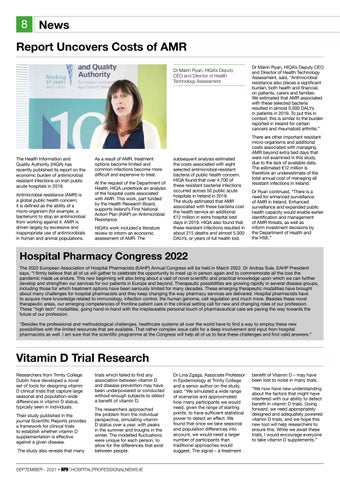
8 News Report Uncovers Costs of AMR Dr Máirín Ryan, HIQA’s Deputy CEO and Director of Health Technology Assessment
The Health Information and Quality Authority (HIQA) has recently published its report on the economic burden of antimicrobial resistant infections on Irish public acute hospitals in 2019. Antimicrobial resistance (AMR) is a global public health concern; it is defined as the ability of a micro-organism (for example, a bacterium) to stop an antimicrobial from working against it. AMR is driven largely by excessive and inappropriate use of antimicrobials in human and animal populations.
As a result of AMR, treatment options become limited and common infections become more difficult and expensive to treat. At the request of the Department of Health, HIQA undertook an analysis of the hospital costs associated with AMR. This work, part funded by the Health Research Board, supports Ireland’s First National Action Plan (iNAP) on Antimicrobial Resistance. HIQA’s work included a literature review to inform an economic assessment of AMR. The
subsequent analysis estimated the costs associated with eight selected antimicrobial-resistant bacteria of public health concern. HIQA found that over 4,700 of these resistant bacterial infections occurred across 50 public acute hospitals in Ireland in 2019. The study estimated that AMR associated with these bacteria cost the health service an additional ¤12 million in extra hospital bed days in 2019. HIQA also found that these resistant infections resulted in about 215 deaths and almost 5,000 DALYs, or years of full health lost.
Dr Máirín Ryan, HIQA’s Deputy CEO and Director of Health Technology Assessment, said, “Antimicrobial resistance also places a significant burden, both health and financial, on patients, carers and families. We estimated that AMR associated with these selected bacteria resulted in almost 5,000 DALYs in patients in 2019. To put this in context, this is similar to the burden reported in Ireland for certain cancers and rheumatoid arthritis.” There are other important resistant micro-organisms and additional costs associated with managing AMR beyond extra bed days that were not examined in this study, due to the lack of available data. The estimated ¤12 million is therefore an underestimate of the total annual cost of managing all resistant infections in Ireland. Dr Ryan continued, “There is a need for enhanced surveillance of AMR in Ireland. Enhanced surveillance and expanded public health capacity would enable earlier identification and management of AMR threats, as well as inform investment decisions by the Department of Health and the HSE.”
Hospital Pharmacy Congress 2022 The 2022 European Association of Hospital Pharmacists (EAHP) Annual Congress will be held in March 2022. Dr Andras Sule, EAHP President says, “I firmly believe that all of us will gather to celebrate the opportunity to meet up in person again and to commemorate all the loss the pandemic made us endure. This new beginning will also bring about a vast of novel scientific and practical knowledge upon which we can further develop and strengthen our services for our patients in Europe and beyond. Therapeutic possibilities are growing rapidly in several disease groups, including those for which treatment options have been seriously limited for many decades. These emerging therapeutic modalities have brought about many challenges for hospital pharmacists and they keep changing the way pharmacy services are delivered. Hospital pharmacists have to acquire more knowledge related to immunology, infection control, the human genome, cell regulation and much more. Besides these novel therapeutic areas, our emerging competencies of frontline patient care in the clinical setting call for new and changing roles of our profession. These "high tech" modalities, going hand-in-hand with the irreplaceable personal touch of pharmaceutical care are paving the way towards the future of our profession. “Besides the professional and methodological challenges, healthcare systems all over the world have to find a way to employ these new possibilities with the limited resources that are available. That rather complex issue calls for a deep involvement and input from hospital pharmacists as well. I am sure that the scientific programme at the Congress will help all of us to face these challenges and find valid answers.”
Vitamin D Trial Research Researchers from Trinity College Dublin have developed a novel set of tools for designing vitamin D clinical trials that capture large seasonal and population-wide differences in vitamin D status, typically seen in individuals. Their study published in the journal Scientific Reports provides a framework for clinical trials to establish whether vitamin D supplementation is effective against a given disease. The study also reveals that many
trials which failed to find any association between vitamin D and disease prevention may have been underpowered or conducted without enough subjects to detect a benefit of vitamin D. The researchers approached the problem from the individual perspective, simulating vitamin D status over a year, with peaks in the summer and troughs in the winter. The modelled fluctuations were unique for each person, to allow for the differences that exist between people.
SEPTEMBER - 2021 • HPN | HOSPITALPROFESSIONALNEWS.IE
Dr Lina Zgaga, Associate Professor in Epidemiology at Trinity College and a senior author on the study, said, “We simulated a wide range of scenarios and approximated how many participants we would need, given the range of starting points, to have sufficient statistical power to detect an effect. We found that once we take seasonal and population differences into account, we would need a larger number of participants than traditional approaches would suggest. The signal – a treatment
benefit of Vitamin D – may have been lost to noise in many trials. “We now have new understanding about the factors that might have interfered with our ability to detect benefit in vitamin D trials. Going forward, we need appropriately designed and adequately powered vitamin D trials, and we hope this new tool will help researchers to ensure this. While we await these trials, I would encourage everyone to take vitamin D supplements.”
"I was prescribed IDACIO®
and Fresenius Kabi supported me all the way" otto, 24, has Crohn's disease
® is an adalimumab biosimilar, which is approved IDACIO®IDACIO is an adalimumab biosimilar, which is approved for usefor in the same indications conditions as the biologicbiologic reference product, including the treatment of moderately to severely activeactive Crohn’s reference product, including the treatment of moderately to severely Crohn’s 1, 2 1, 2 disease disease and ulcerative colitis in adultinpatients. Patients prescribed IDACIOIDACIO can access and ulcerative colitis adult patients. Patients prescribed can access KabiCare, a web-based resource developed with a with holistic approach to patient support. KabiCare, a web-based resource developed a holistic approach to patient support.
The indications for IDACIO include the treatment of moderately to severely active Crohn’s disease and ulcerative colitis The have indications for IDACIO include to the treatment of moderately to severely activetoCrohn’s and in adults who had inadequate response conventional therapies or who are intolerant or havedisease contraindications ulcerative 1 colitis in adults who have had inadequate response to conventional therapies or who are intolerant to such therapies. Before prescribing IDACIO please consult the Summary of Product Characteristics. Patients prescribed 1 Before prescribing IDACIO please consult the Summary of to or have contraindications to such therapies. IDACIO should receive a patient alert card. For more information about IDACIO and KabiCare, please contact your local Product Characteristics. Patients prescribed IDACIO should receive a patient alert card. For more information Fresenius Kabi representative. about IDACIO and KabiCare, please contact your local Fresenius Kabi representative. References: 1. IDACIO 40mg solution for injection in pre-filled syringe and pre-filled pen. Summary of Product Characteristics. Fresenius Kabi Deutschland GmbH. References: 2. Humira 40mg solution for injection in pre-filled syringe andFresenius pre-filled pen. of Product Characteristics. AbbVie Deutschland GmbH & Co. KG. 1. IDACIO Summary of Product Characteristics. KabiSummary Ltd. 2. Humira Summary of Product Characteristics. Abbvie Ltd. KabiCare is funded and developed by Fresenius Kabi. KabiCare is funded and developed by Fresenius Kabi. IDACIO and KabiCare are registered trademarks of Fresenius Kabi. IDACIO and KabiCare are registered trademarks of Fresenius Kabi.
Abbreviated Prescribing Information Consult the Summary of Product Characteristics for full information. Additional information is available on request. Idacio (adalimumab) 40 mg This medicinal product is subject to additional monitoring. This will allow quick identification of new safety information. Healthcare professionals are asked to report any suspected adverse reactions. See below for how to report adverse reactions. Idacio 40 mg solution for injection in pre-filled syringe Idacio 40 mg solution for injection in pre-filled pen Idacio 40 mg solution for injection in vial for paediatric use Presentation and method of administration: Each single dose 0.8 ml pre-filled syringe, 0.8 ml pre-filled pen or 0.8 ml vial contains 40 mg of adalimumab for subcutaneous injection. Indications and Dosage: Please refer to SmPC for full information. Idacio treatment should be initiated and supervised by specialist physicians experienced in the diagnosis and treatment of conditions for which Idacio is indicated.Ophthalmologists are advised to consult with an appropriate specialist before initiation of treatment with Idacio. Patients treated with Idacio should be given a patient alert card. After proper training in injection technique, patients may self-inject with Idacio if their physician determines that it is appropriate and with medical follow-up as necessary. During treatment with Idacio, other concomitant therapies (e.g., corticosteroids and/or immunomodulatory agents) should be optimised. Rheumatoid arthritis (RA), adults: In combination with methotrexate (MTX) for moderate to severe, active RA with inadequate response to disease-modifying anti-rheumatic drugs (DMARDs) including MTX. In combination with MTX for severe, active and progressive RA when not previously treated with MTX. Can be given as monotherapy if intolerance to or when continued treatment with MTX is inappropriate. Reduces rate of progression of joint damage on X-ray and improves physical function, in combination with MTX. Dosage:40 mg single dose every other week (EOW). Concomitant MTX should be continued. In monotherapy, patients may require 40 mg every week or 80 mg EOW if they experience a decrease in clinical response. Treatment beyond 12 weeks should be reconsidered if no clinical response in that time. Consider need for dose interruption, e.g. before surgery or if serious infection occurs. Reintroduction after 70 days or longer of discontinuation gave same magnitudes of clinical response and similar safety profile as before dose interruption. Polyarticular juvenile idiopathic arthritis (pJIA), paediatrics 2 years and above: In combination with MTX for active pJIA with inadequate response to one or more DMARDs. Can be given as monotherapy if intolerance to or when continued treatment with MTX is inappropriate. Dosage: 10 kg to < 30 kg 20 mg single dose EOW. If ≥ 30 kg: 40 mg single dose EOW. Treatment beyond 12 weeks should be reconsidered if no clinical response in that time. Enthesitis-related arthritis (ERA), paediatrics 6 years and above: For active ERA with inadequate response to or intolerance to conventional therapy. Dosage: 15 kg to < 30 kg: 20 mg single dose EOW. If ≥ 30 kg: 40 mg single dose EOW. Ankylosing spondylitis (AS), adults: For severe active AS with inadequate response to conventional therapy. Dosage: adults: 40 mg single dose EOW. Treatment beyond 12 weeks should be reconsidered if no clinical response in that time. Axial spondyloarthritis without radiographic evidence of AS (nr-axSpA), adults: For severe nr-axSpA with objective signs of inflammation (elevated CRP and/or MRI), and an inadequate response to or intolerance to nonsteroidal anti-inflammatory drugs. Dosage: 40 mg single dose EOW. Treatment beyond 12 weeks should be reconsidered if no clinical response in that time. Psoriatic arthritis (PsA), adults: For active and progressive PsA with inadequate response to DMARDs. Reduces rate of progression of peripheral joint damage on X-ray in polyarticular symmetrical subtypes of the disease and improves physical function. Dosage: 40 mg single dose EOW. Treatment beyond 12 weeks should be reconsidered if no clinical response in that time. Psoriasis, adults: For moderate to severe chronic plaque psoriasis in candidates for systemic therapy. Dosage: 80 mg initial dose at Week 0, followed by 40 mg EOW from Week 1. Treatment beyond 16 weeks should be reconsidered if no clinical response in that time (refer to SmPC). Paediatric Plaque Psoriasis, 4 years and above: For severe chronic plaque psoriasis with inadequate response to or if topical therapy and phototherapies are inappropriate. Dosage: 15 kg to < 30 kg: 20 mg dose initially followed by 20 mg EOW starting one week after initial dose. If ≥ 30 kg: 40 mg dose initially followed by 40 mg EOW starting one week after initial dose. Treatment beyond 16 weeks
should be reconsidered if no clinical response in that time. Hidradenitis suppurativa (HS), adults and adolescents from 12 years and above: For active moderate to severe HS (acne inversa) with inadequate response to conventional systemic HS therapy. Dosage: HS, adults: 160 mg dose initially at Day 1, followed by 80 mg two weeks later at Day 15. Two weeks later (Day 29) continue with a dose of 40 mg every week or 80 mg EOW. HS, adolescents 12 years and above ≥ 30 kg: 80 mg initial dose at Week 0, followed by 40 mg EOW from Week 1. If there is inadequate response to 40 mg EOW, an increase in dosage to 40 mg every week or 80 mg EOW may be considered. Antibiotics may be continued if necessary. Concomitant topical antiseptic wash on HS lesions is recommended to be used on a daily basis. Treatment beyond 12 weeks should be reconsidered if no improvement in that time. Reintroduction of Idacio after treatment interruption as appropriate. Evaluate periodically the benefit and risk of continued longterm treatment. Crohn’s disease (CD), adults: For moderately to severely active CD with no response despite a full and adequate course of, intolerance to or contraindication for a corticosteroid and/or an immunosuppressant therapy. Dosage: Induction: 80 mg dose at Week 0, followed by 40 mg at Week 2. For a more rapid response: 160 mg at Week 0, followed by 80 mg at Week 2; risk of adverse events higher during rapid induction. Maintenance: 40 mg dose EOW. During maintenance, corticosteroids may be tapered in accordance with clinical guidelines. If decrease in clinical response, can increase dosage to 40 mg every week or 80 mg EOW. Patients with no response by Week 4 may benefit from continued maintenance therapy to Week 12. Treatment beyond 12 weeks should be reconsidered if no clinical response in that time. Paediatric Crohn’s disease (CD), 6 years and above: For moderately to severely active CD with inadequate response to, intolerance to or contraindication for conventional therapy including primary nutrition therapy and a corticosteroid and/or an immunomodulator. Dosage: < 40 kg: Induction: 40 mg dose at Week 0, followed by 20 mg at Week 2. For a more rapid response: 80 mg at Week 0, followed by 40 mg at Week 2; risk of adverse events higher during rapid induction. Maintenance: 20 mg dose EOW from week 4. If insufficient response, consider an increase in dosing frequency to 20 mg every week. If ≥ 40 kg: Induction: 80 mg dose at Week 0, followed by 40 mg at Week 2. For a more rapid response: 160 mg dose at Week 0, followed by 80 mg at Week 2; risk of adverse events higher during rapid induction. Maintenance: 40 mg dose EOW from week 4. If insufficient response, consider an increase in dosage to 40 mg every week or 80 mg EOW. Treatment beyond 12 weeks should be reconsidered if no clinical response in that time. Ulcerative colitis (UC), adults: For moderately to severely active UC with inadequate response to, intolerance to or contraindication for conventional therapy including corticosteroids and 6-mercaptopurine (6-MP) or azathioprine (AZA). Dosage: Induction: 160 mg dose at Week 0, followed by 80 mg at Week 2. Maintenance: 40 mg dose EOW. During maintenance, corticosteroids may be tapered in accordance with clinical guidelines. If insufficient response, consider an increase in dosage to 40 mg every week or 80 mg EOW. Treatment beyond 8 weeks should not be continued if no clinical response in that time. Uveitis, adults: For non-infectious intermediate, posterior and panuveitis with inadequate response to corticosteroids, in patients in need of corticosteroid-sparing, or in whom corticosteroid treatment is inappropriate. Dosage: 80 mg initial dose at Week 0, followed by 40 mg EOW from Week 1. Treatment can be initiated in combination with corticosteroids and/or with other non-biologic immunomodulatory agents. Concomitant corticosteroids may be tapered in accordance with clinical practice starting two weeks after initiating treatment with Idacio. Evaluate on a yearly basis the benefit and risk of continued long-term treatment. Paediatric Uveitis, 2 years and above: For chronic non-infectious anterior uveitis with inadequate response to or intolerance to conventional therapy, or in whom conventional therapy is inappropriate. Dosage: < 30 kg: 20 mg dose EOW in combination with MTX. Optional 40 mg (for patients < 30 kg) or 80 mg (for patients ≥ 30 kg) loading dose one week prior to start of maintenance therapy. No clinical data in use of loading dose < 6 years of age (see SmPC). If ≥ 30 kg: 40 mg dose EOW in combination with MTX. Evaluate on a yearly basis the benefit and risk of continued long-term treatment. Idacio may be available in other strengths and/or presentations depending on the individual treatment needs. Contraindications: Hypersensitivity to the active substance or to any excipients (see SmPC); Active tuberculosis (TB) or other severe infections such as sepsis and opportunistic infections; Moderate to severe heart failure (NYHA class III/IV). Warnings
Fresenius Kabi Fresenius KabiIreland Ireland Unit 3B Park, Unit 3B Fingal FingalBay BayBusiness Business Park, Balbriggan, Co.Dublin, Ireland Balbriggan, Co.Dublin, Ireland T: +353 +353 (0)1 T: (0)1 8413030 8413030 F: +353 +353 (0)1 F: (0)1 8496949 8496949 www.fresenius-kabi.ie www.fresenius-kabi.ie Date of preparation: July 2020 Date of preparation: July 2020 Job code: BIO/IDACIO/011.20 Job code:information BIO/IDACIO/011.20 Additional is available on request Additional information is available on request
and precautions: Clearly record the name and batch number of administered product stranded DNA. Surgery: Consider the long half-life of Idacio for planned surgical to improve traceability of biological products. Infections: Patients taking TNF- procedures. Monitor closely for infections. Elderly patients: Serious infections were antagonists are more susceptible to serious infections. Impaired lung function may higher in patients over 65 years of age, some of which had a fatal outcome. Consider increase the risk for developing infections. Monitor for infections, including TB, before, risk of infections in these patients. Interactions: Antibody formation was lower when during and for at least 4 months after treatment. Treatment with Idacio should not be adalimumab was given together with MTX in comparison with use as monotherapy. initiated in patients with active infections including chronic or localised infections until Combination of Idacio with other biologic DMARDs (e.g. anakinra and abatacept) or infections are controlled. In patients who have been exposed to tuberculosis and other TNF-antagonists is not recommended. Fertility, pregnancy and lactation: Idacio patients who have travelled in areas of high risk of tuberculosis or endemic mycoses, should only be used during pregnancy if clearly needed. Women of childbearing age such as histoplasmosis, coccidioidomycosis, or blastomycosis, the risk and benefits of should consider the use of adequate contraception and continue its use for at least 5 treatment with Idacio should be considered prior to initiating therapy. Evaluate new months after the last treatment. No administration of live vaccines (e.g. BCG) to infants infections during treatment and monitor closely. Stop treatment if new serious infection exposed to Idacio in utero for 5 months following mother’s last Idacio treatment during or sepsis and treat appropriately. Exercise caution in patients with a history of recurring pregnancy. Idacio can be used during breast-feeding. Adverse Reactions: Very common infections or who are predisposed to infections, including the use of concomitant ≥ 1/10: Respiratory tract infections (including lower and upper respiratory tract infection, immunosuppressive medications. Serious infections: Serious infections, including pneumonia, sinusitis, pharyngitis, nasopharyngitis and pneumonia herpes viral), those associated with hospitalisation or death, were reported in patients receiving leukopenia (including neutropenia and agranulocytosis), anaemia, lipids increased, treatment. TB: Consult SmPC for details. Reactivation and new onset TB, both pulmonary headache, abdominal pain, nausea and vomiting, elevated liver enzymes, rash (including and extra-pulmonary (disseminated), were reported. Screen all patients before therapy exfoliative rash), musculoskeletal pain, injection site reaction (including injection site initiation for active or inactive (latent) TB. Appropriate screening tests (i.e. tuberculin erythema). Common ≥ 1/100 to < 1/10: Systemic infections (including sepsis, candidiasis skin test and chest X-ray) should be performed in all patients. If latent TB is suspected, and influenza), intestinal infections (including gastroenteritis viral), skin and soft tissue consult physician with appropriate expertise and follow local treatment infections (including paronychia, cellulitis, impetigo, necrotising fasciitis and herpes recommendations for prophylaxis prior to initiation of Idacio. Despite prophylaxis, TB zoster), ear infections, oral infections (including herpes simplex, oral herpes and tooth reactivation has occurred on adalimumab. If active TB is diagnosed, do not initiate infections), reproductive tract infections (including vulvovaginal mycotic infection), Idacio treatment. Other opportunistic infections: Opportunistic infections were urinary tract infections (including pyelonephritis), fungal infections, joint infections, observed in patients receiving adalimumab. Stop treatment in patients with signs and skin cancer excluding melanoma (including basal cell carcinoma and squamous cell symptoms of such infections. Consult with physician with appropriate expertise for carcinoma), benign neoplasm, leucocytosis, thrombocytopenia, hypersensitivity, diagnosis and administration of empiric antifungal therapy in these patients. Hepatitis allergies (including seasonal allergy), hypokalaemia, uric acid increased, blood sodium B reactivation: Reactivation of HBV has occurred in chronic carriers (surface antigen abnormal, hypocalcaemia, hyperglycaemia, hypophosphatemia, dehydration, mood positive). Patients should be tested for HBV infection before initiating treatment. HBV alterations (including depression), anxiety, insomnia, paraesthesias (including carriers should consult a specialist physician and be closely monitored for reactivation hypoesthesia), migraine, nerve root compression, visual impairment, conjunctivitis, of HBV infection throughout therapy and for several months following termination of blepharitis, eye swelling, vertigo, tachycardia, hypertension, flushing, haematoma, treatment. If reactivation occurs, stop treatment and initiate appropriate antiviral and asthma, dyspnoea, cough, GI haemorrhage, dyspepsia, gastroesophageal reflux disease, supportive treatment. Neurological events: Caution in patients with pre-existing or sicca syndrome, worsening or new onset of psoriasis (including palmoplantar pustular recent-onset central or peripheral nervous system demyelinating disorders. psoriasis), urticaria, bruising (including purpura), dermatitis (including eczema), Discontinuation of treatment should be considered if any of these disorders develop. onychoclasis, hyperhidrosis, alopecia, pruritus, muscle spasms (including blood Neurologic evaluation should be performed in patients with non-infectious intermediate creatine phosphokinase increased), renal impairment, haematuria, chest pain, oedema, uveitis prior to initiation of treatment and regularly during treatment, to assess for pyrexia, coagulation and bleeding disorders (including activated partial thromboplastin pre-existing or developing central demyelinating disorders. Allergic reactions: Reports time prolonged), autoantibody test positive (including double stranded DNA antibody), of serious allergic reactions including anaphylaxis received. For serious allergic or blood lactate dehydrogenase increased, impaired healing. Serious, including fatal, anaphylactic reaction, stop Idacio immediately and initiate appropriate therapy. adverse reactions have been reported including infections/sepsis, TB, opportunistic Malignancies and lymphoproliferative disorders: A possible risk has been reported of infections, allergic reactions (including anaphylaxis), HBV reactivation and malignancies malignancy, including lymphomas and leukaemia, in all patients, including paediatric (including leukaemia, lymphoma and hepatosplenic T-cell lymphoma). Serious patients, treated with Tumour Necrosis Factor (TNF) antagonists. Examine all patients, haematological, neurological and autoimmune reactions have also been reported. These especially those with a medical history of extensive immunosuppressant or PUVA include rare reports of pancytopenia, aplastic anaemia, central and peripheral treatment, for non-melanoma skin cancer prior to and during treatment; caution in demyelinating events and reports of lupus, lupus-related conditions and StevensCOPD patients, and in patients with increased risk for malignancy due to heavy smoking. Johnson syndrome. Other less common and rarely reported adverse reactions are listed Consider the potential risk with the combination of azathioprine or 6-mercaptopurine in the SmPC. Legal Category: POM. Marketing Authorisation Holder: Fresenius Kabi and adalimumab (hepatosplenic T-cell lymphoma has occurred). Risk of hepatosplenic Deutschland GmbH, Else-Kröner-Straße 1, 61352 Bad Homburg v.d.Höhe, Germany. T-cell lymphoma cannot be excluded. Caution in patients with a history of malignancy. Marketing authorisation numbers: EU/1/19/1356/001, EU/1/19/1356/002, EU/1/19/1356/003 Risk of developing dysplasia or colon cancer is unknown. Patients with UC with Package size and cost: UK / ROI - Idacio 40mg/0.8ml vial x 1: £316.93 / €309.31, Idacio increased risk of dysplasia or colon carcinoma, or history of dysplasia or colon 40mg/0.8ml pre-filled syringe x 2: £633.86 / €618.63, Idacio 40mg/0.8ml pre-filled pen x carcinoma, to be screened for dysplasia before treatment and throughout disease 2: £633.86 / €618.63 Further information: available from Fresenius Kabi Ltd., Cestrian course. Haematological reactions: Adverse events of the haematological system Court, Eastgate Way, Manor Park, Runcorn, Cheshire, WA7 1NT. Tel +44 (0)1928 533 533 reported with adalimumab. Patients should seek immediate medical attention if signs Date of preparation of PI: April 2020 001/API/IDACIO/FKUK-IRL and symptoms of blood dyscrasias develop while on treatment. Vaccinations: Patients Adverse events should be reported. may receive concurrent vaccinations, except for live vaccines. Bring paediatric patients Reporting forms and information can be found at: yellowcard.mhra.gov.uk up to date with all immunisations prior to initiating Idacio treatment. Congestive heart www.hpra.ie/homepage/about-us/report-an-issue failure: See contraindications. Caution is advised with mild heart failure (NYHA class I/ Adverse events should also be reported to Fresenius Kabi Ltd. II). Discontinue treatment if new or worsening symptoms of congestive heart failure. Cestrian Court, Eastgate Way, Manor Park, Runcorn, Cheshire, WA7 1NT Autoimmune processes: Autoimmune antibodies may form with Idacio. Stop treatment Tel +44 (0)1928 533 533 if development of a lupus-like syndrome with positive antibodies against double-
10 News Helping Pharmacists Maximise Disease Prevention “Make every contact count” is the key message from the International Pharmaceutical Federation (FIP) as it launched a new vaccination handbook for pharmacists. The handbook details the many ways in which pharmacists can contribute to improving vaccination coverage, such as supply chain and stock management, storage, record keeping, facilitation of appointments and administration of vaccines, but it also gives emphasis to their important educational and advisory role. “Advocating vaccination should be part of the daily practice of community pharmacists. At this time of increasing levels of vaccine hesitancy, pharmacists should be equipped with proper training and tools to effectively communicate and provide evidence-based recommendations to populations in order to support vaccine uptake,” said Gonçalo Sousa Pinto, editor of the handbook and FIP’s lead for practice development and transformation. The handbook provides guidance on the implementation of a range of pharmacy vaccination services, guidelines on safety, and answers to frequently asked questions about vaccines. “Not all of the roles described in the handbook are currently open to pharmacists in every country — for example, pharmacists’ access to vaccination records is still not mainstream practice worldwide — but with this handbook FIP aims to support the expansion and development of the roles of pharmacists in order to increase vaccination coverage across the globe,” Mr Sousa Pinto said. The handbook is the latest addition to a range of resources developed by FIP to transform vaccination through pharmacy. Other recent resources in this programme of work by FIP to ensure pharmacy’s contribution to the World Health Organization Immunisation Agenda 2030 and the Global Vaccine Action Plan 2011–2020 include a collection of evidence and guidelines for the development of vaccination services, a report on the roles of pharmacy in vaccination, and a regulatory self-evaluation assessment tool for advancing pharmacy services in this area.
New Discovery on Key Factors for Eye Health Professor John Nolan and Dr Marina Green at the NRCI
A new study reports on sunlight and nutrition as being key contributors to eye health. This research was published by a team led by Dr Marina Green from The Nutrition Research Centre Ireland in Waterford Institute of Technology. It is the first study of its kind to describe macular pigment and its determinants for the Mexican population. Additionally, this research investigated the impact of environmental and nutritional factors on macular pigment.
The level of macular pigment present in the human eye enhances visual function in a variety of ways. Low levels of macular pigment have been proposed to be a risk factor for Age-related Macular Degeneration, the leading cause of significant vision loss usually found in those over the age of 55. Macular pigment also absorbs harmful blue light, protecting the retina from damage. Dr Green’s study has discovered that those with high sunlight
SEPTEMBER - 2021 • HPN | HOSPITALPROFESSIONALNEWS.IE
exposure during the day have significantly higher Macular Pigment. Interestingly, macular pigment and serum concentrations of the carotenoids lutein and zeaxanthin were significantly higher in the Mexican study sample compared with an Irish sample, but this difference was not reflected when the dietary analysis was carried out. This finding sheds light on the importance of nutrition and dietary patterns on macular pigment, and consequently, on eye health. Commenting on the publication of her significant research study by IOVS, one of the most prestigious clinical and laboratory ophthalmic and vision research journals in the world, Dr Green says, “I am very proud to see this long-term study published by IOVS. The new data from a Mexican sample provides evidence of the multifactorial interactions and environmental determinants of macular pigment
such as sunlight exposure and dietary patterns. These findings will be essential for future studies for eye health, visual function, and ocular pathology.” Director of the Nutrition Research Centre Ireland (NCRI), Professor John Nolan says, “At the NRCI, we are extremely proud of this work and publication by Dr Green. One of the challenges in our field of research is to understand what are the main determinants of the protective macular pigment at the back of the eye. This work highlights further the importance of both environmental and nutritional factors. Specifically, we learn how light exposure is a key determinant of the protective macular pigment, a finding that highlights further the important role this pigment plays for vision and retinal health. We are most grateful to IOSA (Mexico) for their support and partnership on this research, and to Heidelberg Engineering for their collaboration with the measurement of macular pigment in this unique study.” For further details and to read the newly published study see open access publication online at https://iovs.arvojournals.org/ article.aspx?articleid=2776449
News 11
Astellas – Innovating for Life
In December of last year, Ireland’s international research-based biopharmaceutical industry rolled out a new set of films, telling an impact and value story for medicines innovation as part of the latest edition of the ‘Innovate For Life’ campaign. A new campaign is now in development for 2021. The 2020 campaign, #InnovateForLife, is a window on the world of medicines innovation right across the lifecycle – from discovery and development through to manufacturing and adoption by the health services. It is organised into three pillars – Patients, Places and Pioneers – capturing the economic and societal impact of the biopharmaceutical industry on patients’ lives, on communities, and on science and medicines development.
The 2020 content was multidimensional, interlinking perspectives from scientists, manufacturing staff, doctors and patients. The films tell an evocative story about Ireland’s heritage in biopharmaceutical innovation and the new frontiers our companies are pushing to help raise healthcare standards. In Killorglin, Astellas is making an anti-rejection treatment used by organ transplant patients all over the world. In this rural part of south Kerry, innovation is at the heart of the community. Our story features Anna Pokojska, a kidney recipient and Transplant Games athlete, Louis Collins, Executive Director, Kerry Operations, Astellas, Fergus Foley, a local guesthouse owner, and Megan Staunton, Site Energy Lead, Astellas.
Louis Collins, Executive Director at Astellas (Ireland), states, “For over 28 years, Astellas has been a significant part of the economy and community in Kerry. More than that though, we have helped to power Ireland’s export-led growth, keeping medicines manufacturing going during the pandemic. The work we do in Killorglin is vital for transplant patients all over the world. We are proud of our impact locally, nationally, and globally. As part of ‘Innovate For Life’, we are telling that story.”
demonstrated a commitment to Ireland through continued investment, longevity and resilience. The industry has demonstrated real leadership in the global fight against COVID-19 through collaboration on research to dynamic supply chain responses, directly supporting the demands placed on the healthcare system and wider society. The ‘Innovate For Life’ campaign helps to tell that impact and value story – a powerful narrative for a consequential industry.”
Oliver O’Connor, Chief Executive of IPHA, says, “During Covid-19, the role our industry plays in the economy and in healthcare is Astellas Pharmaceuticals, Killorglin especially obvious. We are proud of our companies’ response to the pandemic – researching and developing vaccines and treatments, keeping manufacturing going, ensuring the supply of medicines, and supporting voluntary, community and healthcare organisations in their frontline work.”
Bernard Mallee, IPHA’s Director of Communications and Advocacy, said: “‘Innovate For Life’ shares an exciting story of pharmaceutical innovation – the science behind the treatments and cures, the passion and dedication of people who work to improve healthcare outcomes, the community impact generated by the presence of significant industry investment, and the strength and resilience of patients whose conditions can be managed by medical innovation. It is an important window on the value of innovation – and a story that can be owned by everyone with a stake in patient care, not just our own industry. We hope the campaign can help us to lay the reputational foundation for the future of our industry which will serve the country well in the right policy and operating environment for the discovery, development and adoption of new medicines.”
Michael Lohan, Head of Life Sciences at IDA Ireland, adds, “The foreign direct investment biopharmaceutical sector has a hugely significant impact on the Irish economy, with 34,000 people directly employed across all regions. It is the third-largest exporter of pharmaceuticals globally, accounting for exports of 70 billion. The sector has
HOSPITALPROFESSIONALNEWS.IE | HPN • SEPTEMBER - 2021
12 Immunisations
COVID-19: A Journey from Discovery to Vaccination Written by Dr Kenneth Beatty, MCRN 403096, SpR in Public Health Medicine, National Immunisation Office
Although it may seem longer, it is less than two years since the Severe Acute Respiratory Syndrome Coronavirus 2 (SARS CoV-2) virus was first identified in a cluster of patients presenting with atypical viral pneumonia in Wuhan, China. In the meantime, this virus (and the disease it causes- Coronavirus Disease 2019-, more commonly known as COVID-19) has produced a truly global pandemic which has fundamentally changed the way in which we live our lives. It has also resulted in levels of mortality from an infectious disease not seen on a population level in, arguably, over a century.
country in the world to grant regulatory approval to the Pfizer/BioNTech (also known as Comirnaty) vaccine for COVID-19. The European Medicines Agency granted conditional marketing authorisation to the Comirnaty vaccine on 21st December 2020. Ms Anne Lynch was the first person to receive a COVID-19
The first case of COVID-19 in Ireland was notified on March 11th 2020 and in the following 15 months, Ireland has seen over 275,000 cases and over 5,000 deaths from COVID-19. In the spring of 2020, the Irish health service was stretched to breaking point trying to limit the impact of this disease on the public. However, during this time, the first steps in the development of possible vaccines against COVID-19 were also being taken. Key in this process was the introduction of the ACCESS TO COVID-19 TOOLS (ACT) ACCELERATOR initiative-a global collaboration to accelerate the development, production and equitable access to new COVID-19 diagnostics, therapeutics and vaccines. This amongst other initiatives allowed for the rapid production of vaccines against the SARS CoV-2 virus. On December 2nd 2020, the United Kingdom’s Medicine and Healthcare Products Regulatory Authority (MHRA) were the first
SEPTEMBER - 2021 • HPN | HOSPITALPROFESSIONALNEWS.IE
“Compared to other European countries, Ireland is also doing well. Out of 30 countries in the EU /EEA area, Ireland has the 9th highest percentage of adults who have received at least one vaccine dose and the 6th highest percentage of fully vaccinated adults as reported by the European Centre for Disease Control”
vaccine in Ireland when she received the Comirnaty vaccine on December 29th, 2020. As of June 2021, three further COVID-19 vaccines have been approved for use in Ireland- the SpikeVax (Moderna) COVID-19 Vaccine, the Vaxzevria (AstraZeneca) COVID-19 Vaccine and the Janssen (Johnson &
Johnson) COVID-19 vaccine. Vaccination in Ireland in rapidly progressing, with over 90% of the population aged 50 years and over having had at least one vaccine. Compared to other European countries, Ireland is also doing well. Out of 30 countries in the EU /EEA area, Ireland has the 9th highest percentage of adults
13
who have received at least one vaccine dose and the 6th highest percentage of fully vaccinated adults as reported by the European Centre for Disease Control. While this high uptake helped reduce the number of cases in the Irish population in the second quarter of 2021, we are now seeing case numbers rise again with the more transmissible Delta variant becoming more dominant. This is why it is so important that as much of our population as possible are fully vaccinated to limit severe outcomes and deaths from any future surges of COVID-19. The National Immunisation Office is a small yet committed team of Public Health doctors, pharmacists, Senior Medical Officers, nurses, communication, IT and administration staff who are centrally involved in vaccination programmes in Ireland and the COVID-19 vaccine programme in this country was no different. NIO staff were primarily tasked with developing training and education resources, clinical guidance and supporting materials relating to COVID-19 vaccines for healthcare professionals (HCPs) and prospective vaccinators. This involved developing specific training sessions for vaccinators,
producing documents such as a clinical guidance document for COVID-19 vaccines, a weekly bulletin updating healthcare professionals on changes to vaccine protocols and individual medicines protocols for each vaccine, webinars for at risk groups such as homeless and Traveller communities as well as responding to individual queries from HCPs relating to COVID-19 vaccines. In addition, as some professions who were not involved as vaccinators in previous mass vaccination programmes-e.g., physiotherapists, optometrists, dentists etc- were invited to become vaccinators in the COVID-19 programme, specific guidance and training was produced by the NIO for these groups also. Strong levels of social media engagement were key in advocating for COVID-19 vaccine uptake particularly amongst our younger age cohorts. As such, we made use of multiple social media platforms to disseminate accurate and up to date information on COVID-19 vaccines. One of the major challenges posed to this work was the fact that these were new vaccines. For some vaccines,
new adverse events came to light that were not observed during clinical trials, which required significant changes to training and guidance. This meant that the resources and outputs produced by NIO required constant review and frequent updating. However, the production of accurate and up to date information relating to COVID-19 vaccines was crucial as it meant that the general public and HCPs could trust these vaccines to be safe and effective and misinformation leading to vaccine hesitancy could be countered. As of July 2021, the future outlook for COVID-19 is promising but with certain concerning factors. A significant proportion of our population are fully vaccinated, and the weekly number of administered doses continues to rise. However, one of the main concerns regarding COVID-19 vaccines is their effectiveness against variants of concern, especially the delta variant. So far, there is evidence that the 4 vaccines used in Ireland provide good protection against severe COVID-19 or hospitalisation from COVID-19 although a lower level of protection than what it provided against the original “wildtype”
“As of July 2021, the future outlook for COVID-19 is promising but with certain concerning factors. A significant proportion of our population are fully vaccinated, and the weekly number of administered doses continues to rise”
SARS CoV2 virus. The National Immunisation Advisory Committee has previously stated that there is evidence of suboptimal protection against the delta variant after one dose of COVID-19 vaccines. Therefore, there is a concerted campaign to ensure as many of our population are fully vaccinated in as short a time as possible. Other concerns around the inequitable distribution of COVID-19 vaccines around the world also exist. For example, while just over 30% of Europe’s population have been fully vaccinated only 1.25% of Africa’s population are. While not only is this morally wrong, it also can provide reservoirs for SARS CoV2 to grow and mutate potentially leading to future variants of concern. As Dr Mike Ryan of the World Health Organization stated at the outset of the COVID-19 pandemic “None of us are safe until all of us are safe”. The COVID-19 vaccine programme in Ireland is a multi-agency whole system response and the NIO worked closely with internal HSE and external organisations to ensure a successful programme. While it has had a transformative effect and contributed to the suppression of the COVID-19 pandemic in Ireland, we are not out of the woods yet. We all have a role to play to get to that point however, by taking our vaccine when offered and by talking to our families and friends about why we need as many people as possible to be fully vaccinated against COVID-19 right now.
HOSPITALPROFESSIONALNEWS.IE | HPN • SEPTEMBER - 2021
14 CANCER RETREAT: CLINICAL TRIALS
Cancer Clinical Trials in Ireland – Enhancing and Facilitating Patient Participation, Engagement and Involvement Written by Professor Maeve Lowery, Academic Director, Trinity St James Cancer Institute and Professor of Translational Cancer Medicine, Trinity College Dublin
A key target of the National Cancer Strategy is to achieve a substantial increase in the percentage of eligible patients enrolled to cancer clinical trials, from 3% to 6%. There are benefits to many stakeholders in achieving this, but most importantly there will be clear and measurable benefits to patients living with cancer.
and are motivated by the ability to help others with the same diagnosis, even if in the future. From an institutional perspective, it is essential to develop an innovative, sustainable cancer clinical trial program as part of maintaining quality improvement and international best standards in provision of cancer care.
The advantages to patients of clinical trial involvement include the obvious - access to innovative, more effective, and less toxic cancer treatments or preventative strategies that are otherwise unavailable. It is clear however that the benefit to patients extends beyond this, including to clinical care with more intensive monitoring of their condition and provision of patient care by highly experienced staff with specialised understanding of their cancer and treatment.
Increasing cancer clinical trial availability and participation introduces state-of-the-art activities and technology, motivates clinicians to pursue better models of care, and provides additional monitoring of adherence to guidelines for clinical care. It provides a clear focus for international benchmarking of institutional excellence and facilitates research collaboration with academic centres and industry.
Clinical trial participation empowers patients to take an active role in management of their cancer and facilitates improved understanding of their condition and new developments in therapeutic strategies. Patients also appreciate the opportunity to contribute to the scientific understanding of their cancer
These advantages translate into tangible national benefits including improvement in healthcare outcomes, and measurable economic benefits including cost saving in care provision, creation of highly skilled jobs, and attraction of international investment from industry for research and development.
SEPTEMBER - 2021 • HPN | HOSPITALPROFESSIONALNEWS.IE
There is a need to prioritise cancer clinical research and achieve these benefits for patients with cancer in Ireland. Most importantly, we need to partner with our patients to facilitate rapid translation of scientific discoveries in academic medical centres in Ireland to innovative, well designed cancer clinical trials. This requires us to put the patient at the centre of clinical and translational cancer research, embedding active public and patient involvement at each stage of development. Only by co-developing the research question with the most important stakeholder – the patient- can we identify and address the key areas of need in cancer care that will have real world impact on cancer outcomes. This principle is well established and acknowledged within the academic and clinical community, however successfully achieving this in practice is more complicated. Many patients with cancer and their families do not have sufficient time, level of wellbeing or healthcare literacy to participate actively and ensure that their voice is heard, leading to an underrepresentation of patient with hard-to-treat cancers, or lower socio-economic groups in patient representative groups. We can address this disparity as clinical and translational researchers by partnering with cancer charities, patient advocacy groups and with Cancer Trials Ireland and the Health Research Board to codevelop the appropriate support, environment and educational resources needed to achieve patient representation from all groups and ensure informed patient participation across the research spectrum. The next decade will bring huge changes in cancer clinical trial design, as the cancer drug development paradigm shifts towards small, biomarker selected studies and with the emergence of next generation cell-based therapies for cancer treatment.
Advances in cancer genetics and genomics offer new opportunities not only for precision cancer medicine but also progress in key areas of cancer prevention and survivorship. We have a unique opportunity to co-develop our cancer clinical trial network nationally to embed patient and public involvement in the design of the next generation of studies, and ensure translational researchers are working in tandem with clinical researchers to address key unmet needs and clinical challenges in oncology. Achieving and hopefully exceeding the patient enrolment targets for cancer clinical trials set by the National Cancer Strategy is an essential goal, but we will achieve the greatest impact on cancer outcomes nationally and internationally through combining this with a similar increase in patient engagement and patient involvement through all stages of the cancer research cycle. Bio: Maeve Lowery is Professor of Translational Cancer Medicine at Trinity College Dublin and Consultant Medical Oncologist at St James Hospital. She was recently appointed Academic Director of the Trinity St James Cancer Institute (TSJCI) and is chairperson of the Cancer Molecular Diagnostics Advisory Group of the National Cancer Control Program (NCCP). Her clinical and translational research involves design and conduction of clinical trials in patients with gastrointestinal malignancies, incorporating translational study endpoints to validate predictive and prognostic biomarkers, identify mechanisms of resistance and guide the development of rational therapeutic strategies. Her translational research interests use of real time genomic profiling to identify novel therapeutic strategies for gastrointestinal cancers, identification of non-coding alterations as modifiers of the DNA damage response pathway and generation of organoid models of cancer as a tool for precision oncology as a member of the PRECODE consortium. Her work is supported by the Pancreatic Cancer Research Fund (https://www.pcrf. org.uk), Science Foundation Ireland, through the Precision Oncology Ireland Consortium, the EU Horizon 2020 Marie SklodowskaCurie Programme and the Health Research Board (HRB).
Latanoprost 50 micrograms/ml + Timolol 5 mg/ml eye drops, solution in single-dose container
The first PRESERVATIVE-FREE
Latanoprost/Timolol fixed combination
• Non-inferior IOP reduction to BAK-preserved latanoprost/timolol fixed combination1 • Superior tolerability to BAK-preserved latanoprost/timolol fixed combination1 • The next option in the treatment pathway for Monopost® patients • The next option for preserved latanoprost/ timolol intolerance
Fixapost 50 micrograms/ml + 5 mg/ml eye drops, solution in single-dose container. Please refer to Summary of Product Characteristics (SmPC) before prescribing. Additional information available on request. Presentation and active ingredients: Box of 6 sachets (30 pack) each containing 5 single-dose containers (LDPE) containing 0.2 ml of eye drops. 1 ml eye drops solution contains 50 micrograms of latanoprost, 5 mg of timolol and 50 mg of macrogolglycerol hydroxystearate 40 (castor oil polyoxyl hydrogenated). Indication: Reduction of intraocular pressure (IOP) in adult and elderly patients with open angle glaucoma and ocular hypertension who are insufficiently responsive to topical beta-blockers or prostaglandin analogues. Posology and Method of Administration: Adults (including the elderly): One drop in the affected eye(s) once daily. Do not exceed this dose. Use immediately after opening the single-dose container and discard any remaining contents after use. Remove contact lenses before instillation and reinsert after 15 minutes. Punctal occlusion for two minutes immediately after instillation can reduce possible systemic absorption. Paediatric population: No data are available. Administer topical ophthalmic medicines at least five minutes apart. Contra-indications: Known hypersensitivity to any ingredient. Reactive airway disease including bronchial asthma or history of bronchial asthma, severe chronic obstructive pulmonary disease. Sinus bradycardia, sick sinus syndrome, sino-atrial block, second- or third-degree atrioventricular block not controlled with pace-maker, overt cardiac failure, cardiogenic shock. Warnings and Precautions: Cardiac disorders: Therapy with beta-blockers in patients with cardiovascular diseases (e.g. coronary heart disease, Prinzmetal’s angina and cardiac failure) and hypotension should be critically assessed and consider therapy with other active substances. Watch patients with cardiovascular diseases for signs of deterioration and for adverse reactions. Due to the negative effect on conduction time, only give beta-blockers with caution to patients with first degree heart block. Cardiac reactions and, rarely, death in association with cardiac failures have been reported following timolol administration. Vascular disorders: Treat with caution in patients with severe peripheral circulatory disturbance/disorders (severe forms of Raynaud’s disease or Raynaud’s syndrome). Respiratory disorders: Respiratory reactions, including death due to bronchospasm in patients with asthma have been reported following administration of some ophthalmic beta-blockers. Use FIXAPOST with caution in patients with mild/moderate chronic obstructive pulmonary disease (COPD), and only if the benefit outweighs the risk. Hypoglycaemia/diabetes: Beta-blockers may mask the signs and symptoms of acute hypoglycaemia so use with caution in patients subject to spontaneous hypoglycaemia or in patients with labile diabetes. Hyperthyroidism: Beta-blockers may mask the signs of hyperthyroidism. Corneal diseases: Ophthalmic beta-blockers may induce dryness of eyes. Use with caution in patients with corneal diseases. Other beta-blockers: Effect on intra-ocular pressure or of systemic beta-blockade may be potentiated when timolol is given to patients already receiving a systemic beta-blocking agent. Closely observe the response of these patients. Concomitant therapy: Timolol may interact with other drugs. Other prostaglandin analogues: Concomitant use of two or more prostaglandins, prostaglandin analogues, or prostaglandin derivatives is not recommended. Anaphylactic reactions: While taking beta-blockers, patients with a history of atopy or of severe anaphylactic reaction to a variety of allergens may be more reactive to repeated challenge with such allergens and unresponsive to the usual doses of adrenaline used to treat anaphylactic reactions. Choroidal detachment: Has been reported with administration of aqueous suppressant therapy (e.g. timolol, acetazolamide) after filtration procedures. Surgical anaesthesia: Beta-blocking ophthalmic preparations may block systemic beta-agonist effects e.g. of adrenaline. Inform the anaesthetist when the patient is receiving timolol. Iris pigmentation changes: Latanoprost may gradually change eye colour by increasing the amount of brown pigment in the iris, predominantly in patients with mixed coloured irides, i.e. green-brown, yellow-brown or blue/grey-brown. The change has only rarely been seen in patients with homogeneously blue, grey, green or brown eyes. Change in iris colour occurs slowly and has not been associated with any symptom or pathological changes. The resultant colour change may be permanent. Neither naevi nor freckles of the iris have been affected by the treatment. Examine patients regularly and consider stopping treatment if increased iris pigmentation ensues. Before treatment is instituted patients should be informed of the possibility of a change in eye colour. Unilateral treatment can result in permanent heterochromia. Eyelid and eyelash changes: Eyelid skin darkening, which may be reversible, has been reported. Latanoprost may gradually change eyelashes and vellus hair in the treated eye; these changes include increased length, thickness, pigmentation, and number of lashes or hairs, and misdirected growth of eyelashes, and are reversible when treatment is discontinued. Glaucoma: There is no documented experience with latanoprost in inflammatory, neovascular or chronic angle closure glaucoma, in open angle glaucoma of pseudophakic patients, in pigmentary glaucoma or in acute attacks of closed angle glaucoma. Latanoprost has no or little effect on the pupil. Use FIXAPOST with caution in these conditions. Herpetic keratitis: Use with caution in patients with a history of herpetic keratitis and avoid in cases of active herpes simplex keratitis and in patients with a history of recurrent herpetic keratitis specifically associated with prostaglandin analogues. Macular oedema: Macular oedema, including cystoid macular oedema, has been reported during treatment with latanoprost, mainly in aphakic patients, in pseudophakic patients with a torn posterior lens capsule, or in patients with known risk factors for macular oedema. Use FIXAPOST with caution in these patients. Excipients: FIXAPOST contains macrogolglycerol hydroxystearate (castor oil polyoxyl hydrogenated) which may cause skin reactions. Pregnancy: Do not use FIXAPOST during pregnancy. Lactation: Do not use or stop breast feeding. Fertility: No effect on fertility in animal studies. Driving and Using Machines: Minor influence. Do not drive or use machines until vision is clear. Interactions: Please refer to Summary of Product Characteristics (SmPC) Undesirable Effects: FIXAPOST is absorbed systemically and the same types of cardiovascular, pulmonary and other adverse reactions as seen with systemic beta-adrenergic blocking agents may occur. Incidence of systemic ADRs after topical ophthalmic administration is lower than for systemic administration. Most latanoprost ocular adverse events are generally transient and occur on dose administration. For timolol, the most serious adverse reactions are systemic in nature, including bradycardia, arrhythmia, congestive heart failure, bronchospasm and allergic reactions. Treatment related adverse reactions seen in clinical trials with the combined latanoprost/timolol preserved reference product are: Very common: Iris hyperpigmentation. Common: eye pain, eye irritation (including stinging, burning, itching, foreign body sensation). Uncommon: Corneal disorders, conjunctivitis, blepharitis, eye hyperaemia, vision blurred, lacrimation increased, headache, rash, pruritus. Please refer to Summary of Product Characteristics (SmPC) for active-specific adverse reactions. Overdose: No data are available in humans. Symptoms of systemic timolol overdose are: bradycardia, hypotension, bronchospasm and cardiac arrest. Symptomatic and supportive treatment in case of systemic symptoms or accidental oral ingestion. Timolol does not dialyse readily. Adverse events should be reported. Reporting forms and information can be found at http://www.hpra.ie Legal Category: POM. PA Number: PA 1107/014/001. MA Holder: LABORATOIRES THEA, 12 RUE LOUIS BLERIOT, 63017 CLERMONT-FERRAND CEDEX 2, France Date of Preparation: August 2020. Item code: TP20027 -IE-FIXAPOST API- V1
ADVERSE EVENTS SHOULD BE REPORTED. REPORTING FORMS AND INFORMATION CAN BE FOUND AT WWW.HPRA.IE/HOMEPAGE/ MEDICINES/SAFETY-INFORMATION/ REPORTING-SUSPECTED-SIDE-EFFECTS. ADVERSE EVENT SHOULD BE REPORTED TO THEAPAMEXLTD. 094 925 0290 OR MEDICAL INFORMATION ON +44 345 521 1290
TheaPamex Ltd. 14 Moneen Business Park, Castlebar, Co. Mayo. Ireland Phone: 094 925 0290 Website: www.theapharma.ie
References: 1-Aptel, F. et al. Journal of Glaucoma. 2019; 28(6):498–506
TP/20/031 FIXAPOST ADVERT V1
let’s open our eyes
PRESCRIBING INFORMATION (PI) SKYRIZI®▼ (risankizumab) 75 mg solution for injection in pre-filled syringe. Refer to Summary of Product Characteristics (SmPC) for full information before prescribing. PRESENTATION: Each pre-filled syringe contains 75 mg risankizumab in 0.83 ml solution. INDICATION: For treatment of moderate to severe plaque psoriasis in adults who are candidates for systemic therapy. DOSAGE AND ADMINISTRATION: Intended for use under guidance and supervision of a physician experienced in diagnosis and treatment of psoriasis. Dosage: The recommended dose of Skyrizi is 150 mg (two 75 mg injections) by subcutaneous injection at weeks 0, 4, and every 12 weeks thereafter. Consider discontinuation of treatment in patients showing no response after 16 weeks of treatment. Some patients with initial partial response may subsequently improve with continued treatment beyond 16 weeks. Special Populations: Elderly: No dose adjustment required. Renal or hepatic impairment: No dose adjustment required. Paediatric Population: No data available. Overweight patients: No dose adjustment required. CONTRAINDICATIONS: Hypersensitivity to any of the active substances or excipients. Clinically important active infections (e.g. active tuberculosis). SPECIAL WARNINGS AND PRECAUTIONS: See SmPC for full details. In order to improve the traceability of biological medicinal products, the name and the batch number of the administered product should be clearly recorded. Skyrizi may increase the risk of infections. In patients with a chronic infection or history of recurrent infections, or known risk factors for infection, Skyrizi should be used with caution. Treatment with Skyrizi should not be initiated in patients with any clinically important active infection until the infection resolves or is adequately treated. Patients should be evaluated for tuberculosis infection prior to initiating treatment. Anti-TB therapy should be considered prior to initiating Skyrizi in patients with a past history of latent or active TB in whom an adequate course of treatment cannot be confirmed. Completion of all appropriate immunisations should be considered prior to initiating therapy. If a patient has received live vaccination (viral or bacterial), it is recommended to wait at least 4 weeks prior to starting treatment with Skyrizi. Patients treated with Skyrizi should not receive live vaccines during treatment and for at least 21 weeks after treatment. If a serious hypersensivity reaction occurs, administration of Skyrizi should be discontinued immediately and appropriate therapy initiated. Skyrizi contains 68.0 mg sorbitol and less than 1 mmol sodium (23 mg) per 150 mg dose. INTERACTIONS: The safety and efficacy of Skyrizi in combination with immunosuppressants, including biologics or phototherapy have not been evaluated. PREGNANCY AND LACTATION: Women of Childbearing potential: An effective method of contraception during treatment and for at least 21 weeks after treatment should be used. Pregnancy: Limited data available. It is preferable to avoid the use of Skyrizi during pregnancy as a precautionary measure. Lactation: It is not known whether Skyrizi is excreted in breast milk. Human IgGs are known to be excreted in breast milk during the first few days after birth, which decreases to low concentrations soon afterwards; consequently, a risk to the breast-fed infant cannot be excluded during this short period. A decision should be made whether to discontinue/abstain from Skyrizi therapy, taking into account the benefit of breast-feeding to the child and the benefit of Skyrizi therapy to the woman. Fertility: The effect of Skyrizi on human fertility has not been evaluated. ADVERSE REACTIONS: See SmPC for full details on adverse reactions. Very common adverse reactions (≥1/10): Upper respiratory infections. Common adverse reactions (≥1/100 to <1/10): Tinea infections, headache, pruritus, fatigue and injection site reactions. ▼ This medicinal product is subject to additional monitoring. This will allow quick identification of new safety information. Healthcare professionals are asked to report any suspected adverse reactions via HPRA Pharmacovigilance; Website: www.hpra.ie. Suspected adverse events should also be reported to AbbVie Limited on 01-4287900. LEGAL CLASSIFICATION: POM (S1A). MARKETING AUTHORISATION NUMBERS/PRESENTATIONS: EU/1/19/1361/001: Skyrizi 75 mg solution for injection in pre-filled syringe (Pack of 2 pre-filled syringes). Further information is available from: AbbVie Ltd., 14 Riverwalk, Citywest Business Campus, Dublin 24. DATE OF REVISION: March 2020. PI/1361/002 HRQoL, Health-Related Quality of Life; PASI, Psoriasis Area Severity Index. REFERENCES: 1. Gordon KB, et al. Lancet 2018; 392: 650661. 2. Ryan C et al. Poster presented at the 27th European Academy of Dermatology & Venerology (EADV) Congress 2018; September 12–16; Paris, France. Skyrizi® Summary of Product Characteristics, available on www.medicines.ie. Date of preparation: September 2020 | IE-RISN-190082
High skin clearance matters to patients: Patients who achieve and maintain high levels of skin clearance (PASI 90-99 or PASI 100) have significantly better HRQoL than those with lower levels of skin clearance (PASI 75-89).2 Sustaining high skin clearance or complete skin clearance is associated with incremental and durable benefits in HRQoL and mental health of psoriasis patients.2
What means everything to the patient? The potential for nothing left on their skin.* * Nothing on the skin: Defined as 75% achievement of PASI90 at Week 16 and ≥50% achievement of PASI 100 at Week 52 in UltIMMa-1 and UltIMMa-2.1
18 CANCER RETREAT: CHANGE
Collaboration – The Engine of Change Cancer Trials Ireland host inaugural Cancer Retreat Written by Eibhlín Mulroe, CEO1 and Professor Seamus O’Reilly BSc MD PhD FRCPI2 1
Cancer Trials Ireland 2Dept of Medical Oncology, Cork University Hospital
Eibhlín Mulroe, CEO
Professor Seamus O’Reilly, Consultant Medical Oncologist
Ahead of a significant change to the public funding environment in 2022, in the form of a new 5-year HRB grant cycle, and amid the pandemic and the HSE Ransomware attack, Cancer Trials Ireland hosted Ireland’s inaugural Cancer Retreat, as part of its annual celebration of International Clinical Trials Day ’Just Ask’ campaign.
investigators and research community have been so successful, relatively speaking, over the past twenty years in Ireland where almost 31,000 people in Ireland have taken part in nearly 800 cancer trials. Given our population size, in order to access the widest range of trials for patients, we have no choice but to collaborate.
This day-long virtual conference was opened by An Taoiseach, Micheál Martin, TD. It featured 30 contributors from Europe and North America across 16 sessions (plenaries, panels, & breakout groups). It was attended by 250+ members of Ireland’s cancer clinical trials community with a view to exploring:
In so doing – whether with international Collaborative Groups, or MOUs between Ireland, Northern Ireland and the National Cancer Institute – we provide options to patients and professionals that Ireland could not generate in Ireland. Within Ireland, the cancer community’s collaboration through the DiseaseSpecific Sub-Group (DSSG) meetings is the cornerstone of our usefulness to international groups and multinational companies. We provide a single point of contact to answer national questions of patient populations, and suitability. On an individual level, Irish investigators are adept at maintaining their own international networks and collaborations, having trained in the finest cancer research centres in the world. In Ireland, we collaborate effectively on every level.
• How do we choose which trials to open in Ireland? • How do we fund these trials – and how do we properly support the careers of the doctors, investigators, and research staff who run them? • How do we bring more trials to a country with a small population? • How can we make running trials more efficient? Collaboration is Key The Retreat began with one key message that became the theme for the day: collaboration is the engine of change. Collaborations help to explain why Ireland’s
Emerging Themes So, if collaboration is the engine of change, what then are the changes the cancer trials community would like to
SEPTEMBER - 2021 • HPN | HOSPITALPROFESSIONALNEWS.IE
see? Here is what emerged at the Cancer Retreat: First and foremost, clinical research must be embedded into wider healthcare planning. Several other discussion points at the Retreat fit under this heading (including protected time for researchers, and clearly defined careers, and career paths for research nurses), but people recognised that protected time and defined careers would only happen if the health system formally plans and resources clinical research. As Dr Teresa Maguire of the HRB put it: “A staffing framework that provides for clinical trial activity is essential to providing an enabling environment protected time for clinicians in itself will not be enough and should not be seen as an optional extra… …This investment needs to come from the health system and not be seen as a drain.” The second broad issue identified at the Retreat concerned the lack of clarity around how translational research will be funded in Ireland, in light of the HRB’s changing grant system. As with the question of embedding health research in planning, panellists addressing this question raised the need for a long-term view, and to move away from the idea that science and medicine are siloed. Panellists made a robust case for the impact of translational research. Prof Liam Gallagher cited the positive example of BREAST-PREDICT, while Prof Mark Lawler referenced evidence that unequivocally shows that patients treated in research-active institutions have better outcomes. Third, Public & Patient Involvement (PPI) demonstrates a clear and exciting avenue of collaborative change in cancer trials. Judy Needham, chair of patient relations for the Canadian Clinical Trials Group (CCTG) delivered a compelling presentation about the impact of properly structured PPI, leading to increases in trial accrual,
retention, and even funding. She described a practical model that the Patient Consultants Committee within Cancer Trials Ireland is eager to adopt. Logistical Issues But if some changes are unambiguously positive, others come with challenges. Under the heading of ‘communication’, the community expressed dissatisfaction with the bureaucracy and variable logistical problems they encounter – even as new measures like the Office for National Research Ethics Committees (NREC) and the Clinical Trials Regulation come into operation. Communication around the progress (or lack thereof) of trial feasibilities was a particular bugbear, as Prof Joe Eustace of the National Clinical Trials Office noted. Finally, the effect of the pandemic – current and projected – came up again and again at the Retreat. Many contributors agreed that the existing National Cancer Strategy should, and must, be updated to reflect the impact of COVID. There is no escaping the enormity of these challenges, and no point pretending they have simple answers. Nevertheless, we take heart in the discussions that happened on the day. It was our hope to galvanise an embattled and exhausted community of healthcare professionals and researchers by bringing them together. It was deeply encouraging to see more than 250 people make the effort to attend on the day, with more than half of these re-registering in the aftermath of the Ransomware attack. It was a clear demonstration of the passion and appetite this group has to run more and better clinical trials in Ireland, irrespective of the challenges that beset them. Their contributions will inform critical elements of the new Cancer Trials Ireland Strategy for the coming five years.
N EW N ew
Sc t ien tifically S
1714
ud ied
ud ied
+
The TheEvolution Evolutionof of Precision Precision Science Science
Sc t ien tifically S
Contains a unique combination of two clinically
Contains a unique combination of two clinically researched researched synergetic strains. individual strains with two different modes of action both targeting key mechanisms in IBS Calcium: Contributes to the normal function of digestive enzymes Pantothenic Acid, Vitamin B6: Contribute to the reduction of tiredness and fatigue.
TM
Group
20 CANCER RETREAT: PERFORMANCE
Cancer Trials Ireland: Disease Specific Subgroups Written by Professor Roisin Connolly, Clinician Investigator/ Principal Investigator, Health Research Board & Professor Gerald O’Sullivan, Chair in Cancer Research, University College Cork (UCC)/Cork University Hospital
“The significant challenges in conducting and participating in clinical trials over the last few years were acknowledged due to the pandemic but also changes in regulations… Maintaining relationships and communication between the HPRA and CTI members will maximize efficiency and compliance with noted regulations” I was delighted to Chair Session 2 in the recent Cancer Trials Ireland (CTI) Retreat, which focused on logistics and operations of the disease specific sub groups (DSSGs) of CTI. Having recently taken up the role of Co-Chair of the Breast DSSG, it is clear to me the benefits of having this central network for breast cancer investigators and research teams; with the goal of providing access to high quality clinical trials for our patients in Ireland. Since its’ inception, CTI has been involved in over 93 breast cancer studies involving investigational medicinal product (IMP), with competitive accrual internationally to many breast cancer clinical trials including those incorporating recently approved novel drugs such as the CDK inhibitors and HER2-directed therapies. Our PIs have trained and worked in internationally recognized academic centres, and have
brought essential clinical research skills back to Ireland for the benefit of the oncology community. The recent HRB restructuring of cancer trials in Ireland has highlighted one of our major challenges; to meet the National Cancer Strategy 2017 target of enrolling a minimum of 6% of all new patients with a diagnosis of cancer on clinical trials in Ireland. Based on international standards this will ensure optimal care, outcomes and novel drug access for our patients. As we move forward we need to continue to attract cancer clinical trials to Ireland, via commercial sponsors and collaborative groups, as well as enhancing the portfolio of investigator-led trials. In parallel we must ensure that the patient voice is at the centre of our activities. Professor Ray McDermott introduced our session and noted that we currently have 10 DSSGs
SEPTEMBER - 2021 • HPN | HOSPITALPROFESSIONALNEWS.IE
with strong accrual particularly across breast and genitourinary cancer, and more recently other cancers including haematologic malignancies. Professor McDermott noted that there has been a significant increase recently in Ireland in the number of clinical and translational investigators who have returned from overseas; with great enthusiasm for continuing a research active career and attracting new collaborations and trials to Ireland in the coming years. Supporting these clinician investigators in the development of investigator-led studies, and providing mentorship and career progression opportunities, will be essential in the coming years to raise the profile of Irish research at a European and international level. As we consider ways to enhance DSSG performance and operations in the coming years, a recent survey was conducted which yielded important feedback from
a wide range of CTI members including our patient advocates, PI’s, academic researchers, and research teams. Respondents felt that regular DSSG meetings and communications were important to hear about ongoing or pending trials, home-grown academic trials in development, and scientific updates. CTI supports felt to be of the greatest importance included sponsorship of clinical trials, access to the collaborative group system, support for above investigator-led trials, and as a platform for networking and communication. In addition, the ability to collaborate across disciplines was felt to be a major strength of participation in DSSGs. Increasing engagement and communication with our surgical and radiation oncology colleagues, as well as allied health professionals, was felt to be important as we expand our clinical trial portfolio. A number of breakout sessions were led by individual Chairs. Professor Peter O’ Gorman, Consultant Haematologist from the Mater Misericordiae University Hospital described expanding collaborations with international academic institutions such as the Dana Farber Cancer Institute in the area of multiple myeloma, as an example. This has led to a large number of Irish patients accessing novel drug combinations, and has enhanced relationships with experts overseas to the benefit of our system. That CTI can provide a sponsorship role for these academic studies is essential to these international collaborations and is an area to expand further in the coming years. The ability for Irish researchers to bring home-grown ideas or science to clinical trials enhances our profile in academic circles internationally and is a major focus for a number of the new Cancer Trials Clusters over the coming years. The relationship of CTI with international collaborative groups was highlighted by Dr Paula Calvert from University Hospital Waterford. Gynae DSSG collaboration with the European Network for Gynaecologic Trials Group (ENGOT) was described as an extremely important example of these relationships due to the
21 small numbers of patients with GYN cancers internationally when compared to other cancer types. These connections have facilitated an increase in the GYN trial portfolio over the years and provided essential connections also for young investigators wishing to expand investigator-led projects in the space. Educational and training opportunities can also be facilitated through these cooperative group relationships, which is essential to the younger generation as we progress the cancer research agenda nationally. CTI was also delighted to have participation at the meeting by members of the Health Products Regulatory Authority (HPRA). The significant challenges in conducting and participating in clinical trials over the last few years were acknowledged due to the pandemic but also changes in regulations. The complexity of being a clinical trial sponsor was highlighted regardless of whether one was a pharmaceutical industry, a collaborative group, or indeed a university body. Maintaining relationships and communication between the HPRA
and CTI members will maximize efficiency and compliance with noted regulations. Finally, a representative from the Canadian Clinical Trials Group led the discussion around patient involvement in CTI and cancer trials. A fantastic presentation outlined how patient involvement led to a gap analysis in relation to patient advocate participation in the clinical trials process, and outlined the steps needed to bridge the patient voice with that of the clinical research infrastructure. It was outlined how processes, tools and training materials were developed to ensure that patient advocates are meaningfully engaged throughout the development and execution of trials. Patient engagement has also led to the incorporation of patient centred end points in clinical trials, which can inform patients by providing outcomes related to quality of life, and ensuring motivation for enrollment and retention of patients in clinical trials.
The emerging role of the new CTI patient advocate committee was highlighted and the importance of education of researchers and research teams in patient engagement was also discussed. Overall the session was very positive, highlighting the energy that is currently present in the cancer community at this time, and the united vision to improve patient accrual to clinical trials and ultimately patient outcome. Support for the development of investigator-led studies based on excellent science from Irish and international researchers was a frequent topic of discussion, as well as a focus on pathways to ensure education and training of the next generation of researchers and research teams. The future is bright I believe for Irish cancer research, with the energy and enthusiasm of all who participated very palpable. Now on to next steps….
Bio: Professor Roisin Connolly was appointed as the Professor Gerald O’Sullivan Chair in Cancer Research at University College Cork (UCC) and Cork University Hospital in September 2019. Prior to same, Roisin was an Associate Professor of Oncology (Breast and Ovarian Cancer Program) and Co-Director of the Developmental Therapeutics Program at the Sidney Kimmel Comprehensive Cancer Center (SKCCC) at Johns Hopkins, US. Prof Connolly is a clinician investigator (medical oncology) with Cancer Trials Cork at CUH and is Principal Investigator (PI) of the Health Research Board funded UCC Cancer Trials Cluster. In 2020, she took on the role of Co-Chair of the Cancer Trials Ireland Breast Disease Specific Group.
Cancer Retreat: News How a Mutation causes Childhood Cancer Geneticists successfully target tumour cells with tailored drug Geneticists from Trinity College Dublin have discovered how a specific genetic mutation called H3K27M causes a devastating, incurable childhood cancer, known as diffuse midline glioma (DMG), and – in lab studies working with model cell types – successfully reverse its effects to slow cancer cell growth with a targeted drug.
Key findings and implications
Their landmark work – just published in leading international journal, Nature Genetics and supported by Worldwide Cancer Research and The Brain Tumour Charity – translates crucial new understanding of the genetics of DMG progression into a highly promising, targeted therapeutic approach and offers significant hope of improved treatments in the future.
• They have also established a specific model cell line for evaluating further targeted DMG approaches
The scientists now call for clinical trials to begin imminently, in which an already approved class of drugs called “EZH2 inhibitors” can be assessed. These drugs target the same key biological pathway involved in DMG as they do successfully in lymphomas and sarcomas -- two cancers common in adults.
The scientists behind this important work discovered:
Adrian Bracken, Professor in Trinity’s School of Genetics and Microbiology
• How a specific genetic mutation called H3K27M causes DMG • How to target this cancercausing gene with a drug that slows cancer cell growth
Adrian Bracken, Professor in Trinity’s School of Genetics and Microbiology, led the exciting research. He said, “We’ve taken a huge step forward in our study of DMG tumours and hope that the insights will help us design and implement precision oncologybased treatment approaches in DMG patients in the future. Crucially, ‘EZH2 inhibitor’ drugs have already received approval from the United States Food and Drug Administration for the treatment of two types of adult cancer. We propose these drugs could be impactful for children with DMG and, as a result, call for clinical trials to begin next.
“Ultimately, we hope that our work – together with that of others focused in this area – will lead to curative clinical approaches for what is a truly terrible disease that can devastate families and for which there are currently no therapeutic options.” Paediatric gliomas – harrowing, devastating cancers Paediatric gliomas like DMG are among the most devastating of childhood cancers. Tumours typically arise in the brain and are very challenging to treat, with prognosis extremely poor. As such, effective therapeutic options are urgently needed. Dr Jane Pears, paediatric consultant oncologist at Our Lady's Children's Hospital, Crumlin, who treats children with this disease added, “Despite
combined best efforts, these tumours remain a devastating diagnosis for children and their families. The best treatment we can currently offer may extend survival for a few months but is not curative. We are now entering an exciting era of expansion of our knowledge of this disease at a molecular level, which in turn will lead us towards more targeted treatments. Thanks to collaborative translational efforts between scientists, such as Prof. Bracken and his team working in the laboratory, and doctors in the clinical setting, this will hopefully lead to the improved outcomes that we all so dearly wish to see.”
HOSPITALPROFESSIONALNEWS.IE | HPN • SEPTEMBER - 2021
22 CANCER RETREAT: COLLABORATION
Cancer Knows No Borders – Time for An All Island Cancer Moonshot Written by Professor Mark Lawler, Associate Pro Vice Chancellor, Professor of Digital Health and Chair in Translational Cancer Genomics at Queen’s University Belfast
paper when he said “Ireland and Northern Ireland together are now firmly embedded on the global cancer research map.”
In October 1999, consequent to the Good Friday Agreement, a cooperative partnership was signed at Government Buildings in Stormont between the Departments of Health for Ireland and Northern Ireland and the world–renowned US National Cancer Institute (NCI) in Bethesda, Maryland. Its core aim: ‘to reduce cancer incidence and mortality on the island of Ireland through cross-border and transatlantic collaborations in cancer research and education1’ This initiative was the brainchild of the late Professor Patrick (Paddy) Johnston, who had just come back to Belfast after working at the NCI and recognised the huge opportunity that such a partnership could bring. Pursuant to the signing, over 700 cancer experts convened at the Waterfront Conference Centre in Belfast, sharing their knowledge and proposing ways to deliver better cancer care for the citizens of this island. I was fortunate to be at both events. Looking back over those 21 years, I remember the excitement and sense of a once-in-a-lifetime opportunity that pervaded the corridors of Stormont as the agreement was signed. But has it delivered on its promise? Last year, we published a landmark study in the European Journal of Cancer,2 highlighting the substantial impact of the Consortium since its inception. There has been a doubling of collaborative cancer research between scientists on this island, North and South, as judged by
joint publications, coupled with significant partnerships with premier US researchers. The quality of the cancer research has also improved, being published in the very highest impact scientific journals. Over 35,000 patients on the island of Ireland have been enrolled in cancer clinical trials, saving thousands of lives. Over the period, Northern Ireland had the best survival rates for breast cancer in the UK,3 while there were significant improvements for bowel cancer in Ireland. Over 500 health care professionals and scientists were trained at the NCI since 2000, returning to bolster cancer research and care on the island of Ireland. On Tuesday 16th March, in an historic ceremony (held on-line due to the COVID-19 pandemic), Stephen Donnelly TD, Minister for Health for Ireland, Robin Swann MLA, Minister for Health for Northern Ireland and NCI Director Doctor Norman Sharpless signed a Memorandum of Understanding, re-affirming a reinvigorated agreement between Ireland, Northern Ireland and the NCI. Video messages of support from An Taoiseach Micheal Martin TD, First Minister Arlene Foster MLA, and deputy First Minister Michelle O’Neill emphasised the importance of working together to tackle a disease that will affect one in every two people on this island. NCI’s Clinical Director Doctor Bill Dahut captured the optimism of the day and the progress that has already been made, name checking the European Journal of Cancer
SEPTEMBER - 2021 • HPN | HOSPITALPROFESSIONALNEWS.IE
However, while 21 years of progress have been made, this is a critical time for cancer research and care on the island of Ireland. Cancer now surpasses cardiovascular disease as the most frequent killer on this island. COVID-19 will further exacerbate the situation, leading to thousands of excess deaths in people with cancer.4 Now is the time to bring together the best minds on the island of Ireland in partnership with our US colleagues, to address the impending cancer epidemic. An initiative akin to the US Cancer Moonshot,5 an All Island Cancer Moonshot if you like, built with the patient, around the patient and for the patient, would drive a 21st century health agenda to deliver better cancer care and better outcomes for our citizens. Working with colleagues such as Professor William Gallagher at University College Dublin, Professor Maeve Lowery at Trinity College Dublin and St James’s Hospital and Ms Eibhlin Mulroe, CEO of Cancer Trials Ireland, as part of a larger group involving cancer researchers, healthcare professionals, patient advocates and other stakeholders across the island of Ireland and with our prestigious partners at the NCI, we aim to make this dream a reality. We need to deliver the very latest advances in cancer research directly to our patients. Previous research that we have published has shown that cancer patients who are treated at research-active hospitals have better outcomes than those who are not.6 Delivering the best cancer care for patients on this island can be achieved through collaborative clinical trials between Ireland, Northern Ireland and the US, thus ensuring, for
example, that Kathleen from Cork gets access to the same innovative treatment as Catherine from Coleraine. This is an unparalleled opportunity for the island of Ireland, particularly given the new US President’s unswerving commitment to cancer research and care. Wouldn’t it be great if Chris from Belfast and Christine from Ballymun were enrolled on the same cancer clinical trial and received the same care as Kris from Boston? Cancer knows no borders, neither should we. I was particularly excited when President Biden called out the Cancer Consortium and emphasised his commitment in supporting this ground-breaking initiative in his opening remarks at his virtual meeting with An Taoiseach on St Patricks Day. Ireland and Northern Ireland now punch above their weight in cancer research. Working together, in close cooperation with our prestigious US partner, we would be unbeatable. An All Island - US Cancer Moonshot would deliver unparalleled benefits, both for our citizens and for our societies. Remember, we need to compete, not against each other, but against our common enemy… cancer. Hear more about this initiative from Prof Lawler and Dr Sharpless as they speak in the opening session at The Economist's 7th Annual World Cancer Series 8th - 11th November 2021 https://events.economist.com/ world-cancer-series/ References available on request Bio Professor Mark Lawler is Associate Pro Vice Chancellor, Professor of Digital Health and Chair in Translational Cancer Genomics at Queen’s University Belfast. He was a member of the Scientific Advisory Board of the IrelandNorthern Ireland-NCI Cancer Consortium and chaired the Consortium’s Scholar Exchange Working Group. He has been prominent in advocating for an all island approach to cancer research and cancer care and played a leading role in the recent successful reinvigoration and re-signing of the Cancer Consortium agreement by health leaders from Ireland, Northern Ireland and the NCI.
Scan QR Code to learn more about ZIRABEV®
BUILDING ONTO THE CLINICAL EXPERIENCE OF BEVACIZUMAB WITH PFIZER1 2
ZIRABEV® is a biosimilar of bevacizumab ZIRABEV®▼ (bevacizumab) 25 mg/ml concentrate for solution for infusion PRESCRIBING INFORMATION - IE Please refer to the full Summary of Product Characteristics (SmPC) before prescribing Zirabev. Presentation: Each 4 ml and 16 ml vial containing 100 mg or 400 mg respectively of bevacizumab concentrate for solution for infusion (bevacizumab is a recombinant humanised monoclonal antibody produced by DNA technology in Chinese Hamster Ovary cells). Administration: Intravenous (IV) infusion only under the supervision of a physician experienced in the use of antineoplastic medicinal products. If first (over 90 mins) and second (over 60 mins) infusions are well tolerated, all subsequent infusions may be administered over 30 mins. Dose reductions not recommended. If indicated, therapy should be stopped or temporarily suspended. Indications and dosage: 1) Zirabev (5 or 10 mg/kg every 2 weeks or 7.5 or 15 mg/kg every 3 weeks) in combination with fluoropyrimidine-based chemotherapy is indicated for treatment of adult patients with metastatic carcinoma of the colon or rectum. 2) Zirabev (10mg/kg every 2 weeks or 15mg/kg every 3 weeks) in combination with paclitaxel is indicated for first-line treatment of adult patients with metastatic breast cancer. 3) Zirabev in combination with capecitabine is indicated for first-line treatment of adult patients with metastatic breast cancer in whom treatment with other chemotherapy options including taxanes or anthracyclines is not considered appropriate. Patients who have received taxane and anthracycline-containing regimens in the adjuvant setting within the last 12 months should be excluded from treatment with Zirabev in combination with capecitabine. 4) Zirabev (7.5 or 15 mg/kg every 3 weeks), in addition to platinumbased chemotherapy (for up to 6 cycles, then Zirabev monotherapy), is indicated for first-line treatment of adult patients with unresectable advanced, metastatic or recurrent non-small cell lung cancer other than predominantly squamous cell histology. 5) Zirabev (15 mg/kg every 3 weeks) in combination with erlotinib is indicated for first-line treatment of adult patients with unresectable advanced, metastatic or recurrent non-squamous non-small cell lung cancer with Epidermal Growth Factor Receptor (EGFR) activating mutations. 6) Zirabev (10 mg/kg every 2 weeks) in combination with interferon alfa-2a is indicated for first line treatment of adult patients with advanced and/or metastatic renal cell cancer. 7) Zirabev (15 mg/kg every 3 weeks), in combination with carboplatin and paclitaxel (for up to 6 cycles followed by Zirabev monotherapy until disease progression, a maximum of 15 months or until unacceptable toxicity, whichever occurs earlier) is indicated for the front-line treatment of adult patients with advanced (International Federation of Gynecology and Obstetrics (FIGO) stages III B, III C and IV) epithelial ovarian, fallopian tube, or primary peritoneal cancer. 8) Zirabev (15 mg/kg every 3 weeks), in combination with carboplatin and gemcitabine (6 to 10 cycles, followed by Zirabev monotherapy) or in combination with carboplatin and paclitaxel (6 to 8 cycles, followed by Zirabev monotherapy), is indicated for treatment of adult patients with first recurrence of platinum-sensitive epithelial ovarian, fallopian tube or primary peritoneal cancer who have not received prior therapy with bevacizumab or other VEGF inhibitors or VEGF receptor–targeted agents. 9) Zirabev (10 mg/kg every 2 weeks) in combination with paclitaxel, topotecan (given weekly), or pegylated liposomal doxorubicin is indicated for the treatment of adult patients with platinum-resistant recurrent epithelial ovarian, fallopian tube, or primary peritoneal cancer who received no more than two prior chemotherapy regimens and who have not received prior therapy with bevacizumab or other VEGF inhibitors or VEGF receptor–targeted agents. If topotecan is administered every 3 weeks, the Zirabev dose is 15 mg/kg every 3 weeks. 10) Zirabev (15 mg/kg every 3 weeks), in combination with paclitaxel and cisplatin or, alternatively, paclitaxel and topotecan in patients who cannot receive platinum therapy, is indicated for the treatment of adult patients with persistent, recurrent, or metastatic carcinoma of the cervix. Elderly patients (≥ 65 years of age): Dosage adjustments are not required in elderly patients. Hepatic impairment & renal impairment: The safety and efficacy have not been studied in patients with hepatic or renal impairment. Paediatric patients (< 18 years): Not indicated. Contra-indications: Hypersensitivity to the active substance or to any of the excipients. Hypersensitivity to Chinese Hamster Ovary (CHO) cell products or other recombinant human or humanised antibodies. Pregnancy. Pregnancy and lactation: Women of childbearing potential have to use effective contraception during (and up to 6 months after) treatment. Bevacizumab is contraindicated in pregnancy. Women must discontinue breast-feeding during therapy and not breast-feed for at least six months following the last dose of bevacizumab. Warnings and precautions: Traceability: Zirabev is a biological medicine; clearly record the name and batch number. There is an increased risk of developing the following serious conditions (see
SmPC for full guidance on patient risk factors and when to discontinue or withhold Zirabev): Gastrointestinal (GI) perforations and fistulae, GI-vaginal fistulae, Non-GI fistulae, wound healing complications, hypertension, aneurysms and artery dissections, posterior reversible encephalopathy syndrome (PRES), proteinuria, arterial thromboembolism, venous thromboembolism, haemorrhage, pulmonary haemorrhage/haemoptysis, congestive heart failure, neutropenia and infections, hypersensitivity reactions/infusion reactions, osteonecrosis of the jaw. Zirabev is not formulated for intravitreal use. Unapproved intravitreal use has led to serious ocular adverse reactions including permanent blindness as well as systemic adverse effects including non-ocular haemorrhages and arterial thromboembolic reactions. As bevacizumab may cause ovarian failure, discuss fertility preservation strategies with women of child-bearing potential prior to starting treatment. Consideration should be given to patients who are on a controlled sodium diet. Sodium content: 3 mg sodium per 4 ml vial and 12.1 mg sodium per 16 ml vial. Side-effects: The overall safety profile of bevacizumab is based on data from over 5,700 patients with various malignancies, predominantly treated with bevacizumab in combination with chemotherapy in clinical trials. The most serious adverse reactions were: gastrointestinal perforations; haemorrhage, including pulmonary haemorrhage/haemoptysis, which is more common in non-small cell lung cancer patients: arterial thromboembolism. The most frequently observed adverse reactions across clinical trials in patients receiving bevacizumab were hypertension, fatigue or asthenia, diarrhoea and abdominal pain. Very common (> 1/10) side effects were: febrile neutropenia, leucopenia, neutropenia, thrombocytopenia, anorexia, hypomagnesaemia, hyponatraemia, peripheral sensory neuropathy, dysarthria, headache, dysgeusia, eye disorder, lacrimation increased, hypertension, thrombo-embolism (venous), dyspnoea, rhinitis, epistaxis, cough, rectal haemorrhage, stomatitis, constipation, diarrhoea, nausea, vomiting, abdominal pain, wound healing complications, exfoliative dermatitis, dry skin, skin discoloration, arthralgia, myalgia, proteinuria, ovarian failure, asthenia, fatigue, pyrexia, pain, mucosal inflammation, weight decreased. Common (≥1/100 to <1/10) reported side-effects were: sepsis, abscess, cellulitis, infection, urinary tract infection, anaemia, lymphopenia, hypersensitivity, infusion reactions, dehydration, cerebrovascular accident, syncope, somnolence, congestive heart failure, supraventricular tachycardia, thrombo-embolism (arterial), haemorrhage, deep vein thrombosis, pulmonary haemorrhage/haemoptysis, pulmonary embolism, hypoxia, dysphonia, gastrointestinal perforation, intestinal perforation, ileus, intestinal obstruction, recto-vaginal fistulae, gastrointestinal disorder, proctalgia, palmar-plantar erythro-dysaesthesia syndrome, fistula, muscular weakness, back pain, pelvic pain and lethargy. The following severe side effects (frequency not known) have also been reported: necrotising fasciitis, hypersensitivity, infusion reactions, posterior reversible encephalopathy syndrome, hypertensive encephalopathy, aneurysms and artery dissections, renal thrombotic microangiopathy, pulmonary hypertension, nasal septum perforation, GI ulcer and perforation, rectal haemorrhage, gallbladder perforation, osteonecrosis of the jaw, non-mandibular osteonecrosis, ovarian failure, foetal abnormalities. See SmPC for full details on all other side effects. Driving and operating machinery: If patients are experiencing symptoms that affect their vision or concentration, or their ability to react, they should be advised not to drive and use machines until symptoms abate. Legal category: POM, S1A Marketing Authorisation Number: EU/1/18/1344/001, EU/1/18/1344/002 Marketing Authorisation Holder: Pfizer Europe MA EEIG, Boulevard de la Plaine 17, 1050 Bruxelles, Belgium. Last revised: 05/2021 Ref: bZR 6_0 For further information on this medicine please contact: Pfizer Medical Information on 1800 633 363 or at medical.information@pfizer.com. For queries regarding product availability please contact: Pfizer Healthcare Ireland, Pfizer Building 9, Riverwalk, National Digital Park, Citywest Business Campus, Dublin 24 + 353 1 4676500.
References: 1. ZIRABEV® (bevacizumab) Summary of Product Characteristics. 2. European Medicines Agency. ZIRABEV® EPAR summary for the public. https://www.ema.europa.eu/en/medicines/human/EPAR/zirabev . Accessed August 2021.
PP-BVC-IRL-0046 | Date of Preparation: August 2021
▼This medicinal product is subject to additional monitoring. This will allow quick identification of new safety information. Healthcare professionals are asked to report any suspected adverse reactions. Refer to section 4.8 of the SPC for how to report adverse reactions.
24 CANCER RETREAT: TRANSLATIONS
Progressing the Vision of an All-Island Cancer Research Institute (AICRI) Professor William Gallagher Professor of Cancer Biology, UCD School of Biomolecular and Biomedical Science Conway Fellow, UCD Conway Institute Founder and Co-Lead Investigator, Cancer Biology & Therapeutics Lab Deputy Director, Precision Oncology Ireland Chief Scientific Officer, OncoAssure Limited Director, BREAST-PREDICT (the Irish Cancer Society's first Collaborative Cancer Research Centre; 2013-2019)
Our aim is to establish an All-Island Cancer Research Institute (AICRI). This will be a virtual institute and through our work we will gain a better understanding of cancer, develop more personalised treatment options and ease suffering and save lives. We will become a global leader in cancer research. About AICRI Potentially one in two people living on the island of Ireland will develop cancer during their lifetime. To help improve the lives of many living with and beyond cancer, there is an urgent need for greater collaboration in the area of cancer research throughout the island of Ireland. Indeed, the COVID-19 pandemic has made the situation even more acute for cancer patients, with there being considerable challenges put in place in terms of delayed diagnosis and associated care.1 Our aim is to establish an All-Island Cancer Research Institute (AICRI). This will be a virtual institute and through our work we will gain a better understanding of cancer, develop more personalised treatment
options and ease suffering and save lives. We will become a global leader in cancer research.
Our ethos will be “With the patient; around the patient; for the patient”.
AICRI will also help to deepen North/South collaboration and to strengthen social, economic and political links on the island of Ireland.
Benefits and Impact
Mission and focus
• Health and healthcare: Reduce cancer incidence, improve prevention and early diagnostics, provide more costeffective cancer care; increase healthy living and prevention to reduce healthcare costs.
AICRI will bring together the combined strengths of cancer researchers on this island of Ireland to tackle cancer, linking with US and other international colleagues. Our mission is to provide an overarching framework for cancer research across the island of Ireland, from discovery to implementation, for the benefit of cancer patients and wider society.
SEPTEMBER - 2021 • HPN | HOSPITALPROFESSIONALNEWS.IE
AICRI offers many benefits and will provide a significant return on investment as follows:
• Society: The projected 233,000 deaths from all invasive cancers in Ireland from 2011-2030 is predicted to result in lost productivity of ¤73 billion, i.e. 1.4% of the annual GDP.2 Emerging health economic data
demonstrate that precision medicine can significantly reduce costs and increase quality of life. • Economy and jobs: AICRI represents a significant opportunity to attract key industries to the island, leveraging return of Investment and innovative spin out/SME activity that will benefit our economy, generate high value jobs, and will be enabled to become cornerstones of the knowledge industry. In sum, AICRI envisages the birth of a new biotech Cluster and will encourage a vibrant and innovative start-up and SME environment for indigenous biotech North and South working closely with the IDA, InterTrade Ireland and Invest NI. Investing in cancer research will not only enhance the health of our citizens but will underpin significant economic and societal benefit, particularly through an inter-sectoral data-enabled crossborder ecosystem that aligns with government health and industrial strategies in both Ireland and Northern Ireland. For example, AICRI will help the National Cancer Control Programme (NCCP) to implement the cancer research element of the National Cancer Strategy 2017-2026.
CONFRONT R/R CLL
VENCLYXTO® + rituximab provides superior PFS to bendamustine + rituximab with a
2-YEAR FIXED TREATMENT DURATION*2
VENCLYXTO® in combination with rituximab is NOW AVAILABLE for the treatment of adult patients with CLL who have received at least one prior therapy1 * 81% risk reduction of progression or death with VEN+R vs BR (HR=0.19;95% CI:0.15-0.26, P<0.0001) at 5 year median follow up. as appropriate. Immunisation: Live vaccines should not be administered during treatment and thereafter until B-cell recovery as the 2-year fixed treatment following 5-week dose titration period.2 PFS = Progression-Free Survival, R/R = relapsed/refractory safety and efficacy has not yet been established. CYP3A inducers: Co-administration of CYP3A4 inducers may lead to decreased VENCLYXTO®▼ (venetoclax) 10 mg/50 mg/100 mg film-coated tablets. PRESCRIBING INFORMATION. PRESENTATION: Venclyxto exposure and consequently a risk for lack of efficacy. Concomitant use of Venclyxto with strong or moderate CYP3A4 inducers Each film-coated tablet contains 10mg, 50mg or 100mg of venetoclax. Please refer to the Summary of Product Characteristics (SmPC) should be avoided. Women of childbearing potential: Women of childbearing potential must use a highly effective method of before prescribing. INDICATION: Venclyxto in combination with obinutuzumab is indicated for the treatment of adult patients with contraception while taking Venclyxto. INTERACTIONS: See SmPC for full details. Venetoclax is predominantly metabolised by CYP3A. previously untreated chronic lymphocytic leukaemia (CLL) (see section 5.1)†. Venclyxto in combination with rituximab is indicated for the CYP3A inhibitors: Concomitant use of Venclyxto with strong CYP3A inhibitors at initiation and during the dose titration phase is treatment of adult patients with CLL who have received at least one prior therapy*. Venclyxto monotherapy is indicated for the treatment contraindicated due to increased risk for TLS. At initiation and during the dose-titration phase, concomitant use with moderate CYP3A of CLL in the presence of 17p deletion or TP53 mutation in adult patients who are unsuitable for or have failed a B cell receptor pathway inhibitors should be avoided. Alternative treatments should be considered. If a moderate CYP3A inhibitor must be used, the doses must inhibitor or in the absence of 17p deletion or TP53 mutation in adult patients who have failed both chemoimmunotherapy and a B cell be reduced and patients should be monitored more closely. Refer to SmPC for full details. Grapefruit, Seville oranges and starfruit receptor pathway inhibitor*. DOSAGE AND ADMINISTRATION: Oral. Treatment to be initiated and monitored by a physician should be avoided during treatment. P-gp and BCRP inhibitors: Concomitant use of Venclyxto with P-gp and BCRP inhibitors at initiation experienced in the use of anticancer medicinal products. See SmPC for full posology. Posology: Dose-titration schedule: the starting and during the dose titration phase should be avoided; if a P-gp and BCRP inhibitor must be used, patients should be monitored closely dose is 20 mg of venetoclax, once daily for 7 days. The dose must be gradually increased over a period of 5 weeks up to the daily dose for signs of toxicities. CYP3A inducers: Concomitant use of Venclyxto with strong or moderate CYP3A inducers should be avoided. of 400 mg. Post-titration dose for venetoclax in combination with rituximab: the recommended dose of venetoclax in Alternative treatments with less CYP3A induction should be considered. Preparations containing St. John’s wort are contraindicated combination with rituximab is 400 mg once daily. Administer Rituximab after the patient has completed the dose-titration schedule and during treatment with venetoclax. Bile acid sequestrants: Co-administration of bile acid sequestrants with Venclyxto is not has received the recommended daily dose of 400 mg venetoclax for 7 days. Venetoclax is taken for 24 months from Cycle 1 Day 1 of recommended as this may reduce the absorption of venetoclax. If a bile acid sequestrant is to be co-administered with Venclyxto, the rituximab. Venetoclax in combination with obinutuzumab: Venetoclax is given for a total of 12 cycles, each cycle consisting of 28 SmPC for the bile acid sequestrant should be followed to reduce the risk for an interaction, and Venclyxto should be administered at days: 6 cycles in combination with obinutuzumab, followed by 6 cycles of venetoclax as a single agent. Administer obinutuzumab 100 least 4-6 hours after the sequestrant. Warfarin: It is recommended that the international normalised ratio be monitored closely in mg on Cycle 1 Day 1, followed by 900 mg which may be administered on Day 1 or Day 2. Administer 1000 mg on Days 8 and 15 of Cycle patients receiving warfarin. Substrates of P-gp, BCRP, and OATP1B1; Co-administration of narrow therapeutic index P-gp, or BCRP 1 and on Day 1 of each subsequent 28-day cycle, for a total of 6 cycles. Start the 5-week venetoclax dose-titration schedule (see Table 1) substrates with Venclyxto should be avoided. If a narrow therapeutic index P-gp or BCRP substrate must be used, it should be used with on Cycle 1 Day 22 and continue through Cycle 2 Day 28. After completing the dose-titration schedule, the recommended dose of caution. For an orally administered P-gp or BCRP substrate sensitive to inhibition in the gastrointestinal tract its administration should venetoclax is 400 mg once daily from Cycle 3 Day 1 of obinutuzumab to the last day of Cycle 12. Post-titration dose for venetoclax be separated from Venclyxto administration as much as possible to minimise a potential interaction. If a statin is used concomitantly monotherapy: the recommended dose of venetoclax is 400 mg once daily. Treatment should be continued until disease progression with Venclyxto, close monitoring of statin related toxicity is recommended. FERTILITY PREGNANCY AND LACTATION: Women of or no longer tolerated by the patient. Patients should swallow the tablets whole with water at approximately the same time each day. childbearing potential/Contraception in females: Women should avoid becoming pregnant while taking Venclyxto and for at least 30 The tablets should be taken with a meal. Prevention of tumour lysis syndrome (TLS): Prior to initiating Venclyxto, tumour burden days after ending treatment. Pregnancy: Venclyxto is not recommended during pregnancy and in women of childbearing potential not assessment, including radiographic evaluation must be performed for all patients. The following prophylaxis measures should be using highly effective contraception. Breast-feeding: Breast-feeding should be discontinued during treatment with Venclyxto. Fertility: followed to minimise the risk of TLS and more intensive measures should be employed as overall risk increases; adequate hydration, Before starting treatment, counselling on sperm storage may be considered in some male patients. SIDE EFFECTS: See SmPC for full administration of anti-hyperuricaemic agents if necessary, blood chemistry monitoring and correction of abnormalities. Monitoring details on side effects. Very common side effects (≥1/10): Pneumonia, upper respiratory tract infection, neutropenia, anaemia, should be increased for patients at high risk of TLS. Temporary hospitalisation and close monitoring may be required in some patients, lymphopenia, hyperphosphataemia, hyperkalaemia, hypocalcaemia, diarrhoea, vomiting, nausea, constipation and fatigue. Common especially those at greater risk of TLS. Dose modifications for TLS or other toxicities may need to be considered during treatment. See side effects (≥1/100 to <1/10): Sepsis, urinary tract infection, febrile neutropenia, tumour lysis syndrome, hyperuricaemia and blood SmPC for full details of prophylaxis measures. Special Populations: Elderly: No dose adjustment required. Renal impairment: No creatinine increased. Tumour lysis syndrome (TLS): TLS is an important identified risk when initiating Venclyxto. dose adjustment required in patients with mild or moderate renal impairment. Patients with reduced renal function may require more ▼ This medicinal product is subject to additional monitoring. This will allow quick identification of new intensive prophylaxis to reduce the risk of TLS and closer monitoring. Safety in patients with severe renal impairment or on dialysis has not been established, and a recommended dose for these patients has not been determined. Hepatic impairment: No dose adjustment safety information. Healthcare professionals are asked to report any suspected adverse reactions via HPRA is recommended in patients with mild or moderate hepatic impairment. Patients with moderate hepatic impairment should be Pharmacovigilance; Website: www.hpra.ie. Suspected adverse events should also be reported to AbbVie Limited monitored more closely for signs of toxicity. A dose reduction of at least 50% throughout treatment is recommended for patients with on 01-4287900. severe hepatic impairment. These patients should be monitored more closely for signs of toxicity. Paediatric Population: The safety and efficacy of Venclyxto in children aged less than 18 years has not been established. CONTRAINDICATIONS: Hypersensitivity to any of the active substances or excipients. Concomitant use of strong CYP3A inhibitors at initiation and during the dose-titration phase Preparations containing St. John’s wort. SPECIAL WARNINGS AND PRECAUTIONS: Tumour lysis syndrome (TLS): Patients with high tumour burden (any lymph node with a diameter ≥5 cm) or those with a high absolute lymphocyte count (≥25 x 109/L), are at greater risk of TLS when initiating Venclyxto. Reduced renal function (CrCL < 80mL/min) further increases the risk. Patients should be assessed for risk and should receive appropriate prophylaxis for TLS, including hydration and anti-hyperuricaemics. Blood chemistries should be monitored and abnormalities managed promptly. Dosing should be interrupted if needed. More intensive measures should be employed as overall risk increases. Neutropenia and infections: Grade 3 or 4 neutropenia has been reported. Complete blood counts should be monitored throughout the treatment period. Dose interruptions or reductions are recommended for patients with severe neutropenia. Serious infections, including sepsis with fatal outcome, have been reported. Monitoring of any signs and symptoms of infection is required. Suspected infections are to receive prompt treatment, including antimicrobials and dose interruption or reduction
LEGAL CATEGORY: POM (S1A). MARKETING AUTHORISATION NUMBERS/PRESENTATIONS: 10mg film-coated tablet, 14 tablets, EU/1/16/1138/002; 50mg film-coated tablet, 7 tablets, EU/1/16/1138/004; 100mg film-coated tablet, 7 tablets, EU/1/16/1138/005;100mg film-coated tablet, 14 tablets, EU/1/16/1138/006; 100mg film-coated tablet, 112 tablets, EU/1/16/1138/007. MARKETING AUTHORISATION HOLDER: AbbVie Deutschland GmbH & Co. KG, Knollstrasse, 67061 Ludwigshafen, Germany. Further information is available fromAbbVie Limited,14 Riverwalk,Citywest Business Campus,Dublin 24,Ireland.†This indication is not reimbursed. * Indications are reimbursed. DATE OF REVISION: June 2020. PI/1138/008. References: 1. VENCLYXTO® Summary of Product Characteristics, available at www.medicines.ie. 2. Kater AP, Kipps TJ, Eichhorst B, et al. Five-year analysis of MURANO study demonstrates enduring undetectable minimal residual disease (uMRD) in a subset of relapsed/refractory chronic lymphocytic leukemia patients following fixed-duration venetoclax-rituximab therapy. Oral presentation (125) presented at: 62nd American Society of Hematology Annual Meeting and Exposition; December 5-8, 2020; Virtual meeting IE-VNCLY-210002 Date of Preparation: January 2021
26 CANCER RETREAT: TRANSLATIONS Funding
AICRI also aligns well with Europe’s Beating Cancer Plan. Main Research Pillars AICRI will be comprised of four main Research Pillars: 1) Cancer Prevention 2) Cancer Diagnosis 3) Cancer Treatment 4) Survivorship/Quality of life Each of the four main research pillars will be broken down into focus areas such as Molecular Mechanisms, Microbiome, Metabolism & Obesity, Food & Nutrition, Inflammation, Exercise & Sports. These focus areas will be refined further as AICRI’s Research Programme is fleshed out. Who’s Involved? AICRI builds on the All-Ireland Cancer Consortium (AICC). This tripartite partnership between the Governments of Ireland and Northern Ireland and the National Cancer Institute in the USA was established in October 1999 and had a striking impact on cancer research in Ireland over the last 20 years.3 The re-signing of the Memorandum of Understanding Ireland-Northern Ireland-NCI Cancer Consortium took place in March 2021.
To date, nine academic institutions have agreed to partner to fulfil the AICRI vision. These are University College Dublin, Trinity College Dublin, Royal College of Surgeons in Ireland, Technical University Dublin, Queen’s University Belfast, Ulster University, NUI Galway, University of Limerick and University College Cork. Representatives from the NCCP and Cancer Trials Ireland are also engaged with the AICRI initiative. All of the aforementioned institutions and organisations, along with two patient advocates, are members of the AICRI Steering Committee, established in February 2021. Novel platform and targeted project ideas have been solicited from hundreds of cancer researchers across the island of Ireland, with a series of workshops planned over the coming months with a view towards creating an integrated framework for cancer research.
AICRI is a ground-breaking initiative in its early stages, but has the potential to transform cancer research and its impact on care across the island of Ireland. The overall aim of AICRI is to make science work for the patient, for society and for the economy. We are presently seeking funding from a variety of sources (Government (NI, IRE, UK), philanthropy, charities, funding agencies and industry partnerships) to fulfil our vision. Please contact us if you would like further information and/or assist in delivering our goal. Contact Details Prof. William Gallagher, AICRI Co-Lead (william.gallagher@ucd.ie) Dr. Rosemarie Gannon, AICRI Project Manager (rosemarie.gannon@ucd.ie)
General enquiries: aicriproject@gmail.com Follow us on Twitter: @AICRIproject AICRI Promotional Video: https://www.youtube.com/ watch?v=OFk1YFeJ6Ho References 1. Vrdoljak, E., Sullivan, R. and Lawler, M. (2020) Cancer and coronavirus disease 2019; how do we manage cancer optimally through a public health crisis? European Journal of Cancer. 132, p. 98-99 2. Pearce, A., Bradley, C., Hanly, P., O'Neill, C., Alforque Thomas, A., Molcho, M., & Sharp, L. (2016). Projecting productivity losses for cancer-related mortality 2011 2030. BMC Cancer, 16(1). https://doi.org/10.1186/s12885-0162854-4 3. Lewison, G., Gavin, A., McCallion, K. McDermott, R, Sullivan, R. and Lawler, M. (2020) The 'Good Friday Agreement' and cancer research on the island of Ireland: Evidence for the impact of a tripartite cancer research partnership, European Journal of Cancer 129, p.15-22
AICRI is currently harnessing the collective input of multiple stakeholders from academia, industry, government agencies and the health services. Active patient engagement in the evolution of AICRI’s activities is a key feature.
Cancer News
Obese Cancer Research The most obese cancer patients have the lowest number of cancerkilling Natural Killer (NK) cells in their tumours. That is according to new research, which also identifies a biological pathway that can be targeted with drugs to mitigate the unhelpful migration of NK cells away from the tumours where they can fight the cancer. In combination, the findings offer significant hope that a new therapeutic approach may one day make a difference by redirecting and reinvigorating the anti-cancer immune response.
A team of scientists led by Dr Melissa Conroy and Dr Joanne Lysaght from Trinity College Dublin’s School of Medicine, worked with blood, fat, and tumour tissue samples collected from oesophagogastric adenocarcinoma (OAC) patients, who were being treated at the National Oesophageal and Gastric Centre at St. James’s Hospital. OACs are a group of obesityassociated and inflammationdriven cancers. Sadly, survival rates are very low: five-year
SEPTEMBER - 2021 • HPN | HOSPITALPROFESSIONALNEWS.IE
survival rates for oesophageal adenocarcinoma and gastric adenocarcinoma are 20 and 32% respectively and this is largely due to poor treatment response rates of <30%, highlighting the need for new and additional treatment options. The team of scientists discovered an inverse correlation between visceral obesity and NK cells in tumours, such that the most obese patients have the lowest number of NK cells in their tumours.
Crucially, the scientists identified that a protein called Fractalkine plays a key role in both pulling the NK cells into the visceral fat and altering their activity. They showed experimentally that this pathway can be targeted with drugs to reduce the extent to which the NK cells are erroneously diverted from the tumours. This research was supported by funding from Breakthrough Cancer Research and the Irish Research Council.
For the treatment of pretreated mCRC
Make time for more moments that matter
trifluridine/tipiracil
Lonsurf® is licensed to Servier by Taiho, co-developed globally and marketed in their respective territories.
Lonsurf® (Trifluridine/ tipiracil): Abbreviated Prescribing Information: Please refer to the Summary of Product Characteristics before prescribing. COMPOSITION*: Lonsurf 15 mg/6.14 mg: film-coated tablet containing 15 mg trifluridine and 6.14 mg tipiracil (as hydrochloride). Lonsurf 20 mg/8.19 mg: film-coated tablet containing 20 mg trifluridine and 8.19 mg tipiracil (as hydrochloride). INDICATION*: As monotherapy for the treatment of adult patients with metastatic colorectal cancer who have been previously treated with, or are not considered candidates for, available therapies including fluoropyrimidine-, oxaliplatin- and irinotecan-based chemotherapies, anti-VEGF agents, and anti-EGFR agents. As monotherapy for the treatment of adult patients with metastatic gastric cancer including adenocarcinoma of the gastroesophageal junction, who have been previously treated with at least two prior systemic treatment regimens for advanced disease. DOSAGE AND ADMINISTRATION*: Recommended starting dose: 35 mg/m2/ dose taken orally twice daily on Days 1 to 5 and Days 8 to 12 of each 28-day cycle, within 1 hour after completion of the morning and evening meals (20mg/m2/dose for patients with severe renal impairment). Dosage calculated according to body surface area, not exceeding 80 mg/dose. Possible dosing adjustments based on individual safety and tolerability: permitted dose reductions to a minimum dose of 20 mg/m2 twice daily (15mg/m2/dose for patients with severe renal impairment), dose escalation not permitted after a dose reduction. CONTRAINDICATIONS*: Hypersensitivity to the active substances or to any of the excipients. WARNINGS *: Bone marrow suppression: Complete blood cell counts must be obtained prior to initiation of therapy, prior to each cycle and as needed. Treatment must not be started if absolute neutrophil count < 1.5 x 10⁹/L, if platelet counts < 75 x 109/L, or if unresolved Grade 3 or 4 non-haematological clinically relevant toxicity. Patient should be monitored closely for infections, appropriate measures should be administered as clinically indicated. Gastrointestinal toxicity: anti-emetic, anti-diarrhoeal and other measures should be administered as clinically indicated, dose modifications should be applied as necessary. Renal impairment: not recommended if end-stage renal disease. Patients with renal impairment should be monitored closely; patients with moderate or severe renal impairment should be more frequently monitored for haematological toxicities. Hepatic impairment: not recommended if baseline moderate or severe hepatic impairment. Proteinuria: monitoring by dipstick urinalysis recommended prior to starting and during therapy. Excipients: contain lactose. INTERACTIONS*: Precautions: medicinal products that interact with nucleoside transporters CNT1, ENT1 and ENT2, inhibitors of OCT2 or MATE1, human thymidine kinase substrates (e.g. zidovudine), hormonal contraceptives. FERTILITY*. PREGNANCY AND BREASTFEEDING*: Not recommended. CONTRACEPTION*: For women and men, highly effective contraceptive measures must be used during treatment and for 6 months after stopping treatment. DRIVE & USE MACHINES*: Fatigue, dizziness or malaise may occur. UNDESIRABLE EFFECTS*: Very common: Neutropenia, leukopenia, anaemia, thrombocytopenia, decreased appetite, diarrhoea, nausea, vomiting, fatigue. Common: Lower respiratory tract infection, febrile neutropenia, lymphopenia, hypoalbuminaemia, dysgeusia, neuropathy peripheral, dyspnoea, abdominal pain, constipation, stomatitis, oral disorder, hyperbilirubinaemia, Palmar-plantarerythrodysaesthesia syndrome, rash, alopecia, pruritus, dry skin, proteinuria, pyrexia, oedema, mucosal inflammation, malaise, hepatic enzyme increased, blood alkaline phosphatase increased, weight decreased. Uncommon: Septic shock, enteritis infectious, lung infection, biliary tract infection, influenza, urinary tract infection, gingivitis, herpes zoster, tinea pedis, candida infection, bacterial infection, infection, neutropenic sepsis, upper respiratory tract infection, conjunctivitis, cancer pain, pancytopenia, granulocytopenia, monocytopenia, erythropenia, leukocytosis, monocytosis, dehydration, hyperglycaemia, hyperkalaemia, hypokalaemia, hypophosphataemia, hypernatraemia, hyponatraemia, hypocalcaemia, gout, anxiety, insomnia, neurotoxicity, dysaesthesia, hyperaesthesia, hypoaesthesia, syncope, paraesthesia, burning sensation, lethargy, dizziness, headache, visual acuity reduced, vision blurred, diplopia, cataract, dry eye, vertigo, ear discomfort, angina pectoris, arrhythmia, palpitations, embolism, hypertension, hypotension, flushing, pulmonary embolism, pleural effusion, rhinorrhoea, dysphonia, oropharyngeal pain, epistaxis, cough, enterocolitis haemorrhagic, gastrointestinal haemorrhage, pancreatitis acute, ascites, ileus, subileus, colitis, gastritis, reflux gastritis, oesophagitis, impaired gastric emptying, abdominal distension, anal inflammation, mouth ulceration, dyspepsia, gastrooesophageal reflux disease, proctalgia, buccal polyp, gingival bleeding, glossitis, periodontal disease, tooth disorder, retching, flatulence, breath odour, hepatotoxicity, biliary dilatation, skin exfoliation, urticaria, photosensitivity reaction, erythema, acne, hyperhidrosis, blister, nail disorder, joint swelling, arthralgia, bone pain, myalgia, musculoskeletal pain, muscular weakness, muscle spasms, pain in extremity, renal failure, cystitis noninfective, micturition disorder, haematuria, leukocyturia, menstrual disorder, general physical health deterioration, pain, feeling of body temperature change, xerosis, discomfort, blood creatinine increased, electrocardiogram QT prolonged, international normalised ratio increased, activated partial thromboplastin time prolonged, blood urea increased, blood lactate dehydrogenase increased, protein total decreased, C-reactive protein increased, haematocrit decreased. Post-marketing experience: interstitial lung disease. OVERDOSE*. PROPERTIES*: Trifluridine is an antineoplastic thymidine-based nucleoside analogue and tipiracil hydrochloride is a thymidine phosphorylase (TPase) inhibitor. Following uptake into cancer cells, trifluridine, is phosphorylated by thymidine kinase, further metabolised in cells to a deoxyribonucleic acid DNA substrate, and incorporated directly into DNA, preventing cell proliferation. However, trifluridine is rapidly degraded by TPase and readily metabolised by a first-pass effect following oral administration, hence the inclusion of the TPase inhibitor, tipiracil hydrochloride.PRESENTATION* Pack of 20 or 60 film-coated tablets. Marketing Authorisation Holder LES LABORATOIRES SERVIER, 50 rue Carnot, 92284 Suresnes cedex France. www.servier.com. Marketing Authorisation: EU/1/16/1096/001-006. Legal Classification for Supply: POM. Further information available from: Servier Laboratories (Ireland) Ltd., Second Floor, 19 Lr. George’s Street, Dun Laoghaire, Co. Dublin A96 ER84, Ireland, Tel (01) 6638110, www.servier.ie. *For complete information, please refer to the Summary of Product Characteristics available on medicines.ie. Date of last revision of text: January 2021 (date of last approved SmPC: December 2020) Date of preparation of this item: February 2021. 2021c1LNPressA4Onc
28 CANCER RETREAT: RESEARCH
Why is Translational Cancer Research Important in Ireland? Written by Robert O’Connor Ph.D Director of Research, Irish Cancer Society
to cells in a dish), and healthcare professional teams who provide excellent patient care and have the resources to systematically collect, store and therapeutically utilise relevant translational material. Why is it important for Ireland?
Researchers from our community have a proud history of contribution to major cancer research science – just as we have in all of the other sciences. To best address this topic perhaps we might agree our ideas as to what translational research and translational medicine means when we’re talking about cancer. Translational cancer research includes using laboratory research and knowledge of cancer biology to find new ways to improve the treatment of cancer. It incorporates concepts like the application of highly specialist “omic” technologies (eg genomic – looking at genetic and mutational contributors, transcriptomic –looking at gene expression changes and proteomic – looking at changes in the levels and types of certain proteins) to better identify “flags” or subtle changes that may point the way to new ways to detect or treat particular types of cancer. Conversely it can also incorporate provision of patient samples to be better able to identify unique opportunities to improve treatment. It is also a form of research that is inherently
dependent on the appropriate collection and storage of collated patient material and associated data to generate a bio bank. These methods are a vital element of the development of most new cancer drug trials. For example, a researcher might identify a drug targetable mutation in a particular form of cancer (the translational research aspect) and a trial will then be warranted to see if, in practice, the particular drug does indeed usefully improve outcome for people whose tumour carries the mutation. If the trial is successful, clinically validated translational techniques will then be needed to routinely stratify the subset of patients who should receive this new medicine. Translational research is inherently multidisciplinary team-based and requires a close partnership between those affected by cancer, scientists who understand the particular challenges working with real human cancer (as opposed
Researchers from our community have a proud history of contribution to major cancer research science – just as we have in all of the other sciences. Translational research is not only a vital requisite to be able to help identify new treatments for cancer, but the skills and infrastructure are also vital in being able to routinely use these advances in quality cancer care. Hence, translational research not only drives innovation but is a vital enabler of the incorporation of that innovation into improving outcome for our friends, family and community affected by cancer. Translational research can be a bit of a hidden gem though and measuring the direct human impact can be challenging against the longer time scales required to provide change to clinical practice. Many people affected by cancer can be stalwart supporters of this type of research. Most I meet want to be cured or have the best possible outcome but they also often want their cancer experience to contribute to making the future better for their children and the community. If we’re to be in a position to make use of, say, every lung cancer sample in Ireland, we need (among a long list of things) to have systems in place to be able to safely collect and store the
tumours and patient information around those tumours, we need clinical teams with the bandwidth to explain the importance of this process and consent the patient, we need specialists with the hi-tech infrastructure to analyse those samples to standards that ultimately will able to drive clinical decisions, and we need regulations in place to ensure that the information is protected from misuse by other interests. A vibrant translational cancer research community also has other benefits. It enables us to attract and retain the brightest people in our labs and hospitals to help ensure that the cleverest minds are working on the health problems that affect us and our families, giving us the best chance of having a good outcome. Translational research is inherently internationally collaborative – so it allows us to be part of an elite global “club” where we provide, get and share access to the most cutting edge-observations. It also potentially gives us early access to the latest innovations in diagnostics and medicines that might make the difference in cancer outcome for us. The future Steadfast support and donations from the community in this country has allowed the Irish Cancer Society to be a significant funder of the translational and trials research taking place through Cancer Trials Ireland in our hospitals and colleges across the country. In previous years that public support allowed us to underwrite world class research efforts like BREAST-PREDICT which saw a ¤7.5m investment that is now driving a raft of new diagnostic and treatment opportunities for those affected by breast cancer in this country. Over the next five years we hope to grow our support and be able to invest at least ¤15m of donor monies in enabling translational research, clinical trials and the key services to enable people to best come through their cancer treatment. This is a vital enabler but we also need our health system to recognise and invest in the people, skills and technology that underpin this vital research endeavor.
Accord’s Commitment to Biosimilars
At Accord, our mandate is to deliver affordable medicines that make a real difference to patients’ lives.
Associated member of:
Oncology & Haematology
Date of preparation: February 2021 IE-01603
30
CPD 79: BLADDER CANCER AUTHOR: Mr Arun Z Thomas, Consultant Urological Surgeon, Tallaght University Hospital
Continuing Professional Development
CPD 60 Second Summary There is a worldwide variation in the rates of bladder cancer, which is in general higher in more industrial countries, possibly because of heavy industries, but could also be a reflection on healthcare systems. Bladder cancer incidences increase with age3, is more common in men and is strongly associated with smoking which is by far the main risk factor. Haematuria, or blood in the urine, is the presenting complaint for many bladder cancers. A variety of older terms have been used to classify haematuria, including “frank haematuria”, “gross haematuria”, “dipstick haematuria” and “microscopic haematuria”, however the classification of haematuria has been simplified into visible haematuria (VH) and non-visible haematuria (NVH). All instances of VH should be further investigated. NVH can be further divided into asymptomatic (aNVH) and symptomatic (sNVH). Non-muscle invasive bladder cancer (NMIBC), sometimes erroneously called “superficial bladder cancer” is the most common bladder cancer diagnosed and relates to bladder cancers that are confined to the mucosa (pTa) or lamina propria (pT1) of the bladder mucosa, without invasion into the bladder wall muscle. For small tumours that appear to be pTa and are completely resected, the administration of a single dose of intravesical mitomycin within 24 hours of resection can help reduce recurrence rates by 14%. Bladder cancer should be considered as 2 distinct diseases albeit on a continuum. Most present with haematuria. Nonmuscle invasive disease (NMIBC) can be completely managed endoscopically with the occasional use of intravesical treatments.
Mr Thomas graduated with Master of Surgery (MCh) from Trinity College Dublin. He completed a fellowship in Urological Oncology at the University of Texas MD Anderson Cancer Center in Houston Texas in the United States prior to taking up a consultant post in Ireland in 2016. He remains on faculty at MD Anderson Cancer Centre as Adjunct Assistant Professor.
1. REFLECT - Before reading this module, consider the following: Will this clinical area be relevant to my practice?
knowledge gap - will this article satisfy those needs - or will more reading be required?
2. IDENTIFY - If the answer is no, I may still be interested in the area but the article may not contribute towards my continuing professional development (CPD). If the answer is yes, I should identify any knowledge gaps in the clinical area.
4. EVALUATE - Did this article meet my learning needs - and how has my practise changed as a result?Have I identified further learning needs?
3. PLAN - If I have identified a
5. WHAT NEXT - At this time you may like to record your learning for future use or assessment. Follow the
CO-AUTHOR: Niall Kelly, Specialist Registrar in Urology
4 previous steps, log and record your findings. Published by HPN. Copies can be downloaded from www.irishpharmacytraining.ie Disclaimer: All material published is copyright, no part of this can be used in any other publication without permission of the publishers and author.
Overview and Factors in Bladder Cancer Management Introduction Bladder cancer is the tenth most common cancer1 and affects about 490 people in Ireland each year2. It has a higher incidence in men (9.5/100,000 person/years) than in women (2.4/100,000 person/ years). There is a worldwide variation in the rates of bladder cancer, which is in general higher in more industrial countries, possibly because of heavy industries, but could also be a reflection on healthcare systems. Risk Factors - Smoking Bladder cancer incidences increase with age3, is more common in men and in strongly associated with smoking which is by far the main risk factor. The incidence of bladder cancer in smokers is almost twice that in non-smokers3 when blood is present in the urine. Smoking accounts for almost 50% of bladder cancer cases, with environmental exposure (“secondhand smoke”) also leading to an increased risk of bladder cancer Other risk Factors: 1. Chemical Exposure: Exposure to certain aromatic amines and certain hydrocarbons, associated with industrial plants
associated with paint, dyes and petroleum-based products, is the second most important risk factor and can account for up to 10% of cases. 2. Parasites: Schistosomiasis is a chronic cystitis condition caused by exposure to the schistosomiasis haematobium parasite, which is endemic to certain parts of the world, in particular along the Nile delta, and is associated with squamous cell carcinoma of the bladder (The majority of bladder cancer is adenocarcinoma) 3. Medications: a. Pioglitazone, a medication for the management of type 2 diabetes mellitus, has been associated with a small increase in the risk of bladder cancer. b. Cyclophosphamide, a chemotherapy agent used in the management of haematological malignancies, has also been implicated in increased bladder cancer risk, up to 9-fold increase. These tumours do not typically occur until 6-13 years after treatment has completed. 4. Radiation: Prior pelvic radiation, can associated with an 2-4-fold increased risk of bladder cancer.
Clinical Presentation Haematuria Haematuria, or blood in the urine, is the presenting complaint for many bladder cancers. A variety of older terms have been used to classify haematuria, including “frank haematuria”, “gross haematuria”, “dipstick haematuria” and “microscopic haematuria”, however the classification of haematuria has been simplified into visible haematuria (VH) and non-visible haematuria (NVH). All instances of VH should be further investigated. NVH can be further divided into asymptomatic (aNVH) and symptomatic (sNVH). Non-visible haematuria relates to blood detected via either microscopy or urine dipstick testing. Urine dipstick testing utilises an oxidation reaction of heme with ortholodine which produces the classical blue colour on the dipstick. Dipsticks have become so sensitive that further confirmation with microscopy is unnecessary, but it can be subject to several false negatives, especially from red cell lysis as a sample is transported to the laboratory. A few red blood cells can be found in the urine of normal
CPD 79: BLADDER CANCER healthy people. Transient nonvisible haematuria can be detected following rigorous exercise, sexual intercourse or as contaminant from menstruation. Such is the sensitivity of dipstick assessment for haematuria that “trace” blood as detected on these strips is recommend being considered negative. All cases of visible haematuria, in the absence of a known cause, requires investigation. Symptomatic non-visible haematuria (sNVH) also requires investigation. Persisting asymptomatic non-visible haematuria (present on 2 of 3 dipsticks or microscopy samples) should be referred for investigation. In 2000, a prospective analysis of nearly 2000 patients identified that 22% patients with visible haematuria have a urological malignancy, while only 5% of patients with non-visible haematuria do5. A more recent publication has reconfirmed these proportions and has also shown that no cancers were detected in those under 35-yearsold with NVH3.
US can miss a small percentage of upper tract urothelial cancers (UTUC) which can be detected with CT scanning. Debate is ongoing as to the optimal imaging strategy in the investigation of haematuria. Non-Muscle Invasive Bladder Cancer Non-muscle invasive bladder cancer (NMIBC), sometimes erroneously called “superficial bladder cancer” is the most common bladder cancer diagnosed and relates to bladder cancers that are confined to the mucosa (pTa) or lamina propria (pT1) of the bladder mucosa, without invasion into the bladder wall muscle. Included in this grouping is carcinoma-in-situ (CIS), a high-grade flat tumour that is confined to the mucosal layer. pTa and pT1 tumours generally appear as papillary type lesions. The number and size of tumours is an important predictor for the risks of recurrence of progression.
(TURBT) is the diagnostic and therapeutic procedure that allows for collection of samples to determine the exact grade and stage of the bladder cancer. Performed under general anaesthetic, a rigid scope is passed into the bladder and an attached electrocautery loop is passed through the tumour and bladder muscle to remove the tumour. These samples are sent for histological analysis. Patients often require an overnight stay and may have a urethral catheter temporarily placed to help monitor for postoperative bleeding. All NMIBC have a potential risk to either recur or to progress to muscle-invasive bladder cancer (MIBC). The EORTC (European Organisation for Research and Treatment of Cancer) developed a scoring model for predicting disease recurrence and progression, which has been widely adopted6. The scoring system is based on assigning points for each of the following factors
31
Patients can then also be placed into risk groups which helps determine their surveillance strategy and the use of any adjunct treatments. These would take in to account particular factors, such as the presence of T1 disease, HG disease or CIS. 2. Surveillance: after bladder cancer treatment such as TURBT, uses a few different modalities, including regular cystoscope evaluation, CT scans and urinary cytology. The frequency and time intervals are determined by the risk groups of the patient. Adherence to a surveillance protocol can be challenging both from a patient compliance point-of-view as well as a resource allocation. 3. Intravesical Treatments: The use of intravesical treatments including chemotherapy agents mitomycin and epirubicin, and BCG, are important in the reduction of the rates of recurrence and progression of NMIBC
For small tumours that appear to be pTa and are completely CIS tumours can appear as a resected, the administration • Number of tumours; “velvety” change to the bladder of a single dose of intravesical mucosa. CIS can often present Non-muscle invasive bladder cancer (NMIBC), sometimes erroneously called “superficial mitomycin within 24 hours • Tumour diameter; with irritative lower urinary tract Investigation of Haematuria of resection bladdersymptoms cancer” israther the most bladder cancer diagnosed and relates to bladder cancers can help reduce thancommon haematuria. • Prior recurrence rate; recurrence 1. Direct Visualisation that are confined to the mucosa (pTa) or lamina propria (pT1) of the bladder mucosa, without rates by 14%. These Management of Non-muscle low(CIS), risk tumours do not usually • Category; invasion into the bladder wall muscle. Included in this grouping is carcinoma-in-situ a Direct visualisation of the invasive bladder cancer require any additional treatments high-grade flat tumour that is confined to the•mucosal layer. bladder is necessary in all Concurrent CIS; 1. pT1 Surgery: Thegenerally transurethral Tumours cases of haematuria where pTa and tumours appear as papillary type lesions. The number and size of that are of intermediate resection of bladder tumour • WHO 1973 tumour grade risk of progressing may benefit there is a concern for bladder tumours is an important predictor for the risks of recurrence of progression. from a yearlong treatment of either cancer5. No imaging modality CIS tumours can appear as a “velvety” change to the bladder mucosa. CIS can often present intravesical BCG or intravesical is sensitive enough to replace with irritative lower urinary tract symptoms rather than haematuria. chemotherapy. High recurrence the cystoscope. Many of these risk tumours benefit from up to visualisations are performed using 3 years of intravesical BCG to a flexible cystoscopy under local reduce the risk of progression. anaesthetic, though some patients may require general anaesthetic. A small subgroup of very-high risk Biopsies can be taken via this groups should have a discussion method, though the sample size regarding early radical cystectomy tends to be small. Larger biopsies as they are at a very high risk of can be taken with the use of a progression to muscle invasive rigid cystoscope, a procedure that disease. The risk of a patient with usually does require a general NMIBC progressing to muscle anaesthetic. There are a variety invasive disease can be as high as of adjunct technologies that can 45% in 5 years. be used to enhance visualisation of the bladder mucosa which are becoming increasingly more common 2. Imaging The main role of imaging in the assessment of haematuria is to evaluate the upper tract (Kidneys and ureters). Either ultrasound (US) or Computed Tomography (CT) assessment may be used, with pros and cons for each. Guidelines differ in their recommendations regarding imaging. US Kidneys will identify most renal tumours and is a relatively cheap quick procedure that does not have associated radiation exposure. However,
Image from Irish Cancer Society .https://www.cancer.ie/cancerinformation-and-support/cancertypes/bladder-cancer/grading-andstaging-of-bladder-cancer
Image from Irish Cancer Society .https://www.cancer.ie/cancer-information-andsupport/cancer-types/bladder-cancer/grading-and-staging-of-bladder-cancer Management of Non-muscle invasive bladder cancer 1. Surgery: The transurethral resection of bladder tumour (TURBT) is the diagnostic and
• • • • • •
Number of tumours; Tumour diameter; Prior recurrence rate; Category; CPD 79: BLADDER CANCER Concurrent CIS; WHO 1973 tumour grade Recurrence Factor Points single 0 Number of tumours 2-7 3 8 6 <3cm 0 Tumour diameter >3cm 3 primary 0 Prior recurrence rate <1 rec/year 2 >1 rec/year 4 Ta 0 Stage T1 1 No 0 Concomitant CIS Yes 1 G1 0 Grade G2 1 G3 2 Total Score 0-17
32
Recurrence points 0 1-4 5-9 10-17 Progression points 0 2-6 7-13 14-23
Progression Points 0 3 3 0 3 0 2 2 0 4 0 6 0 0 5 0-23
removal of the bladder for the purposes of treating a muscle invasive bladder cancer. In men, the prostate gland and seminal vesicles are also removed. The urethra is removed if tumour is detected on urethral biopsies. In women, the uterus, urethra and adjacent vaginal tissues are removed. The ovaries can usually be left in situ. For both men and women, the regional lymph nodes are also removed as these have a potential prognostic benefit for the patient. Radcial cycstectomy is a morbid operation. Up to 45% of patients will develop some complication after radical cystectomy and ileal conduit formation. Functional abnormalities relate to issues with absorption due to the removal of the segment of small bowel. The main complications include vitamin B12 deficiency, metabolic acidosis, deterioration of renal function, urinary tract infections, anastomotic complications such as stenosis and stoma complications such as stoma prolapse, stoma retraction and stoma stenosis.
Risk of recurrence at 1 Risk of recurrence at 5 year years 15% 31% 24% 46% 38% 62% 2. Neoadjuvant chemotherapy: 61% 78% The addition of neoadjuvant chemotherapy (NAC) has been Risk of progression at 1 Risk of progression at 5 shown to account for a 5% year years in overall survival with hearing difficulties or renal impairment. Some centres substitute Carboplatin inimprovement place in patients undergoing RC8. The 0.8%is lacking. NAC should be commenced of0.2% Cisplatin, but the evidence for this regimen as original trials used the MVAC soon 1%as possible while the micro metastatic 6%burden is low, and should be followed by regimen (Methotrexate-Vinblastinedefinitive surgery ideally within 6 weeks 5% 17% Adriamycin-Cisplatin) but more commonly a combination of 17% 45% 3. Urinary Reservoir reconstruction: A challenge with RC is what to do with urine
Gemcitabine and Cisplatin are afterwards. A reservoir for the urine needs to be created and a method of emptying that used. Cisplatin has risks of urine developed. ototoxicity and nephrotoxicity Patients can then also be placed into risk groups which helps determine their surveillance Muscle Invasive Bladder Cancer and thus is unsuitable for patients
strategy and the use of any adjunct treatments. These would take in to account particular Most patients who present and factors, suchwith as the presence are diagnosed bladder cancerof T1 disease, HG disease or CIS. have a non-muscle invasive bladder cancer. However, up to 25% have muscle-invasive bladder cancer (MIBC) where cancer cells are detected within the muscularis mucosa at the time of TURBT. Tumours that only extend to the muscle layer are staged T2, those that extend into the perivesical fat T3 and those that directly invade other organs or the pelvic side wall T47.
with hearing difficulties or renal impairment. Some centres substitute Carboplatin in place of Cisplatin, but the evidence for this regimen is lacking. NAC should be commenced as soon as possible while the micro metastatic burden is low, and should be followed by definitive surgery ideally within 6 weeks 3. Urinary Reservoir reconstruction: A challenge with RC is what to do with urine afterwards. A reservoir for the urine needs to be created and a method of emptying that urine developed.
The significance of this is that MIBC cannot be cured with a. Ileal Conduit endoscopic treatments alone and consideration needs to be made The ileal conduit is the most for radical therapy. Even with performed method of urinary radical treatment, 5-year survival diversion in Ireland and the UK. rates with MIBC can be as low This involves isolating a segment Image of Ileal Conduit from Irish Cancer Society https://www.cancer.ie/cancer-informationas 50%. of approximately 15cm of distal and-support/cancer-types/bladder-cancer/treatment-for-bladder-cancer/surgery-for-muscleileum proximal to the ileocecal Treatment options Image of Ileal Conduit from Irish Cancer Society https://www.cancer.ie/ invasive-bladder-cancer valve and disconnecting this cancer-information-and-support/cancer-types/bladder-cancer/treatment-fora. Ileal Conduit 1. Radical Cystectomy: Radical bladder-cancer/surgery-for-muscle-invasive-bladder-cancer for the contiguous bowel. The Cystectomy involves the surgical The ileal conduit is the most performed method of urinary diversion in Ireland and the UK. bowel is anastomosed to restore This involves isolating a segment of approximately 15cm of distal ileum proximal to the ileocecal valve and disconnecting this for the contiguous bowel. The bowel is anastomosed to restore continuity. The isolated segment of bowel is closed at one end to create a pouch and the ureters are then anastomosed to the bowel. This is then exteriorised on to the abdominal wall as a urostomy, most commonly in the right iliac fossa. b. Other methods The Studer neobladder uses a longer segment of small bowel which is isolated in the same manner as above and the ureters are anastomosed to it. This is then anastomosed to the residual urethra to allow per urethra voiding, thus negating the need for a bag. Patients void
33 continuity. The isolated segment of bowel is closed at one end to create a pouch and the ureters are then anastomosed to the bowel. This is then exteriorised on to the abdominal wall as a urostomy, most commonly in the right iliac fossa. b. Other methods The Studer neobladder uses a longer segment of small bowel which is isolated in the same manner as above and the ureters are anastomosed to it. This is then anastomosed to the residual urethra to allow per urethra voiding, thus negating the need for a bag. Patients void by carefully controlled relaxation of the pelvic floor muscles but may also need to pass a catheter on occasion. This is contraindicated in patients were bladder cancer was detected in the urethra. c. Bladder preservation strategies A small proportion of patients would prefer to retain their bladder or other medical comorbidities precludes radical surgery. Survival rates with these are less than with radical surgery 4. Trimodal Therapy: Trimodal therapy utilises TURBT, radiotherapy and chemotherapy to maximally achieve local bladder cancer control. In carefully selected patients, outcomes can match those of radical cystectomy. Outcomes are best achieved
with a maximal TURBT, where all visible tumour is removed, with radio sensitising chemotherapy in advance of radiotherapy. 5. Radiotherapy: External beam radiotherapy should only be considered in patients who are unfit for cystectomy. It should not be offered as a primary therapy 6. Endoscopic Management: Patients with unresectable disease may still present with symptoms including bleeding and ureteric obstruction. Endoscopic resection and diathermy of bleeding tumour can Improve quality of life but does not include quantity. a. Surveillance after Radical Cystectomy Following a patient after radical cystectomy involves CT scanning of the thorax abdomen and pelvis, at an interval determined by the final histology to identify the development of metastases or other problems as a result of the treatment. If their urethra is still in situ, a urethroscopy with washings for cytology is also be performed. Advanced and Metastatic Bladder Cancer Metastatic bladder cancer has a poor prognosis and median survival even with cisplatin-based chemotherapy regimens is only up to 14 months. Checkpoint inhibitors such as pembrolizumab can be used in the second line setting for suitable patients
Conclusion Bladder cancer should be considered as 2 distinct diseases albeit on a continuum. Most present with haematuria. Nonmuscle invasive disease (NMIBC) can be completely managed endoscopically with the occasional use of intravesical treatments. Strict adherence to a surveillance regimen is required to help prevent recurrence or progression. Muscle Invasive disease is much more aggressive and is optimally treated with radical cystoprostatectomy and ileal conduit formation after neoadjuvant chemotherapy. Long term follow-up is required to monitor for cancer recurrence and functional deterioration. References 1. Compérat E, Gontero P, Liedberg F, et al: Non-muscle-invasive Bladder Cancer (TaT1 and CIS) EAU Guidelines on.; 2021.
com/doi/full/10.1111/bju.15483, accessed June 21, 2021. 4. European Medicines Agency: Pioglitazone Prescribers Guide: Appropriate Patient Selection And Patient Risk Management. Available at: www.medicines.ie., accessed June 21, 2021. 5. Khadra MH, Pickard RS, Charlton M, et al: A prospective analysis of 1,930 patients with hematuria to evaluate current diagnostic practice. J. Urol. 2000; 163: 524–527. 6. RJ S, AP van der M, W O, et al: Predicting recurrence and progression in individual patients with stage Ta T1 bladder cancer using EORTC risk tables: a combined analysis of 2596 patients from seven EORTC trials. Eur. Urol. 2006; 49: 466–477. Available at: https://pubmed.ncbi. nlm.nih.gov/16442208/, accessed July 26, 2021.
2. Irish Cancer Society: Bladder cancer | Irish Cancer Society. Available at: https://www.cancer. ie/cancer-information-andsupport/cancer-types/bladdercancer, accessed June 21, 2021.
7. Witjes JA, Compérat E, Cowan NC, et al: Muscle-invasive and Metastatic Bladder Cancer - EAU Guidelines.; 2021. Available at: http://uroweb.org/guideline/ bladder-cancer-muscle-invasiveand-metastatic/, accessed June 21, 2021.
3. Khadhouri S, Gallagher KM, MacKenzie KR, et al: The IDENTIFY Study: The Investigation and Detection of Urological Neoplasia in Patients Referred with Suspected Urinary Tract Cancer; A multicentre observational study. BJU Int. 2021. Available at: https:// bjui-journals.onlinelibrary.wiley.
8. Vale CL: Neoadjuvant chemotherapy in invasive bladder cancer: Update of a systematic review and meta-analysis of individual patient data. Eur. Urol. 2005; 48: 202–206. Available at: https://pubmed.ncbi.nlm.nih. gov/15939524/, accessed July 26, 2021.
6/10
patients alive at 5 years 1,2
62.5% overall survival (0S) at 5 years with ALECENSA vs 45.5% with crizotinib * 1,2
Difference (95% CI): -17.0% (-33.5 to -2.5) Clinically meaningful improvement in OS ALEX Phase III trial: Global, multicentre, randomised, open-label trial comparing efficacy and safety between ALECTINIB and crizotinib in treatment-naïve patients with stage IIIB/IV ALK+ NSCLC (n=303)1-3
ALECENSA first line in ALK+ non-small cell lung cancer Indication: ALECENSA as monotherapy is indicated for the first-line treatment of adult patients with anaplastic lymphoma kinase (ALK)-positive advanced non-small cell lung cancer (NSCLC).4 Data cut-off: 29 November 2019.1,2 *OS data remain immature.1,2 ALK: anaplastic lymphoma kinase. NSCLC: non-small cell lung cancer. OS: overall survival. References: 1. Mok T et al. Annals of Oncology 2020. DOI: https://doi.org/10.1016/j.annonc.2020.04.478. 2. Peters S et al. Poster 9518. Presented at ASCO Annual Meeting 29-31 May 2020. 3. Peters S et al. Alectinib versus Crizotinib in Untreated ALK-Positive Non–Small-Cell Lung Cancer. N Engl J Med 2017; 377:829-38. 4. ALECENSA SmPC 03 April 2020, available at www.medicines.ie. Date of item: November 2020. M-IE-00000403 ABRIDGED PRESCRIBING INFORMATION (API) For full prescribing information refer to the Summary of Product Characteristics [SmPC].
▼ (alectinib) 150 mg hard capsules (Each hard capsule contains alectinib hydrochloride equivalent to 150 mg alectinib).
Alecensa®
▼ This medicine is subject to additional monitoring. This will allow quick identification of new safety information. Healthcare professionals are asked to report
any suspected adverse reactions. See box below for details on how to report. Indications: As monotherapy for the first line treatment of adult patients with anaplastic lymphoma kinase (ALK)-positive advanced non-small cell lung cancer (NSCLC). As monotherapy for the treatment of adult patients with ALK-positive NSCLC previously treated with crizotinib. Dosage and Administration: Treatment initiated and supervised by a physician experienced in the use of anticancer medicinal products. Validated ALK assay is necessary for the selection of ALK-positive NSCLC patients. Establish ALK-positive NSCLC status prior to initiation of Alecensa therapy. Recommended dose of Alecensa is 600 mg (four 150mg capsules) taken twice daily with food (total daily dose of 1200 mg). Patients with underlying severe hepatic impairment (Child-Pugh C) should receive a starting dose of 450 mg taken twice daily with food (total daily dose of 900 mg). Hard capsules to be swallowed whole, not to be opened or dissolved. Continue treatment until disease progression or unacceptable toxicity. If a planned dose is missed, make up that dose unless the next dose is due within 6 hours. Do not take 2 doses at the same time. If vomiting occurs after taking a dose, take the next dose at the scheduled time. When dose adjustment is necessary, reduce in steps of 150 mg twice daily based on tolerability. Refer to SmPC for dose modification advice. For all patients with hepatic impairment, appropriate monitoring is advised. No available data on patients over 80 years. No available data on children and adolescents <18 years or on patients with body weight above 130 kg. Contraindications: Hypersensitivity to alectinib or to any of the excipients. Special Warnings and Precautions: Interstitial lung disease (ILD)/pneumonitis: Cases of ILD/pneumonitis have been reported in Alecensa clinical trials. Monitor for pulmonary symptoms indicative of pneumonitis. Immediately interrupt in patients diagnosed with ILD/pneumonitis and permanently discontinue if no other potential causes of ILD/pneumonitis have been identified, refer to SmPC. Hepatotoxicity: AST, ALT (>5 x ULN) and bilirubin elevations (>3 x ULN) occurred in Alecensa pivotal clinical trials. The majority of these occurred during the first 3 months of treatment. Monitor AST, ALT and bilirubin at baseline, and then every 2 weeks during the first 3 months of treatment. Thereafter monitoring should be performed periodically, with more frequent monitoring in patients who develop aminotransferase and bilirubin elevations. Treatment should be withheld and resumed at a reduced dose, or permanently discontinued, refer to SmPC. Severe myalgia and creatine phosphokinase (CPK) elevation: Myalgia and musculoskeletal pain was reported in patients in pivotal trials, including Grade 3 events. Patients should be advised to report any unexplained muscle pain, tenderness, or weakness. CPK levels should be assessed every two weeks for the first month of treatment and as clinically indicated in patients reporting symptoms. Based on the severity of the CPK elevation, Alecensa should be withheld, then resumed at the same dose or dose reduced, refer to SmPC. Bradycardia: Symptomatic bradycardia can occur. Monitor heart rate and blood pressure as clinically indicated. Evaluate concomitant medicinal products known to cause bradycardia, as well as anti-hypertensive medicinal products if patients experience symptomatic bradycardia or life-threatening events. Symptomatic bradycardia can be managed with treatment interruption, dose reduction. If life-threatening, permanently discontinue if no contributing concomitant medicinal product is identified or upon recurrence. Gastrointestinal perforation: Cases of gastrointestinal perforations have been reported
in patients at increased risk (e.g., history of diverticulitis, metastases to the gastrointestinal tract, concomitant use of medicinal product with a recognized risk of gastrointestinal perforation) treated with Alecensa. Consider discontinuation of Alecensa in patients who develop gastrointestinal perforation. Inform patients of the signs and symptoms of gastrointestinal perforations and advise them to consult their HCP rapidly in case of occurrence. Photosensitivity: Photosensitivity has been reported. Avoid prolonged sun exposure during treatment and for at least 7 days after discontinuation. Advise to protect against sunburn. Women of child-bearing potential: Alecensa may cause foetal harm during pregnancy. Female patients of child bearing potential receiving Alecensa must use highly effective contraceptive methods during treatment and for at least 3 months following the last dose. Lactose intolerance: Patients with rare hereditary problems of galactose intolerance, congenital lactase deficiency or glucose-galactose malabsorption should not take Alecensa. Sodium content: Alecensa contains 48 mg sodium per daily dose (1200 mg), equivalent to 2.4% of the WHO recommended maximum daily intake of 2 g sodium for an adult. Interactions: Avoid grapefruit juice, grapefruit and Seville oranges. No dose adjustments are required when Alecensa is co-administered with CYP3A inducers, CYP3A inhibitors, CYP3A substrates, proton pump inhibitors or other medicinal products which raise gastric pH. Appropriate monitoring is recommended for patients taking concomitant strong CYP3A inducers, strong CYP3A inhibitors, P-gp substrates, BCRP substrates. The effectiveness of concomitant administration of oral contraceptives may be reduced. Refer to SmPC. Fertility, Pregnancy and Lactation: Advise women of childbearing potential to avoid pregnancy during treatment. See Special Warnings and Precautions. Patients should be advised to report a pregnancy while taking Alecensa or during the 3 months following the last dose of Alecensa and should be advised of the potential harm to the foetus. Reproductive toxicity observed in animals. Do not breast-feed while taking Alecensa. Refer to SmPC. Effects on ability to drive and use machines: Exercise caution when driving or operating machines. Undesirable Effects: Safety evaluated in 405 patients in phase II and III clinical trials. Most common ADRs were constipation (35%), oedema (30%) and myalgia (28%). Very common: anaemia, constipation, nausea, diarrhoea, vomiting, increased bilirubin, increased AST, increased ALT, rash, myalgia, increased blood creatine phosphokinase, oedema, weight increased. Common: Dysgeusia, vision disorders, bradycardia, stomatitis, increased alkaline phosphatase, photosensitivity, blood creatinine increased, acute kidney injury. Uncommon: Severe interstitial lung disease (ILD)/pneumonitis, drug-induced liver injury. Refer to Alecensa SmPC for a full list of adverse reactions. See SmPC section 4.8 for instructions on reporting Suspected Adverse Reactions. Legal Category: Product subject to prescription which may not be renewed (A). Presentation and Marketing Authorization Number: 224 (4 packs of 56) hard capsules (EU/1/16/1169/001). Marketing Authorisation Holder: Roche Registration GmbH, Emil-Barell-Strasse 1, 79639 Grenzach-Wyhlen, Germany. Alecensa® is a registered trade mark. Further information is available from Roche Products (Ireland) Limited, 3004 Lake Drive, Citywest, Naas Road, Dublin 24. Telephone: (01) 4690700. Fax: (01) 4690791. Date of API Preparation: April 2020.
▼ This medicine is subject to additional monitoring. This will allow quick identification of new safety information. Healthcare professionals are asked to report any suspected adverse reactions. In the event of a suspected adverse event, please report it to: The Drug Surveillance Centre Roche Products (Ireland) Limited Telephone: (01) 4690700 Fax: (01) 4690793 Email: ireland.drug_surveillance_centre@roche.com
Alternatively, suspected adverse reactions should be reported to: HPRA Pharmacovigilance The Health Products Regulatory Authority (HPRA) Telephone: (01) 6764971 Fax: (01) 6762517 Website: www.hpra.ie Email: medsafety@hpra.ie
Alecensa® Summary of Product Characteristics [SmPC] is available on www.medicines.ie. API (IE/ALEC/0217/0003(5) based on Alecensa SmPC dated 03rd April 2020.
▼
For adults. Not actual patients.
SLOW DOWN SPMS WITH ACTIVE DISEASE.1
IT’S TIME FOR MAYZENT® MAYZENT® is the first and only oral treatment specifically indicated for SPMS with active disease1,2*† Mayzent ▼ (Siponimod) 0.25mg and 2mg film-coated tablets ▼ This medicinal product is subject to additional monitoring. This will allow quick identification of new safety information. Healthcare professionals are asked to report any suspected adverse reactions. See section 4.8 of the SmPC for how to report adverse reactions.Important note: Before prescribing, consult Summary of Product Characteristics (SmPC). Presentation: Tablets: 0.25 mg film-coated tablets corresponding to 0.25 mg siponimod. 2 mg filmcoated tablets corresponding to 2 mg siponimod. ♦Excipient with known effect: Each tablet of 0.25 mg contains 59.1 mg lactose (as monohydrate) and 0.092 mg soya lecithin. Each tablet of 2 mg contains 57.3 mg lactose (as monohydrate) and 0.092 mg soya lecithin. Indications: Treatment of adult patients with secondary progressive multiple sclerosis (SPMS) with active disease evidenced by relapses or imaging features of inflammatory activity. Dosage and administration (D&A): Treatment with Mayzent should be initiated and supervised by a physician experienced in the management of multiple sclerosis. CYP2C9 genotype should be determined before initiation of treatment. Mayzent should not be used in patients with a CYP2C9*3*3 genotype. Treatment initiation with a titration pack that lasts for 5 days. Once daily intake in the morning. On day 1 and 2: 0.25 mg. On day 3: 0.5 mg. On day 4: 0.75 mg. On day 5: 1.25 mg. Maintenance dose starts on day 6. Adults: Maintenance dose: 2 mg once daily. Maintenance dose for CYP2C9 *2*3 or *1*3 genotype: 1 mg once daily. No dose adjustments are needed in patients with renal impairment. Caution should be exercised when initiating treatment in patients with mild or moderate hepatic impairment (see section CI). Mayzent should be used with caution in the elderly patients (65 years or above) due to insufficient data on safety and efficacy. ♦Missed dose and re-initiation: If a dose is missed on one day in the first 6 days of treatment or if 4 or more consecutive daily doses are missed during maintenance therapy, the same initial dose titration and monitoring recommendations should apply. Contraindications (CI): Hypersensitivity to the active substance, or to peanut, soya or any of the excipients listed. ♦Immunodeficiency syndrome. ♦History of progressive multifocal leukoencephalopathy (PML) or cryptococcal meningitis (CM). ♦Active malignancies. ♦Severe liver impairment (Child Pugh class C). ♦Patients who in the previous 6 months had a myocardial infarction (MI), unstable angina pectoris, stroke/transient ischaemic attack (TIA), decompensated heart failure (requiring inpatient treatment), or New York Heart Association (NYHA) class III/IV heart failure. ♦Patients with a history of second degree Mobitz type II atrioventricular (AV) block, third degree AV block, sino atrial heart block or sick sinus syndrome, if they do not wear a pacemaker. ♦Patients homozygous for CYP2C9*3 (CYP2C9*3*3) genotype (poor metaboliser). ♦During pregnancy and in women of childbearing potential not using effective contraception. Warnings and precautions (W&P): ♦Infections: Before initiating treatment with Mayzent, a recent complete blood count (CBC) (i.e. within last 6 months or after discontinuation of prior therapy) should be available. Assessments of CBC are also recommended periodically during treatment. Absolute lymphocyte counts <0.2 x 10⁹/l, if confirmed, should lead to dose reduction to 1 mg. Confirmed absolute lymphocyte counts <0.2 x 10⁹/l in such a patient (already receiving 1 mg) should lead to interruption of Mayzent until the level reaches 0.6 x 10⁹/l when re initiation of Mayzent can be considered. In patients with severe active infection, wait for resolution before initiating treatment. Patients should be instructed to report symptoms of infection to their physician promptly. Effective diagnostic and therapeutic strategies should be used in patients with symptoms of infection while on therapy and up to 3 to 4 weeks after discontinuation. Consider discontinuing therapy if a serious infection develops. Vigilance is advised for clinical symptoms or magnetic resonance imaging (MRI) findings suggestive of PML or for clinical symptoms of CM and, if suspected, Mayzent treatment should be suspended until PML or CM can be excluded. If diagnosed, appropriate treatment should be initiated. Patients without a healthcare professional confirmed history of varicella or without vaccination against varicella zoster virus (VZV) should be tested for antibodies to VZV prior to treatment initiation. ♦Vaccination: VZV vaccination is recommended in antibody-negative patients and initiation of treatment should be postponed for 1 month to allow the full effect of vaccination to occur. Concomitant use is not recommended with live attenuated vaccines and for 4 weeks after stopping Mayzent therapy. Vaccines may be less effective if administered during Mayzent treatment. Treatment discontinuation 1 week prior to planned vaccination until 4 weeks after is recommended. ♦Anti-neoplastic, immune-modulating or immunosuppressive therapies (including corticosteroids): Caution is required when used concomitantly with Mayzent and in the weeks after administration of any of these medicinal products is stopped. ♦Macular edema: Siponimod therapy should not be initiated in patients with macular oedema until resolution. An ophthalmic examination is recommended 3 to 4 months after Mayzent therapy initiation in all patients. In patients with history of diabetes mellitus, uveitis or underlying/co-existing retinal disease Mayzent should be used with caution due to potential increase of risk of macular oedema and an opthalmic examination is recommended prior to and regularly during therapy. Discontinuing therapy is recommended if macular edema develops. After resolution, reinitiation of treatment after discontinuation should be based on the potential benefits and risks for the individual patient. ♦Bradyarrhythmia and Treatment initiation with certain pre existing cardiac conditions: See section CI. ♦Patients with the following cardiac conditions should be observed for a period of 6 hours after the first dose of Mayzent for signs and symptoms of bradycardia: sinus bradycardia (heart rate <55 bpm), history of first- or second- degree (Mobitz type I) AV block, history of myocardial infarction, or history of heart failure (patients with NYHA class I and II). In these patients, it is recommended that an electrocardiogram (ECG) is obtained prior to dosing and at the end of the observation period. If post dose bradyarrhythmia or conduction related symptoms occur or if ECG 6 hours post dose shows new onset second degree or higher AV block or QTc ≥500 msec, appropriate management should be initiated and observation continued until the symptoms/findings have resolved. If pharmacological treatment is required, monitoring should be continued overnight and 6 hour monitoring should be repeated after the second dose. ♦Due to the risk of serious cardiac rhythm disturbances or significant bradycardia Mayzent should not be used in patients with: history of symptomatic bradycardia or recurrent syncope, uncontrolled hypertension, or severe untreated sleep apnoea. In such patients, treatment with siponimod should be considered only if the anticipated benefits outweigh the potential risks, and advice from a cardiologist should be sought prior to initiation of treatment in order to determine the most appropriate monitoring strategy. ♦Mayzent should not be used in patients with significant QT prolongation (QTc >500 msec) or who were treated with QT prolonging medicinal products with known arrhythmogenic properties. ♦Mayzent should not be used in patients with arrhythmias requiring treatment with class Ia (e.g. quinidine, procainamide) or class III (e.g. amiodarone, sotalol) antiarrhythmic medicinal products (risk of torsades de pointes). ♦Mayzent should not be used in patients receiving concurrent therapy with heart-rate-lowering calcium channel blockers (such as verapamil or diltiazem) or other substances that may decrease heart rate (e.g. ivabradine or digoxin) (risk of severe bradycardia and heart block). ♦If concomitant treatment with one of the above substances is being considered during initiation of treatment with Mayzent, advice from a cardiologist should be sought regarding the switch to a nonheart-rate-lowering medicinal product or appropriate monitoring for treatment initiation. ♦At treatment initiation, use with caution in patients receiving
stable dose of beta-blocker if resting heart rate is ≤50 bpm. In this case, beta-blocker should be interrupted until the baseline heart rate is >50 bpm. Mayzent treatment can then be started and treatment with beta blocker can be re-initiated after up-titration to Mayzent maintenance dose. ♦Initiation of Mayzent treatment results in a transient decrease in heart rate and has been associated with transient atrioventricular conduction delays; therefore a titration scheme to reach the maintenance dose on day 6 is applied. After the first dose, the heart rate decrease starts within one hour and the day 1 decline is maximal at approximately 3 to 4 hours. With continued up titration, further heart rate decreases are seen on subsequent days, with maximal decrease reached on day 5 to 6. The highest daily post-dose decrease in absolute hourly mean heart rate is observed on day 1, post-dose declines on the following days are less pronounced. Heart rate returns to placebo levels within 10 days after treatment initiation. ♦Liver function: Recent (i.e. within last 6 months) transaminase and bilirubin levels should be available before initiation of treatment with Mayzent. A liver function test is recommended in patients who develop symptoms suggestive of hepatic dysfunction during treatment and therapy should be discontinued if significant liver injury is confirmed. After resolution, reinitiation of treatment should be based on the potential benefits and risks for the individual patient. Caution should be exercised in patients with a history of significant liver disease. See section CI. ♦Cutaneous neoplasms: Mayzent should not be used in patients receiving concomitant phototherapy with UV-B radiation or PUVA photochemotherapy. Skin examination is recommended for all patients at treatment initiation, and then every 6 to12 months taking into consideration clinical judgement. Patients should be advised to promptly report any suspicious skin lesions to their physician. Caution is required against exposure to sunlight without protection in patients treated with Mayzent. ♦Unexpected neurological signs: Vigilance is warranted for any unexpected neurological or psychiatric symptoms/signs or accelerated neurological deterioration (posterior reversible encephalopathy syndrome). ♦Prior treatment with immunosuppressive or immune modulating therapies: Caution is required when switching patients from other disease modifying therapies (the half-life and mode of action of the other therapy must be considered). A CBC is recommended prior to initiating Mayzent to ensure that immune effects of the previous therapy (i.e. cytopenia) have resolved. Initiating treatment with Mayzent after alemtuzumab is not recommended. ♦Blood pressure: Special care is indicated if patients with uncontrolled hypertension are treated with Mayzent. Blood pressure should be regularly monitored during treatment. ♦Pharmacogenomics: See section CI for patients with CYP2C9*3*3 genotype (approximately 0.3 to 0.4% of population). See section D&A for CYP2C9 *2*3 or *1*3 genotype. ♦Women of childbearing potential: See section CI. Before initiation of treatment, women of childbearing potential must be informed of the risk to the foetus, must have a negative pregnancy test and must use effective contraception during treatment and for at least 10 days after treatment discontinuation.♦Stopping therapy: Patients should be observed for relevant signs of possible severe exacerbation or return of high disease activity upon Mayzent discontinuation and appropriate treatment should be instituted as required. In vast majority of SPMS patients, lymphocyte counts return to the normal range within 10 days of stopping therapy. However, residual pharmacodynamic effects, such as lowering effects on peripheral lymphocyte count, may persist for up to 3 to 4 weeks after the last dose. ♦Interference with haematological testing: Peripheral blood lymphocyte counts cannot be utilised to evaluate the lymphocyte subset status of a patient treated with Mayzent. ♦Excipients: Peanut or soya: see section CI. Lactose: patients with rare hereditary problems of galactose intolerance, total lactase deficiency or glucose galactose malabsorption should not take Mayzent. Interactions: ♦Anti-neoplastic, immune-modulating or immunosuppressive therapies (including corticosteroids): See section W&P.♦Anti-arrhythmic drugs, QT prolonging drugs, drugs that may decrease heart rate: See section W&P.♦Betablockers: See section W&P. ♦Vaccination: see W&P. ♦CYP2C9 and CYP3A4 inhibitors: Concomitant use with Mayzent is not recommended with moderate CYP2C9 inhibitors and moderate or strong CYP3A4 inhibitors (can consist of a moderate CYP2C9/CYP3A4 dual inhibitor e.g. fluconazole or a moderate CYP2C9 inhibitor in combination with a separate moderate or strong CYP3A4 inhibitor).♦CYP2C9 and CYP3A4 inducers: Caution is required with strong CYP3A4/moderate CYP2C9 inducers (e.g. carbamazepine) in all patients and with moderate inducers of CYP3A4 (e.g. modafinil) in patients with CYP2C9*1*3 and*2*3 genotype (a reduction in siponimod exposure is expected). Fertility, Pregnancy and Lactation: Pregnancy, women of childbearing potential, contraception in females: see section CI. Before initiation of treatment in women of childbearing potential a negative pregnancy test result must be available and counselling should be provided regarding serious risk to the foetus. Women of childbearing potential must use effective contraception during treatment with Mayzent and for at least 10 days after stopping treatment. Mayzent should be stopped at least 10 days before a pregnancy is planned. If a woman becomes pregnant while on treatment, Mayzent must be discontinued. Medical advice should be given regarding the risk of harmful effects to the foetus associated with treatment and ultrasonography examinations should be performed. Embryotoxicity, fetotoxicity and teratogenicity were demonstrated in animal studies. Breast-feeding: Mayzent should not be used during breast feeding (no data in human lactation are available and siponimod is excreted into animal milk). Fertility: The effect of siponimod on human fertility has not been evaluated. Siponimod had no effect on male reproductive organs in rats and monkeys or on fertility parameters in rats. Driving and using machines: Mayzent has no or negligible influence on the ability to drive and use machines. However, dizziness may occasionally occur when initiating therapy. Therefore, patients should not drive or use machines during the first day of treatment initiation with Mayzent. Undesirable effects: Very common (≥10%): Headache, hypertension, liver function test increased. Common (≥1 to <10%): Herpes zoster, melanocytic naevus, Basal cell carcinoma, lymphopenia, dizziness, seizure, tremor, macular oedema, bradycardia, atrioventricular block (first & second degree), nausea, diarrhoea, pain in extremity, oedema peripheral, asthenia, pulmonary function test decreased. Please see Summary of Product Characteristics for further information on undesirable effects. Frequency not known: In the extension part of the phase 3 study, a case of cryptococcal meningitis has been reported. Marketing Authorisation Holder: Novartis Europharm Ltd, Vista Building, Elm Park, Merrion Road, Dublin 4, Ireland. Marketing Authorisation Numbers, Mayzent 0.25 mg film coated tablets: EU/1/19/1414/001 002. Marketing Authorisation Numbers, Mayzent 2 mg film coated tablets: EU/1/19/1414/003. Prescribing information last revised: Feb 2021. ▼ This medicinal product is subject to additional monitoring. Reporting suspected adverse reactions of the medicinal product is important to Novartis and the HPRA. It allows continued monitoring of the benefit/risk profile of the medicinal product. All suspected adverse reactions should be reported via HPRA Pharmacovigilance, website www.hpra.ie. Adverse events could also be reported to Novartis preferably via www.report.novartis.com or by email: drugsafety.dublin@novartis.com or by calling 01 2080 612.
CDP=confirmed disability progression; CI=confidence interval; Gd+=gadolinium-enhancing; HR=hazard ratio; MOA=mechanism of action; SPMS=secondary progressive multiple sclerosis. * EXPAND was a randomized, double-blind, placebo-controlled, Phase III study with a broad range of 1651 patients with SPMS over 24 months, followed by an optional open-label extension.2 † In a subgroup analysis in EXPAND, SPMS with active disease was defined as patients with relapse in the 2 years prior to the study and/or presence of T1 Gd+ lesions at baseline.1 References: 1. MAYZENT [Summary of Product Characteristics]. Novartis Ireland, available from Novartis Ireland Limited, Vista Building, Elm Park Business Campus Merrion Road, Dublin 4. 2. Kappos L, Bar-Or A, Cree BAC, et al; for the EXPAND Clinical Investigators. Siponimod versus placebo in secondary progressive multiple sclerosis (EXPAND): a double-blind, randomised, phase 3 study. Lancet. 2018;391(10127):1263-1273.
August 2021 | IE_145831
NEUROLOGY: DIGITAL
37
Embracing Digital Solutions to Neurological Care A national strategy is required to ensure neurological care service providers are adequately resourced to deliver online services, according to a new report launched at the end of July by the Neurological Alliance of Ireland (NAI). ‘Looking Beyond Covid-19: Embracing Digital Solutions to Neurological Care’ is based on surveys and interviews of serviceusers and providers about their experiences of delivering online care during the pandemic. It was launched by the Neurological Alliance of Ireland to mark World Brain Day 2021. The Report found that neurological care providers are delivering on average 60% of their services online, compared to 8% preCovid. However, 47% of patients are not being reached online. Commenting, Magdalen Rogers NAI Executive Director, said, “The onset of the Covid-19 pandemic saw the beginning of a rapid and unprecedented move to deliver online services and supports across neurological care services. Within a very short timeframe, people with neurological conditions were accessing hospital appointments, physiotherapy sessions, support groups and information through their laptop or smartphone.
Magdalen Rogers, NAI Executive Director
be addressed as part of a new national strategy for the delivery of online neurological care services.” The Irish Heart Foundation is one of a number of NAI members featured in the report which incudes details on the innovative digital methods embraced by NAI members throughout the pandemic to ensure service user needs were being met. The NAI has stated that patients must be central to the debate on online healthcare. The Report found that 74% of service users would like a combination of face to face and online services going forward. Professor Martin Curley, Director of Digital Transformation and Open Innovation Health Services Executive added, “There is a clear
opportunity for the HSE to learn from and engage with providers across neurological care in learning from their experience and incorporating their expertise as we seek to integrate telemedicine and digital health into future service provision. “One of the particular strengths that comes across in this
document is the extent to which neurological providers have reached out to and listened to service users: pre-empting the two-way conversations that needs to take place to involve patients as equal partners in the co-design of all healthcare approaches, including the use of digital technologies.”
The Report highlights four main observations and recommendations:
“Neurological care providers adapted exceptionally well throughout the pandemic to deliver these services online. However, if online services are to remain, we need a national, coordinated approach to the provision of online healthcare, recognising the resources required in terms of equipment, expertise, and dedicated staffing to provide these services. Up to 50 per cent of patients were not availing of online services. We need to understand and address the barriers that prevent people accessing online care if they want to.
There is a requirement for systematic research both within neurological care services and wider healthcare to evaluate outcomes from online healthcare provision and the type of care that is suitable to be provided online.
“The Report shows that technological barriers are a real issue for both patients and staff when it comes to delivering online care. Service providers reported a lack of appropriate IT equipment and poor broadband as key factors affecting their ability to deliver online care. This needs to
The service user must be central to the debate on online healthcare going forward. People should be enabled to have real choices about how their care is delivered and should not be disenfranchised by the use of digital technology in providing services.
There needs to be a national, co-ordinated approach to the provision of online healthcare, recognising the resources required in terms of equipment, expertise and dedicated staffing to provide these services.
This report captures the extensive work carried out by individual NAI member organisations, only in designing online services to meet the needs of their clients but also providing considerable support and outreach to enable them to avail of these services. The extraordinary response of the voluntary sector to the challenges of COVID19 gives added impetus to the need to build a new relationship with Section 39 organisations based on true acknowledgement and practical recognition of their role within health and social care services.
HOSPITALPROFESSIONALNEWS.IE | HPN • SEPTEMBER - 2021
38 NEUROLOGY: INTERVIEW
Ireland and its Standing in Neuroscience Professor David Henshall talks about staying at the cutting edge Professor David Henshall, Director of FutureNeuro/Professor of Molecular Physiology and Neuroscience, RCSI University of Medicine & Health Sciences
“So now, we have a lot of eHealth related projects that look at how patients want to interact with their neurologists and this is providing a lot of exciting research opportunities…It is now more important than ever that we continue to receive input from patients and the public to inform our research agenda, how we design and deliver our research and how we communicate our messages.” One in every four people in Ireland are living with a neurological condition. That’s over 1.1 million people, which is costing our economy over ¤3 billion euro per year.
the health and health-care of people with neurological disease.
It has been said, Ireland’s system for diagnosing, treating and supporting people with neurological diseases is inadequate.
Hospital Professional News recently spoke with Professor David Henshall, Director of FutureNeuro and Professor of Molecular Physiology and Neuroscience at the Royal College of Surgeons in Ireland (RCSI), the University of Medicine and Health Sciences.
FutureNeuro is the SFI Research Centre for Chronic and Rare Neurological Diseases. In partnership with the national clinical network for neurology, this centre contributes to improving
One of Professor Henshall’s priority research areas lies within the field of epilepsy. Nearly 40,000 people in Ireland have epilepsy as do 50 million people worldwide. For many people, their epilepsy
SEPTEMBER - 2021 • HPN | HOSPITALPROFESSIONALNEWS.IE
affects them most while seizures are active. For others, the impact of having epilepsy may be longer term, if their seizures continue. In February of this year, Professor Henshall, alongside fellow researchers from FutureNeuro was awarded ¤4.4 million under the EU Future and Emerging Technologies programme to develop an implant that can predict and manage the treatment of seizures in epilepsy. PRIME (Personalised Living Cell Synthetic Computing Circuit for Sensing and Treating Neurodegenerative Disorders) will
draw on neuroscience, computer engineering and synthetic biology to develop a ‘living brain implant’ that senses and treats impending epilepsy seizures. The programme will build on a significant breakthrough discovery by RCSI collaborators Professor Jochen Prehn and Professor David Henshall who found that increases in transfer RNA (tRNA) fragments, precede seizure onset in some patients. In this interview, Professor Henshall explains more about the work of the FutureNeuro centre and the challenges and opportunities within the field of neuro science. The Science of Drugs Giving us an overview as to why he decided to pursue a career within the field of Neuroscience, Professor Henshall explains, “I studied pharmacology – the science of drugs - which is a great subject if you like biology and chemistry and how it can be applied to health. “My interest in neuroscience got stronger during my time as an undergraduate and I ended up choosing a PhD that would allow me to develop models of how the
39 “Although Ireland is a small country, we have an excellent basic and clinical neuroscience and are worldclass in several areas of brain disease including many of the teams working in FutureNeuro. With sufficient investment from Government, we can compete with the best in the world and generate knowledge and healthcare resources that can transform lives.” brain responds to injury and how we can protect it. “At a conference toward the end of my PhD I had listened to a talk from an American neurologist and wrote to him afterwards to ask if he would take me on as postdoctoral researcher. He agreed, giving me one year to prove myself. The job exposed me to how to put together complex research projects and to involve patients. It also introduced me to epilepsy which has been the focus of my work ever since. I wrote a grant at the end of that year which got funded allowing me to start a small group of my own.” Following this and wanting to be ‘closer to home’, Professor Henshall joined the Royal College of Surgeons Ireland and during this time, his research developed and expanded. “Then,” he continues, “we made a major breakthrough, landing a paper in a big journal. That helped in several ways but in particular I got to lead a major European project. As that came to an end I began to think about what might take its place. SFI was thinking about funding some new research centres and my head of department suggested we try one on the brain and so here we are.” His role within FutureNeuro is specifically as Director of the SFI Research Centre, which is a new establishment and therefore a key focus is to build strong foundations, alongside overseeing day-to-day running. He adds, “Key for me is to ensure its success by bringing together key multi-disciplinary academic and clinical scientists to address the challenges of neurological disease. “Our centre, which is hosted by RCSI, is spread across seven
academic institutions and embedded in the main neurology hospitals. At a strategic level, my role includes developing and implementing scientific and business strategy, pursuing funding opportunities by engaging with new Irish and international researchers and commercial partners and supporting the network of researchers in the centre. Affecting Treatment Response “At an operational level, I make sure we hit our targets, represent the Centre to our funding body, chair or participate in the various committees that oversee the Centre and work with our operations team on the weekto-week business of running a national research centre. It is also important that we work internationally so I am currently coordinator of EPI-Cluster, a pan-European research and advocacy network, which is funded by European Brain Research Area (EBRA).” Explaining in more detail the vital work FutureNeuro carries out, Professor Henshall says, “The major work is research into the causes, diagnosis and treatment of brain diseases. The Centre has three main research areas which underpin this; diagnostics, therapeutics and eHealth. In the Diagnostics strand we are working to identify genetic causes of brain diseases and to understand how genetic variation can affect treatment responses. “We are also looking for molecules in the blood (“biomarkers”) which may also help with diagnosis and working to develop technology to test for these. This type of research involves sequencing samples from blood and brain tissue and modelling the brain
diseases. In our therapeutics strand, research teams are looking for ways to restore normal gene activity in the brain using a variety of traditional drug-like and gene therapies. “We’re particularly interested in the signals generated in the brain that determine which genes are switched on or off, the processes underlying neuroinflammation and communication between the brain and surrounding blood supply. Our eHealth teams are looking at the interface between patients, clinicians and technology. “Electronic patient records are transforming how healthcare is delivered, enabling vast improvements in efficiency and data analysis including in diagnosis. We’re working to ensure these systems are secure and operator-friendly while looking at how we might search the wealth of data for answers to key clinical questions. For example, which types of patient do best on which drug? How will my patient’s condition change in the future?” Staying at the Cutting Edge Reflecting on current challenges within their field, Professor Henshall notes that staying at the cutting edge of neuroscience research - while trying to develop or translate findings into something that could actually be used by a doctor or a patient – is at the forefront. “How do we take, say, the discovery of a new gene for a disease and develop a drug for it or develop a diagnostic test? This requires many skills besides good science and partnerships with industry. It’s a very difficult process with a high attrition rate. The Covid-19 pandemic has had a huge impact on productivity due to reducing access to the labs. This affects our research outputs and is especially difficult for early career researchers who need to build their skills. However, we have prioritised their access to lab facilities.” However there are a number of great opportunities. “I’ve noticed a general increase in public and private sector awareness of RNAbased research due to the Covid vaccines. We do a lot of work on RNA-based medicines and diagnostics so this is helping us attract new partners and projects. “There have been several gene therapies approved in the past year and this is causing a wave of interest in the CNS field which we hope to be part of. The need to develop remote and tele-working
has transformed how healthcare is delivered. This has generated rapid transformation in the clinical care of patients and we’ve had to adapt to that but also take advantage of it. “So now, we have a lot of eHealth related projects that look at how patients want to interact with their neurologists and this is providing a lot of exciting research opportunities. Despite the pandemic, one of our main objectives is to increase our PPI (Public Patient Involvement) throughout the centre. It is now more important than ever that we continue to receive input from patients and the public to inform our research agenda, how we design and deliver our research and how we communicate our messages.” Advancements in Technology Technology is rapidly transforming the basic neuroscience field,” he reflects. “There’s incredible technologies such as optogenetics that allow us to image and control the function of brain circuits. This is transforming our understanding of how the brain works and fails in disease. “For me, however, the most important recent technology is single cell sequencing. The brain contains trillions of cells of many different types. Until recently it was very difficult to be sure which cells were using which genes. “This made it hard to understand or treat a disease – acting on the wrong gene in the wrong cell could be disastrous. Now, a combination of microfluidics and sequencing technology means we can create an atlas of every cell in the brain and what genes are working in them. We aim to use this knowledge to design cell type-specific treatments in the future which guide a drug to the right cell in the right place at the right time. “Although Ireland is a small country, we have an excellent basic and clinical neuroscience and are world-class in several areas of brain disease including many of the teams working in FutureNeuro. With sufficient investment from Government, we can compete with the best in the world and generate knowledge and healthcare resources that can transform lives.” You can find out more about FutureNeuro at www.futurenerocentre.ie
HOSPITALPROFESSIONALNEWS.IE | HPN • SEPTEMBER - 2021
40 NEUROLOGY: DEMENTIA
Recent Advances in Dementia Research Written by Professor Emer McGrath, Associate Professor of Neurology, NUI Galway/Consultant Neurologist, University Hospital Galway. Professor McGrath was recently appointed as a HRB Clinician scientist at NUI Galway, having relocated from Boston where she had been on faculty at Harvard Medical School and a Consultant Neurologist at Brigham & Women’s Hospital.
Irish Context With an ageing population, the number of individuals at risk of developing dementia in Ireland is rapidly growing. There are currently over 64,000 people with dementia in Ireland and this number is expected to more than double to 150,000 by 2045. A focus on preclinical disease detection and population-level interventions for dementia prevention will be key to tackling this growing public health crisis. Risk factor modification for dementia prevention There is an increasing recognition that modifying risk factors in early life, at the preclinical disease stage, could significantly reduce the risk of dementia. The 2020 Lancet Commission on Dementia prevention, intervention and care identified 12 key modifiable risk factors for dementia, including hypertension, smoking, obesity, physical inactivity, diabetes mellitus, depression, lower education level, hearing impairment, low levels of social contact, excessive alcohol consumption, air pollution and head injuries. It is has been estimated that up to 40% of dementia cases could be prevented, or delayed, by modifying these 12 risk factors. Mitigating our risk of dementia will require a multi-faceted approach at both an individual and societal level, beginning in early life (e.g.
engaging in regular physical activity, maintaining a healthy BMI, avoiding smoking, limiting alcohol intake, etc.) and continuing into mid and later-life (e.g. maintaining supportive social networks, prioritising mental health, supporting a greener environment with reduced pollution, etc.). A number of interventional studies targeting risk factor modification for prevention of cognitive decline and dementia have demonstrated promising results. The SPRINTMIND study demonstrated the cognitive benefits of intensive blood pressure reduction in individuals with hypertension while the FINGER trial demonstrated the cognitive benefits of a multidomain (diet, exercise, cognitive training and vascular risk factor monitoring) lifestyle intervention in individuals aged 60–77 years at high risk of dementia. Following the success of the FINGER trial, a worldwide FINGERS network was recently established to evaluate the effectiveness of multi-domain lifestyle interventions for preserving brain health and cognitive function in different populations. Prediction of preclinical disease using blood-biomarkers An exciting advance in the field has been the development of blood-based biomarkers for dementia. Up until recently, our ability to accurately predict earlystage neurocognitive disorders has been limited to PET neuroimaging
SEPTEMBER - 2021 • HPN | HOSPITALPROFESSIONALNEWS.IE
techniques that are not widely available, or CSF measurement which requires an invasive lumbar puncture. We are now entering a transformative era in diagnostic test immunoassays and a number of candidate blood-biomarkers for dementia have been identified, including amyloid-ß, neurofilament light chain, glial fibrillary acidic protein and phosphorylated tau. Blood biomarkers, compared to CSF and PET biomarkers, are minimally invasive, more time and cost-efficient and much more acceptable to patients. There is an emerging recognition that an approach combining multiple candidate blood-biomarkers with clinical variables may be the optimal approach for dementia risk prediction. Professor McGrath, funded by a HRB Clinician Scientist award, is currently leading a large, cross-collaborative research study involving researchers at NUI Galway, Boston University’s Framingham Heart Study and the University of Texas San Antonio to develop a panel of candidate blood-biomarkers for prediction of preclinical dementia. They aim to develop a clinical and biomarker risk score for dementia which can be used as a simple, population-level screening tool for dementia in primary care. It is anticipated that the development of fast, reliable and accessible blood biomarkers for dementia will have a major impact on new approaches to prevention and treatment of dementia.
Clinical trials of dementia therapeutics For the past two decades, development of therapeutics for Alzheimer’s disease has proven challenging, with both small molecule drugs and immunotherapies either failing to demonstrate a significant benefit, or displaying unacceptably high toxicity. The last FDA approved drug for Alzheimer’s disease was memantine in 2003, a symptomatic rather than disease modifying drug. However, earlier this year the FDA approved the anti-amyloid drug aducanumab (Aduhelm), the first ever disease modifying drug for Alzheimer’s disease. While some controversy exists regarding its approval, it adds a much needed boost to the field, and clinical trials of other promising therapeutics are ongoing, including Donanemab (TRIALBLAZER-ALZ 2), and BAN-2401 (AHEAD 3-45). On the Irish front, the recently funded (HRB) dementia clinical trials network, Dementia Trials Ireland, will significantly expand the capacity for clinical trials of dementia therapeutics in Ireland. Patients with dementia in Ireland will now have significantly enhanced opportunities to participate in upcoming clinical trials of new therapeutic agents. While further work is still required to translate many of these recent developments into the clinical arena, the future of dementia research, both nationally and internationally, has never looked brighter.
HOSPITALPROFESSIONALNEWS.IE | HPN • SEPTEMBER - 2021
42 NEUROLOGY: DEMENTIA
TeamUp for Dementia Research Written by Cormac Cahill, Communications Manager, The Alzheimer Society of Ireland
or biweekly basis; and Online Support Group for Family Carers to provide support and information to family carers. Recently, The ASI launched a new research service in collaboration with Dementia Research Network Ireland – TeamUp For Dementia Research. The Alzheimer Society of Ireland (The ASI) is the national leader in advocating for and providing dementia-specific supports and services. Our vision is an Ireland where people on the journey of dementia are valued and supported and our mission is to advocate, empower and champion the rights of people living with dementia and their communities to quality support and services. A national non-profit organisation, The ASI is person-centred, rightsbased and grassroots led with the voice of the person with dementia and their carer at its core. The ASI also operates the Alzheimer National Helpline, offering information and support to anyone affected by dementia at 1800 341 341. The ASI also provides a number of other supports and services to people with dementia and their carers across Ireland including Day Care, Day Care at Home, Home Care, Family Carer Training, Dementia Advisers, Alzheimer Cafes and Social Clubs. The ASI has continued to support people with dementia and their families during Covid-19 as our Home Care, Dementia Advisers, National Helpline and Online Family Carer Training have remained open. The ASI has also implemented new ways of providing ASI supports remotely to our clients: Expansion of National Helpline; Alternative Activity Therapy for people living with dementia and their family carers who availed of day care prior to Covid-19; New Day Care at Home service; Social Calls and Activity Engagement Calls (with Activity packs) on a weekly
TeamUp For Dementia Research enables people living with dementia and their family members to register their interest in participating in dementia research. Then, when a relevant research study arises, the person is informed about the opportunity and supported to connect with the research team. TeamUp For Dementia Research was set up because there is currently no one streamlined and inclusive way for people living with dementia and their families to find and participate in dementiarelated research in Ireland. This has created inequity in access to research opportunities for people affected by dementia and a substantial challenge for research teams. With less than 0.5% of people with dementia currently participating in research in Ireland, this service aims to increase participation and connect people with opportunities to take part in research in a safe way that puts the people who use our services and the public first. The launch of TeamUp For Dementia Research comes following news that The Health Research Board has funded a Dementia Clinical Trials Network to strengthen and increase the number of clinical trials available for people living with dementia in Ireland by 2026. The importance and necessity of research is clear, and we have also learned that participating in research has significant benefits for people living with dementia and their families. In fact, the UK National Institute for Health and Care Excellence guidelines on Dementia Assessment, Management and Support recommend that people diagnosed
SEPTEMBER - 2021 • HPN | HOSPITALPROFESSIONALNEWS.IE
with dementia should be informed about opportunities to take part in research. Participating in research can be stimulating and offer an important outlet and source of hope for people who are affected by dementia and contending with a diagnosis.
this link. Ireland is not accepting the 'status quo' of no treatment or no cure for dementia. We are changing the narrative.” Prof Sean Kennelly, Dementia Research Network Ireland Chair and Consultant Physician in Geriatric and Stroke Medicine.
Therefore the goals of TeamUp For Dementia Research are:
The ASI is delighted to play its part in supporting dementia research by developing this fantastic new service. We want everyone in our communities to have the option of taking part if they wish.” Dr Laura O'Philbin, Interim Research & Policy Manager at The Alzheimer Society of Ireland.
• To make research more accessible to people living with dementia and their families • To enhance dementia research in Ireland • To ensure that more people living with dementia and their families have their voices heard in research Who can sign up TeamUp For Dementia Research is open to people living with dementia and current or former family members who are over 18 and living in the Republic of Ireland. Support TeamUp For Dementia Research Please support TeamUp For Dementia Research by spreading the word to patients, families, clients or any person you feel might be interested in hearing about opportunities to take part in research. Should you wish to display or distribute leaflets please contact teamup@alzheimer.ie to arrange free delivery. For more information visit www.teamupfordementia.ie “Irish people are incredibly altruistic when it comes to dementia-related research and really go above and beyond with their time and energy. The opportunity to participate in research is an important holistic part of living well with dementia. It's important for clinicians and researchers to provide opportunities for people to take part in research and TeamUp For Dementia Research creates
“I have signed up for The Alzheimer Society of Ireland's Team-Up for Dementia Research because I believe in the power of research. For me research is more than just finding answers; research brings hope and understanding to people living with dementia and their families. When I took part in my own research, it helped me come to terms with our new way of life and understand my mom more and how she may be feeling. It's for these reasons I think others should be involved in this new initiative.” Alison McCarthy, Family Carer. “Research brings me hope. As far as I'm concerned, GO RESEARCH” Sean Mackell, Living with Dementia. Services provided by the The ASI: • National Helpline • Social Clubs • Support Groups • Day Care Services • Home Care • Dementia Adviser Service • Mobile Information Bus Helpline: The Alzheimer Society of Ireland National Helpline is open six days a week Monday to Friday 10am–5pm and Saturday 10am–4pm on 1800 341 341. Website: www.alzheimer.ie
BE PREPARED WHEN SEIZURES STRIKE BUCCOLAM (R) is indicated for the for treatment of prolonged, convulsive seizures infants, toddlers, childreninand adolescents (from 3 children months to and <18 years). BUCCOLAM is indicated the treatment ofacute, prolonged, acute, inconvulsive seizures infants, toddlers, adolescents (from 3 months to <18 years). BUCCOLAM® must only be used by parents/carers where the patient has been diagnosed to have epilepsy. For infants between 3–6 months of age, treatment should be in a hospital setting where BUCCOLAM (R) must only be used by parents/carers where the patient has been diagnosed to have epilepsy. For infants between 3-6 months of age, treatment should be in a hospital setting where monitoring is monitoring is possible and resuscitation equipment is available. 1 Please consult the Buccolam® Summary of Product Characteristics (SmPC) before prescribing. ® possible and resuscitation equipment is available. References: 1. Buccolam . Summary of Product Characteristics. Further prescribing information is available on request from Neuraxpharm or the Summary of Product Characteristics - eMail: medinfo@neuraxpharm.com or Tel.: +353 (1) 4688 202 Marketing Authorisation Holder: Laboratories Lesvi S.L. Avinguda Joan Despi, 08970 Barcelona, Spain. Marketing Authorisation Number: EU/1/11/709/001-004 Legal Classification: POM CD. Pricing Information: POA Adverse events should be reported to: medinfo@Neuraxpharm.com - Tel: +353 (1) 4688202 or the Health Products Regulatory Authority - www.hpra.ie – e: medsafety@hpra.ie Tel +353 (1) 676 4971 Fax: +353 1 6767836 ®
1
Neuraxpharm is delighted to commence operations in Ireland Many of us will suffer mental or neurological disorders at some point in our lives. The wellbeing of those suffering from these disorders is at the heart of what we do. This is why we investigate and develop new solutions. Our commitment has led us to become a European leader in developing medicines for Central Nervous System disorders. We strive to support our doctors, pharmacists, nurses and the families affected. Now that we have located in Ireland, we look forward to working as part of the Irish Healthcare System, supporting patients and healthcare professionals in reducing the impact of Central Nervous System disorders in the lives of patients.
44 NEUROLOGY: EPILEPSY
The Importance of Classification and Genetics in Childhood Epilepsies Written by: 1Elaine Reade, 2Mary O’Regan, 1,3Nicholas M. Allen 1. Dept. of Paediatrics, Galway University Hospital, Ireland. 2. Dept. of Paediatric Neurology, Children's Health Ireland @Crumlin. 3. Dept. of Paediatrics, NUI Galway. Dr Elaine Reade, Dr Mary O’Regan and Professor Nicholas Allen, are Consultant Paediatricians who care for children with neurological disorders and epilepsy Dr Elaine Reade and Professor Nicholas Allen, Consultant Paediatricians
epilepsy type. However, epilepsy is a clinical diagnosis and the seizure history is key to this diagnosis. A normal EEG does clearer language/wording, removes imprecise terminology, is diagnosis. translatable in not excludeand epilepsy individual isseizure clinically types a many languages. It also includes previously recognisedWhen butanexcluded diagnosed with an epileptic has introduced new terms such as developmental andseizure, epileptic encephalopathies, then further classification of the seizure is necessary.
show that an epilepsy can occur as part of a wider (e.g genetic) brain disorder, whi Classification affects neurodevelopment, independent of seizures. There is plenty of educati Classification of seizure types and material and paediatric epilepsy training courses to assist withhave the understanding a epilepsies long provided the foundation for treatment choices, utility of the new classification and the everyday investigation, clinical approach to childho and prognosis. Classification provides a common epilepsy.
language for clinical care, families, and for research. Classification systems should change with Seizure classification advances in our understanding of In 2017, the Internationalprovid For any clinical seizure event per se, the onset and disease. evolution (semiology), League Against Epilepsy (ILAE) produced an updated new hemispher information on whether the origin of the seizure if focal (arising in one classification, which uses clearer e.g. prodrome/aura, (iii) the ictus Introduction Basic clinical approach which side it lateralises to, and which anatomic location e.g. loberemoves it localises to language/wording, (e.g. tonic-clonic sequence), and imprecise terminology, and is Paroxysmalitevents are common The epilepsies are the commonest whether is generalised (seemingly arising from both hemispheres simultaneousl (iv) the post-ictal phase. Parent translatable into many languages. in children, with a wide differential neurological disorders, with peak captured video events has been also includes seizure previously types (und diagnosis that vary withwith age. prior knowledge of the manyIt different combined incidences in early childhood and When a major advance in facilitating recognised but excluded seizure Knowledge of the many nonold age. The aim of this article is the diagnosis of epilepticdecisions and motor informed emerge to thenew best way types and hasas introduced epilepticand eventsnon-motor is as important headings), to highlight the relevance of the non-epileptic paroxysmal events. terms such as developmental and as knowledge of the seizure new classification system and evaluate and diagnose the many different types of seizures and epilepsy. The late However, misdiagnosis of epilepsy presentations. Key to diagnosis how it relates to recent advances remains a considerable problem. of both is detailed clinical history classification systems are operational (practical)(Figure 1). Figure 1. Basic Structure of the in molecular diagnosis and EEG testing supports the clinical focusing on (i) the context of the treatments in childhood epilepsy. 2017 ILAE Seizure Classification diagnosis of epilepsy, and assists paroxysm including the age of The epilepsies are defined by (Epilepsia PMID: 28276060) Figure 1. Basic Structure of the 2017 ILAE Seizure Classificationand (Epilepsia PMID: 28276060) with seizure classification the child (ii) the pre-ictal state an enduring predisposition to generate epileptic seizures, and by the neurobiologic, cognitive, psychological, and social consequences of this condition (Fischer 2014). Any of the following conditions allow diagnosis: • At least two unprovoked (or reflex) seizures occurring >24 h apart • One unprovoked (or reflex) seizure and a probability of further seizures similar to the general recurrence risk (at least 60%) after two unprovoked seizures • Diagnosis of an epilepsy (electro-clinical) syndrome
SEPTEMBER - 2021 • HPN | HOSPITALPROFESSIONALNEWS.IE
Epilepsy Classification
45
Figure 2. Basic Structure of the 2017 ILAE Classification of the Epilepsies, modified (Epilepsia 28276062)
epileptic encephalopathies, to show that an epilepsy can occur as part of a wider (e.g genetic) brain disorder, which affects neurodevelopment, independent of seizures. There is plenty of education material and paediatric epilepsy training courses to assist with the understanding and utility of the new classification and the everyday clinical approach to childhood epilepsy.
Seizure classification For any clinical seizure event per se, the onset and evolution (semiology), provides information on whether the origin of the seizure if focal (arising in one hemisphere), which side it lateralises to, and which anatomic location e.g. lobe it localises to or whether it is generalised (seemingly arising from both hemispheres simultaneously).
When combined with prior knowledge of the many different seizure types (under motor and non-motor headings), informed decisions emerge as to the best way to evaluate and diagnose the many different types of seizures and epilepsy. The latest classification systems are operational (practical) (Figure 1). Epilepsy Classification Seizure type informs the epilepsy
type (Figure 2), determined most often clinically and with EEG. In a significant proportion of patients, one can determine a specific epilepsy (electro-clinical) syndrome i.e. epilepsy types with common characteristics, namely age of onset, seizure type/s, and EEG features. Epilepsy syndromes guide treatments, investigations and prognosis. For some epilepsy syndromes e.g. infantile spasms (West syndrome), precise causation at the gene/ mutation level, can be the most powerful piece of information relevant to patient care. In others e.g. childhood absence epilepsy precise aetiology is rarely identified. At each patient encounter consideration should be given to epilepsy classification and aetiology. Aetiology There are 5 broad categories of causation, included in epilepsy classification (Table 1). The seizure and epilepsy type, age, co-existing developmental or
Table I: Epilepsy Classification: Focus on Aetiology in Paediatrics Genetic
Many early onset/drug-resistant/developmentally impaired patients have a genetic cause. E.g. SCN1A in Dravet syndrome, KCNQ2 in neonate. Most idiopathic generalised/focal epilepsies have no genetic cause identified, but some warrant testing. Finding a genetic (or any) cause prompts refinements in personalised care.
Structural
Acquired (e.g. post haemorrhage/infarct) or congenital structural brain malformations. Many congenital abnormalities have a genetic aetiology: e.g. in focal cortical dysplasias may identify a gene along the GATOR1 complex-mTOR signalling pathway or tuberous sclerosis. Neuroimaging advances have increased recognition (e.g. 3T/7T MRI)
Immune
Autoimmune epilepsies/encephalopathies are increasingly recognised but low yield in childhood. E.g. anti-NMDAR, LGI1, GAD, GluR3, AMPA or paraneoplastic onconeuronal antibodies. Tend to present acute/sub acutely with new onset neuropsychiatric presentations. Specific attention as immunotherapy treatments are tantamount e.g. Steroids/IVIG/PLEX/Rituximab/Anakinra, etc. Inborn error of metabolism rare but more commonly present in children. Important as may require substrate replacement (therapy), without which can worsen an encephalopathy/development. Examples amino acid, organic acid, mitochondrial disorders, GLUT1-deficiency, vitamin-dependent (e.g. pyridoxine dependent) epilepsy, etc.
Metabolic
Infective
May have a structural correlation. May be specific to certain regions of the world e.g. Meningitis/encephalitis/Zika
Unknown
May have cause undiagnosed but with advances more are being identified as being genetic/structural/immune. e.g. drug resistant focal epilepsy has 3T-MRI uncovering a previous unidentified lesion/genomics investigation
A patient can also have a combined cause e.g. a malformations of cortical development or inborn error may have also a genetic aetiology (e.g. in tuberous sclerosis/other mTORopathies). Note many aetiologies come with further clues and contexts
HOSPITALPROFESSIONALNEWS.IE | HPN • SEPTEMBER - 2021
46 NEUROLOGY: EPILEPSY
neurological problems, close family history, and context, best guide the investigative process to determine aetiology. The most common tools include neuroimaging with MRI brain. CT brain scan may help determine/outrule an acute insult (e.g. stroke/ haemorrghage/ mass lesion) in a newly presenting patient in the emergency department with certain seizure types. Genetic causes, congenital structural causes, and inborn errors of metabolism (metabolic disorders) present more commonly in infants and younger children. Metabolic disorders, are rarer, but important to investigate by various lab tests, as the metabolic defect may have a treatment. Neurodevelopmental/ behavioural co-morbidities, were often previously regarded as a consequence of epilepsy, but are often now recognised as part of the underlying (e.g. genetic) disorder, and can impact a child significantly.
gene discovery over the last decade, with the widespread application of next generation (high throughput nucleotide) sequencing (NGS) technologies. Given the brain’s complexity it has been no surprise that many gene discoveries have and continue to occur in the field of paediatric neurosciences. It was in the developmental and epileptic encephalopathies (DEEs), a group of severe and predominantly early-onset epilepsies that the bulk of discoveries occurred. Since the first epilepsy associated gene discovery in 1995 (CHRNA4), there now exists hundreds of known distinct geneassociated neurodevelopmental disorders, though some are more frequently linked to epilepsy e.g. SCN1A, SCN2A, KCNQ2/3, PRRT2 etc. Genotype-phenotype heterogeneity is common (one gene disorder can give rise to many phenotypes and an epilepsy type can be caused by separate gene disorders). Inheritance is often de novo in many DEEs (no other family members affected) although recessive, X-linked inheritance, and mosaicism certainly do occur.
Genetic testing traditionally begins when an acquired cause for the epilepsy is not suspected, though sometimes simultaneous investigations for aetiology are performed such as if the epilepsy presents acutely and severely. Even in many MRI+ cases e.g. unexplained malformation of cortical development, genetic testing is still mandated. First parental counselling and informed consent regarding potential findings including ‘incidental findings’ is necessary. Clinical genetics involvement is important, as guidelines in relation to genetic testing need to be adhered to. Further planning may be required prior to meeting families with positive results, when dealing with mostly rare and complex diseases. Reading in depth, contacting expert colleagues for discussion, linking family support and research groups, will instil confidence. Genetic results can take time but with good communication, can often be expedited in urgent cases.
most often these are the DEEs (examples include infantile spasms-West syndrome/Dravet syndrome/severe multifocal epilepsy in an encephalopathic neonate/epilepsy associated with unexplained developmental problems such as intellectual disability, autism etc). However early-onset epilepsy, unexplained drug-resistant epilepsy, epilepsies with a strong familial basis (e.g. first degree relative), and children with epilepsy and dysmorphic features, may have genetic aetiologies identified.
adhered to. Further planning may be required prior to meeting families with positive results, when dealing with mostly rare and complex diseases. Reading in depth, Genetics in commoner contacting expert colleagues for discussion, linking family support and research generalised and focal epilepsies The yield of genetic testinggood groups, will instil confidence. Genetic results can take time but with in more common idiopathic/ genetically generalised epilepsies communication, can often be expedited in urgent cases. (GGEs) e.g. childhood absence epilepsy, and unexplained/ idiopathic childhood focal epilepsies is low and many remit so these do not often have genetic testing performed. Very large cohort studies including more advanced applications of NGS technologies, have uncovered some and will continue to uncover more monogenic as well as ultrarare polygenic/ gene-modifier mutations and other genetic mechanisms for these epilepsies [e.g. previous recognition of rare/ultra-rare mutations in GABA-subunit receptor genes (GABRA2, GABRG2), and CNVs e.g. 15q.13.3 deletion in GGEs].
Genetic testing in developmental and epileptic encephalopathies (DEEs) The cohorts most often being investigated with the highest yield are usually (though not exclusively) the epilepsies representing the largest management problem and most often these are the DEEs (examples include infantile spasms-West syndrome/Dravet in syndrome/severe multifocal epilepsy inGenetic an testing encephalopathic neonate/epilepsy developmental and epileptic encephalopathies Genomics Revolution: Focusunexplained on associated with developmental problems(DEEs) such as intellectual disability, Genetic Aetiologies The cohorts most often being Genetic testing etc). However early-onset epilepsy, unexplained investigated with the highest drug-resistant epilepsy, Inautism an era of rapidly advancing yield are usually (though not technologies, knowledge of In paediatric epilepsy care, epilepsies a strong familial basis (e.g.exclusively) first degree relative), and children with the epilepsies genomics is relevantwith in managing the epilepsy phenotype is of representing the largest paediatric epilepsy. There have paramount importance as this epilepsy andindysmorphic features, may havemanagement geneticproblem aetiologies identified. often predicts the pre-test yield. been major advances epilepsy and Table II: Examples of Epilepsy Genetic tests Test
Comment
Chromosomal microarray Next generation sequencing (NGS) tests
Yield ~ 5-10% in severe early onset epilepsies. Often sent initially, to detect a chromosomal duplication or deletion (copy number variant/CNV) , however NGS testing has a much higher yield Includes gene panels, whole exome sequencing (WES) and whole genome sequencing (WGS). High yield >50% in unexplained severe/early onset epilepsy which are usually monogenic disorders.
Epilepsy gene panel
Widespread use. Not as broad as WES, but same technology applied with more in depth coverage of selected genes, sometimes categorised based on epilepsy phenotype (several to 699 genes).
WES
Widespread use. More agnostic (broader range) than a gene panel when sent as a Trio WES (both parents and child), interrogates protein coding genes ~20,000. Can suggest inheritance pattern immediately. Can be ‘enriched’/adapted to include detection of CNVs, other genetic mechanisms.
WGS
Likely to replace most other approaches eventually. Increased diagnostic yield with unexplained severe/rare epilepsies. Data expands coding and non-coding genome. May be adapted to test for CNVs, complex rearrangements, triple repeats. More expensive, and interpretation required.
Karyotype
Rarely indicated as may be obvious and already diagnosed e.g. Trisomy 21, but don’t overlook when other tests negative e.g. consider karyotype for Ring 20 chromosome-related epilepsy. Single gene test Rarely sent, but still relevant e.g. matching strong phenotype to suspected genetic cause if not detected by another test. Other Example of novel approach: post neurosurgical samples of focal structural epilepsy, can be analysed to reveal tissue only (mosaic) mutations in epilepsy genes, including single cell genomics profiling Always consider limitations of tests, patient phenotype and likely genes e.g. particular type of rearrangement/mutation in a gene not covered by a previous test, and discuss positive and negative cases with clinical genetics. Most samples are blood tests.
SEPTEMBER - 2021 • HPN | HOSPITALPROFESSIONALNEWS.IE
47 Phenotypes, however can start as or even mimic a GGE/common focal epilepsy, evolve into a different epilepsy classification, have neurodevelopmental comorbidities or drug refractoriness so genetic testing should not be precluded. For example, GLUT1 deficiency syndrome should be searched for in drug resistant GGEs. Unusual special/ rare/atypical seizure types may emerge as part of or overlap with a GGE e.g. absences with eyelid myoclonia (NEXMIF), myoclonicabsence seizures (SETD1B), or a progressive myoclonus epilepsy phenotype may emerge, though cognitive issues often co-exist. In certain familial focal epilepsies or focal cortical dysplasia, an example includes the GATOR1 complex genes (DEPDC5, NPRL2, and NPRL3). Autosomal dominant neonatal or infantile epilepsies (BFNEs) may be due to “milder” KCNQ2 mutations. Atypical evolutions of early childhood focal epilepsies with language problems may be due to GRIN2A mutations. Consider NGS tests (as opposed to single gene testing) for these atypical GGE/idiopathic focal epilepsy related phenotypes, as there may be several genes implicated (i.e. genotypic/ phenotypic heterogeneity). Pharmacologic therapy There are over 28 routinely used anti-seizure medications (ASMs), mostly developed to treat the seizures, and not alter the underlying pathophysiology. Despite the number of ASM medication, 30% of children continue to experience seizures. It is important to identify epilepsy surgery candidates as this can render the patient seizure free. In addition, non drug treatment such as the ketogenic diet, and neurostimulation (VNS) can reduce the seizure burden and improve quality of life. However, there still exists a huge treatment gap in epilepsy therapy, principally to tackle the underlying molecular basis of disease.
beneficial (valproate, clobazam and stiripentol). As patients with Dravet syndrome often experience prolonged seizures associated with fevers, optimising acute seizure management plans, further helps individualise care. Improved genetic and epilepsy syndrome diagnosis allows for RCTs of new/repurposed drugs such as fenfluramine and cannabidiol, which have been shown to be beneficial. Despite improvements in seizure control in Dravet syndrome, patients often continue to have severe neurodevelopmental sequelae. To improve the outcome of this group treatment will need to be directed at the underlying pathology. Precision therapy and genetics: Potemkin villages or real prospects? Precision medicine in epilepsy is not restricted to genetic epilepsies and advances in therapies in immune-mediated, infectious and structural causes (epilepsy surgery) demonstrate examples of further individualised care. However, amidst the tidal wave of NGS-based gene discovery, there is great excitement at the prospect of additional ‘precision medicine’ approaches in epilepsy, based on the molecular aetiology/ pathophysiology paradigm. In practice, good evidence based effective precision therapies targeting the molecular basis of disease exists for only some rare monogenic disorders (e.g. tuberous sclerosis), and metabolic epilepsies (e.g pyridoxinedependent epilepsies and GLUT1 deficiency syndrome). There are plenty of further examples (case reports/series mainly) of genetic epilepsies with ‘putative’ new precision therapies (see Speechio et al, 2021: PMID: 33867301), a good proportion of which however, have not clearly demonstrated impact on the overall/long-term encephalopathy and neuro-development. The
most common targets include (i) ion channels (ii) signalling pathways e.g. mTOR pathway and (iii) “metabolic” disorders with substrate replacements. Challenges of precision therapies With further advances in gene editing tools, and drug delivery systems in neurosciences, there is excitement at the potential for translation of gene therapies. In Dravet syndrome, recent use of antisense oligonucleotides were shown to increase expression of SCN1A mRNA in animal models with therapeutic benefit and human trials are about to begin. There are however many other severe genetic epilepsies so far and still to be discovered. Many mutations described per gene, can affect protein function differently (e.g. gain versus lossof-function). Damaging effects occur at subcellular, cellular, and brain network levels in vivo. Monogenic aetiology does not account for environmental, gene regulatory/modifier, multiple gene, and protein expression effects which will impact precision treatment responses in complex neuronal networks in vivo. Furthermore, many epilepsies have no clear monogenic cause identified. Utilising big data (collaborative genotype-phenotype data and curation), the many -omics approaches, and new experimental models, more relevant precision medicines will emerge in epilepsy. For example the novel approach of using patients fibroblast (from skin biopsy) to develop induced pluripotent stem cells and generate neurons, help examine neuronal networks, molecular expression patterns and screen drugs. With enhanced registries, natural history studies, tailored prospective designs,
outcomes can be more clearly defined. Earlier detection and screening will be of importance to modify disease enough to impact developmental outcome. Challenges in drug delivery, unknown effects, and cost add further complexity. The influence of public and patient initiatives, support groups/foundations, and policy makers are vital in driving collaboration and expediting the efforts of clinicians and researchers. Conclusion The latest epilepsy classification system provides clearer language and terminology in epilepsy, includes new seizure types and emphasises aetiological diagnosis, where possible. Advances in genomics and other technologies, allows increased understanding of the aetiology particularly in the early-onset epilepsies. There are many advantages to obtaining a genetic diagnosis, and diagnostic strategies will continue to evolve. Epilepsy experimental models, drug discovery/design, data sharing and collaboration, are changing the way we practice more proactive individualised, precision care. Phenotype will remain the cornerstone in measuring advances as we adapt care to given epilepsy types, and next generation precision therapies. Discoveries will likely impact other epilepsy patient cohorts with known and unknown aetiologies. There is strong will amongst the epilepsy community, and vigorous efforts are underway. Full list of References upon request ("mutation" used to denote pathogenic gene variant throughout this article).
Precision therapies One definition states precision therapies (precision medicine/ personalised medicine) as ‘treatments targeted to the needs of individual patients on the basis of genetic, biomarker, phenotypic, or psychosocial characteristics’. The childhood epilepsies have always been a group of diverse conditions where individual considerations are required. Dravet syndrome, a DEE mostly due to SCN1A mutations, demonstrates an early example of personalised epilepsy care, in which avoidance of exacerbating sodium channel blockers e.g. carbamazepine/ lamotrigine is essential, and early utilisation of drugs known to be
HOSPITALPROFESSIONALNEWS.IE | HPN • SEPTEMBER - 2021
48 NEUROLOGY: MND
Management of Motor Neuron Disease Written by: Professor Orla Hardiman BSc, MD, FRCPI, FAAN, FTCD, MRIA Orla Hardiman Professor of Neurology and Head of the Academic Unit of Neurology at Trinity College Dublin and Consultant Neurologist at Beaumont Hospital, where she is Director of the National Amyotrophic Lateral Sclerosis/ Motor Neuron Disease (ALS/MND ) service . She leads a research group of over 40 individuals in Neurodegeneration, with particular focus on ALS and frontotemporal dementia. She has published over 400 peer reviewed articles and is the recipient of a number of international and national awards including the AAN Sheila Essey Award in ALS Research, the International ALS Alliance Forbes Norris Award and the International Healey Foundation Award; and the TCD Societal Impact Award (2019). She is a Web of Science Highly Cited Researcher (2019,2020). Her research is funded by Science Foundation Ireland, the Health Research Board, The American Centre for Disease Control, The American ALS Association, the British MND Association the Irish MND Association, and the charity Research Motor Neuron.
Motor Neuron Disease (MND), also known as Amyotrophic Lateral Sclerosis (ALS) is traditionally characterized by combined upper and lower motor neuron degeneration with progression to death within 3 years. Although until recently considered a neuromuscular condition, ALS/MND is more accurately classified as a group of neurodegenerative disorders that affects both the corticospinal tracts and the anterior horn cell, leading to muscle denervation and atrophy. While some forms of ALS/MND are primarily motor system degenerations with limited evidence of extra-motor involvement, there is now evidence from clinical, imaging, pathology and genetic studies of extensive overlap between ALS/ MND and Frontotemporal dementia (FTD). Indeed, over 50% of incident ALS/MND patients develop cognitive and behavioural impairment, with 13% of patients presenting with co-morbid behavioural variant FTD. The extra motor domains are primari-ly in executive and language function, with relative preservation of spatial domains. Social cogni-tive and behavioural change is common, and similar to that which occurs in behavioural variant FTD. The peak age of onset of MND in the early 60s, and the incidence in Ireland is around 2.6/100,000, with approximately 130 new diagnoses every year. The prevalence in Ireland is 8/100,000, or approximately 350 cases. Based on data from the Irish ALS/MND Register, we estimate that the overall lifetime risk in Ireland for developing ALS/ MND is approximately 1:350.
There is no definitive diagnostic test for MND, and investigations are aimed at confirming the presence of upper and lower motor neuron degeneration, while excluding other conditions that could mimic the clinical presentation. Neuroimaging is performed to exclude structural pathology, and neurophysiological studies are performed to confirm the presence of acute and chronic denervation, the absence of sensory findings, and to ensure that mimic syndromes such as multifocal motor neuropathy are excluded. Autopsy studies reveal cytoplasmic inclusions in affected regions that stain for TDP43. ALS/MND is sometimes segregatedinto “familial” and “sporadic”subtypes of disease, as around 15-10% of probands report afamily history of ALS/MND or FTD, albeit with incomplete penetrance in the majority of kindreds. Within populations of European origin, four genes account for up to 70% of all cases of “familial” ALS, namely C9orf72, TARDBP (coding for TDP43), SOD1 and FUS. In Ireland, the C9orf72 variant accounts for around 10% of all ALS, and 50% of the familial form of the disease. The prevalence of the remaining gene variants is extremely low. Disease penetrance in families is variable, with estimates of 30-80% for C9orf72 repeat expansions. Our population based research has provided evolving evidence of disease “endophenotypes” among family members of ALS/ MND probands. Case control family aggregation studies have revealed high levels of neuropsychiatric disease in kindreds of ALS/MND probands, characterized primarily by
SEPTEMBER - 2021 • HPN | HOSPITALPROFESSIONALNEWS.IE
Connectivity changes in ALS using quantitative EEG and source analysis demonstrated extesive exta motor involvement (courtesy of Dr. Roisin McMackin, Academic Unit of Neurology, TCD)
increased for psychosis and suicide among first degree relatives. This observation of clustering of ALS/MND and neuropsychiatric conditions within kindreds has been replicated in other countries, is important for two reasons. Firstly, this provides evidence that ALS/MND is a heterogeneous condition, as the clustering only occurs in some kindreds, and is associated with higher rates of cognitive /
behavioural change in probands. The failure to recognize this heterogeneity is a significant factor in the limited success in development of new therapeutics, as clinical trials to date have not accounted for different patterns of disease pathogenesis.Secondly, the presence of a family history of neuropsychiatric disorders is likely to reflect a subtype of ALS/MND with a specificset
49 Computational neuroimaging analysis using structural MRI shows extensive white matter changes extending beyond the motor system (Courtesy of Professor Peter Bede,Academic Unit of Neurology TCD)
of genetic susceptibilities that are shared between MND and psychiatric conditions. This association between ALS/ MND and other neuropsychiatric conditions is also supported by our studies of combined genomewide association (GWAS) data from the international ALS/ MND Consortium with data from the Psychiatric Genome Consortium , which has shown a 14% polygenic overlap in the genetic basis of schizophrenia and ALS/MND. This demonstrates that these two very different conditions are also biologically linked at a polygenic level, suggesting the presence of shared pathways of disruption within the brain, possibly occurring at an early developmental stage. There is now evolving evidence that both of these conditions can be considered as disorders of neural networking. While there already an extensive literature demonstrating that brain networking is disrupted in schizophrenia, the concept of ALS/MND as a "network disorder" is less well established, although evidence from our research based at Trinity College are compelling.
In addition to our neuropsychological studies which have demonstrated that up to 50% of patients develop significant cognitive and behavioural changes, our recent experimental studies using MRI have shown extensive extra motor involvement in MND, and our work using quantitative EEG have shown significant and reproducible patterns of network changes in ALS/MND both in the resting state, and during specific cognitive tasks. We also have evidence that different groups of patients exhibit different patterns of network disruption, opening the way for new neurophysiologic based biomarker both of disease subtype and progression. A clear implication of this work is that the development of drugs that focus exclusively on motor neurons may not be the right approach for at least some forms of human ALS/MND. The likelihood that ALS/MND is more than one condition also indicates that our use of animal models is flawed, at least in part. Clinical trials of over 70 compounds have failed to demonstrate efficacy in humans,
despite positive outcomes in animal models. The reasons for this failure in translation from animal models to human trials are multifactorial, but can be grouped into five major categories, namely: (1) disease heterogeneity, which also reflects our relatively limited knowledge of the interplay between different disease mechanisms in humans; (2) use of pre-clinical experimental models to incorrectly infer how the disease is likely to develop in humans; (3) an absence of markers of pathogenic mechanisms, markers of disease onset, and quantitative markers of progression; (4) pharmacological challenges of dosing and measures of target engagement and (5) inefficient or poorly designed clinical trials. These errors in translation are now being rectified, and there are many new Phase 2 and 3 trials for ALS/MND underway, in which Ireland is participating. The most exciting of these are those that target the major causative genes. The emerging data from SOD1 antisense oligonucleotide (ASO) trials look very promising. Early phase 1 trials of ASOs for those
with the C9orf72 variant are also underway in Ireland. But much remains to be done. As clinicians, a major objective is to complement the cell and animal models with high quality applied clinical research in humans. It is now very clear that human disease is much more complex than any available laboratory models, and additional work in the human domain is urgently required to ensure successful translation from animal to human trials of new drugs. It is axiomatic that future treatments will require a precisionmedicine-based approach. But overcoming the factors that have limited the success of translational medicine will also require novel solutions. ALS/ MND is a rare disease, and we now know that it comprises many different subtypes with different pathobiologic mechanisms. Our next step in Ireland is lead on the development of a system that enables collection and uploading of human data at a very large scale across Europe, delivering a wealth of new multimodal, multisourced clinical phenotype and outcome, imaging, neuroelectricsignaling, biochemical and genomic datasets that will ultimately help to inform how we categorise each patient. This in turn will inform how we design and test new treatments using an exciting array of of new and emerging technologies.
Quantitative EEEG recordings during the resting state demonstrate at least 4 dfferent patterns of connectivity change in ALS/ MND Courtesy of Stefan Dukic, Academic Unit of Neurology, TCD
HOSPITALPROFESSIONALNEWS.IE | HPN • SEPTEMBER - 2021
50 NEUROLOGY: CHILD DISABILITY
Building Relationships with Children with Disabilities and their Families: Taking it in Stages Written by Dr Clare Carroll, Speech and Language Therapist and Lecturer at NUI Galway
The most recent Census in Ireland indicates that 6.7% of the Irish population under 20 years of age have a disability (Central Statistics Office, 2016). Across Europe, the neurodisability field is developing towards more integrated and interdisciplinary practices with equal partnership with families. In Ireland, the National Model of Care for Paediatric Healthcare services in Ireland (HSE, 2016, p. 19) sets out a vision of ‘an integrated care pathway for children and young people that enables them to move from primary to secondary to tertiary care as required, and back again’. For children with and at risk of neurodevelopmental disabilities interagency team working is progressing in Ireland with the adoption of Progressing Disability Services (PDS) Programme. Providing an integrated, familycentered, culturally appropriate and socially inclusive disability service is complex and how these services are provided varies depending on where you live in Ireland (Carroll & Sixsmith, 2013). PDS aims for Children’s Disability Network Teams to deliver services for all children with more complex needs in a defined geographical area. These services need to be supported by a consistent approach informed by an evidence base and underpinned by conceptual constructs within the Irish context. Relationship-centered care is healthcare that values and attends to the relationships that form the context of care. Children diagnosed with neurodevelopmental disabilities and their families engage in
multiple relationships with multiple professionals in both hospital and community contexts. Relationships are complex and within team services for children with neurodevelopmental disabilities there is often an involuntary nature to the relationship which adds to this complexity. Parents often do not make a conscious choice to engage in a relationship with healthcare professionals, they do so because they need the professionals’ expertise. Professionals need to continue to be mindful of this as they are often eager to share their expertise and some children and their parents can be hesitant and ambivalent and are at different points on the disability trajectory and at different stages in their relationship with the professional. ‘If you don’t have a relationship, and a trust and belief that what you are embarking upon is going to be effective, then you’re not going to get anywhere…’ (Therapist 2; Beresford et al. 2018) ‘If you are aware of roles and what somebody’s job is then you won’t be confused, you can engage..’ (Parent 2; Carroll & Sixsmith, 2016). We know that relationships in family-centered care are really important but how can professionals and families begin, progress and end their relationship journey smoothly? My PhD study focused on the processes
SEPTEMBER - 2021 • HPN | HOSPITALPROFESSIONALNEWS.IE
Figure 1
underpinning early intervention disability practice in Ireland and I developed a shared model and an all-inclusive one, combining the views of children, parents and professionals. The model is made up of restraining factors and driving factors which impact on the equilibrium of the relationship between professionals and families in paediatric disability practice. Importantly for families and professionals positive respectful relationships were important: having a shared focus, respect and shared responsibility were
key. This study recognised the interpersonal and professional relationships that exist in paediatric disability practice. The research found that in disability practice the relationship is a complex interdependent one which requires a roadmap of explicit stages, which can facilitate all involved in the relationship to work together. The influence of relationships relates to the understanding that the early intervention relationship process is one that can be explained by an over-lapping five stage
4. Transition
1. Begin
•Transfer planning •Planning for all in the relationship •Looking forward
•Getting to know you •Having quality conversations •Awkward intimacy •Initiation to team
4. Interconnect
2. Explore
•Continuity of care •Frequency •Familiarity •Intense Collaboration •Empowerment
•Defining Roles •Setting Boundaries •Understanding service, interests and ways to share information
3. Integrate •Collaborating •Closeness •Deeper understanding •Flexibility •Accommodating needs and priorities
51 developmental trajectory see (Carroll & Sixsmith, 2016). Figure below which shows the five explicit relationship stages: 1. Begin; 2. Explore; 3. Integrate; 4. Interconnect; 5. Transition. Recognising and acknowledging where each participant is on the relationship development trajectory will facilitate the development and progression of the relationships. Professionals and families must acknowledge the constructs within the relationship by identifying and engaging in conversations about process and outcomes for individual families. Professionals ‘cannot support the child and family without knowing their contexts, interests and needs. Therefore, the child and family and professionals become a unit/ team and each team member needs a space to be heard and included’ (Carroll, 2018, p. 192). The Begin stage is the starting block for building the relationship. This stage is important for teams to consider how interactions between professionals and families are initiated. Teams also need to consider the initiation process for new professionals’ meeting their colleagues for the first time. All involved need to be aware of the assessment procedure, where it will take place, who will be involved, what is expected. All involved need to recognise the feeling of awkward intimacy. This Begin Stage may happen many times for families (child and parents as they engage with a new or different professional. Similarly, for professionals who meet new colleagues and meet new families through the reconfiguration process for example. All new
relationships must start at the beginning and this may pose challenges for parents. For example, a family who have been engaged with a service for many months or years and have moved through the 5 stages with a team/ professional may expect the next team/professional to be at the Integrate Stage with them when really you are all back at the Begin Stage. For this family and team, they will move to the Explore Stage more quickly. In practice, there is overlap between the Begin and the Explore Stage. In the Explore Stage understanding the role of each partner in the relationship, their extended roles, involvement, expectations and motivations will lead to rewards and enabling outcomes for the EI relationship. It is important for service providers and families to understand how each partner can influence the relationship. Awareness of roles allows for clear boundaries and decisions. Unclear roles or inaccurate perceptions of roles impacts on boundaries and will subsequently impact on interactions between all involved. Furthermore, clear boundaries are interdependent with clear roles and may influence interactions and expectations. With more frequent contact the relationships moves to the Integrate Stage, which is about providing time to get to know someone and negotiating to accommodate needs and priorities which in turn will facilitate a deeper understanding of expectations and allow participants to find a balance in the relationship.
Progressing to the Interconnect Stage happens through continuity of care and becoming even more familiar with each other in the relationships. This Stage may not be experienced by some because of inconsistent appointments and changes in personnel. Lacky (2000) stated that there is a difference between a ‘string of episodic interactions’ and a ‘relationship’ involving shared meaning and understanding. With the Interconnect Stage comes the continuous sharing of information, between the professionals, the parents and the children, will in turn facilitate trust and shared decision-making and may subsequently reduce conflicts and discord that may otherwise occur. At a practice level professionals and families need to support each other in the shared decisionmaking process within familycentered practice. All stakeholders, professionals, families and children with disabilities need to work collaboratively acknowledging the level of engagement, commitment, skills and knowledge each person brings. These stages are supported by Rolland (1994) the argument that a family-based intervention needs to consider the different points in the disability trajectory and the consequent impact on how the family is able to function and the differing demands on each person. Considering the roadmap of five explicit relationship stages has the potential to support family centred practice within teams (Carroll & Sixsmith, 2016). Further
exploration of the application of this evidence informed model as a tool to support the engagement and relationship building between professionals and families occurred in 2019 and 2020 with professionals from multiple teams. The professionals shared their views through a survey and group and individual interviews after training and the analysis of this work is ongoing. The process of building relationships is a gradual one and thinking in relationship stages can support this gradual process. Thus, recognising stages in the process to enabling the family to become active, committed and invested collaborators. So, how can professionals and families begin, progress and end their relationship journey smoothly? (see figure 2 below) All References are available by contacting c.carroll@nuigalway.ie or @Clare_Carroll1 on twitter. The key reference for this article is: Carroll, C. & Sixsmith, J. (2016) A Trajectory of Relationship Development for Early Intervention Practice for Children with Developmental Disabilities. International Journal of Therapy and Rehabilitation, 23 (3): 131-140. Available at https://aran.library. nuigalway.ie/handle/10379/5706
Figure 2: Relationship Journey Factors
Relationship journey can begin, progress and end smoothly Knowledge of the relationship stages
Awareness of what stage each participant is at in the relationship
Each partner personally accountable within the relationship
HOSPITALPROFESSIONALNEWS.IE | HPN • SEPTEMBER - 2021
52 Prostate Disease
An Update on Prostate Disease for the Ageing Male Written by: Professor Kilian Walsh FRCSI Urol, Honorary Professor of Urology National University of Ireland Galway and Donnchadh Walsh, Final Year Medical Student University College Dublin Professor Kilian Walsh FRCSI Urol
allowed day case prostatectomy to become more widespread.2 Within the last 5 years two new approaches have allowed the potential for endoscopy/outpatient treatment of BPH .Firstly UroLift, a technique whereby an implanted prostatic stapling device widens the prostatic cavity and although less efficacious in terms of urinary flow improvement than TURP, it does have a quicker recovery and potentially less side effects in terms of sexual dysfunction. As a novel concept it has proven to be valuable in clinical trials but perhaps most beneficial in those patients with smaller prostates and mild to moderate symptoms.3
Donnchadh Walsh, Final Year Medical Student University College Dublin
Prostate disease may be considered as age related in so far as Benign Prostatic Hyperplasia begins to develop pathologically at about 25 but clinical symptoms are rarely seen before 50 while prostate cancer increases in prevalence each decade as we age. Recently there have been developments in both the diagnosis and treatment of both diseases associated with the prostate and our aim is to highlight some of the newer developments in this article. Benign Prostatic Hyperplasia or BPH becomes symptomatic as the stroma of the prostate increases in size over time, altering the length and diameter of the prostatic urethra and consequently altering urinary flow and bladder function. Diagnosis is predominantly focussed on accurate history taking, elucidating relevant lower urinary tract symptoms and deducing from a Digital Rectal Examination the relative increase in size of the prostate. The most useful objective test is
a urinary flow rate where a patient passess urine into a container which can calculate the flow in millilitres per second, a flow of less than 10 mls per second is considered an obstructed flow and would indicate benefit from intervention and a flow of greater than 15 mls per second indicates a lack of obstruction suggesting intervention may not be necessary.1 Traditionally, Urologists have prescribed medical treatment in the form of alpha blockers or 5 alpha reductase inhibitors as the first line of treatment and withheld surgical intervention until later. The traditional surgical treatment for obstruction related to BPH has been a Transurethral Resection of the Prostate either with Mono-Polar or Bi-Polar Diathermy requiring postoperative catheterisation for 24 to 72 hours and a 2 to 3 day hospital stay. Twenty years ago the introduction of Lasers to vaporise prostatic tissue from within the prostatic cavity and increase its diameter revolutionised hospital stay and
SEPTEMBER - 2021 • HPN | HOSPITALPROFESSIONALNEWS.IE
Another new treatment involves utilising water vapour in the form of steam to coagulate prostatic tissue and create a larger prostatic cavity called REZUM. Again it has been utilised in a number of trials and has shown to be efficacious in symptom control and proponents of this technology have suggested it can be utilised in all but the very largest prostates.4 Be it Laser, Diathermy, Steam , Clips or Stents that are utilised to improve the diameter of the prostatic urethra the most important parameter is for the patient to be thoroughly evaluated and counselled as to whether
they require a surgical treatment in the first place and then offered the most suitable treatment that would fit with their risk profile and expectations in terms of side effects and treatment outcomes. The detection of Prostate cancer has increased dramatically since the introduction of serum PSA testing in the late 1980”s , and recognition of the natural history of the diseases has allowed new treatment strategies to be adopted in the last 10 years. Increasingly we recognise that some of the less aggressive histological prostate cancers such as Gleason 6 prostate cancer may take many years before the patient develops symptomatic clinical disease and that a period of Active Surveillance i.e. observing the PSA and the growth pattern of the cancer prior to any intervention may allow the patient avoid the harmful side effects of treatment such as Erectile Dysfunction or Urinary Incontinence. The concept of active surveillance is more easily adopted when we are confident about our diagnosis and major improvements in our diagnostic pathways have been observed in the last 3 years. The initial assessment of a patient with suspected prostate cancer will be based on a serum PSA blood test and a Digital rectal Examination. However in the last few years the role of Dynamic MRI has been clarified and allowed us to identify potential
53 abnormal areas within the prostate that would be more likely to be positive for cancer prior to performing a biopsy. The technique of biopsy has changed from being a transrectal guided biopsy to a transperineal technique therefore significantly reducing the risk of Urosepsis from the procedure but necessitating a general rather than a local anaesthetic.5 But a transperineal template biopsy of the prostate with an increased number of biopsies has given Urologists more
confidence in predicting the quantity and risk profile of the disease in each individual patient allowing for a better match of treatment to each individual patient be that surveillance, surgery or Radiotherapy. Treatments in organ confined prostse cancer have continued to become refined with the Da Vinci Robotic Surgical Technology largely replacing the requirement for an open surgical technique thus reducing in hospital stay, blood transfusion and potentially decreasing complications.6 Radiotherapy being delivered
by both external beam and Brachytherapy or a combination of the two7 and potential focal therapy treatments for patients with cancer confined to just one lobe of the prostate such as High Intensity Focussed Ultrasound, Electroporation and Cryo-Therapy all being offered in specialised trial centres but still under evaluation for long term harms or benefits before being recommended as standard therapy.8 Active Surveillance for those patients with organ confined low risk prostate cancer has also increased dramatically in
recent years with therapy being introduced if the disease changes in grade or stage over time. Great strides have been made in both diagnosis and treatment of the 2 diseases within the prostate namely BPH and Cancer in the last few years but it remains crucial that a thorough assessment , work up and detailed consultation with a well-informed and well trained urologist remains the cornerstone for a patient with suspected prostate disease. Reference on request
News
Ireland Facing ‘Uphill Battle’ against Hep C Up to 20,000 people in Ireland may have the silent disease Hepatitis C - as the State’s target to eliminate the curable virus lags 21 years behind schedule. Ireland faces an uphill battle to overcome the disease by 2030 due to a “lost cohort” of cases, a top professor has warned. Hepatitis C is a viral infection which causes inflammation of the liver and is a major cause of cirrhosis and liver cancer. It is spread through contact with the blood of an infected person – and left undiscovered, can shorten life expectancy by up to 15 years. It is usually associated with drug use, but can also be contracted through tattoos, infected blood products, snorting narcotics and sexual activity. July 28th was World Hepatitis Day – but campaigners warn that with around 600-700 new Hep C diagnosis annually, Ireland is two decades off elimination targets. This is due to limited availability of treatment for those outside specialist addiction services. The number being treated has fallen by two-thirds – from 354 in the first three months of 2019 to just 110 in the first quarter of this year. “At the moment, we have probably had as many, if not more, new infections in the past five years as we have treated,” said Professor Jack Lambert, Consultant in Infectious Diseases and Genitourinary Medicine at Dublin’s Mater Hospital and UCD. “In 2020, we treated approximately 550 people and less than 100 of those in the wider community
setting. We have to re-think how we can reach our target of treating 1,500 people per year to eliminate Hepatitis C by 2030. “People on methadone are being identified all the time, but people who may previously have been drug users but are no longer engaged in care, may be part of the silent epidemic of those lost to follow up. “We now have a lost cohort of Hepatitis C sufferers. Everyone should have a Hep C test once in their lifetime, probably during their forties, as is the case in the US.” Other groups, he said, must now be targeted for screening, including those who developed it from sexual contact, tattoos and nonintravenous drug use. The infection of large numbers of people from Eastern Europe with tainted blood products following the fall of the Soviet Union – and now living here – is also a contributing factor to rising cases. “The scandal is that our neighbours in the UK can have someone tested and beginning treatment within an hour. We are nowhere near that in the community and there are only a handful of GPs prescribing here," said Kristy Hayes, Head of Advocacy with the Hep C Partnership.
Professor Jack Lambert, Consultant in Infectious Diseases and Genitourinary Medicine at Dublin’s Mater Hospital and UCD is through a PCR test and treatment is via oral medication for eight-12 weeks. One person fully cured through new treatment in 2017 after being diagnosed with the virus a decade ago, says it remains grossly misunderstood in Ireland. Sophie, 53, a project worker in the healthcare service, is convinced she contracted it after getting two tattoos in her 20s – and believes she would have died had she not received treatment. “There are people who have never touched drugs who have Hepatitis C and they’re put through a huge amount of stigmatisation,” said Sophie, from North Dublin. “Sometimes it feels worse than having a criminal history, the minute Hep C is mentioned, you are judged.”
Sophie, who holds qualifications from both Trinity and Maynooth University, believes we need to do more to challenge stigma, particularly when it is often disproportionately directed towards disadvantaged groups. Ireland is not among the 11 countries worldwide on track meet to meet Hepatitis C elimination targets by 2030, warns Kristy Maclean Hayes, Head of Advocacy with the Hepatitis C Partnership. Picture: Marc O'Sullivan
“We are not among the 11 countries worldwide on track to meet elimination targets by 2030.” Increased alcohol consumption during lockdown among those unaware they had the infection, has also led to more patients presenting with advanced liver disease. Diagnosis of the virus – one of the few curable viruses in the world –
HOSPITALPROFESSIONALNEWS.IE | HPN • SEPTEMBER - 2021
54 Orthopaedics
Advances in Shoulder Replacement Surgery Written by Ms Ruth Delaney FRCS (Tr & Orth), MB BCh, MMedSc, FFSEM – Associate Professor University College Dublin and Consultant Orthopaedic Surgeon, Shoulder Specialist at Beacon Hospital & Sports Surgery Clinic
Hip and knee replacements are a better known aspect of joint replacement surgery but the first reported metal joint replacement was actually of a shoulder, reported by Parisian surgeon Jules Émile Péan in 1893. Today the most common indications for shoulder arthroplasty are osteoarthritis, rheumatoid arthritis and cuff tear arthropathy. Some proximal humerus fractures are also most appropriately treated with acute shoulder arthroplasty.
The most challenging part of shoulder replacement is the glenoid. In osteoarthritis, the glenoid typically wears preferentially in its posterior part which leads to increasing retroversion of the glenoid – in other words, the glenoid starts to face more posteriorly. This presents challenges in that there
Shoulder replacement is a very effective treatment for patients who suffer from significant pain secondary to arthritis or certain cases of massive, irreparable rotator cuff tear. An anatomic total shoulder replacement requires an intact rotator cuff in order to function. Arthritis with an irreparable cuff tear was a difficult problem until another Frenchman, Paul Grammont, came up with the concept of the reverse shoulder arthroplasty in the 1980s. Prior to this, a hemiarthroplasty was used in these situations (only the humerus was replaced) but results were often unsatisfactory. In reverse shoulder replacement, the ball and socket orientation of the shoulder joint is reversed such that a sphere is placed on the glenoid and a socket or tray is placed on the humeral component. This alters the mechanics of the shoulder joint to allow the deltoid to initiate active elevation of the arm.
Ms. Ruth Delaney and her team performed the first mixed reality-assisted shoulder replacement in Ireland at Beacon Hospital in April 2021
SEPTEMBER - 2021 • HPN | HOSPITALPROFESSIONALNEWS.IE
is less bone left in the glenoid vault to support an anatomic glenoid component, and also in terms of access to glenoid and surgical exposure because the approach is from anterior, via the deltopectoral plane. The glenoid component of an anatomic total shoulder replacement is usually a polyethylene bearing surface and it is this component which wears or loosens more commonly than the humeral component. Glenoid failure is the limiting factor in terms of the age at which it becomes appropriate to consider total shoulder replacement for a patient with glenohumeral arthritis. In younger patients (under age 55), the patient will often feel such dramatic pain relief after the replacement that they do not feel any need to protect the shoulder and often engage in heavy recreational or work
activities. In this younger cohort, the replacement usually lasts very well for the first five years but then implant survival rates decline dramatically. For this reason, intensive research efforts are underway to improve the glenoid bearing material and implant design and increase longevity of the implant. In the more typical shoulder replacement patient in their 60s, 70s or 80s the total shoulder replacement typically has a lifespan of 15-20 years, which is similar to hip replacements. Thus far, alternative bearing surfaces such as metal-backed glenoids and ceramic glenoids have not yielded the desired improvements in implant longevity. The other approach to optimising the glenoid component is to try to achieve more precise placement of the implant. In some cases, it may not even be possible
55
As with any new technology, there will be a diffusion of innovation process whereby there are early adopters and others who are slower to engage, but the advantages of 3-D patient specific planning and patient specific instrumentation have become well accepted among shoulder surgeons internationally to properly seat an anatomic glenoid component due to the severity of the glenoid wear and retroversion and in those cases, a reverse shoulder replacement is needed. The reverse shoulder replacement involves placing a baseplate fixed with screws on the glenoid, upon which the sphere (glenosphere) is placed. This allows for secure fixation to the native glenoid and has a much lower risk of loosening than an anatomic polyethylene glenoid component. Unfortunately the option of using a baseplate and then putting an anatomic polyethylene glenoid onto it has not had good results. Therefore, when a glenoid is too retroverted or medialised, the reverse shoulder replacement is the only reliable solution. The reverse shoulder replacement was initially only used in older, low-demand patients, due to uncertainty about its lifespan. More recent results of reverse shoulder replacement show better longevity but in general the function and range of motion are not as good as
with an anatomic total shoulder replacement and the reverse shoulder replacement is not ideal for those involved in heavy manual work. For these reasons, reverse shoulder replacements are usually reserved for those over at least 60 years old. The younger patient with severe arthritis or cuff tear arthropathy (arthritis with irreparable rotator cuff tear) therefore presents a significant challenge. The decision on which type of shoulder replacement is most appropriate for a given patient is made based on a CT scan. In the past, manual measurements were made of the glenoid retroversion on a 2D CT scan and an estimate was made of whether anatomic total shoulder replacement would be an option. This was an imprecise process, with large inter-observer error. Over the past eight to ten years, 3D patientspecific planning software has been developed. This is “trial without error”, it allows the surgeon to essentially perform
the shoulder replacement on the computer before doing it in the patient, and to ascertain which components and sizes are best for that individual patient. Any unrecognised pitfalls that would have been missed on manual evaluation of 2D CT scan are seen and in some cases even make the difference between choosing a reverse rather than an anatomic replacement for that patient, therefore avoiding the risk of early glenoid failure. Based on the 3D-CT planning of the shoulder replacement, a 3D printed patient-specific guide can be ordered and ensures that the glenoid component placement planned on the software is replicated intra-operatively. The next level of patient-specific planning uses mixed reality to bring the 3D plan and its surgical execution closer together. We have been fortunate to be able to bring this advance to Ireland earlier this year. The surgeon wears a virtual reality headset (Microsoft Hololens) that allows
Intra-operative surgeon view of 3D-printed patient-specific guide and mixed reality CT plan during a shoulder replacement procedure
him or her to see a hologram of all aspects of the 3D plan and manipulate the images in real time to ensure that the surgical execution matches the CT-based plan at each step. The potential of this technology is significant – spectator-mode linked headsets will allow an surgeon in another location to join the operating surgeon virtually and offer assistance, guided navigation using mixed reality will lead to even more precise replication of the pre-operative plan in the actual surgery. Future directions also involve robotics having a role in shoulder replacement, in conjunction with 3-D planning and mixed reality. As with any new technology, there will be a diffusion of innovation process whereby there are early adopters and others who are slower to engage, but the advantages of 3-D patientspecific planning and patientspecific instrumentation have become well accepted among shoulder surgeons internationally. The use of mixed reality in shoulder replacement surgery is in its infancy but has the potential to further improve what can be achieved for our patients who require shoulder replacement.
HOSPITALPROFESSIONALNEWS.IE | HPN • SEPTEMBER - 2021
56 News New Treatment Strategies for AML Dr Luke Jones, Research Fellow, Irish Cancer Society, Systems Biology Ireland, University College Dublin
and long-term side effects. It is therefore a priority to identify safer, more effective treatments for these patients. Many blood cancers, including AML, are aggressive because mutations (alterations in a cells’ DNA) cause overactivity in proteins called kinases. Kinases are enzymes that act like traffic lights within a cell, dynamically switching from ‘go’ to ‘stop’ to allow cells to make decisions, such as whether to grow or divide. When a kinase is mutated, it often results in a constant ‘green light’, causing the cells to grow uncontrolled.
A lack of new treatment options has led to a plateau in survival rates for childhood AML patients. Systems biology is uncovering new treatment strategies for this deadly disease writes Dr Luke Jones, Research Fellow, Irish Cancer Society, Systems Biology Ireland, University College Dublin
in recent decades, survival rates have reached a plateau at approximately 60%.
Acute myeloid leukaemia (AML) is the leading cause of blood cancer-related mortality in children. While outcomes for patients have certainly improved
In fact, treatments for childhood AML have remained essentially unchanged for nearly 50 years, comprising highly toxic drugs which carry significant short-
Efforts to improve survival rates have been hampered by a lack of knowledge about the nature of paediatric AML and limited development of new treatments.
Treatments for childhood AML have remained essentially unchanged for nearly 50 years, comprising highly toxic drugs which carry significant short and long-term side effects. Kinase inhibitors act as ‘stop signs’ Recent decades have seen the development of drugs called kinase inhibitors, with many already used clinically across a range of cancers. These drugs interact with overactive kinases to halt the uncontrolled growth of cancer cells. Unfortunately, these drugs are commonly ineffective
when used on their own as they are unable to completely shut down kinase activity. In keeping with the traffic analogy, cancer cells can divert traffic away from the targeted kinase and use an alternate route. These drugs are more effective when used in combination, however the challenge lies in identifying which combinations will work best for which patient. Predicting effective combinations An approach called systems biology, which combines in vitro experimental data with computer modelling, can be used to predict kinase inhibitor combinations able to shut down overactive kinases. Thanks to funding from the Irish Cancer Society, we are currently applying this approach to kinase mutations frequently observed in childhood AML patients. These predicted combinations will require rigorous lab testing before reaching patients, however this approach has significant potential to allow rapid identification of kinase inhibitor combinations that will provide safe and effective treatment strategies for childhood AML patients.
Tallaght University Hospital Annual Report Tallaght University Hospital with its mission of People Caring for People to Live Better Lives, has published its 2020 Annual Report. The report outlines what was achieved by the staff, management and board of the Hospital in a year of significant and unprecedented pressure on the Hospital. Despite the challenges the Hospital maintained and delivered on the Hospital’s strategy with tremendous progress made on implementation across six priority strategy areas. With a clear focus on future development the Hospital has announced plans to recruit an additional 300 staff including Nursing, Medical, Health & Social Care Professionals and Administrative staff. The plan is to recruit the additional staff over the next 12-18 months to support expansion and enhancement of services across the Hospital. Commenting on the publication of the report and jobs announcement Chief Executive Lucy Nugent
said, “Despite Covid-19 there was incredible progress made during the year with the completion of several capital projects. The challenges that Covid presented also meant we accelerated our digital enabled care programme with technology used to aid communication, diagnosis and treatment. I could not be more proud of my colleagues across the TUH Campus ensuring services were adapted, maintained and restarted as soon as it was safe to do so. “2021 has already presented a new set of challenges but I am confident that the indomitable TUH team spirit will continue to shine through and I look forward to welcoming new members to the team as we continue to grow and expand our services.” 2020 Activity Highlights - Reeves Day Surgery Centre comprising of four theatres and 25 days beds opened on
SEPTEMBER - 2021 • HPN | HOSPITALPROFESSIONALNEWS.IE
time and on budget and will focus on reducing the length of time patients wait for day case procedures
ill patients, four home dialysis training rooms and for the first time in Ireland, four self-care haemodialysis bays
- In partnership with the HSE a Primary Care Radiology Unit opened in the Russell Centre, Tallaght Cross West. Staffed by members of the Hospital Radiology team, a significant number of diagnostic examinations are now performed outside of the Hospital, freeing up hospital radiology capacity for inpatients
- Through the use of artificial intelligence software the Brainomix app provides the stroke doctor on-call with a notification on their phone of a stroke scan being performed. The scan can be viewed by the doctor three to five minutes after the scan is complete. The implementation of the Brainomix software helps the stroke pathway to move faster, the quick transmission of easily interpretable data speeds up treatment decisions.
- An Endoscopy Surveillance Waiting List initiative balances clinical need and service demand resulting in a more efficient and streamlined service - The Vartry Renal Unit opened on time and on budget. The 2,700m2 Unit built over two floors has 28 Haemodialysis Treatment Bays, six single haemodialysis rooms for immunocompromised / acutely
- Through the support of the TUH Foundation robotic surgery arrived at the Hospital offering surgeons the opportunity to provide an alternative option to open surgery and perform complex minimally invasive surgical procedures.
TOGETHER. LONGER. Superior 5-year Overall Survival vs. DA 3+71 In patients with AML-MRC and t-AML1 Who were fit for IC¹ Regardless of their HSCT eligibility1,2 Similar safety profile with prolonged myelosuppression vs. DA 3+73
For more data and a wealth of educational resources, visit www.vyxeos.co.uk or scan the QR code
6
5
4
In AML-MRC and t-AML, consider Vyxeos Liposomal first
Prescribing Information Vyxeos® Liposomal 44mg/100mg powder for concentrate for solution for infusion (daunorubicin and cytarabine) Please refer to the Summary of Product Characteristics before prescribing. Presentation: Purple lyophilised cake of powder for concentrate for solution for infusion. Each vial contains 44 mg of daunorubicin and 100 mg of cytarabine. After reconstitution the solution contains 2.2 mg/mL daunorubicin and 5 mg/mL cytarabine encapsulated in liposomes in a fixed combination in a 1:5 molar ratio. Indication: For the treatment of adults with newly diagnosed, therapy-related acute myeloid leukaemia (t-AML) or AML with myelodysplasia-related changes (AML-MRC). Dosage and administration: FOR INTRAVENOUS USE ONLY. An in-line membrane filter may be used provided the minimum pore diameter of the filter is greater than or equal to 15 μm. It must not be administered via an intramuscular, intrathecal, or subcutaneous route. Refer to the full SmPC for detailed information on preparation of solution for infusion. Treatment should be initiated and monitored under the supervision of a physician experienced in the use of chemotherapeutic medicines. Recommended dosing schedule for induction of remission: 44 mg/100 mg/m2, administered intravenously over 90 minutes on days 1, 3, and 5 as the first course of induction therapy; then on days 1 and 3 as subsequent course of induction therapy, if needed. Recommended dosing schedule for consolidation: The first consolidation cycle should be administered 5 to 8 weeks after the start of the last induction. The recommended dosing schedule is 29 mg/65 mg/m2, administered intravenously over 90 minutes on days 1 and 3 as subsequent courses of consolidation therapy, if needed. Dose adjustments during treatment may be required in hypersensitivity symptoms and cardiotoxicity. Assessment of cardiac function prior to start of treatment is recommended. Renal impairment: Dose adjustment is not required for patients with mild (creatinine clearance [CrCL] 60 - 89 mL/min by Cockcroft Gault equation [C-G]) or moderate (CrCL 30 - 59 mL/min) renal impairment. There is no experience in patients with severe renal impairment (CrCL 15 - 29 mL/min) or endstage renal disease. It should only be used in patients with severe renal impairment if the benefits outweigh the risks. Hepatic impairment: Dose adjustment is not required for patients with a bilirubin ≤50 μmol/L. There is no experience in patients with hepatic impairment resulting in a bilirubin level >50 μmol/L. It should only be used in patients with severe hepatic impairment if the benefits outweigh the risks. Elderly population (≥65 years): No dose adjustment is required. Paediatric population: The safety and efficacy in children aged 0–18 years has not yet been established. Contraindications: Hypersensitivity to the active substance or to any of the excipients. Warnings, precautions and interactions: Do not substitute or interchange with other daunorubicin and/or cytarabine-containing products. Severe myelosuppression and serious or fatal haemorrhagic events have been reported. Due to the long plasma half-life of Vyxeos liposomal, time to recovery of ANC and platelets may be prolonged and require additional monitoring. Prophylactic anti-infectives may be administered during the period of profound neutropenia until ANC returns to ≥500/μL. If myelosuppressive complications occur, appropriate supportive measures should be used. Blood counts should be regularly monitored until recovery. As cardiotoxicity is a known risk, prior therapy with anthracyclines, pre-existing cardiac disease, previous radiotherapy of the mediastinum, or concomitant use of cardiotoxic products may increase the risk. Hepatotoxic medicinal products may impair liver function and increase toxicity. Evaluation of hepatic and renal function is recommended prior to administration and periodically during treatment. Blood uric acid levels should be monitored and appropriate therapy initiated if hyperuricemia develops. Each vial contains 100 mg of copper gluconate. It should only be used in patients with a history of Wilson’s disease or other copper-related disorder if the benefits outweigh the risks. To avoid local tissue necrosis care should be taken to ensure that there is no extravasation of Vyxeos liposomal during administration. Administration of live or live-attenuated vaccines should be avoided. Killed or inactivated vaccines may be administered; however, the response to such vaccines may be diminished.
The absorption of oral accompanying medicinal products may be considerably influenced by gastrointestinal mucositis and/ or diarrhoea frequently occurring in association with intensive chemotherapy. Effect on ability to drive and use machines; Minor influence, fatigue and dizziness reported, caution is advised. Pregnancy, lactation and fertility: There are no data on use in pregnant women. It should not be used during pregnancy unless the benefit of treatment outweighs the risk. It is not known if Vyxeos liposomal is excreted in human milk therefore mothers should be advised to discontinue breastfeeding during therapy. Patients should be advised to avoid becoming pregnant while receiving Vyxeos liposomal. Male patients and women of childbearing potential must use an effective method of contraception during treatment and for 6 months following the last dose. Male fertility may be compromised by treatment. Undesirable effects: Please refer to the full SmPC for the complete list of undesirable effects. The most frequently occurring adverse reactions were hypersensitivity, febrile neutropenia, oedema, diarrhoea/colitis, mucositis, fatigue, musculoskeletal pain, abdominal pain, decreased appetite, cough, headache, chills, arrhythmia, pyrexia, sleep disorders, and hypotension. The most serious and frequently occurring ADRs were infection, cardiotoxicity and haemorrhage. Overdose: There is no specific antidote for overdose and treatment should be symptomatic. Storage and Handling: Store in a refrigerator (2°C - 8°C). Shelf life of unopened vials: 2 years. Keep vial in the original carton to protect from light and store in an upright position. Vyxeos liposomal is a cytotoxic medicinal product intended for single use only. Any unused medicinal product or waste material should be disposed of in accordance with local requirements for cytotoxic agents. Legal category: POM. Marketing authorisation number: EU/1/18/1308/001. Package quantity and Cost: 1 × 50 mL vial. UK: £4581 per vial. IE: Price on Application. Marketing Further information is available from the Marketing Authorisation Holder: Jazz Pharmaceuticals Ireland, 5th Floor, Waterloo Exchange, Waterloo Road, Dublin D04 E5W7, Ireland. Date of preparation: February 2021. Job Code: UK-VYX-2100042. Vyxeos® is a registered trade mark.
Adverse events should be reported. Healthcare professionals are asked to report any suspected adverse reactions. For the UK, reporting forms and information can be found at: www.mhra.gov.uk/yellowcard For Ireland, reporting forms and information can be found at: www.hpra.ie Adverse events should also be reported by email: AEreporting@jazzpharma.com References: 1. Lancet JE, et al. E-poster EP556. EHA25 Virtual Congress 2020. 2. Lin TL, et al. E-poster EP562. EHA25 Virtual Congress 2020. 3. Lancet JE, et al. J Clin Oncol 2018;36(26):2684–2692. 4. National Institute for Health and Care Excellence. Technology Appraisal Guidance [TA552]. December 2018. 5. Scottish Medicines Consortium. SMC2130. March 2019. 6. Health Service Executive. Regimen code 00613a. February 2021 Abbreviations: AML-MRC, acute myeloid leukaemia with myelodysplasia-related changes; DA, daunorubicin/cytarabine; HSCT, haematopoietic stem-cell transplantation; HSE, Health Service Executive; IC, intensive chemotherapy; NICE, National Institute for Health and Care Excellence; SMC, Scottish Medicines Consortium; t-AML, therapy-related AML
August 2021 | IE-VYX-2100019
58 Sepsis
Sepsis 2021 – What’s New in Ireland? Written by Mary Bedding, Royal College of Surgeons in Ireland (RCSI) Hospitals, Sepsis Assistant Director of Nursing1
Written by Fidelma Fitzpatrick, Departments of Clinical Microbiology, Beaumont Hospital and RCSI and Chair, National Sepsis Steering Group2
competent response in each challenge in order to progress and complete the case scenario. In order to help busy staff undertake the programme it can be completed in multiple sitting. On completion, 1.5 NMBI CEUs are awarded for nurses and midwives and 2 RCSI CPDs for doctors.
Sepsis is a global health priority, which if not recognised early and treated promptly, can lead to significant morbidity and mortality. Recognition is key to prompt management; hence, the focus of national and local sepsis programmes has been on sepsis recognition and awareness. Improved public awareness, reduces the time to hospital presentation, and therefore aids earlier diagnosis. Improved professional awareness can lead to early treatment and appropriate escalation for specialist care. Since the start of the national sepsis programme in Ireland, we now have more tools and guidelines to help recognise and manage sepsis in a timely fashion. In this article, we will review what is new from the national sepsis programme in the last year.
Updated Adult Sepsis Form In conjunction with the updated NCG and e learning a new onepage version of the adult nonpregnant sepsis form has been developed. The form consists of a written record on one page and guidance on the reverse. Paediatric Sepsis: New Guidelines
Updated Sepsis Guidelines (Adult – including maternity) The first national sepsis guidelines (National Clinical Guideline No 6: Sepsis Management) were published in November 2014 by the National Clinical Effectiveness Committee (NCEC). The aim was to facilitate the early recognition and appropriate treatment of sepsis in Ireland in order to maximise survival opportunity and minimise the burden of chronic sequelae. These guidelines have been updated to reflect the new Sepsis-3 sepsis definitions (Singer et al. 2016) and the 2016 Surviving Sepsis Campaign Guideline Sepsis Management, (Rhodes et al. 2017). The updated version entitled ‘Sepsis Management for Adults (including maternity)’ will only cover the management of non-pregnant and pregnant adults in acute care settings; a separate National Implementation Plan document is being drafted for paediatric sepsis management. The updated guideline has been approved by the NCEC and is currently being
prepared for printing and launch. Once published the NCG will be available on the HSE Sepsis website and on the NCEC national clinical guidelines webpage . Updated sepsis e Learning The sepsis e-learning programme has been updated to reflect the 2016 Sepsis-3 sepsis definitions and the 2017 Surviving Sepsis Campaign Guidelines. As with the previous version, it is aimed at
SEPTEMBER - 2021 • HPN | HOSPITALPROFESSIONALNEWS.IE
staff involved in the recognition, management and escalation of treatment for adult patients including maternity in acute care settings. The programme aims to engage learners to increase their knowledge and understanding of how to recognise and manage sepsis and includes interactive knowledge checks throughout the programme and two interactive clinical case scenarios in which the learner must choose the most
A Sepsis Assistant Director of Nursing (ADON) for Children’s Health Ireland, Nuala Clarke, was appointed in 2020 and is working on national paediatric guidelines, clinical decision support tools, sepsis awareness and educational materials. A separate ‘National Implementation Plan of International Paediatric Sepsis Guidelines’ guidance document for the management of paediatric sepsis has been developed based on the Surviving Sepsis Campaign Guideline for paediatric septic shock and sepsis associated organ dysfunction, (Weiss et al. 2020). It is planned to launch this in September 2021. In consultation with the end-users and the Clinical Programme for Paediatrics, updates have been made to the first draft of the Paediatric Sepsis Form and a further pilot is being undertaken in three paediatric centres in Dublin. It is hoped that the form will be available for use before the end of the year. National Sepsis Report 2019 The 2019 National Sepsis Report was published in January 2021 and is available on the HSE
AMGEVITA® AND ME HOW AND WHEN IS IT GIVEN?
AMGEVITA® is injected under the skin (a subcutaneous in a specially designed pen called SureClick® or using a pre
VITA® AND ME
WHEN IS IT GIVEN?
jected under the skinAMGEVITA® (a subcutaneous injection) withpen 40mg SureClick® Pre-filled ned pen called SureClick® or using a pre-filled syringe. You should inject in the tummy, or the tops of your legs ( see diagram below.
The medicine travels into your bloodstream to work on t that are inflamed and causing your symptoms.
AMGEVITA® 20mg Pre-filled syringe Your doctor, pharmacist or nurse will show t in the tummy, or the tops of your legs (thighs), you or your parent/carer how to give the ow. injection. It’s important the injection is given correctly it to avels into your bloodstream tofor work onwork. the areas
RIGHT
d and causing your symptoms. You may have the injection in hospital or at home. You can give it to yourself or your parent/carer can do this for you. Usually, the ® RIGHT armacist or nurse willinjection show AMGEVITA 40mg Pre-filled syringebut your is given every 2LEFT weeks, ent/carer how to givedoctor the may change this to best suit what portant the injection is givenfor you. works o work. You need to follow the advice of your he injection in hospital or healthcare team and ask to speak to them n give it to yourself or your if you are not feeling well. Further information is available on request n do this for you. Usually, the or in the Summary of Product Characteristics (SmPC) at www.medicines.ie. For full and detailed instructions on how to n every 2 weeks, but your administer your AMGEVITA®, please read the A nge this to best suit what instructions provided in the product carton. ©2021 Amgen Inc. All rights reserved. IE-AMB-0321-00001. Date of preparation: April 2021.
▼This medicinal product is subject to additional monitoring. Adverse events should be reported directly to HPRA Pharmacovigilance, Earlsfort Terrace, IRL-Dublin 2, Tel: +353 1 6764971, Fax: +353 1 6762517, website: www.hpra.ie, e-mail: medsafety@hpra.ie. Adverse events should also be reported to Amgen Limited on +44 (0)1223 436441.
Legal Category: POM. Marketing Authorisation Numbers:
Further information is available on request or in the Summary of Product Characteristics (SmPC) at www.medicines.ie.
EU/1/16/1164/001 – 1 pack: AMGEVITA® 20 mg solution for injection in pre-filled syringe EU/1/16/1164/003 – 2 pack: AMGEVITA® 40 mg solution for injection in pre-filled syringe EU/1/16/1164/007 – 2 pack: AMGEVITA® 40 mg solution for injection in pre-filled pen
Indications: AMGEVITA is indicated for the treatment of rheumatoid arthritis, juvenile C axial spondyloarthritis, psoriatic arthritis, psoriasis, paediatric B idiopathic arthritis,
ow the advice of your and ask to speak to them eling well.
Marketing Authorisation Holders: Amgen Europe B.V., Minervum 7061, NL-4817 ZK Breda, The Netherlands.
®
plaque psoriasis, hidradenitis suppurativa, Crohn’s disease, paediatric Crohn’s disease, ulcerative colitis, uveitis and paediatric uveitis. For full indications and more information, see full Summary of Product Characteristics.
B
2019 (excludes paediatric and maternity).
60 Sepsis
Figure 1: The number of adult patients with a diagnosis of Sepsis & Septic Shock, 2011- 2019 (excludes paediatric and maternity)
Sepsis website. When reading
the immune system is immature,
10-AM was introduced with new codes for septic shock (R57.2) and systemic inflammatory response syndrome (SIRS) of infectious origin with acute organ failure (sepsis) (R65.0). In line with the Sepsis-3 sepsis definitions, the HIPE code for SIRS of infectious origin without organ failure was excluded from the analysed data set in 2019. The change in these codes means the datasets analysed pre and post-2015 are not identical and this needs to be taken into consideration when interpreting trends over the past five years.
system gradually deteriorates leading to increases in both incidence and mortality.
sepsis and septic shock were recorded which represents an 11.8% decrease from 14,639 in 2018. (Figure 1) This includes 11,819 sepsis cases and 1,089 septic shock cases. As in previous years, sepsis incidence in 2019 increased with age and the number of comorbidities in adults and mortality peaks at the extremes of age. The majority of paediatric morbidity and mortality occurs in the under ones when
maternity and paediatric patient information leaflets and posters, which describe and illustrate the possible signs and symptoms of sepsis which if recognised and treated earlier, will afford patients
the best opportunity to survive.
The Sepsis Team have worked
GP surgeries and acute hospital sites in 2020. They can be located on the ‘Programme Document and Resources’ section of the HSE Sepsis webpage and ordered through the HSE Health Promotion website https:// www.healthinfo.ie/. In addition, sepsis videos outlining the signs and symptoms of sepsis and patient stories from a relative’s perspective are available on YouTube – HSE Sepsis videos.
increase public awareness of the signs and symptoms of sepsis as it is widely acknowledged that early recognition and treatment will give patients the best opportunity to survive. The Sepsis ADONs support hospitals to undertake Sepsis Awareness events particularly during September (sepsis month) and on World Sepsis Day (13th September) and attend other national events to promote sepsis awareness. This annual event is an opportunity for targeted awareness campaigns, enabling healthcare professionals to highlight the burden of sepsis on our patients, the healthcare system and society.
the report it is worth noting that and with ageing co-morbidities The posters were19.7% distributedin to 2019 in conjunction with the HSE toto The in-hospital mortality rate for non-pregnant adults was which compares in 2015, the 8th edition of ICDare accumulated and the immune
20.3% in 2018 (2.9% decrease). (Figure 2) As in previous years, a seasonal trend was The in-hospital mortality rate for non-pregnant adults was 19.7% in 2019 which compares to 20.3% in 2018 (2.9% decrease). (Figure 2) As in previous years, a seasonal trend was observed with peaks in mortality in the winter season corresponding with the higher incidence of respiratory tract infections, a number of which are vaccine preventable.
observed with peaks in mortality in the winter season corresponding with the higher incidence of respiratory tract infections, a number of which are vaccine preventable.
Patient information & Public Awareness
The Paediatric Sepsis Awareness video and media cut which were distributed widely in 2020 are available at https:// childrenshealthireland.ie/connolly/ watch-paediatric-sepsisawareness-video/ These videos are designed to promote awareness particularly in GP surgeries and emergency departments.
Figure 2: Age-standardised hospital mortality rate for adult inpatients with a diagnosis of In 2019, 12,908 patients with There is a range of adult, Sepsis, 2011-2019
Figure 2: Age-standardised hospital mortality rate for adult inpatients with a diagnosis of Sepsis, 2011-2019
SEPTEMBER - 2021 • HPN | HOSPITALPROFESSIONALNEWS.IE
Further information: HSE Sepsis website. https://www.hse.ie/eng/ about/who/cspd/ncps/sepsis/
5
62 Oncology
Oral Cancer: The Silent Killer Written by Dr Kumara Ekanayake MBBCh, BAO, FRCS, FRCS (OMFS), MS, BDS, FDSRCSI, FDSRCS, MSc Consultant Surgeon, National Unit for Maxillofacial Surgery, St James's Hospital
September 15th is the mouth cancer awareness day in Ireland. Cancer of the mouth is the sixth most common malignancy in the world. Around 300 000 people worldwide are affected by oral cancer annually and it is ranked tenth among the number of mortalities due to malignancies. In Ireland, roughly 300 new cases are diagnosed every year, according to the Irish cancer Society. Yet the public awareness is considerably less when compared to other cancers like breast, prostate, skin and bowel. To put this into perspective, more people die in Ireland due to oral cancer than from skin melanoma. Squamous cell carcinomas comprise more than 95% of all oral cancers. Although most patients are males over 40 years, it is also rarely seen in young children below 15 years. It is now apparent that this disease is affecting more and more young people who have little or no risk factors. Their disease progression is aggressive, and the outcome is generally poor. This cancer can result in significant suffering if untreated. Facial disfigurement and functional disabilities lead to psycho-social isolation. Early diagnosis will result in proper management leading to complete cure in most cases. The overall 5year survival rate has not improved much over the past decades which is about 55%. Apart from squamous cell carcinoma (SCC), the oral cavity can be affected by other malignancies. Salivary gland tumours, lymphomas and melanomas are not uncommon. Various sarcomas, such as osteogenic and chondrosarcomas are seen rarely. Oral cancer can affect the lips, tongue, gingivae, buccal mucosa, hard and soft palate and the floor of mouth. The oropharyngeal cancer involves the soft palate, oropharynx, base of the tongue and tonsil.
Areca nut contains arecoline, a parasympathomimetic alkaloid stimulant. This alkaloid causes oral sub mucous fibrosis, which is a potentially malignant condition with a very high transformation rate to oral squamous cell carcinoma. Gutka is another chewable tobacco product. They tend to keep the tobacco quid in the buccal sulcus and therefore the incidence of buccal SCC is very high in these countries. In contrast, the buccal SCC is almost unheard of in countries where chewing tobacco is not widely practiced. In Ireland and in most European/ North American countries, the SCC is common in the floor of the mouth and the lateral border of the tongue. Alcohol Alcohol increases the risk of oral SCC. Heavy drinkers are at a higher risk. Drinking alcohol and smoking together multiplies the risk. Simultaneous smoking and alcohol use is the most consistent factor found in the majority of patients with oral cancer. The risk is about 30 times higher. Infective agents
Advanced oral cancer with metastasis in the neck nodes
Squamous cell carcinoma of lower lip
Human Papilloma Virus (HPV) is associated with the development of pharyngeal and tongue base SCC. HPV 16 and 18 have been implicated in head and neck squamous cell carcinomas (HNSCC). HPV is mainly transmitted to the oral cavity through oral sex. Patients with HPV positive HNSCC s have a better prognosis than those with HPV negative HNSCCs. Tumour suppressor gene P53 associated mutations are also less frequent in these patients. Oral candidiasis is believed to have an association in the aetiology of certain lesions. UV exposure
Aetiology Smoking and tobacco use It is well known that smoking is associated with the development of many malignancies. Any type of tobacco consumption is harmful. Research has proved that oral tobacco products such as snuff, dip, spit, chew, or dissolvable tobacco increase the risk. Many people in south Asian and southeast Asian countries use betal quid also known as pan, which consist of tobacco, lime, betal leaf and areca nut.
SEPTEMBER - 2021 • HPN | HOSPITALPROFESSIONALNEWS.IE
Lip cancer behaves differently, although it is also a Squamous Cell carcinoma. It behaves less aggressively, and the neck node metastasis is seen somewhat later. The main predisposing factors are the excessive exposure to UV light and tobacco usage. Fair skinned people are at a higher risk. Genetic factors It is believed that some people are inherently susceptible, and they are unable to metabolise carcinogens or procarcinogens. Their ability to repair the DNA damage is also impaired. Individuals with Fanconi Anaemia and Dyskeratosis Congenita are
more susceptible to develop oral malignancies. They can develop multiple synchronous lesions. Immunodeficiency, poor diet, poor oral health, and male gender are some of the other observations associated with oral cancer. Nevertheless, many patients develop oral cancer without having any known risk factors. Potentially Malignant Disorder (PMD) These lesions carry a higher risk of malignant transformation compared to the normal oral mucosa. Research has established that almost all oral malignancies are preceded by clinically visible lesion. PMDs exhibit various degree of dysplasia on histopathological examination. Majority of the PMDs present as a white patch (leukoplakia), white patch with red areas (erythroleukoplakia) or as a red patch (erythroplakia). It is usually seen in the buccal mucosa in patients who use betal quid, and in the floor of mouth, or lateral border of tongue in heavy smokers and drinkers. Other conditions like oral lichen planus, oral sub mucous fibrosis actinic cheilitis, proliferative verrucous leukoplakia, oral lichenoid lesions and discoid lupus have all been implicated to a varying degree.
Multiple synchronous tongue lesions; Leukoplakia of right side of tongue, and early SCC on left side in a tobacco chewer Various presentations of oral cancer • Non healing ulcer in the mouth • White or red patch or mixture of white and red area inside the mouth • Dark or pigmented patch • A lump/raised area in the mouth or neck • Difficulty in mouth opening, chewing or swallowing • Numbness of the lower lip, tongue, or face
63 • Impaired tongue mobility • Wasting of one half of the tongue • A persistent sore throat and hoarseness • Unexplained bleeding, mobile teeth, dental pain or pain radiating to the ear • Ill-fitting denture • Pathological fracture of mandible Behaviour of the oral Squamous cell carcinoma As this is an epithelial tumour, As this is an epithelial tumour, it originates in the oral mucosa and locally invades slowly. Then spreads to the ipsilateral cervical lymph nodes. Tongue and floor of mouth tumours tend to spread bilaterally at an early stage. If left untreated, the tumour can metastasise to lung and other regions such as bones and skin. Lymphangitis carcinomatosis is rarely seen. Diagnosis The diagnosis is established with an incisional biopsy. A CT/MRI/ PET scans will help to identify the extent and staging of the disease. TNM classification based on the tumour size/depth, nodal state and the presence or absence of metastasis will be used to stage the disease. Spread to the cervical nodes decreases the overall survival by 50%. Occult node metastasis is about 20-30% in patients with clinically negative neck nodes. Therefore, sentinel node biopsy is being used in some centres to detect any occult metastasis in early oral cancer. A recent systematic review and meta-analysis has shown a high specificity of sentinel node biopsies in patients with clinical tumour stage CT 1- 2 and clinically negative nodes.
manage the disease is decided at this conference. Surgery is the mainstay of management in oral SCC. However, depending on the stage of the disease and the histopathology, it may be necessary to use neo adjuvant/ adjuvant chemotherapy. Most patients presenting with late disease will receive radiotherapy post operatively. Early lesions can be surgically excised with a minimum of 1 cm margin in most cases leading to complete excision with a pathologically proven safe margin. For these patients, the 5-year survival rate is almost 100%. However, larger lesions will need wider excisions causing much morbidity due to the removal of highly specific oral tissues such as tongue, soft palate, lips, buccal mucosa, and teeth bearing mandible or maxilla. Therefore, the disfigurement and loss of speech, swallowing, oral seal, and taste causes much suffering to the patient. Microvascular reconstruction techniques have improved the re-establishment of much of the lost form and function. These surgical procedures are very technically demanding, and it is necessary to have the participation of two surgical teams. Some surgeries could take eight to ten hours depending on the complexity of the resection and reconstruction. Therefore, preoperative optimisation of the patient is mandatory to address any co morbidities. Reconstructive methods have evolved significantly, and computer aided design and computer aided manufacturing (CAD-CAM) method is the best available technique at present. Many patients will require a unilateral or bilateral neck dissection to address the cervical nodes. This will depend on the TNM stage of the disease.
Prognostic Indicators The outcome of the oral cancer may depend on various factors. The site and size of the lesion, age, gender, certain pathological findings such as the depth of invasion, histological grade, the pattern of invasion, perineural invasion, lymphovascular invasion, lymphoid response, tumour budding, tumour clearance margins and extra capsular spread have been implicated.
“As most cancers in the mouth are preceded by a recognisable potentially malignant lesion, self-examination and being aware of the various presentations may help in alerting the person. A visit to the dental practitioner every six months is vital….”
Immunotherapy with PD-1 inhibitors has shown some benefit in certain studies and there is hope that neoadjuvant or adjuvant treatment with them will bring more hope to these patients in the future. Follow up in the outpatient department is mandatory for at least five years after treatment. Patient education and habit intervention is vital for prevention/ development of further lesions. Many patients revert to the old lifestyle after a short period of abstinence from bad habits as they feel that they are out of the woods. Prevention
Management Once the diagnosis is established, each patient is discussed at a multi disciplinary tumour (MDT) conference involving surgeons, radiation oncologists, medical oncologists, pathologists, prosthodontists, speech therapists etc. A decision of how to
Mandibular resection reconstructed with a fibula free flap and dental implants
CAD CAM reconstruction of mandible (Adapted from http:// dx.doi.org/10.21037/fomm-2020mr-03)
As most cancers in the mouth are preceded by a recognisable potentially malignant lesion, selfexamination and being aware of the various presentations may help in alerting the person. A visit to the dental practitioner every six months is vital as the dentist is the best person trained to identify these lesions. In case of any suspicion, a visit to the GP or the dentist is the first step, as they will refer the patient to a specialist without delay. Following measures will help in prevention of oral cancer. • Stop smoking
• Cut down on alcohol consumption • Self-examination of the mouth • Attend the dentist at six monthly intervals • Vaccinate children with HPV vaccine • Use a lip balm and skin protection from sun exposure • Keep healthy by having a wellbalanced diet rich in vegetables and fruits Oral cancer is a deadly disease once it is well established. Surgery is the best hope for these patients. Unfortunately, the survival rate has not improved significantly despite the advancing knowledge into the aetiology and new interventions. However, due to the recent advances in surgical techniques and reconstructive methods, a reasonable quality of life can be expected after even extensive ablative surgeries. Any unexplained symptom persisting for more than two weeks needs investigating. Early lesions can be diagnosed and treated easily, and most lesions precede by a clinically recognisable lesion in the oral cavity. Therefore, regular oral cavity examination as a surveillance/screening method cannot be over emphasised.
HOSPITALPROFESSIONALNEWS.IE | HPN • SEPTEMBER - 2021
Strength of Balance Introducing JYSELECA – a preferential JAK1 inhibitor for moderate to severe RA1
Indicated for the treatment of moderate to severe active rheumatoid arthritis in adults who have responded inadequately to, or are intolerant to one or more disease modifying anti-rheumatic drugs.1 May be used as monotherapy or in combination with methotrexate.1 Refer to Summary of Product Characteristics (SmPC) before prescribing, and for full prescribing information. JYSELECA®
filgotinib 100 mg or 200 mg film-coated tablets.
Indication: Jyseleca is indicated for the treatment of moderate to severe active rheumatoid arthritis in adult patients who have responded inadequately to, or who are intolerant to one or more disease modifying anti-rheumatic drugs (DMARDs). Jyseleca may be used as monotherapy or in combination with methotrexate (MTX). Dosage: Adults: 200 mg once daily. Taken orally with/ without food. It is recommended that tablets are swallowed whole. Laboratory Monitoring: Refer to the SmPC for information regarding laboratory monitoring and dose initiation or interruption. Elderly: A starting dose of 100 mg once daily is recommended for patients aged 75 years and older as clinical experience is limited. Renal impairment: No dose adjustment required in patients with estimated creatinine clearance (CrCl) ≥ 60 mL/min. A dose of 100 mg of filgotinib once daily is recommended for patients with moderate or severe renal impairment (CrCl 15 to < 60 mL/min). Not recommended in patients with CrCl < 15 mL/min. Hepatic impairment: Mild moderate hepatic impairment: no dose adjustment required. Severe hepatic impairment: not recommended. Children (< 18 years): Safety and efficacy not yet established. Contraindications: Hypersensitivity to the active substance or to any of the excipients. Active tuberculosis (TB) or active serious infections. Pregnancy. Warnings/Precautions: See SmPC for full
information. Immunosuppression: Combination use, with immunosuppressants e.g. azathioprine, ciclosporin, tacrolimus, or biologic DMARDs (bDMARDs) or other Janus kinase (JAK) inhibitors is not recommended as a risk of additive immunosuppression cannot be excluded. Infections: Infections, including serious infections such as; pneumonia and opportunistic infections e.g. tuberculosis (TB), oesophageal candidiasis, and cryptococcosis have been reported. In some cases, treatment should be temporarily interrupted. There is a higher incidence of serious infections in the elderly aged 75 years and older, caution should be used when treating this population. Treatment should be interrupted if a patient develops a serious infection until the infection is controlled. Patients should be closely monitored for the development of signs and symptoms of infections during and after filgotinib treatment. Tuberculosis: Patients should be screened for TB before initiating filgotinib, and filgotinib should not be administered to patients with active TB. Viral reactivation: Cases of herpes virus reactivation (e.g., herpes zoster), were reported in clinical studies (see SmPC). If a patient develops herpes zoster, filgotinib treatment should be temporarily interrupted until the episode resolves. Screening for viral hepatitis and monitoring for reactivation should be performed. Malignancy: Immunomodulatory medicinal products may increase the risk of malignancies. Malignancies were observed in clinical studies (see SmPC). Fertility: In animal studies, decreased fertility, impaired spermatogenesis, and histopathological effects on male reproductive organs were observed (see SmPC). The potential effect of filgotinib on sperm production
JYSELECA, GALAPAGOS and the JYSELECA and GALAPAGOS logos are registered trademarks of Galapagos NV. © 2021 Galapagos NV. All rights reserved.
JYSELECA is now reimbursed and will be dispensed under the High Tech Arrangement effective March 1st 2021
JYSELECA 200 mg offers a balance of sustained efficacy from Week 2 to Week 52,2 with acceptable tolerability and low rates* of JAK inhibitor-associated adverse events1,3† ACR20 response seen by Week 2 in 37% of JYSELECA patients (n=475) vs. 15% of those in the placebo group (n=475; p<0.001)2 By Week 52, 44% of JYSELECA patients had achieved ACR70 response (n=475)2 Similar observed rates of serious infections, VTEs and Herpes Zoster vs. adalimumab2,3 * Based on AE rates observed as ‘Uncommon’ (<1% and ≥0.1%) or of lower frequency in the JYSELECA clinical trials.1,3 † JAK inhibitor-associated adverse events defined as VTEs, Herpes Zoster reactivation and serious infections.4
Visit strengthofbalance.co.uk to learn more and male fertility in humans is currently unknown. Haematological abnormalities: Do not start therapy, or temporarily stop, if Absolute Neutrophil Count (ANC) <1 × 10⁹ cells/L, ALC <0.5 × 10⁹ cells/L or haemoglobin <8 g/dL Temporarily stop therapy if these values are observed during routine patient management. Vaccinations: Use of live vaccines during, or immediately prior to, filgotinib treatment is not recommended. Lipids: Treatment with filgotinib was associated with dose dependent increases in lipid parameters, including total cholesterol, and high-density lipoprotein (HDL) levels, while low density lipoprotein (LDL) levels were slightly increased (see SmPC). Cardiovascular risk: Rheumatoid arthritis patients have an increased risk for cardiovascular disorders. Patients should have risk factors (e.g., hypertension, hyperlipidaemia) managed as part of usual standard of care. Venous thromboembolism: Events of deep venous thrombosis (DVT) and pulmonary embolism (PE) have been reported in patients receiving JAK inhibitors including filgotinib. Caution should be used in patients with risk factors for DVT/PE, such as older age, obesity, a medical history of DVT/PE, or patients undergoing surgery, and prolonged immobilisation. Lactose content: Contains lactose; patients with rare hereditary problems of galactose intolerance, total lactase deficiency or glucose-galactose malabsorption should not take filgotinib. Interactions: Co-administration with sensitive OATP1B1 or OATP1B3 substrates (e.g., valsartan, statins) is not recommended. See SmPC for full list. Pregnancy/Lactation: Filgotinib is contraindicated in pregnancy. Filgotinib should not be used during breast-feeding. Women of childbearing
potential must use effective contraception during and for at least 1 week after cessation of treatment. Driving/Using machinery: No or negligible influence, however dizziness has been reported. Side effects: See SmPC for full information. Common (≥1/100 to <1/10): nausea, upper respiratory tract infection, urinary tract infection and dizziness. Uncommon (≥1/1000 to <1/100): herpes zoster, pneumonia, neutropenia and blood creatine phosphokinase increase. Serious side effects: See SmPC for full information Legal category: POM Pack: 30 film-coated tablets/ bottle Price: Ireland: POA Marketing authorisation number(s): Ireland & United Kingdom (Northern Ireland): EU/1/20/1480/001, EU/1/20/1480/003 Further information: Gilead Sciences Ltd, 280 High Holborn, London, WC1V 7EE, Great Britain & Northern Ireland: +44 (0) 8000 113700; Ireland: +353 214825999. ukmedinfo@gilead.com. Jyseleca® is a trade mark. Date of Preparation: July 2021 UK-RA-JY-202107-00014 Additional monitoring required Adverse events should be reported. For Ireland, reporting forms and information can be found at www.hpra.ie and can be reported to HPRA on +353 1 6764971. Adverse events should also be reported to Gilead to safety_FC@gilead.com or +44 (0) 1223 897500.
References: 1. JYSELECA SPC. Available at: www.medicines.ie. Last accessed: August 2021. 2. Combe B, et al. Ann Rheum Dis 2021;doi:10.1136/annrheumdis-2020-219214. 3. Genovese MC, et al. Poster presented virtually at the European League Against Rheumatism (EULAR) 2020 E-Congress, June 3–6, 2020. 4. Angelini J, et al. Biomolecules 2020;10(7):E1002. doi: 10.3390/biom10071002. Date of preparation: August 2021 Job code: UK-RA-JY-202107-00017
66 Childhood Cancer
Acute Lymphoblastic Leukaemia in the Adolescent & Young Adult Written by Dr Peter McCarthy1,2, Clinical Research Fellow and Dr Scheryll Alken1,3, Consultant in Adoloscent and Young Adult Cancer, Children’s Hospital Crumlin with thanks to Professor Owen Smith1,2, Professor of Paediatric & Adolescent Medicine, UCD 1: National Children's Cancer Service, Children's Health Ireland at Crumlin 2: Systems Biology Ireland, School of Medicine, University College Dublin 3: Department of Medical Oncology, St. James's Hospital
Dr Peter McCarthy, Clinical Research Fellow
Adolescent and young adult (AYA) patients with acute lymphoblastic leukaemia (ALL) are increasingly recognised as a unique population with specific characteristics and needs. Traditionally AYA patients with ALL had worse outcomes compared to their paediatric counterparts. Mounting evidence has shown the benefit of paediatric or paediatric-inspired treatment approaches in dramatically improving outcomes. These advances are underpinned by increasing knowledge of the underlying biology of the disease and improved access to specialised age-appropriate supportive care. In addition to their unique disease biology, these patients also have unique physical, psychosocial, and supportive care needs.
access to treatment centres and potentially treatment protocols. ALL is a type of cancer that affects the white blood cells. Most cases of the disease develop in children, adolescents, and young adults. There are approximately 5-10 new cases per year in AYA patients in Ireland. It is the most common type of cancer seen in those under 21 years old. It affects slightly more males than females. In most cases, the cause is unknown. Genetic predisposition syndromes include Down syndrome and Li Fraumeni syndrome. Environmental risk factors include prior chemotherapy.
Background According to the World Health Organisation definition, adolescents are individuals aged 10 to 19 years, with age ranges adopted for adolescent and young adult age ranges varying across the world – in the United States from age 15 to 39 years and more commonly across Europe to be until 29 years. In Ireland, services for AYA cancer patients will include young people aged 15 to 24 years. Such distinctions are not insignificant as they affect
Image 1: A microscopic image of a peripheral blood film from a patient with Acute Lymphoblastic Leukaemia showing two lymphoblasts
SEPTEMBER - 2021 • HPN | HOSPITALPROFESSIONALNEWS.IE
Dr Scheryll Alken, Consultant in Adoloscent and Young Adult Oncology, Children’s Hospital Crumlin
Diagnosis and Risk Stratification Patients often present with non-specific symptoms due to pancytopenia and proliferation of abnormal leukaemia cells (or lymphoblasts). Presenting symptoms and signs include fatigue, easy bruising, increased risk of infection, fever, pallor, and hepatosplenomegaly. Initial investigations include a Full Blood Count (FBC) and blood film examination. An increase in the white blood cell count and the presence of circulating lymphoblasts can be suspicious for the presence of acute leukaemia, and referral to a haematologist
should follow. Bone marrow aspirate and biopsy will be performed to confirm the diagnosis. In addition to the morphological features seen down the microscope (see image 1), further specialised testing is performed. This includes immunophenotyping (a laboratory technique to identify proteins expressed on the surface of the lymphoblast) and cytogenetic/ molecular investigations. This determines the subtype and stage of maturation of the ALL (B-cell or T-cell lineage) and the underlying driver mutations. A lumbar puncture is also performed to look for the presence of disease in the Cerebrospinal Fluid (CSF).
maintaining these outcomes while potentially reducing the treatment burden (and resultant toxicity) for some low-risk patients.
67
Image 2: Overview of current treatment algorithm for Children, Adolescent and Young Adults with Acute
Image 2: Overview of current treatment algorithm for Children, Adolescent and Young Adults with Acute Lymphoblastic Leukaemia (based on UKALL 2019 interim guidelines) Lymphoblastic Leukaemia (based on UKALL 2019 interim guidelines)
Targeted Therapies Patients with ALL can be risk
stratified based on a combination of patient-specific and diseasespecific characteristics. Patientspecific characteristics include age (better if between 1-10 years), gender (boys worse than girls, however lessened with modern treatment) and any underlying medical conditions. Disease-specific characteristics include immunophenotypic sub-type (T worse than B), WBC at presentation (poor risk if >50 x109/L) and genetic mutations which drive the initiation and progression of the leukaemia. Certain sentinel chromosomal lesions are known to have clear prognostic significance. Examples include good risk: ETV6-RUNX1 and high hyperdiploidy, and poor risk: Philadelphia Chromosome (t(9;22)), KMT2A gene rearrangements, hypodiploidy, near haploidy and iamp21. The most important prognostic factor is response to treatment. At the end of induction therapy, all patients are assessed for the presence of minimal residual disease (MRD) – with undetectable MRD indicating the best prognosis. These individualised risk factors are then used to tailor each patient’s treatment pathway.
intensity treatment regimens (see image 2). Induction treatment consists of either three drugs (vincristine, asparaginase and steroids) with the addition of a fourth (daunorubicin) in higher risk patients. All patients receive intrathecal methotrexate during induction with additional doses for those with blasts in their CSF. This is then followed by consolidation, interim maintenance and delayed intensification blocks of treatment. All patients then receive maintenance therapy (oral mercaptopurine and methotrexate, monthly vincristine and steroid pulses and threemonthly intrathecal methotrexate) for two years (females) or three years (males). In addition to this standard treatment pathway, some patients may require an allogeneic haemopoietic stem cell transplant (HSCT) in first remission and in those who are resistant or relapse following first line treatment. Autologous stem cell transplantation is of no benefit in ALL. Given the good results of current protocols, much work is now focussed on maintaining these outcomes while potentially reducing the treatment burden (and resultant toxicity) for some low-risk patients.
Treatment
Targeted Therapies
Following initial risk stratification based on age, WBC, immunophenotypic subtype and karyotype/cytogenetic analysis, patients receive one of two induction regimens. Depending on this initial clinical group and MRD assessment, they then receive one of three escalating
Targeted therapy in ALL, or a precision medicine approach, harnesses the mutational landscape within the lymphoblast to optimise treatment paradigms. Its utility is not just for those patients with refractory/relapsed ALL (r/r ALL) but as an option for escalating intensification
without a corresponding rise in treatment related morbidity (TRM) that is associated with polychemotherapy.
registries of 27 European countries reported on the outcomes of 4617 AYAs with ALL age 15 to 39 years compared to 15089 children (age 0 to 14 years) diagnosed between 2000-2007. The 5-year relative survival (+- standard deviation [SD]) was 85.8% (+- 0.4%) for those aged 0 to 14 years, 62.2% (+-1.6%) for adolescents aged 15 to 19 years, and 52.8% (+- 0.01%) for those aged 20 to 39 years.
Targeted therapy in ALL, or a precision medicine approach, harnesses the mutational landscape
within the lymphoblast to optimise treatment paradigms. Its ofutility not just Examples targetedistherapies in for those patients with clinical use at present include:
- Kinase inhibition for BCR-ABL1 rearrangements - Kinase inhibition for BCR-ABL1Like (Ph-like) ALL - Monoclonal antibodies with drug conjugate: CD22 (inotuzumab ozogamicin) - Bi-specific T cell engaging antibodies: CD19 (blinatumomab), utilised in patients with Down Syndrome and ALL to reduce TRM In addition to these targeted therapies, cellular therapy (i.e., Chimeric Antigen Receptor, or CAR-T cell therapy) is also being more frequently utilised in patients with r/r ALL. CAR-T involves the use of a patient’s own T cells. These are harvested and then modified in the laboratory so they will bind to and kill the leukaemia cells. From July 1st, CAR-T cell therapeutics have been reimbursed by the Health Services Executive/National Cancer Control Programme to take place in Children’s Health Ireland at Crumlin and St James’s Hospital. Inferior Outcomes in AYA Patients In many cancer subtypes, the outcomes of AYA patients remain markedly worse than those of their young counterparts. For instance, the EUROCARE-5 study of population-based cancer
Over the last two decades, retrospective comparisons of the outcomes of adolescent patients treated in paediatric and adult trials in different countries have drawn the same conclusion: AYAs with ALL have better outcomes when treated with paediatric strategies. The reasons for this are unclear, but possibly include physician experience and compliance, patient compliance, supportive care and specific aspects of protocol design. The results of these retrospective comparisons have also been validated in prospective clinical trials that recruited AYA patients to a paediatric protocol, such as UKALL 2003, in which patients 16 to 25 years old had a five-year event free survival of 75%, without excess toxicity compared to the 10-to-15-year age group. In Ireland, significantly excess mortality for AYA patients (16-24 years) with leukaemia compared to children (0-15 years) was shown between 1994 and 2013, with the gap narrowing over time for ALL. This coincided with the recognition that AYA patients had superior outcomes when treated on paediatric protocols and the
HOSPITALPROFESSIONALNEWS.IE | HPN • SEPTEMBER - 2021
68 Childhood Cancer opening of large cooperative leukaemia trials in Ireland for this age group. AYA Specific Biology in ALL Beyond the age of approximately 10 years, an increase of poor-risk factors and a decrease of goodrisk prognostic factors are seen in ALL. These are outlined in Table 1 below. AYA patients also have evidence of a leukaemia biology that is intrinsically resistant to treatment.
recently reported trials (such as UKALL 2003 described above), and the St Jude group in the United States achieving 5-year Event Free Survival of 86% and Overall Survival of 88%. However, these excellent results were obtained with significant toxicities, including severe infections, osteonecrosis, thrombosis and hyperglycaemia.
developmental milestones such as completing education, establishing autonomy, forming (romantic) relationships, identity development (including sexual identity), pursuing employment and having children. When diagnosed with cancer, AYAs face added challenges because of the intersection of the cancer experience with everyday aspects of their lives. Cancerrelated issues such premature confrontation of mortality, changes in physical appearance, increased dependence on parents, disruption of social life and school/employment due to treatment and loss of reproductive capacity all become particularly distressing.
International trials (such as NOPHO 2008) have demonstrated the feasibility of adopting fully paediatric protocols in AYAs up Philadelphia chromosome-like to 40 years of age. Irish patients (Ph-like) ALL, or BCR-ABL1aged 0-24 years will soon be like ALL predominates in the offered the opportunity to enrol AYA age group and represents on the ALLTogether (A2G) trial approximately 20-30% of all – a pan-European treatment cases. It is characterised by a protocol for children and young gene expression profile which is The delivery of quality care for adults with ALL. This trial will use similar to Ph-positive ALL with AYA patients with cancer, such a novel, personalised algorithm adverse clinical features and poor as ALL, and survivors requires for risk stratification based upon outcomes. Ph-like ALL is driven understanding of the unique clinical characteristics, sentinel be a diverse range of genetic qualities of this group – the shared chromosomal lesions and genetic alterations that activate kinase norms, attitudes and beliefs that abnormalities in the leukaemia signalling pathways and cytokine determine their behaviour as cell, in conjunction with molecular receptor genes, and thus are well as the unique stresses they treatment response assessment targetable with tyrosine kinase regularly face. at specific time points during inhibitor (TKI) therapy. therapy. The protocol will define The successful combination of Place of care a platform for diagnosis and TKI with chemotherapy for treatment upon which randomised Ph-positive ALL is now being AYAs have often been described as well as non-randomised applied to patients with Ph-like as the “lost tribe” – with neither interventions and translational ALL with the hope of similarly paediatric nor adult haematostudies will take place. One improved outcomes. oncology departments able to intervention will address provide age-appropriate care Treat AYA patients using over-treatment in lower-risk single-handedly to this group. Paediatric Protocols patients (under 16 years) and a Much work has taken place further the addition of targeted internationally over recent As mentioned above, AYA patients therapies to reduce relapse-risk in years to establish AYA-specific with ALL do better when treated paediatric protocols and the opening of large cooperative leukaemia trials in IrelandAYAs for this age higher-risk patients. programmes. benefit with paediatric protocols, with from an AYA multidisciplinary numerous Psychosocial Challenges group. studies confirming this team (MDT) approach to their observation. Broadly speaking, and Needs management. This AYA MDT may the differences in approach in include medical professionals, Adolescence and young paediatric versus adult regimens specialised nurses, fertility and adulthood are complex can distilledBiology to the increased AYAbeSpecific in ALL sexual experts, physiotherapists, phases of life due to the many dose density and dose intensity of Beyond age of approximately 10developmental, years, an increase of poor-risk factors and apsychologists, decrease of gooddietitians, and emotional and three keythe agents: corticosteroids social workers. Each patient will social transitions occurring. (especially dexamethasone), risk prognostic factors are seen in ALL. These are outlined in Table 1 below. AYA at patients have be discussed the AYAalso MDT to A cancer diagnosis and the vincristine and asparaginase. offer psychosocial supports, in treatment required challenge Ongoing improvements in evidence of a leukaemia biology that is intrinsically resistant to treatment. addition to the acute leukaemia the ability of AYAs to achieve outcome are being seen in more
Table 1. Poor Prognostic Factors associated with ALL in AYA Patients More males
Less hyperdiploidy
Increased WCC at presentation
More hypodiploidy
More CNS involvement
Less ETV6-RUNX1
More T cell subtypes
More IKZF1 deletion
More day 8 PPR
More CRLF-2 lesions
More day 15/21 M2/M3 BM
More BCR-ABL
Higher TRM
More Ph-like
Higher relapse in BCP [abbreviations: CNS – central nervous system; PPR – prednisolone poor response; M2 BM – bone
[abbreviations: CNS – central nervous system; PPR – prednisolone poor response; M2 BM – bone marrow with 5-25% blastsleukaemic at day 15; M3 BM at – bone marrow 25% leukaemic blasts at day 21; marrowleukaemic with 5-25% blasts day 15; M3 with BMgreater – bonethan marrow with greater than 25% TRM – treatment related morbidity; BCP – B-cell precursor]
leukaemic blasts at day 21; TRM – treatment related morbidity; BCP – B-cell precursor]
Philadelphia-chromosome-like (Ph-like) ALL, or BCR-ABL1-like ALL predominates in the AYA age SEPTEMBER 2021 • HPN | HOSPITALPROFESSIONALNEWS.IE
MDT for treatment planning. The health care environment can also be used to support AYA patients through provision of AYA specific spaces and facilities. AYA Cancer Care in Ireland The third National Cancer Strategy (2017 - 2026) was published in 2018 by the National Cancer Control Programme. It is the first Irish strategy document to recognise the AYA cancer population as a unique group with specific disease and psychosocial characteristics. It led to the founding of the National Clinical Leads Group for Children, Adolescents & Young Adults (CAYA) with Cancer. This group includes representatives from all stakeholders including medical, nursing, and paramedical disciplines, and also patient and family representatives. Through it, it is planned to develop a National AYA Cancer Network with 4 designated AYA centres associated with current designated cancer centres. A core objective of this network is to increase enrolment of AYA patients in clinical trials. Central to this is the recent announcement of the Health Research Board (HRB) -Children’s Health Ireland (CHI) – University College Dublin (UCD) Cancer Cluster, which will facilitate this expansion, underpinning research as a core component of the AYA Cancer Network. ALL could be considered the prototype AYA cancer, encompassing the diagnostic, therapeutic and psychosocial challenges that make this group of patients unique. Superior survival outcomes have been achieved through complex, multidrug regimens incorporating precision medicine through MRD, and for some, focus has now pivoted to further reduction of long-term treatment related toxicities. For those needing further therapy, advances in cellular therapy (i.e., CAR-T therapy) offer a further treatment paradigm. Importantly, throughout all these therapeutic advances, developmentally appropriate psychosocial support assists the young person, with their support, to continue with normal development as much as possible. Integrated, patient-centred care with a precision medicine approach is the hallmark of good care for the AYA patient with ALL; this approach will be further developed with the A2G trial, the opening of which is a significant development for Irish patients. References available on request
HIV: PEP 69
Preventing HIV Infection: Post- Exposure Prophylaxis Written by Gorman. D2, Crowe. A1, Salgaonkar. S2, Rowley. D2 1 King’s College Hospital, Denmark Hill, London, UK 2 The Sexual Health Clinic, Midlands Regional Hospital, Portlaoise, Ireland.
Deirdre Gorman, Clinical Nurse Specialist
Dr Andrew Crowe
Saili Salgaonkar, Medical Student
Dr Dominic Rowley
Human Immunodeficiency Virus (HIV) is a virus that attacks the human immune system and weakens its ability to fight infection and disease. Currently, over 6,000 people in Ireland are living with HIV of which 15% don’t know they have it yet. (HIV Ireland 2021)
HIV seroconversion was reduced by 80% by giving a 28 day course of Zidovudine compared to those who did not receive PEP. Benn et Al (2011). In the Uk there were no incidents of HIV from a needle stick injury from anyone started
on PEP in 2020, (Public Health England, 2020).
effective. Furthermore, they concluded that seroconversion most commonly resulted from ongoing risk behaviour after completing PEP. Donnell et Al (2010) conducted a study called the EXPLORE study, where Men who have sex with Men( MSM)
Beymer et Al (2018) inferred in their study that when PEP is initiated promptly and taken appropriately after sexual exposure, it is likely to be highly
Many studies indicate that there may be a window of opportunity to prevent the acquisition of HIV infection by taking Post Exposure Prophylaxis (PEP) when taken early <72hours post exposure. Young et Al(2007 ) concluded in their study that once HIV crosses a mucosal barrier it may take up to 48 hours before it begins to replicate and up to five days before it can be detected in blood. Furthermore, O’ Byrne et Al (2017) concurred that if PEP was delivered within the 72 hour window with the medication freely available then HIV acquisition could be avoided. PEP is available through sexual health clinics and the Accident and Emergency departments in hospitals. The Emergency Management of Injuries (EMI) tool is used to identify the requirement to use PEP in the emergency setting, where a patient presents with the injury including needlestick ( Appendix 1 ) , sexual exposure, human bite and exposure of broken skin or mucous membranes. A case controlled study was carried out between 1983 and 1994 among health care workers (HCW). This study demonstrated
HOSPITALPROFESSIONALNEWS.IE | HPN • SEPTEMBER - 2021
70 HIV: PEP accessed PEP over 4 years in six cities in the United States with no assocciation found between risk of HIV seroconversion and PEP use. When PEP is commenced promptly within the 72hour timeframe, is taken accurately and repeat sexual exposures are avoided, it is likely to be highly effective. Roland et Al (2005) concluded that if PEP initiation was not delayed and if poor or non-adherence had not occurred then PEP was effective. The San Francisco PEP study in 2001, recruited 401 participants who had taken PEP. Six months after exposure none of the participants had developed HIV antibodies with only 78% completing the course. Kahn et Al (2001). Rowley et Al (2013) concurred that PEP completion rates to 28 days have been historically poor in the UK. The Emergency Management of Injuries toolkit (EMI toolkit) 2018 is used in Ireland to determine who needs PEP. An urgent referral is made to an appropriate clinician specialising in HIV treatment and the management of PEP. When PEP is indicated baseline tests are carried out including Creatinine and Egfr, Liver function, HIV and Hepatitis B serology. Hepatitis C is indicated in needle stick injuries. Follow up testing is carried out 45 days after completion of PEP with a Sexual transmission Infection (STI) test carried out at two weeks if exposure is sexual. The EMI toolkit originated from English data around calculating the risk of HIV transmission from a single exposure as per Table 1: 5.3.1. and Table 2:5.4.1. These two tables led to the development of the algorithm below which in turn led to the development of the EMI toolkit ( BASHH, 2021). Risk of HIV transmission=risk that source is HIV positive with a detectable HIV load X risk per exposure. Current regimens maybe jurisdiction dependant for example issues such as drug availability, costs, drug doses and reimbursement factors vary from country to country. The most up to date regime comprises of Raltegravir 1200 mgs OD with Tenofovir disoproxil Fumarate 245 mgs /Emtricitabine 200 mgs 1 pill OD ( Truvada) as a PEP regime and is generally well tolerated. (BASSH,2021). In Ireland at present we provide Truvada 1 pill OD combined with Raltegravir 400 mgs 1 pill BD. While the cost of PEP is expensive at 600 euro approximately for a full 28 day supply, the lifetime cost
of treatment for a HIV positive individual is very expensive at 420.000 euro. Bryant (2009) concluded that PEP following non-occupational exposure was cost effective and reduced the HIV exposure for all male to male intercourse exposures and also with intravenous drug users and high risk women. Nakagawa et Al (2015) in their study concurred that lifetime costs are expensive and concluded that PEP following non- occupational exposure to HIV through male-male intercourse, heterosexual receptive anal intercourse and intravenous drug users sharing needles with a known HIV positive person was more cost effective.
use of post exposure prophylaxis against HIVin a community based clinic in Los Angeles, California. AIDS research and human retroviruses. 2014: 30(() : pages 848-845.
It is important that individuals at risk of acquiring HIV are aware of PEP and where they can avail of treatment Whether or not an individual accesses PEP may be related to what occurred during the risk and can be influenced by factors such as the characteristics of the sexual partner, the venue and whether alcohol or drugs were taken (Roeding et Al, 2008). Community based organisations including sexual Health Clinics have a vital role to play in disseminating information about PEP. Furthermore, Roeding et AL (2008) also deduced that Sexual Assault trauma Units (SATU) and the Police should ensure clients are aware of PEP and need to risk assess each individual case.
https://www.hpsc.ie/a-z/ EMIToolkit/ https://www.hpsc. ie/a-z/EMIToolkit/
PEP should also be proactively discussed with clients diagnosed with HIV, particulary if they are in a serodifferent relationship, reporting frequent partner changes or having condomless sexual intercourse. In conclusion, compared to HIV treatment of thirty years ago, we are now in a new era! Many efficacious, scientifically proven and cost effective treatments are available to prevent the acquisition and onward transmission of the HIV virus. References BHIVA/BASHH guidelines on the use of HIV post- exposure Prophylaxis (PEP) 2021 BHIVA/BASHH guidelines on the use of HIV pre–exposure prophylaxis (PrEP) 2018. HIV Medicine. 2019;20(S2):s2-s80. Benn P, Fisher M, Kulasegaram R, Bashh Group PGWGCE. UK guideline for the use of postexposure prophylaxis for HIV following sexual exposure (2011). Int J STD AIDS. 2011: 22(12): pages 695 – 708. RK, Beymer MR, Bolan Flynn RP, Kerrone DR, PIeribone DL and Kulkari SP. Uptake and Repeat
SEPTEMBER - 2021 • HPN | HOSPITALPROFESSIONALNEWS.IE
Donnell D, Mimiaga MJ, Mayer K, Chesney M,Koblin b and Coates T.Use of non-occupational post-exposure prophhylaxis does not lead to an increase in high risk sex behaviours in men who have sex with men participating in the EXPLORE trial. AIDS and behaviour. 2010;14(5): pages 1182 -1189. https://www.hivireland.ie/hiv/ prevention/pep/
Kahn J.O., Martin J.N., Roland M.E., Bamberger J.D., Chesney M., Chambers D, Franses K., Coates T.J. & Mitchell H.K. feasibility of Postexposure Prophylaxis(PEP) against Human Immunodeficiency Virus Infection after Sexual or Injection Drug Use Exposure: The San Francisco PEP Study.The Journal of Infectious Diseases. 2001, Vol. 183(5), pages 707 – 714. Nakagawa F, Miners A, Smith C.J. Simmons R, Lodwick RK and Cambiano V.Projected Lifetime Healthcare Costs Associated with HIV Infection. PLoS one. 2015: 10(4). O’Byrne P.;Mac Pherson P. & Roy M. Nurse –Led HIV PEP program used by men at high risk of HIV seroconversion. Journal of the Association of Nurses in AIDS Care (2017) Vol 29(4): pages 550-559. Roedling S, Reeves I, Copas AJ, Beattie A, Edwards SG and Fisher M. Changes in the provision of post-exposure prophylaxis for HIV after sexual exposure following introduction of guidelines and publicity campaigns. International Journal of STD&AIDS, 2008: 19(4): pages 241-242. Roland ME, Neiland TB;Krone: Katz MH Franses K and Grant RM. Seroconversion following nonoccupational postexposure prophylaxis against HIV. Clinical infectious diseases: an official publication of the Infectious Diseases Society of America. 2005; 41(10): pages 1507-1513. Rowley D, O'Bara R, Quinlan M, Clarke S. Twenty-eight days later: Audit of postexposure prophylaxis following sexual exposure (PEPSE) in a community sexual health clinic for men who have sex men. International Journal of STD and AIDS. 2013;24:9-10.
St James’s Launch New HIV Clinic St James’s Hospital has launched a first-of-its-kind specialised clinic aimed at patients aged 65 years or over living with HIV and who attend the hospital’s GUIDe Clinic. The clinic’s aim is to help older People Living With HIV (PLWH) to enjoy healthy and independent lives as they age. The joint-care model will deliver advanced treatment plans and involve social prescribing – which is when patients are recommended a range of social activities to help them engage with society and keep active. A recent report from St James’s Hospital described how the new Platinum Clinic is the result of a team up between the GUIDe Clinic and the hospital’s Mercer’s Institute for Successful Ageing (MISA); a collaboration between two specialist consultants, Dr Emma Devitt and Dr David Robinson. Dr Emma Devitt, a consultant in HIV medicine, welcomed the new service saying, “This is a great new service for GUIDe clinic patients living with HIV. Many have lived through difficult times over the years with HIV/AIDS and associated stigma. They are now living very well on modern HIV treatment and we want to facilitate successful healthy living into older age. “Considering HIV/AIDS was first described 40 years ago this month and so many million people died worldwide of the HIV pandemic, it is wonderful that People Living with HIV can now have a normal life expectancy with modern treatment.”
POWER POWER REIMAGINED REIMAGINED AN INNOVATIVE TREATMENT FOR YOUR PATIENTS LIVING WITH HIV AN INNOVATIVE TREATMENT FOR YOUR PATIENTS LIVING WITH HIV 1,2 POWERFUL, DURABLE EFFICACY POWERFUL, DURABLE EFFICACY1,2
HIGH BARRIER TO RESISTANCE1,2 HIGH BARRIER TO RESISTANCE1,2
TDF, TAF AND ABC FREE1-3 TDF, TAF AND ABC FREE1-3
GEMINI-1 and GEMINI-2 96-week data in treatment-naïve patients: DOVATO 86.0% (n=716) vs DTG + TDF/FTC 89.5% (n=717) (Proportion of patients with HIV-1 RNA <50 copies/mL) GEMINI-1 and GEMINI-2 96-week data in treatment-naïve patients: DOVATO 86.0% (n=716) vs DTG + TDF/FTC 89.5% (n=717) (Proportion of patients with HIV-1 RNA <50 copies/mL)
WHY USE 3 IF 2 IS ALL HE NEEDS? DTG 50 mg + 3TC 300 mg used in the GEMINI studies.
WHY USE 3 IF 2 IS ALL HE NEEDS?
DOVATO is indicated for the treatment of HIV-1 in adults and adolescents above 12 years weighing at least 40 kg, with no known or DTG 50 mg +resistance 3TC 300 mg to used the GEMINIinhibitor studies. class, or lamivudine. suspected theinintegrase DOVATO is indicated for the treatment of HIV-1 in adults and adolescents above 12 years weighing at least 40 kg, with no known or suspected resistance to the integrase inhibitor class, or lamivudine. Abridged Prescribing Information Dovato (dolutegravir 50mg/lamivudine 300mg) tablets See Summary of Product Characteristics (SmPC) before prescribing. Presentation: Film-coated tablet containing dolutegravir sodium equivalent to 50 mg Abridged Prescribing Information dolutegravir and 300 mg lamivudine debossed with “SV-137” on one face. Indication: Dovato 50mg/lamivudine 300mg) HIV-1 in (dolutegravir adults & adolescents above 12 years of tablets age weighing >40kg, with no known See Summary of Product Characteristics (SmPC) beforeclass, prescribing. or suspected resistance to the integrase inhibitor or lamivudine. Dosing: One tablet once daily with or without food. Use dolutegravir an additionalsodium 50mg tablet of dolutegravir Presentation: Film-coated tablet containing equivalent to 50 mg approximately 12 300 hours the dosedebossed of Dovatowith when co-administered withIndication: efavirenz, dolutegravir and mgafter lamivudine “SV-137” on one face. nevirapine, tipranavir/ritonavir, etravirine boosted >40kg, PI), carbamazepine, HIV-1 in adults & adolescents above 12 years(without of age weighing with no known oxcarbazepine, phenytoin, phenobarbital, St John’s Wort or rifampicin. Elderly: Limited or suspected resistance to the integrase inhibitor class, or lamivudine. Dosing: One data inonce 65+ daily yrs. Not in patients creatinine clearance 50 mL/min. tablet withrecommended or without food. Use an with additional 50mg tablet of< dolutegravir Caution in severe hepatic impairment. Contraindications: Hypersensitivity to any approximately 12 hours after the dose of Dovato when co-administered with efavirenz, ingredient. Co-administration with substrates OCT-2 with narrow PI), therapeutic windows, nevirapine, tipranavir/ritonavir, etravirine of(without boosted carbamazepine, such as fampridine. Special warnings/precautions: Risk or of rifampicin. hypersensitivity reactions. oxcarbazepine, phenytoin, phenobarbital, St John’s Wort Elderly: Limited Discontinue dolutegravir and other suspect agents Risks of osteonecrosis, data in 65+ yrs. Not recommended in patients withimmediately. creatinine clearance < 50 mL/min. immune reactivation syndrome. Monitor LFTs in Hepatitis B/C Hypersensitivity co-infection and to ensure Caution in severe hepatic impairment. Contraindications: any effective Hepatitis B therapy. Caution withofmetformin: renal function and ingredient. Co-administration with substrates OCT-2 with monitor narrow therapeutic windows, consider metformin dose adjustment. Use with etravirine requires boosted PI or such as fampridine. Special warnings/precautions: Risk of hypersensitivity reactions. increased dose of dolutegravir. Use with Mg/Al-containing antacids requires dosage Discontinue dolutegravir and other suspect agents immediately. Risks of osteonecrosis, separation. Use with syndrome. calcium, multivitamins also B/C requires dosage and separation immune reactivation Monitor LFTsor in iron Hepatitis co-infection ensure if not taken at theB same timeCaution with food. with cladribine emtricitabine not effective Hepatitis therapy. with Use metformin: monitororrenal function and recommended. When possible, avoid chronic co-administration of sorbitol or other consider metformin dose adjustment. Use with etravirine requires boosted PI or osmotic acting (see SmPC section If unavoidable, consider more frequent increased dosealcohols of dolutegravir. Use with 4.5). Mg/Al-containing antacids requires dosage viral load monitoring. and lactation: Human fertility - no data; animal separation. Use with Fertility, calcium,pregnancy multivitamins or iron also requires dosage separation fertility - studies indicate effects. of childbearing potential (WOCBP) should if not taken at the samenotime withWomen food. Use with cladribine or emtricitabine not
be counselled about the potential risk of neural tube defects including consideration of effective contraceptive measures. If a woman plans pregnancy, the benefits and the risks of continuing treatment should be discussed with the patient. The safety and efficacy of a duel regime has not been studied in pregnancy. If a pregnancy is confirmed in thecounselled first trimester while Dovato, theofbenefits and defects risks of including continuing Dovato versus be about the on potential risk neural tube consideration of switchingcontraceptive to another antiretroviral be discussed the patient effective measures. Ifregimen a womanshould plans pregnancy, thewith benefits and thetaking risks thecontinuing gestationaltreatment age and the critical periodwith of neural tube defect development into of should be time discussed the patient. The safety and efficacy account SmPChas section have reportsIfofamitochondrial in of a duel(see regime not 4.6). beenThere studied inbeen pregnancy. pregnancy is dysfunction confirmed in HIV-negative infants exposed in uterothe and/or post-natally to nucleoside analogues. not the first trimester while on Dovato, benefits and risks of continuing Dovato Do versus breast-feed. effects: See SmPCregimen for full details. Headache, GI with disturbance, insomnia, switching to Side another antiretroviral should be discussed the patient taking abnormal dreams, anxiety, rash, pruritus, alopecia, the gestational age depression, and the critical time dizziness, period of somnolence, neural tube defect development into fatigue, arthralgia, myalgia, hypersensitivity, suicidal ideation or suicide attempt, hepatitis, account (see SmPC section 4.6). There have been reports of mitochondrial dysfunction in blood dyscrasias, acute hepatic failure, pancreatitis, angioedema, rhabdomyolysis, HIV-negative infants exposed in utero and/or post-natally to nucleoside analogues. Do not lactic acidosis, peripheral neuropathy. Elevations bilirubin,GIALT, AST and insomnia, CPK. MA breast-feed. Side effects: See SmPC for full details. of Headache, disturbance, Nr: EU/1/19/1370/001. MA holder: ViiV dizziness, Healthcaresomnolence, BV, Van Asch vanpruritus, Wijckstraat 55H, abnormal dreams, depression, anxiety, rash, alopecia, 3811 LP Amersfoort, Netherlands. Legal Category: POM A. Date of preparation of fatigue, arthralgia, myalgia, hypersensitivity, suicidal ideation or suicide attempt, hepatitis, API: May 2021. Code: PI-6305. Further information available from GlaxoSmithKline, blood dyscrasias, acute hepatic failure, pancreatitis, angioedema, rhabdomyolysis, 12 Riverwalk, Business Campus,Elevations Dublin 24.ofTel: 01-4955000. lactic acidosis,Citywest, peripheral neuropathy. bilirubin, ALT, AST and CPK. MA Nr: EU/1/19/1370/001. MA holder: ViiV Healthcare BV, Van Asch van Wijckstraat 55H, events Netherlands. should be reported to the POM HealthA. Products Regulatory Date of preparation of 3811 LP Adverse Amersfoort, Legaldirectly Category: (HPRA) on their website: www.hpra.ie . Adverseavailable events should be reported API:Authority May 2021. Code: PI-6305. Further information fromalso GlaxoSmithKline, to GlaxoSmithKline on 1800 24401-4955000. 255. 12 Riverwalk, Citywest, Business Campus, Dublin 24. Tel:
recommended. When avoid chronic co-administration of sorbitol2. or Adverse should be reported directlySummary to the Health Products Regulatory References: 1. Cahn P etpossible, al. J Acquir Immunde Defic Syndr. 2020;83(3):310-318. vanother WYK J et al. Clin Infect Dis.events 2020;ciz1243:1-10 3. DOVATO of Product osmotic acting Last alcohols (see SmPC section 4.5). Ifat:unavoidable, consider more frequent Authority (HPRA) on their website: www.hpra.ie . Adverse events should also be reported Characteristics. Accessed: July 2021. Available https://www.medicines.ie/medicines/dovato-50-mg-300-mg-film-coated-tablets-34871/spc. viral load monitoring. Fertility, pregnancy and lactation: Human fertility - no data; animal to GlaxoSmithKline on 1800 244 255. fertility - studies indicate no effects. Women of childbearing potential (WOCBP) should References: 1. Cahn P et al. J Acquir Immunde Defic Syndr. 2020;83(3):310-318. 2. van WYK J et al. Clin Infect Dis. 2020;ciz1243:1-10 3. DOVATO Summary of Product DOVATO is owned by or licensedat: tohttps://www.medicines.ie/medicines/dovato-50-mg-300-mg-film-coated-tablets-34871/spc. the ViiV Healthcare group of companies. Characteristics. Last Accessed: July 2021. Available ©2021 ViiV Healthcare group of companies or its licensor.
Date of preparation: July 2021. PM-IE-DLL-ADVT-200002
DOVATO is owned by or licensed to the ViiV Healthcare group of companies. ©2021 ViiV Healthcare group of companies or its licensor.
Date of preparation: July 2021. PM-IE-DLL-ADVT-200002
72 Biosimilars
Questions and Answers on Biosimilars Submitted by the National Medicines Information Centre, St James’s Hospital, Dublin www.nmic.ie - email: nmic@stjames.ie Biological medicines are well established in clinical practice; they were introduced for autoimmune conditions and cancer but now provide therapeutic options for a wide range of conditions.1,2 While biological medicines play a vital role in the treatment of many diseases, they are responsible for a significant proportion of the total drug expenditure.3,4 In Europe it is estimated that 30% of all drug expenditure is on biological medicines.4 In Ireland, biological medicines feature in the “Top 10 medicines” of expenditure reports under the Community Drug Schemes and in secondary care.3,5 In Europe and other jurisdictions, an increasing number of biosimilar medicines (biosimilars) are being developed.2 Biosimilars are biological medicines that are highly similar in all essential aspects to an already approved biological medicine (so-called “reference medicine”).2 Companies can market approved biosimilars once the period of market protection of the reference medicine expires isoform profiles and the degree continue to grow in the coming Can biological medicines cause (usually after 10 years).2 The EU years as more medicines lose an immune response? of protein aggregation.1 The approved the first biosimilar in patent exclusivity and additional active substance in a biological 2006 (Omnitrope®, a biosimilar All biological medicines have the biosimilars are approved.3 medicine can have an inherent of the reference medicine potential to induce an immune degree of minor variability ® Genotropin ), and up to June response (i.e. immunogenicity), What are biological medicines? 2,18 (microheterogeneity). The 2021 there were >65 biosimilars however they usually cause no or manufacturing of a biological Biological medicines contain approved in Europe.2,6 Healthcare only a minor immune response This bulletin updates on biosimilars medicine requires multiple onebulletin or more active substances (2015). professionals (HCPs) have a previous (e.g. transient appearance of produced by or extracted from complex steps, each of which increasing clinical experience with antibodies).2 Immunogenicity may a biological source (e.g. living may have a profound impact the use of biosimilars and evidence result in adverse reactions ranging Like (2) cells or organisms), resulting in on the final structure of the shows that they can be used as from mild injection-site reactions a specific therapeutic molecule biological medicine.1 Due to the safely and effectively as reference to more rare, serious and life2,7-13 or group of molecules, usually Over the biological medicines. inherent variability of the active threatening reactions.2 In addition, 1,2,18 proteins. There are many last 10 years, the EU monitoring substance and the manufacturing immunogenicity could potentially different types of biological system for safety concerns has not process, biological medicines result in antibodies against the medicines (see table 1). identified any relevant difference exhibit a degree of variation, biological medicine which could in the nature, severity or frequency neutralise the medicine’s activity even between batches of the The structural properties of a of adverse effects between and reduce its efficacy.2 same product (so called batchbiological medicine are key factors 2,14,18 biosimilars and their reference to-batch variability). Due to that dictate its pharmacological biological medicines.2 this variability, it is not possible profile, including biological activity, to make an exact copy of any clinical efficacy, side-effect profile The introduction of biosimilars biological medicine.18 Strict and safety.1 Complex biologicals following patent expiry of the controls are always in place (e.g. or monoclonal antibodies) are reference biological medicine, Biological medicines contain one more active substances produced by or extracted from a biological source (e.g. during manufacturing to minimise characterised not only by their offers potential economic living to cells or organisms), resulting a sequence, specific but therapeutic molecule or togroup molecules, usually proteins.1,2,18 variability and ensureof that any amino in acid also benefit healthcare systems, variability does not affect the by their three-dimensional (3-D) which may result in increased There are many different types of biological medicines (see table 1). Table 1: Examples of safety and efficacy of a structure, the degree and location patient access to medicines.1-3,14-17 biological medicines18 2 of their glycosylation sites, their biological medicine. The biosimilars market will
Questions and Answers on Biosimilars
BIOLOGICAL MEDICINES
What are biological medicines?
Table 1: Examples of biological medicines18
• Recombinant proteins such as insulin, epoetin, and follicle stimulating hormone • Monoclonal antibodies, which are highly targeted engineered antibodies used to treat a wide variety of conditions, such as rheumatoid arthritis e.g. infliximab
• Blood-derived products e.g. clotting factors and animal-derived products (e.g. heparin) • Vaccines The structural properties of a biological medicine are key factors that dictate its pharmacological profile, including
| HOSPITALPROFESSIONALNEWS.IE SEPTEMBER - 2021 • HPN biological activity, clinical efficacy, side-effect profile and safety.1 Complex biologicals (e.g. monoclonal antibodies)
How do biological medicines compare to chemically-based medicines? Biological medicines differ from chemically-based medicines (also known as small molecule medicines) in a number of ways (see table 2). In general, biological medicines tend to be more targeted in their therapeutic activity than chemically-derived molecules.1,18
73
Table 2: Differences between biological medicines and chemically-based medicines1 Examples Properties Size Structure Degradation Variability Manufacturing Characterisation Stability Immunogenicity
Biological Insulin, denosumab, adalimumab
Chemically-based (small molecule) Paracetamol, aspirin, propranolol
Large Complex Complex mechanisms Heterogeneous product Unique living cell bank (unlikely to achieve identical copy) Difficult to fully characterise More sensitive Higher potential
Small Simple Precise and known Single, defined structure; no variability Predictable chemical reaction (identical copy can be made) Easy to fully characterise Less sensitive Lower potential
Like (1) Table 2: Differences between biological medicines and chemicallybased medicines1
that is expected to have the same clinical effect, such as replacing a reference medicine with a biosimilar (or vice versa) Clinical trials are required to or replacing one biosimilar with support each indication of an another.2,18 It is demonstrated approved reference biological during the approval process that medicine, however this may not there are no clinically meaningful 2,18,19 be the case for biosimilars. differences between the biosimilar How do biological medicines Once biosimilarity has been shown and the reference biological compare to chemically-based for a biosimilar for one indication medicine, therefore biosimilars medicines? by comparability to the reference can be used interchangeably with biological medicine, safety and the reference biological medicine Biological medicines differ from A biosimilar is a medicine thatHow is highly similar get to aa referenceefficacy biological medicine (which already has a marketing data may be extrapolated do biosimilars or with other biosimilars of that chemically-based medicines indications for which the authorisation? authorisation [MA]) in terms ofmarketing its quality, safety and efficacy.to18other There are minor differences between a biosimilar reference biological medicine (also known as small molecule reference medicine is approved. under the supervision of a medicines) in a number ofbiological ways and the reference medicine, however there are strict controls to ensure 2,18 that any differences do not As for all medicines, biosimilars This is on a case-by-case basis. physician.18 (see table 2). In general, 2 biosimilar must contain the same protein (i.e. amino acid sequence) affect the biosimilar’s efficacy orobtain safety. must a MA The before they biological medicines tend to It is important to review Switching refers and to theusually marketed inbiological the EU.18 and thetargeted same in3-D thebereference medicine, as well as having the same posology be more theirstructure ascan the Summary of Product replacement of a biological Biosimilars are approved therapeutic activity than Characteristics (SmPC) of a reference medicine with an according to the same strict chemically-derived molecules.1,18 biosimilar to confirm the approved appropriate biosimilar by the standards of quality, safety and indications, as a biosimilar may not prescriber.3.14 Switching to What is a biosimilar? efficacy that apply to any other have the same authorisation for biosimilars has already become biological medicine.2 A biosimilar is a medicine that all the indications as the approved routine clinical practice in some 18 is highly similar to a reference reference biological medicine. The regulatory evaluation European countries (e.g. Denmark, biological medicine (which already Biosimilars are clearly identified as of biosimilarity relies on UK) and in some hospitals in has a marketing authorisation such in section 5.1 of their SmPC. comprehensive comparability Ireland;3,14,17,19 there have been no [MA]) in terms of its quality, safety studies with the reference new safety signals or reports of How are biosimilars monitored 18 and efficacy. There are minor biological medicine. These studies loss of efficacy from these “real following marketing differences between a biosimilar are designed to investigate if world” switches.3,7,13,17-19 authorisation? and the reference biological there are any clinically meaningful Automatic substitution is when a medicine, however there are Similar to all biological medicines, differences between the biosimilar medicine is substituted for another strict controls to ensure that the clinical safety of biosimilars and the reference biological by a pharmacist without the input any differences do not affect the must be monitored closely on an medicine, and to ensure that there of the prescriber.3,14,18 The Health biosimilar’s efficacy or safety.2 ongoing basis following approval, are no significant differences Act 2013 specifically precludes The biosimilar must contain 18 including continuous benefitin the benefit/risk profile. The biological medicines from inclusion the same protein (i.e. amino risk assessment.18 Any specific assessment is a tiered approach in a list of interchangeable acid sequence) and the same safety monitoring imposed on based on 3 steps: 1) quality medicines, therefore automatic 3-D structure as the reference the reference biological medicine comparability (physiochemical substitution of biological biological medicine, as well will also apply to the biosimilar.18 and biological), 2) non-clinical medicines is not permitted under as having the same posology All new medicines, including comparability (in vitro and more Irish legislation.4,20 and usually the same route biosimilars, are subject to rarely in vivo studies) and 3) of administration; there may additional monitoring following clinical comparability (pharmacoki What evidence is there to be differences in the form, approval which includes the netics,pharmacodynamics, safety support a switch to biosimilars? formulation, excipients, display of the black inverted [including immunogenicity] presentation (e.g. powder to be While clinical studies on switching triangle symbol () in the SmPC and efficacy).2,18,19 reconstituted versus solution ready between reference biological and the package leaflet.18 for injection) and administration medicines and biosimilars are not Further details on the approval HCPs are asked to report any device.2,18 Biosimilars must be required for regulatory approval, process are available on the Health suspected adverse reactions manufactured to the same quality there is nonetheless a large Products Regulatory Authority associated with all medicines standards as the reference body of evidence (including “real (HPRA) www.hpra.ie and European 18 (including biosimilars) that are biological medicine. world” data) based on evaluation Medicines Agency (EMA) subject to these additional of the impact of switching (on www.ema.europa.eu websites. How do biosimilars compare to monitoring requirements.18 efficacy and safety [including generic medicines? The key principle on which a immunogenicity]) from reference What is meant by the terms biosimilar is approved for use is biological medicines to biosimilars While biosimilars have the same interchangeability, switching that any differences between it and for many biologicals including primary structure (i.e. identical and substitution? the reference biological medicine erythropoietin, human growth amino acid sequence) and have have been shown not to affect its Interchangeability refers to the hormone, filgrastim, etanercept, a high degree of similarity in safety or efficacy in a clinically possibility of exchanging one adalimumab, infliximab and molecular and biological terms significant way.18 medicine for another medicine rituximab.8,9,11-13,17,21-24 The overall to the reference medicine, it is
BIOSIMILARS
What is a biosimilar?
not possible to produce an exact copy of a reference biological medicine.2,18 Biosimilars are more challenging and expensive to develop than generic medicines,14 and have a defined and comprehensive regulatory approval process.2 Therefore generic medicines are only possible for chemically-based medicines, while biosimilars are possible for biological medicines.
Do biosimilars have the same indications as the reference biological medicine?
https://nmiccomms.newsweaver.com/s4bbfot0bh/8mk6ssowciw
HOSPITALPROFESSIONALNEWS.IE | HPN • SEPTEMBER - 2021
74 Biosimilars data from patients who have been switched from reference biological medicines to corresponding biosimilars shows that there is no clinically significant difference in efficacy and safety (including immunogenicity).7-13,23 Experts conclude that biosimilars licensed in the EU can be switched with their reference biological medicine, however as with all biological medicines, continued pharmacovigilance is important to monitor for safety events.8,11,21 Use of Biosimilars in Clinical Practice The use of biosimilars is supported by many professional organisations.14,19,25-27 The use of a biosimilar must be assessed for each patient by the prescriber and be in accordance with the approved indications in the SmPC.3,14,19 All biological medicines, including biosimilars, should be clearly identifiable by brand name and batch number.2,14,18,19 This is to ensure that the medicines are traceable should any product-specific safety concerns arise. It also ensures that the substitution with other biologicals (including biosimilars) does not inadvertently occur when the medicine is being dispensed.2,14,18,19
many policy recommendations have been adopted to increase biosimilar uptake and reduce drug expenditure.5,17 Despite the introduction of policies to increase the use of biosimilars, large differences remain in the price and the uptake of biosimilars between countries and even within a country.15,16,28 For example, despite increasing biologic utilisation, Denmark has realised considerable cost savings by implementing biosimilar switching policies for infliximab, etanercept and adalimumab, with the majority of patients switched on the basis of a national tender.7,17,29 There was no associated increase in disease activity or development of antibodies following these switches.6,7,17 There has been lower uptake of biosimilars in some other EU countries.5 Reasons for poor uptake include lack of familiarity with biosimilars, therapeutic inertia, concern about patient confusion between different brand names and different looking formulations, perceived lack of efficacy and nocebo effect (negative expectations towards a given treatment).21 What about the use of biosimilars in Ireland?
In Ireland the majority of biological (or carer) is aware of the brand Questions and Answers on Biosimilars medicines are prescribed It is important that the patient
of the biological medicine being prescribed to avoid accidental substitution and is educated on the use of a new device (if applicable), with a focus on any different administration or storage requirements.3
when switching from a reference biological medicine to a biosimilar (and vice versa).3,18,19 The utilisation of biosimilars in Ireland was significantly lower compared to other European countries; for example, in 2016 the market share of biosimilars for tumour necrosis factor-alpha (TNF-α) inhibitors was 5% in Ireland compared with 90% in Denmark and 82% in Norway.30,31 The Health Service Executive (HSE)-Medicines Management Programme (MMP) highlighted the potential for biosimilars to significantly reduce drug expenditure and facilitate greater access to such treatments in the Irish healthcare setting, and introduced the best-value biological medicine (BVB) initiative in 2018.30,32 What is a best-value biological medicine? A best-value biological medicine (BVB) is a biosimilar of a biological medicine that has been evaluated and recommended by the MMP. The evaluation process includes consultation with relevant stakeholders and uses set criteria as outlined in table 3.30 In addition, resources to support the prescribing and utilisation of the BVB medicine are published by the MMP for clinicians, pharmacists, nurses and patients.29,32-34
Primary Care Reimbursement Service (PCRS).30 The availability of biosimilars for Humira® (adalimumab) and Enbrel® (etanercept) was seen as an opportunity to reduce expenditure for these medicines.5 The MMP identified four BVB medicines for adalimumab; Amgevita®, Hulio®, Idacio® and ImraldiTM, and one BVB medicine for etanercept; BenepaliTM. A number of measures were implemented to support the uptake of the BVB medicines, including the delivery of information sessions to clinicians in the areas of rheumatology, gastroenterology and dermatology, and the introduction of a gainshare incentive which offered the relevant clinical service ¤500 for each patient initiated on or switched to a BVB medicine (for investment in patient care).5,35 Twelve months after introducing the initiative, these BVBs accounted for 50% of the market share, resulting in estimated savings of ¤22.7 million (facilitating access to new innovative medicines for patients) and ¤3.6 million (for the specialities to invest back into patient care).5,36 The HSE recommended in February 2020, that reimbursement of adalimumab and etanercept under the High Tech Arrangement would only be supported for the BVB medicines in adult patients commencing these therapies.35
and initiated in the hospital Examples of best-value setting (e.g. antineoplastic and biological medicines used in immunomodulatory drugs); It is likely that there will be further clinical practice in Ireland patients can then access them BVB initiatives in the future. either from a community pharmacy The TNF-α inhibitors were the Examples of biosimilars where they are supplied via the first BVB medicine initiative approved in the EU and available High Tech Arrangement, or they which commenced in 2019.5 in Ireland can be supplied and administered Are biosimilars widely used in Biological medicines containing to a patient in a hospital setting.5 clinical practice?biological medicine (BVB) is a biosimilar of a biological TNF-α inhibitors were the highest There are a largeand number of A best-value medicine that has been evaluated Some hospitals in Ireland have expenditure category on the biosimilars approved in the EU; biosimilar policiesprocess in place that The biosimilar market Europe recommended byinthe MMP. The evaluation includesHigh consultation with relevant stakeholders and uses set Tech Arrangement in 2017, examples of biosimilars that are is the largest worldwide and 30detail the changeover process representing 10.9% of the total available in Ireland shown in criteria as outlined in table 3. In addition, resources to support the prescribing and utilisation of the BVBare medicine table 4. expenditure on medicines 29,32-34 by the
What is a best-value biological medicine?
are published by the MMP for clinicians, pharmacists, nurses and patients.
Table 3: Criteria considered by the HSE Medicines Management Programme 30 to identify3: a best-value medicine Table Criteria biological considered by the HSE Medicines Management Programme to identify a best-value
biological medicine30 Criteria include:
• Acquisition cost
• Expenditure in the therapeutic area & potential for cost saving
• Therapeutic indications
• Clinical guidelines
• Formulation considerations
• Robustness of supply to the Irish market
• Product range e.g. pack sizes & strengths available
• Department of Health National Biosimilar Policy
• Product stability including storage requirements
• Utilisation & clinical experience with the biological medicine
• Administration devices
• Any other relevant factors
• Patient factors Like (1) SEPTEMBER - 2021 • HPN | HOSPITALPROFESSIONALNEWS.IE
Examples of biosimilars approved in the EU and available in Ireland There are a large number of biosimilars approved in the EU; examples of biosimilars that are available in Ireland are shown in table 4.
75
Table 4: Examples of biological medicines for which a biosimilar is currently approved in the EU and available in Ireland2,37-76*
Classes of biological medicines and Reference biological Examples of biosimilars available in Ireland** active ingredients medicine Growth factors Epoetin Eprex® Retacrit® Filgrastim Neupogen® Accofil®, Grastofil®, Nivestim®, Tevagrastim® Pegfilgrastim Neulasta® Pelgraz®, Pelmeg® Hormones Follitropin alfa Gonal-f® Bemfola® Insulin glargine Lantus® Abasaglar® Somatropin Genotropin® Omnitrope® Teriparatide Forsteo® Movymia®, Terrosa® Fusion proteins Etanercept Enbrel® BenepaliTM Proteins Adalimumab Humira® ImraldiTM, Idacio®, Amgevita®, Hulio® Infliximab Remicade® Flixabi®, Inflectra® Rituximab MabThera® Ruxience®, Truxima® Trastuzumab Herceptin® Herzuma®, Trazimera®, Kanjinti®, Ogivri®, Bevacizumab Avastin® Mvasi®, Zirabev®, * the Summary of Product Characteristics contains full prescribing details; **available under the High Tech Arrangement/ Community Drug Scheme or listed on www.medicines.ie (June 2021) * the Summary of Product Characteristics contains full prescribing details; **available under the High Tech Table 4: Examples of biological Arrangement/ Community Drug Scheme or listed on www.medicines.ie (June 2021) medicines for which a biosimilar is Like (1) currently approved in the EU and available in Ireland2,37-76*
USEFUL RESOURCES USEFUL RESOURCES Medicines Management Programme - Best-Value Biological Medicines, available on https://www.hse.ie/yourmedicines Medicines Management Programme - Best-Value Biological Medicines, available on https://www.hse.ie/yourmedicines Health Products Regulatory Authority (HPRA) – Guide to Biosimilars for Healthcare Professionals (August 2020), available on www.hpra.ie Health Products Regulatory Authority (HPRA) – Guide to Biosimilars for Healthcare Professionals (August 2020), available on www.hpra.ie National Programme – NCCP Guidance theofuse of Biosimilar Medicines in Cancer Treatment (version May 2021), National CancerCancer ControlControl Programme – NCCP Guidance on theon use Biosimilar Medicines in Cancer Treatment (version 4 May4 2021), available on available on www.hse.ie www.hse.ie
European Medicines Agency - Biosimilars in the EU: Information guide for healthcare professionals (2019), available on www.ema.europa.eu Irish Society for Colitis and Crohn’s Disease – Biosimilars Patient Information Leaflet available on www.iscc.ie HPRA – Biologicals and Biosimilars: What Patients Should Know, available on www.hpra.ie References available on Request https://nmiccomms.newsweaver.com/s4bbfot0bh/8mk6ssowciw
HOSPITALPROFESSIONALNEWS.IE | HPN • SEPTEMBER - 2021
76 News Lipid Lowering Therapy Presented at EAS 2021 The Clinical Late Breaking Session from the 2021 EAS Congress highlighted real-world experience of the use of lipid lowering therapy from the HEYMANS study with evolocumab, the DA VINCI Study in Central and Eastern European (CEE) countries and the German Apheresis Registry. Clinical trials are fundamental to establishing the efficacy and safety of new treatments. Realworld evidence of the use of these agents is just as important but often more limited. This was the focus of the HEYMANS study, an observational, multicentre cohort study in 1896 adults from 12 European countries initiating first-time treatment with the PCSK9 inhibitor evolocumab. Data were collected for up to 26 weeks
before and up to 30 months after starting evolocumab. The current report described findings in 801 patients with familial hypercholesterolaemia (FH), predominantly heterozygous FH (n =766, mean age 57.2 years, 57% male), who were followed to July 2020. Almost three-quarters (73%) of heterozygous FH patients had pre-existing cardiovascular disease, and almost half (44%) were not on a statin. Thus, the majority of these patients met the criteria for very-high-risk of the 2019 European Society of Cardiology (ESC)/EAS dyslipidaemia guidelines. One-third of patients were prescribed the combination of high-intensity statin plus ezetimibe.
cholesterol (LDL-C) levels decreased from 4.3 mmol/L at entry to 1.86 mmol/L at months 22-24, representing more than 50% reduction from entry levels. Importantly, for patients with homozygous FH, while most had a history of cardiovascular disease and comorbidities, 37% were not receiving a statin. For both groups of patients, LDL-C lowering with evolocumab was consistent with that reported in clinical trials with evolocumab. In conclusion, these results from the HEYMANS study, representing the largest cohort of FH patients initiating a PCSK9 inhibitor in routine clinical practice, provide important insights into the real-world use of evolocumab.
Among patients with heterozygous FH, low-density lipoprotein
DA VINCI was a cross-sectional, observational study of patients
prescribed lipid lowering therapy for primary or secondary prevention in 18 European countries. Due to the timing of the study, there was a unique opportunity to compare LDL-C goal attainment according to 2016 and 2019 ESC/EAS dyslipidaemia guidelines. Overall, the study included 5888 patients (3000 primary and 2888 secondary prevention patients). Consistent with other reports such as EUROASPIRE, the study reported low LDL-C goal attainment; overall, 54% of patients achieved their risk-based 2016 goal and 33% their risk-based 2019 goal. Goal attainment was lower for secondary care patients, with only about one in five attaining 2019 LDL-C goal.
New Appointment Bon Secours Hospital Limerick at Barringtons has announced that Mr Pathma Ramasamy, Consultant Ophthalmic surgeon has joined the Hospital's Ophthalmology department. Mr Pathma Ramasamy is a graduate of UCC and after completing his general ophthalmic training in Ireland, he undertook a medical and surgical retina fellowship at the renowned Bristol Eye Hospital. He has also worked as a consultant eye surgeon in the Royal Victoria Eye and Ear Hospital in Dublin and most recently in University Hospital Waterford. Pathma is passionate about providing personalised, high-quality care. In the hospitals he worked in, he has initiated and implemented numerous changes that led to improvements in patient experience, pathways, safety and outcomes. During his fellowship, numerous donations were made to the Friends of Bristol Eye Hospital Foundation by his patients, for the sight-saving emergency surgery and aftercare he provided.
IBS Symptoms ‘Improve’ under Lockdown Sufferers of irritable bowel syndrome (IBS) found their symptoms unexpectedly improved when they were under Covid-19 lockdown, reaffirming the gut-brain connection in functional gastrointestinal disorders, according to research that was selected for presentation at Digestive Disease Week® (DDW) 2021. In Ireland, IBS affects 20,000 people. Females are twice as likely to be affected as males, with younger females even more affected. IBS is a complex and debilitating
condition for which there is no known cause. However, many doctors now agree that symptoms can be triggered by psychological as well as physical factors. “One of our main hypotheses was that these patients were going to be worse because of pressure and stress due to Covid-19,” said Juan Pablo Stefanolo, MD, a lead author on the study and a physician with the Neurogastroenterology and Motility section, Hospital de Clínicas José de San Martín, Buenos Aires University, Argentina. “We think the results have something to do with people
SEPTEMBER - 2021 • HPN | HOSPITALPROFESSIONALNEWS.IE
staying at home. They were not exposed to outside stress, and at home they were able to avoid food triggers.” Pandemic lockdown orders in Argentina created a unique opportunity for researchers to study the impact of pandemic stressors and reduced social interaction on 129 IBS patients whose pre-pandemic data had already been collected through an earlier research project. The patients were re-assessed during the lockdown with the same online survey that included multiple validated measures of IBS severity, anxiety, and
depression, along with questions about co-occurring illnesses, including heartburn, regurgitation, indigestion, chronic fatigue, fibromyalgia, and nonmigraine headaches. “Our results reinforce the concept that IBS, or functional gastrointestinal disorders, have a connection to psychosocial factors, as well as food and other factors,” Dr. Stefanolo said. “The gut-brain axis has a lot of facets.” Dr. Stefanolo presented data from the study, “Gut-brain axis and irritable bowel syndrome during SARS-CoV-2 pandemic.
For high risk patient eligibility*
When statins plus ezetimibe are not enough, add Repatha® to lower LDL-C and reduce CV risk1 Repatha® (evolocumab) Brief Prescribing Information
Please refer to the Summary of Product Characteristics (SmPC) before prescribing Repatha. Pharmaceutical Form: Pre-filled pen (SureClick®) containing 140 mg of evolocumab in 1 mL solution for injection. Indication: Hypercholesterolaemia and mixed dyslipidaemia: Repatha is indicated in adults with primary hypercholesterolaemia (heterozygous familial and nonfamilial) or mixed dyslipidaemia, as an adjunct to diet: in combination with a statin or statin with other lipid lowering therapies in patients unable to reach LDLC goals with the maximum tolerated dose of a statin or; alone or in combination with other lipid-lowering therapies in patients who are statinintolerant, or for whom a statin is contraindicated. Homozygous familial hypercholesterolaemia: Repatha is indicated in adults and adolescents aged 12 years and over with homozygous familial hypercholesterolaemia in combination with other lipidlowering therapies. Established atherosclerotic cardiovascular disease: Repatha is indicated in adults with established atherosclerotic cardiovascular disease (myocardial infarction, stroke or peripheral arterial disease) to reduce cardiovascular risk by lowering LDL-C levels, as an adjunct to correction of other risk factors: in combination with the maximum tolerated dose of a statin with or without other lipid-lowering therapies or; alone or in combination with other lipid-lowering therapies in patients who are statin-intolerant, or for whom a statin is contraindicated. For study results with respect to effects on LDL-C, cardiovascular events and populations studied see section 5.1 of the SmPC. Dosage and Administration: Repatha is for subcutaneous injection into the abdomen, thigh or upper arm region. Repatha is intended for patient self-administration after proper training. Prior to initiating Repatha, secondary causes of hyperlipidaemia or mixed dyslipidaemia (e.g., nephrotic
syndrome, hypothyroidism) should be excluded. Primary hypercholesterolaemia and mixed dyslipidaemia in adults: The recommended dose of Repatha is either 140 mg every two weeks or 420 mg once monthly; both doses are clinically equivalent. The safety and efficacy of Repatha in children aged less than 18 years has not been established. Homozygous familial hypercholesterolaemia in adults and adolescents aged 12 years and over: The initial recommended dose is 420 mg once monthly. After 12 weeks of treatment, dose frequency can be up titrated to 420 mg once every 2 weeks if a clinically meaningful response is not achieved. Patients on apheresis may initiate treatment with 420 mg every two weeks to correspond with their apheresis schedule. The safety and efficacy of Repatha in children aged less than 12 years has not been established. Established atherosclerotic cardiovascular disease in adults: The recommended dose of Repatha is either 140 mg every two weeks or 420 mg once monthly; both doses are clinically equivalent. Contraindications: Hypersensitivity to the active substance or to any of the excipients. Special Warnings and Precautions: Traceability: Clearly record the name and batch number of administered product to improve traceability of biological products. Hepatic impairment: In patients with moderate hepatic impairment, a reduction in total evolocumab exposure was observed that may lead to a reduced effect on LDLC reduction. Therefore, close monitoring may be warranted in these patients. Patients with severe hepatic impairment (Child-Pugh C) have not been studied. Repatha should be used with caution in patients with severe hepatic impairment. Dry natural rubber: The needle cover of the glass pre-filled pen (SureClick®) is made from dry natural rubber (a derivative of latex), which may cause severe allergic reactions. Interactions: No interaction studies have been performed. Fertility, pregnancy
and lactation: There are no or limited amount of data from the use of Repatha in pregnant women. It is unknown whether evolocumab is excreted in human milk. A risk to breastfed newborns/infants cannot be excluded. No data on the effect of evolocumab on human fertility are available. Undesirable Effects: Adverse reactions reported in pivotal, controlled clinical studies and from spontaneous reporting: common (≥ 1/100 to < 1/10) influenza, nasopharyngitis, upper respiratory tract infection, hypersensitivity, rash, headache, nausea, back pain, arthralgia, myalgia, injection site reactions; rare (≥1/10,000 to <1/1,000) angioedema. Please consult the SmPC for a full description of undesirable effects. Pharmaceutical Precautions: Store in a refrigerator (2°C – 8°C). Do not freeze. Store the pre-filled pen (SureClick®) in the original carton in order to protect from light. If removed from the refrigerator, Repatha may be stored at room temperature (up to 25°C) in the original carton and must be used within 1 month. Legal Category: POM. Presentation, Basic Costs and Marketing Authorisation Number: Repatha pre-filled pen (SureClick®) 140 mg/1mL: Pack of 2 pre-filled pens. EU/1/15/1016/003. Price in Republic of Ireland is available on request. Marketing Authorisation Holder: Amgen Europe B.V. Minervum 7061, 4817 ZK Breda, The Netherlands. Further information is available from Amgen Ireland Limited, 21 Northwood Court, Santry, Dublin D09 TX31. Repatha is a registered trademark of Amgen Inc. Date of PI preparation: March 2021 (Ref: IE-REP-0321-00002).
* Managed Access Protocol – Repatha® https://www.hse.ie/eng/about/who/cspd/ncps/medicines-management/ pcsk9-inhibitors/hse-managed-access-protocol-repatha1.pdf 1. Repatha® (evolocumab) Amgen – Summary of Product Characteristics. https://www.medicines.ie/medicines/repatha-sureclick-33565/smpc
Amgen Ireland 21 Northwood Court Santry, Dublin 9, Ireland
© 2021 Amgen Inc. All rights reserved. IE-REP-0421-00005. Date of preparation: May 2021
Adverse reactions/events should be reported to the Health Products Regulatory Authority (HPRA) using the available methods via www.hpra.ie. Adverse reactions/events should also be reported to Amgen Limited on +44 (0)1223 436441 or Freephone 1800 535 160.
78 News National Cardiovascular Strategy Expired Two Years Ago Irish Heart Foundation Faces the Oireachtas Dr Tim Collins, CEO of the Irish Heart Foundation 1,800 of these lives could be saved, if the right evidence-based policies were put in place. He said that political will was needed to address the factors fuelling preventable cardiovascular disease – including, overweight and obesity, uncontrolled blood pressure, smoking, physical inactivity, excess alcohol intake and air pollution.
“It sounds extraordinary that for the world’s biggest killer disease, the first thing we need is a plan. The previous national cardiovascular strategy expired two years ago. Not only hasn’t it been replaced, it was never even evaluated.” The Irish Heart Foundation has called for the development of a new Cardiovascular Health Policy underpinned by a National Cardiac Register and the urgent implementation of the Stroke Strategy with additional measures to support stroke recovery in the community.
Addressing the Joint Oireachtas Health Committee on Wednesday (16th of June), Dr Tim Collins, CEO of the Irish Heart Foundation, said that almost 9,000 people die in Ireland every year from heart disease and stroke, and given that 80% of cardiovascular disease was preventable, all but about
Dr Collins stated that in addition to unnecessary deaths, approximately two million people were at risk, or living with the longterm effects of heart disease and stroke in Ireland. “No family is left untouched and we’re not doing enough to help them,” Dr Collins said. While improved treatments, public health measures and awareness campaigns have driven down the burden of heart disease and stroke in past generations, Dr Collins said that the curve was turning on these improvements due to a combination of an ageing population and the impact of lifestyle factors. Calling for a new cardiovascular policy Dr Collins said, “It sounds extraordinary that for the world’s biggest killer disease, the first thing we need is a plan. The previous national cardiovascular strategy expired two years ago. Not only hasn’t it been replaced, it was never even evaluated.”
“This is even more galling given how neatly a good cardiovascular policy would dovetail with the objectives of Sláintecare. We have a National Cardiac Services Review that has been mothballed by Covid, and a Stroke Strategy focusing on acute services, but we have no overarching framework, and no current intention to create one,” he added. Dr Collins said that cardiac services faced many severe challenges due to the pandemic coupled with “significant historical service deficits.” “Chronic heart disease patients make up 44 per cent of Covid deaths and 49 per cent of related ICU admissions in Ireland, whilst the future impact of reductions in heart attack admissions, which peaked at 80 per cent, remains unknown,” Dr Collins stated. In the absence of a National Cardiac Register Dr Collins said that real-time data was hard to establish however, cardiologists have advised that outpatient waiting times for new patients were as high as 14 months, while waiting times for echocardiograms have lengthened from seven to 12 months in some hospitals, and some patients were waiting for more than a year for an angiogram. “Cardiologists also report that their patients are generally sicker due to cancelled clinics and reduced GP access. In this information twilight zone, it’s not possible to estimate the impact of Covid-related service deficits on death and disability,” he said.
IPSON Leadership Award The Irish Cancer Society wishes to invite eligible professionals in the field of Psycho-Social Oncology to submit an application for the IPSON Leadership Award. The Irish Psycho-Social Oncology Network (IPSON) is the representative group for professionals working in the area. Launched in 2016, the key objectives for IPSON are • The development of first class Psycho-Social Oncology services in both our hospitals and community settings, • Ensuring these services are equitable and inclusive, and • Developing a strong psycho-social research focus with international links. The purpose of the IPSON Leadership Award is to buy out the time of an outstanding individual currently working in the field of Psycho-Social Oncology in Ireland. The successful applicant will be supported with funding to enable them to spend a minimum of one day per week away from clinical and administrative commitments for up to 2 years to focus purely on developing and growing IPSON. This is intended to be a transformative investment for IPSON which will result in the establishment of IPSON as an independent professional body. Applicants must submit their application to ipson@irishcancer.ie by 9am Monday 13 September 2021. Applications must include a completed application form, employer declaration of support and CV (max 3 pages). Informal enquiries can be directed to Donal Buggy, Director of Service Delivery and Innovation, Irish Cancer Society on dbuggy@irishcancer.ie.
SEPTEMBER - 2021 • HPN | HOSPITALPROFESSIONALNEWS.IE
News 79 Framework Agreement on the Supply of Medicines Over recent decades, the parameters of pricing mechanisms and supply arrangements for medicines in Ireland have been determined by the terms of successive agreements between the State and the respective representative bodies of the pharmaceutical industry in Ireland. The most recent agreement was the Framework Agreement on the Supply of Medicines to the Health Services 2016-2020 (FASPM). It has been confirmed that Medicines for Ireland, as the representatives of the suppliers of the majority of medicines to the HSE and to patients directly in Ireland, will be participating in the negotiations to agree a new Framework Agreement on the Supply of Medicines to the Health Services.
Detailed proposals from Medicines for Ireland have been submitted, which if implemented can help increase patient access to medicines in a sustainable way and improve affordability for the HSE. Expenditure on medicines represents one of the largest areas of expenditure across the health service and will continue to grow in the years ahead and as an organisation Medicines for Ireland (MFI) share the objective of Government and the HSE in helping to secure affordable access to existing and new medicines in a timely manner. The current Framework Agreement on the Supply of Medicines to the Health Services was due to end in July 2020, however, due to COVID-19 it was necessary to
implement an extension until 31 July 2021 to facilitate preparatory work on the successor agreement within the context of the ongoing COVID-19 challenges. The HSE has statutory responsibility for medicine pricing and reimbursement
decisions, in accordance with The Health (Pricing and Supply of Medical Goods) Act 2013. The Act specifies the criteria for decisions on the reimbursement of medicines, including provision for the existence of any framework agreements in place.
National Single Sign-On Project The accelerated advances in technology in recent years have positively impacted the Irish Health Service in terms of the availability of computer systems to support the delivery of healthcare. A number of national Programmes and Strategies have been initiated to harness this technology. HSE Information Technology team has made significant strides in recent years in working towards the achievement of delivering digital health systems. With this increase in available solutions there are challenges, one of which is an increase in the administrative tasks associated with system access. This can prove to be cumbersome for clinicians who may have to keep up to eight unique passwords to access their systems. To help staff access systems in a more efficient way the HSE is introducing Single Sign On, this will allow staff to just tap their ID badge and they will have instant access to all clinical systems. Single Sign On will deliver integrated, patient-centred care, more effective and safer delivery of health services. Health professionals will have ready access to clinical records and administrative information, which will enable better decisions to be made. The Single Sign On project will implement the solution across the Irish public health and social care system to provide a digital workplace to enable health service professionals to operate in a modern, digitised environment in line with Sláintecare Implementation Plan. The Single Sign On solution will enable clinicians and other staff who legitimately access patient records electronically, to move between computer systems without the need to log into solutions more than once and without the need to repeat searches for patient information, a clinician will be able to move seamlessly between systems staying within the same patient. This will also provide the required infrastructure to support effective clinical decision making.
Clonmel Healthcare introduce Oyavas® Clonmel Healthcare are delighted to announce the introduction of Oyavas®, the new Bevacizumab biosimilar. Oyavas® is an anti-VEGF monoclonal antibody, indicated for the treatment of the same 6 cancer types as the reference product*†1,2 • Breast cancer • Cervical cancer • Colorectal cancer • Lung cancer • Ovarian cancer • Renal cell cancer Oyavas® is confirmed to be biosimilar to the reference product*3, demonstrated
according to EMA recommendations and guidelines. SIMPLY CONVINCING – with similar efficacy, safety and quality to the reference product*3 Simply AFFORDABLE – with improved cost effectiveness compared to the reference product*4 Simply RELIABLE – with dedicated European production and comprehensive logistical support
on 01-6204000 or e-mail oyavas@clonmel-health. ie if you require any additional information. Marketing authorisation number: EU/1/20/1510/001002. Marketing authorisation holder: STADA Arzneimittel AG, Stadastrasse 2-18, 61118 Bad Vilbel, Germany. Date prepared: July 2021. 2021/ADV/OYA/077H.
Full prescribing information is available on request or alternatively please go to www.clonmel-health. ie. Medicinal product subject to medical prescription.
*Avastin
Please contact Clonmel Healthcare
2. Avastin SmPC (Feb. 2021)
† Not all treatment schedules within each cancer type are approved due to patent protection 1. Oyavas SmPC (Apr. 2021).
3. Oyavas EPAR Public Assessment Report. Available at: https://www.ema. europa.eu/en/documents/assessmentreport/oyavas-epar-public-assessmentreport_en.pdf. Last accessed May 2021. 4. Cost of Oyavas and reductions in price will vary depending on the market
HOSPITALPROFESSIONALNEWS.IE | HPN • SEPTEMBER - 2021
80 Clinical R&D CRCBIOSCREEN ANNOUNCES PUBLICATION OF CLINICAL VALIDATION DATA OF A MULTITARGET FECAL IMMUNOCHEMICAL TEST FOR COLORECTAL CANCER SCREENING CRCbioscreen, a Dutch diagnostics company, dedicated to developing a next generation stool test for population based ColoRectal Cancer or CRC screening, has announced the publication of promising results of a diagnostic accuracy study with a multitarget immunochemical test (mtFIT) for early detection of CRC. Data were published in the prestigious journal Annals of Internal Medicine. The researchers found that the combination of 3 biomarkers (hemoglobin, calprotectin and serpin F2) had significantly higher sensitivity compared with the standard FIT test, without compromising specificity. The mtFIT detects 35% more advanced adenomas, which could translate into 12% CRC incidence reduction and 8% CRC mortality reduction. The paper was authored by a team of researchers and clinicians from the Netherlands Cancer Institute, Amsterdam, in collaboration with researchers from AmsterdamUMC and ErasmusMC in Rotterdam, The Netherlands. The researchers used bio-banked residual FIT sample buffer from 1,284 patients to assess if the addition of protein biomarker quantification in stool could be used to improve the sensitivity of FIT, without sacrificing specificity. The patients were classified by their most advanced lesion – CRC, advanced adenomas, advanced serrated polyps, nonadvanced adenomas, and nonadvanced serrated polyps— and then classification and regression tree (CART) analysis was applied to biomarker concentrations in order to identify the optimal combination for detecting advanced neoplasia. Performance of this combination, the mtFIT, was cross-validated using a 'leave-one-out' approach and compared with FIT at equal specificity. The researchers found that the combination of 3 biomarkers (hemoglobin, calprotectin and serpin F2) had significantly higher sensitivity than FIT for advanced neoplasia (i.e. CRC and advanced precursor lesions) with equal specificity to FIT. The improvement was seen in the
advanced adenomas, for which sensitivity was increased by 35%, while sensitivity for CRC and advanced serrated polyps did not change. The improved sensitivity for advanced adenomas may prove critical to improving FIT's performance as a cancer prevention test. The authors estimate that when performed biennially and compared to traditional biennial FIT, mtFIT would reduce CRC incidence and mortality by 12% and 8%, respectively, assuming 73% adherence. Finally, the mtFIT was also deemed cost-effective. Funding has been secured to conduct a prospective screening trial to further validate mtFIT within the context of the Dutch CRC screening program. An independent editorial comment in the same issue of the journal commented on the study to be "important because the challenge of building a better screening test was approached from the perspective of an organized, population-based screening program, and it shows the potential of relatively inexpensive enhancements to the widely used FIT to improve sensitivity without sacrificing specificity" and "Ultimately, this study offers promise of incremental but important improvements in the effectiveness of population-based CRC screening through novel biomarker measurement using an existing screening platform." HANSA BIOPHARMA ANNOUNCES REIMBURSEMENT IN THE NETHERLANDS OF IDEFIRIX® (IMLIFIDASE) Hansa Biopharma, “Hansa” (Nasdaq Stockholm: HNSA), the pioneer in enzyme technology for rare immunological conditions, has announced that its firstin-class treatment Idefirix® (imlifidase) is, as of August 1, reimbursable and available for use in the Netherlands. Idefirix® is the first and only treatment approved for use in the European Union for desensitization of highly sensitized patients prior to kidney transplantation, allowing them to be considered for a life-altering kidney transplantation from a deceased donor. “Highly sensitized patients have high levels of immunoglobulin G against many human leukocyte antigens that can cause tissue damage and potentially transplant rejection.” says Dr Annelies de Weerd, nephrologist at the Erasmus
SEPTEMBER - 2021 • HPN | HOSPITALPROFESSIONALNEWS.IE
Medical Center in Rotterdam. “Idefirix is the first medicine to desensitize immunized kidney transplant candidates. It works by inactivating immunoglobulin G, then reduces the risk of hyperacute rejection following transplantation.” Hansa Biopharma’s commercial launch activities throughout Europe are underway as planned. Pricing for Idefirix® has been published in the first markets[*] and the first commercial sales were reported in Q1 2021. The first agreements around reimbursement and funding access with healthcare providers and payers have been completed, and more are expected in the early-launch countries over the course of 2021. “At Hansa, our mission is to significantly improve the lives of rare disease patients with serious unmet medical needs, bringing highly innovative medicines from the laboratory to patients”, said Henk Doude van Troostwijk, Senior Vice President and Chief Commercial Officer, Hansa Biopharma. “We are excited to be able to partner with the healthcare community in the Netherlands to offer a new therapy option for highly sensitized patients waiting for a potentially life-saving kidney transplant. This reimbursement announcement shows how we are delivering on our commitment to improve the lives of patients with rare immunological conditions.” LEO PHARMA ANNOUNCES MHRA AND EC APPROVAL OF ADTRALZA (TRALOKINUMAB) LEO Pharma UK and Ireland, a leader in medical dermatology, has announced that the Medicines and Healthcare products Regulatory Agency (MHRA) and the European Commission (EC) has approved tralokinumab for the treatment of moderate-tosevere atopic dermatitis in adult patients who are candidates for systemic therapy. The MHRA and EC approvals make tralokinumab the first and only approved biologic that specifically targets the IL-13 cytokine alone, a key driver of atopic dermatitis signs and symptoms.3,4 Tralokinumab is the first high affinity, human monoclonal antibody developed to specifically bind to and inhibit the IL-13 cytokine in adult patients with uncontrolled moderate-to-severe atopic dermatitis. 1,3,4 Tralokinumab will be available in a 150 mg/mL
prefilled syringe for subcutaneous injection with an initial dose of 600 mg followed by 300 mg every other week. Tralokinumab can be used with or without topical corticosteroids (TCS).5 “Atopic dermatitis can be an intensely itchy, challenging and unpredictable skin condition for some. As clinicians, we always want more options for patients and the approval of tralokinumab means that clinicians across the UK and Ireland now have an important new treatment option for patients with moderate-tosevere atopic dermatitis in adult patients” said, Professor Anthony Bewley, Consultant Dermatologist at Barts Health NHS Trust. The MHRA and EC approval of tralokinumab is a significant milestone for thousands of adults in Europe living with atopic dermatitis,” said Dr. Amit Aggarwal, Medical Director, LEO Pharma UK and Ireland. “Tralokinumab was developed based on the advanced understanding of the immune processes underlying atopic dermatitis, which is fundamental to our mission of pioneering medical dermatology” he continued. The approval is based primarily on safety and efficacy results from the ECZTRA 1, 2 and ECZTRA 3 pivotal Phase 3 trials, which included more than 1,900 adult patients with moderate-to-severe AD. Safety data was evaluated from a pool of five randomized, double-blind, placebo-controlled trials, including ECZTRA 1, 2 and ECZTRA 3, a dose ranging trial, and a vaccine response trial. LEO Pharma is working closely with key stakeholders to support access to tralokinumab for eligible patients. The MHRA and EC decisions are valid in the UK and all European Union Member States, Iceland, Norway, and Liechtenstein. Additional regulatory filings are underway with [the U.S. Food and Drug Administration (FDA) and other] health authorities worldwide. DUPIXENT® (DUPILUMAB) SIGNIFICANTLY IMPROVED ITCH AND HIVES IN PATIENTS WITH CHRONIC SPONTANEOUS URTICARIA A pivotal Phase 3 trial evaluating Dupixent® (dupilumab) in patients with moderate-to-severe chronic spontaneous urticaria (CSU), an inflammatory skin disease, met its primary endpoints and all key secondary endpoints at
81 24 weeks. Adding Dupixent to standard-of-care antihistamines significantly reduced itch and hives for biologic-naïve patients, compared to those treated with antihistamines alone (placebo) in Study A (the first of two trials) of the LIBERTY CUPID clinical program. CSU is a chronic inflammatory skin disease characterized by the sudden onset of hives on the skin and/or swelling deep under the skin. Despite standardof-care treatment, people with CSU often experience symptoms including a persistent itch or burning sensation, which can be debilitating and significantly impact quality of life. Swelling often occurs on the face, hands and feet, but can also affect the throat and upper airways. CSU is typically treated with antihistamines but for up to 50% of people living with CSU their disease remains uncontrolled and available treatment options are few. CSU is the fifth inflammatory disease for which Dupixent has achieved positive Phase 3 data, including atopic dermatitis, asthma, chronic rhinosinusitis with nasal polyposis and eosinophilic esophagitis (EoE, investigational). In the trial (n=138), adding Dupixent to standard-of-care antihistamines nearly doubled the reduction in itch and urticaria activity compared to standard-ofcare alone at 24 weeks: • 63% reduction in itch severity with Dupixent vs 35% with standard-of-care (antihistamines) as measured by a 0-21-point itch severity scale (10.24-point reduction with Dupixent vs 6.01-point reduction with standard-of-care) (p<0.001), the primary endpoint in the US (secondary endpoint in the EU) with continuous improvement out to week 24.
adverse events were injection site reactions (11% Dupixent, 13% placebo). The potential use of Dupixent in CSU and EoE is currently under clinical development, and the safety and efficacy have not been fully evaluated by any regulatory authority. ABBOTT ANNOUNCES R&D INVESTMENT IN CLONMEL Global healthcare company Abbott has announced further investment in its cardiovascular Research and Development Centre based at its Vascular devices site in Clonmel, Co. Tipperary, Ireland. Abbott is the world leader in drug-eluting stents. Both R&D and manufacturing of Abbott’s new vascular technologies to treat complex heart disease take place at its Clonmel site. The Irish R&D team spent three years developing the company’s market-leading stent, XIENCE Sierra, which is being used worldwide in patients who, because of the nature of their disease, might not previously have been suitable for minimally invasive surgery. Abbott’s manufacturing plant in Clonmel manufactures its XIENCE family of stents, including XIENCE Sierra, for global use. The continued major investment programme in its R&D centre in Clonmel, supported by the Irish government through IDA Ireland, comes as Abbott celebrates 75 years in Ireland this year. Over the next three years, Abbott will invest ¤37.8 million in an
R&D programme focusing on the discovery, innovation and development of a number of projects, including next generation drug eluting stents, as well as coronary and endovascular balloon technologies. Deirdre Mullins, site director, Abbott in Clonmel said, “Our market leading XIENCE stents were developed in Clonmel and today’s announcement places us at the vanguard of Abbott’s global research efforts in cardiovascular treatments. We are very proud that the life changing technologies we design and manufacture in Clonmel are saving lives in Ireland and across the world.” CEO of IDA Ireland Martin Shanahan said, “Abbott has demonstrated real commitment to its Irish operations in its 75 years here, investing and expanding its operations and growing jobs across its manufacturing and shared services sites, employing over 4,000 people in Ireland. The economic and jobs benefit of Abbott’s longevity here is substantial. I congratulate the Irish and global teams on this investment and wish Abbott continued success in its operations here.” Over 90,000 Irish people have heart disease and it is one of the most common causes of hospitalisation in people aged over 65 in Ireland. Dr Colm Hanratty, Consultant Cardiologist at Mater Private Network Dublin, is a pioneer in the treatment of patients with complex cardiovascular disease and
broadcasts operations all over the world, sharing his knowledge and skills with consultants across the globe. He said, “Drug eluting stents revolutionised the treatment of cardiovascular disease. But we are starting to see more complex cases. As people get older, the arteries narrow, they become twisted and there is a build-up of plaque. Abbott’s XIENCE Sierra stent is a feat of engineering that means we can treat previously untreatable patients.” Dr Diarmuid Meagher, Director of Research and Development, Abbott, explains that the engineering team worked closely with Dr Hanratty and the global interventional cardiology community to understand the challenges that were impacting successful cardiovascular interventions. “We adapted the XIENCE design to develop a stent for older and more complex patients which was smaller, more flexible and physically stronger. Its sophisticated navigation makes it easier to manoeuvre through challenged arteries and obstacles and it’s now being used in 90 countries around the world.”
Abbott has announced further investment in its cardiovascular Research and Development Centre based at its Vascular devices site in Clonmel, Co. Tipperary, Ireland
• 65% reduction in urticaria activity (itch and hives) severity with Dupixent vs 37% with standard-of-care, as measured by a 0-42-point urticaria activity scale, (20.53-point reduction with Dupixent vs 12.00-point reduction with standard-of-care) (p<0.001), the primary endpoint in the EU (secondary endpoint in the US) with continuous improvement out to week 24. The trial demonstrated safety results similar to the known safety profile of Dupixent in its approved indications. For the 24-week treatment period, the occurrence of treatment emergent adverse events were generally similar between the Dupixent and placebo groups (50% of Dupixent patients and 59% of placebo patients). The most common
HOSPITALPROFESSIONALNEWS.IE | HPN • SEPTEMBER - 2021
82 Clinical R&D MINISTER FOR HEALTH ANNOUNCES HSE APPROVAL TO REIMBURSE PATISIRAN (ONPATTRO) The Minister for Health, Stephen Donnelly TD is pleased to announce that the drug Patisiran (Onpattro) has been approved by the HSE for reimbursement in the treatment of hereditary transthyretin-mediated (hATTR) amyloidosis. hATTR amyloidosis is an inherited, rare, life-limiting, multi-systemic disease where there are limited treatment options currently available. In order for the HSE to recommend in favour of reimbursement of Patisiran (Onpattro), the HSE has undertaken considerable engagement and negotiation with the manufacturer Alnylam over a protracted period. Speaking today, Minister Donnelly said, “The reimbursement of Patisiran by the HSE is a welcome decision for hereditary transthyretin-mediated amyloidosis patients, their families and friends. "Our country continues to make new and innovative treatment available to patients and the allocation of ¤50m in Budget 2021 for new medicines ensures that this continues. However, securing access to treatments for patients at an affordable price remains the key priority. I wish to take the opportunity to thank the HSE for the dedication it has put into the Patisiran negotiations over a long period, which required significant work and deserves recognition.” The HSE now advise that they will develop and implement the required managed access programme, as required for reimbursement, in order for all eligible patients with hATTR amyloidosis with stage 1 or stage 2 polyneuropathy to access treatment with Patisiran in the near future. ORPHAN-DRUG DESIGNATION FOR VO659, AN INVESTIGATIONAL THERAPY FOR HUNTINGTONS DISEASE VICO Therapeutics, a Leiden Bio Science Park, the Netherlands, based biotech company focusing on the development of RNA modulating therapies for rare neurological disorders, has announced that the Office of Orphan Products Development (OOPD) of the U.S. Food and Drug Administration (FDA) has granted orphan-drug designation for VO659, VICO's investigational antisense oligonucleotide (AON) therapy, for the treatment of Huntington's disease (HD). This news comes only one month after
VICO announced that VO659 had received orphan-drug designation for the treatment of spinocerebellar ataxia (SCA). This new designation completes the quartet of orphan designations for VO659 in HD and SCA in both the US and EU. Rupert Sandbrink, MD PhD, Chief Medical Officer at VICO, stated, "Huntington's disease, like many types of SCA, belongs to the group of polyglutamine disorders which are rare genetic and progressive brain diseases. Patients affected by Huntington's disease experience motor disturbances, personality changes and dementia, leading to increasing disability, loss of independence and reduced survival. Only very limited, symptomatic treatment options are currently available for patients with this devastating disease. Our investigational RNA modulating therapy is aimed to be a disease modifying treatment for polyglutamine disorders, designed to lower the mutant polyglutamine protein levels that cause these neurodegenerative diseases. "We are delighted that FDA has granted this orphan-drug designation, following the ODD for SCA one month ago. This is affirmation of the potential of our AON approach." The FDA's Office of Orphan Products Development grants Orphan Drug Designation to drugs and biologics that are defined as those intended for the safe and effective treatment, diagnosis or prevention of rare diseases/ disorders that affect fewer than 200,000 people in the U.S. The designation allows VICO to qualify for a number of incentives, including seven years of market exclusivity upon regulatory approval; exemption from FDA application fees for Huntington's Disease; and tax credits for qualified clinical trials. SANOFI TO ACQUIRE TRANSLATE BIO; ADVANCES DEPLOYMENT OF MRNA TECHNOLOGY ACROSS VACCINES AND THERAPEUTICS DEVELOPMENT As part of Sanofi's endeavor to accelerate the application of messenger RNA (mRNA) to develop therapeutics and vaccines, the company has entered into a definitive agreement with Translate Bio (NASDAQ: TBIO), a clinical-stage mRNA therapeutics company, under which Sanofi will acquire all outstanding shares of Translate Bio for $38.00 per share in cash, which represents a total equity value of approximately $3.2 billion (on a fully diluted basis). The Sanofi and Translate Bio Boards of Directors unanimously approved the transaction.
SEPTEMBER - 2021 • HPN | HOSPITALPROFESSIONALNEWS.IE
"Translate Bio adds an mRNA technology platform and strong capabilities to our research, further advancing our ability to explore the promise of this technology to develop both best-in-class vaccines and therapeutics," said Paul Hudson, Sanofi Chief Executive Officer. "A fully owned platform allows us to develop additional opportunities in the fast-evolving mRNA space. We will also be able to accelerate our existing partnered programs already under development. Our goal is to unlock the potential of mRNA in other strategic areas such as immunology, oncology, and rare diseases in addition to vaccines." In June 2018, Sanofi and Translate Bio entered into a collaboration and exclusive license agreement to develop mRNA vaccines which was further expanded in 2020 to broadly address current and future infectious diseases. There are two ongoing mRNA vaccine clinical trials under the collaboration, the COVID-19 vaccine Phase 1/2 study with results expected in Q3 2021 and the mRNA seasonal influenza vaccine Phase 1 trial with results due in Q4 2021. The acquisition builds on Sanofi's establishment of a first-of-its kind vaccines mRNA Center of Excellence. On the therapeutic side, Translate Bio has an early-stage pipeline in cystic fibrosis and other rare pulmonary diseases. In addition, discovery work is ongoing in diseases that affect the liver, and Translate Bio's MRTTM platform may be applied to various classes of treatments, such as therapeutic antibodies or vaccines in areas such as oncology. Sanofi's recent acquisition of Tidal Therapeutics expanded the company's mRNA research capabilities in both immuno-oncology and inflammatory diseases. The Translate Bio acquisition further accelerates Sanofi's efforts to develop transformative medicines using mRNA technology.
Tonery, CEO of the Bon Secours Hospital Dublin said, “We are very proud to announce our support for this dynamic, progressive and successful four-successive All-Irelands champion team. As the official medical partner, we will be working closely with the DublinLGFA medical staff to assist them to keep the senior squad fit and healthy by providing players with access to our world-class healthcare facilities and wide team of specialists at our hospital in Glasnevin.“ The partnership has been agreed initially until 2024 and both the hospital and the team are keen to establish a longer term relationship. Mike Tonery went on to say that, “Delivering healthcare excellence to patients from across Ireland requires team work and dedication and with so many of our staff and their families already firm supporters of the team, partnering with the DublinLGFA team is a fantastic way for the Bon Secours Hospital Dublin to be involved. Best of luck to the team on Saturday and for the season ahead. We look forward to seeing the ladies and Dublin bringing even more silverware to Glasnevin in 2021.” Also commenting on the announcement, Mick Bohan, Manager of the Dublin Senior Ladies Football team said, “Quick access to diagnostics tests and scans plays a critical role in facilitating early diagnosis, rehabilitation and return to play. Having speedy access to these services and the range of specialists at the Bon Secours Hospital Dublin will ensure that our players receive the best possible care and are back on the pitch as soon as possible. This is of particular importance this year with the season being so condensed and competitive. We look forward to the partnership continuing over the coming years.”
BON SECOURS HOSPITAL MEDICAL PARTNER TO DUBLIN LADIES FOOTBALL TEAM The Bon Secours Hospital Dublin has been appointed as the official medical partner of the Dublin Senior Ladies Football team. Under the agreement, the players will have rapid access to diagnostics including MRI, X-Ray and ultrasound and to relevant specialties amongst the hospital’s 140 medical and surgical consultants. Bon Secours Hospital Dublin will also contribute towards the funding of the team’s medical staff. Commenting on the launch of the medical partnership, Mr Mike
Mike Tonery - CEO, Bon Secours Hospital Dublin, Carla Rowe and Nicola Owens - Dublin team players at the announcement of the partnership
When it comes to your patients’ psoriasis treatment goals
What means everything to the patient? The potential for nothing left on their skin.* High skin clearance matters to patients: Patients who achieve and maintain high levels of skin clearance (PASI 9099 or PASI 100) have significantly better HRQoL than those with lower levels of skin clearance (PASI 75-89). 2
* Nothing on the skin: Defined as 75% achievement of PASI90 at Week 16 and ≥50% achievement of PASI 100 at Week 52 in UltIMMa-1 and UltIMMa-2.1
Sustaining high skin clearance or complete skin clearance is associated with incremental and durable benefits in HRQoL and mental health of psoriasis patients. 2
PRESCRIBING INFORMATION (PI) SKYRIZI®▼ (risankizumab) 75 mg solution for injection in pre-filled syringe. Refer to Summary of Product Characteristics (SmPC) for full information before prescribing. PRESENTATION: Each pre-filled syringe contains 75 mg risankizumab in 0.83 ml solution. INDICATION: For treatment of moderate to severe plaque psoriasis in adults who are candidates for systemic therapy. DOSAGE AND ADMINISTRATION: Intended for use under guidance and supervision of a physician experienced in diagnosis and treatment of psoriasis. Dosage: The recommended dose of Skyrizi is 150 mg (two 75 mg injections) by subcutaneous injection at weeks 0, 4, and every 12 weeks thereafter. Consider discontinuation of treatment in patients showing no response after 16 weeks of treatment. Some patients with initial partial response may subsequently improve with continued treatment beyond 16 weeks. Special Populations: Elderly: No dose adjustment required. Renal or hepatic impairment: No dose adjustment required. Paediatric Population: No data available. Overweight patients: No dose adjustment required. CONTRAINDICATIONS: Hypersensitivity to any of the active substances or excipients. Clinically important active infections (e.g. active tuberculosis). SPECIAL WARNINGS AND PRECAUTIONS: See SmPC for full details. In order to improve the traceability of biological medicinal products, the name and the batch number of the administered product should be clearly recorded. Skyrizi may increase the risk of infections. In patients with a chronic infection or history of recurrent infections, or known risk factors for infection, Skyrizi should be used with caution. Treatment with Skyrizi should not be initiated in patients with any clinically important active infection until the infection resolves or is adequately treated. Patients should be evaluated for tuberculosis infection prior to initiating treatment. Anti-TB therapy should be considered prior to initiating Skyrizi in patients with a past history of latent or active TB in whom an adequate course of treatment cannot be confirmed. Completion of all appropriate immunisations should be considered prior to initiating therapy. If a patient has received live vaccination (viral or bacterial), it is recommended to wait at least 4 weeks prior to starting treatment with Skyrizi. Patients treated with Skyrizi should not receive live vaccines during treatment and for at least 21 weeks after treatment. If a serious hypersensivity reaction occurs, administration of Skyrizi should be discontinued immediately and appropriate therapy initiated. Skyrizi contains 68.0 mg sorbitol and less than 1 mmol sodium (23 mg) per 150 mg dose. INTERACTIONS: The safety and efficacy of Skyrizi in combination with immunosuppressants, including biologics or phototherapy have not been evaluated. PREGNANCY AND LACTATION: Women of Childbearing potential: An effective method of contraception during treatment
and for at least 21 weeks after treatment should be used. Pregnancy: Limited data available. It is preferable to avoid the use of Skyrizi during pregnancy as a precautionary measure. Lactation: It is not known whether Skyrizi is excreted in breast milk. Human IgGs are known to be excreted in breast milk during the first few days after birth, which decreases to low concentrations soon afterwards; consequently, a risk to the breast-fed infant cannot be excluded during this short period. A decision should be made whether to discontinue/abstain from Skyrizi therapy, taking into account the benefit of breast-feeding to the child and the benefit of Skyrizi therapy to the woman. Fertility: The effect of Skyrizi on human fertility has not been evaluated. ADVERSE REACTIONS: See SmPC for full details on adverse reactions. Very common adverse reactions (≥1/10): Upper respiratory infections. Common adverse reactions (≥1/100 to <1/10): Tinea infections, headache, pruritus, fatigue and injection site reactions. ▼ This medicinal product is subject to additional monitoring. This will allow quick identification of new safety information. Healthcare professionals are asked to report any suspected adverse reactions via HPRA Pharmacovigilance; Website: www.hpra.ie. Suspected adverse events should also be reported to AbbVie Limited on 01-4287900. LEGAL CLASSIFICATION: POM (S1A). MARKETING AUTHORISATION NUMBERS/PRESENTATIONS: EU/1/19/1361/001: Skyrizi 75 mg solution for injection in pre-filled syringe (Pack of 2 pre-filled syringes). Further information is available from: AbbVie Ltd., 14 Riverwalk, Citywest Business Campus, Dublin 24. DATE OF REVISION: March 2020. PI/1361/002 HRQoL, Health-Related Quality of Life; PASI, Psoriasis Area Severity Index. REFERENCES: 1. Gordon KB, et al. Lancet 2018; 392: 650-661. 2. Ryan C et al. Poster presented at the 27th European Academy of Dermatology & Venerology (EADV) Congress 2018; September 12–16; Paris, France. Skyrizi® Summary of Product Characteristics, available on www.medicines.ie. Date of preparation: September 2020 | IE-RISN-190074