The Right to Vote
BY CHRISTINE DRAGONNETTE
O
n any given Tuesday morning over about a 13-year span, you could find me in the ballroom of St. Francis Xavier “College” Church, the Jesuit Catholic parish on the campus of Saint Louis University in Missouri. The ballroom regularly transforms from reception venue to event space to meetup spot: a place of hospitality in many forms. On Tuesday mornings, the parish welcomes into this hospitality space community members from all walks of life seeking a common goal: recognition of their identity. For over 30 years, the ID and Birth Certificate Program, commonly referred to as the “Outreach Program” by College Church parishioners, has paired trained volunteers with community members seeking U.S. birth certificates and photo identification, like a driver’s license or non-driver photo ID. Volunteers are often parishioners, Saint Louis University students, and Jesuits in formation who seek to put their faith into action by helping their neighbors navigate the bureaucracy and cost required to obtain identification. I had the privilege of working as a staff member in the program for over a decade. Guests of the program seek proof of identity for jobs, housing, health care, and countless other needs. Each person has their own story, but many face similar barriers. A man recently released from incarceration shows up to the program urgently needing a photo ID to apply for jobs and jumpstart his reentry process. A survivor of intimate partner violence whose ID and birth certificate were withheld by her abuser seeks to piece together the documents needed to start again on her own. An unhoused guest who stays outside by the river in downtown St. Louis cannot prove his Missouri residency for a photo ID without an official address.
6
FA L L 2 0 2 6 • N O. 1 5 1
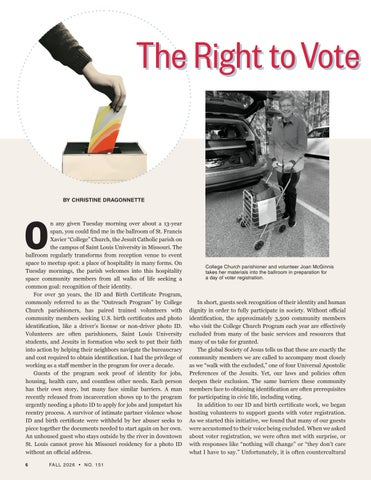
College Church parishioner and volunteer Joan McGinnis takes her materials into the ballroom in preparation for a day of voter registration.
In short, guests seek recognition of their identity and human dignity in order to fully participate in society. Without official identification, the approximately 3,500 community members who visit the College Church Program each year are effectively excluded from many of the basic services and resources that many of us take for granted. The global Society of Jesus tells us that these are exactly the community members we are called to accompany most closely as we “walk with the excluded,” one of four Universal Apostolic Preferences of the Jesuits. Yet, our laws and policies often deepen their exclusion. The same barriers these community members face to obtaining identification are often prerequisites for participating in civic life, including voting. In addition to our ID and birth certificate work, we began hosting volunteers to support guests with voter registration. As we started this initiative, we found that many of our guests were accustomed to their voice being excluded. When we asked about voter registration, we were often met with surprise, or with responses like “nothing will change” or “they don’t care what I have to say.” Unfortunately, it is often countercultural
“ As the 2026 election cycle unfolds, new and existing barriers remain to many of our neighbors’ full participation in our democracy.”
Photos: Courtesy of the author
Two parishioner volunteers work with a program guest of the College Church ID and Birth Certificate Program, or “Outreach Program.”
to actively seek inclusion of those pushed to the margins in our democracy. College Church parishioner Joan McGinnis volunteered to register Outreach Program guests to vote in 2024 and is preparing to participate again this year. For Joan, the experience was eye-opening, as she had always had access to the information she needed to participate in voting. Through her voter registration work, Joan had the privilege of registering several first-time voters, including one man in his 40s who had never before been invited to register to vote. She also had the satisfaction of providing accurate voter information to program guests who had been misinformed about their right to vote, including several formerly incarcerated community members who believed that they could never vote again. These laws vary by state, but in Missouri, most individuals are eligible to register to vote again once they are no longer on probation or parole. However, Joan also encountered many of the logistical roadblocks to voting, especially among guests experiencing homelessness. Federal law does not require a permanent residence to register to vote; however, a mailing address is required in order to register in Missouri and options for unhoused voter registration are often not widely accessible. Our volunteers worked with unhoused program guests to brainstorm an address where they could receive their registration card or to use the College Church address when possible. On top of these hurdles, Missouri is now one of 24 U.S. states requiring nothing short of an unexpired photo identification card in order to cast a ballot. The very same identification our guests struggle to attain is often required to vote. When these
challenges arose, the volunteers took care to accompany the guest along their path to voting as best they could. While Joan and others registered Outreach Program guests to vote, other parishioners were moved to action by guests’ experiences. Members of the College Church community were compelled to engage in the electoral process with our program guests’ stories in mind. We asked questions about why it is so difficult for many already marginalized community members to participate in elections. When a new ballot initiative arose, we examined the impacts on our broader community outside of just the walls of the parish. Several parishioners engaged with our local faith-based community organizing group to speak with voters about elections. The experience of encounter in the Outreach Program gave us a wider view of God’s kingdom, and of who we call our neighbors. As the 2026 election cycle unfolds, new and existing barriers remain to many of our neighbors’ full participation in our democracy. May we answer the call to “walk with the excluded” through our actions: by both directly supporting marginalized community members to more fully participate in elections and questioning the broader systems that make it difficult for them to cast their ballot in the first place. Christine Dragonette serves as the Provincial Assistant for Justice and Ecology for the U.S. Central and Southern Province of the Society of Jesus, advancing justice and ecology initiatives across the province’s Jesuit ministries. Previously, she was Director of Social Ministry at St. Francis Xavier (College) Church for eleven years, stewarding the parish’s service and justice efforts.
A M AT T E R O F S P I R I T
7