AMOS Editor Emily Sanna speaks with Eli McCarthy, a peace fellow with Franciscan Action Network and professor at Georgetown University.
The Peacemakers at the Polls
F
or most people, going to vote is a fairly mundane exercise: You wait in line, fill out a ballot, and go home. But amid heightened political tensions, some faith leaders are preparing for the possibility that polling places could become sites of anxiety, intimidation, or conflict. That’s where poll chaplains come in. Trained in nonviolence and deescalation, clergy and lay faith leaders serve as a calm, nonpartisan presence at polling places, supporting voters and responding when tensions arise. Eli McCarthy, a peace fellow with Franciscan Action Network and professor at Georgetown University, has helped train Catholics and other people of faith to become poll chaplains. For McCarthy, the work is about more than keeping the peace on Election Day. It offers a way to think about democracy itself: not simply as casting a ballot or winning an election, but as the ongoing work of building communities rooted in participation, human dignity, and nonviolence.
What is an election chaplain and what do they do? Poll chaplains are usually deployed to areas or states where there’s likely to be some increased conflict of possible hostility at the polls. There are a variety of organizations that do this: Faith United to Save Democracy deploys chaplains to nine different states that they have designated as priority locations. Other groups, like Franciscan Action Network and Catholics in Communion, are working to try to get poll chaplains deployed to as many states as possible. These chaplains bring a hopeful presence to a space that can sometimes feel a little unnerving or create some anxiety for certain groups or individuals. For example, they might 8
FA L L 2 0 2 6 • N O. 1 5 1
engage in light conversation with people to build familiarity and trust. On occasion, some people might ask them to pray, since they often wear clerical garb or some sort of signal of the role they are playing. At other times, they act to defuse conflict, whether caused by people in line, somebody walking by who starts yelling things, or a protest group that brings a bunch of signs and is trying to increase people’s anxiety. There’s also the possibility of various federal agents on the scene, whether Immigrations and Customs Enforcement (ICE) or related agencies, and chaplains are trained in different kinds of deescalation tactics.
How does someone train to be a poll chaplain? In our trainings we go through about 12 different tactics. These include things like centering; helping a chaplain to center themselves so they are less reactive and defensive in the moment and can react creatively to a situation. We also teaching direct engagement strategies. Like, for example, using distraction to distract someone from what they’re saying or doing. Using empathy: listening for feelings and needs and acknowledging people’s experiences, while also making a proposal or request for them to shift their behavior. As things intensify, we teach other kinds of tactics, like using dignity phrases to re-humanize the people involved. Things like: “You’re part of our community” or “your ideas matter” or “we’re one human family.” Delegation is a tactic where a chaplain might ask someone else to step in who might have more credibility with a certain person. Perhaps that is based on age or gender or race or their kind of role in that space. And some of our chaplains have higher thresholds of risk than others, so they might be willing
to kind of put their bodies in between people or even block or walk somebody back. Those latter tactics are less likely to occur, but we do teach an entire range of ways to respond to possible situations.
of care and creativity that can more easily avoid dynamics of dehumanization, hostility, and harmful escalation that can be present in these situations.
The most common things that happen are individuals or small groups of a few people coming to a space to harass certain folks. They’ll say things like, “You better all be citizens”; “you know who to vote for”; or “We’re gonna make this country great, and you better fall in line.” The chaplain is there to engage those kinds of moments. Sometimes this looks like the chaplain turning to the person who’s getting harassed and checking in with them. Telling them they’re OK and that we’re standing with you; they have a right to vote and we’re going to protect that right. At other times, the poll chaplain will deal more directly with the person who’s creating some hostility. Maybe that looks like complementing their shoes or something; anything that kind of shifts the energy and gets them to talk to the chaplain rather than harassing anyone else. There have also been other situations—maybe not at polls, but related to voting—that involve someone pulling a weapon. After January 6, 2021, there were large demonstrations of both protestors and counter protestors. We had a tall white guy in camouflage walk up to someone in the crowd and start yelling at them; the two guys are eventually in the street, about four feet away from each other, and first guy reaches into his pocket and pulls out a long, black, curved knife. One of our peace team members was monitoring the situation, and he walked up to the guy, put out his hands, and said something like, “Let’s slow down. You don’t need the knife. You can put it away.” The guy with the knife took maybe half a step back, but in that moment, that was enough time for his buddies who were watching to come up and pull the guy back. The two men kept yelling at each other, but the fight never happened.
I think part of it is laying out the goal: increasing safety for everybody. If a chaplain can stay focused on that, then they realize that the less partisan they appear, the more likely they are to de-escalate a range of situations. So there is a strategic element to this. But there’s also the fact that democracy and sustainable peace are not simply determined by an election process. An election is just one moment in cultivating a more democratic society. So, it’s important how it plays out and who wins; but even more important is the process and how well we exercise the means of being democratic nonviolent people. That is what determines how sustainable our democracy, our peaceful society, becomes. Chaplains have this sort of orientation. We want to communicate that democracy is not merely voting. It’s about building a strong, resilient civil society. Gandhi said that democracy will not survive unless it becomes increasingly nonviolent—he saw how all these so-called democracies around the world, global superpowers, had massive structural violence, marginalization, and colonialism. An important part of this work is seeing the bigger picture of democracy and trying to increase active nonviolence in our habits, policies, and systems.
Presumably, everyone doing this work has their own Is there an example of a particular situation that you or political views and hopes for any given election. How do you another poll chaplain encountered that shows why this prepare people to set that aside and be genuinely present work is so important? to people who might want very different outcomes?
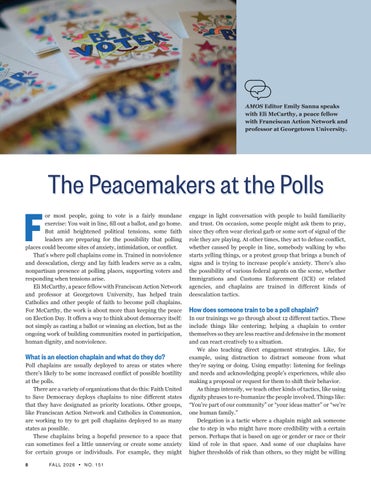
Be a voter © Dan Dennis, unsplash
Why chaplains specifically? What does pastoral training offer in these situations that other kinds of election protection or de-escalation training might not? When pastoral formation is done well, we cultivate this deep sense of interconnectedness with one another. We’re all one family of God’s children. That sense of identity and interconnectedness has a depth to it that allows us to really attend to the dignity of all people. It lets us slow down our judgment and our habits of trying to find an argument and instead focus on the well-being of every person involved, not simply the person we agree with or the one we’re trying to protect. Everyone in a space is part of one sacred family with sacred dignity. This can add a layer
What does that work of building more democratic societies look like for both individuals and communities? One aspect is creating ways that a broad range of people can feel like they can participate—not just as voters, but as chaplains, peacekeepers, people who are part of rapid response networks, etc. Trying to give people different roles and ways to use their gifts and be part of the imagination of creating this world. One of the invitations of the faith journey is to enter into community. We have Franciscan justice circles in about 25 to 30 different cities and towns that meet regularly and pray together and discern how to take just and peaceful action in their communities. Many parishes have active groups. Whatever the community is, lean into it and discern the signs of the times— the urgent needs that match the gifts within your community— and come up with a strategy. There’s that participatory aspect of democracy. But another aspect is to cultivate a posture of humility. We can all kind of move in that direction—so we’re not wrapped up in winning the argument or making sure our policies are the ones that win. That can cultivate this democratic ethos and break down some of the polarization that comes from trying to have a certain party win all the time, which can cloud the view of what policies are actually just and sustainable. A M AT T E R O F S P I R I T
9