Racism - Open Wide Our Hearts—the enduring call to love - 2020
open wide our hearts —the enduring call to love
Four-Session Process for Faith Communities on the USCCB Pastoral on Racism | 2020
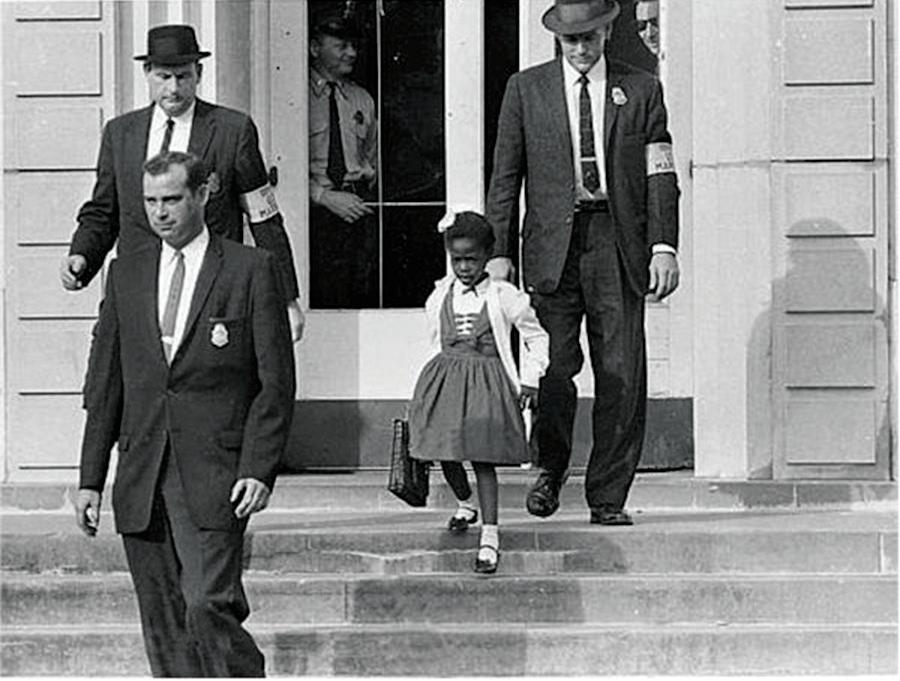
Ruby Bridges, pictured at William Frantz Elementary School in Louisiana during the New Orleans school desegregation crisis on 14 November 1960, advanced the cause of civil rights when she became the first African American student to integrate an elementary school in the South. (Uncredited DOJ photographer)
Facilitator Guide
Leadership is an essential element of any gathering. Each session is designed to be led by a facilitator. This role can be rotated or shared. The facilitator will be responsible for the following:
Preparation
Read the sessions and prepare for each.
y Set up the prayer table.
y Make sure participants have a booklet and the reading assignment before Session 1: Open Wide Our Hearts: The Enduring Call to Love, [1-12]*
y Identify and invite readers before each session.
y Bring, or ask participants to be responsible for refreshments for the break.
Specific Preparation for Each Session
At the beginning of each session, welcome the group. Introductions should be made at the first session and again when new members join. Share the theme of the session.
SESSION 1
Invitation to Conversion
y Ritual cloth, candle and lighter. Optional: begin with a song, e.g., We Are Called by David Haas
y Remind the group to read Open Wide Our Hearts, [13-29] and One Asian American’s Voice on pp. 27–28; and study the Racism Legislation & Resistance Timeline on pp. 32–33 for session two.
SESSION 2
To Do Justice: Live in Right Relationship
y Ritual cloth, candle and lighter. Optional: begin with a song, e.g., Amazing Grace
y Remind the group to read Open Wide Our Hearts, [30-37] and White privilege and what to do about it on pp. 29–30; and study the charts on pp. 9–11 for session three.
SESSION 3
To Love Goodness
y Ritual cloth, candle and lighter. Optional: begin with a song, e.g., All are Welcome by Marty Haugen
y Remind the group to read Open Wide Our Hearts, [3860] for session four.
SESSION 4
To Walk Humbly with God
y Ritual cloth, candle and lighter. Optional: begin with a song, e.g., City of God by Dan Schutte
Small Group Guidelines for Sharing
It is the responsibility of the facilitator to create and maintain a safe and supportive environment for sharing openly and honestly. Each session is comprised of prayer, group discussion, reflection, analysis and action. The facilitator should review the following guidelines with participants for the first two or three sessions.
y Listen with respect and without interruption, judgment or counsel.
y Each person is a potential voice of the Holy Spirit.
y Speak for oneself using “I” statements rather than “We” statements.
y Be brief so that all participants have an opportunity to speak.
y All sharing is to be kept confidential.
Size of Discussion Groups: Generally when a group is larger than 10, it is better to form smaller groups for discussion.
Time: The sessions are scheduled for two hours. Respect people’s time by starting and ending each session on time. At the beginning of the session remind people that it is your role as facilitator to monitor the time for the benefit of the participants and the process.
*Note: paragraph numbers [ ] were not included in the Bishops’ letter; they have been added for ease of reference.
Invitation to Conversion
THEME: We consider individual and systemic racism, why is it sinful; and our call to conversion, to transform our institutions and society into one that respects the dignity and rights of all peoples.
Introduction
to the Pastoral Letter and the Process
(10 minutes)
Leader: Thank you for coming to consider the letter of our U.S. Bishops on racism, Open Wide Our Hearts: The Enduring Call to Love. Recognizing that “racism still profoundly affects our culture,” our bishops call us to “a genuine conversion of heart, a conversion that will compel change, and the reform of our institutions and society.” They offer us the promise that “if racism is confronted by addressing its causes and the injustice it produces, then healing can occur.”
During our four sessions we will use the Pastoral Letter and the Study Guide, which is designed to enable faith communities to understand individual and systemic racism; to listen to the stories of our brothers and sisters and be moved to restore right relationships; to unpack white privilege; and to work to end racism.
Before we begin, let’s review the Small Group Guidelines for Sharing on p. 1.
Now I invite each person to introduce yourself.
Opening Prayer
(15 minutes)
Setting: Put on the ritual table a cloth and a candle. Optional: begin with a song, e.g., We Are Called by David Haas
Reader: Excerpt from On The Pulse of Morning by Maya Angelou
Lift up your eyes upon
The day breaking for you.
Give birth again
To the dream...
Lift up your hearts.
Each new hour holds new chances
For new beginnings.
Do not be wedded forever
To fear...
The horizon leans forward, Offering you space to place new steps of change. Here on the pulse of this new day You may have the grace to look up and out And into your sister’s eyes, into Your brother’s face, your country And say simply Very simply With hope Good morning.
Reflection
Leader: As we embark on this journey of exploring racism, we reflect on the invitation of our bishops to Open Wide Our Hearts as each new day holds new chances for new beginnings. Let’s take a few moments of quiet to consider: What is calling me to accept the invitation to open my heart to how racism is affecting my life and our society? After the quiet I will invite those who wish to share briefly.
(pause)
Leader: Briefly share what is calling you to accept the invitation to open your heart to how racism is affecting your life and our society.
Let us pray
All: Creator God, we thank you for the gift of this day. With your grace and hearts full of hope we are here to give birth again to your dream that all will be one. Amen!
Small Group Discussion: What is Racism?
(35 minutes)
Leader: Let’s take quiet time to reflect on what our bishops and others say about racism and the questions that follow. Then we will have time for discussion in small groups.
As bishops of the Catholic Church in the United States, we want to address one particularly destructive and persistent form of evil. Despite many promising strides made in our country, racism still infects our nation. [1]
Racism arises when—either consciously or unconsciously—a person holds that his or her own race or ethnicity is superior, and therefore judges persons of other races or ethnicities as inferior and unworthy of equal regard. When this conviction or attitude leads individuals or groups to exclude, ridicule, mistreat, or unjustly discriminate against persons on the basis of their race or ethnicity, it is sinful. Racist acts are sinful because they violate justice. They reveal a failure to acknowledge the human dignity of the persons offended… [2]
The Bible calls for us to “love God with all of our strength” and “love our neighbor as ourselves.” …Sin refers to free choices [words, thoughts, actions, and inactions] that harm and break our relationship with God and with others.1
—Kevin P. Considine, Ph.D
Racism is rooted in sin…which goes deeper than politics, pointing fingers, partisan maneuvers, blaming or name calling. We can get to a better place only if we go to that morally deeper place. There will be no superficial or merely political overcoming of our racial sins—that will take a spiritual and moral transformation as well. Sin must be named, exposed, and understood before it can be repented of.2
—Jim Wallis
y What new insights did these reflections give me?
y Have I ever thought of racism as evil and sinful? Why or why not?
y Where/when have I experienced or witnessed the harm of racism?
y What does going to that morally deeper place involve?
y What lifts up my heart as I envision myself and our country undertaking the spiritual and moral transformation to overcome racism?
Direction: After the quiet, invite the participants to share their reflections in a small group.
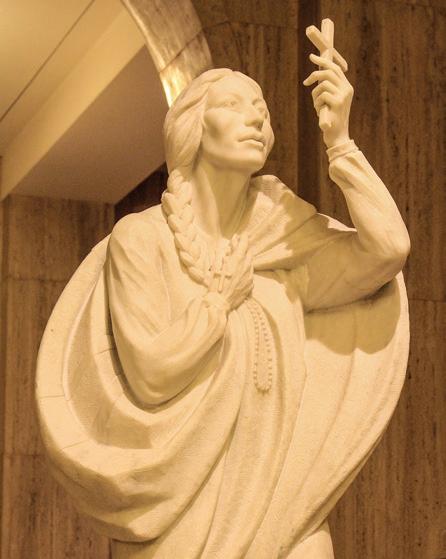
Saint Kateri Tekakwitha
Kateri Tekakwitha was born in 1656 of a Catholic Christian Algonquin mother and a Mohawk Chief. Orphaned at age 4 by a smallpox epidemic, she was adopted by her aunt and uncle.
She was baptized at age 20 at St. Peter's Mission in Caughnawaga (now Fonda, New York) by a Jesuit missionary and given the name Catherine, "Kateri" in Mohawk. After her baptism she was ostracized by her tribe, who did not trust that Catholic values would integrate with their native traditions.
In August 1677, Kateri was encouraged and assisted to leave her Mohawk village and live at St. Francis Xavier Mission near Montreal, Canada where she was able to practice her faith, teach the children and help the sick. She died at age 24.
Saint Kateri Tekakwitha, the first Native American saint, is the patroness of Native Americans and of the environment. Her feast day is May 14.
“To clasp the hands in prayer is the beginning of an uprising against the disorder in the world.”
—KARL BARTH
The Statue of the saint is in the crypt of the Basilica of the Immaculate Conception in Washington DC. Photo, Lawrence OP
Direction: After 20 minutes close this section by inviting participants to share with the larger group a new insight from their small group discussion. Caution participants not to attribute the insight to a particular person.
Break (15 minutes)
Analysis of Racism
(35 minutes)
Leader: At significant times in our history, the bishops have written to express their pastoral concern over the scourge of racism, [8] which they say has “no place in the human heart.”
1958 Segregation and “Jim Crow” laws 3
1968 Scandal of racism and policies and actions that led to frustration and violence4
1979 Structural and institutional forms of racism evident in economic structures5
2018 Persistence of evil of racism Open Wide Our Hearts
What is Racism?
Racism
Personal Racial Prejudice + the Misuse of Power by Systems and Institutions
Let’s take a few minutes for reflection: From my perspective what forms of racism are profoundly impacting our society today?
y Words, thoughts, actions, and inactions of individuals?
y Words, thoughts, actions, and inactions of groups?
y Policies and practices of systems that promote inequity (systemic racism)?
Direction: After the quiet, invite the participants to share with one other person what forms of racism they think are profoundly impacting our society today. Close this section by inviting participants to share with the large group something they heard that they hadn’t considered before.
Closing Reflection and Prayer
(10 minutes)
Reader: Tonight we are being called to a genuine conversion of heart, a conversion that will compel change, and the reform of our institutions and society. Conversion is a long road to travel for the individual. Moving our nation to a full realization of the promise of liberty, equality, and justice for all is even more challenging. However, in Christ we can find the strength and the grace necessary to make that journey. [10]
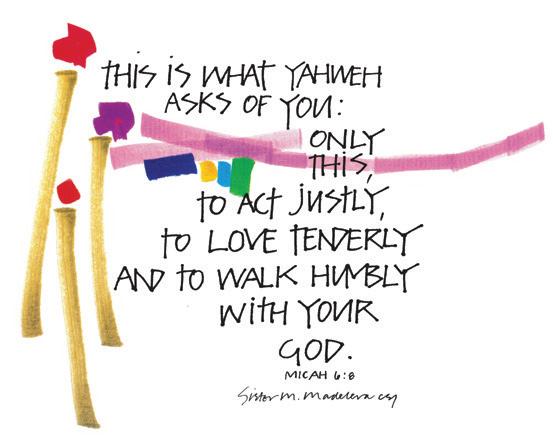
Leader: Karl Rahner tells us that “Grace is everywhere as an active orientation of all created reality toward God.” What steps can we take to avail ourselves of God’s grace to respond to the call for conversion and to transform our institutions and society into one that recognizes and respects the dignity and rights of all peoples? Let us be inspired by the words of the prophet Micah.
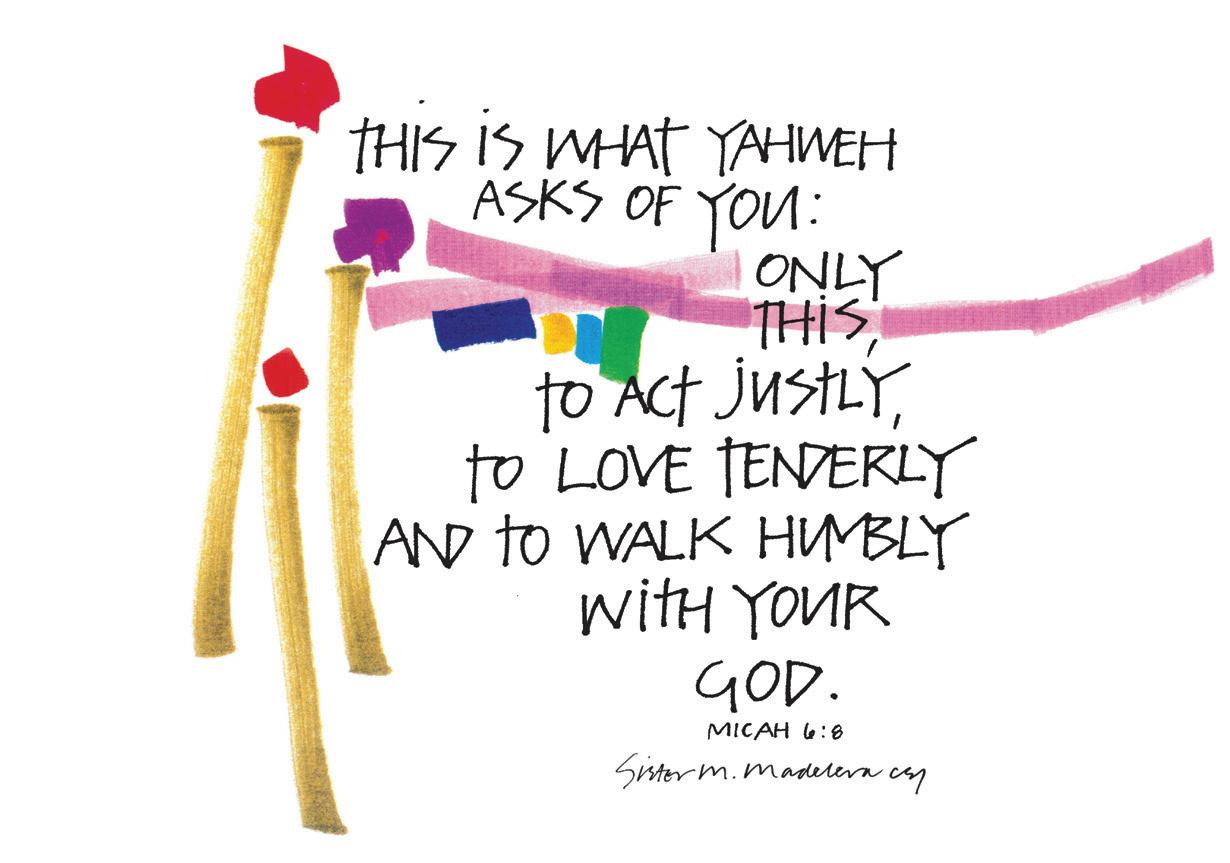
—Patricia Chappell, SNDdeN & Anne Louise Nadeau, SNDdeN
Artwork used with permission of Sisters of St. Joseph of Orange
Reader: Do Justice
We have been told what is good and what God requires of us.
All: We will strive to acknowledge our failures and work to restore right relationships with our brothers and sisters.
Reader: Love goodness
All: We will pursue “what leads to peace and to the building up of one another.” (Rom 14:19)
Reader: Walk humbly
All: We will rely on Christ’s strength and grace, knowing that our effort alone cannot eradicate the evil of racism.
Reader: We are confident that God who has begun this good work in us will bring it to perfection! Let the people say, Amen!
Preparation for Session 2
Read Open Wide Our Hearts, [13-29] and One Asian American’s Voice on pp. 27–28; and study the Racism Legislation & Resistance Timeline on pp. 32–33.
Examples of Jim Crow Laws
Jim Crow Laws, named after a 1828 black minstrel character, were state and local laws that mandated and maintained racial segregation, primarily but not exclusively in southern states. The “separate but equal” legal principle established by the Supreme Court in 1896 was the foundation for the Jim Crow Laws (1876–1965) that enforced racial prejudice, denied human rights and treated black people as second-class citizens. Those who dared to defy these laws were often met with violence and death.
1865 Arizona – Marriages between whites and blacks, “mulattoes,” “Indians,” or “Mongolians,” were declared illegal and void. This law was repealed in 1962.
1873 West Virginia – It was declared that blacks were prohibited from serving on juries. This was overturned in 1880.
1894 California - Voters who couldn’t read the Constitution in English or write their name would be disenfranchised.
1904 Maryland – A law dictated that railroad companies designate racially segregated cars or coaches for whites and blacks, i.e., each race would have its own car.
“The
beauty of anti-racism is that
you don’t have to pretend
to be free of racism to be an antiracist. Anti-racism is the commitment to fight racism whenever you find it, including yourself. And it’s the only way forward.”
IJEOMA OLUO
1927 Illinois – Chicago instituted racially segregated housing practices, which continued until they were ruled unconstitutional in 1948.
1931 Wyoming – Schools were directed to segregate their student bodies when 15 or more “colored” children were enrolled in a district.
1953 Oregon – Laws required that race or color of adopting parents be stated on adoption petitions.
1955 Tennessee - Declared that white and black patients should be treated in separate buildings in hospitals for the insane.
1960 Kentucky - Enacted a law that required voters’ races to be listed on their ballots.
1964 Washington - Seattle voters rejected a referendum that prohibited housing discrimination.
Source: ushistory.org/ legaldictionary.net
To Do Justice: Live in Right Relationship
THEME: We listen with open hearts to the stories of how racism has impacted the lives of our Native American, African American, Hispanic and Asian American sisters and brothers and humbly ask for the grace to live in right relationship with our God, one another and all of creation.
Opening Prayer
(15 minutes)
Setting: Put on the ritual table a cloth and a candle. Optional: begin with a song, e.g., Amazing Grace
Reader: A Rabbi once asked his students how they could tell when the night had ended and the day was on its way back. “Is it when you can see an animal in the distance and know whether it is a dog or a sheep?”
“No,” replied the Rabbi.
“Is it when you can see a tree at a distance and tell whether it is a peach or an apple tree?”
“No,” replied the Rabbi.
“Well then,” demanded the students, “when is it?”
“It is when you look into the face of another human being and see that he or she is your brother or your sister. Because if you cannot do that, then no matter what time it is, it is still night!”
—Source Unknown
Leader: Take a few moments of quiet to remember an encounter you had with another person that moved you to see her/him as your sister or brother. After the quiet we will share our experience with one other person. (pause)
Leader: Briefly share with another person an encounter that changed you.
Let Us Pray
All: God, we thank you for your call to open our hearts to our brothers and sisters and to hear from them the stories of how racism has impacted their lives. We humbly ask for the grace to strive to be the people you created us to be, people who live in right relationship with you, with one another and with all of creation. Amen!
Stories of Our Brothers and Sisters
(10 minutes)
Leader: In our first session we heard our bishops say that “racism still profoundly affects our culture” [9] and they called us to “a genuine conversion of heart, a conversion that will compel change, and the reform of our institutions and society.” [10]
Now we take the first step on our journey to conversion. Martin Luther King, Jr. encourages us saying, “Take the first step in faith. You don't have to see the whole staircase, just take the first step.” Our first step is hearing with open hearts “the tragic stories that are deeply imprinted on the lives of our brothers and sisters.” [17]
Let’s take a few moments of quiet to reflect on the stories in Open Wide Our Hearts, [18-29], One Asian American’s Voice on pp. 27–28; the Racism Legislation & Resistance Timeline on pp. 32–33 and consider the questions below. (pause)
After listening to the Native American, African American, Hispanic and Asian American experiences
y What am I feeling?
y What was new to me?
y What would I like to know more about?
y What experience have I had with Native Americans, African Americans, Hispanics and Asian Americans?
y What does hearing these stories call me to?
y What other groups who have been victims of racial and ethnic prejudice and racism would I like to explore?
“The whole idea of compassion is based on a keen awareness of the interdependence of all these living beings, which are all part of one another, and all involved in one another.”
Small Group Discussion
(50 minutes)
Leader: Let’s take 10 minutes to consider and discuss each of the experiences—Native American, African-American, Hispanic and Asian American. I’ll let you know when 10 minutes has ended and you should move on to the next experience.
Break (15 minutes)
Large Group Discussion & Closing Prayer
(30 minutes)
Leader: Let’s take a few moments of quiet to consider: How am I feeling after our discussion of the stories of my Native American, African American, Hispanic and Asian American sisters and brothers? Is there something from our small group that I would like to share? (pause)
Leader: Anyone who wishes to share how s/he is feeling or something from the small group is invited to do so.
Direction: Conclude the sharing with these words from our bishops.
Reader: We are not finished with the work. The evil of racism festers in part because, as a nation, there has been very limited formal acknowledgement of the harm done to so many, no moment of atonement, no national process of reconciliation and, all too often a neglect of our history. Many of our institutions still harbor, and too many of our laws still sanction, practices that deny justice and equal access to certain groups of people. God demands more from us. We cannot, therefore, look upon the progress against racism in recent decades and conclude that our current situation meets the standard of justice. In fact, God demands what is right and just. [16]
Direction: Invite participants to alternate sides of the room for each verse of our prayer.
“ In a free society, some are guilty; all are responsible.”
—ABRA HA M HESCHEL
Leader: Let us pray for God to Open Wide our Hearts
y God of justice, in your wisdom you create all people in your image, without exception.
y Through your goodness, open our eyes to see the dignity, beauty, and worth of every human being.
y Open our minds to understand that all your children are brothers and sisters in the same human family.
y Open our hearts to repent of racist attitudes, behaviors, and speech, which demean others.
y Open our ears to hear the cries of those wounded by racial discrimination, and their passionate appeals for change.
y Strengthen our resolve to make amends for past injustices and to right the wrongs of history.
y And fill us with courage that we might seek to heal wounds, build bridges, forgive and be forgiven, and establish peace and equality for all in our communities.
y In Jesus’ name we pray. Amen.
—CATHOLIC CHARITIES USA
Preparation for Session 3
Read Open Wide Our Hearts, [30-37] and White Privilege and what to do about it, on pp. 29–30; and study the charts on pp. 9–11.
Optional:
View How White Privilege Made Ben & Jerry’s Possible benjerry.com/whats-new/2018/07/ben-jerry-white-privilege
Understanding My Privilege, Sue Borrego stuartcenter.org/resource/understanding-my-privilege -sue-borrego
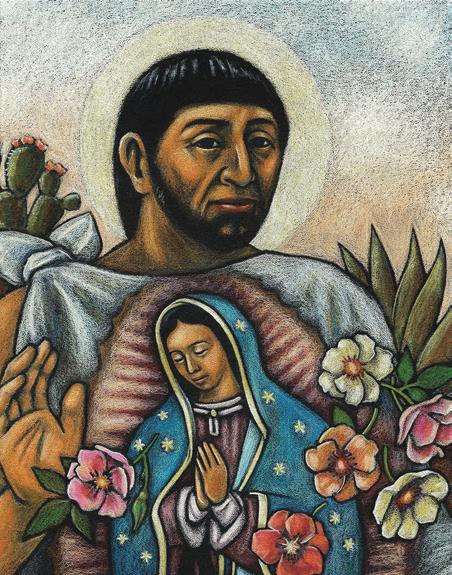
Saint Juan Diego
The story of Juan Diego takes place in 16th century Mexico about 10 years after the Spanish conquest. While he was on his way to religious instruction he saw Our Lady who told him, “I am your ever-loving mother who has come forth to show my love, compassion, help and defense. I want you to build me a little house here.”
He went to the bishop who did not believe him because Juan was an indigenous person. When Juan asked Our Lady to send someone who was more respected she told him that she had many messengers but it was important that he do this. He returned to the bishop who asked him for a sign.
On his way home, Juan found roses growing among rocks. Startled by roses growing in December, he picked them up in his tilma and carried them home. When he unwrapped the roses, the image of Our Lady appeared on his tilma.
The picture of Our Lady of Guadalupe startled him because she was an indigenous woman and on her arm she wore a black armband signifying that she was pregnant. For the indigenous population of Mexico, this was a sign that God was present with them and that the oppression which they had suffered would not endure.
The feast of Saint Juan Diego, the first indigenous saint from the Americas, is on December 9.
To Love Goodness
THEME: We consider with open hearts the experience of being white in America and the privileges that come with it; and the responsibility to work to end the injustice in our systems of education, housing, incarceration and employment.
Opening Prayer
(15 minutes)
Setting: Put on the ritual table a cloth and a candle. Optional: begin with a song, e.g., All are Welcome by Marty Haugen
Reader: Most people would not consider themselves to be racist. A person might admit to being prejudiced but certainly not racist. As Christians, we know it is our duty to love others. St. Paul reminds us that we live by the Spirit, and the “fruit of the Spirit is love, joy, peace, patience, kindness, generosity, faithfulness, gentleness, self-control” (Gal 5:22-23).
We must be honest with ourselves. Each of us should examine our conscience and ask if these fruits are really present in our attitudes about race. Or, rather, do our attitudes reflect mistrust, impatience, anger, distress, discomfort, or rancor? [30]
Leader: Let’s take a few moments for reflection: Which grace of the Spirit do I need for conversion of heart? Which attitude toward race do I need to let go of? (pause)
Leader: Believing with Julian of Norwich that “All shall be well…for there is a Force of love moving through the universe that holds us fast and will never let us go,” I invite you to name the fruit of the spirit or the attitude about race that came to you in your reflection.
(Pause for participants to name a grace or attitude and then pray.)
Let us Pray
All: Come, Holy Spirit, fill the hearts of your faithful. And kindle in them the fire of your love. Send forth your Spirit and they shall be created. And you will renew the face of the earth. Amen —Prayer to the Holy Spirit from
Art by Julie Lonneman
Small Group Discussion
(20 minutes)
Leader: Last week we listened with open hearts to the stories of our Native American, African-American, Hispanic and Asian American sisters and brothers. Now we want to consider the experience of being white in America.
Let’s take a few moments of quiet to reflect on the following quotes on white privilege and white fragility. Then we will have an opportunity for discussion in small groups.
The scholar Peggy McIntosh describes white privilege as, “an invisible package of unearned assets.” These assets are largely unrecognized by those who hold them and are rendered invisible through dominant social practices. Law provides many concrete examples of white privilege. The U.S. Naturalization Law of 1790 is one such example. The very first Congress of the country determined that in order to naturalize as a U.S. citizen one had to be white. This particular structural advantage that conferred white privilege was shared by poor and wealthy alike and it did not matter whether one was aware of the advantage or desired it. The advantage was simply built in, a feature of law. The requirement of being white to naturalize lasted more than 150 years…6
—Jacqueline Battalora
Widening Average Family Wealth Gap by Race/Ethnicity
The advantage extended beyond immigrants to other whites both in the past and present. The law worked to construct a white = American equation that continues today, creating both systemic and personal advantage for whites and disadvantage for people of color.7
White privilege operates to give whites unfair access to resources both material (land, money, jobs) and symbolic (positive representations including common toys like Superman, Barbie) advantages simply by virtue of being white.8
As a white person, I realized I had been taught about racism as something that puts others at a disadvantage, but had not been taught to see one of its corollary aspects, white privilege, which puts me at an advantage.9
—Peggy McIntosh
White Fragility is a state in which even a minimum amount of racial stress becomes intolerable, triggering a range of defensive moves. These moves include the outward display of emotions such as anger, fear, and guilt, and behaviors such as argumentation, silence, and leaving the stress-inducing situation. These behaviors, in turn, function to reinstate white racial equilibrium.10
—Robin DiAngelo
y What new insights on racism did the reflections on white privilege and white fragility give me?
y Where do I see privilege related to race in my life? In my community? In our society?
y What will I/we do to lessen and end white privilege?
Direction: Invite participants to form small groups.
Large Group Discussion
(10 minutes)
Leader: Let’s take a few moments to reflect on our small group discussion: How am I feeling after our discussion; what am I being called to?
Direction: After the quiet, invite the participants to share with the large group: How am I feeling after our discussion; what am I being called to?
Source: Federal Reserve Board- Survey of consumer finances, federalreserve.gov
(15 minutes)
U.S. Male Incarceration Rate by Race 2017
Source: US Department of Justice, Bureau of Justice Statistics, April 2019
Small Group Discussion: Systemic Racism
(35 minutes)
Leader: Our bishops tell us:
The poverty experienced by many of these communities has its roots in racist policies that continue to impede the ability of people to find affordable housing, meaningful work, adequate education, and social mobility. [26]
Let’s take time to study the charts on the wealth gap, criminal justice, education, and children living in poverty of our Native American, African American, Hispanic and Asian American brothers and sisters and the questions that follow.
y What new insights and information did these charts give me?
y Where have I experienced these inequalities in my community, or seen them play out in our country?
y When/how have I worked to change laws, policies and practices that promote or allow racism in our systems of education, housing, incarceration or employment?
y God calls us to work for justice, right relationships with one another. What can we do to lessen and end the injustice in one of our systems?
Direction: After the quiet, invite the participants to discuss the questions in small groups. Tell them that when we gather in a large group we’ll share on the question: What can we do to lessen and end the injustice in one of our systems?”
Large Group Discussion
(15 minutes)
Leader: Let’s begin by giving anyone who wishes an opportunity to share any new insights s/he had.
Direction: after 5 minutes move on to the following question.
Now, let’s discuss what we can do to lessen and end the injustice in our systems.
Closing Prayer
(10 minutes)
Leader: As we conclude our time together let’s recall how Jesus began his ministry.
Reader: And Jesus returned to Galilee in the power of the Spirit, and news about Him spread through all the surrounding district. And He began teaching in their synagogues and was praised by all.
And He came to Nazareth, where He had been brought up; and as was His custom, He entered the synagogue on the Sabbath, and stood up to read. And the book of the prophet Isaiah was handed to Him. And He opened the book and found the place where it was written,
The Spirit of the Lord is upon me, because he anointed me to preach the Gospel to the poor. He has sent me to proclaim release to the captives, and recovery of sight to the blind, to set free those who are oppressed, to proclaim the favorable year of the Lord.
And He closed the book, gave it back to the attendant and sat down; and the eyes of all in the synagogue were fixed on Him. And He began to say to them, “Today this Scripture has been fulfilled in your hearing.”
—Luke 4-14-18
(pause)
U.S. Highest Education Attainment and Poverty Rates By Race
“How did I get so lucky to have my heart awakened to others and their suffering?”
Leader: During the week take time to reflect on the mission of Jesus which is also our mission, and ponder how you can address racism in your life, community and society. Let us conclude by claiming the mission of Jesus as our own.
All: The Spirit of the Lord is upon me, because he anointed me to preach the Gospel to the poor.
He has sent me to proclaim release to the captives, and recovery of sight to the blind, to set free those who are oppressed, to proclaim the favorable year of the Lord.
Preparation for Session 4
Read from Open Wide Our Hearts, [38-60]. Ponder how you can address racism in your life, community and society.
*Excludes
Source:
Children Living in Poverty by Race 2017
Source:
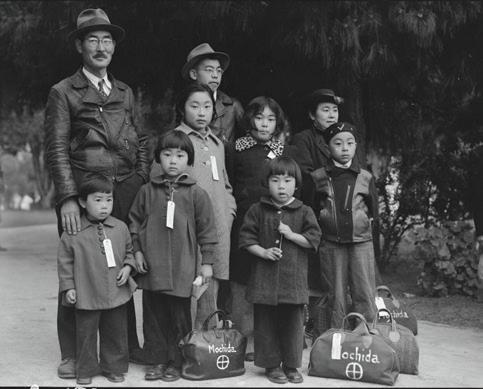
Members of the Mochida Family Awaiting Evacuation; 5/8/1942
Records of the War Relocation Authority, National Archives.
Father Leopold Tibesar
On Feb. 19, 1942, after the Japanese attack on Pearl Harbor, President Franklin Roosevelt issued Executive Order 9066 sending nearly 120,000 Japanese who lived on the West Coast to “war relocation centers.” The government feared the Japanese would become spies or saboteurs.
The Catholic Church in Seattle, in the person of Bishop Gerald Shaughnessy, spoke out against the injustice of how the Japanese were being treated. He called on Catholics to:
“ ...embrace our fellow American citizens of Japanese extraction in a special bond of charity…and in the bond of that all-inclusive love of neighbor which our Blessed Savior so often and so insistently calls to our mind.”
When Executive Order 9066 imprisoned most his parishioners of Lady Queen of Martyrs at the Minidoka, Idaho War Relocation Center, Maryknoll Father Leopold Tibesar joined them. Moved by compassion and not fear, he lived with them inside the barbed-wire fence with guard towers and armed soldiers, celebrating Mass and the Sacraments with them.
4
To Walk Humbly with God
THEME: We conclude our consideration of the invitation to Open Wide Our Hearts to our sisters and brothers and commit “to walk humbly with God” in rebuilding our relationships, healing our communities, and working to shape our policies and institutions toward the good of all. [38]
Opening Prayer
(20 minutes)
Setting: Put on the ritual table a cloth and a candle. Optional: begin with a song, e.g., City of God by Dan Schutte
Leader: Examining our sinfulness—individually, as the Christian community, and as a society—is a humbling experience. Only from a place of humility can we look honestly at past failures, ask for forgiveness, and move toward healing and reconciliation. [40]
In light of the need for ourselves, our church and our society to heal from the sin of racism we begin our time together with an Examen.
Reader: “In the Examen, we review our recent past to find God and God’s blessings in life. We also look back to find moments…when things didn’t go so well…when we sinned or made a mistake. We give praise and thanksgiving for the blessed moments. We ask forgiveness and healing for the difficult and painful moments…We then turn to the day yet to come and ask God… for insight into what graces we might need…patience, wisdom, fortitude, self-knowledge, peace, optimism…11
—Mark E. Thibodeaux, SJ
Leader: Let’s take time to consider God’s blessings in my life and where I have failed. Then ask God for the grace I need to be in right relationship with my sisters and brothers.
y Where have I experienced racism in myself, either in actions or in failing to take a stand?
y Do I take time to listen to the voices of my Native American, African American, Hispanic and Asian American sisters and brothers?
y Do I use dehumanizing language about others, such as “illegal alien?”
y Do I blame people living in poverty and/or people who are oppressed for their situation?
(pause for 5 minutes)
Leader: I invite us to close our Examen by having each person name the grace s/he is seeking to live in right relationship.
Large Group Discussion
(20 min)
Reader: A reading from Night Will Be No More, by Bishop Mark Seitz12
‘God gave the earth to the whole human race for the sustenance of all its members, without excluding or favouring anyone.’ 13 We must work to ensure all our children have access to quality educational opportunities, eliminate inequality in the colonias, pass immigration reform, eradicate discrimination, guarantee universal access to health care, ensure the protection of all human life, end the scourge of gun violence, improve wages on both sides of the border, offer just and sustainable development opportunities, defend the environment and honor the dignity of every person. This is how we write a new chapter in our history of solidarity and friendship that future generations can remember with pride. This work of undoing racism and building a just society is holy, for it ‘contributes to the building of the universal city of God, which is the goal of the history of the human family. It anticipates that day when ‘night will be no more, nor will they need light from lamp or sun, for the Lord God shall give them light, and they shall reign forever and ever.’ 14
Leader: Let’s take time to consider: During the week when and where was I aware of white privilege and how racism impacts employment, housing, education, criminal justice or children in our society? (pause)
Direction: Invite participants to share their experiences, reminding them that we have about 10 minutes for this and we want to give everyone an opportunity to share.
“In the course of history, there comes a time when humanity is called to shift to a new level of consciousness…A time when we have to shed our fear and give hope to each other. That time is now.”
—WANGERI MAATHAI
Break
(10 minutes)
Small Group Discussion: Discerning the Call
(45 Minutes)
Leader: At this point in our consideration of racism our bishops invite us to press forward without fear. They write: To press forward without fear means “to walk humbly with God” in rebuilding our relationships, healing our communities, and working to shape our policies and institutions toward the good of all… Racism is a moral problem that requires a moral remedy—a transformation of the human heart—that impels us to act. [38]
In the Walk Humbly with God section of the Pastoral Open Wide Our Hearts, [43–59] our bishops call us to
y Be open to encounter and to new relationships
y Resolve to work for justice
y Educate ourselves
y Work in our churches
y Change structures
y Conversion
y Commitment to life
Now we are going to take about 45 minutes to consider how we want to go forward in addressing and ending racism as individuals, communities and society. In your small group use Undoing Racism: Discerning the Call on p. 14.
y Discuss the suggested actions
y Edit them as you wish
y Add your ideas in the blank spaces
If there is something that you want to do together, who will be the convener? When we gather in a large group you’ll have an opportunity to share your individual or group commitments.
Undoing Racism: Discerning the Call
Personal Communal Systemic
Where have I experienced racism in the church, either in actions or in failing to take a stand? [40–42]
Pay attention to the topics of the homilies in your parish. [51]
Embrace the bishops’ statement that “racism is a life issue” and study how disregard for human life impacts people of color. [59, 16]
Investigate how racism is taught and diversity is evident in our elementary and high schools. [52]
Discover what unique contribution you can make to eliminating racism. Explore how your energies and passions might contribute to the larger effort. [11–12]
Find a group in your faith community with whom to share your reflections.
Ask the leaders of your parish to preach on racism during Respect Life Month or Black History Month.
Organize a dialogue on how the bishops’ teaching can enlarge and expand the life issues important to our faith community.
Form a group with whom to share your findings and concerns, e.g., parent groups and administrators.
Focus on one action or failure. Devise a plan to remedy it.
Organize activities and opportunities to address racism in your parish community.
Create opportunities to end racism in prisons, education, housing, employment, etc.
Track how the schools implement diversity in the curriculum and activities.
Convene a group to study the Movement.
Ask communities that you are a part of to create a vision and commitment statement, in collaboration with people of color, to address racism.
Be part of a movement to ask for accountability when racism is suspected or evident.
Examine our systems that are in need of reform and take action, e.g., education, criminal justice.
Large Group Discussion
(15 minutes)
We invite any group that is making a commitment to address racism to share it.
If anyone wants to share a personal commitment, please do so.
Closing Prayer
(10 minutes)
Leader: As we conclude our consideration of the invitation to Open Wide Our Hearts to our sisters and brothers and how racism and privilege are impacting our society, let’s take a few moments of communal quiet to ponder: What is in my heart as I reflect on what I have learned and experienced over the past weeks?
(pause)
Leader: I invite those who wish to share a word or phrase from your reflection.
Direction: Invite participants to alternate sides in praying our Litany of Commitment.
Leader: Spirit of God, here on the pulse of this new day may we have the grace
y To examine our own prejudices and privilege and work to lessen and end them
y To speak up when racism goes unchecked, unacknowledged, unrecognized
y To stand up when an individual or group is violated by violence and abuse of power
y To go into boardrooms and courtrooms, police stations and council meetings, institutions and churches until all people are free
y To promote understanding, inclusion and mutual respect and build community within and among all races, ethnicities and cultures
Leader: Let the people say: Amen!
Adapted, Prayer of Lament by Dr. Sharon R. Fennema; Sisters of Mercy Prayer for the Elimination of Racism
“ A single seed can turn into a forest. A single heart can transform a nation.”
—BRYAN THAO WORRA
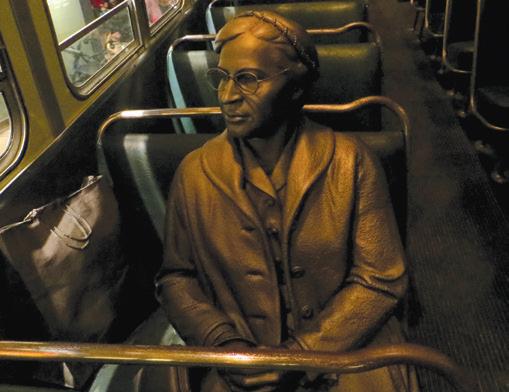
Rosa Parks
“People always say that I didn't give up my seat because I was tired…the only tired I was, was tired of giving in.”
On her way home from work at a Montgomery shirt factory on December 1, 1955 Rosa Parks was arrested for not giving up her bus seat to a white passenger. Her action ignited the 13-month Montgomery Bus Boycott that ended when the US Supreme Court ruled that segregation on public buses is unconstitutional; and launched nationwide efforts to end racial segregation of public facilities.
This was not Rosa’s first experience of racial discrimination and activism for racial equality. She attended segregated schools and witnessed the Klu Klux Klan march down the street in front of her house. After graduation from high school she became involved in civil rights issues when she joined the NAACP.
While unveiling a statue of Rosa Parks in the U.S. Capitol, President Barak Obama said of her, "In a single moment, with the simplest of gestures, she helped change America and change the world. . . . And today, she takes her rightful place among those who shaped this nation’s course.”
Peter Helver sculpture of Rosa Parks, National Civil Rights Museum, Memphis, Tennessee
[1] Holy Scripture boldly proclaims, “See what love the Father has bestowed on us that we may be called the children of God. Yet so we are” (1 Jn 3:1). This love “comes from God and unites us to God; through this unifying process it makes us a ‘we’ which transcends our divisions and makes us one, until in the end God is ‘all in all’ (1 Cor 15:28).” 1 By the work of the Holy Spirit, the Church is called to share with all the world this gift of love. As Pope Francis points out, “The salvation which God has wrought, and the Church joyfully proclaims, is for everyone. God has found a way to unite himself to every human being in every age.”2 Through his Cross and Resurrection, Christ united the one human race to the Father. However, even though Christ’s victory over sin and death is complete, we still live in a world affected by them. As bishops of the Catholic Church in the United States, we want to address one particularly destructive and persistent form of evil. Despite many promising strides made in our country, racism still infects our nation.
What Is Racism?
[2] Racism arises when—either consciously or unconsciously— a person holds that his or her own race or ethnicity is superior, and therefore judges persons of other races or ethnicities as inferior and unworthy of equal regard. When this conviction or attitude leads individuals or groups to exclude, ridicule, mistreat, or unjustly discriminate against persons on the basis of their race or ethnicity, it is sinful. Racist acts are sinful because they violate justice. They reveal a failure to acknowledge the human dignity of the persons offended, to recognize them as the neighbors Christ calls us to love (Mt 22:39).
[3] Racism occurs because a person ignores the fundamental truth that, because all humans share a common origin, they are all brothers and sisters, all equally made in the image of God. When this truth is ignored, the consequence is prejudice and fear of the other, and—all too often—hatred. Cain forgets this truth in his hatred of his brother. Recall the words in the First Letter of John: “Everyone who hates his brother is a murderer,
1 Pope Benedict XVI, Deus Caritas Est, no. 18.
2 Pope Francis, Evangelii Gaudium, no. 113.
and you know that no murderer has eternal life remaining in him” (1 Jn 3:15). Racism shares in the same evil that moved Cain to kill his brother. It arises from suppressing the truth that his brother Abel was also created in the image of God, a human equal to himself. Every racist act—every such comment, every joke, every disparaging look as a reaction to the color of skin, ethnicity, or place of origin—is a failure to acknowledge another person as a brother or sister, created in the image of God. In these and in many other such acts, the sin of racism persists in our lives, in our country, and in our world.
[4] Racism comes in many forms. It can be seen in deliberate, sinful acts. In recent times, we have seen bold expressions of racism by groups as well as individuals. The re-appearance of symbols of hatred, such as nooses and swastikas in public spaces, is a tragic indicator of rising racial and ethnic animus. All too often, Hispanics and African Americans, for example, face discrimination in hiring, housing, educational opportunities, and incarceration. Racial profiling frequently targets Hispanics for selective immigration enforcement practices, and African Americans, for suspected criminal activity. There is also the growing fear and harassment of persons from majority Muslim countries. Extreme nationalist ideologies are feeding the American public discourse with xenophobic rhetoric that instigates fear against foreigners, immigrants, and refugees. Finally, too often racism comes in the form of the sin of omission, when individuals, communities, and even churches remain silent and fail to act against racial injustice when it is encountered.
[5] Racism can often be found in our hearts—in many cases placed there unwillingly or unknowingly by our upbringing and culture. As such, it can lead to thoughts and actions that we do not even see as racist, but nonetheless flow from the same prejudicial root. Consciously or subconsciously, this attitude of superiority can be seen in how certain groups of people are vilified, called criminals, or are perceived as being unable to contribute to society, even unworthy of its benefits. Racism can also be institutional, when practices or traditions are upheld
that treat certain groups of people unjustly. The cumulative effects of personal sins of racism have led to social structures of injustice and violence that makes us all accomplices in racism.3
[6] We read the headlines that report the killing of unarmed African Americans by law enforcement officials. In our prisons, the number of inmates of color, notably those who are brown and black, is grossly disproportionate.4 Despite the great blessings of liberty that this country offers, we must admit the plain truth that for many of our fellow citizens, who have done nothing wrong, interactions with the police are often fraught with fear and even danger. At the same time, we reject harsh rhetoric that belittles and dehumanizes law enforcement personnel who labor to keep our communities safe. We also condemn violent attacks against police.
[7] We have also seen years of systemic racism working in how resources are allocated to communities that remain de facto segregated. As an example, the water crisis in Flint, Michigan, resulted from policy decisions that negatively affected the inhabitants, the majority of whom were African Americans.5 We could go on, for the instances of discrimination, prejudice, and racism, sadly, are too many.
[8] At significant times in our history, the bishops have written to express their pastoral concern over the scourge of racism, which some have called our country’s original sin. In 1958, the bishops wrote to condemn the blatant forms of racism found in segregation and “Jim Crow” laws.6 Ten years later, they wrote to condemn the scandal of racism and the policies and actions that led to so much frustration that violence erupted in many cities.7 In 1979, the bishops wrote on how racism still affected so many of our brothers and sisters, highlighting the structural and institutional forms of racial injustice evident in the economic imbalances found in our society.8
[9] With the positive changes that arose from the civil rights movement and related civil rights legislation, some may believe that racism is no longer a major affliction of our society— that it is only found in the hearts of individuals who can be
3 See Catechism of the Catholic Church, no. 1869.
dismissed as ignorant or unenlightened. But racism still profoundly affects our culture, and it has no place in the Christian heart. This evil causes great harm to its victims, and it corrupts the souls of those who harbor racist or prejudicial thoughts. The persistence of the evil of racism is why we are writing this letter now. People are still being harmed, so action is still needed.
[10] What is needed, and what we are calling for, is a genuine conversion of heart, a conversion that will compel change, and the reform of our institutions and society. Conversion is a long road to travel for the individual. Moving our nation to a full realization of the promise of liberty, equality, and justice for all is even more challenging. However, in Christ we can find the strength and the grace necessary to make that journey.
[11] In this regard, each of us should adopt the words of Pope Francis as our own: let no one “think that this invitation is not meant for him or her.”9 All of us are in need of personal, ongoing conversion. Our churches and our civic and social institutions are in need of ongoing reform. If racism is confronted by addressing its causes and the injustice it produces, then healing can occur. In that transformed reality, the headlines we see all too often today will become lessons from the past.
[12] How do we overcome this evil of rejecting a brother or sister’s humanity, the same evil that provoked Cain’s sin? What are the necessary steps that would lead to this conversion? We find our inspiration in the words of the prophet Micah:
You have been told, O mortal, what is good, and what the LORD requires of you: Only to do justice and to love goodness, and to walk humbly with your God. (Mi 6:8)
To do justice requires an honest acknowledgment of our failures and the restoring of right relationships between us. “If we acknowledge our sins, [God] is faithful and just and will forgive our sins and cleanse us from every wrongdoing”
4 The Pew Research Center reports, “The racial and ethnic makeup of U.S. prisons continues to look substantially different from the demographics of the country as a whole. In 2016, blacks represented 12% of the U.S. adult population but 33% of the sentenced prison population. Whites accounted for 64% of adults but 30% of prisoners. And while hispanics represented 16% of the adult population, they accounted for 23% of inmates.” See John Gramlich, “The gap between the number of black and whites in prison is shrinking,” January 12, 2018. www. pewresearch.org/fact-tank/2018/01/12/shrinking-gap-between-number-of-blacks-and-whites-in-prison/ (accessed May 31, 2018).
5 See Michigan Civil Rights Commission Report, “The Flint Water Crisis: Systemic Racism Through the Lens of Flint,” Michigan Department of Civil Rights Website, February 17, 2017. www.michigan.gov/documents/mdcr/VFlintCrisisRep-F-Edited3-13-17_554317_7.pdf (accessed August 10, 2018).
6 USCCB, Discrimination and Christian Conscience, November 14, 1958.
7 USCCB, National Race Crisis, April 25, 1968.
8 USCCB, Brothers and Sisters to Us, November 14, 1979.
9 Pope Francis, Evangelii Gaudium, no. 3.
(1 Jn 1:9). To love goodness demands pursuing “what leads to peace and to building up one another” (Rom 14:19). It requires a determined effort, but even more so, it requires humility; it requires each of us to ask for the grace needed to overcome this sin and get rid of this scourge. In what follows, we hope to provide a Christian call for all of us in this country to “walk humbly with our God” so that, by his grace, racism will be eradicated.
Do Justice
[13] For a nation to be just, it must be a society that recognizes and respects the legitimate rights of individuals and peoples.10 These rights precede any society because they flow from the dignity granted to each person as created by God.11 We are reminded of this fundamental truth in the earliest passages of the book of Genesis:
Then God said: Let us make human beings in our image, after our likeness. Let them have dominion over the fish of the sea, the birds of the air, the tame animals, all the wild animals, and all the creatures that crawl on the earth.
God created mankind in his image; in the image of God he created them; male and female he created them. (Gen 1:26-27)
[14] From revelation, we know that the one God who created the human race is Triune, a communion of truth and love, and so by faith we recognize all the more clearly that human beings are, by their very nature, made for communion. Pope Benedict XVI noted, “As a spiritual being, the human creature is defined through interpersonal relations. The more authentically he or she lives these relations, the more his or her own personal identity matures. It is not by isolation that man establishes his worth, but by placing himself in relation with others and with God.”12 We are meant to love God with our whole being, which then overflows into love for our neighbor. “Whoever loves God must love his brother” (1 Jn 4:21).
[15] This is the original meaning of justice, where we are in right relationship with God, with one another, and with the rest of God's creation. Justice was a gift of grace given to all of humanity. After sin entered the world, however, this sense of justice was overtaken by selfish desires, and we became
10 Pope Benedict XVI, Caritas in Veritate, no. 6.
11 Catechism of the Catholic Church, no. 1930.
12 Pope Benedict XVI, Caritas in Veritate, no. 53.
inclined to sin.13 St. Augustine described well our lives after Eden, saying that in the fallen world our relationships with one another have been guided by a “lust to dominate.”14 Whether recognized or not, the history of the injustices done to so many, because of their race, flows from this “lust to dominate” the other. Even when we are freed from Original Sin by Baptism, we continue to struggle with overcoming temptation and sin in our lives.15
[16] Although our nation has moved forward in a number of ways against racial discrimination, we have lost ground in others. Despite significant progress in civil law with regard to racism, societal realities indicate a need for further catechesis to facilitate conversion of hearts. Too many good and faithful Catholics remain unaware of the connection between institutional racism and the continued erosion of the sanctity of life. We are not finished with the work. The evil of racism festers in part because, as a nation, there has been very limited formal acknowledgement of the harm done to so many, no moment of atonement, no national process of reconciliation and, all too often a neglect of our history. Many of our institutions still harbor, and too many of our laws still sanction, practices that deny justice and equal access to certain groups of people. God demands more from us. We cannot, therefore, look upon the progress against racism in recent decades and conclude that our current situation meets the standard of justice. In fact, God demands what is right and just.
[17] As Christians, we are called to listen and know the stories of our brothers and sisters. We must create opportunities to hear, with open hearts, the tragic stories that are deeply imprinted on the lives of our brothers and sisters, if we are to be moved with empathy to promote justice. Many groups, such as the Irish, Italians, Mexicans, Puerto Ricans, Poles, Jews, Chinese, and Japanese, can attest to having been the target of racial and ethnic prejudice in this country. It is also true that many groups are still experiencing prejudice, including rising anti-Semitism, the discrimination many Hispanics face today, and anti-Muslim sentiment. Especially instructive at this moment, however, are the historical and contemporary experiences of Native and African Americans.
The Native American Experience
[18] Before Europeans arrived, this land already had many diverse peoples upon it, with varying customs, languages,
13 Catechism of the Catholic Church, no. 405.
14 St. Augustine, City of God, Book I, Preface.
15 Catechism of the Catholic Church, no. 978.
and beliefs. As explorers, and then pioneers, arrived, relations with Native Americans also varied but were mostly to the detriment of Native peoples. Native Americans experienced deep wounds in the age of colonization and expansion, wounds that largely remain unhealed and strongly impact the generations to this day—a fact that St. John Paul II recognized when he met with Native peoples in 1987: “The early encounter between your traditional cultures and the European way of life was an event of such significance and change that it profoundly influences your collective life even today. That encounter was a harsh and painful reality for your peoples. The cultural oppression, the injustices, the disruption of your life and of your traditional societies must be acknowledged.”16
[19] Many European settlers were blind to the dignity of indigenous peoples. Colonial and later U.S. policies toward Native American communities were often violent, paternalistic, and were directed toward the theft of their land. Native Americans were killed, imprisoned, sold into slavery, and raped. These policies decimated entire communities and brought about tragic death. The results were massive, forced relocations of people, such as the forced removal of the Cherokee people from the Southeast to the Western territories along the “Trail of Tears,” and of the Navajo in the “Long Walk.” Thousands of men, women, and children died during those forced removals. The forced relocation of peoples occurred again and again due to the idea that if the indigenous peoples “interfered with progress they should be pushed aside.”17 In many boarding schools and orphanages, the objective was to “Americanize” Native children by forcing them to abandon all facets of their culture, including their native languages. In the words of the superintendent of one school, the goal was to “kill the Indian, and save the man.”18
[20] During this time there were missions that stood as a barrier to the abuse of indigenous peoples and provided a form of protection in a rapidly changing reality. Although not all encounters with missionaries were benign, a number of missionaries heroically defended Native Americans as they sought to bring the Good News of Christ to many who had yet to hear it. The Jesuit Fr. Pierre-Jean de Smet and the Franciscan Anselm Weber, for example, worked tirelessly in supporting and promoting Native American rights. Earlier,
16 St. John Paul II, Address at the Meeting with the Native Peoples of the Americas, September 14, 1987, Phoenix, Arizona, no. 2.
17 U.S. Library of Congress, The Indians of Southern California in 1852; The B. D. Wilson Report and a Selection of Contemporary Comment, Ed. John Walton Caughey (Los Angeles: Plantin Press, 1952), 12. www.loc.gov/resource/calbk.051 (accessed May 31, 2018).
St. Junipero Serra frequently clashed with civil authorities over the treatment of Native people. Many, but certainly not all, Native peoples accepted the Gospel willingly. For instance, St. Kateri Tekakwitha, Nicholas William Black Elk, Sr., and the martyrs of La Florida Missions were moved by Christ’s message of love, and by the example of Christians who honored their dignity.
[21] Yet, in the order of natural justice, these acts done in the power of Christ’s Spirit are overshadowed by the devastation caused by policies of expansion and manifest destiny, fueled by racist attitudes, that led to the near eradication of Native American peoples and their cultures. The effects of this evil remain visible in the great difficulties experienced by Native American communities today. Poverty, unemployment, inadequate health care, poor schools, the exploitation of natural resources, and disputes over land ownership are all factors that cannot, and should not, be ignored.
[22] The truth that we must face is straightforward. When one culture meets another, lack of awareness and understanding often leads to grossly distorted value judgments and prejudice. This prejudice fuels attitudes of superiority that are embedded in, and reinforced by, social structures and laws. This is evident in how white European immigrants and pioneers acted in their encounters with Native Americans; it is equally evident in the treatment of Africans who were enslaved and brought to the shores of America.
The African American Experience
[23] As this country was forming, Africans were bought and sold as mere property, often beaten, raped, and literally worked to death. This form of slavery, known as chattel slavery, was different from and far more brutal than the slavery known in ancient times. Racial categories, which classified different ethnic communities as different races, some even as subhuman, were used to justify this new form of slavery. The injustices of chattel slavery were horrifying and lasted for generations. Families were separated, marriages were forbidden or dishonored, and children were maltreated and forced to work. After slavery ended, many former slaves faced continued servitude in the evolving economies that once relied upon their labor, and blacks encountered new forms of resentment and
18 Captain Richard H. Pratt, “On the Education of Native Americans,” Address to a Convention in 1892.The Carlisle Indian Industrial SchoolDigital Resource Center. http://carlisleindian.dickinson.edu/teach/kill-indian-and-save-man-capt-richardh-pratt-education- native-americans (accessed May 31, 2018).
violence. In freedom, millions of blacks lived in constant fear for their lives. Most resided in extreme poverty and endured daily indignities in their interactions with whites. Efforts to advance out of poverty by working a small farm, owning a business, building a school, or forming a trade union generally met fierce resistance throughout the country. For so many, the right to participate in the political process would be withheld or severely hindered for another century.
[24] Consistently, African Americans have been branded, by individuals, society, and even, at times, by members of the Church, with the message that they are inferior. Likewise, this message has been imprinted into the U.S. social subconscious. African Americans continue to struggle against perceptions that they do not fully bear the image of God, that they embody less intelligence, beauty, and goodness. This reality represents more than a few isolated stories; it was the lived experience of the vast majority of African Americans for most of our national history.
[25] We acknowledge with gratitude the religious orders whose charism embodied evangelizing and caring for those who were marginalized and unwelcomed. We recall the bold witness of the Divine Word Missionaries, the Oblate Sisters of Providence, Sisters of the Holy Family, the Josephites, the Franciscan Handmaids of Mary, and the Blessed Sacrament Sisters. Likewise, countless individuals—Daniel Rudd, Thomas Wyatt Turner, Sr. Thea Bowman, and Dr. Lena Edwards to name a few—worked tirelessly against the prevailing current of racism to share the Catholic faith with persons of African descent.
[26] Still, to understand how racism works today, we must recognize that generations of African Americans were disadvantaged by slavery, wage theft, “Jim Crow” laws, and by the systematic denial of access to numerous wealth-building opportunities reserved for others. This has left many African Americans without hope, discouraged, disheartened, and feeling unloved. While it is true that some individuals and families have thrived, significant numbers of African Americans are born into economic and social disparity.19 The
poverty experienced by many of these communities has its roots in racist policies that continue to impede the ability of people to find affordable housing, meaningful work, adequate education, and social mobility.20 The generational effects of slavery, segregation, and the systemic use of violence—including the lynching of more than 4,000 black men, women, and children across 800 different counties throughout the United States between 1877 and 1950 21 —are realities that must be fully recognized and addressed in any process that hopes to combat racism.
The Hispanic Experience
[27] Of course, experiencing racism is not limited to African or Native Americans. Many different groups of people have encountered “in varying degrees the evil of discrimination, racial prejudice, and oppression that endangers the very fabric of American society.”22 Some of the same patterns of prejudice and discrimination have been repeated. At this time, we would be remiss not to highlight the experience of Hispanics in our country. Since the Mexican-American War, Hispanics from various countries have experienced discrimination in housing, employment, healthcare, and education. Hispanics have been referred to by countless derogatory names, have encountered negative assumptions made about them because of their ethnicity, have suffered discrimination in applying for college, for housing, and in registering to vote. Despite their sizable share of the U.S. workforce and their numerous contributions to U.S. economy in many different fields and industries, the large income gap between Hispanic and European Americans points to the persistence of certain discriminatory practices in employment and pay.23 In the not too distant past, Hispanics encountered signs in restaurants and shops that read, “No Mexicans or Blacks Allowed.” Moreover, there have been over 550 documented cases of Hispanics being lynched, and experts estimate that the number could actually be twice as large.24
[28] Hispanics are the major target of immigration raids and mass deportation. In the past, U.S. citizens of Hispanic descent caught up in these raids have been deported. Today,
19 See R. Kochhar and A. Cilluffo, “How wealth inequality has changed in the U.S. since the Great Recession, by race, ethnicity and income,” Pew Research Center, November 1, 2017. www.pewresearch.org/fact-tank/2017/11/01/how-wealth-inequality-has-changed-in-the-u-s-since-the- great-recession-byrace-ethnicity-and-income/ (accessed May 31, 2018).
20 See USCCB Backgrounder, “Racism: Confronting the Poison in Our Common Home,” January 2016. www.usccb.org/issues-and action/human-life-and-dignity/racism/upload/racism-backgrounder.pdf (accessed May 31, 2018).
21 Equal Justice Initiative, “Lynching in America: Confronting the Legacy of Racial Terror, Third Edition,” Lynching in America–Equal Justice Initiative, https://lynchinginamerica.eji.org/report/ (accessed November 6, 2018).
22 USCCB, Reconciled Through Christ: On Reconciliation and Greater Collaboration Between Hispanic American Catholics and African American Catholics (Washington, DC: USCCB, 1997), 4.
23 See R. Kochhar and A. Cilluffo, “How wealth inequality has changed in the U.S. since the Great Recession” Pew Research Center.
24 See Nicholas Villanueva, The Lynching of Mexicans in the Texas Borderlands (Albuquerque, NM: University of New Mexico Press, 2017). See also William D. Carrigan and Clive Webb, Forgotten Dead: Mob Violence against Mexicans in the United States, 1848-1928, (New York: Oxford University Press, 2013).
many Hispanics are often assumed to be in this country illegally. These attitudes of cultural superiority, indifference, and racism need to be confronted; they are unworthy of any follower of Christ.25 After all, a large part of our nation consists of immigrants and their descendants. We must also remember that many people of Hispanic heritage come from families that were in this land long before the borders changed.
[29] These examples from the experiences of Native, African, and Hispanic Americans demonstrate how, as a nation, we have never sufficiently contended with the impact of overt racism. Nor have we spent the necessary time to examine where the racist attitudes of yesterday have become a permanent part of our perceptions, practices, and policies of today, or how they have been enshrined in our social, political, and economic structures. Much can be learned in hearing the stories of those who have lived through the effects of racism. In examining the generational effects of racism on families, communities, and our Church, each of us can begin to act in solidarity to change the prospects for future generations.
Love Goodness
[30] Most people would not consider themselves to be racist. A person might admit to being prejudiced but certainly not racist. As Christians, we know it is our duty to love others. St. Paul reminds us that we live by the Spirit, and the “fruit of the Spirit is love, joy, peace, patience, kindness, generosity, faithfulness, gentleness, self-control” (Gal 5:22-23). We must be honest with ourselves. Each of us should examine our conscience and ask if these fruits are really present in our attitudes about race. Or, rather, do our attitudes reflect mistrust, impatience, anger, distress, discomfort, or rancor?
[31] When we begin to separate people in our thoughts for unjust reasons, when we start to see some people as “them” and others as “us,” we fail to love. Yet love is at the heart of the Christian life. When approached and asked what is the greatest commandment, Jesus answered: “You shall love the Lord, your God, with all your heart, with all your soul, and with all your mind. This is the greatest and the first commandment. The second is like it: You shall love your neigh-
bor as yourself” (Mt 22:37-39). This command of love can never be simply “live and let others be.” The command of love requires us to make room for others in our hearts. It means that we are indeed our brother’s keeper (see Gn 4:9).
[32]The sin of Cain finds its remedy in Christ, in his command to love and in the gift of his Holy Spirit that enables us to respond to his call. When Cain struck and killed his brother, the human family was further divided. But Christ heals all divisions, including those that are at the core of racism. It is through his Cross that we learn the greatest lesson about love. On the Cross, Jesus died for the human race (see 2 Cor 5:15). “He is expiation for our sins, and not for our sins only but for those of the whole world” (1 Jn 2:2). Here is our hope! Here is the grace given to us to be healed of this sin of division! Here is the lesson of love.
[33] Once “we have come to the conviction that one died for all”—and not just for ourselves—then “the love of Christ impels us” to see others as our brothers and sisters (2 Cor 5:14). For, “if [one] part suffers, all the parts suffer with it; if one part is honored, all the parts share its joy” (1 Cor 12:26). It is the love of Christ that binds together the Church, and this love reaches out beyond the Church to all peoples. This love also requires justice. “If we love others with charity,” as Pope Benedict XVI reminds us, “then first of all we are just toward them.”26 In this way, love “is an extraordinary force which leads people to opt for courageous and generous engagement in the field of justice and peace.”27 In doing so, we are also loving goodness.
The Urgent Call of Love
[34] Love compels each of us to resist racism courageously. It requires us to reach out generously to the victims of this evil, to assist the conversion needed in those who still harbor racism, and to begin to change policies and structures that allow racism to persist. Overcoming racism is a demand of justice, but because Christian love transcends justice, the end of racism will mean that our community will bear fruit beyond simply the fair treatment of all. After all, “Within [the human] family,” as St. John Paul II said, “each people preserves and expresses its own identity and enriches others with its gifts of culture.”28
25 Catholic Bishops of Mexico and the United States, Pastoral Letter Concerning Migration, Strangers No Longer: Together on the Journey of Hope (Washington, DC: USCCB, 2003), no. 40.
26 Pope Benedict XVI, Caritas in Veritate, no. 6.
27 Caritas in Veritate, no. 1.
28 St. John Paul II, Address at the Meeting with the Native Peoples of the Americas, September 14, 1987, no. 4.
[35] Our faith gives us a treasury of inspiring holy men and women who courageously worked toward racial reconciliation, showing us the way forward. There is, for example, the Servant of God Augustus Tolton, who was born into slavery and escaped to the free state of Illinois. Despite a strong calling to the priesthood supported by clergy who knew his faith, all the seminaries in the United States rejected him. Having eventually made it to a seminary in Rome, he was ordained, and returned to serve as the first black priest born in the United States, where, again, he faced much discrimination and racism.
[36] Once home and ministering to the People of God, Fr. Tolton was tormented by others, especially by a brother priest who was white. This priest made public and ugly statements urging the white people of the city not to go to Fr. Tolton’s parish. Through this long persecution, Fr. Tolton exhibited the love of Christ, forgiving what was done to him and continuing to serve others. Things got so bad, however, that Fr. Tolton accepted an invitation from Archbishop Feehan to move north to Chicago, where he served the faithful until his death in 1897. Fr. Tolton often spoke of how the Church had taught him to always “pray and forgive my persecutors.”29
[37] During his ministry, Fr. Tolton corresponded with Mother (now Saint) Katharine Drexel, who helped support his parish work in Chicago. She is another example of people working for racial reconciliation. Following a directive from Pope Leo XIII in 1887, St. Katharine dedicated her life to working closely with Native Americans and African Americans, exhibiting genuine respect and concern. By the time of her death in 1955, St. Katharine had more than 500 sisters working in 63 schools and had established 50 missions for Native Americans in 16 states. She also founded 50 schools for African American students, including Xavier University of Louisiana, the first and only Catholic university in the United States established specifically for African Americans. Her motivation was clear. As she said, “If we wish to serve God and love our neighbor well, we must manifest our joy in the service we render to Him and them. Let us open wide our hearts. It is joy which invites us. Press forward and fear nothing.”30
Walk Humbly with God
[38] To press forward without fear means “to walk humbly with God” in rebuilding our relationships, healing our communities, and working to shape our policies and institutions toward the good of all, as missionary disciples. Evangelization, which is the work of the Church, “means not only preaching but witnessing; not only conversion but renewal; not only entry into the community but the building up of the community.”31 Racism is a moral problem that requires a moral remedy—a transformation of the human heart—that impels us to act. The power of this type of transformation will be a strong catalyst in eliminating those injustices that impinge on human dignity. As Christians, we know this to be true, for with “God all things are possible” (Mt 19:26). It is the Lord who, by his grace, forgives and restores us to these relationships and heals the wounds between us. After all, the aim of salvation history is reconciliation and entering the heavenly Jerusalem, a communion of all peoples and all nations.
[39] To press forward without fear also means cooperating with God’s grace by taking direct and deliberate steps for change. It means opening doorways where once only walls stood. As bishops, we commit ourselves to the following actions with the hope that others, especially those in our spiritual care, will do likewise in their own lives and communities.
Acknowledging Sin
[40] Examining our sinfulness—individually, as the Christian community, and as a society—is a humbling experience. Only from a place of humility can we look honestly at past failures, ask for forgiveness, and move toward healing and reconciliation. This requires us to acknowledge sinful deeds and thoughts, and to ask for forgiveness. The truth is that the sons and daughters of the Catholic Church have been complicit in the evil of racism.32 In his Papal Bull Dum Diversas (1452), Nicholas V granted apostolic permission for the kings of Spain and Portugal to buy and sell Africans, setting the stage for the slave trade. Even though subsequent popes strongly renounced and rejected the international slave
29 Address to the first Catholic Colored Congress, Washington, D.C., January 1-4, 1889.
30 “A Eucharistic Focused Mission,” Sisters of the Blessed Sacrament. www. katharinedrexel.org/wp-content/uploads/2016/11/FocusedMissionBro.pdf (accessed Aug. 23, 2018).
31 What We Have Seen and Heard, A Pastoral Letter on Evangelization from the Black Bishops of the United States (St. Anthony Messenger Press: Sept. 9, 1984), 2.
32 St. John Paul II, Tertio Millennio Adveniente, no. 33: “Although she is holy because of her incorporation into Christ, the Church does not tire of doing penance: before God and man, she always acknowledges as her own her sinful sons and daughters.”
trade, much to our shame, many American religious leaders, including Catholic bishops, failed to formally oppose slavery; some even owned slaves.
[41] We also realize the ways that racism has permeated the life of the Church and persists to a degree even today. “For too long,” in the Church’s missions throughout the world, “the way to a fully indigenous clergy and religious was blocked by an attitude that was paternalistic and racist.”33 Not long ago, in many Catholic parishes, people of color were relegated to segregated seating, and required to receive the Holy Eucharist after white parishioners. All too often, leaders of the Church have remained silent about the horrific violence and other racial injustices perpetuated against African Americans and others.
[42] Therefore we, the Catholic bishops in the United States, acknowledge the many times when the Church has failed to live as Christ taught—to love our brothers and sisters.34 Acts of racism have been committed by leaders and members of the Catholic Church—by bishops, clergy, religious, and laity—and her institutions. We express deep sorrow and regret for them. We also acknowledge those instances when we have not done enough or stood by silently when grave acts of injustice were committed. We ask for forgiveness from all who have been harmed by these sins committed in the past or in the present.
Being Open to Encounter and New Relationships
[43] “To walk humbly with God” requires even more. We know that we do not have all the answers, but a missionary disciple is one who willingly meets every problem and every sinful attitude with the confidence that comes from a deep love of Jesus. As Pope Benedict XVI has said, “Being Christian is not the result of an ethical choice or a lofty idea, but the encounter with an event, a person, which gives life a new horizon and a decisive direction.”35
[44] The Christian community should draw from this central, ongoing encounter with Christ and seek to combat racism with love, recalling the insight of Pope Francis that “if we have
33 What We Have Seen and Heard (Sept. 9, 1984), 21.
received the love which restores meaning to our lives, how can we fail to share that love with others?”36 With the guidance of the Holy Spirit, this wellspring of strength and courage must move us to act. Consequently, we all need to take responsibility for correcting the injustices of racism and healing the harms it has caused.
[45] To work at ending racism, we need to engage the world and encounter others—to see, maybe for the first time, those who are on the peripheries of our own limited view. Knowing that the Lord has taken the divine initiative by loving us first, we can boldly go forward, reaching out to others. We must invite into dialogue those we ordinarily would not seek out. We must work to form relationships with those we might regularly try to avoid. This demands that we go beyond ourselves, opening our minds and hearts to value and respect the experiences of those who have been harmed by the evil of racism. Love also requires us to invite a change of heart in those who may be dismissive of other’s experiences or whose hearts may be hardened by prejudice or racism. Only by forging authentic relationships can we truly see each other as Christ sees us. Love should then move us to take what we learn from our encounters and examine where society continues to fail our brothers and sisters, or where it perpetuates inequity, and seek to address those problems.
Resolving to Work for Justice
[46] To foster, in part, such encounters, and to express our strong and renewed resolve to work for justice, the United States Conference of Catholic Bishops formed an Ad Hoc Committee Against Racism. The committee has already begun its work—conducting listening sessions; providing resources about racism; giving tools to dioceses, eparchies, and parishes to begin important conversations about this evil; and exploring needed policy initiatives. We charge this Ad Hoc Committee to implement the vision of this pastoral letter. Furthermore, this committee is to develop ways to help facilitate an ongoing national dialogue, bringing successful models and stories of hope to people at all levels. We also task the leadership of our bishops’ conference to seek meaningful opportunities that deepen understanding, foster reconciliation, and publicly witness to the Church’s commitment to
34 See International Theological Commission, Memory and Reconciliation, no. 3.3, which quotes Augustine, Sermon 181, 5,7: “The Church as a whole says: Forgive us our trespasses! Therefore, she has blemishes and wrinkles. But by means of confession the wrinkles are smoothed away and the blemishes washed clean. The Church stands in prayer in order to be purified by confession and, as long as men live on earth it will be so.”
35 Pope Benedict XVI, Deus Caritas Est, no. 1.
36 Pope Francis, Evangelii Gaudium, no. 8.
ending racism. We commit all the offices and committees of the United States Conference of Catholic Bishops to be ever mindful of this imperative.
[47] Nationally, taking concrete action should include advocating for equality in how laws are implemented and advocating for moral budgets that reduce barriers to economic well-being, appropriate healthcare, education, and training. We can also learn from the example of other countries, such as South Africa, Germany, and Rwanda, and from certain institutions that have recognized past wrongs and have come to understand the truth of their history.
[48] Locally, including in our own parishes, practical plans should be made to provide further opportunities for qualified candidates who historically have been excluded, such as through hiring and contracting practices. Likewise, within our dioceses, taking concrete action entails that struggling parishes, schools, and organizations receive resources and training for catechesis, youth ministry, and other pastoral needs. It also means providing necessary support to families, seniors, and ex-offenders.
[49] In addition, “To overcome discrimination, a community must interiorize the values that inspire just laws and live out, in day-to-day life, the conviction of the equal dignity of all.”37 Therefore, we affirm that participating in or fostering organizations that are built on racist ideology (for instance, neo-Nazi movements and the Ku Klux Klan) is also sinful— they corrupt individuals and corrode communities. None of these organizations have a place in a just society.
Educating Ourselves
[50] As bishops, we encourage our leadership to make formal visits to institutions of culture and learning, to the National Museum of African American History and Culture, the National Museum of the American Indian, and the Holocaust Museum—all in Washington, D.C.—and the Martin Luther King, Jr. Center in Atlanta, for example. Similar opportunities should be encouraged in our local communities. Parishes, for instance, could use the National Day of Prayer for Peace in Our Communities, which falls on the feast of St. Peter Claver (September 9), to organize activities that foster community, dialogue, and reconciliation. These encounters will help open our minds and hearts more fully and continue the healing needed in our communities
37 Pontifical Commission on Justice and Peace, The Church and Racism: Toward a More Fraternal Society (1988), no. 24.
and our nation. By listening to one another’s experiences, we can come to understand and to empathize, which leads to those right relationships that unite us as brothers and sisters. This justice finds its source and strength in the love of Christ who laid down his life for his friends (see Jn 15:13).
[51] “A change of heart,” the Pontifical Commission on Justice and Peace points out, “cannot occur without strengthening spiritual convictions regarding respect for other races and ethnic groups.”38 We must, therefore, form the consciences of our people, especially the young, “by clearly presenting the entire Christian doctrine on this subject. [We] particularly [ask] pastors, preachers, teachers and catechists to explain the true teaching of Scripture and Tradition about the origin of all people in God, their final common destiny in the Kingdom of God, the value of the precept of fraternal love, and the total incompatibility between racist exclusivism and the universal calling of all to the same salvation in Jesus Christ.”39
[52] Here we call on our religious education programs, Catholic schools, and Catholic publishing companies to develop curricula relating to racism and reconciliation. Our campus ministers should plan young adult reflections and discussions that strive to build pathways toward racial equality and healing. We can also learn from the example of those young people who rise above racist attitudes and model respect. We also charge our seminaries, deacon formation programs, houses of formation, and all our educational institutions to break any silence around the issue of racism, to find new and creative ways to raise awareness, analyze curricula, and to teach the virtues of fraternal charity.
[53] Our individual efforts to encounter, grow, and witness, to change our hearts about racism, must also find their way into our families. We urge each person to consider the dignity of others in the face of jokes, conversations, and complaints motivated by racial prejudice. We can provide experiences for children that expose them to different cultures and peoples. We can also draw upon the incredible diversity of the Church worldwide in providing education within the family and make it clear that God dwells in the equal dignity of each person. We ask all the faithful to consider ways in which they and their families can encounter, grow, and witness through an understanding and commitment to these values today. In turn, we pledge to provide tools and resources to facilitate those efforts.
38 The Church and Racism, no. 25.
39 The Church and Racism, no. 25.
Working in Our Churches
[54] Of course, racism will not end overnight. Still, we pledge these actions and hope that more actions will follow. We instruct our priests, deacons, religious brothers and sisters, lay leaders, our parish staffs, and all the faithful to endeavor to be missionary disciples carrying forth the message of fraternal charity and human dignity. We ask them to fight the evil of racism by educating themselves, reflecting on their personal thoughts and actions, listening to the experience of those who have been affected by racism, and by developing and supporting programs that help repair the damages caused by racial discrimination. We need to continue to educate ourselves and our people about the great cultural diversity within our Church. One way to do this is to support actively the cause for canonization of the first African American saint. We can also promote knowledge of the martyrs, blessed, and saints of the different cultural groups and nationalities present in our midst, and propose them as models of faith for the entire Church. So many of our parishes are richly diverse, composed of people from various cultures and ethnic groups, such that they can be a model for the whole Church and for the country. We will redouble our efforts to promote vocations to marriage, priesthood, and religious life—especially within communities of color—so as to better reflect all of the People of God. We commit to preach with regularity homilies directed to the issue of racism and its impact on our homes, families, and neighborhoods, particularly on certain feast days and national holidays. We direct our priests and deacons to do the same. We call on theologians to help us address these issues as well. In this task, it is essential to understand, and to help others see, how racism diminishes everyone—society as a whole—and not just those who are directly affected by it.
Changing Structures
[55] The roots of racism have extended deeply into the soil of our society. Racism can only end if we contend with the policies and institutional barriers that perpetuate and preserve the inequality—economic and social—that we still see all around us. With renewed vigor, we call on the members of the Body of Christ to join others in advocating and promoting policies at all levels that will combat racism and its effects in our civic and social institutions. “Even in the developed world,” Pope Francis told members of the U.S. Congress, “the effects of unjust structures and actions are all too apparent. Our efforts must aim at restoring hope, righting wrongs, maintaining commitments, and thus promoting the well-being of individuals and of peoples.”40
[56] Certainly, we cannot accomplish this task alone. We call on everyone, especially all Christians and those of other faith traditions, to help repair the breach caused by racism, which damages the human family. Ecumenical and interreligious cooperation has been pivotal at key moments in our history, for instance, in the abolition of slavery and during the civil rights era. The leadership of the civil rights movement, especially that of Rev. Martin Luther King, Jr., invited ecumenical and interreligious cooperation, as was seen when Catholics, Protestants, and Jews marched together. That spirit is integral to the fight today, and in some communities, the success of this effort will very much depend on this kind of collaboration. As religious leaders, we must continue this tradition.
Conversion of All
[57] As St. Paul proclaimed, “Christ Jesus came into the world to save sinners. Of these I am the foremost. But for that reason, I was mercifully treated, so that in me, as the foremost, Christ Jesus might display all his patience as an example for those who would come to believe in him for everlasting life” (1 Tm 1:15-16). St. Paul’s own conversion is a powerful reminder of how God’s grace can transform even the hardest of hearts. Prayer and working toward conversion must be our first response in the face of evil actions. “I tell you, in just the same way there will be more joy in heaven over one sinner who repents than over ninety-nine righteous people who have no need of repentance” (Lk 15:7). Therefore, we must never limit our understanding of God’s power to bring about the conversion of even those whose hearts appear completely frozen by the sin of racism. Our communities must never cease to invite and encourage them in love to abandon these sinful thoughts and destructive ways.
[58] Conversion is an essential aspect of evangelization, which “is a question not only of preaching the Gospel in ever wider geographic areas or to ever greater numbers of people, but also of affecting and as it were upsetting, through the power of the Gospel, mankind’s criteria of judgment.”41 Like St. Paul, this requires us to examine our most deeply held “values, [our] points of interest, lines of thought, sources of inspiration and models of life”—all that may be “in contrast with the Word of God and the plan of salvation.”42 40
Our Commitment to Life
[59] The injustice and harm racism causes are an attack on human life. The Church in the United States has spoken out consistently and forcefully against abortion, assisted suicide, euthanasia, the death penalty, and other forms of violence that threaten human life. It is not a secret that these attacks on human life have severely affected people of color, who are disproportionally affected by poverty, targeted for abortion, have less access to healthcare, have the greatest numbers on death row, and are most likely to feel pressure to end their lives when facing serious illness. As bishops, we unequivocally state that racism is a life issue. Accordingly, we will not cease to speak forcefully against and work toward ending racism. Racism directly places brother and sister against each other, violating the dignity inherent in each person. The Apostle James commands the Christian: “show no partiality as you adhere to the faith in our glorious Lord Jesus Christ” (Jas 2:1).
Going Forward
[60] Almost thirty years ago, St. John Paul II reminded us just what is at stake. Each person “is called to a fullness of life which far exceeds the dimensions of his earthly existence, because it consists in sharing the very life of God. The loftiness of this supernatural vocation reveals the greatness and the inestimable value of human life.”43 We are all called to that great life, to the communion of heaven where “a great multitude, which no one could count, from every nation, race, people, and tongue [stand] before the throne and before the Lamb” (Rev 7:9). That Lamb, Christ, showed us that the very life of God is love, and love requires something of each of us. We pray that the reader will join us in striving for the end of racism in all its forms, that we may walk together humbly with God and with all of our brothers and sisters in a renewed unity. For there is no place for racism in the hearts of any person; it is a perversion of the Lord’s will for men and women, all of whom were made in God’s image and likeness. We end by adopting the words of St. Paul: Brothers and sisters,“be on your guard, stand firm in the faith, be courageous, be strong. Your every act should be done with love” (1 Cor 16:13-14).
As in all things, we turn to prayer, asking Our Blessed Mother to intercede on our behalf:
Mary, friend and mother to all, through your Son, God has found a way to unite himself to every human being, called to be one people, sisters and brothers to each other.
We ask for your help in calling on your Son, seeking forgiveness for the times when we have failed to love and respect one another.
We ask for your help in obtaining from your Son the grace we need to overcome the evil of racism and to build a just society.
We ask for your help in following your Son, so that prejudice and animosity will no longer infect our minds or hearts but will be replaced with a love that respects the dignity of each person.
Mother of the Church, the Spirit of your Son Jesus warms our hearts: pray for us.
One Asian American‘s Voice
Interview with Andrea Fontana (née Wong), originally published in A Matter of Spirit, No. 122, Spring 2019
How would you describe your family background?
When asked to give this interview, my first thought was how significant it was that this issue would include an Asian American voice. Asian American experiences are often missing or minimally mentioned in conversations about racism, as I noticed in the U.S. Catholic Bishops’ pastoral letter against racism.
Yet my second thought was awareness of my privilege. I’m a first-generation Asian American but I am not a first-generation Asian “Westerner.” My dad and his mother are New Zealand-born Chinese. So I know that I’m not speaking for Asian Americans as a whole because like others’, my story is unique.
After my dad earned the top score on New Zealand’s national math test, he was awarded a Fulbright to attend Harvard. After receiving a PhD in math, he returned to New Zealand to teach, met my mom and she gave birth to my oldest sister. When my sister was one, a former professor invited him to teach at Notre Dame. So I was born in South Bend, Indiana, a predominantly white college town.
What are your thoughts on the term “Asian American”?
The label “Asian American” lumps me with a vast array of people with varied experiences of racism. There are people from countries of origin that experience more discrimination. (Southeast Asians statistically experience more discrimination than Chinese and Japanese.) There are immigrants of Asian descent, lower income Asian Americans, and those who do not speak English fluently who may experience more discrimination than my family. There are so many Asian countries that it is hard to generalize “the Asian American experience” as a monolithic experience.
My mom, an immigrant from China to New Zealand, is more traditionally Chinese. She often pitted the words “Asian” and “American” against each other. When she didn’t approve of my friends’ influence, she pointed out that their values were “so American” (as opposed to Chinese values), even though we were also American. So the term “Asian American” holds memories of tension for me. Though I was not biracial, I definitely felt bicultural growing up.
How is your experience of race different from that of your children?
I recently asked my kids about being biracial. My seven-year old said, “No, we’re white!” I sadly realized, “Hmm…that’s how she sees herself!” Racial awareness develops at a very young age, but I think that claiming one’s racial identity comes as a young adult. I later said to my eleven-year old,
“You know you’re biracial. Some people call it ‘half/half,’ but it’s not like you take half of yourself from the Chinese side and half of yourself from the Italian and English side. If you fully embrace it all, you’ll be able to talk about what it’s like to live in the space between cultures.” It will be interesting to learn from them what it means to be biracial.
How do you feel about Asian Americans often being cast as the “model minority”?
The “Model Minority” Myth – that all Asian Americans are smart, hard-working, ideal minorities - stems from a change in U.S. immigration law in 1965 which gave preference to highly educated and skilled applicants. It ushered in a new wave of Asian immigrants who had previously been perceived as illiterate or not assimilating. My dad, a classic case of a “model minority,” was allowed into the country around that time precisely because he was highly educated. I wonder how many Asians were not allowed into the U.S. due to this hyper-selective policy. Yet it benefitted our family and likely contributed to our experiencing relatively little discrimination.
The flipside of the stereotype that Asian Americans are industrious rule-abiding workers is a perception that they lack interpersonal charm or other skills. Interestingly, many Asian Americans have internalized the “Model Minority” Myth (e.g. aspiring to the Ivy League) perhaps believing they will compensate for other obstacles to Asian success in American society. My Chinese upbringing led me to be detail-oriented, conscientious, and a hard worker who prefers to be behind the scenes. In many ways I fit the stereotypes. But I also defy the stereotypes through my education as an architect and theologian. I’ve noticed that when people praise me, they often focus on how organized and detail-oriented I am, rather than on my creativity or ministerial skills. I wonder whether the attention given to the aspects of me that are more stereotypically Asian American reveals a subconscious internalization of the “Model Minority” Myth.
Can you describe your experience with racism?
My experiences operate more on a personal level than on the level of institutional discrimination or systemic racism, which other people of color face daily. When racism does not surface in overt ways, one effect is that I can never be sure whether or not someone has demonstrated racial bias toward me. When recently vetting orthodontists, the orthodontist asked me, “So where did you live before you came to Seattle?” I thought to myself, “That’s a subtle way to ask the ‘Where are you from?’ question!” And I wondered, “Would he have asked my white husband the same question?” Perhaps not, but the point is—I will never know for sure.
One of my European American friends actually helped me understand why I as an Asian American often feel marginalized on a personal level. I shared with her that I didn’t feel known in a group of people I had met with for years. She said she’s noticed that a typical communication style of her Asian friends is to ask questions and then listen, following up questions with more questions. As a result, they don’t talk much about themselves if at all. This was revelatory because it put words to a cultural difference that explains why I sometimes feel invisible and unknown in spaces that are not Asian.
On an institutional level, Asian Americans are statistically the racial group least likely to be promoted to management. I believe this not only comes from the common stereotypes about Asian Americans, but also from unquestioned assumptions about what makes a good leader. The dominant culture often views good leaders as vocal, bold decision-makers. Often white men fit this description. I became aware of this dynamic at my daughters’ first school where the Head of School was a Japanese gentleman. He told me that he was the only Asian Head of School in the NW Independent School system. When he announced his decision to retire and it came time to interview a new Head, parents murmured, “No offense to Robert, but he was just not ‘out there’ enough to promote our school.” I thought he listened carefully and did amazing things very quietly. The characteristics the parents sought in a leader were not qualities typically associated with people of Asian descent.
What is something that you wish others would know or, at least, begin to understand about Asian Americans? Asian Americans are often invisible in U.S. society and culture, and also tend to be forgotten in discourse about racism. What I wish others would do is – first, simply notice Asian Americans. And I offer these questions for reflection:
• How do I overlook Asian Americans in my circles? How well and deeply do I know and listen to the Asian Americans around me?
• What are my stereotypes of Asian Americans, and where do those come from? How might Asian Americans be boxed in or discriminated against?
• Where are Asian Americans in my circles, in the church and community, in entertainment and media, in education and politics, in leadership and business, and in public discourse?
White privilege and what to do about it
By Jacqueline Battalora
Originally published in A Matter of Spirit, No. 122, Spring 2019
White Privilege
The scholar Peggy McIntosh describes white privilege as, “an invisible package of unearned assets.” These assets are largely unrecognized by those who hold them and are rendered invisible through dominant social practices. Law provides many concrete examples of white privilege. The U.S. Naturalization Law of 1790 is one such example. The very first Congress of the country determined that in order to naturalize as a U.S. citizen one had to be white. This particular structural advantage that conferred white privilege was shared by poor and wealthy alike and it did not matter whether one was aware of the advantage or desired it. The advantage was simply built in, a feature of law. The requirement of being white to naturalize lasted more than 150 years, conferring advantage to immigrants who were seen as white not because they did anything special, but rather, simply because they were white in the eyes of courts. The Naturalization Law of 1790 is an example of systemic white advantage with the reverse side of the same coin being systemic racism.
The advantage extended beyond immigrants to other whites both in the past and present. The law worked to construct a white = American equation that continues today, creating both systemic and personal advantage for whites and disadvantage for people of color. Regardless of when one’s family arrived on North American shores, those who are seen as white are treated as American, as people who belong here, as those who should access and claim the rights and liberties of the U.S. This is not how Americans of Asian descent, for example, are treated despite some having family in the U.S. for more than 150 years. These Asian Americans are frequently presumed to be immigrants and complimented for their good English. White privilege derived from naturalization law goes beyond common everyday assumptions about who is presumed to be American. It has also shaped how people are commonly referenced. Americans with descendants from Asia, for example, are referred to as “Asian Americans” while those with descendants from Europe are simply “American.”
White privilege operates to give whites unfair access to resources both material (land, money, jobs) and symbolic (positive representations including common toys like Superman, Barbie), advantages simply by virtue of being white. The ben-
efits conferred by virtue of being white are, of course, mediated by gender, class, sexuality, religion, and dis/ability, among other fiercely enforced categories. For example, under the Expatriation Act of 1907, a white man’s U.S. citizenship was not impacted by the person he married, whereas a white woman lost her U.S. citizenship if she married a noncitizen ineligible for naturalization (i.e., not white). And of course, one of the most important expressions of citizenship, the vote, was accessible to white men but only to white women beginning in 1920 with the passage of the 19th amendment.
White Fragility
White privilege allows white people to move around in the world with greater ease, dignity, and comfort than most people of color. The social structure that creates white privilege also insulates whites from race-based stress caused by such triggers as a claim that one’s behavior had a racist impact or that one’s success came, in part, by virtue of being white, to mention just a couple. According to Robin DiAngelo’s 2011 journal article “White Fragility” in International Journal of Critical Pedagogy, the social context of the U.S. produces an environment of racial protection for whites. It results in expectations that they will maintain racial comfort. This environment simultaneously lowers the ability of white people to tolerate or navigate race-based stress. This inability to tolerate race-based stress is what DiAngelo calls “White Fragility” and defines as, “a state in which even a minimum amount of racial stress becomes intolerable, triggering a range of defensive moves… [that] function to reinstate white racial equilibrium.”
DiAngelo explains that white fragility is what happens when white privilege gets contested. White fragility gets expressed in a variety of ways. Some people avoid confronting racial bias by walking away or bursting into tears, or both, while others respond with anger and rage. Crying when confronted with facing racial bias diverts attention away from the topic of bias and results in the crier’s hurt feelings becoming the center of attention. Rather than cry or walk away, some avoid facing racial bias by exploding in anger and citing hard work and personal struggle as the true source of white success. The anger works to sharpen focus upon one’s impassioned claims and to sideline the issue of racial bias. The claims of individual effort completely bypass the structural advantages that made it possible for one’s hard work to pay off. In these ways, white fragility works to pre-
serve the racial status quo and to keep central white people’s feelings, interests and claims. White fragility is the biggest roadblock keeping communities, organizations, and white individuals from developing the competency to identify the workings of Whiteness.
Whiteness
Both white privilege and white fragility rest upon a foundation of Whiteness. In fact, both are the result of the dynamic interplay of Whiteness. In her 1993 book White Women, Race Matters: The Social Construction of Whiteness, sociologist Ruth Frankenberg defines Whiteness as “a location of structural advantage, of race privilege. Second, it is a ‘standpoint,’ a place from which White people look at ourselves, at others, and at society. Third, ‘Whiteness’ refers to a set of cultural practices that are usually unmarked and unnamed.”
The Naturalization Law of 1790 is an example of a structural advantage. It in turn worked to shape white viewpoints of white people as desirable, of nonwhites as undesirable and a view of the world as better when white. Together these worked to constitute the national practice of seeing white as American. There are many thousands of structural examples throughout U.S. history up to the present moment. That most of us are not taught about them and that our U.S. history texts exclude them is a major challenge for K-12 educators and a huge red flag to all who seek social justice.
The history of legal disputes arising from the Naturalization Law of 1790 provide examples of race as a construct. Because “white” was never defined as a matter of federal law, disputes over who is white were fought in courts. Legal scholar Ian F. Haney Lopez’ analysis of these legal disputes in his 1996 book Wrote By Law: The Legal Construction of Race reveals that one court defined being Caucasian as being white while yet another court rejected the equation. The court cases expose that those we see as white reflect not a genetic or biological group but a complex matrix of law, policy, and practices that have created meaning we describe as race.
When we understand that race is a social construct, not rooted in biology but rather the result of human actions and choices, the path out becomes clear. Whiteness requires continual affirmation and reconstruction to be sustained. There is a way out of Whiteness, a construct of domination and exclusion. The way out is to dismantle Whiteness and instead, choose liberation and belonging. This is no small feat but is absolutely doable. Each one of us possesses the power to reject Whiteness within our own lives and spheres of influence. Understanding some of the history of institutionalized white superiority within each moment of U.S. history is critical because it makes clear what anti-racism activist Tim Wise frequently notes in his lectures, “Whiteness has been done to all of us.” There is no need for white people to fall into guilt or despair because the structures we were born into ensured the pervasive message of the superiority of white people. It is no one individual’s fault. There is, however, a desperate need for white people to identify the workings of Whiteness and make daily choices that fracture the domination and exclusion it asserts. I call this Whiteness Competency.
Daily choices include the areas we drive through or avoid, the areas we select to live within, the businesses we patronize, the people we hire, the comments we make, the people we see and those we do not, those we invite over for dinner, those we confide in, the trust we have or withhold, etc. In countless daily activities we either support the status quo or forge a new construct rooted in liberation and belonging for a diverse humanity. Whiteness must be dismantled within minds and hearts, through daily choices made, through policies and practices supported, through structures and institutions rejected and new ones created, through entirely new ways of being. New structures and institutions aligned with liberation and belonging for a diverse humanity will result from many individual actions that envision and support them.
Endnotes
Session 1
1 Kevin P. Considine, Ph.D, “What is Sin?” U.S. Catholic, July 2017, uscatholic.org/articles/201707/what-sin-31074
2 Jim Wallis, America’s Original Sin, pp.33–34
3 USCCB Discrimination and Christian Conscience, November 14, 1958
4 USCCB National Race Crisis, April 25, 1968
5 USCCB Brothers and Sister to Us, November 14, 1979 Session 3
6 Jacqueline Battalora, “White privilege and what to do about it”, p. 29
7 Ibid., p. 29
8 Ibid., p. 29
9 Peggy McIntosh, “White Privilege and Male Privilege: A Personal Account of Coming To See Correspondences through Work in Women’s Studies,” Wellesley College Center for Research on Women, 1988
10 Robin DiAngelo,“White Fragility,” International Journal of Critical Pedagogy, 2011 Session 4
12 Bishop Mark Seitz, Night Will Be No More, 2019, par. 61
13 Pope Saint John Paul II, Encyclical Letter, Centesimus annus (1991), par. 31
14 Pope Benedict XVI, Encyclical Letter, Caritas in veritate (2009), par. 7
Resources
Session 1
• America’s Original Sin, Jim Wallis, 2016*
• Night Will Be No More, Bishop Mark Seitz, Diocese of El Paso, 08.03.19, hopeborder.org/nightwillbenomore-eng
• So You Want to Talk about Race, Ijeoma Oluo. 2018*
• The New Jim Crow: Mass Incarceration in the Age of Colorblindness, Michelle Alexander, 2012* Session 2
• National Memorial for Peace and Justice and The Legacy Museum: From Enslavement to Mass Incarceration. The nation’s first memorial dedicated to the legacy of enslaved black people. museumandmemorial.eji.org
• Films: Cesar Chavez; Harriet; Selma; 12 Years a Slave; 42: The Jackie Robinson Story
• Fiction: Hotel on the Corner of Bitter and Sweet, Jamie Ford, 2009; The Underground Railroad, Colson Whitehead, 2016 Session 3
• Just Mercy: A Story of Justice and Redemption, Bryan Stevenson, 2015*
• Environmental Justice: A Matter of Spirit, No. 126, Spring 2020
• White Fragility: Why it’s so Hard for White People to Talk about Racism, Robin DiAngelo, 2018*
• The Sin of White Supremacy: Christianity, Racism, & Religious Diversity in America, Jeanine Hill Fletcher, 2017*
• RACE: The Power of an Illusion, newsreel.org/video/race-the-power-of-an-illusion Session 4
• Race in America 2019: pewsocialtrends.org/2019/04/09/race-in-america-2019/
• Racial Justice and the Catholic Church, Bryan Massingale, 2010*
• Tears We Cannot Stop: A Sermon to White America, Michael Eric Dyson, 2017
• Film: Just Mercy; A Catholic Study Guide, catholicsmobilizing.org/just-mercy-catholic-study-guide
*Available from IPJC
Racism Legislation & Resistance Timeline
1452 & 1455
Papal Decrees
Authorize Portugal to reduce non-Christians to perpetual slavery, sanctioned & promoted conquest, colonization, & exploitation of nonChristian territories
1493 – “Doctrine of Discovery”
Papal bull proclaims land not inhabited by Christians available to be “discovered” & exploited by Christian rulers.
Effectively gives New World to Spain
1787 – US Constitution Ratified
Male slave counts as 3/5s of a man in determining representation in House of Representatives
1793 – Fugitive Slave Act
Legalized states ability to return escaped slaves to owner, criminalized escaping & grew slave catching industry, which often didn’t distinguish between slaves & free blacks
1807 – Congress Bans Importation of Slaves in1808
Illegal slave smuggling continues for ~52 years
1823 - Johnson v. M’Intosh
SCOTUS rules Doctrine of Discovery rights given to European sovereigns transferred to US
1830 – Indian Removal Act
Relocates all Native Americans living east of Mississippi River to west of River
1850 – Fugitive Slave Act
Strengthens 1793 Act – helping or not arresting runaway slaves subject to fine/ imprisonment
1850 – Foreign Miners’ Tax
$20/month tax on all foreign-born miners in California. By 1852, $3/mo tax exclusively on Chinese miners
1857 – Dred Scott v. Sandford
SCOTUS declares slave & free Africans noncitizens. Denies rights & liberties enjoyed by whites
1862 – Homestead Act
1876–1965 – Jim Crow Laws –
1867– Reconstruction Act of 1867
In reaction to black code, temporary military rule forced southern states to ratify 14th & 15th Amendments
1868 – Treaty of Fort Laramie Treaty reserving the Black Hills in Dakotas for Native Americans unilaterally changed when gold discovered
1868 – 14th Amendment
Citizenship granted men regardless of race
1870 – 15th Amendment
Prohibits race-based denial of voting rights
Allots 160 acres of Native land to any US citizen for $1.25. Excludes blacks, Native Americans, & non-European immigrants
1864 – Ratification of 13th Amendment
Abolishes slavery in the United States
1865–1866 – Black Codes
1831–1969 – Residential School System
Forces assimilation of Native American children—reeducate in white culture, economy & values. Schools run largely by missionaries
1839 – Pope Gregory XVI
Condemns slavery & slave trade & encouraged development of Indigenous Clergy
1712 – 25 slaves armed with guns & clubs set fire to houses in NYC
1720 – Enslaved Africans of Charleston, SC rise up against masters & attack whites in homes & on streets
1775 – Quakers found world’s first antislavery society, Pennsylvania Society for Promoting the Abolition of Slavery (PAS). Benjamin Franklin & Thomas Paine become members
1790s–1810 – Tecumseh & his brother unite all Indian Tribes in effort against westward expansion of settlers
1811 – Louisiana Territory Slave Insurrection
~125 enslaved men march from sugar plantations toward New Orleans (largest slave revolt in US history)
1824 – American Colonization Society acquires land in Africa (Liberia) to transport freeborn & emancipated blacks to Africa
1850s–1860s – Using Underground Railroad, Harriet Tubman helps slaves escape north
1850 – Free blacks form vigilance committees in north to alert black communities & watch for slave hunters
1859 – John Brown raids Harper’s Ferry to free & arm slaves. He is executed
State or local laws in southern states to control labor & behavior of free blacks—denies right to vote, testify against whites, serve on juries, bar from some occupations & acquiring land. Convict leasing system begins
1882 – Chinese Exclusion Act
Suspends Chinese immigration & bars Chinese from citizenship
1887 – Dawes General Allotment Act
Forbids communally held tribal land, meant to disrupt tribal culture & force assimilation
1863 – Emancipation Proclamation abolishes slavery in confederate states but not in non-rebelling slave states such as DE, MD, KY & MO
1863 – 200,000 free black men enlist & serve in Bureau of Colored Troops under white officers
1865 – Ku Klux Klan formed in Pulaski, TN; reaction to end of slavery
1865 – Many northern states reject referendum to grant black men franchise. Former confederate states enact “Black Laws” severely limiting rights & liberties
1867–1877 – 22 blacks elected to congress during Reconstruction Era No black senators from1881–1967
1876 – Battle of Little Bighorn - Lakota & Cheyenne Indians resist another broken treaty. (Custers Last Stand)
1890 – Wounded Knee Massacre – Botched attempt to disarm Lakota Indians results in slaughter of ~300 (~50% women & children)
1892 – Ida Wells-Barnett campaigns against lynching & for women’s suffrage
1895 – Hopi Resistance – 19 Hopi leaders imprisoned for resisting residential schools & moving to government assigned farming plots
1909 – Bi-racial activists establish National Association for Advancement of Colored People (NAACP)
Cadre of laws & institutions enforces segregation; justified by Plessy v. Ferguson
1896 – Plessy v. Ferguson
SCOTUS – separate but equal segregation doctrine enables state & local municipalities to enact Jim Crow Laws
1902 – Extension of Chinese Exclusion Act
By reenacting Geary Act of 1892 without an end date, Chinese immigration is effectively made permanently illegal
1917 – Immigration Act of 1917 (AKA Asian Barred Zone Act) Bars all immigrants from Asia
1924 – Indian Citizenship Act
Declares Native Americans citizens despite protests from them
1929–1939 – Mexican Repatriation
During the depression, one million people of Mexican descent (60% US citizens) were forced or pressured to leave US
1935 – Social Security Act
Excludes domestic & agricultural workers— 25% hispanic & 75% black
1940s–1960s – Indian Termination Policy
1970s–2010s – Mass Incarceration
War on Drugs & tough on crime policies—mandatory minimums, harsher sentences for crack v. cocaine & Three-Strikes Law—along with court fees/bonds imprison people of color at rates 3–6 times more than whites, despite similar offending rates
Formalizes Native American US citizenship but ends sovereignty of tribes, trusteeship of reservations & excludes Native Americans from state laws with negative effects on education, healthcare & tribal economy
1942 – Japanese-American Interment
Executive Order 9066 enacted forces
relocation & internment of over 127,000
Japanese-Americans in camps during WWII. ~62% American citizens
1943 – Magnuson Act
Repeals Chinese Exclusion Act & allows for Chinese immigration but maintains restrictions against property & ownership rights for Chinese until 1965
1944 – Korematsu v. US
SCOTUS declares internment of JapaneseAmericans constitutional
1944 – GI Bill
Low cost mortgage, low interest loan to start business, free tuition, stipend while in school & 1 yr unemployment compensation—all essentially unavailable to 1 million Black GIs
1944 – Federal Housing Authority Redlining Policies
Banks & realtors, map out neighborhoods according to skin color
1948 – Universal suffrage For Native Americans
1964 – Civil Rights Act
Outlaws discrimination based on race, religion, sex, or national origin, unequal application of voting rights
1965 – Voting Rights Act
Outlaws poll taxes, literacy tests, & other mechanisms of minority disenfranchisement
Section 5 (Preclearance) requires states & districts with history of discrimination to get clearance from DOJ before changing election rules
2013 – Shelby County v. Holder SCOTUS declares Preclearance requirement in Voting Rights Act unconstitutional, clearing the way for minority voting restriction laws—voter photo ID requirement, early voting cutbacks, restricted registration & extreme gerrymandering
2018 – SCOTUS upholds Trump Travel Ban from 5 Muslim majority countries, N. Korea & Venezuela
1967 – Loving v. Virginia SCOTUS puts an end to anti-miscegenation laws in the Commonwealth
1968 – Civil Rights Act
Provides for equal access to housing regardless of race, religion, or country of origin
1989 – Apology for JapaneseAmerican Interment
US government issues a formal apology, as well as $20,000 to each survivor ~60,000
1952 – Immigration & Nationality Act
Abolishes the Asiatic Barred Zone Act & relaxes immigration restrictions
1954 – Brown v. Board of Education
SCOTUS declares that segregation in education inherently unequal, opening door to school integration
1957 – Eisenhower Orders Federal Troops to Arkansas
In response to Gov. Orville Faubus barring 9 Black students from integrating Central High School in Little Rock, President sends troops to escort students to school
2020 – Truncated Census during COVID significantly undercounts BIPOCs ensuring these communities will be underfunded.
2020 – 168 Confederate symbols removed from public spaces: 704 statues remaining
2021 – Voter Restriction Laws: 19 states—already with restrictive voting process—enact 33 laws restricting mail & early voting, increasing likelihood of faulty voter purging & impose harsher voter ID requirements.
2021 – 25 states—already with less restrictive voting access—enact 63 laws expanding voting access
1910 – National Urban League helps African Americans moving north find jobs, housing & adjust to urban life
1915 – “The Birth of a Nation” – Silent movie credited for spreading Klan ideology and resurgence of KKK
1920s – Tulsa Race Massacre – Fueled by false rumors, whites destroy black business community, “Black Wall Street,” killing ~300 & rendering 8,000 homeless in 18 hours
1944 – Redlining – Realtors incite fear of people of color moving into white areas. After whites sell & relocate, realtors sell houses at inflated value to black customers. Still occurring, e.g., Long Island 2019
1954 – Operation “Wetback” – Removal of 1.1 million undocumented immigrants through systemic sweep of Mexican-American neighborhoods, random stops & ID checks. Reaction to Bracero Program 1960s–1970s – Cesar Chavez’ civil disobedience won farmworkers (mostly Mexican) the right to unionize
1963 – MLK Jr. Jailed & Writes “Letter from a Birmingham Jail” – Calls for civil disobedience in face of unjust laws. Leads the March on Washington
1965 – Voting Rights Act enacted. In 4 months, 1 million black voters (1/3 of population) registered
1992 – Denny’s restaurants in US subject of class action suit for treatment of people of color
2005 – Hurricane Katrina – Thousands outraged by US Government neglect of 9th ward – mostly African Americans
2013 – Black Lives Matter – Grassroots social justice movement advocates for end of violence & systemic racism towards black people
2017 – Thousands protest Trump Travel Ban for citizens from 7 muslim majority countries
2020 – George Floyd murdered by white police for a counterfeited $20; Sparks thousands of BLM protest marches in 1,360 counties
2020 – President Biden wins election with the highest voter turnout in more than a century.
2021 – January 6th - A mob of Trump supporter’s attempt a coup by interrupting the electoral vote count. 4 killed & lots more including 138 police injured. 727 Insurrectionist arrested & charged so far
2021 – George Floyd’s and Ahmaud Arbery’s murderers are convicted in contrast to >98% of killings where no officer is held accountable
THE GREAT MIGRATION — BLACKS MOVE NORTH
Intercommunity Peace & Justice Center
a collaborative venture of: sponsoring communities: Adrian Dominican Sisters • Congregation of the Sisters of St. Joseph of Peace Jesuits West • Sisters of the Holy Names of Jesus and Mary, U.S. Ontario Province Sisters of Providence, Mother Joseph Province • Sisters of St. Francis of Philadelphia • Tacoma Dominicans affiliate communities: Benedictine Sisters of Cottonwood, Idaho • Benedictine Sisters of Lacey Benedictine Sisters of Mt. Angel • Dominican Sisters of Mission San Jose • Dominican Sisters of San Rafael Sinsinawa Dominicans • Sisters of Charity of the Blessed Virgin Mary • Sisters of St. Francis of Redwood City Sisters of St. Joseph of Carondelet • Sisters of St. Mary of Oregon • Sisters of the Holy Family Sisters of the Presentation, San Francisco • Society of the Holy Child Jesus Society of the Sacred Heart • Ursuline Sisters of the Roman Union 1216 NE 65th St • Seattle, WA 98115 • 206-223-1138 • ipjc@ipjc.org • www.ipjc.org