Northwest Coalition for Responsible Investment Despite increasing headwinds, shareholders continue to adopt, innovate and collaborate for greater corporate accountability, sustainability and the common good. This proxy season, investors pushed back with new strategies including: floor resolution presentations at annual meetings, media campaigns highlighting companies unilaterally excluding proposals, and digital platform creation to explain and promote proposals to fellow investors. Following the 1929 stock market crash, the U.S. Securities and Exchange Commission (SEC) was established to protect investors, maintain fair markets, and facilitate capital formation. Through shareholder dialogue and the proposal process investors have long played an important role in pressing corporations to strengthen risk management and ethically conduct business.
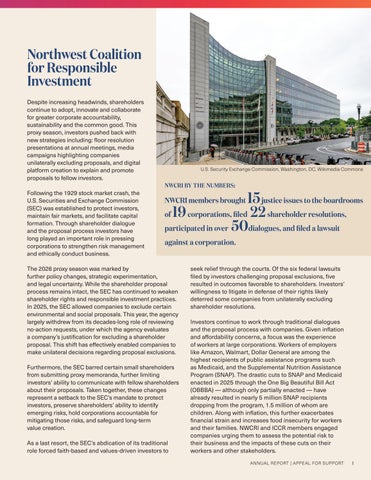
U.S. Security Exchange Commission, Washington, DC, Wikimedia Commons
NWCRI BY THE NUMBERS:
15 justice issues to the boardrooms of 19 corporations, filed 22 shareholder resolutions, participated in over 50dialogues, and filed a lawsuit NWCRI members brought
against a corporation.
The 2026 proxy season was marked by further policy changes, strategic experimentation, and legal uncertainty. While the shareholder proposal process remains intact, the SEC has continued to weaken shareholder rights and responsible investment practices. In 2025, the SEC allowed companies to exclude certain environmental and social proposals. This year, the agency largely withdrew from its decades-long role of reviewing no-action requests, under which the agency evaluates a company’s justification for excluding a shareholder proposal. This shift has effectively enabled companies to make unilateral decisions regarding proposal exclusions. Furthermore, the SEC barred certain small shareholders from submitting proxy memoranda, further limiting investors’ ability to communicate with fellow shareholders about their proposals. Taken together, these changes represent a setback to the SEC’s mandate to protect investors, preserve shareholders’ ability to identify emerging risks, hold corporations accountable for mitigating those risks, and safeguard long-term value creation. As a last resort, the SEC’s abdication of its traditional role forced faith-based and values-driven investors to
seek relief through the courts. Of the six federal lawsuits filed by investors challenging proposal exclusions, five resulted in outcomes favorable to shareholders. Investors’ willingness to litigate in defense of their rights likely deterred some companies from unilaterally excluding shareholder resolutions. Investors continue to work through traditional dialogues and the proposal process with companies. Given inflation and affordability concerns, a focus was the experience of workers at large corporations. Workers of employers like Amazon, Walmart, Dollar General are among the highest recipients of public assistance programs such as Medicaid, and the Supplemental Nutrition Assistance Program (SNAP). The drastic cuts to SNAP and Medicaid enacted in 2025 through the One Big Beautiful Bill Act (OBBBA) — although only partially enacted — have already resulted in nearly 5 million SNAP recipients dropping from the program, 1.5 million of whom are children. Along with inflation, this further exacerbates financial strain and increases food insecurity for workers and their families. NWCRI and ICCR members engaged companies urging them to assess the potential risk to their business and the impacts of these cuts on their workers and other stakeholders. ANNUAL REPORT | APPEAL FOR SUPPORT
I
In the ensuing pages, you will see the various ways that our shareholder coalition is holding companies accountable to more just, humane, and ethical practices. These changes are central to building a society that acknowledges and upholds the dignity of every person putting people before profit. The need for strong values flowing from our faith tradition has never been more needed in this time of pain, suffering, and polarization.
ICCR 2026 Filings Across Issues Governance
255
Corp. Political Responsibility
34
Human & Worker Rights
43
Climate Change
38
Racial Justice 16 Environment
33
Health 17
NWCRI and ICCR members believe that shareholder engagement in public policy discussions is crucial to mitigate the risks of adverse social and environmental impacts. Shareholders continue to engage companies in a number of priority areas including climate change, gender and racial equity, human and worker rights, environment, lobbying and political spending, health equity, and governance. The overall number of resolutions filed decreased except for corporate governance, and lobbing and political spending. The filing of a resolution will often prompt companies to reach out to negotiate a withdrawal.
0
50
436 Resolutions filed 58% of all proposals went to a vote 27% Average vote on proxy 58 Resolutions withdrawn for agreement 60% of agreements were related to the environment, corporate political responsibility, or climate change
22.2% Resolutions unilaterally excluded by companies 18 Resolutions won majority shareholder votes II
INTERCOMMUNITY PEACE & JUSTICE CENTER
150
200
NWCRI 2026 Proposals Filed FILINGS ACROSS ISSUES Health
27% Equity Human & Worker 45.5% Rights Human & Worker 45.5% Rights
2026 BY THE NUMBERS.
100
Health
27% Equity 14%
Governance
4.5% 9%
Racial14% Corporate Governance Justice Political Responsibility
4.5% 9%
Racial Corporate Justice Political Responsibility Agreements
FILING OUTCOMES 23% Went to 54% Vote Went to 54% Vote
Agreements
23% 23%
Unilaterally Excluded
23%
Unilaterally Excluded
250
300
2025-2026 Shareholder Activities NWCRI members brought 15 justice issues to the boardrooms of 19 corporations, filed 22 shareholder resolutions, participated in over 50 dialogues, and filed a lawsuit agains a corporation. COMPANY
ISSUE
ACTION
AbbVie
Independent Chair
Resolution 39.4%
AbbVie*
Human Rights Impact Assessment
Unilaterally Excluded
Aramark*
Living Wage Philosophy
Agreement
Amazon.com, Inc.
Alignment of AI Sales and Development with Responsible AI Approach
Unilaterally Excluded
Chevron Corp.
Assess Effectiveness of Policies in Respecting Indigenous Peoples’ Rights
Resolution 9%
Dollar General Corp.
Human Rights Policy
Resolution 29.2%
Essential Utilities (formerly Aqua America)*
Separate Chair and CEO
Agreement
GEO Group, Inc.
Assess Effectiveness of Human Rights Policy Implementation Unilaterally Excluded
Gilead Sciences, Inc.
Human Rights Policy
Agreement
Home Depot, Inc.
Assess Risks to Customers’ Data Privacy Rights Due to Company’s Data Sharing Practices
Resolution 8.8%
Merck & Co., Inc.
Tax Transparency Report
Unilaterally Excluded
Merck & Co., Inc.*
Political Contribution Misalignment
Resolution 12.4%
Microsoft Corp.
Human Rights Impact Assessment on Customer Misuse of Products and Services
Awaiting Vote
Meta (Facebook, Inc.)
Incorporation of Child Safety Performance in Senior Executive Compensation Program
Resolution 3.4%
Mondelez International, Inc.
Chemicals and Food Additives
Agreement
Palantir Technologies
Human Rights Impact Assessment
Resolution 12.4%
PepsiCo, Inc.
Human Rights Oversight in Supply Chain
Resolution 16.5%
PepsiCo, Inc.
Chemicals and Food Additives
Agreement
Tyson Food, Inc.*
Assess Impact of US Immigration Policy Changes
Resolution 2.7%
UnitedHealth Group, Inc.
Consequences of Acquisitions on Healthcare
Unilaterally Excluded
Walmart Stores, Inc.
Report on Governance Measures Adopted to Address Workplace Health and Safety
Resolution 6.6%
Wells Fargo & Company
Charter a New Committee on Indigenous Peoples’ Rights
Resolution 5.3%
*Resolutions filed by the Sisters of St. Francis of Philadelphia from their office
ANNUAL REPORT | APPEAL FOR SUPPORT
III
Immigration
The US administration’s escalating goal of detaining 2,000 immigrants daily continues to wreak havoc at schools, stores, routine traffic stops, airports, and courts. A central justification of the administration’s Immigration and Customs Enforcement (ICE) enforcement policy of removing undocumented immigrants is to expand job opportunities for US-born workers. On the contrary, a recent national study examining the effect of ICE activity on the labor market shows that the enforcement crackdown has lessened economic activity. Furthermore, US-born workers have also been negatively impacted, leading to declines in economic participation in areas with increased ICE activity.
Over the last year and half, the federal administration’s initial policy of deporting undocumented criminal immigrants has expanded to include the deportation of legal immigrants with work authorization, such as refugees, green card holders, and those with Temporary Protection Status. More than one-in-three of Tyson’s workers are immigrants. The unpredictable and changing invalidation of work authorization puts Tyson’s workforce at significant risk. Investors filed a resolution asking for an independent report on how the company is managing this risk and on proxy the proposal received 2.7% of the investor vote.
Investors filed a proposal urging GEO to conduct an independent audit to determine whether they are complicit in violating international human rights law through the action of its subsidiary. Taking advantage of the SEC’s new policy to not assess the merit of the company’s request to exclude resolutions, GEO unilaterally omitted the proposal from their proxy materials. Shareholders persist in calling for humane treatment within GEOs facilities and to extricate itself from risk of complicit support of the illegal movement of people.
2025 ushered in an uptick of immigration enforcement operations targeting day laborers in stores and in the parking lot of companies like The Home Depot (THD), Target and Lowes. THD was under significant scrutiny for not protecting their customers, employees, and day laborers whose cheap labor their customers depend on. The company collects and shares sensitive customer data and deploys Flock Safety automated license plate readers in its parking lots. Flock safety now has over 120,000 cameras across 49 states that timestamp, geolocate, and automatically store the license plate information of passing cars. This aggregated data is linked to a national surveillance network that is accessible to ICE and law enforcement authorities. Shareholders urged the company to assess and report on their data privacy risks and mitigation strategies. On proxy, it garnered 8.8% of the vote.
Child Online Safety A California state report on detention centers identified the surge in detainees related to the current ICE enforcement campaign as the reason for dangerous and unhealthy conditions. All four GEO centers in California failed to meet ICE’s own minimum standards of confinement and basic medical health care. Four deaths due to substandard and delayed medical care, insufficient water, undercooked food, and conflicting scheduled food service were all noted in the GEO facilities. In addition to their inhumane detention centers, through its subsidiary GEO Transport Inc. (GTI), GEO may be violating international human rights law by providing transportation and security services on deportation flights for ICE. The UN Guiding principle on respecting human rights states that corporations have a responsibility to do due diligence and avoid complicity in the systematically enforced disappearance of individuals. IV
INTERCOMMUNITY PEACE & JUSTICE CENTER
For over a decade, NWCRI and ICCR have been challenging social media platforms on protecting children’s safety online. Despite major tech companies instituting some parental controls and safety features, the negative impacts of social media and online safety risk are pervasive and alarming.
Meta is accused of exploiting developing brains through specific design features like infinite scroll, autoplay, and algorithmic reward schedules which all encourage compulsive use. Meta’s own internal documents show that children were knowingly exposed to harmful material at a much higher rate than the company publicly admitted. In fact, an internal study comparing depression and anxiety symptoms in teens that use Instagram showed such significant improvement in metal health symptoms after just one week of avoiding the app that the company discontinued the study and suppressed the results.
Failure to implement effective age verification, introduction of artificial intelligence (AI), and end-to-end encryption has impaired the ability to filter explicitly and harmful material, resulting in six million less instances of Child Sexual Abuse Material being reported compared to last year. There are numerous ongoing state and congressional investigations as well as over 3000 litigation cases focused on the company’s business model and failure to protect children, all pointing to governance failures. Investors filed a resolution asking the company to include executive performance on child safety improvements in their senior executive compensation programs. The resolution received 3.4% of the vote.
Tech
Traditionally, out of protection of citizens, federal law prevents agencies from sharing sensitive private data with one another. This protection of citizen data was breached by the action of the Department of Government Efficiency (DOGE), facilitated by Palantir's services enabling the current administration to weaponize taxpayers' data. In late 2025, The Washington Post reported that Palantir’s immigration software plays a key role in supporting the administration’s mass deportation and detention campaign, potentially violating international laws on the human rights of migrants. Shareholders filed a proposal for Palantir to conduct a human rights impact assessment which received 12.8% of the vote, representing 56% of the independent vote.
Pope Leo XIV’s encyclical Magnifica Humanitas recognizes the potential of AI to improve life, whilst warning that without strong guardrails dehumanizing impacts like autonomous weapons decision making, the displacement of workers, and increased isolation would be expected.
© Khanchit Khirisutchalual, iStock
Given the commitment that AI companies have made to the UN’s principles on business and human rights, our engagement with tech companies focused on ensuring that their products and services are not used to limit or abuse human rights throughout the value chain.
Although Palantir has been operating for over 20 years, it was relatively unknown until recent media reports have shed light on the use of the company’s products in autonomous weapons systems during this Iran war. Palantir develops data mining, analytics, and integration platforms for government agencies, militaries, and corporations. Its AI products amass and analyze massive amounts of personal data from many different sources including Flock Safety, social media, satellite data, and other individual private tracking sources.
Through its AI and cloud services contracts with clients known to violate human rights, Amazon has been accused of storing mass surveillance data that is being used to target marginalized communities including Palestinians, immigrants, and refugees. In addition, Amazon is planning to add facial recognition technology to its residential doorbell products, in partnership with Flock safety. Ring products and Flock safety are known to extensively network with police departments. Shareholders’ asked Amazon to report on any misalignment of its AI sales deployment and their responsible AI policy, which was unilaterally omitted by Amazon. Investors continue to press the company to respect people’s rights and hold their customers accountable.
Microsoft data storage services in conflict-affected and high-risk areas including to the Israeli government is similarly implicated in the human rights abuse in Gaza. Investors proposed a resolution urging the company to do its due diligence across its product users to identify and mitigate misuse of its products through these contracts, which has yet to be voted on.
Health Equity
Healthcare companies have an obligation to provide dignified, accessible, and affordable care. We continue to pressure pharmaceutical and healthcare companies to honor their social contract, recognize their contribution to health inequities, and to take responsibility in addressing these challenges. One of the unintended consequences of the Affordable Care Act (ACA) cost containment rule was requiring insurers to spend at ANNUAL REPORT | APPEAL FOR SUPPORT
V
In the case of United HealthGroup (UNH), over the last sixteen years it has grown to be the third largest US company, by acquiring over 2700 subsidiaries including healthcare providers, pharmacies, data analytics, and even a bank — enabling the company to be on both sides of a transaction in almost all aspects of the healthcare delivery system. There is rising concern that UNH may be skirting the ACA rule by shifting profits to unregulated subsidiaries. While UNH insists that vertical integration allows them to improve quality healthcare, adverse impacts of this consolidation include: decreased coverage of procedures, less competition, limited provider networks, higher prices for families, employers, states, and public programs. The consequences of these trends threaten the long-term sustainability of the healthcare system resulting in price hikes, exacerbated disparities, and a shift towards prioritizing financial gain over patient-centered care. Concerned investors filed a resolution asking the company to assess the adverse impact of this vertical integration on patient care and health outcomes. Despite a recent SEC ruling to keep a similar resolution on proxy, UNH unilaterally excluded the resolution. Standing up for shareholders rights the Sisters of Holy Names of Jesus and Mary and ICCR sued UNH for denying shareholders the right to flag salient human rights and societal risks. Lacking legal precedence in the courts, the judge granted a preliminary injunction but did not dismiss the case; given the short time frame before publishing of proxy material, we decided not to pursue the litigation further.
Merck has a long history of working on life saving vaccines including the Mumps Measles and Rubella (MMR) vaccine. With the change in the federal administration’s stance on vaccine policy, the weakening of vaccine requirements in public and educational institutions, misinformation about the mRNA vaccine technology, and the introduction of scores of anti-vaccine bills, Merck’s vaccine business is at risk. And yet, Merck reportedly has funded sponsors of the very bills that undermine public health through weakening vaccine regulation. Investors concerned about the misalignment between Merck’s VI
INTERCOMMUNITY PEACE & JUSTICE CENTER
commitment to its vaccine business and its political spending in support of vaccine weakening legislation, filed a proposal asking for a report on this misalignment. On proxy the resolution received 12.4% of the vote.
At Gilead, investors refiled a resolution asking for increased global access to its game-changing, two-injection-a-year HIV preventative drug, lenacapavir. Investors urged the company to adopt a comprehensive human rights policy that effectively addresses any negative impacts inhibiting access to healthcare as a result of the company’s policies. This resolution was withdrawn after Gilead agreed to strengthen its human rights policy.
Nutrition
Chemicals and substances added to food may be categorized as Generally Recognized as Safe (GRAS). These federal loopholes enable the food industry to selfregulate and determine whether an ingredient is GRAS without notifying the Food and Drug Administration (FDA) or supplying underlying research assessing the safety of GRAS food additives. These products include synthetic food dyes which are petroleum-based compounds, have no nutritional value, and are associated with neurobehavioral issues in children including hyperactivity and adverse behavioral outcomes.
Almost one third of Mondelēz’s and 40% of PepsiCo’s products contain synthetic food dyes and are categorized as GRAS additives. Furthermore, the federal government and 20 states have introduced or passed legislation seeking to address this GRAS regulatory loophole. While competitors, such as Nestle and Kraft Heinz, have all pledged to remove these dyes from all products by next year, Mondelēz and Pepsi have not made any such commitment. Proposals at both companies requested a report to assess and manage risks associated with synthetic dyes in their food and beverages were withdrawn for agreements.
U.S. Navy photo © Zachary Melvin, flickr
least 85% of premiums on healthcare which in turn incentivized insurance companies to enter the healthcare service provider space.
Human Rights in the Supply Chain In line with the UN Guiding Principles on Business and Human Rights (UNGPs), investors continue to urge companies to conduct comprehensive human rights and environmental due diligence across their supply chains. This responsibility includes improving supply chain traceability, upholding human rights and environmental standards, and addressing the racial inequities that can be exacerbated by business decisions.
Sugar cane farming in Karnataka, India © ILO/Vijay Kutty, flickr
PepsiCo’s sourcing of palm oil and sugar cane from southeast Asia and Latin America is connected to documented human rights violations throughout its supply chain. A 2025 investigation reported palm oil sourcing from deforested Indigenous land and workers’ rights violations such as unpaid overtime, subminimal wages, and inadequate worker protections. To better assess the systemic risk faced across the company’s supply chain investors filed a resolution asking for a report on the effectiveness of their human rights oversight policies and procedures. The resolution received strong support totaling 16.5% of the vote.
The cocoa sector continues to be marked by a highly fragmented supply chain with many informal intermediaries making transparency and monitoring of environmental and human rights violations such as deforestation, agrochemical use, and child trafficking and forced labor, very difficult. A root cause of these challenges is the reality of farmer poverty in the top cocoa producing countries in West Africa. Despite the recent high market prices for cocoa and self-organization of farmers, farmers continue to earn unlivable income. Given the significant market share that Mondelēz, Hershey, and Nestlé hold in the cocoa market, through a strategic partnership
with Investor Advocates for Social Justice, we continue to challenge them to ensure sustainable sourcing, that farmers are paid a living wage, and to include farmers in developing solutions to identified challenges.
Chevron has a long history of severe civil rights violations in its oil fields, particularly through its mismanagement of toxic waste pits leading to soil and water contamination of Indigenous land. Despite the company’s commitment to respect Indigenous communities, Chevron’s sourcing of crude oil from the Amazonian region of Ecuador continues despite court protections and public protest, and now has attracted a state investigation. The auctioneering of new oil fields that overlap with Indigenous lands heightens Chevron’s risk of Free, Prior, and Informed Consent (FPIC) violations in addition to financial, regulatory, moral, and legal risk. Investors asked Chevron to evaluate the effectiveness of Chevron’s policies and practices in respecting Indigenous Peoples’ Rights (IPR) including any remediation processes implemented to address past harms. On proxy, it received almost 9% of the vote.
Wells Fargo is a leading financier of oil and gas projects. Through financing projects like Enbridge and the Dakota Access pipelines that violate IPR and FPIC, Wells Fargo is exposed to significant financial, moral, and legal risk. A shareholder resolution urged the Company to create a new committee of independent directors on IPR to oversee the Company’s management of actual and potential adverse impacts on Indigenous Peoples arising from its general corporate and project-specific financing. This resolution received 5.3% of the vote.
Corporate Governance
The role of the board of directors is general oversight of the company and to evaluate the effectiveness of the CEO, who is entrusted with the day-to-day management of the corporation. There are two models of CEO and Board Chair leadership structures: combined or separated roles. An independent Board Chair is an important safeguard against management pursuing short-term gains. A recent Institutional Shareholders Services survey found that over 80% of investors surveyed prefer an independent board chair with separate roles for CEO and Chair, to ensure a robust oversight of the board and management team. ANNUAL REPORT | APPEAL FOR SUPPORT
VII
NWCRI
Despite years of majority investor support for proposals addressing access and affordability concerns as well as several lawsuits and fines for price gouging and predatory marketing practices of opioids, investors have not seen a sufficient response from management. To address this governance gap, investors asked the company to eliminate any potential conflict of interest by amending their bylaws and adopting a policy that creates an independent Board Chair separate from the CEO, which received 39.6% of the vote.
Strategic Partnership with Investor Advocates for Social Justice Investor Advocates for Social Justice (IASJ) is a sister organization of IPJC’s on the east coast that similarly represents faith-based investors who use the shareholder process to advance human rights, climate justice, racial equity, and the common good. Over the last three years, with the generous support of a grant from the Congregation of the Sisters of St. Joseph of Peace, IPJC and IASJ have been strategically collaborating on several issues and sharing best practices to strengthen faith-based shareholder power. Currently, we have an ongoing cocoa industry engagement focused on human rights and environmental justice, with an emphasis on directly impacted communities leading sustainability efforts.
VIII
INTERCOMMUNITY PEACE & JUSTICE CENTER
Timnit Ghermay Director, NWCRI
Members
Adrian Dominican Sisters Benedictine Sisters, Cottonwood, Idaho Benedictine Sisters of Mt. Angel Congrégation des Soeurs des Saints, Noms de Jésus et de Marie Congregation of the Sisters of St. Joseph of Peace Jesuits West Northwest Women Religious Investment Trust PeaceHealth Providence St. Joseph Health Sisters of Providence, Mother Joseph Province Sisters of St. Francis of Philadelphia Sisters of St. Mary of Oregon Sisters of the Holy Names of Jesus & Mary, U.S.-Ontario Province Tacoma Dominicans
© Markus Spiske, unsplash
Essential Utilities’ governance guidelines support maintaining a combined Chair and CEO structure on the grounds of leadership uniformity. However, this rationale undermines independent oversight as key executive authority remains concentrated in the CEO role. An investor proposal requesting this separation was subsequently withdrawn after the company agreed to address the concern.
A program of the Intercommunity Peace and Justice Center, the Northwest Coalition of Responsible Investment is a member of the Interfaith Center on Corporate Responsibility, a national coalition of over 300 faith-based investors who are Inspired by Faith, Committed to Action. These highlights summarize the work that NWCRI has done in collaboration with ICCR during the past year.