Mercy Housing Northwest: FROM TEMPORARY SHELTER TO PERMANENT HOUSING
BY NATHAN BOX
Sherry moved from Atlanta to Seattle to be closer to her children and grandchildren. While getting settled, she found an affordable short-term rental. Then the pandemic hit, and in the blink of an eye, the employees at Sherry’s new company were told to work from home. As the pandemic stretched from weeks into months and the return date moved further away, Sherry was terminated from her job.
With little savings, it was not long before Sherry could no longer afford her short-term rental. She began couch surfing, staying with family and friends. Fearful of becoming a burden, she decided this could not be a long-term option for her.
Without the knowledge of her family and friends, Sherry would drive to an empty parking lot, park her car, and begin a nightly ritual. Packed inside her car was everything she owned. To sleep, she would move clothes and treasured items. With enough room to lay the seat back, she would attempt another night of uneasy sleep. In the morning, she would rise with the sun and exit the lot. Sherry would spend the day looking for housing.
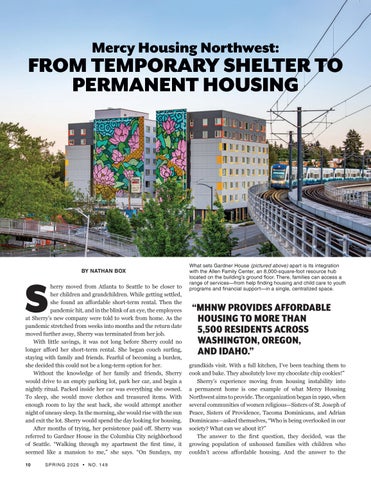
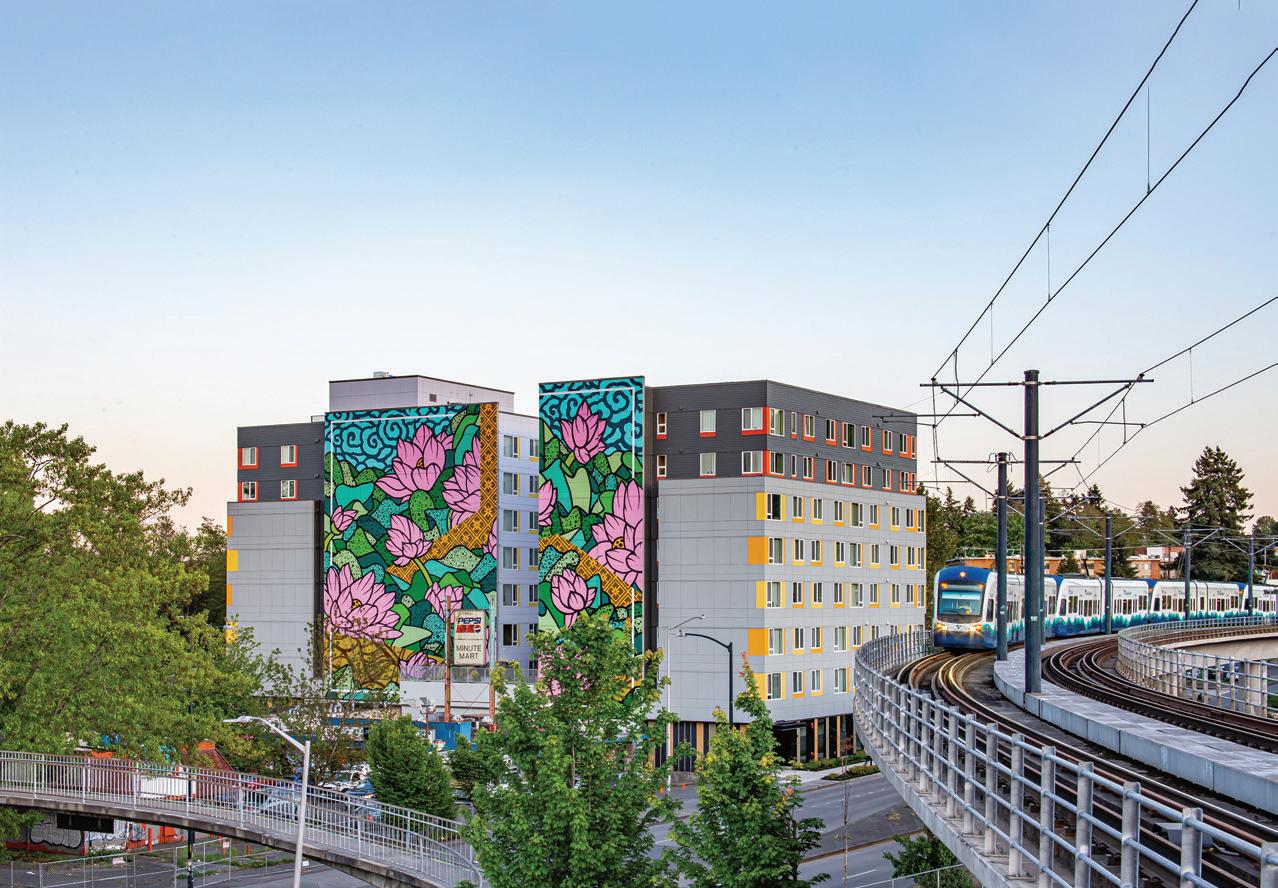
After months of trying, her persistence paid off. Sherry was referred to Gardner House in the Columbia City neighborhood of Seattle. “Walking through my apartment the first time, it seemed like a mansion to me,” she says. “On Sundays, my
“MHNW PROVIDES AFFORDABLE HOUSING TO MORE THAN 5,500 RESIDENTS ACROSS WASHINGTON, OREGON, AND IDAHO.”
grandkids visit. With a full kitchen, I’ve been teaching them to cook and bake. They absolutely love my chocolate chip cookies!”
Sherry’s experience moving from housing instability into a permanent home is one example of what Mercy Housing Northwest aims to provide. The organization began in 1990, when several communities of women religious—Sisters of St. Joseph of Peace, Sisters of Providence, Tacoma Dominicans, and Adrian Dominicans—asked themselves, “Who is being overlooked in our society? What can we about it?”
The answer to the first question, they decided, was the growing population of unhoused families with children who couldn’t access affordable housing. And the answer to the

second question was Mercy Housing Northwest (MHNW).
Today, MHNW provides affordable housing to more than 5,500 residents across Washington, Oregon, and Idaho, managing 55 properties and 3,193 homes. We believe that housing is meant to be a starting point rather than an endpoint—a foundation for greater stability. Therefore, in addition to developing and managing housing, the organization offers resident services aimed at helping provide stability for folks to remain housed, including health, education, and financial well-being support.
From early on, MHNW has partnered with Mercy Housing Inc., a national nonprofit that develops and manages affordable housing across the country. Together, they focus on serving families, seniors, and people with special needs.
MHNW also collaborates with other local organizations to better support residents. One of those partners is Mary’s Place, a Seattle-based nonprofit that serves families experiencing homelessness. The two organizations have worked together on several developments, including Gardner House, where Sherry now lives. That partnership is continuing to grow. In Burien, Washington, MHNW and Mary’s Place are developing a new campus that will combine emergency shelter with permanent affordable housing on the same site.
About Gardner House
�� Gardner House is a 95-unit affordable housing community in Seattle’s Mount Baker neighborhood designed for families with a range of needs, including those experiencing or at risk of homelessness. Roughly half of the apartments are set aside for families coming out of homelessness, including units with additional supportive services for those with the greatest needs.
�� Located near public transit, schools, and other community resources, Gardner House is designed to help families not only find housing but also remain connected to jobs, education, and support networks.
�� The goal is to reduce the fragmentation that often makes it difficult for families to get help, offering both stable housing and on-site support in one place.
When it opens in 2027, the Burien Family Campus will include 200 beds for families in need of immediate shelter and 90 units of long-term housing. The goal is to allow families to move from temporary shelter into stable housing without leaving their community or support systems.
For people like Sherry, that kind of stability can be lifechanging. Not long ago, she was sleeping in her car, unsure where she would go next. Now, she has a home where her grandchildren can visit and where she can begin to rebuild.
Nathan Box is the communication and engagement manager for Mercy Housing Northwest. He is also a 2007 graduate of the University of Central Oklahoma, where he earned a bachelor’s degree in broadcast communications, and a 2013 graduate of Seattle University’s nonprofit leadership program.