Annual Report & Appeal for Support
Intercommunity Peace & Justice Center | 2025 - 2026 Intercommunity Peace & Justice Center
“
THE FUTURE BELONGS TO THOSE WHO GIVE THE NEXT GENERATION REASON FOR HOPE.” — Pierre Teilhard de Chardin
Here are just a few ways IPJC has sparked hope:
Dear IPJC Community, It is a bittersweet moment for me as I write this final official note to the community reflecting on this year’s theme, Spark Hope. As many of you know, I will be concluding my time at IPJC by the end of 2026. These last six years have been filled with hopeful and inspiring moments connected by one thread: relationship. While I will miss our public work, programming, and events, I will miss the people in this community the most. Thank you for being a source of hope, grounding, and love over these last several years. I know that as IPJC moves into the next phase, it will continue to build the Kindom of God through its prophetic and essential mission, evidenced by the work we have done together over the last year.
Y
A Matter of Spirit published its 150th issue, marking 35 years of educating on critical justice issues.
Y
NWCRI members brought 15 justice issues to the boardrooms of 19 corporations, filed 22 shareholder resolutions, participated in over 50 dialogues, and filed a lawsuit against a corporation.
Y
Youth Action Team interns led actions mobilizing over 450 people.
Y
Inaugural IPJC Community Assembly hosted over 200 of our community leaders to build relationships and act together.
These acts of collective hope are only possible because of you. As we move forward, we invite you to help us reach our end-of-the-year fundraising goal of $45,000 by: Y
Considering a gift of $35, $350, or $3500 to celebrate our 35th anniversary!
Y
Making a one-time or recurring gift of any amount.
Y
Making a tax-free donation from your IRA.
Y
Participating in and promoting our programs, events, and publications.
Y
Choosing IPJC for employer matching contributions.
Y
Naming IPJC in your estate plan.
Y
Praying for our ministry.
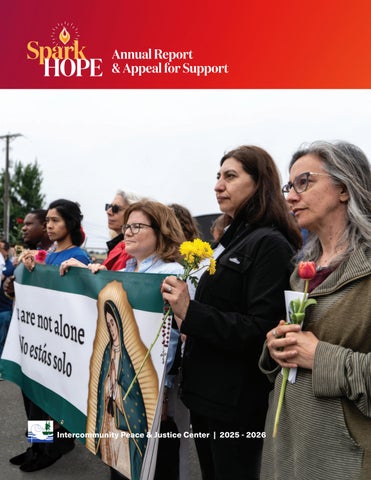
Thank you for being part of this movement of hope. In Gratitude, Above: Immigration Vigil, Municipal Court of Seattle, Fall 2025 Cover photo: Eucharistic Procession from St. Leo church to the Tacoma Detention Center ©Archdiocese of Seattle by Stephen Brashear All Photos unless noted © IPJC by Paul Dehmer 2
INTERCOMMUNITY PEACE & JUSTICE CENTER
Will Rutt, Executive Director
Youth Organizing | Youth Action Team Internship In the fall, we welcomed 12 interns from Bishop Blanchet High School, Forest Ridge School of the Sacred Heart, Holy Names Academy, Seattle Preparatory School, and, for the first time, Kennedy Catholic High School. Our interns came from across the greater Seattle area, spanning Roosevelt to Renton, Kirkland to SeaTac, and many communities in between.
differences into the gameplay. As interns fought off trolls, bartered for jewels, and navigated challenges with unequal resources, they experienced how social identities and systems of privilege can shape the opportunities available to individuals and communities. Ultimately, the simulation reinforced that relationship building is essential to “defeating the dragon of oppression.”
This year, we also welcomed our largest cohort of second-year interns, known as fellows. These seven young women, who successfully completed the first-year internship were invited to return in expanded leadership roles. They became trainers themselves,
Interns used this growing understanding of their identities to craft powerful public narratives, sharing stories of difficult experiences that had shaped their values and called them into public leadership. They practiced telling stories to one another in a space that was intentionally
YOUTH ORGANIZING BY THE NUMBERS:
12 Interns 7Fellows
Left and Right: Way of the Cross stations Center: Visions for our community during the assembly
+450
participants in YATI actions
3 yeses from King County
Council member!
holding one-to-one meetings with first-year interns and researching the previously discerned issues of immigration, housing, and healthcare. During the first semester, interns participated in a series of workshops designed to build a foundational understanding of community organizing, social justice, and liberative theology. They also developed practical leadership skills, including public speaking, communication, relationship building, and storytelling. Among these workshops, one was an unmistakable standout. Youth Action Team Fellow and Holy Names Academy Class of 2026, Grace MacLeod, led the interns through a Dungeons & Dragons-inspired simulation exploring identity and privilege. Grace assigned fantastical attributes to each intern’s character based on aspects of their real-life identities and thoughtfully incorporated those
+150 students received at least one
organizing workshop
supportive, reverent, and rooted in mutual trust. As each person shared, they listened with care and curiosity, honoring the vulnerability it takes to connect personal experience to a larger call for justice. Through this practice, they learned that storytelling can be both deeply personal and profoundly public: a way to build relationships, uncover shared values, and invite others into collective action. Workshops like these, coupled with relational time, community-building activities, shared meals, prayer, and weekly check-ins, helped foster a sense of safety and belonging. Interns formed friendships across schools, race, and class, and discovered the importance of relationships not only as a source of personal support, but also as the foundation of community organizing. For many, simply gathering each week became a source of hope and renewal. ANNUAL REPORT | APPEAL FOR SUPPORT
3
“The internship was a great learning experience with social justice issues and community organizing,” shared one student. “It was also such a fun experience getting to know different girls who are like-minded and kind. It feels like a space that is separate and different from my usual interactions, and it’s a time that I never forget or regret.” Interns also explored the ways faith can inspire and sustain the work of justice. Through prayer, theological reflection, spiritual practices, and conversations about Catholic Social Teaching, they encountered a vision of Catholic identity rooted in solidarity, human dignity, and courageous action. Students reflected on Jesus as a friend of those pushed to the margins, a challenger of unjust systems, and a model for accompanying communities rather than speaking on their behalf. One intern shared that YATI helped her “understand my Catholic identity as something that can coexist with other parts of who I am, rather than contrasting it.” Interns described YATI as a space distinct from many of their ordinary school and social environments: a place where they could ask difficult questions, speak honestly about the issues affecting their communities, and build friendships with other young women who shared their commitment to justice. “I got to meet incredible people, got so much out of our sessions, and I can’t wait to carry those lessons with me to college and beyond,” one intern reflected. As IPJC gathered for its inaugural assembly in January (see pg. 16), the YATIs played a key leadership role during the event. Broken into pairs, they facilitated 4
INTERCOMMUNITY PEACE & JUSTICE CENTER
Above and Bottom Left: Ignatian Advocacy Summit 1-1s Right: Student sign at the town hall
a speed one-to-one organizing activity, guiding the community through a generative and joyful relationship building process. Watching each of them step into their knowledge of one-to-ones and lead intergenerational rooms was exciting and inspiring! In the spring, interns and fellows put their learning into action by helping organize a social justicefocused Stations of the Cross (see pg. 18) centered on the experiences of immigrant communities. They created and prepared artwork for each station, offered readings and reflections, and helped guide participants through the prayer experience. Interns and fellows also shared personal stories about the impact of ICE on their families, schools, and communities, grounding the event in the lived experiences of young people. Through public prayer, testimony, and action, they invited the broader community to reflect on the suffering caused by unjust immigration systems and respond with solidarity, compassion, and courage.
NW Ignatian Advocacy Summit
In March 2026, IPJC continued its partnership with Jesuits West and Seattle University to convene the Northwest Ignatian Advocacy Summit for its fourth year, bringing together students from Jesuit high schools across the Pacific Northwest for three days of experience, reflection, and action. The summit invited young people to explore how faith can move beyond personal belief and become a source of courage, solidarity, and public leadership. Throughout the gathering, students participated in public narrative training, one-to-one relational meetings, issue-based workshops, theological reflection,
an elected official. Seattle University student and former Youth Action Team Intern Kenny Ouedraogo reflected on environmental justice and the importance of protecting salmon, explaining, “This issue is about preserving and reviving a culture... It’s about our moral integrity, our environment, local cultures, and what we choose to prioritize as a society.” Youth Action Team Fellow Soliana Fishatsion shared her family’s migration story across Ethiopia and Eritrea. Challenging harmful narratives about immigrants, she asked, “Is it a crime to seek safety? Should survival be met with punishment? Where some see a criminal, I see a young person asking for shelter—and I see my family.”
Scenes from the Thriving Together: Care, Community, and Creation Town Hall
intergenerational storytelling, and a public witness pilgrimage through Seattle. These experiences helped participants develop core community-organizing and advocacy skills, including how to build relationships, tell compelling stories grounded in shared values, analyze public issues, engage decision-makers, and translate faith into collective action. The summit centered on three priority concerns identified by young people through listening sessions conducted by IPJC’s Youth Action Team: environmental justice, immigration justice, and housing justice. Students spent time deepening their understanding of each issue and connecting broad policy questions to their families, schools, neighborhoods, and faith communities. The experience culminated in the youth-led town hall, Thriving Together: Care, Community, and Creation. Student leaders shared testimony and presented concrete policy recommendations directly to King County Councilmember Jorge Barón. Their preparation and confidence demonstrated the leadership cultivated throughout the summit, as students moved beyond awareness and reflection into direct engagement with
Holy Names Academy senior and Youth Action Team Intern Yssa Javier spoke about housing justice, reflecting on how her understanding of homelessness had evolved from meeting immediate needs to examining “the policies and structures that perpetuate the issues of homelessness and unaffordable housing.” Students presented three policy requests: the adoption of a countywide Salmon-Safe policy, stronger protections preventing ICE and CBP from using county property for civil immigration enforcement, and expanded access to affordable housing across King County. Councilmember Barón expressed support for all three proposals, affirming the students’ work and underscoring the power of informed youth advocacy. The summit exemplified IPJC’s commitment to developing the next generation of faith-rooted leaders. By equipping students with practical organizing skills, opportunities for public leadership, and direct access to decision-makers, the gathering helped young people recognize that they are not only capable of learning about justice, but of leading meaningful change in their communities. ANNUAL REPORT | APPEAL FOR SUPPORT
5
“
I HAVE BEEN ABLE TO LEAD EVEN ADULTS, SOMETHING I NEVER THOUGHT I WOULD DO.”
Above and left: The Way of the Cross, 2026
Catholic High School Collaborations
We had the opportunity to collaborate with several Catholic high schools in our area, incorporating community organizing into theology and cultural leadership programs. At Bishop Blanchet, IPJC staff led affinity group leaders through a workshop on crafting powerful public narratives and later facilitated an Organizing 101 session at the school’s annual Diversity Leadership Summit, a daylong gathering of student leaders from Catholic schools across the Seattle area. We also visited theology classes at Holy Names Academy and Forest Ridge School of the Sacred Heart, introducing students to community organizing as a tool for creating meaningful social change.
Shaping the Future of Social Justice Movements
Across each of these experiences, one theme became increasingly clear: Young people are eager to lead. When they are given meaningful opportunities, trusted with real responsibility, and supported by strong relationships, they are capable of shaping their schools, faith communities, and the broader public life of our region. 6
INTERCOMMUNITY PEACE & JUSTICE CENTER
Throughout the year, interns and fellows grew from participants into facilitators, storytellers, researchers, mobilizers, and organizers. They practiced speaking about the issues closest to their lives, learned how to build relationships across differences, and discovered that their experiences could become a source of leadership rather than something they needed to leave at the door. As one YATI reflected, “I have been able to lead even adults, something I never thought I would do.” That transformation is at the heart of the Youth Action Team. Whether leading a workshop for their peers, sharing testimony with an elected official, facilitating a one-to-one meeting, helping guide a public prayer, or simply finding the courage to speak honestly in a room of new people, students experienced what becomes possible when their voices are taken seriously. Just as importantly, they learned that leadership does not happen alone. It is rooted in relationships, sustained by community, and strengthened by a faith that calls us toward solidarity and action. Over the course of the year, young people built friendships across schools and communities while developing the skills to accompany others and organize for change. As these students carry what they have learned into their schools, colleges, parishes, and communities, we are reminded that investing in young people is an investment in the leadership, courage, and hope our communities need right now.
A New Vision for Women’s Leadership INAUGURAL ASSEMBLY BY THE NUMBERS:
213 attendees 89 different ZIP codes Over 40 Catholic parishes and institutions represented Over 100 women recognized as leaders by our community and nominated for our Women’s Leadership Team 36% of attendees were under the age of 44 Inspired by the Past and Looking to the Future
Across IPJC’s 35-year history, our five Women’s Convocations have been among our most formative offerings. Participants continue to describe them as spiritually grounding and transformative, and many still ask whether IPJC will host another. As IPJC’s work has evolved, so has our model. We have shifted toward leadership development, community organizing, and direct action. While the Convocations remain central to our story, recreating a large-scale gathering in the same format felt less sustainable and less aligned with the movement-building practices that now guide us. Still, the desire for ritual, faith formation, relationship, and collective action remains strong. Our Inaugural Assembly emerged from the convergence of two realities: channeling the spirit and transformative power of the Convocations and embracing critical organizing practices needed to build collective power. We invited leaders from across our community to help shape a day centered on relationship, formation, leadership, and shared discernment about how we are called to act together. Together, the assembly leadership team sent hundreds of invitations, drew on the gifts of our community, and planned a diverse, representative gathering. The result was a joyful and successful inaugural assembly.
IPJC Inaugural Assembly On January 31, 2026, more than 200 people gathered at St. Edward Parish in South Seattle (photos above and page 8). Participants traveled from 89 ZIP codes and represented more than 40 Catholic parishes and institutions, making it one of our most diverse gatherings to date.
Grounded in our shared call to help build God’s kingdom on Earth, participants learned and practiced the community organizing skill of relational one-on-ones through a “speed organizing” activity led by IPJC Youth Action Team Fellows and Interns. Through Conversations in the Spirit, small groups reflected on barriers preventing their communities from flourishing. These conversations revealed common experiences of isolation and a deep desire for stronger local communities where people know and support one another, especially amid challenges such as immigration concerns and the rising cost of living. The day concluded with presentations from our Youth Action Team Interns and Fellows and the launch of the inspiring vision of the IPJC Women’s Leadership Team. During a democratic nomination process, participants identified women they saw as leaders, both present and absent. The room erupted in surprise when more than 100 women were nominated. As each woman was invited to stand and be recognized by name, the gathering offered a powerful witness to the leadership already present in our community and the unmistakable movement of the Holy Spirit among us.
Hope in Relationship
Our inaugural assembly sparked hope through relationship—renewing existing bonds and forming new ones. It reminded participants that they are not alone in the struggle for justice. As one participant shared, “It made me feel that we can make a difference seeing all the people from so many walks of life feeling the same way of what is going on in our country.” This assembly was only the beginning of our work to strengthen communities of faith and support across Western Washington, and we look forward to future assemblies and actions in the year ahead. ANNUAL REPORT | APPEAL FOR SUPPORT
7
Women’s Leadership Team Over the next several years, we will build a diverse coalition of intergenerational Catholics who are equipped to work toward systemic change through a community organizing framework. Living out the charism of IPJC's founding congregations, this coalition will be led by our Women's Leadership Team and will be a continuation of IPJC’s longstanding commitment to women’s leadership that was manifested first through the WEAVERS program and then through Women’s Justice Circles. Since our inaugural assembly in January 2026, the Women's Leadership Team has been forming through the power of 100 relational one-to-one meetings with women from around the Archdiocese of Seattle. Through these encounters, we have uncovered how women are being called to lead, where they are longing for growth, and what type of support they need. One thing has become clear: people are looking for a community in which they can grow in faith and in action. There is no common table to unite us across parishes, counties, and cultures, nor is there a space where we can be both spiritually nourished and equipped for mission. Our Women's Leadership Team hopes to be that space where women can be supported with the formation, organizing training, and community they desire. The team hopes to be the table where the leaders can develop into who God is calling them to be: leaders who will invite and animate the broader community of believers to join the ever-widening table. Our inaugural leadership team includes 20 powerful women representing more than 10 different Catholic institutions and 13 different parish families spanning seven counties (King, Whatcom, Grays Harbor, Clark, Jefferson, Pierce, and Skagit.) In September 2026, the Women's Leadership Team gathered for an intensive community organizing training. Over the following months, members will conduct relational one-on-ones within their communities to build relationships, surface key concerns, and identify emerging leaders. By the end of the first year, we will have woven a 8
INTERCOMMUNITY PEACE & JUSTICE CENTER
WOMEN’S LEADERSHIP TEAM BY THE NUMBERS
100 one-to-ones completed
Our Inaugural Women’s Leadership Team Cohort Jenny Abbey Emelie Ali Samantha Almanza Tricia Cavanaugh Isabel Cisneros Rueda Natalia Duran Mara Eaton Rosa Figueroa Odalis Gonzalez Kelsey Harrington
Kelly Hickman Tanya Higgins Kristin Holland Noemi Lopez Novela Maxine Martin Marta Martinez Olivera Dora Pale-Alarcon Anisa Ralls Kim Anh Tran Ayla Windley
growing network of leaders across the Archdiocese of Seattle that is prepared to shape and participate in the public actions that will be launched in the second year. In Fall 2027, the broader IPJC community will reconvene for our second Community Assembly to hear the priorities emerging from these diverse communities and discern how the Spirit is calling us to respond together as a Catholic community.
Northwest Coalition for Responsible Investment Despite increasing headwinds, shareholders continue to adopt, innovate and collaborate for greater corporate accountability, sustainability and the common good. This proxy season, investors pushed back with new strategies including: floor resolution presentations at annual meetings, media campaigns highlighting companies unilaterally excluding proposals, and digital platform creation to explain and promote proposals to fellow investors. Following the 1929 stock market crash, the U.S. Securities and Exchange Commission (SEC) was established to protect investors, maintain fair markets, and facilitate capital formation. Through shareholder dialogue and the proposal process investors have long played an important role in pressing corporations to strengthen risk management and ethically conduct business.
U.S. Security Exchange Commission, Washington, DC, Wikimedia Commons
NWCRI BY THE NUMBERS:
15 justice issues to the boardrooms of 19 corporations, filed 22 shareholder resolutions, participated in over 50dialogues, and filed a lawsuit NWCRI members brought
against a corporation.
The 2026 proxy season was marked by further policy changes, strategic experimentation, and legal uncertainty. While the shareholder proposal process remains intact, the SEC has continued to weaken shareholder rights and responsible investment practices. In 2025, the SEC allowed companies to exclude certain environmental and social proposals. This year, the agency largely withdrew from its decades-long role of reviewing no-action requests, under which the agency evaluates a company’s justification for excluding a shareholder proposal. This shift has effectively enabled companies to make unilateral decisions regarding proposal exclusions. Furthermore, the SEC barred certain small shareholders from submitting proxy memoranda, further limiting investors’ ability to communicate with fellow shareholders about their proposals. Taken together, these changes represent a setback to the SEC’s mandate to protect investors, preserve shareholders’ ability to identify emerging risks, hold corporations accountable for mitigating those risks, and safeguard long-term value creation. As a last resort, the SEC’s abdication of its traditional role forced faith-based and values-driven investors to
seek relief through the courts. Of the six federal lawsuits filed by investors challenging proposal exclusions, five resulted in outcomes favorable to shareholders. Investors’ willingness to litigate in defense of their rights likely deterred some companies from unilaterally excluding shareholder resolutions. Investors continue to work through traditional dialogues and the proposal process with companies. Given inflation and affordability concerns, a focus was the experience of workers at large corporations. Workers of employers like Amazon, Walmart, Dollar General are among the highest recipients of public assistance programs such as Medicaid, and the Supplemental Nutrition Assistance Program (SNAP). The drastic cuts to SNAP and Medicaid enacted in 2025 through the One Big Beautiful Bill Act (OBBBA) — although only partially enacted — have already resulted in nearly 5 million SNAP recipients dropping from the program, 1.5 million of whom are children. Along with inflation, this further exacerbates financial strain and increases food insecurity for workers and their families. NWCRI and ICCR members engaged companies urging them to assess the potential risk to their business and the impacts of these cuts on their workers and other stakeholders. ANNUAL REPORT | APPEAL FOR SUPPORT
9
In the ensuing pages, you will see the various ways that our shareholder coalition is holding companies accountable to more just, humane, and ethical practices. These changes are central to building a society that acknowledges and upholds the dignity of every person putting people before profit. The need for strong values flowing from our faith tradition has never been more needed in this time of pain, suffering, and polarization.
ICCR 2026 Filings Across Issues Governance
255
Corp. Political Responsibility
34
Human & Worker Rights
43
Climate Change
38
Racial Justice 16 Environment
33
Health 17
NWCRI and ICCR members believe that shareholder engagement in public policy discussions is crucial to mitigate the risks of adverse social and environmental impacts. Shareholders continue to engage companies in a number of priority areas including climate change, gender and racial equity, human and worker rights, environment, lobbying and political spending, health equity, and governance. The overall number of resolutions filed decreased except for corporate governance, and lobbing and political spending. The filing of a resolution will often prompt companies to reach out to negotiate a withdrawal.
0
50
436 Resolutions filed 58% of all proposals went to a vote 27% Average vote on proxy 58 Resolutions withdrawn for agreement 60% of agreements were related to the environment, corporate political responsibility, or climate change
22.2% Resolutions unilaterally excluded by companies 18 Resolutions won majority shareholder votes 10
INTERCOMMUNITY PEACE & JUSTICE CENTER
150
200
NWCRI 2026 Proposals Filed FILINGS ACROSS ISSUES Health
27% Equity Human & Worker 45.5% Rights Human & Worker 45.5% Rights
2026 BY THE NUMBERS.
100
Health
27% Equity 14%
Governance
4.5% 9%
Racial14% Corporate Governance Justice Political Responsibility
4.5% 9%
Racial Corporate Justice Political Responsibility Agreements
FILING OUTCOMES 23% Went to 54% Vote Went to 54% Vote
Agreements
23% 23%
Unilaterally Excluded
23%
Unilaterally Excluded
250
300
2025-2026 Shareholder Activities NWCRI members brought 15 justice issues to the boardrooms of 19 corporations, filed 22 shareholder resolutions, participated in over 50 dialogues, and filed a lawsuit agains a corporation. COMPANY
ISSUE
ACTION
AbbVie
Independent Chair
Resolution 39.4%
AbbVie*
Human Rights Impact Assessment
Unilaterally Excluded
Aramark*
Living Wage Philosophy
Agreement
Amazon.com, Inc.
Alignment of AI Sales and Development with Responsible AI Approach
Unilaterally Excluded
Chevron Corp.
Assess Effectiveness of Policies in Respecting Indigenous Peoples’ Rights
Resolution 9%
Dollar General Corp.
Human Rights Policy
Resolution 29.2%
Essential Utilities (formerly Aqua America)*
Separate Chair and CEO
Agreement
GEO Group, Inc.
Assess Effectiveness of Human Rights Policy Implementation Unilaterally Excluded
Gilead Sciences, Inc.
Human Rights Policy
Agreement
Home Depot, Inc.
Assess Risks to Customers’ Data Privacy Rights Due to Company’s Data Sharing Practices
Resolution 8.8%
Merck & Co., Inc.
Tax Transparency Report
Unilaterally Excluded
Merck & Co., Inc.*
Political Contribution Misalignment
Resolution 12.4%
Microsoft Corp.
Human Rights Impact Assessment on Customer Misuse of Products and Services
Awaiting Vote
Meta (Facebook, Inc.)
Incorporation of Child Safety Performance in Senior Executive Compensation Program
Resolution 3.4%
Mondelez International, Inc.
Chemicals and Food Additives
Agreement
Palantir Technologies
Human Rights Impact Assessment
Resolution 12.4%
PepsiCo, Inc.
Human Rights Oversight in Supply Chain
Resolution 16.5%
PepsiCo, Inc.
Chemicals and Food Additives
Agreement
Tyson Food, Inc.*
Assess Impact of US Immigration Policy Changes
Resolution 2.7%
UnitedHealth Group, Inc.
Consequences of Acquisitions on Healthcare
Unilaterally Excluded
Walmart Stores, Inc.
Report on Governance Measures Adopted to Address Workplace Health and Safety
Resolution 6.6%
Wells Fargo & Company
Charter a New Committee on Indigenous Peoples’ Rights
Resolution 5.3%
*Resolutions filed by the Sisters of St. Francis of Philadelphia from their office
ANNUAL REPORT | APPEAL FOR SUPPORT
11
Immigration
The US administration’s escalating goal of detaining 2,000 immigrants daily continues to wreak havoc at schools, stores, routine traffic stops, airports, and courts. A central justification of the administration’s Immigration and Customs Enforcement (ICE) enforcement policy of removing undocumented immigrants is to expand job opportunities for US-born workers. On the contrary, a recent national study examining the effect of ICE activity on the labor market shows that the enforcement crackdown has lessened economic activity. Furthermore, US-born workers have also been negatively impacted, leading to declines in economic participation in areas with increased ICE activity.
Over the last year and half, the federal administration’s initial policy of deporting undocumented criminal immigrants has expanded to include the deportation of legal immigrants with work authorization, such as refugees, green card holders, and those with Temporary Protection Status. More than one-in-three of Tyson’s workers are immigrants. The unpredictable and changing invalidation of work authorization puts Tyson’s workforce at significant risk. Investors filed a resolution asking for an independent report on how the company is managing this risk and on proxy the proposal received 2.7% of the investor vote.
Investors filed a proposal urging GEO to conduct an independent audit to determine whether they are complicit in violating international human rights law through the action of its subsidiary. Taking advantage of the SEC’s new policy to not assess the merit of the company’s request to exclude resolutions, GEO unilaterally omitted the proposal from their proxy materials. Shareholders persist in calling for humane treatment within GEOs facilities and to extricate itself from risk of complicit support of the illegal movement of people.
2025 ushered in an uptick of immigration enforcement operations targeting day laborers in stores and in the parking lot of companies like The Home Depot (THD), Target and Lowes. THD was under significant scrutiny for not protecting their customers, employees, and day laborers whose cheap labor their customers depend on. The company collects and shares sensitive customer data and deploys Flock Safety automated license plate readers in its parking lots. Flock safety now has over 120,000 cameras across 49 states that timestamp, geolocate, and automatically store the license plate information of passing cars. This aggregated data is linked to a national surveillance network that is accessible to ICE and law enforcement authorities. Shareholders urged the company to assess and report on their data privacy risks and mitigation strategies. On proxy, it garnered 8.8% of the vote.
Child Online Safety A California state report on detention centers identified the surge in detainees related to the current ICE enforcement campaign as the reason for dangerous and unhealthy conditions. All four GEO centers in California failed to meet ICE’s own minimum standards of confinement and basic medical health care. Four deaths due to substandard and delayed medical care, insufficient water, undercooked food, and conflicting scheduled food service were all noted in the GEO facilities. In addition to their inhumane detention centers, through its subsidiary GEO Transport Inc. (GTI), GEO may be violating international human rights law by providing transportation and security services on deportation flights for ICE. The UN Guiding principle on respecting human rights states that corporations have a responsibility to do due diligence and avoid complicity in the systematically enforced disappearance of individuals. 12
INTERCOMMUNITY PEACE & JUSTICE CENTER
For over a decade, NWCRI and ICCR have been challenging social media platforms on protecting children’s safety online. Despite major tech companies instituting some parental controls and safety features, the negative impacts of social media and online safety risk are pervasive and alarming.
Meta is accused of exploiting developing brains through specific design features like infinite scroll, autoplay, and algorithmic reward schedules which all encourage compulsive use. Meta’s own internal documents show that children were knowingly exposed to harmful material at a much higher rate than the company publicly admitted. In fact, an internal study comparing depression and anxiety symptoms in teens that use Instagram showed such significant improvement in metal health symptoms after just one week of avoiding the app that the company discontinued the study and suppressed the results.
Failure to implement effective age verification, introduction of artificial intelligence (AI), and end-to-end encryption has impaired the ability to filter explicitly and harmful material, resulting in six million less instances of Child Sexual Abuse Material being reported compared to last year. There are numerous ongoing state and congressional investigations as well as over 3000 litigation cases focused on the company’s business model and failure to protect children, all pointing to governance failures. Investors filed a resolution asking the company to include executive performance on child safety improvements in their senior executive compensation programs. The resolution received 3.4% of the vote.
Tech
Traditionally, out of protection of citizens, federal law prevents agencies from sharing sensitive private data with one another. This protection of citizen data was breached by the action of the Department of Government Efficiency (DOGE), facilitated by Palantir's services enabling the current administration to weaponize taxpayers' data. In late 2025, The Washington Post reported that Palantir’s immigration software plays a key role in supporting the administration’s mass deportation and detention campaign, potentially violating international laws on the human rights of migrants. Shareholders filed a proposal for Palantir to conduct a human rights impact assessment which received 12.8% of the vote, representing 56% of the independent vote.
Pope Leo XIV’s encyclical Magnifica Humanitas recognizes the potential of AI to improve life, whilst warning that without strong guardrails dehumanizing impacts like autonomous weapons decision making, the displacement of workers, and increased isolation would be expected.
© Khanchit Khirisutchalual, iStock
Given the commitment that AI companies have made to the UN’s principles on business and human rights, our engagement with tech companies focused on ensuring that their products and services are not used to limit or abuse human rights throughout the value chain.
Although Palantir has been operating for over 20 years, it was relatively unknown until recent media reports have shed light on the use of the company’s products in autonomous weapons systems during this Iran war. Palantir develops data mining, analytics, and integration platforms for government agencies, militaries, and corporations. Its AI products amass and analyze massive amounts of personal data from many different sources including Flock Safety, social media, satellite data, and other individual private tracking sources.
Through its AI and cloud services contracts with clients known to violate human rights, Amazon has been accused of storing mass surveillance data that is being used to target marginalized communities including Palestinians, immigrants, and refugees. In addition, Amazon is planning to add facial recognition technology to its residential doorbell products, in partnership with Flock safety. Ring products and Flock safety are known to extensively network with police departments. Shareholders’ asked Amazon to report on any misalignment of its AI sales deployment and their responsible AI policy, which was unilaterally omitted by Amazon. Investors continue to press the company to respect people’s rights and hold their customers accountable.
Microsoft data storage services in conflict-affected and high-risk areas including to the Israeli government is similarly implicated in the human rights abuse in Gaza. Investors proposed a resolution urging the company to do its due diligence across its product users to identify and mitigate misuse of its products through these contracts, which has yet to be voted on.
Health Equity
Healthcare companies have an obligation to provide dignified, accessible, and affordable care. We continue to pressure pharmaceutical and healthcare companies to honor their social contract, recognize their contribution to health inequities, and to take responsibility in addressing these challenges. One of the unintended consequences of the Affordable Care Act (ACA) cost containment rule was requiring insurers to spend at ANNUAL REPORT | APPEAL FOR SUPPORT
13
In the case of United HealthGroup (UNH), over the last sixteen years it has grown to be the third largest US company, by acquiring over 2700 subsidiaries including healthcare providers, pharmacies, data analytics, and even a bank — enabling the company to be on both sides of a transaction in almost all aspects of the healthcare delivery system. There is rising concern that UNH may be skirting the ACA rule by shifting profits to unregulated subsidiaries. While UNH insists that vertical integration allows them to improve quality healthcare, adverse impacts of this consolidation include: decreased coverage of procedures, less competition, limited provider networks, higher prices for families, employers, states, and public programs. The consequences of these trends threaten the long-term sustainability of the healthcare system resulting in price hikes, exacerbated disparities, and a shift towards prioritizing financial gain over patient-centered care. Concerned investors filed a resolution asking the company to assess the adverse impact of this vertical integration on patient care and health outcomes. Despite a recent SEC ruling to keep a similar resolution on proxy, UNH unilaterally excluded the resolution. Standing up for shareholders rights the Sisters of Holy Names of Jesus and Mary and ICCR sued UNH for denying shareholders the right to flag salient human rights and societal risks. Lacking legal precedence in the courts, the judge granted a preliminary injunction but did not dismiss the case; given the short time frame before publishing of proxy material, we decided not to pursue the litigation further.
Merck has a long history of working on life saving vaccines including the Mumps Measles and Rubella (MMR) vaccine. With the change in the federal administration’s stance on vaccine policy, the weakening of vaccine requirements in public and educational institutions, misinformation about the mRNA vaccine technology, and the introduction of scores of anti-vaccine bills, Merck’s vaccine business is at risk. And yet, Merck reportedly has funded sponsors of the very bills that undermine public health through weakening vaccine regulation. Investors concerned about the misalignment between Merck’s 14
INTERCOMMUNITY PEACE & JUSTICE CENTER
commitment to its vaccine business and its political spending in support of vaccine weakening legislation, filed a proposal asking for a report on this misalignment. On proxy the resolution received 12.4% of the vote.
At Gilead, investors refiled a resolution asking for increased global access to its game-changing, two-injection-a-year HIV preventative drug, lenacapavir. Investors urged the company to adopt a comprehensive human rights policy that effectively addresses any negative impacts inhibiting access to healthcare as a result of the company’s policies. This resolution was withdrawn after Gilead agreed to strengthen its human rights policy.
Nutrition
Chemicals and substances added to food may be categorized as Generally Recognized as Safe (GRAS). These federal loopholes enable the food industry to selfregulate and determine whether an ingredient is GRAS without notifying the Food and Drug Administration (FDA) or supplying underlying research assessing the safety of GRAS food additives. These products include synthetic food dyes which are petroleum-based compounds, have no nutritional value, and are associated with neurobehavioral issues in children including hyperactivity and adverse behavioral outcomes.
Almost one third of Mondelēz’s and 40% of PepsiCo’s products contain synthetic food dyes and are categorized as GRAS additives. Furthermore, the federal government and 20 states have introduced or passed legislation seeking to address this GRAS regulatory loophole. While competitors, such as Nestle and Kraft Heinz, have all pledged to remove these dyes from all products by next year, Mondelēz and Pepsi have not made any such commitment. Proposals at both companies requested a report to assess and manage risks associated with synthetic dyes in their food and beverages were withdrawn for agreements.
U.S. Navy photo © Zachary Melvin, flickr
least 85% of premiums on healthcare which in turn incentivized insurance companies to enter the healthcare service provider space.
Human Rights in the Supply Chain In line with the UN Guiding Principles on Business and Human Rights (UNGPs), investors continue to urge companies to conduct comprehensive human rights and environmental due diligence across their supply chains. This responsibility includes improving supply chain traceability, upholding human rights and environmental standards, and addressing the racial inequities that can be exacerbated by business decisions.
Sugar cane farming in Karnataka, India © ILO/Vijay Kutty, flickr
PepsiCo’s sourcing of palm oil and sugar cane from southeast Asia and Latin America is connected to documented human rights violations throughout its supply chain. A 2025 investigation reported palm oil sourcing from deforested Indigenous land and workers’ rights violations such as unpaid overtime, subminimal wages, and inadequate worker protections. To better assess the systemic risk faced across the company’s supply chain investors filed a resolution asking for a report on the effectiveness of their human rights oversight policies and procedures. The resolution received strong support totaling 16.5% of the vote.
The cocoa sector continues to be marked by a highly fragmented supply chain with many informal intermediaries making transparency and monitoring of environmental and human rights violations such as deforestation, agrochemical use, and child trafficking and forced labor, very difficult. A root cause of these challenges is the reality of farmer poverty in the top cocoa producing countries in West Africa. Despite the recent high market prices for cocoa and self-organization of farmers, farmers continue to earn unlivable income. Given the significant market share that Mondelēz, Hershey, and Nestlé hold in the cocoa market, through a strategic partnership
with Investor Advocates for Social Justice, we continue to challenge them to ensure sustainable sourcing, that farmers are paid a living wage, and to include farmers in developing solutions to identified challenges.
Chevron has a long history of severe civil rights violations in its oil fields, particularly through its mismanagement of toxic waste pits leading to soil and water contamination of Indigenous land. Despite the company’s commitment to respect Indigenous communities, Chevron’s sourcing of crude oil from the Amazonian region of Ecuador continues despite court protections and public protest, and now has attracted a state investigation. The auctioneering of new oil fields that overlap with Indigenous lands heightens Chevron’s risk of Free, Prior, and Informed Consent (FPIC) violations in addition to financial, regulatory, moral, and legal risk. Investors asked Chevron to evaluate the effectiveness of Chevron’s policies and practices in respecting Indigenous Peoples’ Rights (IPR) including any remediation processes implemented to address past harms. On proxy, it received almost 9% of the vote.
Wells Fargo is a leading financier of oil and gas projects. Through financing projects like Enbridge and the Dakota Access pipelines that violate IPR and FPIC, Wells Fargo is exposed to significant financial, moral, and legal risk. A shareholder resolution urged the Company to create a new committee of independent directors on IPR to oversee the Company’s management of actual and potential adverse impacts on Indigenous Peoples arising from its general corporate and project-specific financing. This resolution received 5.3% of the vote.
Corporate Governance
The role of the board of directors is general oversight of the company and to evaluate the effectiveness of the CEO, who is entrusted with the day-to-day management of the corporation. There are two models of CEO and Board Chair leadership structures: combined or separated roles. An independent Board Chair is an important safeguard against management pursuing short-term gains. A recent Institutional Shareholders Services survey found that over 80% of investors surveyed prefer an independent board chair with separate roles for CEO and Chair, to ensure a robust oversight of the board and management team. ANNUAL REPORT | APPEAL FOR SUPPORT
15
NWCRI
Despite years of majority investor support for proposals addressing access and affordability concerns as well as several lawsuits and fines for price gouging and predatory marketing practices of opioids, investors have not seen a sufficient response from management. To address this governance gap, investors asked the company to eliminate any potential conflict of interest by amending their bylaws and adopting a policy that creates an independent Board Chair separate from the CEO, which received 39.6% of the vote.
Strategic Partnership with Investor Advocates for Social Justice Investor Advocates for Social Justice (IASJ) is a sister organization of IPJC’s on the east coast that similarly represents faith-based investors who use the shareholder process to advance human rights, climate justice, racial equity, and the common good. Over the last three years, with the generous support of a grant from the Congregation of the Sisters of St. Joseph of Peace, IPJC and IASJ have been strategically collaborating on several issues and sharing best practices to strengthen faith-based shareholder power. Currently, we have an ongoing cocoa industry engagement focused on human rights and environmental justice, with an emphasis on directly impacted communities leading sustainability efforts.
16
INTERCOMMUNITY PEACE & JUSTICE CENTER
Timnit Ghermay Director, NWCRI
Members
Adrian Dominican Sisters Benedictine Sisters, Cottonwood, Idaho Benedictine Sisters of Mt. Angel Congrégation des Soeurs des Saints, Noms de Jésus et de Marie Congregation of the Sisters of St. Joseph of Peace Jesuits West Northwest Women Religious Investment Trust PeaceHealth Providence St. Joseph Health Sisters of Providence, Mother Joseph Province Sisters of St. Francis of Philadelphia Sisters of St. Mary of Oregon Sisters of the Holy Names of Jesus & Mary, U.S.-Ontario Province Tacoma Dominicans
© Markus Spiske, unsplash
Essential Utilities’ governance guidelines support maintaining a combined Chair and CEO structure on the grounds of leadership uniformity. However, this rationale undermines independent oversight as key executive authority remains concentrated in the CEO role. An investor proposal requesting this separation was subsequently withdrawn after the company agreed to address the concern.
A program of the Intercommunity Peace and Justice Center, the Northwest Coalition of Responsible Investment is a member of the Interfaith Center on Corporate Responsibility, a national coalition of over 300 faith-based investors who are Inspired by Faith, Committed to Action. These highlights summarize the work that NWCRI has done in collaboration with ICCR during the past year.
COLLABORATIVE EFFORTS BY THE NUMBERS:
+1900 people attended programming
+15 community and partner organizations
+44 media and news engagements
Sparking Hope through Collaborations Collaborative for Catholic Organizing
IPJC continued as a coordinating organization for the Collaborative for Catholic Organizing, helping build a national network of organizers, theologians, social ministry leaders, and advocates rooted in Catholic Social Teaching. Key accomplishments include: Y Hiring the Collaborative’s first Program Director Y
IPJC becoming the fiscal sponsor
Y
Securing a $50,000 grant
Y
Supporting the launch of the Season of Faithful Witness and Catholics in Communion initiative
Y
Hosting quarterly virtual gatherings focused on faith, justice, and organizing
Annual Earth Day Summit, On Common Ground
In partnership with the Laudato Si’ Movement Washington State Chapter, IPJC convened the largest Earth Day Summit to date, bringing together faith leaders, environmental advocates, students, artists, and community members to explore care for creation as a spiritual imperative. Keynote speakers Sr. Mimi Maloney, SNJM, and Sr. Mary Ellen Robinson, SNJM, called participants to recognize our interconnectedness with the natural world and embrace ecological responsibility. The summit featured Indigenous reflection from Sul ka dub (Freddie Lane) of the Lummi Nation, poetry and writing workshops, student-led wetland restoration projects, a screening of Rooted in Resilience, and advocacy for the Doc Holliday Legacy Forest. Together, these experiences renewed participants’ commitment to ecological justice through reverence, action, and hope.
Left to Right: Lummi elder lead reflection at the Seattle U reflection pool; Seven Sisters speaker; Sr. Mimi Maloney, SNJM gifts a salmon blanket to Freddie Lane, at the Earth Day Summit
Xaalh and the Way of the Masks
Throughout the fall we supported an Indigenous-led campaign connecting Native Nations, environmental organizations, faith communities, artists, and advocates across the Pacific Northwest. Through ten events spanning 1,850 miles, the campaign promoted Indigenous knowledge; treaty rights; and stewardship of lands, waters, forests, and salmon while helping build public support for protecting old-growth forests and the federal Roadless Rule. More than 1,500 people participated across the campaign, which contributed to advocacy efforts that generated over 650,000 signatures opposing the rule’s rescission. In Seattle, Auxiliary Bishop Eusebio Elizondo offered a blessing that highlighted the growing partnership between Indigenous and faith communities in advancing ecological justice. The campaign demonstrated the power of broad coalition-building to advance ecological justice throughout the Pacific Northwest.
Seven Sisters Campaign
Beginning in June 2026, IPJC continued its Sacred Salmon work by partnering on an initiative honoring seven Indigenous women whose leadership addresses biodiversity loss, climate disruption, and environmental injustice. On June 27, community members gathered at St. Mark’s Episcopal Cathedral in Seattle to learn, reflect, and deepen their commitment to ecological justice. A highlight was the participation of Anna Johnson, Director of North America for the Laudato Si’ Movement, who offered a Catholic witness grounded in Laudato Si’ and the call to ecological conversion. The gathering strengthened relationships among faith leaders, advocates, and community members, while elevating Indigenous wisdom and environmental stewardship.
ANNUAL REPORT | APPEAL FOR SUPPORT
17
Season of Faithful Witness Over the past year, IPJC joined Catholics across the country through the Season of Faithful Witness, a national movement calling the Church to respond to this moment of moral urgency through prayer, public action, and solidarity. Initiated and supported by Catholics in Communion, the movement sparked hope by bringing together Catholic organizations, religious communities, parishes, and lay leaders committed to defending human dignity through visible expressions of faith that are rooted in Scripture and Catholic Social Teaching. For IPJC, this season has been more than a series of events. It has been an opportunity to reclaim a public, prayerful Catholic witness grounded in accompaniment, justice, and the conviction that every person bears the image of God. Echoing themes explored in our 150th issue of A Matter of Spirit: Work of the People, participants experienced how worship forms communities not only for prayer but for action in the world.
One Church, One Family Immigration Justice Vigil
Beginning on the Feast of St. Frances Xavier Cabrini in November, community members gathered outside the federal building in Seattle for prayer and vigil in solidarity with immigrants and refugees. Inspired by Mother Cabrini’s ministry to immigrant communities, participants publicly affirmed the dignity of those facing detention, deportation, family separation, and fear. The gathering established a framework that would guide the months ahead: prayer rooted in Catholic tradition, public visibility, and accompaniment of those most impacted by unjust policies. After the November vigil, IPJC gathered a group of community leaders to consider how to move forward 18
INTERCOMMUNITY PEACE & JUSTICE CENTER
Scenes from We Are One Body: A Eucharistic Procession from St. Leo’s to the NW Detention Center, Tacoma Photos pg 18-19 ©Archdiocese of Seattle by Stephen Brashear
in collaboration with IPJC’s Youth Action Team Interns and Fellows. IPJC’s leaders committed to mobilizing the Catholic community for two public prayer experiences connected to immigration justice.
The Way of the Cross: Immigration Stations of the Cross
On the Monday of Holy Week, over 300 people joined IPJC’s annual stations of the cross ritual, the Way of the Cross, through Seattle’s Beacon Hill neighborhood, connecting Christ’s journey to Calvary with the realities facing migrants and refugees today. As participants prayed and processed through the neighborhood, they reflected on what IPJC Executive Director Will Rutt described as the purpose of the gathering: “to acknowledge that the body of Christ—our immigrant siblings—is suffering just as Jesus suffered his passion and death, and to accompany the community amidst this painful moment.” One particular moment stands out from the experience: During the seventh and eighth stations, when Jesus falls a second time and meets the women of Jerusalem, a community member shared his experience of being wrongfully detained for over three months forcing him to close his beloved food truck business. After recounting the pain, fear, and isolation he endured, he dropped to his knees, thanking the community for bearing witness to his story and offering a vision of belonging that welcomes all and upholds human dignity at all costs. In that moment, we collectively felt the Spirit moving among us, encouraging us forward and offering a sense of hope.
SEASON OF FAITHFUL WITNESS BY THE NUMBERS
30+ Leaders collaborating for justice
+950 community members
+4 media engagements
The Way of the Cross was particularly powerful due to the shared leadership of the Youth Action Team Interns and Fellows, and IPJC’s adult immigration organizing team. The intergenerational leadership was evident in the makeup of the community members who participated, as well as the readers and reflectors throughout the experience.
We Are One Body: A Eucharistic Procession for Migrant Dignity
The season culminated as more than 450 people gathered at St. Leo Parish to celebrate mass and then process to the Northwest Detention Center. Carrying the Eucharist through city streets, participants proclaimed a profound theological truth: Every person is part of the human family beloved by God, and the suffering of any member of the Body of Christ concerns us all. The symbolism of the procession was especially powerful. By carrying the Eucharist to the doorstep of a detention center, our community made visible the connection between worship and solidarity. Outside the detention center, people prayed the rosary, sang, listened to testimony, and gathered in Eucharistic adoration. Flowers were placed in the fence surrounding the facility as signs of hope and remembrance. Organizers later learned that people detained inside were aware of the gathering and drew encouragement from knowing that hundreds of people were present in solidarity with them.
A Powerful and Growing Movement
Collectively, more than 950 Catholics participated in local Season of Faithful Witness events over eight months. Yet the significance of the season extends far beyond attendance numbers. Many participants described rediscovering a Catholic identity rooted not only in personal spirituality but also in collective action for justice. Anna Robertson of Discerning Deacons, as well as an IPJC Board Member, reflected on how she was moved by “this prayerful, unified defense of human dignity” and challenged by the question of whether local communities were prepared to respond faithfully to growing threats facing immigrant communities. Whether gathered in vigil outside a federal building, walking a Way of the Cross through city streets, accompanying immigrant families, or processing to a detention center with the Eucharist, our community demonstrated that faith can be both contemplative and public, rooted in prayer and expressed through action.
ANNUAL REPORT | APPEAL FOR SUPPORT
19
A poem inspired by AMOS:
A MATTER OF SPIRIT
A Matter of Spirit We published our 150th issue of A Matter of Spirit this summer, marking over 35 years of telling stories, educating on current justice issues, and offering reflection for communal transformation. Thank you for reading and to all those who have contributed as authors or have served on our editorial board!
you can cry you can dance
Issue #1, 1989, and Issue 9, 1991 as IPJC was established!
Fact is, visions are not uncommon they are, in fact, constant
Fall 2025 (No. 147) - Immigration
We examined immigration through Catholic Social Teaching, emphasizing the dignity of migrants and the Church’s responsibility to move beyond compassion alone and engage in public witness, advocacy, and solidarity with migrants and refugees. Articles explored papal teaching on migration, clergy-led resistance to detention and deportation policies, grassroots Catholic organizing through The Dorothea Project, practical immigration resources, and Bishop Eusebio Elizondo’s personal reflection.
24-7
Winter 2026 (No. 148) - Health Care Is a Human Right
The trick is to hold on to what’s in front of you
even if you’re blind even if you’re asleep Your eyeballs translate light into objects and your mind’s eye Horatio makes pictures in the dark
Focusing on health care access as a moral issue, this issue explored disability justice, mental health care, health inequities affecting young adults, and the legacy of women religious in health care ministry. Contributors highlighted how policy decisions impact vulnerable communities and argued that health care is rooted in human dignity and the common good.
or to those elusive near-things until they take some quasi-holographic form outside your head Focus long enough and it’s quite possible that whatever shimmers will transmit some information
Spring 2026 (No. 149) - Housing Access
We addressed housing as a human right and a spiritual concern. Through reflections, case studies, and organizational profiles, it examined homelessness, housing affordability, and faith-based responses to the housing crisis. Features highlighted the work of Low Income Housing Institute, Mercy Housing Northwest, and Catholic Community Services, demonstrating how partnerships, public policy, and community advocacy can expand access to safe, stable housing.
and you will have had a certifiable vision the kind of which others speak and wonder. — Richard Wells, IPJC community member and AMOS subscriber
Summer 2026 (No. 150) - The Work of the People This issue explored how Catholic liturgy extends beyond worship into public action for justice. Contributors reflected on protests, vigils, Eucharistic processions, and public prayer as expressions of faith and solidarity, particularly with immigrants and people in detention. Through stories from Chicago, Indianapolis, Seattle, and communities nationwide, the issue highlighted the Season of Faithful Witness. 20
or you could do all three at once
INTERCOMMUNITY PEACE & JUSTICE CENTER
AMOS BY THE NUMBERS:
150th Issue of AMOS 16,400 Print distribution 22,864 Downloadsaccessed
Fall Appeal $36,050
4% Spring Benefit Stewardship of Resources $163,263 21%
Sponsoring REVENUE Communities $274,130
34%
Fall Appeal $36,050
4% 12%
14%
Spring Benefit
General Donations $99,483
$66,420 Spring Benefit
7% $163,263 21% Operational
Investment Income $56,400 Grant Revenue $118,150 8% Program Revenue $66,420
General Donations Sponsoring $99,48334% Communities $274,130
12%
8% Program Revenue
7%
Operational Investment Income $56,400 Grant Revenue $118,150
14%
TOTAL REVENUE $813,896
EXPENSE Capital & Technology $29,194
The evening of celebration embodied the spirit of community, justice, and belonging. Thanks to the incredible generosity of so many, we exceeded our goal of $130,000 and raised over $162,000! There were many powerful moments from the evening, a few highlights include: Y Former intern Vega Zangerle welcoming the community with warmth and authenticity, and sharing how IPJC became a place where she could be her most authentic self. Y
Y
Powerful testimonies from Franca ladonato, Judy Byron, OP, and Mattie Gottbrath, demonstrating the transformative work happening across our programs. Honoring Yssa Javier with the Thérèse of Lisieux Young Activist Award
Celebrating the prophetic leadership of Barbara Connor with the Sr. Thea Bowman Award Thank you to all who attended, generously supported, and made the event a success! Y
Development $65,480 Capital & Technology $29,194 Development $65,480
Administration $75,878
4% 8%
9%
Administration $75,878
4% 8%
Programs
79% $631,055
9%
Programs
79% TOTAL EXPENSES $801,607$631,055 INVESTMENTS & ENDOWMENT ACTIVITY
Endowment . . . . . . . . . . . . . . . . . . . . . . . . . . . . . $100,000 Investments Income . . . . . . . . . . . . . . . . . . . . . . $88,323 Unrealized Gain . . . . . . . . . . . . . . . . . . . . . . . . . $77,003 Net . . . . . . . . . . . . . . . . . . . . . . . . . . . . . . . . . . . . $265,326 Investments and Endowment Balance . . . $1,505,115
ANNUAL REPORT | APPEAL FOR SUPPORT
21
JULY 2025–JUNE 2026
WE ARE VERY GRATEFUL FOR EACH OF YOU WHO HAS SUPPORTED IPJC IN THE PAST FISCAL YEAR THROUGH YOUR FINANCIAL AND IN-KIND CONTRIBUTIONS!* ORGANIZATIONS
Ackerman Consulting Group, LLC Adorers of the Blood of Christ, US Region JPIC Office Adrian Dominican Sisters Archdiocese of Seattle Bellarmine Preparatory School Catholic Community Services of Western Washington CommonSpirit Health, Viginina Mason Franciscan Health Faber Jesuit Community Holy Names Academy Jesuits West JVC Northwest NE Seattle Catholics PeaceHealth Seattle University Office of Mission Integration Sisters of Charity of the Blessed Virgin Mary Sisters of Providence, Mother Joseph Province Sisters of St. Francis of Philadelphia Sisters of St. Joseph of Peace Sisters of the Holy Names of Jesus and Mary, U.S.-Ontario Province Sisters of the Holy NamesPinehurst South Seattle Parish Family St. James Cathedral St. Joseph Parish & St. Therese Parish Family Tacoma Dominicans Washington State Catholic Conference
INDIVIDUALS
Joanne Ackerman Nancy Allen Kathy & Guy Alloway Karen Allvin Madeline Ancelard Trudie Atkinson Maureen Augusciak Lynne & Tony Balk Art Barkshire Patrick Barredo Maria Batayola Carol Baum, BVM
22
Marianne & Jenni AbbottBayardi Corrine Bayley Mary Lee Becker Betsey Beckman & Charles Bommarito Joan & Sam Bell Jeanne Berwick & James Degel Brigette Blair Jack Blume Terri Bobzien Herinckx Chris Boitano Sharon Bongiorno, FSPA Lynn Bouker Janyce Bouta, SNJM Cellie Bowans Patty Bowman Jonathon Bowman, Attorney of Law, P.S. & Steven McGregor Monica Bradley Bill & Jackie Brennan Larry and Jeanette Brixius Mary Brown Christina Brugman Elizabeth Ann Buchanan Mary Burggraff Jim & Becky Burns Judy Butler Judy Byron, OP Ann Cacciari Melissa Cadwallader Michael & Michele Carleton Ann Carson Kathy Cartee Kate Carter Colleen Catey Kate & Bob Chambers Lisa Christen Donna Christensen James & Jan Clancy Mary C. Clare Elaine & Jim Clark Julie Codd, CSJP Carol Colleran Fr. Scott Connolly Judith Connor Barbara & Dcn Joseph Connor Coby Connor & Catherine Baldwin Candace Connor Virginia & Larry Cooper Gerry & Jerry Coupe Blanche Crandall Francis & Joanne Crum
INTERCOMMUNITY PEACE & JUSTICE CENTER
Joseph Cussen Raymond Daoust Charlotte Davenport, CSJP Kimberly Dawson Jo'Ann De Quattro, SNJM & Jennie Lechtenberg, SNJM Yvonne de Turenne, SNJM Paul Dehmer Joan Delaplane, OP Lisa Dennison Maria & Edward DeSouza Betty Devereux Maureen & Ronald DiGiacomo Patrick Shane Dinneen Judy Dirks Mary Ann Dixon, OP Carol Donahue & Steve Donaldson Shelley Dooley Dcn. Denny & Joan Duffell Catherine A. Dummer James Eblen Sheila & John Edwards Daniel Eiben William Marie Eleniki, OSF Catherine & Michael Elia Kathleen Emry Barbara N. Evans Christine Farrell Jo Anne Felton Margie Ferstl Brenda Fincher Michael Fitzpatrick, SJ Sue & John Fitzpatrick Julia Fitzpatrick JoAnn Fleischaker, OP Shannon Fleming-Bray Ann Forbes Gwen Fraley Tom & Patty Freeburg Dan Frei Willa & Robert Gaines Fr. Jim Galluzzo Carol & David Gavareski Anthony & Josephine Gnanarajah Marcos Gonzales Courtney Goodheart Kathy Goodman Cele Gorman, OP Diane Grabowski Julia Guerrero Elizabeth & Stephen Guss Barb Guzzo
Bertha Haas Peg Haggerty R. Michael & Freda Hale Toni Hall Elizabeth Hansen Molly Harmon Kelsey Harrington Barbara Harrington Dolores & Gary Harris Dennis & Lorraine Hartmann Joseph Harvey Mary Haskins, SNJM Arlene Hatch Maureen Hawkins Rev. Richard Hayatsu Linda Haydock, SNJM Lyn Head Marie & Dale Hedden Rose & Tom Hesselbrock Marijean Heutmaker Carolyn & John Hickman Chris Hillman Dr. Emily Hitchens Menchie & Joe Hobson Kristin Holland Judith Holter Audrey Hudgins Charlene Hudon, SP Denny Hunthausen & Michelle Bullinger Sukyi Hur, CSJP Pat & Tak Iwata Jude Jackson Marisa & Bill Jeakle Anne Jenkins Doug & Diane Johnson Margaret Johnson Pat Johnson Dave & Gerry Jones Adrienne Corpuz Joyce Mary Kahle Ed & Linda Kaiel Marta Kalve Basil & Paulette Kattula Nancy Kaye & John Kaye Rev. Dale Kelley Jennifer Kelly & Gerry Scully Clara Kennedy Patricia & John Kennish Jim Keogh & Nancy Kibler Keogh Katherine A. Kilbourne Judy Killion Kathleen Kirschner
Melissa Kisser Stacy & Alan Klibanoff Diana & Richard Koob Angela Kremer Mimi Krsak Carolyn Ladd & James Williams Gerlinde Lamer Louise Lansberry Kathleen Larsh Maria Laughlin Rev. Gary Lazzeroni Daniel Lefebvre Michael & Tecla Legge Sheila Lemieux, CSJP Linda Lepeirs & Douglas Slawson John & Susan Lester Kathy & Max Lewis Sharon & Lloyd Lowe Betty Lucas Barb Luxenberg Cecille Lynch Patricia Lynds Grace MacLeod Gabriella Maertens Rev. Paul Magnano Erin Maguire & Dr. Ryan Quirk Anne Marie Maguire Brian Maguire Tom Mailhot & Betty Ngan Mary Mallon-Behrens Nancy Mariano Martin Family Foundation Kate & Ralph Maughan Fr. Joseph J. McCarthy, O. Carm. Br. Michael McCarthy Carol McCormick Marie McCormick & Adam Niblick Joyce McCown Marianne McGah Margaret McGonigle Barb McGrath Steven McGregor Deacon Greg & Joan McNabb Christopher McNabb Anne McNamara, OSF Dr. Judy & Tim McNamara Diane McQuiston Nick & Mary Mele JoAnne Menard Muriel & Ron Mendonca Patty Metzger Lyn Miletich Robin Miranda Lori Mitchell Carla Montante, SP Sheila & Stan Moon
Tess Morales Suzanne Moreau John & Kathy Morefield Sue Moreland Marguerite Murphy, BVM Ann Murphy Cathy Murray & Vince Herberholt Carol Nelson Jane Nelson Marilyn Newton Janet Nickolaus Kathleen & Ellis Nierenberg Margaret & Thomas Nolan Donna Lee & William O'Connell Kathleen O'Connor & Heidi Erdmann Jim & Young O’Hanlon Elisa Ochoa Carole Oesterhaus Yoshio & Karen Ohno Pamela Olson Katie ONeill Keith Orchard Joe & Carla Orlando Jessica Palmer Melissa Parisi Denise Pavageau Frances Pavlas Bose JoAnne Paxton Monika Perkins Perry Petrich, SJ Ruby Phillips Susan Picht Judy Pigott Karen Pollard, BVM Jane Powers Sheila & Joseph Prusa Barbara & Raymond Puigh Kay Purcell Lauren Pusich Kathy Quinn Stephanie Ragland & Jerry Johnson Anisa Ralls Cecilia A Ranger, SNJM Fr. Mike Raschko Stephanie Read Ken & Linda Reid John & Maureen Reid Susan & Jeff Renner Dr. Victoria Ries & Sam Saracino Kathy Riley Senaida Rivera, OP Anna Robertson Jeanie & Tom Robinson Jesus Rodriguez Lopez Maria Romero, OP
*If we have inadvertantly left off your name please let us know.
Liam Roney Ella Rosana Eve Rumpf-Sternberg & Bill Rumpf Paula & Joe Rutt Will Rutt & Elizabeth Bayardi Rev. Michael Ryan Judy Ryan, SNJM Mary & Manford RyanHotchkiss Thomasina C. Sacrison Nancy Salvadalena Paul Sampson Betty Sanders Joellen Sbrissa, CSJ Paul & Julia Schaefer Greg & Jo Anne Schell Rev. David Schilling Margaret Ann Schmidt Demetra & Tim Schwieger Kathleen Shannon Dorcy Randy Shay Maureen Sheridan Dianne Shiner Pat Siggs Mark & Lara Simmons Susan Simpson Floricita Siong Ben & Olivia Skwiercz Mary Slater, SNJM Laura & Tom Slavin Paul Snow Jane Snyder Nancy Sorenson Gerald Spatz Dave & Marti Spicer Taylor Stafford Phyllis Lee Standefer Gerald Stanley Kathy Stein, CSJ Janie Stevens Morningstar Stevenson Candace Stickney Christine Still, OSF Jim Sullivan Kathleen Sullivan & Dan Berger Charlotte & Earl Sutherland Sylvia Swanke, RSM Elizabeth Swift Mary Syslo Suzanne Thiel Jim & Jan Thomas Mary Thorne, CSJP Pat Thrasher Julie Tilghman Mary Anne Vincent Mary Volk Deanna Rose Von Bargen, RSCJ
Sr. Mary Waddell George & Rita Waldref Mary Kay Walsh Theresa Ward Peggy Warren, OP Eric Watson, SJ Mary Ellen & James Weber Annie Welch Arnadene Welton Bean, SNJM Joseph Wenzl & Jennifer Burch Anne & Joe Wermus Diane & Bill Whalen Emeline Whalon Toni Whitfield Ryan & Elysse Wiggins Peggy Wilds Mary Winter Jean Withrow & James Haggerty Nancy & Pete Wright Michelle Xavier Joyce & Randy Yates Pat Yearian Gail Young Polly Young & Heidi Gemperle
IN HONOR OF
Judy Byron, OP Barbara Connor Sharon Park, OP Alice Marie Schmid, OP
IN MEMORY OF
Mary Fran Barkshire Mary Catey Dominican Sisters Lillian Farrell Sheila Giesler Patty Houts-Hussey John W. Maney Susan Snow Tim Snow
ANNUAL REPORT | APPEAL FOR SUPPORT
23
Intercommunity
NON-PROFIT ORG. US POSTAGE PAID SEATTLE, WA PERMIT NO. 4711
Intercommunity Peace & Justice Center 1216 NE 65th St Seattle, WA 98115-6724
Peace & Justice Center
INTERCOMMUNITY PEACE & JUSTICE CENTER
Thank you for your service!
ESTABLISHED IN 1991
BOARD OF DIRECTORS Judy Byron, OP* Yuliana Chaparro Betty Devereux* Brenda Fincher Annie Fox* Marcos Gonzales, Secretary Vince Herberholt Beatrice LaFramboise, SP*
Angela Angel, Chair Erin Maguire Marselys Lucero Anna Robertson Kascha Sanor Mary Slater, SNJM, Treasurer Jessica Valdez, Vice Chair
* Also on the Board of Members
BOARD OF MEMBERS
Charlotte Davenport, CSJP, Linda Riggers, SNJM, Christine Still, OSF
STAFF
Sheila Edwards, Office Manager | Graphic Designer Timnit Ghermay, Director of Northwest Coalition for Responsible Investment Finance | Operations
Mattie Gottbrath, Lead Community Organizer Gabi Jeakle, Youth Organizer Sarah Pericich-Lopez, Director of Community Organizing Will Rutt, Executive Director
EDITORIAL BOARD
Don Clemmer, Sheila Edwards, Cassidy Klein, Will Rutt, Emily Sanna Editor
SPONSORING COMMUNITIES
Adrian Dominican Sisters Congregation of the Sisters of St. Joseph of Peace Jesuits West Sisters of the Holy Names of Jesus and Mary, US-Ontario Province Sisters of Providence, Mother Joseph Province Sisters of St. Francis of Philadelphia Tacoma Dominicans
Denny Duffell
Yuliana Chaparro
Angela Angel
Thank you to Denny, who grounded the board in peace and nonviolence, and to Yuliana, who brought experience in organizing Maureen Augusciak John Hickman and accompanying Circle leaders. We also thank former board chair Angela for her creativity, expansive vision, and hopeful presence. Special thanks to Maureen and John, among IPJC’s first lay board members. Maureen’s enthusiasm and dedication helped carry IPJC to new places, while John’s six years as board chair offered steady mentorship, vision, and generosity. We are deeply grateful for all you gave to this community.
Welcome to IPJC’s Board of Directors!
Benedictine Sisters of Cottonwood, Idaho Benedictine Sisters of Lacey Benedictine Sisters of Mt. Angel Dominican Sisters of Mission San Jose Dominican Sisters of Racine Dominican Sisters of San Rafael Sinsinawa Dominicans Sisters of Charity of the Blessed Virgin Mary Sisters of St. Francis of Redwood City Sisters of St. Joseph of Carondelet Sisters of St. Mary of Oregon Society of the Holy Child Jesus Sisters of the Holy Family Sisters of the Presentation, San Francisco Society of Helpers Society of the Sacred Heart Ursuline Sisters of the Roman Union
IPJC@IPJC.ORG • 206.223.1138 • IPJC.ORG
Anna Robertson
Kascha Sanor
Marselys Lucero
Anna brings deep organizing experience and a passion for women’s leadership. Kascha offers a strong commitment to women religious and a grounded vision for justice. Marselys contributes leadership in peace through justice, pastoral care, and liberative theology. We are grateful to welcome their gifts to the board.
Photos courtesy of board members
AFFILIATE COMMUNITIES