How Working the Polls Helped Me Better Understand Community
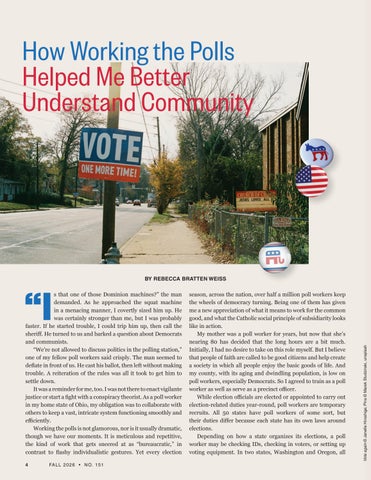
s that one of those Dominion machines?” the man demanded. As he approached the squat machine in a menacing manner, I covertly sized him up. He was certainly stronger than me, but I was probably faster. If he started trouble, I could trip him up, then call the sheriff. He turned to us and barked a question about Democrats and communists. “We’re not allowed to discuss politics in the polling station,” one of my fellow poll workers said crisply. The man seemed to deflate in front of us. He cast his ballot, then left without making trouble. A reiteration of the rules was all it took to get him to settle down. It was a reminder for me, too. I was not there to enact vigilante justice or start a fight with a conspiracy theorist. As a poll worker in my home state of Ohio, my obligation was to collaborate with others to keep a vast, intricate system functioning smoothly and efficiently. Working the polls is not glamorous, nor is it usually dramatic, though we have our moments. It is meticulous and repetitive, the kind of work that gets sneered at as “bureaucratic,” in contrast to flashy individualistic gestures. Yet every election 4
FA L L 2 0 2 6 • N O. 1 5 1
season, across the nation, over half a million poll workers keep the wheels of democracy turning. Being one of them has given me a new appreciation of what it means to work for the common good, and what the Catholic social principle of subsidiarity looks like in action. My mother was a poll worker for years, but now that she’s nearing 80 has decided that the long hours are a bit much. Initially, I had no desire to take on this role myself. But I believe that people of faith are called to be good citizens and help create a society in which all people enjoy the basic goods of life. And my county, with its aging and dwindling population, is low on poll workers, especially Democrats. So I agreed to train as a poll worker as well as serve as a precinct officer. While election officials are elected or appointed to carry out election-related duties year-round, poll workers are temporary recruits. All 50 states have poll workers of some sort, but their duties differ because each state has its own laws around elections. Depending on how a state organizes its elections, a poll worker may be checking IDs, checking in voters, or setting up voting equipment. In two states, Washington and Oregon, all
Vote again © Janelle Hiroshige; Pins © Marek Studzinski, unsplash
“I
BY REBECCA BRATTEN WEISS
voting is done by mail, so full-time employees oversee most of the voting. Simply setting up the polling station is laborious. There are security protocols for maintaining the machine, and strict rules about everything from what to do with a spoiled ballot to how to deal with a voter in the wrong precinct. We are obliged to post information and communicate throughout the day with the county’s Board of Elections.
Vintage pins - rawpixel.com; "the peace symbol" photo by Marshall Colman
“ Working the polls means committing to collaborate with my ideological adversaries to ensure something we both care about: secure elections.” My county, in Appalachian coal country, was long a Democratic stronghold with robust union membership. That began to change in the 1990s, thanks in part to the bombardment of right-wing media, which has created an atmosphere of distrust and paranoia about a number of things, elections included. Knowing people might get rowdy was an added incentive for me to be a poll worker. I wanted to be on the side of democracy. Ironically, this means working alongside the people with whom I have serious moral disagreements. Ohio law mandates that “no more than one-half of the total number of poll workers assigned to a precinct may be members of the same political party.” No members of one party can even be alone in the room or with the ballots without a member of the other party. It makes for an awkward time, everyone lurking and hovering as the ballots are secured. At the end of the evening, both a Republican and a Democrat have to drive the ballots back to the Board of Elections office to be checked in. People often talk about unity and community, in the church as well as in politics, as though it’s all about good vibes and agreeing to disagree. Given the Republican party’s widespread attacks on immigrant and queer populations, I find such facile calls for unity unhelpful. The harm done to the vulnerable will not be magically mended because I, a straight white woman, happened to discover a shared taste in music or swap a recipe with a Republican. That sort of unity reminds me of what Dietrich Bonhoeffer said about cheap grace: “Cheap grace is the preaching of forgiveness without requiring repentance, baptism without church discipline, Communion without confession, absolution without personal confession.” Cheap unity is fake unity, the comfortable having a laugh together while the vulnerable remain neglected and at risk. Working the polls means committing to collaborate with my ideological adversaries to ensure something we both care about: secure elections. Is this enough of a common ground to work towards a unity that is not cheap? I think it can sustain serious discussions about democracy, what a good society looks like, and the inalienable rights of every human being. It’s certainly clarified, for me, that community is not about surface feelings,
but about a commitment to shared goals and the objective justice due to everyone—even if you don’t like them very much. While I’ve always been passionate about politics, my interest was usually more in policy, messaging, and ideological dynamics than in the granular bureaucratic details. But these meticulous local efforts are essential to policy implementation. Seeing this helps me understand the concrete relationship between subsidiarity and solidarity, two principles of Catholic social teaching that are sometimes, wrongly, put in opposition to each other. Solidarity insists that our shared humanity alone demands mutual responsibility for one another, and some Catholic social ethicists reference it when talking about things like federal social welfare programs. Some conservative thinkers, meanwhile, argue that such programs would violate subsidiarity, the belief that things should be done on a local level. Yet subsidiarity is not mere localism. It’s the understanding that decisions should be made by those most affected by them, and that solidarity is best supported by grassroots efforts. This is exactly what happens with the way our elections and local government are maintained. I wish more people in our nation understood just how much work goes into keeping everything from tumbling into the bad sort of chaos. We’re so impatient. We want people to wave magic wands and fix everything, whether it’s building a road, containing a pandemic, or repairing a broken economy. We even tend to think about activism in terms of a few towering figures. Such heroic leaders are important, yes, but so are the countless other folks who did their part to move the needle a notch closer to justice. Our Board of Elections recently responded to the attacks on our election security by putting an invitation in our local paper: “If you’re so worried, come work the polls.” I’ll echo that invitation, including to those less worried about election security than in the existential survival of our democratic republic. Contributing to these painstaking but undramatic efforts is one way to help build a society in which everyone can flourish. “If you're so Rebecca Bratten Weiss is digital editor of U.S. Catholic magazine, cohost of the Glad You Asked
worried, come work the polls.” — Board of Elections
podcast, and a regular contributor to the National Catholic Reporter. She has published extensively on religion, culture, and politics and is coeditor (with Jessica Mesman) of Sick Pilgrims: An Anthology of Catholic Spiritual Autobiography. A M AT T E R O F S P I R I T
5