BETWEEN ASHES AND BREAD: Rediscovering Public Faith Through the Season of Faithful Witness
BY SERGIO LOPEZ
Last year, Catholics across the United States began gathering in parish halls, ministry meetings, detention center parking lots, sidewalks, chapels, and neighborhood streets with a shared question: What does faithful witness look like in this moment?
For many communities, the question emerged from lived experience. Families were navigating fear and uncertainty. Immigrant communities were experiencing instability and separation. Parishioners were wrestling with exhaustion, polarization, and the feeling that public life had become increasingly fragmented and dehumanizing. Many Catholics sensed a widening gap between the faith they professed inside church walls and the realities unfolding around them.
Out of that moment, Catholic leaders, clergy, religious, lay organizers, and organizations across the country began shaping what became the Season of Faithful Witness: a shared invitation to prayer, discernment, and peaceful public witness from Ash Wednesday through the Feast of Corpus Christi.
Catholics in Communion helped connect and support this effort as a coalition space, but what unfolded was not a centralized campaign or a single coordinated event. Instead, local Catholic communities across the country began responding in ways that were deeply pastoral, visible, and rooted in ordinary Catholic life. Some communities organized eucharistic processions through neighborhoods. Others held prayer vigils outside detention centers or invited parishioners to remain after Mass for reflection and conversation. Some hosted bilingual gatherings for Hispanic ministry leaders and immigrant families. Others created small spaces for listening, prayer, and discernment inside existing ministries and parish groups.
Many of these actions were intentionally simple. But they reflect a shared truth: Catholics are longing to rediscover forms of public faith that are prayerful, communal, and grounded in human dignity.
4 Ways to Get Involved
1. Join the movement
Commit to working alongside Catholics across the country to engage in prayerful discernment and public expressions of faithful, nonviolent, and prophetic witness. Complete the sign-up form at the link below and you’ll receive:
• invitations to national events and calls to action
• timely resources and trainings to respond to the moment direct to your inbox
• ongoing support for you and your community
To sign up, visit: c atholicsincommunion.org/join-us
2. Unlock your toolkit
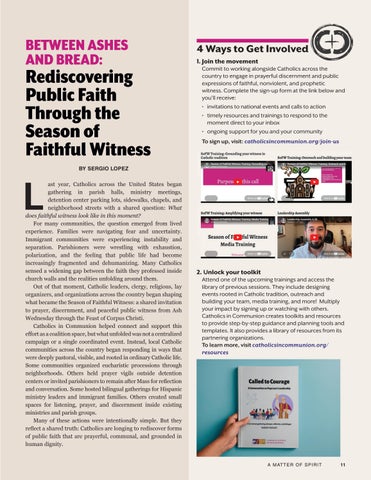
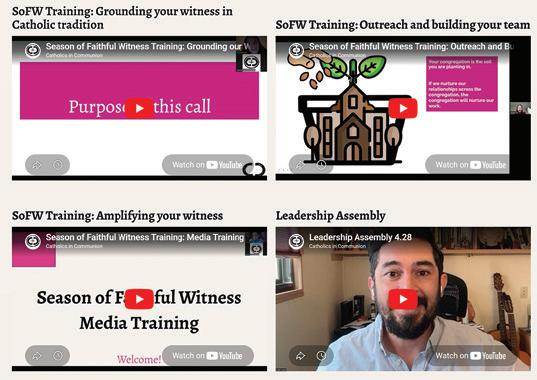
Attend one of the upcoming trainings and access the library of previous sessions. They include designing events rooted in Catholic tradition, outreach and building your team, media training, and more! Multiply your impact by signing up or watching with others.
Catholics in Communion creates toolkits and resources to provide step-by-step guidance and planning tools and templates. It also provides a library of resources from its partnering organizations.
To learn more, visit catholicsincommunion.org/ resources
PUBLIC FAITH IN A FRAGMENTED TIME
The season also reflects a broader question emerging within Catholic life today: What does public faith look like in an era shaped by polarization and distrust?
For many Catholics, public expressions of religion have become associated either with partisan conflict or private spirituality disconnected from social reality. The Season of Faithful Witness attempted to reclaim another tradition within Catholic life: public witness rooted in prayer, the Eucharist, solidarity, and human dignity.
Our movement does not ask Catholics to adopt a partisan identity or join a single organization. It invites them to begin from the practices Catholics already know: prayer, Eucharist, listening, accompaniment, works of mercy, and concern for the dignity of every person. In that sense, the Season of Faithful Witness sought not to create something separate from ordinary Catholic life, but to help communities rediscover the public implications of the faith they already profess.
The Feast of Corpus Christi became especially important within this framework. As communities looked toward Corpus Christi, Catholic organizers, theologians, ministry leaders, and partner organizations helped name the feast not only as a celebration of Christ’s presence in the Eucharist, but also as an invitation to remember who we become when we receive the Eucharist.
A PASTORAL EMERGENCY OF HOPE
One phrase surfaced repeatedly as Catholics gathered, listened, and shared what they were carrying: “a pastoral emergency of hope.”
The phrase named something many people were already feeling: Across communities, Catholics expressed concerns not only about political division or social instability, but about isolation. Many people no longer knew where to bring their fears, grief, hopes, or questions together as church.
In the days leading up to Ash Wednesday, hundreds of people joined welcome calls, and by Holy Week, thousands were gathering in public spaces to protest and to pray.
What mattered most was not only the number of gatherings, but the choices people made. A priest in a rural parish chose to preach about welcoming the stranger even while carrying real fear. Volunteers stepped forward and found themselves doing far more than expected, because they wanted the church’s witness to be visible. Leaders who had long loved the teachings of Jesus but felt disconnected from parish life began finding their way back because something about this witness felt real.
That theological vision shaped many of the season’s public actions. Communities organized processions through neighborhoods, prayer services in public spaces, and gatherings centered on the connection between eucharistic faith and the church’s social mission. The season repeatedly emphasized the church’s teaching that the Eucharist commits us to the poor and that reverence for the blessed sacrament and reverence for human dignity belong together.
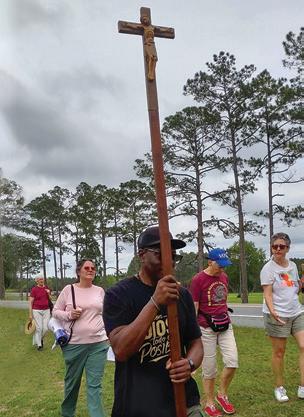
Importantly, these public witnesses were not framed primarily as protests. They were framed as acts of prayerful solidarity. Participants described public processions that carried Christ’s presence into the streets.
That image helps explain why the season resonated across such diverse Catholic communities. Many participants were not looking for ideological certainty. They were looking for ways to live their faith visibly in a moment marked by fear and fragmentation.
WALKING TOGETHER IN COMMUNION
A defining characteristic of the Season of Faithful Witness has been its emphasis on communion.
Throughout bilingual gatherings, invitations, and trainings, Catholics repeatedly returned to the conviction that we are not alone and we are called to walk together in communion.
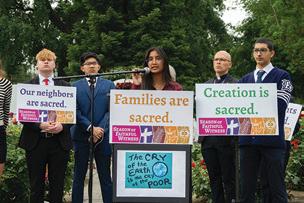
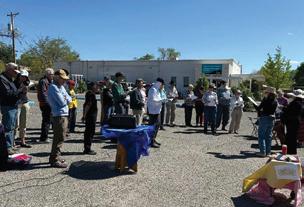
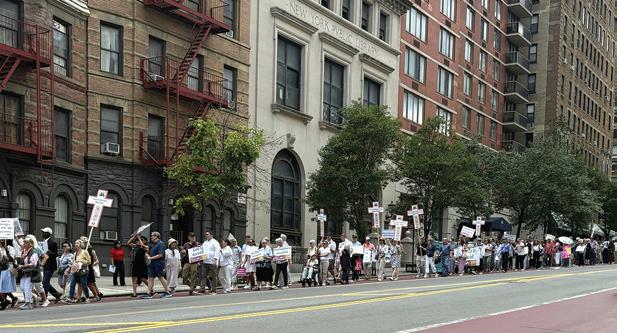
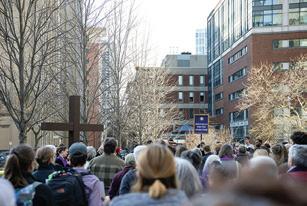
Catholics in Communion events in (clockwise from top left) St. Augustine, Florida; Sacramento, California; Boston, Albuquerque, and New York City
That language became especially meaningful in gatherings focused on Hispanic and immigrant ministry. Earlier this year, Bishop Evelio Menjivar-Ayala, Bishop Ramón Bejarano, Bishop Pedro Bismarck Chau, and Sister Xiomara Méndez Hernández, O.P., helped convene a National Virtual Gathering of Hispanic Ministry Leaders, which created space for prayer, listening, and discernment about how the church is being called to respond to the plight of immigrants.
The gathering reflected a broader reality unfolding throughout the season: Many Catholics are seeking spaces where accompaniment, prayer, and public witness can coexist.
That desire has shaped not only large gatherings, but also the season’s smallest interactions. In practice, this looked like hospitality teams creating a warm, non-anxious tone; organizers beginning meetings with listening and prayer; communities discerning together rather than rushing immediately toward action.
These details may seem small, but they point toward something larger: a vision of public Catholic life grounded not in performance, but in communion.
FROM ISOLATION TO COMMUNION
Near the conclusion of the Corpus Christi season, one line became, for many participants, a kind of summary of the entire effort: We hope these faithful witnesses will make possible that parishioners move from concern to courage, from isolation to communion, from private faith to public witness.
That movement—from isolation to communion—may ultimately be the deepest significance of the Season of Faithful Witness.
During Holy Week, that response became more visible. Nearly 30 actions in 19 states reached more than 5,000 people. In places like Philadelphia, Los Angeles, Boston, Minnesota, rural Florida, New Mexico, and beyond, Catholics gathered in prayer, in public, with courage, and with a deep desire to stand together in faith.
Not every gathering was large. Not every witness drew media attention. Some simply involved a handful of parishioners remaining after Mass for prayer and conversation. Others brought clergy, families, ministry leaders, and immigrant communities together in public spaces across cities and neighborhoods.
But together, these local acts of witness formed something larger: a reminder that Catholic faith is not only something practiced privately or professed inside church walls. It is also something lived publicly, communally, and courageously.
And perhaps that is what so many Catholics have been searching for all along—not a new institution, brand, or program, but a renewed way of walking together as church in a wounded and divided world.
Between ashes and bread, many communities have begun rediscovering that path together.
3. Start a Conversation
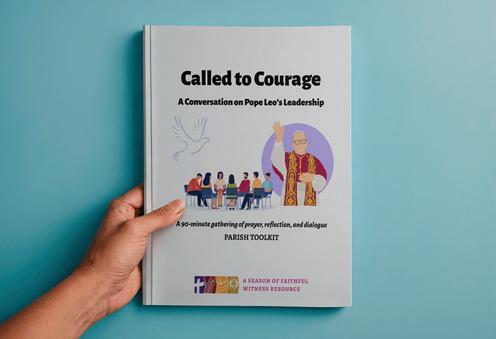
Catholics in Communion produces toolkits to support your next steps. The “Called to Courage: A Conversation on Pope Leo’s Leadership” toolkit invites parishes into a guided conversation on Pope Leo’s leadership and the church’s call to live out our faith in today’s world. It includes a facilitator guide for prayerful dialogue and utilizes a recent 60 Minutes video segment with three U.S. cardinals. In just 90 minutes, this conversation can support your community in taking a small but meaningful step toward what the church calls us to be: a people who listen, discern, and respond together. To download the toolkit, visit: catholicsincommunion.org/ called-to-courage-conversation-toolkit
4. Get connected
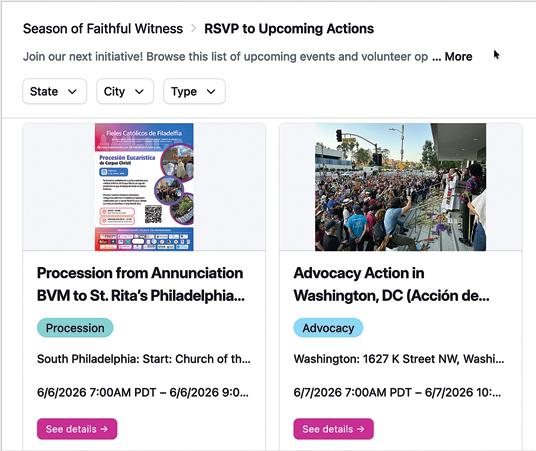
Find people in your local community and invite others to join you in faithful witness. Visit the Catholics in Communion website to find local actions and leaders near you and to sign up for upcoming welcome and training calls.
This is the hope that action in communion will make possible: that parishioners move from concern to courage, from isolation to communion, from private faith to public witness. Whether you bring together 5 people or 500, public faithful witness allows the wider church to see Catholics across the country responding not with fear, division, or despair, but with prayer, solidarity, and moral courage.
To get connected, visit: catholicsincommunion.org/events
Sergio Lopez is the national director of mission and leadership formation for Catholics in Communion.