From the Editor
On a gray November morning outside Chicago’s Broadview Processing Center, an Immigrations and Customs Enforcement detention center, more than 2,000 Catholics gathered for Mass.
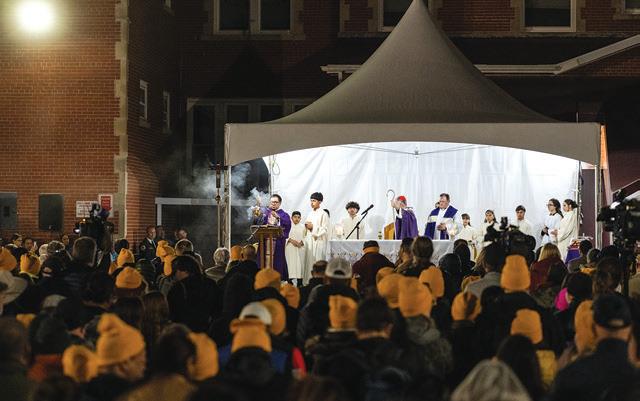
There were no stained glass, quiet pews, or fonts of holy water. Mass took place in a parking lot, bordered by fencing and barbed wire. Across the street, immigrants sat in detention, cut off from their families and existing in limbo, unsure what would happen to them next.
The people standing outside had come to bring communion to those inside; to tell them that they weren’t alone. “On All Saints Day, we affirm that in Christ there is no separation,” a press release promoting the event declared. “The prophets of justice intercede from heaven, those killed by ICE like Silverio cry out for mercy, the detained endure inside, and the people of God stand together outside in prophetic witness.”
The people outside were denied entry. The people inside were denied access to the sacraments.
And yet, as Cassidy Klein—also an editorial board member for A Matter of Spirit—writes in an article for U.S. Catholic, “Although the delegations were denied entry, they prayed and sang loud enough that they hoped the people inside the facility could hear them.”
Klein writes that the organizers of this event—along with other vigils at Broadview and around the country—understood this gathering as an expression of liturgy in its oldest sense: as the “work of the people.” Liturgy, as professor of liturgy Anne McGowan writes in this issue, is not something that only happens within church walls. “Our identity as liturgists does not stop when the Mass is ended,” she writes. “For, as the standard preface of Eucharistic Prayer II affirms, ‘It is truly right and just, our duty and salvation, always and everywhere to give [God] thanks.’”
This is the vision of liturgy that lies at the heart of this issue of A Matter of Spirit. Far too often, Christians place a divide between worship and the work of justice, prayer and action, contemplation and public life. But the articles in this issue show that dichotomy is a false one.
In “God’s People’s No to the Status Quo,” McGowan writes about protest as a liturgy—as part of our universal vocation to bring about the kingdom of God on Earth. The remaining articles highlight just how individuals and communities are interpreting this vocation. In “One People, One Church, One Community,” Kascha Sanor describes her own experience of being at the Broadview Mass and the work of the Coalition for Spiritual and Public Leadership as a “spiritually rooted force for good” in Chicago. In “IPJC and the Season of Faithful Witness,” IPJC executive director Will Rutt writes about how participating in public vigils makes him proud of being a Catholic. Carley Haselhorst, in “The Power of a Public Vigil Mass,” writes about her work with Discerning Deacons and a public vigil in Indianapolis. And in “Between Ashes and Bread,” Catholics in Communion’s national director of mission and leadership formation provides a model for how all communities can get involved in this work and witness.
If we are truly one body in Christ, all of these authors argue, then the suffering of our neighbors cannot remain abstract. The stranger, the migrant, the detained, the excluded—they are not someone else’s concern. They belong to us. At a time when isolation and division seem to define public life, these stories remind us that another way is possible. Liturgy forms us into a people capable of solidarity.
The work of the people does not end when Mass is over.
—Emily Sanna, Editor
“If we are truly one body in Christ, then the suffering of our neighbors cannot remain abstract.”
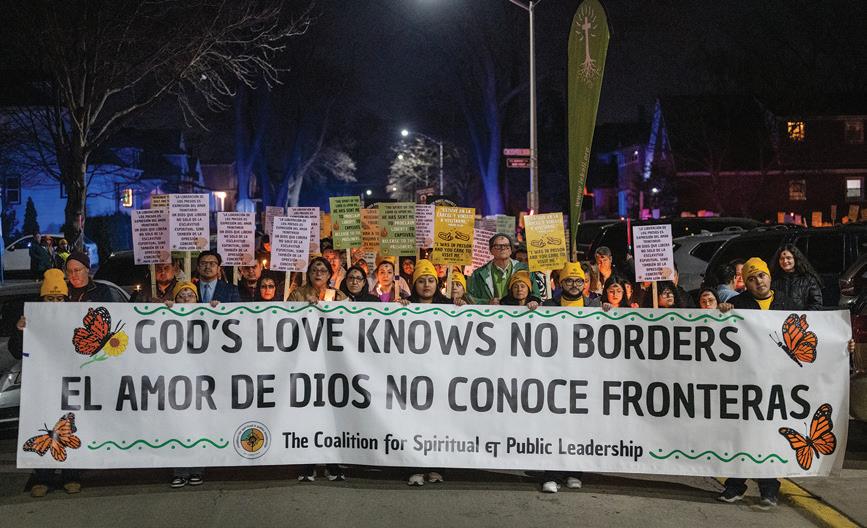
See article Page 6: Participants of Feb 18, 2026 Ash Wednesday Mass and Procession with Cardinal Blase Cupich, Our Lady of Mount Carmel, Melrose Park, IL. Photo: flickr © Paul Goyette
GOD’S PEOPLE’S NO TO THE STATUS QUO: PROTEST AS LITURGICAL RESPONSE
BY ANNE MCGOWAN
The ritual rehearsal of the reign of God unfolds in the church’s liturgies through a cycle of Advent anticipation, Christmas celebration, Lenten longing, Easter exuberance, and Ordinary Time tempering that recalibrates participants’ listening, looking, and loving to the mind of Christ. Liturgy represents an inflection point between the Church’s connection to Christ as source and sustenance of salvation and the impetus for Christians’ publicfacing work as Christ’s ambassadors. The ones who traverse this holy ground of transformation are liturgists.
At its best, the rhythms of ritual do not dull our senses but retune our sensibilities and reorient our perceptions around our relationships to God, others, and the entirety of the created universe, so it can be received more rightly as fruit of God’s goodness and craft of God’s creatures.
Therefore, with Easter eyes that have beheld both God’s suffering and God’s glory, God’s people may mount a protest that is categorically liturgical whenever there is need for confessing and lamenting injustice, witnessing another way of being present, and praying publicly for the arrival of God’s promised future where people love life in all stages, promote participation, recognize rights and responsibilities, opt for the poor and vulnerable, dignify workers and their work, enact solidarity with the whole human family, and cherish creation carefully.
THE MEANING OF LITURGY
Before the word liturgy took on churchy connotations, the Greek term λειτουργία (leitourgia) appears in the New Testament as a straightforward reference to “service” and, more specifically, service performed by an individual or group on behalf of many others for their flourishing.1
The church’s liturgical life makes us the thankful (i.e., eucharistic) beneficiaries of Christ’s service on our behalf, beholders and receivers of God’s work unfolding in salvation history through Christ and in the Spirit for us and for our salvation. This is work in which we are invited to participate, making all who have been baptized liturgists, people who cannot help but be “doers” of liturgy. The Second Vatican Council’s Constitution on the Sacred Liturgy declares that:
Mother Church earnestly desires that all the faithful should be led to that fully conscious and active participation in liturgical celebrations which is
1 For example, Paul describes the civil authorities to whom taxes are paid as “liturgists of God” (Romans 6:13) for their service, ultimately oriented toward the public good, and himself “poured out as a libation upon the sacrificial service [liturgy] of your faith” (Philippians 2:17). All biblical quotations are from the New American Bible, Revised Edition (NABRE), as found at https://bible.usccb.org/bible
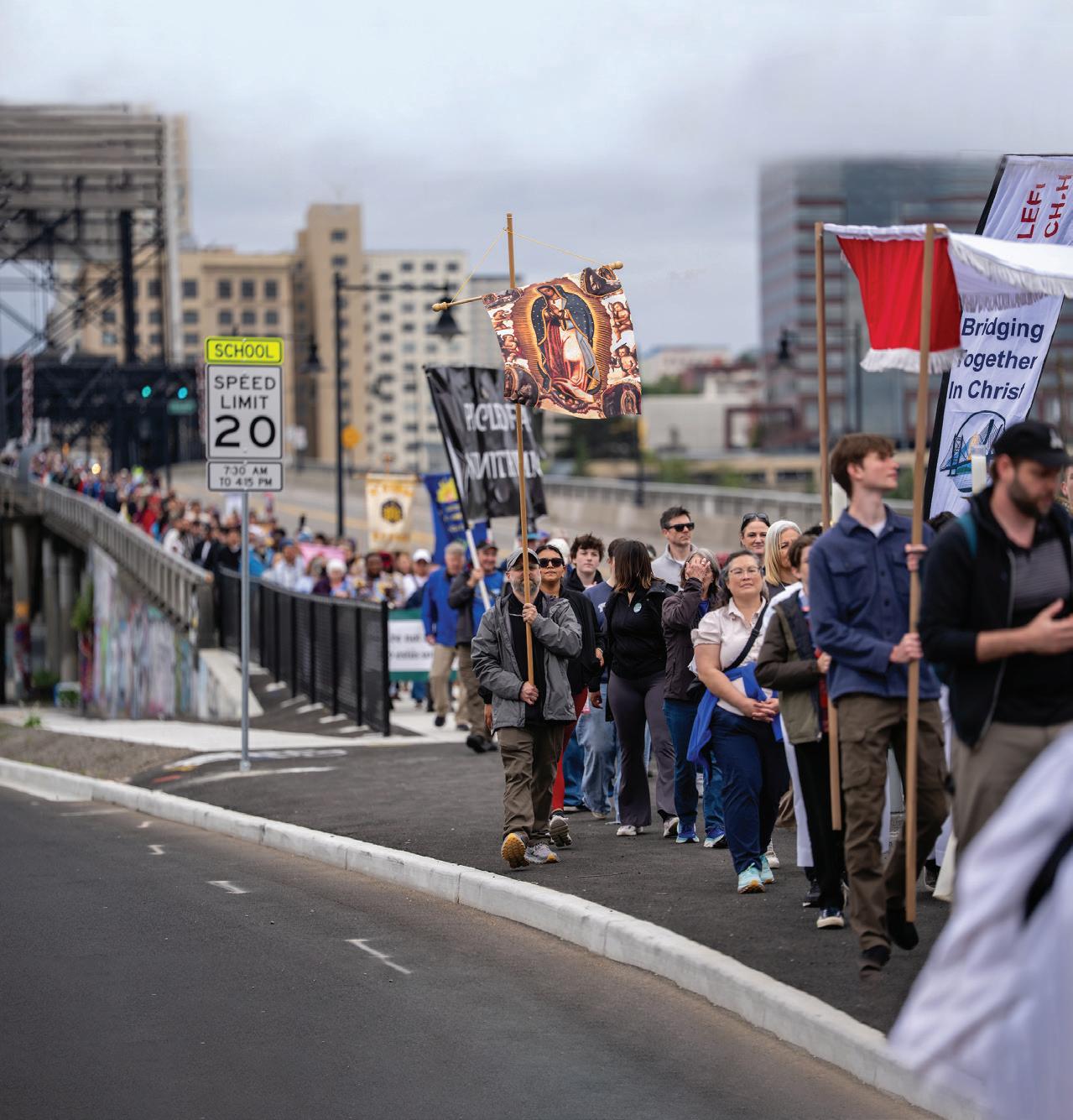
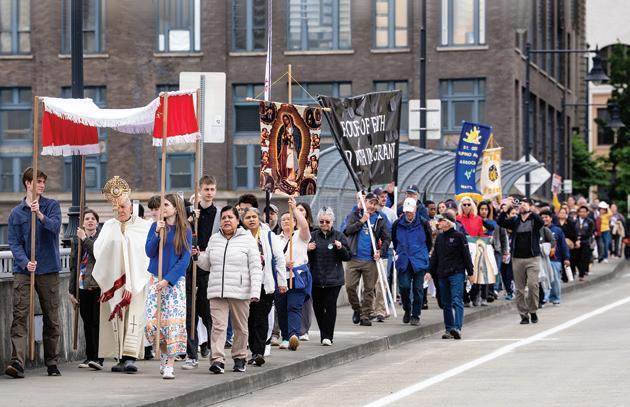
Eucharistic procession through the streets of Tacoma, Washington
demanded by the very nature of the liturgy. Such participation by the Christian people as “a chosen race, a royal priesthood, a holy nation, a redeemed people” (1 Pet. 2:9; cf. 2:4–5), is their right and duty by reason of their baptism.2
LITURGY BEYOND CHURCH WALLS
But we who have been blessed by Christ’s liturgy are not done with ours when the church’s liturgy concludes. Rather, we are immersed in God’s ongoing mission for the life of the world, where our service contributes to the thriving of all people and all creation. “Go and announce the Gospel of the Lord,” we might hear at the end of Mass, or “Go in peace, glorifying the Lord by your life.” Our identity as liturgists does not stop when the Mass is ended. For, as the standard preface of Eucharistic Prayer II affirms, “It is truly right and just, our duty and salvation, always and everywhere to give [God] thanks.”
This liturgical response of thanks and praise does not benefit God directly, because God’s goodness, glory, and graciousness are neither enhanced nor diminished by anything we have to offer, or by what we have done or failed to do. Rather, the response of our earthly liturgy is fulfilled most visibly and profoundly in what sacramental theologian Louis-Marie Chauvet calls the “liturgy of the neighbor,” where we make a return gift to God on a trajectory running through the revelation of our enfleshed answer to the parable of the Good Samaritan Jesus presents after being asked, “And who is my neighbor?”3
Protesting injustice, therefore, becomes for Christians a viable and vivifying liturgical response. Its broad moves mirror patterns practiced previously in liturgy. A community gathers in solidarity with or as people who are poor, oppressed, fearful, marginalized, persecuted, or made to feel powerless— or on behalf of people who cannot be present, perhaps because they are ill or incarcerated, underpaid or unborn, detained or dead. Sometimes, God’s human children gather on behalf of God’s other creatures experiencing the threat or actuality of degradation or annihilation.
God’s ever-effective Word proclaimed anew into the particularity of a situation invites a fresh reckoning with what God wills and how God keeps working in the world. Making manifest that gap invites protesters while implicating bystanders and perpetrators of injustice toward a response that will begin to redress the situation through remembrance, repentance, reconciliation, redress, and/or revised ways of cohabiting
2 Second Vatican Council, Sacrosanctum Concilium, Constitution on the Sacred Liturgy (Holy See, 1963), no. 14, https://www.vatican.va/archive/hist_ councils/ii_vatican_council/documents/vat-ii_const_19631204_sacrosanctumconcilium_en.html (hereafter cited as SC).
3 See Luke 10:29–37. Developing this concept from the work of the philosopher Emmanuel Levinas, Chauvet discusses the liturgy of the neighbor most extensively in Louis-Marie Chauvet, Symbol and Sacrament: A Sacramental Reinterpretation of Christian Existence, trans. Patrick Madigan and Madeleine Beaumont (Liturgical Press, 1995), 278–89.
as God’s creatures. If a more just resolution is not realized immediately, protesters may disperse to continue their advocacy and activism in less visible ways. They are sent forth to continue collaborating with God on behalf of others for the realization of the reign of God that relentlessly reorients the world.
When prayer is directed to God the Father as Christ taught us to pray—“thy kingdom come; thy will be done on earth as it is in heaven”—the Spirit remains at work in the world while God’s people rest and repeat their protest as necessary, refueled by the liturgy of the church to regain strength for engaging the ongoing liturgy of the world. Gathering, proclamation, response, and sending on mission keep recurring so that the world’s ragged reality comes to resemble more and more the redeemed resonance God promises.
At a minimum, all Christians are called to respond to God’s Word, “exercising the office of their baptismal Priesthood” by offering prayers for the Church’s needs, for those with worldly power and for the whole world’s salvation, for those oppressed and “burdened by any kind of difficulty,” and for the particular needs God has placed around them in their local communities, as in the Prayer of the Faithful (i.e., the baptized) at Mass.4 When we do not know what to pray or how to pray, “the Spirit itself intercedes with inexpressible groanings” (Romans 8:26).
4 The scope and parameters of the Universal Prayer or Prayer of the Faithful are laid out in the General Instruction of the Roman Missal, nos. 69–70; text available at https://www.usccb.org/prayer-and-worship/the-mass/generalinstruction-of-the-roman-missal/girm-chapter-2
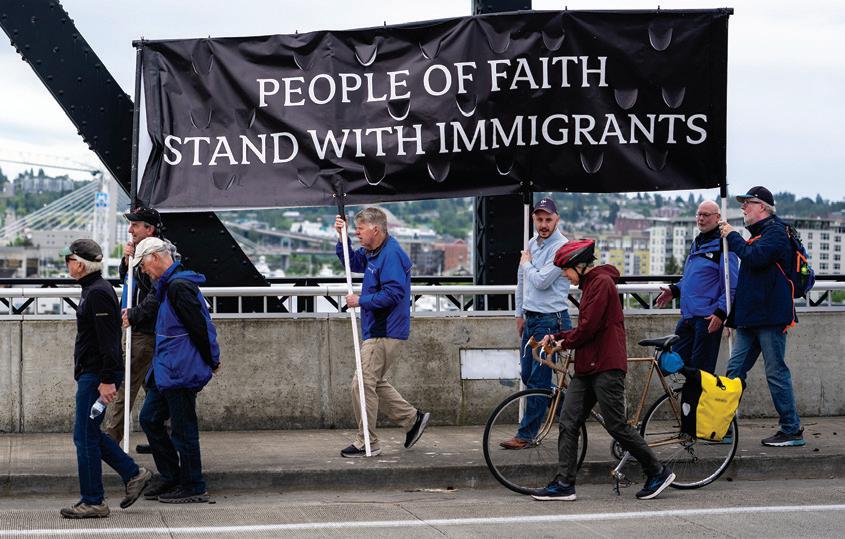
Page 4: Top: Front of the eucharistic procession on the 11th St. bridge
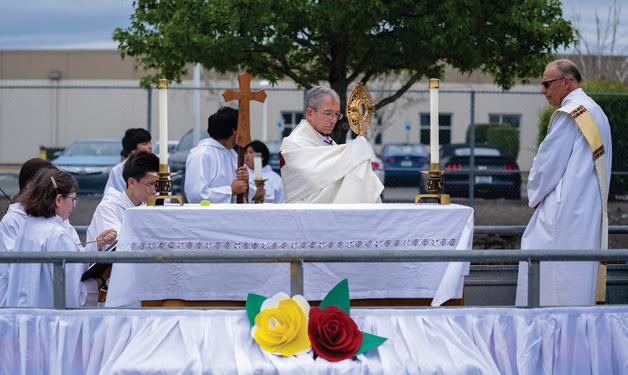
Below: Eucharistic benediction outside the Northwest ICE Processing Center
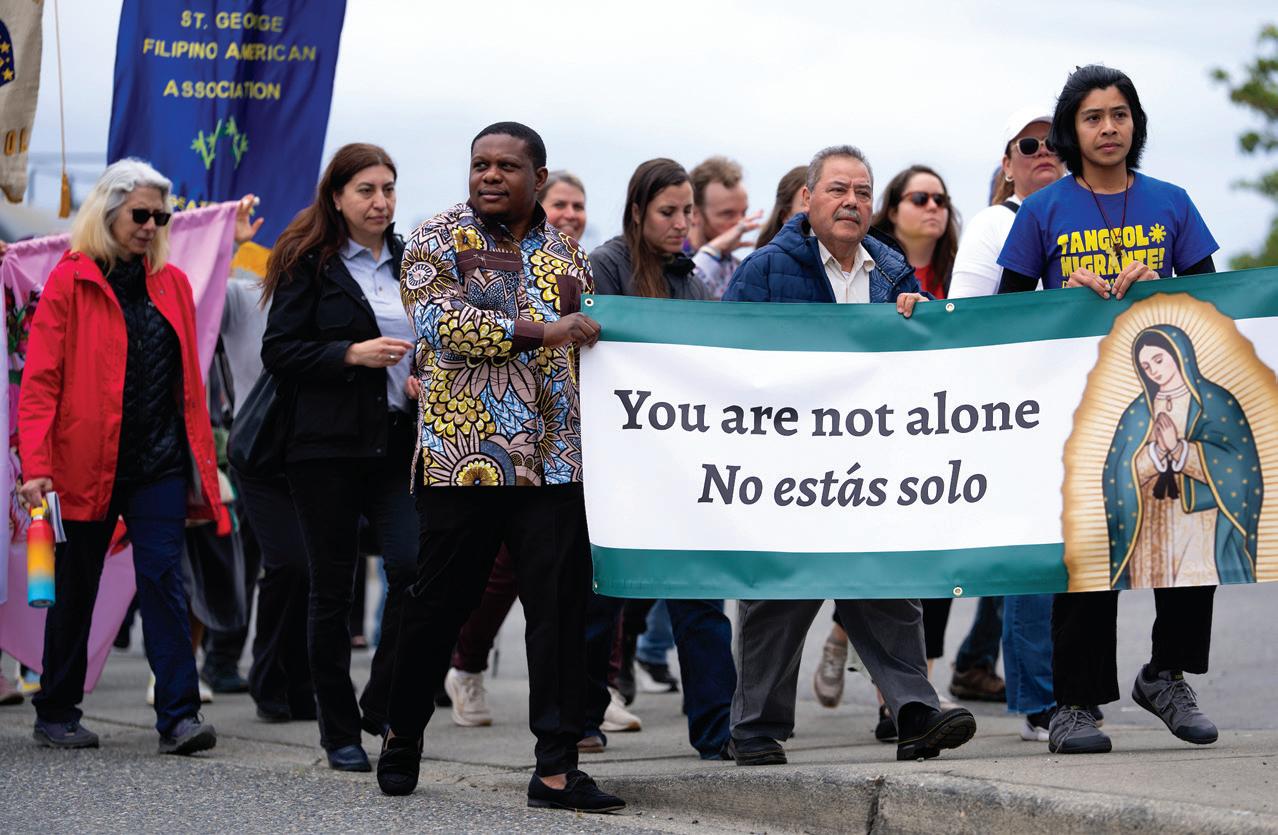
Page 5: Local parishioners make clear that the greater Seattle community stands in solidarity with immigrants and refugees
Beyond prayer, the pastoral liturgical theologian Mark Searle identified three levels of liturgical participation (amounting to embodied engagement, purposeful participation, and total transformation of life) that might fruitfully be applied also to liturgy’s more overt protest potential as the service of God’s people on behalf of others.5
Embodied engagement (level one) entails just going through the motions of protest and trying them on for size. Bring your body to protest injustice, even if only because someone invited you to go or because you know someone directly impacted by an unjust situation. As Jesus’ disciples experienced post-Pentecost, something powerful begins to happen when we leave the safety of our upper rooms and venture into the world free from fear, strengthened by the commitments of the Spirit-saturated community that surrounds us.
At this level, adding words or actions to one’s protest is encouraged but optional; the first step of any liturgy is responding to the Spirit’s summons by showing up. As Jesus demonstrated in his trial before Pontius Pilate in John’s Gospel, even silence serves as a powerful witness when used to problematize the power dynamics presumed in the processes that perpetuate injustice. God’s people know now, as Jesus did then, that the powers of this world “would have no power over me if it had not been given…from above.”6
Second-level liturgical participation would involve practicing protest consciously accepting that it is your cooperation in realizing the reign of God, your participation in the ongoing
5 See Mark Searle, Called to Participate: Theological, Ritual, and Social Perspectives, ed. Barbara Searle and Anne Y. Koester (Liturgical Press, 2006), 15–45.
6 See John 19:10–11.
mission of Christ for the life and love of the world. We who have become God’s adopted children and siblings in the Spirit manifest ourselves as who we are: members of the Body of Christ, sharing the life of the One whose death and resurrection animates us now. Our witness matters to each other and for the wider world as people who live liturgy, who embody the church’s social teaching, who unite our prayer and action with Christ’s ongoing, broadly liturgical prayer and work on behalf of the world.
Protesters who, with the help of God’s grace, become so transparent to the life and love of the triune God that both they and the world cannot help but be transformed because of who they are and what they do to exemplify Searle’s level three: participation in the life of God. They become people whose obedient faith, coupled with active cooperation in God’s ongoing work of salvation, effectively continues God’s self-communication in a world where all creation is groaning for its redemption (Romans 8:22–23).
“Our vocation,” Searle states, “is to cooperate in the mediating work of Christ as links between God and the human world. For that ritual is indispensable, but it is never enough. For that we need holiness, in the sense of a certain Christ-like transparency to the Spirit of God. That openness to God is what we call faith; that transforming self-gift of God to us we call sanctifying grace.”
7
God only knows what might happen when we—as God’s people—assemble as a community convoked in God’s name, for God’s purposes. At Mass, “the renewal in the Eucharist of the covenant between the Lord and [humanity] draws the faithful into the compelling love of Christ and sets them on fire” (SC 10).
When massing for peaceful protest, members of Christ’s body let our listening discernment, kindled now to burning conviction, take shape in a visible stance against violence and exploitation of vulnerability. Whether or not we recognize that our service on behalf of others is service for and with Christ,8 our protest liturgy is inspired by the eschatological vision of what a world renewed by God’s Spirit could be, a vision that the church’s liturgies have taught us to long for.
In this time between Pentecost and the Parousia, therefore, such protests will periodically ignite among precarious people in troubling times until conditions have changed so completely that every creature can freely exult in God’s praise.
Anne McGowan is an associate professor of liturgy at Catholic Theological Union in Chicago, where she teaches courses on liturgy and sacraments. She is the mother of two young children.
7 Searle, Called to Participate, 37–38.
8 See Matthew 25:31–46.
ONE PEOPLE, ONE CHURCH, ONE COMMUNITY
BY KASCHA SANOR
“I could have been one of them too. In a moment I could be. Speaking Spanish, having this skin color, makes it possible that one day I could be detained too - as has happened in many cases.”
This is how Chicago Bishop Jose Maria Garcia-Maldonado reflected on presiding over a Peoples Mass outside of Broadview ICE facility. “I am also an immigrant,” he said, “someone who came to this country 24 years ago. So this is a form of solidarity.”
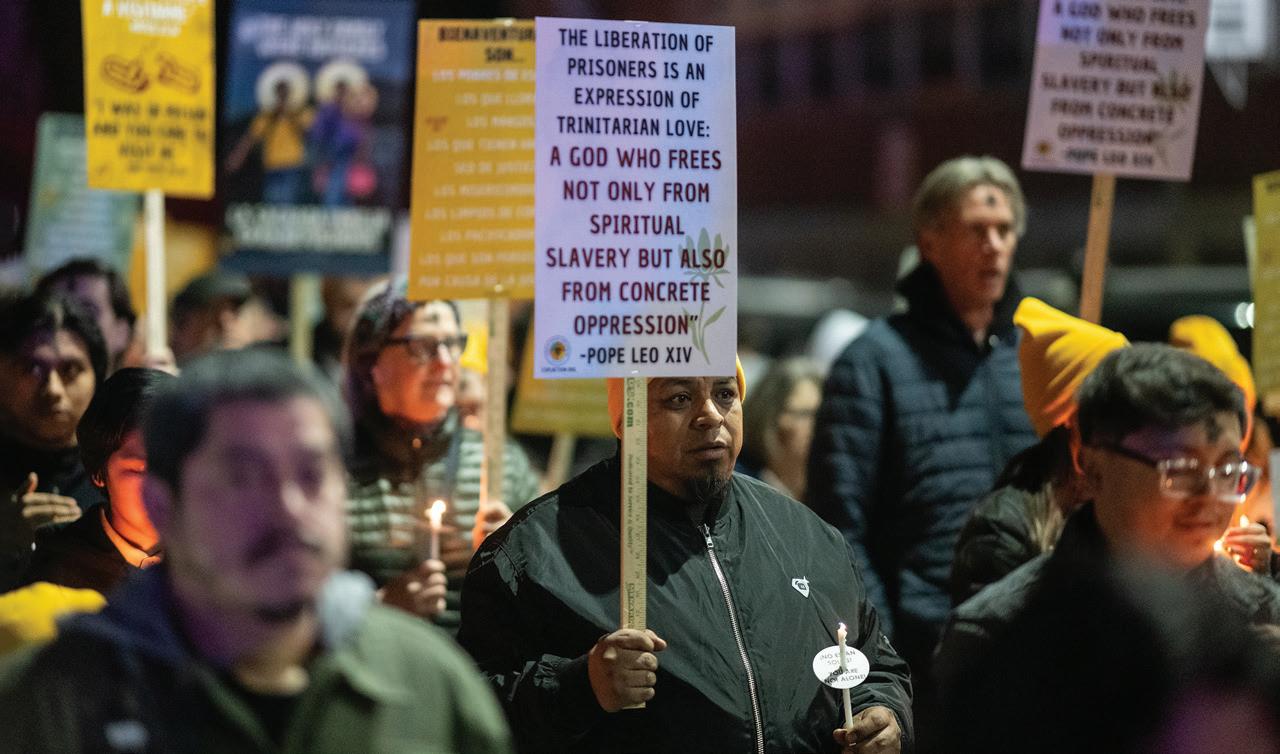
On November 1st, over 2,000 faithful Catholics gathered outside of Broadview Detention Center for the Misa Popular or Peoples Mass. The hope was to offer the Eucharist and spiritual care to our fellow parishioners, beloved friends, neighbors, and people of God being inhumanely held inside. In an empty parking lot, surrounded by fencing and barbed wire, we celebrated Mass. Moments after the consecration, a delegation of Sisters, Priests, and the Bishop were missioned to approach the detention center as Eucharistic Ministers. Despite following all proper protocols, including providing advanced notice, we were denied and the eucharistic table divided.
This was one of multiple attempts to provide communion to those held in the ICE facility. Months earlier, when it was announced that ICE and the National Guard would move into Chicago for immigration enforcement efforts, the fear and
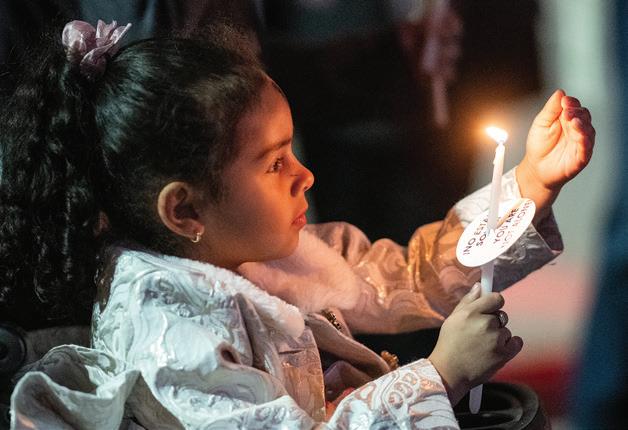
worry throughout the city was palpable and immediate. But, so too, was a faithful response.
The Coalition for Spiritual and Public Leadership (CSPL), a spiritually rooted force for good, has been the heartbeat of some stunning public faith-based witness across Chicago. Each invitation, a breathtakingly beautiful response to heartbreaking headlines.
The multi-racial, multi-generational community of CSPL is deeply rooted in the rituals and traditions of our Catholic faith. During a Eucharistic Procession, over 500 people gathered for adoration, followed by a mile-long procession to the ICE facility while praying the rosary. Every step was an intercession through Mary to guide and strengthen
did you receive the foreigner? Did you receive him and welcome him or not? And I think that there’s a deep reflection that needs to be made in terms of what’s happening. The spiritual rights of people who have been detained should also be considered.”
“Every time I’m with CSPL, I grow in devotion. I am surrounded by people who make love and goodness real.”
us: Mother Mary who once journeyed as a refugee, who revealed herself in Guadalupe, who faced poverty and oppression, who proclaims the Magnificat.
“Faith isn’t meant to stay inside the walls of our churches.” CSPL reminds us, “It moves. It resists. It shows up.” Every time I’m with CSPL, I grow in devotion. I am surrounded by people who make love and goodness real. I see friends from an old parish, former professors, community partners, and colleagues—each willing to risk, to pray, and to work for peace.
“I just cried,” said a dear friend of mine about the Peoples Mass. She is a young woman who works in university campus ministry. “I understood communion for the first time in a long while and all I could do was cry. What are we doing to the body of Christ?”
On October 21st, Cardinal Blase Cupich made the following public statement: “Families are being torn apart, children are left in fear, and communities are shaken by immigration raids and detentions. These actions ruin the soul of our city. Let me be clear, the Church stands with migrants.”
These gatherings around the greater Chicago area, and all the works of CSPL, have been an unrelenting, ongoing example of a Church that loves and serves a people hungry for peace and justice. These moments of public witness have moved not only hearts across our city but even garnered a response from Pope Leo XIV.
When asked a question about his thoughts on people being unlawfully detained and denied the Eucharist in Chicago, he responded: “In the first place, the role of the Church is to preach the Gospel. And just a few days ago we heard Matthews Gospel 25, in which Jesus says very clearly at the end of the world: how
It’s overwhelming: both the crisis and the depth of the call. But standing in a vacant lot, surrounded by Catholics of every age, race, and ability, I’m reminded that the Gospel is Good News—for all of us. And if we believe that, how does that call us to faithfully move, resist, and show up? I am grateful to have strong community here in Chicago and the leadership of CSPL, but I know this groundswell of hope extends far beyond our local community.
Since last November, there have been countless faithful witnesses across our country. In Detroit, Michigan, Sisters and Associates have been steadfast to a weekly witness for immigration justice downtown. At Delaney Hall in New Jersey, Sr. Susan Francois, CSJP has been a consistent pastoral presence. The depth of our tradition, the well of graces, the examples of women doing good works are all abundant! And you can join us!
If you’re not yet connected to a local group working for immigration justice, you can access virtual resources from and donate to CSPL on their website: csplaction.org There are also some great “Know Your Rights” trainings and advocacy actions with nationwide partners such as CLINIC (cliniclegal.org) and the Justice for Immigrants Campaign of the USCCB (justiceforimmigrants.org ) . Finally, it is never too late to discern and sign the Cabrini Pledge, hosted by the United States Conference of Catholic Bishops (usccb.org/ cabrinipledge).
Kascha Sanor is the director of social and environmental justice for the Congregation of the Sisters of St. Joseph and a current board member with IPJC. She holds a Master of Divinity and Social Justice dual degree from the Institute of Pastoral Studies at Loyola University Chicago and is deeply committed to synodality.
This article was originality published in the Spring 2026 issue of imagineONE, the publication of the Congregation of the Sisters of St. Joseph, and was reprinted with permission.
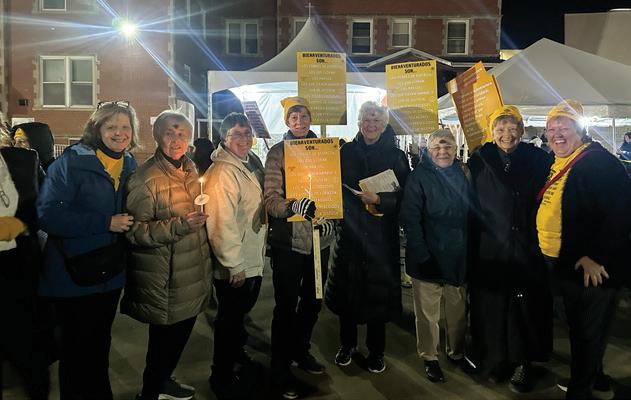
Participants of Feb 18, 2026 Ash Wednesday Mass and Procession with Cardinal Blase Cupich, Our Lady of Mount Carmel, Melrose Park, IL
Photos flickr © Paul Goyette
Above right photo from article author: Sisters of St. Joseph (CSSJ) and Associates at the Ash Wednesday Mass
IPJC AND THE SEASON OF FAITHFUL WITNESS: A FAITH WE CAN BE PROUD OF
BY WILL RUTT
Ihave long struggled with my Catholic identity, particularly when it comes to holding the complexity of the tradition around justice issues. This has often led to a sense of shame when publicly identifying as Catholic in social justice spaces and a hesitation to participate in explicitly Catholic public prayer. While this struggle has been difficult, I can’t remember a time when I have been prouder to be Catholic, or more compelled to boldly claim that identity, than during this Season of Faithful Witness.
As we face an administration that claims to be guided by Christian values while systematically harming immigrant and refugee communities across the country, our tradition and community offer a prayerful, dignified, and powerful form of resistance. In addition to the actions highlighted in this issue, since last November, there have been countless faithful witnesses in the Catholic community.
When IPJC was invited to serve as a regional animator for the Season of Faithful Witness, our community responded in formidable and prophetic ways. Beginning on the Monday of Holy Week, we gathered for The Way of the Cross, walking through Seattle’s Beacon Hill neighborhood while praying the stations. In this historically immigrant community, marked by resilience, joy, and pain, we bore witness to the suffering of our immigrant and refugee neighbors.
During the seventh and eighth stations, when Jesus falls a second time and meets the women of Jerusalem, a community member shared his experience of being wrongfully detained for over three months, forcing him to close his beloved food truck business. After recounting the pain, fear, and isolation he endured, he dropped to his knees, thanking the community for bearing witness to his story and offering a vision of belonging that welcomes all and upholds human dignity at all costs. In that moment, I felt the Spirit moving among us encouraging us forward and consoling us in a time of fear.
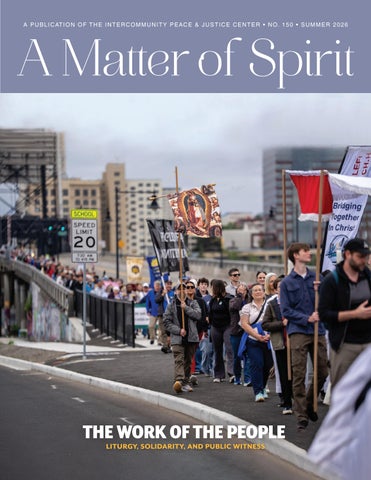
A few months later, our community gathered in Tacoma, Washington, for We Are One Body: A Eucharistic Procession for Migrant Dignity. We began with Mass at St. Leo’s and processed behind the Blessed Sacrament through the streets to the Northwest Detention Center. Singing with one voice and praying the sorrowful mysteries of the rosary, we affirmed that when one part of the body of Christ suffers, we all suffer.
As we prayed and sang outside the detention center, Deacon Juan, who ministers inside, shared that he had informed those detained that we stood in solidarity with them. In a note afterward, he wrote that our encouragement and support gave strength and hope to the people detained and their families. In a time when words feel insufficient, prayer and song allowed us to offer consolation.
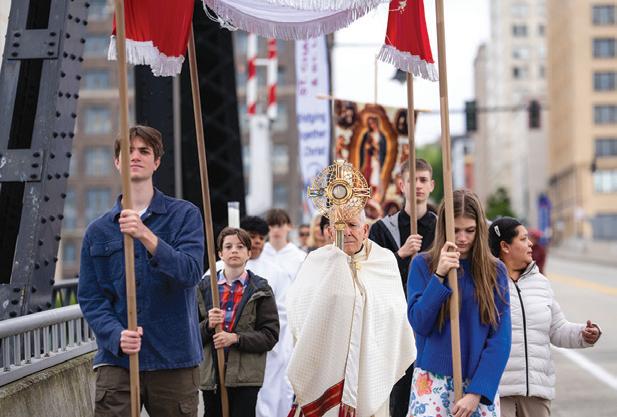
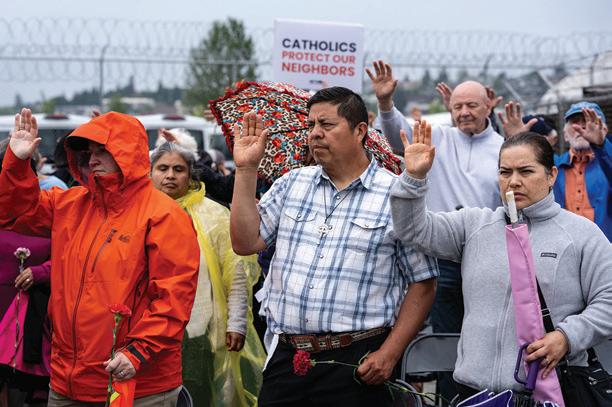
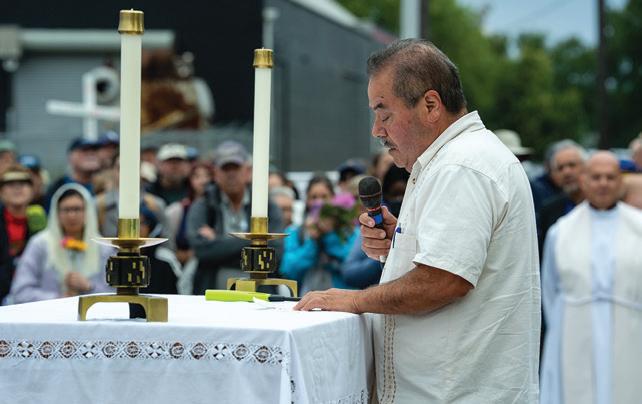
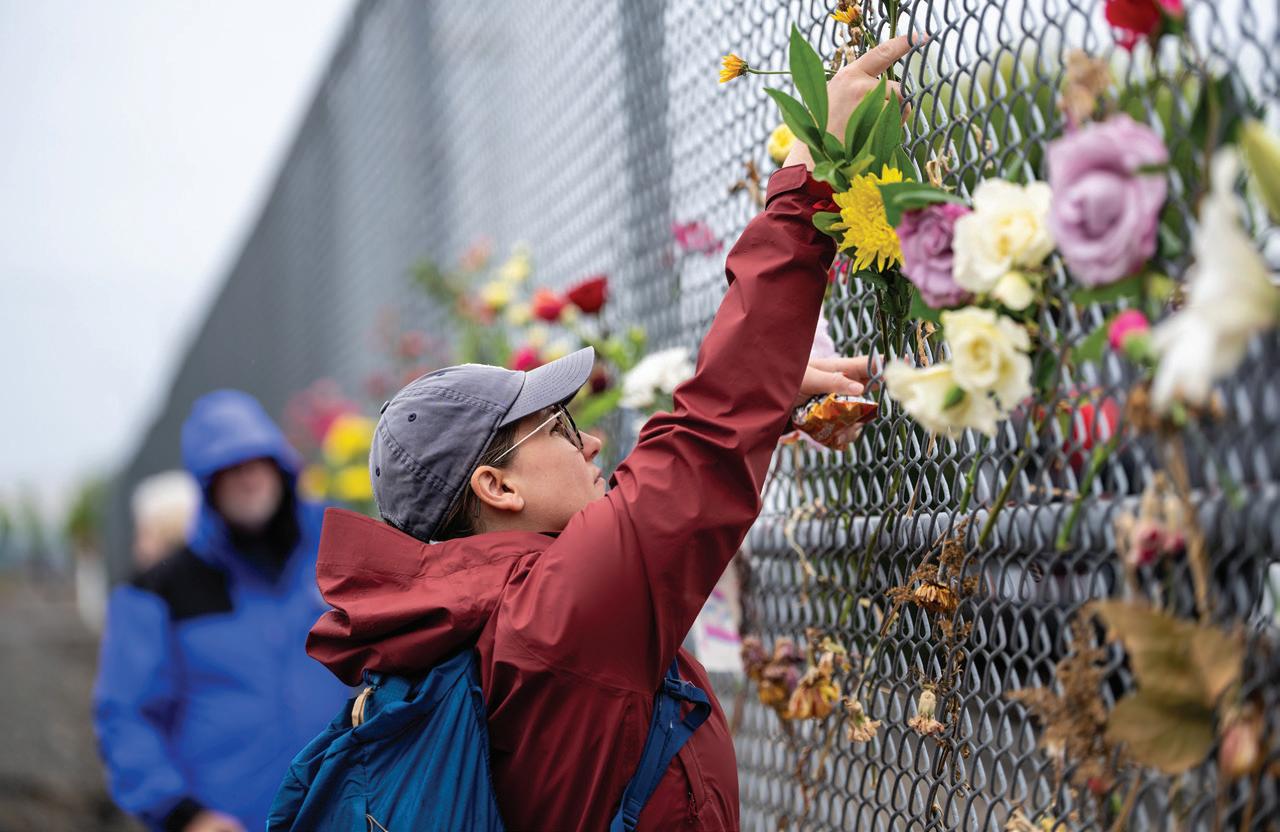
The images in this article are all taken during the eucharistic procession on May 15, 2026. More than 450 people walked from St. Leo's parish, where Mass was celebrated, to the Northwest ICE Processing Center in Tacoma, Washington.
Page 8: A participant places flowers in the fence of the detention center.
Page 9 (clockwise from top left): Youth leaders hold a canopy over the Blessed Sacrament, which is held by Father Gary Lazzeroni, pastor of St. James Cathedral, Seattle.
Community leaders share testimony about the impact mass deportation and detention has had on their lives.
“As we face an administration that claims to be guided by Christian values while systematically harming immigrant and refugee communities across the country, our tradition and community offer a prayerful, dignified, and powerful form of resistance. ”
Over the course of the Season of Faithful Witness, more than 750 Catholics gathered to proclaim that all are welcome! Our community embodied a Catholic faith grounded in lived experience that demands the transformation of systems of injustice through holding leaders accountable to enacting policies that promote human dignity and protect the right to migrate.
At a time when assaults on human dignity feel relentless, when culture often feels transactional and performative, and when principled leadership is absent, our faith community, grounded in gospel values, has both an opportunity and a responsibility to foster hope through public prayer and action. In doing so, we offer an encounter with the sacred that has the power to transform our world.
Participants offer a blessing over immigrants and refugees and those who minister to them.
Pope Francis called for a “torrent of moral energy that springs from including the excluded in the building of a common destiny.” At IPJC, we are continuing to build a movement that unleashes that moral energy for immigration justice, one that all Catholics can take pride in and participate in as an authentic expression of both tradition and personal belief. I am proud of how our local church has come together to proclaim the gospel boldly, and I feel emboldened by the Spirit to continue practicing our faith publicly as we build the kingdom of God together.
Will Rutt has served as IPJC's executive director since 2021. With experience both in community organizing and working with youth, Will brings a particular passion for shaping future social justice leaders and accompanying communities to claim power together. For most of his career, he has focused on issues of immigration, particularly as it impacted students. He lives in Seattle with his partner and two daughters.
THE POWER OF A PUBLIC VIGIL MASS
BY CARLEY HASELHORST
This spring, I was asked to help coordinate a public vigil Mass outside an Immigrations and Customs Enforcement processing facility five miles from my home in Indianapolis. This is where anyone detained in central Indiana for immigration reasons is processed for release, deportation, or further detention at a facility elsewhere.
The Indiana Organizing Project had already been working for a year to curb ICE detention in Indiana. They were influential in ending overnight ICE detention in Indianapolis and are now working to end ICE detention at Miami Correctional Facility in northern Indiana where two ICE detainees have already died this year due to lack of medical care.
Discerning Deacons was planning their national assembly in Indianapolis this May and connected with the Indiana Organizing Project about coordinating a public witness as part of their weekend that would aid local humanitarian efforts. Discerning Deacons engages Catholics in the active discernment about women and the diaconate and seeks to embody the diaconal call to bridge liturgy with ministry to the marginalized. So it is natural that when they are in town, they will bring a pulpit to the streets.
I work full-time for the church and have four children ages 6 years to 6 months, so
I say no to a lot of things, but this was too exciting to pass up. I have been involved with Discerning Deacons through all their work engaging Catholics in the most recent Synod on Synodality and its implementation phase. Their work helped me name the call I feel to the diaconate, a call to preach the Word of God and to bridge liturgy with ministry to the marginalized. The invitation to coordinate this event was an invitation to live out this call now.
In connecting with Stuart Mora of the Indiana Organizing Project, I learned the details of how detention and deportation are playing out in Indiana. I became even more convicted that the motivations of ICE in Indiana are not to target immigrants with criminal behavior but to fill detention beds. These beds are being filled by mothers and fathers, and their families are in crisis. The social teaching and tradition of the church cries out against this, and I was eager to respond to the call of the USCCB to accompany immigrant families and to engage in public witness against this affront on human dignity and the sanctity of family life.
Through Catholics in Communion, we were able to get planning tools for coordinating a public liturgy. A local priest, Father Jim Farrell, eagerly agreed to celebrate the Mass. We worked with the city to gain permitting for having Mass in the street outside the facility. We also met
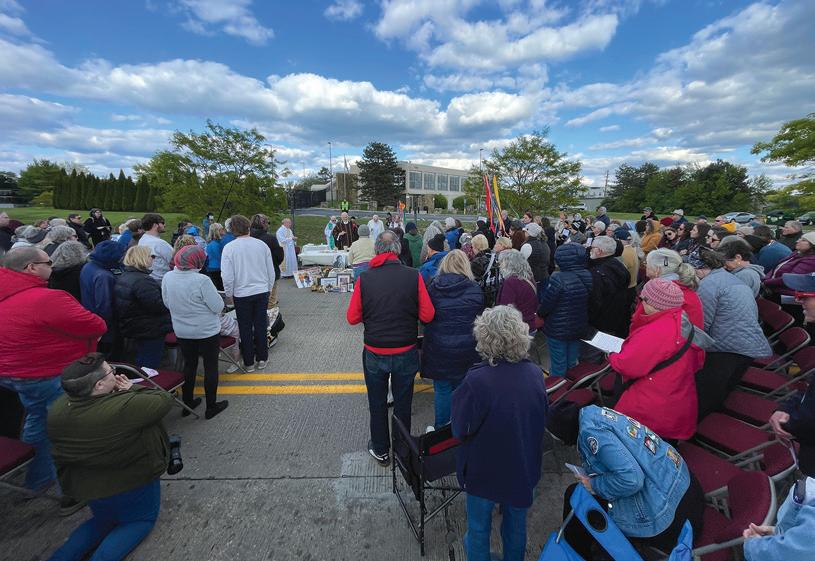
A public witness Mass at an Immigrations and Customs Enforcement processing facility in Indianapolis
with our Indiana Catholic Conference, the public policy arm of the Indiana Catholic Church, seeking to be in alignment with their work on immigration. Then we worked to get out the word.
On May 2, we were blessed with a cool, sunny day for our liturgy. About 300 people attended, including more than 100 from the Discerning Deacons assembly. Miguel Avila spoke at the beginning of the Mass about his own experience in ICE detention, describing total isolation and conditions unfit for human beings. Kate Williams of GIA Publications led powerful music throughout the Mass. After communion, Farrell led a focused reflection on what Jesus would say to each of us about the current immigration situation and what we should do about it. Congregants placed icons and flowers in front of the altar on the street. The event was solemn because of the horrible reasons for our being there, but it was also incredibly beautiful, joyful, and energizing to be together as Catholics publicly standing up for what we believe in.
Many people present at the Mass reported having very impactful experiences. After the Mass, about 100 people signed up to be involved with the local movement by praying with affected families, helping meet the needs of families in crisis, and planning more public actions. The event successfully provided inspiration and direction to many people who were concerned about ICE operations in Indiana but who were not sure how to respond. We pray we can build on the momentum from this public liturgy to continue supporting families and curbing ICE detentions. And we pray that more Catholics around the country have the courage to take their faith to the streets. In this work, if we focus on relationships and stay persistent, the Holy Spirit takes over.
Carley Haselhorst works as the faith formation director at St. Monica Catholic Church in Indianapolis. She has been active with Discerning Deacons since 2021.
Photo © Allison Mayer
BETWEEN ASHES AND BREAD: Rediscovering Public Faith Through the Season of Faithful Witness
BY SERGIO LOPEZ
Last year, Catholics across the United States began gathering in parish halls, ministry meetings, detention center parking lots, sidewalks, chapels, and neighborhood streets with a shared question: What does faithful witness look like in this moment?
For many communities, the question emerged from lived experience. Families were navigating fear and uncertainty. Immigrant communities were experiencing instability and separation. Parishioners were wrestling with exhaustion, polarization, and the feeling that public life had become increasingly fragmented and dehumanizing. Many Catholics sensed a widening gap between the faith they professed inside church walls and the realities unfolding around them.
Out of that moment, Catholic leaders, clergy, religious, lay organizers, and organizations across the country began shaping what became the Season of Faithful Witness: a shared invitation to prayer, discernment, and peaceful public witness from Ash Wednesday through the Feast of Corpus Christi.
Catholics in Communion helped connect and support this effort as a coalition space, but what unfolded was not a centralized campaign or a single coordinated event. Instead, local Catholic communities across the country began responding in ways that were deeply pastoral, visible, and rooted in ordinary Catholic life. Some communities organized eucharistic processions through neighborhoods. Others held prayer vigils outside detention centers or invited parishioners to remain after Mass for reflection and conversation. Some hosted bilingual gatherings for Hispanic ministry leaders and immigrant families. Others created small spaces for listening, prayer, and discernment inside existing ministries and parish groups.
Many of these actions were intentionally simple. But they reflect a shared truth: Catholics are longing to rediscover forms of public faith that are prayerful, communal, and grounded in human dignity.
4 Ways to Get Involved
1. Join the movement

Commit to working alongside Catholics across the country to engage in prayerful discernment and public expressions of faithful, nonviolent, and prophetic witness. Complete the sign-up form at the link below and you’ll receive:
• invitations to national events and calls to action
• timely resources and trainings to respond to the moment direct to your inbox
• ongoing support for you and your community
To sign up, visit: c atholicsincommunion.org/join-us
2. Unlock your toolkit
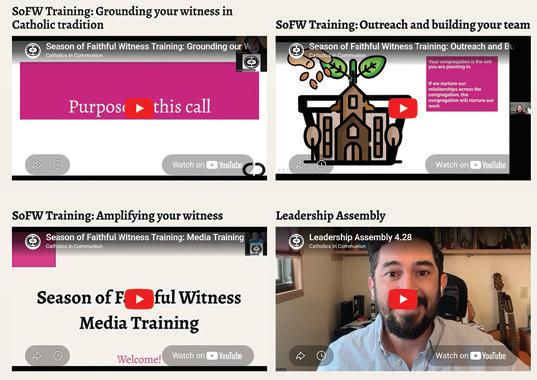
Attend one of the upcoming trainings and access the library of previous sessions. They include designing events rooted in Catholic tradition, outreach and building your team, media training, and more! Multiply your impact by signing up or watching with others.
Catholics in Communion creates toolkits and resources to provide step-by-step guidance and planning tools and templates. It also provides a library of resources from its partnering organizations.
To learn more, visit catholicsincommunion.org/ resources
PUBLIC FAITH IN A FRAGMENTED TIME
The season also reflects a broader question emerging within Catholic life today: What does public faith look like in an era shaped by polarization and distrust?
For many Catholics, public expressions of religion have become associated either with partisan conflict or private spirituality disconnected from social reality. The Season of Faithful Witness attempted to reclaim another tradition within Catholic life: public witness rooted in prayer, the Eucharist, solidarity, and human dignity.
Our movement does not ask Catholics to adopt a partisan identity or join a single organization. It invites them to begin from the practices Catholics already know: prayer, Eucharist, listening, accompaniment, works of mercy, and concern for the dignity of every person. In that sense, the Season of Faithful Witness sought not to create something separate from ordinary Catholic life, but to help communities rediscover the public implications of the faith they already profess.
The Feast of Corpus Christi became especially important within this framework. As communities looked toward Corpus Christi, Catholic organizers, theologians, ministry leaders, and partner organizations helped name the feast not only as a celebration of Christ’s presence in the Eucharist, but also as an invitation to remember who we become when we receive the Eucharist.
A PASTORAL EMERGENCY OF HOPE
One phrase surfaced repeatedly as Catholics gathered, listened, and shared what they were carrying: “a pastoral emergency of hope.”
The phrase named something many people were already feeling: Across communities, Catholics expressed concerns not only about political division or social instability, but about isolation. Many people no longer knew where to bring their fears, grief, hopes, or questions together as church.
In the days leading up to Ash Wednesday, hundreds of people joined welcome calls, and by Holy Week, thousands were gathering in public spaces to protest and to pray.
What mattered most was not only the number of gatherings, but the choices people made. A priest in a rural parish chose to preach about welcoming the stranger even while carrying real fear. Volunteers stepped forward and found themselves doing far more than expected, because they wanted the church’s witness to be visible. Leaders who had long loved the teachings of Jesus but felt disconnected from parish life began finding their way back because something about this witness felt real.
That theological vision shaped many of the season’s public actions. Communities organized processions through neighborhoods, prayer services in public spaces, and gatherings centered on the connection between eucharistic faith and the church’s social mission. The season repeatedly emphasized the church’s teaching that the Eucharist commits us to the poor and that reverence for the blessed sacrament and reverence for human dignity belong together.
Importantly, these public witnesses were not framed primarily as protests. They were framed as acts of prayerful solidarity. Participants described public processions that carried Christ’s presence into the streets.
That image helps explain why the season resonated across such diverse Catholic communities. Many participants were not looking for ideological certainty. They were looking for ways to live their faith visibly in a moment marked by fear and fragmentation.
WALKING TOGETHER IN COMMUNION
A defining characteristic of the Season of Faithful Witness has been its emphasis on communion.
Throughout bilingual gatherings, invitations, and trainings, Catholics repeatedly returned to the conviction that we are not alone and we are called to walk together in communion.
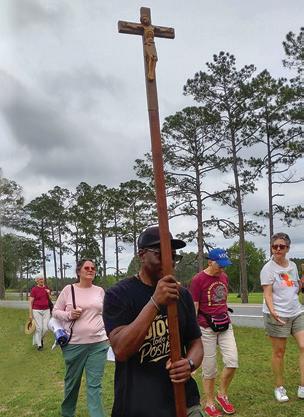
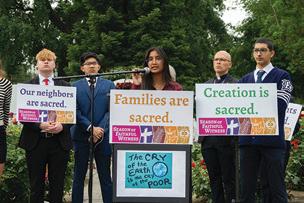
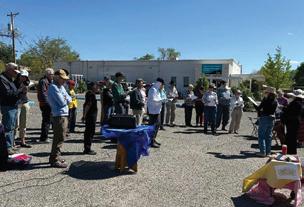
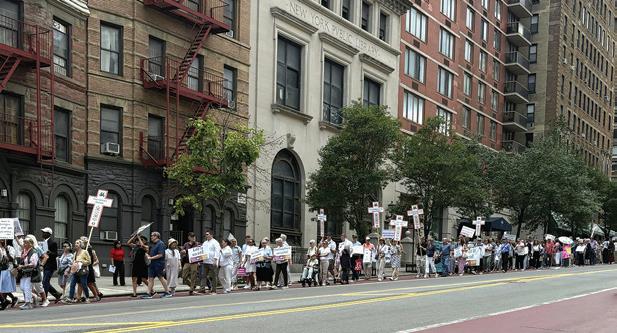
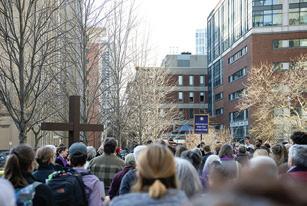
Catholics in Communion events in (clockwise from top left) St. Augustine, Florida; Sacramento, California; Boston, Albuquerque, and New York City
That language became especially meaningful in gatherings focused on Hispanic and immigrant ministry. Earlier this year, Bishop Evelio Menjivar-Ayala, Bishop Ramón Bejarano, Bishop Pedro Bismarck Chau, and Sister Xiomara Méndez Hernández, O.P., helped convene a National Virtual Gathering of Hispanic Ministry Leaders, which created space for prayer, listening, and discernment about how the church is being called to respond to the plight of immigrants.
The gathering reflected a broader reality unfolding throughout the season: Many Catholics are seeking spaces where accompaniment, prayer, and public witness can coexist.
That desire has shaped not only large gatherings, but also the season’s smallest interactions. In practice, this looked like hospitality teams creating a warm, non-anxious tone; organizers beginning meetings with listening and prayer; communities discerning together rather than rushing immediately toward action.
These details may seem small, but they point toward something larger: a vision of public Catholic life grounded not in performance, but in communion.
FROM ISOLATION TO COMMUNION
Near the conclusion of the Corpus Christi season, one line became, for many participants, a kind of summary of the entire effort: We hope these faithful witnesses will make possible that parishioners move from concern to courage, from isolation to communion, from private faith to public witness.
That movement—from isolation to communion—may ultimately be the deepest significance of the Season of Faithful Witness.
During Holy Week, that response became more visible. Nearly 30 actions in 19 states reached more than 5,000 people. In places like Philadelphia, Los Angeles, Boston, Minnesota, rural Florida, New Mexico, and beyond, Catholics gathered in prayer, in public, with courage, and with a deep desire to stand together in faith.
Not every gathering was large. Not every witness drew media attention. Some simply involved a handful of parishioners remaining after Mass for prayer and conversation. Others brought clergy, families, ministry leaders, and immigrant communities together in public spaces across cities and neighborhoods.
But together, these local acts of witness formed something larger: a reminder that Catholic faith is not only something practiced privately or professed inside church walls. It is also something lived publicly, communally, and courageously.
And perhaps that is what so many Catholics have been searching for all along—not a new institution, brand, or program, but a renewed way of walking together as church in a wounded and divided world.
Between ashes and bread, many communities have begun rediscovering that path together.
3. Start a Conversation
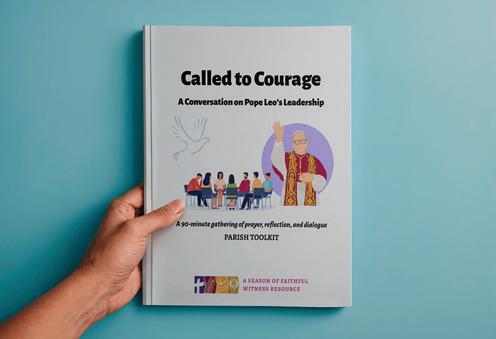
Catholics in Communion produces toolkits to support your next steps. The “Called to Courage: A Conversation on Pope Leo’s Leadership” toolkit invites parishes into a guided conversation on Pope Leo’s leadership and the church’s call to live out our faith in today’s world. It includes a facilitator guide for prayerful dialogue and utilizes a recent 60 Minutes video segment with three U.S. cardinals. In just 90 minutes, this conversation can support your community in taking a small but meaningful step toward what the church calls us to be: a people who listen, discern, and respond together. To download the toolkit, visit: catholicsincommunion.org/ called-to-courage-conversation-toolkit
4. Get connected
Find people in your local community and invite others to join you in faithful witness. Visit the Catholics in Communion website to find local actions and leaders near you and to sign up for upcoming welcome and training calls.
This is the hope that action in communion will make possible: that parishioners move from concern to courage, from isolation to communion, from private faith to public witness. Whether you bring together 5 people or 500, public faithful witness allows the wider church to see Catholics across the country responding not with fear, division, or despair, but with prayer, solidarity, and moral courage.
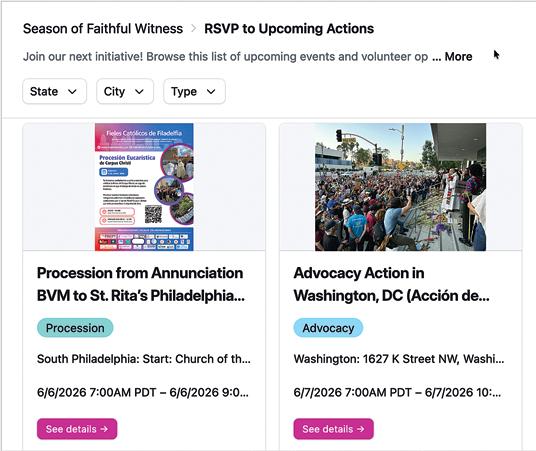
To get connected, visit: catholicsincommunion.org/events
Sergio Lopez is the national director of mission and leadership formation for Catholics in Communion.
Liturgy finds its origin in the Greek words for “people” and “work.” It is the labor of a community, alongside the prayers, meditations, and rituals that shape us as we gather. Empire, with its hunger for domination, division, and isolation trembles at this. It fears our togetherness, our longing for belonging. And so we must resist the forces of individualism and discord that threaten to unravel us. This resistance does not deny the necessity of solitude. It is in the quiet exploration of our inner landscapes that healing begins, not just for ourselves but for the collective whole.
Questions for Reflection:
n Kat Armas describes liturgy as the “labor of a community.” What kind of community is your worship forming? In what ways does your congregation’s life together reflect—or fail to reflect—the values proclaimed in prayer and sacrament?
n Scripture repeatedly calls God’s people to welcome the stranger. Who feels like a “stranger” to you or your community today? What fears, assumptions, or barriers make genuine solidarity difficult?
n Public vigils, processions, and Stations of the Cross bring prayer into the streets. What is gained and what is risked when faith becomes visible in public? How do you discern when public witness is called for?
n Armas writes that forces of domination and division fear “our togetherness, our longing for belonging.” Where do you see division, isolation, or indifference shaping your own life? What practices help you move beyond them?
n Public acts of prayer often express solidarity with people whose lives are very different from our own. How can we ensure that solidarity grows into relationship, accountability, and shared struggle rather than remaining a symbolic gesture?
n What is one place, issue, or community that God may be calling you to pay closer attention to right now? What would it look like to respond not only as an individual disciple but as part of a community?

LOOKING BACK
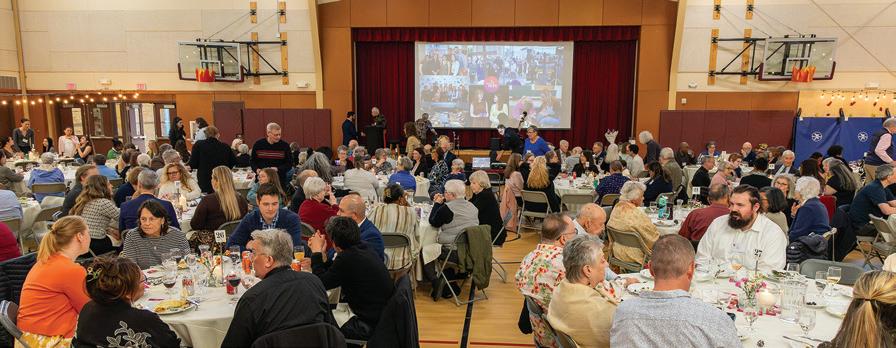
Spring Benefit 2026: Spark Hope
We sparked hope by gathering in community to share stories of faith in action, from youth organizing for immigrant and housing justice to collective public witness rooted in the gospel. We celebrated leaders such as Yssa Javier and Barbara Connor, whose lives embody courage, compassion, and a commitment to human dignity, and lifted up a vision of intergenerational organizing grounded in relationship and hope. Together, we surpassed our goal by over 20 percent, raising over $160,000 and strengthening our shared work for justice and peace.
We Are One Body: Eucharistic Procession for Migrant Dignity
As part of the national Season of Faithful Witness, we joined thousands of Catholics across the United States. More than 450 people of faith prayed, processed, and bore witness to the dignity of migrants and people in detention, carrying the Eucharist from St. Leo’s Parish to the Northwest Detention Center. In word, song, and sacred silence, the community proclaimed that Christ is present among those who suffer and renewed our call to compassion, courage, and solidarity. Rooted in the Season of Faithful Witness, this day offered a visible sign of hope, reminding all that when one part of the body of Christ suffers, we are called to walk together in love.
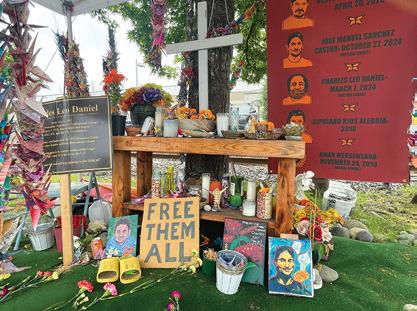
—Kat Armas, Liturgies for Resisting Empire (Baker Books, 2025)
Youth Action Team Internship and Fellowship
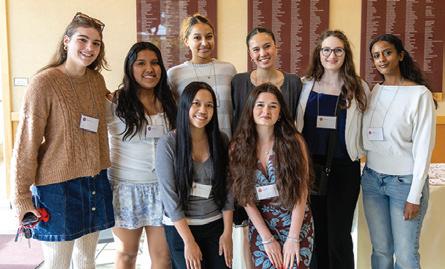
We bid farewell to our 11 beloved seniors (eight seniors pictured below), knowing they will each make a profound impact in their future communities! Our seven junior interns said yes to moving forward as fellows and are building a compelling vision for next year focused on gathering the Catholic Students for Social Change Coalition each month to take action on immigration, housing, and health justice.
Donations
LOOKING FORWARD
Seven Sisters campaign June - Nov 2026
Join IPJC and our partners for the the Seven Sisters Campaign, which elevates the wisdom of seven Indigenous women and several women witnesses from throughout the community. Local events are June 27 and October 16. Learn more here: se-si-le.org/campaigns/seven-sisters

LEADERSHIP OPPORTUNITY
A Matter of Spirit Editorial Board
We need you! The Intercommunity Peace & Justice Center (IPJC) is inviting justice-centered, faith-rooted leaders to consider serving on the Editorial Board of A Matter of Spirit — this quarterly justice journal. Weaving together analysis, theological reflection, and action on pressing justice issues facing our world today, the Editorial Board plays a vital role in shaping how each issue comes alive through thoughtful articles, diverse voices, and faithful reflection. Share your interest here: bit.ly/editorial-board-AMOS
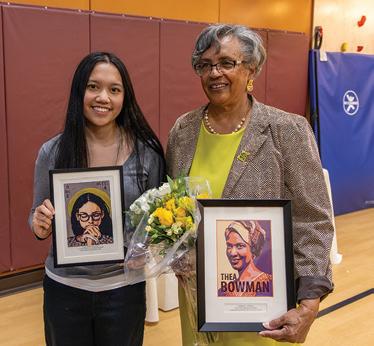
Above: 2026 Award recipients: Yssa Javier-St. Thérèse of Lisieux award; Barbara Connor-Sr. Thea Bowman award
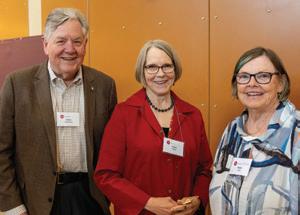
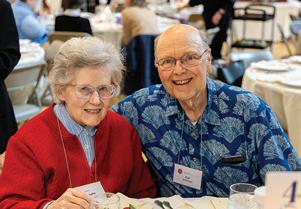
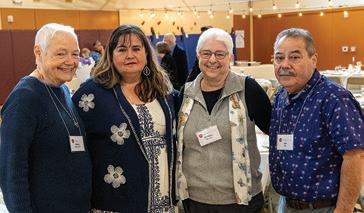
IPJC Spring Benefit dinner at St. Catherine of Siena school (Below L to R)
Long time members of IPJC join us: Vince Herberholt, Cathy Murray, Katie Carter; Charlotte and Earl Sutherland; Marilee Murphy, CSJP, Lilia Ortiz, Christine Still, OSF, José Ortiz
Intercommunity Peace & Justice Center
1216 NE 65th St Seattle, WA 98115-6724
SPONSORING COMMUNITIES
Adrian Dominican Sisters
Congregation of the Sisters of St. Joseph of Peace
Jesuits West
Sisters of the Holy Names of Jesus and Mary, U.S.-Ontario Province
Sisters of Providence, Mother Joseph Province
Sisters of St. Francis of Philadelphia
Tacoma Dominicans
AFFILIATE COMMUNITIES
Benedictine Sisters of Cottonwood, Idaho
Benedictine Sisters of Lacey Benedictine Sisters of Mt. Angel Dominican Sisters of Mission San Jose Dominican Sisters of Racine Dominican Sisters of San Rafael Sinsinawa Dominicans
Sisters of Charity of the Blessed Virgin Mary Sisters of St. Francis of Redwood City Sisters of St. Joseph of Carondelet Sisters of St. Mary of Oregon Society of the Holy Child Jesus Sisters of the Holy Family
Sisters of the Presentation, San Francisco Society of Helpers Society of the Sacred Heart Ursuline Sisters of the Roman Union
EDITORIAL BOARD
Don Clemmer
Cassidy Klein
Will Rutt
Sheila Edwards
Editor: Emily Sanna
Copy Editor: Cassidy Klein
Design: Sheila Edwards
A Matter of Spirit is a quarterly publication of the Intercommunity Peace & Justice Center, a 501(c)3 nonprofit organization, Federal Tax ID# 94-3083964. All donations are tax-deductible within the guidelines of U.S. law. To make a matching corporate gift, a gift of stocks, bonds, or other securities please call (206) 223-1138. Printed on FSC® certified paper made from 30% post-consumer waste.
Cover: Eucharistic Procession May 25, 2026 from St. Leo Parish to NW Detention Center, Tacoma WA. Photo © Archdiocese of Seattle by Stephen Brashear ipjc@ipjc.org • ipjc.org
Prayer

God of justice and peace, be with us as we stand against militarization and deportations.
Dios de justicia y paz, acompáñanos en nuestra oposición a la militarización y las deportaciones.
God who stands with the marginalized and oppressed, defend us as we take action in solidarity.
Dios que estás con los marginados y oprimidos, defiéndenos mientras actuamos en solidaridad.
God who leads those who choose the path of justice, transform the hearts and minds of those in power who choose violence over peace.
Dios que guia a quienes eligen el camino de la justicia, transforma los corazones y las mentes de aquellos en el poder que eligen la violencia sobre paz.
Jesus our brother and savior, strengthen our conviction to flip the tables of the empire oppressing us today.
Jesús nuestro hermano y salvador, fortalece nuestra convicción de voltear las mesas del imperio que hoy nos oprime.
Dorothy Day, be our example of political holiness.
Dorothy Day, sé nuestro ejemplo de santidad política.
Sr. Thea Bowman, show us the way to build equity and racial justice.
Hra. Thea Bowman, muéstrenos el camino para construir equidad y justicia racial.
Mary of Nazareth, sing your anti-imperial and freedom song with us.
María de Nazaret, canta con nosotros tu canción de libertad, antiimperialista.
St. Óscar Romero, teach us to meet civil unrest with courageous solidarity. San Óscar Romero, enséñanos a afrontar el malestar social con valiente solidaridad.
Sr. Dorothy Stang, be with us as we stand against corporate powers that enable those in power to oppress us.
Hra. Dorothy Stang, acompáñenos mientras nos oponemos a los poderes corporativos que permiten que quienes están en el poder nos opriman.
Rosa Parks, remind us that peaceful protest ignites lasting transformation of our society.
Rosa Parks, recuérdanos que la protesta pacífica enciende la transformación duradera de nuestra sociedad.
Sr. Violeta Marcos, stand with us as we resist against the detention of our people. Hermana Violeta Marcos, acompáñenos en nuestra lucha para resistir la detención de nuestra gente.
Pope Francis, inspire our movement for justice and peace.
Papa Francisco, inspira nuestro movimiento para paz y justicia.