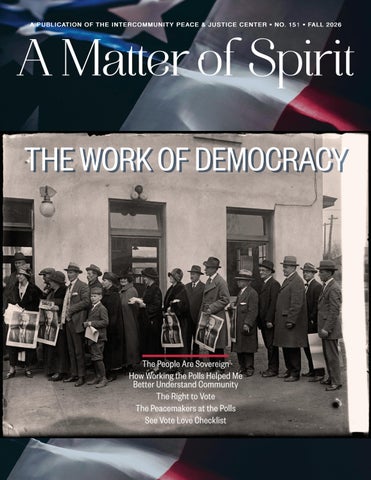
A P U B L I C AT I O N O F T H E I N T E R C O M M U N I T Y P E AC E & J U S T I C E C E N T E R • N O. 1 5 1 • FA L L 2 0 2 6
THE WORK OF DEMOCRACY
The People Are Sovereign How Working the Polls Helped Me Better Understand Community The Right to Vote The Peacemakers at the Polls See Vote Love Checklist
From the Executive Director In a departure from our typical practice of Emily offering an editorial note, I wanted to use “Participatory the opportunity to share notes of gratitude democracy is as I complete my tenure at IPJC. Over the the only real last six years we have built a community of democracy.” –Ella Baker leaders and movement of people that can sustainably work to create systemic change. The center of this work has been investing in the leadership of people across the community to develop greater agency to share each of our unique stories and voices and collaboratively enact a vision of the world grounded in justice, mercy, and love. The opportunity to lead this shared mission has been a privilege and gift. During my time here I have witnessed what it means to accompany people in co-building a world we all desperately need to live a fully dignified life. I am especially grateful for the trust of the community, particularly as a man leading an organization that since its inception has been centered around women’s leadership. It has been humbling to learn from so many women on our staff, board, Youth Action Team program, and many other places. As the father of two young girls, I am reassured by the strength, commitment, and leadership of this community both in offering an example to my daughters but also creating a world and church in which their leadership and value will be respected and activated. I have no doubt that the future of this organization will be one marked by real and meaningful change catalyzed by a movement of people that belong to one another. As the organization has grown and changed it has become clearer to me that if we are to truly live into the principles of solidarity and subsidiarity, democracy must become and embedded in that practice and the structure of the organization and protected in larger society. Each of the articles in this issue highlights the role that democracy plays in shaping a society that promotes participation and manufactures real unity oriented towards the common good. As people of faith, creating the conditions for all people to have a place at the table is essential for building the systems that impact each of us daily. The civil rights activist and leader Ella Baker put it succinctly: “Participatory democracy is the only real democracy.” We hope these articles can agitate and activate your imagination as we all consider what is each of ours to do. Peace, Will Rutt, Executive Director P.S. Thank you to all of the faithful AMOS readers, to our editorial board, and especially to Emily Sanna, our editor. This resource continues to be a foundational tool for highlighting Catholic social teaching in praxis. It’s been an honor and joy to serve on the editorial board during my time here. 2
FA L L 2 0 2 6 • N O. 1 5 1
The People Are BY STEVEN P. MILLIES
“ Since all are free by nature, all government, whether by written law or a prince, is based solely on the agreement and consent of the subject.” — Nicholas of Cusa, The Catholic Concordance (1433)
D
emocracy has not had a happy experience in the Roman Catholic Church. In 1433, a bright young churchman named Nicholas of Cusa suggested that government inside and outside the church derived from the consent of the governed. His Catholic Concordance, which expressed his revolutionary idea, was placed on the Index of Forbidden Books by Pope Sixtus V in 1590, and it never has been formally rehabilitated (though Nicholas himself did go on to become a cardinal). As centuries went by, the church persisted in its skepticism about democracy through the revolutionary decades that brought the 1700s to the 1800s, right down until World War II. Pope Leo XIII opened a crack in this determined ecclesial opposition with his 1899 encyclical, Libertas. But it was in a 1944 radio address where—caught between Hitler’s Germany, Mussolini’s Italy, and Stalin’s Soviet Union—Pope Pius XII finally allowed that democracy could be a “healthy and well balanced” form of government that served the common good of all the people. Still, a radio address is not an official teaching. Most people assume that when the Second Vatican Council said, “Praise is due to those national procedures which allow the largest possible number of citizens to participate in public affairs with genuine freedom,” the Catholic Church had finally accepted democracy. But that still was not quite the case. As late as 1991, Pope John Paul II worried about what the people might choose by democratic means when he implied a distinction between democracy and “authentic democracy,” the latter being a democracy that was guided by the moral law so that—for example—the people would not vote for legalized access to abortion. The “authentic” democracy was one that agreed with the church about moral questions. When the 21st century dawned, officially, the church could not allow that democracy itself was a social or political good for fear of what the people might choose. All of that is why Pope Francis’ simple statement in a 2016 airborne press conference—“The people are sovereign”—was a
Sovereign thunderclap moment. An airborne press conference is no more an official teaching than a radio address. But the pope said what everyone knows to be true, and in substance he said what still has not been rehabilitated in The Catholic Concordance as much as what John Paul II worried about 25 years earlier. In a very quiet way, Pope Francis acknowledged something that, only a month before Donald Trump’s first election win, was about to become much more important: being “sovereign,” the people are the ultimate decisionmakers, and there is nothing to be afraid of in that. By 2026, under the leadership of Francis’ successor, the Roman Catholic Church has become the most visible and stalwart defender of democracy in the world. The irony is rich. But history is funny, and God has a sense of humor. Leo XIV’s first encyclical, Magnifica Humanitas, gives us a direct statement about the goodness of democracy. Leo writes, “Democracy does not consist of rules and procedures alone, but above all of a solid concordance with the facts and a genuine commitment to the good of individuals and society as a whole.” That is in substance what John Paul meant, but Leo has said it far better. Democracy is not a procedure, it is a commitment that we all must have to one another. Tyranny thrives on “indifference.” Politics must express our care for one another. And maybe the even better way is to say it like this—in order to be genuinely free, we must be committed to being free together. If I am speaking honestly as a political theorist, I strongly suspect that the problem for the church has been the word democracy. The word incites theological discomfort for notirrational reasons. Democracy implies a procedure, voting, and when we think about voting we think about something we do alone, self-interestedly in a booth. That strains against the importance of community that is fundamental to Catholic faith. I know the unsavoriness that too often is behind saying, “We are a republic, not a democracy.” But republic really is a far better word. Republicanism evokes the demanding citizenship of the ancient world, the full commitment to one another that the church’s own sense of ecclesial communion was born in. It means “thinking and acting in terms of community,” as Pope Francis wrote in Fratelli Tutti, and unsurprisingly it also is very close to how Pope Francis asked the church to think as a synodal community. From the Latin res publica (“the people’s thing”), a republic asserts that the community belongs equally to everyone. The community is not for any one person or group of people. Or, in the definition of a scholar of republicanism named Philip Petit, in a republic, “All count for one, and none counts for more than one.” Something like this sense of republicanism as a community committed together to one another is how Catholics must come to politics in 2026 if we want to defend democracy.
And, for all that word’s technical “The people are deficiencies, defend democracy we sovereign.” must! The very idea seems discredited — Pope Francis Oct ober 2, 2016 in our time. Or, perhaps better, the idea of democracy has become deformed by populism. Populism perverts the people’s sovereignty against the people, themselves. The populist leader stirs emotions to divide the people into friends and enemies. The populist divides so he can conquer. This is the cycle we are caught in now. Catholics, with what our tradition tells us about politics, are well-situated to help break the cycle. I think Pope Leo knows that. I think it is what he is asking us for. Those words in Magnifica Humanitas are the important beginning. It is a mistake to become preoccupied by procedures as much as it is a mistake to become preoccupied by particular issues. That is what we must defend. The dignity and the defense of the human person depends on having a political system that is committed to the good of all of us. We can accomplish very little without that. More than “winning” on this issue or that issue, more than any particular
“ The Roman Catholic Church has become the most visible and stalwart defender of democracy in the world.” outcome, what matters first is that we must be firm in our commitment to being free together. From there, Pope Leo also has told us the next step. In Magnifica, he tells us that “my hope is, first and foremost, to help the lay faithful and people of goodwill rediscover their duty of implementing” the principles of Catholic social teaching. That word—duty—should hang heavily on us. Too few of us know Catholic social teaching well, and nearly all of us would be uncomfortable with the ways it challenges us once we come to understand it. Yet, Leo uses another word to describe these social principles that set the poor and vulnerable, always as the focus of concern where we begin: doctrine. Catholic social teaching is not an add-on or an extra. It is the doctrine of the church. It makes demands on us. Those demands become our duty as Christian believers. And, in politics, they all point in the same direction: a full commitment to the whole community, especially the vulnerable and poor, that is expressed best by thinking of democracy as a way we express our care for one another. “The people are sovereign”: I have no doubt. Democracy is the very best way the human race has yet found to promote the good for everyone. And, more than perhaps ever before, in 2026 democracy rests in the hands of faithful Catholics. Steven P. Millies is associate professor of public theology and director of The Bernardin Center at Catholic Theological Union in Chicago. His most recent book is A Consistent Ethic of Life: Navigating Catholic Engagement with U.S. Politics (Paulist Press, 2024). A M AT T E R O F S P I R I T
3
How Working the Polls Helped Me Better Understand Community
s that one of those Dominion machines?” the man demanded. As he approached the squat machine in a menacing manner, I covertly sized him up. He was certainly stronger than me, but I was probably faster. If he started trouble, I could trip him up, then call the sheriff. He turned to us and barked a question about Democrats and communists. “We’re not allowed to discuss politics in the polling station,” one of my fellow poll workers said crisply. The man seemed to deflate in front of us. He cast his ballot, then left without making trouble. A reiteration of the rules was all it took to get him to settle down. It was a reminder for me, too. I was not there to enact vigilante justice or start a fight with a conspiracy theorist. As a poll worker in my home state of Ohio, my obligation was to collaborate with others to keep a vast, intricate system functioning smoothly and efficiently. Working the polls is not glamorous, nor is it usually dramatic, though we have our moments. It is meticulous and repetitive, the kind of work that gets sneered at as “bureaucratic,” in contrast to flashy individualistic gestures. Yet every election 4
FA L L 2 0 2 6 • N O. 1 5 1
season, across the nation, over half a million poll workers keep the wheels of democracy turning. Being one of them has given me a new appreciation of what it means to work for the common good, and what the Catholic social principle of subsidiarity looks like in action. My mother was a poll worker for years, but now that she’s nearing 80 has decided that the long hours are a bit much. Initially, I had no desire to take on this role myself. But I believe that people of faith are called to be good citizens and help create a society in which all people enjoy the basic goods of life. And my county, with its aging and dwindling population, is low on poll workers, especially Democrats. So I agreed to train as a poll worker as well as serve as a precinct officer. While election officials are elected or appointed to carry out election-related duties year-round, poll workers are temporary recruits. All 50 states have poll workers of some sort, but their duties differ because each state has its own laws around elections. Depending on how a state organizes its elections, a poll worker may be checking IDs, checking in voters, or setting up voting equipment. In two states, Washington and Oregon, all
Vote again © Janelle Hiroshige; Pins © Marek Studzinski, unsplash
“I
BY REBECCA BRATTEN WEISS
voting is done by mail, so full-time employees oversee most of the voting. Simply setting up the polling station is laborious. There are security protocols for maintaining the machine, and strict rules about everything from what to do with a spoiled ballot to how to deal with a voter in the wrong precinct. We are obliged to post information and communicate throughout the day with the county’s Board of Elections.
Vintage pins - rawpixel.com; "the peace symbol" photo by Marshall Colman
“ Working the polls means committing to collaborate with my ideological adversaries to ensure something we both care about: secure elections.” My county, in Appalachian coal country, was long a Democratic stronghold with robust union membership. That began to change in the 1990s, thanks in part to the bombardment of right-wing media, which has created an atmosphere of distrust and paranoia about a number of things, elections included. Knowing people might get rowdy was an added incentive for me to be a poll worker. I wanted to be on the side of democracy. Ironically, this means working alongside the people with whom I have serious moral disagreements. Ohio law mandates that “no more than one-half of the total number of poll workers assigned to a precinct may be members of the same political party.” No members of one party can even be alone in the room or with the ballots without a member of the other party. It makes for an awkward time, everyone lurking and hovering as the ballots are secured. At the end of the evening, both a Republican and a Democrat have to drive the ballots back to the Board of Elections office to be checked in. People often talk about unity and community, in the church as well as in politics, as though it’s all about good vibes and agreeing to disagree. Given the Republican party’s widespread attacks on immigrant and queer populations, I find such facile calls for unity unhelpful. The harm done to the vulnerable will not be magically mended because I, a straight white woman, happened to discover a shared taste in music or swap a recipe with a Republican. That sort of unity reminds me of what Dietrich Bonhoeffer said about cheap grace: “Cheap grace is the preaching of forgiveness without requiring repentance, baptism without church discipline, Communion without confession, absolution without personal confession.” Cheap unity is fake unity, the comfortable having a laugh together while the vulnerable remain neglected and at risk. Working the polls means committing to collaborate with my ideological adversaries to ensure something we both care about: secure elections. Is this enough of a common ground to work towards a unity that is not cheap? I think it can sustain serious discussions about democracy, what a good society looks like, and the inalienable rights of every human being. It’s certainly clarified, for me, that community is not about surface feelings,
but about a commitment to shared goals and the objective justice due to everyone—even if you don’t like them very much. While I’ve always been passionate about politics, my interest was usually more in policy, messaging, and ideological dynamics than in the granular bureaucratic details. But these meticulous local efforts are essential to policy implementation. Seeing this helps me understand the concrete relationship between subsidiarity and solidarity, two principles of Catholic social teaching that are sometimes, wrongly, put in opposition to each other. Solidarity insists that our shared humanity alone demands mutual responsibility for one another, and some Catholic social ethicists reference it when talking about things like federal social welfare programs. Some conservative thinkers, meanwhile, argue that such programs would violate subsidiarity, the belief that things should be done on a local level. Yet subsidiarity is not mere localism. It’s the understanding that decisions should be made by those most affected by them, and that solidarity is best supported by grassroots efforts. This is exactly what happens with the way our elections and local government are maintained. I wish more people in our nation understood just how much work goes into keeping everything from tumbling into the bad sort of chaos. We’re so impatient. We want people to wave magic wands and fix everything, whether it’s building a road, containing a pandemic, or repairing a broken economy. We even tend to think about activism in terms of a few towering figures. Such heroic leaders are important, yes, but so are the countless other folks who did their part to move the needle a notch closer to justice. Our Board of Elections recently responded to the attacks on our election security by putting an invitation in our local paper: “If you’re so worried, come work the polls.” I’ll echo that invitation, including to those less worried about election security than in the existential survival of our democratic republic. Contributing to these painstaking but undramatic efforts is one way to help build a society in which everyone can flourish. “If you're so Rebecca Bratten Weiss is digital editor of U.S. Catholic magazine, cohost of the Glad You Asked
worried, come work the polls.” — Board of Elections
podcast, and a regular contributor to the National Catholic Reporter. She has published extensively on religion, culture, and politics and is coeditor (with Jessica Mesman) of Sick Pilgrims: An Anthology of Catholic Spiritual Autobiography. A M AT T E R O F S P I R I T
5
The Right to Vote
BY CHRISTINE DRAGONNETTE
O
n any given Tuesday morning over about a 13-year span, you could find me in the ballroom of St. Francis Xavier “College” Church, the Jesuit Catholic parish on the campus of Saint Louis University in Missouri. The ballroom regularly transforms from reception venue to event space to meetup spot: a place of hospitality in many forms. On Tuesday mornings, the parish welcomes into this hospitality space community members from all walks of life seeking a common goal: recognition of their identity. For over 30 years, the ID and Birth Certificate Program, commonly referred to as the “Outreach Program” by College Church parishioners, has paired trained volunteers with community members seeking U.S. birth certificates and photo identification, like a driver’s license or non-driver photo ID. Volunteers are often parishioners, Saint Louis University students, and Jesuits in formation who seek to put their faith into action by helping their neighbors navigate the bureaucracy and cost required to obtain identification. I had the privilege of working as a staff member in the program for over a decade. Guests of the program seek proof of identity for jobs, housing, health care, and countless other needs. Each person has their own story, but many face similar barriers. A man recently released from incarceration shows up to the program urgently needing a photo ID to apply for jobs and jumpstart his reentry process. A survivor of intimate partner violence whose ID and birth certificate were withheld by her abuser seeks to piece together the documents needed to start again on her own. An unhoused guest who stays outside by the river in downtown St. Louis cannot prove his Missouri residency for a photo ID without an official address.
6
FA L L 2 0 2 6 • N O. 1 5 1
College Church parishioner and volunteer Joan McGinnis takes her materials into the ballroom in preparation for a day of voter registration.
In short, guests seek recognition of their identity and human dignity in order to fully participate in society. Without official identification, the approximately 3,500 community members who visit the College Church Program each year are effectively excluded from many of the basic services and resources that many of us take for granted. The global Society of Jesus tells us that these are exactly the community members we are called to accompany most closely as we “walk with the excluded,” one of four Universal Apostolic Preferences of the Jesuits. Yet, our laws and policies often deepen their exclusion. The same barriers these community members face to obtaining identification are often prerequisites for participating in civic life, including voting. In addition to our ID and birth certificate work, we began hosting volunteers to support guests with voter registration. As we started this initiative, we found that many of our guests were accustomed to their voice being excluded. When we asked about voter registration, we were often met with surprise, or with responses like “nothing will change” or “they don’t care what I have to say.” Unfortunately, it is often countercultural
“ As the 2026 election cycle unfolds, new and existing barriers remain to many of our neighbors’ full participation in our democracy.”
Photos: Courtesy of the author
Two parishioner volunteers work with a program guest of the College Church ID and Birth Certificate Program, or “Outreach Program.”
to actively seek inclusion of those pushed to the margins in our democracy. College Church parishioner Joan McGinnis volunteered to register Outreach Program guests to vote in 2024 and is preparing to participate again this year. For Joan, the experience was eye-opening, as she had always had access to the information she needed to participate in voting. Through her voter registration work, Joan had the privilege of registering several first-time voters, including one man in his 40s who had never before been invited to register to vote. She also had the satisfaction of providing accurate voter information to program guests who had been misinformed about their right to vote, including several formerly incarcerated community members who believed that they could never vote again. These laws vary by state, but in Missouri, most individuals are eligible to register to vote again once they are no longer on probation or parole. However, Joan also encountered many of the logistical roadblocks to voting, especially among guests experiencing homelessness. Federal law does not require a permanent residence to register to vote; however, a mailing address is required in order to register in Missouri and options for unhoused voter registration are often not widely accessible. Our volunteers worked with unhoused program guests to brainstorm an address where they could receive their registration card or to use the College Church address when possible. On top of these hurdles, Missouri is now one of 24 U.S. states requiring nothing short of an unexpired photo identification card in order to cast a ballot. The very same identification our guests struggle to attain is often required to vote. When these
challenges arose, the volunteers took care to accompany the guest along their path to voting as best they could. While Joan and others registered Outreach Program guests to vote, other parishioners were moved to action by guests’ experiences. Members of the College Church community were compelled to engage in the electoral process with our program guests’ stories in mind. We asked questions about why it is so difficult for many already marginalized community members to participate in elections. When a new ballot initiative arose, we examined the impacts on our broader community outside of just the walls of the parish. Several parishioners engaged with our local faith-based community organizing group to speak with voters about elections. The experience of encounter in the Outreach Program gave us a wider view of God’s kingdom, and of who we call our neighbors. As the 2026 election cycle unfolds, new and existing barriers remain to many of our neighbors’ full participation in our democracy. May we answer the call to “walk with the excluded” through our actions: by both directly supporting marginalized community members to more fully participate in elections and questioning the broader systems that make it difficult for them to cast their ballot in the first place. Christine Dragonette serves as the Provincial Assistant for Justice and Ecology for the U.S. Central and Southern Province of the Society of Jesus, advancing justice and ecology initiatives across the province’s Jesuit ministries. Previously, she was Director of Social Ministry at St. Francis Xavier (College) Church for eleven years, stewarding the parish’s service and justice efforts.
A M AT T E R O F S P I R I T
7
AMOS Editor Emily Sanna speaks with Eli McCarthy, a peace fellow with Franciscan Action Network and professor at Georgetown University.
The Peacemakers at the Polls
F
or most people, going to vote is a fairly mundane exercise: You wait in line, fill out a ballot, and go home. But amid heightened political tensions, some faith leaders are preparing for the possibility that polling places could become sites of anxiety, intimidation, or conflict. That’s where poll chaplains come in. Trained in nonviolence and deescalation, clergy and lay faith leaders serve as a calm, nonpartisan presence at polling places, supporting voters and responding when tensions arise. Eli McCarthy, a peace fellow with Franciscan Action Network and professor at Georgetown University, has helped train Catholics and other people of faith to become poll chaplains. For McCarthy, the work is about more than keeping the peace on Election Day. It offers a way to think about democracy itself: not simply as casting a ballot or winning an election, but as the ongoing work of building communities rooted in participation, human dignity, and nonviolence.
What is an election chaplain and what do they do? Poll chaplains are usually deployed to areas or states where there’s likely to be some increased conflict of possible hostility at the polls. There are a variety of organizations that do this: Faith United to Save Democracy deploys chaplains to nine different states that they have designated as priority locations. Other groups, like Franciscan Action Network and Catholics in Communion, are working to try to get poll chaplains deployed to as many states as possible. These chaplains bring a hopeful presence to a space that can sometimes feel a little unnerving or create some anxiety for certain groups or individuals. For example, they might 8
FA L L 2 0 2 6 • N O. 1 5 1
engage in light conversation with people to build familiarity and trust. On occasion, some people might ask them to pray, since they often wear clerical garb or some sort of signal of the role they are playing. At other times, they act to defuse conflict, whether caused by people in line, somebody walking by who starts yelling things, or a protest group that brings a bunch of signs and is trying to increase people’s anxiety. There’s also the possibility of various federal agents on the scene, whether Immigrations and Customs Enforcement (ICE) or related agencies, and chaplains are trained in different kinds of deescalation tactics.
How does someone train to be a poll chaplain? In our trainings we go through about 12 different tactics. These include things like centering; helping a chaplain to center themselves so they are less reactive and defensive in the moment and can react creatively to a situation. We also teaching direct engagement strategies. Like, for example, using distraction to distract someone from what they’re saying or doing. Using empathy: listening for feelings and needs and acknowledging people’s experiences, while also making a proposal or request for them to shift their behavior. As things intensify, we teach other kinds of tactics, like using dignity phrases to re-humanize the people involved. Things like: “You’re part of our community” or “your ideas matter” or “we’re one human family.” Delegation is a tactic where a chaplain might ask someone else to step in who might have more credibility with a certain person. Perhaps that is based on age or gender or race or their kind of role in that space. And some of our chaplains have higher thresholds of risk than others, so they might be willing
to kind of put their bodies in between people or even block or walk somebody back. Those latter tactics are less likely to occur, but we do teach an entire range of ways to respond to possible situations.
of care and creativity that can more easily avoid dynamics of dehumanization, hostility, and harmful escalation that can be present in these situations.
The most common things that happen are individuals or small groups of a few people coming to a space to harass certain folks. They’ll say things like, “You better all be citizens”; “you know who to vote for”; or “We’re gonna make this country great, and you better fall in line.” The chaplain is there to engage those kinds of moments. Sometimes this looks like the chaplain turning to the person who’s getting harassed and checking in with them. Telling them they’re OK and that we’re standing with you; they have a right to vote and we’re going to protect that right. At other times, the poll chaplain will deal more directly with the person who’s creating some hostility. Maybe that looks like complementing their shoes or something; anything that kind of shifts the energy and gets them to talk to the chaplain rather than harassing anyone else. There have also been other situations—maybe not at polls, but related to voting—that involve someone pulling a weapon. After January 6, 2021, there were large demonstrations of both protestors and counter protestors. We had a tall white guy in camouflage walk up to someone in the crowd and start yelling at them; the two guys are eventually in the street, about four feet away from each other, and first guy reaches into his pocket and pulls out a long, black, curved knife. One of our peace team members was monitoring the situation, and he walked up to the guy, put out his hands, and said something like, “Let’s slow down. You don’t need the knife. You can put it away.” The guy with the knife took maybe half a step back, but in that moment, that was enough time for his buddies who were watching to come up and pull the guy back. The two men kept yelling at each other, but the fight never happened.
I think part of it is laying out the goal: increasing safety for everybody. If a chaplain can stay focused on that, then they realize that the less partisan they appear, the more likely they are to de-escalate a range of situations. So there is a strategic element to this. But there’s also the fact that democracy and sustainable peace are not simply determined by an election process. An election is just one moment in cultivating a more democratic society. So, it’s important how it plays out and who wins; but even more important is the process and how well we exercise the means of being democratic nonviolent people. That is what determines how sustainable our democracy, our peaceful society, becomes. Chaplains have this sort of orientation. We want to communicate that democracy is not merely voting. It’s about building a strong, resilient civil society. Gandhi said that democracy will not survive unless it becomes increasingly nonviolent—he saw how all these so-called democracies around the world, global superpowers, had massive structural violence, marginalization, and colonialism. An important part of this work is seeing the bigger picture of democracy and trying to increase active nonviolence in our habits, policies, and systems.
Presumably, everyone doing this work has their own Is there an example of a particular situation that you or political views and hopes for any given election. How do you another poll chaplain encountered that shows why this prepare people to set that aside and be genuinely present work is so important? to people who might want very different outcomes?
Be a voter © Dan Dennis, unsplash
Why chaplains specifically? What does pastoral training offer in these situations that other kinds of election protection or de-escalation training might not? When pastoral formation is done well, we cultivate this deep sense of interconnectedness with one another. We’re all one family of God’s children. That sense of identity and interconnectedness has a depth to it that allows us to really attend to the dignity of all people. It lets us slow down our judgment and our habits of trying to find an argument and instead focus on the well-being of every person involved, not simply the person we agree with or the one we’re trying to protect. Everyone in a space is part of one sacred family with sacred dignity. This can add a layer
What does that work of building more democratic societies look like for both individuals and communities? One aspect is creating ways that a broad range of people can feel like they can participate—not just as voters, but as chaplains, peacekeepers, people who are part of rapid response networks, etc. Trying to give people different roles and ways to use their gifts and be part of the imagination of creating this world. One of the invitations of the faith journey is to enter into community. We have Franciscan justice circles in about 25 to 30 different cities and towns that meet regularly and pray together and discern how to take just and peaceful action in their communities. Many parishes have active groups. Whatever the community is, lean into it and discern the signs of the times— the urgent needs that match the gifts within your community— and come up with a strategy. There’s that participatory aspect of democracy. But another aspect is to cultivate a posture of humility. We can all kind of move in that direction—so we’re not wrapped up in winning the argument or making sure our policies are the ones that win. That can cultivate this democratic ethos and break down some of the polarization that comes from trying to have a certain party win all the time, which can cloud the view of what policies are actually just and sustainable. A M AT T E R O F S P I R I T
9
A BETTER KIND OF POLITICS: The Lecture I Hope My Students Remember
S
BY STEPHEN F. SCHNECK
Practiced rightly, politics means taking “action against any form of injustice and tyranny.”
eptember always brings me back to the start of the academic year and to a lecture I gave every fall for years to incoming students in political philosophy at The Catholic University of America. It was always the first lecture of the We need that better politics now because so semester, and it was always about the same much we have taken for granted is genuinely thing: the nobility of politics. Politics, I told at risk. The independence of courts that them, rightly understood, is not a dirty word. answer to the law rather than to whoever It is the art of building a civilization ordered to appointed them. The due process owed to the common good. every person on American soil, citizen or not, Vatican II. Constitution Pastorale Gaudium et Spes I hope some of those students remember that when the government moves against them. ‘Joys and Hopes’ lecture today, because our country needs it badly. Birthright citizenship, settled constitutional The Second Vatican Council said it better than law for a century and a half, treated suddenly I ever could. In Gaudium et Spes, the bishops of as negotiable. A shared factual world sturdy the Council described politics as a “very noble . . . enough that citizens across our divides can art,” one that Christians should “strive to practice at least argue about the same reality. None of . . . without regard for their own interests or for these are partisan talking points. They are the material advantages.” Practiced rightly, they pillars of a constitutional order, and they are wrote, politics means taking “action against any under real strain. form of injustice and tyranny” and dedicating St. Pope John Paul II saw this danger oneself “to the service of all with sincerity and coming decades ago. “Authentic democracy,” fairness, indeed, with the charity and fortitude he wrote in Centesimus Annus, “is possible demanded by political life.” only in a State ruled by law, and on the basis Charity and fortitude. Not cynicism. of a correct conception of the human person.” Not tribalism. Not the exhausted shrug so He went further, in a line that has only grown many of us have learned to give whenever more urgent with time: “If there is no ultimate someone mentions government or campaigns Centesimus annus, truth to guide and direct political activity, then ‘The Hundredth Year,’ 1991 or the news—especially those of you who ideas and convictions can easily be manipulated Encyclical of Pope John Paul II only remember the “politics of spectacle and for reasons of power . . . a democracy without grievance” of the last decade. No, our church is values easily turns into open or thinly disguised asking for something much harder and much totalitarianism.” A democracy that stops caring better: a politics practiced as an act of love. about truth is already partway to losing itself. That is exactly the vision Pope Francis offered in Fratelli As Catholics, we don’t get to sit this out, and we don’t get Tutti, in the chapter he titled “a better kind of politics.” Francis to define the common good however is convenient. Scripture was blunt about how far our actual politics falls from that ideal— defines it for us: the preferential option for the poor, welcome captured by markets, by technocratic indifference, by leaders for the stranger, care for creation, and the pursuit of peace. who treat the vulnerable as expendable. But he was equally clear These are not four separate causes to pick among. They are one that another politics is possible: one built on what he called vision of a just common life, and it obligates us. social friendship, oriented not to power for its own sake but to That obligation, notably, is not optional in Catholic the flourishing of everyone, especially those our economies and teaching, it is a duty. Gaudium et Spes doesn’t merely praise our borders leave behind. engaged citizens; it says citizens “should be mindful of the
10
FA L L 2 0 2 6 • N O. 1 5 1
The bread in his hands © Discha AS, iStock
“As Catholics, we don’t get to sit this out, and we don’t get to define the common good however is convenient.” right and also the duty to use their free vote to further the common good.” A few years later, Paul VI put it even more starkly in Octogesima Adveniens: to take politics seriously, he wrote, “is to affirm the duty of man, of every man,” to work for the good of his city, his nation, and the human family. Not a hobby for the civically inclined or the politics nerds. A duty. I’ve tried to live out that duty by taking on the leadership of Catholics for the Future, a political action committee working through elections to advance exactly this kind of politics, the noble kind, the kind ordered to the common good rather than to power. I won’t pretend such electioneering is for everyone. Plenty of good people are put off by partisan combat or can’t find a candidate on any ballot who comes close to Francis’ better kind of politics. That is a legitimate hesitation. It is not an excuse to disengage. There are as many ways to answer this duty as there are gifts among us. Work the polls on Election Day. Do the unglamorous work of getting out the vote: arrange child care so a parent can go cast a ballot, drive a neighbor who no longer drives, help
a voter with a disability navigate the process. Write to your representatives, show up to a public hearing, join your parish’s social action committee, march in a demonstration, start a reading group on Catholic social teaching, or simply write what you believe—in an op-ed, a blog, a letter to the editor. Most importantly, vote! None of this requires a campaign lawn sign. All of it can be politics in the noble sense: service, offered with charity and fortitude, striving to build a civilization for the common good. I hope my former students remember that first lecture today, because I believe it more today than I did the year I first gave it. America urgently needs the kind of politics Vatican II described and Pope Francis renewed: a politics that builds not a party’s fortunes but a civilization worthy of the people who live in it, a better kind of politics. Stephen Schneck is president of Catholics for the Future, a political action organization inspired by the social justice traditions of the Catholic Church. He also serves on the governing boards for Catholics for the Future, Catholic Climate Covenant, and Catholic Mobilizing Network. Schneck was appointed by President Biden in 2022 to serve on the United States Commission on International Religious Freedom. He was the founder and director of the Institute for Policy Research & Catholic Studies at The Catholic University of America in Washington, DC, and served as the executive director of Franciscan Action Network from 2018 to 2020. A M AT T E R O F S P I R I T
11
12
FA L L 2 0 2 6 • N O. 1 5 1
Checklist Candidate name:
Will your candidate work for...
An economy that puts families over billionaires? Ensure the wealthy and corporations pay their fair share in taxes, including with a billionaire's tax, to fund the essentials our families need Support U.S. jobs by removing corporate tax incentives that shift jobs overseas Fund childcare programs to ease the cost of living for families Provide the full Child Tax Credit to all families Catholic teaching calls for an inclusive economy that places people over profit and ensures that we all have what we need to thrive. (Populorum Progressio, #33)
Affordable energy, clean air, and safe drinking water? Lower energy prices by investing in clean energy Protect our communities from AI data centers that pollute our water and drive up our utility bills Protect clean air and safe drinking water for every community
Printed with permission by NETWORK
Care for our common home is a requirement of the Catholic faith. (Laudato Si’, #8)
Safe and welcoming neighborhoods? Invest in vibrant neighborhoods instead of funding mass deportations and more for-profit prisons Keep families together, support the right to seek safety from persecution, and create pathways to earn citizenship Ensure immigrant families can go to religious services, schools, and hospitals without fear Support common-sense gun safety laws to save lives and create safe neighborhoods The Catholic Church insists upon every person’s intrinsic dignity, our right to live free of violence, and our right to migrate to seek a safe and good life for ourselves and our families. (USCCB, Strangers No Longer, #19, 28)
Our say in shaping our future? Ensure all eligible voters can cast a ballot and have an equal say in the decisions that affect us Ensure the will of the people prevails over the interests of corporations and the ultra-wealthy Catholic teaching calls each of us to participate in public life, especially through voting, to serve the common good. (Christifidelis Laici, #42)
VOTE!
Check or update your voter registration status Find your polling place See who and what is on your ballot networkadvocates.org/vote Learn more and get involved!
A M AT T E R O F S P I R I T
13
Reflection “ We will have to repent in this generation not merely for the hateful words and actions of the bad people but for the appalling silence of the good people. Human progress never rolls in on wheels of inevitability; it comes through the tireless efforts [of people] willing to be co-workers with God, and without this hard work, time itself becomes an ally of the forces of social stagnation. We must use time creatively, in the knowledge that the time is always ripe to do right. Now is the time to make real the promise of democracy and transform our pending national elegy into a creative psalm of brotherhood. Now is the time to lift our national policy from the quicksand of racial injustice to the solid rock of human dignity.”
LOOKING BACK
Youth Action Team Interns and Fellows We welcomed 18 interns and seven returning fellows between the end of August and early September! The new interns are learning the ins and outs of organizing and preparing for their fall listening campaign. The fellows are building their first coalition meeting, set to take place in October.
— Martin Luther King Jr., “Letter from a Birmingham Jail,” 1963
Questions for Reflection:
✩ Where do you see people in your community participating in and
strengthening democracy? Where do you see people excluded, discouraged, or prevented from participating?
✩ King warns against the “appalling silence of the good people.”
Where are you tempted to remain silent or disengaged because an issue feels too political, complicated, or beyond your control?
✩ King calls people to become “co-workers with God” in the
work of human progress. What might it mean to understand participation in democracy not simply as a civic responsibility, but as part of our responsibility to one another?
✩ How might your faith shape the way you engage with people whose
political beliefs differ from your own?
✩ King writes that “the time is always ripe to do right.” What is one
concrete way you can help strengthen democratic participation in your community—not only by casting your own vote, but by helping others exercise theirs?
✩ What gifts, skills, or resources could you offer? Could you register
voters, serve as a poll worker or election chaplain, provide transportation or child care, share reliable election information, or simply help someone navigate the voting process?
14
FA L L 2 0 2 6 • N O. 1 5 1
NEW MISSION AND VISION STATEMENT FOR THE YOUTH COALITION In August, YATF team met to begin envisioning this upcoming year. As part of that process, they developed a mission and vision statement along with short- and long-term goals for the coalition. We are thrilled to share their statements below: MISSION Inspired by Catholic social teaching, our mission is to unite and empower Catholic-affiliated young leaders to build relationships, educate ourselves on issues affecting our community, and act for long-term social change. VISION We envision a community of belonging and safety, where youth have the power to raise social awareness and act collectively for justice and to create a world where all people have equitable access to their basic necessities and can live into their full human dignity.
I HAVE A DREAM pin Bibllio.com; Photo © IPJC by Paul Dehmer.
“ Now is the time to lift our national policy from the quicksand of racial injustice to the solid rock of human dignity.”
...
First Women’s Leadership Team Training
In late September, IPJC gathered 20 women from seven different counties and connected to many different communities for a weekend-long training. The training focused on community organizing, Catholic social teaching formation, and building trust among leaders. The cohort has initiated a listening campaign that they will lead over the next eight months through one-to-one meetings and synodal encounters. If you are interested in getting connected to our Women’s Leadership Team, please reach out to our lead organizer, Mattie Gottbrath, at mgottbrath@ipjc.org.
Catholic High School Coalition for Social Change Monthly Meeting Wednesday, October 21 | 6:00-8:00 p.m. Centro de la Raza, Seattle If you are a high school student or know high school students looking for a welcoming, fun, and intentional community committed to taking action for justice, we are your people! To learn more and get connected with one of our student organizers, please reach out to our youth organizer, Gabi Jeakle, at gjeakle@ipjc.org.
LOOKING FORWARD
Seven Sisters: Return of the Matriarchy November 13th - San Juan Island, WA 2:00pm-4:00pm NOTE: This location/date has been updated since the printing of AMOS.
Join Se’Si’Le, IPJC, and many other community partners for the second to last stop of the Seven Sisters: Return of the Matriarchy, a powerful evening highlighting the leadership of Indigenous women who are addressing the interconnected challenges of climate change, biodiversity loss, and environmental injustice. Through storytelling and dialogue, participants will learn from Indigenous leaders whose work is rooted in ecosystem restoration, cultural knowledge, relational responsibility, and care for future generations. Learn more and see the video of earlier stops at https://se-si-le.org/campaigns/ seven-sisters
Is It Just Labor? A Catholic Conversation Thursday, October 22 | 4:00-5:15 p.m. Seattle University
Join Jesuit and historian Brother Dr. Ken Homan for an engaging discussion on the history of Jesuit involvement in labor movements, the current landscape of Catholic labor activism, and what the future of work may look like in the age of artificial intelligence. Refreshments provided; all are welcome. Learn more and RSVP at: https://events. seattleu.edu/event/ken-homan
Donations IN MEMORY OF
Dominican Sisters of Tacoma: Peg, Mary Pat, Nora & Anna Murphy; Manuel D. Esteban; John Nohr
If you would like to honor a loved one, you may note with a contribution and we will include in the upcoming issue. A M AT T E R O F S P I R I T
15
Intercommunity Peace & Justice Center 1216 NE 65th St Seattle, WA 98115-6724
NON-PROFIT ORG. US Postage PAID Seattle, WA Permit No. 4711
SPONSORING COMMUNITIES Adrian Dominican Sisters Congregation of the Sisters of St. Joseph of Peace Jesuits West Sisters of the Holy Names of Jesus and Mary, U.S.- Ontario Province Sisters of Providence, Mother Joseph Province Sisters of St. Francis of Philadelphia Tacoma Dominicans AFFILIATE COMMUNITIES Benedictine Sisters of Cottonwood, Idaho Benedictine Sisters of Lacey Benedictine Sisters of Mt. Angel Dominican Sisters of Mission San Jose Dominican Sisters of Racine Dominican Sisters of San Rafael Sinsinawa Dominicans Sisters of Charity of the Blessed Virgin Mary Sisters of St. Francis of Redwood City Sisters of St. Joseph of Carondelet Sisters of St. Mary of Oregon Society of the Holy Child Jesus Sisters of the Holy Family Sisters of the Presentation, San Francisco Society of Helpers Society of the Sacred Heart Ursuline Sisters of the Roman Union EDITORIAL BOARD Don Clemmer Sheila Edwards Cory Johnson Cassidy Klein Lyn Miletich Will Rutt Editor: Emily Sanna Copy Editor: Cassidy Klein Design: Sheila Edwards A Matter of Spirit is a quarterly publication of the Intercommunity Peace & Justice Center, a 501(c)3 nonprofit organization, Federal Tax ID# 94-3083964. All donations are tax-deductible within the guidelines of U.S. law. To make a matching corporate gift, a gift of stocks, bonds, or other securities please call (206) 223-1138. Printed on FSC® certified paper made from 30% postconsumer waste. Cover: USA flag © Anthony Shane;“In line to vote at Clarendon, Va.” 1924, November 4, National Photo Company Collection (Library of Congress); Back cover: Bernard Hermant, unsplash
ipjc@ipjc.org • ipjc.org
Prayer There was that moment at the Red Sea when our people despaired like never before. Looking behind, the people saw an enemy coming for them. Looking ahead, the waters seemed ready to swallow them up. To stand still was not an option. We pray, Eloheinu veilohei avoteinu v’imoteinu, Our God and God of our fathers and mothers, When our nation is divided When our people are afraid When our children are confused When we ourselves are unsure about how to move forward. Grant us, Like Nachshon, the courage to face our fears and walk forward into the unknown. Like Miriam, the insight to find the hidden waters in the wilderness to quench our thirst. Like King Solomon, the wisdom to decide wisely as we face difficult questions in the days and months ahead. Like the prophet Nathan, the faith to speak truth to power, demanding as he did from King David, truth and justice, compassion and kindness. And may we lie down in peace and rise up each tomorrow refreshed and renewed, prepared to work toward blessing for all.
Amen. By Rabbi Paul Kipnes Source: reformjudaism.org