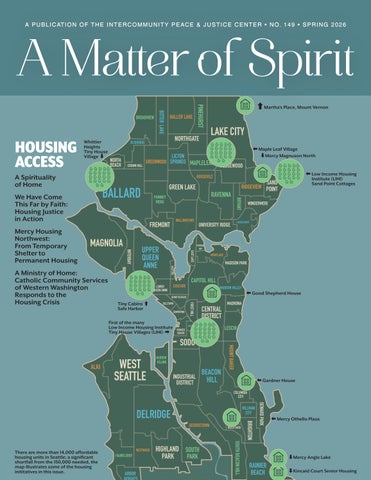
Mercy Housing Northwest: From Temporary Shelter to Permanent Housing
A Ministry of Home: Catholic Community Services of Western Washington Responds to the Housing Crisis
Good Shepherd House
⬅ Gardner House
⬆Martha's Place, Mount Vernon
Mercy Angle Lake ⬅ Mercy Othello Plaza
⬇Mercy Magnuson North
From
the Editor
I remember my first apartment. Not my first home, where I was born, but the first (and only) place I lived by myself, that I was solely responsible for taking care of and paying for. When I was a student in divinity school, for a while my portly tuxedo cat and I lived in a tiny one-bedroom, ground floor apartment in the West Rock neighborhood of New Haven, Connecticut. The only place to put the fridge was smack dab in the middle of the living room (which was fine, I didn’t have a TV anyway.) It was right next to a concert venue, and on weekend evenings I could hear loud music late into the night—plus the sounds of drunken undergraduates trying to climb the fire escape outside of my windows. We briefly had a flea infestation. A month before I moved out, the water utility company seized all my landlord’s rents because she hadn’t been paying her bills.
In other words, it was perfect.
In her essay for this season’s issue of A Matter of Spirit, Melina Rudman writes about our homes as containers, “full of memory, energy, dreams, decisions, and their consequences. [They are] like a book still being written; holding the stories of our lives in words and illustrations, changing and evolving as we do.” This was the wonder and magic I found in that first apartment.
And yet, it is almost impossible to think about how much I found my first home a sanctuary and then look away from the fact that, on any given night, more than 7,000 people in Washington State have no shelter at all. In fact, to afford the average two-bedroom apartment in Washington requires a full-time wage of over $41 per hour.
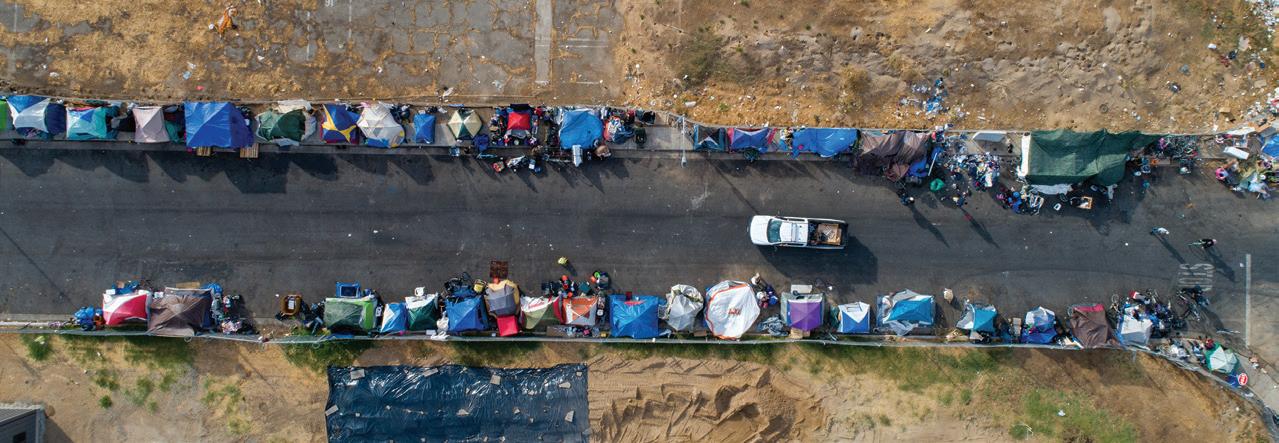
Pope Francis sharply names the tension between our love of home and the often-ignored fact that housing is so inaccessible to so many people. “We live in cities that throw up skyscrapers and shopping centres and strike big real estate deals,” he said at the 2014 World Meeting of Popular Movements, “but they abandon a part of themselves to marginal settlements on the periphery.”
Pope Francis also had something to say about the language we use to avoid reckoning with that tension. “While [cities] offer wellbeing and innumerable pleasures for a happy minority, housing is denied to thousands of our neighbours, our brothers and sisters including children, who are called elegant names such as ‘street people’ or ‘without fixed abode’ or ‘urban camper,’” he said. “In general, what lurks behind each euphemism is a crime.”
The articles in this issue of A Matter of Spirit take on Pope Francis’ mandate to ensure that all of our siblings have housing. Melina Rudman opens the issue with a meditation on the spiritual dimensions of home: what it means to be at home in ourselves, in our communities, and in a nation that can feel increasingly unrecognizable. The Low Income Housing Institute (LIHI) traces the decade-long journey from Seattle’s
Pope Francis sharply names the tension between our love of home and the often-ignored fact that housing is so inaccessible to so many people… “We live in cities that throw up skyscrapers and shopping centres and strike big real estate deals, but they abandon a part of themselves to marginal settlements on the periphery.”
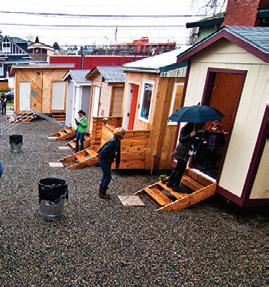
first tiny house village (pictured above) to Good Shepherd House, a seven-story permanent supportive housing building on the same church property. Mercy Housing Northwest (MHNW) tells the story of Gardner House, an affordable housing community in Seattle. And Catholic Community Services of Western Washington (CCSWW), the largest Catholic Charities in the country, reminds us that housing alone is rarely enough and that people also need stability, community, and care.
Francis called for urban integration to solve the housing crisis—not eradication, not cosmetics, not elegant euphemisms for abandonment. There is room: The communities in these pages are making it. The question this issue leaves with us is whether we will join in.
—Emily Sanna, Editor
LIHI Tiny House village, Seattle, WA opened in 2015
A SPIRITUALITY OF HOME
“ WHEREVER YOU STAND, BE THE SOUL OF THAT PLACE.” — RUMI
BY MELINA RUDMAN
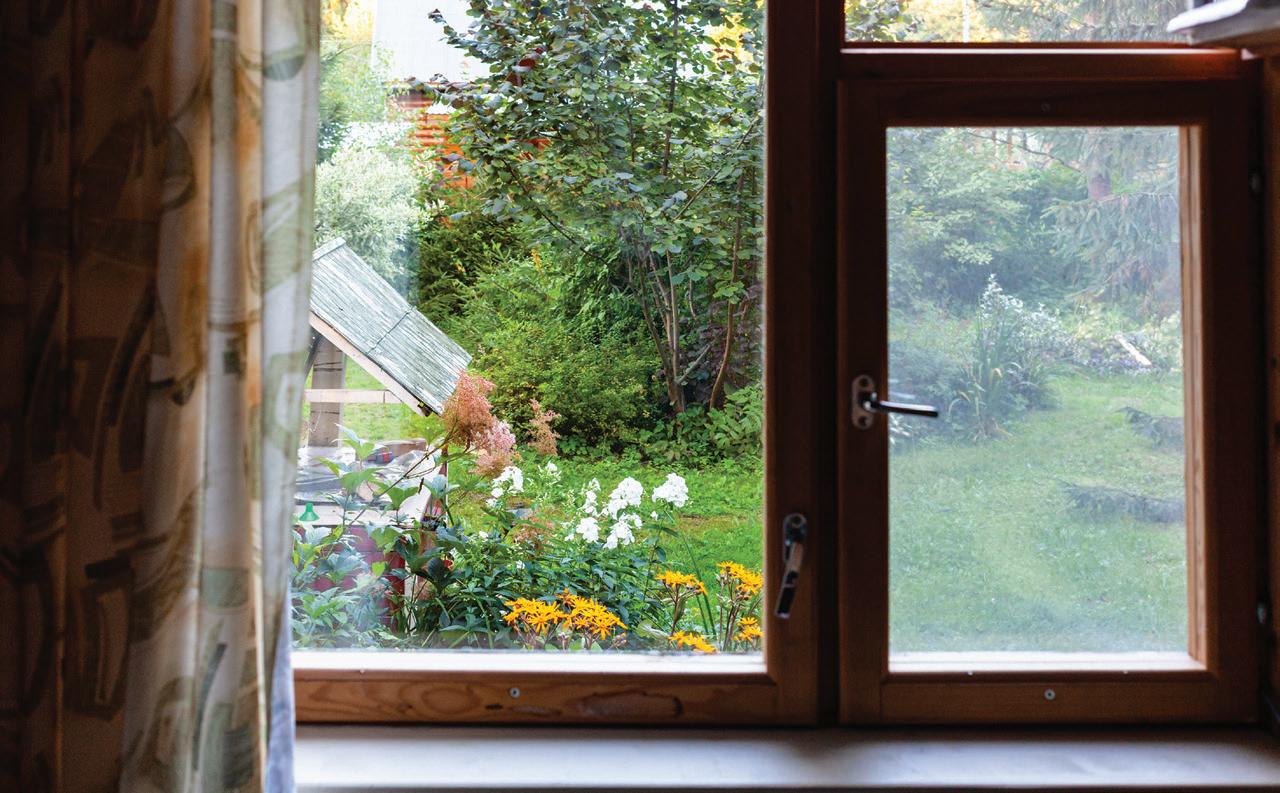
It is a cool and rainy Easter morning as I begin this reflection. I am in my writing spot (a comfortable old sofa in the living room,) tapping my first thoughts onto keys that make words appear on a screen. There is a mug of hot coffee in easy reach. My dog, Luna, lies warm, fed, and happy beside my outstretched legs. We are home.
We are home where there is focaccia dough rising on the kitchen counter, galette crust chilling in the refrigerator, and five Easter baskets destined for the grandchildren waiting on the dining room table. We are home.
I believe our homes reflect and reveal us to the world. This is true in all the places we call home: our nation, our physical shelter, our hearts, our lived (and thus truest) beliefs. The great Persian mystic, Rumi, said: Wherever you stand, be the soul of that place. I believe our souls, our words, our actions, intentions, and lives leave imprints upon the fabric of time and space. There is a palpable difference in the way places feel to us, Creatures that we are, we know when we are in a place where there has been great suffering, great peace, great awe, evil, or joy.
My own home is a sturdy house where my children grew up; my mother aged and died; my father and my in-laws visited, sat for meals, and celebrated family; a place where my grandchildren now play and “help” in the gardens. Home is where my husband and I have loved each other some 40 years now, even when times are tough, money is tight, even when we disagreed about almost
everything, wondered who we were becoming, and whether we could make this marriage work.
This place is a container: full of memory, energy, dreams, decisions, and their consequences. It is like a book still being written; holding the stories of our lives in words and illustrations, changing and evolving as we do.
At 67 years of age, I am grateful to finally be at home in myself, too. I am occupying my own life; living into my beliefs, sharing my words, creating quilts, baking bread, making gardens, growing older and (hopefully) wiser, and more loving.
This has not been easy work, though healing and freeing work never is. When I was younger, I had a recurring night dream about my house (which never looked like my actual house, but was the home of my psyche and persona.) In the dreams I would find entire new wings of my home: rooms that I had never entered, rooms I was afraid to enter. For some months I found myself needing to journey through dark tunnels in the basement; places where I feared monsters and death itself were lurking in wait. I would walk through this darkness (my own unconscious) with a group of people (who were all aspects of myself) shining our flashlights before us to know where to step next.
Of course, the darkness never killed me or even harmed me. The dreams taught me that fear feeds the shadows and shadows feed the fear in a terrible symbiotic loop. As Jesus says in the
“THAT THE CITIZENS OF MODERN NATIONS DO NOT INSIST ON SAFE HOUSING FOR ALL OUR SISTERS AND BROTHERS SPEAKS TO HOW LITTLE OUR HEARTS HAVE GROWN OVER TIME.”
My prayer for us all:
May we be and provide homes for those who need shelter and refuge.
May we welcome and wash the feet of the weary, may we feed the hungry, clothe the naked, tend the sick, educate the ignorant, soothe the fearful and love one another.
May it be so. Courage my dears.
non-canonical Gospel of Thomas: “If you bring forth what is within you, what you bring forth will save you. If you do not bring forth what is within you, what you do not bring forth will destroy you.”
Walking through those scary places with and within myself saved me. Now, within myself I am finding a sacred heart, a refuge, a fountain of living waters, a garden in which to put down roots and bear fruit. There are still fears and phantoms to meet and heal, but mostly there is peace. I am grateful for that, too.
That I am home and at peace within myself is a good thing, because I feel I am without a home in my own nation in these days of rising authoritarianism, and it is disconcerting and distressing. I no longer recognize my country, or even some of my neighbors. I live in a blue state, in a purple town, and still, there are those who wear their fear proudly in the form of red hats; those who shout their ignorance with yard signs and decorated pickup trucks. Like the shadows and fears of my dream-work; our nation needs to face the truth of how we began, who we have always been, and who we will become if we choose love or choose fear. I pray we choose wisely. We shall see.
“Foxes have dens and birds have nests, but the Son of Man has no place to lay his
head”. (Matthew 8:20) Jesus wandered, though he was not lost. He was always at home within himself; yet lived with no home in a world that did not recognize him. His world, like ours, was an age of empire with all its oppression, injustice, and violence. Poor and homeless himself, he met the hungry, the sick, and the poor in spirit right where they were: around their fires and in their camps and rough shelters. For those with eyes to see and ears to hear, Jesus highlighted the trauma of being without place. That the citizens of modern nations do not insist on safe housing for all our sisters and brothers speaks to how little our hearts have grown over time.
Still, some 2,000 years after that first Easter, the risen Christ makes a home within those whose hearts offer welcome; those whose hearts belong to love, and whose lives tear down walls, open doors, invite in, make room for, wash feet, set tables, serve meals, and join hands with.
Melina Rudman is a writer, spiritual director, the interim coordinator of the Doctor of Ministry Program at Union Theological Seminary, and author of Sacred Soil A Gardener’s Book of Reflection (Anamchara Books). Melina lives with and near her family in Rocky Hill, Connecticut.
Home in the Bible
Housing justice is not a modern political concern; it is woven into the tradition from the beginning. From Genesis to Revelation, scripture returns again and again to the question of home: who has one, who doesn’t, and what God demands of those with the power to provide homes to those who have none.
“ The land shall not be sold in perpetuity, for the land is mine; with me you are but aliens and tenants.” (Leviticus 25:23)
The Jubilee law commands that land cannot be permanently bought or sold, because it belongs to God, not to any human owner. Every 50 years, land returns to its original families. In other words, to treat housing as a commodity—something to be accumulated, speculated upon, and withheld—contradicts God’s order. The earth is God’s, and we are its stewards, not its owners.
“Thus says the Lord: In the place where dogs licked up the blood of Naboth, dogs will also lick up your blood.” (1 Kings 21)
1 Kings 21 tells the story about how King Ahab wants Naboth’s vineyard. When Naboth refuses to sell his ancestral land, Ahab’s wife, Jezebel, arranges false charges against him, and Naboth is killed as a result. The king then seizes the property. The prophet Elijah’s condemnation is swift and total: God has seen what was done, and there will be consequences. The story illustrates that state-sanctioned displacement is not a modern invention. It has been around as long as there have been powerful people to take advantage of the less powerful, and scripture has always named it as sin.
“Is not this the fast that I choose . . . to share your bread with the hungry and bring the homeless poor into your house?” (Isaiah 58:6–7)
In this passage from Isaiah, God rejects the people’s fasting and religious observance as empty performance. The fast God chooses looks different: loosing the bonds of injustice, feeding the hungry, and bringing those who are experiencing homelessness into your house. Rather than being depicted as extraordinary generosity or optional charity, it is the baseline of faithfulness.
“They shall all sit under their own vines and under their own fig trees, and no one shall make them afraid.” (Micah 4:4)
The prophet’s vision is specific: everyone sitting safely under their own vine and fig tree. Home in this vision represents security, dignity, and peace as well as shelter. It is the freedom to rest without fear of displacement or violence. This is what God intends for every human being.
“Foxes have holes, and birds of the air have nests, but the Son of Man has nowhere to lay his head.” (Matthew 8:20)
When a scribe offers to follow Jesus wherever he goes, Jesus responds: the Son of Man has nowhere to lay his head. Jesus knew homelessness from the inside. The God who became human became, in part, a person without stable housing.
“There was a rich man . . . who feasted sumptuously every day. And at his gate lay a poor man named Lazarus, covered with sores, who longed to satisfy his hunger with what fell from the rich man’s table.” (Luke 16:19–31)
The parable of the rich man and Lazarus is a story about proximity and indifference. Lazarus lies at the rich man’s gate, homeless and hungry, every single day. The rich man’s sin is not that he is cruel; it is that he does not see. Jesus tells this story as a warning: Indifference to the unhoused person at our gate is a moral failure with eternal weight.
“There was not a needy person among them, for as many as owned lands or houses sold them and brought the proceeds of what was sold.” (Acts 4:34)
The earliest Christian communities took seriously what it meant to follow a homeless Christ. In Acts, believers held things in common and distributed to each as any had need. This was ecclesial practice: the church as a community that actively ensures its members have what they need to live with dignity, including a place to live.
1990
�� Washington State Growth Management Act (GMA) enacted
�� Requires local governments to create comprehensive plans guiding growth, zoning, and housing development
2015
�� Seattle/King County declare a homelessness state of emergency
�� First LIHI tiny house village established at 22nd & Union, property of the Lutheran Church of the Good Shepherd
17 TINY HOUSE VILLAGES
2015–2020
�� Tiny house village operates on Good Shepherd property
�� Model expands regionally as a response to unsheltered homelessness
The opening of the first tiny house village at 22nd Ave. and Union St., Seattle, WA in 2015 LIHI’s newest tiny house village, Church By the Side of the Road Village in Tukwila, opened in March 2026. The village sits on churchowned land and was brought to reality in close partnership with Church By the Side of the Road
2021
�� Washington State Substitute House Bill 1377 adopted
�� Requires jurisdictions to allow increased density for affordable housing on religious land
�� Seattle Affordable Housing on Religious Organization Land Ordinance (SMC 23.42.055) goes into force
�� Enables higher-density affordable housing on faithowned property
�� Generates progressive revenue for housing and services, including operating support
We Have Come This Far by Faith
BY CARA WILLIAMS, TAN MACARAEG, AND MOLLY HARDIMAN
On May 29, 2024, the Low Income Housing Institute (LIHI) opened the doors to Good Shepherd House.
The opening of the seven-story, newly constructed apartment building located behind the Lutheran Church of the Good Shepherd was years in the making. Good Shepherd House is located in Seattle’s Central District and provides permanent supportive housing for formerly homeless singles and couples. Residents pay 30 percent of their income for rent and have access to onsite case management to connect them to supportive services.
THE BEGINNINGS
The lease-up of Good Shepherd House marked a new milestone in the relationship between the Lutheran Church of the Good Shepherd and LIHI. Long before the church agreed to embark on a 16 month-long construction project in its backyard, the site was home to Seattle’s first tiny house village.
In 2015, the city of Seattle and King County declared a state of emergency over the homelessness crisis. At that time, “tent cities” were a common practice to address unsheltered homelessness. The Lutheran Church of the Good Shepherd already sponsored a tent city with Nickelsville—a self-managed group of people
experiencing homelessness who organized tent encampments and shelters—on their vacant lot adjacent to the church.
After the closure of the tent city, which was time-limited, LIHI, the Lutheran Church of the Good Shepherd, and Nickelsville decided to do something new: temporary microshelters that would be cost effective and restore dignity to people who are experiencing homelessness.
The result was the tiny house village at 22nd and Union, a program on the church’s property consisting of 14 tiny houses (the size of small bedrooms), hygiene pavilion, kitchen and dining tent, security office, and storage space. This was the first tiny house village to include a kitchen, running water, hygiene services, or laundry facilities.
Since 2015, LIHI has expanded this model and currently operates 17 tiny house villages, serving thousands of people exiting homelessness. In 2025, LIHI provided shelter to 1,663 individuals, couples, and families with children in tiny houses.
A MORE PERMANENT SOLUTION
The Lutheran Church of the Good Shepherd hosted the tiny house village on its property from 2015 to 2020. Eventually, however, it decided to transition from a tiny house village to an affordable housing development.
The transformation of this site stands as a living reflection of the church’s mission to serve their neighbors and LIHI’s
�� Permanent supportive housing for formerly homeless individuals and couples
2025
�� LIHI reports 1,663 people sheltered in tiny house villages across the region
1,663 PEOPLE SHELTERED
2026
�� Washington State House Bill 2266 passed
�� Limits local governments’ ability to delay or block shelters and supportive housing through zoning/ permitting barriers
�� Among the first projects to utilize the 2021 religious land ordinance
�� Unit count increased from 65 to 86 due to density allowances
UNIT COUNT INCREASED FROM 65 TO 86
HOUSING JUSTICE IN ACTION
steadfast belief that housing is a human right. Today, many of LIHI’s partners are faith-based and play a powerful role in strengthening community within and around tiny house villages.
Embarking on this process, Reverend Nate Whittaker reflected: “We welcome the next step of what our God is doing in this community. We will continue to follow our Lord and serve our community with love. We have come this far by faith and cannot wait to see what the next 100 years brings all of us”.
Following a two-year period of development planning, Good Shepherd House broke ground in 2022 thanks to Seattle’s 2021 Affordable Housing on Religious Organization Land Ordinance; it was one of the first developments to rely on this ordinance.
Recognizing the important role of faith-based organizations in Seattle’s network of affordable housing, this piece of legislation allows for increased density in affordable housing developments on property owned by religious organizations. When it went into force in 2021, LIHI was able to increase the scale of the project at Good Shepherd Housing, bringing the total number of units up from the planned 65 to 86 and significantly increasing the number of formerly homeless individuals the building could serve.
THE ROLE OF LEGISLATION
Policies such as Seattle’s Affordable Housing on Religious Organization Land Ordinance shape the landscape of housing. This ordinance was passed to comply with the Washington State Legislature’s adoption of Substitute House Bill 1377, a bill requiring local jurisdictions to allow additional density in affordable housing developments on religious land.
This bill is one of a slew of recent pieces of legislation enacted at the state level that are targeted at easing the lengthy process of developing affordable housing and shelter, which currently cannot keep up with skyrocketing demand. House Bill 2266, for example, passed this year after years of advocacy efforts. The bill will prevent local jurisdictions from using unnecessary zoning and permitting delays to discriminate against prospective shelters, transitional housing, and permanent supportive housing.
Much of Washington’s recent housing policy builds on the Washington State Growth Management Act of 1990. This sweeping legislation requires local jurisdictions to create comprehensive plans to prepare for urban growth that include strategies and zoning laws that determine what types of housing can go where. This provides the legal framework for legislation that either promotes housing for all or hinders it.
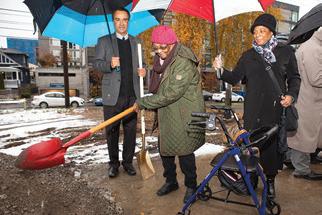
Trustee Steve Tucker and members of the church congregation attend the Good Shepherd House groundbreaking event on December 4, 2022 and literally make their mark on the block
While the state can enforce pro-housing policy by enacting mandates for comprehensive plans, local governments can direct more resources for housing and shelter through their comprehensive planning process. Numerous other policy and funding mechanisms interact to impact housing as well. For example, revenue from Seattle’s 2021 JumpStart payroll expense tax, a progressive tax, provided operating funds for Good Shepherd House along with numerous other sources.
INTO THE FUTURE
While historical and present-day policies have directly caused the housing and homelessness crisis we are experiencing today, there are legislative and funding efforts that can significantly reduce the number of people experiencing homelessness. From the first conversations about identifying a parcel to develop to the moment a tenant receives the keys to their new home, local and federal funding and legislation impact LIHI’s ability to provide affordable housing and shelter. To understand where individuals, communities, and faith-based organizations can make an impact to promote housing justice in the rapidly changing policy environment, this paradoxical relationship must be acknowledged.
Because policies come into place with public input, there are opportunities to advocate for housing and homelessness services. This includes legislative initiatives, progressive taxation, land use and zoning changes, and other efforts to increase resources to address housing and homelessness. Pushing for structural change and the need to advance housing justice efforts cannot be overstated.
The partnership between LIHI and the Lutheran Church of Good Shepherd shaped operational principles that continue
to guide LIHI’s work. As a housing and shelter provider, LIHI’s collaboration with faith-based organizations has furthered our progress in restoring humanity to all our neighbors. Within all of LIHI’s programs, churches serve as key providers of community engagement, in-kind donations, volunteer support, and broader networks that help clients feel more connected and supported. Along the journey from site planning and construction, to moving into a tiny house, these efforts help thousands of clients on the path to safe, stable, and secure housing.
Reverend Whittaker voices the importance of religious partnerships in his vision statement asserting that “the more opportunities we can create by opening our doors to neighbors, old and new, the better stewards we will be of the precious gifts God has blessed us with.”
Good Shepherd House is emblematic of the interplay between housing policy, faith-based work, and strong partnerships. Since opening in 2024, Good Shepherd House has served 121 individuals and continues to be uplifted by the Lutheran Church of the Good Shepherd.
Cara Williams, Tan Macaraeg, and Molly Hardiman are all staff members of the Low Income Housing Institute (LIHI), which develops, owns, and operates housing, urban rest stops, and tiny house villages for the benefit of low-income, unhoused, and formerly unhoused people in Washington State. LIHI administers a range of supportive service programs to assist those we serve in maintaining stable housing and increasing their self-sufficiency.
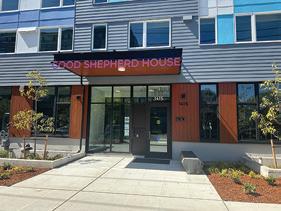
Good Shepherd House is located in Seattle's Central District directly behind the Lutheran Church of the Good Shepherd
Washington Housing by the Numbers
�� In the next 20 years, Washington State needs over 1 million new homes , almost 650,000 of which will need to be affordable for low-income households.
�� Affording the average two-bedroom apartment requires a full-time wage of $41.11/hour . In King and Snohomish Counties, this jumps to more than $51/hour.
�� A January 2025 point in time count found 22,173 people experiencing homelessness . More than 7,267 of these people did not have any shelter at all.
�� In 2021, almost 70 percent of Seattle-area homes sold above asking price, with more than 4,500 homes sold for at least $100,000 over asking price; 580 sold for more than $300,000 over.
�� In 2021, the median home price in Seattle was $737,800 .
�� Washington ranks in the bottom 10 states for the proportion of people who are homeowners. And the median home price is almost $100,000 more than that of the rest of the nation ($452,400 for Washington State in 2020).
�� Wages are unable to keep up with the rise in housing prices. Between 2010 and 2019 median wages increased by between 0.6% to 3.9% each year; while home prices have risen by between 5.4% to 10.4% in the same time period.
�� In 2017, 48% of renters in the Seattle-Tacoma metropolitan area were cost-burdened, meaning they spent more than 30% of their income on rent. This number has only increased over time.
�� Washington renters must make twice the minimum wage— $57,782 a year—to affordably rent a two-bedroom unit.
�� About half of the state’s white residents can afford to buy the typical home; just 32% of Black residents and 33% of Hispanic residents can afford to do the same.
Mercy Housing Northwest: FROM TEMPORARY SHELTER TO PERMANENT HOUSING
BY NATHAN BOX
Sherry moved from Atlanta to Seattle to be closer to her children and grandchildren. While getting settled, she found an affordable short-term rental. Then the pandemic hit, and in the blink of an eye, the employees at Sherry’s new company were told to work from home. As the pandemic stretched from weeks into months and the return date moved further away, Sherry was terminated from her job.
With little savings, it was not long before Sherry could no longer afford her short-term rental. She began couch surfing, staying with family and friends. Fearful of becoming a burden, she decided this could not be a long-term option for her.
Without the knowledge of her family and friends, Sherry would drive to an empty parking lot, park her car, and begin a nightly ritual. Packed inside her car was everything she owned. To sleep, she would move clothes and treasured items. With enough room to lay the seat back, she would attempt another night of uneasy sleep. In the morning, she would rise with the sun and exit the lot. Sherry would spend the day looking for housing.
After months of trying, her persistence paid off. Sherry was referred to Gardner House in the Columbia City neighborhood of Seattle. “Walking through my apartment the first time, it seemed like a mansion to me,” she says. “On Sundays, my
“MHNW PROVIDES AFFORDABLE HOUSING TO MORE THAN 5,500 RESIDENTS ACROSS WASHINGTON, OREGON, AND IDAHO.”
grandkids visit. With a full kitchen, I’ve been teaching them to cook and bake. They absolutely love my chocolate chip cookies!”
Sherry’s experience moving from housing instability into a permanent home is one example of what Mercy Housing Northwest aims to provide. The organization began in 1990, when several communities of women religious—Sisters of St. Joseph of Peace, Sisters of Providence, Tacoma Dominicans, and Adrian Dominicans—asked themselves, “Who is being overlooked in our society? What can we about it?”
The answer to the first question, they decided, was the growing population of unhoused families with children who couldn’t access affordable housing. And the answer to the
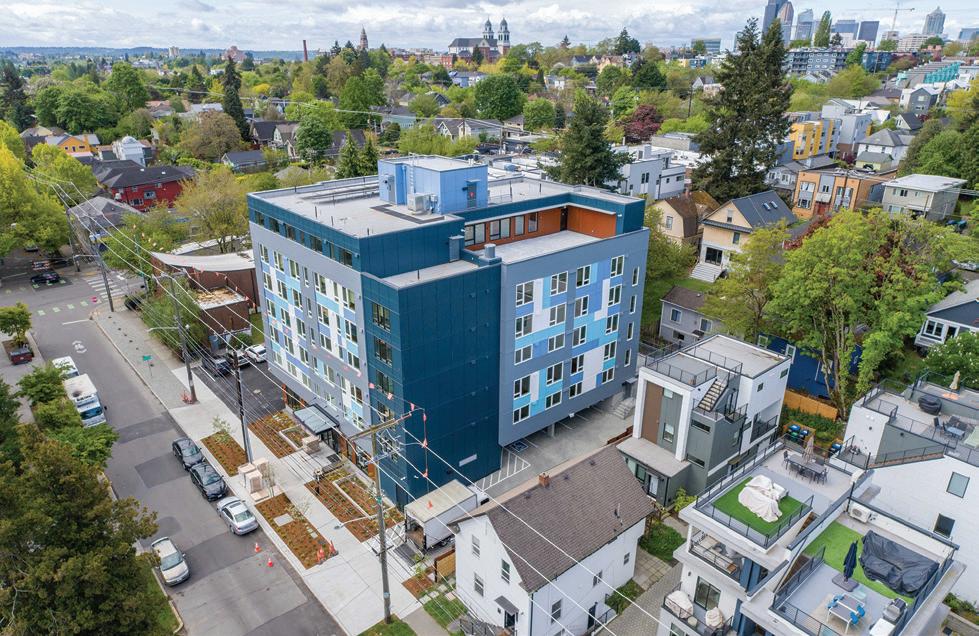
What sets Gardner House (pictured above) apart is its integration with the Allen Family Center, an 8,000-square-foot resource hub located on the building’s ground floor. There, families can access a range of services—from help finding housing and child care to youth programs and financial support—in a single, centralized space.
second question was Mercy Housing Northwest (MHNW).
Today, MHNW provides affordable housing to more than 5,500 residents across Washington, Oregon, and Idaho, managing 55 properties and 3,193 homes. We believe that housing is meant to be a starting point rather than an endpoint—a foundation for greater stability. Therefore, in addition to developing and managing housing, the organization offers resident services aimed at helping provide stability for folks to remain housed, including health, education, and financial well-being support.
From early on, MHNW has partnered with Mercy Housing Inc., a national nonprofit that develops and manages affordable housing across the country. Together, they focus on serving families, seniors, and people with special needs.
MHNW also collaborates with other local organizations to better support residents. One of those partners is Mary’s Place, a Seattle-based nonprofit that serves families experiencing homelessness. The two organizations have worked together on several developments, including Gardner House, where Sherry now lives. That partnership is continuing to grow. In Burien, Washington, MHNW and Mary’s Place are developing a new campus that will combine emergency shelter with permanent affordable housing on the same site.
About Gardner House
�� Gardner House is a 95-unit affordable housing community in Seattle’s Mount Baker neighborhood designed for families with a range of needs, including those experiencing or at risk of homelessness. Roughly half of the apartments are set aside for families coming out of homelessness, including units with additional supportive services for those with the greatest needs.
�� Located near public transit, schools, and other community resources, Gardner House is designed to help families not only find housing but also remain connected to jobs, education, and support networks.
�� The goal is to reduce the fragmentation that often makes it difficult for families to get help, offering both stable housing and on-site support in one place.
When it opens in 2027, the Burien Family Campus will include 200 beds for families in need of immediate shelter and 90 units of long-term housing. The goal is to allow families to move from temporary shelter into stable housing without leaving their community or support systems.
For people like Sherry, that kind of stability can be lifechanging. Not long ago, she was sleeping in her car, unsure where she would go next. Now, she has a home where her grandchildren can visit and where she can begin to rebuild.
Nathan Box is the communication and engagement manager for Mercy Housing Northwest. He is also a 2007 graduate of the University of Central Oklahoma, where he earned a bachelor’s degree in broadcast communications, and a 2013 graduate of Seattle University’s nonprofit leadership program.
Residents of Mercy Angle Lake housing south of Seattle in Seatac
A MINISTRY OF HOME Catholic Community Services of Western Washington Responds to the Housing Crisis
BY JILMA MENESES
Every day, those of us who work at Catholic Community Services of Western Washington (CCSWW) meet individuals and families at moments when life feels impossibly fragile. When people cannot access housing, or when their access is insecure, they often lose more than a roof over their head: They lose stability, community, health, and the ability to plan for the future.
The housing crisis is not simply an economic or political issue; it is a moral and spiritual one. For communities of faith, this crisis is a call to live out the values at the heart of Catholic social teaching: the inherent dignity of every human person and our shared responsibility for the common good.
At CCSWW, responding to this call has been our mission for more than a century. We serve more than 100,000 people each year, making us the largest private social services provider in Washington State and the largest Catholic Charities in the country. Our work touches nearly every dimension of the housing continuum—from homelessness prevention and emergency shelter to permanent supportive housing—because solving homelessness requires both caring for people in crisis and committing to long-term solutions to the problem.
We’ve developed innovative housing approaches that meet people where they are while affirming their dignity. CCSWW’s housing portfolio spans shelters, transitional housing, and permanent homes across Western Washington. From modular villages to hotelstyle shelters, we meet people where they are and creatively adapt space—often in collaboration with faith communities and local governments—to quickly expand access to safe housing.
In 2024 alone, CCSWW provided 3,438 units of housing across 76 properties, helped 5,500 people secure permanent homes, and supported 375 seniors across seven senior housing sites. On any given night, our 18 shelters—including seven in Seattle—serve more than 300 people. Behind each number is a person whose life has been stabilized because a community chose to respond with care and creativity.
Housing alone, however, is rarely enough to fix the problem. Many people experiencing homelessness have endured trauma, prolonged instability, or significant health challenges that require more than a place to sleep. Our programs offer safe, supportive environments where individuals can meet regularly with case managers, access behavioral health and addiction treatment, reconnect with
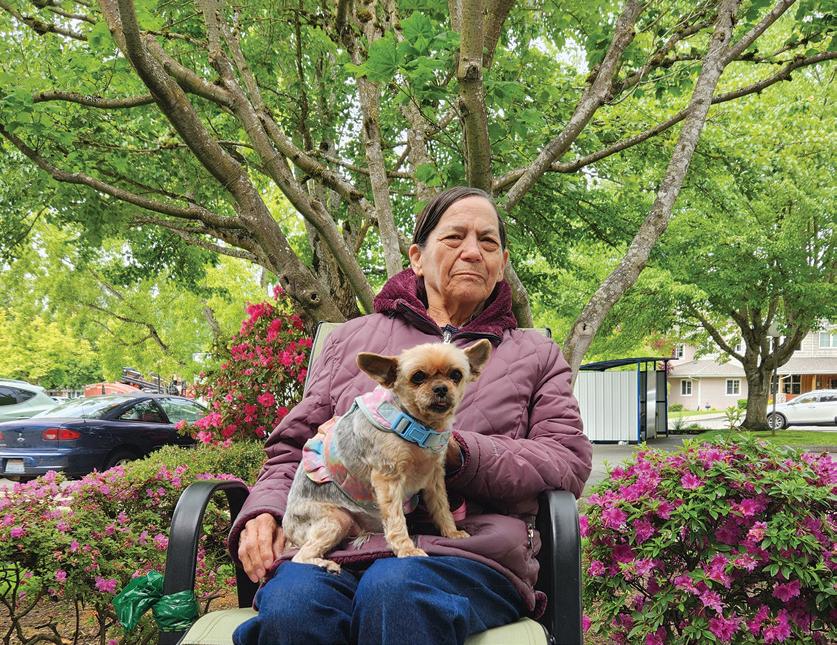
Client from Kincaid Court Senior Housing
Martha’s Place client 2023
“ Meeting immediate needs is crucial, but it’s only part of the picture. We also need long-term strategies: prevention services, stable supportive housing, culturally responsive programs, and coordinated efforts across health care, government, philanthropy, and faith communities.”
employment opportunities, and begin rebuilding their lives. When safe housing is paired with these services, people are able to heal and thrive.
This work relies on deep and lasting partnerships. Meeting immediate needs is crucial, but it’s only part of the picture. We also need long-term strategies: prevention services, stable supportive housing, culturally responsive programs, and coordinated efforts across health care, government, philanthropy, and faith communities. No single organization can meet the scale of the housing crisis alone. Communities of faith, however, are uniquely positioned to advance housing justice—not because they have all the answers, but because they are called to embody God’s compassion and stand in solidarity with those who are struggling.
Housing is more than a commodity; it is a foundation for human flourishing. A safe home gives people dignity, stability, and hope. It lets children learn, families heal, and communities thrive. When someone moves indoors and gains access to support, we see real transformation. We see dignity restored. We see humanity affirmed. And we see people reclaim their hopes and dreams.
This moment calls for action, partnership, and hope. Every home we help provide is a way of participating in God’s vision of a beloved community. This is the heart of our ministry: to reflect Christ’s love through acts of mercy, justice, and healing.
Jilma
Meneses is the president and chief executive officer of Catholic Community Services of Western Washington.
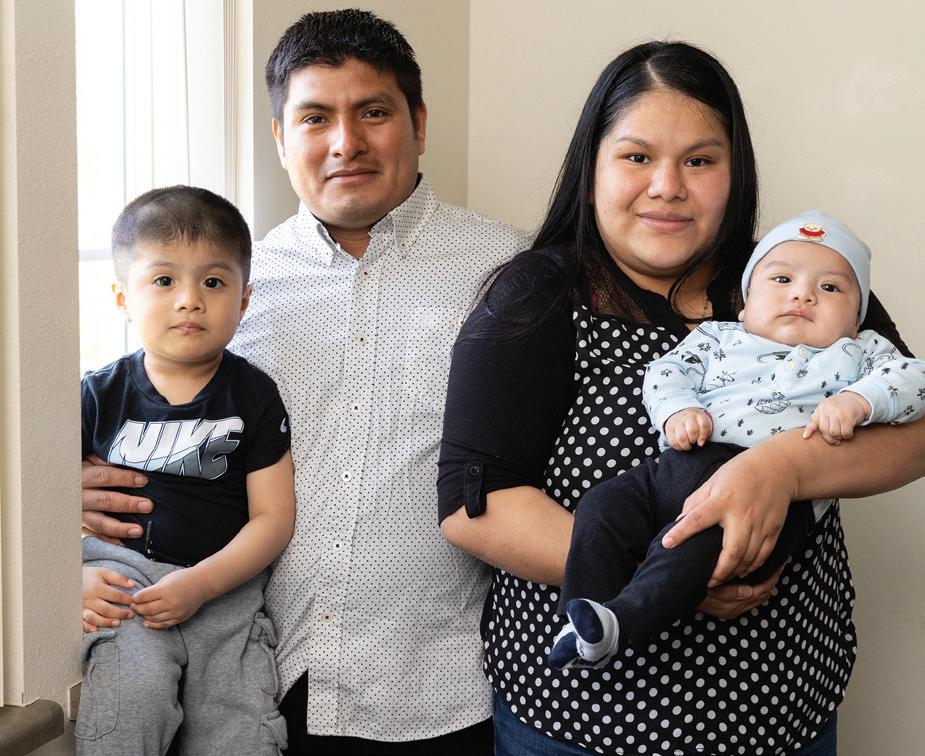
CCSWW and Catholic Housing Services clients, new residents at their farmworker housing
Reflection
The day Arleen and her boys had to be out was cold. . . . She would be given two options: truck or curb. “Truck” would mean that her things would be loaded into an eighteen-footer and later checked into bonded storage. She could get everything back after paying $350. Arlene didn’t have $350, so she would have opted for “curb,” which would mean watching the movers pile everything onto the sidewalk. Her mattresses. . . . Her nice glass dining table and the lace tablecloth that fit just-so. Silk plants. Bibles. . . . Jafaris’s asthma machine.
Arlene took her sons—Jori was thirteen, Jafaris was five—to a homeless shelter, which everyone called the Lodge so you could tell your kids, “We’re staying at the Lodge tonight,” like it was a motel. . . . Arlene stayed in the 120-bed shelter until April, when she found a house on Nineteenth and Hampton. . . . There was often no water in the house, and Jori had to bucket out what was in the toilet. But Arlene loved that it was spacious and set apart from other houses. “It was quiet,” she remembered, “And five-twenty-five for a whole house, two bedrooms upstairs and two bedrooms downstairs. It was my favorite place.”
After a few weeks, the city found Arleen’s favorite place “unfit for human habitation,” and removed her. . . . Arlene moved Jori and Jafaris into a drab apartment complex deeper in the inner city, on Atkinson Ave, which she soon learned was a haven for drug dealers. . . .
Arleen endured four summer months on Atkinson before moving into a bottom duplex unit on Thirteenth Street and Keefe, a mile away. . . . There was a fist-sized hole in a living-room window, the front door had to be locked with an ugly wooden plank dropped into metal brackets, and the carpet was filthy and ground in. But the kitchen was spacious and the living room well lit. Arleen stuffed a piece of clothing into the window hole and hung ivory curtains.
The rent was $550 a month, utilities not included. . . . Arleen couldn’t find a cheaper place, at least not one fit for human habitation. . . . The rent would take 88 percent of Arleen’s $628-a-month welfare check.
—From Evicted: Poverty and Profit in the American City, by Matthew Desmond (Broadway Books, 2016)
n What details from Arleen’s story stay with you? What does it mean that this level of instability is ordinary for millions of families in the United States? Does this challenge how you think about housing access at all?
n Arleen defines her favorite home not by its condition—there’s no running water—but by its quiet and space. What does home mean to you spiritually: Sanctuary? Belonging? Stability? How does sitting with her favorite space challenge or expand yours?
n Catholic social teaching holds that housing is not a commodity but a human right tied to dignity and the common good. Where do you see that teaching honored or violated in your own city or neighborhood?
n What is one concrete step you or your parish could take—whether that’s advocacy, accompaniment, or direct service—to stand with families like Arleen’s? Who is already doing this work in your area that you could support or join?
LOOKING BACK
Town Hall & Advocacy Summit
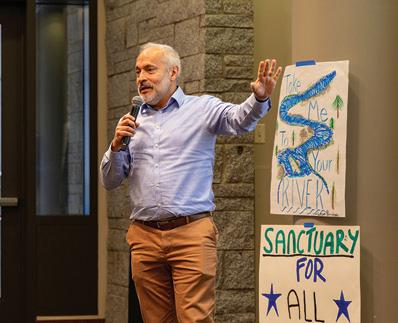
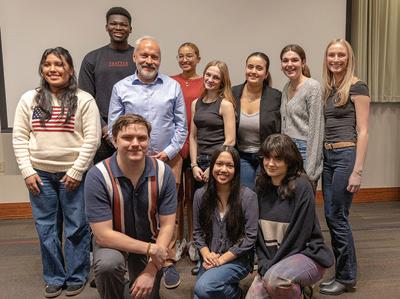
The NW Ignatian Advocacy Summit was an experience of courage, faith, and action, as Jesuit high school students (pictured above) from across the Pacific Northwest came together to form deep relationships and hone their social justice leadership. Through immersive workshops, a community-centered Stations of the Cross, and powerful storytelling with adults, students organized around the urgent issues of ecology, housing, and immigration. The summit culminated in an inspiring town hall, where Councilmember Jorge Barón (pictured top) affirmed the students’ vision, saying yes to all three of their bold asks.
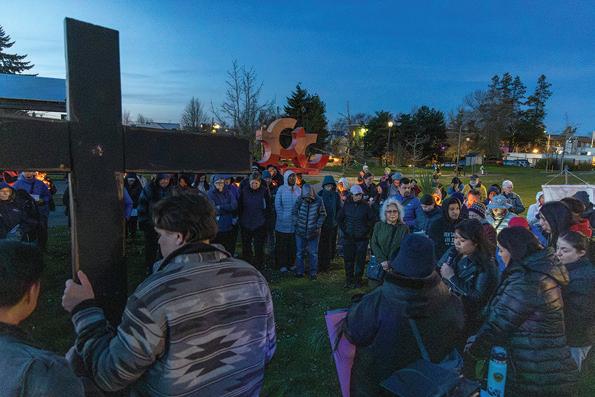
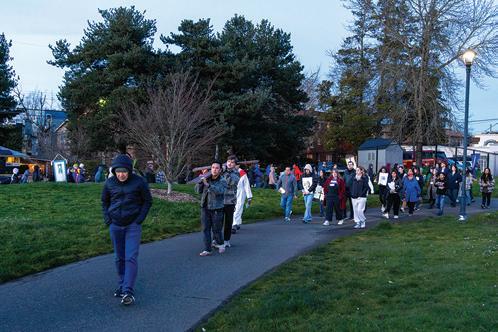
On the Monday of Holy Week, nearly 300 people gathered in the Beacon Hill neighborhood to walk the Way of the Cross as an act of faithful witness, grounding our prayer in public solidarity with immigrants and refugees. Beginning at El Centro de la Raza and ending at Jefferson Park, the community connected Jesus’ Passion to present day crucifixions of displacement, detention, deportation, and systemic violence. The scripture, testimony, and reflection on the walk called us, during this Season of Faithful Witness, to reject apathy and respond together with courage, compassion, and action for justice, dignity, and radical hospitality.
Caring for Creation Summit
Nearly 100 people attended “Caring for Creation: Finding Common Ground,” the annual LSMWA Earth Day Summit, for a day rooted in learning, prayer, relationship building, and action. Participants heard inspiring speakers from across Washington, engaged in thoughtful breakout sessions, and reflected together on the spiritual call to care for our common home. Folks walked away with a renewed commitment to act for environmental justice.
LOOKING FORWARD
IPJC Spring Benefit 2026
Thursday, May 14
6:00 – 8:30 p.m.
St. Catherine of Siena School Seattle
Join us to spark hope for justice as we celebrate our collective work and raise critical funds for the Center! The event will feature good food, classy music, stories of impact, awards honoring Barbara Connor and Yssa Javier, and much more. Get your tickets at ipjc.org/ springbenefit2026 or make a gift to celebrate.
We Are the Body of Christ
Monday, May 25
10:00 a.m. – 1:00 p.m.
St. Leo to the NW Detention Center, Tacoma
On Memorial Day, people of faith and goodwill from across Western Washington will gather at St. Leo’s Church in Tacoma for Mass and a eucharistic procession led by Archbishop Etienne to the Northwest Detention Center, publicly proclaiming Christ’s presence in both the Eucharist and in migrants and asylum seekers denied their dignity. Learn more and register here: bit.ly/421rBq5
Seven Sisters: Return of the Matriarchy I Kick-Off
Saturday, June 27
6:00 – 8:00 p.m.
St. Mark’s Cathedral Seattle, WA
Join IPJC and our partners for the kick-off of the Seven Sisters Campaign elevating the wisdom of seven Indigenous women and several women witnesses from throughout the community. Friend of the center and former staff member Anna Johnson will be featured as one of the witnesses. Join us as we learn from the wisdom, knowledge, and leadership of women. Details to come!
Donations
IN MEMORY OF Lillian Farrell Patty Houts-Hussey
Procesión Eucarística por la dignidad de migrantes Eucharistic Procession for Migrant Dignity
Intercommunity Peace & Justice Center
1216 NE 65th St Seattle, WA 98115-6724
SPONSORING COMMUNITIES
Adrian Dominican Sisters
Congregation of the Sisters of St. Joseph of Peace
Jesuits West
Sisters of the Holy Names of Jesus and Mary, U.S.-Ontario Province
Sisters of Providence, Mother Joseph Province
Sisters of St. Francis of Philadelphia
Tacoma Dominicans
AFFILIATE COMMUNITIES
Benedictine Sisters of Cottonwood, Idaho
Benedictine Sisters of Lacey
Benedictine Sisters of Mt. Angel Dominican Sisters of Mission San Jose Dominican Sisters of Racine Dominican Sisters of San Rafael Sinsinawa Dominicans
Sisters of Charity of the Blessed Virgin Mary Sisters of St. Francis of Redwood City Sisters of St. Joseph of Carondelet Sisters of St. Mary of Oregon
Society of the Holy Child Jesus Sisters of the Holy Family
Sisters of the Presentation, San Francisco Society of Helpers
Society of the Sacred Heart Ursuline Sisters of the Roman Union
EDITORIAL BOARD
Don Clemmer
Cassidy Klein
Will Rutt
Editor: Emily Sanna
Copy Editor: Cassidy Klein
Design: Sheila Edwards
A Matter of Spirit is a quarterly publication of the Intercommunity Peace & Justice Center, a 501(c)3 nonprofit organization, Federal Tax ID# 94-3083964. All donations are tax-deductible within the guidelines of U.S. law. To make a matching corporate gift, a gift of stocks, bonds, or other securities please call (206) 223-1138. Printed on FSC® certified paper made from 30% post-consumer waste.