A BETTER KIND OF POLITICS: The Lecture I Hope My Students Remember
S
BY STEPHEN F. SCHNECK
Practiced rightly, politics means taking “action against any form of injustice and tyranny.”
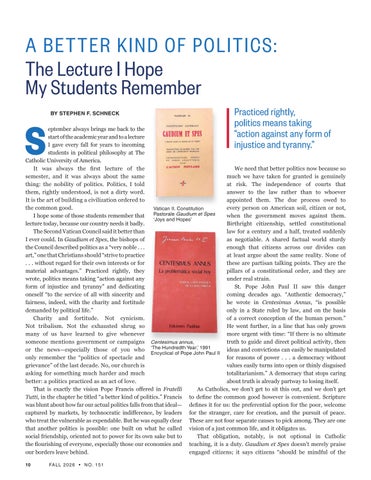
eptember always brings me back to the start of the academic year and to a lecture I gave every fall for years to incoming students in political philosophy at The Catholic University of America. It was always the first lecture of the We need that better politics now because so semester, and it was always about the same much we have taken for granted is genuinely thing: the nobility of politics. Politics, I told at risk. The independence of courts that them, rightly understood, is not a dirty word. answer to the law rather than to whoever It is the art of building a civilization ordered to appointed them. The due process owed to the common good. every person on American soil, citizen or not, Vatican II. Constitution Pastorale Gaudium et Spes I hope some of those students remember that when the government moves against them. ‘Joys and Hopes’ lecture today, because our country needs it badly. Birthright citizenship, settled constitutional The Second Vatican Council said it better than law for a century and a half, treated suddenly I ever could. In Gaudium et Spes, the bishops of as negotiable. A shared factual world sturdy the Council described politics as a “very noble . . . enough that citizens across our divides can art,” one that Christians should “strive to practice at least argue about the same reality. None of . . . without regard for their own interests or for these are partisan talking points. They are the material advantages.” Practiced rightly, they pillars of a constitutional order, and they are wrote, politics means taking “action against any under real strain. form of injustice and tyranny” and dedicating St. Pope John Paul II saw this danger oneself “to the service of all with sincerity and coming decades ago. “Authentic democracy,” fairness, indeed, with the charity and fortitude he wrote in Centesimus Annus, “is possible demanded by political life.” only in a State ruled by law, and on the basis Charity and fortitude. Not cynicism. of a correct conception of the human person.” Not tribalism. Not the exhausted shrug so He went further, in a line that has only grown many of us have learned to give whenever more urgent with time: “If there is no ultimate someone mentions government or campaigns Centesimus annus, truth to guide and direct political activity, then ‘The Hundredth Year,’ 1991 or the news—especially those of you who ideas and convictions can easily be manipulated Encyclical of Pope John Paul II only remember the “politics of spectacle and for reasons of power . . . a democracy without grievance” of the last decade. No, our church is values easily turns into open or thinly disguised asking for something much harder and much totalitarianism.” A democracy that stops caring better: a politics practiced as an act of love. about truth is already partway to losing itself. That is exactly the vision Pope Francis offered in Fratelli As Catholics, we don’t get to sit this out, and we don’t get Tutti, in the chapter he titled “a better kind of politics.” Francis to define the common good however is convenient. Scripture was blunt about how far our actual politics falls from that ideal— defines it for us: the preferential option for the poor, welcome captured by markets, by technocratic indifference, by leaders for the stranger, care for creation, and the pursuit of peace. who treat the vulnerable as expendable. But he was equally clear These are not four separate causes to pick among. They are one that another politics is possible: one built on what he called vision of a just common life, and it obligates us. social friendship, oriented not to power for its own sake but to That obligation, notably, is not optional in Catholic the flourishing of everyone, especially those our economies and teaching, it is a duty. Gaudium et Spes doesn’t merely praise our borders leave behind. engaged citizens; it says citizens “should be mindful of the
10
FA L L 2 0 2 6 • N O. 1 5 1
The bread in his hands © Discha AS, iStock
“As Catholics, we don’t get to sit this out, and we don’t get to define the common good however is convenient.” right and also the duty to use their free vote to further the common good.” A few years later, Paul VI put it even more starkly in Octogesima Adveniens: to take politics seriously, he wrote, “is to affirm the duty of man, of every man,” to work for the good of his city, his nation, and the human family. Not a hobby for the civically inclined or the politics nerds. A duty. I’ve tried to live out that duty by taking on the leadership of Catholics for the Future, a political action committee working through elections to advance exactly this kind of politics, the noble kind, the kind ordered to the common good rather than to power. I won’t pretend such electioneering is for everyone. Plenty of good people are put off by partisan combat or can’t find a candidate on any ballot who comes close to Francis’ better kind of politics. That is a legitimate hesitation. It is not an excuse to disengage. There are as many ways to answer this duty as there are gifts among us. Work the polls on Election Day. Do the unglamorous work of getting out the vote: arrange child care so a parent can go cast a ballot, drive a neighbor who no longer drives, help
a voter with a disability navigate the process. Write to your representatives, show up to a public hearing, join your parish’s social action committee, march in a demonstration, start a reading group on Catholic social teaching, or simply write what you believe—in an op-ed, a blog, a letter to the editor. Most importantly, vote! None of this requires a campaign lawn sign. All of it can be politics in the noble sense: service, offered with charity and fortitude, striving to build a civilization for the common good. I hope my former students remember that first lecture today, because I believe it more today than I did the year I first gave it. America urgently needs the kind of politics Vatican II described and Pope Francis renewed: a politics that builds not a party’s fortunes but a civilization worthy of the people who live in it, a better kind of politics. Stephen Schneck is president of Catholics for the Future, a political action organization inspired by the social justice traditions of the Catholic Church. He also serves on the governing boards for Catholics for the Future, Catholic Climate Covenant, and Catholic Mobilizing Network. Schneck was appointed by President Biden in 2022 to serve on the United States Commission on International Religious Freedom. He was the founder and director of the Institute for Policy Research & Catholic Studies at The Catholic University of America in Washington, DC, and served as the executive director of Franciscan Action Network from 2018 to 2020. A M AT T E R O F S P I R I T
11