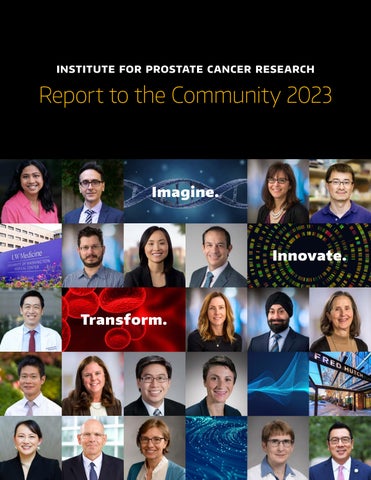
INSTITUTE FOR PROSTATE CANCER RESEARCH
Report to the Community 2023
Imagine.
Innovate.
Transform.
Report to the Community / 1
Who we are The Institute for Prostate Cancer Research is a collaborative effort between University of Washington Medicine and Fred Hutchinson Cancer Center. Our expert team of scientists and clinicians work to fulfill our three-part mission: • Understanding prostate cancer to improve diagnosis and treatment. • Providing effective, individualized therapy for patients. • Extending and enhancing the quality of a patient’s life upon diagnosis.
To achieve this mission, we are committed to: • Studying potential preventive agents and strategies. • Developing new biomarkers for early diagnosis and therapy selection. • Improving surgical, radiation and ablative techniques. • Exploring the biology of prostate cancer metastasis and resistance to treatment. • Understanding hereditary and acquired gene defects to develop better detection and therapy strategies. • Advancing targeted imaging technologies and integrating them with novel therapies. • Conducting innovative clinical trials to bring new discoveries to the bedside.
2 / Institute for Prostate Cancer Research
Message from the Director
Message from the Scientific Director
Our 2023 Report to the Community
We witness breakthroughs toward improving human health
provides you with a window into some of
through biomedical research on a daily basis. From preventing
our most exciting and impactful ongoing
lethal infections to correcting genetic diseases to enhancing
research. In the following pages, we’ll give
outcomes after a cancer diagnosis, the pace of discovery is
you insight into various aspects of our
remarkable. The foundation for these advances continues to
program, introduce you to our newest
center on basic research.
research directions, and profile several recently recruited investigators. The stories outline some of the novel avenues of discovery we are pursuing as we endeavor to produce landscape-changing advances in the most common of all adult cancers. Although the primary goal of IPCR involves engaging in foundational and revolutionary prostate cancer research, we are also fully committed to raising awareness in our community, educating patients and families, and providing the highest quality care to patients. The spirit of collegiality and team-science is palpable in our motivated and determined body of IPCR investigators, bringing together two world-class institutions: Fred Hutchinson Cancer Center and UW Medicine. I am constantly inspired by our collective efforts in tackling difficult problems in cancer research and care of patients. We are committed to curing prostate cancer at all stages. To achieve this, we are launching an ambitious multiyear initiative to accelerate advances in screening, diagnostics and treatment of prostate cancer. We are delighted that Jon Fine, former CEO of United Way, will lead the IPCR Fundraising Council and partner with the Fred Hutch philanthropy team to inspire donors to fuel
Yet prostate cancer remains a common and potentially devastating disease. And while we can now cure most men diagnosed with localized disease, we cure very few whose cancer has spread. But as the pace of research accelerates, I believe we will soon have the potential to radically improve the effectiveness of treatments, leading to cures. IPCR supports work across a spectrum of scientific areas designed to understand how the prostate develops, what factors contribute to its cancer risk, how hormones influence prostate cancer growth, and how the immune system recognizes targets. A key aspect of our work continues to focus on translating new knowledge into clinical action to improve the lives of patients with prostate cancer, ultimately driving prevention and cure. My role as scientific director provides a unique vantage point to preview the progress made by the outstanding group of 45 physicians and researchers who make up IPCR. Notably, their work on prostate cancer research is extended through a network spanning more than 15 departments and divisions across the UW and Fred Hutch, incorporating novel ideas from other fields such as engineering, computer science, mathematics, chemistry
this effort (see pages 16-18).
and immunology. IPCR investigators are also
I want to take this opportunity to thank the IPCR team and our
collaboration and knowledge-exchange to
community of generous supporters. Together, we are united
rapidly test and apply precision-oncology
in the words on the front cover of this report: to imagine novel
strategies for prostate cancer prevention,
approaches of investigation, to innovate and develop emerging
detection and treatment.
frontiers of science, and to transform the landscape of prostate cancer care to make cure a reality. We certainly could not reach these new heights of research excellence without your support
connected to international efforts that foster
We thank you for your interest in our work. We are inspired by the researchers you will read about in this Report to the
and generosity.
Community, and we hope you will partner with us in our goal
Thank you for your interest in our mission. If you would like more
and better lives.
information, we are happy to arrange a tour of our facilities and an informational session. Feel free to reach out to me directly at any time (dlin@uw.edu).
to eliminate prostate cancer, enabling men to live longer
With gratitude, Peter S. Nelson, MD
Warm regards,
Research Director, Institute for Prostate Cancer Research
Daniel W. Lin, MD
Professor, Division of Human Biology Division, Fred Hutchinson Cancer Center
Director, Institute for Prostate Cancer Research
Director, Sloan Precision Oncology Institute
Pritt Family Endowed Chair of Prostate Cancer Research Chief of Urologic Oncology and Professor, Department of Urology, University of Washington
Report to the Community / 3
TURNING ON THE
4 / Institute for Prostate Cancer Research
Metastatic prostate cancer, in which the cancer has spread to other parts of the body, is a difficult-to-treat disease and there is an urgent need for novel therapies that employ distinct mechanisms of action.
At the Institute for Prostate Cancer Research, a team of scientists led by Michael Haffner, MD, PhD, is working to develop new treatments that target PSMA, or prostate-specific membrane antigen. Although PSMA-directed therapies hold the promise to greatly improve prostate cancer treatment, there are limitations. In about 70% of patients, PSMA is expressed at low levels or shows significant variations when highly expressed. “The way PSMA is expressed in prostate cancer cells can differ among patients and even across different metastatic sites within the same patient,” said Haffner. “That means some individuals may respond well to PSMA-targeted therapies and others will not. We are looking at developing strategies that
gene encoding for PSMA can be found in up to 40% of prostate cancer metastases. It’s as if this epigenetic switch turns off PSMA expression.
will enhance PSMA expression, which will improve treatment
Can we turn PSMA expression back on? Haffner thinks so. “We’ve
outcomes for more men.”
found that histone deacetylase inhibitors, a group of drugs that can change the epigenome, can induce PSMA expression,” he said.
Determining a cell’s fate All cells in the human body have the same DNA sequence but a cell in the heart looks and functions very differently than a cell in the prostate. These differences are dictated by an additional layer of information that is encoded by modifying the DNA molecule without changing the DNA sequence, called epigenetic marks (literally, “on top of the genome”). Epigenetic marks define the function and behavior of all cells, essentially determining a cell’s fate, but cancers can find unique ways to highjack and change them. One of the most widely studied epigenetic marks is DNA methylation. Haffner and his team have discovered that a gain of DNA methylation in the
Next year, Haffner and his colleague Michael Schweizer, MD, plan to launch a first clinical trial to test if epigenetic therapies can enhance the benefits of PSMA-directed treatments. During the trial, funded by the Lopker Family Foundation, the team will administer vorinostat, a drug that induces PSMA expression. Eligible patients will receive a second drug called 177 Lu-PSMA-617 (Pluvicto), a recently approved treatment for men with advanced metastatic prostate cancer that specifically targets PSMAexpressing cells. The researchers will then study whether the combination therapy can assist patients with low levels of PSMA and extend survival time. “We hope these treatments will shed light on how PSMA is expressed,” said Haffner. “Understanding these patterns can help
“ We hope these treatments will shed light on how PSMA is expressed. Understanding these patterns can help us identify unique
us identify unique vulnerabilities that may allow us to treat this disease even more effectively.” LEFT: MICHAEL HAFFNER, MD, PHD UPPER RIGHT: PSMA SCAN
vulnerabilities that allow us to treat this disease even more effectively.” Report to the Community / 5
Developing a
Some prostate cancers are slow-growing and can be easily monitored over time, but others are more aggressive and need immediate treatment. To determine how aggressive a cancer is, pathologists use a microscope to look for abnormalities visible in paper-thin slices of biopsy tissue. The process, while precise, can take days to complete which is frustrating for patients and families. More importantly, since the biopsies use only thin slices, critical elements in the biopsy tissue may not be part of the sample. Recently a cross-disciplinary team at the University of Washington developed a 3-dimensional (3-D) pathology microscope which can provide more accurate analysis while also potentially reducing wait times. Called an open-top light-sheet (OTLS) microscope, the groundbreaking new technology is the work of four researchers: Dr. Larry True, surgical pathologist
How it works Traditional pathology uses a 2-D method: Biopsy tissue is sectioned, embedded into wax and cut into paper-thin sections. The sections, about 4 microns thick, are mounted onto traditional glass slides for analysis. (In comparison, a strand of human hair is about 100 microns thick.) To view a biopsy in the OTLS microscope, the tissue is placed in a solution containing fluorescent molecules, then rendered transparent using a non-toxic chemical. A thin sheet of laser light rapidly scans the tissue to stimulate the fluorescent molecules. The light is collected in a high-resolution camera as digital data.
and a founding member of the Institute for Prostate Cancer
Software stitches the images together to produce 2-micron
Research; Dr. Nicholas Reder, clinical instructor, Laboratory
thick virtual images. A stack of 2-micron thick images from
Medicine and Pathology; Dr. Jonathan Liu, professor, Mechanical
a 1-millimeter biopsy provides 500 virtual sections—several
Engineering; and Dr. Adam Glaser, senior scientist, Allen
hundred more sections than are provided by traditional 2-D
Institute for Neural Dynamics.
microscopy. This means the pathologist can view at least 200 times as much image data.
UPPER LEFT: LARRY TRUE, MD
The specimen is placed on top of a glass plate where a camera
UPPER RIGHT: BIOPSY TISSUE
attached to the microscope transmits digital data to a computer to reconstruct a 3-D image. By viewing multiple digital images,
6 / Institute for Prostate Cancer Research
approach to pathology
pathologists can completely analyze the biopsy and the structure of the cancer as well as how each cell relates to surrounding cells. The open-top design—envision an office scanner—can accommodate a wide range of tissue-specimen sizes and shapes. “The 3-D technology provides a way to look deeper into the tissue,” said True. “Since we image intact tissue, a diagnosis can be made more quickly and with more precision. Deeper levels of tissue and larger sample sizes are immense aids to a more accurate diagnosis, especially in borderline cases.” The idea to digitize the pathology came about when Reder, at the time a research fellow in pathology, noted that the 3-D structure could not be seen in conventional tissue slices. He wondered if technology developed by colleagues Liu and Glaser could be used to expedite and improve the process used to diagnose and grade prostate cancer. Along with True, the team came up with the idea of using lightsheet microscopy to more thoroughly analyze and diagnose prostate biopsies. Their invention—the first open-top lightsheet pathology microscope—led to the founding of Alpenglow Biosciences in 2019 with Reder as its CEO. The OTLS technology
Benefits of 3-D microscopy Light-sheet microscopy is not only more informative than 2-D microscopy since tissue can be completely analyzed, but it can also potentially be faster since it minimizes the time it takes to prepare a tissue specimen. Digitizing also makes it easier to share data among health care professionals. “The downside might be that it’s more expensive,” said True. In a pilot study by True and his colleagues, five pathologists in the United States, Canada and the United Kingdom analyzed 160 biopsies, using the new 3-D technology. “We found that 15% of the samples had more malignant histologic patterns than if we looked at them with standard 2-D screening,” said True. “The 3-D technology also allowed us to find more cancer because we were viewing thicker tissue samples in all their complexity.” True believes that the collegial environment on the UW campus played a major role in the development of the 3-D microscope. “Our team included mechanical engineers, optical scientists and pathologists,” he said. “Having access to this broad interdisciplinary network allowed us to percolate ideas and helped facilitate the end result.”
has been patented and is currently being tested.
Report to the Community / 7
New technologies and tools for cancer diagnostics are being developed at breakneck speeds, but the research evaluating their outcomes and results has not kept pace. That’s where public health researcher Dr. Ruth Etzioni comes in. Referring to herself as a biostatistician with a mission, Etzioni is
Her impact is enormous, and among her many honors is the
passionate about ensuring that the dizzying array of precision
prestigious Outstanding Investigator Award, presented to her by
cancer diagnostics being released is properly, quickly and
the National Cancer Institute in 2022. The award provides about
objectively evaluated for use in the real world. The data-driven
$7.4 million over seven years to support her team’s investigations
evidence in turn drives clinical and policy decisions.
into the accuracy of new cancer diagnostics, including nuclear
During the three decades she has worked at Fred Hutchinson Cancer Center, where she holds the Rosalie and Harold Rea Brown Endowed Chair, Etzioni has focused much of her work on prostate and breast cancer. She has helped refine the use of PSA (prostate-specific antigen) tests for prostate cancer screening, identified what constitutes over-diagnosis and over-treatment of prostate cancer, calculated costs and benefits of preventive screening, and tracked patterns and outcomes of cancer care.
imaging modalities and multi-cancer early detection tests, commonly referred to as liquid biopsies.
Making informed decisions “If you want to have precision oncology, you’ve got to have diagnostics,” said Etzioni. “But the rapid pace at which new technologies are entering the marketplace makes rigorous evaluation via controlled studies unfeasible for all but a few.”
Along the way, she’s been attuned to identifying and eliminating
Some tests developed in laboratory settings can be marketed
health disparities.
before they have final approval from the Food and Drug Administration, noted Etzioni, making it impossible to know the long-term benefits—or harms. “We don’t know if these new tools
8 / Institute for Prostate Cancer Research
WITH A MISSION are making patients’ lives better or not,” she said, “because the
can ascertain who is getting access to these technologies and
technologies have not been evaluated using controlled studies.
their clinical outcomes is a priority,” she said. “We want to
Ultimately, my work is about people making informed decisions,
understand the impact not only on the disease but also on public
whether they are a patient or a health care provider.”
health costs and health disparities.”
Ensuring equitable access
Eventually Etzioni wants to create a go-to resource where
To ensure that emerging technologies are used equitably, Etzioni also examines dissemination patterns and test availability by
researchers, patients, providers and the general public can better understand how to navigate diagnostic test options.
race, ethnicity, geographic region and insurance status.
Etzioni is grateful to the support she has received over the years
“Creating access to a large body of clinical data from which we
through collaborations with her colleagues at Fred Hutch— whether in radiology, nuclear medicine, pathology or lab testing.
“Together, we can move the field forward,
“Together, we can move the field forward,” she said, “not only by
not only by growing new technologies but
use them to improve cancer outcomes.”
growing new technologies but also by learning how we can best
also be learning how we can best use them to improve cancer outcomes.”
Report to the Community / 9
shows promising results in detecting cell-free DNA
10 / Institute for Prostate Cancer Research
Prostate cancer can change over time, evolving into one of several subtypes that are progressively resistant to treatment. Being able to classify the tumor subtype is important, but the current process, which relies on a tissue biopsy, can be costly, invasive and sometimes difficult to obtain. And repeated biopsies are not feasible, especially for advanced cancers.
With funding from the Lopker Family Foundation, Ha and his team are developing algorithms that will allow scientists to comb through the genetic analysis of the drawn blood to reveal whether DNA from cancer cells was released somewhere in the body. Along with An attractive solution is a “liquid biopsy,” which can reveal the same information about a patient’s cancer as a tissue sample. This noninvasive alternative uses blood as a diagnostic tool to detect and characterize cell-free DNA, also known as circulating
colleague Colin Pritchard, MD, PhD, co-director of the UW Genetics and Solid Tumors Laboratory, the researchers will extend their work towards expanding the utility of current clinical blood tests.
tumor DNA. This is DNA that has been released from dead or
Developing a simple, reliable blood test to accurately classify
dying tumor cells into the bloodstream. Although it still uses
tumor subtypes will provide a more accurate diagnosis and allow
needles, a liquid biopsy is a simple blood draw so it carries less
physicians to better target cell-surface markers, predict response
risk. Because it’s less invasive, patients find it less stressful.
rates and monitor for treatment resistance.
The idea of a liquid biopsy is not new but quickly becoming an attractive solution to address these challenges. This diagnostic
Needle in a haystack
tool has been used to detect genomic changes in both oncogenes
Although liquid biopsies are designed to be simple for the patient,
and tumor suppressors, such as BRCA2. But the information that
the science behind them is anything but. Most of the DNA from
can be obtained from these blood tests is currently limited.
a cancer cell looks identical to that of a normal healthy cell, so
Enter Gavin Ha, PhD, a computational biologist and cancer geneticist, whose laboratory is working to develop novel
scientists must know the hallmark changes that distinguish normal DNA from tumor DNA.
computational approaches to study cell-free DNA. In a recently
The other challenge is having the ability to sift through enormous
published landmark study, Ha and Peter Nelson, MD, along with
amounts of DNA molecules from normal cells, mostly white
a team of IPCR researchers, showed that it’s possible to identify
blood cells, to find the rare few molecules of cell-free DNA. It’s the
prostate cancer subtypes by analyzing tumor DNA circulating in
proverbial needle in a haystack.
a patient’s blood.
“This research brings us closer to being able to glean more information from a simple blood draw.”
“There’s a real urgency to translate these methods to the clinic,” said Ha. “This research brings us closer to being able to glean more information about a patient’s cancer from a simple blood draw, allowing physicians to better inform treatment.” Ha’s goal is to develop the software and collect study samples by summer 2024, and, working together with Pritchard, be ready with a clinical test the following year.
FAR LEFT: COLIN PRITCHARD, MD, PHD NEAR LEFT: GAVIN HA, PHD Report to the Community / 11
IDENTIFYING THE GENETIC VARIANTS
THAT PREDICT
prostate cancer risk
12 / Institute for Prostate Cancer Research
Prostate cancer is the second leading cause of cancer death among American men, with men of African descent having the highest incidence and mortality rates. While the causes of this health disparity are unknown, prostate cancer can run in families, making it likely that genetic and possibly environmental factors are at play. Investigating the genetic risk of prostate cancer, particularly
numbers of men from diverse populations,” she said. “The data
among diverse populations, is a research specialty of Burcu
should help us better distinguish aggressive from non-aggressive
Darst, PhD, a genetic epidemiologist who joined Fred Hutch
forms of the disease, which is very promising news. We’re also
in 2021.
finding that men with higher polygenic risk scores are often
Currently, Darst leads a team of researchers working to identify
diagnosed at a younger age.”
rare genetic variants that can impact the risk for prostate cancer.
Darst, who earned a PhD in epidemiology from the University of
It seems straightforward enough but identifying rare variants is
Wisconsin in 2018, has published several ground-breaking studies
particularly challenging since researchers need to assemble a
in prostate cancer genetics and polygenic risk scores. She has been
huge study sample in order to detect them.
honored by many national organizations for her work, and has
Common variants, on the other hand, have much smaller risk contributions individually but when viewed in aggregate, they too can be strongly predictive of prostate cancer risk. By combining these multiples of variants, researchers can determine an individual’s polygenic risk score. “A polygenic risk score is strongly predictive of prostate cancer risk, much more so than polygenic risk scores for other diseases,” said Darst. “The tool also works
received the Prostate Cancer Foundation’s Young Investigator Award, NextGen Star Award from the American Association for Cancer Research, and K99/R00 Award from the National Cancer Institute, among others.
Taking it to the next level Darst chose to establish her lab at Fred Hutch because of its
well across diverse populations.”
national reputation, innovative researchers, diverse research
Creating a polygenic risk score is as easy as taking a blood test or
“The IPCR covers so many different aspects of prostate cancer
providing a saliva sample. From the blood or saliva, researchers
research,” said Darst, “and there are so many people around to
can genotype or use DNA sequencing to determine whether
help you take it to the next level, whether it’s clinical
patients inherited these risk-increasing genetic variants.
implementation or just getting a better understanding of the
“Currently our polygenic risk score has 451 variants, so we need
biological function of a particular genetic variant.”
to genotype those 451 variants,” explained Darst. “We would also include some ancestry markers to determine an individual’s genetic ancestry because the risk score can vary, depending on a person’s ancestry.” When used with other screening measures, such as PSA testing, polygenic risk scores can help scientists develop a much more accurate risk assessment. Improving how scientists identify prostate cancer risk can lead to improved screening guidelines,
agenda and major prostate cancer program that includes the IPCR.
Darst’s research on rare genetic variants is particularly helpful in identifying men at risk of aggressive disease. Considering rare variants along with polygenic risk will likely further distinguishing aggressive from non-aggressive disease. Recently she teamed up with another IPCR researcher, Heather Cheng, MD, PhD, on a new study to enroll men recently diagnosed with prostate cancer through the Washington State
which can save lives.
Cancer Registry.
There is one drawback. The polygenic risk score has a limited
“We’re going to focus on men regardless of diagnosis,
ability to accurately distinguish between aggressive and nonaggressive forms of the disease. This raises concerns about using the scores in clinical settings for fear of over-diagnosing a non-aggressive cancer that may never threaten a patient, even if
aggressive or non-aggressive, but limit it to those who report as being non-white, which should help us better understand health disparities,” said Darst. “We’ll follow them longitudinally to see how their prostate cancer changes over time and try to
never diagnosed.
get a better understanding of whether polygenic risk as well as
That’s another area of research that Darst and her team are
men who are more likely to progress to an aggressive form of
tackling. “We’ve recently been able to improve the polygenic risk
the disease.”
other genetic factors, such as rare variants, can help us identify
score by having a larger sample size and including larger Report to the Community / 13
Using
to treat localized Removing prostate cancer without the side effects of surgery or radiation has been a long-term goal of George Schade, MD, a national leader in research to improve prostate cancer treatment. Currently Schade and his colleagues at the University of
To address these shortcomings and improve existing focal
Washington/Fred Hutchinson Cancer Center are working on a
therapy technologies, Schade and his team at the UW Applied
new treatment called prostate focal therapy in which a small
Physics Lab are working on a specific type of HIFU called Boiling
portion of the prostate, including the cancer, is destroyed
Histotripsy (BH), an experimental technique with the potential to
(ablated) using energy sources.
revolutionize treatment for localized prostate cancer. (The word
“Traditional treatments such as surgery and radiation therapy have been successful in wiping out prostate cancer,” said Schade,
histotripsy comes from the Greek “histo” meaning “soft tissue” and “tripsy” which refers to breaking down.)
“but both can affect nearby structures, which can lead to negative
Like thermal HIFU, histotripsy uses focused ultrasound, or sound
effects on urinary, bowel and sexual quality of life.”
waves, delivered from outside the body to kill targeted tissues
The most commonly used method for prostate cancer focal therapy is high-intensity focused ultrasound (HIFU). This approach uses approximately one-second pulses of ultrasound energy focused to a point about the size of a grain of rice. Within the focus, rapid heating occurs which causes cell death. Other current options for focal therapy also rely on temperature
or cancer. However, BH uses shorter, higher-intensity bursts or pulses of ultrasound that cause vapor microbubbles to form, mechanically destroying cells in the targeted tissue without heating it. Using this minimally invasive approach, pre-clinical studies have shown this innovative technology can safely destroy prostate cancer tissue with pinpoint precision.
changes, including freezing (cryotherapy) or heating (laser
Improving cancer outcomes
ablation). While all these options, including thermal HIFU, have
Unlike other technologies, histotripsy also offers surgeons
shown promise as a prostate cancer treatment with fewer
the ability to monitor treatment in real-time. “The procedure
reports of side effects compared with surgery and radiation,
produces bright bubbles that are visible on ultrasound, so we
there are limitations. In fact, 15% to 40% of men are found to
know the exact area we’re treating,” said Schade. “The mechanical
have residual prostate cancer six to 12 months after treatment.
destruction of tissue produces a darker image that gives us real-
Additionally, some men have experienced changes to their
time feedback on the success of the treatment, and the treatment
urinary and sexual health.
margins—where tissue is injured but not destroyed—are considerably less than with other therapies.”
14 / Institute for Prostate Cancer Research
As a result of the precision and ability to monitor imaging,
While tests are ongoing, Schade and his team are finding
BH should lead to improved prostate cancer outcomes while
that Boiling Histotripsy may have broad application for other
reducing side effects. By making prostate cancer treatment less
medical procedures, as well. “In pre-clinical testing, BH has
invasive, more effective and with fewer side effects, BH may also
been shown to be effective for benign prostatic hyperplasia,
reduce the costs of prostate cancer care.
a non-cancerous prostate enlargement,” said Schade. “It also
In addition, several studies have found that HIFU and similar treatments activate host anti-tumor effects that may improve cancer outcomes long term. Histotripsy may be even more advantageous for inducing systemic anti-tumor immunity
appears to be a potential treatment option for kidney stones and other cancers such as liver, kidney and pancreas. The future potential of successful treatments using histotripsy has yet to be fully uncovered.”
because it does not use heat. This might turn on a patient’s own immune system to fight the cancer, further improving cancer outcomes.
This schematic of boiling histotripsy treatment and tissue effects shows how focused sound waves are delivered into tissue, producing vapor bubbles. Interactions between the vapor bubbles and sound waves produce mechanical tissue destruction without heating, allowing the treated tissue to be destroyed with precision.
Report to the Community / 15
Building on today’s success to inspire tomorrow’s breakthroughs A conversation about IPCR’s forthcoming fundraising initiative to help men live longer and live better
Our hopes for the future of precision oncology at Fred Hutchinson Cancer Center have been informed, in many ways, by the successes of the Institute for Prostate Cancer Research (IPCR). For more than two decades, researchers involved in this highly collaborative effort between Fred Hutch and UW Medicine have worked to understand prostate cancer’s inherited nature. They’ve identified proteins expressed by its cells that can be used to detect its presence and as a target for treatments. And they’ve improved our ability to identify which patients need more aggressive treatment than others. Now, they’re preparing to redefine precision oncology for the next generation: This fall, the IPCR will launch a $100 million fundraising initiative to advance research that will better determine which individuals to screen and when to screen them, further develop methods for treating patients based on the unique characteristics of their cancer, and refine how much treatment patients need to minimize side effects and improve their quality of life. It’s an ambitious effort to accelerate research — and it needs to be. Prostate cancer continues to be the most prevalent and second deadliest cancer among men. We spoke to three of the people who will help drive the initiative to learn more about its goals and our community’s role in ensuring its success.
16 / Institute for Prostate Cancer Research
Daniel W. Lin, MD Director, Institute for Prostate Cancer Research
What does the phrase “precision oncology” mean
What do we need to do to make those advances?
to you?
Every discovery starts with an idea, then preclinical work to
It means the right treatment for the right patient at the right time.
determine if the idea can move forward. And then you have to
That’s the easy way to think about it. In other words, personalized
conduct a small version of your trial to gather the data you need
and specific treatment that is tailored to a variety of patient
to move on to a much larger trial. And you need people to gather
characteristics. That might be something about their genetics or
and analyze the large amounts of data from all those endeavors.
the molecular makeup of their tumor.
All of that costs money, which is why our donors are so, so
But it also applies to people who haven’t been diagnosed: How
important. They make it possible for us to turn an idea into a
to screen and who to screen, based on their genetic makeup or
discovery that can help patients.
other characteristics.
Why is now the right time for IPCR to undertake a
What potential advances in precision treatment for
fundraising initiative of this size?
prostate cancer can you see just over the horizon?
Generally speaking, we’ve made enormous leaps in our ability
We’re currently working on methods of manipulating tumor
to interrogate the human genome, the tumor genome and the
characteristics to make them more susceptible to treatments.
interaction between the two. That’s what is driving precision
So, for example, a few of our researchers are trying to encourage
oncology. And we’re ideally situated to continue making
prostate cancer cells to produce more of a certain protein that
discoveries in that space, thanks to Fred Hutch’s new Stuart and
can be used as a treatment target.
Molly Sloan Precision Oncology Institute.
And I think it’s very attainable in the near future to develop
More specifically to IPCR, we have amassed an unbelievable team
a blood-based test for tracking changes in a patient’s tumor
of driven investigators with big ideas for targeting more precisely
over time, which would be invaluable for helping us be more
everything from screening to treatment. I’ve been researching
responsive in adjusting treatment.
prostate cancer for more than 20 years, and I’ve never been more inspired by a group of people or more excited about the future than I am right now.
17
Jon Fine Chair, IPCR Volunteer Fundraising Council
Your involvement in and commitment to this community goes back decades, including 19 years as the CEO of United Way. Why have you chosen to take on a leadership role in IPCR’S fundraising initiative? I’ve always believed in being engaged in the community, giving
What will your role be? I will take a leadership role in recruiting other council members who value Fred Hutch in the same way I do and want to see it succeed. I’m looking to recruit other advisers who can help give us some ideas about where to fundraise and who to fundraise with.
back, and helping where I can. Aside from believing that Fred Hutch has tremendously impressive people and programs that
You and your wife have already made a significant gift to
produce world-class research, I also have a very personal reason
this effort. Why?
for being involved. A year and a half ago, I was diagnosed with
First, the patient care, the research, the world-class thinking that
prostate cancer. I’ve received wonderful care from the team at Fred Hutch and UW Medicine, and I believe so strongly in their commitment to world-class research and their vision for the future of prostate cancer care that when they asked me to help lead this effort, I agreed without hesitation.
goes on at Fred Hutch merit that kind of support. Second, I’m going to be going out and asking people to join me in giving. There’s something special about being asked to give by someone who’s not only not being paid to do it, but who also truly believes in what they’re asking you to support.
Kelly O’Brien Vice President and Chief Philanthropy Officer, Fred Hutch
Fred Hutch is in the early days of launching a
Fred Hutch received two truly transformational gifts
comprehensive campaign. How does this funding
in 2022. How would you respond to the donor who says,
initiative to support IPCR fit into it?
“What difference could my gift make?”
Creating an imperative in our community to support Fred Hutch
I would say that none of us knows which dollar is going to be the
at this scale is new for us. IPCR has engaged the donor community
one to create the next breakthrough that offers today’s patient a
for nearly two decades, thanks in large part to the efforts of its
new treatment option.
founding director, Dr. Paul Lange. So it’s only natural that we would leverage that strong foundation of engagement and trust as we launch our campaign. And what we accomplish will be a model, as we work with faculty and community members to develop focused fundraising efforts within the campaign for breast cancer, gastrointestinal cancers, multiple myeloma and lymphoma, Merkel cell carcinoma and others. In a more practical sense, the majority of the men we love and admire will face prostate cancer at some point in their life. My father passed away from pancreatic cancer, but if he’d lived long enough, prostate cancer probably would have been in his future. We can’t not make it a part of our larger campaign.
I would also say that we are among the best institutions in the country at securing competitive grants, but our scientists first need to gather data or develop proof-of-concept to compete for those grants. Every dollar helps provide them additional flexibility to pursue those innovative ideas. How will you inspire donors to give? Part of that will involve working with donors to understand the impact that they want to make through their giving and creating an experience that is meaningful to them. And our clinician partners will be vital to that effort. In many ways, they’re on the frontline of our fundraising efforts, engaging with patients and their families every day. Supporting them as they cultivate those relationships and develop a culture of philanthropy within their clinics will ensure the success of both this IPCR
18 / Institute for Prostate Cancer Research
initiative and the larger mission of Fred Hutch.
Every discovery starts with an idea, then preclinical work to determine if the idea can move forward. And then you have to conduct a small version of your trial to gather the data you need to move on to a much larger trial. And you need people to gather and analyze the large amounts of data from all those endeavors. All of that costs money, which is why our donors are so, so important. They make it possible for us to turn an idea into a discovery that can help patients.
Report to the Community / 19
The statistics are alarming: Black men are not only more likely to get prostate cancer during their lifetimes, but are twice as likely to die from it than men of other races or ethnicities. This disparity is the largest racial inequity of any cancer in the U. S. And despite improvements in both diagnosis and treatment, the gap has persisted for more than five decades.
A new community-based, patient-centered toolkit called COMBAT-PC is being developed to increase awareness, education and support for the early detection of prostate cancer among Black men, particularly men aged 40-45. Under the direction of Dr. Yaw Nyame, a urologic oncologist, researcher and educator at the University of Washington, the program is supported by the Institute for Prostate Cancer Research and the National Cancer Institute. COMBAT-PC builds on the findings of Nyame and Ruth Etzioni, PhD, a biostatistician at Fred Hutch. In their research, the scientists demonstrated that an intensified screening strategy, such as annual PSA (prostate-specific antigen) testing of Black men, could reduce the number of prostate cancer deaths among this population. This was especially true when testing began with younger men. Translating these findings to real-world application, though, has been challenging. That’s where COMBAT-PC comes in.
20 / Institute for Prostate Cancer Research
Developing an equity-based toolkit To get a better idea of the existing knowledge, attitudes, experiences and practices around the early detection of prostate cancer, the COMBAT-PC research team interviewed Black men who live in the Puget Sound region. Their findings revealed a number of critical equity-related barriers. For example, many men did not fully understand the benefits of early screening and others were reluctant to discuss prostate cancer screening or share decision-making with their primary care providers. The team is now working to develop learning tools that reflect these concerns. To ensure the toolkit is accessible, culturally relevant and community-based, stakeholders representing diverse points of view are acting as sounding boards. Advisory group members include Black men both with and without a history of prostate cancer, patient and community advocates, urologists, researchers and health communications specialists.
Among the discussion topics are toolkit contents, format and
Just three years later, BACPAC’s network includes more than 30
distribution vehicle. “A toolkit is only as good as its dissemination,”
community partners, such as ZERO and Communities of Color
said Jenney Lee, UW School of Medicine senior research scientist,
Coalition. “A patient- and community-centered approach that
“so determining how patients and doctors communicate is an
addresses racial inequities in prostate cancer ensures we can
important part of our research. We want to give patients access to
pinpoint the priorities that matter most to Black men, that our
more information that is helpful and has value. On the clinical side,
approach is culturally appropriate and relevant, and that our
we know that doctors are busy people and we don’t want to layer
research and interventions are effective,” said Nyame.
in one more thing for them to do. We hope this tool will be useful to doctors and support conversations with their patients.”
Community collaborations are key The COMBAT-PC team believes that community partners are central to creating the right message and delivering it via the appropriate vehicle. Advising the research team is a communitybased organization called BACPAC, which stands for Black and African-descent Collaborative for Prostate Cancer Action, started by Nyame in 2020.
ABOVE: YAW NYAME, MD, MS, MBA (FAR LEFT), WITH MEMBERS OF BACPAC
The COMBAT-PC equity-based toolkit will be piloted in Washington state next year. Depending on results, researchers are prepared to scale up the project for a national roll-out in the future.
BAC AC Report to the Community / 21
Turning “doctor speak”
into plain English Intraductal
Gleason Score
perineural invasion
4+5
atypical small acinar proliferation
22 / Institute for Prostate Cancer Research
Cribriform
extra capsular extension
Acinar
Adenocarcinoma
seminal vesicle invasion
Patients who understand their prostate cancer prognosis and treatment options tend to become more involved in the decision-making process about their care, which can lead to better health outcomes. But it’s hard for patients to know what options are best—or even what questions to ask—if foundational health documents, such as pathology reports, are full of unfamiliar words and complex medical terms.
Dr. John Gore, a surgeon and researcher with a specialty in
“Nothing is lost in the process,” said Gore. “The physician version
urologic oncology, has been interested in patient-centered
of the pathology report remains untouched. Patients can choose
communications for several years. During a systematic review of
to read the patient-centered version, the physician version or
pathology reports, he found that communications were prepared
both. It’s their personal choice.”
with the physician—not the patient—in mind. “These reports use medical terminology and complex vocabulary that are beyond the health literacy of the average patient,” said Gore. “If patients can’t understand a pathology report, how can they choose between their treatment options?” Today’s patients have unprecedented access to their medical records, making it even more important that documents such as pathology reports can be read and comprehended by a general audience. Greater knowledge not only leads to better patient-physician communication, but has also been linked to
In his pilot studies to see if patient-centered pathology reports are beneficial to patients, Gore found that clinicians would often use the patient-centered reports, and not the standard reports, when discussing the new cancer diagnosis with their patients. Gore believes there is great potential for the Pathology Translator. “The Pathology Translator is designed to be used at clinical sites regardless of their electronic health-record infrastructure,” said Gore. “Its design will also enable it to translate pathology reports for other common cancer types, such as breast or bladder cancer.”
improved emotional health, improved decision-making and better comprehension of the overall cancer-management plan. It can also impact health disparities for vulnerable and marginalized populations. Gore employed various methods to collect data and engage stakeholders, including patient focus groups to help him elicit themes and design recommendations for patient-centered pathology reports. Two common requirements emerged: The language should be framed in a way that informs and engages patients, and the clinical documentation format should be leveraged to enhance readability and information flow.
The Pathology Translator With support from the Institute for Prostate Cancer Research, Gore is now working on developing a product that will automate a patient-centered pathology report, in essence, turning “doctorspeak” into plain English. Called the Pathology Translator, the software will be able to read a standard pathology report, recognize words or concepts common to diagnostic pathology, translate these concepts into language that is more accessible, and then issue a personalized patient-centered pathology report.
Report to the Community / 23
Jessica Hawley: Improving treatment and care through science Jessica Hawley, MD, MS, focuses on advancing new immunotherapeutics for patients with prostate cancer. It’s not only a professional calling for Hawley but a personal one as well: Her father and both grandfathers were diagnosed or died from the disease. After college, Hawley served in the Peace Corps for two years, earned a medical degree from the University of Wisconsin and then a master’s degree in biostatistics from Columbia. In 2020, she was honored with the Young Investigator Award from the Prostate Cancer Foundation. The following year, she joined IPCR, drawn by its outstanding reputation and depth of expertise in the field.
Tell us about some of your current research projects.
What about your work with the Microbiome Research Initiative?
I have several projects going on. One is a clinical trial I designed
Dave Fredricks, a Fred Hutch investigator, and I put together
focused on TNF-alpha, a pro-inflammatory protein. My earlier
a proposal where we’ll collect stool samples from patients
work showed that perturbations in the immune system can affect
before and after hormonal therapy. Earlier studies had shown
the androgen receptor (AR) in prostate cancer, and that high
how important the microbiome is. For example, bacteria
levels of TNF-alpha are associated with poor outcomes across
in the stool might be metabolizing some of the drugs we’re
the prostate cancer spectrum. Our preclinical and translational
giving to treat prostate cancer, rendering them ineffective.
studies showed that if we block TNF-alpha, we can re-engage the
Another study showed the microbiome is responsible for
drugs that block AR and extend the duration of response. We
making testosterone. So if we are suppressing testosterone
expect to have this trial start in 2024.
with drugs, is the microbiome making its own and feeding cell
I’m also the clinical lead on a study advancing the work of CAR T cell therapy initiated by Dr. John Lee, an IPCR colleague. John’s lab has engineered a novel CAR T cell therapy that targets the protein STEAP1, produced in most prostate cancers. This has shown excellent promise in laboratory models. We’ll be following up with a Phase 1 clinical trial with a home-grown CAR T cell John developed, using it alone or in combination with enzalutamide.
24 / Institute for Prostate Cancer Research
growth? Our first step is to collect stool and blood samples before and after treatment in patients and confirm if these previous findings hold up.
Professional collaboration seems to be central to your work.
How did you find your way to prostate cancer research?
My goal is to be very interactive across the University and
The Peace Corps was a transformative experience and redirected
Fred Hutch. I don’t have dedicated lab space, so all of the
my focus to a medical profession. After additional post-
biospecimens I’m collecting will be studied in conjunction with
baccalaureate coursework, I trained in internal medicine, working
IPCR colleagues. I’ll be processing some patient biospecimens
for three years as a general internist, including overseas in Nepal,
at facilities at Fred Hutch, and also working with Dr. Gavin Ha,
before returning to medical oncology fellowship training.
a computational scientist, and his team on the computational side. I’ll also work closely with the prostate cancer SPORE biostatistics core that Dr. Ruth Etzioni leads. Many heads might give us the answer that’s needed.
At Columbia University, I met my future research mentor, a prominent prostate cancer immunologist. He had a great lab and a good team. I knew I wanted to work with him and learn everything I could.
How formative were your years in the Peace Corps? I was an international relations major in college and considered becoming an interpreter for the United Nations. But after graduation I decided I first wanted to make an impact in the world. I joined the Peace Corps as a public health volunteer and was stationed on a tiny coral atoll country in the Pacific Ocean called the Republic of Kiribati. I lived in a hut on the clinic compound and worked with nurses to teach villagers basic health concepts. I also met my husband in the Peace Corps. Report to the Community / 25
A unique multi-stage trial focusing on
therapy
26 / Institute for Prostate Cancer Research
Just as there is great diversity among individuals, there is also great diversity among cancer cells and the genetic mutations that create the cancer. That’s the foundation for an innovative study called the Genomic Umbrella Neoadjuvant Study, which uses genetic testing to determine which pre-surgery treatments best target a patient’s specific gene mutation.
Led by Dr. Martin Gleave, MD, director, Vancouver (B.C.) Prostate
By using genomics to understand the diversity of localized
Centre, in collaboration with Dr. Michael Schweizer, MD, a
prostate cancer and how different subgroups may have variable
prostate cancer researcher at Fred Hutch, the trial is supported
responses to different treatment regimens, researchers hope
by funds from the Institute for Prostate Cancer Research. Participants in the study all have high-risk localized prostate cancer and are scheduled to have their prostates surgically
to show that treatment can lead to a complete-response rate of at least 20%. (A complete-response rate means that the cancer has disappeared.)
removed. Before surgery, though, each man receives a
“Neoadjuvant therapies have been slow to reach many cancer
customized drug regimen for 16 weeks based on his individual
patients,” said Schweizer. “The challenge was both the time and
gene mutation, with the aim of shrinking the tumor or altering
the cost required for getting a genomic signature. To try to capture
the way the cancer cells grow.
10% of the population in one trial is inefficient and costly. The
The trial offers an efficient approach for deploying precision oncology to men with prostate cancer. For the first eight
novel trial design allows us to capture more subtypes, bundle them into one trial, and then do the testing.”
weeks, patients receive the same drug treatment (LHRHa and
Patients in both Canada and the U.S. are participating in the trial,
Apalutamide) while researchers perform genomic sequencing of
providing researchers with more cases to study and compare.
the tumors. Once the sequencing is complete and for the next
The resulting data will help scientists identify more targeted
eight weeks, each man is assigned to one of four groups based
therapeutic options based on gene mutations, leading to better
on his lab results. Group 1 includes men whose tumors have no
outcomes for high-risk prostate cancer patients.
targetable aberrations and are likely to respond well to androgen deprivation therapy, or ADT. Group 2, on the other hand, is for individuals whose tumorgenetic profile indicates the tumor would have a poor response to ADT. This group gets androgen receptor pathway inhibitor
Biopsy tissue sent for gene test
Subprotocols results
therapy, with or without chemotherapy. Group 3 includes the
Target identified (~75%)
6% to 8% of patients whose tumors have DNA-damage response alterations, for example, BRCA genes which are associated with responses to targeted therapies, while Group 4 comprises about
Group 1: AR Axis
No target identified (~25%)
Group 2: Loss of tumor suppressor Group 3: DNA damage response
5% of patients who have hypermutated genes that predict for response to immunotherapy.
Continue LHRHa + APA for 16 more weeks
Group 4: Immunogenic High TMB
Targeting genomic alterations After surgery, follow-up testing evaluates how well the genespecific “neoadjuvant” therapy—a term that refers to the supplemental treatment received before surgery—improved
GENOMIC UMBRELLA CUSTOMIZED DRUG REGIMEN All patients receive LHRHa and Apalutamid for eight weeks, followed by customized approach, shown above
patient outcomes.
LEFT: MICHAEL SCHWEIZER, MD Report to the Community / 27
Faculty POPULATION SCIENCE AND TRANSLATIONAL RESEARCH
MEDICAL ONCOLOGY
Burcu F. Darst PhD Assistant Professor
Heather H. Cheng MD, PhD Associate Professor
Michael T. Schweizer MD Associate Professor
Ruth B. Etzioni PhD Professor
Petros Grivas MD, PhD Professor
Todd A. Yezefski MD, MS Assistant Professor
Taran S. Gujral PhD Assistant Professor
Jessica Hawley MD, MS Assistant Professor
Evan Y. Yu MD Professor
PATHOLOGY & LABORATORY MEDICINE
Gavin Ha PhD Assistant Professor
Andrew C. Hsieh MD Professor
Michael C. Haffner MD, PhD Assistant Professor
Marian L. Neuhouser PhD, RD Program Head
Hiba Khan MD, MPH Assistant Professor
Colin C. Pritchard MD, PhD Professor
Jeannette M. Schenk PhD, RD Senior Staff Scientist
R. Bruce Montgomery MD Professor
Maria Tretiakova MD, PhD Professor
Janet L. Stanford PhD Professor Emeritus
Elahe A. Mostaghel MD, PhD Associate Professor
Lawrence D. True MD Professor
Catherine M. Tangen DrPH Professor
Peter S. Nelson MD Professor
Funda Vakar-Lopez MD Clinical Associate Professor
28 / Institute for Prostate Cancer Research
RADIATION ONCOLOGY
UROLOGY
Jonathan J. Chen MD, PhD Assistant Professor
Eva Corey PhD Research Professor
Colm M. Morrissey PhD Research Associate Professor
Jay J. Liao MD Associate Professor
Atreya Dash MD Associate Professor
Yaw A. Nyame MD, MS, MBA Assistant Professor
T. Martin Ma MD, PhD Assistant Professor
Claire de la Calle MD Assistant Professor
Sarah P. Psutka MD, MSc Associate Professor
Emily S. Weg MD Assistant Professor
William J. Ellis MD Professor
George Schade MD Associate Professor
Jing Zeng MD Associate Professor
John Gore MD, MS Professor
Jonathan L. Wright MD, MS Professor
Delphine L. Chen MD Professor
Hung-Ming Lam PhD Research Associate Professor
Li Xin PhD Professor
RADIOLOGY
ENDOCRINOLOGY & TRANSLATIONAL RESEARCH
Amir Iravani MD Associate Professor
Paul H. Lange MD Professor and Chair Emeritus
Antonio Westphalen MD Professor
Daniel W. Lin MD Professor
Stephen R. Plymate MD Professor
Report to the Community / 29
Prestigious Prostate Cancer SPORE grant renewed In 2001, researchers from the Institute for Prostate Cancer Research were awarded a prestigious Specialized Program of Research Excellence (SPORE) grant, one of the most soughtafter funding mechanisms available from the National Institutes of Health. Since receiving the award more than two decades ago, we have continued to pursue cutting-edge science, allowing us to reapply and receive funding every five years. Recently, we learned we were awarded $12 million to support new projects for the next five years. The Pacific Northwest Prostate Cancer SPORE is one of only seven SPORE grants nationwide that focus on prostate cancer. The program was initially started to speed the flow of promising knowledge from the laboratory to the clinic, where it will benefit patients the most. The grant enhances our ongoing efforts to develop pioneering treatments and therapies for prostate cancer as well as better understand the biological basis of prostate cancer clinical behavior. We’ve assembled an international team of talented clinical and fundamental research scientists dedicated to translational (bench-to-bedside) research in prostate cancer from the University of Washington, Fred Hutch, University of British Columbia, and Oregon Health and Sciences University. Importantly, we also have the full support of patient advocates who provide critical input from a patient perspective. We would not have received our first SPORE grant, much less the continuous renewals, without the commitment of our donors. Their generosity gives us the flexibility to launch novel
Our current SPORE grant supports four primary projects: 1. Molecular Predictors of Prostate Cancer Progression and Mortality: Evaluates a panel of new biomarkers that can be assayed through noninvasive tests, assessing their influence on prostate cancer outcomes and delving into risk assessments in ethnic and racial groups disproportionately affected by prostate cancer. 2. Understanding and Targeting Prostate Cancer Lineage Plasticity: Uses deep-molecular profiling to characterize subtypes of prostate cancer resistant to typical hormone-directed therapies, then treats patients before surgery in a unique clinical trial to confirm on-target treatment efficacy and assess resistance factors. 3. Modulating Androgen Receptor Signaling to Enhance Efficacy of CAR T Cell Therapy for Advanced Prostate Cancer: Uses a highly original immune-system approach involving chimeric antigen receptor (CAR) T cells engineered to recognize a tumor protein called STEAP1. This approach holds high promise since STEAP1 is found on virtually all prostate cancer cells, unlike previous immunotherapy targets. 4. Clinical Development of Therapeutic Strategies Targeting DNA Repair: Harnesses an underused aspect of prostate cancer biology in which over-stimulation with testosterone can cause DNA damage and interfere with subsequent DNA repair, making prostate cancer cells susceptible to more conventional therapies.
and groundbreaking ideas in the earliest stages before these projects could be considered for this type of federal funding.
We are very grateful to our community for its philanthropic support. Our work would not be possible without you.
28 30 / Institute for Prostate Cancer Research
Collaboration that drives impact If you take away just one thing from reading this report, I hope it’s
Above all, though, IPCR’s success in helping men with prostate
that the Institute for Prostate Cancer Research is built on the belief
cancer live longer and live better—not to mention its support for
that when working to eliminate cancer, two is better than one.
their caregivers—is a testament to the program’s longstanding,
That starts, of course, with the collaboration between Fred Hutchinson Cancer Center and UW Medicine that drives this nationally renowned research program’s work. In the last 20 years alone, brilliant researchers from those two organizations have worked collectively and continually to develop more effective treatments for patients with prostate cancer and provide them a higher quality of life. In fact, many of the advances made
committed partnership with this community. When Dr. Paul Lange and his colleagues launched IPCR more than two decades ago, they recognized that they would need the support of donors who understood the stakes and shared their vision for bringing the community and researchers closer. Along the way, they built a culture of philanthropy that Dr. Dan Lin continues to nourish today.
by IPCR scientists, from genomic profiling of patients’ tumors
As IPCR embarks on an ambitious fundraising initiative that will
to understanding the molecular mechanisms behind their
fuel research to drastically improve prostate cancer screening,
development and progression, have laid the foundation for much
treatment and prevention, continued support from the
broader precision oncology efforts at Fred Hutch.
community will be crucial to the effort. Because we will always
It’s no coincidence that Dr. Pete Nelson has been chosen to lead
accomplish more together.
some of that work at our new Stuart and Molly Sloan Institute for
Thomas J. Lynch Jr., MD
Precision Oncology, which has the potential to benefit countless
President and Director Raisbeck Endowed Chair Fred Hutchinson Cancer Center
patients living with any number of different cancers, like breast, colon and multiple myeloma, among others. And that’s on top of the tremendous impact IPCR already makes by routinely supplying invaluable tumor samples and biospecimens for prostate cancer research at other institutions around the world. Progress like this takes more than the combined efforts of two prestigious organizations, though. At its core, lifechanging science is a collaboration between research and care, each fueling the other in a continuous cycle of discovery: Breakthroughs in the lab reach patients much faster, and their response to new treatments informs further exploration. Each patient-centered, patient-fueled project described in these pages is proof of that model’s power to accelerate advances.
To learn more about the Institute for Prostate Cancer Research or to make a gift, please contact: Dan Lin, MD, Institute for Prostate Cancer Research, dlin@uw.edu Mike Rubin, Fred Hutch Philanthropy, 206.667.5377, mrubin@fredhutch.org Lindsey Antos, Fred Hutch Philanthropy, 206.667.2159 lantos@fredhutch.org IPCR Program Coordinator, 206.667.5412, ipcr@uw.edu
Fred Hutch is an independent, nonprofit organization that also serves as the cancer program for UW Medicine. Our relationship allows for enhanced care coordination between a top-ranked cancer center and a leading integrated health system and accelerates the latest scientific breakthroughs in cancer and other life-threatening diseases. Fred Hutch is proud to raise funds that fuel the adult oncology program on behalf of both Fred Hutch and UW Medicine.
Report to the Community / 31
Institute for Prostate Cancer Research Fred Hutchinson Cancer Center 1100 Fairview Ave N Mail Stop J5-200 Seattle, WA 98109
THIS REPORT WAS PRODUCED BY UW CREATIVE COMMUNICATIONS FOR THE INSTITUTE FOR PROSTATE CANCER RESEARCH ©2023 Principal Components − AAPC_5study_Phase3−AFR
IPCR@uw.edu https://urology.uw.edu/research/ipcr
DESIGN: JOHN LINSE & JULI RUSSELL, UW CREATIVE COMMUNICATIONS
0.06
PROJECT COORDINATION: AGNES GAWNE • WRITING/EDITING: CIPALLA COMMUNICATIONS INC.
−0.02
0.00
PC4
0.02
0.04
PHOTOGRAPHY: FISCHER WALLACE OF SWAE PHOTOGRAPHY (UNLESS OTHERWISE INDICATED)
−0.01
0.00
0.01 PC2
32 / Institute for Prostate Cancer Research
0.02