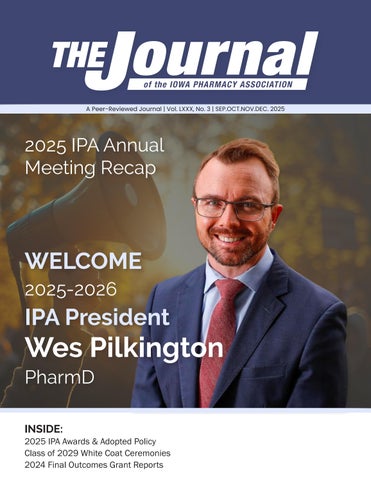
A Peer-Reviewed Journal | Vol. LXXX, No. 3 | SEP.OCT.NOV.DEC. 2025
2025 IPA Annual Meeting Recap
WELCOME 2025-2026
IPA President
Wes Pilkington PharmD INSIDE: 2025 IPA Awards & Adopted Policy Class of 2029 White Coat Ceremonies 2024 Final Outcomes Grant Reports
We Don’t Just Process Claims— We Show Up When It Matters.
When a claim is filed, it’s often during a stressful moment. That’s why Pharmacists Mutual focuses on more than just paperwork. We deliver clarity, speed, and compassion, so you never face uncertainty alone. “Every claim tells a story, and we take that seriously,” says Todd Terhark, Claims Service Manager. “By tracking performance, training continuously, and leading with empathy, our team ensures every policyholder gets the support they need—when it matters most.”
96.1%
of policyholders contacted within 8 business hours
60%
contacted within just 4 hours
Real Stories That Make it Real “Pharmacists Mutual did an amazing job! They were fast, efficient, and helped me through the process. Excellent service over the last 23 years. The claims team called me the same day. I didn’t expect it, and it meant everything to me.” –Pharmacist, Policyholder Imagine discovering an error you were involved in may have harmed a patient—and now you must report it. When you call Pharmacists Mutual, you’ll speak with a claims team that truly understands pharmacy. They know the medications and processes, and they handle your claim with knowledge, compassion, and understanding. –Kristen Jones, PharmD
When time matters, we don’t wait. With over a century of commitment to pharmacy professionals, Pharmacists Mutual is built to be there for you—quickly, personally, and with purpose.
Serving pharmacists coast-to-coast through 45+ state associations
Backed by in-house experts who know the profession
Scan the QR code or call 800.247.5930. phmic.com ©️2025 Pharmacists Mutual Insurance Company and Chiron Insurance Company. All rights reserved. Claims response data based on internal performance metrics collected by Pharmacists Mutual, 2025.
TABLE OF CONTENTS 2570 106th Street, Unit D, Urbandale, IA 50322 Phone: 515.270.0713 Fax: 515.270.2979 Email: ipa@iarx.org | www.iarx.org
PUBLICATION STAFF Allison Hale Luther, Managing Editor Matthew Pitlick, PharmD, BCPS Brian Wall, PharmD, CAE Laura Miller Kellie Staiert, MPA Spencer Short, PharmD
COVER STORY Rebellions Are Built on Hope pg. 4-5
OFFICERS CHAIRMAN Jim Hoehns, PharmD, BCPS, FCCP — Cedar Falls PRESIDENT Wes Pilkington, PharmD — Cedar Falls PRESIDENT-ELECT Heather Ourth, PharmD, BCPS, BCGP, FASHP — West Des Moines TREASURER Kristin Meyer, PharmD, BCGP, CACP, FASCP — Marshalltown
IPA Annual Meeting pg. 6-7
Class of 2029 pg. 22-23
SPEAKER OF THE HOUSE Ryan Jacobsen, PharmD, BCPS — Iowa City VICE SPEAKER OF THE HOUSE Micaela Maeyaert, PharmD, BCPS, DLPA — Spirit Lake
TRUSTEES REGION #1 Kelly Kent, PharmD — Williamsburg REGION #2 Dana McDougall, PharmD, BCPS, BCOP — Hudson REGION #3 Helen Eddy, RPh, MBA — Des Moines REGION #4 Andrew Wagner, PharmD — Eagle Grove AT LARGE Betsie Frey, PharmD, BCPS — Cedar Falls Andy Stessman, PharmD — West Des Moines Omobola Thompson, RPh, MPH — Clive Mylo Wells, PharmD — Bloomfield HONORARY PRESIDENT Greg Johansen, RPh — Cumming
FEATURES 2026 Standard of Care Symposium. . . . . . . . . . . . . . . . . . . . . . 9 2025 IPA Professional Awards . . . . . . . . . . . . . . . . . . . . . . . . . . 10 2025 Speaker’s Address. . . . . . . . . . . . . . . . . . . . . . . . . . . . . . 12 Peer-Reviewed Article: Team-Based Diabetes Care . . . . . . . . . 14 2025 IPA Adopted Policy . . . . . . . . . . . . . . . . . . . . . . . . . . . . . . 18 Peer-Reviewed Article: Cannabis Use Disorder . . . . . . . . . . . . 26 2024 Final Outcomes Grant Reports . . . . . . . . . . . . . . . . . . . . 34 IPA Executive Intern Reflection . . . . . . . . . . . . . . . . . . . . . . . . . 37
IN EVERY ISSUE President’s Page . . . . . . . . . . . . . . . . . . . . . . . . . . . . . . . . . . . . . . 4 CEO’s Column . . . . . . . . . . . . . . . . . . . . . . . . . . . . . . . . . . . . . . . . 8
PHARMACY TECHNICIANS Kimerly Metcalf, CPhT-Adv — Cedar Falls Kelly Andersen, CPhT — Des Moines
Practice Advancement . . . . . . . . . . . . . . . . . . . . . . . . . . . . . . . . 20
STUDENT PHARMACISTS Stacy Johnson — Drake University Ian Patterson — University of Iowa
Public Affairs . . . . . . . . . . . . . . . . . . . . . . . . . . . . . . . . . . . . . . . . 31
The Journal of the Iowa Pharmacy Association is a peer-reviewed publication. Authors are encouraged to submit manuscripts to be considered for publication in the Journal. For author guidelines, see www.iarx.org/journal. “The Journal of the Iowa Pharmacy Association” (ISSN 15257894) publishes 3 issues per year: January/February/March/ April issue; May/June/July/August issue; and September/ October/November/December issue by the Iowa Pharmacy Association, 2570 106th Street, Unit D, Urbandale, IA 50322. POSTMASTER: Send address changes to: The Journal of the Iowa Pharmacy Association, 2570 106th Street, Unit D, Urbandale, IA 50322. Published tri-annually, The Journal is distributed to members as a regular membership service paid for through allocation of membership dues. Subscription rates are $80 per year, single copies are $30. Printed by Mittera; Graphic design by the Iowa Pharmacy Association.
Healthcare Hot Topics . . . . . . . . . . . . . . . . . . . . . . . . . . . . . . . . 24 IPA Foundation . . . . . . . . . . . . . . . . . . . . . . . . . . . . . . . . . . . . . . 33 IPA in Action . . . . . . . . . . . . . . . . . . . . . . . . . . . . . . . . . . . . . . . . 37 Members’ Section . . . . . . . . . . . . . . . . . . . . . . . . . . . . . . . . . . . 40 Calendar of Events . . . . . . . . . . . . . . . . . . . . . . . . . . . . . . . . . . . 42 Time Capsule . . . . . . . . . . . . . . . . . . . . . . . . . . . . . . . . . . . . . . . 43
Mission Statement The Iowa Pharmacy Association empowers the pharmacy profession to improve the health of our communities. SEP.OCT.NOV.DEC. 2025 |
3
PRESIDENT’S PAGE
Rebellions Are Built on Hope Presidential Address — June 5, 2025
Wes Pilkington, PharmD 2025-2026 IPA President Owner & Pharmacist in Charge, Evans Crossing Pharmacy
Before I get started, I have a few special guests here today who traveled long distances to celebrate this accomplishment with me. Sean DeFrates, who traveled from Lake Zurich, Illinois, and Nate Vorac, who traveled from Geneseo, Illinois. Sean and Nate are both fellow pharmacists and friends who have both been great role models for me. It means the world to me to have both of you here. I would also like to call out the IPA staff for all their work to not only make this meeting happen, but for their tireless work every day to ensure we all have an association to call home.
ed myself with. The Evans Crossing Pharmacy staff, Cindy, Kim, Caitleen and pharmacist Jenna Beninga: I can always count you doing things the way I expect them to be done, even when I am not there, and I am tremendously thankful for that. Your kindness to our patients is why they are so loyal to our pharmacy. I am so grateful to have you as employees.
Bob Greenwood: Thank you, Bob, for encouraging me to get involved in IPA and passing along the dream of independent ownership to me. Steve Firman: Steve used to joke that he couldn’t die until I was president of IPA. Thank you, Steve, for always believing in my leadership ability and encouraging my interest in IPA, especially the legislative “Whether you know it or process. Not to get too morbid, not, by being part of this but hopefully we can still share quite a few more Annual Meetorganization, you are ings together.
“
My wife, Sarah, and I always tell our kids to surround themselves with good people. I have had the fortune of surrounding myself with many amazing people over the years, and I fighting in a revolution. attribute much of my success We have collectively Joe Greenwood: You're a great to them being part of my life. I business partner and friend. decided to say no to consider Sarah to be the most Thanks for always making sure important person in my life. I the way things are.” I understand the business side always tell our kids that I am of things. Brent Bovy, Brett lucky to be married to their Hansen, Rob Nichols: Thanks mom because she’s the total for being my smart friends who consistently arm package—she’s beautiful, smart, kind, and funny. me with new ideas to better my pharmacy. Dana Thank you, Sarah, for always supporting me, McDougall: I can always count on Dana to make but especially my involvement in the pharmacy me laugh regardless of the situation. Thanks for profession. Thank you for always being emotionmany years of friendship and many IPA meetings ally invested in the ups and downs with me. Most together. Lastly, thanks to my dad who has shown importantly, thanks for being an amazing wife and me firsthand how important professional involvemother. ment and advocacy can be for my career, and my mom who gave me the gift of gab and served as Sarah and I have three awesome children. Jacob an inspiration for a career in healthcare. is 10 and wants to be a pharmacist when he grows up. He is a clever kid who can pick up a My introduction to independent pharmacy started conversation with any person he encounters. Ryan the summer after my freshman year of college. is 8 and wants to be an NBA player. His growth I had come home for the summer, and my plan chart says he is on track to be the first Pilkington was to continue my lawn mowing gigs from high who is over six feet tall, but if his basketball career school and try to scrape up enough cash to afford doesn’t work out, he’d like to be a scientist. He to screw around until I went back to school in the is very driven and works hard in every aspect of fall. Thankfully, my dad had other plans and said I his life. Anna is 5 and wants to be a neonatologist had one week to screw around. Then, I had to go or as she puts it, a doctor for babies. Anna has a visit all of the pharmacies in town with my resume wonderful singing voice and is incredibly funny. and see if they were hiring. The rest of the family thinks she’ll be on Saturday Night Live someday if that’s what she wants. I went to a few stores who told me they didn’t have room for me and made my way to Bob’s old store I’d like to take just a moment to call out a few on Byron Ave. Bob told me he didn’t have anything more of those good people that I’ve surround-
4 | The Journal of the Iowa Pharmacy Association
PRESIDENT’S PAGE curic nitrate, an emulsifying agent called 3-wea. I use the term pharmaceutical manufacturing lightly because I was part of the line that labeled the bottles, and the manufacturing facility was just an old warehouse in East Waterloo. Leon used to make us take hour-long lunch breaks during our shifts in the pharmacy because he said our brains needed a rest. Leon, Tom, Jerry, Steve the IT guy, and I would pile into my 1992 Chrysler LeBaron convertible, cruise with the top down, and go eat lunch somewhere. Here I was, 19 years old, and these old pharmacists with real salaries thought I was the cool guy because I had a convertible. I really had no idea work was supposed to be this much fun. Things really changed for independent pharmacies by the time I finished pharmacy school and started working at Greenwood Pharmacy in Waterloo. Patient care was always our first goal, but we had a goal that was a close second: survival. This is the way I was taught to operate a pharmacy. The other pharmacy owners in the room have probably had to spend the last decade-plus operating the same way. The goal was to survive so we could continue to provide for our patients while hoping those who govern our state and country would realize if the PBMs were not stopped, none of us would survive. Not only would we not sit idly as pharmacies continued to close in our state, but we would join together and fight to stop it. Whether you know it or not, by being part of this organization, you are fighting in a revolution. We have collectively decided to say no to the way things are. Last year, we said no to the status quo of our profession and passed a bill that allows us to find new and innovative ways to help our patients. This year, we stood toe to toe with some of the biggest companies in the world and, so far, we have won. for me, but he made a call to Leon Galehouse who owned John Deere Pharmacy in Waterloo. Leon was looking to hire so I stopped by with my resume and gave it to Leon who wanted to do an interview on the spot. As we sat down to talk, Leon saw I was an Eagle Scout and pretty much asked when I could start. I spent the next two summers and Christmas breaks working for Leon, and I was introduced to independent pharmacy. I mostly ran the drive-through (which made me never want a drivethrough) and worked to fill and clean the Script Pro machine. I worked with a pharmacist named Tom Rasmussen, who I became good friends with. Tom taught me lots about being a pharmacist, and we shared lots of fun times in the pharmacy. I was also introduced to Jerry Pieters, a retired pharmacist in his mid-seventies who would “work” on Wednesdays for a few hours. I’m not sure Jerry accomplished a whole lot during his shift, and by the end of our time working together, his shift usually just consisted of messing with me and telling lots of incredibly funny stories. I also got inducted into Jerry’s “Circle of Trust,” which gave me my first pharmaceutical manufacturing gig bottling phenylmer-
The fight continues today when, as my first official act as president, I will join other pharmacists in a meeting with Governor Reynolds to urge her to sign this legislation into law. IPA has always served as a beacon of hope. As an organization, we have given hope to not only pharmacies and pharmacists in Iowa, but pharmacies and pharmacists around the country. A hope that you can stand toe to toe with insurance oligarchs and emerge with a victory. I’ve always been a big Star Wars fan. Most stories within the galaxy center around hope. Hope that rebels, with less resources, can defeat the evil Empire and restore peace and freedom in the galaxy. One Star Wars quote I think relates quite well to our profession is, “Rebellions are built on hope.” We have not only given hope that pharmacies can survive but hope that all pharmacists can innovate in ways we never imagined. My charge to you, my friends, is to think not like rebels, but like leaders as we continue to pass this hope to others. Thank you. ■
IPA Presidential Video >>
SEP.OCT.NOV.DEC. 2025 |
5
IPA ANNUAL MEETING
2025 IPA Annual Meeting IPA welcomed nearly 250 pharmacists, pharmacy technicians, student pharmacists, and industry partners to Des Moines for the 2025 Annual Meeting, June 5-6. Themes of tradition, transformation, and a better tomorrow were felt throughout the meeting, not just during Friday’s keynote. The 2025 Annual Meeting highlighted exciting changes at the leadership level—from IPA President Jim Hoehns and CEO Kate Gainer (2011-2025) to IPA President Wes Pilkington and new CEO Matthew Pitlick. Keynote Teresa Peterson, EdD, of the Noll Wilson Group, explored ways to build trust with patients and colleagues alike. Dean Erik Maki of Drake University, Dean Jill Kolesar of the University of Iowa, and IPA’s new CEO, Matthew Pitlick, joined Kate Gainer for a Q&A panel exploring pharmacy trends, challenges, and opportunities for collaboration among the state’s pharmacy trifecta. New in 2025, IPA hosted a trivia-style OTC Challenge, where attendees forged teams and tested their over-the-counter medication knowledge. The 2025 IPA House of Delegates adopted policy related to proactive peer review, jurisprudence examination, pharmacist licensure compacts, residency funding, AI, cybersecurity, at-home pharmacy care, and a New Business Item on yellow fever vaccine stamp certification. See pg. 18 for complete policy statements. ■
6 | The Journal of the Iowa Pharmacy Association
Caricature of IPA President Jim Hoehns
OTC Challenge Trivia
Iowa Pharmacy Trifecta Keynote: Dean Erik Maki, IPA CEO Matt Pitlick, Dean Jill Kolesar
OTC Challenge Trivia
Caricature of IPA CEO Emeritus Kate Gainer
Delegat
te Brianne Bakken
IPA ANNUAL MEETING
Thank You Sponsors APMS Baxter CPESN-Iowa Iowa Total Care Johnson & Johnson Innovative Medicine McKesson Amplify Novo Nordisk Pharmacists Mutual PharmServ Staffing Teva Thrifty White Health Wellmark
Incoming IPA Board Members
2025 Poster Winner Erika Ernst
2025 IPA Foundation Poster Presentation Award
Outgoing IPA Board Members
“Statewide Antimicrobial Stewardship Initiative: A Partnership Between the Iowa Department of Health and Human Services and the University of Iowa College of Pharmacy” — Erika J. Ernst, PharmD; Matthew Witry, PharmD, PhD; Michael Patten, DO; Kenzie Teno, MPH; Abby Hough, RN; DeeAnn Baage, RN; Lisa Vitale, RN; Cole Chapman, PhD Delegate Michael Andreski
Delegate Patty Kumbera
See all IPA Awards on pg. 10
SEP.OCT.NOV.DEC. 2025 |
7
CEO’S COLUMN
Raise the Floor. Lift Iowa.
Matthew Pitlick, PharmD, BCPS Executive Vice President & CEO, Iowa Pharmacy Association
When the IPA Board of Trustees entrusted me with this responsibility, I made two simple promises: listen first and keep the pharmacy community at the center. These first months have reminded me that progress rarely shows up in grand ways. It shows up on a Tuesday afternoon when a pharmacist solves a problem that could have become an emergency by Friday. I’ve also been humbled, truly, by your kindness, gratitude, and support.
When those pieces line up, the patient experience gets better and everyone’s day calms down. “Raise the floor” has taken on a specific meaning for me. It isn’t about setting the bar low; it’s about building a base you can trust. On the payment side, that means a NADAC-based floor with a professional fee so access isn’t underwater. On the clinical side, it means adhering to a standard of care so pharmacists can practice with confidence, in step with the care team. With those floors in place, what happens above them—innovation, collaboration, better outcomes—comes easier. Iowa doesn’t need a slogan; it needs a foundation. That’s what we’re laying.
Our IPA Goes Local visits drove that home. These stops weren’t about slide decks; they were about sitting at your counters, visiting your IV rooms, walking your aisles, and asking honest questions. In rural towns, I heard how clinical services keep a community healthy—and how fragile that Another theme is workforce. “I’ve learned that feels when payment is unpreI’ve met pharmacy technicians change almost never dictable. In health systems, who quietly hold the place I watched pharmacists lower together, student pharmacists looks like a switch readmissions when they’re eager for real patient care, flipping. It looks like fully embedded, then saw the and residents ready to lead. persistence.” reimbursement chase behind If we want them to build their those results. In busy commucareers in Iowa, the work must nity sites, I saw strong vaccine, be meaningful and sustaintesting, and chronic care programs still wrestling able—and we should show proof, not just tell with documentation that should be simpler. The stories. That’s on us: clearer roles, better pathcommon thread wasn’t frustration; it was purways, and data that match what we see every day pose—and a desire to spend more time on care in practice. and less on friction. The footings have been poured with a payment On PBM reform, I’ve learned that change aland clinical floor. Now, we build room by room: most never looks like a switch flipping. It looks SOC in practice, community connections, and fewlike persistence. We’ve defended Iowa’s rules er barriers between intent and care. Doors open, with state and national partners. We’ve turned lights on. One profession, one voice. ■ member stories into clean, credible complaints regulators can use. We’ve had straight talk with self-funded employers who want benefits that buy care, not games. None of it feels fast, but it has moved things: underpayments corrected, timelines clarified, and a wider understanding that rules in Iowa are meant to be followed. Consistent follow-through is powerful.
“
Standard of care (SOC) has been another teacher. SOC isn’t a slogan or a blank check. It’s a floor for professional judgment, a shared understanding that pharmacists should have room on the team and in the workflow to solve the problem in front of the patient. When we talk with physicians and hospital leaders in plain language, we find common ground quickly. We don’t need fancy terms. We need documentation that matches risk, workflows that fit real life, and payment that recognizes routine clinical work without a scavenger hunt.
8 | The Journal of the Iowa Pharmacy Association
Pharmacy Visits Top: UnityPoint Health Allen Hospital Bottom: Reinbeck Pharmacy
7 Hours of CPE* REGISTER TODAY!
JANUARY 31, 2026 WEST DES MOINES, IA 8:00-8:45 AM
Registration, Breakfast & Exhibit Hall
8:45-9:00 AM
Welcome & Opening Remarks
9:00-10:00 AM
Keynote
SOC It to Me: Embracing the Shift, Leading the Change Practice Panel Discussion
10:00-11:00 AM
In My SOC Era: Success Stories on Buy-In, Billing, and Clinical Service Implementation
11:00-11:30 AM
Networking & Exhibit Hall
11:30 AM-12:15 PM
12:15-1:30 PM
Billing and Reimbursement
Essentials for Navigating the Payment Pathway Networking Lunch & Exhibit Hall
The SOC Tank: Where Innovation Gets Real and Patient Care Gets Better Hands-On Workshop
1:30-3:00 PM
From Blueprint to Implementation: Building a SOC-Aligned Service from the Ground Up
3:00-3:30 PM
Networking & Exhibit Hall
3:30-4:00 PM
4:00-4:45 PM
4:45-5:15 PM
5:15-5:30 PM *
Documentation and SOPs
Core Operational Tools for Standard of Care Compliance Branding and Messaging SOC It Out of the Park: Crafting Your Standard of Care Elevator Pitch Next Steps
Aligning Policy and Practice to Drive Implementation and Impact Closing Remarks
Accreditation Pending
WWW.IARX.ORG/SOC_SYMPOSIUM SEP.OCT.NOV.DEC. 2025 |
9
2025 IPA AWARDS
2025 IPA Professional Awards IPA takes great pride in recognizing individuals for their contributions of leadership, patient care, professional involvement, and public service. These awards serve to capture Iowa pharmacy’s spirit of service and its culture of professionalism.
Bowl of Hygeia
Robert G. Gibbs Distinguished Pharmacist
Thomas R. Temple Mentorship Award
Jay Currie, BS Pharm, PharmD, FCCP, FAPhA, Mt. Vernon
Cheryl Clarke, EdD, BS Pharm, FAPhA, Waukee
Excellence in Innovation
Distinguished Young Pharmacist
Health-System Pharmacist
Aaron McDonough, PharmD, North Liberty
Grant Houselog, PharmD, CSPI, Sergeant Bluff
Allie Schlicher, PharmD, BCPS, Ames
Appreciation Award (Corporate)
Appreciation Award (Individual)
Pharmacy Technician of the Year
Jerry Karbeling Leadership
Onnen Company, Urbandale
Sue Mears, RPh, MBA, Urbandale
Molly Walter, CPhT, Coralville
Sabrina Renner (Iowa) Kitri (Kit) Reimer (Drake)
William (Bill) Drilling, RPh, Sioux City
10 | The Journal of the Iowa Pharmacy Association
Honorary President Mike Pursel, BS Pharm, MBA, CHP, Morrison, CO
Patient Care Partner University of Iowa Toxicology Team, Iowa City
AMPLIFY
PATIENT FIRST. PHARMACY FORWARD.
You are here to serve, McKesson is here to amplify At McKesson, our core belief is that the patient comes first. Pharmacists are the healthcare providers that patients see most often. We are committed to protecting and elevating the profession, ensuring pharmacists can continue providing critical services to meet each patient’s needs.
Use Your Voice! • Get active with your state association • Contact your elected officials Download your guide to advocacy here
• Meet your elected officials or give them a tour of your pharmacy
© 2025 McKesson Corporation and/or one of its subsidiaries. All rights reserved. All other products mentioned may be trademarks, service marks or registered trademarks of their respective owners. ISMC-3874250-0125
SPEAKER’S ADDRESS
The Next Chapter of Iowa Pharmacy Speaker’s Address — June 5, 2025 Thank you, Vice Speaker Jacobsen. Good morning fellow delegates and all gathered here today. Welcome to the 61st Iowa Pharmacy Association House of Delegates!
Laura Knockel, PharmD, BCACP 2024-2025 IPA Speaker of the House Clinical Associate Professor, University of Iowa College of Pharmacy
Two years ago, I stood in front of this House and asked you to put your trust in me as Vice Speaker. I talked about pharmacy’s past, present, and future through the eyes of our policies. Serving you and the House of Delegates in this role has been one of my proudest professional accomplishments, so thank you for allowing me this opportunity. It has been my honor to serve as Speaker of the House. The following quote is attributed to Albert Einstein: “The measure of intelligence is the ability to change.” If that is truly the case, I am in a room full of geniuses! While one can make this case each year, it feels like recent years have involved more change than usual, starting with our Pharmacy Practice Act. This House passed policy supporting the development of a task force to modernize the Iowa Pharmacy Practice Act back in 2019. In 2022, policy was passed to support a standard of care regulatory framework. In 2024, House File 555 was signed by the Governor, and our new Practice Act went into effect almost a year ago. I’ll admit, I am still trying to wrap my mind around the concept of “standard of care.” It is defined as: the level of care and service that a reasonably competent and skilled health professional, with a similar background and in a similar setting, would have provided under similar circumstances. This will come as no surprise to some of you, but I am a rule follower. So how am I supposed to practice if there are no brightline rules telling me what I’m allowed to do? At my practice site, if I’m ever unsure or debating how to deal with a situation, I look to my coworkers and ask if they agree with what I’m thinking—a form of peer review. Today, we will vote on policy to help shape our approach regarding proactive peer review in a standard of care model.
12 | The Journal of the Iowa Pharmacy Association
Another significant change in Iowa pharmacy is the PBM bill that so many in this room worked tirelessly to get over the finish line. This work goes back as far as 2002 when a New Business Item was passed in the IPA House of Delegates, calling for legislative action to provide regulatory oversight of pharmacy benefit managers. The state of Iowa passed its first PBM bill in 2007, and now, after four legislative sessions and countless hours of grassroots advocacy, Senate File 383 is awaiting the Governor’s signature. We will also vote on policy regarding artificial intelligence use in pharmacy practice. In full transparency, I asked ChatGPT to brainstorm potential talking points for speaking to pharmacy professionals in a House of Delegates. While it offered broad suggestions, such as “advancing pharmacy practice through legislative innovation,” it lacked the specificity and insight needed for this organization and this House. In many ways, this mirrors how AI can’t fully grasp the individual needs of patients we serve. It did find that Albert Einstein quote for me—but applying that quote meaningfully to my situation was up to me. I think that’s the real takeaway: knowing when and how to use AI effectively, while remembering that we, as professionals, are ultimately the ones responsible for decisions and recommendations during patient care. Having policy on AI allows the Board of Trustees and IPA staff to appropriately represent the organization on this topic. This past year has marked a change in prominent leadership at our two colleges of pharmacy and IPA. Tomorrow, we will hear from Dean Erik Maki from Drake and Dean Jill Kolesar from Iowa, in addition to IPA’s incoming CEO, Matthew Pitlick. We are lucky to have these three leaders moving us forward into the next chapter of pharmacy in Iowa. One thing hasn’t changed—the dedication and efforts of the IPA staff. Thank you to Laura, Brian, Kellie, George, Allison, Amanda, and Dawn for all their behind-the-scenes work. I would be remiss if I didn’t take a moment to thank Kate Gainer for her twenty years of leadership in Iowa pharmacy. The past two years on the
SPEAKER’S ADDRESS Executive Committee have allowed me to witness the passion and care Kate puts in every single day, whether it’s answering texts on a Sunday afternoon about how long a speaker’s address should be or running Executive Committee meetings from her minivan while the kids are at sports practice. Kate, while you may have grown up in Wisconsin, your tireless support of Drake University, the University of Iowa, and the state of Iowa shows us you have some blue, white, black, and gold in your heart next to Badger red. Thank you for everything. Thank you to the Policy Committees on Public and Professional Affairs, in-
cluding Chairs Alex Mersch and Dana McDougall, for providing us with seven strong policy topics and associated statements. Thank you also to the Policy Review Committee for ensuring our policies remain relevant and making recommendations on which policies to archive. And finally, thank you to YOU—everyone in this room. IPA is a strong organization because of you— pharmacists, technicians, and student pharmacists from all parts of the state and all types of practice sites coming together as one profession. I look forward to a productive session of the House. Let’s have a great Annual Meeting! ■
Fuel Exam Confidence with Official PTCB Practice Tools
Candidates using PTCB’s Practice Tools consistently report higher passing rates , giving them the confidence to soar.
Pre-PTCE
Employers and educators can easily support candidates by
PTCE Practice Bank
using PTCB's direct billing service to purchase vouchers online. Get started at ptcb.org
SEP.OCT.NOV.DEC. 2025 |
13
TEAM-BASED DIABETES CARE
Effects on A1c in Patients with Diabetes After One Year of Team-Based Diabetes Care Using a Patient-Centered, Provider-Friendly Platform Authors: McKenna M. Murcek Drake University College of Pharmacy and Health Sciences Pharmacy Intern, Iowa Diabetes Telephone: 402-290-3930 Email: mckenna.murcek@drake.edu Erin M. Maxwell, PharmD Drake University College of Pharmacy and Health Sciences Pharmacy Intern, Iowa Diabetes Telephone: 563-949-2686 Email: erin.maxwell@drake.edu Jamie M. Pitlick, PharmD, BCPS, BC-ADM Professor and Pharmacy Practice Chair Drake University College of Pharmacy and Health Sciences Clinical Pharmacist, Iowa Diabetes Telephone: 515-271-1849 Email: jamie.pitlick@drake.edu Keywords: Multidisciplinary care, Diabetes mellitus, Glycemic control, Healthcare, Pharmacist, Disease management, Collaborative practice Conflict of Interest Statement: The authors have no conflicts of interest to declare related to this publication.
Introduction Team-based care is becoming more common in many healthcare settings. Having multiple healthcare providers involved in a patient’s care allows for many different skill sets to work together to ensure each patient is receiving the best care possible. The American Diabetes Association (ADA) recommends that people with diabetes be treated by a multidisciplinary team and include a list of 11 different types of professionals who should be involved in their care.1 How these team members should interact and what strength each member brings to the team is not defined. Several studies have evaluated the effect of adding a pharmacist to the care team. Results between these studies were consistent in showing that including a pharmacist as a member of the care team led to improvements in outcomes such as A1c and the ability to get A1c to goal faster.2,3,4 A limitation of these studies was a lack of description regarding the specific care that each patient was receiving from the members of the care team. There was no measure of consistency in the education given to patients and members of the multidisciplinary team that saw each patient.
14 | The Journal of the Iowa Pharmacy Association
In a prospective, randomized control study completed by Korcegez, et al5, the effects of a 12-month pharmacist-led care program for patients with type 2 diabetes was evaluated. The intervention group received 5 face-to-face education sessions with the clinical pharmacist that occurred on the same date as their usual physician visits. The pharmacist reviewed medication regimens, provided education regarding diet and exercise, and explained the importance of testing blood sugars to patients. The usual care group received standard care from an outpatient diabetes clinic, not including pharmacist collaboration. After 12 months, the intervention group showed a 0.74 percent reduction in A1c compared to a 0.04 percent reduction for the control group (p<0.001). There was not a significant difference in fasting blood glucose (p=0.410), and there was a 1.24 kg/m2 reduction in BMI for the intervention group in comparison to a 0.4 kg/m2 increase for the usual care group (p<0.001). Tourkmani et al.6 conducted a randomized, parallel-group trial that assessed the difference in outcomes for patients with type 2 diabetes receiving standard care as outlined by the ADA guidelines, or multidisciplinary care. The multidisciplinary care team consisted of a family physician, clinical pharmacy specialist, dietician, diabetic educator, health educator, and social worker. The group receiving multidisciplinary care showed statistically significant (p<0.05) reductions in the percentage of change relative to baseline for A1c (-27.08%), fasting blood glucose (-17.0%), total cholesterol (-9.93%), LDL cholesterol (-11.44%), systolic blood pressure (-1.49%), and diastolic blood pressure (-3.41%). In patients who had an A1c over 10% in the multidisciplinary team care group, there was a significant reduction (p<0.001) from 167 patients at enrollment to 11 patients after intervention. Overall, patients had better outcomes when given care by a multidisciplinary care team compared to standard care alone. Iowa Diabetes is a diabetes-focused institution with a goal to change the future of diabetes through clinical research, education, and technology. Iowa Diabetes utilizes team-based care consisting of a physician, an advanced practitioner, a pharmacist, a dietician, a navigator, and a diabetes technology platform as shown in Figure 1. The approach to team-based care at Iowa Diabetes consists of patients meeting with the diabetes educator prior to meeting with the physician or advanced practitioner at every appointment. This allows for the diabetes educator to assess medication efficacy and educational needs, along with conducting a blood sugar review, and determining if any changes need to be made to discuss with the physician before the physical exam is complete. After the pharmacist and the physician have met
TEAM-BASED DIABETES CARE with the patient, they collaborate to come up with the best care plan for each patient. Utilizing a team-based care approach has allowed Iowa Diabetes to provide specialized care for each and every patient. In addition, the team utilizes a patient-centered, provider-friendly care management platform called Iowa Diabetes Portal (IDP) to expedite the experience. This system helps patients manage blood sugars, medications, laboratory results, doctor visits, and communicate with their care team. This platform can be connected to Iowa Diabetes Pro to allow seamless data exchange and communication between patients and healthcare professionals. Many other diabetes platforms focus simply and only on making glucose data available and are not customizable to each physician/patient’s workflow and needs. This study will assess the outcomes for patients receiving care at Iowa Diabetes, which is needed due to the unique care model that is followed.
Methods This was a retrospective cohort study that evaluated the effects of team-based diabetes care in patients seen at Iowa Diabetes Clinic in West Des Moines, IA, prior to August 30, 2023. The primary outcome was to analyze the difference between A1c values prior to and after 12-15 months of specialized teambased diabetes care. Secondary outcomes included the median difference between weight at initial appointment and weight at follow-up appointment 12-15 months after initial appointment. For patients on continuous glucose monitors (CGMs), we evaluated the median difference between average glucose 14 days prior to first appointment and average glucose 14 days prior to follow-up appointment, which took place 12-15 months after first appointment. In patients with CGMs, we also analyzed the median difference between time in range 14 days prior to initial appointment and time in range 14 days prior to follow-up appointment 12-15 months after initial appointment. For patients who were not using a CGM, we evaluated the median difference between average fasting blood glucose 14 days prior to first appointment and average fasting blood glucose 14 days prior to follow-up appointment 12-15 months after first appointment. Data collection involved gathering previously collected, de-identified A1c values and weights from clinic patients from prior to and after 12-15 months of receiving care at Iowa Diabetes. For those patients with a CGM, previously collected, de-identified CGM reports and trend data were obtained starting 14 days prior to and after 12-15 months of receiving care at Iowa Diabetes. For patients without CGMs, previously collected, de-identified fasting blood glucose readings were gathered starting 14 days before each visit prior to and after 12-15 months of receiving care at Iowa Diabetes. All values were entered into the data collection spreadsheet. The data was analyzed using paired t-tests to identify outcomes compared to the time the values were taken. Means, medians, and standard deviations were used to determine the absolute difference to analyze the primary outcome. Patients were eligible to be included in this study if they were at least 18 years of age or older, had a diagnosis of type 1 or type
2 diabetes mellitus, have been a clinic patient at Iowa Diabetes for at least one year, and have had A1c tests performed at least one year apart. Patients were excluded from this study if they only had one recorded A1c value in the patient chart.
Results A total of 75 patients were included in this study. The mean age of the participants was 57 years (Table 1). Of the 75 patients, 52% were female and 71% had type 2 diabetes. The majority of the patients were Caucasian (79%). As shown in Figure 2 and Table 2, the initial average A1c in this patient population was 8.2±1.7%, and the follow-up average A1c was 7.5±1.6% after 12-15 months of receiving multidisciplinary care. Therefore, there was a statistically significant decrease in average A1c of 0.71±1.3% between baseline and follow-up 12-15 months later (p<0.001). In regards to secondary outcomes, the average initial weight was 207.6±56.5 lbs compared to the weight at follow-up of 202.5±52.7 lbs (Figure 3). This is a decrease of 2.5% from baseline (p=0.024). In the patients who had a CGM to track their blood sugars (n=37), the average initial glucose level was 192.2±52.0 mg/dL versus 179.8±42.8 at follow-up, which showed a 6.4% decrease from baseline (p=0.051). In patients who did not use a CGM (n=10), the 14-day average fasting blood glucose at baseline was 187.9±50.6 mg/dL compared to 138.7±39.7 mg/dL at follow-up (Figure 4), resulting in a decrease of 26.20% from baseline (p=0.017). The average initial time in range value for CGM users was 58.0±26.7% compared to 63.6±22.4% at follow-up. This showed an 8.8% increase from baseline (p=0.092).
Discussion In this retrospective cohort study involving patients over the age of 18 with type 1 or type 2 diabetes, receiving care from a multidisciplinary team led to statistically significant improvements in A1c, weight, and fasting blood glucose data after 12-15 months of specialized team-based care. These outcomes are important in evaluating the level of diabetes control in patients as A1c and fasting blood glucose are two targets that patients with diabetes aim to achieve. The results in this study confirm the findings in previous literature that specialized diabetes care with a multidisciplinary team can improve A1c and other measurements of diabetes such as fasting blood glucose levels. Rothman et al.7 demonstrated that patients treated with a multidisciplinary care team, including a diabetes educator and a pharmacist, had greater improvements in diabetes knowledge and experienced a 0.8% decrease in A1c at 12 months. These results are very similar to the present study as they show the positive impact that multidisciplinary care can have on diabetes management and metabolic targets. This shows a consistency between studies where multidisciplinary teams can lead to better diabetes outcomes and better glycemic control.
SEP.OCT.NOV.DEC. 2025 |
15
TEAM-BASED DIABETES CARE Team-based diabetes care is becoming an increasingly common intervention for the management of diabetes. This model of care gives the patient the opportunity to receive care from different professional perspectives, which provides the patient with a well-rounded care plan. Specialized diabetes care is critical in the management of this disease state as each patient is unique and requires individualized interventions, which a multidisciplinary team can efficiently provide as evidenced in previous studies as well as this present study.
Conclusion
The strengths of this trial include the approximately equal percentage of men and women included in the trial, and the inclusion of both CGM data and self monitoring blood glucose data. Since insurance dictates who can utilize a CGM, it is important to also look at outcomes for our patients who only are able to utilize self monitoring of their blood glucose.
References:
This study had several limitations. For example, there was a strict cutoff date for inclusion of participants. Patients are commonly seen at 3-month, 6-month, 9-month, and 12-month intervals, which led to participants missing the 12-15 month cutoff by a matter of days. Regarding CGM data, it may have been beneficial to analyze time CGM was active. It was noted that time active was increased by the end of the study, which may correlate with minimal improvement in time in range and less improvement in CGM average blood sugars. Another limitation includes the lack of diversity in the study, having 79% Caucasian patients, and 71% of patients with type 2 diabetes. While this is reflective of the patient population at Iowa Diabetes, it leads to a lack of generalizability.
Table 1: Baseline Patient Characteristics
In this retrospective cohort study, multidisciplinary care resulted in statistically significant improvements in A1c, fasting blood glucose data, and weight, and non-significant improvements in CGM average blood glucose and time in range. These results warrant further studies to investigate the limitations listed above and to determine other potential ways that a multidisciplinary care team can positively impact diabetes patient care.
1. American Diabetes Association Professional Practice Committee; 4. Comprehensive Medical Evaluation and Assessment of Comorbidities: Standards of Medical Care in Diabetes—2023. Diabetes Care 1 January 2023; 46 (Supplement_1): S49–S67. doi.org/10.2337/dc23-S004 2. Wagner ML, McCarthy C, Bateman MT, Simmons D, Prioli KM. Pharmacists improve diabetes outcomes: a randomized controlled trial. J Am Pharm Assoc (2003). 2022;62(3):775-782.e3. doi:10.1016/j.japh.2021.12.015 3. Patti M, Colmenares EW, Abrahamson A, et al. Impact of pharmacist participation in the patient care team on value-based health measures. Am J Health Syst Pharm. 2022;79(19):1645-1651. doi:10.1093/ajhp/zxac175 4. Benedict AW, Spence MM, Sie JL, et al. Evaluation of a Pharmacist-Managed Diabetes Program in a Primary Care Setting Within an Integrated Health Care System. J Manag Care Spec Pharm. 2018;24(2):114-122. doi:10.18553/jmcp.2018.24.2.114 5. Korcegez EI, Sancar M, Demirkan K. Effect of a Pharmacist-Led Program on Improving Outcomes in Patients with Type 2 Diabetes Mellitus from Northern Cyprus: A Randomized Controlled Trial. J Manag Care Spec Pharm. 2017;23(5):573-582. doi:10.18553/jmcp.2017.23.5.573 6. Tourkmani AM, Abdelhay O, Alkhashan HI, et al. Impact of an integrated care program on glycemic control and cardiovascular risk factors in patients with type 2 diabetes in Saudi Arabia: an interventional parallel-group controlled study. BMC Fam Pract. 2018;19(1):1. doi:10.1186/s12875017-0677-2 7. Rothman RL, Malone R, Bryant B, et al. A randomized trial of a primary care-based disease management program to improve cardiovascular risk factors and glycated hemoglobin levels in patients with diabetes. Am J Med. 2005;118(3):276-284. doi:10.1016/j.amjmed.2004.09.017
Characteristics
Number of Patients (%)
Female Sex
39 (52)
Male Sex
36 (48)
Age in Years
57 ± 14.7
Measurement, n
Initial
Follow-Up
% Change
p-value
Type 1 Diabetes
22 (29)
8.2 ± 1.7
7.5 ± 1.6
-8.50%
< 0.001
Type 2 Diabetes
53 (71)
Average A1c (%), 75 Average Weight (lbs), 53
207.6 ± 56.5
202.5 ± 52.7
-2.50%
0.024
CGM Average Glucose (mg/dL), 37
192.2 ± 52.0
179.8 ± 42.8
-6.40%
0.051
Average Fasting Blood Glucose (mg/dL), 10
187.9 ± 50.6
138.7 ± 39.7
-26.20%
0.017
CGM Time In Range (%), 36
58.0 ± 26.7
63.6 ± 22.4
-8.80%
0.092
Race Caucasian
59 (79)
African American
2 (3)
Asian
2 (3)
Hispanic
6 (8)
Unknown
6 (8)
Payment Type Cash
42 (56)
Medicare
12 (17)
Free
20 (27)
16 | The Journal of the Iowa Pharmacy Association
Table 2: Average Values
TEAM-BASED DIABETES CARE Figure 1: Team-Based Care Model at Iowa Diabetes Figure 1: Team-Based Care Model at Iowa Diabetes
Figure 2: Change in A1c Value
Figure 3: Change in Weight
Figure 4: 14-Day Average Fasting Blood Glucose
SEP.OCT.NOV.DEC. 2025 |
17
2025 ADOPTED POLICY
Final Policy Statements The following policy was adopted by the IPA House of Delegates during the 2025 IPA Annual Meeting in Des Moines.
25-U1 Proactive Peer Review Supporting Pharmacy Practice in SOC Model
25-R2 Artificial Intelligence Use in Pharmacy Practice
1. IPA supports peer review as a foundational element within the standard of care regulatory framework.
1. IPA encourages judicious use of artificial intelligence by pharmacists and pharmacy personnel as a tool to elevate pharmacy practice and enhance patient care.
2. IPA calls for a customized approach to utilize peer review processes based upon practice settings. 3. IPA encourages the formation of a task force to shape and guide implementation of a proactive peer review. 4. IPA supports the development of educational resources tailored to specific practice settings to facilitate the establishment and implementation of peer review programs.
2. IPA opposes artificial intelligence replacing the pharmacist’s professional, clinical, and ethical judgement. 3. IPA supports pharmacists' involvement in the entire life cycle of artificial intelligence solutions including evaluation, development, regulation, implementation, and maintenance.
25-U2 Jurisprudence Examination
4. IPA advocates for education and training on the lawful, ethical, and clinical use of artificial intelligence.
1. IPA advocates for the assessment of knowledge regarding pharmacy laws, regulations, and policies as a component of pharmacist licensure.
25-R3 Cybersecurity and Data Governance in Pharmacy
2. IPA supports the use of a non-state specific assessment to evaluate minimum jurisprudence knowledge for pharmacist licensure.
1. IPA supports implementation and maintenance of cybersecurity systems that optimize pharmacy care and pharmacist-provided services.
3. IPA encourages collaboration with all key stakeholders to ensure effective and relevant pharmacy jurisprudence competency standards.
2. IPA promotes the development of and education on best practices in data governance and cybersecurity.
25-U3 Pharmacist Licensure Compacts 1. IPA supports utilization of a state pharmacy compact to strengthen the Iowa workforce, reduce pharmacy deserts, and increase access to local healthcare. 2. IPA supports the involvement of the Iowa Board of Pharmacy in compacts to improve license reciprocity, portability, and mobility. 3. IPA encourages a framework that supports license reciprocity, portability, and mobility for practicing under a standard of care model.
25-R1 Residency and Fellowship Funding 1. Reaffirm 03-NBI-01 – Pharmacy Residency Programs. 2. IPA supports government funding for post-graduate pharmacist residency and fellowship training programs regardless of pharmacy practice setting. 3. IPA supports transparency and clear guidance regarding post-graduate residency and fellowship funding requirements and program audits.
18 | The Journal of the Iowa Pharmacy Association
25-R4 At-Home Pharmacy Care Services 1. IPA supports the integration of pharmacy staff in the planning, implementation, and care management of all at-home pharmacy care services. 2. IPA supports all at-home pharmacy care services to improve access, offer personalized patient care, and reduce barriers. 3. IPA supports fair, equitable, and consistent reimbursement by all public and private payers for all at-home pharmacy care services, including those provided by a pharmacist. 4. IPA encourages ongoing research to advance all at-home pharmacy care service models.
25-NBI-1 Pharmacist Eligibility for Yellow Fever Vaccine Stamp Certification 1. IPA supports the recognition of Iowa-licensed pharmacists as eligible healthcare providers to independently hold Yellow Fever vaccine uniform stamp certification. 2. IPA advocates for state policy change to permit pharmacists who meet CDC Yellow Fever vaccine provider training requirements to apply for and maintain this certification, consistent with their immunization authority and scope of practice in Iowa.
Testing is the gateway to HIV prevention & treatment— and you hold the key. Health care providers are essential to ending the HIV epidemic in Iowa. The best first step you can take? Offering routine HIV screening as part of your practice. Diagnosing HIV quickly and linking people to treatment immediately are crucial to reducing HIV transmissions and improving health outcomes for all. Testing for HIV empowers patients, no matter their status. For people living with HIV, diagnosis is the first step in connecting to HIV resources and care. For people who do not have HIV, testing can begin an ongoing conversation about their prevention needs.
Scan our QR code to learn more or visit stophiviowa.org/providers
SEP.OCT.NOV.DEC. 2025 |
19
PRACTICE ADVANCEMENT Pride and Prevention: Expanding HIV Testing Through Local Pharmacies Greenwood Pharmacy staff attended the Cedar Valley Pridefest that was held in downtown Waterloo on August 22-23, providing free HIV tests, education and awareness to attendees. This is the second year Greenwood Pharmacy has attended the festival as part of their participation in the HIV and HCV testing project in collaboration with Iowa HHS Bureau of HIV, STI and Hepatitis and IPA. During the festival, Greenwood Pharmacy completed 15 HIV tests and engaged with more than 100 attendees about the importance of knowing one’s status through regular testing. This outreach also helped raise public awareness about the vital role pharmacists play in HIV testing and treatment and as a trusted access point for care.To learn more about the project, contact Kellie Staiert, IPA’s Director of Grants & Partnerships, at kstaiert@iarx.org.
Iowa Workforce Task Force Since 2019, IPA has been part of the Iowa Workforce Task Force, along with the Iowa Medical Society, Iowa Hospital Association, Iowa Health & Human Services, and the Iowa Primacy Care Association. The goal of this task force is to create unified strategic action to improve the healthcare workforce across disciplines, settings and locations in Iowa. IPA staff attended the Healthcare Workforce Summit organized by the task force in the spring of 2025, which brought together over 70 stakeholders from various healthcare fields to discuss strategies for addressing Iowa’s ongoing healthcare workforce challenges. The goal of the summit was to seek input from healthcare leaders in Iowa communities about the healthcare workforce landscape and to create a strategic action plan to be collaboratively advocated amongst stakeholders to advance the healthcare workforce in Iowa. IPA contributed to ideas and insights, highlighting the critical role pharmacists play in improving access to care in communities across the state. The result of the summit was a statewide strategy with three common, consistent goals: (1) education and training: support early exposure to healthcare careers; (2) recruitment: improve work environments, create competitive employment agreements including pay and loan repayment; and (3) retention: redesign work structures to address burnout, aid employers with culture and work environment awareness. The Iowa Workforce Task Force will continue to convene in 2026 with a focused goal of creating an annual workforce survey to gauge status in various healthcare disciplines across the state and will look to create a website that will provide strategic communications statewide. To learn more about the task force, contact Brian Wall, IPA’s Vice President of Professional Affairs, at bwall@iarx.org.
CHW Alliance Engagement Integration of community health workers (CHW) in pharmacies continues to expand. IPA continues to collaborate with the Iowa CHW Alliance, which represents a range of organizations,
20 | The Journal of the Iowa Pharmacy Association
including state agencies, Iowa Medicaid, academic institutions, funders, local public health agencies, nonprofit and community-based organizations. The CHW Alliance has developed three goal areas guiding its future work: (1) Establish Sustainable Funding Models; (2) Focus on Workforce Development, Retention, and Support; and (3) Increase Awareness and Cross-Sector Partnerships.
University of Iowa and Eli Lilly: Lung Cancer Screening In collaboration with the University of Iowa College of Pharmacy and Eli Lilly, IPA received funding to support pharmacists partnering with primary care providers to advance shared decision-making for lung cancer screenings. IPA will lead the coordination and development of a training program for the pilot pharmacy. As the project launches in 2026, IPA is excited to work alongside the University of Iowa College of Pharmacy and Eli Lilly to advance this important initiative. We look forward to sharing updates with our members and highlighting the pivotal role pharmacists can play in cancer prevention across Iowa.
Cardiovascular Health Improvement The Cardiovascular Health Improvement Grant successfully completed its second year of work in July and is now progressing into its third year. The primary focus of the grant is to improve cardiovascular health and health disparities in patients with hypertension and high cholesterol. The grant is funded by the National Cardiovascular Health Program and CDC. The projects and services the grant funds are provided in collaboration with the Iowa Department of Health and Human Services’ Bureau of Chronic, Congenital and Inherited Conditions. The first cohort of pharmacies have maintained active engagement throughout their projects, which focus on supporting populations at high risk for cardiovascular disease and health disparities. Their projects target health information systems, improving community partnerships, training pharmacy technicians as community health workers, and using multidisciplinary team approaches. Chayla Morris, PharmD, BCACP, Ambulatory Care Clinical Pharmacy Coordinator at Broadlawns Medical Center, has not only been hard at work collecting data from the cohort’s projects but has provided continuing education during IPA Goes Local events. 2025 Goes Local programing, titled “Implementing Iowa’s Pharmacy Standard of Care: From Framework to Practice,” focused on providing pharmacy professionals with a high-level overview of the standard of care framework. The presentations used cardiovascular disease interventions as examples for implementing the standard of care framework and the new Iowa Board of Pharmacy regulations. August (Des Moines) and September’s (Waterloo) events were attended by more than 100 total pharmacists and pharmacy technicians eager to implement new services under standard of care. Please contact Brian Wall (bwall@iarx.org) to learn more about this grant initiative.
Pharmacy Law Resource Available as Membership Add-on THE LIRC INCLUDES: • Monthly email updates
Featuring state and federal updates, opportunities for public comment, newly adopted rules, sign-on letters, and more!
• Detailed regulatory tracker • In-depth FAQ webpage • What, Why & How Podcast
PURCHASE LIRC >>
The Iowa Pharmacy Law & Information Resource Center (LIRC), now completely digital, provides access to an online database containing Iowa Code, Board of Pharmacy rules, Controlled Substance laws, Medicaid and other Healthcare Provider rules, as well as updates and analysis of recent changes, frequently asked questions, and additional resources. The LIRC is your go-to resource for standard of care practice changes, new Board of Pharmacy rules, and more!
EXPLORE LIRC >>
Available on Spotify and Apple Podcasts
$300 VALUE for just $75! (for ENGAGED Pharmacists)
Seeking an educational and accessible law resource? ENGAGED and CONNECTED Pharmacist members can now add a LIRC subscription to their current IPA membership at a discounted rate!
WWW.IARX.ORG/LAWMANUAL
WHITE COAT CEREMONIES
New Students Pursue Dreams September 9, 2025 The 2025-26 academic year has taken off, and the college has welcomed 119 first-year Doctor of Pharmacy (PharmD) students and five graduate students pursuing their Doctor of Philosophy (PhD).
Making History Following Engagement Week, during which PharmD students get to know classmates and faculty, and learn tips for studying, finances, ways to get involved, and more, the Class of 2029 gathered for its Welcome to the Profession White Coat ceremony at UI’s Hancher Auditorium. “Today marks the beginning of a transformative journey—one that connects you to a proud legacy and propels you toward a future of impact,” Jill Kolesar, Dean, Schmidt Chair, and Professor, told students. Marilyn Osterhaus, ’80 BSPh, delivered the keynote address, asking students if they were ready to make history. She is active in local, state, and national pharmacy associations and has held a variety of pharmacy leadership positions. “I encourage you to connect with this new team surrounding you to minimize stress and maximize success,” Osterhaus said.
Several representatives from state and national organizations were on hand, including Iowa Pharmacy Association President-Elect Heather Ourth. Ourth told students, “Know you are joining a profession that is proud of you and invested in your success.”
PhD Pursuit Five graduate students seeking their PhD degree participated in orientation the week prior to classes beginning, getting to know the building, UI medical campus, meeting faculty, and more. Each of the College of Pharmacy’s graduate areas welcomed at least one student. Lilly Duff, Zebulon Gnida, and Dana Sorensen entered the Drug Discovery and Experimental Therapeutics program; Divya Bande joined the Pharmaceutics program; and Gosia Clore is pursuing Health Services Research. When asked why she chose the UI College of Pharmacy, Bande said, “A strong reputation in drug delivery and formulation science. The program’s structure and the supportive departmental culture felt like the right environment for my professional growth.” ■ Top: Aidan Rybialek coated by Professor Laura Knockel Middle: Hannah Worden and Regan Herbst Bottom: New PhD students
Credit: UI Pharmacy
22 | The Journal of the Iowa Pharmacy Association
WHITE COAT CEREMONIES
Drake Healthcare Students Enter Next Chapter at 2025 CPHS White and Blue Coat Ceremonies September 15, 2025 Drake University’s College of Pharmacy and Health Sciences (CPHS) has welcomed a cohort of more than 100 new professional students into its pharmacy, nursing and occupational therapy programs. The College held its annual Coating Ceremonies on August 22, 2025, in Sheslow Auditorium. Incoming graduate students received a white or blue coat, representing their entry into the healthcare profession. Then, students recited the Oath of Professionalism for their chosen path of study. Since 1988, these ceremonies have signified the beginning of a journey for Drake CPHS students. CPHS Dean Erik Maki encouraged incoming students to reflect on the “profound symbolism” of receiving their coat.“In the health professions, a white coat has come to symbolize the authority of science and the art of healing,” Maki said. “It is the symbol of commitment, compassion and care.” Across three ceremonies, CPHS inducted 75 students into the Doctor of Pharmacy (PharmD) Class of 2029, 20 students into the Occupational Therapy Doctorate (OTD) Class of 2028, and 24 students into the Accelerated Bachelor of Science in Nursing (ABSN) Class of 2026.
Pharmacy Drake welcomed 75 new PharmD candidates with their traditional white coats. As the students crossed the stage, faculty members Dr. Darla Eastman and Dr. Wendy Mobley-Bukstein adorned them with their coats for the very first time. “I hope that you wear your white coat each day with pride, humility, and a deep sense of responsibility to improve the lives of others,” Dean Maki said.
Credit: Drake CPHS
Hannah Lester (PharmD ’27) encouraged the incoming students to step out of their comfort zone during their time on campus. “Pharmacy school offers countless opportunities to try something new, whether it’s joining student government, taking a leadership role, going to office hours, or attending events where you don’t know anyone,” Lester said.
Nursing 24 students entered the Accelerated Bachelor of Science in Nursing program this year. This is the second cohort of students entering the one-year program, which launched in 2024. Dr. Abby Rail and Dr. Amanda McGraw, two Nursing faculty members, bestowed white coats to the incoming students. Lance Schmitt, Chief Nursing Officer at Broadlawns Medical Center, congratulated the students on their entrance into the nursing profession and thanked them for pursuing a career in healthcare. “As you stand at the threshold of this noble profession, remember, nursing is not just about treating ailments,” he said. “It’s about caring for the whole person. It’s about listening to the stories that they’re going to tell you, understanding where they’re coming from, meeting them in that space.”
Occupational Therapy 20 students were inducted into the OTD program, receiving a blue coat from OT faculty members Dr. Rachel Allen-McHugh and Dr. Mallory Asbe. The blue coats honor “reconstruction aides,” a group of civilian women who provided occupational therapy to soldiers in World War One. “The uniform of these reconstruction aides was a slate blue, which led the army to refer to these aides as the bluebirds,” Maki said. “It is with pride in honoring the beginning of the profession that we also use the color blue.” Current O2 student Taylor Bohannan (OTD ’27) congratulated her new classmates on their entrance to the program and encouraged them to prepare for the academic challenges ahead. “You will be stretched, you will be molded, you will be tested. But most importantly, you will be strengthened,” Bohannon said. “You will be challenged to think critically, asked for your perspective before being given an answer, (and) reminded time and time again that it depends as you build your unique professional identity.” ■
SEP.OCT.NOV.DEC. 2025 |
23
HEALTHCARE HOT TOPICS
Healthcare Hot Topics Lenacapavir 6-Month Injection Approved for HIV PrEP Yeztugo (lenacapavir) was approved by the FDA in June of 2025. This long-acting injectable is administered twice per year as a preventative drug against Human Immunodeficiency Virus (HIV). Prior to this approval, daily oral tablets Descovy and Truvada and long-acting injectable cabotegravir (administered monthly) were the only FDA-approved PrEP therapies.
have at least one high-risk condition defined in a list compiled by the CDC. The narrowing of indications for the newly approved COVID vaccines and the change in CDC recommendations have left many patients confused and concerned on how they can receive their desired care. Pharmacies and healthcare organizations have also struggled to navigate the new regulations and recommendations.
The World Health Organization (WHO) released guidelines in July addressing lenacapavir’s approval for PrEP therapy, as well as testing strategies for patients utilizing long-acting injectable (LAI) PrEP therapies. The two new recommendations highlighted in the WHO guideline encourage providers to offer lenacapavir as an option for PrEP therapy and share that rapid diagnostic tests can be used to make decisions about initiating, continuing, or stopping LAI PrEP therapy. The approval of this bi-annual injection offers patients a more convenient option for HIV prevention by reducing patient pill burden and improving PrEP therapy adherence.
Some organizations, like the American College of Obstetricians and Gynecologists (ACOG) and the American Academy of Pediatrics (AAP) have released their own vaccination schedules, marking the first time in more than fifteen years that organizations have not deferred to the CDC for the recommended immunization schedule. Although there are other reputable sources for vaccination recommendations, the pharmacist’s ability to administer immunizations often relies on ACIP recommendations. With recommendations being pulled, pharmacists may become limited in what they can administer, insurance companies may not cover certain vaccinations, and doctors may become inundated with immunization consultations or prescription requests—all of which hinder patient care.
COVID-19 Vaccine & ACIP Changes
Advancing AI in Healthcare
In May of 2025, the Department of Health and Human Services (HHS) announced that the recommendation for patients to receive the COVID-19 vaccine was to be removed from the CDC’s immunization schedule for healthy children and pregnant women. The recommendation for individuals 65 years of age and older to receive the vaccine was to remain. Many states, organizations, and health insurance companies rely on recommendations from the CDC and its Advisory Committee on Immunization Practices (ACIP) to develop decisions on immunization protocol. ACIP typically releases its fall immunization recommendations by the beginning of summer. However, the discussion process was halted due to a complete restructuring of the committee in June, with the seventeen sitting committee members removed and replaced by eight new members plus four additional members appointed in September.
The explosion of artificial intelligence (AI) over the last few years has made its way into the healthcare field. Several new AI platforms have been developed that aim to improve the patient and clinician experience, including IntelePeer, athenaOne, and many more. ASHP has launched a case study library for healthcare professionals to share their experiences using AI with other practitioners. Innovation has become a major focus for many healthcare institutions, as well as considerations for the adoption of AI tools. There are already several examples of AI implementation in healthcare—from drug information to risk stratification for ICU patients.
In August of 2025, the FDA approved the Pfizer, Moderna, and Novavax 2025-2026 COVID-19 vaccines and narrowed the indication to adults 65 and older and individuals less than 65 who
24 | The Journal of the Iowa Pharmacy Association
At the Epic Systems’ annual Users Group Meeting in August, the popular EMR company shared new AI capabilities the platform would be offering. Some of the new tools include Art for Clinicians, a clinical assistant; Emmie, a patient-facing chatbot; and Penny, a revenue management assistant. With increased access and input from AI tools, practitioners are faced with the challenge of balancing AI utilization with other components of evidence-based care.
HEALTHCARE HOT TOPICS Registry has served the state by providing data about cancer incidence and supporting research on the etiology, prevention, and control of cancer. In 2025, the Iowa Cancer Registry initiated the 99 Counties Project, which aims to increase awareness about cancer throughout all of Iowa’s counties. This project provides resources on how communities can work to lower cancer risk through advocacy, education, and support.
Rising Cancer Rates in Iowa Since 2015, the state of Iowa has seen a rise in cancer rates. As of 2025, Iowa has the second fastest growing rate of new cancer diagnoses in the United States, second to Kentucky. With the national cancer incidence rate declining, healthcare professionals and patients alike are wondering what can be done in Iowa to fight the rise in cancer. Since 1973, the Iowa Cancer
The Iowa Cancer Registry also releases a yearly report that focuses on a specific metric related to cancer. The 2025 Cancer Report focused on cancer survivorship, a measure often overlooked. As cancer cases grow, more patients are expected to go through cancer treatments. Pharmacists are in a unique position to play a significant role in educating patients on how their cancer medications work, the importance of adherence, potential drug interactions, and how to manage side effects. With the implementation of standard of care, Iowa pharmacies have the opportunity to expand their offerings to provide greater access to cancer screenings, education, and supportive services. Awareness, advocacy, and education will be important in the coming years to support Iowans navigating this rising rate.
SEP.OCT.NOV.DEC. 2025 |
25
CANNABIS USE DISORDER
Efficacy of an Academic Summit to Inform and Destigmatize Cannabis Use on a Small University Campus Authors: Caesar Yeaman, PharmD, MS(HIA), EBHC, College of Pharmacy and Health Sciences, Drake University, Des Moines, IA, USA Braden Weiser, PharmD, BS, College of Pharmacy and Health Sciences, Drake University, Des Moines, IA, USA Nirjan Bhattarai, PharmD, MS(HIA), BAL, College of Pharmacy and Health Sciences, Drake University, Des Moines, IA, USA Sarah Grady, PharmD, BCPS, BCPP, College of Pharmacy and Health Sciences, Drake University, Des Moines, IA, USA Anna Shook, PharmD, BCPS, BCOP, College of Pharmacy and Health Sciences, Drake University, Des Moines, IA, USA Ginelle Bryant, PharmD, BCPS, College of Pharmacy and Health Sciences, Drake University, Des Moines, IA, USA Kristin Meyer, PharmD, BCGP, FASCP, College of Pharmacy and Health Sciences, Drake University, Des Moines, IA, USA Address correspondence to Sarah Grady: Email: sarah.grady@drake.edu Phone: +1 (515) 271-2296 The authors declare that they have no known competing financial interests or personal relationships that could have appeared to influence the work reported in this paper.
Background Cannabis is the most used federally illegal substance in the United States, with around 20% of Americans having used the drug at least once as of 2019.1 The prevalence is increasing as more states permit medicinal or recreational use of the substance.2 However, education regarding cannabis appears to be lacking among the public and even healthcare professionals, with many not fully understanding its risks and potential benefits.3 Cannabinoids have demonstrated several medically useful effects and are used to treat a variety of conditions, including chemotherapy-induced nausea and vomiting.4 However, tetrahydrocannabinol (THC) has been linked to several deleterious outcomes, including a dramatic impact on memory, attention, learning ability, depression, anxiety, and lifetime suicidality.5-9 There is also evidence suggesting young adults with developing brains are at an increased risk of harmful effects from THC, and a positive association has been observed with school dropout, truancy, and unemployment.10-11 Thus, it is particularly important to target a college audience when discussing cannabis use.
26 | The Journal of the Iowa Pharmacy Association
Cannabis use disorder (CUD) was 30% prevalent among cannabis users between 2012 and 2013.12-13 These statistics are concerning when considering the increase in cannabis-related emergency department visits per capita between 2006 and 2018, especially in the American Midwest. One potential contributor to this phenomenon is the increased incidence of the more-potent synthetic THC exposure from 2016 to 2019 in the American Midwest.14 However, stigma and a lack of awareness or understanding by healthcare professionals or the public may prevent people with CUD from receiving help when needed. A survey of the general US population revealed the treatment rate of CUD to be 13.7%, indicating a need for promotional intervention.15 A systematic review was conducted, which included 13 published and unpublished studies with various designs but moderately strong methodological quality.16 Among other meaningful interventions, it found communicating positive stories of people with substance use disorders to be an effective strategy for addressing social stigma. As for changing structural stigma, conventional healthcare education was found to be effective. There is a paucity of research regarding cannabis education, but three cohort studies have demonstrated improved knowledge and attitudes toward opioid and alcohol use disorders following various educational interventions.17-19 A variety of surveys were used between these studies, the most validated of which being the Opening Minds Scale (OMS) established by the Mental Health Commission of Canada in 2009. These methods and results are consistent with similar research previously conducted by members of this team.20-21 This study aims to assess the utility of implementing an educational intervention to destigmatize and improve factual understanding of cannabis use on a small university’s campus.
Methods A two-hour, live educational summit regarding cannabis use was held at a private midwestern university in April 2023. The university enrolls approximately 3,000 undergraduate and 2,000 graduate students, offering more than 100 majors and 35 graduate degrees, including healthcare degrees in fields such as pharmacy. However, education about cannabinoids has been lacking. The summit featured several speakers presenting in lecture format for 20-25 minutes each. First, a professor of pharmacology established the mechanism of action of cannabinoids and
CANNABIS USE DISORDER their effects in humans. Then, a panel composed of a psychiatrist, psychiatric resident, and psychiatric pharmacist discussed therapeutic considerations of cannabinoids, sharing their experiences with patients using cannabis. Finally, a prosecutor specializing in drug-related crimes spoke about the evolving legal and political landscape surrounding cannabis use. Time was left after each section for questions. All students and faculty at the university were invited to attend the summit. Attendees were asked immediately before and after the event to complete an identical survey. Speakers did not complete the survey. After collecting informed consent and pertinent demographic data, the survey presented six statements to assess understanding of fundamental concepts and six statements to assess stigma, adapted from the OMS. Responses were recorded on a five-point Likert scale, ranging from strongly disagree to strongly agree. Participants were allowed to answer any or all of the survey questions posed. This study was approved by the institutional review board at the university. Statements to assess factual understanding and stigma can be found in Table 1. The goal of this intervention was to increase factual understanding and decrease stigma related to cannabis use. Greater values were indicative of more stigma for the first, second, third, and sixth questions, whereas greater values were indicative of less stigma for the fourth and fifth questions. Greater values were indicative of increased factual understanding for the eighth through 11th questions, whereas greater values were indicative of decreased factual understanding for the seventh and 12th questions.
Statistical Analysis The study utilized a modified intention-to-treat population including all participants that submitted an answer to at least one survey question. Shapiro-Wilk tests were conducted to check for normality of the data. Normally distributed data were reported as means (95% CI) and two-sided paired t tests were performed. Data that did not distribute normally were reported as medians (IQR) and two-sided Wilcoxon signed rank tests were performed. Although data could not be matched, they remained related and dependent. Since they were continuous in theoretical nature, assumptions for these tests were met. A significance level of 0.05 was selected for all tests between preand post-intervention survey results. An a priori power analysis with the `pwr` package, version 1.3-0, in R, using a Cohen’s d of 0.5, revealed sample sizes of 34 and 38 to be necessary to achieve 80% power for paired t tests and signed rank tests, respectively. Subgroup analyses were completed to compare the effectiveness of the intervention between genders, races and ethnicities, professions or fields of study, status as a student or faculty, if one belongs to a fraternity or sorority, whether one is an athlete, and the greatest degree of legality given to cannabis in a state where the respondent has lived for at least one year. RStudio 2023.03.0+386 was used for all statistical analyses.
Results Seventy-three attendees submitted survey responses before the symposium and 54 attendees submitted survey responses after the symposium. Demographic proportionality can be viewed in Table 2. There may have been a difference between groups regarding the legality of cannabis in any of the respondent’s home states during their residence, at least between the “medical” and “unknown” options, with responses for the former increasing in number while the latter lost respondents. This can be explained by attendees learning that the state law permits the medical use of cannabis during the seminar. Significant improvements were found between pre- and post-intervention responses for one measure of stigma and four measures of factual understanding (Table 3 and Figure 1). However, one measure of factual understanding was significantly worse after the symposium than before.
Conclusions The seminar was mostly effective at improving factual understanding with the effects of cannabis use, with a greater number of attendees being more able to recognize the signs and symptoms of withdrawal, explain the increased potency of cannabis over the past several decades, and understand the fundamental laws relating to THC and CBD products by the end. Furthermore, attendees left the symposium with a more complete understanding of the risks that come with cannabis use than they had before. Implementing a teaching model like the one used here may reproduce this effect. Given the sizable and growing prevalence of cannabis use, this information is valuable to the public and especially healthcare professionals. By the symposium’s end, however, fewer attendees believed cannabinoids could be used to treat certain health conditions than in the beginning. This shortcoming can be explained by a perceived emphasis toward the dangers of cannabis use, so the potential benefits should be made clearer when teaching about the drug in contexts such as oncology or neurology. The seminar also failed to decrease the number of attendees believing most cannabis users have CUD, but most attendees already doubted this claim beforehand. Thus, it may not be necessary to extensively teach this point. Unfortunately, this study was unable to conduct a longitudinal follow-up so the long-term effects of the seminar were unable to be analyzed. The seminar was less successful at reducing cannabis-related stigma. By the end, fewer attendees believed cannabis use is an unhealthy coping mechanism than in the beginning, but there was no significant change in the responses to statements 1, 3, 4, and 6. Unfortunately, someone capable and willing to share personal experiences from CUD and their recovery could not be found to present at the event, which may have contributed. At baseline, though, most attendees already agreed they would hire someone with managed CUD or tell a friend if they suspected themselves of having CUD, with responses heavily skewed toward strong agreement.
SEP.OCT.NOV.DEC. 2025 |
27
CANNABIS USE DISORDER These findings suggest a lack of need to destigmatize cannabis use, but this is not consistent with the other statements, the baseline responses to which indicated a considerable amount of stigma. However, lecture-style teaching, while not completely ineffective, does not appear to be best suited for destigmatizing cannabis use. This is supported by Knaack et al.18 more than the research preceding it, so it is possible the content of this symposium was not geared enough toward destigmatization. An interactive social contact, like discussions with someone who has experienced CUD, may be more effective to destigmatize cannabis use. The symposium demonstrated several key strengths that contributed to its impact and effectiveness. Notably, it engaged a diverse audience beyond just health professions students, broadening its reach and fostering interdisciplinary dialogue on cannabis use and its implications. Additionally, the study incorporated a comprehensive range of measurements, allowing for a more nuanced analysis of the symposium’s effects. To ensure credibility and reliability, the survey questions were adapted from a validated instrument, reinforcing the strength of the data collected. Furthermore, at the time of its presentation in April 2023, this symposium was the first of its kind to be held on a college campus, marking a significant milestone in cannabis-related education and advocacy within an academic setting. A primary limitation was the lack of matched pre- and post-survey responses due to logistical constraints, preventing the ability to analyze dropout rates or changes in knowledge and stigma at both the demographic and individual levels. Additionally, resource and time limitations restricted the seminar to a single large session rather than multiple smaller ones, which may have affected engagement and retention. Lastly, the sample size lacked the statistical power necessary to perform subgroup analyses, limiting the ability to draw conclusions about specific populations. Addressing these limitations in future iterations could enhance the effectiveness of similar educational interventions. Depending on the desired results, the intervention may then be adapted and reproduced for future use. Our results suggest a lecture-style teaching method may be sufficient to teach students the fundamental science along with risks and potential benefits of cannabis use. While we achieved some of the symposium’s goals, there was a notable 26% dropout rate between the pre- and post-surveys, and several measures of stigma showed no significant change. Utilizing alternative learning methods, such as active learning and organizing speakers into distinct sessions, may have yielded better results and improved participant retention.22 Successful educational strategies for CUD could stand to improve community safety and productivity.
References: 1. Substance Abuse and Mental Health Services Administration. (2021). Key substance use and mental health indicators in the United States: Results from the 2020 National Survey on Drug Use and Health (HHS Publication No. PEP21-07-01-003, NSDUH Series H-56). Rockville, MD: Center for Behavioral Health Statistics and Quality, Substance Abuse and Mental Health Services Administration. https://www.samhsa.gov/data.
28 | The Journal of the Iowa Pharmacy Association
2. Martins SS, Levy NS, Bruzelius E, Segura LE. Cannabis legalization in the US. Where do we go from here? Trends Psychiatry Psychother. 2022;44(Suppl 1):1-6. 3. Kruger DJ, Kruger JS, Bednarczyk EM, Prescott WA. Cannabis education in United States Pharmacy Colleges and Schools. JACCP. 2021;4(5):616-621. doi:https://doi.org/10.1002/jac5.1400 4. Vorvick L. Medical marijuana: MedlinePlus Medical Encyclopedia. Medlineplus.gov. Published 2017. https://medlineplus.gov/ency/patientinstructions/000899.htm. 5. National Academies of Sciences E. The Health Effects of Cannabis and Cannabinoids: The Current State of Evidence and Recommendations for Research.; 2017. https://nap.nationalacademies.org/catalog/24625/thehealth-effects-of-cannabis-and-cannabinoids-the-current-state 6. Degenhardt L, Hall W, Lynskey M. Alcohol, cannabis and tobacco use among Australians: a comparison of their associations with other drug use and use disorders, affective and anxiety disorders, and psychosis. Addiction. 2001;96(11):1603-1614. 7. Patton GC. Cannabis Use and Mental Health in Young people: Cohort Study. BMJ. 2002;325(7374):1195-1198. 8. Reiman A. Cannabis as a substitute for alcohol and other drugs. Harm Reduction Journal. 2009;6(1):35. doi:https://doi.org/10.1186/14777517-6-35. 9. Rey JM, Martin A, Krabman P. Is the Party Over? Cannabis and Juvenile Psychiatric Disorder: The Past 10 Years. J Am Acad Child Adolesc Psychiatry. 2004;43(10):1194-205. 10. Batalla A, Bhattachayyria S, Yucel M, et al. Structural and functional imaging studies in chronic cannabis users: a systematic review of adolescent and adult findings. PLoS One. 2013;8(2):e55821. 11. Lynskey M, Hall W. The effects of adolescent cannabis use on educational attainment: a review. Addiction. 2000 Nov;95(11), 1621–1630. 12. Lopez-Quintero C, Cobos JP de los, Hasin DS, et al. Probability and predictors of transition from first use to dependence on nicotine, alcohol, cannabis, and cocaine: Results of the National Epidemiologic Survey on Alcohol and Related Conditions (NESARC). Drug Alcohol Depend. 2011;115(1-2):120-130. 13. Hasin DS, Saha TD, Kerridge BT, et al. Prevalence of Marijuana Use Disorders in the United States Between 2001-2002 and 2012-2013. JAMA Psychiatry. 2015 Dec;72(12):1235–1242. https://doi.org/10.1001/jamapsychiatry.2015.1858 14. Roehler DR, Hoots BE, Holland KM, et al. Trends and characteristics of cannabis-associated emergency department visits in the United States, 2006-2018. Drug Alcohol Depend. 2022 Mar 1;232:109288. 15. Kerridge BT, Mauro PM, Chou SP, et al. Predictors of treatment utilization and barriers to treatment utilization among individuals with lifetime cannabis use disorder in the United States. Drug Alcohol Depend. 2017;181:223–228. https://doi.org/10.1016/j.drugalcdep.2017.09.032. 16. Livingston JD, Milne T, Fang ML, Amari E. The effectiveness of interventions for reducing stigma related to substance use disorders: a systematic review. Addiction. 2012;107(1):39-50. doi:10.1111/j.13600443.2011.03601.x 17. Lam JA, Lee HIS, Truong AQ, et al. Brief video intervention to improve attitudes throughout medications for opioid use disorder in a correctional setting. J Subst Abuse Treat. 2019;104:28-33. doi:10.1016/j. jsat.2019.06.001 18. Knaak S, Besharah J, Billeett M, et al. Measuring the Influence of Curricular Content and Personal Stories on Substance Use Stigma. J Nurs Educ. 2022;61(5):264–267. https://doi.org/10.3928/01484834-2022030308. 19. Dion K, Griggs S. Teaching Those Who Care How to Care for a Person With Substance Use Disorder. Nurse Educ. 2020;45(6):321-325. doi:10.1097/ NNE.0000000000000808 20. Countey H, Steinbronn C, Grady SE. Changing student attitudes and perceptions toward opioid use disorder. Ment Health Clin. 2018;8(5):222226. Published 2018 Aug 30. doi:10.9740/mhc.2018.09.222 21. Enzmann M, Reiter D, Grady SE, Ulrich E. Decreasing the stigma surrounding alcohol use disorder. Curr Pharm Teach Learn. 2021;13(1):36-41. doi:10.1016/j.cptl.2020.08.001 22. Freeman S, Eddy SL, McDonough M, et al. Active learning increases student performance in science, engineering, and mathematics. Proc Natl Acad Sci U S A. 2014;111(23):8410-8415. doi:10.1073/ pnas.1319030111
CANNABIS USE DISORDER Table 1: Statements used to assess factual understanding and stigma. Stigma Assessment Statements
Factual Understanding Assessment Statements
1. I would be more comfortable helping a person who has diabetes than someone who suffers from cannabis use disorder.
7. Cannabis is safe for anyone to use.
2. Cannabis use disorder results from an inability to cope with stress in a healthy way.
8. I know and can recognize the signs and symptoms of cannabis use withdrawal.
3. I would be reluctant to seek help if I suspected myself of having cannabis use disorder.
9. Cannabinoids (like THC and CBD) are useful to treat various health conditions.
4. If I were an employer, I would consider hiring a person with managed cannabis use disorder.
10. I would feel comfortable explaining the change in potency of cannabis, if any, over the last several decades.
5. If I suspected myself of having cannabis use disorder, I would tell my friends.
11. I would feel comfortable explaining the basic law surrounding THC and CBD.
6. If a person with cannabis use disorder complains of physical symptoms (like nausea or headache), I would likely attribute them to cannabis use.
12. Most people who use marijuana have marijuana use disorder.
Table 2: A summary of demographics responding before and after the symposium. Demographic
Pre-Event Survey
Post-Event Survey
n (%)
73 (100)
54 (100)
Gender
Female: 44 (60.8) Male: 28 (37.8) Nonbinary: 1 (1.4)
Female: 34 (63) Male: 20 (37) Nonbinary: 0 (0)
Race/Ethnicity
Asian: 10 (13.5) Black: 2 (2.7) Hispanic/Latino: 1 (1.4) White: 55 (75.6) Multiple: 4 (5.4) Other: 1 (1.4)
Asian: 8 (14.8) Black: 2 (3.7) Hispanic/Latino: 1 (1.9) White: 40 (74) Multiple: 2 (3.7) Other: 1 (1.9)
Profession or Study
Business: 5 (6.8) Health Sciences: 3 (4.1) Journalism: 2 (2.7) Law: 2 (4.1) Liberal Arts: 4 (5.4) Medicine: 6 (8.1) Nursing: 2 (2.7) Pharmacy: 47 (63.4) Other: 2 (2.7)
Business: 2 (3.7) Health Sciences: 2 (3.7) Journalism: 1 (1.9) Law: 1 (1.9) Liberal Arts: 0 (0) Medicine: 5 (9.3) Nursing: 2 (3.7) Pharmacy: 39 (72.1) Other: 2 (3.7)
Institutional Status
Faculty/Staff: 5 (6.8) Graduate: 31 (41.9) Undergraduate: 32 (44.5) Other: 5 (6.8)
Faculty/Staff: 4 (7.4) Graduate: 28 (51.9) Undergraduate: 16 (29.6) Other: 6 (11.1)
Greek Membership
No: 44 (59.5) Yes: 29 (40.5)
No: 40 (74.1) Yes: 14 (25.9)
Athletic Participation
No: 69 (94.5) Yes: 4 (5.5)
No: 51 (94.4) Yes: 3 (5.6)
Cannabis Legality in Home State at Any Time
Illegal: 15 (20.5) Medical: 23 (31.5) Recreational: 24 (32.9) Unknown: 11 (15.1)
Illegal: 9 (16.7) Medical: 31 (57.3) Recreational: 13 (24.1) Unknown: 1 (1.9) SEP.OCT.NOV.DEC. 2025 |
29
CANNABIS USE DISORDER Table 3: Median (IQR) survey responses before and after event, with Wilcoxon result reported for each statement. 2 corresponds to strong disagreement, -1 to disagreement, 0 to neutrality, 1 to agreement, and 2 to strong agreement. The first six statements assess stigma while seventh through 12th assess factual understanding with the effects of cannabis use. *p < 0.05, ⸸Desired outcome. Statement
Pre-Event Survey
Post-Event Survey
p-value
1
0 (-1, 1)
0 (-1, 1)
0.3322
2
0 (-1, 1)
0 (-1, 0)
0.01219*⸸
3
0 (-1, 1)
0 (-1, 1)
0.3835
4
1 (0, 1)
1 (0, 1)
0.8991
5
1 (0, 1)
1 (0, 1)
0.2572
6
0 (-1, 1)
0 (-1, 0)
0.2162
7
-1 (-1, 0)
-1 (-2, -1)
0.02387*⸸
8
0 (-1, 1)
1 (1, 1)
<0.01*⸸
9
1 (1, 2)
1 (0, 1)
<0.01*
10
-1 (-1, 0)
1 (1, 1)
<0.01*⸸
11
-1 (-1, 0)
1 (1, 1)
<0.01*⸸
12
-1 (-2, 0)
-1 (-1, 0)
0.3533
Figure 1: A box plot of survey responses for each statement before and after the event, with whiskers extending to 1.5 times the
IQR. -2 corresponds to strong disagreement, -1 to disagreement, 0 to neutrality, 1 to agreement, and 2 to strong agreement. The first six statements assess stigma while seventh through 12th assess factual understanding with the effects of cannabis use. *p < 0.05, ⸸Desired outcome.
30 | The Journal of the Iowa Pharmacy Association
PUBLIC AFFAIRS
State Update Updated Board of Pharmacy Rules Take Effect On May 23, 2025, IPA held a webinar on the pharmacy rule changes under 481 Iowa Administrative Code (Chapters 550557) with guests Anne Schlepphorst, Executive Director of the Iowa Board of Pharmacy, and Larry Johnson, former Director of the Department of Inspections, Appeals, and Licensing (DIAL). The updated rules allow for full implementation of standard of care within the state of Iowa following passage of HF 555 in April of 2024. On July 14, the Iowa Board of Pharmacy brought forth the new pharmacy practice rules to the Administrative Rules Review Committee (ARRC) for approval, with an intended effective date of August 1, 2025. During the ARRC hearing, Novo Nordisk raised concerns that the new rules would allow for unsafe compounding practices. As a result, ARRC voted to delay implementation of the new rules by 70 days and provide an additional hearing on August 11. During the August 11 hearing, IPA members testified before ARRC to address Novo Nordisk’s concerns. Sue Mears, pharmacist compliance officer with the Iowa Board of Pharmacy, explained that the new rules would put the state of Iowa in alignment with the federal government’s compounding regulations and guidance. Aaron McDonough, PharmD, pharmacist at Towncrest Pharmacy, and Adam Jones, PharmD, MBA, BCSCP,
pharmacist at the University of Iowa Health Care, testified alongside IPA CEO Matt Pitlick, PharmD, BCPS, and Iowa Representative Brett Barker, PharmD, answering additional questions about current compounding practices in Iowa and the effect of the new rules. ARRC voted to lift the remainder of the 70-day delay, resulting in the immediate implementation of 481 IAC (Chapters 550-557), effective August 11, 2025.
Summer IPPAC Support The Iowa Pharmacy Political Action Committee (IPPAC) is a fund used to strategically strengthen relationships with legislators who are supportive of pharmacy interests. Over the summer, IPA staff and our contract lobbyists were hard at work arranging meetings between IPA members and Iowa legislators to deliver checks and discuss key issues impacting the profession. These conversations covered PBM reform, 340B, and reimbursement, among other issues. To date, the IPPAC has distributed $6,000 to 10 legislators in 2025. These efforts are vital to advancing IPA’s legislative priorities during the 2026 Legislative Session. Learn more and donate today at www.iarx.org/IPPAC.
Rep. David Young
Rep. Shannon Lundgren
Federal Update One Big Beautiful Bill Act On May 20, 2025, the U.S. House of Representatives passed its version of the One Big Beautiful Bill Act (H.R. 1) by a single vote margin. The legislation intended to exclude site-neutral payment reforms and changes to the 340B Drug Pricing Program, as well as delay cuts to Medicaid Disproportionate Share Hospital (DSH) payments. The legislation also aimed to curb PBM spread pricing by requiring transparent pass-through pricing models to ensure rebates, discounts, and incentive payments flow back to the plan sponsor when tied to service fees. On June 26, the legislation was stripped of its Medicaid PBM reforms, and on June 29, the mandate that pharmacies participate in the National Average Drug Acquisition Cost (NADAC) survey was removed. The American Pharmacists Association (APhA) had lobbied for the removal of the NADAC provisions, as it was believed that without PBM reform provisions, the legislation would cause inflated drug prices and pharmacy closures.
The One Big Beautiful Bill Act was passed by Congress on July 3 and signed into law by President Trump on July 4. While the full effects of the legislation have yet to be realized, there are some key estimates on the effects it will have on Medicaid and the 340B Program. As a result, states are expected to increase their Medicaid funding obligations to maintain current expenditures. Over the next decade, the Congressional Budget Office (CBO) estimates $1.2 trillion spent primarily through Medicaid will be reduced, with decreases of $326B in Medicaid work requirements, $200B in Medicaid eligibility changes, and $340B in Medicaid provider tax reductions. Disproportionate Share Hospitals (DSHs) are likely to be negatively impacted, as their large percentage of Medicaid and uninsured patients qualify them for the 340B program. Due to the estimated 16 million people who will lose their Medicaid coverage, DSHs may subsequently lose their 340B eligibility.
SEP.OCT.NOV.DEC. 2025 |
31
PUBLIC AFFAIRS
PBM Reform (SF 383) Update Iowa’s PBM reform law (SF 383) has faced many hurdles in recent months, but IPA remains committed to defending the law and the pharmacies and patients it protects. Signed by Governor Kim Reynolds on June 11, 2025, SF 383 combats discriminatory practices by pharmacy benefit managers (PBMs), restores patient choice (anti-steering, anti-mandatory mail order provisions), and enforces adequate reimbursement to Iowa pharmacies (NADAC + $10.68). Additionally, the law regulates the use of spread pricing, requires regular reporting by PBMs, and aligns with reforms passed in other states.
and, following appeals from both sides, the State of Iowa submitted its opening brief on October 1.
On June 23, opponents of SF 383, including the Iowa Association of Business and Industry (ABI), Iowa Bankers Association and others, filed a lawsuit in federal court. The temporary restraining order (TRO) was granted on June 30, pausing enforcement of SF 383 for the named plaintiffs.
Looking Ahead
On July 1, SF 383 took effect for all fully insured health plans regulated by the Iowa Insurance Division, as well as self-funded plans not named in the lawsuit. Later that month, a federal judge granted a preliminary injunction that blocked most of SF 383 from being enforced against the ERISA-regulated health plans in the case. The case moved to the Eight Circuit Court,
An Update from PAAS National®: PBMs Are Criticizing Clinical Notes! By Trenton Thiede, PharmD, MBA, President at PAAS National®, expert third party audit assistance, FWA/HIPAA and USP 800 compliance Calling a prescriber’s office due to a prescription with missing elements, or needing clarification, is an inescapable task. If you are failing to document that phone call with a valid clinical note, PBMs may flag the claim upon audit and try to recoup. We have seen OptumRx, Humana, Navitus, and ESI/Prime results citing pharmacy clinical notes. Many of the provider manuals have language on what a valid clinical note should minimally contain. Our experience upon reviewing audit documents, results, and provider manuals is that a clinical note should contain four elements. If the following elements for a clinical note are present, they will reduce an auditor’s ability to recoup upon audit. PAAS National® recommends these four elements be attached to all clinical notes: 1. Date/Time of the call/conversation 2. Name and title of who you spoke with 3. Specific details about the clarification 4. Initials or name of the pharmacy employee making the clarification
32 | The Journal of the Iowa Pharmacy Association
On October 14, Wellmark BCBS filed its own complaint, mimicking ABI and the Iowa Bankers Association’s lawsuit. The preliminary injunction was granted, effective October 28, 2025, restraining the Iowa Insurance Division from enforcing the same provisions enjoined in the ABI/Iowa Bankers’ case as applied to Wellmark-insured or Wellmark-administered plans. SF 383 remains enforceable for those not named in either lawsuit.
The Eighth Circuit briefing is expected to finish in late January 2026, with oral argument early next year and a decision in the summer of 2026. As seen with PBM reform in other states, IPA’s legal team was prepared for a long, drawn out process. IPA continues to work closely with the Iowa Insurance Division and encourages members to keep filing complaints. Documenting PBM violations assists the Insurance Division in taking action and strengthens our path to enforcement. Visit the Insurance Division’s website under Consumers > Filing Complaints > File a Pharmacy Benefits Manager Complaint.
PAAS Tips: • Clinical notes are part of the pharmacy record and must be provided upon any audit. • Train staff and have a policy on how clinical notes will be documented. • Some pharmacies have created a customized ink stamp to aid in the documentation process. • Check with your software vendor on how to utilize the electronic notes field. ◦ Date/time stamped notes provide validation to the PBM that they existed at the time of dispensing. ◦ Humana requires a copy of pharmacy electronically stored notes for various discrepancies. • If you are making handwritten clinical notes, be sure to rescan the prescription into your software. • Annotations made on previous prescriptions may be carried forward to a new prescription (where relevant) if clinically appropriate based on a pharmacist’s professional judgement. • If the patient instructions are clarified, ensure the patient label is updated prior to dispensing to reflect the new directions. • Some provider manuals have language indicating “per MD” is not acceptable (need the name and title of who you spoke with). • Remember the saying, “if it isn’t documented, it didn’t happen.”
IPA FOUNDATION
IPA MEMBER BENEFIT Have You Accessed Your FREE Continuing Education Benefits Yet? WWW.IARX.ORG/ACCESSCPE
NEW 1-Click Activation! No Code Needed! 1. Go to www.iarx.org/AccessCPE and select Activate My CE Subscription 2. Log in to your IPA account 3. Select your CE library (Pharmacist or Technician) 4. Start learning!
IPA Foundation Memorial Contributions
On Behalf of Gary Thudium Wright Pharmacy Vinton, Iowa
THANK YOU: Susan Keller
Memorial gifts are a great way to carry on the contributions and legacy of a pharmacist, technician, or someone close to the pharmacy family. These gifts are designed to remember an individual’s contributions to the profession of pharmacy.
Learn More: www.iarx.org/IPAFWaysToDonate
SEP.OCT.NOV.DEC. 2025 |
33
IPA FOUNDATION
2024 Outcomes Grant Program: Final Reports Implementation and Evaluation of Vivitrol Administration Service in An Independent Pharmacy Emilie Heggen, PharmD University of Iowa PGY1 Community-based Pharmacy Resident, Towncrest Pharmacy Funding Amount: $1,000 This project aimed to establish a Vivitrol administration service at Towncrest Pharmacy in Iowa City, IA, to support patients with alcohol use disorders. By collaborating with a nearby academic medical center, the pharmacy sought to overcome barriers preventing patients from accessing treatment. A pharmacist within the academic medical center identified eligible patients who were unable to receive Vivitrol due to insurance restrictions and facility policies. Although the goal was to enroll 5-10 patients, recruitment and retention challenges arose. Complex insurance processes, including strict formularies and prior authorizations, delayed access, and a lack of follow-up communication further hindered progress. Despite these obstacles, the project improved
the pharmacy’s operations. Pharmacists completed the AAPP Psychotropic Long-Acting Injectable Training Program, and essential documentation forms were created for administration and patient consent. A comprehensive protocol for Vivitrol was also established, outlining storage, monitoring, and follow-up procedures. Overall, this initiative highlighted the complexities of providing care for individuals with substance use disorders and underscored the need to address logistical barriers to enhance patient access. It demonstrated that community pharmacies can effectively offer injectable administration services with proper training and resources, ultimately improving patient care and reducing administrative burdens on healthcare providers.
Pharmacy Technician Certification Board (PTCB) Pathway Jamie Pitlick, PharmD, BCPS, BC-ADM, Professor of Pharmacy Practice, Drake University College of Pharmacy and Health Sciences Lynn Kassel, PharmD, BCPS, Associate Professor of Clinical Practice, Drake University College of Pharmacy and Health Sciences Funding Amount: $10,000 At the heart of all pharmacy departments, certified pharmacy technicians play a critical role in assuring accuracy in patient care through their role in pharmacy operations. Unfortunately, qualified certified pharmacy technicians are in shortage across the nation and the state of Iowa. The Pharmacy Technician Certification Examination (PTCE) Readiness at Drake program launched in Fall of 2025. Completing a program not only opens the door to immediate job opportunities but can also serve as a steppingstone for those interested in pursuing further education in pharmacy, nursing, or other health-related fields. This program is a comprehensive, flexible, and accessible training opportunity for individuals interested in entering the pharmacy profession. It offers professional development support and infrastructure as learners within the community pursue the certification for Pharmacy Technicians. This is a self-paced, asynchronous program that is ideal for high school students,
34 | The Journal of the Iowa Pharmacy Association
recent graduates, and adult learners. The curriculum includes content on pharmacology, medication safety, pharmacy law, calculations, and pharmacy operations. Learners identify and learn alongside professionals in community partner institutions as they acquire the skills and knowledge for this career path. The grant provided by the IPA Foundation provides opportunities for learners to enter the program while minimizing expenses to the individuals. Within one month of recognition status from PTCB, the program has enrolled 14 learners in various ‘waves’ of access across the calendar year, which highlights the desire to enroll in this type of program. Additional information, including pass rates of the PTCE, will be important barometers of programmatic successes. Of the learners enrolled, less than 25% of them are currently enrolled at Drake University, which provides opportunity for University enrollment and program sustainability.
IPA FOUNDATION Implementing Long-Acting Injectable (LAI) Medications in a Comprehensive Strategy for Opioid Abstinence Opeyemi Omotoyinbo, PharmD University of Iowa PGY1 Community-based Pharmacy Resident, MercyOne Pharmacy Funding Amount: $1,500 This pilot study aimed to address adherence challenges and improve treatment outcomes for patients with substance use disorders (SUD) at Turning Point Treatment Center (TPTC) by implementing a pharmacist-led long-acting injectable (LAI) medication service in collaboration with MercyOne Dubuque Medical Center Pharmacy. The focus was initially on treating opioid use disorder (OUD), but due to low enrollment, the program adapted to include patients with alcohol use disorder (AUD) receiving LAI naltrexone. Pharmacists played a key role in launching and coordinating the service, overseeing medication procurement, supporting workflow development, and promoting awareness among staff and patients. Two patients were enrolled, both of whom discontinued treatment due to injection site reactions. Despite this, the experience highlighted the need for flexible implementation, provider education, and stronger follow-up protocols. To evaluate the LAI service, staff completed a survey with 17 structured questions, including rating-scale, multiple choice, and open-ended formats. A free-text comment section allowed for additional input, providing both quantitative and qualitative
insights into service implementation and identifying strengths, barriers, and areas for improvement. Findings emphasized the importance of strong collaboration, especially with the prescribing clinician and pharmacy staff, to streamline processes and improve access. Early challenges—such as medication delivery delays and billing errors—were addressed through coordinated efforts and workflow refinements. The study also identified gaps in patient outreach and recruitment, particularly among those already on oral naltrexone, and the lack of patient survey responses limited insight into the patient experience. Future programs may benefit from using alternative outcome measures like retention and refill data. Overall, the project demonstrated that pharmacist-led LAI services can enhance patient care, optimize workflows, and support retention in SUD treatment programs. Continued success will require standardized protocols, expanded staff training, and stronger community partnerships. Broadening access to LAI, such as buprenorphine formulations—along with sustained collaboration and manufacturer support, can help meet diverse patient needs and improve long-term outcomes.
Evaluation of Community Pharmacy Outreach Events to Screen for Human Immunodeficiency Virus (HIV) Destanie Truman, PharmD University of Iowa PGY1 Community-based Pharmacy Resident, Greenwood Pharmacy Funding Amount: $1,500 This study aimed to evaluate community perceptions and awareness around HIV and pharmacy-based testing in Black Hawk County, Iowa—a high-risk area. The objectives were to assess community knowledge of HIV, attitudes toward point-ofcare testing at pharmacies, and the effectiveness of community outreach marketing.
63% trusted pharmacists to provide testing, 11% disagreed, and 20% were neutral. Around 58% would get tested at a pharmacy if it were free, and 46% had no concerns about confidentiality. 15 total tests were administered during the duration of the study. 13 at community events and 2 at the pharmacy, with no direct link from community outreach to pharmacy visits.
Pharmacists participated in local community events in 2024 and 2025, offering education and an optional survey for attendees. Of 260 attendees, 69 took the survey, and 58 responses met criteria (22.3% response rate). Most participants had moderate HIV knowledge, but significant gaps were found—particularly regarding gender-based risk and the misconception that HIV can be cured with medication. About 61% felt extremely unlikely to contract HIV, and 53.5% didn’t worry about it. While
Overall, the public showed willingness to get tested at pharmacies, but knowledge gaps and stigma remain which may be an opportunity for pharmacist engagement. The number of tests administered at the pharmacy versus those administered in the community suggests that being at the events was more successful in increasing testing than encouraging people to come get tested at the pharmacy.
SEP.OCT.NOV.DEC. 2025 |
35
IPA FOUNDATION 2025 IPAF Silent Auction 84 items were up for bid at the 2025 IPA Foundation Silent Auction. This event also included the wine ring toss. The IPA Foundation thanks everyone who donated items, placed winning bids, threw rings, and provided monetary donations—helping us raise over $9,200 to support student pharmacists, leadership development, and practice advancement across the state.
Step, Cycle, Swing for Student Scholarships 2025 marked the IPA Foundation’s sixth Step, Cycle, Swing fundraiser, allowing IPA members to get active however they enjoy to support student scholarships. 40 Iowa pharmacy professionals took part in this year’s fundraiser, raising over $3,000 for Foundation initiatives. Defending champion Hannah McMurrin, 2027 PharmD candidate at the University of Iowa College of Pharmacy, logged over 22,000 steps for Step Up for Students, a one-day step count competition. Thank you to her pharmacist sponsor, Jamie Pitlick, as well as our 2025 Step, Cycle, Swing sponsor, Hartig Drug.
2025 SCS Kick-off at IPA Annual Meeting
2025 Decker-Temple Leadership Pharmacy Conference In early August, rising pharmacy leaders from Iowa and Wisconsin came together in Galena, Illinois, to develop their leadership potential and learn about key issues impacting the profession. Every year, ten pharmacists in their first 3-15 years of practice are selected to participate from each state. This experience is designed to develop future leaders for the profession and association. IPA thanks the Pharmacy Society of Wisconsin (PSW) for co-hosting this annual event and McKesson Corporation for their continued support.
2025 Leadership Pharmacy Graduates: Tara Bergland, PharmD, BCPPS, Pediatric Clinical Pharmacy Specialist, University of Iowa Health Care Chelsea Carlson, PharmD, Lead Pharmacist, UnityPoint Health – Prairie Parkway Pharmacy Lacey Ferguson, PharmD, Clinical Pharmacist, Spencer Hospital Lorin Fisher, PharmD, BCACP, Clinical Assistant Professor, University of Iowa College of Pharmacy Craig Ford, PharmD, Manager, Outpatient Pharmacy Services, MercyOne Nancy Le, PharmD, Clinical Pharmacy Specialist, Adult Neurology, University of Iowa Health Care Levi Long, PharmD, Pharmacist in Charge, Ames Medicap Pharmacy Taylor Naberhaus, PharmD, BCGP, Clinical Ambulatory Care Pharmacist, Broadlawns Medical Center Emily Walsh, PharmD, BCACP, Clinical Pharmacy Specialist, University of Iowa Health Care Will Wright, PharmD, MBA, Senior Operations Manager, MercyOne Learn more at www.iarx.org/LeadershipPharmacy. Apply for 2026! Applications accepted online December 1-February 1, 2026.
36 | The Journal of the Iowa Pharmacy Association
IPA IN ACTION
Resilience, Grit, Compassion, and the Ever-Evolving Nature of Pharmacy
Volta Adovor 2025 Max W. Eggleston Summer Executive Intern 2027 PharmD Candidate, University of Iowa College of Pharmacy
This summer, I had the honor of completing the Max W. Eggleston Summer Executive Internship in Association Management with the Iowa Pharmacy Association (IPA). I am deeply grateful to those who selected me for this opportunity, giving Kate Gainer a special shoutout for her leadership and warm welcome to IPA my first year of pharmacy school. My summer would not have been as successful as it was if not for the leadership, guidance, and knowledge of Matt Pitlick and Brian Wall. This internship provided me with experiences that not only deepened my knowledge of association management and health services, but also expanded my appreciation for the resilience, grit, compassion, and ever-evolving nature of the pharmacy profession. To me, this parallels with the IPA core values of community, unification, and excellence. Over the course of my internship, I was fortunate to participate in a variety of meetings and events that highlighted both the challenges and opportunities facing the profession of pharmacy today. At the Annual Meeting in June, I saw the profession come together in celebration of our progress, while also engaging in thinking about what lies in the future. Being involved and watch-
ing the progression and finalization of SF 383, the pharmacy benefit manager (PBM) legislation, kick-started my time with IPA and set the tone of grit and accomplishments. I read over 200 letters about the pharmacists, student pharmacists, pharmacy technicians, support personnel, and community members that were counting on the passing of that piece of legislation and was reminded of the importance of grassroots efforts and advocacy. Both are equally as important in unifying a community for the better. I attended the Board of Trustees Retreat, which gave me a first-hand view of the strategic planning and visioning process that drives IPA’s work. Watching the Board look to students for their thoughts and actively inviting them to participate in that process showcased the importance of student involvement in actions that directly and indirectly involve them. This gave me the confidence to participate in leading a discussion about student engagement, specifically speaking to how key stakeholders in the profession can work to impact students. Emphasizing the importance of advocacy and coalition building, this conversation opened many doors of exploration into what resources could be offered to students on a multitude of levels. Throughout my internship, I was continually reminded of IPA’s mission: to empower the pharmacy profession to improve the health of Iowa’s communities. This guiding principle was evident in every meeting, event, and conversation I observed and participated in. I saw how this mission drives efforts to adapt to change, advocate for patient-centered care, and ensure that pharmacy professionals are equipped to meet the evolving needs of the public.
Top L: IPA Board Retreat Top R: Volta with internship plaque Bottom L: Pharmacy visit at Towncrest Bottom R: Staff coffee walks
This summer was transformative for me, both professionally and personally. I have so much gratitude for the opportunity I had to contribute to IPA’s mission. I am thankful for the mentorship and support I received, and I look forward to carrying the knowledge that I have learned and sharing my experiences with students who are looking for an opportunity to apply their health services knowledge. ■
SEP.OCT.NOV.DEC. 2025 |
37
IPA IN ACTION ASHP Pharmacy Futures Meeting
workforce challenges and technician certification. Ryan Burke, Senior Director of Professional Affairs at PTCB, presented statistical insights on national technician certification. Sarah Sorum, Executive Vice President and CEO of the Pharmacy Society of Wisconsin (PSW), provided insights into technician membership and involvement within PSW, as well as the need for technician career and practice advancement. This Board is passionate about the future of pharmacy and the association. IPA staff look forward to working with these Board members in the year ahead!
ASHP held its Pharmacy Futures meeting on June 7-11 in Charlotte, NC. The following Iowa pharmacists were elected to serve in ASHP’s House of Delegates: John Hamiel, PharmD; Jessica Nesheim, PharmD, BCPS; Arinze Nkemdirim Okere, PharmD, MS, MBA, BCPS, BCCP; and Jennifer Williams, PharmD, BCPS (Alternate Delegate). Elections for Iowa Delegates for the 2026 ASHP House of Delegates will be held in early January 2026. In addition to establishing new ASHP policies and providing education sessions, ASHP celebrated several awards during the meeting. Iowa’s own Jessica Nesheim was recognized as an ASHP Fellow during the ceremony (R).
2025 IPA Board Retreat
The IPA Board of Trustees convened on June 26-27 at Honey Creek Resort in Moravia, Iowa, for its annual Board Retreat. The meeting started with a Family Feud-style ice breaker activity, and Anne Schlepphorst, Executive Director of the Iowa Board of Pharmacy, provided updates on the PBM reform law (SF 383). The Board discussed several key issues, including standard of care implementation and necessary resources for pharmacy professionals, as well as
38 | The Journal of the Iowa Pharmacy Association
2025 NAPLEX-MPJE Review Course Over 70 student pharmacists attended IPA’s virtual NAPLEXMPJE Review Course on May 20, 2025. Faculty from Drake University College of Pharmacy and Health Sciences and the University of Iowa College of Pharmacy led students through a full day of review, highlighting key areas of interest for preparation of the NAPLEX and MPJE. This year’s course was significant, as the Iowa MPJE was updated to reflect the new Board of Pharmacy rules (481 IAC Chapters 550-557) on August 1, 2025. To support student pharmacists through these changes, IPA offered two MPJE study guides, one covering the old rules (657 IAC) and one covering the new rules (481 IAC), for the price of one.
2025 District 5 Meeting IPA staff Matt Pitlick, Brian Wall, and Spencer Short attended the National Association of Boards of Pharmacy (NABP) and American Academy of Colleges of Pharmacy (AACP) District 5 Meeting August 6-8 at the Hyatt Regency in Coralville, Iowa. During the meeting, Ronda Chakolis-Hassan, President of the Minnesota Board of Pharmacy, spoke about public health initiatives being undertaken to train community members in Minnesota to administer Narcan. Eric Maki, Dean of Drake University College of Pharmacy and Health Sciences, moderated a panel session on Promoting Pharmacy to Increase Enrollment & Workforce, where panelists discussed the workforce shortage and decreased enrollment of pharmacy students. IPA’s own Matt Pitlick moderated a panel discussion around Pharmacy Standard of Care, covering differences and difficulties in implementing standard of care between different states and Manitoba, Canada. Iowa State Representative and pharmacist Brett Barker (R) presented on the lessons learned from the development, passage, and implementation of the legislation that made standard of care possible in Iowa (HF 555). Additional topics included mental health of pharmacists and technicians, workplace engagement and expanded roles of technicians, and the effects of direct and indirect remuneration fees on pharmacies.
IPA IN ACTION IPA Goes Local 2025: Implementing Iowa’s Pharmacy Standard of Care
2025-2026 IPA Practice Forums IPA Practice Forums are designed to help pharmacy professionals navigate Iowa’s new regulatory landscape, implement practice opportunities, ask questions about difficulties they’re experiencing, and discuss solutions to complex issues. These virtual interactive forums provide a platform to stay ahead of regulatory changes, share insights, and shape the future of pharmacy practice in Iowa.
Payment for Pharmacy Services Forum March 3, 2026, 3:00-4:00 PM
Independent & Community Pharmacy Forum March 25, 2026, 3:00-4:00 PM
IPA hosted eight IPA Goes Local events in 2025, bringing a total of 300 pharmacy professionals together locally to network, connect with the association, and earn continuing pharmacy education. With an emphasis on cardiovascular disease management, this year’s CE presentation offered a comprehensive exploration of the new Iowa Board of Pharmacy regulations and standard of care framework. Attendees gained a thorough understanding of these changes and their implications for pharmacy practice.
IPA Journal: Call for Peer Reviewers and Article Submissions
Pharmacy Technician Forum April 2, 2026, 7:00-8:00 PM
Specialty Pharmacy Forum April 20, 2026, 3:00-4:00 PM
Industry & Managed Care Pharmacy Forum May 5, 2026, 12:00-1:00 PM
Recruiting Pharmacies: CVH Initiative
Do you have a topic that you’re an expert on or are passionate about? Do you enjoy writing? Have you completed research and would like to share your findings? We are looking for article submissions and peer reviewers! Submitting an article to the IPA Journal is a great opportunity to showcase your research and interests, while further developing your writing skills. Peer reviewing articles is a great, low-time-commitment way to get involved in IPA and promote the advancement of pharmacy practice. Learn more at www.iarx.org/Journal.
IPA is actively recruiting pharmacies to participate in a statewide cardiovascular health initiative focused on improving cardiovascular outcomes in local communities. Participating pharmacies will collaborate with IPA and HHS to explore pharmacist-driven approaches to cardiovascular care, such as implementing new methods for cardiovascular health tracking, implementing new clinical or community-based services, or expanding existing services to better support patients and optimize outcomes. To learn more, please contact Kellie Staiert at kstaiert@iarx.org.
Welcome New IPA Members May 1–August 31, 2025 ENGAGED Pharmacists
CONNECTED Pharmacists
Natalie Boyer Lisa Gray Morgan Hayslip Jill McCoy Jaymie O'Connor-Wessels Spencer Short Sarah Thompson
Sara Arnold
Pharmacy Technicians Mary Decker Erin Hubbard Shelby Jones Kenna Lambertsen
Vlasta Mujanovic Richelle Nodland Amy Robbe Hannah Van Wyk
Student Pharmacists Alison Laubenthal Katelyn VanCompernolle
SEP.OCT.NOV.DEC. 2025 |
39
MEMBERS’ SECTION
Member Milestones Congratulations to University of Iowa College of Pharmacy Dean Jill Kolesar, named in Forbes’ 50 Over 50 under Innovation! Best of luck to CoraLynn Trewet, PharmD, BCPS, in her new role as Director of Medical Science Liaisons, Program Lead – Nephrology, at ANI Pharmaceuticals, Inc! Best of luck to Laura Knockel, PharmD, BCACP, in her new role as Director of Pharmacy Practice Laboratories at the University of Iowa College of Pharmacy! Congratulations to Wendy Mobley-Bukstein, PharmD, BCACP, CDCES, CHWC, NASM-CPT, FAPhA, FADCES, who has been elected to the Association of Diabetes Care & Education Specialists’ (ADCES) Board of Directors as the Member Affiliate Liaison!
Congratulations to Michael Andreski, PhD, who was awarded the 2025 Hartig Distinguished Professor Award by Drake University College of Pharmacy and Health Sciences! Congratulations to Jeffrey Reist, BS, PharmD, BCPS, who was selected as the Class of 2028 Teacher of the Year by his students at the University of Iowa College of Pharmacy! Congratulations to Erika Ernst, PharmD, who was selected as the Class of 2027 Teacher of the Year by her students at the University of Iowa College of Pharmacy! Congratulations to Matthew Cantrell, PharmD, BCPS, who was selected as the Class of 2026 Teacher of the Year by his students at the University of Iowa College of Pharmacy!
Best of luck to Matthew Yeates, PharmD, in his new role as a Clinical Assistant Professor with the University of Iowa College of Pharmacy!
Best of luck to the newly rebranded Wagner Pharmacy (previously Eagle Gove Pharmacy)!
Congratulations to Shankar Munusamy, PhD, Professor of Pharmacology and Director of Assessment at Drake University College of Pharmacy and Health Sciences, who was awarded the American Society for Pharmacology and Experimental Therapeutics’ (ASPET) 2025 Pharmacology Educators Award!
In Memoriam
Best of luck to Brandon Gerleman, PharmD, RPh, in his new role as a Clinical Account Manager with Capital Rx! Congratulations to David Weetman, RPh, MS, FASHP, and Michelle Garvin, CPhT, who were appointed to the Iowa Board of Pharmacy! Congratulations to Matthew Witry, PharmD, PhD, who was awarded the American Association of Colleges of Pharmacy’s (AACP) 2025 Best Poster Award from the Leadership Development SIG. The poster was titled, “An Exploratory Qualitative Study of Student Pharmacist Perspectives on Leadership.” Congratulations to Kimerly Metcalf, CPhT-Adv, who was selected to serve on ASHP’s Advisory Group on Education and Practice Excellence for 2025-2026! Best of luck to the newest owners of Kingsley Drug: Connor Clark, PharmD, Brice Buryanek, PharmD, and Porter Hummel, PharmD! Congratulations to Lynn Kassel, PharmD, BCPS, who was awarded the 2025 Richard Morrow Transformational Leadership Award by Drake University College of Pharmacy and Health Sciences!
40 | The Journal of the Iowa Pharmacy Association
Bernard A. Sorofman, Professor Emeritus and former Executive Associate Dean at the University of Iowa College of Pharmacy, passed away on July 27, 2025. Bernard served on the IPA Foundation Board of Directors and received the association’s highest honor, the Robert G. Gibbs Distinguished Pharmacist Award, in 2017. Over the course of his career, Bernard mentored more than 3,000 pharmacy students and 60 graduate students. He will be dearly missed by the profession. C. Boyd Granberg, Professor Emeritus and former Dean of Drake University’s College of Pharmacy, passed away on August 31, 2025, at the age of 104. Boyd served as President of IPA from 1967-1968 and was awarded the Robert G. Gibbs Distinguished Pharmacist Award in 1984. He dedicated 34 years to Drake University, known for cultivating relationships with students to support the next generation of pharmacists. Boyd’s legacy lives on through the Eggleston-Grandberg Golf Classic, annual scholarships, and other IPA Foundation initiatives benefiting student pharmacists.
protect your patients. protect your pharmacy.
The PQC+ QA program provides tools to improve efficiency and patient safety and to meet accreditation, Part D, and state quality assurance requirements. Med-safety resources, safe practice tips, and training Legal protection for your QA work Practical tools to collect and analyze patient safety data
Learn more at www.medicationsafety.org or call us at (866) 365-7472. The Alliance for Medication Safety (APMS) is a federally listed Patient Safety Organization (PSO).
CALENDAR OF EVENTS
UPCOMING IPA EVENTS To find additional details for these events and more, visit www.iarx.org. Click on “Calendar of Events” under the Events tab. Events are subject to change.
JANUARY 2026 31
2026 Standard of Care Symposium
Onnen Company has been serving our customers’ needs since 1964. Fourth generation owned and operated, we offer endless industry knowledge through dedicated sales reps, management and owners with well over 100 years combined experience. We have a knowledgeable, unparalleled, and dedicated customer service staff to help you through the order process. Thank you for trusting us to continue to serve your prescription packaging and pharmacy supply needs.
What can Onnen do for you?
FEBRUARY 2026 10
2/2/2 Webinar
25
2026 Pharmacy Day on the Hill
27
Insight to Advocacy: First Funnel Update
MARCH 2026 3
Payment for Pharmacy Services Forum
10
2/2/2 Webinar
10
IPA Goes Local – Ankeny
25
Independent & Community Pharmacy Forum
APRIL 2026 2
Pharmacy Technician Forum
9
IPA Goes Local – Mason City
14
2/2/2 Webinar
20
Specialty Pharmacy Forum
28
IPA Goes Local – Algona
MAY 2026 5
Industry & Managed Care Pharmacy Forum
7
Insight to Advocacy: 2026 Legislative Session Recap
42 | The Journal of the Iowa Pharmacy Association
Prescription Labels and Forms. Laser and Thermal formats available.
Vials in most brands. Save money on Secure brand. Free logo on Secure caps. Wide selection of Prescription Equipment and Compounding supplies.
Pill Cards in both Cold Seal and Heat Seal versions.
Stock and Custom printed bags for pharmacy.
Rx Tape • Dosing Supplies • Custom Forms • Checks Envelopes • Padded Mailers • Shipping Supplies Toners • Printer Supplies • Pens • Calendars Magnets • Ad Specialties • and much more!
Phone Toll Free 800.373.7162 Local Phone 515.276.0479 Fax Toll Free 800.373.7163 Local Fax 515.276.8341 www.onnencompany.com email: sales@onnencompany.com
PHARMACY TIME CAPSULE
19 95
Issues & Events That Have Shaped Iowa Pharmacy (Or Are Fun To Remember!)
FEBRUARY The Iowa Pharmaceutical Care Conference (IPCC) was held on February 19 in Des Moines with nearly 200 pharmacists in attendance. IPA’s Executive Vice President, Tom Temple, led the conference and engaged attendees with key presenters including Ken Miller, John Gans, and William Zellmer. IPCC was established in May of 1994 to educate, train, and assist pharmacists with implementation of pharmaceutical care in their practice.
MARCH On March 19, APhA honored Iowa pharmacist Max W. Eggleston with the 1995 Remington Honor Medal, the highest award in American pharmacy. A nominator stated, “Throughout his career, Max has been a strong and vocal supporter of independent community pharmacy. This national award acknowledges the hard work and drive Max demonstrated during his time as a pharmacist within Iowa and across the nation.” Eggleston served as IPA President from 1960-1961 and APhA President from 1968-1969.
MAY On May 10, the Iowa Board of Pharmacy filed an amendment to rule 657-8.1. The proposal came in response to recommendations by the 1994 Iowa Pharmacy Technician Advisory Task Force and numerous requests concerning the functions of pharmacy supportive personnel. The Board believed this amendment would remove a barrier to pharmaceutical care and enable pharmacists to delegate certain functions, such as receiving new prescriptions and refill authorizations.
JUNE Randy McDonough was awarded the Young Pharmacist of the Year Award at the IPA Annual Meeting on June 16. The award, created in 1987 and sponsored by Hoechst Marion Rousell, was designed to encourage young pharmacists’ participation in association and community activities. McDonough’s dedicated service to The Associated Press the pharmacy profession and his local community was unmistakable then and continues to be today.
DECEMBER On December 7, the FDA approved saquinavir as the first HIV protease inhibitor for combination use with other antiviral medication to treat AIDS. Saquinavir worked by inhibiting a key enzyme (protease) that HIV needs to replicate, thereby reducing the amount of virus in the body. The drug was approved under the FDA's accelerated mechanism, which allows surrogate endpoints to serve as a measure of a drug's effectiveness, rather than definitive proof of patient improvement.
The Iowa Pharmacy Association Foundation is committed to the preservation of the rich heritage of pharmacy practice in Iowa. By honoring and remembering the past, we are reminded of the strong tradition we have to build upon for a prosperous future for the profession.
SEP.OCT.NOV.DEC. 2025 |
43