The Journal of the Iowa Pharmacy Association | A Peer-Reviewed Journal
APR.MAY.JUN 2014 Governor Signs PBM Bill Pharmacist Provider Status 2014 IPA Annual Meeting
APR.MAY.JUN 2014 | Vol. LXVIV, No. 2
TABLE OF CONTENTS 8515 Douglas Avenue, Suite 16, Des Moines, IA 50322 Phone: 515.270.0713 Fax: 515.270.2979 Email: ipa@iarx.org | www.iarx.org
PUBLICATION STAFF Lynndi Koester, Managing Editor lkoester@iarx.org Kate Gainer, PharmD kgainer@iarx.org Anthony Pudlo, PharmD, MBA, BCACP apudlo@iarx.org Laura Miller lmiller@iarx.org Joan Stover jstover@iarx.org
COVER
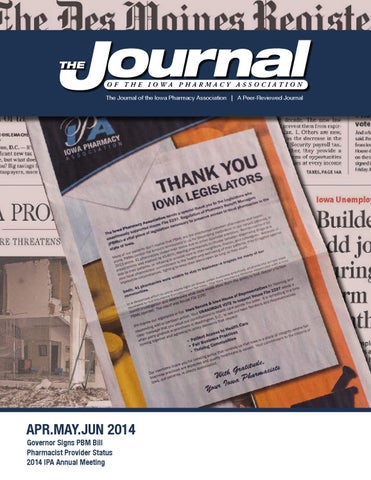
* A full-page IPA ad thanking Iowa Legislators ran in the Des Moines Register’s March 11th edition days before Governor Branstad signed the PBM bill.
FEATURES
President’s Page . . . . . . . . . . . . . . . . . . . . . . . . . . . . . . . . . . . 4 CEO Editorial . . . . . . . . . . . . . . . . . . . . . . . . . . . . . . . . . . . . . . 5 Governor Signs PBM Bill . . . . . . . . . . . . . . . . . . . . . . . . . . . . . 6 IPA Board of Trustees . . . . . . . . . . . . . . . . . . . . . . . . . . . . . . . 8 Pharmacist Provider Status . . . . . . . . . . . . . . . . . . . . . . . . . . 9 IPA Annual Meeting . . . . . . . . . . . . . . . . . . . . . . . . . . . . . . . . 12 Iowa Pharmacy Recovery Network . . . . . . . . . . . . . . . . . . . . 14 When is Enough, Enough? ONLINE ONLY . . . . . . . . . . . . . . . 28
OFFICERS CHAIRMAN Julie Kuhle, RPh, Indianola 515.273.8876, jwkuhle@aol.com PRESIDENT Michele Evink, MS, PharmD, CGP, FASCP, Osceola 641.342.5322, mevink@clarkehosp.org PRESIDENT-ELECT John Swegle, PharmD, BCPS, Mason City 641.428.7182, john-swegle@uiowa.edu TREASURER Steve Firman, RPh, Cedar Falls 319.277.7540, steve@pmgrx.com SPEAKER OF THE HOUSE Randy McDonough, PharmD, MS, CGP, BCPS, Iowa City 319.337.3526, mcdonough9@mchsi.com VICE SPEAKER OF THE HOUSE Connie Connolly, RPh, DeWitt 563.652.5611, conniejconnolly@hotmail.com
TRUSTEES REGION 1 Steven Martens, PharmD, Grundy Center 641.366.3440, steven@nucara.com REGION 2 John Daniel, PharmD, Fort Dodge 515.573.3431, jfdaniel@frontiernet.net REGION 4 Ashley Dohrn, PharmD, Le Claire 563.324.5004, ashley.dohrn@me.com REGION 5 Pat Thies, RPh, MS, FACHE, Cedar Rapids 319.265.3647, thiespw@crstlukes.com AT LARGE Marilyn Aldrich, RPh, Urbandale 515-276-4845, marilyn.aldrich@dahlsfoods.com Cheryl Clarke, BPharm, RPh, CHC, Des Moines 515-271-3899, cheryl.clarke@drake.edu Felix Gallagher, PharmD, Des Moines 515.334.4293, fgallagher@pharmservstaffing.com Justin Rash, PharmD, CGP, Ankeny 515.331.2594, rash.justin@gmail.com HONORARY PRESIDENT Mark Jones, RPh, Davenport jonesma@genesishealth.com, 563.421.4458 PHARMACY TECHNICIAN Michelle Garvin, CPhT, Wilton 563.732.5238, mgarvin@westerdrug.com STUDENT PHARMACISTS Matt Farley, University of Iowa matthew-farley@uiowa.edu Kelsey Lawfer, Drake University kelsey.lawfer@drake.edu
IN EVERY ISSUE
Health Care Hot Topics . . . . . . . . . . . . . . . . . . . . . . . . . . . . . Iowa Pharmacy News . . . . . . . . . . . . . . . . . . . . . . . . . . . . . . IPA Foundation . . . . . . . . . . . . . . . . . . . . . . . . . . . . . . . . . . . Public Affairs . . . . . . . . . . . . . . . . . . . . . . . . . . . . . . . . . . . . . Peer Review . . . . . . . . . . . . . . . . . . . . . . . . . . . . . . . . . . . . . . Member Section . . . . . . . . . . . . . . . . . . . . . . . . . . . . . . . . . . Technician’s Corner . . . . . . . . . . . . . . . . . . . . . . . . . . . . . . . College of Pharmacy News . . . . . . . . . . . . . . . . . . . . . . . . . . Student Section . . . . . . . . . . . . . . . . . . . . . . . . . . . . . . . . . . Last Laugh . . . . . . . . . . . . . . . . . . . . . . . . . . . . . . . . . . . . . . . Calendar of Events . . . . . . . . . . . . . . . . . . . . . . . . . . . . . . . .
16 18 24 26 35 40 43 44 46 48 48
ADVERTISERS
PharmServ . . . . . . . . . . . . . . . . . . . . . . . . . . . . . . . Inside Cover Hansen, McClintock & Riley . . . . . . . . . . . . . . . . . . . . . . . . . 14 IPRN . . . . . . . . . . . . . . . . . . . . . . . . . . . . . . . . . . . . . . . . . . . . 15 PQC . . . . . . . . . . . . . . . . . . . . . . . . . . . . . . . . . . . . . . . . . . . . 17 CoOportunity Health . . . . . . . . . . . . . . . . . . . . . . . . . . . . . . . 20 OutcomesMTM . . . . . . . . . . . . . . . . . . . . . . . . . . . . . . . . . . . 22 McKesson/RxOwnership . . . . . . . . . . . . . . . . . . . . . . . . . . . 23 Buy-Sellapharmacy.com . . . . . . . . . . . . . . . . . . . . . . . . . . . . 32 Career Center . . . . . . . . . . . . . . . . . . . . . . . . . . . . . . . . . . . . 33 Onnen Company . . . . . . . . . . . . . . . . . . . . . . . . . . . . . . . . . . 35 Pharmacists Mutual . . . . . . . . . . . . . . . . . . . . . . . . . . . . . . . 37 PTCB . . . . . . . . . . . . . . . . . . . . . . . . . . . . . . . . . . . . . . . . . . . 42 PACE Alliance . . . . . . . . . . . . . . . . . . . . . . . . . . . . . . . . . . . . . 47 Bowl of Hygeia . . . . . . . . . . . . . . . . . . . . . . . . . . . . . . . . . . . . 49 PBAHealth . . . . . . . . . . . . . . . . . . . . . . . . . . . . . . . . Back Cover
The Journal of the Iowa Pharmacy Association is a peer reviewed publication. Authors are encouraged to submit manuscripts to be considered for publication in the Journal. For Author Guidelines, see www.iarx.org. “The Journal of the Iowa Pharmacy Association” (ISSN 1525-7894) is published 4 issues per year: January/February/March issue; April/May/June issue; July/August/September issue; and October/November/December issue by the Iowa Pharmacy Association, 8515 Douglas Avenue, Suite 16, Des Moines, Iowa 50322. Periodicals postage paid at Des Moines, Iowa and additional mailing offices. POSTMASTER: Send address changes to: The Journal of the Iowa Pharmacy Association, 8515 Douglas Ave., Suite 16, Des Moines, IA 50322. Published quarterly The Journal is distributed to members as a regular membership service paid for through allocation of membership dues. Subscription rates are $100 per year, single copies are $20. Printed by ColorFx; Graphic Design done by Iowa Pharmacy Association.
President’s Page
THE FUTURE IS NOW
T
his year’s annual meeting’s theme is “The Future is Now”. There are many things that point us in this direction, but one component of that is the past.
Michele Evink
MS, PharmD, CGP, FASCP IPA President
Many of you may have visited the Disney “House of the Future” in Tomorrowland. Built in 1957, it featured crazy things like picture phones, remote control televisions and microwave ovens! The central theme, however, was how technology would make our lives better, our work easier and our days more comfortable. Technology continues to drive the future of pharmacy. The Iowa Pharmacy Association recognizes this by actively working with our partners to maximize the effectiveness of technology while directing its uses toward those that also maximize the positive impact on the profession. An example of this includes our work with the Iowa Board of Pharmacy on their taskforce to reshape and define telepharmacy across practice settings.
“Technology continues to drive the future of pharmacy...Telepharmacy has evolved from telephoning, faxing and remote computer access to fully integrated and fully interactive provision of service.” Telepharmacy has evolved from telephoning, faxing and remote computer access to fully integrated and fully interactive provision of service. The central question of telepharmacy remains how do we ensure access to quality pharmacy services to our patients while also ensuring pharmacist positions are not being eliminated in
4
| APR.MAY.JUN 2014 2014
favor of remote services. We have exciting pilot projects being conducted right now. Those projects are generating data to be reviewed so future projects can optimally meet the needs of practitioners and patients. Another example of collaboration is our efforts to advance the practice through implementing a plan to encourage each health system pharmacy in Iowa to evaluate their services. This is being done through our relationship with ASHP and based on their Pharmacy Practice Model Initiative. We launched the Iowa efforts with a day-long work session in October of 2013 and continue to assist all hospitals in Iowa with completing the Hospital Self Assessment. This will allow each facility to assess their current status and identify areas for focused efforts. The next phase of this effort will be toolkits to assist with priority projects like implementing tech check tech and promoting pharmacy services to hospital administration. Central to the PPMI initiative is evaluating and implementing the right technology to move each health system forward. Through bar code technology, automated dispensing machines and other technology, pharmacy services can be expanded and improved helping each pharmacy staff person work at the top of their own practice scope and making services safer for patients. We have a professional responsibility to promote good use of technology to make sure we’re achieving these important goals. Technology permeates our days, and even our nights. It seems we’re constantly plugged in. Our patients are too. We continue to learn of new ways our patients are using technology to make their health better. The future is truly now. Celebrate with us how far pharmacy has come and the great opportunities ahead of us!
ceo editorial
WHAT’S ON YOUR BUCKET LIST?
W
hen I first moved to Iowa the summer of 2004, I was curious about the packs of bicyclists I often saw riding through the streets of Des Moines. Finally someone shared with me – it was a training team for RAGBRAI. For what?!? Having never heard of the Registers’ Annual Great Bike Ride Across Iowa, I asked around to anyone willing to tell me about this event. About half the people I asked had done part or all of RAGBRAI, and many of the others said it was on their ‘bucket list’ – someday, somehow they would find a way to dip the back tire of their bike in the Missouri River and make the 7-day trek across our great state and end dipping their front tire in the Mississippi. Making them one of 10,000+ cycling enthusiasts each year to ride in the oldest, largest, and longest bike-touring event in the world! Hopefully, you have already seen the promotions for IPA’s 2014 RAGBRAI team. If not, check out pg 25. Maybe you’re wondering why IPA would create a team for RAGBRAI? It was a concept approved by the Board of IPA’s Foundation, with three primary objectives:
1). Raise money for student scholarships
Yes, it’s a fundraising team, so a portion of the registration fees to IPA will go into the Foundation’s account to support and grow student scholarships from IPAF to Drake and UI. The Foundation currently hosts a Golf Classic and a Silent Auction to raise funds for student scholarships – we hope the IPA RAGBRAI team captures a new interest within the IPA membership and expands our fundraising to support students. And, even if you are not a rider yourself, there are ways to donate to the IPA team and sponsor other riders.
2). Promote the profession of pharmacy Throughout the RAGBRAI course IPA, along with students from Drake and UI, will coordinate health and wellness screenings at pharmacies in different communities each day. All riders on the IPA team will have matching jerseys designed with the IPA logo and a pharmacy theme, and will promote the upcoming screenings to other riders. Additionally, the IPA team will have a ‘traveling pharmacy’ carrying common over-the-counter pharmacy items that a bicyclist may need during the ride.
Kate Gainer
PharmD IPA Executive Vice President & CEO
3). B uild camaraderie through a NEW event
Not only will the IPA team be made up of our members and their family and friends, the team will also be camping each night at the homes of IPA member ‘hosts’ in each community. We hope this extends the Iowa ‘pharmacy family’ and creates a fun, new opportunity for pharmacy professionals to support IPA. A big thanks to the RAGBRAI committee who has already had a lot of fun planning! As an organization that advocates for health and wellness and represents healthcare providers, this is an exciting NEW opportunity for IPA. Although it is too late to sign up as a week-long rider, there is still plenty of time to register for day passes, and you can ride up to three days. Support the RAGBRAI team or ride a few days with your colleagues - that counts towards checking RAGBRAI off your bucket list!
APR.MAY.JUN 2014
|
5
governor signs pbm bill
GOVERNOR BRANSTAD SIGNS PBM BILL On March 14, Governor Branstad signed the PBM bill into law, and a ceremonial bill signing was hosted in the Governor’s Office on April 28th for IPA and industry partners. Key legislators, including Representatives Guy Vander Linden (R-79) and John Forbes (D-40) and Senator Matt McCoy (D-21) were present with the Governor and his staff also. IPA thanks every member who took time to email or call their legislator(s) and the Governor’s office. It truly made a difference in advancing this priority. (See page 26)
When does the law go into effect? July 1, 2014 What exactly does the law do? Gives the Iowa Insurance Division (IID) complete authority to investigate PBMs operating in Iowa and requires that PBMs disclose MAC (Maximum Allowable Cost) pricing lists and methodology to the IID. It also limits which drugs can be MAC’d by a PBM. A single-source generic in the generic exclusivity period cannot be MAC’d. Only A-rated generics can be MAC’d. Only products available for purchase by multiple Iowa pharmacies can be used to calculate a MAC. What if my pharmacy is still reimbursed below acquisition cost on a MAC’d drug after July 1? Pharmacies should continue submitting complaints to the Iowa Insurance Division on the form designed for PBM complaints. We will rely on IID to act under its new authority to determine if PBMs are following the new law and enforce the terms and penalties accordingly. What about timely price updates? Timely price updates was not included in this legislation. IPA has been working closely with the IID over the past 9 months to update administrative rules that address timely pricing updates (3 days) pursuant to legislation passed in 2007. In the draft rule changes, other PBM issues are addressed as well: PBM audits, prompt pay, complaint and appeal process, non-retaliatory language, and clear oversight and authority to the IID. If these rule updates are passed, the new terms would be effect upon contract renewal but no later than January 1, 2015. (see page 26) Does this law impact all PBMs? As a piece of legislation granting authority to a state regulatory agency (IID), the law does not impact PBMs operating under federal contracts. Therefore, PBM contracts that service Medicare Part D plans do not fall under this law.
66
| APR.MAY.JUN 2014 | APR.MAY.JUN 2014
TIMELINE OF IOWA PBM LEGISLATION: 2004-2006 PBM bills debated in Iowa Legislature; None passed. 2007-2008 Senate File 512 passes, Signed by Governor Culver. IC 510B – Pharmacy Benefits Managers – addresses prompt payment, auditing practices and adjudication of claims. Iowa Insurance Division (IID) adopts administrative rules 191 – Ch 59. Jan 2013 - Feb 2013 IPA meets with Nick Gerhart to discuss PBM auditing practices. Insurance Commissioner Gerhart hears from 100+ pharmacists at IPA’s Legislative Day on PBM auditing practices and drastic reimbursement cuts beginning Jan 1, 2013. Feb-Aug 2013 Iowa Insurance Division conducts full investigation of pharmacy payment processes, including pharmacists and pharmacy owners; PBMs; insurance companies; and pharmacy service administration organizations (PSAOs). Determines current statute and regulations do not provide needed oversight and authority over PBMs by IID. Aug 2013 Iowa Insurance Division releases draft rule amendments to IAC 191 – Ch 59. Aug – Dec 2013 IID works with interested stakeholders on PBM rule amendments; deletes sections related to PSAOs, pricing transparency and rebate disclosure. Jan 2014 Legislation to require transparency and regulate MAC pricing and PBM rebates introduced by House and Senate Commerce Committee Chairs. HSB 519 passes subcommittee 3-0 (1/27/14). Feb 2014 SSB 3087 passes subcommittee 3-0 (2/5/14). HSB 519 passes Commerce committee 23-0 with amendment to strike rebate disclosure (2/10/14). SSB 3087 passes Commerce committee 11-1 with amendment (2/13/14). March 2014 HF 2297 (successor to HSB 519) passed House 95-0, sent to Senate where it passed the same day 49-0 (3/4/14). Full page IPA ad featured on page 3A in Des Moines Register thanking Iowa Legislators for unanimous, bipartisan support of HF 2297 (3/11/14). Governor Branstad signs HF 2297 into law (3/14/14).
The Iowa Pharmacy Association sends a special thank you to the Legislators who supported House File 2297, Regulation of Pharmacy Benefit Managers (PBMs)--a vital piece of legislation necessary to preserve access to local pharmacies in the state of Iowa. Many of our patients don’t realize that PBMs are the middleman between pharmacies and health plans. PBMs control the amount reimbursed to us for dispensing medication to our valued patients. In 2013 alone, 41 pharmacies closed their doors due to unfair business practices. Reimbursement for prescriptions was slashed by 45-60%, leaving pharmacists to choose between dispensing drugs at a loss to their patients; or refusing to provide care to their neighbors, friends, and colleagues. Because of your local pharmacists’ commitment to the health and well-being of their patients, they struggled against impossible circumstances, fighting to keep their doors open as long as they could.
Sadly, 41 pharmacies were unable to stay in business—a tragedy for many of our communities. In a desperate effort to shine some light on these unfair business practices, pharmacists across Iowa appealed to the Insurance Commissioner for help. The Iowa Insurance Division responded with a nine month investigation and determined what tools would allow them the ability to look deeper into how PBMs operate. The result was House File 2297. IPA thanks our legislators in the Iowa Senate & Iowa House of Representatives for listening and responding with bi-partisan action. Your UNANIMOUS VOTE to support House File 2297 sends a clear message that you value our contributions to health care across the state. It is refreshing in a time when party gridlock is prominent in Washington, D.C., to see our Iowa Senators and Representatives coming together and agreeing to policy decisions that respect:
• Patient Access to Health Care • Fair Business Practices • Thriving Communities Our members thank you for creating policy that reminds us that Iowa is a place of integrity-where fair business practices are expected and quality healthcare is valued. Your commitment to the citizens of Iowa, our patients, is deeply appreciated.
With Gratitude, Your Iowa Pharmacists
APR.MAY.JUN 2014
|
7
ipa board of trustees
IPA’S NEWLY ELECTED LEADERS The election results have been ratified for the 2014-2015 officer and trustee elections for IPA’s Board. In this year’s election, IPA members selected seven officer and trustee positions for the 2014-2015 administrative year. The new officers and trustees will be installed on June 13, during the IPA Annual Meeting in Altoona. Congratulations to the new officers and trustees. A special THANK YOU to all of the pharmacists who volunteer to serve the association and those who exercised their right to vote!
John Swegle, PharmD, BCPS President Mason City
Bob Greenwood, RPh President-Elect Waterloo
Dave Weetman, RPh Trustee At Large Iowa City
Board of Trustees Advances its Strategic Plan
To continue to preserve the mission of IPA, the Board of Trustees convened on February 19th to conduct the regular business of the Board specifically reviewing the progress on priority projects within the 2012-2015 Strategic Plan, newly elected leadership, and selection of IPA Annual Award recipients. Patient Care, Safety, and Health Outcomes The Board recognizes quality patient care is provided through
8
| APR.MAY.JUN 2014
Kristin Meyer PharmD, CGP, CACP, FASCP Trustee Region 1 Marshalltown
Laura Knockel, PharmD Trustee At Large North Liberty
Erik Maki, PharmD Trustee Region 3 Johnston
Jean Gallogly, CPhT Pharmacy Technician Vincent
a multi-disciplinary team, which includes pharmacists. The Board reviewed important patient care initiatives in Iowa involving provider status, practice advancement in hospital settings, and the evolution of telepharmacy practice. Membership & Advocacy for the Profession The Board reviewed the membership report and discussed mechanisms to reach membership goals stated in the strategic plan. The Board discussed the plan for IPA Goes Local events in 2014 and the
important outreach events held in coordination with these meetings. The Board spent significant time reviewing the legislative activity of the association and the important role of grassroots efforts to contact legislators on PBM regulations (full update on page 26). The Board learned of additional efforts to work with Medicaid to evaluate the current drug product reimbursement methodology and efforts needed to properly reimburse pharmacies enrolled in the Medicaid program.
pharmacist provider statuS
NASPA FINDS STATE-LEVEL PROVIDER STATUS IS WIDESPREAD, BUT NOT NECESSARILY LINKED TO PAYMENT
T
hirty-four states recognized pharmacists as providers or practitioners in at least one section of their state statute or in their state Medicaid program, according to a recent analysis conducted by the National Alliance of State Pharmacy Associations (NASPA). But little correlation existed between the recognition of pharmacists as providers within state law or the Medicaid program, and payment for pharmacists’ patient care services. The actual framework and positioning of the language in state law varied greatly from state to state, as did the payment implications of having provider status. “The large number of states who already have recognized pharmacists as providers or practitioners is both exciting and sobering news,” Rebecca P. Snead, BSPharm, NASPA Executive Vice President and CEO, told Pharmacy Today. “It’s exciting because it shows us that there are fewer statutory barriers to payment for pharmacists’ patient care services, but also is a reminder that there is much work to be done beyond legislative advocacy.”
Overview of results
To determine which states have designated pharmacists as providers or practitioners, NASPA staff looked at state statutes, specifically the insurance code, the business and professional codes, and the pharmacy practice act; looked at the Medicaid provider manuals; and surveyed the state pharmacy association executives. NASPA staff also collected information on states where pharmacists are being paid for the patient care services they
are providing. The analysis included the collection of information on payment for pharmacists’ patient care services from Medicaid, state employee benefits, and network contracts with private payers; instances of network contracting opportunities were captured from a survey of state pharmacy association executives. The analysis didn’t include contracts between a single payer and a single provider, incident-to billing, and facility fee billing.
Krystalyn Weaver, PharmD Director, Policy and State Relations National Alliance of State Pharmacy Associations
Of the 34 states that recognized pharmacists as providers or practitioners, the majority do so through state statute, but a handful also recognize pharmacists within their state Medicaid provider manuals. In a couple of cases, pharmacists are recognized in their Medicaid provider manual but not within state law. In at least 28 states, pharmacists’ patient care services (other than immunization administration) are covered by either the state or private payers. Included in the 28 were 15 states where pharmacists can be paid for services by their Medicaid program for at least one specified service, and 6 states with a state employee MTM benefit. In at least six states, pharmacists are not formally recognized as providers in the state’s statute or Medicaid provider manual, but are compensated for providing targeted patient care services. One of the reasons for the lack of correlation between payment and a state’s designation of pharmacists as providers or practitioners is likely due to pharmacists not being federally recognized as providers. Because APR.MAY.JUN 2014
|
9
Pharmacist Provider Status
Medicaid and private payers often follow precedents set by Medicare, federal provider status for pharmacists within the Social Security Act would likely make coverage for pharmacists’ patient care services easier and more widespread. See the map above for more information on pharmacist recognition as providers in the United States.
State pathways to provider status
A state can take various pathways to designate pharmacists as providers. Insurance code. The insurance code is one of the most common places
10
|
APR.MAY.JUN 2014
within state statutes for pharmacists to be formally recognized as
“The large number of states who already have recognized pharmacists as providers is … exciting because it shows us that there are fewer statutory barriers to payment for pharmacists’ patient care services, but also is a reminder that there is much work to be done beyond legislative advocacy.” providers. The insurance code is the set of laws with which insurance
companies in the state must comply. But because state insurance laws do not apply to publicly funded programs (Medicare, Medicaid, state employee plans) or to plans for selffunded employers, the insurance code affects only a small portion of the insurance market—so changes to these laws may have less impact. Although some states have seen positive effects from recognizing pharmacists as providers under the insurance code, others have seen little change. For example, pharmacists in Virginia have been recognized as practitioners in the insurance code for more than a decade but have not seen scalable payment from private insurers for their services.
pharmacist provider statuS Other sections in state codes. In a handful of states, pharmacists are recognized as providers in the pharmacy practice act. With this approach, the statute may include in the definition of the word “pharmacist” a provider designation. Such is the case with Connecticut and Tennessee, which also both recognize pharmacists as health care providers in the insurance code. Some states, such as California and Nevada, define pharmacists as health care providers in their business, professional, or occupation codes. A handful of states, such as Minnesota and Michigan, recognize pharmacists in their public health provisions; Minnesota also recognizes pharmacists as providers in the insurance code. Recognition by Medicaid. At least nine states recognize pharmacists as providers in the state Medicaid
provider manual, including two states where pharmacists are not recognized in statute. Although recognition as providers in Medicaid doesn’t always result in payment for the provision of patient care services, it does help to remove a barrier to implementing new programs that include pharmacists. Recognition by private payers. Because the end goal of achieving provider status is to provide patients with access to coverage for pharmacists’ patient care services, another approach is to work directly with private payers. This approach has been used in states such as New Mexico, where pharmacists are recognized by many of the health maintenance organizations and health plans, and in Tennessee, where pharmacists are recognized and being paid as providers of patient care services through a program developed by the Blue Cross Health
Foundation and the Tennessee Pharmacists Research and Education Foundation.
Every pharmacist can make an impact
The NASPA analysis showed that legislative changes are not the only way—and never the final step—to affect change in the pharmacy practice model. Practicing pharmacists collectively can make a huge impact on the national and state level provider status initiatives by doing what they do best: taking care of their patients. Pharmacists need to share their impact on patients’ health outcomes and costs. As public demand increases for pharmacists’ patient care services, there will be more pressure on payers to cover them. Pharmacists should continue to support APhA and other national and state pharmacy associations to ensure the success of provider status initiatives.
Call To Action
Please note that it was not possible for the National Alliance of State Pharmacy Associations (NASPA) to do a comprehensive analysis of all potential contracts between pharmacists and payers for the provision of patient care services. If you are a pharmacist who is currently participating in such a contract, APhA and NASPA want to hear about it! Please send information about your program to Michael Ghobrial, PharmD, JD, APhA Associate Director of Health Policy, at mghobrial@aphanet.org.
Patient Access to Pharmacists Care Coalition Unites Behind H.R. 4190 The profession united to form the Patient Access to Pharmacists Care Coalition (PAPCC) and to pursue provider status for pharmacists through the recognition of pharmacists’ services in federal legislation. On March 11, 2013, a bill was introduced in the U.S. House of Representatives to amend Title XVIII of the Social Security Act to provide for coverage of pharmacists’ patient care services (H.R. 4190). Introduced by Reps. Brett Guthrie (R-KY), G.K. Butterfield (D-NC), and Todd Young (R-IN), this legislation would enable patient access to, and payment for, Medicare Part B services by state-licensed pharmacists in medically underserved communities. Pharmacy organizations have united as the PAPCC to gain the recognition that gets the profession on the team and in the game! This will be a long term, strategic effort that must be pursued vigorously if patients are to use their medicines successfully, and if our profession is to be relevant in an evolving health care system. IPA applauds the pharmacy organizations, stakeholders, and our congressional champions who are uniting and focused on passage of federal legislation that gives access to pharmacists care.
APR.MAY.JUN 2014
|
11
ipa annual meeting
JUNE 13-14, 2014 • ALTOONA, IA IOWA PHARMACY ASSOCIATION • 2014 ANNUAL MEETING
THE FUTURE IS NOW THURSDAY, JUNE 12 12:00n-2:30pm
IPA Board of Trustees and Past Presidents Luncheon Meeting
FRIDAY, JUNE 13 8:30-11:30AM HOUSE OF DELEGATES – SESSION I*
A welcome will be provided by Doug Hoey, CEO of the National Community Pharmacists Association (NCPA), with a message on positioning community pharmacists in today’s healthcare team.
Keynote: Reflections on What is Coming Dennis Helling, executive director emeritus of Pharmacy Operations and Therapeutics for Kaiser Permanente in Denver, Colorado. Session I of the House Speaker of the House, Randy McDonough will preside over the Delegate Orientation, Report of Officers, Policy Committee Hearings and New Business Review. This is your opportunity to learn about and shape Iowa pharmacy’s priority directions and policy decisions for tomorrow.
POLICY TOPICS FOR DEBATE:
• Accreditation of Pharmacy Technician Education Programs • Role of Pharmacy in Meaningful Use • Reimbursement and Safety of Restricted Drug Distribution Products • Biosimilars & Interchangeability • Non-Resident Pharmacies • Distribution of Medications to be used in Emergency Situations
12
|
APR.MAY.JUN 2014
Leadership Dinner (by invitation only)
Joan Becker of Parkersburg, is the mother of Mark Becker. Mark has paranoid schizophrenia and is serving a first-degree murder sentence in the death of AplingtonParkersburg High School football coach Ed Thomas. Becker shares her family’s story about Mark and their experience coping with Joan Becker paranoid schizophrenia in hopes it will help others understand the need for change in our current system to not fail the needs of those with mental health diagnoses.
1:00-3:00PM 3:00-4:00PM
EXHIBITS/POSTERS/DESSERT TRENDING TOPICS*
• Pharmacists’ Role in Emerging Healthcare Models • The Future of Pharmacy in Community and LTC Practices
Dennis Helling
Randy McDonough
IPA Board Meeting
11:30-1:00PM LUNCH MOTIVATION
7:00AM REGISTRATION 7:15AM EXHIBIT THEATER BREAKFAST
Doug Hoey
3:00pm-4:00pm 6:00pm-10:00pm
Trending topics will be led by national leaders with plenty of opportunity for discussion and Q&A. All Annual Meeting attendees are welcome to attend ANY session! Policy Committees on Professional and Public Affairs will meet in executive session.
6:00PM PRESIDENT’S RECEPTION/ANNUAL BANQUET & AWARDS PROGRAM
The Annual Banquet will feature delightful entertainment and prestigious awards. John Swegle, PharmD, BCPS will deliver his presidential address as he is installed as IPA’s 135th President.
9:30PM SILENT AUCTION & RED ENVELOPE PRIZE
The evening will conclude with the IPA Foundation’s popular reception and auction. Don’t miss the great desserts and auction items. Please plan to be generous - all proceeds support the educational and student programs of the Foundation.
John Swegle
ipa annual meeting
SATURDAY, JUNE 14
HOTEL INFORMATION
7:00am ANNUAL FUN RUN/WALK
1 Prairie Meadows Drive Altoona, IA 50009
The Meadows Events & Conference Center
Don’t miss out on this annual event! If you plan to participate, be sure to indicate your tshirt size on registration form.
515.957.3000 All business sessions, social activities and educational programming will be at The Meadows Events & Conference Center in Altoona, IA. When making your lodging reservation, please indicate that you will be attending the IPA Annual Meeting to receive the rate of $99.00. To guarantee availability and rate, please make your reservation on or before May 13, 2014.
REGISTRATION
Full registration includes attendance at all Friday and Saturday programs and activities. CE information is available on IPA’s website at www.iarx.org. Daily registration includes the programs and activities for that day.
7:00AM REGISTRATION/CONTINENTAL BREAKFAST
TARGET AUDIENCE
9:00AM HOUSE OF DELEGATES – SESSION II*
Keynote: Health Care Technology for the Future is Here Today Bill Felkey, MS, Professor at Auburn University Hear about practical technologies that exist today as well as technology that can be used to enhance pharmacists’ practice. Even though disruptive technologies challenge our ability to change our business practices, it is imperative that all facets of healthcare become truly digital in a reformed health care world. In Session II of the House, Speaker of the House Randy McDonough will preside over the final policy debate as well as the nomination of the 2014 Honorary President, ratification of the Nominations Committee Report and installation of Connie Connolly as Speaker of the House and the election of the 2014-2015 Vice Speaker of the House.
CANCELLATIONS
The refund policy is full refund, less a $50.00 administrative fee, before June 1. No refund after June 1. An additional $25.00 will be added to all on-site registrations.
POSTER PRESENTATION AND EXHIBIT PROGRAM Bill Felkey
Following the Friday luncheon and keynote speaker we will adjourn to the Exhibit Hall for the poster presentations, company sponsored exhibits and desserts. This session will spotlight exciting projects and research which advance the practice of pharmacy and increase the quality of care provided to patients in Iowa. If you would like to present a poster, please submit abstract at: www.iarx.org - click on the Annual Meeting Link
STUDENT SPONSORSHIP Connie Connolly
11:30AM ADJOURNMENT * CPE available during these programs. Details and program learning objectives will be available at www.iarx.org.
TO REGISTER:
Pharmacists, pharmacy technicians, student pharmacists and their guests.
VISIT WWW.IARX.ORG AND CLICK ON THE ANNUAL MEETING QUICK LINK
Meeting attendees are encouraged to support IPA’s ability to provide pharmacy students discounted meeting rates by donating to the student attendance fund.
SILENT AUCTION & RED ENVELOPE PRIZE
Participation in the Annual Silent Auction provides support for the activities of the Iowa Pharmacy Association Foundation, which includes leadership programming, scholarships and student participation in various state and national professional association meetings. Please contact Laura Miller at lmiller@iarx.org regarding item(s) that you would like to donate. Donations will be accepted during the Annual Meeting weekend –however, only those items contributed or committed with notification, by June 6, will be included in the Silent Auction promotional piece recognizing individual contributors. APR.MAY.JUN 2014
|
13
iowa pharmacy recovery network
IPRN: WE’RE HERE FOR YOU!
I
t is estimated that approximately 15% of pharmacy professionals have some form of chemical dependency. The Iowa Pharmacy Recovery Network (IPRN) is a monitoring and advocacy peer assistance program supported by the Iowa Pharmacy Association (IPA) and can be used by all pharmacy personnel (pharmacists, technicians, and student pharmacists). It is in place for those whose dependency, disability, and/or mental impairments are potentially threatening to professional performance and public safety. There are pharmacists, student pharmacists, and pharmacy
technicians who are falling out of the profession due to chemical and/or mental impairments. The profession of pharmacy can’t afford to lose valuable people because of a disease that is manageable. As a group, the IPRN is 100% confidential. IPRN has been designed to work with impaired pharmacy professionals in a compassionate and non-punitive manner by providing confidential assistance in locating appropriate rehabilitative services and serving as an advocate for their re-entry into the profession. Once an impaired professional signs a contract with IPRN, the individual must uphold their end of the agreement, yet an IPRN mentor has a duty to report a
HANSEN, MCCLINTOCK & RILEY PROFESSIONAL LICENSURE & ETHICS COUNSEL AND REPRESENTATION • Licensing Board Inquiries • Professional Discipline • Proactive Negotiation with Federal and State Agencies and Administrative Boards
• Ethics • Errors and Omissions Insurance • Coverage • Conflicts of Interest
Contact: David L. Brown, Chester C. Woodburn, III or Alexander E. Wonio 5th Floor, U.S. Bank Building 520 Walnut Street Des Moines, IA 50309 515-244-2141
www.HMRLAWFIRM.com
14
|
APR.MAY.JUN 2014
breach of contract to the Board of Pharmacy. In 1988, IPRN was started with financial assistance from the Iowa Board of Pharmacy. IPRN remains a primary resource for those with a dependency issue psychiatric disorder to receive confidential assistance in their treatment to gain control over their dependence and reenter the professional workforce. As part of these resources, IPRN hosts monthly meetings that occur on the first Sunday of every month and are held at the Des Moines Fellowship Church at 950 35th Street in Des Moines at 6:00 pm. These meetings serve as a support group for individuals on contract with IPRN or serve as advocates for the program. The meetings allow all individuals the opportunity to discuss their recovery achievements and battles with other professionals, both recovering and non-recovering in a confidential and supportive manner. IPRN is always looking for IPA members that can serve as mentors and advocates for the program. IPRN volunteers understand addictions and psychiatric disorders and are here to help provide a second chance to those who need it. IPRN volunteers work with impaired professionals in seeking an evaluation, treatment and aftercare support. They also serve as advocates for the recovering individual in coping with professional and personal issues stemming from the impairment and recovery process. Advocate training is being planned for an upcoming IPA meeting. Watch for more information on how you can get involved with IPRN!
IOWA PHARMACY RECOVERY NETWORK
Assisting Impaired Pharmacists, Student Pharmacists, and Pharmacy Technicians
Where do you turn when you, a coworker or someone you care about needs help with an addiction, physical illness or psychiatric disorder?
Providing support . . . through caring volunteers
HOPE FOR RECOVERY 1-877-890-IPRN
http://www.iowarecovery.org/ APR.MAY.JUN 2014
|
15
health care hot topics THE PROFESSION OF PHARMACY AND HEALTH CARE CONTINUE TO CHANGE AND EVOLVE WITH EACH DAY THAT PASSES. HERE IS A SHORT SUMMARY OF EVENTS THAT HAVE HAD AN EFFECT ON OUR PROFESSION. CVS/Caremark to Stop Selling Tobacco Products • CVS Caremark
is planning a $2 billion decrease in annual revenue. In February, CVS announced that it will phase out tobacco products in its 7,600 stores nationwide by October. This action follows a precedent set by other drug stores and several cities, including San Francisco and Boston which have considered or passed bans on tobacco sales in stores with pharmacies. Larry Merol, CEO of CVS, said “We came to the decision that cigarettes and providing health care just don’t go together in the same setting.” CVS is working on other ways to reduce smoking such as initiating a smoking cessation program and training pharmacists to counsel people on how to quit.
Patients’ Right to Access Lab Test Reports • The Department
of Health and Human Services (HHS) has issued a rule to give patients or a person designated by the patient a means of direct access to the patient’s completed laboratory test reports. The final rule amends the Clinical Laboratory Improvement Amendments of 1988 (CLIA) regulations to allow laboratories to give a patient, or a person designated by the patient, his or her “personal representative,” access to the patient’s completed test reports on the patient’s or patient’s personal representative’s request. While patients can continue to get access to their laboratory test reports from their doctors, these changes give patients a new option to obtain their test reports directly from the laboratory while maintaining strong protections for patients’ privacy.
16
|
APR.MAY.JUN 2014
Patients Get More Information to Help Find a Doctor • The
Centers for Medicare & Medicaid Services (CMS) announced in February that they added quality measures to Physician Compare, a website created by the Affordable Care Act that assists consumers in making informed decisions about their health care. It helps consumers search for information about health care professionals including specialties offered, board certification, and affiliations. The quality measures added include: controlling blood sugar levels and blood pressure in patients with diabetes; prescribing aspirin to patients with diabetes and heart disease; and patients with diabetes who do not use tobacco. In the first year, 66 group practices and 141 Accountable Care Organizations (ACO) now have quality data publicly reported at the group practice and ACO level on Physician Compare.
DEA Pilots Drug Abuse Tip Line in Atlanta and Philadelphia
• The Drug Enforcement Administration in Atlanta launched an initiative called TIP411. It allows the public to report suspicious activity quickly and anonymously by texting the keyword PILLTIP to TIP411 (or 847-411). The message will then be forwarded to a DEA agent who will investigate the situation. The DEA is also sending educational materials to 1,200 pharmacies in Atlanta that contains information about the tip line and a guide on suspicious behavior. The city of Philadelphia is also trying out this program as a way to combat prescription drug abuse.
Pfizer Aims to Sell OTC Lipitor
• Despite changes in lipid guidelines, Pfizer, the maker of Lipitor, recently started a 1,200-patient clinical trial to test if consumers could take a nonprescription Lipitor and manage cholesterol appropriately. The study will track factors such as what percentage of users comply with directions to get cholesterol levels checked again in six weeks, and whether consumers should continue to take the drug or consult with a doctor based on its effectiveness. The trial is expected to be completed by the end of the year with the results affecting whether Pfizer applies for U.S. approval of the OTC medication. While in the UK, a 10mg dose of simvastatin has been available as an OTC medication around 10 years.
CoOportunity Hits 3-Year Goal in 6 Months • Iowa and Nebraska’s new nonprofit health CO-OP has eclipsed 50,000 individual and group members, a milestone that wasn’t supposed to be achieved for at least two years. One of 23 Consumer Operated and Oriented Plans (CO-OPs) nationwide, CoOportunity Health exceeded its 2016 enrollment projections as of Feb. 24, one indicator of broad interest from individuals and businesses in new insurance alternatives. An analysis of available premium rates by the National Alliance of State Health CO-OPs (NASHCO) last October found that states with a CO-OP had rates that were, on average, more than 8 percent lower than states without a CO-OP.
IA S,
IN E
O 5 201 , 5 -1 F E BRUARY 13
•
S DE
M
Get up to 17 hours of Continuing Pharmacy Education! APR.MAY.JUN 2014 | 17
O
NA
, IA
iowa pharmacy news
T AL
O
– RY 7 FEBRUA
9,
• 14 20
Inaugural ‘Midwest Pharmacy Expo’ Builds on Success of Past • Over 400 pharmacists, pharmacy technicians, and student pharmacists from across 8 states in the Midwest came together on February 7-9, 2014 in Altoona. In collaboration with the Collaborative Education Institute (CEI), IPA partnered with other state pharmacy associations to provide close to 20 hours of continuing pharmacy education sessions and opportunities to network with exhibitors and other health professionals. IPA would like to thank the numerous speakers, exhibitors, and attendees for making the 2014 Midwest Pharmacy Expo a success!
SAVE THE DATE: 2015 MIDWEST PHARMACY EXPO February 13-15
At the Community Choice Credit Union Convention Center in Des Moines, IA
18
|
APR.MAY.JUN 2014
IPA Goes Local to Dubuque
• IPA partnered with the Dubuque Area Pharmacy Association on Tuesday evening, March 4th, in Dubuque, Iowa. Rachel Digmann, PharmD, BCPS, and Kate LaFollette, RN, of Telligen spoke on ‘The Missing Link: Medication Manager’. 48 pharmacists and pharmacy technicians in this part of the state attended this IPA Goes Local event. IPA Executive Vice President and CEO, Kate Gainer, and Laura Miller, IPA Membership & Development Director, stopped into pharmacies and hospitals along the way to meet with fellow Iowans. Laura and Kate are pictured to the right with Gary Albers and Bryce Jackman at CarePro Pharmacy in Cedar
Rapids. Contact Laura at lmiller@iarx.org to set up a visit at your practice when IPA is in the area. Please mark your calendars for the next upcoming 2014 IPA Goes Local events in your area. • Central Iowa Pharmacy Association (Des Moines area) – April 10 • Quad Cities Area Pharmacy Association (Davenport area) – April 17 • Black Hawk/Bremer Co Pharmacy Association (Waverly area) – May 15 • North Iowa Pharmacy Association (Mason City area) – May 20
iowa pharmacy news The Power & Promise of PHARMACY – APhA 2014 Annual MeetingIowa Pharmacist, Matt Osterhaus, Installed as 159th President
• Over 100 Iowa pharmacists, residents, and student pharmacists were in Orlando for this year’s Annual Meeting of the American Pharmacists Association. A significant year for the state of Iowa, highlights of the meeting are recapped below. Matt Osterhaus, RPh, FASCP, FAPhA, was installed as the 159th President of APhA. Matt’s installation marks the fourth time in APhA history that two generations of pharmacists from the same family have served as the Association’s top elected leader. Matt’s father, Bob Osterhaus, served as APhA president 1992-1993. IPA, along with the Osterhaus family, hosted a special dinner honoring Matt in Orlando at the Rusty Spoon, a local restaurant owned by Matt’s cousin Kathleen (Osterhaus) Blake, the chef. Over 120 friends, family members, and pharmacy colleagues from across the country attended to honor Matt. IPA presented Matt with a gift certificate to go skydiving following his year serving as President of APhA. The Annual Iowa Reception, hosted by IPA, Drake, and the University of Iowa Colleges of Pharmacy attracted over 400 pharmacists and students. All were welcomed with special remarks
from Deans Wendy Duncan and Don Letendre, IPA CEO Kate Gainer, and Matt Osterhaus. HOUSE OF DELEGATES Iowa’s delegation in the APhA House of Delegates included IPA Board members: Felix Gallagher, Steve Firman, Julie Kuhle, and John Swegle. (pictured below)
pharmacist, Caitlin Lickteig (University of Iowa) as part of the poster, Doucette WR, Lickteig C, Veach S, Carter B, Levy B. “Multicase study of fostering providerpharmacist team management of hypertension in communities.”
•Drake University won the APhA-ASP Chapter Policy and Legislative Award (pictured above) Other IPA members served as delegates: • Cheryl Clarke (APhA-APPM) • Bob Greenwood (NCPA) • Gene Lutz (Past President) • Wendy Mobley-Buckstein (APhA-APPM) • Carrie Koenigsfeld (APhA-APPM) • Bob Osterhaus (Past President) • Matt Osterhaus (Board of Trustees) • Ben Urick (APhA-APRS) • Susan Vos (APhA-APPM) The House of Delegates debated timely issues, including care transitions, audits of health care practices, and use of social media.
CAMPAIGNS Student pharmacists Joshua Rose, University of Iowa P2, and Carson Klug, Drake University P2, ran remarkable campaigns for ASP president-elect and ASP Speaker of the House, respectively. Though unsuccessful, IPA is incredibly proud of their efforts. Iowa delegate Steve Firman was slated to run for APhA Speaker of the House, but was unsuccessful in his bid. On the 2014 APhA ballot, Bob Greenwood will be running for Trustee at Large.
AWARDS AND RECOGNITION • Matt Osterhaus, RPh, FASCP, FAPhA, installed as President • Coralynn Trewet, MS, PharmD, BCPS, CDE installed as APhA-APRS Fellow • Steve Firman, RPh, MBA, serving as APhA PAC Chair • Thomas Temple, RPh, MS, serving on the APhA Foundation Board • Osterhaus Pharmacy received honorable mention for the Immunization Champion Award in the Corporate/Institution category • APhA-APPM Poster Presentation Merit Award went to student
APR.MAY.JUN 2014
|
19
iowa pharmacy news
New MTM Program Compensates Pharmacists for Consultations • To recognize
pharmacists’ ability to affect health outcomes and reduce medical costs, CoOportunity Health—in partnership with HealthPartners—is now recruiting Iowa and Nebraska pharmacists for a medication therapy management [MTM] network. Pharmacists who join the network are reimbursed for MTM services provided to any of CoOportunity Health’s 50,000 plus members.* CoOportunity Health plans to notify their members of the MTM program, called RxCheckup, in May 2014. Since early 2013, IPA has met regularly with executives from
20
|
APR.MAY.JUN 2014
CoOportunity Health to discuss everything from PBM practices, mail order, specialty medications, and MTM, and we’re happy to announce the availability of this program. Brief Program Overview After joining the network, you identify a member with a complex drug therapy need, or you receive notification from CoOportunity Health of a member who needs MTM services. • During a private consultation with the patient, you provide a number of services, from assessing a patient’s medication regimen, to making recommendations for cost reductions or working with the patient’s physician[s] to resolve identified concerns.
• Following the consultation, you document the service in Medication Pathfinder [the MTM vendor’s documentation platform], and submit a claim to receive reimbursement. • Because CoOportunity Health covers the service, there is no need to collect a cost-share from the patient. Learn More or Enroll • Visit the Medication Therapy Management Services page at coOportunityhealth.com/provider [look for Clinical Resources, Pharmacy]. • Call Clinical Support Services [the MTM vendor] at 1.877.296.9670. *Membership as of February 2014
iowa pharmacy news Iowa Immunization Coalition Supports Pharmacies as an ‘Immunization Destination’ • On March 28, 2013, Iowa Governor
Terry Branstad signed into law Senate File 353 that expanded the immunizations that can be administered by licensed pharmacists or student pharmacists in the state of Iowa. Pharmacists in the state are now able to provide influenza and emergency immunizations to patients ages 6 years and older as well as all vaccinations recommended by the CDC, including those for international travel, for patients 18 years of age and older. IPA is partnering with the Iowa Immunization Coalition to implement a strategy in 2014 to further engage pharmacists across the state in provision of immunization services in accordance with this statute and subsequent Board of Pharmacy regulations. With the support and collaboration of the Iowa Immunization Coalition, IPA will work to ensure that all pharmacies in the state are fully aware of the new regulations that took effect on September 1, 2013. IPA believes it is important to prepare all pharmacists to provide immunizations based on the new regulations in order to promote pharmacies as an ‘immunization destination’ across Iowa. IPA will provide informational toolkits for pharmacies and local health departments to describe the new opportunities for immunization services by pharmacists. These toolkits will include not only promotional materials for pharmacists and their patients, but also resources to help pharmacists administer these vaccinations. Pharmacies can request sample flyers that could be used to educate patients about the expanded authority for pharmacists. IPA also plans to provide pharmacists with sample protocols for vaccine administration while encouraging them to collaborate with local health departments to expand their current protocols.
Watch for email and fax communications in May that detail the resources available for your pharmacy.
An Update on the New Practice Model Initiative • The New
Practice Model (NPM) Initiative is 5 years in the making. Pharmacists from 7 pharmacies across the state are working together to implement a new workflow and business model for community pharmacy practice through a pilot project. Recently, IPA was awarded a grant from the National Association of Chain Drug Stores (NACDS) to support this initiative, and phase 1 of the project is projected to roll-out in April. The grant will help support the research aims of the pilot study, development of education, and a project manager. Megan Myers, PharmD, is pleased to join the IPA team as the NPM project manager. Megan graduated from the University of Wisconsin-Madison in 2006 and completed a community pharmacy residency with Jewel-Osco and Midwestern University in 2007. In 2008, Megan moved to Des Moines to teach in the Pharmacy Skills and Application series at Drake University College of Pharmacy and Health Sciences, with a shared position at Medicap Pharmacy. She provided education on MTM, health screenings, immunizations, and diabetes care to student pharmacists. In 2011, Megan accepted a position with Dahl’s Foods. As wellness coordinator for Dahl’s, Megan has worked towards expanding and developing a variety of clinical services. Megan is excited to be part of this progressive and important initiative for community pharmacy practice!
Trinity Pioneer ACO MTM Program Hits Critical Point • After 5 months of community
pharmacists providing MTM services in the 8-county service area of
the Trinity Pioneer ACO, over 140 Medicare ACO patients have been served. As pharmacies begin to showcase the impact of MTM within the ACO, all stakeholders including IPA, OutcomesMTM, and The University of Iowa hope to display reduction in overall hospitalizations and 30-day hospital readmissions through utilization of community pharmacists as part of the ACO team. As the program hits a critical halfway point, more data will become available to highlight the efforts of this program in bringing pharmacists to the table to care for patients within an ACO. TOP 5 Participating Pharmacies in ACO Project 1). Hy-Vee Pharmacy in Fort Dodge 82 MTM Claims 2). Wal-Mart Pharmacy in Fort Dodge 69 MTM Claims 3). Daniel Pharmacy in Fort Dodge 40 MTM Claims 4). Hy-Vee Drugstore in Fort Dodge 39 MTM Claims 5). Walgreen’s Pharmacy in Fort Dodge 33 MTM Claims Featured ACO Encounter Pharmacist Focuses on Patient’s Safety Personal Pharmacist™ Lisa Flaherty Daniel Pharmacy — Fort Dodge, IA Lisa was reviewing the medications for one of her OutcomesMTM-eligible elderly patients when she discovered the patient was taking a potentially dangerous muscle relaxer. Elderly patients who take this medication are at a higher risk of experiencing side effects because the medication stays in their body longer. The most worrisome side effects for this patient would be sleepiness, dizziness, and instability which could lead to the patient falling and sustaining a serious injury. Lisa talked with the patient about the risks associated with the medication. Between the two of them, they decided it was best to avoid a dangerous medication such as this one. Lisa reached out the patient’s doctor to share her concerns as well. APR.MAY.JUN 2014
|
21
iowa pharmacy news
The doctor agreed that the medication was too risky and probably unnecessary at this time. Thanks to Lisa’s intervention, her patient avoided taking a medication that was potentially detrimental to their health. By talking with the doctor on her patient’s behalf, Lisa was able to initiate a change in the patient’s drug therapy without requiring the patient to make an office appointment. Great patient care, Lisa!
2/2/2 WHAT IS IT? 2/2/2 is an IPA program designed for you to stay engaged and stay informed on hot issues impacting the profession of pharmacy. These
online webinars are free of charge to all pharmacy technicians. All previous 2/2/2 programs are recorded and available on IPA’s website.
WHEN IS IT?
2nd Tuesday of every month at 2:00 pm CST
UPCOMING TOPICS YOU WON’T WANT TO MISS! • April 8: Implications of Federal Compounding Legislation - (CPE Available) • May 13: Open Forum on Proposed IPA Policies • June 10: Disposal of Controlled Substances
THE FACE-TO-FACE DIFFERENCE® IN MEDICATION THERAPY MANAGEMENT. NATIONAL NETWORK, LOCAL RELATIONSHIPS. OutcomesMTM™ leverages relationships between local pharmacists and patients to advance the Face-to-Face Difference® in Medication Therapy Management (MTM). OutcomesMTM programs feature innovative technology and aggressive performance guarantees. It’s why OutcomesMTM-contracted plans outperform the national average in all five triple-weighted Patient Safety Measures.
To learn more about how OutcomesMTM can bring the Face-to-Face Difference to your plan, visit outcomesmtm.com or call 877.237.0050.
22
|
APR.MAY.JUN 2014
Take advantage of these Virtual Engagement Opportunities by registering with the 2/2/2 Quick Link at www.iarx.org. Have a hot topic that you think would be of interest to pharmacists and pharmacy technicians? Contact Laura at lmiller@iarx.org to make it a part of this series.
APR.MAY.JUN 2014
|
23
ipa foundation been raised. (See chart on pg 25).
IPA-F Board of Directors: February Meeting Recap
• The IPA-F Board of Directors met on February 5th, 2014. Due to inclement weather this meeting was held via conference call. Discussion at the February meeting included: Policy Updates The IPA-F Board reviewed and voted favorably on a Gift Acceptance Policy, Gift of Stock Policy and Leadership Giving Policy. These policies help ensure all gifts to IPA-F are meaningful to the donor and appropriate to further the mission of IPA-F. Development Discussion The Foundation saw a positive increase in members electing to make a contribution with their annual membership renewal. RAGBRAI – This year’s ride will be a northern Iowa route. A RAGBRAI planning committee has been established and working diligently to reach out to pharmacists and pharmacies in the overnight towns to host the IPA-F team. IPA-F’s goal is to secure 30 total riders throughout the week. The committee is working with local pharmacies to promote the profession of pharmacy by hosting student screenings. Thomas R Temple Leadership Endowment – The endowment was established three years ago with most commitments being completed in 2013. The board discussed opportunities to fulfill the remaining endowment goal with additional pledges and encouragement of 100% participation from past conference participants. Iowa’s portion of the Endowment is $375,000. It was shared that to date, just over $277,000 has
24
| APR.MAY.JUN 2014
Legacy Society/Foundation Institute – The Board was notified that promotional materials for the Legacy Society/Foundation Institute are now available. It was discussed that these methods of giving are to provide sustainable funding to the Foundation and these levels of giving will be recognized accordingly. The board also heard updates from IPA and CEI staff on current professional and educational programs. The next board meeting is scheduled for May 22nd, 2014.
Leadership Pharmacy Reception
• During the 2014 Midwest Educational Expo, IPA provided an opportunity for past leadership conference participants, IPA leadership and guests to come together during a reception held at the Botanical Center in Des Moines. Over 50 attendees gathered for the evening to socialize and celebrate 25 successful years of the conference. The night was highlighted by remarks from pharmacist and current APhA President-elect, Matt Osterhaus.
Natalie Benson selected for 2014 Max W. Eggleston Executive Intern at IPA Meet Natalie. Greetings! My name is Natalie Benson and I have been selected to be the 2014 Max W. Eggleston Executive Intern in Association Management at the Iowa Pharmacy Association. I will serve in this position for the upcoming summer, and I look forward to the experiences that await me. I am originally from Lino Lakes, Minnesota, a northeastern suburb of St. Paul, and am currently a second-year PharmD student at Drake University. At Drake, I have been involved in a variety of pharmacy organizations and events. This past year I served as Regent (president) of Drake’s chapter of Kappa Psi Pharmaceutical Fraternity. I was also inducted into Rho Chi Pharmacy Academic Honor Society and Phi Lambda Sigma Pharmacy Leadership Society this year. I have been an active member of IPA since my pre-pharmacy years at Drake, from attending IPA College Nights, to participating in the Bill Burke Student Leadership Conference, to serving on the Long Term Care and Senior Care Advisory Committee. Through these experiences, along with a political advocacy and leadership J-term class, my interest in advocating for our profession has grown. I am honored and grateful to have this opportunity to serve our profession as an enthusiastic student pharmacist.
IPA FOUNDATION The Register’s Annual Great Bicycle Ride Across Iowa • RAGBRAI is scheduled for July 20-26, 2014. Support IPAF and pharmacy colleagues as we ride across Iowa to inspire generosity and fulfill the aspirations of the profession of pharmacy.
Not a cyclist? No problem.
We are also looking for volunteers to help get the team from the Missouri River to the Mississippi River, as well as help with outreach efforts along the RAGBRAI route by providing screenings and other pharmacy promotions.
Can’t participate during that week? We are looking for sponsors
to support a student rider or the team for the day or week here. Visit www.iarx.org to make sponsorship payment. The link is under IPA information, meetings and conference, IPA-F Team: RAGBRAI 2014. Thank you to our fellow pharmacists that have agreed to host our team along the route. We appreciate your hospitality! • Rock Valley – Del Knobloch • Okoboji (Iowa Great Lakes) - Gayle Mayer • Emmetsburg – Mark & Barb Anliker • Forest City – Matt Farndale • Mason City – Tim Becker • Waverly – Sharon Cashman • Independence – Mitch Barnett Interested in participating and have additional questions? Contact Laura Miller at lmiller@iarx.org or 515-270-0713.
IPA Foundation’s Legacy Society • The IPA Foundation has
formally established its Legacy Society as a way to recognize Iowa pharmacists and their families who have created a Named Scholarship or who have made provisions for a deferred gift to the
Foundation through their will or trust. This commitment sets an example for the generations to follow for the work and opportunities provided by the IPA Foundation. These gifts are truly critical for funding the charitable programs of the IPA Foundation and provide for the future of the profession. Planned and deferred gifts may be used to support the Foundation’s general fund or be directed to a specific Foundation program. Contact the IPA Foundation if you are interested in language to be used in your will, revocable trust or beneficiary designation. If you have already included the IPA Foundation in your estate plan, please tell us so that we may thank you and recognize your support.
Leadership Conference Endowment Growing • The
Thomas R Temple Leadership Pharmacy Endowment continues to grow! To ensure that the conference continues on in perpetuity Iowa’s portion of the endowment campaign goal has been set at $375,000. To date more than $277,000 in pledges and contributions have been made from over 260 individuals and corporations.
LEADERS...
CLOSING THE GAP BETWEEN WHAT IS AND WHAT COULD BE. 100%
$375,000
90%
$333,000
80%
$300,000
70%
$262,500
60%
$225,000
50%
$187,500
40%
$150,000
30%
$112,500
20%
$75,000
10%
$37,500
JOIN THE FOUNDATION INSTITUTE
It is not too late to make your contribution and/or pledge to the Endowment. Visit www. iarx.org/IowaPharmacy/ Foundation/IPF.aspx.
Watch for the 2014 Leadership Pharmacy Class to be announced soon!
This group of donor leaders in Iowa make a commitment to annual giving in support of the Foundation’s mission. Contact the Foundation to set up your on-going, annual financial support for the IPA Foundation. Platinum Membership Gold Membership Silver Membership Bronze Membership Sustaining Membership
$1,000 or more $500-$999 $250-$499 $100-$249 Up to $99
APR.MAY.JUN 2014
|
25
public affairs Pharmacy Benefits Manager (PBM) Regulation • IPA staff
and lobbyists have focused intense time and effort on IPA’s top priority – PBM regulation. HF 2297, a bill regulating PBM MAC pricing, and creating transparency and oversight requirements for PBMs by the Iowa Insurance Division, passed with unanimous, bipartisan support in both the Iowa House and Senate. On March 14, Governor Branstad signed the bill into law. IPA’s grassroots network grew to over 300 members communicating with their legislators on this issue. During each committee meeting and floor debate, legislators spoke of these communications and the importance of having local access to pharmacists in their districts and communities. IPA thanks every member who took time to email or call their legislator(s) and the Governor’s office. It truly made a difference in advancing this priority. Another PBM bill related to mail order pharmacy and data privacy of prescription claim data, HF 2433, that would prohibit PBMs from utilizing claim data to contact patients to transfer to the mail order pharmacies, did not make it to the House floor for debate. On a parallel track, over the past six months, IPA has been working closely with the Iowa Insurance Division to update the administrative rules from 2008 that relate to prompt payment of claims, timely pricing updates, audit parameters, and anti-retaliatory language for PBMs operating in the state of Iowa. These rules were officially noticed by the Administrative Rules Review Committee on February 7th. DHS Budget- Medicaid Reimbursement - MTM IPA worked with IME to support legislative language that converts prescription reimbursement from a state-based AAC formula to
26
|
APR.MAY.JUN 2014
the National Average Drug Acquisition Cost (NADAC), a budget neutral conversion. Pursuant to the second cost-of-dispensing survey, a new dispensing fee will be implemented in this equation. Unfortunately, the political environment did not lend to the inclusion of language for an expanded MTM program within Iowa Medicaid. TakeAway Funding The Department of Human Services budget bill included On April 28th, a ceremonial bill signing was hosted language to authorize the Board in the Governor’s Office. of Pharmacy to increase the allowable funding the Board may Susan Winckler Talks Politics, approve for a statewide medication disposal program. The funding for Healthcare • During the IPA Iowa’s TakeAway program has come Political Leadership Breakfast, Susan from the Board of Pharmacy’s retained Winckler, Senior Advisor and member fees since 2011. This approval of the Future Panel at Leavitt Partners, allows Iowa to continue its successful a healthcare intelligence firm, TakeAway program and expand the presented an update from Washington program as the new DEA rules are DC. Winckler addressed the implemented. healthcare policy issues, and touched on a few pharmacy specific questions related to CMS. However, her energy ‘Paint It White’ = Blizzard, was focused on political changes and White-out Conditions Across forces that will impact our federal Iowa • When IPA themed our Annual government, including the exodus of Legislative Day, ‘Paint It White,’ we several senior Congressmen in 2014, intended to paint the capitol white including Iowa’s Senator Harkin. with 250+ pharmacists and student pharmacists in white coats on February 20th. Unfortunately, mother nature had a different interpretation and painted Iowa white with a blizzard that same day. For only the second time in 37 years, IPA was forced to cancel Legislative Day to do inclement weather.
In lieu of pharmacists and student pharmacists descending on capitol hill that day, IPA challenged its membership to generate 300+ grassroots communications, creating a ‘virtual legislative day.’ IPA members rose to the challenge and sent just over 300 calls and emails into Iowa’s 150 legislators.
A special thank you to the Independent Pharmacy Cooperative (IPC) for sponsoring the Political Leadership Breakfast hosted during the Midwest Pharmacy Expo in February.
Kate Gainer, Susan Winckler & Michele Evink, with IPC Sponsors: Brad Young & Mike Mitchell
public affairs The Show (Capitol Screenings) Must Go On! • Despite cancelling the 2014 Legislative Day due to inclement weather, student pharmacists from both Drake University and The University of Iowa were able to ‘Paint it White’ and host the annual Student Screenings at the Capitol on Tuesday, March 4th. With over 15 students in attendance, legislators and other State Capitol guests were provided nearly 100 blood pressure and blood sugar screenings.
Madison Williams, P4 student at The University of Iowa, reflects on her experience stating, “It’s always a great opportunity when we can show our legislators the variety of skills that pharmacists are capable of by providing health screenings and education. It was also an invaluable experience to attend the House floor debate and witness the unanimous vote for the PBM bill.”
Iowans make an IMPACT at the NACDS RxImpact Day in DC! • Thank you to the Iowa
pharmacists that attended the 2014 NACDS RxIMPACT Day in Washington, DC. This year saw a record-breaking number of registrations filling the event to capacity. Brett Barker of NuCara in Nevada stated, “The value of communicating with our legislators cannot be overstated. It is very clear that the voices of pharmacists carry great weight with our Senators and Representatives and it is vital that we remain engaged and further educate our elected officials on the value of pharmacists as members of the health care team.” Hundreds attended this groundbreaking event on March 12-13, 2014 that brought 300 advocates from across the nation to Washington, DC to educate Members of Congress about the importance of pro-patient,
pro-pharmacy policy and key issues related to healthcare reform including any willing provider provisions and provider status (HR 4160 , which was introduced the prior week)!
Iowa Pharmacy Represented in Washington DC From L to R: Brett Barker, NuCara; Randy Edeker, Hy-Vee; Dick Hartig, Hartig Drug; Keith Bibelhausen, Hartig Drug; Kelsey Lawfer, Drake Student Pharmacist; Bob Egeland, Hy-Vee
2014 CAPITOL SCREENINGS
APR.MAY.JUN 2014
|
27
public affairs ONLINE ONLY FEATURE
WHEN IS ENOUGH, ENOUGH? OUT-OF-STATE PHARMACY APPLICATIONS RISING; RAISES QUESTIONS OF MOTIVES FOR NON-RESIDENT LICENSURE By: Michael Gassmann, 2014 PharmD Candidate The University of Iowa and Kristen Neumeister, 2014 PharmD Candidate Drake University When asked where patients get their medications, most would answer that they get them from their local pharmacy. Whether that may be a chain drugstore or the family-owned independent business in their town, these trusted pharmacies all have one main objective: promote safe and effective medication use to improve the health of their patients. However, there are many pharmacies not located in Iowa that provide medications and other services to residents of the state. Compounding, specialty, and mail-order pharmacies are a few examples of the types of non-resident pharmacies that may send medications into the state. Under the current Board of Pharmacy regulations, non-resident pharmacy pharmacies must pay a $135 licensing fee, fill out a standardized application, and submit their most recent inspection to the board for review in order to become licensed in Iowa. Upon review of these materials,
28
|
APR.MAY.JUN 2014
the board may approve or deny the application. If approved, the pharmacy is then legally allowed to dispense medications to Iowa residents and ship medications into the state. Due to the location of these pharmacies, the Iowa Board of Pharmacy relies on the Board of Pharmacy in that state to conduct regular inspections and ensure safe operations in these pharmacies. The New England Compounding Center (NECC) disaster of 2012 is an example of how relying on others Boards of Pharmacy may put patients at risk. Since the tragedy at NECC, the Iowa Board of Pharmacy contracted with the National Association of Boards of Pharmacy (NABP) to inspect all non-resident pharmacies licensed
in Iowa in order to have a better understanding of the operations conducted in their pharmacies and accordance to Iowa Board of Pharmacy regulations. (Click here to review report of non-resident pharmacy inspections.) As of January 2014, there are 843 licensed pharmacies located in Iowa and 628 licensed non-resident pharmacies located in other states. Additionally, there are 72 non-resident pharmacy applications seeking licensure in Iowa currently pending board approval. The natural question to ask is, “What are these pharmacies providing that pharmacies in Iowa cannot provide to its residents?� The answer is multifaceted, ranging from network contracts to provision of
public affairs
specialty medications or compounded medications that are commercially unavailable. One important question is, “What is the motive for this pharmacy seeking licensure in Iowa?” During our attendance at the Iowa Board of Pharmacy meeting on January 14, 2014, the 72 non-resident applications were up for review. In our observations, as the board members began their review, it was clear that many of the applications exhibited errors. Additionally, it appeared there were many pharmacies with incomplete or unacceptable inspections. While it was unclear why so many of the applications had flaws, the board chose to table all pending requests. With the responsibility to protect the public and protect Iowa’s residents, the Board of Pharmacy wants to approve only pharmacies that they feel can confidently provide safe medication use services to patients in Iowa.
“Currently, there are no specific guidelines in the regulations for the Board to follow for application approval or denial.” With 628 non-resident pharmacies currently licensed in Iowa, as student pharmacists we may ask, “Why not
just deny all pending applications? Iowa seems to already have plenty of out-of-state pharmacies.” Currently, there are no specific guidelines in the regulations for the Board to follow for application approval or denial. The current regulations to apply as a nonresident pharmacy were adopted in 1992 pursuant to legislation. Various changes were made to the regulation over the years with the most recent modifications occurring in 2002. For this reason, the Board of Pharmacy has filed a bill SF 2156 to address the application process of non-resident pharmacies. This new bill, if passed, would allow the board to inspect non-resident pharmacies up for new or renewal of licensure and would require sterile compounding facilities to pay for the costs of the inspection. The bill would also give the Board of Pharmacy authority to deny a pharmacy license if a board agent is refused access for inspections. In our attendance at a Board of Pharmacy meeting, it is easy to see Board members acted on behalf of the public to meet their ultimate goal of ensuring medication safety for the residents of Iowa. When reviewing other states’ standards and requirements for investigations, it is clear that there is a large variability from state-to-state. For example, certain states conduct routine inspections ranging from every
2 to 10 years. Other states inspect at the opening of the pharmacy and only inspect again if a complaint is filed against that pharmacy. Then some states rely on pharmacy operators themselves to inspect their location. With such variability between inspection standards, it seems that a standardized service, like NABP’s Verified Pharmacy Program (VPP), could be very helpful for states to utilize. This service ensures that quality inspections have taken place and allows Boards of Pharmacy to access and share inspection information. During our experience at the Board of Pharmacy we have learned there are too many non-resident pharmacies seeking licensure in Iowa. The Iowa Board of Pharmacy continues to evaluate and determine the need for stricter regulations for non-resident pharmacy licensure in the state. Through the collaborative efforts of the Board of Pharmacy and its Compounding Task Force, it is clear that Iowa is ahead of most states in this effort. While there is no doubt that the number of non-resident pharmacies and applications is alarming high; one question remains; “When is enough, enough?”
APR.MAY.JUN 2014
|
29
public affairs
T
he Iowa Board of Pharmacy recently completed a special project in which nearly all nonresident (out-of-state) pharmacies licensed to do business in Iowa were inspected. Between March and December 2013, a total of 538 nonresident pharmacies were surveyed with the assistance of the field services division of the National Association of Boards of Pharmacy.
Lloyd Jessen, RPh, JD Executive Director Iowa Board of Pharmacy
The pharmacies that were inspected were located in 42 states. The top-10 states were: • Florida: 69 pharmacies • Illinois: 45 pharmacies • Nebraska: 41 pharmacies • California: 31 pharmacies • Pennsylvania: 30 pharmacies • Minnesota: 26 pharmacies • Missouri: 22 pharmacies • Tennessee: 21 pharmacies • Texas: 20 pharmacies • Ohio: 20 pharmacies A total of 263 pharmacies (49%) were found to be engaged in some form of compounding. One hundred thirteen pharmacies (21%) were found to be doing both sterile and non-sterile compounding. Eighty five pharmacies (16%) were doing only non-sterile compounding, while 65 pharmacies (12%) were doing only sterile compounding. Of those pharmacies that were engaging in sterile compounding, the following was observed: • High Risk Preparations by Prescription: 93 pharmacies • High Risk Preparations without a Prescription: 40 pharmacies • Medium Risk Preparations by Prescription: 121 pharmacies • Medium Risk Preparations without a Prescription: 24 pharmacies • Low Risk Preparations by Prescription: 134 pharmacies • Low Risk Preparations without a Prescription: 23 pharmacies In addition, 158 pharmacies (29%) were found to be performing bulk compounding without a prescription, in anticipation of receiving prescriptions. There were 14 pharmacies that were also licensed as a distributor, with internal movement of compounded product from the pharmacy to the distributor.
30
| APR.MAY.JUN 2014 2014
These pharmacies ranged in size from 65 square feet to 163,000 square feet. The size of their compounding areas ranged from 2 square feet to 1,000 square feet. The number of pharmacists per facility ranged from 1 to 258, while the number of pharmacy technicians ranged from 1 to 668. Some facilities dispensed up to 90,000 prescriptions per day. The number of prescriptions dispensed to Iowa patients ranged from 1 to 1,285 per day. Interestingly, 47 of these same pharmacies (8.7%) were also inspected by FDA during the same time period. Twenty six of those pharmacies (4.8%) received a warning letter from the FDA. One hundred and nine pharmacies (20%) were found to be operating under a waiver granted by their home state board of pharmacy. The types of pharmacies inspected included the following: • Traditional Retail/Community • HMO/PBM only • Institutional (Hospital or Long Term Care) • Mail Order • Central Fill/Central Processing • Internet Pharmacy • Telepharmacy The results of these inspections have been reviewed by the Board. In some cases, nonresident pharmacies have been issued letters of education or administrative warnings. In other cases, nonresident pharmacies have been issued a Statement of Charges and Notice of Hearing, which initiates the formal disciplinary process. More information will be released as it becomes available. The Board has proposed new legislation during the 2014 legislative session which would require nonresident pharmacies to comply with rules of the Board pertaining to the preparation of compounded sterile products. The proposed legislation would authorize the Board to inspect the premises and practices of applicants for a nonresident pharmacy license, and would also require these pharmacies to pay the Board’s costs of conducting inspections of the nonresident pharmacy’s sterile compounding operations.
public affairs
IOWA BOARD OF PHARMACY FOCUSES ON COMPOUNDING, TELEPHARMACY, NON-RESIDENT PHARMACIES, AND MEDICAL MARIJUANA Compounding Task Force Convenes In light of the compounding disaster stemming from contaminated medications shipped to several states from the New England Compounding Center (NECC) in 2012, the Iowa Board of Pharmacy (BOP) convened its own task force to review current compounding regulations for Iowa. On January 7, 2014, the task force met for the first time to discuss the results of the BOP’s year-long process of inspecting non-resident pharmacies, review components of the Drug Quality and Security Act of 2013, and review regulatory proposals of other state BOP’s. The task force will meet throughout 2014 to develop recommendations to the BOP for regulatory changes in Iowa.
FDA Encourages BOP for Registration of Outsourcing Facility The BOP reviewed a letter from FDA Commissioner Margaret Hamburg that encouraged all state agencies and Boards of Pharmacy to review strategies that might encourage nonresident compounding pharmacies that ship compounded sterile drugs into a state to become registered as an ‘outsourcing facility’ through the FDA. The letter also encouraged groups that purchase compounded sterile drugs for these facilities to develop policy that would require purchasing products only from facilities that are registered as outsourcing facilities with FDA. The Board referred this letter to the compounding task force for additional review.
Update on Non-Resident Pharmacy Investigations Through a contract with the National Association of Boards of Pharmacy (NABP), the BOP sought to inspect
all non-resident pharmacies licensed in Iowa in 2013. The BOP recently reviewed the results of 538 inspections on non-resident pharmacies across 42 states to have a better understanding of the operations of these pharmacies. The results revealed 49% engage in compounding with 29% performing bulk compounding without a prescription (in anticipation of receiving prescriptions). Forty-seven pharmacies were inspected by FDA authorities with 26 locations receiving warning letters from the FDA. The inspections also estimated that less than ¼ of all in-state BOP’s routinely (defined as “at least every two years”) inspected these pharmacies.
Non-Resident Pharmacy Applications
The BOP continues to experience a larger-than-usual number of nonresident pharmacies applying for licensure in the state. At the recent BOP meeting, 73 non-resident pharmacy applications were up for review. The Board chose to table all current out-of-state pharmacy applications to closely review the process for non-resident pharmacy licensure in Iowa. In addition, the BOP has proposed legislation that would require non-resident pharmacies to cover the cost of an Iowa BOP inspection if the pharmacy has not undergone a recent inspection by their current state’s BOP.
Telepharmacy Practices in Iowa
Iowa pharmacy stakeholders, including IPA, the BOP, the University of Iowa, and Drake University, released a joint position statement on telepharmacy practice in Iowa in January of 2014. The joint position
statement will assist in addressing this growing area of pharmacy practice. A joint BOP/IPA task force will meet in 2014 to develop principles to direct future rule making and legislative efforts. This task force will assist the BOP in reviewing the data collected from currently approved telepharmacy practices in Iowa. The Board will continue to provide waivers for pilot projects to allow the profession to evaluate and develop “best practices” for telepharmacy.
Medical Marijuana
At the January and March BOP meetings, patient advocacy groups approached the Board to request proposals on BOP regulations for the legalization of medical cannabis distribution. At the same time, Iowa lawmakers have been learning about the issue firsthand from patient advocacy groups. Currently the Board has tabled the discussion as the Attorney General’s office provides the most appropriate process for the BOP to act on this issue.
New BOP Rule Changes
The BOP adopted and filed new rules under Iowa Administrative Code (IAC 657) Chapters 6 “General Pharmacy Practice” and 7, “Hospital Pharmacy Licenses”. The amendments were to clarify when a pharmacist was absent from the pharmacy, the pharmacy is to be considered closed. During that closure if the pharmacist in charge authorizes pharmacy personnel to be present in the closed pharmacy, a detailed log of activities performed by the pharmacy personnel must be kept and periodically check by the pharmacist in charge. APR.MAY.JUN 2014
|
31
public affairs Additionally, amendments to IAC 657 Chapter 11, “Drugs in Emergency Medical Service Programs” were adopted and filed. The amendment permits a pharmacy that utilizes an automated medication distribution system (AMDS) to authorize specific personnel to replenish the drug supply. Each specific personnel shall have a unique identifier and access code. A pharmacist must verify the drugs stocked in the AMDS before use as well as verify and document verification of the access and removal of drugs from the AMDS within 72 hours of access. Watch for the next update of the Iowa Pharmacy Law & Information Manual and CPE webinar this Spring to review full details of these rule changes.
32
|
APR.MAY.JUN 2014
IOWA PHARMACY LAW & INFORMATION MANUAL Is your subscription up-to-date? Manuals are available in a paper-version or electronic (CD-ROM) version.
LAW MANUAL SUBSCRIPTION PROVIDES YOU:
*Two updates per year *Two 30-min ACPE-accredited law CE webinars *Access to IPA staff for specific questions To order an Iowa Pharmacy Law and Information Manual subscription: www.iarx.org/MarketPlace/Store.aspx#2
Annual Subscription Fee: $250
Iowa state law mandates that each licensed pharmacy maintain an updated copy of the Iowa Pharmacy Law and Information Manual as part of its reference library. Questions? Call the IPA Office at 515.270.0713.
APR.MAY.JUN 2014
|
33
peer review
ANALYSIS OF TREATMENT DECISIONS PROVIDED BY CLINIC-BASED PHARMACISTS AFTER REVIEW OF GLUCOMETER DOWNLOAD REPORTS. Authors: Nicholas P. Lehman, PharmD, BCACP Assistant Professor, Department of Clinical Sciences, Drake University College of Pharmacy and Health Sciences, 2507 University Ave, Des Moines, IA 50311-4505 nicholas.lehman@drake.edu
Financial Disclosures: The authors did not receive any financial support for this article.
Craig D. Logemann, PharmD, BCPS, CDE UnityPoint Health, 2901 86th Street, Urbandale, IA 50322-4201 Craig.Logemann@unitypoint.org
Purpose: Evaluate the frequency and types of diabetes related medication changes completed by clinicbased pharmacists when reviewing glucometer download reports in a primary care setting.
Carrie Foust Koenigsfeld, PharmD, FAPhA Professor, Department of Clinical Sciences, Drake University College of Pharmacy and Health Sciences, 2507 University Ave, Des Moines, IA 50311 carrie.koenigsfeld@drake.edu Ginelle A. Bryant, Pharm.D., BCPS Assistant Professor, Department of Clinical Sciences, Drake University College of Pharmacy and Health Sciences, 2507 University Ave, Des Moines, IA 50311-4505 ginelle.bryant@drake.edu
Background
In the early 1980s, self-monitoring blood glucose (SMBG) devices were introduced to assist patients in managing their diabetes. Since the 1990s, SMBG devices have become a necessary element of type 1 diabetes management. However, its usefulness in type 2 diabetes has been up for debate.1 The Standards of Medical Care in Diabetes-2014 position statement from the American Diabetes Association (ADA) also discusses this
34
|
APR.MAY.JUN 2014
Acknowledgements: Special thanks to John Beyer for his assistance in data review and manuscript development.
Abstract
Methods: Data was collected from patient encounters involving a glucometer download by a clinic-based pharmacist during a seven month period. Collected information included: type of diabetes, current diabetes treatments, assessments from the glucometer review, and type of diabetes medication intervention. Each clinic had a collaborative practice agreement that allowed the pharmacist to discontinue, initiate, or adjust medications.
issue, citing a recent meta-analysis reporting a 0.25% A1C reduction in non-insulin treated type 2 diabetics who self-monitor.2,3 In 1998, the United Kingdom Prospective Diabetes Study (UKPDS) showed that adjustments in the therapy of type 2 diabetes patients based on fasting blood glucose provided a reduction in A1C and a decrease in long-term microvascular complications.4 Many studies since
Results: A total of 305 glucometer downloads were assessed during the study period. The majority of patients had type 2 diabetes (91.5%) and 124 patients (40.6%) were using insulin therapy. Medication adjustments were made during the visit of 118 patients (38.7%). Only 48(15.7%) reports were reviewed with the provider. The most common interventions were increasing insulin dose (N=60) or decreasing insulin dose (N=16). Medication interventions were based on a combination of A1C and glucometer data for 58 of 118 (49.1%) patients and on review of glucometer data at the visit alone for 55 of 118(46.6%) patients. Conclusion: Review of glucometer data by clinic-based pharmacists can assist with medication dosage titration, especially in insulin requiring patients. Analyzing glucometer reports in addition to A1C testing can provide additional insight related to pattern management and glucose trends.
then have been conducted in diabetes patients to observe the benefit of using SMBG data from glucometers, along with A1C, to improve glycemic control. 5, 6, 7 SMBG testing can also be a beneficial problem solving tool in identifying hypoglycemic episodes.8 SMBG has been suggested to be a helpful compliment to A1C data through instant feedback and the ability to fine-tune diet, therapy, and lifestyle choices to improve glycemic control.9
With recent advances in glucometer technology, patients have been able to track and download their glucose readings for review by their primary care physician, pharmacist, or other health care provider. Studies have shown that glucose readings are sufficient to adjust doses in insulin and noninsulin patients 7,10,11,12. One study suggested that changes made every 1-4 weeks was optimal in improving glycemic control and reducing hypoglycemic episodes, with 88.5% of patients achieving an A1C of <7%, compared to the average of 35% in the general population.10 However, questions remain regarding the role of SMBG data in adjusting patients’ medication regimens. Changes in medication regimens made by a primary care physician based on SMBG can result in an increase in office visits and time spent.7,13 Pharmacists have been suggested as another health care provider who can assist in diabetes management programs.14 Pharmacists can assist with adjusting medication regimens, as well as provide necessary education to patients.14 Patients with diabetes are seven times more likely to see their pharmacist than their primary care physician.15 The interventions of a clinical pharmacist in a primary care setting, when collaborating with a primary care provider and dietitian, have been shown to significantly reduce A1C from 7.6 to 7.1% in patients starting insulin therapy.16 Many diabetic patients perform SMBG at home but do not have the results analyzed in the primary care setting. Glucometer download reports can provide additional insight in regards to pattern management and glucose trends over time. The clinically trained pharmacist has knowledge about medication use in diabetes and how glucose results may be impacted by those medications. Physician-pharmacist collaborative practice agreements have been put in place to allow pharmacists to review subjective and objective information available to change insulin or medication doses without the direct involvement of a primary care provider. Physicians are involved in routine visits and pharmacists manage frequent, non-acute visits.17 Pharmacists’ expertise in drug therapy positions them to be a valuable member of the diabetes management team. The purpose of this study was to evaluate the frequency and types of diabetes-related medication changes completed by clinicbased pharmacists when reviewing glucometer download reports in a primary care setting.
Methods
This study was designed as a retrospective review of glucometer downloads completed by clinic pharmacists in three primary care clinics. The study was approved by the Iowa Health-Des Moines Institutional Review Board and Drake University Institutional Review Board. A clinical pharmacist
APR.MAY.JUN 2014
|
35
peer review
collected data from patient encounters involving a glucometer download during a seven month period (October 2011 through May 2012). Patients were included in the study if their blood glucose monitor was downloaded at an office visit by a clinical pharmacist during the study period, and patients were eligible to have more than one glucometer download conducted. A standardized data collection form was developed for the study. Information collected on the form included: type of diabetes, current diabetes treatments, assessments from the glucometer review, and type of diabetes medication intervention that occurred during the encounter. Following the meter download, the clinic pharmacist reviewed patient reports generated by the meter software. Based on the clinical pharmacist’s assessment, glucometer reports were either reviewed by the pharmacist with the patient and/or provider, or printed for the provider’s review. Reports were assessed for frequency of testing performed by the patient and the degree of glycemic control. No pre-specified blood glucose levels reflecting the degree of control were established. The interpretation of the results and need for medication changes were performed solely using the pharmacist’s clinical judgment. Each clinic had a collaborative practice agreement that allowed the pharmacist to adjust medications independent of physician review. Any recommendations regarding adjustments in therapy were implemented by the pharmacist or discussed with the patient’s provider at the clinic visit.
Results
From October 2011 through May 2012, a total of 305 glucometer downloads were completed and reviewed by a clinical pharmacist. Of the 305 downloads completed, 295 (96.7%) of the reports generated were
36
|
APR.MAY.JUN 2014
reviewed only by the pharmacist who then discussed their findings with the patient. The pharmacist reviewed the glucometer reports with the patient’s provider on 48 occasions (15.7%). The average blood glucose, based on the glucometer results for all patients, was 143 mg/dl (7.94 mmol/L) and patients tested their blood glucose an average of 1.17 times per day. The majority of patients (91.5%) had type 2 diabetes, 6.2% were classified as having prediabetes, and 2.3% of patients had type 1 diabetes. A summary of data gained from the glucometer reviews is summarized in Table 1 and Table 2. Of the 305 glucometer downloads completed, 156 patients (51.1%) were determined to have good blood glucose control based on the clinical judgment of the pharmacist. Of those not well controlled on their current medication regimen, 94 patients were determined to have elevated blood glucose levels as defined by the pharmacist at some point during the day and 20 patients had documented low blood glucose values during the day. In addition, there were 35 patients who experienced variable control of their blood glucose based on the results of the glucometer download. These results are summarized in Table 3. Medication adjustments were made during the visit in 118 of 305 patients (38.7%). The most common interventions were increasing a patient’s insulin dose (N=60) or decreasing a patient’s insulin dose (N=16). For patients not on insulin therapy, the most common interventions were to add an oral medication (N=15), add insulin (N=4), or decrease the dose of an oral medication (N=4). Oral medications were discontinued in two patients during the visit. The types of medication changes made as a result of a glucometer download are summarized in Table 4 and Table 5. Of the 118 patients who had a
medication regimen change on the date of the glucometer download, 5 patients (4%) had only a hemoglobin A1C level performed, while 58 (49.1%) were based on both a review of the glucometer data and hemoglobin A1C levels. Medication interventions were based on review of glucometer data downloaded at the visit alone for 55 (46.6%) patients. Of these patients, 36 (65.5%) did not have an A1C test ordered on the same day the glucometer download was completed.
Discussion
In this review of over 300 glucometer downloads in the primary care setting, we found self-monitored blood glucose levels can provide important information regarding a patient’s control of their diabetes. Approximately 39% of patients required a change in their diabetes medication regimen based at least in part on blood glucose levels downloaded at the primary care physician’s office. The vast majority of these reports (96.7%) were reviewed with patients by the clinical pharmacist at the time of the meter download. Through this review, patients may be able to visualize how well their diabetes is controlled and help identify patterns in their blood glucose levels throughout the day. This may ultimately lead to improvements in patients’ understanding of their diabetes and overall better blood glucose control. Many diabetic patients check their blood sugars at home but do not have the results analyzed in the primary care setting. Providers who encourage their patients to bring their glucometer to every office visit find immense value in the information SMBG can provide. The most recent 2014 ADA Standards of Medical Care state that self-monitored blood glucose results can provide additional insight to guide treatment decisions.2 In this study, slightly less than half of all medication adjustments were based on results from the glucometer download and
APR.MAY.JUN 2014
|
37
peer review
not corroborated by other laboratory measures such as A1C testing being conducted at the visit. Glucometer downloads can be used to adjust medications more frequently than A1C testing can be performed. In the past, healthcare professionals had to rely on a patient’s self-reported blood sugar or logbook entry to identify blood glucose patterns. The meter download provides more concrete data on which to identify these changes and make adjustments in therapy. Adjustments in insulin dosages accounted for the majority of medication changes made in this study. While the A1C level is a vital part of the overall assessment of glycemic control, this study suggests that self-monitored blood glucose levels can provide additional insight regarding blood glucose patterns at particular times during the day. Patient self-monitoring of blood glucose can help identify whether fasting or postprandial blood glucose levels are out of range. As evidenced by the current study, this information is important for the clinician to have when making medication adjustments, especially for patients on insulin therapy. Documentation of low blood glucose levels was another important consideration idenfitied by this study. Approximately 6% of patients had documented low blood glucose levels at some point in the day. In addition, a reduction in a patient’s insulin dose was the second most common medication adjustment. A smaller number of patients also had oral medication dosages reduced or stopped based on the results of the glucometer download. A1C levels provide a 3 month average of blood glucose values and are unable to highlight specific high or low blood glucose levels. Episodes of hypoglycemia can be frightening to patients and may lead to acute harm to the patient.2 Interpretation of selfmonitoring blood glucose data can
38
|
APR.MAY.JUN 2014
help providers idenfity patterns of low blood glucose and prevent subsequent complications. Physician time to review and discuss glucometer data with the patient is often limited. The clinically trained pharmacist has knowledge about medication use in diabetes and how blood glucose results may be impacted by those medications. In the current study, the majority of glucometer reports were interpreted solely by the clinical pharmacist and not reviewed with the proivder at the time of download. Through the use of collaborative practice agreements, clinical pharmacists are able to make medication adjustments independently of provider review in a large number of cases. To our knowledge, this is the first study to show the role of pharmacists in interpreting glucometer reports and recommending medication changes to patients. The data presented in this study provides an example for the role of a clinical pharamcist in diabetes management in the primary care setting. Our study was limited to patients being seen in an outpatient internal medicine or family practice clinic with a clinical pharmacist present and may not be extrapolated to other practice settings. However, blood glucose data can be downloaded and reported across a wide range of practice models and locations, including in pharmacies where A1C testing may not be feasible. In addition, the majority of the patients in the study had type 2 diabetes and tested their blood glucose just over once per day, which limited the amount of data available from the glucometer download. Additional tests per day would have provided further data with which to make recommendations. Patient technique and appropriate use of the glucometer were also not assessed. The type of glucometer used varied from patient to patient and could be viewed as a limitation as some studies have documented
a variance in accuracy between glucometers.18 Also, patient opinions regarding the value of the information acquired through the glucometer downloads were not assessed as part of this study. Finally, the study was not designed to track patients over time to assess the effect of adjustments made in therapy based on glucometer data and reports at future appointments. Additional studies in these areas would provide valuable information regarding the role of glucometer data in the overall scope of diabetes management.
Conclusion
In conclusion, clinical pharmacist review of reports generated by glucometer downloads provided additional information regarding a patient’s overall blood glucose control. Glucometer data can be used to make treatment decisions independent of A1C or other laboratory tests. Generated glucometer reports helped to detect blood glucose patterns throughout the day, including instances of hypoglycemia. Adjustments in a patient’s insulin, including both increases and decreases in dose, were the most common medication change idenfitied. Through analysis of self monitored blood glucose reports, clinical pharmacists can provide additional insight related to pattern management and effectively implement medication changes as part of a collaborative practice agreement. References
1. Ratheau L, Jeandidier N, Moreau F, Sigrist S, Pinget M. How technology has changed diabetes management and what it has failed to achieve. Diabetes & Metabolism 2011; 37:S57-S64. 2.Standards of Medical Care in Diabetes -2014. Diabetes Care, Volume 37, Supplement 1, January 2014. 3. Farmer AJ, Perera R, Ward A, et al. Metaanalysis of individual patient data in randomised trials of self monitoring of blood glucose in people with noninsulin treated type 2 diabetes. BMJ 2012; 344:e486 4. UK Prospective Diabetes Study (UKPDS) Group. Intensive blood-glucose control with sulphonylureas or insulin compared with conventional treatment and risk of complications in patients with type 2 diabetes (UKPDS 33). Lancet 1998; 352:837-853 5. Alleman S, Diem CHP, Stettler C. Self-monitoring
peer review
of blood glucose in non-insulin treated patients with type 2 diabetes: a systematic review and metaanalysis. Curr Med Res Opin 2009; 2903-13. 6. Khamseh ME, Ansari M, Malek M, Shafiee G, Baradaran H. Effects of a Structured SelfMonitoring of Blood Glucose Method on Patient Self-Management Behavior and Metabolic Outcomes in Type 2 Diabetes Mellitus. J Diabetes Sci Technol 2011; 5(2):388-393 7. Polonsky WH, Fisher L, Schikman CH, et al. Structured Self-Monitoring of Blood Glucose Significantly Reduces A1C Levels in Poorly Controlled, Noninsulin-Treated Type 2 Diabetes. Diabetes Care 2011; 34:262-267. 8. Wang J, Zgibor J, Matthews JT, Charron-Prochownik D, Sereika SM, Siminerio L. Self-Monitoring of Blood Glucose is Associated With Problem-Solving Skills in Hyperglycemia and Hypoglycemia. The Diabetes Educator 2012; 38:207-214. 9. Dailey G. Assessing Glycemic Control With Self-monitoring of Blood Glucose and Hemoglobin A1C Measurements. Mayo Clin Proc. 2007; 82(2): 229-236. 10. Bashan E, Herman WH, Hodish I. Are Glucose Readings Sufficient to Adjust Insulin Dosage? Diabetes Technology & Therapeutics. 2011; 13(1):85-92. 11. Polonsky WH, Jelsovsky Z, Panzera S, Parkin CG, Wagner RS. Primary Care Physicians Identify and Act upon Glycemic Abnormalities Found in Structured, Episodic Blood Glucose Monitoring Data from Non-Insulin-Treated Type 2 Diabetes. Diabetes Technology & Therapeutics 2009; 11(5): 283-291. 12. Rodbard D. Optimizing Display, Analysis, Interpretation and Utility of Self-Monitoring of Blood Glucose (SMBG) Data for Management of Patients with Diabetes. J Diabetes Sci Technol 2007; 1(1):6270. 13. Davidson MB. Detailed Treatment Algorithms for Effective Nurse-and Pharmacist-Directed Diabetes Care. The Diabetes Educator 2009; 35(1):61-71. 14. Armor BL, Britton ML, Dennis VC, Letassy NA. A Review of Pharmacist Contributions to Diabetes Care in the United States. Journal of Pharmacy Practice. 2010; 23(3):250-264. 15. Kroon LA, Coleman LT, Koda-Kimble MA. The management of type 2 diabetes mellitus: a call to action for pharmacists. US Pharm. 1997; (suppl 1):1-18. 16. Stading J, Herrmann J, Walters R, Destache C, Chock A. Impact of Pharmacist Intervention on Diabetes Patients in an Ambulatory Setting. Diabetes Spectrum 2009; 22(4):241-246. 17. Irons BK, Lenz RJ, Anderson SL, Wharton BL, Habeger B, Anderson, JR HG. A Retrospective Cohort Analysis of the Clinical Effectiveness of a Physician-Pharmacist Collaborative Drug Therapy Management Diabetes Clinic. Pharmacotherapy 2002; 22(10):1294-1300. 18. Freckmann G, Baumstark A, Jendrike N, et al. System Accuracy Evaluation of 27 Blood Glucose Monitoring Systems According to DIN EN ISO 15197. Diabetes Technology & Therapeutics. 2010; 12(3):221-231.
LOOKING TO GET PUBLISHED? Consider submitting your research manuscript to be peer-reviewed by the Journal of IPA. Please send articles to IPA@iarx.org.
Table 1 – Summary of Glucometer Reviews (N=305) Type of Diabetes
N (%)
Ave. # of Tests/Day
Ave. BG mg/dl (mmol/L)
Medication Change Completed (%)
Type 2 Diabetes
279 (91.5)
1.14
144.6 (8.02)
114 of 279 (40.8)
Prediabetes
19 (6.2)
0.57
113.3 (6.29)
0
Type 1 Diabetes
7 (2.3)
3.85
164.4 (9.12)
4 of 7 (57.1)
All Meter Downloads
305 (100)
1.17
143 (7.94)
118 (38.7)
BG = blood glucose
Table 2 – Summary of Glucometer Reviews Based on Whether Medication Changes Occurred (N=305) Category
N (%)
Ave. # of Tests/ Day
Ave. BG mg/dl (mmol/L)
Medication Change
118 (38.7)
1.51
163.3 (9.06)
No Medication Change
187 (61.3)
0.95
130.4 (7.24)
BG = blood glucose
Table 3 – Clinical Pharmacist Assessment of Glucometer Downloads (N=305) Blood Sugar Control
N (%)
Good Control
156 (51.1)
Elevated Pre-prandial
53 (17.4)
Elevated Pre- and Postprandial
38 (12.5)
Lows Pre-prandial
15 (4.9)
Lows Pre- and Postprandial
3 (1.0)
High Postprandial
3 (1.0)
Lows Postprandial
2 (0.7)
Variable Blood Sugars
35 (11.5)
Table 4 - Type of Medication Regimen Adjustment (N=118) Medication Change
N (%)
Increase Insulin Dose
60 (50.8)
Decrease Insulin Dose
16 (13.6)
Add Oral Medication
15 (12.7)
Increase Oral Dose
11 (9.3)
Add Insulin
4 (3.4)
Decrease Oral Dose
4 (3.4)
Change medication type
3 (2.5)
Other
3 (2.5)
Stop Medication
2 (1.7)
APR.MAY.JUN 2014
|
39
member section
IPA Member Spotlight on:
JUDY MENTZER, CPHT HY-VEE PHARMACY IOWA FALLS By: Kristen Neumeister 2014 PharmD Candidate Drake University When attending many Iowa Pharmacy Association meetings or events, it is obvious that the majority of IPA members are pharmacists or student pharmacists. One very underrepresented membership group in the association is pharmacy technicians. Many pharmacy technicians may not be aware, but pharmacy technicians are members of IPA and can receive various benefits of being involved in such an organization. Judy Mentzer is an active IPA member that continues to demonstrate her dedication to the profession and the importance of pharmacy technicians in the practice of pharmacy.
Background
Judy began her first pharmacy job at Rite Drug in Iowa Falls in 1987 after first working in the front end of the store as a clerk. Through over 15 years on the job she has seen the growing impact of certified pharmacy technicians on the evolution of pharmacy practice. Judy became a certified technician in Iowa in 1992 and then became nationally certified in 1995. She has been in her current position at Hy-Vee pharmacy in Iowa Falls since June of 2004. At Hy-Vee pharmacy, Judy has many responsibilities in addition to the general tasks asked of her as a
40
|
APR.MAY.JUN 2014
pharmacy technician. She helps patients fill out necessary paperwork to be sent to insurance providers and takes care of the audit requests received from Medicare. Additionally, Judy is a certified diabetic shoe fitter and is able to provide this service to patients with diabetes who visit Hy-Vee pharmacy. In addition to being a devoted pharmacy technician, Judy is a grandmother to five wonderful grandchildren ranging from 3 to 18 years of age. She also has remained committed to active involvement in her community, regularly singing in the community theater as well as other local music groups.
Leadership and Involvement
Throughout her years as a pharmacy technician, Judy has shown her dedication her to the profession by getting involved within IPA, and continues to be an enthusiastic supporter of the role of the pharmacy technician in the community pharmacy settings. Several years ago, Judy was approached by Helen Eddy, the current Assistant Vice President of Health and Wellness at Hy-Vee, to serve on IPA’s Pharmacy Technician Advisory Committee. With her previous involvement in IPA and great work ethic, Judy was a great fit for the position. “I said yes and I have never regretted that decision,” Judy stated when reflecting about her experience. “Service on this committee or any IPA committee is an important role to fill; members of the technician committee address the several issues facing pharmacy technicians in the profession. Plus it’s a lot of fun to work with technicians around the state!” explained Judy. Additionally, this advisory committee and its members promote national certification of technicians in Iowa while working
to develop and promote educational programming and materials for those interested in becoming certified. Through sitting on this committee, Judy has been able to be a voice to technician and pharmacist colleagues the need to advocate for our profession.
Getting Involved as a Technician
In addition to service on the Pharmacy Technician Advisory Committee, Judy attends other IPA events throughout the year to stay involved in the profession. “Being part of IPA has helped to instill in me the pride of our profession as pharmacy technicians,” says Judy. “We are trained professionals, and while there are times we are not always seen in that light…having the support of IPA is very uplifting”. It is the dedication and mindset of technicians like Judy that make a pharmacy a trusted and pleasant place for patients to come for their health care needs. While IPA’s membership is made up of over 1,900 individuals, only 161 technicians hold an active membership. Members, like Judy Mentzer, demonstrate the vital role pharmacy technicians play in a state pharmacy association. As the role of the pharmacy technicians continues to evolve with the profession of pharmacy, IPA will look to these members to play key leadership and advocacy roles for the advancement of pharmacy technicians. Judy is an exceptional example of how a dedicated and passionate pharmacy technician can make a difference in his/her profession.
member section
WELCOME NEW IPA MEMBERS THANK YOU FOR SUPPORTING IPA!
JANUARY 1 - MARCH1: Jeff Aden, Des Moines Anthony Allee, Council Bluffs Jordan Bruns, Des Moines Jennifer Carpenter, Des Moines Justin Collingwood, Cedar Rapids Gary Cottington, Pella Vincent Crosby, West Des Moines Christopher Dardis, Farley Lindsey Feldman, Marshalltown Craig Ford, Davenport Katie Frank, Des Moines
Pamela Goode, Des Moines Bridget Grimm, Coralville William Gutz, Blue Grass Daniel LaGrange, Vinton Kathryn Lee, North Liberty John L’Estrange, West Des Moines
Steven Sayler, Indianola Carla Schwensohn, Spencer Ifedapo Sonuga, Clinton Aaron Stangel, Onawa Jessica Sunstrom, Ankeny Katherine Thaut, Ankeny
Traci Lindley, Council Bluffs Matthew Markert, Denver Laura Minard, Burlington Danielle Nichols, Urbandale Alicia Points, Council Bluffs Eric Rauch, Ottumwa
Teresa Treiber, Alcester Mark Vogt, Arlington Camille Weir, Bettendorf Misti Whitmore, Webster City
IPA MEMBER MILESTONES • Raylene Rospond, BS, PharmD will become the Vice President and Dean of the College of Pharmacy at Manchester University in Indiana starting July 2014. Your leadership will be missed! Best of luck with your new opportunities in Indiana! • J eff Olson, RPh from Winterset was recently named 2013 Business Person of the Year by Madison County Chamber of Commerce. • Jack Kampf, PharmD, MPH, BCPS will become the Pharmacy Operations Manager at Columbia St. Mary’s in Milwaukee, WI. Congratulations, Jack! Best of luck in your new endeavors! • Pharmacists Mutual Companies presented Karla Krogman-Sauer the 2013 Commitment to Excellence Award. This award recognizes the field representative who has displayed dedication to excellence in service to customers based on several areas of measurement.
• J essica Frank, PharmD has been appointed to Vice-President of the new Quality Division at OutcomesMTM. Congratulations on your new position, Jessica! •K yle Rotert, PharmD was recently promoted to Healthcare Business Partner for Target, overseeing Western Iowa and Eastern Nebraska. • Felix Gallagher, PharmD will be receiving the 2014 Drake University Young Alumni Achievement Award. Send your member milestones to Lynndi Koester at lkoester@iarx.org for inclusion in the next IPA Journal.
APR.MAY.JUN 2014
|
41
nician Pharmacy Tech rum Fo l na tio ca Edu
SAVE THE DATE 2014 TECH FORUM
The Pharmacy Technician Educational Forum has moved to the Fall!
OCTOBER 25, 2014 Stoney Creek Hotel & Conference Center 5291 Stoney Creek Ct. | Johnston, IA 50131
THE PTCB
ADVANTAGE • Improved employment opportunities • Demonstrated value to the pharmacy team • Validated achievement • Future career growth options • Prestige among coworkers • Potential for higher salary
Certification by PTCB is the gold standard for pharmacy technicians. Many employers now require their employees to be PTCB-Certified Pharmacy Technicians (CPhTs). PTCB has a new website, a streamlined application process, sponsorships, and free verifications. The Pharmacy Technician Certification Exam (PTCE) reflects current knowledge areas demanded across all practice settings. PTCB’s requirements to become a CPhT include a high school diploma and a passing score on the PTCE. Learn more and apply at www.ptcb.org.
Get the
PTCB ADVANTAGE SETTING THE STANDARD www.ptcb.org
CONNECT ONLINE:
Become a
PTCB CPhT TODAY
technician’s corner
NEWLY PTCB CERTIFIED IOWA TECHNICIANS
October 1, 2013 through December 31, 2013 Please join IPA in congratulating the following pharmacy technicians on becoming PTCB-certified! Lori Alderson Cody Anderson Rhea Angstrom Peggy Ashby Nichole Bartos EmmyLou Bates Edward Baxter Noelle Belisario Kristina Bieranowski Chelsea Bormann Dylana Bowen Rebecca Britton Kalyn Buckallew Linda Bucklin Scott Caslow Amanda Chapman Amy Chandler Melinda Christensen Nila Clark Sierra Cockrell Amanda Cyr Amanda Doran Britta Ehlers Nicholle Eliasen Whitney Faris
PA I N I JO AY TOD
Marina Fayram Amy Fenton Cynthia Forbes Hillary Goodwin Lindsey Gordy Anna Graves Melissa Gunderson Jessica Hagen Kylee Hansen Nadine Harris Karen Hartman Suzannah Hekel Nayeli HernandezLopez Sara Hess Jared Holliday Carmen Homan Courtney House Logan Howard Cynthia Iole Dayna Jansen Tammy Jensen Kristi Johannsen Ashley Johnson Chelsey Joiner
Chelsea Jordan Lindsey Kanis Ashley Karn Brandi Kelchen Mavadene Kennedy Jill Klenk Kelsey Knoblauch Marylin Krueger Loran Land Kristy Lawrence Brianna Magnuson Colleen Martindale Sarah Masse Ronda Mathias Levi McBain Daniela McCue Kari McDermott Sheri McKenna Emma McMillin Victoria Meyer Adam Morrison Lisa Morgan Kodee Nafziger Rob Nauman Sandra Nauman
Desiree Newlon Linda Oviatt Christina Padavich Kayla Paltz Jaywin Patel Lorna Petersburg Jone Poppe Jasnine Randall Tiffany Roberts Michele Rotgers Jenifer Rugaard Jayson Salsbery Karen Salke Hollie San Penni Saul Rebecca Schilling Shelby Seil Cora Shumate Penny Sickler Benjamin Smith Cheryl Smith Michelle Smith Trish Solivan Breon Spauldin Jennifer Stallman
Jennifer Stedman Melissa Strunk Michaela Titus Jamie Toel Nicole Torgerson Sarah Tortora Shawna Tungate Takeeta Umoren Trista VanCannon Edith VanHauen Paige Vortman Carli Wagner Ashley Wallis Stephanie Walker Mariam Wanis Brittani Weichman Sara Wenger Leah Werderitsch Cindra Winchell Rochelle Yang Janet Young Donna Zimmerline Emily Zipperer
CERTIFIED TECHNICIANS -
Looking for Quality Education?
IPA Technician Membership Includes 10 FREE Hours of CPE If you, or the technicians who work with you, are looking for quality CPE (Continuing Pharmacy Education) – the search is over! IPA Technician Membership now includes 10 hours of FREE Continuing Education each year. The CPE included with membership will help technicians maintain their certification. Continuing education topics will follow the PTCB blueprint domains. The New Topics for 2014 can be found on the CEI website at WWW.GOTOCEI.ORG (under Technician tab) Pharmacy Technician Education for Association Members
APR.MAY.JUN 2014
|
43
college of pharmacy news
THE FUTURE IS NOW
Wendy Duncan
PharmD, PhD Drake University College of Pharmacy Dean
I feel that one of the most important steps one can take as a new Dean is taking time to listen, and one group I listen to intently is employers. Their concerns about the future and needs for today determine the employability of our graduates – so what I learn from them will always have critical implications for our educational programs. The question, “What makes a potential employee rise to the top of your list?” has yielded a startlingly consistent message that I think is important for our graduates to understand.
“Graduate employers dream about is the individual who does whatever it takes to enhance the practice and workplace … with passion, poise, and professionalism.” First of all – it’s not competence, although competence is fundamentally important. Employers understand the depth and rigor of the academic accreditation process and many take for granted that a Doctor of Pharmacy and Bachelor of Health Sciences degrees are sufficient evidence that the graduate has the knowledge and skills necessary to practice in most community and health systems settings. And it’s not the school from which the individual graduated, although this IS an important consideration if the employer has had sufficient exposure to the graduates of a given institution. It turns out that knowledge and abilities always trump pedigree. Basically – the graduate employers dream about is the individual who does whatever it takes to enhance the practice and workplace … with passion, poise, and professionalism. Let’s deconstruct what this means. Passion, poise and professionalism
44
| APR.MAY.JUN 2014 2014
are often “first impression traits.” Everything from your demeanor, to your clothing, to the way you shake hands can be construed as evidence of the presence - or absence – of these characteristics. You should ensure that you “wow” your interviewer during your first interview. Practice makes perfect – and colleagues and mentors can provide excellent feedback and advice about your performance. Why not ask? Nevertheless all employers know that the best evidence of future performance is past performance. So if you can provide evidence that you consistently evince these traits, for example through letters of reference, so much the better. But what exactly must one do to “do whatever it takes to enhance the practice?” The first ingredient is intellectual curiosity. Someone with this trait is always assessing the current situation and asking questions such as, “what’s working?” “what’s not?” “why?” and “what’s missing?” …. among others. The second is initiative. Once a possibility for improvement has been identified, the sought-after employee doesn’t wait to be told to make enhancements or propose innovations – she does it of her own accord. The final ingredient is selfassessment. Our superstar continually looks for signs that things are moving in the right direction and he self-corrects before someone else has to intervene. I am extremely proud that Drake CPHS already places a premium on these skills and abilities, and its curriculum, advising, and co-curricular activities are designed to help students practice and hone these traits. After all – the demands of practice change constantly, and the future belongs to those who do whatever it takes to adapt and lead … with passion, poise, and professionalism.
college of pharmacy news
• The University of Iowa recently welcomed Matthew Witry, assistant professor, Health Services Research Division, Department of Pharmacy Practice and Science. He will devote much of his time to researching issues and processes facing community and clinic pharmacists. He is also interested in discussing the realities of pharmacy in the real world and engaging in practicebased research with partners from the community. Dr. Witry received both his PharmD and PhD from the college. • Drs. Jim Hoehns and John Swegle were recently appointed assistant division heads in the Division of Applied Clinical Sciences. As assistant division heads Jim Hoehns they will facilitate division leadership and help with annual reviews of faculty efforts and accomplishments. Jim’s sustained leadership in the pharmacotherapy John Swegle series of courses makes him an ideal selection to broadly facilitate academics within the division. John’s lengthy professional involvement makes him well prepared to promote faculty involvement in the profession and recognize outstanding faculty accomplishments. • Susan Vos was recently appointed director of the Professional Experience Program. Vos has demonstrated she has the knowledge and skills to lead PEP going forward. This has been evident throughout her seven years working with PEP, assisting in PEP leadership, and in her great success identifying and developing practice sites and preceptors to improve the experiences received by students. •Dr. Nicole Brogden received a statewide Women of Innovation award in the category of Research Innovation and Leadership. Brogden, BS, PharmD,
PhD, was among nine Iowa professionals and academics selected for one of the Women of Innovation awards, sponsored by the Technology Association Nicole Brogden of Iowa (TAI) and The Principal Financial Group. Currently only a limited number of drugs are effective as transdermal patches, such as nicotine-cessation or birth control patches. Brogden has taken a drug called naltrexone that is only available to be taken by mouth or an injection and used this microneedle delivery approach to allow the drug to be delivered through the skin for seven days. She is now working with collaborators in the Colleges of Pharmacy, Medicine, Dentistry, and Engineering to develop novel extended release gel formulations to be used in combination with the microneedles to deliver therapeutics for chronic pain and osteoarthritis. • Sheetal D’Mello and Aliasger Salem are among a team of researchers at the University of Iowa who have created a bio patch to regenerate missing or damaged bone by putting DNA into a nano-sized particle that delivers bone-producing instructions directly into cells. The bone-regeneration kit relies on a collagen platform seeded with particles containing the genes needed for producing bone. In experiments, the gene-encoding bio patch successfully regrew bone fully enough to cover skull wounds in test animals. It also stimulated new growth in human bone marrow stromal cells in lab experiments. The study is novel in that the researchers directly delivered boneproducing instructions (using piece of DNA that encodes for a platelet-derived growth factor called PDGF-B) to existing bone cells in vivo, allowing those cells to produce the proteins that led to more
bone production. Previous attempts had relied on repeated applications from the outside, which is costly, intensive, and harder to replicate consistently.
• University of Iowa College of Pharmacy students are learning to collaborate with other health care professionals to benefit patients. An 18-month pilot course, called Interprofessional Skills and Team Based Health Care, was launched last fall. For this year’s first-year UI pharmacy students, it fulfills Introductory Practice Experience (IPPE) requirements. Firstyear students from the colleges of dentistry, nursing, public health, and medicine are also participating. • Minh Nhuyen has been accepted into the Center for Internal Rural and Environmental Health International Summer Internship Program. He will travel to Romania to participate in health disparities research during summer 2014. • Dr. Mary Schroeder received funding to support the creation of a SEER-Medicare analytic data set for the study of breast cancer, funded by the Holden Comprehensive Cancer Center at the University of Iowa. • Professor Zhengdong Jin was awarded a Breast Cancer Research Award seed grant from the Holden Comprehensive Cancer Center for his proposal “Synthesis of Biotinylated Photoaffinity Probes of Anticancer Agent ZJ-101.
Zhengdong Jin
APR.MAY.JUN 2014
|
45
STUDENT SECTION
PHARMACIST: A TOP 5 CAREER PATH
Kelsey Lawfer
2015 PharmD Candidate Drake University 2013-2014 IPA Board of Trustee
Change. It is inevitable. As fellow students and colleagues in pharmacy, we are reminded of this each and every day. However, it is important to remember that with change comes an array of opportunity to impact the future of this profession.
member. Pharmacists have the ability to work in a variety of practice settings. This profession has few boundaries, and as IPA Board member, Justin Rash says, “The key is to find a passion in pharmacy and then learn how to practice in that area.”
As a third-year pharmacy student, I am continuously reminded of how arising obstacles in pharmacy, such as decreased reimbursement rates, the fight to expand medication therapy management services, and a tough job market, have left many of my peers feeling a bit discouraged about what their professional futures may hold. Although I agree that it is only natural to be apprehensive about many of the reforms currently taking place in healthcare, I also believe it is key that we maintain a positive outlook on the infinite possibilities that these reforms can provide.
“. . .the question to ask in the face of change is this—How can we take this imperfect situation and overcome it by focusing on the potential it has to create new opportunity? ”
“The 100 Best Jobs of 2014”, a report recently published in U.S. News, ranked pharmacists as one of the top five professions. This is exciting; this is what we focus on moving forward! There will be challenges and setbacks in any career, but the question to ask in the face of change is this—How can we take this imperfect situation and overcome it by focusing on the potential it has to create new opportunity? A few of our very own IPA Board of Trustee members were able to provide some encouraging thoughts regarding the changes occurring in pharmacy, which may provide a sense of relief for many students. In reference to the 2015 CMS Call Letter, IPA Board member, Marilyn Aldrich offers insight on the importance of advocating for the profession by saying,“ It gives pharmacists a chance to show their value and the quality programs that pharmacists can offer.” In addition, this rapidly expanding profession “offers the flexibility and the freedom to work almost anywhere,” states another Board
46
| APR.MAY.JUN 2014 2014
Pharmacy is not limited. Times are changing and pharmacy may have the capability to expand into other professions. In reviewing the U.S. News report of the “Top 100 Jobs of 2014,” IPA Board member Cheryl Clarke points out those careers tend to involve health care and technology. Thus, it is no surprise that information technology pharmacists are becoming more prevalent. Perhaps there is more opportunity in our near future for pharmacists to create new jobs that combine pharmacy with other careers. We are being granted the opportunity to take our profession and mold it to fit the needs and demands of our evolving society. Change is among us. It always will be. IPA Speaker of the House Randy McDonough states, “I am convinced that the future of pharmacy is secure and that pharmacists will continue to be in high demand—at least those who are practicing to the level of their degree.” The manner in which we embrace this inevitable change is what will determine our future success. It will take hard work, dedication, and the need to think beyond our comfort zone, but with time, our commitment to pharmacy will open the door to great opportunity.
STUDENT SECTION
Bill Burke Leadership Conference pushes into its 19th Year!
pharmacy students who have displayed leadership potential, and Improve communication and teamwork skills.
New format & timing of conference:
The 2014 conference will partner with the Eggleston-Granbrag Golf Classic to spotlight the efforts of the IPA Foundation, Drake University, and The University of Iowa to groom the leaders of the future in one weekend of IPA-F activities. Thank you to Lisa Ploehn and Anne Burke from Main at Locust Pharmacy in Davenport for their continued support of this year’s conference!
SEPTEMBER 19-20
• As the foremost leadership conference for student pharmacists in Iowa, the Bill Burke Student Pharmacist Leadership Conference will bring together 30 student pharmacists from Drake University and The University of Iowa on September 19-20, 2014 in Coralville. This conference works to instill quality organizational leadership skills, increase awareness of issues impacting the profession of pharmacy, encourage development of leadership skills and involvement in professional and community activities, recognize
Watch the next Journal of the IPA for the list of students selected for this year’s conference.
Student Screenings at RAGBRAI
Pharmacists and student pharmacists will be providing various clinical screenings to showcase the
advancing role of the pharmacist in today’s healthcare system. These screenings will be held along the RAGBRAI route. Screenings planned to be provided include: blood pressure, blood glucose, and other services available at nearby pharmacies. 2014 RAGBRAI Route • Rock Valley – Sat, July 19 • Iowa Great Lakes – Sun, July 20 • Emmetsburg – Mon, July 21 • Forest City – Tues, July 22 • Mason City – Wed, July 23 • Waverly – Thurs, July 24 • Independence – Fri, July 25 • Guttenberg – Sat, July 26 * If you’re interested in participating, being a host site for these screenings, or supporting this event, please contact Laura at lmiller@iarx.org.
APR.MAY.JUN 2014
|
47
last laugh
NEED A RELIEF PHARMACIST? CONTACT
“JOSEPH IN RELIEF” Joseph Thompson, RPh 9616 Quail Ridge Urbandale, IA 50322
CALL 1.888.278.0846 515.278.0846
Place your ad/classified ad with us. All ads, contracts, payments, reproduction material and all other related communication should be addressed to Lynndi at lkoester@iarx.org or call the IPA office at 515.270.0713 for more information.
2014 CALENDAR OF EVENTS APRIL 2014 2-4 AMCP 26th Annual Meeting & Expo - Tampa, FL 4 Quality and Patient Safety Symposium, Iowa City, IA 8 2-2-2 Virtual Engagement Series 9 Log-in To Learn e-journal Club 10 IPA Goes Local - Central Iowa Pharmacy Association Des Moines 17 Policy Committee on Public Affairs - IPA Headquarters 17 IPA Goes Local - Davenport 24 IPA Board of Trustees Meeting, IPA Headquarters 26-29 NACDS Annual Meeting - Scottsdale, AZ 29 Federal Pharmacy Law Update MAY 2014 2 Current Topics in Primary Care Conference, Dubuque, IA 7-8 NCPA Legislative Conference - Washington, D.C. 13 2-2-2 Virtual Engagement Series 15 IPA Goes Local - Black Hawk/Bremer Co Pharmacy Association - Waterloo
48
|
APR.MAY.JUN 2014
20 31
IPA Goes Local - North Iowa Pharmacy Association Mason City ASHP Summer Meeting - Las Vegas, NV
JUNE 2014 5 PNI Board Meeting 10 2-2-2 Virtual Engagement Series 11 Log-in To Learn e-journal Club 12 IPA Board of Trustees Meeting 12-14 ASCP Spring Conference - Phoenix, AZ 13-14 IPA Annual Meeting - Prairie Meadows Conference Center - Altoona 13 Immunization Administration Training - Live Workshop, Altoona, IA JULY 2014 9 Log-in To Learn e-journal Club 20-27 IPA-F Team on RAGBRAI 26-30 AACP Annual Meeting - Grapevine, TX
2013 Recipients of the “Bowl of Hygeia” Award
Charles D. Sands III Alabama
Martie Lamont Alaska
Kathryn Labbe Arizona
Karrol Fowlkes Arkansas*
Vicki Fowlkes Arkansas*
Helen K Park California
Ronald Kennedy Colorado
Gregory L Hancock Connecticut
David W. Dryden Delaware
Judith Martin Riffee Florida
William Lee Prather Georgia
Selma Yamamoto Hawaii
Mark Johnston Idaho
Garry Moreland Illinois
Patrick Cashen Indiana
Bernard Cremers Iowa
Leland Hanson Kansas
J Leon Claywell Kentucky
Douglas Boudreaux Louisiana
Paul Chace Maine
Angelo C. Voxakis Maryland
John R Reynolds Massachusetts
Nancy J W Lewis Michigan
Harvey Buchholz Minnesota
Clarence DuBose Mississippi
Kenneth W. Schafermeyer Missouri
Carla Cobb Montana
Scott E Mambourg Nevada
Cheryl A Abel New Hampshire
Eileen Fishman New Jersey
Phil Griego New Mexico
James R. Schiffer New York
Jean Douglas North Carolina
Laurel Haroldson North Dakota
Kenneth S. Alexander Ohio
Eric Winegardner Oklahoma
Wayne Kradjan Oregon
Edward Bechtel Pennsylvania
Daniel Mahiques-Nieves Puerto Rico
Linda A Carver Rhode Island
Linda Reid South Carolina
Ann M Cruse South Dakota
Kenneth Smith Tennessee
Leticia Van de Putte Texas
Dominic DeRose Utah
The “Bowl of Hygeia”
Leo H Ross Virginia
Janet Kusler Washington
Russell Jensen Wisconsin
Timothy Seeley Wyoming
The Bowl of Hygeia award program was originally developed by the A. H. Robins Company to recognize pharmacists across the nation for outstanding service to their communities. Selected through their respective professional pharmacy associations, each of these dedicated individuals has made uniquely personal contributions to a strong, healthy community. We offer our congratulations and thanks for their high example. The American Pharmacists Association Foundation, the National Alliance of State Pharmacy Associations and the state pharmacy associations have assumed responsibility for continuing this prestigious recognition program. All former recipients are encouraged to maintain their linkage to the Bowl of Hygeia by emailing current contact information to awards@naspa.us. The Bowl of Hygeia is on display in the APhA Awards Gallery located in Washington, DC. Boehringer Ingelheim is proud to be the Premier Supporter of the Bowl of Hygeia program. *husband and wife co-recipients
APR.MAY.JUN 2014
|
49
Remember learning about contract negotiation in pharmacy school? Maybe it’s because you were busy learning to be a pharmacist. But what you didn’t learn then, doesn’t have to hold your pharmacy back now. Because now there’s ProfitGuard. ProfitGuard utilizes a team of expert negotiators to secure
better pricing, rebates and terms on your supplier contract. Guaranteed. Securing chainlike pricing is possible, if you’re backed by the expert negotiators at ProfitGuard. www.pbahealth.com/profitguard
6300 Enterprise Road Kansas City, MO 64120 800-333-8097