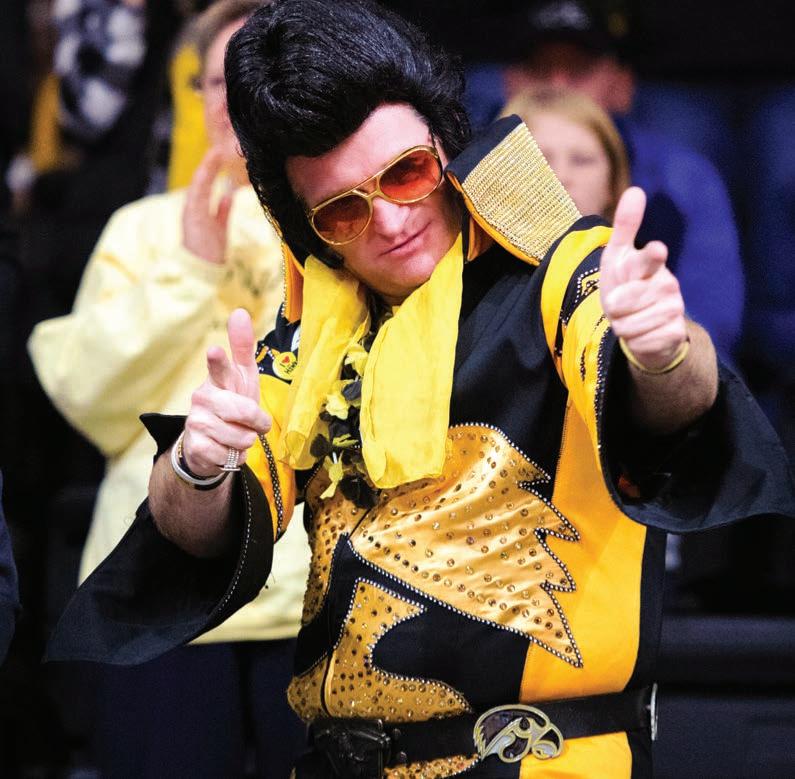
At 100, the Iowa Memorial Union undergoes renovations to advance student well-being.
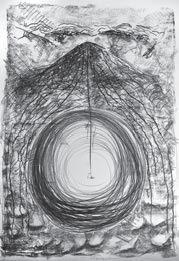
ALASKAN ZEN
A photographer fi nds beauty in land scarred by volcanic eruptions.
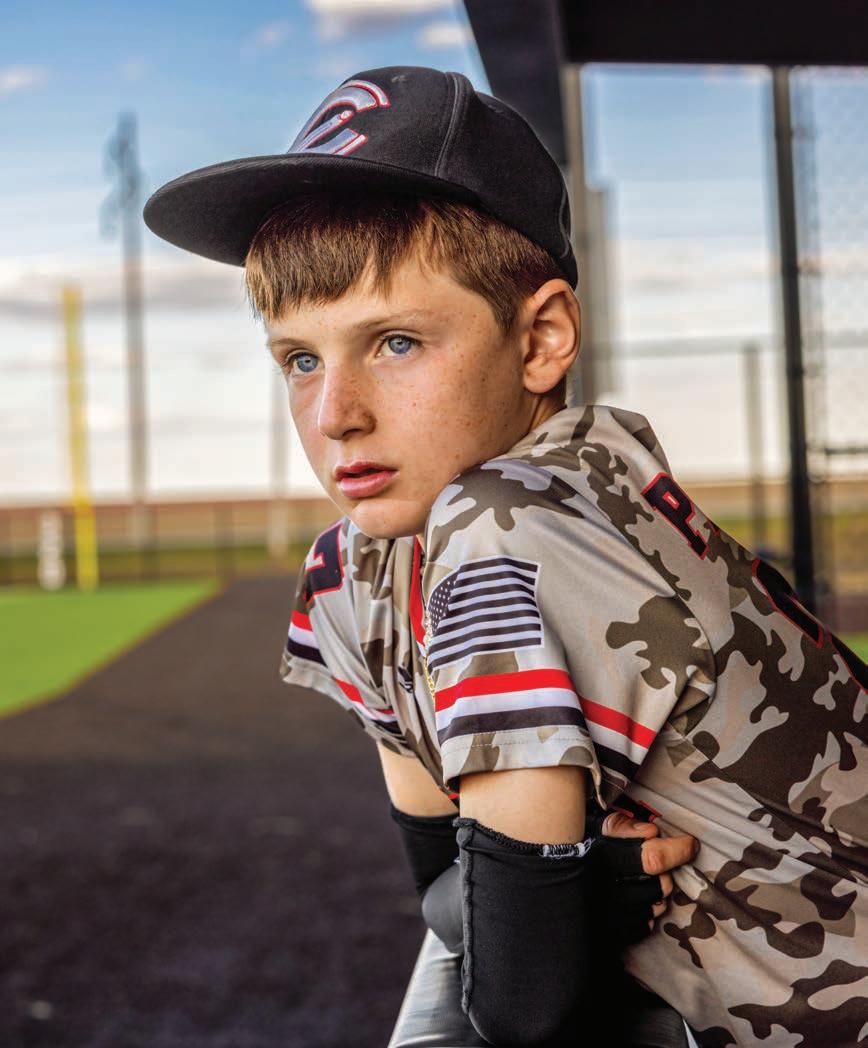
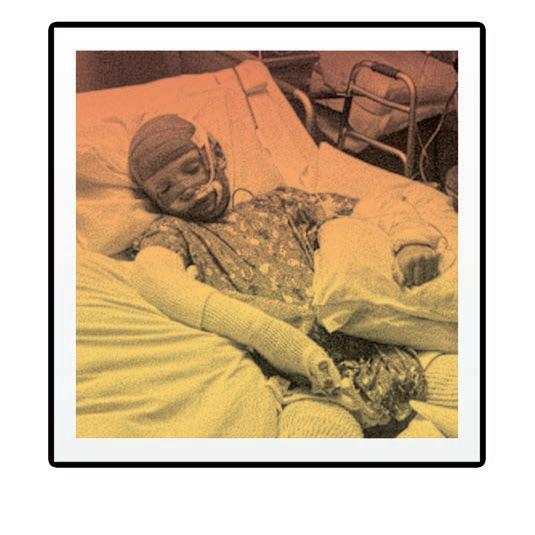
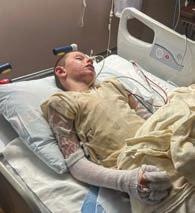
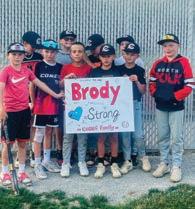
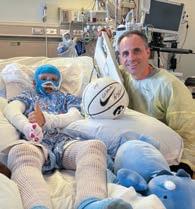
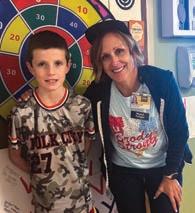
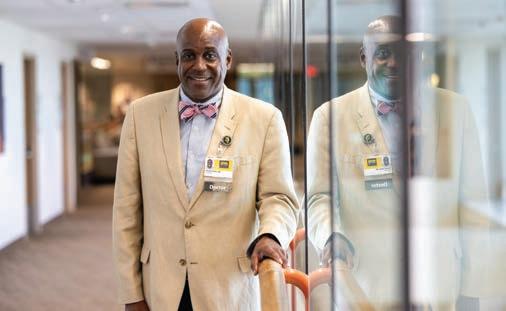
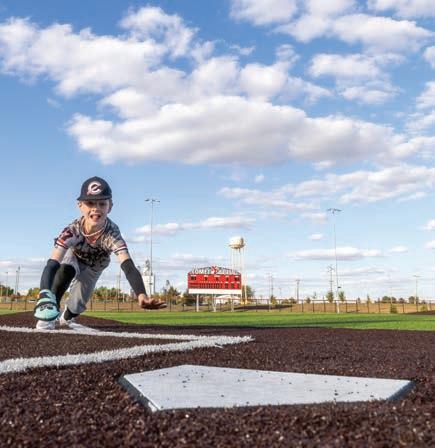
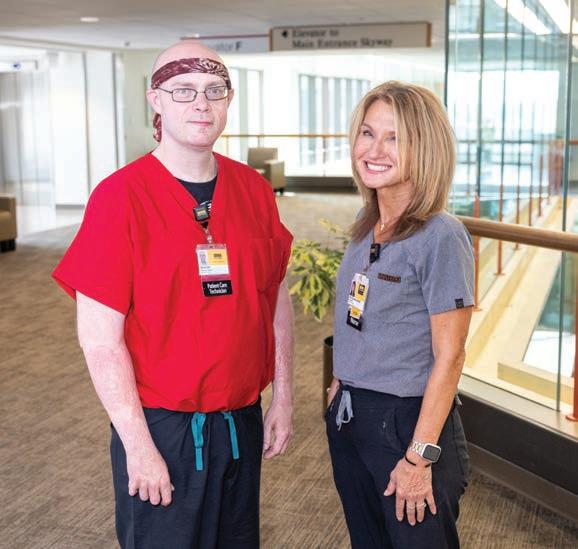
INSIDE IOWA’S BURN UNIT
The family of an 8-year-old baseball player shares his journey to recovery.
Stories From 100 Years of the Iowa Memorial Union
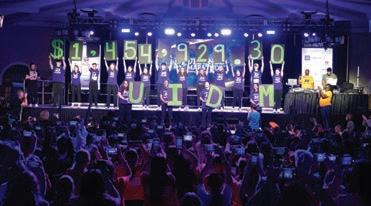
TEN YEARS. ONE DAY. THOUSANDS OF HAWKEYES.
On March 25, 2026, we’re celebrating 10 years of One Day for Iowa—and we want you to be part of it!
Sponsor a challenge for your favorite area, and help Hawkeyes everywhere make history.
FEATURES
Century of Support
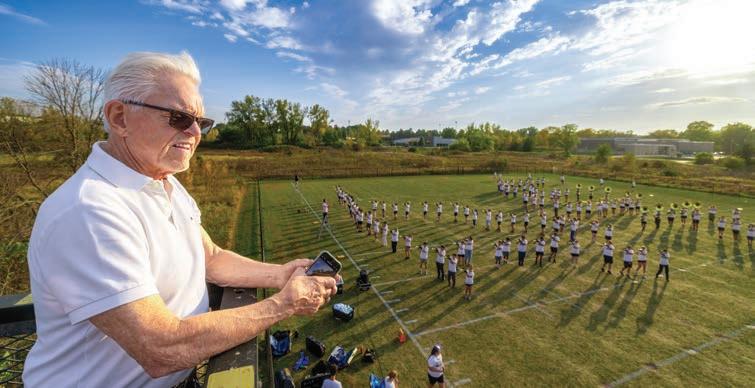
As it celebrates its 100-year anniversary, the Iowa Memorial Union continues to evolve to meet the needs of the campus community.
Inside Iowa’s Burn Unit
Tending to traumatic injuries, UI Health Care’s Burn Treatment Center brings hope to patients of all ages.
15 | Go Hawks
Former Hawkeye Cooper DeJean becomes a rising star in the NFL as a cornerback for the Philadelphia Eagles.
Alaskan Zen
Renowned landscape photographer Gary Freeburg (78MFA) captures wonders in the wilderness.
The nationally renowned
47 | Iowa Arts
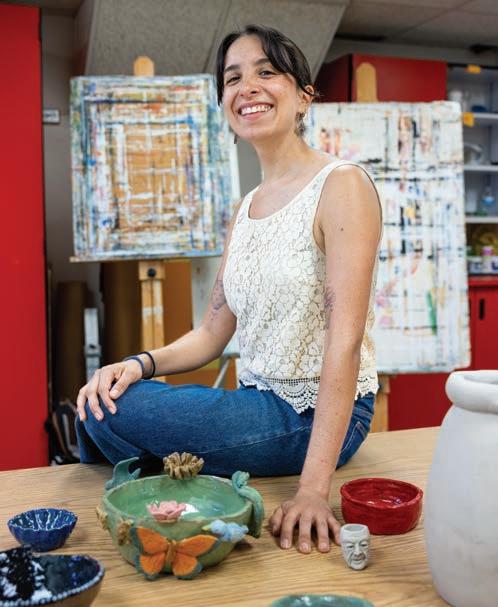
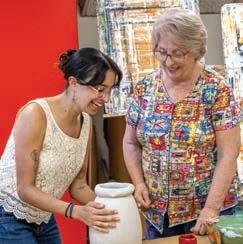
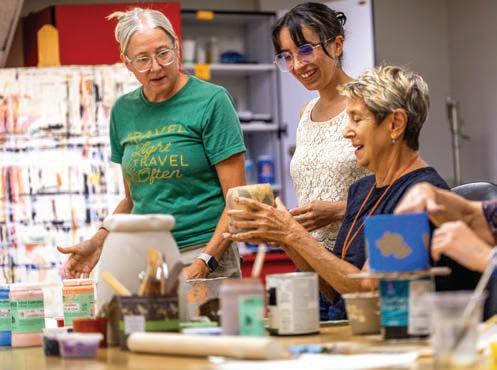
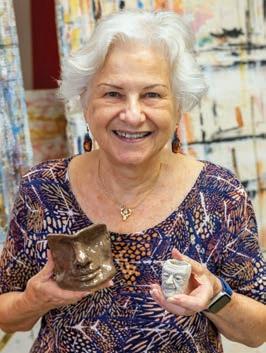
Rheumatic patients find healing and community through a ceramic workshop.
52 | For Iowa
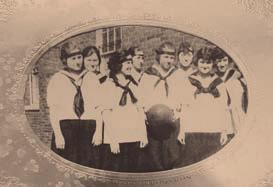
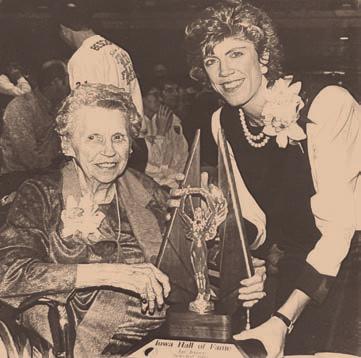
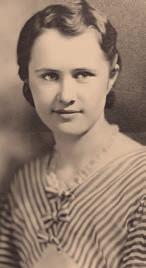
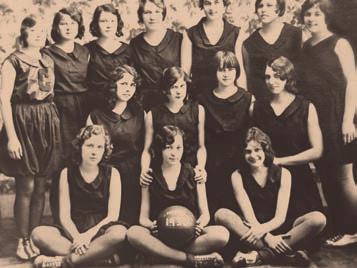
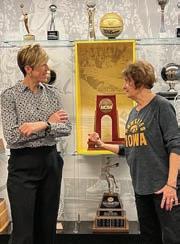
A gift to the Hawkeye women’s basketball program honors the rich legacy of Iowa high school girls participating in the sport.
58 | Always A Hawkeye
USA Today crossword constructor Sally Hoelscher (95PhD) creates a puzzle for Iowa Magazine readers.
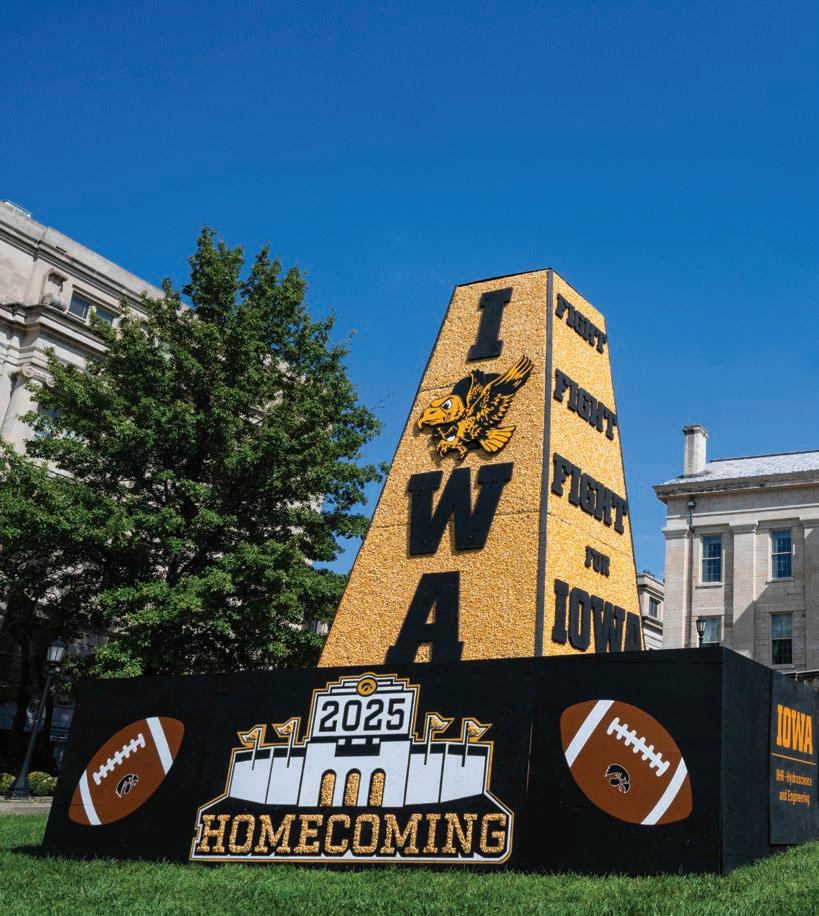
An A-Maize-ing Tradition
For more than a century, the University of Iowa has celebrated homecoming with a corn monument standing tall on the Pentacrest. Designed and built by UI engineering students, the tradition dates back to 1914. While this year’s obelisk took one month to build, students began planning the design last spring as part of their involvement with the campus chapter of the American Society of Civil Engineers.
For a photo timeline of Iowa’s past corn monuments, visit foriowa.info/im25-corn
BIG PICTURE
PHOTO: TIM SCHOON/UI OFFICE OF STRATEGIC COMMUNICATION
Celebrated Coach
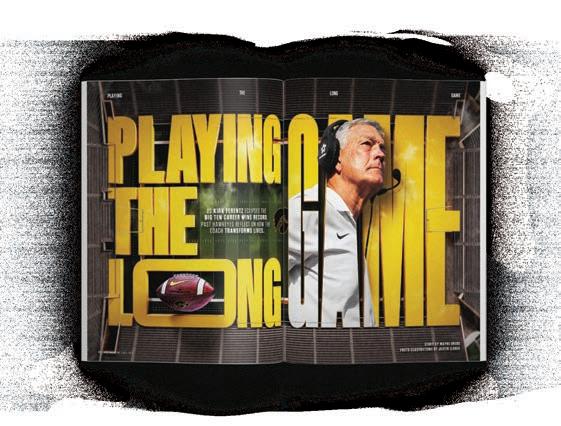
I’m glad I found the article “Playing the Long Game” [fall 2025, p. 20] on social media and took the time to read it. In this day and age, it is very refreshing to be reminded about what makes me proud to be an Iowa graduate and fan of the football team. I take pride in wearing the logo and cheering on the team because of coaches like Kirk Ferentz. Go Hawks!
Connor Blythe (15BA) Waukee, Iowa
Thanks for the great article on Coach Ferentz and players who have been under him. It brings out what is perhaps Ferentz’s most noteworthy quality: He cares.
Warren DeKraay Jr. (81BA) Racine, Wisconsin
I was on the sidelines to support the Hawks at the Iowa vs. Indiana football game in 1999. I was standing next to then-athletic director Bob Bowlsby (78MA), who may or may not have been having second thoughts about the coach he hired. The team was on a losing streak, and it couldn’t stop Indiana that day.
I introduced myself to Bowlsby and said, “I played here, and Coach Ferentz was my O-line coach for my first two years here. You made a great decision hiring him. He is the right man for this job.”
Bowlsby smiled and went on watching the game, probably wondering what the heck this guy was thinking. In 2004, I saw Bowlsby again at the Meadowlands Arena in New Jersey. I extended my hand, which he shook, and said, “I told
you in 1999 you made a great decision hiring Coach Ferentz.”
Bowlsby smiled and said, “You were right. Anyone who played for him is a better person for it.”
Mike Ferroni (93BA)
Stewartsville, New Jersey
Coach Ferentz was never looking for glory, just hoping to teach, inspire, and prepare players to do their best. In my opinion, he is a true gentleman and as ethical a man as can be found in college sports.
This story brings to life the essence of what Coach Ferentz is all about. Wayne Drehs’ (00BA) style of writing, along with the reflections of Ferentz’s former players, provides a multidimensional, almost surreal quality into the mind’s eye of the reader.
Although words can’t adequately describe what Coach Ferentz has brought to Iowa, Chad Greenway (05BA) put it best. I would also feel “nervous” upon meeting this man, as I would have to ask myself: Have I lived up to a similar code of ethics within my own life?
Joe Tortorich
Chicago
In the fervor of Iowa football, the message sometimes gets lost. The job of a football coach, in addition to winning games, is to prepare the young men he supervises for adulthood and life beyond the gridiron. Your article indicates Coach Ferentz has succeeded at both.
Raymond Page (70BBA) Downers Grove, Illinois
When my son went to Iowa in 2005, he came home his freshman year for Christmas with a gold-wrapped box labeled “To Dad, from Josh,” with an additional note: “You owe me—you owe me big.” Christmas morning, I opened it up: It was an autographed football in a plastic display case. The inscription read “Jeff, Go Hawks! Kirk Ferentz.”
My son explained that he was jogging one afternoon, and Coach Ferentz jogged past. My son sped up to run with him and asked, “If I were to get one of those autograph footballs, would you sign it for my dad for Christmas?” Coach said, “Sure. I’ll be in my office about 3. Bring it by then.”
That’s how I got my Ferentz autographed football. It sits in my office next to the 1980 Final Four autographed basketball. How many coaches would do that for some freshman student he doesn’t even know? Not very many. Coach Ferentz did, and after reading your article, I understand why he is the winningest coach at Iowa and in the Big Ten.
Jeff Nelson (75BGS) Grimes, Iowa
Calling All Hawkeye Superfans
Do you have a Hawkeye superfan in your life? Iowa Magazine wants to hear the story. Email us at uimagazine@foriowa.org
FOOTBALL
PHOTO: JEFF NELSON
Writers’ Guiding Light
I love “Compass in the Wilderness” [fall 2025, p. 46] by Pete Nelson (79MFA). I loved [the late Iowa Writers’ Workshop administrator] Connie Brothers, who convinced me that I could be one of the 5% as well.
My list of publications is much shorter than Nelson’s, but if it weren’t for Brothers’ cheerful encouragement, I might have no list at all. She was the warm, beating heart of the Workshop.
Mary Helen Stefaniak (84MFA)
Iowa City
Masked Heroes
“Courage Behind the Mask” [spring 2025, p.11] was such a wonderful story. Profound thanks to the UI Health Care radiation oncology department and Weiren Liu (21MD) for thinking of such a powerful support for the children and to the artists who are keeping the program growing. The masks are delightful! Tragically, many years ago, my younger brother died of leukemia. Even though all the doctors were incredibly caring, there wasn’t nearly the awareness of the psychological needs of kids in those days. My brother died alone overnight in the hospital, at a time when parents weren’t allowed to stay with their child.
I don’t think you could possibly overestimate how important such loving projects as Liu’s masks are to kids who are afraid, not only of their disease and treatments, but just being in a hospital at all. I’m so moved to read such a heartwarming story and congratulate all of you, including UI Health Care, for your great compassion, humor, and being true healers.
Judy Cuttler
New York
Although I’m not an Iowa grad, my workplace gets the quarterly Iowa Magazine. I always look forward to consuming it, and the summer 2025 issue was something to be consumed!
All the fun food stories, facts, photographs, and illustrations made this issue a delight. Specifically, Andy (02BS) and Carrie Schumacher ’s (01BA) Cobble Hill story ["A Marriage of Taste," p. 30], Bob (91MBA) and Kristy Platz Walker (83BS, 92MBA) and Walker Homestead ["A Feast for the Senses," p. 32], and the engaging story melding medicine and food with UI physician Terry Wahls (82MD, 86R) [“Grow Your Gut Garden,” p. 38] stood out to me.
Thank you for a wonderfully produced quarterly magazine that—like a great, rich, and savory broth—is well worth waiting for.
Doug Wagner Morning show host Newsradio 600WMT and Newstalk 1420WOC
The Chase of a Case
Applause to both the writer of ”The Alias Buster” [fall 2025, p. 32] and UIPD Detective Ian Mallory for their work in presenting details on identity theft—a very real and frustrating crime that seems to be increasing in frequency.
After a 23-year career in the FBI, working 14 of those years in whitecollar crime, I can attest to the fact that working on one of these cases can be a lesson in frustration for all involved. The same financial and right-to-privacy laws
that protect us from identity theft also make it extremely difficult to pursue those who find ways to skirt the laws. Not only is it frustrating gathering sufficient proof to prosecute identity thieves, it also can be frustrating to find prosecutors to file charges against violators. On the federal level, prosecutive guidelines prevent prosecutions unless there are substantial dollar losses or multiple victims. On the local level, as the article shows, there may
be multiple jurisdictions, and a violation in each jurisdiction may only result in misdemeanor charges. Congratulations to Detective Mallory. Pat Tadlock (74BA) Memphis, Tennessee
Painting Praise
“Painting Kurt Vonnegut: An Iowa Artist Celebrated a Workshop Legend” [fall 2025, p. 38] is one of the most beautiful pieces I’ve ever read. Worthy of a second, third, fourth read. A heart-stunner.
Cynthia Nooney Berkeley, California
Valued Voices
My older brother was diagnosed with Parkinson’s disease about 15 years before his death in 2020. He used to sing in the church choir, and the kind of therapy described in “Songs of Healing” [spring 2025, p. 59] would have been valued by him and others who missed their vocal gifts.
Diane Stien Newhall, Iowa
College Choice
I enjoyed the article “A Four-Year Portrait of a Reluctant Hawkeye” [spring 2025, p. 48]. I love how the writer’s uncertainty in the beginning turned into something bigger and better than she ever could have known. I’m from Iowa. I went to Iowa for two years in the 1970s after attending Drake for my freshman and sophomore years. Each college transition was great and also terrifying, so I loved her story and courage.
Kathi Branson Sherby (77BFA) Austin, Texas
magazine.foriowa.org MAIL One West Park Road Iowa City, IA 52242
EMAIL uimagazine@foriowa.org PHONE
FACEBOOK University of Iowa Alumni
Letters to the editor may be edited for style, length, and clarity. While we welcome feedback, we regret that we are unable to print or reply to every letter. CONNECT WITH
I am not a reader, but Ellen Yandel (25BA) has a gift for writing. “A FourYear Portrait of a Reluctant Hawkeye” held my interest. I wish her all the best and am happy she stuck with the UI when she didn’t think she was on her chosen path. Then she saw the light.
Go Hawks!
Pam Abbott (85BS) Mesa, Arizona
Hiruni Sumanasiri
Doctor Play Day
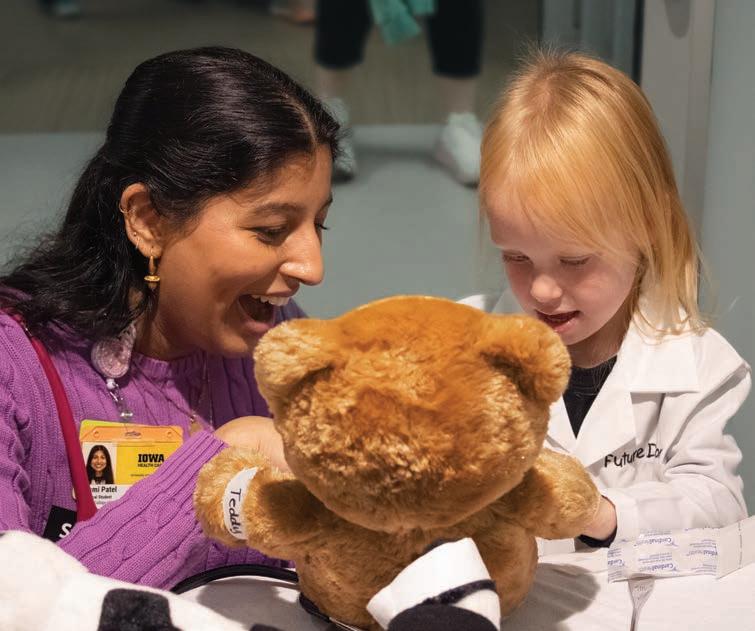
In October, the University of Iowa Carver College of Medicine hosted its Teddy Bear Clinic—an ongoing program established in 2015 to help children feel more comfortable in health care settings and spark their interest in the medical field. Alongside medical students like Asmi Patel (25BA, 25BS),
children from kindergarten to sixth grade acted as health care providers for their stuffed animals. They pretended to take their plush toys’ blood pressure, listen to their hearts, and perform X-rays during the event at UI Health Care’s Iowa River Landing clinic in Coralville.
8 ON THE MOVE 10 CAMPUS KEEPSAKES 12 THE SKINNY ON WEIGHT LOSS DRUGS
Built on Tradition
The Department of Communication Sciences and Disorders— one of the UI’s leading programs—has a new home in the Health Sciences Academic Building.
Earlier this year, the University of Iowa’s Department of Communication Sciences and Disorders marked the start of a new chapter when it moved into the new six-story, $249 million Health Sciences Academic Building. The expansive, light-filled facility gives Iowa’s renowned speech-language pathology and audiology programs a world-class setting to train future clinicians, advance research, and serve patients.
At the same time, the building stands as a testament to the department’s storied past, says Eric Hunter (01PhD), department executive officer and the Harriet B. and Harold S. Brady Chair in Liberal Arts and Sciences. “We’re standing on the shoulders of remarkable people—faculty, alumni, and the state itself—who built something extraordinary here,” he says. “Our job now is to honor that legacy by continuing to push the boundaries of what communication science can do for people’s lives.”
The field of speech and hearing science grew up at Iowa. Human communication research began at the Iowa Psychological Laboratory in 1897, and by the 1920s, experts in psychology, speech, and medicine were collaborating to study speech disorders scientifically. In 1925, a meeting between Iowa colleagues led to the founding of the American Speech-Language-Hearing Association—an organization that gathered again in Iowa City this past year to celebrate its centennial. Iowa has been a national leader in the discipline ever since. In the latest U.S. News & World Report Best Graduate Schools rankings, Iowa ranked second in the nation for audiology and fifth for speechlanguage pathology.
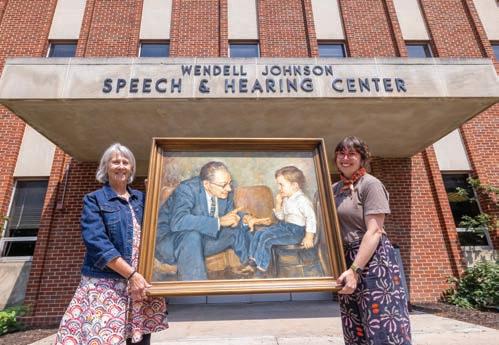
The department bid farewell to its home of nearly six decades, the Wendell Johnson Speech and Hearing Center, with a commemorative ceremony this past August. It will be joined in the Health Sciences Academic Building—located on the west
Pictured at left, professor emerita Patricia Zebrowski and assistant professor Naomi Rodgers hold a painting of Wendell Johnson outside the Department of Communication Sciences and Disorders’ former home at a commemorative event before its move to the new Health Sciences Academic Building (pictured below).
side of campus at the corner of Melrose and South Grand avenues—in 2026 by two other thriving programs: the Department of Health, Sport, and Human Physiology, as well as the Department of Physical Therapy and Rehabilitation Science.
The building features a soaring central atrium with an interconnecting stair way that links the programs together, as well as sweeping windows that provide outdoor views and natural light on each level. The rooftop will include an adaptive play space for children—a focal point for the annual Communication Explorers summer camp, which helps children with hearing loss build communication skills.
Hunter says bringing together several health science programs under one roof, along with the new building’s proximity to the main campus and UI Health Care Medical Center, will create innovative collaborations across the disciplines and help attract top talent to Iowa.
“The new building isn’t just about space—it’s about connection,” says Hunter, who was the first hire of the university’s Transformational Faculty Hiring Program in 2023. “It brings together students, faculty, and collaborators across health sciences in ways that spark innovation and improve lives. We’re in the middle of two faculty searches right now, and when candidates see this facility, they recognize it as a reflection of our energy and the university’s commitment to leading the field for years to come.”
BY JOSH O’LEARY
Dedicated and Decorated
Iowa honors five service members with the Hawkeye Distinguished Veterans Awards.
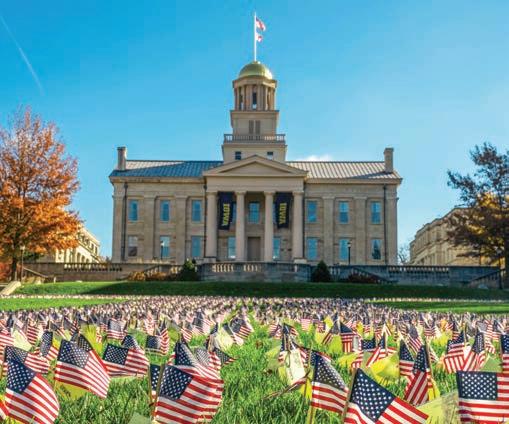
As the Iowa Memorial Union celebrates its 100 th anniversary, the University of Iowa recognized five outstanding service members last month at the campus landmark where fallen soldiers have been honored since 1925. Four alumni and one former faculty member received the Hawkeye Distinguished Veterans Award and were also honored at Kinnick Stadium during Iowa’s military appreciation football game against Oregon.
Chief Warrant Officer 2, U.S. Army
A Vietnam War veteran and medevac helicopter pilot, Clark served two tours from 1968-70 and 1976-81 and received the Purple Heart and National Defense Service Medal, among other honors. After earning a master’s degree in counseling and human development from the UI College of Education, he founded what became the Cedar Rapids Vet Center and launched Iowa’s first Critical Incident
Stress Debriefing Team. A frequent UI lecturer, counselor, and mentor, he also established the Joanne and Gregory Clark Memorial funds to support UI student veterans.
Jacobus’ 33-year career began at Iowa, where he earned his commission through ROTC. He later commanded the 224th Engineer Battalion during a yearlong deployment to Iraq in 2004-05, leading high-risk missions in support of Operation Iraqi Freedom. In 2022, he was named commandant of the Iowa Department of Veterans Affairs, overseeing care for thousands of veterans. Jacobus has held leadership roles with multiple military, nonprofit, and civic organizations, and he helped launch the Mighty Hawkeye Battalion Alumni Association.
Malott served as UI professor of military science from 1993-97, mentoring more than 250 cadets who earned officer commissions. After retiring in 1998, he continued supporting students as an admissions counselor and later as assistant director of transfer relations and outreach. Remembered as “Counselor Dave,” he was a trusted advocate for student veterans, military families, and transfer students. Malott, who died last year, served 22 years in the Army as a field artillery officer, with assignments in Germany, Venezuela, and at U.S. training and academic institutions.
An Iowa ROTC graduate, Stabler capped his 27year career as commander of the Air Force Office of Special Investigations, leading law enforcement and counterintelligence operations with 3,300 personnel at more than 255 locations worldwide. His honors include the Distinguished Service Medal, Legion of Merit, and Defense Meritorious Service Medal. At Iowa, his philanthropy has supported the Iowa Veteran Education, Transition, and Support (IVETS) program and UI Health Care, and he has served on the board of the UI Veterans Association Group. He is now director of global corporate security for Eastman Chemical Company.
Stewart earned his commission through Iowa’s ROTC program and was captain for the university’s first Ranger Challenge team, which became the top university-based team in the nation. Over his 27year Army career, he remained closely connected to Iowa, creating a support network for cadets and graduates, mentoring students, and hosting alumni gatherings while stationed in Washington. He also helped establish the Mighty Hawkeye Battalion Alumni Association and served on its inaugural board. His honors include the Defense Superior Service Medal, Legion of Merit, Defense Meritorious Service Medal, and several unit awards.
BY JOSH O’LEARY
Greg Clark (85 MA)
Todd Jacobus (89 BA) Colonel, U.S. Army
David Malott Lieutenant Colonel, U.S. Army
Kirk Stabler (91BS) Colonel, U.S. Air Force
Vance Stewart III (86 BBA) Colonel, U.S. Army
VETERANS
Memories and Mementos
Hawkeyes share their favorite keepsakes and snapshots from their time at Iowa.
This past fall, many alumni, friends, and fans added a new homecoming button to their collections—an Iowa tradition dating back more than century. Buttons, however, are just the beginning. Whether it’s a well-worn sweatshirt, cherished photograph, or keepsake tucked away on a bookshelf, Hawkeyes carry Iowa with them long after graduation. We recently asked Hawkeyes to share the mementos and snapshots that take them back to their days on campus. Here are a few of their Iowa treasures.
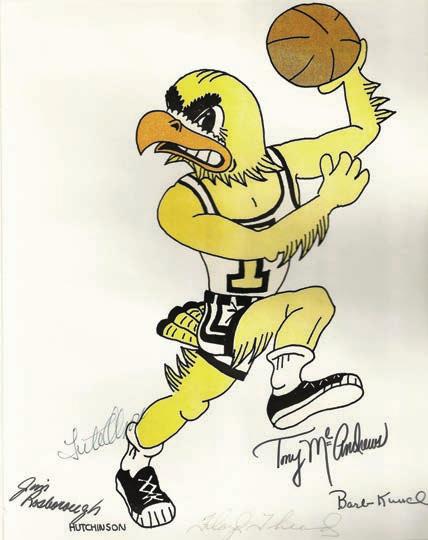
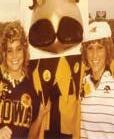
1 I kept the autographs of the men’s basketball staff from my two years as head manager of the team from 1974-76. That is Lute Olson ’s autograph on Herky’s left calf; Jim Rosborough (66BA), Tony McAndrews , and Floyd Theard filled out the staff, with Barb Kuncl serving as staff secretary.
Andrew Deming (76BA)
Martinez, Georgia
2 Here is my original student ID card in all its beat-up glory. I kept it together as long as I could until I was told to get a new one, which I still have too.
Roger Conely (86BSPh)
Phoenix
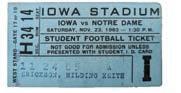
3 I still have my football ticket for the Nov. 3, 1963, football game against Notre Dame that was canceled due to the John F. Kennedy assassination. I had an apartment on East Burlington Street and was listening to the noon news when the assassination of JFK broke. On the way to class, I stopped at Schaeffer Hall and tapped on a ground level window, where a friend had class. I told him about the assassination through the window, and the class was immediately dismissed.
H. Keith Erickson (65BA)
Cedar Rapids
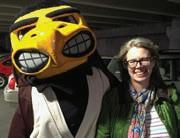
4 There was the epic day in 2015 I met Jedi Herky in a downtown ramp on my way to campus. It was a fantastic moment, something I’ll always remember when I think about my time at Iowa. One minute I’m stressed about finding a parking space, thinking about everything that needs to be done before the class I’m going to teach; the next, there’s Herky in a Jedi costume, and the chance for a photo together brightened my day, both then and now. May the Force be with you, UI!
Jennifer Burek Pierce
Professor, UI School of Library and Information Science
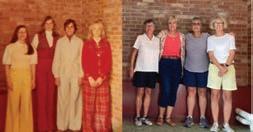
5 I made lifetime pals in Viva Lindman Boerschel (77BSN), Carol Roemig-Heusinkveld (76BS, 81MA), and Jan Sebern Gilliland (77BS) at Iowa. The first photo was taken in 1975 during spring of our sophomore year in Kate Daum Hall; the second was taken at a reunion in 2023. Don’t tell anyone that we had to sneak into the dorm to take the photo. We’re all in good enough shape to climb to the eighth floor to take the authentic photo reenactment.
Jody Adams Howells (77BS) Mooresburg, Tennessee
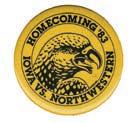
6 Homecoming buttons from 1983–86 and a Chuck Long (85BBA) 1986 Rose Bowl jersey
Lori Hansmeier Smith (87BA) Oregon, Illinois
7 My dad (Thom Chesney) joined me on REACH weekend 2021 for the Hawkeyes’ win over the Gophers. I remember how surprised I was that we were sitting so close to the field. I was an intern at UI Health Care then too, so when we did the Hawkeye Wave to the children, it was especially meaningful to me. I had probably met some of them when they came in, as I was a patient mover. No matter the weather, Hawkeye games feel warm and welcoming.
Drew Chesney
2024 UI REACH program graduate Santa Fe, New Mexico
8 Hancher Auditorium Joffrey Ballet Nutcracker poster from December 1987
Bev Stevenson (87BBA) North Liberty
9 My bestie from Chariton High School, Rachel Mathes Arend t (pictured with me at right), and I wanted to be Hawkeyes for as long as I can remember. Rachel and I moved to Iowa City in 1983, and we never missed a home game and traveled to many away games, always decked out in ’80s Iowa fashion. For our 40 th high school reunion weekend in 2023, we went to the IowaNorthwestern game at Wrigley Field to celebrate our 40 years as fans. It has been such a special part of our friendship. We lived in Iowa City together until 1988, and on game days it can still feel like yesterday!
Mary Kay Morr Radavich (88BA)
Litchfield Park, Arizona
BY JOSH O’LEARY
The Writing University
The UI once again has been named the No. 1 public university for writing by U.S. News & World Report. Iowa recently established an Office of Writing and Communication headed by Daniel Khalastchi (05MFA) to unify, amplify, and expand the many writing and communication programs across campus.
Prestigious Programs
Iowa’s physician assistant program is ranked No. 1 in the latest list of “Best Graduate Schools” by U.S. News & World Report. Other UI programs in the top five include audiology at No. 2, physical therapy at No. 3, nursing anesthesia at No. 3, pediatric primary care Doctor of Nursing Practice at No. 4, rehabilitation counseling at No. 4, and speech-language pathology at No. 5.
Nationally Recognized Nursing
Two UI College of Nursing programs recently received national recognition for their innovative models of care. The Simulation in Motion program, which provides mobile training across the state, and the Iowa Online Nurse Residency Program, which boosts support for new graduate nurses, were selected as Edge Runners by the American Academy of Nursing.
What Should We Know About Weight Loss Drugs?
Physician Leon Jons , a weight management specialist at UI Health Care and clinical associate professor of internal medicine at the Carver College of Medicine, helps patients lose weight—and keep it off. According to a 2024 Centers for Disease Control and Prevention study, 4 in 10 Americans have obesity, which puts them at a higher risk for long-term health concerns. Here, Jons answers questions on how weight loss drugs can be used to help manage one’s health.
What are common myths about weight loss drugs?
The most common concern patients have is whether they will regain all their weight if they stop these medications. In general, patients do not always regain
Successful weight management includes understanding a person’s reasons for weight gain, barriers, and medical problems.
the weight. However, weight loss maintenance is much more difficult to achieve than weight loss. Having a good behavioral plan in place and having plenty of physical activity are important in helping patients maintain weight.
What are the most common weight loss drugs, and how do they work?
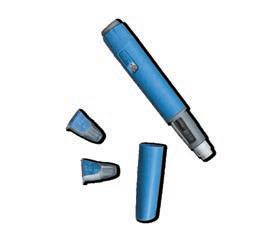
Many prescription medications are available to help individuals with weight loss through controlling hunger, meal size, and cravings. Examples of medications that have been available for many years include phentermine, Qsymia, Contrave, and Saxenda. Newer medications that have become popular include Wegovy and Zepbound. These last two are injectable medications that mimic proteins that our bodies naturally make called incretins. They were originally introduced as diabetic medications but had the effect of causing significant weight loss by helping control eating behavior.
Are
weight loss drugs suitable for everyone?
Leon Jons,
clinical associate professor of internal medicine at the Carver College of Medicine
These medications can have significant effects on weight loss, with patients able to lose between 11–22% or more of their weight. They are not for everyone. Individuals have different causes of weight gain and different medical issues that are important to understand when considering weight loss. Side effects also can limit their use.
Do I need to make lifestyle changes on weight loss medication?
Successful weight management includes understanding a person’s reasons for weight gain, barriers, and medical problems. Treatment first revolves around behavioral interventions. If there’s a reason to be more aggressive, then medications and bariatric surgery can be considered.
Message frequency varies.
Text “Help” to 97817 for help, or text “Stop” to 97817 to end.
Message frequency varies.
Message and data rates may apply.
Text “Help” to 97817 for help, or text “Stop” to 97817 to end.
Message and data rates may apply.
HAWKEYES at home
HAWKEYES at home
at home
IOWA’S BEHIND-THE-SCENES
IOWA’S BEHIND-THE-SCENES STORIES, STREAMING TO YOU!
STREAMING TO YOU!
IOWA’S BEHIND-THE-SCENES STORIES, STREAMING TO YOU!
magnifying-glass-paper
JOIN US FOR THREE NEW EPISODES OF THE UNIVERSITY OF IOWA’S WEB VIDEO SERIES, DEBUTING JAN. 5–7:
JOIN US FOR THREE NEW EPISODES OF THE UNIVERSITY OF IOWA’S WEB VIDEO SERIES, DEBUTING JAN. 5–7:
JOIN US FOR THREE NEW EPISODES OF THE UNIVERSITY OF IOWA’S WEB VIDEO SERIES, DEBUTING JAN. 5–7:
Discover the hidden secrets of University Libraries.
Discover the hidden secrets of University Libraries.
Discover the hidden secrets of University Libraries.
Explore Iowa’s cutting-edge driving research for safer roads.
Explore Iowa’s cutting-edge driving research for safer roads.
Explore Iowa’s cutting-edge driving research for safer roads.
Go inside UI Health Care’s innovative surgical simulation labs.
Go inside UI Health Care’s innovative surgical simulation labs.
Go inside UI Health Care’s innovative surgical simulation labs.
DON’T MISS AN EPISODE!
DON’T MISS AN EPISODE!
DON’T MISS AN EPISODE!
Scan the code or visit foriowa.info/im-hawkeyes-home26 to receive links to the episodes when they debut.
Scan the code or visit foriowa.info/im-hawkeyes-home26 to receive links to the episodes when they debut.
Scan the code or visit foriowa.info/im-hawkeyes-home26 to receive links to the episodes when they debut.
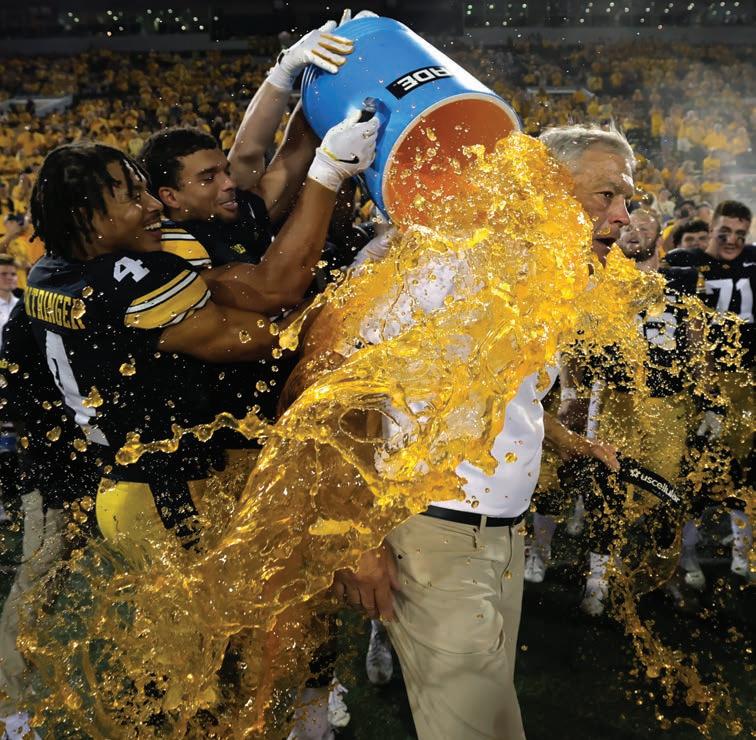
Victory Shower
Hawkeye football players doused Kirk Ferentz with orange Powerade as he surpassed a record set by College Football Hall of Fame Coach Woody Hayes to become the all-time winningest coach in Big Ten history.
“I’m thrilled and can’t believe, quite frankly, that my name’s next to that distinction,” Ferentz said following the September victory over UMass. “It’s a real testament to the university and to the program here.”
16 FROM HAWK TO EAGLE 18 CLARK ’ S WILSON COLLAB 20 WOMEN ’ S WRESTLING MILESTONE
DeJean Delivers
After helping the Philadelphia Eagles win last season‘s Super Bowl, former Hawkeye Cooper DeJean has become a rising star in the NFL—and gives back to a state he loves.
NFL HAWK
Cooper DeJean hasn’t forgotten his Iowa roots.
That’s why, after the NFL star for the Philadelphia Eagles won the Super Bowl in February, he spent much of his offseason giving back to a state he loves.
In June, he hosted a charity softball event at Principal Park in Des Moines, which raised $75,000 to benefit University of Iowa Health Care Stead Family Children’s Hospital. Approximately 9,000 fans watched DeJean, some of his Eagles teammates, and former Hawkeyes—including C.J. Beathard (16BS), Dallas Clark (07BA), Jay Higgins (24BA), and Riley Moss (21BS)—compete in a home run derby and celebrity softball game.
“I was trying to find a way to give back, and I figured that would be a fun way to do it,” says DeJean. “The University of Iowa has given me so much, and Stead Family Children’s Hospital means so much to our football program, the university, and our state. I was happy to use the platform I have and raise money for a place that means a lot to me.”
He’s continued to give back to Stead Family Children’s Hospital after releasing a new selfbranded cereal in September called Coop’s Crunch.
DeJean—a native of Odebolt, Iowa—credits the Hawkeye football program for setting him up for a successful 2024 NFL season. Despite having to wait six weeks to see the field due to a hamstring injury, DeJean started nine games, accumulated 50 tackles, and became just the second rookie in Super Bowl history to have an interception return for a touchdown.
“Iowa is a first-class program,” says DeJean. “The way you’re coached there prepared me really well. Just the way they teach football, the way they teach life in general, and what Coach Kirk Ferentz does for the student-athletes. The program has given me so much, and I wouldn’t be the player I am today if I didn’t go to the University of Iowa. I owe a lot to that program and the coaches.”
In year two, DeJean continues to adjust to playing in the NFL. The biggest change for him is life beyond football.
“In the NFL, you’re around people with families and kids, so outside of the building, you’re not going home to hang with your boys,” says DeJean. “Everybody’s going back to their family, so it’s a little different off the field. But I literally get to do football all day, every day, which is fun. It’s what I love to do.”
BY BEN FROTSCHER
CLOCKWISE FROM TOP: Cooper
DeJean signs autographs in Des Moines this past summer while hosting a charity softball event, returns an interception 41 yards against Purdue as a Hawkeye in 2023, and scores a Super Bowl touchdown on his birthday last season as a Philadelphia Eagles rookie.
On the Ball
A former Hawkeye gives Caitlin Clark an assist on her Wilson basketball line.
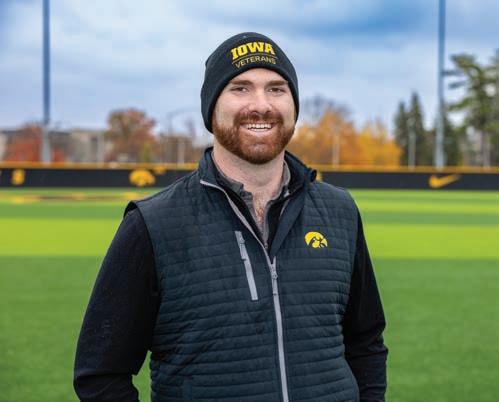
Christopher Rickert (13BBA) will never forget how it felt to play for the black and gold.
“It was kind of the dream come true, honestly,” says the former Hawkeye men’s basketball team walk-on. “The first time I saw my last name on the back of an Iowa jersey was pretty surreal.”
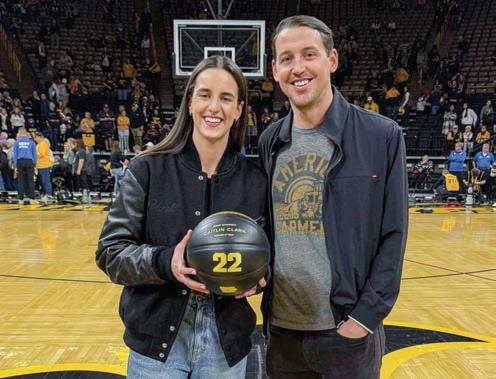
More than a decade after he last stepped on the court for the Hawkeyes, Rickert returned to CarverHawkeye Arena again last season—this time to help the Wilson Sporting Goods company present an Iowa career achievement ball to Caitlin Clark (24BBA) during her jersey retirement ceremony.
As the senior director of global product at Wilson, Rickert has worked closely with Clark throughout the process of designing basketballs for the Wilson x Caitlin Clark product line that launched last year. “The Caitlin Clark project has been one of the true highlights of my career at Wilson,” says Rickert.
Now based out of Chicago, Rickert grew up playing basketball in Iowa. The Sioux City native
won a high school state championship as a senior but thought it would be his last game. Instead, he played intramurals as a freshman at Iowa, where he heard about the Gray Squad—a group of practice players who scrimmage against the Hawkeye women’s basketball team to prepare it for upcoming games. Rickert joined sophomore year. “I just loved everything about it, going back to practice, feeling like I was back part of a team,” he says.
A spot on the Hawkeye men’s basketball team opened his junior year, and he joined the squad as a walk-on from 2011-13.
When Rickert graduated from the Tippie College of Business, he knew he wanted a career that mixed sports with business. He joined Wilson in 2013, working his way up to product development, where he has been for eight years. His job includes creating footballs, volleyballs, and soccer balls for some of the top leagues across the globe.
Rickert paid close attention to Clark’s rise to the national spotlight. When he saw her using the
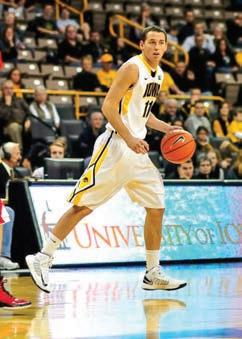
LEFT: Caitlin Clark holds an Iowa career achievement ball presented by Christopher Rickert of Wilson during her jersey retirement ceremony at Carver-Hawkeye Arena in February 2025. BELOW: Rickert played two seasons as a walk-on for the Iowa menʼs basketball team.
Wilson ball in the 2023 NCAA tournament game in which Iowa beat South Carolina, he began to think, “She’s an absolute generational talent that inspired so many people to start watching women’s basketball around the world. We’ve got to find a way to be a part of this.”
The Caitlin Clark Signature Series, according to Wilson, aims to “inspire players everywhere to take center court and center stage to play the game they love.” Wilson created the product line by sending the WNBA guard surveys on her personality and preferences, including favorite color, hobbies outside basketball, and what she finds most meaningful. That led to a blue basketball (her favorite color), a green ball with a hidden golf motif, and phrases like “Dream Big” being incorporated into the designs.
Rickert says returning to his alma mater to present Clark with the ball he helped design was a full-circle moment. “There are so many spiderwebs of connection that day on the court that made it impactful,” he says.
That included talking to the Indiana Fever star about her own experience with the Gray Squad. “Back in my day, I’m thankful I didn’t have to guard Caitlin in practice,” says Rickert, “because she would have absolutely cooked me.”
BY ALISON BOWEN
Speed Pays
A three-time All-American sprinter chases down NIL deals.
Kalen Walker (24BS) knew running the 40-yard dash at Kinnick Stadium would garner some attention.
When the All-American crossed the finish line last fall in 4.15 seconds—the second-fastest unofficial time ever recorded—it turned heads. That experience also opened up doors for potential NIL deals.
“I really feel like I own a small business, and my goal with NIL is to provide value to anyone who partners with me,” says Walker, who is currently collaborating with Major Fitness, a home workout equipment company. “I want what someone is paying me to be worth it for them.”
Walker, who has 103,000 followers on Instagram, is a prime example of a student-athlete using his social media following to attract and secure NIL deals. Scott Brickman , general manager for NIL and strategy within the UI Department of Intercollegiate Athletics, says that student-athletes are cashing in on online audiences they’ve built.
“You don’t have to be a high-profile athlete in a high-profile sport to get an NIL deal,” says Brickman. “If you have a strong presence on social media, a savvy business is going to want to partner with you and tap into your social media followers.”
Since July 1, all NIL deals of $600 or more go through NIL Go, a centralized clearinghouse
operated by Deloitte that oversees and regulates student-athlete endorsement deals. Dozens of Hawkeye NIL deals have been approved since this summer—benefiting student-athletes in many of Iowa’s 22 sports.
Brickman says these companies—including local and regional banks, ag and health and wellness companies, car dealerships, and property managers—are looking to build relationships and align with a student-athlete that fits their brand.
Walker—who has worked with 10 businesses over the past two years—makes cold calls, schedules meetings, and pitches his own deals. He says it’s been a valuable learning experience that will help as he plans to continue competing and launch a coaching career.
“I’ve gained so much knowledge about how companies work, but I’ve also learned that I need to take ownership of my career,” says the Eddyville, Iowa, native, who hopes to contend for Big Ten and NCAA championships this season in the 60- and 100-meter dash. “Don’t wait around for anyone else to figure it out for you. Figure it out yourself—and run with it.”
BY BEN FROTSCHER
Aced It
Megan Gustafson (19BBA, 25MBA) won a WNBA championship with the Las Vegas Aces this past fall to become the first Hawkeye since Tangela Smith (98BS) in 2009 to earn the title.
Top of the Field
Johnston, Iowa, native Jack Dreyer (21BBA), who played Hawkeye baseball from 2018-21, won a World Series title this past fall in his rookie season as a relief pitcher with the Los Angeles Dodgers. He becomes the first former Hawkeye player since Jim Sundberg of the Kansas City Royals in 1985 to win the World Series.
Kittle by Kittle
Hawkeye power couple George (16BA) and Claire Kittle (16BA) have launched the weekly podcast The Kittle Things to share about their lives, football, and varied interests. NBA legend Charles Barkley is the first episode’s featured guest.
Big Ten 100-meter dash reigning champion Kalen Walker has leveraged his large following for business partnerships.
We Have Arrived
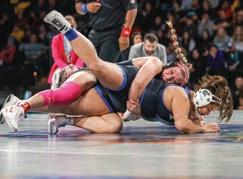
Six years after becoming an emerging sport, women’s wrestling hosts its inaugural NCAA championships in March.
The path to a national title will only get tougher. Iowa women’s wrestling coach Clarissa Chun embraces that reality as a natural byproduct of the sport’s rapid growth.
The Hawkeyes will be at the center of another milestone on the mat, March 5–7, 2026, when they host the inaugural women’s wrestling NCAA championships at Coralville’s Xtream Arena. “These are the things we work toward to not only grow as a sport, but to provide these young women opportunities to compete on a big stage,” says Chun. “This recognizes that they’re there, and there is enough competitiveness in the sport. It also fuels the opportunity for other programs to add woman’s wrestling.”
Chun says Division I has ground to cover to keep pace with the rapid increase of Division II and Division III institutions offering the sport. Since the NCAA approved women’s wrestling for championship status last January, she has received calls from several Big Ten and Big 12 universities seeking advice on establishing programs of their
own. Lehigh University became the sport’s sixth Division I varsity program in May, following historically Black college and university Delaware State. Meanwhile, Oklahoma State fields one of several prominent club teams hoping to make the jump.
Iowa seeks a third straight national title this season but has fewer opportunities to flex its depth at the championship level. The maximum number of national qualifiers per school drops from 15 to 10 this season, with just one competitor per weight class, while the NCAA championship field decreases from 320 to 180 student-athletes. Iowa had 15 All-Americans at the National Collegiate Women’s Wrestling Championships last season, including a pair at five different weight classes.
Chun says the format change has minimal impact on how her team approaches the season, and she’ll continue to build depth by filling her roster with 30 student-athletes, the maximum allowed for a Division I revenue-sharing team. The change has led, however, to having candid conversations
“
These are the things we work toward to not only grow as a sport, but to provide these young women opportunities to compete on a big stage.”
— Clarissa Chun on hosting the inaugural women’s wrestling NCAA championships
earlier in the season. “No one’s guaranteed a spot, but that’s the beauty of wrestling—you’re fighting for a spot,” says Chun. “Even though now it’s a third of the team that, if qualified, would get to represent Iowa and compete for a national title, it’s never losing the fact that it takes the entire team to earn that team title, whether they step on the mat at nationals or not.”
Two-time defending national champion Kylie Welker never imagined competing for an NCAA championship as a possibility when she first began wrestling. As that reality approaches, she hopes the increased visibility will garner more respect for the sport and create greater opportunities, like a Big Ten championship, for those following in her footsteps. “It’s inspiring and a testament to the sport,” says the 2025 U23 world champion. “We have moved really far in a short period of time, but we still have places to be in where we want to go.”
BY TYLER STRAND
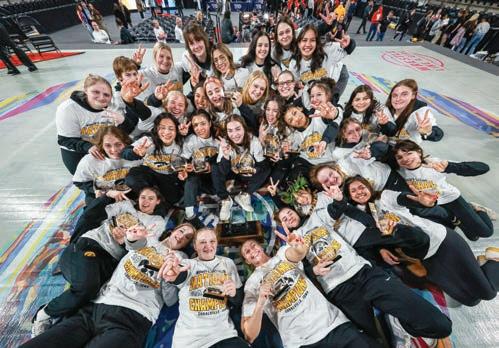
TOP: The Iowa women’s wrestling team seeks its third straight national title this season—and its first NCAA championship. ABOVE: Two-time defending national champion Kylie Welker looks forward to competing for her first NCAA title this season.
WOMEN’S WRESTLING
Fall in Focus
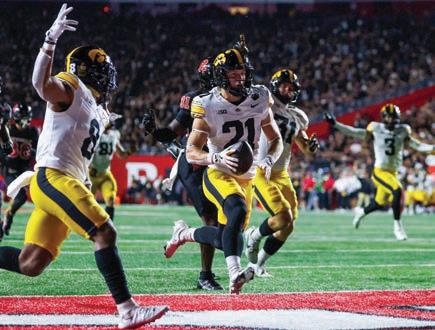
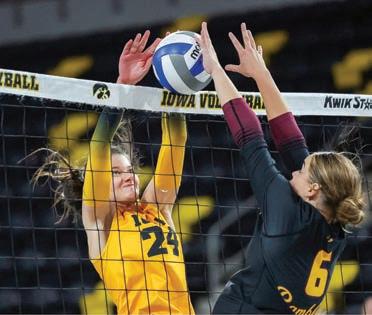
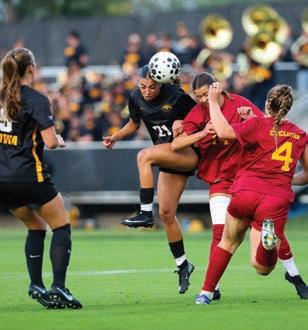
Iowa’s athletic teams made runs at history early and often throughout the fall season. Here are a few defining moments.
1 UNTOUCHED: Williamsburg, Iowa, native Kaden Wetjen (No. 21) returns the opening kickoff 100 yards for a touchdown in the Hawkeyes’ victorious Big Ten opener at Rutgers. Wetjen later recorded his fifth career return touchdown against Minnesota to tie Tim Dwight (99BS) for the most in Iowa history. “Whenever he gets the ball in his hands,” says Iowa quarterback Mark Gronowski, “you know something spectacular is going to happen.”
2 HEAD-TO-HEAD : Iowa freshman Liana Tarasco (No. 21) heads the ball in a 1-0 SEASON SNAPSHOTS
home victory over Iowa State. The Hawkeye soccer team finished the regular season at 11-3-4 overall.
3 NET GAIN: Iowa’s Aleksandra Stojanovic (No. 24) challenges at the net against Loyola Chicago to help Hawkeye volleyball reach its first 6-0 start in 15 years.
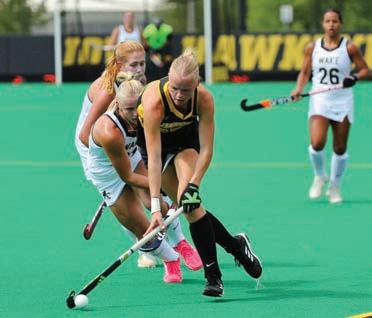
4 SPEED DEMON : Iowa field hockey’s Dionne van Aalsum zips past a pair of Demon Deacons and scores twice in the Hawkeyes’ win over No. 20 Wake Forest. Iowa completed the regular season with a 12-4 record.
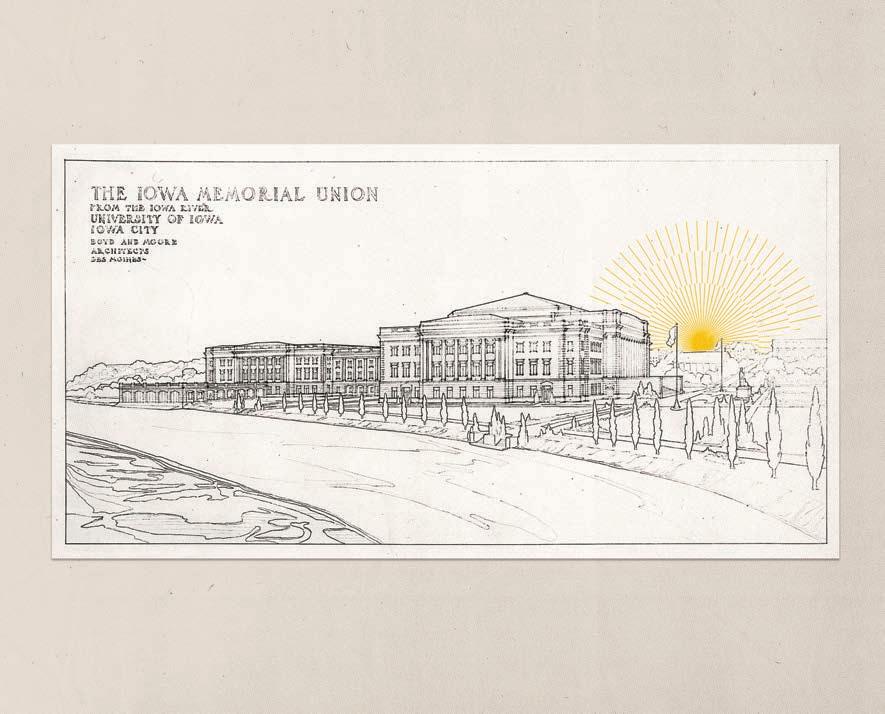
100 Years Stories From of the Iowa Memorial Union
BY EMMA CONWAY
A Century of Support
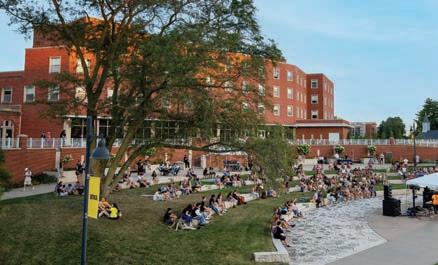
In its 100th year, the Iowa Memorial Union continues to adapt to meet students’ needs.
hether it’s prospective students forming their first impressions on a campus tour, current Hawkeyes gathering for activities with their student organizations, or alumni stopping by the bookstore for a memento, there’s never a dull moment at the Iowa Memorial Union. The buzzing building at the heart of campus turns 100 in February, a milestone that the University of Iowa is celebrating all year.
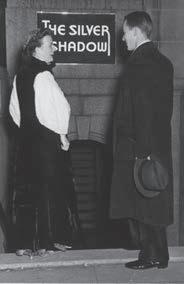
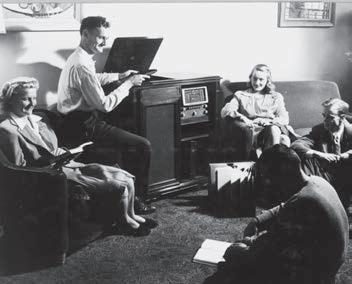
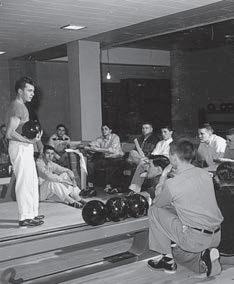
Since its official dedication in 1926, the IMU has undergone many changes to meet the needs of students. A dry nightclub called the Silver Shadow, a classical music listening library, and a six-lane bowling alley are just a few features that have come and gone. The union has also weathered challenges, including the 2008 flood washing out the ground floor and the COVID-19 pandemic limiting its use. But even in the face of natural disasters,
war, and the changing times, the IMU’s purpose has remained the same: to serve the university community.
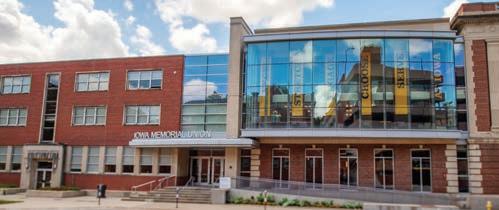
In recognition of the IMU’s legacy and its ongoing importance to campus, the UI has launched an $81.4 million renovation project set for completion in 2027. The project will preserve the union’s character, while transforming it into a modern space where students can gather, grow, and more easily access the resources they need to succeed.
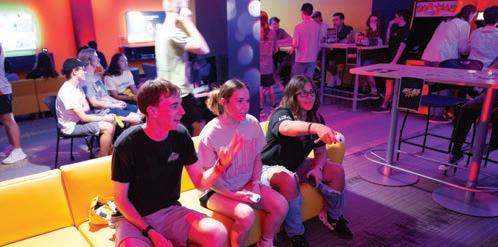
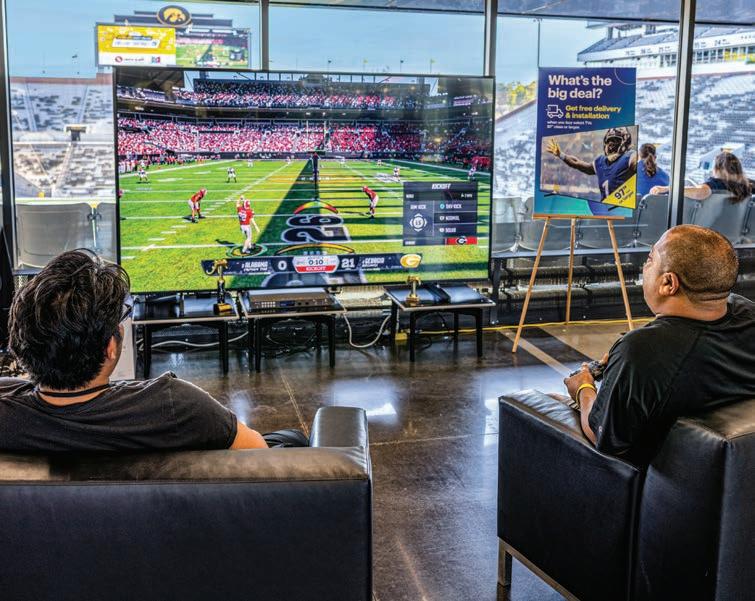
Plans include a student well-being center to bring university support services under one roof; renovated dining spaces with nationally branded food options; improved navigation and circulation throughout the building; updated meeting rooms, offices, and lounge areas to study and connect; and a leveled-up space for esports.
As the IMU marks a century at the center of the student experience, Hawkeyes can also look ahead to a new era in which the union’s offerings help students thrive at every stage of their UI journey.
Cause for Construction
A key part of shaping that future is creating a campus well-being center that offers physical and mental health services. Currently on the west side of campus, Student Health, Student Wellness, and University Counseling Service will move to the IMU, taking space once occupied by the Iowa House Hotel. The former Iowa House Hotel’s transformation will complement other IMU improvements completed in 2023, when additional services like the food pantry were added to the union’s ground floor. These student-centric features are all part of the university’s strategic plan of “embedding well-being and mental health into all aspects of campus culture.”
Upholding that mission by placing Student Wellbeing Services within the union was a novel idea. Bill Nelson , associate dean and executive director of the IMU, says no other Big Ten university houses student health and counseling services in its union. When he’s spoken to other Big Ten union directors, Nelson says, “People are fascinated by what we’re doing here. People are interested in what these renovations will do in terms of redefining the student experience.”
Tanya Villhauer (87BS, 91MA), assistant dean of students for well-being and basic needs, says putting student wellness services in the IMU sends an important message. “We want our students to understand that we value their health and wellbeing,” she says. “We can show that by how we show up for them.”
Student-Driven Updates
Undergraduate Student Government President Thomas Knudsen and Vice President Emily Cross are among the Iowa students who have been advocating for the renovations. On any given weeknight, the two can be found attending meetings in the IMU for USG. USG and UI Graduate and Professional Student Government both supported the IMU project, which will be covered primarily by student fees, with help from donor funds.
When Knudsen and Cross decided to run for student leadership positions in spring 2025, they thought deeply about their goals—not only for USG, but for the extended campus community. A part of their campaign platform was enhancing campus spaces and championing mental health awareness to ensure students have convenient access to support services. “If students don’t know where to go or how to access those resources, they’re not going to use them,” says Cross, a UI junior studying marketing and event management.
An $81.4 million renovation to modernize the 100-year-old Iowa Memorial Union for students began in summer 2025 and is estimated for completion by fall 2027. The updates include improvements to spaces where the campus community can gather, eat, and study.
Director of Student Health and Wellness Todd Patterson (14BA, 17MHA) reported that Student Health averaged 23,697 visits from fiscal years 2021–25. University Counseling Service averaged 11,000 appointments for each of the last three years. With the IMU location change, Patterson says, “We are looking forward to moving into a newly remodeled clinic to continue providing excellent health care for our UI students.”
The move comes at a time when the demand for student services and support is larger than ever. Pursuing higher education at an institution is a major life transition. For many students, college is the first time they are juggling academic, financial, and personal stressors on their own. Studies from the American Council on Education show that poor mental health leads to lower retention rates. For these reasons and more, Villhauer says, “Having accessible care is an important component of students’ success.”
Over the years, many famous figures have visited the IMU—including
An Investment in the Future
A pre-law student, Knudsen graduates this spring—meaning he won’t see the final changes to the IMU until he becomes an alum. Even so, the senior views the building’s updates as a win for the university. “When the IMU renovations are done, it will be a focal point that students look at when deciding to attend the University of Iowa,” he says. “I’m very excited for the next generation of Hawkeyes who will be able to fully benefit from centralized services, the expansion of student workspaces, and the cool new food vendors. ”
The next generation of Hawkeyes deserve extra consideration, especially given their size. When the undergraduate class of 2029 arrived on campus this past fall, they were 5,561 strong. This is the second-largest admitted undergraduate class Iowa has seen. More students mean more needs, and Knudsen and
Cross see the IMU project as a long-term investment in current and future students.
Of course, the IMU is not just used by students—it’s frequented by alumni, community members, prospective and future Hawkeyes, friends, families, faculty, staff, and the general public When Villhauer imagines the future of the IMU, she sees a revolving door with people constantly coming in and out. From public lectures and concerts to shopping and dining, the IMU is a space she views as offering something for everyone.
Nelson shares a similar vision. Because even when student activities and offerings within the IMU change, its 100 -year tradition as the hub of campus life does not. More than just a building, the IMU is a place for making new connections and memories. As Nelson says, “It will always be the people who make the IMU special.”
Cut the Cake
While Iowa Memorial Union renovations won’t be complete until 2027, students, alumni, and community members are invited to participate in the centennial celebration. This fall, the IMU hosted an open house and birthday bash during homecoming. More events open to the public are planned for this winter, including a Lunch with the Chefs on Jan. 15 and the IMU Centennial Gala on Feb. 14. For more information or to join the festivities, visit imu.uiowa.edu/ centennial
Support the IMU Give to the Iowa Memorial Union Fund at foriowa.info/ im25-imu to help fund the building’s programs and projects.
What are your memories of the Iowa Memorial Union?
Email imu-centennial@ uiowa.edu to share your stories and memorabilia
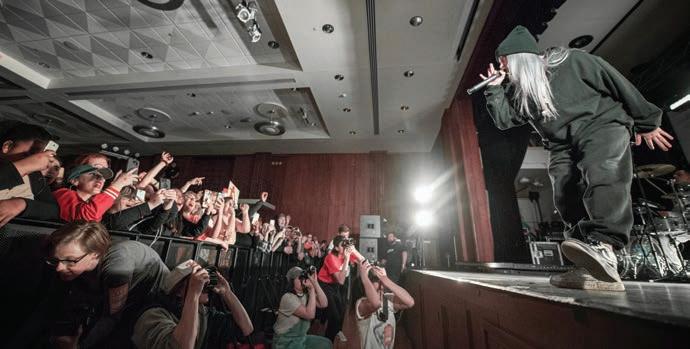
musician Billie Eilish, pictured here in 2018.
ACheers to 100 Years
Standout moments from a century of the Iowa Memorial Union
BY EMMA CONWAY
celebration of this size calls for a stroll down memory lane. Over the past century, the Iowa Memorial Union has been the backdrop for many special moments on campus. Big band dances, famed visitors, student
activism, and flood recovery efforts all add to the IMU’s rich history. Join Iowa Magazine as we revisit key milestones through the stories of Iowa alumni and staff who share meaningful connections with each era.
The M in IMU
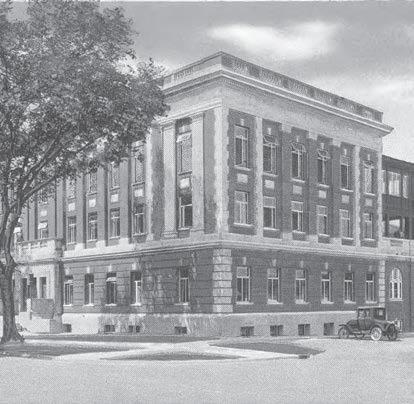
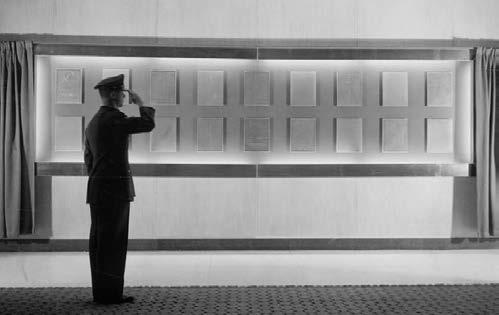
Following the end of World War I, community leaders proposed a memorial on campus to honor the University of Iowa’s veterans. The university’s students and alumni embraced the effort and contributed significantly to the building fund. Construction of the Iowa Memorial Union began in 1924. Its doors opened the following year .
At the IMU’s dedication ceremony on Feb. 6, 1926, Des Moines attorney James Weaver (1882LLB) spoke of his vision for the building. He said, “If this magnificent structure is to fulfill the dreams out of which it has arisen, it can only do so by stirring the impulses of the young men and women of Iowa to lives of service to mankind.”
Young people answered that call in 1942 when the U.S. Navy selected Iowa as one of four major universities to house its pre-flight training program. Through 1944, Iowa hosted several thousand pilotsin-training, including future Hawkeye football coach Forest Evashevski and astronaut John Glenn The IMU also fed and trained U.S. Army cadets during World War II.
The son of a World War II veteran, Major General Stewart Wallace (68BBA) remembers visiting the IMU’s veterans memorial wall with
his father as a high school student. The memorial made an impression on Wallace that would help shape the course of his life. “If it wasn’t for those individuals, if they hadn’t given their lives to keep the country free, we wouldn’t be able to walk across campus or get an education,” he says.
After graduating from Iowa’s ROTC and business programs, Wallace was commissioned as second lieutenant in the U.S. Army. He served for 33 years, including 13 years overseas in Vietnam, Turkey, Germany, and Korea.
When Wallace officially retired in 2017, he revisited the IMU to speak at the ROTC spring ball. Refurbishing and updating the memorial wall on the first floor gave him a renewed sense of purpose. Wallace received a Hawkeye Distinguished Veterans Award in 2022 for his efforts in support of UI veterans and helped establish the IMU Veterans Plaza in 2023.
“There have been a lot of changes at the IMU, and it’s all for the better,” says Wallace. “But I hope young people who step into the IMU continue to recognize those willing to make the ultimate sacrifice, so that they can continue to learn and exchange ideas.”
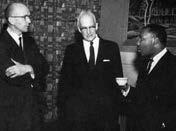
Professor Robert Michaelson of the UI School of Religion and Pastor Lewis Dunnington of the First Methodist Church of Iowa City welcome Martin Luther King Jr. to the IMU in 1959 to discuss race relations. To hear MLK’s speech, visit foriowa.info/im25-mlk.
A Call to Action
On Nov. 11, 1959, Martin Luther King Jr. spoke to a packed room in the Iowa Memorial Union. The civil rights leader’s message—delivered four years before his “I Have a Dream” speech at the March on Washington—focused on organizing efforts to address the discrimination Black Americans faced in the North. He said, “The Negro and white must join to make this more than a racial issue, but an issue between justice and injustice.”
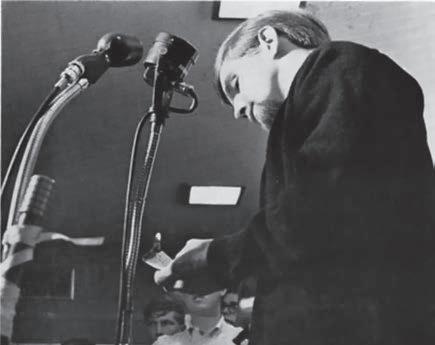
According to University Archivist Emeritus David McCartney, King’s speech sparked a flurry of activism in Iowa City. Off campus, an undercover Daily Iowan investigation in 1962 revealed landlords on housing listings that were approved by the Office of Student Activities had barred Black students from living in their facilities. On campus, students embraced free speech through Soapbox Sound Off, a weekly forum where students could stand on a soapbox at the IMU and share whatever was on their mind.
ABOVE: In this photo from the 1950s, a soldier salutes the memorial plaques at the IMU that honor university students and alumni who died in service. The display has since been updated, and a new Veterans Plaza outside the IMU recognizes UI veterans who have served in each of the six branches of the U.S. armed services.
The IMU was also a hub for student activists planning events on a national scale. In 1964, the Student Nonviolent Coordinating Committee recruited students from Iowa for Freedom Summer. Several students who felt compelled by the cause traveled to Mississippi, where they taught Black students at freedom schools and helped Black Americans
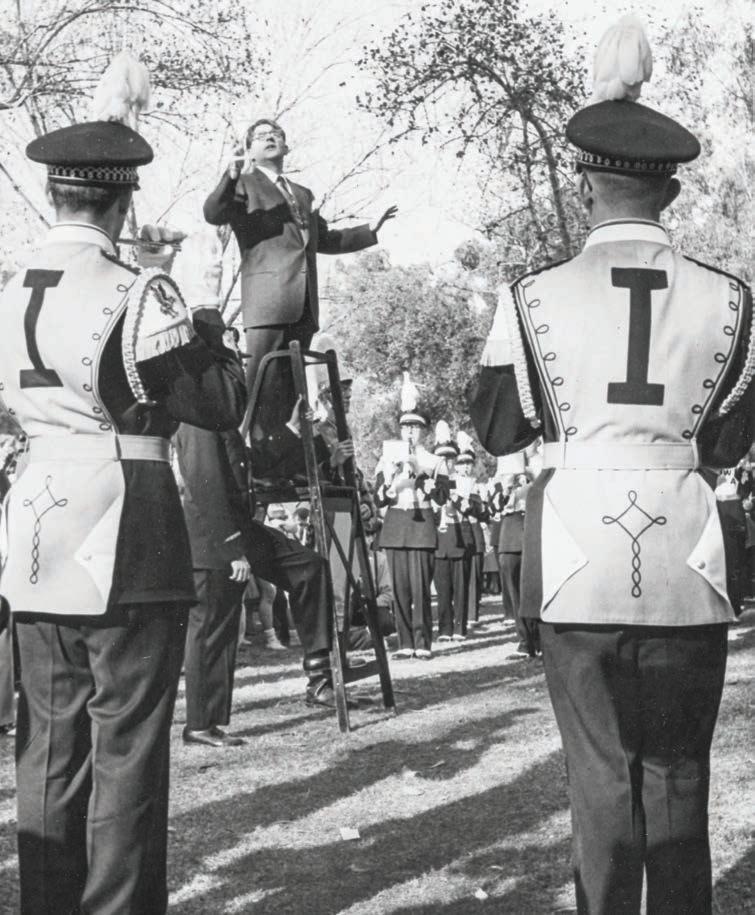
AT LEFT, CLOCKWISE FROM TOP : Northeast view of the IMU, circa 1928; the Union Boys work the soda fountain, 1940s; IMU library, 1950s; bowling alley, 1955; reading and listening to music in an IMU lounge, 1950s; IMU night club, The Silver Shadow, 1937
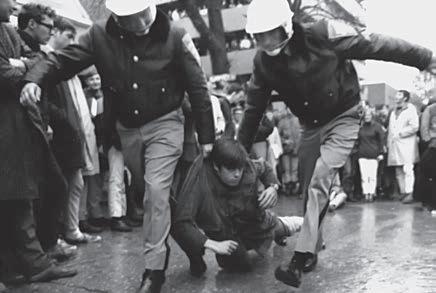
ABOVE: In 1967, police arrest a student who was part of a protest outside the IMU against Marine recruitment during the Vietnam War.
register to vote. One student who made the trip was Stephen Smith . The Marion, Iowa, native would later become known as the first person to burn his draft card on a college campus following a federal law criminalizing the act. He did so during a Soapbox Sound Off on Oct. 20, 1965.
In the years that followed, students continued using their voices to address national and global issues, such as the Vietnam War. Students responded when
Dow Chemical Co. came to the IMU’s Business and Placement Office in 1967.
Dow Chemical’s goal was to interview Iowa students for jobs; however, the company was known for creating napalm, a gel-like mixture of gasoline and chemicals developed for the war. The controversial chemical caused severe burns, not only to forests but to soldiers and civilians on the ground. In protest of the company, 200 students linked arms and formed a human chain around the
IMU’s perimeter, barring people from entering. Protestors later clashed with police, who arrested 18 people.
These are just some of the events that happened at the IMU during this tumultuous period of social, political, and cultural change, which motivated many students to act As McCartney looks toward the future of Iowa’s union, he says, “My hope is that the IMU, within the law, can continue to function as place for people to freely exchange ideas.”
The Dawn of Dance Marathon
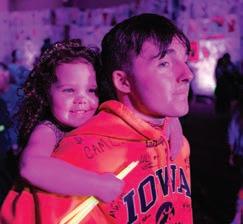
Over the years, the Iowa Memorial Union has served as a gathering space for hundreds of student organizations. The largest of the 600 groups active today launched in 1994, when the Children’s Miracle Network had an idea to start a dance marathon to support local pediatric cancer patients. It would be modeled after THON, a similar event hosted at Penn State.
Fraternity leader Chris Metzger (95BS) hopped in a car with fellow UI students and drove to State College to see the event for himself. Twelve hours in , he realized that a dance marathon fundraiser could work at Iowa.
As Iowa’s first Dance Marathon executive director, Metzger returned to campus to scope out venues big enough for the event, considering locations like the Field House. “The IMU was pretty much the only place that would have us,” he says. According to Metzger, devoted staff like Lisa Baum of the Children’s Miracle Network at University of Iowa Hospitals & Clinics and Mary Peterson (79BS, 88MA) of the University Life Centers were catalysts for the idea. David Grady, director of the Office of Campus Programs and Student Activities, helped give the beloved Iowa tradition a home in the IMU. Metzger was then trusted to bring the vision to life.
After a year of planning, the first Dance Marathon was held in the IMU Main Lounge in 1995 and raised $31,000. Now approaching its 32nd
TOP: UI student activist Stephen Smith, who participated in the Freedom Summer of 1964 to support civil rights, burns his draft card at the IMU in 1965 to protest the Vietnam War.
Dance Marathon, the largest student organization on campus, has used the IMU since 1995 to host its annual fundraiser for local pediatric cancer patients.
event in February, the organization has raised more than $37 million in total for youth cancer patients and their families.
Although the Big Event has grown considerably since its inception, the IMU continues to host Dance Marathon. “The IMU still carries the spirit of what Iowa is, who the students are, and what Dance Marathon is fighting for,” says Metzger. “Those memories, those relationships, those moments that you create, they stick with you.”
June 2008 Fast Flood Facts
At its peak, the Iowa River reached 31.5 feet.
O ver 2,000 people supported sandbagging efforts.
T he sandbag wall surrounding the IMU was 16 feet deep and 8 feet high.
Despite these efforts, the IMU was submerged in 8 feet of water at the flood’s peak.
T he IMU’s ground floor would not reopen until 2015.
Famous Visitors and Features of the Iowa Memorial Union
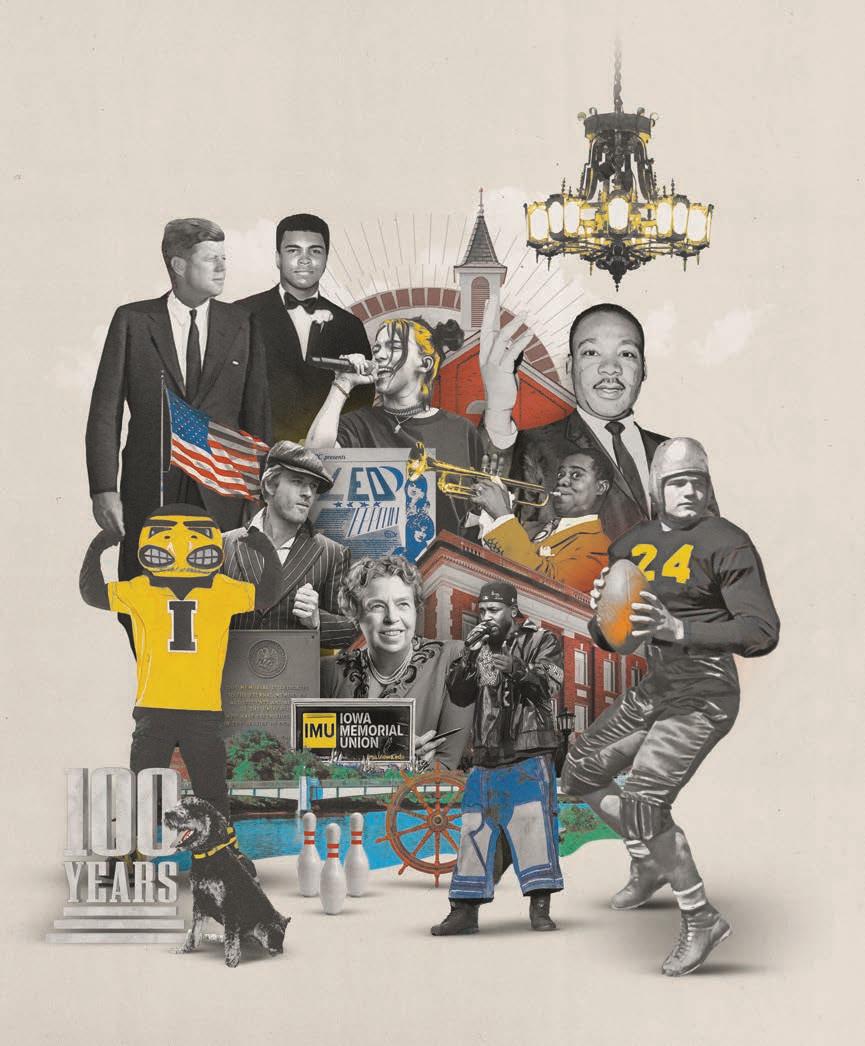
1. Sen. John F. Kennedy campaigned at the IMU in November 1959 and attended a football game, where he would “cheer for Iowa but pray for Notre Dame.” 2. An American flag waves in the IMU Veterans Plaza.
3. Former world heavyweight boxing champion Muhammad Ali visited Iowa in November 1967 at the request of his friend, the university hospital chaplain.
4. In April 2018, 16-year-old Billie Eilish sang in the IMU ballroom.
5. Danforth Chapel has been the site of many Hawkeye weddings. 6. Chandeliers grace IMU event spaces.
7. In November 1959, Martin Luther King Jr. spoke to an overflow crowd. 8. Louis Armstrong performed big band hits at IMU dances throughout the 1950s. 9. Nile Kinnick (40BA), whose fighter plane crashed during training in World War II, is one of many veterans remembered on the Memorial Honor Roll. 10. Kendrick Lamar
performs a hip-hop show in the Main Lounge in May 2013, 12 years before headlining the Super Bowl halftime show. 11. A steamboat pilot wheel that decorated the IMU with a river theme later became central to the former Wheel Room’s motif. 12. UI alumni remember wintry walks across the IMU Pedestrian Bridge 13. The bowling alley lasted from 1954–88. 14. Finn supports student mental health as an IMU-based therapy dog. 15. Herky attends orientation and other IMU events as the UI mascot. 16. A plaque dedicates the IMU in memory of Hawkeyes who died in service to the country. 17. Robert Redford promoted All the President’s Men during the 1976 Refocus Spring Festival. 18. Led Zeppelin gave its only concert in Iowa during an ice storm in January 1969. 19. In March 1957, former First Lady Eleanor Roosevelt urged students to better their communities.
Photographer Gary Freeburg visits Alaskaʼs Aniakchak National Monument and Preserve, where he stands near a maar, a shallow volcanic crater formed by explosive interactions between magma and groundwater.
Iowa alum Gary Freeburg has spent decades documenting Alaska’s wilderness. The state’s rugged volcanoes continue to call him back .
In 1912 ,
a series of violent volcanic eruptions rattled a remote river valley on the Alaska Peninsula. The ejection lasted for 60 hours, spewing 30 times more magma than the 1980 eruption of Mount St. Helens in Washington. The Alaska event, which is known as the largest eruption of the 20 th century, buried a 44-square-mile valley in ash and pumice.
For decades, steam billowed out of the valley’s ash-covered floor, giving the area its popular name: The Valley of Ten Thousand Smokes.
While the smokes have largely extinguished, other scars of this cataclysm remain more than a century later. The valley is pockmarked by craters and littered with volcanic rocks that resemble reptilian scales. Other areas are as stark as the surface of a distant moon. Vegetation is nonexistent.
Many would view the Valley of Ten Thousand Smokes as a wasteland. Gary Freeburg (78MFA) sees serenity. The renowned landscape photographer, who captures the craggy expanse in shades of black and white, often compares the area to a Zen dry garden. To him, traversing this volcanic valley is an immersive experience in tranquility.
“In the Buddhist dry gardens, you’re sitting on the outside looking in at them because you can’t walk around in the garden itself,” says Freeburg, a graduate of the UI School of Art, Art History, and Design. “But in the Valley of Ten Thousand Smokes, everything is scattered all around you. You’re actually standing in the garden. And to me, it’s a peaceful, wonderful place to be.”
By Jack Tamisiea | Photos by Gary Freeburg
The Valley of Ten Thousand Smokes, Katmai National Park and Preserve
Juneau Anchorage
Freeburg spent 25 years living and teaching in Alaska. Although he now resides in Maine, the 77-year-old continues to venture back to the Alaskan frontier; this past July, he spent weeks camping inside a remote volcanic caldera. His work—which includes thousands of photographs in both black-and-white and color, lively sketches, and multiple books—documents the constellation of volcanoes that dot the Alaska Peninsula, which sits at the collision point of two massive tectonic plates.
Photographing the Valley of Ten Thousand Smokes for the first time in 2000 was among the highlights of his artistic career. But his interest in the Alaskan wilderness began decades before he had heard of the volcanic valley and years before the 49th state was officially admitted to the union.
It began when he was 13, sitting on a boat with his grandfather in his native Minnesota. The fish weren’t biting. So, to pass the time, his grandfather took out his billfold. Freeburg expected him to hand him a dollar. Instead, his grandfather removed a picture that had been clipped out of an issue of National Geographic. The photograph depicted Denali, then known as Mount McKinley, North America’s highest peak.
Freeburg was transfixed by the image. “It showed me the gravity of a photograph,” he says. “That photograph is still stuck in my mind, just as fresh as it was that day.” He can still remember the composition of the shot—the mountain’s snow-capped summit rising above a lake fringed with verdant forests.
The distant territory’s rugged wilderness captured the imagination of grandfather and grandson alike. Freeburg recalls his grandfather telling him, “I’m never going to have a chance to see this place, but I hope that one day you’ll go there and see it for yourself.”
Freeburg finally reached Alaska in 1980. In the preceding years, Freeburg served in the United States Navy and spent nearly two years in Vietnam. He then received a pair of degrees in photography from Minnesota State University before attending the UI for a Master of Fine Arts, studying photography under longtime professor John Schulze (48MFA). After graduating from Iowa in 1978, he returned home to Minneapolis to operate a studio. But Alaska beckoned, and he realized it was time to embark on a new adventure.
When he first arrived in southeast Alaska for a part-time teaching gig in Sitka, he immediately fell in love with the location, which was nestled between the Pacific Ocean and soaring mountain peaks and devoid of the muggy conditions of summertime in Minnesota. “I took one big breath of air, and I knew this is home to me,” he says.
After his stint in Sitka, Freeburg accepted a position as an art professor at Kenai Peninsula College, an extension of the University of Alaska Anchorage. He ended up teaching at the college for most of his time in Alaska. The campus art gallery now bears his name.
Freeburg enjoyed Alaska’s natural beauty. But his camera was more drawn to documenting how these environments change, not only as conditions freeze and thaw but as the Earth moved underneath his feet. “There’s a lot of action up there like volcanoes
ABOVE: A 1912 volcanic eruption created this field of ash and pumice-covered snow pyramids near the Knife Creek Glaciers within the Valley of Ten Thousand Smokes at Katmai National Park and Preserve in Alaska. AT RIGHT, CLOCKWISE FROM TOP: Braided stream and grasses, a maar and lake with floating ice, moss growing on cooled lava flows at Aniakchak National Monument and Preserve in Alaska, and Vent Mountain with a field of lupine.
and earthquakes, which really appealed to me,” says Freeburg.
His first subject was the dynamic coastlines of Sitka, which were constantly changing with the tides. As the waters retreated to the sea, natural compositions of volcanic rocks and swirling sands were left in their wake.
These shots reminded Freeburg of something he had seen during his deployment in Asia. In Vietnam, everything was overwhelming—the noise, the energy. Freeburg escaped the fray while on leave in Japan and discovered relief in the meticulously raked sands and carefully positioned rocks in a Zen dry garden. As he watched, the sand seemed to ripple around the rocks, like a tide ebbing along a shoreline. Freeburg attempted to recreate a similar sense of serenity in his photographs of tide pools and rocky shorelines. The resulting work formed the basis of his first photography exhibition in southeast Alaska, which caught the eye of the National Park Service. Several park rangers that attended the show thought Freeburg’s photographs of the Alaskan coast invoked a remote region completely shaped by volcanic activity: the Valley of Ten Thousand Smokes.
In June 1912, an emerging volcano known as Novarupta began spewing ash as high as 20 miles into the sky. The eruption buried a 40-mile swath of the surrounding Ukak River valley in smoldering ash. The layer of ash was as thick as 700 feet in some areas, creating a landscape largely devoid of life.
Adding to the area’s otherworldly aura was the constant smoke wafting up from the valley’s floor. The ash preserved heat for decades, and any water that was buried by the initial eruption or percolated inside the deluge was superheated into steam. The steam escaped from the ash through vents known as fumaroles that dotted the landscape like chimneys.
The scene captivated the botanist Robert Fiske Griggs, who conducted the first scientific survey of the volcanic valley for the National Geographic Society in 1916. “The whole valley as far as the eye could reach was full of hundreds, no thousands—literally, tens of thousands—of smokes curling up,” Griggs would later write. “Some were sending up columns of steam which rose a thousand feet before dissolving.”
Griggs’ account inspired others to begin referring to the area as the Valley of Ten Thousand Smokes. While most of the
Drawing Inspiration
When he is not snapping photos of landscapes and summits with his cameras, Freeburg is often drawing detailed sketches of the volcanic features around him.
Using frenetic scribbles and crosshatching, Freeburg recreates dynamic depictions of volcanic domes, fumaroles, and craters. His work illustrates that in Alaska’s constantly changing environments, even geologic structures are brimming with energy.
Freeburg picked up his knack for crafting lively drawings during his time in Iowa City. As part of his studies at the UI, he took drawing classes with the legendary art instructor Joe Patrick . Freeburg still remembers Patrick telling him bluntly one day, “You’re wasting your time in photography. You need to be drawing.”
While Freeburg ended up sticking with photography, he still heeds Patrick’s advice to draw. Oftentimes, these sketches add context to his serene photographs of Alaskan landscapes. “If you want to know what it feels like to be there, look at the drawings,” says Freeburg. “It’s a very active environment most of the time, and it doesn’t always show up in the photographs.”
LEFT: Surprise Lake at Aniakchak National Monument and Preserve, with The Gates canyon and Black Nose peak in the background. ABOVE: Gary Freeburg’s sketch of Vent Mountain, a volcanic cone located inside the Aniakchak Caldera. TOP RIGHT: Freeburg’s drawing of the Vulcan Dome, located inside the Aniakchak Caldera, with its magma chamber beneath.
Bringing the Alaskan Sublime to Iowa City
Over his career, Freeburg has worked with a bevy of renowned photographers. The three that influenced him the most were Ansel Adams, Oliver Gagliani, and John Schulze (48MFA), a photographer and educator known for producing black-and-white landscapes and unorthodox portraiture. Schulze worked at the University of Iowa’s School of Art, Art History, and Design for 36 years and taught Freeburg while he was earning an M.F.A. in 1978. “Iowa is a very special place to me, and when I look back [at my time there], I often think of John Schulze, who was the absolute best at what he did,” says Freeburg.
Even after spending decades in Alaska, Freeburg maintains a connection to the UI. This past year, he visited Iowa and donated four of his photographs to the Stanley Museum of Art’s collection. According to Diana Tuite, a visiting senior curator of modern and contemporary art at the museum, these images make strange natural phenomena accessible.
“What is so extraordinary about Gary’s work is that he creates images of landscapes most of us will never see,” says Tuite. “Gary composes his photographs so poetically that we can sense the incomprehensibility of the terrain.”
One of her favorite Freeburg compositions is Lenticular Cloud Over Vent Mountain (2012), pictured at right, where saucer-like clouds hang above Aniakchak’s Vent Mountain like a stack of halos. “These clouds have strange UFO-like shapes, making them both familiar and utterly fantastical,” says Tuite. “This photograph is one that symbolizes his visual storytelling for me.”
steaming fumaroles have died out as the ash cooled, signs of the eruption are evident throughout the valley. Novarupta’s lava dome pokes out of the valley floor like a giant, coal-colored bubble. The valley is also littered with volcanic bombs—masses of molten lava as large as boulders that were ejected from the erupting volcano and cooled as they traveled across the Alaskan sky.
The Valley of Ten Thousand Smokes is located within a remote swath of Katmai National Park and Preserve. When workers at the park mentioned the valley to Freeburg, he was immediately intrigued by the area’s evocative name. He knew he had to see it for himself.
However, reaching the Valley of Ten Thousand Smokes was no easy feat. The journey entails a flight from Anchorage to a small village called King Salmon. Then comes a seaplane flight to the Brooks Camp region of the national park, an area famed for its population of brown bears. From there, it is a 23-mile drive through all terrain before a lengthy hike. The first time Freeburg made the trek in 2000 he carried 125 rolls of film with him as he hiked some 12 miles through the bush.
The views of the valley were worth the trip. Freeburg was immediately struck by how the area was largely devoid of plant life, which brought the details of the volcanic landscape into focus. “Foliage tends to soften the environment, and you lose the starkness of just the object by itself,” he says. “That contrast is what I’m always looking for.”
Freeburg visited the Valley of Ten Thousand Smokes five times between 2000 and 2011. In recent years he has set his sights on Aniakchak Caldera, a national monument further down the Alaska Peninsula and part of the Aleutian Arc.
The Aniakchak volcano once stood about 7,000 feet tall. But an eruption 3,500 years ago caused the summit to collapse, creating a caldera that spans some six miles across. The area has experienced roughly 20 eruptions since its collapse. Features from these subsequent eruptions, like cinder cones and volcanic bombs, litter the caldera’s floor.
Aniakchak’s most recent eruption occurred in 1931. Over a span of six weeks, magma gurgled out of the caldera as earthquakes rocked the region. The eruption carved new craters and buried much of the caldera in ash. Local life was devastated.
LEFT: Lenticular Cloud Over Vent Mountain, a photograph that Gary Freeburg took at the Aniakchak National Monument and Preserve in Alaska and donated to the UI Stanley Museum of Art. ABOVE: The rim of the Aniakchak volcano rises above a volcanic bomb where lava once flowed from Vent Mountain within Aniakchak National Monument and Preserve in Alaska.
Gary Freeburg photographs a lava feature, with the western wall of the Aniakchak volcano in the background.
Capturing how life recovered at this caldera fascinated Freeburg. However, reaching Aniakchak is just as difficult as reaching the Valley of Ten Thousand Smokes. The journey culminates with a seaplane ride through a notch in the caldera’s rim before landing on a lake. This requires a good deal of luck with the weather. And Aniakchak’s location between the Gulf of Alaska and the Bering Sea often creates a tempestuous mix. “Sometimes, it’s like looking into a bowl of oyster stew, because it’s completely packed in with clouds,” says Freeburg.
This past July, the weather cooperated enough for his fourth visit to Aniakchak. But conditions were far from nice. The wind whipped, and the rain was incessant. Freeburg still managed to snap 200 photographs, documenting how the local environment had changed since his last trip in 2018.
Some of the changes were subtle, like lichens inching across volcanic rocks. Others were substantial. Unlike the Valley of Ten Thousand Smokes, life has bloomed in many areas of Aniakchak after the 1931 eruption. The caldera contains Surprise Lake, a springfed body of water that is surrounded by a carpet of hardy tundra vegetation including mosses, grasses, and small shrubs. This tundra is home to Kodiak brown bears, caribou, and squirrels. During one trip, Freeburg struck up a friendship with a fox that frequented his campsite.
The local climate has also changed in the 90 years since Aniakchak last erupted. Some glaciers hanging from the southeast side of the caldera have almost completely disappeared, and the amount of snow has decreased in recent years. In the past when Freeburg visited Aniakchak during the summer solstice in June, he would often wake up surrounded by snow in a tent encrusted with frost. But this past summer, the temperature was relatively balmy, hovering within the 40s the entire time. Aniakchak’s environmental flux makes the
caldera an ideal subject for Freeburg’s lens. Freeburg is often asked why he does not frequent volcanic hotspots closer to home like Iceland. It’s because he has little interest in photographing active or recent eruptions. What appeals to him is the landscape long after the lava has cooled. “I like to go in and watch how these new Earth surfaces change over a period of time,” he says.
In 2005, Freeburg left Alaska and moved to Harrisonburg, a college town nestled in Virginia’s Shenandoah Valley. He served as an art professor at James Madison University and directed the school’s gallery of fine art before retiring from teaching in 2018 and moving to Maine.
However, Freeburg is not done trekking through Alaska. “I may live in Maine right now, but I always think of Alaska as my home,” he says. “I always have a plan to go back out there.”
In the next few years, he hopes to photograph several sites further out on the Aleutian Island chain, including the Pavlof Volcano, a snow-capped peak that ranks among the United States’ most active volcanoes in recent decades.
In the meantime, Freeburg has plenty to keep him busy at home. He estimates that he has several thousand negatives and digital prints, as well as hundreds of drawings, to review and organize from his expeditions. Sifting through all this material could keep Freeburg busy for the rest of his life.
But staying busy has always been Freeburg’s MO. Even though he no longer teaches, he does not consider himself retired. Former mentor and famed landscape photographer Ansel Adams told him that retirement was unacceptable for an artist. This outlook continues to drive Freeburg back into the Alaskan wilderness to photograph more volcanoes.
“I don’t consider myself to be old,” Freeburg says. “As long as I can climb around in a volcano, I’ll be happy.”
Jack Tamisiea is a science writer based in Washington, D.C., who covers natural history. Tamisiea’s work has appeared in The New York Times, Scientific American, National Geographic, Smithsonian Magazine, and many others. Tamisiea is also the son of Iowa alumnus John Tamisiea (87BBA) and grew up an avid Hawkeye fan.
Close Encounters in Bear Country
On his way to the Valley of Ten Thousand Smokes, Freeburg passes near Brooks Falls, a waterfall in Katmai National Park and Preserve where brown bears congregate each summer to feast on salmon migrating upstream. During one trip, Freeburg agreed to snap a picture of the falls for the park’s visitor lodge.
When he arrived at the waterfall in the early morning, Freeburg found an adult brown bear standing in the bubbling rapids. The bear paid little attention to the photographer as he moved down the riverbank to get a good shot.
When Freeburg finally glanced through his viewfinder, the bear was suddenly looking in his direction. “I was startled to be making eyeto-lens contact with it,” Freeburg later recalled on his blog.
Freeburg quickly realized that the subject of the bear’s glare was a juvenile bear that had silently crept within feet of him on the riverbank. “If I reached with my right hand, I could have touched his large, light-brown head,” Freeburg wrote. While the bear beside Freeburg was a juvenile, it still weighed around 400 pounds. And the adult bear in the river was wary of potential competition in his fishing hole.
Freeburg wanted no part in a potential battle over turf. He slowly packed up his tripod and cautiously moved back toward the viewing platform, where he would take photographs, safely removed from the bears frequenting that morning’s buffet.
A young brown bear along the Brooks River in Katmai National Park and Preserve
Inside Iowa’s Burn Unit
At UI Health Care’s Burn Treatment Center, specialists take on some of medicine’s most traumatic cases—helping patients like Brody Pearston heal and find hope again.
BY JOSH O’LEARY
WHEN EMERGENCY CREWS FLEW 8-YEAR-OLD BRODY
PEARSTON ACROSS THE STATE to the Burn Treatment Center at University of Iowa Health Care this past June, the situation was critical.
Just hours earlier, Brody had gathered with his parents and older brother around a tabletop s’mores maker on their deck. A week into summer break and with no baseball games on the calendar for the boys that evening, the Pearstons were enjoying some family time at home in Polk City, Iowa.
But in an instant, an idyllic summer night turned into a nightmare. A bottle of isopropyl alcohol, used to fuel the s’mores maker, caught fire and exploded. Flames covered Brody’s arms and legs. His father, Durk—a state trooper and no stranger to emergency situations—smothered the fire with his bare hands.
But the flames had spread too fast, leaving Brody with devastating injuries.
The ensuing hours were a blur. Doctors in nearby Des Moines stabilized him, but it became clear that his burns were beyond what could be handled locally. Brody was airlifted to Iowa City, home to the state’s only burn center.
His arrival marked the beginning of a harrowing 38-day hospitalization. Like many of the hundreds of burn victims who receive specialized care at the UI Burn Treatment Center each year, Brody’s injuries were as complex as they were painful. His legs, arms, and right hand were nearly fully covered in burns. His torso and cheeks, chin, and mouth also were affected, though less severely. All told, 45 percent of his body was covered in deep second-degree burns.
“The hardest part as a parent is just watching your child go through something so extreme, and you have no control over it,” says Brody’s mother, Ashley Pearston. “You just want to take it away from him.”
In the coming weeks, Brody would endure close to 10 surgeries, including two skin grafts, as well as a dangerous bout of sepsis. Through it all, the experts with Iowa’s multidisciplinary burn team—including surgeons, physical therapists, and social workers—were by the family’s side as Brody fought to heal.
GROWING THE CAPACITY FOR CARE
In medicine, every day holds the potential for heartbreak. Yet on the eighth floor of UI Health Care Medical Center, where the Burn Treatment Center has operated since 1996, the staff shoulder a weight few others experience. They often see the worst of the worst—and are prepared to meet it.
“We don’t want anyone to get burned, but if you do, we’re here to take care of you,” says Samuel Jones , the center’s director and UI surgeon who oversaw Brody’s treatment. “It’s a very unique specialty, because most burn injuries scare anyone who doesn’t take care of burn patients.”
The center—one of 77 American Burn Association–verified programs nationally and one of just 39 that treat both adults and children—provides care for patients from across Iowa and neighboring
states. Among the most common injuries treated at the unit are burns from hot liquids and flames, as well as chemical and electrical accidents. Some cases follow seasonal patterns: frostbite in the winter, and severe sunburns and fireworks-related injuries in the summer. Beyond burns, the center treats life-threatening skin conditions such as toxic epidermal necrolysis, a disorder marked by widespread blistering and skin detachment, as well as necrotizing soft tissue infections, more commonly known as flesh-eating bacteria.
About 300 patients are admitted each year, many of whom face lengthy hospitalizations and months of rehabilitation. The center also manages nearly 3,000 outpatient visits annually for dressing changes, physical and occupational therapy, scar management, psychological support, and other long-term treatments. At the same time, the center is home to a flourishing research program, including clinical trials that provide patients with access to cutting-edge therapies.
To meet the state’s growing needs for burn care, UI Health Care is in the midst of the largest renovation and expansion in the center’s 30-year history. The $14.9 million project, scheduled for completion by summer 2026, will modernize inpatient spaces with new hydrotherapy rooms, staff work areas, and support facilities. It will also increase capacity from 17 to 21 beds. A new outpatient clinic will feature a dedicated entrance,
ABOVE: Burn Treatment Center director and surgeon Samuel Jones oversees treatment for the nearly 300 patients admitted to the center each year. AT LEFT, FROM TOP TO BOTTOM: Brody during his 38-day stay in the Burn Treatment Center; his baseball teammates with the Polk City Comets made signs and T-shirts to show support; Iowa men’s basketball coach Ben McCollum paid Brody a visit; Brody is pictured with UI Health Care senior physical therapist Julie Tjarks.
“The hardest part as a parent is just watching your child go
through something so extreme, and you have no control over it. You just want to take it away from him.”
—Ashley Pearston
exam and procedure rooms, a waiting area, and additional support spaces.
The expansion means that fewer acute patients will need to be transferred to other hospital floors, and pediatric burn patients who are sometimes housed in Stead Family Children’s Hospital can stay within the unit. It will also allow the center to provide care across every phase of recovery, from the critical moments after injury through months or years of reconstructive treatment, rehabilitation, and emotional healing.
“It’s not just about seeing the wound and putting something on it and sending the patient home,” says Jones, the Clara Smith Clinical Professor in Burn Treatment. “It’s a comprehensive specialty that requires multiple disciplines—physical therapy, occupational therapy, recreational therapy, nursing, social work—then making sure that you’re meeting their needs at home.”
That kind of longitudinal care, says Jones, ensures continuity and a holistic approach to every survivor’s long-term health and well-being. “They’re patients with us for life,” he says.
A TEAM EFFORT TOWARD HEALING
Brody, an energetic, sports-loving kid, had looked forward to a summer playing baseball with the North Polk Comets, a team coached by his dad. But now, bandaged head to toe in Iowa City, the baseball field seemed a million miles away.
In the days after the accident, Brody’s body was so swollen he was nearly unrecognizable. Severe damage to the skin—the
body’s largest organ and its first line of defense—can trigger widespread inflammation and dangerous systemic problems, stripping away the natural barrier that retains fluids, regulates temperature, and protects against infection. To stabilize him, doctors worked quickly to replace fluids intravenously, a treatment that contributed to the dramatic swelling.
Burns also require specialized wound care, from complicated dressings that require frequent and painful changes, to daily hydrotherapy sessions, to delicate surgeries. With Jones leading the surgical team, Brody underwent two skin grafts that used healthy skin from his thighs and back to replace badly burned patches on his arms and legs.
“There were just so many different pieces of the puzzle to getting him healed,” says Ashley Pearston. “The nutrition team, the infectious disease team, our nurses, our main surgeon, our pharmacist—they all played a huge role. They never stopped listening or caring or investigating what they could do for Brody.”
As Brody’s skin slowly healed, there were nights when the itching was so excruciating that he couldn’t sleep. Other times, he couldn’t stomach food. But his parents’ feelings of helplessness were eased by the care team.
“I don’t want to say it was manageable, because there were a lot of days that I felt like it wasn’t manageable,” Ashley says. “But it made it so much more of a team process. Rather than me just sitting in this corner in the hospital room watching them do everything, they were very open to how I advocated for Brody and what Brody’s needs were at the time.” Extra
Watch Brody Pearston’s family share his story of recovery at foriowa. info/im25-burnvideo
After getting the all-clear from doctors, Brody returned to the baseball diamond in Polk City this past August.
A SPECIAL STAFF CONNECTION
Nurse manager Jolyn Schneider (88BSN) and patient care technician Steven Hoff know firsthand what it’s like to be a child in the hospital— experiences that now guide their care for young patients like Brody at the Burn Treatment Center.
Schneider, who grew up in the small northeast Iowa town of Luxemburg, was hospitalized for long stretches as a child at UI Health Care and Mayo Clinic because of a rare skin condition called pustular psoriasis. Resembling burns, it causes large, painful blisters with a high risk for infection. During weeks and monthslong stays, hospital staff became like family to her. She remembers chatting with the nurses on their breaks and going on rounds with doctors while wearing their lab coats. “I knew then that I wanted to do that for somebody someday,” says Schneider. “I remember from the time I was in second grade saying I wanted to be a nurse.”
Meanwhile, a horrific accident first brought Hoff to the UI in 1992. At age 2, he fell into a campfire at a campsite just south of Iowa City and suffered third-degree burns to his arms, neck, and face. His mother was told he might not survive—or, at best, lose his arms. Instead, Hoff underwent multiple surgeries, skin grafts, and years of physical therapy at Iowa. Though he lost the tips of two fingers, doctors ultimately restored function to his arms and hands.
Schneider was on a job shadow with burn specialists at UI Health Care early in her career when Hoff was rushed in that night. “I remember just watching all the teamwork and the people around this very little boy,” Schneider recalls. “I just remember thinking, ‘He has to be so scared, and he needs people to be with him.’”
Shortly after, Schneider accepted a job with the burn unit. Three decades later, she now leads a team of 47 nurses and 28 patient care technicians. That includes Hoff, who joined the staff in 2015. Like Schneider, Hoff wanted to give patients the same compassion he received as a patient. “I just had so many people taking care of me when I was younger, that’s what I wanted to do,” he says.
Hoff credits the Miracle Burn Camp—a summer program at Camp Foster on Lake Okoboji for young burn survivors—for helping him build confidence and a sense of purpose as a child. Hosted by the St. Florian Burn Foundation, a longtime partner with the UI Burn Treatment Center, the camp is staffed by professional firefighters, burn survivors, and burn care professionals. Between his time there as a camper, then as a counselor in his teens and early 20s, and later as a board member for the St. Florian Burn Foundation, Hoff spent nearly 25 years affiliated with Miracle Burn Camp.
Patient care technician Steven Hoff is pictured with nurse manager Jolyn Schneider outside the Burn Treatment Center. In 1992, Schneider was among the UI nurses who cared for Hoff as a child after he suffered severe burns from a campfire.
“When I was younger, I felt easily ostracized. People would always stare at me. But through camp, I had opportunities to have people not just see me for my scars.”
—Steven Hoff on the annual Miracle Burn Camp
“When I was younger, I felt easily ostracized,” says Hoff. “People would always stare at me. But through camp, I had opportunities to have people not just see me for my scars; they just treated me like a normal person. That’s probably one of the reasons why I really love it up on the burn unit. I’m not looked at as a former patient, as a guy with scars. They’re just like, ‘Hey there, Steve.’”
Hoff is grateful for the perspective he has as a burn survivor, which gives him compassion and understanding for his patients. “I wouldn’t change anything, because it’s who I am,” says Hoff. “And I wouldn’t have met all these great people, had these great opportunities.”
Treatment for burn patients has dramatically changed since Hoff was a child. Thanks to strides made in critical care and new therapies, burn centers nationally now see a 97.7% survival rate for admissions, according to the American Burn Association. Among those innovations used at Iowa is ReCell, a treatment in which doctors harvest a small sample of the patient’s skin, isolate the cells crucial for regeneration, and spray them back over the burned area to regrow skin. Another approach, known as cultured epithelial autograft, also starts with a small skin sample—but this one is sent to a laboratory, where new sheets of skin are grown and later applied to the patient’s injuries.
Just as crucial as cutting-edge therapies, says Schneider, is Iowa’s family-centered approach to care that places a patient’s loved ones as partners in the healing process. Family members are invited into decisions, valued for their insights, and supported as part of the care team.
“A burn injury truly involves healing from multiple levels,” says Schneider. “It involves healing from a nutritional level, a mobility level, but also very much so a mental and spiritual level. Especially patients with really devastating injuries; they’re not the same person they were before the injury, and yo have to help the family cope with that as well.”
ROUNDING THE BASES HOME
For weeks, Brody Pearston fought to heal. His hospital room filled up with toys, stuffed animals, and get-well signs from his baseball teammates. New Iowa men’s basketball coach Ben McCollum visited and left a signed ball. Each day, Jones would greet Brody on his rounds with a smile and ask, “How’re we doing today, my man?” Back home in Polk City, the community printed “Brody Strong” T-shirts, with the proceeds going to the Burn Treatment Center.
Even the smallest movements were intensely painful, yet Brody’s rehabilitation depended on him eventually returning to his feet. The center’s physical therapy team devised games to get him moving—tying a ball to a string for him to hit with a bat and scattering “Brody Bucks” around the unit for him to collect on walks. He spent his Brody Bucks on a stuffed koala with a remote control that made comical noises, which he loved placing outside his door to scare the nurses. One night, he and a nurse toilet-papered the physical therapy office. The next morning, Brody woke up to find the PTs had TPed his room.
Five weeks after the accident, Brody was released from the hospital. Doctors and nurses signed one of Brody’s teddy bears before saying goodbye. On the foot, Jones wrote: “I will miss you, my man!”
HOW TO HELP
Support Iowa burn patients and research by donating to the Burn Treatment Center’s general fund at foriowa.info/ im25-burn
“It was one of those sad, joyful moments,” says Ashley. “These people have become like family to us, and now we’re leaving them. We prayed for that day for so long, but it was a little scary, really, because there were so many more unknowns about what it would be like at home.”
Brody continued to make progress in Polk City. Ashley and Durk administered antibiotics through an IV push daily, diligently tended to his bandages, and moisturized his skin.
At a follow-up visit in August, Brody was cleared to swim, play flag football, and best of all, rejoin his baseball team.
The day Brody returned to the diamond, his parents wiped away tears when he ran to first base on his own—no Brody Bucks required.
He was back with his old team, thanks to his new team in Iowa City.
Any comments?
Email uimagazine@foriowa.org
Durk and Ashley Pearston with their children Brody and Knox.
48-Hour Flash Writing Microstory Hawkeye Haiku
48-Hour Flash Writing Microstory Hawkeye Haiku
48-Hour Flash Writing Microstory Hawkeye Haiku
stopwatch-timer
stopwatch-timer
stopwatch-timer
stopwatch-timer
48-Hour Flash Writing Microstory Hawkeye Haiku
magnifying-glass
magnifying-glass
magnifying-glass
magnifying-glass
Channel your creativity by participating in our next free online writing contest.
Channel your creativity by participating in our next free online writing contest.
Channel your creativity by participating in our next free online writing contest.
Channel your creativity by participating in our next free online writing contest.
Scan the code or visit foriowa.org/write-now for contest details.
Modern Marvel
The University of Iowa Stanley Museum of Art recently hosted two exhibitions featuring work by the late Hayward L. Oubre Jr. (48MFA), a New Orleans artist who studied at Iowa before returning to the South to establish art programs at historically Black colleges and universities during the Civil Rights Movement. The modernist’s first-ever retrospective included the pictured painting.
Hayward L. Oubre, Jr. (American, 1916–2006), Equivocal Fox, 1968, oil on board, 24 x 29 ⅞ x 1 in., Clark Atlanta University Art Museum, Atlanta Annuals: Second Atlanta University Purchase Award for Oils, 1968.004, image credit: Erin Croxton
48 THE ART IN ARTHRITIS 50 WRITING REVISITED 51 BOOKSHELF PICKS
EXHIBITION
Healing Through Clay
grad student’s ceramic workshop provides community for rheumatic patients.
As a ceramic artist, Perla Camacho Jiminez finds it cathartic to work with her hands.
But when the Veracruz, Mexico, native was diagnosed with rheumatoid arthritis and osteoporosis two years ago, she worried she may
never be able to work with clay again. The previously healthy sculptor suddenly became preoccupied with pain, doctor appointments, and medical bills.
“Going through the process of that isolation and depression that comes along with not knowing what’s going on with my body, I felt that I needed
Studio arts grad student Perla Camacho Jiminez uses ceramic classes to help connect people with rheumatic conditions such as arthritis.
to connect with more people,” says Camacho, who earned a bachelor’s degree in 2017 from the University of Veracruz.
Fortunately, the doctor told Camacho that working with clay would actually help alleviate the stiffness in her hands. She began to focus her art on what it’s like to live with pain and enrolled last year as a University of Iowa studio arts graduate student. She also received a Graduate Engagement Corps grant from the UI Office of Community Engagement to launch a program this year called “Healing Through Clay: Ceramic Workshops for Rheumatic Patients in Iowa City.”
Most Friday afternoons throughout the school year, Camacho hosts the workshop at the Iowa City Senior Center. She packs her art supplies in a backpack and bikes downtown from her apartment near the Visual Arts Building to teach the class. Around 10 participants benefit from exercising their hands while creating pinch pots, coil pots, and sculptures. At the same time, they share and learn from each other’s experiences with rheumatic conditions. The class culminates in a public gallery showing this May at the Senior Center.
New to Iowa City—and to arthritis—Camacho appreciates how the workshop has helped her connect with others who understand her struggles. “I was like, ‘This is perfect for me,’” says Camacho, who is now in her second year of Iowa’s three-year MFA program for ceramics. “I just needed to build a little bit of community to feel myself with [others who are] going through the same thing.”
PHOTOS: JOHN EMIGH
(center) instructs a ceramic workshop at the Iowa City Senior Center; working with clay helps strengthen and exercise the hands of a rheumatic patient; a painted pot from the class; art supplies used for the ceramic workshop; and Helene Hirmes, who used to teach a sculpting class for 10 years at an art center in Florida called “Faces, Figures, and Beyond,” shows off her completed artwork.
One of the workshop students is Helene Hirmes, a former sculpture instructor with the Herrig Center for the Arts in Bradenton, Florida, who has fibromyalgia and chronic back pain. “People with pain, if they isolate in their houses, do not do a good service to themselves, because getting out and talking to other people is so rewarding,” says Hirmes. “I really have most of my pain under control, but when you are working with something like art, you focus on it so intently because you’re enjoying it so much that you don’t feel any pain.”
Camacho, who also teaches Ceramics I at Iowa, hopes to continue her partnership with the Senior Center next year. She says, “I think that what they need the most sometimes is someone to listen and just be there for them. We all need that, but it’s harder when you have a disease or when you are getting older, so I feel that this workshop helps with that.”
BY SHELBI THOMAS
The Road to Broadway Iowa Playwrights Workshop graduate Samuel D. Hunter (07MFA) recently made his Broadway debut with Little Bear Ridge Road, a play he wrote that stars two-time Tony winner Laurie Metcalf. The production follows an estranged nephew who reunites with his reclusive aunt in Idaho to settle his father’s estate.
New Chapter
After serving for 25 years as director of the International Writing Program, Christopher Merrill announced he will step down in 2026 to return as a faculty member in the University of Iowa Department of English. Cate Dicharry, former executive associate director of operations for the IWP, is the program’s new director.
High School Musical
Nearly 30 years ago, the movie Romy and Michele’s High School Reunion became an instant cult classic. Now the film’s executive producer, UI speech and dramatic art alum Barry Kemp (71BA), is co-producing Romy and Michele: The Musical offBroadway, starring Laura Bell Bundy as Romy.
AND SETH DIEHL
CLOCKWISE FROM TOP: Perla Camacho Jiminez
PODCAST
Origin Stories
Acclaimed authors reflect on their early works in this Writing University series.
At the end of a book, have you ever wondered: Did this author always write well?
That’s the question at the heart of Sad Me of the Past, a podcast hosted by Daniel Khalastchi (05MFA), executive director of the new University of Iowa Office of Writing and Communication; Lauren Haldeman (01BA, 06MFA), Writing University webmaster; and Stephen Lovely (92MFA), director of the Iowa Young Writers’ Studio. Each episode, UI-affiliated authors dust off their earliest writings— childhood stories, teenage poems, long-forgotten drafts—and read them aloud. The result is a poignant and often comical look at rough, unpolished work from some of today’s most successful writers.
Rachel Yoder (11MFA), author of Nightbitch, reads from her fifth-grade story about becoming an astronaut: “I was trying to imagine my way into something that felt utterly impossible,” she says, which felt similar to writing the last paragraph of her debut novel at the First Avenue Java House. “It was like, ‘Oh, you write the book to become the person who’s capable of writing the book.’” When it was done, she says, “I became the person who could write the book.”
Journalist Joe Fassler (11MFA) recalls the magic of Iowa City’s writing community: “You feel the energy in the coffee shops—and you just know
there’s a higher per capita writing contingent here than even places like New York City.” He adds that his time at Iowa “took books and storytelling and connection through words and presented a path—like this is a thing. You can build a life around this.”
Poet Srikanth Reddy (00MFA) shares a poem from his first year in the Iowa Writers’ Workshop: “My poetry got so bad when I got in the Workshop, because everyone else’s poetry was inspiring mine. … I lost any sense of what my style was,” he says. But through practice—and the support of the community—Reddy found his voice again. “It’s still really a place where people can be creative together, and that’s really rare,” he says. “I’ve visited different writing and artistic communities, but I always keep coming back to this place.”
Nam Le (06MFA), author of The Boat, moved from Australia to attend the Workshop: “I cannot explain to you how enchanting it was to arrive here,” he says. “Everyone’s talking about writing and reading. It was just glorious.”
BY MEGAN MAGEE
E xtra
Listen to Sad Me of the Past at writinguniversity.org/sad-me-of-the-past
Rachel Yoder
Joe Fassler
Nam Le
Bookshelf Picks
Cozy up this winter to these five new books from University of Iowa authors.
The Academy: A Novel by Elin Hilderbrand (98MFA) and Shelby Cunningham Little, Brown and Company
This New York Times bestselling novel, cowritten by Hilderbrand’s daughter, details a drama-filled year at a New England boarding school.
BY EMMA CONWAY
A Long Game: Notes on Writing Fiction by Elizabeth McCracken (90MFA) Ecco
The bestselling and award-winning author reveals her tips and tricks for writing fiction, encouraging writers to feel empowered rather than debilitated by a story’s possibilities.
Early Stories by Tennessee Williams by Tom Mitchell, editor, and Thomas Keith, contributor University of Iowa Press
A collection of 31 previously unpublished stories reveals the inspiration for some of Iowa alum and playwright Tennessee Williams’ (38BA) major works.
Bog Queen: A Novel by Anna North (09MFA) Bloomsbury
Agnes, an American forensic anthropologist, seeks to unravel the mystery of a body found in a bog in northwest England that is almost completely preserved— despite being buried more than 2,000 years ago.
The Book of Candles:
by Laurel Snyder (00MFA) HarperCollins
A new children’s book follows a family through their eight-day Hanukkah celebration to introduce kids to the holiday’s rich traditions.
Eight Poems for Hanukkah
Game On
On one football bye week this past fall, Kinnick Stadium hosted a different kind of game—for a good cause. The Ted Pacha Family Club above the north end zone transformed into a video gaming room for an EA Sports College Football 26 tournament. Organized by the Children’s Miracle Network, the second annual Extra Life Charity Challenge raised around $60,000 for University of Iowa Health Care Stead Family Children’s Hospital.
During the event, nearly 200 participants and spectators— including 13-year-old Kid Captain Cooper Estenson—toured the stadium, did the Hawkeye Wave, and watched the championship round on the jumbotron. They also matched last year’s fundraising total while playing a newly released game.
PHOTO: JOHN EMIGH
Back in Action
A reestablished veterans alumni group connects students and grads.
In 2017, Robert Leahey (21BA) hit one of his lowest points. Following his retirement from the U.S. Navy Corps after five years of service, he began pursuing a bachelor’s degree in enterprise leadership at the University of Iowa. But, at age 24, he didn’t feel like he fit in with his peers. He planned on transferring.
On one of his last planned nights in Iowa City, Leahey decided to grab a drink. He says, “I bumped into two gentlemen from the University of Iowa Veterans Association that night. They turned out to be some of my best friends.”
That exchange with Ryan Psenka (21BA) and Carson Kowalski made Leahey stay. He later lived with them, and Psenka was even a groomsman at his wedding to former Hawkeye tennis star Danielle Bauers Leahey (21BBA).
Now four years since graduating, Leahey is restarting an alumni organization for UI veterans. The goal of the UI Veterans Alumni Group is to provide current students and alumni with a community of support.
Like Leahey, many veterans face challenges in finding meaningful friendship, mentorship, and career resources after serving. That’s why Matt Miller, director of Student Support Services for Iowa Veteran Education, Transition, and Support, is particularly excited about the alumni group’s reestablishment. “Our students usually stand out in class—they’re typically a bit older—so we want to give them connections with other students who share their experiences,” says Miller, who served in the Army for 21 years before taking the job at Iowa eight years ago.
LEFT: Robert Leahey helped organize a tailgate for the UI Veterans Alumni Group at Hawkeye Village this past November before Iowa’s Military Appreciation Day football game.
BELOW: Veterans, including Leahey (pictured at far right) tailgate in 2022 before an Iowa-Iowa State football game.
Miller and his department support 2,300 students, including veterans, current service members, military-connected students, and ROTC cadets. Leahey kept these students in mind when planning events for the veterans alumni group, such as a tailgate and flag presentation at Iowa’s Military Appreciation Day football game against Oregon this past November.
Throughout the year, Leahey plans to partner with Miller and pair students with veterans in their chosen career fields. “We have a lot of students who never thought that they’d go to college,” says Miller. “Being able to show our students that there is a path forward, that’s super important.”
Leahey is grateful two veterans in a bar brought him into Hawkeye community five years ago. Now, he’s proud to do the same for others.
BY EMMA CONWAY
ALUMNI COMMUNITIES
CLOCKWISE FROM
TOP: Dorcas Anderson, one of the pioneers of Iowa high school girls basketball; Anderson’s 1921 state championship basketball; Anderson and her granddaughter, Iowa women’s basketball coach Jan Jensen, at Jensen’s induction into the Iowa Girls High School Basketball Hall of Fame in 1993; and Anderson’s 1921 state championship team from Audubon, Iowa
Dream Teams
A
Hawk fan gives in honor of the legacy of girls basketball in Iowa.
Jan Jensen remembers admiring a trophy her grandmother Dorcas Anderson displayed in her china cabinet.
“I always looked at her most valuable player trophy and knew I wanted to get one too,” says Jensen, the University of Iowa’s P. Sue Beckwith, MD, Head Women’s Basketball Coach. “She was an amazing basketball player, person, and grandmother.”
Anderson played center for her 6-on-6 high school basketball team in Audubon, Iowa—scoring 89 of its 122 points en route to the 1921 state championship. She scored so many points that her high school nickname was Lottie.
Until 1993, Iowa girls played various forms of 6-on-6 basketball. According to author Janice Beran and her book, From Six-on-Six to Full Court Press, many teams in the 1920s and 1930s used two forwards, two guards, a jump center, and a side center. Over time, the game shifted to three players each on offense and defense—with participants allowed two dribbles before having to pass or shoot.
Much like her grandmother, Jensen was a 6-on-6 high school scoring star at Elk Horn-Kimballton High School—leading the state her senior year with an average of 66 points per game. For Jensen and so many young women, it was an exciting brand of
basketball that garnered much attention around the state.
“It was just so much fun because of the community support— every night we played in front of packed houses,” says Jensen. “Iowa has long shown its support for girls and women’s sports, and we stand on the shoulders of those who came before us. My grandmother was one of the first to play the sport in Iowa, and she would certainly be proud that her passion and hard work has produced such an exciting game.”
While Anderson and Jensen were fortunate to compete at the state tournament for their communities, not every Iowa girl had the same opportunities.
Heartbreak Off the Court
Growing up on a farm near Collins, Iowa, Maxine Hand Atkinson could be frequently found playing basketball with her brothers and cousins.
“She was a competitor, and that’s why she loved basketball so much,” says her daughter Sheryl Stoll (80JD). “Basketball was one of the few sports her high school offered young girls.”
In the early 1930s, Atkinson’s team was exceptionally good and was looking forward to showcasing its skills at the state tournament. Stoll’s mother, the jump center, was excited. There
WOMEN’S BASKETBALL
was just one problem—the school superintendent decided they could not play in the postseason.
“The superintendent said it would be too hard on the girls and would not allow the team to compete,” says Stoll. “My mother said many of the parents protested and tried to talk to the superintendent. He was adamant that they could not go. It broke all their hearts.”
It was an experience that stuck with Stoll’s mother until her death in 2010 at age 94.
“When she would tell the story about her team, you could tell that she never got over it,” says Stoll. “They might have lost in the first game of the state tournament, but they never had the opportunity to see what they could do. I can’t fix what happened, but I wanted to bring light to the barriers that some of the early girls teams faced.”
A Celebration of Women in Sport
In 2024, Stoll toured Carver-Hawkeye Arena and met Jensen. It served as an epiphany.
“We talked briefly about her grandmother and my mother— and it made me want to honor these pioneering women who were some of the first to play high school basketball,” says Stoll.
That’s why she made a generous gift to create the Iowa High School Girls Basketball Pioneer Fund, which will recognize the state’s rich girls high school basketball history and support some of the pressing needs of the UI women’s basketball program. Stoll’s hope is to unearth more stories, much like her mother’s and Jensen’s grandmother’s, from the early 1900s.
“What Sheryl has done is amazing,” says Jensen. “So much gratitude. It’s awesome that she’s honoring her mother in this way. I’m so thankful that our program has so many supporters—those who endow special funds like Sheryl, create scholarships, support Carver-Hawkeye Arena renovations, and support revenue share through the Women’s Basketball Flight Fund. It takes all of us.”
Stoll is happy to pay it forward, support a team she enjoys cheering on, and celebrate her mother and others who were Iowa high school girls basketball pioneers.
“I know she would have been proud that Iowa has put women’s basketball—a sport that she played and loved—on a bigger stage,” says Stoll. “She would have loved to see how far the sport has come since her time on the court.”
BY BEN FROTSCHER
Give to the Iowa High School Girls Basketball Pioneer Fund at givetoiowa.org/pioneer
BRIEFS
Time to Dance
Student volunteers have been working all year to support University of Iowa Health Care Stead Family Children’s Hospital cancer patients through fundraising and programming that caters to their physical, emotional, and financial needs. It all leads up to the 24-hour Dance Marathon on Feb. 6–7. To give to Dance Marathon, visit foriowa.info/im25-dm
Spring Break
Make plans to return for Alumni Day April 18 to see campus in bloom. The new program invites Hawkeyes to build their itineraries, with activities ranging from guided tours and speaker sessions to social gatherings and behindthe-scenes experiences. For more information, visit foriowa.org/events
Wordsmiths Welcome
UI alumni and friends seeking a creative community can join a new writers club. At virtual meetings, writers choose from prompts and workshop their pieces. To join, email write.now@foriowa.org
Lifelong Learning
Senior College, a program that offers educational courses for senior citizens both virtually and on the UI campus, opens registration for spring classes on Jan. 12. For more details, visit foriowa.org/senior-college
CLOCKWISE FROM TOP: Maxine Hand Atkinson, Sheryl Stoll’s mother and a pioneer of high school girls basketball in Iowa; Atkinson’s Collins, Iowa, high school basketball team in 1930; and Coach Jan Jensen swaps basketball history stories with Stoll
Band Booster
How a shared love for The Music Man led to support for every member of the Hawkeye Marching Band
University of Iowa alumnus John F. Allen (66BBA) watched from the tunnel at Kinnick Stadium as the Hawkeye Marching Band sang “Alma Mater, Iowa” before taking the field to the Iowa Fight Song. The performance, which he found even “more inspiring than the football game,” helped support Allen’s decision to make a transformational gift that would benefit all 295 members of the band.
Allen developed a love for the Hawkeyes, music, and The Music Man while growing up in Charles City, Iowa. In high school, he played the sousaphone, trumpet, and tuba, and performed in the North Iowa Band Festival under the direction of The Music Man composer Meredith Willson. He later graduated with a degree in business from Iowa and started his information technology career in San Francisco.
In the early months of the COVID-19 pandemic, Allen and Eric Bush (15DMA), director of the Hawkeye Marching Band, spoke weekly, connecting over their shared love of The Music Man. When Allen visited campus in fall 2021, Bush gave him a tour of the facilities and introduced him to the band. “I went to practice and realized how talented they are and how much work goes into their many hours of preparation,” says Allen.
Until three years ago, the band members’ only compensation was one academic credit.
“I couldn’t believe it,” says Allen. “They don’t have to do this. They give their time and talent and energy.”
Watching them rehearse changed how Allen saw the band’s commitment. By this point, he had already helped purchase a new line of game day trumpets—one of the largest gifts
in the band’s history—ensuring students no longer had to use their personal instruments for major performances. Later, his gift of bass trombones filled what Bush called “a sonic gap” between the sousaphones and higher brass.
“If you’re there, you’re there,” says Allen. “I don’t care if you’re the best or worst trumpet player—you’re putting in the time, you’re working hard, and you’re showing up.”
Allen wanted to do more. In 2022, he created the John F. Allen Appreciation Awards, a $100,000 annual gift that provides all members of the band with a monetary award that increases each year they return. In the three years since the first round of awards, Bush says band member retention has increased by about 21%, and turnout for auditions has increased by nearly 50%. That means a stronger, more skilled band, and performances that can truly push the limits of creativity.
“It’s the spirit, the music, the excitement,” says Allen. “When the band shows up, it gives you goosebumps.” Whether it’s game day or the homecoming parade, he says, “it’s all enhanced considerably by the music.”
BY MEGAN MAGEE
PHOTOS: JOHN EMIGH
Business alumnus John F. Allen spends time with the Hawkeye Marching Band this past fall during a visit to campus.
Elvis Has Left the Building
After bringing joy to Iowa fans for 15 years, Hawkeye Elvis is hanging up his rhinestone and sequined jumpsuits. Greg Suckow officially announced this past summer that he was retiring from portraying the King of Rock and Roll at Hawkeye sporting events.
Suckow lists several reasons for his retirement. He recently moved to California, underwent his 13 th knee surgery, and lost his mom—a huge Elvis fan who hand-sewed his costumes and joined him for games. Despite his retirement, Suckow plans to remain active as Hawkeye Elvis on social media. He sends a special “thank ya very much” to his family, friends, and fellow fans for their support over the years.
CROSSWORD CONSTRUCTOR 65 MUSIC MAN
Captain America to Hawkeye,
Guardian of the Marvel Universe
A
UI graduate helps retain Marvel’s creative vision in the video game world.
Dakota Maysonet (15BA) is a defender for the thousands of characters in the Marvel Universe. As a creative development manager at Marvel Games, he provides context and guidance to partner video game companies to help bring their stories to life while honoring Marvel’s 86-year history.
One of Maysonet’s current projects is Marvel Rivals, a free-to-play team-based video game in which players select Marvel characters to battle and complete objectives against an opposing team. As season 6 of the game launches in January with new characters, storylines, and battlegrounds, the UI creative writing graduate continues to draw upon his Iowa experience to help captivate millions of gamers around the world.
Press Start
Maysonet had dreamed of a career in video games since he was a kid. He became enamored with
Pokémon Red on his Game Boy Color, slayed monsters with his parents on Nintendo 64’s Castlevania, and developed a longstanding affinity for World of Warcraft
Maysonet enjoyed writing poetry and short stories in middle school and earned praise from his high school honors English teacher who proposed he consider a writing career. Maysonet learned about Iowa’s writing programs and loved the people and energy on campus during a summer visit. The Beverly Hills, California, native earned an Honors Program scholarship at Iowa, where he gained playwrighting experience, developed his poetry and short-story writing, and drew inspiration from courses like Shakespeare’s Villains, taught by Adam Hooks
“There are lessons I learned there that I still use today—when it comes to framing a story and building a character,” says Maysonet, who joined Marvel Games in 2019. “The classes within Iowa’s
English and creative writing programs were formative to say the least. I would even go as far as saying they have defined my writing style.”
Choose Your Character
Maysonet balances Marvel lore, partner input, and inspiration from pop culture to develop characters and storylines. He reads through some of the introductory or definitive runs of a character in the Marvel Comics database to review their interactions with others, see how their personality has evolved, and create interpretations that still feel authentic.
Maysonet interacts with a game’s story daily, whether it’s reviewing 600 lines of dialogue, character pitches, or backstory documents. For Marvel Rivals , he and his creative team hold conference calls with NetEase Games in Guangzhou, China, to discuss and refine every aspect of the game, like a character animation or new costume.
Level Complete
After several years of development, Marvel Rivals launched in December 2024, offering Maysonet a moment to reflect on his journey. “It was a feeling of ‘You’ve made it; the sprint is over, but now the marathon begins where you are doing what you set out to do,’” says Maysonet, who recently spoke on a panel at San Diego Comic-Con 2025. “This dream would not have been possible without Iowa—the classes, the people, and everything about the institution. It shaped who I am as a person and as a creative force.”
BY TYLER STRAND
PROFILE DAKOTA MAYSONET (15BA)
From
Dakota Maysonet ensures every comic book character is accurately represented in the Marvel Rivals video game.
of
3. Scottish island known for its abbey 4. "Ask me later. I'm watching the 19-Across!"
Puzzle Master
19. Greetings 20. "I crushed that midterm!"
Ode to Iowa City
Enjoy this Iowa-themed puzzle
Sally Hoelscher created specifically for Iowa Magazine readers.
ACROSS
1. Putting to work
6. Inform of danger
10. Porch
11. Adidas competitor
12. S ymbolic center of the University of Iowa campus
14. S tretch across
15. S leep study subject
16. Nondairy milk option
18. www.uiowa.edu, for example
19. U niversity of Iowa athletes
22. “Just a ___” (“Be right with you”)
23. A nger
24. S hoe spike
26. Epic tale
30. Gold-domed Iowa City landmark located on the 12-across
32. Word after film or pinot
33. Love dearly
34. E ast, in Spanish
35. Hurdle for a doctoral student, informally
DOWN
1. O rg. that might deliver care packages to University of Iowa students
2. Pedometer unit
3. S cottish island known for its abbey
4. “Ask me later. I’m watching the 19-across!”
A pharmacology alum turns blank grids into brainteasers for crossword enthusiasts across the country.
5. Transcript fig. 6. ___ speed (sci-fi pace)
7. Iowa or Rochester in Iowa City, e.g. 8. Choir platforms
9. Pertaining to birth
Clues consume most of Sally Hoelscher ’s (95PhD) waking hours these days— along with themes and grids. Whether she’s shopping for groceries or heading out West on a road trip, the former pharmacologist is constantly thinking about puzzles.
13. Provide food for a tailgate party, say
“I have a mantra to always be brainstorming,” says Hoelscher, who is a crossword constructor for several publications, including USA Today. She found herself immersed in this world after a varied career as a practicing pharmacist, University of Iowa adjunct professor of pharmacology, and freelance writer.
17. Japanese dog breed
She still draws upon her knowledge from those roles when she’s building crosswords—a passion
21. Appropriate response to "Do you root for the 19-Across?"
22. Pastry served with clotted cream
25. One of 2,106 for the University or Iowa campus
27. Tiny bit of matter 28. Hiker's snack mix 29. Brewery offerings 31. Lobbying org.
first sparked at her kitchen table in Iowa City. Working on a New York Times puzzle one day, she suddenly began pondering its provenance.
“I’d never before thought about who makes these crosswords, and I wondered if I could,” says Hoelscher. “It turns out the answer is yes.”
5. Transcript fig.
6. __ speed (sci-fi pace)
7. Iowa or Rochester in Iowa City, e.g.
8. C hoir platforms
9. Pertaining to birth
13. Provide food for a tailgate party, say
17. Japanese dog breed
19. Greetings
20. “ I crushed that midterm!”
21. A ppropriate response to “Do you root for the 19-across?”
22. Pastry served with clotted cream
25. O ne of 2,106 for the University of Iowa campus
27. T iny bit of matter
28. Hiker’s snack mix
29. B rewery offerings
31. Lobbying org.
Solutions on p. 61
PROFILE SALLY HOELSCHER ( 95 PHD)
Sally Hoelscher
The Missouri native, who earned an undergraduate degree in pharmacy from Drake University and a doctorate in pharmacology at Iowa, has loved puzzles since childhood. She began researching the creation process and submitted a few beginner puzzles to The New York Times
Despite some initial rejections, Hoelscher persevered, and her first and only New York Times crossword went to print in February 2020. She recalls driving to Hy-Vee with her husband to buy the paper early in the morning. That puzzle now lives in a frame on her wall. “Seeing it was such a thrill,” she says.
After that, Hoelscher was hooked. She dove deeper into the online crossword-constructor community and began creating puzzles for USA Today, Universal, and others. She also published a crossword blog for USA Today —Sally’s Take on the USA Today Crossword—that now has become a personal project, and she’s one of the editors of an indie publication, Lil AVCX, which publishes 78 medium-sized puzzles per year.
When she’s not producing puzzles, Hoelscher mentors aspiring constructors and coordinates the Midwest Crossword Tournament. She is the cofounder and co-director of this new annual event, which she and a fellow puzzler established in 2024 as a companion to the nation’s oldest and largest crossword competition, the American Crossword Puzzle Tournament, in Connecticut.
This past fall, their Chicago-based tournament featured crosswords from several renowned regional constructors and attracted nearly 370 solvers, including Hoelscher’s adult daughter.
“People come together and just spend the whole day solving puzzles,” says Hoelscher. “It feels like a family reunion for nerds, and I absolutely love it.”
Class Notes
2020s
Adedayo Agarau (23MFA), a poet, editor, and educator, has released his debut poetry collection titled The Years of Blood Gisela Argote (23MA) is a history instructor at El Paso Community College in Texas AJ Ediger (25BA), an Iowa women’s basketball alum, is a graduate assistant coach at University of Wisconsin-Milwaukee. Mackensie Graham (21JD), founder and attorney at the Ampersand Legal firm in Coralville, received the emerging leader award from the UI College of Law. Ivory Kelly-Martin (22BA), a former Hawkeye football player, is the running backs coach for Bemidji State University in Minnesota. C. Mallon (24MFA) is author of the debut novel Dogs Ellie Maranda (24BA) is the Opus self-publishing manager for Politics and Prose Bookstore in Washington, D.C Hailey Mercuri (24BS) is an assistant rowing coach for the University of Connecticut in Storrs. Kathleen Maris Paltrineri (21MFA), a poet and translator, is the English translator of and when the light comes it will be so fantastic by Norwegian poet Kristin Berge. Scott Sether (22BA), a former Hawkeye football player under Hayden Fry, has been inducted into the Winona Senior High School Hall of Fame in Minnesota for his threesport career in football, wrestling, and track and field. Victor Soupene (21MS, 25PhD), a postdoctoral fellow in the UI College of Public Health, received the 2025 National Violent Death Reporting System New Investigator Award, presented by the Centers for Disease Control and Prevention and the American Public Health Association. Robsan Halkeno Tura (21PhD), assistant commissioner of health for the Health Improvement Bureau at the Minnesota Department of Health, received a 2025 Outstanding Alumni Award from the UI College of Public Health. Katie Wadman (23BA), a deputy press secretary in the U.S. Senate and Miss District of Columbia, competed
in the 2025 Miss America pageant. Emily van Oosbree Webb (21MBA), a commercial counsel for the Wiz cloud security company, received the 2025 Rising Star Volunteer Fundraiser Award from the central Iowa chapter of the Association of Fundraising Professionals. Jesse Weiss (20BSN, 22MSN, 24PhD), a nurse manager at Steindler Surgery Center in North Liberty, is a new member of the UI Alumni Leadership Council.
2010s
Amie Barrodale (14MFA) has released her debut novel, Trip Anna Bruno (15MFA), an adjunct assistant professor at the UI Tippie College of Business, is author of the murder mystery Fine Young People Tania Davis (19BA), a former member of the Hawkeye women’s basketball team, is an assistant women’s basketball coach for University of Detroit Mercy. Ian Dunbar (18BA) is director of place management for the Iowa City Downtown District. Angela Flournoy (11MFA), a faculty member in the low-residency MFA program at Warren Wilson College in Swannanoa, North Carolina, is included on the 2025 National Book Award longlist for fiction with The Wilderness Santino Morena (17BBA), an associate director at the MorrisAnderson financial and operating consulting firm in Chicago, is the UI Tippie College of Business’ 2025 Young Alum of the Year. Douglas Pendleton (14BFA), a Detroit-based painter, recently served as the 2025 Dome House Al & Mickey Quinlan Artist in Residence at the Miller Art Museum in Sturgeon Bay, Wisconsin Jen Percy (10MFA, 13MFA), a contributing writer at The New York Times Magazine , is author of the nonfiction book Girls Play Dead. Chad Pickering (15BA), a U.S. Army captain, has been appointed by the District of Columbia National Guard as its new bilateral affairs officer to Jamaica. Jenny Schuelke (11BA), founder of Champagne Travel in Washington, D.C., is a new board member for the Capital Area Iowa Club. Benjamin Shattuck (13MFA) is screenwriter for the new film The History of Sound, based on
BY LEAH KLEVAR
Unstoppable Sisters
Both in their early 80s, sisters Ellen Pryzyuski (72BA) and Faith O’Reilly (03LLM) are fit and fabulous.
This past summer, the Iowa grads returned to their hometown of Des Moines for the National Senior Games, an Olympic-style sports competition for senior citizens. O’Reilly made the trip from Saguache, Colorado, to participate in powerlifting. At 82, she was the oldest woman registered for the event and placed first in her age group.
Pryzyuski, 80, traveled from Ottsville, Pennsylvania, to cheer on O’Reilly in powerlifting and compete alongside her in the team triathlon. The night before the race, however, the lake was deemed unfit for swimming and substituted for a 1-mile run Pryzyuski stepped up for the team, completing both the running portion and the additional mile. O’Reilly did the cycling. In their age group, the sisters took home gold.
When asked what motivated the sisters to compete in the games, Pryzyuski laughed and said, “It was Faith’s big idea.”
Joking aside, the pair make training part of their everyday routine. Living on opposite sides of the country, Pryzyuski goes on daily runs, while O’Reilly uses her own powerlifting equipment at home. “It keeps life fun,” says O’Reilly. “Staying physically fit makes life easier.”
The two encourage others who are able to get active, regardless of age.
his 2024 collection of interconnected short stories. Gregs G. Thomopulos (10DSC), chair emeritus of the Stanley Consultants global consulting engineering firm headquartered in Muscatine, Iowa, received a 2025 UI International Impact Award. Tony Tran (14BA), senior editor for technology at Slate Magazine, is a new member of the UI Alumni Leadership Council. Ted Waitt (17LHD), founder and chairman of the Waitt Institute, received the Vanuatu National Award from the country’s president in recognition of his
2000s
James Bryan (03BS) is an attorney with the Whitfield & Eddy Law in Des Moines. Mike Chasar (05MA, 07PhD), an English professor at Willamette University in Salem, Oregon, is author of The Poetry of Bob Dylan: 30 Essays on 30 Songs Karmen Harms Dillon (08MBA, 19MHA) is chief information officer at the University of Northern Iowa in Cedar Falls. Amber Morrow Doyle (02BA), a former Hawkeye softball letter winner, has been inducted into the Ottumwa Schools 2025 Hall of Fame.
contributions to ocean conservation. Matthew Walker (19BBA), a Hawkeye golf letter winner, has been inducted into the Ottumwa Schools Hall of Fame. Kate Zordani (15BA, 18MA), a former Hawkeye women’s tennis letter winner, is assistant coach for the women’s tennis team at the University of Wisconsin-Madison. Rebecca Zweig (18MFA), a filmmaker, journalist, and poet based in Mexico City, is a 2025 Sundance Institute Documentary Edit Residency artist-in-residence.
Ettore “Big E” Ewen (08BA), a former professional wrestler and powerlifter, had his story “Sour,” originally published in The Players’ Tribune, selected for The Year’s Best Sports Writing 2025 anthology. Jason W. Gordon (03BA), a partner with the Reed Smith law firm in Chicago, received the Value Champion Award at the Association of Corporate Counsel’s Legal Ops conference for his work developing an AI-based diligence tool for Brookfield Properties. Stephen Starring Grant (05MFA) is author of the memoir Mailman: My Wild Ride Delivering the Mail in Appalachia and Finally Finding Home Allison Guernsey (08JD) is the Hershel G. Langdon Clinical Professor of Tribal Advocacy and director of the Federal Criminal Defense Clinic at the UI College of Law. Jeremy B. Jones (09MFA), a professor of English studies at Western Carolina University in Cullowhee, North Carolina, is author of the nonfiction book Cipher: Deciphering My Ancestor’s Scandalous Secret Diaries Victoria Kelly (09MFA) is co-producer of the PBS documentary Atomic Echoes: Untold Stories from World War II Douglas Kollasch (02BA, 11MBA) is senior director of learning development at the Ellit Groups health care information technology consulting firm. Virginia Croskery Lauridsen (05DMA), received the 2025 Outstanding Individual Philanthropist Award from the central Iowa chapter of the Association of Fundraising Professionals. Yiyun Li (00MS, 05MFA) is author of Things in Nature Merely Grow, a memoir selected as a 2025 National Book Award finalist for
nonfiction. Tom McAllister (06MFA), an assistant teaching professor at Rutgers University-Camden in New Jersey, is author of the autobiographical essay collection It All Felt Impossible: 42 Years in 42 Essays Kevin Moffett (05MFA) has been named to the 2025 National Book Award fiction longlist for his debut novel, Only Son Joe Pan (02MFA) released his debut crime novel, Florida Palms, which has been optioned for a TV series for HBO. Jason Rausch (07MA) received the Robert M. McCowen Memorial Award for his work as a vocal music educator at Decorah High School in Iowa. Amy Sanders (03MA, 04JD) is the John and Ann Curley Chair in First Amendment Studies at Penn State University. Melvin Shaw (04JD), past president of the Iowa State Bar Association, received the Alumni Service Award from UI College of Law. Laura Sievert-Hesseltine (04BA), executive director at the Arts Quincy: America’s First Council nonprofit in west central Illinois, has been named a 2025-26 Obama Foundation USA Leader. José Skinner (02MFA) released a new novel set at the Texas-Mexico borderlands titled The Search Committee Gretchen Wolf (02JD), general counsel at the Chicago Community Trust, received the UI College of Law’s 2025 Iowa Law Review Distinguished Alumni Award.
1990s
Richard Adams (95PhD, 16MA) is an eighth-grade English and language arts teacher at Miller Middle School in Marshalltown, Iowa. Scott K. Anderson (93MFA), a contributing writer for The New York Times Magazine , is author of King of Kings: The Iranian Revolution: A Story of Hubris, Delusion and Catastrophic Miscalculation Rob Berntsen (98JD) is executive vice president and general counsel for American Electric Power, based in Columbus, Ohio Ryan Bowen (98BS) is head coach of Denver Nuggets’ G League affiliate Grand Rapids Gold in Michigan. Karri Goeldner Byrne (92BA), an advisory committee member for the Markets in Crises Community of Practice , received a 2025 UI International Impact Award. Caroline
Ellen Pryzyuski (left) and Faith O'Reilly at the National Senior Games
Carney (92MD, 97R, 98F, 99MS) is CEO of Magellan Health, based in Phoenix. Michael Fiddelke (99BSE) will become CEO of Target, based in Minneapolis, in February. Heather Gudenkauf (92BA) is author of the murder mystery The Perfect Hosts Scott Irwin (90BSE) is executive vice president and chief technology and consumer operations officer for Security National Bank, based in Omaha, Nebraska. Marty Nevshemal (92BBA, 00MBA) is chief operating officer at the UI Center for Advancement. Kristen Denninger Schneider (92BA, 95JD) has been appointed as a district associate judge in Iowa’s Judicial District 6. David Schwebel (96MA, 00PhD) is the UI vice president for research. Tara Sutton (92JD), a partner with the Robins Kaplan law firm in Minneapolis, received the UI College of Law’s 2025 Alumni Achievement Award. Suzanne Yoon (98BA), founder and managing partner with Kinzie Capital private equity firm in Chicago, has been named a member of the women’s advisory board for the Chicago Bears and a Crain’s Chicago Business 2025 Notable M&A Dealmaker.
1980s
Mark Bogue (82BSCE), owner and operator of Hi-Way Products and Hawkeye Fabrication in Ida Grove, Iowa, is a new member of the UI Alumni Leadership Council. Willard “Bill” L. Boyd III (84JD), a shareholder with Nyemaster Goode law firm in Des Moines, earned the Iowa State Bar Association’s highest honor, the Award for Merit. Timothy Brady (83MFA) is author of A Light in the Northern Sea: Denmark’s Incredible Rescue of Their Jewish Citizens During WWII Steve Brody (85MA) has retired as president and CEO of BioConnect Iowa in Des Moines. Steven R. Fleagle (84BSE) has retired as chief information officer at UI Information Technology Services after serving the university for 40 years Lisa Gersema (84BSPh, 86PharmD), system director of clinical pharmacy services at Allina Health in Minneapolis, has been elected treasurer of the American Society of
Health-System Pharmacists. George Hiller (80BBA, 82MBA), president and CEO of Hiller & Associates, has been named the UI Tippie College of Business 2025 Alum of the Year. Lisa Kieffer-Haverkamp (89MA) has retired as a clinical instructor and program coordinator for the UI College of Education’s Educational Leadership program. Jeffrey C. Reist (82BSPh) has retired as a professor and director of the Pharmacy Learning Center at the UI College of Pharmacy. Jim Sawtelle (88BA, 91JD), a partner with Venable law firm in Denver, has been elected vice president of the Iowa Law School Foundation. James Skogsbergh (82MA), who retired as co-CEO of Advocate Health in 2024, received a 2025 Outstanding Alumni Award from the UI College of Public Health. Dean L. Whitford (83JD), an Army colonel, received the Outstanding Military Service Career Judge Advocate Award from the American Bar Association. George T. Yatchisin (86MFA, 88MA) is the City of Santa Barbara, California, poet laureate.
1970s
Roxie Albrecht (79BS, 84MD), a tenured emeritus professor and prior chief of acute care surgery and vice chair of quality in the department of surgery at the University of Oklahoma, is a new member of the UI Alumni Leadership Council. Dave Clement (72BS), a former Hawkeye football player and retired athletic director for Ottumwa High School in Iowa, has been inducted into the Ottumwa Schools Hall of Fame. Galen Howsare (78MA), a retired educator, received the Paul E. Hellwege Guardian of Integrity Award from Rotary District 6000 in West Des Moines. Nix Lauridsen (75JD), founder of the Lauridsen Group in Ankeny, Iowa, received the 2025 Outstanding Individual Philanthropist Award from the central Iowa chapter of the Association of Fundraising Professionals. Danila Bradley McAsey (74MA), co-owner and therapist emerita of Speech and Language Rehabilitation Services in Peoria, Illinois, has been awarded honors of the association from the
Illinois Speech - Language - Hearing Association. Barb Westercamp (74MA), a retired educator for the Cedar Rapids Community School District, has been selected as a KCRG -TV “9 Who Care” honoree. Thomas Wolf (75MFA) is author of Baseball in the Roaring Twenties: The Yankees, the Cardinals, and the Captivating 1926 Season
1960s
Nolden Gentry (60BA, 63JD), a retired lawyer and community leader who was the first African American member of the Des Moines Public School Board, has been honored as a History Maker by the African American Museum of Iowa in Cedar Rapids. Jerre (65BBA, 11LHD)
and Mary Joy Stead, philanthropists and civic leaders, received the Beyond the Page Award from the American Writers Museum in Chicago for their visionary support of the museum and writers. J.D. Turner (64BBA), a Perry, Iowa, native and former Hawkeye golf captain, has been inducted into the 2025 class of the PGA of America Hall of Fame. Joy Williams (65MFA) has been named to the 2025 National Book Award longlist for fiction with The Pelican Child
Have news to share? Submit to uimagazine@foriowa.org
Good Morning America host Michael Strahan with UI student Dasia Taylor
Empowering Entrepreneur
University of Iowa junior Dasia Taylor recently appeared on ABC’s Good Morning America, demonstrating kid-friendly science experiments from a take-home kit she created called the NERD STEM Box. Taylor developed the hands-on learning tool during her time in the UI John Pappajohn Entrepreneurial Center’s Startup Incubator program.
In the segment that aired this past August, Taylor spoke about the importance of making STEM—science, technology, engineering, and mathematics—education accessible for all students. She told host Michael Strahan, “It’s up to our households and community partners to bridge the gap between schools and the broader world. I’m trying to step in and do my part.”
Taylor grew up in Iowa City, and her claim to fame came in high school when she used beet strips to create color-changing sutures that could detect infections. Since then, she has been featured by The Ellen DeGeneres Show, PBS NewsHour, People Magazine, and many other major news outlets for her inventions and entrepreneurship. In 2023, USA Today named her Iowa’s Woman of the Year.
While still a full-time student majoring in global health studies, Taylor has booked speaking events at TEDx in Davenport and at local schools across the country with one goal: to empower the next generation of scientists.
Have news to share? Submit to uimagazine@foriowa.org
In Memory
1940s
Beverly Brandau (48BA) of Alexandria, Virginia, on July 14, 2025. Dorothy Miller Brecunier (43BA) of Moorpark, California, on June 15, 2025.
1950s
Alice Dalbey Bernstein (55BA) of Baltimore on Sept. 6, 2025. James L. Halbach (58BA) of Bonita Springs, Florida, on Sept. 3, 2025. Kimberly R. Hillyard Hannon (59BA) of Edina, Minnesota, on Sept. 12, 2025. George H. Myers (56BA) of Sarasota, Florida, on Aug. 19, 2025. Marjorie Smith Newton (54BA) of Omaha, Nebraska, on Feb. 5, 2025. Roger L. Stoughton (58BSCE) of Carmichael, California, on Sept. 1, 2025. Arnold R. Tammes (51BA, 56MD, 63R) of Rockford, Illinois, on Sept. 22, 2025. Robert Whalen (57MA) of Bloomfield, Connecticut, on Sept. 14, 2025. Dolores J. Whitehead (53BSN, 61MA) of Ames, Iowa, on Sept. 1, 2025.
1960s
Gary L. Alvord (69BA) of Des Moines on July 25, 2025. Kay M. Andrew Andersen (61BA) of Las Vegas on Aug. 1, 2025. Stephen J. Banjak (60BSPE) of Slippery Rock, Pennsylvania, on Sept. 18, 2025. Donald L. Boyd (63BA, 65MA, 71PhD) of Rochester, New York, on Sept. 1, 2025. Patrick J. Carney (69PhD) of Knoxville, Tennessee, on Aug. 28, 2025. Carl E. Denzler (60MS) of Bradenton, Florida, on Aug. 31, 2025. Richard Hawkins (61MA) of Roanoke, Virginia, on Aug. 19, 2025. Alfred Hinton (67BA) of Honolulu on Sept. 2, 2025. Dorothy Campbell “Dottie” Hinz (60BSP) of Salisbury, North Carolina, on Sept. 5, 2025. Martha Montross Huffman (67BA) of Iowa City on June 23, 2025. Glenn H. Kaiser (67MS) of Coralville on Sept. 5, 2025. M. Jane McConaughy Kelso (67BA) of Mount Vernon, Iowa, on Aug. 31, 2025. Alex Kuo (63MFA) of Spokane, Washington, on June 11, 2025. Robert K. Kuramoto (68BA, 71MD) of Carbondale, Colorado, on Sept. 8, 2025. Francis Kurrie (63BSME)
of Warren, Michigan, on Aug. 6, 2025. Mary Buswell Mallison (62BSN) of Decatur, Georgia, on Aug. 9, 2025. Janet L. McRoberts (68BA) of San Rafael, California, on April 1, 2025. David G. Robinson (68MA, 69MFA) of Leeds, Massachusetts, on April 23, 2025. Barry I. Strum (66BA) of Cincinnati on Aug. 26, 2025. Mary Ann Gustafson
Wherry (64BS, 64DH) of Jenkintown, Pennsylvania, on Aug. 25, 2025.
1970s
Jeanne E. Tangeman Bope (71MSW) of Kewadin, Michigan, on Sept. 13, 2025. Frederick C. Brush Jr. (72BA) of Clear Lake, Iowa, on June 2, 2025. Christopher R. Edginton (75PhD) of
George Raveling
George Raveling served as the Iowa men’s basketball coach from 1983-86, when he guided the Hawkeyes to two 20-win seasons and NCAA Tournament appearances.
While leading the program, Raveling recruited several highcaliber players like B.J. Armstrong (89BA), Kevin Gamble, Ed Horton , Roy Marble Jr. (91BA), and Greg Stokes (87BGS)—all of whom went on to play professionally. Several of Raveling’s recruits led Iowa’s run to the 1987 Elite Eight.
Raveling began his coaching career as an assistant at his alma mater, Villanova (1963-69), and at Maryland (1970-72). As a head coach, Raveling guided Washington State (1972-83) to two NCAA Tournament appearances before moving to the Midwest in 1983. After coaching at Iowa, he led USC (1986-94) to two NCAA appearances. He also served as
Cedar Falls, Iowa, on Sept. 3, 2024. Glen T. Gill (77MS) of New Albany, Indiana, on Sept. 5, 2025. Carolyn M. Swanson Hudgens (72BSN, 75MA) of Boone, Iowa, on Sept. 5, 2025. Linda M. Long (73BBA) of Burlington, Iowa, on Sept. 6, 2025. William E. McCusker (79BA) of Cedar Rapids on Sept. 20, 2025. Donald A. Morgan (78PhD) of Kearney, Nebraska, on Sept. 13, 2025. Kevin P. O'Brien (71MS) of Las Vegas on May 8, 2024. Paul R. Pomrehn Jr. (71BS, 75MD, 79MS) of Iowa City on Sept. 6, 2025. Phillip W. Smith (75R, 77F) of Omaha, Nebraska, on July 22, 2025. Harold D. “Dick” Trotter (73MA) of Cedar Rapids on Sept. 19, 2025. Craig A. Tunwall (76BBA, 77MA, 92PhD) of Ballston Spa, New York, on Sept. 13, 2025.
1980s
John L. Miclot (81BBA) of Pittsburgh on March 18, 2025. Joyce C. Krambeer Riggle (84MA) of Cloquet, Minnesota, on Sept. 12, 2025. Thomas E. Stautzenbach (87BBA, 89MA, 89MBA) of Hendersonville, North Carolina, on Sept. 15, 2025.
1990s
an assistant coach for the U.S. Olympic team in 1984 and 1988. Raveling was the first Black coach in the ACC and PAC-8. He became part of history as a security volunteer at the March on Washington in 1963 when Martin Luther King Jr. handed him the original copy of the “I Have a Dream” speech, which Raveling later donated to Villanova.
Raveling was named Coach of the Year four times throughout his career, later being inducted into the College Basketball Hall of Fame in 2013 and the Naismith Memorial Basketball Hall of Fame in 2015. After retiring from coaching, Raveling—who had played a pivotal role in Nike signing a young Michael Jordan in the 1980s—became the shoe company's global basketball sports marketing director.
Raveling died Sept. 2 in Los Angeles. He was 88.
Theresa M. Alan (94BA) of Denver on Sept. 2, 2025.
2000s
Derreck L. Robinson (04BA) of San Diego on Aug. 13, 2025.
2010s
Curtis A. Tegethoff (11BBA) of St. Peters, Missouri, on July 24, 2025. Sharaine M. Conner Webster (12BA) of Des Moines on Sept. 17, 2025.
faculty & friends
Walter A. Dobrian of Aliso Viejo, California, on Aug. 30, 2025. Gary L. Grout of Iowa City on Aug. 29, 2025. Joseph D. Howe of Sedona, Arizona, on Oct. 24, 2025. Isaac L. Moel of Iowa City on Aug. 22, 2025.
To honor a recently deceased loved one in the In Memory section of Iowa Magazine, please send their name, University of Iowa degree year, city and state of last residence, and date of death to uimagazine@foriowa.org
Iowa Anthem
Seventy-five years ago this December, composer Meredith Willson premiered the Iowa Fight Song on a national radio broadcast. The Mason City, Iowa, native—pictured here directing the Hawkeye Marching Band at the 1959 Rose Bowl—composed the tune six years before the Broadway debut of his Tony Award-winning The Music Man, which returns to Hancher this March.
PHOTO: HAWKEYE MARCHING BAND RECORDS/UI LIBRARIES SPECIAL COLLECTIONS AND ARCHIVES
The University of Iowa Center for Advancement One West Park Road, Iowa City, IA 52242
CHANGE SERVICE REQUESTED
Architectural drawing of the Iowa Memorial Union from the 1920s