S P ECI A L IS S UE
ROOTED IN IOWA MAGAZINE W I N T E R 2 0 2 4 -2 5
Through education, research, and health care, the University of Iowa helps rural communities thrive across the Hawkeye State. FO R U N I V E R S I T Y O F I OWA A LU M N I A N D F R I E N D S
TEACHER HEALER
Jose e d n e u c r o M
Orthopedic Surgeon, University of Iowa Health Care/Chief Medical Director, Ponseti International Association
Join the global effort. together.foriowa.org
EDITORIAL
FE ATURES
EDITOR IN CHIEF
Shelbi Thomas (05BA) ART DIRECTOR
Nick Beecher (03BA) MANAGING EDITOR
Josh O’Leary (00BA) CONTRIBUTING WRITERS/EDITORS
Ben Frotscher Josephine Geiger-Lee Leah Klevar (93BA, 95MA) Tyler Strand Ellen Yandel GRAPHICS MANAGER
Jared Salasberry
CONTRIBUTING DESIGNERS
Danette Angerer (85BFA) Jodi Schmucker e m a i l : uimagazine@foriowa.org w e b s i t e : magazine.foriowa.org
DIGITAL SENIOR WEB DESIGNER/DEVELOPER
Jimmy Losasso (09BFA) WEB DEVELOPERS
22
Mike Miersen Heidi Schmidt
Rooted In Iowa
The UI helps rural communities thrive in all 99 counties through its work in environmental conservation, public health and safety, health care, community revitalization, and education.
SENIOR DIGITAL MARKETING STRATEGIST
Nicole Knoll (08BA, 22MS)
DIGITAL MARKETING STRATEGIST
Megan Magee
COVER ART: JASON MECIER; PHOTO: JUSTIN TORNER/UI OFFICE OF STRATEGIC COMMUNICATION
MULTIMEDIA SPECIALISTS
24 Lab to Land
28 Safeguarding Iowa
32 A Clear Mission
36 Hands-On Help
40 Investing
Iowa engineers conduct sustainability research at a living laboratory and deploy climate sensors across the state to forecast extreme weather events.
UI public health experts collaborate on rural research projects to keep Iowans safe on the farm, at work, and on the roadway.
With a network of clinics and community partners across the state, UI Health Care works to address gaps in cancer treatment, obstetrics, and mental health.
Students gain firsthand experience working on communityimprovement projects, while future journalists cut their teeth at small-town newspapers.
Students from all 99 counties make up the UI’s student body, while alumni boost the economy and workforce in every corner of the Hawkeye State.
in Iowa
Seth Diehl (07BA) John Emigh (11BBA, 13BFA) LEADERSHIP PRESIDENT AND CEO
Lynette Marshall
VICE PRESIDENT, ALUMNI & DONOR ENGAGEMENT
Colin Hennessy (01BA)
ASSISTANT VICE PRESIDENT, ALUMNI ENGAGEMENT
Leslie Prideaux (08BA, 12MA) ASSISTANT VICE PRESIDENT, COMMUNICATION AND MARKETING
Rebekah Tilley
EXECUTIVE DIRECTOR, CONTENT STRATEGY
Laura Kivlighan
EXECUTIVE DIRECTOR, MARKETING ANALYTICS AND WEB STRATEGY
Zack Schmidt (03BA)
OFFICE OF ALUMNI ENGAGEMENT One West Park Road Iowa City, IA 52242
SECTIONS
phone : 319-335-3305
email: uiowa@foriowa.org
2 | Big Picture 4 | Campus Mail 7 | On Iowa
Art scholars set out to catalogue the work of former faculty member and celebrated regionalist Grant Wood.
15 | Go Hawks
Hawkeye football alumnus Matt Kroul (08BA) gives Big Ten student-athletes a taste of Iowa farm life.
45 | Iowa Writers
Author Cornelia Mutel discusses Iowa’s agricultural challenges and searches for a path to sustainability.
51 | For Iowa
With Iowa roots dating to the 1860s, the Harper-Eichacker family is honored with the UI Family Spirit Award.
57 | Always A Hawkeye
A faculty member helps preserve Iowa’s agricultural heritage by restoring an octagonal barn.
w e b s i t e : foriowa.org
Iowa Magazine, Volume 77, Number 4 © 2024 University of Iowa Center for Advancement. The UI Center for Advancement publishes Iowa Magazine four times a year. POSTMASTER: Send address changes to Iowa Magazine, UI Center for Advancement, One West Park Road, Iowa City, IA 52242. Opinions expressed are not necessarily shared by the university, the publishers, or the editors. The University of Iowa prohibits discrimination in employment, educational programs, and activities on the basis of race, creed, color, religion, national origin, age, sex, pregnancy (including childbirth and related conditions), disability, genetic information, status as a U.S. veteran, service in the U.S. military, sexual orientation, gender identity, or associational preferences. The university also affirms its commitment to providing equal opportunities and equal access to university facilities.
Big Pict u re
BIG P IC T URE
Eyes on the Sky
The aurora borealis, or northern lights, was visible Oct. 10 at F.W. Kent Park in Oxford, Iowa. Located about 10 miles west of campus, the park is named after former University of Iowa photographer F.W. Kent (1915BA), who captured many images of campus life and the natural beauty of Johnson County over his 47-year career. The nor thern lights’ unusually southern appearance was also seen from the Iowa physics and astronomy depar tment ’s obser vator y atop Van Allen Hall. A leader in aurora research worldwide, the UI previously guided a study funded by the U.S. National Science Foundation, the U.S. Department of Energy, and NASA that confirmed the electromagnetic cause of the phenomenon. PHOTO: JOSEPH CRESS/THINK IOWA CITY
2
IOWA MAGAZINE
WINTER 2024-25
Big Pict u re
MAGAZINE.FORIOWA.ORG
IOWA MAGAZINE
3
With respect to the comment about Taylor Swift by UI instructor Candice Wuehle (08BA, 14MFA) in “Inside the Tortured Poets Department” [fall 2024, p. 12] that “There’s never been an artist like this in my lifetime, someone who—whether you like her or don’t—you have at least one strongly held opinion on her,” may I suggest she take a look at the incredibly deep repertoire of Bruce Springsteen, who is often described as singing the story of our lives? Born to Run, his book, provides much guidance, in addition to his music, films and podcasts, and college classes studying his works. I wish you much joy studying the young Swift. Bev Clark (75MSW, 80JD) Baxter, Iowa
Ida Grove High School girls’ basketball team, 1928
CALLING ALL BASKETBALL HISTORIANS
James Naismith invented basketball in 1891, and five years later, the first five-on-five college basketball game was played at the University of Iowa against the University of Chicago. Since then, Iowa has cemented its prominent role in the sport’s history, from its popular six-on-six girls’ basketball high school state tournaments to the Hawkeye women’s basketball team that recently made back-to-back appearances in the national championship game. Do you or your family have ties to the pioneers of Iowa basketball, particularly to the young women who played in the state during the early years of the sport? If so, please email your stories and photos to uimagazine@foriowa.org. CORRECTION: In the fall 2024 issue, Iowa Magazine incorrectly stated the length of Distinguished Alumni Award recipient Michael V. Michener’s service in the U.S. Army. He served seven years.
CONNEC T W I T H
IOWA MAGAZINE magazine.foriowa.org
4
IOWA MAGAZINE
MAIL One West Park Road Iowa City, IA 52242 EMAIL uimagazine@foriowa.org PHONE 319-335-3305 or 800-648-6973
WINTER 2024-25
Friends Off the Field
Martin Waldinger’s (61BBA) letter “Quarterbacks Remembered” [fall 2024, p. 4] brought memories of former Iowa quarterback Wilburn Hollis (71BA), whom I knew through civil rights work back in the ’60s. I had sadly noted his passing in an earlier Iowa Magazine. Hollis, which is what my friends and I called him, was indeed unassuming, sweet, and friendly, with a delightful laugh. He was the total opposite of an ego-ridden football star. Also noted in the letter was that he was one of
FACEBOOK The UI Center for Advancement INSTAGRAM @uiadvancement @UIAdvancement LINKEDIN @UIAdvancement
Letters to the editor may be edited for style, length, and clarity. While we welcome feedback, we regret that we are unable to print or reply to every letter.
the rare Black college quarterbacks back then and received extra attention because of that. This he handled with quiet grace. The ’60s were an exciting time to be a college student, as major changes were happening in society. Very slowly, more folks were waking up and addressing some of the ills besetting this country. For a small-town Iowa girl, being a small part of the civil rights movement changed my life. It was by far the most meaningful experience I had at Iowa. Barbara Doughty (65BA, 70MA) Portland, Maine
Far-Out Physics
I about fell out of my chair when I read about Iowa and the history of Voyager [“Bon Voyage,” fall 2024, p. 30]. I was utterly flabbergasted to read that scientists at my alma mater were receiving data from the far reaches of the solar system. Keep up the great work, Dr. Allison Jaynes and Dr. William Kurth (73BA, 75MS, 79PhD)! Warren DeKraay Jr. (81BA) Racine, Wisconsin
Shining Example
I loved reading “Twice as Bright” [summer 2024, p. 40] about the UI Academy for Twice-Exceptionality. As a mom of a bright, neurodivergent son who is now a senior in college at a smaller school (because we were afraid he would’ve been lost at such a big university), having this program would’ve been so valuable. My son has done well academically as a data analytics major but socially would have benefited from this program. Angie Ellerbroek (96BS) Waverly, Iowa
PHOTO: SARAH ALIEN LONGCHAMP PAPERS/IOWA WOMEN’S ARCHIVES, UI LIBRARIES
Swift Study
Ca mpus Ma i l
A Long Legacy
I enjoyed your recent piece on former Hawkeye quarterback Chuck Long [“The Long Road Home,” fall 2024, p. 22]. I transferred to Iowa in fall 1985 to major in English and soak up Iowa’s famed literary culture. It was certainly exciting as well to follow the football team as it rolled to a 10-1 record and a Rose Bowl appearance. One special memory involved grocery shopping while the Hawkeyes hosted Illinois. The radio broadcast was played on the store’s audio speakers, and it seemed like every time I moved to the next aisle, the Hawkeyes would score again. The final score was 59-0! As a lover of wordplay, I used to regale fellow English majors with a fun question about Long: “How long would Chuck Long chuck, if Chuck Long could chuck long?” The only problem with my
creation was that of course Chuck Long could chuck long! Tim Wiles (87BA, 89MA) Guilderland, New York Whenever I hear Chuck Long’s name, I feel a close connection. It all began in the early ’80s when I was president of the National Iowa Varsity Club (now known as the Iowa Letterwinners Club). I’m a former Hawkeye and played on the 1958 Big Ten and 1959 Rose Bowl championship football teams. What I did was mail letters to high school seniors, emphasizing the beauty of Iowa football and Iowa City. Long sent a letter from Wheaton, Illinois, wanting verification that Hayden Fry really wanted him. When the Iowa staff read the request and got over the shock, the rest became history! Al Miller Flushing, Michigan
Cover artist Jason Mecier in his studio
LONG PHOTO: JOHN EMIGH; ARTIST PHOTO: JASON MECIER
About the Cover
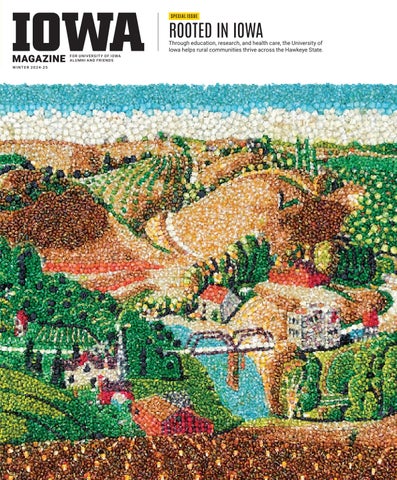
It started with a kernel of an idea. For the cover of this special rural-themed issue of Iowa Magazine, we wanted a visual that popped. We wondered, what if we re-created one of Grant Wood’s most famous paintings using Iowa’s most famous crop? Iowa Magazine art director Nick Beecher (03BA) took the corny concept to San Francisco-based pop artist Jason Mecier, who was all ears. Mecier is known for his audacious mosaics using candy, old electronics, and everything else that fills the junk drawers of his studio. He’s made portraits of Kevin Bacon from bacon and the Mona Lisa from candy wrappers. For our cover story, we commissioned Mecier to create an homage to Wood’s iconic Stone City, Iowa using a variety of corn kernels found in the Hawkeye State and beyond. Wood created the pastoral in 1930—the same year he painted American Gothic—and it’s considered his first acclaimed
Former Hawkeye quarterback Chuck Long, pictured at Kinnick Stadium, returned to Iowa City this past fall for homecoming.
landscape. Today, the regionalist painting—pictured on the back cover of this issue—is part of the permanent collection of the Joslyn Art Museum in Omaha, Nebraska. Stone City, a tiny eastern Iowa quarry town in Jones County, was where Wood helped establish an art colony in the summers of 1932 and 1933. The following year, Wood moved to Iowa City and joined the University of Iowa faculty. Mecier used about 16,000 kernels of corn to create his homage, which he glued to a 28-by-36-inch backing board. His palette included 15 varieties of kernels, including Iowa’s signature yellow corn, an assortment of colorful heirloom seeds, and microwave popcorn. All told, Mecier spent 50 hours working on the piece before shipping it to Iowa City. Mecier says replicating Wood’s masterpiece was a meditative exercise. “The painting already has great composition,” he says. “Working on it felt like I was mostly making different patterns of polka dots and stripes. I listened to a lot of ’70s folk rock like Gordon Lightfoot, Linda Ronstadt, and Buffy Sainte-Marie to keep myself in the right mood.” Read more about the university’s continued work to fortify Wood’s legacy on page 9, and get a closer look at Mecier’s mosaic in our special “Rooted in Iowa” feature on pages 22-43. BY JOSH O' LE ARY
Extra Watch pop artist Jason Mecier create the cover art for Iowa Magazine at foriowa.info/IM-process-24.
MAGAZINE.FORIOWA.ORG
IOWA MAGAZINE
5
GRANDPARENTS UNIVERSITY
®
JULY 17, 2025
Experience a day of discovery for the young and young at heart. Join the fun and make core memories together. Learn more: foriowa.org/grandparentsu
The term Grandparents University® is a registered trademark originating at the University of Wisconsin–Madison and is used with permission. This intergenerational learning opportunity is for children ages 8–14. They may be accompanied by a grandparent or honorary grandparent.
7 F O S S I L F I N D 9 W O O D W O R K 12 D O G G E D W R I T E R
DISCOVERY
Mighty Mastodon
University of Iowa archaeologists dug up a mastodon skull in rural Wayne County, Iowa, similar to the one pictured here. For more on the excavation, see page 8.
MAGAZINE.FORIOWA.ORG
IOWA MAGAZINE
7
On Iowa
BRIEFS
THE ART OF ARCHITECTURE The University of Iowa Stanley Museum of Art, which was designed by the architectural firm BNIM, has received the 2024 International Architecture Award. The prestigious award is presented by the European Centre for Architecture Art Design and Urban Studies and the Chicago Athenaeum Museum of Architecture Art and Design.
State Archaeologist John Doershuk and research archaeologist Veronica Mraz uncover a mastodon skull in an eroded creek bed in southern Iowa.
MOVEMENT IN DANCE
MILITARY SUPPORT NETWORK The UI recently launched a Veteran and Military Council to offer support to more than 500 faculty and staff who are veterans and military members, as well as provide mentoring to more than 850 students who are veterans, National Guard and Reserve members, or Air Force and Army ROTC cadets.
8
IOWA MAGAZINE
WINTER 2024-25
A RCH A EOL OGY
Mastodon Unearthed in Southern Iowa This past fall, University of Iowa archaeologists excavated the first wellpreserved mastodon skull discovered in the state of Iowa—a find that notably dates to when the first humans lived and hunted in the area. Mastodons, an extinct mammal with similarities to elephants and mammoths, roamed North America from around 3.5 million years ago until 10,000 years ago. Through radiocarbon dating, UI scientists determined the Iowa mastodon bones—uncovered in an eroded creek bed in Wayne County alongside human-made stone tools—to be around 13,600
years old. The UI Office of the State Archaeologist and UI Paleontology Repository will analyze and conserve the fossils before their display at Prairie Trails Museum in Corydon, Iowa. BY GABRIELL A SNYDER
Extra Watch state archaeologist John Doershuk explain the significance of the find at foriowa.info/IM-Mastadon-24.
STANLEY PHOTO: JUSTIN TORNER/UI OFFICE OF STRATEGIC COMMUNICATION; ARCHAEOLOGY PHOTOS: KIRK MURRAY/UI OFFICE OF STRATEGIC COMMUNICATION
The University of Iowa Performing Arts Annex, which was formerly known as the old Museum of Art building, began renovations this fall to provide a new home for the UI Department of Dance by August 2026.
On Iowa
The cover of a scrapbook compiled by Nan Wood Graham, Grant Wood's sister, includes a portrait of the artist and his tools of the trade.
A R T HIS T OR Y
Rediscovering Grant Wood PHOTO: FIGGE ART MUSEUM GRANT WOOD DIGITAL COLLECTION/IOWA DIGITAL LIBRARY
UI researchers set out to catalogue the extensive work of Iowa’s most famous artist. No artist captured the essence of Iowa quite like Grant Wood, whose bucolic landscapes and portraits of salt-of-the-earth Midwesterners earned him the nickname “America’s painter of the soil.” Yet Wood’s artistic range extended far beyond regionalist works such as American Gothic, the painting that catapulted him to fame nearly a century ago. In his early years, Wood experimented with impressionism after traveling to Europe, and for a time he operated a jewelry and fine metalwork shop in Chicago. The former University of Iowa professor also crafted furniture, sculptures, and stained glass, and he was deeply interested in architecture and interior design. Wood was so prolific, in fact, that the full scope of his work remains unclear to scholars. To address this, a new UI research project aims to illuminate the breadth of Iowa’s most famous artist by building a comprehensive database of Wood’s works, helping fortify his legacy.
How to Help To support the fundraising effort for the Grant Wood catalogue raisonné project, visit givetoiowa.org/ grantwood.
The three-year endeavor will create a digital scholarship tool—known in the art world as a catalogue raisonné—that will detail Wood’s paintings, prints, drawings, murals, and decorative work in metal and wood, as well as his public and private commissions. The project will also establish a multidisciplinary arts and humanities initiative at Iowa dedicated to studying Wood’s life and work. “If we’re really trying to elevate Grant Wood to his well-earned spot in art history, then we need to have this kind of resource available for scholars and the next generation of students,” says Maura Pilcher, director of the UI-based Grant Wood Art Colony. “A lot of the texts not only overlook Grant Wood, but regionalism in general, and that’s a huge part of our cultural legacy as Midwesterners—and for the United States. It was a truly American style at a time when a lot of people were looking to Europe and other locations for inspiration.” Wood, who grew up in Anamosa and Cedar Rapids, taught at Iowa from 1934–41 in his studio at the original Art Building. He died from cancer at age 50 in 1942 at University Hospital in Iowa City. Even today, collectors, auction houses, and people who have inherited pieces come forward with artwork believed to be created by Wood, but there is no resource to collect and catalogue this information. The Grant Wood Art Colony, in partnership with UI Libraries and the UI Stanley Museum of Art, secured a grant for $296,743 from the Carver Charitable Trust to fund three years of the catalogue raisonné project. Further grants and private fundraising will support the full scope of the endeavor. This past fall, the art colony hired alumna Ranelle Knight-Lueth (06MA, 15PhD) as project manager to lead the development of the catalogue. The project team will include a graduate research assistant, undergraduate interns, and an advisory panel of scholars and legal experts. Researchers will partner with museums and sift through records and published materials in search of forgotten works, track provenance details of known pieces, and ultimately create a database of Wood’s output. The web-based resource will also serve as a repository for scholarship and creative works related to Wood and the regionalism movement he championed. It will be freely available to scholars, museums, art dealers, and the public. Says Pilcher: “Wood was never an elitist, so we want an accessible database where everybody can dig in.” BY JOSH O’LE ARY
MAGAZINE.FORIOWA.ORG
IOWA MAGAZINE
9
On Iowa
program and became the principal gifts officer. Dierks is an advocate for veteran programs at Iowa and has helped them secure philanthropic support. U.S. N AV Y
Capt. John H. Fraser (96MBA)
V E T ER A NS
Hawkeye Heroes The university pays tribute to six service members for their commitment to country and community.
Fraser served seven years of active duty, including two Vietnam deployments with Helicopter Combat Support Squadron One, then served 18 years in the Naval Air Reserve, where he was commanding officer of Helicopter Anti-Submarine Warfare Squadron 85 at Alameda Naval Air Station in California. At Iowa, Fraser was director of the Tippie College of Business’ executive MBA program for 14 years and an adjunct lecturer for 12 years. After retiring, he served as a faculty member and mentor to the Washington Mandela Fellows Program and established the John Fraser Iowa Veterans Tippie Scholarship. U.S. A R M Y
Col. Robert Hedgepeth (89BSE)
U.S. A R M Y
Col. Edwin “Andy” Anderson
A former assistant professor of military science for the UI’s ROTC program, Anderson established the university’s Ranger Challenge team, which won a national championship in 1987. During his decorated 30-year Army career, Anderson mentored officers who graduated from Iowa and were commissioned through the ROTC program. In retirement, Anderson has helped lead many veteran support organizations, including the Special Operations Warrior Foundation, and was instrumental in the project to build the America’s Response Monument that honors U.S. Army Special Forces at Ground Zero in New York.
10
IOWA MAGAZINE
WINTER 2024-25
U.S. N AV Y
Lt. Howard Cowen (76DDS, 95MS)
Cowen served in the Navy for eight years, including while he was a dental student at the UI, before returning to Iowa City in 1983 to join the College of Dentistry faculty. Currently a clinical professor, Cowen has led Iowa’s geriatric and special needs oral health care program for more than 40 years. As a student mentor and an advocate for providing oral health care to vulnerable populations, Cowen was named the Iowa Dental Alumni Association’s Educator of the Year in 2001 and Dental Service Awardee of the Year in 2016. He also received the Dentaquest Health Equity Hero Award in 2022. U.S. A R M Y
Master Sgt. Dave Dierks (70BA)
A non-commissioned officer who provided combat medic training for enlisted personnel, Dierks served 28 years in the military with the Army, National Guard of Illinois, and 109th Medical Battalion of the Iowa National Guard. Dierks devoted his professional career to his alma mater, working for more than 50 years at the UI Center for Advancement (formerly the UI Foundation), where he established a planned and major gifts
A U I College of Engineering and ROTC alumnus, Hedgepeth spent more than 30 years in the Iowa Army National Guard, where he served as commander of the 671st Troop Command. In 2014, he was a founding member of the Mighty Hawkeye Battalion Alumni Association, guiding the group as it established an endowed fund to support current cadets. A board member for Safeguard Iowa, he serves as the adjutant for American Legion Post 728 and on the advisory board for the UI-based Iowa Technology Institute. U.S. A R M Y
Capt. Zachary Graham
The recipient of this year’s Larry Lockwood Student Award, Graham was a military intelligence officer with the U.S. Army in Germany before enrolling in the UI College of Dentistry. Graham served as a veteran academic counselor at Iowa, helping ease the transition of student veterans into academic life. Graham also has held positions in the American Student Dental Association and the Iowa American Student Dental Association, served as president of the Tau Sigma Military Dental Club, and cofounded the Pediatric Smiles Fund, which raises money to support dental care for under/uninsured pediatric patients. BY JOSH O’LE ARY
CAMPUS PHOTO: TIM SCHOON/UI OFFICE OF STRATEGIC COMMUNICATION
For the recipients of this year’s University of Iowa Distinguished Veterans Awards, loyalty to the black and gold is matched only by a dedication to the red, white, and blue. The UI honored four alumni, a former ROTC faculty member, and a student veteran in a November ceremony at the Iowa Memorial Union ahead of Veterans Day. Hawkeye fans also applauded the recipients when they were introduced during the military appreciation football game against Wisconsin at Kinnick Stadium.
On Iowa
BRIEFS
NEW NAME, SAME GAME
A S K A N E X P ER T
How Can I Make My Winter Commute Safer? University of Iowa research shows that, for many workers, the morning commute is the most hazardous part of their day. UI College of Public Health assistant professor Jon Davis (17PhD) says a little precaution can go a long way in creating a safer Jon Davis Diane Rohlman winter commute. A study he and colleague Diane Rohlman published in the International Journal of Environmental Research and Public Health found that wintry weather was most frequently a contributing factor to crashes between 8-8:30 a.m. Davis says the risk significantly reduces as workers delay their driving to allow time for conditions to improve and snowplows to clear the roads.
Tips for a safe winter commute Take advantage of flexible work hours or telecommuting to avoid hazardous driving conditions, especially during peak commute times. Dress for the weather conditions.
PHOTO ILLUSTRATIONS: NICK BEECHER
Stay on top of vehicle maintenance, including tire replacement. Keep blankets, snacks, and water in the vehicle. Be prepared with a fully charged cell phone and a full tank of gas. Those who have less confidence in their winter driving can make advance arrangements for grocery delivery or rides. BY SHELBI THOMAS
A street near the UI Health Care campus has been renamed Hawkeye Wave Way, recognizing the football tradition, Stead Family Children’s Hospital patients, and the supportive Hawkeye community.
LEARNING ENVIRONMENT The Iowa Board of Regents approved a College of Liberal Arts and Sciences plan to combine the Departments of Earth and Environmental Sciences and Geographical and Sustainability Sciences into a School of Earth, Environment, and Sustainability. The merge will allow students access to more resources and classes in the field of study.
TARGETING TOXINS UI Health Care opened a Medical Toxicology Clinic this past summer to diagnose and treat severe poisoning cases with specialized, efficient care. Located in the Medical Specialty Clinics, the clinic is the first of its kind in Iowa.
MAGAZINE.FORIOWA.ORG
IOWA MAGAZINE
11
On Iowa
“
One day I thought, ‘It would be a really horrible idea if I literalized this and wrote a book about a mom becoming a dog.’ But it seemed like such a fun idea. And when I tried it out, it just sort of took off.”
NE W S M A K ER: R A CHEL YODER ( 1 1MFA )
A Mother Unleashes Her Inner Animal One of the most anticipated films of the year is an adaptation of a UI professor’s novel about a mother who finds herself turning into a dog. It started with a joke between Rachel Yoder and her husband. “After having a child and two years of not sleeping through the night, I could be quite feral when awoken during the night. So, we would joke about the nightbitch,” says Yoder (11MFA), assistant professor in the University of Iowa Department of Cinematic Arts. “One day I thought, ‘It would be a really horrible idea if I literalized this and wrote a book about a mom becoming a dog.’ But it seemed like such a fun idea. And when I tried it out, it just sort of took off.” Yoder’s debut novel, Nightbitch, was released in 2021 to critical acclaim. It was selected as an Indie Next Pick and a best book of the year by Esquire and Vulture, as well as being recognized as a finalist for the PEN/Hemingway Award for Debut Fiction, finalist for the VCU Cabell First Novelist Award, and shortlist for the McKitterick Prize. Earlier this month, a film adaptation of the book directed by Marielle Heller and starring Amy Adams released in theaters nationwide after premiering in September at the Toronto Film Festival.
12
IOWA MAGAZINE
WINTER 2024-25
Nightbitch follows “mother,” who puts her art career on hold to stay at home with her son. As her previous sense of identity fades into motherhood, she discovers a dense patch of hair on the back of her neck, and her canines suddenly look sharper than she remembers. Her symptoms intensify until she finds herself transforming at night into a dog. Yoder grew up in a Mennonite community in the Appalachian foothills of eastern Ohio and studied English literature as an undergraduate student at Georgetown. She says it wasn’t until she moved to Arizona and met a mentor who encouraged her that she thought about writing as a viable career option. While working toward an MFA in creative writing—which she received in 2007—at the University of Arizona, Yoder took a couple of creative nonfiction writing courses. She also attended a NonfictioNOW Conference, which was hosted at Iowa, and the Bread Loaf Writers’ Conference, at which she studied with Iowa Writers’ Workshop graduate David Shields (80MFA). “The fiction I was writing was already so autobiographical, and I was also interested in publishing nonfiction, but those experiences solidified my interest,” Yoder says. “I told myself I would only indulge a second MFA if it was at Iowa and it was paid for, and they were kind enough to give me funding.” Yoder graduated from the UI Nonfiction Writing Program in 2011. She says she loved that the faculty and her classmates were all coming at nonfiction from different angles. “Some were journalists, others were poets, and that was a huge benefit of the program,” Yoder says. “Another thing I really liked about it was this sense
PHOTO: TIM SCHOON/UI OFFICE OF STRATEGIC COMMUNICATION
— Rachel Yoder
On Iowa
‘NIGHTBITCH’ OPENS REFOCUS FILM FESTIVAL
Actor Amy Adams stars in Nightbitch, a supernatural comedy based on a novel by UI Nonfiction Writing Program grad Rachel Yoder.
A few weeks after Nightbitch premiered at the Toronto Film Festival, it opened Iowa City’s Refocus Film Festival. The festival, in its third year, celebrates adaptation and transforming one art form into another. Yoder says she is thrilled that the film was shown this past fall in the city where she found her home and where so many people supported her during the writing of the book. “I feel like the community is in some
PHOTO COURTESY SEARCHLIGHT PICTURES
way part of its creation,”
that you could experiment. There weren’t hard and fast rules. We were still sort of defining the genre. The sense of experimentation and possibility and hybridity, bringing in fiction, bringing in storytelling, bringing in poetry, it just really gave me this sense that I could do whatever I want.” When Yoder started Nightbitch, she wasn’t sure whether she would ever show it to anyone. “It was a place where I could be completely honest and tell the truth, and I could decide later if I wanted anyone to read it,” Yoder says. “A lot of the book is about getting to know the darker sides of the self, and instead of running away from them, embracing them and seeing what they have to teach us. “There are so many things that are taboo about motherhood and what you say about motherhood. You’re not supposed to tarnish it in any way. I thought, ‘What if we just tell the truth about it being hard and vicious and messy and wild? If we tell that story, what will be gained?’” Yoder says parents have told her that before reading Nightbitch it felt like no one understood what they were going through or the feral thoughts they were having. It felt like no one had told their story before. “It’s been really wonderful to hear that people feel seen and feel less alone,” Yoder says. “What else could you hope for from your work than that?” Actor Amy Adams’ production company partnered with Annapurna Pictures to option the rights to Nightbitch before it was even published.
“Books are optioned all the time, but it takes a lot to get a movie made. The stars really have to align,” Yoder says. “And somehow the stars aligned.” Yoder wrote an initial screenplay, but when director Marielle Heller, who previously wrote and directed the film The Diary of a Teenage Girl, came on board, she wanted to do her own adaptation. “That’s not unusual, and I was totally on board,” Yoder says. “She very generously had me read the script early on and invited me on set for a few days. I felt like, if I wanted to, I could have some input. But I had a lot of trust in her because I really admire and respect the work that she’s done. It’s been great to have another artist be inspired by my book and make it their own.” Yoder says it was surreal watching the cast and crew film Nightbitch. “It was kind of emotional because there are parts of the book that are drawn from my life,” Yoder says. “Seeing these moments acted out in front of me was baffling and magical.” Yoder is currently working on a script she describes as a dark horror comedy, which is based on a short story by another author. She says she also may put together her own short story collection at some point down the road, but for now, she’s focusing on the script and teaching. This is Yoder’s first year teaching screenwriting courses, and she says after 20 years of teaching fiction writing, it’s exciting to feel a sort of beginner enthusiasm again. “These students are so brilliant. They see things in texts that I don’t see,” Yoder says. “They’re also from a different generation, so just learning about what is on their minds and what their concerns are is important to me. I’ve gotten set in my ways and in the kinds of things I like, so I like it when my students introduce me to new things that I would never have picked up on my own. “I’m excited to be in community with them, and it feels like an honor to lead them through this exploration of screenwriting. I’m really excited to see what stories they want to tell and what characters they want to bring into being.” B Y E M I LY N E L S O N
Yoder says. “This is where I became a mother. This is where I really kind of came into my adult self. It’s very, very special to share it with the community.”
WHAT SHE’S READING Rachel Yoder can’t say enough about Small Rain, a new book by Iowa City author Garth Greenwell (15MFA). “It was so masterful, so beautiful, and so romantic in a lot of ways,” says Yoder. “It’s so unlike how I write. I really appreciate reading a writer whose approach is so different yet so accomplished. I highly recommend this book.”
MAGAZINE.FORIOWA.ORG
IOWA MAGAZINE
13
TOGETHER, HAWKEYES MAKE A DIFFERENCE! On Wednesday, March 26, 2025, Hawkeyes from around the world will come together for One Day for Iowa—the University of Iowa’s 24-hour online giving day. This is your chance to double your impact with exclusive matching gifts and help support the students, faculty, and programs that make Iowa exceptional. Hawkeyes support Hawkeyes! Every gift, big or small, makes a difference.
Go Hawks
16 C O U R T C H E M I S T R Y 18 G Y M N A S T I C S G R O W T H 19 F A R M I N G T O F O O T B A L L
PHOTO: JUSTIN ELSNER/HAWKEYESPORTS.COM
FOOTBALL
Hay There!
It’s become a Solon Beef Days tradition. Since the early 2000s, members of the Hawkeye football team have competed for bragging rights in the small-town festival’s annual hay bale toss. Redshirt freshman offensive lineman Kade Pieper (pictured) hurled a 60-pound hay bale 12 feet in the air to become this year’s victor, joining a long line of past Hawkeye winners that includes six-time champion and event organizer Matt Kroul (08BA), Solon native Tyler Linderbaum (21BA), and UI junior Gennings Dunker.
MAGAZINE.FORIOWA.ORG
IOWA MAGAZINE
15
Go Hawks
Brock Harding and Owen Freeman headline a sophomore class that Hawkeye basketball coach Fran McCaffery says has “really elevated their games.”
Full-Court Connection Former Moline teammates bring chemistry and emerging leadership into their sophomore season at Iowa. 16
IOWA MAGAZINE
WINTER 2024-25
Brock Harding wasn’t sure he’d get along with fellow Hawkeye Owen Freeman when they first met playing AAU basketball in
high school. Harding was initially amused by Freeman’s gangly appearance. Freeman jokes that Harding was shorter than he expected. But their chemistry as teammates grew as they stepped onto the court. The Illinois natives developed a rapport in their first practice together in 2019 for MidPro Academy, a premier AAU basketball program. Harding threw lobs to Freeman inside, and Freeman found Harding for open shots outside. A dynamic duo emerged. “Everything flowed together perfectly as soon as we started playing,” says Harding. Throughout four seasons with MidPro Academy and a senior-year state championship run with Moline High School in Illinois, Harding and Freeman developed a connection on and off the court that carried into their first season on the Iowa men’s basketball team. The UI sophomores enter this season determined to shoulder bigger roles and take the Hawkeyes on an NCAA tournament run.
PHOTOS: JOHN EMIGH
BASKETBALL
Go Hawks Owen Freeman
“
Everybody on our team enjoys that underdog mentality. We know what our team can do, and everyone’s excited
Brock Harding
for the noise we’re going to make this season.” — Brock Harding Fire and Ice
Harding still gives Freeman a hard time, whether it’s poking fun at his WWE fandom or his use of replacement words such as “frick” and “daggumit” to avoid swearing. Freeman, who transferred to Moline before his senior season, dishes it right back. “That just shows the kind of relationship we have,” says Freeman. “We like to tease each other a lot.” They hold each other to a high standard on the court and play with a swagger and awareness, seemingly always knowing where the other is. Harding provided a spark off the bench last season with his energy and playmaking. Freeman, last year’s co-Big Ten Freshman of the Year, offers a steadying presence with his scoring efficiency and shot blocking. “He’s more the fiery guy, and I’m more chill,” Freeman says, “but I feel like we’ve rubbed off on each other.” Bigger, Stronger, Motivated
The two share a chip-on-their-shoulder mentality that’s fueled their improvement this offseason. To better handle the rigors of Big Ten play, Harding added 10 pounds to his 6-foot frame, while 6-foot10-inch Freeman tacked on more than 20 pounds. Beyond their strength gains, Harding raised the quickness and release point of his jump shot, while Freeman developed his dribbling and outside shot. They embraced the opportunity to return to Moline for a nonconference game this past November against Washington State—the first Hawkeye showdown in the Quad Cities in 26 years—and prove any doubters wrong. “[Outside] expectations for our team aren’t super high,” says Harding. “Everybody on our team enjoys that underdog mentality. We know what our team can do, and everyone’s excited for the noise we’re going to make this season.” BY T Y L E R S T R A N D
Get to Know Brock and Owen What Their Tattoos Tell One of Harding's tattoos reads: Trust Your Work. “That’s always been my thing. I’ve never been the biggest, tallest, or strongest, and I’ve always outworked everybody that I’ve seen in front of me—and that kind of translates to my confidence on the court. I know that nobody’s worked harder than me, so I’m going to have confidence in whatever I do.”
Freeman has a tattoo to remind him of Isaiah 41:10. “It’s just knowing that’s where my confidence and strength come from. I struggle with some fear and anxiety, so it helps me with that and just knowing that I don’t need to worry about anything, and that’s ultimately where all my abilities come from.”
Sophomore Growth Harding: “Owen is pretty relaxed on and off the court, but now he’s been stepping into his own a bit and getting a little more animated on the court. It’s a good thing most times.”
Freeman: “I think Brock will step into that starting point guard role and lead this team. It’s something I’ve seen him do on both the teams we’ve played on [before]. His leadership and the way he’s going to play will shock a lot of people.”
MAGAZINE.FORIOWA.ORG
IOWA MAGAZINE
17
Go Hawks
NEW PRACTICE FACILITY SET TO OPEN
of three Canadian Olympians who joined the Hawkeye gymnastics team this year.
GY MN A S T IC S
Sticking the Landing A new coach and a trio of talented freshman Olympians plant their feet in Iowa City. Jen Llewellyn didn’t face the challenge
many college coaches deal with when taking over a new program. In an era when the NCAA’s transfer portal can become a busy escape hatch after a coaching change, rebuilding hasn’t been a concern for Llewellyn, who became Iowa’s new women’s gymnastics coach in early June. “From the moment we got here, the team was extremely welcoming,” Llewellyn says. “They’re super driven, super hungry for success, and they’re a very united group.” Llewellyn takes the reins of the GymHawks after leading the University of Washington to three consecutive NCAA second-round regional appearances. Iowa’s program has had its own success, with Emily Erb, Ilka Juk, and Karina Muñoz returning this winter after advancing to the NCAA regionals last season. But it was the strength of the university’s other women’s programs that also played a role in Llewellyn deciding to come to Iowa.
“What was so attractive about Iowa was the attention to women’s sports,” Llewellyn says. “A lot of great things are going on here. I’ve always been a huge supporter and believer in women’s empowerment, so I felt like it was a special place that has huge opportunities.” Llewellyn has already made an impact on the GymHawks. “Coach Jen has made it easy to make the transition to college,” says Cassie Lee, one of three freshmen from Canada, along with Aurélie Tran and Sydney Turner, who were part of the national team that finished fifth at the Olympics this past summer. “Coming from elite to NCAA competition is a lot different, and she’s been super helpful and easygoing with our transition.” The freshmen join a program with high expectations this winter. Three-time All-American JerQuavia Henderson (23BA) has announced her return to gymnastics after stepping away last season, while fifth-year senior Adeline Kenlin returns after tearing her ACL last winter. “I think the key for success is just going out there as a team and supporting one another, because I know last year they all had it a little rough, so being there for each other and just lifting each other up is going to be a big key this year,” Lee says. BY JOHN BOHNENK AMP
18
IOWA MAGAZINE
WINTER 2024-25
Give Support women’s athletics at Iowa through the Hawkeye Women: RISE campaign at foriowa.info/IM-Rise-24.
PHOTO: HAWKEYESPORTS.COM
Cassie Lee is one
Llewellyn’s hiring comes at a key time in the program’s advancement, with the GymHawks moving into their new training facility in January. “It’s a dream come true,” Llewellyn says. “I am so excited and grateful to be at a place that is investing in the program.” The new Gymnastics/Spirit Squad Training Center is a onestory, 32,500 square-foot climatecontrolled practice facility on the west edge of Iowa’s campus off Prairie Meadow Drive, south of Hawkeye Tennis Recreation Complex. The center features competition-style beams, vault runways, uneven bars, and a floor exercise space, along with space for coaches and athletic training medical staff. Iowa has been practicing in the Field House, but it lacks many modern amenities. “Everything will be more efficient,” Llewellyn says. “It helps make the student-athletes’ days easier, too, with the fact that they can do everything all in one space. There will be a study lounge, they can take naps, they can shower, they can rest and recover, and it’s just a great space so that they can be completely all in for what they need to do to be at their best.” The $20 million project is being funded by athletics department revenue and private gifts through the Hawkeye Women: RISE campaign.
Go Hawks
Former Hawkeye and NFL tight end Brandon Myers, pictured here at his former high school, Prairie City-Monroe, credits his farming background for his success in football.
MAIN PHOTO: CONRAD SCHMIDT/IOWA FARM BUREAU; HAWKEYE PHOTO: HAWKEYESPORTS.COM
F OO T B A L L
From Grainfield to Gridiron A former farm kid and Hawkeye tight end becomes Iowa’s latest America Needs Farmers honoree.
The Universit y of Iowa Department of Intercollegiate Athletics and the Iowa Farm Bureau recently selected Myers as the 12th Hawkeye to be added to Kinnick Stadium’s America Needs Farmers Wall of Honor, which recognizes Hawkeyes who embody the tenacity, work ethic, and character of Iowa farmers. He was honored this past fall during Iowa’s annual ANF football game. “It’s very humbling to be recognized,” says Myers, who joins a distinguished list of past recipients that includes Robert Gallery (03BA) and Dallas Clark (07BA). “It’s a big deal for me— especially when I think about where I came from and my upbringing in rural Iowa. To follow some of the guys who have come before me, I’m honored.” BY BEN FROTSCHER
More on Myers YEARS AT IOWA: 2004–08 KEY PLAY: Two receptions on game-winning
drive to beat No. 3 Penn State, 24-23, in 2008 FAVORITE MOMENTS: 2005 Capital One Bowl
30-25 win over LSU and 6-4 victory over Penn
Growing up close to his grandparents’ farm near Prairie City, Iowa—population 1,700— Brandon Myers loved spending fall weekends working in the fields. “I drove the grain cart and listened to Jim Zabel (44BA) call Hawkeye football games,” says Myers. “I remember a lot of Tim Dwight (99BS) and Tavian Banks (97BS) touchdowns. I always thought it would be cool to run out of the tunnel at Kinnick Stadium.” Myers later became a four-year letter winner at tight end and led the Hawkeyes to three bowl game wins. He says his farming background helped him develop the determination to succeed on the field. “Farmers know that no matter how they’re feeling, they have to go do their job because people are depending on them,” says Myers, who spent eight seasons in the NFL and now owns a window cleaning business in Peoria, Arizona. “It’s the same with football. You’re not always going to feel great or have the energy, but you have teammates depending on you.”
State in 2004 BIG HONOR: First-team, All-Big Ten in 2008 PRO CAREER: Eight NFL seasons with the
Oakland Raiders, New York Giants, and Tampa Bay Buccaneers from 2009–16
Extra Watch a video on Myers’ farming background at foriowa.info/IM-Myers-24.
MAGAZINE.FORIOWA.ORG
IOWA MAGAZINE
19
Go Hawks
BRIEFS
Dave Dilanni
100 WINS AND COUNTING
ROOKIE RECORDS Indiana Fever guard Caitlin Clark (24BBA) was named the 2024 WNBA Rookie of the Year and a member of the All-WNBA first team after leading her team to the playoffs for the first time since 2016. This year, Clark set WNBA single-season records for assists, points scored by a rookie, and three-pointers by a rookie.
GOLFER’S MILESTONE Noah Kent, a sophomore on the Iowa men’s golf team, earned invitations to the 2025 Masters in April and the U.S. Open in June by placing runnerup this past fall in the U.S. Amateur finals.
BEST IN SPORTS The University of Iowa received USA Today’s 2024 Readers’ Choice Award for Best College Sports Tradition for the Hawkeye Wave. Since 2017, football fans have waved to pediatric patients in the UI Health Care Stead Family Children’s Hospital.
20
IOWA MAGAZINE
WINTER 2024-25
Big Ten studentathletes, including Hawkeye gymnast Gianna Masella (pictured), learned about agriculture this past summer at Kroul Farms in Mount Vernon, Iowa.
BIG L IF E S ERIE S
Field Day Big Ten student-athletes experience Iowa farm life. Originally from Palm Harbor, Florida, Hawkeye gymnast Gianna Masella had never spent much time on a farm. That changed earlier this year when the University of Iowa junior had the opportunity to feed calves and pick fresh produce at Kroul Farms in Mount Vernon, Iowa, as part of the Big Life Series that provides new cultural and educational experiences to members of the Big Ten. “It was definitely a culture shock for me,” says Masella. “I am a huge animal person, but I think the reality of being on a farm was a lot different from the image in my mind. It was cool, and not what I expected.” Masella was one of a select group of Big Ten student-athletes, coaches, and administrators who participated in the Big Life Agricultural Experience, which included visiting the farm of former Hawkeye football defensive lineman Matt Kroul (08BA) and his wife, Nicole Mason Kroul (09BA, 18MA). The program also included speakers who shared about sustainable farming, improving access to healthy food, and the diverse approaches and cultural backgrounds represented in agricultural practices. Masella says a common thread she saw between farming and gymnastics was teamwork. “I never realized how much coordination it takes to make a farm run,” she says. “Every detail requires a person to see it through, from hands-on tasks to the entire business side of things. In gymnastics, I would not be where I am without my coaches, teammates, athletic trainers, and so many others. There are so many people that go into that success.” BY JACK BACON
PHOTOS: HAWKEYESPORTS.COM
Iowa women’s soccer coach Dave Dilanni earned his 100 th victory with the team in its home opener this fall. The team finished third in the Big Ten regular season and earned a No. 3 seed in the NCAA tournament, the highest in program history.
Go Hawks
S E A S ON S N A P S HO T S
Highlight Reel From the gridiron to the pitch, Iowa student-athletes provided thrilling moments in competition this past fall. We’ve gathered a few of our favorites. 1 3
4 2
1. TWO-HUNDREDTH TRIUMPH: Kirk Ferentz won his 200 th career
game as a Big Ten coach when the Iowa football team routed Washington 40-16 in October at Kinnick Stadium. The milestone victory moved Ferentz past hall of fame coach Amos Alonzo Stagg for second in all-time Big Ten wins. “The best part about coaching always has been working with players,” says Ferentz, who was closing in on Woody Hayes’ conference record 205 wins at press time. “I’ve been so fortunate where the guys I’ve worked with on a daily basis have been really good folks.” 2. FIRST-YEAR FORCE: Hawkeye soccer freshman Berit Parten
celebrates a goal in Iowa’s 2-0 home triumph over No. 18 Wake Forest. The Hawkeyes earned their first-ever United Soccer Coaches Poll top10 ranking this season and posted a 13-2-4 record ahead of hosting in the NCAA tournament for the second-straight season.
PHOTOS: HAWKEYESPORTS.COM
3. BRINGING HOME THE BACON: Junior Kaleb Johnson rushed
for 206 yards and scored three touchdowns in the Hawkeyes’ 3114 victory at Minnesota in September as Iowa claimed the Floyd of Rosedale trophy. In a November game at UCLA, Johnson broke the school record for touchdowns (21) and points (126) in a season. 4. LION TAMER: Iowa field hockey’s Harper Dunne battles for
possession in the Hawkeyes’ 1-0 win over No. 17 Penn State.
MAGAZINE.FORIOWA.ORG
IOWA MAGAZINE
21
22
IOWA MAGAZINE
WINTER 2024-25
Rooted in
How the University of Iowa helps rural communities thrive in all 99 counties
ART: JASON MECIER
V
isit nearly any small town in Iowa, and you’re bound to see the Tigerhawk. The University of Iowa’s familiar athletics logo appears on license plates along Main Street, painted on the sides of barns, and emblazoned on the ballcaps of farmers. But if you look closer, you’ll notice the university’s footprint goes far beyond sports fandom. Stop into the drugstore owned by a UI College of Pharmacy alum. Talk to the landowner who uses weather forecasting systems developed by the UI College of Engineering. Or visit the UI Health Care community clinic providing families with expert care close to home. For communities stretching from the Missouri River to the Mississippi, the University of Iowa isn’t just a destination for learning; it’s a partner. In this special feature, learn how the UI’s deep roots nourish rural areas across the Hawkeye State, helping Iowans flourish. MAGAZINE.FORIOWA.ORG
IOWA MAGAZINE
23
The 18 th annual Iowa Water Conference this past fall featured a tour of the Johnson County Historic Poor Farm, where UI experts demonstrated a
Iowa researchers are working to solve some of our state’s most significant environmental challenges. That includes experts from the UI College of Engineering who are using a living laboratory to conduct innovative sustainability research and scientists who have deployed a vast network of climate sensors to prepare for the growing impact of extreme weather events. 24
IOWA MAGAZINE
WINTER 2024-25
PHOTO COURTESY IIHR—HYDROSCIENCE & ENGINEERING
hydrological monitoring station.
UI researchers use hydrologic monitoring stations to study weather events throughout Iowa.
Iowa Flood Center sensors monitor water conditions across the state.
BRACING FOR THE STORM The UI develops sensors for rivers, soil, and air to help rural communities plan for changing conditions. BY J O S H O ' L E A R Y with additional reporting from the UI College of Engineering
PHOTOS COURTESY IOWA FLOOD CENTER
As record flooding threatened northwest Iowa this past June, a
UI-built network of river sensors provided small towns with important data to support local decision-making. The Iowa Flood Information System, or IFIS, delivered real-time information about stream levels, flood alerts, and forecasts, helping northwest Iowa communities where catastrophic f looding forced the evacuation of residents and damaged hundreds of homes. An online tool developed by the Iowa Flood Center at the UI College of Engineering, the IFIS communicates river levels at 270 stream sensor locations updated every 15 minutes and flood alerts and forecasts for more than 1,000 Iowa river communities. It also features detailed inundation maps
for cities that model how predicted flood levels could affect property and critical infrastructure. T he IF IS is one of severa l forecasting technologies developed by UI researchers to help Iowa’s rural communities grapple with increasingly extreme weather events— including floods, droughts, and heat waves—driven by climate change. The Iowa Flood Center also collects data on rainfall, wind, soil conditions, and groundwater using hydrologic monitoring stations in 53 counties. This past summer, the center installed 31 new hydrostations in eastern Iowa, thanks to a $1 million federal grant from Congress’ Communit y Project Fund ing. This data helps farmers with land management decisions, as well as researchers studying extreme
weather. The sensors will also support the development of an Iowa Drought Information System, which will be modeled after the IFIS. “Recent events have show n how quickly Iowa can change from drought to flood conditions,” says Larry Weber (89BSE, 90MS, 93PhD), professor of civil and environmental engineering and interim director of the Iowa Flood Center, the nation’s only academic research center devoted to flooding. “Having a more uniform hydrostation network across the state helps us better support agencies and communities in making flood and drought mitigation, forecasting, and response decisions.” The UI’s expertise with weather sensors a lso benef its residents beyond Iowa. The National Science Foundation recently awarded the UI
a $6 million, four-year grant to lead a multistate collaboration to help Midwest agricultural communities deal with severe weather. The project, called Data-Advanced Research and Education, places UIdesigned sensors in farm fields and neighborhoods across Iowa, Kansas, Nebraska, and Arkansas. The sensors
The UI has deployed 270 stream sensors across Iowa.
MAGAZINE.FORIOWA.ORG
IOWA MAGAZINE
25
UI engineering professor Jun Wang and his team use sensors to provide weather and air quality forecasts.
Iowa Flood Information System Check out the Iowa Flood Center’s web tool that provides community-based flood conditions, forecasts, and inundation maps at ifis.iowafloodcenter.org.
26
IOWA MAGAZINE
WINTER 2024-25
The Johnson County Historic Poor Farm, off Melrose Avenue in Iowa City, has become a center for environmental research and education.
FIELDS OF INNOVATION From education to conservation, the Johnson County Historic Poor Farm provides a space for visionary UI research that can help protect Iowa’s land and water. BY M E G A N M AG E E
Located three miles west of Kinnick Stadium on the outskirts of Iowa City, the Johnson County Historic Poor Farm began in 1855 as part of a national social movement to provide living accommodations for society’s most vulnerable. Tenants received room and board in exchange for working on the farm, caring for livestock, and growing crops. It’s been 36 years since the last residents left, and until 2016, the county leased the land under a crop-share model. More than 30 community partners have since collaborated to transform the countyowned, public property into a hub of environmental sustainability and education—including for University of Iowa students, faculty, and staff. “The county chose to take the 160 acres, restore it, create community space, and help make an impact back to the community,” says Kate G i a n n i n i , a prog ra m ma nager with IIHR—Hydroscience and Engineering at Iowa and one of many environmental researchers engaged in
community-based projects at the site. The Johnson County Historic Poor Farm now addresses many challenges faced by rural communities, serving as a living learning laboratory where education, science, and climate research intertwine. The site hosts the nonprofit Grow: Johnson County that grows fresh fruits and vegetables for local food pantries, a land access program that equips new farmers to start their own operations, a 15.5-acre pollinator plot to retain and boost biodiversity, and other environmental projects with practical applications beyond these 160 acres. White outbuildings flank the silo and red barn on the northeast end of the property, extending to greenhouses, rows of vegetables from immigrant farmers’ homelands, and instruments for measuring soil and water quality. Every hour, a hydrostation at the poor farm installed by UI College of Engineering scientists collects data on soil moisture and temperature, rainfall, and groundwater levels. Giannini emphasizes the importance of tracking long-term data to monitor
WANG PHOTO: JUSTIN TORNER/UI OFFICE OF STRATEGIC COMMUNICATION; FARM PHOTO COURTESY JOHNSON COUNTY HISTORIC POOR FARM
gather weather and soil data to produce model weather forecasts for agricultural communities via phone apps and interactive web tools. “A g-ba sed commu n it ies in t he cent ra l U. S. a re disproportionally affected by climate change,” says professor Jun Wang , the UI’s James E. Ashton Chair of Engineering and the project’s principal investigator. Wang, a member of the Iowa Technology Institute who will lead a project team of 29 experts across various sectors and four universities, says the project “will strengthen communities’ resilience and grow the next-generation workforce to tackle the impacts of severe weather and climate change.” UI scientists are also launching a project to develop new ground-based and airborne climate research capabilities. As part of this effort, the UI College of Engineering’s airborne research center, the Operator Performance Laboratory, is developing pods for its jets that will house instruments to gather atmospheric and environmental data on air quality and pollution, nitrate runoff, soil moisture, and wildfires. “This capability for airborne research does not exist in the Midwest,” says project lead Matthew McGill, UI professor of chemical and biochemical engineering and a member of the Iowa Technology Institute. “The OPL capability represents truly untapped potential for the university to become a destination for the science community to conduct field campaigns and test new sensor prototypes.”
The Johnson County Historic Poor Farm provides a public space for community members to connect to the land
PHOTOS COURTESY JOHNSON COUNTY HISTORIC POOR FARM
and local history.
Iowa’s soil and water health. “If we don’t have water quality sensors out there, how are we measuring success?” she says. “It’s not about how much money we’ve spent on conservation; it’s about measuring improvements over time and making a positive impact downstream.” UI Donald E. Bently Associate Professor in Engineering Craig Just (01PhD) and his students at IIHR are working to install instruments, like the hydrostation here, in every Iowa count y as part of a U.S. Department of Housing and Urban Development grant to help monitor and forecast flood and drought. Two Environmental Protection Agency grants awarded to Just in 2020 also fund work at the Johnson County Historic Poor Farm to study soil microbiology and its impact on the nitrogen cycle. Just says these grants are crucial for flood mitigation and water quality,
tying into statewide goals to reduce excess nitrates and restore ecological balance. Decades of nitrogen-heavy fertilizer use has impacts far beyond farming. “We’re creating these dead waterways,” says Just, “and it’s not just a health issue—it’s impacting the recreational value of the state.” Nitrogen pollution has become one of the most pressing challenges currently facing Iowa. There’s nothing inherently wrong with nitrogen—it’s essential for chlorophyll production, building amino acids, and supporting ecosystem health. But when the soil can’t absorb it, nitrogen runs downstream, creating toxic algae blooms throughout the watershed. Many rural towns rely on outdated water infrastructure because upgrades are f inancially out of reach, but removing excess nitrates is crucial for human and environmental health. The research conducted at the Johnson County Historic Poor Farm
will help IIHR experts find ways to support these rural communities in enhancing and protecting their water quality. Ju s t a l s o u n d e r s c o r e s t h e importance of places like the poor farm for students to get hands-on experience with real-world issues. Whether it’s monitoring water quality or installing new technology, Just says his students aren’t just studying theory—they’re improving lives across the state. In addition to the IIHR’s water and soil research, UI students and professors across other disciplines interact with the site to advance their studies. Willow Creek headwaters beg in on t he fa r m, nea r la nd designated for beetle biodiversity research by Andrew Forbes , UI professor and associate chair of biology. The English department and UI College of Engineering have also visited the farm for the
Nationa l Science Foundationsponsored BlueGAP project, aimed at equipping stor y tel lers w ith science-based experiences to give voice to the environmental impacts of nitrogen pollution. The range of learning opportunities at the Johnson County Historic Poor Farm sets a model for rural innovation with education and science at its core. UI researchers who work with the land believe the theories and experiments tested here will impact Iowa for generations to come, laying the groundwork for sustainable solutions that benef it both the environment and local communities.
Iowa Water Quality Information System Visit the IIHR’s web tool to monitor real-time nitrate levels and water quality across the state at iwqis. iowawis.org.
MAGAZINE.FORIOWA.ORG
IOWA MAGAZINE
27
Institute at Iowa are involved in a federally funded pilot program to study automated vehicle performance on rural roads.
28
IOWA MAGAZINE
WINTER 2024-25
PHOTO: JUSTIN TORNER/UI OFFICE OF STRATEGIC COMMUNICATION
Researchers at the Driving Safety Research
Iowa is a national leader in rural public health research. Home to research hubs like the Great Plains Center for Agricultural Health and the Prevention Research Center for Rural Health, the UI is dedicated to enhancing the wellbeing of rural Iowans—on the farm, at work, and on the roadway.
RURAL ROADS, AUTOMATED The Driving Safety Research Institute at Iowa is investigating how to safely bring automated driving to rural America. BY R I C H A R D C . L E W I S
As a shuttle van cruised down a gravel road south of Iowa City, Cheryl Roe had a serene look on her face, even though she, as the driver, was
not grasping the steering wheel. “I really have to become one with the vehicle,” says Roe (99BS). “I have to know what it’s going to do and when it’s going to do it.” Far from some mystical automotive kinship, Roe’s ease comes from knowing the vehicle had been trained to drive on that road. Roe, the automated vehicle transportation outreach specialist at the Driving Safety Research Institute (DRSI) at the University of Iowa, operates the shuttle as part of a federally funded pilot program to study how automated vehicles can run safely on rural roads. While automated rural driving is far from a reality, researchers envision a day when Iowans and other rural residents have another safe transportation option to make a doctor’s appointment or grocery store run. “We’ve chosen to own our ruralness,” says Daniel McGehee, director of the DSRI, which was the first in the nation to study automated driving in rural
conditions. “We want to look at increasing people’s quality of life through adding another dimension of transportation that’s not available today, that will allow rural folks to extend their lives in a social and healthy way.” With more than three decades of expertise in vehicle-human safety, DSRI leads the Automated Driving Systems (ADS) for Rural America Demonstration project, which in December 2023 wrapped up three and a half years of research to understand the unique demands that rural roads place on automated vehicles. DSRI researchers confronted myriad obstacles: the sheer variety of rural driving environments; the effects of snow, sleet, and other weather variables; and the need for technological innovations to navigate rural roads. “Our goal was to highlight the challenges and opportunities of operating an automated transit vehicle on rural roadways and to share that knowledge with everybody, such as the government, industry, and other stakeholders,” says Omar Ahmad (93BS, 95MS, 14MBA), project manager for ADS for Rural America. “We wanted to raise questions: ‘Hey, have you thought about what’s going to happen when you operate in a four-season state like Iowa that has all sorts of weather?’” Driverless vehicles currently operating in the U.S. are mostly confined to large cities, where roads are well marked and precisely mapped, and to areas of the nation that do not experience major seasonal changes. Expanding automated driving to rural areas, with their open spaces, inclement weather, and diversity of roads and driving conditions, requires a different approach. But it is important: While one-fifth of Americans live in rural areas, nearly half of traffic fatalities occur on rural roads, according to a report from the Governors Highway Safety Association. MAGAZINE.FORIOWA.ORG
IOWA MAGAZINE
29
study how automated vehicles can operate safely on Iowa’s rural roads.
30
IOWA MAGAZINE
Unincorporated areas come with an array of motoring challenges: roads that are unpaved, roads that have no lane markings, roads with no shoulders, roads that suddenly veer at abrupt angles, roads where the speeds drop abruptly from highway to town limits, and roads dotted with intersections lacking any directional signs. Heck, in Iowa, there’s even a gravel intersection with a tree in the middle. (Look it up: It’s in Audubon County.) Ahmad and his team welcomed these challenges when they won the research award from the U.S. Department of Transportation. The researchers plotted a 47-mile fixed route with stops in three small towns—Hills, Kalona, and Riverside—and one urban area, Iowa City. The shuttle picked up passengers at each stop, who rated their anxiety levels on a tablet while riding. The ADS for Rural America vehicle drove in all seasons, on different days, during peak and off-peak time periods, and at speeds that ranged from in-town limits to highway posted limits of 65 mph. “We chose a route to be as representative as possible of the different types of roadways that you may see in rural areas,” Ahmad says. The ADS for Rural America shuttle encountered oncoming vehicles, vehicles changing lanes around it, stop-and-go traffic, pedestrians, bicyclists, and even horse-driven buggies. Roe, as the driver, determined when to put the vehicle in automated mode, while Stephen Cable, the data management lead seated beside Roe, monitored the shuttle’s performance in real time via GPS and an array of LiDAR and radar sensors that mapped the terrain and spotted any navigational obstacles. Almost immediately from the start of the project, the team noticed the automated system had trouble responding adeptly to vehicles slowing in front of it. It also interpreted the posted speed limit as a mandate to reach that speed as quickly as possible, resulting in sudden bursts of acceleration. Meanwhile, the
WINTER 2024-25
shuttle’s exterior sensors were prone to fogging or icing, which in essence could blind the vehicle when in automated mode. The researchers also learned that neither LiDAR, which maps in close range, nor radar, which senses longer range, would suffice independently. The DSRI team combined the systems to render a fuller-distance field of vision for the shuttle. Arguably the biggest challenge was “teaching” the vehicle how to operate safely on gravel roads. At nearly 1.4 million miles, unpaved roads are ubiquitous in rural America, accounting for about 35% of the nation’s roadways. Yet driving on them is a learned experience; with typically no center line and angled, rock-strewn edges, drivers are accustomed to sticking to the center and then easing to the right for an oncoming vehicle. All of this was new, fertile territory for DSRI researchers. “A very important finding is that automated vehicles need to adapt their behavior to being on a gravel road,” Ahmad says. “They need to recognize that they’re on a gravel road, and then they need to adapt their behavior to more closely mimic how human beings drive gravel roadways.” The DSRI detailed its findings last November in a 101page report currently under review by the Department of Transportation. Researchers have applied for additional funding from the DOT to continue their studies. “We are very excited; we’re encouraged,” Ahmad says. “The technology shows a lot of promise, and I think with more testing, it will get better, and we will see solutions that work for everybody.”
Extra Watch a video about the UI’s automated vehicle research on Iowa’s rural roads at foriowa.info/IM-Automation-24.
PHOTOS: JUSTIN TORNER/UI OFFICE OF STRATEGIC COMMUNICATION
UI researchers
BRAVING THE ELEMENTS A public health professor studies how to keep rural workers safe during extreme weather. BY J O S E P H I N E G E I G E R - L E E
In January 2024, a polar vortex surge
IOWA STUDY REVEALS TOP STRESSORS FOR WOMEN FARMERS W hile women make up more than one-third of the agricultural workforce in the
U.S. and play an even larger role internationally, they have been historically overlooked in research about farmer stress and mental health. In a study published late last year by the Journal of Rural Health, Universit y of Iowa researchers Carly Nichols and Jonathan Davis (17PhD) sought to change that by creating the Women Farmer Stress Inventory, a tool to help understand the unique stressors that women face in the field. They used the inventory to survey nearly 600 Iowa women farmers in a study funded by the UIbased Healthier Workforce Center of the Midwest. The respondents indicated that time pressures and workload were among their greatest stressors, which were often related to childcare, e ld e rc a r e , a nd ho u s ek e e pi n g responsibilities outside of farming. Women who were younger, married, managed a smaller farm, or also worked outside the farm were more likely to report higher levels of stress.
caused much of the U.S.—including Iowa—to experience dangerous subzero temperatures. It even resulted in the first day of University of Iowa classes after winter break being moved completely online. In urban areas like Iowa City, video conferencing and email can offer an alternative to venturing outside. People who work outdoors in rural communities, however, do not always have that option. “Farmers still have to go out and feed the cows,” says Diane Rohlman, director of the Healthier Workforce Center of the Midwest and a professor and endowed chair of rural safety and health at the UI College of Public Health. “Or you still have to take care of the hogs.” In rural communities, environmental hazards and natural disasters often hit harder. Response time to emergencies takes longer than in the city because of communities and homes being spread out, first responders being volunteers, and greater barriers to communication. An aging population and infrastructure also leave rural communities more vulnerable to crisis.
Rohlman serves employers and workers in rural areas by helping them devise strategies to prevent or reduce risks in the workplace, including during emergency situations. In the case of a cold snap, she says, “You think about eliminating outside work and trying to move it into a building. But sometimes that just can’t happen; you have to go outside to do your work.” When workers cannot completely avoid the weather, Rohlman recommends adopting measures to lessen its impact for a safer work environment. On a frigid day, this includes avoiding going outside until it’s warmer; taking frequent breaks to warm up, including sitting in heated tractors or vehicles; and wearing layers to avoid frostbite and hypothermia. Rohlman says she’s witnessed the strength and resilience of tight-knit rural communities through bitter windchills, heat waves, tornadoes, and floods. “When we think about emergency preparedness, rural communities often use a whole community approach,” she says. “So, in a city, you may rely on certain people to do it, but [in a rural community], everyone comes together when there is a disaster.”
CAUTION: FARM VEHICLES AHEAD Although only about 20% of the U.S. population lives in rural areas, nearly 40% of all fatal crashes occur on rural roads,
according to the National Highway Traffic Safety Administration. Researchers from the UI College of Public Health and its Great Plains Center for Agricultural Health have been at the forefront of studying rural road hazards, particularly those involving farm equipment—a leading cause of injuries and fatalities in the agricultural industry. To better understand the risk factors behind rural roadway crashes, Iowa researchers developed a video and GPS monitoring system to capture real-time interactions between vehicles and farm equipment. Studies led by former Iowa faculty
Cori Peek-Asa and Marizen Ramirez revealed that
most crashes involving farm vehicles occur when a passenger vehicle either rear-ends a slower-moving farm vehicle or attempts to overtake one. Speeding also plays a significant role in these incidents. Meanwhile, Cara Hamann (03BS, 12PhD), a UI associate professor of epidemiology, focuses on prevention strategies aimed at non-farm vehicles. Hamann has developed a community-level rural road safety campaign called “We’re on This Road Together” to encourage drivers to adopt safer behaviors, such as maintaining a safe following distance, avoiding risky passing maneuvers, and reducing speed around farm vehicles.
MAGAZINE.FORIOWA.ORG
IOWA MAGAZINE
31
Patients from all 99 counties depend on Iowa’s top-ranked hospital for life-saving care. In fiscal year 2024, UI physicians performed nearly 38,000 major surgeries and more than 202,000 minor surgical procedures at the university campus.
Rural residents face significant health disparities, including higher cancer rates and limited access to obstetric and mental health care. That’s why UI Health Care and its statewide network of clinics and community partners are vital for Iowa’s health. “We have a clear mission to serve 3.2 million Iowans across 99 counties,” says Denise Jamieson, vice president for medical affairs and dean of the UI Roy J. and Lucille A. Carver College of Medicine. 32
IOWA MAGAZINE
WINTER 2024-25
PHOTO: LIZ MARTIN/UI HEALTH CARE
.
Jesse Van Maanen (16MD), a general surgeon at Mahaska Health in Oskaloosa, Iowa, and part of the inaugural Carver Rural Iowa Scholars Program cohort, says he enjoys the familiarity and continuity of care that serving a small town offers.
STATEWIDE HEALTH SUPPORT
PHOTO COURTESY JESSE VAN MAANEN
The UI trains physicians to meet health care needs in rural Iowa, including for obstetric services and psychiatry. A Rural Physicians Pipeline
Closing the OB Care Gap
Meeting Mental Health Needs
The Association of American Medical Colleges predicts a shortage of up to 124,000 physicians across the U.S. by 2034, with some of the hardesthit areas in rural communities where the population tends to be older and in need of the most care. By showing medical trainees the benefits of putting down roots in Iowa, a UI Carver College of Medicine program has helped close health care gaps throughout the state. Since 2012, the Carver Rural Iowa Scholars Program has connected medical students with the resources to serve smaller Iowa communities. The curriculum is enhanced with clinical rotations in rural areas, an agricultural medicine class, and guest lecturers who discuss the ins and outs of rural practice. Students are each paired with a physician mentor who practices in a rural area. If they later complete residency training in a primary care specialty and practice in a small Iowa community, they are eligible to receive up to $100,000 in student loan repayment.
Since 2000, 31 Iowa counties—most of them rural—have closed their obstetric services, creating potentially dire consequences for pregnant mothers and their babies. Across Iowa, which has the fewest OBGYNs per capita of any U.S. state, expectant mothers often face long drives to get the care they need, particularly for high-risk pregnancies. To add ress this g row ing problem, U I Health Care provides training to rural pockets throughout the state. The UI’s mobile simulation programs and outreach teams of doctors and nurses help local emergency room providers gain additional experience in delivering babies and treating complications. UI Health Care also offers a rural obstetrician track for resident physicians interested in training and working with OBs in rural-based communities. “They can see themselves working in small towns because they experience it and work with people who do it and enjoy it,” says Andrea L. Greiner (19MHA), vice chair and clinical professor of obstetrics and gynecology.
Iowa faces a critical shortage of mental health care providers, particularly in its small communities. As of 2022, 66% of the state’s psychiatrists worked in the three most populous Iowa counties, while 73 counties had no practicing psychiatrists at all. The UI Department of Psychiatry is responding to that need through its Public and Rural Psychiatry Track. Through this program, resident physicians complete family medicine rotations in rural areas, collaborate with community agencies, participate in telepsychiatry services, and attend lectures and workshops on public and rural psychiatry. The UI Carver College of Medicine residents also partner with the state to provide support at several key mental health facilities in rural Iowa. Similarly, the UI College of Education’s Telepsychology Training Clinic helps address the need for mental health care in rural areas. Staffed by counseling psychology doctoral trainees, postdoctoral scholars, and faculty, the clinic offers free short-term counseling via videoconferencing to Iowans with limited access to mental health services. MAGAZINE.FORIOWA.ORG
IOWA MAGAZINE
33
CANCER IN IOWA
2ND
highest and fastest growing rate of new cancers in the U.S.
21,000 estimated new
cancers among Iowans in 2024
6,100
Mark Burkard is the new director for UI Health Care
estimated cancer
Holden Comprehensive
deaths among
Cancer Center.
NEW HOLDEN DIRECTOR SHARES VISION FOR IOWA
168,610
The center plans to make its cutting-edge treatments more accessible to cancer patients statewide.
cancer survivors
BY A L E K S A N D R A V U J I C I C
Iowans who are
Iowa has one of the fastest growing cancer rates in the country. It’s an alarming trend that’s
top-of-mind for the clinical, research, and outreach teams with UI Health Care Holden Comprehensive Cancer Center. And as the cancer center’s newly appointed director, Mark Burkard is looking at ways to advance patientcentered care in Iowa. Burkard—a physician scientist who was a faculty member at University of Wisconsin-Madison for the last 16 years—says UI Health Care is uniquely
4TH
in the nation incidence rate in Iowa for alcoholrelated cancers
34
IOWA MAGAZINE
WINTER 2024-25
positioned to create a statewide cancer care network that brings Holden’s expertise closer to home for more Iowans. “Holden Cancer Center is a well-known comprehensive cancer center in the national scene, and it’s been a National Cancer Institute-designated cancer center for more than 20 years, so there’s a very strong platform to build on,” Burkard says. “I see this role as an opportunity to work at an institution that’s already strong thanks to the people working at Holden Cancer Center—from the physicians to the nurses and support staff, to the
PHOTO: LIZ MARTIN/UI HEALTH CARE
Iowans in 2024
clinical research staff, to the genetic counselors, the basic scientists, and the translational researchers.” Iowa Magazine recently caught up with Burkard to discuss his plans for Holden Cancer Center. What motivates you to work in the field of oncology?
I’ve spent many, many hours in oncology clinics getting to know patients, and you really make a strong connection with people as they face often the scariest thing in their lives. And what I see happening in the field of cancer, I’m just very excited about. We’re going from this era where we had very few treatments for people with incurable cancer to prolonging people’s lives profoundly. We’re f inding better ways of taking care of our cancer patients, whether it’s better medicines, better models of care, better radiation strategies, or surgeries that preserve quality of life. There’s been this steady progress. I like being part of this fastmoving field; it brings a lot of hope to our patients. As Holden Cancer Center’s newest director, what is your vision for cancer care in Iowa over the next several years?
Cancer care is changing quickly. It’s evolving in many ways, and it’s getting more complicated. When I started, there was one treatment for melanoma. Now there a re many effective treatments. It’s very challenging for a general oncologist to stay on top of all that is happening in the realm of cancer care. And then to offer cutting-edge treatments— whether it’s cellular therapy, a new immunotherapy, or a targeted drug— is even more challenging. W hat we want to do as an academic health care system in a rural state is provide more support to oncologists across Iowa, so Iowans can get the best expert care in their communities. In Wisconsin, I created a statewide molecular tumor
board, for example, and would like to find more ways for oncologists to collaborate on tumor boards. More advanced or experimental therapies like cellular therapy programs are important as we think about the future. And going forward, there are more ways to incorporate telehealth and treatments at home, particularly for rural Iowans. We know how important it is to deliver care locally, so Iowans don’t have to travel great distances. Access seems to be a challenge as demand for cancer care continues to rise, particularly in rural parts of the state. Do you have a strategy for improving access to care?
There’s opportunity for a more streamlined approach to delivering cancer care, and that will take collaboration. When patients are seeing their surgeon or coming for their initial visit, it’s important to have coordinated visits with all their providers and the experts they need right from the start. In October, we announced an agreement with Mission Cancer + Blood to create a comprehensive ca ncer ca re net work uniquely positioned to tackle Iowa’s elevated cancer rates. The agreement provides opportunities for oncology specialists to work together to keep care local and increase access to cancer detection, treatment, and research across Iowa. By joining forces, we can provide more patients with access to comprehensive services, shortened time between diagnosis and treatment for rare and difficult cancers, and expanded options for the latest therapies offered as part of clinical trials. For example, if we find a patient with a rare genetic variant and we have a powerful new medicine that could change their life, we can connect them to the right clinical trial right away. We want to be able to deliver the best care in a highly complex, changing field and do it closer to patients’ homes.
A FOCUS ON CANCER Iowa’s New Home for Cancer Research The UI plans to build a new cancer-focused research building on the west side of campus, expanding Holden Comprehensive Cancer Center’s ability to perform state-ofthe-art research and enhance existing collaborations among the university’s health sciences colleges and programs. “This project reflects the deep commitment of the university in supporting the needs of our state through education and research,” says UI President Barbara Wilson. “Building new labs that support our faculty, staff, and trainees will move forward research that will impact the lives of Iowans.” Two locations are being considered for the new project: the Medical Education Building site and the Westlawn site, both previously identified in the university’s 10-year master plan. A formal space analysis for the research building will take place over the next few months.
A Statewide Network Six hospitals that serve rural populations across Iowa participate in the Iowa Cancer Affiliate Network, which connects them with experts at Holden Comprehensive Cancer Center for guidance and support. Holden researchers and clinicians provide the affiliate hospitals with population-specific reports, assistance with data collecting, strategic planning guidance, educational opportunities and training, and access to clinical trials.
Registry Shines Light on Disease For more than 50 years, the UI-based Iowa Cancer Registry has tracked cancer cases, survival rates, and deaths to inform research and improve prevention and treatment. The registry’s data has revealed that Iowa has the secondhighest cancer rate in the nation and is the only state where cancer rates are increasing. Iowa also ranks second in cancer rates and third for cancer deaths in the Black population. Other trends are positive, including that Iowa’s number of cancer survivors is rising, led by breast-cancer patients. Health care stories by Novid Parsi, Celine Robins, Sara Epstein Moninger, Richard Lewis, Aleksandra Vujicic, and Josh O’Leary
MAGAZINE.FORIOWA.ORG
IOWA MAGAZINE
35
UI partnerships help rural communities thrive. Each year, students, faculty, and staff collaborate with towns on an array of municipal-improvement projects through the Initiative for Sustainable Communities. At the same time, the next generation of community journalists get on-the-job experiences through The Daily Iowan’s new partnership with two small-town newspapers. 36
IOWA MAGAZINE
WINTER 2024-25
PHOTO: BONDURANT HISTORICAL SOCIETY
UI students wrote about the history of Bondurant, Iowa, including the founder’s home (pictured), for a digital project with the Bondurant Historical Society.
A UI partnership will help rural high school UI students plant prairies that
students learn about
contribute to a healthy ecosystem.
careers in health care.
PARTNERS IN IOWA’S GROWTH The UI's Initiative for Sustainable Communities provides students with learning opportunities that benefit towns across the state. As a University of Iowa urban and regional planning student , Emani Brinkman put the skills she learned in
the classroom to use by creating a master plan for a piece of undeveloped land in Clinton, Iowa. Not only did she and her classmates help the town, but they also received useful hands-on experience to prepare for their futures. Brinkman (23MS) now works as an associate planner for the City of West Des Moines and credits the learning opportunity for helping to jumpstart her career. Every year through the UI’s Initiative for Sustainable Communities, hundreds of students across disciplines have a chance like Brinkman to provide valuable services to Iowans throughout the state. Since 2009, the IISC has connected UI classrooms with community partners to complete dozens of projects annually, ranging from painting a mural in Mason City to restoring a historic building in Manning. Here are four examples of recent IISC projects that have enhanced student learning while enriching life in Iowa.
Rural History Preservation
Health Care Career Exploration
BY THE NUMBERS
60+
Iowa communities served
410
community projects completed since 2009
PHOTOS COURTESY IISC
B o n du r a nt , 2 02 3 –2 4
Bondurant is a city deeply rooted in farming and agricultural traditions, yet the community’s identity is being reshaped by rapid growth. An unused grain silo downtown heralds to its past, while a new Amazon warehouse across the road from old clapboard farmhouses signals toward its future. Working with the newly formed Bondurant Historical Society, UI graduate students in the humanities have created an online history of Iowa’s second-fastest growing city.
Appanoose, Keokuk, Lucas, Monroe, Poweshiek, Ta m a , a n d Wa y n e C o u nt i e s , 2 02 4 –2 5
To address the need for more health care professionals in rural Iowa, UI College of Nursing graduate students have partnered with the Fairfield-based nonprofit Pathfinders Resource Conservation & Development to help high school students in seven counties to learn about nursing and other careers in medicine.
Prairie Restoration We s t B u rl i n g t o n , 2 02 4 –2 5
UI earth and environmental science students worked with West Burlington this past semester to develop a new prairie garden. The southeast Iowa town plans to use the garden as a demonstration site that will inspire local businesses and residents to plant their own small prairies, providing a welcome habitat for songbirds, pollinators, and other wildlife.
Pocket Neighborhood Development M aq u ok e t a , 2 017–1 8
200+
UI students working in Iowa communities each year
In conjunction with the East Central Intergovernmental Association, UI civil and environmental engineering students worked on a senior capstone project to design a new residential development in Maquoketa that provided much-needed affordable housing for the area. In fall 2022, a ribbon-cutting celebrated the opening of Bear River Cottages, a pocket neighborhood of 10 modestly priced homes that were immediately occupied.
MAGAZINE.FORIOWA.ORG
IOWA MAGAZINE
37
Joel Kellar, a UI student and Daily Iowan
STUDENTS KEEP COMMUNITY JOURNALISM ALIVE IN RURAL IOWA
photographer, shoots photos for the Solon Economist during Solon Beef Days.
The Daily Iowan buys two small-town newspapers, preserving local news and providing UI students on-the-job training with veteran journalists.
Since 1869, the Solon Economist and Mount Vernon-Lisbon Sun have informed readers on the news and issues that affect small-town Iowa, whether through reporting on city hall and high school sports or sharing stories about people in the community. But like many newspapers covering small communities and rural life across the country, the two weeklies have struggled with rising operating costs and a loss of ad revenue. According to a recent local news study conducted by Medill, Northwestern University’s journalism school, the nation is on pace to lose one-third of its newspapers by the end of this year when compared with 2005. The Solon Economist and Mount Vernon-Lisbon Sun were in danger of becoming part of that statistic until a unique partnership with the University of Iowa presented a lifeline. Earlier this year, the UI’s independent, student-run newspaper, The Daily Iowan, acquired the two nearby papers in what might be the only such news-academic partnership that exists. What appealed to Jason Brummond (08BA, 08BBA, 14MBA), The Daily Iowan’s publisher, and Melissa Tully, head of Iowa’s School
38
IOWA MAGAZINE
WINTER 2024-25
of Journalism and Mass Communication, was the opportunity to boost production capabilities at two local newspapers that were under constant threat of folding, while also adding to the school’s growing catalog of experiential learning opportunities. “We were motivated by the preservation aspect—and thought that we could do a good job with it—but from a student perspective, it presented a new opportunity, one that we have not offered before,” says Brummond, a UI journalism and mass communication, business, and Daily Iowan alum. The plan for Iowa’s new partnership is for Daily Iowan staff to cover stories that the minimally staffed newspapers can’t take on, providing a freelance pool of sorts, and to repurpose original Daily Iowan content for those papers when relevant. It will also create internships for students to work directly with the papers’ editors to create content and allow journalism faculty to work with students in their classes to develop content specific to those news audiences. The arrangement already has started paying off. Two undergraduate journalism students were selected as the first
JOURNALISM PHOTOS: JUSTIN TORNER/UI OFFICE OF STRATEGIC COMMUNICATION
BY S A R A E P S T E I N M O N I N G E R
LEFT: UI student Joel Kellar learns from seasoned journalist Chris Umscheid of the Solon Economist on assignment at Solon Beef Days. CENTER AND RIGHT: UI journalism student Marandah Mangra-Dutcher learned about everything from proofreading to ad design in her internship with two small area newspapers.
interns over the summer: Joel Kellar of Urbandale, Iowa, worked as a reporter, while Marandah Mangra-Dutcher of Johnston, Iowa, was a page designer. Brummond says plans include creating a business-related internship. Mangra-Dutcher, who has been a design editor at The Daily Iowan, worked about 15 hours remotely each week for the internship, learning about everything from proofreading to ad design. When she graduates in May, she hopes to secure a job in journalism, potentially working in data visualization for a print magazine or newspaper. She believes The Daily Iowan’s partnership with local newspapers will have an impact beyond campus. “The acquisition of these two papers sets an example for other student newsrooms, or newsrooms in general, for what could happen if we invest more in local news and make sure that we still have these information networks set up across the United States,” she says. Brummond and Tully already have received inquiries from other institutions interested in the model. Although the idea of a news-academic partnership is not a new one, Tully thinks this specific situation—involving an independent and nonprofit student-run paper—is a first. She also says it demonstrates the values of the UI School of Journalism and Mass Communication, which celebrated its 100th anniversary this year. “Using our resources to support these papers is a reflection of our commitment to support high-quality local journalism, and these two communities are vibrant places that deserve coverage,” Tully says. “Students will get a chance to do community journalism and then take that perspective with them when they graduate. Maybe they’ll decide to pursue community reporting in western Iowa or northern Nebraska or wherever. We want to support the
local news ecosystem by giving students an opportunity to dabble in it in a way that is structured and sustainable and by incorporating it across our curriculum.” Kellar, who also serves as a television reporter for DITV and as a production assistant for the Big Ten Network, wants to pursue a job in sports writing and says the internship with the Solon Economist and the Mount Vernon–Lisbon Sun opened his eyes to working in a small town. He enjoyed getting to know the communities—and being embraced by the residents. “It’s been really fun covering news, and I think it’s made me a much better reporter,” says Kellar, who wrote about two stories a week for the Mount Vernon–Lisbon Sun and several more for the Solon Economist. “I feel like I’m more well-rounded now and that I conduct better interviews.” Chris Umscheid, editor of the Solon Economist, says having an intern is a win-win, calling Kellar a “godsend,” and he looks forward to working with more students. Unlike his peers at the Mount Vernon–Lisbon Sun, which has a small staff, Umscheid works alone. “Having Joel as an intern was fantastic, even better than I expected. It took quite a bit off my plate,” he says. “But the big thing was seeing Joel’s enthusiasm, his energy level, and his passion.” Tully says the hope is to build a long-term and sustainable engagement w ith these papers and their communities. “Ideally, students will be able to work with these papers throughout their time at Iowa,” she says. “Investing in opportunities like this is going to set our students up not only for their first job but also for a lifetime of success.”
“
Using our resources to support these papers is a reflection of our commitment to support high-quality local journalism, and these two communities are vibrant places that deserve coverage.” — Melissa Tu l ly, director of t he UI School of Journa lism and Mass Com mun ication
MAGAZINE.FORIOWA.ORG
IOWA MAGAZINE
39
40
IOWA MAGAZINE
WINTER 2024-25
ART: JASON MECIER
The UI trains the next generation of professionals, providing a solid foundation for Iowa’s workforce and economy. Students from all 99 counties come to Iowa City for undergraduate and postgraduate education, and proud alumni make their homes in every corner of the Hawkeye State as health care workers, lawyers, pharmacists, and more.
SMALL TOWNS, BIG IMPACT BY T Y L E R S T R A N D
From a young age, Ryan Daisy
(22JD) witnessed the ways attorneys serve communities. His mother works as a legal assistant at a Carroll, Iowa, law firm, and he noticed that attorneys were often active citizens and trusted mentors beyond their legal work. That background also gave Daisy an appreciation for the challenges many Iowa communities face when they can’t access a legal advisor. A 2020 American Bar Association study reported that Iowa’s 10 most populated counties have 73% of the state’s lawyers. Today, Daisy works to address the state’s attorney shortage in underserved areas as chair of the Rural Practice Committee Program, which finds career opportunities for young attorneys across Iowa. Daisy founded the Rural Interest Group in 2020 at the UI College of Law. The group assembles students interested in rural practice and connects the college to the Iowa State Bar Association and practitioners in small communities. Students receive advice and job opportunities from rural attorneys, some of whom speak on campus about their experiences. “Many shared a similar mantra: ‘You’re a big fish in a small pond,’” says Daisy, an associate attorney for Willson & Pechacek, a Council Bluffs-based law firm, with offices in six smaller Iowa towns. “You can be a leader, well involved, and have all these opportunities to make a big impact.”
STARS COLLEGE NETWORK SUPPORTS RURAL STUDENTS Arriving at the University of Iowa from Sioux Center, a northwest Iowa town with a population of 8,000, Mayra Gomez was overwhelmed with all the opportunities to get involved and meet new people. After spending her high school years with the same students in every class, it was intimidating to enter classrooms where she didn’t know everyone. “The transition was not easy at first,” says Gomez, a sophomore political science major with a news and media literacy minor. “I was initially shy going into every class and thought to myself, ‘How will I ever make friends?’ But once you arrive as a student, you realize everyone is in the same boat as you.” As a student ambassador for the STARS (Small-Town and Rural Students) College Network, Gomez now helps other students from similar backgrounds find support to enroll in and graduate from college. STARS is in its second year partnering with Iowa and other colleges nationwide to reach rural students with resources such as financial aid tutorials, college application workshops, and question-and-answer sessions. Research shows that rural students are half as likely to graduate from a top university as their peers in metro areas. STARS aims to change this tide and encourage an ongoing cycle of support and success for rural students. “We’re proud to have been a founding member of this important effort to expand educational access for students in Iowa and nationwide,” says Brent Gage, UI associate vice president for enrollment management and strategy. “The growth of this coalition strengthens our ability to support students from all economic and geographic backgrounds.”
“
We’re proud to have been a founding member of this important effort to expand educational access for students in Iowa and nationwide.” — Brent Gage
MAGAZINE.FORIOWA.ORG
IOWA MAGAZINE
41
UI-Trained Health Care Professionals Across Iowa
Iowa alumni in the medical field practice throughout the Hawkeye State. Here’s a county-by-county look at the number of UI-trained dentists, pharmacists, and physicians who serve the state of Iowa. HIGHEST: POLK COUNTY 235 DENTISTS
UI-Trained Dentists The share of Iowa’s dentists who are UI-educated. They practice in 89 Iowa counties.
72%
NUMBER PER COUNTY
UI grad Mylo Wells returned to his Iowa hometown to open a pharmacy.
0
EDUCATING FOR IOWA’S FUTURE
1
5
50
100
+ HIGHEST: JOHNSON COUNTY 365 PHARMACISTS
UI-Trained Pharmacists The share of Iowa’s pharmacists who are UI-educated. They practice in 93 Iowa counties.
Mylo Wells (18PharmD) graduated from the
48%
NUMBER PER COUNTY 0
1
5
10
50
100
+ HIGHEST: JOHNSON COUNTY 661 DOCTORS
UI-Trained Doctors WELLS PHOTO: JUSTIN TORNER/UI OFFICE OF STRATEGIC COMMUNICATION; DATA ILLUSTRATIONS: NICOLAS RAPP
University of Iowa College of Pharmacy in 2018 and opened pharmacies in his hometown of Bloomfield, Iowa, and nearby Keosauqua. After benefiting from mentors throughout his training, Wells now serves as a preceptor for the UI College of Pharmacy, hosting rotations for student pharmacists at Wells Hometown Drug. “We’re providing a really high level of pharmacy care, and I feel good about doing that because I grew up around here, and I know that it’s affecting people who helped me when I was growing up,” Wells says. “That means a lot to me.” Wells is among thousands of UI-educated medical professionals who live and work across Iowa, serving alongside UI Health Care in bridging the gap in health care access for a state where a third of the population is rural. For generations, the UI has attracted students from all 99 Iowa counties and around the globe to participate in its core missions of education, research, and service. As a recent study of the university’s economic value concluded, “The greatest economic impact of the UI stems from the added human capital—the knowledge, creativity, imagination, and entrepreneurship—found in its alumni.” Whether they stay in Iowa like Wells or go farther afield, these alumni join the university in providing valuable services to their communities and making a substantial economic impact on the state, as can be seen through this data.
10
The share of Iowa’s physicians who are UI-educated. They practice in 90 Iowa counties.
49%
NUMBER PER COUNTY 0
1
5
10
50
100
+
COUNTY KEY 1. Adair 2. Adams 3. Allamakee 4. Appanoose 5. Audubon 6. Benton 7. Black 60 72 30 32 95 98 66 45 Hawk 8. Boone 9. Bremer 10. Buchanan 11. Buena Vista 12. Butler 13. 96 3 55 Calhoun 14. Carroll 15. Cass 16. Cedar 17. Cerro Gordo 18. Cherokee 19. 84 71 21 74 41 17 34 19 Chickasaw 20. Clarke 21. Clay 22. Clayton 23. Clinton 24. Crawford 25. Dallas 33 22 75 18 11 76 46 99 35 12 9 26. Davis 27. Decatur 28. Delaware 29. Des Moines 30. Dickinson 31. Dubuque 32. Emmet 33. Fayette 34. Floyd 35. Franklin 36. Fremont 37. Greene 38. Grundy 7 10 28 31 38 94 97 47 81 13 40 42 39. Guthrie 40. Hamilton 41. Hancock 42. Hardin 43. Harrison 44. Henry 45. 49 Howard 46. Humboldt 47. Ida 48. Iowa 49. Jackson 50. Jasper 51. Jefferson 52. 67 24 14 37 8 85 64 86 6 57 53 23 Johnson 53. Jones 54. Keokuk 55. Kossuth 56. Lee 57. Linn 58. Louisa 59. Lucas 16 43 83 5 39 25 77 50 79 48 52 60. Lyon 61. Madison 62. Mahaska 63. Marion 64. Marshall 65. Mills 66. Mitchell 82 67. Monona 68. Monroe 69. Montgomery 70. Muscatine 71. O’Brien 72. Osceola 73. 70 78 15 1 61 91 63 62 54 92 Page 74. Palo Alto 75. Plymouth 76. Pocahontas 77. Polk 78. Pottawattamie 79. 58 Poweshiek 80. Ringgold 81. Sac 82. Scott 83. Shelby 84. Sioux 85. Story 86. Tama 65 69 2 88 20 59 68 90 51 44 29 87. Taylor 88. Union 89. Van Buren 90. Wapello 91. Warren 92. Washington 93. Wayne 36 73 87 80 27 93 4 26 89 56 94. Webster 95. Winnebago 96. Winneshiek 97. Woodbury 98. Worth 99. Wright
SOURCE: UI OFFICE OF STATEWIDE CLINICAL EDUCATION PROGRAMS BENCHMARK DATA 2023
42
IOWA MAGAZINE
WINTER 2024-25
The UI Educates Students From All 99 Iowa Counties This past fall semester, 18,078 students from Iowa enrolled at the University of Iowa, representing every county in the state. Here’s a breakdown of the Iowa counties these students call home. NUMBER OF UI STUDENTS FROM IOWA BY COUNTY, FALL 2024 1
10
50
WOODBURY 295
100
DALLAS 980
500
POLK 2,815
1,000
2,000
3,000
+
BREMER 102 JOHNSON 4,242
CERRO GORDO 137 STORY 333
LINN 1,882
UI’s Statewide Economic Impact According to a 2023 study commissioned by the Iowa Board of Regents, the UI adds about $8 billion to the state’s economy annually, or about 4% of the Iowa’s gross domestic product. Here’s how the university’s economic impact breaks down. UI IMPACT BY CATEGORY
$3.5 BILLION Alumni workforce
DUBUQUE 612 BLACK HAWK 571
$2 BILLION
SCOTT 1,474 BENTON 104
Hospitals and clinics operations
CLINTON 183
$1.4 BILLION University operations
CEDAR 126 MUSCATINE 276
POTTAWATTAMIE 194
DES MOINES 145
WARREN 253 MARION 111
NOTE: ONLY COUNTIES WITH MORE THAN 100 STUDENTS ARE LABELED.
LEE 130
IOWA 181
$551 MILLION
Start-up and spin-off companies
$370 MILLION Research
WASHINGTON 149
$91 MILLION Visitors spending
River-to-River Reach
$72 MILLION
The university makes health care and education accessible to all Iowans while boosting the state’s economy.
Construction
$64 MILLION Student spending
An estimated 99% of Iowans are within a 30-minute drive of a practicing UI-trained dentist.
7,034 health care providers from all 99 Iowa counties participated in UI continuing education programs in fiscal year 2023.
Students from 81 counties were among the 5,300 new UI graduates at commencement this past spring.
Among first-year UI students, 2,813 are residents of the state, including 811 from rural Iowa.
The UI is an economic powerhouse for the state of Iowa, supporting one out of every 19 jobs in the state.
$12 MILLION
Volunteerism
SOURCES: UI OFFICE OF THE REGISTRAR; 2023 THE ECONOMIC VALUE OF THE UNIVERSITY OF IOWA REPORT/LIGHTCAST
MAGAZINE.FORIOWA.ORG
IOWA MAGAZINE
43
January 17–19, 2025
Can you tell a story in 1,000 words or less? Channel your creativity by participating in our free, online flash writing contest.
Scan the code or visit foriowa.org/write-now for contest details.
Iowa Writers
45 R E G E N E R A T I V E A G 47 B O O K S H E L F P I C K S 48 M U S I C A L C O N N E C T I O N
W
PHOTO COURTESY CORNELIA MUTEL
A PATH FORWARD
Environmental science writer Cornelia Mutel discusses Iowa’s agricultural challenges and solutions for a sustainable future on page 46.
MAGAZINE.FORIOWA.ORG
IOWA MAGAZINE
45
Iowa Writers
Tallgrass prairies used to cover 85% of Iowa and provide a natural habitat for a wide variety of plant and animal life, but that number has since dwindled to less than 0.1%.
AU T HOR Q & A
Tending Iowa’s Land Pathways to a Sustainable Future
In the past 200 years, Iowa’s prairie has been transformed into croplands and confined animal feeding operations that provide fuel and food, but also present environmental challenges for the state. Cornelia Mutel , a retired senior science writer for University of Iowa IIHR—Hydroscience & Engineering, recently spoke with Iowa Magazine about these issues discussed in her award-winning book Tending Iowa’s Land: Pathways to a Sustainable Future. The anthology features essays from scientists, scholars, and farmers who are committed to improving agricultural practices to restore the Iowa biome, which Mutel describes as among the most altered terrain on Earth. How are Iowa’s environmental challenges with soil, water, air, and biodiversity related?
All environmental features are interconnected. They work together either positively or negatively. In Iowa’s native prairies, the soil and water fed diverse life, which sequestered carbon and helped moderate the climate. When the prairies were plowed, these healthy interactions were disarticulated: water started eroding
46
IOWA MAGAZINE
WINTER 2024-25
exposed soil, which polluted water and released greenhouse gases that affected climate. Biodiversity dropped. Reintroducing nature back into agricultural lands through regenerative agriculture can help reestablish nature’s former healthy landscape processes. Farms used to be self-contained. The animals that pulled the machinery grazed on pastures fertilized by the animals that lived there. Is it possible to return to farms being self-sustaining?
Even in the “good old days,” some problems were worse than they are now. Rivers were murky with sediment and manure. In addition to old problems, we have new ones to deal with. When Iowa was first settled, agriculture could count on gentle rains throughout the growing season. Now weather is less predictable. Rain often comes in huge storms, and climate change drives the extremes: periods of heavy rain and drought. Because of heavy rains, croplands are being tiled more, which shoots more pollutants directly into drainageways. Meanwhile erosion continues. Iowa used to have 16 inches of topsoil on average. Now we have 6-8 inches. Some say we are “mining” our topsoil, and that in 50 years, it will be gone.
PRAIRIE AND FARM PHOTOS: JUSTIN TORNER/UI OFFICE OF STRATEGIC COMMUNICATION; CATTLE PHOTO: ADOBE STOCK
Edited by Cornelia F. Mutel University of Iowa Press, 302 pp.
Iowa Writers
BOOKSHELF PICKS
Mothers and Sons by Adam Haslett (99MFA) Hachette, available Jan. 7 An estranged mother and son are forced to confront the secret that tore them apart years ago.
Instead of looking backward, let’s look forward. Today’s regenerative agriculture involves planting cover crops to improve soil year-round, using buffer strips along the streams and drainages to decrease runoff, and planting prairie strips in cropland that produce pollinators and catch eroding soils. These practices will help control modern problems, but we will always need to remain vigilant and adapt to evolving conditions.
ABOVE: The plowing of Iowa’s prairies has left topsoil vulnerable to erosion, but regenerative agricultural practices can restore soil health. BELOW: According to the Environmental Protection Agency, Iowa has more than 4,000 confined animal feeding operations—the most of any state.
The Life and Death of Ryan White: AIDS and Inequality in America by Paul M. Renfro (16PhD) The University of North Carolina Press
In your book, a farmer writes that in the past, the cows moved out to pastures to graze, but now “the cows stay in one place, and … the grass moves to the cows.” What problems does that create?
It creates problems with manure, which is now concentrated in confined animal feeding operations instead of being dropped on pastures where it feeds the soil. Today’s concentrated manure is supposed to be treated on-site, but too often it escapes into streams and ultimately runs into the Gulf of Mexico, where it creates an immense dead zone. Manure problems are accentuated by tremendous increases in Iowa’s confined livestock. In 1980, 65,000 Iowa farmers raised 13 million hogs, about 200 to a farm. By 2002, 10,000 farmers raised 14 million hogs. In the last 40 years, hog numbers rose from 200 to 4,700 per operation. In 1997, Iowa had 21.5 million egg-laying chickens. By 2017, we had 56 million, nearly all raised in operations of 100,000 or more birds. There’s no way Iowa can handle concentrated waste from this many animals. It’s expensive to transport, so it’s spread within a few miles of a confined animal feeding operation. Elsewhere, Iowa farmers fertilize with nitrogen—5 million metric tons were applied in 2022. Many of the things we’re doing with modern agriculture disarticulate natural processes, rather than nurturing life. Nature tells us that healthy interconnections
A historian documents the complex legacy of the teenager who became the face of the AIDS epidemic.
among plants, animals, and natural processes are critical life-supports. We have techniques to deal with today’s environmental problems. It’s just a matter of doing these things, fast. Your book sounds a warning, but it also provides solutions, such as those you’ve shared in this interview.
There is indeed hope. Millions of people around the world are passionately working on these environmental problems, as are many in Iowa.
Such Lovely Skin by Tatiana Schlote-Bonne (18BA, 22MFA) Penguin Random House Schlote-Bonne's debut YA horror novel follows teenage chronic liar Viv as she tries to escape her evil doppelganger and make up for past mistakes.
BY PE TE NELSON
MAGAZINE.FORIOWA.ORG
IOWA MAGAZINE
47
Amy Kraft Kolen is pictured at right with her mother and dog Buster around 1962.
E XCERP T
Inside Voices: A Prison Choir, My Mother, and Me A caregiver sees her relationship with her ailing mother in a new light after volunteering to sing at a prison. BY A M Y KO LE N (73BA , 0 0 M FA)
48
IOWA MAGAZINE
WINTER 2024-25
As we outside singers filed into the rehearsal room that first choir practice of the season, a month before my mother’s stroke, inside singers from the songwriting workshop that preceded rehearsal were arranging folding chairs for our sections. A couple of guys steered the rolling cart holding guitars, handheld percussion instruments, and a banjo closer to the piano, while others organized musical scores. “How nice,” a friend had said when I told her I’d joined the Oakdale Community Choir. “You’re in a choir with your mother,” she said, confusing my mother’s home in Oaknoll Retirement Residence with Oakdale prison. An understandable mistake. Both have the same number of letters, both begin with the word “oak,” and both incorporate a landscape element into the name. Everyone looked up from their tasks and smiled in greeting when they saw us, some waving hello. Once we were all assembled, Mary invited us to introduce ourselves to someone we didn’t know in the few minutes before we warmed up. Self-introductions, never easy for me, typically incited mild anxiety when I was compelled to mingle with people I’d never met, and I’d never met any of the inside singers, had never knowingly had a conversation with anyone who’d been in prison. I didn’t want to hover around Andy, who was talking with some inside singers he hadn’t seen since the last concert, the one I’d attended in May. And I didn’t want to hang on the sidelines doing nothing, feeling like the last person chosen for the softball team (as was the case the only time I played a team sport, in sixth grade), waiting for someone else to make the first move. I surveyed the beige, windowless walls, unadorned save for the large clock on the wall, like the clocks on the walls of my school classrooms when I was a kid, and trying to look busy, bent towards the industrial-sized cooler near the door and poured some water into a Styrofoam cup. When I turned back to face the room, a young man, around 28, my son’s age, was walking in my direction. About my height, with shaved head and horseshoe mustache, he wore tattoos in black ink of what looked like crosses superimposed on barbed wire wound around his neck and forearms. A laminated card with his name and prison identification number was clipped to his navy T-shirt. “Hi,” he said, smiling, hands in his pockets, allowing me to initiate a handshake, if I wished, per prison rules. “I’m Zach.” I introduced myself, extending my hand, which he clasped between both of his. “This is my first rehearsal,” I said, “the first time I’ve ever sung with a group. Any tips on how to get started?”
PHOTOS COURTESY AMY KOLEN
Iowa Writers
Iowa Writers
“Sure, no problem. Let me show you the book I’m using about learning how to read music.” I followed him to his chair in the bass section, and we chatted for a few minutes while he flipped through the book, pausing at certain pages he found particularly helpful. “You should ask Dr. Cohen if you could borrow a copy,” he said, just before we all gathered into our separate sections. That wasn’t so bad. I’d just had my first conversation, albeit brief, with an inside singer. And it wasn’t any more or less awkward than talking to someone who wasn’t incarcerated. I thanked Zach for his help, took a chair with the altos, and in no time lost my place in a rhythmically complicated “I Heard It Through the Grapevine.” As the voices harmonized around me, the screeching in my head got louder: “Two note heads and stems on the upper staff? How can I tell which one I’m supposed to sing? What if they don’t line up vertically? How will I know what to do? Why are some of the notes’ stems pointing down? Oh, I get it! Those are the altos.” For the 90 minutes that we rehearsed, I was forced to concentrate or risk getting lost in the music. I was forced to focus—and I liked having my mind shut up so I could concentrate. It felt good to stretch my lungs, vocal cords, and comfort level, which included singing songs that I never thought I’d add to my repertoire. As a Jew, I initially feared that the more obvious (to me) Christian songs, which I didn’t know nor think I’d care to learn, would eventually keep me from sticking with the choir. Along with discussing with Michael the issues revolving around safety and singing in the prison, the content of many of the songs figured in our talking through my decision to continue participating after that first rehearsal. Though our repertoire did include the Motown classic, “Grapevine” (and I admit that I wondered about its lyrics, sung in the context of a prison choir, about a man’s finding out that his girlfriend is cheating on him), during my first season with the choir, songs with seemingly religious themes loomed large—from the Romantic composer Cherubini’s “Veni Jesu” to an inmate’s song adapted from Psalm 30, to another incarcerated songwriter’s piece that thanked the Lord Jesus for his staunch happiness, regardless of situation. Initially, I thought the words to such pieces had nothing to do with me. Throughout my life, I’d bleeped out all references to Jesus in the prayers and hymns that dominated most of the funerals and weddings I’d attended, and substituted the words love or higher power in my mind. But after a month of rehearsals, I realized that the music and emotional content of some of these songs
worked in tandem to evoke in me genuine and positive responses. Despite the distraction of mechanical voices from nearby PA systems blasting announcements for inmates into this wing of the prison, “The Prayer of Saint Francis” lyrics held particular significance after my mother’s stroke. The words helped me attend to the task that immediately waited outside these walls: being a reliable and caring advocate for my mother while she was in the hospital, and possibly after she was released. Lord, make me an instrument of your peace… Where there is darkness, let me bring light… Where there is sorrow, let me bring joy… Not so much seek to be consoled as to console… Where, I asked myself, is the divisiveness in wanting to be “an instrument of peace”? Why would “not seek[ing] to be consoled,” but instead trying to console and offering understanding and support be limited only to those who consider themselves Christians? And even if I didn’t yet hit each note correctly, how could I not love the altos’ “amens” in the last eight measures, the elegant way the notes flowed down the scale, how they crescendoed then quieted, in a meditative, natural sealing of the singers’ wish for a spacious and generous spirit? “Nicely done, ma’am,” said Tom, the inside tenor beside me, as we put our scores back into our folder at the end of the piece. I thanked him for his gracious comment. Who wouldn’t want to feel this way? In addition to maintaining focus on the lyrics and rhythms, I had to constantly attend to proper ways of behaving towards the inside singers, especially important when we broke into small groups for informal discussion. During our volunteer orientation, we were instructed not to ask insiders about the offense that landed them in prison. If they offered that information, we had to end the conversation. We weren’t supposed to ask about their families, past employment, how they envisioned their futures. Which meant I had to think before I opened my mouth. Deliberately present and staying in the present, in the moments before choir ended, I asked Tom about his contribution that month—an article on the inmate council—to the insider-edited newsletter, a publication in which contributors can voice their concerns in a venue that outsiders rarely see. He grinned. “Wow!” he said. “I’m not invisible! You really read it? I don’t think many of the guys in here even looked at it for a minute.” In the car after rehearsal, driving back to the hospital, I reflected on my interactions with Tom
that day and with Zach during my first rehearsal and with everyone else I was meeting in the choir. Being vigilant didn’t necessarily mean being unable to relax. Rather than the “monkey mind” of worries that I’d brought to my first prison experience as a guest at the spring concert, if I instead approached the choir with “beginner’s mind”—an expression I heard in a yoga class years ago, referring to freeing oneself from preconceptions, starting from a pure childlike place and keeping an open, eager mind— perhaps I could relax into the spirit and energy the group generated. As with any other choir, while we sang together as a group, each of us was an individual—each continua l ly learning what non-judgment, acceptance, and love are and how to bring those elements forward in our lives. An ongoing challenge. A life’s work. And I briefly considered the possibilities of applying the new (for me) concept of ubuntu, of “communal connection,” that the choir was nourishing in a very small, personal way towards my interactions with my mother, of being available to her and exploring what the potential for new connection might be—though I wasn’t yet certain if the old rules and who I thought I was relating to were gone. UI Nonfiction Writing Program graduate Amy Kraft Kolen (73BA, 00MFA) is an Iowa native who lives in Estes Park, Colorado. Among her many works, her essay “Fire,” about her family’s connections to the Triangle Shirtwaist Factory fire, was published in The Best American Essays 2002, and the essay “Moenkopi Dance,” about a visit to the Hopi Cultural Center, was shortlisted in The Best American Essays 2009. This excerpt comes from her new book, Inside Voices: A Prison Choir, My Mother, and Me, which was published this past fall by Ice Cube Press, an independent press run by Steve Semken (87BA). While in Iowa, Kolen volunteered for four years to sing at a prison alongside community members and inmates through the Oakdale Community Choir. Though the program ended in 2020, Kolen’s memoir shares how the experience enriched her perspective on life and helped improve her relationship with her mother, whose health was rapidly declining after a massive stroke.
MAGAZINE.FORIOWA.ORG
IOWA MAGAZINE
49
WE CAN’T WAIT TO READ WITH YOU!
Join us for conversation and community: THE UNIVERSITY OF IOWA BOOK CLUB FOR ALUMNI AND FRIENDS foriowa.org/bookclub
For Iowa
PHOTO: REBECCA MILLER/UI COLLEGE OF NURSING, WITH SUPPORT FROM THE STANLEY INTERNATIONAL TRAVEL AWARD THROUGH INTERNATIONAL PROGRAMS AND THE STANLEY-UI FOUNDATION SUPPORT ORGANIZATION
51 N U R S I N G S A F A R I 53 F A M I L Y S P I R I T 54 W R I T E R S R E T U R N
AFRICAN ADVENTURE
This month, University of Iowa nursing students are traveling abroad for a cross-cultural exchange in the southern African country of Eswatini. While their trip includes a safari at a wildlife preserve (pictured), the central purpose is to learn and serve alongside nurses in rural Africa. “When you take someone out of their environment and place them where they have an opportunity to serve, it is life-changing,” says UI alumnus Andy Code (80BBA, 81MBA), who helped provide scholarships for participating students. See page 52 for more on the trip.
MAGAZINE.FORIOWA.ORG
IOWA MAGAZINE
51
For Iowa
BRIEFS MORE THAN A GAME A College Football 25 video game tournament at Kinnick Stadium hosted this past fall by Extra Life, a Children’s Miracle Network fundraising program, raised $61,900 for the University of Iowa Health Care Stead Family Children’s Hospital.
DOLLARS AT WORK CLOCKWISE FROM TOP: Alyssa Nahnsen (24BSN) makes friends with children from the Mnyafula Primary School outside of Siteki, Eswatini, during the practicum earlier this spring; UI nursing students break for a safari; and students learn from EMTs about health care in rural Eswatini.
S CHOL A R S HIP S UP P OR T
ALUMNI VOICES HEARD The UI Alumni Leadership Council welcomed four new members and two student government representatives during its fall meeting. Jhoon “Jake” Chung (96BA) of Arlington Heights, Illinois, became the new chair of the organization, which serves as the university’s alumni advisory body and includes representation from areas across campus. For a list of participating alumni leaders, visit foriowa.info/IM-ALC-24.
52
IOWA MAGAZINE
WINTER 2024-25
Global Perspective on Nursing Each December and March, a dozen students from the University of Iowa College of Nursing spend two weeks in the Kingdom of Eswatini, putting their classroom preparation into action as they learn about health care practices in rural African communities. The trip is made possible for many students by UI alumni Andy (80BBA, 81MBA) and Susie Code (79BSN) through the Code Family Foundation, which provides needs-based scholarships for the community and public health nursing practicum abroad. “[The UI students’ experience in Eswatini is] a gift back to the state of Iowa, because it just changes their focus to being community-minded,” says UI College of Nursing lecturer Kimberly Nuxoll, who leads the Eswatini course with clinical professor Anita Nicholson (87BSN, 91MA, 10PhD). “I do think that it breaks down a lot of biases and also really opens their eyes to seeing the bigger picture."
PHOTOS: REBECCA MILLER/UI COLLEGE OF NURSING, WITH SUPPORT FROM THE STANLEY INTERNATIONAL TR AVEL AWARD THROUGH INTERNATIONAL PROGR AMS AND THE STANLEY-UI FOUNDATION SUPPORT ORGANIZATION
Earlier this year, Dance Marathon funded several new projects to support UI Health Care Stead Family Children’s Hospital, including leukemia chemotherapy drug research, toys that help patients stay calm, and a special therapy machine to prevent a side effect of stem cell transplants. UI students are currently fundraising to prepare for the annual Dance Marathon event Feb. 7 at the Iowa Memorial Union.
For Iowa
AT LEFT: Siblings Virginia, Lois Jr., and Milton Eichacker visit the Currier Five mural in Currier Hall that pays tribute to their aunt Virginia Harper’s integration of the UI residence halls in 1946. BELOW: The Harper-Eichacker family is honored at a Hawkeye football game this past fall during Family Weekend.
T OGE T HER H AW K E Y E S
Hawkeye Heritage The Harper-Eichacker family accepts the UI Family Spirit Award.
CURRIER PHOTO: JOHN EMIGH; FOOTBALL PHOTO: CHRISTINE VALORA
Virginia Harper played an instrumental
role in advancing social change during Iowa’s civil rights movement. Years after she refused to sit in the segregated section of the Fort Madison, Iowa, movie theater at 11 years old, Harper endured discrimination while she and four other Black women integrated the University of Iowa’s residence halls in 1946. There were only 20 Black women enrolled at Iowa that year, and Harper was one of five who lived on campus in Currier Hall. “We knew that we got extra attention because we were Black,” said Harper in a 1992 Daily Iowan interview recalling her time as one of the Currier Five. These experiences propelled her into a career fighting racial injustice and prejudice with the National Association for the Advancement of Colored People (NAACP). She wasn’t alone. Many individuals in the Harper-Eichacker family dedicated their lives to ensure equity and justice for all Iowans, and their efforts are one reason why they have earned the 2024 University of Iowa Family Spirit Award.
“It’s an incredible honor for our family,” says Lois Eichacker Jr. (85BBA), a fifth-generation Iowan
and Harper’s niece. “The university and the state have meant so much to so many.” First awarded in 2018, the Family Spirit Award recognizes families that advocate for the university and improve their communities. The EichackerHarper family were honored at an Iowa football game earlier this year. The family’s Iowa stor y began in 1866 when Rufus and Matilda Dandridge left the Kentucky and Tennessee cotton and tobacco plantations where they had been enslaved and migrated to Keokuk, Iowa. By the late 1910s, Dandridges’ grandson Harry Dandridge Harper became one of the first in his family to go to college at Iowa. Serving as a doctor for more than 50 years in Fort Madison, Harry—a friend of Iowa football icon Duke Slater (28LLB)— helped shape Iowa’s civil rights movement as president of the Fort Madison NAACP and chair of the Iowa Civil Rights Commission. “He was a civil rights pioneer in Iowa,” says Milton Eichacker (85BGS, 89JD), Harry’s
grandson. “He instilled in all of us the belief that everyone—regardless of race—deserves respect, and that advocating for racial justice is essential.” Of Harry’s five children, three studied at Iowa—Virginia Harper, Harry Harper Jr. (65R), and Lois Harper Eichacker. Harper Eichacker—whose husband, George Eichacker (51BA, 52MA), graduated from Iowa— extended the family’s legacy of advocating for Iowans. She led the Southeast Iowa Community Action Organization and helped advance public policies that support disadvantaged individuals. Harper Eichacker wrote about her family in Invisible Hawkeyes—a book that examines influential African Americans at Iowa during the civil rights era. She also was the first African American president of the UI Alumni Association’s board of directors and received the 1999 UI Distinguished Alumni Award for Service. Her three children—Milton, Lois Jr., and Virginia Eichacker (87BS, 92JD)—are now charting their own paths. Milton supports the UI College of Law. Lois Jr., who serves on the Henry B. Tippie College of Business Advisory Board and the UI Center for Advancement Board of Directors, helps the Tippie Gateway Program provide opportunities to students from underrepresented backgrounds or who would be the first in their family to attend college. Virginia has supported the UI Libraries and the Iowa Women’s Archives, and she volunteers on the Libraries Advancement Council. “Iowa taught me the importance of a good education,” says Virginia. “It also taught me the importance of giving back to the community—using what I have learned and paying it forward.”
BY BEN FROTSCHER
MAGAZINE.FORIOWA.ORG
IOWA MAGAZINE
53
For Iowa
Longtime friends reconnect at the UI Latino Native American Cultural Center for a reunion this past fall that included storytelling sessions, a film screening, networking opportunities, and cultural gatherings of music, art, dance, and literature. CULT UR A L CEN T ER S
Alumni Storytellers Return The University of Iowa’s Latino Native American Cultural Center celebrated 50-plus years this past fall with a Latino-Native American Alumni Alliance reunion headlined by the return of influential writers Joy Harjo (78MFA), Sandra Cisneros (78MFA), and Juan Felipe Herrera (90MFA). The three Iowa Writers’ Workshop graduates joined event moderator and Ojibwe historian Brenda Child (83MA, 93PhD) and UI President Barbara Wilson for a panel discussion at the Iowa Memorial Union about their experiences as Latino and Native American students who found their home away from home at the cultural center, known as LNACC. “[LNACC] is a great space for our students to come back, to be welcomed into a space where they feel safe, where they can learn about their heritage, and where they can meet each other,” said Wilson, noting students frequently bring up a sense of community when talking about their time at Iowa. “[Community is] a signature part of who we are.” Harjo, a three-term U.S. poet laureate whose awards include the National Humanities Medal and National Endowment for the Arts and Guggenheim fellowships, shared that she applied to the Iowa Writers’ Workshop for graduate
54
IOWA MAGAZINE
WINTER 2024-25
school because of its reputation. “It was considered the best program in the country, and I think it still is,” said Harjo, a member of the Muscogee Nation who initially felt like an outsider on campus. “I already mapped out the Native communities, so I knew the Meskwaki weren’t too far away, but it was a big test for me to come into this place.” She found community in the Chicano and Indian American Student Union, now known as LNACC, as well as in the company of fellow student Sandra Cisneros. Cisneros—whose honors include a National Book Award, National Medal of Arts Award, National Endowment for the Arts fellowships in poetry and fiction, and a MacArthur fellowship—says she was in awe of Harjo back then, because she could change a tire and drive a truck. Cisneros considered Harjo an older sister. “You’re the one who made me recognize my Indigenous self and took me to go to the Chicano center,” said Cisneros. Finding the workshop culture of the time challenging, Cisneros gathered inspiration from everything else Iowa had to offer: performances at Hancher Auditorium, concerts at the art museum, and dance classes. Those profound experiences informed her writing and helped her move in a positive direction.
PHOTO: TEAGAN PERRIN/UI OFFICE OF STUDENT LIFE
Two U.S. poets laureate and a National Book Award honoree speak at a celebration for the UI’s Latino Native American Cultural Center.
For Iowa
CISNEROS AND HARJO PHOTOS COURTESY LANA3 AND LNACC; HERRERA PHOTO COURTESY JOHN D. AND CATHERINE T. MACARTHUR FOUNDATION
Cisneros’ debut novel, The House on Mango Street, which she started writing at Iowa, is now celebrating its 40th anniversary. “I’m grateful for the difficult time I had in Iowa,” said Cisneros, citing anger at being dismissed by workshop professors as the catalyst for writing a story only she could write. “I’m glad I didn’t quit. The book was my life raft.” Herrera, a 2024 MacArthur fellow and a past U.S. poet laureate and National Humanities Medal recipient, started his tenure at the Iowa Writers’ Workshop while living in a house on Johnson Street in Iowa City. A good cook, Herrera soon became known for his tamales, which caught the attention of workshop faculty. “One day, the writers’ workshop said, ‘Can we have a party at your house? Can we have those tamales?’” Herrera recalled. “We had a great time cooking and eating some solid food.” Herrera credits his mother for his creative voice. A performer, his mother was held back from singing and dancing on stage in the 1920s and ’30s. She wanted Herrera to have the freedoms she was denied. “She told me, ‘I’m not going to hold you back like I was held back,’” said Herrera. “She didn’t want done to me what had been done to her.” Herrera, Harjo, and Cisneros also spoke the next day at a public lecture at the Iowa Memorial Union, where they read from their works and shared how tapping into hardship can fuel creativity. “Poems come from when our hearts are broken open,” said Cisneros.
MORE FROM LNACC’S RENOWNED ALUMS
Iowa Magazine spoke with the three writers to dig deeper into their inspirations and creative journeys. Sandra, you’ve described writing The House on Mango Street as a “quiet” revolution. Can you say more about that? Cisneros: I was raised to be
a good Mexican daughter, so [at the workshop] I would do things that to me seemed very radical, but no one else knew it was radical. The workshop would have a poem about a swan, and I would write about the opposite of a swan, you know, a rat. I felt like I was this little mouse throwing a brick. Maybe nobody knew I was reacting and upset, but I knew what I was doing, and through that resistance I discovered my voice. It turned out to be a great thing, because one of the things they don’t teach you is: What do you know that no one else in this room knows? That’s what I discovered in Iowa without realizing it. Then I
said, I’m going to write something that you cannot tell me that I am wrong. I’m an expert on sitting on back porches that are ugly. I’m going to write about an ugly back porch. Joy, what was it like to be a young poet in the 1970s? Harjo: It was so different
then. You wrote letters, you talked to people on the phone, you met with people. It was exciting. I was involved in seeing actual changes come about— like Roe vs. Wade, or the American Indian Religious Freedom Act—being involved in this trajectory of justice and then knowing that your voice mattered, or we had a place we didn’t before. There was a sense that poetry was a living field, you know, not just Euro-American male literature or people from the 1800s or 1900s. It wasn’t necessarily always like that. I think about all those stories of women publishing under men’s names, or men taking over their work, and not having a place to publish, especially if you’re a Native woman writer. We were not anywhere. We were not in our textbooks. We were not in literature. But we have to use the material of our lessons, our challenges, our failures. We take all of that and make a pathway through it. And not just for ourselves. I think of it like hand holds in the sky, for instance, for those who come after. Juan, what questions about identity were you asking yourself in your 20s? Herrera: In the late ’60s
when I was at UCL A , everybody was talking about Chicano and feminism and gay identity. In the Chicano group, we were saying that we had Aztec and Inca ancestors. I said, wait a minute, that’s true. But we haven’t met Aztecs. We haven’t had communion with the Nahuatl peoples of central Mexico. Something is missing here. So, I wrote up a proposal to the Chicano Studies Research Center, and I gathered a group of funky friends, and I said, we’re going to go to visit the Totonac people, and the Lacandón Maya, and people of central Mexico, and we’re going to bring back artifacts and film interviews and recordings. So that was a step to the question of identity.
“
Sometimes we don’t see in our lifetime the harvest of the seeds we plant. But I’m very lucky that I’ve witnessed how my art changes people.” —Iowa a lum na Sandra Cisneros
Do you feel like poetry can change the world? What has been your experience of that? Herrera: When we write, we take a dream as an
object, and then we write about the dream and create another object. But if the poem is really a stream of kindness in whatever manner it does that, and compassion for all life, that’s when things change. But if we veer off into description, into something that looks fun, or complex, or abstract, and we think that’s groovy, well it is, but what’s the core of it? There’s a lot of suffering, wars, people get mistreated and separated and ridiculed—only compassion can heal that, not my fun words and my groovy caesuras. Cisneros: Yes, if you do it with your heart, with no
personal agenda, no ego involved. Sometimes we don’t see in our lifetime the harvest of the seeds we plant. Sometimes it takes generations. But I’m very lucky that I’ve witnessed how my art changes people. I get testimonials that say, “This was the first book I read in English, and it really helped me to get through a difficult time as an immigrant.” People cry and they tell me things and then I cry because the things they tell me are so glorious. Harjo: As poet laureate, I’ve done a lot of travel,
visiting communities and universities. That role showed me how important poetry is to the soul of the nation. When you’re dealing with trauma, literature and art help keep your heart open. Only then can you find your way. BY SANJNA SINGH
MAGAZINE.FORIOWA.ORG
IOWA MAGAZINE
55
ICON MUSIC MAN
Lou t s i r C
(60BA, 81MA) Golden Voice of the Hawkeye Marching Band
Use your voice for what matters to you. together.foriowa.org
A lways a Hawkeye
58 H I S T O R I C B A R N 60 S E E D S A V E R 64 H E R I T A G E F A R M Follow Lucky Break Ranch Rescue @luckybreakrescue or Oponski @cowgirl.cait on Instagram.
ROOMMATE DRAMA Actors Mia Farrow (left) and Patti LuPone make their grand return to Broadway this fall to star in The Roommate, a dark comedy written by
HORSE HAVEN
Iowa Playwrights Workshop alum Jen Silverman (11MFA). “They are both legends, but most importantly, they’re real artists,” says Silverman PHOTO COURTESY CAITLIN OPONSKI
about the play’s leads.muzzle “My admiration andatgratitude have only been compounded as we’ve started getting to work together.” Zane (whose is pictured right) was the first horse Arizona ranch owner Caitlin Oponski (11BA) purchased for a Set in Iowa City, The Roommate follows two women whose roan life circumstances bring them together in a desire to reinvent themselves. trail ride business. Rescued from slaughter, the varnish Appaloosa inspired Oponski to launch a nonprofit dedicated to Silverman, who is horses also a prolific novelist andfor screenwriter, says at the heartRanch of the Rescue play is the question: “Who says you can’t upend andand remake preventing from being sold meat. So far, Lucky Break has raised funds to rescue, rehabilitate, yourrehome life at any age?” more than 500 horses over the past eight years. “Every horse is worth it. They’re the same as a shelter animal for me,”
says Oponski. “I’m fortunate to be a mouthpiece for these horses, and I feel privileged to fight for them.”
MAGAZINE.FORIOWA.ORG
IOWA MAGAZINE
57
A lways a Hawkeye
PROFILE RICHARD T YLER (78PHD)
Echoes of Iowa’s Past A UI professor revitalizes a one-of-a-kind barn in rural Johnson County. When University of Iowa professor Richard Tyler (78PhD) first stepped into the Secrest Octagonal Barn, it was hard to imagine it had once been considered an architectural wonder. The abandoned 19th century farm building—on an acreage Tyler purchased in 1992 on a gravel road a few miles east of Iowa City—was filled with rotting hay, mud-caked rooms, and walls buckling under a porous roof. Instead of accepting the barn’s inevitable decay, Tyler saw something worth preserving. An accomplished audiologist at UI Health Care and the Carver College of Medicine, Tyler has spent the past three decades amplifying the echoes of Iowa’s agricultural history in one of the state’s most distinctive barns.
58
IOWA MAGAZINE
WINTER 2024-25
“I didn’t have any farming background, but I was always interested in architecture, and this turned out to be a special place,” says the professor of otolaryngology and communication sciences. “It was a mess, but it was incredibly unique. There’s no barn like this anywhere in the world.” In 1883, a master carpenter aptly named George Frank Longerbeam built the barn for Joshua and Esther Secrest, prosperous farmers in Johnson County’s early days. The three-level, 75-foot-tall structure once housed 200 tons of loose hay, 32 horses, and 16 cows. The Secrests forked hay down to their horses via four shoots from the cathedrallike loft, and they carted hay along a short wooden rail line to an adjacent cattle-feeding shed.
Today, the barn is open to the public for tours and events.
PHOTOS COURTESY IOWA BARN FOUNDATION
The Secrest Octagonal Barn dates to 1883.
Although round barns weren’t necessarily rare in that era, the craftsmanship and scale of the Secrest barn set it apart. Square nails hold together the eight-sided, bell-shaped roof with laminated ribs, and an octagonal cupula crowns the building. Future U.S. President Herbert Hoover, who grew up in nearby West Branch, might have been among the schoolchildren who traveled to marvel at the structure, notes Tyler. The fact that the barn was still standing after decades of neglect when Tyler took ownership is a testament to Longerbeam’s skill. “Where one carpenter would put in three nails, Frank would put in five,” says Tyler. A native of Ontario, Canada, Tyler was treated for stuttering as a child, and his interest in speech and hearing disorders led him to Iowa City for graduate school in speech pathology and audiology. Tyler began his career in the United Kingdom but returned to the UI as a faculty member, where he’s spent more than 40 years treating patients and conducting research in otolaryngology and at the Wendell Johnson Speech and Hearing Center. He studied some of the earliest cochlear implants, founded the university’s tinnitus and hyperacusis clinic, and published hundreds of papers and six books. In 2023, Tyler received the Jerger Career Award for Research in Audiology from the American Academy of Audiology and recently received the University of Western Ontario Communication Sciences and Disorders Alumni of Distinction Award. Tyler purchased eight acres of the former Secrest farmstead—including the barn, a farmhouse, and other outbuildings—as a place to hike and camp with his children when they were younger. It turned into a passion project. Beyond the countless weekends he’s spent chasing the raccoons away and filling the barn with antique implements and tools, Tyler has secured grants from the State Historical Society of Iowa and the Historic Preservation Alliance and coordinated hundreds of volunteers to help with restoration projects.
A lways a Hawkeye
Just this past summer, Tyler worked with an Iowa company to relocate an antique windmill to the farmstead. Tyler used an illustration of the farm from the 1880s to match the location of the original windmill to ensure its historical accuracy. In recognition of Tyler’s efforts, the Iowa Barn Foundation, a nonprofit dedicated to preserving Iowa’s rural buildings, awarded the Secrest Barn an Award of Distinction in 2023. This past fall, the structure was one of 11 round barns featured on the foundation’s annual statewide barn tour. “I talk with a lot of people who grew up on farms, or whose parents or grandparents were farmers, and they have stories to tell,” says Tyler, who gives presentations about the importance of agricultural preservation through Humanities Iowa. “When I give these barn talks around the state, people come up to me afterward almost crying, so it’s very motivating to save our history. I think it also helps us look to the future and decide what’s important in our lives and what we should care about.” When Tyler first took ownership of the Secrest Barn, he wanted to host a town picnic for his new neighbors. One day, Tyler drove into Downey, the tiny unincorporated community about a mile down the road. The locals directed him to a woman in a house on the corner to ask about the party, so Tyler knocked on her door and introduced himself as the person fixing up the old octagonal barn.
UI professor Richard Tyler is pictured inside the Secrest Barn, which is filled with antique farm tools and implements.
“Yes, I know,” said the woman, Downey’s defacto mayor. “What if we have a town picnic at the barn? Is that OK?” he asked. “I’ll think about it,” the woman said. A week later, Tyler returned to the woman’s house. “You can have the town picnic,” she said. About 50 people came out for Tyler’s first party, and he and the barn have been community fixtures ever since. Today, Secrest Barn, which is on the National Register of Historic Places, is open to the public for tours, community events, and weddings. It hosts school field trips to teach children about farming history, and UI archaeology classes visit to dig for relics of early farm life. Each year, the barn welcomes attendees of the UI’s international tinnitus conference, which Tyler organizes, for a barbecue and square dance. “Whenever I go and give a talk in Africa or China, people don’t ask me about my research,” he says. “They ask me, ‘How’s the round barn?’”
PHOTOS: JOSH O’LEARY
BY JOSH O’LE ARY
Have you visited the Secrest Barn? Let us know at uimagazine@foriowa.org.
MAGAZINE.FORIOWA.ORG
IOWA MAGAZINE
59
A lways a Hawkeye
The Seed Keeper An agricultural law expert is helping to protect the world’s food supply. Neil Hamilton (79JD) never met Baptist
John Ott, an Iowa farmer born to German immigrants in 1894. However, both men wound up being deeply connected to a place that is preserving plants for future generations. When Ott’s father sailed to America in 1883, he tucked morning-glory and tomato seeds among his few belongings. Today, the seeds from those heirloom varieties—“Grandpa Ott’s” morning glory and the “German pink” tomato—are among more than 20,000 available through Seed Savers Exchange, the nation’s largest nongovernmental seed bank. Hamilton, an emeritus distinguished professor of law and former director of the Agricultural Law Center at Drake University who has advised presidential candidates, chairs its board. In 1975, Ott’s granddaughter, Diane Ott Whealy, co-founded Seed Savers—which sits on the 890-acre Heritage Farm near Decorah, Iowa—with her family’s two ancestral seeds. Hamilton joined its board in 1996 after receiving attention for an article he wrote about the legal issues surrounding plant genetics. A former assistant attorney general for the Iowa Department of Justice and past president of the
60
IOWA MAGAZINE
WINTER 2024-25
American Agricultural Law Association, Hamilton continues to steer Seed Savers as it nears a half century of supplying gardeners and chefs alike. “We are the Noah’s Ark of heirloom seed varieties,” Hamilton says. “We’ve had a significant impact on American eaters—and profoundly influenced restaurants’ approaches to food diversity.” Throughout the last century, the world has lost 75 percent of its edible plant varieties, and according to a 2024 report from the U.S. Department of Agriculture, more than 90 percent of the country’s corn, upland cotton, and soybean crops now grow from genetically engineered seeds. Such shifts have had a profound impact on plant biodiversity and food security. That’s why Hamilton works with Seed Savers to safeguard endangered garden and food crops—and share heirloom seeds and plants with everyone from farmers to restaurateurs. When he was growing up on a family farm in Adams County, Iowa, agricultural law was in its infancy, and rural issues such as seed preservation weren’t in the spotlight. He wanted to help change that reality, so after earning a forestry degree from Iowa State University in 1976 and working
for former U.S. Sen. Tom Harkin during his first congressional term, Hamilton enrolled in the University of Iowa College of Law’s now-defunct agricultural law track. From there, he launched a long and notable career of teaching, publishing, and shaping policy in the field of agricultural law. Along the way, Hamilton donated part of his family farm to the Iowa National Heritage Foundation, where he has been a board member for more than three decades. He did so because he believes in “walking the walk” for the organizations he serves. He and his wife, Khanh, also maintain Sunstead Farm—a 12-acre market garden at their home near Waukee, Iowa—where they grow several Seed Savers plants, including zinnias, tomatoes, and leeks. “You have to hold the mission in your heart,” Hamilton says. “It’s important to keep telling the story of the vital role these seeds play for humanity.” B Y L E A H K L E VA R
FROM SOIL TO SAFE
Seed Savers Exchange stores heirloom and open-pollinated seed varieties in its Heritage Farm gene bank—and sends them to the nation’s gardeners and farmers, allowing the plants to adapt to diverse growing conditions. The exchange also backs up its extensive collection in Norway’s Svalbard Global Seed Vault. To learn more, visit seedsavers.org.
FARM PHOTO: CLAY MASTERS/IOWA PUBLIC RADIO; SEED PHOTOS COURTESY SEED SAVERS EXCHANGE
PROFILE NEIL HAMILTON (79JD)
Iowa law grad Neil Hamilton, pictured at left on his family’s farm in Adams County, serves as chair of the board of directors for Seed Savers Exchange, a Decorah-based nonprofit that preserves heirloom seeds, such as those pictured above.
A lways a Hawkeye
Class Notes 2020s
Adedayo Ararau (23MFA) received the Poetic Justice Institute Book Prize for his manuscript The Years of Blood, which will be published by Fordham University Press in 2025. Jorge Cabrera (22MBA), head of communications for Kone Elevators in Chicago, has been named to Negocios Now’s 2024 list of the 50 Most Powerful Hispanics in Corporate. Andrew Herkelman (23BA), a calculus teacher in Peoria, Illinois, participated as a contestant on season 2 of FOX’s trivia game show The Floor. Connor McCaffery (22BA, 22BBA), former Hawkeye men’s basketball letter winner, is an assistant coach for Butler University men’s basketball in Indianapolis. Derick Edgren Otero (24MFA) is a 2050 artistic fellow at the New York Theatre Workshop, which supports emerging playwrights, directors, and artists. Morgan Sackett (23BA) is executive producer of the HBO series Hacks, which won an Emmy for Best Comedy Series. Darrin Terpstra (24BA), an MFA candidate in the Iowa Playwrights Workshop, received the Dramatists Guild Foundation’s Hansberry-Lilly Fellowship, which suppor ts emerging women and nonbinary playwrights of color. Rachel Whitesitt (20MPH, 21PharmD), a clinical services manager at Streu’s Pharmacy Bay Natural in Green Bay, Wisconsin, received the 2024 Pharmacy Society of Wisconsin Young Pharmacist of the Year Award.
PHOTO COURTESY REBECCA KIA-MILLS
2010s
Michael S. Brown (11BBA) is cofounder of L a Liga Pequeña , a nonprofit organization in Colombia that connects at-risk youth to baseball. Jeffrey Ding (16BS, 16BA, 16BBA), an assistant professor at the George Washington University in Washington, D.C., published his nonfiction book Technology and the Rise of Great Powe rs: H ow D if fusion S hapes Economic Competition. Maria Drout (10BS), an associate professor in
the David A. Dunlap Department for Astronomy & Astrophysics at the University of Toronto, was featured on Time Magazine’s 2024 100 Next List for her work identifying rare star types. Garth Greenwell (15MFA), a Distinguished Writer in Residence at New York University, is author of the novel Small Rain. Andrew James (14BBA), associate director of the Todd Merrill Studio, a New York art gallery that connects artists and collectors worldwide, recently returned to the University of Iowa to speak to art students about business. Larissa Luckel (10BA , 13MPH, 13MHA), director of revenue cycle services for Revology, an Iowa-City based revenue cycle management firm for health systems, has been named to Corridor Business Journal’s 2024 Forty Under 40 list. Daniela Moga (12PhD), the Larry H. Spears endowed chair in pharmacogenetics, associate professor of pharmacy practice and science, and assistant dean for research at the University of Kentucky College of Pharmacy, received the UI College of Public Health’s 2024 Outstanding Alumni Award. Jessa Hansen Parker (12BA) is head women’s gymnastics coach at the University of Washington in Seattle. Candice Robinson (13MA) is an assistant professor of sociology at Washington and Lee University in Lexington, Virginia. Mark Willis (10BA, 12MHA), vice president of operations for St. Luke’s Hospital in Cedar Rapids, has been named to Corridor Business Journal’s 2024 Forty Under 40 list. Anne Bergquist Zepeski (16PharmD), a clinical assistant professor at the UI College of Pharmacy and Carver College of Medicine and a UI Health Care emergency medicine clinical phar macist , re ceived the 20 24 Distinguished Young Pharmacist of the Year Award from the Iowa Pharmacy Association. Eric Steven Zimmer (12MA, 16PhD), a faculty affiliate at the University of Montana, released his nonfiction book Red Earth Nation on the land reclamation efforts of the Meskwaki nation.
Carol Conductor As a member of Mannheim Steamroller, Rebecca Kia-Mills (89MA) is on tour again this holiday season, bringing cheer to audiences across the country, including to several towns in Iowa. Each year, the ensemble plays more than 50 shows over about seven weeks, offering a modern take on classic holiday music. Kia-Mills, an Omaha-based violinist and conductor, initially joined the orchestra in 1990 as a backup member for local shows but was asked to be a soloist—and full touring member—after a few seasons. “I said, ‘No way!’” recalls Kia-Mills, a graduate of the University of Iowa School of Music. “I was too scared to play up front as a soloist.” But soon, the offer came from someone she couldn’t refuse: Mannheim Steamroller founder and legendary composer Chip Davis. With his encouragement, Kia-Mills not only settled into her soloist role but soon also became the orchestra’s conductor on tour, introducing new musicians and listeners alike to the beloved holiday tradition. Says Kia-Mills, “I feel blessed with the opportunity to be a soloist and to bring joy to audiences across the country.”
2000s
Brett Bathel (05BSE, 07MS) is team lead of advanced density-based optical diagnostics at the NASA Langley Research Center in Hampton, Virginia. Scott Beck (07BA) is a writer and director for the horror film Heretic, which stars Hugh Grant. Sean Considine (04BBA), a former Hawkeye football player who won Super Bowl XLVII with the Baltimore Ravens and now works as a financial planner with Byron Wealth Management in Byron, Illinois, has been inducted into
the Sports Faith International Hall of Fame. V.V. Ganeshananthan (05MFA), a McKnight presidential fellow and associate professor of English for the MFA program at the University of Minnesota, received the Women’s Prize for Fiction 2024 for her novel Brotherless Night. Vijay Golla (07PhD), vice provost for research and health sciences and professor of health and behavioral sciences at Texas A&M University-San Antonio, received the UI College of Public Health’s 2024 Outstanding Alumni Award. Paul Harding (00MFA) is a distinguished
MAGAZINE.FORIOWA.ORG
IOWA MAGAZINE
61
A lways a Hawkeye
professor of creative writing at Emerson College in Boston. Spencer Lourens (08BS, 15PhD) is the chief data officer at CliftonLarsonAllen, an accounting firm in Omaha, Nebraska. Jennifer L. Miller (08MPH, 10MHA) is chief administrative officer of UI Health Care’s downtown Iowa City campus. Wes Obermueller (07BS), a former Hawkeye baseball letter winner and Major League Baseball player, is director of player development for Hawkeye baseball. Libby Skarin (08BA, 11JD) is the executive director of the American Civil Liberties Union of South Dakota, North Dakota, and Wyoming. Tim Storhoff (07BA, 07BM) is executive director of the Wichita Symphony Orchestra in Kansas. Angela Nepodal Warfield (09PhD), a principal consultant at Compass Academics in St. Louis, participated as a contestant on season 2 of FOX’s trivia game show The Floor. Pamela Wong Wiltfang (08BA, 12MPH, 12PharmD), a medical science liaison, rare disease, for the Amgen biotechnology company, has been named to Corridor Business Journal’s 2024 Forty Under 40 list. Bryan Woods (07BA) is a writer and director for the horror film Heretic, which stars Hugh Grant.
1990s
Paul Burmeister (94BA, 97MA), a former Hawkeye quarterback, is a Big Ten football announcer for NBC Sports. Peter Craig (93MFA) is co-writer of Gladiator II, directed by Ridley Scott. Rick Gates (95BSPh), chief pharmacy officer at Walgreens, has been named one of the 50 Most Influential People in Retail Health by Drug Store News. Valerie Jensen (90BSPh), associate director of the drug shortage staff at the U.S. Food and Drug Administration, received the UI College of Pharmacy’s 2024 Distinguished Alumni Award. Mona Susan Power (92MFA), a fiction author, received a 2024 Minnesota Book Award for her novel A Council of Dolls. Jerald Walker (93BA, 95MFA, 02PhD) is a distinguished professor of creative writing at Emerson College in Boston. D.B. Weiss (98MFA) is cocreator, executive producer, and writer of Netflix’s sci-fi series Three Body
62
IOWA MAGAZINE
WINTER 2024-25
1970s
Deborah Jackson Taffa
m.s. RedCherries
Kaveh Akbar
Lauded Literature Three University of Iowa alumni and faculty members were finalists for the 2024 National Book Award: Nonfiction Writing Program alumna Deborah Jackson Taffa (13MFA) for her memoir Whiskey Tender, Iowa Writers’ Workshop graduate m.s. RedCherries (21MFA) for her book of poetry Mother, and English and creative writing associate professor Kaveh Akbar for his novel Martyr!. Additionally, Iowa Writers’ Workshop professor Elizabeth Willis’ book of poetry Liontaming in America and Iowa Writers’ Workshop alumnus Tony Tulathimutte’s (12MFA) novel Rejection were longlisted. The winner was scheduled to be announced Nov. 20.
Problem, which won an Emmy for Best Drama Series. Laurie Wichman Willhite (91BSPh, 93PharmD) is a medication safety officer at Hennepin Healthcare in Minneapolis and chair of the board of the Steve Rummler HOPE Network, the largest nonprofit distributor of naloxone in Minnesota.
1980s
Dan Campion (89PhD), a retired editor for the educational company ACT in Iowa City, released The Mirror Test, his latest book of poems, through MadHat Press. Evan Hammer (82BSPh) has retired after 42 years working as a retail pharmacist at Walgreens. Brian James (87DDS), a dental practice broker for Integrity Practice Sales, launched Mentoringdentist.com, a resource and community platform to support
private dentistry practices. Robert Kelly Ortberg (82BSME), the former CEO and president of Rockwell Collins, a Cedar Rapids-based aerospace company, is the new CEO of Boeing. Jeff Reist (82BSPh), clinical associate professor and director of the Pharmacy Practice Learning Center at the UI College of Pharmacy, received the Thomas R. Temple Mentorship Award from the Iowa Pharmacy Association. Harper Steele (85BA) stars alongside Will Ferrell in Will & Harper, a Netflix documentary about friendship and the trans experience. Lisa Anderson Stone (84BS, 86MA) is the head women’s basketball coach at Washington University in St. Louis. Susan Werner (86BM) wrote the music and lyrics for Bull Durham: A New Musical, produced by Theatre Raleigh in North Carolina.
Have news to share? Submit to uimagazine@foriowa.org.
James Bawden (73BM, 78MA), a retired music educator, has published his original music for handbell choir with From the Top Music. Barry Carter (78BSPh), a UI professor emeritus of pharmacy practice and science, received the UI College of Pharmacy’s 2024 Distinguished Alumni Award. Peter Hansen (79BGS, 82JD), a lawyer with Hansen Law Offices in Burlington, Iowa, has been included in the 2024 Lawdragon 500 Leading Global Bankruptcy and Restructuring Lawyers Guide. Joy Harjo (78MFA), the 23rd U.S. poet laureate, recently received honorary degrees from Brown University and Harvard University. Dean Ketelsen (76BA) received a p os thu m o us E xc e ll e n c e an d Volunteerism Award from the National Park Service for starting the annual Grand Canyon Star Party astronomy event in 1991. Jack Stapleton (77BA), a professor of internal medicine at the UI Carver College of Medicine who founded the state’s first HIV/AIDS clinic in 1986 at Iowa and continues to serve as its director, received the 2024 Regents Award for Faculty Excellence for his work as a virologist.
1960s
Nicholas Meyer (68BA), an author, screenwriter, and director, released his latest novel, Sherlock Holmes and the Telegram from Hell.
faculty & friends
Neal Fischer, a former student and current filmmaker and writer based in La Grange Park, Illinois, participated as a contestant on season 2 of FOX’s trivia game show The Floor. Ryan Jacobsen, a clinical associate professor at the UI College of Pharmacy, received the Health-System Pharmacist of the Year award from the Iowa Pharmacy Association. Nina Lohman, a 2024-25 visiting professor in the UI Nonfiction Writing Program, released her memoir The Body Alone. Tonya Verbeek, assistant Hawkeye women’s wrestling coach, has been inducted into the United World Wrestling Hall of Fame.
A lways a Hawkeye
In Memory
1940s
Katherine Robison Shope (49BSCh, 51MS) of Willow Street, Pennsylvania, on June 7, 2024. Roger Simpson (49BA, 52MD, 57R) of Iowa City on July 24, 2024.
1950s
Mace Braverman (57BA) of Lone Tree, Iowa, on June 23, 2024. Charles Cebuhar (51BA , 54 JD) of Edina, Minnesota, on July 29, 2024. Robert Essman (59BFA) of Shelburne, Vermont, on May 1, 2024. Harold Gannon (54DDS) of Scottsdale, Arizona, on June 8, 2024. Dorothy Krebill Karayanis (51BM) of Santa Fe, New Mexico, on Aug. 3, 2024. Richard Mau (54BA) of Gloucester, Virginia, on June 8, 2024. Donald Mosier (56BA) of Las Vegas on July 28, 2024. Judith McLaren Napier (58BSN) of West Des Moines on Sept. 4, 2024. Fred Palumbo (56BSC) of Huntley, Illinois, on Feb. 3, 2024. Jane Mackey Pinkerton (57BSPh) of Glendale, California, on May 28, 2024. W.J. “Bill” Robison II (53BSC) of Tiffin, Iowa, on Aug. 2, 2024. Charles Skaugstad (58BA, 63MD) of Coralville on Aug. 5, 2024. Don Suchy (57BA) of Raleigh, North Carolina, on Aug. 8, 2024. Richard E. Tupper (50BSC) of Huntington, New York, on May 13, 2024. George Vieth (53BSC) of Davenport, Iowa, on June 7, 2024. Lois Kay Johnson Weede (58BA) of Oro Valley, Arizona, on July 11, 2024. Peggy Van Patten Youngers (53BA) of Reston, Virginia, on July 11, 2024.
1960s
Bill Ashton (62BSCE, 63MS) of Davenport on Oct. 6, 2024. Benjamin Blackstock (60BA, 68JD) of Mesa, Arizona, on June 6, 2024. William DeKock (60BA, 63DDS, 67MS, 67OrthS) of Flagstaff, Arizona, on Aug. 18, 2024. Melvin Holubar (60BSME, 69MS) of Solon, Iowa, on Aug. 21, 2024. Terry Housman (66MA) of Marengo, Iowa, on July 21, 2024. Jeanne Jaggard (60MD) of Iowa City on Aug. 6, 2024. Roderick Kellogg (60BA, 64MD, 70R) of Burlington, Iowa, on April 26, 2024.
Milford Limesand (60BA, 62JD) of Tonganoxie, Kansas, on Aug. 29, 2024. Andrew Wehde (60BBA) of Little Rock, Arkansas, on June 25, 2024. Larry V. Wright (63BBA) of Naperville, Illinois, on Aug. 30, 2024.
1970s
Duane Chamberlain (77BBA) of Omaha, Nebraska, on Aug. 2, 2024. Joe L. Clark (74MS, 74R) of Lynchburg, Virginia, on June 17, 2024. Nadine Bunge DeVoss (77BS) of Council Bluffs, Iowa, on Sept. 25, 2023. James Haddad (79BBA) of Hiawatha, Iowa, on Aug. 8, 2024. J. William Holtze (76MD, 80R) of Ann Arbor, Michigan, on June 1, 2024. Sherry Creps Marlowe (70BA) of Le Claire, Iowa, on June 6, 2024. William McGinnis (73MD, 77R) of West Des Moines, Iowa, on June 13, 2024. Meenal Dalal Menezes (72R) of Coralville on May 26, 2024. Kenneth Oberembt (72PhD) of Renton, Washington, on Aug. 7, 2024. James L. Olson (68BS, 71MD) of Seattle on Aug. 9, 2024. Cornelius “Perk” Thornton (71BBA) of Chicago on July 14, 2024. Rick White (77PhD) of College Station, Texas, on Aug. 3, 2024.
1980s
Steven Banwart (81BSCE, 83MS) of South Anston, England, on Dec. 30, 2023. Dorothy Bouleris Paul (81BGS, 84MA) of Iowa City on June 7, 2024. Debra Susie-Lattner (83MD) of Hawthorn Woods, Illinois, on July 17, 2024.
1990s
Terri Jo Ottoson Erickson (96MBA) of Cedar Rapids on Aug. 5, 2024.
2000s
James Van Winkle (02PharmD) of Washington, Iowa, on June 15, 2024.
2010s
FayeLin Bartram (10MA, 17PhD) of Chaska, Minnesota, on Aug. 29, 2024.
faculty & friends
Stuart Cross of Atlanta on July 14, 2024. Usha Mallik of Iowa City on Aug. 4, 2024. Jaroslaw Pelenski of New York on Feb. 20, 2022. Alan Spitzer of Philadelphia on July 23, 2024.
Hualing Nieh Engle (66MFA) Chinese novelist, translator, and editor Hualing Nieh Engle (66MFA) is known for co-founding the renowned University of Iowa International Writing Program with her late husband and former Iowa Writers’ Workshop director, Paul Engle (32MA). Hualing met Paul in Taiwan while he was scouting literary talent in 1963. She accepted his invitation to study at the workshop, and after having a formative experience in Iowa City’s literary community, Hualing hatched an idea. “Iowa City is such a wonderful place for writers, so I said, ‘Why not expand the workshop to focus on international writers?’” she said in a 2012 interview. Paul, whom Hualing later married, was intrigued—and in 1967, they created a new residency for international writers at the UI called the International Writing Program (IWP). The nonacademic program, which receives some support from the U.S. Department of State, brings international writers to Iowa each fall. Since its founding, more than 1,600 writers from more than 160 countries have participated. For their efforts to promote cultural diplomacy by convening writers from around the world, especially from regions overseen by repressive governments, the Engles were nominated for the Nobel Peace Prize in 1976. Hualing was drawn to writing as a girl, listening to her grandfather chant classical poetry. She studied English literature in China, but as the political climate grew more turbulent—her father was executed in the Chinese civil war when she was 11—she fled to Taiwan. At Iowa, Hualing co-directed the IWP with Paul until his retirement in 1977 and took over as sole director until her retirement in 1988. She remained involved in the IWP, serving on its advisory board and hosting writers. The English translation of her book Mulberry and Peach (1976) won an American Book Award in 1990. Hualing died Oct. 21 in Iowa City at age 99.
To honor a recently deceased loved one in the In Memory section of Iowa Magazine, please send their name, University of Iowa degree year(s), city and state of last residence, and date of death to uimagazine@foriowa.org.
MAGAZINE.FORIOWA.ORG
IOWA MAGAZINE
63
A lways a Hawkeye
REF L EC T
Farm Family
In 1999, University of Iowa Institute for Rural and Environmental Health editor Leslie Loveless discovered a box of negatives forgotten at the Oakdale campus. They turned out to be a series of farming images from the early- to mid-20 th century, showcasing the joys and hardships of rural life during a period of rapid technological change. The photographer was A.M. Pete Wettach, a Farm Security Administration loan officer who traveled the Midwest, often forming close bonds with his clients and subjects. Loveless collected and contextualized Wettach’s work in her book A Bountiful Harvest, published by the UI Press. Here, in one of Wettach’s photos dated around 1945, the Middleswart family is pictured harvesting tomatoes on their Warren County, Iowa, farm. James Middleswart, at right, was also a legislator in the Iowa House of Representatives, and members of his family have remained active supporters of land conservation in the state. PHOTO: A.M. WETTACH COLLECTION, 1930-1970. PC 4. SPECIAL COLLECTIONS, STATE HISTORICAL SOCIETY OF IOWA, IOWA CITY
64
IOWA MAGAZINE
WINTER 2024-25
A lways a Hawkeye
MAGAZINE.FORIOWA.ORG
IOWA MAGAZINE
65
Nonprofit Org. U.S. Postage PAID Permit No. 40 Iowa City, IA
The University of Iowa Center for Advancement One West Park Road, Iowa City, IA 52242
CHANGE SERVICE REQUESTED
Grant Wood (American, 1891–1942), Stone City, Iowa, 1930, oil on wood panel, 30¼ x 40 in., Joslyn Art Museum, Omaha, Nebraska, gift of the Art Institute of Omaha, 1930.35