M AG A Z I N E
FO R U N I V E R S I T Y O F I OWA A LU M N I A N D F R I E N D S
SP UR MIM NG E R2 2 00 22 66
HAWKS OF A FEATHER Special Issue UNDER THEIR WINGS p. 20 BAND OF BIRDERS p. 26 HAWK-STRUCK p. 34
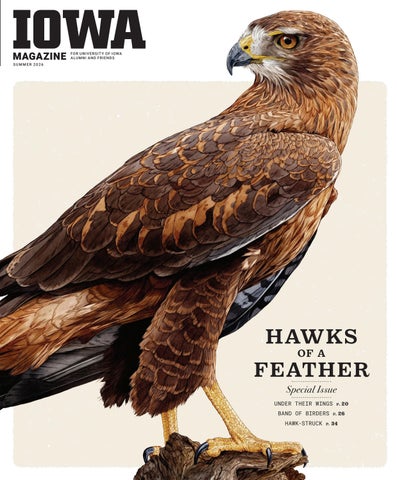
HAWKS OF A FEATHER Special Issue FOR THIS THEME ISSUE, THE BIRD IS THE WORD. Birds of a feather flock together—and so do Hawkeyes, united by their shared passion for the University of Iowa. May these pages act as a field guide to the kettles Hawks form wherever they land, whether they’re exploring nature, mentoring fledgling students, or supporting their favorite team. No matter how far they fly from Iowa City, they’ll always be part of the Hawkeye family.
p. 20
p. 34
ON THE COVER Drawing on what he calls a “deep reverence for the natural world,” New York illustrator Michael Hoeweler created our cover image of Iowa’s iconic red-tailed hawk—and the colorful birds featured throughout this special issue.
20
26
34
Mentors help Hawkeye
Hit the road for a birding
Superfans of a
success stories take
expedition with the Iowa
feather cheer on
flight.
Raptor Project.
the Hawkeyes.
UNDER THEIR WINGS
BAND OF BIRDERS
HAWK-STRUCK
ILLUSTRATIONS: MICHAEL HOEWELER
FIELD NOTES
p. 26
EDITORIAL EDITOR IN CHIEF
Shelbi Thomas (05BA) ART DIRECTOR
Nick Beecher (03BA) MANAGING EDITOR
Josh O’Leary (00BA) CONTRIBUTING WRITERS/EDITORS
Emma Conway Ben Frotscher Leah Klevar (93BA, 95MA) Amanda Rahn Tyler Strand
CREATIVE SERVICES MANAGER
p. 15
Jared Salasberry
CONTRIBUTING DESIGNERS
Danette Angerer (85BFA) Jodi Schmucker e m a i l : uimagazine@foriowa.org w e b s i t e : magazine.foriowa.org
DIGITAL SENIOR WEB DESIGNER/DEVELOPER
Jimmy Losasso (09BFA) WEB DEVELOPERS
Mike Miersen Heidi Schmidt
MARKETING TECHNOLOGY STRATEGIST
Nicole Knoll (08BA, 22MS)
CONTENT MARKETING STRATEGIST
Megan Magee
p. 47
MULTIMEDIA SPECIALISTS
Seth Diehl (07BA) John Emigh (11BBA, 13BFA) LEADERSHIP PRESIDENT AND CEO
Sheila Baldwin (98BBA) VICE PRESIDENT, ALUMNI & DONOR ENGAGEMENT
Colin Hennessy (01BA)
ASSISTANT VICE PRESIDENT, ALUMNI ENGAGEMENT
Leslie Prideaux (08BA, 12MA)
p. 59
ASSISTANT VICE PRESIDENT, COMMUNICATION AND MARKETING
Rebekah Tilley
EXECUTIVE DIRECTOR, CONTENT STRATEGY
Laura Kivlighan
EXECUTIVE DIRECTOR, CREATIVE SERVICES
p. 5
Caleb Saunders
EXECUTIVE DIRECTOR, MARKETING ANALYTICS AND WEB STRATEGY
Zack Schmidt (03BA)
OFFICE OF ALUMNI ENGAGEMENT
p. 54
One West Park Road Iowa City, IA 52242 phone : 319-335-3305
email: uiowa@foriowa.org w e b s i t e : foriowa.org
Iowa Magazine, Volume 79, Number 2 © 2026 University of Iowa Center for Advancement. The UI Center for Advancement publishes Iowa Magazine four times a year. POSTMASTER: Send address changes to Iowa Magazine, UI Center for Advancement, One West Park Road, Iowa City, IA 52242.
INDEX
5 15 p. 47 p. 54 p. 59 p.
ON IOWA
p.
GO HAWKS IOWA ARTS FOR IOWA ALWAYS A HAWKEYE
Opinions expressed are not necessarily shared by the university, the publishers, or the editors. The University of Iowa prohibits discrimination in employment, educational programs, and activities on the basis of race, creed, color, religion, national origin, age, sex, pregnancy (including childbirth and related conditions), disability, genetic information, status as a U.S. veteran, service in the U.S. military, sexual orientation, or associational preferences. The university also affirms its commitment to providing equal opportunities and equal access to university facilities.
Big Pict u re
B IG P IC T URE
Early Birds
While many college students slept, more than 70 cadets in the Reserve Officers’ Training Corps started a two-mile run around campus at 5:50 one morning this past spring. After jogging along the west side of the Iowa River, the group crossed the pedestrian bridge over to the east side. Track sprints and strength training make up most of the program’s workouts, meaning long-distance runs like this one are rare. That’s according to Lt. Col. William Todd Kuebler, an active-duty Army officer and head of the Mighty Hawkeye Battalion ROTC Program, who says, “We do a morale run like this one for all of us to close out the semester together.” BY E M M A C O N WAY
PHOTO: CALEB SAUNDERS
2
IOWA MAGAZINE
SUMMER 2026
MAGAZINE.FORIOWA.ORG
IOWA MAGAZINE
3
Hawks of a Feather
O N I OWA
Special Issue
6 HALL OF BIRDS 8 FIELD GUIDES 10 PERCH PERFECT
AMERICAN GOLDFINCH
ILLUSTRATION: MICHAEL HOEWELER
Spinus tristis Known for the males’ bright yellow and black summer plumage, this small finch is the official state bird of Iowa—and one of more than 1,000 native birds featured in the UI Museum of Natural History’s Hageboeck Hall of Birds. See p. 6.
MAGAZINE.FORIOWA.ORG
IOWA MAGAZINE
5
On Iowa
E X HIB I T
Bird by Bird
no. 2
no. 1
An archive in the University of Iowa Museum of Natural History offers a long view of life on a changing planet. A trove of birds in the University of Iowa Museum of Natural History can no longer take flight—but it still holds the secrets to past worlds in motion. With more than 31,000 avians, eggs, and nests, the museum’s ornithological collection features nearly all native Iowa species and seasonal visitors. This includes about 1,000 birds on display in the Hageboeck Hall of Birds as well as those in the century-old Laysan Island Cyclorama, a 360-degree view of a bird sanctuary on an outpost of the Hawaiian atoll. The museum’s specimens, which staff also catalogue in an international database, benefit students, scholars, and artists alike. Visitors can use the collection to explore everything from Earth’s shifting seasons and vanishing habitats to evolving avian forms. Perched behind glass or tucked in drawers, some of the birds date as far back as the museum’s founding in 1858, while others are more recent acquisitions from members of the public, the Iowa Raptor Project, and academic research collections. Each one serves as an ecological time capsule that can yield vital clues about climate and biodiversity. “This collection plays a special role in educating students, and it helps them answer some of the most pressing questions about our past, present, and future,” says Jessica Smith (14BA), the museum’s director of communications and engagement. “Birds are incredibly important to humanity.”
no. 3
no. 4
no. 6
no. 5
1. American goldfinch, Spinus tristis;
Gainesville, Cooke County, Texas; UI
striata; collected in 1871 by Clinton
collected by zoology professor Homer
male, collected in 1954 by Walter
Museum of Natural History, research
Mellen Jones in Sparham, Breckland,
Ray Dill during the 1911 Laysan Island
Conrad Thietje in Johnson County,
collections. 3. Banded kingfisher, Lacedo
United Kingdom; UI Museum of Natural
Expedition in Hawaii, which included
Iowa; on display at the UI Museum of
pulchella; female, part of the William
History, research collections. 5. Scarlet
UI students and faculty; on display at
Natural History, third floor, Hageboeck
Temple Hornaday Collection, 1880s
ibis, Eudocimus ruber; on display at the
the UI Museum of Natural History, third
Hall of Birds. 2. Pileated woodpecker,
c., Malacca, Malaysia; UI Museum of
UI Museum of Natural History, third
floor, Hageboeck Hall of Birds, Laysan
Dryocopus pileatus; female, collected
Natural History, research collections.
floor, Hageboeck Hall of Birds. 6. Laysan
Island Cyclorama. 7. American crow,
in 1878 by Clinton Mellen Jones in
4. Spotted flycatcher eggs, Muscicapa
albatross, Phoebastria immutabilis;
Corvus brachyrhynchos; UI Museum of
6
IOWA MAGAZINE
SUMMER 2026
PHOTOS: SETH DIEHL
BY L E A H K L E VA R
On Iowa
no. 9
no. 8
no. 10
no. 7
no. 11
no. 12
no. 13 no. 14
Natural History, research collections.
UI Museum of Natural History, research
on display at the UI Museum of Natural
8. Red grouse eggs, Lagopus scotica; part
collections. 10. Tourmaline sunangel
History, third floor, Hageboeck Hall
13. and 14. Indigo buntings, Passerina cyanea, perched as a pair; left, male,
of the Clinton Mellen Jones Collection;
(hummingbird), Heliangelus exortis;
of Birds. 12. Great blue heron, Ardea
collected in 1898; right, female, collected
UI Museum of Natural History, research
South America; part of the Homer Ray
herodias, male; collected in 1940 by
in 1898; both by Clinton Mellen Jones in
collections. 9. North Island brown kiwi
Dill Collection; UI Museum of Natural
Walter Conrad Thietje in Louisa County,
Eastford, Connecticut; on display at the
skeleton, Apteryx mantelli; collected in
History, research collections. 11. Greater
Iowa; on display at the UI Museum of
UI Museum of Natural History, third floor,
New Zealand; purchased from Ward’s
roadrunner, Geococcyx californianus;
Natural History, first floor, Iowa Hall,
Hageboeck Hall of Birds.
Natural Science Establishment, 1887, c.;
collected by Daniel Hector Talbot, Texas;
ecology wing, wetland exhibition.
MAGAZINE.FORIOWA.ORG
IOWA MAGAZINE
7
On Iowa
Rare Birds University of Iowa scientists turn to nature for insights into our world. Walking along the Iowa River at the heart of campus, pedestrians can observe bald eagles circling, Canadian geese waddling, and songbirds perched in the trees. For students, faculty, and staff at the University of Iowa, these encounters might inspire a deeper curiosity about the natural world. Here are three stories of UI researchers in Earth and environmental science, psychological and brain sciences, and mechanical engineering who study birds in the Hawkeye State.
Eagle-Eyed Scientist
Most birders have a “trigger bird”—the sighting that sparked their interest in birdwatching. Christopher Brochu (89BS) first became captivated by a blue-gray and white bird as a first-year UI geology student sitting on his grandparents’ covered porch during an Iowa City blizzard. A field guide helped him identify it as a white-breasted nuthatch. “The more I flipped the field guide, the more I noticed other birds—like the red-breasted nuthatch, which is closely related but distinct—and that got me interested in bird diversity,” says Brochu, who is now a professor in the UI School of Earth, Environment, and Sustainability.
8
IOWA MAGAZINE
SUMMER 2026
At the Uganda Wildlife Conservation Education Centre in 2016, UI paleontologist Christopher Brochu (above) saw the rare shoebill, a large bird that inhabits the swamps and wetlands of East Africa.
BY SHELBI THOMAS
Pecking Order
If you were rewarded for following a particular pattern of behavior, wouldn’t you keep doing it? The answer turns out to be more nuanced than you might think. In a new study published in the Journal of Experimental Psychology: Animal Learning and Cognition, UI researchers report that pigeons rewarded with food after pecking five buttons in any order never gravitate toward a single pattern but instead consistently elect to try different sequences.
PHOTO COURTESY CHRISTOPHER BROCHU
RE S E A R CH
“I went and bought my own field guide, and the rest is history.” Today, Brochu is a renowned paleontologist who studies the evolutionary history of crocodilians, examining fossils from around the world to understand how various species differ and change over time. Birding, he says, makes him sharper at observing the subtle distinctions between specimens. “Studying fossils makes me a better birder,” says Brochu, “but working on birds makes me a better paleontologist.” Birding also has shaped his teaching. In UI courses such as How Birds Work and Age of Dinosaurs, Brochu teaches the origin of birds, which are classified in taxonomy as theropod dinosaurs. Evolved from small, bipedal theropods from the Mesozoic era, they share traits such as feathers, hollow bones, and nest building and brooding. “Once you evolve from the ancestor of a group, you’re a part of that group, and you never leave it,” says Brochu. “Birds are dinosaurs for the same reason that you and I are mammals or primates.” Brochu, who has an extinct Miocene crocodile genus named in his honor, recently identified a previously unknown species of crocodile in Ethiopia that lived more than 3 million years ago. While on such research expeditions, Brochu sets aside his free time for birdwatching with local guides. In 2016, he encountered his first shoebill, a prehistoric-looking bird that was eating a lungfish in Uganda. “That was one I’ll never forget,” he says. The beauty of birdwatching, Brochu says, is that it can be done anywhere, from a warbler walk in Hickory Hill Park with the Iowa City Bird Club to a visit via subway to the Jamaica Bay National Wildlife Refuge in New York. “It keeps you in tune with the seasons, gets you outside. You get to meet some incredible people. It’s an intellectually stimulating exercise,” he says. “There are as many reasons to bird as there are birds, and you’re always going to have a good time doing it.”
On Iowa
Ed Wasserman , professor in the Department of Psychological and Brain Sciences, calls the pigeons’ pattern of behavior “responding at the edge of chaos.” “What we learned is there’s something that keeps the birds from becoming fully machinelike in their responses,” says Wasserman, the study’s corresponding author. “Maybe it’s in their best interest to keep some variability in their behavior. You don’t want to be too locked in, because things happen, and the world could change.” The study also extends the notion of the edge of chaos beyond evolutionary biology, where flexibility to a changing environment can be beneficial to a species’ survival. “Might other, more intricate and innovative behaviors like playing an instrument, composing music, and creating visual art involve similarly adaptive variation?” says Odysseus Orr (23BA, 23BS, 25M A), study coauthor and thirdyear graduate student in the Department of Psychological and Brain Sciences. “Only time will tell, but the pigeons provide a convenient gateway for answering those questions under highly controlled circumstances.” Wasserman, Orr, and study coauthor Sophia Li devised an experiment to test the Law of Effect. This law posits that animals, including humans, will repeat a response—and winnow other options—when it produces a rewarding outcome. The researchers enlisted six pigeons to peck five buttons in any order they chose, yielding a set of
120 possible sequences. The birds were given no training; in fact, any of the 120 total possible fivebutton sequences generated a treat. The researchers found that each of the pigeons performed all 120 sequences. The birds also increasingly performed some sequences at the expense of others, consistent with the century-old Law of Effect. But the researchers were surprised to discover that the pigeons never fully committed to any of their most-favored sequences. More surprising, the pigeons’ most preferred five-button sequences rose and fell throughout the eight months and 30,000 times they performed the task. “Such dramatic behavioral instability is most definitely not consistent with the Law of Effect,” says Wasserman, who has studied pigeon cognition and behavior for more than five decades. “The pigeons maintain this exploratory tendency and keep trying multiple sequences. They do not abide by the familiar maxim: ‘If it ain’t broke, don’t fix it.’” The results generally followed earlier behavioralreward studies with other animals—including mice, rats, cats, and guinea pigs—that found they reduced their range of options when finding one that consistently produced a reward, the authors write. But while the variability in the pigeons’ response sequences decreased, the Iowa team’s study showed clearly that the pigeons also repeatedly switched among their favorite sequences and never ceased considering even seemingly less preferred sequences. BY RICHARD C. LE WIS
WASSERMAN PHOTO: JOHN EMIGH; WANG PHOTO: ANETA GOSKA
Stuit Professor of Experimental Psychology Ed Wasserman researches and compares learning, memory, and cognition in animals.
cutline
With Mother Nature as his muse, assistant professor Cong Wang conducts fundamental fluid dynamics research at the UI College of Engineering.
Inspired by Nature
Cong Wang enjoys taking his kids outside to
experience nature as he did as a boy. Growing up in China, he was fascinated by insects, birds, and fish. “Even now as an engineering scientist … I still think that’s a great resource for my research work,” says Wang, a UI assistant professor of mechanical engineering and IIHR assistant faculty research engineer. “Birds know how to control their feathers, their wings, and they can manipulate the [air] flow.” Even compared to state-of-the-art technology, Wang says, nature often does it better. Wang’s excited by the emerging field of bioinspired engineering—essentially, learning from the natural world. “Mother Nature has already developed very dedicated flow control devices,” he says. “The fish, the birds—they know how to deal with very complex flow motion.” He adds, “We can learn from the natural world … and based on that knowledge, we can design some new devices and systems, all to achieve better performance.” Wang’s work focuses on f luid dynamics— experimental work and theoretical analysis of turbulent flow, which can cause a huge energy loss for ships and other vehicles. He hopes to develop devices that will allow researchers to achieve better turbulence control. Wang knows it will take time to solve such fundamental problems. “I think doing research is maybe 95% failure. Most of the time it doesn’t work,” he says. But when it does, that’s the payback. As Wang says, “That kind of aha moment—it’s very rewarding.” BY JACKIE HARTLING STOLZE
MAGAZINE.FORIOWA.ORG
IOWA MAGAZINE
9
On Iowa
QUADRANGLE RESIDENCE HALL 1948 Bunk beds are a blast from the past, even in four-person rooms, as most presentday students opt for separated loft beds.
S T UDE N T L IF E
Hawks’ Nests Photos of students’ decorated rooms show the evolution of dorm décor. 10
IOWA MAGAZINE
SUMMER 2026
PHOTOS COURTESY UI LIBRARIES SPECIAL COLLECTIONS
CURRIER RESIDENCE HALL 1950s Similar to today, students cover their dorm room walls with meaningful art and photos.
On Iowa
HILLCREST RESIDENCE HALL 2026 This black and gold-themed room highlights Hawkeye spirit, complete with a yellow couch for watching movies and playing video games.
PHOTOS: UI HOUSING AND DINING
CURRIER RESIDENCE HALL 2026 Neon name signs, string lights, and pink accent pieces add to a modern-day Currier room.
Many students fly the coop to live independently for the first time in one of the University of Iowa’s 11 residence halls. UI Housing’s latest Amazing Room Contest winners rule their roosts—and reveal that minimalistic décor has gone the way of the dodo. Today’s hawks’ nests showcase creativity through colorcoordinated bedspreads, neon signs, and extensive wall
art. TV lounges are long gone, as students stream their favorite shows and play video games from the privacy of their own rooms. No matter which residence hall a student selects or how they choose to decorate their room, UI Housing aims to make every Hawkeye feel at home. BY E M M A C O N WAY
MAGAZINE.FORIOWA.ORG
IOWA MAGAZINE
11
On Iowa
Iowa Baja races on a muddy off-road course during a past national competition in Williamsport, Pennsylvania.
seeing all that hard work come together when we compete against schools from across the country.”
Indian Student Alliance
Members hold events that celebrate Indian culture, promote cultural awareness, and foster an inclusive campus.
Nestled in Community Hawkeyes find their wingmates through involvement in student organizations. Outside of the classroom, University of Iowa students seek places of connection and belonging. They can find that in one of more than 600 student organizations on campus. Here are a few of the many groups where Hawkeyes make friends, serve others, and grow personally and professionally in leadership roles.
Iowa Baja Racing
The Society of Automotive Engineers’ UI chapter designs, tests, and races off-road vehicles, so students can gain hands-on experience in engineering, marketing, and business. Signature Events: Members typically compete in three races per year: Backwoods Baja in Eau Galle, Wisconsin, in the fall; Winter Baja in Houghton, Michigan; and the national SAE competition.
12
IOWA MAGAZINE
SUMMER 2026
Student Endorsement: “I’ve always been involved in mechanical projects, fixing and building things. However, I have never done anything on this scale to where we are designing and building a new car every year and consistently competing and applying what we learn in the classroom,” says past club president Carter DeLanoit (26BSE), a recent mechanical engineering graduate from Fort Dodge, Iowa. “I love being involved in each build and the problem solving that comes with it, then
KRUI Radio
For more than 40 years, the student-run station has given Hawkeyes practical experience in the radio and broadcast industry. Student Endorsement: Lee Nienhaus, the station’s marketing director and an incoming junior majoring in art and pre-business from Muscatine, Iowa, says, “I joined KRUI because I wanted to find my people. My favorite thing about KRUI is how creative and different everyone is.”
Letters of Love
Students team up to send handcrafted, heartfelt letters each month to encourage and uplift pediatric patients facing serious illnesses. Lasting Memory: According to Sara Streeter, who served as Letters of Love vice president of administration this past year, around 600 students created more than 3,800 cards for children in the
PHOTO COURTESY IOWA BAJA RACING
S T UDE N T L IF E
Signature Events: The group hosts four major events each year, including Garba Raas Bollywood Bhangra, which draws hundreds of Hawkeyes for food and dancing; Diwali, the Indian Festival of Lights; Gathe Raho, a national South Asian a cappella contest; and Nachte Raho, a national Bollywood fusion dance competition. Kushi Maridu (26BS), past president and a recent biomedical sciences grad from Bettendorf, Iowa, says this past year’s Garba Raas event had one of the highest turnouts he’d ever seen. “Seeing everyone, from little kids to the ones that have seen it all, lose themselves in dance reminded me once again how powerful culture and diversity is and why ISA does what it does,” he says.
On Iowa
1
3
2 4
fall semester alone. The incoming senior public health major from Wayzata, Minnesota, says she was blown away by attendance at the organization’s first meeting of the year this past fall. “We had never seen so many people show up!” she says. “We had hoped to grow interest in our club, but we were not prepared for every seat in [the room] to be taken, with people lining the stairs and finding spots on the floor. Our numbers more than doubled from the previous semester, and we even had to run during the meeting to grab more paper to keep up with everyone writing cards.”
PHOTO 2: AVA NEUMAIER/DAILY IOWAN; OTHERS COURTESY STUDENT ORGANIZATIONS
A Moment of Magic
This group harnesses the power of play to spark joy and support the mental and emotional health of medically vulnerable children and their families. Signature Events: Members visit patients at UI Health Care Stead Family Children’s Hospital and take trips beyond campus to meet with children at health care facilities, donation-based daycares, and rehabilitation centers. Students dress as princesses, superheroes, and other characters to delight children who may live with chronic illness, disabilities, or cancer. Lasting Memory: Last year, the group traveled to a small Iowa town to spend time with a young cancer patient and her sisters. “I will never forget the smile on her face the moment we arrived. She radiated light and happiness despite her illness,” says past
chapter president Ana Laura Leyser (26BS), a recent biomedical sciences graduate originally from Brazil. “In one short afternoon, we were able to bring her joy and make her feel like a princess. She is now forever 3 years old, and I like to believe that she and her family will always carry that moment with them, a memory filled with magic, love, and light.”
South Asian Student Alliance
The alliance invites students with an interest in South Asian culture, regardless of background, to participate in social and philanthropic events that showcase cultural traditions. Signature Events: Mock Shaadi—a pretend wedding that introduces students to Southeast Asian nuptial customs—features fashion, choreographed dances, traditional food, and games. Other club events include painting diyas, oil lamps used in the celebration of Diwali.
1. Spring cards from Letters of Love 2. Letters of Love members prepare encouraging cards for kids in the hospital. 3. Students in A Moment of Magic dress as princesses to delight children. 4. A group from Purdue University sings in the UI Indian Student Alliance’s annual Gathe Raho, a national South Asian a cappella competition.
Student Endorsement: “I originally joined to find a community and reconnect with my own culture, but I ended up learning so much about other South Asian traditions too,” says past club president Sowji Kondety (26BS), a recent biology and pre-med graduate from Johnston, Iowa. “The best part, though, is the people. The friends I’ve made here aren’t just until graduation; they will always be a part of my life.” BY S H E L B I T H O M A S
MAGAZINE.FORIOWA.ORG
IOWA MAGAZINE
13
Save the Date!
HOMECOMING 2026 Oct. 25–31, 2026
Gather with fellow Hawkeyes—at the parade, inside Kinnick, and across the campus that still feels like home. homecoming.uiowa.edu
Go Hawks
Hawks of a Feather
G O H AW K S
Special Issue
16 PROUD AS A PEACOCK 18 SOAR TO VICTORY 19 HOME TO ROOST
COMMON PEAFOWL
ILLUSTRATION: MICHAEL HOEWELER
Pavo cristatus Whereas the peacock flashes its iridescent tailfeathers to command attention, Luk a Garza (21BBA)—who made the slogan “Let the peacock fly” famous at Iowa—uses hard work over spectacle to turn heads and earn playing time in the NBA. See p. 16.
MAGAZINE.FORIOWA.ORG
IOWA MAGAZINE
15
Go Hawks
“
I’ve always felt like I’m different in the way I push myself to the limit as much as possible.”
Luka Garza earned the Naismith Trophy as college basketball’s top player in 2021 at Iowa. His father, Frank—who used to raise peacocks—originated the mantra “Let the peacock fly” to describe Garza’s work ethic.
MEN’S BASKETBALL
Culture Raiser Former Hawkeye standout Luka Garza turns persistence into playing time. For much of his NBA career, there were nights when Luka Garza (21BBA) just knew. Nights in Detroit and Minnesota when rotations tightened and minutes disappeared, when his only path to the floor came in the final possessions of a blowout. The former Iowa AllAmerican, whose No. 55 jersey hangs in the CarverHawkeye Arena rafters, responded the only way he knew how. He worked. “I’ve always felt like I’m different in the way I push myself to the limit as much as possible,” he says. “If I’m not playing, how can I get better?
16
IOWA MAGAZINE
SUMMER 2026
That was my mindset. How can I utilize my time the most?” He turned the regular season into the offseason. Before practice, after practice, late at night, he hit the gym. Shots. Footwork. Conditioning. More shots. By the end of the 2024–25 season in Minnesota, Garza logged 42,000 shots, some 12,000 more than any other NBA player according to metrics tracked by Noah Basketball analytics. He studied the league, searching for ways to fit—setting screens, crashing the glass, stretching the floor—anything that could help a team win.
It was work that for five seasons went largely unrecognized until the Boston Celtics called last offseason—and basketball wasn’t even part of the conversation. “The thing they cared about most when we first talked was being able to add to the culture that they have,” says Garza. “They heard from other teams that I can be someone who is a culture raiser. That’s what they wanted.” Boston signed Garza to a modest two-year contract in July 2025. Afterward, Celtics president Brad Stevens referred to his new big man as a “stats darling” with “unrealized potential.” Nearly a year later, Garza’s impact on the Celtics has far exceeded just helping the team’s culture. This past season he averaged a career-high 8.1 points in 16.2 minutes per game, a reflection of a role that, for the first time, is real. “This league is about molding yourself into someone who can help a team win at a high level,” he says. “Obviously it took me a while and I grinded, but this season I’ve been able to figure that out.” Even that doesn’t fully capture it. The year after Garza earned National Player of the Year honors at Iowa, the Detroit Pistons cut him. He pondered playing in Europe before former Iowa coach Fran McCaffery implored him to believe he was an NBA talent. While the work never wavered, a two-way contract with Minnesota and a successful stint with the Iowa Wolves of the G League restored his confidence. Now with the Celtics he’s thriving. “You have to be in love with what you’re doing and how you’re going about it,” says Garza. “If you work for something and you love doing it, it doesn’t matter what the outcome is.” It’s a mindset Iowa fans know well. The same one that made Garza a star in Iowa City. The same one that carried him through the quietest stretches of his NBA career. And that now is again being seen in Boston. B Y WAY N E D R E H S
PHOTO: BRIAN RAY/HAWKEYESPORTS.COM
— Lu ka Garza
PHOTO: GLENN JAMES/NBAE VIA GETTY IMAGES
Go Hawks
Luka Garza of the Boston Celtics drives to the basket during a game earlier this year in Dallas.
MAGAZINE.FORIOWA.ORG
IOWA MAGAZINE
17
Go Hawks
S E A S ON S N A P S HO T S
Feathers in Their Cap From the court to the mat, the Hawkeyes had a memorable spring on the national stage. Here are a few magical moments. 1
2
4
1. LATER, GATOR
In the second round of the NCAA tournament, Iowa forward Alvaro Folgueiras makes a gamewinning 3-pointer to upset defending national champion Florida. The 73-72 victory sparked the Hawkeye men’s first run to the Elite Eight since 1987.
2. COUNT IT
During the Big Ten Tournament semifinals, Iowa forward Hannah Stuelke (26BA) celebrates making a basket and drawing a foul against Michigan. The Hawkeyes won 59-42 and punched their 10th ticket to the Big Ten championship game.
18
IOWA MAGAZINE
SUMMER 2026
5
3. HOME CROWD
Lilly Luft thanks Hawkeye fans for their support
during the inaugural NCAA women’s wrestling championships at Xtream Arena in Coralville. Iowa finished second, and three Hawkeyes—Valarie Solorio, Kennedy Blades , and Kylie Welker — earned individual titles.
4. FIELD DAY
At the NCAA indoor track and field championships, Ryan Johnson throws a record-setting 25.64 meters to win Iowa’s first national weight throw title. His honors this year include first-team All-American, Big Ten weight throw champion, Big Ten Men’s
Indoor Field Athlete of the Year, and USTFCCCA Midwest Region Men’s Field Athlete of the Year.
5. FLIP OUT
Aurélie Tran goes airborne during the Big Ten
championships. Tran became the first gymnast in Hawkeye program history to earn second-team All-American honors in two events: bars and allaround. She also finished as the national runner-up on bars at the NCAA championships. E M M A C O N WAY
PHOTOS: HAWKEYESPORTS.COM
3
Go Hawks
Members of the 1985 Big Ten champion Iowa football team returned to Kinnick Stadium last fall during a Hawkeye Legacy reunion.
F OO T B A L L
Return to the Roost
PHOTO: JUSTIN ELSNER/HAWKEYESPORTS.COM
Through Hawkeye Legacy, Iowa football alumni connect with each other—and the current team. Only five guests showed up in 2018 when Ben Hansen (10BA) and Broderick Binns (12BA, 18MA) hosted the first event for their newly formed Hawkeye football alumni network in Chicago. “We could have easily folded at that time,” says Hansen, UI director of football operations and assistant athletic director for football. Instead, a text from one of those guests— Iowa Moon Family Head Football Coach Kirk Ferentz —encouraged the organizers to keep growing the group. Now Hawkeye Legacy, a program that supports and connects former Hawkeye football players, draws hundreds of guests for its events. Last fall, 340 attended a Hawkeye Legacy reunion in Iowa City that celebrated the 1985 Big Ten champion Hawkeye football team. Seventy former players from that team returned along with coaches Dan McCarney (75BS) and Barry Alvarez for the homecoming celebration. More than 200 also gathered later that fall to commemorate the 2015 squad’s perfect regular-season record.
Nearly eight years since its debut, the Hawkeye Legacy network continues to foster a brotherhood for Iowa football alumni—known as Legacy Hawks—through career and personal networking opportunities, family events, and special access to the program.
Going In-House
To establish Hawkeye Legacy, Hansen and Binns sought insight and support from the Iowa Football Club, a successful fraternal nonprofit organization with a similar mission that originated early in Ferentz’s tenure at Iowa. But why start a new network? Hansen and former Iowa defensive end Binns wanted to build an internal group within the Hawkeye football program, allowing more resources for organizing events at Kinnick Stadium and better access to former players. “Our mission was to really showcase what we have always valued, which is that this is family,” says Hansen of the Iowa football program. “Our culture is really strong.” Hansen says the program emphasizes an open-door policy to every alum, whether they
need support or want to visit the current team. And whether they competed on a team that won a conference championship or finished sub-.500, Hansen says every Hawkeye is celebrated for their contributions to Iowa football. Hawkeye Legacy began with about 300 alumni records in its database and has expanded to more than 1,600. The group hosts two reunions each fall, where alumni as far back as the 1950s trade stories with those who played as recently as the 2020s. Whatever is lost in translation between generations always comes back to a common thread: They all shed blood, sweat, and tears for the black and gold.
Key to Connection
Other Division I Power Four programs and NFL teams have contacted Hansen to learn about Hawkeye Legacy to start their own alumni networks. What’s the secret to its success that brings former players back? Hansen points to the longevity of Ferentz and Hayden Fry, who cultivated continuity and strong relationships throughout the past 47 years of Iowa football. “You can tell that the people here really truly care,” says Hansen. “That starts at the top with Coach [Ferentz] and how he treats everybody in the building—the players, their families, our fans. And then that trickles down to the entire staff. That’s why you genuinely feel that connection.” BY T YLER STR AND
MAGAZINE.FORIOWA.ORG
IOWA MAGAZINE
19
UNDER
THEIR
WINGS
HAWKEYES REFLECT ON THE TRANSFORMATIVE POWER OF MENTORSHIP. Students often face challenges and uncertainties throughout college, no matter their discipline, level, or program of study. As students develop, it can be helpful to have someone who acts as a field guide—identifying available resources, sharing their own experiences, and providing encouragement along the way. These life lessons may continue to resonate, long after they leave the nest.
ILLUSTRATION: MICHAEL HOEWELER
Through these five stories, Hawkeyes share how their mentors provided advice they keep close to their hearts and why giving time to someone else’s growth is an invaluable investment.
20
IOWA MAGAZINE
SUMMER 2026
Donika Kelly and Sydney Mayes reunite at last year’s Sewanee Writers’ Conference in Tennessee.
RS
ND
BY V E
BOUND BY VERSE
GS•B O U
E • UN DE
THEIR W IN
R
Professor Donika Kelly and rising poet Sydney Mayes remain connected by their shared devotion to the written word.
PHOTO COURTESY SYDNEY MAYES
When poet and Iowa associate English professor Donika Kelly taught Sydney Mayes in a 2021 honors undergraduate poetry
workshop on the “Lyric I,” the course was organized around a nonprescriptive principle: It is more challenging, and more life-giving, to say why someone’s poem works than why it doesn’t. “In my class, students are not allowed to ‘fix’ each other’s pieces by declaring what’s wrong,” says Kelly, a past National Endowment of the Arts fellow whose poetry collection Bestiary was longlisted for the 2016 National Book Award. “Instead of telling someone what to do, I ask them to say how they read the poem and what is already working.” This way of reading—supporting what’s there, resisting the simpler work of “cut this, move that”—extends beyond the page into a philosophy that now defines their relationship as mentor and mentee. During that first semester, Mayes came to office hours every week, bringing poems and questions. “Having another queer Black woman in my space pushed me to articulate things I wouldn’t have had the language for had she not been there,” says the published poet from Denver. An independent study on Black women poets followed. Mayes still draws on those authors in her current writing. Kelly, who adds that she too needed to read those poets at that time, calls Mayes’ work “stellar, grounded, phenomenal—and she also doesn’t just rely on talent. Sydney came in with the work. That is the thing that brought us together.” Mayes (23BA) graduated from Iowa and is following her professor’s footsteps in pursuing a graduate degree at Vanderbilt University. Meanwhile, Kelly’s advising now includes practical tips her grandfather once doled out—don’t forget the oil change, set aside this much for savings.
Kelly and Mayes shared a few secrets to their flourishing mentormentee relationship: • Make time for mentorship: Moving away from the structure of the
classroom takes time. Mayes is still learning to address Dr. Kelly by her first name. She calls her former professor regularly, knowing Kelly prefers speaking on the phone over texting. (“This is big. I hate the phone,” says Mayes.) • Say the hard thing: Mayes, after graduating, was hesitant to show
Kelly a manuscript she felt certain was ready to be published as her first book. “Everyone else had seen it; I was fixated on the book going out,” says Mayes, who now serves as the executive editor of Nashville Review. “But I wanted [Kelly’s] approval more than anything first. She read it and said, ‘This is not your book.’ ... I had to finish crying before I could take the feedback. Now it doesn’t feel like something I’m going to wake up one day and regret.” • Let it be uneven: In a cultural moment that emphasizes reciprocity,
embrace the lopsidedness of a mentor relationship. Kelly, who had good mentors while earning a PhD, felt the lack of one in her poetry life after publishing her first book. That realization of what she had been missing helped her recognize the potential to build something with Mayes. “Can I shine a little light on what could happen? Can I make some recommendations and then step back?” Kelly wondered. Both poets agree that an artist’s life is unscripted and that you need your people—peers, mentors, compatriots—to guide the way. BY T. J. C A R L I N
MAGAZINE.FORIOWA.ORG
IOWA MAGAZINE
21
GS • TRAI
NI
D • U N D ER
IN
UN
THEI R W
NG GRO
TRAINING GROUND
Mark Kaufman (86BS), a student trainer for the Iowa football team in the 1980s, remembers answering the call when a Hawkeye linebacker suffered a knee injury on a wet practice field in Kinnick Stadium. Head athletic trainer Ed Crowley (69CER) evaluated the student-athlete, but before administering care, he asked Kaufman to drop what he was doing. “Ed had me come over and walked me through a complete knee evaluation,” says Kaufman. “He went through the entire exam, the history, the mechanical tests, and we discussed next steps.” Kaufman continued to help the student-athlete during Iowa’s 1985 Big Ten title and Rose Bowl campaign—driving him to the hospital, watching sports medicine orthopedic surgeon John Albright perform surgery, and staying connected to the Hawkeye during rehabilitation. “I got to see everything—from injury to recovery,” says Kaufman. “Ed could have easily not used that injury as a teaching moment. That was just a reflection of Ed’s leadership. He took the weight of all the injuries on his own shoulders and took the role of getting student-athletes back on the field safely very seriously.” Overseeing a student-athlete’s recovery was just one of many influential experiences Kaufman had during his time with Iowa’s athletic training program. He credits former UI athletic trainers Crowley, Danny Foster (74BS, 77MA, 96PhD), John Streif (70BS), Faye Thompson (78BS, 80MA, 98MA), Gail Hudash Wadley (77BGS), and Ed Gregori (81CER) for his current success in the field. “Athletic trainers are often the first people pulling into the parking lot to start the day and the last to leave,” says Kaufman. “At Iowa, you felt important as part of the team—even as a student. Coming to Iowa proved to be one of the best decisions I ever made, because
22
IOWA MAGAZINE
SUMMER 2026
Mark Kaufman (at right) honors mentor Ed Crowley (left) with support for athletic training at Iowa.
those experiences kickstarted my career and eventually helped me build Athletico Physical Therapy.” Following his first job at an outpatient facility, Kaufman opened his own clinic in downtown Chicago at just 26 years old. Now, as founder and executive chairman, he helps oversee more than 900 Athletico Physical Therapy locations in 24 states and Washington, D.C. Grateful for his mentors at Iowa, Kaufman continues to support the program that gave him so much. “Growing up 38 miles away from Iowa City in Olds, Iowa, I have always been—and will continue to be—a Hawkeye,” says Kaufman, who now lives in Oak Brook, Illinois. “Not a lot of dollars get directed toward athletic trainers and caring for student-athletes, but it’s an important part of the overall experience for each student-athlete. I have a huge amount of respect for the work being done—and that’s why I support it.” Kaufman and his wife, Mary Ann , whom he met at Iowa, recently made a leadership gift commitment to support the Together Hawkeyes campaign. His support focuses on several initiatives including establishing the Edward T. Crowley Director of Athletic Training Services Fund, which honors his mentor and provides vital resources to the program. “I wanted to honor Ed Crowley—he was at Iowa for nearly 40 years,” says Kaufman. “I also wanted to honor and recognize the entire athletic training staff at Iowa, past and present, and the student athletic trainer alumni. They all provide such important services as they care for our student-athletes.” BY B E N F R O T S C H E R
PHOTO: BRIAN RAY/HAWKEYESPORTS.COM
Iowa’s athletic trainers helped Athletico Physical Therapy founder Mark Kaufman get his start on the Hawkeye football field.
THEIR W
NSE• UND FE
ER
GS•DISC IN
LINED DE IP
Defensive coordinator Phil Parker
Former Hawkeye defensive back Micah Hyde
DISCIPLINED DEFENSE
PHOTOS: HAWKEYESPORTS.COM
Retired NFL player Micah Hyde carries football coach Phil Parker’s standard of excellence beyond the gridiron. Micah Hyde (13BS) can still feel it. The blisters. The torn skin. The limp. In summer 2009, he was fighting to survive one of his first training camp practices at Iowa. Earlier that day, a mix of sweat and damp grass soaked through his cleats. For that night’s session he’d make a terrible rookie mistake, swapping into a shiny new pair. Stiff, unforgiving, not broken in. Within minutes, his feet were shredded. “I could hardly walk,” Hyde remembers. Hobbling around Iowa’s defensive backfield, Hyde told coach Phil Parker his feet were “killing” him. Hyde says Parker responded, “I don’t give a s---,” then sent the freshman onto the field to line up against Iowa’s No. 1 offense. “I damn near wanted to cry,” Hyde says now, chuckling. Instead of tears, the 18-year-old gutted it out. Every rep. Every cut. Every painful step. Afterward, Parker pulled Hyde aside. “I know you were hurting,” he said. “Way to push through.” That was the lesson, Hyde’s first glimpse at the standard Parker has built over 28 seasons at Iowa. Even on a good play, there’s always something to correct. A better angle. A quicker step. A higher goal. “I always see it as an opportunity,” Parker says. “Sometimes, for me, it’s a sickness.” What looks on the outside like anger directed at players, Parker admits is something far different. “In those moments,” he says, “it’s really me yelling at myself, frustrated with myself, because I can’t get them to do what I want them to do.” Hyde didn’t know this when he arrived at Iowa from northwest Ohio. At the time, Hyde wasn’t thinking about the NFL. He just wanted to get on the field. The standout high school quarterback’s
recruiting tape featured 98 offensive plays and two on defense. While watching the tape with Hyde during a recruiting visit, the defensive coordinator quipped, “How the hell is this supposed to help me?” Hyde shrugged. But Parker saw the potential. “Before I did,” Hyde admits. That gap, between what a player believes he is and what Parker sees he can become, is where the work happens. It isn’t always comfortable. “Sometimes they don’t know their ceiling,” says Parker. “Anytime they do something on the field, I hold them to that standard. They set the bar. I try to push them past it.” Hyde says the lessons extend beyond football. After an 11-year NFL career with Green Bay and Buffalo as a safety, Hyde retired in 2024. Now, years removed from Iowa, Parker’s influence still shapes Hyde. It shows up when he works with his 6-year-old son, Micah Jr., on the basics of baseball and teaches him the importance of discipline. “That’s funneled down from Phil through me directly to my son,” he says. Parker doesn’t hover over former players, the hundreds of athletes he’s coached for nearly three decades. He doesn’t expect calls or updates. But Parker watches from afar, and every so often something triggers his emotions. When told that Hyde now shares the lessons he learned from Parker with his son, the coach paused. “I just got the chills up and down my body,” he says. “That’s truly special. That’s why we do this. You want the lessons they learn to carry on for the rest of their lives.” BY WAY N E DR E H S
MAGAZINE.FORIOWA.ORG
IOWA MAGAZINE
23
I ED
N GR
O
Eddie Ponce
GS •RO O T
H• UNDE WT
T HE IR W IN
R
Lorie Reins-Schweer
ROOTED IN GROWTH When Eddie Ponce (21JD) arrived in Iowa City in summer 2018 to attend law school, he sought all the help he could get. He found Iowa equal parts welcoming and strange. “I remember flying into Cedar Rapids, coming from LA, and looking out the window of the airplane to see the words, ‘I love Iowa,’ spelled out in corn,” he says. “I thought, ‘Man, what did I get myself into?’” Ponce’s first class in legal writing was equally confounding. “It’s like trying to learn a new language,” says Ponce. “The first two or three cases I read, it took me an hour to read one page.” Ponce says he relied a lot on Professor Lorie Reins-Schweer (03JD) for guidance. “I remember her being incredibly patient and supportive,” he says. Reins-Schweer, who retired earlier this year and now lives in Tucson, Arizona, taught legal writing at the University of Iowa College of Law for 18 years. Legal writing is an essential component of the study of law, where language must be exact and precise, when the wrong word choice can put an entire document in default, or the lack of an Oxford comma in a contract can result (in the famous case of Maine dairy drivers suing for overtime pay) in a multimillion dollar settlement. Reins-Schweer could see Ponce, a first-generation college student, struggling. “Generally, first-generation students haven’t been coached as much on using resources or feeling like they can ask for support or help,” says Reins-Schweer. “I knew Eddie was a very strong, capable person. In fact, he’s extraordinary, but I knew he had a transition to make.”
24
IOWA MAGAZINE
SUMMER 2026
Ponce became Reins-Schweer’s research assistant. He consulted with her on other matters for the rest of his study, knowing his questions would be welcomed and he wouldn’t be judged for asking them. In 2019, they helped establish the First-Generation Professionals at Iowa Law student organization. Their relationship evolved over the years as their respect and affection for each other grew. As Ponce approached graduation, he brought her an ivy plant as a gift. “I said, ‘I hope that you don’t think it’s corny, but this plant represents me. You were the person who assisted this little plant, and now I’ve started sprouting, and I hope that I’m going to grow into something,’” says Ponce. Ponce says that Reins-Schweer said she was proud of him and that he would be a phenomenal attorney one day. “It meant the world to me to hear her say that,” he says. They talk now a few times a year. Reins-Schweer still acts as a career advisor, sharing her thoughts and opinions when Ponce has choices to make. Today, Eddie Ponce, Esq., is a successful lawyer in Irvine, California, in Orange County, not far from where he grew up, practicing labor and employment law. And as for that ivy plant? “I’m looking at it right now,” says Reins-Schweer. BY P E T E R N E L S O N
PHOTOS COURTESY EDDIE PONCE AND UI COLLEGE OF LAW
First-generation graduate Eddie Ponce honors Lorie Reins-Schweer, the professor whose support helped him flourish in law school.
Kevin P. Campbell in his lab with graduate research assistant Emma Luhmann
LL
ERY•UND OV
THEIR W
GS•THRI IN
OF DISC
THE THRILL OF DISCOVERY
ER
Groundbreaking scientist Kevin P. Campbell nurtures his trainees’ love of research as they work toward a cure for muscular dystrophy. Early in his career at the University of Iowa, Professor
PHOTO: LIZ MARTIN/UI CARVER COLLEGE OF MEDICINE
Kevin P. Campbell tried to do everything himself in the lab.
One weekend, however, a student offered to monitor the gels they were running—a common technique to separate biomolecules. When Campbell returned on Monday, he was greeted by his excited student eager to share the results. “I realized that in science, to get people really motivated, you sometimes need to step aside and let people experience the thrill of discovery for themselves,” Campbell says. “As scientists, we’re addicted to that rush you get when you see results. But if you give that to a young person, and they get it, you’ve got them hooked.” In the decades since, Campbell has been instrumental in helping young scientists develop a passion for discovery in his lab, where they work to better understand muscular dystrophy and pave the way for improved therapies and potential cures. “I like solving problems. For me, that’s what science is,” says Campbell, professor and chair of the Department of Molecular Physiology and Biophysics. “And muscular dystrophy is a problem I want to solve.” Muscular dystrophy refers to a group of inherited conditions that affect muscle structure and function, leading to progressive muscle weakness, reduced mobility, and shortened lifespan. In some cases, it also causes severe cardiac and respiratory complications, as well as neurological impairment.
Campbell has been a leader in muscular dystrophy research since joining the UI faculty in 1981. His discoveries in muscle cell biology helped lay the foundation for new approaches that have improved the diagnosis and treatment of the disease. Building on his lab’s work, scientists are moving closer to therapies that may correct or even reverse the progression of muscular dystrophy. For more than 40 years, Campbell has guided colleagues and trainees in his lab while collaborating with scientists around the world. In 2005, he received the Carver College of Medicine Distinguished Mentor Award. Physician Ronald Cohn, president and CEO of the Hospital for Sick Children in Toronto, was a postdoctoral fellow in Campbell’s lab from 1998–2001 and remains in touch with his former mentor. He says that in his work as a hospital administrator and clinician, he still draws upon the lessons learned under Campbell. “You look at Kevin’s career and all the fundamental discoveries that he, with his laboratory, has helped us understand—not just about Duchenne muscular dystrophy but many other muscular dystrophies,” Cohn says. “You can only do that if you have that kind of special, creative, critical thinking. And to me, that’s probably one of the main reasons for his success.” BY M Y R NA T R AY L OR
Who is the mentor who made a difference in your life as a Hawkeye? Email uimagazine@foriowa.org.
MAGAZINE.FORIOWA.ORG
IOWA MAGAZINE
25
IO WA R A P T O R P R OJ EC T DIR EC T O R DAV E C O N R A D S, CE N T ER, IS PIC T U R E D WIT H VO LU N T EERS A A R O N PE T RIE, LEF T, A N D CA DE N D O R R A N CE AT T H E H AW K E Y E WILDLIFE M A N AG E M E N T A R E A IN R U R A L J O H NS O N C O U N T Y.
26
IOWA MAGAZINE
SUMMER 2026
BIR D B A N D S
BAND BIRDERS OF
ON THE HUNT FOR HAWKS AND OTHER BIRDS OF PREY WITH THE IOWA RAPTOR PROJECT It ’s a c l o u d l e ss a n d chilly February morning
when Iowa Raptor Project director Dave Conrads pulls up to the Levitt Center for University Advancement, home of Iowa Magazine. Photographer Seth Diehl (07BA), art director Nick Beecher (03BA), and I are heading out with Conrads’ team for a leg of their winter raptor survey—an annual count of the area’s birds of prey. Before we pile into Conrads’ SUV, though, something catches our eye. A sizable bird swoops down, likely in pursuit of its unsuspecting meal. It lands near the office window I look out of every day, unaware of these natural dramas unfolding just beyond the glass. The bird has bluish-gray plumage, a hooked bill, and a beretlike cap. It’s instantly recognizable to
our birding guides: a Cooper’s hawk, one of the many species of raptors commonly found in Iowa. Our goal today is to locate and identify more of these regal hunters— and, if possible, catch and band one. Each winter, the Iowa Raptor Project—part of the University of Iowa College of Education’s UI W ILD depa r tment— conducts surveys across Johnson County to study population trends and habitat needs for bald eagles, rough-legged hawks, northern harriers, and other birds of prey. Spotting the Cooper’s hawk before we’ve even left campus is a good sign, we agree, but maybe not unexpected. Soon, we’ll see firsthand why Iowa is home of the Hawks.
BY JOSH O'LEARY PHOTOS BY JOHN EMIGH & SETH DIEHL ILLUSTRATIONS BY CADEN DORRANCE
MAGAZINE.FORIOWA.ORG
IOWA MAGAZINE
27
Iowa Raptor Project volunteers who can tell you the difference between a sharp-shinned hawk and rough-legged hawk. Through the windshield, they spot something: hidden in a tree up ahead is an adult red-tailed hawk—Iowa’s most common year-round raptor. “And there’s a second!” says Conrads, training his binoculars to a nearby mate. Red-tails are distinguished not just by their cinnamon-colored tails, but also by broad, rounded wings spanning 4 to 5 feet. Their pale undersides tell us these two are light morphs, Conrads explains, as opposed to dark morphs with brownish bellies. Dorrance logs the red-tails on his clipboard. He also notes the GPS coordinates, time, morph, sex, and whether it’s a juvenile or adult. Later, that data will be entered into the Hawk Migration Association’s winter raptor survey database, which is used by researchers, land management agencies, and birding organizations to track population trends. Red-tails are also the subject of a budding Iowa Raptor Project collaboration with Cornell University’s prestigious ornithology lab, Conrads tells us. As part of the Red-Tailed Hawk Project, UI researchers hope to band, photograph, and take feather samples to document the five subspecies of red-tails found in Iowa during the winter months. By studying one of North America’s most familiar raptors, researchers hope to answer broader questions about raptor ecology and evolution. “Red-tailed hawks are everywhere,” Conrads says. “You’ve heard the phrase ‘familiarity breeds contempt’—with red-tails, it’s more like familiarity breeds apathy. ‘Oh, it’s just a red-tail.’ But there are still a lot of questions about them.”
“RED-TAILED H AW KS A RE E VERY W HERE. ... B U T T HERE A RE S TILL A LOT OF QUES TIO NS A B OU T T HEM.” — DAV E C O N R A D S, IO WA R A P T O R P R O J EC T DIR EC T O R
Winter is a favorable time to conduct bird population surveys,
Conrads explains while navigating the Chevy Suburban down a gravel road. Not only are the trees bare, making it easier to spot the state’s year-round residents like Cooper’s hawks, but the cold months bring migratory birds from Canada, Alaska, and other far-flung locales. Today’s expedition takes us to the Hawkeye Wildlife Management Area, a 15-minute drive northwest of campus and the site of one of three regular survey routes for the Iowa Raptor Project. This Department of Natural Resources-managed property is a peaceful mix of prairie, woodlands, and wetlands. It’s also a hotbed for birdlife—even if things seem lifeless to an untrained eye like mine on this sunny, 16-degree morning. Shortly after 9 a.m., Conrads stops the vehicle and grabs his binoculars. His survey sidekicks—Iowa Raptor Project volunteers Aaron Petrie and Caden Dorrance —do the same. Petrie is a 2024 graduate of the UI REACH program, while Dorrance is an undergraduate studying Earth and environmental sciences. Both are passionate birders and
IOWA RAPTOR PROJECT VOLUNTEER AND UI UNDERGRADUATE CADEN DORRANCE, LEFT, IS AN AVID BIRDER WHO MAKES DETAILED SKETCHES OF HIS SIGHTINGS, INCLUDING THE RAPTORS PICTURED BELOW.
SOME OF IOWA'S RAPTORS
COOPER’S HAWK
28
IOWA MAGAZINE
NORTHERN HARRIER
SUMMER 2026
RED-TAILED HAWK
RED-SHOULDERED HAWK
AMERICAN KESTREL
SHARP-SHINNED HAWK
RAPTOR SURVEY SCENES FROM THE ROAD
MAGAZINE.FORIOWA.ORG
IOWA MAGAZINE
29
“T H AT’S A SPECIA L SIG H TING. T HIS H AS M Y HE A R T P OUNDING.” — DAV E C O N R A D S O N T H E R O U G H- LEG G E D H AW K
ALUMNUS AARON PETRIE HOLDS A ROUGH-LEGGED HAWK DURING A BANDING OUTING LAST YEAR.
Conrads deputizes the magazine team as official
surveyors, urging us to scan the skies and timberline while giving us a crash course on Iowa’s native raptors and snowbirds. His enthusiasm is infectious. In the back seats, Beecher, Diehl, and I crane our necks, eager for the next sighting. Soon, Beecher calls out another red-tailed hawk, and Dorrance adds it to a log that is quickly filling. Near a marshy area known as Swan Lake, we spy the snowcapped head of a bald eagle. Once a rare sight in Iowa, they’ve become increasingly common—particularly near prime fishing waters like the Iowa River. Thanks to decades of conservation efforts, bald eagles were removed from the national list of threatened and endangered species in 2007. A few minutes later, Dorrance passes the binoculars back to us. This time: a medium-sized raptor that remains on the state’s endangered species list. The northern harrier—an owl-faced bird whose silver-feathered males are nicknamed the “gray ghost”—can be found in Iowa year-round, though its population has declined due to the loss of grassy habitat it needs to hunt. Next, we step out of the Suburban for a better view of two raptors in flight. At first glance, they resemble red-tails, but Conrads knows better. They’re red-shouldered hawks, he explains—another endangered species in Iowa. The mediumsized raptors have rich, reddish-brown chests, black-and-white checkered wings, and striped tails. 30
IOWA MAGAZINE
SUMMER 2026
A week before the bird count, Diehl and I meet Conrads at the Iowa Raptor Project headquarters at Macbride Nature Recreation Area. Inside a roomy, wood-slatted enclosure, he introduces us to the center’s newest resident. Conrads offers up a dead rodent, and a red-tailed hawk named Forty leaps onto his gloved arm. Forty initially arrived at the World Bird Sanctuary in St. Louis in early 2025 with a bill injury that made it impossible to tear apart its prey. The sanctuary reached out to Iowa, and Conrads agreed to take in the 3-year-old hawk as one of the center’s raptor ambassadors. The name came from its intake number: the 40th bird admitted that year at the sanctuary. But it stuck for other reasons. The Iowa Raptor Project marked its 40th anniversary in 2025, and the number also carries Hawkeye resonance, a nod to the late basketball player Chris Street , whose No. 40 jersey hangs in Carver-Hawkeye Arena. Forty is one of 13 residents at the Iowa Raptor Project—birds that can’t survive in the wild and are cared for by licensed staff as part of the center’s educational work. Others include Hercules, a red-tailed hawk who has thrilled football fans with flyovers at Kinnick Stadium in recent years, and Spirit, an
PHOTO COURTESY DAVE CONRADS/IOWA RAPTOR PROJECT
IOWA RAPTOR PROJECT VOLUNTEER AND UI REACH PROGRAM
“Nothing else is shaped like that, flies like that, in a habitat like that—it rules out everything else,” says Conrads. “If you do this long enough, it all comes together.” Later, as I scan the snow-splotched marshland through a back window, I note a dark shape on the ground. A jolt of excitement—I call it out. Conrads slows the SUV, but there’s no need to log this one. It’s just a crow, he confirms through his binoculars. Just as deer hunters begin to see mirages of bucks after hours in a tree stand, Conrads says birders can experience a similar kind of buck fever. It’s easy to mistake, say, a mourning dove for a raptor like an American kestrel, he says. Or in my case, a very average crow for a hawk. Still, many of Iowa’s non-raptors are worth a closer look. When a cherubic, brownish-gray songbird with a black mask darts past the SUV, Petrie tells us not to be fooled by its looks. It’s a northern shrike, otherwise known as “the butcher bird” because of its taste for mice, shrews, and general violence. “It’s the most vicious songbird,” says Petrie. “Whatever they kill, they’ll impale it on a barbed wire fence or a branch to eat later.” Midmorning, we pull off to the shoulder to fix our binoculars on a dark raptor high in the sky. Diehl snaps away with his camera. We watch it glide and turn in the wind, circling the field. A dark morph, rough-legged hawk, the three experts agree. These large raptors breed and nest in the Arctic but winter in southern Canada and the U.S. Conrads and Dorrance exchange a high five. “That’s a special sighting,” says Conrads. “This has my heart pounding.” Sometime before noon we pull into Casey’s in Amana for coffee and provisions. I do not impale my breakfast pizza on a fence post.
DAVE CONRADS IS PICTURED WITH THE IOWA RAPTOR PROJECT’S NEWEST AMBASSADOR, A REDTAILED HAWK NAMED FORTY. THE NAME IS A NOD TO HAWKEYE LEGEND CHRIS STREET.
elderly bald eagle who has been with the program since 1989. Together, they serve as ambassadors for UI WILD, the university’s broader conservation education program designed to connect Iowans with the outdoors. Conrads has been part of that work for most of his career. He arrived at the UI in 1990 after earning a master’s degree in biology from the University of Northern Iowa and went on to expand Iowa’s outdoor education programs, founding Iowa Wildlife Camps and School of the Wild, a statewide initiative for elementary and middle school students. In the early 2000s, he left academia to attend seminary in Michigan, later returning to Iowa to establish Genesis Church in Coralville, where he serves as pastor. He rejoined the university full time in 2013 to lead UI WILD before transitioning back into fieldwork and leadership at the Iowa Raptor Project in 2024. “My graduate work was on Cooper’s hawks and sharp-shinned hawks,” says Conrads. “It’s been 30 years since I’ve been active in the field, so it’s been fun to get back into it.” Recent years have brought both loss and uncertainty. A 2024 fire swept through several enclosures and killed four raptors—a devastating blow for staff and volunteers. Then last year, the UI announced it will not renew its lease of the Macbride Nature Recreation Area with the U.S. Army Corps of Engineers when it expires in 2029, meaning the Raptor Project and other UI WILD programs will eventually relocate. “This facility has served us well, but there are also limitations here,” Conrads says. “So who knows how it’ll play out?”
CONRADS WITH 40 AT
By early afternoon, after completing our survey loop of northwestern Johnson County, Dorrance tallies the clipboard: 15 red-tailed
hawks, 10 bald eagles, four northern harriers, two red-shouldered hawks, one rough-legged hawk, and one buteo of unknown species. In other words, 33 more raptors than I would have identified—or likely even spotted— without the eagle eyes of Conrads, Dorrance, and Petrie. My crow does not make the list. Before calling it a day, Conrads has one last item on the agenda: capture and band a raptor. Each year, Iowa Raptor Project staff and students band migrating diurnal raptors like hawks, as well as nocturnal raptors like northern saw-whet owls, to help researchers better understand their longevity and movement along the Iowa River valley and surrounding region. They also band hundreds of migrating and nesting songbirds. “Through capture and recapture statistics, you can estimate populations of breeding birds, and if you do that over a longer period of time, you can learn about what birds are declining, what birds are gaining ground, what birds are stable,” says Conrads. In the passenger seat, Petrie readies a raptor trap known as a bal-chatri. The lightweight wire cage holds and protects two live sparrows—lures that Conrads, who is a licensed bird bander, caught the day before in anticipation of the outing. Affixed to the domed top is a web of fine nooses designed to safely snare a raptor’s legs when it strikes. Conrads steers the SUV down a country road as we scan treetops for birds of prey—for now, our prey. “Now we’re trolling,” he says. Near the west edge of the Hawkeye Wildlife Management Area, the birders spot an American kestrel on a powerline. Conrads slows the Suburban. Petrie rolls down the window and gently tosses the trap, frisbee-like, into the ditch. We drive a few dozen yards down the road where we wait, like cops on a stakeout. A moment later, the silent hunter drops onto the trap.
HERCULES, A 4-YEAR-OLD REDTAILED HAWK AND A RESIDENT AT THE IOWA RAPTOR PROJECT, HAS FLOWN AT SEVERAL HAWKEYE FOOTBALL GAMES.
MAGAZINE.FORIOWA.ORG
IOWA MAGAZINE
31
BANDING IOWA RAPTORS AMERICAN KESTREL
PICTURED HERE, DAVE CONRADS MEASURES AND BANDS AN AMERICAN KESTREL THIS PAST FEBRUARY IN RURAL JOHNSON COUNTY. RESEARCHERS BAND BIRDS TO BETTER UNDERSTAND THEIR LIFE CYCLES AND MIGRATION PATTERNS.
32
IOWA MAGAZINE
SUMMER 2026
1.
2.
“THE ETYMOLOGY OF HAWK IS AKIN TO HAVOC. AND WE WITNESSED TRUE HAVOC IN THAT BRIEF MOMENT.” — DAV E C O N R A D S
Then, a plot twist. “There’s a sharpie!” says Conrads, spotting a second bird in pursuit. We speed back to find a scene that stuns even Conrads. Not one but two raptors are tangled atop the trap. The American kestrel—a small falcon— reached the sparrows first, only to be attacked by a sharp-shinned hawk, or “sharpie.” The sharpie frees itself and takes off, but the kestrel is ensnared. Conrads and Dorrance work quickly to free its talons and check for injury. It’s alive but stunned. We huddle around to admire the bird in a hushed kind of reverence. Slate blue wings, rust-colored plumage that looks almost tiger-striped, and a white- and black-checkered tail. Of all the raptors we saw today, this one looks the most like it came from a fairytale. Conrads measures the kestrel’s wings and records its data, then slides it into a metal restraint cylinder. With a pair of pliers and the steady hand of a surgeon, he fits a small metal band around its leg. The band has a unique number and contact information for future identification if the bird is recaptured or found by the public. With its new ID band in place, he frees the kestrel from the tube and sets it in the roadside brush to regain its bearings. “I’ve been doing this for 40 years and I’ve never seen this before, where we’ve had a bird go for another bird,” Conrads says. “That was insane.”
A day after our expedition, Conrads is still reflecting on its unexpected conclusion—a lesson in nature’s unpredictability. “The etymology of hawk is akin to havoc,” he tells me in an email. “And we witnessed true havoc in that brief moment.” The outing stays with me too. I find myself paying closer attention to the big birds patrolling the skies outside my office window. On drives home, I spot bald eagles perched statue-like above the Iowa River. Sometimes I stand on my back porch, hoping to catch another glimpse of a magical kestrel. One sunny afternoon, on a spring break road trip with my family, a winged shadow crosses the highway. I glance up from the steering wheel to see a raptor with a white belly and rounded wings. “Look,” I say. “A red-tail!”
3.
6.
5. 4.
7.
9.
8.
10.
TOOLS OF THE TRADE THE BIRD BANDING TOOLKIT 1. Bal-chatri trap 2. Binoculars 3. Metal cylinder to minimize movement and reduce stress 4. Measurement tools 5. Digital scale 6. Bird identification guide 7. Hood to remove visual stimulation 8. Clipboard with survey tally 9. Banding pliers 10. Box of bird bands
Any comments? Email uimagazine@foriowa.org. MAGAZINE.FORIOWA.ORG
IOWA MAGAZINE
33
PHOTO: JOHN EMIGH
What makes someone a Hawkeye fan? Maybe they grew up in Iowa. Maybe they were born into a family of Hawkeyes. Or perhaps they attended an exciting game that resonated with them long after the final notes of “The Hawkeye Victory Polka.” Regardless of the reason, being an Iowa fan is a choice—one that brings the black-and-gold flock together. Here are six stories from some of Iowa’s most ardent supporters, which reveal how fandom has the power to shape lives. From fans who drive in from far and wide to those who wear school colors loud and proud, these are just a few examples of what it means to be a Hawkeye.
Do you have a superfan story?
34
I O W A M A G A Z I N E Email S U M Muimagazine@foriowa.org. ER 2026
Van Hayden frontman Robby Marvin, aka Hayden Lee Roth (top right), “might as well jump” for the joy of performing at Kinnick Stadium.
MAGAZINE.FORIOWA.ORG
IOWA MAGAZINE
35
Robby Marvin from Van Hayden lets loose in a Hawkeyethemed den. 36
IOWA MAGAZINE
SUMMER 2026
PHOTOS: JOHN EMIGH
Van Hayden in the pink visitors’ locker room at Kinnick
An aging ambulance pulls up to a Hawkeye football tailgate off Melrose Avenue, and several Hayden Fry look-a-likes sporting aviator glasses and fake mustaches jump out. Wearing white pants and black Tigerhawk sweaters over white-collared shirts to honor the late great Hawkeye football coach, the Van Hayden band is ready to rock. For the past three football seasons, Van Hayden has toured tailgates from the UI Athletics Hall of Fame area to the dental lot in its refurbished “Vanbulance,” playing Hawkeye-themed parodies of Van Halen songs. Van Halen’s crowd-pleasing “Jump” becomes “Punt” in tribute to the Hawkeyes’ stifling defense that limits opponents’ options to score, while “Running with the Devil” has been reimagined as “Running with the Football,” an ode to Iowa’s offensive game. The band also puts a Hawkeye spin on popular tunes from ZZ Top, Twisted Sister, and the Zac Brown Band. As Jake Olson (99PharmD), the drummer from Milwaukee, attests, “We’re not doing this for money. We’re not doing this for fame. We’re doing this to bring positive energy to Iowa.” “We’re committed to the bit,” adds Andrew Olson (99BSE), Jake’s brother from Plainfield, Illinois, who plays guitar. “We love fun, wild ideas.” The family-friendly band includes Andrew’s teenage daughter, Willow, on keytar, as well as a few other friends with connections to the UI. Trumpeter Jarrett West (24BA, 24BM) of Waterloo, Iowa, is a former member of the Hawkeye Marching Band. Lead singer Robby Marvin of Marion, Iowa, is the husband and brother of UI grads, while bass player Brent Buresh of Decorah, Iowa, has sent some of his children to school at the UI. As Jake
Olson says, “We’re not exactly all Iowa alumni, but we all have deep ties to the University of Iowa.” The Olson brothers found inspiration for the band in their more than 40 years of traveling to Iowa City to tailgate and watch games with family and friends. In the 1980s, they would watch Carl Schwendinger —a longtime fan who became known as the Hawkeye Poet—stand on a cooler to recite an original Iowa football poem an hour before kickoff. More recently, the Olsons enjoyed the showmanship of Hawkeye Elvis (Greg Suckow), who joined Van Hayden in 2023 for a performance of “Suspicious Minds.” Van Hayden aims to follow in the footsteps of these pregame Hawkeye entertainers to hype up the latest crop of Iowa fans. In addition to tailgates, Van Hayden has played local and national TV broadcasts and other dream gigs. They marched in the UI homecoming parade and performed at Coralville’s annual FRYfest celebration to kick off the football season. The band also headlined an Iowa football alumni tailgate, where they met their gridiron heroes such as Bill Happel (86BBA). “The Hayden Fry Iowa football teams were our ’85 Bears,” says Jake Olson. “Hayden Fry really brought that winning tradition back to Iowa.” Through its FRYfest performance, Van Hayden received the highest honor of all after discovering that the Fry family approve of the band’s funny and lighthearted tribute to Iowa’s former coach. “They said keep up the good work in keeping his name and image alive out there,” says Jake Olson. “That actually brought tears to my eyes.”
“
We’re not doing this for money. We’re not doing this for fame. We’re doing this to bring positive energy to Iowa.” —Jake Olson of Van Hayden
BY SHELBI THOMAS
MAGAZINE.FORIOWA.ORG
IOWA MAGAZINE
37
MEET THE BAND Willow Olson AKA Wolfgang Van Hayden Keytar High school student in Plainfield, Illinois Andrew Olson (99BSE ) AKA Edward Van Hayden Guitar Computer engineer in Plainfield, Illinois Brent Buresh AKA Michael Van Hayden Bass and backing vocals Health plan consultant in Decorah, Iowa Robby Marvin AKA Hayden Lee Roth Lead vocals Home restorer in Marion, Iowa Jarrett West (24BA, 24BM) AKA Montrose Van Hayden Trumpet, bass, keys, and backing vocals Vocal music teacher in La Porte City, Iowa Jake Olson (99PharmD) AKA Alex Van Hayden Drums Pharmacist in Milwaukee, Wisconsin
38 O W A EMIGH MAGAZINE PHOTO:I JOHN
SUMMER 2026
MAGAZINE.FORIOWA.ORG
IOWA MAGAZINE
39
occasionally goes to cheer on the Iowa women’s basketball team with her son, a season ticket holder. But this past winter, she enjoyed the game against Penn State from a new vantage point. At 91, Kristensen performed for the first time with the alumni pep band. Kristensen’s affinity for music and the University of Iowa runs deep. The Burlington, Iowa, native took advanced clarinet lessons in Iowa City growing up and later enrolled at the UI School of Music on a full-ride scholarship, where the late Himie Voxman (33BSChE, 34MA, 08LHD) served as her professor. After graduation, Kristensen returned to Burlington, where she’s taught music for over 50 years and plays for the Burlington Municipal and Southeast Iowa Bands. Kristensen especially cherishes memories from a music class she started for special education students. On one field trip to Des Moines, Kristensen had the group stop at the UI to see Kinnick Stadium for the first time. One of her students received permission to run from one end of the field to the other. “I will never forget that,” says Kristensen. “Music gave them a different perspective on life.” B Y E M M A C O N WAY
40
IOWA MAGAZINE
SUMMER 2026
and Indianapolis for games—and that’s not including their trips to playoff, WNBA AllStar, and Unrivaled games. Whether they’re supporting the Hawkeyes, Fever, or another team, they can be seen in the stands with custom cowboy hats and their faces painted. At their core, Grimm says she and her husband are the same dedicated fans with or without the paint, but the makeup brings out a more theatrical side. “The passion is there; the screaming for the team is there; the positive energy is there, but there’s a little bit more of a stage with the paint,” says Grimm. That stage has helped the couple collect several pieces of Hawkeye memorabilia, including Clark-signed shoes, Clark ’s WNBA rookie card, and a basketball signed by Hannah Stuelke (26BA). Grimm and Kuklinski argue, however, that the face paint has brought something much greater than collectors’ items. While others are originally drawn to Grimm and Kuklinski for their face paint, their fandom means more than standing out in a crowd. The couple has met many people at games who have now become lifelong friends. “Hawkeye women’s basketball has been a miracle in our lives,” says Grimm. “We have all these new, wonderful people to give our love to. We are lucky to receive the same love back.” B Y E M M A C O N WAY
Kuklinski and Grimm show off their Hawkeye-signed basketball and shoes.
KRISTENSEN PHOTO: CALEB SAUNDERS; GRIMM PHOTOS: HEIKE C. O’DAY PHOTOGRAPHY
Sue Fischer Kristensen (55BA)
Athletes have their pregame rituals, but so do superfans. For Suzy Grimm (90MD) and her husband, Dale Kuklinski, their game day routine starts with a brush, paint, and the right game face. While Caitlin Clark (24BBA) now refers to the couple as “the face paint people,” Grimm first started painting her face for Packer football games 25 years ago. The game-day tradition slowly transitioned over into Hawkeye football and basketball games, with her late father, Louis Grimm (1924BSC), being a season ticket holder. Raised in Stanwood, Iowa, Suzy Grimm says, “I’ve been a Hawkeye since birth.” A self-taught face painter, Grimm has only improved her skills over the years. While she started with simply painting both halves of her face in school colors, Grimm has advanced to complex designs such as the Iowa “I” and Hawkeye talon marks. At first, Kuklinski wasn’t a fan of the paint; however, when Clark led the Hawkeye women’s basketball team to their second trip to the Final Four in 2024, he decided to join in. Once he realized the joy the paint brought people, Kuklinski says, “There was no stopping it.” Enchanted with how Clark has changed the game, the couple has held Indiana Fever season tickets for three years. They have driven nearly 32,000 miles between their home in Wisconsin Rapids, Wisconsin,
Wisconsin couple Dale Kuklinski and Suzy Grimm paint their faces and spend hours on the road to cheer on the Hawkeyes and Fever.
MAGAZINE.FORIOWA.ORG
IOWA MAGAZINE
41
Last fall, Bruce Dall and his son, Kinnick , went to their first Hawkeye football night game. Though they had been to Kinnick Stadium before to cheer on the Hawks, Dall says, “There’s something special about night games at Iowa.” Dall asked a fellow fan to take a photo of him and his son during Iowa’s victory over Penn State. The next morning, he woke up reflecting on the game and the picture. “It brought me back to where we were earlier in our lives,” says Dall, a head girls basketball coach at Cedar Rapids Prairie High School who previously won five state titles and a national coach of the year honor. Dall and his wife, Billie, struggled for years to become parents. They suffered miscarriages and a failed adoption. They were about to give up, days before Kinnick came into their life. Posting his game-day picture on the social media platform X, Bruce wrote, “My wife and I had four miscarriages. I didn’t think I would ever be able to share a moment like this with a son or daughter. Then, in 2015, our baby boy came to us. We named him Kinnick. I thank God for this gift. Last night was a magical night we got to experience together.” The post resonated immediately; it has been viewed more than 28 million times on X, and their story appeared on SportsCenter and Sports Illustrated. 42
IOWA MAGAZINE
SUMMER 2026
Dall also received an offer from StubHub to go to another Hawkeye football game; they enjoyed VIP seating for Iowa’s matchup against Minnesota. Now father and son have a goal to attend a football game at every Big Ten stadium. Since that viral post, Dall has posted more updates on his son, who he regularly refers to as “2034 Iowa commit Kinnick Dall.” The posts show signed memorabilia Kinnick has collected from former Hawkeye athletes such as Caitlin Clark (24BBA), T.J. Hockenson , and Tyler Linderbaum (21BA), as well as a handwritten note from coach Kirk Ferentz. For so long, Dall and his wife wanted to be parents. A decade later, Dall is still overcome with emotion as he revels in the good fortune of becoming a dad. “You want to have these experiences as a parent with a child,” he says. “When you’ve experienced what my wife and I have, there’s a tremendous amount of scarring that happens. ... When you take a picture like that, and you are in a moment of gratitude in your mind, all those feelings that you buried come back.” Hawkeye athletics—and Kinnick Stadium—continue to be a cherished part of Dall and Kinnick’s relationship. After all, it inspired Kinnick’s name. “I wanted to give him the name of a great person,” says Dall. “I’m not even talking about the athlete—a great person who was a scholar and served in World War II. I thought it was a real strong name for him.” BY ALISON BOWEN
PHOTOS: SETH DIEHL
Hawkeye fan Kinnick Dall
Eleven-year-old Kinnick Dall and his father, Bruce, bond over their shared love for Hawkeye sports.
MAGAZINE.FORIOWA.ORG
IOWA MAGAZINE
43
inspiration, and he found it in the Hawkeye field hockey team. In 2016, the University of Iowa professor emeritus was writing a novel about a boarding school teacher and needed a sport for her to coach. “I started following our Hawkeye field hockey team and grew fascinated by the beauty and elegance of the game,” says Kupersmith, who taught English at Iowa from 1972–2007. In 2024, Kupersmith cheered on the Hawks at all of their matches, home and away, earning the title of honorary parent from the team. Last season, he completed his quest to visit every Big Ten field hockey venue with a trip to Penn State. Kupersmith ’s loyalt y to the Hawkeyes extends to alumnae of the program. Last November, the 84-year-old visited Katie Birch (20BA) and Harper Dunne (24BA, 24BS) at Durham University in England, where they both studied after Iowa. “He has been the most loyal fan,” says Dunne about Kupersmith. “The Hawkeye parents have happily welcomed him into their traveling troupe, and I think that really speaks to the special nature of the Hawkeye field hockey community.” BY SHELBI THOMAS
44
IOWA MAGAZINE
SUMMER 2026
FIELD HOCKEY PHOTO COURTESY BILL KUPERSMITH; PACHA PHOTOS: BRIAN RAY/HAWKEYESPORTS.COM
Bill Kupersmith was searching for
Hawkeye superfan Ted Pacha (center) opens his barn to the 2025—26 Iowa women’s basketball team.
It started with homecoming buttons. Ted Pacha has been collecting Iowa Hawkeye memorabilia for much of his life. His collection features more than 18,000 homecoming buttons, including a 1922 cardboard creation. “I have a binder with the years listed and how many buttons I have for each year,” says Pacha. “It’s been fun to help people complete their collections too.” Pacha’s Hawkeye treasures are housed in two buildings on his 50-acre property in Iowa City, and within his garage and office, he has one standout item—a 1929 Mercedes Benz replica produced in 1981 that was once owned by former Iowa football coach Hayden Fry. “Coach Fry and his wife, Shirley, drove it back from California after a Rose Bowl,” says Pacha, a longtime donor to University of Iowa Athletics. “He was 6-foot-4, so that could not have been comfortable. It only has 3,400 kilometers on it.” Pacha’s barn—dubbed Ted Pacha Hall of Fame East—is where most of his Hawkeye mementos are located. Whether it’s posters from generations of Hawkeye teams to more unusual
items such as a signed Nile Kinnick (40BA) playing card or a 1986 Rose Bowl toothbrush, Pacha has it all. His collections have attracted many events, including I-Club functions, parties, and weddings. Last fall, he had an unexpected request. “Both the Iowa men’s and women’s basketball teams wanted to do their photo shoots in my barn,” he says. “I couldn’t picture it, but I said yes. I spent the entire weekend making sure it looked its best, scrubbing the floors and cleaning stuff up.” Pacha’s barn then became the setting for a special moment in Hawkeye history for the women’s basketball team. During the shoot, Jan Jensen, the P. Sue Beckwith, MD, Head Women’s Basketball Coach, took a surprise video call from McKenna Woliczko, ESPN’s No. 6 ranked women’s basketball recruit. Woliczko committed to the Hawkeyes, and the team—and Pacha—erupted in jubilation. As Jensen said to Woliczko, “We’re going to do this photo shoot, and we can’t wait for the next one—when you’re in it.” BY BEN FROTSCHER
MAGAZINE.FORIOWA.ORG
IOWA MAGAZINE
45
Join a Community of Book-Loving Hawkeyes
Talk stories, characters, and everything in between through guided conversation and online discussion.
THE UNIVERSITY OF IOWA BOOK CLUB FOR ALUMNI AND FRIENDS foriowa.org/bookclub
Iowa A rts
Hawks of a Feather
I OWA A R T S
Special Issue
48 READERS TAKE WING 50 PHOENIX RISING 52 DUCK TALES
MALLARD Anas platyrhynchos
ILLUSTRATION: MICHAEL HOEWELER
The wild duck inspired Iowa editorial cartoonist J.N. “Ding” Darling’s creation of the first federal duck stamp required for waterfowl hunting, which is part of a UI Libraries exhibit celebrating the conservationist. See p. 52.
MAGAZINE.FORIOWA.ORG
IOWA MAGAZINE
47
Iowa A rts
RE A DING
Bookworms For most of his football career, James Daniels’ reading was limited to playbooks. Now James (19BA), who starred at center for the Hawkeyes from 2015–17, is surrounded by science fiction, psychological thrillers, and other books. He and his wife, Erin Tormey Daniels (19BA), opened Prairie Pages, an independent bookstore in Sun Prairie, Wisconsin, late last year—an unexpected plot twist in the NFL offensive lineman’s story. James, who grew up in Ohio, followed his older brother LeShun (17BA) to Iowa to play football. Though he didn’t have much time for reading between classes and practices, James does remember a couple of books that stuck with
48
IOWA MAGAZINE
SUMMER 2026
him: Slaughterhouse Five, written by former Iowa Writers’ Workshop instructor Kurt Vonnegut , and Margaret Atwood’s The Handmaid’s Tale, which he read for an Interpretations of Literature course. By contrast, Erin grew up a bookworm in Indianola, Iowa. She came to the UI to study health and human physiology, met James in health class, and helped spark his interest in reading. The couple married in 2023 and landed in Sun Prairie after Erin took a job at a nearby Madison, Wisconsin, hospital while James was playing for the Chicago Bears. They began making more time for reading and exchanging books every month.
PHOTO: BRIAN E. CLARK
Hawkeye couple James and Erin Daniels open a Midwest bookstore designed to spark a love of reading.
Iowa A rts
PRAIRIE PAGES BOOK PICKS
“
In my experience, books can open you to different
RECOMMENDED BY ERIN
RECOMMENDED BY JAMES
Nocticadia by Keri Lake, a Gothic romance about a student who enters the prestigious Dracadia University to investigate a mysterious parasite that killed her mother
The Dungeon Crawler Carl Series by Matt Dinniman, which follows Carl as he works to survive a deadly, intergalactic game show after Earth is overtaken by aliens
Remarkably Bright Creatures by Shelby Van Pelt, a heartwarming novel about a 70-year-old widow working nights at a Pacific Northwest aquarium who forms a friendship with a Giant Pacific octopus
Love, Mom by Iliana Xander, a fast read with multiple twists about a girl whose estranged mom was mysteriously murdered, but not before writing her a series of letters
worlds and perspectives.” —James Dan iels
James—who played eight years for the Bears, Pittsburgh Steelers, and Miami Dolphins in the NFL—was released this past February by the Dolphins after spending the season on injured reserve, but he hopes he’ll be picked up by another team. If not, he says it’s been a good run. And he’ll have more time to attend Iowa games with Erin. “But I’m really enjoying the bookstore,” says James, who describes himself as an “introspective nerd.” “Football always came easy for me, so this has been a new and fun kind of challenge,” he says. “Researching what kind of romance novels we might want to stock for 50- to 60-year-old women is quite different.” James now reads at least two books a month, favoring mysteries, thrillers, and science fiction with a plot twist. He’s also fond of stories that have made the jump from page to screen. Meanwhile, Erin left her hospital job last year to focus fulltime on the bookstore. “It’s hard work and a lot of hours,” she says. “But we’re really enjoying it.” Erin describes herself as a “mood reader” who gravitates toward romantasy, thrillers, and “sappy romances,” while occasionally mixing in a gothic or horror novel. She admits that she gets emotionally attached to fictional characters and lives for a well-written slow burn. Erin, who earned a doctorate in occupational therapy from Washington University in St. Louis, uses that background to ensure the 2,000-square- foot bookstore is accessible to people with disabilities. Creating an inclusive space for readers involves widening aisles for wheelchairs, adjusting counters to appropriate heights, and stocking books that represent all types of people. James also hopes to broaden the store’s reach—especially among athletes and young men. “Our customers and people who come in to hear authors are about 80% women,” says James, who is working with a local high school athletic director to start a book club for student-athletes. “What I know best are football locker rooms, which are hypermasculine environments,” he says, where reading wasn’t valued. “So we’ve got work to do. But I’m up for it. In my experience, books can open you to different worlds and perspectives.” BY BRIAN E . CL ARK
MAGAZINE.FORIOWA.ORG
IOWA MAGAZINE
49
Iowa A rts
Author Peter Bognanni
P E R S ON A L E S S AY
Words That Heal How one writer turned personal struggles into stories that help teens navigate mental health
I was diagnosed with anxiety disorder when I was 18 years old. Right around the age of the characters I write novels about now. At the time, back in the dark ages of mental health awareness, I did everything possible to hide my condition. I worked at a Barnes & Noble as an aggressively mediocre barista, and I can still remember locking myself in the employee bathroom each day to have my afternoon panic attack. I would stand, bracing myself against the sink, the sound of the screaming steam wand blending with my racing thoughts while I waited, teeth clenched, for my heart rate to slow. Later, I’d emerge, looking like I had just been involved in an exorcism, to resume making Frappuccinos for my suburban regulars. For a long time, I lived a double life.
50
IOWA MAGAZINE
SUMMER 2026
On the outside, I was an extroverted theater kid, happy to annoy you by quoting entire scenes from movies in a Perkins at 1 in the morning. On the inside, I was often in distress. Senses on high alert for a danger that I couldn’t quite name. But you would have never known it by looking at me. I’ve come to see this as one of the hardest things about anxiety. No one can really see it unless you let them. So, if you don’t tell anybody that you’re constantly terrified, you can pretty much pass as someone with a perfectly calm and helpful brain. I embodied this lie as long as I possibly could, white-knuckling my days until I finally reached a point where it became impossible to keep everything hidden. On a drive home from college, after a semester where I’d barely kept my head above water, it all came spilling out. I sat in a highway rest stop,
PHOTO: LESLIE PLESSER
BY PETER BOGNANNI
Iowa A rts
semitrucks roaring past me, locked in the grips of a soul-rattling anxiety attack I couldn’t quiet. That’s when I knew it was time to talk to someone. I got help that summer. I got on medication, which changed my life, and I eventually made it to therapy. And while I couldn’t instantly rewire my brain the way I longed to, I got things to a baseline where gradual recovery felt possible. After a while, I could go out with friends again without worrying I was going to hyperventilate in the middle of an action movie. I could do breathing exercises in my car. I could talk myself out of the worst doom spirals. And eventually, I could even make a latte without taking refuge in a walk-in freezer. I wish I could say this was the end of the story. That once I got treatment, I never had any problems again. But even after I got a handle on the worst of my disorder, there was one big thing I couldn’t seem to shake: the shame. Despite all my hard work to get better, I constantly told myself I was weak. That I didn’t have enough grit to face the world. This cruel inner voice (which, by the way, sounded a little like Clint Eastwood), was my final anxiety boss. No matter how much progress I made, it always seemed to be there, ready to convince me that I wasn’t enough. Eventually, I found a way to quiet it. But it came from a very unexpected place. Writing fiction. From a cursory Google search, there don’t seem to be any online resources that tell you to combat panic attacks by writing novels. But within days of my very first creative writing class, I realized that writing had a couple immediate benefits. 1) I could disappear into a story for hours and escape the pitfalls of my melodramatic brain. And 2) it allowed me to find empathy for my struggling fictional characters that I couldn’t always summon for myself. Somehow, making up a person from scratch allowed me to find more beauty and meaning in being an overly sensitive human in the world. In fiction, you learn pretty early that a perfect, well-socialized character is basically useless. Nobody identifies with perfection. What actually makes a reader connect to a character is often the flaws they’d love to keep hidden. It’s their desperate attempt to be a little better today than they were yesterday. In the end, perfect characters are pretty boring. So are perfect humans. I arrived at the Iowa Writers’ Workshop in fall 2003, with only the vaguest idea of what I wanted to write about. My teachers were incredible and encouraging, and my classmates’ talent was inspiring, but I was unsure about what I might contribute as a writer. Looking back, many of my early stories were about self-defeating characters. People (kind of like me) who couldn’t get out of
How to Lose Yourself Completely by Peter Bognanni (05MFA) Balzar + Bray
their own heads. People (kind of like me) who were stuck in excruciating situations of their own making. My first published novel was literally about a character (kind of like me?) who was trapped in a geodesic dome and couldn’t get out to face the world around him. I was, in retrospect, writing mental illness without writing mental illness. It wasn’t until my second book, when I wrote for a young adult audience, that I confronted the issue directly. The characters in that book are dealing with the aftermath of a friend’s suicide, trying to understand what caused it. And even more than the writing, it was the reaction to that book that encouraged me to say more about the subject. After Things I'm Seeing Without You came out, I found myself speaking in schools, connecting directly with readers. And I learned very quickly that teen readers will tell you honestly what they think of your book. Sometimes, very honestly. (Hello onestar Goodreads reviews!) Most of the time, though, this is a good thing. I started hearing from young people who were going through the same things as my characters. And, unlike me at their age, they were willing to talk about it. It’s a conversation more of us should be having. According to a study published in JAMA Pediatrics, in 2012 only about 11.6% of teens worldwide had
anxiety. But during the pandemic, those numbers nearly doubled to 20.5%. One in 5. These are kids who need someone to acknowledge the truth about their experience. Stories can provide that acknowledgment. They can often help just by putting a name to something. Or, as the writer George M. Johnson says, “You sometimes don’t know you exist until you realize someone like you existed before.” My latest novel, How to Lose Yourself Completely, is the culmination of my attempts to write about mental illness more directly. It’s about a young character dealing head-on with panic and grief who goes on a group wilderness therapy trip as a last resort. But when the guide goes missing, he and his new friends have to help each other make it home. I put everything I knew about anxiety into this story, all those daily indignities and frustrations of living with an uncalm mind, but I also included the very real hope that getting past the worst of it is wholly possible. The novel is a survival story, but it’s also a metaphor for everything that brave teens with anxiety disorder go through every day. Like most authors who write for young people, I’m shamelessly trying to make the books I wish I’d had when I was younger. Books that would have allowed me to see myself in a fuller, more generous light when I was struggling. Because even if a book can’t magically heal you, it might keep you from staying silent. Or cause a flicker of recognition when you most need one. On my most optimistic days—the days when Mr. Eastwood is not around—it feels possible that the connection between writer and reader can create this awareness. When I was at Iowa, one of my teachers often spoke about “the reader-writer bridge.” The idea is that if you build the right bridge by using the right amount of subtext, the right inhabitable characters, and the right entry point to a story, the reader will walk that bridge and enter your text as a cocreator. They will make the book alongside you, and even live it alongside you. These days, it’s my hope that readers who need it will find my bridge, see themselves, and create their own next chapter.
Peter Bognanni (05MFA) is a novelist and associate professor of creative writing at Macalester College in St. Paul, Minnesota. His new novel, How to Lose Yourself Completely, is available wherever books are sold.
MAGAZINE.FORIOWA.ORG
IOWA MAGAZINE
51
Iowa A rts
Watercolor paintings by Iowan Jay N. “Ding” Darling that became federal wildlife stamps
E X HIB I T
Darling Ducks
It’s Been Wonderful Knowing You: Wildlife Conservation and Advocacy Through the Lens of Jay N. “Ding” Darling Aug. 24–Dec. 18 Main Library Gallery 125 W. Washington St., Iowa City
52
IOWA MAGAZINE
SUMMER 2026
Starting this fall, University of Iowa alumni and friends can experience It’s Been Wonderful Knowing You: Wildlife Conservation and Advocacy Through the Lens of Jay N. “Ding” Darling at the Main Library Gallery. The exhibit celebrates the 150 th anniversary of Darling’s birth and commemorates his life as an artist, advocate, and environmentalist. Darling (1876–1962) was a two-time Pulitzer Prize-winning editorial cartoonist at the Des Moines Register, where many of his cartoons addressed environmental issues and wildlife preservation. In 1934, President Franklin D. Roosevelt appointed the Sioux City, Iowa, native as the director of the United States Bureau of Biological Survey (a precursor to the U.S. Fish and Wildlife Service), where Darling designed the first federal duck stamp. Two years later, he became founder and president of the National Wildlife Federation and devised annual wildlife stamps to support conservation. Darling also served as the first chairman of the Iowa Fish and Game Commission (now known as the Iowa Department of Natural Resources) and
has a national wildlife refuge in Florida named in his honor. In Iowa, Lake Darling State Park near Brighton—about an hour’s drive southwest of Iowa City—also bears his name. Curated by Lindsay Moen (11BA, 14MA) and Collin Vandewalle (25MA), the library exhibit will showcase many items from Darling’s papers in the UI Libraries Special Collections and Archives, including the watercolor paintings that became wildlife stamps. Other Iowans who contributed to conservation efforts, including artist and naturalist Shirley Briggs (39BA, 40MA), will also be highlighted. “Darling’s papers are one of the most heavily used collections and have a worldwide research audience,” says Moen. “Working on this exhibit has been a wonderful opportunity for Collin and me to expand the visibility of Darling’s legacy to an even wider audience such as alumni, who we hope are interested in visiting the Main Library Gallery when they’re on campus.” B Y E M M A C O N WAY
IMAGES: THE PAPERS OF JAY NORWOOD “DING” DARLING, UI LIBRARIES SPECIAL COLLECTIONS AND ARCHIVES
University of Iowa Libraries features the work of an Iowa artist and conservationist.
Iowa For Iowa A rts
Bookshelf Picks Add these books from University of Iowa authors to the summer reading list.
Last Night in Brooklyn by Xochitl Gonzalez (21MFA) Flatiron Books
The Beheading Game by Rebecca Lehmann (05MFA) Crown
Whistler by Ann Patchett (87MFA) Harper
A young woman, captivated by her glamorous neighbor, explores what the American Dream is and is not. The New York Times bestselling author’s novel about ambition, class, and money has been named by multiple news outlets as one of the most anticipated books of the year.
King Henry VIII’s second wife, Anne Boleyn, was beheaded in 1536. In this novel, Lehmann reimagines how Boleyn would have responded if she survived her execution. A tale of fantasy and revenge, The Beheading Game gives Boleyn a chance to tell her story.
From The New York Times bestselling writer, Whistler follows the unexpected but welcome reunion of a daughter and her former stepfather.
Small Town Girls: A Writer’s Memoir by Jayne Anne Phillips (78MFA) Knopf Oprah’s most anticipated book of 2026, Phillips’ memoir is a love letter to her hometown of Buckhannon, West Virginia. The past Pulitzer Prize recipient shares beloved childhood memories that have informed her perspectives on reading, writing, and womanhood.
Lidie: The Further Travels and Adventures of Lidie Newton by Jane Smiley (75MA, 76MFA, 79PhD) Knopf In 1857, two young women flee a divided U.S. on the verge of civil war. When they arrive in England, one woman embraces her future, while the other runs from her past. A Pulitzer Prize-winning novelist, Smiley captures what life might have been like during the volatile era.
B Y E M M A C O N WAY
MAGAZINE.FORIOWA.ORG
IOWA MAGAZINE
53
For Iowa
Hawks of a Feather
F O R I OWA
Special Issue
55 HAWK FLOCK 56 MENTAL HEALTH MOVEMENT 57 COLLEGE MISSION POSSIBLE
BALD EAGLE A national symbol of the United States, the bald eagle can be found in most states— much like the UI’s alumni network of Iowa Clubs. See p. 55.
54
IOWA MAGAZINE
SUMMER 2026
ILLUSTRATION: MICHAEL HOEWELER
Haliaeetus leucocephalus
For Iowa
STRONG IN NUMBERS
Iowa Clubs awarded over $75,000 in scholarships this past school year to more than 40 UI students.
Five Iowa Clubs (and counting) have endowed scholarships.
Fans can watch Hawkeye football at nearly 100 Iowa Club game watch locations.
Several Iowa Clubs are more than 40 years old.
A SI
Chicago 35,375
Seoul, South Korea 419 Japan 267
Albuquerque 473 Las Vegas 881
Lansing, MI 3,605
Denver 7,405
Sacramento, CA 961
Boston 2,146
Cleveland 866
Cedar Rapids 49,365 Boise, ID 484
New York City 3,075
Washington, D.C. 2,333 Fort Collins, CO 965 Bloomington, IL 490 St. Louis 2,548
San Francisco 4,696
Philadelphia 1,225
Springfield, MO 307
Orange Co., CA 1,345 San Diego 1,900
Memphis, TN 301
Columbus, OH 831
Nashville, TN 1,222
Phoenix 4,669 Palm Springs, CA 564
Richmond, VA 393
Cincinnati 665
Kansas City, MO 2,763
Los Angeles 5,721
RO
Rockford, IL 1,006
Minneapolis 11,140
Salt Lake City 1,026
Seattle 3,662
EU
Indianapolis 1,354 Madison, WI 2,832
Portland, OR 2,085
London 123
PE
A
NUMBER OF ALUMNI IN SELECT IOWA CLUB METRO AREAS
Atlanta 2,326
Charlotte, NC 1,061 Charleston, SC 322
Dallas 3,684 Austin, TX 1,874 San Antonio 825
Houston 2,173 Tampa, FL 1,232
Hawaii 516
Columbia, SC 217
Orlando, FL 1,356
Daytona Beach, FL 171
Fort Myers, FL 1,101
Melbourne, FL 291 Fort Lauderdale, FL 1,555
Flight Paths
INFOGRAPHIC: NICOLAS RAPP
Alumni migration patterns reveal that Hawkeyes flock together. Whether Hawkeyes stay in Iowa or migrate across the country, they can find a sense of belonging through joining an Iowa Club or alumni community group based on their location, background, and interests. In more than 60 cities, Iowa Clubs are open to all University of Iowa alumni and friends and provide a place to connect, network, and socialize. To connect with fellow Hawkeyes, visit foriowa.org/networks.
MAGAZINE.FORIOWA.ORG
IOWA MAGAZINE
55
For Iowa
LEFT: This watercolor painting paying tribute to Mollie Tibbetts is displayed in the UI Child and Adolescent Psychiatry Clinic.
GI V ING
Mollie’s Movement The Mollie Tibbetts Memorial Fund helps expand access to children’s mental health care and programs. A small piece of artwork hangs inside the Child and Adolescent Psychiatry Clinic at University of Iowa Health Care Stead Family Children’s Hospital. The painting bears the words “Mollie’s Movement,” a Bible verse, and a watercolor depiction of a mustard tree with deep roots and scattered seeds. It’s a fitting tribute to Mollie Tibbetts, the former UI student whose life was cut short but whose vision for helping children continues to branch outward. The Mollie Tibbetts Memorial Fund for Child and Adolescent Psychiatry has raised more than $925,000 to date, supporting programs and care provided by the UI’s pediatric psychiatry team. With the goal of reaching $1 million by 2028, the 10th anniversary of Tibbetts’ death, the fund is designed to advance research, enhance patient care of adolescents with mental health diseases, provide support for their families, and train the next generation of child mental health providers in Iowa. Tibbetts had just finished her freshman year at the UI when she was abducted and killed in summer 2018 while jogging near her hometown of Brooklyn, Iowa. The tragedy prompted an outpouring of grief and donations from across the country, leading her family to establish a memorial fund at the UI, where Tibbetts was studying to become a child psychologist. Simply put, “the fund supports the people doing the work that Mollie wanted to do,” says professor Hanna Stevens, director of the UI Division of Child and Adolescent Psychiatry. Managed by a department committee in collaboration with Tibbetts’ family, Mollie’s Fund has supported dozens of children’s mental health initiatives since its establishment.
56
IOWA MAGAZINE
SUMMER 2026
Grants have funded music therapy programs at the children’s hospital and in Iowa schools, parent-child mental health retreats for families from underserved communities, and group art projects for clinic patients. Mollie’s Fund has also supported Circle School, a UI program in which teachers and therapists offer programming for young patients hospitalized with psychiatric and behavioral concerns. Program leaders have used funding to purchase personalized mental health workbooks, journals, and other supplies designed to help children heal. “The kids on the units are coming here for treatment and help, so giving them all the tools that they can have to help them recover while they’re here is really important,” says Kaley Boress, a clinical assistant professor of psychiatry who leads the memorial fund’s grant committee. In addition to private donations, Mollie’s Fund has grown thanks to proceeds from a memorial road race held each fall in Tibbetts’ hometown, as well as One Day for Iowa, the UI’s annual online giving day. The Wartburg College Dance Marathon student group has also raised more than $300,000 for child psychiatry at the UI in its 18-year history, and those funds are used in tandem with Mollie’s Fund to support initiatives. Most of all, Stevens says the continued growth of Mollie’s Fund brings needed visibility to the topic of children’s mental health, an often-overlooked issue. “People don’t want to talk about it because it’s too stigmatized or it makes people feel uncomfortable,” says Stevens. “So it’s huge that we get to talk about mental health more transparently and more openly because of this memorial.” BY JOSH O' LE ARY
How to Help Support the Mollie Tibbetts Memorial Fund for Child and Adolescent Psychiatry at givetoiowa.org/tibbetts.
ART COURTESY UI DEPARTMENT OF PSYCHIATRY; TIBBETTS PORTRAIT: FILE PHOTO
ABOVE: Former UI student Mollie Tibbetts
For Iowa
John Deere Scholars Kamryn Benson and Ella Strader take a photo with other first-year
BRIEFS
students on the Pentacrest in fall 2025 during the On Iowa! welcome program.
Leader Within
S CHOL A R S HIP S
From Dream to Degree
PHOTO COURTESY ELLA STRADER
The John Deere Scholars Program helps Davenport students bring their higher education goals within reach. Tears of joy streamed down Ella Strader’s face as she received life-transforming news. Strader thought she would have to take on a large financial burden to put herself through college. Instead, she became one of the first 20 students chosen for a scholarship through the John Deere Scholars Program, which provides major financial, academic, and social support for select Davenport, Iowa, high school seniors to attend the University of Iowa. “That was one of the best days,” says Strader, who recently completed her first year at Iowa as a music education major. “It was like a huge relief to know that I could focus on my school instead of having to stress about making ends meet.” The program, which is now in its second year, stemmed from a three-year, $6.6 million commitment from the John Deere Foundation to increase access to higher education for Iowa high school students. The foundation partnered with the UI and Davenport Community School District to sponsor a free college readiness program for the district’s high school seniors.
Participants can apply for one of 20 need-based scholarships to Iowa awarded each year. The scholarship covers all four years of the student’s education, including tuition, fees, room, board, and books. Scholarship recipients earn a leadership certificate and also meet regularly with academic support staff at the Gerdin Athletic Learning Center and John Deere mentors. Following her first year at Iowa, Strader says she’s been impressed with the UI School of Music and all the guest artists she’s been able to learn from—including a cappella group Voces8. She’s learned to play piano; joined the University Choir; and performed in the spring opera, The Hunchback of Notre Dame. Each experience has moved her closer toward her goal of teaching high school choir or working with children in music education. “Anytime I can bring music into a kid’s life, I’m so excited,” she says. Reflecting on the opportunity to come to Iowa through the John Deere Scholars Program, Strader says, “This program is a huge blessing to students from my community, and I think it’s going to set us up for a lot of success in our futures. I’m forever grateful.” BY SHELBI THOMAS
Alumna and longtime fundraising leader Sheila Baldwin (98BBA) is the new president and CEO at the University of Iowa Center for Advancement. For more on Baldwin, visit foriowa.info/im26-baldwin or read her story in the next Iowa Magazine.
Ten Years of Support On the 10 th annual One Day for Iowa, more than 7,000 Hawkeyes from all 50 states donated $5,629,574 to UI colleges, departments, and programs. Next year’s online giving event will be on March 31.
Major Milestone The Children’s Miracle Network team at UI Health Care Stead Family Children’s Hospital recently accomplished a goal 38 years in the making— reaching $100 million in lifetime support. Those funds have advanced critical pediatric care, supported family-centered programs, fueled research, and provided lifesaving equipment for young patients.
Back in Session Senior College offers classes for seniors on a range of topics. Registration for fall courses opens Aug. 3. For more information, visit foriowa.org/senior-college.
MAGAZINE.FORIOWA.ORG
IOWA MAGAZINE
57
July 13–24, 2026
A simple prompt. 100 words or less. How will you tell the story? Free. Online. Open to all. Scan the code or visit foriowa.org/write-now for contest details.
ALWAYS A
Hawks of a Feather
A lways a Hawkeye
H AW K E Y E
Special Issue
60 HOBBITS AND HIPPIES 61 LIVE STREAMING 62 LEADER IN THE ARTS
GREAT HORNED OWL Bubo virginianus
ILLUSTRATION: MICHAEL HOEWELER
While these nocturnal hunters soar through the starry skies, scanning the ground below for prey, Hawkeye night owls gaze upward in awe of the wonders of the universe. See p. 65.
MAGAZINE.FORIOWA.ORG
IOWA MAGAZINE
59
A lways a Hawkeye
English professor Kathy Lavezzo is pictured in front of Hobbit Village in the Nishiogi neighborhood of Tokyo while researching her upcoming book,
P R OF IL E
K AT H Y L AV E Z Z O
Flights of Fantasy An author and English professor revisits the influence of J.R.R. Tolkien on the counterculture movement. Several years ago, while reading a memoir by one of the founding figures in the field of cultural studies, University of Iowa English professor Kathy Lavezzo had a Bilbo Baggins moment. Like J.R.R. Tolkien’s hobbit stumbling across the One Ring beneath the Misty Mountains, Lavezzo spotted a glint of scholarly gold buried in the writings of Stuart Hall, the influential cultural theorist and sociologist. In his memoir, Hall wrote about his love of medieval literature, which caught the attention of Lavezzo, a trained medievalist. Even more intriguing, Hall mentioned studying under an unnamed, “ascetic South African language professor” in the 1950s at Oxford. Lavezzo contacted Oxford and confirmed her hunch: Hall’s
60
IOWA MAGAZINE
SUMMER 2026
instructor was none other than Tolkien, who was born in South Africa before moving as a child to England, where he would later write The Hobbit and The Lord of the Rings. Sparked by this prev iously overlooked connection between two cultural giants, Lavezzo embarked on an academic adventure exploring Tolkien’s influence on 1960s counterculture—a topic Hall first touched on in his 1968 essay, “The Hippies: An American ‘Moment.’” Lavezzo’s research project has taken her around the world to interview sources, inspired an upcoming book titled Hobbits and Hippies: Fantasy and the Long Sixties, and led to a new UI honors seminar. “This is a topic that many people are fascinated by,” says Lavezzo. “Our moment is one in which the
’60s seem to be making a comeback, and Tolkien is even more popular now than he ever has been.” Lavezzo grew up in the Bay Area, not far from Berkeley, at the heart of the counterculture. She read The Hobbit in high school but was more captivated by Daphne du Maurier’s brand of fantasy in The House on the Strand. Lavezzo has taught at Iowa since 1999, including classes on Arthurian lore and The Canterbury Tales. The author or editor of five books, her most recent is Bad Medievalism and the Modernity Problem (Fordham University Press, 2025), in which she investigates the medieval roots of modern racism. For Hobbits and Hippies—a book still in the research stage—Lavezzo is interviewing dozens of people on why students, writers, and musicians of the era found meaning in Tolkien’s stories. That includes visiting a hippie haven near Tokyo known as Hobbit Village and meeting a founder of a Japanese Hobbit café once frequented by GIs. She’s also spoken with Vietnam veterans who shared copies of The Lord of the Rings on deployment, the hippie owner of A Change of Hobbit bookstore who collected Tolkien first editions, and a free-speech activist who read Tolkien in prison. “The ’60s were in the background of my life growing up in Northern California, and this seemed like an exciting opportunity to get to know something that was always kind of there,” Lavezzo says. “I’ve loved hearing the voices of people who were part of that moment.” Lavezzo says many English majors arrive at Iowa already as fans of Tolkien. In this past spring’s Hobbits and Hippies honors seminar, she challenged students to think critically about fantasy literature in the context of the real-world happenings of the ’60s. Just as the decade’s ideals of free speech, civil rights, and peace and love have endured, Tolkien’s stories of common people—and elves, dwarves, and hobbits—standing against dark forces continue to strike a chord with today’s students. “There’s something comforting about Tolkien’s world,” Lavezzo says. “It confronts oppression, but it maintains a sense of hope and optimism. And the hope is centered in these little, gentle, fallible hobbits.” BY JOSH O' LE ARY
PHOTO COURTESY KATHY LAVEZZO
Hobbits and Hippies: Fantasy and the Long Sixties.
A lways a Hawkeye
P R OF IL E
NICKOL A S RHODE S (8 7 B A )
A Streaming Success
of entrepreneurs receive hands-on training. “I remember sitting in those students’ seats, feeling uncertain and anxious about how my life was going to unfold,” says Rhodes. That feeling motivates him to give back to his alma mater. The past UI Distinguished Alumni Award honoree credits his success to the mentors he has had throughout his career, both at and beyond Iowa. From Los Angeles to New York, his work has taken him across the U.S. “Anywhere I go, I see a Tigerhawk,” he says. “Then, there’s always that immediate connection.” His wife, Penny Christensen Rhodes (85BA), and son, Dusty Rhodes (23BA), are also Iowa graduates. Even though Malibu, California, is now his home, the Waterloo, Iowa, native still travels back to Iowa City as a mentor and Hawkeye football season ticket holder. As Rhodes says, “The University of Iowa is our happy place.” B Y E M M A C O N WAY
PHOTO COURTESY NICKOLAS RHODES
Backed by country music stars, an entrepreneur builds upon an outdoor media brand’s ecosystem. Founded in 1871, Field and Stream is one of the oldest storytelling platforms centered around the great outdoors. Since launching as a print magazine, it has grown into a lifestyle brand that features tips on hunting, fishing, camping, and conservation. Yet despite its robust print, web, social media, and podcast presence, the brand did not have a streaming and broadcasting platform—until now. That’s thanks to Nickolas Rhodes (87BA), a prolific entrepreneur in the entertainment industry, who recently became the founding CEO of Field and Stream TV. Investors like country music stars Eric Church and Morgan Wallen are just some of the big names backing the project. “We’re clearly capitalizing on what Field and Stream is doing to reimagine and revitalize one of the oldest brands in media,” says Rhodes. Before the Field and Stream project, Rhodes led the development of many other noteworthy cable network concepts. One of his proudest accomplishments was starting La Cadina Deportiva, the first Spanish language sports network in North America that’s now known as Fox Deportes. While Spanish-speaking networks are mainstream today, the platform was ahead of its time in 1993. It was met with great enthusiasm, especially in Southern California. Beyond Fox Deportes, Rhodes has been part of startup teams for several channels that reach millions of American homes, including Fox Sports Net, Fox Sports 1, NBCU Sports, and Game TV. Rhodes now shares his career experiences and advice with UI Tippie College of Business students as an advisory board member with the John Pappajohn Entrepreneurial Center, where the next generation
Penny and Nick Rhodes celebrate their son Dusty’s 2023 graduation from Iowa with daughter Jade. MAGAZINE.FORIOWA.ORG
IOWA MAGAZINE
61
A lways a Hawkeye Joyce Summerwill‘s home is full of reminders of her impact on the Iowa City arts scene.
Class Notes
2020s
William Borich (20MFA) is an assistant professor of lighting and projections within the entertainment engineering and design program at the University of Nevada Las Vegas. Jonathan Gleason (22MFA), a creative writing lecturer at the University of Chicago, is author of Field Guide to Falling Ill. Javier Espinosa Mómox (24MA, 25MFA) is a teaching scholar in ceramics at the University of Notre Dame in Indiana. Lucy Olsen (25BA), a former Hawkeye women’s basketball letter winner who plays for the Washington Mystics, received the Women’s National Basketball League’s Sixth Woman of the Year Award and won the WNBL Championship Series in Australia this past spring with the Townsville Fire.
JO Y CE S UMME R W IL L
Healing Art A retiree invests in Iowa City‘s arts community. When Joyce Summerwill and her late husband, Dick, moved to Iowa City in 1963, the plan was to stay three years at the most. Over time, Summerwill fell in love with the college town—a hub for health care, politics, and the arts. According to Summerwill, “Iowa City is densely small, but it’s filled with large thinkers.” Now at 89, Summerwill has been a vibrant presence in the community for more than 60 years, connecting people through art. In 1975, she walked through the halls of the then-named University of Iowa Hospitals & Clinics to explore the idea of using art to enhance the hospital’s ambience with CEO John W. Colloton (57MA, 13LHD). At the time, green-tiled walls and linoleum floors lined the hospital. “I had never seen a sadder place in my life,” says Summerwill. Summerwill spent the next five months talking to doctors, nurses, and patients to create a plan to improve patients’ healing experience by adding original works from thousands of artists. Project
62
IOWA MAGAZINE
SUMMER 2026
Art launched in 1978, and the collection now includes more than 6,500 works of art. While art has since become commonplace in teaching hospitals, Summerwill says Iowa was one of the first to incorporate it to beautify the space. Since retiring as director of patient and guest relations at UI Hospitals & Clinics in 1993, Summerwill has continued investing in Iowa City’s art scene, including at the Englert Theatre, FilmScene, and UI Stanley Museum of Art. For the past 10 years, she has invited UI School of Music students to join her for Hancher performances by donating tickets. Summerwill has stayed in touch with a lot of the people she’s met through the arts over the years. Her home in downtown Iowa City is filled with many art pieces, often given to her as gifts for her impact. Through her legacy and the people she has met, it is clear to Summerwill that “art is healing.” B Y E M M A C O N WAY
2010s
Matt E. Arnold (12PharmD), a clinical pharmacist and population health specialist at Genesis Quad Cities Family Medicine Residency Program and Genesis Health Group in Davenport, has been named the 2025 Iowa Diabetes Care and Education Specialist of the Year. Isabel Baldrich (16BA, 18MA, 25PhD) is a professor at Escuela de Artes Plásticas y Diseño in Puerto Rico. Zach J. Hermsen (12BA, 15JD) is an attorney in Des Moines on the Whitfield & Eddy Law firm’s executive committee. Jenny L. Juehring (16BA) is a partner with the Lane & Waterman law firm in the Quad Cities. Jesse L. Kreitzer (15MFA), a filmmaker, premiered the short documentary Sugarhouse at the Big Sky Documentary Film Festival in Missoula, Montana. Nora Claire Miller (19MFA), editor-in-chief of Ghost Proposal and the founder and director of Somehow School in Easthampton, Massachusetts, is author of the novel Groceries. Delaney T. Nolan (16MFA), an investigative journalist in New Orleans, is author of the novel Happy Bad. Neva Wagner (17JD) is a partner at the Perkins Coie law firm in Chicago. Devon E. Walker-Figueroa (17MFA), an assistant professor of
PHOTO: SETH DIEHL
P R OF IL E
A lways a Hawkeye
English at Virginia Commonwealth University in Richmond, is author of the poetry collection Lazarus Species. Janet Weaver (19PhD) retired from her role as the Iowa Women’s Archives curator. Atticus Wegman (15MA), founder of Atticus Injur y Law in Southern California, has been named one of The Los Angeles Daily Journal’s Top 40 Under 40 personal injury lawyers. Joshua G. Wheeler (15MFA), an associate English professor at Louisiana S tate University in Baton Rouge, is author of the novel The High Heaven.
2000s
Johnathan L. Gajdos (06MA, 11PhD) is provost at the U.S. Merchant Marine Academy in Kings Point, New York. Donald G. Klepser (05PhD) is dean at the University of Nebraska Medical Center College of Pharmacy in Omaha. Erik D. Maki (03PharmD) is dean of the College of Pharmacy and Health Sciences at Drake University in Des Moines. Wesley M. Obermueller (07BS), a former Hawkeye baseball letter winner, has been inducted into the Kirkwood Athletics Hall of Fame in Cedar Rapids. Kaethe E. Schwehn (06MFA), an associate professor of practice in English at St. Olaf College in Northfield, Minnesota, is author of the novel The Gospel of Salome. Alexander M. Tsirtsis (08BA), a former Hawkeye men’s wrestling letter winner, is the Illinois Wrestling Coaches Officials Association’s Coach of the Year. Kara Westercamp (05BA, 05BBA, 09JD, 09MBA), a White House associate counsel, has been nominated for appointment to the U.S. Court of International Trade. Renee Zukin (02MAT) is author of the self-help memoir Every Day, I’m Brave: Cultivating Resilience to Gain Freedom from Fear.
IMAGES COURTESY JU LI KHAW
1990s
Laura Borgelt (95BSPh) is the executive vice chancellor for academic student affairs, provost, and chief academic officer for University of Colorado Anshutz. Brian LaCien (99BBA), Chicago trial attorney and Smith LaCien Founder, has been named to
the Top 100 Illinois Super Lawyers for the fifth consecutive year. Jessie Whitmer (97BA), a former Hawkeye men’s wrestling letter winner, has been inducted into the Glen Brand Wrestling Hall of Fame of Iowa. Suzanne S. Yoon (98BA), founder and managing partner of Kinzie Capital Partners in Chicago, has been named as one of Mergers & Acquisition’s 2026 Most Influential Women in Mid-Market Mergers & Acquisitions.
U.S. district court judges for the Northern District of Iowa in Cedar Rapids, are authors of Persuading Judges: Principles and Strategies for Effective Advocacy in Trial Courts.
1970s
Patricia L. Albers (71BA), an art historian, is author of the biography Everything Is Photograph: A Life of André
Kertész. Richard Mahoney (74BBA), a board member of The Wine Group, is a new member of the UI Center for Advancement board of directors. David Petreman (76MA, 84PhD), professor emeritus of modern languages at Wright State University in Dayton, Ohio, published a memoir titled El amigo cuando es forastero: Mis memorias de Francisco Coloane.
1980s
Stephen R. Baird (86BSPh, 90JD), a shareholder with the Greenberg Traurig law firm in Minneapolis, has been named to Thomson Reuters’ 2026 Stand-Out Lawyer list. Susan Bennett (88BM, 92JD), chief legal officer and secretary for the e2open supply chain software platform, is a new member of the UI Center for Advancement’s board of directors. Greg Bruch (85JD) and the late Scott Friestad (83BBA, 86JD) have been named to the Class of 2025 Enforcement Hall of Fame by Securities Docket, an industry resource on securities enforcement. Cathy Shen J. Fann (87MS, 93PhD) is a deputy director and research fellow at Academia Sinica, an academic institution in Taiwan. Ted Habte-Gabr (89BSE), founder and producer of Live Talks Los Angeles, celebrated 15 years of onstage stories, ideas, and conversations with actors, artists, and writers. Anthony J. Leo (82MD), a retired general and vascular surgeon from Oelwein, Iowa, completed his term as president of the Iowa Association of County Medical Examiners. Lou Ann Montgomery (88MA, 00PhD) retired as associate chief nursing officer at UI Health Care after 47 years in the health care field. David A. Richmond (81BFA, 86MA, 87MFA) served as the principal artist for the Monarch Skyway Project at the Annett Nature Center in Warren Count y, Iowa. Mark Steffensen (88BBA, 92JD, 92MBA) is the chief of law, policy, and legislative affairs on the Social Security Administration’s executive leadership team. Leonard Strand (87BA, 90JD) and C.J. Williams (85BBA, 88JD),
Ghost of Yōtei
Art of the Game Growing up admiring Disney movies, Ju Li K haw (08BA) always knew she wanted to be an animator. Now she’s living her dream in the competitive video game industry. K h aw ’s jo u r n ey b e g an at the University of Iowa, where
to video games like Wolfenstein, Redfall, and most recently Ghost of Yōtei, where she animated extra characters and animals such as foxes, chickens, and crows. As a child in Mount Pleasant, Iowa, Khaw remembers being asked, “What do you want to be
she double majored in art and computer science. She credits her computer science courses for teaching her the fundamentals of coding that she still uses today. Khaw furthered her education in 3D animation and visual effects at the Vancouver Film School, where she was introduced to the complex worldbuilding within video games. “You are the player’s connection to the virtual world,” she explains. In a typical day, Khaw spends a lot of time at her computer in Bellevue, Washington, putting art in motion while paying close attention to detail. Khaw has contributed
when you grow up?” She says, “Those questions never really go away as you get older. I would tell young people to find what really speaks to you and go for it.” —EMMA CONWAY
MAGAZINE.FORIOWA.ORG
Ju Li Khaw
IOWA MAGAZINE
63
A lways A Hawkeye
Class Notes
Continued
1960s
Thomas Y. Moore (61BA), a former UI quarterback and letter winner, is senior consultant to the head coach and offensive advisor for Hawkeye football.
In Memory 1940s
Joseph S. Leo (4 8BA , 53JD) of Oelwein, Iowa, and San Diego on Dec. 12, 2024. Seymour E. Spilka (49BA) of Brooklyn, New York, on Feb. 20, 2026.
1950s
Harvey G. Allbee Jr. (56BA, 58JD) of Muscatine, Iowa, on Dec. 11, 2025. Carol E. Jordan Altenbern (51BSP) of Asbury, Iowa, on Jan. 24, 2026. Jacob Eisenbach (55DDS) of Villa Park, California, on Nov. 27, 2025. Kent M. Forney (56BA, 58JD) of Waukee, Iowa, on Jan. 21, 2026. Judith Walters Lemke (58BA) of Irving, Texas, on Jan. 18, 2021. Kenneth R. Lemke (58BA, 64JD) of Irving, Texas, on July 1, 2025. Richard D. Roberts (58BSC) of Beaverton, Oregon, on Feb. 1, 2026. Norma Townsend Schroeder (52BA) of Mason City, Iowa, on Dec. 26, 2025. Gerald T. Schultz (52BA, 56MD, 61R) of Fort Lauderdale, Florida, on Jan. 19, 2026. Robert A. Stein Sr. (56BSC, 68MA, 86MA) of Iowa City on Dec. 11, 2025. David Van Ginkel (53BSC, 62MD) of Cincinnati on Dec. 1, 2025.
1960s
Kathleen M. Gray Braun (61BA) of Waterloo, Iowa, on Dec. 31, 2025. Ronald D. Brown (60BSEE) of St. Paul, Minnesota, on Dec. 26, 2025. Camille Case Calhoun (62BA) of
faculty & friends
Christine M. Annicella retired after 24 years as the UI College of Education’s human resources director. Bob Shomper, a Hawkeye Marching Band alum and longtime radio broadcaster, will serve as the next Golden Voice of the Hawkeye Marching Band. Anna Stanhewicz, associate professor in
West Des Moines, Iowa, on Feb. 22, 2026. Danny W. Clausen (68BBA) of Corpus Christi, Texas, on Oct. 4, 2025. Richard P. Cummins (66BA, 70MFA) of San Diego on Oct. 19, 2025. Bruce D. Dugstad (68BBA) of San Francisco on Oct. 29, 2025. John M. Hey (68BA, 77MBA) of Hiawatha, Iowa, on Jan. 19, 2026. Vivian Hildebrandt (68MA) of Kronenwetter, Wisconsin, on March 3, 2026. Lou L. Holtz (62MA) of Orlando, Florida, on March 4, 2026. James C. McGrath III (67JD) of Pawleys Island, South Carolina, on Dec. 15, 2025. Jerold L. Nook (66BA) of Edgewood, Maryland, on Aug. 17, 2025. Doug R. Rendleman (63BA, 65MA, 68JD) of Lexington, Virginia, on March 8, 2026.
IOWA MAGAZINE
SUMMER 2026
director of undergraduate writing, and past director of the Nonfiction Writing Program, retired from the UI’s English department after 34 years.
1990s
Richard J. Bloesch of Iowa City on Feb. 12, 2026. Jeffrey A. Brown of Fremont, Ohio, on Feb. 11, 2026. Edward L. Kottick of Kansas City, Missouri, on Dec. 6, 2025. Basil B. Talbott Jr. of
Melvin A. Foster (90BGS) of Houston on March 21, 2026
faculty & friends
Mike D. Adams of Bradenton, Florida, on Jan. 5, 2026.
1970s
Jerry E. Bradley (78PeriS) of Little Rock, Arkansas, on Dec. 27, 2025. Jeffrey D. Grinnell (72BA, 75MFA) of Redwood City, California, on March 5, 2026. Kenny E. James (71MS) of Sunset, South Carolina, on April 24, 2025. Tracy Kidder (74MFA) of Williamsburg, Massachusetts on March 24, 2026. William J. Lancial II (76BBA) of Iowa City on Jan. 18, 2026. Mary B. Aggen New (79BGS) of Iowa City on Jan. 17, 2026. Susan L. Hayes Taber (74BBA) of Des Moines on June 23, 2025. Joseph M. Waechter Jr. (72BA) of Chicago on Jan. 6, 2026.
1980s
Robert Balik (84PhD) of Kalamazoo, Michigan, on Oct. 27, 2025.
To honor a recently deceased loved one in the In Memory section of Iowa Magazine, please send their name, University of Iowa degree year, city and state of last residence, and date of death to uimagazine@foriowa.org.
64
UI Department of Health, Sport, and Human Physiology, has received the 2026 Henry Pickering Bowditch Award for early career scholar excellence from the American Physiological Society. Garrett Stewart, a UI English professor, has retired after 33 years. Bonnie S. Sunstein, a professor, past chair of English education, former
Mary Beth Hurt (68BA) Mary Beth Hurt wowed audiences all over the world from the stage and screen, but she got her start in the University of Iowa Department of Theatre Arts. Growing up in Marshalltown, Iowa, a young Hurt—then Mary Beth Supinger—was babysat by Jean Seberg, a former UI student who would go on to star in movies. Hurt sharpened her acting skills at the UI Department of Theatre Arts, where she studied communication and drama in the 1960s. H u r t wa s b e l ove d fo r h e r portrayals of female characters,
Have news to share? Submit to uimagazine@foriowa.org.
Washington, D.C., on Jan. 28, 2026.
bringing an interiority to roles others might have dismissed. On the stage, she was nominated three times for Tony Awards for her Broadway performances in Trelawny of the Wells, Crimes of the Heart, and Benefactors. She got her big break on screen in 1978 in the Woody Allen film Interiors opposite Kristin Griffith and Diane Keaton. Hurt went on to star in 1982 alongside Robin Williams in The World According to Garp, a film adapted from the novel written by UI alumnus John Irving (67MFA). Hur t was married to actor William Hurt from 1971 to 1982. S he married f ilmmaker and screenwriter Paul Schrader in 198 3 and is sur vived by her husband as well as the couple’s son, Sam, and daughter, Molly. In 2009, Hurt donated her papers to the Iowa Women’s Archives at University Libraries. Molly wrote of her mother, “She was an actress, a wife, a sister, a mother, an aunt, a friend, and she took on all those with grace and a kind ferocity.”
A lways a Hawkeye
RE F L E C T
Night Owls
C o m m u n i t y m e m b e r s g a t h e r a r o u n d a te l e s c o p e a n d e x p l o r e t h e n i g h t sk y at the Van Allen Obser vator y, located on the roof of Van Allen Hall in downtown Iowa City. The UI Department of Physics and Astronomy hosts public obser vation nights like these twice a month from March through October. PHOTO: JOHN EMIGH
MAGAZINE.FORIOWA.ORG
IOWA MAGAZINE
65
Nonprofit Org. U.S. Postage PAID Permit No. 40 Iowa City, IA
The University of Iowa Center for Advancement One West Park Road, Iowa City, IA 52242
CHANGE SERVICE REQUESTED
RED-TAILED HAWK Buteo jamaicensis Keeping a watchful eye over the hawKeye State, iowa’S moSt common yearround raptor iS the focuS of field reSearch by expertS with the iowa raptor project.