IOWA MAGA ZINE
IOWA CIT Y EATS
MAGAZINE
Ten local foods alumni crave from college
AT THE TABLE
The Hawkeyes shaping Iowa’s culinary scene
TO DINE FOR
How the UI feeds thousands of students each day
FO R U N I V E R S I T Y O F I OWA A LU M N I A N D F R I E N D S
SUMMER 2025
FOR UNIVERSIT Y OF IOWA ALUMNI AND FRIENDS
The e!
FoOd IsSu
GROW YOUR GUT GARDEN
Why the gut microbiome is key to good health
M AG A ZIN E.FO RI OWA .O RG SUMMER 2025
EDITORIAL EDITOR IN CHIEF
Shelbi Thomas (05BA) ART DIRECTOR
Nick Beecher (03BA) MANAGING EDITOR
Josh O’Leary (00BA)
THE FOOD ISSUE S P E C I A L LY P R E PA R E D BY I OWA MAGAZ I N E
Mains
CONTRIBUTING WRITERS/EDITORS
Ben Frotscher Josephine Geiger-Lee (25BA) Leah Klevar (93BA, 95MA) Tyler Strand Ellen Yandel (25BA) CREATIVE SERVICES MANAGER
Jared Salasberry
CONTRIBUTING DESIGNERS
Danette Angerer (85BFA) Jodi Schmucker e m a i l : uimagazine@foriowa.org
IOWA C I T Y E AT S Revisit the college-town favorites that define Iowa City’s food scene, according to alumni. . . . . . 20
w e b s i t e : magazine.foriowa.org
DIGITAL SENIOR WEB DESIGNER/DEVELOPER
Jimmy Losasso (09BFA) WEB DEVELOPERS
AT T HE TA BLE Meet the chefs, restaurateurs, and farm owners with UI roots who elevate dining in Iowa. . . . . . 26
GROW YOU R GU T GA R DEN UI researchers reveal the importance of our gut microbiome to health and disease. . . . . . 38
Mike Miersen Heidi Schmidt
SENIOR DIGITAL MARKETING STRATEGIST
Nicole Knoll (08BA, 22MS)
DIGITAL MARKETING STRATEGIST
Megan Magee
MULTIMEDIA SPECIALISTS
TO DINE FOR Learn how campus dining staff feed thousands each day—while keeping things fun and fresh. . . . . . 34
Seth Diehl (07BA) John Emigh (11BBA, 13BFA) LEADERSHIP PRESIDENT AND CEO
Lynette Marshall
COVER PHOTOGR APHER: KELSE Y HANSEN, FOOD ST YLIST: SAMMY MIL A, PROP ST YLIST: STEPHANIE HUNTER
Specials
VICE PRESIDENT, ALUMNI & DONOR ENGAGEMENT
Colin Hennessy (01BA)
ASSISTANT VICE PRESIDENT, ALUMNI ENGAGEMENT
Leslie Prideaux (08BA, 12MA)
BIG PICTURE A neon-lit Iowa City landmark stands as a soft-serve oasis. . . . . . 2
ASSISTANT VICE PRESIDENT, COMMUNICATION AND MARKETING
Rebekah Tilley
EXECUTIVE DIRECTOR, CONTENT STRATEGY
Laura Kivlighan
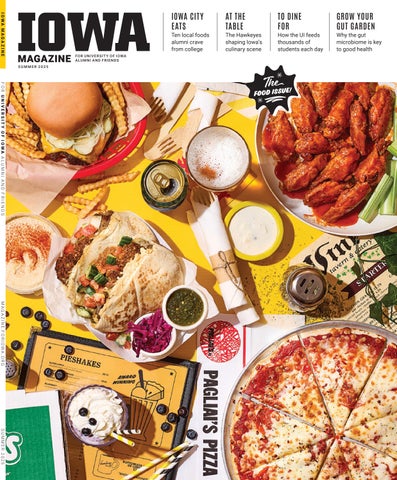
ON THE COV ER Identify your favorite Iowa City foods featured in our cover photo shoot. . . . . . 5
IOWA A RT S Food writer Wini Moranville (82BA) discovers a hidden culinary gem in Des Moines. . . . . . 45
CAMPUS MAIL Readers dish about the legacy of celebrated artist Mauricio Lasansky. . . . . . 5
F OR IOWA Visit three alumni-owned restaurants where far-flung Hawkeyes gather. . . . . . 51
EXECUTIVE DIRECTOR, CREATIVE SERVICES
Caleb Saunders
EXECUTIVE DIRECTOR, MARKETING ANALYTICS AND WEB STRATEGY
Zack Schmidt (03BA)
OFFICE OF ALUMNI ENGAGEMENT One West Park Road Iowa City, IA 52242 phone : 319-335-3305
email: uiowa@foriowa.org w e b s i t e : foriowa.org
ON IOWA International students share the meals they crave most from back home. . . . . . 6 G O H AW K S The foods that fuel Hawkeyes like football player Gennings Dunker and gymnast Karina Muñoz . . . . . . 13
A LWAY S A H AW K E Y E A UI graduate teaches Panamanian farmers how to grow cacao and sell chocolate. . . . . . 57
Iowa Magazine, Volume 78, Number 2 © 2025 University of Iowa Center for Advancement. The UI Center for Advancement publishes Iowa Magazine four times a year. POSTMASTER: Send address changes to Iowa Magazine, UI Center for Advancement, One West Park Road, Iowa City, IA 52242. Opinions expressed are not necessarily shared by the university, the publishers, or the editors. The University of Iowa prohibits discrimination in employment, educational programs, and activities on the basis of race, creed, color, religion, national origin, age, sex, pregnancy (including childbirth and related conditions), disability, genetic information, status as a U.S. veteran, service in the U.S. military, sexual orientation, gender identity, or associational preferences. The university also affirms its commitment to providing equal opportunities and equal access to university facilities.
Big Pict u re
2
IOWA MAGAZINE
SUMMER 2025
Big Pict u re
BIG P IC T URE
Dessert Destination
In the shadow of Old Cap, another Iowa City landmark sits on the banks of the Iowa River: the Riverside Dairy Queen. The ice cream stand offers a nostalgic experience largely unchanged since it opened in 1952, with oldies music, vintage signs, and a reputation for friendly service. Even when it was damaged by a tornado in 2006 and flooding in 2008, the Dairy Queen bounced back, ensuring Iowa City always has somewhere to go for a sweet summer treat. PHOTO: JUSTIN TORNER/UI OFFICE OF STRATEGIC COMMUNICATION
MAGAZINE.FORIOWA.ORG
IOWA MAGAZINE
3
ENGINEER MUSICIAN HAWKEYE n o t y a l C n o m r a G
Class of 2024 UI College of Engineering
Empower sustainability problem-solvers like Clayton. together.foriowa.org.
Ca mpus Ma i l
Musical Medicine
My father suffered from Parkinson’s disease and sang in the Treble Clefs in Sun City, Arizona, with Sun Joo Lee (25PhD) [“Songs of Healing,” spring 2025, p. 59], and it was amazing how much it helped his speech and ability to swallow. What a great thing that Lee will continue to spread such a wonderful voice, song, and therapy for those who need it! Michael Miller (95MD) Iowa City
I was lucky enough to attend the University of Iowa when Mauricio Lasansk y [“Drawing Dignity and Disgust,” spring 2025, p. 44] was there. His work was evocative and horrific. He brought human pain to paper. He should not and will not be forgotten. Shirley A. Fagan Roggen (71BA) Portland, Oregon Mauricio Lasansky was the reason I went to Iowa for my MFA in printmaking,
PHOTO COURTESY LASANSKY CORPORATION
but sadly he no longer taught at that point. My father knew him personally and bequeathed to me the best version of Lasansky’s España—a most sumptuous artist’s proof. What a talent he was! Andrew Fuhri (80MA, 91MFA) Cranston, Rhode Island
CONNEC T W I T H
IOWA MAGAZINE magazine.foriowa.org
W e b e g a n t h e I o w a w o m e n ’s gymnastics club [featured in “Objects of the Game,” spring 2025, p. 20] in the Halsey Gym in 1971. In 1973, we were recognized as a club and allowed to practice in the Field House gymnastics area with men, but just on three days a week. Anyhow, it was far better to work out there than in the Halsey ballet room. The UI Main Library does have some further details about gymnasts, teams, training, competition, and results up to 1980. My meticulous handwritten scores from meets are included. Those were the times, my friends! In October 2021, I managed to organize a reunion, thanks to a couple team members who lived in Iowa City. The pictures are in the Main Library. Tepa Haronoja (74MA) First Iowa women's gymnastics coach Finland
MAIL One West Park Road Iowa City, IA 52242 EMAIL uimagazine@foriowa.org PHONE 319-335-3305 800-648-6973
2
3
4
5
7
6
8
12
9
11
10
On the Cover
GymHawk History Lasansky’s Legacy
1
Iowa Magazine brought in a team from Des Moines to help capture the vibrancy of the Iowa City food scene. How many of these college-town favorites can you identify? 1. Mesa Pizza’s fresh mozzarella, Roma tomatoes, and basil pizza 2. Hamburg Inn cheeseburger 3. Big Grove Brewery’s Easy Eddy 4. Vine hot wings 5. Micky’s Famous Conglomeration sandwich 6. Oasis falafel pita 7. Pop’s BBQ pulled pork sandwich 8. Java House coffee 9. Pagliai’s pepperoni pizza 10. Pancheros burrito 11. Gumby's Pokey Stix 12. Hamburg Inn blueberry pie shake
Back to School
As a 2019 grad who was brought to Iowa for the allure of the writing program and asked every moment I was there, “Why would you come to Iowa from Colorado?” the essay, “A Four-Year Portrait of a Reluctant Hawkeye” [spring 2025, p. 48], really helped me reminisce on how unforgettable my four years were. Thank you for bringing me back to the libraries, the sushi restaurants, and even the frigid sidewalks for a brief moment. Brooke Clayton (19BA) Stateline, Nevada
FACEBOOK The UI Center for Advancement INSTAGRAM @uiadvancement @UIAdvancement LINKEDIN @UIAdvancement
Letters to the editor may be edited for style, length, and clarity. While we welcome feedback, we regret that we are unable to print or reply to every letter.
Land Lessons Learned
I graduated from Iowa in 1966 and ’68 with a BS and MS in civil and environmental engineering. I have worked for Washington state’s drinking water program and was CEO of a regional water, waste, and watershed consultant company for 35-plus years. I am currently working with input from Craig Just (01PhD) [featured in “Lab to Land,” winter 2024-25, p. 24] on creating agriculture and solar power systems in rural Malawi, Kenya, Bolivia, Mexico, and more. Lessons learned at Iowa continue to pay professional, charitable, and life rewards. Thank you, Craig and the university, for all you are doing to make new technologies and rural life sustainable. Bob Wubbena (66BSCE, 68MS) Olympia, Washington
MAGAZINE.FORIOWA.ORG
IOWA MAGAZINE
5
7 S A L T O N T H E B R A I N 9 I N T E R N A T I O N A L C U I S I N E 11 C O O K B O O K C O L L E C T I O N
BREAKFAST
Warm, fluffy buttermilk pancakes offer a morning mood boost for students as part of a beloved finals week tradition. Jim Kuper, better known as the Pancake Man, has set up shop in the Iowa Memorial Union twice a year for more than a decade to share his perfected recipe—and show off his world-record pancake flipping skills, launching flapjacks from the griddle to empty plates up to 30 feet away.
Extra Watch the Pancake Man flip pancakes during finals week at foriowa.info/im25-pancakes.
6
IOWA MAGAZINE
SUMMER 2025
PHOTO: JUSTIN TORNER/UI OFFICE OF STRATEGIC COMMUNICATION
Pancakes
On Iowa
DIS COV ER Y
Salt Tooth A UI researcher has identified the part of the brain that controls our love for salty foods.
PHOTO ILLUSTRATION: CALEB SAUNDERS
Joel Geerling doesn’t crave salty snacks.
However, the University of Iowa researcher has discovered why so many of us find salty foods irresistible. According to a recently released study in the journal JCI Insight, Geerling and his team have found that a set of neurons within the brain stem controls desire for salt and the sodium it contains. Geerling, an associate professor of neurology in the UI Roy J. and Lucille A. Carver College of Medicine, says these neurons sense a hormone called aldosterone, which plays a role in regulating blood pressure.
“We found that when these neurons are removed from the brain stem, desire for sodium disappears,” he says. “We also saw an increase in sodium appetite when these neurons are stimulated.” The UI study may change our understanding of how taste and cravings influence diet. It may also help physicians find solutions to curb their patients’ excessive salt intake—something that many Americans struggle with daily.
A Salty Situation
Nearly 90 percent of U.S. adults consume more than the daily recommended maximum of 2,300
milligrams—or one teaspoon—of salt set by the Food and Drug Administration. However, Geerling also sees a number of patients over the age of 60 who don’t consume enough salt or water, which can also lead to significant health risks such as hypertension. What controls salt appetite has been less understood until now. Building off research started in collaboration with his PhD mentor, the late Arthur Loewy of Washington University in St. Louis, Geerling worked to change that. He and Iowa research scientist Silvia Gasparini studied aldosterone, a hormone created by the adrenal cortex that controls the balance of water and salt in the kidney. “Aldosterone is really important for us to be alive and is vital for our overall health and bodily functions,” says Geerling. “If you’re not drinking enough fluid, aldosterone is created to tell the kidney and other organs to retain sodium. But when your body produces too much of it, your blood pressure spikes.”
Craving Control
In their study of a set of specific cells in the brain stem, Geerling’s team discovered that aldosteronesensitive HSD2 neurons—of which each human has around 1,000 in total—were the culprit behind the aldosterone-induced craving of salty foods. The researchers found that the only central function of these HSD2 neurons is boosting sodium appetite, which Geerling says is the most specific behavior for a cell type ever discovered in mammals. Now, with a clearer picture of how these neurons operate, Geerling plans to go more indepth with the cellular operations surrounding these HSD2 neurons. He says, “We’ve showed that it’s easy to boost or minimize the drive to consume salt, which could have huge implications for people in the long run.” BY BEN FROTSCHER
MAGAZINE.FORIOWA.ORG
IOWA MAGAZINE
7
On Iowa
A S K T HE E X P ER T S
UI Dietitians Answer Your Nutrition Questions University of Iowa health and human physiology professors Kathy Mellen (95DI, 97MA, 07PhD) and Stephanie Borst start each semester of their Nutrition and Health course with an inquiry to students: “What is your burning nutrition question?” Over the years, the registered dietitians have helped answer many questions about healthy eating choices. Here are a few of the most common.
How much water do I need?
Water needs vary from person to person and also within the same person from day to day. Your water needs depend on a variety of factors including the types of foods consumed, environmental conditions such as temperature and humidity, physical activity level, and overall health. Our fluid needs don’t only have to be met by drinking water. Beverages we consume—including tea and milk—contribute to our total fluid intake. Foods, especially fruits and vegetables, also provide us with water. Drinking water with meals and when thirst occurs is generally sufficient to meet most adults’ fluid needs.
Are carbohydrates bad for me?
Carbohydrates are an important fuel source for our body. We prefer to say there are no “good” or “bad” foods, but rather foods we should consider having 8
IOWA MAGAZINE
SUMMER 2025
Kathy Mellen
Stephanie Borst
Can someone following a vegetarian diet get enough protein?
Yes, individuals who follow a vegetarian eating pattern can meet their protein needs. As with any eating pattern, the key is to include a variety of foods that provide numerous nutrients. Protein is an important nutrient but so are carbohydrates, fats, vitamins, and minerals. Protein is provided by a variety of foods that may be part of a vegetarian eating pattern. Vegetarians who consume milk, yogurt, and eggs are obtaining protein from these foods. There are also plant-based protein sources including tofu, beans (such as black beans or garbanzo beans), and nuts and seeds. Plant-based proteins provide us with several health benefits. Even if someone does include meat in their diet, it is advantageous to also include a variety of plant-protein sources. Replacing some animal-based proteins with plant proteins can increase fiber intake and reduce saturated fat intake. Some quick and easy ways to incorporate plant proteins into your diet include dipping vegetables into hummus, adding beans to a salad, or mixing nuts or seeds into yogurt or cereals.
PHOTO ILLUSTRATION: NICK BEECHER
?!?
more often and others in moderation. Choosing whole food sources of carbohydrates—such as vegetables, fruits, whole grains, and legumes—is encouraged. These foods provide us with several health benefits due to their vitamin, mineral, and fiber content. Fiber is beneficial for gastrointestinal and cardiovascular health. Additionally, balancing your carbohydrates with protein in your meals and snacks will help maintain good blood sugar control. Processed forms of carbohydrates, such as those made with added sugar or enriched flour, lack vitamins, minerals, and fiber compared to whole food sources. These types of carbohydrates also don’t keep us full and satiated, often leading to consuming portion sizes bigger than what we need. Individuals might consume these foods in a social setting or choose them because they are tied to memories or craved from time to time. It is important that we don’t make strict food rules for ourselves, so have cake at the birthday party, and also fill your grocery cart and kitchen with more whole food carbohydrate sources.
On Iowa
Yum naem khao tod
Bhetki paturi
S T UDEN T L IF E
Far-Flung Favorites International students share diverse cultural backgrounds through food. Each year, the University of Iowa welcomes thousands of international students. Hailing from more than 100 different countries, they arrive eager to absorb all Iowa has to offer. “Coming from Bangkok, a bustling capital city filled with noise, lights, and pollution, Iowa has been a refreshing change,” says Nitan Tantawichian, a UI finance and business analytics and information systems major, who’s
Akash Choudhuri
Nitan Tantawichian
PhD candidate in computer science
Undergraduate in business
Kolkata, India
Bangkok, Thailand
Extracurricular activities: International Student Advisory Board; hiking with friends at Maquoketa Caves, Palisades-Kepler, and Backbone State Parks
STUDENT PHOTOS: SETH DIEHL
also pursuing a certificate in sustainability. “I appreciate the tight-knit and friendly community here. Since it’s a smaller place, it allows me to step out of my comfort zone without feeling too overwhelmed.” But as exciting as it is to explore the world of sweet corn, pork tenderloin, and classic American burgers, nothing can beat a taste of home. These international students discuss the dishes they miss most while in Iowa.
Extracurricular activities: Global Engagement Student Advisory Board, International Student Advisory Board, Tippie Tech, Tippie Buddies, vice president of Thai Student Association
Favorite Dish: Bhetki paturi
Favorite Dish: Yum naem khao tod
Asian sea bass fillets steamed with ground mustard, green chilies, turmeric,
An eastern Thai and Lao-inspired crispy rice salad with fermented pork,
mustard oil, and salt, and wrapped with banana leaves.
topped with fresh herbs and lime.
“The reason I miss this food is because of my memories associated with it—the
“I love its balance of sour, spicy, and crunchy textures, and the fact that it can
love which is mixed with this dish as my mother used to make it back home,
be customized to fit different tastes. It can be enjoyed as a satisfying meal or
and the happiness I used to feel when my parents and I would all be together
a light snack, making it a versatile and comforting dish.”
having it for lunch. Additionally, I miss the burst of flavors, and the raw spice of the mustard infused with the fish.”
B Y E L L E N YA N D E L
MAGAZINE.FORIOWA.ORG
IOWA MAGAZINE
9
On Iowa
BRIEFS
FINAL VERDICT: CHAMPIONS University of Iowa debate team members Spencer Anderson McElligott and Grey Parfenoff recently won a national championship from the Cross Examination Debate Association. Four of Iowa’s teams placed in the top 20 at the tournament, continuing the national tradition of excellence of the UI’s A. Craig Baird Debate Forum.
EXTRA! EXTRA! The Daily Iowan has been named the Iowa Newspaper Association’s Newspaper of the Year for the third time in the last six years. In total, the DI brought home 33 awards from this year's statewide competition.
NEW PATHS FOR PHARMACISTS This fall, the UI College of Pharmacy debuts a new certificate in Emergency Medicine and Critical Care for students interested in pursuing a career in emergency medicine, toxicology, or critical care.
10
IOWA MAGAZINE
SUMMER 2025
A S K A N E X P ER T
Five Tips for Food Safety It’s the time of year when barbecues, potlucks, and picnics are in full swing, enticing us to go outside, meet friends and neighbors, and try delicious dishes. But without the proper precautions, foodborne illnesses can quickly turn a meal with friends into a visit with the doctor. “We have to recognize that there’s bacteria in our food, our environment, and on our hands,” says Michael Pentella , a clinical professor of epidemiology and the director of the State Hygienic Laboratory at the University of Iowa, “and we have to do everything we can to reduce those numbers.” Funded in part by the Centers for Disease Control and Prevention, the State Hygienic Laboratory works to detect cases of foodborne illness early and to catalogue information about the pathogens’ genetic makeup to track outbreak sources on a national network. Sharing data and monitoring cases closely keeps outbreaks smaller and less severe. But the best-case scenario is preventing illness from occurring at all. Pentella shares his top tips for a food-safe season.
Control food temperatures.
While eating, keep hot foods hot and cold foods cold. Afterwards, put leftovers in the refrigerator as soon as possible to prevent bacterial growth.
Cook everything thoroughly.
Ensure foods reach the right temperature to eliminate diseases like salmonella and E. coli.
Avoid cross-contamination.
“Food safety is all about making sure your environment is clean, and that includes your hands,” says Pentella. Washing hands—and equipment— between handling cooked and uncooked foods keeps bacteria from spreading.
Check for product recalls.
Go to fda.gov/safety to see recent recalls and alerts.
Avoid unpasteurized dairy products and juices.
Pasteurization removes harmful pathogens from a drink.
PHOTO ILLUSTRATION: NICK BEECHER
IT’S A MATCH The Carver College of Medicine recently celebrated 163 senior medical students who participated this past spring in Match Day. Among this year’s graduates, 41 are starting their first year of postgraduate training in Iowa, including 32 at UI Health Care.
On Iowa
UI L IBR A RIE S
Flavorful History
PHOTOS: JOHN EMIGH
Iowa is home to one of the nation’s largest cookbook collections. If any Mark Twain buff ever wants the recipe for the Roman Punch he quaffed at an 1896 banquet, the University of Iowa Libraries can help, thanks to one of the world’s first celebrity chefs. Hungarian-born Louis Szathmáry arrived in America in 1951 with just $1.10 in his pocket. He later presided over Chicago’s famed Bakery Restaurant and appeared as a guest on television programs such as The Oprah Winfrey Show. He also wrote a New York Times bestseller, The Chef ’s Secret Cookbook, and amassed one of the largest collections of food-related artifacts in history. Among these works is the recipe for Twain’s Roman Punch. Szathmáry’s collection, focused primarily on American and European cooking from the 16th century to the 1960s, began in a room above his Bakery Restaurant. Many of those items now live in the UI Libraries Special Collections and Archives. The Louis Szathmáry Culinary Collection is a vast repository of more than 17,000 cookbooks, handwritten recipe manuscripts, pamphlets, and even objects such as Devil’d Egg by Allyson Nagel, a sculpture shaped like an egg with horns. Szathmáry, who died in 1996, began sending portions of his collection to Iowa in the 1980s, due, in part, to his friendship with Barry Greenberg , a former UI executive chef. Szathmáry donated the rest of his memorabilia to a few other American academic institutions. “Chef Louis once wrote, ‘The collection never rests,’” says Margaret Gamm, the former director of Special Collections and Archives at UI Libraries. “He would have been pleased with its extensive use today—not only by scholars, but also by foodies and people who simply like to cook.”
1942
193 4
ne Greek book on Great American Cuisi for Chefs and Families, 1917
Extra
20 05
Explore the collection online at foriowa.info/im25-cookbooks or in person on the third floor of the UI Main Library.
BY L E A H K L E VA R
MAGAZINE.FORIOWA.ORG
IOWA MAGAZINE
11
SAVE THE DATE FOR
HOMECOMING
2025
a w o I t a
SEPTEMBER 21–27, 2025
Gather with fellow Hawkeyes on campus for the University of Iowa Homecoming parade, football game, and all your other favorite black-and-gold festivities.
homecoming.uiowa.edu
Go Hawks
15 F R O M B.J. T O C C 16 W H A T A T H L E T E S E A T
19 M E E T M C C O L L U M
DESSERT
Carver Cone
Smooth and creamy soft serve made with a fresh mix from a local dairy. Available in vanilla, chocolate, raspberry, or a twist, and served in a cone or commemorative cup. Indulge in a treat that brings out the kid in anyone and makes any trip to Carver-Hawkeye Arena that much sweeter on p. 14.
MAGAZINE.FORIOWA.ORG
IOWA MAGAZINE
13
Go Hawks
Fans line up to get a Carver Cone during this past season's last home women's basketball game against Wisconsin.
classic vanilla-and-chocolate twist. Each year, a special advance order is made for the raspberry flavoring produced by a small Midwest company that closes for the winter. Aramark doubled its order this season, ensuring the flavor’s now available at every Carver Cone station.
There’s a commitment to quality and service.
CONCE S SIONS
Why Hawkeyes Melt for the Carver Cone
The late Pete Rourke, who is said to have coined the term Carver Cone, was a concessions manager for Aramark and a fixture in Carver-Hawkeye Arena concessions for nearly 40 years. He set a high standard that lives on today. While the ice cream machine’s blades can last up to a year, Aramark replaces them every few weeks to maintain quality through high production.
You’re supporting a good cause.
Community volunteers staff the Carver Cone machines, and proceeds help support the local causes these volunteers represent. Duffy says there’s an art to crafting the Carver Cone that takes dozens of tries to perfect. So even if your cone is a little crooked, fear not, it tastes just as good.
Iowa fans line up for this satisfying swirl of nostalgia every winter.
It’s a game-day tradition.
Nearly 48 hours before the doors open to CarverHawkeye Arena, maintenance technicians reassemble the eight ice cream machines. A shipment of locally produced Carver Cone mix arrives the next day to be poured into each machine six hours before fans arrive. Fifteen minutes before the arena’s opening, the machines are turned on,
14
IOWA MAGAZINE
SUMMER 2025
activating their refrigeration system. The mix flows into freezing cylinders, where it’s agitated and rapidly frozen to create soft-serve ice cream. Soon after, Carver’s doors open, mobile ticket scanners chime, and lines form at the arena’s four ice cream stands.
The environment whets the appetite.
The Carver game-day experience evokes so many memories that stir a longing for this nostalgic treat. While the Carver Cone is offered at other Hawkeye sports venues, it’s most popular in the arena it’s named after. The dessert sells best at women’s basketball games, where nearly 170 gallons of ice cream are served per game. “No matter how old you are, it seems to bring back the kid in you when you get your cone,” says Duffy.
You can always switch it up.
Raspberry-chocolate twist is the most popular flavor combination, followed by raspberry and the
BY T YLER STR AND
What’s your Carver Cone story? Share your favorite photos or memories of this game-day treat to uimagazine@foriowa.org.
PHOTOS: SETH DIEHL
For many fans, no trip to CarverHawkeye Arena is complete without a Carver Cone. Around 75,000 servings of the frozen treat are sold each winter sports season. But what is it about this seemingly simple soft serve that draws fans in droves and rises in popularity as outdoor temperatures plummet? Iowa Magazine sought the inside scoop from fans, as well as Mark Duffy and Jordan Lewis (21BA) of Aramark, a food services provider for Hawkeye Athletics. Here are their five reasons why Hawkeyes melt for the Carver Cone.
Go Hawks
2025: Caitlin Clark and the Indiana Fever
1990: B.J. Armstrong and the Chicago Bulls
H AW K E Y E HIS T OR Y
ARMSTRONG PHOTO: CENTER FOR MEDIA PRODUCTION PHOTOGRAPHIC SERVICE SLIDE COLLECTION, UI LIBRARIES SPECIAL COLLECTIONS; CLARK PHOTO: BRIAN RAY/HAWKEYESPORTS.COM
Carver Goes Pro Two professional basketball games 35 years apart bring Hawkeye stars back to their home court. Then
On Oct. 16, 1990, Iowa alum B.J. Armstrong (89BA) returned to CarverHawkeye Arena with the Chicago Bulls for an exhibition game against the Washington Bullets. The Bulls earned a 121-82 victory against the Bullets in the sold-out game. Playing alongside legend Michael Jordan, who led with 16 points, Armstrong finished with 13 points and five assists. The Hawkeye hall of famer, who was recently named assistant general manager of the Sacramento Kings, competed in the NBA for 11 seasons. He won three consecutive championship titles with the Bulls, with the first title coming in 1991. The second in a series of three exhibition visits to Carver-Hawkeye Arena for the Bulls—they defeated the Utah Jazz here in 1986 and lost to the Seattle Sonics in 1994—the 1990 victory was a standout moment in the university’s basketball history.
Now
On May 4, reigning WNBA Rookie of the Year Caitlin Clark (24BBA) returned to Carver-Hawkeye Arena with the Indiana Fever for an exhibition game against the Brazilian National Team. Indiana earned a 108-44 victory against Brazil—and Clark finished with 16 points, including a 36-foot 3-pointer from beyond the spot where she broke the NCAA scoring record last year. “Something about this gym,” Clark said at the postgame press conference, “just makes me play well.” Tickets for Clark’s homecoming sold out 37 minutes after going live in February and quickly reappeared on the secondary market for prices reaching well over $1,000, previewing the enthusiasm of the game-day crowd. In typical Clark fashion, the WNBA’s first visit to Carver-Hawkeye Arena was one for the history books. “These are the moments that you just want to stay in for forever,” she said. B Y E L L E N YA N D E L
MAGAZINE.FORIOWA.ORG
IOWA MAGAZINE
15
Go Hawks
Kira Blum
Director of UI Sports Nutrition
Performance Plate
Blum uses visuals to encourage student-athletes to fill their plates with whole grains, lean proteins, and fruits and vegetables. Heavier training days require more starchy carbs like bread, pasta, and potatoes, while light training days include a diet of less readily available carbs and more fiber from fruits and vegetables.
Fuel Sources
All Iowa student-athletes can grab nutrient-dense foods like smoothies, fruit, and protein bars at fueling stations in team locker rooms and practice facilities. They can also use the Black Card app, which has a preloaded amount of money for them to purchase meals at local restaurants that meet UI Sports Nutrition guidelines. Field hockey, football, gymnastics, soccer, volleyball, and men’s and women’s basketball can choose to provide catered meals in place of Black Card to their student-athletes.
Everything in Moderation
Gennings Dunker
S P OR T S NU T RI T ION
Fuel for Success Iowa student-athletes rely on dietitian-guided meals and snacks to achieve peak performance.
As a registered dietitian, Blum operates from a framework that everything can fit in an athlete’s diet in moderation. “I try to teach student-athletes to think about food in terms of what it’s providing you from a nutrient standpoint,” she says. And in a pinch, eating something is better than nothing. Such was the case for the Iowa women’s basketball team in February when ice and flight delays before an away game in Minnesota limited after-midnight dinner options to Casey’s pizza near the Eastern Iowa Airport. “Should it be their main source of pregame fuel? Probably not every single game, but in the grand scheme of things, it offers quite a bit in terms of macronutrients,” says Blum, referring to the pizza’s carbs, proteins, and fats.
Raimond Braithwaite
After every Iowa football possession, offensive lineman Gennings Dunker hustles to the sideline and consumes about 350 calories of Honey Stinger energy waffles and fruit chews. The snack helps the 320-pounder continue moving opposing linemen against their will for 60 snaps a game. Meanwhile, Hawkeye gymnast Karina Muñoz has mere minutes to refuel with fruit snacks, pretzels, or Goldfish crackers between her four events in a dual competition.
16
IOWA MAGAZINE
SUMMER 2025
These easily digestible foods maintain her energy without tying her stomach in knots when she’s flipping through the air. While every University of Iowa student-athlete has unique needs and preferences when it comes to fueling—and refueling—for success, the core nutrition principles are largely the same. Iowa Magazine talked with student-athletes and staff to learn how Hawkeyes fuel for peak performance.
Director of strength and conditioning for Iowa football
Weight Management
Target weights and caloric intake vary drastically by position. A first-year 175-pound defensive back may only have to gain 10-15 pounds and consume 3,500 calories a day to reach his ideal playing weight, while a first-year 285-pound lineman may need to add 30 or more pounds and consume up to
Go Hawks
6,000 calories daily. During the most intense training phases, and especially in hot weather, every student-athlete is expected to f inish between 90 ounces to a gallon of their electrolyte hydration drink each day. “Guys are extremely mindful, almost to a fault,” says Braithwaite. “They want to be lean because they’re athletes and get the job done with their bodies, but sometimes that can be a detriment if they’re overly restrictive with what they eat.”
Eat Often
Football players receive a catered breakfast and dinner most days. They’re also expected to eat a pre-morning workout snack, a pre-lunch snack, lunch, an afternoon snack, and a postdinner snack. Braithwaite even conducts bag checks to ensure players always have a source of on-the-go fuel. “The weight room is just a stimulus for growth,” he says. “We stimulate your body for two hours, and then the true growth comes in what you do the other 22 hours—the way you eat, the way you sleep, and the way you recover.”
Supermarket Sweep
Hosting Nevada in 2022, the Hawkeyes faced lightning delays that extended the game to seven hours and forced Braithwaite to send equipment staff to the local Hy-Vee to get as many grab-and-go sandwiches as they could carry. “You might have a guy sitting in a corner eating an Italian hoagie and another guy eating a ham and cheese just to get through the evening,” he says. “Your options are limited. You try not to be picky.” Karina Muñoz
Ryan Ruckdaschel
Fill the Tank
(19BS, 21MA)
Director of operations for Iowa gymnastics
A football player and gymnast share how they fuel for competition.
Healthy Body Image
Nutritionists meet with the team before the season to share fueling strategies that promote optimal performance and recovery. The staff ensures food and snacks are readily available, though the gymnasts choose what, when, and how much they eat. Ruckdaschel, a former gymnast himself, emphasizes the importance of nutrition as eating disorders can be more prominent in the sport. “There’s no weigh-in and there’s no calorie count check,” he says. “It gets down to just the athlete themselves and how they feel.”
Meal Plan
At home meets, athletes receive their last meal about four hours before competition, smoothies for warm-up, and snacks throughout the meet. On the road, all snacks and meals are provided. Ruckdaschel coordinates meal orders and sends a menu to the athletes with Blum’s recommended selections. “Given the nature of the sport of judgment and perfection, there can be a negative rap with trying to look perfect,” says Ruckdaschel. “I think we’re in a place now where body types of all different kinds are proven to be successful in this sport. People are opening up to the idea that perfection looks different on everyone.” BY T YLER STR AND
9 a.m. | Four pieces of toast and a chicken breast 10:15 a.m. | Maurten Gel, Honey Stinger energy waffle and chews, and Drip Drop hydration mix Throughout the game | Powerade, water, Honey Stinger energy
Gennings Dunker Football
waffles and chews
N I G H T B E F O R E 1 1 A.M. K I C KO F F
5:30 p.m. | Two to three servings of pasta with meat marinara sauce, a couple bread rolls, 12 oz. steak, and two servings of fruit
Halftime | Maurten Gel, Honey Stinger energy waffles and chews Postgame meal with parents at Culver’s | Double bacon cheeseburger with no vegetables,
8:30 p.m. | Three hamburgers,
family-size order of cheese curds
three bags of Baked Lays chips,
or onion rings, and three sides
Drip Drop hydration mix, and
of ranch
hot chocolate
About pregame eating: “It’s not
G A M E D AY
fun. I have a giant gut going into
7:15 a.m. | Four pieces of toast, two bowls of Wheaties, a couple
the game.”
pancakes, two chicken breasts, 24 oz. water, and Drip Drop hydration mix
Karina Muñoz Gymnastics M E E T D AY
9 a.m. | Breakfast sandwich with ham, over-easy eggs, and cheese on a Hawaiian roll, home fries, and
9 p.m. | Post-meet dinner with her
chocolate milk or coffee from the
mom at 30Hop: Teriyaki Dragon
Dandy Lion restaurant downtown
Bowl (grilled chicken, wok veggies, roasted mushrooms, sticky rice,
1:30 p.m. | Panera Frontega
teriyaki glaze, scallions, crispy
chicken sandwich, creamy tomato
onions, spicy aioli)
soup, and a side of bread
PHOTOS: HAWKEYESPORTS.COM
On reward meals: “Something I’ve 4:45 p.m. | Smoothie and fruit
realized with my body throughout
snacks, pretzels, or Goldfish
the years of doing the sport is
crackers during team warmup
knowing that I don’t really need to restrain myself. If you’re just
During competition | Fruit snacks,
eating what you think is best for
pretzels, or Goldfish crackers
your body, and if it helps you, then
between events
eat it.” MAGAZINE.FORIOWA.ORG
IOWA MAGAZINE
17
Go Hawks
“
Everything that Iowa stands for is what our team is going to look like.” —Ben McCol lum
On the Court
McCollum played for former Hawkeye Steve Krafcisin (81BS) at North Iowa Area Community College in Mason City, Iowa. He played his final two seasons at Division II’s Northwest Missouri State, where he helped lead the team to its first Elite Eight appearance.
Rare Air
Get to Know Ben McCollum The new Hawkeye coach brings a winning culture to Iowa City. Ben McCollum dreamed of playing
for the Hawkeyes when he was a child growing up in Storm Lake, Iowa. While that aspiration never came to fruition, in March, he became Iowa’s 23rd head men’s basketball coach. McCollum accepted the position just days after leading Drake to its first NCAA Tournament firstround victory since 1971 and a program-best 31 wins. As a new era begins for Iowa men’s basketball, here are seven things to know about McCollum.
Iowa Ties
McCollum was born in Iowa City and grew up attending Hawkeye basketball and football games.
18
IOWA MAGAZINE
SUMMER 2025
Accomplished Accolades
McCollum was named the Joe B. Hall National Coach of the Year after Drake’s historic season. A five-time National Association of Basketball Coaches’ Coach of the Year, McCollum also earned the 2019 John McClendon Award, which is presented annually to the top coach among all levels of basketball.
A Hawkeye basketball camp participant, he earned an MVP award and praise for his competitiveness from former Iowa assistant coach Bruce Pearl. McCollum’s mother, Mary Timko (79BA, 82JD, 84MA), is an Iowa alumna.
“We’ll Always Play Defense.”
Streetball
Team Effort
At his introductory press conference, McCollum referenced his Hawkeye idol to describe how his team would play. “Have you ever seen Chris Street play?” he asked. “The intensity, the energy, the effort, the enthusiasm, the joy, the servant mentality, the toughness. Everything that Iowa stands for is what our team is going to look like.”
While his team’s offensive pace can vary based on the team’s personnel, McCollum’s teams have ranked in the top 10 nationally in scoring defense in each of the last 10 seasons. McCollum says he wants all Hawkeyes to participate in building a championship program: “Our goal is to get Carver-Hawkeye Arena filled back up, to create an environment where other fans want to come, and to be the best venue in the state of Iowa.” BY T YLER STR AND
PHOTO: STEPHEN MALLY/HAWKEYESPORTS.COM
MEN’ S B A S K E T B A L L
In 16 years as a head coach, McCollum has won 81.8% of his games, ranking fifth all-time among collegiate men’s basketball coaches. Before he led Drake to conference regular-season and tournament crowns in his lone season with the Bulldogs, McCollum guided Northwest Missouri State to four NCAA Division II national titles and 12 conference regular-season titles.
Go Hawks
BRIEFS
Olympic bronze medalist Brittany Brown, pictured this past fall at Kinnick Stadium,
Unmatched
will compete in the final Grand Slam Track meet of the season
The Hawkeyes brought home their second-straight title at the 2025 National Collegiate Women’s Wrestling Tournament in Coralville and crowned three individual champions: Kennedy Blades, Macey Kilty, and Kylie Welker. Blades also was named USA Wrestling’s Women’s College Wrestler of the Year, while Nanea Estrella became the inaugural female recipient of the Big Ten Jackie Robinson Community and Impact Award for helping Lahaina, Hawaii, bounce back from a deadly wildfire.
June 27-29 in Los Angeles.
A Hawkeye First
W HERE A RE T HE Y NOW? BRI T TA N Y BROW N ( 17B A ) WOMEN’ S T R A CK A ND F IEL D, 20 14 –18
BROWN PHOTO: BRIAN RAY/HAWKEYESPORTS.COM; BIKEMBO PHOTO: STEPHEN MALLY/HAWKEYESPORTS.COM
The Sprint to Glory Sprinting to bronze in the 200 meters at the 2024 Summer Olympic Games in Paris, former Hawkeye Big Ten champion Brittany Brown (17BA) overcame an injury and pelvic pain to reach the podium. Heading into 2024, a hip labrum tear delayed Brown’s training. In addition, she battled chronic pain caused by endometriosis—a persistent and painful condition where tissue similar to the lining of the uterus grows outside of it. Recently, Brown has shared her struggles with the condition online. Brown’s persistence and strength—along with the support of family, coaches, and teammates— propelled her forward. In the Olympic trials, the 11-time All-American took second in the 200 meters, earning a spot on the U.S. team. In Paris, Brown sprinted against a top international field.
Her teammate Gabby Thomas claimed gold with a time of 21.83 seconds, while Brown finished third in 22.20 seconds. “I came into the Olympics feeling confident, knowing I could medal,” says Brown. “I was happy to be on that podium and feeling the energy of the crowd and all the love for track.” Currently, Brown lives and trains in Arkansas. This year, she’s competing in Grand Slam Track, a new league formed by legendary Olympic sprinter Michael Johnson. And with the 2028 Summer Olympics being held in her California backyard, she has her eye on the prize—again. Says Brown, “It’s definitely an experience I want to repeat and improve upon.”
Stephen Buchanan II became Iowa’s first national champion at 197 pounds during the 2025 NCAA Men’s Wrestling Championships. Buchanan’s title is the 86th in Hawkeye history and 14th under head coach Tom Brands (92BS).
Freshmen Phenoms Iowa track and field stars Pauline Bikembo and Abraham Vogelsang were named 2025 Big Ten Indoor Freshmen of the Year. They are the first Hawkeyes to receive the honor since 1998. Pauline Bikembo
BY JD MENDENHALL
MAGAZINE.FORIOWA.ORG
IOWA MAGAZINE
19
marco's
Grilled Cheese
20
IOWA MAGAZINE
SUMMER 2025
Photography: Kelsey Hansen Food Styling: Sammy Mila Prop Styling: Stephanie Hunter
By
Josh O'Leary
It’s been more than 15 years since Joe Reilly (10BA) slung sandwiches to the hungry night owls of Iowa City’s ped mall. But he still won’t divulge the ingredients to the perfect Marco’s grilled cheese. “There’s something in the butter, and there’s a certain type of bread,” says Reilly, who worked the Marco’s cart on Thursday nights while earning his theatre arts degree at the University of Iowa. “But I don’t want to give away their secrets.” What Reilly will talk about, however, is his deep appreciation for Iowa City’s eclectic food scene. “I always liken our downtown to the community’s kitchen,” he says. “Because when you’re at a party, everyone always hangs out in the kitchen.” Today, Reilly serves as Iowa City’s Nighttime Mayor, a role created by the Downtown District in 2017 to champion the city’s arts, culture, and nightlife. Few people know the local restaurants better than Reilly, whose job has given him a front-row seat to the city’s diverse food landscape—from the classic college-town pizza at Pagliai’s to chef-driven dining at the Webster to hip luncheonettes like the Dandy Lion.
“Once you’re here, you’re never too far away from your next great culinary experience,” he says. Downtown Iowa City alone boasts more than 90 restaurants, including beloved institutions like Hamburg Inn and the Airliner, which have fed generations of Hawkeyes. Among these favorites is Marco’s Grilled Cheese, whose founders Mark Paterno (99BA) and Pete Johnson (01BA) rolled their first food cart into the ped mall in 2000. Now, 25 years later, Marco’s has expanded into a fleet of grilled cheese, gyro, and taco stands, plus a brickand-mortar restaurant on North Linn Street. Although Reilly remains tight-lipped about Marco’s secret recipe, he still makes a mean grilled cheese at home. “I get a little crazy,” he says. “I get like three kinds of cheeses, hot sauce, you’ve got to get a dollop of sour cream in there, and we’ll do diced tomatoes. That’s what I’d add when I got a free grilled cheese during my Marco’s shift.” We recently asked Reilly and other alumni to help us put together a list of quintessential Iowa City foods. Here are 10 more timeless favorites that Hawkeyes can’t stop craving.
MAGAZINE.FORIOWA.ORG
IOWA MAGAZINE
21
Iowa City
Eats
O a s i s Fa l a f e l P i ta After earning his engineering degree, alumnus Ofer Sivan (03BSE) teamed up with restaurant co-founder Naftaly Stramer to introduce Iowans to the Mediterranean flavors they grew up with. The business partners started with a humble downtown food cart and soon began engineering top-notch falafel and hummus at Oasis, their Northside restaurant. Today, the duo’s Middle Eastern food empire extends across the Midwest, with Oasis Street Food hummus stocked in more than 100 grocery stores.
Pa n c h e r o s B u r r i t o NASA instruments, the Iowa Writers’ Workshop, and the Pancheros burrito. Of Iowa City’s greatest innovations, only one can be packed full of carnitas and guac. Founded in 1992 at the corner of Clinton and Washington streets—and now with locations in more than a dozen states—Pancheros is famous for its burritos the size of Herky’s head. In fact, the only thing guaranteed to bring a crowd to its feet as fast as Herky is the Pancheros Burrito Lift, a timeout tradition at Kinnick Stadium and CarverHawkeye Arena.
Vi n e Wi ng s Nothing beats cheering on the Hawkeyes in person. But let’s face it—people look at you funny when you scarf a plate of chicken wings in the stands. Thankfully, the Vine Tavern & Eatery, a hot spot for Iowa fans on game day, provides a way to watch the Hawkeyes and buzzsaw your way through a basket of its famous wings. With flavors ranging from mango habanero to spicy honey mustard, you’ll leave more bones behind than the Hawks after steamrolling the Cyclones.
B ig G r ov e B e e r at K i n n ic k S ta d i u m As an ancient Hawkeye proverb puts it, “In heaven there is no beer, that’s why we drink it here.” Here, of course, meaning Kinnick Stadium. For many fans of legal age, their drink of choice comes from Big Grove Brewery, which signed a marketing partnership last year to become an official craft brewery of the Iowa Hawkeyes that sells its beer at games. In addition to its award-winning Easy Eddy hazy IPA, Big Grove also brews a brown ale called Burch the Bear that’s named after the UI’s first mascot, as well as an amber ale dubbed 1939—a nod to Iowa’s legendary Ironmen team.
22
IOWA MAGAZINE
SUMMER 2025
Alumvnedi ! A ppr o
Hamburg Inn Pie Shake
Hawkeyes Dish on THeir
favorite menu Items Despite living across the
For over 30 years, my
river in the Quad, we would
wife, Kim (98BA), and I
for everyone we were going
often make our way to
have loved Pokey Stix from
out with that night. Nice to
Pagliai’s on Sunday evening
Gumby’s. These breadsticks
see it’s still around.
when the cafeteria was
bring back fond memories
Kim White (87BS)
closed. Best pizza in Iowa
of our time on campus and
Huntington Beach,
City, then and now.
were a must-have request
California
Brad Davis (77BA, 16MA)
to bring home to Chicago
Coralville
when Kim was pregnant
I lived in the dorms for
cheeseburgers; the juice
we still remember the
would be dripping down
three years and was never
phone number—35-GUMBY!
your chin, and the cheddar
disappointed with what
Jake Chung (96BA)
was divine.
the dining halls had to
Arlington Heights, Illinois
Kimberly Reed (71BGS)
stopping by Oasis for their
The signature dessert of this historic eatery blends two diner staples into one frozen concoction that’s been heartily endorsed by countless politicians. UI alumni and restaurateurs Nate Kaeding (04BA, 15MBA) and Ben Smart (04BS) revitalized this popular campaign stop in 2023, preserving its famous Coffee Bean Caucus and traditional diner fare. The Burg’s current menu offers four pie shake varieties: Dutch apple, maple pecan, French silk, and blueberry. Cast your vote wisely.
Hamburg Inn
with our boys. To this day,
offer. However, I still love
Hamburg Inn's Pie Shake
used it as a starting place
Des Moines When going back to Iowa
gyros, falafel, and hummus.
City, a staple I get every
I was lucky enough to
Oasis is a great local spot
time is Pop’s BBQ. The
grow up in Iowa City and
that never disappoints.
pulled pork sandwich and
frequent Dane’s Dairy
Hayley Masching (21BA,
sweet potato fries with their
whenever the moment
23JD)
homemade barbecue sauce
“mooved” us. There are
Coralville
brings back memories of
fond memories of taking
warm summer days in Iowa
elementary field trips to the
City and the smell of their
Danes’ farm and topping
it had such unique
smoking process.
off the day with a swirl
combinations that I haven’t
Angie Benda (19BA, 19BS)
cone. While attending the
found anywhere else. I also
Omaha, Nebraska
UI, I always made sure to
Mesa Pizza because
loved Whitey’s Ice Cream—
introduce Dane’s to friends,
my friends and I would
I lived across the street
and eventually to our kids.
make a habit of stopping
from the Vine in Iowa City
Even though we live out
there together.
my junior year. It was so
of state, Dane’s Dairy is a
Wendy Sweeney (10BBA,
easy to run over there and
must-stop to enjoy a sweet
15MA)
get a late-night drink, listen
treat and sweet memories.
Dubuque, Iowa
to some live music, and
Patrice Hynek (88BS)
share some apps. We also
Mount Juliet, Tennessee
Micky 's Famous Conglomeration
Known to locals simply as “The Conglo,” this grilled sandwich is a favorite for patrons at Micky’s Irish Pub, a South Dubuque Street mainstay since 1980. Pony up to Micky’s historic, solid-oak bar— originally built in 1870—and savor the in-house roasted ham and turkey topped with melted Swiss and cheddar on grilled sourdough. While Micky’s offers a taste of Ireland, it doesn’t get any more Iowa than the Conglo’s requisite side of ranch.
24
IOWA MAGAZINE
SUMMER 2025
G u m by ’ s P ok e y S t i x It’s midnight on a Thursday, and you’re locked in a heated GoldenEye tournament with your dormmates instead of writing your term paper. Everyone’s hungry. The solution? Tear a coupon from The Daily Iowan and dial up Gumby’s Pizza, a collegetown chain whose phone number alumni still have memorized. Minutes later arrives the carb-laden box of Pokey Stix—cheesy bread lathered in the mysterious and magical Pokey Butter. Life is good. The term paper can wait.
B u m p ’ s C r a n b e r ry A l mo n d C h ic k e n S a l a d S a n dw ic h Chalmers “Bump” Elliott elevated Hawkeye
athletics to new heights, bringing legendary coaches like Dan Gable and Hayden Fry to Iowa City. That same standard of excellence is reflected at Bump’s, a restaurant at the UI’s Finkbine Golf Course named after the former athletics director. Bump’s most popular golf-season offering is its fresh take on the classic chicken salad sandwich, featuring cranberry rice bread that adds a touch of light sweetness. After 18 holes, there’s no better way to finish the round than with a clubhouse meal worthy of a Hawkeye legend.
J ava H ou s e P ou r - O v e r C off e e a n d S c o t c h a r oo
For many Hawkeyes, caffeine and sugar fuel finals week—especially at Java House, an Iowa City institution for 30-plus years. Founded by alumna Tara Cronbaugh (98BA) from a business plan developed during an entrepreneur class, Java House now boasts four local cafés and a UI medical campus coffee bar. And while Iowans know the sweetness of the scotcharoo, newcomers quickly embrace this distinctly Midwest take on the Rice Krispies treat.
Taste of Iowa City George ’s Cheeseburger
The only thing more legendary than the writers who’ve tipped a pint at George’s Buffet is its cheeseburger. Just like the unassuming Iowa Writers’ Workshop hangout itself, George’s burger keeps it simple: a perfectly cooked beef patty topped with American cheese, ketchup, mustard, pickles, and chopped white onions on a sesame seed bun. The secret? A vintage Clark electric broiler, which gives the burger its signature juicy taste. Pair it with a good book—or the novel you’re writing.
On Aug. 27, Taste
annual event is held
of Iowa City will bring
in conjunction with
local foodies and
Engaged Hawkeyes
students together
Week, which helps
to sample an array
students explore
of menu items
ways to get involved
outside of downtown
on campus and in
and Northside
the community.
restaurants. The For details, visit downtowniowacity.com.
MAGAZINE.FORIOWA.ORG
IOWA MAGAZINE
25
Located at the corner of Market and Linn streets in Iowa City, the Webster is one of a growing crop of Hawkeyerun food establishments that embrace Midwestern cuisine.
26
IOWA MAGAZINE
SUMMER 2025
At the
Table From chef-driven restaurants to expansive farmsteads, Hawkeyes cultivate dining experiences that are uniquely Iowan.
PHOTOS: THALASSA RAASCH
W
h i le cit ies l ike New York , Los Angeles, and Chicago steal the spotlight as major foodie destinations, the state of Iowa quietly holds its own as a hidden gem. With miles of abundant farmland, it’s the perfect place to source fresh, homegrown ingredients for a t r u ly M idwe ster n dining experience.
But it’s not just about the food. Culinary innovators know that the best meals are those that uplift the communities they nourish. Follow these Hawkeye entrepreneurs as they revive a historic restaurant, welcome t he p u bl ic onto f a m i l y farmland, and highlight local cuisine as upscale fare—all to turn Iowa’s food traditions into a shared celebration.
MAGAZINE.FORIOWA.ORG
IOWA MAGAZINE
27
Return of the Chef BY JOSEPHINE GEIGER-LEE
o
ne of the best restaurants in America, according to The New York Times and USA Today, is located on North Linn Street in Iowa City. In 2021, chef Sam Gelman returned to his hometown to open the Webster with his wife, R iene. G el ma n desc r ibes it as “a cosmopolitan restaurant with a Midwest heart,” serving contemporary American cuisine. Gelman left Iowa City soon after high school to attend the Culinary Institute of America in New York. But he first nurtured his passion for cooking at the former Givanni’s Italian restaurant on the ped mall and at the University of Iowa, where he prepared food for the former State Room in the Iowa Memorial Union. After years refining his culinary and restaurateur skills on the East Coast with celebrity chef David Chang of the Momofuku
28
IOWA MAGAZINE
SUMMER 2025
Restaurant Group, Gelman decided to return to raise his son in the same community that shaped him—and bring something new to the Iowa City dining scene. As a child, Gelman remembers ordering egg salad sandwiches and strawberry milkshakes with his father and grandfather at the Pearson Drug Store lunch counter on Iowa City’s Northside. The Webster now occupies the former Pearson site, and its name pays tribute to his grandfather. Offering an upscale dining experience, the Webster features a menu rooted in the seasons. Everything from Wisconsin trout to duck egg tagliatelle is prepared with a focus on quality ingredients that are locally sourced whenever possible. That might include incorporating asparagus, morel mushrooms, peas, and radishes in the spring; corn and tomatoes in the summer; and apples and Brussels
sprouts in the fall. “If you don’t have something good to start with,” says Gelman of his ingredients, “then how are you going to put something good on the plate at the end of the day?” Gelman’s approach has earned the Webster national acclaim. The New York Times included it as one of 50 establishments on its 2023 Restaurant List, and USA Today named it one of the 2024 Restaurants of the Year.
Guests at the Webster can reserve a seat at the Chef's Counter for a personalized, multicourse meal, featuring interaction with the chef.
In addition to running the Webster, Gelman helped longtime team member Edwin Lee open Paper Crane, a ramen shop and cocktail lounge, last fall in nearby Northside Brewery Square. “It’s about the people and finding the right people to grow with us,” says Gelman of the restaurant business. “We’re always just pushing to be better in every way that we can.”
PHOTOS: THALASSA RAASCH
Former UI cook Sam Gelman brings fine dining back to his hometown.
Mark Kaufman is pictured this past spring at the former Iowa River Power Restaurant during renovations.
Restoring Power Alumnus and UI supporter Mark Kaufman works to revive a historic Coralville restaurant. BY JOSH O’LEARY
PHOTO: SETH DIEHL
F
or d e c a d e s , Io w a R i v e r Power Restaurant stood as a cornerstone for the local dining scene. It hosted brunches for Hawkeye football coaches and recruits, upscale dinners for visiting faculty candidates, and date nights for students eager to impress. Now, more than a year and a half after its closure, a University of Iowa alumnus is leading the effort to revive the landmark building along a scenic bend of the Iowa River in Coralville. Mark Kaufman (86BS) purchased the property last fall, and the redbrick building is slated for historic renovations this year—with hopes of reopening by fall 2026. Originally a power plant dating to the early 1900s, the repurposed industrial building became one of the area’s most recognizable dining destinations when Iowa R iver
Power Restaurant opened in 1977. Known for its sweeping views of the river—along with its steaks, seafood, and Sunday brunch—the restaurant remained a local favorite until its closure in 2023. “I’m committed to doing it right, and mak ing the building what it wants to be,” says Kaufman, a Chicago-area resident and founder and executive chairman of Athletico Physical Therapy. “You walk through it, you see the bones of it, and it’s just such a cool, solid building with great history.” T he prop er t y f i r s t c au ght Kaufman’s attention a few years ago when he was back in Iowa helping his parents move from his hometown of Olds to a retirement community in Coralville. Driving past the building each day, he found himself thinking about its history—and its future. He
“
You walk through it, you see the bones of it, and it’s just such a cool, solid building with great history.” —Mark Kaufman
hoped someone would restore it to the charming restaurant he remembered from his first visit as a college student in the 1980s. “Within a few more trips up and down First Avenue, my inner voice said, ‘Why not you?’” recalls Kaufman, who is a member of the UI Center for Advancement’s board of directors. “If you don’t know me, when I get my teeth into something, it’s hard to get it out of my mind.” After discussing the idea with his wife, Mary Ann—whom he met as a student at Iowa—and their three daughters, all UI graduates, Kaufman purchased the property and assembled a development group. Fellow UI alumnus Tom Beardsley (86BBA), a commercial real estate and development consultant— and K aufman’s former col lege room mate —is over seei ng t he renovation. Supporting their efforts is UI business undergraduate Peyton Weber, an intern on the project who connected with Kaufman through the UI Tippie College of Business’ Marketing Institute. As of this past spring, Kaufman was in discussions with a potential tenant—a restaurant group that will shape the menu and overall concept. The team has also brought on Dubuque-based companies Stickley Morton Architects, Gronen, and Heritage Works for design and renovations work and to pursue a historic preservation designation. Kaufman says it will be up to the new restaurant group on whether the Iowa River Power name will remain. But he hopes to preserve the character of the former restaurant while introducing a refreshed vision. “First and foremost, this is a restaurant that will have great views of the river and an industrial feel—but modernized,” says Kaufman. “I think it’s going to be fantastic. I’m happy and appreciative that I have a chance to do something for a community I care about.” MAGAZINE.FORIOWA.ORG
IOWA MAGAZINE
29
Schumacher
A Marriage of Taste Serving flavors from the heartland, a Hawkeye couple stirs up national recognition for their award-winning restaurant. BY MEGAN MAGEE
E
ach year, the James Beard Foundation unveils its list of the nation’s top restaurants in what’s known as the Oscars of the culinary world. T h i s p a s t Ja nu a r y, A n d y Schumacher (03BS), head chef and co-owner of Cobble Hill restau rant in Ceda r R apids, became a semif inalist for Best Chef: Midwest—a decade after his first recognition from the James Beard Foundation. He and his wife, Carrie (01BA), began their culinary journey at Quinton’s in downtown Iowa City, where they first met as University of Iowa students over 20 years ago. Young and untethered after graduation, Carrie encouraged Andy to enroll in a nine-month culinary program in New York. “He was really into cooking,” says Carrie, “so we were like, why not?” Over the next four years, the Schumachers lived in a one-bedroom apartment in Brooklyn. Carrie, who originally planned to be a high school guidance counselor, grew interested in managing restaurants.
30
IOWA MAGAZINE
SUMMER 2025
The vibrant food scene inspired the Schumachers as they tasted their way through New York’s hidden gems and neighborhood favorites. “There were all these restaurants,” says Carrie. “You could walk down the street, music was going, doors were open—this beautiful food and beautiful ambience.” But more than that, these local fixtures were welcoming to all. “You could be in your sneakers, pushing your carriage,” says Carrie, “and feel just as welcome as anybody else celebrating a special occasion.” By the time their daughter— now a student at Iowa—was a toddler and the Schumachers were pregnant with their second child, the inspiration from New York’s culinary culture had sparked a dream: They wanted a restaurant of their own. But city life had become increasingly unsustainable—and they missed the support of family. They headed home to Iowa and gave it a shot. Back in eastern Iowa, they spent another four years reestablishing themselves in the community.
the relationships they’ve built, they can now go beyond what’s typically available. Some of their farmers ask, “What do you want us to grow?” or “Is there something you want for the menu?” One supplier came in nearly a decade ago as a hobby farmer and now brings in seed catalogs to offer special plants grown just for Cobble Hill’s menu, like sunchokes, a starchy root belonging to the sunf lower family. “We’ll try to feature these new ingredients or come up with an idea for a new dish,” says Andy. “It’s fluid and dynamic.” In the 12 years since opening Cobble Hill, the Schumachers have deeply rooted themselves in the local and statewide culinary community. Along the way, they’ve strengthened their persona l relationship by supporting each other’s individual gifts and talents. “It’s unique to have a partner or spouse you can work with successfully,” says Andy. “We’ve been able to find each other and find roles that work for us.” Carrie adds, “When people have separate jobs, you don’t get to see what they’re actually doing. Watching him be a mentor and teacher is pretty neat. He’s so good at that.” While Andy teaches new skills and collaborates with his kitchen staff, Carrie ensures everyone feels welcome
Inspired by the local food movement in New York, UI alumni Andy and Carrie Schumacher opened a farm-to-table restaurant in 2013 in Cedar Rapids.
SCHUMACHER PHOTO: JOHN EMIGH; RESTAURANT PHOTO COURTESY COBBLE HILL
Andy and Carrie
Andy became sous chef at the former Lincoln Café in Mount Vernon, and Carrie worked in hospitality and catering. Between those experiences and their years in New York, they gained the support and skills to build the kind of restaurant they’d only imagined. Cobble Hill, located just a block from the Paramount Theatre in downtown Cedar Rapids, would provide locally sourced contemporary American fare. “We’re in the agricultural hub of the United States,” says Carrie, “and it’s like, wow, I didn’t even have a sense of how precious and beautiful that is and what that can do to the food scene [in the Midwest].” In New York, chefs can pop over to the nearest market for fresh produce right before service. Although the ingredients are within walking distance, they’re often sold far from where they’re grown. Not in Iowa. “Nothing we’ve ever put on the menu—with a couple of rare exceptions—has ever been on the menu more than once,” says Andy about t he menu t hat c ha nges seasonally. “A lot of that is dictated by the seasonality of the produce.” You’ll never see a tomato when it’s not in season, but maintaining seasonality can be difficult, especially in the winter months. Through
at the front of house as co-owner and general manager. She curates warm spaces, crafts fresh-cut floral arrangements each week, and curates a thoughtful wine list. When the food arrives, plated with care, guests already feel transported. Between the exposed brick wall, giant white pillars, and candlelight, this Cedar Rapids restaurant almost looks like it belongs in New York— but it feels like home.
UI biology grad Andy Schumacher originally planned to go to med school before he decided to turn his passion for cooking into a career.
Roasted onions
Carrie Schumacher,
Grilled
a UI communication
asparagus
studies grad, serves
salad
as general manager and co-owner of
PHOTOS: JOHN EMIGH; ROASTED ONION PHOTO COURTESY COBBLE HILL
Cobble Hill.
“
We’re in the agricultural hub of the United States, and
I didn't even have a sense of how precious and beautiful that is and what that can do to the food scene [in the Midwest].” —Carrie Schumacher
MAGAZINE.FORIOWA.ORG
IOWA MAGAZINE
31
A Feast for the Senses At Walker Homestead, guests come for the food and stay for the views.
D
BY MEGAN MAGEE
rive west of Kinnick Stadium, beyond the traffic lights and neatly tucked subdivisions. Continue through the rolling plots of corn and soybeans; notice the ravines where water gathers, and watch the red-winged blackbirds land on mile markers. Turn left on an unassuming gravel road, roll the windows down, and breathe in the freshly tilled soil. When you reach the white barn, you have arrived at Walker Homestead Farm and Winery, a family-owned agritourism business inspired by the villas, views, and community of Tuscany in Italy. THE HEART Back in 2016, University of Iowa Tippie College of Business professors Bob (91MBA) and Kristy Walker (92MBA, 83BS) had different ideas about how to one day spend their retirement. Bob dreamt of a downtown apartment, a place they could land between bucket list trips and extended periods of travel. But Kristy longed for the days of her childhood growing up in rural Iowa, when they chose dinner from the garden, and neighbors built community around the kitchen table. She wanted a farm—and she got it. Five acres felt sufficient. They built their dream home on the outskirts of Iowa City and planted a garden. Not long after, Kristy’s green thumb turned an abundance into a surplus, and they started hosting monthly dinners to reduce food waste. When that wasn’t enough, they shared their extra fruits and veggies with local community members who subscr ibed to a Community-Supported Agriculture (CSA) program throughout the growing season. Then, the 80 acres adjoining the Walkers’ home came on the market.
32
IOWA MAGAZINE
SUMMER 2025
“I took some of my retirement to buy the farm,” says Kristy, who didn’t view it as spending, but “reinvesting … in memories.”
With food, wine, and picturesque views of
T H E PA I N T I N G Before opening in 2020, the homestead required some work. The land had been row cropped and heavily farmed. They built a new barn to host dinners and events, with a bright interior and airy 20-foot ceilings. On the west end, they planted rows of grapevines that stretch into prairie and fields rolling into the horizon. A wedding arch overlooks the vineyard, serving as a picturesque setting for guests, and especially those saying “I do.”
the countryside, the Walkers bring a taste of Tuscany to Iowa City.
UI Tippie College of Business professors Kristy and Bob Walker opened Walker Homestead Farm and Winery in rural Iowa City for the community to enjoy.
PHOTOS COURTESY WALKER HOMESTEAD
Hosting events and weddings is a family affair. At one event, as the family and guests danced on the patio with the sun setting, the Walkers’ 14-year-old granddaughter turned to Kristy and said, “This is just like Mamma Mia!” Her eyes shined. “I thought—yes, this is magic,” says Kristy. In addition to renting the farm out for weddings and fundraising events, the Walkers open it to the public on Thursday nights for wood-fired pizza and farm shareables. The community welcomes the chance to watch the sky change from bubblegum pink to mulberry with farm-to-table pizza and a glass of Iowamade wine in hand. THE COMMUNITY When there aren’t events, the sounds of the farm fill the spaces between the pillars of the pavilion and the lavender fields north of the barn. The lavender fields are a favorite. “I love working here in the evening,” says Kristy, gesturing toward rows of light purple bushes. “Wine, a sandwich, and the scent of lavender at sunset? It’s the best.” Across the way, goats bleat and chickens cluck as children offer them seeds and feed, purchased for a quarter from an adapted candy dispenser. Their grandkids are especially fond of the barnyard animals. When a goat went into labor a few years ago, the kids packed up their sleeping bags and slept in the barn. Kristy says, “They wouldn’t miss it.” Sharing the land, animals, and way of life with their grandchildren brings the Walkers a lasting joy. Even more
rewarding is working as a family to share all they have with the greater community. THE LAND The magic of Walker Homestead comes from years of labor, hope, and belief. From installing bioswales to mitigate flooding and capture runoff, to creating prairie strips to improve soil health, they hope to steward and protect the land for generations to come. “Getting your hands in the dirt, feeling productive,” Kristy says, “it’ll help your mental health more than anything.” The Walkers find purpose in many ways here: in reducing their carbon footprint “by walking the vegetables from the garden to the kitchen,” in sharing the lessons they’ve learned with Tippie students and other agritourism businesses, and adding new ways to delight their guests— like the fire pits scattered across the property with views straight from a Grant Wood painting. This season they’re introducing grab-and-go picnic baskets with garden-fresh snacks and mocktails (or a bottle of their award-winning wine) for visitors to enjoy in the peaceful quiet of their acreage. T H E PA L E T T E When the last guest leaves the barn and the crunch of tires on gravel fades in the distance, the wind brings the song of cicadas to the Walkers’ front porch. The scent of evergreen wafts up from the small patch of adolescent Christmas trees their grandchildren plant each year and mixes with lavender and the rich scent of fertile earth. Their land is a vibrant mix of greens, yellows, browns, and blues. “This is our palette,” says Kristy. “We get to do all five senses up here. It’s become our greatest work of art.” Learn more about Walker Homestead at walker-homestead.com.
MAGAZINE.FORIOWA.ORG
IOWA MAGAZINE
33
By
Ellen Yandel • Photos By Justin Torner
TO
DINE FOR
UI Dining Services provides an inside look at what it takes to keep campus fed.
F
EEDING large groups
of people is no small feat—just ask anyone who has tried to order pizza with friends. Compound that challenge to serving more than 900,000 meals over the course of a semester, and the task becomes herculean. It’s a daunting undertaking, one that historically led to limited menus, long lines, and crowded spaces. But in recent years, University of
34
IOWA MAGAZINE
SUMMER 2025
Iowa Dining Services has taken that challenge head-on, using careful planning to add new locations, ingredients, and meal plans that cater to the needs of a diverse student body. From the Street Hawk food truck’s on-the-go tacos to the allergy-free choices in Burge Market Place, here’s how today’s campus dining scene has become more sustainable, accessible, and just plain fun.
Variety, the Spice of Life
“How would you feel if you went to the same restaurant every single day, three times a day, seven days a week for 16 weeks?” asks UI Dining Services director Don Stanwick , explaining his constant motivation to improve the col lege dining experience. “That’s always the biggest challenge on our end: How do we make it better? How do we create a variety?” Fortunately for UI students, monotony is not on the menu. Far from the days of Burge Market Place feeding the east side and Hillcrest the west, UI students, staff, and visitors can now choose from 19 different dining locations across campus. In addition to the three main market place dining halls (Burge, Hillcrest, and Catlett), spots include cafés in academic buildings like the Pappajohn Business Building and Main Library, grab-and-go stops in the Iowa Memorial Union and two residence halls, and late-night grills on both sides of the river. And if that isn’t enough flexibility, green Market2Go boxes allow students with a meal plan to take their dining hall favorites with them for study sessions, Pentacrest picnics, or wherever else they go. Each location features its own signature dishes, such as the sushi at the IMU’s Union Station and walking tacos at the residence hall convenience stores. A rotating international station in Catlett Dining Hall offers
everything from crêpes to bibimbap, depending on the day. Even back at Burge and Hillcrest, the dining services staff strive to create an experience that combines reliability and excitement. Menus are planned months in advance to incorporate themed dinners that celebrate major holidays like Thanksgiving or fun occasions such as Major League Baseball’s opening day. Part of the job of feeding hungry Hawkeyes, according to Stanwick, is never feeling fully satisfied. He and his team are always looking for ways to better serve students—with their help. This year, thousands of survey responses helped select a new meal plan system to be implemented in the fall that offers more choices across campus that fit students’ schedules, budgets, and lifestyles. “From our managers and our staff to our student workers, day in and day out, they all do such an amazing job making sure that the student experience is the best it can be,” says Stanwick. “I cannot thank my team enough for the work they do. None of this would be possible without each and every one of them.”
Options for All
To c r e ate a p o s it i v e s t u d e nt experience, the UI Dining Services team ensures its food options offer something for everyone. At Iowa, that includes providing for a variety of dietary restrictions, health concerns, and nutritional needs.
PHOTO: JOHN EMIGH
MAGAZINE.FORIOWA.ORG
IOWA MAGAZINE
35
36
IOWA MAGAZINE
SUMMER 2025
Under the guidance of dietitian
Laura Croteau-Lopez , UI Dining
Services has developed a thorough support system. Each food item is labeled with any common allergens or restrictions (such as meat or dairy), and each dining hall offers plenty of alternative options. For peace of mind at mealtime, diners can visit Burge, which is nut-free and features the Thrive station, where the entire selection is prepared without the nine most common allergens: milk, eggs, fish, shellfish, tree nuts, peanuts, wheat, soy, and sesame. Accommodating allergies is just the beginning. Croteau-Lopez meets with students daily who have more complex health concerns, seek nutrition advice, or are simply overwhelmed by the sheer number of choices as they transition to eating away from home for the first time. In each case, Croteau-Lopez works with the student and her team to come up with a plan: Should a chef prepare their meals separately? Are there alternative products the university can order? Soon, the team hopes to add a second dietitian specializing in student outreach and engagement, who can help connect students who need support navigating campus dining but don’t know where to start. “We really try to communicate to students that we understand that what you’re going through is tough, and we’re trying to make things better,” says Croteau-Lopez. “What can we do for you?”
Trash Talk
Feeding large numbers of people inevitably generates a lot of waste—a reality Stanwick acknowledges but still works actively to change. Since 2007,
A YEAR IN FOOD
UI Dining Services composts 450,000 pounds of food scraps annually, and food pulpers reclaim and save 2.25 million gallons of water per year.
From Aug. 15 to April 1, UI Dining Services served:
157,800 20 oz.
soft drinks
4,908 gallons
of vanilla Greek yogurt
16,140 pounds of queso
34,860 pounds
of tempura chicken
the UI has been a leader in environmentally friendly waste-reduction practices that serve as a model to other institutions. “ We can’t prevent all waste,” says Stanwick, “so we want to make sure that we are being as proactive as possible. What can we actually affect?” The answer—with careful planning— turns out to be quite a bit. As the dining services team plans menus filled with both popular and novel choices, they track what’s left behind on the shelf or in the buffet line, constantly revising their grocery list to make sure what they buy gets eaten. Additionally, the university partners with over 20 local producers to source food, supporting both the environment and businesses like Oasis and Wilson’s Orchard. Since it’s impossible to predict the behavior of several thousand students, there’s still a lot of work to be done after each meal. Whenever possible, food is safely reused: for example, extra meat or vegetables in storage can be turned into soup later in the week. UI Dining Services also composts 450,000 pounds of food scraps annually, and food pulpers reclaim and save 2.25 million gallons of water per year. Sustainability is also baked into the everyday dining experience. The dining halls are now trayless, cutting back on both food waste and water and energy usage. Dishes, including the green Market2Go boxes, are reusable or recyclable. Currently, UI Dining Services and Undergraduate Student Government are working together to start providing reusable bags for students at to-go locations, reducing plastic waste. And, as always, Stanwick is on the lookout for more ways to combine sustainability and service.
Mobile Meals
The Street Hawk food truck is a well-known sight on campus in the warmer months, blasting upbeat music as lines of hungry students stretch across the T. Anne Cleary Walkway or around Hubbard Park to wait for a burger or a Korean fried chicken sandwich. Originally created to draw crowds away from Burge Market Place before Catlett Residence Hall was built in 2015, Street Hawk remains a popular stop not just for students, but for anyone who catches it as it visits different campus locations each day. Of course, working on the go creates its own set of challenges. “Almost everything has to go right for a day to go smoothly,” says sous chef Chris Horras , “and there are a lot of moving pieces that all have to be put together every single day.” Running a food truck takes more than just cooking skills; it also involves managing the vehicle. When something goes wrong, a mechanic, IT expert, or food supplier may not always be nearby. Staff work together to keep the line moving, stay on top of maintenance, and solve problems—both technical and culinary—on the fly. That flexibility and creativity is what Horras appreciates most about his team, which apply their ingenuity to constantly reinventing the menu. This season, for example, they introduced a new mediterranean veggie burger he hopes will be a big hit. “We’re always testing and trying stuff out,” says Horras. “They put the creativity in our hands and let us run with it.” What are your memories of the UI dining halls? Email uimagazine@foriowa.org.
MAGAZINE.FORIOWA.ORG
IOWA MAGAZINE
37
Iowa experts say a healthy microbiome is essential to our well-being—something UI physician Terry Wahls knows firsthand from her battle with multiple sclerosis. By Josh O’Leary | Images By W.Flemming Illustration
38
IOWA MAGAZINE
SUMMER 2025
MAGAZINE.FORIOWA.ORG
IOWA MAGAZINE
39
W 40
IOWA MAGAZINE
hen University of Iowa researcher Terry Wahls works in her and environment introduce new microbes to our biome—which backyard garden, her thoughts often return to the farm where she grew up in northeast Iowa. Her family’s 220 acres in Clayton County included a sprawling vegetable plot, where Wahls loved to plant and pick asparagus, peas, and green beans alongside her mother. What Wahls didn’t know then was that the plant-rich diet, and working in the soil itself, helped her cultivate another garden— the microbiome in her gut. Today, as an internationally known physician, author, and speaker, Wahls (82MD, 86R) evangelizes the importance of gut health as she makes new discoveries about the effects of diet and lifestyle on chronic disease. She’s among the many Iowa researchers investigating the microbiome—the tiny ecosystem of bacteria, fungi, viruses, and genes that naturally live in our body—and its impact on our health. “The food we eat is fertilizer for our microbial garden,” says Wahls, a clinical professor of internal medicine. “If you eat more fruits and vegetables, you’re fertilizing health-promoting bacteria. But if I’m inhibiting those helpful microbes by having lots of sugar, lots of white flour, lots of food-like chemicals, then I may be fertilizing new bacterial species that are creating compounds that interfere with the chemistry of life.” A flourishing gut microbiome is essential for good health. This native garden in our mouth and digestive system is populated by trillions of microscopic organisms first inherited from our mothers through the birth canal and breastfeeding. Our diets
SUMMER 2025
is unique to each person—while other exposures can harm gut microbiota. When this diverse ecosystem prospers, we too thrive thanks to the symbiotic benefits provided by these organisms. Gut bacteria help us break down certain foods, synthesize micronutrients, fight pathogens, and control inflammation. It can also assist neurotransmitters and help regulate aspects of our metabolism. On the flip side, “all disease begins in the gut,” as Hippocrates supposedly said more than 2,000 years ago. An unhealthy gut microbiome, known as dysbiosis, can directly lead to infections and conditions like inflammatory bowel disease. Gut problems have been tied to a host of other issues, including allergies, asthma, anxiety and depression, obesity, certain cancers, and neurodegenerative diseases. For Wahls, the “gut garden” analogy is a useful one for discussing the microbiome with her hundreds of thousands of followers on Instagram and Facebook. One day this past spring, while digging in her backyard in Iowa City, she filmed a social media clip as she extolled the benefits of gardening without gloves. Helpful bacteria in the soil can be passed to our own microbiome, explains Wahls, including microbiota that influence neurotransmitters tied to mood like serotonin and dopamine. Gardening, in other words, helps nurture your gut garden. “Play in the dirt,” she tells her followers in the video. “It’s good for you.”
Food as Medicine
The most powerful driver of our gut microbiome is our diet—and Wahls’ personal health journey is, famously, a testament to that crucial connection. In 2000, Wahls was diagnosed with multiple sclerosis, an autoimmune disease that occurs when our immune system goes awry and mistakenly attacks the brain and spinal cord. MS affects nearly 1 million people in the U.S. and over 2.8 million worldwide. By 2003, Wahls had begun chemotherapy and was using a tilt-recline wheelchair, unable to sit upright because of muscle weakness. But even as her body declined in the coming years, she continued to search for answers. Wahls dove into the latest scientific studies and zeroed in on the growing evidence of how nutrient-rich foods boost brain and mitochondrial health. She devised a program of diet and lifestyle interventions—later dubbed the Wahls Protocol— that featured a modified Paleolithic diet to support her microbiome. Wahls’ dietary regimen emphasizes green leafy vegetables, fermented vegetables like sauerkraut, colorful fruits, and meat and fish packed with protein and good fats. At the same time, her protocol limits grains, legumes, dairy products, sugar, and processed foods. When Wahls combined her dietary overhaul with physical therapy, electrical muscle stimulation, and other functional medicine concepts, the results were dramatic. In less than a year, her debilitating fatigue faded, she regained her strength, and she began walking—and even cycling—again. At the urging of former UI Carver College of Medicine Dean Paul Rothman , Wahls and colleagues published a 2009 case study of her success with functional medicine and the paleo diet. She launched her first clinical trials at Iowa in 2010, and she shared her story in a TEDx Talk in 2011 that went viral and has been watched millions of times. In 2014, she published The Wahls Protocol, which serves as a roadmap for people suffering from the ravages of MS and other autoimmune conditions. A decade later, the book has sold more than 400,000 copies, and Wahls is a sought-after speaker and podcast guest. She regularly receives emails and letters from people around the world who have benefited from her protocol and follow-up book, Cooking for Life. At the same time, Wahls and her UI laboratory team remain committed to advancing research in MS and other diseases. Currently, in one of the largest
Terry Wahls used a tilt-recline wheelchair in 2007. A year later, she was back on a bicycle.
“If you want to fix how your cells do the chemistry of life, we need to also improve our nutrition.” —Terry Wahls
and longest dietary intervention studies ever for MS patients and funded by a $2.5 million grant from the Carter Chapman Shreve Family Foundation, Wahls’ group compares the effects of different diets on fatigue and quality of life for people with the disease. In a separate study, the Wahls lab is evaluating the efficacy of an online wellness course emphasizing diet for people with MS, fibromyalgia, long COVID, and cancer patients in remission who have significant fatigue. The goal, says Wahls, is not to replace drug therapies, but to help patients struggling with chronic health conditions make lifestyle changes that can improve their pain and fatigue—the two most common complaints she hears in her clinical work. Her interventions aim to work in tandem with traditional care, not as a cure-all. Wahls has found in her clinical practice that, by teaching patients how to improve their nutrition through diagnostic testing and personalized recommendations, 80% to 90% report a noticeable reduction in fatigue and improved energy within three months. “Drugs that have FDA approval to treat a specific condition and block a specific biochemical pathway can be very helpful, so this is not an eitheror,” Wahls says. “If you want to fix how your cells do the chemistry of life, we need to also improve our nutrition.”
MAGAZINE.FORIOWA.ORG
IOWA MAGAZINE
41
Inner Allies
Learn More Read about the Wahls Protocol, her current clinical trials, and how to support the Wahls Research Fund at terrywahls.com.
42
IOWA MAGAZINE
Wahls isn’t the only Iowa researcher deeply interested in “our microbial friends,” as she calls them. Among her campus collaborators is Ashutosh Mangalam, a scientist who serves as an associate professor of pathology and directs the Microbiome Core at UI Health Care Holden Comprehensive Cancer Center. Mangalam has spent nearly two decades investigating the connection between the microbiome and the immune system. That line of inquiry began at the Mayo Clinic, where he helped identify a key type of bacteria called Prevotella, which can suppress inflammation and is associated with diets high in fiber. Mangalam explains that over the course of human evolution, our bodies have outsourced many essential functions to the gut microbiome. For example, scientists have discovered that about 90% of the body’s serotonin is produced in the gut before entering the bloodstream. Mangalam compares this evolutionary shift to the development of the automobile: Just as cars have gained new features to boost performance—from power steering to self-driving systems—our microbiome has evolved new bacterial features that enhance biological efficiency. “This bacteria said, ‘Pick me as a tenant because I’ll produce a metabolite, so your body doesn’t have to work as hard,’” Mangalam says. The symbiotic relationship between certain gut bacteria and the human body is highlighted in a newly published study in the journal PNAS by Mangalam and his UI team examining the microbiome of patients with multiple sclerosis. The researchers analyzed the chemical and bacterial makeup of the gut in people with MS and confirmed they had signs of gut inflammation and a distinct bacterial profile compared to individuals without the disease. Through studies in mice and samples from MS patients in Iowa and internationally, the team found that an imbalance between two key bacterial groups—“one good bacteria, and one good bacteria gone bad,” as Mangalam describes it—may not only signal disease, but could also help predict its severity.
SUMMER 2025
While Mangalam’s work in the lab studying this hidden ecosystem is complex, he offers a simple takeaway: “A healthy lifestyle means healthy bacteria.” That means eating an abundance of greens, eliminating stressors to the best of our ability, and getting regular exercise. Mangalam says that science has just begun to scratch the surface of the power of the microbiome. His lab is currently exploring the therapeutic efficacy of human gut-derived bacteria as a drug—a therapy he’s dubbed “Brug”—in animal models of MS. “Don’t be surprised when you go to a doctor in the future, and they do your checkup and blood work and say, ‘Oh, you need this bacteria, because these are the metabolites that are lacking,’” says Mangalam. “They’ll say, ‘Take this bacteria, and you’ll be good to go.’” UI nutrition expert Linda Snetselaar (75MS, 83PhD), a professor of epidemiology in the College of Public Health, says the microbiome plays a vital role in the emerging area of “precision nutrition”—tailoring diets to people’s different circumstances and biological characteristics. In recent years, the National Institutes of Health launched a massive study to develop artificial intelligence algorithms to predict the ideal diets for individuals based on their genetics, biology, behavior, and other factors. “The microbiome will be a really important piece to individualizing a dietary pattern and helps us be much more precise in how we make our recommendations,” says Snetselaar, who served on the USDA’s 2020-25 Dietary Guidelines Advisory Committee. “I think that’s something we’ll see in the future.” A person’s gut microbiome is ever-changing, says Snetselaar, and its composition can vary significantly from person to person. Currently, she’s working on a study with colleagues in the College of Public Health comparing the microbiomes of pregnant women to nonpregnant women. She’s also a member of Wahls’ research team conducting the five-year study among MS patients following three dietary protocols: a modified Paleolithic
Wahls’ hope is that one day, patients diagnosed with MS will be advised from the start to improve their diet, better manage their stress, and exercise regularly. diet, a ketogenic diet, and a control diet following the USDA’s dietary guidelines. Meanwhile, Snetselaar serves on a national committee that works with researchers studying the mechanisms of the gut-brain connection and how diet and the microbiome may be linked to neurological disorders like dementia. To support a healthy microbiome, and good health generally, Snetselaar recommends “cooking with colors of the rainbow.” That means devoting at least half of your plate each meal to colorful and nutrient-packed fruits and vegetables while minimizing added sugars and saturated fats. “We’re trying to really maximize those fruits and vegetables that tend to give us the highest level of nutrients, which is connected to less disease and lower mortality rates,” Snetselaar says.
Bearing Fruit
Wahls turns 70 later this year, and she’s as active as ever. Beyond her work to promote nutrition and wellness programming and conducting her research, she cycles, swims, and doesn’t miss a Hawkeye women’s basketball game. Last year, she became a grandmother, which prompted her to add strength training to her fitness regimen so she can carry her grandson even as he grows. It’s a life that was almost unimaginable 20 years ago, when Wahls seemed destined to spend her remaining days bedridden with devastating pain and worsening brain fog. That’s why, after her dramatic recovery, she says she felt “morally obligated” to spread the word about the power of diet and lifestyle—and advance research about how nutrition is related to MS and other progressive health problems. When Wahls first began sharing her story, some in the medical community expressed skepticism, and the National MS Society banned her as a speaker over apprehensions that she was spreading false hope. But things have changed. Over the past decade and a half, her team has conducted seven clinical trials, published dozens of papers
Want to boost your gut health? Terry Wahls offers these quick tips: Making additions to your diet is easier than making subtractions. Add big, leafy salads or cooked greens, and deeply colorful fruits and vegetables such as berries, beets, carrots, red cabbage, peppers, and tomatoes. Substitute bread, cereals, and
related to diet and MS, and has been cited over 1,700 times by other scientists. Wahls’ hope is that one day, patients diagnosed with MS and other autoimmune and chronic health problems with neurological or psychological symptoms will be advised from the start to improve their diet, better manage their stress, and exercise regularly. “I tell my postdocs and biomedical students that it’s a 30-year journey,” says Wahls. “I’m 15 years into this, and my ideas are no longer crazy. So, in another 15 years, it will be the standard of care that, yes, physicians will still recommend FDA-approved drugs, but they will also stress the importance of improving diet and other modifiable lifestyle factors like sleep, stress, and exercise to have more vitality and health.” Wahls’ short-term ambitions, meanwhile, are closer to home. Recently, she planted blackberry bushes alongside the raised-bed gardens and fruit trees in her backyard. Rich with antioxidants, fiber, and vitamins, blackberries have been shown to feed friendly bacteria in our microbiome—making them a much-anticipated addition to Wahls’ kitchen. If all goes to plan, the first crop of berries will be ready to pick next year. Her grandson will be just old enough to help. Any comments? Email uimagazine@foriowa.org.
pastas with starchy vegetables like yams, squash, and potatoes. Gradually add live culture fermented foods such as kimchi, sauerkraut, or kombucha to increase the diversity of your gut microbiome. Swap out sweetened beverages for water and tea. MAGAZINE.FORIOWA.ORG
IOWA MAGAZINE
43
WE CAN’T WAIT TO READ WITH YOU!
Join us for conversation and community: THE UNIVERSITY OF IOWA BOOK CLUB FOR ALUMNI AND FRIENDS foriowa.org/bookclub
Iowa A rts
48 L I V E F R O M N E W Y O R K 49 U N L E A S H T H E P E N 49 B O O K S H E L F P I C K S
SOUP OF THE DAY
PHOTO: JUSTIN TORNER/UI OFFICE OF STRATEGIC COMMUNICATION
Tom kha kai
Herbal hot and sour chicken soup with coconut milk, fresh mushroom, napa cabbage, and a twist of lime juice that left former Des Moines Register food critic Wini Moranville (82BA) “wide-eyed and reeling, practically giddy with goofy delight.” See p. 46.
MAGAZINE.FORIOWA.ORG
IOWA MAGAZINE
45
Iowa A rts
B OOK E XCERP T
I Was the Des Moines Register’s Restaurant Reviewer Somebody had to be. BY WINI MORANVILLE
This chapter’s title, of course, echoes the opening sentences of Bill Bryson’s book The Lost Continent: “I come from Des Moines. Somebody had to.” The tone of resignation describes how I sometimes felt on the most challenging days on the job. Happily, though, for about 78 percent of the time, reviewing restaurants was a great gig. Every Thursday morning from 1997 to 2012, my review appeared in the Datebook, the Des Moines Register’s weekly entertainment guide; later, I continued to cover Des Moines restaurants for dsm magazine many years afterward. On Thursday mornings, I loved opening my front door, grabbing the physical paper, and seeing how the review looked on the printed page and checking out the photos that ran with it (which I never saw in advance). Thursday was also the day that I always set aside to write and submit my review for the following week. Back then, reviewing was just one part of how I wove together a living as a food and wine writer. I also wrote for and worked as a project editor on all kinds of magazines and cookbooks, and later websites. While I enjoyed the non-reviewing work—greatly, in fact—it often entailed collaborating with a team of other writers, editors, recipe developers, recipe testers, art directors, graphic designers, photographers, food stylists, prop stylists, and such. Together, we turned out some great cookbooks and magazine food stories, sometimes with moments of discord and tension that creatives often experience when working as a team, but usually with plenty of camaraderie and laughs in between. But Thursdays were all mine—a nice break from the peopley aspect of everything else I did. I’d bang away on my keyboard in my “freelancer’s hut” (my incredibly unkempt home office) and think about the best way to tell the story of my dining experiences with the goal of doing only one thing: to help readers decide whether the restaurant I was reviewing was worth their hard-earned money and hard-won leisure time. I never loved the job more than when I was writing about an undiscovered gem that I could bring to light—the review would be a pleasure to write and a boon to both my reader and the restaurateur. Win-win-win. In 20-plus years of writing about restaurants, the greatest of such moments was in my discovery of Thai Flavors. One weekday when I was working in the offices of the Better Homes & Gardens family of publications, I invited David, a food-magazine editor, to go with me to review a newish hole-in-the-wall joint that was supposed to be good in a greasy spoon kind of way. When we got there, we walked into an empty place, took in the haphazardness of the workspace behind the counter
46
IOWA MAGAZINE
SUMMER 2025
PHOTO: ANDY LYONS CAMERAWORKS
Iowa A rts
and the dingy furnishings in the dining area, and stood there, waiting for someone to come out of the back room. We might have even called out, “Yoo-hoo! Anyone here?” But no one came, and frankly, I was a bit relieved. By this time I had a remarkably accurate feel for restaurants that looked bleak at first glance but could be worthy in some other way versus restaurants that were hopeless through and through. I called this sixth sense “mon pif ” (my snout), a slang term that a Quebecois friend taught me while we were traveling together in France—he was bemused by my knack for snouting out really good restaurants. As a reviewer, mon pif was generally pretty accurate. I knew this place would never make it, and I had no desire to be the one to nail its coffin shut. We beat a path out of there. The place closed within months, entirely on its own. I had promised to take David to lunch but was scrambling for an idea of where to go. One of the drawbacks of being a well-known food critic in town is that everyone wants you to decide where to eat. That can be a lot of pressure when you’re dining with talented food editors for national publications. Driving back toward the downtown offices, we spotted a place called Thai Flavors. It was in a scruffy old strip mall, next door to a spay clinic, and yet, mon pif told me something about it looked hopeful. I decided to roll the dice. We settled into the near-empty, simply furnished space with its tapestry tablecloths under glass and scant Thai decorations here and there. I ordered my go-to Thai dish, a green curry, and David ordered pad Thai. These were hardly the most adventurous dishes on the 50-plus-item menu, I know, but I wasn’t sure if I was truly reviewing the place or just getting a reliable meal to see me through the afternoon. But then, the most unexpected and amazing thing happened. When the server (a middle-aged man, likely in his 50s) brought David his pad Thai, he set a bowl of soup down in front of me. He did not speak English fluently, but I understood he was telling me, in a friendly but quite matterof-factly way, that he was bringing me this dish instead of what I ordered. It wasn’t a question; it was a statement. I had a sense that all was going to be just fine. And it was better than fine. The dish had me wideeyed and reeling, practically giddy with the goofy delight food lovers get when they unexpectedly stumble onto a new and wondrous dish. When it was over, my mood turned more wistful as I said to David, “Why can’t all food be this good?” The dish was tom kha kai—by now a well-known dish in our parts, but new to many local diners at
“
The dish had me wide-eyed and reeling, practically giddy with the goofy delight food lovers get when they unexpectedly stumble onto a new and wondrous dish.” —Win i Moranv i l le
the time. In quintessential Thai fashion, the chicken soup brought a world of great effects into one bowl: the meatiness of chicken and mushrooms; a spicy bite of chiles; a fresh burst of lemongrass; a sweet, smooth, and nutty finish of coconut milk; and a sour touch of lime. I returned a couple more times on review visits, and the place continued to make me profoundly happy at almost every turn. I also loved the genuine, unrestrained joy of the waitstaff and how they’d do everything they could to steer you right. You could order a dish spiced from one (not very spicy) to five (blowout spicy). On a final review visit, I ventured to order a three. The young server started giggling, and in the sweetest, most amiable way possible, said, “No, no, no! You’re a TWO!” I still smile when I think of her. She knew me well. Des Moines had seen a few Thai restaurants over the years, but this one moved the needle. Accolades practically flew from my fingers as I wrote the review, and after it ran, diners would sometimes have to wait to get a table at lunch. It tickled me to no end to walk in one day and see my four-star review blown up to poster size on the wall of the restaurant. This, my friends, is when reviewing restaurants is truly the best job in the world. No, it’s not seeing my words blown up on a wall, but, rather, seeing my words truly connect food lovers with restaurateurs who will bring them joy. I’m still not sure why the owner brought me the tom kha kai instead of what I ordered, but I think it was in the spirit of one food lover saying to another, “You must try this.” Visit after visit—and I continued to go there often over the years—the place was always run by an exuberant waitstaff eager to share their culinary world. In fact, after a while, the owner and staff keyed into my role as a reviewer, and more than once, the owner’s father (the guy who had brought me the tom kha kai
instead of green curry on my first visit) invited me to go to Thailand and stay with him and his extended family. He said he wanted me to experience Thai food in Thailand. I’m sorry I didn’t take him up on it. It surely would have been more meaningful than the rote press junkets I’d go on later in my career. *** That first visit to Thai Flavors combined everything wonderful that can happen in a restaurant: great food, yes, but also that marvelous feeling of being in the presence of people who are genuinely glad you’re sitting at their table. Alas, how often did Thai Flavor-like moments happen in the years of reviewing? Not as often as I hoped. It is an honor, a pleasure, and a great luck to be a widely read restaurant reviewer, and when it’s good, it’s one of the best jobs in the world. But you have to get out there and try it all, from the subpar to the sublime. Bad meals indifferently served come with the territory, and in fact, they weren’t even the worst part of the job. No, the hardest part wasn’t the rank letdown of a lousy meal. Rather, it was deciding whether or not you’re going to tell everyone in town about it, and then actually telling everyone in town about it. Before the days of crowd-sourced reviews (Yelp and the like), I was one of just a handful of voices on the dining scene—and likely the one with the widest circulation. That could be a burden. And just who was I, anyway, to be such a highly visible voice on the Des Moines dining scene? Had I been a chef? A culinary school grad? Was I even a trained journalist? In truth, I was none of these; rather, I was simply a longtime waitress turned highly experienced and passionate diner … who could write. Wini Moranville (82BA) has worked as a cookbook author, food and wine writer, and restaurant reviewer for more than 25 years. She has written hundreds of foodrelated articles for national food magazines and has served as the wine columnist for Relish Magazine, a TV food segment host, and a James Beard Restaurant Awards panelist.
“I was the Des Moines Register’s restaurant reviewer. Somebody had to be.” is from the book Love Is My Favorite Flavor by Wini Moranville, © 2024 by Wini Moranville. Reprinted with permission of the University of Iowa Press.
MAGAZINE.FORIOWA.ORG
IOWA MAGAZINE
47
Iowa A rts
For a Netflix documentary, comedian Will Ferrell and UI grad Harper Steele reconnected on a cross-country road trip that took Steele back to her childhood home in Iowa City.
How did you land at Saturday Night Live?
Harper’s Homecoming Fresh off a cinematic road trip with Will Ferrell, former Saturday Night Live writer Harper Steele returns to the campus that helped jumpstart her career. Growing up in literary Iowa City, Harper Steele decided she was going to be a writer. Her parents were University of Iowa English faculty members, after all, and she had babysitting gigs for authors John Irving (67MFA) and David Morrell. Unfortunately, Steele was also a C student. Her school papers were often covered with red marks noting spelling and grammatical errors. But she persisted. “Something inside me said I was going to be a writer,” says Steele (85BA), who earned an English degree from Iowa. “I’m thankful that I had a passion like that early on, because a lot of people don’t.” At Iowa, Steele took a writing class for students without a writing background—and that’s where she received the encouragement to pursue her dreams. “On the first day, the teacher said, ‘We’re not going to ever correct any spelling or grammar,’ and there was a sigh of relief,” she says. “That class basically changed my life.” After finding inspiration at Iowa, Steele spent 13 years writing for Saturday Night Live and earned an Emmy. She later served as creative director for comedy website Funny or Die and wrote films such as Eurovision Song Contest. Recently, Steele and longtime friend Will Ferrell became the subject of the Netflix documentary Will & Harper. The film follows the pair’s cross-country road trip not long after Steele came out to friends as a trans woman. The documentary premiered at the Sundance Film Festival and won a Critics’ Choice award. The UI Lecture Committee recently invited Steele to campus, and she reserved time with Iowa Magazine to talk about Iowa City and her writing career. Here is the conversation, edited for length and clarity.
48
IOWA MAGAZINE
SUMMER 2025
What would surprise people about SNL?
SNL is a grind. It’s a very competitive, anxietyridden environment. It can be a tense, hard place to make a living, but it’s full of joy and fun as well. But it’s work. If you don’t like writing college papers, this is five times worse. Would you say one of the key themes of Will & Harper is friendship?
Yes, the movie is not heavily laden with politics. It enters politics a bit, because we’re in that place in our country right now, but it’s more about friendship and how people navigate change. It could be any kind of change. How has Iowa affected your worldview?
Midwesterners stereotypically are even-keeled, a little kinder, I think, and that plays out for me as an Iowan. I like silly comedy, and I think that came out of Iowa itself or my growing up in Iowa. That writing class I took at Iowa opened a whole world for me. I decided that I could become a writer after that class. This is why I like coming back. I love this school. BY SAR A EPSTEIN MONINGER
WILL & HARPER PHOTO COURTESY NETFLIX
A L UM Q & A
I got hired by The Jon Stewart Show on MTV. That lasted a couple of years, and it ended up being the very moment SNL was cleaning house and looking for cool new writers. In 1995, I walked in there the same week as Will Ferrell. As with anything in entertainment, it was a combination of timing and luck.
Iowa A rts
BOOKSHELF PICKS
W RI T ING
Busting Writer’s Block
Bug Hollow by Michelle Huneven (77MFA) Penguin Random House In the wake of their eldest son’s tragic death, a California family struggles to cope and connect to each other.
UI experts offer guidance to keep the words coming.
Becoming Caitlin Clark by Howard Megdal Triumph Books
Whether in writing creative work, research papers, or business presentations, everyone has felt the anxiety of staring at a blank page. Consider these tips to overcome writer’s block:
Write often.
Trying to write every day will build the habit of getting words to flow. “It’s important to create a protected writing time, especially when you’re not collaborating with other writers,” says Deirdre Egan (16PhD), associate director of the University of Iowa’s Writing Center. “It’s a way to hold yourself accountable.”
FACULTY PHOTOS: UI OFFICE OF STRATEGIC COMMUNICATION
Talk it out.
Having a conversation is a good way to generate ideas, make connections, and raise new questions. If you don’t have another person to talk to, record yourself, then listen back and see if it sparks an idea. Using a voice-to-text feature can even eliminate the blank page.
Simplify your tasks.
Breaking it down into simple steps can make a project more manageable. “Is what we’re describing as writer’s block actually fear?” asks Megan Gogerty (97BA), playwright and associate professor of instruction
and director of undergraduate studies in theatre arts at Iowa. “We stand on the diving board, contemplating how cold the water will be. Jump in. Start anywhere. Make it as easy as possible to start.”
Make a list.
Create a list of everything you think about the topic, then see what ideas work best and how they link together. From there, you can start an outline. “I’m one of those obnoxious writers who doesn’t believe in writer’s block,” says Kaveh Akbar, author of Martyr!, associate professor, and director of the English and creative writing major at Iowa. “I might have project block on getting that specific thing done, but ... I can always make words fastened to other words.”
Engage in the arts.
Reading and taking in other forms of art can help. “Reading, watching film, looking at art, listening to music, going to see modern dance,” says Rachel Yoder (11MFA), author of Nightbitch and assistant professor of cinematic arts at Iowa. “Anything that feeds my creative impulse is within bounds when I don’t want to write.”
A reporter explores the history of Iowa women’s basketball leading up to Caitlin Clark’s stardom through conversations with the WNBA superstar; her teammates; and coaches C. Vivian Stringer, Lisa Bluder, and Jan Jensen.
The Tiny Things Are Heavier by Esther Ifesinachi Okonkwo (20MFA) Bloomsbury In this debut novel from an Iowa Writers’ Workshop graduate, a Nigerian woman navigates immigrating to America and the complex family relationships she left behind.
MAGAZINE.FORIOWA.ORG
IOWA MAGAZINE
49
July 14–25, 2025
Can you tell a story in 100 words or less? Test your writing efficiency during our free, online microstory competition.
Scan the code or visit foriowa.org/write-now for contest details.
For Iowa
52 H U N G E R D R I V E 53 C O O K B O O K F O R A C A U S E 54 H A W K E Y E H U B S
DE S S ER T
Lemon Meringue Pie
PHOTO: JUSTIN TORNER/UI OFFICE OF STRATEGIC COMMUNICATION
Delicate meringue peaks sit atop a lemon filling that balances sweet and tart in this Iowa State Fair blue-ribbon pie baked by Andrew Picchietti (22BBA) of Iowa City. Famous for foods of all sorts, the fair judges thousands of delicious dishes each year. Try them yourself—and stop by the University of Iowa booth in the Varied Industries Building in Des Moines—this summer from Aug. 7-17.
MAGAZINE.FORIOWA.ORG
IOWA MAGAZINE
51
For Iowa
The Food Pantry at Iowa, located in the Iowa Memorial Union, assists members of the UI community facing food insecurity.
Why Do College Students Face Food Insecurity? KATHARINE BROTON, an associate professor at the UI College of Education who studies poverty and material hardship among college students, notes that students have struggled to meet their basic needs for as long as higher education has existed. A decrease in college affordability has exacerbated the problem. “Just a generation or two ago, S T UDEN T L IF E
you could work your way through
No Hungry Hawkeyes
college,” says Broton. “That’s
A UI pantry fights student food insecurity.
pantries and other institutional
impossible now.” Broton, who co-edited the book Food Insecurity on Campus: Action and Intervention, is enthusiastic about the growth of campus food responses to food insecurity, such as donating unused dining hall
52
IOWA MAGAZINE
SUMMER 2025
Anyone with an Iowa ID card can make a weekly visit to the pantry, which resembles a small market. The only checkout required is a weigh-in, so staff can track how much food has been shared. Common finds include dry goods, dairy products, and hygiene items. Most of the shelf-stable food comes from a nearby food bank, but the pantry buys fresh fruit and vegetables directly through its modest budget. “If we had more outside funding,” says Beecher, “we’d definitely spend it on fresh produce and items for people with food allergies.” Led by student workers and volunteers, the pantry staff ensures all clients feel welcome. Since international students and first-generation students are the groups who use the service the most, it works to provide food from a variety of cultures. Beecher says the pantry provides an important service beyond food assistance. “The staff and clients have built a strong community,” she says. “It’s just a really good vibe in there.” BY JENNIFER NEW
meal swipes. She also believes more should be done. “Resources like food pantries and meal vouchers are essential because students need help today, but they don’t actually solve the problem of food insecurity,” she says. “They’re not designed to end hunger. For that, we’ll need a systemic approach.”
How to Help Fight food insecurity by giving to the Food Pantry at Iowa at foriowa.info/im25-foodpantry.
PHOTO COURTESY FOOD PANTRY AT IOWA
As tuition costs rise, food insecurity has become a per vasive issue on campuses nationwide. In 2020, the U.S. Government Accountability Office reported 3.8 million college students had repeatedly eaten less than they should or skipped meals altogether. At the University of Iowa, 30% of students have reported food insecurity. Nea rly a decade ago, a group of Iowa undergraduates noticed many of their friends were struggling to afford food and opened the UI Food Pantry in response. Today, the pantry has moved from a small room in a back hallway of the Iowa Memorial Union to a prime space on the building’s lower level. Located between the Hawk Shop and a tutoring center, it has benefited from added visibility. In 2023, 6,649 students, staff, and faculty used the pantry, a nearly 50% increase from earlier years. “When we open on Tuesday morning,” says Steph Beecher (10MA), the basic needs coordinator who oversees the food pantry, “there is often a line of 50 or more people waiting.”
For Iowa
Orchid’s Tangy Cool Noodles Kanellis tasted this dish at an outdoor dinner party 30 years ago and has been chasing down the recipe ever since. He finally found it in The Modern Art of Chinese Cooking by Barbara UI dentistry professor
Tropp. The only modification made (and one
Michael Kanellis compiled
Tropp approves of) is the use of spaghettini
a cookbook to raise money
instead of Chinese noodles.
for pediatric dental care. 1 pound spaghettini noodles (Kanellis uses Garofalo spaghettini)
DEN T IS T R Y
Recipe for Generosity A professor channels his passion for cooking to improve children’s dental health.
3 ½ tablespoons Chinese sesame oil (O’Food Korean-style toasted sesame oil) 3 ½ tablespoons black soy sauce (Kwong Hung Se from Thailand) 1 ½ tablespoons Chinese black vinegar (Soeos black vinegar, aged three years) 2 tablespoons sugar 2 teaspoons kosher salt 1 tablespoon hot chili oil 4 heaping tablespoons thin-cut green and
PHOTO: JAKE HANNON/UI COLLEGE OF DENTISTRY
white scallion rings, plus more to garnish
A Universit y of Iowa professor’s cookbook decades in the making has helped fund children’s dental care at the UI College of Dentistry and Dental Clinics. Michael Kanellis (79DDS, 81PedoS, 82MS, 95MS), a professor of pediatric dentistry, has raised over $10,000 to fund children’s dental care since 2024 by selling his cookbook. The proceeds finance the Pediatric Smiles Fund, which helps children who are uninsured or underinsured afford quality dental care at the College of Dentistry. After releasing Iowa Mike’s Family Recipes in 2024, the new, improved, and renamed 2025 edition, Kanellis Family Cookbook, has 335 pages of recipes that Kanellis has gathered, perfected, and created over the years. These include everything from his award-winning fajitas to a homemade version of Casey’s pizza. “My wife did the cooking for the first 20 years while the kids were home, and after that I took
over,” Kanellis told CBS2Iowa’s morning show last year. “The next thing you know, I had recipes everywhere—in three-ring binders, cookbooks, file boxes—and during the pandemic, I collated all of them and self-published the book, so I could have all of my recipes in one place.” Last year, dental students Zach Graham and Sydney Fisher, members of the Tau Sigma Military Dental Club, gave Kanellis the idea to establish the Pediatric Smiles Fund and use his cookbook to support it. He now sells his cookbook for $20, with 100% of the money going toward the fund. “The takeaway for me,” says Kanellis, “would be the power that food has to bring people together, and in this case for a good cause.” BY JACK ROSSI
To purchase the cookbook or contribute to the Pediatric Smiles Fund, contact Kanellis at michael-kanellis@uiowa.edu.
1. Boil the noodles in water for 6 minutes. Drain and run under cold water until cool to the touch. Drain well and place in large bowl. 2. Mix remaining ingredients except scallions in a small bowl. Pour the sauce over the noodles, using a handful of noodles to wipe the bowl clean so you don’t lose any of the sugar. Toss gently with your hands to separate the noodles and distribute the sauce, then add the scallion rings and toss again to mix. 3. Place in a one-gallon zip-lock bag and refrigerate overnight. 4. Toss before eating to redistribute the seasonings. Serve at room temperature or slightly chilled, heaped in a bowl and garnished with a fresh sprinkling of scallion rings.
MAGAZINE.FORIOWA.ORG
IOWA MAGAZINE
53
For Iowa
Memphis Iowa Club volunteer Tim Theisen prepares the smoky ribs at Ty’s Smokehouse BBQ.
IOWA CL UB S
Hawkeye Hangouts Iowa Club volunteers open their businesses for UI game watches and other alumni events.
Jerked Chicken Wings by Tim Theisen Fire up the grill with this recipe from the Memphis Iowa Club’s Hawkeye Style cookbook. 15 chicken wings ½ cup onion 2 tablespoons lime juice
For University of Iowa alumni, the bonds forged during their formative college years don’t end with graduation. Hawkeye pride transcends state lines, and many graduates—and Iowa fans—have found ways to carry that spirit wherever they go. The University of Iowa Center for Advancement helps nurture this community by overseeing a vibrant network of Iowa Clubs ( foriowa.org/networks) that host Hawkeye game watches and other alumni events worldwide. Here’s a look at three Hawkeye-owned venues where Iowa fans gather to cheer on the black and gold. Memphis, Tennessee Daryl Helle, an Anamosa, Iowa, native, has always been a Hawkeye at heart. After moving to Memphis, Tennessee, in 2003, he connected with the local Iowa Club and eventually opened Ty’s Smokehouse with fellow Hawkeye fan and Iowan Tim Theisen. Located in the Memphis suburb of Bartlett, the restaurant serves Memphis-style barbecue, along with a pork tenderloin sandwich inspired by their Iowa roots. Several years ago, Helle and Theisen brought their award-winning barbecue to Iowa City for an annual Iowa
54
IOWA MAGAZINE
SUMMER 2025
1 teaspoon crushed red pepper ½ teaspoon allspice ½ teaspoon black pepper 1/4 teaspoon curry powder 1/4 teaspoon thyme 1/8 teaspoon ground red pepper
Club volunteers meeting. They also compiled a cookbook with Memphis Iowa Club members to raise money for UI student scholarships. The cookbook features recipes from Hawkeye celebrities like broadcaster Gary Dolphin and wrestling icon Dan Gable. Helle says he gives back to the Memphis Iowa Club and the UI in gratitude for their role in helping him find his Hawk family away from home. “[The Iowa Club] gave me a chance to meet people,” he says, “and I just want to keep the club going to give that opportunity for current and future Hawkeyes.”
1/8 teaspoon ground ginger 2 cloves garlic, minced 1. Mix all ingredients except the wings in a blender. 2. Put wings in a one-gallon zip-lock bag and pour in the mixture. Marinate four hours (overnight is even better). 3. Then grill.
PHOTOS COURTESY TY'S SMOKEHOUSE BBQ
Ty’s Smokehouse BBQ
1 teaspoon salt
For Iowa
Tin Roof
Nashville, Tennessee Over the past five seasons, Iowa football has twice played in the Music City Bowl based in Nashville, Tennessee, bringing thousands of Hawkeye fans to the city. Bob Franklin (98BA), part-owner and CEO of Tin Roof, a live music venue on Nashville’s Lower Broadway, has created a welcoming place for Hawks to gather. The Nashville Iowa Club fills the building’s second floor with fans during football and basketball seasons and sells custom merchandise at each game watch, with proceeds benefiting the UI. “When Hawk fans come to town, we are excited to see so much black and gold in town—and especially at Tin Roof,” says Franklin, a 2022 UI Distinguished Alumni Award recipient who also owns Elray’s in Iowa City. Tin Roof, which has hosted Nashville Iowa Club game watches since 2019, now has 19 locations across 14 states. Franklin donates venue space for UI events, including for Hawkeye Huddles before the recent Big Ten basketball tournaments in Indianapolis. While his businesses keep him traveling throughout the year, Franklin says his heart remains in Iowa City. “I love hosting events and doing things to give back to the university, because I loved my time at Iowa,” he says.
BRIEFS
Tin Roof
Deere in the Spotlight John Deere partnered with the University of Iowa and the Davenport Community School District this past spring to surprise 20 Davenport-area high school students with scholarships to Iowa. Over the next two years, an additional 40 students will receive needbased scholarships through the program designed to improve access to higher education.
Investment in Cancer Care The Roland & Ruby Holden Foundation recently pledged a transformational gift of $5 million to University of Iowa Health Care Holden Comprehensive Cancer Center to establish an endowed directorship for the center in honor of its former director, George Weiner, the Dr. C.E. Block Chair of Cancer Research.
Theory
TIN ROOF PHOTO COURTESY NASHVILLE IOWA CLUB; THEORY PHOTO COURTESY THEORY
Hawks By $4 Million
Theory
Chicago
Joel Sorinsky (04BA) has fond memories of enjoying
the deluxe burger at Quinton’s Bar & Grill and deejaying events in downtown Iowa City while a University of Iowa student. So, when he returned to Chicago after graduation to open Theory, a restaurant and bar in the River North neighborhood, Sorinsky knew he wanted his venture to be a mecca for Hawk fans. “On game days, we are at our busiest,” says Sorinsky, who earned a degree in communication studies, along with an entrepreneurial certificate from the UI Tippie College of Business.
As a local Iowa Club board member, Sorinsky ensures everyone who visits feels welcome at what he calls “Chicago’s No. 1 Hawkeye bar.” Fans hear the Iowa Fight Song, revel in the “In Heaven There is No Beer” signs across the bar, and marvel at the Kinnick Stadium mural highlighting the Hawkeye Wave. The menu features a taco flatbread pizza that Sorinsky calls an “ode to the 319 and Happy Joe’s Pizza.” “I love being a Hawkeye, and the relationships I have with the university make hosting events and giving back as much as I can so rewarding,” says Sorinsky. “I feel more tied to the university now than when I was a student.”
This year, 7,623 Hawkeyes raised nearly $4.3 million for the UI during One Day for Iowa, the university’s 24-hour online giving day. To give to your favorite program, visit givetoiowa.org.
Eight Over 80 Last month, the UI recognized eight Hawkeyes age 80 and over for their achievements and service to their communities. For the list of honorees, visit foriowa.org/eight-over-80.
B Y M I K E W AT K I N S
MAGAZINE.FORIOWA.ORG
IOWA MAGAZINE
55
ICON MUSIC MAN
Lou t s i r C
(60BA, 81MA) Golden Voice of the Hawkeye Marching Band
Use your voice for what matters to you. together.foriowa.org
A lways a Hawkeye
59 C A C A O C A P I T A L 60 L O C A L F O O D N E T W O R K 64 E A R L Y A I R L I N E R
BEVER AGE
Coffee
PHOTO: JUSTIN TORNER/UI OFFICE OF STRATEGIC COMMUNICATION
For the perfect pick-me-up, Sips' Gold Coast Medium Roast coffee offers a smooth, rich brew with hints of caramel, fig, and hazelnut. Add warm brown sugar on top for a sweet and toasty drink developed by coffee entrepreneur Stephanie Zullo (22BA). See p. 58.
MAGAZINE.FORIOWA.ORG
IOWA MAGAZINE
57
A lways a Hawkeye
‘Ma’am, This is a Starbucks’ A coffee entrepreneur becomes an internet sensation after spilling the beans about life as a barista. During the COVID-19 pandemic, after leaving the University of Iowa campus to return home when classes went virtual, Stephanie Zullo (22BA) started scrolling TikTok. As she watched videos parodying various service industries, she thought about all the stories she had from her days as a barista. One day, Zullo decided to make a video about it. Sporting a green apron like she was at Starbucks, she pretended to talk into a headset at a drive-thru. “No,” she said, “we cannot do 25 pumps of sugarfree mocha.” Though clearly satire, she knew other baristas would understand it wasn’t that far off from reality. She posted the TikTok.
58
IOWA MAGAZINE
SUMMER 2025
The next morning, a friend texted her, “Your TikTok has 80,000 views on it.” “I opened up the comments, and it was all these baristas,” she says, asking for more barista-related stories and content. She began making short videos, inspired by real interactions from her time working at a Chicago coffee shop: customers ordering while talking on the phone, customers insisting their order was wrong when it was not, customers refusing to order off the menu. Zullo, whose social media alter ego is Stefania Marzelia , says she tries to make videos that are comedic, transparent, and open. “It’s been great, the community that I’ve built so far,” she says, “and, fingers crossed, it keeps growing.”
BY ALISON BOWEN
Follow Stefania Marzelia @StefaniaMarzelia on YouTube, Instagram, and TikTok stefaniamarzelia.com sipmoresips.com
PHOTO COURTESY IVY MARKETING GROUP
P ROF IL E S T EP H A NIE Z UL L O (22B A )
After initially posting on TikTok, she’s expanded to Instagram, YouTube, Facebook, Threads, and Pinterest. Her audience has now grown to nearly 1 million followers across platforms—and a new business. As a barista, Zullo says she often put away the coffee shop’s weekly stock, noticing many ingredients in the products included dyes, additives, and preservatives. “ You can’t even pronounce ha l f these ingredients,” she says. “It was just so gross.” Focusing on clean ingredients, she began sharing beverage recipes in her posts, eventually also creating syrup recipes. The enthusiastic online response to her recipes inspired Sips, a company she launched in October 2024. Syrup offerings include Madagascar vanilla bean, warm brown sugar, tiramisu, and hazelnut toffee. Coffee roast options, such as Gold Coast Medium Roast and Maplewood Cold Brew, are named after Chicago neighborhoods. She also plans to add matcha to the mix. The company has grown in just a few short months; when she began the business, she shared commercial kitchen space in Chicago entrepreneur incubator the Hatchery Chicago. Already, she has her own private space there. Zullo, who grew up in Crystal Lake, Illinois, and now lives in the city’s West Loop, graduated from Iowa in 2022 with a bachelor’s degree in enterprise leadership. She credits Iowa business professor Joseph N. Sulentic (88MBA) for helping her think big and advises students to build rapport with their professors. “It makes all the difference in your professional career,” she says. “Whether you want to be an entrepreneur or do something different, it’s so important to find mentors. And professors are the best mentors.” This year Zullo hopes to expand into local markets, maybe even creating a coffee cart to bring to farmers markets and other summer events. “We just have so many ideas,” she says.
A lways a Hawkeye
P ROF IL E CH A RL E S C A S E Y “CHUCK” M A R T IN (8 1MFA )
Charles and the Chocolate Factory
PHOTOS COURTESY CHUCK MARTIN
An Iowa alum empowers small cacao farmers in Central America. In the tropics of western Panama, in the town of Las Minas, Charles Casey “Chuck” Martin (81MFA) is teaching farmers to grow cacao and sell chocolate. A graduate of the Iowa Writers’ Workshop, Martin worked as a book designer for small publishers until the U.S. economy tanked in 2008. He turned the obstacle into an opportunity to switch career paths in 2010, offering his time and experience to those in need through the Peace Corps. “I traveled extensively in Latin America and got a close-up of the poverty present in the countries I visited,” says Martin. “I felt I might be able to contribute something helping people start and develop small businesses. That’s one of the Peace Corps’ specialties, so I signed up.”
The Peace Corps matches the needs of a community with the specific skills of a volunteer. After serving the Peace Corps in Peru, El Salvador, and Colombia, Martin brought to Panama in 2017 a needed degree of business acumen. In his previous Colombia posting, he had worked with a USAID/USDA program called Cacao Para la Paz, or “Cocoa for Peace,” that taught farmers to grow chocolate instead of coca for cocaine. He used that background to support Las Minas’ economic development. “Very quickly, I saw that chocolate and cacao were places where people could really make money,” says Martin. “It’s an economically viable way to farm.” Part of that viability requires Panamanians to control the entire value chain, including cacao production and bean processing. Instead of providing the raw cacao to others, who then receive most of the profits, he encourages farmers to make and sell the chocolate themselves. U.S. consumers once had three kinds of chocolate to choose from: Nestle, Hershey, and Mars. The big players are still around, but they have been challenged to compete with specialty providers in a marketplace catering to a more refined global palate, where people are willing to pay for high-quality products. “In Central America, they have excellent cacaos that make chocolate with really specific and unique flavors,” says Martin. “Companies like Lindt Chocolate buy highquality beans, so they’re looking for cacao like what we grow in Las Minas.” Martin’s insights have helped local farmers into the chocolate market. Not only do they better understand the value of their product, but they are more equipped to sell it, as Martin has worked to build an international network of buyers, marketers, and other allies. The town has even begun to use the same strategies for vanilla and Melipona honey. Martin has no plans to stop anytime soon. Since his Peace Corps posting ended in 2019, he has remained in Las Minas independently, continuing to grow the town’s economy using everyone’s favorite sweet treat.
Main Types of Cacao Beans How can you tell if you have high-quality chocolate? According to cacao expert Charles Casey “Chuck” Martin (81MFA), “You look at appearance, aroma, mouth feel, and aftertaste—the flavor of chocolate on the tongue and the finish. Professional tasters describe different cacaos as fruity, nutty, citrusy, earthy, or floral.” Here are three types of cacao beans from Panama that create these sought-after chocolate flavors.
CRIOLLO Criollo means “wild” and indicates the cacao’s genetics can be traced back to the original wild cacaos from the Amazon Basin. If you slit open a bean from a pod and it’s white inside, Martin says you have Criollo cacao.
FORASTERO If the bean is dark purple, it’s Forastero, or bulk cacao, which is used for coating candy bars or making chocolate chips.
TRINITARIO If the cacao has a pinkish bean inside, it’s a hybrid of the Criollo and Forastero varieties developed in Trinidad, called Trinitario. BY PE TER NELSON
MAGAZINE.FORIOWA.ORG
IOWA MAGAZINE
59
A lways a Hawkeye
UI grad Giselle Bruskewitz leads a statewide effort to help farmers find local buyers for
P ROF IL E GIS EL L E BRU S K E W I T Z ( 12B A )
In the Trenches of Iowa’s Food System An advocate for eating local does the “next hard thing” to help farmers connect with their communities. Iowa has a well-earned reputation as an agricultural leader. One-eleventh of the nation’s food is grown in the state, which is the largest producer of corn, pork, and eggs. But much of this food is produced at an industrial scale and leaves the state for processing, meaning fewer options for Iowans. Growing more diverse food at a smaller scale, getting it onto Iowan’s tables, and supporting the people who do the work is what motivates Giselle Bruskewitz (12BA). As senior program director at Iowa Valley Resource Conservation and Development, Bruskewitz has become a statewide leader in building food hubs. Through the nonprofit, she’s grown these centralized distribution networks that link 300 small-scale Iowa farmers to buyers, such as
60
IOWA MAGAZINE
SUMMER 2025
restaurants, grocery stores, food banks, and 169 school districts. Her work also includes helping farmers navigate the repercussions of changing federal policies that affect financial support for growers. “You can’t stop food production on a dime,” she says, noting that some of the changes take away funding that had already been promised. “[Farmers have] already increased their herds and started seeds.” Bruskewitz’s commitment to local food systems took root long before her current leadership role. As a student at the University of Iowa, the Elgin, Illinois, native became an active member of the UI Environmental Coalition and the student garden. After struggling to find an academic path that aligned with her interests, faculty mentor David Gould (92MA) encouraged her to create
her own multidisciplinary major in sustainable community development. Bruskewitz’s undergraduate experience culminated with a study abroad opportunity to learn about indigenous agricultural practices in Peru. After graduation, she became coordinator of sustainability education at Central College in Pella, Iowa, where she helped the dining staff increase local produce purchasing from 2% to 75%. That spurred her interest in connecting farmers with buyers. Eventually, Bruskewitz helped an Iowa City nonprofit create a food hub, overseeing the design and construction of its warehouse and developing its network of producers and consumers. That hands-on experience prepared her for her current role at Iowa Valley Resource Conservation and Development. “To have local food options, there needs to be connections and conversations between so many kinds of people,” she says. “Everyone is strapped for time and money, so creating infrastructure is key to growing a healthier system.” Though the agricultural sector can be stressful— she jokes that she earned her graduate degree in the trenches—Bruskewitz remains committed to the work. “We saw during the pandemic how quickly the food chain can be disrupted,” she says. “I want to stay in Iowa to help diversify our food system. It’s more important than ever.” BY JENNIFER NE W
PHOTO COURTESY GISELLE BRUSKEWITZ
their food.
A lways a Hawkeye
Class Notes 2020s
Aaron Cashman (22BS), a former University of Iowa men’s wrestler, is head coach of the St. Xavier High School men’s wrestling team in Cincinnati, Ohio. Grace Clouser (23BS, 24MA), a former Hawkeye rower, is the top assistant coach for the University of Minnesota Crookston softball team. Rory Gallagher (23JD) is an associate at Stinson law firm in Minneapolis. Xochitl Gonzalez (21MFA), author of Anita de Monte Laughs Last, had her novel longlisted for the 2025 Aspen Words Literary Prize. Daniel Groeneveld (24MFA) is a multimedia journalist for WNEM TV-6 in Saginaw, Michigan. Kaylyn King (24MA) is a donor relations, stewardship, and special events coordinator for the University of Northern Iowa. Juliana Lamy (23MFA) received a 2024 Community of Literary Magazines and Presses Firecracker Award for her novel We Were Watching from the Sand. Spencer Lee (21BS), a Hawkeye Wrestling Club member and former Iowa wrestler, has been inducted into the Western Pennsylvania Interscholastic Athletic League Hall of Fame. Ruben Reyes Jr. (21MFA), author of There is a Rio Grande in Heaven, was a finalist for the 2025 Aspen Words Literary Prize.
PHOTO COURTESY CRYSTAL GROUP
2010s
Conner Bassett (15MFA), a professor at Xavier University in Cincinnati, Ohio, launched his publishing company, Bench Editions. Jamel Brinkley (15MFA), a UI assistant professor of creative writing, received the Harold D. Vursell Memorial Award for exceptional prose st yle from the A merican Academy of Arts and Letters. Signe Coombs (11BA), a former Hawkeye volleyball student-athlete, is director of athletics at Truman State University in Kirksville, Missouri. Declan Doyle (18BBA), a former offensive student assistant for Hawkeye football, is offensive coordinator for the Chicago
Bears. Reice Haase (11BA) is director of the state of North Dakota’s Department of Water Resources. Alex Hoffman (15BA) is the founder of Stateside Solar Energy, a solar installation company based in Des Moines. Micah Ariel James (14MFA) is director of UMass Downtown in Amherst, Massachusetts. Jamil Kochai (19MFA) is an assistant professor of creative writing at Princeton University in New Jersey. Afabwaje Kurian (18MFA), author of Before the Mango Ripens, was a finalist for the 2025 Aspen Words Literary Prize. Ayana Mathis (11MFA), a New York-based novelist, is a 2025-26 Mary Mackall Gwinn Hodder Fellow at Princeton University’s Lewis Center for the Arts. Sean Powell (10BA, 16JD) is a partner with the Faegre Drinker law firm in Chicago. Miles Taylor (17BA), a former Hawkeye defensive back, is co-defensive coordinator for University of South Dakota football. Mason White (19BSE), an assistant project manager at M. A. Mortenson construction and development company in Minneapolis, was named a 2024 Rising Young Professional by Finance & Commerce.
2000s
Ladell Betts (01BS), a former assistant for Hawkeye football, is running backs coach for the New Yor k Giants. Nicole Brogden (0 3B S , 07PharmD), the Ting-Fong and NeiJia Chin Professor in Pharmaceutics at the UI College of Pharmacy, has been named to the American Association of Pharmaceutical Sciences’ PharmSciTech journal editorial board. Michael Garms (04BA) is author of the children’s book Carrie’d Away. Lisa Hanneman (01BA) is chief development officer of Blessings in a Backpack, a Chicago-based nonprofit that provides weekend meals for children. Karla Kelsey (01MFA), a poet, released her lyric documentary book Transcendental Factory: For Mina Loy. Wesley Kisting (04MA, 07PhD), an English professor, is provost and dean of the faculty at Hamline University in St. Paul, Minnesota. Nam Le (06MFA) had his debut poetry book, 36 Ways of Writing a Vietnamese Poem, named
Service and Scholarship Thomas Lutz, a U.S. Navy veteran and University of Iowa College of Engineering student, attended the commissioning ceremony this past spring in Groton, Connecticut, for the USS Iowa, a new fast-attack nuclearpowered submarine. Lutz attended as a guest of Crystal Group, a Cedar Rapids-based military technology manufacturer that produced equipment for the new vessel. “I feel honored and lucky to have been chosen to attend the commissioning ceremony,” Lutz told Iowa News Now. “I’m exceptionally glad to be sponsored by a company that I can relate to—I have seen firsthand the effects of reliable avionics.” An Iowa native, Lutz served as an aviation structural mechanic petty officer second class while in the Navy. Today, he volunteers at the Iowa Veteran Education, Transition, and Support center on the UI campus as a tutor and mentor for other veterans adjusting to college life. The chemical engineering student, who will be a senior this fall, attended the commissioning ceremony alongside UI President Barbara J. Wilson (pictured above).
to The Guardian’s list of the 25 best Australian books of 2024. Reagan Lund (06BBA) is the executive director for the American Red Cross Silicon Valley Chapter in San Jose, California. Tom McAllister (06MFA) is an assistant teaching professor of English and communications at Rutgers University. Lucas Moffitt (03BA), head wrestling coach at Iowa Central Community College in Fort Dodge, Iowa, and a former Hawkeye wrestler, has been inducted into the National Junior College Athletic Association’s Wrestling
of choral activities and associate director of graduate studies at the UI School of Music. Emily Dannenberg Rodman (01BA, 03MS) is director of planning and community development for Arlington Heights, Illinois. Lisa VanderWilt Shileny (02JD) is president and CEO of Hills Bank. Matthew Warner-Blankenship (04MS, 11JD) has been elected to the board of directors for Dentons Davis Brown, a Des Moines-based law firm.
Coaches Association Hall of Fame. Jerry Montgomery (03BA), a former Hawkeye football letter winner, is a defensive line coach and run game coordinator for the Cincinnati Bengals. David Puderbaugh (06DMA) is director
David Bissinger (90BA), a partner with the Houston law firm Bissinger, Oshman, Williams & Strasburger, has been named to Lawdragon’s 2025 list of 500 Leading Lawyers in America. Hannah Brenner Johnson (94BA,
1990s
MAGAZINE.FORIOWA.ORG
IOWA MAGAZINE
61
A lways a Hawkeye
Repeat Returns This past spring, the University of Iowa Center for Advancement helped reunite not one but two Hawkeyes with their long-lost class rings. In February, Joan Koch found an Iowa Varsity Club ring in a Waterloo, Iowa, parking lot. It was engraved with the name Gregory Sieh, but Koch struggled to track him down until she found an article online that mentioned a Hawkeye swim team letter winner by that name. She reached out to the UICA for help and was soon connected with Sieh (69BBA, 73JD), who had previously owned a CPA firm near where the ring was found. It had been missing for 37 years. “I remain shocked by this whole deal and grateful to a wonderful giving lady,” says Sieh.
98JD) is dean of the Southern Illinois University Simmons Law School in Carbondale, Illinois. Michael Carnahan (93BM), band director at South Tama County High School in Iowa, has been named the 2025 VFW Department of Iowa High School Teacher of the Year. Peter Craig (93MFA), a Hollywood screenwriter, has partnered with producer Bryan Unkeless to launch the film and TV banner Night Owl. Charlie D’Ambrosio (91MFA), a UI professor emeritus of creative writing, received the American Academy of Arts and Letters’ Award of Merit Medal for the Short Story for lifelong achievement in the genre. Heidi Deininger (94BA) is superintendent of West Carroll School District in Carroll County, Iowa. Bruce Gleason (95PhD), professor of music at St. Thomas University in St. Paul, Minnesota, published his latest book, Cold War Cadence: A Military Musician’s Berlin Memoir, 1988–1991.
62
IOWA MAGAZINE
SUMMER 2025
Around the same time, Charlie Duncan (20BBA), a district manager for Aldi in the Cedar Rapids area, had a different lost ring on her hands. A 1968 Tippie College of Business ring bearing the initials WRS had been found in the bathroom months earlier, but the owner hadn’t returned. Duncan called Tippie, which contacted the UICA, which soon matched the ring to Cedar Rapids resident Wayne Shaw (68BBA). He had lost the ring several years prior and given up on finding it. The two rings were returned to their owners within a week of each other in April.
Shawn Griffin (94MD), CEO of health care accreditation company URAC in Washington, D.C., has been named to Modern Healthcare’s list of 100 Most Influential People in Healthcare. McCeil King Johnson (94BA, 99MA, 99JD), vice president for accreditation and regulatory compliance at the University of Phoenix, is a diversity and inclusive excellence committee co-chair for the UPCEA online and professional education association. Mary Sackett (98BA) is president of the Marin County Board of Supervisors in California, where she represents San Rafael. Melvin Shaw (97MA, 04JD) is president of the Iowa State Bar Association. Ed Stevenson (94BA), director of golf at DuPage County Forest Preserves in Illinois, has been named the 2024 Illinois PGA Executive of the Year. Suzanne Yoon (98BA), founder and managing partner of Kinzie Capital Partners private equity firm, has been
named to the 2025 Crain’s Chicago Business Women of Influence list. Heidi Zahner-Younts (97BA, 19MA) is the director of talent and organizational development at Kansas State University in Manhattan, Kansas.
1980s
Ruth Bardon (82MFA) has released her debut poetry collection, Witness, which was a finalist for the 2024 Birdy Poetry Prize. Susan E. Bennett (88BM, 92JD) is chief legal officer and secretary of E2open supply chain software in Chicago. Scott Chadwick (84BS) is dean of the John E. Simon School of Business at Maryville University in Missouri. Fred Crawford (87MBA), who recently retired as the former president and COO of Aflac Insurance, is the first executive in residence at the UI Tippie College of Business, a position that brings experienced business leaders to work with students and faculty. Brad
1960s
Elliott Brack (62MA) has been inducted into the Gwinnett County, Georgia, Preservation Hall of Fame for his 50 years of work as a local journalist. Daniel Van Tassel (64MA, 70PhD) is author of Beyond Barron: A Memoir.
faculty & friends
Kaveh Akbar, UI associate professor of English, received the American Academy of Arts and Letters’ Rosenthal Family Foundation Award for his novel Martyr! Lisa Bluder, former Hawkeye women’s basketball coach, has been inducted into the Missouri Valley Conference Hall of Fame. Mark Blumberg, UI Distinguished Chair in the Department of Psychological and Brain Sciences, received the Sleep Research Society’s 2025 Distinguished Scientist Award. Jan Jensen, the head Hawkeye women’s basketball coach, has been named the Women’s Basketball Coaches Association’s 2025 Spalding Maggie Dixon NCAA Division I Rookie Coach of the Year. Tim Stalter recently retired after 26 years as the UI director of choral activities.
Have news to share? Submit to uimagazine@foriowa.org.
TOP LEFT PHOTO COURTESY JOAN KOCH; TOP RIGHT PHOTO: HANNAH HILGENKAMP/TIPPIE COLLEGE OF BUSINESS
Charlie Duncan with Wayne Shaw
Joan Koch with Gregory Sieh
Penrith (89BGS) a former Hawkeye wrestler, has been inducted into the Greater Binghamton Sports Hall of Fame in New York. Jim Skogsbergh (82MA) received the American College of Healthcare Executives 2025 Gold Medal Award for his 16 years as CEO of Advocate Health Care. Heidi McNeil Staudenmaier (81BA, 85JD), a partner with Snell & Wilmer law firm in Phoenix, has been named to iGaming Business’s 2024 list of Most Influential Women for her work improving diversity in the gaming law industry. C.J. Williams (85BBA, 88JD), chief judge for the U.S. District Court for the Northern District of Iowa in Cedar Rapids, published his true-crime novel A Monster in Mount Pleasant: A Story of Murders and Justice.
A lways a Hawkeye
In Memory 1940s
Fritz Cohen (49BA, 50MA, 55PhD) of Chicago on Dec. 30, 2024. Janice Larson Donahue (48BA) of Peoria, Arizona, on March 6, 2025.
1950s
Richard Carrothers (57DDS) of Oak Harbor, Washington, on March 2, 2025. Betty Jeanne Humphry (51MA, 54PhD) of Jacksonville, Florida, on March 8, 2025. Karen Joy Lewis (55BSN) of Charlotte, North Carolina, on Jan. 8,
2025. Allyn Mark (57BA, 61MD) of Iowa City on April 3, 2025. Donna McKay (55BA) of Davenport, Iowa, on Jan. 11, 2025. Ardith Morningstar (57BA) of Rolling Hills Estates, California, on May 25, 2022. Peter D. Van Oosterhout (53BA, 55JD) of Cleveland on Dec. 17, 2024. Jim S. Sherman (53BSC) of Minneapolis on Jan. 4, 2025. Earl H. Smith Jr. (57BA) of Gary, Indiana, on Jan. 16, 2025. Dorothy E. Walt Waugh (50MA) of Millersville, Maryland, on Oct. 31, 2024.
1960s
Rick Davis (67BA, 69MA) of Fernandina Beach, Florida, on Feb. 10, 2025.
Dennis Gaunt (67BA, 69MS, 72PhD) of Iowa City on Dec. 12, 2024. John A. “Jersey” Jermier (65MA) of Cedar Falls, Iowa, on April 12, 2025. Frank Kos (66BBA) of The Woodlands, Texas, on Dec. 11, 2024. Takako Lento (67MFA) of Wilmington, Delaware, on Dec. 4, 2024. Edward Maahs (68BBA) of Clive, Iowa, on Feb. 12, 2025. Curtis Olthoff (68BSPh) of North Liberty on March 2, 2025. Gary G. Petersen (64BA, 66MS) of Maquoketa, Iowa, on Dec. 7, 2024. Jung Bay Ra (60PhD) of Medina, Ohio, on March 28, 2025. John D. Sperry (63BA, 66DDS) of Mountlake Terrace, Washington, on Sept. 14, 2024.
1970s
Craig Halverson (73BBA, 75MBA, 76JD) of Dallas on Oct. 24, 2024. Walt Lind (71BA, 74MS) of Nassau Bay, Texas, on Nov. 26, 2024.
1980s
Patricia Schupfer (86MD) of Coralville on March 25, 2025.
1990s
Mitchell Dralle (96BS) of Parkersburg, Iowa , on D e c . 17, 20 24 . Ta nya Shinkunas Winegard (93BA, 95MA) of Omaha, Nebraska, on Oct. 28, 2023.
PHOTO ILLUSTRATIONS: NICK BEECHER; GAITHER REFERENCE PHOTO COURTESY CECIL J. WILLIAMS
Thomas Gaither (68PhD) Scientist, teacher, and activist Thomas Gaither (68PhD) was the innovator behind key tactics used in the Civil Rights Movement. Born in Great Falls, S outh Carolina, Gaither attended Claflin College, a nearby historically Black institution, where he was president of the youth NAACP chapter. After his graduation in 1960, he became a field secretary for the Congress of Racial Equality to help train and organize civil rights activists. D ur ing a Ro c k Hill , S ou th Carolina, lunch counter sit-in, he implemented the jail - no bail strategy, in which he and other protesters—known as the
“ Friendship Nine”—accepted jail time to emphasize their commitment and draw renewed attention to the cause. He later helped plan the first of the 1961 Freedom Rides, bus trips that challenged illegal segregation in the South. In 1962, Gaither returned to school, earning a master’s degree in biology from Clark Atlanta University and a PhD in botany from the University of Iowa. He then became a professor of biology at Slippery Rock University in Pennsylvania, where he taught for 38 years. Gaither died Dec. 23, 2024, in Prospect, Pennsylvania. He was 86.
faculty & friends
Connie M. Brothers of Brookline, Massachusetts, in February 2025. Wallace Chappell of Iowa City on April 14, 2025. Lawrence Fritts of Iowa City on Jan. 18, 2025. David Lohman of Iowa City on March 5, 2025. Jim Marshall of Muscatine, Iowa, on Oct. 16, 2024. W. Richard Summerwill of Iowa City on March 17, 2025. Robert Wachal of Iowa City on Feb. 9, 2025.
To honor a recently deceased loved one in the In Memory section of Iowa Magazine, please send their name, University of Iowa degree year, city and state of last residence, and date of death to uimagazine@foriowa.org.
Dora Martin Berry As the first Black Miss State University of Iowa, Dora Martin Berry broke boundaries and worked to improve the e duc ational experienc e for other Black students. Born in Houston, Berry came to the University of Iowa in 1955 to study theatre ar ts. When she was a freshman, her fellow students voted her Miss SUI, an accomplishment that soon made international news. However, the university quickly canceled her public appearances, including in the Rose Bowl parade, erasing her win until 2016, when she returned to campus and received a heartfelt apology from the university president. The Texas native married Henry Berry (56BA), one of the UI’s first Black baseball and basketball student-athletes. Determined to make a good education accessible for others, Dora Martin Berry earned a master’s degree in social work from Rutgers University and spent her career helping New Jersey public school students. Throughout her life, she also remained active with the Southern Poverty Law Center and the Iowa Black Alumni Association. Berry died Oct. 5, 2024, in Framingham, Massachusetts. She was 86.
MAGAZINE.FORIOWA.ORG
IOWA MAGAZINE
63
A lways a Hawkeye
REF L EC T
Frequent Flyers
The crowds may dress more casually now, but not much else has changed about the Airliner since it f irst opened its doors 80 years ago. Originally frequented by World War II naval aviation cadets and pre-flight students rumored to have inspired the restaurant’s name, the Iowa City staple later became a hangout for ’80s arcade enthusiasts. It now attracts sports fans, nightlife seekers, and nostalgic alumni. With such a long history, it’s no wonder the Airliner has an endless supply of tales—some taller than others—as the place that distracted former NBC anchor Tom Brokaw from his University of Iowa studies and where a talent scout discovered Ashton Kutcher. Through all its eras, the Airliner has remained a favorite gathering space for Hawkeye students and alumni to enjoy pizza and beer with a view of the Old Capitol dome. PHOTO COURTESY THE AIRLINER
64
IOWA MAGAZINE
SUMMER 2025
A lways a Hawkeye
MAGAZINE.FORIOWA.ORG
IOWA MAGAZINE
65
Nonprofit Org. U.S. Postage PAID Permit No. 40 Iowa City, IA
The University of Iowa Center for Advancement One West Park Road, Iowa City, IA 52242
CHANGE SERVICE REQUESTED
A brain research workshop invites first-generation college students to explore the power of the mind. Read more on p. 36.