IOWA MAGA ZINE
CAPTURING GREATNESS
MAGAZINE
An Iowa photographer shares iconic moments from March Madness.
MASCOT MASTERPIECES
An artistic tribute to Herky the Hawk returns to Iowa City’s streets.
On Iowa TWICE AS BRIGHT
Neurodiverse students shine at the Academy for Twice-Exceptionality.
FO R U N I V E R S I T Y O F I OWA A LU M N I A N D F R I E N D S
SUMMER 2024
FOR UNIVERSIT Y OF IOWA ALUMNI AND FRIENDS
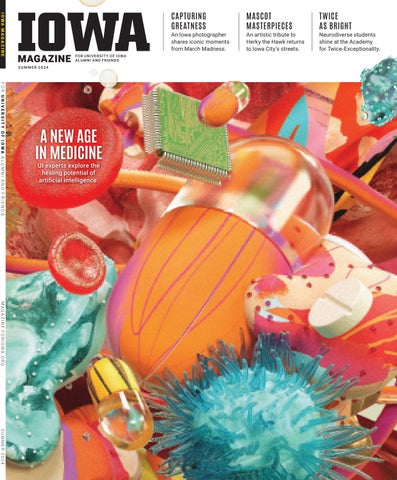
A NEW AGE IN MEDICINE UI experts explore the healing potential of artificial intelligence.
M AG A ZIN E.FO RI OWA .O RG SUMMER 2024
MAGAZINE.FORIOWA.ORG
IOWA MAGAZINE
101
CANCER SURVIVOR
FUTURE CEO
Kinley t h c e r Alb
LeClaire, Iowa Patient, UI Health Care Stead Family Children’s Hospital
Rally around Kinley and all patients who need support. together.foriowa.org
FE ATURES
EDITORIAL EDITOR IN CHIEF
Shelbi Thomas (05BA) ART DIRECTOR
22
Nick Beecher (03BA) MANAGING EDITOR
Capturing Greatness Look back at the iconic images from Iowa’s inspiring return to the Final Four, where Caitlin Clark (24BBA) and her teammates raised the profile of women’s basketball to unprecedented heights.
Josh O’Leary (00BA)
28
CONTRIBUTING WRITERS/EDITORS
Ben Frotscher Leah Klevar (93BA, 95MA) Tyler Strand Ellen Yandel
Mascot Masterpieces
GRAPHICS MANAGER
Artists unveil their Herky-inspired creations as a popular public art installation returns this summer.
Jared Salasberry
CONTRIBUTING DESIGNERS
Danette Angerer (85BFA) Jodi Schmucker e m a i l : uimagazine@foriowa.org w e b s i t e : magazine.foriowa.org
DIGITAL SENIOR WEB DESIGNER/DEVELOPER
Jimmy Losasso (09BFA) WEB DEVELOPERS
Mike Miersen Heidi Schmidt
SENIOR DIGITAL MARKETING STRATEGIST
Nicole Knoll (08BA, 22MS)
DIGITAL MARKETING STRATEGIST
BASKETBALL PHOTO: BRIAN R AY/HAWKE YESPORTS.COM; HERK Y PHOTO: THINK IOWA CIT Y; AI ILLUSTR ATION: DAVID MIL AN; TWICE AS BRIGHT PHOTO: JASON SMITH
Megan Magee
40
34
Twice as Bright
A New Age in Medicine Iowa experts explore the vast promise of physician-guided artificial intelligence in the clinic and laboratory while weighing its complex ethical questions. C O V E R A R T: DAV I D M I L A N
The UI’s Academy for TwiceExceptionality nurtures talented students with autism, ADHD, specific learning disorders, or anxiety and depression.
SECTIONS
2 | Big Picture 4 | Campus Mail 6 | On Iowa The UI Law Library spotlights its unusual collection of presidential books and ephemera donated by former university president Sandy Boyd (81LHD).
MULTIMEDIA SPECIALISTS
John Emigh (11BBA, 13BFA) Jason Smith
LEADERSHIP PRESIDENT AND CEO
Lynette Marshall
VICE PRESIDENT, ALUMNI & DONOR ENGAGEMENT
Colin Hennessy (01BA)
ASSISTANT VICE PRESIDENT, ALUMNI ENGAGEMENT
Leslie Prideaux (08BA, 12MA) ASSISTANT VICE PRESIDENT, COMMUNICATION AND MARKETING
Rebekah Tilley
EXECUTIVE DIRECTOR, MARKETING & DIGITAL STRATEGY
15 | Go, Hawks
51 | For Iowa
Get to know the Hawkeye football team’s new offensive coordinator, Tim Lester, who brings two decades of coaching experience to Iowa City.
Hawkeye legend Dallas Clark (07BA) returns to campus to talk about his support for patients at UI Health Care’s Stead Family Children’s Hospital.
45 | Iowa Writers
56 | Always A Hawkeye
Mindy Pennybacker (77MFA) reflects on the rich history of women in a sport she fell in love with as a teenager riding Hawaii’s waves.
Sydnie L. Mosley (09MFA) is the founder of a Harlem-based dance company that uses movement to promote social change.
Zack Schmidt (03BA)
OFFICE OF ALUMNI ENGAGEMENT One West Park Road Iowa City, IA 52242 phone : 319-335-3305
email: uiowa@foriowa.org w e b s i t e : foriowa.org
Iowa Magazine, Volume 77, Number 2 © 2024 University of Iowa Center for Advancement. The UI Center for Advancement publishes Iowa Magazine four times a year. POSTMASTER: Send address changes to Iowa Magazine, UI Center for Advancement, One West Park Road, Iowa City, IA 52242. Opinions expressed are not necessarily shared by the university, the publishers, or the editors.
Big Pict u re
2
IOWA MAGAZINE
SUMMER 2024
Big Pict u re
B IG P IC T URE
New Dawn
The Tippie College of Business reflects on 30 years in the Pappajohn Business Building. As enrollment continues to grow, the college also looks ahead to new expansion opportunities on the horizon. PHOTO: JUSTIN TORNER/UI OFFICE OF STRATEGIC COMMUNICATION
MAGAZINE.FORIOWA.ORG
IOWA MAGAZINE
3
Greg Suckow ’s dedication to his mother and the
bond they share through Hawkeye Elvis is very moving [“Bigger Than Elvis,” spring 2024, p. 56]. What joy Suckow must feel to know that one way or another, he will always remain in her memory. I attended the Elvis, Aloha from Hawaii concert in 1973 while serving in the U.S. Army. His spirit lives in Suckow! Joe Tortorich Chicago
Health Care Home Run
Christi Eldred (93BA), featured in “Team Effort”
[spring 2024, p. 10], was a classmate of mine in the College of Education. She made a huge impression on me on how thoughtful she was in the deliberate manner in which she pursued her education and conducted herself given her unique relationship with baseball star Cal Eldred. I am grateful that I got to know Christi and graduate with her. I am even more grateful to know that her University of Iowa Health Care providers were able to achieve a successful result in treating her medical condition. I am relieved to know that Christi is doing well, enjoying her time with her family, and thriving in her community. Thank you for keeping us connected with our classmates, as well as sharing the success stories of the university. Happy endings are always the best kind of stories, especially when it involves great people being able to continue living productive lives. Jim Meseck (93BA) Denver, Colorado
EMAIL uimagazine@foriowa.org
CONNECT WITH
IOWA MAGAZINE
magazine.foriowa.org MAIL One West Park Road Iowa City, IA 52242
4
IOWA MAGAZINE
PHONE 319-335-3305 or 800-648-6973 FACEBOOK The UI Center for Advancement
SUMMER 2024
College in Common
Great to know that John Sandford (66BA, 71MA), one of my favorite authors, is an Iowa alum [“Toxic Prey,” spring 2024, p. 44]! Thanks for the good article. Lori Miller Wilhelm (87BBA) Escondido, California
Puppy Love
I loved hearing about UI Health Care’s Stead Family Children’s Hospital Facility Dog Program so much [“Paws for a Cause,” winter 2023-24, p. 25]! I worked at VCU Health System in Richmond, Virginia, for 35 years, where we have Dogs on Call. The pediatric patients love the pups.
I have been coming to Iowa games since 1971, but for one reason or another I haven’t eaten at the Hamburg Inn. I met my wife in Iowa City in 1972. Sometime soon we will take a leisurely drive from Eldridge, Iowa, where we live, to patronize this eating establishment. Thank you to Nate Kaeding (04BA, 15MBA) and Ben Smart (04BS) for making this investment in one of my favorite towns. Dan Flink Eldridge, Iowa
Laurel Marsden (77BSPh) Glen Allen, Virginia
Burg Brought Back
I graduated in 1968, and Hamburg Inn [“Hamburg Helpers,” spring 2024, p. 12] was a favorite spot. Loved the juicy hamburgers and coffee in white mugs. Stewart Truelsen (68BA) Hoffman Estates, Illinois
I was an early 1970s east side dormie and ate at the Burg as often as I could afford. I lived several blocks north on Kimball Avenue for law school. Since then, I’ve stopped on every trip back for 45 years. The last time was late September, right before renovations were complete. See you later this year! Bill Crews (74BA, 77JD) Washington, D.C.
INSTAGRAM @uiadvancement @UIAdvancement LINKEDIN @UIAdvancement
Letters to the editor may be edited for style, length, and clarity. While we welcome feedback, we regret that we are unable to print or reply to every letter.
Growth of the Game
Regarding the Crossover at Kinnick [featured in “‘It’s Bigger Than Basketball,’” winter 2023-24, p. 32], I sat in the Kinnick Stadium end zone in the ’80s as a student watching football. If you’d told me that nearly 40 years later, I’d be watching a top-ranked women’s basketball team from this vantage point, I wouldn’t have believed it. Believe! Shelly Richards (84BSN) Cedar Rapids
PHOTO COURTESY SHELLY RICHARDS
Elvis Lives
Ca mpus Ma i l
Fantastic story of two inspiring Hawkeye alumni who have contributed so much to the economic, cultural, and gastronomic fabric of Iowa City. Iowa City is a stronger, more vibrant community, thanks to people like Kaeding and Smart. Quentin Misiag (16BA) Chicago
I welled up a bit just knowing that these “kids” cared about preserving a piece of Iowa City history. I’ve been in town since there were two Hamburg Inns. Iowa City would not be the same without one. Rex Clemmensen (79BA) Iowa City
College Connection
As I scanned the first paragraph of this article [“Diane Oliver’s Unfinished Story,” spring 2024, p. 36], my eyes caught the words “the corner of Tate Street and Walker Avenue.” I thought, “That corner from my undergraduate days?” Then I noticed mention of Greensboro and the corner of N. Dubuque and E. Davenport in Iowa City. I am an alumna of the University of North Carolina Greensboro (1980) and the University of Iowa (1981). Thank you for bringing to light Diane Oliver’s story. I knew the story of the Greensboro Five and Woolworth’s lunch counter at UNCG, but not about the first students integrating the former Women’s College. Kathy Parsons (81MA) Ames, Iowa
ARTWORK COURTESY IOWA PRINT ARCHIVE AND JOAN ROBERTSON
Prime Professor
I loved the fall 2023 story by Jennifer New (88BA) about retired UI English professor Miriam Gilbert [“Shakespeare for All Ages,” p. 56]. It was so amazing to read about all the people who were affected by her teaching, as I was. My Uncle Bob (G. Robert Carlsen, a former UI English education faculty member) highly recommended taking her class. Gilbert was an incredible professor who believed Shakespeare should be studied as stagecraft, not literature, though her class was offered through the English department. I rehearsed and performed a scene from The Winter’s Tale in class. It was great fun, surrounded as I was by serious theater people. Gilbert assigned us a thick, hardcover anthology of all of Shakespeare’s plays, saying that carrying it around campus would build character. I still have my copy. Mary Lilja (77BA) Edina, Minnesota
Familiar Face I was both shocked and thrilled to receive my most recent magazine with Diane Oliver’s face on the cover [“Diane Oliver’s Unfinished Story,” spring 2024, p. 36]. I lived next to her in Burge Hall our first year at Iowa, and we hoped to room together our second year, but my parents said no and would not lend me tuition. Diane (66MFA) graciously said school was more important, so we found other roommates. I was at the party the night she was killed. She had called me and insisted I go with her. I doubt she was on her way home when she was hit, because we had gone together, and it was only 10 p.m. I heard she had gone for gum and snacks. After we got news of the accident, a group of us gathered in an attic apartment on Brown Street to hold a candlelight vigil and then mourn and reminisce after we heard she had died. I made intaglio etchings based on her death (pictured). The one of her floating on a cloud reflects her sense of humor, laughing at us as we mourned. The etchings were chosen as a few of my thesis prints and are in the Iowa Print Group collection. I also painted an oil of Diane, but I used too much linseed oil, so I eventually had to destroy the painting since it never dried. Diane gave me four of her stories a few weeks before she died: “Confessions of a Schizophrenic Downtowner,” with a personal note to me; “Spiders Cry Without Tears,” with corrections in ink; “With Silver Bells and Cockle Shells,” also with a few corrections in ink; and “The Closet on the Top Floor,” with extensive ink corrections. I would be glad to donate the stories to the university. “Confessions of a Schizophrenic Downtowner” tells of our exploits in Iowa City’s after-bar scene. I probably took Diane and her roommate to their first party in Iowa City. I know we went to Kenney’s Bar together, because I told them about or introduced them to some of the characters in this story, and I identified most of the characters while their names were fresh in my mind. The story possibly isn’t included in her collection, because it isn’t really about the Black Southern experience. I am so glad to hear that Diane’s stories have not just been stashed in some file but are out in the world where other people can enjoy them and learn from them. Joan E. Mitchell Robertson (67MA) Wauconda, Illinois
MAGAZINE.FORIOWA.ORG
IOWA MAGAZINE
5
On Iowa
Time-Honored Tradition
The UI’s Native American Student Association hosted its 28th annual powwow this past spring at the Johnson County Fairgrounds in a ceremony that celebrates community and Indigenous culture.
6
IOWA MAGAZINE
SUMMER 2024
PHOTO: TIM SCHOON/UI OFFICE OF STRATEGIC COMMUNICATION
10 F I N D I N G F R I E N D S 11 P R E S I D E N T I A L P A G E S 12 M U R A L O F F T H E W A L L
On Iowa
LEFT: Owned by the state of Iowa and operated through the Iowa Board of Regents, Iowa Lakeside Laboratory provides science classes and hands-on learning opportunities for university students. BELOW: Students conduct research at Iowa Lakeside Laboratory’s 147-acre campus on West Okoboji Lake.
ALUMNI DISPATCH
Iowa’s Living Laboratory
PHOTOS COURTESY IOWA LAKESIDE LABORATORY; HEADSHOT COURTESY TOM MONTGOMERY FATE
An artist-in-residence finds inspiration in nature at Okoboji’s Lakeside Lab. My first class at Iowa, as a freshman in 1979, met in Macbride Hall: Ecology and Evolution with Professor Richard Bovbjerg. His lectures inspired and entertained. My favorite was his hilarious reenactment of two crayfish mating. Squatting down, with his “claws” up in the air, he played the parts of both the male and the female, imagining out loud what they might be thinking. This illustration stemmed from Bovberg’s study of crayfish with students at Iowa Lakeside Laboratory, otherwise known as Lakeside Labs. Coupled with research facilities in Iowa City, Lakeside Labs serves as a field station for botanical and aquatic studies related to agriculture and plant diseases, as well as studies of wetlands and prairie. The 147-acre campus is located on scenic West Okoboji Lake, on Little Millers Bay. Lakeside Labs reappeared in my life a couple years ago when my son, Bennett, spent a summer there as an intern. He loved the field research, working side-by-side with professors and students from a variety of backgrounds, and the sense of community.
Afterward, he told me about its writer-in-residence program, which led to my residency there last summer. During my stay at Lakeside, I worked on a series of essays and drawings about trees and decay and offered a writing workshop for the community. I also sat in on classes, which meet 8–5 each day—in the woods, on the lake, in the labs—so there is ample opportunity for conversation. Given the recent research on college students’ “climate anxiety” about the future they’ve inherited, it was encouraging to hear of Lakeside’s positive impact. Whether they are researching the impact of algal blooms on water quality or monitoring crayfish or leopard frog populations, students counter their worries by “doing something about it.” Paige Liebrecht , a University of Iowa undergrad in the earth and environmental sciences program, was one of the students I met. In the field and lab, Liebrecht worked on a fen reconstruction project. “Lakeside is a scientific community. Yet I was surprised by the large number of students and
professionals outside ‘hard science,’” says Liebrecht. “Artists, writers, social scientists, political science majors, marketing interns—mitigating effects of the climate crisis can be a goal for every area of study.” An environment conducive to spark ing conversation between art and science is largely what drew me there. The scientist collects numeric info with her sensors—a decaying cottonwood log’s carbon emission in kilograms per year. The artist captures the rotting log with his senses—the colors and smells that reveal how life and death are convergent. Both kinds of perception are essential to capture the full picture. No one captured the essence and purpose of the place better than executive director Mary Skopec (87BS, 91MA, 99PhD). “Often we try to understand the environment in its component pieces,” says Skopec. “The educational model of Lakeside transcends the components—weaving together students, faculty, and the environment in a manner that fosters a joy of learning that is impossible to replicate.”
B Y T O M M O N T G O M E R Y F AT E
Tom Montgomery Fate (83BA, 87MA) is a graduate of the UI Nonfiction Writing Program and the author of six books of creative nonfiction, including The Long Way Home (2022, Ice Cube Press), a travel memoir.
MAGAZINE.FORIOWA.ORG
IOWA MAGAZINE
7
On Iowa
BRIEFS
HEARTS IN RHYTHM Earlier this year, the U.S. Food and Drug Administration approved a medical technology created by Steve Mickelsen (13F, 14F), UI assistant professor at the Carver College of Medicine, to treat abnormal heart rhythms. The Farapulse Pulsed Field Ablation System,
DEGREES AHEAD The Iowa Board of Regents approved three new degree programs that will launch this fall at the University of Iowa: a Bachelor of Business Administration in entrepreneurship through the Tippie College of Business, a Bachelor of Arts in counseling and behavioral health services through the College of Education, and an online Executive Master of Health Administration through the College of Public Health.
PREEMIE PROGRESS A new UI-led study in the Journal of the American Medical Association shows that when a birth mother’s milk is unavailable, premature infants fed donated breast milk experience the same neurological development and lower risk of a life-threatening inflammation of the intestines.
8
IOWA MAGAZINE
SUMMER 2024
PHYSICS AND ASTRONOMY
NASA Touches Down in Iowa UI researchers provide a progress report on instruments slated for the TRACERS mission. NASA delegates visited the University of Iowa this past spring for an update on TRACERS, an Iowa-led mission to study interactions between the sun and the Earth that spawn the Northern and Southern lights. The $115-million mission is the largest externally funded research project in UI history. Visitors included Joseph Westlake, the new head of NASA’s heliophysics division, which oversees missions involving the Earth and sun, such as TRACERS—short for Tandem Reconnection and Cusp Electrodynamics Reconnaissance Satellites. Researchers at Iowa and other participating institutions have been designing, building, and assembling the instruments, hardware, and software in preparation for a scheduled launch in April 2025. UI scientists—including David Miles, associate physics and astronomy professor and TRACERS principal investigator—gave a progress report about the five instruments that will determine
how powerful winds from the sun are able to cleave through the Earth’s magnetic field and potentially affect satellites, telecommunications, and energy grids. TRACERS is managed by NASA’s Explorers Program Office. With an eye toward potential involvement in future near-Earth and space forays, the Iowa group led the NASA representatives on a tour of the top floor at Van Allen Hall, which will be transformed into instrument design and build spaces. BY RICHARD C. LE WIS
ABOVE: UI scientists Christian Hansen (17BSE) and Richard Dvorsky (16BSE) prepare an instrument to be shaken to determine its capability to withstand vibrations during launch on TRACERS.
PHOTOS: TIM SCHOON/UI OFFICE OF STRATEGIC COMMUNICATION
developed as a UI startup before being acquired by Boston Scientific, provides a simple, cost-effective alternative to the standard atrial fibrillation treatment of thermal ablation.
On Iowa
“
With this year’s report, we seek to increase awareness that all types of alcoholic beverages increase cancer risk, and reducing the amount we drink will also reduce alcohol-related cancers.” —Mary Charlton
IOWA CANCER REGISTRY
Drinking Danger
PHOTO ILLUSTRATION: NICK BEECHER
A College of Public Health report finds that alcohol consumption leads to greater cancer risk for Iowans. Iowans’ alcohol consumption—in volume and frequency—is among the highest in the nation, and puts residents at greater risk for cancer, according to the 2024 Cancer in Iowa report issued by the Iowa Cancer Registry. The annual report, produced by the College of Public Health at the University of Iowa, notes that the state of Iowa has the fourth-highest incidence of alcohol-related cancers in the U.S. and has the highest rate in the Midwest. Only Kentucky, Louisiana, and Mississippi have higher rates of alcohol-related cancers among U.S. states. “With this year’s report, we seek to increase awareness that all types of alcoholic beverages increase cancer risk, and reducing the amount we drink will also reduce alcohol-related cancers,” says Mary Charlton (98BSN, 02MS, 08PhD), professor of epidemiology in the College of Public Health
and the report’s co-author. “What’s especially noteworthy is while any alcohol can increase one’s risk of cancer, heavy drinking and binge drinking pose the greatest risk.” Binge drinking is defined as consuming five or more drinks for men or four or more drinks for women in a single occasion. In 2022, 22% of adults in Iowa reported binge drinking, compared with 17% in the U.S. That ranks Iowa fourth in the nation for adult binge drinking. The report’s authors say the link between drinking and risk of cancer is not well known: Only 40% of adults know that alcohol may increase cancer risk, even at low-to-moderate levels. The issue is acute with young drinkers: 23% of Iowa youth (ages 12–20) reported drinking at least one alcoholic drink, and 15% reported binge drinking in 2019-20.
Public health researchers have conducted multiple analyses to determine the reasons behind Iowa’s high cancer rate. “One place Iowans stand out from other states is alcohol consumption,” Charlton says. “This report contains information and resources on how to reduce drinking, at the individual level as well as at the policy level.” Heavy drinking is defined as consuming more than 14 drinks per week for men and more than seven drinks per week for women. In 2022, 8% of adults in Iowa reported heavy drinking, the sixthhighest rate among all states. These percentages have remained steady over the past decade. While the heavy-drinking rate has remained constant, the rate of alcohol-related cancers was almost 10% higher in Iowa than the U.S average, according to survey results from 2019. Other findings from the report: An estimated 21,000 cancers will be diagnosed among Iowans this year. An estimated 6,100 Iowans will die from cancer. The number of cancer survivors is growing, with an estimated 168,610 Iowans who overcame cancer between 1973 and 2019. BY RICHARD C. LE WIS
Learn More The report is available online at foriowa.info/IM-cancer-24. MAGAZINE.FORIOWA.ORG
IOWA MAGAZINE
9
On Iowa
“
People aren’t just going to show up at our door, so we’ve really got to get out there.” —Rachel McLaren on making friends
Assume People Like You
McLaren says we tend to underestimate how much others like us—an effect experts call “the liking gap”—which can lead us to act cold and reserved. By shifting our mindset and reminding ourselves that people naturally want to connect, we open up to the possibility of new friendships. “There’s a funny thing that happens, a selffulfilling prophecy,” she says. “When I assume that people like me, I actually end up acting in more open and friendly ways, which can result in better social interactions.”
ASK AN EXPERT
How Do I Make New Friends? Trying to find friendship in adulthood can feel risky, says University of Iowa associate professor of communication studies Rachel McLaren. “We don’t know if people are going to like us or not like us,” she says, “so there’s a lot of uncertainty in initial interactions, and it makes us very hesitant to be direct in our communication—many times for fear of rejection.” But humans are social creatures and have a fundamental need for connection, McLaren said in a recent UI webinar titled “How to Human: Combatting Loneliness and Cultivating Friendship.” Relationships give our lives meaning and promote personal growth, she added. They’re also crucial for our health. According to the U.S. Surgeon General, half of U.S. adults report experiencing loneliness, with some of the highest rates occurring among young adults. Research shows we’re spending less time per week with friends than past generations, which is problematic because loneliness and isolation carry comparable levels of health risk as smoking, diabetes, and obesity. Simply put, strong relationships keep us happy and healthy. Here are three strategies from McLaren for taking the first steps in making new friends.
10
IOWA MAGAZINE
SUMMER 2024
Join an Active Group
Research shows that we have an unconscious desire to like people who are familiar to us—a psychological phenomenon known as the Mere Exposure Effect. McLaren says we get an inside track on making friends by simply seeing the same faces regularly. “Sign up for a language class that meets once a week for 10 weeks, or a dance class that meets every week, or some other event that you know is going to happen regularly,” she says. “You’re going to give yourself more chances to observe the people in that group and to be exposed to them and hopefully connect with them.” Be Present
Rachel McLaren
Once we commit to turning off Netflix and leaving the house regularly, McLaren says it’s important we communicate our openness to talking to others. That starts by putting away our phones around others, being present, and being open to small talk. “It’s going to be hard initially, but it’s a muscle we can continue to work on,” she says. “People aren’t just going to show up at our door, so we’ve really got to get out there.” BY JOSH O’LE ARY
On Iowa
4
1
5
1
2
6
3
L AW LIBR ARY
Collector-in-Chief An election year exhibit highlights former UI President Sandy Boyd’s deep collection of books and memorabilia on American presidents.
PHOTOS COURTESY UI COLLEGE OF LAW
Willard “Sandy” Boyd’s fascination
for presidential collectibles began when he was a law student at the University of Minnesota. Passing by a bookstore window one day, a large portfolio of lithographs featuring U.S. presidents caught his eye. Boyd (81LHD), a history enthusiast, felt compelled to make the purchase, sparking a lifelong hobby. Boyd went on to become a president in his own right, first at the University of Iowa and then at the Field Museum in Chicago. Over the course of his career, he amassed nearly 2,500 books about U.S. presidents and a diverse assortment of artifacts and ephemera before his death in 2022 at age 95. In his memoir, A Life on the Middle West’s Never-Ending Frontier (2019, UI Press), Boyd reflected on how his collection grew while leading the UI from 1969-81. “Whenever I was away from Iowa City, I frequented secondhand bookstores,” he wrote. The Boyd Presidential Collection is featured in an exhibit through August
inside the Boyd Law Building and in a digital presentation celebrating the life and legacy of the UI’s 15th president. The collection previously lived in Boyd’s office at the Field Museum, says Noëlle Sinclair (89BA, 93MA, 03JD, 07MA), head of special collections at the Law Library. But when Boyd retired from the museum in 1996 and returned to Iowa City to teach at the UI College of Law, he donated the trove to the library. “It’s really an eclectic collection that Sandy put together based on things that he was interested in reading,” says Sinclair, who curated the exhibit as a tribute to her former mentor. “I’m almost certain that he read most, if not all, of these books.” As this year’s presidential election approaches, let’s explore some of the items and oddities in Boyd’s collection, which continues to grow through new acquisitions by the Law Library. BY JOSH O’LE ARY
View More of the Collection See more items from Boyd’s presidential collection and learn about his life and career in this digital presentation at foriowa.info/ IM-Boyd-24.
Collection Artifacts
This aluminum thimble, inscribed with the slogan “Home Happiness Hoover,” was created for the 1928 campaign of Iowa-born president Herbert Hoover. The Herbert Hoover Presidential Museum and Library is just 12 miles away from Iowa City in Hoover’s hometown of West Branch. 2 President Gerald Ford—whose 1976 campaign handed out these buttons—appointed Boyd to a sixyear term on the National Council on the Arts that year. 3 Abraham Lincoln is prominently featured in Boyd’s collection, including this bust. In Boyd’s memoir, he details how over spring break in 1970, he and his family visited Lincoln’s home in Springfield, Illinois. There, Boyd discovered that Illinois’ Old State Capitol was designed by the same architect as Iowa’s Old Capitol. The former Illinois capitol had recently been restored, which sparked the idea to move the UI president’s office out of the Old Capitol to Jessup Hall, then revive Old Cap, a plan that took shape during Boyd’s presidency. 4 Items in the collection from Barack Obama’s presidency include a set of paper dolls and a ticket to the former president’s 2010 appearance at the UI Field House, where he spoke about health care reform. 5 Boyd often received gifts from friends who knew about his penchant for presidents, including these unusual slippers depicting Ronald and Nancy Reagan. Ronald Reagan, who called Iowa football games as an announcer for radio stations in Davenport and Des Moines in the 1930s, appointed Boyd in 1988 as chair of the Institute of Museum Services board. 6 Boyd wrote in his autobiography that Harry Truman was the first presidential candidate he voted for. Boyd, who once saw Truman speak in St. Paul, Minnesota, later in life served as chair of the Harry S. Truman Library and Museum Institute. “He was a voracious reader and had a sense of history,” Boyd wrote of Truman. “Moreover, he was not afraid to make decisions, and, unlike many, he took responsibility for those decisions. Never before or since in my lifetime has a president touched me so personally.” MAGAZINE.FORIOWA.ORG
IOWA MAGAZINE
11
ART
The Drawing’s on the Wall The UI Stanley Museum of Art chronicles an unlikely partnership between local elementary students and groundbreaking artist Keith Haring. A masterpiece was hiding in plain sight at Iowa City’s Horn Elementary, and the only person standing between this work and the wrecking ball was a savvy school administrator. Thanks to Principal Kristin Meyer Cannon (97BA, 05MA), a vibrant mural that renowned contemporary American artist Keith Haring painted on the Horn library wall with a group of students in 1989 has found a temporary home in the University of Iowa Stanley Museum of Art. Cannon helped save the mural, A Book Full of Fun, from potential construction damage during her school’s current building renovation. However, getting this piece, which measures 7 feet by 10 feet, from point A to point B proved no easy feat. It took months of strategizing—along with some sawing and heavy lifting that two visiting art conservators oversaw—to safely ensconce this 4,000-pound wall panel at the Stanley. The museum publicly debuted the work in May as part of its To My Friends at Horn: Keith
12
IOWA MAGAZINE
SUMMER 2024
Haring and Iowa City exhibition, which showcases the mural and other works on loan from the Keith Haring Foundation. “When I first got the call, I was skeptical,” says Lauren Lessing, director of the UI Stanley Museum of Art. “People often think they have works by famous artists, but it’s not always the case. I was stunned when Kristin produced photo albums bulging with pictures of Haring interacting with students and teachers.” Former Horn teacher Colleen Ernst, whose nickname was “Dr. Art,” was the catalyst for this improbable connection between a New York pop-culture graffiti artist and Iowa elementary students. She introduced her pupils to Haring’s work and launched a pen pal exchange with him that culminated in his three-day art residency at Horn in 1984. “He opened a window to a new world of creativity and imagination,” says Michelle Altmaier (94BA), who was a Horn sixth grader at the time and collaborated with Haring and fellow students
IMAGE COURTESY UI STANLEY MUSEUM OF ART VIA THE KEITH HARING FOUNDATION
On Iowa
On Iowa
1
2
HARING PHOTOS: RODNEY WHITE VIA THE KEITH HARING FOUNDATION; MUSEUM PHOTOS: JASON SMITH
3
on a drawing they made using crayons and large paper. “He showed me art wasn’t something you see in museums or read about in books, but something you create and share.” Haring grew up in Kutztown, Pennsylvania, and attended New York’s School of Visual Arts. He rose to global fame in the 1980s for his gritty street art, which promoted racial and sexual tolerance—and tackled thorny issues such as nuclear disarmament, the AIDS epidemic, apartheid states, and environmental devastation. The prolific artist returned to Iowa City for one day, in 1989, to paint his Horn mural. The piece is a whimsical homage to the literary life of the mind, depicting an open book with a thought bubble abuzz with colorful characters, letters, and numbers. Just a year later, Haring died, at the age of 31, from complications of AIDS. However, his works still hang in major museums and art collections around the world, and his legacy endures. “He taught us that art is a powerful tool for self-expression and communication—and I’ve carried that lesson with me all my life,” says Altmaier.
4
5
View the Exhibition
B Y L E A H K L E VA R
Now through Jan. 5, 2025 UI Stanley Museum of Art
Extra Watch a video about the Stanley exhibit at foriowa.info/IM-KeithHaring-24.
6
1 Students watch artist Keith Haring create a mural in 1989 at Horn Elementary School in Iowa City. 2 Haring poses with A Book Full of Fun in 1989. 3 Experts remove the mural from the wall at Horn Elementary earlier this year. 4 A team loads the mural from Horn Elementary for transportation to the Stanley Museum of Art. 5 Tuckerbrook Conservation art conservator Ron Harvey assists with the installation earlier this spring at the Stanley Museum of Art. 6 The team poses in front of the mural after its move for temporary exhibition at the Stanley.
MAGAZINE.FORIOWA.ORG
IOWA MAGAZINE
13
Save Save the the Date Date for for
HOMECOMING at Iowa Gather Gather with with fellow fellow Hawkeyes Hawkeyes on on campus campus for for the the University University of of Iowa Iowa Homecoming Homecoming parade, parade, football football game, game, and and all all your your other other favorite favorite black-and-gold black-and-gold festivities. festivities.
October October 20–26, 20–26, 2024 2024
Go, Hawks
17 I O W A ' S N E W O F F E N S E 18 H A W K E Y E O L Y M P I C H O P E F U L S 21 N U G G E T S C O A C H B O W E N
PHOTO: BRIAN RAY/HAWKEYESPORTS.COM
A Remarkable Run
Lisa Bluder announced her retirement from coaching this past spring after 40 years as a head women’s basketball coach, including 24 at Iowa. “It has been the honor of my career to be a part of the Iowa Hawkeye family,” she said, “and to lead a women’s basketball program filled with so many talented and remarkable young women, who have gone on to do great things in their careers and, more importantly, in their lives.”
The 2019 Naismith Coach of the Year led the Hawkeyes to five Big Ten tournament titles and 18 NCAA tournaments, including the last two national championship games. Bluder, who is the Big Ten’s all-time winningest coach, hands the reins to her longtime associate head coach, Jan Jensen. The announcement came at press time. Look for more coverage in the fall issue.
MAGAZINE.FORIOWA.ORG
IOWA MAGAZINE
15
Go, Hawks
WNBA
Next Level Iowa’s homegrown superstar brings her transcendent game to professional basketball. Caitlin Clark ’s offseason seemed to fly
by faster than her release on a step-back three. Days after leading Iowa back to the national championship game, Clark traveled to Los Angeles to collect her second-straight Wooden Award as college basketball’s top player. She made a cameo on Saturday Night Live the following evening. Two days later, she was on another stage in New York as the first selection of the WNBA draft. “These are the moments you dream of,” said Clark (24BBA), who showed no signs of exhaustion when she introduced herself in April for her first jam-packed press conference with her new team, the Indiana Fever. This spring marked the beginning of the West Des Moines native’s professional career after
16
IOWA MAGAZINE
SUMMER 2024
captivating fans with her dazzling playmaking and magnetic confidence. In her four years at Iowa, Clark evolved from a decorated recruit with limitless shooting range into the greatest scorer the college game has ever seen—not to mention a bona fide national celebrity. Now, as a WNBA rookie, she’s eager to prove herself in what she calls “the most competitive league in the world.” “I felt like I had done everything at Iowa that I possibly could, and we did a lot of amazing things,” said Clark, who became the first person to twice win the Sullivan Award as the nation’s top collegiate or Olympic athlete. “But to be able to come here and stay in the Midwest—it’s only five hours from Iowa City and seven hours from where I grew up—you can’t script it any better.”
Clark wasn’t the only Hawkeye to hear her name called on draft night. The defending champion Las Vegas Aces selected Kate Martin (22BS, 24MA) in the second round. A three-year Iowa captain, Martin secured a roster spot this past spring in training camp alongside former Iowa All-American and sixth-year WNBA player Megan Gustafson (19BBA), who signed with the Aces in the offseason. Clark and Martin join 17 previous Hawkeyes who have been drafted or signed free agent contracts with WNBA teams since the league began in 1997. Iowa’s notable WNBA alums include Michelle Edwards (89BGS), 1997-2001 with Cleveland and Seattle; Toni Foster (00BA), 1997-99 with Phoenix; and Tangela Smith (98BS), 1998-2012 with five teams. The Clark Effect sent tidal waves across the WNBA even before her debut in May. Her Fever jersey sold out within an hour of the draft, and Indiana games became the hottest ticket in basketball months ahead of the season opener. Clark also made headlines by re-signing with Nike in a record endorsement deal reportedly worth $28 million over eight seasons that includes a signature shoe. Clark, who graduated in May with her business degree, is now launching 3-pointers from the Fever logo. But before she left campus, Clark said farewell to nearly 8,000 fans who showered her with one last ovation inside Carver-Hawkeye Arena in a postseason celebration in April, when Iowa announced that her No. 22 would be retired. “I would say you’ve all inspired me as much as I inspired you,” she said.
The Aces selected Kate Martin in the second round. BY JOSH O’LE ARY
CLARK PHOTO: MICHAEL AINSWORTH/AP PHOTO; MARTIN PHOTO: BRIAN RAY/HAWKEYESPORTS.COM
Indiana Fever rookie Caitlin Clark plays in her first WNBA preseason game this past May against the Dallas Wings in Arlington, Texas.
Go, Hawks
What made you interested in coaching at Iowa?
During the offseason, I had two college and two NFL coaching opportunities in front of me—but there were a lot of reasons why Iowa was a good fit. I’ve always had an affinity for Iowa. My sister, Cori Lester (97BSN), went to nursing school here, and being from the Chicago area, I’ve been to Iowa City a few times. Working with head coach Kirk Ferentz was also a big draw. We really hit it off when we first started talking, and I got excited about the opportunity here. How do you envision improving the offense this season?
Iowa offensive coordinator Tim Lester works with players during a spring practice.
FOOTBALL
Iowa’s New Offensive Coordinator Gets to Work PHOTO: JUSTIN ELSNER/HAWKEYESPORTS.COM
Tim Lester plans to use more than two decades of coaching experience to jumpstart Iowa’s offense. There are more questions than answers surrounding the Iowa offense heading into the 2024 football season. Tim Lester, who started as Iowa’s new offensive coordinator on Jan. 31, is busy reimagining what the Iowa offense will look like this fall. “Everything will be new—from the way we name plays to the players and cadences,” says Lester, who has more than 20 years’ experience as a head coach and offensive coordinator. “The guys have been great, and they’ve been eager to learn.” Hawkeye fans will get a first look at the team during the Aug. 31 season opener at Kinnick Stadium. Iowa Magazine caught up with Lester to learn more about what Iowa football fans can expect this fall.
I told the players this the first time I met them— anything that happened in the past has zero impact on the Iowa offense moving forward. It doesn’t matter if it was good, bad, or indifferent. Everything is new now—a clean slate. What I can tell you is that we’re going to run the ball, have an efficient pass game, and be aggressive. Whether you want to go fast or use a huddle, you still need some kind of deception that the defense has to catch up to—a shift or a motion. We’re getting the guys used to that. That’s one thing I learned last year with the Green Bay Packers as senior analyst. You can throw the starting formation out the window because it’s going to morph and change. The Kansas City Chiefs and Detroit Lions do a great job of that—getting the defense’s eyes in places they shouldn’t be. You were a quarterback at Western Michigan University, throwing for more than 11,000 yards during your career. How does your playing experience shape how you think about and call a game?
Having played quarterback and calling some plays in college, you certainly have a different perspective. When you’ve sat in the pocket and ran plays, I think that helps you connect with quarterbacks better. I’m excited to work with our quarterbacks and get back to calling plays again. Beyond football, what do you enjoy doing?
I have four kids, and when I’m not chasing them around and watching their various sporting events, golf is my favorite pastime. I get to play about six weeks a year, and I always look forward to it. BY BEN FROTSCHER
MAGAZINE.FORIOWA.ORG
IOWA MAGAZINE
17
Go, Hawks
BASKETBALL
CAITLIN CLARK (24BBA) | 2020-24 | USA While it’s rare for a WNBA rookie to make the 12-player squad, it isn’t without precedent. Diana Taurasi (2004), Candace Parker (2008), and Breanna Stewart (2016) all headed to the Olympics immediately following their college careers. Clark was the only college athlete to be invited to the USA Basketball training camp this spring, and Olympic gold medalist Lisa Leslie said the team would benefit from Clark’s star power as an emerging global ambassador for the sport. When asked about the 2024 Olympics during her introductory press conference with the Indiana Fever, Clark said, “I want to be an Olympic gold medalist one day, and it would really be a dream come true.”
OLYMPICS
Dreams of Black and Gold Hawkeyes train to compete on the world stage at this summer’s Olympics. Many student-athletes come to the University of Iowa to proudly represent the black and gold. Now some Hawkeyes past and present have the chance to contend for gold at the highest level in the 2024 Summer Olympic Games. Held July 26–Aug. 11 in Paris, the international competition gives athletes a chance to showcase their talents among the world’s best. While the national teams won’t be finalized in many sports until qualifying events later this summer, here are some Hawkeye hopefuls to watch for on the road to Paris. ARTISTIC GYMNASTICS
CASSIE LEE | incoming freshman | Canada The future Hawkeye from Toronto, who represented her home country at the 2023 World Gymnastics Championships, won bronze with Team Canada at the 2023 Pan American Championships and Pan American Games.
18
IOWA MAGAZINE
SUMMER 2024
AURÉLIE TRAN | incoming freshman | Canada At the 2023 Pan American Championships, the five-star Iowa commit from Quebec earned bronze with Team Canada and took home individual bronze medals on balance beam and in the allaround. Tran also represented Canada in the 2023 World Gymnastics Championships and earned a team bronze in the 2023 Pan American Games. SYDNEY TURNER | incoming freshman | Canada Turner, a future engineering major from the Vancouver area, made Canadian history as part of the group that earned the nation its first team medal—a bronze—in the 2022 World Gymnastics Championships. She also earned bronze on the uneven bars and with the team in the 2022 Pan American Championships. Along with Lee and Tran, she won team bronze at the 2023 Pan American Championships and Pan American Games. “I want to take my gymnastics as far as I possibly can,” Turner told Inside Gymnastics, “and to me, that’s competing at the Olympics.”
LUKA GARZA (21BBA) | 2017-21 | Bosnia and Herzegovina Garza, a Minnesota Timberwolves player in the NBA, will compete with the Bosnian national team this July in a FIBA Olympic qualifying tournament with the goal of making the Olympics. The 2021 unanimous national player of the year, who has dual U.S.-Bosnian citizenship, said on the social media platform X, “It is an honor for me and my family to represent the country where my mother was born. It’s a childhood dream.” MEGAN GUSTAFSON (19BBA) | 2015-19 | Spain In February, weeks after signing with the WNBA champion Las Vegas Aces, Gustafson helped secure a spot in the 2024 Olympic Games for the Spanish national team. The 2019 U.S. national player of the year, who has played overseas the past five years during the WNBA offseason, was granted Spanish citizenship earlier this year. “It’s definitely been a dream of mine since I was a little girl to play at the highest level,” Gustafson, who won a EuroCup championship this past spring with the London Lions, told Northern News Now. “Every four years, I would watch the Olympics with my family and the people in it that I’ve always looked up to and wanted to be like, so just to see that happening and realize a dream like that is really awesome.” PETER JOK (23BS) | 2013-17 | South Sudan The former Hawkeye All-American was part of the South Sudan national team that advanced to the Olympics for the first time in history by clinching Africa’s qualifying spot in the 2023 FIBA Basketball World Cup. Jok, who holds Iowa’s single-season free throw percentage record, has played professional basketball in the NBA Summer League, NBA G League, and in Spain, France, and Canada.
PHOTO: BRIAN RAY/HAWKEYESPORTS.COM
Laulauga Tausaga, a former Hawkeye who won the USA’s first world title in women’s discus last year, competes this month at the U.S. Olympic trials.
Go, Hawks
TOMI TAIWO (22BA) | 2018-22 | Nigeria The former Iowa starter punched her ticket to the Olympics this February with the Nigerian national team. Taiwo, who plays professional basketball overseas, began her journey to the Olympics in May 2023 as the top 3-point shooter on Nigeria’s FIBA AfroBasket championship team. “It has been my goal since I was a freshman in college to represent Nigeria at the Olympics,” says Taiwo, the daughter of Nigerian immigrants. “This motivated me to work hard on what I can bring to the floor, whether that’s my shooting ability, defensive skills, or providing high energy and effective communication on both ends of the court.” FREEST YLE WRESTLING
SPENCER LEE (21BS) | 2017-23 | USA The three-time NCAA champion will compete in the Paris Summer Olympics Aug. 8-9 in the 57-kilogram weight class. Lee, whose mother is from the host country of France, said to USA Wrestling following the event, “It’s great and all, but being an Olympian doesn’t mean a whole lot unless you come back with that prized gold medal.” ROWING
EVE STEWART (20BA, 21BA) | 2016-20 | Great Britain With the Great Britain national team, Stewart competed in the eight and four for the 2024 World Rowing Cup I and won a silver in the eight at the 2024 European Rowing Championships.
BROWN PHOTO: STEPHEN MALLY/HAWKEYESPORTS.COM; LEE PHOTO: MATTHEW O'HAREN/USA TODAY SPORTS
TR ACK & FIELD
JAMAL BRITT | 2020-22 | USA Britt competes in the 60 and 100-meter hurdles on the world stage and earned a silver medal in the 100-meter hurdles at the 2022 North American, Central American, and Caribbean Championships in the Bahamas. BRITTANY BROWN (17BA) | 2014-18 | USA Brown commanded the international spotlight by winning silver in the 200-meter dash at the
Spencer Lee defeated 2020 Olympic bronze medalist and former Hawkeye Thomas Gilman in April at the U.S. Olympic wrestling trials on the road to fulfilling a childhood dream.
2019 World Championships—bringing home Team USA’s first world medal in the women’s 200 since 2011. Last year, Brown also became a silver medalist in the 100-meter dash at the USA Track and Field Outdoor Championships, qualifying her for the World Championships, where she made the 100-meter final. NIK CURTISS | 2018-22 | USA Curtiss previously qualified for the 2021 U.S. Olympic trials in shot put and set a personal record while placing fifth earlier this year at the USA Track and Field Indoor Championships. CHRIS DOUGLAS (19BS) | 2016-19 | Australia Born in Australia, Douglas is the Oceanic record holder for the 60-meter hurdles and became a national champion this year in the 110-meter hurdles at the New South Wales Championships and Australian Athletics Championships. He previously contended to qualify for the Tokyo Oly mpics in the 40 0-meter hurdles after placing first at the 2021 Australian Track and Field Championships. AUSTIN KRESLEY | student | Mexico Kresley, a three-time All-American and the 2023 Big Ten outdoor 200-meter champion, has set school records in the outdoor 200-meters (20.26) and as part of a 4x100-meter relay (38.64). RIVALDO MARSHALL | student | Jamaica The 2024 NCAA indoor 800-meter champion placed first in the outdoor 800-meter race this past April at the Jim Click Shootout and Multis in Tucson, Arizona. His time of 1:45.86 not only beat a school record, but also met the Olympic trials standard.
Track star Brittany Brown
MIKE STEIN | student | USA The Milford, Iowa, native recently became a 2024 Big Ten champion and set the school record in the men’s javelin with an 81.19-meter throw, a mark which qualifies him for the U.S. Olympic trials. He previously won the gold medal for the U.S. in the men’s javelin throw at the 2023 Pan American U20 Championships. On his decision to be a Hawkeye, Stein told The Daily Iowan, “I was thinking that there was no way that I could go to Iowa and not make the Olympics. I didn’t get that feeling anywhere else.” LAULAUGA TAUSAGA (21BA) | 2017-21 | USA In a stunning underdog performance last year in Budapest, Hungary, Tausaga improved her careerbest throw by over 4 meters to become the first American woman to win the discus at the World Championships. The 2019 NCAA discus champion now awaits the U.S. Olympic trials for track and field June 21-30 in Eugene, Oregon. RENO TUUFULI (19BA) | 2015-19 | USA Tuufuli, a 2019 Drake Relays champion who ranks second all-time for discus at Iowa, recently had one of the best throws of his career at the 2023 USA Track and Field Outdoor Championships. AUSTIN WEST (23BA, 23BS) | 2019-24 | USA The Iowa City native placed third in the decathlon at last year’s USA Track and Field Outdoor Championships and plans to build on that momentum to vie for a spot on Team USA. “I think [the Olympics are] the pinnacle of track and field,” West told the Iowa City Press-Citizen. “It’s something that everyone dreams of, and having a chance to do that is something I don’t take lightly.” BY SHELBI THOMAS
MAGAZINE.FORIOWA.ORG
IOWA MAGAZINE
19
Go, Hawks
BIG MAC Mac McClear is one of the most accomplished golfers in Iowa program history. Here’s more about his love for the game. PL AYMAKER: MAC M c CLEAR (23BBA)
Hawkeye Ace A men’s golfer makes program history as Iowa’s first two-time Big Ten champion.
AGE STARTED GOLFING Two years old
FAVORITE COURSE Crystal Downs Country Club in Frankfort, Michigan
BUCKET LIST COURSES
20
IOWA MAGAZINE
SUMMER 2024
their grip. “My dad taught me the game, and he didn’t use a glove,” says the Hinsdale, Illinois, native. “By the time I got older, I really liked the feel without a glove. It also helps that my hands don’t sweat, so I don’t have a grip problem without a glove.” With that unorthodox approach, McClear began the spring season in position to be invited to PGA Tour University—a program designed to provide collegiate golfers with professional playing opportunities. But, as any golfer will tell you, the game is always a work in progress. “I’ve been struggling with ball striking a little bit as of late, so I’m just trying to get that back,” says McClear. “I’ve been working with golf instructor Jeff Schmid (90BBA), and he’s taught me a lot and is helping me get back to the foundations.” This summer, McClear hopes to qualify for one of the professional developmental tours, as well as play in some local events throughout the Midwest. Whatever happens for McClear, he can’t imagine life without golf. “I love golf,” says McClear, who graduated with a finance degree and leadership certificate. “I know that I want to be involved in the game—in some way, shape, or form—for the rest of my life.” BY BEN FROTSCHER
Shinnecock Hills in Tuckahoe, New York, and Augusta National Golf Club in Augusta, Georgia
FAVORITE GOLF MOVIE Tin Cup
GOLF BALL PREFERENCE Titleist Pro V1
HOLE IN ONES One (No. 4 at Finkbine Golf Course in Iowa City)
LONGEST DRIVE 415 yards
LOWEST COMPETITIVE ROUND AT IOWA 64
NUMBER OF TOURNAMENT WINS AT IOWA Six
PHOTOS: STEPHEN MALLY/HAWKEYESPORTS.COM
Clinging to a one-stroke lead heading into the final nine holes of the 2021 Big Ten Championships, Mac McClear (23BBA) knew he needed to close strong to claim his first conference title. Two birdies on the inward nine holes led to a runaway victory—one he still thinks about now as an outgoing fifth-year Hawkeye senior. “That was the biggest tournament I had won at the time,” says McClear. “That was early on in my career. We ended up losing the team race to Illinois by one stroke, but it was an amazing experience.” McClear recently completed his career at Iowa as one of the most accomplished golfers in Hawkeye history. After claiming outright medalist honors in 2021, he was co-medalist at the 2023 championships—becoming the first Iowa men’s golfer to ever win multiple league titles. McClear also has six tournament wins—tying for most in men’s program history with Lonnie Nielsen (76BBA). “In the modern era, say the last 40-plus years, only five people have won multiple Big Ten championships,” says Tyler Stith (02BBA), Iowa head men’s golf coach. “Mac is just a relentless worker. He’s got tons of confidence in himself, and he’s never content.” McClear has rewritten the Hawkeye record books all without wearing a glove—used by many golfers to improve
Go, Hawks
Fort Madison, Iowa, native Ryan Bowen was a two-time all-Big Ten performer for Iowa. He now works for the Denver Nuggets alongside fellow Hawkeyes Jason Miller (95BS), associate head athletic trainer, and Andrew Munson (16BA), special assistant to the head coach.
BRIEFS Brody Brecht
PRO MOVE Hawkeye pitcher Brody Brecht is projected to be a first-round pick in the 2024 Major League Baseball Draft July 14-16. The All-American from Ankeny, Iowa, recently broke a 25-year-old record to become the Hawkeyes’ single-season strikeout record holder and also led the conference in strikeouts and strikeouts per nine innings as of press time.
WHERE ARE THEY NOW? RYAN BOWEN (98BS), MEN’S BASKETBALL, 1994–98
BOWEN HEADSHOT: GARRETT ELLWOOD/NBAE VIA GETTY IMAGES; BOWEN ACTION PHOTO COURTESY HAWKEYESPORTS.COM; BRECHT PHOTO: JEROD RINGWALD/HAWKEYESPORTS.COM
NBA Summit
Ryan Bowen (98BS) landed a spot
on the Iowa roster—and later a 10-year NBA career—through hustle and hard work. Since retiring from basketball in 2009, the two-time All-Big Ten honoree has used these strengths to become a successful NBA assistant coach. Bowen, who helped the Denver Nuggets capture their first NBA title in franchise history last June, had the defending champs in contention again this season. Denver Developer
As a senior at Iowa, Bowen became the program’s career steals leader and was drafted by the Denver Nuggets with the 55th pick in the 1998 NBA Draft. Bowen played five seasons with the Nuggets but started to envision his future as a coach while scouting opponents at the end of his playing career. He served one season as video coordinator on Iowa head coach Fran McCaffery ’s staff before becoming an assistant coach with the Nuggets. In that role,
Bowen has developed players like three-time NBA MVP Nikola Jokic on the court, though these days he focuses more on scouting upcoming opponents. “I was an effort and energy player for a majority of my career,” says Bowen, who’s spent 11 of his 13 seasons coaching with the Nuggets. “My work ethic spoke for itself. I think coaches are looking for workers, and they thought I was going to be able to come in and do just that.”
FULFILLING FINALE The Hawkeye women’s wrestling team won the National Collegiate Women’s Wrestling Championships this past March in Cedar Rapids, crowning six champions and 12 AllAmericans. Emilie Gonzalez, Ava Bayless, Felicity Taylor, Reese Larramendy, Marlynne Deede, and Kylie Welker each won their weight classes. Clarissa Chun was named the National Wrestling Coaches Association Coach of the Year and later became the USA Wrestling Women’s Coach of the Year.
Family Title
Bowen’s efforts paid off last year as he celebrated the Nuggets’ first NBA championship on the court with his family. “I was almost more excited for my family because of what they’d been through— traveling around and moving kids to different schools, whether I was a player or a coach,” he says. “It almost felt like it was a reward just as much to them as it was to me, and it was just a really special moment in my life.” BY T YLER STR AND
NFL BOUND Four Iowa football players were selected in the 2024 NFL Draft, including second-round pick Cooper DeJean. Tory Taylor became the first Hawkeye punter drafted since 1983, while Erick All and Logan Lee (23BA) also heard their names called.
MAGAZINE.FORIOWA.ORG
IOWA MAGAZINE
21
Final Four Media Session “This day is always fun—they used to call it the media car wash. The athletes have different stations where they’re interviewed by the NCAA, ESPN, and all the main stakeholders. This is from ESPN’s shoot, where they do their intro video for the game, along with their in-game graphics. The women like to make fun of each other and laugh,” says UI Athletics photographer Brian Ray.
22
IOWA MAGAZINE
S U M M E R 2 0 2 44
CAPTURING
GREATNESS Iowa’s memorable tournament moments, as seen through the lens of THE TEAM'S photographer
BY TYLER STRAND P H O T O S B Y B R I A N R AY
One of the greatest assists of the Hawkeyes’ return to the national championship game came from a teammate who never took the court. Brian Ray (02BA), director of photography for UI Athletics, delivered Hawk fans an exclusive pass to the Iowa women’s basketball team’s NCAA tournament run. From momentum-shifting plays to locker room celebrations, Ray captured it all, taking tens of thousands of photos. This spring, the team’s full-time photographer provided insight into some remarkable images that tell the story of this inspiring team.
Team Circle “This is what they do at the end of every pregame shootaround. They have their circle, where Coach Lisa Bluder usually has a message. A lot of times it’s from a sports or motivational book she’s read; she reads messages that she wants the team to focus on for a particular game. Toward the end of the season, she would pull a senior into the middle of the circle, and everyone would talk about what they appreciated about that person. These can be emotional. It’s a privilege to witness,” says Ray.
Hannah’s big Elite EIGHT 3-POINT Playe “Our women are good about celebrating each other’s victories. LSU was bigger than us, so it was important for them to celebrate Hannah Stuelke [No. 45] for that basket. Coach prefers to celebrate the assist more than the basket. As a photographer, this is what I’m looking for—the moment after the moment, the reaction to the action.”
Caitlin After the Elite Eight “Everyone’s celebrating, and Caitlin Clark (24BBA) laid down on the floor and was taking it all in. The trophy was just sitting there, and Coach Raina Harmon laid it on her. You can see the feet of all the people around her. It’s one of my more memorable shots from the run.”
Photographer
Brian Ray For a Q&A with Brian Ray, visit foriowa.info/ IM-BrianRay-24.
24
IOWA MAGAZINE
SUMMER 2024
Sydney AFFOLTER and West Virginia’s JJ Quinerly Collide “This [second-round contest] was such a hard-fought game, and Syd may be the toughest player on the team. She’s not afraid to get on the floor and do the hard things. This was taken from a remote camera underneath the media seating. We can’t put it there during the season because there’s fan seating there, but during the tournament there are tables there, so we’re able to come up with different angles. The camera was set up for a deep Caitlin three to try to get her shooting from a different angle, but it just so happened that this play happened right in front of it.” MAGAZINE.FORIOWA.ORG
IOWA MAGAZINE
25
Pre-First Round “The women were doing visualization at practice, and Coach had this look like, ‛What is my team doing?’ They called her over, and she laid down with them. They were taking a moment to think positive and about winning. That’s the fun thing with this team; they’re very close,” says Ray.
Hannah After SEMIFINAL UConn Victory “Coach picks who places the placard. It’s unique to the tournaments and a fun moment.”
Pre-Championship Open Practice
West Virginia Pregame “This was before Caitlin’s last game in Carver-Hawkeye Arena, so I was looking for moments of her reflecting. She sat next to Syd, and they started talking and laughing, and it made for a nice, quiet moment in the chaos.”
26
IOWA MAGAZINE
SUMMER 2024
“Coach sat down with Molly Davis [who was injured]. A lot of people assumed that Coach told her she wasn’t going to play. I don’t necessarily think that was the case; I think Molly already knew based on how she was feeling. “They had a heartfelt moment where Molly broke down a little, and Lisa gave her a hug—and then it turned, and they were laughing. Coach is good at making sure everybody feels valued, from the players to the staff.”
Kate and Caitlin After Final Game “This is something we’d been preparing for: What would the end look like for these seniors? How do we put a bow on the end of it? One thing I really wanted was to get Caitlin walking off the floor, and it just so happened that Kate Martin (22BS, 24MA) was with her, which was perfect. “As photographers, a lot of what we’re doing is almost trying to see into the future as far as what could happen in any game and what the storyline might be. It’s a little challenging in this environment, especially anything involving Caitlin, because there are so many people trying to get the same shot. You have to 27 M A G A Z I N E . F O R I O W A muscle .ORG I your O W A way M A G in.” AZINE
28
IOWA MAGAZINE
SUMMER 2024
MASCOT Masterpieces BY MEGAN MAGEE
Iowa City pays a creative tribute to Herky and the Hawkeye spirit. It’s 9:58 a.m. on May 1, and, across Johnson County, city workers, artists, and community leaders stand next to 6-foottall statues wrapped in plastic. In two minutes, the tornado sirens will sound—but this is no ordinary drill. As soon as the test is announced, 99 versions of Herky, reimagined and vibrant in color, are unveiled to mark the beginning of Herky on Parade III.
PHOTOS: THINK IOWA CIT Y
MAGAZINE.FORIOWA.ORG
IOWA MAGAZINE
29
f
Just four months ago, these fiberglass stat ues were blank canvases— paperwhite and uniform, awaiting their transformation. Now, they’re adorned with glitter and PVC pipe, papier-mâché photographs of Iowa athletics legends, black and gold wildflowers. They stand reinvented, a creative ode to the university mascot and dozens of local artists in the Hawkeye community. Herky on Parade began t wo decades ago in an effort to bring the university and Iowa City together with a town-and-gown initiative. It was the early aughts, and the universit y wanted to celebrate Kinnick Stadium’s 75th anniversary. Josh Schamberger —president of the local conventions and visitors bureau, which is known today as Think Iowa City—had an idea, but it would require permission to take liberties with the presentation of a college mascot. “Josh came to me with this idea, and his tone was like, ‘Hear me out,’” says Dale Arens , head of licensing and trademarks at the University of Iowa. Typically, brands don’t allow trademarks to be altered in any way, and Schamberger’s pitch would mean not just one, but 25 different takes on Herky. The idea was an iteration on the wildly popular Cows on Parade installation that debuted in 1998 on the streets of Zürich, Switzerland, and again the following year in Chicago. Schamberger had experience in this realm, having worked on the 2001 Overalls All Over public art display in Cedar Rapids that featured 30 statues paying tribute to artist and former UI professor Grant Wood ’s American Gothic. Herky on Parade would take the UI’s most iconic figure and transform him into a universal symbol of Iowa. This would signal the beginning of Herky’s move beyond athletics to represent all Hawkeyes.
30
IOWA MAGAZINE
SUMMER 2024
“Herky on Parade became the proverbial ‘front porch’ of the Hawkeye community,” says Arens. Dozens of Herkys across the greater Iowa City area provided accessible entry points for people to connect with the university. It might be difficult for someone without athletic interest to connect with a Hayden Fry Herky, but a Knee High by the Fourth of July Herky? That’s something all Midwesterners understand. The team learned a lot during the first two parades—held in 2004 and 2014—and perfected the process for 2024. Herky’s fighting pose in 2004, for example, looked fierce but sometimes scared kids and was awkward to move. Organizers tweaked the mold for the 2014 installation to give Herky a Superman pose, which not only made it easier to carry, but was a more welcoming posture. This year, Herky stands in a fist-pump pose—ready for action.
UI trademark licensing director Dale Arens and Think Iowa City president Josh Schamberger remember being at a warehouse in 2014, with all 75 Herky statues standing proudly before them, which brought to mind a scene from Toy Story. “I don’t remember who said it,” says Schamberger, “but one of us asked, ‘So, who do you think is in charge here after we leave?’”
PHOTOS : JOSEPH CRESS/THINK IOWA CITY
From Vision to Tradition
Design Selection
Artist Kelsi Fobian Lynch (06BA), at right, gets a helping hand to put the finishing touches on Scratch Art Glass Herky.
The Joy of Creation
LYNCH PHOTO: JOSEPH CRESS/THINK IOWA CITY; KELLY PHOTOS: JASON SMITH
Jim and April Kelly (01BA) converted a room
in the basement of their Iowa City home into an art studio, with a collage of pages from old art textbooks plastered on the back wall. This provides a colorful backdrop for the clutter of materials and tools that spark their creativity: electrical conduits, PVC pipe, acetate sheets. It may look unconventional, but their studio is alive with invention. The Kellys have been part of Herky on Parade since the beginning, creating over 15 statues to date. “Our kids have gotten pretty used to a lifesized Herky hanging around the house,” April says with a laugh. They’ve already completed five figures in the last year, including the special 75th Herky unveiled at the 2023 FryFest to mark the mascot’s milestone birthday. That figure required 135 hours of work to set over 150,000 rhinestones by hand. Jim and April agree it was a labor of love. T heir ded ication to communit y a r t is undeniable. As an art teacher at Liberty High School in North Liberty, April saw Herky on Parade as an opportunity to give her students reallife mixed media experience. Together, her class created Thunder Hawk, an ode to collaborative creativity, now on display near the school.
“They’re learning to use materials beyond what’s generally used in a high school sculpture class,” says April, who noted that as the project progressed and a very real deadline loomed, the class learned the importance of compromise and teamwork. Artists April and Jim Kelly
Extra Watch a video on the launch of Herky on Parade at foriowa.info/HOP-video.
From the first submitted designs to the final reveal, Herky on Parade’s artist committee played a vital role in connecting the statues’ designers with local sponsors. Artists submitted their designs as DIY projects, or they could be sponsored by businesses across the corridor. For the 2014 parade, Jim Kelly, who co-owns a dog daycare, submitted a design for “Herk-Dog” with his business, Lucky Paws, as the sponsor. Still today, Herk-Dog sits outside the business’ Iowa City location. The committee worked to select a variety of Herkys to appeal to as many people as possible in the community. Over 300 designs were submitted this cycle from artists across the Midwest, and while designs like Taylor Swift or Barbie were popular proposals, the arduous process of reaching a licensing official made some ideas nearly impossible to bring to life. Plenty of inspired designs did make the cut, though, like Herky in the Wildflowers, which aligned an artist with the local Indigenous community and took over 170 hours to draw and paint. When looking through designs, the committee considered the impact of additions to the figure and how they would hold up in the elements. Upon completion, the statues go to a car repair shop in Coralville to receive a few rounds of automotive lacquer for protection from humid Iowa summers. But additions to Herky’s form require more thought. During the creation of the new Heartlander Herky—inspired by the Iowa Heartlanders minorleague hockey team—the Kellys thought about adding a hockey stick but decided it would be too tempting for kids to hang on and hurt themselves. This isn’t a new issue. “Back in 2004, we had a Herky holding the world, but we were really worried the world was going to fall off and hurt someone’s kid,” Schamberger says. Thankfully, the team doesn’t have much to worry about this year, with the two most “dangerous” designs featuring a soup ladle and a toothbrush. Having fewer additions to the statue also helps keep vandalism to a minimum. There’s always going to be people who want to damage public art no matter the effort to dissuade them, Schamberger explains, but there’s also people in the community who want to protect the Herkys. In a more formal effort to prevent vandalism, the committee hires contracted artists to fix whatever damage may occur. MAGAZINE.FORIOWA.ORG
IOWA MAGAZINE
31
Members of the Herky on Parade team pose with the blank statues before they were distributed to local artists. The finished statues were unveiled May 1 in Iowa City and the surrounding communities.
Each Herky statue is coated in automotive lacquer at Kahler Collision Center in Coralville.
It’s hard to name a better symbol for the Iowa City community than Herky. And seeing him presented as a Teenage Mutant Ninja Turtle or a fairy with stained-glass wings or Where’s Waldo will delight different groups of people. Everyone will have their favorite Herky, and, for some, the goal is to visit or collect photos of every statue. “It’s just neat seeing all the different variations and different styles that artists create,” says Jim Kelly. “And my favorite part of the project is watching everyone go and taking pictures with them.” The statues are placed throughout Johnson County, and a map with their locations is available at Think Iowa City or online at herkyonparade3.com. Herky on Parade becomes like a Pokémon Go game for the community and a destination for summer adventures. “For this next generation of families going
32
IOWA MAGAZINE
SUMMER 2024
to each Herky this year, they remember doing this 10 years ago, maybe even 20 years ago with their parents,” Schamberger says. Families have even created scrapbooks to document their quest to see every version of Herky, and people like Arens are excited to experience the display through the eyes of their grandchildren. “Families will gather and make it a summer activity to visit every one of these Herkys,” he says, “and even just seeing them in previous parades brought so much joy.” To add to the interactive experience, a 100 th Herky stayed behind the curtain for a later unveil the first week of June. Golden Herky’s arrival was announced with clues to his whereabouts on the Herky on Parade social media pages, and the first person to find him won a prize pack.
Contest Enter by June 28 for a chance to win a Herky prize pack at foriowa.info/ HOP24.
PHOTOS: JOSEPH CRESS/THINK IOWA CITY
Herky Hunt
Herky Statues by Year
2004
Fighting Pose
Colors of Courage Herky, located by the UI College of Public Health, raises cancer awareness.
2014
Superman Pose
PHOTO: CALEB DAVIS/ UI HEALTH CARE
A Community Effort
From the streets committee that places the 1,000-pound concrete stands on city sidewalks to the collaboration with local businesses and the UI, pulling off the summerlong program is a herculean feat involving multiple community organizations. Herky on Parade will be up until Aug. 26, the Monday before the first home Hawkeye football game this fall against Illinois State. Afterward, the unsponsored statues will be put up for auction, with all proceeds benefiting kids camps and art education programs through local school district foundations. In this way, Herky on Parade comes full circle: a program built, from start to finish, by and for the Iowa City community.
Share your favorite photos and stories of Herky on Parade at foriowa.info/ IM-HOPpics-24.
2024
Fist-Pump Pose Learn more about Herky on Parade. herkyonparade3.com
MAGAZINE.FORIOWA.ORG
IOWA MAGAZINE
33
34
IOWA MAGAZINE
SUMMER 2024
A
N E W A G E IN MEDICINE UI Health Care experts explore the promise and challenges of artificial intelligence. BY JOSH O’LEARY | ILLUSTRATIONS BY DAVID MILAN
MAGAZINE.FORIOWA.ORG
IOWA MAGAZINE
35
A
couple of years ago, Lindsey Knake (11BSE, 15MD), a neonatologist at University of Iowa Health Care’s Stead Family Children’s Hospital, was watching a mechanical ventilator help a premature baby breathe when she had what she calls a minor epiphany. Physicians once had to manually adjust breathing machines to prevent preemies’ delicate lungs from collapsing. But here, inside a quiet bay in the hospital’s Neonatal Intensive Care Unit, where the baby slept inside an incubator, the ventilator fine-tuned the airflow within parameters set by Knake. As the newborn’s lungs improved, the ventilator dialed back the air flowing through the endotracheal tube. For Knake, seeing the technology work alongside her—but also independently—was a light-bulb moment, a reminder of how far medicine had come and the possibilities ahead. “It was doing automatically what we used to have to do manually, which was sit by the bedside and wean the pressures ourselves,” she says. Today, Knake is one of the many UI doctors and researchers exploring the healing potential of advanced technologies in health care. Specifically, she collaborates with other UI experts to study how the latest frontier of tech—artificial intelligence— can serve as a new tool in the NICU by helping physicians determine the optimal time to remove ventilator support from infants who are ready to breathe on their own. Elsewhere at UI Health Care, experts are investigating the vast promise of physician-guided AI use. Pilot projects study how machines and computers that think like humans can be used to improve efficiency in recordkeeping and doctorpatient interactions, while in the laboratory, researchers investigate how it can enhance diagnosis and treatment. At the same time, Iowa experts are weighing the complex ethical questions about AI’s use and what it will mean for the future of health care. “I tell trainees that this is a really exciting time to get into medicine and to make sure they’re becoming technologically literate,” says Knake, a clinical professor and associate chief medical information officer in pediatrics. “Some people are like, ‘Is AI going to take my job?’ But the answer is no; we will still need clinicians and humans to have oversight over the technology and help interpret it. We’ll have an opportunity to mold that technology and hopefully advance care to a place we didn’t think possible 50 years ago.”
36
IOWA MAGAZINE
SUMMER 2024
Harnessing Big Data
James Blum , an anesthesiologist and Intensive Care Unit doctor, sees some
AI can identif y and unwind complex patterns in a patient’s medical history and improve the productivit y of physicians.
of UI Health Care’s most complex cases. He often works with patients with extended hospitalizations and whose electronic records can include dozens, if not hundreds, of notes from specialists and span decades. Sorting through it all can be a challenge. “They might have a history of heart failure, chronic kidney disease, COPD,” says Blum. “But which came first? Is their renal failure because their heart is bad, or is their heart bad because of their kidneys? Those types of things become really hard to figure out.” To address the problem of electronic record overload, UI Health Care became one of the nation’s first hospitals to pilot an AI-driven software platform called Evidently, which can quickly process and summarize vast amounts of notes, reports, and scanned documents. Instead of doctors spending hours trying to piece together a patient’s medical history, AI generates streamlined timelines, graphs, and lists of potential health concerns. “Now I can put that patient’s picture together much more readily than I ever could have before,” says Blum, whose role as UI Health Care’s chief health information officer includes evaluating new technologies to improve patient care and support research.
Medical records are just one piece of the data quagmire facing the health care industry. Large amounts of information can also be collected from smart watches, phone apps, genomic testing, and environmental studies. “One of the problems is that there are very good systems for collecting a lot of data, but there are not good systems for processing a lot of data,” Blum says. “It’s sort of like that drawer at home that we just throw stuff into. You may be really good at throwing stuff in the junk drawer, but then you need to process that data—find that key to that shed that you go into once every three years.” Blum says AI can potentially help physicians get a handle on that flood of data. With that aim in mind, UI Health Care has implemented another powerful AI tool in recent years called Nebula, a cloud-based platform that works in tandem with the hospital’s EPIC electronic records system. Nebula allows Iowa experts to create computer models that harness massive amounts of data to give physicians deeper insights and predictions of patient outcomes. One model already in use at UI Health Care tells doctors the likelihood of a patient being readmitted to the hospital, which is associated with an increased risk of mortality and higher cost of care. Another model, built by Carver College of Medicine experts with collaboration from the Tippie College of Business, predicts the likelihood of bedridden patients developing life-altering pressure injuries, also known as bedsores.
Predictive models can potentially help doctors make quicker decisions and improve doctor-patient interactions.
“When I have a patient with a condition that maybe I haven’t seen in a couple of years, I have to review and make sure the clinical guidelines haven’t changed,” Gutierrez says. “If I can have AI synthesize some of that information at the point of care, that will be much more efficient.” The biggest AI-driven change Iowa’s patients might notice in the coming years, say Blum and Gutierrez, is in their interactions with doctors. Among UI Health Care’s pilot projects involving AI, physicians are using a largelanguage model platform to assist with record-keeping in the exam room. Instead of having to focus their attention on a computer terminal to type in information, doctors can use an ambient clinical documentation tool to transcribe conversations and generate their notes automatically. “Some people are reluctant to go into a career in general medicine because they hear about how primary care doctors spend so much time filling out paperwork,” Gutierrez says. “If we can have AI tools take part of that role and allow the physicians to go back to the core of medicine, then not only will burnout go down, but more people will want to go into fields like mine, where you’re a generalist. People in careers like primary care will have a greater opportunity to really engage with what they love to do, which is caring for the patient.”
More Face Time
A 2016 study by the American Medical Association found that for every hour physicians spend faceto-face with patients in ambulatory practice, they spend another two hours performing desk work. For doctors like Jeydith Gutierrez (19MPH), a UI hospitalist and clinical associate professor of internal medicine, filling out forms was hardly their reason for going to med school. “We know that we are spending a lot more time interacting with medical records than we are with patients in our daily practice in almost every area in medicine,” says Gutierrez. “And that becomes a big barrier.” With severe worker shortages and burnout among health care’s most pressing issues, Gutierrez sees AI relieving doctors of some time-consuming tasks so they can spend more time with patients. For example, AI systems can potentially help hospitalists like her, who work with a wide spectrum of patients, quickly scan the latest medical literature and keep updated on protocols.
MAGAZINE.FORIOWA.ORG
IOWA MAGAZINE
37
Increasing Access to Care
Ophthalmologist and computer scientist Michael Abramoff, one of the UI’s foremost experts in AI, has a keen understanding of the technology’s untapped potential in health care. In 2018, Abramoff made headlines when the UI spinoff company he founded, today known as Digital Diagnostics, earned the FDA’s first-ever approval for an AI system to autonomously diagnose disease. Abramoff spent years developing an AI tool to diagnose diabetic retinopathy—a serious complication of diabetes that can cause vision loss—at the point of care and without physician input. It has since become the world’s fastestgrowing AI medical procedure based on patient usage, according to a recent study in the New England Journal of Medicine. Today, the UI professor and executive chairman of Digital Diagnostics researches how AI can be used to diagnose other diseases, including glaucoma and conditions beyond the eye. Abramoff also studies how AI can boost productivity in medicine
and improve health equity—areas where he says real-world scientific evidence has been lacking. He recently led a randomized controlled trial to determine whether autonomous AI improves clinician productivity, marking the first evidence of AI’s effect on efficiency not just in health care, but in any industry, says Abramoff. The study, published last fall in the journal Nature Digital Medicine, measured the productivity of retinal doctors with and without the use of Digital Diagnostics’ autonomous AI system, LumineticsCore. Abramoff and his research team found a 39.5 percent increase in completed care encounters per hour in the autonomous AI group compared to the group receiving traditional care. I n a s e p a r ate s t ud y c o - aut hor e d b y Abramoff published earlier this year in Nature Communications, researchers found that Black youths with diabetes received as many exams as white youths when LumineticsCore was used—a previously intractable health disparity tied to blindness and vision loss in underserved
populations. Because AI provides an instant diagnosis, says Abramoff, patients receive important follow-up care immediately and are more likely to return for future appointments. Abramoff says AI not only has potential to improve productivity and health equity, but it can also lower the costs of care and make medicine more accessible in a world where billions of people lack access to essential health services. With diabetic eye exams, for instance, Abramoff says autonomous AI can reduce the cost to the health system by two-thirds. “It’s like what we saw in agriculture a century ago when there were famines and people couldn’t feed their children,” Abramoff says. “Now, because of the productivity increases from the mechanization and automation of agriculture, affordable food is ubiquitous in many places. And Iowa, with all our John Deere combines, many of which run autonomously, is a leading example of productivity in agriculture. I want the same for health care, where it’s affordable and available everywhere, and no one needs to worry about getting appropriate care.”
Navigating Ethical Questions
There must be constant navigation and negotiation to determine if this is for the good of patients. And the good of patients will continue to depend on clinicians who can demonstrate virtues like compassion, honesty, courage, and practical wisdom, which are characteristics of persons, not computers.” — Lauris Kaldjian, director of the Carver College of Medicine’s Program in Bioethics and Humanities
38
IOWA MAGAZINE
SUMMER 2024
This past spring, clinicians and administrators from around the region converged in Iowa City for the annual Ethics in Healthcare Conference. Among the conference’s most pressing topics were the ethical questions surrounding AI use, including: Who’s responsible if something goes wrong, the AI or the doctor? How will patient privacy and security be ensured in these massive databases? How do we safeguard AI from systemic biases? The conference’s organizer, Lauris Kaldjian , director of the Carver College of Medicine’s Program in Bioethics and Humanities, says the tendency can sometimes be to apply new technology, “and then ethics chases after it.” But he says that as the use of AI increases, it’s crucial technology remains in service to humanity, rather than the other way around. “AI is a tool and not a mind,” says Kaldjian, noting that it reflects information from vast datasets but does not think, reason, or exercise judgment. “At its best, it could improve performance and decrease the burden of mundane tasks like documentation and billing. It could also facilitate the delivery of treatments that are scientifically based and more individualized. The proponents of AI are really enthusiastic about all the good that could come from it, if it’s harnessed the right way. But at the same time, one has to wonder about the possible unintended consequences and some of the distortions of what it means to be human.”
One of the central questions being asked is how doctors can learn to trust a technology they might not fully understand. Since deep learning systems can be opaque in their decision-making—what’s known as the “black box problem”—Kaldjian says health care professionals might not be able to explain to patients how an AI system arrived at its conclusion, which is necessary in obtaining informed consent for a procedure or intervention. “Like many people do these days, I like to talk about shared decision-making between the clinician and patient,” Kaldjian says. “As we incorporate increasingly different AI technologies, we need to be straightforward with patients about the benefits, risks, and alternatives.” Kaldjian sometimes hears from medical students who are worried their specialty could be replaced one day by computers and algorithms. After all, AI is already being deployed in areas like radiology, where it can recognize complex patterns in images to provide computer-assisted diagnosis, and robotic surgery is already a part of modern medicine, albeit at the direction of humans. Looking into the future, could there come a day when AI is not just a tool but the surgeon, asks Kaldjian? Could we even see robotic caregivers at the bedside? While AI’s integration into our world will only continue to grow, Kaldjian doesn’t see a future in health care without people caring for people. “These technologies are designed by human beings, and that means they are not perfect. And I mean that in the sense that they’re prone to mistakes, and they’re prone to biases. So there must be constant navigation and negotiation to determine if this is for the good of patients. And the good of patients will continue to depend on clinicians who can demonstrate virtues like compassion, honesty, courage, and practical wisdom, which are characteristics of persons, not computers.”
Augmented Decision-Making
When premature and critically ill babies receive care in the NICU, doctors and machines monitor each tenuous heartbeat and breath. As ventilators, IV pumps, and warming lamps help preemies gain strength, instruments measure oxygen saturation, body temperature, blood pressure, and other vital signs. Knake, the neonatologist, has collected that data from about 250 patients at Stead Family Children’s Hospital as part of her preliminary research on extubation—the delicate process of removing the endotracheal tube from a baby’s windpipe. Her goal is to one day provide fellow NICU doctors with an AI tool to help determine when the time is right to extubate and allow babies to begin breathing on
UI exper ts in 2018 created the first FDA-approved AI system to autonomously diagnose a disease— diabetic retinopathy— and continue to study its use to detect other conditions.
their own. While doctors have tried-and-true tests and biomarkers they rely on to determine when to extubate adult patients, decisions for newborns can be more precarious and involve a host of variables, Knake says. “I don’t think AI will ever replace clinical decision-making,” Knake says. “Some people say it really should be called augmented intelligence and not artificial intelligence because we’re trying to augment our intelligence and experience as clinicians. AI would add critical pieces of information that clinicians might not have picked up from the vital sign monitor, such as subtle changes in heart rate patterns that may suggest a patient isn’t ready.” Knake is one of dozens of UI investigators to receive funding in recent years through the Iowa Initiative for Artificial Intelligence, a UI College of Engineering-based research group. The initiative has supported an array of AI studies in the health sciences and other fields since it was established in 2019, including areas like COVID-19, lung cancer, and cochlear implants. Now Knake is applying for National Institutes of Health grants to gather more data through partnerships with other hospitals to build her computer model. She’s hopeful AI will help reduce extubation failure rates and the number of days some babies spend on ventilators. Just as the incorporation of medical devices has revolutionized doctors’ abilities to save patients, Knake sees the development of predictive algorithms as the next frontier in medicine. “Over time, similar to computers, similar to the new ventilators, people will start using AI tools and start trusting them and realizing they can improve outcomes,” she says. “It will help them feel more confident in the decisions they’re making.” Still, no matter how far technology takes us, Knake and other UI experts agree that the heart of health care will remain the same: the human touch.
Any comments? Email uimagazine@foriowa.org.
MAGAZINE.FORIOWA.ORG
IOWA MAGAZINE
39
40
IOWA MAGAZINE
SUMMER 2024
With a focus on building community, Iowa’s Academy for Twice-Exceptionality helps star neurodivergent students shine. Kate Cannon is at her best when buried deep in the belly of Voxman Music Building. This is where the third-year music therapy major spends most of her time: in the hallways, walking with friends; on stage, showcasing her talent as a pianist, cellist, and singer; and in classrooms, spending long hours studying. At Voxman, Cannon is in her element, and she is determined to use her passion for music to help others thrive too. But it’s taken time and hard work to get here. “The only way to describe my freshman year is it was a little bit of an emotional roller coaster,” says Cannon, reflecting on the adjustment to college’s unfamiliar environments, relationship struggles, and demanding new course loads.
By Ellen Yandel
Cannon—an academically and musically advanced student who has anxiety, ADHD, and autism—was overwhelmed. With all the energy she devoted just to make it through each class her freshman year, the thought of being accepted into the music therapy program was a daunting one. Cannon wasn’t about to give up, though. She embraced the challenge with the assistance of the University of Iowa’s Academy for Twice-Exceptionality, an innovative program designed to support students just like her. Taking advantage of the academy’s wide set of resources, she says, has made all the difference. Now, settled into the music therapy major, Cannon looks confidently toward the future.
Photos by Jason Smith
MAGAZINE.FORIOWA.ORG
IOWA MAGAZINE
41
The College Challenge
Twice-exceptional students like Cannon are both academically talented and have disabilities such as autism, ADHD, specific learning disorders, or anxiety and depression. Because their talents may hide their disabilities and their disabilities may hide their talents, these students often fall through the cracks of academic support. In college, where the support is typically less hands-on, receiving meaningful help to hone executive functioning, time management, and social skills can be especially challenging. But the UI is working to change that. For years, facult y at the UI College of Education’s Belin-Blank Center and the Carver College of Medicine’s Iowa Neuroscience Institute have joined forces to better understand twiceexceptionality. Their research to find the causes of twice-exceptionality, identify useful tools and therapies for twice-exceptional students, and advocate for better accommodations in schools and workplaces laid the foundation for the Academy for Twice-Exceptionality. Started as a pilot program in 2021, the academy aims to put Iowa’s vast bank of research into action to improve the college experience for the UI’s twiceexceptional students, especially those with autism. Though it has grown and changed significantly over the last three years, the social, emotional, and academic development of its students remains the academy’s core goal. “Transitioning to college is hard for most students, and the University of Iowa is a big place,” says Megan Foley-Nicpon, professor of counseling psychology and director of the Belin-Blank Center, which oversees the academy. “So what we want is to make it smaller, to provide an environment where students feel welcomed, supported, and respected for the individual talents they bring.”
and a career. That she would continue to pursue music, her lifelong passion, was nearly a given. But it was a mix of encouragement from teachers and friends, as well as her strong desire to help others, that led her to music therapy at Iowa. Cannon knew the program was a perfect match. She just had to make it in. Cannon and her mother were thrilled when they found a flyer for the fledgling Academy for Twice-Exceptionality. The program offered a rare opportunity for Cannon to receive tailored assistance for her transition to college that could prepare her to achieve her big dreams. More than that, it was a chance to meet people at school who understood her and shared her challenges. Cannon joined the academy during its pilot year as one of just two students.
A Shared Community
In the Driver’s Seat
Like other twice-exceptional students, Cannon didn’t always feel included in school. Growing up neurodivergent meant the classroom often seemed unaccommodating to her needs—and friends could also be impatient or inflexible. Still, by high school, Cannon’s musical gifts and deep empathy began to flourish. “I did have some hardships in school, like some of the grading systems, a few fake friends, and stuff like that,” says Cannon. “But over time, those hardships helped me learn so many things about what’s really important: about relationships, having good friends, academics, and how I can overcome issues.” At the end of her senior year at Iowa City West High School, Cannon was ready to leave those hardships behind and move forward, toward college 42
IOWA MAGAZINE
SUMMER 2024
What we want is to provide an environment where students feel welcomed, supported, and respected for the individual talents they bring.” —Megan Foley-Nicpon, director of the Belin-Blank Center
Just like their peers at Iowa, Cannon and the other members of the Academy for TwiceExceptionality—now up to 13—go to class, stress over exams, join teams and clubs, and hang out with friends. In the background, the academy works hard to boost student success in each area. Each student meets week ly with Emily Kuhlmann (20MA), a PhD candidate in counseling psychology who studies the program’s effectiveness. Kuhlmann prefers taking the hands-on approach to her research; meeting face-to-face with students, she finds, is far more effective than just “crunching numbers.” This way, she is better able to understand the complexities of the program and see each member as an individual.
In return, she is a resource for the wide variety of needs the academy students may express weekto-week, from managing class schedules and homework, to finding rewarding extracurricular activities, to resolving social struggles. “Universities are not set up for students who are neurodiverse, and that’s a big challenge for them,” says Kuhlmann. “Part of my role is just helping them navigate all those different challenges.” Kuhlmann—along with Randy Lange (89MA, 04PhD), Belin-Blank clinical professor and associate director for academic affairs—also runs a weekly seminar for the academy. Tailored to the group, topics vary from writing professional emails to navigating what it means to be twice-exceptional at school and work. Frequently, the seminar also connects students to other resources on campus, including Student Disability Services, Student Health, and University Counseling Service. Outside the seminar, Lange believes that one of the most important elements of the academy is goal setting. He and Kuhlmann have each student develop three goals at a time, one in each category: academic, engagement (or social), and personal. Goals may be short-term, like turning in assignments on time for a particular course, or take a longer view. One of Cannon’s academic goals was to be accepted into the music therapy program by acing the prerequisite classes. For her, that meant building new study skills and finding a comfortable, caring social circle that allowed her to focus on school. After three semesters of dedication, achieving it for her junior year meant celebration, relief, and time to choose a new goal.
The goals help students build awareness of people who are like them and understand what it’s both their strengths and challenges. They also give like to be someone with autism.” The community isn’t just for students, either. students control of how they achieve their dreams, especially important for twice-exceptional young Kristin Meyer Cannon (97BA, 05MA), Kate’s mom, adults, who may not always feel like they have is grateful that the academy keeps her informed agency in settings that do not accommodate them. on her daughter’s progress. While not intended “Students have done a great job coming up with a to encourage “helicopter parents,” Lange and Kuhlmann do send updates every few plan to progress through their goals weeks, so that each student can have and redirecting themselves when plan their support systems at home and A and B don’t work,” says Lange. “I school on the same page. “They were think it’s a great experience to be very helpful in allowing me to gain able to say that you’re in the driver’s Learn more about insight on the things that she was seat. You’re in charge of where you’ll the Academy for struggling with in this transition,” be tomorrow.” Twice-Exceptionality say s K r ist in Cannon. “A nd if Outside the classroom, the at foriowa.info/ there were things I knew she was academy also is a social hub for twiceIM-belinblank-24. struggling with, I could communicate exceptional students. Friendships those back to her advisor.” form in both official events, such as The variety of personalized resources that the annual Parents’ Weekend in the spring, and in student-organized hangouts. Movies, video the Academy for Twice-Exceptionality offers is games, and craft nights are some favorite social something Kate Cannon appreciates most about the activities. “I think one thing that we do really well program. “It can help you out in any way possible,” is provide a space where people in a room together she says. “You can meet a lot of new people, a lot of have a similar experience,” says Lange. “Students new friends, and learn new techniques and ways to have said to us that they enjoy being around other improve yourself in college. It changed me a lot.”
Kate Cannon, a gifted cellist and pianist, plans to become a music therapist.
Everyone’s Welcome, Everyone Wins
Cannon isn’t the only one who feels that way. Kuhlmann, who began her clinical internship year at the American Family Children’s Hospital at the University of Wisconsin-Madison this summer, reflects on what the academy has given her. “As a future psychologist, that individualized support approach, rather than applying one thing to all people with a shared diagnosis, is definitely something that’s important to me to keep,” she says. “I’m proud and happy about that.” Mea nwh i le, t he Academy for Tw iceExceptionality has an eye on growth—to a certain degree. While both Lange and Foley-Nicpon are excited by the program’s rising enrollment, they don’t want that individualized approach to be compromised by large student numbers. Instead, they are focused on making the academy more effective for its members by building new opportunities, such as a potential partnership with the Pomerantz Career Center. Career resources are especially important to the academy because people with autism are unemployed at significantly higher rates than their neurotypical peers. Lange also hopes to provide more specific support tailored to a student’s year in school. Those changes might include splitting the weekly seminar by grade level so that first-year students focus on their adjustment to college, while upperclassmen explore topics like career development and graduate programs. Most importantly, Lange and Foley-Nicpon want to maintain the nurturing, uplifting network they’ve created. “There aren’t very many places where students who have these amazing academic talents alongside areas of growth can feel like they’re understood. I think sometimes that can feel really isolating,” says Foley-Nicpon. “And if we’re able to develop a community where students can feel proud, have self-efficacy, believe in themselves, and have the courage to pursue their dreams, then I think we’ve made a difference. And that feels really good.” For her part, Cannon is happy with where she is and where she’s going. She’s had plenty of time to think about what she wants to do with music therapy after graduation, and her conclusion is hardly a surprise. As always, Cannon is compelled to give back in a personal way. “The people I’m hoping to help out with music therapy are people with disabilities just like me,” she says. “I just want to give it my all and do my best.” Any comments? Email uimagazine@foriowa.org.
MAGAZINE.FORIOWA.ORG
IOWA MAGAZINE
43
WE CAN’T WAIT TO READ WITH YOU!
Join us for conversation and community: THE UNIVERSITY OF IOWA BOOK CLUB FOR ALUMNI AND FRIENDS foriowa.org/bookclub
Iowa Writers
45 W O M E N M A K I N G W A V E S 48 I N D I A N L O V E S T O R Y 49 B O O K S H E L F P I C K S
PHOTO COURTESY MINDY PENNYBACKER
SURF'S UP
Iowa Writers' Workshop graduate and author Mindy Pennybacker, pictured here riding a wave in her native Hawaii, shares the rich tradition of women in surfing on p. 46.
MAGAZINE.FORIOWA.ORG
IOWA MAGAZINE
45
Iowa Writers
In Surfing Sisterhood Hawai‘i, Mindy Pennybacker (pictured second from left) shares stories from more than 30 female surfers, including these veteran wave riders at Makalei Beach Park in Honolulu.
PERSONAL ESSAY
Women Have Been Surfing for Centuries So why do they still have to fight so hard to be taken seriously in the sport? BY M I N DY PE N N Y BAC K E R (7 7M FA)
46
IOWA MAGAZINE
SUMMER 2024
When I first started surfing, as a teenager in Honolulu in 1966, my uncle would clear a way for me through the big, intimidating men on long, heavy surfboards—men who vastly outnumbered women in the fabled waves at Queen’s surf break in Waikiki. Back then, I didn’t see the irony in men dominating a break named for a powerful woman—Queen Lydia Lili‘uokalani, whose cottage had once stood on that very beach. As far as I knew, surfing had always been a man’s sport, one that girls like me were just breaking into. Only later did I learn that women had been surfing since the very beginning, but had been driven out of the sport as it became popular. In the 19th century, Lili‘uokalani’s own niece Princess Victoria Ka‘iulani famously loved to surf. Long before that, Kelea, a chief of Maui before Europeans first reached the islands, was famous for her surfing, which she had a reputation for loving more than any man. Queen Nāmāhāna‘i Kaleleokalani was “one of the most expert” surfers that the British explorer Peter Puget observed when he traveled to Maui in 1794. “The surf that brought her into the beach was immensely high,” Puget wrote. “On its top she came, floating on a broad board till the break[er] had nearly reached the rocks; she then suddenly turned.” Nāmāhāna’s daughter Ka‘ahumanu was also a surfer, and paddled out with her husband, King Kamehameha I, at the wild cliff breaks of the Big Island’s Kohala coast. “The surfing places were constantly filled with men and women,” the historian John
SURFING PHOTO: DENNIS ODA; HEADSHOT COURTESY MINDY PENNYBACKER
Iowa Writers
Papa Ī‘ī wrote in 1870. As a boy, he had served in the royal court. Under the Hawaiian kingdom’s traditional kapu system, women could be put to death for eating at the same table as men. But in the surf, men and women had always ridden as equals, on the same waves. Sometimes the wahine outsurfed the kane. In a contest held in Lahaina in 1887, the favorite, Poepoe, was challenged by his wife, Nakookoo, who shot “like a flying fish through the whitening foam, jostle[d] the champion on his wonted plank of victory, and came in foremost amid the outcries of a delighted multitude glad that the woman had won,” according to a local newspaper at the time. But generations later, when I started paddling out to my neighborhood break off Diamond Head, I was often the only girl, and the boys blocked me and pushed me off waves, violating all the rules of etiquette that Uncle Shippy had taught me. Worse were the men in their 20s and older who tried to put the moves on me. They would usually back off when I gave them the stink eye and paddled away. But I remember one sunburned tourist who kept paddling after me until I yelled at him to get lost. “Wow,” he responded. “How’d you ever learn to speak such perfect English?” I am hapa, half Asian and half white, but in his eyes I was one of the brown-skinned, dark-haired Native girls who’d been objects of fantasy to outsiders since Europeans first arrived in Hawaii in 1778. Tourists still expected to find us speaking broken English, wearing grass skirts, living in grass huts. But not surfing. Go figure. The backlash against women surfers took hold in the 1960s, after, ironically, popular books and Hollywood films about a California surfer girl named Gidget had launched the sport as a commercialized lifestyle trend, stoked by the music of the Beach Boys. Men muscled women aside, seizing control of surf contests, magazines, and sponsorship opportunities, and appropriating and revising surf history, stigmatizing women as weaker and less interesting to watch. A seminal 1966 documentary, The Endless Summer, glorified men from California on a round-the-world surf safari while relegating women to supporting positions in bikinis on the beach. California had claimed Hawaii’s endemic sport and narrowed it to exclude women, and was selling it back to us. Men’s and women’s contests were held at different breaks. The most prestigious and mediagenic venues, such as the tubing waves at the surf break known as Banzai Pipeline and the giant Waimea Bay—both on Oahu’s North Shore—were deemed off limits to women as too difficult and dangerous. This became a self-fulfilling prophecy,
the women’s-surf-event organizer Betty Depolito points out, as women, lacking sponsorships and earning only a fraction of the prize money paid to men, and sometimes none at all, couldn’t afford to travel and invest the time to gain experience at these crowded, contentious breaks. “They say there aren’t enough women, but the reason why is women don’t get the opportunities,” Depolito told me. More than 50 years since I first put up with sexist treatment in the water, widespread dismissal, intimidation, bullying, and sexual harassment persist. Male surfers outnumber female surfers four to one worldwide, according to the International Surfing Association. In a video that went viral last year, a man drops in on the pro surfer Sara Taylor in Bali; to avoid being hit, she deftly pushes him out of her way and coolly finishes her ride, whereupon a friend of his paddles up and punches her, hard, in the back of the head, driving her underwater.
Yet there is some cause for optimism. In 2017, the World Surf League held its first big-wave contest for women, alongside the men’s, at Maui’s Peahi, the famous break more popularly known as Jaws. In 2019, women’s-surfing advocates pressed the city and county of Honolulu to add gender equity as a criterion in permitting surf events at North Shore beach parks. That same year, the World Surf League began paying equal prize money to both genders. (Until then, men’s-event winners were awarded $100,000, while women were awarded $60,000.) However, Depolito notes, there are berths for only half as many women as men on the championship tour, so more money overall remains available to men. In 2022, the World Surf League established equal venues, holding a women’s championship-tour contest at Pipeline for the first time ever; at nearby Sunset Beach for the first time in 20 years; and at Teahupo‘o, in Tahiti, for the first time in 16 years.
(Still, the women are sent out in inferior conditions, while the best waves are reserved for men.) In January 2023, the sport’s biggest glass ceiling broke when six women surfed (with 34 men) in the Super Bowl of Surfing, the Eddie Aikau Big-Wave Invitational at Waimea Bay. But another event, Depolito’s Women of the Bay contest at Waimea, has still never been held, because the Eddie permit claims the three-month winter window for waves of sufficient size, coinciding with the time of year when monster surf rolls up to Oahu’s North Shore. “Having some 100 percent women’s surfer events will get more women surfing, which is a good thing,” the city’s parks director, Laura Thielen, said in one public meeting. (After some men protested the notion of women-only competitions, Thielen quoted Justice Ruth Bader Ginsburg’s reply, upon being asked when there would be enough women on the Supreme Court: “When there are nine.”) This summer, I will be rooting for Honolulu’s hometown hero, Carissa Kainani Moore, a five-time world champion who will surf on the U.S. team in the 2024 Paris Summer Olympic Games, at Teauhupo‘o, Tahiti. Moore won the women’s gold medal in the first Olympic surfing event, in 2021. For more than a decade, she and her generation have led a resurgence in women’s surfing, riding in the wake of pioneers who have been fighting for equality for more than 60 years. But there’s still a long way to go. As many surfers have told me, our offshore-surf lineups are a microcosm of a society in which women still have to fight to be taken seriously far too often. “Go on any wave,” a fellow surfer told me the other day, but when I paddled for a nice one, he couldn’t help himself—he cut me off. Mindy Pennybacker (77MFA) is a Hawaii native and surfing columnist for the Honolulu StarAdvertiser. A graduate of Stanford University, University of Iowa Writers’ Workshop, and University of California at Davis’ Martin Luther King School of Law, Pennybacker is also author of Do One Green Thing: Saving the Earth Through Simple, Everyday Choices (St. Martin’s, 2010). Her stories and articles have appeared in The Atlantic, The New York Times, The Wall Street Journal, The Nation, Sierra Magazine, and The Surfer’s Journal. This essay was adapted from the book Surfing Sisterhood Hawai’i: Wahine Reclaiming the Waves (Mutual Publishing, 2023) and was originally published in The Atlantic (theatlantic.com) on Sept. 6, 2023.
MAGAZINE.FORIOWA.ORG
IOWA MAGAZINE
47
Iowa Writers
Former computer programmer Ruthvika Rao realizes her dream of becoming an author with The Fertile Earth, a love story across social classes.
“
I like a good light, a good chair, and a good book more than anything I can think of, NOTES
Old content
except my wife.” —Joh n Sand ford in a past interv iew w it h The New York Times
The Fertile Earth by Ruthvika Rao (22MFA) Flatiron Books, 384 pp. Available Aug. 13
48
IOWA MAGAZINE
SUMMER 2024
Ruthvika Rao (22MFA) plays the long game. She studied and worked
in computer programming for 12 years to pay for her dream of being a writer. “My takeaway was that I can do the thing that I don’t want to do,” says Rao, a graduate of the Iowa Writers’ Workshop. “Now that I have this life as a writer, I try not to be lazy or take it for granted.” Her motto: Show up every day to do the work. Pregnant at the time she moved from Michigan to Iowa in 2020, Rao spent the first eight months racing to finish her book before her son was born, in April of the following year. Her debut novel, The Fertile Earth, a love story across social lines, is set in her birthplace of Telangana, India. Rao spoke to Iowa Magazine from her home in Michigan.
PHOTO COURTESY RUTHVIKA RAO
AUTHOR Q& A
Iowa Writers
BOOKSHELF PICKS I wrote the book in English because it’s the language I’m most comfortable writing in. However, in this place, nobody is speaking in English. So, one challenge was getting the sense of this other language existing beneath the English, to make it visible without it being obvious. I tried not to include too many words in Telugu, because it makes the page brittle. It breaks the dream a little. Also, when I’m writing, English is my first language, but when I’m speaking it’s my second language. When the characters speak, the dialogue happens in my head in Telugu and then I have to translate it. So, I have to bring in some of that translation, the feeling of sensational translation into the world. That was a big challenge.
Can you talk about the evolution of this book and how the Iowa Writers’ Workshop influenced your work? I wanted to write a story that would hold up a big social canvas of a particular time and place, like Dr. Zhivago or A Suitable Boy. Both books have so many different characters, and all of it is held together by the thread of a love story. I’m also generally fascinated by the themes of childhood and romantic love. So, I thought I’d put those two things together. At the time, I didn’t know anything about writing. Then I saw in an interview that Haruki Murakami writes eight hours a day, so that’s what I did the summer before I applied to Iowa. I would get up in the morning, get dressed, and then write until 5. It felt like I was hypnotizing myself into this place, and by the end of the three months I had a 500-page manuscript. Then I spent three years revising it. The workshop experience was life-changing. In the beginning, I was scared to come to this place where all these very talented people show up. But in each semester, by some incredible luck, I was matched to the right teacher. My first workshop was with Sam Chang (93MFA). Her classes are very collegial; the work is handled gently. I felt very comfortable going up for workshop. My final class was with Margot Livesey. At that stage, I needed to learn to cut things that I had grown attached to over three years. She cut 30 pages. It was the right move at the right time. Had that happened at the beginning of my time at the workshop, I would have resisted it. Your novel is largely rooted in rural Telangana, a world not even familiar to most Indian readers. What were some challenges in translating that world into a work that you want to be read globally?
“
Show up every day
Swan Song by Elin Hilderbrand (94MFA) Hatchette, available June 11 The final installment of Hilderbrand’s Nantucket novels follows familiar characters trying to save their way of life when rich, mysterious strangers—and the chaos they bring with them—threaten to destroy it.
Same As It Ever Was by Claire Lombardo (17MFA) Penguin Random House, available June 18
to do the work.” —Rut hv i ka Rao's w riting motto
Lombardo returns with a family drama about a middle-aged woman re-examining her life after running into a friend from her checkered past.
You’ve described this book as a love story. What are your inspirations for this book? So much of the book is influenced by my reading life. I was on a strict reading diet growing up. My father would control what I read, like an athlete parent controls a child’s diet. He would expose me to these giant tales from the Mahabharata. I wasn’t allowed foreign books, except the Russians. Some pieces of those storytelling traditions are visible in the book. Everything in this book is some version of me. Either it’s a reading influence or some personal connection—all of it feels like a slant truth. I feel like I could claim every piece of this book. BY SANJNA N. SINGH
Digging Stars by Novuyo Rosa Tshuma (15MFA) Norton, available July 16 Talented graduate students in an elite astronomy and technology program challenge a classmate’s ideas on family legacies, nationhood, and the boundaries of art and science.
MAGAZINE.FORIOWA.ORG
IOWA MAGAZINE
49
July 15–26, 2024
Can you tell a story in 100 words or less? Spark your imagination during our free, online microstory competition.
Scan the code or visit foriowa.org/write-now for contest details.
For Iowa
PHOTO: BAILEY PARKER/LUVIN ARMS ANIMAL SANCTUARY
52 I R O N M A N D A L L A S C L A R K 54 G O L D E N A L U M N I 55 F R I E N D S I N S E R V I C E
COW CUDDLES
Tito the cow receives hugs from Kate Karlen and Ella Grzybowski, University of Iowa students who spent spring break serving at Luvin Arms Animal Sanctuary in Erie, Colorado, a haven for farm animals rescued from abuse or neglect. The students were part of a larger UI group participating in service-learning opportunities across the country through the Hawkeye Service Breaks courses. Scholarships supported the experience for 32 students this year.
MAGAZINE.FORIOWA.ORG
IOWA MAGAZINE
51
For Iowa
BRIEFS
Hawkeye hall of famer Dallas Clark recently met with fans at the Old Capitol to share his journey of support for Stead Family Children's Hospital.
GIVE FOR IOWA On One Day for Iowa, the university’s 24-hour online giving day this past spring, 5,881 Hawkeyes raised nearly $2.6 million to help support a range of campus programs. To give to Iowa, visit givetoiowa.org.
COLLEGE PREP The John Deere Foundation recently gave a $6.6 million gift to launch the
HAWKEYE STATE SUMMER From Aug. 8–18, Iowa State Fair visitors can stop by the UI booth in the southwest corner of the William C. Knapp Varied Industries Building in Des Moines. Visit the booth to talk to an admissions counselor, pick up a football poster, and celebrate being a Hawkeye.
NOMINATE AN ALUM Know a Hawkeye who deserves to be nominated for a UI Distinguished Alumni Award? Submit a nomination now through Jan. 31 for consideration for the 2025 awards ceremony during UI homecoming weekend. For more details, visit foriowa.info/IM-DAA-24.
52
IOWA MAGAZINE
SUMMER 2024
HAWKEYES GIVE BACK
Game-Changing Gift Super Bowl champion Dallas Clark returns to his alma mater to inspire generosity. Dallas Clark had already been named the best
tight end in college football and won a Super Bowl championship with the Indianapolis Colts. But several years after his retirement from football in 2014, Clark (07BA) was ready for a new challenge. “We’re all made for something,” he said, delivering the annual Hawkeyes Give Back lecture at the Old Capitol this past spring as part of One Day for Iowa, the University of Iowa’s 24-hour giving day. “What is it for you? We need to find out.” Clark believed he could use his influence to help pediatric patients and their families, who had inspired him through his work with the Make-A-Wish Foundation. He convinced the Ironman Foundation to allow him to compete in the 2022 Ironman World Championship in Kailua-Kona, Hawaii, to raise money through supporters for UI Health Care’s Stead Family Children’s Hospital and Peyton Manning Children’s Hospital in Indianapolis. The former consensus All-American trained for the competition with a half-Ironman in Oceanside, California, earlier that spring. Then, at the championship in October,
he competed with elite athletes to swim 2.4 miles in the Pacific Ocean, bike 112 miles on a coastal highway and through lava fields, and run 26.2 miles to the finish line. Clark completed the full Ironman in 13 hours and 50 minutes, but the greatest reward came in April 2023 at the Hawkeye spring football practice at Kinnick Stadium when he presented a $101,000 check to Stead Family Children’s Hospital representatives. “If you need a little boost in strength and courage, go to any of those [patient] rooms, and it’s living in any one of those families,” Clark said at the lecture as his voice filled with emotion. Clark reflected on all the coaches who inspired him along his journey from a walk-on for the Iowa football team in 1999 to a 2007 Super Bowl champion, encouraging the audience to think about the ways they can make a difference in someone’s life. “You’re never too old or too young to have that impact,” said the Livermore, Iowa, native. “We all need someone to believe in us.” BY SHELBI THOMAS
PHOTO: JOHN EMIGH
UI Leadership Program in the Davenport Community School District, which will help prepare high school students for college. The program offers need-based scholarships, academic counseling and support for admissions, and college prep and leadership courses.
For Iowa
Tamakia Angel and Cornelius Davis are pictured with their son Corvon at UI Health Care’s Stead Family Children’s Hospital.
PATIENT SUPPORT
Help During Hardship
PHOTO COURTESY TAMAKIA ANGEL
A special fund assists families with children receiving treatment at Stead Family Children’s Hospital. Before Tamakia Angel and Cornelius Davis’ son Corvon was born, they knew he would need care at University of Iowa Health Care’s Stead Family Children’s Hospital. But the Davenport, Iowa, couple had no idea that his initial hospital stay would last 105 days. Corvon was diagnosed with Trisomy 21, a genetic condition also known as Down syndrome, while Angel was pregnant. She planned to give birth in Iowa City, but Corvon arrived prematurely in October 2023 in Davenport. He was airlifted to Stead Family Children’s Hospital the same day, and Angel arrived at UI Health Care by ambulance. Because of her high-risk pregnancy, she had stopped working two months earlier, leaving the family with a single income.
Traveling between Iowa City and Davenport while Corvon was hospitalized proved challenging financially for Angel and Davis, partners of 23 years who also are parents to two schoolage children and two young adults. That’s when staff tapped into the hospital’s Extenuating Circumstances Fund to provide gift cards for gas and some household expenses. “This program has really, really helped us a lot to be able to see our little man more than we expected,” says Angel. “Any money donated to us was so much appreciated.” The Extenuating Circumstances Fund was started about a decade ago, but demand for assistance has grown since 2020, according to Janine Petitgout (90BSN, 94MA, 14DNP), director of the hospital’s pediatrics care coordination division and pediatric pain/palliative care program. She says the fund helps in “all aspects of people’s hardships when a child is hospitalized,” including support for travel expenses, hospital dining, and other needs, adding that “many times, one parent quits their job so they can be here with their child.” In 2023, the fund distributed more than $87,000 in assistance. Donors include individuals and families who have benefited from the fund previously, as well as corporate partners. Since December 2020, GreenState Credit Union has contributed $225,000, making it the fund’s largest donor. The need for financial assistance is especially acute in a rural state like Iowa where families may travel several hours to reach Iowa City. The Level 4 Neonatal Intensive Care Unit at Stead Family Children’s Hospital offers the highest-level care in the state. Although NICU babies tend to have long in-patient stays, the fund helps qualifying families throughout the hospital. Despite being far from home, Corvon’s parents remained vigilant about being with him at the hospital, says social worker Kathy Shey (95BA, 99MSW). “I knew it was difficult for them financially, and they were hesitant to ask for help,” says Shey. “We never want finances to be a reason that parents aren’t able to be with their child at the hospital.” For Angel’s family, the assistance provided a financial—and emotional—lift when they needed it the most. “It really makes a big difference in a NICU family’s life,” Angel says. B Y K AT H E R I N E H O U S E
How to Help Give to the Extenuating Circumstances Fund at UI Health Care’s Stead Family Children’s Hospital by visiting foriowa.info/IM-UIHealth-24.
MAGAZINE.FORIOWA.ORG
IOWA MAGAZINE
53
For Iowa
Broadcast journalist Tom Brokaw, pictured here being honored at an Iowa men's basketball game in 2018, is among the alumni recipients of this year's Eight Over 80 awards.
ROBERT M. FLEMING (56BA)
Fleming helped develop the Winegard Company, which became the world’s largest TV antenna maker. He’s invested in Burlington, Iowa, as a member of the Burlington City Council and the city’s development, chamber of commerce, and Great River Health boards. JEFFREY KNOX (68MA, 75PhD)
Lifetime Achievement A UI award celebrates accomplished alumni. Each year, the University of Iowa honors alumni who have dedicated their careers—and their retirements—to service, giving, and community involvement in the Eight Over 80 ceremony. Learn about the 2024 honorees, who were celebrated at a May luncheon on campus. TOM BROKAW (10LHD)
A longtime NBC Nightly News anchor and managing editor, Brokaw served on the steering committee for the Iowa Endowment 2000 fundraising campaign, established a UI scholarship, and donated his papers to UI Libraries Special Collections. He is a recipient of a UI Distinguished Alumni Award and honorary doctor of humane letters degree. WILLIAM J. “BILL” DANIELS (64MA, 70PhD)
Daniels, a professor and dean at the Rochester Institute of Technology, cofounded a congressional internship program. He was a founding member and president of the National Conference of Black Political Scientists and served as vice president of the American Political Science Association.
54
IOWA MAGAZINE
SUMMER 2024
LUANNE PUHL (64BA)
Puhl served as laboratory director of the Clinical Laboratory Management Association, where she became program chair. Passionate about education, she also has established UI scholarships. KAREN SPURGEON (64BM)
After retiring from teaching music, Spurgeon worked as publisher and editor at The Bloomfield Democrat, an independent newspaper she and her husband, Gary (64BA), owned. She received the 2023 Iowa Newspaper Association Master Editor-Publisher Award and served as a president of the INA board. PAMELA WILLARD (79MS)
A teacher of clinical nursing at Iowa, Willard helped modernize public health systems in the Slovak Republic after the fall of the Soviet Union, and she has mentored Croatian nursing scholars. Willard also has been chair of the Johnson County Board of Health and served on Iowa Department of Public Health committees. ROBERT “BOB” WUBBENA (66BS, 68MS)
Wubbena has been a global leader in improving water quality, helping found the International Association of Operator Certification, acting as international president of the American Water Works Association, and managing water projects in developing countries. Wubbena and his wife also established two Iowa scholarships. B Y R U T H PA A R M A N N
BROKAW PHOTO: UI OFFICE OF STRATEGIC COMMUNICATION
EIGHT OVER 80
As a member of the Technology Resource Group, Knox was at the forefront of technological advances in speech and language pathology and offered guidance and professional development for speech pathologists nationwide. He co-chaired the Grant Wood Area Education Agency’s speech department and helped create a master’s of speech language pathology at St. Ambrose University.
For Iowa
UI volunteer leaders and former college roommates Kevin Meredith, left, and James Jorris reunite at Bo-James in downtown Iowa City.
20 0 4
TOGETHER HAWKEYES
Friends of Iowa Two college buddies become lead volunteers for the university where their friendship flourished.
BO-JAMES PHOTO: JOHN EMIGH; COLLEGE PHOTO COURTESY JAMES JORRIS AND KEVIN MEREDITH
Kevin Meredith knows he always has a couch to sleep
on when he returns to Iowa City. When Meredith (01BSE), the president of the Capital Area Iowa Club in Washington, D.C., revisited his alma mater this past spring for a University of Iowa Alumni Leadership Council meeting, he stayed with his college roommate, UI Staff Council President James Jorris. Since their college days celebrating Hawkeye football victories at Bo-James bar and grill in downtown Iowa City, the friends haven’t ceased staying in touch—or serving the UI as volunteer leaders. “For me, it was just about giving back,” says Jorris, who has been a member of the university community for over 20 years— first as a student and now as an employee with patient financial services at UI Health Care and a leading advocate for UI staff. “The university has given so much to me, and it molded me into who I am today. It’s all due to people like Kevin, the people I’ve met here at the University of Iowa, and the opportunities that have been available to me here.” The friends met in high school in 1996 when Meredith helped D.C. native Jorris acclimate to small-town life in Newton, Iowa.
Jorris later served as the best man in Meredith’s wedding and helped Meredith and his wife, Julie Saine (04BA), move to D.C. The Merediths quickly made some of their closest friends there by joining the Capital Area Iowa Club, where Kevin has served as a board member since 2007 and president since 2014. “It’s an easy way to meet people,” says Meredith, an account executive with Amazon Web Services, about his volunteer work. “I think it’s neat to see people come together for the events we host and form lifelong friendships.” While Meredith and Jorris have met university presidents, legislators, and prominent UI alumni as part of their advocacy work, they say the key to the strength of the Hawkeye network is in its thousands of alumni volunteers. “As a university, we need to celebrate the people who are behind the scenes,” says Meredith. “They’re doing amazing things in their community, in their profession, and with their families with leadership skills that were developed or at least polished at the University of Iowa.” BY SHELBI THOMAS
Get Involved Learn how to volunteer on campus, mentor a Hawkeye, or join an alumni network at foriowa.info/ IM-GetInvolved-24.
MAGAZINE.FORIOWA.ORG
IOWA MAGAZINE
55
WISH COME TRUE
Iowa Playwrights Workshop alumna Allison Moore (01MFA), who previously wrote for theater and TV, makes her feature film debut as co-writer of the Disney+ hit animated movie Wish. The film, which includes UI art grad Don Hall (91BFA) as executive producer, follows a girl named Asha on her quest to stop a narcissistic king from hoarding all his kingdom’s wishes. “Working [on Wish] has been incredibly soul-filling and really wonderful,” Moore told the San Antonio Current. “I feel like I've gotten to use every ounce of my creativity.”
56
IOWA MAGAZINE
SUMMER 2024
ILLUSTRATION COURTESY DISNEY STUDIOS
57 A C C L A I M E D F I L M P R O D U C E R 58 D A N C E R S T O W A T C H 60 V O I C E O F A N E P I D E M I C
A lways a Hawkeye
PROFILE REGINALD DE GUILLEBON (93BA)
A Force in French Film An Iowa alum receives recognition for his work on an Oscar-nominated animated short.
IMAGES COURTESY REGINALD DE GUILLEBON
Reginald de Guillebon (93BA), an alum from the College of
Liberal Arts and Sciences and owner of the French animation studio Folimage, recently received recognition for his work as a producer on Pachyderme, an Oscar-nominated French animated short film that addresses incestuous abuse. “I was so happy to hear about the nomination,” says de Guillebon, who studied French during his time at the University of Iowa. This was not the film’s first nomination. Prior to the Academy Awards, Pachyderme received awards for Best Short Film at the Manchester Animation Festival and Best Animated Short at the Foyle Film Festival. A Cat in Paris
Reginald de Guillebon
and Genius Loci, two other animated films from Folimage, were also nominated for Oscars in 2012 and 2021, respectively. After graduating from Iowa and returning to France to study business, de Guillebon earned his first producing credit in 2009 on the French animated television show Ariol. Since then, he has been listed as a producer on 33 other projects. Widely praised by critics for its beautiful art style and unsettling tone, Pachyderme follows young Louise as she visits her grandparents each summer. Told in dreamlike memories, the film uses visual metaphors to explore Louise’s childhood trauma. “In France, the prominence of the MeToo movement came about more slowly than it did in the United States,” de Guillebon says about the motivation for the film’s production. “There are so many famous cases of sexual abuse in the French film industry, and that’s why we made this movie. This is something that isn’t OK, that must be fought; we cannot be complacent.” In addition to its tackling of an intense subject, Pachyderme has also been praised for its extraordinary animation, which harnesses moving imagery to tell its story. To de Guillebon, animation is an underappreciated art form in filmmaking. “A movie is the product of all of the frustration you’ve had during the process of making it—it’s the sum of the image you had in your mind and what you were actually able to produce onscreen,” says de Guillebon. “The product onscreen is always a smaller version than what was in your head, but animation permits us to say and do things we wouldn’t be able to in live action. That’s the beauty of it.” Reflecting back on his time as an undergraduate student, de Guillebon credits the UI for keeping him interested in film while he was exploring other options. A member of the Bijou Film Board, de Guillebon worked with other students to hold film screenings on campus. He also took part in the Best University Music Show, which was a TV show on the Iowa network. “This school inf luenced me into gaining confidence in myself,” says de Guillebon. “Iowa has a special place in my heart. It was the foundation of what came afterwards.” De Guillebon is currently working with actress Naomi Watts on a reboot of the French franchise Emmanuelle with Chantelouve, his other production company, and hopes to be selected at this year’s Cannes Film Festival. BY CHARLOT TE BROOKINS
MAGAZINE.FORIOWA.ORG
IOWA MAGAZINE
57
A lways a Hawkeye
PROFILE SYDNIE L. MOSLEY (09MFA)
Movement for Change PHOTO: TRAVIS COE
A teacher, choreographer, and company leader seeks social justice through inclusive dance.
58
IOWA MAGAZINE
SUMMER 2024
A lways a Hawkeye
Sydnie L. Mosley is pictured working with dancers through SLMDances to advocate for gender and racial justice through the arts.
MOSLEY PHOTOS COURTESY SLMDANCES; HEADSHOT COURTESY UI DEPARTMENT OF DANCE
Sydnie L. Mosley (09MFA) is living out a lifelong dancer’s dream.
Mosley has been honored by former New York City Mayor Bill de Blasio for her advocacy through the arts and was recently featured on Dance Magazine’s 2024 “25 Dancers to Watch” list as the founder of Sydnie L. Mosley Dances, a Harlem-based dance collective that works for social change. Founded in 2010, SLMDances is more than a dance studio. Its work celebrates artists who are Black, female, or from other marginalized identities seeking to start conversations about important issues and strengthen connections within and between different groups of people. In 2011, SLMDances premiered the Window Sex Project, which provides space for participants to share stories of gender-based sexual harassment and then use their bodies to process their emotions and create movement. Since then, SLMDances has also produced CAKE, which focuses on shame surrounding sexuality and women’s bodies; Body Business, which examines the economic challenges dancers face; and PURPLE, a collection of multimedia projects partially inspired by Alice Walker’s The Color Purple that seeks to highlight sisterhood as a source of social change. Since high school, Mosley has been certain she wanted a life in dance. She studied dance at Barnard College in New York, then received an MFA in choreography from the University of Iowa, where she honed her artistic voice and teaching abilities. Mosley describes SLMDances as a creative space where everyone is welcome and contributes their vision. While their practice is based in modern and contemporary dance, classes vary widely since each teacher and student offers a unique perspective. However, they share a focus on breathing, creating connection, and providing what she calls “loving feedback” to students and peers. Mosley also seeks to give back to those who create with her in the form of resources and professional development. “Artists who come into SLMDances have access to what I have access to,” she says, “and that is offered in a spirit of reciprocity for their time and their artistry that they offer to the work we do together.” As Mosley looks to the future of SLMDances, she strives to elevate both its art and community. She plans to expand the
ANOTHER DANCER TO WATCH
reach of PURPLE and the Window Sex Project, including spreading the latter to college campuses across the U.S. She wants to develop collaborations with dancers and choreographers inside and outside of SLMDances to create new and exciting work. And she aspires to focus on her writing to tell the story of her dancing life. Says Mosley, “The world is my oyster. The world is SLMDances’ oyster. And I’m very excited by dreaming up new possibilities right now.”
Recent UI graduate Laila Franklin (21MFA) also made Dance Magazine’s 2024 “Dancers to Watch” list. The independent dancer, teacher, and choreographer recently participated in a 2023-24 Boston Center for the Arts’ Boston Dancemakers residency, where she produced BABYBABYBABY, a project that explores the ways people give and receive love.
B Y E L L E N YA N D E L
MAGAZINE.FORIOWA.ORG
IOWA MAGAZINE
59
A lways a Hawkeye
Compassion Amid Crisis A medical historian highlights an Iowa nurse’s transformational role in the AIDS epidemic. As a University of Iowa graduate student in history, Karissa Haugeberg (11PhD) worked in the Iowa Women’s Archives, which houses 1,200 manuscript collections from women across the state. One collection that caught Haugeberg’s attention was that of Barbara Fassbinder. A graduate of the UI College of Nursing, Fassbinder (75BSN) lived in northeast Iowa and worked as a nurse in nearby Prairie du Chien, Wisconsin. As a straight, white Midwesterner and mother of three children, she was an unexpected but important voice in the HIV/AIDS epidemic of the late 1980s. During a routine ER procedure in 1986, Fassbinder applied a bare finger to a young man’s wounded arm after a failed attempt to insert a catheter. She didn’t think about how her hands were chapped from gardening, or that she wasn’t wearing gloves, which wasn’t yet standard practice for medical workers outside of the operating room. The man died that night, and an autopsy showed he had AIDS. A few weeks later when she wasn’t feeling well, Fassbinder visited her doctor who diagnosed her with the flu. Blood tests later revealed she carried antibodies for HIV. It took months for public
60
IOWA MAGAZINE
SUMMER 2024
health officials to trace Fassbinder’s HIV status to her treatment of the man. Fassbinder became one of the first health care workers in the country to be infected with HIV through a non-needle stick injury. In reporting intended to raise awareness that this kind of transmission was possible, the CDC referred to her as “health care worker No. 1.” Meanwhile, Haugeberg became an associate professor of history at Tulane University in New Orleans, where she also serves as an adjunct in the School of Medicine. She established herself as a notable medical historian through her first book, which examined how the anti-abortion movement shifted from its Catholic roots to an increasingly evangelical Christian base by the early 1980s. Fassbinder’s story and the inf luence she’d have on her profession are the focus of a chapter in Haugeberg’s current book project, Nursing a
Karissa Haugeberg
Revolution: Civil Rights, Feminism, and the American Nursing Profession, 1965-90. The book provides historical context for how nursing responded to major social-political events of the late 20th-century, including HIV/AIDS. Fearful of the animosity that many people with AIDS experienced at that time, Fassbinder kept her health status private until 1990. At a press conference held at UI Hospitals & Clinics, where she was receiving treatment, she announced her condition. Immediately, says Haugeberg, “Fassbinder became a cause célèbre” appearing on the major morning TV shows and featured in magazines like Good Housekeeping. Prior to her death in 1994, Fassbinder testified before Congress and spoke at countless churches. How Fassbinder’s faith, rural location, and role as a nurse intersected in transformational ways is central to Haugeberg’s inquiry. “Her decision to sound the alarm against mandatory HIV testing for health care workers, her advocacy in support of universal health insurance, and her efforts to combat homophobia in the heartland marked the remainder of her life,” says Haugeberg. Haugeberg’s book features other nurses whose lives similarly intersected with social-political movements. Few if any of the people Haugeberg highlights intended to change nursing. But many of them spoke out, challenging their profession to keep pace with a changing world. As Fassbinder said, “In 1986, AIDS was considered to be a disease of the big cities. Small, rural settings such as mine in Wisconsin seemed safe.” Because of her, people began to think and act differently. BY JENNIFER NE W
HEADSHOT COURTESY KARISSA HAUGEBERG; IMAGES: DAILY IOWAN ARCHIVES
PROFILE K ARISSA HAUGEBERG (11PhD)
A lways a Hawkeye
Class Notes 2020s
Olugbenga Adeoba (20MFA) is a poet featured in Unbound: An Anthology of New Nigerian Poets Under 40. Camille Leclère-Gregory (21PhD) is an assistant professor of French and Francophone studies and director of the Institut d’Avignon at Bryn Mawr College in Pennsylvania.
PHOTOS COURTESY CHILDVOICE
2010s
Sara Deniz Akant (12MFA), a poetry professor at Tufts University in Medford, Massachusetts, received the 2023 Massachusetts Book Award in poetry for her collection Hyperphantasia. Tala Al-Rousan (15MPH), an assistant professor at the Herbert Wertheim S cho ol of Public Health at the University of California San Diego, has been named one of the Arab American Businesses and Professional Association’s top 10 most inspiring and influential women in the United States. Erica Cole (19BA), founder of the adaptive clothing company No Limbits, has been named to Forbes’ 2024 30 under 30 list in retail and ecommerce. Jessie Gaynor (13MFA), senior editor at Literary Hub, released her debut fiction novel, The Glow. Charles Green (19MFA), a poet and playwright, wrote the Dungeons & Dragons-inspired play In the Castle of Eternal Sunset, which ran at Brick Aux in Brooklyn. Samsun Knight (18MFA), an assistant professor in the Rotman School of Management at the University of Toronto, released his debut novel The Driver. Josh Krakauer (12BBA), CEO of Sculpt, an Iowa City-based marketing agency, was named the 2023 Young Alumni Entrepreneur of the Year by the John Pappajohn Entrepreneurial Center. Basil Kreimendahl (13MFA) has been named the 2023–26 Playwright in Residence at the Rattlestick Theater in New York, where he will develop his play Sadie River’s Drag Ball on the Lawn. Sandra Kromminga (19BA) is an associate attorney at Peddicord Wharton law firm in West Des Moines. Mark
Mattes (12MA, 13PhD), an assistant professor of English at the University of Louisville in Kentucky, edited the book Handwriting in Early America: A Media History. Bennett Sims (12MFA), a UI assistant professor of English, recently released a collection of short stories, Other Minds and Other Stories.
2000s
Kelly Haley Anderson (03BA) is president of Off Campus Writers’ Workshop, a global writing community based in Chicago. Jerry Bednyak (01BSE), a managing partner at Skybox Capital, which invests in e-commerce and digital media, was named a 2023 Alumni Entrepreneur of the Year by the Iowa John Pappajohn Entrepreneurial Center. Christopher Bolin (03MFA), an instructor at the College of St. Benedict & St. John’s University in Collegeville, Minnesota, released Anthem Speed, his latest book of poems. Shane Book (02MFA), an associate professor at the University of Victoria in Canada, released his latest poetry anthology, All Black Everything. Mike Bridenstine (03BA), a comedian, released his book on the rise of alt-comedy, The Perfect Amount of Wrong. Matthew Clark (09MFA) released the essay collection Bjarki, Not Bjarki. Tina Freese Decker (02MS, 02MHA), president and CEO of Corewell Health in Michigan, has been named the 2025 chair of the American Hospital Association. Kaitlin Zander Emrich (07BS, 09MPH) is the public health director of the Black Hawk County Board of Health in Waterloo, Iowa. Mayuri Patel Farlinger (04MFA) is president of Alliant Energy in Iowa. Tiffany Armstead Flowers (00MA, 15PhD), associate professor of education at Georgia State University Perimeter College in Atlanta, received the 2023 Judy Richardson Literacy as a Living Legacy Award from the Association of Literacy Educators and Researchers for her project #EliminatingBookDeser ts, which creates access to books for elementary through high school students. Hana Hinkle (06BA, 09MPH), director of the University of Illinois’ National Center for Rural Health Professions
“
We’re always looking for great role models for girls, and there’s no one better than Caitlin Clark.” —Nei l Mandsager
Global Inspiration From New York to Los Angeles, Nike billboards have celebrated Hawkeye Caitlin Clark as one of the greatest women’s basketball players of all time. Now, she’s expanded her fan base globally to Uganda. Girls enrolled in ChildVoice—a nonprofit organization that supports women and children whose lives have been affected by conflict in Uganda, South Sudan, and the Congo—watched video of the Iowa women’s basketball season finale against Ohio State and then wore Clark shirts while playing netball at the ChildVoice Lukome Center outside of Gulu, Uganda. Des Moines physician Neil Mandsager (82MD), whose family helped launch ChildVoice in 2006, says, “We’re always looking for great role models for girls, and there’s no one better than Caitlin Clark.”
MAGAZINE.FORIOWA.ORG
IOWA MAGAZINE
61
A lways a Hawkeye
and president of the Illinois Public Health Association, was named to the de Beaumont Foundation 2023 40 Under 40 in Public Health list for her work supporting rural health programs. Jacqueline Creveling Johnson (07BS) was elected shareholder at Dean Mead, a law firm based in Naples, Florida. Bridget Kemps (08BA, 08BBA) is a deputy director of communications for USAID in Pretoria, South Africa. Cristina Henriquez Kowalczyk (03MFA) recently published her new novel, The Great Divide. Yiyun Li (00MS, 05MFA), a creative writing professor at Princeton University in New Jersey, released her third collection of short stories, Wednesday’s Child. Shelley Minteer (00PhD) is founding director of the Kummer Institute Center for Resource Sustainability at the Missouri University of Science and Technology in Rolla, Missouri. Jessica Belman Shannon (08BA) is an associate attorney in the family law department
of Dentons Davis Brown in Des Moines. James Frankie Thomas (19MFA), a novelist, critic, and teacher, released his debut novel, Idlewild. Eric Vassilatos (01BBA), a managing partner at Skybox Capital, which invests in e-commerce and digital media, was named a 2023 Alumni Entrepreneur of the Year by the Iowa John Pappajohn Entrepreneurial Center. Heather Wallace (04BA), a high school teacher in Phoenix, received a grant from the Palo Verde Fiesta Bowl Charities Wishes for Teachers Draft Day to purchase cameras and equipment for student-run yearbooks. Alex Wilkes (02BA) is president of CooperVision, Americas, an internationally leading manufacturer of contact lenses. Brian Wolf (02R, 06MS), the Kim and John Callaghan Endowed Chair in Sports Medicine at UI Health Care and the head team physician for Iowa Athletics, has been named director-elect of the American Board of Orthopaedic Surgery.
1990s
Dean S. Adams (94MA, 95MFA) is a dean of arts in architecture at Montana State University in Bozeman, Montana. Natoshia Askelson (95BA, 08PhD), associate professor of community and behavioral health at the UI College of Public Health, received a 2024 Iowa Mid-Career Faculty Scholar Award for her research in maternal and childhood health. Jay Byers (96JD) is president of Simpson University in Indianola, Iowa. Jake Chung (96BA) is president of the Educational League of Illinois, which supports all levels of public education in the state. Peter Craig (93MFA) is a producer on the movie Mission Hill, a crime thriller based on a true story. Rebecca Gillis Crow (93BA), a second-grade teacher in Chandler, Arizona, received a grant from the Palo Verde Fiesta Bowl Charities Wishes for Teachers Draft Day to support a Science of Reading program. Pramod
Dwivedi (94MSW, 98MS) is health director of Linn County Public Health in Cedar Rapids and president of the National Association of County and City Health Officials, which represents local health departments across the U.S. David Hayes (96JD, 09LLM) is president of Coe College in Cedar Rapids. Rob Kamensky (91BA) is a partner at the Chicago office of the Husch Blackwell law firm. Rachelle Karstens Keck (95JD) is president of Grand View University in Des Moines Michelle Rodgers Niermann (94MA) is the chief operating officer for UnityPoint Health, East Division, overseeing the organization’s hospitals in Cedar Rapids, Waterloo, Dubuque, the Quad Cities, and Madison, Wisconsin. Chris Pawelski (90MA) is an onion farmer featured in Muckville, a documentary about farmer depression and suicide, which premiered this past fall at the Woodstock Film Festival. Seth Rosenthal (96BBA) is chief investment officer of Academy
Isaiah Reeves
Iowa on Ice
Hawkeyes find each other even in the most unlikely places. Isaiah Reeves (20MD) and Jon Ahrendsen (78BS, 82MD) met while providing medical care to researchers and staff at
Antarctica’s McMurdo Station. Ahrendsen, a practitioner of family medicine in Clarion, Iowa, and Reeves, a fourth-year student at the University of Texas Medical Branch’s aerospace and internal medicine residency program, recently connected over their Iowa roots during their rotations on the ice.
62
IOWA MAGAZINE
SUMMER 2024
PHOTOS COURTESY JON AHRENDSEN AND ISAIAH REEVES
Jon Ahrendsen
A lways a Hawkeye
Asset Management, an investment advising firm, and founding corporate investor in Academy Veteran Impact ETF, which offers loans primarily to veterans and their families.
1980s
Patricia Foster (86MFA), a retired UI creative nonfiction writing professor, released her latest essay collection, Written in the Sky: Lessons of a Southern Daughter. Brian Groves (88BA) invented the Chandelier Swan, designed to help replace high lightbulbs, which was named to Time magazine’s list of the 200 Best Inventions of 2023. Janet Hassebroek Guthmiller (88DDS), dean of the Universit y of Nor th
DECKER PHOTO: JUSTIN TORNER/UI OFFICE OF STRATEGIC COMMUNICATION; RAY PHOTO COURTESY CHARLES RAY
Carolina Adams School of Dentistry, was named 2023 Leader of the Year by the UI College of Dentistry. David Hamod (81BA), president and CEO of the National U.S-Arab Chamber of Commerce, received the Outstanding Service Award from the Association of Americans Resident Overseas in recognition of his efforts to advance the rights of Americans living abroad. Kevin Locke (82BS, 86MD), a medical examiner in Decorah, Iowa, received the Iowa Academy of Family Physicians’ 2023 Lifetime Achievement Award. Elizabeth Farris Whited (87BBA) is president of Union Pacific railroad company in Omaha, Nebraska.
1970s
Renee Rayner Brown (78BSN) retired after working in health care since 1978, including as a captain in the U.S. Air Force. Jim Carney (70BA), a lawyer with Carney & Appleby Law in Des Moines, received an honorary membership from the American Association of Nurse Anesthesiology in recognition of 30 years of service as a legal counsel and lobbyist for the organization. Thomas Colbert (73BS, 78MA, 79MFA) is chair of a recently finished project to reconstruct a historical canal boat in Wayne County, Pennsylvania, and was featured this past fall in the Our Living Woods art exhibition. Francis Hamit (72BGS, 76MFA) is author of the genre-bending novel STARMEN. Jon Janes (70BA) retired after a 51-
Bill Decker
Charles Ray
Honored Alumni The University of Iowa awarded alumni Bill Decker (66BA, 68MS) and Charles Ray (75BFA) with honorary degrees this spring, recognizing their career achievements and service to the university. Decker is a leader in computer science and research, while Ray is one of today’s foremost sculptors. Now retired, Decker once served as an adjunct associate professor of computer science and the interim vice president for research at Iowa, overseeing dozens of programs and projects. Outside the university, he was a program director for advanced networking infrastructure at the National Science Foundation, where he worked to advance the speed and scope of the internet. He also
year career in TV news across Iowa and Kansas, including WHO-TV in Des Moines and as news director at WIBW-TV in Topeka. Markes Johnson (71BA), a professor emeritus of geology at Williams College in Williamstown, Massachusetts, published his fourth book, Islands in Deep Time. Gerrit Marshall (77BA), a retired TV broadcast engineer from Madison, Wisconsin, won the 2023 Hemingway LookAlike Contest in Key West, Florida’s annual Hemingway Days celebration, which raises scholarship funds for local students. Susan Neely (78BA), president and CEO of the American Council of Life Insurers, was named to Washingtonian Magazine’s 2023 list of the most powerful women in Washington. Scott Prill (74BS, 77MS) published his third book, Where the Corn Grows Tallest: A Tale of Mystery and Murder in America’s Heartland. Dianne Welsh (78BA), a professor of entrepreneurship at the University of North Carolina Greensboro, received the Max S. Wortman, Jr. Lifetime Achievement Award from the U.S.
served as secretary and vice chair for CICNet, part of the Committee on Institutional Cooperation, an academic consortium of the Big Ten institutions and the University of Chicago. A visionary sculptor, Ray creates innovative and realitybending pieces for display all over the world, including at the Art Institute of Chicago and the Museum of Modern Art in New York. His sculptures, which sometimes take years to create and are regularly auctioned for up to seven figures, are often clever nods to artists who came before. Ray is also a professor emeritus at the UCLA School of the Arts and Architecture.
Association for Small Business and Entrepreneurship.
1960s
Earl E. Fitz (68BA, 70MA), professor of Por tuguese, Spanish, and comparative literature at Vanderbilt University, published his new book, Clarice Lispector: From Brazil to the World, this past spring with Purdue University Press. Garrison Nelson (66MA, 73PhD), professor of political science at the University of Vermont in Burlington, has had a 50-year career that includes 11 books in print, an endowed chair, two professional association presidencies, and speaking invitations at 27 colleges and universities. Jerre Stead (65BBA), chair emeritus of Clarivate, received the 2023 Arthur Miller Foundation Humanitarian Award for his support of theater education programs in New York City. Ellen Bryant Voigt (66MFA) released her volume Collected Poems, which gathers all her work from her nine previous poetry collections.
faculty & friends
Denise Jamieson, UI vice president for medical affairs and Roy J. and Lucille A. Carver College of Medicine dean, received the Association of American Medical Colleges’ 20 23 Rober t Wood Johnson Foundation David E. Rogers Award, which recognizes outstanding contributions in medical education, research, clinical care, and community engagement. Allison Jaynes, UI associate professor of space and plasma physics, received the 2023 Katherine E. Weimer Award, which recognizes women in the field of plasma physics, and the 2023 American Geophysical Union James B. Macelwane Medal, which honors the contributions of earlycareer scientists. Mary Joy Stead, a philanthropic leader and volunteer for many nonprofits, received a 2023 Arthur Miller Foundation Humanitarian Award for her support of theater education programs in New York City.
MAGAZINE.FORIOWA.ORG
IOWA MAGAZINE
63
A lways a Hawkeye
1950s
In Memory 1940s
Virginia Padovan (41BSC, 49MA) of Medford, Oregon, on March 15, 2024. Stephen P. Sedlak (43BA) of Raleigh, North Carolina, on Feb. 16, 2024. Patty Miller Stichnoth (46BA) of North Palm Beach, Florida on Jan. 11, 2024.
Allen Anneberg (52BA, 55MD) of Carroll, Iowa, on April 20, 2024. Shirley Sparks Greif (55BA) of Cupertino, California, on Dec. 14, 2023. Dave Gunther (59BA) of Grand Forks, North Dakota, on March 16, 2024. Jerry Hilgenberg (54BSPE) of Iowa City on Jan. 14, 2024. Alberta Mueller Jacobs (52BA) of Doylestown, Pennsylvania, on March 9, 2024. Paul McKeen (56BA) of Mesa, Arizona on Feb. 16, 2024. Gerald Nordquist (53BSC, 56MA, 60PhD) of North Liberty on Jan. 26, 2024. Donald Peterson (57BA, 60DDS) of Tubac, Arizona, on April
5, 2024. Kenneth Ploen (58BSCE) of Winnipeg, Manitoba, on Feb. 13, 2024. Bill Quinby (54BSPE) of Robins, Iowa, on April 20, 2024. Marlyn Rydson (55BA) of Melbourne Beach, Florida on March 25, 2024. Holly Mundt Tracy (53BSPE) of Colorado Springs, Colorado, on March 26, 2024. Frank Waldburger (59BA, 62JD) of Springfield, Illinois, on Dec. 22, 2023. Catherine Phelps Warmbrod (52BA) of Dublin, Ohio, on March 18, 2024. Nancy Zadek (51BA) of Chicago on April 12, 2024.
1960s
Roger Gaddis (60BA), of Plano, Texas, on Feb. 16, 2023. Thomas D. Hanson (67BA) of Des Moines on April 3, 2024. Richard Konzen (61BSCE, 64MS, 70PhD) of Bryan, Texas, on March 26, 2024. Janet Lindeberg (69BA, 74BS) of Bellvue, Colorado, on April 4, 2024. James C. McAndrew (66BA) of Scottsdale, Arizona, on March 14, 2024. Richard Santi (69JD) of West Des Moines on April 24, 2024. Judd Truax (60BBA, 62JD) of Cedar Falls, Iowa, on Jan. 7, 2024. Stephen Ummel (65MA) of Savannah, Georgia, on March 22, 2024.
1970s
Jerome K. Sherman (54PhD) A visionary scientist and researcher, Jerome K. Sherman (54PhD) was known as the father of cryobiology for his groundbreaking work in the cryopreservation of semen, which offered hope for those otherwise unable to conceive, as well as served as a model for tissue preservation throughout the world. Born in Brooklyn, New York, Sherman studied biology at Brown University and Case Western Reserve University before coming to the University of Iowa to earn a PhD in zoology. During this time, he discovered a technique for freezing and storing semen, and in 1953 established the world’s first semen cryobank in Iowa City. Sherman later became a professor of anatomy at the University of Arkansas College of Medicine, where he remained until his retirement in 1992. Throughout his career, he was dedicated to sharing his knowledge and building standards for safe cryobanks and tissue preservation. His other medical work forms the basis of today’s methods for organ and bone transplantation, as well as vaccine and viral preparation. Sherman, who received the UI Distinguished Alumni Award for Achievement in 2006, died Dec. 1, 2023, in Little Rock, Arkansas. He was 98.
64
IOWA MAGAZINE
SUMMER 2024
Gail Bowman (74BA) of Pittsburgh on Feb. 18, 2024. Kent DeYarman (70BS, 74MD) of Central Point, Oregon, on Jan. 11, 2024. Thomas J. McIntosh (70MS, 70R) of Cedar Rapids on Jan. 31, 2024. V. Hale Starr (76MA, 79PhD) of Carefree, Arizona, on April 12, 2024. Steven Wettach (79DDS, 92MBA) of Mount Pleasant, Iowa, on Jan. 10, 2024.
1980s
William D. Tompkins (82BGS) of Iowa City on Feb. 16, 2023.
1990s
Susan Malecki (97CER) of Coralville on Jan. 14, 2024.
faculty & friends Joseph Walder of Chicago on March 26, 2024. Chris Wiersema of Iowa City on March 13, 2024.
Wilburn Hollis (71BA) As one of the first Black athletes to become an All American, Wilburn Hollis (71BA) was a groundbreaking figure in college sports and Hawkeye history. Hollis was born in Possum Trot, Mississippi, on Nov. 12, 1940, and grew up at Boys Town in Omaha, Nebraska. By high school, he was already an accomplished athlete, competing in baseball, basketball, track, and football. His skills caught the attention of University of Iowa football coach Forest Evashevski, who recruited him as a quarterback. In 1960, Hollis helped lead the Hawkeyes to a Big Ten Championship. That same season, he scored 68 points, a University of Iowa record since 1922, and was named a secondteam All-American and first-team All-Big Ten honoree. Af te r g r a d u ati o n , H o llis became the director of human resources for the United Fire Group. He remained a dedicated fan of Hawkeye sports, regularly at te n d i n g fo ot b all g a m e s throughout his life. Hollis died Jan. 31, 2024, in Cedar Rapids. He was 83.
PHOTO: NATIONAL ARCHIVES
RE F L E C T
In what’s believed to be last known photograph of Nile Kinnick (40BA), Iowa’s Heisman Trophy winner (pictured at far right) shares a smile with officers in the flight deck control office of the USS Lexington, a World War II-era aircraft carrier for the U.S. Navy. Kinnick, who was enlisted in the Navy Air Corps Reserve and training to become a fighter pilot, died June 2, 1943, after his plane developed an oil leak and crashed off the coast of
Venezuela. He was 24. In his final letter to his parents before deployment, Kinnick wrote, “Truly, we have shared to the full life, love, and laughter. Comforted in the knowledge that your thought and prayer go with us every minute, and sure that your faith and courage will never falter, no matter the outcome, I bid you au revoir.”
The University of Iowa Center for Advancement One West Park Road, Iowa City, IA 52242
CHANGE SERVICE REQUESTED